


Abstract
Soil salinization is a major abiotic stress limiting cotton production, and the identification of salt-tolerant germplasm is fundamental to its genetic improvement. This study used 235 upland cotton accessions as materials; initial screening was performed by measuring relative survival rate under hydroponic salt stress (150 mmol·L−1 NaCl) at the seedling stage, followed by comprehensive evaluation using principal component analysis and the membership function method. Ion concentrations in roots and leaves were also determined at the seedling stage, and field validation was carried out under saline stress at the mature plant stage. The results indicated that the 235 accessions were classified into three groups, i.e., 20 salt-tolerant, 37 moderately salt-tolerant, and 178 salt-sensitive. Accessions 16, 18, 12, 10, and 4 had high comprehensive evaluation values (D-values). By restricting Na+ transport to leaves, sequestering Cl− in roots, and maintaining a high K+/Na+ ratio, salt-tolerant accessions alleviated leaf ion toxicity. Under field saline stress, salt-tolerant accessions outperformed salt-sensitive accessions in root morphology, photosynthesis during the flowering and boll-setting stage, and seed cotton yield. Accessions 10 and 4 showed consistent performance in seedling-stage salt tolerance, physiological traits at maturity, and final yield, thereby acting as core germplasms for breeding salt-tolerant, high-yielding cotton varieties.
1. Introduction
Soil salinization has become a key abiotic stress factor limiting the sustainable production of cotton worldwide, exerting severe adverse effects on cotton germination, growth, and final yield [1,2]. As an important fiber crop globally, upland cotton experiences a series of physiological disorders under salt stress, including ion toxicity and oxidative stress, which reduce photosynthetic efficiency, impair root development, and ultimately cause yield losses [3]. Although several quantitative trait loci and candidate genes associated with salt tolerance have been identified through conventional and molecular breeding techniques, the genetic basis of cotton salt tolerance remains highly complex, and regulatory mechanisms under stress conditions have not yet been fully elucidated. Varieties that simultaneously possess stress tolerance, high yield, and superior quality traits remain scarce [4,5]. Therefore, mining and deploying elite salt-tolerant germplasm resources remains a critical prerequisite for the genetic improvement of salt tolerance in cotton.
Under salt stress, high NaCl concentrations in the rhizosphere alter ion uptake and allocation in cotton, leading to substantial Na+ and Cl− accumulation in planta. Given that Na+ and K+ share similar physicochemical properties, Na+ competitively inhibits K+ uptake and lowers the K+/Na+ ratio, thereby disrupting cellular ion homeostasis and suppressing growth [6,7]. The root system is the first organ to perceive soil salinity. It serves as a core site for cotton salt-stress responses and tolerance [8]. Accordingly, cotton salt tolerance depends not only on the magnitude of Na+ accumulation but also on root capacity to retain and transport Na+ and Cl−, alongside the plant’s ability to maintain K+ uptake and a relatively high K+/Na+ ratio [7,9]. Most existing studies have focused on Na+–K+ balance or single-ion responses. The partitioning of Cl− between cotton roots and leaves has received limited attention. Relatively few studies have investigated their synergistic interactions with Na+ and K+ [10,11]. Because Na+, K+, and Cl− concentrations and the K+/Na+ ratio directly reflect cotton salt exclusion, ion compartmentalization, and ion homeostasis maintenance, these parameters serve as important physiological indicators for evaluating cotton salt tolerance [6,12].
Reliable salt tolerance assessment is fundamental to the screening of salt-tolerant germplasm, the elucidation of salt tolerance mechanisms, and the breeding of salt-tolerant cultivars [13]. Available evidence indicates that cotton salt tolerance gradually improves across growth and development; the seed germination and seedling stages are most sensitive to salinity and thus constitute critical windows for salt tolerance evaluation [14,15,16,17,18,19]. Major approaches for cotton salt tolerance assessment include laboratory assays and field trials. Common laboratory methods comprise the double-filter paper test, sand-culture germination assay, and saline soil cultivation, with evaluations based mainly on relative emergence rate, relative survival rate (RSR), and seedling growth indices. Field assessments are primarily performed in salt pools and high-salinity fields, generally relying on integrated evaluation of traits such as yield [20]. One previous study assessed salt tolerance in 12 cultivated cotton varieties using seedling traits including plant height, cotyledonary node diameter, shoot dry weight, and root dry weight [21]. Another study screened 58 highly salt-tolerant accessions from 720 low-gossypol cotton germplasms by measuring the RSR [22]. Nevertheless, a large proportion of upland cotton germplasm has not undergone systematic salt tolerance assessment [23], and existing investigations mostly adopt single-trait evaluation at the seedling stage or functional validation of individual genes. Few reports have comprehensively characterized photosynthetic performance, root morphology, and the yield responses of both tolerant and susceptible germplasms under saline field conditions [24]. Establishing an integrated salt tolerance evaluation framework, from laboratory screening at the seedling stage to field validation at the mature stage, is therefore essential for identifying salt-tolerant germplasm and uncovering the underlying salt tolerance mechanisms.
Therefore, this study used 235 upland cotton accessions as experimental materials. Preliminary salt tolerance screening was carried out by measuring the RSR under hydroponic salt stress at the seedling stage. Combined with seedling morphological traits, principal component analysis, and the membership function method, comprehensive evaluation of salt-tolerant accessions was conducted. Furthermore, Na+, K+, and Cl− concentrations in roots and leaves and the K+/Na+ ratio were determined at the seedling stage for salt-tolerant and salt-sensitive accessions to clarify their association with salt tolerance. The selected salt-tolerant and salt-sensitive accessions were subsequently validated under field salt stress across the whole growth cycle. Systematic measurements included root morphology at maturity, photosynthetic parameters during the flowering and boll-setting stage, and lint yield, aiming to identify core accessions with stable salt tolerance and provide a material basis and a theoretical basis for the genetic improvement of salt tolerance in cotton.
2. Results
2.1. Screening for Salt Tolerance During the Seedling Stage in 235 Cotton Accessions
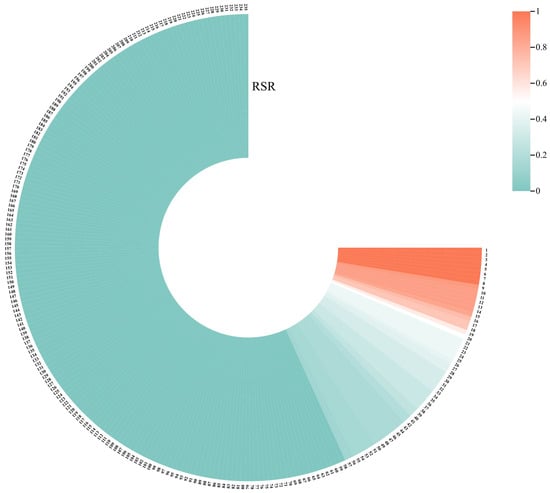
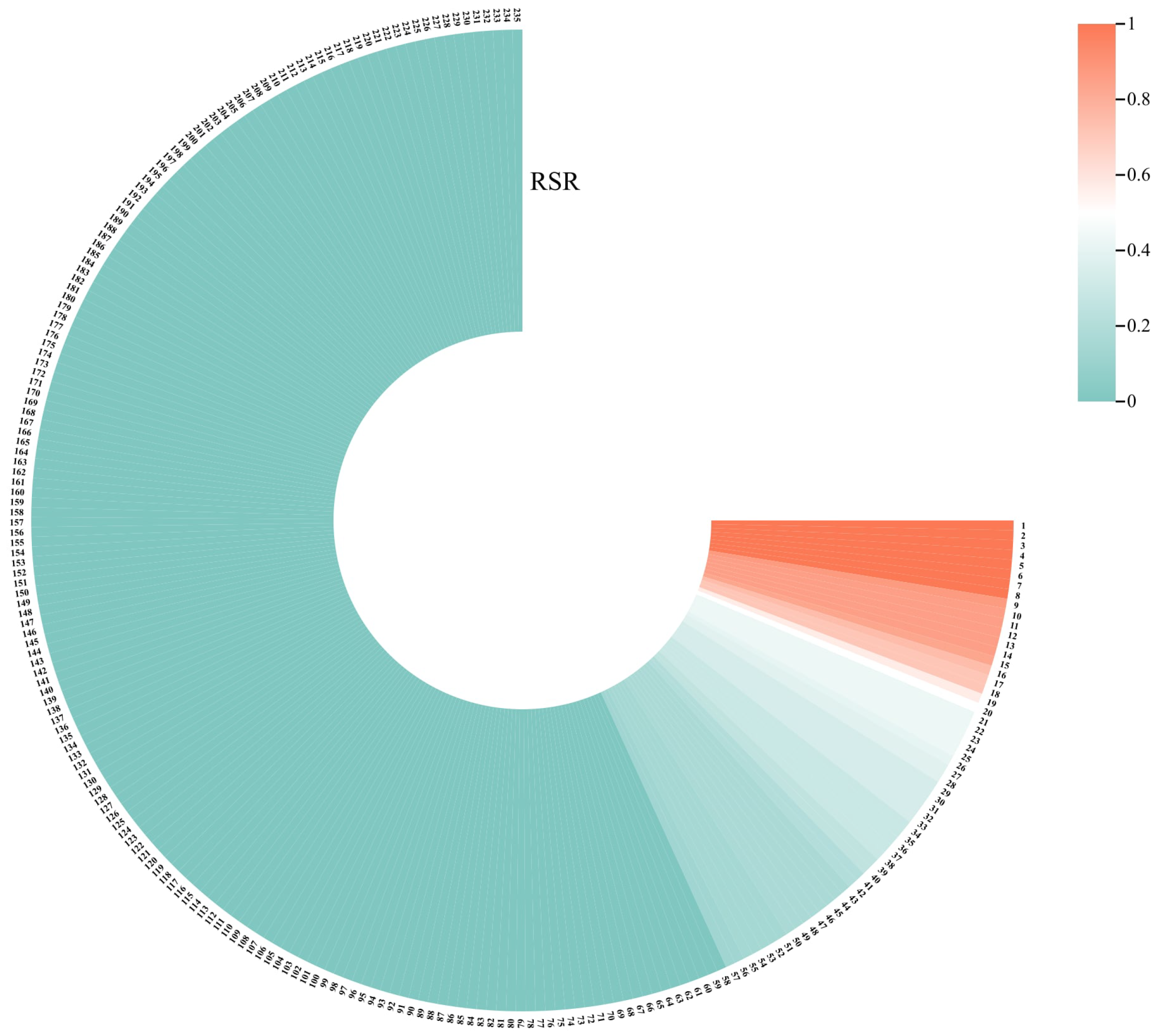
The RSR of 235 upland cotton germplasms fell into a range from 0% to 100%. Higher RSR values indicated greater salt tolerance (Figure 1). Some control plants in individual trays died during hydroponic screening at the seedling stage. As a result, a small number of germplasms with RSR > 100% were yielded. The above high values indicated experimental error rather than genuine salt tolerance advantages. Accordingly, an upper-bound truncation method was used to adjust any RSR exceeding 100% to 100%. Next, the salt tolerance of the germplasms was classified according to the adjusted RSR values. Based on the RSR, the 235 cotton germplasms fell into three categories: 50% ≤ RSR ≤ 100% was designated as salt-tolerant, 0 < RSR < 50% was designated as moderately salt-tolerant, and RSR = 0 was designated as salt-sensitive. Specifically, 20 germplasms (e.g., Ji Mian 262, Yan Min 38, Xinlu Zhong 87) were classified as salt-tolerant. A total of 37 germplasms (e.g., Yun Nan No. 4, Xinshi H12) were classified as moderately salt-tolerant, and 178 germplasms (e.g., Xinlu Zhong 88, Shenke 808, 808 superior lines, etc.) were salt-sensitive (Table 1). The above-mentioned salt-tolerant and salt-sensitive germplasms can act as references for subsequent comprehensive evaluations and field trials.
Figure 1.
Circular heatmap of 235 RSR germplasm resources of upland cotton.
Table 1.
Statistical analysis of the relative values of eight traits.
2.2. Statistical Analysis of Various Traits During the Cotton Seedling Stage
Statistical analysis was performed on eight traits’ relative values (Table 1). The mean values for plant height, cotyledon node diameter, belowground fresh weight, shoot dry weight, belowground dry weight, and chlorophyll content were less than 1. This result indicated that all six traits were inhibited by salt stress. In contrast, the mean values for shoot fresh weight and number of true leaves were higher than 1, suggesting an increasing trend under salt stress. Significant differences were observed among the mean values of the eight traits. As indicated by this result, different traits varied in their susceptibility to salinity, and plant height was the least affected. The coefficients of variation for the eight traits ranged from 12.452% to 43.158%. Specifically, plant height exhibited the lowest and belowground fresh weight had the highest coefficient. These results demonstrated the diverse responses of these traits to salt stress.
2.3. Principal Component Analysis and Correlation Analysis of Cotton Trait Indices
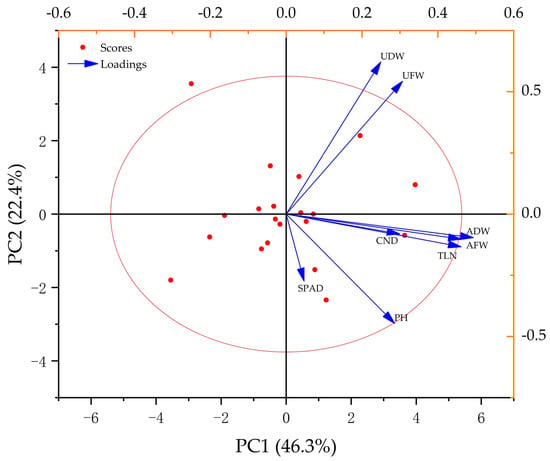
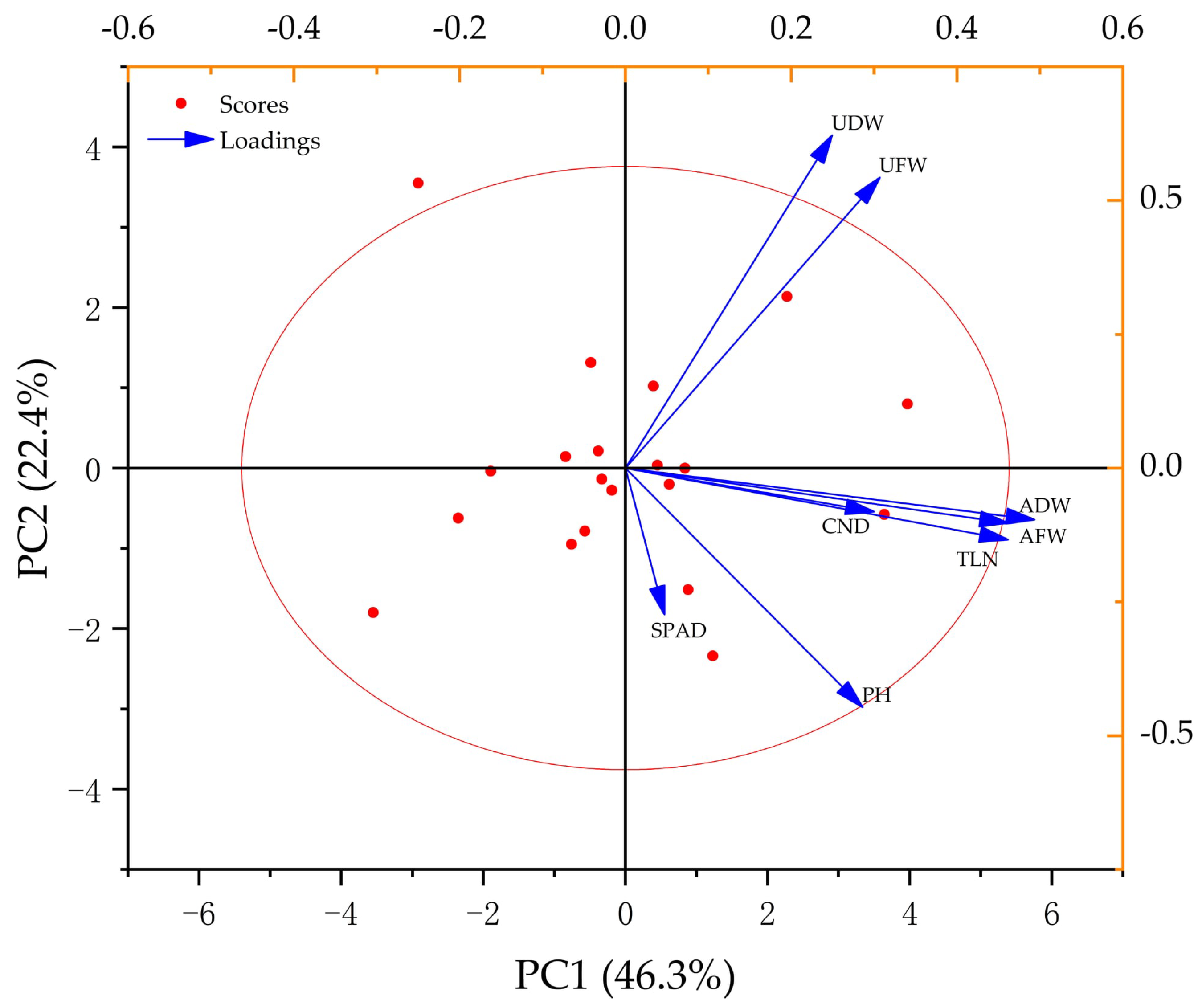
Principal component analysis was conducted on eight seedling-stage traits of 20 salt-tolerant germplasms (Table 2, Figure 2). Three principal components with eigenvalues greater than 1 were extracted, accounting for a cumulative contribution rate of 46.264%. PC1 contributed the largest share; traits with large absolute eigenvector values were aboveground fresh weight (0.494), aboveground dry weight (0.462), and the number of true leaves (0.461), indicating that PC1 mainly captures aboveground biomass accumulation under salt stress. For PC2, the coefficients of belowground dry weight (0.622) and belowground fresh weight (0.543) were relatively large, primarily representing root growth. In PC3, SPAD (0.740) had the largest absolute coefficient, mainly reflecting the plant’s photosynthetic physiological status. These findings reveal uneven weighting of the eight traits in the salt stress response.
Table 2.
Principal component analysis of 20 salt-tolerant germplasm resources.
Figure 2.
Principal component analysis scatter plot of salt resistance coefficients for eight traits. Note: PH, plant height; CND, cotyledon node diameter; AFW, aboveground fresh weight; UFW, underground fresh weight; ADW, aboveground dry weight; UDW, underground dry weight; TLN, True Leaf Number; SPAD, relative chlorophyll content.
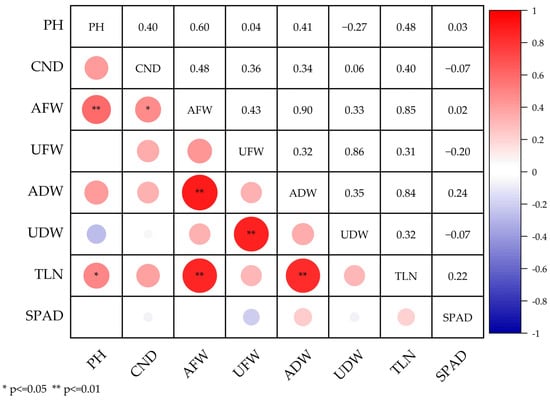
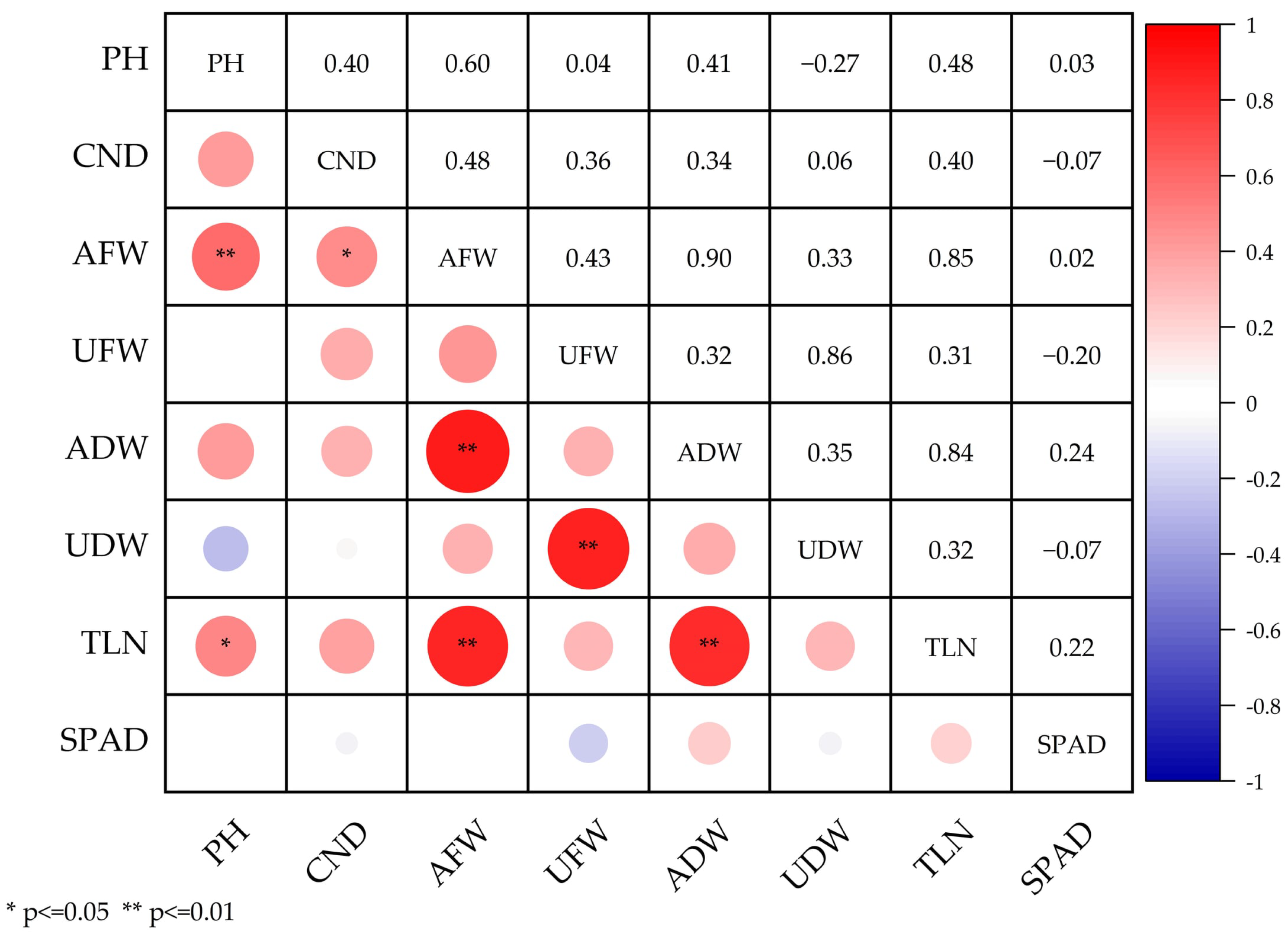
Correlation analysis was performed on the relative values of eight traits for 20 salt-tolerant germplasm accessions (Figure 3). Plant height showed an extremely significant positive correlation with shoot fresh weight (r = 0.60) and a significant positive correlation with the number of true leaves (r = 0.48). Cotyledon node diameter was significantly positively correlated with shoot fresh weight (r = 0.48). Shoot fresh weight displayed an extremely significant positive link to shoot dry weight (r = 0.90) and to the number of true leaves (r = 0.85). Underground fresh weight had an extremely significant positive link to underground dry weight (r = 0.86). The number of true leaves was extremely significantly positively correlated with shoot dry weight (r = 0.84). Correlations among the remaining traits were not statistically significant.
Figure 3.
Correlation analysis of the salt tolerance coefficients of eight seedling-stage traits. Note: * and ** indicate significant correlation at the 0.05 and 0.01 levels, respectively.
2.4. Comprehensive Evaluation of 20 Germplasm Lines at the Seedling Stage
A comprehensive evaluation was conducted on eight phenotypic traits and the RSRs of 20 salt-tolerant germplasms at the seedling stage through the membership function method. The overall evaluation values (D) for each tested germplasm were calculated and ranked (Table 3). A higher D value indicated better overall performance of the germplasm during the seedling stage. The results indicated that the D values of the 20 germplasms varied significantly (0.107 to 0.705). Germplasms 16, 18, 12, 10, and 4 achieved higher D values, indicating superior overall salt tolerance at the seedling stage.
Table 3.
D-values at the seedling stage and ranking of salt tolerance for 20 upland cotton germplasms.
2.5. Effect of Salt Stress on Ion Contents in Upland Cotton Seedlings
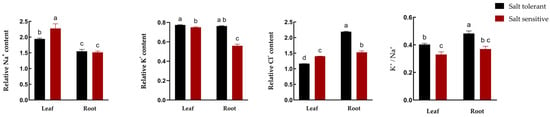
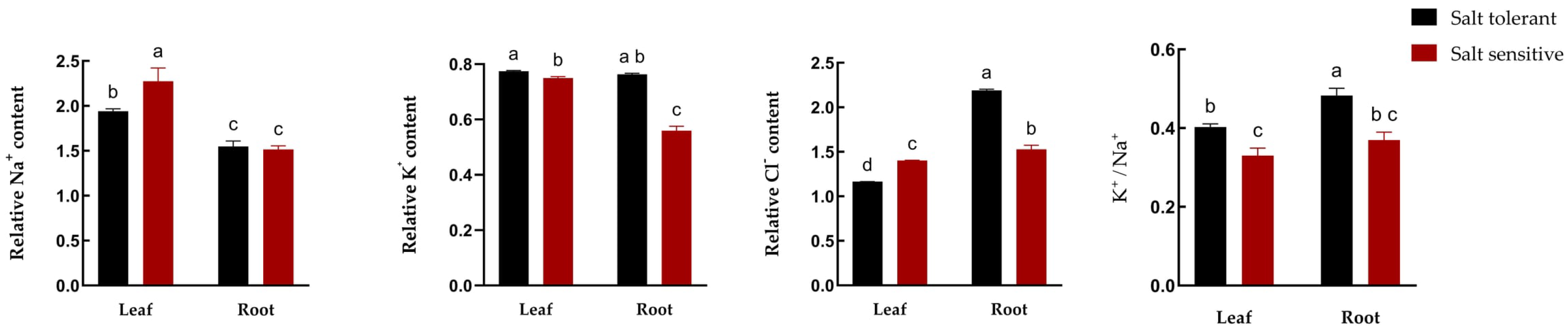
Significant tissue-specific differences under salt stress were observed in ion accumulation between the two groups of cotton germplasms (Figure 4). In leaves, the relative Na+ and Cl− contents in salt-sensitive germplasms were significantly higher than those in salt-tolerant germplasms. As indicated by this result, the shoots of salt-sensitive germplasms were more susceptible to ion toxicity. In contrast, the relative K+ content and the K+/Na+ ratio in salt-tolerant germplasms were significantly higher than those in salt-sensitive germplasms, which could be conducive to maintaining normal physiological functions in the leaves.
Figure 4.
Na+, K+, and Cl− contents, as well as the relative K+/Na+ ratio, in the leaves and roots of salt-tolerant and salt-sensitive germplasms. Note: The black bars represent the mean values of five salt-tolerant germplasm samples; the red bars represent the mean values of five salt-sensitive germplasm samples; and the error bars indicate the mean ± standard deviation. Lowercase letters indicate statistically significant differences at p < 0.05.
In the root system, the pattern of ion accumulation differed from that in the leaves. In comparison with salt-sensitive germplasms, salt-tolerant germplasms had a significantly higher relative Cl− content. This result indicated that salt-tolerant germplasms retained more Cl− in the roots, thereby alleviating Cl− toxicity in the leaves. Salt-tolerant germplasms also had a significantly higher relative K+ content than salt-sensitive germplasms. This result demonstrated that the salt-tolerant germplasms had a stronger capacity for K+ uptake. No significant difference was detected in the relative Na+ content between the two types of germplasm. This result revealed that differences in Na+ accumulation in the leaves were not due to variations in root Na+ uptake but rather to differences in Na+ translocation to the leaves, with more Na+ being transported and accumulated in the leaves. Furthermore, in both leaves and roots, salt-tolerant germplasms maintain a higher K+/Na+ ratio, which lays an important ionic basis for their enhanced salt tolerance.
2.6. Effect of Salt Stress on Root Morphology at the Adult Stage in Salt-Tolerant and Salt-Sensitive Germplasms
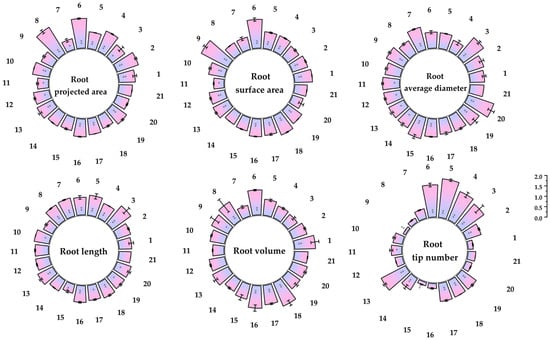
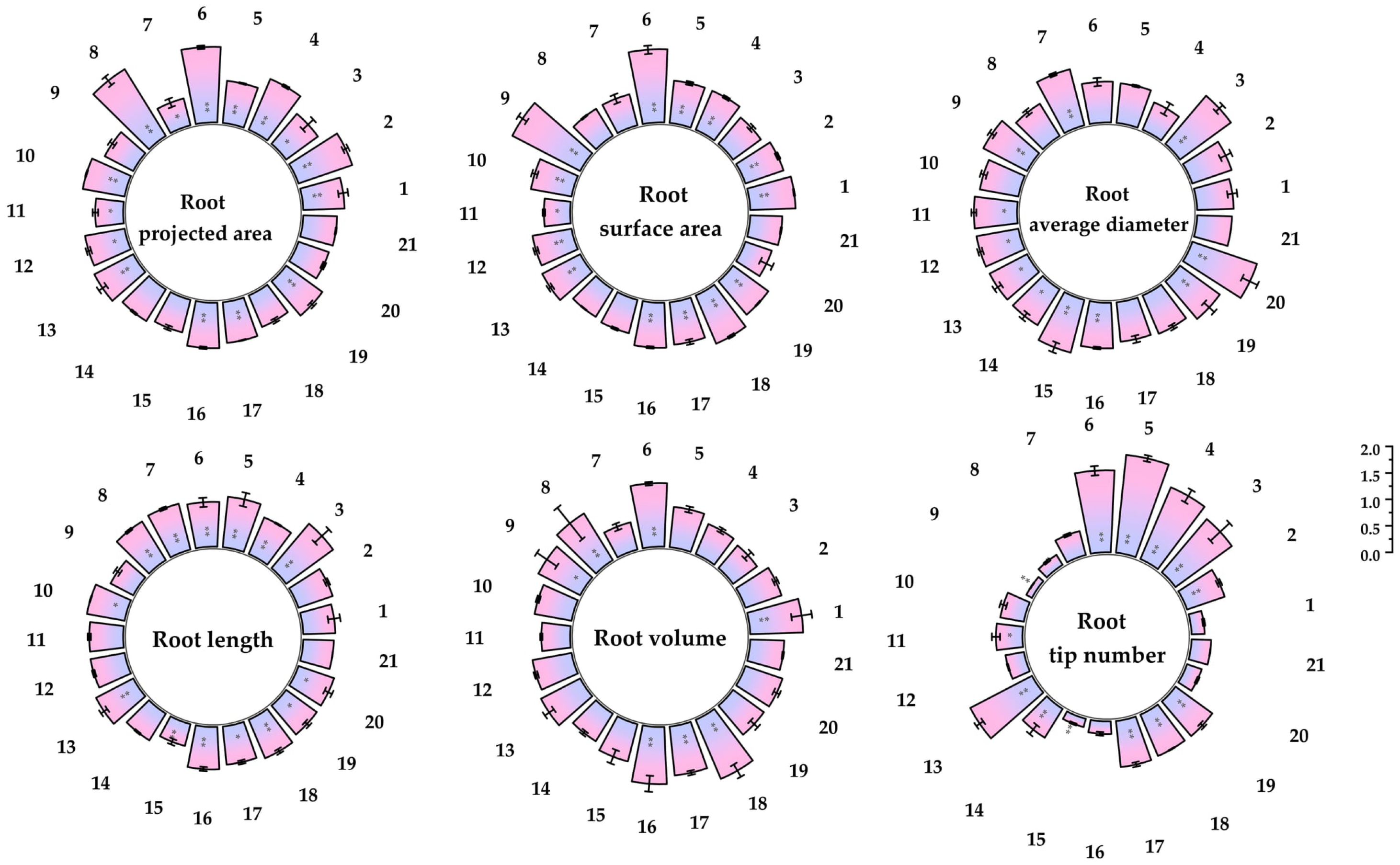
We measured six root morphological traits (Figure 5) and compared the significance of differences between the mean values of salt-tolerant and salt-sensitive germplasms to evaluate the root growth characteristics of 20 salt-tolerant germplasms and 5 salt-sensitive germplasms comprehensively. Root traits showed substantial variation among germplasms. Germplasms 6, 8, and 9 had superior root projected area, surface area, and volume. Germplasms 3, 7, and 20 had larger mean root diameters. Germplasms 3, 5, and 7 had longer roots. Compared with the salt-sensitive germplasms, germplasms 4, 5, and 6 had significantly more root tips. The salt-sensitive germplasms displayed smaller projected area, surface area, and number of root tips. This result indicated that salt stress could strongly inhibit root morphology in these lines. Compared with the salt-sensitive germplasms, most salt-tolerant germplasms exhibited significantly better root metrics. This result revealed that salt-tolerant germplasms could maintain favorable root morphology under saline stress.
Figure 5.
Effects of salt stress on root morphology at the mature stage of salt-tolerant and salt-sensitive germplasms. Note: Here, 1–20 represent salt-tolerant upland cotton germplasms, and 21 represents the mean of five salt-sensitive accessions; * indicates significance at the 0.05 level; ** indicates significance at the 0.01 level.
2.7. Effect of Salt Stress on Photosynthesis During the Flowering and Boll Formation Stage in Salt-Tolerant and Salt-Sensitive Germplasms
As indicated by analysis of variance, Gs, Ci, and Tr differed significantly with time, and photosynthetic parameters showed significant differences in germplasms and in the time × germplasm interaction, which could lay a foundation for comparative analysis among germplasms (Table 4).
Table 4.
Relative values of photosynthesis during the flower-bud stage in salt-tolerant and salt-sensitive germplasms.
On July 20, the Pn of most of the salt-tolerant germplasms was higher than that of the salt-sensitive germplasms. In particular, germplasms 13 (1.015) and 7 (1.006) had significantly higher values than the salt-sensitive germplasms, and germplasm 17 (0.944) was also significantly higher. There were no significant differences in Gs between the salt-tolerant germplasms and the salt-sensitive germplasms (0.606). For most salt-tolerant germplasms, Ci and Tr were significantly higher than those of the salt-sensitive germplasms; among them, the Tr values of germplasms 6, 13, and 19 were extremely significantly higher than those of the salt-sensitive germplasms, indicating strong water metabolism activity. The SPAD values of germplasms 3, 4, 5, 7, 9, 11, and 16 were significantly higher than those of the salt-sensitive germplasms, suggesting that the salt-tolerant germplasms exhibited favorable photosynthetic characteristics on July 20.
On August 10, the Pn (0.609), Gs (0.462), and Tr (0.577) values of the salt-tolerant germplasms decreased significantly. The Pn values of germplasms 4, 5, 7, 9, 10, 11, 12, and 17 were significantly higher than those of the salt-tolerant germplasms; the Gs values of germplasms 10, 12, 19, 17, and 4 were significantly higher than those of the salt-tolerant germplasms. The Ci values of germplasms 16, 15, and 7 were significantly higher than those of the salt-tolerant germplasms. The Tr values of germplasms 4 and 6 were significantly higher than those of the salt-tolerant germplasms. The SPAD values of germplasms 14 and 17 were significantly higher than those of the salt-tolerant germplasms. These results indicate that the salt-tolerant germplasms exhibited relatively high net photosynthetic rates on August 10.
2.8. Effect of Salt Stress on Seed Cotton Yield in Salt-Tolerant and Salt-Sensitive Germplasms
Under salt stress, all of the tested germplasms’ seed cotton yield decreased to varying degrees (Table 5). Overall, most of the salt-tolerant groups (1–20, 0.67–0.97) exhibited higher seed cotton yield than the salt-sensitive groups (58–62, 0.60–0.79).
Table 5.
Relative seed cotton yield of different upland cotton germplasm lines under salt stress.
There were also differences in seed cotton yield among different salt-tolerant germplasms. Germplasms 10 (0.967), 6 (0.963), 3 (0.952), 13 (0.947), 4 (0.942), and 20 (0.910) achieved relatively high values, which indicated good yield under salt stress. In contrast, germplasms 17 (0.671), 8 (0.686), and 11 (0.716) exhibited weak salt tolerance. Although these three germplasms were classified as salt-tolerant at the seedling stage, they exhibited lower tolerance to salt stress at the mature plant stage. The salt-sensitive germplasms 62 (0.598), 58 (0.634), and 59 (0.648) had low relative values and the poorest salt tolerance. Salt-sensitive germplasms 60 and 61 showed relatively high values at the mature plant stage, which might display a link to systematic errors occurring during that developmental phase.
3. Discussion
3.1. Differential Analysis of Cotton Seedling Traits Under Salt Stress and Screening of Salt-Tolerant Germplasm
Cotton is a moderately salt-tolerant crop, and salt tolerance varies considerably among different varieties [25]. Field-based salt tolerance evaluation is highly susceptible to environmental conditions, while laboratory screening of germplasm can accurately grade salt tolerance levels [26]. In this study, we first conducted preliminary screening for seedling salt tolerance and then performed further validation in the field, ensuring both the comprehensiveness and practical applicability of the germplasm salt tolerance assessment [27].
A single trait cannot adequately indicate a plant’s salt tolerance. Thus, multiple traits should be analyzed for accurate identification [28,29,30]. When screening varieties under abiotic stress, traits such as stem diameter, fresh root weight, and dry root weight can be considered [31]. Accordingly, this study adopted RSR as an indicator for preliminary screening of salt tolerance at the seedling stage among the 235 upland cotton germplasms. The 20 selected salt-tolerant accessions were further evaluated for eight morphological traits at the seedling stage. Combining principal component analysis with the membership function method overcame the limitations of relying on a single evaluation approach. The comprehensive evaluation indicated that germplasms 16, 18, 12, 10, and 4 obtained high D values and exhibited strong salt tolerance at the seedling stage.
These materials can serve as key candidate resources for salt tolerance breeding, and these evaluation methods also offer a reference for screening salt-tolerant germplasm at the seedling stage.
3.2. Ion Homeostasis in Cotton Roots and Leaves Under Salt Stress
Salt stress causes substantial changes in inorganic ion levels within cotton plants, and Na+ represents one of the primary toxic factors under salt stress [32]. In this study, obvious tissue-specific differences in Na+ accumulation were observed between salt-tolerant and salt-sensitive germplasms. The relative Na+ content in the leaves of salt-sensitive germplasms was significantly higher than that of salt-tolerant germplasms, whereas root Na+ concentrations did not differ significantly between the two groups. The above-mentioned results agree with the report of Higbie et al. [5] on tetraploid cultivated cotton. Specifically, they found that leaf Na+ accumulation was markedly lower in salt-tolerant genotypes than in salt-sensitive ones, suggesting that limiting Na+ translocation to the shoot is a key mechanism for cotton salt tolerance. Wang Renlei et al. also reported reduced Na+ accumulation in salt-tolerant cotton germplasm. In the present study, Na+ accumulation in the leaves of salt-tolerant germplasm was significantly lower than that in salt-sensitive germplasm, while root Na+ concentrations did not differ significantly between the two groups. These results revealed that cotton salt tolerance can be primarily manifested through regulated Na+ transport.
For sustaining protein synthesis, ion balance, and cytoplasmic pH stability in plants, it is necessary to maintain intracellular K+ homeostasis [33]. In this study, leaf and root K+ concentrations were higher in salt-tolerant genotypes than those in salt-sensitive genotypes, and the difference was more pronounced in the roots. This result indicated that under salt stress, salt-tolerant genotypes could better maintain K+ uptake and accumulation, thereby ensuring relatively high K+ levels in leaves to counteract Na+ toxicity and preserve their ion balance [34]. The K+/Na+ ratios in salt-tolerant genotypes’ leaves and roots were significantly higher than those of salt-sensitive genotypes, and the K+/Na+ ratio in the roots of salt-tolerant genotypes was significantly greater than in the leaves. This indicates that cotton could regulate Na+ and K+ transport under salt stress to maintain a favorable K+/Na+ balance, which constitutes an important feature of its salt tolerance [35]. However, this study found that Cl− content in the roots of salt-tolerant genotypes was significantly higher than that in leaves. This finding differs from an earlier conclusion that “cotton roots have limited capacity to retain Na+ and Cl−, allowing Cl− to readily translocate to leaves and result in elevated Cl− levels” [36]. The above inconsistency may be related to differences among cotton genotypes.
3.3. Salt Tolerance Adaptation Mechanisms of Cotton Root Morphology Under Salt Stress
Cotton roots form a taproot system consisting of a main root and lateral roots [37], and cotton can adapt to diverse adverse environments by adjusting root architecture [38]. The results of this study showed that under salt stress, salt-sensitive germplasms had smaller projected area, surface area, and root tip number relative to salt-tolerant germplasms, accompanied by inhibited root growth; these observations are consistent with most published cotton studies. Liu Danyang et al. [39] found that moderate to severe salt stress significantly restricted cotton root length, root surface area, and root volume, and Gong Jiang et al. [40] similarly reported that rising salinity suppressed cotton root growth; several studies further noted that mild salt stress may moderately promote root growth [41]. In this study, we assessed mature roots exposed to relatively high salinity: salt-tolerant germplasms preserved normal root morphology through vigorous root development, whereas salt-sensitive germplasms suffered overall root growth inhibition. These findings support the conclusion of Li et al. [42] that “cotton alleviates salt stress by optimizing root architecture.” Based on comparisons of six morphological traits of mature plants between the 20 salt-tolerant accessions and salt-sensitive materials, we detected clear differences in root architecture among tolerant lines; specifically, the average root diameter was significantly larger in most tolerant genotypes, consistent with Duan et al. [43], who demonstrated that enhanced main root thickening improves cotton salt tolerance. In addition, individual root morphological traits did not change independently but acted synergistically to shape the root architecture of salt-tolerant plants. Accordingly, most root-related indicators were significantly higher in salt-tolerant germplasms than in salt-sensitive germplasms.
3.4. Mechanisms of Photosynthetic Response in Cotton Under Salt Stress
Salt stress suppresses plant photosynthesis through stomatal and non-stomatal limitations. The response patterns of Pn, Gs, Ci, Tr, and chlorophyll content serve as key physiological indicators for evaluating crop salt tolerance [44]. As indicated by our results, under salt stress Pn, Gs, and Tr of salt-sensitive genotypes in the flowering–boll formation stage were significantly lower than those of salt-tolerant genotypes and decreased further with extended stress duration. The above result can be consistent with the results of Hamani et al. [45] and Wang Bohao et al. [46]. With the increase in salinity, Pn, Gs, and Tr decreased synchronously in the flowering–boll formation stage. The possible reason for this result is that salt accumulation in roots triggers stomatal closure, chlorophyll degradation, and photosystem damage. On July 20, most of the salt-tolerant genotypes showed significantly higher Ci and Tr values than the salt-sensitive genotypes, which is not consistent with previous conclusions that “photosynthetic gas exchange is generally suppressed under saline conditions.” This discrepancy may arise from the well-developed root systems of tolerant genotypes, which maintain leaf water potential and stomatal function through osmotic adjustment to adapt to the saline–thermal complex environment of southern Xinjiang [47]. The types of photosynthetic limitation in this study also displayed temporal shifts. In the early stage of stress, Gs showed no significant difference between tolerant and sensitive genotypes. In the later stage, however, Pn, Gs, and Tr declined markedly in sensitive genotypes, while Gs continued to be significantly higher in most tolerant genotypes, aligning with the findings of Zhang Wanheng et al. [48]. As indicated by the above results, salt-tolerant genotypes exhibited favorable Ci, Tr, and SPAD values on July 20, and superior Pn and Gs on August 10.
3.5. Genotypic Differences in Cotton Yield Response to Salt Stress
Cotton yield is a complex quantitative trait controlled by multiple factors; it is determined by varietal genetic characteristics and is also highly vulnerable to external environmental conditions [49]. This study performed a comprehensive yield evaluation across different germplasms. The results showed that seed cotton yield decreased to different degrees in all tested germplasms after salt exposure, consistent with the findings of Chen Binglin et al. [50]. Although some germplasms displayed salt tolerance in the seedling stage, they had low yields under complex field conditions, which may be related to the soil environment in the field [51].
Moreover, consistent with the previous statement that “salt-sensitive cotton materials face extremely high risks when grown in saline–alkali soils” [52], the salt-sensitive germplasms in this study experienced severe yield loss under salt stress. Therefore, selection relying only on seedling-stage traits is insufficient in salt tolerance breeding. It is necessary to carry out a comprehensive evaluation incorporating field yield performance. The germplasm lines 10 and 6 identified in this study can maintain relatively high yield under salt stress. They can serve as core genetic resources for developing high-yield and salt-tolerant cotton cultivars, and also provide valuable materials for further dissecting the genetic basis of salt tolerance in cotton using genomic and transcriptomic approaches.
4. Materials and Methods
4.1. Materials
A total of 235 cotton germplasm accessions were employed in the study, provided by the Germplasm Resource Bank of the College of Agriculture at Tarim University. Detailed information is given in Table S4 of the Supplementary Materials.
4.2. Selection of Salt-Stress Concentration
Fifty cotton germplasm accessions were selected for a preliminary indoor pot seedling experiment. Uniform seeds were sown in seedling pots with drainage holes. The growth medium consisted of peat soil: vermiculite = 3:1. Seeds were planted at a depth of 2 cm. Each pot was irrigated with 250 mL of Hoagland nutrient solution. Seedlings were grown in the light incubation room of the College of Agriculture, Tarim University, under a light intensity of 1400 μmol·m−2·s−1, day/night temperatures of 30 °C/21 °C, a 16 h/8 h photoperiod, and 60% relative humidity. When the cotton seedlings reached the two-leaf, one-heart stage, seedlings with uniform growth were selected for salt-stress treatment. Seedlings were transplanted into 1 L turnover boxes. The respective box had an 8-hole PVC plastic lid at the top. The seedlings were secured with planting cotton. Each treatment included three replicates and was subjected to hydroponic stress with Hoagland nutrient solution (control) or Hoagland solution supplemented with 200 mM NaCl. The nutrient solution was renewed every 3 days. Aeration was supplied twice daily for 30 min each time. After 4 weeks of treatment, the RSR of the 50 accessions was assessed. The results showed that under 200 mM NaCl stress, the RSRs of these accessions ranged only from 0% to 10% without significant inter-accession differences, indicating that this stress level was excessively high. Hydroponic stress was then tested using 150 mM NaCl. At this concentration, clear differences in RSRs were observed among accessions, enabling differentiation of their salt tolerance levels.
4.3. Experimental Design
4.3.1. Seedling-Stage Trial
The seedling-stage experiment was performed in the light incubation room of the College of Agriculture, Tarim University, with environmental conditions consistent with those of the preliminary seedling-stage trial. All 235 cotton germplasm accessions were subjected to potted seedling cultivation under controlled conditions. The salt-stress protocol during the seedling stage matched that used in the preliminary trial. After four weeks of stress exposure, the RSR was assessed. Plants were considered dead when all leaf blades had withered and fallen off, leaving only stems.
4.3.2. Field Trials
Twenty salt-tolerant and five salt-sensitive germplasms were selected for field trials carried out in 2025 at the Southern Xinjiang Industry-Education Integrated Modern Agriculture Training Base of Tarim University. The experimental soil was sandy loam, and a two-factor randomized complete block design with three replicates was adopted. Each plot was 5 m long and 2.27 m wide, with a plant and row spacing arrangement of (10 + 66 + 10 + 66 + 10) cm × 10.5 cm. Treatments comprised standard drip irrigation and drip irrigation under salt stress (initial total soil salt content: 15.58 g·kg−1). The management practices were identical to those employed in the field. Stress was imposed from June 11 to August 20. In this period, the treatment plots received ten irrigations. For each salt-stress irrigation, 100 kg of industrial salt (industrial sodium chloride, purity ≥96%, GB/T 5462, supplied by Xinjiang Yanhu Salt Production Co., Ltd., Urumqi, Xinjiang, China) was applied. At harvest, the total salt concentration in stressed plots reached 25.89 g/kg.
4.4. Determination of Indicators
Ion content determination: On the basis of seedling-stage identification results, five salt-tolerant and five salt-sensitive germplasms were selected. After 72 h of hydroponic cultivation, true leaves and root systems were collected for ion analysis. For cotton seedlings, the second true leaf was used. The roots were fully rinsed in 10 mM CaCl2 for 60 s, and surface liquid was blotted dry with filter paper. Three replicates were prepared for both control and salt-treated samples. Leaf and root samples were first killed at 105 °C in an oven and then dried at 80 °C to constant weight. After grinding through a 60-mesh sieve, sample detection was performed by Jiangsu ELISA Biotechnology Co., Ltd. Na+ and K+ concentrations were determined via atomic absorption spectrophotometry, and Cl− concentration was measured via ion chromatography.
Measurement of photosynthetic parameters: Five days after drip irrigation during the flowering–boll-setting stage (July 20 and August 10), three plants per replicate were selected. Measurements were taken using a chlorophyll meter (HM-YD) and a LI−6400 portable photosynthesis system (LI-COR Biosciences, Lincoln, NE, USA) between 10:00 and 13:00. Leaf chamber settings were set as follows: photosynthetically active radiation (PAR) of 1500 μmol·m−2·s−1, CO2 concentration of 400 μmol·mol−1, leaf temperature of 30 °C, and relative humidity of 50–60%. The third fully expanded leaf from the top was used to measure Pn, Gs, Ci, Tr, and SPAD values.
Root system measurements: At cotton harvest, three plants were sampled per replicate. Root cores were collected using a root auger. Samples were soaked in clean water for 8–10 h and washed through a 0.1 mm mesh sieve to remove debris. Root images at 300 dpi were acquired using Epson Scan 2 (Version 6.7.84.0, Seiko Epson Corporation, Suwa, Nagano, Japan), and the WinRHIZO (Version 2022a, Regent Instruments Inc., Quebec City, QC, Canada) root scanning and analysis system scanning and analysis system was used to obtain root length, projected area, root surface area, root volume, average root diameter, and root tip number.
Determination of seed cotton yield: At harvest, seed cotton yield was measured on 15 plants per genotype under saline treatment and normal drip irrigation, with three replicates. Samples were weighed using an electronic balance (0.1 g precision), and relative seed cotton yield was calculated.
Absolute values of different traits were normalized, and relative values were used for salt tolerance evaluation; the mean relative value of each index was calculated for the five salt-sensitive germplasms [53].
Calculation formula:
In the equation, Xij is the relative value of the jth trait for the ith germplasm; Nij is the measured value of the jth trait under salt stress for the ith germplasm; and Cij is the measured value of the jth trait under the control treatment for the ith germplasm.
The membership function method was adopted for comprehensive evaluation at the seedling stage.
Calculation formula:
In the equation, U denotes the membership function value, Xij represents the jth principal component score of the ith germplasm, Xjmax is the maximum value of the jth principal component, and Xjmin is the minimum value of the jth principal component [54].
Principal component weight calculation formula:
In the equation, j = 1, 2, …, n; Wj denotes the weight of the jth principal component and Pj denotes the contribution rate of the jth principal component.
Comprehensive evaluation formula for salt tolerance:
In the equation, the D value represents the comprehensive salt tolerance score of the ith germplasm.
4.5. Meteorological Conditions of the Experimental Site
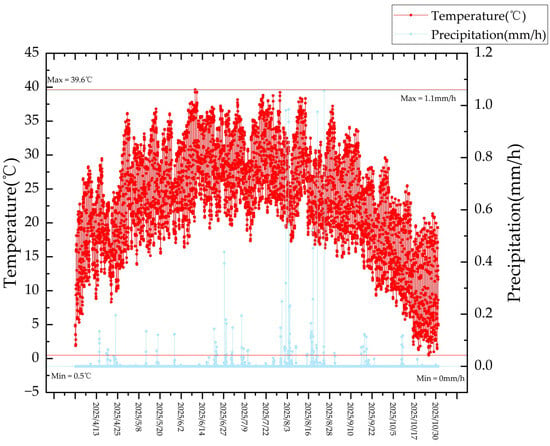
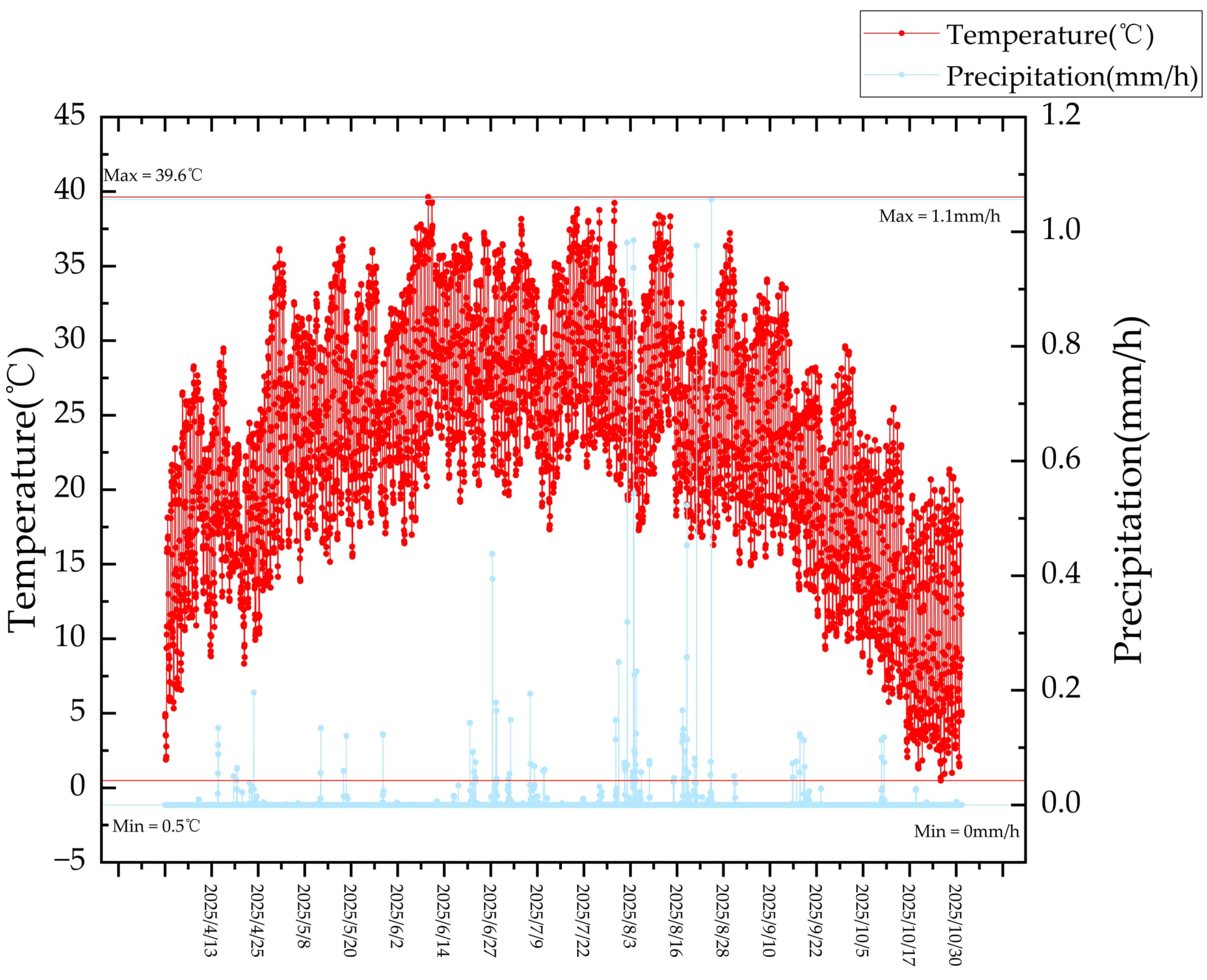
Meteorological conditions at the test site in 2025 (Figure 6): Annual temperature first increased and then decreased, with a maximum temperature of 39.6 °C and a minimum of 0.5 °C. Precipitation was concentrated during the cotton growing period from May to September, mostly as short-duration showers, with a maximum rainfall intensity of 1.1 mm/h.
Figure 6.
Meteorological conditions at the test site in 2025.
4.6. Data Analysis
Data were compiled and relative values were calculated in Microsoft Excel; RSR values exceeding 100% at the seedling stage were truncated and adjusted to 100%. Statistical analyses were conducted using SPSS 20.0 and GraphPad Prism 10. At the seedling stage, two-way ANOVA was performed for eight traits, Na+, K+, Cl− contents, and the K+/Na+ ratio, followed by Tukey’s test for multiple comparisons. At the mature stage, one-way ANOVA with LSD multiple comparison was applied to six root morphological traits. Two-way ANOVA with LSD multiple comparison was conducted for photosynthetic parameters during the flowering–boll-setting stage. Seed cotton yield was analyzed using one-way ANOVA. Principal component analysis was used to determine eigenvalues, contribution rates, cumulative contribution rates, and factor loadings for each trait. Pearson correlation coefficients (two-tailed) were used to assess trait correlations. Figures and tables were generated with Origin 2024 and GraphPad Prism; circular cluster heatmaps were constructed on the Chiplot platform (https://chiplot.online). Error bars indicate mean ± standard deviation.
5. Conclusions
This study used 235 upland cotton germplasms as materials. Preliminary screening under hydroponic salt stress at the seedling stage identified 20 salt-tolerant accessions. Comprehensive evaluation using principal component analysis and the membership function method highlighted the prominent seedling-stage salt tolerance of accessions 4, 10, 12, 16, and 18. Ion analysis revealed that tolerant germplasms relieve ion toxicity by restricting Na+ transport to leaves, sequestering Cl− in roots, and maintaining high K+ levels and a high K+/Na+ ratio. Salt-tolerant germplasms outperform salt-sensitive germplasms in root morphology in the mature plant stage, photosynthetic regulation in the flowering and boll stage, and seed-cotton yield. Overall, germplasm lines 10 and 4 show excellent performance in salt tolerance in the seedling stage, photosynthetic regulation in the flowering and boll stage, and seed-cotton yield. The above two accessions achieve coordinated salt tolerance in the seedling stage, physiological performance in the mature plant stage, and high yield, thereby acting as core germplasms for salt-tolerant, high-yield breeding programs.
Supplementary Materials
The following supporting information can be downloaded at https://www.mdpi.com/article/10.3390/plants15233682/s1. Table S1: Primary data,Relative values of seedling characteristics in 20 salt-tolerant germplasm samples; Table S2: Relative values of mean root characteristics for 20 salt-tolerant germplasm lines and 5 salt-sensitive germplasm lines; Table S3: Relative values of average photosynthetic indicators for 20 salt-tolerant germplasm lines and 5 salt-sensitive germplasm lines; Table S4: Information on the sources of 235 upland cotton germplasm resources; Table S5: Relative survival rates of 50 germplasm samples in a 200 mmol/L NaCl solution; Table S6: Raw data of Na+, K+ and Cl− concentrations in leaves and roots of upland cotton germplasms under salt stress; Table S7: Growth stage of experimental cotton in 2025; Figure S1: Comparison diagram of root morphology; Figure S2: Photographs of the phenotypes of large-field plants.
Author Contributions
Conceptualization, W.G.; methodology, W.G., X.C. and X.Z.; software, X.Z.; validation, X.C.; formal analysis, X.Z.; investigation, X.Z., J.B., G.T. and S.M.; resources, W.G.; data curation, X.Z.; writing—original draft preparation, X.Z.; writing—review and editing, W.G. and X.C.; visualization, X.Z.; project administration, X.Z.; funding acquisition, W.G. All authors have read and agreed to the published version of the manuscript.
Funding
The projects sponsored by the Development Fund for Xinjiang Talents XL (Project NO: XL202403) and the innovative research team for cultivating high yield, high quality, and stress resistant new cotton varieties (Project NO: TDZKCX202503).
Data Availability Statement
Data are contained within the article.
Conflicts of Interest
The authors declare no conflicts of interest.
References
- Ayesha, J.; Tahmina, N.; Mohsin, A.; Zhu, Y.H.; Li, J.; Zhang, H.Y.; Wu, J.; Xiang, C.; Wu, S. Thellungiella halophila ST103 enhances salt tolerance in Gossypium hirsutum. J. Cotton Res. 2022, 5, 13. [Google Scholar] [CrossRef] [Scilit]
- Sun, Z.W.; Li, H.L.; Zhang, Y.; Li, Z.K.; Ke, H.F.; Wu, L.Q. Identification of SNPs and Candidate Genes Associated With Salt Tolerance at the Seedling Stage in Cotton (Gossypium hirsutum L.). Front. Plant Sci. 2018, 9, 1011. [Google Scholar] [CrossRef] [Scilit] [PubMed]
- Wang, Y.; Yu, Y.H.; Wan, H.N.; Tang, J.; Ni, Z.Y. The sea-island cotton GbTCP4 transcription factor positively regulates drought and salt stress responses. Plant Sci. Int. J. Exp. Plant Biol. 2022, 322, 111329. [Google Scholar] [CrossRef] [Scilit] [PubMed]
- Cui, C.J.; Feng, L.C.; Zhou, C.H.; Wan, H.; Zhou, B.L. Transcriptome Analysis Revealed that GhPP2C43-A Negatively Regulates Salinity Tolerance in an Introgression Line from a Semi-Wild Upland Cotton. Plant Cell Physiol. 2023, 64, 786–802. [Google Scholar] [CrossRef] [Scilit] [PubMed]
- Higbie, S.M.; Wang, F.; Stewart, J.M.; Sterling, T.M.; Lindemann, W.C.; Hughs, E. Physiological response to salt (NaCl) stress in selected cultivated tetraploid cottons. Int. J. Agron. 2010, 2010, 643475. [Google Scholar] [CrossRef] [Scilit]
- Fu, Y.Y.; Jiang, X.H.; Shen, X.J.; Sun, W.J.; Zhang, J.P.; Amin, A.S.; Gao, Y. The relationship between foliar K + and Na + concentrations and photosynthetic parameters of cotton seedlings under salt stress. Chin. J. Ecol. 2021, 40, 1716–1722. [Google Scholar] [CrossRef]
- Cheng, L.H.; Yang, H.L.; Zhang, D.W.; Ma, Q.Q.; Zhang, D.Y. Analysis of salt tolerance of ScALDH21 transgenic cotton. Acta Agric. Boreali-Sin. 2022, 37, 1–7. [Google Scholar]
- Loka, D.A.; Oosterhuis, D.M.; Ritchie, G.L. Water-deficit stress in cotton. Stress Physiol. Cotton 2011, 7, 37–72. [Google Scholar]
- Che, B.N. Function Analysis of Halophyte Tamarix SOSI Gene to Improve Salt Tolerance of Cotton; Nanjing Agricultural University: Nanjing, China, 2021. [Google Scholar] [CrossRef]
- Li, H.M.; Yin, H.; Xue, L.S.; Zhang, S.W.; Shi, Y.Q.; Ma, X.Y.; Zhao, T.L.; Chen, J.H.; Zhu, S.J. Comprehensive evaluation of two salt tolerance identification methods and salt tolerance identification of glandless cotton germplasms. Cotton Sci. 2024, 36, 306–319. [Google Scholar] [CrossRef]
- Lu, X.Y.; Guo, J.X.; Tao, Y.F.; Ye, Y.; Gui, C.H.; Guo, H.J.; Min, W. Effects of different salt and alkali stress on absorption, transportation, and metabolis of nutrient elements in cotton. Chin. J. Eco Agric. 2022, 31, 438–451. [Google Scholar]
- Du, L.; Xiong, D.B.; Zhao, H.H.; Li, C.Q. Research on salt tolerance differences of cotton in germination and seedling stages andgermplasm identification. Seed 2023, 42, 59–63. [Google Scholar] [CrossRef]
- Wang, J.J.; Fan, W.L.; Ye, W.W.; Wang, D.L. The research and application of the method of salt tolerance on upland cotton at the germination and seedling stages. Jiangsu Acad. Agric. Sci. 2010, 2, 87–88. [Google Scholar] [CrossRef]
- Munns, R.; Tester, M. Mechanisms of salinity tolerance. Annu. Rev. Plant Biol. 2008, 59, 651–681. [Google Scholar] [CrossRef] [Scilit] [PubMed]
- Qin, L.X.; Nie, X.Y.; Hu, R.; Li, G.; Xu, W.L.; Li, X.B. Phosphorylation of serine residue modulates cotton Di19-1 and Di19-2 activities for responding to high salinity stress and abscisic acid signaling. Sci. Rep. 2016, 6, 20371. [Google Scholar] [CrossRef] [Scilit] [PubMed]
- Wang, T.; Kong, X.Q.; Song, Y.; Dong, H.Z. The Effects of NaCl Stress on Cotton Leaf Senescence Characteristics and Physio-logical Mechanisms. Cotton Sci. 2014, 26, 66–72. [Google Scholar]
- Liu, Y.; Cui, S.F.; Zhang, H.N.; Qian, Y.Y.; Wang, G.E.; Jin, W.P. Research progress of response mechanisms of cotton to salt stress and mitigation measures. J. Agric. 2015, 5, 10–16. [Google Scholar]
- Xin, C.S.; Luo, Z.; Wu, Z.M. Variations in physiological and biochemical characteristics of salt tolerance between different cultivars of insect-resistant cotton at the seedling stage. Cotton Sci. 2012, 24, 406–413. [Google Scholar]
- Peng, Z.; He, S.P.; Sun, J.L.; Xu, F.F.; Jia, Y.H.; Pan, Z.E. An efficient method for identifying salt tolerance of upland cotton at seedling stage. Acta Agron. Sin. 2014, 40, 476–486. [Google Scholar] [CrossRef] [Scilit]
- Wang, X.P.; Zhang, G.X.; Lu, X.L.; Wu, X.H.; Liu, Y.H.; Cao, C.X. Study on identification methods and indexes of salt tolerance of cotton seedlings. J. Hebei Agric. Sci. 2011, 15, 8–11. [Google Scholar] [CrossRef]
- Liu, Y.; Qian, Y.Y.; Zhang, H.N.; Han, X.; Cui, S.F.; Wang, G.E. Identification and evaluation of 12 varieties or lines of Gossypium hirsutum based on seedling salt tolerance. Crop Res. 2017, 31, 37–41. [Google Scholar] [CrossRef]
- Li, H.L.; Wang, X.F.; Wang, G.N.; Li, Z.K.; Wu, L.Q.; Zhang, Y. Identification of salt tolerant germplasm resources in glandless cotton. J. Plant Genet. Resour. 2016, 17, 1099–1105. [Google Scholar] [CrossRef]
- Liao, Z.; Chen, J.X.; Liao, Z.K. Overview and prospects for the study of cotton salt tolerance. Crop Res. 2008, 22, 460–465. [Google Scholar] [CrossRef]
- Tang, X.X.; Wu, L.; Wang, F.L.; Tian, W.G.; Hu, X.M.; Jin, S.X. Ectopic Expression of GhSAMDC3 Enhanced Salt Tolerance Due to Accumulated Spd Content and Activation of Salt Tolerance-Related Genes in Arabidopsis thaliana. DNA Cell Biol. 2020, 40, 1144–1157. [Google Scholar] [CrossRef] [Scilit] [PubMed]
- Garratt, L.C.; Janagoudar, B.S.; Lowe, K.C.; Anthony, P.; Power, J.B.; Davey, M.R. Salinity tolerance and antioxidant status in cotton cultures. Free Radic. Biol. Med. 2002, 33, 502–511. [Google Scholar] [CrossRef] [Scilit] [PubMed]
- Abdelraheem, A.; Esmaeili, N.; O’connell, M.; Zhang, J.F. Progress and perspective on drought and salt stress tolerance in cotton. Ind. Crops Prod. 2018, 130, 118–129. [Google Scholar] [CrossRef] [Scilit]
- Xu, W.J.; Liu, X.; Zhang, Z.; Zhu, J.T.; Han, R.; Wang, X.L.; Wang, K.; Qi, G.; Fan, Q.Q.; Liu, J.; et al. Integrated evaluation and screening of salt-tolerant wheat germplasm and indices. BMC Plant Biol. 2026, 26, 1119. [Google Scholar] [CrossRef] [Scilit] [PubMed]
- Luo, J.; Sun, H.J.; Du, S.S.; Yao, Q.Q.; He, Z.S.; Wang, D.L. Evaluation on salt tolerance of 25 upland cotton varieties during germination. China Cotton 2024, 51, 23–30. [Google Scholar]
- Zhao, K.; Yang, T.; Wang, H.G.; Li, S.M.; Pang, B.; Ma, S.J. Evaluation on salt tolerance of 42 sea-island cotton (Gossypium barbadense) varieties in Xinjiang during germination period. Crops 2022, 38, 27–33. [Google Scholar] [CrossRef]
- Al-Ashkar, I.; Alderfasi, A.; Ben Romdhane, W.; Seleiman, M.F.; El-Said, R.A.; Al-Doss, A. Morphological and genetic diversity within salt tolerance detection in eighteen wheat genotypes. Plants 2020, 9, 287. [Google Scholar] [CrossRef] [Scilit] [PubMed]
- Dewi, E.S. Root Morphology of Drought Resistance in Cotton (Gossypium hirsutum L.); Texas A&M University: College Station, TX, USA, 2011. [Google Scholar]
- Zhu, J.; Sun, L.; Ju, F.; Wang, Z.; Xiong, C.; Yu, H.; Yu, K.; Huo, Y.; Khattak, W.A.; Hu, W.; et al. Potassium Application Increases Cotton (Gossypium hirsutum L.) Fiber Length by Improving K+/Na+ Homeostasis and Potassium Transport Capacity in the Boll-Leaf System under Moderate Salinity. Agronomy 2022, 12, 2962. [Google Scholar] [CrossRef] [Scilit]
- Shabala, S. Regulation of Potassium Transport in Leaves: From Molecular to Tissue Level. Ann. Bot. 2003, 92, 627–634. [Google Scholar] [CrossRef] [Scilit] [PubMed]
- Wang, N.; Yang, J.; Huang, Q.; Su, G.L.; Zhou, H.; Xu, Q.H.; Dong, H.L.; Yan, G.Y. Physiological Salinity Tolerance Mechanism for Transport of K+ and Na+ Ions in Cotton (Gossypium hirsutum L.) Seedlings under Salt Stress. Cotton Sci. 2015, 27, 208–215. [Google Scholar] [CrossRef]
- Wu, H.H.; Lana, S.; Karen, B.; Zhou, M.X.; Sergey, S. Ability of leaf mesophyll to retain potassium correlates with salinity tolerance in wheat and barley. Physiol. Plant. 2013, 149, 515–527. [Google Scholar] [CrossRef] [Scilit] [PubMed]
- Li, W.H.; Gao, S.Q.; Zhao, Y.H.; Wu, Y.C.; Li, X.N.; Li, J.N.; Zhu, W.; Ma, Z.B.; Liu, W. GhCLCc-1, a Chloride Channel Gene from Upland Cotton, Positively Regulates Salt Tolerance by Modulating the Accumulation of Chloride Ions. Genes 2024, 15, 555. [Google Scholar] [CrossRef] [Scilit] [PubMed]
- Do, M.C.; Nguyen, T.N.M.; Vu, Q.L.; Phan, P.M.H.; Hoang, H.D.; Bui, V.T.V.; Cao, V.H.; Hoang, T.T.; Nguyen, Q.V.; Duong, T.N. Enhancing antioxidant enzyme activities in chrysanthemum plantlets (Chrysanthemum morifolium Ramat cv. ‘Jimba’) under salt stress: A response surface methodology approach evaluating NaCl and CeO2 nanoparticles interactions. Plant Cell Tissue Organ Cult. 2025, 161, 70. [Google Scholar] [CrossRef] [Scilit]
- Shi, Q.H.; Ding, F.; Wang, X.F.; Wei, M. Exogenous nitric oxide protect cucumber roots against oxidative stress induced by salt stress. Plant Physiol. Biochem. 2007, 45, 542–550. [Google Scholar] [CrossRef] [Scilit] [PubMed]
- Liu, D.Y.; Wang, B.H.; Li, J.; Aolazibieke, M.H.B.L.; Zhang, H.S.; Zhu, X.P.; Yang, Z.L.; Jia, H.T.; Xu, W.L. Effects of biochar on cotton seedling root morphology and root exudates under moderate and severe saline stress. J. Agro-Environ. Sci. 2025, 44, 50–58. [Google Scholar] [CrossRef]
- Gong, J.; Hou, Z.A.; Yang, Z.H.; Zhang, D.W. Effects of different soil salinity levels on the growth of cotton root on drip irrigation under film. J. Irrig. Drain. 2008, 27, 41–43. [Google Scholar] [CrossRef]
- Zhang, X.Y.; He, P.Y.; Guo, R.Y.; Huang, K.F.; Huang, X.Y. Effects of salt stress on root morphology, carbon and nitrogen metabolism, and yield of Tartary buckwheat. Sci. Rep. 2023, 13, 12483. [Google Scholar] [CrossRef] [Scilit] [PubMed]
- Li, L.; Lin, E.; Liu, H.G.; Li, Y.J.; Li, Z.J.; Cai, R. Water-nitrogen coupling promotes efficient resource utilization by optimizing cotton root morphology under salt stress. Field Crops Res. 2025, 325, 109830. [Google Scholar] [CrossRef] [Scilit]
- Duan, W.J.; Meng, Y.J.; Jiang, D.; Liu, L.T.; Zhang, K.; Zhang, Y.J.; Sun, H.C.; Bai, Z.Y.; Li, C.D. Effects of exogenous melatonin on the morphology and antioxidant enzyme activities of cotton seedlings under salt stress. Chin. J. Eco-Agric. 2022, 30, 92−104. [Google Scholar] [CrossRef]
- Zahra, M.; Tahira, L.; Sahar, N.; Sana, M.U.D.K.; Wang, B.H.; Allah, D.; Muhammad, K.R.K. An overview of salinity stress, mechanism of salinity tolerance and strategies for its management in cotton. Front. Plant Sci. 2022, 13, 907937. [Google Scholar] [CrossRef] [Scilit] [PubMed]
- Hamani., A.K.M.; Li, S.; Chen, J.S.; Amin, A.S.; Wang, G.S.; Shen, X.J.; Muhammad, Z.; Gao, Y. Linking exogenous foliar application of glycine betaine and stomatal characteristics with salinity stress tolerance in cotton (Gossypium hirsutum L.) seedlings. BMC Plant Biol. 2021, 21, 146. [Google Scholar] [CrossRef] [Scilit] [PubMed]
- Wang, B.H.; Liu, D.Y.; Dang, L.X.; Li, J.; Zhu, X.P.; Yang, Z.L.; Xu, W.L.; Jia, H.T. Effects of organic acids on photosynthetic characteristics and physiological indexes of cotton at boll stage in saline-alkali soil. J. Agric. Resour. Environ. 2024, 41, 1323–1331. [Google Scholar] [CrossRef]
- Ma, Y.Y.; Yuan, Z.Q.; Wei, Z.H.; Yan, F.; Liu, X.Z.; Li, X.N.; Hou, J.X.; Hao, Z.Q.; Liu, F.L. Stomatal and non-stomatal regulations of photosynthesis in response to salinity, and K and Ca fertigation in cotton (Gossypium hirsutum L cv.). Environ. Exp. Bot. 2025, 230, 106092. [Google Scholar] [CrossRef] [Scilit]
- Zhang, W.H.; He, S.; Zhong, Z.B. Effects of water deficit and salt stress on growth and photosynthetic characteristics of cotton seedlings. Agric. Eng. 2024, 14, 115–120. [Google Scholar] [CrossRef]
- Zhu, Y.K.; Wang, Z.H.; Li, W.H. Effects of differentsalt stress on physiological growth and yield of cotton underdrip irrigation. J. Soil Water Conserv. 2018, 32, 298–305. [Google Scholar] [CrossRef]
- Chen, B.L.; Li, J.L.; Zhang, H.; Li, D.S.; Zhang, L.; Zhou, Z.G. Temporal and spa-tial distribution characteristics of soil salinity in coastal cottonfields and their effects on lint yield and fiber quality. J. Soil Water Conserv. 2015, 29, 182–187. [Google Scholar] [CrossRef]
- Zhang, W.; Zhou, G.W.; Min, W.; Ma, L.J.; Hou, Z.A. Fate of fertilizer N in saline water drip-irrigated cotton field using 15N tracing method. Acta Pedol. Sin. 2015, 52, 372–380. [Google Scholar] [CrossRef] [PubMed]
- Ye, W.W.; Wang, J.J.; Fan, B.X.; Lü, Y.J.; Pang, N.G. Abscission and its mechanism of three different salt-tolerant types of upland cot-ton under the stress of salinity. Cotton Sci. 2007, 19, 159–160. [Google Scholar]
- Ma, Q.Q. Identification of the Resistance on Verticillium Wilt and Salt Stress on Upland Germplasm Resources and Screening of Their Hybrid Progenies; Xinjiang Agricultural University: Ürümqi, China, 2023. [Google Scholar] [CrossRef]
- Zhao, M.Q.E.; Wang, Z.J.; Bao, J.; Sun, L.; Zhang, Y.H.; Wen, R.; Jia, Y.S.; Ge, G.T. Analysis and evaluation of forage millet quality under different fertility and storage times using the membership function method. Pratacultural Sci. 2023, 40, 200–207. [Google Scholar] [CrossRef]

Disclaimer/Publisher’s Note: The statements, opinions and data contained in all publications are solely those of the individual author(s) and contributor(s) and not of MDPI and/or the editor(s). MDPI and/or the editor(s) disclaim responsibility for any injury to people or property resulting from any ideas, methods, instructions or products referred to in the content. |
© 2026 by the authors. Licensee MDPI, Basel, Switzerland. This article is an open access article distributed under the terms and conditions of the Creative Commons Attribution (CC BY) license.