


Abstract
Tomato (Solanum lycopersicum L.) is an economically important crop, and fruit quality is a horticultural priority. Rare earth elements (REEs) have potential as plant biostimulants, but their effects on tomato productivity and fruit bioactive compounds remain insufficiently understood. This study evaluated the effects of LaCl3 and GdCl3 at concentrations of 50, 75, and 100 μM alongside a control on ‘Rio Grande’ tomato plants grown under greenhouse conditions. Plant growth, yield, fruit quality, sugar content, polyphenol content, and antioxidant activity were assessed. Treatment with 100 μM LaCl3 produced the highest yield (770.24 g plant−1), statistically comparable to 50 μM GdCl3 (676.80 g plant−1). GdCl3 at 75 μM yielded the highest total soluble solids (7.20 °Brix) and total soluble solids–titratable acidity ratio (55.08). Sugar content was highest with 100 μM LaCl3 (42.33 mg D-glucose g−1 fw), followed closely by 50 μM GdCl3 (42.31 mg g−1). GdCl3 at 50 μM resulted in the highest polyphenol content (10.90 mg gallic acid equivalents g−1 dw), DPPH activity (23.70 μmol Trolox equivalents g−1 dw), and FRAP activity (53.84 μmol Trolox equivalents g−1 dw). These findings indicate concentration- and element-dependent responses. Further research should assess La and Gd accumulation in tomato fruit and potential environmental risks before practical recommendations can be made.
1. Introduction
Tomato (Solanum lycopersicum L.) is one of the most horticulturally and economically significant crops worldwide, owing to its widespread consumption and high nutritional value in the human diet [1]. Beyond serving as a vital source of nutrients and vitamins, tomato fruit contains bioactive compounds such as lycopene, polyphenols, and sugars, whose concentrations determine both its nutraceutical properties and overall fruit quality [2]. In this context, attributes including yield, fruit size, soluble solids content, titratable acidity, and color represent critical parameters for establishing the commercial and nutritional quality of tomatoes [3].
However, tomato production faces severe challenges driven by climate change, including rising temperatures, drought, and increased pest and disease pressures. These environmental constraints hinder the maintenance of high yields and the enhancement of fruit quality under increasingly adverse growing conditions [4]. Consequently, there is an urgent need for sustainable strategies to optimize plant growth, increase productivity, and improve the nutritional and functional profile of tomato fruit, which has driven the interest in novel biostimulants. Among potential alternatives, rare earth elements (REEs), a group of 17 chemical elements comprising the 15 lanthanides, along with scandium and yttrium, have emerged as compounds of interest in agricultural research [5]. At low concentrations, some REEs have been reported to influence plant growth and physiological processes, including nutrient uptake, photosynthesis, and responses to biotic and abiotic stresses [6,7]. Among these, lanthanum (La) and gadolinium (Gd) have received particular attention due to their reported effects on crop growth, yield, and quality. Nevertheless, the magnitude of these responses depends heavily on factors such as plant species, element type, concentration, and application method [8]. The uptake and translocation of rare earth elements (REEs) in plants depend on their chemical properties and the physiological characteristics of the species. Following root absorption, REEs may move through apoplastic pathways, involving cell walls and extracellular spaces, or symplastic pathways, which require passage across cell membranes. However, their translocation to aerial organs is often limited by retention in root cell walls, particularly through interactions with pectic compounds, as well as by precipitation and restricted radial transport across the root endodermis. Because of similarities in their ionic properties, rare earth elements (REEs) may interact with calcium-related transport systems. Ion channels and other nonspecific metal transport proteins have therefore been proposed to contribute to REE uptake, although the specific mechanisms involved remain incompletely understood. Consequently, REE accumulation and internal distribution can vary according to the element, plant species, and organ, and uptake does not necessarily imply efficient translocation to aerial tissues [9,10].
Evaluating different concentrations is therefore essential to understand how La and Gd influence plant growth, productivity, and fruit quality in crops such as tomato. Numerous studies have demonstrated that lanthanum can stimulate germination, enhance photosynthetic activity, and improve nutrient uptake [11,12], while also affecting plant responses to biotic stress caused by fungal, bacterial, and nematode pathogens [13,14,15]. Conversely, gadolinium has exhibited both beneficial and detrimental effects on plant growth, metabolism, and abiotic stress tolerance by modulating enzymatic activity and nutrient absorption [16,17]. However, the widespread environmental distribution and bioaccumulation potential of Gd raise concerns regarding potential ecological and human health risks, underscoring the need for further investigation into its physiological impacts [18]. Notably, high concentrations of either element can exert inhibitory effects, significantly reducing physiological, biochemical, and growth parameters [19], consistent with the concentration-dependent responses described by the concept of hormesis [20].
Beyond their effects on plant growth and mineral nutrition, rare earth elements can also influence biochemical processes associated with antioxidant defense and secondary metabolism. In tomato seedlings, lanthanum has been observed to modulate the ascorbate–glutathione cycle, enhancing antioxidant defenses under salt stress conditions [21]. Research on tomato plants exposed to gadolinium has demonstrated alterations in antioxidant responses and phenylpropanoid metabolism, including changes in the activity of phenylalanine ammonia-lyase (PAL) and chalcone synthase (CHS) enzymes associated with the biosynthesis of phenolic compounds [22]. These findings suggest that the biochemical responses induced by rare earth elements may extend beyond growth and mineral nutrition; however, their effects on the accumulation of bioactive compounds in tomato fruits, particularly polyphenols, antioxidant compounds, and carotenoids such as lycopene, have not yet been sufficiently characterized under comparable treatment conditions.
Furthermore, most existing research has evaluated these elements independently, focusing primarily on vegetative growth parameters. In tomato plants, information regarding the individual and comparative effects of La and Gd on fruit physicochemical quality and bioactive composition remains scarce, particularly under identical experimental conditions. Therefore, this study aimed to evaluate the effects of different concentrations of LaCl3 and GdCl3 on the growth, yield, physicochemical quality, and bioactive compounds of tomato fruit (S. lycopersicum L.) cv. Rio Grande under greenhouse conditions. We hypothesized that LaCl3 and GdCl3 would differentially affect tomato growth, yield, fruit physicochemical characteristics, and bioactive composition, and that these responses would depend on the applied concentration.
2. Results
Application of lanthanum chloride and gadolinium chloride significantly affected stem diameter, plant height, leaf number, and node number in tomato plants (p ≤ 0.05; Table 1). The mean stem diameter ranged from 9.43 to 11.08 mm, while plant height varied between 120.75 and 155.20 cm. The highest values for both variables were recorded under LaCl3 treatments, specifically at 50 µM for stem diameter (11.08 mm) and 100 µM for plant height (155.20 cm). Leaf numbers ranged from 103.75 to 138.33 leaves per plant, with GdCl3 treatments yielding the highest values. Node number varied between 6.50 and 10.00 nodes per plant, peaking in the 100 µM LaCl3 treatment.
Table 1.
Effects of LaCl3 and GdCl3 at different concentrations on the growth parameters of tomato plants cv. Rio Grande at 98 days after transplanting (DAT).
Furthermore, application of lanthanum chloride and gadolinium chloride significantly altered the number of clusters, flowers, and fruits per plant (p ≤ 0.05; Table 2). The 100 µM LaCl3 treatment produced the highest number of clusters (98 DAT) (50.00) and flowers per plant (98 DAT) (52.25), whereas the control showed the lowest values for these parameters (13.33 clusters and 15.00 flowers per plant). The 50 and 75 µM LaCl3 treatments, along with all GdCl3 concentrations, exhibited intermediate values that did not differ significantly from either the control or the 100 µM LaCl3 treatment. The number of fruits per plant (148 DAT) ranged from 25.50 to 60.00 per plant, with the highest value recorded under 100 µM LaCl3 and the lowest under 75 µM LaCl3. The control plants produced 27.00 fruits per plant. According to the statistical comparisons, the number of fruits was significantly higher under 50 µM LaCl3, 50 µM GdCl3, 75 µM GdCl3, 100 µM GdCl3, and 100 µM LaCl3 than under the control and 75 µM LaCl3 treatments. The statistical differences among treatments varied according to the reproductive parameter evaluated.
Table 2.
Effects of LaCl3 and GdCl3 at different concentrations on the reproductive development of tomato plants cv. Rio Grande.
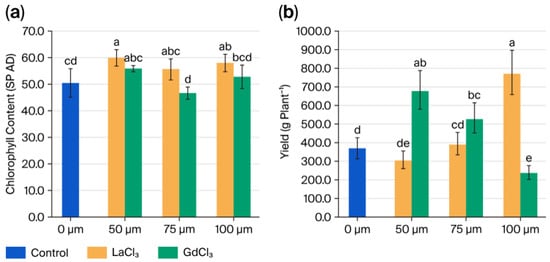
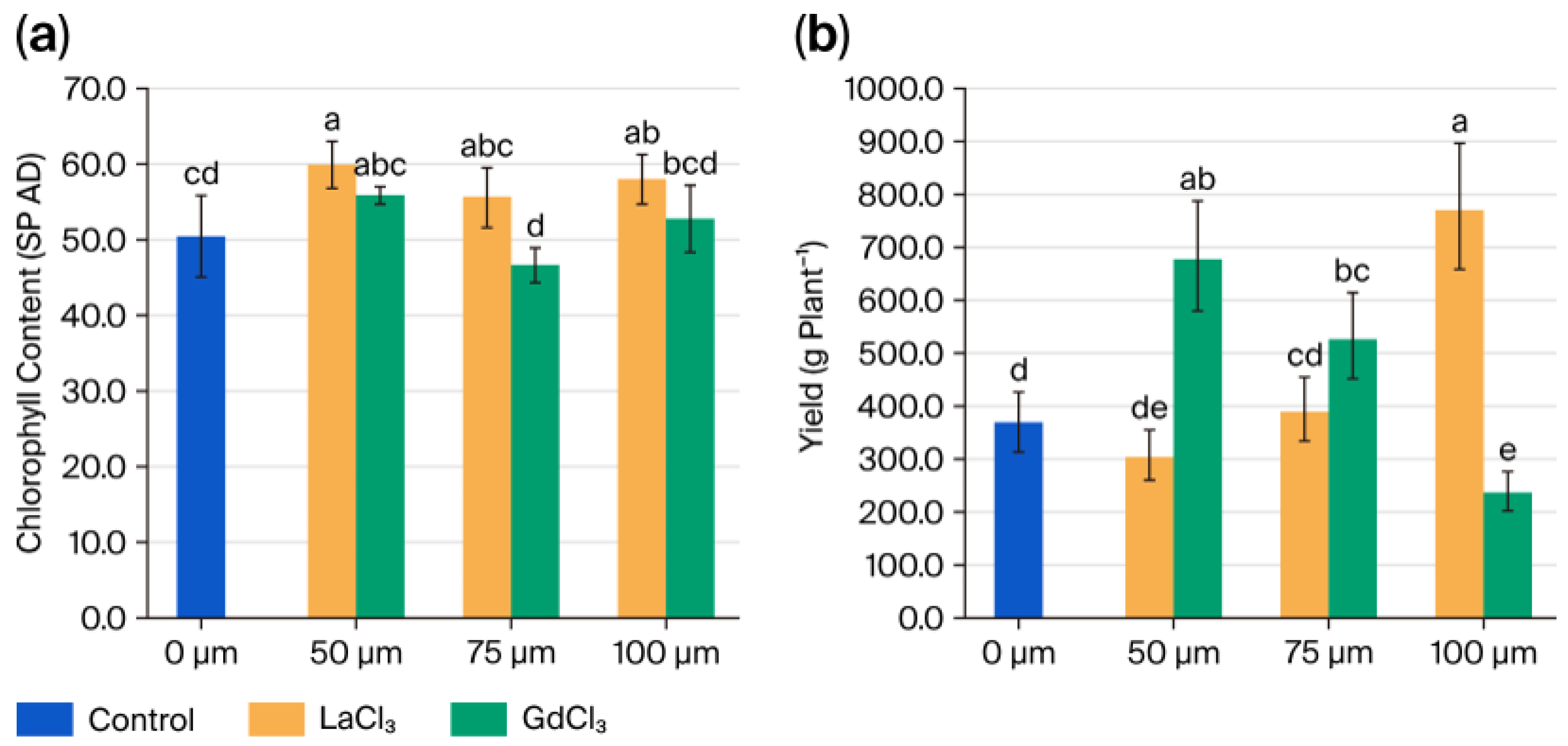
Significant differences were observed among treatments for chlorophyll content and yield (p ≤ 0.05; Figure 1a,b). The application of 50 µM LaCl3 yielded the highest chlorophyll content, followed by 100 µM LaCl3, with no significant difference between the two; the lowest value was recorded with 75 µM GdCl3, while the remaining treatments exhibited intermediate values.
Figure 1.
Effects of LaCl3 and GdCl3 on chlorophyll content and yield per plant in tomato plants (S. lycopersicum L. cv. Rio Grande. (a) Chlorophyll content and (b) yield per plant. Data are presented as means ± SDs (n = 6) for chlorophyll content. Yield values represent model-estimated mean cumulative fruit weight based on seven harvests, obtained using a generalized linear model (GLM) with a Gamma distribution and log link function. Error bars represent 95% confidence intervals for yield. Different letters indicate statistically significant differences among treatments according to Tukey’s multiple-comparison test (p ≤ 0.05).
Regarding yield, fruit weight was recorded for each plant over seven harvests, and the cumulative fruit weight per plant was calculated. The measured data were analyzed using a generalized linear model (GLM) with a Gamma distribution and log link function. Model-estimated mean cumulative yield ranged from 237.75 to 770.24 g plant−1. The highest yield was obtained with 100 µM LaCl3 (770.24 g plant−1; 95% CI: 660.24–898.57), followed by 50 µM GdCl3 (676.80 g plant−1; 95% CI: 580.14–789.56), with no significant difference between these treatments. The 75 µM GdCl3 treatment had a model-estimated mean yield of 528.00 g plant−1 (95% CI: 452.59–615.97), whereas the 75 µM LaCl3 treatment and the nutrient solution control showed values of 391.00 and 367.67 g plant−1, respectively. The lowest yield was recorded with 100 µM GdCl3 (237.75 g plant−1; 95% CI: 203.79–277.36), which did not differ significantly from 50 µM LaCl3 (305.80 g plant−1; 95% CI: 262.13–356.75). Pairwise comparisons were adjusted using Tukey’s method (p < 0.05).
Regarding quality parameters, significant differences among treatments were observed for polar diameter, equatorial diameter, total soluble solids (TSS), titratable acidity (TA), and the TSS/TA ratio (p ≤ 0.05; Table 3). The application of LaCl3 and GdCl3 significantly altered fruit dimensions. The highest polar diameter was observed with 50 µM GdCl3 (6.89 cm), followed by 100 µM LaCl3 (6.83 cm), whereas the control treatment exhibited the lowest value (4.56 cm). Similarly, the largest equatorial diameters were obtained with 100 µM LaCl3 (5.43 cm) and 50 µM GdCl3 (5.37 cm), both of which were significantly greater than the control (3.63 cm). The highest TSS contents were recorded with 75 µM GdCl3 (7.20 °Brix), 75 µM LaCl3 (7.00 °Brix), 100 µM GdCl3 (6.74 °Brix), and 50 µM LaCl3 (6.34 °Brix). In contrast, the 100 µM LaCl3 treatment resulted in the lowest TSS content (4.44 °Brix). For titratable acidity (%TA), the maximum value was observed under 75 µM LaCl3 (0.24%) compared to the control. Consequently, the TSS/TA ratio was significantly higher with 75 µM GdCl3 (55.08) than in all other treatments, which ranged between 29.24 and 34.58. Collectively, these results demonstrate that the response of fruit quality attributes was dependent on both the element and the applied concentrations, with 75 µM GdCl3 standing out due to its high TSS/TA ratio.
Table 3.
Effects of LaCl3 and GdCl3 at different concentrations on fruit quality parameters of tomato cv. Rio Grande.
Fruit color parameters varied significantly following the application of LaCl3 and GdCl3 (p ≤ 0.05; Table 4). The control treatment exhibited the highest values for a*, b*, chromaticity, and hue angle. Conversely, LaCl3 and GdCl3 applications significantly reduced these parameters, with values ranging from 14.76 to 17.48 for a*, 7.99 to 11.48 for b*, 17.26 to 20.67 for chromaticity, and 28.70 to 33.70 for hue angle. The color index (a*/b*) also differed significantly among treatments; the highest value was recorded with 100 μM GdCl3, whereas the lowest corresponded to the control. Treatments with 50 and 100 μM LaCl3, as well as 75 μM GdCl3, showed intermediate values and did not differ statistically from the 100 μM GdCl3 treatment.
Table 4.
Effects of LaCl3 and GdCl3 at different concentrations on fruit color parameters of tomato plants cv. Rio Grande.
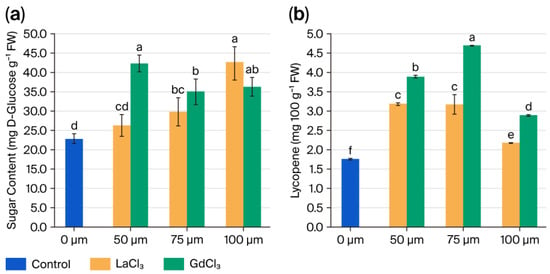
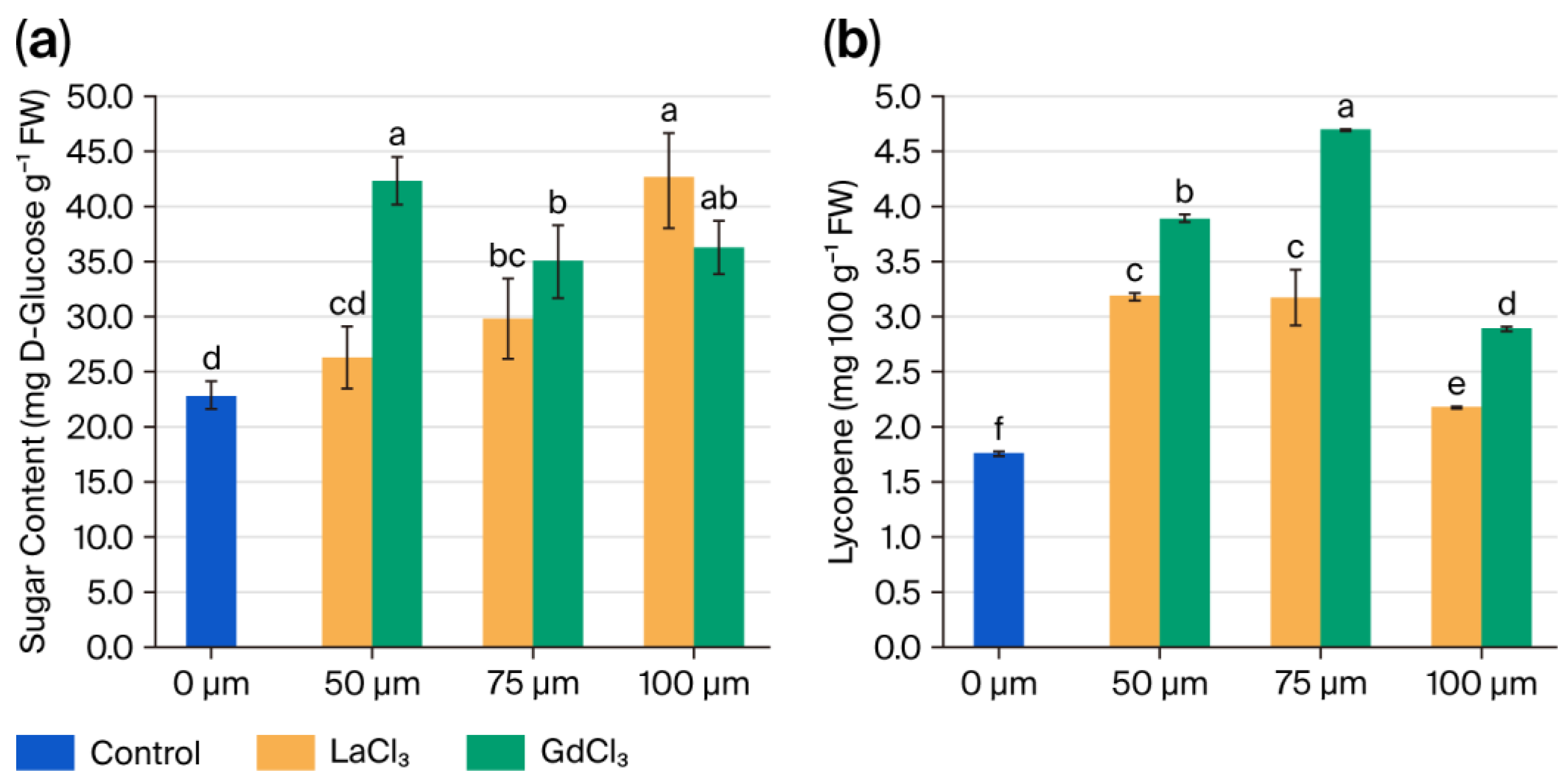
Regarding biochemical composition in tomato fruit cv. Rio Grande, LaCl3 and GdCl3 applications significantly altered total sugar and lycopene contents (p ≤ 0.05; Figure 2a). The highest sugar content was observed under 100 μM LaCl3 and 50 μM GdCl3, while the control showed the lowest value. Lycopene content peaked at 75 μM GdCl3 and was lowest in the control, showing distinct statistical separation across nearly all treatments (Figure 2b). Overall, these results demonstrate a concentration- and element-dependent response for both metabolites.
Figure 2.
Effects of LaCl3 and GdCl3 on the biochemical composition of Rio Grande tomato fruits. (a) Sugar content and (b) lycopene content. Results are presented as means ± SDs (n = 4). Different letters indicate statistically significant differences among treatments (p ≤ 0.05).
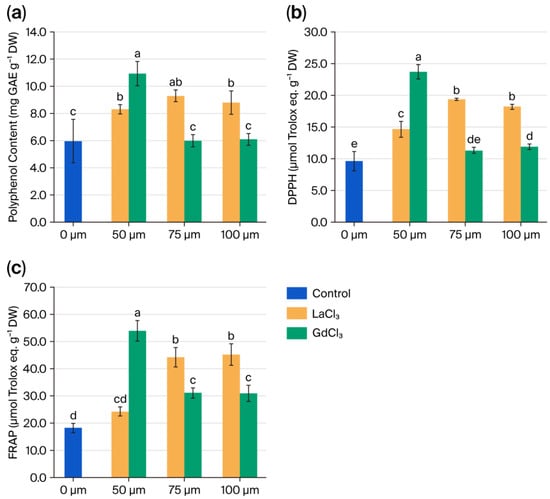
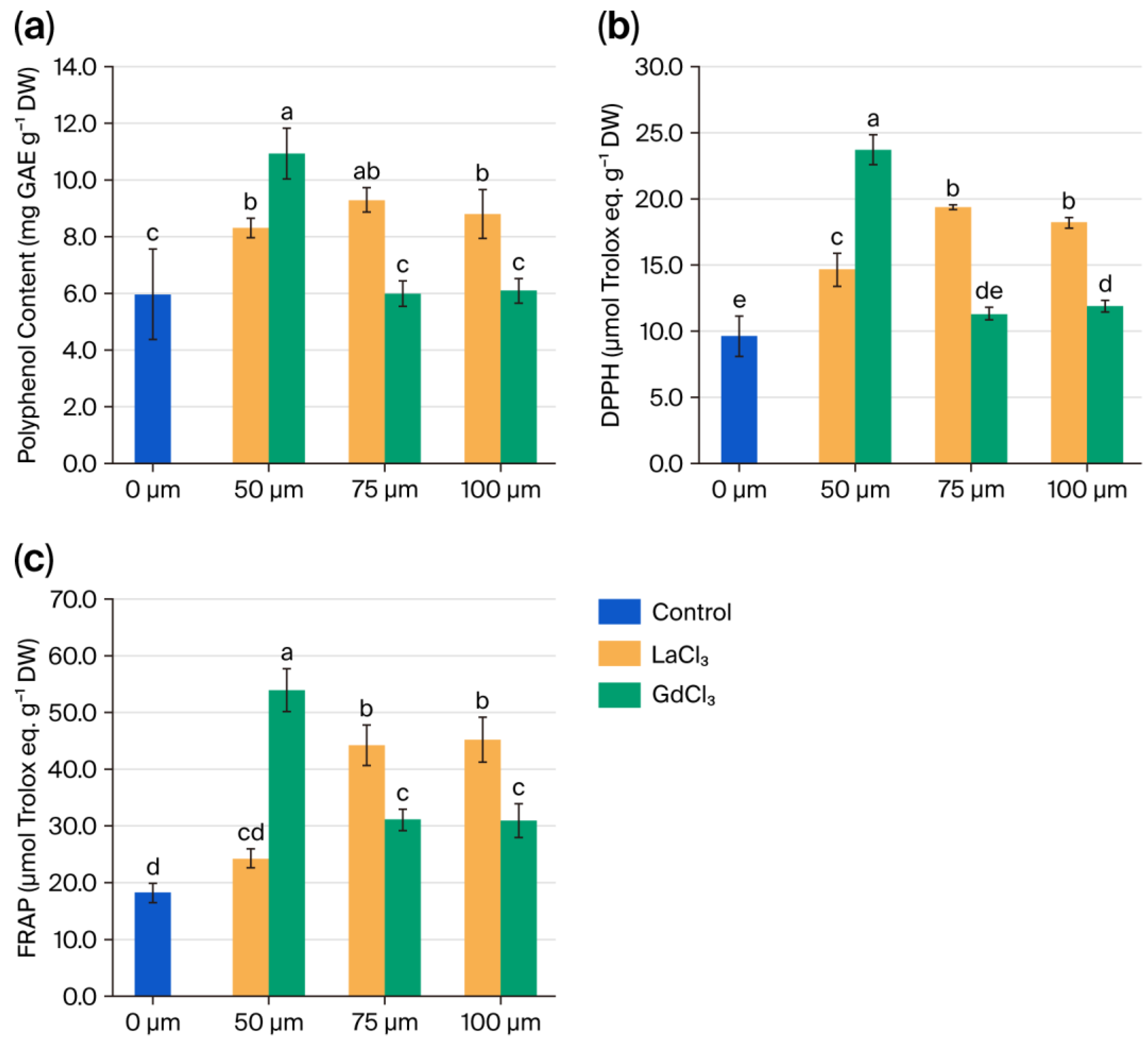
Regarding the bioactive compound content, the application of LaCl3 and GdCl3 significantly modified total polyphenol content, expressed as milligrams of gallic acid equivalents per gram of dry weight (mg GAE g−1 DW), and antioxidant activity in tomato fruits (p ≤ 0.05; Figure 3a). The highest total polyphenol content was recorded with 50 µM GdCl3, followed by 75 µM LaCl3, whereas the control treatment exhibited one of the lowest values. Treatments with 50 and 100 µM LaCl3 showed intermediate values, whereas 75 and 100 µM GdCl3 resulted in the lowest polyphenol contents, remaining statistically similar to the control.
Figure 3.
Effects of LaCl3 and GdCl3 on the content of bioactive compounds in Rio Grande tomato fruits. (a) Polyphenol content, (b) content of antioxidant compounds by the DPPH method, and (c) content of antioxidant compounds by the FRAP method. Results are presented as means ± SDs (n = 4). Different letters indicate statistically significant differences among treatments (p ≤ 0.05).
Antioxidant activity determined by DPPH reached its highest value at 50 µM GdCl3, followed by 75 and 100 µM LaCl3, which were statistically equivalent. The control treatment recorded the lowest antioxidant activity (Figure 3b). Similarly, antioxidant activity evaluated via FRAP was also highest with 50 µM GdCl3, followed by 75 and 100 µM LaCl3. In contrast, the control showed the lowest value, while 50 µM LaCl3 yielded an intermediate response (Figure 3c). Overall, these results demonstrate that applying 50 µM GdCl3 promoted the highest accumulation of total polyphenols and enhanced antioxidant activity in both DPPH and FRAP assays. However, fruit responses were dependent on both the specific element applied and its concentration.
3. Discussion
According to the results, the application of LaCl3 and GdCl3 elicited distinct responses in tomato plant growth, reproductive development, fruit characteristics, and bioactive compound composition. The observed effects varied according to the element applied, its concentration, and the response variable evaluated. Significant differences were identified in vegetative growth variables (specifically stem diameter, plant height, leaf number, and node number), reproductive parameters, and fruit quality. This indicates that while these elements modify general vegetative growth, they may also influence physiological processes associated with floral differentiation, fruit development, secondary metabolite accumulation, and enzymatic activity [23]. However, the specific physiological and biochemical mechanisms underlying these responses were not directly evaluated in this study.
These significant differences in vegetative growth parameters suggest that, under the evaluated experimental conditions, specific concentrations of LaCl3 and GdCl3 alter the vegetative architecture of tomato plants. Notably, higher mean values for stem diameter, height, leaf count, and node number were observed under LaCl3 treatment compared to the control (Table 1). Lanthanum applied at low doses has been characterized as a beneficial element that may influence nutrient uptake, thereby promoting root activity, cell wall polysaccharide content, respiration rate, and the activities of ascorbic acid oxidase (AAO) and polyphenol oxidase (PPO). Furthermore, previous studies have associated lanthanum application with changes in mitochondrial subcellular distribution, root transcriptional regulation, photosynthetic properties, chlorophyll fluorescence parameters, and total chlorophyll content, which may contribute to growth responses in some crops [24,25]. Nevertheless, these processes were not directly measured in the present study and cannot be identified as the mechanisms responsible for the observed growth responses.
In contrast, reproductive development exhibited a more pronounced response. The application of 100 µM LaCl3 significantly increased the number of clusters, flowers, and fruits per plant, achieving the highest values and showing statistical differences compared to both the control treatment and GdCl3 concentrations (Table 2). These results are consistent with previous studies reporting that LaCl3 increases protein, sugar, and proline levels in plants, and may influence nutrient-related processes in reproductive tissues, as reported following the application of 45 µM LaCl3 in Hemerocallis fulva L. [26]. Similarly, in chrysanthemum, lanthanum has been associated with changes in secondary metabolism and hormonal processes related to reproductive development [27]. The reproductive responses observed following the application of LaCl3 and GdCl3 could be associated with changes in the physiological processes involved in floral development and fruit set. However, the effects of rare-earth elements may depend on the applied concentration and the physiological state of the plants. Although stress-related responses could influence reproductive development, stress indicators were not measured in the present study; therefore, further research is required.
The increase in reproductive structures observed at 100 µM LaCl3 may reflect changes in physiological processes involved in floral development and reproductive allocation. Plant hormones, particularly auxins and gibberellins, play important roles in flower development and fruit set [28]. Therefore, the observed response could be associated with changes in hormonal signaling or resource allocation; however, these mechanisms remain hypothetical because hormone concentrations and related molecular markers were not measured in the present study. Further research is needed to determine whether La influences these pathways directly or indirectly.
Likewise, crop yield showed statistically significant differences among treatments, with the highest value recorded at 100 µM LaCl3 (Figure 1). This yield response coincided with the observed increase in cluster and flower production. The effects on reproductive components and yield observed here contrast with other studies, where beneficial effects were reported at 60 μM, whereas concentrations of 80 μM proved toxic to the growth and yield of Triticum aestivum (wheat) [29]. Nevertheless, lanthanum may affect specific physiological or metabolic processes differently from other rare-earth elements, consistent with studies comparing lanthanum to other elements such as yttrium in tomato plants [30]. Although 100 µM LaCl3 produced the highest model-estimated cumulative yield in the present study, it was not significantly different from 50 µM GdCl3 according to the Tukey-adjusted comparisons. Furthermore, the experiment was terminated earlier than originally anticipated because of time constraints. Thus, yield represents the cumulative fruit weight recorded over seven harvest events, rather than total yield over a complete production cycle. This limitation should be considered when interpreting the yield response and its potential application in greenhouse production.
The application of rare earth elements (REEs) significantly altered the physical and physicochemical quality parameters of the fruit. The largest polar and equatorial diameters were predominantly observed under treatments of 50 µM GdCl3 and 100 µM LaCl3, respectively (Figure 3), indicating that both elements were associated with changes in fruit dimensions, although the response depended on the element and concentration. These fruit diameter values surpass those reported by previous studies using Trichoderma spp. as a biostimulant, which recorded fruit diameters below 60.00 mm, thereby highlighting the potential of beneficial elements to enhance fruit size [31]. Regarding total soluble solids (TSS), the highest values were recorded with 75 µM GdCl3, 75 µM LaCl3, and 100 µM GdCl3 (Figure 3). The 50 µM LaCl3 treatment also belonged to the statistically similar group with higher TSS values. Conversely, while 100 µM LaCl3 yielded fruits with greater equatorial diameter, it resulted in a lower TSS content. This difference may reflect variation in fruit development or soluble solids accumulation; however, altered photoassimilate partitioning, cellular homeostasis, and protein degradation were not measured and cannot be confirmed as explanations for this response [32]. Furthermore, our results demonstrated that lanthanum enhances total chlorophyll content to a greater extent than gadolinium (Figure 1). This aligns with previous findings reporting that low concentrations of lanthanum chloride positively impact chlorophyll a, chlorophyll b, carotenoids, and total chlorophyll contents, thereby enhancing photosynthetic capacity in crops such as Oryza sativa L. [33]. Overall, these findings indicate that fruit size expansion and total soluble solids accumulation respond differently to these two rare earth elements.
Titratable acidity (TA) was significantly affected by the treatments. The highest value was observed under 75 µM LaCl3, whereas the lowest values were recorded with 75 µM GdCl3 and 100 µM LaCl3. Specifically, TA was 0.24% under 75 µM LaCl3, 0.13% under 75 µM GdCl3, and 0.14% under 100 µM LaCl3. These values were lower than those reported by [34], who recorded values exceeding 0.5%. Furthermore, TA combined with TSS serves as a crucial indicator of the balance between sweetness and acidity, although the TSS/TA ratio alone does not establish consumer preference or sensory quality. However, this TA percentage typically declines as the harvest season progresses [35]. The 75 µM GdCl3 treatment exhibited the highest TSS/TA ratio (55.08), reflecting its relatively high TSS content (7.20 °Brix) and low TA (0.13%). In contrast, 75 µM LaCl3 showed the highest TA and a TSS/TA ratio of 29.62. These results indicate that the treatments altered the balance between soluble solids and acidity in different ways. Nevertheless, sensory analyses and more detailed information on fruit maturity at harvest would be needed to determine whether these differences translate into changes in perceived flavor or consumer acceptance.
Color parameters also showed distinct responses among treatments. The control presented the highest values for a*, b*, C*, and h°, whereas LaCl3 and GdCl3 applications reduced these parameters. Concurrently, the color index (a*/b*) increased following rare earth element treatments, peaking at its highest mean under 100 µM GdCl3 (Table 4). Altogether, these changes denote a significant modification of the chromatic composition of the fruit in response to the treatments. Fruit color in tomato is tightly linked to maturity stage and pigment accumulation; specifically, color shifts during tomato ripening result from dynamic changes in L*, a*, and b* values, with a* being associated with changes in chlorophyll and lycopene during ripening [36]. These modifications could be associated with changes in pigment composition or ripening-related processes. However, carotenoid metabolism, chlorophyll degradation, and pigment-related gene expression were not directly measured, so these mechanisms cannot be confirmed from the present results. These findings contrast with those reported by [11], where negative effects were observed.
Lycopene is one of the most prominent carotenoids in the food and cosmetic industries due to its nutraceutical and antioxidant properties [37]. The results showed that the 75 µM GdCl3 treatment achieved a lycopene content of 4.71 mg 100 g−1 fresh weight (fw), whereas the control treatment yielded the lowest value; notably, these values exhibited an inverse trend to those observed for fruit color (Figure 2, Table 4). The higher lycopene content observed with 75 µM GdCl3 might reflect a concentration-dependent modulation of carotenoid metabolism during fruit development and ripening. Phytoene synthase (PSY) catalyzes an early rate-limiting step in carotenoid biosynthesis, whereas phytoene desaturase (PDS) is involved in the conversion of phytoene into downstream carotenoids in the metabolic pathway [38]. Variations in the regulation or activity of these enzymes could influence carotenoid accumulation; however, their role in the response to Gd remains to be determined, as neither gene expression nor enzymatic activity was evaluated in this study.
Consequently, these outcomes were concentration- and element-dependent, as the increase in lycopene varied between the applied compounds (LaCl3 vs. GdCl3). Furthermore, the 75 µM GdCl3 treatment showed the highest lycopene content and TSS/TA ratio, as well as a high TSS value; however, its TSS value did not differ significantly from those of the other treatments in the same statistical group. Total polyphenols and antioxidant capacity displayed a similar pattern. The 50 µM GdCl3 treatment yielded the highest polyphenol content and the maximum antioxidant activity assessed via both DPPH and FRAP assays (Figure 3). Recent studies indicate that low doses of gadolinium can stimulate plant antioxidant systems, which promotes the accumulation of antioxidant compounds, whereas high concentrations may disrupt cellular homeostasis, generating reactive oxygen species (ROS) and reducing antioxidant capacity [39]. In the present study, ROS concentrations and antioxidant enzyme activities were not measured; therefore, these processes can only be considered possible explanations rather than demonstrated mechanisms.
The lower polyphenol accumulation observed at higher GdCl3 concentrations may reflect a concentration-dependent alteration in phenolic metabolism. Excessive ROS accumulation could potentially affect the activity of enzymes involved in phenolic biosynthesis or increase the demand for antioxidant compounds, thereby influencing their net accumulation. Overall, these results demonstrate that lanthanum and gadolinium applications induced concentration- and element-dependent responses in tomato plants. Previous studies in tomato have reported diverse physiological responses to La and Gd exposure. LaCl3 concentrations ranging from 20 to 100 µM have been associated with enhanced antioxidant activity and ethylene-related defense responses against root-knot nematodes [15]. Additionally, La has been shown to modify organic acid accumulation and transport, particularly in roots, under hydroponic conditions [30]. In contrast, exposure to 150 µM Gd has been associated with growth inhibition, root alterations, and oxidative stress responses in tomato plants [40]. These studies provide additional evidence that La and Gd can induce different physiological responses depending on the element, concentration, and exposure conditions. However, differences in experimental conditions, exposure methods, and evaluated responses prevent direct comparisons with the present study. Importantly, the concentrations reported in previous studies are presented here as scientific context and should not be interpreted as a justification for the concentrations evaluated in the present experiment.
Lanthanum at 100 µM was primarily notable for its effect on flower and truss formation, alongside favorable trends in growth and fruit size. In contrast, gadolinium exhibited distinct effects on various quality attributes, particularly at 50 and 75 µM concentrations. These findings highlight that rare earth elements should not be considered a physiologically homogeneous group, as their effects depend on the specific interaction between the element and the applied concentration. Nevertheless, the results should be interpreted as treatment responses under the experimental conditions evaluated, rather than as sufficient evidence to recommend specific concentrations for commercial use.
Finally, the results of this study suggest that the application of rare earth elements may offer different potential benefits for greenhouse tomato production, depending on the compound and concentration used. Lanthanum chloride (LaCl3) at 100 µM showed promising effects on reproductive development, producing the highest numbers of clusters, flowers, and fruits per plant. Therefore, this concentration could be considered a candidate for further evaluation in production systems aimed at improving tomato yield. However, its potential as a yield-enhancing treatment requires confirmation over a complete production cycle and validation under different greenhouse conditions. Gadolinium chloride (GdCl3) may also be of interest for applications focused on fruit quality, depending on its effects on bioactive compounds and antioxidant activity. The selection of an appropriate concentration should consider the specific quality parameters targeted, since the treatment that maximizes one parameter may not produce the highest values for all others. Any potential agricultural application must also consider food safety and environmental risks, particularly because accumulation of these elements was not assessed in the present study.
An additional limitation of this study is the absence of a chloride-matched control treatment. Both LaCl3 and GdCl3 provide chloride as the common counterion, and at equivalent molar concentrations, both salts contribute the same nominal concentration of chloride. This shared counterion facilitates comparison between the two treatments. However, because no additional chloride control was included, the contribution of chloride-related effects cannot be evaluated independently. Therefore, the observed differences are interpreted as responses to the application of LaCl3 and GdCl3 under the experimental conditions, without assuming that all responses were caused exclusively by La3+ or Gd3+.
Furthermore, the changes in fruit bioactive composition observed in this study may provide a basis for further research into the recovery of valuable compounds from tomato fruits and processing by-products. Polyphenols have attracted considerable interest because of their antioxidant properties and the availability of different methods for their extraction and recovery [41]. In addition, tomato processing by-products have been identified as potential sources of lycopene, polyphenols, and other valuable compounds that can be recovered using conventional and emerging technologies [42]. Therefore, fruits from treatments associated with higher polyphenol or lycopene contents could be investigated to determine their potential for bioactive compound extraction. However, extraction efficiency, compound stability, product safety, and economic feasibility would need to be evaluated before any industrial application could be recommended. In particular, the residual concentrations of La and Gd in the extracted compounds and remaining plant material should be assessed before considering their use in food, cosmetics, or other products. The potential recovery of bioactive compounds does not, by itself, establish the safety of treated fruits for direct human consumption.
Overall, these findings provide a starting point for exploring the use of rare earth elements to improve tomato production and fruit quality. Nevertheless, further research is required to establish suitable application concentrations, assess potential phytotoxic effects, evaluate food safety, and determine the environmental and economic implications of their use in commercial greenhouse production.
4. Materials and Methods
4.1. Experimental Site
The experiment was conducted from September 2024 to March 2025 in a metal-framed greenhouse equipped with an 80% black shade net at the Faculty of Agricultural Sciences, Xalapa Campus, Universidad Veracruzana, located in Zona Universitaria, Xalapa-Enríquez, Veracruz, Mexico (19°30′54.43″ N, 96°55′5.12″ W).
4.2. Experimental Design
A completely randomized design (CRD) was employed with seven treatments and six replications per treatment, yielding a total of 42 experimental units. Each experimental unit consisted of one tomato plant grown individually in a bag containing tezontle as the growing substrate. The treatments comprised an untreated control (without rare earth element application) and three concentration levels (50, 75, and 100 µM) for each rare earth element: lanthanum chloride LaCl3 and gadolinium chloride GdCl3.
4.3. Plant Material and Crop Establishment
Tomato plants (S. lycopersicum L.) cv. ‘Rio Grande’ were used. Seeds were germinated in propagation trays. Upon reaching a height of approximately 10–12 cm, seedlings were transplanted into 25 × 30 cm black polyethylene growing bags containing red volcanic slag (tezontle) as an inert substrate, with a pH of 6.9 and an electrical conductivity (EC) of 0.10 dS m−1. Prior to transplanting, the substrate was disinfected with a 10% sodium hypochlorite solution. Each experimental unit was equipped with an individual drip irrigation system.
4.4. Preparation and Application of Lanthanum and Gadolinium Solutions
The plants were fertigated daily via a drip irrigation system using a modified Steiner (1961) [43] nutrient solution, with a total volume of 1000 L prepared. Three formulations were used according to the phenological stage of the crop: vegetative growth, flowering, and fruiting. Stock solutions (20,000 µM) of LaCl3 7H2O and GdCl3 6H2O were prepared. Working experimental solutions (50, 75, and 100 µM) were obtained by serial dilution using the dilution equation (C1V1 = C2V2) to achieve a final volume of 1 L per treatment. For the experiment reported here, 1 L of each treatment solution was allocated to six plants, corresponding to an average of approximately 167 mL per plant.
The LaCl3 and GdCl3 treatment solutions were prepared separately from the nutrient solution and applied as supplementary treatments, following an application procedure similar to that used for commercial fertilizers. Initially, they were applied via foliar spraying every 15 days during the first 70 days after transplanting (DAT), with applications performed in the morning. From 70 to 148 DAT, the solutions were applied via soil irrigation (root application). The application method was modified as the plants grew to reduce the risk of spray drift and exposure to neighboring plants. Control plants received only the nutrient solution via the drip irrigation system, without the addition of LaCl3 or GdCl3. Throughout the experiment, the plants were irrigated with a modified nutrient solution for tomatoes. At 157 DAT, six fully red fruits per treatment were harvested to determine their physicochemical parameters and bioactive metabolite content.
4.5. Evaluated Variables
At 98 days after transplanting (DAT), stem diameter was measured using a digital caliper (Steren, model HER-411, Mexico City, Mexico), whereas plant height was determined with a measuring tape (TRUPER, Jilotepec, Mexico), and the number of leaves, nodes, clusters, flowers, and fruits per plant (148 DAT) was recorded through visual counting. Yield per plant was calculated as the cumulative weight of fruits harvested over seven harvest events during the experimental period and expressed as g plant−1. Leaf chlorophyll content was measured in fully expanded intermediate leaves using a portable chlorophyll meter (AtLeaf CHL PLUS, FT Green LLC, Wilmington, DE, USA). Total yield was determined by weighing harvested fruits across seven harvesting events using a digital scale (RCA, model RC-B1, Shanghai, China). Polar and equatorial fruit diameters were evaluated via image analysis using ImageJ software for Windows (version 1.54p).
For the biochemical analyses, 6 fruits (one per plant) were selected from each treatment and grouped into two subgroups of 3 fruits. Two independently prepared extracts were used for the analyses, with four replicates.
Total soluble solids (TSS) content was determined using a high-precision digital refractometer (Soonkoda, Dongguan, China; Brix Tester Meter, 0–55% range). Titratable acidity (TA) was quantified according to the official AOAC methodology [44]. The TSS/TA ratio was calculated by dividing the TSS content by the percentage of TA. Fruit color was evaluated using the CIELab color space by recording L*, a*, and b* parameters. From a* and b*, chroma (C*) was calculated using the equation C*= and the hue angle (h°) was calculated as h°= . The color index (CI) was calculated using the a*/b* ratio [45].
Total sugar content was determined using the phenol–sulfuric acid method described by [46]. For extraction, 1 g of fruit puree was weighed and mixed with 30 mL of 80% ethanol. The sample was homogenized for 1 min at 1200 rpm (Protytan, model FSH-2A, Changzhou, China) and incubated at −20 °C for 24 h. Subsequently, the mixture was centrifuged at 4000 rpm for 20 min at 4 °C (HERMLE, model Z 300 K, Wehingen, Germany) and filtered through cheesecloth. The extract was diluted 1:30, and 1 mL of this dilution was mixed with 100 µL of 85% phenol and 5 mL of concentrated sulfuric acid under a fume hood. The mixture was incubated for 20 min at 30 °C in a water bath, and absorbance was measured at 490 nm using a quartz cuvette.
Lycopene content was determined according to the methodology described by [47]. Six grams of tomato puree from each sample were weighed into amber Falcon tubes, followed by the addition of 9.6 mL of an acetone–hexane mixture (4:6, v/v). Samples were homogenized for 1 min at 1200 rpm and then centrifuged at 4000 rpm for 10 min at 4 °C. The resulting extract was filtered through cheesecloth into amber Falcon tubes and adjusted to a final volume of 10 mL using an amber volumetric flask. Thereafter, all procedures were carried out under dark conditions to prevent light-induced lycopene degradation. The extract was transferred to a separatory funnel (pre-washed with hexane) and allowed to stand until complete separation of the aqueous and oily phases. The oily phase was collected via the stopcock and made up to 10 mL with hexane. Finally, the oily phase was transferred to an amber Falcon tube for spectrophotometric analysis. Absorbance was measured in quadruplicate at 502 nm (Shimadzu, Kyoto, Japan), using hexane as a blank.
Total polyphenols were determined using the Folin–Ciocalteu method described by [48]. For extract preparation, 4 g of fruit puree was weighed into foil-wrapped Falcon tubes, and 16 mL of pure acetone was added. The sample was homogenized for 1 min at 1200 rpm, centrifuged for 20 min at 4 °C and 400 rpm, and subsequently filtered through cheesecloth into amber Falcon tubes. The assay was performed in quadruplicate for each extract using 400 µL of sample. The blank was prepared with 1000 µL of distilled water and 200 µL of Folin–Ciocalteu reagent. After incubating for 8 min, 2000 µL of Na2CO3 and 1400 µL of distilled water were added. The mixture was homogenized and incubated for 1 h at room temperature. Absorbance was read at 750 nm.
Antioxidant activity was evaluated using the DPPH (2,2-diphenyl-1-picrylhydrazyl) [49] and FRAP (Ferric Reducing Antioxidant Power) [50] assays. Both assays utilized the same extract prepared for the determination of total polyphenols.
A DPPH working solution was prepared by dissolving 0.006 g of DPPH in 80% methanol and bringing the volume to 100 mL in an amber volumetric flask. The absorbance was adjusted to 1.250 nm using 80% methanol, which was subsequently used as the blank for calibration. The analysis was conducted in quadruplicate for each extract in vials. For the reaction, 100 µL of extract was mixed with 2900 µL of the DPPH solution. The mixture was incubated for 30 min at room temperature in the dark, and absorbance was subsequently recorded at 517 nm using a quartz cuvette.
The FRAP reagent was prepared freshly under light-protected conditions by combining three solutions: (1) 300 mM sodium acetate buffer (pH 3.6, adjusted with glacial acetic acid and diluted to 1 L with distilled water), (2) 10 mM TPTZ solution in 40 mM HCl (10 mL), and (3) 20 mM FeCl3⋅6H2O solution in distilled water (10 mL).
Finally, the FRAP reagent was prepared in a 10:1:1 ratio. For the assay, 100 µL of the extract was mixed with 3 mL of the FRAP reagent and incubated in a water bath (OAKTON, model 12501-10, Vernon Hills, IL, USA) at 37 °C for 30 min. Absorbance was measured at 593 nm using a UV-1800 spectrophotometer (Shimadzu, Kyoto, Japan).
4.6. Statistical Analysis
Data distribution was assessed using graphical methods and the Shapiro–Wilk test for normality. Homogeneity of variances was evaluated using Levene’s test. Variables meeting the assumptions for parametric analysis were subjected to one-way analysis of variance (ANOVA), followed by Tukey’s multiple-comparison test (p < 0.05). Since yield data did not meet the normality assumption, yield was analyzed separately using a generalized linear model (GLM) with a Gamma distribution and log link function. Treatment comparisons were performed using Tukey-adjusted pairwise comparisons, and the results were presented as model-estimated mean cumulative fruit weight per plant based on seven harvests, with 95% confidence intervals. Statistical analyses were performed using STATISTICA version 12.5 and R software (version 4.6.1).
5. Conclusions
The application of LaCl3 and GdCl3 elicited element- and concentration-dependent responses in tomato crops. The treatments affected reproductive development, yield, and specific physicochemical and biochemical fruit quality attributes, although the responses varied depending on the element and concentration. Specifically, 100 μM LaCl3 was associated with the highest number of clusters per plant and flowers and the highest model-estimated cumulative fruit yield, although yield did not differ significantly from that obtained with 50 μM GdCl3. Meanwhile, 50 μM GdCl3 resulted in the highest total polyphenol content and antioxidant capacity, whereas 75 μM GdCl3 produced the highest lycopene content and total soluble solids-to-titratable acidity ratio.
Overall, the findings partially support our hypothesis, as the effects of LaCl3 and GdCl3 varied according to the element, concentration, and fruit quality attribute evaluated. However, these responses were not consistent across all measured variables, highlighting the importance of evaluating each element and concentration separately. Further research is needed to assess La and Gd accumulation in plant tissues, fruits, and the growing substrate, as well as their potential environmental and food safety implications, before practical agricultural recommendations can be made.
Author Contributions
Conceptualization, G.C.-M. and L.L.-C.; methodology, G.C.-M. and E.N.A.-B.; software, J.E.A.-J.; validation, G.C.-M., L.L.-C., E.N.A.-B. and J.C.N.-C.; formal analysis, G.C.-M. and I.A.-C.; investigation, L.L.-C. and J.C.N.-C.; writing—original draft preparation, G.C.-M. and L.L.-C.; writing—review and editing, L.L.-C. and G.C.-M.; visualization, G.A.-V.; supervision, L.G.H.-M. All authors have read and agreed to the published version of the manuscript.
Funding
The authors thank the Secretariat of Science, Humanities, Technology and Innovation (SECIHTI) for the scholarship awarded to Guadalupe Contreras Martínez (Scholarship No. 1027882) to pursue doctoral studies.
Data Availability Statement
The original contributions presented in this study are included in the article. Further inquiries can be directed to the corresponding authors.
Conflicts of Interest
The authors declare no conflicts of interest.
References
- Khan, R.; Saurabh, A.; Singh, G.; Khan, N.; Saini, D.; Kapoor, H. Evaluating organic and bio fertilizers as an integrated nutrient management practice in Tomato (Solanum lycopersicum L.). Int. J. Hortic. Food Sci. 2025, 7, 20–26. [Google Scholar] [CrossRef] [Scilit]
- Maurya, H.K.; Lata, R.; Sundar, S.; Mitra, D.; Singh, H.; Yadav, G. Scientific Advances in Tomato (Solanum lycopersicum L.) Cultivation, Agronomic Innovation and Genetic Improvement: A Comprehensive Review. J. Adv. Biol. Biotechnol. 2025, 28, 781–803. [Google Scholar] [CrossRef] [Scilit]
- Yang, Y.; Luo, J.; Tang, Y.; Li, Z.; Yang, L.; Gao, J. Comparative evaluation of appearance and nutritional qualities of 57 tomato (Solanum lycopersicum L.) accessions. Horticulturae 2025, 11, 796. [Google Scholar] [CrossRef] [Scilit]
- Mohammed, S.P.; Yen, J.Y.; Hsu, Y.C.; Chou, H.Y.; Natarajan, S.; Eybishitz, A. Integrative Trait Analysis for Enhancing Heat Stress Resilience in Tomato (Solanum lycopersicum L.): A Focus on Root, Physiological, and Yield Adaptations. Plants 2025, 14, 533. [Google Scholar] [CrossRef] [Scilit] [PubMed]
- Ambaye, T.G.; Vaccari, M.; Castro, F.D.; Prasad, S.; Rtimi, S. Emerging technologies for the recovery of rare earth elements (REEs) from the end-of-life electronic wastes: A review on progress, challenges, and perspectives. Environ. Sci. Pollut. Res. 2020, 27, 36052–36074. [Google Scholar] [CrossRef] [Scilit] [PubMed]
- Ali, I.; Ullah, S.; Dai, W.; Xu, Y.; Yang, M. Sustainable Use of Rare Earth Elements Lanthanum and Cerium to Enhance Growth and Nutrient Uptake in Paramichelia baillonii Seedlings via Hormonal Regulation. Environ. Technol. Innov. 2025, 40, 104451. [Google Scholar] [CrossRef] [Scilit]
- Liu, C.D.; Zhao, J.C.; Liu, W.S.; van der Ent, A.; Qiu, R.L.; Morel, J.L.; Tang, Y.T. The effect of rare earth elements (REEs) on plant growth promotion: A review on mechanisms and the role of REE-dependent methylotrophs. Plant Soil 2026, 518, 959–974. [Google Scholar] [CrossRef] [Scilit]
- Kastori, R.R.; Putnik-Delić, M.I.; Maksimović, I.V. Rare earth elements application in agriculture. Acta Agric. Serb. 2023, 28, 87–95. [Google Scholar] [CrossRef] [Scilit]
- Grosjean, N.; Purwadi, I.; Sirguey, C.; Chalot, M.; Le Jean, M.; van Der Ent, A.; Blaudez, D. Rare earth elements in plants: Transfer, transport, accumulation, impacts and perspectives. Adv. Bot. Res. 2024, 109, 19–61. [Google Scholar] [CrossRef] [Scilit]
- Pandey, S.; Saha, D.; Dharmappa, P.M.; Dey, P.; Chauhan, J.; Jha, R.; Choyal, P.; Mishra, U.N.; Gupta, S.; Sajeevan, R.S. Light Rare Earth Elements in Plants: Environmental Sources, Bioavailability, Uptake, Nutrient Interactions, Mechanisms, and Concentration-Dependent Physiological and Signaling Reactions. Plants 2026, 15, 2947. [Google Scholar] [CrossRef] [Scilit] [PubMed]
- van Doan, C.; Maghrebi, M.; Gatti, N.; Mannino, G.; Vigani, G.; Maffei, M.E. The rare earth element lanthanum (La) accumulates in brassica rapa L. and affects the plant metabolism and mineral nutrition. Plants 2025, 14, 692. [Google Scholar] [CrossRef] [Scilit] [PubMed]
- Liu, C.; Chen, W.; Dong, C.; Fang, R.; Dong, C.; Ding, Z.; Zhang, H.; Zhang, X. The Effect of Exogenous Rare Earth Element Lanthanum on the Germination of Melon (Cucumis melo L.) Seeds and the Growth and Physiology of their Seedlings. J. Plant Growth Regul. 2026, 45, 3232–3246. [Google Scholar] [CrossRef] [Scilit]
- Wang, Z.; Wang, T.; Wang, C.; Yue, L.; Li, J.; Liu, T.; Lv, Y.; White, J.C.; Cao, X.; Xing, B. Lanthanum-based nanomaterials suppress bacterial wilt in tomato: Importance of particle morphology and dissolution profiles. Environ. Sci. Nano 2023, 10, 747–760. [Google Scholar] [CrossRef] [Scilit]
- Kastori, R.U.D.O.L.F.; Putnik-Delić, M.; Maksimović, I. Rare earth elements, microorganisms, and control of plant diseases. Contemp. Agric. 2024, 73, 228–237. [Google Scholar] [CrossRef] [Scilit]
- Esmaeili, E.S.; Pedram, M.; Atighi, M.R. Lanthanum chloride mitigates root-knot nematode infection on tomato plants through the ethylene pathway and antioxidant activity. Rhizosphere 2026, 37, 101297. [Google Scholar] [CrossRef] [Scilit]
- Tomczuk, M.; Godlewska-Żyłkiewicz, B.; Bajguz, A. Gadolinium in the Environment: A Double-Edged Sword for Plant Growth and Ecosystem Stability. Metabolites 2025, 15, 415. [Google Scholar] [CrossRef] [Scilit] [PubMed]
- Giuliano, F.; Tangredi, D.N.; Guarino, F.; Castiglione, S.; Cicatelli, A. Effects of Gd3+ and Ce3+ on seed germination and growth of tomato and quinoa plants. Plant Biosyst. 2026, 160, 148. [Google Scholar] [CrossRef] [Scilit]
- Liu, Z.; Guo, C.; Tai, P.; Sun, L.; Chen, Z. The exposure of gadolinium at environmental relevant levels induced genotoxic effects in Arabidopsis thaliana (L.). Ecotoxicol. Environ. Saf. 2021, 215, 112138. [Google Scholar] [CrossRef] [Scilit] [PubMed]
- Guo, S.; Yang, S.; Li, J.; Su, X.; Deng, S.; Lu, Y.; Liu, L.; Yang, S. Lanthanum nitrate enhances aroma precursors of tobacco leaves via influencing chemical components and photosynthetic characteristics. Sci. Rep. 2025, 15, 41915. [Google Scholar] [CrossRef] [Scilit] [PubMed]
- Tommasi, F.; Thomas, P.J.; Lyons, D.M.; Pagano, G.; Oral, R.; Siciliano, A.; Toscanesi, M.; Guida, M.; Trifuoggi, M. Evaluation of rare earth element-associated hormetic effects in candidate fertilizers and livestock feed additives. Biol. Trace Elem. Res. 2023, 201, 2573–2581. [Google Scholar] [CrossRef] [Scilit] [PubMed]
- Huang, G.; Shan, C. Lanthanum improves the antioxidant capacity in chloroplast of tomato seedlings through ascorbate-glutathione cycle under salt stress. Sci. Hortic. 2018, 232, 264–268. [Google Scholar] [CrossRef] [Scilit]
- Hamad, A.A.A.; Hamoud, Y.A.; Shaghaleh, H.; Ni, L.; Okla, M.K.; Alaraidh, I.A.; Alkhaled, A.A.; Maridueña-Zavala, M.G.; Abuelsoud, W. Organ-specific secondary metabolism under elevated CO2 enhances gadolinium detoxification in tomato (Solanum lycopersicum). Sci. Hortic. 2026, 366, 115003. [Google Scholar] [CrossRef] [Scilit]
- Shan, C.; Zhang, H.; Zhang, Y.; Zhou, H. Lanthanum nitrate regulates the content of vitamin C through its biosynthesis, regeneration and degradation in the fruit of strawberry. Sci. Hortic. 2017, 224, 102–108. [Google Scholar] [CrossRef] [Scilit]
- Liu, Y.; Zhang, J. Lanthanum promotes Bahiagrass (Paspalum notatum) roots growth by improving root activity, photosynthesis and respiration. Plants 2022, 11, 382. [Google Scholar] [CrossRef] [Scilit] [PubMed]
- Jia, T.; Gu, J.; Ma, M.; Song, Y. Lanthanum significantly contributes to the growth of the fine roots’ morphology and phosphorus uptake efficiency by increasing the yield and quality of Glycyrrhiza uralensis taproots. Plants 2024, 13, 474. [Google Scholar] [CrossRef] [Scilit] [PubMed]
- Lone, H.Y.; Aftab, M.; Wani, A.A.; Zargar, M.A.; Tahir, I. Lanthanum Mitigates Postharvest Flower Senescence in Hemerocallis fulva L. by Accentuating the Antioxidant Machinery. Biol. Bull. 2025, 52, 138. [Google Scholar] [CrossRef] [Scilit]
- Gao, Y.; Zhang, R.; Xu, N.; Song, Y.; Chen, S.; He, M. Transcriptome analysis revealed the molecular mechanism by which Chrysanthemum naktongense roots respond to low-concentration lanthanum treatment. Ornam. Plant Res. 2024, 5, e008. [Google Scholar] [CrossRef] [Scilit]
- Rafiq, M.; Guo, M.; Shoaib, A.; Yang, J.; Fan, S.; Xiao, H.; Chen, K.; Xie, Z.; Cheng, C. Unraveling the hormonal and molecular mechanisms shaping fruit morphology in plants. Plants 2025, 14, 974. [Google Scholar] [CrossRef] [Scilit] [PubMed]
- Mahajan, M.; Chaudhary, S.; Khan, M.I.R. Lanthanum (a rare earth element)-induced abscisic acid responses to modulate stomatal dynamics, nitrogen-carbon assimilation, metabolomic profile and yield traits in wheat. J. Hazard. Mater. 2025, 497, 139763. [Google Scholar] [CrossRef] [Scilit] [PubMed]
- Sajid, A.; Zhang, H.; Amir, H.; Jing, C.; Ren, M.; Wei, Z. Enhanced impacts of lanthanum on organic acid accumulation and transport in tomato plants compared to yttrium. Int. J. Phytoremediation 2025, 27, 1100–1109. [Google Scholar] [CrossRef] [Scilit] [PubMed]
- Ruiz-Cisneros, M.F.; Ornelas-Paz, J.D.J.; Olivas-Orozco, G.I.; Acosta-Muñiz, C.H.; Sepúlveda-Ahumada, D.R.; Pérez-Corral, D.A.; Rios-Velasco, C.; Salas-Marina, M.A.; Fernández-Pavía, S.P. Efecto de Trichoderma spp. y hongos fitopatógenos sobre el crecimiento vegetal y calidad del fruto de jitomate. Rev. Mex. Fitopatol. 2018, 36, 444–456. [Google Scholar] [CrossRef] [Scilit]
- Jiang, D.; Gao, W.; Chen, G. Toxic effects of lanthanum (III) on photosynthetic performance of rice seedlings: Combined chlorophyll fluorescence, chloroplast structure and thylakoid membrane protein assessment. Ecotoxicol. Environ. Saf. 2023, 267, 115627. [Google Scholar] [CrossRef] [Scilit] [PubMed]
- Liu, P.; Fang, X.; Wang, Y.; Yang, X.; Li, Q. Exogenous Application of Lanthanum Chloride to Rice at Booting Stage Can Increase Chlorophyll Content, Modulate Chlorophyll Fluorescence and Promote Grain Yield Under Deficit Irrigation. Agronomy 2024, 15, 32. [Google Scholar] [CrossRef] [Scilit]
- Bapary, M.S.; Islam, M.N.; Kumer, N.; Tahery, M.H.; Al Noman, M.A.; Mohi-Ud-Din, M. Postharvest physicochemical and nutritional properties of Tomato fruit at different maturity stages affected by physical impact. Appl. Food Res. 2024, 4, 100636. [Google Scholar] [CrossRef] [Scilit]
- Dladla, S.S.; Workneh, T.S. Evaluation of the effects of different packaging materials on the quality attributes of the tomato fruit. Appl. Sci. 2023, 13, 2100. [Google Scholar] [CrossRef] [Scilit]
- Mexicano-Santoyo, L.; Medina-Saavedra, T.; Arroyo-Figueroa, G.; Marín-Sanchez, A.; Montalvo-García, E.; Castro-Jácome, T. Aplicación de insumos orgánicos: Su efecto en variables de calidad del fruto de jitomate. Abanico Agrofor. 2025, 7, e2024-33. [Google Scholar] [CrossRef] [Scilit]
- Vázquez, R.N.M.; Moisés, F.P.P.; Nardello-Rataj, V.; Arízaga, G.G.C. Lycopene from tomato biomass: Extraction and stabilization. Foods Raw Mater. 2025, 13, 330–340. [Google Scholar] [CrossRef] [Scilit]
- Zhang, L.; Huang, K.; Chen, L.; Chen, M.; Dong, K.; Gong, Y.; Bai, Y. From Prokaryotes to Eukaryotes: Insights into the Structure, Function, and Evolution of Phytoene Synthases. J. Agric. Food Chem. 2025, 73, 31664–31679. [Google Scholar] [CrossRef] [Scilit] [PubMed]
- Scurtu, V.F.; Clapa, D.; Leopold, L.F.; Ranga, F.; Iancu, Ș.D.; Cadiș, A.I.; Coman, V.; Socaci, S.A.; Moț, A.C.; Coman, C. Gadolinium accumulation and toxicity on in vitro grown Stevia rebaudiana: A case-study on gadobutrol. Int. J. Mol. Sci. 2022, 23, 11368. [Google Scholar] [CrossRef] [Scilit] [PubMed]
- Giuliano, F.; Petta, G.; Terzaghi, M.; Tangredi, D.N.; Guarino, F.; Castiglione, S.; Cicatelli, A. Integrated plant and rhizosphere response to gadolinium exposure in hydroponically grown tomato plants. BMC Plant Biol. 2026, 26, 1560. [Google Scholar] [CrossRef] [Scilit] [PubMed]
- Brglez Mojzer, E.; Knez Hrnčič, M.; Škerget, M.; Knez, Ž.; Bren, U. Polyphenols: Extraction methods, antioxidative action, bioavailability and anticarcinogenic effects. Molecules 2016, 21, 901. [Google Scholar] [CrossRef] [Scilit] [PubMed]
- Eslami, E.; Carpentieri, S.; Pataro, G.; Ferrari, G. A comprehensive overview of tomato processing by-product valorization by conventional methods versus emerging technologies. Foods 2022, 12, 166. [Google Scholar] [CrossRef] [Scilit] [PubMed]
- Steiner, A.A. A universal method for preparing nutrient solutions of a certain desired composition. Plant Soil 1961, 15, 134–154. [Google Scholar] [CrossRef] [Scilit]
- Clark, D.H.; Latimer, G.W., Jr. AOAC Official Method 942.15: Acidity (Titratable) of Fruit Products. In Official Methods of Analysis of AOAC International; Oxford University Press: Oxford, UK, 2023. [Google Scholar] [CrossRef] [Scilit]
- McGuire, R.G. Reporting of objective color measurements. HortScience 1992, 27, 1254–1255. [Google Scholar] [CrossRef] [Scilit]
- DuBois, M.; Gilles, K.A.; Hamilton, J.K.; Rebers, P.A.; Smith, F. Colorimetric method for determination of sugars and related substances. Anal. Chem. 1956, 28, 350–356. [Google Scholar] [CrossRef] [Scilit]
- Fish, W.W.; Perkins-Veazie, P.; Collins, J.K. A quantitative assay for lycopene that utilizes reduced volumes of organic solvents. J. Food Compos. Anal. 2002, 15, 309–317. [Google Scholar] [CrossRef] [Scilit]
- Singleton, V.L.; Rossi, J.A. Colorimetry of total phenolics with phosphomolybdic-phosphotungstic acid reagents. Am. J. Enol. Vitic. 1965, 16, 144–158. [Google Scholar] [CrossRef] [Scilit]
- Brand-Williams, W.; Cuvelier, M.E.; Berset, C.L.W.T. Use of a free radical method to evaluate antioxidant activity. LWT-Food Sci. Technol. 1995, 28, 25–30. [Google Scholar] [CrossRef] [Scilit]
- Benzie, I.F.; Strain, J.J. Ferric reducing/antioxidant power assay: Direct measure of total antioxidant activity of biological fluids and modified version for simultaneous measurement of total antioxidant power and ascorbic acid concentration. Methods Enzym. 1999, 299, 15–27. [Google Scholar] [CrossRef] [Scilit] [PubMed]

Disclaimer/Publisher’s Note: The statements, opinions and data contained in all publications are solely those of the individual author(s) and contributor(s) and not of MDPI and/or the editor(s). MDPI and/or the editor(s) disclaim responsibility for any injury to people or property resulting from any ideas, methods, instructions or products referred to in the content. |
© 2026 by the authors. Licensee MDPI, Basel, Switzerland. This article is an open access article distributed under the terms and conditions of the Creative Commons Attribution (CC BY) license.