


Abstract
Alfalfa (Medicago sativa L.) is a perennial legume forage whose winter survival determines stand persistence, spring green-up, and long-term yield in cold regions. Low-temperature stress causes membrane phase transitions, cellular dehydration, impaired photosynthetic electron transport, and excessive reactive oxygen species (ROS) accumulation. Tolerance depends on coordinated antioxidant protection, osmotic adjustment, membrane stabilization, photosynthetic maintenance, and carbon–nitrogen allocation to the root crown. At the molecular level, this process is mediated by calcium ion signaling, phytohormone pathways, and the cold-responsive ICE–CBF/DREB–COR regulatory cascade. Reported molecular resources include calmodulin-like protein modules (MsCML10 and MsCML50), CBF/DREB factors, autophagy and circadian regulators, sugar-metabolism genes, and genes from yellow-flowered alfalfa. This review integrates low-temperature injury, physiological responses, molecular regulatory networks, evaluation methods, genetic resources, and breeding progress. It emphasizes that evidence strength differs among cultivated-alfalfa functional studies, heterologous validation, and omics-based candidate discovery. Major gaps include inconsistent phenotyping, insufficient root-crown and overwintering-bud characterization, limited validation under natural overwintering, and weak translation of candidate genes into breeding populations. Future research should combine standardized multi-environment phenotyping with multi-omics, functional validation in alfalfa, marker development, genomic selection, and multi-trait improvement of cold tolerance, yield, forage quality, and stress adaptation.
1. Introduction
Alfalfa is an important crop for restructuring grassland-based agriculture, securing a supply of high-quality forage, and supporting the high-quality development of animal husbandry in China. Registered alfalfa cultivars in China include bred cultivars, local cultivars, wild-derived cultivated materials, and introduced cultivars. Cold-tolerant cultivars adapted to Northeast China, Inner Mongolia, Northwest China, and alpine regions remain a priority for breeding and regional deployment [1].
Plant adaptation to low temperature generally involves a sequence of cold perception, a decrease in membrane fluidity, activation of calcium-ion (Ca2+) signaling, dynamic regulation of reactive oxygen species (ROS), transcription factor cascades, and metabolic reprogramming. Cold tolerance in alfalfa should therefore not be regarded as a single overwintering phenotype, but as a complex quantitative trait determined by cellular protection, organ survival, stand recovery, and genetic background [2]. In production systems, overwintering failure is rarely caused by low temperature alone. It commonly results from the combined effects of extreme cold, freeze–thaw cycles, insufficient snow cover, unstable spring warming, and interactions among cold, drought, and salinity. Mechanistically, low-temperature injury is driven by sustained disruption of cellular water status, membrane structure, redox homeostasis, and metabolic allocation [3]. In regions exposed to combined cold, drought, and salinity, low temperature can also impair rhizobial symbiotic nitrogen fixation, soil water and salt movement, and post-winter plant recovery. Research on alfalfa cold tolerance should therefore integrate cellular tolerance mechanisms, protection of the root crown and overwintering buds, and field-level overwintering performance [4,5].
In this review, cold tolerance is used as the broad capacity to maintain function under non-freezing or freezing low temperatures, whereas freezing tolerance refers specifically to survival of subzero exposure and freeze-induced cellular dehydration. Cold acclimation is the inducible increase in freezing tolerance after prior exposure to low, non-freezing temperatures. Winter hardiness is the integrated capacity of a perennial stand to withstand the full winter complex, including freezing, freeze–thaw events, desiccation, ice encasement, pathogens, and unstable snow cover. Overwintering survival is the field outcome measured after winter and therefore combines genetic winter hardiness with site, year, stand age, and management effects. These terms are related but are not interchangeable [6].
Accordingly, this review focuses on cold tolerance mechanisms and molecular breeding for cold resistance in alfalfa. It summarizes the morphological, physiological, and molecular effects of low-temperature stress; physiological mechanisms involving antioxidant defense, osmotic adjustment, membrane stability, photosynthesis, and primary metabolism; and molecular pathways involving Ca2+ signaling, inducer of CBF expression–C-repeat binding factor/dehydration-responsive element-binding–cold-responsive (ICE–CBF/DREB–COR) regulation, phytohormone signaling, autophagy, circadian rhythms, and sugar metabolism. Cold-tolerance evaluation systems, genetic resources, molecular breeding progress, and differences between research in China and other countries are further integrated to identify priorities for future research and breeding applications.
Literature Search Strategy
This is a narrative, evidence-weighted review rather than a systematic review or meta-analysis. The revision used targeted web-based searches of PubMed/PMC, journal and publisher websites, and official cultivar-registration or institutional sources, together with citation tracing from the existing bibliography. Search concepts combined alfalfa, Medicago sativa, or Medicago falcata with cold, chilling, freezing, acclimation, winter hardiness, overwintering, root crown, ROS, Ca2+, ABA, CBF/DREB, autophagy, circadian regulation, QTL, GWAS, genomic selection, phenomics, multi-omics, and non-coding RNA. Coverage focused on 2010–2026, retaining earlier foundational studies and relevant Chinese-language reports. The final targeted update was completed on 30 September 2026. Studies were distinguished by donor species, validation host, sampled organ, stress regime, and survival endpoint; cultivar catalogues and official notices were used only for claims explicitly documented in those sources. No claim of exhaustive database coverage is made.
2. Effects of Low-Temperature Stress on Alfalfa
2.1. Types of Low-Temperature Injury and Production Impacts
Low-temperature injury in alfalfa can be classified as chilling injury, freezing injury, freeze–thaw injury, and late-spring cold injury. Chilling injury generally occurs at temperatures above 0 °C. Although intracellular ice does not form, chloroplast function, root absorption, and membrane fluidity are inhibited, resulting in leaf chlorosis, wilting, growth arrest, and delayed green-up. Freezing injury occurs below 0 °C, when extracellular ice formation lowers water potential and causes protoplasmic dehydration. Under rapid or severe cooling, intracellular ice crystals may directly damage organelles and membrane systems. Repeated freezing and thawing causes recurrent contraction and expansion of the root crown and membranes, which can lead to crown cracking, taproot browning, lateral root death, and reduced viability of overwintering buds. Late-spring cold injury occurs after green-up has begun; damage to newly emerging buds, young leaves, and regrowing shoots directly reduces first-cut yield.
Natural snow cover can buffer soil-surface temperature fluctuations, but winter survival still differs among cultivars and fall-dormancy classes [7]. Final harvest timing and cold soda-saline–alkali conditions also influence crown physiology and survival [8,9]. These management and environmental comparisons should not be summarized as a uniform increase or decrease in antioxidant activity or reserve concentration: the direction depends on treatment, genotype, organ, and sampling date. Their practical value is to identify the conditions under which crown protection and spring recovery are maintained, rather than to establish a single universal biochemical mechanism.The main types of low-temperature injury, their symptoms, and corresponding evaluation criteria are summarized in Table 1.
Table 1.
Types of low-temperature injury in alfalfa, major symptoms, and key evaluation criteria.
2.2. Physiological Responses
At the physiological level, low temperature shifts membrane lipids toward a more ordered state, decreases membrane fluidity, disrupts membrane-protein function, and generally increases electrolyte leakage. Freezing injury is therefore commonly accompanied by higher relative electrolyte conductivity, higher malondialdehyde (MDA), tissue browning, and lower root-crown viability. Photosynthetic electron transport is inhibited, while reactive oxygen species (ROS) can rise above the signaling range and promote lipid, protein, and nucleic-acid oxidation. During abrupt chilling, soluble sugars and freezing tolerance can increase during acclimation but decline when injury exceeds metabolic capacity; the direction must therefore be reported together with genotype, organ, temperature, and sampling time [10].
Recent paired-cultivar freezing analysis provides a directional example: compared with the sensitive cultivar Bara 218TR, the cold-tolerant Dongnong No. 1 maintained higher APX, GR, and CAT activities and accumulated more proline and soluble sugars, while showing lower MDA and relative electrolyte leakage under freezing treatment [11]. These variables are useful injury or response indicators, but association with survival does not by itself establish that the measured change causes tolerance. Causal evidence requires genetic or pharmacological perturbation, complementation or rescue, and an organ- or whole-plant survival endpoint. Root studies likewise link higher soluble sugars, proline, glutathione, ABA, JA, and POD activity with tolerant genotypes, while appropriately treating co-expression as candidate evidence rather than functional proof [12].
2.3. Molecular Responses
Alfalfa cold responses involve Ca2+ transients, redox and hormone signaling, transcriptional regulation, and protective metabolism. Transcriptomic comparisons identify cold-responsive candidates but do not by themselves demonstrate causality [13,14]. Under the phosphate regimes examined by Wang et al., moderate phosphate supply increased soluble sugar and soluble protein contents during acclimation relative to phosphate-deficient plants; integrated transcriptomic and metabolomic data implicated several metabolic networks [15]. This directional result is specific to the tested nutrition and temperature regime and should not be generalized to every metabolite or fertilizer dose.
Transcriptomic studies of roots and root crowns during overwintering suggest that belowground low-temperature responses are associated with subsequent survival and green-up [16]. The root crown is the perennial transition zone that stores reserves and contains overwintering buds; damage at this site can disconnect apparently tolerant leaf physiology from field persistence. It should therefore be a central sampling organ, with autumn acclimation, non-structural carbohydrate and nitrogen reserves, bud viability, winter injury, spring shoot emergence, and first-cut regrowth measured as a linked sequence rather than as isolated endpoints.
2.4. Cold-Adapted Germplasm and Cultivars as the Biological Context
Cultivars and perennial germplasm provide the biological context for interpreting molecular mechanisms Table 2. The compendium documents entries for Gunner, Lejinde, and Gongnong No. 6 [17]. Official reports document Zhongcao No. 35, Zhongke No. 1 yellow-flowered(Medicago falcata) and variegated materials, and Dongnong 109 [18,19,20]. Registration establishes cultivar identity and an adaptation context; it is not a common-environment ranking of freezing tolerance. The detailed cultivar comparison is retained in Section 6, after the mechanistic and phenotyping evidence.
Table 2.
Selected alfalfa cultivars with traceable registration or catalogue sources and bounded performance claims.
The value of yellow-flowered alfalfa is not the yellow flower color itself. The name commonly denotes the Medicago falcata gene pool, a wild or semi-domesticated relative valued for adaptation to cold, drought, and low-fertility environments. Its breeding value lies in alleles and trait combinations that can be introgressed into cultivated M. sativa, while linkage drag, forage quality, yield, and population adaptation must still be evaluated. This germplasm context explains why Mf-prefixed genes are discussed later, while also preventing heterologous validation from being mistaken for direct evidence in cultivated alfalfa.
3. Physiological Mechanisms of Cold Tolerance in Alfalfa
3.1. ROS Accumulation and Antioxidant Defense
Low temperature can increase ROS production when photosynthetic or respiratory electron flow becomes imbalanced. Chloroplasts and mitochondria are important sources, peroxisomal metabolism produces H2O2, and plasma-membrane respiratory burst oxidase homologs (RBOHs/NADPH oxidases) generate apoplastic ROS. Their relative contributions depend on organ, illumination, temperature, and acclimation stage. Transient ROS signals can contribute to acclimation, whereas sustained accumulation increases oxidative injury. A rise in antioxidant activity may therefore reflect either effective protection or a response to greater ROS exposure; enzyme activity alone cannot distinguish these alternatives [26,27].
Ca2+ and ROS form a reciprocal signaling circuit: cytosolic Ca2+ can activate RBOHs, and ROS-sensitive channels can reinforce Ca2+ influx. The amplitude, duration, and compartment of this circuit help determine whether ROS acts as a signal or as an injury factor. SOD, CAT, APX, GR, GST, peroxiredoxins, and the ascorbate–glutathione cycle constrain this signal and restore redox homeostasis. Activities of antioxidant enzymes, MDA, H2O2, O2−, and electrolyte leakage are therefore informative readouts, but they should be described as biomarkers unless gene perturbation or rescue links them causally to survival.
Root-crown studies of phosphorus placement, potassium supply, and water–phosphorus combinations connect nutrient management with protective compounds and overwintering performance [28,29,30]. Because responses are dose- and context-dependent, they should be reported against the relevant untreated or alternative-treatment control, not assigned a universal direction. These studies support management-sensitive crown protection, but they do not establish any single antioxidant enzyme or metabolite as the cause of winter hardiness.
Interorganelle coordination adds a further level of regulation. In photosynthetic tissue, chloroplasts, mitochondria, and peroxisomes exchange metabolites through photorespiratory and carbon-metabolic networks, coupling carbon flux with energy and redox balance. Chloroplast- and mitochondrion-derived retrograde signals can also adjust nuclear stress-responsive transcription. Cold-induced perturbation of one compartment may therefore affect the others. This is a mechanistic framework, not proof of a defined interorganelle cold-acclimation circuit in alfalfa: direct flux, compartment-targeted sensor, and perturbation evidence remain scarce, particularly in non-green crowns and overwintering buds. Leaf chloroplast-based models should not be transferred to these organs without testing.
3.2. Osmotic Adjustment and Accumulation of Storage Compounds
Osmotic adjustment is a major physiological basis for resistance to cold-induced dehydration in alfalfa. Soluble sugars, sucrose, raffinose, galactinol, proline, soluble proteins, and selected amino acids can lower cellular freezing points, stabilize protein conformation and membrane structure, and improve cellular water retention. Chitosan treatment promotes the accumulation of cold-protective compounds, indicating that exogenous elicitors can serve as auxiliary tools for investigating osmotic adjustment and screening physiological indicators of cold tolerance [31].
Before winter, photosynthates and nitrogenous compounds are redistributed to the root crown and roots, increasing starch, soluble sugars, amino acids, and storage proteins. During acclimation and winter, controlled mobilization of these reserves supports osmotic adjustment and maintenance respiration; after winter, the remaining reserve pool supports bud break and early shoot growth. Consequently, crown reserve concentration should be interpreted together with bud viability, winter survival, spring green-up, and first-cut biomass rather than as an isolated biochemical endpoint [28].
3.3. Membrane Stability and Root-Crown Protection
The plasma membrane is both a primary site of cold perception and one of the earliest cellular structures damaged by freezing. Low temperature induces membrane lipid phase transition, decreases membrane fluidity, impairs membrane proteins and ion channels, and disrupts ionic homeostasis. These effects are reflected by increased electrolyte leakage, elevated MDA, and reduced tissue viability. Cold-tolerant materials generally alleviate membrane injury by increasing the proportion of unsaturated fatty acids, strengthening antioxidant defense, accumulating LEA and HSP proteins, and maintaining compatible-solute concentrations.
The root crown is the central organ connecting cold acclimation with perennial persistence. Crown diameter, tissue water status, membrane injury, stored carbohydrate and nitrogen reserves, overwintering-bud number and viability, and vascular integrity influence whether a plant survives winter and resumes growth. A useful organ-to-field sequence is autumn crown acclimation and reserve accumulation → protection of meristems and buds → winter survival → spring green-up and shoot number → first-cut yield. Studies in cold regions should therefore pair leaf measurements with repeated crown and bud observations.
3.4. Photosynthesis and Metabolic Regulation
Low temperature inhibits chlorophyll synthesis, photosystem II activity, and electron transport efficiency, thereby reducing chlorophyll concentration, Fv/Fm, effective photochemical efficiency, and net photosynthetic rate, and ultimately constraining carbon assimilation. Cold-tolerant materials generally maintain higher Fv/Fm and a more stable chloroplast structure under low temperature, which supports the supply of storage compounds to the root crown.
Maintenance of carbon assimilation supports the reserve pool available for crown respiration and spring regrowth. Protective sugar accumulation, polyamine turnover, and membrane lipid remodeling can contribute, but their directions need not be identical across organs or acclimation stages. For example, overexpression of MfSAMS1, which encodes S-adenosylmethionine synthetase, increased S-adenosylmethionine and polyamine turnover in tobacco without significantly increasing steady-state polyamine concentrations [32]. This distinction between pool size and metabolic flux helps explain why a metabolite concentration alone is not a sufficient mechanistic endpoint.
4. Molecular Regulatory Mechanisms of Cold Tolerance in Alfalfa
The molecular basis of cold tolerance in alfalfa is best viewed as a network connecting perception, compartmented Ca2+ and ROS signals, hormonal and circadian regulation, transcription, metabolism, organ protection, and field survival. Gene prefixes indicate source: Ms denotes cultivated Medicago sativa and Mf denotes yellow-flowered M. falcata. Evidence from M. truncatula, Arabidopsis thaliana, or Nicotiana tabacum is identified as homologous-model or heterologous evidence and is not treated as direct validation in cultivated alfalfa. Table 3 summarizes each candidate by origin, validation system, pathway, and evidence level.
Table 3.
Reported cold-tolerance-related genes or modules in alfalfa and related species, classified by validation system and evidence level.
4.1. Ca2+ Signaling and Its Links with Sugar Metabolism and ROS Homeostasis
Low temperature can induce Ca2+ influx and generate cytosolic signals that are decoded by calmodulin, calmodulin-like proteins, calcium-dependent protein kinases, and CBL–CIPK sensor–kinase modules. Ca2+-responsive RBOHs and ROS-sensitive channels provide reciprocal signaling. In cultivated alfalfa, MsCML10 interacts with MsGSTU8, a glutathione S-transferase, and MsFBA6, a fructose-bisphosphate aldolase; this connects Ca2+ sensing with ROS control and sugar metabolism [33]. MsCML50 interacts with MsTPP8, a trehalose-6-phosphate phosphatase, linking Ca2+ signaling to protective sugar accumulation and redox homeostasis [34]. These experimentally supported modules do not imply that every Ca2+–ROS connection has been validated in crowns or field-grown plants.
4.2. ICE-CBF/DREB-COR Pathway and Transcription Factor Cascades
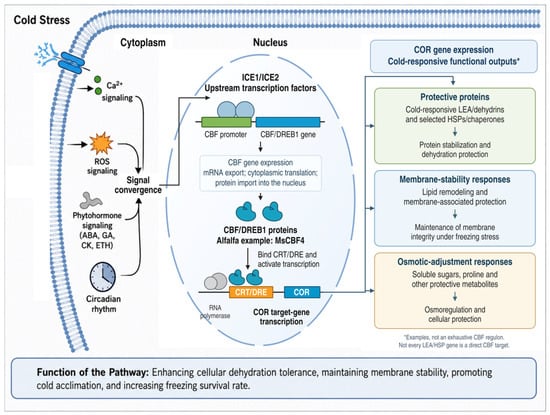
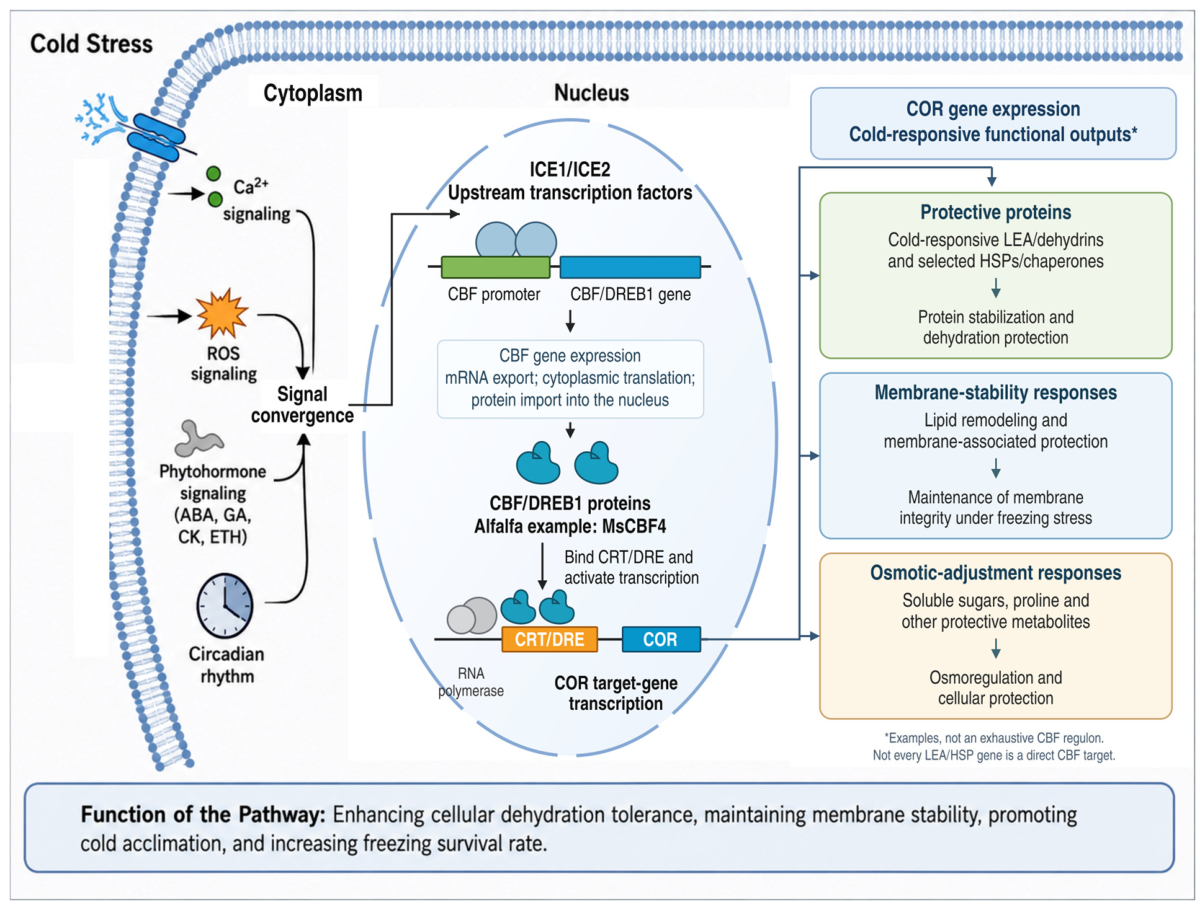
The ICE–CBF/DREB–COR pathway is a major cold-acclimation module rather than a single linear route. Cold-regulated ICE activity promotes rapid CBF/DREB1 expression, and CBF proteins bind CRT/DRE elements in a subset of COR genes that contribute to dehydration protection, membrane stabilization, and compatible-solute accumulation. In parallel, CBF-independent branches involving MYB, NAC, WRKY, ERF, and bZIP/ABF factors regulate overlapping and distinct targets. Ca2+ and ROS signals, ABA and other hormones, protein modification, and circadian gating determine the timing and amplitude of both branches [35,36]. MsCBF4 provides E2 heterologous support, but direct multi-year validation in cultivated alfalfa remains necessary [37]. Figure 1 therefore represents the CBF core within a broader network, not the complete cold-response system.
Figure 1.
ICE–CBF/DREB–COR core module. The module links cold-responsive upstream signals with CBF/DREB1 expression, CRT/DRE binding, and a subset of protective outputs. Ca2+, ROS, phytohormone, and circadian inputs converge on this core, while CBF-independent transcriptional branches operate in parallel; the diagram should therefore be interpreted as a focused module rather than an exhaustive or strictly linear network. Abbreviations: ICE, inducer of CBF expression; CBF/DREB, C-repeat binding factor/dehydration-responsive element-binding; CRT/DRE, C-repeat/dehydration-responsive element; COR, cold-responsive; ABA, abscisic acid; ROS, reactive oxygen species.
4.3. ROS Scavenging, Phytohormone Signaling, Autophagy, Circadian Regulation, and Sugar Metabolism
Phytohormones regulate both the threshold and duration of acclimation. ABA perception by PYR/PYL receptors releases SnRK2 kinases from PP2C inhibition, enabling bZIP/ABF-mediated transcription and interaction with sugar, redox, and CBF-related responses. Recent integrated transcriptomic and proteomic evidence in alfalfa implicates the PYL–PP2C–SnRK2–bZIP branch during freezing, while salicylic acid, jasmonate, and ethylene modules contribute context-dependent defense and growth trade-offs [40]. Hormone-associated expression remains candidate evidence unless perturbation is linked to survival in cultivated alfalfa.
Recent direct evidence strengthens the ABA link. MsNCED3 encodes 9-cis-epoxycarotenoid dioxygenase 3, an ABA-biosynthesis enzyme. Its overexpression in cultivated alfalfa increased ABA accumulation and improved cold-response phenotypes, with lower ROS and membrane-injury indicators [52]. Sequential saline–alkali pretreatment and simultaneous combined stress had different outcomes. This E4 result supports ABA-dependent cross-adaptation under the tested regimes, not a recommendation to impose salinity or proof of field winter hardiness.
Autophagy recycles cellular material and can support protein and organelle quality control during stress and energy limitation. MsATG13, which encodes a regulator of autophagy initiation, promoted autophagosome formation, increased antioxidant enzyme activities, and reduced oxidative-injury indicators in transgenic tobacco [38]. This E2 evidence does not establish selective turnover of chloroplasts, mitochondria, or peroxisomes in the alfalfa crown. Measurements of autophagic flux, rather than vesicle abundance alone, should be combined with direct alfalfa perturbation and bud-survival assays to test whether recycling sustains acclimation and regrowth.
Circadian regulation can gate cold-responsive transcription, so temperature responses must be interpreted with sampling time and photoperiod. MsLHY encodes a LATE ELONGATED HYPOCOTYL clock-associated transcription factor. Overexpression and RNA interference in cultivated alfalfa supported its positive contribution to cold tolerance; overexpressing plants showed higher antioxidant activities and lower ROS accumulation and electrolyte leakage under the tested conditions [39]. Whether these effects represent altered phase, amplitude, or downstream cold signaling requires time-series analysis. Crown acclimation, reserve use, and spring regrowth should therefore be assessed across light–dark cycles rather than at one sampling time.
4.4. Cold-Tolerance Gene Resources from Yellow-Flowered Alfalfa and Related Species
The M. falcata gene pool contributes experimentally tractable candidates, but donor origin must be distinguished from validation host. MfGolS1 encodes galactinol synthase, MfMIPS1 encodes myo-inositol-phosphate synthase, and MfINT-like encodes an inositol transporter-like protein; these candidates connect cold responses with raffinose-family sugars and inositol metabolism [41,42,43]. MfSAMS1, an S-adenosylmethionine synthetase, links signaling with polyamine turnover [32]. MfTIL1 is a temperature-induced lipocalin, and MfPIP2–7 is a plasma-membrane aquaporin [44,45]. MfERF1 and MfNAC3 are transcription factors, MfLEA3 is a late-embryogenesis-abundant protective protein, and MfEF2 is a translation elongation factor. Their functions can be summarized by pathway rather than repeated as enzyme lists. Most evidence comes from tobacco or M. truncatula (Table 3); confirmation in tetraploid M. sativa crowns and buds remains necessary.
4.5. Multi-Omics and Genomic Resources for Resolving Cold-Tolerance Networks
Cultivated alfalfa is an outcrossing autotetraploid with polysomic inheritance, high heterozygosity, and allele dosages from zero to four copies. These features complicate read mapping, haplotype phasing, marker coding, estimation of additive and non-additive effects, and editing of all functional alleles. A marker associated with cold tolerance in one population may also lose predictive value when allele frequency, dosage, linkage phase, or environment changes. Allele-aware reference genomes, diploid and wild-relative genomes, pangenomes, and transgene-free editing platforms now provide the basis for resolving these problems [53,54,55,56].
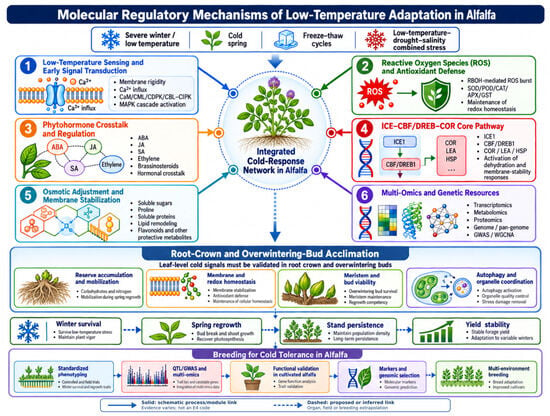
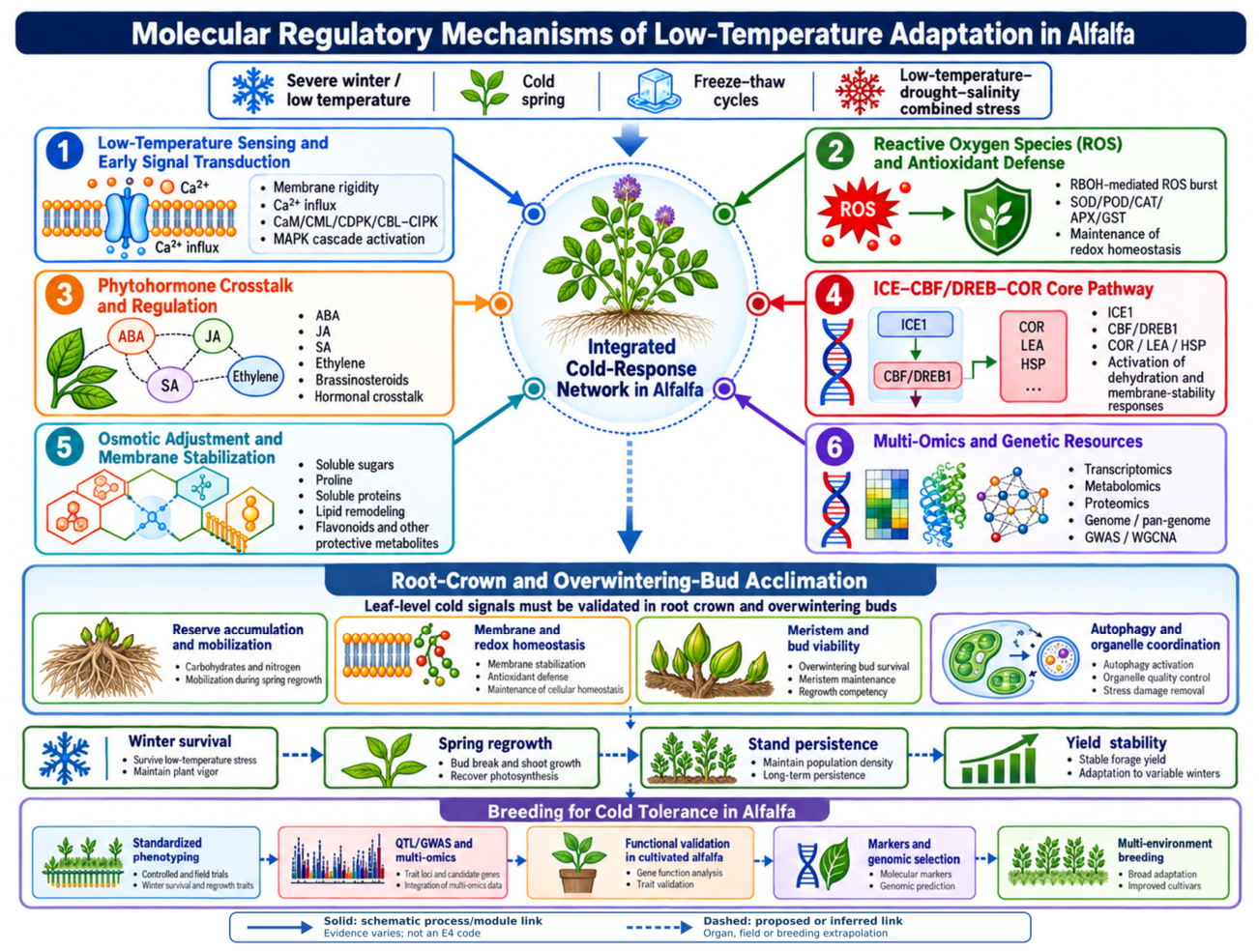
A connected multi-omics pipeline should begin with reliable crown, bud, and field phenotypes and dosage-aware QTL or GWAS signals; overlay transcriptomic, proteomic, metabolomic, and non-coding-RNA responses; use network analysis to prioritize dosage- and organ-consistent candidates; test candidates by direct perturbation in cultivated alfalfa; convert validated variants into marker assays; and evaluate them in breeding populations across environments. Recent work integrating GWAS with whole-transcriptome and ceRNA analysis [57], transcriptomics with proteomics, and root physiology with co-expression networks illustrates the discovery stages of this pipeline. Figure 2 integrates these processes with crown and bud acclimation. Solid arrows schematically connect the literature-discussed response modules; dashed arrows identify proposed links or extrapolation to organ, field, and breeding outcomes. Line style does not encode the E1–E5 evidence levels. Table 3 supplies the candidate-level evidence and validation hosts. Neither a solid arrow nor E4 evidence establishes field winter-survival validation.
Figure 2.
Evidence-aware framework connecting low-temperature perception, Ca2+–ROS signaling, hormonal and transcriptional regulation, protective metabolism, and breeding for winter survival. Solid arrows schematically connect processes and modules discussed in the literature, including physiological and multi-omics associations; they do not establish candidate-specific causality or direct physical binding. Dashed arrows mark proposed or inferred connections, including extrapolation to root-crown, overwintering-bud, field, and breeding outcomes. Line style does not encode E1–E5 evidence levels. E4 remains restricted to candidate-specific genetic perturbation in cultivated M. sativa linked to a cold-response phenotype, as defined in Table 3. General mechanisms and heterologous examples retain their stated evidence boundaries. Root-crown reserves and bud viability form the organ-level bridge to spring regrowth and breeding assessment. Candidate sources and evidence definitions are given in Table 3; the breeding workflow represents the proposed application, not a validated causal pathway.
5. Evaluation Systems for Cold Tolerance in Alfalfa
Cold tolerance is a complex quantitative trait whose meaning depends on scale. Controlled freezing can estimate cellular or whole-plant freezing tolerance, whereas winter hardiness and overwintering survival require field exposure to the winter complex. Evaluation should therefore integrate standardized controlled tests, crown and bud measurements, repeated field observations, and molecular information, while identifying which endpoint each metric predicts.The main evaluation approaches, their indicators, advantages, limitations, and representative evidence are summarized in Table 4.
Table 4.
Evaluation systems for cold tolerance in alfalfa and their applicable scenarios.
Field identification most directly reflects overwintering capacity under production conditions and is suitable for regional trials, cultivar registration, and evaluation before commercial deployment. Physiological and biochemical indicators explain differences in cellular injury, antioxidant defense, osmotic adjustment, and photosynthetic stability and are suitable for germplasm prescreening and mechanistic studies. Molecular identification can improve selection efficiency through candidate-gene expression, molecular markers, QTL mapping, GWAS, WGCNA, transcriptomic modules, metabolic biomarkers, and genomic selection models.
An effective evaluation system should combine multi-year and multi-location winter survival with root-crown injury, bud viability, spring green-up, regrowing shoot number, stand cover, persistence, and first-cut yield. MDA, electrolyte leakage, antioxidant enzyme activity, proline, and related measurements can support screening and mechanism discovery, but their predictive value should be calibrated against survival and regrowth. Molecular markers and omics candidates should be evaluated with independent populations rather than only with the discovery panel.
5.1. Standardized Phenotyping and LT50 Determination
Comparable LT50 estimates require explicit reporting of plant age; acclimation temperature, duration, and photoperiod; organ or whole-plant sampling; cooling rate; ice-nucleation temperature and method, or a clear statement that nucleation was not controlled; target temperatures and holding time; thawing conditions; recovery temperature, light, and duration; and biological replication. Temperatures must span both low and high mortality. Chamber air temperature should not be assumed to equal crown or sample temperature: monitoring the tissue or substrate temperature and documenting ice formation improve interpretability. A common parameter set should not be imposed retrospectively on studies using different organs or endpoints.
A concrete controlled-freezing example used intact alfalfa plants acclimated at 4 °C for three weeks, held at 0 °C for 8 h, cooled at 2 °C h−1 to −8 °C for 90 min, and rewarmed at the same rate to 2 °C. Recovery was under 23°C/15 °C day/night conditions; survival and regrowth were assessed after two weeks [64]. This was a single-temperature screening assay, not an LT50 curve, and controlled ice inoculation was not specified. LT50 determination would additionally require a graded temperature series and a defined mortality model.
For a mortality-based LT50, the endpoint is death of 50% of the tested plants or explicitly defined crown–bud units after recovery. A fitted binomial logistic model can be written as logit (pdeath) = α + βT, giving LT50 = −α/β; probit models are another option. The temperature–response range, fitted uncertainty, and biological replicate structure should be reported, with an interval estimate and no extrapolated LT50 when 50% mortality is not bracketed. Bud viability, regrowth reduction, visual injury, and electrolyte leakage are distinct endpoints: a fitted 50% injury or response temperature must be named accordingly, unless calibrated against mortality. Raw responses, controls, and recovery criteria are essential for comparing studies.
5.2. High-Throughput Phenotyping and Phenomics
High-throughput phenotyping can reduce the cost of repeatedly measuring large perennial populations. UAV-based RGB or multispectral imaging can quantify canopy height, spectral indices, stand cover, autumn growth cessation, snowmelt recovery, and the timing and uniformity of spring green-up. In 210 alfalfa populations, UAV-derived canopy traits supported automated assessment of fall dormancy and forage yield [65], and a 2026 RGB point-cloud pipeline estimated plant height, crown width, and canopy volume in breeding fields [66]. Repeated flights are especially valuable because winter response is a trajectory rather than a single score.
Aboveground remote sensing should be paired with organ-level ground truth. Image-based machine learning has classified root-system architecture from mature field-grown alfalfa roots [67], and related workflows can be adapted to crown diameter, crown cracking, bud number, tissue browning, and root architecture. Phenomics models should be trained and independently validated across years and sites, with destructive crown measurements and survival used to prevent a visually convenient canopy proxy from replacing the causal overwintering organ.
A 2026 Canadian study analyzed 566 fields on 225 farms across four provinces using local conditions, weather, management, and repeated stand observations to model winter-survival risk [68]. Its scale illustrates the value of environment-linked longitudinal phenotypes. The model was not a genomic-selection experiment and does not establish gene-level causality; nevertheless, such environmental metadata can help design representative training populations and independently test the transferability of future genomic predictions.
6. Cold-Tolerance Gene Discovery and Progress in Molecular Breeding
Molecular breeding for cold tolerance should connect standardized phenotyping, dosage-aware mapping, evidence-weighted candidate discovery, direct functional validation, marker development, genomic prediction, crossing, and multi-environment selection. The target is an integrated perennial phenotype: crown and bud survival, spring regrowth, stand persistence, yield, forage quality, and adaptation to interacting drought or saline–alkaline stress. Candidate lists or short-term seedling expression alone are insufficient for cultivar development.
6.1. Germplasm, Cultivars, and Evidence Translation
Breeding and regional adaptation studies in China have emphasized winter survival, fall dormancy, crown development, and yield stability [69]. Registration, regional adaptation, and mechanistic validation are nevertheless different evidence types. Table 2 summarizes ten cultivar records while distinguishing book entries, national announcements, institutional notices, and an issuer disclosure. Quantitative performance is reported only where the cited source explicitly supplies it, with its geographic boundary. Registration alone does not establish a minimum freezing threshold or a common-environment ranking.
6.2. Quantitative Genetics, Genomic Selection, and Genome Editing
QTL and GWAS in autotetraploid alfalfa should retain allele dosage (0–4) and account for polysomic inheritance, relatedness, and population structure. Pseudo-testcross designs using single-dose markers capture only part of segregating variation; a locus near a CBF homolog is not proof that the homolog is causal [64]. High heterozygosity, dosage uncertainty, linkage phase, and structural variation can reduce transferability. Genotype-by-environment interaction may reorder survival rankings across snow cover, soil moisture, freeze–thaw exposure, and management. Crown and field phenotypes across years and locations, followed by independent population validation, are therefore required before marker deployment.
Genomic selection is attractive for winter survival because the phenotype is quantitative, slow, costly, and environment-sensitive. Alfalfa prediction studies establish feasibility for biomass yield and canopy traits, not yet a universal prediction accuracy for winter survival [70,71,72]. Training sets should represent the deployment gene pool, allele-dosage distribution, relatedness, stand ages, and winter environments. Cross-validation should separate families, sites, years, and selection cycles to prevent information leakage. Multi-environment models can include environmental covariates and genotype-by-environment effects; multi-trait indices can balance survival, crown injury, green-up, persistence, yield, and forage quality. Controlled-freezing traits may assist prediction only after calibration against field outcomes. Recalibration with new winters is important when deployment environments differ from the training set.
AtCBF1 transgenic work in cultivated alfalfa is reported in a Master’s thesis, rather than a peer-reviewed research article [73]. This thesis-derived observation is retained with a different documentary status from the peer-reviewed MsCML10, MsCML50, MsLHY, and MsNCED3 studies (Table 3). MsCBF4 and MsATG13 rely on heterologous validation. These results do not yet establish improved winter survival in breeding populations. Genome editing can test candidate causality, but designs must resolve homolog-specific sequence and dosage, account for redundant alleles, and distinguish partial from complete knockouts. Mosaicism, regeneration genotype, unintended edits, and possible growth penalties require evaluation. Stable crown and bud phenotypes and multi-year field performance remain the gate between a functional gene and a deployable breeding target.
International and Chinese programs together provide wild-relative genes, controlled-freezing QTL, high-quality genomes, pangenomes, phenomics, and regional field populations. The priority is to join these resources in a closed pipeline: standardized phenotype → dosage-aware QTL/GWAS → multi-omics and network prioritization → direct alfalfa validation → marker or genomic-prediction model → multi-environment breeding trial → cultivar decision. Recent GWAS–ceRNA, transcriptome–proteome, root-network, combined saline–alkaline–cold, and metabolomic studies broaden the candidate base but remain discovery-stage evidence until they enter this pipeline.The principal breeding routes, representative resources, target traits, and current limitations are summarized in Table 5.
Table 5.
Progress in cold-tolerance gene discovery and molecular breeding in alfalfa.
7. Comparison of Research Progress in China and Other Countries
Geographic comparisons are useful for understanding target environments, but the cited studies do not support an exclusive national division of research methods. Chinese programs contribute regional cultivar resources and trials in Northeast China, Inner Mongolia, Northwest China, and cold saline–alkaline environments, alongside functional genetics, genome assemblies, and editing resources. Their regional measurements link crown condition and management with overwintering, while controlled experiments help resolve specific mechanisms.
Complementary examples from other countries include controlled-freezing QTL experiments, alfalfa genomic-prediction studies, image-based root architecture, UAV canopy phenotyping, and Canadian multi-region winter-survival assessment [70,71,72]. These are examples from the cited literature, not a quantitative ranking of national research capacity. Mf-prefixed genes denote M. falcata origin, not the country in which a study was conducted; studies of these genes and alfalfa pangenomes should not automatically be classified as research outside China.
The principal opportunity is to connect these complementary resources: shared cold-response definitions, dosage-aware genomic models, repeated crown and bud phenotyping, and independent multi-environment validation. Collaboration is especially valuable where genotypes, management systems, and winter hazards differ. Table 6 therefore summarizes representative contexts and transferable methods without treating them as nationally exclusive approaches.
Table 6.
Representative research contexts in China and other countries and opportunities for integration.
8. Current Challenges and Future Perspectives
Four limitations remain. First, acclimation, cooling, ice nucleation, exposure, recovery, organ choice, and injury criteria are inconsistently reported. Second, expression, biochemical correlation, heterologous transformation, direct alfalfa perturbation, and field validation are often discussed as though they were equivalent. Third, crown and overwintering-bud dynamics from autumn reserve accumulation through spring regrowth remain poorly resolved. Fourth, autotetraploidy, genotype-by-environment interaction, and correlated responses in yield, quality, persistence, drought, and saline–alkaline tolerance complicate translation into cultivars.
Future research should treat the root crown–overwintering bud unit as the primary organ-level target, rather than using leaf responses alone as a substitute for perennial survival. Standardized freezing assays should be paired with repeated crown injury, bud viability, winter survival, spring green-up, shoot number, persistence, and first-cut yield. Time-resolved sampling should measure organelle redox state, membrane lipids, carbohydrate and nitrogen reserves, ABA, autophagic flux, and circadian phase. Direct perturbation in cultivated alfalfa should prioritize candidates supported across organs, omics layers, allele dosage, and contrasting genotypes.
Breeding pipelines should integrate UAV and ground-based phenomics, QTL and GWAS, pangenomes, transcriptomics, proteomics, metabolomics, non-coding RNA, network analysis, genome editing, and genomic selection with conventional crossing. Training populations and prediction models should represent target environments and combined stresses; recent saline–alkaline–cold and metabolomic studies illustrate why selection under cold alone may miss production-relevant responses [74,75]. The practical endpoint is a cultivar whose crown and buds survive winter and whose stand regrows uniformly while maintaining yield and forage quality across environments.
Author Contributions
Conceptualization, X.L. and W.Y.; methodology, J.L. and X.S.; investigation, X.S. and W.Y.; data curation, J.L. and X.S.; writing—original draft preparation, X.S. and W.Y.; writing—review and editing, X.L.; supervision, X.L.; project administration, X.L.; funding acquisition, X.L. All authors have read and agreed to the published version of the manuscript.
Funding
This research was supported by the National Major Science and Technology Project for Biological Breeding (Grant No. 2022ZD04012) and the Research Start-up Program for Outstanding and Introduced Talent (Grant No. XYB202113).
Data Availability Statement
No new datasets were generated for this narrative review. The evidence discussed is available in the cited publications and cultivar sources.
Acknowledgments
The authors express their gratitude to all individuals who offered valuable comments and support during the preparation of this manuscript. In the course of this work, the authors utilized Deepseek-V3 for text generation in some paragraphs. AI was NOT used for literature selection, reference generation, evidence weighting, scientific interpretation, or the formulation of conclusions. All AI-assisted text was fully reviewed, revised, and verified by all authors, who take full responsibility for the content of this publication.
Conflicts of Interest
The authors declare no conflicts of interest.
Abbreviations
The following abbreviations are used in this manuscript:
| Ca2+ | calcium ion |
| APX | ascorbate peroxidase |
| CAT | catalase |
| CBF | C-repeat binding factor |
| CML | calmodulin-like |
| COR | cold-responsive |
| FBA | fructose-bisphosphate aldolase |
| GR | glutathione reductase |
| HSP | heat-shock protein |
| ICE | inducer of CBF expression |
| LEA | late embryogenesis abundant |
| LT50 | temperature causing 50% mortality |
| MDA | malondialdehyde |
| POD | peroxidase |
| ROS | reactive oxygen species |
| SOD | superoxide dismutase |
| TPP | trehalose-6-phosphate phosphatase |
| ABA | abscisic acid |
| ceRNA | competing endogenous RNA |
| G×E | genotype-by-environment interaction |
| GWAS | genome-wide association study |
| HTP | high-throughput phenotyping |
| ncRNA | non-coding RNA |
| PP2C | protein phosphatase 2C |
| QTL | quantitative trait locus |
| RBOH | respiratory burst oxidase homolog |
| RGB | red–green–blue |
| SnRK2 | SNF1-related protein kinase 2 |
| UAV | unmanned aerial vehicle |
| WGCNA | weighted gene co-expression network analysis |
| ABF | ABA-responsive element-binding factor |
| bZIP | basic leucine zipper |
| CaM | calmodulin |
| CBL | calcineurin B-like protein |
| CDPK | calcium-dependent protein kinase |
| CIPK | CBL-interacting protein kinase |
| DREB | dehydration-responsive element-binding factor |
| ERF | ethylene-responsive factor |
| Fv/Fm | maximum quantum efficiency of photosystem II |
| GBS | genotyping-by-sequencing |
| GS | genomic selection |
| GST | glutathione S-transferase |
| JA | jasmonic acid |
| MAPK | mitogen-activated protein kinase |
| NAC | NAM, ATAF1/2, and CUC2 transcription-factor family |
| NCED | 9-cis-epoxycarotenoid dioxygenase |
| NO | nitric oxide |
| PYR/PYL | PYRABACTIN RESISTANCE/PYRABACTIN RESISTANCE-LIKE ABA receptors |
| SA | salicylic acid |
| SAM | S-adenosylmethionine |
| SNP | single-nucleotide polymorphism |
References
- Wang, Q.Q.; Xie, J.H.; Yu, L.Q.; Wang, Y.T.; Sun, Z.; Li, J. Research Progress and Prospects of Alfalfa Breeding in China. J. Grassl. Forage Sci. 2023, 4, 1–7. (In Chinese) [Google Scholar] [CrossRef]
- Ding, Y.; Shi, Y.; Yang, S. Advances and challenges in uncovering cold tolerance regulatory mechanisms in plants. New Phytol. 2019, 222, 1690–1704. [Google Scholar] [CrossRef] [Scilit]
- Qian, Z.; He, L.; Li, F. Understanding cold stress response mechanisms in plants: An overview. Front. Plant Sci. 2024, 15, 1443317. [Google Scholar] [CrossRef] [Scilit]
- Zhang, H.M.; Cheng, B.; Zhang, C.; Li, W.J.; Zhang, J.P.; Wang, Z.Y. Research Progress on Stress Resistance of the Rhizobium-Alfalfa System under Cold, Drought, and Salinity Stresses. J. Temp. For. Res. 2018, 1, 14–18+62. (In Chinese) [Google Scholar] [CrossRef]
- D’Amours, E.; Bertrand, A.; Cloutier, J.; Claessens, A.; Rocher, S.; Seguin, P. Metabolic and genetic responses to simulated overwintering conditions of alfalfa-rhizobia associations contrasted in their freezing tolerance. Symbiosis 2023, 90, 321–343. [Google Scholar] [CrossRef] [Scilit]
- Gusta, L.V.; Wisniewski, M. Understanding plant cold hardiness: An opinion. Physiol. Plant. 2013, 147, 4–14. [Google Scholar] [CrossRef] [Scilit]
- Su, L.H.; Zhang, F.F.; Wang, X.Z.; Song, L.; Yu, X.; He, T.T.; Ma, C.H. Effects of Natural Snow Cover on Winter Survival and Cold Tolerance of Five Alfalfa Cultivars with Different Fall Dormancy Classes. Xinjiang Agric. Sci. 2021, 58, 2122–2132. (In Chinese) [Google Scholar] [CrossRef]
- Chen, W.D.; Zhang, Y.X.; Zhang, Q.X.; Liu, T.Y.; Wang, X.G.; Wang, D.R. Effects of the Final Cutting Date on the Antioxidant System and Cold Tolerance of the Alfalfa Root Crown. Acta Pratacult. Sin. 2022, 31, 129–138. (In Chinese) [Google Scholar] [CrossRef]
- Chen, N.; Bao, F.X.; Zhao, H.X.; Wang, N.; Jiang, R.Y.; Li, G.L.; Liu, X.P.; Qu, S.M.; Yang, W.G. Physiological Characteristics of the Alfalfa Root Crown during Overwintering in a Cold Soda-Saline-Alkali Habitat. Acta Pratacult. Sin. 2025, 34, 78–86. (In Chinese) [Google Scholar] [CrossRef]
- Xu, H.; Tong, Z.; He, F.; Li, X. Response of Alfalfa (Medicago sativa L.) to Abrupt Chilling as Reflected by Changes in Freezing Tolerance and Soluble Sugars. Agronomy 2020, 10, 255. [Google Scholar] [CrossRef] [Scilit]
- Ren, N.; Liu, J.; Wang, H.; Liu, Z.; Liu, X.; Li, G. Combined transcriptomic and proteomic analysis reveals the response mechanisms of alfalfa to freezing stress. Front. Plant Sci. 2026, 16, 1682825. [Google Scholar] [CrossRef] [Scilit]
- Wang, X.; Chai, H.; Xu, Y.; Li, S.; Wu, Y.; Wang, R.; Yang, Z. Analysis of physiological characteristics and gene co-expression networks in Medicago sativa roots under low-temperature stress. Front. Plant Sci. 2025, 16, 1597949. [Google Scholar] [CrossRef] [Scilit]
- Wang, X.; Kang, W.; Wu, F.; Miao, J.; Shi, S. Comparative Transcriptome Analysis Reveals New Insight of Alfalfa (Medicago sativa L.) Cultivars in Response to Abrupt Freezing Stress. Front. Plant Sci. 2022, 13, 798118. [Google Scholar] [CrossRef] [Scilit]
- Xu, H.; Zhang, Z.; Zhao, Q.; Gao, Y.; Xiang, Y.; Chai, J.; Li, Y.; Hou, X. Study on molecular response of alfalfa to low temperature stress based on transcriptomic analysis. BMC Plant Biol. 2024, 24, 1244. [Google Scholar] [CrossRef] [Scilit]
- Wang, Y.; Sun, Z.; Wang, Q.; Xie, J.; Yu, L. Transcriptomics and metabolomics revealed that phosphate improves the cold tolerance of alfalfa. Front. Plant Sci. 2023, 14, 1100601. [Google Scholar] [CrossRef] [Scilit]
- Ma, Y.; Yang, G.; Duan, R.; Li, X.; Zeng, S.; Yan, Y.; Zheng, C.; Hu, Y. Transcriptome analysis of alfalfa (Medicago sativa L.) roots reveals overwintering changes in different varieties. Czech J. Genet. Plant Breed. 2024, 60, 97–104. [Google Scholar] [CrossRef] [Scilit]
- Bureau of Animal Husbandry and Veterinary Services, Ministry of Agriculture and Rural Affairs; National Animal Husbandry Service (Eds.) Zhongguo Shending Dengji Cao Pinzhong Ji: 1987–2020 [Compendium of Approved and Registered Grass Cultivars in China: 1987–2020]; China Agriculture Press: Beijing, China, 2022; pp. 322, 325, 369. ISBN 978-7-109-29579-7. (In Chinese) [Google Scholar]
- Institute of Grassland Research, Chinese Academy of Agricultural Sciences. Four New Forage Cultivars Approved and Registered. 2023. Available online: https://gri.caas.cn/xwdt/zhdt2/e58ce9e73dd3420daaa2c2373a98bb7f.htm (accessed on 29 September 2026).
- Institute of Botany, Chinese Academy of Sciences. New Forage Cultivars Developed by the Institute Approved in Inner Mongolia. 2025. Available online: https://ib.cas.cn/2019gb/kyjz2019/202504/t20250418_7603778.html (accessed on 29 September 2026).
- National Forestry and Grassland Administration. List of Approved and Registered Grass Cultivars in 2025; Dongnong 109, registration Guo S-BV-MS-003-2025; National Forestry and Grassland Administration: Beijing, China, 2025; p. 2. Available online: https://lyj.hunan.gov.cn/lyj/xxgk_71167/tzgg/202511/33857267/files/5b8b0ec7dd5a4ff2a5655730524c17b3.pdf (accessed on 30 September 2026). (In Chinese)
- Institute of Botany, Chinese Academy of Sciences. Wang Tianzuo: Research Profile and Registered Cultivars; Zhongke No. 1 Variegated Alfalfa, Mengshen-133-2024. 2025. (In Chinese) Available online: https://sklfbdu.ibcas.ac.cn/yjtd/jsyz/rcdw/202506/t20250625_588755.html (accessed on 30 September 2026).
- Ministry of Agriculture and Rural Affairs of the People’s Republic of China. Announcement No. 460: Approved Grass Cultivars; entry for Zhongmu No. 10; Gazette of the Ministry of Agriculture and Rural Affairs: Beijing, China, 2021; p. 77. Available online: https://www.moa.gov.cn/nybgb/2021/202110/202112/P020211220377069569316.pdf (accessed on 30 September 2026). (In Chinese)
- Sichuan Grassland Technology Research and Extension Center. Achievements in Forage Cultivar Breeding in Sichuan Province in 2024. China Agricultural Information Network. 20 September 2024. Available online: https://www.agri.cn/zx/xxlb/sc/202409/t20240920_8672851.htm (accessed on 30 September 2026). (In Chinese)
- Institute of Botany, Chinese Academy of Sciences. Research Outputs of the Germplasm Innovation Team; Zhongke No. 1 Yellow-Flowered Alfalfa, Mengshen-132-2024. Available online: https://sklfbdu.ibcas.ac.cn/yjtd/pzcztd/kycg/ (accessed on 30 September 2026). (In Chinese)
- M-Grass Ecology and Environment (Group) Co., Ltd. Annual Report 2025; Cultivar-Registration List; M-Grass Ecology and Environment (Group) Co., Ltd.: Hohhot, China, 2026; p. 14. Available online: https://static.cninfo.com.cn/finalpage/2026-04-23/1225146956.PDF (accessed on 30 September 2026). (In Chinese)
- Waszczak, C.; Carmody, M.; Kangasjärvi, J. Reactive oxygen species in plant signaling. Annu. Rev. Plant Biol. 2018, 69, 209–236. [Google Scholar] [CrossRef] [Scilit]
- Suzuki, N.; Koussevitzky, S.; Mittler, R.; Miller, G. ROS and redox signalling in the response of plants to abiotic stress. Plant Cell Environ. 2012, 35, 259–270. [Google Scholar] [CrossRef] [Scilit]
- Xia, Q.C.; Zhang, Y.X.; Sun, M.X.; Chen, W.D.; Sun, H.; Zhang, Q.X.; Cong, B.M. Effects of Phosphorus Fertilizer Placement Depth on Nitrogen-Containing Protective Compounds and Cold Tolerance in the Alfalfa Root Crown. Agric. Res. Arid. Areas 2022, 40, 96–101. (In Chinese) [Google Scholar]
- Sun, M.X.; Zhang, Y.X.; Xia, Q.C.; Wang, X.; Zhang, Q.; Liu, T.; Zhang, Y. Effects of Potassium Fertilizer Type and Rate on Sugar Contents and Cold Tolerance of the Alfalfa Root Crown under Low-Temperature Stress. Agric. Res. Arid. Areas 2022, 40, 62–70. (In Chinese) [Google Scholar]
- Sun, M.X.; Zhang, Y.X.; Cong, B.M.; Xia, Q.C.; Tian, Y.L.; Zhang, Q.X.; Zhang, D.M. Effects of Water and Phosphorus Combinations on Antioxidant Characteristics of the Alfalfa Root Crown and Winter Survival of Alfalfa. J. Northwest A&F Univ. (Nat. Sci. Ed.) 2022, 50, 9–17. (In Chinese) [Google Scholar] [CrossRef]
- Teng, Z.; Zhang, Y.X.; Chen, W.D.; Cong, B.M.; Tian, Y.L.; Zhang, Q.X.; Zhang, Y.L.; Wang, D.R. Effects of Chitosan on Cold Tolerance and the Contents of Cold-Protective Compounds in Alfalfa. J. Agric. Sci. Technol. 2023, 25, 192–198. (In Chinese) [Google Scholar] [CrossRef]
- Guo, Z.; Tan, J.; Zhuo, C.; Wang, C.; Xiang, B.; Wang, Z. Abscisic acid, H2O2 and nitric oxide interactions mediated cold-induced S-adenosylmethionine synthetase in Medicago sativa subsp. falcata that confers cold tolerance through up-regulating polyamine oxidation. Plant Biotechnol. J. 2014, 12, 601–612. [Google Scholar] [CrossRef] [Scilit]
- Yu, S.; Wu, J.; Sun, Y.; Zhu, H.; Sun, Q.; Zhao, P.; Huang, R.; Guo, Z. A calmodulin-like protein (CML10) interacts with cytosolic enzymes GSTU8 and FBA6 to regulate cold tolerance. Plant Physiol. 2022, 190, 1321–1333. [Google Scholar] [CrossRef] [Scilit]
- Yang, L.; Sun, H.; Xu, B.; Liu, Y.; Zhu, H.; Guo, Z. A calmodulin-like protein (MsCML50) confers cold tolerance through interacting with MsTPP8 to moderate sugars accumulation and ROS scavenging in alfalfa. Environ. Exp. Bot. 2025, 239, 106255. [Google Scholar] [CrossRef] [Scilit]
- Shi, Y.; Ding, Y.; Yang, S. Molecular Regulation of CBF Signaling in Cold Acclimation. Trends Plant Sci. 2018, 23, 623–637. [Google Scholar] [CrossRef] [Scilit]
- Liu, J.; Shi, Y.; Yang, S. Insights into the regulation of C-repeat binding factors in plant cold signaling. J. Integr. Plant Biol. 2018, 60, 780–795. [Google Scholar] [CrossRef] [Scilit]
- Ren, N.P.; Zang, H.; Xuan, Y.F.; Liu, J.L.; Liu, X.P.; Li, G.L. The alfalfa AP2/ERF transcription factor MsCBF4 enhances frost tolerance in Arabidopsis thaliana. BMC Plant Biol. 2025, 25, 1763. [Google Scholar] [CrossRef] [Scilit]
- Zhao, W.; Song, J.; Wang, M.; Chen, X.; Du, B.; An, Y.; Zhang, L.; Wang, D.; Guo, C. Alfalfa MsATG13 confers cold stress tolerance to plants by promoting autophagy. Int. J. Mol. Sci. 2023, 24, 12033. [Google Scholar] [CrossRef] [Scilit]
- Li, J.; Chai, L.; Yang, M.; Zhang, H.; Shang, C.; Liu, Y.; Qian, K.; Sun, J.; Han, W.; Zhang, P. MsLHY is an active regulator of cold resistance in alfalfa (Medicago sativa L.). Front. Plant Sci. 2025, 16, 1559988. [Google Scholar] [CrossRef] [Scilit]
- Wang, X.; Miao, J.; Kang, W.; Shi, S. Exogenous application of salicylic acid improves freezing stress tolerance in alfalfa. Front. Plant Sci. 2023, 14, 1091077. [Google Scholar] [CrossRef] [Scilit]
- Zhuo, C.; Wang, T.; Lu, S.; Zhao, Y.; Li, X.; Guo, Z. A cold responsive galactinol synthase gene from Medicago falcata confers multiple abiotic stress tolerance in transgenic tobacco. Physiol. Plant. 2013, 149, 67–78. [Google Scholar] [CrossRef] [Scilit]
- Tan, J.; Wang, C.; Xiang, B.; Han, R.; Guo, Z. Hydrogen peroxide and nitric oxide mediated cold- and dehydration-induced myo-inositol phosphate synthase that confers multiple resistances to abiotic stresses. Plant Cell Environ. 2013, 36, 288–299. [Google Scholar] [CrossRef] [Scilit]
- Sambe, M.A.N.; He, X.; Tu, Q.; Guo, Z. A cold-induced myo-inositol transporter-like gene confers tolerance to multiple abiotic stresses in transgenic tobacco plants. Physiol. Plant. 2015, 153, 355–364. [Google Scholar] [CrossRef] [Scilit]
- He, X.; Sambe, M.A.; Zhuo, C.; Tu, Q.; Guo, Z. A temperature induced lipocalin gene from Medicago falcata (MfTIL1) confers tolerance to cold and oxidative stress. Plant Mol. Biol. 2015, 87, 645–654. [Google Scholar] [CrossRef] [Scilit]
- Zhuo, C.; Wang, T.; Guo, Z.; Lu, S. Overexpression of MfPIP2-7 from Medicago falcata promotes cold tolerance and growth under nitrate deficiency in transgenic tobacco plants. BMC Plant Biol. 2016, 16, 138. [Google Scholar] [CrossRef] [Scilit]
- Zhuo, C.; Liang, L.; Zhao, Y.; Guo, Z.; Lu, S. A cold responsive ethylene responsive factor from Medicago falcata confers cold tolerance by up-regulating polyamine turnover, antioxidant protection and proline accumulation. Plant Cell Environ. 2018, 41, 2021–2032. [Google Scholar] [CrossRef] [Scilit]
- Qu, Y.; Duan, M.; Zhang, Z.; Dong, J.; Wang, T. Overexpression of the Medicago falcata NAC transcription factor MfNAC3 enhances cold tolerance in Medicago truncatula. Environ. Exp. Bot. 2016, 129, 67–76. [Google Scholar] [CrossRef] [Scilit]
- Shi, H.; He, X.; Zhao, Y.; Lu, S.; Guo, Z. Constitutive expression of a group 3 LEA protein from Medicago falcata (MfLEA3) increases cold and drought tolerance in transgenic tobacco. Plant Cell Rep. 2020, 39, 851–860. [Google Scholar] [CrossRef] [Scilit]
- Shi, H.; He, S.; He, X.; Lu, S.; Guo, Z. An eukaryotic elongation factor 2 from Medicago falcata (MfEF2) confers cold tolerance. BMC Plant Biol. 2019, 19, 218. [Google Scholar] [CrossRef] [Scilit]
- Wang, Q.; Wu, J.; Di, G.; Zhao, Q.; Gao, C.; Zhang, D.; Wang, J.; Shen, Z.; Han, W. Identification of Cold Tolerance Transcriptional Regulatory Genes in Seedlings of Medicago sativa L. and Medicago falcata L. Int. J. Mol. Sci. 2024, 25, 10345. [Google Scholar] [CrossRef] [Scilit]
- Zhang, X.; Yang, H.; Li, M.; Bai, Y.; Chen, C.; Guo, D.; Guo, C.; Shu, Y. A pan-transcriptome analysis indicates efficient downregulation of the FIB genes plays a critical role in the response of alfalfa to cold stress. Plants 2022, 11, 3148. [Google Scholar] [CrossRef] [Scilit]
- Liu, L.; Feng, M.; Li, J.; Wang, J.; Guo, R.; Chai, J.; Si, L.; Sun, N.; Guo, C. ABA accumulation confers cross-adaptation to saline-alkali and cold stresses in alfalfa. Plant Cell Environ. 2026, 49, 6106–6123. [Google Scholar] [CrossRef] [Scilit]
- Chen, H.; Zeng, Y.; Yang, Y.; Huang, L.; Tang, B.; Zhang, H.; Hao, F.; Liu, W.; Li, Y.; Liu, Y.; et al. Allele-aware chromosome-level genome assembly and efficient transgene-free genome editing for the autotetraploid cultivated alfalfa. Nat. Commun. 2020, 11, 2494. [Google Scholar] [CrossRef] [Scilit]
- Li, A.; Liu, A.; Du, X.; Chen, J.Y.; Yin, M.; Hu, H.Y.; Shrestha, N.; Wu, S.D.; Wang, H.Q.; Dou, Q.W.; et al. A chromosome-scale genome assembly of a diploid alfalfa, the progenitor of autotetraploid alfalfa. Hortic. Res. 2020, 7, 194. [Google Scholar] [CrossRef] [Scilit]
- Shi, K.; Dong, H.; Du, H.; Li, Y.; Zhou, L.; Liang, C.; Sakiroglu, M.; Wang, Z. The chromosome-level assembly of the wild diploid alfalfa genome provides insights into the full landscape of genomic variations between cultivated and wild alfalfa. Plant Biotechnol. J. 2024, 22, 1757–1772. [Google Scholar] [CrossRef] [Scilit]
- Zhang, F.; Wei, C.; Shi, X.; Cao, S.; Xu, X.; Ma, Z.; Peng, Y.; Arshad, R.; Xue, H.; Zhang, Z.; et al. Medicago super-pangenome reveals adaptive advantages and evolutionary constraints in autotetraploid alfalfa. Nat. Commun. 2026, 17, 583. [Google Scholar] [CrossRef] [Scilit]
- Zhu, L.; Zhao, Y.; Guo, M.; Bai, J.; Zhang, L.; Li, Z. Deciphering the ceRNA network in alfalfa: Insights into cold stress tolerance mechanisms. Biomolecules 2026, 16, 208. [Google Scholar] [CrossRef] [Scilit]
- Wang, X.-L.; Li, H.; Mi, F.-G.; Yu, J.; Wang, X.-T.; Meng, K.; Jia, Z.-Y.; Wang, Q.-Z. Evaluation of Production Performance and Winter Survival of Alfalfa Cultivars with Different Fall Dormancy Classes. Acta Pratacult. Sin. 2019, 28, 82–92. (In Chinese) [Google Scholar]
- Li, T.; Zhu, T.; Liu, Z.; Yang, N.; Wang, Z.; Yang, T.; Gao, K. Evaluation of Cold Resistance in Alfalfa Varieties Based on Root Traits and Winter Survival in Horqin Sandy Land. Biology 2024, 13, 1042. [Google Scholar] [CrossRef] [Scilit]
- Wu, Y.; Song, Y.T.; Tian, Y. Freezing Tolerance of Seedlings of Alfalfa Cultivars with Different Fall Dormancy Classes. Chin. J. Grassl. 2020, 42, 169–173. (In Chinese) [Google Scholar] [CrossRef]
- Ma, B.; Nan, L.L.; Wang, K.; Yao, Y.H.; Chen, J.; Xia, J. Physiological Responses of 30 Alfalfa Germplasm Materials to Low-Temperature Stress and Evaluation of Their Cold Tolerance. Grassl. Turf 2024, 44, 170–180. (In Chinese) [Google Scholar] [CrossRef]
- Zhao, Y.H.; Meng, L.D.; Zhang, X.M.; Wang, L.N.; Liu, H.Y.; Bi, L.L.; Liu, H.L.; Yin, X.J. Physiological Responses and Cold-Tolerance Evaluation of Four Alfalfa Cultivars under Low-Temperature Stress. Pratacult. Sci. 2021, 38, 683–692. (In Chinese) [Google Scholar]
- Liu, Z.Y.; Sui, K.; Yuan, Z.T.; Zhang, Y.X.; Liu, T.Y.; Shan, X.H.; Zhang, Z.Y.; Wang, X.G. Effects of Low-Temperature Stress on Antioxidant Physiology in WL-Series Alfalfa Cultivars. Grassl. Turf 2025, 45, 24–31. (In Chinese) [Google Scholar] [CrossRef]
- Adhikari, L.; Makaju, S.O.; Lindstrom, O.M.; Missaoui, A.M. Mapping freezing tolerance QTL in alfalfa: Based on indoor phenotyping. BMC Plant Biol. 2021, 21, 403. [Google Scholar] [CrossRef] [Scilit]
- González, F.; Noushahi, H.A.; Hernández, D.; Garriga, M.; del Pozo, A.; Gerding, M.; Muñoz-Espinoza, C.; Gezan, S.A.; Inostroza, L. UAV image-derived canopy traits for predicting alfalfa fall dormancy and forage yield in Mediterranean environments. Front. Plant Sci. 2026, 17, 1841672. [Google Scholar] [CrossRef] [Scilit]
- Cheng, T.; Gao, Z.; Xie, J.; Ren, W.; Liu, Y.; Han, D.; Zhang, G.; Yuan, F.; Guo, J.; Zhang, D. PTv3-HRAC: Structural phenotyping of alfalfa in breeding fields using UAV-derived RGB point clouds, 3D deep learning, and adaptive clustering. J. Integr. Agric. 2026; in press. [CrossRef] [Scilit]
- Xu, Z.; York, L.M.; Seethepalli, A.; Bucciarelli, B.; Cheng, H.; Samac, D.A. Objective phenotyping of root system architecture using image augmentation and machine learning in alfalfa (Medicago sativa L.). Plant Phenomics 2022, 2022, 9879610. [Google Scholar] [CrossRef] [Scilit]
- Saifuzzaman, M.; Adamchuk, V.I.; Leduc, M.; Chokmani, K.; Etezadi, H.; Seguin, P. A probabilistic approach to predicting alfalfa’s winter survival using local conditions, weather and management factors. Sci. Rep. 2026, 16, 11529. [Google Scholar] [CrossRef] [Scilit]
- Zhang, F.; Yang, Q.C. History, Current Status, and Prospects of Alfalfa Breeding. Sci. Agric. Sin. 2025, 58, 4471–4481. (In Chinese) [Google Scholar]
- Li, X.; Wei, Y.; Acharya, A.; Hansen, J.L.; Crawford, J.L.; Viands, D.R.; Michaud, R.; Claessens, A.; Brummer, E.C. Genomic prediction of biomass yield in two selection cycles of a tetraploid alfalfa breeding population. Plant Genome 2015, 8, plantgenome2014.12.0090. [Google Scholar] [CrossRef] [Scilit]
- Annicchiarico, P.; Nazzicari, N.; Li, X.; Wei, Y.; Pecetti, L.; Brummer, E.C. Accuracy of genomic selection for alfalfa biomass yield in different reference populations. BMC Genom. 2015, 16, 1020. [Google Scholar] [CrossRef] [Scilit]
- Andrade, M.H.M.L.; Acharya, J.P.; Benevenuto, J.; Oliveira, I.d.B.; Lopez, Y.; Munoz, P.; Resende, M.F.R.; Rios, E.F. Genomic prediction for canopy height and dry matter yield in alfalfa using family bulks. Plant Genome 2022, 15, e20235. [Google Scholar] [CrossRef] [Scilit]
- Xu, C. Study on Improving Alfalfa Cold Tolerance by Introducing the AtCBF1 Gene. Master’s Thesis, Inner Mongolia Agricultural University, Hohhot, China, 2016. (In Chinese) [Google Scholar]
- Zhuang, X.; Zhang, D.; Yang, Y.; Han, W.; Mu, L.; Shen, Z.; Di, G.; Liu, Y.; You, J.; Wang, J. Physiological and metabolic responses of alfalfa to cold stress under saline–alkaline conditions. Int. J. Mol. Sci. 2026, 27, 267. [Google Scholar] [CrossRef] [Scilit]
- Yue, Y.; Liu, Y.; Miao, P.; Yang, D.; Niu, K. Melatonin-mediated modulation of metabolic pathways enhances cold tolerance in alfalfa (Medicago sativa L.). Plants 2026, 15, 557. [Google Scholar] [CrossRef] [Scilit]

Disclaimer/Publisher’s Note: The statements, opinions and data contained in all publications are solely those of the individual author(s) and contributor(s) and not of MDPI and/or the editor(s). MDPI and/or the editor(s) disclaim responsibility for any injury to people or property resulting from any ideas, methods, instructions or products referred to in the content. |
© 2026 by the authors. Licensee MDPI, Basel, Switzerland. This article is an open access article distributed under the terms and conditions of the Creative Commons Attribution (CC BY) license.