


Abstract
Tetraploid non-apomictic citrus genotypes are key female parents for 4x × 2x hybridizations aimed at producing seedless triploid hybrids. However, the extent to which different tetraploidization methods affect genome integrity remains insufficiently characterized at a genome-wide scale. In this study, genotyping-by-sequencing (GBS) was used to evaluate marker-based genomic stability in ten tetraploid plants of ‘Clemenules’, ‘Fina’, and ‘Marisol’ clementines obtained via colchicine treatment, in vitro adventitious organogenesis, or somatic cybridization. Diploid parental plants, two haploid plants of ‘Clemenules’ and ‘Fina’ clementines, and one doubled haploid plant of ‘Clemenules’ clementine were included, being the haploid and double haploid essential to resolve allelic phases. After quality filtering, 3333 SNP (Single Nucleotide Polymorphism) markers distributed across the nine citrus chromosomes were identified and used to compare allele dosage patterns along the genome. Across all GBS-covered regions, no major marker-based genomic gains or losses were detected in any tetraploid plant. These results indicate that, at the resolution provided by GBS, all three tetraploidization methods largely preserve chromosome structure, supporting their suitability for citrus triploid breeding programs based on 4x × 2x sexual hybridizations.
1. Introduction
Triploid breeding is a key strategy for developing new seedless mandarin cultivars that are demanded by the fresh fruit market, as consumers generally do not accept seedy fruits [1]. Triploid plants are typically considered an evolutionary dead-end, since they usually produce aneuploid gametes with very low fertility [2]. In citrus triploid hybrids, meiosis commonly results in predominantly trivalent associations, together with numerous bivalent and univalent configurations [3]. Additionally, the abortion of megasporogenesis frequently occurs during the period between the first embryo-sac divisions and the fertilized egg cell [4]. For these reasons, citrus triploid hybrids are generally sterile, although they may occasionally produce fruits containing very few seeds.
Triploid citrus plants can be obtained directly from crosses between two diploid genotypes through the union of a 2n megagametophyte with haploid pollen [5,6,7], or from hybridization between diploid and tetraploid parents [8,9,10]. Citrus breeding is hampered by apomixis in most genotypes at both the diploid and tetraploid levels. In citrus, apomixis occurs via adventitious embryony from nucellar cells [11]. Most citrus genotypes are apomictic, with the main exceptions being citrons (Citrus medica L.), pummelos (C. maxima (Burm.) Merr.), clementines (C. × aurantium var. clementina) and some mandarin hybrids. In seeds of apomictic citrus genotypes, formation of the nucellar embryos can begin before fertilization [12], and competition between the zygotic and nucellar embryos generally leads to the failure of the zygotic embryo [11,13]. This characteristic represents a major limitation for the use of apomictic tetraploid genotypes as female parents in 4x × 2x hybridizations.
The most effective approach to recover large triploid populations is through 4x × 2x hybridizations using tetraploid non-apomictic genotypes as female parents [10]. This strategy has been little used for triploid breeding due to the difficulty of producing tetraploid plants of non-apomictic genotypes. Clementines are the most important group of mandarins in Spain due to their excellent fruit quality and consumer acceptance. ‘Fina’ is the original clementine cultivar, first described in 1902. It originated as a chance seedling and is now known to result from a hybridization between ‘Willow leaf’ mandarin (C. reticulata var. deliciosa) and sweet orange (C. x aurantium var. sinensis) [14]. Spontaneous mutations of ‘Fina’ clementine, along with additional and subsequent mutations accumulated on the derived clementines, have originated all known clementine varieties. ‘Clemenules’ was obtained in 1953 in Nules (Castellón, Spain) from a spontaneous mutation of ‘Fina’, which is one of the most important clementine varieties in the Spanish citrus industry due to its fruit quality and remains the most widely cultivated clementine in Spain. ‘Marisol’ originated in 1970 in Bechí (Castellón) from a spontaneous mutation of ‘Oroval’, which itself arose as a spontaneous mutation of ‘Fina’. The production of tetraploid plants of clementines is of great interest for triploid breeding because they produce fruits of excellent quality and are non-apomictic genotypes, allowing the production of large progenies of triploid hybrids in a relatively straightforward manner.
Spontaneous chromosome doubling in nucellar tissue is the primary mechanism underlying tetraploidization in apomictic citrus genotypes [15]. However, this phenomenon does not occur in non-apomictic genotypes, making it necessary to employ alternative methodologies to recover tetraploid plants from these genotypes. Aleza et al. [16] developed an efficient method for producing stable tetraploid plants of non-apomictic citrus genotypes by combining in vitro shoot-tip grafting with colchicine and/or oryzalin treatment of shoot-tips. When applied to adult plant material, this technique avoids the long juvenile phase associated with tetraploid recovery from nucellar seedlings. The recovery of citrus cybrid plants as a by-product of symmetric protoplast fusion has also been reported, yielding mainly diploid cybrids [17,18,19] and much less frequently, tetraploid cybrids [20,21]. Tetraploid cybrids arise from protoplast fusion between one protoplast from the callus parent and two diploid protoplasts from the leaf parent, followed by failed nuclear fusion, the subsequent loss of the callus-parent nucleus and the incorporation of mitochondria released from ruptured embryogenic cells into the fused leaf protoplasts [20]. The use of non-apomictic citrus genotypes as leaf parents enables the recovery of tetraploid cybrids that produce non-apomictic seeds, although these tetraploid cybrids display juvenile characteristics as they originate from embryogenesis [21].
Somaclonal variation is a useful approach for citrus improvement and has been applied for this purpose in several laboratories [22,23,24]. Clementines are good candidate for somaclonal variation studies because they are genetically unstable and frequently produce budsports in the field. We attempted to recover somaclonal variants through in vitro adventitious organogenesis from adult internodal segments and plant regeneration via shoot-tip grafting. Following this methodology, we regenerated more than 450 plants all which were diploid except for two tetraploid plants of ‘Clemenules’ clementine (unpublished data).
Somatic hybridization by protoplast fusion has been reported to induce genomic instability in citrus and related species [19], while in vitro adventitious organogenesis has been shown to promote somaclonal variation in sweet orange [24]. Somaclonal variation constitutes an important source of heritable diversity, encompassing both genetic mutations and epigenetic modifications, including alterations in DNA methylation patterns and transposable element activity [25,26]. In addition, colchicine treatments have been reported to induce genetic and chromosomal variations in several plant species, including cotton (Gossypium spp.) [27], Brachiaria spp. [28,29], Lilium spp. [30], and Calendula officinalis [31]. Based on these observations, we aimed to determine whether these techniques could similarly induce genetic instability in tetraploid citrus plants. Genetic analyses of citrus tetraploids plants have traditionally relied on a limited number of molecular markers [16,24,25,26,27], providing only partial genome coverage and limiting the detection of structural chromosomal variations, such as large deletions or duplications affecting heterozygosity. Genotyping-by-sequencing (GBS) has been successfully applied to investigate the phylogenomic structure of triploid and tetraploid citrus genotypes [32,33] and to identify chromosomal instabilities in allotetraploid somatic hybrids obtained by protoplast fusion [19]. However, as highlighted by Ahmed et al. [32], GBS alone does not allow accurate estimation of allele dosage at individual SNP loci in polyploid genomes. To overcome this limitation, these authors proposed an approach based on read-depth information for reference and alternative alleles across successive phased SNPs. In this context, the availability of genotyping data from haploid and doubled haploid plants provides comprehensive phasing information across the clementine genome. The development of haploid and doubled haploid plants therefore represents a valuable resource for genetic and genomic studies, and significant efforts have been made to generate such materials in various tree species [34,35].
In the present study, we expanded beyond conventional marker approaches by performing a genotyping by sequencing (GBS) analysis of tetraploid clementine plants recovered through the three methods described above (in vitro shoot-tip grafting and colchicine treatment, in vitro adventitious organogenesis from adult internodal segments and plant regeneration via shoot-tip grafting, and somatic cybridization) together with their diploid parental genotypes. Our main objective was to determine whether any of these methodologies induced gains or losses of large chromosome regions.
2. Results and Discussion
2.1. SNP Mining
After genotype calling against the Valencia sweet orange DVS_B genome reference and filtering for diallelic SNPs with a minimum allele frequency of 0.01, we identified a total of 15,480 SNPs. Further filtering for markers without missing data, heterozygous in the three diploid clementines and with the same homozygous allelic configuration as the haploid and doubled-haploid ‘Clemenules’ clementine, resulted in the selection of 3333 SNPs (Table S1).
2.2. Assessment of Allele Dosage
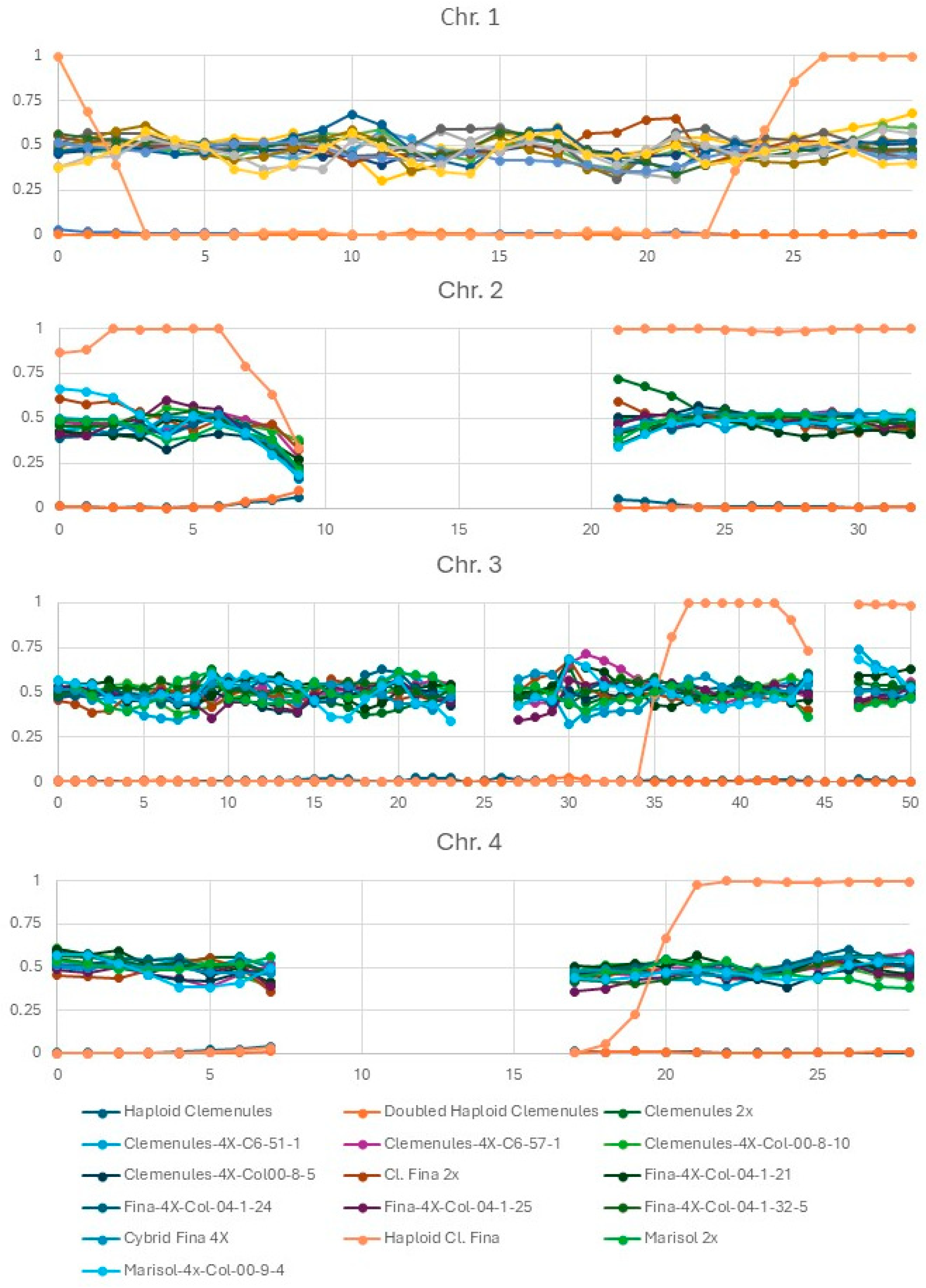
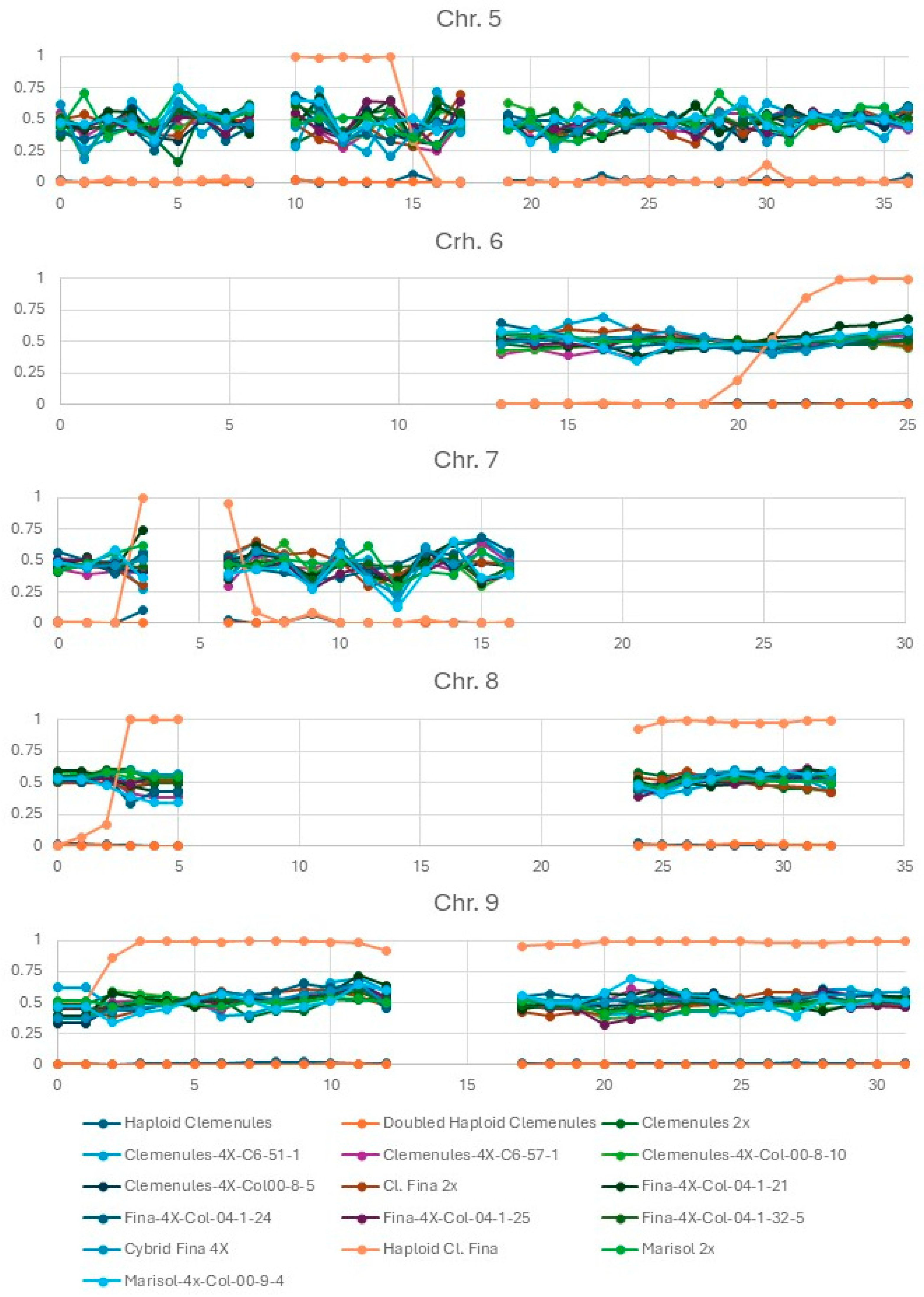
To identify potential variations along the genome, the first step of the analysis was to study the allele read frequencies for SNPs across the genome. For the haploid and doubled-haploid plants, the theoretical frequencies are 0 and 1, whereas for diploid and tetraploid plants the expected frequency is 0.5 in the absence of large structural variation, because only heterozygous markers were selected for the clementines.
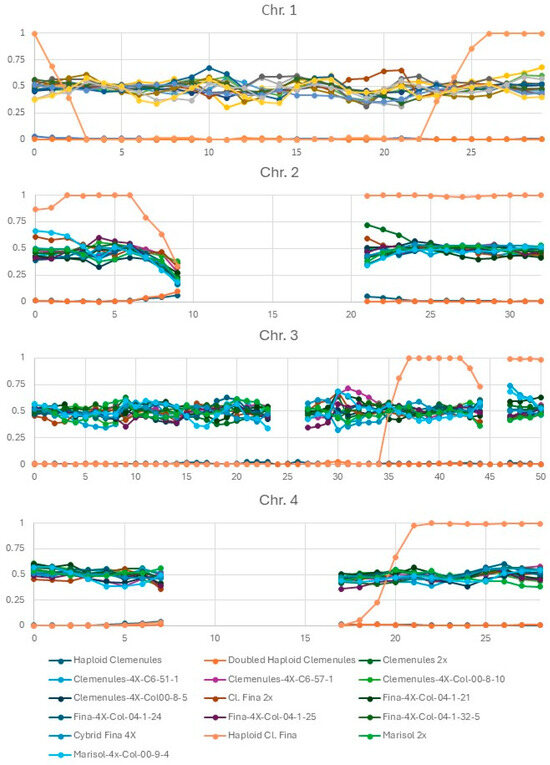
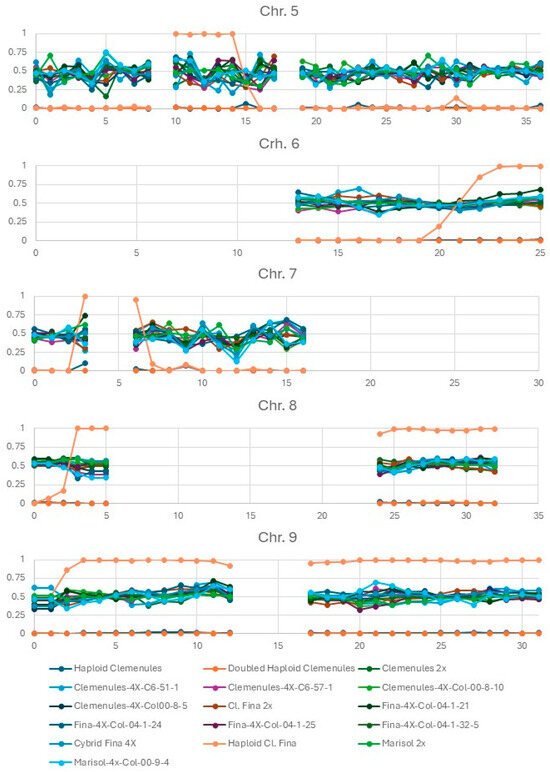
The analysis was conducted using the 3333 selected SNPs that were heterozygous in all three parental clementine varieties. After phasing these SNPs according to the haploid/doubled-haploid ‘Clemenules’, the frequency of the clementine haplotype alternative to the one of the haploid/doubled-haploid ‘Clemenules’ was estimated using successive windows of 1 Mb. When fewer than 10 SNPs were present in a 1 Mb segment, the segment was considered uninformative (missing data). Large gaps lacking information were observed on chromosomes 2, 4, 6, 7, 8 and 9 (Figure 1 and Figure 2). Most of these regions with few or no markers in our analysis correspond to clementine genomic regions identified by [14] as fully homozygous due to inbreeding. Consequently, only heterozygous regions provided informative data regarding parental haplotype dosage and, by extension, potential variation in local ploidy. Within these informative regions, we did not detect genomic regions exhibiting deviations in tetraploid plants compared to the range of allelic ratio variability observed in the diploid parental plants, nor any loss or gain of chromosomal fragments in tetraploid plants recovered using any of the three methodologies (Figure 1 and Figure 2). However, our GBS method, based on Apek1 digestion, did not provide information on the entire genome and focused on genic regions of the genome. Therefore, we cannot exclude the possibility of variations in repetitive regions, particularly centromeric regions, which are sparsely covered by our markers. In addition, point mutations such as SNPs or small indels were not examined.
Figure 1.
Allele frequencies observed along chromosomes 1 to 4 in all analyzed haploid, doubled haploid, diploid, and tetraploid plants. The y-axis represents the frequency of the phased alternative allele. A frequency of 0.5 corresponds to the three diploid parental clementine genotypes and the ten tetraploid plants, whereas frequencies ranging from 0 to 1 correspond to haploid and doubled haploid plants of the ‘Fina’ and ‘Clemenules’ clementines. The x-axis represents chromosome length, shown in 1 Mb intervals.
Figure 2.
Allele frequencies observed along chromosomes 5 to 9 in all analyzed haploid, doubled haploid, diploid, and tetraploid plants. The y-axis represents the frequency of the phased alternative allele. A frequency of 0.5 corresponds to the three diploid parental clementine genotypes and the ten tetraploid plants, whereas frequencies ranging from 0 to 1 correspond to haploid and doubled haploid plants of the ‘Fina’ and ‘Clemenules’ clementines. The x-axis represents chromosome length, shown in 1 Mb intervals.
Finally, it is important to note that the doubled-haploid plant of ‘Clemenules’ clementine shows identical allele frequencies across all SNP markers and chromosomes, consistent with its origin from a budsport spontaneous chromosome doubling. The GBS analysis also reveals two clearly distinct genomic profiles between the haploid plants of ‘Clemenules’ and ‘Fina’, revealing the different crossover breakpoints that occurred during the formation of the two distinct gametes that gave rise to each haploid plant. (Figure 1 and Figure 2).
2.3. Genomic Stability of Recovered Tetraploid Plants
Colchicine treatment is one of the most widely used methods for inducing polyploidy in plants, as it disrupts spindle fiber formation during cell division, leading to chromosome doubling [36]. In citrus, [16,37,38] tetraploid plants have been obtained using this approach. Aleza et al. [16] obtained, by shoot-tip grafting and subsequent colchicine treatment, four tetraploid plants of ‘Fina’ clementine (Col-04-1-21, Col-04-1-24, Col-04-1-25 and Col-04-1-32-5), two tetraploid plants of ‘Clemenules’ clementine (Col-00-8-05 and Col-00-8-10) and one tetraploid plant of ‘Marisol’ clementine (Col-00-9-4), that have been used in this study. Recently, other methods [15] have been developed based on in vivo colchicine application to the decapitated epicotyl juvenile seedlings, enabling tetraploid induction and the recovery of stable tetraploid plants of non-apomictic mandarins, pummelo and citron genotypes. Nevertheless, this approach results in tetraploid hybrid plants that retain juvenile characteristics, requiring several years before they can be used as parental material in new genetic combinations. Conversely, applying shoot-tip grafting and colchicine treatment to mature tissues markedly shortens the time needed before these plants can be utilized as parents in subsequent breeding programs.
Colchicine treatment has been shown to induce chromosome loss or rearrangements, as well as gene mutations, in different crop species such as flax, sunflower, barley and cotton [27,39,40]. It has also been reported that the treatment of explants with colchicine may cause some chromosomal aberrations, leading to the formation of aneuploid population in grapes [41]. In Lilium davidii var. unicolor, Li et al. [30] analyzed diploid and colchicine-induced tetraploid plants with five ISSR (Inter-simple sequence repeat) markers and identified polymorphisms between ploidy levels for all markers analyzed. El-Nashar and Ammar [31] also detected genetic variability among calendula plants exposed to different colchicine concentrations using SRAP (Sequence-Related Amplified Polymorphism) markers, which are used to amplify coding regions of DNA with primers targeting ORFs. In the present study, we did not identify any loss or gain of chromosomal fragments in tetraploid plants recovered through colchicine treatment.
Somatic hybridization through callus and leaf protoplast fusion is a technique used in citrus to generate allotetraploid hybrids and tetraploid cybrids from both apomictic and non-apomictic genotypes [19,20,21,42,43]. Citrus cybrids have been obtained from more than 40 combinations [19,21,42], but there are few references on regeneration of tetraploid cybrids. Grosser et al. [43] regenerated 99 plants following polyethylene glycol-mediated protoplast fusion between embryogenic callus of ‘Nova’ tangelo (C. x aurantium var. clementina X (C. x aurantium var. tangerina ined. X C. x aurantium var. paradisi)) and leaf protoplasts of ‘Succari’ sweet orange (C. x aurantium var. sinensis). Of these regenerants, only one plant was identified as a tetraploid cybrid of ‘Succari’ sweet orange. Subsequently, Guo et al. [20] recovered more than 150 plants via electrofusion between embryogenic callus of ‘Page’ tangelo (C. x aurantium var. clementina X (C. x aurantium var. paradisi x C. x aurantium var. tangerina ined.) and leaf protoplasts of rough lemon (C. x limonia var. jambhiri), yet only a single tetraploid cybrid was obtained. Similarly, Aleza et al. [21] produced 26 plants through electric protoplast fusion between embryogenic callus of ‘Chios’ mandarin and leaf protoplasts of Clementine, of which only one was confirmed as a tetraploid cybrid. These studies collectively demonstrate that tetraploid cybrid formation in citrus occurs at a very low frequency. Both diploid and tetraploid cybrids possess the nuclear genome of the leaf parent and the mitochondrial genome from the embryogenic callus parent, while the chloroplast genome is inherited randomly.
The characterization of regenerated allotetraploid and somatic cybrid plants relies on multiple complementary approaches, including morphological evaluation, cytological determination of ploidy level (via chromosome counting and flow cytometry), and molecular analysis using diverse DNA markers [21,42]. Individually, these techniques are insufficient to elucidate the somatic cybrid origin; therefore, an integrated methodological framework is required. In particular, SSR markers have proven especially valuable for characterizing the nuclear and organellar genomes of somatic cybrids. In a previous study, we recovered 28 cybrid plants derived from the embryogenic callus parent ‘Chios’ mandarin and the leaf parent Clementine through electrofusion of protoplasts. Flow cytometry revealed that all regenerated plants were diploid except for a single tetraploid plant. This tetraploid cybrid was further characterized using twenty nuclear SSR markers, three mitochondrial markers, and two chloroplast markers [21]. The analyses revealed that the nuclear genome corresponded to that of the Clementine leaf parent, and no polymorphisms were detected in either the mitochondrial or chloroplast genomes.
In the present study, we further analyzed this tetraploid cybrid using GBS to identify potential gains or losses of genomic regions; however, no such variations were detected. It is noteworthy that tetraploid cybrids and allotetraploid somatic hybrids exhibit juvenile characteristics because they are regenerated through embryogenesis, whereas tetraploids derived from colchicine-treated adult tissues or regenerated through in vitro organogenesis do not display this limitation. The latter are therefore of greater interest from a breeding standpoint, as they can be used immediately as parental material to produce new genetic combinations, thereby increasing the overall efficiency of our breeding program.
The chromosomal stability observed in our study is consistent with the identical nuclear genomes reported by Dambier et al. [19] for the five cybrids they obtained, which were indistinguishable from their respective leaf parents. Moreover, in allotetraploid somatic citrus hybrids recovered through protoplast fusion, different authors identified frequent chromosomal instability and concluded that an important part of these variations in allotetraploid plants may occur during the induction and multiplication of embryogenic calluses used for protoplast isolation or variation promoted during plant regeneration from isolated protoplasts via somatic embryogenesis [19]. Such genomic changes have also been observed in interspecific somatic hybrids of different Brassica species [44], Nicotiana tabacum L. + Atropa belladonna L. somatic hybrids [45], in symmetric somatic hybrids between Arabidopsis thaliana L. and Bupleurum scorzonerifolium Willd [46], somatic hybrids between bread wheat and other grass species [47], and in somatic hybrid cells between Oryza sativa L. subsp. japonica + O. sativa L. subsp. indica and between Japonica rice and bread wheat (Triticum aestivum L.) [48].
In vitro adventitious organogenesis from internodal segments of adult material is a methodology used by only a few research groups for the genetic transformation of citrus plants [49]. In our laboratory, this approach has been applied to induce somaclonal variation in different clementine genotypes. More than 450 plants were regenerated, all of which were diploid except for two tetraploid plants of ‘Clemenules’ clementine. The diploid ones were cultivated in experimental plots at IVIA (Moncada, Valencia, Spain), where no significant differences were observed in either the ripening period or fruit size, as these traits are easily assessed in the field when compared with their parental counterparts. The two tetraploid plants may have arisen either during the in vitro adventitious organogenesis process or from internodal tissues that underwent a somatic mutation leading to chromosome doubling, as previously reported for the doubled haploid plant of ‘Clemenules’ clementine. Chromosome doubling in citrus somatic tissues was observed by Raghuvanshi [50]; however, very few tetraploid budsports have been identified due to unfavorable competition between diploid and tetraploid cells in the meristem [51]. Our GBS analysis does not allow us to confirm either of the previously proposed hypotheses regarding their origin. Nonetheless, regardless of the biological process responsible for their origin, we can confirm that neither of the two tetraploid plants obtained through in vitro adventitious organogenesis exhibits any gain or loss of chromosomal fragments.
3. Materials and Methods
- Plant material
A total of ten tetraploid plants were analyzed in this study, along with their respective diploid clementine genotypes, ‘Clemenules’ (IVIA-022), ‘Fina’ (IVIA-039) and ‘Marisol’ (IVIA-093) grown at IVIA Citrus Germplasm Bank located in Moncada, Valencia, Spain. In addition, we analyzed the haploid plant of ‘Clemenules’ clementine (IVIA-638) that was selected by the International Citrus Genomic Consortium (ICGC) to establish the reference sequence of the nuclear genome of citrus [14], and a doubled haploid plant of this genotype derived from spontaneous chromosome doubling. We also included a haploid plant of ‘Fina’ clementine obtained previously in our laboratory.
The tetraploid plants used in this study included four tetraploid plants of ‘Fina’ clementine (Col-04-1-21, Col-04-1-24, Col-04-1-25 and Col-04-1-32-5), two tetraploid plants of ‘Clemenules’ clementine (Col-00-8-05 and Col-00-8-10) and one tetraploid plant of ‘Marisol’ clementine (Col-00-9-4), all obtained via shoot-tip grafting followed by colchicine treatment, according to the methodology described by Aleza et al. [16]. Two additional tetraploid plants of ‘Clemenules’ clementine (C6-51-1 and C6-57-1), generated through in vitro adventitious organogenesis from internodal segments, were also included, as well as one tetraploid cybrid of ‘Fina’ clementine (Cybrid Fina) obtained by protoplast fusion [21].
- Plant Genotyping
Genomic DNA was isolated using the Plant DNAeasy® kit (Qiagen, Hilden, Germany), following the manufacturer’s instructions. The DNA concentration was adjusted to 20 ng/µL, and the ApekI (New England Biolabs, Hitchin, UK) GBS libraries were prepared according to the protocol described by Elshire et al. [52]. Digestion was performed at 75 °C for 2 h, followed by enzyme inactivation at 65 °C for 20 min. The ligation reaction was carried out in the same plate as the digestion, using T4 DNA ligase (New England Biolabs, Hitchin, UK) at 22 °C for 1 h; the ligase was inactivated prior to pooling the samples by holding it at 65 °C for 20 min. For each library, ligated samples were pooled and PCR-amplified in a single tube. Complexity was further reduced using PCR primers with one selective base (A), as described by Sonah et al. [53]. Pair-end sequencing was performed on a single lane of an Illumina HiSeq4000 at Genewiz facilities (Leipzig, Germany). Raw sequencing data were demultiplexed with GBSX v1.3 [54]. Cutadapt v1.8 [55] was used to remove the adapter sequences and low-quality bases (-q 20,20). Processed reads shorter than 30 were discarded. SNP genotype calling was then performed with the VCF-Hunter 2.1.0 pipeline (https://github.com/SouthGreenPlatform/VcfHunter accessed on 11 November 2025) as described in Baurens et al. [56], using VcfPreFilter.1.0.py and vcfFilter.1.0.py utilities and the genome assembly of Valencia sweet orange DVS_B genome v1.0 [57] as reference. For genotype calling, positions with less than five reads were considered as missing data. Polymorphic sites were then filtered for diallelic SNPs with minor allele frequencies (MAFs) greater than 0.01.
- Allelic dosage analysis
For polyploids, GBS does not allow for accurate estimation of allele dosages at a single SNP locus [32]. Ahmed et al. [32] developed an efficient approach based on the frequency of reads of phased successive markers to estimate the haplotypic doses in successive genomic windows of at least 10 markers. The published tool, called TraceAncestor, was successfully applied to analyze the phylogenomic structure of Citrus polyploid germplasm [32], to perform genetic studies of tetraploid progenies resulting from interspecific 4x × 4x crosses and to identify chromosome instability in tetraploid somatic hybrids [19].
The present analysis was based on a total of 3333 SNP markers heterozygous in the three parental diploid clementines, considering genomic windows of 1 Mb as locus for allele dose estimation. Frequencies of the reference and alternative alleles were calculated by dividing the number of reads each within each 1 Mb region by the total number of reads. For this analysis, we leveraged the genotyping data generated for the haploid and doubled haploid clementines, providing the phase information across the clementine genome, except in the vicinity of the eight recombination breakpoints identified for the clementine gamete that produced the sequenced haploid plant [58]. Additionally, this approach enabled the identification of differences in breakpoint positions between the gametes that generated the ‘Fina’ and ‘Clemenules’ haploid plants.
4. Conclusions
GBS alone does not allow precise estimation of allele dosage at individual SNP loci in polyploid genomes. To address this limitation, 3333 SNPs heterozygous in all three parental clementine varieties were phased based on the haploid and doubled-haploid ‘Clemenules’. The frequency of the clementine haplotype alternative to that of the haploid/doubled haploid ‘Clemenules’ clementine was then calculated using successive windows of 1 Mb across the genome. Using this approach, no evidence of chromosomal instability was detected during clementine tetraploidization, regardless of the tetraploidization method employed. This result indicates that GBS is a useful methodology to analyze the genetic stability of tetraploid plants produced by colchicine treatment, in vitro adventitious organogenesis, and somatic cybridization, providing more detailed genome-wide information than that obtained with traditional molecular markers such as SSRs, ISSRs or SRAPs.
These tetraploid plants of ‘Clemenules’, ‘Fina’ and ‘Marisol’ clementines serve as valuable female parents for producing large progenies of new triploid hybrids. Indeed, these tetraploid clementine plants, artificially generated in the laboratory, have facilitated the selection of 19 triploid mandarin hybrids with excellent organoleptic properties. Notably, one of these hybrids, ‘Vera’ mandarin, produced by sexual hybridization between tetraploid ‘Clemenules’ clementine as the female parent and ‘Nova’ tangelo as the male parent, is expected to be released to the Spanish citrus industry in the near future.
Supplementary Materials
The following supporting information can be downloaded at: https://www.mdpi.com/article/10.3390/plants15020336/s1, Table S1: 3333 SNPs markers heterozygous for clementines used to analyze allele dosage and chromosome stability of tetraploid clementines. Frequencies of the reference and alternative alleles were calculated dividing the number of reads for reference allele and alternative allele.
Author Contributions
P.O. and P.A. contributed to the study conception and design. Material preparation for GBS analysis was performed by A.G.-L. Genotyping-by-Sequencing analysis was done by P.M. GBS data analysis was performed by P.A. and P.O. The first draft of the manuscript was written by A.G.-L. The revision of the original draft and editing were done by L.N., P.A. and P.O. All authors have read and agreed to the published version of the manuscript.
Funding
This research was supported by project PID2021-128115OR-I00, funded by the Ministry of Science and Innovation, MCIN/AEI/10.13039/501100011033/FEDER, UE and for the project IVIA-GVA 52201 AgroAlimVal from the Instituto Valenciano de Investigaciones Agrarias (this project is subject to being co-financed by the European Union through the ERDF Program 2021–2027 Comunitat Valenciana).
Data Availability Statement
The original contributions presented in this study are included in the article/Supplementary Material. Further inquiries can be directed to the corresponding author.
Conflicts of Interest
The authors declare no conflicts of interest.
References
- Wang, X.; Cheng, Z.M.; Zhi, S.; Xu, F. Breeding Triploid Plants: A Review. Czech J. Genet. Plant Breed. 2016, 52, 41–54. [Google Scholar] [CrossRef] [Scilit]
- Otto, S.P.; Whitton, J. Polyploid Incidence and Evolution. Annu. Rev. Genet. 2000, 34, 401–437. [Google Scholar] [CrossRef] [Scilit]
- Cameron, J.W.; Frost, H.B. Genetic, Breeding and Nucellar Embryony. In The Citrus Industry; Reuther, W., Batchelor, L.D., Webber, H.J., Riverside, C.A., Eds.; University of California: Berkeley, CA, USA, 1968; Volume 1, pp. 325–370. [Google Scholar]
- Fatta Del Bosco, S.; Matranga, G.; Geraci, G. Micro and Macro-Sporogenesis of Two Triploid Hybrids of Citrus. In Proceedings of the 7th International Citrus Congress, Acireale, Italy, 8–13 March 1992; International Society of Citriculture: Riverside, CA, USA, 1992; pp. 122–124. [Google Scholar]
- Esen, A.; Soost, R.K. Unexpected Triploids in Citrus: Their Origin, Identification and Possible Use. J. Hered. 1971, 62, 329–333. [Google Scholar] [CrossRef] [Scilit]
- Esen, A.; Soost, R.K. Precocious Development and Germination of Spontaneous Triploid Seeds in Citrus. J. Hered. 1973, 64, 147–154. [Google Scholar] [CrossRef] [Scilit]
- Geraci, G.; Esen, A.; Soost, R.K. Triploid Progenies from 2x × 2x Crosses of Citrus Cultivars. J. Hered. 1975, 66, 177–178. [Google Scholar] [CrossRef] [Scilit]
- Cameron, J.W.; Burnet, R.H. Use of Sexual Tetraploid Seed Parents for Production of Triploid Citrus Hybrids. HortScience 1978, 13, 167–169. [Google Scholar] [CrossRef] [Scilit]
- Esen, A.; Soost, R.K. Tetraploid Progenies from 2x × 4x Crosses of Citrus and Their Origin. J. Am. Soc. Hortic. Sci. 1971, 97, 410–414. [Google Scholar] [CrossRef] [Scilit]
- Esen, A.; Soost, R.K.; Geraci, G. Seed Set, Size and Development after 4x × 2x and 4x × 4x Crosses in Citrus. Euphytica 1978, 27, 283–293. [Google Scholar] [CrossRef] [Scilit]
- Koltunow, A.M. Apomixis: Embryo Sacs and Embryos Formed without Meiosis or Fertilization in Ovules. Plant Cell 1993, 5, 1425–1437. [Google Scholar] [CrossRef] [Scilit]
- Wakana, A.; Uemoto, S. Adventive Embryogenesis in Citrus I. The Occurrence of Adventive Embryos without Pollination or Fertilization. Am. J. Bot. 1987, 74, 517–530. [Google Scholar] [CrossRef] [Scilit]
- Frost, H.B.; Soost, R.K. Seed Reproduction: Development of Gametes and Embryos. In The Citrus Industry. Volume II. Anatomy, Physiology, Genetics, and Reproduction; Reuther, W., Batchelor, L.D., Webber, H.J., Eds.; University of California: Berkeley, CA, USA, 1968; Volume 2, pp. 290–324. [Google Scholar]
- Wu, G.A.; Prochnik, S.; Jenkins, J.; Salse, J.; Hellsten, U.; Murat, F.; Perrier, X.; Ruiz, M.; Scalabrin, S.; Terol, J.; et al. Sequencing of Diverse Mandarin, Pummelo and Orange Genomes Reveals Complex History of Admixture during Citrus Domestication. Nat. Biotechnol. 2014, 32, 656–662. [Google Scholar] [CrossRef] [Scilit]
- Ren, J.; Lu, X.; Duan, Y.-Y.; Xiao, G.-A.; Xie, K.-D.; Wu, X.-M.; Guo, W.-W. In Vivo Tetraploid Induction of Mono-Embryonic Citrus Genotypes by Colchicine Treatment. Sci. Hortic. 2024, 338, 113701. [Google Scholar] [CrossRef] [Scilit]
- Aleza, P.; Juárez, J.; Ollitrault, P.; Navarro, L. Production of Tetraploid Plants of Non Apomictic Citrus Genotypes. Plant Cell Rep. 2009, 28, 1837–1846. [Google Scholar] [CrossRef] [Scilit] [PubMed]
- Grosser, J.W.; Gmitter, F.G. 2004 SIVB Congress Symposium Proceedings “Thinking Outside the Cell”: Applications of Somatic Hybridization and Cybridization in Crop Improvement, with Citrus as a Model. In Vitro Cell. Dev. Biol.-Plant 2005, 41, 220–225. [Google Scholar]
- Guo, W.W.; Prasad, D.; Cheng, Y.J.; Serrano, P.; Deng, X.X.; Grosser, J.W. Targeted Cybridization in Citrus: Transfer of Satsuma Cytoplasm to Seedy Cultivars for Potential Seedlessness. Plant Cell Rep. 2004, 22, 752–758. [Google Scholar] [CrossRef] [Scilit] [PubMed]
- Dambier, D.; Barantin, P.; Boulard, G.; Costantino, G.; Mournet, P.; Perdereau, A.; Morillon, R.; Ollitrault, P. Genomic Instability in Somatic Hybridization between Poncirus and Citrus Species Aiming to Create New Rootstocks. Agriculture 2022, 12, 134. [Google Scholar] [CrossRef] [Scilit]
- Guo, W.W.; Cheng, Y.J.; Chen, C.L.; Deng, X.X. Molecular Analysis Revealed Autotetraploid, Diploid and Tetraploid Cybrid Plants Regenerated from an Interspecific Somatic Fusion in Citrus. Sci. Hortic. 2006, 108, 162–166. [Google Scholar] [CrossRef] [Scilit]
- Aleza, P.; Garcia-Lor, A.; Juárez, J.; Navarro, L. Recovery of Citrus Cybrid Plants with Diverse Mitochondrial and Chloroplastic Genome Combinations by Protoplast Fusion Followed by in Vitro Shoot, Root, or Embryo Micrografting. Plant Cell Tissue Organ Cult. 2016, 126, 205–217. [Google Scholar]
- Ben-Hayyim, G.; Goffer, Y. Plantlet Regeneration from a NaCl-Selected Salt-Tolerant Callus Culture of Shamouti Orange (Citrus sinensis L. Osbeck). Plant Cell Rep. 1989, 7, 680–683. [Google Scholar]
- Deng, Z.N.; Gentile, A.; Domina, F.; Nicolosi, E.; Tribulato, E. Selecting Lemon Protoplasts for Insensitivity to Phoma Tracheiphila Toxin and Regenerating Tolerant Plants. J. Am. Soc. Hortic. Sci. 1995, 120, 902–905. [Google Scholar] [CrossRef] [Scilit]
- Grosser, J.; Deng, X.; Goodrich, R. Somaclonal Variation in Sweet Orange: Practical Applications for Variety Improvement and Possible Causes. In Citrus Genetics, Breeding and Biotechnology; Khan, I.A., Ed.; CAB International: Wallingford, UK, 2007; pp. 219–233. [Google Scholar]
- Ferreira, M.d.S.; Rocha, A.d.J.; Nascimento, F.d.S.; Oliveira, W.D.d.S.; Soares, J.M.d.S.; Rebouças, T.A.; Morais Lino, L.S.; Haddad, F.; Ferreira, C.F.; Santos-Serejo, J.A.d.; et al. The Role of Somaclonal Variation in Plant Genetic Improvement: A Systematic Review. Agronomy 2023, 13, 730. [Google Scholar] [CrossRef] [Scilit]
- Miguel, C.; Marum, L. An Epigenetic View of Plant Cells Cultured in Vitro: Somaclonal Variation and Beyond. J. Exp. Bot. 2011, 62, 3713–3725. [Google Scholar] [CrossRef] [Scilit]
- Luckett, D.J. Colchicine Mutagenesis Is Associated with Substantial Heritable Variation in Cotton. Euphytica 1989, 42, 177–182. [Google Scholar] [CrossRef] [Scilit]
- Pereira, R.C.; Davide, L.C.; Techio, V.H.; Timbó, A.L.O. Duplicação Cromossômica de Gramíneas Forrageiras: Uma Alternativa Para Programas de Melhoramento Genético. Ciênc. Rural 2012, 42, 1278–1285. [Google Scholar]
- Morais, L.C.; Souza Sobrinho, F.; Techio, V.H. Comparative Microsporogenesis between Diploid and Tetraploid Plants of Brachiaria ruziziensis and Their Progenies. S. Afr. J. Bot. 2018, 119, 258–264. [Google Scholar]
- Li, S.; Lin, Y.; Pei, H.; Zhang, J.; Zhang, J.; Luo, J. Variations in Colchicine-Induced Autotetraploid Plants of Lilium davidii Var. unicolor. Plant Cell Tissue Organ Cult. 2020, 141, 479–488. [Google Scholar] [CrossRef] [Scilit]
- El-Nashar, Y.I.; Ammar, M.H. Mutagenic Influences of Colchicine on Phenological and Molecular Diversity of Calendula officinalis L. Genet. Mol. Res. 2016, 15, 1–15. [Google Scholar] [CrossRef] [Scilit]
- Ahmed, D.; Comte, A.; Curk, F.; Costantino, G.; Luro, F.; Dereeper, A.; Mournet, P.; Froelicher, Y.; Ollitrault, P. Genotyping by Sequencing Can Reveal the Complex Mosaic Genomes in Gene Pools Resulting from Reticulate Evolution: A Case Study in Diploid and Polyploid Citrus. Ann. Bot. 2019, 123, 1231–1251. [Google Scholar] [CrossRef] [Scilit] [PubMed]
- Calvez, L.; Dereeper, A.; Perdereau, A.; Mournet, P.; Miranda, M.; Bruyère, S.; Hufnagel, B.; Froelicher, Y.; Lemainque, A.; Morillon, R.; et al. Meiotic Behaviors of Allotetraploid Citrus Drive the Interspecific Recombination Landscape, the Genetic Structures, and Traits Inheritance in Tetrazyg Progenies Aiming to Select New Rootstocks. Plants 2023, 12, 1630. [Google Scholar] [CrossRef] [Scilit]
- Hosseini Grouh, M.S.; Vahdati, K.; Lotfi, M.; Hassani, D.; Biranvand, N.P. Production of Haploids in Persian Walnut through Parthenogenesis Induced by Gamma-Irradiated Pollen. J. Am. Soc. Hortic. Sci. 2011, 136, 198–204. [Google Scholar] [CrossRef] [Scilit]
- Vahdati, K.; Sadat-Hosseini, M.; Martínez-Gómez, P.; Germanà, M.A. Production of Haploid and Doubled Haploid Lines in Nut Crops: Persian Walnut, Almond, and Hazelnut. Methods Mol. Biol. 2021, 2289, 179–198. [Google Scholar] [PubMed]
- Eng, W.H.; Ho, W.S. Polyploidization Using Colchicine in Horticultural Plants: A Review. Sci. Hortic. 2019, 246, 604–617. [Google Scholar] [CrossRef] [Scilit]
- Gmitter, F.G., Jr.; Ling, X.B.; Cai, C.Y.; Grosser, J.W. Colchicine-Induced Polyploidy in Citrus Embryogenic Cultures, Somatic Embryos, and Regenerated Plantlets. Plant Sci. 1991, 74, 135–141. [Google Scholar] [CrossRef] [Scilit]
- Wakana, A.; Park, S.M.; Hanada, N.; Fukudome, I.; Kajiwara, K. Production of Tetraploid Forms of Acid Citrus Cultivars by Top Grafting of Shoots with Sprouting Axially Buds Treated with Colchicine. J. Fac. Agric. Kyushu Univ. 2005, 50, 93–102. [Google Scholar]
- Yemets, A.I.; Blume, Y.B. Progress in Plant Polyploidization Based on Antimicrotubular Drugs. Open Hortic. J. 2008, 1, 15–20. [Google Scholar] [CrossRef] [Scilit]
- Ahmadi, B.; Ebrahimzadeh, H. In Vitro Androgenesis: Spontaneous vs. Artificial Genome Doubling and Characterization of Regenerants. Plant Cell Rep. 2020, 39, 299–316. [Google Scholar] [CrossRef] [Scilit] [PubMed]
- Sinski, I.; Dal Bosco, D.; Pierozzi, N.I.; Maia, J.D.G.; Ritschel, P.S.; Quecini, V. Improving in Vitro Induction of Autopolyploidy in Grapevine Seedless Cultivars. Euphytica 2014, 196, 299–311. [Google Scholar] [CrossRef] [Scilit]
- Guo, W.W.; Xiao, S.X.; Deng, X.X. Somatic Cybrid Production via Protoplast Fusion for Citrus Improvement. Sci. Hortic. 2013, 163, 20–26. [Google Scholar] [CrossRef] [Scilit]
- Grosser, J.W.; Gmitter, F.G.; Louzada, E.S.; Chandler, J.L. Production of Somatic Hybrid and Autotetraploid Breeding Parents for Seedless Citrus Development. HortScience 1992, 27, 1125–1127. [Google Scholar] [CrossRef] [Scilit]
- Sundberg, E.; Glimelius, K. Effects of Parental Ploidy Level and Genetic Divergence on Chromosome Elimination and Chloroplast Segregation in Somatic Hybrids within Brassicaceae. Theor. Appl. Genet. 1991, 83, 81–88. [Google Scholar] [CrossRef] [Scilit] [PubMed]
- Babiychuk, E.; Kushnir, S.; Gleba, Y.Y. Spontaneous Extensive Chromosome Elimination in Somatic Hybrids between Somatically Congruent Species Nicotiana tabacum L. and Atropa belladonna L. Theor. Appl. Genet. 1992, 84, 87–91. [Google Scholar] [CrossRef] [Scilit] [PubMed]
- Minqin, W.; Junsheng, Z.; Zhenying, P.; Wei, G.; Yun, W.; Le, W.; Guangmin, X. Chromosomes Are Eliminated in the Symmetric Fusion between Arabidopsis thaliana L. and Bupleurum Scorzonerifolium Willd. Plant Cell Tissue Organ Cult. 2008, 92, 121–130. [Google Scholar] [CrossRef] [Scilit]
- Cui, H.; Sun, Y.; Deng, J.; Wang, M.; Xia, G. Chromosome Elimination and Introgression Following Somatic Hybridization between Bread Wheat and Other Grass Species. Plant Cell Tissue Organ Cult. 2015, 120, 203–210. [Google Scholar] [CrossRef] [Scilit]
- Sun, Y.; Xu, C.H.; Wang, M.Q.; Zhi, D.Y.; Xia, G.M. Genomic Changes at the Early Stage of Somatic Hybridization. Genet. Mol. Res. 2014, 13, 1938–1948. [Google Scholar] [CrossRef] [Scilit]
- Cervera, M.; Navarro, A.; Navarro, L.; Pena, L. Production of Transgenic Adult Plants from Clementine Mandarin by Enhancing Cell Competence for Transformation and Regeneration. Tree Physiol. 2008, 28, 55–66. [Google Scholar] [CrossRef] [Scilit]
- Raghuvanshi, S.S. Cytologenetical Studies in Genus Citrus IV. Evolution in Genus Citrus. Cytologia 1962, 27, 172–188. [Google Scholar] [CrossRef] [Scilit]
- Iwamasa, M.; Nito, N.; Ling, J.T. Intra and Intergeneric Hybridization in the Orange Subfamily, Aurantioideae. In Proceedings of the 6th International Citrus Congress, Tel Aviv, Israel, 6–11 March 1988; Balaban: Rehovot, Israel, 1988; pp. 123–130. [Google Scholar]
- Elshire, R.J.; Glaubitz, J.C.; Sun, Q.; Poland, J.A.; Kawamoto, K.; Buckler, E.S.; Mitchell, S.E. A Robust, Simple Genotyping-by-Sequencing (GBS) Approach for High Diversity Species. PLoS ONE 2011, 6, e19379. [Google Scholar] [CrossRef] [Scilit]
- Sonah, H.; Bastien, M.; Iquira, E.; Tardivel, A.; Légaré, G.; Boyle, B.; Normandeau, É.; Laroche, J.; Larose, S.; Jean, M.; et al. An Improved Genotyping by Sequencing (GBS) Approach Offering Increased Versatility and Efficiency of SNP Discovery and Genotyping. PLoS ONE 2013, 8, e54603. [Google Scholar] [CrossRef] [Scilit]
- Herten, K.; Hestand, M.S.; Vermeesch, J.R.; Van Houdt, J.K. GBSX: A Toolkit for Experimental Design and Demultiplexing Genotyping by Sequencing Experiments. BMC Bioinform. 2015, 16, 73. [Google Scholar] [CrossRef] [Scilit]
- Martin, M. Cutadapt Removes Adapter Sequences from High-Throughput Sequencing Reads. EMBnet J. 2011, 17, 10. [Google Scholar] [CrossRef] [Scilit]
- Baurens, F.C.; Martin, G.; Hervouet, C.; Salmon, F.; Yohomé, D.; Ricci, S.; Rouard, M.; Habas, R.; Lemainque, A.; Yahiaoui, N.; et al. Recombination and Large Structural Variations Shape Interspecific Edible Bananas Genomes. Mol. Biol. Evol. 2019, 36, 97–111. [Google Scholar] [CrossRef] [Scilit]
- Wu, B.; Yu, Q.; Deng, Z.; Duan, Y.; Luo, F.; Gmitter, F., Jr. A Chromosome-Level Phased Genome Enabling Allele-Level Studies in Sweet Orange: A Case Study on Citrus Huanglongbing Tolerance. Hortic. Res. 2023, 10, uhac247. [Google Scholar] [CrossRef] [Scilit]
- Ollitrault, P.; Terol, J.; Chen, C.; Federici, C.; Lotfy, S.; Hippolyte, I.; Ollitrault, F.; Berard, A.; Chauveau, A.; Cuenca, J.; et al. A Reference Genetic Map of C. clementina Hort. Ex Tan.; Citrus Evolution Inferences from Comparative Mapping. BMC Genom. 2012, 13, 593. [Google Scholar] [CrossRef] [Scilit]
Disclaimer/Publisher’s Note: The statements, opinions and data contained in all publications are solely those of the individual author(s) and contributor(s) and not of MDPI and/or the editor(s). MDPI and/or the editor(s) disclaim responsibility for any injury to people or property resulting from any ideas, methods, instructions or products referred to in the content. |
© 2026 by the authors. Licensee MDPI, Basel, Switzerland. This article is an open access article distributed under the terms and conditions of the Creative Commons Attribution (CC BY) license.