


Abstract
Nepeta sibirica L. is a medicinal and aromatic species of Lamiaceae whose volatile chemistry varies across its Eurasian range. In this study, we integrated voucher-anchored botanical characterization, GBIF-supported distributional context, essential-oil composition, chemogeographic comparison, and preliminary bioactivity assessment of a wild population from the Altai–Tarbagatai Ridge, Eastern Kazakhstan. Hydrodistillation yielded 0.3% (w/w) essential oil. GC–MS analysis of the essential oil detected and tentatively identified 62 volatile constituents, accounting for 95.5% of the total composition. A dominant nepetalactone peak represented 70.6% of the oil and was tentatively assigned as cis–trans-nepetalactone based on electron-ionization mass-spectral and retention-index data obtained on an achiral column. Germacrene D (6.5%) and cis-β-ocimene (2.8%) were the principal secondary constituents. Chemogeographic comparison indicated similarity to previously reported nepetalactone-rich material from the Altai region. The essential oil exhibited limited DPPH radical-scavenging activity, reaching a maximum inhibition of 12.88 ± 0.56% at 24.19 µg/mL; an IC50 could not be determined within the tested concentration range. In the Artemia salina assay, the essential oil caused 100% mortality at all tested concentrations (0.01–0.10 mg/mL) after 24 h, precluding LC50 estimation within the tested range. These findings document a nepetalactone-dominant essential-oil profile in a voucher-confirmed wild population of N. sibirica from Eastern Kazakhstan and provide preliminary quantitative data on its DPPH radical-scavenging activity and A. salina lethality.
Keywords:
Altai; Artemia salina; chemogeography; essential oil; GBIF; GC–MS; Kazakhstan; Lamiaceae; Nepeta; nepetalactone; stereochemistry 1. Introduction
Medicinal and aromatic plants are important sources of specialised metabolites and essential oils with pharmaceutical, cosmetic, agricultural, and ecological relevance. Their volatile profiles can vary with taxon, geography, habitat, phenological stage, plant organ, extraction procedure, and analytical conditions. Population-based studies are therefore particularly valuable for interpreting chemically distinctive wild resources and for linking phytochemical variation to documented provenance [1,2,3].
Central Asia provides an especially informative setting for such studies because high floristic richness coincides with strong environmental and topographic heterogeneity. The Mountains of Central Asia are recognized for high vascular-plant diversity and endemism [1], while Kazakhstan supports more than 6000 vascular plant taxa, with the eastern and southeastern mountain systems among the principal centres of diversity [2]. Lamiaceae is prominent among regional medicinal and aromatic resources, including essential-oil-rich Nepeta taxa [3].
The genus Nepeta L. (Lamiaceae, Nepetoideae, Mentheae) comprises approximately 300 species distributed mainly across Eurasia and neighbouring temperate regions. Species of Nepeta are used as medicinal, aromatic, ornamental, and occasionally culinary plants and contain essential oils, iridoids, flavonoids, phenolic acids, terpenoids, and other specialized metabolites [4,5,6]. Nepetalactone and related iridoid monoterpenes are characteristic constituents of many Nepeta oils and contribute to aroma, ecological signalling, insect-repellent effects, and other biological activities [7,8,9,10]. Southwestern Asia and the western Himalayas are regarded as important diversification centres for the genus [11].
Ethnobotanical records provide additional context for Nepeta research. Across the genus, traditional applications have been reported for respiratory, digestive, nervous-system, inflammatory, aromatic, and household purposes [4,5,6,12]. Evidence specifically concerning N. sibirica, however, remains comparatively sparse and geographically fragmented; such records are therefore treated here as background rather than as evidence of efficacy.
Essential-oil information also remains uneven for Central Asian Nepeta, particularly for voucher-confirmed wild mountain populations. Regional studies have documented terpenoid-rich and, in some taxa, nepetalactone-dominant oils [13,14,15], but directly comparable data for N. sibirica populations from Eastern Kazakhstan are limited. This gap is important because environmental heterogeneity and population identity can contribute to variation in specialised metabolism.
Reliable botanical anchoring is essential for regional chemical comparisons. Kazakhstan studies combining population documentation with morphological, phytochemical, and bioactivity data illustrate the value of traceable plant material [16,17]. A broader methodological example shows that combining morphological characterization with multigene phylogeny can strengthen taxonomic resolution when species boundaries are uncertain [18]. Pollen micromorphology provides additional taxonomic resolution within Nepeta [19]. Such integrative evidence reduces the risk of assigning chemical profiles to incompletely documented material.
N. sibirica is a perennial Eurasian species recorded from Kazakhstan in taxonomic and herbarium sources [20,21]. It occurs on mountain slopes, in steppe meadows, along river-associated habitats, and on disturbed or fallow ground. Diagnostic characters include a perennial habit, a woody creeping underground system, quadrangular shoots, opposite leaves, and violet bilabiate flowers.
Published essential-oil profiles indicate pronounced geographic and cultivation-associated variation within N. sibirica. Material from the Siberian Altai was strongly nepetalactone-dominant [22], and Mongolian material was reported as a single-component nepetalactone oil [23]. In contrast, cultivated Lithuanian material showed a 1,8-cineole- and caryophyllene-oxide-rich profile [24]. These differences raise the unresolved question of whether wild Eastern Kazakhstan material is chemically closer to the nepetalactone-rich Altai–Mongolian pattern or represents a distinct regional profile.
Interpretation of nepetalactone profiles requires stereochemical caution. Conventional achiral GC–MS and retention-index matching can support compound identification but cannot by themselves establish absolute stereochemical configuration. Assignments in N. sibirica have been refined using chiral GC–MS and complementary stereochemical approaches [25]. In addition, iridoid production in N. sibirica can respond to pathway regulation and biological elicitation [26]. Variation among populations may therefore reflect interacting genetic, developmental, environmental, and biological influences rather than geography alone.
More broadly, regional studies emphasize the value of voucher-based, species-level documentation and the integration of biodiversity records with ethnobiological, chemical, and bioactivity evidence [27,28,29,30,31,32]. This methodological perspective is relevant to N. sibirica because taxonomically secure material and traceable provenance are prerequisites for defensible chemical and applied interpretation.
Complementary studies using field inventories, micromorphological evidence, molecular confirmation, sequence-supported occurrence documentation, and metabolite or bioactivity profiling further demonstrate the value of traceable biological material in comparative research [33,34,35,36,37,38]. These studies provide methodological context for the present work but are not treated as direct evidence for the biology or chemistry of N. sibirica.
The Kazakhstan Altai provides a particularly relevant regional setting. Medicinal-plant resource surveys and floristic studies have documented substantial ecological heterogeneity, population-level variation, and conservation value across the South-Western and Southern Altai [39,40,41,42,43]. Regional chemical and pharmacological studies likewise illustrate the importance of linking composition and biological activity to clearly documented provenance [44,45]. Together, these observations support population-specific interpretation of Eastern Kazakhstan N. sibirica rather than extrapolation from a single locality to the species as a whole.
Against this background, this study aimed to characterize a voucher-confirmed wild population of N. sibirica from the Altai–Tarbagatai Ridge of Eastern Kazakhstan, focusing on its botanical characteristics, essential-oil composition, and preliminary biological activity. A further aim was to assess whether the volatile profile of this population reflects broader geographic variation reported across the Eurasian range of N. sibirica, thereby placing the Eastern Kazakhstan material within a wider chemogeographic context.
2. Results
2.1. Taxonomic Treatment and Population Characteristics of Nepeta sibirica
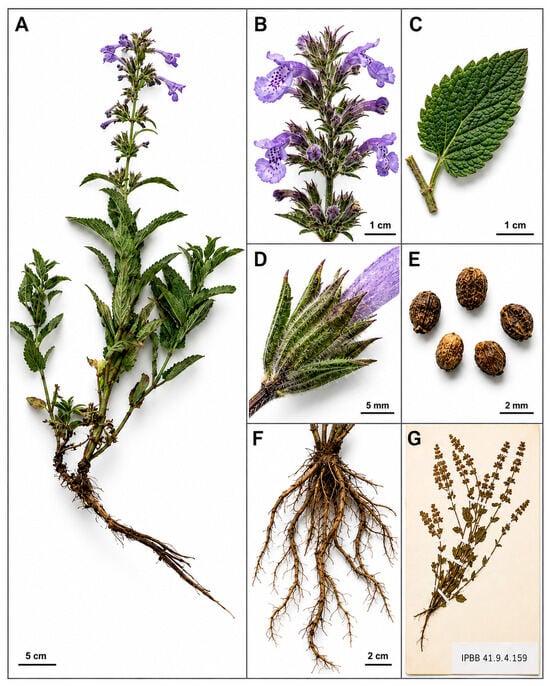
The material was identified as N. sibirica from diagnostic morphology and comparison with taxonomic and herbarium references. Individuals were perennial herbs with woody creeping underground organs, erect to ascending quadrangular shoots, opposite leaves, characteristic Nepeta inflorescences, violet bilabiate flowers, and small mature nutlets. Figure 1A–G documents the whole-plant habit, inflorescence, leaf, calyx and bracts, nutlets, root system, and voucher specimen, thereby linking the chemical dataset to authenticated plant material.
Figure 1.
Diagnostic morphology and voucher documentation of Nepeta sibirica L. from Eastern Kazakhstan. (A) Whole flowering plant habit; (B) inflorescence and flowers; (C) leaf; (D) calyx and bracts; (E) mature nutlets; (F) root system; (G) voucher specimen deposited in the Herbarium of the Institute of Plant Biology and Biotechnology, Kazakhstan, under accession number IPBB 41.9.4.159. Scale bars: A = 5 cm; B = 1 cm; C = 1 cm; D = 5 mm; E = 2 mm; F = 2 cm.
A voucher specimen was deposited in the Herbarium of the Institute of Plant Biology and Biotechnology, Kazakhstan, under accession IPBB 41.9.4.159. This specimen provides the permanent taxonomic reference for the material used in the essential-oil analysis.
Phenology. Flowering occurs from June to September and fruiting from July to September.
Reproduction. By seed.
Population status. N. sibirica was common at the sampled locality and occurred in dense groups, indicating a well-established local population suitable for phytochemical sampling.
Morphological Description
N. sibirica is a perennial herb with erect stems, typically 60–100 cm tall, bearing short glandular pubescence. Leaves are oblong-lanceolate, approximately 5–15 cm long, with crenate-dentate to serrate margins, numerous punctate glands on the abaxial surface, and petioles shorter than the blades. Venation is reticulate; the veins are impressed adaxially and raised abaxially, with only weak pubescence along the veins. The inflorescence forms a relatively loose raceme of 3–8 pseudowhorls. Bracteoles are lanceolate and distinctly shorter than the calyx. The violet calyx is approximately 9.5–14 mm long, with lanceolate teeth; the teeth of the upper lip are broader and shorter than those of the lower lip. The violet corolla is 25–35 mm long and approximately two to three times the calyx length. Mature nutlets associated with the voucher material (Figure 1E) are oblong and triquetrous, brown with darker brown mottling, and bear a prominent, triangular basal hilum. Nutlet surface sculpture was not examined by stereomicroscopy, and isolated seeds were not studied separately; consequently, no additional surface-sculpture or seed characters are reported. The underground system is woody and creeping, with conspicuous lateral roots (Figure 1F). The above-ground characters, root morphology, and voucher IPBB 41.9.4.159 (Figure 1G) collectively anchor the taxonomic identity of the essential-oil sample. The principal morphological characters observed in voucher-associated material (IPBB 41.9.4.159), together with their comparison with published taxonomic and floristic descriptions, are summarized in Table 1. Habitats reported for N. sibirica include steppe meadows, rocky mountain slopes, river and stream banks, and fallow ground; Flora of Siberia records the species from Western and Central Siberia, Central Asia, and Mongolia [46].
Table 1.
Diagnostic morphological characters of the examined Nepeta sibirica specimen from Eastern Kazakhstan compared with reference descriptions.
2.2. Distribution and Ecological Context of the Sampled Population
Distribution in Kazakhstan Based on GBIF Records
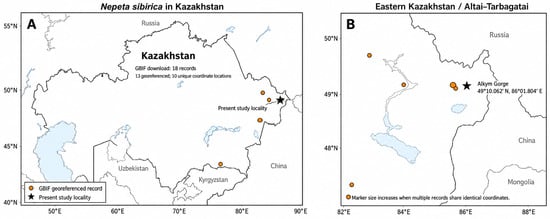
The GBIF occurrence dataset used in this study was obtained from a dedicated GBIF Occurrence Download (GBIF.org, 2 July 2026; https://doi.org/10.15468/dl.699bv4) [47]. The download yielded 18 occurrence records of N. sibirica from Kazakhstan. Of these, 13 records contained decimal latitude and longitude coordinates and were retained for mapping, representing 10 unique georeferenced localities, as several records shared identical coordinates. The georeferenced occurrences were concentrated predominantly in eastern Kazakhstan and the Altai region (Figure 2), placing the sampled population within an independently documented area of occurrence.
Figure 2.
Distribution of Nepeta sibirica in Kazakhstan and the occurrence context of the sampled population. (A) Distribution of georeferenced GBIF occurrence records of N. sibirica across Kazakhstan. The GBIF download contained 18 Kazakhstan records, of which 13 had decimal coordinates and were used for mapping, corresponding to 10 unique coordinate locations because several records shared identical coordinate pairs. (B) Enlarged view of Eastern Kazakhstan and the Altai–Tarbagatai region showing the position of the present study locality in Alkym Gorge (49°10.062′ N, 86°01.804′ E; 1144 m a.s.l.) relative to nearby GBIF occurrence records. Orange circles indicate georeferenced GBIF records, with marker size increasing where multiple records share the same coordinate location; the black star indicates the present study locality. The map is intended to provide documented occurrence and collection context rather than a species-distribution model.
Sampling locality. Plant material was collected in Alkym Gorge on the Altai–Tarbagatai Ridge, Eastern Kazakhstan, at 1144 m a.s.l. (49°10.062′ N, 86°01.804′ E). The site lies within the eastern mountainous cluster represented in the GBIF dataset.
Ecological setting. The locality is part of the Southern Altai, a landscape characterised by complex relief, continental climate, and a mosaic of mountain-steppe vegetation. At the collection site, N. sibirica formed dense groups under mountain-steppe conditions, consistent with the range of open and semi-open habitats reported for the species.
The coincidence of the voucher-confirmed collection site with the mapped Eastern Kazakhstan occurrences provides the geographic basis for interpreting the chemical profile as belonging to a wild Altai–Tarbagatai population rather than to the species as a whole.
2.3. Essential Oil Yield and GC-MS Composition
Hydrodistillation of air-dried N. sibirica material yielded 0.3% (w/w) essential oil on a dry-weight basis. GC–MS detected and tentatively identified 62 volatile constituents accounting for 95.5% of the total composition (Table 2; Figure S1), providing broad coverage of the volatile fraction at the level supported by EI mass spectra and retention indices.
Table 2.
GC–MS composition of Nepeta sibirica essential oil from Eastern Kazakhstan.
One nepetalactone peak dominated the chromatogram at 70.6%. EI mass-spectral matching and retention-index comparison supported a tentative cis–trans-nepetalactone assignment; however, the achiral stationary phase did not permit determination of absolute configuration or complete stereochemical identity. The principal secondary constituents were germacrene D (6.5%), cis-β-ocimene (2.8%), trans-β-farnesene (1.7%), β-caryophyllene (1.4%), β-bisabolene (1.4%), β-bourbonene (1.2%), and trans-β-ocimene (1.1%). Additional components included β-cyclocitral (0.7%), dihydroedulan (0.6%), caryophyllene oxide (0.5%), dihydronepetalactone (0.4%), β-elemene (0.4%), β-sesquisabinene hydrate (0.4%), 4-epi-abietol (0.4%), and several trace monoterpenes and sesquiterpenes.
The large separation between the major nepetalactone signal and all other peaks defines the sample as nepetalactone-dominant at the descriptive level. Formal chemotype designation would require replicated populations analysed under standardised conditions together with stereochemical confirmation of the major isomer.
2.4. Comparative Chemogeographic Profile of Nepeta sibirica Essential Oils
The Eastern Kazakhstan profile was compared with published N. sibirica oils from the Siberian Altai, Mongolia, and Lithuania (Table 3). Comparison was limited to studies explicitly identifying N. sibirica and focused on dominant constituents, oil yield when reported, and the analytical evidence used for compound identification.
Table 3.
Chemogeographic comparison of published Nepeta sibirica essential-oil profiles.
The Kazakhstan sample contained 70.6% nepetalactone (tentatively assigned as cis–trans-nepetalactone), with germacrene D (6.5%) and cis-β-ocimene (2.8%) as the leading secondary constituents. Fresh flowering tops from the Siberian Altai showed a closely comparable pattern, with neoepinepetalactone at 78.8% and germacrene D at 9.4% [22]. In Mongolia, Tsuruoka et al. [23] characterised an essentially single-component oil as 4aα,7α,7aα-nepetalactone using GC–MS, optical rotation, and NMR. Cultivated Lithuanian material differed markedly, being dominated by 1,8-cineole (42.58%) and caryophyllene oxide (20.35%) [24].
These published data demonstrate substantial intraspecific chemical variation. Eastern Kazakhstan and the Siberian Altai share a nepetalactone-rich pattern, whereas the cultivated Lithuanian profile represents a distinct volatile phenotype. Because plant material, phenological stage, extraction conditions, chromatographic systems, and stereochemical resolution differed among studies, the comparison is descriptive and hypothesis-generating rather than a formal chemotype classification.
2.5. DPPH Radical-Scavenging Activity
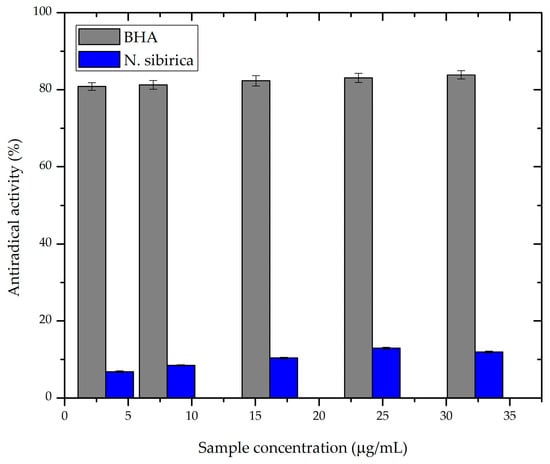
DPPH radical-scavenging activity was evaluated for N. sibirica essential oil and BHA as the reference antioxidant (Figure 3; Figure S2). BHA exhibited consistently high DPPH radical-scavenging activity across the tested concentration range, with inhibition values of 80.82–83.88%.
Figure 3.
DPPH radical-scavenging activity of Nepeta sibirica essential oil and BHA as the reference antioxidant. Essential-oil and BHA stock solutions were prepared at nominal concentrations of 0.10, 0.25, 0.50, 0.75, and 1.00 mg/mL; after addition of 0.10 mL stock solution to 3.00 mL DPPH solution, these corresponded to final reaction concentrations of 3.23, 8.06, 16.13, 24.19, and 32.26 µg/mL, respectively, as shown on the x-axis. Data are presented as mean ± SD (n = 3).
In comparison, the N. sibirica essential oil showed substantially lower activity. Its DPPH inhibition increased with concentration up to a maximum of 12.88 ± 0.56% at 0.75 mg/mL stock concentration (24.19 µg/mL final concentration), followed by a slight decrease to 11.94 ± 0.48% at 1.00 mg/mL nominal stock concentration (32.26 µg/mL final concentration). As DPPH inhibition did not reach 50% at any of the tested concentrations, an IC50 value could not be determined within the experimental concentration range. No additional concentrations beyond those specified above were tested for IC50 estimation.
An exploratory PCA integrating selected GC–MS-quantified volatile constituents with DPPH-related variables is presented in Figure S3. The ordination is intended solely as a descriptive visualisation of preliminary compositional–activity patterns and should not be interpreted as evidence of statistically validated or causal relationships between individual constituents and antioxidant activity.
2.6. Preliminary Artemia salina Lethality Screening
Artemia salina screening showed low background mortality in the negative control, with approximately 96% survival (Table 4).
Table 4.
Preliminary toxicity of Nepeta sibirica essential oil in the Artemia salina lethality assay.
Exposure to N. sibirica essential oil produced complete mortality at 0.10, 0.05, and 0.01 mg/mL after 24 h. Because 100% mortality occurred even at the lowest concentration tested, the selected range did not resolve a dose–response relationship. No overt neurobehavioural signs were observed before death under the predefined visual criteria.
The positive control, actinomycin D, produced 100% mortality at 0.10 mg/mL and 96.2% mortality at 0.05 mg/mL based on the available larval counts.
2.7. Chemogeographic Synthesis of Reported Nepeta sibirica Volatile Profiles
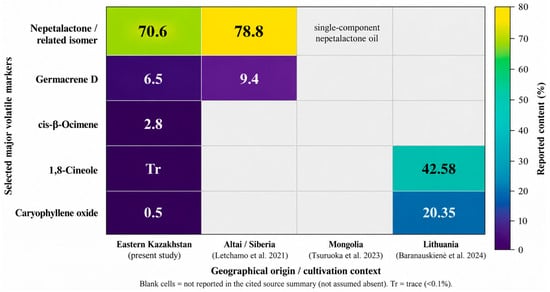
Figure 4 condenses the major reported compositional contrasts among N. sibirica oils from Eastern Kazakhstan, the Siberian Altai [22], Mongolia [23], and Lithuania [24]. Only values explicitly reported in the present dataset or source summaries were plotted; missing observations were retained as blank cells rather than converted to zeros.
Figure 4.
Chemogeographic comparison of selected major volatile constituents reported for Nepeta sibirica essential oils. Quantitative values are shown only where explicitly available for the present Eastern Kazakhstan sample, the Siberian Altai material [22], and cultivated Lithuanian material [24]. The Mongolian oil is annotated qualitatively as a single-component nepetalactone oil because Tsuruoka et al. [23] established its identity by GC–MS, optical rotation, and NMR. Blank cells indicate values not reported in the cited source summary and do not imply absence; Tr indicates a trace amount (<0.1%). Different nepetalactone labels across studies should not be assumed stereochemically equivalent.
The matrix emphasises the shared nepetalactone dominance of Eastern Kazakhstan and the Siberian Altai, while the Lithuanian cultivated oil is distinguished by high 1,8-cineole and caryophyllene oxide. The Mongolian report is shown qualitatively because its stereochemically confirmed oil was described as single-component rather than as a full percentage profile.
Accordingly, Figure 4 is a literature-based descriptive synthesis, not an inferential multivariate analysis or a formal chemotype classification. It is intended to define a testable Altai-focused hypothesis for future replicated sampling under harmonised analytical conditions.
3. Discussion
Voucher-supported morphology, herbarium deposition, and accepted taxonomic records establish the identity of the Eastern Kazakhstan material as N. sibirica [20,21]. This taxonomic anchoring is essential because interpretation of population-level volatile chemistry depends on unambiguous species identification. Comparable Kazakhstan studies have likewise demonstrated the value of integrating morphological and phytochemical evidence [16,17], and micromorphological work within Nepeta provides further support for character-based taxonomic verification [19].
The spatial evidence adds a second layer of provenance. The Alkym Gorge collection falls within the eastern Kazakhstan cluster of GBIF records [47] and within the environmentally heterogeneous Southern Altai, where continental climate, complex relief, and mountain-steppe habitats may influence secondary metabolism [48,49]. The chemical profile should therefore be read as evidence from one documented wild population, not as a range-wide composition for N. sibirica.
This distinction is also important when discussing diversity. The study does not quantify community or species-level biodiversity; its contribution lies in documenting intraspecific phytochemical variation within a widespread medicinal and aromatic plant. Central Asian floristic inventories demonstrate high regional plant richness [1,2], while geographically structured variation has been reported in other medicinal Nepeta taxa [11]. Replicated sampling across the Altai–Tarbagatai, Siberian Altai, Mongolia, and additional parts of the range will be needed before geographic chemotype boundaries or broader diversity patterns can be delimited statistically.
Chemically, the Eastern Kazakhstan oil is defined by a 70.6% nepetalactone peak accompanied by substantially smaller amounts of germacrene D, cis-β-ocimene, trans-β-ocimene, trans-β-farnesene, β-caryophyllene, β-bourbonene, and β-bisabolene. Although EI-MS and RI data support a tentative cis–trans-nepetalactone assignment, stereochemical certainty is not possible from the achiral separation used here. Hernández Lozada et al. [25] showed that conventional GC assignments in N. sibirica can change after chiral and complementary stereochemical analysis. The strongest conclusion is therefore nepetalactone dominance; definitive isomer identification will require chiral GC–MS, co-injection with an authentic standard, or spectroscopic confirmation.
The cross-regional comparison strengthens that interpretation. Eastern Kazakhstan (70.6% nepetalactone; 6.5% germacrene D) closely approaches the Siberian Altai profile reported by Letchamo et al. [22] (78.8% neoepinepetalactone; 9.4% germacrene D). Mongolian material likewise represents an extreme nepetalactone phenotype, with 4aα,7α,7aα-nepetalactone identified as the single oil component [23]. In contrast, cultivated Lithuanian plants were dominated by 1,8-cineole and caryophyllene oxide [24]. Taken together, these observations are consistent with an Altai–Mongolian tendency towards nepetalactone-rich oils, but methodological heterogeneity and the single-population design preclude designation of a geographically fixed chemotype.
Evidence from other Central Asian Nepeta taxa provides useful, but not substitutive, context. East Kazakhstan N. densiflora has been reported with cis–trans-nepetalactone, cis-β-ocimene, germacrene D, and β-cyclocitral among its important volatiles [13], and additional regional studies document substantial variation in essential-oil composition and biological properties [14,15]. These observations reinforce the need for multi-population sampling across ecological gradients, developmental stages, and plant organs using standardised extraction and chromatographic protocols. In this sense, the current dataset contributes a well-anchored record of intraspecific chemical diversity rather than a biodiversity inventory.
Regional evidence also supports treating locality as an explicit biological variable rather than merely collection metadata. Medicinal-plant surveys in the South-Western and Southern Altai, including the Altai–Tarbagatai system, have documented substantial differences in population structure, habitat associations, and resource availability [39,40,41], while recent floristic syntheses demonstrate strong habitat heterogeneity and conservation value across the Kazakhstan Altai [42,43]. The nepetalactone-rich oil described here should therefore be regarded as a population-specific chemical phenotype that warrants replicated sampling across neighbouring ridges, seasons, and phenological stages. Kazakhstan data from N. pannonica [44] and regional Rhodiola studies [41,45] further show the value of linking chemical or biological measurements to well-documented provenance without implying that a single locality defines the species as a whole.
Mechanistic evidence offers a plausible biological basis for such variation. Popović et al. [26] showed that iridoid production in N. sibirica can be enhanced by transient expression of pathway-related genes and by elicitation with Trichoderma harzianum and T. viride. Nepetalactone abundance may therefore reflect regulated defence metabolism and plant–microbe interactions in addition to genetic, developmental, and abiotic influences. Resolving these contributions will require replicated field populations accompanied by environmental metadata and stereochemical resolved metabolite profiles.
The DPPH assay showed that the nepetalactone-rich oil exhibited limited radical-scavenging activity. Maximum inhibition was 12.88% at the nominal 0.75 mg/mL stock concentration (24.19 µg/mL final concentration), whereas BHA showed consistently high inhibition (>80%) across the tested concentration range. The observed weak activity is consistent with the generally weaker DPPH-scavenging capacity of volatile terpenoid-rich mixtures compared with phenolic-rich extracts. In Nepeta species, antioxidant activity has more frequently been associated with polar phenolic constituents, particularly rosmarinic acid [50,51,52,53,54,55]. Therefore, antioxidant activity should be considered a secondary aspect of the biological profile of the investigated essential oil rather than a major functional characteristic.
The antioxidant assessment has several limitations. First, DPPH inhibition did not reach 50% within the tested concentration range, and no additional concentrations were tested; consequently, an IC50 value could not be determined. Second, antioxidant activity was evaluated using a single radical-scavenging assay, which provides only a partial measure of antioxidant potential. Complementary assays based on different reaction mechanisms, including ABTS, FRAP, and CUPRAC, would provide a broader assessment. The exploratory PCA (Figure S3) is therefore retained only as a descriptive visualisation of preliminary compositional–activity patterns and should not be interpreted as evidence of statistically validated or causal relationships between individual volatile constituents and antioxidant activity.
In contrast, the Artemia salina assay produced a markedly different biological response, as all tested concentrations of the essential oil caused 100% mortality after 24 h. The A. salina lethality assay is useful as a first-pass screening approach for biologically active natural products, but the observed mortality represents a preliminary indication of biological/toxicological activity rather than a complete toxicological assessment [56,57,58]. Because neither purified nepetalactone nor individual minor constituents were tested separately, the observed lethality cannot be attributed to nepetalactone or any other specific constituent. Nevertheless, the available literature on Nepeta essential oils and nepetalactones supports further investigation of their potential repellent, insecticidal, antimicrobial, phytotoxic, and cytotoxic activities [6,8,9,10].
The concentration range used in A. salina assay was insufficient for potency estimation because complete mortality was already observed at the lowest tested concentration (0.01 mg/mL). Accordingly, lower concentrations and a broader dose–response design would be required to determine an LC50 value using an appropriate dose–response or probit analysis [59]. The absence of visible tremor, paralysis, loss of coordination, abnormal floating, or persistent pre-mortality immobility indicates only that no overt neurobehavioural abnormalities were observed under the experimental conditions; it does not exclude membrane-disruptive, metabolic, cytotoxic, or other underlying mechanisms.
The ethnobiological literature provides a useful boundary for applied interpretation. Central Asian studies have emphasized the value of voucher-linked integration of biodiversity, ethnomedicinal, chemical, and bioactivity evidence [27,28,29,30,31,32]. N. sibirica fits this broader resource framework; no new ethnobotanical interviews were conducted in the present study. Traditional or aromatic use should therefore not be conflated with demonstrated efficacy or safety, particularly in light of the strong lethality observed in the Artemia salina assay.
A broader methodological perspective also supports interpretation of the present dataset. Studies spanning cultivated and wild Nepeta, GC–MS identification, nepetalactone bioactivity, and analytical characterisation illustrate how taxonomic provenance, extraction conditions, chromatographic assignment, and functional screening jointly shape conclusions about aromatic-plant chemistry [60,61,62,63,64,65,66,67,68,69,70]. These sources are retained here to preserve the wider analytical and comparative framework of the study rather than to imply direct equivalence among experimental systems.
The functional literature further shows that volatile-plant research routinely integrates antimicrobial, anti-inflammatory, phytotoxic, antioxidant, medicinal, and cultivation-oriented evidence, while recognising that activities depend strongly on compound class, matrix, dose, and assay design [71,72,73,74,75,76,77,78,79,80]. This breadth is relevant to the present nepetalactone-rich oil because it supports a cautious transition from compositional description to targeted hypothesis testing rather than broad claims of efficacy.
Additional comparative work on essential-oil profiling, retention-index resources, insect-control applications, ecological effects, catnip chemistry, and species-specific Nepeta bioactivity expands the interpretive background for chemogeographic and functional variation [81,82,83,84,85,86,87,88,89,90]. Collectively, these studies reinforce the value of standardised analytical procedures and explicit reporting of missing or trace constituents when comparing populations sampled under different ecological or cultivation conditions.
Finally, cytotoxicity, toxicokinetic modelling, regional essential-oil surveys, biogeographic studies, endemic-plant chemistry, repellent activity, and comparative morphological studies provide complementary examples of how chemical, ecological, taxonomic, and safety evidence can be integrated across biological research [91,92,93,94,95,96,97,98]. Although several of these references concern systems outside Nepeta, they are retained as part of the manuscript’s original cross-disciplinary reference framework and support the general emphasis on reproducible identification, chemical characterization, and biologically interpretable endpoints.
Overall, the data define a voucher-confirmed Eastern Kazakhstan population with a nepetalactone-dominant volatile phenotype that is more similar to published Siberian Altai and Mongolian material than to cultivated Lithuanian plants. The most defensible applied direction is not a broad antioxidant claim, but targeted investigation of ecological and functional properties associated with nepetalactone-rich volatiles.
Future research should first address the analytical and biological limitations identified in the present study. Stereochemical confirmation of the dominant nepetalactone peak using chiral GC–MS, co-injection with authentic standards, and/or complementary spectroscopic approaches would strengthen the chemotaxonomic interpretation. Replicated sampling across regional populations, seasons, phenological stages, and ecological gradients would be necessary to distinguish population-specific variation from geographically structured chemotypes. For the biological assessment, broader concentration–response designs, including lower concentrations for the A. salina assay, would allow more reliable potency estimation, while complementary antioxidant assays such as ABTS, FRAP, and CUPRAC would provide a broader assessment of antioxidant behaviour.
Future phytochemical studies should also extend beyond the essential oil to different plant organs and employ extraction procedures using solvents of contrasting polarity and/or complementary extraction techniques. Combining these approaches with targeted and untargeted profiling of volatile and non-volatile constituents could help identify chemical markers associated with population, organ, developmental stage, or ecological conditions. Such chemical information should be integrated with targeted biological assays relevant to the major phytochemical classes identified. Finally, more comprehensive safety and toxicological studies using appropriate cellular and organismal models, together with mechanistic investigations, will be necessary before any broader functional or applied conclusions can be drawn from the preliminary activities observed here.
4. Materials and Methods
4.1. Study Area
The study was conducted in Eastern Kazakhstan, within the Kazakhstan Altai mountain system. The sampled population was located in the Altai–Tarbagatai Ridge, Alkym Gorge, at 1144 m a.s.l. (49°10.062′ N, 86°01.804′ E). This area belongs to the Southern Altai region, which is characterised by complex mountain relief, continental climatic conditions, and diverse vegetation types. The heterogeneity of the region, including mountain slopes, intermontane depressions, steppe–meadow habitats, and river-associated vegetation, provides suitable ecological conditions for medicinal and aromatic plants, including species of the genus Nepeta. The geographical and ecological context of the Southern Altai is important for interpreting possible regional variation in the accumulation of volatile secondary metabolites in wild N. sibirica populations. Regional resource, floristic, and physical-geography studies provide additional context for this heterogeneous mountain landscape [39,40,41,42,43,44,48,49].
4.2. Plant Material, Identification, and Voucher Specimen
Plant material of N. sibirica was collected from the Altai–Tarbagatai Ridge, Alkym Gorge, Eastern Kazakhstan, at 1144 m a.s.l. (49°10.062′ N, 86°01.804′ E). The collection was carried out by Talant Samarkhanov and Anar Myrzagaliyeva with prior permission from the relevant local executive authorities and in accordance with the Law of the Republic of Kazakhstan “On the Plant World” (No. 183-VII) [99]. The collected material consisted of aboveground plant material.
The species was identified as N. sibirica by Dr Anar Myrzagaliyeva based on diagnostic morphological characters and comparison with herbarium and taxonomic references. Morphological documentation included whole plant habit, stem and leaves, inflorescence and flowers, fruits/nutlets or seeds, root system, and voucher material. A voucher specimen was deposited in the Herbarium of the Institute of Plant Biology and Biotechnology, Kazakhstan, under accession number IPBB 41.9.4.159. All field sampling and experimental work involving this species were conducted in compliance with applicable institutional, national, and international guidelines and legislation.
4.3. GBIF Occurrence Data and Distribution Mapping
Occurrence data for N. sibirica were obtained from the Global Biodiversity Information Facility [47] to visualise the known distribution of the species in Kazakhstan and to place the collection locality within a broader geographical context. The GBIF download (0009522-260623161305970; accessed 2 July 2026) contained 18 occurrence records. 13 records had decimal latitude and longitude values and were used for mapping; the five records lacking coordinates were retained in Supplementary Data S1 but were not plotted. The 13 georeferenced records corresponded to 10 unique coordinate locations because several records shared identical coordinates.
The distribution map was prepared using GBIF occurrence records and the geographical coordinates of the present study locality. GBIF occurrence records were shown as circular markers, while the collection locality of the present study in the Altai–Tarbagatai Ridge, Alkym Gorge, Eastern Kazakhstan, was indicated by a star symbol. The map was used only to provide distributional and geographical context and was not interpreted as a complete species distribution model.
4.4. Essential Oil Isolation
The collected plant material was air-dried at room temperature under shaded and well-ventilated conditions and then shredded before essential oil isolation. Essential oil was obtained by hydrodistillation using a Clevenger-type apparatus for 2 h, following the procedure described by Yerezhepova et al. [17], with hexane used as the collection solvent. The obtained essential oil was separated and stored in sealed glass vials until GC–MS analysis and bioactivity assays. The essential oil yield was 0.3% (w/w), calculated relative to the dry weight of the plant material.
4.5. GC-MS Analysis of Essential Oil
The chemical composition of N. sibirica essential oil was determined by gas chromatography–mass spectrometry (GC–MS) using a Clarus SQ 8 gas chromatograph coupled to a mass spectrometric detector (PerkinElmer, Waltham, MA, USA). Approximately 25 mg of essential oil was placed in a 25 mL volumetric flask, dissolved in 15 mL of hexane, brought to volume, and mixed thoroughly before analysis.
GC–MS analysis was performed on a Restek Rxi®-1 ms capillary column (30 m × 0.25 mm i.d., 0.25 μm film thickness; Restek Corporation, Bellefonte, PA, USA). The injection volume was 1.0 μL, with a split ratio of 1:25. Helium was used as the carrier gas at a flow rate of 1.0 mL/min. The oven temperature was initially set at 40 °C and then increased at 2 °C/min to 280 °C. The injector temperature was 280 °C, and the detector temperature was 240 °C. Mass spectra were recorded in electron ionization mode at 70 eV over an m/z range of 39–500, with an acquisition time window of 4–120 min.
Relative abundances of individual constituents were calculated by peak-area normalization of the total ion chromatogram (TIC) and expressed as percentages. No compound-specific response factors were applied; the reported values therefore represent relative chromatographic abundances rather than absolute concentrations.
Compound identification was based on the combined evaluation of electron-ionization mass spectra against the NIST and Wiley spectral libraries and comparison of calculated retention indices with literature data. Retention indices were calculated relative to a homologous series of n-alkanes (C8–C40) analysed under the same chromatographic conditions. Formal compound-specific limits of detection (LoD) and quantitation (LoQ) were not established because the analysis was designed for qualitative/semi-quantitative essential-oil profiling rather than validated absolute quantification. Components present at <0.1% were reported as trace constituents; this value is a reporting threshold and should not be interpreted as an experimentally validated LoD or LoQ. A single numerical library-match score was not used as the sole criterion for identification; assignments were based on the combined spectral and retention-index evidence.
Pure analyte reference standards were not co-injected to confirm retention times or retention indices of the major constituents. The C8–C40 n-alkane series was used for chromatographic indexing. Accordingly, individual constituent assignments are reported at the level supported by EI-MS and RI evidence, and the dominant nepetalactone peak remains tentative at the stereoisomer level.
Only the Restek Rxi®-1 ms capillary column, based on a 100% dimethyl polysiloxane (PDMS) stationary phase, was used in the present study; alternative 5–phenyl, polar/WAX, or chiral cyclodextrin-based stationary phases were not evaluated. Because the analytical phase was achiral, definitive stereochemical assignment would require complementary analysis using a chiral GC–MS phase, co-injection with an authentic reference compound, optical rotation/circular dichroism, and/or NMR.
The GC–MS dataset used for the compositional profile was acquired in 2018. The representative chromatogram provided as Figure S1 retains the original acquisition date displayed in the analytical record; the 2018 date therefore refers to the instrumental measurement, whereas the present manuscript was prepared and submitted in 2026.
4.6. DPPH Radical-Scavenging Assay
The antiradical activity of N. sibirica essential oil was evaluated using the DPPH radical-scavenging assay, following the general principles described by Blois [50] and Brand-Williams et al. [51], with modifications adapted to essential-oil samples. Essential-oil stock solutions were prepared in hexane at concentrations of 0.10, 0.25, 0.50, 0.75, and 1.00 mg/mL. No emulsifier or additional solubilizing agent was used. For each concentration, 0.10 mL of the corresponding stock solution was mixed with 3.00 mL of DPPH solution (6 × 10⁻⁵ M in methanol), giving a final reaction volume of 3.10 mL. The corresponding final essential-oil concentrations were 3.23, 8.06, 16.13, 24.19, and 32.26 µg/mL, respectively.
BHA was used as a reference antioxidant and was prepared in methanol at the same stock concentrations (0.10, 0.25, 0.50, 0.75, and 1.00 mg/mL), corresponding to the same final concentrations in the reaction mixture. The negative control consisted of 3.00 mL of DPPH solution and 0.10 mL of methanol, without essential oil or BHA.
The reaction mixtures were protected from light, mixed thoroughly, and incubated in the dark for 30 min at room temperature. Absorbance was measured at 520 nm using a Cary 60 UV–Vis spectrophotometer (Agilent Technologies, Santa Clara, CA, USA). Each concentration was analysed in three independent replicates (n = 3). Antiradical activity was calculated as follows:
where A0 is the absorbance of the negative control containing DPPH solution and methanol but no essential oil or BHA, and At is the absorbance measured in the presence of the tested essential oil or BHA at the corresponding final concentration.
ARA (%) = [(A0 − At)/A0] × 100
4.7. Artemia salina Lethality Assay
Preliminary toxicity of N. sibirica essential oil was evaluated using the Artemia salina lethality assay, following previously published procedures [17,18,57]. A 55 mL separatory funnel was filled with artificial seawater and supplemented with 200 mg of A. salina eggs. The suspension was gently aerated and maintained for 3 days to allow hatching. To generate a light gradient, one side of the funnel was covered with aluminum foil; after 5 min, nauplii that migrated toward the illuminated side were collected using a Pasteur pipette.
Approximately 20–40 nauplii were transferred into each well of a 24-well microplate containing 990 μL of artificial seawater. Baseline mortality was recorded by counting non-motile nauplii under a stereomicroscope before treatment. Each well was then dosed with 10 μL of DMSO solution containing the test sample. Actinomycin D was used as the positive control, while DMSO alone served as the negative control.
After 24 h of incubation, nauplii were examined microscopically, and the numbers of surviving and dead larvae were recorded. Samples showing strong toxicity were retested at lower concentrations of 0.10, 0.05, and 0.01 mg/mL. Nauplii were also observed for visible neurobehavioural signs, including reduced mobility, tremor-like movements, paralysis, loss of coordination, abnormal floating, and persistent immobility. Mortality was calculated using the following equation:
where dead larvae represent the number of non-viable nauplii after 24 h of exposure, and total larvae represent the total number of nauplii initially introduced into each well.
Mortality (%) = (dead larvae/total larvae) × 100
4.8. Statistical Analysis and Comparative Visualisation
Data from the DPPH assay were expressed as mean values with standard deviations from three independent replicates. An exploratory PCA was used only as a descriptive visualisation of selected GC–MS-quantified volatile constituents and DPPH-related variables (Figure S3). The PCA was performed using the online version of Statistics Kingdom (https://www.statskingdom.com; accessed 31 January 2026), and graphical visualisation was carried out using OriginPro 8.0.
For the chemogeographic comparison, selected major volatile constituents were compiled from the present study and published N. sibirica essential-oil reports [22,23,24]. Only explicitly reported quantitative values were included, while unreported values were retained as missing. The resulting matrix (Figure 4) was used for descriptive comparison of regional volatile profiles.
5. Conclusions
This study documents a voucher-confirmed wild population of Nepeta sibirica from the Altai–Tarbagatai Ridge of Eastern Kazakhstan and demonstrates a strongly nepetalactone-dominant essential-oil profile. GC–MS detected 62 volatile constituents representing 95.5% of the oil, with a dominant nepetalactone peak accounting for 70.6%, accompanied mainly by germacrene D (6.5%) and cis-β-ocimene (2.8%). The chemical profile supports a regional Altai-associated nepetalactone-rich pattern, although stereochemical confirmation of the dominant nepetalactone isomer remains necessary.
The essential oil exhibited limited DPPH radical-scavenging activity, whereas the Artemia salina assay showed 100% mortality across the tested concentration range. These latter results should be regarded as a preliminary biological/toxicological signal rather than a compound-specific or potency-defined toxicological endpoint. Future studies should therefore focus on stereochemical confirmation, replicated regional sampling, lower-dose A. salina assays to enable LC50 estimation, and targeted ecological and bioactivity investigations.
Supplementary Materials
The following supporting information can be downloaded at: https://www.mdpi.com/article/10.3390/plants15192992/s1, Figure S1. GC–MS chromatogram of N. sibirica essential oil (original analytical acquisition from 2018; acquisition date retained in the chromatogram); Figure S2. Optical density (OD) values at 520 nm measured in the DPPH assay for N. sibirica essential oil and BHA (butylated hydroxyanisole) at the tested concentrations (0.10, 0.25, 0.50, 0.75, and 1.00 mg/mL); Figure S3. Exploratory PCA biplot of selected GC–MS-quantified volatile constituents and DPPH-related variables. The ordination is provided as a descriptive visualization and is not intended for inferential or causal interpretation; Supplementary Data S1. Curated GBIF occurrence records of N. sibirica in Kazakhstan from GBIF download 0009522-260623161305970, including all 18 downloaded records, mapping status, geographical coordinates, dataset provenance, and record-level source links.
Author Contributions
Conceptualization, A.M., M.R. and Y.G.; methodology, A.M., T.S., Y.S. and Z.I.; validation, A.M., M.R., N.A. and Y.G.; formal analysis, A.M., M.S., M.R., Y.G. and G.M.; investigation, A.M., T.S. and M.S.; resources, A.M. and T.S.; data curation, A.M., M.R. and Y.G.; writing—original draft preparation, A.M., M.R., M.S. and Y.G.; writing—review and editing, all authors; visualization, M.R. and Y.G.; supervision, A.M.; funding acquisition, Y.S. All authors have read and agreed to the published version of the manuscript.
Funding
This research is funded by the Committee of Science of the Ministry of Science and Higher Education of the Republic of Kazakhstan (Grant No. BR24992761).
Data Availability Statement
The GBIF occurrence dataset used for the distribution analysis was downloaded from GBIF.org on 2 July 2026 (download 0009522-260623161305970). The download contained 18 occurrence records of N. sibirica from Kazakhstan, of which 13 contained geographical coordinates and were used for distribution mapping. All 18 records, including the five non-georeferenced records, together with mapping status, coordinates, dataset provenance, and record-level source links, are provided in Supplementary Data S1. All other data supporting the findings of this study are included in the article and Supplementary Materials.
Acknowledgments
The authors thank the relevant local executive authorities in Kazakhstan for permission to collect plant material and the contributing GBIF data publishers whose occurrence records were used for distribution mapping.
Conflicts of Interest
The authors declare no conflicts of interest.
References
- Altstadt, M.; Donath, T.W.; Kühling, I. Drivers of plant diversity and productivity patterns in the Mountains of Central Asia—Reassessment of a forgotten hotspot. Sci. Total Environ. 2025, 998, 180242. [Google Scholar] [CrossRef] [Scilit] [PubMed]
- Shaimoldina, A.K.; Osmonali, B.B.; Zhou, Y.; Wariss, H.M.; Ma, S.; Li, W. Vascular plant diversity and distribution patterns in Kazakhstan. Diversity 2026, 18, 213. [Google Scholar] [CrossRef] [Scilit]
- Mamadalieva, N.Z.; Akramov, D.K.; Ovidi, E.; Tiezzi, A.; Nahar, L.; Azimova, S.S.; Sarker, S.D. Aromatic medicinal plants of the Lamiaceae family from Uzbekistan: Ethnopharmacology, essential oils composition, and biological activities. Medicines 2017, 4, 8. [Google Scholar] [CrossRef] [Scilit] [PubMed]
- Sharma, A.; Cannoo, D.S. Phytochemical composition of essential oils isolated from different species of genus Nepeta of Labiatae family: A review. Pharmacophore 2013, 4, 181–211. [Google Scholar] [CrossRef] [Scilit]
- Sharma, A.; Cooper, R.; Bhardwaj, G.; Cannoo, D.S. The genus Nepeta: Traditional uses and pharmacological properties. J. Ethnopharmacol. 2020, 268, 113679. [Google Scholar] [CrossRef] [Scilit] [PubMed]
- Salehi, B.; Valussi, M.; Jugran, A.K.; Martorell, M.; Ramírez-Alarcón, K.; Stojanović-Radić, Z.Z.; Antolak, H.; Kręgiel, D.; Mileski, K.S.; Sharifi-Rad, M.; et al. Nepeta species: From farm to food applications and phytotherapy. Trends Food Sci. Technol. 2018, 80, 104–122. [Google Scholar] [CrossRef] [Scilit]
- Süntar, I.; Nabavi, S.M.; Barreca, D.; Fischer, N.; Efferth, T. Pharmacological and chemical features of Nepeta L. genus: Its importance as a therapeutic agent. Phytother. Res. 2018, 32, 185–198. [Google Scholar] [CrossRef] [Scilit] [PubMed]
- Pavela, R.; Benelli, G.; Maggi, F. Essential oils of Nepeta species as potential biopesticides: A review. Trends Plant Sci. 2018, 23, 844–856. [Google Scholar]
- Lichman, B.R.; Godden, G.T.; Hamilton, J.P.; Palmer, L.; Kamileen, M.O.; Zhao, D.; Vaillancourt, B.; Wood, J.C.; Sun, M.; Kinser, T.J.; et al. The evolutionary origins of the cat attractant nepetalactone in catnip. Sci. Adv. 2020, 6, eaba0721. [Google Scholar] [CrossRef] [Scilit] [PubMed]
- Uenoyama, R.; Miyazaki, T.; Hurst, J.L.; Beynon, R.J.; Adachi, M.; Murooka, T.; Onoda, I.; Miyazawa, Y.; Katayama, R.; Yamashita, T.; et al. The characteristic response of domestic cats to plant iridoids allows them to gain chemical defense against mosquitoes. Sci. Adv. 2021, 7, eabd9135. [Google Scholar] [CrossRef] [Scilit] [PubMed]
- Karami, S.; Ejtehadi, H.; Moazzeni, H.; Vaezi, J.; Behroozian, M. Minimal climate change impacts on the geographic distribution of Nepeta glomerulosa, medicinal species endemic to southwestern and central Asia. Sci. Rep. 2022, 12, 19893. [Google Scholar] [CrossRef] [Scilit] [PubMed]
- Formisano, C.; Rigano, D.; Senatore, F. Chemical constituents and biological activities of Nepeta species. Chem. Biodivers. 2011, 8, 1783–1818. [Google Scholar] [CrossRef] [Scilit] [PubMed]
- Astashenkov, A.Y.; Cheryomushkina, V.A.; Myrzagaliyeva, A.B.; Medeubayeva, B.Z. Ontogenesis, estimation of coenopopulation state and component composition in Nepeta densiflora Kar. et Kir. (Lamiaceae) individuals of East Kazakhstan. Int. J. Environ. Stud. 2019, 76, 634–647. [Google Scholar] [CrossRef] [Scilit]
- Mamadalieva, N.Z.; Sharopov, F.S.; Satyal, P.; Azimova, S.S.; Wink, M. Chemical composition of the essential oils of some Central Asian Nepeta species (Lamiaceae) by GLC-MS. Nat. Prod. Commun. 2016, 11, 1891–1893. [Google Scholar] [CrossRef] [Scilit]
- Kabanova, S.; Bortsov, V.; Shakhmatov, P.; Danchenko, M.; Scott, S.; Kabanov, A.; Krekova, Y.; Kochegarov, I. Study of plant growth and essential oil of Nepeta cataria L. in Kazakhstan. OnLine J. Biol. Sci. 2023, 23, 286–295. [Google Scholar] [CrossRef] [Scilit]
- Kulymbet, K.; Mukhitdinov, N.; Kubentayev, S.; Tynybayeva, K.; Tastanbekova, A.; Kurmanbayeva, M.; Gafforov, Y.; Kaparbay, R.; Zhumagul, M. The current state of the cenopopulations of Adonis tianschanica (Adolf) Lipsch. (Ranunculaceae) in Southeast Kazakhstan. Biodiversitas 2023, 24, 4359–4372. [Google Scholar] [CrossRef] [Scilit]
- Yerezhepova, N.; Kurmanbayeva, M.; Terletskaya, N.; Zhumagul, M.; Kebert, M.; Rašeta, M.; Gafforov, Y.; Jalmakhanbetova, R.; Razhanov, M. New data on phytochemical and morphophysiological characteristics of Platycladus orientalis L. Franco and Thuja occidentalis L. conifer trees in polluted urban areas of Kazakhstan. Forests 2024, 15, 790. [Google Scholar] [CrossRef] [Scilit]
- Pem, D.; Gafforov, Y.; Jeewon, R.; Hongsanan, S.; Promputtha, I.; Doilom, M.; Hyde, K.D. Multigene phylogeny coupled with morphological characterization reveal two new species of Holmiella and taxonomic insights within Patellariaceae. Cryptogam. Mycol. 2018, 39, 193–209. [Google Scholar] [CrossRef] [Scilit]
- Jabeen, S.; Zafar, M.; Ahmad, M.; Ali, M.A.; Elshikh, M.S.; Makhkamov, T.; Mamarakhimov, O.; Yuldashev, A.; Khaydarov, K.; Gafforov, Y.; et al. Micrometer insights into Nepeta genus: Pollen micromorphology unveiled. Micron 2024, 177, 103574. [Google Scholar] [CrossRef] [Scilit] [PubMed]
- Royal Botanic Gardens, Kew. Nepeta sibirica L. Plants of the World Online. 2026. Available online: https://powo.science.kew.org/taxon/452734-1 (accessed on 2 July 2026).
- Kazflora Herbarium Database. Nepeta sibirica; accession number IPBB 41.9.4.159. 2026. Available online: https://kazflora.kz/catalog/?ELEMENT_ID=43382&sphrase_id=2828441 (accessed on 2 July 2026).
- Letchamo, W.; Korolyuk, E.A.; Tkachev, A.V. Chemical screening of essential oil bearing flora of Siberia IV. Composition of the essential oil of Nepeta sibirica L. tops from Altai Region. J. Essent. Oil Res. 2005, 17, 487–489. [Google Scholar] [CrossRef] [Scilit]
- Tsuruoka, T.; Bekh-Ochir, D.; Kato, F.; Sanduin, S.; Shataryn, A.; Ayurzana, A.; Satou, T.; Li, W.; Koike, K. The essential oil of Mongolian Nepeta sibirica: A single component and its biological activities. J. Essent. Oil Res. 2012, 24, 555–559. [Google Scholar] [CrossRef] [Scilit]
- Baranauskienė, R.; Bendžiuvienė, V.; Ragažinskienė, O.; Venskutonis, P.R. Essential oil composition of five Nepeta species cultivated in Lithuania and evaluation of their bioactivities, toxicity and antioxidant potential of hydrodistillation residues. Food Chem. Toxicol. 2019, 129, 269–280. [Google Scholar] [CrossRef] [Scilit] [PubMed]
- Hernández Lozada, N.J.; Hong, B.; Wood, J.C.; Caputi, L.; Basquin, J.; Chuang, L.; Kunert, M.; Rodríguez López, C.E.; Langley, C.; Zhao, D.; et al. Biocatalytic routes to stereo-divergent iridoids. Nat. Commun. 2022, 13, 4718. [Google Scholar] [CrossRef] [Scilit] [PubMed]
- Popović, N.; Matekalo, D.; Stojković, D.; Skorić, M.; Gašić, U.; Božunović, J.; Milutinović, M.; Petrović, L.; Nestorović Živković, J.; Dmitrović, S.; et al. Transient expression of PRISEs and Trichoderma-mediated elicitation promote iridoid production in Nepeta sibirica L. Plant Physiol. Biochem. 2025, 225, 109986. [Google Scholar] [CrossRef] [Scilit] [PubMed]
- Tayjanov, K.; Khojimatov, O.; Gafforov, Y.; Makhkamov, T.; Bussmann, R.W.; Normakhamatov, N. Plants and fungi in the ethnomedicine of the medieval East—A review. Ethnobot. Res. Appl. 2021, 22, 120. [Google Scholar] [CrossRef] [Scilit]
- Khojimatov, O.K.; Gafforov, Y.; Bussmann, R.W. (Eds.) Ethnobiology of Uzbekistan: Ethnomedicinal Knowledge of Mountain Communities; Springer: Cham, Switzerland, 2023. [Google Scholar] [CrossRef] [Scilit]
- Gafforov, Y.; Rašeta, M.; Zafar, M.; Makhkamov, T.; Yarasheva, M.; Chen, J.-J.; Zhumagul, M.; Wang, M.; Ghosh, S.; Abbasi, A.M.; et al. Exploring biodiversity and ethnobotanical significance of Solanum species in Uzbekistan: Unveiling the cultural wealth and ethnopharmacological uses. Front. Pharmacol. 2024, 14, 1287793. [Google Scholar] [CrossRef] [Scilit] [PubMed]
- Gafforov, Y.; Yarasheva, M.; Wang, X.-W.; Rašeta, M.; Rakhimova, Y.; Kyzmetova, L.; Bavlankulova, K.; Rapior, S.; Chen, J.-J.; Langer, E.; et al. Annotated checklist of poroid hymenochaetoid fungi in Central Asia: Taxonomic diversity, ecological roles, and potential distribution patterns. J. Fungi 2025, 11, 37. [Google Scholar] [CrossRef] [Scilit] [PubMed]
- Gafforov, Y.; Bekić, S.; Yarasheva, M.; Mišković, J.; Živanović, N.; Chen, J.J.; Petri, E.; Abdullaev, B.; Rapior, S.; Lim, Y.W.; et al. Bioactivity profiling of Sanghuangporus lonicerinus: Antioxidant, hypoglycaemic, and anticancer potential via in-vitro and in-silico approaches. J. Enzym. Inhib. Med. Chem. 2025, 40, 2461185. [Google Scholar] [CrossRef] [Scilit] [PubMed]
- Gafforov, Y.; Rašeta, M.; Mykchaylova, O.; Rapior, S.; Karaman, M.; Mišković, J.; İnci, Ş.; Yarasheva, M.; Abbasi, A.M.; Ghosh, S. Mycochemistry, traditional uses, and nutraceutical potential of Laricifomes officinalis: A biotechnological and pharmacological perspective. Plant Foods Hum. Nutr. 2025, 80, 77. [Google Scholar] [CrossRef] [Scilit] [PubMed]
- Majeed, S.; Ahmad, M.; Ali, A.; Althobaiti, A.T.; Ramadan, M.F.; Kilic, O.; Demirpolat, A.; Çobanoğlu, D.N.; Zafar, S.; Afza, R.; et al. Pollen micromorphology among Amaranthaceous species from desert rangeland: Exine stratification and their taxonomic significance. BioMed Res. Int. 2023, 2023, 4967771. [Google Scholar] [CrossRef] [Scilit]
- Kan, Y.-H.; Gafforov, Y.; Li, T.; Zhou, L.-W. Hyphodontia zhixiangii sp. nov. (Schizoporaceae, Basidiomycota) from Uzbekistan. Phytotaxa 2017, 299, 273–279. [Google Scholar] [CrossRef] [Scilit]
- Urinboev, I.; Yarasheva, M.; Sherimbetov, V.; Mamarakhimov, O.; Jalilov, L.; Aslonov, Z.; Munnavarov, B.; Shakarbaev, U.; Umarov, Z.; Abdurazakov, A.; et al. Morphological and molecular confirmation of Puccinia antirrhini on cultivated Antirrhinum majus in Uzbekistan, with notes on global occurrence documentation. N. Z. J. Bot. 2026, 64, e70119. [Google Scholar] [CrossRef] [Scilit]
- Shakarbaev, U.; Akramova, F.; Paluaniyazova, D.; Allamuratov, B.; Kurbanova, A.; Samandarov, O.; Arepbaev, I.; Azimov, D. The trematode cercariae fauna in Central Uzbekistan. Biosyst. Divers. 2025, 33, e2536. [Google Scholar] [CrossRef] [Scilit]
- Gafforov, Y.; Rašeta, M.; Rapior, S.; Yarasheva, M.; Mykchaylova, O.; Allaberdiev, R.; İnci, Ş.; Berdieva, D.; Abbasi, A.M.; Khodjaev, S.; et al. Mycochemical diversity and therapeutic potential of hymenochaetoid fungi from Central Asia: Regional and global perspectives. N. Z. J. Bot. 2026, 64, e70030. [Google Scholar] [CrossRef] [Scilit]
- Gafforov, Y.; Yarasheva, M.; Bussmann, R.W.; Azizov, K.; Berdieva, D.; Khidoyatova, M.; Yang, W.; Shakarbaev, U.; Hasimu, H.; Abzalov, S.; et al. Ethnomycological relevance, ecology, and bioactive potential of Stereum hirsutum: A review with emphasis on Central Asia. Ethnobot. Res. Appl. 2026, 34, 1–21. [Google Scholar] [CrossRef] [Scilit]
- Baitulin, I.O.; Myrzagalieva, A.B. Kazakhstan Altai as raw materials of the medicinal plants. News Natl. Acad. Sci. Repub. Kazakhstan Ser. Biol. Med. 2015, 65, 5–11. [Google Scholar]
- Kubentayev, S.A.; Kotukhov, Y.A.; Danilova, A.N.; Suleimenov, A.N.; Sumbembayev, A.A. Phytocoenotic structure and stocks of main medical plants in southern part of Altai mountain system (East Kazakhstan). J. Comput. Theor. Nanosci. 2019, 16, 2822–2834. [Google Scholar] [CrossRef] [Scilit]
- Kubentayev, S.A.; Zhumagul, M.Z.; Kurmanbayeva, M.S.; Alibekov, D.T.; Kotukhov, J.A.; Sitpayeva, G.T.; Mukhtubayeva, S.K.; Izbastina, K.S. Current state of populations of Rhodiola rosea L. (Crassulaceae) in East Kazakhstan. Bot. Stud. 2021, 62, 19. [Google Scholar] [CrossRef] [Scilit] [PubMed]
- Sumbembayev, A.A.; Kotukhov, Y.A.; Danilova, A.N.; Aitzhan, M. Endemic and endangered vascular flora of Kazakhstan’s Altai Mountains: A baseline for sustainable biodiversity conservation. Sustainability 2025, 17, 7283. [Google Scholar] [CrossRef] [Scilit]
- Sumbembayev, A.; Kotukhov, Y.; Danilova, A.; Nowak, S.; Genievskaya, Y. Vascular plant flora of the Koktau Mountains (Kalba Ridge): Diversity, phytogeographical relationships, and conservation significance in the Kazakhstan Altai. Biology 2026, 15, 1309. [Google Scholar] [CrossRef] [Scilit] [PubMed]
- Kurmantayeva, G.K.; Marchenko, A.B.; Ivasenko, S.A.; Seidakhmetova, R.B.; Smagulov, M.K.; Atazhanova, G.A. Chemical composition and biological activity of essential oil of Nepeta pannonica. Bull. Karaganda Univ. Biol. Med. Geogr. Ser. 2021, 104, 46–52. [Google Scholar] [CrossRef] [Scilit] [PubMed]
- Zhumagul, M.; Rašeta, M.; Mišković, J.; Myrzagaliyeva, A.B.; Kurmanbayeva, M.; Gafforov, Y.; Kubentayev, S.A.; Kobylina, T.; Shaikhymbekova, R.; Kusmangazinov, A. Pharmacological evaluation of Rhodiola rosea L. extract from the Kazakh ecosystem: Implications for obesity management in male rats. Farmacia 2024, 72, 104–115. [Google Scholar] [CrossRef] [Scilit]
- Doron’kin, V.M.; Kovtonyuk, N.K.; Zuev, V.V.; Ovczinnikova, S.V.; Nikiforova, O.D.; Malyschev, L.I.; Friesen, N.V.; Peschkova, G.A.; Rybinskaya, E.V.; Krestovskaya, T.V.; et al. Flora of Siberia. Volume 11: Pyrolaceae–Lamiaceae (Labiatae); Malyschev, L.I., Ed.; Rao, P.M., Translator; Science Publishers: Enfield, NH, USA, 2006; pp. 186–187. [Google Scholar]
- GBIF.org. GBIF Occurrence Download for Nepeta sibirica L. in Kazakhstan. 2026. Available online: https://www.gbif.org/occurrence/download/0009522-260623161305970 (accessed on 2 July 2026). [CrossRef]
- Egorina, A.V.; Zinchenko, Y.K.; Zinchenko, E.S. Physical Geography of East Kazakhstan; Alfa-Press: Ust-Kamenogorsk, Kazakhstan, 2003; 187p. (In Russian) [Google Scholar]
- Yesnazarov, U.A. Physical Geography of Kazakhstan; Dauir: Almaty, Kazakhstan, 2001. [Google Scholar]
- Blois, M.S. Antioxidant determinations by the use of a stable free radical. Nature 1958, 181, 1199–1200. [Google Scholar] [CrossRef] [Scilit]
- Brand-Williams, W.; Cuvelier, M.E.; Berset, C. Use of a free radical method to evaluate antioxidant activity. LWT Food Sci. Technol. 1995, 28, 25–30. [Google Scholar] [CrossRef] [Scilit]
- Sharma, O.P.; Bhat, T.K. DPPH antioxidant assay revisited. Food Chem. 2009, 113, 1202–1205. [Google Scholar] [CrossRef] [Scilit]
- Adiguzel, A.; Ozer, H.; Sokmen, M.; Gulluce, M.; Sokmen, A.; Kilic, H.; Sahin, F.; Baris, O. Antimicrobial and antioxidant activity of the essential oil and methanol extract of Nepeta cataria. Pol. J. Microbiol. 2009, 58, 69–76. [Google Scholar] [PubMed]
- Nestorović Živković, J.; Živković, S.; Šiler, B.; Aničić, N.; Dmitrović, S.; Divac Rankov, A.; Giba, Z.; Mišić, D. Differences in bioactivity of three endemic Nepeta species arising from main terpenoid and phenolic constituents. Arch. Biol. Sci. 2018, 70, 63–76. [Google Scholar] [CrossRef] [Scilit]
- Moshari Nasirkandi, A.; Alirezalu, A.; Bahadori, S. Phenolic compounds and antioxidant activity of Nepeta fissa—First report from Iran. Nat. Prod. Res. 2021, 35, 4596–4599. [Google Scholar] [CrossRef] [Scilit] [PubMed]
- Meyer, B.N.; Ferrigni, N.R.; Putnam, J.E.; Jacobsen, L.B.; Nichols, D.E.; McLaughlin, J.L. Brine shrimp: A convenient general bioassay for active plant constituents. Planta Med. 1982, 45, 31–34. [Google Scholar] [CrossRef] [Scilit] [PubMed]
- Lewan, L.; Andersson, M.; Morales-Gomez, P. The use of Artemia salina in toxicity testing. Altern. Lab. Anim. 1992, 20, 297–301. [Google Scholar] [CrossRef] [Scilit]
- Solís, P.N.; Wright, C.W.; Anderson, M.M.; Gupta, M.P.; Phillipson, J.D. A microwell cytotoxicity assay using Artemia salina. Planta Med. 1993, 59, 250–252. [Google Scholar] [CrossRef] [Scilit] [PubMed]
- Finney, D.J. Probit Analysis, 3rd ed.; Cambridge University Press: Cambridge, UK, 1971. [Google Scholar]
- Kodamboev, P.K.; Ferjani, H.; Abou El-Reash, Y.G.; Yousef, T.A.; Abdullaev, I.I.; Guganathan, L.; Takhirov, Y.R.; Samandarov, E.S.; Ibragimov, A.B.; Balakrishnan, C. Structure-property relationships in morpholinium hexahalostannate(IV) hybrid materials: Impact of halide substitution on optical and nonlinear responses. J. Solid State Chem. 2026, 353, 125665. [Google Scholar] [CrossRef] [Scilit]
- Aćimović, M.; Zeremski, T.; Kiprovski, B.; Brdar-Jokanović, M.; Popović, V.; Koren, A.; Sikora, V. Nepeta cataria cultivation, chemical composition and biological activity. J. Agron. Technol. Eng. Manag. 2021, 4, 620–634. [Google Scholar]
- Aćimović, M.; Lončar, B.; Pezo, M.; Stanković Jeremić, J.; Cvetković, M.; Rat, M.; Pezo, L. Volatile compounds of Nepeta nuda L. from Rtanj Mountain, Serbia. Horticulturae 2022, 8, 85. [Google Scholar] [CrossRef] [Scilit]
- Adams, R.P. Identification of Essential Oil Components by Gas Chromatography/Mass Spectrometry, 4th ed.; Allured Publishing Corporation: Carol Stream, IL, USA, 2007. [Google Scholar]
- Aničić, N.; Gašić, U.; Lu, F.; Ćirić, A.; Ivanov, M.; Jevtić, B.; Dimitrijević, M.; Anđelković, B.; Skorić, M.; Nestorović Živković, J.; et al. Antimicrobial and immunomodulating activities of two endemic Nepeta species and their major iridoids isolated from natural sources. Pharmaceuticals 2021, 14, 414. [Google Scholar] [CrossRef] [Scilit] [PubMed]
- Ayurzana, A.; Shataryn, A. Studies on chemical composition and antioxidant activity of Nepeta sibirica L. essential oil and cultivation technology. In Proceedings of the Conference “Opportunities for Development of Local History and Tourism of the Siberian Region and Adjacent Territories”, Tomsk, Russia, 26–27 October 2023. [Google Scholar]
- Arshakyan, N.; Hovhannisyan, V.; Ghazaryan, A.; Grigoryan, A.; Danielyan, K.; Poghosyan, G.; Danielyan, L.; Hovhannisyan, H.; Feschyan, S.; Hovsepyan, M.; et al. Chemical composition and biological capacity of essential oils and ethanol extracts from endemic Nepeta species in the Armenian flora. Nat. Prod. Res. 2026, 40, 4496–4509. [Google Scholar] [CrossRef] [Scilit] [PubMed]
- Borlace, G.N.; Singh, R.; Seubsasana, S.; Chantanathoi, P.; Thongkham, E.; Aiemsaard, J. Antimicrobial effects of catnip (Nepeta cataria L.) essential oil against canine skin infection pathogens. Vet. World 2024, 17, 585–592. [Google Scholar] [CrossRef] [Scilit] [PubMed]
- Bourrel, C.; Perineau, F.; Michel, G.; Bessiere, J.M. Catnip (Nepeta cataria L.) essential oil: Analysis of chemical constituents, bacteriostatic and fungistatic properties. J. Essent. Oil Res. 1993, 5, 159–167. [Google Scholar] [CrossRef] [Scilit]
- Chauhan, K.R.; Klun, J.A.; Debboun, M.; Kramer, M. Feeding deterrent effects of catnip oil components compared with two synthetic amides against Aedes aegypti. J. Med. Entomol. 2005, 42, 643–646. [Google Scholar] [CrossRef] [Scilit]
- Deineka, V.I.; Deineka, L.A.; Fofanov, G.M.; Baliatinskaya, L.N. Identification of fatty acids in composition of triglycerides of plant seed oils with using of reversed-phase HPLC. Rastit. Resur. 2004, 40, 104–112. [Google Scholar]
- de Cássia da Silveira e Sá, R.; Andrade, L.N.; de Sousa, D.P. A review on anti-inflammatory activity of monoterpenes. Molecules 2013, 18, 1227–1254. [Google Scholar] [CrossRef] [Scilit] [PubMed]
- Dmitrović, S.; Nestorović Živković, J.; Smailagić, D.; Trajković, M.; Banjac, N.; Ninković, S.; Stanišić, M. Via air or rhizosphere: The phytotoxicity of Nepeta essential oils and Malus dihydrochalcones. Plants 2025, 14, 701. [Google Scholar] [CrossRef] [Scilit] [PubMed]
- Durczyńska, Z.; Żukowska, G. Properties and applications of essential oils: A review. J. Ecol. Eng. 2024, 25, 333–340. [Google Scholar] [CrossRef] [Scilit] [PubMed]
- El-Saadony, M.T.; Saad, A.M.; Mohammed, D.M.; Korma, S.A.; Alshahrani, M.Y.; Ahmed, A.E.; Ibrahim, E.H.; Salem, H.M.; Alkafaas, S.S.; Saif, A.M.; et al. Medicinal plants: Bioactive compounds, biological activities, combating multidrug-resistant microorganisms, and human health benefits—A comprehensive review. Front. Immunol. 2025, 16, 1491777. [Google Scholar] [CrossRef] [Scilit] [PubMed]
- Farjam, M.H. Antibacterial activity and composition of essential oil of Nepeta pungens Benth. from Iran. J. Appl. Pharm. Sci. 2012, 2, 103–105. [Google Scholar] [CrossRef] [Scilit]
- Gomes, E.N.; Allen, K.; Jaworski, K.; Zorde, M.; Lockhart, A.; Besançon, T.; Brown, T.; Reichert, W.; Wu, Q.; Simon, J.E. Catnip (Nepeta cataria L.): Recent advances in botany, horticulture and production. In Medicinal and Aromatic Plants of North America; Máthé, Á., Ed.; Springer: Cham, Switzerland, 2020; pp. 247–284. [Google Scholar] [CrossRef] [Scilit] [PubMed]
- Gülçin, I. Antioxidant activity of food constituents: An overview. Arch. Toxicol. 2012, 86, 345–391. [Google Scholar] [CrossRef] [Scilit] [PubMed]
- Heshmati Afshar, F.; Delazar, A.; Rahimpour, Y.; Moharrer Navaei, N.; Asnaashari, S.; Asgharian, P. Phytochemistry and bioactivity of Nepeta racemosa Lam. Res. J. Pharmacogn. 2021, 8, 1–8. [Google Scholar] [CrossRef]
- Kováts, E. Gas-chromatographische Charakterisierung organischer Verbindungen. Teil 1: Retentionsindices aliphatischer Halogenide, Alkohole, Aldehyde und Ketone. Helv. Chim. Acta 1958, 41, 1915–1932. [Google Scholar] [CrossRef] [Scilit]
- Mollova, S.; Dzhurmanski, A.; Fidan, H.; Bojilov, D.; Manolov, S.; Dincheva, I.; Stankov, S.; Stoyanova, A.; Ercisli, S.; Assouguem, A.; et al. Chemical composition of essential oils from Nepeta transcaucasica Grossh. and Nepeta cataria L. cultivated in Bulgaria and their antimicrobial and antioxidant activity. ACS Omega 2023, 8, 15441–15449. [Google Scholar] [CrossRef] [Scilit] [PubMed]
- National Institute of Standards and Technology. NIST Chemistry WebBook. Available online: https://webbook.nist.gov/chemistry/ (accessed on 2 July 2026).
- Porrello, A.; Vaglica, A.; Badalamenti, N.; Ilardi, V.; Bruno, M. The chemical composition of the aerial parts’ essential oil of Nepeta apuleji Ucria (Lamiaceae) growing in Sicily, Italy. Nat. Prod. Res. 2025, 39, 1994–1999. [Google Scholar] [CrossRef] [Scilit] [PubMed]
- Rabotyagov, V.D. Morphology and component composition of essential oil of some species of the genus Nepeta L. Bull. State Nikita Bot. Gard. 2014, 112, 49–53. [Google Scholar]
- Regnault-Roger, C.; Vincent, C.; Arnason, J.T. Essential oils in insect control: Low-risk products in a high-stakes world. Annu. Rev. Entomol. 2012, 57, 405–424. [Google Scholar] [CrossRef] [Scilit] [PubMed]
- Salehi, B.; Mishra, A.P.; Shukla, I.; Sharifi-Rad, M.; Contreras, M.d.M.; Segura-Carretero, A.; Fathi, H.; Nasri Nasrabadi, N.; Kobarfard, F.; Sharifi-Rad, J. Thymol, thyme, and other plant sources: Health and potential uses. Phytother. Res. 2018, 32, 1688–1706. [Google Scholar] [CrossRef] [Scilit] [PubMed]
- Santos, M.J.; Anderson, L.W.; Ustin, S.L. Effects of invasive species on plant communities: An example using submersed aquatic plants at the regional scale. Biol. Invasions 2011, 13, 443–457. [Google Scholar] [CrossRef] [Scilit]
- Schultz, G.; Simbro, E.; Belden, J.; Zhu, J.; Coats, J.R. Catnip, Nepeta cataria (Lamiales: Lamiaceae)—A closer look: Seasonal occurrence of nepetalactone isomers and comparative repellency of three terpenoids to insects. Environ. Entomol. 2004, 33, 1562–1569. [Google Scholar] [CrossRef] [Scilit]
- Sefidkon, F.; Zakerian, F.; Moradi, A.; Kalvandi, R.; Bidarlord, M.; Asgari, F. Analysis of the essential oils of Nepeta straussii, N. amoena, N. haussknechtii and N. speciosa from Iran. Iran. J. Pharm. Sci. 2023, 19, 24–36. [Google Scholar]
- Shan, B.; Cai, Y.Z.; Sun, M.; Corke, H. Antioxidant capacity of 26 spice extracts and characterization of their phenolic constituents. J. Agric. Food Chem. 2005, 53, 7749–7759. [Google Scholar] [CrossRef] [Scilit] [PubMed]
- Shekari, F.; Shekari, F.; Najafi, J.; Abassi, A.; Radmanesh, Z.; Bones, A.M. Phytotoxic effects of catnip (Nepeta meyeri Benth.) on early growth stages development and infection potential of field dodder (Cuscuta campestris Yunck.). Plants 2022, 11, 2629. [Google Scholar] [CrossRef] [Scilit] [PubMed]
- Skorić, M.; Gligorijević, N.; Čavić, M.; Ristić, M.; Mišić, D.; Radulović, S. Cytotoxic activity of Nepeta rtanjensis Diklić & Milojević essential oil and its mode of action. Ind. Crops Prod. 2017, 100, 163–170. [Google Scholar] [CrossRef] [Scilit]
- Stoica, N.-B.; Cascajosa-Lira, A.; Morea, A.; Catunescu, G.M.; Hornedo-Ortega, R.; Guzmán-Guillén, R. Toxicokinetic-oriented assessment of nepetalactone using in silico ADMET modeling, in vitro rat and human liver microsomes, and UHPLC-MS/MS metabolite characterization. Toxics 2026, 14, 319. [Google Scholar] [CrossRef] [Scilit] [PubMed]
- Suleimen, E.M.; Ibataev, Z.A.; Iskakova, Z.B.; Ishmuratova, M.Y. Constituent composition and biological activity of essential oil from Artemisia gurganica. Chem. Nat. Compd. 2015, 51, 1184–1185. [Google Scholar] [CrossRef] [Scilit]
- Suleimen, Y.M.; Ibatayev, Z.A.; Iskakova, Z.B.; Dudkin, R.V.; Gorovoy, P.G.; Myrzagaliyeva, A.B.; Samarkhanov, T.N.; Medeubayeva, B.Z.; Ishmuratova, M.Y. Composition and biological activity of essential oils from Kazakhstan and the Far East (Russia) plants. In Proceedings of the 12th International Symposium on the Chemistry of Natural Compounds, Tashkent, Uzbekistan, 7–8 September 2017; p. 108. [Google Scholar]
- Suleimen, Y.M.; Iskakova, Z.B.; Tursynova, N.K.; Dudkin, R.V.; Gorovoy, P.G.; Myrzagaliyeva, A.B. Investigation of composition and biological activity of essential oils from East Asia plants. In Proceedings of the 12th International Symposium on the Chemistry of Natural Compounds, Tashkent, Uzbekistan, 7–8 September 2017; p. 95. [Google Scholar]
- Zengin, G.; Mahomoodally, M.F.; Aktumsek, A.; Jekő, J.; Cziáky, Z.; Rodrigues, M.J.; Custodio, L.; Polat, R.; Cakilcioglu, U.; Ayna, A.; et al. Chemical profiling and biological evaluation of Nepeta baytopii extracts and essential oil: An endemic plant from Turkey. Plants 2021, 10, 1176. [Google Scholar] [CrossRef] [Scilit] [PubMed]
- Zhu, J.J.; Zeng, X.-P.; Berkebile, D.; Du, H.-J.; Tong, Y.; Qian, K. Efficacy and safety of catnip (Nepeta cataria) as a novel filth fly repellent. Med. Vet. Entomol. 2009, 23, 209–216. [Google Scholar] [CrossRef] [Scilit] [PubMed]
- Abbas, N.; Zafar, M.; Ahmad, M.; Althobaiti, A.T.; Ramadan, M.F.; Makhkamov, T.; Gafforov, Y.; Khaydarov, K.; Kabir, M.; Sultana, S.; et al. Tendril anatomy: A tool for correct identification among cucurbitaceous taxa. Plants 2022, 11, 3273. [Google Scholar] [CrossRef] [Scilit]
- Republic of Kazakhstan. Law of the Republic of Kazakhstan “On the Plant World”; No. 183-VII; Institute of Legislation and Legal Information of the Republic of Kazakhstan: Astana, Kazakhstan, 2023. [Google Scholar]

Disclaimer/Publisher’s Note: The statements, opinions and data contained in all publications are solely those of the individual author(s) and contributor(s) and not of MDPI and/or the editor(s). MDPI and/or the editor(s) disclaim responsibility for any injury to people or property resulting from any ideas, methods, instructions or products referred to in the content. |
© 2026 by the authors. Licensee MDPI, Basel, Switzerland. This article is an open access article distributed under the terms and conditions of the Creative Commons Attribution (CC BY) license.