


Abstract
Non-heading Chinese cabbage (Brassica campestris ssp. chinensis) is an economically important leafy vegetable whose quality and yield are severely constrained by high temperature. Abscisic acid (ABA) is a key stress hormone, and 9-cis-epoxycarotenoid dioxygenase (NCED) is the rate-limiting enzyme of its biosynthesis; however, the function of NCED in the thermotolerance of this crop remains unclear. In this study, the heat-tolerance candidate gene BcNCED3 was functionally characterized in non-heading Chinese cabbage using bioinformatics, subcellular localization, expression profiling, exogenous ABA treatment, genetic transformation, and CRISPR/Cas12a editing. BcNCED3 has an intronless 1797 bp open reading frame encoding a 598-amino-acid hydrophilic protein with a conserved RPE65 domain, is localized to the chloroplast, and is highly conserved across Brassicaceae. Its transcript was strongly induced under 40 °C heat stress, with reaching markedly higher transcript abundance at 6 h in the heat-tolerant cultivar ‘Suzhou Qing’ than in the heat-sensitive ‘Aijiaohuang’. Exogenous ABA (10 µM) pretreatment alleviated heat injury, increased endogenous ABA content by 1.8-fold, upregulated heat-responsive genes (BcHSFA1, BcHSFA2, BcHSP101, BcDREB2A, BcMBF1c and BcGolS1) by 1.5- to 3.2-fold, enhanced POD, SOD, and CAT activities by 25–40%, and reduced malondialdehyde accumulation by 32%. BcNCED3-overexpressing plants with 12- to 30-fold increased expression reproduced these responses, whereas Cas12a knockout plants exhibited heat hypersensitivity. These results demonstrate that BcNCED3 positively regulates thermotolerance in non-heading Chinese cabbage and provide a genetic resource for heat-tolerance breeding.
1. Introduction
Non-heading Chinese cabbage (Brassica campestris ssp. chinensis) originated in China and is an important leafy vegetable of the family Brassicaceae with high nutritional and economic value [1]. It is a cool-season crop that grows best at temperatures between 18 and 25 °C. Sustained high temperatures inhibit growth, causing dwarfism, leaf yellowing, reduced nutritional quality, lower survival, and increased disease susceptibility, thereby severely affecting the yield and quality. Since industrialization, the global mean temperature has risen by approximately 1.1 °C, and the frequency, intensity, and duration of heat waves are increasing rapidly [2]. A 1 °C rise in temperature is estimated to reduce the yield of major crops by 3–7% [3,4], posing a serious threat to the year-round stable supply of this crop. Therefore, elucidating the molecular mechanisms underlying heat stress responses in non-heading Chinese cabbage and developing heat-tolerant cultivars have become urgent priorities.
Plants respond to heat stress through a highly coordinated molecular network. Heat stress transcription factors (HSFs) and heat shock proteins (HSPs) serve as molecular chaperones to maintain protein homeostasis [5,6,7]. Concurrently, reactive oxygen species (ROS) generated under thermal stress are detoxified by antioxidant enzymes, including superoxide dismutase (SOD), peroxidase (POD), and catalase (CAT) [8,9,10]. Phytohormones, particularly abscisic acid (ABA), provide central regulatory oversight, integrating these protective pathways [11]. ABA, widely regarded as the principal stress hormone, accumulates rapidly under drought, salinity, and high-temperature conditions [12].
In plants, ABA is synthesized via the carotenoid (indirect) pathway [13]. In plastids, β-carotene is converted to zeaxanthin and then to all-trans-violaxanthin, which is cleaved by 9-cis-epoxycarotenoid dioxygenase (NCED) to form the C15 precursor xanthoxin, which is subsequently oxidized in the cytosol to yield ABA [14,15]. NCED catalyzes the committed rate-limiting step, and its expression directly determines the rate of ABA accumulation [16]. Upon heat perception, ABA is recognized by PYR/PYL/RCAR receptors, which inhibit type 2C protein phosphatases (PP2Cs), thereby activating SnRK2 kinases and downstream AREB/ABF transcription factors to activate stress-responsive genes [17,18]. ABA acts as a central regulator of plant thermotolerance [19]. Under heat stress, it promotes stomatal closure to limit water loss and acts as a signal that activates heat-responsive genes [20]. In tomato, SlSnRK2.3 modulates ABA-controlled stomatal movement and confers high-temperature tolerance [21]; in wheat, the heat-induced TaABF5b–HsfA2h/HsfC2a module directly activates TaNCED2b to promote ABA synthesis and enhance thermotolerance [22]; and in maize, ZmbZIP4 improves seedling heat tolerance by promoting ABA biosynthesis [23]. Exogenous ABA applied before heat stress can enhance sucrose metabolism, antioxidant capacity, and heat shock gene expression [24,25].
NCED genes typically constitute small multigene families characterized by conserved RPE65 domains, with individual members exhibiting distinct tissue- and stress-specific expression patterns [26,27]. Since the founding member VP14 was cloned from the maize vp14 mutant [28,29], NCED genes have been identified across diverse plant species [30,31,32] and characterized at the genome-wide level in crops such as soybean and wheat [33,34]. Functionally, NCED family members regulate seed dormancy and germination, root and floral development, and fruit ripening through spatiotemporal control of ABA biosynthesis [35,36,37,38,39]. They play central roles in abiotic stress tolerance, conferring drought, salt, and cold resistance in Arabidopsis, rice, and peanut [40,41,42,43,44,45,46,47].
Several heat tolerance genes have been reported in non-heading Chinese cabbage, including BchProT1 [48], BcWRKY22 [49], and the BcWRKY23/BcWRKY25 module [50]. Although NCED is a well-established rate-limiting enzyme in ABA biosynthesis, its function in this crop remains largely unexplored. In this study, we selected BcNCED3-a heat tolerance candidate gene identified through prior resequencing and genetic mapping for functional characterization in non-heading Chinese cabbage. We systematically analyzed its gene and protein architecture, subcellular localization, and heat-inducible expression dynamics. Its biological function was validated using complementary approaches including exogenous ABA supplementation, constitutive overexpression, and CRISPR/Cas12a-mediated targeted mutagenesis. This work provides both mechanistic insights and genetic resources to advance heat-tolerance breeding in non-heading Chinese cabbage.
2. Materials and Methods
2.1. Plant Materials and Growth Conditions
‘Suzhou Qing’ (NHCC001) is a locally adapted landrace from Jiangsu Province with documented heat tolerance, while ‘Aijiaohuang’ (NHCC002) is a commercial F1 hybrid known to be heat-sensitive. Both cultivars are routinely maintained by the Cabbage Systems Biology Laboratory at Nanjing Agricultural University. Their contrasting thermotolerance phenotypes have been validated through multi-year field observations and controlled-environment assays. Seeds were germinated on moist filter paper, sown into 50-cell trays containing substrate (nutrient soil:vermiculite = 2:1), and uniform two-leaf-one-heart seedlings were transplanted into 6.5 cm pots. All plants were grown in a light incubator (24 °C/18 °C, 16 h light/8 h dark, relative humidity 60 ± 5%).
2.2. RNA Extraction and cDNA Synthesis
Fresh leaves (0.1 g) were frozen in liquid nitrogen and ground into a fine powder. Total RNA was extracted using the RNAsimple Total RNA Kit (TIANGEN Biotech (Beijing) Co., Ltd., Beijing, China) following the manufacturer’s instructions, and RNA quality was assessed by ultraviolet spectrophotometry (A260/A280 = 1.8–2.1). First-strand cDNA was synthesized using the Evo M-MLV reverse-transcription premix kit (Accurate Biotechnology (Hunan) Co., Ltd., Changsha, China) and stored at −20 °C for cloning, vector construction, and quantitative PCR.
2.3. Bioinformatic Analysis of BcNCED3
The AtNCED3 (AT3G14440) sequence was retrieved from TAIR (https://www.arabidopsis.org/, accessed on 5 November 2024), and the BcNCED3 gene, coding sequence (CDS), and protein sequence were obtained from the published non-heading Chinese cabbage genome [51] using homology comparison in TBtools (v2.056). The physicochemical properties and hydrophobicity were analyzed using ProtParam and ProtScale (ExPASy) (Swiss Institute of Bioinformatics, Geneva, Switzerland), conserved domains using SMART (European Molecular Biology Laboratory (EMBL), Heidelberg, Germany), transmembrane structure using DeepTMHMM (Technical University of Denmark, Kgs Lyngby, Denmark), secondary and tertiary structures using SOPMA (Institut de Biologie et de Chimie des Protéines (IBCP‑CNRS), Lyon, France) and SWISS-MODEL (Swiss Institute of Bioinformatics & University of Basel, Basel), respectively, and subcellular localization was predicted using CELLO v2.5 (National Chiao Tung University, Hsinchu, Taiwan, China) and Cell-PLoc (Gordon Life Science Institute, San Diego, CA, USA; Shanghai Jiao Tong University, Shanghai, China).
2.4. Promoter Cis-Acting Element Analysis
The 2000 bp sequence upstream of the BcNCED3 start codon (ATG) was downloaded from NCBI, and cis-acting elements were predicted using PlantCARE and visualized in TBtools.
2.5. Sequence Alignment and Phylogenetic Analysis
The BcNCED3 protein sequence was used as a query against the BRAD database (http://brassicadb.cn/) using BLAST (V 4.0). Homologous sequences from species with ≥80% identity were aligned using DNAMAN6, and a phylogenetic tree was constructed in MEGA12 using the neighbor-joining method with 1000 bootstrap replicates [52].
2.6. Gene Cloning
Specific primers were designed using Primer-BLAST (Table 1). Target fragments were amplified from cDNA using PrimeSTAR Max DNA Polymerase (Takara Bio Inc., Kusatsu, Shiga, Japan), separated on 1.2% agarose gels, recovered using a gel-extraction kit (TIANGEN Biotech (Beijing) Co., Ltd., Beijing, China), and stored at −20 °C.
Table 1.
Primer sequences used in this study.
2.7. Subcellular Localization
The stop codon was removed, and the BcNCED3 CDS was inserted into the Nde I/Bam H I-digested pRI101-EGFP vector by homologous recombination (OK Clon DNA Ligation Kit III, Accurate Biotechnology (Hunan) Co., Ltd., Changsha, China) to generate 35S:BcNCED3-GFP. The recombinant and empty (35S:GFP) vectors were transformed into Agrobacterium tumefaciens GV3101 (pSoup-p19) and infiltrated into the abaxial epidermis of four-week-old N. benthamiana leaves. After 24 h of darkness followed by 1–2 d of normal light, GFP and chloroplast autofluorescence were observed using a confocal laser-scanning microscope (Zeiss LSM780, Carl Zeiss Microscopy GmbH, Jena, Germany).
2.8. High-Temperature Treatment and Expression Profiling
Four-week-old ‘Suzhou Qing’ and ‘Aijiaohuang’ plants were exposed to 40 °C, and the third true leaf was sampled at 0, 3, 6, 9, and 12 h (three plants per time point, three biological replicates). Samples were frozen in liquid nitrogen and used for RNA extraction and RT-qPCR, as described in Section 2.2.
2.9. Real-Time Quantitative PCR (RT-qPCR)
Gene-specific primers (Table 1) were used with AceQ Universal SYBR qPCR Master Mix (Vazyme Biotech Co., Ltd., Nanjing, China) on a Bio-Rad CFX96 system (two-step amplification: 95 °C for 5 min; 40 cycles of 95 °C for 10 s and 60 °C for 30 s, followed by melt-curve analysis). BcACTIN7 served as the internal reference, and relative expression was calculated using the 2−ΔΔCt method with three technical replicates [53].
2.10. Exogenous ABA Treatment and Heat Stress
Four-week-old ‘Aijiaohuang’ seedlings were sprayed with 10 µmol·L−1 ABA on both leaf surfaces once daily for three days before heat stress, whereas controls received distilled water. Plants were then exposed to 38 °C/25 °C (16 h light/8 h dark, RH 60 ± 5%) for three days with equal daily watering to exclude drought effects. The third fully expanded functional leaf was sampled before and after treatment, frozen in liquid nitrogen, and stored at −80 °C. Transgenic and non-transgenic plants were heat-treated under identical conditions.
2.11. Overexpression Vector Construction and Genetic Transformation
The BcNCED3 CDS (stop codon removed) was inserted into the Nru I site of the pER8-WPR-superGFP vector by homologous recombination and transformed into Agrobacterium rhizogenes K599. Seeds were surface-sterilized and germinated on 1/2 MS medium. Explants comprising two cotyledons and 1 cm hypocotyl were infiltrated with A. rhizogenes (OD600 0.6–0.8, 150 µmol·L−1 acetosyringone), co-cultured in darkness for 2d, and transferred through differentiation, subculture, and rooting media. Roots showing green GFP fluorescence under a handheld lamp (LUYOR-3415RG) were selected, and transgenic plants were confirmed by PCR and RT-qPCR. The transformation system followed the A. rhizogenes-mediated method reported for Chinese cabbage [54], with some modifications.
2.12. CRISPR/Cas12a Vector Construction and Editing
The 35S:LbCas12a-RRV expression cassette was cloned into the WUS2-IPT-PLT5-Ruby backbone to construct the LbCas12a-RRV vector [55]. crRNAs targeting the BcNCED3 open reading frames were designed using CRISPR-P v2.0 (Table 2). BcNCED3-edited regenerants were genotyped by PCR and third-generation sequencing.
Table 2.
Target site sequences for CRISPR/Cas12a editing.
2.13. Determination of ABA Content and Physiological Indices
Endogenous ABA content was quantified using a plant ABA ELISA kit (Shanghai Enzyme-linked Biotechnology Co., Ltd., Shanghai, China; Catalog No. ml064291) at 450 nm against a standard curve, following the manufacturer’s protocol. Absorbance values were interpolated from a six-point ABA standard curve (0–100 ng·mL−1). Malondialdehyde (MDA) concentration was determined by the thiobarbituric acid (TBA) colorimetric method at 532 nm. Catalase (CAT), total superoxide dismutase (T-SOD), and peroxidase (POD) activities were measured using commercial assay kits (Nanjing Jiancheng Bioengineering Institute, Nanjing, China/Geruisi Biotechnology, Suzhou, China) at 510, 550, and 420 nm, respectively. Statistical analyses were performed as follows: pairwise comparisons (e.g., ABA-treated vs. control gene expression) used Student’s t-test; multi-group comparisons of gene expression in overexpression and genome-edited lines employed one-way ANOVA followed by Dunnett’s post-hoc test; all physiological index comparisons across genotypes and treatments applied two-way ANOVA followed by Tukey’s honestly significant difference (HSD) test. All analyses were conducted in SPSS 26.0 (IBM Corp., Armonk, NY, USA), and graphs were generated using GraphPad Prism 8 (three biological replicates per treatment).
3. Results
3.1. Gene and Protein Structural Features of BcNCED3
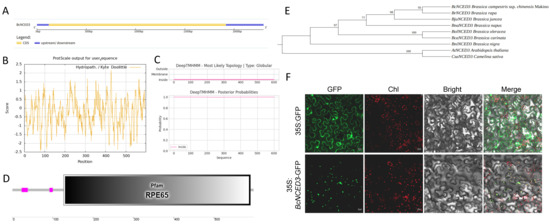
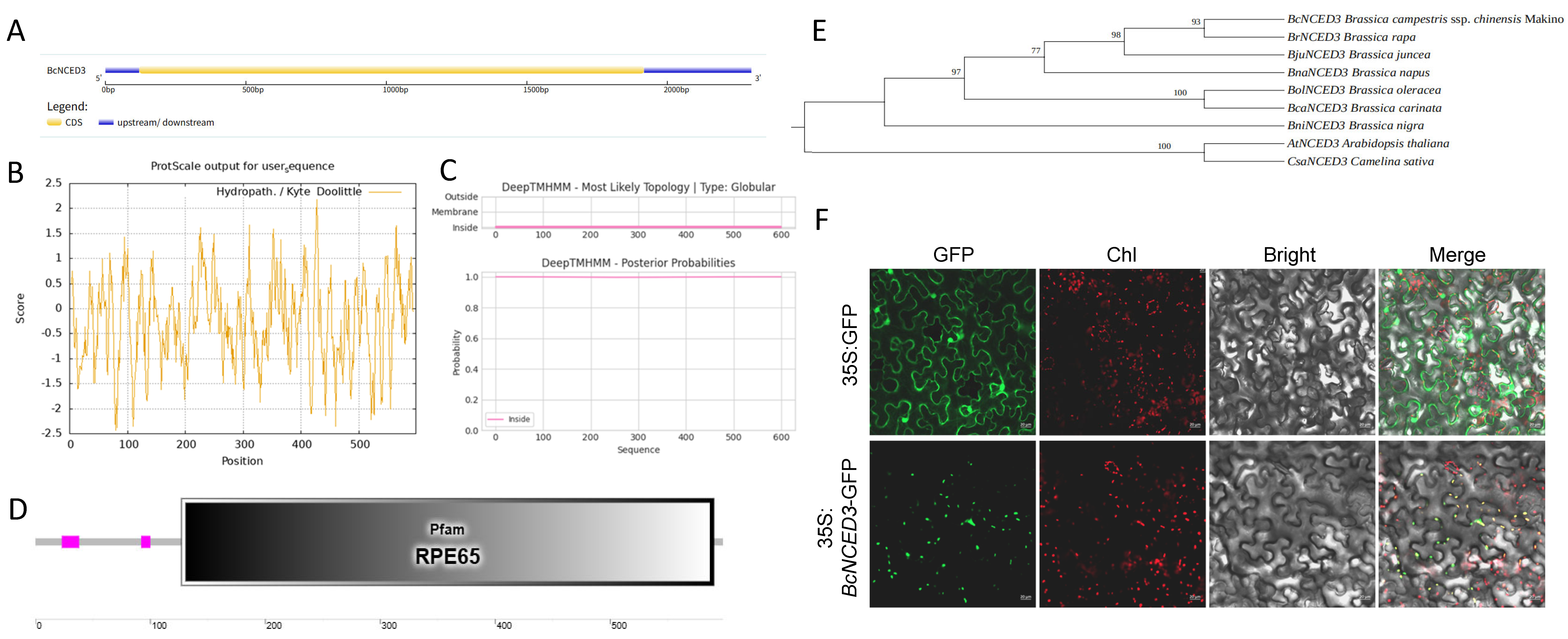
The full-length gene BcNCED3 (BraC01g041920.1) spans 2299 bp, harboring a single 1797 bp coding sequence devoid of intronic regions. This locus encodes a 598-amino-acid polypeptide (Figure 1A). Biophysical parameter calculation predicted a molecular weight of 65.76 kDa and a theoretical pI of 5.57, accompanied by an instability index of 41.45. Global hydrophilicity profiling indicated that the protein is predominantly soluble (Figure 1B), with no predicted transmembrane helices detected (Figure 1C), collectively supporting that BcNCED3 constitutes an acidic, labile soluble protein.
Figure 1.
Bioinformatic analysis and subcellular localization of BcNCED3: (A) gene structure showing CDS and flanking regions; (B) hydrophobicity analysis of BcNCED3; (C) transmembrane topology prediction; (D) conserved RPE65 domains; (E) phylogenetic tree of NCED3 proteins from eight Brassicaceae species (Brassica rapa, B. juncea, B. napus, B. oleracea, B. carinata, B. nigra, Arabidopsis thaliana, and Camelina sativa), constructed using the neighbor-joining method with 1000 bootstrap replicates (bootstrap values (≥70%) are shown at branch nodes, indicating the statistical confidence of each bifurcation); (F) subcellular localization of BcNCED3 in Nicotiana benthamiana epidermal cells: 35S:GFP control and 35S:BcNCED3-GFP showing GFP, chloroplast autofluorescence (Chl), bright field (Bright), and merged channels.
In silico secondary structure prediction uncovered three dominant structural components: random coils occupied the largest proportion at 66.39%, followed by extended strands (20.40%) and α-helices (13.21%). Homology-based tertiary structure modeling was performed using the Arabidopsis NCED3 template, sharing 91.47% sequence identity with BcNCED3; the resulting 3D conformation matched the secondary structural distribution. The polypeptide carries a canonical RPE65 conserved domain spanning residues 127 to 529 (Figure 1D). Subcellular localization prediction assigned BcNCED3 to chloroplast compartments, consistent with its core catalytic role in plastid-localized ABA biosynthetic cascades.
3.2. Cis-Regulatory Motifs Within the BcNCED3 Promoter
Beyond basal core promoter elements, the 2000 bp upstream regulatory region of BcNCED3 accumulates abundant cis-elements responsive to phytohormones and environmental stimuli. Identified hormone-associated motifs include ABA-responsive ABRE, methyl jasmonate-inducible CGTCA-motif and ethylene-triggered ERE. Stress-related signatures were also captured, such as anaerobic induction ARE and general stress-responsive STRE motifs. Multiple binding cis-sites for transcription factors MYB, MYC and WRKY (W-box), alongside a suite of light-responsive modules, were additionally distributed across the promoter fragment (Supplementary Materials).
Pervasive ABRE enrichment points to tight transcriptional control mediated by ABA signaling cascades. The coexistence of STRE motifs further implies that BcNCED3 acts as a molecular hub integrating ABA and thermal signals to coordinate plant thermotolerance.
3.3. Multiple Sequence Alignment and Phylogenetic Reconstruction
Homology searches against the BRAD database retrieved eight Brassicaceae species whose NCED3 orthologs shared over 80% amino acid identity with BcNCED3, encompassing Brassica rapa, B. juncea, B. napus, B. oleracea, B. carinata, B. nigra, Arabidopsis thaliana and Camelina sativa. Pairwise identity values between BcNCED3 and these homologous proteins reached 100%, 99.8%, 98.7%, 98.5%, 98%, 96%, 91.5% and 92%, respectively.
Intra-genus sequence homology within Brassica consistently surpassed 98%, while cross-genus similarity remained above 90%, reflecting profound functional conservation of NCED3 across cruciferous taxa. The reconstructed phylogenetic tree partitioned all Brassica orthologs into a monophyletic clade, separating Arabidopsis and Camelina into an independent branch (Figure 1E), substantifying the deep evolutionary conservation of NCED3 within Brassicaceae.
3.4. Experimental Validation of BcNCED3 Subcellular Localization
This assay was designed to validate BcNCED3’s contribution to plastid-resident ABA biosynthesis and furnish cytological evidence supporting its stress-modulatory functions in non-heading Chinese cabbage. Although chloroplast localization of NCED homologs has been established in model species such as Arabidopsis thaliana and tomato, divergent transit peptide sequences among NCED orthologs in horticultural crops may drive distinct intracellular sorting patterns. We therefore experimentally validated the subcellular distribution of BcNCED3 through transient expression of a 35S:BcNCED3-GFP fusion construct in Nicotiana benthamiana leaf epidermal cells-a well-established heterologous platform for cytological characterization of vegetable crop genes. The 35S:GFP empty vector control yielded diffuse fluorescence throughout the cytosol and nucleus, showing no overlap with chloroplast autofluorescence. In contrast, the BcNCED3-GFP fusion protein produced discrete punctate signals that fully colocalized with chloroplast autofluorescence, yielding characteristic yellow signals in merged micrographs (Figure 1F). These cytological observations provide direct experimental evidence for chloroplast targeting of BcNCED3, confirming its catalytic function within the plastid-localized ABA biosynthetic pathway in non-heading Chinese cabbage.
3.5. Heat-Triggered Transcriptional Profiling of BcNCED3
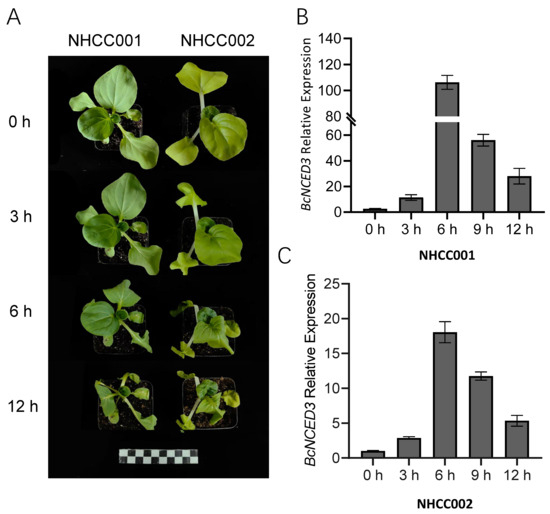
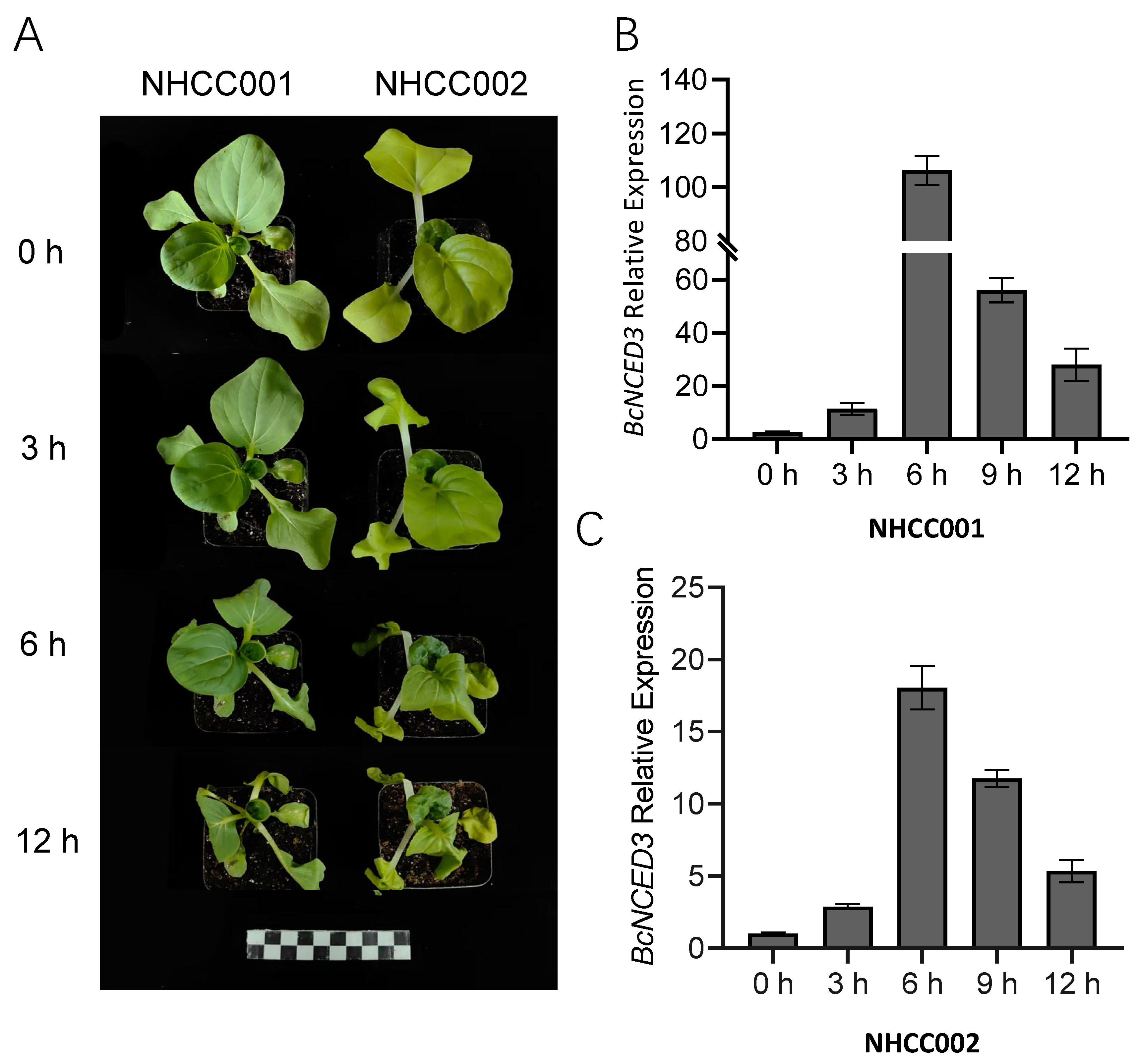
Quantitative RT–PCR was employed to quantify BcNCED3 transcript abundance over a 0–12 h 40 °C heat stress regime. Two non-heading Chinese cabbage genotypes with divergent thermotolerance were assayed: thermotolerant cultivar ‘Suzhou Qing’ (NHCC001) and heat-vulnerable ‘Aijiaohuang’ (NHCC002). Heat-triggered leaf wilting was markedly exacerbated in the heat-sensitive line (Figure 2A). BcNCED3 transcripts accumulated to higher levels in NHCC001 throughout the stress period, and heat exposure triggered robust transcriptional upregulation in both genotypes. Transcript quantities rose sharply from 3 h to 6 h post-treatment, peaking at a roughly 5-fold induction at 6 h before undergoing a pronounced reduction by 9 h of thermal exposure (Figure 2B,C). These transcriptional patterns establish BcNCED3 as a heat-inducible gene, whose activation amplitude aligns positively with intrinsic thermotolerance capacity of non-heading Chinese cabbage cultivars.
Figure 2.
Phenotypic changes and relative expression of BcNCED3 in NHCC001 and NHCC002 under high temperature: (A) phenotypes of NHCC001 and NHCC002 at 0, 3, 6, and 12 h of 40 °C treatment; (B,C) relative expression of BcNCED3 in NHCC001 (B) and NHCC002 (C). Data are presented as mean ± SD (n = 3 biological replicates). Asterisks denote statistically significant differences (Student’s t-test).
3.6. Exogenous ABA Pretreatment Fortifies Basal Thermoprotection
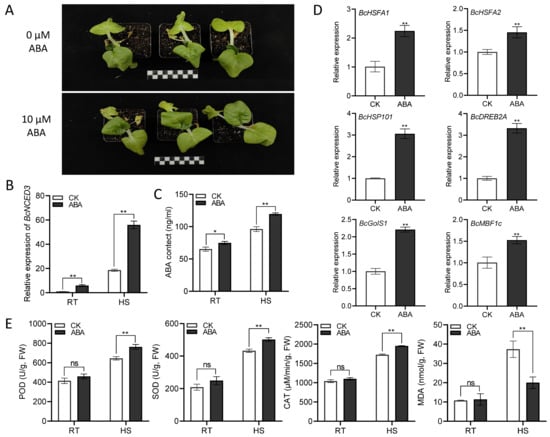
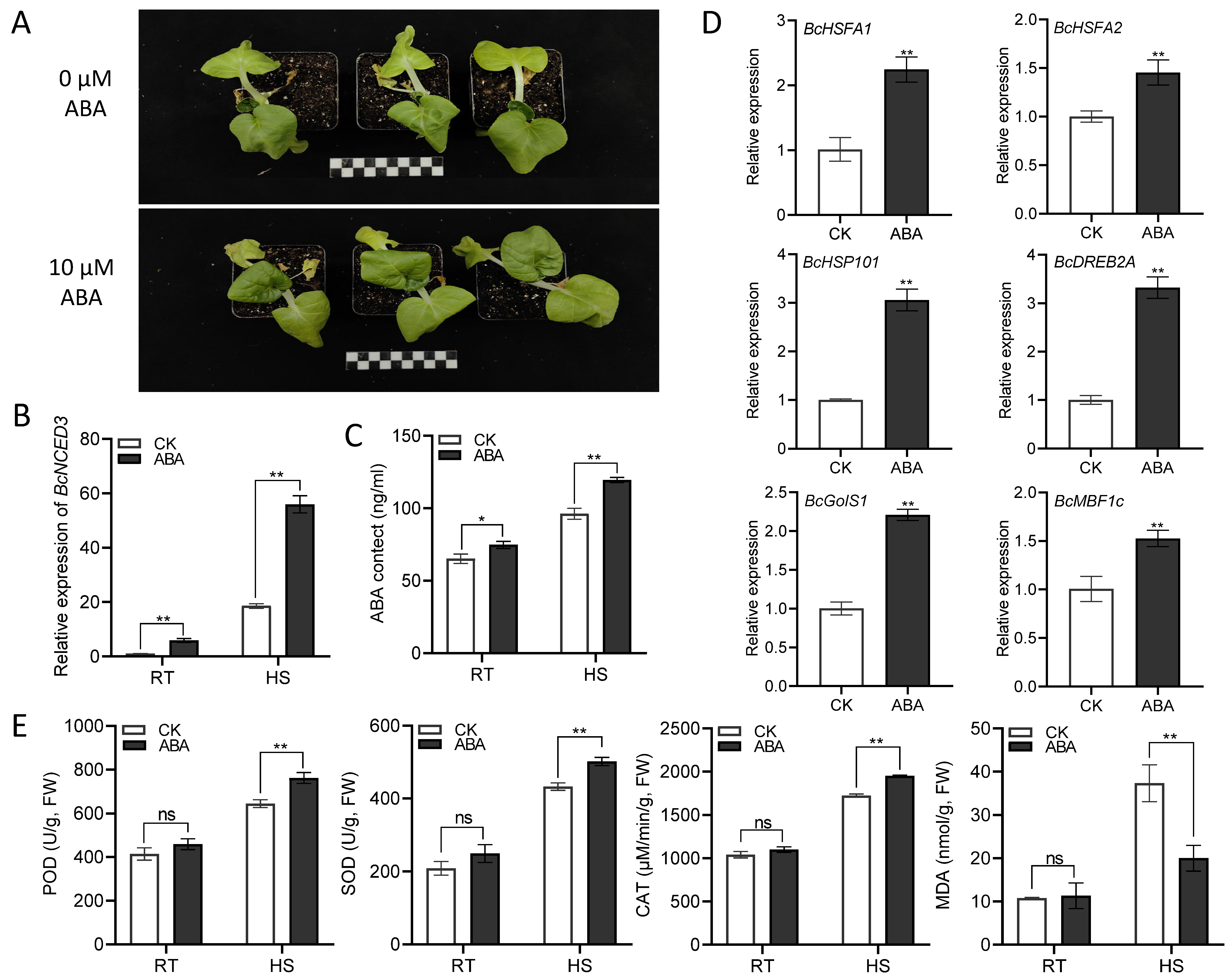
Seedlings of heat-sensitive ‘Aijiaohuang’ primed with 10 µM ABA exhibited attenuated heat lesions following three days of cycling 38 °C/25 °C conditions, compared with water-mock controls. Untreated control material developed extensive chlorosis and necrotic lesions on basal leaves coupled with severe apical wilting, whereas ABA-pretreated foliage retained superior stress resilience (Figure 3A). Both BcNCED3 transcript abundance and intrinsic ABA pools accumulated to higher titres in ABA-primed seedlings relative to mock specimens, with further amplification recorded upon heat imposition (Figure 3B,C). These observations establish that exogenous ABA signalling drives transcriptional activation of BcNCED3 and stimulates de novo endogenous ABA biosynthesis.
Figure 3.
Effects of exogenous ABA pretreatment on heat tolerance of non-heading Chinese cabbage: (A) phenotypes of the control (CK) and ABA-pretreated (ABA) groups after high-temperature treatment; (B) relative expression of BcNCED3 in the CK and ABA groups at room temperature (RT, 24 °C) and high temperature (HS, 38 °C); (C) endogenous ABA levels; (D) expression of heat-responsive genes (BcHSFA1, BcHSFA2, BcHSP101, BcDREB2A, BcGolS1, and BcMBF1c) after high-temperature treatment; (E) POD, SOD, and CAT activities and MDA content at RT and HS. Data are presented as mean ± SD (n = 3 biological replicates). Asterisks indicate statistically significant differences (* p < 0.05, ** p < 0.01, Student’s t-test for gene expression; two-way ANOVA with Tukey’s HSD for physiological indices, ns = non-significant).
Transcripts encoding core heat-responsive regulators-BcHSP101, BcHSFA1, BcHSFA2, BcDREB2A, BcGolS1, and BcMBF1c-were significantly upregulated in ABA-pretreated seedlings post heat exposure (Figure 3D). This transcriptional cascade infers that ABA-activated BcNCED3 signalling reinforces thermotolerance by mobilizing downstream heat shock regulons.
Basal antioxidant enzyme activities and malondialdehyde (MDA) titres were indistinguishable across treatment cohorts prior to thermal stress. After three days of high-temperature cycling, ABA priming yielded substantially elevated SOD, POD and CAT enzymatic activities, alongside restrained MDA accumulation relative to untreated controls (Figure 3E). Exogenous ABA therefore reinforces cellular antioxidant buffering capacity, accelerates reactive oxygen species (ROS) scavenging and curtails lipid peroxidation, thereby preserving plasma membrane integrity under thermal duress.
3.7. Constitutive Overexpression of BcNCED3 Enhances Intrinsic Thermotolerance
We generated regenerated ‘Aijiaohuang’ seedlings by Agrobacterium-mediated transformation and subsequent plant tissue regeneration culture. We irradiated seedling roots with the LUYOR-3415RG handheld fluorescent lamp, and strong green GFP fluorescence signals were clearly visible in positive transgenic individuals when viewed through a yellow filter. Tissue culture successfully yielded transgenic ‘Aijiaohuang’ regenerants with GFP reporter signals specifically expressed in roots (Supplementary Figure S2A). Genotypic screening using primer pairs pER8-BcNCED3-F/pER8-R identified three independent lines carrying the expected ~2000 bp amplicon (Supplementary Figure S2B). Quantitative RT–PCR analysis revealed BcNCED3 transcript levels in OE-1, OE-2, and OE-3 to reach approximately 30-, 12-, and 13-fold relative to wild-type (WT) expression, respectively (Supplementary Figure S2C). All three independent overexpression lines were retained for subsequent phenotypic and physiological analyses to demonstrate the consistency and reproducibility of the overexpression phenotype across independent transgenic events, thereby ruling out line-specific artifacts arising from positional effects or somaclonal variation.
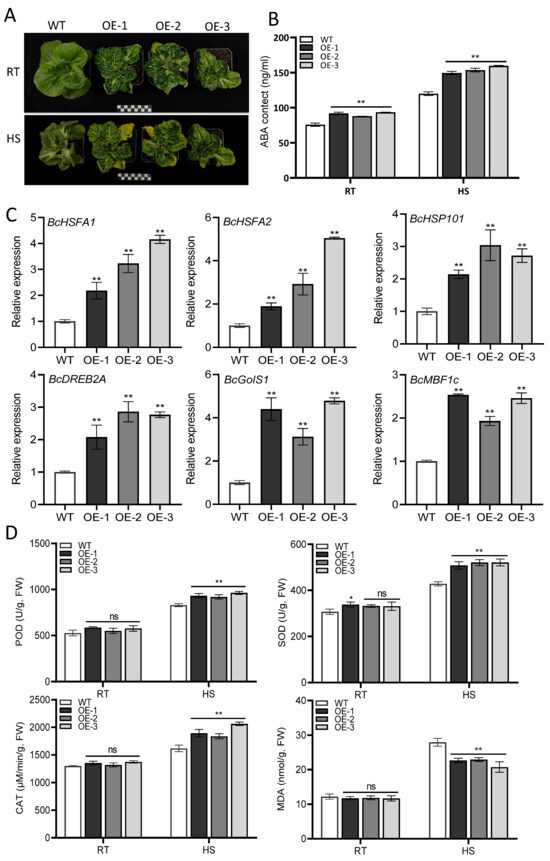
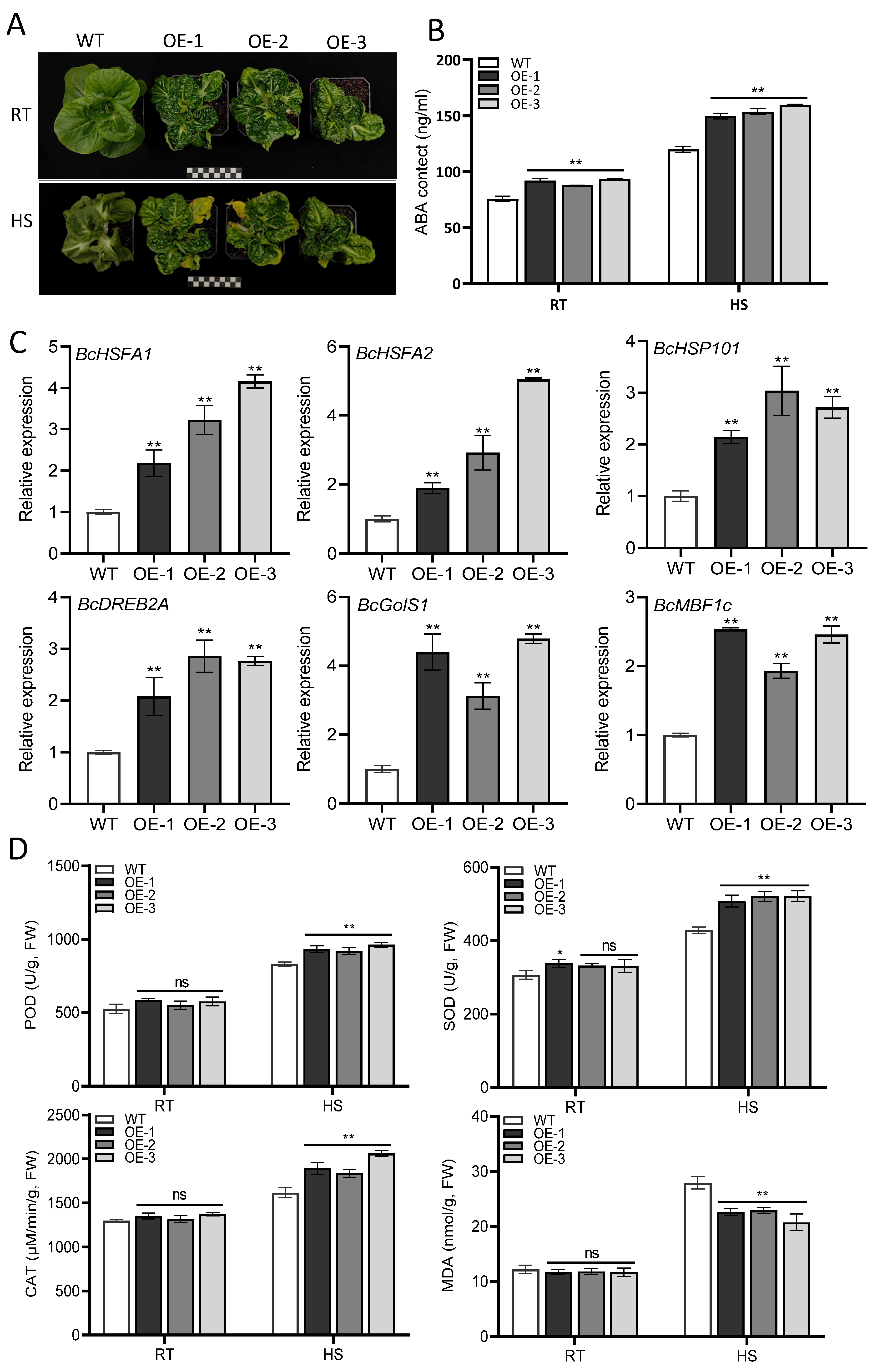
Following three days of 38 °C/25 °C heat cycling, WT foliage displayed widespread chlorosis and wilting, while overexpression lines sustained intact newly emerged green tissue with only mild senescence in mature leaves (Figure 4A). Thermal stress stimulated endogenous ABA biosynthesis across all genotypes, yet overexpression lines maintained constitutively higher ABA concentrations under both ambient and heat-challenged regimes (Figure 4B). This demonstrates that ectopic BcNCED3 expression mitigates heat-induced damage via sustained elevation of intrinsic ABA pools. All six characterized heat-responsive marker genes exhibited significantly stronger transcriptional activation in overexpression backgrounds upon heat imposition (Figure 4C). At the physiological level, stress-triggered increments in SOD, POD and CAT activity were amplified in BcNCED3-overexpressing lines, concurrent with suppressed MDA build-up compared with WT counterparts (Figure 4D). Such physiological readouts verify that constitutive BcNCED3 expression reinforces antioxidant defence cascades and stabilizes membrane architecture during sustained heat exposure.
Figure 4.
BcNCED3 overexpression enhances heat tolerance in non-heading Chinese cabbage: (A) Phenotypes of WT and overexpression plants (OE-1, OE-2, and OE-3) at room temperature (RT, 24 °C) and high temperature (HS, 38 °C); (B) Endogenous ABA levels; (C) Expression of heat-responsive genes BcHSFA1, BcHSFA2, BcHSP101, BcDREB2A, BcGolS1, and BcMBF1c after high-temperature treatment; (D) POD, SOD, and CAT activities and MDA content at RT and HS. Data are presented as mean ± SD (n = 3 biological replicates), (* p < 0.05, ** p < 0.01, one-way ANOVA with Dunnett’s test for gene expression; two-way ANOVA with Tukey’s HSD for physiological indices, ns = non-significant).
Pearson correlation analysis was used to assess the relationships between BcNCED3 transcript abundance and the expression of six heat-responsive genes (BcHSFA1, BcHSFA2, BcHSP101, BcDREB2A, BcGolS1, and BcMBF1c), as well as the activities of SOD, POD and CAT antioxidant enzymes and MDA content under HS conditions. The full correlation matrix is provided in Supplementary Figure S3. Correlation analysis revealed that BcNCED3 expression was significantly positively correlated with the transcript levels of all six heat-responsive genes, with correlation coefficients of 0.72 to 0.89 (p < 0.01). Moreover, BcNCED3 transcript abundance was positively and significantly correlated with the activities of SOD (r = 0.81, p < 0.01), POD (r = 0.76, p < 0.01) and CAT (r = 0.69, p < 0.01). Conversely, BcNCED3 expression exhibited a significant negative correlation with MDA content (r = −0.78, p < 0.01).
3.8. Loss-of-Function Mutagenesis of BcNCED3 Compromises Thermotolerance
Genomic DNA isolated from healthy regenerated plantlets was PCR-amplified using Cas12a vector-specific primers. Five independent transformants yielding the diagnostic ~800 bp amplicon were confirmed as transgene-positive. Long-read third-generation (PacBio) sequencing across both target loci resolved three distinct mutational classes, all involving small indel deletions within the BcNCED3 coding sequence. The three knockout lines-designated KO-1, KO-2, and KO-3-harbored deletions ranging from 12 to 29 bp at the crRNA1 and crRNA2 target sites, resulting in frameshift mutations and premature stop codons. These mutations are predicted to yield truncated BcNCED3 polypeptides lacking the catalytically essential RPE65 domain (Supplementary Figure S4A–C). All three homozygous knockout lines were advanced for thermotolerance phenotyping.
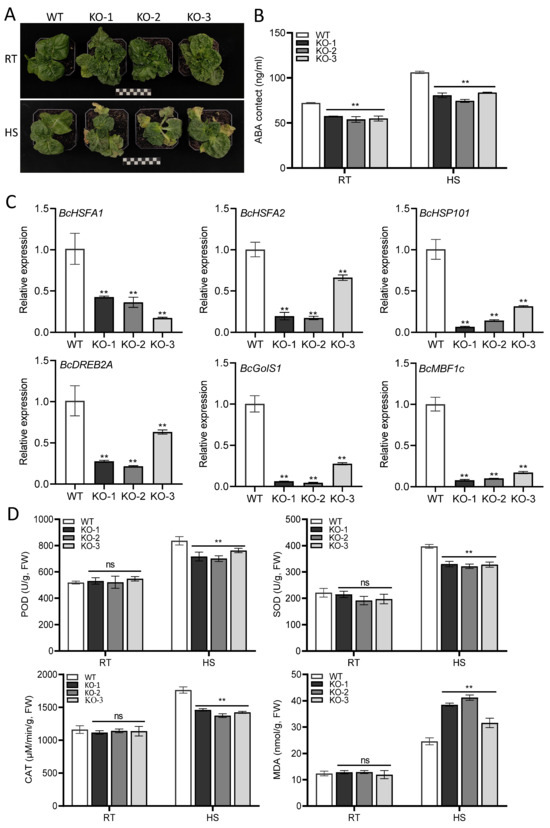
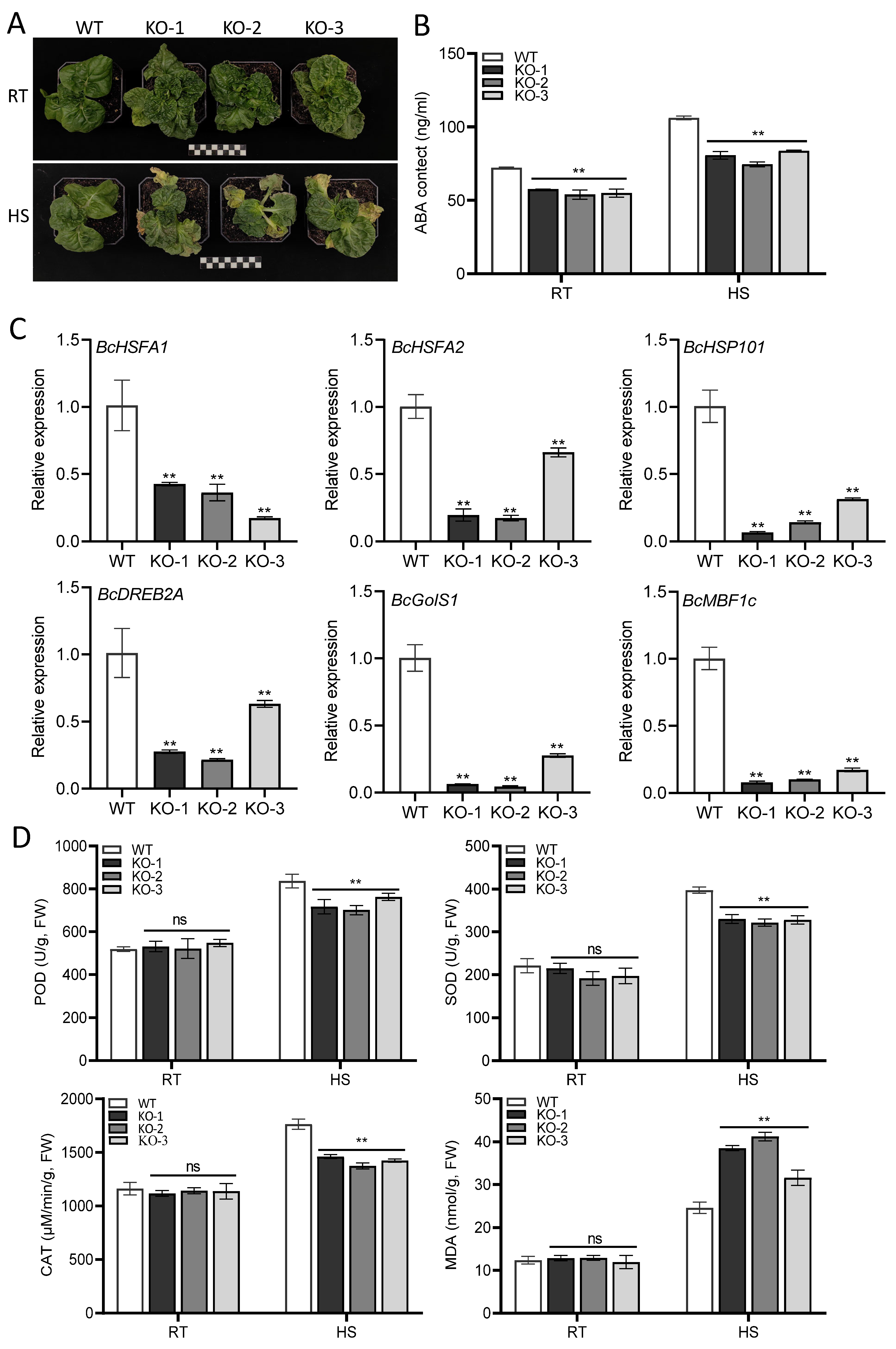
After three days of cyclic 38 °C/25 °C thermal treatment, all three homozygous knockout (KO) lines developed severe foliar wilting and necrotic lesions, alongside accelerated vegetative growth relative to WT controls during stress incubation (Figure 5A). Although heat stimulation triggered measurable ABA biosynthesis in all genotypes, KO lines maintained significantly depleted endogenous ABA pools both prior to and post thermal challenge (Figure 5B). This genetic evidence confirms that functional ablation of BcNCED3 severely attenuates stress-inducible ABA biosynthesis. Ablated ABA signalling renders knockout material refractory to thermal cues, disrupting the developmental switch from vegetative proliferation to stress acclimation. Under heat stress, all six heat-responsive marker genes exhibited markedly dampened transcription in KO lines relative to WT specimens (Figure 5C). While antioxidant enzymatic activity still increased in mutagenized material upon heat imposition, the magnitude of induction was significantly blunted, paired with substantially elevated MDA titres compared with wild-type tissue (Figure 5D). These physiological disparities reflect weakened ROS scavenging machinery and aggravated membrane lipid peroxidation in the absence of functional BcNCED3.
Figure 5.
CRISPR/Cas12a editing of BcNCED3 reduces heat tolerance in non-heading Chinese cabbage: (A) phenotypes of WT and BcNCED3-edited plants (KO-1, KO-2, and KO-3) at RT and HS; (B) endogenous ABA levels; (C) expression of heat-responsive genes BcHSFA1, BcHSFA2, BcHSP101, BcDREB2A, BcGolS1, and BcMBF1c after high-temperature treatment; (D) POD, SOD, and CAT activities and MDA content at RT and HS. Data are presented as mean ± SD (n = 3 biological replicates), (** p < 0.01, one-way ANOVA with Dunnett’s test for gene expression; two-way ANOVA with Tukey’s HSD for physiological indices, ns = non-significant).
4. Discussion
Non-heading Chinese cabbage is a cool-season leafy vegetable with an optimal growth temperature range of 18–20 °C. Sustained ambient temperatures exceeding 25 °C severely inhibit vegetative growth, triggering premature petiole elongation, accelerating leaf chlorosis, increasing crude fiber deposition, and ultimately reducing both edible quality and marketable yield. Abscisic acid (ABA), a quintessential stress phytohormone, accumulates rapidly upon exposure to drought, salinity, and thermal stress, orchestrating a wide repertoire of stress-adaptive responses [56]. NCED enzymes catalyze the rate-limiting step of ABA biosynthesis; consequently, the transcriptional regulation of NCED genes governs cellular ABA biosynthetic capacity and directly shapes thermotolerance phenotypes in crop plants [16,31].
The BcNCED3 coding sequence is contained within a single exon lacking intronic interruptions. This intronless genomic architecture circumvents post-transcriptional splicing, enabling rapid transcriptional and translational activation to sustain robust ABA production during environmental perturbations [57]. The deduced BcNCED3 polypeptide harbors a conserved RPE65 domain characteristic of the NCED protein superfamily, which endows intrinsic dioxygenase activity to catalyze the oxidative cleavage of 9-cis-epoxycarotenoids during ABA biosynthesis [58]. Phylogenetic analysis revealed pronounced sequence conservation between BcNCED3 and NCED3 orthologs across Brassicaceae species, echoing evolutionary conservation patterns previously documented in peanut, radish, and barley [59,60]. In silico predictions and experimental subcellular localization assays collectively demonstrate chloroplast residency of BcNCED3, consistent with its core catalytic function in plastid-localized ABA biosynthesis. Quantitative RT-PCR analysis revealed robust and rapid transcriptional induction of BcNCED3 under 40 °C heat stress, with markedly divergent transcript accumulation between heat-tolerant and heat-sensitive cultivars. This positive correlation between BcNCED3 expression and thermotolerance mirrors the established function of OsNCED1 in rice, where elevated NCED1-mediated ABA biosynthesis reinforces heat resilience in seedlings [61].
Exogenous phytohormone application represents a practical strategy to mitigate heat-induced cellular damage and reinforce basal thermotolerance [11]. In rice, pretreatment with 10 μM ABA alleviated heat-induced leaf wilting and chlorophyll degradation while transcriptionally upregulating antioxidant and heat shock gene repertoires [25]. Consistent with these findings in cereals, exogenous ABA application in non-heading Chinese cabbage significantly elevated BcNCED3 transcript levels under thermal stress, augmented endogenous ABA concentrations, activated heat-responsive transcription factors (BcHSP101, BcHSFA1, and BcHSFA2), stimulated antioxidant enzyme activities, and suppressed MDA overaccumulation. These results indicate that exogenous ABA amplifies endogenous ABA biosynthesis while concurrently mobilizing heat-responsive transcriptional modules and antioxidant defense machinery, ultimately attenuating membrane lipid peroxidation [62,63,64]. Our observations align with prior studies attributing enhanced heat tolerance to ABA accumulation in mini Chinese cabbage and cucumber [65,66].
Notably, BcNCED3-overexpressing transgenic lines faithfully recapitulated the full spectrum of physiological, transcriptional, and phenotypic thermotolerance responses elicited by exogenous ABA treatment. Conversely, CRISPR/Cas12a-mediated knockout mutants displayed pronounced heat hypersensitivity. Although the core finding-that NCED-mediated ABA biosynthesis enhances thermotolerance through HSF/HSP and antioxidant pathways has been documented in several model and crop species [61,66], our study provides several distinct contributions specific to non-heading Chinese cabbage: (i) the first functional characterization of an NCED family member in this economically important leafy vegetable; (ii) direct evidence that BcNCED3 expression level quantitatively correlates with thermotolerance across cultivars; and (iii) a complete gain- and loss-of-function genetic validation demonstrating the necessity and sufficiency of BcNCED3 for heat tolerance. This dual genetic validation establishes BcNCED3 as a positive regulator of thermotolerance in non-heading Chinese cabbage, operating through ABA-dependent HSF/HSP regulatory axes and antioxidant defense pathways [67].
Stable genetic transformation combined with precision genome editing provides a powerful toolkit for molecular dissection of plant gene function [54]. In this study, we employed Agrobacterium rhizogenes-mediated transformation alongside the LbCas12a-RRV multiplex editing platform to generate complementary overexpression and knockout germplasm. While CRISPR/Cas9 and conventional Cas12a systems have been successfully established in several Brassica species (e.g., B. oleracea and B. napus), their application in non-heading Chinese cabbage (B. rapa subsp. chinensis) remains limited, largely due to the recalcitrance of this subspecies to genetic transformation and tissue regeneration-a major bottleneck for functional genomics and molecular breeding. The LbCas12a-RRV system deployed in this work offers several practical advantages in the non-heading Chinese cabbage context: (i) the WUS2-IPT-PLT5 developmental regulator cassette carried in the vector backbone substantially enhances regeneration efficiency from transformed explants, with the Ruby visible reporter enabling early, non-destructive screening of positive transformants; (ii) Cas12a recognizes T-rich PAM sequences (TTTV), expanding targetable genomic space to AT-rich regulatory regions such as the ABRE- and W-box-enriched BcNCED3 promoter; and (iii) Cas12a generates staggered DNA double-strand breaks with short overhangs, facilitating precise gene disruption through the NHEJ repair pathway—consistent with the 12–29 bp small deletions observed in this study [55]. Distinct from SpCas9 systems, LbCas12a requires only a single crRNA guide, recognizes AT-rich protospacer adjacent motifs, and produces cohesive-ended breaks conducive to precise allele modification [68,69]. This editing platform has been deployed with high efficiency across model organisms and diverse crop species [70,71,72,73,74,75]. Our functional validation confirms that LbCas12a-RRV drives consistent, high-efficiency mutagenesis in non-heading Chinese cabbage, furnishing a robust technical resource for functional genomic research within this crop and allied Brassicaceae vegetables. Critical gaps remain regarding upstream transcriptional regulators governing BcNCED3 expression, as well as its nuanced regulatory roles linking ABA heat signalling to plant growth and developmental homeostasis [76], these lines of inquiry warrant dedicated follow-up characterisation.
5. Conclusions
This study demonstrates that chloroplast-localized BcNCED3 positively regulates thermotolerance in non-heading Chinese cabbage through ABA biosynthesis modulation. Constitutive overexpression of BcNCED3 significantly enhanced heat tolerance, whereas CRISPR/Cas12a-mediated knockout conferred marked heat hypersensitivity, establishing BcNCED3 as a bona fide positive thermotolerance regulator. The validated high-efficiency LbCas12a-RRV genome editing platform and the functionally characterized BcNCED3 gene together serve as valuable molecular tools and genetic resources for advancing heat-tolerance breeding in non-heading Chinese cabbage and allied Brassica vegetables.
Supplementary Materials
The following supporting information can be downloaded at https://www.mdpi.com/article/10.3390/plants15172613/s1. Figure S1: Analysis of cis-regulatory elements of BcNCED3 gene. Figure S2: Identification of BcNCED3 overexpression plants: (A) GFP fluorescence photograph of regenerated seedling roots observed by LUYOR3415; (B) PCR detection of the BcNCED3 gene in WT and BcNCED3 overexpressing plants; (C) relative expression of BcNCED3 in WT and BcNCED3 overexpressing plants. Figure S3: Clustered ellipse correlogram showing pairwise correlations between BcNCED3 gene expression, other tested genes and biochemical parameters. Positive correlations (r > 0, p ≤ 0.05) and negative correlations (r < 0, p ≤ 0.05) are distinguished by ellipse color. Figure S4: Mutation types of the BcNCED3 ORF induced by CRISPR/Cas12a: (A) third-generation sequencing peak maps and alignment of wild-type (WT) and knockout (KO) plants; (B) mutation types at target site 1 in KO plants; (C) mutation types at target site 2 in KO plants.
Author Contributions
D.X. and C.Z. provided financial support. D.X. and C.Z. designed and conceived the study. W.L. and C.C. performed the experiments and data analysis. W.L. and Y.W. wrote the paper. D.X., C.Z. and S.S. revised the manuscript. H.Z. and Z.L. coordinated the study. All authors have read and agreed to the published version of the manuscript.
Funding
This work was supported by Hainan Provincial Natural Science Foundation of China, project number: 326MS0229, supported by the Education Department of Hainan Province, project number: Hnky2026ZD-31, Supported by the Earmarked Fund for HNARS (HNARS-05-G05).
Data Availability Statement
The data presented in this study are available on request from the corresponding author. The data are not publicly available due to privacy restriction.
Conflicts of Interest
The authors declare no conflicts of interest.
References
- Xu, H.; Wang, C.; Shao, G.; Wu, S.; Liu, P.; Cao, P.; Jiang, P.; Wang, S.; Zhu, H.; Lin, X.; et al. The reference genome and full-length transcriptome of pakchoi provide insights into cuticle formation and heat adaption. Hortic. Res. 2022, 9, uhac123. [Google Scholar] [CrossRef] [Scilit] [PubMed]
- Samat, A.T.; Soltabayeva, A.; Bekturova, A.; Zhanassova, K.; Auganova, D.; Masalimov, Z.; Srivastava, S.; Satkanov, M.; Kurmanbayeva, A. Plant responses to heat stress and advances in mitigation strategies. Front. Plant Sci. 2025, 16, 1638213. [Google Scholar] [CrossRef] [Scilit] [PubMed]
- Challinor, A.J.; Watson, J.; Lobell, D.B.; Howden, S.M.; Smith, D.R.; Chhetri, N. A meta-analysis of crop yield under climate change and adaptation. Nat. Clim. Change 2014, 4, 287–291. [Google Scholar] [CrossRef] [Scilit]
- Zhao, C.; Liu, B.; Piao, S.; Wang, X.; Lobell, D.B.; Huang, Y.; Huang, M.T.; Yao, Y.T.; Bassu, S.; Ciais, P.; et al. Temperature increase reduces global yields of major crops in four independent estimates. Proc. Natl. Acad. Sci. USA 2017, 114, 9326–9331. [Google Scholar] [CrossRef] [Scilit] [PubMed]
- Qu, A.-L.; Ding, Y.-F.; Jiang, Q.; Zhu, C. Molecular mechanisms of the plant heat stress response. Biochem. Biophys. Res. Commun. 2013, 432, 203–207. [Google Scholar] [CrossRef] [Scilit] [PubMed]
- Mishra, S.K.; Tripp, J.; Winkelhaus, S.; Tschiersch, B.; Theres, K.; Nover, L.; Scharf, K.-D. In the complex family of heat stress transcription factors, HsfA1 has a unique role as master regulator of thermotolerance in tomato. Genes Dev. 2002, 16, 1555–1567. [Google Scholar] [CrossRef] [Scilit] [PubMed]
- Ul Haq, S.; Khan, A.; Ali, M.; Khattak, A.M.; Gai, W.-X.; Zhang, H.-X.; Wei, A.-M.; Gong, Z.-H. Heat shock proteins: Dynamic biomolecules to counter plant biotic and abiotic stresses. Int. J. Mol. Sci. 2019, 20, 5321. [Google Scholar] [CrossRef] [Scilit] [PubMed]
- Hasanuzzaman, M.; Nahar, K.; Alam, M.M.; Roychowdhury, R.; Fujita, M. Physiological, biochemical, and molecular mechanisms of heat stress tolerance in plants. Int. J. Mol. Sci. 2013, 14, 9643–9684. [Google Scholar] [CrossRef] [Scilit] [PubMed]
- Nadarajah, K.K. ROS homeostasis in abiotic stress tolerance in plants. Int. J. Mol. Sci. 2020, 21, 5208. [Google Scholar] [CrossRef] [Scilit] [PubMed]
- Fortunato, S.; Lasorella, C.; Dipierro, N.; Vita, F.; de Pinto, M.C. Redox signaling in plant heat stress response. Antioxidants 2023, 12, 605. [Google Scholar] [CrossRef] [Scilit] [PubMed]
- Li, N.; Euring, D.; Cha, J.Y.; Lin, Z.; Lu, M.; Huang, L.-J.; Kim, W.Y. Plant hormone-mediated regulation of heat tolerance in response to global climate change. Front. Plant Sci. 2021, 11, 627969. [Google Scholar] [CrossRef] [Scilit] [PubMed]
- Sah, S.K.; Reddy, K.R.; Li, J. Abscisic acid and abiotic stress tolerance in crop plants. Front. Plant Sci. 2016, 7, 571. [Google Scholar] [CrossRef] [Scilit] [PubMed]
- Milborrow, B.V. The pathway of biosynthesis of abscisic acid in vascular plants: A review of the present state of knowledge of ABA biosynthesis. J. Exp. Bot. 2001, 52, 1145–1164. [Google Scholar] [CrossRef]
- Nambara, E.; Marion-Poll, A. Abscisic acid biosynthesis and catabolism. Annu. Rev. Plant Biol. 2005, 56, 165–185. [Google Scholar] [CrossRef] [Scilit] [PubMed]
- Chen, K.; Li, G.; Bressan, R.A.; Song, C.; Zhu, J.; Zhao, Y. Abscisic acid dynamics, signaling, and functions in plants. J. Integr. Plant Biol. 2020, 62, 25–54. [Google Scholar] [CrossRef] [Scilit] [PubMed]
- Xiong, L.; Zhu, J.K. Regulation of abscisic acid biosynthesis. Plant Physiol. 2003, 133, 29–36. [Google Scholar] [CrossRef] [Scilit] [PubMed]
- Park, S.Y.; Fung, P.; Nishimura, N.; Jensen, D.R.; Fujii, H.; Zhao, Y.; Lumba, S.; Santiago, J.; Rodrigues, A.; Chow, T.-F.F.; et al. Abscisic acid inhibits type 2C protein phosphatases via the PYR/PYL family of START proteins. Science 2009, 324, 1068–1071. [Google Scholar] [CrossRef] [Scilit] [PubMed]
- Fujii, H.; Zhu, J.K. Arabidopsis mutant deficient in 3 abscisic acid-activated protein kinases reveals critical roles in growth, reproduction, and stress. Proc. Natl. Acad. Sci. USA 2009, 106, 8380–8385. [Google Scholar] [CrossRef] [Scilit] [PubMed]
- Larkindale, J.; Hall, J.D.; Knight, M.R.; Vierling, E. Heat stress phenotypes of Arabidopsis mutants implicate multiple signaling pathways in the acquisition of thermotolerance. Plant Physiol. 2005, 138, 882–897. [Google Scholar] [CrossRef] [Scilit] [PubMed]
- Wang, Q.; Wu, Y.; Wu, W.; Lyu, L.; Li, W. A review of changes at the phenotypic, physiological, biochemical, and molecular levels of plants due to high temperatures. Planta 2024, 259, 57. [Google Scholar] [CrossRef] [Scilit] [PubMed]
- Li, Y.; Gao, Z.; Lu, J.; Wei, X.; Qi, M.; Yin, Z.; Li, T. SlSnRK2.3 interacts with SlSUI1 to modulate high temperature tolerance via abscisic acid (ABA) controlling stomatal movement in tomato. Plant Sci. 2022, 321, 111305. [Google Scholar] [CrossRef] [Scilit] [PubMed]
- Wei, J.-T.; Zheng, L.; Ma, X.-J.; Yu, T.-F.; Gao, X.; Hou, Z.-H.; Liu, Y.-W.; Cao, X.-Y.; Chen, J.; Zhou, Y.-B.; et al. An ABF5b-HsfA2h/HsfC2a-NCED2b/POD4/HSP26 module integrates multiple signaling pathways to modulate heat stress tolerance in wheat. Plant Biotechnol. J. 2025, 23, 4735–4751. [Google Scholar] [CrossRef] [Scilit] [PubMed]
- Ma, H.; Liu, C.; Li, Z.; Ran, Q.; Xie, G.; Wang, B.; Fang, S.; Chu, J.; Zhang, J. ZmbZIP4 contributes to stress resistance in maize by regulating ABA synthesis and root development. Plant Physiol. 2018, 178, 753–770. [Google Scholar] [CrossRef] [Scilit] [PubMed]
- Rezaul, I.M.; Baohua, F.; Tingting, C.; Weimeng, F.; Caixia, Z.; Longxing, T.; Guanfu, F. Abscisic acid prevents pollen abortion under high-temperature stress by mediating sugar metabolism in rice spikelets. Physiol. Plant. 2019, 165, 644–663. [Google Scholar] [CrossRef] [Scilit] [PubMed]
- Liu, X.; Ji, P.; Yang, H.; Jiang, C.; Liang, Z.; Chen, Q.; Lu, F.; Chen, X.; Yang, Y.; Zhang, X. Priming effect of exogenous ABA on heat stress tolerance in rice seedlings is associated with the upregulation of antioxidative defense capability and heat shock-related genes. Plant Growth Regul. 2022, 98, 23–38. [Google Scholar] [CrossRef] [Scilit]
- Matilla, A.J.; Carrillo-Barral, N.; Rodríguez-Gacio, M.C. An update on the role of NCED and CYP707A ABA metabolism genes in seed dormancy induction and the response to after-ripening and nitrate. J. Plant Growth Regul. 2015, 34, 274–293. [Google Scholar] [CrossRef] [Scilit]
- Basso, M.F.; Contaldi, F.; Celso, F.L.; Karalija, E.; Paz-Carrasco, L.C.; Barone, G.; Ferrante, A.; Martinelli, F. Expression profile of the NCED/CCD genes in chickpea and lentil during abiotic stress reveals a positive correlation with increased plant tolerance. Plant Sci. 2023, 336, 111817. [Google Scholar] [CrossRef] [Scilit] [PubMed]
- Schwartz, S.H.; Tan, B.C.; Gage, D.A.; Zeevaart, J.A.D.; McCarty, D.R. Specific oxidative cleavage of carotenoids by VP14 of maize. Science 1997, 276, 1872–1874. [Google Scholar] [CrossRef] [Scilit] [PubMed]
- Tan, B.C.; Schwartz, S.H.; Zeevaart, J.A.; McCarty, D.R. Genetic control of abscisic acid biosynthesis in maize. Proc. Natl. Acad. Sci. USA 1997, 94, 12235–12240. [Google Scholar] [CrossRef] [Scilit] [PubMed]
- Burbidge, A.; Grieve, T.M.; Jackson, A.; Thompson, A.; McCarty, D.R.; Taylor, I.B. Characterization of the ABA-deficient tomato mutant notabilis and its relationship with maize Vp14. Plant J. 1999, 17, 427–431. [Google Scholar] [PubMed]
- Iuchi, S.; Kobayashi, M.; Taji, T.; Naramoto, M.; Seki, M.; Kato, T.; Tabata, S.; Kakubari, Y.; Yamaguchi-Shinozaki, K.; Shinozaki, K. Regulation of drought tolerance by gene manipulation of 9-cis-epoxycarotenoid dioxygenase, a key enzyme in abscisic acid biosynthesis in Arabidopsis. Plant J. 2001, 27, 325–333. [Google Scholar] [CrossRef] [Scilit] [PubMed]
- Zhang, M.; Leng, P.; Zhang, G.; Li, X. Cloning and functional analysis of 9-cis-epoxycarotenoid dioxygenase (NCED) genes encoding a key enzyme during abscisic acid biosynthesis from peach and grape fruits. J. Plant Physiol. 2009, 166, 1241–1252. [Google Scholar] [CrossRef] [Scilit] [PubMed]
- Islam, M.S.U.; Shing, P.; Ahmed, M.; Zohra, F.T.; Rownaq, A.; Paul, S.K.; Rahman, S.M.; Sarkar, A.R. Genome-wide identification and characterization of NCED gene family in soybean (Glycine max L.) and their expression profiles in response to various abiotic stress treatments. PLoS ONE 2025, 20, e0319952. [Google Scholar] [CrossRef]
- Cui, G.; Cheng, H. Comprehensive analysis of TaNCED gene family in wheat vernalization process. Biology 2025, 14, 1293. [Google Scholar] [CrossRef] [Scilit] [PubMed]
- Tan, B.-C.; Joseph, L.M.; Deng, W.-T.; Liu, L.; Li, Q.-B.; Cline, K.; McCarty, D.R. Molecular characterization of the Arabidopsis 9-cis epoxycarotenoid dioxygenase gene family. Plant J. 2003, 35, 44–56. [Google Scholar] [CrossRef] [Scilit] [PubMed]
- Frey, A.; Effroy, D.; Lefebvre, V.; Seo, M.; Perreau, F.; Berger, A.; Sechet, J.; To, A.; North, H.M.; Marion-Poll, A. Epoxycarotenoid cleavage by NCED5 fine-tunes ABA accumulation and affects seed dormancy and drought tolerance with other NCED family members. Plant J. 2012, 70, 501–512. [Google Scholar] [CrossRef] [Scilit] [PubMed]
- Dai, S.; Kai, W.; Liang, B.; Wang, J.; Jiang, L.; Du, Y.; Sun, Y.; Leng, P. The functional analysis of SlNCED1 in tomato pollen development. Cell. Mol. Life Sci. 2018, 75, 3457–3472. [Google Scholar] [CrossRef] [Scilit] [PubMed]
- Wang, P.; Lu, S.; Zhang, X.; Hyden, B.; Qin, L.; Liu, L.; Bai, Y.; Han, Y.; Wen, Z.; Xu, J.; et al. Double NCED isozymes control ABA biosynthesis for ripening and senescent regulation in peach fruits. Plant Sci. 2021, 304, 110739. [Google Scholar] [CrossRef] [Scilit] [PubMed]
- Pei, X.; Wang, X.; Fu, G.; Chen, B.; Nazir, M.F.; Pan, Z.; He, S.; Du, X. Identification and functional analysis of 9-cis-epoxy carotenoid dioxygenase (NCED) homologs in G. hirsutum. Int. J. Biol. Macromol. 2021, 182, 298–310. [Google Scholar] [CrossRef] [Scilit] [PubMed]
- Huang, Y.; Guo, Y.; Liu, Y.; Zhang, F.; Wang, Z.; Wang, H.; Wang, F.; Li, D.; Mao, D.; Luan, S.; et al. 9-cis-epoxycarotenoid dioxygenase 3 regulates plant growth and enhances multi-abiotic stress tolerance in rice. Front. Plant Sci. 2018, 9, 162. [Google Scholar] [CrossRef] [Scilit] [PubMed]
- Huang, Y.; Jiao, Y.; Xie, N.; Guo, Y.; Zhang, F.; Xiang, Z.; Wang, R.; Wang, F.; Gao, Q.; Tian, L.; et al. OsNCED5, a 9-cis-epoxycarotenoid dioxygenase gene, regulates salt and water stress tolerance and leaf senescence in rice. Plant Sci. 2019, 287, 110188. [Google Scholar] [CrossRef] [Scilit] [PubMed]
- Wan, X.R.; Li, L. Regulation of ABA level and water-stress tolerance of Arabidopsis by ectopic expression of a peanut 9-cis-epoxycarotenoid dioxygenase gene. Biochem. Biophys. Res. Commun. 2006, 347, 1030–1038. [Google Scholar] [CrossRef] [Scilit] [PubMed]
- Xiang, Z.; Zhang, L.; Long, Y.; Zhang, M.; Yao, Y.; Deng, H.; Quan, C.; Lu, M.; Cui, B.; Wang, D. An ABA biosynthesis enzyme gene OsNCED4 regulates NaCl and cold stress tolerance in rice. Sci. Rep. 2024, 14, 26711. [Google Scholar] [CrossRef] [Scilit] [PubMed]
- Xiang, Z.; Zhang, L.; Zhang, M.; Yao, Y.; Qian, Q.; Wei, Z.; Cui, B.; Wang, D.; Quan, C.; Lu, M.; et al. OsNCED5 confers cold stress tolerance through regulating ROS homeostasis in rice. Plant Physiol. Biochem. 2025, 220, 109455. [Google Scholar] [CrossRef] [Scilit] [PubMed]
- Huo, H.; Dahal, P.; Kunusoth, K.; McCallum, C.M.; Bradford, K.J. Expression of 9-cis-epoxycarotenoid dioxygenase 4 is essential for thermoinhibition of lettuce seed germination but not for seed development or stress tolerance. Plant Cell 2013, 25, 884–900. [Google Scholar] [CrossRef] [Scilit] [PubMed]
- Je, J.; Chen, H.; Song, C.; Lim, C.O. Arabidopsis DREB2C modulates ABA biosynthesis during germination. Biochem. Biophys. Res. Commun. 2014, 452, 91–98. [Google Scholar] [CrossRef] [Scilit] [PubMed]
- Zhou, H.; Wang, Y.; Zhang, Y.; Xiao, Y.; Liu, X.; Deng, H.; Lu, X.; Tang, W.; Zhang, G. Comparative analysis of heat-tolerant and heat-susceptible rice highlights the role of OsNCED1 gene in heat stress tolerance. Plants 2022, 11, 1062. [Google Scholar] [CrossRef] [Scilit] [PubMed]
- Tian, J.; Chang, K.; Lei, Y.; Li, S.; Wang, J.; Huang, C.; Zhong, F. Genome-wide identification of proline transporter gene family in non-heading Chinese cabbage and functional analysis of BchProT1 under heat stress. Int. J. Mol. Sci. 2024, 25, 99. [Google Scholar] [CrossRef] [Scilit] [PubMed]
- Wang, H.; Gao, Z.; Chen, X.; Li, E.; Li, Y.; Zhang, C.; Hou, X. BcWRKY22 activates BcCAT2 to enhance catalase (CAT) activity and reduce hydrogen peroxide (H2O2) accumulation, promoting thermotolerance in non-heading Chinese cabbage (Brassica campestris ssp. chinensis). Antioxidants 2023, 12, 1710. [Google Scholar] [CrossRef] [Scilit] [PubMed]
- Gao, Z.; Wang, H.; Chen, X.; Ding, Q.; Li, E.; Shen, Y.; Jiang, C.; Li, Y.; Zhang, C.; Hou, X. BcVQ11A-BcWRKY23-BcWRKY25 module is involved in thermotolerance by regulating phenylalanine ammonia-lyase activity in non-heading Chinese cabbage. Plant Cell Environ. 2025, 48, 2357–2376. [Google Scholar] [CrossRef] [Scilit] [PubMed]
- Li, Y.; Liu, G.-F.; Ma, L.-M.; Liu, T.-K.; Zhang, C.-W.; Xiao, D.; Zheng, H.-K.; Chen, F.; Hou, X.-L. A chromosome-level reference genome of non-heading Chinese cabbage [Brassica campestris (syn. Brassica rapa) ssp. chinensis]. Hortic. Res. 2020, 7, 212. [Google Scholar] [CrossRef] [Scilit] [PubMed]
- Saitou, N.; Nei, M. The neighbor-joining method: A new method for reconstructing phylogenetic trees. Mol. Biol. Evol. 1987, 4, 406–425. [Google Scholar] [CrossRef] [Scilit] [PubMed]
- Livak, K.J.; Schmittgen, T.D. Analysis of relative gene expression data using real-time quantitative PCR and the 2(-Delta Delta C(T)) method. Methods 2001, 25, 402–408. [Google Scholar] [PubMed]
- Wang, Y.; Yang, X.; Wang, W.; Wang, Y.; Chen, X.; Wu, H.; Gao, Z.; Xu, H.; Liu, T.; Li, Y.; et al. Efficient genetic transformation and gene editing of Chinese cabbage using Agrobacterium rhizogenes. Plant Physiol. 2025, 197, 2. [Google Scholar] [CrossRef] [Scilit] [PubMed]
- Wang, Y.; Xu, H.; Lu, W.; Wan, Z.; Xu, Z.; Wang, W.; Chen, C.; Pan, E.; Jiang, F.; Liu, T.; et al. Establishment of an efficient and PAM-relaxed LbCas12a genome editing tool in plants. New Phytol. 2026. [Google Scholar] [CrossRef] [Scilit] [PubMed]
- Abdelrahman, M.; El-Sayed, M.; Jogaiah, S.; Burritt, D.J.; Tran, L.-S.P. The “STAY-GREEN” trait and phytohormone signaling networks in plants under heat stress. Plant Cell Rep. 2017, 36, 1009–1025. [Google Scholar] [CrossRef] [Scilit] [PubMed]
- Wang, X.; Huang, B. Lipid- and calcium-signaling regulation of HsfA2c-mediated heat tolerance in tall fescue. Environ. Exp. Bot. 2017, 136, 59–67. [Google Scholar] [CrossRef] [Scilit]
- Changan, S.S.; Ali, K.; Kumar, V.; Garg, N.K.; Tyagi, A. Abscisic acid biosynthesis under water stress: Anomalous behavior of the 9-cis-epoxycarotenoid dioxygenase1 (NCED1) gene in rice. Biol. Plant. 2018, 62, 663–670. [Google Scholar] [CrossRef] [Scilit]
- Chen, A.; Li, J.; Wang, H.; Zhao, P. Identification and expression profile of NCED genes in Arachis hypogaea L. during drought stress. Int. J. Mol. Sci. 2024, 25, 5564. [Google Scholar] [CrossRef] [Scilit] [PubMed]
- Zhang, G.; Yang, X.; Wang, Y.; Ye, Q.; Xue, D.; Fang, Y.; Zhang, X. Identification and expression analysis of the NCED gene family under abiotic stresses in barley (Hordeum vulgare L.). Plant Growth Regul. 2026, 106, 29. [Google Scholar] [CrossRef] [Scilit]
- Zhang, Y.; Liu, X.; Su, R.; Xiao, Y.; Deng, H.; Lu, X.; Wang, F.; Chen, G.; Tang, W.; Zhang, G. 9-cis-epoxycarotenoid dioxygenase 1 confers heat stress tolerance in rice seedling plants. Front. Plant Sci. 2022, 13, 1092630. [Google Scholar] [CrossRef] [Scilit] [PubMed]
- Li, H.; Liu, S.S.; Yi, C.Y.; Wang, F.; Zhou, J.; Xia, X.J.; Shi, K.; Zhou, Y.H.; Yu, J.Q. Hydrogen peroxide mediates abscisic acid-induced HSP70 accumulation and heat tolerance in grafted cucumber plants. Plant Cell Environ. 2014, 37, 2768–2780. [Google Scholar] [CrossRef] [Scilit] [PubMed]
- Larkindale, J.; Knight, M.R. Protection against heat stress-induced oxidative damage in Arabidopsis involves calcium, abscisic acid, ethylene, and salicylic acid. Plant Physiol. 2002, 128, 682–695. [Google Scholar] [CrossRef] [Scilit]
- Liu, X.; Zhong, X.; Liao, J.; Ji, P.; Yang, J.; Cao, Z.; Duan, X.; Xiong, J.; Wang, Y.; Xu, C.; et al. Exogenous abscisic acid improves grain filling capacity under heat stress by enhancing antioxidative defense capability in rice. BMC Plant Biol. 2023, 23, 619. [Google Scholar] [CrossRef] [Scilit] [PubMed]
- Yang, J.; Wang, G.; He, Y.; Chen, W.; Wang, X.; Ma, J.; Gao, X.; Yu, J.; Hu, L. Exogenous EBR enhanced heat tolerance in mini Chinese cabbage by regulating ABA accumulation. Plant Stress 2025, 15, 100784. [Google Scholar] [CrossRef] [Scilit]
- Yu, B.; Liang, Y.; Qin, Q.; Zhao, Y.; Yang, C.; Liu, R.; Gan, Y.; Zhou, H.; Qiu, Z.; Chen, L.; et al. Transcription cofactor CsMBF1c enhances heat tolerance of cucumber and interacts with heat-related proteins CsNFYA1 and CsDREB2. J. Agric. Food Chem. 2024, 72, 15586–15600. [Google Scholar] [CrossRef] [Scilit] [PubMed]
- Wahid, A.; Gelani, S.; Ashraf, M.; Foolad, M.R. Heat tolerance in plants: An overview. Environ. Exp. Bot. 2007, 61, 199–223. [Google Scholar] [CrossRef] [Scilit]
- Zetsche, B.; Gootenberg, J.S.; Abudayyeh, O.O.; Slaymaker, I.M.; Makarova, K.S.; Essletzbichler, P.; Volz, S.E.; Joung, J.; van der Oost, J.; Regev, A.; et al. Cpf1 is a single RNA-guided endonuclease of a class 2 CRISPR-Cas system. Cell 2015, 163, 759–771. [Google Scholar] [CrossRef] [Scilit] [PubMed]
- Gujjar, R.S.; Sherin, S.; Batra, S.; Mahto, A.; Goswami, S.K.; Kumar, R.; Tiwari, R.K.; Singh, A.; Kumari, M. Emerging trends in the development of efficient Cas nucleases for meticulous gene editing in plants. Plant Sci. 2026, 362, 112820. [Google Scholar] [CrossRef] [Scilit] [PubMed]
- Kim, H.; Kim, S.-T.; Ryu, J.; Kang, B.-C.; Kim, J.-S.; Kim, S.-G. CRISPR/Cpf1-mediated DNA-free plant genome editing. Nat. Commun. 2017, 8, 14406. [Google Scholar] [CrossRef] [Scilit] [PubMed]
- Tang, X.; Lowder, L.G.; Zhang, T.; Malzahn, A.A.; Zheng, X.; Voytas, D.F.; Zhong, Z.; Chen, Y.; Ren, Q.; Li, Q.; et al. A CRISPR-Cpf1 system for efficient genome editing and transcriptional repression in plants. Nat. Plants 2017, 3, 17018. [Google Scholar] [CrossRef] [Scilit] [PubMed]
- Ming, M.; Ren, Q.; Pan, C.; He, Y.; Zhang, Y.; Liu, S.; Zhong, Z.; Wang, J.; Malzahn, A.A.; Wu, J.; et al. CRISPR-Cas12b enables efficient plant genome engineering. Nat. Plants 2020, 6, 202–208. [Google Scholar] [CrossRef] [Scilit] [PubMed]
- Luo, W.; Ors, S.; Fang, H.; Zeng, M.; Cheng, Y.; Sidawy, A.E.; Qi, Y. Efficient genome editing by CRISPR-Cas12a in common wheat via shoot apical meristem delivery. Plant Physiol. 2025, 199, kiaf611. [Google Scholar] [CrossRef] [Scilit] [PubMed]
- Bircheneder, M.; Parniske, M. Engineering and comparison of Cas12a-based genome editing systems in plants. Plant J. 2025, 123, e70410. [Google Scholar] [CrossRef] [Scilit] [PubMed]
- Zhang, R.; Chai, N.; Liu, T.; Zheng, Z.; Lin, Q.; Xie, X.; Wen, J.; Yang, Z.; Liu, Y.-G.; Zhu, Q. The type V effectors for CRISPR/Cas-mediated genome engineering in plants. Biotechnol. Adv. 2024, 74, 108382. [Google Scholar] [CrossRef] [Scilit] [PubMed]
- Xiang, Z.; Lu, M.; Yao, Y.; Zhang, M.; Zhang, Z.; Chen, S.; Pan, X.; Fu, H.; Zhang, L. OsNCED1, a chloroplast ABA biosynthase, regulates multiple abiotic stress tolerance in rice. Plant Sci. 2026, 364, 112979. [Google Scholar] [CrossRef] [Scilit] [PubMed]

Disclaimer/Publisher’s Note: The statements, opinions and data contained in all publications are solely those of the individual author(s) and contributor(s) and not of MDPI and/or the editor(s). MDPI and/or the editor(s) disclaim responsibility for any injury to people or property resulting from any ideas, methods, instructions or products referred to in the content. |
© 2026 by the authors. Licensee MDPI, Basel, Switzerland. This article is an open access article distributed under the terms and conditions of the Creative Commons Attribution (CC BY) license.