


Abstract
Glycoside hydrolase family 1 (GH1) β-glucosidases (BGLUs) play diverse roles in plant development and stress responses. However, a comprehensive pan-genomic characterization of this gene family across diverse Brassica rapa accessions is still lacking. Here, we conducted a pan-genome-wide analysis of BGLU genes across 21 B. rapa accessions. A total of 1840 BGLU genes were identified and clustered into 57 orthologous gene groups (OGGs), comprising 22 core, 19 dispensable, and 16 private groups. Phylogenetic reconstruction assigned these OGGs to five subgroups, and duplication analysis revealed whole-genome duplication as the predominant driver of family expansion, accounting for 47.51% of duplicated genes. Expression profiling identified two core genes, BrBGLU10 and BrBGLU56, as specifically expressed in fertile floral buds and differentially regulated between fertile and sterile lines. CRISPR/Cas9-mediated knockout of BrBGLU10 resulted in approximately 36% pollen abortion and drastically reduced seed set upon self-pollination, supporting its important role in pollen development. Collectively, these findings establish BrBGLU10 as an important regulator of pollen development and a potential target for fertility-related applications via gene editing in B. rapa and related Brassica crops.
1. Introduction
Brassica rapa is an economically important crop widely cultivated across East Asia, encompassing diverse morphotypes that include both oilseed and vegetable types [1]. As a typical cross-pollinated Brassica species, B. rapa exhibits pronounced heterosis, making it an attractive system for hybrid breeding. However, the small size of its floral organs renders artificial pollination for hybrid seed production highly labor-intensive and inefficient. The utilization of male-sterile lines has therefore emerged as a critical strategy to overcome this bottleneck in commercial hybrid seed production. Considerable progress has been made in elucidating the genetic basis of male sterility in B. rapa. Several genes governing pollen development and male fertility have been cloned and functionally characterized, including BrACOS5 (Brassica rapa acyl-CoA synthetase 5) [2,3], Bra2Ms [4], Brmmd1 [5], and others. Despite these advances, the molecular mechanisms underlying male sterility in B. rapa remain far from fully understood [6]. The genetic and regulatory networks orchestrating pollen development involve numerous genes acting in a spatiotemporally coordinated manner, and many key components, particularly those unique to Brassica species or exhibiting functional divergence from their Arabidopsis thaliana orthologs, have yet to be identified. Consequently, continued discovery and functional characterization of novel genes involved in pollen development and male sterility is of paramount importance for expanding the repertoire of male-sterility resources and fully harnessing heterosis in B. rapa breeding programs.
Glycoside hydrolases (GHs; EC 3.2.1.-) constitute a large and diverse group of enzymes that catalyze the hydrolysis of glycosidic bonds between carbohydrates or between a carbohydrate and a non-carbohydrate moiety [7]. As a central resource for carbohydrate-active enzymes, the CAZy database currently classifies 195 GH families, with GH1 representing one of the most extensively studied and functionally diversified families in plants [8]. Plant GH1 β-glucosidases (BGLUs) participate in a broad spectrum of biological processes, including cell wall modification, phytohormone activation and deactivation, chemical defense against herbivores and pathogens, secondary metabolism, and abiotic stress responses [9,10].
In A. thaliana, the GH1 family comprises 48 BGLU genes that have been phylogenetically classified into approximately ten subfamilies [11]. Functional characterization reveals that AtBGLU18 and AtBGLU33 modulate abscisic acid (ABA) signaling by hydrolyzing ABA-glucose ester (ABA-GE) to release active ABA [12,13], while AtBGLU25 controls flowering time under low-phosphate conditions via subcellular reprogramming [14]. A substantial subset of GH1 enzymes is dedicated to secondary-metabolite turnover. AtBGLU1–6 and AtBGLU15 govern flavonol accumulation and flavonol-bisglycoside catabolism [15,16,17,18], AtBGLU7–11 act as acyl-glucose-dependent glucosyltransferases in anthocyanin biosynthesis [19], AtBGLU21–23 hydrolyze scopolin [20], and AtBGLU12–17 are implicated in flavonoid utilization [18]. The myrosinase branch includes AtBGLU28/30, which mobilize glucosinolates for sulfur reallocation under sulfur deficiency [21,22], and AtBGLU37/38, whose loss impairs allyl isothiocyanate-mediated stomatal closure [23]; AtBGLU36 and AtBGLU39 are myrosinase pseudogenes with stamen- and petal-biased expression [24,25]. AtBGLU26 (PEN2, Penetration 2) mediates pre-invasion resistance to Magnaporthe oryzae [26], whereas AtBGLU42 underlies MYB72-dependent coumarin exudation and iron-deficiency responses [27]. Tissue-specific roles are also well documented. AtBGLU20 is tapetum-enriched and functions downstream of MS1 (Male Sterility 1) in pollen development [28,29]; AtBGLU34/35 are root-tip specific and promote auxin biosynthesis [30]; AtBGLU45/46 participate in coniferin metabolism in stems [31]; and AtBGLU48 (SFR2, Sensitive to freezing 2) is required for freezing tolerance [32]. Salt-stress assays further showed that knockout of AtBGLU1 or AtBGLU19 decreases NaCl sensitivity, implicating GH1 members in ionic-stress acclimation [33]. Transcriptomic profiling of pollen germination additionally detected dynamic expression of AtBGLU11, 12, 14, 15, 16, 22, 36, and 40 [34], underscoring that GH1 diversity extends deeply into reproductive development.
Given the pivotal roles of BGLUs in plant secondary metabolism, development, and environmental adaptation, members of this family have been systematically characterized in numerous plant species, including Medicago truncatula (51 members) [35], Pyrus bretschneideri (50) [36], Gastrodia elata (11) [37], and Brassica napus (149) [38]. Nevertheless, growing evidence indicates that a single reference genome is insufficient to capture the full extent of intraspecific genetic diversity [39]. In response, the pan-genome concept, originally developed for bacteria, has been increasingly adopted in plant research to systematically explore within-species variation [40,41]. The recent assembly and annotation of multiple high-quality genomes have led to the establishment of a pan-genome database for B. rapa, providing a robust foundation for comprehensive gene family analyses and functional investigations [42,43,44].
Previous work, based solely on the Chiifu reference genome (v3.0), identified 64 BrBGLU genes in B. rapa and suggested that several members might participate in pollen development [28]. However, this single-genome approach could not reveal the presence/absence variations or functional diversification of BGLU genes across different B. rapa varieties. As a polyploid crop that has undergone lineage-specific whole-genome triplication, B. rapa likely harbors considerable genetic variability within its gene families, which calls for a pan-genomic perspective to fully understand the evolutionary dynamics and functional divergence of the BGLU family.
In this study, we performed a comprehensive pan-genomic identification and analysis of BGLU genes using whole-genome data from 21 diverse B. rapa accessions. We systematically investigated the genetic diversity and phylogenetic relationships of BrBGLU members across these accessions, and examined their expression profiles in various organs and during pollen development. Furthermore, we functionally characterized BrBGLU10, an important candidate gene implicated in pollen development, using CRISPR/Cas9-mediated gene editing. Collectively, our findings address a critical gap in understanding the BGLU family in a polyploid Brassica crop and establish BrBGLU10 as a promising target for male sterility-based applications in hybrid breeding.
2. Results
2.1. Identification of the BGLUs in the B. rapa
Using HMMER, a total of 1840 BGLU genes were identified across 21 B. rapa accessions, with an average of approximately 87 genes per accession (Table 1 and Table S1). Among these accessions, MIZ contained the highest number of BrBGLU genes (110), while TUA contained the fewest (70). In the reference genome Chiifu (v4.0), 83 BrBGLU genes were identified and named in ascending order according to their genomic locations. The BrBGLU protein sequences ranged in length from 59 amino acids (aa) in ECD04 to 2642 aa in BraZ1, with a mean length of 492 aa. Correspondingly, the molecular weight (MW) ranged from 7.41 to 306.12 kDa (mean 56.06 kDa), and the predicted isoelectric point (pI) ranged from 4.38 (OIA) to 9.99 (ECD04), with a mean of 6.74 (Table 1 and Table S1). The BrBGLU genes from other accessions were named and classified based on their BLASTp hits to the reference BrBGLUs in Chiifu (v4.0) (Table S1). Domain architecture analysis revealed that, among the 289 incomplete BrBGLUs, 170 lacked the N-terminal region and 89 were truncated at the C-terminus. Notably, 30 members retained the complete PF00232 domain despite terminal deletions, suggesting that they may still encode functional enzymes with altered subcellular targeting or regulatory properties (Table S1).
Table 1.
Overview of BGLU Gene Family Information of B. rapa.
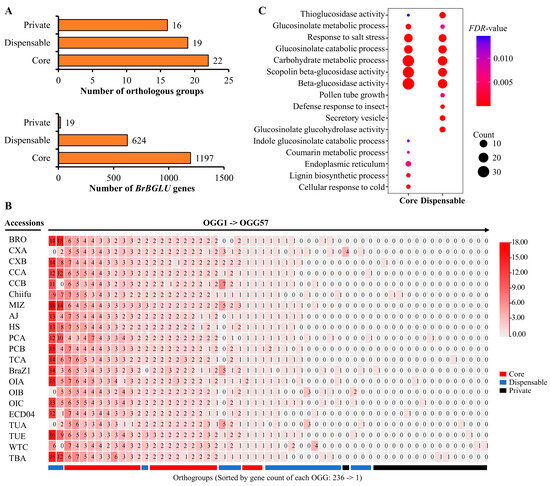
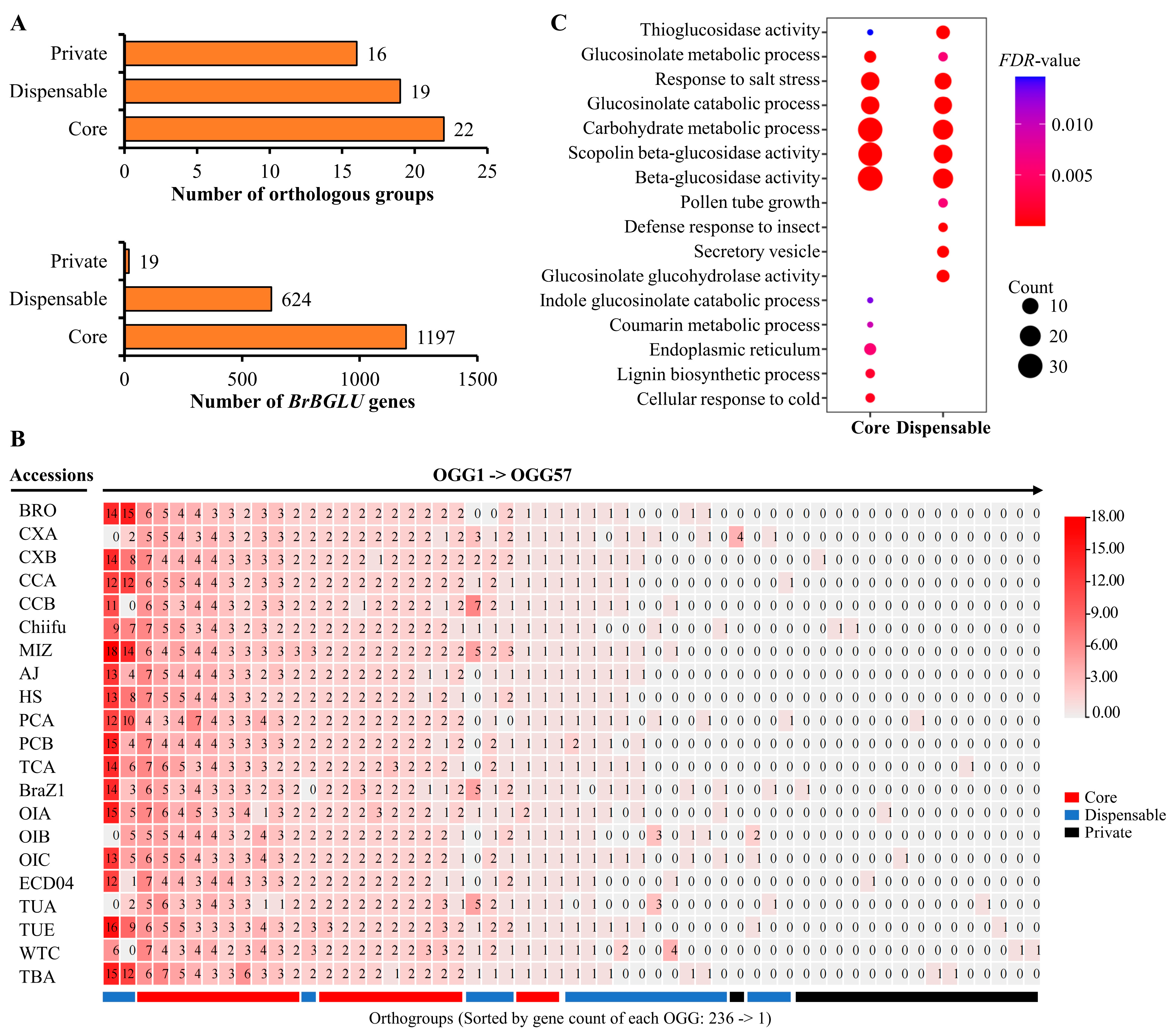
A total of 57 orthologous gene groups (OGGs) were identified and classified into three categories based on their distribution frequency across the 21 genomes: core OGGs (present in all genomes, n = 22), dispensable OGGs (present in 2 to 20 genomes, n = 19), and private OGGs (unique to a single genome, n = 16) (Figure 1A; Table S2). Among these categories, core OGGs contained the largest number of genes, with 1197 genes in total, accounting for 65.05% of the entire gene family, whereas private OGGs contained the fewest, with only 19 genes (Figure 1A). Based on gene content, the 57 B. rapa BGLU OGGs were designated OGG1 through OGG57 (Figure 1B; Table S2). Examination of the presence–absence patterns of BrBGLUs across accessions revealed that gene copy number within each OGG did not strictly correlate with its pan-genome category. For instance, OGG1 and OGG2, which harbored the highest gene counts, were both classified as dispensable rather than core OGGs (Figure 1B).
Figure 1.
Characterization and classification of BrBGLU genes into core, dispensable, or private categories across 21 Brassica rapa accessions. (A) Composition of orthologous gene groups (OGGs). The upper and lower bar plots represent the number of OGGs and BrBGLU genes, respectively, classified into core, dispensable, and private categories. (B) Occurrence of BrBGLU orthologous gene groups (OGGs) across B. rapa accessions. A total of 57 OGGs, numbered sequentially as OGG1 to OGG57, are shown. The heatmap illustrates the distribution of each OGG across the 21 accessions, where filled cells indicate presence and empty cells indicate absence. The numerical value within each cell denotes the gene count for that OGG in the corresponding accession. The color scale (from light to dark) reflects the gene copy number. The red lines indicated the core OGGs, the blue lines indicated the dispensable OGGs, the black lines indicated the private OGGs. (C) Gene Ontology (GO) enrichment analysis of core, dispensable, and private BrBGLUs.
GO enrichment analysis revealed that both core and dispensable BrBGLUs were significantly enriched in terms associated with glucosinolate metabolic process, response to salt stress, glucosinolate catabolic process, carbohydrate metabolic process, scopolin beta-glucosidase activity, and beta-glucosidase activity (Figure 1C). Further analysis demonstrated that core BrBGLUs were additionally enriched in biological processes related to indole glucosinolate catabolic process, coumarin metabolic process, lignin biosynthetic process, and cellular response to cold (Figure 1C). In contrast, dispensable BrBGLUs were specifically enriched in pollen tube growth and defense response to insect (Figure 1C). These findings suggest that core and dispensable BrBGLUs share conserved functions in primary and secondary metabolic processes, whereas their roles in abiotic stress responses and developmental processes are distinct.
2.2. Phylogenetic Classification of the BrBGLUs in B. rapa
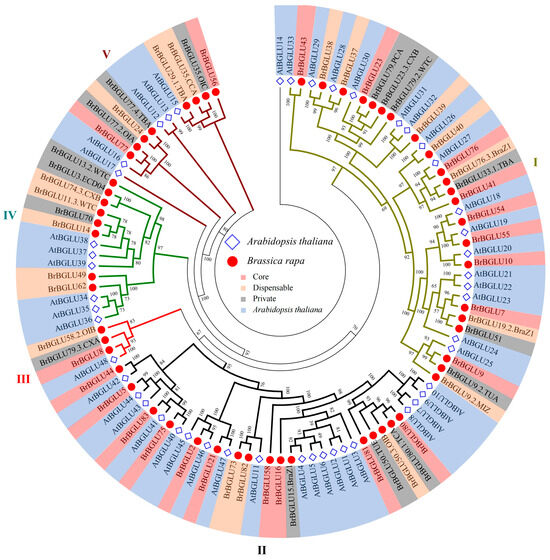
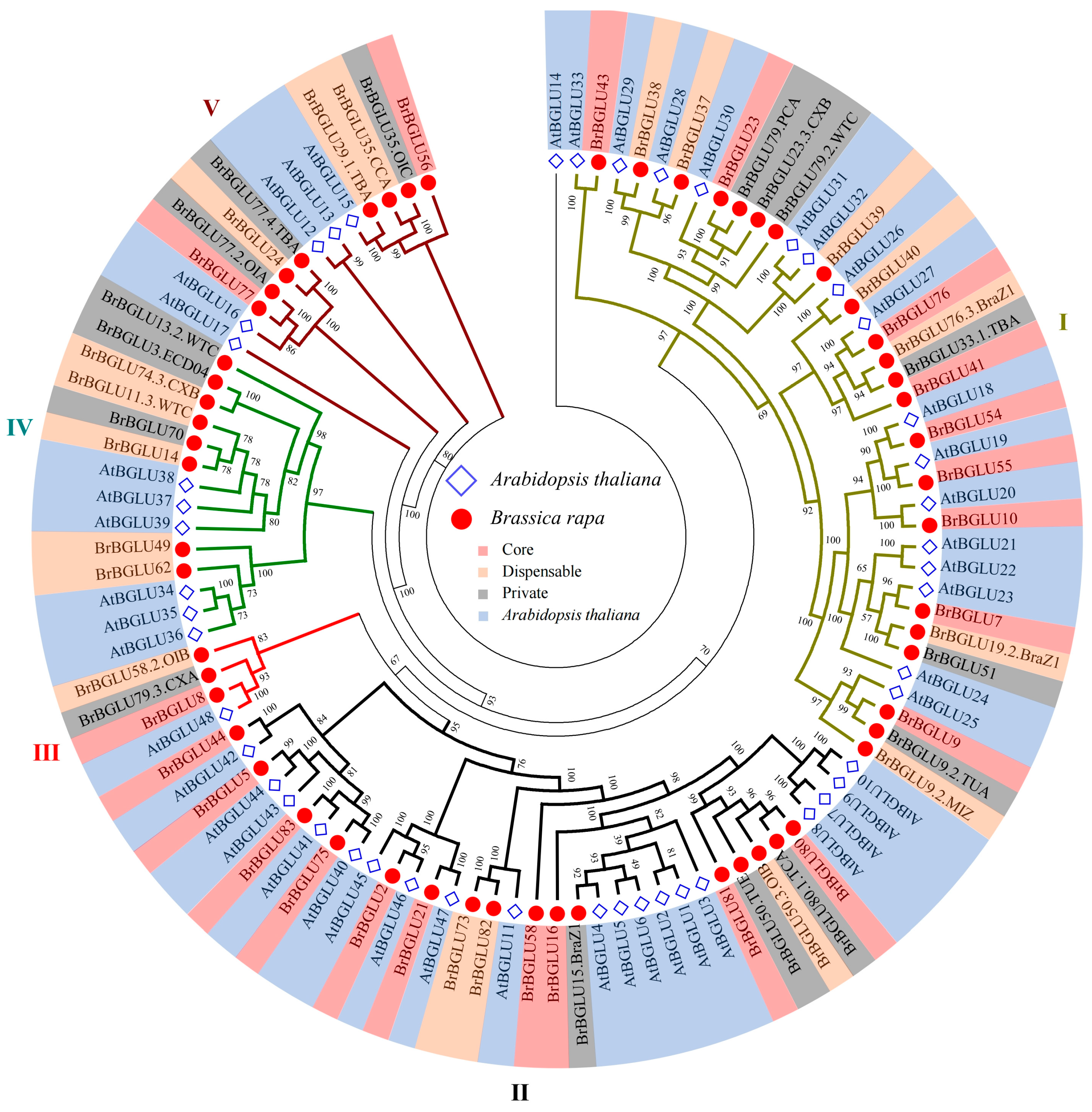
To investigate the evolutionary status of BrBGLUs in B. rapa, with particular emphasis on dispensable BrBGLUs and those absent from the reference genome Chiifu (v4.0), a phylogenetic analysis was conducted on the 57 BrBGLU OGGs. For each OGG containing a BGLU in Chiifu, the Chiifu sequence was used as the representative. For the 23 OGGs absent in Chiifu, the longest BrBGLU sequence from each respective OGG across the remaining 20 B. rapa genomes was selected. Arabidopsis BGLUs (AtBGLUs) were employed as references for subfamily classification. The 57 B. rapa pangenes were classified into five subgroups (Figure 2). Previously, AtBGLUs and BrBGLUs were classified into ten subgroups [28]. In the current study, subgroups GH1-f, GH1-g, GH1-h, and GH1-I were consolidated into subgroup I, while subgroups GH1-a, GH1-b, and GH1-c were merged into subgroup II. Subgroups GH1-j, GH1-e, and GH1-d corresponded to subgroups III, V, and IV, respectively (Figure 2). In addition, the AtBGLU14 which belong to the subgroup GH1-e were not classified into any subgroup in current study.
Figure 2.
Phylogenetic classification of B. rapa and Arabidopsis BGLUs. A maximum-likelihood phylogenetic tree was constructed based on full-length amino acid sequences of BGLU proteins. Representative sequences from 57 B. rapa orthologous gene groups (OGGs) were included, with Arabidopsis BGLUs (highlighted in blue) serving as reference for subfamily classification. BrBGLU OGGs were categorized into three classes according to their presence across 21 B. rapa genomes: core (present in all accessions, red), dispensable (present in a subset of accessions, orange), and private (unique to a single accession, gray). Distinct subgroups are indicated by different branch colors and labeled accordingly. I–V in the figure indicate the classification of all BGLU proteins into five subgroups.
2.3. Analysis of Duplication and Expansion Patterns in BrBGLU Genes
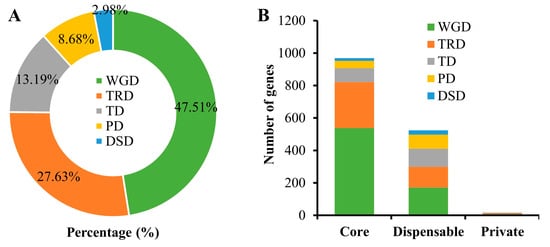
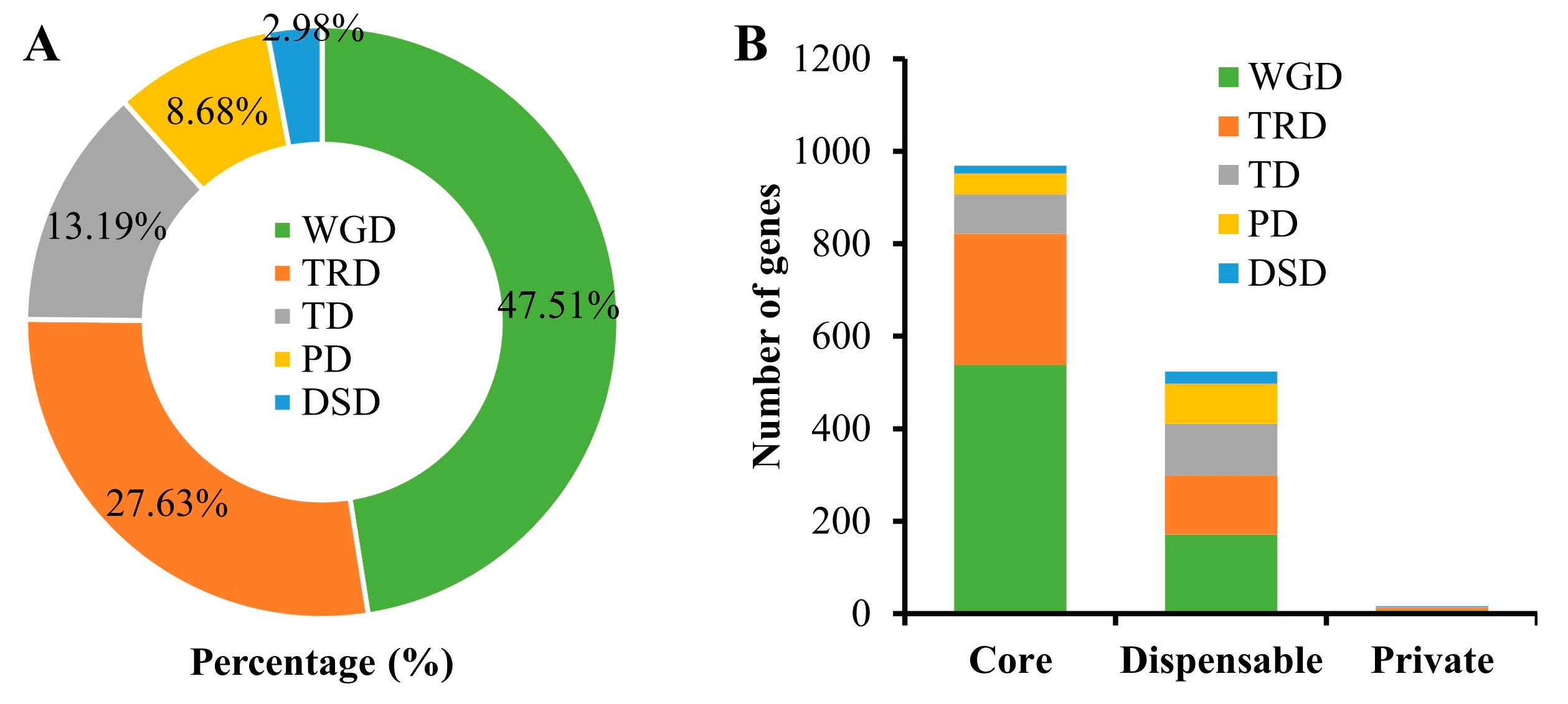
To elucidate the expansion mechanisms of BGLUs in B. rapa, the gene duplication patterns across 21 accessions were analyzed. A total of 1509 duplicated BrBGLU genes were identified and classified into five categories. Among these, whole-genome duplication (WGD) accounted for the largest proportion, with 717 genes (47.51%), followed by transposed duplication (TRD) with 417 genes (27.63%). Tandem duplication (TD), proximal duplication (PD), and dispersed duplication (DSD) comprised 199 (13.19%), 131 (8.68%), and 45 (2.98%) genes, respectively (Figure 3A; Table S3).
Figure 3.
Duplication analysis of the BrBGLU gene family in B. rapa. (A) Pie chart showing the distribution of BrBGLU gene duplication types. (B) Stacked bar chart displaying BrBGLU gene duplications grouped by category. Abbreviations: WGD, whole-genome duplication; TRD, transposed duplication; TD, tandem duplication; PD, proximal duplication; DSD, dispersed duplication.
Examination of duplication patterns across the three BrBGLU categories (core, dispensable, and private) revealed broadly similar distributions (Figure 3B). In the core gene set, WGD-derived duplications were the most prevalent, followed by TRD and TD. The dispensable category was also predominantly characterized by WGD, with TRD and TD ranking second and third, respectively. Similarly, in the private category, WGD again constituted the largest group.
2.4. Tissue Expression of BrBGLUs Reveals Their Potential Functions During Pollen Development
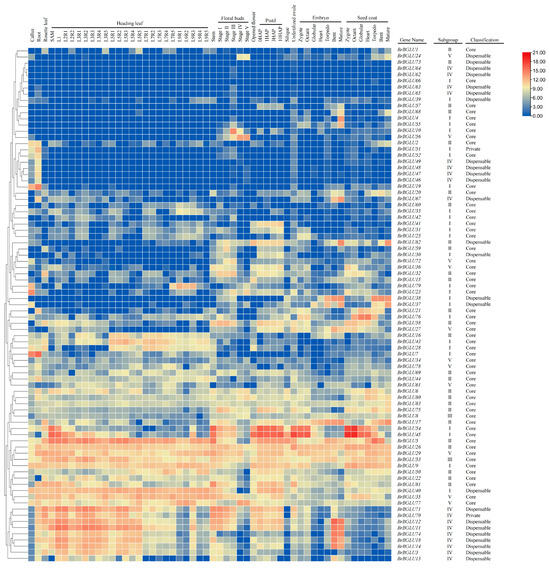
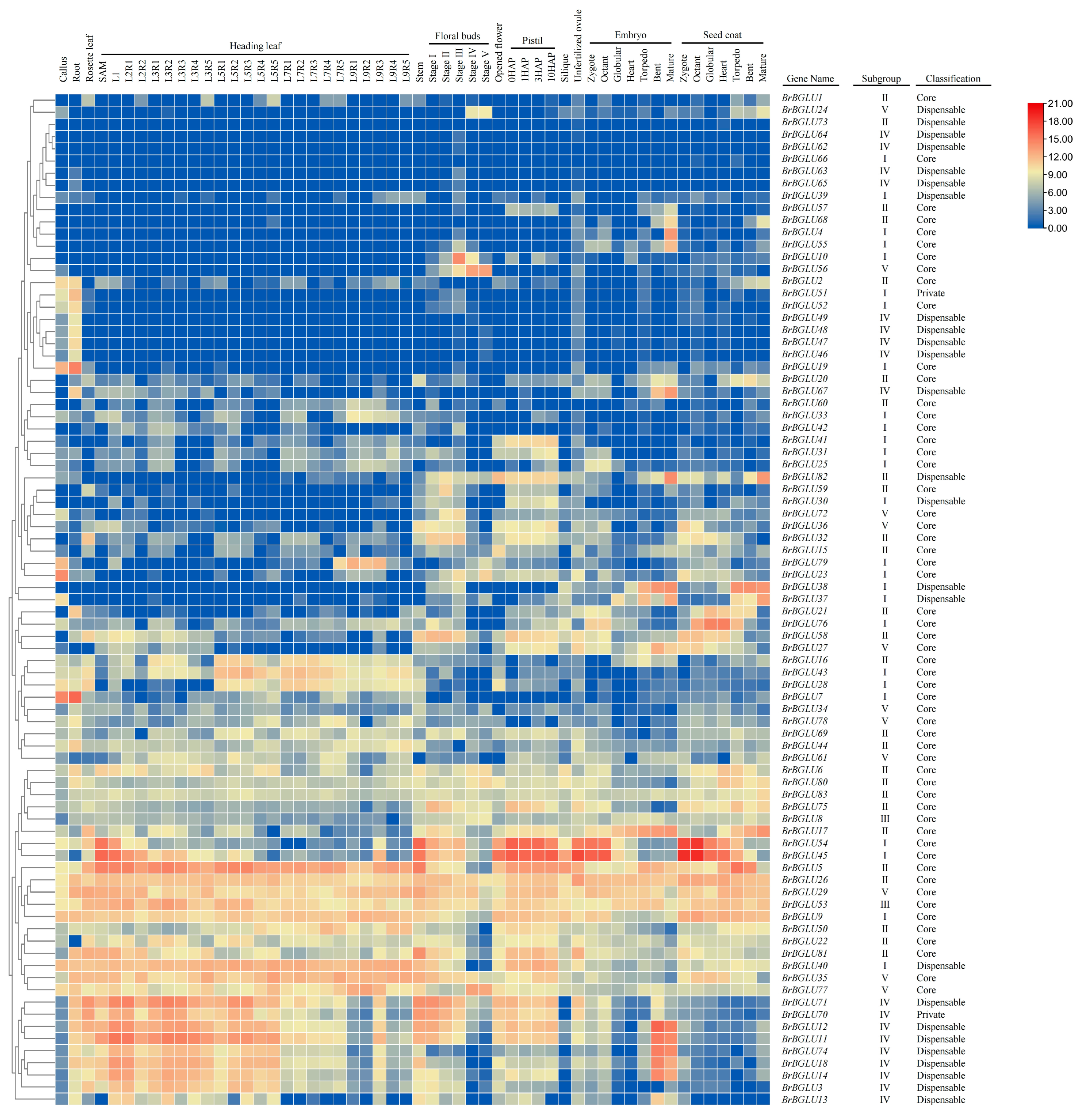
To survey the transcriptional repertoire of BrBGLU family members, RNA-seq data were obtained from 54 samples spanning 12 tissue categories, including callus, root, stem, stem leaf, flower, silique, head leaf (n = 24), floral buds at five progressive stages, pistils (n = 4), unfertilized ovules, embryos (n = 7), and seed coats (n = 7), and were aligned to the reference genome Chiifu (v4.0) (Figure 4). Profiling of transcript abundance revealed marked tissue-preferential expression among BrBGLUs. A set of seven genes, BrBGLU52, BrBGLU51, BrBGLU49, BrBGLU48, BrBGLU47, BrBGLU46, and BrBGLU19, exhibited preferential accumulation in callus and root tissues, whereas BrBGLU4, BrBGLU55, BrBGLU57, and BrBGLU68 were predominantly enriched in mature embryos. Additionally, two core genes, BrBGLU10 (stages II–IV) and BrBGLU56 (stages II–V), displayed stage-specific expression fluctuations during floral bud development, hinting at their involvement in reproductive processes (Figure 4). To further investigate the functional relevance of BrBGLU10 and BrBGLU56, RNA-seq datasets from five independent genic male-sterile lines were re-analyzed. Among the 83 BrBGLU genes, 43 showed differential expression between fertile and sterile floral buds in at least one male-sterile line. Specifically, 17, 18, 8, 15, and 35 BrBGLU genes were differentially expressed in the ms77B, FT, AB, AB01, and Bcajh97-01A/B lines, respectively (Table S4; Figure S1). BrBGLU10 was consistently up-regulated in fertile floral buds across all five lines, whereas BrBGLU56 showed up-regulation in fertile buds of the ms77B, FT, AB01, and Bcajh97-01A/B lines, but not in AB. In addition to these two target genes, several BrBGLU genes, including BrBGLU6, BrBGLU23, BrBGLU24, BrBGLU37, BrBGLU80, and BrBGLU83, exhibited differential expression across multiple male-sterile lines (Figure S1).
Figure 4.
Expression of BrBGLUs in different tissues and organs of Brassica rapa. Expression data were subjected to log2(TPM + 1) normalization. Comparisons of stem leaf, stem, and root tissues were conducted by comparison against seven-week-old Chiifu (B. rapa cv. Chiifu) plants. Flower tissue was also generated from blooming plants without floral shoots, while silique tissues were obtained 15 days after pollination. Further, 24 samples from the heading leaves of eleven-week-old plants were collected. All leaves from the heading leaf samples were divided into eleven whorls extending from the inside to the outside. Leaves with length < 2 cm and shoot apical meristem (SAM) are identified as SAMs. Leaves from whorls one, two, three, five, seven, and nine were identified as L1, L2, L3, L5, L7, and L9, respectively. L2 samples were divided into leaf petiole (L2R2) and leaf blade (L2R1) samples, while L3, L5, L7, and L9 were divided into regions including the top region (R1), outer margin region (R2), middle region of the blade (R3), top region of the petiole (R4), and middle region of the petiole (R5). Stage I to V indicate the floral buds representing the pollen mother cells, tetrad, uninucleate pollen, binucleate pollen, and mature pollen stages, respectively. 1 HAP, 3 HAP, and 10 HAP indicate pistils at 1, 3, and 10 h after pollination in the fertile line, respectively.
To explore potential co-expression relationships between the two target genes and other differentially expressed BrBGLUs, Pearson correlation coefficients (PCCs) were calculated based on TPM values across the five male-sterile lines. BrBGLU80 showed high co-expression with BrBGLU10 (PCC = 0.90), while BrBGLU83 was highly co-expressed with BrBGLU56 (PCC = 0.91) (Table S4). These results suggest that functional redundancy among BrBGLU members may exist during pollen development. Therefore, given that the primary difference between fertile and sterile floral buds in these lines is the presence of pollen grains [45,46,47,48,49], and considering the floral organ-preferential expression of BrBGLU10 and BrBGLU56 and their status as core genes (Figure 4), these two genes represent ideal candidates for further functional characterization.
2.5. Verification of the Function of BrBGLU10 During Pollen Development
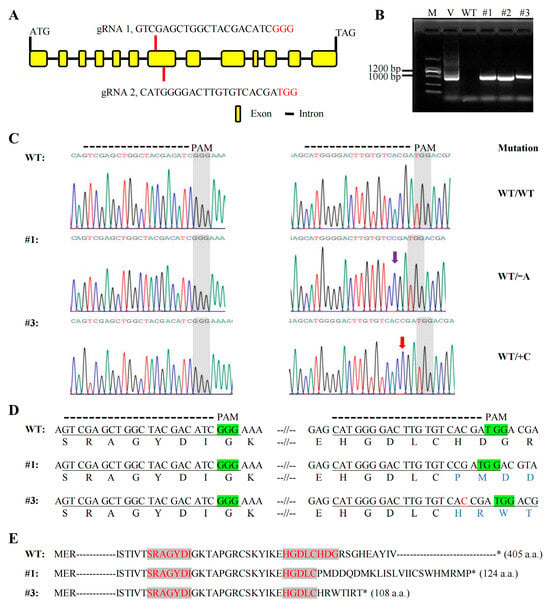
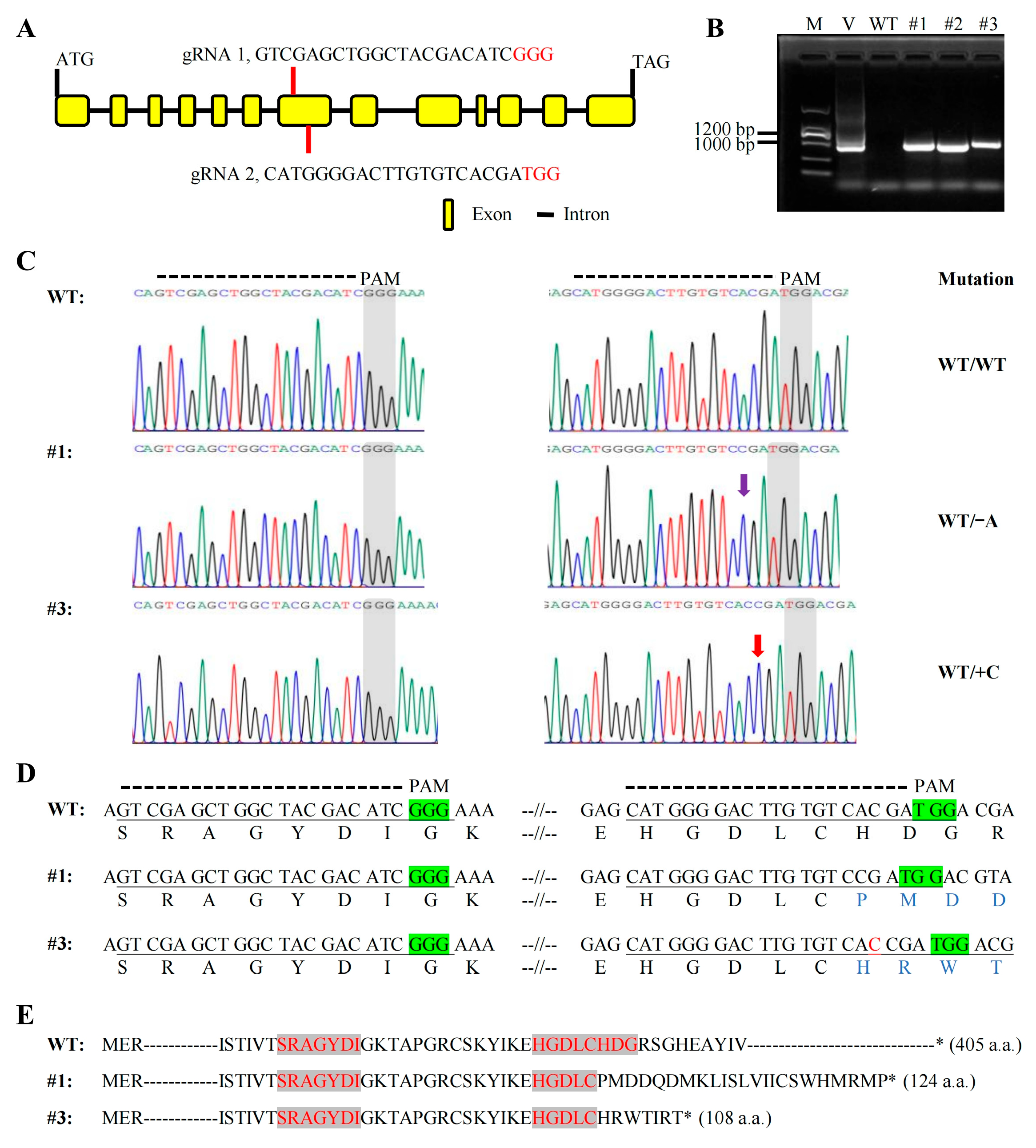
To investigate the function of BrBGLU10, CRISPR/Cas9-mediated gene editing was employed to generate knockout mutants (Figure 5A,B). Approximately 900 cotyledon explants of B. rapa GT-24 were infected with Agrobacterium tumefaciens harboring a recombinant binary vector. Following selection, four buds were obtained, corresponding to a differentiation rate of 0.44%. A total of four shoots regenerated into rooted plantlets, of which three were successfully transferred to the greenhouse and survived to maturity (designated #1 to #3). The presence of the transgene in T0 plants was confirmed by PCR using primers BrBGLU10cas9-F and BrBGLU10cas9-R, which amplify a T-DNA region containing the Cas9 expression cassette and the sgRNA sequence (Table S5; Figure 5B). All three plants were confirmed as transgenic, yielding a transformation efficiency of 0.33% relative to the initial number of explants. To verify targeted mutagenesis, the BrBGLU10 genomic locus was amplified from transgenic plants using primers BrBGLU10GT-F and BrBGLU10GT-R, and the PCR products were subjected to Sanger sequencing. Sequencing results revealed that all three T0 plants carried distinct editing events, with all sequenced clones showing identical mutations, confirming that all three mutants were homozygous. After flowering, bud pollination was performed on T0 plants to obtain T1 seeds. Five and three T1 seeds were obtained from lines #1 and #3, respectively, whereas no seeds were obtained from line #2. Sequencing of the mutated region in T1 plants confirmed that the mutations were stably inherited and identical to those observed in the corresponding T0 plants, including a single nucleotide deletion (A) in line #1 and a single nucleotide insertion (C) in line #3. These frameshift mutations resulted in premature stop codons at various positions, leading to the production of truncated proteins (Figure 5C–E).
Figure 5.
CRISPR/Cas9-mediated mutagenesis of BrBGLU10. (A) Schematic representation of the BrBGLU10 genomic architecture, indicating the positions of two designed sgRNA target sequences (gRNA1 and gRNA2) relative to the PAM motifs (red letters). (B) PCR-based genotyping of three independent T0 transgenic lines (#1–#3), with empty vector control (V) and DNA marker (M) shown for reference. (C) Sanger sequencing chromatograms of the gRNA1- and gRNA2-flanking regions from T1 plants, with red arrows denoting nucleotide insertions and purple arrows indicating deletions. (D) Multiple sequence alignment of the sgRNA-targeted region across different mutant alleles, with the PAM sequence shaded in green. (E) Translation of the mutated sequences reveals frameshift-induced premature stop codons in BrBGLU10, as shown by deduced amino acid sequences from lines carrying an A deletion and a C insertion; target-site residues are highlighted in grey with red lettering. The asterisk (*) indicates a stop codon.
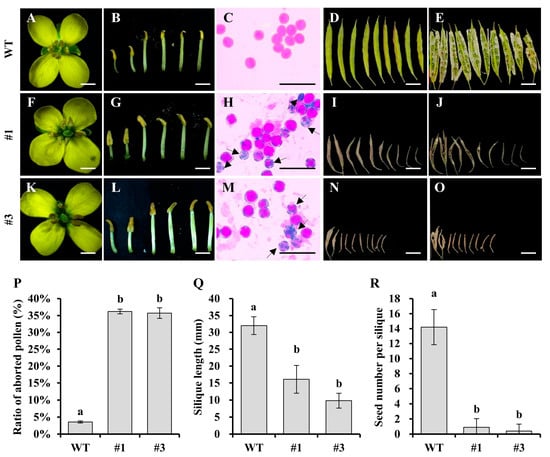
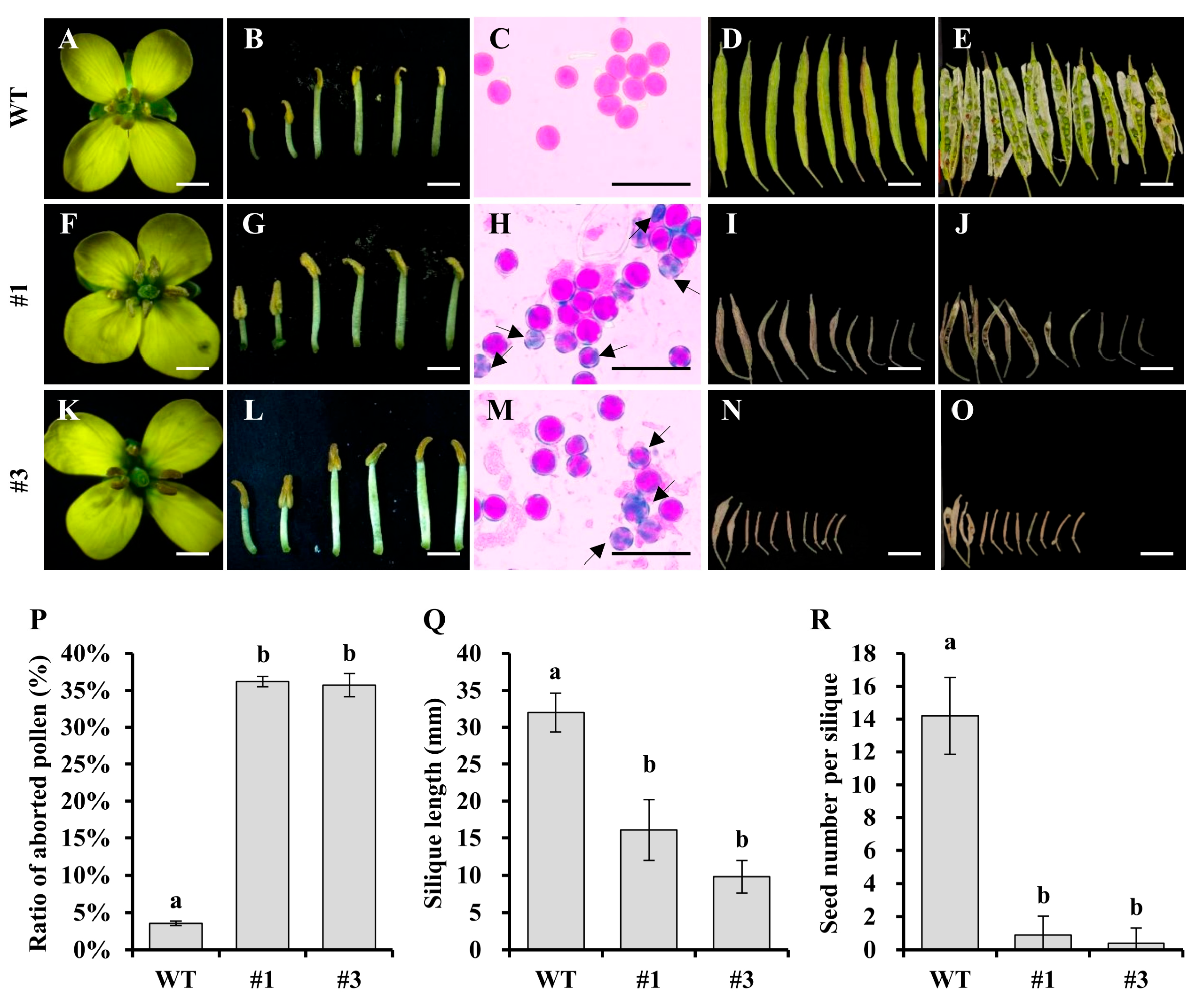
The T1 BrBGLU10 mutants exhibited normal vegetative growth but contained approximately 36% aborted pollen grains compared with wild-type plants (Figure 6). Alexander’s staining revealed that the pollen wall of the mutants showed a darker blue coloration relative to the wild type, indicating reduced pollen viability. Furthermore, self-pollination of T1 plants resulted in significantly shorter siliques than those of the wild type, and only a few seeds were obtained per silique. Taken together with the expression pattern of BrBGLU10 and the mutant phenotypes, our results indicate that BrBGLU10 is important for normal pollen development and male fertility.
Figure 6.
Phenotypic comparison of wild-type (WT) and BrBGLU10 mutant lines. (A–E) Morphological characterization of WT plants: (A) flower, (B) stamen, (C) mature pollen grains, (D) intact silique, and (E) opened silique. (F–J) Corresponding phenotypes of line #1. (K–O) Corresponding phenotypes of line #3. Black arrows indicate aborted pollen grains. (P) Percentage of aborted pollen grains. (Q) Silique length (cm) of WT, line #1, and line #3. (R) Seed number per silique in WT, line #1, and line #3. Data are presented as mean ± SD (n ≥ 3 biological replicates). Different letters above the bars indicate statistically significant differences among groups (one-way ANOVA, p ≤ 0.05). Scale bars: 2 mm (flowers and stamens (A,B,F,G,K,L) and pollen panels (C,H,M)) and 1 cm (siliques (D,E,I,J,N,O)).
3. Discussion
3.1. Diversity of BrBGLUs in the Pan-Genome of B. rapa
The pan-genome approach captures substantially more genetic diversity than a single reference genome, thereby providing a more comprehensive foundation for gene family characterization and functional investigation [50]. In the present study, we identified BrBGLU genes across 21 B. rapa accessions (Table S1 and Figure 1). While a previous study based on the Chiifu reference genome (v3.0) reported 64 BrBGLU genes [28], our pan-genomic survey expanded this number to 1840 potential BrBGLU genes across the 21 accessions (Table 1 and Table S1). Notably, 83 BrBGLU genes were identified in the updated Chiifu reference genome (v4.0) (Table 1), which likely reflects improvements in genome assembly quality and annotation completeness. Of the identified BrBGLUs, 289 (15.7%) were incomplete at the N- or C-terminus. Although these models passed multiple validation steps (HMMER, BLASTP, and CDD), their truncated nature warrants caution when interpreting gene copy-number variation and functional predictions, as fragmented assemblies can introduce substantial errors in gene annotation. Future experimental validation, including RT-PCR and full-length cDNA sequencing, will be required to confirm the expression and integrity of these incomplete models.
The copy number of BrBGLU genes exhibited substantial variation across accessions, ranging from 70 in TUA to 110 in MIZ (Table 1). Notably, only three of the 21 analyzed genomes, Chiifu (v4.0), AJ, and HS, represent telomere-to-telomere (T2T) assemblies [42,43,44]. Although T2T assemblies typically resolve gene space more completely and often yield higher gene counts than conventional approaches, the three T2T genomes in this study harbored only 82–86 BrBGLU genes. These counts were not markedly higher than those derived from many non-T2T assemblies, suggesting that assembly quality alone cannot fully account for the observed copy number variation. Instead, this disparity likely reflects a confluence of factors, including genuine biological divergence among accessions, methodological discrepancies in annotation pipelines, and lineage-specific patterns of gene gain or loss. Among the 21 accessions, we identified 1197 core genes, 624 dispensable genes, and 19 private genes (Table S1 and Figure 1). Accession CXA harbored the highest number of private genes (four), followed by Chiifu, TBA, and WTC (two each), while CXB, OIA, OIC, BraZ1, PCA, TCA, TUA, and TUE each contained one private gene (Table S1). These observations suggest that BrBGLU genes have undergone differential evolution across B. rapa accessions, potentially reflecting adaptive divergence in response to diverse environmental conditions and selection pressures.
Collectively, our pan-genomic analysis not only substantially expands the known repertoire of BrBGLU genes beyond the single-reference framework but also reveals extensive presence–absence variation within this gene family, underscoring the necessity of a pan-genome perspective for understanding the functional diversification of GH1 β-glucosidases in B. rapa.
3.2. Phylogenetic Analysis of BrBGLUs
The phylogenetic analysis revealed that BrBGLUs and AtBGLUs collectively clustered into five major subgroups (I–V) (Figure 2), suggesting a shared evolutionary origin between the two species, despite subsequent lineage-specific duplication, gene loss, and functional diversification. Notably, while a previous study classified AtBGLU and BrBGLU into ten subfamilies based on the Chiifu reference genome (v3.0) [28], the present pan-genomic analysis consolidated several of these subfamilies. Specifically, subgroups GH1-f, GH1-g, GH1-h, and GH1-i were merged into subgroup I; subgroups GH1-a, GH1-b, and GH1-c were merged into subgroup II; and subgroups GH1-j, GH1-e, and GH1-d corresponded to subgroups III, V, and IV, respectively (Figure 2). This reclassification likely reflects both the expanded gene repertoire uncovered by the pan-genomic approach and improved phylogenetic resolution.
Functional inference based on Arabidopsis orthologs provided insights into the potential roles of each BrBGLU subgroup. Subgroup I appears to be predominantly associated with stress responses and secondary metabolism. For instance, AtBGLU21–23, which hydrolyze scopoline, a root-specific metabolite involved in defense against pathogens and abiotic stresses, fall within this subgroup [20]. Similarly, AtBGLU18 and AtBGLU33, which hydrolyze glucose-conjugated abscisic acid (ABA-GE) to elevate ABA levels and enhance drought tolerance, are also members of subgroup I [12,13]. AtBGLU26 (PEN2), which mediates pre-invasion resistance to Magnaporthe oryzae [26], and AtBGLU19, which modulates salt stress tolerance [33], further support the association of this subgroup with environmental stress adaptation.
Subgroup II encompasses genes involved in flavonoid metabolism and structural development. AtBGLU1–6 contribute to flavonol accumulation, AtBGLU7–11 function as anthocyanin glucosyltransferases [15,16,19], and AtBGLU45/46 participate in coniferin metabolism in stems [31]. Subgroup III contains only AtBGLU48 (also known as SFR2), which is required for freezing tolerance [32]. Subgroup IV includes genes associated with auxin biosynthesis (AtBGLU34 and AtBGLU35) and isothiocyanate-mediated stomatal closure (AtBGLU37 and AtBGLU38) [23,30]. Subgroup V comprises genes involved in flavonol bisglycoside metabolism, such as AtBGLU11, AtBGLU15, and AtBGLU16 [18]. These functional associations provide a framework for prioritizing BrBGLU candidates for future functional studies, particularly those with potential roles in stress tolerance and secondary metabolism.
3.3. Duplication Analysis of BrBGLUs
Gene duplication serves as a primary engine driving genomic innovation, with both whole-genome duplication (WGD) and tandem duplication playing important roles in plant genome evolution [51]. Following duplication, the resulting paralogs typically undergo three possible evolutionary trajectories: pseudogenization, neofunctionalization, or subfunctionalization [52]. Analysis of the BrBGLU family revealed that whole-genome duplication (WGD) was the dominant mechanism underlying gene family expansion, contributing 717 genes (47.51%) to the total duplicated genes, followed by transposed duplication (TRD) with 417 genes (27.63%) (Figure 3). Tandem duplication (TD), proximal duplication (PD), and dispersed duplication (DSD) comprised smaller fractions, with 199 (13.19%), 131 (8.68%), and 45 (2.98%) genes, respectively. This pattern is consistent with the known evolutionary history of B. rapa, which has undergone lineage-specific whole-genome triplication (WGT) [53]. WGD events provide hundreds to thousands of retained duplicates in a single event, serving as a major source of genetic material for gene family expansion and functional diversification. The predominance of WGD-derived BrBGLU genes suggests that the ancient polyploidization event has played a substantial role in shaping the current genomic landscape of this gene family in B. rapa.
Previous studies have identified ten BrBGLU gene clusters in the Chiifu genome (v3.0), suggesting that tandem duplication also contributed to the expansion of the BrBGLU family in B. rapa [28]. In current study, the relatively lower contribution of tandem duplications to the BrBGLU family expansion (13.19%) contrasts with observations in some other plant gene families, where tandem duplication is often the predominant mode of expansion [54]. This discrepancy may reflect lineage-specific evolutionary dynamics following whole-genome triplication (WGT) in B. rapa [53]. It has been demonstrated that tandem arrays in B. rapa were dramatically fractionated after WGT, when compared either to non-tandem genes within the B. rapa genome or to tandem arrays in closely related species that have not experienced recent polyploidization. Thus, the extensive WGT event in B. rapa may have led to the preferential loss or masking of tandemly duplicated BrBGLU copies, while simultaneously providing a large reservoir of WGD-derived duplicates. Collectively, these observations indicate that the expansion of the BrBGLU family has been primarily driven by whole-genome triplication, with subsequent functional divergence of the retained duplicates likely contributing to the metabolic versatility characteristic of Brassica species.
3.4. Identification of BrBGLUs Related to Pollen Development
A growing body of evidence from Arabidopsis has linked multiple GH1 family members to male gametophyte development and pollen germination. Transcriptomic profiling revealed that AtBGLU11, 12, 14, 15, 16, 22, 36, and 40 exhibit dynamic expression changes during pollen germination [34], while AtBGLU36 displays pollen-specific expression [25]. AtBGLU20, in particular, has been implicated in pollen wall and exine formation based on its co-expression with genes involved in sporopollenin biosynthesis and tapetal development [28]. Beyond Arabidopsis, functional studies in rice and other plant species have also demonstrated the involvement of β-glucosidases in pollen development, suggesting a conserved role for this enzyme family in male reproduction across angiosperms [55,56].
In B. rapa, our transcriptomic analysis revealed that approximately half of the BrBGLU genes annotated in the Chiifu reference genome (v4.0) are expressed during floral bud development, with BrBGLU10 and BrBGLU56 exhibiting pronounced stage-specific and tissue-preferential expression patterns (Figure 4). Furthermore, re-analysis of RNA-seq data from five independent genic male-sterile lines identified 17, 18, 8, 15, and 35 differentially expressed BrBGLU genes in the ms77B, FT, AB, AB01, and Bcajh97-01A/B lines, respectively (Table S4; Figure S1). This set is substantially larger than a previous report that identified 12 BrBGLU genes with more than twofold expression changes between fertile and sterile floral buds [28], further supporting the view that the BrBGLU family represents a valuable genetic resource for engineering male sterility in B. rapa.
Among the pollen-associated BrBGLU members, BrBGLU10 emerged as a particularly compelling candidate based on its expression profile and sequence homology. Previous work in Arabidopsis established AtBGLU20 (also known as ATA27) as a critical regulator of pollen development. Knockdown of AtBGLU20 resulted in the production of defective pollen grains, and co-expression analysis further supported its role in this process [28]. AtBGLU20 was subsequently identified as a target of MS1, a key transcription factor that orchestrates the expression of sporophytic pollen coat protein genes downstream of the DYT1-TDF1-AMS-MS188-MS1 regulatory cascade [57]. MS1 directly regulates the expression of several pollen coat protein genes, including three lipase proteins (EXL4, EXL5, and EXL6) and ATA27/BGLU20 [57]. In the present study, BrBGLU10 was identified as the putative ortholog of AtBGLU20 (Figure 2). Both proteins belong to the glycoside hydrolase family 1 (GH1) and contain the conserved glycoside hydrolase family 1 domain. The similarity of their conserved domains is 83.23%, indicating that they share a similar protein structure.
CRISPR/Cas9-mediated knockout of BrBGLU10 resulted in approximately 36% aborted pollen grains. Although the remaining pollen grains appeared morphologically normal, self-crossing experiments confirmed that they were non-functional, as evidenced by drastically reduced seed set (Figure 5 and Figure 6). Alexander’s staining further revealed that the pollen wall of BrBGLU10 mutants exhibited enhanced dark blue coloration relative to wild-type controls (Figure 6), a phenotype consistent with the previously documented role of AtBGLU20 in pollen exine formation and its co-expression with genes governing pollen coat and exine development. Given the high sequence and domain conservation, together with the similar pollen phenotypes observed in AtBGLU20 knockdown and BrBGLU10 knockout lines, we infer that both proteins have an important function in pollen wall formation. AtBGLU20 is one of the highly abundant proteins identified in the Arabidopsis pollen coat, and its expression is dependent on MS1 and MS188. By analogy, BrBGLU10 may play a similar role in pollen wall formation in B. rapa, potentially by participating in the hydrolysis of glycosylated substrates required for pollen coat development or exine deposition. However, the precise physiological substrates of BrBGLU10 remain to be experimentally determined, and the extent to which its function is fully conserved with AtBGLU20 awaits further investigation through complementary experiments such as biochemical activity assays and subcellular localization verification.
Collectively, these findings establish a potential functional link between BrBGLU10 and the conserved MS1-mediated regulatory network that governs pollen wall development and male fertility. We propose that BrBGLU10 represents an important component of the pollen developmental program in B. rapa, and its functional characterization not only extends the known roles of GH1 β-glucosidases in plant reproduction but also provides a potential genetic target for fertility-related breeding strategies in Brassica crops.
4. Material and Methods
4.1. Identification of BrBGLUs and Phylogenetic Tree Construction
To identify BrBGLUs across the 21 B. rapa accessions, all predicted protein sequences were downloaded from the BRAD database (http://brassicadb.cn/, accessed on 16 August 2025) or BnIR (https://yanglab.hzau.edu.cn/BnIR, accessed on 16 August 2025). The accessions analyzed included Broccolieto (BRO), Caixin (CXA and CXB), Chinese cabbage types (CCA, CCB, and Chiifu), Sarsons (BraZ1, OIA, OIB, and OIC), turnips (TUA, TUE, and ECD04), Pak choi (AJ, HS, PCA, PCB, and TCA), Wutacai (WTC), Japanese morphotype (mizuna), and an unknown type (TBA, originating from Tibet, China) [42,43,44]. To identify candidate BrBGLU proteins, the predicted proteome of each B. rapa accession was searched against the Hidden Markov Model (HMM) profile of the Pfam 32.0 database using HMMER (version 3.1b2) [58]. Protein sequences harboring the PF00232 domain with an E-value below 1 × 10⁻⁵ were retained as initial candidates. To further validate their identity, these candidates were used as queries in BLASTP searches against the Arabidopsis thaliana proteome, and only those whose best hit corresponded to a known AtBGLU were kept. All candidate sequences were subsequently submitted to NCBI’s Conserved Domain Database (CDD) to verify the presence of the PF00232 domain. Only sequences satisfying all filtering criteria were considered bona fide BrBGLU members and retained for downstream analyses. The completeness of the PF00232 domain was also assessed based on the CDD search results: full-length domain sequences were indicated by “—”, whereas incomplete domains at the C-terminus, N-terminus, or both termini were marked as “C”, “N”, and “NC”, respectively.
To investigate the evolutionary relationships among BrBGLU proteins, multiple sequence alignment was performed using MAFFT (v7.526). The resulting alignment was then used to construct a maximum-likelihood phylogenetic tree with IQ-TREE (version 3.1.2). Automated substitution model selection was conducted using the ModelFinder Plus (MFP) option, and branch support was assessed with 1000 ultrafast bootstrap replicates. All trees were visualized and annotated using the interactive online tool iTOL (https://itol.embl.de/, accessed on 20 April 2026).
4.2. Orthogroup Clustering, Pan-Genome Stratification, and GO Enrichment Analysis
All identified gene family members across the genome panel were subjected to orthogroup clustering using OrthoFinder v2.5.5 [59]. The resulting OGGs were subsequently stratified into pan-genome categories according to their occupancy across genomes, as summarized in the presence–absence matrix, which in turn was used to construct a heatmap using the TBtools to visualize the distribution of BGLUs across 21 B. rapa genomes [60]. OGGs were categorized as core (present in all 21 genomes), dispensable (present in 2–20 genomes), or private (unique to a single genome) based on their distribution across the accessions.
To characterize the functional distinctions between core and dispensable BrBGLU genes, GO enrichment analysis was carried out using ShinyGO (https://bioinformatics.sdstate.edu/go/, accessed on 20 April 2026), an interactive web-based tool for gene-set enrichment analysis [61]. Statistical significance was assessed using the hypergeometric test, and p-values were adjusted with the Benjamini–Hochberg method to control the false discovery rate (FDR). GO terms with an adjusted FDR-value < 0.05 were considered significantly enriched. The enrichment results were subsequently visualized and plotted using the clusterProfiler R package.
4.3. Analysis of Gene Duplication Modes
Gene duplication modes were systematically determined using the DupGen_finder pipeline [62]. The pipeline integrates BLASTP all-against-all alignment (E-value < 1 × e−10) with MCScanX-based synteny detection to identify duplicated gene pairs [63]. Based on their genomic distribution and syntenic relationships, duplicated genes were classified into five categories: whole-genome duplication (WGD), tandem duplication (TD, adjacent genes), proximal duplication (PD, separated by fewer than ten intervening genes), transposed duplication (TRD, involving ancestral and novel loci), and dispersed duplication (DSD). The outgroup species Arabidopsis was included as a reference to anchor syntenic blocks, enabling the distinction between ancestral polyploidization events and lineage-specific duplications.
4.4. RNA-Seq Data Processing and Expression Analysis
Publicly available RNA-seq datasets from B. rapa were obtained through NCBI BioProjects PRJNA529957, PRJNA185152, PRJNA641876, and PRJNA778186 [64,65,66,67]. These datasets comprised 54 samples collected from organs and tissues, including callus, stems, stem leaves, opened flowers, siliques, head leaves at different developmental stages, floral buds, pistils, embryos, and seed coats. Raw sequencing reads were trimmed using TrimGalore to remove low-quality bases and adapter sequences. The cleaned reads were then aligned to the B. rapa reference genome (Chiifu v4.0) employing HISAT2 [68]. Gene expression was quantified as TPM values. For the five genic male-sterility lines, RNA-seq data (BioProjects PRJDB9090, PRJNA310313, PRJNA376499, PRJNA473318, and PRJNA516468) were processed identically, and TPM values were derived from the same quantification pipeline [45,46,47,48,49]. Differentially expressed BrBGLU genes between fertile and sterile floral buds in the five male-sterile lines were identified using the DEGseq package in R [69]. Genes with a fold change ≥ 2 and an adjusted p-value ≤ 0.05 were considered significantly differentially expressed. The expression heatmaps were created using TBtools (version 2.056) [60]. Biological replicates varied among the male-sterile lines based on the available NCBI data. Three biological replicates were available for AB01 (PRJNA376499) and FT (PRJNA516468), whereas only one biological replicate was available for ms77B (PRJDB9090), AB (PRJNA310313), and Bcajh97-01A/B (PRJNA473318).
4.5. CRISPR/Cas9-Mediated Mutagenesis and Mutant Identification in B. rapa
Two sgRNAs targeting BrBGLU10 (gRNA1: GTCGAGCTGGCTACGACATCGGG; gRNA2: CATGGGGACTTGTGTCACGATGG) were designed using the CRISPR-GE online tool (http://crispr.hzau.edu.cn/CRISPR2/, accessed on 22 April 2021) [70]. The sgRNA sequences were introduced into the binary vector pHSbdcas9i via Golden Gate assembly. The resulting construct was then delivered into B. rapa cv. GT-24 through Agrobacterium tumefaciens-mediated transformation [71,72]. Transgenic lines were identified by selection on medium containing hygromycin.
T0 transgenic plants were first acclimatized in soil and maintained in a growth chamber for 5–6 days, after which they were subjected to vernalization at 4 °C for three weeks and then returned to normal growth conditions. For each T0 plant, genomic DNA was isolated from cauline leaves using the EasyPure Universal Plant Genomic DNA Kit (TransGen Biotech, Beijing, China). PCR assays were carried out to confirm the presence of the transgenes encoding hygromycin resistance and Cas9. Following the onset of flowering, T0 plants were self-pollinated by bud pollination to harvest T1 seeds. The genomic regions encompassing the sgRNA target sites and predicted off-target sites were PCR-amplified from T0 and T1 genomic DNA, and the PCR products were gel-purified using the EasyPure Quick Gel Extraction Kit (TransGen Biotech). Purified fragments were then ligated into a cloning vector using the Lethal-Based Fast Cloning Kit (TransGen Biotech) according to the manufacturer’s instructions. All positive clones were subjected to Sanger sequencing to determine whether mutations had been introduced at the BrBGLU10 target sites. For the sgRNA target sites, a minimum of ten independent cloned amplicons were sequenced per plant. For the potential off-target sites, six clones per sample were sequenced to assess the specificity of the editing. A complete list of the primers used in this study is provided in Table S5.
4.6. Pollen Viability and Silique Phenotyping
To assess male fertility, flowers from wild-type and T1 BrBGLU10 mutant lines were fixed in Carnoy’s solution (ethanol: chloroform: acetic acid = 6:3:1, v/v/v) for 2 h. Pollen viability was subsequently evaluated using Alexander’s staining protocol [73]. Briefly, anthers were dissected and incubated in the staining solution containing malachite green, acid fuchsin, and orange G for 12 h. For each genotype, at least three independent plants were selected as biological replicates. From each plant, a minimum of five flowers were examined, with three technical replicates per flower. For silique measurements, ten siliques were harvested from the base to the top of the inflorescence for each plant, and at least three plants were included per genotype as biological replicates.
4.7. Statistical Analysis
Statistical analyses were performed using one-way analysis of variance (ANOVA) followed by Tukey’s multiple comparisons test for pairwise group comparisons, as indicated in the figure legends. Student’s t-test was used for comparisons between two groups where applicable. All statistical analyses were conducted using R software (version 4.4.1), and differences were considered statistically significant at p ≤ 0.05.
5. Conclusions
This pan-genomic analysis of the BrBGLU gene family across 21 B. rapa accessions identified 1840 members classified into five subgroups and 57 OGGs, with whole-genome duplication as the primary driver of gene family expansion. BrBGLU10 and BrBGLU56 were found to be specifically expressed in floral buds and differentially regulated between fertile and sterile lines. CRISPR/Cas9-mediated knockout of BrBGLU10 resulted in substantial pollen abortion and severely reduced seed set, confirming its important role in pollen development and fertility. Collectively, these findings identify BrBGLU10 as an important regulator of pollen development and a potential target for fertility-related applications via gene editing in B. rapa and related Brassica crops.
Supplementary Materials
The following supporting information can be downloaded at https://www.mdpi.com/article/10.3390/plants15172579/s1, Figure S1: Heatmap of differentially expressed BrBGLUs across five genic male sterility (GMS) lines. The heatmap illustrates the transcript abundance of BrBGLUs in male sterile lines ms77B, FT, AB, AB01, and Bcajh97-01A/B. For ms77B, four progressive floral bud stages—pre-tetrad, tetrad, post-tetrad, and mature pollen—were examined for both fertile (F1–F4) and sterile (S1–S4) plants. For lines FT, AB, and AB01, fertile (“F”) and sterile (“S”) floral buds are compared. For line Bcajh97-01A/B, five pollen developmental stages are represented: before tetrad (FS1/SS1), tetrad (FS2/SS2), uninucleate (FS3/SS3), binucleate (FS4/SS4), and mature pollen (FS5/SS5), with “F” and “S” denoting fertile and sterile conditions, respectively. For RNA-seq data, three biological replicates were available for AB01 and FT, whereas only one biological replicate was available for ms77B, AB, and Bcajh97-01A/B; Table S1: Amino acid sequences of BrBGLU family members; Table S2: Orthogroup analysis of BrBGLU genes; Table S3: Detailed information on duplication types and pangenomic classification of BGLU genes in B. rapa; Table S4: Expression levels of BrBGLUs across five genic male sterility (GMS) lines. The heatmap illustrates the transcript abundance of BrBGLUs in male sterile lines ms77B, FT, AB, AB01, and Bcajh97-01A/B. For ms77B, four progressive floral bud stages—pre-tetrad, tetrad, post-tetrad, and mature pollen—were examined for both fertile (F1–F4) and sterile (S1–S4) plants. For lines FT, AB, and AB01, fertile (“F”) and sterile (“S”) floral buds are compared. For line Bcajh97-01A/B, five pollen developmental stages are represented: before tetrad (FS1/SS1), tetrad (FS2/SS2), uninucleate (FS3/SS3), binucleate (FS4/SS4), and mature pollen (FS5/SS5), with “F” and “S” denoting fertile and sterile conditions, respectively. PCC indicates Pearson correlation coefficient. Red font indicates differentially expressed genes in at least one male-sterile line. Red background indicates up-regulated genes. Cyan background indicates down-regulated genes; Table S5: List of primers used in this study.
Author Contributions
The authors have made the following declarations about their contributions: designed research scheme: X.D.; performed experiments: Y.H., S.Z., X.C. and T.H.; analyzed the data: M.J., Y.H., S.Z. and T.H.; wrote the manuscript: X.D. and T.H.; supervision, X.D.; funding acquisition, X.D. All authors have read and agreed to the published version of the manuscript.
Funding
This work was supported by Yunnan Fundamental Research Projects (202401AS070140), and Major Science and Technology Special Program of Yunnan Province (202502AE090012), National Science Foundation of China (32260761).
Data Availability Statement
The datasets generated during and/or analyzed during the current study are available from the corresponding author on reasonable request.
Acknowledgments
The authors thank Zhongyun Piao (Shenyang Agriculture University) for kindly providing the seeds of GT-24. We also acknowledge the use of DeepSeek AI (Version 3.2, https://www.deepseek.com) for initial grammar and language checking.
Conflicts of Interest
The authors declare no conflicts of interest.
Abbreviations
The following abbreviations are used in this manuscript:
| GH1 | Glycoside hydrolase family 1 |
| BGLUs | Glycoside hydrolase family |
| BrBGLUs | Brassica rapa β-glycosidase genes |
| ABA | Abscisic acid |
| GO | Gene Ontology |
| HMM | Hidden Markov Model |
| sgRNA | Single-guide RNA |
| PAM | Protospacer adjacent motif |
| TPM | Transcripts Per Million |
| OGGs | Orthologous gene groups |
References
- McAlvay, A.C.; Ragsdale, A.P.; Mabry, M.E.; Qi, X.; Bird, K.A.; Velasco, P.; An, H.; Pires, J.C.; Emshwiller, E. Brassica rapa Domestication: Untangling Wild and Feral Forms and Convergence of Crop Morphotypes. Mol. Biol. Evol. 2021, 38, 3358–3372. [Google Scholar] [CrossRef] [Scilit] [PubMed]
- Xu, Q.; Wei, X.; Zhao, Y.; Feng, J.; Wang, P.; Ding, C.; Zhang, W.; Su, H.; Chen, W.; Wei, F.; et al. Genetic Analysis and Fine Mapping of Spontaneously Mutated Male Sterility Gene in Chinese Cabbage (Brassica rapa L. ssp. pekinensis). Plants 2025, 14, 779. [Google Scholar] [CrossRef] [Scilit] [PubMed]
- Zou, J.; Dong, S.; Fang, B.; Zhao, Y.; Song, G.; Xin, Y.; Huang, S.; Feng, H. BrACOS5 mutations induced male sterility via impeding pollen exine formation in Chinese cabbage (Brassica rapa L. ssp. pekinensis). Theor. Appl. Genet. 2023, 136, 6. [Google Scholar] [CrossRef] [Scilit] [PubMed]
- Song, L.; Li, X.; Tang, L.; Yu, C.; Wang, B.; Gao, C.; Xie, Y.; Zhang, X.; Wang, J.; Lin, C.; et al. Fine mapping and cloning of the sterility gene Bra2Ms in non-heading Chinese cabbage (Brassica rapa ssp. chinensis). J. Integr. Agric. 2024, 23, 1195–1204. [Google Scholar] [CrossRef] [Scilit]
- Xiong, X.; Li, X.; Zhang, S.; Hu, Z.; Liu, T.; Qiu, Z.; Cao, J.; Huang, L.; Yan, C. Identification and fine mapping of Brmmd1 gene controlling recessive genic male sterility in Brassica rapa L. Gene 2024, 924, 148558. [Google Scholar] [CrossRef] [Scilit] [PubMed]
- Yu, H.; Xiong, X. Advances in the Research of Genic Male Sterility in Chinese Cabbage (Brassica rapa). Plant Mol. Biol. Rep. 2025, 43, 1721–1731. [Google Scholar] [CrossRef] [Scilit]
- Chandrasekar, B.; Colby, T.; Emran Khan Emon, A.; Jiang, J.; Hong, T.N.; Villamor, J.G.; Harzen, A.; Overkleeft, H.S.; van der Hoorn, R.A. Broad-range glycosidase activity profiling. Mol. Cell. Proteom. 2014, 13, 2787–2800. [Google Scholar] [CrossRef] [Scilit] [PubMed]
- Lombard, V.; Golaconda Ramulu, H.; Drula, E.; Coutinho, P.M.; Henrissat, B. The carbohydrate-active enzymes database (CAZy) in 2013. Nucleic Acids Res. 2014, 42, D490–D495. [Google Scholar] [CrossRef] [Scilit] [PubMed]
- Opassiri, R.; Pomthong, B.; Onkoksoong, T.; Akiyama, T.; Esen, A.; Ketudat Cairns, J.R. Analysis of rice glycosyl hydrolase family 1 and expression of Os4bglu12 beta-glucosidase. BMC Plant Biol. 2006, 6, 33. [Google Scholar] [CrossRef] [Scilit] [PubMed]
- Chuenchor, W.; Pengthaisong, S.; Robinson, R.C.; Yuvaniyama, J.; Oonanant, W.; Bevan, D.R.; Esen, A.; Chen, C.-J.; Opassiri, R.; Svasti, J.; et al. Structural Insights into Rice BGlu1 β-Glucosidase Oligosaccharide Hydrolysis and Transglycosylation. J. Mol. Biol. 2008, 377, 1200–1215. [Google Scholar] [CrossRef] [Scilit] [PubMed]
- Xu, Z.; Escamilla-Trevino, L.; Zeng, L.; Lalgondar, M.; Bevan, D.; Winkel, B.; Mohamed, A.; Cheng, C.L.; Shih, M.C.; Poulton, J.; et al. Functional genomic analysis of Arabidopsis thaliana glycoside hydrolase family 1. Plant Mol. Biol. 2004, 55, 343–367. [Google Scholar] [CrossRef] [Scilit] [PubMed]
- Lee, K.H.; Piao, H.L.; Kim, H.Y.; Choi, S.M.; Jiang, F.; Hartung, W.; Hwang, I.; Kwak, J.M.; Lee, I.J.; Hwang, I. Activation of glucosidase via stress-induced polymerization rapidly increases active pools of abscisic acid. Cell 2006, 126, 1109–1120. [Google Scholar] [CrossRef] [Scilit] [PubMed]
- Xu, Z.Y.; Lee, K.H.; Dong, T.; Jeong, J.C.; Jin, J.B.; Kanno, Y.; Kim, D.H.; Kim, S.Y.; Seo, M.; Bressan, R.A.; et al. A vacuolar beta-glucosidase homolog that possesses glucose-conjugated abscisic acid hydrolyzing activity plays an important role in osmotic stress responses in Arabidopsis. Plant Cell 2012, 24, 2184–2199. [Google Scholar] [CrossRef] [Scilit] [PubMed]
- Cho, H.; Choi, I.; Bouain, N.; Nawaz, A.; Zheng, L.; Shahzad, Z.; Brandizzi, F.; Rhee, S.Y.; Rouached, H. Phosphorus availability controls flowering time through subcellular reprogramming of bGLU25 and GRP7 in Arabidopsis. Dev. Cell 2026, 61, 340–355.e346. [Google Scholar] [CrossRef] [Scilit] [PubMed]
- Ishihara, H.; Tohge, T.; Viehöver, P.; Fernie, A.R.; Weisshaar, B.; Stracke, R. Natural variation in flavonol accumulation in Arabidopsis is determined by the flavonol glucosyltransferase BGLU6. J. Exp. Bot. 2015, 67, 1505–1517. [Google Scholar] [CrossRef] [Scilit] [PubMed]
- Roepke, J.; Bozzo, G.G. Arabidopsis thaliana β-glucosidase BGLU15 attacks flavonol 3-O-β-glucoside-7-O-α-rhamnosides. Phytochemistry 2015, 109, 14–24. [Google Scholar] [CrossRef] [Scilit] [PubMed]
- Frommann, J.-F.; Pucker, B.; Sielmann, L.M.; Müller, C.; Weisshaar, B.; Stracke, R.; Schweiger, R. Metabolic fingerprinting reveals roles of Arabidopsis thaliana BGLU1, BGLU3, and BGLU4 in glycosylation of various flavonoids. Phytochemistry 2025, 231, 114338. [Google Scholar] [CrossRef] [Scilit] [PubMed]
- Roepke, J.; Gordon, H.O.W.; Neil, K.J.A.; Gidda, S.; Mullen, R.T.; Freixas Coutin, J.A.; Bray-Stone, D.; Bozzo, G.G. An Apoplastic β-Glucosidase is Essential for the Degradation of Flavonol 3-O-β-Glucoside-7-O-α-Rhamnosides in Arabidopsis. Plant Cell Physiol. 2017, 58, 1030–1047. [Google Scholar] [CrossRef] [Scilit] [PubMed]
- Miyahara, T.; Sakiyama, R.; Ozeki, Y.; Sasaki, N. Acyl-glucose-dependent glucosyltransferase catalyzes the final step of anthocyanin formation in Arabidopsis. J. Plant Physiol. 2013, 170, 619–624. [Google Scholar] [CrossRef] [Scilit] [PubMed]
- Ahn, Y.O.; Shimizu, B.-I.; Sakata, K.; Gantulga, D.; Zhou, Z.; Bevan, D.R.; Esen, A. Scopolin-hydrolyzing β-glucosidases in roots of Arabidopsis. Plant Cell Physiol. 2010, 51, 132–143. [Google Scholar] [CrossRef] [Scilit] [PubMed]
- Sugiyama, R.; Li, R.; Kuwahara, A.; Nakabayashi, R.; Sotta, N.; Mori, T.; Ito, T.; Ohkama-Ohtsu, N.; Fujiwara, T.; Saito, K.; et al. Retrograde sulfur flow from glucosinolates to cysteine in Arabidopsis thaliana. Proc. Natl. Acad. Sci. USA 2021, 118, e2017890118. [Google Scholar] [CrossRef] [Scilit] [PubMed]
- Zhang, L.; Kawaguchi, R.; Enomoto, T.; Nishida, S.; Burow, M.; Maruyama-Nakashita, A. Glucosinolate Catabolism Maintains Glucosinolate Profiles and Transport in Sulfur-Starved Arabidopsis. Plant Cell Physiol. 2023, 64, 1534–1550. [Google Scholar] [CrossRef] [Scilit] [PubMed]
- Oumaima, K.; Hossain, M.S.; Ye, W.; Okuma, E.; Issak, M.; Islam, M.M.; Uraji, M.; Nakamura, Y.; Mori, I.C.; Munemasa, S.; et al. TGG1 and TGG2 mutations impair allyl isothiocyanate-mediated stomatal closure in Arabidopsis thaliana. Protoplasma 2025, 262, 1023–1027. [Google Scholar] [CrossRef] [Scilit] [PubMed]
- Zhang, J.; Pontoppidan, B.; Xue, J.; Rask, L.; Meijer, J. The third myrosinase gene TGG3 in Arabidopsis thaliana is a pseudogene specifically expressed in stamen and petal. Physiol. Plant. 2002, 115, 25–34. [Google Scholar] [CrossRef] [Scilit] [PubMed]
- Fu, L.; Han, B.; Tan, D.; Wang, M.; Ding, M.; Zhang, J. Identification and Evolution of Functional Alleles of the Previously Described Pollen Specific Myrosinase Pseudogene AtTGG6 in Arabidopsis thaliana. Int. J. Mol. Sci. 2016, 17, 262. [Google Scholar] [CrossRef] [Scilit] [PubMed]
- Sultan, E.; Pati, D.; Kumar, S.; Sahu, B.B. Arabidopsis METHYLENETETRAHYDROFOLATE REDUCTASE 2 functions independently of PENETRATION 2 during primary immunity against rice blast. J. Exp. Bot. 2025, 76, 1032–1048. [Google Scholar] [CrossRef] [Scilit] [PubMed]
- Stringlis, I.A.; Yu, K.; Feussner, K.; de Jonge, R.; Van Bentum, S.; Van Verk, M.C.; Berendsen, R.L.; Bakker, P.A.H.M.; Feussner, I.; Pieterse, C.M.J. MYB72-dependent coumarin exudation shapes root microbiome assembly to promote plant health. Proc. Natl. Acad. Sci. USA 2018, 115, E5213–E5222. [Google Scholar] [CrossRef] [Scilit] [PubMed]
- Dong, X.; Jiang, Y.; Hur, Y. Genome-Wide Analysis of Glycoside Hydrolase Family 1 β-glucosidase Genes in Brassica rapa and Their Potential Role in Pollen Development. Int. J. Mol. Sci. 2019, 20, 1663. [Google Scholar] [CrossRef] [Scilit] [PubMed]
- Lu, J.Y.; Xiong, S.X.; Yin, W.; Teng, X.D.; Lou, Y.; Zhu, J.; Zhang, C.; Gu, J.N.; Wilson, Z.A.; Yang, Z.N. MS1, a direct target of MS188, regulates the expression of key sporophytic pollen coat protein genes in Arabidopsis. J. Exp. Bot. 2020, 71, 4877–4889. [Google Scholar] [CrossRef] [Scilit] [PubMed]
- Fu, L.; Wang, M.; Han, B.; Tan, D.; Sun, X.; Zhang, J. Arabidopsis Myrosinase Genes AtTGG4 and AtTGG5 Are Root-Tip Specific and Contribute to Auxin Biosynthesis and Root-Growth Regulation. Int. J. Mol. Sci. 2016, 17, 892. [Google Scholar] [CrossRef] [Scilit] [PubMed]
- Chapelle, A.; Morreel, K.; Vanholme, R.; Le-Bris, P.; Morin, H.; Lapierre, C.; Boerjan, W.; Jouanin, L.; Demont-Caulet, N. Impact of the Absence of Stem-Specific β-Glucosidases on Lignin and Monolignols. Plant Physiol. 2012, 160, 1204–1217. [Google Scholar] [CrossRef] [Scilit] [PubMed]
- Barnes, A.C.; Elowsky, C.G.; Roston, R.L. An Arabidopsis protoplast isolation method reduces cytosolic acidification and activation of the chloroplast stress sensor SENSITIVE TO FREEZING 2. Plant Signal. Behav. 2019, 14, 1629270. [Google Scholar] [CrossRef] [Scilit] [PubMed]
- Cao, Y.-Y.; Yang, J.-F.; Liu, T.-Y.; Su, Z.-F.; Zhu, F.-Y.; Chen, M.-X.; Fan, T.; Ye, N.-H.; Feng, Z.; Wang, L.-J.; et al. A Phylogenetically Informed Comparison of GH1 Hydrolases between Arabidopsis and Rice Response to Stressors. Front. Plant Sci. 2017, 8, 350. [Google Scholar] [CrossRef] [Scilit] [PubMed]
- Wang, Y.; Zhang, W.-Z.; Song, L.-F.; Zou, J.-J.; Su, Z.; Wu, W.-H. Transcriptome Analyses Show Changes in Gene Expression to Accompany Pollen Germination and Tube Growth in Arabidopsis. Plant Physiol. 2008, 148, 1201–1211. [Google Scholar] [CrossRef] [Scilit] [PubMed]
- Yang, J.; Ma, L.; Jiang, W.; Yao, Y.; Tang, Y.; Pang, Y. Comprehensive identification and characterization of abiotic stress and hormone responsive glycosyl hydrolase family 1 genes in Medicago truncatula. Plant Physiol. Biochem. 2021, 158, 21–33. [Google Scholar] [CrossRef] [Scilit] [PubMed]
- Wang, H.; Zhang, Y.; Feng, X.; Peng, F.; Mazoor, M.A.; Zhang, Y.; Zhao, Y.; Han, W.; Lu, J.; Cao, Y.; et al. Analysis of the β-Glucosidase Family Reveals Genes Involved in the Lignification of Stone Cells in Chinese White Pear (Pyrus bretschneideri Rehd.). Front. Plant Sci. 2022, 13, 852001. [Google Scholar] [CrossRef] [Scilit] [PubMed]
- Jiang, M.; Yan, Y.; Dong, H.; Wang, X. Genome-wide identification of glycoside hydrolase family 1 members reveals GeBGL1 and GeBGL9 for degrading gastrodin in Gastrodia elata. Plant Cell Rep. 2024, 43, 214. [Google Scholar] [CrossRef] [Scilit] [PubMed]
- Wei, X.; Tang, Y.; Liu, Y.; Shen, S.; Xu, J.; Chen, L.; Li, M.; Zhao, H.; Zhang, T.; Du, H.; et al. Genome-Wide Identification of the Glycosyl Hydrolase Family 1 Genes in Brassica napus L. and Functional Characterization of BnBGLU77. Plants 2025, 14, 2686. [Google Scholar] [CrossRef] [Scilit] [PubMed]
- Bayer, P.E.; Golicz, A.A.; Scheben, A.; Batley, J.; Edwards, D. Plant pan-genomes are the new reference. Nat. Plants 2020, 6, 914–920. [Google Scholar] [CrossRef] [Scilit] [PubMed]
- Gao, L.; Gonda, I.; Sun, H.; Ma, Q.; Bao, K.; Tieman, D.M.; Burzynski-Chang, E.A.; Fish, T.L.; Stromberg, K.A.; Sacks, G.L.; et al. The tomato pan-genome uncovers new genes and a rare allele regulating fruit flavor. Nat. Genet. 2019, 51, 1044–1051. [Google Scholar] [CrossRef] [Scilit] [PubMed]
- Li, H.; Wang, S.; Chai, S.; Yang, Z.; Zhang, Q.; Xin, H.; Xu, Y.; Lin, S.; Chen, X.; Yao, Z.; et al. Graph-based pan-genome reveals structural and sequence variations related to agronomic traits and domestication in cucumber. Nat. Commun. 2022, 13, 682. [Google Scholar] [CrossRef] [Scilit] [PubMed]
- Cai, X.; Chang, L.; Zhang, T.; Chen, H.; Zhang, L.; Lin, R.; Liang, J.; Wu, J.; Freeling, M.; Wang, X. Impacts of allopolyploidization and structural variation on intraspecific diversification in Brassica rapa. Genome Biol. 2021, 22, 166. [Google Scholar] [CrossRef] [Scilit] [PubMed]
- Yang, Z.; Jiang, Y.; Gong, J.; Li, Q.; Dun, B.; Liu, D.; Yin, F.; Yuan, L.; Zhou, X.; Wang, H.; et al. R gene triplication confers European fodder turnip with improved clubroot resistance. Plant Biotechnol. J. 2022, 20, 1502–1517. [Google Scholar] [CrossRef] [Scilit] [PubMed]
- Zhou, Y.; Ye, H.; Liu, E.; Tian, J.; Song, L.; Ren, Z.; Wang, M.; Sun, Z.; Tang, L.; Ren, Z.; et al. The complexity of structural variations in Brassica rapa revealed by assembly of two complete T2T genomes. Sci. Bull. 2024, 69, 2346–2351. [Google Scholar] [CrossRef] [Scilit] [PubMed]
- Zhou, X.; Liu, Z.; Ji, R.; Feng, H. Comparative transcript profiling of fertile and sterile flower buds from multiple-allele-inherited male sterility in Chinese cabbage (Brassica campestris L. ssp. pekinensis). Mol. Genet. Genom. 2017, 292, 967–990. [Google Scholar] [CrossRef] [Scilit] [PubMed]
- Liu, C.; Liu, Z.; Li, C.; Zhang, Y.; Feng, H. Comparative transcriptome analysis of fertile and sterile buds from a genetically male sterile line of Chinese cabbage. Vitr. Cell. Dev. Biol.-Plant 2016, 52, 130–139. [Google Scholar] [CrossRef] [Scilit]
- Shen, X.; Xu, L.; Liu, Y.; Dong, H.; Zhou, D.; Zhang, Y.; Lin, S.; Cao, J.; Huang, L. Comparative transcriptome analysis and ChIP-sequencing reveals stage-specific gene expression and regulation profiles associated with pollen wall formation in Brassica rapa. BMC Genom. 2019, 20, 264. [Google Scholar] [CrossRef] [Scilit] [PubMed]
- Huang, S.; Peng, S.; Liu, Z.; Li, C.; Tan, C.; Yao, R.; Li, D.; Li, X.; Hou, L.; Feng, H. Investigation of the genes associated with a male sterility mutant (msm) in Chinese cabbage (Brassica campestris ssp. pekinensis) using RNA-Seq. Mol. Genet. Genom. 2020, 295, 233–249. [Google Scholar] [CrossRef] [Scilit] [PubMed]
- Komatsu, K.; Ozeki, M.; Tanaka, K.; Ohtake, R.; Mitsui, Y.; Wakui, K. A naturally occurring insertion in BrEMS1 confers genic male sterility in turnip (Brassica rapa ssp. rapa). Mol. Breed. 2020, 40, 65. [Google Scholar] [CrossRef] [Scilit]
- Zhou, Y.; Zhang, Z.; Bao, Z.; Li, H.; Lyu, Y.; Zan, Y.; Wu, Y.; Cheng, L.; Fang, Y.; Wu, K.; et al. Graph pangenome captures missing heritability and empowers tomato breeding. Nature 2022, 606, 527–534. [Google Scholar] [CrossRef] [Scilit] [PubMed]
- Yang, Y.; Li, Q.; Li, H.; Qi, K.; Xie, Z.; Wang, Z.; Zou, Y.; Huang, B.; Hu, J.; Qiao, X.; et al. Comprehensive identification and analysis of clusters of tandemly duplicated genes reveal their contributions to adaptive evolution of green plants. Plant J. 2025, 123, e70370. [Google Scholar] [CrossRef] [Scilit] [PubMed]
- Sandve, S.R.; Rohlfs, R.V.; Hvidsten, T.R. Subfunctionalization versus neofunctionalization after whole-genome duplication. Nat. Genet. 2018, 50, 908–909. [Google Scholar] [CrossRef] [Scilit] [PubMed]
- Ober, D. Seeing double: Gene duplication and diversification in plant secondary metabolism. Trends Plant Sci. 2005, 10, 444–449. [Google Scholar] [CrossRef] [Scilit] [PubMed]
- Fang, L.; Cheng, F.; Wu, J.; Wang, X. The Impact of Genome Triplication on Tandem Gene Evolution in Brassica rapa. Front. Plant Sci. 2012, 3, 31964. [Google Scholar] [CrossRef] [Scilit] [PubMed]
- Zhu, J.; Chen, H.; Li, H.; Gao, J.-F.; Jiang, H.; Wang, C.; Guan, Y.-F.; Yang, Z.-N. Defective in Tapetal Development and Function 1 is essential for anther development and tapetal function for microspore maturation in Arabidopsis. Plant J. 2008, 55, 266–277. [Google Scholar] [CrossRef] [Scilit] [PubMed]
- Rubinelli, P.; Hu, Y.; Ma, H. Identification, sequence analysis and expression studies of novel anther-specific genes of Arabidopsis thaliana. Plant Mol. Biol. 1998, 37, 607–619. [Google Scholar] [CrossRef] [Scilit] [PubMed]
- Qiao, Y.; Hou, B.; Qi, X. Biosynthesis and transport of pollen coat precursors in angiosperms. Nat. Plants 2023, 9, 864–876. [Google Scholar] [CrossRef] [Scilit] [PubMed]
- Mistry, J.; Chuguransky, S.; Williams, L.; Qureshi, M.; Salazar, G.A.; Sonnhammer, E.L.L.; Tosatto, S.C.E.; Paladin, L.; Raj, S.; Richardson, L.J.; et al. Pfam: The protein families database in 2021. Nucleic Acids Res. 2021, 49, D412–D419. [Google Scholar] [CrossRef] [Scilit] [PubMed]
- Emms, D.M.; Kelly, S. OrthoFinder: Phylogenetic orthology inference for comparative genomics. Genome Biol. 2019, 20, 238. [Google Scholar] [CrossRef] [Scilit] [PubMed]
- Chen, C.; Chen, H.; Zhang, Y.; Thomas, H.R.; Frank, M.H.; He, Y.; Xia, R. TBtools: An Integrative Toolkit Developed for Interactive Analyses of Big Biological Data. Mol. Plant 2020, 13, 1194–1202. [Google Scholar] [CrossRef] [Scilit] [PubMed]
- Ge, S.X.; Jung, D.; Yao, R. ShinyGO: A graphical gene-set enrichment tool for animals and plants. Bioinformatics 2020, 36, 2628–2629. [Google Scholar] [CrossRef] [Scilit] [PubMed]
- Qiao, X.; Li, Q.; Yin, H.; Qi, K.; Li, L.; Wang, R.; Zhang, S.; Paterson, A.H. Gene duplication and evolution in recurring polyploidization–diploidization cycles in plants. Genome Biol. 2019, 20, 38. [Google Scholar] [CrossRef] [Scilit] [PubMed]
- Wang, Y.; Tang, H.; Debarry, J.D.; Tan, X.; Li, J.; Wang, X.; Lee, T.H.; Jin, H.; Marler, B.; Guo, H.; et al. MCScanX: A toolkit for detection and evolutionary analysis of gene synteny and collinearity. Nucleic Acids Res. 2012, 40, e49. [Google Scholar] [CrossRef] [Scilit] [PubMed]
- Golicz, A.A.; Allu, A.D.; Li, W.; Lohani, N.; Singh, M.B.; Bhalla, P.L. A dynamic intron retention program regulates the expression of several hundred genes during pollen meiosis. Plant Reprod. 2021, 34, 225–242. [Google Scholar] [CrossRef] [Scilit] [PubMed]
- Tong, C.; Wang, X.; Yu, J.; Wu, J.; Li, W.; Huang, J.; Dong, C.; Hua, W.; Liu, S. Comprehensive analysis of RNA-seq data reveals the complexity of the transcriptome in Brassica rapa. BMC Genom. 2013, 14, 689. [Google Scholar] [CrossRef] [Scilit] [PubMed]
- Gao, P.; Quilichini, T.D.; Yang, H.; Li, Q.; Nilsen, K.T.; Qin, L.; Babic, V.; Liu, L.; Cram, D.; Pasha, A.; et al. Evolutionary divergence in embryo and seed coat development of U’s Triangle Brassica species illustrated by a spatiotemporal transcriptome atlas. New Phytol. 2022, 233, 30–51. [Google Scholar] [CrossRef] [Scilit] [PubMed]
- Guo, X.; Liang, J.; Lin, R.; Zhang, L.; Wu, J.; Wang, X. Series-Spatial Transcriptome Profiling of Leafy Head Reveals the Key Transition Leaves for Head Formation in Chinese Cabbage. Front. Plant Sci. 2021, 12, 787826. [Google Scholar] [CrossRef] [Scilit] [PubMed]
- Pertea, M.; Kim, D.; Pertea, G.M.; Leek, J.T.; Salzberg, S.L. Transcript-level expression analysis of RNA-seq experiments with HISAT, StringTie and Ballgown. Nat. Protoc. 2016, 11, 1650–1667. [Google Scholar] [CrossRef] [Scilit] [PubMed]
- Wang, L.; Feng, Z.; Wang, X.; Wang, X.; Zhang, X. DEGseq: An R package for identifying differentially expressed genes from RNA-seq data. Bioinformatics 2010, 26, 136–138. [Google Scholar] [CrossRef] [Scilit] [PubMed]
- Xie, X.; Ma, X.; Zhu, Q.; Zeng, D.; Li, G.; Liu, Y.-G. CRISPR-GE: A Convenient Software Toolkit for CRISPR-Based Genome Editing. Mol. Plant 2017, 10, 1246–1249. [Google Scholar] [CrossRef] [Scilit] [PubMed]
- Li, X.; Li, H.; Zhao, Y.; Zong, P.; Zhan, Z.; Piao, Z. Establishment of A Simple and Efficient Agrobacterium-mediated Genetic Transformation System to Chinese Cabbage (Brassica rapa L. ssp. pekinensis). Hortic. Plant J. 2021, 7, 117–128. [Google Scholar] [CrossRef] [Scilit]
- Hu, T.; Yang, J.; Lan, Y.; Huang, Y.; Zhong, S.; Dong, X. Genome-Wide Analysis of Shaggy-like Kinase (SK) Family Genes in Brassica rapa and Functional Characterization of BrSKβ-2 in Pollen Development. Horticulturae 2026, 12, 455. [Google Scholar] [CrossRef] [Scilit]
- Peterson, R.; Slovin, J.P.; Chen, C. A Simplified Method for Differential Staining of Aborted and Non-Aborted Pollen Grains. Int. J. Plant Biol. 2010, 1, e13. [Google Scholar] [CrossRef] [Scilit]

Disclaimer/Publisher’s Note: The statements, opinions and data contained in all publications are solely those of the individual author(s) and contributor(s) and not of MDPI and/or the editor(s). MDPI and/or the editor(s) disclaim responsibility for any injury to people or property resulting from any ideas, methods, instructions or products referred to in the content. |
© 2026 by the authors. Licensee MDPI, Basel, Switzerland. This article is an open access article distributed under the terms and conditions of the Creative Commons Attribution (CC BY) license.