


Abstract
Zinc/iron-regulated transporter proteins (ZIPs) are involved in the transport of zinc and iron, maintenance of ion homeostasis, and regulation of plant responses to abiotic stresses. Although previous studies have identified members of the ZIP gene family and screened for alkaline-responsive ZIP genes in wild soybean (Glycine soja), the functional implications of these genes under alkaline stress conditions remain to be fully elucidated. The present study aimed to identify the GsZIP7 gene and investigate its regulatory role in Arabidopsis and wild soybean under alkaline stress. The results showed that GsZIP7 was highly expressed in roots and young stems. GsZIP7 exhibited differential expression in response to alkaline stress, zinc deficiency, or iron deficiency in wild soybean. In addition, heterologous expression of GsZIP7 in yeast mutants increased tolerance to iron- and zinc-deficient conditions. Overexpression of GsZIP7 in Arabidopsis resulted in reduced root growth, decreased fresh weight, and a weakened antioxidant defense system. Furthermore, GsZIP7-overexpressing soybean hairy roots showed increased sensitivity to alkaline stress, whereas GsZIP7-RNAi lines exhibited enhanced tolerance. Together, these findings indicate that GsZIP7 negatively regulates alkaline tolerance in plants.
1. Introduction
As a major abiotic constraint, alkaline stress impairs plant growth and development [1]. Alkaline stress impairs plant growth through multiple mechanisms: elevated Na+, high pH, and HCO3−, which disrupt cellular metabolic balance, compromise cytosolic pH homeostasis, alter ion homeostasis, and impair oxidative stress responses [2,3]. Particularly, alkaline stress triggers Na+ influx and disrupts Na+/K+ homeostasis, while high pH precipitates soil essential cations (Ca2+, Mg2+, Fe2+, Zn2+ and Cu2+) from the soil solution [3]. This process impairs the root nutrient reuse capacity and nutrient absorption efficiency, ultimately leading to plant nutrient deficiency [4]. To counteract these effects, plants activate ion transport systems to maintain pH homeostasis and enhance antioxidant defenses to mitigate oxidative stress [5].
The ZIP family of zinc and iron transporters is essential for plant growth and development by regulating cellular Zn2+ and Fe2+ homeostasis [6]. Their expression directly controls micronutrient uptake and utilization, thereby determining plant growth performance [7]. ZIP proteins transport Zn2+, Fe2+, and other divalent cations (such as Cd2+ and Cu2+) using a proton gradient, enabling root acquisition and intracellular ion distribution [8]. Structurally, they comprise 300–500 amino acids and feature eight transmembrane domains (TMs). A hydrophilic loop between TM3 and TM4 functions as a metal-binding site [9]. Both the N- and C-termini face the cytoplasm, which is a unique topological feature of the ZIP transporter family [10].
The ZIP family mediates the active transport of Zn2+, Fe2+, and other divalent cations [11]. Zn2+ and Fe2+ can coordinate with amino acid residues including histidine, aspartic acid, and glutamic acid at the conserved metal-binding sites within ZIP transporters. The metal-bound protein undergoes a conformational transition across the lipid bilayer, thereby mediating directional ion translocation [12]. The ZIP family typically does not function independently, but operates within a metal homeostasis regulatory network. During iron uptake, the FIT/bHLH transcription factor activates AHA2 to enhance rhizosphere acidification, and reduces Fe3+ to Fe2+, which subsequently enables ZIP transporters to mediate the influx of Fe2+ into cells [13,14]. AtIRT1 was the first identified iron transporter in Arabidopsis, where it mediates root iron uptake [15]. In rice, OsZIP proteins specifically facilitate zinc loading into the xylem [16]. In Arabidopsis, expression of AtZIP1, AtZIP3, AtZIP4, AtZIP5, AtZIP9, AtZIP10, and AtZIP12 is induced under zinc deficiency and repressed under high zinc. This regulation underscores the ZIP family’s role in metal ion homeostasis. Overexpression of GmIRT1.1 in Arabidopsis could promote plant growth under Fe deficiency, and increase plant sensitivity to Mn and Cd excess [17]. GmZIP1 mediates zinc translocation across the symbiotic membrane during soybean–rhizobia symbiosis [18]. Additionally, ZIP proteins contribute to abiotic stress responses. Overexpression of OsZIP1 enhances cadmium tolerance by limiting Cd2+ uptake [19], and HvIRT1 from barley transports Zn2+, Fe2+, Cd2+, and Mn2+ with broad substrate specificity [20]. In rice, OsIRT1 enhances tolerance to saline–alkaline stress. However, the role of the ZIP family under alkaline stress remains poorly characterized, especially in wild soybean.
Cultivated soybean (Glycine max) represents a highly valuable economic crop with extensive agricultural applications [21]. However, long-term domestication imposed a genetic bottleneck on cultivated soybean [22]. Comparative genomic analyses showed that nucleotide diversity dropped by nearly half from wild soybeans to landraces [23]. Wild soybean, the progenitor of cultivated soybean, exhibits robust tolerance to multiple abiotic stresses [24]. In our previous studies, a highly adaptable alkaline-tolerant wild soybean line (G07256) was identified [25]. This line exhibits normal germination in sodic soil and maintains survival under 50 mmol/L NaHCO3 stress. By using transcriptome data, ZIP family genes were screened for differential expression under alkaline stress, identifying 17 responsive members [26]. Expression of ZIP28 is associated with enhanced alkaline stress tolerance, while ZIP7 is also significantly induced by alkaline stress. In this study, the GsZIP7 gene was identified and induced by alkaline stress, zinc deficiency, and iron deficiency. Functional analyses in yeast mutants, Arabidopsis plants and soybean hairy roots revealed that GsZIP7 enhanced zinc and iron deficiency tolerance and negatively regulated alkaline tolerance in plants. In total, the results suggested that GsZIP7 negatively regulates alkaline tolerance in plants.
2. Results
2.1. Spatial and Temporal Expression Patterns of GsZIP7 in Wild Soybean
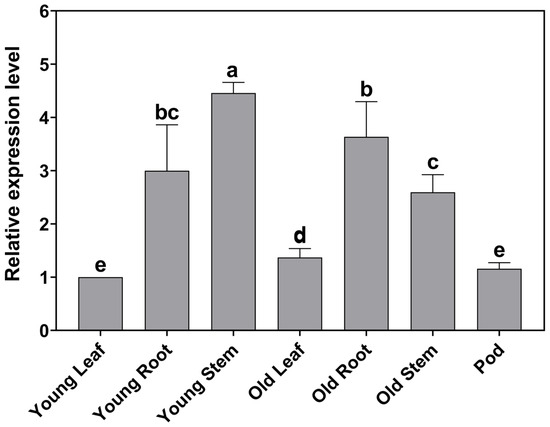
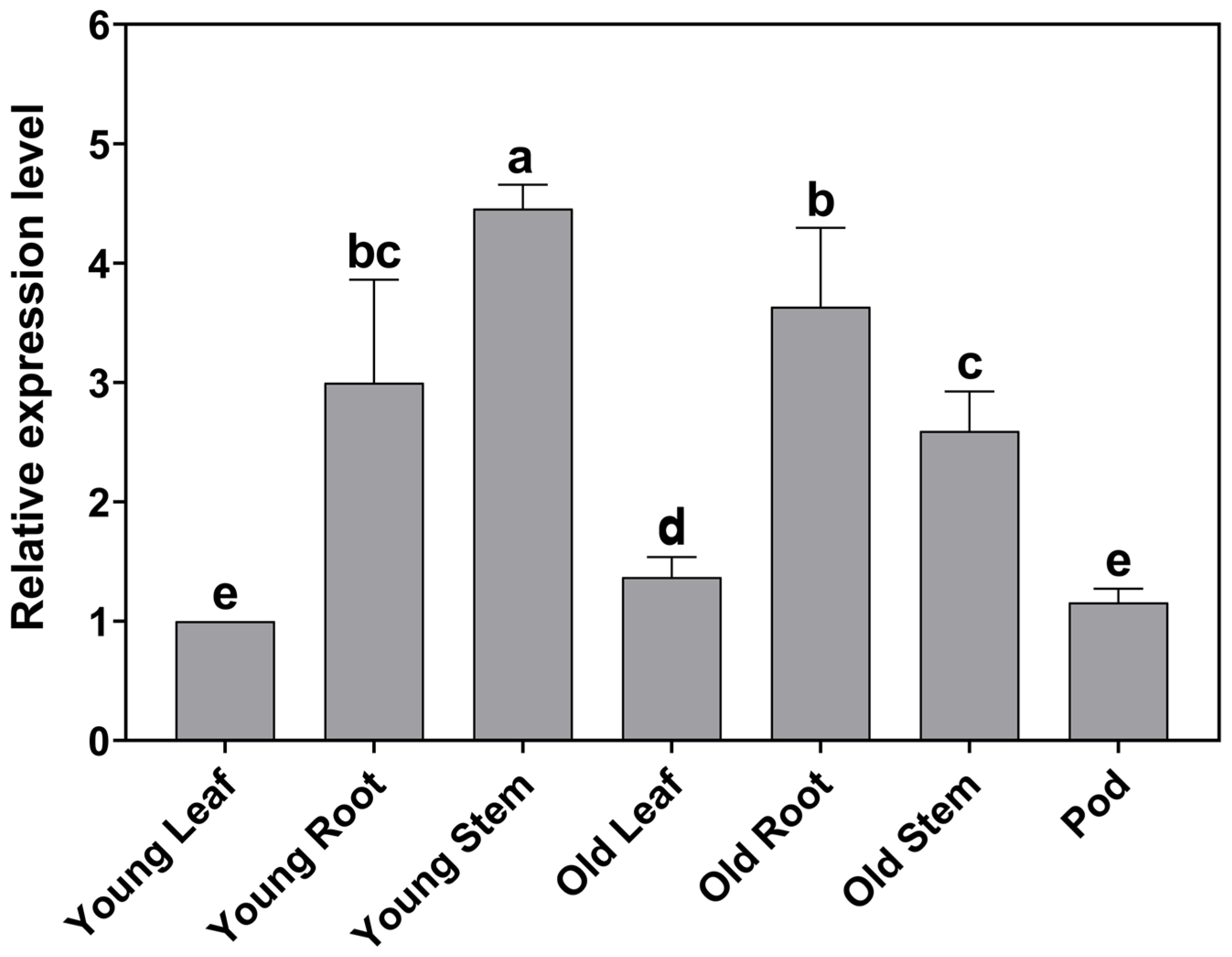
To elucidate the role of the GsZIP7 gene in plant development, its expression patterns were examined across diverse tissues of wild soybean. The results revealed that GsZIP7 expression was detectable in roots, stems, leaves, and pods, with varying levels (Figure 1). The highest expression was observed in young stems, while young roots, mature roots, and stems exhibited relatively high expression. In contrast, mature leaves and pods displayed significantly lower expression levels.
Figure 1.
Spatial expression patterns of GsZIP7 in different tissues of wild soybean. Expression analysis of GsZIP7 gene in various tissues of wild soybean, including the young leaf, young root, young stem, old leaf, old root, old stem and pod. Three independent biological replicates were set for each tissue type. The relative expression level in the leaf was normalized to 1 via the 2−∆∆Ct method, and the expression levels in other tissues were calculated as fold changes relative to this leaf calibrator. LSD multiple comparison test was used to test for significant differences between groups. Different letters (a–e) indicate significant differences with p < 0.05. All statistical calculations were completed with SPSS 21.0 software. All data visualization and graphing work was done with GraphPad Prism 8.0.1 software.
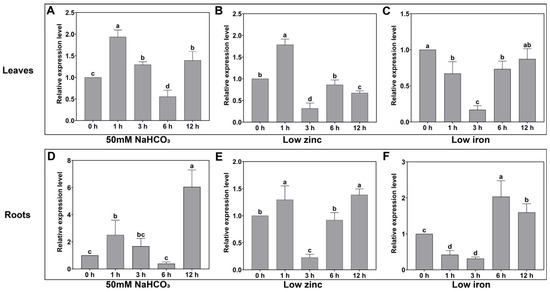
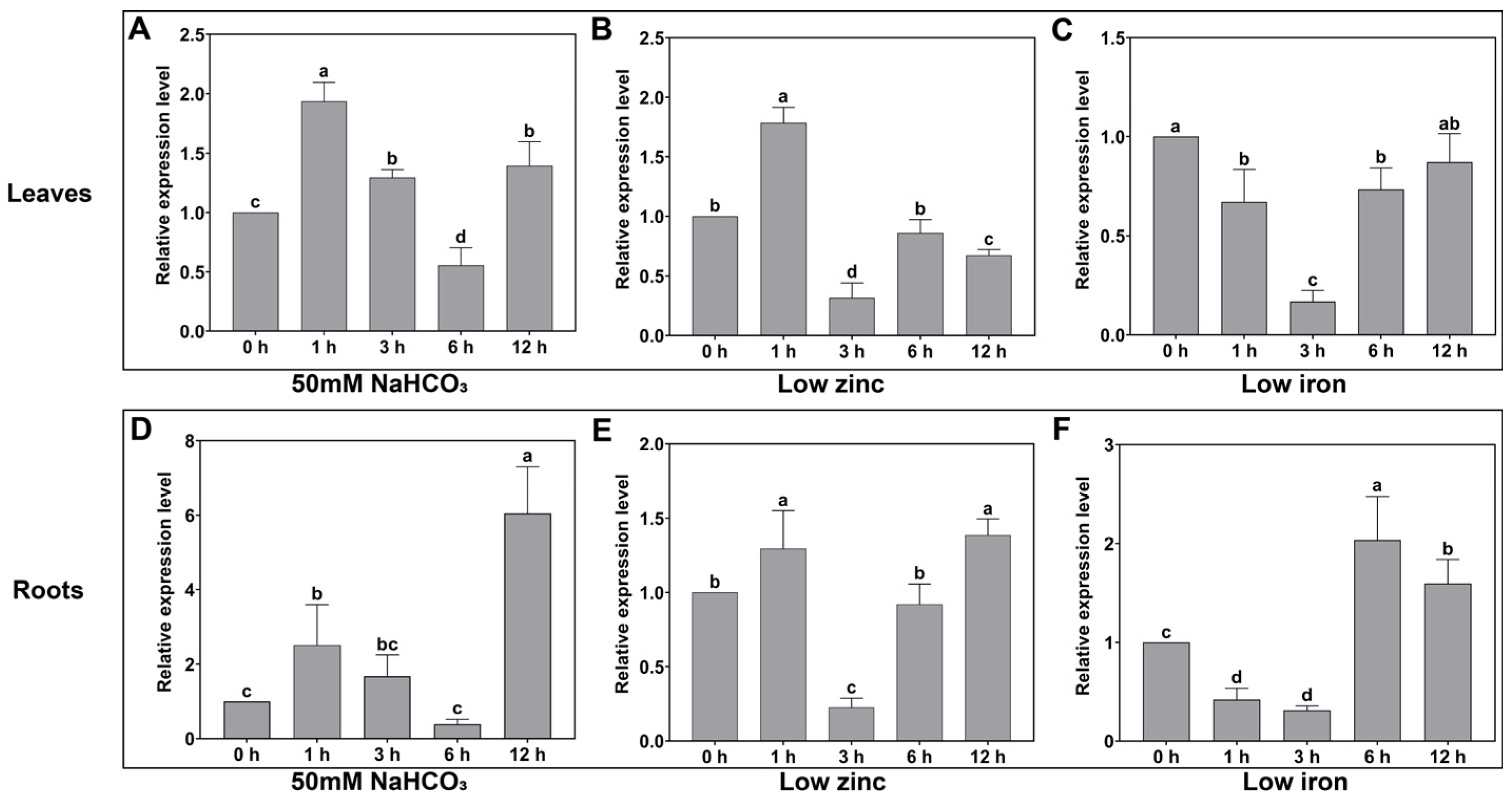
To elucidate the expression characteristics of the GsZIP7 gene in response to alkaline, low-zinc, and low-iron treatments, the expression dynamics of GsZIP7 was detected in wild soybean roots and leaves using quantitative real-time PCR (qRT-PCR). Under alkaline stress, the expression of the GsZIP7 peaked at 1 h, then declined with minor fluctuations in leaves (Figure 2A). In the roots, the expression of GsZIP7 increased slightly at 1 h, reached its lowest level at 6 h, and was significantly upregulated at 12 h (Figure 2D). Under zinc deficiency treatment, the expression of GsZIP7 rose to a maximum at 1 h and dropped to a minimum at 3 h in leaves (Figure 2B). In roots, the expression level of GsZIP7 briefly increased at 1 h, then significantly decreased at 3 h, and peaked at 12 h (Figure 2E). The expression of GsZIP7 was progressively suppressed until 3 h and reached its lowest level under iron deficiency stress in leaves (Figure 2C). In roots, the expression level of GsZIP7 decreased at 1 h and 3 h, while it was significantly upregulated at 6 h and 12 h (Figure 2F). These dynamic expression patterns reveal that GsZIP7 plays important roles in response to low iron, low zinc, and alkaline stresses.
Figure 2.
Expression levels of the GsZIP7 gene under various stress conditions in wild soybean. (A,D) Expression analysis of GsZIP7 gene under 50 mM NaHCO3 (pH 8.5) treatment. (B,E) Expression analysis of GsZIP7 gene under low-zinc treatment. For low-zinc stress, the solution gets 0.4 mmol/L EDTA. (C,F) Expression analysis of GsZIP7 gene under low-iron treatment. For low-iron stress, 0.02 mmol/L BPDS were added to create low-iron stress. Three independent biological replicates were set for each tissue type. The relative expression at the 0 h stress time point was normalized to 1 via the 2−∆∆Ct method, and the expression levels in other stress time points were calculated as fold changes relative to this calibrator. LSD multiple comparison test was used to test for significant differences between groups. Different letters (a–d) indicate significant differences with p < 0.05. All statistical calculations were completed with SPSS 21.0 software. All data visualization and graphing work was done with GraphPad Prism 8.0.1 software.
2.2. Complementation Analysis in Yeast Mutant Cells
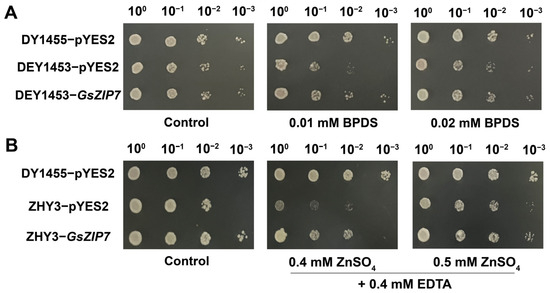
To assess the transport function of GsZIP7, we performed an exogenous functional complementation assay in yeast mutants defective in zinc and iron uptake. Yeast strains harboring pYES2-GsZIP7, empty vector controls (ZHY3-pYES2 for zinc deficiency, DEY1453-pYES2 for iron deficiency), and wild-type DY1455-pYES2 were grown on standard SD-Ura medium or stress media supplemented with low zinc or low iron. All strains displayed comparable growth under normal conditions. The control (DEY1453-pYES2) exhibited suppressed growth, while recombinant and wild-type yeasts thrived (Figure 3A), demonstrating GsZIP7-mediated restoration of iron uptake in iron-limited medium. The empty vector control (ZHY3-pYES2) showed severe growth impairment, whereas GsZIP7-expressing recombinant and wild-type strains grew robustly, confirming functional complementation of zinc deficiency in zinc-limited medium (Figure 3B). The results showed that GsZIP7 enables efficient zinc and iron ion transport in yeast, rescuing growth defects in micronutrient-deficient mutants.
Figure 3.
Complementation assay was performed using yeast mutants defective in zinc and iron uptake. (A) For iron limitation tests, SD medium was supplemented with 0.01 mM or 0.02 mM Bathophenanthroline disulfonate (BPDS). (B) For zinc limitation tests, SD medium was supplemented with 0.4 mM Ethylene diametetra acetic acid (EDTA) and 0.4 mM ZnSO4 or 0.5 mM ZnSO4. The zinc uptake mutant strain ZHY3 (zrt1zrt2), and the iron uptake mutant strain DEY1453 (fet3fet4). The empty pYES2 vector was transferred into WT strain DY1455 as a positive control. Plates were incubated at 30 °C for three days and then photographed to document growth.
2.3. GsZIP7 Decreased Alkaline Tolerance in Arabidopsis
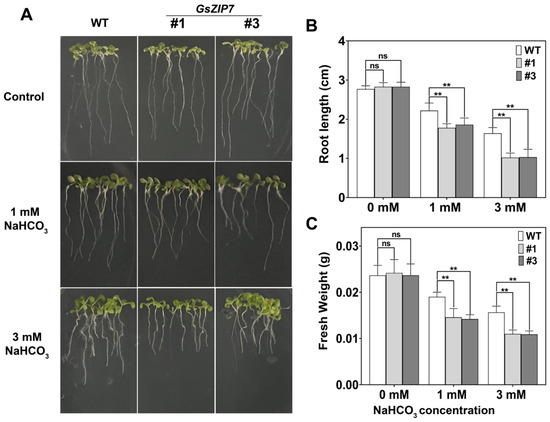
To elucidate the role of GsZIP7 in responses to alkali stress, the GsZIP7 transgenic Arabidopsis plants were obtained using the floral-dip method. Under standardized environmental conditions, the wild-type (WT) and GsZIP7 transgenic plants exhibited normal growth patterns, with no statistically significant difference in root length or fresh weight. However, a significant inhibition of growth was observed in all plants compared to the control under alkali stress. GsZIP7 transgenic plants displayed heightened sensitivity to alkali stress (Figure 4A), with root length reduced by 18% and fresh weight decreased by 24% relative to WT plants (Figure 4B,C). As the NaHCO3 concentration increased, the inhibitory effects on plant growth intensified. GsZIP7 transgenic plants exhibited a more pronounced decline in root length (37.5% reduction) and fresh weight (30% reduction), compared to WT plants. These findings imply that GsZIP7 may negatively regulate alkaline tolerance and increase stress-induced growth suppression.
Figure 4.
Overexpression of GsZIP7 decreased tolerance under NaHCO3 stress in Arabidopsis. (A) Phenotype of GsZIP7 transgenic lines (#1 and #3) and WT grown on 1/2-strength MS medium with the addition of 1 and 3 mM NaHCO3. (B) Root length and (C) fresh weight were determined under both control and alkaline stress conditions. All experimental data were processed with two-way ANOVA and Tukey’s multiple range test (p < 0.05). All statistical calculations were done with SPSS 21.0 software, and data visualization was completed with GraphPad Prism 8.0.1 software (ns indicates no significant difference, **: p < 0.01).
2.4. GsZIP7 Altered Physiological Indicators and Antioxidant Enzyme Activities in Transgenic Arabidopsis Under Alkaline Stress
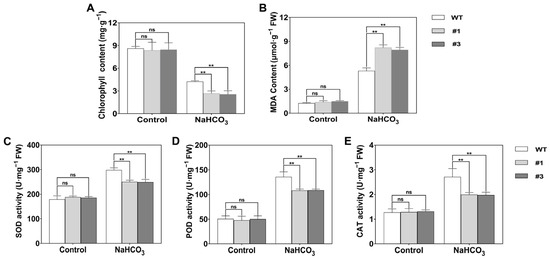
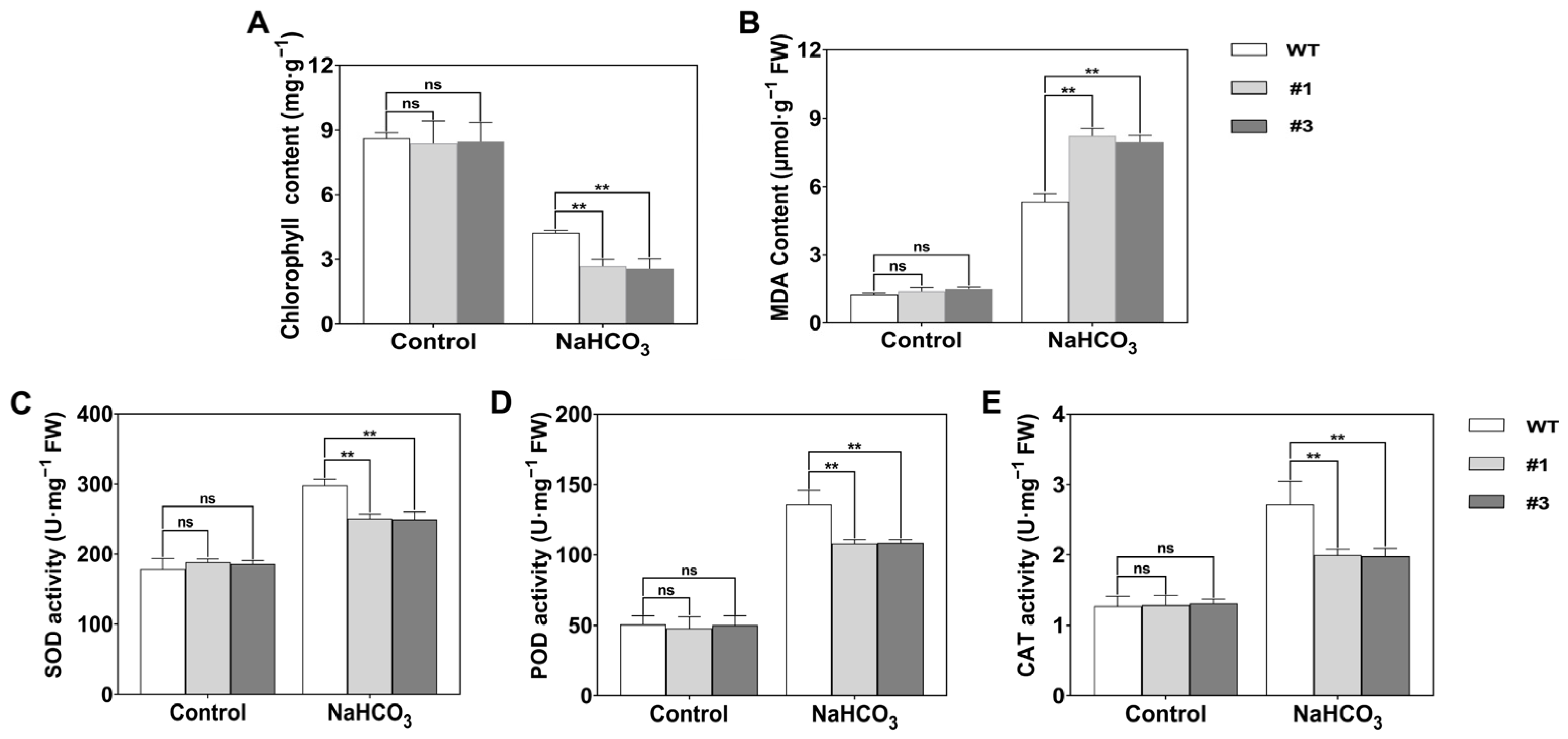
To elucidate the physiological regulatory function of the GsZIP7 gene under alkaline stress conditions, the WT and GsZIP7 transgenic Arabidopsis plants were subjected to alkaline stress treatment. The results showed that alkaline stress induced a significant decrease in chlorophyll content in both WT and transgenic plants. However, chlorophyll content in the transgenic plants was 38.5% lower than that in WT, indicating a more severe disruption of photosynthesis (Figure 5A). In contrast, the malondialdehyde (MDA) level in the GsZIP7 transgenic plants was 52% higher than that in WT, suggesting that the GsZIP7 gene may lead to enhanced oxidative damage to the cell membrane system (Figure 5B). Alkaline stress induced the upregulation of superoxide dismutase (SOD), peroxidase (POD), and catalase (CAT) activities in both WT and GsZIP7 transgenic Arabidopsis plants (Figure 5C–E). The magnitude of this increase was significantly lower in the GsZIP7 transgenic plants compared to WT. The activity of SOD increased by 66% in WT but only 33.5% in transgenic plants. These results collectively suggest that GsZIP7 negatively regulates the physiological regulation in response to alkaline conditions.
Figure 5.
Physiological indices of GsZIP7 under NaHCO3 stress treatment. (A) Chlorophyll, (B) MDA, (C) SOD, (D) POD, and (E) CAT enzyme activity analyses under 50 mM NaHCO3 stress. All experimental data were processed with two-way ANOVA and Tukey’s multiple range test (p < 0.05). All statistical calculations were done with SPSS 21.0 software, and data visualization was completed with GraphPad Prism 8.0.1 software (ns indicates no significant difference, **: p < 0.01).
2.5. GsZIP7 Decreased Alkaline Tolerance in Soybean
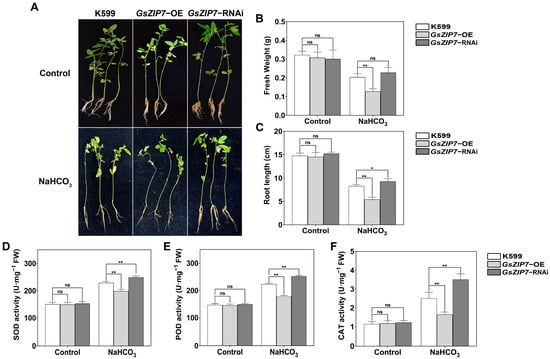
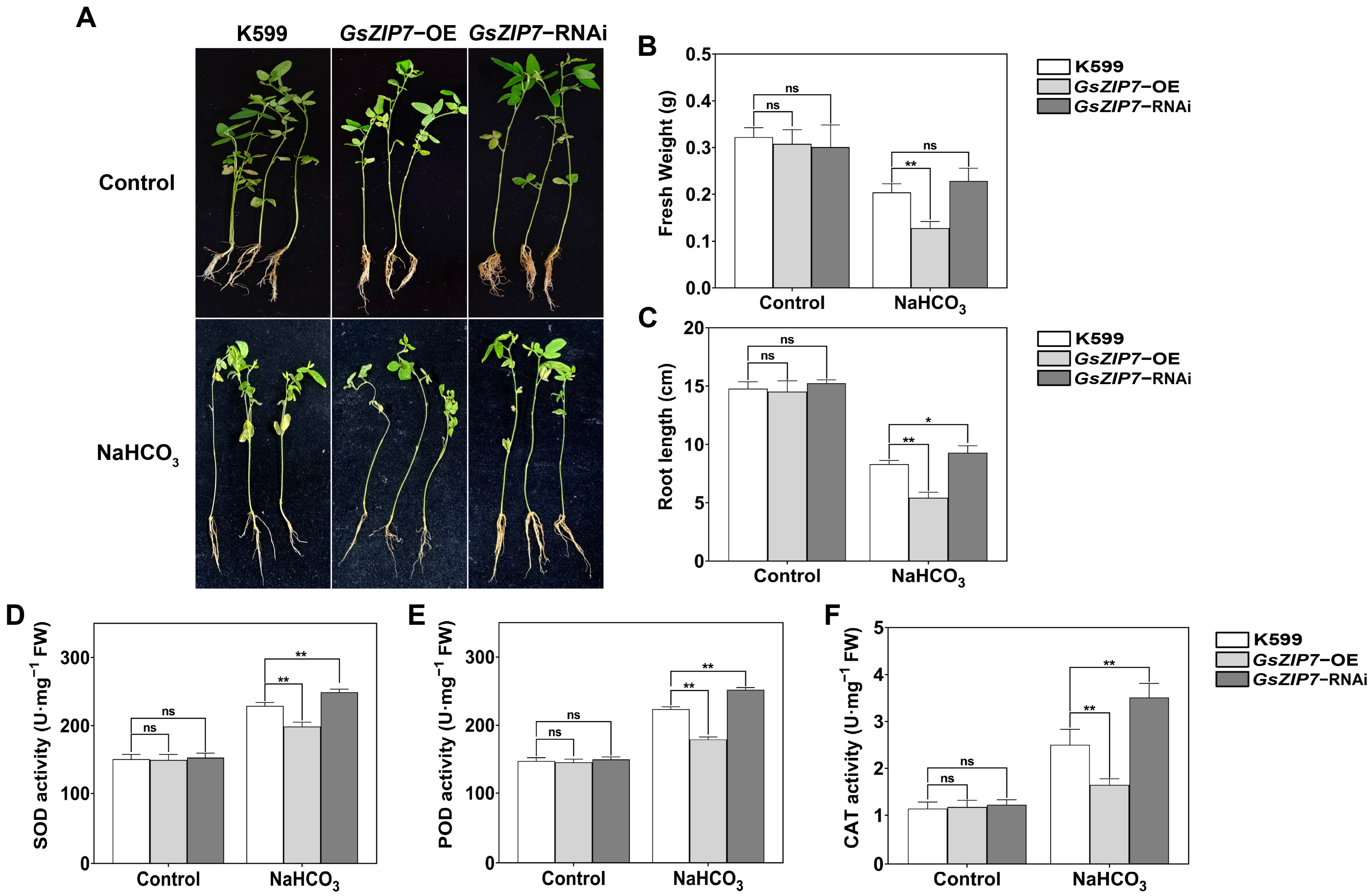
To further determine the functions of GsZIP7 in response to alkaline stress, the overexpression (OE) and RNAi transgenic soybean hairy roots of GsZIP7 were obtained. Under normal growth conditions, no significant differences were observed among the overexpression lines, RNAi lines or the K599 control. Under NaHCO3 stress, all lines exhibited a marked reduction in root length and fresh weight (Figure 6A). Notably, the GsZIP7 overexpression lines displayed a more sensitive stress response, with root length and fresh weight lower than those of the control group (Figure 6B,C). In contrast, the GsZIP7 RNAi lines demonstrated significant resistance, maintaining higher root length compared to the control group. Further, alkaline stress disrupted the normal regulation of three antioxidant enzymes (SOD, POD and CAT) in transgenic soybean hairy roots (Figure 6D–F). However, the RNAi lines showed that the enzyme activity levels were significantly higher than those in the K599 control plants. These phenotypic observations align with the growth performance of GsZIP7-overexpressing Arabidopsis under alkaline stress. This consistency indicates that GsZIP7 negatively regulates plant tolerance in response to alkaline stress.
Figure 6.
GsZIP7 decreased tolerance under NaHCO3 stress in soybean hairy roots. (A) Phenotype of GsZIP7 transgenic soybean hairy roots, RNAi lines and non-transgenic (K599 control) under 50 mM NaHCO3 treatment. (B) Fresh weight, (C) root lengths were determined under both control and alkaline stress conditions. (D) SOD, (E) POD, and (F) CAT enzyme activity analyses under 50 mM NaHCO3 stress. All experimental data were processed with two-way ANOVA and Tukey’s multiple range test (p < 0.05). All statistical calculations were done with SPSS 21.0 software, and data visualization was completed with GraphPad Prism 8.0.1 software (ns indicates no significant difference, *: p < 0.05; **: p < 0.01).
3. Discussion
The ZIP (zinc/iron-regulated transporter) family is essential for plant growth and development, as its members maintain cellular zinc and iron homeostasis to regulate trace nutrient uptake and utilization [27]. Studies have shown that ZIP family genes also participate in plant responses to abiotic stress [28]. In our previous study, the wild soybean ZIP family genes were identified and characterized under alkaline stress, revealing that the alkaline-responsive gene GsZIP28 enhances plant tolerance to alkaline stress [26]. However, the role of GsZIP7 in mediating plant alkaline stress tolerance, despite its induction under alkaline conditions, remains unelucidated. In this study, the crucial role of GsZIP7 was detected in plant alkaline stress response, zinc deficiency and iron deficiency.
The expression analysis revealed that GsZIP7 is constitutively expressed in various tissues in wild soybean (Figure 1). High expression in young stems and roots is indicative of a role in distributing essential micronutrients to growing and metabolically active tissues [29]. This widespread expression pattern is characteristic of many ZIP family transporters involved in maintaining systemic metal homeostasis [30,31]. In tea plants, several CsZIP genes exhibit distinct expression responses to multiple abiotic stresses and hormone treatments including NaCl, low temperature, and methyl jasmonate (MeJA) [32]. Meanwhile, GsZIP7 is significantly upregulated in wild soybean roots under alkaline stress (Figure 2A,D), indicating its primary role in regulating abiotic stress responses in root tissues.
ZIP family genes can transport various metal ions, including Cd2+, Fe2+, Mn2+, and Zn2+, with substrate specificity varying among family members [33]. Zinc deficiency, iron deficiency, or deficiency of other divalent metal ions can also induce the expression of ZIP genes [34]. In this study, the results showed that the expression of GsZIP7 was significantly induced in roots under zinc deficiency and iron deficiency stresses (Figure 2B,C,E,F). The dynamic expression of GsZIP7 in response to zinc and iron deficiency confirms its role as a metal-responsive transporter. ZIP3 and ZIP5 are considered the primary transporters for root Zn uptake [35]. This aligns with the functional characterization of GsZIP7 in yeast. The growth complementation observed in both zinc uptake mutants (ZHY3-pYES2) and iron uptake mutants (DEY1453-pYES2) demonstrates that the GsZIP7 protein functions as a transporter mediating Zn2+ and Fe2+ uptake (Figure 3). ZmZIP5 functionally complements the Zn and Fe uptake defects in the corresponding yeast mutant strains [36]. This dual-ion transport capability, observed in some ZIP family members, may represent a potential key node coordinating Zn2+ and Fe2+ uptake [37,38].
Under saline–alkali stress, iron tends to form insoluble oxides or hydroxides, while zinc is easily fixed by the soil, ultimately triggering iron and zinc deficiencies in plants [3,13]. ZIP family genes are involved in the homeostasis of various divalent metal ions, such as Mn2+, Ca2+ and Zn2+ [11,39,40]. Meanwhile, the ZIP family genes are also involved in the plant saline–alkali stress response. Previous studies revealed that the expression of ZIP genes is regulated in a pH-dependent manner, which modulates their metal ion transport efficiency [41]. The rice OsIRT1 was up-regulated under Fe-deficient conditions, and enhanced tolerance to saline–alkaline stress [42,43]. In this study, GsZIP7 was also induced under alkaline stress and mediated the transport of zinc and iron ions in plants. However, after alkali stress, the GsZIP7 transgenic Arabidopsis lines exhibited reduced tolerance compared to the WT, as evidenced by shorter root lengths and decreased fresh biomass (Figure 4). GsZIP7 transgenic soybean hairy root lines also exhibited more severe growth inhibition under NaHCO3 stress compared to WT and RNAi lines, while the RNAi lines showed enhanced tolerance (Figure 6). However, the current research results are inconsistent with our previous studies on ZIP family genes, which demonstrated that GsZIP28 enhances alkaline stress tolerance in soybean [26]. In wheat, TaZIP13-B, TaZIP14-B, and TaIRT2-A function as functional Zn2+/Fe2+ transporters, while salt stress suppresses their Zn/Fe transport capacity [44]. Members of the ZIP family in foxtail millet may be involved in the intra-cellular redistribution of metal ions such as Zn2+ and Fe2+ under salt stress [45]. In this study, under alkaline stress, it is hypothesized that the altered transport activity of GsZIP7 for Zn2+/Fe2+ may inadvertently distort these critical ionic signals or create ion imbalances [46].
Under salt stress, exogenous Zn or ZnO nanoparticles can alleviate salt-induced damage, mainly by reducing the accumulation of reactive oxygen species (ROS) and MDA, and enhancing the activities of antioxidant enzymes [47,48,49]. In kidney beans, ZnO nanoparticles have been demonstrated to mitigate salt stress damage by improving chlorophyll fluorescence parameters [47]. In our previous study, GsZIP28-overexpressing lines exhibited enhanced tolerance under alkaline stress, which was mainly manifested as reduced superoxide anion accumulation and strengthened antioxidant defense capacity [26]. Overall, salt or alkali stress triggers excessive ROS accumulation and reduces the bioavailability of Zn and Fe. Subsequently, ZIP/IRT family genes mediate the absorption and redistribution of metal ions such as Zn2+ and Fe2+. By maintaining Zn/Fe homeostasis, these genes preserve chlorophyll synthesis, photosynthetic efficiency, antioxidant enzyme activities and cellular redox balance, ultimately enhancing plant adaptability to salt or alkali stress. However, in this study, the results showed that transgenic plants displayed lower chlorophyll content and higher MDA levels than WT plants under alkaline stress (Figure 5A,B), indicating amplified damage to the photosynthetic and cellular membranes from lipid peroxidation [50,51]. As expected, SOD, POD and CAT showed a smaller activity increase in transgenic plants under stress, compared to WT (Figure 5C–E). The RNAi lines of GsZIP7 showed that the enzyme activity levels were significantly higher than those in control plants in hairy roots (Figure 6D–F). It is hypothesized that GsZIP7 may disrupt cellular Zn and Fe homeostasis, resulting in chlorophyll degradation, reduced antioxidant enzyme activities, and ultimately increased plant sensitivity to alkaline stress.
4. Conclusions
Taken together, the GsZIP7 gene in wild soybean encodes a functional zinc and iron transporter. While this transporter is essential for micronutrient acquisition, GsZIP7 overexpression confers sensitivity to alkaline stress by likely interfering with the activation of antioxidant enzymes. However, future investigations on the responses of GsZIP7 transgenic plants to zinc- and iron-deficiency stresses are essential. Also, it will be crucial to investigate the proteins that interact with GsZIP7, which may reveal its integration point into stress signaling networks. In addition, ZIP7 loss-of-function lines should be generated in cultivated soybean using CRISPR/Cas9, and the performance of these lines should be assessed under alkaline field conditions. This approach can provide a direct breeding strategy for improving alkaline soil tolerance.
5. Materials and Methods
5.1. Expression Analysis of GsZIP7
The wild soybean seeds G07256 were treated with concentrated sulfuric acid for 12–15 min. The treatment was done under constant shaking to break the hard seed coat. After the acid treatment, the seeds were rinsed four times with sterile distilled water and then moved onto moist filter paper for two days. The young seedlings were moved to a hydroponic culture device with Hoagland nutrient solution (KNO3 2.09 mol/L, NH4H2PO4 0.2 mol/L, Ca(NO3)2·4H2O 0.8 mol/L, MgSO4·7H2O 0.4 mol/L, EDTA-Fe 61.6 mmol/L, H3BO3 46.26 mmol/L, MnCl2·4H2O 9.1 mmol/L, ZnSO4·7H2O 0.765 mmol/L, CuSO4·5H2O 0.316 mmol/L, (NH4)6Mo7O24·4H2O 0.03 mmol/L), adjusted to pH 5.8 [52]. The nutrient solution was changed once every 72 h. All plants were grown in a controlled growth chamber. The temperature stayed between 22 °C and 28 °C. The growth environment was maintained at 60–65% relative humidity and 320 μmol photons m−2 s−1. The daily light cycle was set to 16 h of light followed by 8 h of dark. To analyze expression levels in different tissues and organs, the young leaf, root and stem were collected from 21-day-old seedlings. The old leaves, roots, stems and pods were collected from three-month-old plants.
For alkali, low-zinc, and low-iron stress treatments, the 21-day-old seedlings were placed in Hoagland nutrient solution for each treatment. Different additives were added to the Hoagland solution for each treatment. A total of 50 mM NaHCO3 (pH 8.5) was added for alkali stress. For low-zinc stress, 0.4 mmol/L EDTA was added to the nutrient solution. A total of 0.02 mmol/L BPDS was added to create low-iron stress. The root and leaf tissue samples were collected at five set time points: 0, 1, 3, 6, and 12 h. Total RNA was extracted from every tissue sample using a commercial RNA extraction kit (Omega Bio-Tek, Beijing, China). The reverse transcription kit (Thermo Fisher, Waltham, MA, USA) was used to synthesize cDNA. GsGAPDH was chosen as the reference gene for this experiment (Table S1). Three independent biological replicates were set for each tissue type. The 2−∆∆Ct method was used to calculate relative gene expression. The LSD multiple comparison test was used to test for significant differences between groups. All statistical calculations were completed with SPSS 21.0 software. All data visualization and graphing work was done with GraphPad Prism 8.0.1 software.
5.2. Analysis of Zinc and Iron Ion Transport Capacity in GsZIP7 Transgenic Yeast
The full-length coding sequence of GsZIP7 was inserted into the yeast expression vector pYES2. This experiment used three different yeast strains. The strains were the WT strain DY1455, the zinc uptake mutant strain ZHY3 (zrt1zrt2), and the iron uptake mutant strain DEY1453 (fet3fet4). The empty pYES2 vector was transformed into the WT strain DY1455 as a positive control. The empty pYES2 vector and the pYES2-GsZIP7 recombinant vector were separately transformed into the mutant strains ZHY3 and DEY1453. To test metal transport function, the yeast strains were grown on low-zinc or low-iron media. For zinc limitation tests, SD medium was supplemented with 0.4 mM EDTA and 0.4 mM ZnSO4 or 0.5 mM ZnSO4 [53]. For iron limitation tests, SD medium was supplemented with 0.01 mM or 0.02 mM BPDS [54]. Plates were incubated at 30 °C for three days and then photographed to document growth.
5.3. Phenotypic Analysis of GsZIP7 in Arabidopsis Under Alkali Stress
The gene-specific primers were used to amplify the full-length coding sequence of GsZIP7 (Table S1). The amplified GsZIP7 full-length coding sequence was inserted into the pCAMBIA230035S vector. The recombinant vector was transferred into Agrobacterium tumefaciens strain GV3101. Then the floral dip method was used to generate transgenic Arabidopsis plants (Figure S1) [55]. All Arabidopsis plants were grown in a controlled greenhouse. The growth environment followed 20–23 °C, 60–65% relative humidity, and 100 μmol photons m−2 s−1, with 16 h light/8 h dark daily photoperiod. The transgenic lines were screened on half-strength MS solid medium with 25 mg L−1 kanamycin. Two homozygous T3 transgenic lines, labeled #1 and #3, were randomly picked for downstream phenotypic analysis. For alkali stress treatment, seeds of transgenic lines and WT Arabidopsis were sown on different 1/2-strength MS media supplemented with three distinct NaHCO3 concentrations: 0, 1, and 3 mM. After two weeks of growth, the total root length and whole plant fresh weight were measured. All experiments were carried out with at least three independent biological replicates, with at least six seedlings included per replicate.
5.4. Phenotypic Analysis of GsZIP7 in Soybean Hairy Roots Under Alkali Stress
The Glycine max cultivar Dongnong 50 was used as plant material. All soybean seedlings were grown in a plant light incubator (Xinyi Company, Shanghai, China). The growth conditions followed a 16 h light/8 h dark daily photoperiod. Five-day-old young soybean seedlings were selected for inoculation. The 300 bp optimal silencing fragment targeting the GsZIP7 gene was designed using the online SGN VIGS Tool (https://vigs.solgenomics.net/) [56]. The target fragment was ligated into the empty pTRV2 vector to complete the RNAi vector construction. The Agrobacterium rhizogenes strain K599 carried the pCAMBIA230035S:GsZIP7 or pTRV2-RNAi-GsZIP7 recombinant construct. The inoculated seedlings grew new hairy roots from the infection site until the hairy roots reached 3–4 cm in length (Figure S1). Then, the whole plants were transferred to pots filled with sterile vermiculite. Plants were treated with 50 mM NaHCO3 solution to induce alkaline stress. After two weeks, the root length and total root fresh weight of the soybean hairy roots were measured. All experiments were carried out with at least 15 seedlings per experiment.
5.5. Analysis of Physiological Indicators of GsZIP7 in Arabidopsis and Soybean Hairy Roots Under Alkali Stress
For physiological index analysis, the two homozygous GsZIP7 transgenic lines (#1 and #3) and WT Arabidopsis were used as materials. All Arabidopsis plants were grown in a mixture of soil and vermiculite at a 1:1 ratio. The growth environment followed a 16 h light/8 h dark daily photoperiod. After 50 mM NaHCO3 alkaline stress treatment, the leaf samples were collected from both control and stress groups. The hairy roots were treated with 50 mM NaHCO3 for two weeks and collected from both control and stress groups. Different standard methods were used to test each physiological indicator. Chlorophyll content was measured with a spectrophotometric method [57]. MDA content was measured with the thiobarbituric acid colorimetric method [58]. POD activity was tested with the guaiacol method [59]. SOD activity was measured with the nitroblue tetrazolium method [60]. CAT activity was quantified with the ultraviolet absorption method [61]. All experimental data were processed with two-way ANOVA and Tukey’s multiple range test (p < 0.05). All statistical calculations were done with SPSS 21.0 software, and data visualization was completed with GraphPad Prism 8.0.1 software.
Supplementary Materials
The following supporting information can be downloaded at: https://www.mdpi.com/article/10.3390/plants15142152/s1, Table S1: Gene-specific primers used in this study. Figure S1. Identification of GsZIP7 transcript levels in transgenic Arabidopsis and soybean hairy roots. (A) RT-PCR analysis of GsZIP7 expression in transgenic Arabidopsis. (B) qRT-PCR analysis of GsZIP7 expression in soybean hairy roots. The relative expression level in the K599 (control) was normalized to 1 via the 2−ΔΔCt method, and the expression levels in other transgenic lines were calculated as fold changes relative to this calibrator. Significant differences were determined using Student’s t-test. Statistical analyses were performed with SPSS 21.0. Asterisks in the figure denote statistical significance between groups (**: p < 0.01).
Author Contributions
Conceptualization, C.C.; methodology, Z.W.; software, C.Z.; validation, X.J. and J.C.; formal analysis, Z.W.; investigation, Y.F.; resources, C.C. and Z.W.; data curation, C.Z. and Z.W.; writing-original draft preparation, Z.W. and C.C.; writing-review and editing, Z.W., X.J., J.C. and C.C.; visualization, Y.F.; supervision, C.C.; project administration, C.C.; funding acquisition, C.C. All authors have read and agreed to the published version of the manuscript.
Funding
This research was funded by the Natural Science Foundation of Heilongjiang Province, grant number YQ2023C034.
Data Availability Statement
The datasets generated and analyzed during the current study are available from the corresponding author on reasonable request.
Conflicts of Interest
The authors declare no conflicts of interest.
Abbreviations
The following abbreviations are used in this manuscript:
| ZIPs | Zinc/iron-regulated transporter proteins |
| TMs | Transmembrane domains |
| BPDS | Bathophenanthroline disulfonate |
| EDTA | Ethylene diametetra acetic acid |
| WT | Wild-type |
| OE | Overexpression |
| MeJA | Methyl jasmonate |
| MDA | Malondialdehyde |
| SOD | Superoxide dismutase |
| CAT | Catalase |
| POD | Peroxidase |
| ROS | Reactive oxygen species |
| qRT-PCR | Quantitative real-time PCR |
References
- Li, G.; Wan, W.; Shi, M.; Cui, H.; Yang, F.; Yang, W.; Jin, S. A NaHCO3 tolerant endophyte bacillus amyloliquefaciens ZmBA DSM7 enhances growth and mitigates NaHCO3 induced alkaline stress in maize through multiple mechanism. Plants 2025, 14, 3742. [Google Scholar] [CrossRef] [Scilit] [PubMed]
- Liu, X.; Wang, B.; Zhao, Y.; Chu, M.; Yu, H.; Gao, D.; Wang, J.; Li, Z.; Liu, S.; Li, Y.; et al. Physiological and transcriptional responses of sorghum seedlings under alkali stress. Plants 2025, 14, 3106. [Google Scholar] [CrossRef] [Scilit] [PubMed]
- Li, J.; Yang, Y. How do plants maintain pH and ion homeostasis under saline-alkali stress? Front. Plant Sci. 2023, 14, 1217193. [Google Scholar] [CrossRef] [Scilit] [PubMed]
- Xiao, C.; Cui, X.; Lu, H.; Han, L.; Liu, S.; Zheng, Y.; Wang, H.; Wang, H.; Yang, C. Comparative adaptive strategies of old and young leaves to alkali stress in hexaploid wheat. Environ. Exp. Bot. 2020, 171, 103955. [Google Scholar] [CrossRef] [Scilit]
- Lu, H.; Wang, Z.; Xu, C.; Li, L.; Yang, C. Multiomics analysis provides insights into alkali stress tolerance of sunflower (Helianthus annuus L.). Plant Physiol. Biochem. 2021, 166, 66–77. [Google Scholar] [CrossRef] [Scilit] [PubMed]
- Upadhyaya, H.D.; Bajaj, D.; Das, S.; Kumar, V.; Gowda, C.L.; Sharma, S.; Tyagi, A.K.; Parida, S.K. Genetic dissection of seed-iron and zinc concentrations in chickpea. Sci. Rep. 2016, 6, 24050. [Google Scholar] [CrossRef] [Scilit] [PubMed]
- Liao, Y.; Li, Z.; Yang, Z.; Wang, J.; Li, B.; Zu, Y. Response of Cd, Zn translocation and distribution to organic acids heterogeneity in Brassica juncea L. Plants 2023, 12, 479. [Google Scholar] [CrossRef] [Scilit] [PubMed]
- Shahzad, M.; Bibi, A.; Khan, A.; Shahzad, A.; Xu, Z.; Maruza, T.M.; Zhang, G. Utilization of antagonistic interactions between micronutrients and cadmium (Cd) to alleviate Cd toxicity and accumulation in crops. Plants 2025, 14, 707. [Google Scholar] [CrossRef] [Scilit] [PubMed]
- Song, X.; Duanmu, H.; Yu, Y.; Chen, C.; Sun, X.; Zhu, P.; Chen, R.; Duan, X.; Li, H.; Cao, L. GsJ11, identified by genome-wide analysis, facilitates alkaline tolerance in transgenic plants. Plant Cell Tissue Organ. Cult. 2017, 129, 411–430. [Google Scholar] [CrossRef] [Scilit]
- Montanini, B.; Blaudez, D.; Jeandroz, S.; Sanders, D.; Chalot, M. Phylogenetic and functional analysis of the cation diffusion facilitator (CDF) family: Improved signature and prediction of substrate specificity. BMC Genom. 2007, 8, 107. [Google Scholar] [CrossRef] [Scilit] [PubMed]
- Yang, Y.; Chen, S.; Liu, H.; Chen, H.; Lu, Z.; Qiao, G.; Xu, J.; Qiu, W.; Zhuo, R.; Han, X. Plant ZIP transporter: Functional analysis on metal uptake, transport, and homeostasis. Plant Physiol. Biochem. 2025, 229, 110336. [Google Scholar] [CrossRef] [Scilit] [PubMed]
- Zhang, Y.; Jiang, Y.; Gao, K.; Sui, D.; Yu, P.; Su, M.; Wei, G.W.; Hu, J. Structural insights into the elevator-type transport mechanism of a bacterial ZIP metal transporter. Nat. Commun. 2023, 14, 385. [Google Scholar] [CrossRef] [Scilit] [PubMed]
- Li, M.; Watanabe, S.; Gao, F.; Dubos, C. Iron nutrition in plants: Towards a new paradigm? Plants 2023, 12, 384. [Google Scholar] [CrossRef] [Scilit] [PubMed]
- Spielmann, J.; Fanara, S.; Cotelle, V.; Vert, G. Multilayered regulation of iron homeostasis in Arabidopsis. Front. Plant Sci. 2023, 14, 1250588. [Google Scholar] [CrossRef] [Scilit] [PubMed]
- Rocha, E.P.; Blanchard, A. Genomic repeats, genome plasticity and the dynamics of Mycoplasma evolution. Nucleic Acids Res. 2002, 30, 2031–2042. [Google Scholar] [CrossRef] [Scilit] [PubMed]
- Ishimaru, Y.; Suzuki, M.; Kobayashi, T.; Takahashi, M.; Nakanishi, H.; Mori, S.; Nishizawa, N.K. OsZIP4, a novel zinc-regulated zinc transporter in rice. J. Exp. Bot. 2005, 56, 3207–3214. [Google Scholar] [CrossRef] [Scilit]
- Gong, C.; Yin, X.; Cheng, L.; Huang, Y.; Shi, R.; Xie, M.; Yang, G.; Kong, L.; Zhang, W.; Chen, X. GmIRT1.1 from soybean (Glycine max L.) is involved in transporting Fe, Mn and Cd. Plant Physiol. Biochem. 2024, 215, 109010. [Google Scholar] [CrossRef] [Scilit] [PubMed]
- Moreau, S.; Thomson, R.M.; Kaiser, B.N.; Trevaskis, B.; Guerinot, M.L.; Udvardi, M.K.; Puppo, A.; Day, D.A. GmZIP1 encodes a symbiosis-specific zinc transporter in soybean. J. Biol. Chem. 2002, 277, 4738–4746. [Google Scholar] [CrossRef] [Scilit] [PubMed]
- Liu, X.S.; Feng, S.J.; Zhang, B.Q.; Wang, M.Q.; Cao, H.W.; Rono, J.K.; Chen, X.; Yang, Z.M. OsZIP1 functions as a metal efflux transporter limiting excess zinc, copper and cadmium accumulation in rice. BMC Plant Biol. 2019, 19, 283. [Google Scholar] [CrossRef] [Scilit] [PubMed]
- Pedas, P.; Ytting, C.K.; Fuglsang, A.T.; Jahn, T.P.; Schjoerring, J.K.; Husted, S. Manganese efficiency in barley: Identification and characterization of the metal ion transporter HvIRT1. Plant Physiol. 2008, 148, 455–466. [Google Scholar] [CrossRef] [Scilit] [PubMed]
- Gai, Y.; Liu, S.; Zhang, Z.; Wei, J.; Wang, H.; Liu, L.; Bai, Q.; Qin, Q.; Zhao, C.; Zhang, S.; et al. Integrative approaches to soybean resilience, productivity, and utility: A review of genomics, computational modeling, and economic viability. Plants 2025, 14, 671. [Google Scholar] [CrossRef] [Scilit] [PubMed]
- Wang, X.; Chen, L.; Ma, J. Genomic introgression through interspecific hybridization counteracts genetic bottleneck during soybean domestication. Genome Biol. 2019, 20, 22. [Google Scholar] [CrossRef] [Scilit] [PubMed]
- Kofsky, J.; Zhang, H.; Song, B.H. The untapped genetic reservoir: The past, current, and future applications of the wild soybean (Glycine soja). Front. Plant Sci. 2018, 9, 949. [Google Scholar] [CrossRef] [Scilit] [PubMed]
- Cai, X.; Jia, B.; Sun, M.; Sun, X. Insights into the regulation of wild soybean tolerance to salt-alkaline stress. Front. Plant Sci. 2022, 13, 1002302. [Google Scholar] [CrossRef] [Scilit] [PubMed]
- Ge, Y.; Li, Y.; Zhu, Y.M.; Bai, X.; Lv, D.K.; Guo, D.; Ji, W.; Cai, H. Global transcriptome profiling of wild soybean (Glycine soja) roots under NaHCO3 treatment. BMC Plant Biol. 2010, 10, 153. [Google Scholar] [CrossRef] [Scilit] [PubMed]
- Xu, N.; Dai, J.; Zhou, W.; Nisa, Z.U.; Wang, H.; Xue, Y.; Liu, X.; Jin, X.; Gatasheh, M.K.; Shah, A.A.; et al. GsZIP28 confers alkaline stress tolerance in Arabidopsis and soybean via ROS scavenging and activation of stress-responsive genes. Physiol. Plant. 2025, 177, e70674. [Google Scholar] [CrossRef] [Scilit] [PubMed]
- Buschiazzo, E.; Gemmell, N.J. The rise, fall and renaissance of microsatellites in eukaryotic genomes. Bioessays 2006, 28, 1040–1050. [Google Scholar] [CrossRef] [Scilit] [PubMed]
- Li, P.; Luo, T.; Pu, X.; Zhou, Y.; Liu, L. Plant transporters: Roles in stress responses and effects on growth and development. Plant Growth Regul. 2021, 93, 253–266. [Google Scholar] [CrossRef] [Scilit]
- Rogers, E.E.; Guerinot, M.L. FRD3, a member of the multidrug and toxin efflux family, controls iron deficiency responses in Arabidopsis. Plant Cell 2002, 14, 1787–1799. [Google Scholar] [CrossRef] [Scilit] [PubMed]
- Guerinot, M.L. The ZIP family of metal transporters. Biochim. Biophys. Acta 2000, 1465, 190–198. [Google Scholar] [CrossRef] [Scilit] [PubMed]
- Colangelo, E.P.; Guerinot, M.L. Put the metal to the petal: Metal uptake and transport throughout plants. Curr. Opin. Plant Biol. 2006, 9, 322–330. [Google Scholar] [CrossRef] [Scilit] [PubMed]
- Zheng, S.; Dai, H.; Meng, Q.; Huang, R.; Tong, H.; Yuan, L. Identification and expression analysis of the ZRT, IRT-like protein (ZIP) gene family in Camellia sinensis (L.) O. Kuntze. Plant Physiol. Biochem. 2022, 172, 87–100. [Google Scholar] [CrossRef] [Scilit] [PubMed]
- Ajeesh Krishna, T.P.; Maharajan, T.; Victor Roch, G.; Ignacimuthu, S.; Antony Ceasar, S. Structure, function, regulation and phylogenetic relationship of ZIP Family transporters of plants. Front. Plant Sci. 2020, 11, 662. [Google Scholar] [CrossRef] [Scilit] [PubMed]
- Fu, X.Z.; Zhou, X.; Xing, F.; Ling, L.L.; Chun, C.P.; Cao, L.; Aarts, M.G.M.; Peng, L.Z. Genome-wide identification, cloning and functional analysis of the zinc/iron-regulated transporter-like protein (ZIP) gene family in trifoliate orange (Poncirus trifoliata L. Raf.). Front. Plant Sci. 2017, 8, 588. [Google Scholar] [CrossRef] [Scilit] [PubMed]
- Robe, K.; Lefebvre-Legendre, L.; Cleard, F.; Barberon, M. Four ZIPs contribute to Zn, Fe, Cu and Mn acquisition at the outer root domain. PLoS Genet. 2025, 21, e1011796. [Google Scholar] [CrossRef] [Scilit] [PubMed]
- Li, S.; Liu, X.; Zhou, X.; Li, Y.; Yang, W.; Chen, R. Improving zinc and iron accumulation in maize grains using the zinc and iron transporter ZmZIP5. Plant Cell Physiol. 2019, 60, 2077–2085. [Google Scholar] [CrossRef] [Scilit] [PubMed]
- Lin, Y.F.; Liang, H.M.; Yang, S.Y.; Boch, A.; Clemens, S.; Chen, C.C.; Wu, J.F.; Huang, J.L.; Yeh, K.C. Arabidopsis IRT3 is a zinc-regulated and plasma membrane localized zinc/iron transporter. New Phytol. 2009, 182, 392–404. [Google Scholar] [CrossRef] [Scilit] [PubMed]
- Korshunova, Y.O.; Eide, D.; Clark, W.G.; Guerinot, M.L.; Pakrasi, H.B. The IRT1 protein from Arabidopsis thaliana is a metal transporter with a broad substrate range. Plant Mol. Biol. 1999, 40, 37–44. [Google Scholar] [CrossRef] [Scilit] [PubMed]
- Zhou, Y.; Gu, T.; Gao, Y.; Qu, J.; Zheng, H.; Guan, Y.; Peng, J. Transcriptomic profiling reveals the involvement of the phenylpropanoid-lignin pathway in the response of maize roots to zinc stress. Plants 2025, 14, 1657. [Google Scholar] [CrossRef] [Scilit] [PubMed]
- Jiang, Y.; Chen, X.; Chai, S.; Sheng, H.; Sha, L.; Fan, X.; Zeng, J.; Kang, H.; Zhang, H.; Xiao, X.; et al. TpIRT1 from Polish wheat (Triticum polonicum L.) enhances the accumulation of Fe, Mn, Co, and Cd in Arabidopsis. Plant Sci. 2021, 312, 111058. [Google Scholar] [CrossRef] [Scilit] [PubMed]
- Zitka, O.; Krystofova, O.; Hynek, D.; Sobrova, P.; Kaiser, J.; Sochor, J.; Zehnalek, J.; Babula, P.; Ferrol, N.; Kizek, R. Metal Transporters in Plants; Springer: Berlin/Heidelberg, Germany, 2013; pp. 19–41. [Google Scholar] [CrossRef] [Scilit]
- Li, Q.; Yang, A.; Zhang, W.H. Efficient acquisition of iron confers greater tolerance to saline-alkaline stress in rice (Oryza sativa L.). J. Exp. Bot. 2016, 67, 6431–6444. [Google Scholar] [CrossRef] [Scilit] [PubMed]
- Duan, X.; Xu, Y.; Liu, Y.; Xu, X.; Wen, L.; Fang, J.; Yu, Y. Iron transporter1 OsIRT1 positively regulates saline-alkaline stress tolerance in Oryza sativa. J. Plant Physiol. 2024, 299, 154272. [Google Scholar] [CrossRef] [Scilit] [PubMed]
- Li, S.; Liu, Z.; Guo, L.; Li, H.; Nie, X.; Chai, S.; Zheng, W. Genome-wide identification of wheat ZIP gene family and functional characterization of the TaZIP13-B in plants. Front. Plant Sci. 2021, 12, 748146. [Google Scholar] [CrossRef] [Scilit] [PubMed]
- Zheng, J.; Ma, Y.; Liang, Y.; Zhang, T.; Chen, C.; Amo, A.; Wang, W.; Ma, F.; Han, Y.; Li, H.; et al. An integration of genome-wide survey, homologous comparison and gene expression analysis provides a basic framework for the ZRT, IRT-like protein (ZIP) in foxtail millet. Front. Plant Sci. 2024, 15, 1467015. [Google Scholar] [CrossRef] [Scilit] [PubMed]
- Vert, G.; Grotz, N.; Dédaldéchamp, F.; Gaymard, F.; Guerinot, M.L.; Briat, J.F.; Curie, C. IRT1, an Arabidopsis transporter essential for iron uptake from the soil and for plant growth. Plant Cell 2002, 14, 1223–1233. [Google Scholar] [CrossRef] [Scilit] [PubMed]
- Shao, J.; Tang, W.; Huang, K.; Ding, C.; Wang, H.; Zhang, W.; Li, R.; Aamer, M.; Hassan, M.U.; Elnour, R.O.; et al. How does zinc improve salinity tolerance? mechanisms and future prospects. Plants 2023, 12, 3207. [Google Scholar] [CrossRef] [Scilit] [PubMed]
- Mushtaq, N.U.; Alghamdi, K.M.; Saleem, S.; Tahir, I.; Bahieldin, A.; Henrissat, B.; Alghamdi, M.K.; Rehman, R.U.; Hakeem, K.R. Exogenous zinc mitigates salinity stress by stimulating proline metabolism in proso millet (Panicum miliaceum L.). Front. Plant Sci. 2023, 14, 1053869. [Google Scholar] [CrossRef] [Scilit] [PubMed]
- Gupta, A.; Bharati, R.; Kubes, J.; Popelkova, D.; Praus, L.; Yang, X.; Severova, L.; Skalicky, M.; Brestic, M. Zinc oxide nanoparticles application alleviates salinity stress by modulating plant growth, biochemical attributes and nutrient homeostasis in Phaseolus vulgaris L. Front. Plant Sci. 2024, 15, 1432258. [Google Scholar] [CrossRef] [Scilit] [PubMed]
- Chan, T.; Shimizu, Y.; Pospíšil, P.; Nijo, N.; Fujiwara, A.; Taninaka, Y.; Ishikawa, T.; Hori, H.; Nanba, D.; Imai, A.; et al. Quality control of photosystem II: Lipid peroxidation accelerates photoinhibition under excessive illumination. PLoS ONE 2012, 7, e52100. [Google Scholar] [CrossRef] [Scilit] [PubMed]
- Shen, C.; Yang, W.; Kang, Y.; Qin, S.; Zhang, W.; Liu, Y.; Qian, S.; Han, Y. Effect of Alkaline Salt Stress on Photosynthetic Activities of Potato Plants (Solanum tuberosum L.). Plants 2025, 14, 2979. [Google Scholar] [CrossRef] [Scilit] [PubMed]
- Hamwieh, A.; Xu, D. Conserved salt tolerance quantitative trait locus (QTL) in wild and cultivated soybeans. Breed. Sci. 2008, 58, 355–359. [Google Scholar] [CrossRef] [Scilit]
- Zhao, H.; Eide, D. The yeast ZRT1 gene encodes the zinc transporter protein of a high-affinity uptake system induced by zinc limitation. Proc. Natl. Acad. Sci. USA 1996, 93, 2454–2458. [Google Scholar] [CrossRef] [Scilit] [PubMed]
- Dix, D.R.; Bridgham, J.T.; Broderius, M.A.; Byersdorfer, C.A.; Eide, D.J. The FET4 gene encodes the low affinity Fe(II) transport protein of Saccharomyces cerevisiae. J. Biol. Chem. 1994, 269, 26092–26099. [Google Scholar] [CrossRef] [Scilit] [PubMed]
- Zhang, X.; Henriques, R.; Lin, S.S.; Niu, Q.W.; Chua, N.H. Agrobacterium-mediated transformation of Arabidopsis thaliana using the floral dip method. Nat. Protoc. 2006, 1, 641–646. [Google Scholar] [CrossRef] [Scilit] [PubMed]
- Fernandez-Pozo, N.; Rosli, H.G.; Martin, G.B.; Mueller, L.A. The SGN VIGS tool: User-friendly software to design virus-induced gene silencing (VIGS) constructs for functional genomics. Mol. Plant 2015, 8, 486–488. [Google Scholar] [CrossRef] [Scilit] [PubMed]
- Arnon, D.I. Copper enzymes in isolated chloroplasts, polyphenoloxidase in beta vulgaris. Plant Physiol. 1949, 24, 1–15. [Google Scholar] [CrossRef] [Scilit] [PubMed]
- Al-Aghabary, K.; Zhu, Z.; Shi, Q. Influence of silicon supply on chlorophyll content, chlorophyll fluorescence, and antioxidative enzyme activities in tomato plants under salt stress. J. Plant Nutr. 2005, 27, 2101–2115. [Google Scholar] [CrossRef]
- Maehly, A.C.; Chance, B. The assay of catalases and peroxidases. Methods Biochem. Anal. 1954, 1, 357–424. [Google Scholar] [CrossRef] [Scilit] [PubMed]
- Beyer, W.F., Jr.; Fridovich, I. Assaying for superoxide dismutase activity: Some large consequences of minor changes in conditions. Anal. Biochem. 1987, 161, 559–566. [Google Scholar] [CrossRef] [Scilit] [PubMed]
- Hadwan, M.H.; Hussein, M.J.; Mohammed, R.M.; Hadwan, A.M.; Saad Al-Kawaz, H.; Al-Obaidy, S.S.M.; Al Talebi, Z.A. An improved method for measuring catalase activity in biological samples. Biol. Methods Protoc. 2024, 9, bpae015. [Google Scholar] [CrossRef] [Scilit] [PubMed]
Disclaimer/Publisher’s Note: The statements, opinions and data contained in all publications are solely those of the individual author(s) and contributor(s) and not of MDPI and/or the editor(s). MDPI and/or the editor(s) disclaim responsibility for any injury to people or property resulting from any ideas, methods, instructions or products referred to in the content. |
© 2026 by the authors. Licensee MDPI, Basel, Switzerland. This article is an open access article distributed under the terms and conditions of the Creative Commons Attribution (CC BY) license.