


Abstract
Carbon dots (CDs) have emerged as promising nanobioinputs capable of modulating plant metabolism and stress responses. However, their effectiveness under field conditions remains poorly understood. This study evaluated the effects of Spirulina-derived carbon dots (S-CDs) on rice metabolic, agronomic, and grain-quality responses under non-stress and heat stress conditions. Two independent field experiments were conducted under ambient and heat stress conditions, the latter imposed using temporary greenhouse structures during the reproductive stage. S-CDs were applied by foliar spraying (0.2 mg mL−1) at key developmental stages. Their effects were assessed through metabolic, agronomic, and grain quality analyses. Under non-stress conditions, daily average temperatures ranged from 20 to 27 °C, while daily maxima ranged from 24 to 38 °C. Heat stress increased daily average temperature by 3.9 °C and daily maximum temperature by 12.5 °C, with temperature peaks frequently exceeding 45 °C for several hours. Under non-stress conditions, S-CDs induced modest changes in antioxidant, carbon, and nitrogen metabolism, but without consistent improvements in grain yield or yield components. Under heat stress, however, S-CD application reduced spikelet sterility and increased grain yield despite limited changes in the metabolic variables evaluated. Grain quality and nutritional composition also responded differently depending on the environmental condition, indicating context-dependent effects. S-CDs showed limited agronomic relevance under favorable field conditions, but contributed to yield stability under heat stress. These findings support the potential of S-CDs as complementary nanobiostimulants to improve rice resilience under climate-related stress conditions.
1. Introduction
The growing demand for food and increasing climate variability challenge agriculture and highlight the need for innovative technologies capable of sustainably enhancing crop productivity, grain quality, and stress resilience under adverse environmental conditions [1]. Among these technologies, carbon-based nanoparticles like carbon dots (CDs) have attracted attention due to their potential to improve plant performance and productivity [2]. Previous studies show that CDs can interact with plant systems and affect plant growth, stress tolerance, and grain quality [3,4,5]. However, substantial knowledge gaps remain, particularly regarding their effects on staple crops such as rice under realistic field conditions.
Among staple crops, rice (Oryza sativa L.) is one of the most important cereal species worldwide. It has high economic and nutritional value and plays a central role in global food security [6]. Cultivated in more than 100 countries, rice provides approximately 20% of global calorie intake [7,8]. Flooded rice systems usually ensure stable yields due to adequate water availability and management practices. However, increasing climate variability, particularly fluctuations in temperature and rainfall, can substantially reduce productivity, especially during the reproductive stage [9,10]. High temperatures during anthesis (>35 °C, even for short periods) disrupt critical reproductive processes such as anther dehiscence, pollen viability and germination, and pollen tube growth. As a result, spikelet fertility declines and severe stress may even cause crop failure [11,12]. Under these conditions, spikelet fertility can decline by 30–80%, and yield losses may reach approximately 6% per °C per day of stress [13,14]. Heat stress also affects key physiological and metabolic processes, including photosynthesis, carbon allocation, and redox balance. These changes ultimately impair grain filling and quality by altering carbohydrate partitioning and reducing starch accumulation [15].
These constraints demonstrate that rice reproductive development is highly vulnerable to heat stress and highlight the need for strategies capable of enhancing crop resilience under field conditions. In this context, nanostructured biostimulants have emerged as promising tools to improve plant performance and tolerance to adverse environmental conditions [2,16]. Among them, CDs have gained increasing attention because they can modulate plant responses to abiotic stresses, including heat stress [17]. Their small size, high surface reactivity, and biocompatibility make them attractive candidates for agricultural applications [18]. Controlled studies show that CDs can influence physiological and metabolic pathways linked to stress acclimation [17,18,19,20]. However, whether these responses are consistently maintained under field conditions remains unclear because environmental variability and source-sink dynamics strongly influence plant performance.
This study evaluated the field effects of CDs on the metabolic and agronomic performance of rice under non-stress and heat stress conditions. We applied Spirulina-derived carbon dots (S-CDs) via foliar spraying at key developmental stages and assessed their effects on plant metabolism, yield components, and grain quality. We imposed heat stress during the reproductive phase (R4) to test whether S-CD application modulates plant responses to high temperature. We hypothesized that S-CDs act as context-dependent modulators of plant metabolic responses under both non-stress and heat stress conditions, attenuating stress-induced disruptions during the reproductive stage and contributing to the maintenance of reproductive performance and yield stability in rice. By combining biochemical and agronomic analyses, this study provides a field-based assessment of how S-CDs affect rice performance under contrasting environmental conditions.
2. Materials and Methods
2.1. Synthesis and Characterization of Spirulina-Derived Carbon Dots (S-CDs)
S-CDs were synthesized as previously described by [21], with minor modifications. Briefly, the Spirulina biomass was carbonized at 300 °C for 2 h, and the resulting material was processed to obtain water-dispersible carbon nanoparticles. Their physicochemical properties, including morphology, elemental mapping, surface functional groups, particle size distribution, and zeta potential, were previously characterized by [22].
2.2. Experimental Site and Plant Material
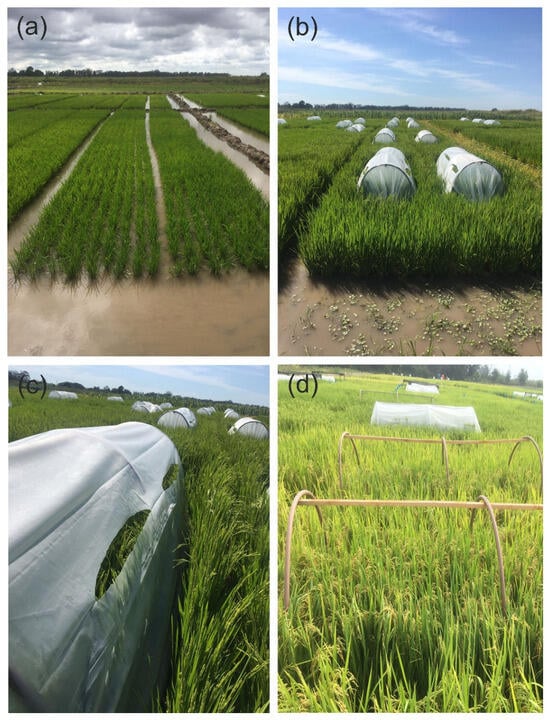
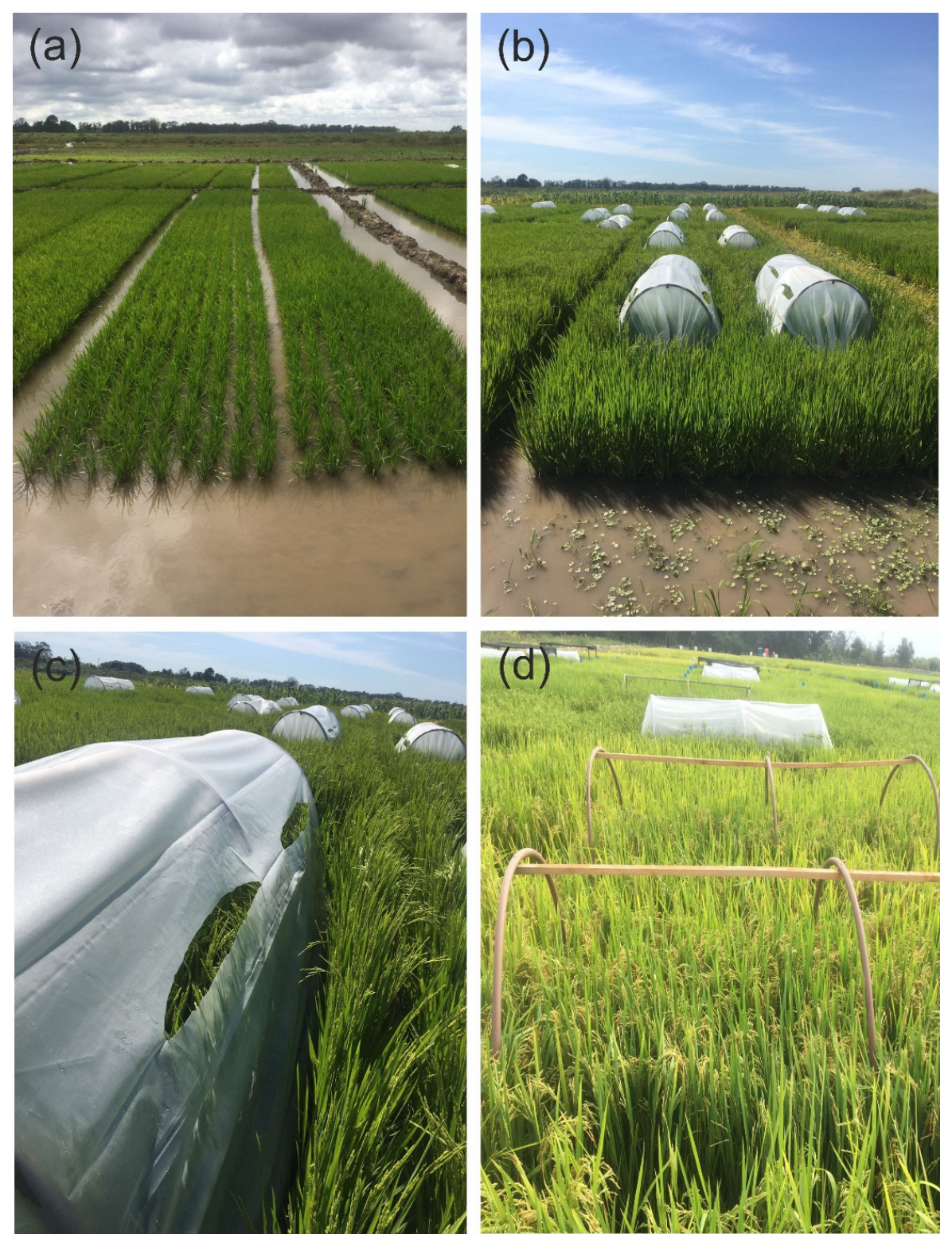
Field experiments were conducted at the Palma Agricultural Center, Federal University of Pelotas, in Capão do Leão, Rio Grande do Sul, Brazil (31°48′07.9″ S, 52°30′17.9″ W; ~14 m a.s.l.). Two field experiments were established. The first was conducted under non-stress conditions (Figure 1a) and the second under heat stress conditions (Figure 1b). The soil in the experimental area is classified as a Haplic Planosol with carbonate characteristics, which is typical of coastal lowland regions [23]. Before the experiments were established, soil chemical properties at the 0–20 cm depth were determined according to [24] and are shown in Supplementary Table S1. The rice cultivar IRGA 424 RI was selected due to its high adaptability to regional climate. Seeds were sown at a density of 300 plants m−2 (120 kg ha−1) with 0.35 m between rows. Crop management followed the technical recommendations of [25].
Figure 1.
Experimental area at the Federal University of Pelotas during the first experiment under non-stress conditions (a) and second experiment under heat stress conditions (b). In the second experiment, temporary greenhouse structures (1.3 m × 3.0 m × 5.0 m; H × W × L) were used to impose heat stress during the early reproductive stage of rice for 16 days (c). Panel (d) shows the same structures after removal of the plastic cover.
2.3. Experimental Design, Treatments, and Sampling Strategy
2.3.1. Field Application of CDs Under Non-Stress Conditions
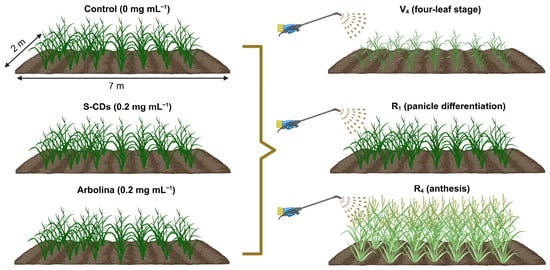
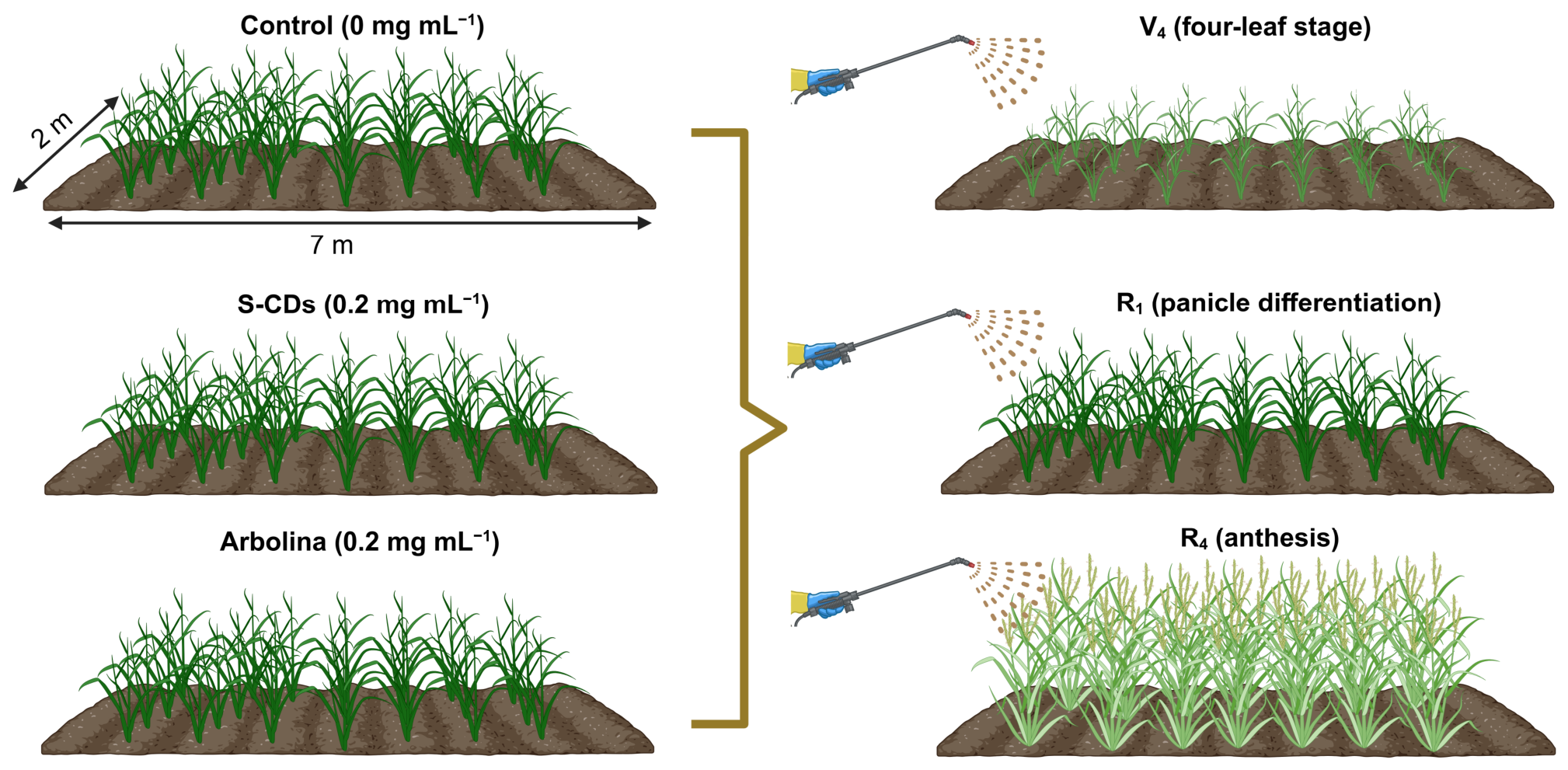
The experiment followed a randomized complete block design with four replicates. Experimental plots measured 2 m × 7 m (14 m2) and were separated by levees to prevent water movement between plots. Treatments consisted of T1: control (untreated); T2: Spirulina-derived carbon dots (S-CDs); and T3: Arbolina (commercial CD-based product) (Figure 2), with four replicates per treatment. CDs were applied via foliar spraying at a concentration of 0.2 mg mL−1 using a backpack sprayer calibrated to deliver 200 L ha−1 at three developmental stages: V4 (four-leaf stage), R1 (panicle differentiation), and R4 (anthesis) (Figure 2).
Figure 2.
Experimental design of the field trials conducted with rice (Oryza sativa L. cv. IRGA 424 RI). Plants were foliar-sprayed with Spirulina-derived carbon dots (S-CDs) or Arbolina (commercial product) at 0.2 mg mL−1 at the V4, R1, and R4 stages, alongside an untreated control. Heat stress was imposed at the R4 stage using temporary greenhouse structures (1.3 m × 3.0 m × 5.0 m; H × W × L) for 16 days. In the non-stress experiment, biochemical measurements were performed 24 h after the third application. In the heat stress experiment, biochemical measurements were performed 7 days after stress imposition. The experiments followed a randomized block design with four independent replicates.
2.3.2. Field Application of CDs Under Heat Stress (HS) Conditions
This experiment used the same plot dimensions and agronomic management described before. Treatments consisted of T1: heat stress (HS); T2: Spirulina-derived carbon dots (S-CDs) under HS; and T3: Arbolina under HS, with four replicates per treatment. HS was imposed at the R4 stage (anthesis) by covering the plots with temporary greenhouse structures (1.30 m height × 3.0 m width × 5.0 m length) (Figure 1c). The structures remained for 16 days to increase air temperature above ambient conditions. Air temperature inside and outside the structures was monitored using AK170 dataloggers (Akso, São Leopoldo, Brazil). After the stress period, the structures were removed (Figure 1d), and plants remained under field conditions until harvest.
2.4. Leaf Sampling and Sample Preparation
In the non-stress experiment, leaves were sampled 24 h after the third foliar application of CDs, at the R4 (anthesis) stage. In the HS experiment, leaves were sampled after 7 d of HS exposure. In both experiments, each sample consisted of five fully expanded leaves collected from five plants within each replicate. Leaves were taken from the position immediately below the flag leaf, pooled, frozen in liquid nitrogen, ground to a fine powder, and stored at −80 °C until analysis. Given the distinct objectives and sampling times of each experiment, the experiments were interpreted independently, aiming to assess the effects of CDs under non-stress and HS conditions, respectively.
2.5. Determination of Antioxidant Compounds and Antioxidative Capacity
2.5.1. Total Phenolic Content (TPhnlcC)
TPhnlcC was determined as described by [26], with minor modifications. Phenolic compounds were extracted from 300 mg of powdered leaves using 3 mL of 80% methanol. For the reaction, 100 μL of the extract was mixed with 75 μL of Folin–Ciocalteu reagent and 825 μL of 2% sodium carbonate. After 1 h of incubation, absorbance was measured in triplicate at 750 nm using a microplate reader (ThermoPlate, model P-reader; Dallas, TX, USA). Gallic acid was used as the standard at concentrations ranging from 7.81 to 500 µg mL−1 and TPhnlcC was calculated from the calibration curve (y = 0.006x, r2 = 0.9967).
2.5.2. Total Flavonoid Content (TFC)
TFC was quantified as described by [27], with modifications. Flavonoids were extracted from 300 mg of powdered leaves with 3 mL of 80% methanol. For the assay, 500 μL of the extract was mixed with 2.5 mL of analytical-grade ethanol and 500 μL of 2% aluminum chloride solution in methanol. After 1 h of incubation, absorbance was measured in triplicate at 420 nm using a microplate reader (ThermoPlate, model P-reader; Dallas, TX, USA). Quercetin was used as the standard at concentrations ranging from 7.81 to 500 µg mL−1 and TFC was calculated from the calibration curve (y = 0.0056x, r2 = 0.9799).
2.5.3. Total Carotenoid Content (TCrtnC)
TCrtnC was determined as described by [28], with modifications. Carotenoids were extracted from 300 mg of powdered leaves with 3 mL of 80% methanol. Then, 300 μL of the extract was transferred to the microplates, and absorbance was measured in triplicate at 450 nm using a microplate reader (ThermoPlate, model P-reader; Dallas, TX, USA).
2.5.4. Antioxidant Capacity
Antioxidant capacity was evaluated using the DPPH (2,2-diphenyl-1-picrylhydrazyl) radical scavenging assay, as described by [29]. Antioxidant compounds were extracted from 300 mg of powdered leaves with 3 mL of 80% methanol. The DPPH stock solution was prepared by dissolving 7.9 mg of DPPH in 2.5 mL of methanol. The working solution was prepared by diluting 0.5 mL of stock solution in 49.5 mL of 80% methanol and adjusting the absorbance to 0.5–0.6. For the reaction, 10 μL of the extract was added to 290 μL of the working solution. After 30 min of incubation, absorbance was measured at 540 nm using a microplate reader (ThermoPlate, model P-reader; Dallas, TX, USA). DPPH radical scavenging capacity was calculated as:
where Control absorbance is the absorbance of the diluted DPPH, and Sample absorbance is the absorbance of the reaction mixture containing DPPH and extract.
2.6. Determination of Primary Metabolites
2.6.1. Total Soluble Sugars (TSS) and Total Starch (TS)
TSS and TS were quantified according to [30]. For TSS determination, 50 mg of powdered leaves was extracted with 2 mL of MCW solution (methanol:chloroform:distilled water, 12:5:3, v/v/v). After centrifugation, 1 mL of chloroform and 1.5 mL of distilled water were added to induce phase separation. Then, 1 mL of the supernatant was collected, mixed with 2 mL of 0.2% anthrone in sulfuric acid, vortexed, and heated in a water bath at 100 °C for 3 min. Samples were cooled to room temperature, and absorbance was measured at 630 nm using a microplate reader (ThermoPlate, model P-reader; Dallas, TX, USA). Glucose was used as the standard at concentrations ranging from 62.50 to 2000 μg mL−1 and TSS was calculated from the calibration curve (y = 0.0018x, r2 = 0.9517).
For TS determination, the pellet remaining after TSS extraction was resuspended in 2 mL of 30% perchloric acid and centrifuged at 4000 rpm for 10 min. The supernatant was collected, and this step was repeated once. The final volume was adjusted to 4 mL with perchloric acid. Then, 1 mL of the extract was mixed with 2 mL of 0.2% anthrone in sulfuric acid, heated in a water bath at 100 °C for 3 min, and cooled to room temperature. Absorbance was measured at 630 nm using a microplate reader (ThermoPlate, model P-reader; Dallas, TX, USA). Glucose was used as the standard at concentrations ranging from 62.50 to 2000 μg mL−1 and TS was calculated from the calibration curve (y = 0.0016x, r2 = 0.9916).
2.6.2. Total Carbohydrate Content (TChC)
TChC was determined using the phenol-sulfuric acid method described by [31], with modifications. Aliquots (50 mg of powdered leaves) were extracted with 20 mL of distilled water. After centrifugation, 2 mL of the supernatant was mixed with 50 μL of 80% phenol and 5 mL of concentrated sulfuric acid. After 10 min, the mixture was gently agitated and incubated in a water bath at 25–30 °C for 15 min. After cooling, samples were transferred to microplates and analyzed in triplicate. Absorbance was measured at 490 nm using a microplate reader (ThermoPlate, model P-reader; Dallas, TX, USA). Galactose was used as the standard at concentrations ranging from 7.80 to 500 μg mL−1 and TChC was calculated from the calibration curve (y = 0.0025x, r2 = 0.9992).
Because total carbohydrate content (TChC), total soluble sugars (TSS), and total starch (TS) were determined using independent extraction procedures and analytical methods, their values represent distinct carbohydrate fractions and should not be interpreted as additive components of a single carbohydrate pool.
2.7. Determination of Nitrogen-Related Metabolites
2.7.1. Soluble Protein Content (SPC)
SPC was quantified using the Bradford assay [32], with modifications. Proteins were extracted from 200 mg of powdered leaves with 10 mL of phosphate-buffered saline (PBS; pH 7.0). Samples were homogenized, incubated for 15 min, and centrifuged. An aliquot of 100 μL of the supernatant was mixed with 5 mL of Bradford solution (1 mL of Bradford reagent in 4 mL of water). After 5 min, samples were transferred to microplates and analyzed in triplicate. Absorbance was measured at 595 nm using a microplate reader (ThermoPlate, model P-reader; Dallas, TX, USA). Bovine serum albumin was used as the standard at concentrations ranging from 3.90 to 62.5 μg mL−1 and SPC was calculated from the calibration curve (y = 0.0032x, r2 = 0.9772).
2.7.2. Total Amino Acid Content (TAAC)
TAAC was determined according to [33], with modifications. Amino acids were extracted from 100 mg of powdered leaves with 2 mL of distilled water. After centrifugation, 1 mL of the supernatant was mixed with 3 mL of 2% ninhydrin solution in PBS (pH 7.0). The reaction mixture was heated in a water bath at 100 °C for 30 min and then cooled. Aliquots were transferred to microplates and analyzed in triplicate. Absorbance was measured at 570 nm using a microplate reader (ThermoPlate, model P-reader; Dallas, TX, USA). Proline was used as the standard at concentrations ranging from 1.95 to 499.20 μg mL−1 and TAAC was calculated from the calibration curve (y = 0.0026x, r2 = 0.9962).
2.8. Grain Yield Evaluation
Grains were harvested when approximately 90% of the panicles had reached physiological maturity and grain moisture was about 22%. After harvest, grains were cleaned and dried to 13% moisture. Productive performance was assessed at the plant and field scales using thousand-grain weight (TGW) and grain yield per area, according to [34]. Yield components were evaluated by randomly collecting 20 panicles from each replicate (n = 80 panicles per treatment) and determining the number of filled and empty grains per panicle. Grain yield per area was calculated by extrapolating the grain mass from the harvested plot area to a hectare basis and expressed as kg ha−1.
2.9. Grain Processing and Quality Analyses
Post-harvest evaluations, including grain processing yield and grain quality, were performed according to the protocol established by [34]. Briefly, a 105 g sample of rough rice from each experimental unit was processed using a laboratory rice mill (PAZ-2/DTA model; Zaccaria, São Paulo, Brazil) for 1 min to remove the husk, followed by 30 s of polishing. Whole polished grains and broken grains were subsequently separated with a no. 1 trieur, weighed, and expressed as percentages of head rice yield and broken grains, respectively. Grain appearance traits, including the incidence of chalky grains and white belly, were also evaluated and expressed as percentages.
Grain nutritional composition, including protein, lipid, fiber, ash, and starch contents, was determined using Near-Infrared Spectroscopy (NIRS) [35]. NIR spectra were obtained using a FOSS NIRS DS2500 L analyzer (FOSS Analytics, Hillerød, Denmark), and grain composition was estimated using previously validated calibration models for rice grain constituents.
2.10. Statistical Analysis
Data were first tested for normality using InfoStat version 2020 (InfoStat, Córdoba, Argentina). When the normality assumption was met, data were subjected to analysis of variance (ANOVA), and means were compared using Tukey’s test at p < 0.05. When the data did not meet this assumption, pairwise comparisons were performed using Kruskal–Wallis test at p < 0.05. Mean temperatures inside and outside the greenhouse structures during the 16-day HS period were compared using Student’s t test. All analyses were performed in SPSS (version 23.0; IBM Corp., Armonk, NY, USA). Results are means ± standard error (SE), and different letters indicate significant differences among treatments.
3. Results and Discussion
3.1. Environmental Conditions and Heat Stress Imposition
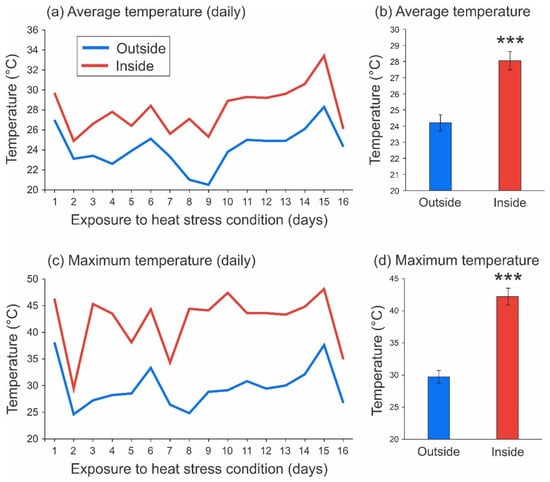
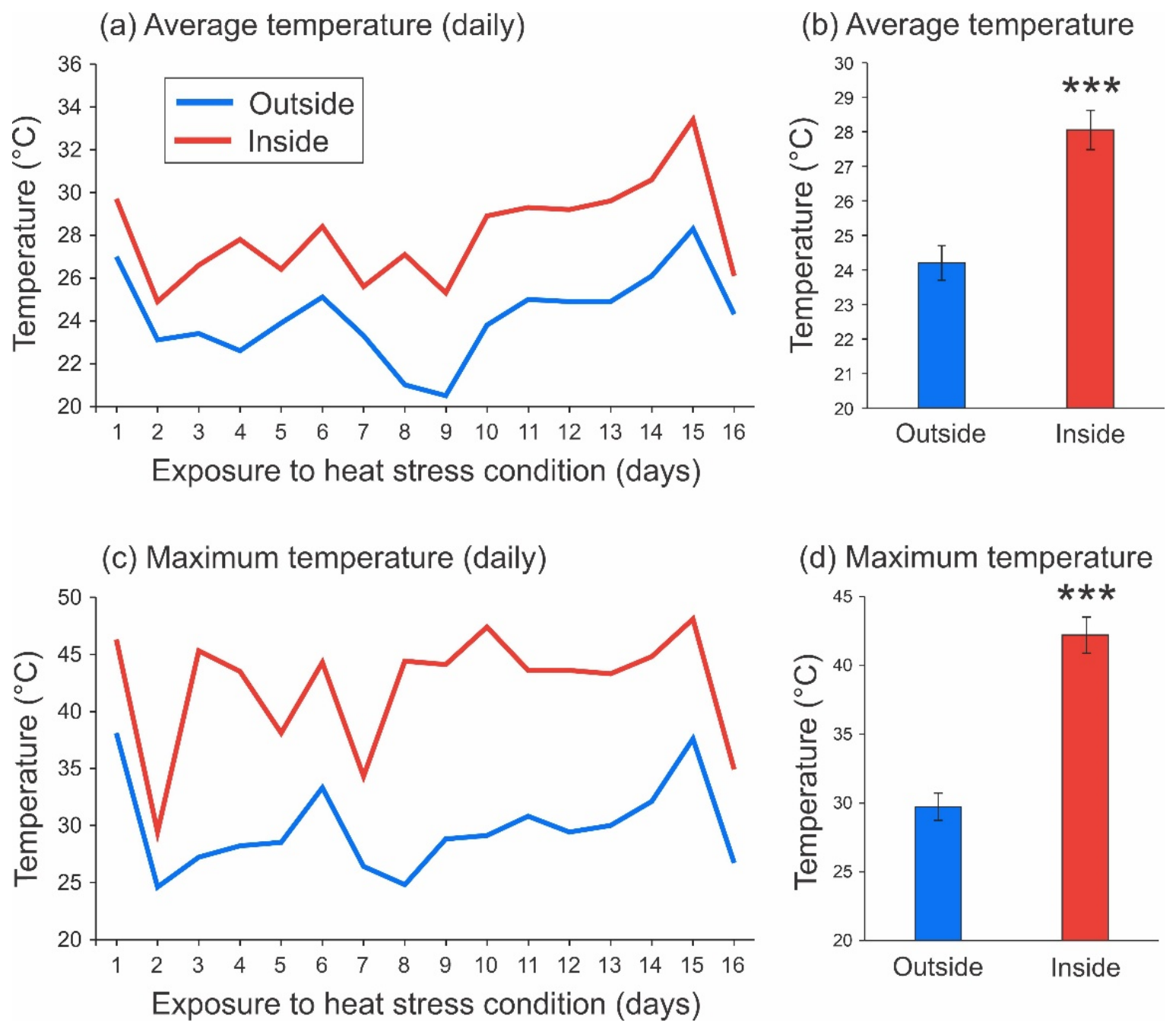
The environmental conditions followed typical seasonal patterns, with daily average temperatures ranging from 20 to 27 °C, and daily maximum temperatures reaching 24 to 38 °C (Figure 3a,c). These conditions are within the optimal to moderately permissive range for rice normal development, particularly during the reproductive stage. The temporary greenhouses effectively imposed HS during the reproductive stage of rice. During the 16-day exposure period, the average air temperature inside the structures was 3.9 °C higher than under ambient field conditions, reaching 28.1 °C compared with 24.2 °C outside (Figure 3a,b). HS also sharply increased daily maximum temperature. Inside the temporary greenhouses, maximum temperatures frequently exceeded 40 °C and reached peaks above 45 °C, whereas outside values averaged 29.7 °C (Figure 3d). Overall, the maximum temperature under HS was 12.5 °C higher than under non-stress conditions.
Figure 3.
Air temperature during the heat stress experiment. (a) Daily mean air temperature recorded inside (red line) and outside (blue line) the temporary greenhouse structures during the 16-day heat-stress period imposed at the reproductive stage (R4). (b) Mean air temperature over the stress period, showing significantly higher temperatures inside the greenhouse structures compared to ambient conditions. (c) Daily maximum air temperature recorded inside (red line) and outside (blue line) the greenhouse structures during the stress period. (d) Mean maximum temperature over the stress period, showing higher peak temperatures inside the greenhouse structures. Data in (b,d) are means ± standard error (SE). Asterisks (***) indicate significant differences between inside and outside conditions (p < 0.001).
The temporal dynamics of temperature also indicate that HS was not only more intense but consistently sustained over the experimental period. While outside temperatures showed moderate fluctuations typical of field conditions, the greenhouse structures amplified both baseline and peak temperatures, increasing thermal load during both daytime and daily peaks. From a physiological perspective, temperatures above 35 °C during the reproductive stage are known to impair pollen viability, fertilization, and spikelet fertility in rice [12,14]. Thus, while the first experiment under non-stress conditions represents a baseline without thermal constraint, the thermal regime imposed in the second experiment can be classified as a severe HS. This contrast between ambient and HS conditions provided a suitable framework to assess the context-dependent effects of S-CDs on rice reproductive performance.
3.2. Antioxidant Metabolism in Response to S-CD Application
Under the non-stress field condition, S-CD application increased antioxidant-related secondary metabolites at the R4 stage. Total phenolic content (TPhnlcC) and total flavonoid content (TFC) increased by approximately 15% and 48%, respectively, compared with the control (Table 1). Phenolic compounds and flavonoids are central components of the plant non-enzymatic antioxidant system, contributing to redox homeostasis, cellular signaling, and protection against oxidative damage through reactive oxygen species (ROS) scavenging [36]. Recent studies further demonstrate that reactive oxygen and nitrogen species (ROS/RNS) act not only as toxic byproducts of stress metabolism, but also as integrated signaling molecules that regulate stress perception, acclimation, metabolic reprogramming, and reproductive responses under adverse environmental conditions [37,38]. Thus, modulation of antioxidant-related metabolism by S-CDs may also reflect adjustments in redox-mediated signaling networks during stress acclimation. Their accumulation is often associated with metabolic adjustments during developmental transitions, response to environmental constraints, and periods of high metabolic demand [36,39]. In rice, the late reproductive stage involves intense source-sink reorganization and enhanced antioxidant capacity may contribute to maintaining metabolic stability and protecting photosynthetic and reproductive tissues [40,41].
Table 1.
Effects of foliar application of Spirulina-derived carbon dots (S-CDs) or the commercial product Arbolina (0.2 mg mL−1) on total phenolic content (TPhnlcC), total flavonoid content (TFC), total carotenoid content (TCrtnN), and antioxidant capacity determined by the DPPH assay in fully expanded rice leaves collected from the position immediately below the flag leaf at the reproductive stage (R4, anthesis) under non-stress conditions, or after 7 d of heat stress (HS) exposure. Data are means ± SE of four biological replicates. Significant differences (Tukey’s test for parametric data or Kruskal–Wallis for non-parametric data, p < 0.05) among treatments are indicated by different letters in each column. DW: dry weight.
Similar increases in phenolic metabolism and antioxidant responses have been reported in plants exposed to carbon-based nanomaterials under controlled conditions, including studies with carbon nanotubes, graphene, and CDs [42,43]. These responses were linked to redox modulation, activation of stress-related pathways, and priming-like effects. As total antioxidant capacity measured by the DPPH assay and total carotenoid content (TCrtnC) did not differ from the control (Table 1), the response appears to reflect a selective shift in secondary metabolism rather than a broad increase in antioxidant activity.
Under HS condition, S-CD application did not affect any of the redox-related variables evaluated (Table 1). This may indicate that thermal stress had already constrained antioxidant metabolism at this stage, limiting further modulation by S-CD application. Our results contrast with reports in lettuce (Lactuca sativa L.) and Chinese cabbage (Brassica rapa L.), in which CDs improved thermotolerance through modulation of antioxidant systems and stress-responsive pathways [37,44,45].
Together, these results indicate that the effects of S-CD application on antioxidant metabolism depend on the environmental context, with selective accumulation of phenolic compounds and flavonoid under non-stress conditions and no clear response under HS. However, we cannot exclude the possibility that the effects of S-CDs depend on HS intensity and the physiological state of the plant.
3.3. Effects of S-CDs on Primary Carbon Metabolism
Under non-stress field conditions, S-CD application influenced primary carbon metabolism, increasing total carbohydrate content (TChC), total soluble sugars (TSS), and total starch (TS) by 34%, 9%, and 43%, respectively, compared with the control (Table 2). These results suggest a positive effect of S-CDs on carbon assimilation and partitioning during the reproductive stage under favorable conditions. Similar responses have been reported in plants treated with carbon-based nanomaterials. In maize (Zea mays L.), foliar application of nitrogen-doped carbon dots (N-CDs) increased net photosynthetic rate, carbohydrate content, biomass, grain yield, and thousand-grain weight during the reproductive stage, possibly through the upregulation of sucrose transporter genes [46]. In rice, CDs have also been linked to increased CO2 assimilation and improved growth, suggesting enhanced photosynthetic efficiency and carbon use [47]. Additional evidence indicates that N-CDs can stimulate starch metabolism and sucrose translocation, thereby improving photoassimilate partitioning and yield under nutrient-limited conditions [48,49].
Table 2.
Effects of foliar application of Spirulina-derived carbon dots (S-CDs) or the commercial product Arbolina (0.2 mg mL−1) on total carbohydrate content (TChC), total soluble sugars (TSS), and total starch (TS) in fully expanded rice leaves collected from the position immediately below the flag leaf at the reproductive stage (R4, anthesis) under non-stress conditions, or after 7 d of heat stress (HS) exposure. Data are means ± SE of four biological replicates. Significant differences (Tukey’s test for parametric data or Kruskal–Wallis for non-parametric data, p < 0.05) among treatments are indicated by different letters in each column. DW: dry weight.
Under the HS condition, S-CD-treated plants showed 42% lower TChC than plants subjected to HS alone, while TSS and TS did not differ between treatments (Table 2). This result suggests that S-CD application altered overall carbon balance under thermal stress, but without detectable changes in the major carbohydrate fractions evaluated. This pattern is consistent with preferential use of assimilated carbon for metabolic maintenance and stress acclimation rather than for accumulation as reserve compounds [50]. In rice, HS can disrupt carbon metabolism by impairing photosynthesis, increasing respiratory demand, and altering source-sink relationships, particularly during the reproductive stage [51,52].
3.4. Effects of S-CD on Nitrogen-Related Metabolites
Under the non-stress field condition, S-CD application did not affect soluble protein content (SPC) or total amino acid content (TAAC) (Table 3). Under the HS condition, TAAC also remained unchanged, whereas SPC decreased by 21% in S-CD-treated plants compared to the HS alone (Table 3). These results suggest that S-CD application did not increase nitrogen accumulation, but may have altered nitrogen partitioning under thermal stress. The reduction in protein content without changes in total amino acids points to adjustments in protein turnover or allocation rather than changes in nitrogen assimilation. This response is consistent with stress-induced reorganization of nitrogen metabolism, in which protein degradation and amino acid remobilization help maintain metabolic homeostasis under adverse conditions [11].
Table 3.
Effects of foliar application of Spirulina-derived carbon dots (S-CDs) or the commercial product Arbolina (0.2 mg mL−1) on soluble protein content (SPC) and total amino acid content (TAAC) in fully expanded rice leaves collected from the position immediately below the flag leaf at the reproductive stage (R4, anthesis) under non-stress conditions, or after 7 d of heat stress (HS) exposure. Data are means ± SE of four biological replicates. Significant differences (Tukey’s test for parametric data or Kruskal–Wallis for non-parametric data, p < 0.05) among treatments are indicated by different letters in each column. DW: dry weight.
The nitrogen-related responses were consistent with the patterns observed for carbon metabolism, suggesting coordinated metabolic adjustments under HS. Although we did not assess the underlying mechanisms, the lack of major changes in amino acid pools suggests that the effects of S-CD application appear to be more closely related to protein dynamics rather than to bulk nitrogen accumulation. Similar responses have been reported for carbon-based nanomaterials under abiotic stress conditions, where their effects are associated more with metabolic and redox regulation than with direct increases in nutrient accumulation [53,54]. Together, these results support a context-dependent effect of S-CD application on plant metabolism under HS conditions.
3.5. Productive Performance and Grain Quality
Under the non-stress field condition, S-CD application did not affect productive performance, including thousand-grain weight (TGW), spikelet sterility, and grain yield (Table 4). These results indicate that, under favorable conditions, S-CD application did not improve productivity. In contrast, grain physical quality was affected. S-CD-treated plants showed higher head rice yield (14%) and a greater proportion of whole kernels (12%), but also a marked increase in the proportion of chalky grains (283%) (Table 4). No significant differences were observed for broken grains or white-belly grains. These results collectively suggest that S-CDs affected some traits related to grain processing quality under ambient conditions, but without consistent improvements in overall grain quality.
Table 4.
Effects of foliar application of Spirulina-derived carbon dots (S-CDs) or the commercial product Arbolina (0.2 mg mL−1) on productivity-related parameters determined at harvest in rice plants grown under non-stress or heat stress (HS) conditions. Evaluated traits included whole kernels (%), head rice yield (%), broken grains (%), chalky grains (%), white-belly grains (%), thousand-grain weight (g), spikelet sterility (%), and grain yield (kg ha−1). Data are means ± SE of four biological replicates. Significant differences (Tukey’s test for parametric data or Kruskal–Wallis for non-parametric data, p < 0.05) among treatments are indicated by different letters in each column.
Under the HS condition, S-CD-treated plants showed a significant increase in whole kernels (9%) and broken grains (177%), along with lower spikelet sterility (29%) and higher grain yield (34%) compared to plants exposed to HS alone (Table 4). TGW did not differ among treatments. These results suggest that S-CD application partly mitigated the negative effects of HS on reproductive performance, contributing to higher yield under adverse conditions. HS during anthesis severely affects pollen viability, anther dehiscence, fertilization, and assimilate allocation to developing spikelets, and the reduced spikelet sterility observed in S-CD-treated plants suggests a possible protective effect on these reproductive processes. However, the simultaneous increase in broken grains indicates that this improvement in yield was not accompanied by better grain physical integrity.
Under non-stress conditions, S-CD application altered grain nutritional composition, increasing protein (21%), lipid (381%), and starch (25%) contents while reducing crude fiber by 62% and ash (69%) (Table 5). Under HS condition, S-CD-treated plants also showed higher protein (26%), lipid (254%), and starch (23%) contents and lower crude fiber (65%) and ash (67%) than plants subjected to HS alone (Table 5). These changes suggest that S-CD application modified grain biochemical composition under both conditions, although the response was more relevant under HS because it was accompanied by higher grain yield.
Table 5.
Effects of foliar application of Spirulina-derived carbon dots (S-CDs) or the commercial product Arbolina (0.2 mg mL−1) on grain quality-related parameters determined at harvest in rice plants grown under non-stress and heat stress (HS) conditions. Evaluated traits included percentages of proteins, lipids, crude fibers, ash, and starch. Data are means ± SE of four biological replicates. Significant differences (Tukey’s test for parametric data or Kruskal–Wallis for non-parametric data, p < 0.05) among treatments are indicated by different letters in each column.
Previous studies have shown that carbon-based nanomaterials can enhance grain filling and productivity through improved photosynthesis, assimilate translocation, and the upregulation of sucrose transport and metabolism-related genes [47,48]. Similar responses have been reported in maize, soybean, and tomato, particularly under stress conditions [55,56]. In our study, S-CD application did not improve productivity under non-stress conditions, but under HS it reduced spikelet sterility and increased grain yield. However, these benefits were accompanied by trade-offs in grain physical quality, reinforcing the context-dependent nature of S-CD effects on rice performance. These results reinforce that metabolic stimulation alone does not necessarily translate into higher productivity, particularly under favorable conditions in which source-sink limitations and reproductive constraints may already be minimized. Thus, the metabolic responses induced by S-CDs under non-stress conditions may reflect physiological acclimation or buffering rather than effective conversion into agronomic advantages. Recent advances in single-cell and spatial transcriptomics further reinforce this complexity by demonstrating that stress responses can vary substantially among tissues and cell types, generating heterogeneous regulatory dynamics that may remain undetected in bulk metabolic analyses [57]. These high-resolution approaches may therefore help explain why metabolic modulation does not consistently translate into predictable agronomic outcomes under field conditions.
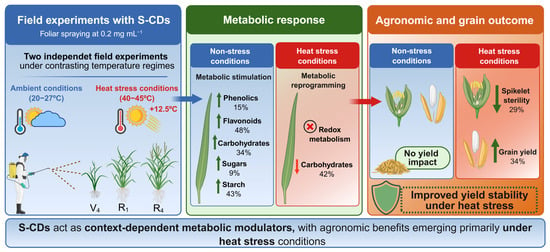
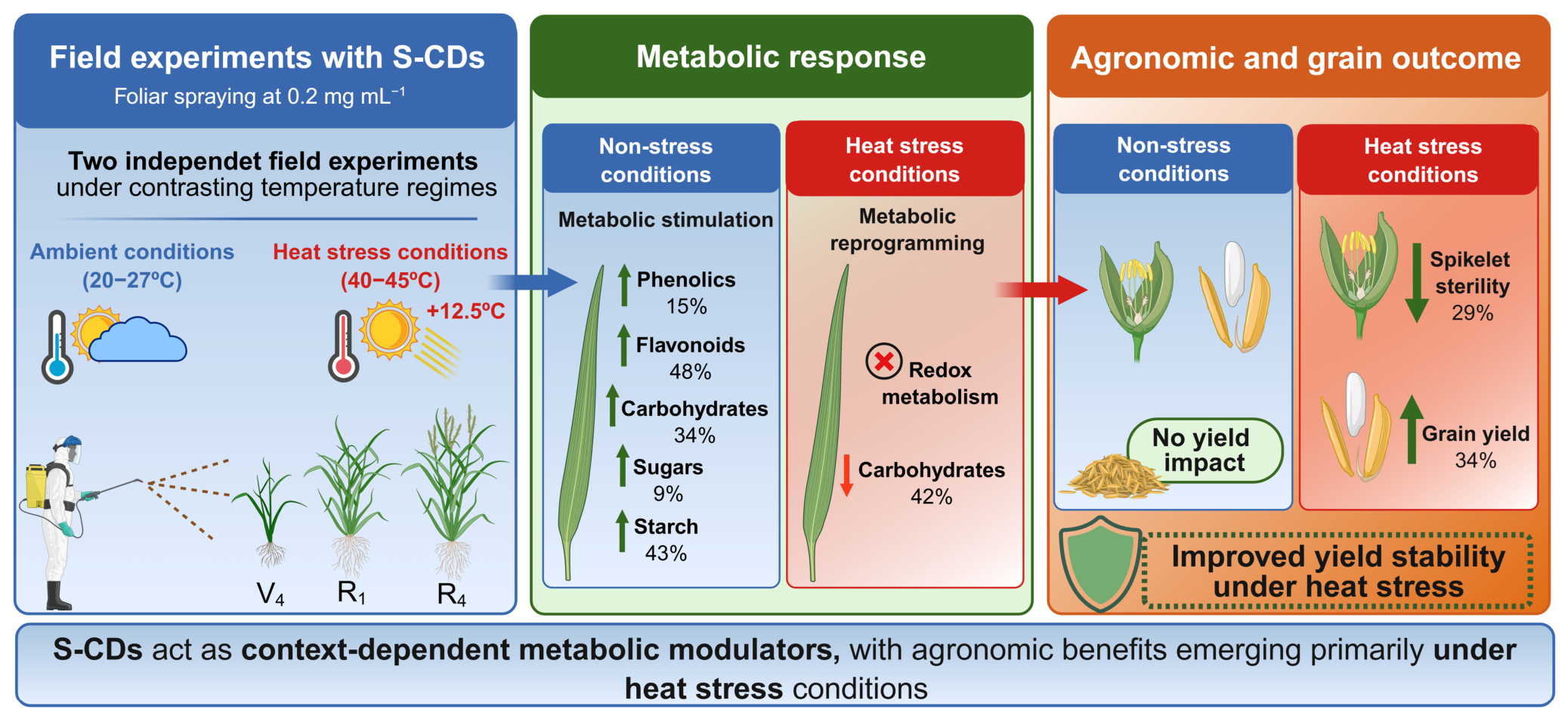
To integrate the metabolic and agronomic responses observed under contrasting environmental conditions, a schematic model summarizing the effects of S-CDs is presented in Figure 4. Under non-stress conditions, S-CD application promoted metabolic stimulation, characterized by increased accumulation of phenolic compounds, flavonoids, and carbohydrates, without consistent effects on grain yield. In contrast, under HS, S-CDs induced a distinct metabolic reprogramming, associated with reduced spikelet sterility and increased grain yield. These results indicate that the agronomic benefits of S-CDs emerge primarily under stress conditions, supporting their role as context-dependent metabolic modulators that enhance yield stability.
Figure 4.
Context-dependent effects of Spirulina-derived carbon dots (S-CDs) on rice metabolism and agronomic performance under non-stress and heat stress field conditions.
4. Conclusions
This study advances our understanding of how S-CDs affect rice under field conditions. Overall, S-CD application induced context-dependent responses, with limited agronomic relevance under favorable conditions. Although S-CDs altered metabolic traits under favorable conditions, these changes did not improve grain yield or its components. Under HS during the reproductive stage, however, S-CD application reduced spikelet sterility and increased grain yield, indicating potential to support reproductive performance under adverse thermal conditions. Although S-CD application reduced spikelet sterility and increased grain yield under HS, the molecular and signaling pathways underlying this response remain to be elucidated. Future studies integrating transcriptomics, proteomics, metabolomics, reproductive biology, and time-resolved physiological analyses should investigate whether S-CDs modulate ROS signaling, antioxidant enzyme activity, heat-shock protein accumulation, hormone-mediated stress responses, pollen viability, anther dehiscence, source-sink regulation, and assimilate partitioning during rice reproductive development under high temperature. The integrative framework presented in Figure 4 demonstrates that metabolic responses alone are insufficient to predict agronomic outcomes, underscoring the central role of environmental context in shaping the effectiveness of nanobiostimulants. These findings suggest that S-CDs act less as general growth promoters and more as context-dependent modulators of plant responses to environmental stress, which is relevant under increasingly frequent and intense climate-related stress conditions.
Supplementary Materials
The following supporting information can be downloaded at https://www.mdpi.com/article/10.3390/plants15111657/s1, Table S1. Chemical properties of the soil (0–20 cm depth) prior to experiment establishment.
Author Contributions
S.D., M.M. and R.A.S.: Conceptualization, Funding acquisition, Project administration, Supervision, and Writing—original draft; L.V.P.M., S.L.d.S., L.B.L., N.d.S.F., A.N. and E.R.O.: Investigation, Methodology, Software, Writing—review and editing. All authors have read and agreed to the published version of the manuscript.
Funding
Research in Raul Sperotto’s laboratory is currently financed by CNPq (National Council for Scientific and Technological Development—Projects 405779/2022-4 and 305135/2021-0) and FAPERGS (Research Support Foundation of Rio Grande do Sul—Project 22/2551-0001641-3). Research in Marcelo Maraschin’s laboratory is currently financed by CNPq (Grants 405949/2022-7 and 306495/2023-6). Research in Sidnei Deuner’s laboratory is currently financed by CNPq (Grant 308145/2025-9). Research was also supported by FAPESP (Research Support Foundation of São Paulo—Grant 2023/03886-1 to Aline Nunes) and CNPq (Grant 303956/2023-2 to Eva Regina Oliveira).
Data Availability Statement
The data that support the findings of this study are available from the corresponding author upon reasonable request.
Conflicts of Interest
Author Raul Antonio Sperotto was employed by the company Brazilian Agricultural Research Corporation (Embrapa Maize and Sorghum). The remaining authors declare that the research was conducted in the absence of any commercial or financial relationships that could be construed as potential conflicts of interest. The authors declare that they have no known competing financial interests or personal relationships that could influence the work reported in this review.
Declaration of Generative AI and AI-Assisted-Technologies-in-the-Writing-Process
During the preparation of this work, the authors used ChatGPT 5.5 to improve readability and language accuracy. After using the tool, the authors carefully reviewed and edited the content as necessary and take full responsibility for the final version of the publication.
References
- Saud, S.; Wang, D.; Fahad, S.; Alharby, H.F.; Bamagoos, A.A.; Mjrashi, A.; Alabdallah, N.M.; AlZahrani, S.S.; AbdElgawad, H.; Adnan, M.; et al. Comprehensive impacts of climate change on rice production and adaptive strategies in China. Front. Microbiol. 2022, 13, 926059. [Google Scholar] [CrossRef] [Scilit]
- Shah, M.A.; Shahnaz, T.; Din, Z.U.; Masoodi, J.; Nazir, S.; Qurashi, A.; Ahmed, G.H. Application of nanotechnology in the agricultural and food processing industries: A review. Sustain. Mater. Technol. 2024, 39, e00809. [Google Scholar] [CrossRef] [Scilit]
- Li, H.; Huang, J.; Lu, F.; Liu, Y.; Song, Y.; Sun, Y.; Zhong, J.; Huang, H.; Wang, Y.; Li, S.; et al. Impacts of carbon dots on rice plants: Boosting the growth and improving the disease resistance. ACS Appl. Bio Mater. 2018, 1, 663–672. [Google Scholar] [CrossRef] [Scilit] [PubMed]
- Yang, H.; Wang, C.; Chen, F.; Yue, L.; Cao, X.; Li, J.; Zhao, X.; Wu, F.; Wang, Z.; Xing, B. Foliar carbon dot amendment modulates carbohydrate metabolism, rhizospheric properties and drought tolerance in maize seedling. Sci. Total Environ. 2022, 809, 151105. [Google Scholar] [CrossRef] [Scilit] [PubMed]
- Lu, Z.; Li, Y.; Chen, K.; Chai, S.; Su, G.; Wu, C.; Sun, M.; Wang, Y.; Feng, S.; Hao, M.; et al. Multi-activity ferruginated carbon quantum dots nanozyme improves wheat seedling growth and Cd tolerance. Crop J. 2025, 13, 510–523. [Google Scholar] [CrossRef] [Scilit]
- Guo, Y.; Fu, Y.; Hao, F.; Zhang, X.; Wu, W.; Jin, X.; Robin Bryant, C.; Senthilnath, J. Integrated phenology and climate in rice yields prediction using machine learning methods. Ecol. Indic. 2021, 120, 106935. [Google Scholar] [CrossRef] [Scilit]
- FAO. Climate technologies for agrifood system transformation. In United Nations Framework Convention on Climate Change (UNFCCC); FAO: Rome, Italy, 2024. [Google Scholar] [CrossRef] [Scilit]
- Fukagawa, N.K.; Ziska, L.H. Rice: Importance for global nutrition. J. Nutr. Sci. Vitaminol. 2019, 65, S2–S3. [Google Scholar] [CrossRef] [Scilit]
- Siddik, M.A.; Zhang, J.; Chen, J.; Qian, H.; Jiang, Y.; Raheem, A.K.; Deng, A.; Song, Z.; Zheng, C.; Zhang, W. Responses of indica rice yield and quality to extreme high and low temperatures during the reproductive period. Eur. J. Agron. 2019, 106, 30–38. [Google Scholar] [CrossRef] [Scilit]
- Liu, M.; Zhou, Y.; Sun, J.; Mao, F.; Yao, Q.; Li, B.; Wang, Y.; Gao, Y.; Dong, X.; Liao, S.; et al. From the floret to the canopy: High temperature tolerance during flowering. Plant Commun. 2023, 4, 100629. [Google Scholar] [CrossRef] [Scilit]
- Shrestha, S.; Mahat, J.; Shrestha, J.; K.C., M.; Paudel, K. Influence of high-temperature stress on rice growth and development. A review. Heliyon 2022, 8, e12651. [Google Scholar] [CrossRef] [Scilit]
- Ullah, A.; Nadeem, F.; Nawaz, A.; Siddique, K.H.M.; Farooq, M. Heat stress effects on the reproductive physiology and yield of wheat. J. Agron. Crop Sci. 2022, 208, 1–17. [Google Scholar] [CrossRef] [Scilit]
- Sakai, H.; Cheng, W.; Chen, C.P.; Hasegawa, T. Short-term high nighttime temperatures pose an emerging risk to rice grain failure. Agric. For. Meteorol. 2022, 314, 108779. [Google Scholar] [CrossRef] [Scilit]
- Hill, C.B.; Angessa, T.T.; Westcott, S.; McFawn, L.-A.; Shirdelmoghanloo, H.; Han, Y.; Li, C. Evaluation of the impact of heat stress at flowering on spikelet fertility and grain quality in barley. Agric. Commun. 2024, 2, 100066. [Google Scholar] [CrossRef] [Scilit]
- Fortunato, S.; Lasorella, C.; Dipierro, N.; Vita, F.; De Pinto, M.C. Redox signaling in plant heat stress response. Antioxidants 2023, 12, 605. [Google Scholar] [CrossRef] [Scilit]
- Juárez-Maldonado, A.; Ortega-Ortíz, H.; Morales-Díaz, A.B.; González-Morales, S.; Morelos-Moreno, Á.; Cabrera-De La Fuente, M.; Sandoval-Rangel, A.; Cadenas-Pliego, G.; Benavides-Mendoza, A. Nanoparticles and nanomaterials as plant biostimulants. Int. J. Mol. Sci. 2019, 20, 162. [Google Scholar] [CrossRef] [Scilit]
- Chen, F.; Shen, Z.; Shi, R.; Zhang, X.; Zhang, H.; Li, W.; Lei, B. Carbon dots-mediated plant adaptive responses to abiotic stress. Mater. Res. Bull. 2025, 182, 113137. [Google Scholar] [CrossRef] [Scilit]
- Li, Y.; Xu, X.; Wu, Y.; Zhuang, J.; Zhang, X.; Zhang, H.; Lei, B.; Hu, C.; Liu, Y. A review on the effects of carbon dots in plant systems. Mater. Chem. Front. 2020, 4, 437–448. [Google Scholar] [CrossRef] [Scilit]
- Li, Y.; Gao, J.; Xu, X.; Wu, Y.; Zhuang, J.; Zhang, X.; Zhang, H.; Lei, B.; Zheng, M.; Liu, Y.; et al. Carbon dots as a protective agent alleviating abiotic stress on rice (Oryza sativa L.) through promoting nutrition assimilation and the defense system. ACS Appl. Mater. Interfaces 2020, 12, 33575–33585. [Google Scholar] [CrossRef] [Scilit]
- Li, Y.; Li, W.; Yang, X.; Kang, Y.; Zhang, H.; Liu, Y.; Lei, B. Salvia Miltiorrhiza-derived carbon dots as scavengers of reactive oxygen species for reducing oxidative damage of plants. ACS Appl. Nano Mater. 2021, 4, 113–120. [Google Scholar] [CrossRef] [Scilit]
- Agnol, L.D.; Neves, R.M.; Maraschin, M.; Moura, S.; Ornaghi, H.L.; Dias, F.T.G.; Bianchi, O. Green synthesis of Spirulina-based carbon dots for stimulating agricultural plant growth. Sustain. Mater. Technol. 2021, 30, e00347. [Google Scholar] [CrossRef] [Scilit]
- Minello, L.V.P.; Aguzzoli, C.; Nunes, A.; Oliveira, E.R.; Maraschin, M.; Da Paschoa, R.P.; Silveira, V.; Sperotto, R.A. Seed nanopriming with Spirulina-derived carbon dots enhances rice (Oryza sativa L.) germination, crop establishment, and seedling metabolic performance. Plants 2026, 15, 770. [Google Scholar] [CrossRef] [Scilit]
- Dos Santos, H.G.; Jacomine, P.K.T.; Dos Anjos, L.H.; De Oliveira, V.A.; Lumbreras, J.F.; Coelho, M.R.; De Almeida, J.A.; De Araujo Filho, J.C.; De Oliveira, J.B.; Cunha, T.J.F. Sistema Brasileiro de Classificação de Solos, 5th ed.; Embrapa: Brasília, Brazil, 2018; Available online: https://www.infoteca.cnptia.embrapa.br/infoteca/bitstream/doc/1094003/2/SiBCS2018ISBN9788570358004.pdf (accessed on 25 May 2026).
- EMBRAPA. Informação Tecnológica—Manual de Análises Químicas de Solos, Plantas e Fertilizantes, 2nd ed.; da Silva, F.C., Ed.; EMBRAPA (Empresa Brasileira de Pesquisa Agropecuária): Brasília, Brazil, 2009. [Google Scholar]
- SOSBAI. Recomendações Técnicas da Pesquisa para o Sul do Brasil: XXXIII Reunião Técnica da Cultura do Arroz Irrigado, 33rd ed.; SOSBAI: Bento Gonçalves, Brazil, 2023; Available online: https://www.sosbai.com.br/uploads/documentos/recomendacoes-tecnicas-da-pesquisa-para-o-sul-do-brasil_310.pdf (accessed on 25 May 2026).
- Singleton, V.L.; Orthofer, R.; Lamuela-Raventós, R.M. Analysis of total phenols and other oxidation substrates and antioxidants by means of Folin-Ciocalteu reagent. In Methods in Enzymology; Elsevier: Amsterdam, The Netherlands, 1999; Volume 299, pp. 152–178. [Google Scholar] [CrossRef] [Scilit]
- Woisky, R.G.; Salatino, A. Analysis of propolis: Some parameters and procedures for chemical quality control. J. Apic. Res. 1998, 37, 99–105. [Google Scholar] [CrossRef] [Scilit]
- Aman, R.; Carle, R.; Conrad, J.; Beifuss, U.; Schieber, A. Isolation of carotenoids from plant materials and dietary supplements by high-speed counter-current chromatography. J. Chromatogr. A 2005, 1074, 99–105. [Google Scholar] [CrossRef] [Scilit] [PubMed]
- Yamaguchi, T.; Takamura, H.; Matoba, T.; Terao, J. HPLC method for evaluation of the free radical-scavenging activity of foods by using 1,1-Diphenyl-2-picrylhydrazyl. Biosci. Biotechnol. Biochem. 1998, 62, 1201–1204. [Google Scholar] [CrossRef] [Scilit]
- Umbreit, W.W.; Burris, R.H.; Stauffer, J.F. Manometric and Biochemical Techniques: A Manual Describing Methods Applicable to the Study of Tissue Metabolism; Burgess Publishing Company: Minneapolis, MN, USA, 1972. [Google Scholar]
- DuBois, M.; Gilles, K.A.; Hamilton, J.K.; Rebers, P.A.; Smith, F. Colorimetric Method for Determination of Sugars and Related Substances. Anal. Chem. 1956, 28, 350–356. [Google Scholar] [CrossRef] [Scilit]
- Bradford, M.M. A rapid and sensitive method for the quantitation of microgram quantities of protein utilizing the principle of protein-dye binding. Anal. Biochem. 1976, 72, 248–254. [Google Scholar] [CrossRef]
- Silveira, C.M.; Furlong, E.B. Characterization of nitrogenated compounds in solid state fermented bran. Food Sci. Technol. 2007, 27, 805–811. [Google Scholar] [CrossRef] [Scilit]
- Brazilian Ministry of Agriculture, Livestock and Food Supply. Regras para Análise de Sementes. 2009. Available online: https://repositorio-dspace.agricultura.gov.br/handle/1/423 (accessed on 25 May 2026).
- Fountain, W.; Dumstorf, K.; Lowell, A.E.; Lodder, R.A.; Mumper, R.J. Near-infrared spectroscopy for the determination of testosterone in thin-film composites. J. Pharm. Biomed. Anal. 2003, 33, 181–189. [Google Scholar] [CrossRef] [Scilit] [PubMed]
- Xu, L.; Wang, X. A comprehensive review of phenolic compounds in horticultural plants. Int. J. Mol. Sci. 2025, 26, 5767. [Google Scholar] [CrossRef] [Scilit] [PubMed]
- Zheng, C.; Chen, J.-P.; Wang, X.-W.; Li, P. Reactive oxygen species in plants: Metabolism, signaling, and oxidative modifications. Antioxidants 2025, 14, 617. [Google Scholar] [CrossRef] [Scilit]
- Ali, M.; Kaderbek, T.; Khan, M.A.; Skalicky, M.; Brestic, M.; Elsabagh, M.; El Sabagh, A. Biosynthesis and multifaceted roles of reactive species in plant defense mechanisms during environmental cues. Plant Stress 2025, 18, 101102. [Google Scholar] [CrossRef] [Scilit]
- Ferguson, J.N.; Tidy, A.C.; Murchie, E.H.; Wilson, Z.A. The potential of resilient carbon dynamics for stabilizing crop reproductive development and productivity during heat stress. Plant Cell Environ. 2021, 44, 2066–2089. [Google Scholar] [CrossRef] [Scilit]
- Tu, D.; Jiang, Y.; Salah, A.; Cai, M.; Peng, W.; Zhang, L.; Li, C.; Cao, C. Response of source-sink characteristics and rice quality to high natural field temperature during reproductive stage in irrigated rice system. Front. Plant Sci. 2022, 13, 911181. [Google Scholar] [CrossRef] [Scilit]
- Tavu, L.E.J.; Redillas, M.C.F.R. Oxidative stress in rice (Oryza sativa): Mechanisms, impact, and adaptive strategies. Plants 2025, 14, 1463. [Google Scholar] [CrossRef] [Scilit]
- González-García, Y.; López-Vargas, E.R.; Cadenas-Pliego, G.; Benavides-Mendoza, A.; González-Morales, S.; Robledo-Olivo, A.; Alpuche-Solís, Á.G.; Juárez-Maldonado, A. Impact of carbon nanomaterials on the antioxidant system of tomato seedlings. Int. J. Mol. Sci. 2019, 20, 5858. [Google Scholar] [CrossRef] [Scilit]
- Samadi, S.; Saharkhiz, M.J.; Azizi, M.; Samiei, L.; Ghorbanpour, M. Multi-walled carbon nanotubes stimulate growth, redox reactions and biosynthesis of antioxidant metabolites in Thymus daenensis celak. In vitro. Chemosphere 2020, 249, 126069. [Google Scholar] [CrossRef] [Scilit]
- Wang, H.; Kang, Y.; Li, H.; Huang, S.; Li, W.; Zheng, M.; Huang, R.; Lei, B.; Yang, X. Salvia miltiorrhiza-derived carbon dots and their heat stress tolerance of italian lettuce by promoting growth and enhancing antioxidant enzyme activity. ACS Omega 2021, 6, 32262–32269. [Google Scholar] [CrossRef] [Scilit] [PubMed]
- Hassanpouraghdam, M.B.; Mehrabani, L.V.; Khoshmaram, L.; Rasouli, F. Amelioration of the growth and physiological responses of Capsicum annum L. via quantum dot-graphene oxide, cerium oxide, and titanium oxide nanoparticles foliar application under salinity stress. Sci. Rep. 2025, 15, 467. [Google Scholar] [CrossRef] [Scilit] [PubMed]
- Wang, C.; Yang, H.; Chen, F.; Yue, L.; Wang, Z.; Xing, B. Nitrogen-doped carbon dots increase light conversion and electron supply to improve the corn photosystem and yield. Environ. Sci. Technol. 2021, 55, 12317–12325. [Google Scholar] [CrossRef] [Scilit] [PubMed]
- Tan, T.L.; Zulkifli, N.A.; Zaman, A.S.K.; Jusoh, M.B.; Yaapar, M.N.; Rashid, S.A. Impact of photoluminescent carbon quantum dots on photosynthesis efficiency of rice and corn crops. Plant Physiol. Biochem. 2021, 162, 737–751. [Google Scholar] [CrossRef] [Scilit]
- Li, G.; Ni, C.; Zhu, C.; Hu, Q.; Zhang, Y.; Xu, J.; Zhou, C.; Xu, K. Foliar application of nano carbon dots increases grain yield in rice via enhancing leaf photosynthesis and stem assimilates translocation under nitrogen deficiency. Field Crops Res. 2025, 333, 110037. [Google Scholar] [CrossRef] [Scilit]
- Lei, S.; Liu, W.; Xing, B.; Wang, J.; Xu, J.; Wang, C.; Zhang, C.; Gao, P.; Wang, J.; Zhu, L. Carbon dots as a green alternative for preventing Magnaporthe oryzae infection in rice: Mechanisms of disease resistance. Eco-Environ. Health 2025, 4, 100167. [Google Scholar] [CrossRef] [Scilit]
- Ribeiro, C.; Stitt, M.; Hotta, C.T. How stress affects your budget—Stress impacts on starch metabolism. Front. Plant Sci. 2022, 13, 774060. [Google Scholar] [CrossRef] [Scilit]
- Sharma, N.; Thakur, M.; Suryakumar, P.; Mukherjee, P.; Raza, A.; Prakash, C.S.; Anand, A. ‘Breathing out’ under heat stress—Respiratory control of crop yield under high temperature. Agronomy 2022, 12, 806. [Google Scholar] [CrossRef] [Scilit]
- Kumar, N.; Khatibi, S.M.H.; Sharma, D.; Azeem, F.; Koutu, G.K.; Ali, J. Decrypting molecular mechanism of heat stress tolerance in rice to tackle climate change challenges through recent approaches. Front. Plant Sci. 2026, 16, 1722694. [Google Scholar] [CrossRef] [Scilit]
- Li, Y.; Xu, R.; Han, Q.; Lei, S.; Ma, C.; Qi, J.; Liu, Y.; Wang, H. Selenium–nitrogen-co-doped carbon dots increase rice seedling growth and salt resistance. Crop J. 2024, 12, 1496–1501. [Google Scholar] [CrossRef] [Scilit]
- Batool, A.; Farooq, M.A.; Iqbal, M.M.; Ashraf, U.; Imran, M.; Abbas, G.; Khan, M.N.; AlSolami, M.A. Nitrogen-doped carbon quantum dots enhance rice seedlings growth and antioxidant defense system under arsenic stress. Ecotoxicol. Environ. Saf. 2025, 307, 119413. [Google Scholar] [CrossRef] [Scilit] [PubMed]
- Li, G.; Xu, J.; Xu, K. Physiological functions of carbon dots and their applications in agriculture: A review. Nanomaterials 2023, 13, 2684. [Google Scholar] [CrossRef] [Scilit] [PubMed]
- Wang, C.; Yao, Y.; Yue, L.; Chen, F.; Cao, X.; Li, J.; Yang, H.; Zhang, N.; Liu, T.; Wang, Z.; et al. Regulation mechanisms of nitrogen-doped carbon dots in enhanced maize photosynthesis under drought stress. ACS Agric. Sci. Technol. 2023, 3, 181–189. [Google Scholar] [CrossRef] [Scilit]
- Ali, M.; Wang, Z.; Guo, Q.; Wang, Y.; Cai, Y.; Du, J.; Pi, E.; Ding, P.; Shen, J. Mapping plant cell-type-specific responses to environmental stresses. Trends Plant Sci. 2026. [Google Scholar] [CrossRef] [Scilit] [PubMed]

Disclaimer/Publisher’s Note: The statements, opinions and data contained in all publications are solely those of the individual author(s) and contributor(s) and not of MDPI and/or the editor(s). MDPI and/or the editor(s) disclaim responsibility for any injury to people or property resulting from any ideas, methods, instructions or products referred to in the content. |
© 2026 by the authors. Licensee MDPI, Basel, Switzerland. This article is an open access article distributed under the terms and conditions of the Creative Commons Attribution (CC BY) license.