Article

Nitrogen and Microelements Co-Drive the Decomposition of Typical Grass Litter in the Loess Plateau, China


1
College of Resources and Environment, Shanxi Agricultural University, Jinzhong 030801, China
2
Institute of Loess Plateau, School of Environmental & Resource Sciences, Shanxi University, Taiyuan 030006, China
3
Shanxi Dadi Minji Ecological Environment Company Limited, Taiyuan 030002, China
*
Authors to whom correspondence should be addressed.
Plants 2024, 13(6), 753; https://doi.org/10.3390/plants13060753

Submission received: 17 January 2024 / Revised: 23 February 2024 / Accepted: 4 March 2024 / Published: 7 March 2024
(This article belongs to the Special Issue Grassland Ecosystems and Their Management)

Abstract

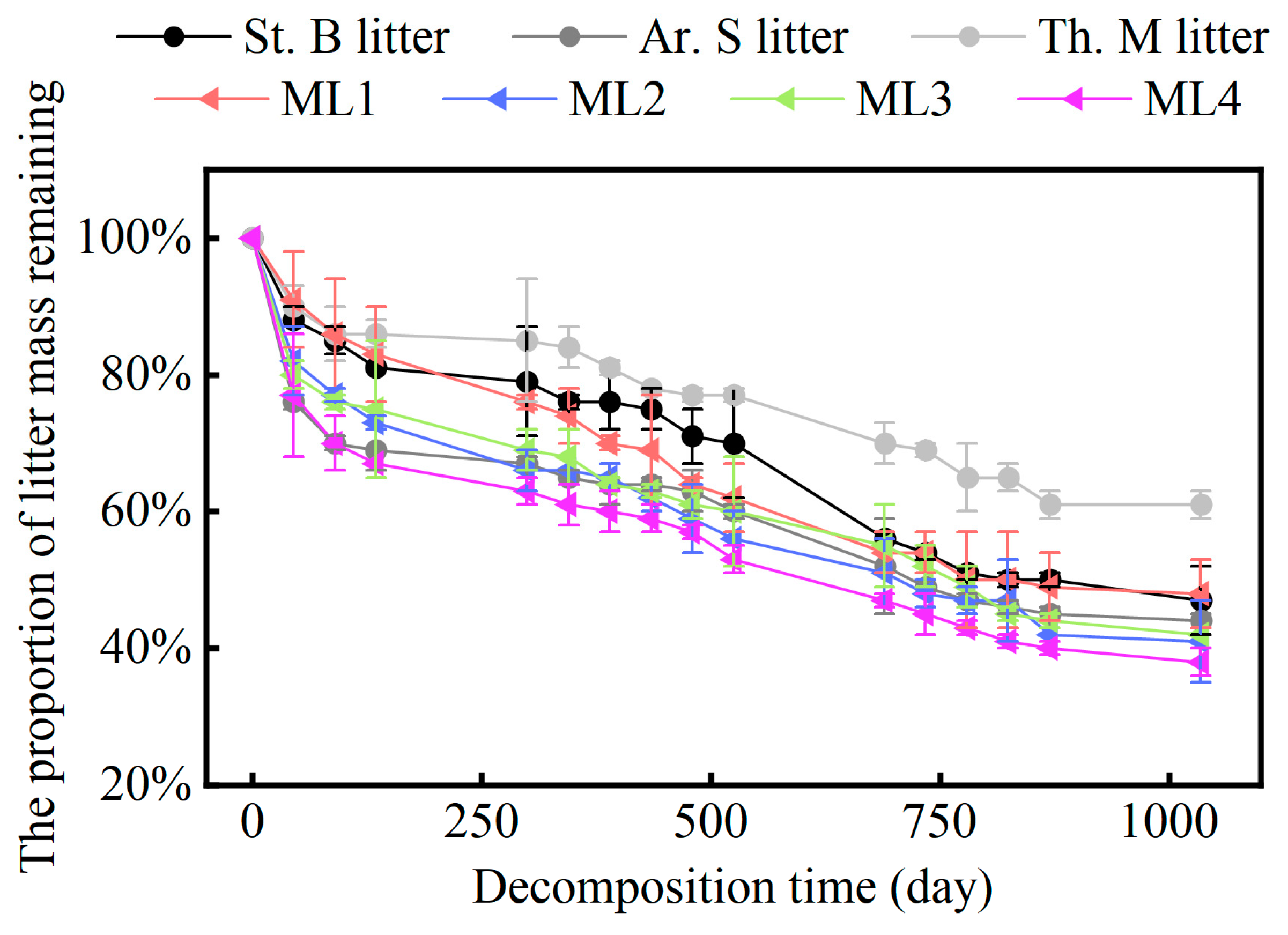
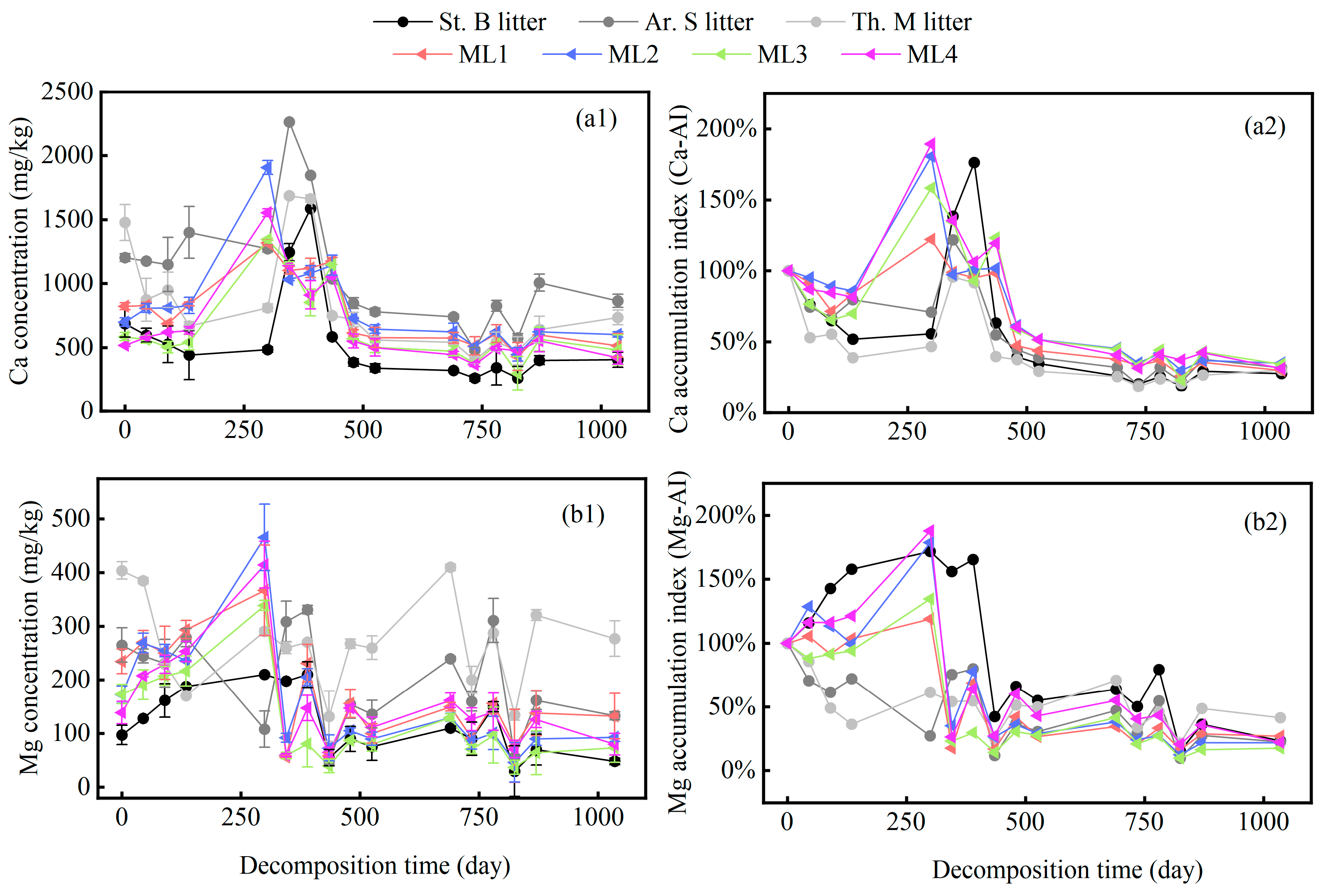
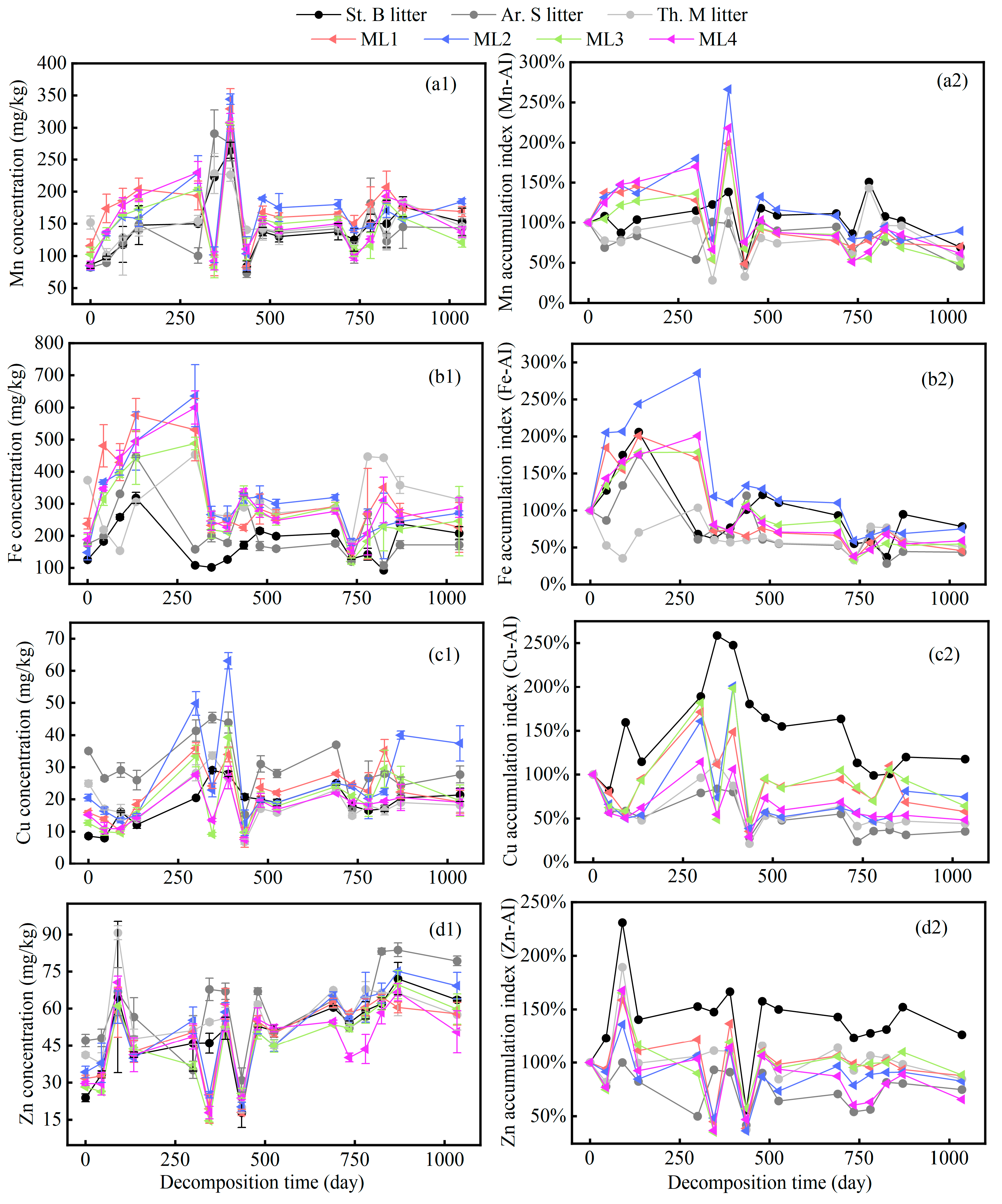
In grassland ecosystems, the decomposition of litter serves as a vital conduit for nutrient transfer between plants and soil. The aim of this study was to depict the dynamic process of grass litter decomposition and explore its major driver. Three typical grasses [Stipa bungeana Trin (St. B), Artemisia sacrorun Ledeb (Ar. S), and Thymus mongolicus Ronniger (Th. M)] were selected for long-term litter decomposition. Experiments were conducted using three single litters, namely, St. B, Ar. S, and Th. M, and four different compositions of mixed litter: ML1 (55% St. B and 45% Th. M), ML2 (55% St. B and 45% Ar. S), ML3 (75% St. B and 25% Th. M), and ML4 (75% St. B and 25% Ar. S). The dynamic patterns of mass and microelements (Ca, Mg, Fe, Mn, Cu, and Zn) within different litter groups were analyzed. Our findings indicated that, after 1035 days of decomposition, the proportion of residual mass for the single litters was as follows: Th. M (60.6%) > St. B (47.3%) > Ar. S (44.3%), and for the mixed groups it was ML1 (48.0%) > ML3 (41.6%) > ML2 (40.9) > ML4 (38.4%). Mixed cultivation of the different litter groups accelerated the decomposition process, indicating that the mixture of litters had a synergistic effect on litter decomposition. The microelements of the litter exhibited an initial short-term increase followed by long-term decay. After 1035 days of decomposition, the microelements released from the litter were, in descending order, Mg > Ca > Fe > Cu > Mn > Zn. Compared to the separately decomposed St. B litter, mixing led to an inhibition of the release of Ca (antagonistic effect), while it promoted the release of Mg, Cu, and Zn (synergistic effect). For the single litter, the stepwise regression analysis showed that Ca was the dominant factor determining early litter decomposition. Mg, Mn, and Cu were the dominant factors regulating later litter decomposition. For the mixed litter groups, Ca, Mn, and Mg were the dominant factors closely related to early decomposition, and TN emerged as a key factor regulating the mass loss of mixtures during later decomposition. In summary, nitrogen and microelements co-drive the decomposition of typical grass litter. Our study underscores that, in the succession process of grassland, the presence of multiple co-existing species led to a faster loss of plant-derived materials (litter mass and internal elements), which was primarily modulated by species identity and uniformity.
Keywords: litter mixture; litter mass remaining; microelement; non-additive effect litter mixture; litter mass remaining; microelement; non-additive effect