


Abstract
In this paper, a novel ionization energy, , set theory-based organizational structure is suggested: (i) iso-protonic sets, ; (ii) iso-electronic sets, ; and (iii) iso-ionic sets, . A computational algorithm is proposed which was demonstrated on twenty-five iso-electronic -sets plotted vs. the nuclear charge, Z. The algorithm allows for: (i) the interpolative assessment of 162 new (not measured) IE values, with their uncertainties estimated by the Lagrange method, for ions from 30Zn to 41Nb; and (ii) effective atomic nuclear charge assessment. It is shown that the IE effective atomic nuclear charge assessment is strongly correlated with the Slater’s effective charge and Pauling electronegativity scale.
1. Introduction
Measuring, calculating, and utilizing the ionization energy values of atoms and atomic ions are an integral part of physical sciences, as outlined in the recent review by P. Lang [1]. The majority of the original atomic spectroscopic experimental work was done in the mid-20th century [2,3,4].
Today, 118 chemical elements are known, the first 94 (up to plutonium) of which occur naturally on Earth [5]. Each chemical element, with the nuclear charge (atomic number) Z, can be thought to represent a set consisting of one atom and atomic ions, and with identical nuclei and varied number of electrons. Each member of the set has a well-defined, directly measurable ionization energy—IE. IE is defined as the energy required to extract the outermost electron from the ionic (atomic) shell. Thus, each chemical element can be associated with a set of Z number ionization energies. Thus, the 94 elements occurring naturally on Earth, have a total of 4465 IE values, which can be organized and categorized by different criteria. The number of IE values of atoms and atomic ions included in the latest, 105th edition (2024) of the CRC Handbook of Chemistry and Physics [6] is 770. Thus, approximately 17% of the IEs have been measured. Currently, all ionization energies are measured up to 29Cu, and all ionization energies up to ion 29+ of two elements: 36Kr and 42Mo.
This study is inspired by the questions: Is there a way for more IE values, and effective nuclear charges [7], to be assessed empirically? Is it feasible to utilize the experimentally measured 770 IEs to estimate values not yet measured, bypassing the complicated quantum electrodynamical “bottom-up” approach in multielectron systems?
This study proposes a set theory-based—IE values—analysis. Set theory is a branch of mathematical logic concerned with the study of sets, which are collections of objects (called elements). The set elements herein are the IE values. Thus, 26 iso-electronic sets are considered in this study. The largest set has 29 elements, and the smallest has six elements. The analysis of sets with less than six elements is less reliable and it is not considered herein. Furthermore, we propose systematic, analytical, comparative investigation of robust quadratic correlations of each isoelectronic set, with the nuclear charge Z. The proposed investigation assesses 162 new ( not measured) IE values via interpolation, with estimated uncertainties, for 11 chemical elements from 30Zn to 41Nb. For 13 chemical elements, IE values of one-electron ions, 12 keV, are assessed via extrapolation.
In addition, the iso-electronic analysis offers purely energy derived assessment of the effective nuclear charge, , allowing the reliable estimation of the uncertainty up to 35Br. The proposed IE derived effective nuclear charge values revealed strong linear correlation for the 2nd and 3rd period of the periodic table, with the Slater effective nuclear charge [8] and the Pauling electronegativity scale [9].
2. Proposed Novel Set Theory-Based Ionization Energy (IE) Organization
Traditionally, the IE values are designated by roman numerals called the order of ionization: I, II, III, IV, etc. Where the ionization energy of: an atom is I; a singly ionized atom (1+) ion—II; (2+) ion—III; (3+)—IV, etc. The first ionization energy was measured for all chemical elements up to Z = 108 [10]. Out of the 108 values, the smallest value is 4.07 eV (Z = 87) and the largest value is 24.59 eV (Z = 2). Usually the first ionization energies are presented as a function of the nuclear charge, where the pattern of increasing IE values along the periods can be noticed, with the maximum at the noble gases, followed by a drop at the first group elements [7].
This study proposes the following nomenclature for the ionization of energy values . The term suggests an IE value for a chemical element with the nuclear charge Z (lower left index), the number of screening electrons, s (lower right index), and the ionic charge i+ (upper right index). For example, the third ionization energy of Na III can be designated by the term: . Na is a chemical element with ; an electron is removed from an ion with the charge and the number of the screening electrons .
This study develops a set theory-based IE values analysis. All IE values from the periodic table can be grouped in one of three types of sets: (i) iso-protonic, ; (ii) iso-ionic,; and (iii) iso-electronic, . The iso-protonic and iso-ionic sets are described in Supplementary Materials S1. This study proceeds by illustrating the utility of the iso-electronic sets, yielding assessment of the unmeasured IE values and the effective atomic nuclear charge value.
The members of the sets have identical numbers of screening electrons, s. For example, the IE value set associated with ions with two screening electrons, , can be presented as:
A generalized -set can be written:
The first member of an -set is the IE value associated with an atom with the nuclear charge: , . The number of -sets that can be constructed is equal to the chemical elements in the periodic table, N, and .
This study investigates the correlation of the members of -sets with the nuclear charge, Z.
3. Methodology and Outcome for Extrapolative Assessment of 13 New IE Values of Hydrogen-like Ions
First, we consider the -set of all known IE values of the hydrogen atom and 28 hydrogen-like ions, [5], up to , Cu, which are plotted vs. the nuclear charge Z:
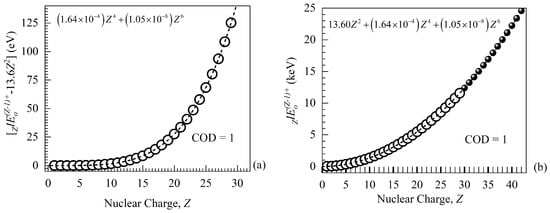
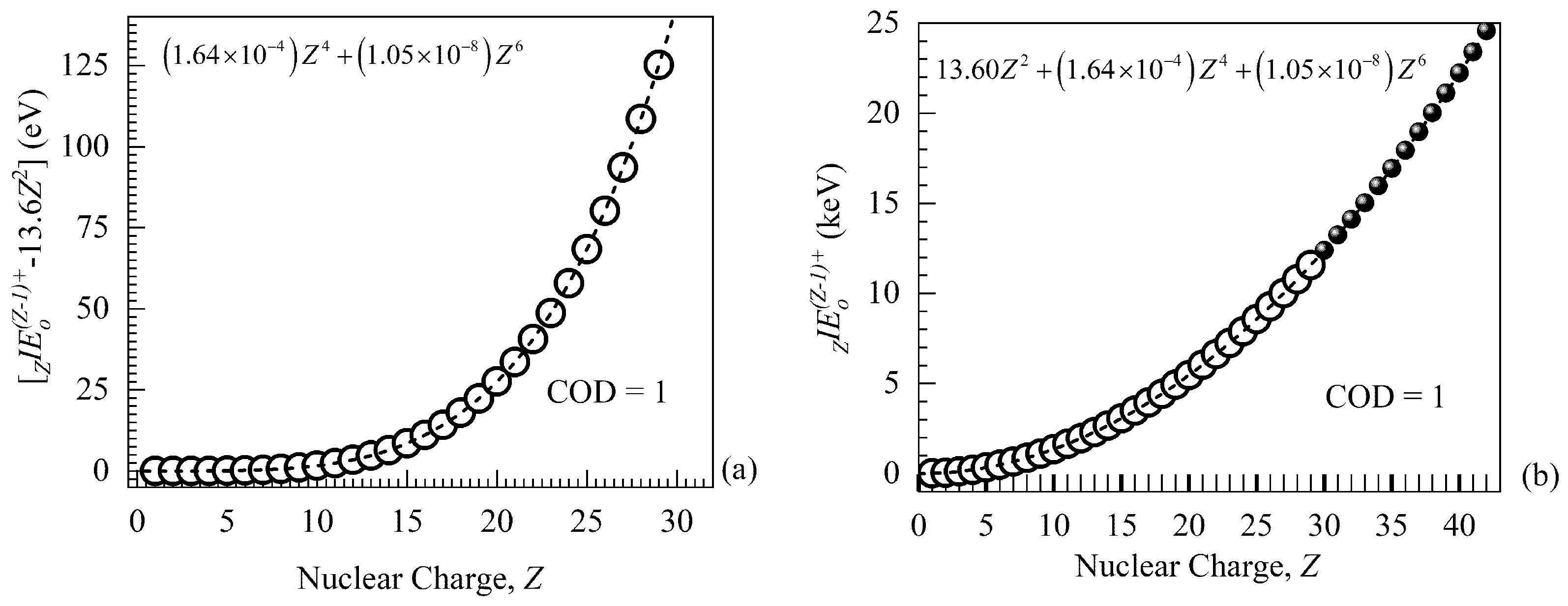
The data suggests that the quadratic fit of the experimental values might be deemed satisfactory up to . The parabolic fitting function is in agreement with Zener [10,11]. At Z = 9, the difference between the experimental value and Equation (2a) is ≈1 eV. Overall, it is noted that the experimental values are consistently larger than the values assessed by Equation (2a), and the difference, increases with Z, reaching 125 eV for Cu, . We further investigated the difference vs. Z, plotted in Figure 1a.
Figure 1.
(a) The difference between the experimental5 and Equation (2a) values plotted vs. Z. (b) The known (open circles) and the assessed new values (bullet points) of -set plotted vs. Z. The fitting functions and the coefficients of determination COD are listed.
Based on the function of the difference data, Figure 1a, Equation (2b) yields much better accuracy with the experimental data.
Most importantly, the fourth and the sixth power terms are in agreement with the relativistic kinetic energy corrections to the hydrogen-like ions [11]. The inclusion of the sixth power allows for better absolute value accuracy, ≈0.7 eV, for the highest experimentally measured value of the hydrogen-like ion, Cu, .
Finally, the open circles in Figure 1b summarize all known single-electron ion values, plotted vs. the nuclear charge, Z fitted with Equation (2b). A robust coefficient of determination, COD = 1 (>14 nines), allows us to assess 13 new values— to —which are plotted in Figure 1b with black bullet points. The extrapolated, numerical values are listed in Table 1. For further extrapolation of IE values, Z > 42, more expansion coefficients might be needed.
Table 1.
Chemical element; nuclear charge, Z; extrapolated, hydrogen-like ions values (keV); total of 13 IE values, Equation (2b), with uncertainties ≈ 1 eV.
4. Methodology and Outcome for Interpolative Assessment of 162 New IE Values of Multielectron Ions
In addition to the above-discussed -set, 462 IE data points, ref [2], grouped in 25 iso-electronic -sets, Equation (3a), are discussed. There are two important outcomes when analyzing -sets: (i) unknown IE values can be assessed through interpolation and (ii) atomic effective nuclear charge can be evaluated.
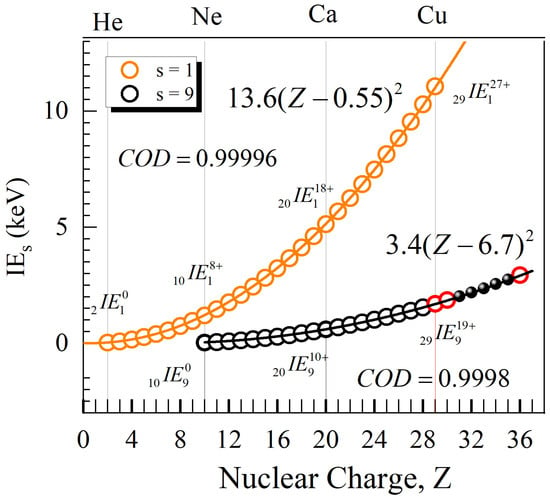
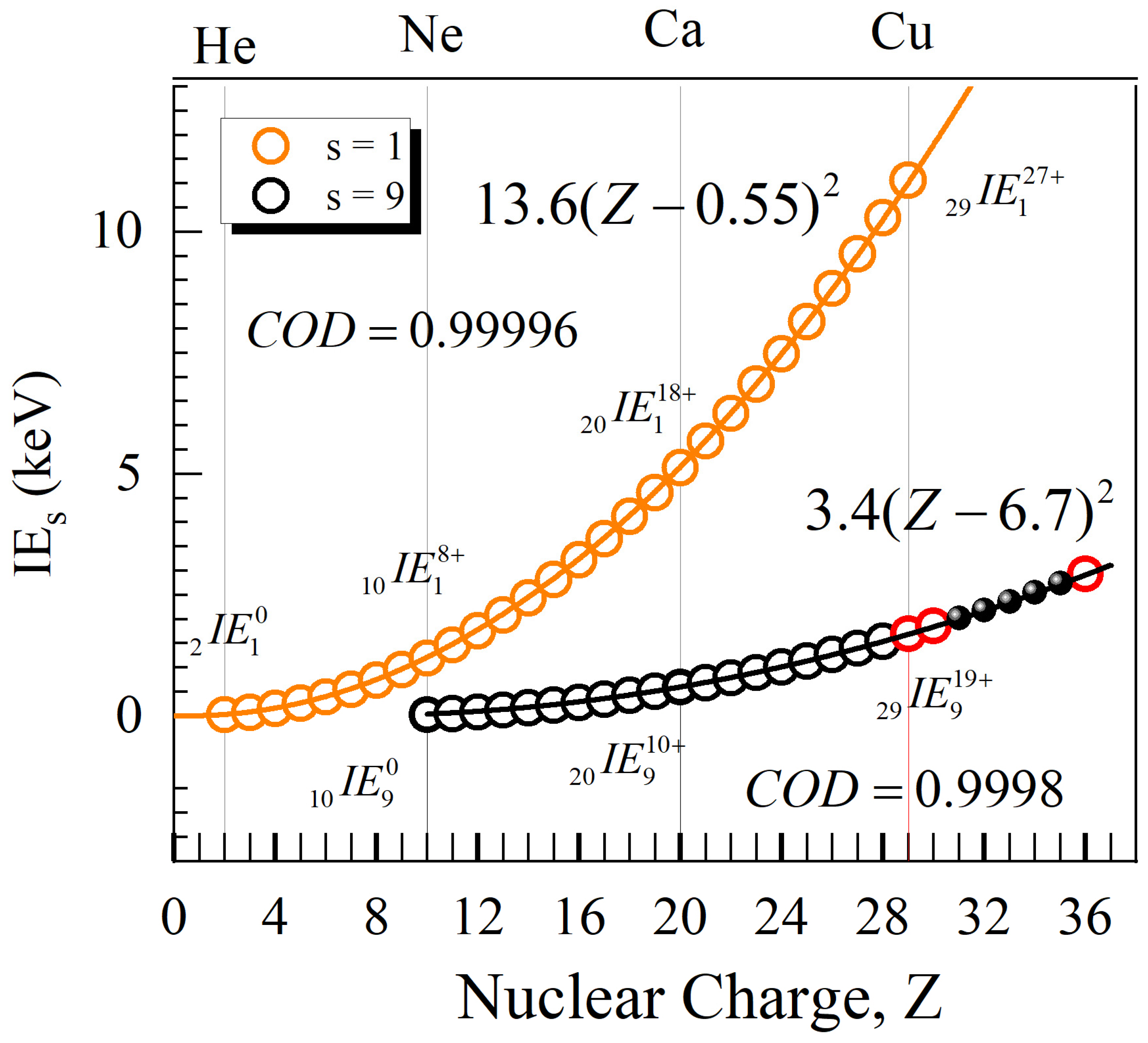
The analysis procedure is illustrated with the two -sets: (i) two-electron ions (one screening electron, s = 1), , which are plotted as orange symbols in Figure 2:
and (ii) 10-electron ions (9 screening electrons, s = 9) , which are plotted as black symbols in Figure 2:
Figure 2.
IE values [2] correlated with the nuclear charge, Z for -set, Equation (3a)—orange open symbols and -set, Equation (3b)—black/red open symbols. Parabolic fit analytic expression for each series is listed. The atoms, and atomic ions IE notations of He, Ne, Ca, and Cu are listed for clarity.
Each series starts with the ionization energy of a neutral atom, first ionization energy, (He) and (Ne). The last known ionization energy in this set is the XXVIII ionization energy of Cu-. All energies listed in the set are known (measured). However, there are five unmeasured values in the -set namely: .
The fact that the last value (XXVII ionization energy of Kr) is measured plays an important role in our considerations. This allows for the interpolative assessment of the missing five values.
The set members in Equation (3a,b) are plotted vs. nuclear charge, , in Figure 2. Furthermore, the and sets are fitted with the quadratic form:
where , and are the two fitting parameters. is in eV and represents the screening charge produced by s number of electrons. For fitting the isoelectronic experimental IE values sets, [5], we used a simple quadratic expression, yielding a strongly satisfactory coefficient of determination value, COD > 0.9993. The author is unaware of an accepted methodology which accounts for the exchange and orbital energies, residual interactions, relativistic kinetic energy, spin–orbit coupling, Darwin term, and other quantum electrodynamic effects of the multielectron isoelectronic series [12]. Thus, further investigation of the physical plausibility of the quadratic form and the expected limit of its validity is outside of the scope of this study. We concur with published studies [12] suggesting a strong case for the implementation of a simple quadratic expression for the purposes of interpolative assessment of IE values neither calculated nor experimentally measured yet. Furthermore, uniform fitting of all 25 series allows for reliable comparative empirical assessment of the screening charge, S.
The values of the fitting parameters , and are listed in Figure 2. The coefficient of determination, COD > 0.999 is included in Figure 2 as well. The COD values strongly support the appropriateness of the fitting Equation (4). Therefore, all members of a specific -set can be associated with one and the same screening charge. Furthermore, from , a linear transformation is proposed for evaluating the effective nuclear charge of the neutral atoms, vide infra.
This study proceeds with an interpolative assessment of the new IE values. For a more accurate numerical assessment of the new (unmeasured) IE values, three points bracketing the Z range were selected to be interpolated, e.g., the red bold open symbols in s = 9 trace in Figure 2.
For example, a quadratic fit was used for the local, three points bracketing the interpolation area, with the goal of producing a more accurate assessment of non-measured, ionization energies—as can be seen by the five black bullet points in the -set, Figure 2. Furthermore, the uncertainty of the interpolated values is determined via the Lagrange method [13]. The uncertainty in the last decimal place is presented in parenthesis after the value.
In general, utilizing Equation (4) it is possible to assess, via extrapolation, the ionization energies for atomic ions from the isoelectronic series discussed herein, with . However, assessing the uncertainty might be difficult.
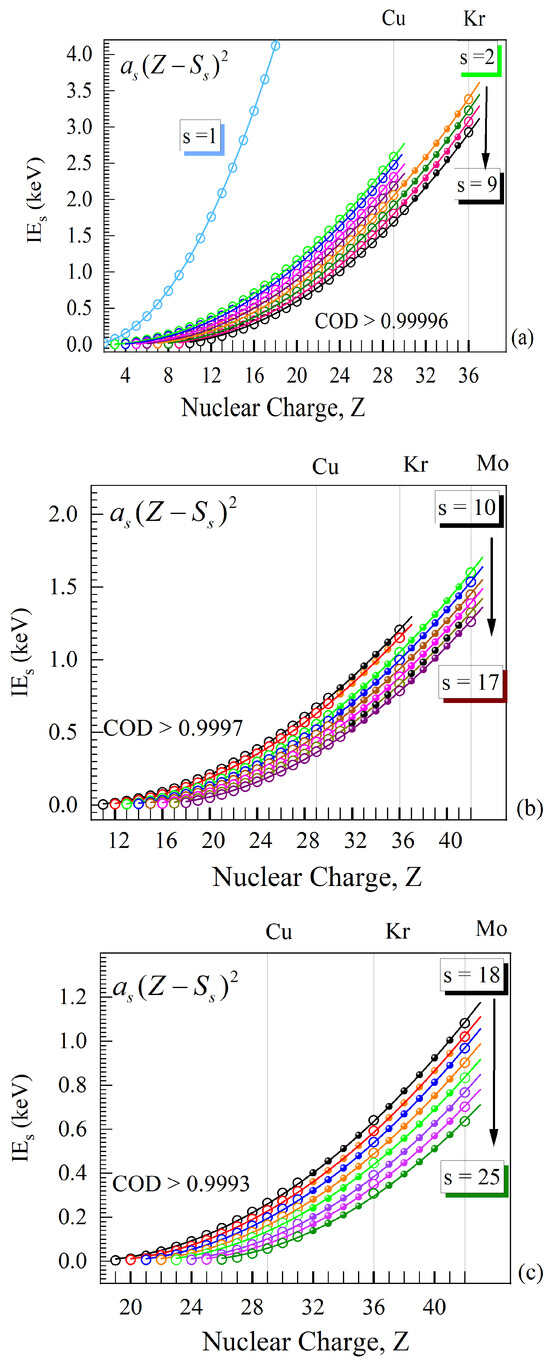
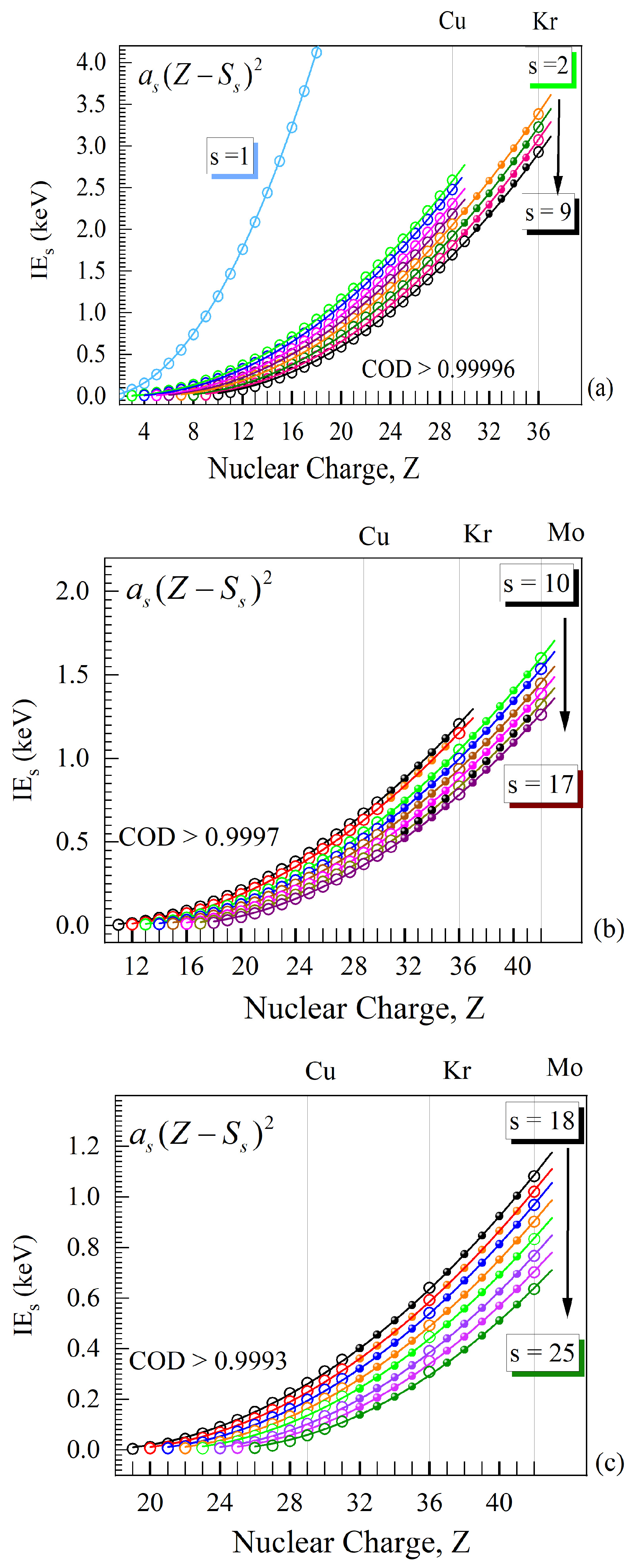
The analysis followed the procedure described above for the investigation 25 isoelectronic series, Figure 3. All isoelectronic series are fitted with parabolas, Equation (4).
Figure 3.
Ionization energies [2], keV, as a function of the nuclear charge, Z, of isoelectronic atomic ions series, s (known values, open circles) with: (a) ; (b) ; and (c) ; quadratic fit lines correspond to each isoelectronic series, the minimum coefficient of determination (COD) is listed; interpolated values are included (bullet points).
The two fitting coefficients in Equation (4), along with their uncertainties, COD, and the number of points in each parabolic fit, are listed in Table S1. The high coefficient determination of the fits, , allows for assessing the missing 162 IE values of 11 chemical elements—between 30Zn and 41Nb. The assessed new IE values are included in Figure 3 as bullet points, in the same color as the measured IE values. The numerical values, in eV, of the interpolated data points are listed in Tables S2–S5 with the uncertainty in parentheses after the last decimal place. The uncertainties of the interpolated values, indicated in Figure 4 are within the size of the bullet points.
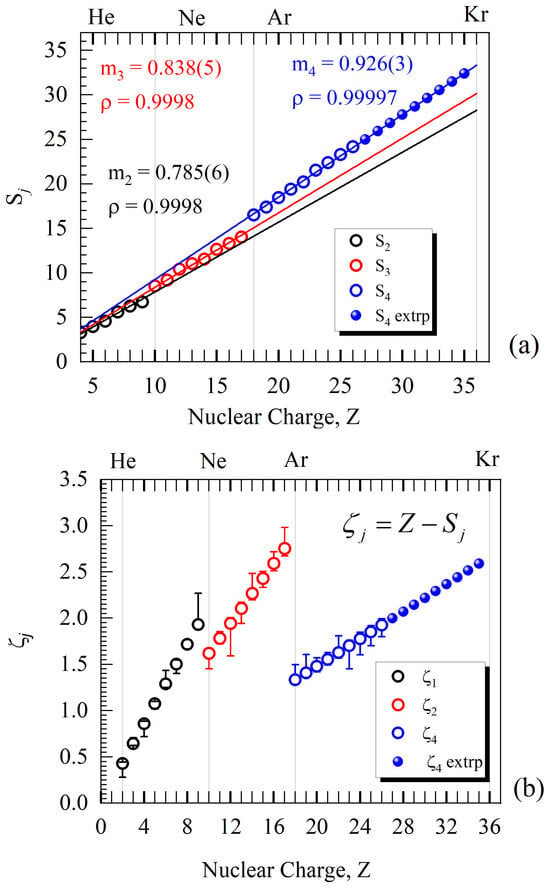
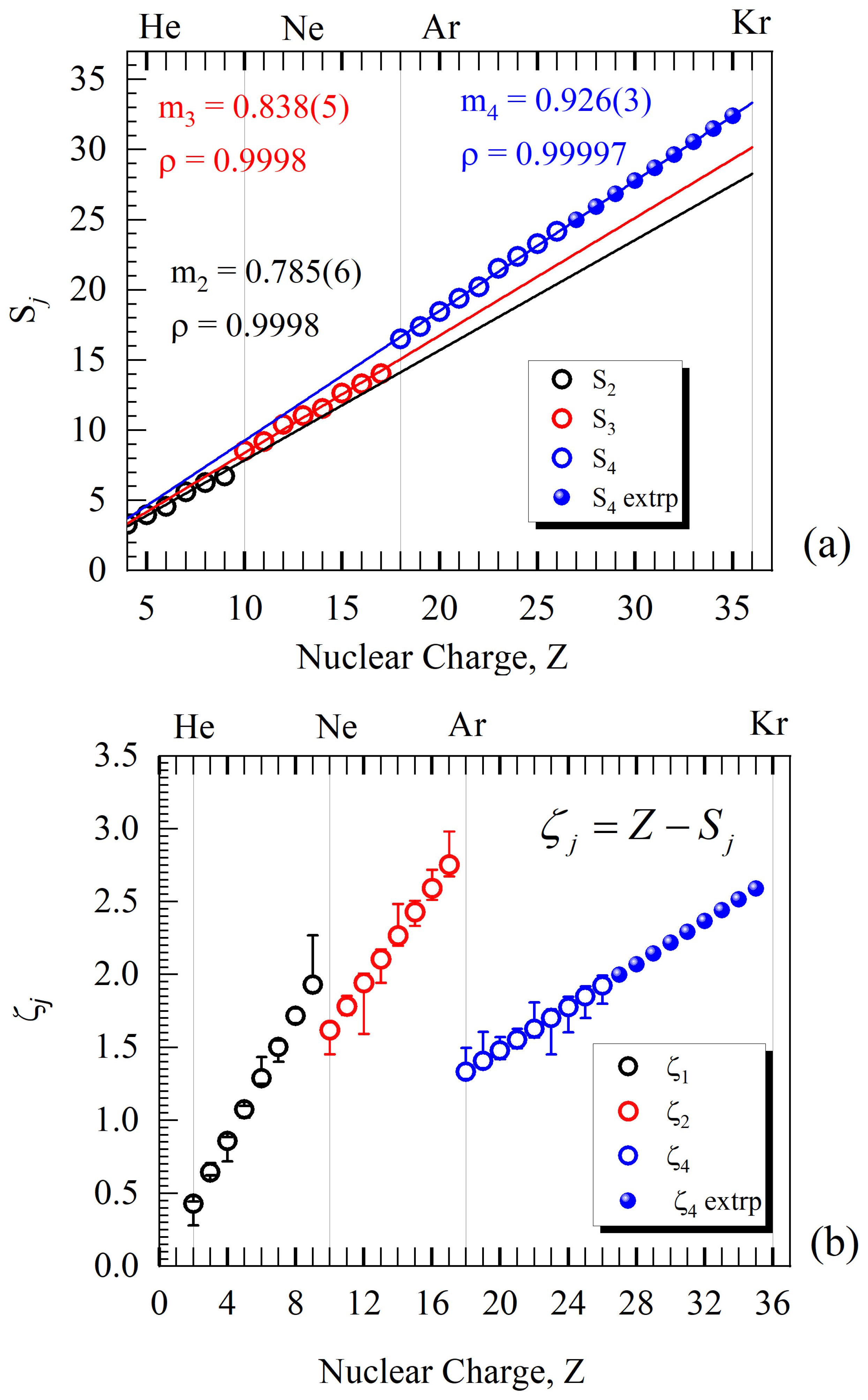
Figure 4.
(a) Fitting parameter, S and (b) phenomenologically assessed atomic effective nuclear charge ζ, vs. the nuclear charge Z. All points are color coded by the period, (index j): black open circles—2nd period; red open circles—3rd period; blue open circles—4th period; the blue bullet points are linearly extrapolated values up to Kr.
Finally, we summarize the number of assessed IE values per chemical element. The number of known IE values [6] per chemical element are also listed for comparison, Table 2. Overall, 168 IE values are measured, while 162 IE values are assessed herein, .
Table 2.
Chemical element, nuclear charge, number of interpolated IE values from this study, and known IE values [6].
5. Methodology and Outcome for Phenomenological Effective Nuclear Charge Assessment
The 25 isoelectronic series fits yield 25 values, Table S1. The first member of every -set is the first ionization energy of a neutral atom with a nuclear charge . The values are plotted vs. the nuclear charge, Z, in Figure 4a.
It was noted that the fitting parameter Ss was revealed to be linearly correlated with the atomic number, Z, with a robust Pearson’s correlation factor, ρ > 0.9997, for 2nd, 3rd and 4th periods of the periodic table. The periods are color coded, and the period number is indicated by the subscript of the slope, (). As expected, the slope remains less than one. It can be projected that in higher number periods, the slope will asymptotically approach one. Overall, it can be suggested that, statistically, more electrons screen the nucleus more efficiently. The effective atomic nuclear charges, , where the index j, indicates the period, is assessed herein from the linear fit values expressed in the effective nuclear charge definition: , Figure 4b. The indicated larger uncertainty reflects the point’s residue from the linear regression. Effective nuclear charge values are listed in Table S6. Extrapolated values are listed in Table S7.
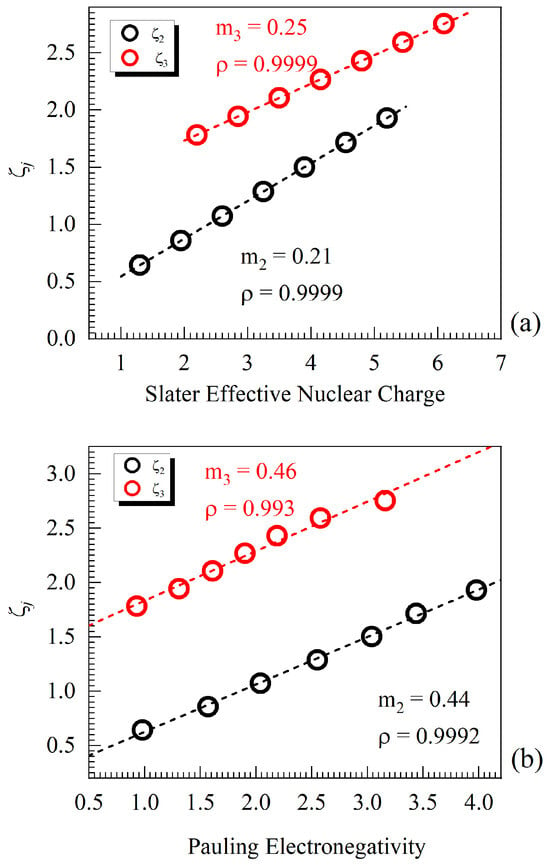
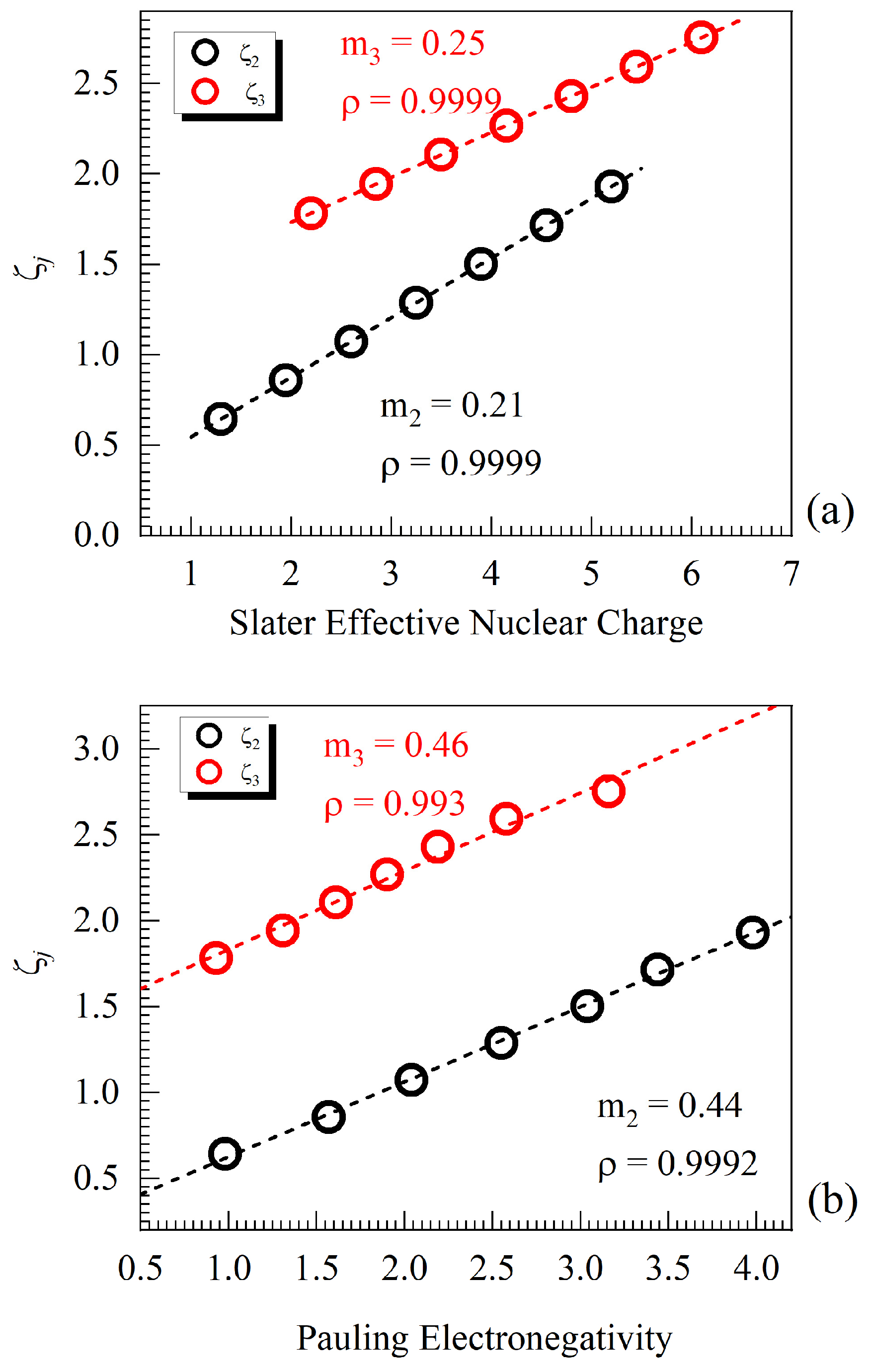
In a paper published in 1930, Slater proposed an assessment of the effective nuclear charge, . Slater’s study was based on different weights of the electron wave functions (s p, d, f) and on assigning a parameter called effective quantum number, [8]. Thus, Slater’s treatment can be considered a “bottom-up” approach, while the proposed herein -sets consideration is deemed “top-down” approach. Most importantly, there is a strong linear correlation between Slater’s atomic effective nuclear charge, , and the same parameter assessed independently from the -set analysis proposed herein, Figure 5a. In addition, the -set analysis exhibits a robust correlation with the Pauling relative electronegativity scale [14] for the 2nd and 3rd periods, Figure 5b.
Figure 5.
IE assessed parameter ζj, correlated (a) with Slater effective nuclear charge and (b) Pauling electronegativity scale; 2nd (black open circles) and 3rd (red open circles) period, solid symbols, not included in the linear fit (black and red dashed lines); slope and the Pearson’s are listed.
6. Conclusions
A novel, set theory-based ionization energy computational algorithm is proposed. The isoelectronic -sets are fitted with parabolic curves allowing for: (i) the interpolative assessment of 162 new IE values of ionization energies, with their uncertainties estimated by the Lagrange method—for ions from 30Zn to 41Nb. In addition, 13 values of single-electron ions are estimated via the extrapolation of a proposed expanded parabolic function. (ii) The phenomenologically assessed parameter ζj strongly correlates with the effective atomic nuclear charge, Slater’s effective charge, and the Pauling electronegativity.
Supplementary Materials
The following supporting information can be downloaded at: https://www.mdpi.com/article/10.3390/atoms14030015/s1, Supplementary Materials S1 includes the proposed set theory-based ionization energy organization—iso-protonic and iso-ionic sets; its utilization is outside of the scope of the current study. Supplementary Materials S2 includes all numerical values with its uncertainties assessed in the discussion, systematized in eight tables: Table S1. The fitting parameters of the parabolic fits, Equation (4). The COD of each fit and number of the points used for fitting are also listed; Tables S2–S5: Interpolated IE values with their uncertainties assessed by the Lagrange method, Figure 2 and Figure 3 bullet points. Table S6. IE effective charge, values and the assessed uncertainties; Table S7. Extrapolated IE effective charge, values, for 35 > Z > 26; Figure 4b.
Funding
This research received no external funding.
Data Availability Statement
The data that supports the findings of this study are available within the article and its Supplementary Material.
Conflicts of Interest
The author declares no conflict of interest.
References
- Lang, P.F. Measurement, Calculation, and Applications of Ionization Energies and Electron Affinities of Hydrogen and Atomic Ions. Mon. Chem. 2023, 154, 709–716. [Google Scholar] [CrossRef] [Scilit]
- Moore, C.E. Ionization Potentials and Ionization Limits Derived from the Analyses of Optical Spectra; National Bureau of Standards: Washington, DC, USA, 1970; Volume 34. [Google Scholar]
- Martin, W.C.; Zalubas, R.; Hagan, L. Atomic Energy Levels—The Rare Earth Elements. (the Spectra of Lanthanum, Cerium, Praseodymium, Neodymium, Promethium, Samarium, Europium, Gadolinium, Terbium, Dysprosium, Holmium, Erbium, Thulium, Ytterbium, and Lutetium). [66 Atoms and Ions]; PB-282067; NSRDS-NBS-60; The Manchester College of Science and Technology, Department of Chemistry: Manchester, UK, 1977. Available online: https://www.osti.gov/biblio/6507735 (accessed on 19 August 2025).
- Sugar, J.; Corliss, C. Atomic Energy Levels of the Iron-Period Elements: Potassium through Nickel; PB-86-165446/XAB; American Chemical Society: Washington, DC, USA, 1984. Available online: https://www.osti.gov/biblio/6008300 (accessed on 13 November 2025).
- Thornton, B.F.; Burdette, S.C. Neutron Stardust and the Elements of Earth. Nat. Chem. 2019, 11, 4–10. [Google Scholar] [CrossRef] [Scilit] [PubMed]
- Rumble, J.R. (Ed.) Ionization Energies for Atoms and Atomic Ions. In CRC Handbook of Chemistry and Physics; CRC Press: Boca Raton, FL, USA, 2024; pp. 2–5. [Google Scholar]
- Atkins, P. Shriver and Atkins’ Inorganic Chemistry; OUP: Oxford, UK, 2010. [Google Scholar]
- Slater, J.C. Atomic Shielding Constants. Phys. Rev. 1930, 36, 57–64. [Google Scholar] [CrossRef] [Scilit]
- Viswanathan, B.; Gulam Razul, M.S. Relating Screening to Atomic Properties and Electronegativity in the Slater Atom. Found. Chem. 2023, 26, 89–113. [Google Scholar] [CrossRef] [Scilit]
- Kramida, A.; Ralchenko, Y.; Reader, J.; NIST ASD Team. NIST Atomic Spectra Database, version 5.12; NIST ASD Team: Gaithersburg, MD, USA, 2024. [CrossRef] [Scilit]
- Wirnata, R. Relativistic Corrections to Hydrogen-like Atoms; Institute for Theoretical Physics TU Freiberg: Freiberg, Germany, 2016. [Google Scholar]
- Lang, P.F.; Smith, B.C. Methods of Calculating Ionization Energies of Multielectron (Five or More) Isoelectronic Atomic Ions. Sci. World J. 2013, 2013, 157412. [Google Scholar] [CrossRef] [Scilit] [PubMed]
- White, D.; Saunders, P. Propagation of Uncertainty on Interpolated Scales, with Examples from Thermometry. Metrologia 2003, 37, 285. [Google Scholar] [CrossRef] [Scilit]
- Pauling, L. The Nature of the Chemical Bond IV. The Energy of Single Bonds and the Relative Electronegativity Od Atoms. J. Am. Chem. Soc. 1932, 54, 3570–3582. [Google Scholar] [CrossRef] [Scilit]

Disclaimer/Publisher’s Note: The statements, opinions and data contained in all publications are solely those of the individual author(s) and contributor(s) and not of MDPI and/or the editor(s). MDPI and/or the editor(s) disclaim responsibility for any injury to people or property resulting from any ideas, methods, instructions or products referred to in the content. |
© 2026 by the author. Licensee MDPI, Basel, Switzerland. This article is an open access article distributed under the terms and conditions of the Creative Commons Attribution (CC BY) license.