


Abstract
The Andromeda galaxy (M31) is the nearest massive spiral galaxy and is expected to reside in an extended dark matter (DM) halo, making it a useful target for indirect dark matter searches with - rays. In this study, we perform a template-based Fermi-LAT search for emission from annihilating and decaying dark matter in M31 using Pass 8 data over 17 years. The analysis considers both the and final states for DM masses between and . We compare three representative M31 halo models, denoted MIN, MED, and MAX, that bracket uncertainties in the smooth halo profile and in the substructure contribution, and we quote the MED model as our reference. No DM signal is claimed; instead, we derive 95% confidence-level bounds: upper limits on and lower limits on the decay lifetime. For the channel, the annihilation limits span – and the decay-lifetime lower limits span –; for the channel the corresponding ranges are – and –. We compare our results with existing experimental constraints. The results are complementary to high-mass M31 searches with HAWC and illustrate that the spatial morphology of the halo, not only the total astrophysical factor, is an important systematic in M31 DM constraints.
1. Introduction
The existence of DM is supported by a wide range of astrophysical and cosmological observations, including galactic rotation curves, gravitational lensing, the cosmic microwave background, and large-scale structure formation. [1,2,3,4,5] Despite decades of experimental effort, the particle nature of dark matter remains unknown. Among the leading candidates are weakly interacting massive particles (WIMPs), which can self-annihilate or decay into Standard Model particles, producing a potentially observable flux of -rays, neutrinos, and charged cosmic rays [6,7,8,9].
Indirect detection with -rays is particularly promising because photons travel unimpeded through the Galaxy and retain spectral information about the underlying particle-physics process. The Fermi Large Area Telescope (Fermi-LAT) [10] has conducted extensive searches for DM signals from a variety of astrophysical targets [11,12,13,14,15]. The most stringent constraints to date come from the stacked analysis of Milky Way dwarf spheroidal galaxies [12,16,17,18], which benefit from low astrophysical backgrounds and well-measured stellar kinematics. Complementary searches have targeted the Galactic center [13,19], the Large Magellanic Cloud [20], individual nearby galaxies [11], high-energy emission from extended targets with water-Cherenkov instruments such as HAWC [21,22], and IACT observations of dwarf galaxies [23,24,25]. Each target class involves a different trade-off between the expected signal strength (encoded in the astrophysical J-factor for annihilation or D-factor for decay) and the systematic uncertainties arising from background modeling.
The M31 [11,26,27,28,29] occupies a distinctive position among these targets. At a distance of approximately 780 kpc, it is the nearest large spiral galaxy and is spatially extended on the sky, with an angular diameter of several degrees. This extended morphology offers a key advantage: the DM signal is distributed over a large solid angle, reducing the sensitivity to point-source contamination and to the detailed modeling of the central few kiloparsecs that complicates Galactic center analyses. M31 also has a well-established halo mass and density profile constrained by rotation-curve measurements, stellar kinematics, and satellite dynamics [30,31,32,33]. Unlike unidentified subhalo candidates whose distances, masses, and even existence as DM subhalos remain uncertain, M31 is a confirmed galaxy with a securely measured astrophysical context. These advantages make M31 a valuable laboratory for testing DM models in an extended extragalactic halo.
At the same time, M31 presents significant challenges. Its central region harbors bright diffuse gamma-ray emission that has been detected by Fermi-LAT, and its location at low Galactic latitude () places it against a structured Galactic diffuse foreground. Several cataloged point sources lie within or near the M31 optical disk, and the overlap between plausible DM spatial templates and the central M31 emission can introduce degeneracies in the likelihood fit. These challenges motivate a careful treatment of the background model, the spatial morphology of the DM template, and the halo-profile systematics that enter the final constraints.
The expected gamma-ray flux from DM annihilation or decay factorizes into a particle-physics term and an astrophysical term. For annihilation, the flux scales with the velocity-averaged cross section and integrated along the line of sight (the J-factor); for decay, it scales with the inverse lifetime and (the D-factor). Because the spatial distribution of dark matter within M31 is not precisely known, the choice of halo density profile directly affects both the overall normalization (the total J- or D-factor) and the spatial morphology of the template, which in turn influences the degeneracy with background components in the likelihood fit. Disentangling these two effects is essential for a reliable interpretation of the limits.
In this study, we present an updated, template-based search for emission from annihilating and decaying dark matter in M31 using approximately 17.3 years of Fermi-LAT Pass 8 (P8R3) data from 500 MeV to 500 GeV. The analysis is performed over a region of interest centered on M31 within a binned-likelihood framework in which the DM template and all background components are fitted simultaneously, extending the earlier Fermi-LAT analysis of M31 [11] with a longer data set and an explicit treatment of halo-profile systematics. We consider the and final states for both annihilation and decay, with WIMP masses between and . Uncertainties in the smooth halo profile and in the substructure contribution are bracketed by three representative models, denoted MIN, MED, and MAX, with the MED model quoted as our reference. We find no statistically significant DM signal and instead derive 95% confidence-level upper limits on the annihilation cross section and lower limits on the decay lifetime . The resulting constraints are complementary to high-mass M31 searches with HAWC [22] and demonstrate that the spatial morphology of the halo, not only its integrated astrophysical factor, is an important systematic in M31 DM searches.
The remainder of this paper is organized as follows. Section 2 describes the Fermi-LAT data set, the DM signal model, and the template normalization and fitting procedure. Section 3 reports the annihilation and decay limits and compares them with existing constraints. Finally, we conclude and discuss the implications and future work in Section 4.
2. Data and Methodology
2.1. Fermi-LAT Data Set
We use Pass 8 (P8R3) [34,35] Fermi-LAT data spanning approximately 17.3 years of observations (MET 239557417–785293911, corresponding to 4 August 2008 to 17 November 2025), covering the full energy range of the LAT from 500 MeV to 500 GeV. The region of interest (ROI) is a square centered at Galactic coordinates , which encompasses M31 and a large surrounding area for background characterization. A compact ROI of the size typically used for approximately point-like targets such as dwarf spheroidal galaxies would not encompass the extended DM templates, and it would leave the normalization of the Galactic diffuse foreground, which is significant at the low Galactic latitude of M31, degenerate with the extended template. The ROI instead provides a large off-source region over which the diffuse components are constrained independently of the DM signal. The data are binned into a pixel count map in AIT (Aitoff) projection with a pixel size of , using 30 logarithmic energy bins (10 bins per decade) from to .
The analysis employs the standard Fermi Science Tools [36,37,38] binned likelihood framework. The spacecraft data file is used to construct the livetime cube and binned exposure map, both of which are precomputed and held fixed for all analysis configurations. The instrument response functions (IRFs) are selected automatically via the CALDB keyword, corresponding to the P8R3_SOURCE_V3 event class with no PSF event-type partitioning (evtype=INDEF). We deliberately combine all PSF event types for the following reasons: (a) the expected M31 signal is extended over several degrees, so the additional point-source-like angular resolution provided by the PSF-split event classes yields little benefit; (b) including all event types maximizes the photon statistics, which drives the sensitivity of the analysis to a weak, extended signal; and (iii) it allows a single set of IRFs and a single precomputed background source map to be used for the entire analysis.
The background model includes the standard Galactic diffuse emission template (gll_iem_v07 [39,40]), the isotropic diffuse and residual cosmic-ray background (iso_P8R3_SOURCE_V3_v1 [39,41]), and all point sources from the 4FGL-DR3 catalog [39] within and near the ROI. The complete background source-map file is precomputed once using gtsrcmaps and held fixed. For each DM mass and halo profile, a separate DM source map is generated with gtsrcmaps and merged with the precomputed background source map prior to the likelihood fit. This strategy avoids recomputing the expensive background source maps while allowing the DM component to vary across the full grid of masses, profiles, and channels.
2.2. DM Signal Model
The differential photon flux from DM annihilation or decay can be expressed as the product of a particle-physics factor and an astrophysical factor [42,43,44,45]. The astrophysical factor is the line-of-sight integral of the DM density along the direction of observation, i.e., the J-factor for annihilation [46,47] and the D-factor for decay [48,49]. For annihilation, the differential photon flux is written as
For decay, the corresponding expression is
Here is the DM mass, the velocity-averaged annihilation cross section, the decay lifetime, the gamma-ray yield per annihilation or decay, and the attenuation factor due to extragalactic background light (EBL) absorption. For the gamma-ray energies considered here (≲1 TeV) and the very small distance of M31 (∼780 kpc, ), the EBL optical depth is [50,51], and this attenuation is therefore negligible. The solid-angle element is integrated over the region of interest centered on M31.
The astrophysical factors are defined as line-of-sight integrals over the DM density :
The total J- and D-factors are obtained by integrating over the solid angle of the region of interest.
We adopt three halo models for M31, labeled MIN, MED, and MAX, corresponding to a Burkert profile, an Einasto profile, and an adiabatically contracted NFW profile, respectively [52,53,54]. These three models span the range from conservative to optimistic DM density assumptions. They do not imply a hierarchy of the final fitted limits: for decay the integrated D-factor is not even ordered in the same way (the MAX D-factor is the smallest of the three, Table 1), and in both channels the fitted normalization is governed by how well the template shape matches the data rather than by the size of the astrophysical factor. Mass- and channel-dependent crossings of the three limit curves are therefore expected and carry no physical contradiction.
Table 1.
Parameters of the three M31 DM halo models (MIN, MED, and MAX) used in this analysis: the smooth density profile, the subhalo mass-function index , the substructure mass fraction , the minimum subhalo mass , and the total J- and D-factors.
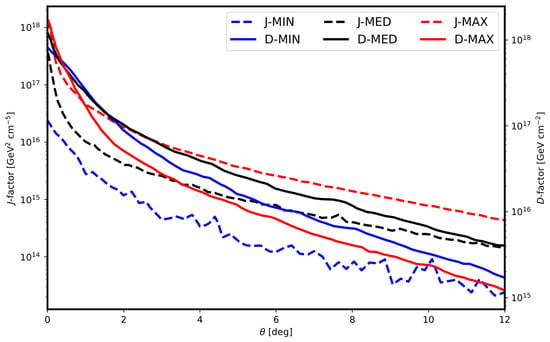
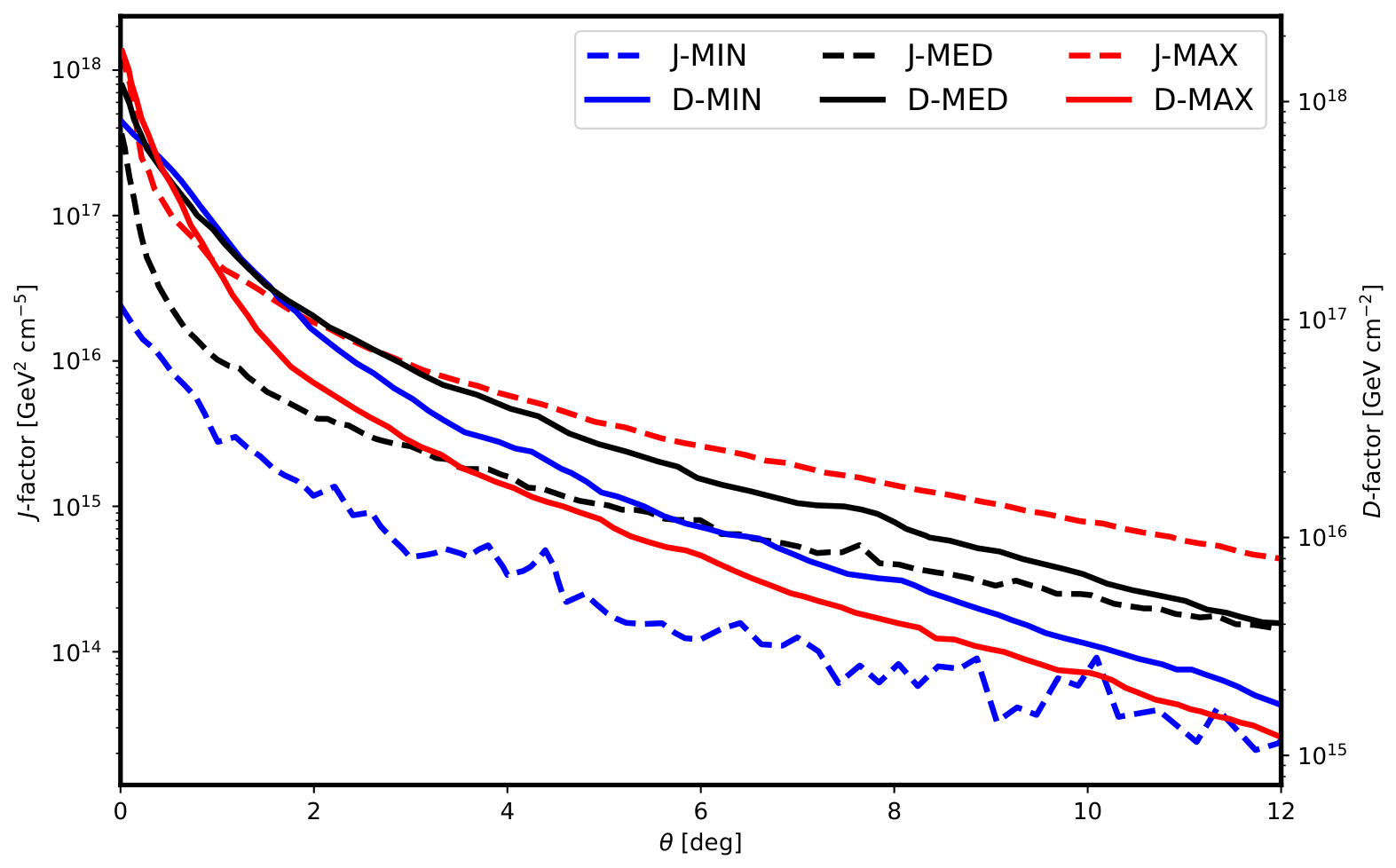
The spatial templates for each model are constructed from digitized or radial profiles extending to ∼ and interpolated onto the analysis pixel grid. The total J- and D-factors are integrated over a region () centered on M31 at a nominal distance of 780 kpc, following the HAWC M31 analysis [22]; within this region the J-factor decreases by about two orders of magnitude, so the contribution beyond is subdominant. The templates are normalized to a unit solid angle in the likelihood fit, so their angular extent is decoupled from the total factors, which enter only when converting the fitted normalization to physical limits (Section 2.3). These values, together with the subhalo-population parameters, are summarized in Table 1. In addition to the smooth component, each model includes a subhalo population characterized by the subhalo mass-function index (with ), the substructure mass fraction , and the minimum subhalo mass . Larger and smaller increase the number of subhalos and hence the annihilation J-factor, whereas the decay D-factor depends mainly on the virial mass . The three models also differ in their degree of central concentration: MAX yields the largest J-factor but the smallest D-factor because the weighting enhances the contribution from the dense inner region, whereas MIN gives the opposite trend with the most extended mass distribution.
The radial profiles are shown in Figure 1. The MIN/MED/MAX terminology follows the bracketing strategy used in the HAWC M31 DM analysis [22]: MIN is a conservative, cored Burkert-like model with a small annihilation J-factor; MED is an Einasto benchmark model motivated by M31 halo fits; and MAX is an optimistic, centrally concentrated adiabatically contracted NFW model. The present analysis treats the three templates as a compact way to propagate both smooth-profile and substructure uncertainties into the Fermi-LAT likelihood fit.
Figure 1.
Radial profiles of the J-factors (solid lines) and D-factors (dashed lines) using the three templates of M31.
2.3. Template Normalization and Fitting Procedure
For each of the three M31 DM models (MIN, MED, and MAX), we construct a separate spatial template for annihilation and for decay. The likelihood model therefore contains one DM source with the chosen template plus the standard background model. In the nominal configuration, all point-source parameters are fixed and only the DM normalization and the diffuse-background normalizations are left free. This choice is intended to reduce degeneracies from refitting a large number of catalog-source parameters while still allowing the dominant diffuse components to adjust. Because M31 occupies only a small fraction of the ROI, the diffuse normalizations are effectively constrained by the large off-source area surrounding the source, in the same spirit as the neighboring-sky-region background estimate used in ground-based observations [22]. This background treatment follows the standard approach of previous Fermi-LAT analyses of M31 [11] and of dwarf spheroidal galaxies [12].
To test the robustness to time-variable catalog sources, we refit the nominal configuration with the normalizations of the 4FGL-DR3 sources flagged as variable in the catalog left free; the resulting limits change by less than a few percent compared with the fixed-source treatment. The Galactic diffuse emission is modeled with the standard Fermi-LAT template, and the isotropic background with the corresponding isotropic spectrum. Their normalizations are left free in the fit, absorbing the dominant uncertainty in the overall diffuse level. To assess the sensitivity to the assumed diffuse morphology, we repeat the analysis with the Galactic diffuse normalization split into independent normalizations per energy bin and with an alternative diffuse template; the resulting limits change by ≲10% compared with the nominal configuration.
The MIN, MED, and MAX models enter the fit through their spatial morphologies. Their total astrophysical factors are not built into the FITS pixel values. Instead, every DM spatial map is normalized to unit solid-angle integral:
where is the pixel value and is the pixel solid angle. With this convention, the likelihood fit measures the normalization allowed for the template shape, while the physical J- or D-factor of the selected model is applied only when the fitted normalization is converted to a cross-section or lifetime limit.
The gamma-ray yield is taken from PPPC4DMID tabulated spectra [44,45,55], generated for the and final states. To build each DM source map with gtsrcmaps, the spectrum file is computed from the tabulated yield with a fixed reference normalization,
using the bookkeeping constants and . These constants are arbitrary and carry no physical content: they only set the numerical scale of the FileFunction spectrum and are kept identical for every mass, channel, and halo model, so that the unit-normalized spatial template (Equation (5)) combined with the spectrum file defines a source model whose overall amplitude is measured by the single fitted normalization A.
To assess whether the data require a DM component at all, we complement each fit with a likelihood-ratio test against a background-only model,
where is obtained by removing the DM source from the source model and refitting the remaining catalog and diffuse normalizations against the identical data set and energy bins. For a one-parameter DM signal, is asymptotically distributed as under the null hypothesis (Wilks’ theorem), so provides an approximate detection significance. We verified the stability of the background-only fit: independent null fits for different mass points converge to the same value, and reruns of representative fits reproduce the reported log-likelihood values exactly.
For each mass and model, we fit the model with NewMinuit [56,57]. We then compute a one-sided 95% confidence-level upper limit on the DM normalization, , using the Fermi ScienceTools UpperLimits routine. The limit is defined by the value of the DM normalization at which the profile likelihood increases by [58,59,60] relative to its best-fit value.
For each mass, profile, and channel, the full model (DM template plus fixed background components) is first fitted to the data, and the best-fit model parameters are used as the starting point of the profile-likelihood scan. To verify that the assumed angular distributions provide an acceptable description of the data, we inspect the residual count maps and the residual TS maps after subtracting the best-fit model; no significant residual structure coincident with the DM templates is found. The absolute best-fit log-likelihood values are also compared across the three halo profiles for consistency. After the likelihood fit, the fitted 95% upper limit on the template normalization is converted to a physical limit on the annihilation cross section by
For decay, the corresponding conversion to a lifetime lower limit is
Here and are the fixed reference quantities introduced in Equation (6), being only a numerical scale and not a third halo model, while and are the actual J- and D-factors of the halo profile under consideration, as listed in Table 1. The factor of 2 in Equation (9) accounts for the fact that the reference source map is generated with an annihilation formalism, which involves rather than . These conventions are used consistently for all results presented below.
3. Results
For the MED profile, the test statistic defined by Equation (7) is negligible for in both channels (; e.g., TS values of 1.4 and 0.8 at , and ≲0.9 at 1 TeV), confirming that the data do not require a DM component in this regime; the corresponding limits are therefore proper one-sided 95% upper limits in the absence of a signal. At lower masses the TS of the soft leptonic () templates rises steeply, reaching (annihilation) and ≃1126 (decay) at , corresponding to nominal significances and ; the templates remain consistent with over the full mass range. This soft-spectrum excess is spatially and spectrally degenerate with M31’s own central GeV emission (Section 4); we therefore do not interpret it as DM evidence, and the low-mass limits quoted below should be regarded as conservative.
The current production run covers DM masses logarithmically spaced from to , for each of the three halo profiles and both the annihilation and decay channels. In the following, we quote the MED profile as the reference model in the text and tables, and we report the MIN and MAX results as independent, fully fitted realizations of the halo-model uncertainty. Because the fitted limits also depend on the spatial morphology of the template through the fitted normalization , the ordering of the three profiles is in general mass- and channel-dependent; no statistical meaning (such as an error bar or a confidence band) is attached to the spread among the three curves, and any systematic range is quoted as the per-mass-point envelope of the three fits.
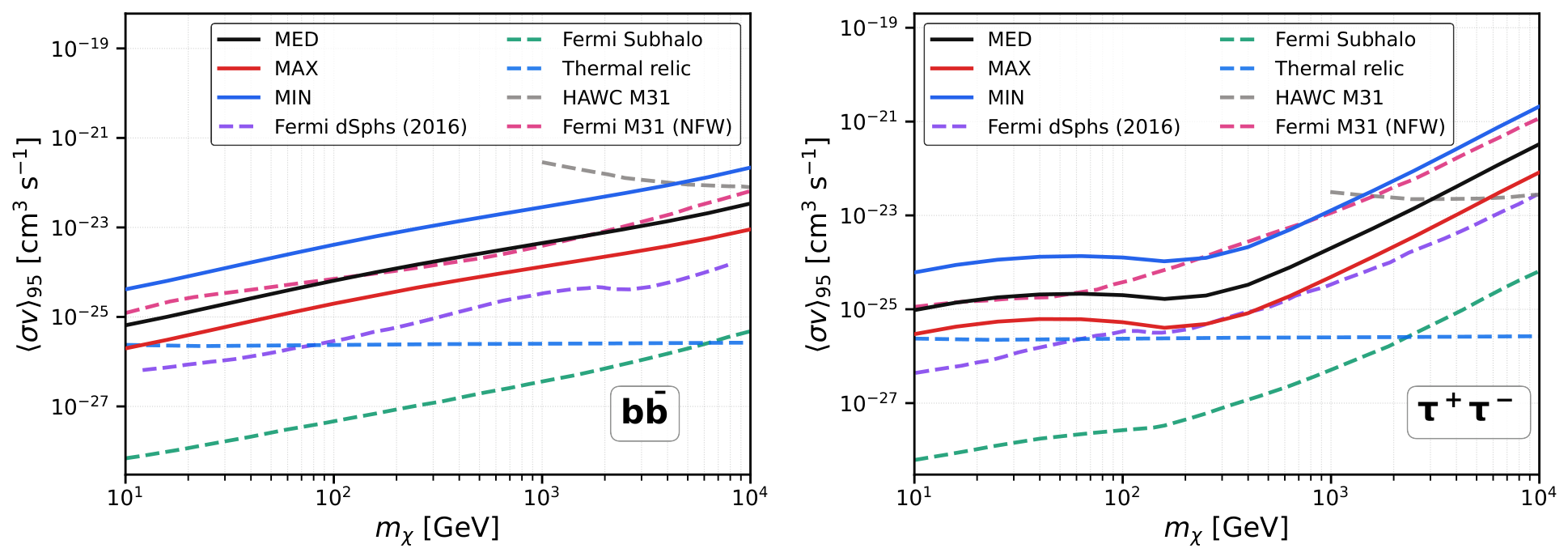
Figure 2 shows the 95% confidence-level upper limits on the velocity-averaged annihilation cross section for the channel and channel. The limits of MED model span approximately – across the full mass range in channel. The current grid gives the numerically strongest limits at the lowest masses and weaker upper limits toward the TeV scale. For example, for channel, the limit increases from at to at and at . This trend reflects the combined effects of the fitted template normalization, the changing spectral shape, and the fixed reference-flux convention used in the source-map generation.
Figure 2.
The 95% upper limits on the annihilation cross section . (Left) channel; (Right) channel. The M31 limits for the three halo models of this work are shown as colored solid lines: MAX (red), MED (black), and MIN (blue). The horizontal dashed blue line marks the WIMP thermal relic cross-section [8]. For comparison we also show existing constraints from Fermi-LAT dwarf spheroidal galaxies [12] (dashed purple line), Fermi-LAT searches for subhalos [61] (dashed green line), HAWC observations of M31 [22] (dashed gray line), and Fermi-LAT observations of M31 assuming an NFW profile [11] (dashed magenta line).
A notable feature of the annihilation results is the non-trivial ordering of the three halo profiles. Based purely on the total J-factor (Table 1), one would expect the MAX profile to yield the most stringent limits, followed by MED and then MIN. In practice, this ordering is not observed: for the channel the MIN profile—despite its smaller J-factor—yields the most stringent limits at every mass, exceeding the MED limits by a factor of roughly 300 at and still by a factor of about 10 at . The reason is that the cored MIN template overlaps only weakly with the central M31 emission, so the profile likelihood converges to a much smaller fitted amplitude that overcompensates for the smaller J-factor. The resulting ordering—MIN more stringent than MAX more stringent than MED in —is the expected outcome of separating the template shape from the total astrophysical factor through the unit solid-angle normalization, not a violation of the MIN/MED/MAX convention.
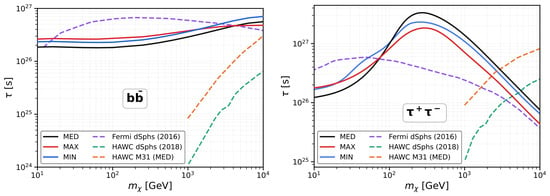
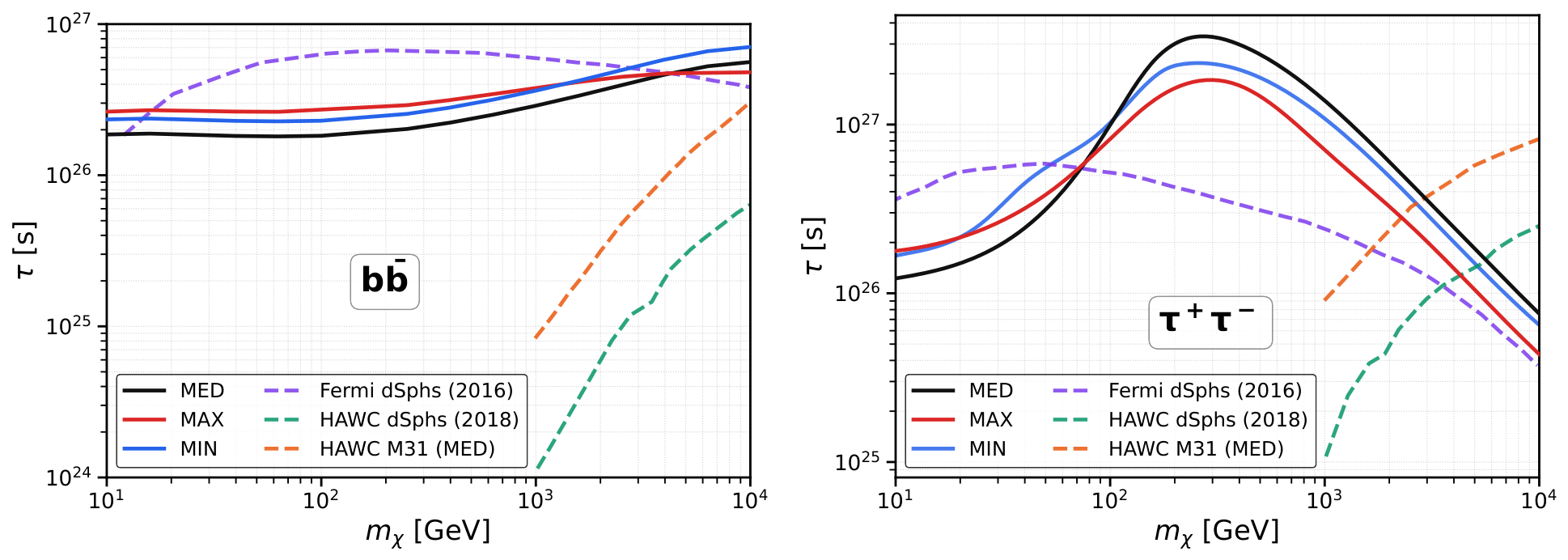
Both panels of Figure 3 display the 95% lower limits on the DM lifetime. The MED limits for the channel constrain across the low-mass range, rising to at . At the MIN limit reaches , reflecting the smaller fitted amplitude for this profile.
Figure 3.
The 95% lower limits on the decay lifetime . (Left) channel; (Right) channel. The M31 limits for the three halo models of this work are shown as colored solid lines: MAX (red), MED (black), and MIN (blue). For comparison we also show existing constraints from Fermi-LAT dwarf spheroidal galaxies [12] (dashed purple line), HAWC dwarf spheroidal galaxies [62] (dashed green line), and HAWC observations of M31 [22] (dashed orange line).
The relative ordering of the decay limits is set by the template morphology rather than by the magnitude of the D-factor. Although the MAX profile has the smallest integrated D-factor (Table 1), its sharply peaked template is only weakly degenerate with the moderately extended central -ray excess, yielding a smaller fitted amplitude ; the competition between these two effects makes the MAX limit slightly stronger than the MED one below ∼1 TeV (e.g., by ∼40% at ) and weaker above ∼2 TeV, producing the crossing of the two curves in Figure 3. The MIN profile, whose cored template is least degenerate with the central emission, provides the strongest decay limits at the high end of the mass range ( at ). In short, the decay ordering tracks the fitted template amplitude , not the J-factor hierarchy encoded in the MIN/MED/MAX labels, and is entirely compatible with the behavior of the HAWC decay analyses.
The right panels of Figure 2 and Figure 3 show the corresponding limits for the final state. For annihilation, the MED cross-section upper limits range from at low masses to at . The limits are generally weaker than the limits by a factor of a few at low masses, increasing to roughly an order of magnitude at the highest masses. This is primarily due to the different gamma-ray spectrum per annihilation: the softer photon spectrum from leptonic cascades produces fewer high-energy photons, making the signal harder to distinguish from the diffuse background.
For decay, the MED lifetime lower limits range from at to a peak of ∼ at , decreasing to ∼ at . The non-monotonic behavior is more pronounced in the channel than in , reflecting the energy-dependent leptonic spectrum shape.
For the channel, a similar comparison with existing constraints shows that our M31 results are broadly consistent with previously reported limits. At masses , the Fermi dSphs combined analysis [12] and the HAWC dSphs results [62] provide the most stringent constraints in the literature to date. For our annihilation limits reach within a factor of a few of the Fermi dSphs limits and complement them as an independent target system. At lower masses the soft leptonic templates overlap most strongly with the central -ray emission, where the background control is weakest, and we therefore quote those points as model-dependent rather than using them for a head-to-head comparison.
Overall, our annihilation and decay limits are within a factor of ∼2–3 of the leading dwarf-spheroidal constraints over most of the – range, while the limits approach the dSph bounds to within a factor of a few only for . In view of the residual background-model and halo-template systematics discussed below, we do not claim that the single-target M31 analysis supersedes the combined dSph constraints; the two approaches are complementary and rest on largely independent systematic uncertainties.
4. Discussion
The results presented in this work represent a significant step forward in constraining the properties of WIMP dark matter using the M31 galaxy as a target. Several points merit further discussion.
A central result of our analysis is the non-trivial impact of the halo profile choice on the derived limits. While a larger total J- or D-factor naively implies stronger constraints, the increased spatial concentration of the MED and MAX templates leads to greater degeneracy with the modeled M31 central emission and diffuse backgrounds. This degeneracy is absorbed by the profile likelihood, producing larger fitted template normalizations that partially compensate for the larger astrophysical factors. The MIN profile, with its more diffuse spatial morphology, is less affected by this degeneracy, allowing it to yield competitive limits despite its smaller J-factor. This template–background degeneracy also explains the large low-mass test statistics reported in Section 3: the soft M31 GeV excess is absorbed by the DM templates rather than representing a DM signal.
The separation of spatial morphology and total astrophysical factor through our unit-solid-angle normalization scheme is essential for this interpretation. Without this separation, the limits would be unduly compressed by the template-background degeneracy. Our approach makes it possible to isolate the spatial component of the systematic uncertainty from the normalization component, providing a clearer picture of how profile assumptions propagate through the analysis.
The comparison between the and final states reveals channel-dependent features that are expected from the different gamma-ray production mechanisms. The quark fragmentation in annihilation produces relatively hard photon spectra that are more easily distinguished from the diffuse background at Fermi-LAT energies. In contrast, the leptonic cascades from produce softer spectra, resulting in weaker constraints by a factor of a few at low masses and up to an order of magnitude at TeV masses.
For decay, the situation is broadly analogous, although the template spatial profile for decay is typically broader than for annihilation (scaling with rather than ), which affects the template-background correlation differently. The non-monotonic behavior in the decay limits is more pronounced than in , reflecting the energy-dependent shape of the leptonic spectrum convolved with the Fermi-LAT response.
Our results demonstrate that M31 can be a competitive target for indirect DM searches with Fermi-LAT, despite the fact that M31 is only a single galaxy while the dSph analyses combine over a dozen targets. The proximity of M31 (∼) and its large DM content compensate for the reduced statistical power from a single-target analysis. At the same time, the systematic uncertainties due to halo modeling are different from the dSph case and provide an independent cross-check. It is also instructive to compare our indirect detection constraints with limits from direct detection experiments [63,64] and from neutrino telescopes [65], which together probe complementary regions of the WIMP parameter space.
The HAWC M31 constraints [22] complement our Fermi-LAT results at high masses (). The combined coverage of the two instruments—Fermi-LAT probing the GeV regime and HAWC extending to hundreds of TeV—provides a nearly continuous probe of the M31 DM parameter space over more than four orders of magnitude in mass. Future observations with the Cherenkov Telescope Array [66] and the Southern Wide-field Gamma-ray Observatory [67] will further extend the sensitivity to the TeV–PeV range.
Several limitations of the current analysis should be noted. The mass grid—while covering the cosmologically interesting range from to —is currently coarse. Denser sampling at intermediate masses, particularly around where the thermal relic cross-section is expected [8], will improve the precision of the constraints. The current analysis uses only the and final states. Extending the analysis to additional channels (, , etc.) would provide a more complete picture of the WIMP parameter space and may identify channels where M31 is particularly competitive. The background model includes only the standard diffuse and point-source components. Additional systematic investigations of the diffuse model and potential M31-specific astrophysical emission (e.g., cosmic-ray-induced emission from the M31 disk and halo [28,68]) would strengthen the robustness of the limits. Furthermore, the contribution from DM subhalos within M31 [69,70] could boost the expected signal and sharpen the constraints, although such boosts are typically mild for an extended halo like that of M31. Given the complementary coverage of the M31 and dSph analyses, a formal statistical combination of the M31 and dSph likelihoods [60] could further improve the overall sensitivity, particularly for the channel where the M31 limits are currently within a factor of a few of the dSph constraints. A global goodness-of-fit assessment based on full Monte Carlo pseudo-experiments is computationally prohibitive with the current grid and is deferred to future work; the per-point likelihood-ratio statistics reported in Section 3 already provide the relevant model-comparison information.
The results confirm that the M31 galaxy is a valuable target for indirect DM searches and that careful treatment of spatial morphology systematics is essential for extracting reliable and competitive limits. With ongoing improvements in Fermi-LAT data processing, extended exposure, and refined background modeling, further improvements in sensitivity are anticipated.
Funding
This research was funded by Xinjiang Natural Science Foundation, grant number 2025D01C287.
Institutional Review Board Statement
Not applicable.
Data Availability Statement
The Fermi-LAT data used in this analysis are publicly available from the Fermi Science Support Center at https://fermi.gsfc.nasa.gov/ssc/data/ (accessed on 17 November 2025). The derived data products supporting the results of this study are available from the corresponding author upon reasonable request.
Conflicts of Interest
The author declares no conflicts of interest. The funders had no role in the design of the study; in the collection, analyses, or interpretation of data; in the writing of the manuscript; or in the decision to publish the results.
References
- Bertone, G.; Hooper, D.; Silk, J. Particle dark matter: Evidence, candidates and constraints. Phys. Rep. 2005, 405, 279–390. [Google Scholar] [CrossRef] [Scilit]
- Rubin, V.C.; Ford, W.K.; Thonnard, N. Rotational properties of 21 SC galaxies with a large range of luminosities and radii, from NGC 4605 (R=4kpc) to UGC 2885 (R=122kpc). Astrophys. J. 1980, 238, 471–487. [Google Scholar] [CrossRef] [Scilit]
- Clowe, D.; Bradač, M.; Gonzalez, A.H.; Markevitch, M.; Randall, S.W.; Jones, C.; Zaritsky, D. A direct empirical proof of the existence of dark matter. Astrophys. J. 2006, 648, L109–L113. [Google Scholar] [CrossRef] [Scilit]
- Aghanim, N. et al. [Planck Collaboration] Planck 2018 results. VI. Cosmological parameters. Astron. Astrophys. 2020, 641, A6. [Google Scholar]
- Springel, V.; White, S.D.M.; Jenkins, A.; Frenk, C.S.; Yoshida, N.; Gao, L.; Navarro, J.; Thacker, R.; Croton, D.; Helly, J.; et al. Simulations of the formation, evolution and clustering of galaxies and quasars. Nature 2005, 435, 629–636. [Google Scholar] [CrossRef] [Scilit] [PubMed]
- Jungman, G.; Kamionkowski, M.; Griest, K. Supersymmetric dark matter. Phys. Rep. 1996, 267, 195–373. [Google Scholar] [CrossRef] [Scilit]
- Bringmann, T.; Weniger, C. Gamma ray signals from dark matter: Concepts, status and prospects. Phys. Dark Universe 2012, 1, 194–217. [Google Scholar] [CrossRef] [Scilit]
- Steigman, G.; Dasgupta, B.; Beacom, J.F. Precise relic WIMP abundance and its impact on searches for dark matter annihilation. Phys. Rev. D 2012, 86, 023506. [Google Scholar] [CrossRef] [Scilit]
- Funk, S. Indirect detection of dark matter with γ rays. Proc. Natl. Acad. Sci. USA 2015, 112, 12264–12271. [Google Scholar] [CrossRef] [Scilit] [PubMed]
- Atwood, W.B. et al. [Fermi-LAT Collaboration] The Large Area Telescope on the Fermi Gamma-ray Space Telescope mission. Astrophys. J. 2009, 697, 1071–1102. [Google Scholar]
- Ackermann, M. et al. [Fermi-LAT Collaboration] Observations of M31 and M33 with the Fermi Large Area Telescope: A Galactic Center excess in Andromeda. Astrophys. J. 2017, 836, 208. [Google Scholar] [CrossRef] [Scilit]
- Ackermann, M. et al. [Fermi-LAT Collaboration] Searching for dark matter annihilation from Milky Way dwarf spheroidal galaxies with six years of Fermi Large Area Telescope data. Phys. Rev. Lett. 2015, 115, 231301. [Google Scholar] [CrossRef] [Scilit] [PubMed]
- Ackermann, M. et al. [Fermi-LAT Collaboration] The Fermi Galactic Center GeV excess and implications for dark matter. Astrophys. J. 2017, 840, 43. [Google Scholar] [CrossRef] [Scilit]
- Ackermann, M. et al. [Fermi-LAT Collaboration] Constraints on dark matter annihilation in clusters of galaxies with the Fermi Large Area Telescope. J. Cosmol. Astropart. Phys. 2010, 2010, 25. [Google Scholar] [CrossRef] [Scilit]
- Charles, E. et al. [Fermi-LAT Collaboration] Sensitivity projections for dark matter searches with the Fermi Large Area Telescope. Phys. Rep. 2016, 636, 1–46. [Google Scholar] [CrossRef] [Scilit]
- Albert, A. et al. [Fermi-LAT, DES Collaboration] Searching for dark matter annihilation in recently discovered Milky Way satellites with Fermi-LAT. Astrophys. J. 2017, 834, 110. [Google Scholar]
- Geringer-Sameth, A.; Koushiappas, S.M.; Walker, M. Dwarf galaxy annihilation and decay emission profiles for dark matter experiments. Astrophys. J. 2015, 801, 74. [Google Scholar] [CrossRef] [Scilit]
- Drlica-Wagner, A. et al. [Fermi-LAT, DES Collaboration] Searching for dark matter annihilation in the Smith high-velocity cloud. Astrophys. J. 2015, 790, 24. [Google Scholar]
- Calore, F.; Cholis, I.; Weniger, C. Background model systematics for the Fermi GeV excess. J. Cosmol. Astropart. Phys. 2015, 2015, 38. [Google Scholar] [CrossRef] [Scilit]
- Ackermann, M. et al. [Fermi-LAT Collaboration] Search for gamma-ray emission from dark matter annihilation in the Large Magellanic Cloud with the Fermi Large Area Telescope. Phys. Rev. D 2015, 91, 122002. [Google Scholar] [CrossRef] [Scilit]
- Harding, J.P.; Dingus, B. Dark matter annihilation and decay searches with the High Altitude Water Cherenkov (HAWC) Observatory. arXiv 2015, arXiv:1508.04352. [Google Scholar]
- Albert, A. et al. [HAWC Collaboration] Search for dark matter gamma-ray emission from the Andromeda Galaxy with the High-Altitude Water Cherenkov Observatory. arXiv 2018, arXiv:1804.00628. [Google Scholar]
- Ahnen, M.L. et al. [MAGIC Collaboration] Limits to dark matter annihilation cross-section from a combined analysis of MAGIC and Fermi-LAT observations of dwarf satellite galaxies. J. Cosmol. Astropart. Phys. 2016, 2016, 39. [Google Scholar] [CrossRef] [Scilit]
- Archambault, S. et al. [VERITAS Collaboration] Dark matter constraints from a joint analysis of dwarf spheroidal galaxy observations with VERITAS. Phys. Rev. D 2017, 95, 082001. [Google Scholar] [CrossRef] [Scilit]
- Abdalla, H. et al. [H.E.S.S. Collaboration] Searches for gamma-ray lines and “pure WIMP” spectra from dark matter annihilations in dwarf galaxies with H.E.S.S. J. Cosmol. Astropart. Phys. 2018, 11, 37. [Google Scholar] [CrossRef] [Scilit]
- Li, Z.; Huang, X.; Yuan, Q.; Liang, Y. Constraints on the dark matter annihilation from Fermi-LAT observation of M31. J. Cosmol. Astropart. Phys. 2016, 12, 28. [Google Scholar] [CrossRef] [Scilit]
- Karwin, C.; Murgia, S.; Campbell, S.; Moskalenko, I.V. Fermi-LAT observations of γ-ray emission toward the outer halo of M31. Astrophys. J. 2019, 880, 95. [Google Scholar] [CrossRef] [Scilit] [PubMed]
- Abdo, A.A. et al. [Fermi-LAT Collaboration] Fermi Large Area Telescope observations of Local Group galaxies: M31 and M33. Astron. Astrophys. 2010, 523, L2. [Google Scholar]
- Karwin, C.M.; Murgia, S.; Moskalenko, I.V.; Fillingham, S.P.; Burns, A.-K.; Fieg, M. Dark matter interpretation of the Fermi-LAT observations toward the outer halo of M31. Phys. Rev. D 2021, 103, 023027. [Google Scholar] [CrossRef] [Scilit] [PubMed]
- Tamm, A.; Tempel, E.; Tenjes, P.; Tihhonova, O.; Tuvikene, T. Stellar mass map and dark matter distribution in M31. Astron. Astrophys. 2012, 546, A4. [Google Scholar] [CrossRef] [Scilit]
- Sadoun, R.; Colin, J. The M31 potential: A comparison of dynamical models with observations. Mon. Not. R. Astron. Soc. 2016, 460, 2967. [Google Scholar]
- McConnachie, A.W. The observed properties of dwarf galaxies in and around the Local Group. Astron. J. 2012, 144, 4. [Google Scholar] [CrossRef] [Scilit]
- Kafle, P.R.; Sharma, S.; Lewis, G.F.; Robotham, A.S.G.; Driver, S.P. The need for speed: Escape velocity and dynamical mass measurements of the Andromeda galaxy. Mon. Not. R. Astron. Soc. 2018, 475, 4043–4054. [Google Scholar] [CrossRef] [Scilit]
- Atwood,W.B. et al. [Fermi-LAT Collaboration] Pass 8: Toward the full realization of the Fermi-LAT scientific potential. arXiv 2013, arXiv:1303.3514. [Google Scholar]
- Bruel, P. et al. [Fermi-LAT Collaboration] Fermi-LAT improved Pass 8 event selection. arXiv 2018, arXiv:1810.11394. [Google Scholar]
- Fermi Science Support Center. Fermi Science Tools. Available online: https://fermi.gsfc.nasa.gov/ssc/data/analysis/software/ (accessed on 30 July 2026).
- Mattox, J.R.; Bertsch, D.L.; Chiang, J.; Dingus, B.L.; Digel, S.W.; Esposito, J.A.; Fierro, J.M.; Hartman, R.C.; Hunter, S.D.; Kanbach, G.; et al. The likelihood analysis of EGRET data. Astrophys. J. 1996, 461, 396–406. [Google Scholar] [CrossRef] [Scilit] [PubMed]
- Wood, M.; Caputo, R.; Charles, E.; Di Mauro, M.; Magill, J.; Perkins, J.S. Fermipy: An open-source Python package for analysis of Fermi-LAT data. PoS (ICRC2017) 2017, 301, 824. [Google Scholar] [CrossRef] [Scilit]
- Abdollahi, S. et al. [Fermi-LAT Collaboration] Incremental Fermi Large Area Telescope Fourth Source Catalog. Astrophys. J. Suppl. 2022, 260, 53. [Google Scholar] [CrossRef] [Scilit]
- Acero, F. et al. [Fermi-LAT Collaboration] Development of the model of galactic interstellar emission for standard point-source analysis of Fermi Large Area Telescope data. Astrophys. J. Suppl. 2016, 223, 26. [Google Scholar] [CrossRef] [Scilit]
- Ajello, M. et al. [Fermi-LAT Collaboration] The spectrum of isotropic diffuse gamma-ray emission between 100 MeV and 820 GeV. Astrophys. J. 2015, 799, 86. [Google Scholar] [CrossRef] [Scilit]
- Gondolo, P.; Gelmini, G. Cosmic abundances of stable particles: Improved analysis. Nucl. Phys. B 1991, 360, 145–179. [Google Scholar] [CrossRef] [Scilit]
- Bergström, L. Dark matter evidence, particle physics candidates and detection methods. Ann. Phys. 2012, 524, 479–496. [Google Scholar] [CrossRef] [Scilit]
- Bringmann, T.; Bergström, L.; Edsjö, J. New gamma-ray contributions to supersymmetric dark matter annihilation. J. High Energy Phys. 2008, 2008, 49. [Google Scholar] [CrossRef] [Scilit]
- Cirelli, M.; Corcella, G.; Hektor, A.; Hütsi, G.; Kadastik, M.; Panci, P.; Raidal, M.; Sala, F.; Strumia, A. PPPC 4 DM ID: A poor particle physicist cookbook for dark matter indirect detection. J. Cosmol. Astropart. Phys. 2011, 2011, 51, Erratum in J. Cosmol. Astropart. Phys. 2012, 2012, E01. [Google Scholar] [CrossRef] [Scilit]
- Gondolo, P.; Silk, J. Dark matter annihilation at the galactic center. Phys. Rev. Lett. 1999, 83, 1719–1722. [Google Scholar] [CrossRef] [Scilit]
- Bergström, L.; Ullio, P.; Buckley, J.H. Observability of gamma rays from dark matter neutralino annihilations. Astropart. Phys. 1998, 9, 137–162. [Google Scholar] [CrossRef] [Scilit]
- Bertone, G.; Buchmüller, W.; Covi, L.; Ibarra, A. Gamma-rays from decaying dark matter. J. Cosmol. Astropart. Phys. 2007, 11, 003. [Google Scholar] [CrossRef] [Scilit]
- Ibarra, A.; Tran, D. Gamma ray spectrum from gravitino dark matter decay. Phys. Rev. Lett. 2008, 100, 061301. [Google Scholar] [CrossRef] [Scilit] [PubMed]
- Finke, J.D.; Razzaque, S.; Dermer, C.D. Modeling the extragalactic background light from stars and dust. Astrophys. J. 2010, 712, 238–249. [Google Scholar] [CrossRef] [Scilit]
- Domínguez, A.; Primack, J.R.; Rosario, D.J.; Prada, F.; Gilmore, R.C.; Faber, S.M.; Koo, D.C.; Somerville, R.S.; Pérez-Torres, M.A.; Pérez-González, P.; et al. Extragalactic background light inferred from AEGIS galaxy-SED-type fractions. Mon. Not. R. Astron. Soc. 2011, 410, 2556–2578. [Google Scholar] [CrossRef] [Scilit]
- Navarro, J.F.; Frenk, C.S.; White, S.D.M. A universal density profile from hierarchical clustering. Astrophys. J. 1997, 490, 493–508. [Google Scholar] [CrossRef] [Scilit] [PubMed]
- Burkert, A. The structure of dark matter halos in dwarf galaxies. Astrophys. J. 1995, 447, L25–L28. [Google Scholar] [CrossRef] [Scilit]
- Merritt, D.; Graham, A.W.; Moore, B.; Diemand, J.; Terzić, B. Empirical models for dark matter halos. Astron. J. 2006, 132, 2685–2700. [Google Scholar] [CrossRef] [Scilit]
- Cembranos, J.A.R.; de la Cruz-Dombriz, A.; Dobado, A.; Lineros, R.A.; Maroto, A.L. Photon spectra from WIMP annihilation. Phys. Rev. D 2011, 83, 083507. [Google Scholar] [CrossRef] [Scilit]
- James, F.; Winkler, M. MINUIT User’s Guide; CERN Program Library Long Writeup D506; CERN: Geneva, Switzerland, 2004. [Google Scholar]
- Brun, R.; Rademakers, F. ROOT: An object oriented data analysis framework. Nucl. Instrum. Methods Phys. Res. A 1997, 389, 81–86. [Google Scholar] [CrossRef] [Scilit]
- Rolke, W.A.; M. López, A.; Conrad, J. Limits and confidence intervals in the presence of nuisance parameters. Nucl. Instrum. Methods Phys. Res. A 2005, 551, 493–503. [Google Scholar] [CrossRef] [Scilit]
- Chernoff, H. On the distribution of the likelihood ratio. Ann. Math. Stat. 1954, 25, 573–578. [Google Scholar] [CrossRef] [Scilit]
- Conrad, J.; Botner, O.; Hallgren, A.; de los Heros, C.P. Including systematic uncertainties in confidence interval construction for Poisson statistics. Phys. Rev. D 2003, 67, 012002. [Google Scholar] [CrossRef] [Scilit]
- Zhu, B.-Y.; Liang, Y.-F.; Huang, X. Constraints on dark matter annihilation from a nearby subhalo candidate. arXiv 2025, arXiv:2512.13261. [Google Scholar]
- Albert, A. et al. [HAWCCollaboration] Dark matter limits from dwarf spheroidal galaxies with the HAWC gamma-ray observatory. Astrophys. J. 2018, 853, 154. [Google Scholar] [CrossRef] [Scilit]
- Aprile, E. et al. [XENON Collaboration] Dark matter search results from a one ton-year exposure of XENON1T. Phys. Rev. Lett. 2018, 121, 111302. [Google Scholar] [CrossRef] [Scilit] [PubMed]
- Meng, Y. et al. [PandaX-4T Collaboration] Dark matter search results from the PandaX-4T commissioning run. Phys. Rev. Lett. 2021, 127, 261802. [Google Scholar] [CrossRef] [Scilit] [PubMed]
- Aartsen, M.G. et al. [IceCube Collaboration] Search for annihilating dark matter in the Sun with 3 years of IceCube data. Eur. Phys. J. C 2017, 77, 146. [Google Scholar] [CrossRef] [Scilit]
- Acharya, B.S. et al. [CTA Consortium] Science with the Cherenkov Telescope Array; World Scientific: Singapore, 2019. [Google Scholar]
- Schwenk, A. et al. [SWGO Collaboration] The Southern Wide-field Gamma-ray Observatory: Status and prospects. PoS (ICRC2021) 2021, 395, 894. [Google Scholar] [CrossRef] [Scilit]
- Strong, A.W.; Moskalenko, I.V.; Ptuskin, V.S. Cosmic-ray propagation and interactions in the Galaxy. Annu. Rev. Nucl. Part. Sci. 2007, 57, 285–327. [Google Scholar] [CrossRef] [Scilit]
- Sánchez-Conde, M.A.; Prada, F. The flattening of the concentration–mass relation towards low halo masses and its implications for the annihilation signal boost. Mon. Not. R. Astron. Soc. 2014, 442, 2271–2277. [Google Scholar] [CrossRef] [Scilit]
- Moliné, Á.; Sánchez-Conde, M.A.; Palomares-Ruiz, S.; Prada, F. Characterization of subhalo structural properties and implications for dark matter annihilation signals. Mon. Not. R. Astron. Soc. 2017, 466, 4974–4990. [Google Scholar] [CrossRef] [Scilit]

Disclaimer/Publisher’s Note: The statements, opinions and data contained in all publications are solely those of the individual author(s) and contributor(s) and not of MDPI and/or the editor(s). MDPI and/or the editor(s) disclaim responsibility for any injury to people or property resulting from any ideas, methods, instructions or products referred to in the content. |
© 2026 by the author. Licensee MDPI, Basel, Switzerland. This article is an open access article distributed under the terms and conditions of the Creative Commons Attribution (CC BY) license.