


Abstract
This article investigates wormhole geometry in modified gravity, where R, , and X denote the Ricci scalar, scalar potential, and kinetic term, respectively. We also introduce charge to examine its influence on the wormhole geometry. In the present scenario, the Karmarkar condition is employed to determine the metric potentials. A key feature of this work is the derivation of the modified Tolman–Oppenheimer–Volkoff equation, which is used to analyze the stability of the wormhole geometry. We have analyzed the behavior of the matter-plus-charge energy conditions and found that the null energy condition is satisfied for the considered model, while the strong energy condition is violated. In contrast to general relativity, where the matter NEC must be violated to support a traversable wormhole, the present modified-gravity model fulfils the flare-out requirement through the effective energy–momentum tensor generated by the curvature–scalar–kinetic sector. Hence the required exoticity is shifted from ordinary matter to the effective modified-gravity sector. We also discuss the behavior of the equation-of-state parameters and anisotropy. Moreover, we perform an additional stability analysis based on the adiabatic index. Our analysis reveals that the wormhole solutions are stable for the considered model in modified gravity.
1. Introduction
The idea of wormholes as bridges was first introduced by Einstein and Rosen in 1935 [1]. The “bridge” essentially connects different paths, thereby reducing travel time and distance. Einstein’s field equations provide solutions for wormholes, and the notion that gravity behaves like “tunnels” is even more thought-provoking. A wormhole is formed when large amounts of matter are placed in two parallel domains; the presence of such matter generates a wormhole. The first mathematical solution for wormholes in the context of black holes was discovered. These detailed solutions lead to two geometric interpretations of black hole geometry. Brane tension creates a force that offsets gravitational attraction in dense objects with negative pressure. Sufficiently strong interactions between branes can lead to deformation and the formation of a wormhole [2]. Modified gravity theories offer alternative explanations for cosmological phenomena such as dark energy, dark matter, and cosmic expansion. Several theoretical models aim to uncover the secrets underlying the cosmos’s accelerating expansion. According to Einstein’s theories of relativity, the laws of physics are uniform and unchanging for all observers in inertial motion [3]. The terms “drain hole” (Ellis) and “geon” (Wheeler) describe theoretical constructs related to wormholes and spacetime topology [4,5]. Morris and Thorne were the first to suggest that humans might travel through wormholes, establishing the concept of traversable wormholes and Kar found that non-static Lorentzian wormholes can exist for finite or half-infinite time intervals [6,7,8]. Researchers have investigated the impact of exotic matter on wormhole formation and evolution. Research by Visser et al. [9] has established that through appropriate wormhole geometry configurations, violations of the null energy condition (NEC) can be spatially localized to arbitrarily small regions. Within general relativity (GR), the existence of traversable wormholes fundamentally requires exotic matter that violates the NEC through its stress–energy properties. In modified gravity, however, this statement must be interpreted for the total effective source rather than only the material source: the matter-plus-charge sector may satisfy the NEC, while the additional curvature, scalar-field, and kinetic contributions in the modified field equations provide the effective support needed by the flare-out condition.
The investigation of wormhole solutions within modified gravity theories has consistently attracted significant research attention. A broader investigation of wormhole solutions within modified gravity theories has revealed that higher-order curvature terms and matter–geometry couplings can significantly relax or even eliminate the need for exotic matter. Morris and Thorne’s original traversability conditions were re-examined in gravity by Lobo and Oliveira [10] who showed that wormhole throats can be supported by ordinary matter if the effective gravitational coupling becomes negative in certain curvature regimes. Moraes and Sahoo [11] constructed simple phantom-free wormhole solutions in gravity and noted that the coupling parameter can mimic the effect of exotic matter. Shamir and Fayyaz [12] derived the field equations for spherically symmetric wormholes in gravity and developed the shape functions that satisfy the energy conditions at the throat without violating NEC. Sharif and Rani [13] investigated non-commutative wormhole geometry in theory of gravity. In the context of Gauss-Bonnet gravity, Kanti et al. [14] discussed the properties of Lorentzian wormholes in dilatonic Einstein–Gauss–Bonnet theory in four spacetime dimensions. Shweta et al. [15] discussed the wormhole solutions in modified theory of gravity. Jianbo et al. [16] investigated the behavior of wormholes without exotic matter violation in gravity. Shamir and Zia [17] studied the wormhole solutions in theory of gravity. Sharif and Ikram [18] analyzed wormhole solutions in theory of gravity by using shape functions. Malik and collaborators investigated traversable wormhole solutions in the context of modified gravity. Their study demonstrated that the proposed shape function constructs a valid wormhole geometry connecting two asymptotically flat regions of spacetime while satisfying all necessary physical conditions for traversability [19,20,21]. Malik and collaborators studied stellar structures using the embedding approach within the modified gravity framework, analyzing spherically symmetric spacetimes with anisotropic fluid matter distributions [22]. Within modified gravity, Golchin and Mehdizadeh [23] verified energy conditions for three classes of wormhole solutions (spherical, flat, hyperbolic). Harko et al. [24] discussed that energy conditions can be satisfied through ordinary matter. Mustafa et al. [25] investigated the wormhole solutions in modified symmetric teleparallel gravity. Lobo and his collaborators [26] discussed the traversable wormhole solutions through equations of state and specific shape function functions.
The construction of traversable wormhole geometries has traditionally faced a critical obstacle: the unavoidable violation of classical energy conditions due to the presence of exotic matter. In recent years, the Karmarkar embedding class-I condition—originally devised for stellar interiors—has been repurposed as a systematic tool for generating wormhole shape functions, thereby reducing the degree of ad hoc assumptions. Sutar et al. [27] first extended this approach to include a cosmological constant in GR, demonstrating that stable, non-exotic wormhole solutions become possible when the cosmological constant is tuned appropriately. Malik et al. [28] introduced electric charge into the Karmarkar framework and found that the repulsive Coulomb effect can help satisfy the null energy condition near the throat. In modified gravity, Turkoglu et al. [29] derived a generalized shape function in gravity and, for the first time, linked the Karmarkar condition with the Casimir effect, suggesting a possible geometric evolution of the wormhole throat. Mustafa et al. [30] performed a similar analysis in gravity and reported that the Karmarkar-derived shape function significantly reduces the required amount of exotic matter for realistic model parameters. Paramanik et al. [31] went a step further by incorporating dark matter halo profiles (URC, NFW, and SFDM) into gravity under the Karmarkar condition, obtaining wormhole solutions that remain traversable without any exotic matter. Sarkar et al. [32] proposed a new Karmarkar-based shape function in gravity that not only avoids exotic matter but also allows calculation of the weak gravitational lensing deflection angle. Chanda and Sharma [33] showed that simultaneously imposing the Karmarkar condition and conformal flatness leads to overly restrictive constraints, potentially limiting the method’s applicability unless time-dependent factors are considered. Kiroriwal et al. [34] discussed the wormhole solutions under tidal force constraints in gravity. Sanjay et al. [35] examined the non-commutative finslerian wormhole solution admitting conformal motion. Parsaei and Rastgoo [36] examined exact wormhole solutions within the framework of Rastall theory. Gul et al. [37] explored viable traversable wormhole geometries in non-metric gravity theory. Kiroriwal et al. [38] investigated traversable wormhole configurations sourced by dark matter halos modeled through the Burkert density profile. They also [39] investigated the impact of the tangential velocity and Karmarkar condition in constructing wormhole solutions within Rastall–Rainbow gravity. Ditta et al. [40] discussed the embedded wormhole solutions and thermodynamics in extended teleparallel gravity. Sarkar et al. [32] discussed the traversable wormholes using Karmarkar condition in modified theory of gravity.
Modified gravity theories offer a natural framework to circumvent the exotic matter problem that plagues traversable wormholes in GR. Among these, gravity stands out as a particularly powerful and unified approach. This theory generalizes both gravity and scalar-tensor models by allowing the Lagrangian to depend arbitrarily on the Ricci scalar R, scalar potential , and its kinetic term . The inclusion of the kinetic term introduces additional degrees of freedom that can mimic the effective stress–energy required to keep the wormhole throat open, potentially reducing or even eliminating the need for exotic matter. Moreover, the non–minimal coupling between curvature and the scalar sector gives rise to a rich phenomenology: the effective gravitational coupling becomes scale-dependent, and the null energy condition can be violated by purely geometric contributions even when ordinary matter satisfies all energy conditions. Previous studies have shown that and gravity can sustain wormholes with less exotic matter, but the additional flexibility of gravity allows for more precise control of the energy condition violation and the stability profile. Consequently, gravity provides a compelling arena to construct traversable wormhole solutions that are both physically plausible and stable, while also connecting to broader topics such as inflation, dark energy, and the early universe dynamics. The present work leverages this flexibility to derive, for the first time, the complete set of wormhole properties including equation of state parameters, anisotropy, and adiabatic stability analysis within this theory. Recently, Li et al. [41] investigated the charged wormhole solutions in modified and we have extended the analysis in our current work by taking different model. The paper is structures as: Section 2 gives the basic formulism of gravity. Karmarkar condition is discussed in Section 3. Section 4 presents the detailed physical analysis of wormhole solutions. Section 5 concludes the final remarks.
2. Basic Formalism of Modified Gravity
The gravitational action for gravity is defined as
where denotes the matter Lagrangian, g represents the determinant of the metric tensor and is the electromagnetic Lagrangian. The field equations are given as follows:
where , , and denotes the covariant derivative. Moreover, the energy–momentum tensor is given as
The stress–energy tensors for ordinary matter and the electromagnetic field combine to form the total energy–momentum tensor. Now, is written as
and is written as
The electromagnetic field tensor can be expressed in terms of the four-potential as
where is the covariant derivative operator. When expressed in a local coordinate basis, this relation simplifies to
The static, spherically symmetric electromagnetic field is completely characterized by the four-potential
where denotes the electric potential dependent solely on the radial coordinate r. In this configuration, the electromagnetic field tensor possesses exactly two independent non-vanishing components,
with . The antisymmetric property of the field tensor () is manifest in these non-zero components, while the conditions of time-independence and rotational invariance enforce the vanishing of all remaining components. This configuration describes a purely radial electric field, the field tensor components being entirely determined by the radial derivative of the electric potential. Now the well-known Maxwell equations are
The four-current density is given by
where denotes the proper charge density. The electric field intensity E is given as
In the present analysis, we choose as [42]
where is a constant. Using the field equations, we obtain
Here, prime denotes differentiation with respect to the radial coordinate r. For computational convenience, we adopt the units . This choice allows us to simplify the field equations when analyzing wormhole solutions in extended gravity theories. Notably, by fixing the redshift function, we can significantly reduce the complexity of the system. It should be emphasized that the complete field Equations (14)–(16) remain considerably more complex, making analytical solutions particularly challenging to obtain. In what follows, we explore general classes of modified gravity theories to derive exact wormhole solutions. For our current analysis, we consider gravity as
where
and the kinetic term is defined as
After substituting the above functional forms into Equations (14)–(16), we obtain the following expressions for the energy density and pressure components:
These field Equations (18)–(20) are essential for discussing the behavior of the wormhole geometry. For clarity, the quantities , , and , together with the charge contribution, are used in the energy-condition plots. The wormhole throat, however, is governed by the effective source appearing in the modified field equations. Therefore, satisfaction of the NEC for the matter-plus-charge sector does not contradict the flare-out condition. In the present solution, the effective geometric contribution generated by the , , and terms provides the required support at the throat.
3. Karmarkar Condition
The static, spherically symmetric spacetime is defined as
requires specific conditions on its metric functions for physical viability. The redshift function must remain finite and differentiable everywhere to prevent horizon formation and ensure traversability. The metric function must satisfy at the throat radius . Non-zero Riemann curvature can be written as
The well-established Karmarkar relation is defined as
The Karmarkar condition establishes a relation as
After some simplification, we obtain
under the condition . Consequently, we obtain
where B is a constant of integration. The shape function of the wormhole was derived using the Morris–Thorne metric
Comparing Equations (21) and (27), we obtain
Furthermore, we choose as
where acts as a constant parameter. By simplifying Equations (26), (28) and (29), we obtain the wormhole shape function as
After applying the throat condition to Equation (30), we obtain a trivial solution. To avoid this issue, we introduce a constant C in (30) as
Applying the throat condition to Equation (31), we obtain
Finally, Equation (31) becomes
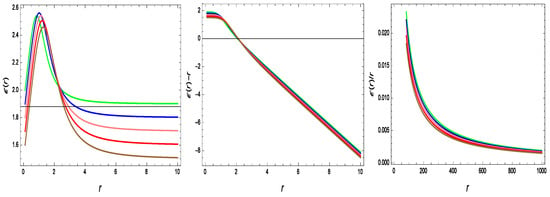
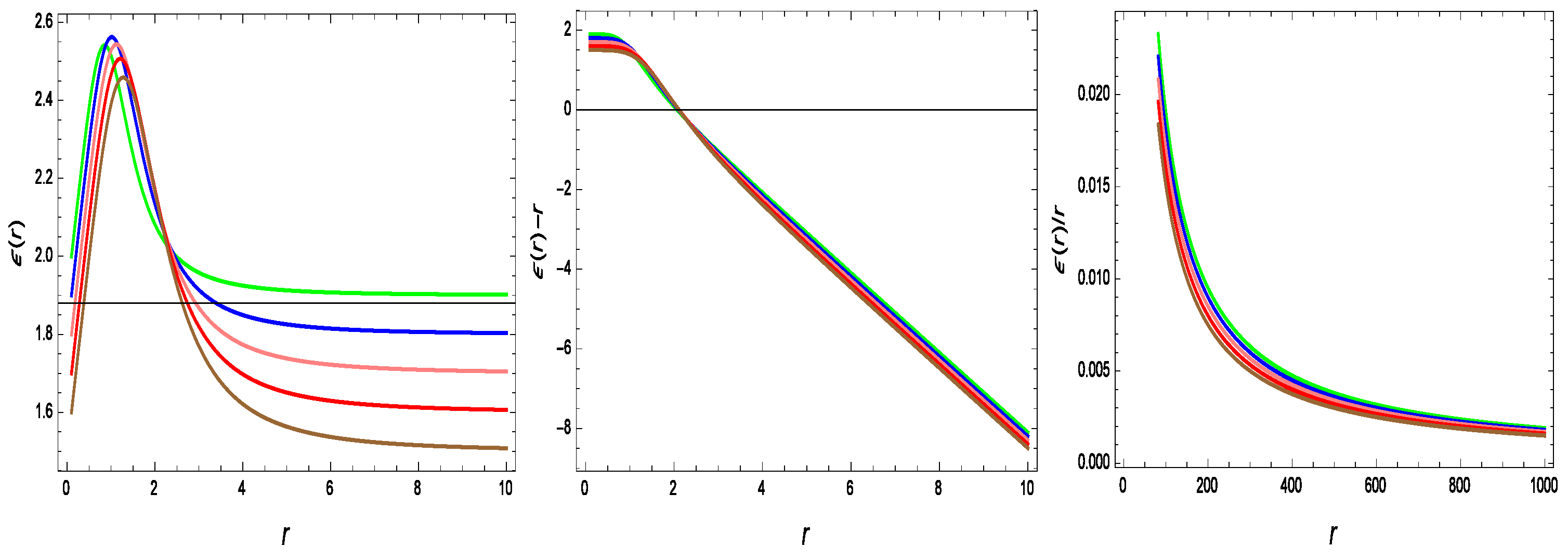
This must satisfy the following conditions:
- Throat condition: at .
- Flaring-out condition: at .
- Derivative constraint: at the throat and for all .
- Asymptotic flatness: .
Figure 1.
Graphical representation of , and .
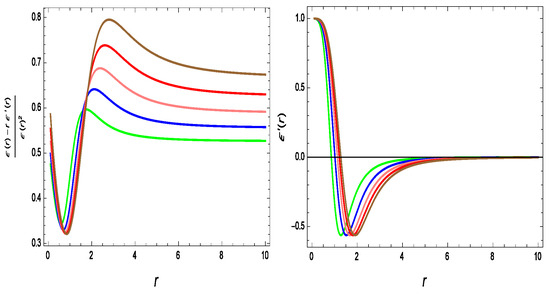
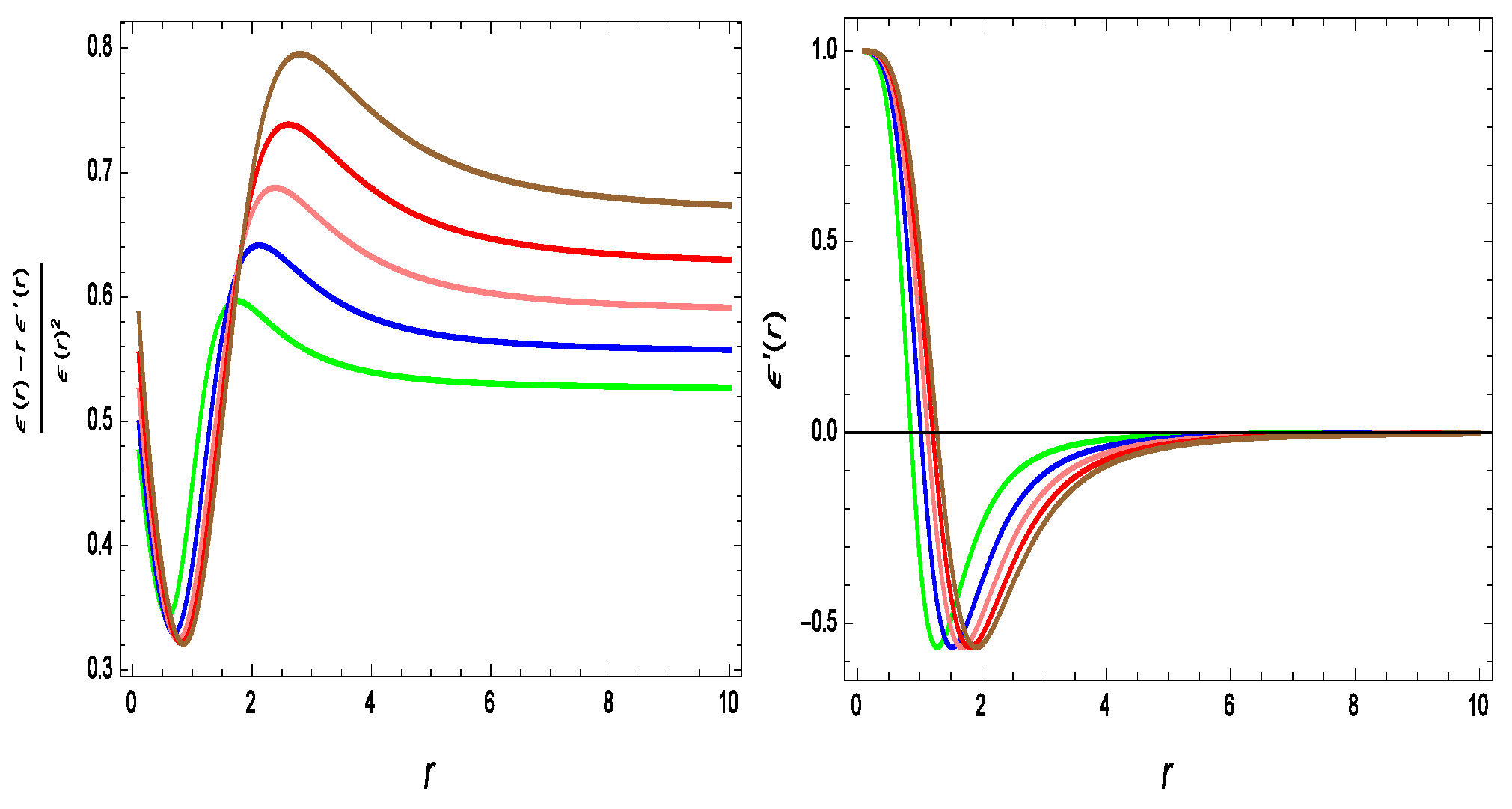
Figure 2.
Graphical representation of and showing .
4. Physical Analysis of Wormhole Solutions
In this section, we examine the physical analysis of wormhole solutions in theory of gravity. We also investigate the equation of state (EoS) parameters and anisotropy. Moreover, we examine the behavior of the energy conditions and identify the relevant violations, which are also a critical part of these solutions. We discuss the stability of wormhole geometry though the modified Tolman–Oppenheimer–Volkoff (TOV) equation and adiabatic index. Detailed discussion of all these aspects can be seen in upcoming subsections. For all numerical analyses and graphical representations throughout this section, we adopt the following parameter values: , , , , , , and .
4.1. Energy Density and Pressure Components
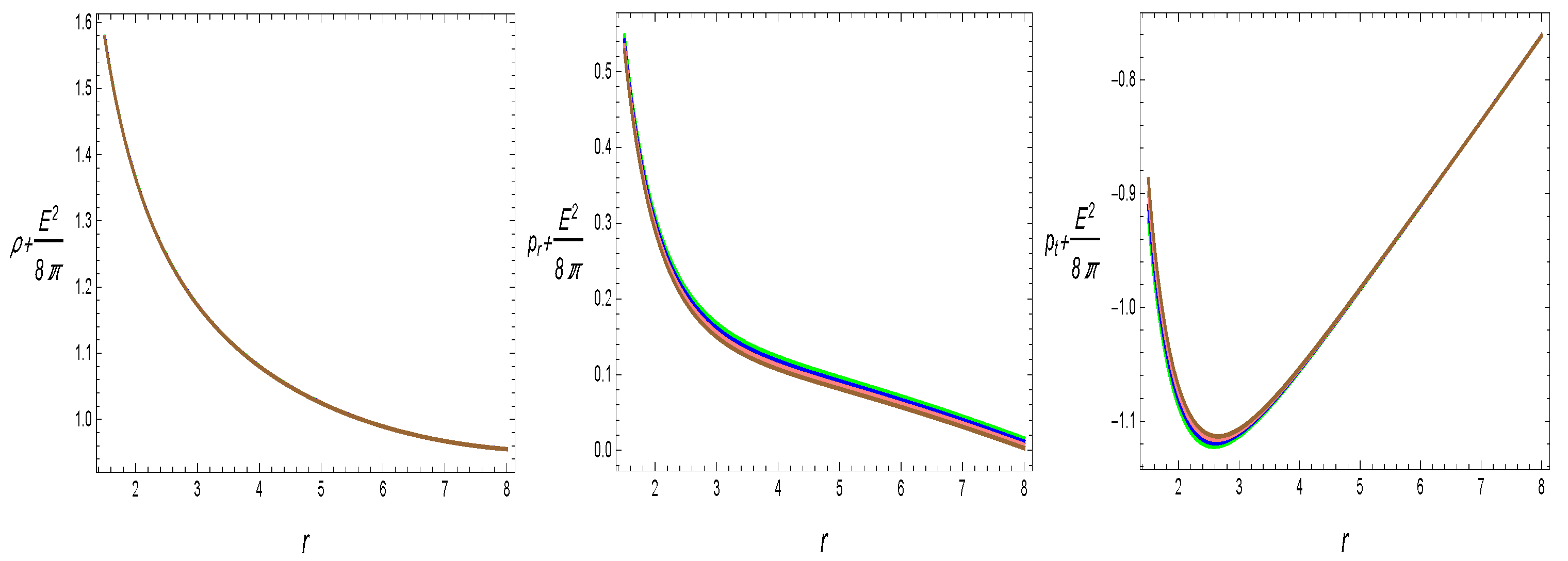
After substituting the metric potentials into the field Equations (18)–(20), we obtain the expressions for the energy density and pressure components (see Appendix A (A1)–(A3)), which help us to analyze the behavior of wormhole geometry. The structural properties of the wormhole are determined by the material composition, characterized by the energy density , radial pressure , and tangential pressure , whose radial profiles are depicted in Figure 3. The energy density remains positive throughout the spacetime and decreases gradually as the radial coordinate r increases. The graphical analysis of radial pressure is positive, but the graphical representation of tangential pressure is negative. This persistent negativity is a common feature in wormhole physics, as it directly linked with exotic matter.
Figure 3.
Graphical analysis of energy density, radial pressure, and tangential pressure.
4.2. Energy Conditions
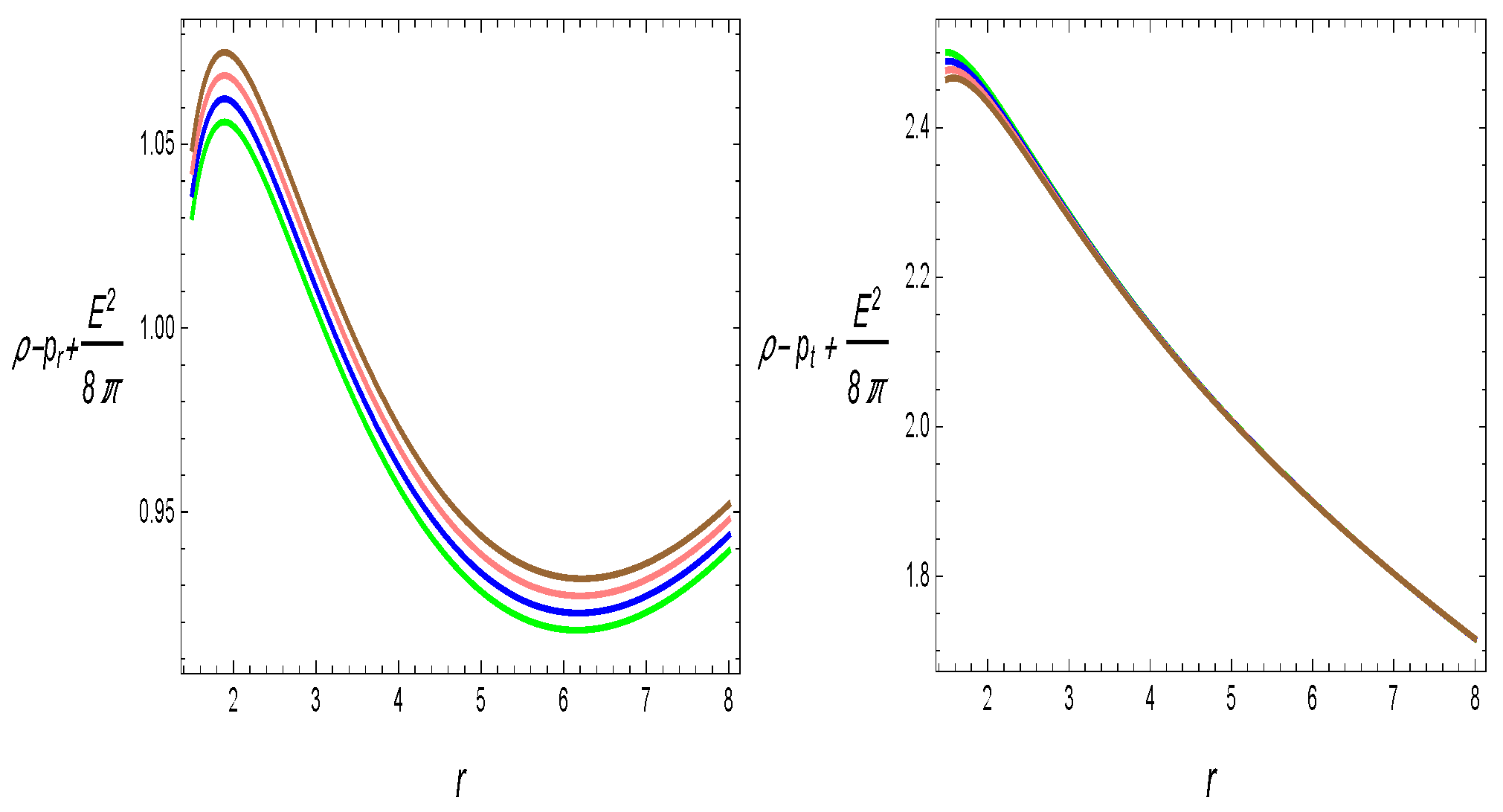
In this subsection, we discuss the energy conditions, which play a fundamental role in determining the physical viability of wormhole geometries. The inequalities displayed below refer to the matter sector together with the charge/electromagnetic contribution. This distinction is important because the Morris–Thorne flare-out condition is controlled by the effective source in the modified field equations. Consequently, satisfaction of the NEC for the matter-plus-charge sector does not contradict the existence of the wormhole; it indicates that the required NEC violation is produced by the effective geometric sector rather than by ordinary matter. These conditions are Null Energy Condition (NEC), Weak Energy Condition (WEC), Strong Energy Condition (SEC) and Dominant Energy Condition (DEC), which are defined as follows:
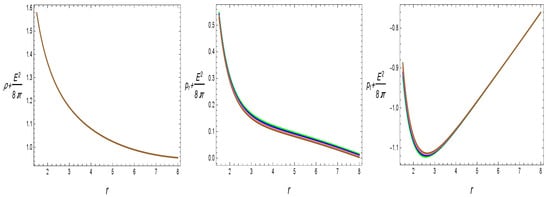
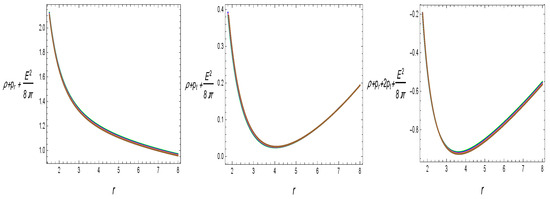
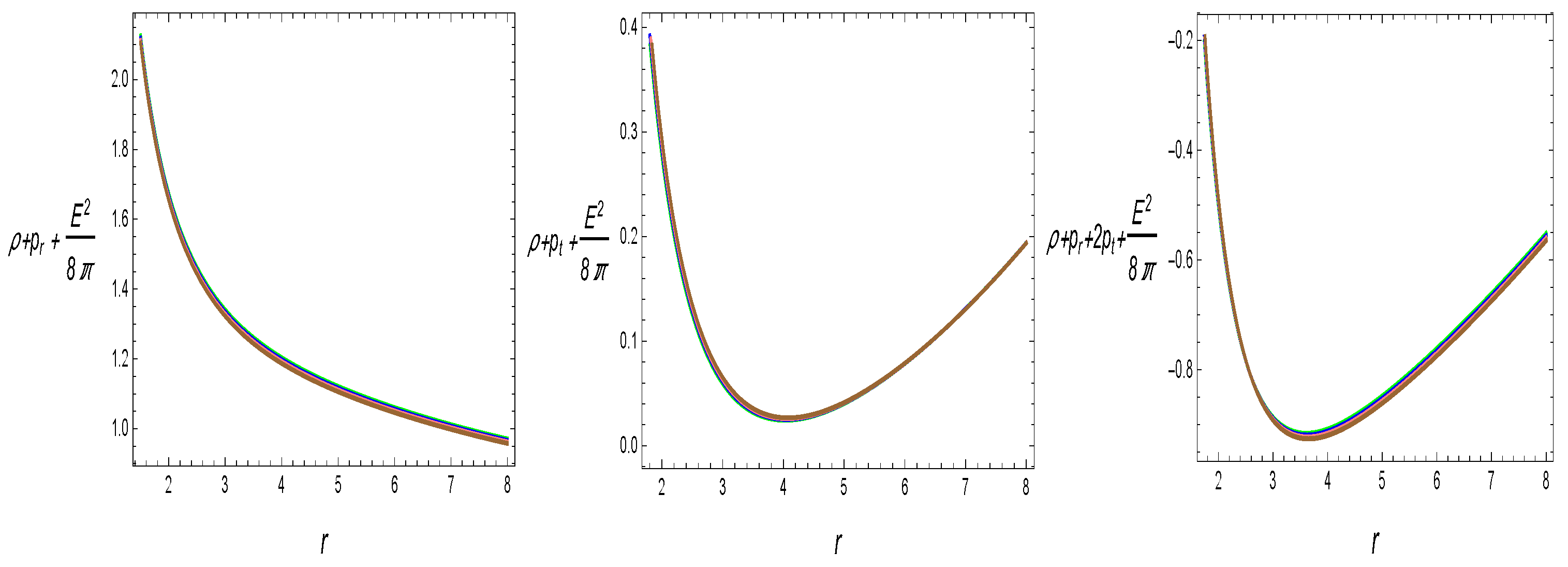
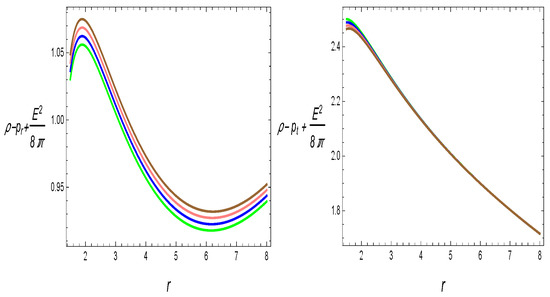
The quantities and are positive, as shown in Figure 4, indicating that the NEC is satisfied. The quantity is violated, whereas the other two SEC components are satisfied; hence, the SEC is violated. Similarly, (Figure 4) and (Figure 5) remain positive, indicating that the DEC is satisfied. The violation of these energy conditions, especially SEC, indicates the presence of effective exotic behavior and justifies the existence of wormhole geometry. Based on the above energy conditions, we analyze how the energy components—especially the null and weak energy conditions—contribute to the understanding of wormhole formation. In the present modified-gravity model, the matter-plus-charge NEC remains satisfied; therefore, the flare-out requirement is supplied by the effective geometric sector rather than by direct NEC violation in ordinary matter. The validity and violation of energy conditions in the context of wormhole solutions have been extensively examined in the literature using various frameworks of modified gravity [43,44,45]. Such effective violations imply the presence of exotic behavior, which is essential for maintaining wormhole geometries.
Figure 4.
Graphical analysis of NEC and SEC.
Figure 5.
Graphical analysis of DEC.
4.3. Equation of State Parameters
The equation of state (EoS) provides a useful description of the matter content supporting the wormhole geometry. In most cases, it is assumed that there is a linear relationship between the radial pressure and the energy density, , where is the EoS parameter. For normal matter, may be 0 (dust), (radiation), or (vacuum energy). On the other hand, traversable wormholes usually need an effective (or at least negative enough) to break the null energy requirements at the throat. We can tell how “exotic” the fluid is and if the solution is still physically possible by looking at the radial profile . In modified gravity theories, the EoS also receives geometric contributions, which may help satisfy the flare-out requirement without requiring classical exotic matter. Thus, the radial and tangential EoS parameters are defined as
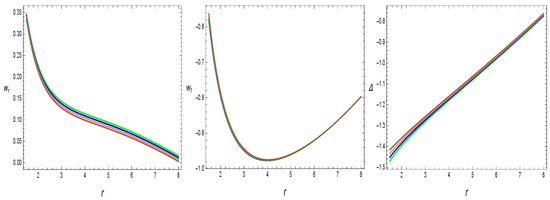
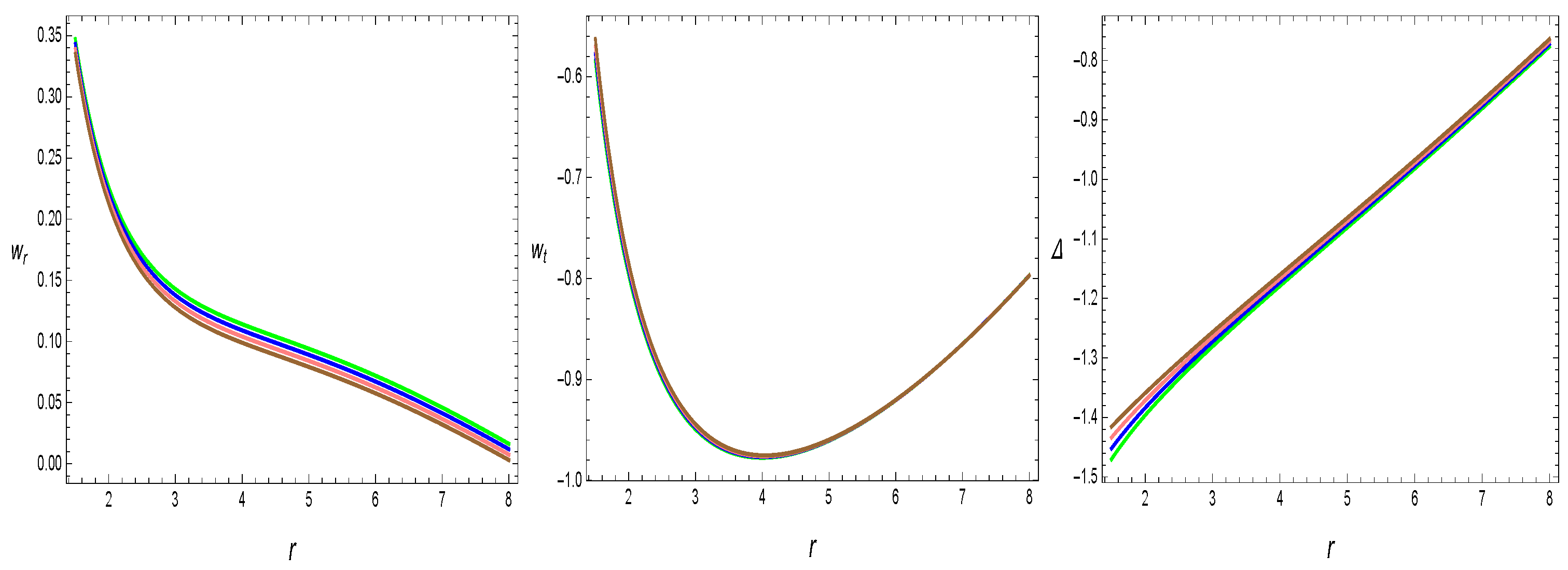
After substituting the relevant quantities into Equation (34), we obtain the expressions for and ; see Appendix A (A4) and (A5). Our analysis reveals that the radial EoS parameter is positive throughout the domain and decreases monotonically with increasing radial distance, approaching zero as (see Figure 6). Since both the energy density and the radial pressure are positive (Figure 3), a positive simply indicates that the fluid behaves in a conventional manner in the radial direction, with pressure and density having the same sign. The gradual decrease in means that the radial pressure becomes less dominant compared to the energy density as we move away from the throat. The asymptotic limit corresponds to a pressureless fluid at infinity, which is compatible with asymptotic flatness. This behavior is consistent with the requirement that the exotic matter needed to sustain the throat is predominantly associated with the negative tangential pressure, not with the radial component.
Figure 6.
Graphical representation of , and .
In contrast, the tangential EoS parameter is negative over the entire range and increases (i.e., becomes less negative) with r, also approaching zero from below (Figure 6). Because and is negative, a negative means that the tangential pressure opposes the energy density. This negative tangential pressure provides the necessary transverse tension to counteract the radial compression, which is precisely the condition required for the flare-out of the wormhole throat. The fact that tends to zero at large radii indicates that the tangential stress vanishes asymptotically, restoring local isotropy.
4.4. Anisotropy
Anisotropy, defined as the difference between the tangential and radial pressures, plays an important role in wormhole physics. In several traversable wormhole models, the supporting matter is intrinsically anisotropic, exhibiting large differences between and . This anisotropy may facilitate the effective exotic behavior required for the flare-out condition while keeping the energy density positive. The anisotropy factor is a crucial diagnostic; a non-zero often indicates the existence of supplementary forces or geometric factors that stabilize the throat. In modified gravity theories, anisotropy arises inherently from the curvature–matter interactions or the dynamics of the scalar field, enabling more flexibility in the formulation of physically plausible wormhole solutions. Mathematically, it is defined as
The expression for the anisotropy parameter is given in Appendix A (A6), which is found to be negative throughout the domain as shown in Figure 6. This means that the radial pressure dominates over the tangential pressure. In wormhole physics, a negative anisotropy (i.e., ) is often associated with the stability of the throat, as the radial tension is balanced by the anisotropy force in the modified TOV equation. The magnitude of decreases with radial distance, indicating that the pressure anisotropy is a near-throat phenomenon and that the fluid becomes nearly isotropic in the asymptotic region.
4.5. Stability Analysis via TOV Equation
This subsection conducts a comprehensive stability analysis through TOV methodology [46,47,48]. Five main factors work together to create the equilibrium state including gravitational force, hydrostatic force, anisotropic force, electromagnetic force and one extra force due to the modified gravity. The coupling of the gravity significantly modifies the standard equilibrium conditions, resulting in stability requirements that are fundamentally distinct from those of classical general relativistic wormhole models.
Applying the covariant derivative and utilizing the Bianchi identity yields the generalized conservation equation:
After some manipulation, we obtain
where
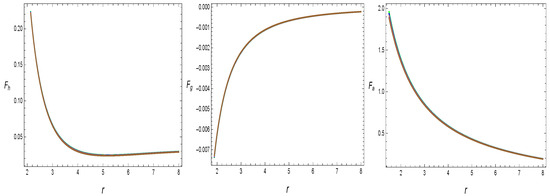
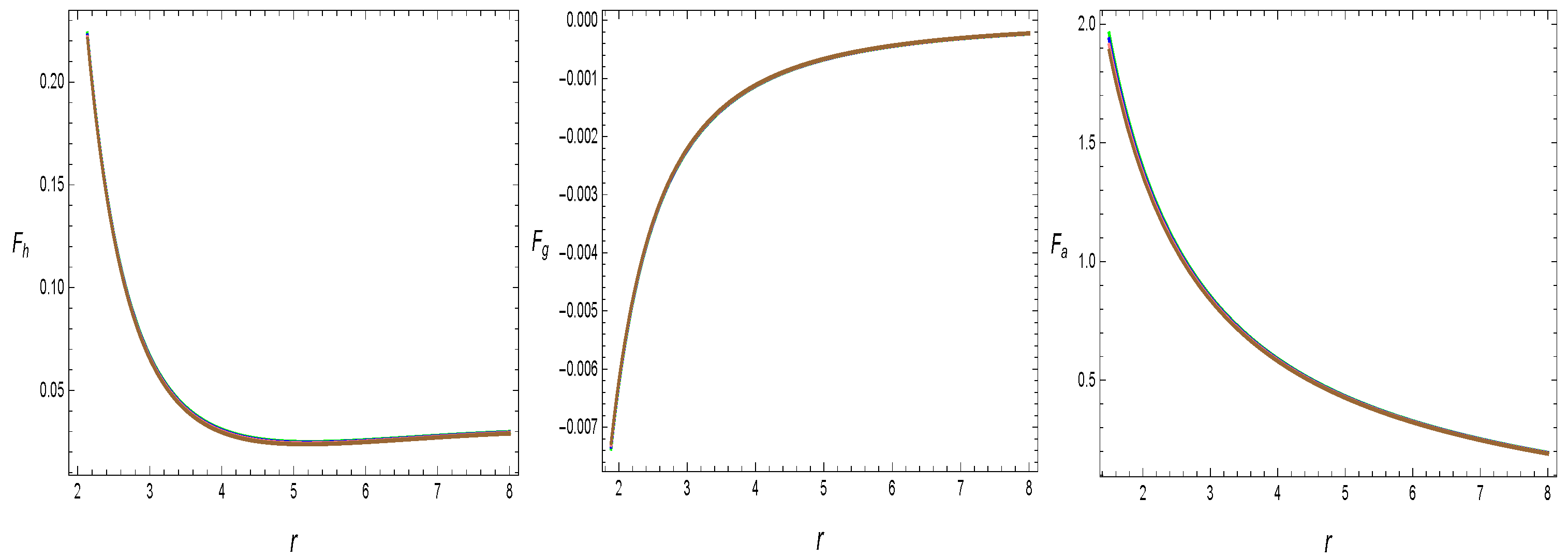
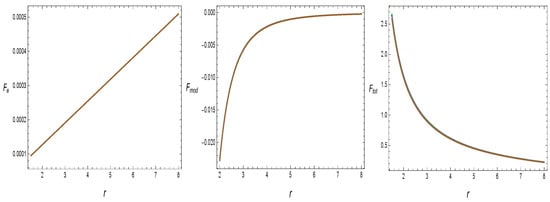
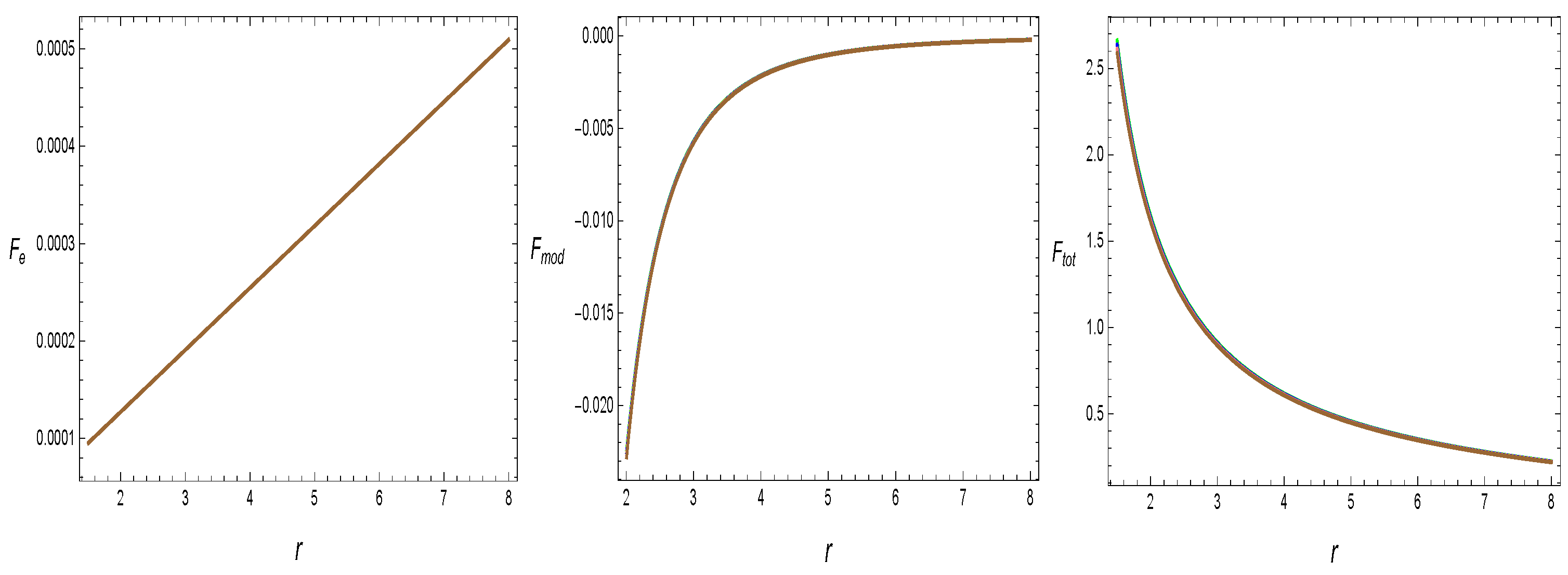
As shown in Figure 7, and are positive, whereas is negative. Similarly, Figure 8 shows that is positive and increasing, while the modified force is negative. The modification force originates from the non-minimal coupling between curvature and the scalar field. Near the throat, it is negative, indicating an attractive contribution that helps balance the repulsive hydrostatic and electromagnetic forces. As r increases, decays to zero, restoring the usual GR behavior in the asymptotic region. Thus, the modified TOV equation reveals how gravity provides an additional stabilizing mechanism for traversable wormholes. It can also be noticed from the last panel of Figure 8 that the sum of all forces approaches zero, which confirms that the equilibrium condition is satisfied and demonstrates the stability of the wormhole geometry.
Figure 7.
Graphical analysis of , and .
Figure 8.
Graphical analysis of , and equilibrium condition.
4.6. Adiabatic Index Stability Analysis
To further assess the dynamical stability of the wormhole configuration, we examine the radial adiabatic index . For an anisotropic fluid, the adiabatic index is defined as [49,50,51]:
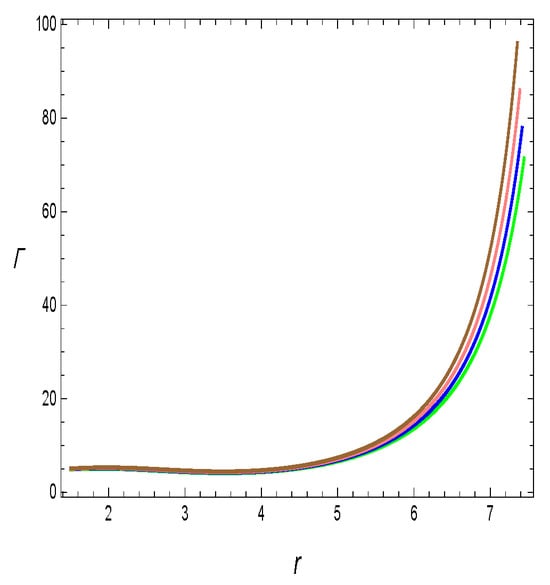
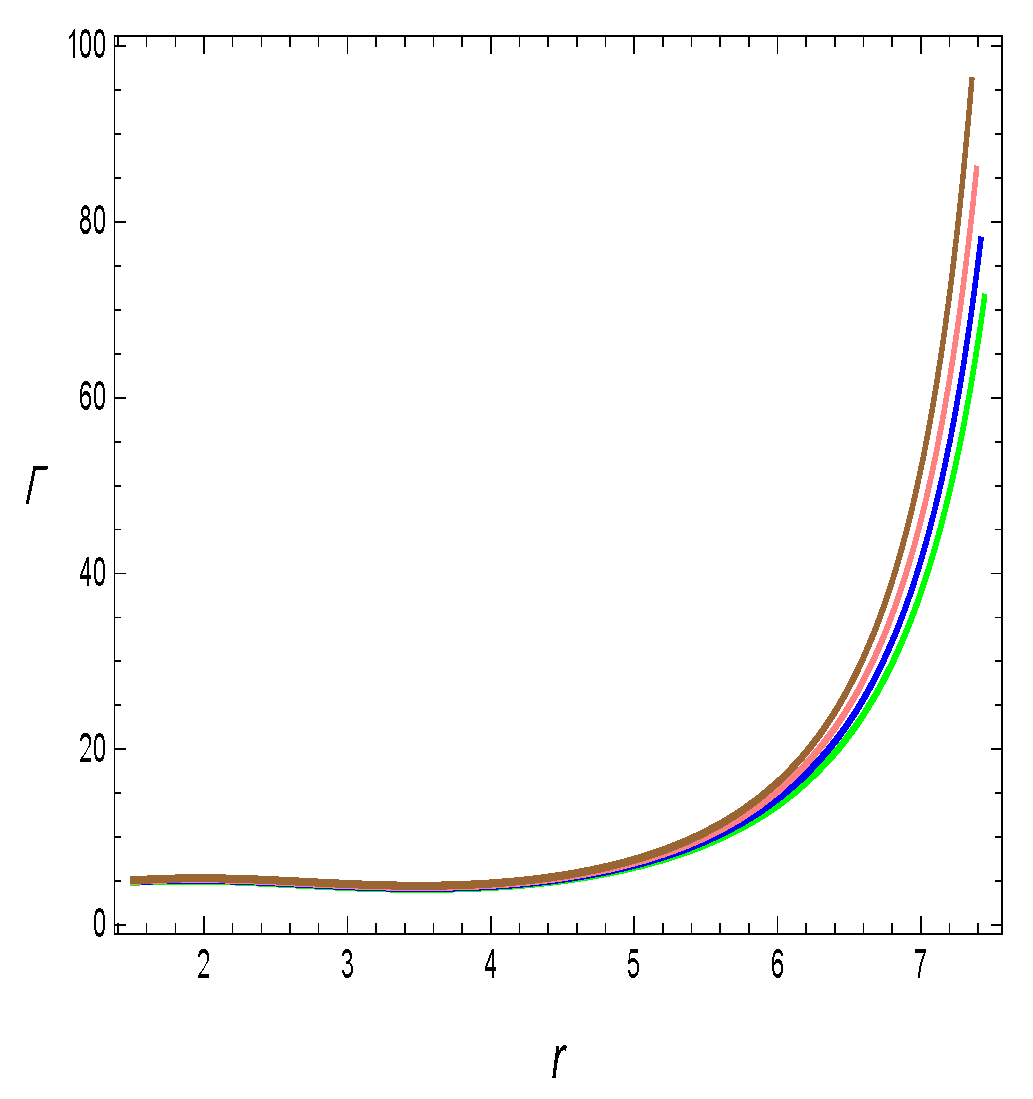
According to the well-established stability criterion, a relativistic fluid configuration is considered stable against radial adiabatic perturbations if throughout the interior [30,39]. Conversely, signals the onset of instability.
Figure 9 presents the radial profile of for our wormhole solution. It is evident that remains consistently greater than the critical threshold across the entire domain. This behavior confirms that the wormhole geometry is stable against radial perturbations, complementing the equilibrium analysis from the modified TOV equation. The satisfaction of the adiabatic index criterion further supports the physical viability of our traversable wormhole model within gravity.
Figure 9.
Graphical analysis of adiabatic index.
4.7. Comparative Discussion with Other Modified Gravity Wormhole Solutions
To highlight the advantages of the specific model, we compare its key features with representative wormhole solutions in GR, gravity, and gravity. In classical GR traversable wormholes (Morris–Thorne), the energy density is negative near the throat, indicating a large amount of exotic matter [7,8]. In many wormhole solutions, energy density can be positive only with fine-tuning [10]. In our model, the effective energy density is positive throughout the spacetime (Figure 3), which is a clear improvement.
Regarding energy condition violations, GR wormholes require violation of NEC [9]. In some models, NEC can be avoided, but often at the cost of introducing unusual matter equations of state [11]. In our solution, the NEC for the matter-plus-charge sector is satisfied (Figure 4); only the strong energy condition (SEC) is violated. The flare-out condition is nevertheless fulfilled because the effective stress–energy tensor contains additional curvature–scalar–kinetic terms together with the charge contribution. These terms act as an effective source that supports the throat, while the physical matter-plus-charge sector remains non-exotic with respect to the NEC. This is less restrictive and reduces the required exoticity.
Stability analysis is another area where our work goes beyond typical studies. Most modified gravity wormhole papers only check energy conditions and the flare-out condition; stability is rarely addressed. We have performed two independent stability tests: (i) a modified TOV force balance demonstrating that the sum of all forces tends to zero (Figure 8); and (ii) an adiabatic index analysis confirming (Figure 9). This dual verification is a novel contribution.
Asymptotic behavior is also well controlled. Our model restores asymptotic flatness and isotropy naturally: all pressures, EoS parameters, anisotropy, and the modification force decay to zero as r increases (extended range up to ). This ensures that the wormhole geometry smoothly merges into a flat spacetime, a feature not always verified in other modified gravity works.
Finally, the presence of the kinetic term X and the Ricci-square correction in our action provides extra degrees of freedom that allow the modification force to be tuned. Near the throat, is negative (attractive), helping to balance the repulsive hydrostatic and electromagnetic forces. This flexibility is not available in simpler or scalar-tensor models. In summary, our model offers a compelling combination of positive energy density, absence of matter-plus-charge NEC violation, effective geometric support for the flare-out condition, rigorous stability verification, and asymptotic consistency—advantages that are not simultaneously present in many existing modified gravity wormhole solutions.
4.8. Comparison with Previous Work
Very recently, Li et al. [41] studied charged wormhole solutions in gravity, analyzing energy conditions for three distinct models. However, their work did not examine the equation of state (EoS) parameters, the anisotropy factor, nor the detailed force-balance verification that confirms equilibrium. In contrast, the present manuscript goes beyond that study in several key aspects: (i) we derive and analyse the radial and tangential EoS parameters, as well as the anisotropy, which are essential for characterizing the exotic fluid and the flare-out condition; (ii) we present each force component from the modified TOV equation in separate panels and, crucially, explicitly demonstrate that the sum of all forces approaches zero, providing a direct quantitative proof of hydrostatic equilibrium—a check not performed in Li et al.; (iii) we extend all graphical analyses to larger radial distances (r up to 8) to confirm asymptotic behavior; (iv) we adopt a different model, namely with a linear kinetic term, which has not been used for wormholes before; and (v) we include an adiabatic index stability analysis, further supporting the viability of the wormhole configurations. These novel contributions collectively offer a more complete and physically insightful description of wormhole geometries in gravity.
5. Conclusions
In our work, we have investigated the traversable wormhole solutions in modified gravity theory. For this work, we have adopted the charge and Karmarkar condition approach for the wormhole geometry’s investigation. The detailed outcome of our work is as follows:
- The graphical analysis in Figure 3 shows that the energy density and radial pressure are positive, whereas the tangential pressure is negative.
- The graphical analysis of the NEC, WEC, SEC, and DEC is presented in Figure 4 and Figure 5. From these figures, it can be observed that the NEC for the matter-plus-charge sector is satisfied while SEC is violated. Thus, the existence of the wormhole is not attributed to NEC-violating ordinary matter alone; rather, the required flare-out support comes from the effective geometric contribution of the modified sector.
- In summary, the combination of a decreasing positive , an increasing negative , and a negative that decays to zero describes an exotic fluid that is strongly anisotropic near the throat, providing the required tangential support and radial tension, while smoothly transitioning to an isotropic, pressureless state at infinity. This behavior is physically reasonable and supports the viability of the traversable wormhole solution within gravity.
- The graphical behavior of the modified TOV equation, including all force components (, , , and ), is shown in Figure 7 and Figure 8. The forces , , and are positive, whereas and are negative. The sum of all forces approaches zero, confirming the equilibrium condition and supporting the stability of the wormhole configuration.
- Finally, the graphical analysis of the adiabatic index is shown in Figure 9. It is evident that remains consistently greater than the critical threshold across the entire domain , which further supports the physical viability of our traversable wormhole model within gravity.
In summary, the wormhole configuration examined in this study within gravity satisfies the necessary conditions for a traversable wormhole solution. These results contribute to the ongoing study of exotic spacetime geometries and their relevance in modified gravity frameworks. They also open new directions for investigating the nature of traversable wormholes and their possible astrophysical implications. Future research may explore specific functional forms of that further enhance wormhole stability and observable signatures.
Author Contributions
A.M.: Conceptualization and Investigation; R.M.H.: Writing—original draft; M.W.A.: Formal analysis, Methodology; A.K.A.: Validation and Funding acquisition; W.L.: Supervision and Writing—review and editing. All authors have read and agreed to the published version of the manuscript.
Funding
This research was funded by Princess Nourah bint Abdulrahman University Researchers Supporting Project number (PNURSP2026R939), Princess Nourah bint Abdulrahman University, Riyadh, Saudi Arabia.
Data Availability Statement
The original contributions presented in this study are included in the article. Further inquiries can be directed to the corresponding author.
Acknowledgments
Princess Nourah bint Abdulrahman University Researchers Supporting Project number (PNURSP2026R939), Princess Nourah bint Abdulrahman University, Riyadh, Saudi Arabia.
Conflicts of Interest
The authors declare no conflict of interest.
Appendix A
In the following expressions, the compact notations , , and denote , , and , respectively. These abbreviations are introduced only to keep the lengthy formulae readable.
References
- Einstein, A.; Rosen, N. The particle problem in the general theory of relativity. Phys. Rev. 1935, 48, 73. [Google Scholar] [CrossRef] [Scilit]
- Shatskii, A.A.; Novikov, I.D.; Kardashev, N.S. A dynamic model of the wormhole and the Multiverse model. Physics-Uspekhi 2008, 51, 457–464. [Google Scholar] [CrossRef] [Scilit]
- Canfora, F.; Dimakis, N.; Paliathanasis, A. Topologically nontrivial configurations in the 4d Einstein-nonlinear s-model system. Phys. Rev. D 2017, 6, 025021. [Google Scholar]
- Ellis, H.G. Ether flow through a drainhole: A particle model in general relativity. J. Math. Phys. 1973, 14, 104–118. [Google Scholar] [CrossRef] [Scilit]
- Wheeler, J.A. Geons. Phys. Rev. 1955, 97, 511. [Google Scholar] [CrossRef] [Scilit]
- Kar, S. Evolving wormholes and the weak energy condition. Phys. Rev. D 1994, 49, 862. [Google Scholar] [CrossRef] [Scilit] [PubMed]
- Morris, M.S.; Thorne, K.S. Wormholes in spacetime and their use for interstellar travel: A tool for teaching general relativity. Am. J. Phys. 1988, 56, 395–412. [Google Scholar] [CrossRef] [Scilit]
- Morris, M.S.; Thorne, K.S.; Yurtsever, U. Wormholes, time machines, and the weak energy condition. Phys. Rev. Lett. 1988, 61, 1446. [Google Scholar] [CrossRef] [Scilit] [PubMed]
- Visser, M.; Kar, S.; Dadhich, N. Traversable wormholes with arbitrarily small energy condition violations. Phys. Rev. Lett. 2003, 90, 201102. [Google Scholar] [CrossRef] [Scilit] [PubMed]
- Lobo, F.S.; Oliveira, M.A. Wormhole Geometries in f(R) Gravity Theories. Phys. Rev. D 2009, 80, 104012. [Google Scholar] [CrossRef] [Scilit]
- Moraes, P.H.R.S.; Sahoo, P.K. Wormholes in exponential f (R, T) gravity. Eur. Phys. J. C 2019, 79, 677. [Google Scholar] [CrossRef] [Scilit]
- Shamir, M.F.; Fayyaz, I. Traversable wormhole solutions in f (R) gravity via Karmarkar condition. Eur. Phys. J. C 2020, 80, 1102. [Google Scholar] [CrossRef] [Scilit]
- Sharif, M.; Rani, S. Wormhole solutions in f (T) gravity with noncommutative geometry. Phys. Rev. D Part. Fields Gravit. Cosmol. 2013, 88, 123501. [Google Scholar] [CrossRef] [Scilit]
- Kanti, P.; Kleihaus, B.; Kunz, J. Stable Lorentzian wormholes in dilatonic Einstein-Gauss-Bonnet theory. Phys. Rev. D Part. Fields Gravit. Cosmol. 2012, 85, 044007. [Google Scholar] [CrossRef] [Scilit]
- Shweta; Sharma, U.K.; Mishra, A.K. Traversable wormhole models in modified theories of gravity. Int. J. Geom. Methods Mod. Phys. 2023, 20, 2350009. [Google Scholar] [CrossRef] [Scilit]
- Lu, J.; Xu, M.; Guo, J.; Li, R. Investigating the physical properties of traversable wormholes in the modified f (R, T) gravity. Gen. Relativ. Gravit. 2024, 56, 37. [Google Scholar] [CrossRef] [Scilit]
- Shamir, M.F.; Zia, S. Existence of static wormhole solutions in f (R, G) gravity. Astrophys. Space Sci. 2018, 363, 247. [Google Scholar] [CrossRef] [Scilit]
- Sharif, M.; Ikram, A. Galactic halo traversable wormhole solutions in f (G, T) gravity. Int. J. Mod. Phys. D 2018, 27, 1950009. [Google Scholar] [CrossRef] [Scilit]
- Malik, A.; Naz, T.; Qadeer, A.; Shamir, M.F.; Yousaf, Z. Investigation of traversable wormhole solutions in modified f (R) gravity with scalar potential. Eur. Phys. J. C 2023, 83, 522. [Google Scholar] [CrossRef] [Scilit]
- Shamir, M.F.; Malik, A.; Mustafa, G. Noncommutative wormhole solutions in modified f (R) theory of gravity. Chin. J. Phys. 2021, 73, 634–648. [Google Scholar]
- Shamir, M.F.; Malik, A.; Mustafa, G. Wormhole solutions in modified f (R) theory of gravity. Int. J. Mod. Phys. A 2021, 36, 2150021. [Google Scholar] [CrossRef] [Scilit]
- Malik, A.; Xia, Y.; Almas, A.; Shamir, M.F. Anisotropic spheres via embedding approach in f(R, ϕ, X) gravity. Eur. Phys. J. Plus 2023, 138, 1091. [Google Scholar] [CrossRef] [Scilit]
- Golchin, H.; Mehdizadeh, M.R. Quasi-cosmological traversable wormholes in f (R) gravity. Eur. Phys. J. C 2019, 79, 777. [Google Scholar] [CrossRef] [Scilit]
- Harko, T.; Lobo, F.S.; Mak, M.K.; Sushkov, S.V. Modified-gravity wormholes without exotic matter. Phys. Rev. D Part. Fields Gravit. Cosmol. 2013, 87, 067504. [Google Scholar] [CrossRef] [Scilit]
- Mustafa, G.; Maurya, S.K.; Hussain, I. Relativistic Wormholes in Extended Teleparallel Gravity with Minimal Matter Coupling. Fortsch. Phys. 2023, 71, 2200119. [Google Scholar] [CrossRef] [Scilit]
- Godani, N.; Samanta, G.C. Traversable wormholes and energy conditions with two different shape functions in f (R) gravity. Int. J. Mod. Phys. D 2019, 28, 1950039. [Google Scholar] [CrossRef] [Scilit]
- Sutar, K.; Mahanta, K.L.; Sahoo, P.K. Traversable Wormholes with Cosmological Constant in Karmarkar Class-I Spacetime. Phys. Dark Universe 2024, 45, 101532. [Google Scholar]
- Fayyaz, I.; Naz, T.; Malik, A. Fate of charged wormhole structures utilizing Karmarkar approach. New Astron. 2024, 112, 102255. [Google Scholar] [CrossRef] [Scilit]
- Turkoglu, M.M. Evolution of wormholes under f (R, T) theory, the Karmarkar condition and the Casimir energy. Turk. J. Phys. 2025, 49, 92–122. [Google Scholar] [CrossRef] [Scilit]
- Wang, D.; Mustafa, G. Wormhole solutions via embedding approach in R + βR2 gravity with matter coupling. Int. J. Geom. Methods Mod. Phys. 2021, 18, 2150215. [Google Scholar] [CrossRef] [Scilit]
- Paramanik, S.; Das, K.P.; Debnath, U. Embedding class-I traversable wormhole in f (T, T) gravity via Karmarkar condition. Nucl. Phys. B 2025, 1012, 116813. [Google Scholar] [CrossRef] [Scilit]
- Sarkar, N.; Sarkar, S.; Sarkar, M.; Rahaman, F. Traversable wormholes satisfying the Karmarkar condition in f (R) gravity with deflection angle of light. Phys. Dark Universe 2025, 47, 101828. [Google Scholar] [CrossRef] [Scilit]
- Chanda, S.; Sharma, R.; Maharaj, S.D. On the Limitations of Karmarkar’s Condition in Static, Conformally Flat Spacetimes. arXiv 2026, arXiv:2602.15486. [Google Scholar]
- Kiroriwal, S.; Maurya, S.K.; Kumar, J. Wormhole solutions under tidal force constraints in f (Q) gravity: A unified approach. Eur. Phys. J. C 2026, 86, 302. [Google Scholar] [CrossRef] [Scilit]
- Sanjay, T.; Narasimhamurthy, S.K.; Nekouee, Z.; Manjunatha, H.M. Non-commutative Finslerian wormhole solution admitting conformal motion. Mod. Phys. Lett. A 2026, 41, 2650109. [Google Scholar] [CrossRef] [Scilit]
- Parsaei, F.; Rastgoo, S. Non-exotic wormhole in Rastall theory. Phys. Lett. B 2026, 140276. [Google Scholar] [CrossRef] [Scilit]
- Gul, M.Z.; Ni, F.; Sharif, M.; Shahid, S.; Javed, F. Exploring Viable Traversable Wormhole Geometries in Non-Metric Gravity. Fortschritte Der Phys. 2026, 74, e70076. [Google Scholar] [CrossRef] [Scilit]
- Kiroriwal, S.; Maurya, S.K.; Kumar, J.; Mustafa, G. Burkert Dark Matter Induced Wormholes in Quantum Improved Gravity. Phys. Lett. B 2026, 140381. [Google Scholar] [CrossRef] [Scilit]
- Kiroriwal, S.; Kumar, J.; Maurya, S.K.; Ali, A. Impact of the tangential velocity and Karmarkar condition in constructing wormhole solutions within Rastall-Rainbow gravity. Chin. J. Phys. 2025, 96, 1289–1302. [Google Scholar] [CrossRef] [Scilit]
- Ditta, A.; Mustafa, G.; Mahmood, A. Exploring embedded wormhole solutions and thermodynamics in extended teleparallel gravity. J. High Energy Astrophys. 2025, 45, 350–358. [Google Scholar] [CrossRef] [Scilit]
- Li, J.; Aslam, M.W.; Lin, W.; Mofarreh, F. Charged Wormhole Solutions in f(R, ϕ, X) Gravity. Phys. Dark Universe 2026, 52, 102250. [Google Scholar] [CrossRef] [Scilit]
- de Felice, F.; Siming, L.; Yunqiang, Y. Relativistic charged spheres. Mon. Not. R. Astron. Soc. 1995, 277, L17–L19. [Google Scholar] [CrossRef] [Scilit]
- Rahaman, F.; Kuhfittig, P.K.F.; Ray, S.; Islam, N. Possible existence of wormholes in the galactic halo region. Eur. Phys. J. C 2014, 74, 2750. [Google Scholar] [CrossRef] [Scilit]
- Ovgun, A.; Halilsoy, M. Existence of traversable wormholes in the spherical stellar systems. Astrophys. Space Sci. 2016, 361, 214. [Google Scholar] [CrossRef] [Scilit]
- Safonova, M.; Torres, D.F.; Romero, G.E. Microlensing by natural wormholes: Theory and simulations. Phys. Rev. D 2001, 65, 023001. [Google Scholar] [CrossRef] [Scilit]
- Oppenheimer, J.R.; Volkoff, G.M. On massive neutron cores. Phys. Rev. 1939, 55, 374. [Google Scholar] [CrossRef] [Scilit]
- Gorini, V.; Moschella, U.; Kamenshchik, A.Y.; Pasquier, V.; Starobinsky, A.A. Tolman-Oppenheimer-Volkoff equations in the presence of the Chaplygin gas: Stars and wormholelike solutions. Phys. Rev. D Part. Fields Gravit. Cosmol. 2008, 78, 064064. [Google Scholar] [CrossRef] [Scilit]
- Kuhfittig, P.K.F. A note on the stability of Morris-Thorne wormholes. arXiv 2020, arXiv:2009.11179. [Google Scholar]
- Chandrasekhar, S. Dynamical instability of gaseous masses approaching the Schwarzschild limit in general relativity. Phys. Rev. Lett. 1964, 12, 114. [Google Scholar] [CrossRef] [Scilit]
- Ratanpal, B.S.; Patel, R. Anisotropic approach: Compact star as generalized model. Astrophys. Space Sci. 2023, 368, 21. [Google Scholar] [CrossRef] [Scilit]
- Singh, K.N.; Pant, N. A family of well-behaved Karmarkar spacetimes describing interior of relativistic stars. Eur. Phys. J. C 2016, 76, 524. [Google Scholar] [CrossRef] [Scilit]
Disclaimer/Publisher’s Note: The statements, opinions and data contained in all publications are solely those of the individual author(s) and contributor(s) and not of MDPI and/or the editor(s). MDPI and/or the editor(s) disclaim responsibility for any injury to people or property resulting from any ideas, methods, instructions or products referred to in the content. |
© 2026 by the authors. Licensee MDPI, Basel, Switzerland. This article is an open access article distributed under the terms and conditions of the Creative Commons Attribution (CC BY) license.