


Abstract
We present the first study of leading subjet (LSJ) radial distributions as a novel jet substructure observable in high-energy nuclear collisions using Pythia8 for p + p collisions and the Linear Boltzmann Transport (LBT) model for Pb + Pb collisions. In p + p collisions, the LSJ is concentrated near the jet core, with multi-subjet events exhibiting enhanced probability compared to single-subjet events except in the innermost core of the jet. In Pb + Pb collisions, the inclusive sample exhibits pronounced suppression without significant radial broadening, while single-subjet events display weak modification throughout the jet cone. Multi-subjet events exhibit suppression at small radii followed by enhancement at large radii, indicating a medium-induced redistribution of energy toward the jet periphery. This broadening is masked in the inclusive distribution due to the dominance of single-subjet events. The increased transverse momentum balance between the LSJ and subleading subjet (SLSJ) in two subjet events drives the jet axis away from the LSJ, providing a mechanistic explanation for the observed radial broadening. These results establish the LSJ radial distribution as an independent and complementary probe of medium-induced jet modifications.
1. Introduction
A central pursuit in high-energy nuclear physics is the exploration of quark–gluon plasma (QGP)—a state of nuclear matter created under extreme temperatures and densities. Understanding its fundamental properties stands as a primary objective of the heavy-ion collision programs at the RHIC and LHC [1,2,3,4,5,6,7,8,9,10,11,12,13]. The process starts with the production of high-energy partons in the earliest stage of the collision. Then, within an extremely short interval of less than , these partons shower and evolve into a collimated stream of particles referred to as a jet. Such jets then traverse the QGP medium and interact with it, resulting in energy–momentum exchange with the medium. A fraction of the jet energy is thereby transferred to the medium. This phenomenon of jet energy loss is referred to as jet quenching. The central insight is that the degree of jet modification encodes detailed information about the intrinsic properties of the medium. Consequently, jets serve as powerful microscopic probes that are sensitive to the internal structure and dynamical evolution of this state of matter [14,15,16,17,18,19,20,21,22,23,24,25,26,27,28,29,30,31,32,33,34,35]. Studies in recent years have shown that jet quenching leads to jet yield suppression and transverse momentum broadening through jet–medium interactions. Meanwhile, substantial effort has been devoted to elucidating the mechanisms by which jet energy is redistributed within the jet in the presence of a nuclear medium, and jet substructure observables have emerged as powerful tools to probe this phenomenon [36,37,38]. These jet substructure observables can be broadly classified into two categories: one characterizing the energy distribution within the jet [39,40,41,42,43,44,45,46,47,48,49,50,51] and the other based on grooming procedures that focus on the average or hardest splitting in the jet’s evolution [52,53,54,55,56,57,58,59].
Despite the considerable success of existing jet substructure observables, most of them either characterize the overall energy distribution inside jets—exemplified by the jet shape [60,61,62]—or focus on selected hard splittings obtained through grooming procedures, such as the groomed splitting angle and the hardest splitting scale [63,64,65,66,67,68]. The former class characterizes the collective distribution of energy within the jet, while the latter probes the microscopic structure of individual branchings. However, less attention has been paid to the spatial distributions of the energetic branches that naturally emerge during jet evolution.
Leading subjets (LSJs), reconstructed with clustering-based algorithms, capture the most energetic branches of the parent jet. Their radial positions with respect to the parent jet axis directly encode how the energy-carrying substructures are arranged in space within the jet. In contrast to groomed observables, which algorithmically single out particular splittings, or jet-shape observables, which characterize the average energy density as a function of angle, the subjet radial distribution probes the likelihood of encountering localized energy deposits at a specific distance from the jet core. A key advantage of this observable is that it directly probes how the hardest branch within the jet is redistributed by the medium, thereby providing a complementary view of medium-induced modifications of jet substructure. In particular, it offers branch-resolved information that is not directly accessible from the global energy profile measured by conventional jet-shape observables.
In this work, we propose the radial distribution of the LSJ with respect to the parent jet axis as new jet substructure observables. The distribution directly reflects how the LSJ is organized inside the jet, while the comparison between Pb + Pb and p + p distributions reveals how the LSJ responds to medium interactions. By comparing results in p + p and Pb + Pb collisions within the Pythia8 and LBT frameworks, we investigate both vacuum jet production and medium-induced modifications. Because the hadronization framework for Pb + Pb collisions faces substantial challenges at the level of this observable, our analysis is carried out at the parton level. All phenomenological results and analyses are presented in Section 2, followed by a summary of this work in Section 3.
2. Phenomenological Results
In our study, jet production in p + p collisions is simulated with a Monte Carlo event generator Pythia8 [69,70,71,72] configured with the Monash 2013 tune. Jet propagation and jet–medium interactions are simulated using the Linear Boltzmann Transport (LBT) framework [73,74,75,76,77,78], which describes multiple scatterings between energetic jet partons and thermal medium constituents. The spacetime evolution of the background medium is provided by a (3 + 1)D CLVisc hydrodynamic model [79,80,81,82,83], for which its initial conditions are generated using the A Multi-Phase Transport (AMPT) model [84]. The hydrodynamic spacetime background corresponds to the centrality class. In addition, the key physics parameter in the LBT model is set to 0.15. Both elastic collisions and medium-induced radiation processes are taken into account for jet shower partons and for the recoil thermal partons. Jets and subjets are reconstructed using the FastJet package [85,86].
Within the LBT framework, elastic scatterings of the type 2 → 2 are governed by a linear Boltzmann transport equation:
which describes the momentum exchange between propagating hard partons and medium constituents. The sum in the equation is over the flavor of the initial thermal parton b and all possible scattering channels for different flavors of the final partons c and d. are the phase-space distributions of jet shower partons, and is the corresponding matrix element that is averaged (summed) over the initial (final) spin and color as a function of standard Mandelstam variables s, t, and u. To remove the divergences arising from two massless partons scattering at small angles, a Lorentz-invariant regularization condition is introduced, , where is the Debye screening mass ; is the number of active quark flavors in the QGP; and is the number of colors in QCD. The spin and color degeneracy factors are and for gluons and each flavor of quark or antiquark, respectively.
Medium-induced gluon radiation, corresponding to inelastic energy loss in the LBT model, is implemented following the higher-twist formalism [87,88,89,90,91,92]. The gluon emission rate is expressed as
which determines the probability of gluon emission induced by interactions with the medium. Here, z is the fractional energy of the emitted gluon taken from its parent parton, and is the transverse momentum of the gluon. is the strong coupling constant, is the gluon transport coefficient due to elastic scatterings. is the splitting function in vacuum, and is the formation time of the radiated gluons in QGP.
The kinematic setup of our study is as follows. Parent jets are reconstructed using the clustering-based anti-kt algorithm with jet radius . The subjets are reconstructed using the clustering-based C/A algorithm with radius . Jets are selected in the transverse momentum range , with jet pseudorapidity satisfying , and the subjet transverse momentum is required to satisfy .
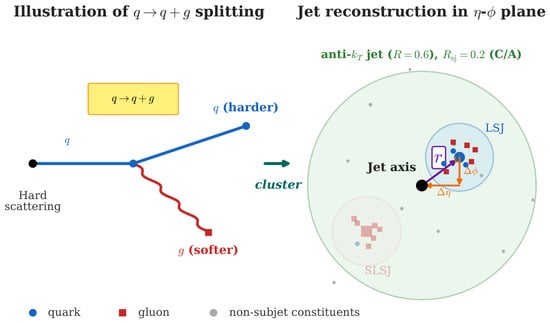
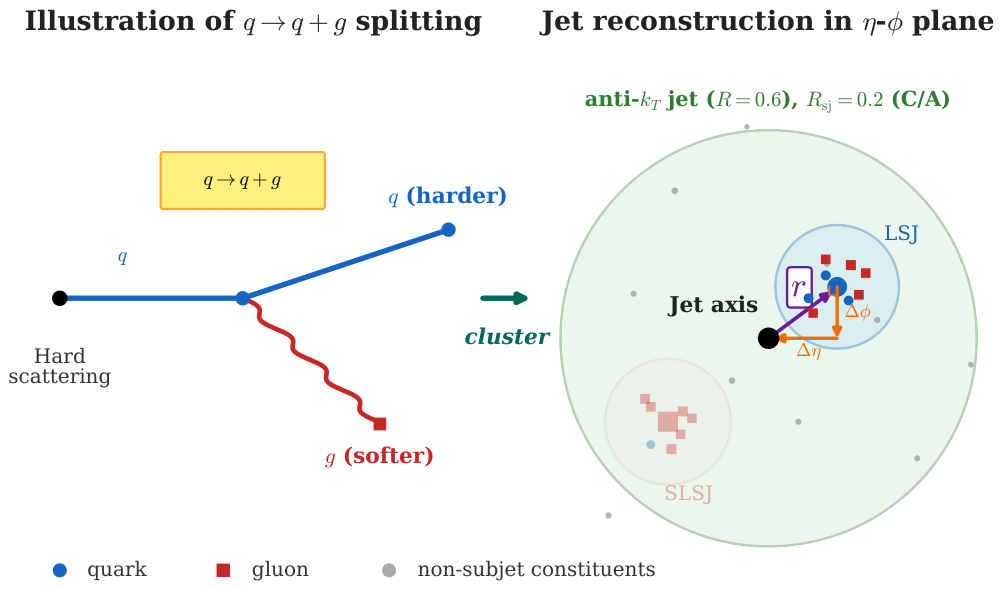
Figure 1 presents a schematic illustration of the proposed observable. The left panel shows a quark-initiated jet, taking the splitting process as an example. After clustering-based jet and subjet reconstruction, the corresponding jet substructure is visualized in the - plane in the right panel. The radial distance between a subjet and its parent jet axis is defined as
with
Figure 1.
Schematic illustration of the leading subjet (LSJ) and subleading subjet (SLSJ) reconstructed with the C/A algorithm () inside an anti-kt jet ().
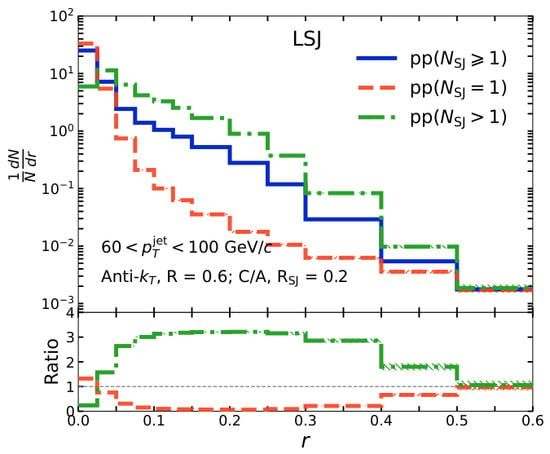
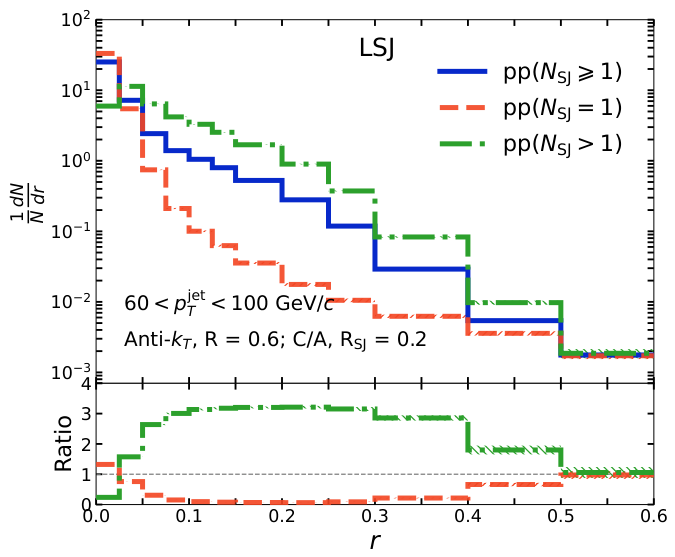
As a baseline for Pb + Pb collisions, we first present the LSJ radial distributions in p + p collisions, as shown in Figure 2. The upper figure displays the normalized radial distributions of the LSJ relative to the parent jet axis, with the solid blue, dashed red, and dash-dotted green curves corresponding to , , and , respectively. The lower panel presents the ratios of the and distributions to that of . In all cases, the LSJ is observed to be concentrated near the jet axis, as it carries the majority of jet energy and thus represents the hardest branching. The lower panel further reveals that, relative to the inclusive sample (), events with multi-subjets () exhibit an enhanced probability at large radial distances, whereas single-subjet events () are relatively more concentrated in the innermost core of the jet. As r increases, the three distributions are observed to converge. This behavior arises because multi-subjet events originate from splittings at larger angles, which naturally lead to a larger separation between the LSJ and the parent jet axis. As a result, the large-r region is increasingly populated by multi-subjet events, causing their distribution to approach the inclusive one. Meanwhile, as the complementary category, the distribution of single-subjet events also approaches that of the inclusive sample at large r values.
Figure 2.
Top: Normalized radial distribution of LSJ with respect to the parent jet axis for (blue), (red), and (green) in p + p collisions at . Bottom: Ratio of the and distributions to the distribution. The shaded bands indicate statistical uncertainties.
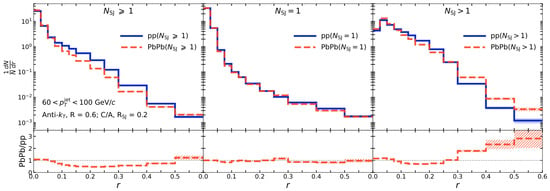
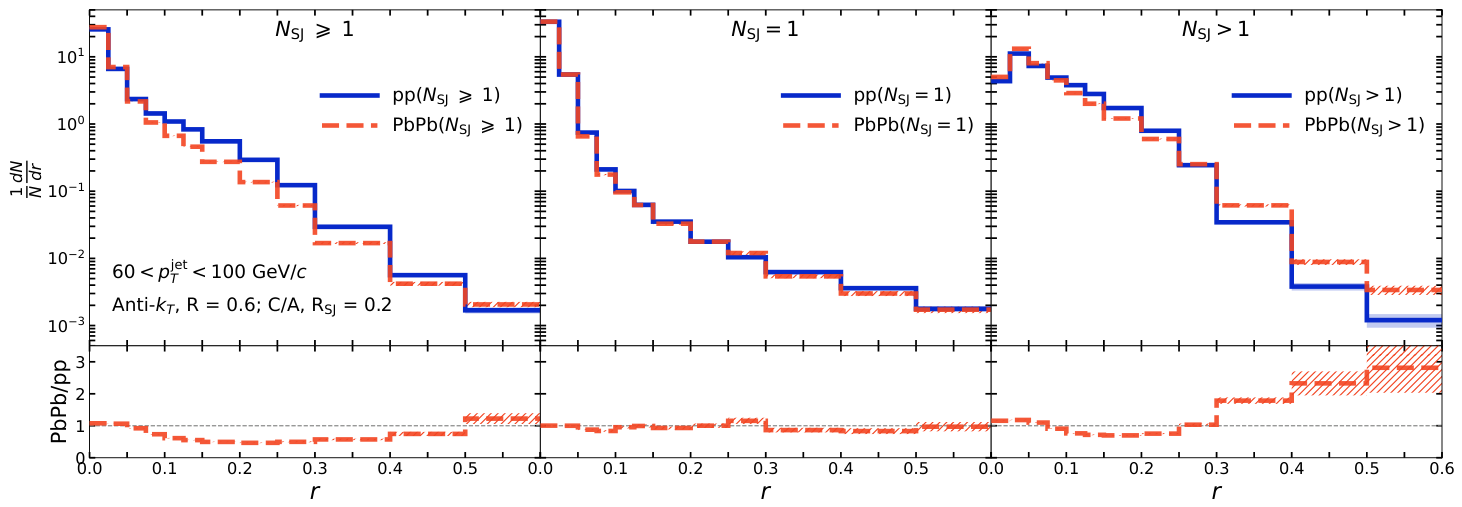
The simulation of the LBT model described above provides results for Pb + Pb collisions, which are compared with those from p + p collisions to quantify nuclear modification effects. As shown in Figure 3, the left, middle, and right panels present the LSJ radial distributions in p + p (blue) and Pb + Pb (red) collisions at for , , and , respectively, with the lower panels showing the corresponding ratios between Pb + Pb and p + p. We find that the nuclear modifications of these three event categories differ significantly. Events with exhibit a pronounced suppression in the region , while events with show only a weak modification across the entire jet cone. For events with , a suppression is observed in followed by an enhancement in . This indicates that, after medium modification, multi-subjet events exhibit a redistribution of the LSJ toward the outer regions of the jet compared to the vacuum case. To gain a deeper understanding of the results presented above, we compute the following observables.
Figure 3.
Top: Normalized radial distributions of LSJ with respect to the parent jet axis for (left), (middle), and (right) in p + p and Pb + Pb collisions at . Bottom: Ratios of the Pb + Pb to p + p distributions, representing the corresponding nuclear modifications. The shaded bands indicate statistical uncertainties.
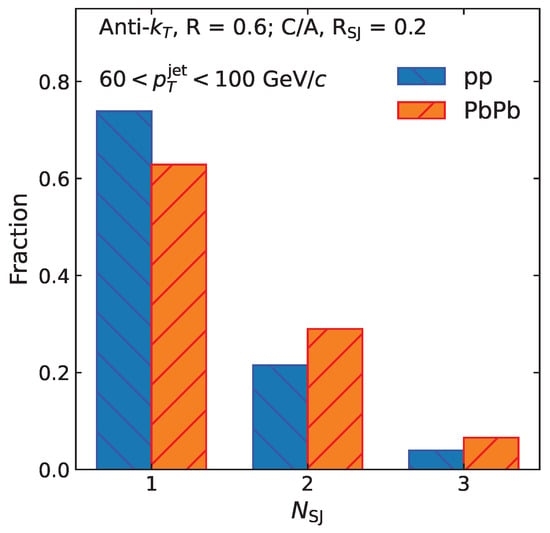
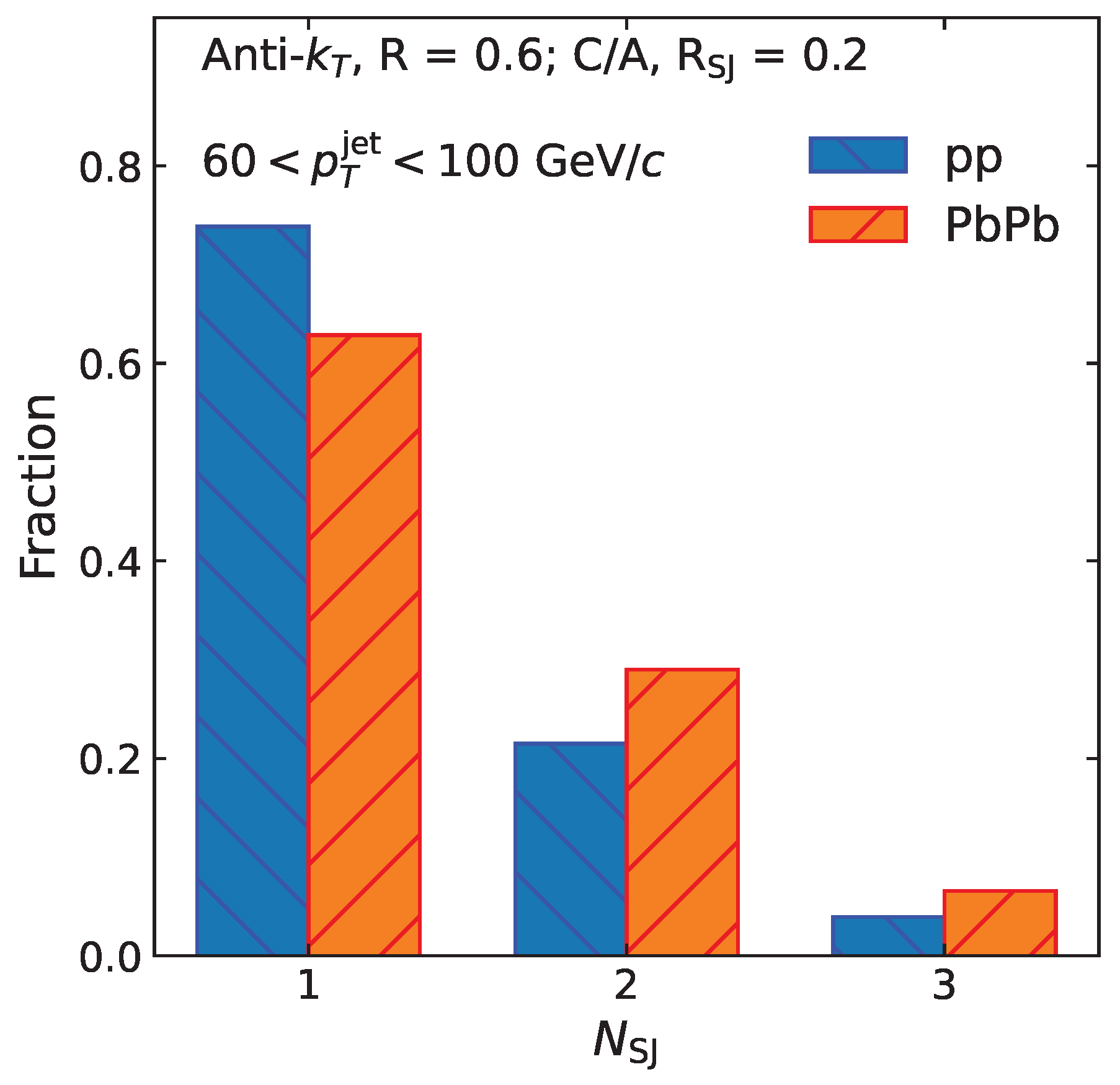
Figure 4 shows the fractions of jet events with , 2, and 3 in p + p and Pb + Pb collisions at . Single-subjet events dominate in both p + p and Pb + Pb collisions, which is the primary reason why the enhancement of events at large r observed in Figure 3 is largely absent in the distribution. Additionally, we observe that the fractions for and increase after medium modification, while those for decrease. This change in the composition can also influence the inclusive nuclear modification through the change in the event-class mixture. Such a composition effect cannot be isolated using the inclusive distribution alone. The present -resolved analysis separates it from the radial modification within each class.
Figure 4.
Fractions of jets containing 1, 2, and 3 subjets in p + p (blue) and Pb + Pb (orange) collisions at .
In the LBT model, subjets lose energy independently through their interactions with the medium, an assumption that is also supported by comparisons between model calculations and experimental measurements [93]. This implies that the deflection of subjet directions induced by jet–medium interactions is equally likely to increase or decrease the radial distance r. This suggests that another mechanism responsible for the broadening of the LSJ radial distribution may be the transverse momentum imbalance between subjets. To examine this possibility, we perform the following analysis.
where and are the transverse momenta of the SLSJ and the LSJ, respectively. The observable characterizes the transverse momentum imbalance between the SLSJ and the LSJ.
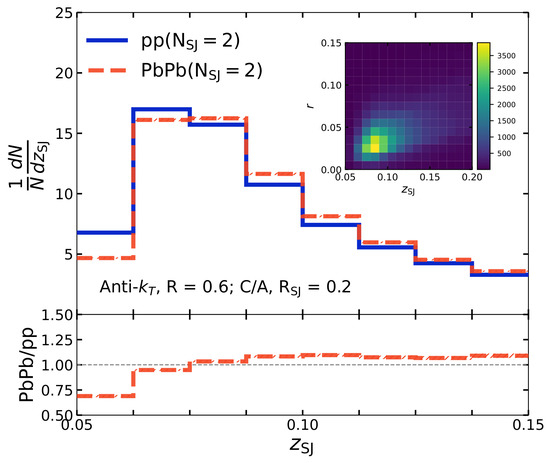
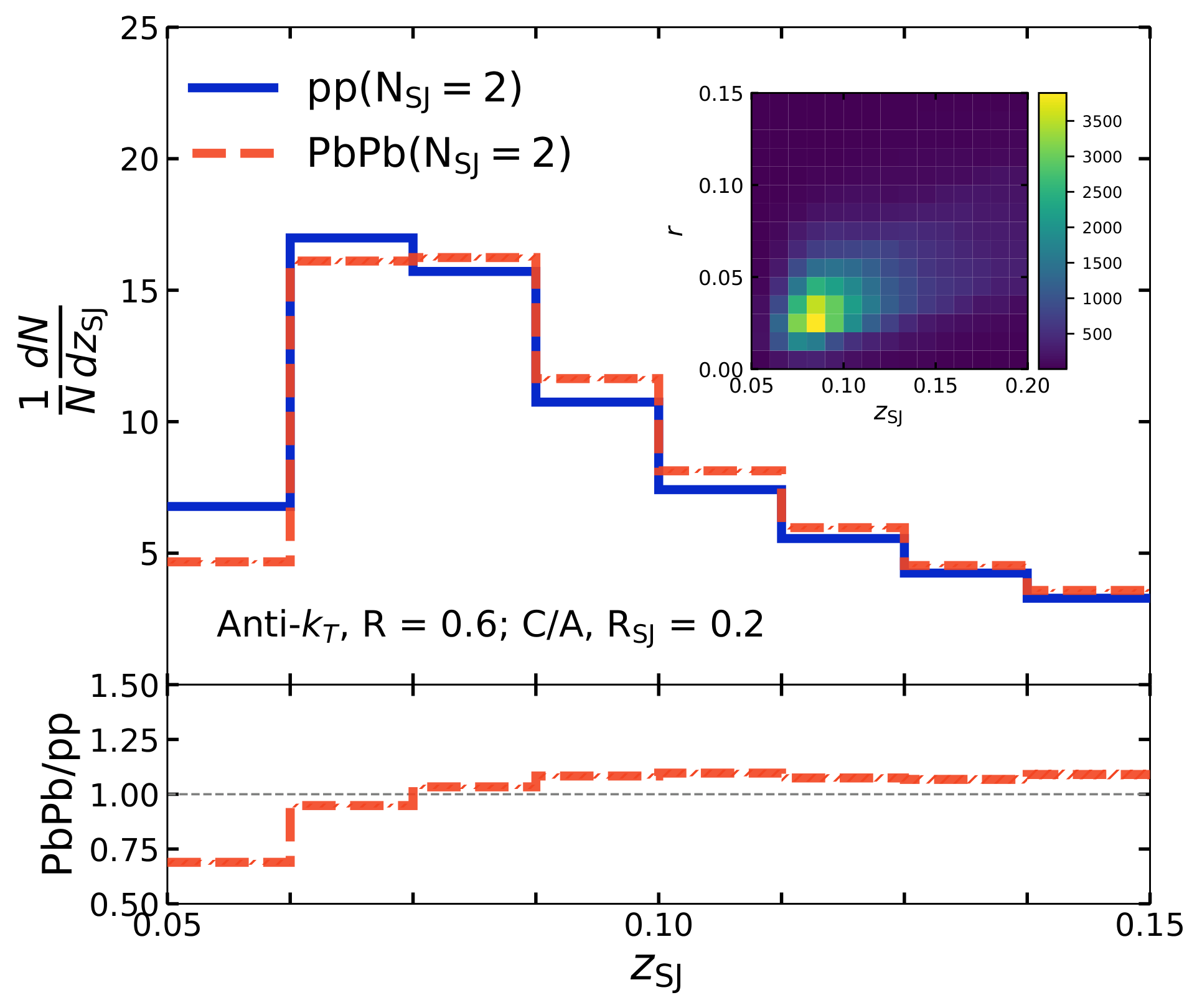
As shown in Figure 5, we present the distribution of the subjet transverse momentum imbalance in p + p and Pb + Pb collisions at , together with the corresponding nuclear modification ratio. The upper-right panel of the figure shows the two-dimensional density correlation between the LSJ radial position r and . The motivation for restricting the distribution to the interval becomes clear from this two-dimensional representation: Beyond this range, the correlation between r and becomes essentially flat, indicating that variations in exhibit only a weak dependence on r, while the event density also decreases rapidly, leaving only limited statistics in this region. In this regime, ceases to be informative for characterizing the medium-induced broadening of r. Consequently, our discussion is confined to the interval specified above.
Figure 5.
The distribution of the transverse momentum imbalance for events in p + p (blue) and Pb + Pb (red) collisions at , along with the corresponding ratio. The shaded bands indicate statistical uncertainties. Inset: The two-dimensional distribution of the LSJ radial position r versus in p + p collisions at .
We observe that, after medium modification, the distribution shifts slightly toward larger values. This means that the LSJ and SLSJ transverse momenta become closer in events after medium modification. The jet axis direction is essentially determined by the vector sum of the two subjet momenta; when the two momentum magnitudes are brought closer together by energy loss, the direction of their vector sum tilts further away from the larger subjet, namely the LSJ. Consequently, the medium-induced increase in the subjet transverse momentum balance gives rise to a broadening of the LSJ radial distribution in events.
3. Summary
In our study, p + p and Pb + Pb collisions are simulated with the Pythia8 event generator and the LBT model. For the first time, we present the radial distributions of the leading subjet within the parent jet as a jet substructure observable.
In p + p collisions, the LSJ is concentrated near the jet core, reflecting its origin from the hardest branching. events show an enhanced probability relative to events except in the innermost core of the jet, and the three distributions converge at large r due to the dominance of wide-angle splittings in events.
In heavy-ion collisions, the nuclear modification patterns differ markedly across event categories. events show pronounced suppression at intermediate radii, while events exhibit weak modification throughout the jet cone. events display a characteristic suppression at small radii followed by enhancement at large radii, indicating a redistribution of energy toward the jet periphery. This broadening is masked in the inclusive distribution because events dominate the event sample. The increase in event fractions after medium modification may also affect the nuclear modification of the LSJ radial distribution. The increased transverse momentum balance between the LSJ and SLSJ in events drives the jet axis away from the LSJ, providing a mechanistic explanation for the observed radial broadening.
Author Contributions
Conceptualization and methodology, W.-X.K.; validation, J.-W.K.; formal analysis, W.-X.K., J.-W.K., and S.W.; investigation, W.-X.K.; resources, Y.L.; data curation, W.-X.K.; writing—original draft preparation, W.-X.K.; writing—review and editing, S.W., J.-W.K., Y.L., and M.-Q.Y.; supervision, B.-W.Z. and E.-K.W.; project administration, B.-W.Z. and E.-K.W. All authors have read and agreed to the published version of the manuscript.
Funding
This research was funded by the National Natural Science Foundation of China (NSFC) with Project No. 12535010 and the Guangdong Major Project of Basic and Applied Basic Research No. 2020B0301030008.
Data Availability Statement
The code used in this work is not publicly available at present. Interested readers may contact the authors to request access.
Acknowledgments
We are grateful for valuable discussions with Wei Dai and Shan-Liang Zhang.
Conflicts of Interest
The authors declare no conflicts of interest.
References
- Adams, J. et al. [STAR Collaboration] Experimental and theoretical challenges in the search for the quark gluon plasma: The STAR Collaboration’s critical assessment of the evidence from RHIC collisions. Nucl. Phys. A 2005, 757, 102–183. [Google Scholar] [CrossRef] [Scilit]
- Gyulassy, M.; McLerran, L. New forms of QCD matter discovered at RHIC. Nucl. Phys. A 2005, 750, 30–63. [Google Scholar] [CrossRef] [Scilit]
- Chatrchyan, S. et al. [CMS Collaboration] The CMS Experiment at the CERN LHC. JINST 2008, 3, S08004. [Google Scholar] [CrossRef] [Scilit]
- Aamodt, K. et al. [ALICE Collaboration] The ALICE experiment at the CERN LHC. JINST 2008, 3, S08002. [Google Scholar] [CrossRef] [Scilit]
- Aad, G. et al. [ATLAS Collaboration] Observation of a Centrality-Dependent Dijet Asymmetry in Lead-Lead Collisions at =2.77 TeV with the ATLAS Detector at the LHC. Phys. Rev. Lett. 2010, 105, 252303. [Google Scholar] [CrossRef] [Scilit] [PubMed]
- Aaboud, M. et al. [ATLAS Collaboration] Jet energy scale measurements and their systematic uncertainties in proton-proton collisions at =13 TeV with the ATLAS detector. Phys. Rev. D 2017, 96, 072002. [Google Scholar] [CrossRef] [Scilit]
- Aad, G. et al. [ATLAS Collaboration] Measurement of the jet radius and transverse momentum dependence of inclusive jet suppression in lead-lead collisions at = 2.76 TeV with the ATLAS detector. Phys. Lett. B 2013, 719, 220–241. [Google Scholar] [CrossRef] [Scilit]
- Khachatryan, V. et al. [CMS Collaboration] Jet energy scale and resolution in the CMS experiment in pp collisions at 8 TeV. JINST 2017, 12, P02014. [Google Scholar] [CrossRef] [Scilit]
- Connors, M.; Nattrass, C.; Reed, R.; Salur, S. Jet measurements in heavy ion physics. Rev. Mod. Phys. 2018, 90, 025005. [Google Scholar] [CrossRef] [Scilit]
- Blaizot, J.P.; Mehtar-Tani, Y. Jet Structure in Heavy Ion Collisions. Int. J. Mod. Phys. E 2015, 24, 1530012. [Google Scholar] [CrossRef] [Scilit]
- Braun-Munzinger, P.; Koch, V.; Schäfer, T.; Stachel, J. Properties of hot and dense matter from relativistic heavy ion collisions. Phys. Rep. 2016, 621, 76–126. [Google Scholar] [CrossRef] [Scilit]
- Cunqueiro, L.; Sickles, A.M. Studying the QGP with Jets at the LHC and RHIC. Prog. Part. Nucl. Phys. 2022, 124, 103940. [Google Scholar] [CrossRef] [Scilit]
- Cao, S.; Qin, G.Y. Medium Response and Jet-Hadron Correlations in Relativistic Heavy-Ion Collisions. Ann. Rev. Nucl. Part. Sci. 2023, 73, 205–229. [Google Scholar] [CrossRef] [Scilit]
- Wang, X.N.; Gyulassy, M. Gluon shadowing and jet quenching in A + A collisions at s**(1/2) = 200-GeV. Phys. Rev. Lett. 1992, 68, 1480–1483. [Google Scholar] [CrossRef] [Scilit] [PubMed]
- Gyulassy, M.; Vitev, I.; Wang, X.N.; Zhang, B.W. Jet quenching and radiative energy loss in dense nuclear matter. In Quark–Gluon Plasma 3; Hwa, R.C., Wang, X.N., Eds.; World Scientific: Singapore, 2004; pp. 123–191. [Google Scholar] [CrossRef] [Scilit]
- Mehtar-Tani, Y.; Milhano, J.G.; Tywoniuk, K. Jet physics in heavy-ion collisions. Int. J. Mod. Phys. A 2013, 28, 1340013. [Google Scholar] [CrossRef] [Scilit]
- Qin, G.Y.; Wang, X.N. Jet quenching in high-energy heavy-ion collisions. Int. J. Mod. Phys. E 2015, 24, 1530014. [Google Scholar] [CrossRef] [Scilit]
- Wang, X.N. Effect of jet quenching on high pT hadron spectra in high-energy nuclear collisions. Phys. Rev. C 1998, 58, 2321. [Google Scholar] [CrossRef] [Scilit]
- Wang, E.; Wang, X.N. Parton energy loss with detailed balance. Phys. Rev. Lett. 2001, 87, 142301. [Google Scholar] [CrossRef] [Scilit] [PubMed]
- Wang, E.; Wang, X.N. Jet tomography of dense and nuclear matter. Phys. Rev. Lett. 2002, 89, 162301. [Google Scholar] [CrossRef] [Scilit] [PubMed]
- Vitev, I.; Zhang, B.W. Jet tomography of high-energy nucleus-nucleus collisions at next-to-leading order. Phys. Rev. Lett. 2010, 104, 132001. [Google Scholar] [CrossRef] [Scilit] [PubMed]
- Brambilla, N.; Eidelman, S.; Foka, P.; Gardner, S.; Kronfeld, A.S.; Alford, M.G.; Alkofer, R.; Butenschoen, M.; Cohen, T.D.; Erdmenger, J.; et al. QCD and Strongly Coupled Gauge Theories: Challenges and Perspectives. Eur. Phys. J. C 2014, 74, 2981. [Google Scholar] [CrossRef] [Scilit] [PubMed]
- Neufeld, R.B.; Vitev, I.; Zhang, B.W. The Physics of Z0/γ∗-tagged jets at the LHC. Phys. Rev. C 2011, 83, 034902. [Google Scholar] [CrossRef] [Scilit]
- He, Y.; Pang, L.G.; Wang, X.N. Gradient Tomography of Jet Quenching in Heavy-Ion Collisions. Phys. Rev. Lett. 2020, 125, 122301. [Google Scholar] [CrossRef] [Scilit] [PubMed]
- Kang, J.W.; Wang, L.; Dai, W.; Wang, S.; Zhang, B.W. Multijet topology in high-energy nuclear collisions: Jet broadening. Phys. Rev. C 2025, 112, 034903. [Google Scholar] [CrossRef] [Scilit]
- Dai, W.; Vitev, I.; Zhang, B.W. Momentum imbalance of isolated photon-tagged jet production at RHIC and LHC. Phys. Rev. Lett. 2013, 110, 142001. [Google Scholar] [CrossRef] [Scilit] [PubMed]
- Yang, Z.; He, Y.; Moult, I.; Wang, X.N. Probing the Short-Distance Structure of the Quark-Gluon Plasma with Energy Correlators. Phys. Rev. Lett. 2024, 132, 011901. [Google Scholar] [CrossRef] [Scilit] [PubMed]
- Wang, S.; Dai, W.; Wang, E.; Wang, X.N.; Zhang, B.W. Heavy-Flavour Jets in High-Energy Nuclear Collisions. Symmetry 2023, 15, 727. [Google Scholar] [CrossRef] [Scilit]
- Xie, M.; Ke, W.; Zhang, H.; Wang, X.N. Information-field-based global Bayesian inference of the jet transport coefficient. Phys. Rev. C 2023, 108, L011901. [Google Scholar] [CrossRef] [Scilit]
- Yang, Z.; Luo, T.; Chen, W.; Pang, L.G.; Wang, X.N. 3D Structure of Jet-Induced Diffusion Wake in an Expanding Quark-Gluon Plasma. Phys. Rev. Lett. 2023, 130, 052301. [Google Scholar] [CrossRef] [Scilit] [PubMed]
- Kong, W.X.; Zhang, B.W. Fox-Wolfram moment of jet production in relativistic heavy-ion collisions. Chin. Phys. C 2025, 49, 094101. [Google Scholar] [CrossRef] [Scilit]
- Wang, S.; Dai, W.; Zhang, B.W.; Wang, E. Diffusion of charm quarks in jets in high-energy heavy-ion collisions. Eur. Phys. J. C 2019, 79, 789. [Google Scholar] [CrossRef] [Scilit]
- Li, Y.; Shen, S.; Wang, S.; Zhang, B.W. Transverse momentum balance of dijets in Xe+Xe collisions at the LHC. Nucl. Sci. Tech. 2024, 35, 113. [Google Scholar] [CrossRef] [Scilit]
- Xie, M.; Han, Q.F.; Wang, E.K.; Zhang, B.W.; Zhang, H.Z. The medium-temperature dependence of jet transport coefficient in high-energy nucleus–nucleus collisions. Nucl. Sci. Tech. 2024, 35, 125. [Google Scholar] [CrossRef] [Scilit]
- Zhang, H.X.; Xiao, Y.X.; Kang, J.W.; Zhang, B.W. Phenomenological study of the anisotropic quark matter in the two-flavor Nambu–Jona–Lasinio model. Nucl. Sci. Tech. 2022, 33, 150. [Google Scholar] [CrossRef] [Scilit]
- Altheimer, A.; Arora, S.; Asquith, L.; Brooijmans, G.; Butterworth, J.; Campanelli, M.; Chapleau, B.; Cholakian, A.E.; Chou, J.P.; Dasgupta, M.; et al. Jet Substructure at the Tevatron and LHC: New Results, New Tools, New Benchmarks. J. Phys. G 2012, 39, 063001. [Google Scholar] [CrossRef] [Scilit]
- Aad, G. et al. [ATLAS Collaboration] Jet mass and substructure of inclusive jets in = 7 TeV pp collisions with the ATLAS experiment. J. High Energ. Phys. 2012, 5, 128. [Google Scholar] [CrossRef] [Scilit]
- Casalderrey-Solana, J.; Milhano, G.; Pablos, D.; Rajagopal, K. Modification of Jet Substructure in Heavy Ion Collisions as a Probe of the Resolution Length of Quark-Gluon Plasma. JHEP 2020, 1, 44. [Google Scholar] [CrossRef] [Scilit]
- Aaboud, M. et al. [ATLAS Collaboration] Measurement of jet fragmentation in Pb+Pb and pp collisions at = 5.02 TeV with the ATLAS detector. Phys. Rev. C 2018, 98, 024908. [Google Scholar] [CrossRef] [Scilit]
- Caucal, P.; Iancu, E.; Mueller, A.H.; Soyez, G. Vacuum-like jet fragmentation in a dense QCD medium. Phys. Rev. Lett. 2018, 120, 232001. [Google Scholar] [CrossRef] [Scilit] [PubMed]
- Kang, Z.B.; Lee, K.; Ringer, F. Jet angularity measurements for single inclusive jet production. J. High Energ. Phys. 2018, 4, 110. [Google Scholar] [CrossRef] [Scilit]
- Sirunyan, A.M. et al. [CMS Collaboration] Observation of Medium-Induced Modifications of Jet Fragmentation in Pb-Pb Collisions at = 5.02 TeV Using Isolated Photon-Tagged Jets. Phys. Rev. Lett. 2018, 121, 242301. [Google Scholar] [CrossRef] [Scilit] [PubMed]
- Apolinário, L.; Milhano, J.G.; Ploskon, M.; Zhang, X. Novel subjet observables for jet quenching in heavy-ion collisions. Eur. Phys. J. C 2018, 78, 529. [Google Scholar] [CrossRef] [Scilit]
- Aaboud, M. et al. [ATLAS Collaboration] Measurement of jet fragmentation in Pb+Pb and pp collisions at = 2.76 TeV with the ATLAS detector at the LHC. Eur. Phys. J. C 2017, 77, 379. [Google Scholar] [CrossRef] [Scilit] [PubMed]
- Yan, J.; Chen, S.Y.; Dai, W.; Zhang, B.W.; Wang, E. Medium modifications of girth distributions for inclusive jets and Z0 + jet in relativistic heavy-ion collisions at the LHC. Chin. Phys. C 2021, 45, 024102. [Google Scholar] [CrossRef] [Scilit]
- Hayrapetyan, A. et al. [CMS Collaboration] Girth and groomed radius of jets recoiling against isolated photons in lead-lead and proton-proton collisions at sNN = 5.02 TeV. Phys. Lett. B 2025, 861, 139088. [Google Scholar] [CrossRef] [Scilit]
- Barata, J.; Caucal, P.; Soto-Ontoso, A.; Szafron, R. Advancing the understanding of energy-energy correlators in heavy-ion collisions. J. High Energ. Phys. 2024, 11, 60. [Google Scholar] [CrossRef] [Scilit]
- Wang, S.; Li, Y.; Kang, J.W.; Zhang, B.W. Unveiling the jet angular broadening with photon-tagged jets in high-energy nuclear collisions. Nucl. Sci. Tech. 2026, 37, 168. [Google Scholar] [CrossRef] [Scilit]
- Chatrchyan, S. et al. [CMS Collaboration] Measurement of Jet Fragmentation in PbPb and pp Collisions at = 2.76 TeV. Phys. Rev. C 2014, 90, 024908. [Google Scholar] [CrossRef] [Scilit]
- Kang, J.W.; Wang, S.; Wang, L.; Zhang, B.W. Phenomenological study of the angle between jet axes in heavy-ion collisions. Phys. Rev. C 2025, 111, 054905. [Google Scholar] [CrossRef] [Scilit]
- Li, Y.; Chen, S.Y.; Kong, W.X.; Wang, S.; Zhang, B.W. Medium Modifications of Heavy-Flavor Jet Angularities in High-Energy Nuclear Collisions. Chin. Phys. Lett. 2025, 42, 011201. [Google Scholar] [CrossRef] [Scilit]
- Sirunyan, A.M. et al. [CMS Collaboration] Measurement of the Splitting Function in pp and Pb-Pb Collisions at = 5.02 TeV. Phys. Rev. Lett. 2018, 120, 142302. [Google Scholar] [CrossRef] [Scilit] [PubMed]
- Qin, G.Y. Parton shower evolution in medium and nuclear modification of photon-tagged jets in Pb+Pb collisions at the LHC. Eur. Phys. J. C 2014, 74, 2959. [Google Scholar] [CrossRef] [Scilit]
- Acharya, S. et al. [ALICE Collaboration] Search for quasi-particle scattering in the quark-gluon plasma with jet splittings in pp and Pb-Pb collisions at = 5.02 TeV. Phys. Rev. Lett. 2025, 135, 031901. [Google Scholar] [CrossRef] [Scilit] [PubMed]
- Cunqueiro, L.; Pablos, D.; Soto-Ontoso, A.; Spousta, M.; Takacs, A.; Verweij, M. Isolating perturbative QCD splittings in heavy-ion collisions. Phys. Rev. D 2024, 110, 014015. [Google Scholar] [CrossRef] [Scilit]
- Acharya, S. et al. [ALICE Collaboration] Measurement of the groomed jet radius and momentum splitting fraction in pp and Pb-Pb collisions at = 5.02 TeV. Phys. Rev. Lett. 2022, 128, 102001. [Google Scholar] [CrossRef] [Scilit] [PubMed]
- Acharya, S. et al. [ALICE Collaboration] Measurements of the groomed and ungroomed jet angularities in pp collisions at = 5.02 TeV. J. High Energ. Phys. 2022, 5, 61. [Google Scholar] [CrossRef] [Scilit]
- Sirunyan, A.M. et al. [CMS Collaboration] Measurement of the groomed jet mass in PbPb and pp collisions at = 5.02 TeV. J. High Energ. Phys. 2018, 10, 161. [Google Scholar] [CrossRef] [Scilit]
- Wang, S.; Li, S.; Kang, J.W.; Zhang, B.W.; Wang, E. Substructure grooming of inclusive and photon-tagged jets in heavy-ion collisions. arXiv 2025, arXiv:2512.14053. [Google Scholar]
- Kunnawalkam Elayavalli, R.; Zapp, K.C. Medium response in JEWEL and its impact on jet shape observables in heavy ion collisions. J. High Energ. Phys. 2017, 7, 141. [Google Scholar] [CrossRef] [Scilit]
- Chang, N.B.; Qin, G.Y. Full jet evolution in quark-gluon plasma and nuclear modification of jet production and jet shape in Pb+Pb collisions at 2.76ATeV at the CERN Large Hadron Collider. Phys. Rev. C 2016, 94, 024902. [Google Scholar] [CrossRef] [Scilit]
- Chatrchyan, S. et al. [CMS Collaboration] Modification of Jet Shapes in PbPb Collisions at = 2.76 TeV. Phys. Lett. B 2014, 730, 243–263. [Google Scholar] [CrossRef] [Scilit]
- Larkoski, A.J.; Marzani, S.; Soyez, G.; Thaler, J. Soft Drop. J. High Energ. Phys. 2014, 5, 146. [Google Scholar] [CrossRef] [Scilit]
- Frye, C.; Larkoski, A.J.; Schwartz, M.D.; Yan, K. Factorization for groomed jet substructure beyond the next-to-leading logarithm. J. High Energ. Phys. 2016, 7, 64. [Google Scholar] [CrossRef] [Scilit]
- Acharya, S. et al. [ALICE Collaboration] Exploration of jet substructure using iterative declustering in pp and Pb–Pb collisions at LHC energies. Phys. Lett. B 2020, 802, 135227. [Google Scholar] [CrossRef] [Scilit]
- Acharya, S. et al. [ALICE Collaboration] Measurements of the groomed jet radius and momentum splitting fraction with the soft drop and dynamical grooming algorithms in pp collisions at = 5.02 TeV. J. High Energ. Phys. 2023, 5, 244. [Google Scholar] [CrossRef] [Scilit]
- Wang, L.; Kang, J.W.; Zhang, Q.; Shen, S.; Dai, W.; Zhang, B.W.; Wang, E. Jet Radius and Momentum Splitting Fraction with Dynamical Grooming in Heavy-Ion Collisions. Chin. Phys. Lett. 2023, 40, 032101. [Google Scholar] [CrossRef] [Scilit]
- Zhang, S.L.; Yang, M.Q.; Zhang, B.W. Parton splitting scales of reclustered large-radius jets in high-energy nuclear collisions. Eur. Phys. J. C 2022, 82, 414. [Google Scholar] [CrossRef] [Scilit]
- Sjostrand, T.; Mrenna, S.; Skands, P.Z. A Brief Introduction to PYTHIA 8.1. Comput. Phys. Commun. 2008, 178, 852–867. [Google Scholar] [CrossRef] [Scilit]
- Sjöstrand, T.; Ask, S.; Christiansen, J.R.; Corke, R.; Desai, N.; Ilten, P.; Mrenna, S.; Prestel, S.; Rasmussen, C.O.; Skands, P.Z. An introduction to PYTHIA 8.2. Comput. Phys. Commun. 2015, 191, 159–177. [Google Scholar] [CrossRef] [Scilit]
- Sjostrand, T.; Mrenna, S.; Skands, P.Z. PYTHIA 6.4 Physics and Manual. J. High Energ. Phys. 2006, 5, 26. [Google Scholar] [CrossRef] [Scilit]
- Bierlich, C.; Chakraborty, S.; Desai, N.; Gellersen, L.; Helenius, I.; Ilten, P.; Lönnblad, L.; Mrenna, S.; Prestel, S.; Preuss, C.T.; et al. A comprehensive guide to the physics and usage of PYTHIA 8.3. SciPost Phys. Codebases 2022, 8, 8. [Google Scholar] [CrossRef] [Scilit]
- Wang, X.N.; Zhu, Y. Medium Modification of γ-jets in High-energy Heavy-ion Collisions. Phys. Rev. Lett. 2013, 111, 062301. [Google Scholar] [CrossRef] [Scilit] [PubMed]
- He, Y.; Luo, T.; Wang, X.N.; Zhu, Y. Linear Boltzmann Transport for Jet Propagation in the Quark-Gluon Plasma: Elastic Processes and Medium Recoil. Phys. Rev. C 2015, 91, 054908, Erratum in Phys. Rev. C 2018, 97, 019902. https://doi.org/10.1103/PhysRevC.91.054908. [Google Scholar] [CrossRef] [Scilit]
- Cao, S.; Luo, T.; Qin, G.Y.; Wang, X.N. Linearized Boltzmann transport model for jet propagation in the quark-gluon plasma: Heavy quark evolution. Phys. Rev. C 2016, 94, 014909. [Google Scholar] [CrossRef] [Scilit]
- Cao, S.; Luo, T.; Qin, G.Y.; Wang, X.N. Heavy and light flavor jet quenching at RHIC and LHC energies. Phys. Lett. B 2018, 777, 255–259. [Google Scholar] [CrossRef] [Scilit]
- Zhang, S.L.; Luo, T.; Wang, X.N.; Zhang, B.W. Z+jet correlation with NLO-matched parton-shower and jet-medium interaction in high-energy nuclear collisions. Phys. Rev. C 2018, 98, 021901. [Google Scholar] [CrossRef] [Scilit]
- Luo, T.; Cao, S.; He, Y.; Wang, X.N. Multiple jets and γ-jet correlation in high-energy heavy-ion collisions. Phys. Lett. B 2018, 782, 707–716. [Google Scholar] [CrossRef] [Scilit]
- Schenke, B.; Jeon, S.; Gale, C. (3+1)D hydrodynamic simulation of relativistic heavy-ion collisions. Phys. Rev. C 2010, 82, 014903. [Google Scholar] [CrossRef] [Scilit]
- Schenke, B.; Jeon, S.; Gale, C. Elliptic and triangular flow in event-by-event (3+1)D viscous hydrodynamics. Phys. Rev. Lett. 2011, 106, 042301. [Google Scholar] [CrossRef] [Scilit] [PubMed]
- Pang, L.; Wang, Q.; Wang, X.N. Effects of initial flow velocity fluctuation in event-by-event (3+1)D hydrodynamics. Phys. Rev. C 2012, 86, 024911. [Google Scholar] [CrossRef] [Scilit]
- Pang, L.G.; Petersen, H.; Wang, X.N. Pseudorapidity distribution and decorrelation of anisotropic flow within the open-computing-language implementation CLVisc hydrodynamics. Phys. Rev. C 2018, 97, 064918. [Google Scholar] [CrossRef] [Scilit]
- Pang, L.G.; Hatta, Y.; Wang, X.N.; Xiao, B.W. Analytical and numerical Gubser solutions of the second-order hydrodynamics. Phys. Rev. D 2015, 91, 074027. [Google Scholar] [CrossRef] [Scilit]
- Lin, Z.W.; Ko, C.M.; Li, B.A.; Zhang, B.; Pal, S. A Multi-phase transport model for relativistic heavy ion collisions. Phys. Rev. C 2005, 72, 064901. [Google Scholar] [CrossRef] [Scilit]
- Cacciari, M.; Salam, G.P.; Soyez, G. FastJet User Manual. Eur. Phys. J. C 2012, 72, 1896. [Google Scholar] [CrossRef] [Scilit]
- Cacciari, M.; Salam, G.P.; Soyez, G. The anti-kt jet clustering algorithm. J. High Energ. Phys. 2008, 4, 63. [Google Scholar] [CrossRef] [Scilit]
- Guo, X.F.; Wang, X.N. Multiple scattering, parton energy loss and modified fragmentation functions in deeply inelastic e A scattering. Phys. Rev. Lett. 2000, 85, 3591–3594. [Google Scholar] [CrossRef] [Scilit] [PubMed]
- Wang, X.N.; Guo, X.f. Multiple parton scattering in nuclei: Parton energy loss. Nucl. Phys. A 2001, 696, 788–832. [Google Scholar] [CrossRef] [Scilit]
- Zhang, B.W.; Wang, E.; Wang, X.N. Heavy quark energy loss in nuclear medium. Phys. Rev. Lett. 2004, 93, 072301. [Google Scholar] [CrossRef] [Scilit] [PubMed]
- Zhang, B.W.; Wang, X.N. Multiple parton scattering in nuclei: Beyond helicity amplitude approximation. Nucl. Phys. A 2003, 720, 429–451. [Google Scholar] [CrossRef] [Scilit]
- Majumder, A. Hard collinear gluon radiation and multiple scattering in a medium. Phys. Rev. D 2012, 85, 014023. [Google Scholar] [CrossRef] [Scilit]
- Zhang, B.W.; Wang, E.k.; Wang, X.N. Multiple parton scattering in nuclei: Heavy quark energy loss and modified fragmentation functions. Nucl. Phys. A 2005, 757, 493–524. [Google Scholar] [CrossRef] [Scilit]
- Acharya, S. et al. [ALICE Collaboration] Measurement of the angle between jet axes in Pb-Pb collisions at sNN=5.02 TeV. Phys. Rev. C 2026, 113, 044905. [Google Scholar] [CrossRef] [Scilit]
Disclaimer/Publisher’s Note: The statements, opinions and data contained in all publications are solely those of the individual author(s) and contributor(s) and not of MDPI and/or the editor(s). MDPI and/or the editor(s) disclaim responsibility for any injury to people or property resulting from any ideas, methods, instructions or products referred to in the content. |
© 2026 by the authors. Licensee MDPI, Basel, Switzerland. This article is an open access article distributed under the terms and conditions of the Creative Commons Attribution (CC BY) license.