


Abstract
We present archival photometry from the Gravitational-wave Optical Transient Observer (GOTO) for four Galactic novae discovered between 2017 and 2024, spanning some of the faintest ZTF24aaomlxy and PGIR22akgylf (at a marginal near-limit level consistent with the practical limiting magnitude of calibrated L to the brightest V1405 Cas and V1674 Her recent eruptions. For each object, we extract GOTO measurements obtained at or near the pre-eruption state, excluding data points with observational uncertainties exceeding 0.5 mag (except for the faintest PGIR22akgylf). The resulting light curves show that GOTO can detect nova progenitors close to its observable limiting depth at calibrated L magnitudes approaching the survey’s practical limiting magnitude, providing meaningful constraints on quiescent brightness, possibly for systems that were only sparsely monitored using surveys such as ZTF and PGIR. These detections demonstrate that wide-field imaging originally designed for gravitational-wave follow-up can yield meaningful limits on both faint and fast-evolving nova progenitors. Simultaneously, we improve the sky positions of five Galactic novae—ZTF24aaomlxy, V3732 Oph, V2000 Aql, V3666 Oph, and V659 Sct—whose published coordinates are affected by crowding or limited precision. Using high-cadence photometry from ZTF and AAVSO, we identify the actual eruption source in each field and obtain revised coordinates that differ by several arcseconds. These findings highlight the importance of time-domain archives for identifying faint nova progenitors and improving astrometric accuracy across the Galactic nova population.
1. Introduction
Classical and recurrent novae are thermonuclear explosions on the surface of accreting white dwarfs in semi-detached binaries, producing a sudden brightening by 8–15 mag, followed by a decline over weeks to months [1]. Modern wide-field surveys have transformed nova discovery and characterization by providing high-cadence photometry capable of detecting increasingly faint or rapidly evolving eruptions that would previously have gone unnoticed [2,3]. The Zwicky Transient Facility (ZTF) has been particularly influential in this regard, offering large-area imaging with sufficient spatial resolution to monitor transient behavior even in highly crowded Galactic fields [4]. Long-term photometric coverage provided by the American Association of Variable Star Observers (AAVSO) also contributes essential information on pre- and post-outburst variability of nova progenitors.
Despite these advances, the quiescent magnitudes of many novae remain poorly constrained. Faint, highly reddened, or short-lived eruptions—especially those peaking near —are often undersampled by major surveys. Independent archival facilities, therefore, offer a valuable opportunity to extend quiescent limits, particularly for systems lying near survey detection thresholds. The Gravitational-wave Optical Transient Observer (GOTO; Steeghs et al. [5]) is one such facility: although designed for gravitational-wave follow-up [6], its multi-year wide-field coverage enables recovery of pre-eruption or near-quiescent detections of nova progenitors at calibrated L magnitudes approaching the survey’s practical limiting magnitude.
A second challenge in nova research concerns the accuracy of published eruption coordinates. Discovery announcements—especially those based on small telescopes, crowded Galactic-plane fields, or low-resolution imaging—may report positions with arcsecond-level uncertainties [7]. Such inaccuracies can lead to source blending, misidentification of the progenitor, or confusion among nearby objects exhibiting unrelated variability [8]. These issues propagate into nova catalogues [9,10], complicating cross-matching with archival datasets and hindering follow-up spectroscopy or progenitor studies. Time-domain survey archives now provide sufficient spatial resolution and cadence to resolve these ambiguities by examining all nearby stellar sources and identifying the eruptive object from its unique outburst signature.
In this work, we present archival GOTO photometry for four Galactic novae—ZTF24aaomlxy, PGIR22akgylf, V1405 Cas, and V1674 Her—spanning some of the faintest to the brightest eruptions of the past decade. These data provide new constraints on their pre-eruption brightness and demonstrate GOTO’s capability to recover progenitors close to the survey’s practical limiting magnitude.
In parallel, we refine the sky positions of five Galactic novae discovered between 2017 and 2024: ZTF24aaomlxy, V3732 Oph, V2000 Aql, V3666 Oph, and V659 Sct. Using archival ZTF and AAVSO photometry, we evaluate all stellar sources within each discovery region and identify the true eruptive star through the presence of an unmistakable outburst or variability pattern. The resulting corrected coordinates highlight the importance of time-domain archives for resolving crowded-field confusion and improving the accuracy of modern nova catalogues.
2. Materials and Methods
Our analysis began with the catalogue of 88 Galactic novae with eruptions recorded between 2017 and 2024, compiled and maintained by Koji Mukai1. The catalogue provides discovery coordinates, eruption dates, and reported peak magnitudes. To assess the detectability of quiescent progenitors in archival surveys, the novae were reordered by peak brightness, allowing the faintest systems to be examined first, as presented in Table 1.

Table 1.
Summary of 88 Galactic novae (2017–2024) compiled from Koji Mukai’s online catalog. Peak magnitudes are as reported in the discovery announcements; GOTO columns indicate whether the field was covered by GOTO and how many plates contain the nova position.
2.1. Archival Photometry from GOTO, ZTF and AAVSO
2.1.1. GOTO Photometry
GOTO imaging data were retrieved through a programmatic interface to the GOTO archive, querying all observations obtained between 2017 and late 2024 in which the reported nova coordinates fell within the field of view. The images were reduced using a custom NARIT pipeline executed in Jupyter Notebook with Python (v3.11, Python Software Foundation, Wilmington, DE, USA). Only images obtained in the broad L band were considered. This filter spans approximately 4000–6800 Å and is bracketed by Sloan and Johnson V bands [5]. The practical limiting magnitude of GOTO in the L band is typically mag [5], and measurements near this depth are treated cautiously as marginal detections or upper limits.
Photometry was performed on a per-image basis using a custom pipeline. Source detection and circular-aperture photometry were carried out at the target coordinates, with local sky backgrounds estimated from concentric annuli. Image statistics were characterized using sigma-clipped estimators to minimize the impact of cosmic rays and background structure. For the four novae analyzed in detail, differential photometry relative to nearby non-variable reference stars was also performed to improve robustness under varying transparency and seeing.
Photometric calibration was performed independently for each image using reference stars drawn from the Pan-STARRS1 (PS1) catalogue. Calibration stars within of the nova position and with reliable PS1 photometry ( mag) were used to derive a robust, sigma-clipped photometric zero point. No color-term corrections were applied; the resulting calibrated magnitudes therefore correspond to a pseudo-L system tied to the PS1 photometric scale. The calibrated nova magnitudes were obtained by applying the derived zero point to the instrumental measurements. Data flagged as problematic by the GOTO pipeline, or with observational uncertainties exceeding 0.5 mag (except for the faintest PGIR22akgylf, for which uncertainties exceeding 1.0 mag were allowed), were excluded. Throughout this work, we report magnitudes in this internally consistent pseudo-L system.
2.1.2. ZTF and AAVSO Photometry
Zwicky Transient Facility (ZTF) Data Release 23 was accessed through the IRSA Gator service2, providing calibrated g- and r-band light curves for all point sources within the ZTF footprint [3,4]. For each nova, all ZTF detections within several arcseconds of the reported discovery coordinates were extracted to ensure that potentially blended or neighboring sources were included.
Complementary photometry was obtained from the AAVSO International Database3, which aggregates multi-filter () time-series observations from a global network of observers. AAVSO measurements within the same positional search window were queried and incorporated when available, after excluding points flagged as unreliable or with quoted uncertainties exceeding 0.1 mag.
2.2. Identifying the True Eruptive Source
Many novae lie in crowded Galactic-plane fields where multiple stars fall within the discovery uncertainty region. To isolate the true eruptive object, we applied a time-domain variability screening approach similar to procedures used in large-scale nova surveys [8]. For each nearby candidate source, its ZTF and AAVSO light curves were examined for a characteristic nova eruption signature, namely, a rapid multi-magnitude rise followed by a structured decline or distinctive post-eruption variability. In its idealized form, the nova light curve (see Bode and Evans [1]) consists of nine evolutionary phases: the initial rise, pre-maximum halt (PMH), final rise, optical maximum, early decline, transition phase, oscillation phase, final decline, and post-nova phase.
A nova was deemed misidentified when the published coordinates corresponded to a non-variable star, while a nearby object exhibited an unambiguous outburst signature. Through this systematic comparison, we identified five novae whose published coordinates do not match the eruptive source: ZTF24aaomlxy, V3732 Oph, V2000 Aql, V3666 Oph, and V659 Sct.
Refined astrometric positions were derived using the centroid of the eruptive source in ZTF imaging, with confirmation from AAVSO variability when available. The corrected coordinates and supporting photometric evidence are presented in the RA and Dec columns of Table 1.
3. Results
3.1. GOTO Photometry of Four Galactic Novae
We performed aperture photometry for the four selected Galactic novae observed using GOTO, namely, ZTF24aaomlxy, PGIR22akgylf, V1405 Cas, and V1674 Her. For each target, differential photometry was carried out by selecting nearby non-variable stars within the same field of view as reference stars in order to minimize the effects of atmospheric transparency variations and instrumental systematics. The reference stars were chosen based on their photometric stability, brightness comparable to the target where possible, and isolation from nearby sources to avoid contamination. In cases where a single suitable reference star was insufficient, additional reference stars were employed to improve photometric robustness. The details of the reference stars adopted for each target are summarized in Table 2. The resulting calibrated light curves enable a reliable comparison of the quiescent and pre-outburst photometric behavior of the four novae.
Table 2.
Reference stars used for differential aperture photometry of the four novae in GOTO imaging.
Although PSF-fitting photometry can offer advantages in highly crowded fields, the aperture-based approach described above is sufficient for identifying nova eruptions and relative photometric behavior across surveys in the context of this work.
Instrumental magnitudes from differential aperture photometry were calibrated onto a consistent calibrated L scale using nearby non-variable reference stars. Catalogue photometry was used to establish the zeropoint for the reference stars only. We do not apply any conversions from calibrated L to standard narrow-band systems for novae; all GOTO measurements are reported in calibrated L.
Two ultra-faint novae occupy the faintest end of our ranked sample (ZTF24aaomlxy and PGIR22akgylf), for which GOTO data are sparse. Although these measurements approach the survey’s sensitivity limit, they establish the first quantitative constraints on the quiescent luminosities of these transients.
3.1.1. ZTF24aaomlxy
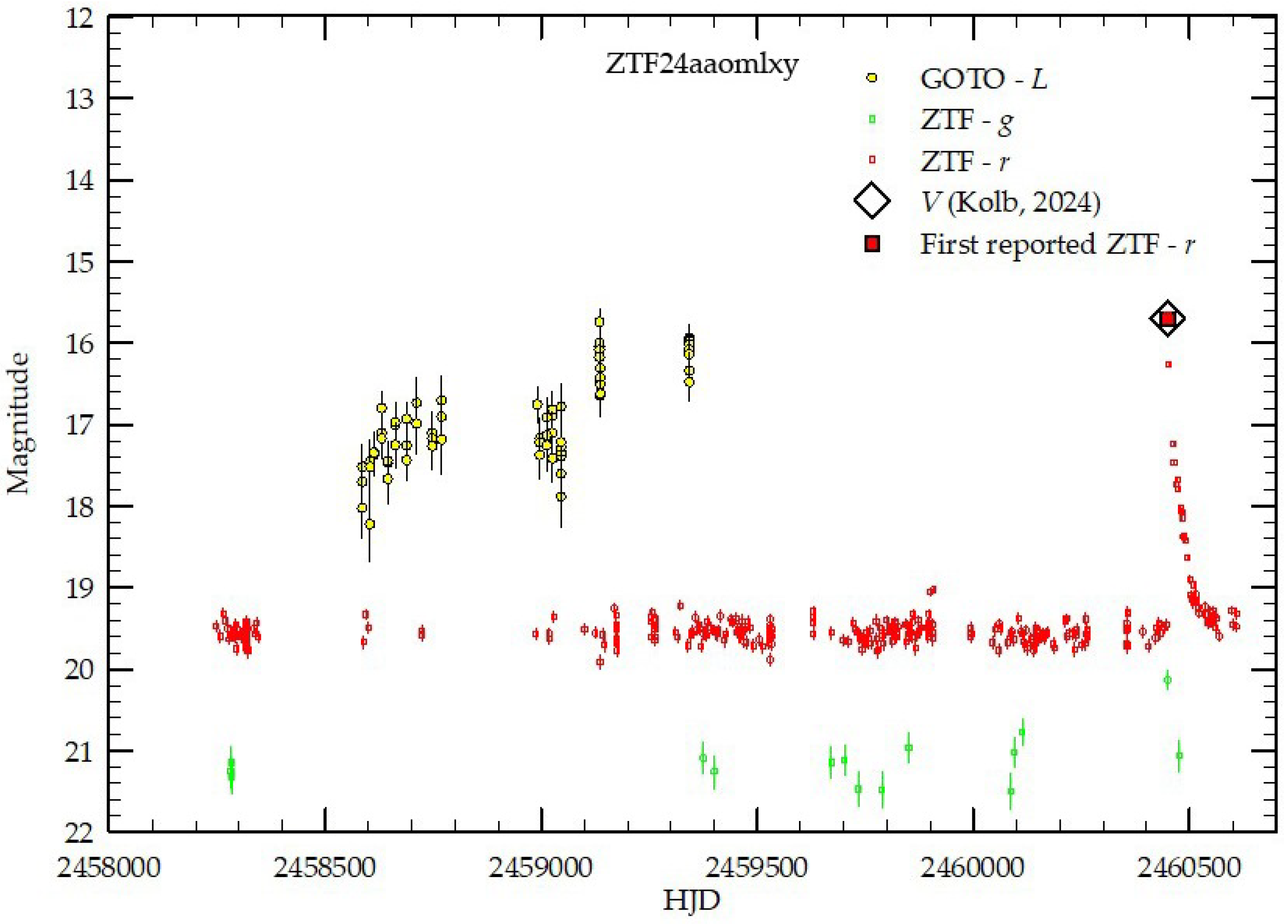
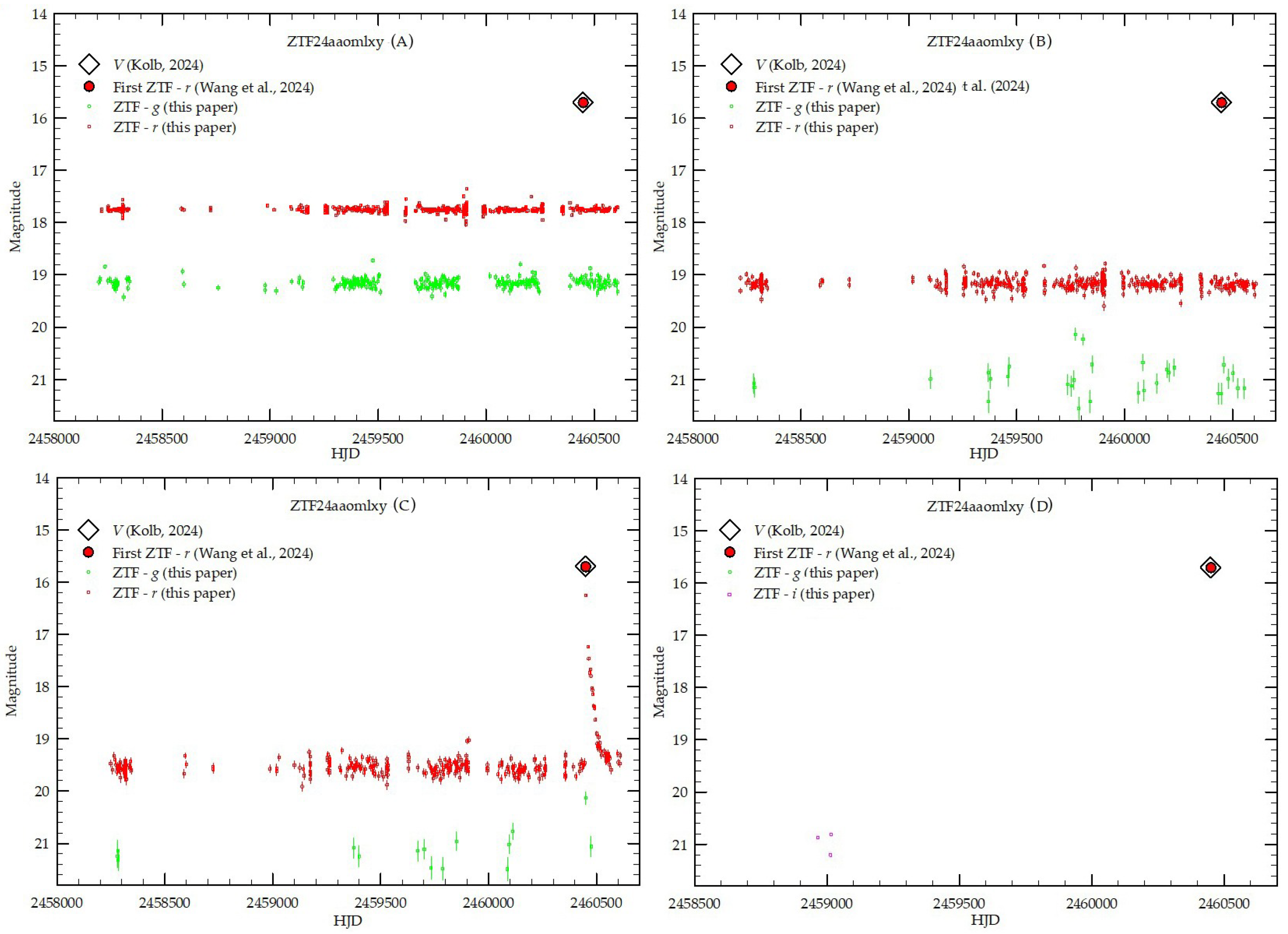
ZTF24aaomlxy was first reported as a Galactic nova candidate in the Zwicky Transient Facility (ZTF; Bellm et al. [3]) alert stream on 2024 May 19.376 UT (HJD 2460449.87600) at coordinates , [11]. The nova was detected near peak at , while a nearly simultaneous ZTF g-band observation yielded , indicative of strong reddening. No source was detected in ZTF observations on 2024 May 15 (HJD 2460446) or 17 (HJD 2460448), although ATLAS forced photometry recorded detections on May 18, immediately prior to maximum [11]. Our GOTO and ZTF investigations yielded marginal detections of quiescent magnitude at and , respectively as shown in Figure 1. Since the GOTO-L magnitude corresponds to a very broad optical bandpass, small brightness variations that are not apparent in individual narrow-band filters cannot be ruled out; however, the pre-eruption GOTO photometry remains consistent with a flat quiescent level within the quoted uncertainties. The apparent proximity of the final ZTF-g observation to the ZTF-r outburst in Figure 1 can be understood in the context of band-dependent variability in nova progenitor systems. Optical emission in different filters may be dominated by distinct physical components of the binary [1]: the g band is more sensitive to emission from the hot, potentially unstable accretion disc, while the r band can be influenced by the cooler secondary star and/or relatively stable Hα emission. In addition, episodic increases in mass transfer or small-scale pre-outburst flaring may temporarily enhance one band more strongly than another.
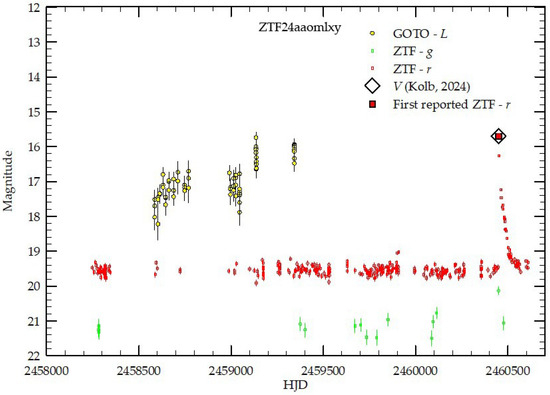
Figure 1.
Light curve of ZTF24aaomlxy from 2017 September to 2024 June, combining first discovery ZTF r reported by Wang and Bellm [11] compared to ZTF, AAVSO, V magnitude observed by Kolb [12], and GOTO L-band photometry in this study. The final ZTF-g point precedes the ZTF-r rise by 24 d; band-dependent variability is expected as different filters trace distinct components of the binary system.
A KOSMOS spectrum obtained on 7 June 2024 (HJD 2460469) showed strong emission of Hα (FWHM ) with no equivalent width measurement reported, together with O i and Ca ii emission lines, but no P Cygni absorption. The continuum shape implied severe extinction, with ( mag), and a Swift/XRT observation on 2024 June 13 placed an upper limit of 0.0058 ct s−1 in the 0.3–10 keV band [11].
Although the reported coordinates were quoted to sub-arcsecond precision, the field lies in a highly crowded region of the Galactic plane. Examination of the ZTF reference image revealed four sources within a 5 arcsec radius of the discovery position. Section 3.2 presents our refined coordinates and identifies the correct counterpart through time-domain variability.
The nova declined by approximately two magnitudes in 14 days, consistent with a moderately fast nova [9]. The Balmer and O i line widths, combined with the large extinction, support classification as a heavily reddened, moderately fast classical nova located in the Scutum region.
3.1.2. PGIR22akgylf
PGIR22akgylf was discovered as an infrared transient by the Palomar Gattini-IR (PGIR) survey and reported in ATel [13]. Early PGIR observations captured the nova during its rapid rise in the near-infrared, while optical detections from ZTF later established a well-sampled rise and decline. Deep archival images from GOTO and ZTF provided additional constraints on the pre-eruption brightness.
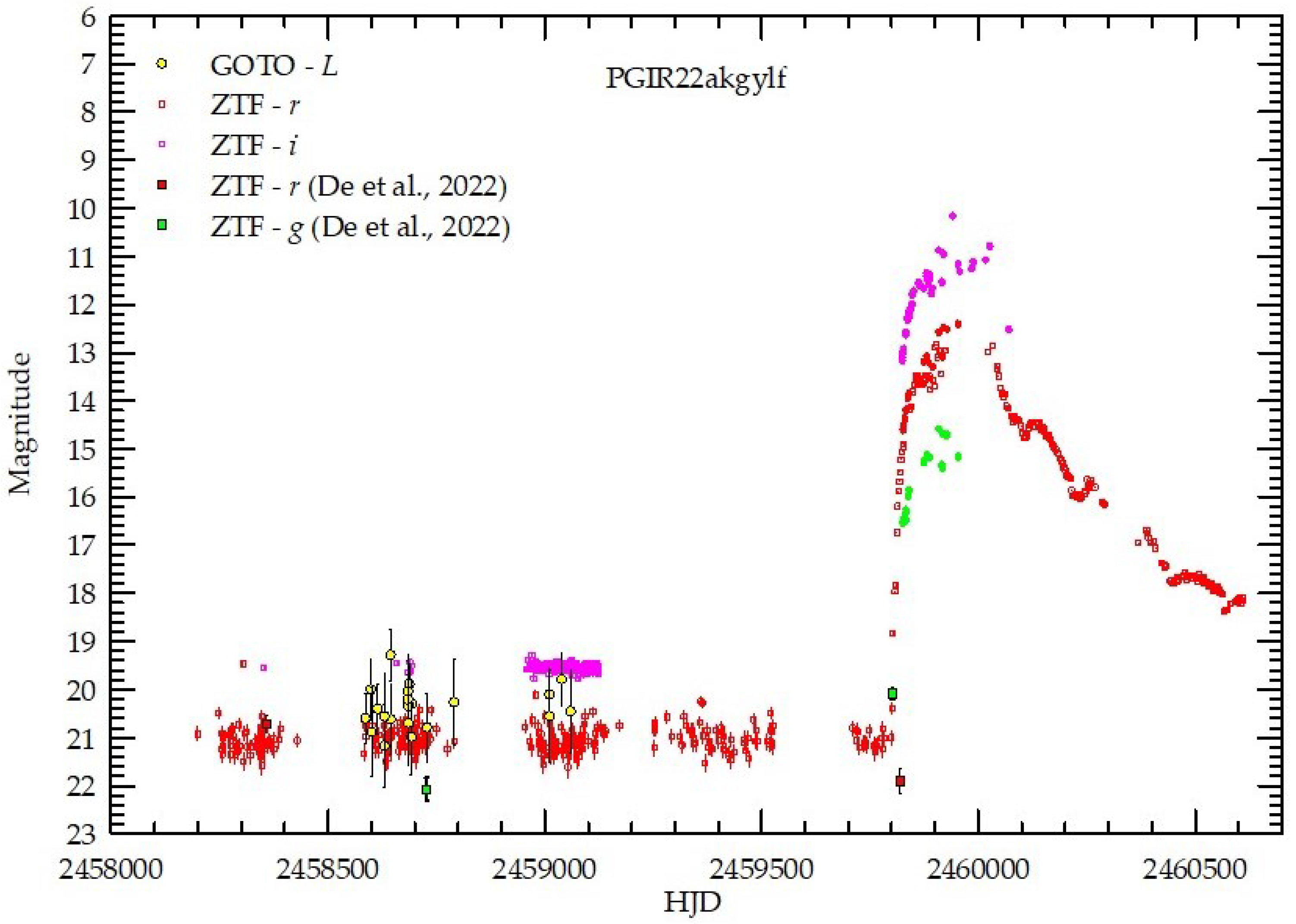
To characterize the system, we compiled all available photometry from GOTO and ZTF spanning the quiescent state through eruption. The pre-outburst level is defined by detections outside the eruption. Our ZTF investigation yields a faint quiescent counterpart at . In GOTO, the pre-eruption measurements fall at the practical limiting magnitude: individual calibrated points cluster around –20.3 with large uncertainties, i.e., at or below the practical limiting magnitude of calibrated L ( mag; Steeghs et al. [5]). We therefore treat the GOTO constraint as marginal and adopt a conservative quiescent at the limiting L magnitude (Figure 2).
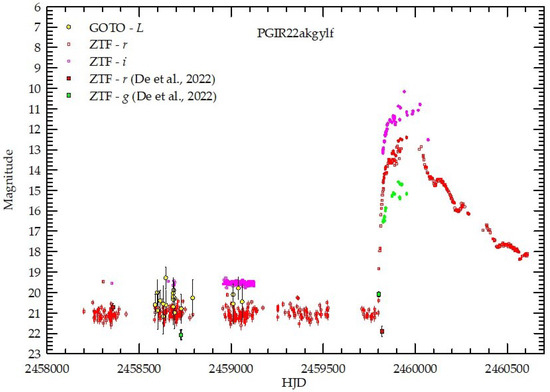
Figure 2.
Light curves of PGIR22akgylf combining GOTO, the reported ZTF g and r detections from De et al. [13], and additional detections from this study. The pre-maximum halt is clearly evident in ZTF data, while GOTO provides some of the detections of the progenitor in L-band photometry.
The eruption evolution is particularly well constrained. Dense ZTF g and r detections reveal a clear pre-maximum halt approximately 1–2 mag below the peak. Such halts are recognized features of nova eruptions but are rarely captured without continuous time coverage [14]. After maximum light, the nova exhibited a rapid decline in all bands, which was traced using ZTF photometry.
Post-eruption optical monitoring revealed a low-amplitude (0.008 mag) periodic modulation with a period of h, interpreted as the orbital modulation of the underlying cataclysmic binary [15]. The short orbital period and the well-resolved pre-maximum halt together support the classification of PGIR22akgylf as a classical nova observed shortly after eruption.
3.1.3. V1405 Cas
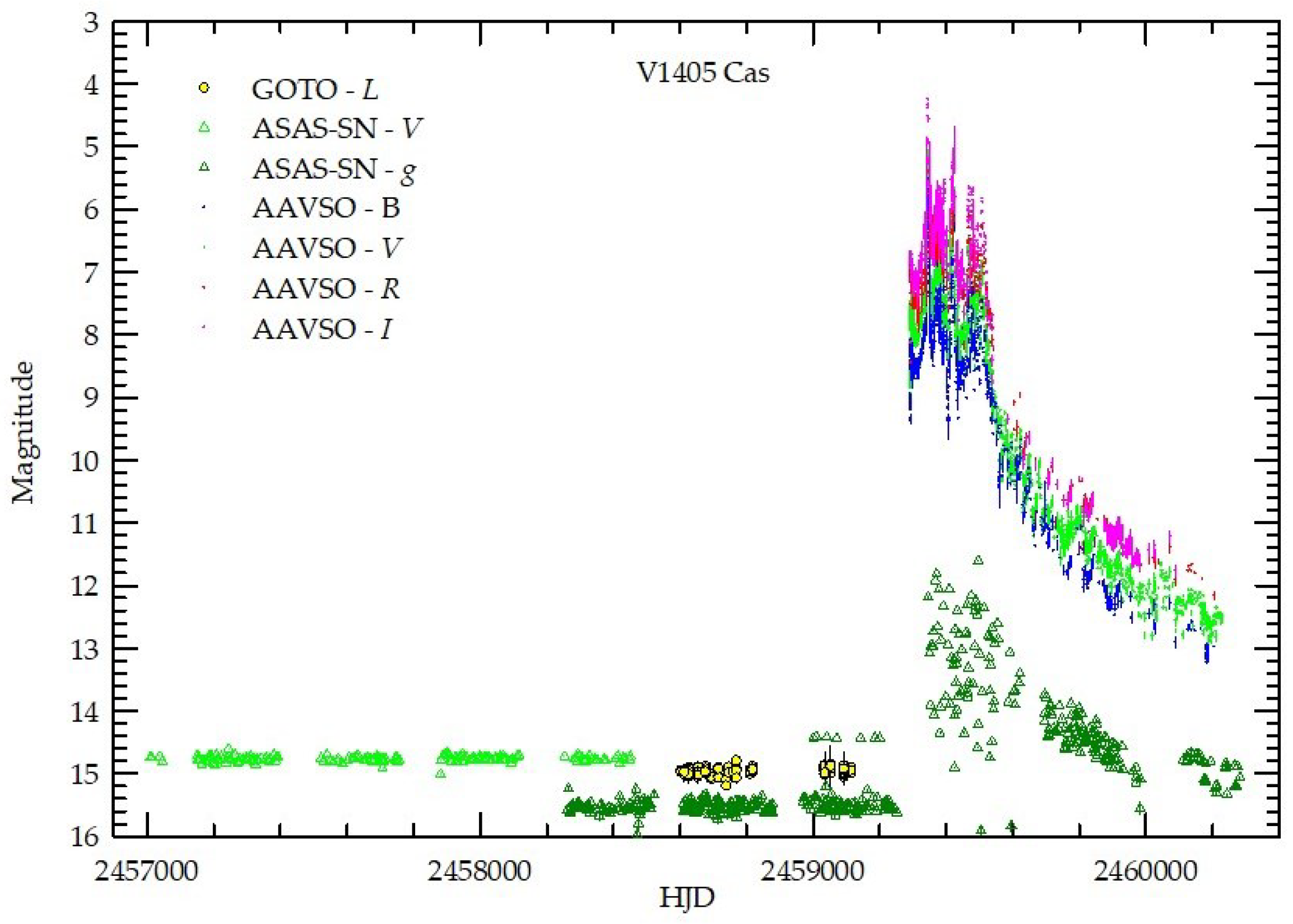
V1405 Cas (Nova Cas 2021 = PNV J23244760 + 6111140) produced a bright and intensively monitored eruption in early 2021. Although the eruption phase has been well characterized, the pre-nova behavior became accessible only recently through archival surveys. Previous analyses of ASAS-SN, ZTF, and Gaia identified the progenitor as a short-period eclipsing system with –16 and modest variability [e.g., [16,17,18]], though the cadence of these surveys left the long-term quiescent stability only loosely constrained.
GOTO recorded detections of the progenitor in early 2021, corresponding to a quiescent brightness of . Post-eruption GOTO measurements show the system returning gradually toward this level. The combined GOTO–ASAS-SN–AAVSO light curve (Figure 3) provides the clearest view to date of the pre-eruption behavior of V1405 Cas. The pre-nova points cluster tightly around the mean, with low-amplitude variations of mag, consistent with an accreting cataclysmic binary in a stable, high state. No evidence is found for precursor brightening or enhanced activity prior to the 2021 eruption.
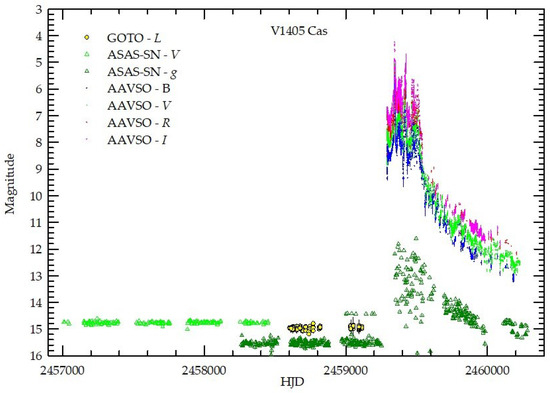
Figure 3.
Light curves of the V1405 Cas eruption in March 2021 that present (November 2023) detected by AAVSO in (dots in purple, blue, green, red, and dark red, respectively) and GOTO L-band photometry.
These archival constraints demonstrate that GOTO can recover reliable quiescent magnitudes for bright progenitors and provide meaningful limits for systems near the wide-field transient survey depth.
3.1.4. V1674 Her
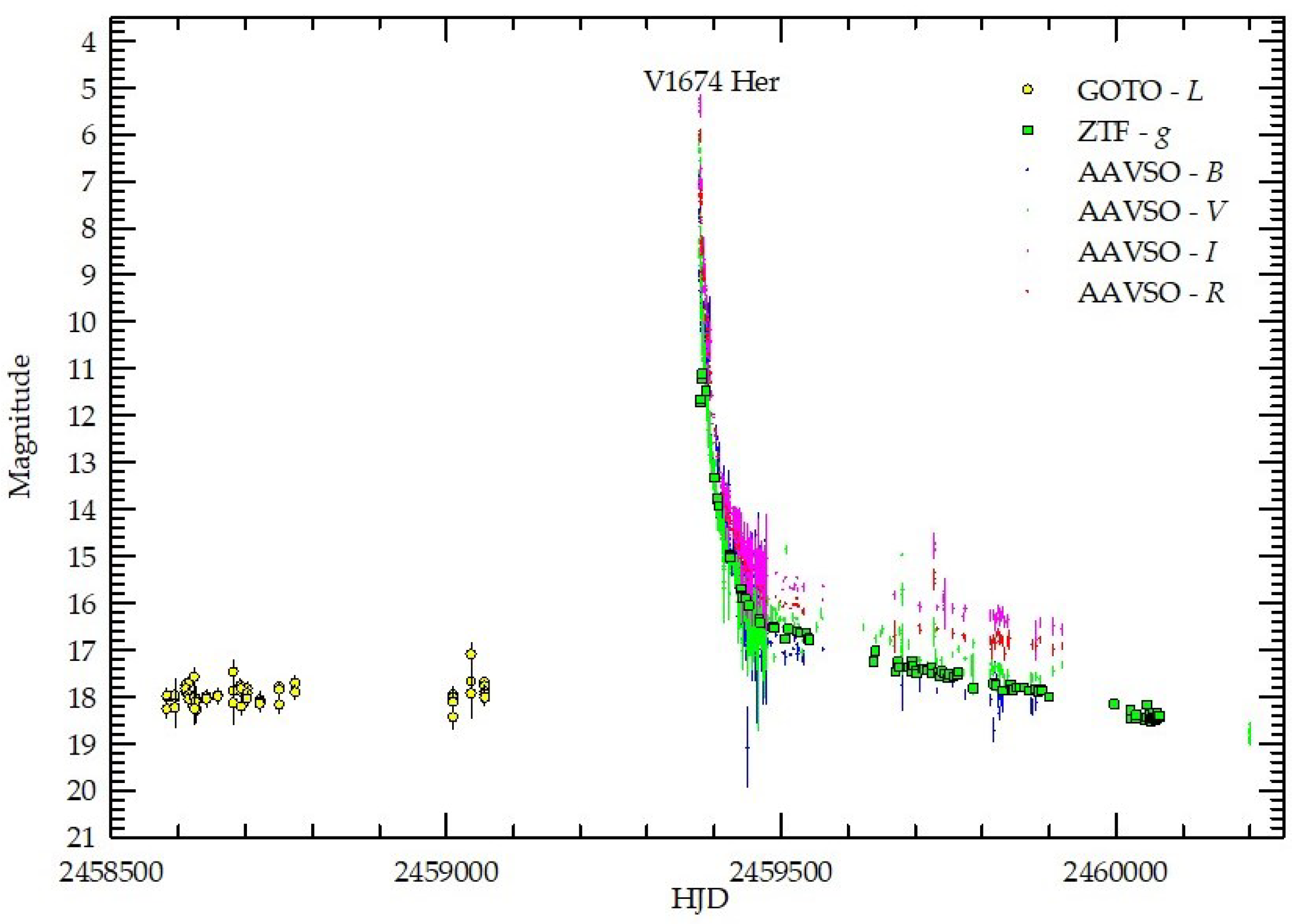
The extremely fast nova V1674 Her (Nova Her 2021) exhibited one of the shortest decline times known for a classical nova [19]. Archival GOTO imaging provided several detections both before and after the eruption. The faintest pre-eruption measurement, , represents one of the deepest ground-based constraints on the quiescent luminosity of this system (Figure 4).
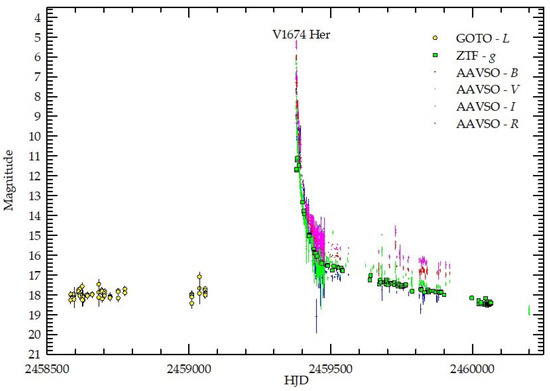
Figure 4.
Light curves of V1674 Her eruption in June 2021, which was detected (November 2023) using AAVSO in (dots in purple, blue, green, red, and dark red, respectively) and GOTO L-band photometry. The apparent offset between the GOTO-L points and the V-band measurements reflects the different bandpasses, with the broad GOTO-L system yielding systematically brighter magnitudes than narrow-band filters such as V.
Such a faint quiescent magnitude implies a low accretion luminosity relative to the eruption amplitude, consistent with a high-mass white dwarf where thermonuclear runaway occurs after the accumulation of a relatively small accreted mass. This interpretation aligns with spectroscopic modeling, which indicates a near-Chandrasekhar-mass white dwarf and a correspondingly short recurrence timescale. The extremely fast photometric evolution of V1674 Her is widely interpreted as evidence of a high-mass white dwarf, because more massive WDs require a smaller ignition envelope mass and therefore evolve more rapidly during a nova outburst. Recent time-dependent nova light-curve modeling by Kato et al. [20] successfully reproduced the observed rise and decline in V1674 Her using a 1.35 WD, supporting a near-Chandrasekhar-mass interpretation. Our archival GOTO detections provide an independent observational constraint on the quiescent brightness but do not by themselves determine the WD mass. Under standard ignition models, a high WD mass can also imply a shorter recurrence time for a given accretion rate; however, no recurrence interval is measured for V1674 Her, and this should be regarded as a theoretical implication rather than an observational constraint. The GOTO detections therefore provide an important observational anchor for understanding the pre-eruption state of one of the most rapidly evolving novae ever observed.
3.2. Refining the True Coordinates of Five Novae
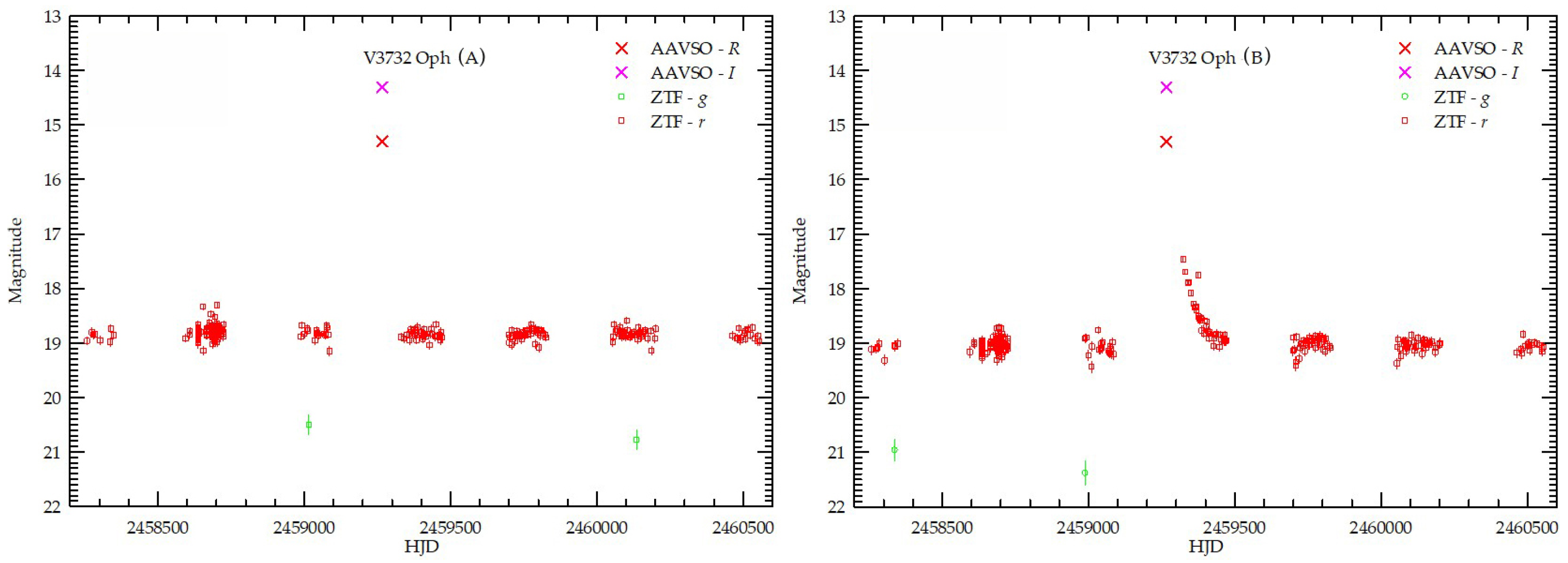
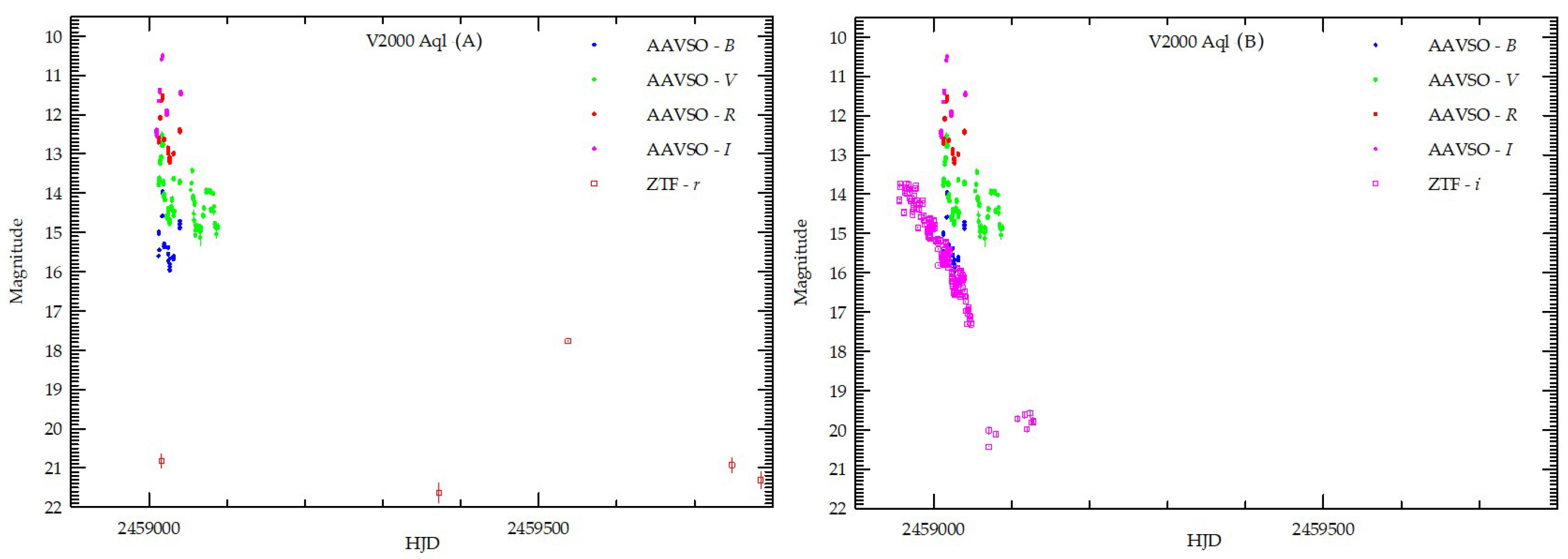
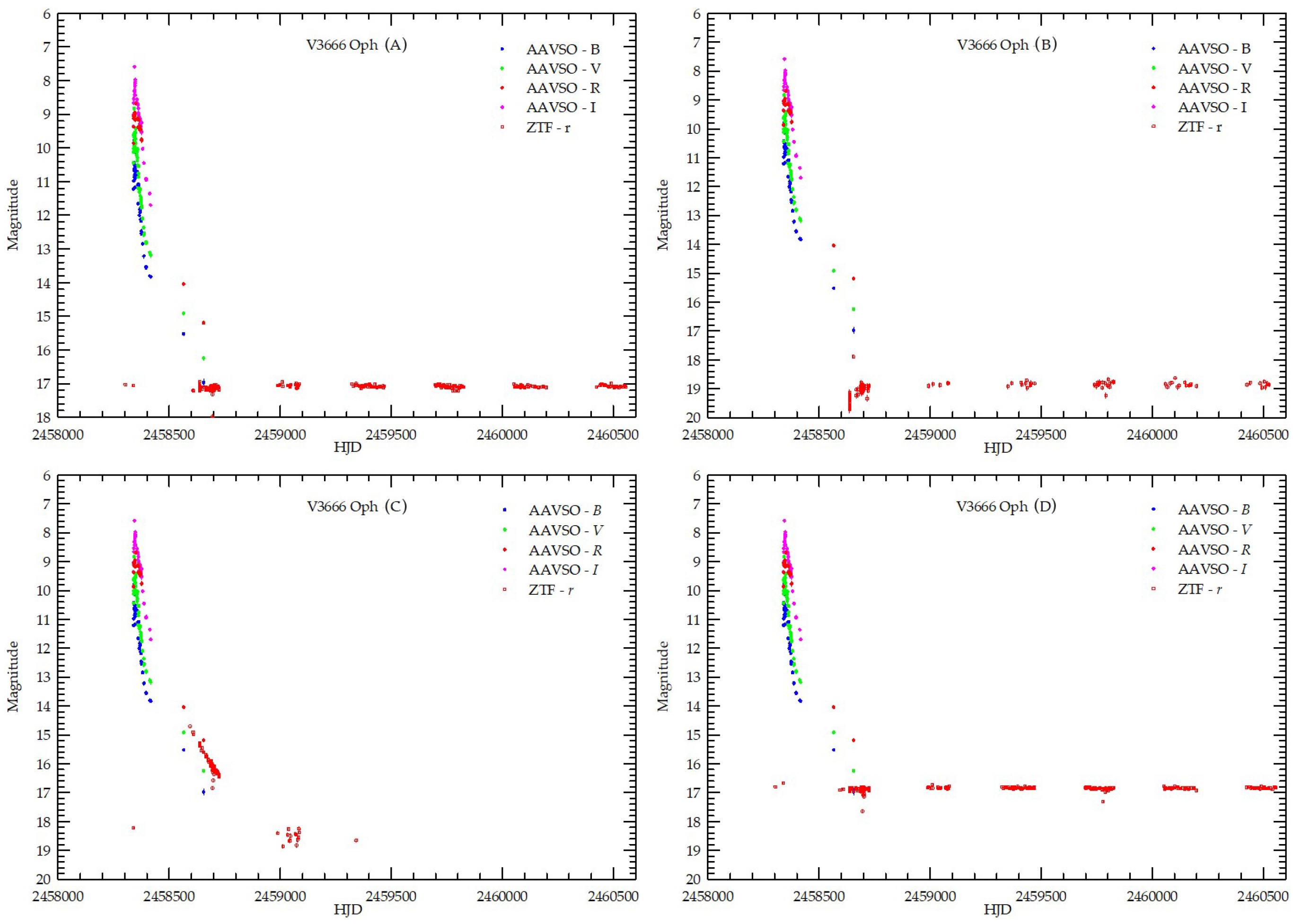
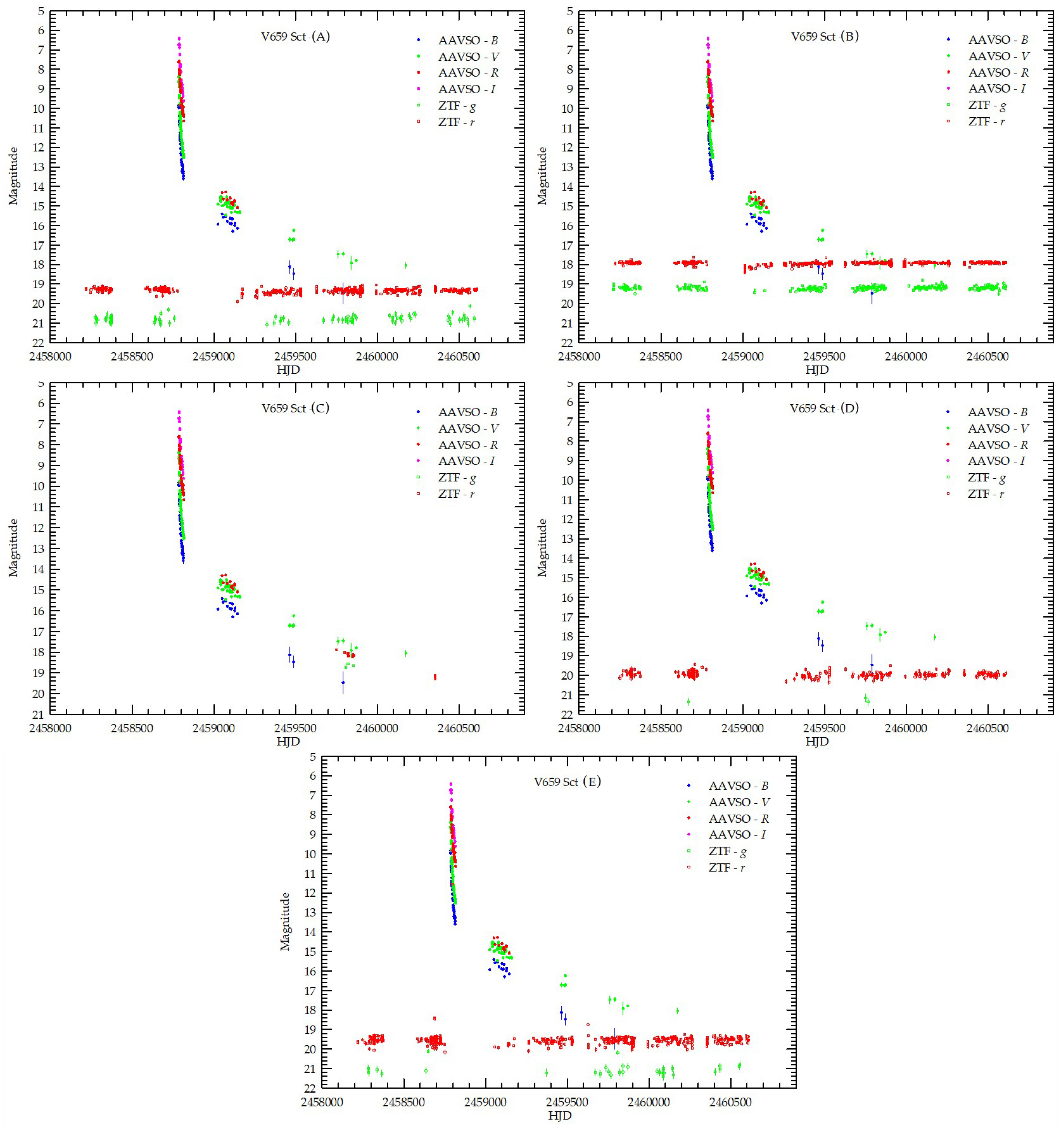
For five novae in our sample—ZTF24aaomlxy, V3732 Oph, V2000 Aql, V3666 Oph, and V659 Sct—the published discovery coordinates did not coincide with the eruptive source when examined in high-resolution time-domain imaging. Each field lies in a crowded Galactic-plane region where multiple stars fall within a few arcseconds, leading to ambiguity in the original identifications.
To resolve these discrepancies, we inspected all ZTF point sources within a 5 arcsec radius of the discovery coordinates and compared their ZTF and AAVSO light curves. The eruptive counterpart in each field was identified as the only source exhibiting a characteristic nova eruption: a rapid rise followed by a structured decline or distinctive post-eruption variability.
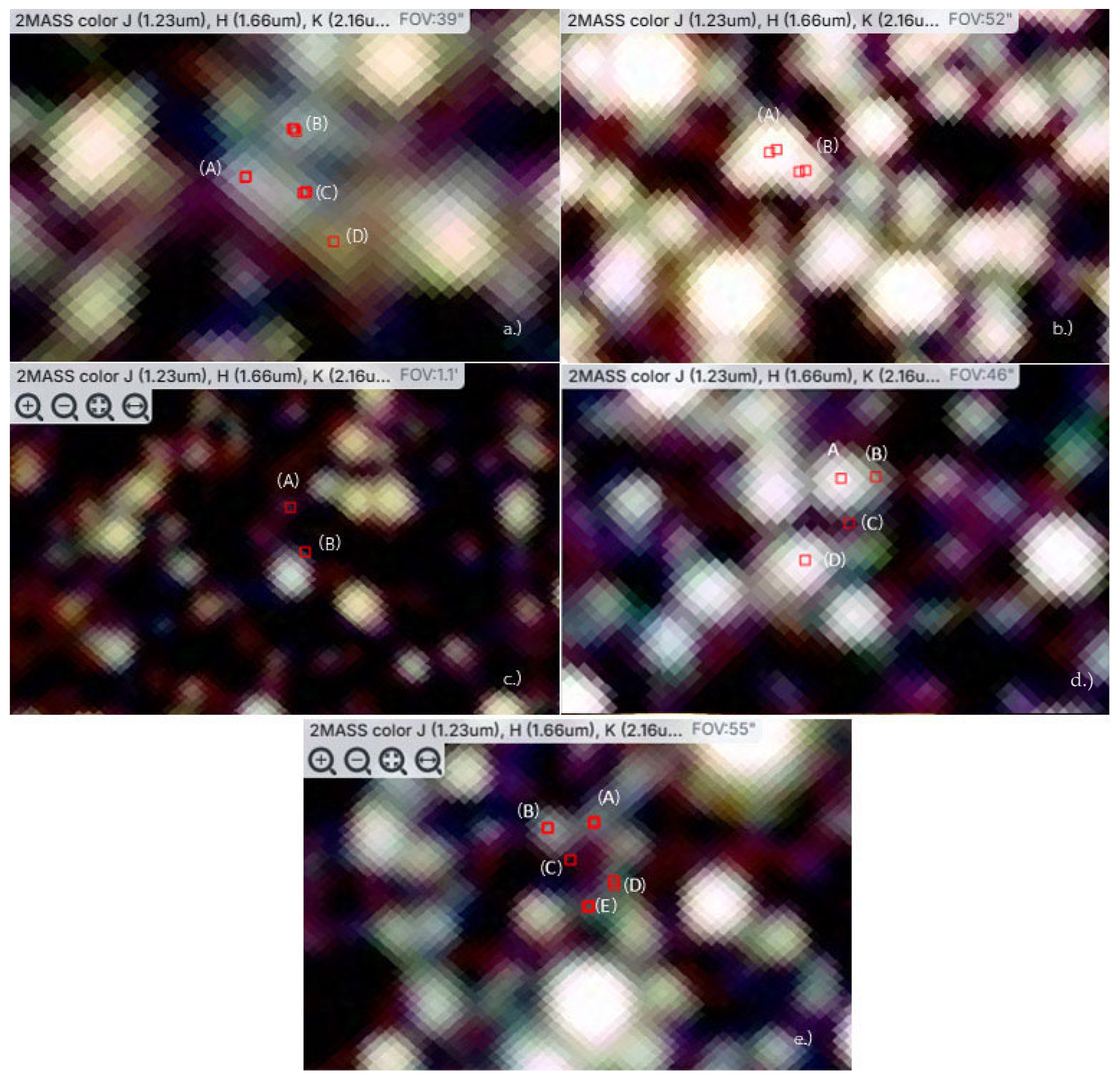
Once the eruptive object was isolated, we measured its centroid position using ZTF reference images and confirmed it as the nova counterpart via its unique variability signature. The refined coordinates for all five novae are listed in Table 1. The corresponding ZTF finder charts and multi-object comparison panels are shown in Figure 5, Figure 6, Figure 7, Figure 8, Figure 9 and Figure 10.
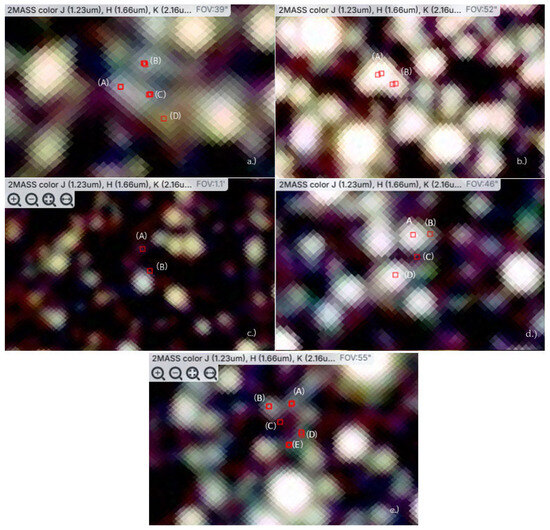
Figure 5.
ZTF reference images showing the immediate environments of the five novae whose coordinates are refined in this study: (a) ZTF24aaomlxy, (b) V3732 Oph, (c) V2000 Aql, (d) V3666 Oph, and (e) V659 Sct. Each panel highlights the nova counterpart and nearby stars within a few arcseconds, illustrating the degree of crowding that led to misidentification in the original discovery coordinates. Positions A–E of each novae were explained in Figure 6, Figure 7, Figure 8, Figure 9 and Figure 10.
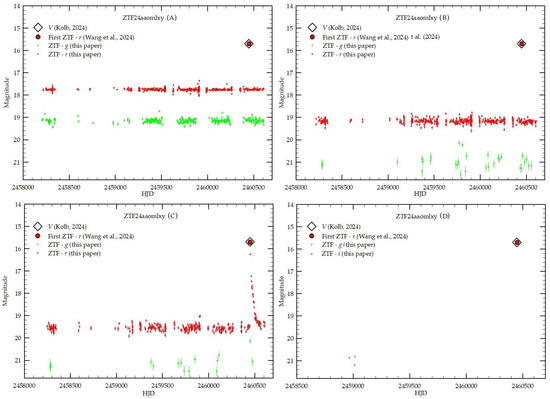
Figure 6.
Identification of the true counterpart to ZTF24aaomlxy. Four blended objects (A–D) lie within a 5 arcsec radius of the discovery position reported by Wang and Bellm [11] and Kolb [12]. Only object (C) exhibits the nova eruption in its ZTF light curve. The refined coordinates of the nova are , .
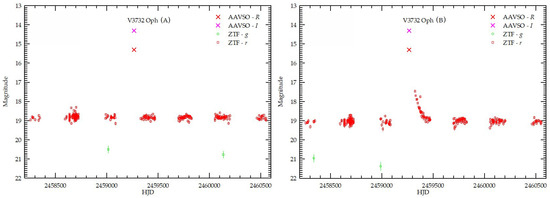
Figure 7.
Refined coordinates of V3732 Oph. Two nearby stars (A,B) lie within 5 arcsec of the discovery coordinates listed in Koji’s catalogue. ZTF time-series photometry shows that only object (B) displays the nova eruption, establishing it as the correct counterpart. The refined position is , .
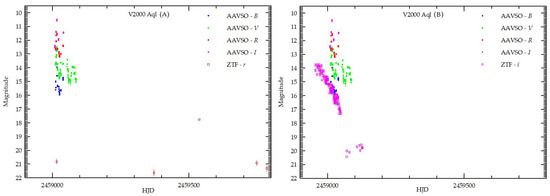
Figure 8.
Refined coordinates of V2000 Aql. Two stars (A,B) lie close to the published discovery coordinates. Object (A) is identified as the nova counterpart based on its ZTF light curve. Object (B) shows unrelated variability but no nova eruption. The refined nova position is , .
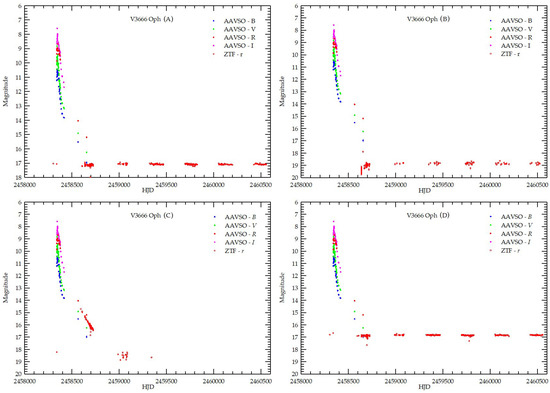
Figure 9.
Refined coordinates of V3666 Oph. Four stars (A–D) fall within 5 arcsec of the discovery position. Only object (C) shows nova-like eruption behavior in ZTF photometry. The refined position is , .
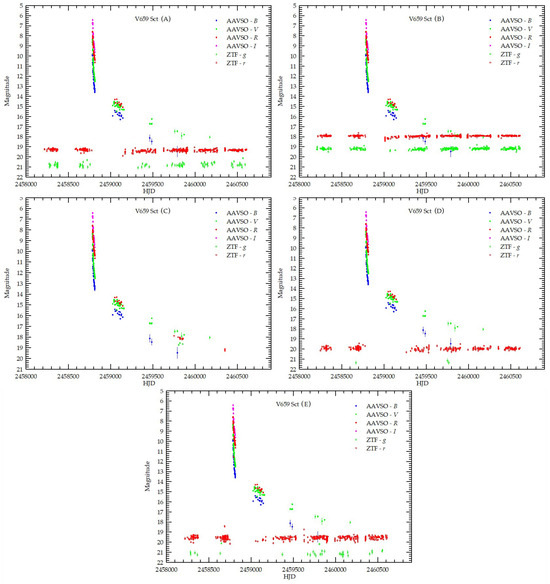
Figure 10.
Refined coordinates of V659 Sct. Five nearby stars (A–E) lie within 5 arcsec of the catalogue coordinates. Object (C) is confirmed as the nova counterpart based on its ZTF variability, whereas no ZTF time-series data are available at the position of object D. The refined coordinates are , .
These corrected positions improve astrometric reliability for catalogue cross-matching and future follow-up studies. They also illustrate that crowded-field misidentification remains a significant challenge in nova discovery, particularly for faint or highly reddened systems detected close to the Galactic plane.
4. Discussion
The archival photometry presented in this work illustrates the scientific value of wide-field, multi-year imaging surveys—originally designed for other time-domain science—for constraining the properties of Galactic novae. Although GOTO was not optimized for nova discovery, its limiting depth and large sky coverage enable detections of progenitor systems near or below the sensitivity of surveys such as ZTF, ASAS-SN, or PGIR. For the two faintest novae in our sample, ZTF24aaomlxy and PGIR22akgylf, GOTO provides some of the deepest pre-eruption measurements currently available, establishing quiescent constraints at 19.6–21.1 and 16.9–19.8, depending on the object. These detections demonstrate that the GOTO archive can play a strategic role in extending the faint end of nova progenitor studies, particularly for highly reddened or short-lived eruptions where major surveys provide limited coverage.
The combined archival light curves further highlight the complementarity of different surveys in recovering nova evolution. ZTF provides high-cadence sampling around eruption, while AAVSO observers contribute multi-filter coverage extending into late decline phases. GOTO, with its deeper but sparser cadence, fills critical gaps by anchoring the long-term flux baseline. This multi-survey synergy is particularly evident in PGIR22akgylf, where the pre-maximum halt—often missed even in modern surveys—is clearly resolved due to dense AAVSO and ZTF coverage tied to deep GOTO pre-eruption points.
A second major outcome of this study is the refinement of eruption coordinates. Our time-domain variability method identifies five novae—ZTF24aaomlxy, V3732 Oph, V2000 Aql, V3666 Oph, and V659 Sct—whose published coordinates do not correspond to the eruptive object. The offsets (typically 1–5 arcsec) are consistent with expectations for discoveries made in crowded Galactic-plane fields or from small-aperture telescopes with limited astrometric calibration. Misidentification of the progenitor affects not only photometric studies but also spectroscopic follow-up, catalog integrity, and future cross-matching with Gaia and LSST-era databases. The corrected coordinates presented here, confirmed through ZTF and AAVSO variability, therefore represent an important contribution to the archival accuracy of Galactic nova records.
More broadly, this work highlights the growing importance of archival time-domain data for nova population studies. As eruptions are increasingly discovered at faint magnitudes or through infrared surveys (e.g., PGIR), optical archives such as GOTO and ZTF will become essential for constraining quiescent luminosities and enabling uniform characterization across the Galactic nova population. In the upcoming LSST era, systematic cross-survey analyses such as the one performed here will be vital for building statistically complete samples of nova progenitors and for improving rate estimates, extinction models, and population-synthesis predictions.
5. Conclusions
We analyzed archival GOTO, ZTF, and AAVSO photometry for four Galactic novae spanning some of the faintest to the brightest eruptions recorded between 2017 and 2024. GOTO provides new pre-eruption constraints spanning securely detected progenitors (e.g., ZTF24aaomlxy at ) to near-threshold limits for the faintest systems (PGIR22akgylf at , consistent with the practically calibrated L depth; Steeghs et al. [5]) on the quiescent magnitudes of ZTF24aaomlxy, PGIR22akgylf, V1405 Cas, and V1674 Her. These results demonstrate that GOTO, despite its primary mission in gravitational-wave follow-up, is a valuable resource for nova progenitor studies.
Using time-domain variability screening, we also refine the eruption coordinates of five novae—ZTF24aaomlxy, V3732 Oph, V2000 Aql, V3666 Oph, and V659 Sct—showing offsets of up to several arcseconds relative to published positions. These corrected coordinates resolve ambiguities caused by source confusion in crowded fields and will improve the reliability of future catalog-based analyses.
Together, our findings highlight the scientific utility of archival time-domain imaging for both photometric and astrometric studies of Galactic novae. As broader and deeper surveys come online, cross-survey integration will remain essential for accurately characterizing nova progenitors, constraining outburst physics, and constructing comprehensive nova population models.
Author Contributions
Conceptualization, F.S.; methodology, F.S. and S.K.; software, K.N.; validation, F.S. and K.N.; formal analysis, S.K.; investigation, S.K.; resources, K.N.; data curation, S.K.; writing original draft preparation, F.S.; writing review and editing, K.A., M.J.D., J.L., K.U., S.B., D.K.G., V.S.D., P.O., G.R., R.K., R.P.B., L.K.N., B.G. (Ben Gompertz), J.C., P.C., A.C., D.C., R.E.-F., B.G. (Ben Godson), D.J., L.K., M.K., T.K., A.L., S.M. (Soheb Mandhai), S.M. (Seppo Mattila), A.S., K.P., E.S., R.S. and Y.S.; visualization, F.S.; supervision, K.N. and F.S. All authors have read and agreed to the published version of the manuscript.
Funding
This research received no external funding.
Data Availability Statement
The original data presented in the study are openly available at https://science.crru.ac.th/fahrung/ (accessed on 30 December 2025).
Acknowledgments
We express our gratitude to the observers from all over the world who contributed variable star observations to the AAVSO International Database for use in this study. The Gravitational-wave Optical Transient Observer (GOTO) project acknowledges the support of the Monash Warwick Alliance; University of Warwick; Monash University; University of Sheffield; University of Leicester; Armagh Observatory & Planetarium; the National Astronomical Research Institute of Thailand (NARIT); Instituto de Astrofísica de Canarias (IAC); University of Portsmouth; University of Turku; University of Birmingham; and the UK Science and Technology Facilities Council (STFC, grant numbers ST/T007184/1, ST/T003103/1 and ST/Z000165/1). Thanks for the support of J.C. from the Spanish Ministry of Science via the Plan de Generación de Conocimiento through grant PID2022-143331NB-100. We are also grateful for the data based on observations obtained with the 48-inch Samuel Oschin Telescope and the 60-inch Telescope at the Palomar Observatory as part of the Zwicky Transient Facility project (ZTF) supported by the National Science Foundation under grants No. AST-1440341 and AST-2034437 and a collaboration including current partners Caltech; IPAC; the Weizmann Institute for Science; the Oskar Klein Center at Stockholm University; the University of Maryland; Deutsches Elektronen-Synchrotron and Humboldt University; the TANGO Consortium of Taiwan; the University of Wisconsin at Milwaukee; Trinity College Dublin; Lawrence Livermore National Laboratories; IN2P3; the University of Warwick; Ruhr University Bochum; Northwestern University; and former partners the University of Washington, Los Alamos National Laboratories, and Lawrence Berkeley National Laboratories. Operations are conducted by the COO, IPAC, and UW. During the preparation of this manuscript, the authors used SciSpace for the purposes of literature review and used ChatGPT 5 for the purposes of paraphrasing and language rearrangement. The authors have reviewed and edited the output and take full responsibility for the content of this publication.
Conflicts of Interest
The authors declare no conflicts of interest.
Notes
| 1 | https://asd.gsfc.nasa.gov/Koji.Mukai/novae/novae.html (accessed on 20 June 2025) hereafter “Koji’s list”. |
| 2 | https://irsa.ipac.caltech.edu/cgi-bin/Gator/nph-scan?projshort=ZTF (accessed on 27 June 2025). |
| 3 | https://www.aavso.org/data-download (accessed on 27 June 2025). |
References
- Bode, M.F.; Evans, A. Classical Novae; Cambridge University Press: Cambridge, UK, 2012. [Google Scholar]
- Shappee, B.J.; Prieto, J.L.; Grupe, D.; Kochanek, C.S.; Stanek, K.Z.; De Rosa, G.; Mathur, S.; Zu, Y.; Peterson, B.M.; Pogge, R.W.; et al. The Man behind the Curtain: X-Rays Drive the UV through NIR Variability in the 2013 Active Galactic Nucleus Outburst in NGC 2617. Astrophys. J. 2014, 788, 48. [Google Scholar] [CrossRef]
- Bellm, E.C.; Kulkarni, S.R.; Barlow, T.; Feindt, U.; Graham, M.J.; Goobar, A.; Kupfer, T.; Ngeow, C.C.; Nugent, P.; Ofek, E.; et al. The Zwicky Transient Facility: Surveys and Scheduler. Publ. Astron. Soc. Pac. 2019, 131, 068003. [Google Scholar] [CrossRef]
- Masci, F.J.; Laher, R.R.; Rusholme, B.; Shupe, D.L.; Groom, S.; Surace, J.; Jackson, E.; Monkewitz, S.; Beck, R.; Flynn, D.; et al. The Zwicky Transient Facility: Data Processing, Products, and Archive. Publ. Astron. Soc. Pac. 2019, 131, 018003. [Google Scholar] [CrossRef]
- Steeghs, D.; Galloway, D.K.; Ackley, K.; Dyer, M.J.; Lyman, J.; Ulaczyk, K.; Cutter, R.; Mong, Y.L.; Dhillon, V.; O’Brien, P.; et al. The Gravitational-wave Optical Transient Observer (GOTO): Prototype performance and prospects for transient science. Mon. Not. R. Astron. Soc. 2022, 511, 2405–2422. [Google Scholar] [CrossRef]
- Ackley, K.; Galloway, D. The Gravitational-Wave Optical Transient Observer (GOTO). In Proceedings of the American Astronomical Society Meeting Abstracts #235, Honolulu, HI, USA, 4–8 January 2020; Bulletin of the American Astronomical Society: Washington, DC, USA, 2020; Volume 235, p. 379.06. [Google Scholar]
- Kiyota, S.; Kato, T.; Yamaoka, H. Light Curves of Novae on VSNET. Publ. Astron. Soc. Jpn. 2004, 56, S193–S211. [Google Scholar] [CrossRef]
- Mróz, P.; Udalski, A.; Poleski, R.; Soszyński, I.; Szymański, M.K.; Pietrzyński, G.; Wyrzykowski, Ł.; Ulaczyk, K.; Kozłowski, S.; Pietrukowicz, P.; et al. OGLE Atlas of Classical Novae. I. Galactic Bulge Objects. Astrophys. J. Suppl. Ser. 2015, 219, 26. [Google Scholar] [CrossRef]
- Strope, R.J.; Schaefer, B.E.; Henden, A.A. Catalog of 93 Nova Light Curves: Classification and Properties. Astron. J. 2010, 140, 34–62. [Google Scholar] [CrossRef]
- Schwarz, G.J.; Ness, J.U.; Osborne, J.P.; Page, K.L.; Evans, P.A.; Beardmore, A.P.; Walter, F.M.; Helton, L.A.; Woodward, C.E.; Bode, M.; et al. Swift X-Ray Observations of Classical Novae. II. The Super Soft Source Sample. Astrophys. J. Suppl. Ser. 2011, 197, 31. [Google Scholar] [CrossRef]
- Wang, Y.D.; Bellm, E.C. ZTF Discovery of Highly Reddened Galactic Nova Candidate ZTF24aaomlxy. Astron. Telegr. 2024, 16658, 1. [Google Scholar]
- Kolb, M. Kataklysmische Sterne: Aktivitäten Juli bis November 2024. BAV Rdbr. 2024, 73, 138–141. [Google Scholar]
- De, K.; Soria, R.; Agusti, M.B.; Kong, M.; Karambelkar, V.; Hankins, M.; Kasliwal, M.M.; Sokoloski, J.; Ashley, M.; Babul, A.; et al. Palomar Gattini-IR discovery and classification of a new highly reddened Galactic nova PGIR22akgylf in the active TESS field. Astron. Telegr. 2022, 15587, 1. [Google Scholar]
- Hounsell, R.; Darnley, M.J.; Bode, M.F.; Harman, D.J.; Surina, F.; Starrfield, S.; Holdsworth, D.L.; Bewsher, D.; Hick, P.P.; Jackson, B.V.; et al. Nova Light Curves From The Solar Mass Ejection Imager (SMEI) - II. The extended catalog. Astrophys. J. 2016, 820, 104. [Google Scholar] [CrossRef]
- Schmidt, R.E. The Photometric Period of PGIR22akgylf (Nova Cygni 2022). J. Am. Assoc. Var. Star Obs. 2022, 50, 260. [Google Scholar]
- Taguchi, K.; Maeda, K.; Maehara, H.; Tajitsu, A.; Yamanaka, M.; Arai, A.; Isogai, K.; Shibata, M.; Tampo, Y.; Kojiguchi, N.; et al. Spectra of V1405 Cas at the Very Beginning Indicate a Low-mass ONeMg White Dwarf Progenitor. Astrophys. J. 2023, 958, 156. [Google Scholar] [CrossRef]
- Takeda, L.; Lyke, J.; Campbell, R. Observation and modeling of dusty novae. In Proceedings of the American Astronomical Society Meeting Abstracts #242, Albuquerque, NM, USA, 4–8 June 2023; Bulletin of the American Astronomical Society: Washington, DC, USA, 2023; Volume 242, p. 109.05. [Google Scholar]
- Motley, E.; Macro Consortium; Peterson, W.; Golay, W. Hα Observations of the Long Decay Nova V1405 Cas. In Proceedings of the American Astronomical Society Meeting Abstracts #244, Madison, WI, USA, 9–13 June 2024; Bulletin of the American Astronomical Society: Washington, DC, USA, 2024; Volume 244, p. 228.16. [Google Scholar]
- Habtie, G.R.; Das, R.; Pandey, R.; Ashok, N.M.; Dubovsky, P.A. Study of the fastest classical nova, V1674 Her: Photoionization and morpho-kinemetic model analysis. Mon. Not. R. Astron. Soc. 2024, 527, 1405–1423. [Google Scholar] [CrossRef]
- Kato, M.; Hachisu, I.; Saio, H. A Comprehensive Light-curve Model of the Very Fast Nova V1674 Herculis. Astrophys. J. 2025, 988, 112. [Google Scholar] [CrossRef]
Disclaimer/Publisher’s Note: The statements, opinions and data contained in all publications are solely those of the individual author(s) and contributor(s) and not of MDPI and/or the editor(s). MDPI and/or the editor(s) disclaim responsibility for any injury to people or property resulting from any ideas, methods, instructions or products referred to in the content. |
© 2026 by the authors. Licensee MDPI, Basel, Switzerland. This article is an open access article distributed under the terms and conditions of the Creative Commons Attribution (CC BY) license.