
Article

U-Net Based Forecasting of Storm-Time Total Electron Content over North Africa Using Assimilation of GNSS Observation into Global Ionospheric Maps

1
Space Environment & Remote Sensing Program, Institute of Basic & Applied Sciences, Egypt-Japan University of Science and Technology (E-JUST), New Borg El-Arab City 21934, Egypt
2
Physics Department, Faculty of Science, Fayoum University, Fayoum 63514, Egypt
3
Physics and Chemistry Department, Faculty of Education, Alexandria University, Shatby, Alexandria 21526, Egypt
4
Department of Medical Instruments Engineering Techniques, Medical Technical College, Al-Farahidi University, Baghdad 10021, Iraq
5
Department of Physics, Earth and Environmental Sciences, The Technical University of Kenya, Nairobi P.O. Box 52428-00200, Kenya
6
National Space Research and Development Agency (NASRDA), Abuja P.M.B. 437, Nigeria
7
Department of Physics, Muni University, Arua P.O. Box 725, Uganda
8
Institute for Space-Earth Environmental Research (ISEE), Nagoya University, Nagoya 464-8601, Japan
9
South African National Space Agency (SANSA), Hermanus P.O. Box 32, South Africa
10
Faculty of Engineering, Egypt-Japan University of Science and Technology (E-JUST), New Borg El-Arab City 21934, Egypt
11
Faculty of Computer Science and Information Technology, Egypt-Japan University of Science and Technology (E-JUST), New Borg El-Arab City 21934, Egypt
12
Department of Computer Science and Engineering, Faculty of Electronic Engineering, Menoufia University, Menouf 32951, Egypt
*
Author to whom correspondence should be addressed.
Universe 2026, 12(2), 54; https://doi.org/10.3390/universe12020054
Submission received: 5 January 2026 / Revised: 6 February 2026 / Accepted: 9 February 2026 / Published: 18 February 2026

Abstract

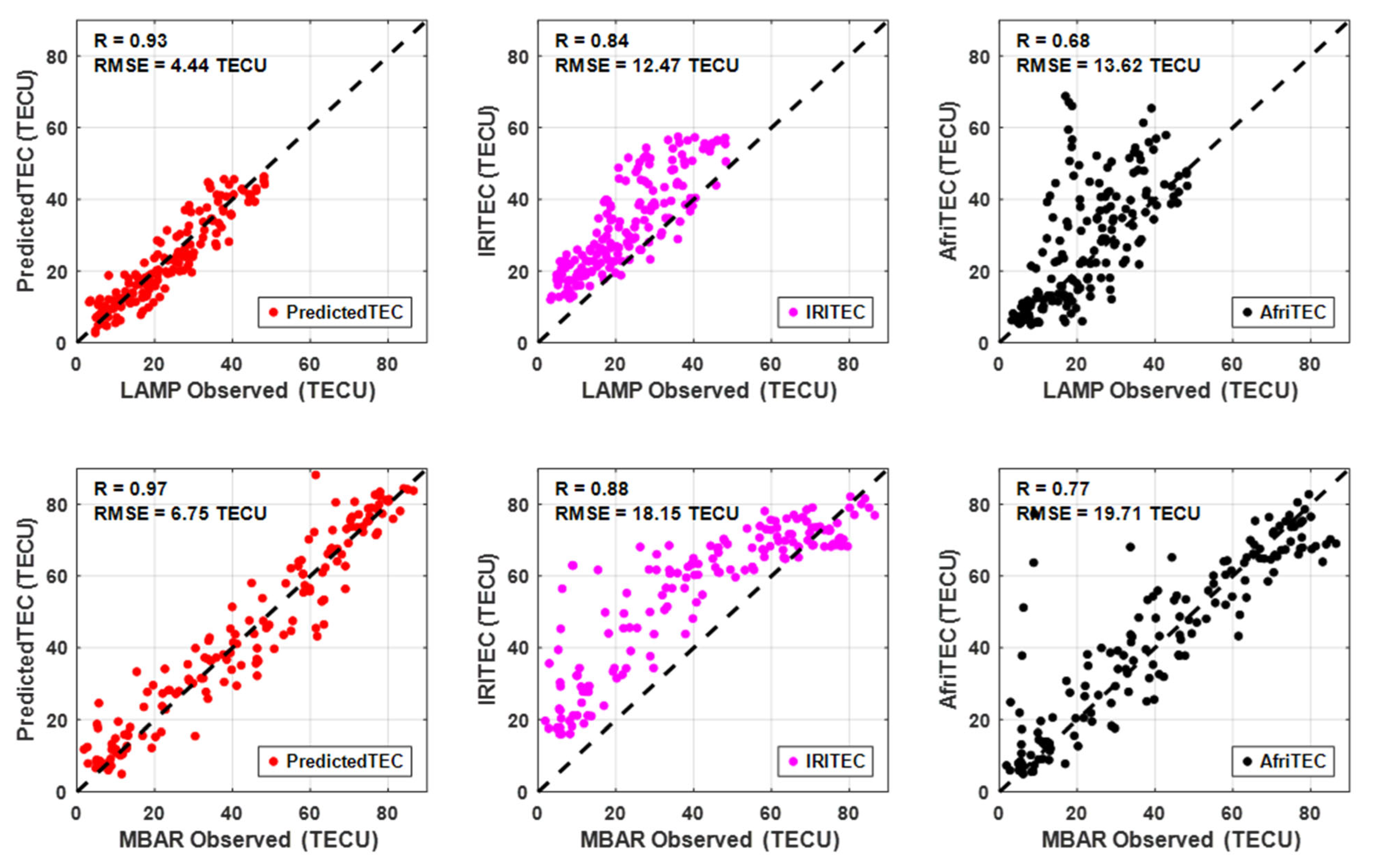
This study presents U-Net deep learning of total electron content (TEC) obtained from Global Ionosphere Maps (GIMs) to forecast ionospheric TEC over the African 0–40° N latitude sector during geomagnetic storms which have occurred between 2011 and 2024. Before being utilized in the deep learning procedure, the GIM-TEC data were improved by assimilating ground-based vertical TEC (VTEC) observations from available Global Navigation Satellite System (GNSS) receiver stations. The U-Net one-hour-ahead prediction of TEC was examined during the intense geomagnetic storm of May 2024. Additionally, the model’s accuracy and reliability were evaluated through quantitative comparison with established climatological models, including IRI-2020 and AfriTEC storm time models. The results indicate that the integration of data assimilation with the deep learning framework yields TEC estimates that closely agree with observations, achieving a RMSE of approximately 5 TECU. On the other hand, the IRI-2020 model exhibits substantially larger errors, with RMSE ~10–17 TECU, while the AfriTEC model shows the poorest performance, with RMSE reaching approximately 15–22 TECU. Further, the U-Net was validated using two equatorial and mid-latitude GNSS stations whose data were excluded from the assimilation process, achieving RMSE values of 4.44 and 6.75 TECU and correlation coefficients of 0.93 and 0.97, confirming the model forecasting capability for reproducing ionospheric TEC variability. These results establish the model as a precise, robust tool for TEC prediction in regions with sparse GPS coverage that is crucial for ionospheric monitoring and space weather applications.

1. Introduction

The ionospheric TEC is the integrated electron density along a GNSS signal path. It constitutes a primary observable for ionospheric remote sensing and is widely used to monitor plasma-density variability that affects positioning accuracy, communication-signal integrity, and radar operations [1]. Because TEC responds rapidly to solar irradiance, geomagnetic forcing, thermospheric circulation, and magnetosphere–ionosphere coupling, its accurate modeling is essential for mitigating space-weather impacts on operational systems and for improving forecast performance [2,3].
Accurate specification and short-term forecasting of the ionosphere remain a central challenge in space-weather science, satellite-navigation engineering, and Earth observation applications [4,5,6]. These challenges are particularly serious in low- and sub-equatorial latitude regions such as the African region, where complex electrodynamic processes, storm-time disturbances, and sparse observational coverage combine to produce large uncertainties in ionospheric characterization [7,8,9].
Global Ionospheric Maps (GIMs) provide TEC on a global scale. These maps are typically generated by interpolating GNSS-derived TEC observations into a spatiotemporal grid with a spatial resolution of 2.5° × 5°, providing continuous coverage of the ionosphere [10]. Although GIMs offer broad coverage and near-real-time availability, their performance over data-sparse regions is degraded because their underlying interpolation and spherical harmonic models rely heavily on dense input data. Africa, particularly North Africa, suffers from limited GNSS receiver distribution, leading to elevated GIM uncertainties and large errors during geomagnetically disturbed conditions [11,12,13,14,15]. This limitation motivates the need for developing further frameworks capable of optimally integrating regional GNSS observations into prediction models.
Empirical models such as the International Reference Ionosphere (IRI-2020) provide a widely used climatological description of electron density and TEC based on decades of measurements [16]. Although IRI offers a globally applicable framework even during storm-time conditions, its predictions are largely statistical in nature and may not capture rapid temporal variations or localized disturbances, particularly during geomagnetic storms or solar events [17]. Conversely, regional models such as AfriTEC have been developed to address these limitations by incorporating regional GNSS observations and tailoring model parameters to the African ionosphere [18,19]. However, the AfriTEC improves regional representation where measurements are available; the model remains constrained by the limited number of GNSS receivers across the African region, leading to residual uncertainties in TEC estimation, especially during disturbed periods [20,21]. So, both IRI-2020 and AfriTEC models may therefore diverge significantly from actual conditions, especially during geomagnetic events.
Further, data assimilation techniques offer a powerful approach to enhance the accuracy of TEC maps by integrating observational data into physics-based or empirical models. Assimilation schemes, including the Kalman filter, and variational approaches, allow the correction of model forecasts using real-time observations, thereby producing TEC maps that are both dynamically consistent and observationally constrained [22,23,24,25]. The types of data assimilated include both ground- and space-based GNSS TEC measurements, ionosonde observations, and in situ measurements of electron densities by low-earth orbiting satellites as well as radio occultation measurements. The assimilation process results in enhanced TEC representations that better reflect both global trends and regional structures. GIM TEC, to which ground-based GNSS TEC is assimilated, not only reduces errors associated with sparse observational coverage but also provides a physically consistent dataset suitable for downstream forecasting and analysis [26,27,28]. The work of [18,19] is one of the most promising efforts to incorporate additional datasets, such as COSMIC radio occultation measurements, to improve GIM-derived TEC estimates over the African sector. Recently, ref. [29] demonstrated the strong potential of calibrated COSMIC data as a complementary dataset to ground-based GNSS observations for operational space-weather monitoring. Therefore, both calibrated COSMIC data and ground-based GNSS observations are required to produce corrected (assimilated) GIM products. These corrected GIMs are particularly important for deep learning models to reduce spatial errors arising from GIM interpolation.
In recent years, deep learning approaches have emerged as promising tools for forecasting complex geophysical phenomena, including ionospheric TEC [30,31]. Deep learning architectures including Recurrent Neural Networks (RNNs), Long Short-Term Memory (LSTM) networks, and convolutional LSTM (ConvLSTM) architectures are capable of learning nonlinear spatiotemporal dependencies from multi-dimensional datasets [32,33,34]. By feeding historical TEC maps into these networks, the models can learn both local and large-scale temporal patterns, enabling the prediction of future TEC distributions, including during geomagnetically disturbed conditions [35,36]. For instance, the U-Net model, which is a convolutional neural network, consisting of contracting (encoding) and symmetric expanding (decoding) paths, is modified to predict the global TEC maps [37,38]. It is worth noting that implementation of the CNN-based U-Net architectures have emerged as powerful alternatives for time-series tasks [37]. Its Net architecture utilizes convolutional filters to capture local and global patterns simultaneously across the entire input window. This is particularly effective for “TEC image-like” time-series data where multi-scale features (e.g., short-term spikes vs. long-term trends) are critical [39]. In contrast, RNN processes data sequentially, which can lead to vanishing gradient issues over very long sequences despite their internal memory cells. Because U-Nets are fully convolutional, they allow for massive parallelization during training, often resulting in significantly faster convergence compared to the sequential nature of LSTMs [40]. Finally, the hierarchical structure of the U-Net’s encoder–decoder paths allows it to establish a large receptive field, enabling the model to “see” a broad temporal context without the recursive overhead of an RNN. So, deep learning models are particularly well-suited for TEC forecasting in regions like North Africa, where observational gaps and complex ionospheric behavior render traditional empirical models less effective. Accordingly, the limited number of GNSS receivers across the region leads to deficiencies in ionospheric specification and increased uncertainties to space-weather disturbances, motivating the development of a regionally optimized forecasting system.
To address these challenges, this study develops a hybrid ionospheric modeling framework that integrates GIM TEC with deep learning forecasting. In order to improve TEC prediction accuracy, ground-based GNSS TEC were assimilated to the GIM TEC. Essentially, the GIM TEC to which data is assimilated is provided as input to a U-Net model to forecast one-hour-ahead TEC during geomagnetically disturbed periods. The performance of the proposed framework was evaluated against widely used models such as IRI-2020 and AfriTEC under storm conditions. Through this integrated approach, the present study aims to advance regional ionospheric monitoring and forecasting capabilities over the African 0–40 degrees latitude sector, offering new tools for space-weather-resilient navigation and communication systems in regions with limited observational infrastructure. In Section 2, we describe the dataset and the methodology employed in this study.

2. Materials and Methods

2.1. Datasets

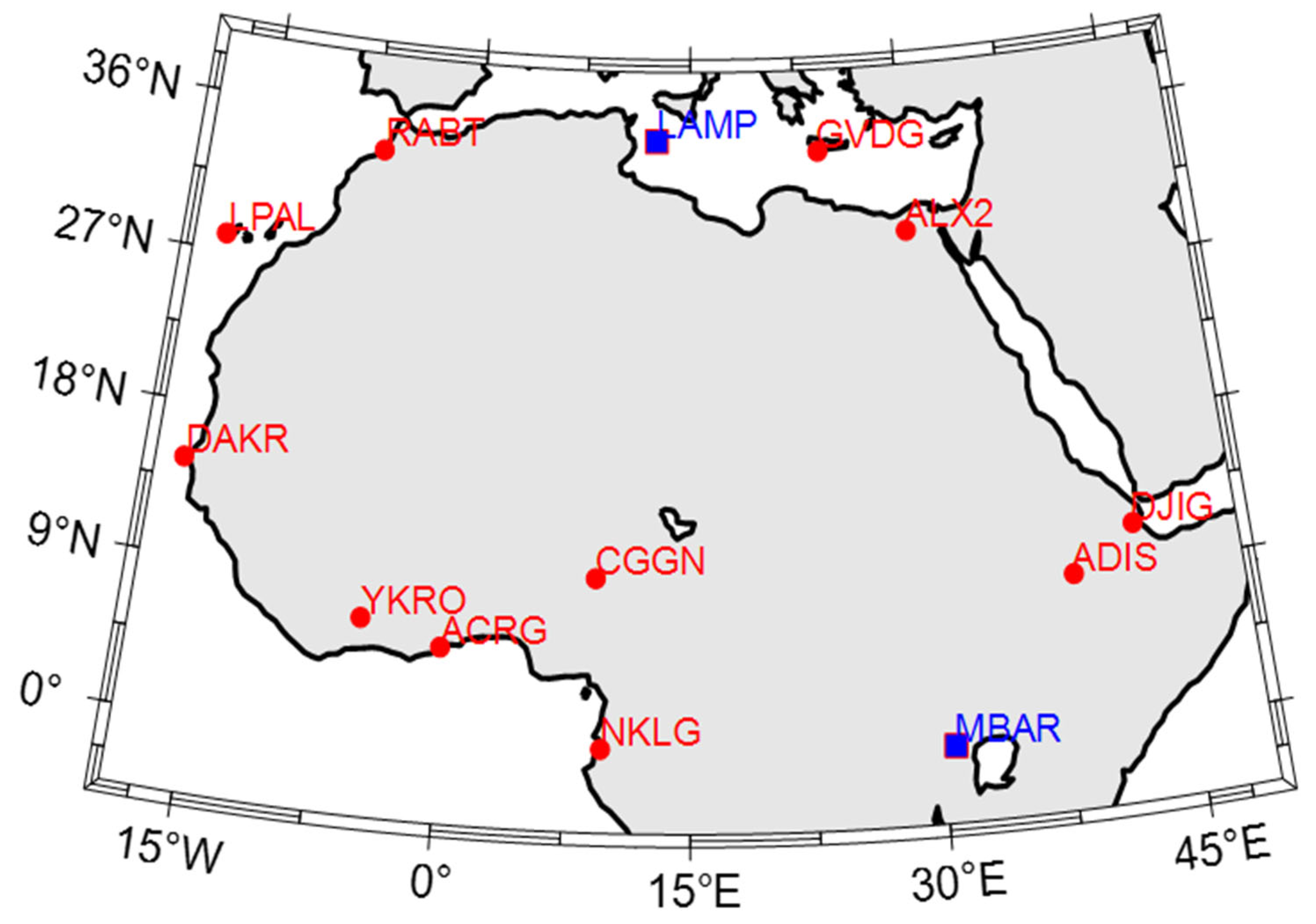
Figure 1 illustrates the spatial distribution of the ground-based GNSS receiver stations used in this study. The stations cover the latitude range from 0° to 35° N and the longitude range from 20° W to 50° E, providing regional observational support for ionospheric modeling and data assimilation over a low- to mid-latitude region. Stations shown by red circles provided data which were incorporated into the data assimilation and then fed the model’s training framework. These stations are primarily located along the boundaries of the study area, leaving large interior regions—particularly the central part—largely unmonitored for ionospheric sounding. Notably, the LAMB and MBAR stations, highlighted by blue squares, are excluded from the assimilation and training phases and are reserved solely for independent testing and validation of the proposed modeling approach. This experimental design ensures a rigorous and unbiased evaluation of model performance by comparing predicted TEC values with observations from stations that do not influence the assimilation process. It is also worth noting that data availability at both LAMB and MBAR stations is limited to 2024, which restricts their use in the assimilation and training stages of the U-Net model. Therefore, selecting these stations as previously unseen data and adopting them exclusively for validation against predicted data represents the most appropriate and robust strategy.
A list of the stations used in this study is presented in Table 1. Geomagnetic dipole coordinates of the selected stations were calculated through the British geological survey interface (https://geomag.bgs.ac.uk/data_service/models_compass/coord_calc.html (accessed on 25 December 2025)). Also, it should be noted that stations MBAR and NKLG are situated around the equatorial boundary, and due to the limited availability of observational data in this region, their measurements are incorporated in this study.
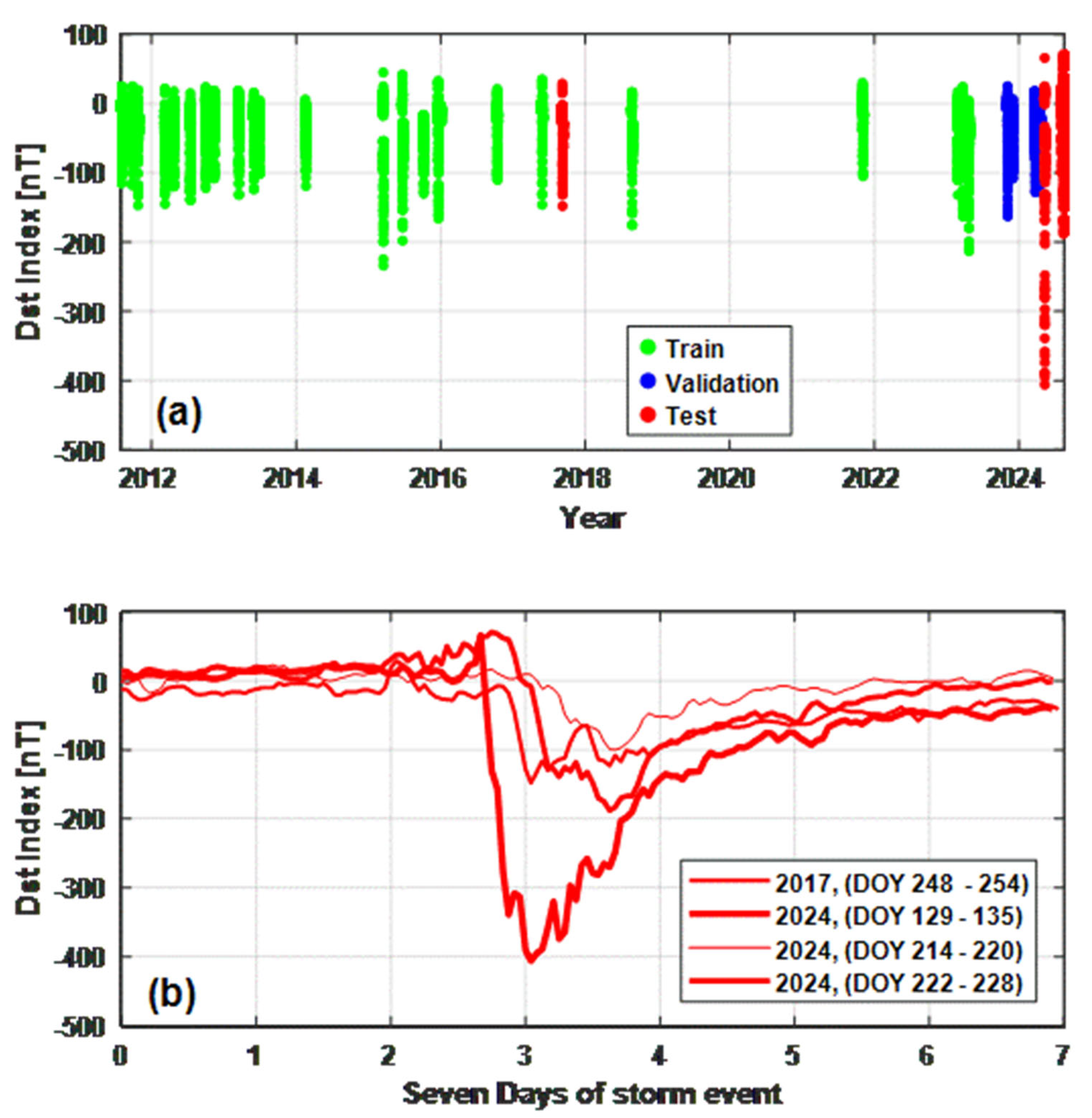
This present study utilizes the hourly rapid UPC product of GIM-TEC (UHRG) Global Ionospheric Map, provided by the Polytechnic University of Catalonia (UPC), which generates global vertical TEC maps at a temporal resolution of 1 h and spatial resolution of 2.5° × 5°, derived from a dense network of GNSS stations and serving as raw TEC data [41]. For this analysis, a regional subset encompassing the African 0–40 degrees latitude sector was extracted to construct a grid comprising 15 × 15 nodes (225 points). IONEX-formatted data were acquired from the NASA CDDIS archive (https://cddis.nasa.gov/archive/gnss/products/ionex/, accessed on 6 October 2025). A total of 33 intense geomagnetic storms (Dst ≤ –100 nT) occurring during the period 2011–2024 were selected for analysis. These events were partitioned into 25 for training, 4 for validation, and 4 for testing. Each storm interval spans seven days centered on the minimum Dst value, encompassing the quiet, main, and recovery phases. The 10–12 May 2024 storm, as depicted in Figure 2, among the other tested storms during solar cycle 25, was employed as the principal case study for detailed evaluation. To enhance model performance, five solar-geomagnetic indices identified as dominant TEC drivers—F10.7 cm radio flux, Lyman-α flux, Dst index, solar wind speed, and sunspot number—were incorporated as auxiliary inputs, yielding a total of six input channels. These solar-geomagnetic parameters were obtained from the OMNI database (https://omniweb.gsfc.nasa.gov/, accessed on 6 October 2025). All datasets were temporally aligned to a 1 h resolution and spatially interpolated to conform to the TEC grid, yielding multi-channel features of dimension 15 × 15 × 6 (TEC plus five solar-geomagnetic indices).

2.2. Assimilation Methodology of GNSS TEC into UHRG Map

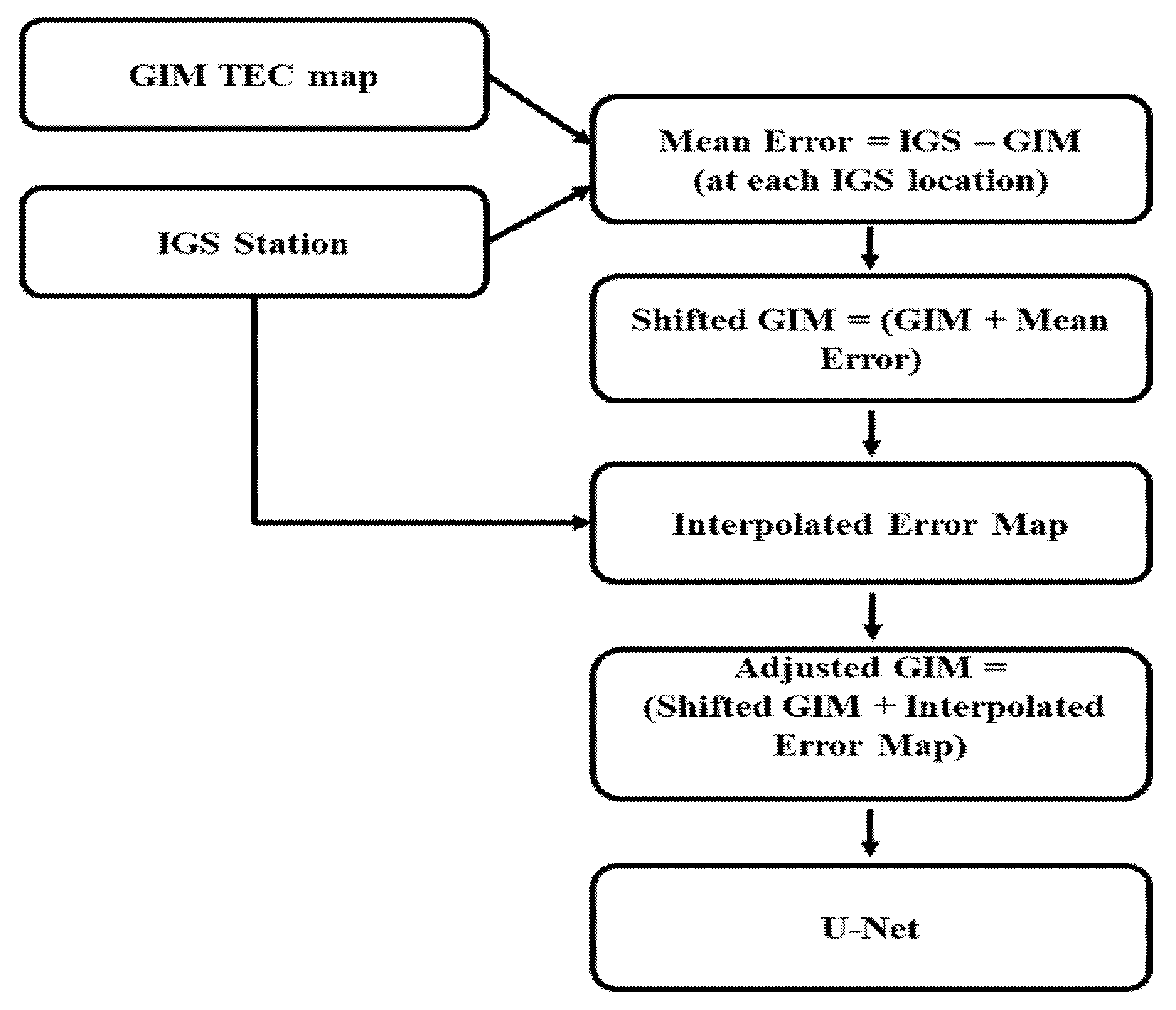
The TEC data obtained from the ground-based GNSS receiver stations shown in Figure 1 were assimilated to GIM TEC data to reduce regional biases and spatial errors of the latter data set. For each epoch (year, Day of Year, and hour), GIM TEC values were first interpolated to the geographic locations of the GNSS stations using linear interpolation and extrapolation. Hourly mean TEC values were then computed at each station from the GNSS observations. The difference between the observed station TEC and the corresponding interpolated GIM TEC (IGS − GIM) was calculated at each station, and the spatially averaged mean error was used to apply a uniform offset to the entire GIM field for that epoch. This first adjustment corrects large-scale systematic biases between the modeled and observed TEC.
To account for spatially varying residual errors (tilt or regional gradients), a second adjustment was applied using the station-wise TEC residuals. When observations from more than two stations were available, the residual errors were interpolated over the full GIM grid to generate an error correction map. This interpolated error map was scaled by a fixed contribution factor of 50%, a value chosen based on preliminary sensitivity tests that balanced the correction of spatially residual errors against the risk of overfitting to the uneven GNSS station distribution. Specifically, lower values failed to adequately correct regional biases, whereas higher values occasionally accumulate errors in sparsely observed regions. Therefore, a 50% contribution factor was identified as the most robust and balanced choice. The scaled error map is then added to the mean-shifted GIM, producing the final adjusted TEC map. The resulting assimilated GIM products were then used as inputs for subsequent U-Net-based modeling, as summarized in Figure 3. The performance and effectiveness of the proposed assimilation technique are quantitatively evaluated and discussed in the Section 3 and Section 4.

2.3. U-Net Deep Learning Model

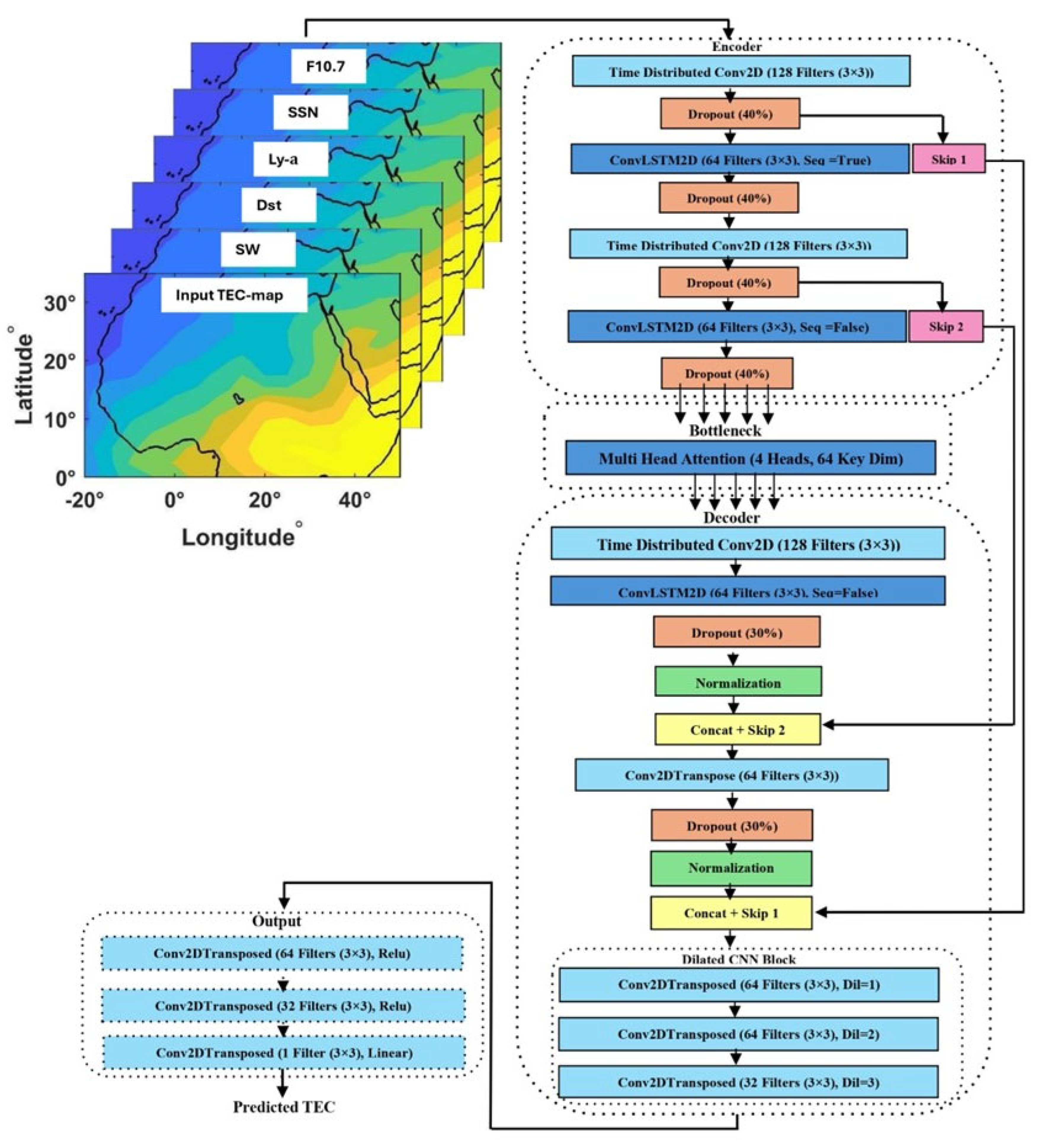
In our proposed work, spatio-temporal attention-based U-Net involving ConvLSTM and Dilated CNN modules has been utilized for precise prediction of TEC maps during geomagnetic disturbances. This is done through the combined use of sequential TEC observations and space-weather indices. The model successfully captures intricate ionospheric dynamics across various spatial and temporal scales, enhancing its robustness during geomagnetic storm events. Figure 4 shows an overview of the proposed model. The proposed architecture consists of five main stages which are as follows:
  • Multi-channel input representation;
  • Encoder architecture for spatio-temporal feature extraction;
  • Attention-based bottleneck;
  • Decoder architecture for feature reconstruction with skip connections;
  • Output block.
The first stage is the Multi-Channel Input Representation stage which is required to acquire the sequence of TEC maps identified by the indices: TEC map as a ground truth with the F10.7 solar flux, Sunspot Number (SSN), Lyman-α radiation, Dst index and Solar Wind as input features. Also, each step is represented as a multi-channel 2D grid over latitude and longitude. This enables the model to learn physically meaningful correlations and improves robustness during geomagnetic storms. Also, the model takes input sequences of size (24, 15, 15, 5), indicating 24 h temporal historical intervals (T = 24) of 15 (latitude) × 15 (longitude) spatial grids (H = W = 15) with five feature channels (C = 5). It is worth noting that, for each geomagnetic storm, we selected a 7-day interval consisting of three days before and three days after the time of maximum depression in the Dst index, in addition to the day of maximum depression itself. The GIM-TEC data have a temporal resolution of 1 h. Consequently, the number of samples per storm is 24 × 7 = 168 TEC maps. Based on this selection, the total number of training samples (25 storms) amounted to 4200 TEC maps.
The second stage is the encoder stage of spatio-temporal feature extraction. It is mainly composed of the following components: Time-Distributed Conv2D layers, ConvLSTM2D layers, dropout layers and two skip connections which are Skip-1 and Skip-2. While the Time-Distributed layers of Conv2D are necessary to extract the spatial features independently for each time step, ConvLSTM2D layers are required to identify the temporal dependencies while maintaining the spatial features [42,43]. Also, the dropout layer reduces the overfitting of the model [44]. Skip connections are necessary to retain the high-resolution spatial features of later decoding operations. This module is structured as two sequential blocks. Each block consists of a Time-Distributed Conv2D layer featuring 128 (3 × 3) filters, followed by a Conv-LSTM layer containing 64 (3 × 3) filters and interrupted by a dropout layer with a 40% dropout ratio.
The third stage is the Multi-Head Attention stage that utilizes Multi-Head Self-Attention (4 heads, 64-dimensional keys). This is required to enable the model to learn long-range temporal and spatial dependencies and weigh important regions and time steps dynamically. This, in turn, overcomes the limited receptive field of CNNs and ConvLSTMs and enhances sensitivity to localized storm-time disturbances.
The fourth stage in the proposed model is the decoder stage that is required for feature reconstruction following the U-Net-style decoding that improves spatial accuracy [45]. It is composed of the following layers: Time-Distributed Conv2D with 128 (3 × 3) filters, ConvLSTM2D with 64 (3 × 3) filters, Conv2DTranspose with 64 (3 × 3) filters, Normalization layers to stabilize the training process, dropout (30%) layers to reduce the model’s overfitting, and concatenation with skip connections to preserve regional TEC patterns. This architecture gradually reconstructs high-resolution TEC maps and combines deep semantic features with fine spatial details via skip connections. This stage ends with a dilated CNN refinement block that is composed of dilated Conv2DTranspose layers with increasing dilation rates. This is required to expand the receptive field without increasing parameter count, which enables the model to capture the multi-scale spatial dependencies [46]. This is effective for modeling large-scale ionospheric structures and enhances continuity across latitude–longitude grids. This block contains three sequential Conv2DTranspose layers. Each of the first two layers contain 64 (3 × 3) filters while the third layer contains 32 (3 × 3) filters.
The fifth stage is the final output stage which consists of three Conv2DTranspose layers with 64 (3 × 3), 32 (3 × 3) and 1 (3 × 3) filters, respectively. They are essential for further spatial refinement and feature smoothing to improve feature reconstruction and produce the final output by converting multi-channel features into the desired TEC prediction.

3. Results

This section presents the results obtained from the proposed GNSS-TEC data assimilation and U-Net-based prediction framework applied over the North African region during geomagnetic storm conditions. Section 3.1 evaluates the performance of assimilating GNSS-derived TEC into the Global Ionospheric Map (GIM) using a leave-one-out validation strategy, with improvements quantified through station-based error statistics and spatial comparisons. In Section 3.2, the storm-time TEC predictions generated by the U-Net model are examined and compared with the assimilated TEC reference, as well as with the IRI-2020 and AfriTEC models, across the initial, main, and recovery phases of the May 2024 geomagnetic storm. Finally, Section 3.3 presents an independent validation at unassimilated GNSS stations to assess the robustness and generalization capability of the proposed framework.

3.1. GNSS-TEC Data Assimilation into the GIM-TEC

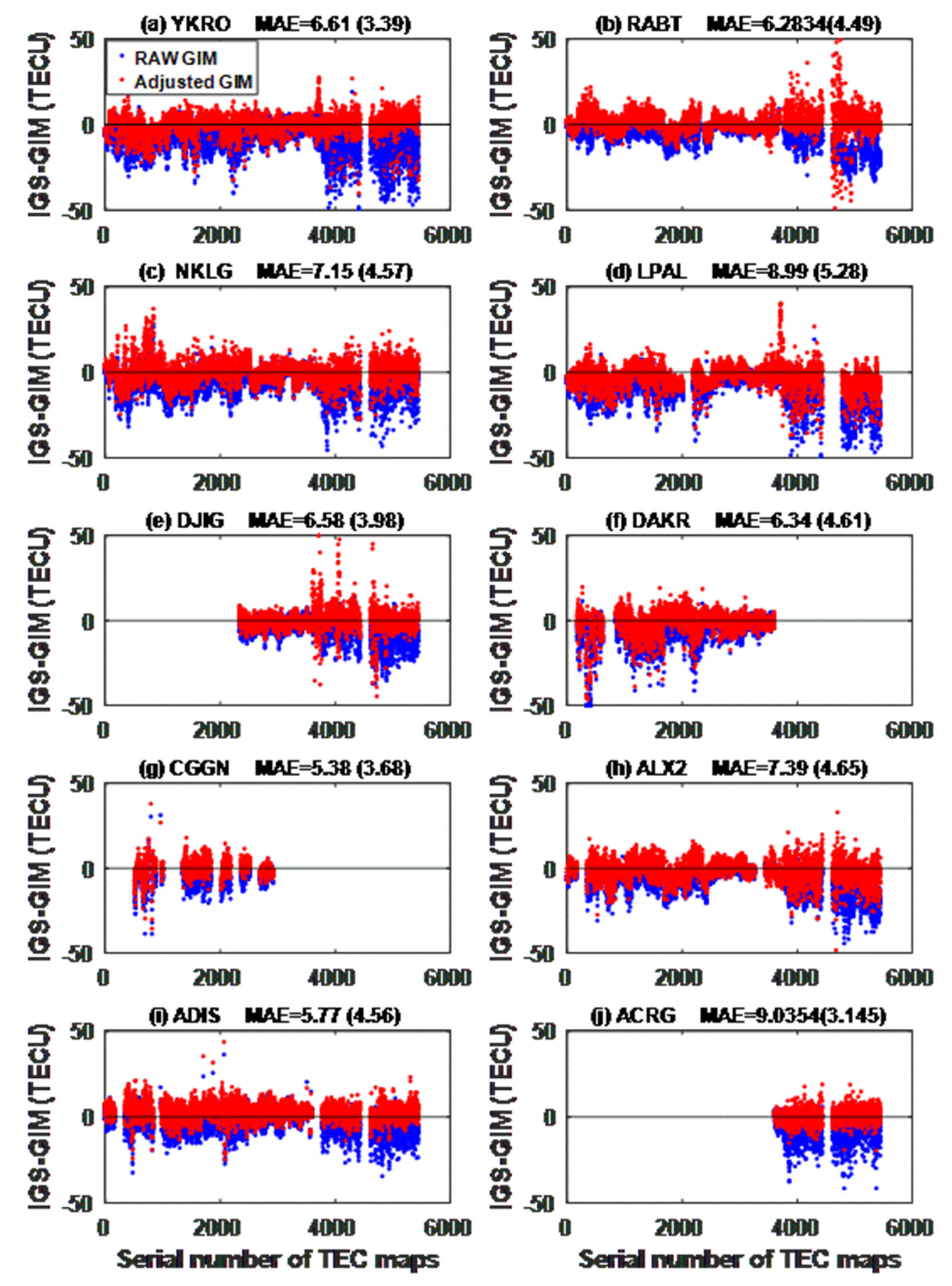
Data from the 11 stations highlighted in red text over the map (Figure 1) have been used for the assimilation process. The performance of the GIM-GNSS TEC assimilation technique was evaluated using a leave-one-out testing strategy, in which each GNSS receiver station was alternately excluded from the assimilation process and used solely for independent testing. For each test case, TEC measurements from all remaining stations were assimilated into the GIM, and the adjusted GIM TEC was then compared against the observed TEC at the withheld station. Figure 5 presents a time series of the TEC differences (IGS − GIM) for each test station, comparing the raw GIM with the adjusted GIM. Across all stations, the adjusted GIM consistently exhibits reduced dispersion and a closer clustering of residuals around zero relative to the raw GIM, indicating an overall improvement in model–observation agreement.
Quantitatively, the mean absolute error (MAE) is reduced at all test stations following assimilation, with reductions ranging from approximately 20% to over 60%, depending on station location. Stations such as ACRG, YKRO, and LPAL show particularly strong improvements, reflecting the effectiveness of the assimilation in capturing regional TEC variability. Even for stations located near the periphery of the network (e.g., LPAL and DJIG), the adjusted GIM demonstrates a notable decrease in residual magnitude, highlighting the robustness of the interpolation-based error correction. The remaining residual variability is likely attributable to localized ionospheric structures and limited station density. In particular, small-scale to medium-scale ionospheric phenomena such as equatorial plasma bubbles, traveling ionospheric disturbances, and sharp storm-time TEC gradients are difficult to capture accurately using a generic interpolation-based assimilation scheme. These structures exhibit rapid temporal evolution and strong spatial gradients that are not well resolved by the sparse GNSS station distribution over Africa and are therefore partially smoothed during interpolation. As a result, localized TEC variations may persist as residual errors even after assimilation. Overall, these results confirm that the assimilation framework substantially enhances GIM TEC accuracy while maintaining stability and avoiding overfitting, thereby providing a reliable improved TEC product for subsequent U-Net-based modeling.
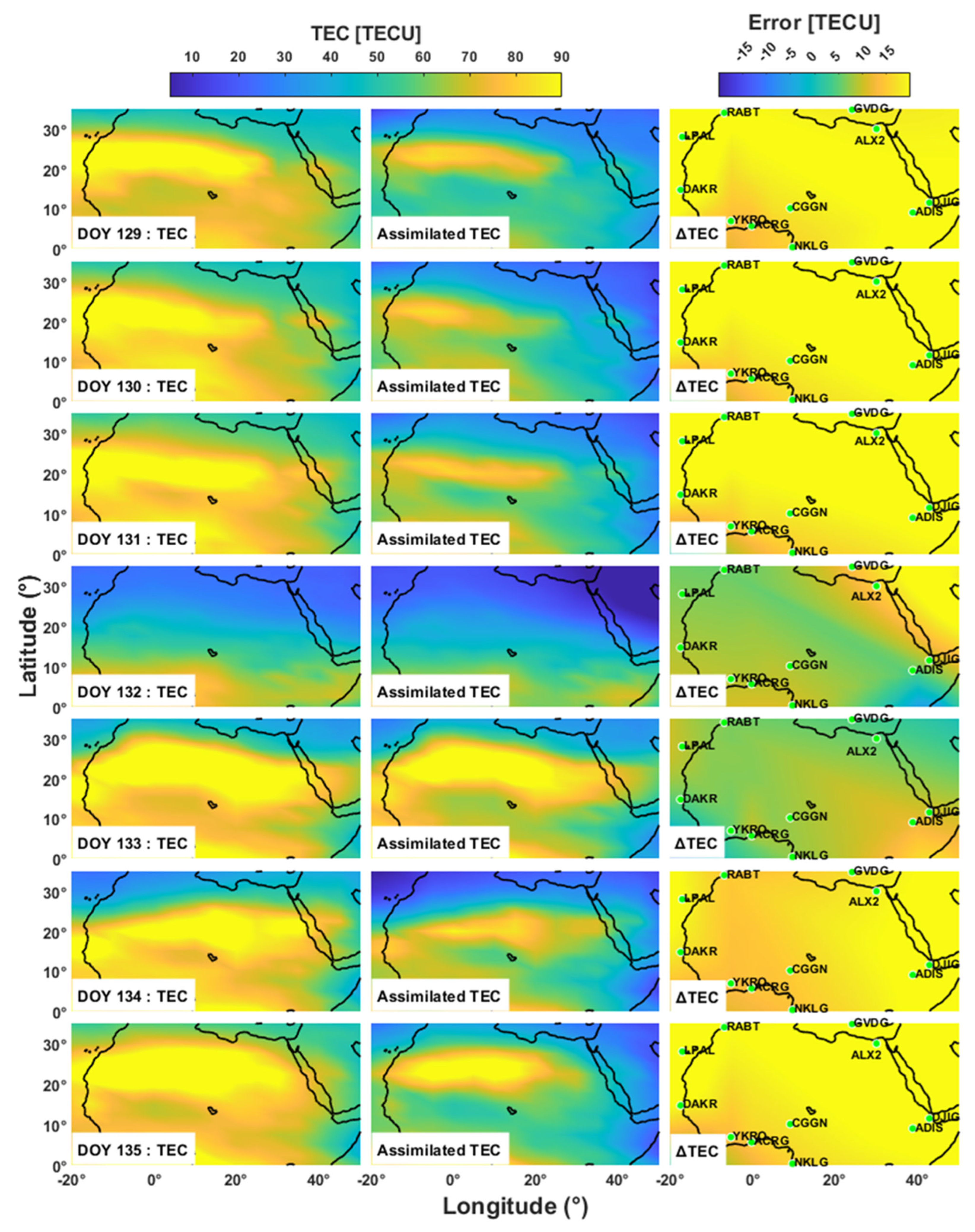
Figure 6 provides a comparative visualization illustrating how the UHRG TEC maps (GIM) over the North African region relate to their corresponding assimilated TEC maps during the selected seven-day interval of the geomagnetic storm from 8 to 14 May 2024. Panels in the left and middle columns show the original GIMs and corresponding assimilated TEC maps, respectively, while the right column displays the spatial distribution of the error (GIM minus assimilated), with the GNSS station locations superimposed for reference. Each row, arranged from top to bottom, represents the TEC conditions at 16:00 UT for Days of Year (DOYs) 129 to 135, corresponding to the geomagnetic storm dates of 8–14 May 2024.
The comparison reveals a consistent pattern: the GIMs systematically overestimate the assimilated TEC values across the region. Despite this overall bias, the GIM dataset still successfully reflects the major storm-related ionospheric features. In particular, it captures the pronounced TEC suppression associated with both the main phase and the recovery phase of the geomagnetic storm (DOYs 132–133), indicating that although the amplitude is exaggerated, the temporal and spatial evolution of the storm’s impact remains clearly identifiable. The error distribution clearly indicates the presence of a systematic offset (bias) between the GIM and the assimilated TEC data, resulting from the adjustment procedure used to align the GIM with the observed GNSS TEC measurements. This bias is approximately 10 TECU. It is also worth noting that, from this point onward, the assimilated TEC data will be referred to as the ground truth.

3.2. U-Net Prediction Model Relative to IRI-2020 and AfriTEC Storm-Time Models

To demonstrate the performance of the U-Net prediction model in comparison with the IRI and AfriTEC models, the TEC distribution over the North African region was examined during the three phases of the geomagnetic storm of 10–12 May 2024. The time intervals corresponding to the initial, main, and recovery phases are shown in Figure 2b. A four-hour temporal resolution is used to highlight the evolution of TEC throughout each phase.
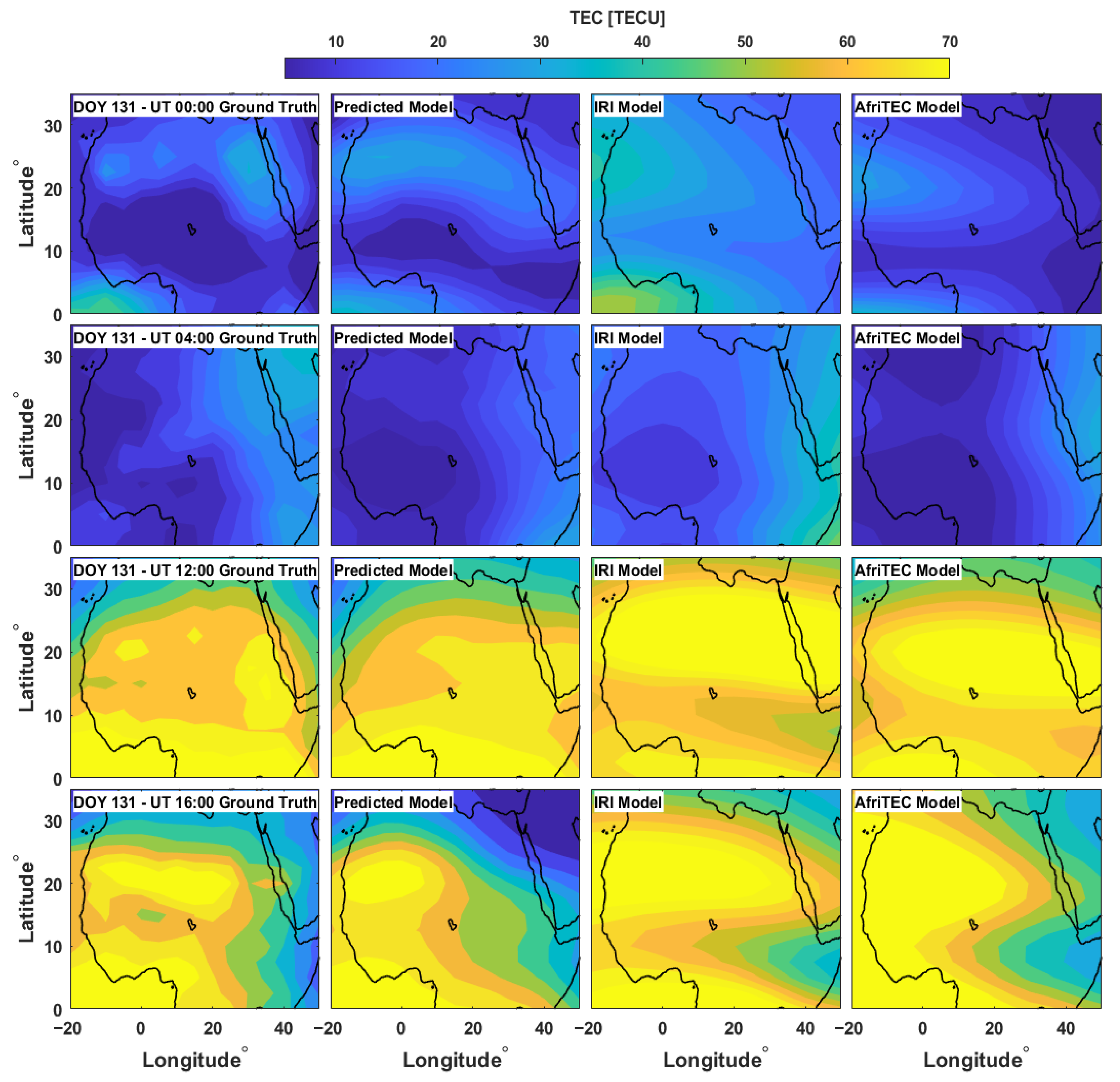
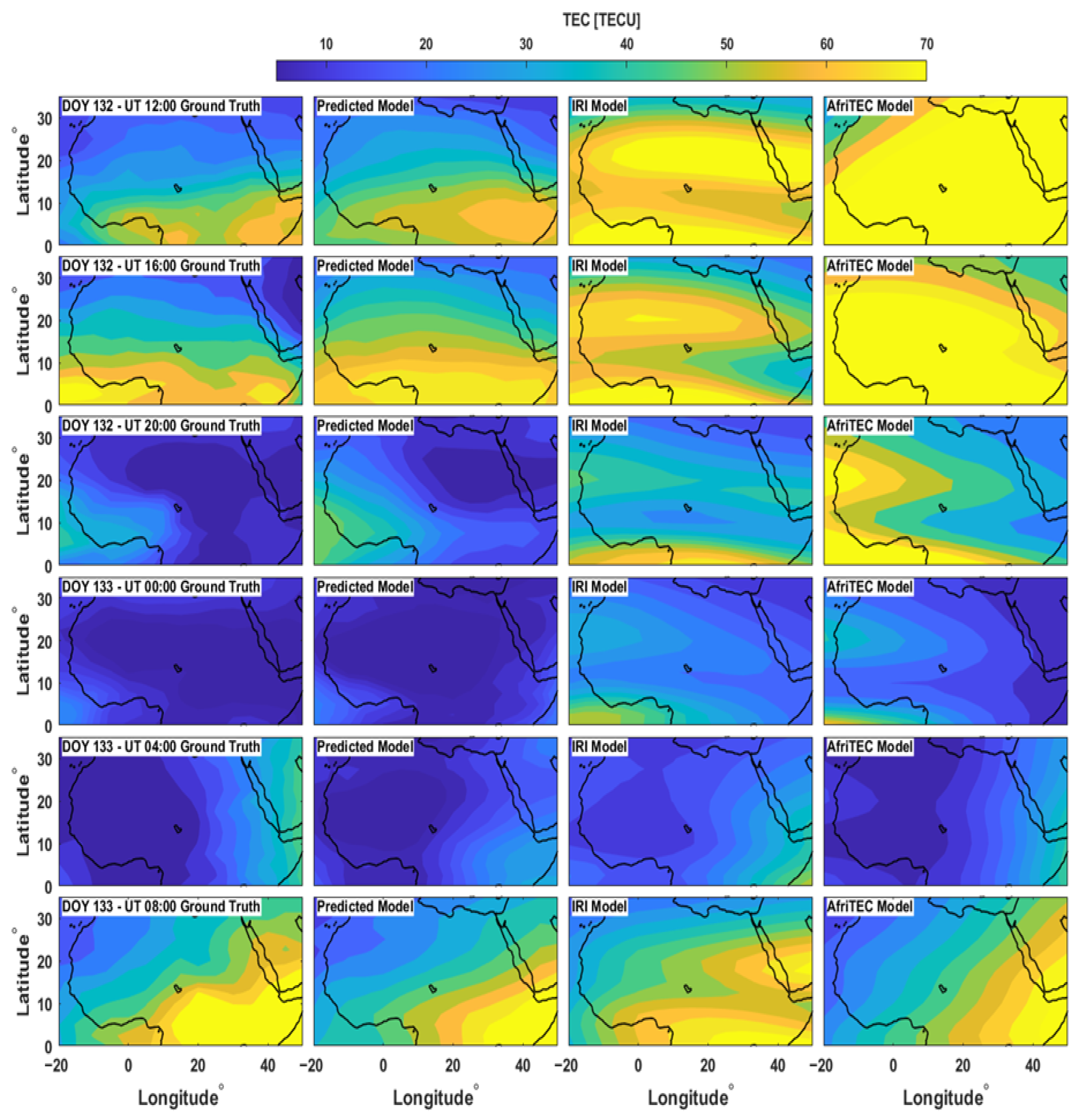
Figure 7 presents the TEC maps during the initial phase of the storm. It is worth noting that the ground-truth data has 1 h time resolution; however, the 4 h time interval shown in Figure 7, Figure 8 and Figure 9 is presented solely for visualization purposes to illustrate the temporal evolution of TEC over the North African region. This reduced interval was chosen to limit the number of displayed maps while preserving the key temporal characteristics. The results show that the U-Net prediction (1 h lead prediction) closely matches the ground-truth TEC, both in magnitude and spatial structure. In contrast, although the IRI and AfriTEC models successfully reproduce the general diurnal trend of TEC—showing an increase from early morning toward daytime—their spatial patterns differ substantially from the observed TEC distribution. Both the IRI and AfriTEC models continue to exhibit the characteristic double-crest structure of the Equatorial Ionization Anomaly (EIA) around local noon. However, the ground-truth observations show markedly different behavior during this period. At 12:00 UT, the northern EIA crest is significantly weakened, indicating a degradation of TEC in the northern hemisphere that is not captured by either empirical model. By 16:00 UT, the ground-truth TEC map also reveals a noticeable shrinkage in the overall spatial extent of the ionization region, whereas the IRI and AfriTEC outputs maintain broader, more climatologically smooth structures. This highlights the inability of the empirical (IRI and AfriTEC) models to reproduce the storm-time morphological changes observed in the actual TEC distribution.
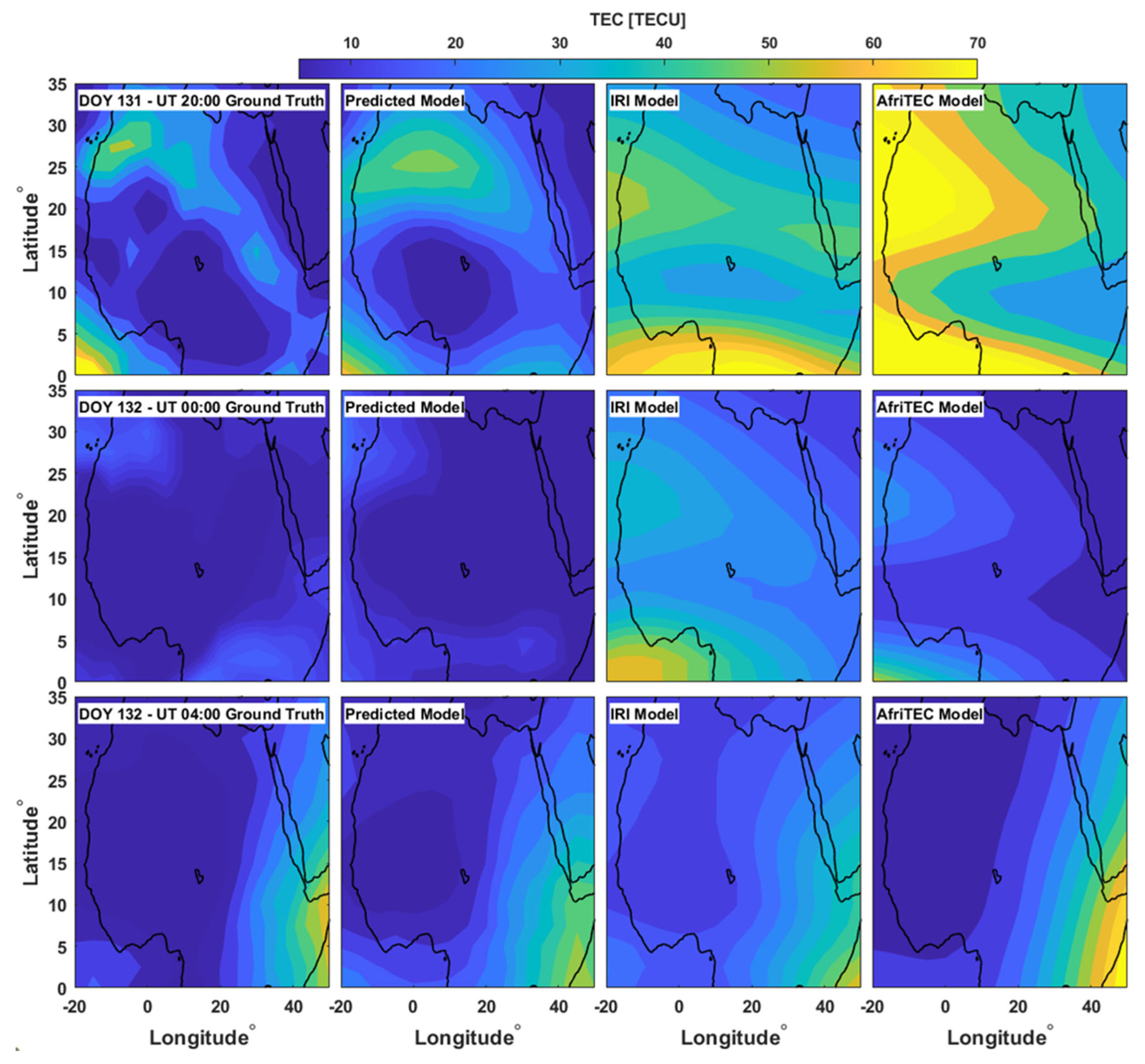
Figure 8 follows the same structure as Figure 7 but illustrates the TEC behavior during the main phase of the geomagnetic storm. At 20:00 UT, both the IRI and AfriTEC models continue to display features resembling quiet-time TEC conditions. The IRI output shows a weakening of the northern EIA crest, while the southern crest remains comparatively elevated. In contrast, the AfriTEC model maintains relatively strong TEC levels in both hemispheres, preserving the typical double-crest morphology.
However, when compared with the ground-truth and U-Net predicted TEC maps, a markedly different pattern emerges: the southern hemispheric crest undergoes severe degradation, a signature storm-time effect that neither IRI nor AfriTEC captures. By 00:00 UT, both the ground-truth and predicted TEC maps exhibit an almost complete collapse of the EIA structure, whereas the IRI and AfriTEC models still retain faint indications of the double-crest pattern.
During the recovery phase of the geomagnetic storm (between 12:00 and 16:00 UT) as indicated in Figure 9, the IRI and AfriTEC models exhibit noticeably different behaviors. The IRI model continues to produce a pronounced double-crest TEC structure, whereas the AfriTEC model shows a strong merging and interference of these two crests, resulting in a broad, intensified TEC enhancement spread across much of the African continent. In contrast, both the ground truth and the predicted data indicate only a weak enhancement over the southern crest and a clear reduction in TEC levels across the northern hemisphere region.
As the local time progresses toward nighttime—approximately from 20:00 UT on DOY 132 to 04:00 UT on DOY 133—the TEC becomes significantly suppressed, as reflected in the ground-truth observations. During this interval, however, both the IRI and AfriTEC models continue to display a weak double-crest pattern, failing to capture the strong depletion. By the end of the recovery phase, the AfriTEC model begins to align more closely with ground-truth behavior, showing improved agreement relative to earlier hours.
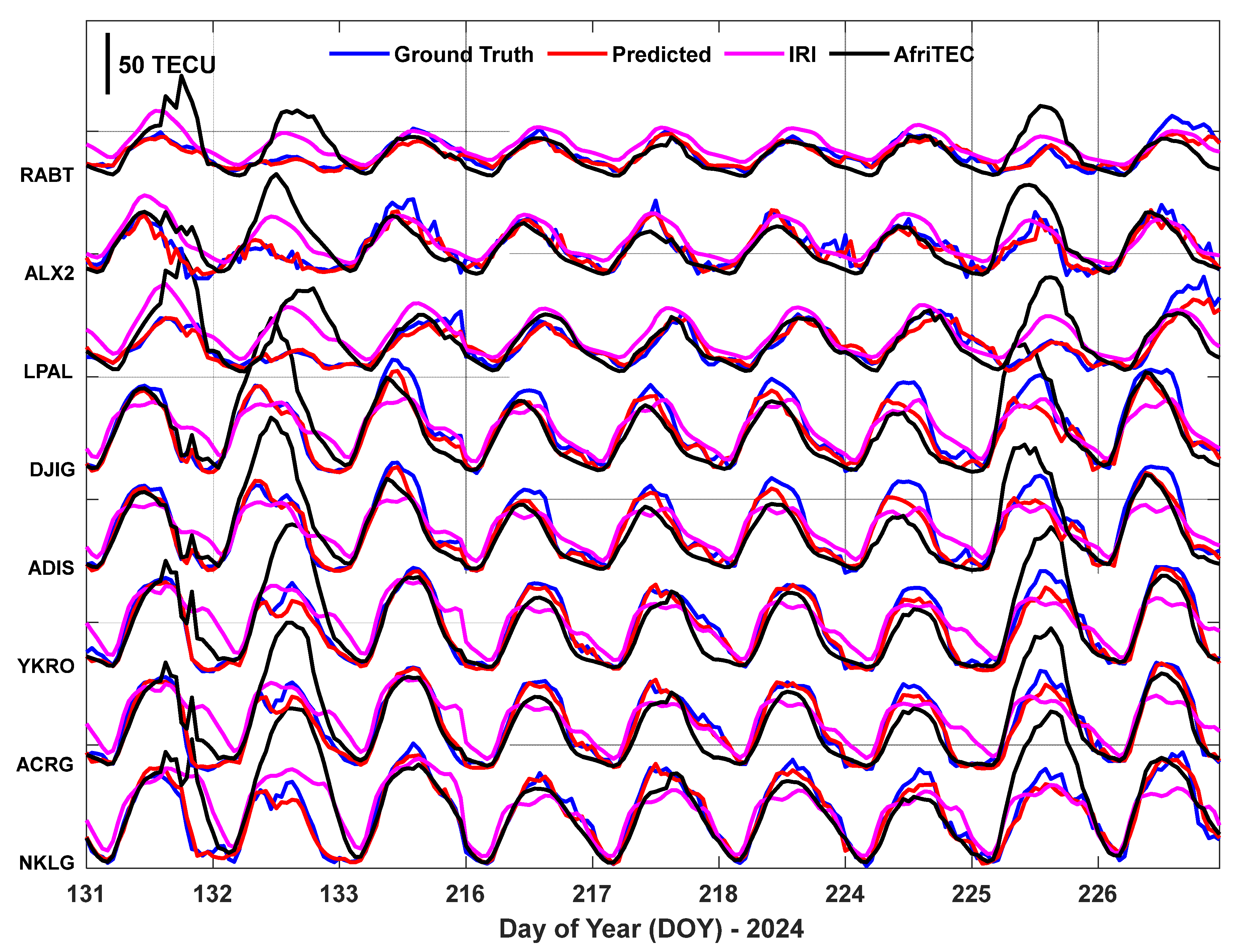
At the locations of the GNSS stations considered in this study, we compared the ground-truth, predicted, IRI, and AfriTEC model outputs during the test geomagnetic storms of 2024. In Figure 10, the x-axis represents the Day of Year (DOY) in 2024, while the y-axis shows the TEC values, shifted by 100 TEC units for each station to allow all stations to be displayed in a single panel. The stations are arranged from top to bottom according to their latitude. The blue, red, magenta, and dark red lines correspond to the ground-truth, predicted, IRI, and AfriTEC model outputs, respectively. Across all stations, the ground truth and predicted data exhibit strong co-variation, reflecting accurate prediction of TEC dynamics. In contrast, the AfriTEC model tends to overestimate TEC values, particularly during the main phases of the geomagnetic storms on DOY 132 (May 11) and DOY 225 (August 12), 2024. Meanwhile, the IRI model consistently shows an offset relative to the observations throughout all three storm events. This comparison highlights the improved agreement between the predicted data and the ground truth, while also illustrating the systematic differences in TEC estimation by the AfriTEC and IRI models during disturbed geomagnetic conditions.
Table 2 presents the correlation coefficients between observed TEC from GNSS stations across the North African region and various TEC datasets: original GIM, assimilated GIM (ground truth), predicted TEC, IRI, and AfriTEC model outputs. It demonstrates that assimilation significantly improves agreement with observations. Correlations between observed TEC and ground-truth GIM reach ~0.99 at nearly all stations, indicating a nearly perfect match and confirming the effectiveness of the assimilation process. Predicted TEC also shows strong agreement with observations, slightly lower than the ground-truth GIM but still high, reflecting the model’s ability to capture TEC variability. In contrast, the original GIM exhibits lower correlations, while the IRI model performs moderately, providing reasonable but lower agreement. The AfriTEC model shows the lowest correlations, indicating limited ability to reproduce observed TEC in this region. Clearly, the table highlights the improvements achieved through assimilation, the reliability of predicted TEC, and the relative performance of standard ionospheric models across GNSS stations in North Africa.
Although the correlation coefficients indicate a generally strong linear relationship between the original GIM and the observed TEC, they do not account for the systematic offset relative to the observations. This limitation is evident in Table 3, where the RMSE of the original GIM consistently exceeds 10 TECU at all stations, reaching values as high as ~17 TECU at the ALX2 and LPAL stations. In contrast, both the ground-truth GIM (ground truth) and the U-Net predictions exhibit substantially lower RMSE values, indicating a marked improvement in accuracy. The IRI and AfriTEC models show the largest RMSE values when compared with the ground-based GNSS TEC observations, with errors frequently exceeding those of the original GIM. Overall, the assimilation of GNSS TEC data into the GIM significantly enhances model performance relative to the storm-time climatological models, demonstrating the effectiveness of the proposed assimilation and data-driven prediction approach.
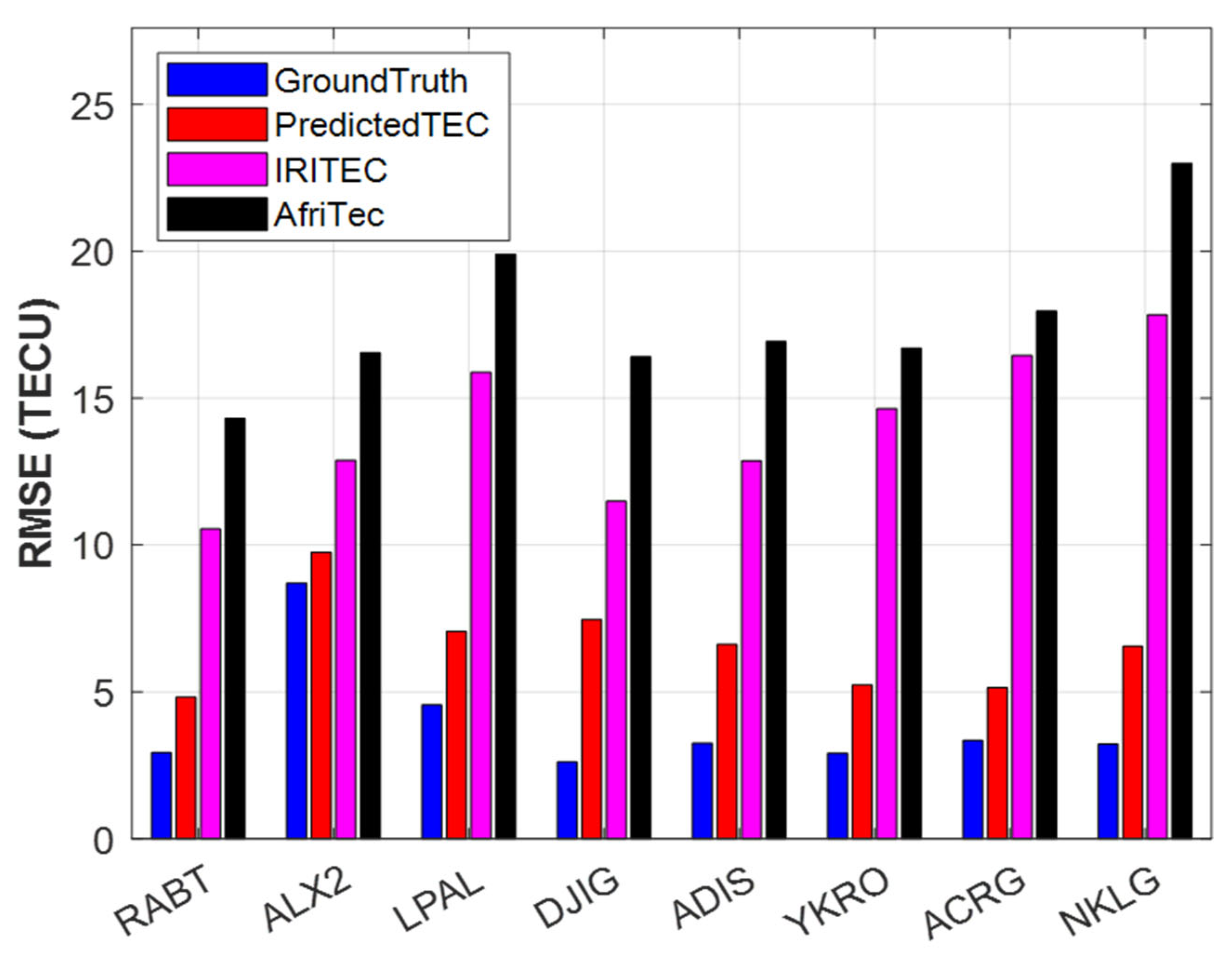
Figure 11 presents the RMSE of the ground-truth, Predicted, IRI, and AfriTEC which are evaluated directly against the observed GNSS TEC measurements at each station. The blue, red, magenta, and black bars represent the GroundTruth, PredictedTEC, IRITEC, and AfriTEC values, respectively. The strong correspondence between the ground truth and the observed GNSS TEC confirms the effectiveness of the assimilation process used to generate the reference dataset. Compared with reference observational TEC, the PredictedTEC model consistently achieves the smallest RMSE values—typically between 4 and 6 TECU—indicating high reliability in capturing station-level TEC variability. The IRI model yields moderate errors, generally in the 10–15 TECU range, while the AfriTEC model shows the largest deviations, frequently exceeding 15 TECU and approaching 20 TECU at several sites. Although the absolute RMSE values differ from those in Figure 11 due to the change in reference data, the relative performance ranking of the models remains unchanged: the Predicted model provides the closest agreement with observations, followed by IRI and then AfriTEC. This consistency across both evaluation approaches highlights the robustness of the Predicted TEC model in reproducing TEC dynamics under geomagnetic storm conditions.

3.3. U-Net Validation at Two Unassimilated GNSS Stations

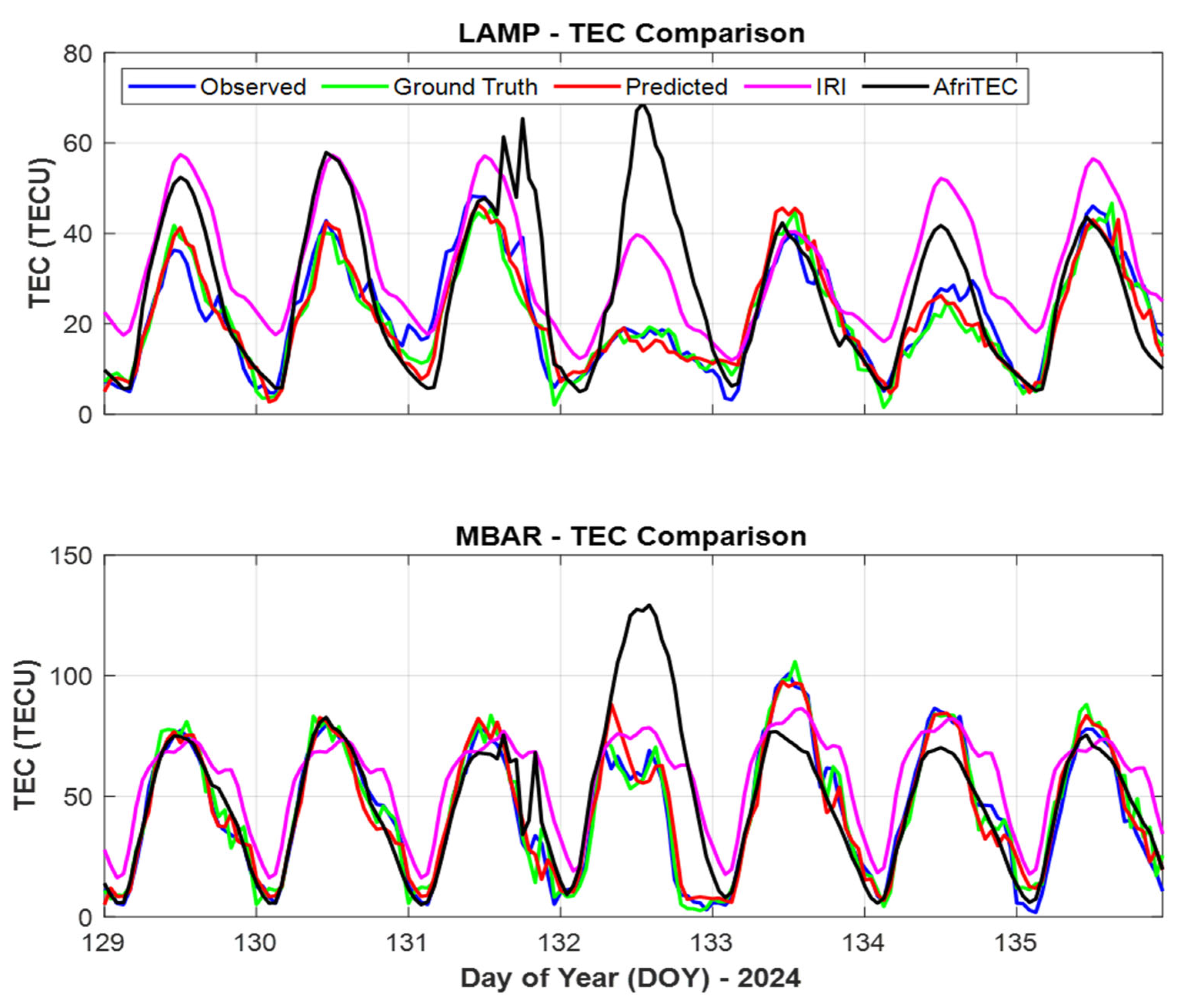
Figure 12 illustrates the temporal comparison of TEC at the LAMP and MBAR stations, which serves as an independent validation site not included in the data assimilation and model’s training dataset. The evaluation covers the DOYs 129–136, encompassing diurnal variations during the geomagnetic storm of May 2024. Comparative profiles are shown for observed TEC (at LAMP and MBAR), ground-truth data, the modeled–predicted TEC, and outputs from IRI-2020 and AfriTEC models. It is noted that the observed TEC exhibits the characteristic ionospheric diurnal variation, with pronounced daytime enhancements and nighttime depressions. The ground-truth series remains closely aligned with the observations, capturing rapid changes and translational features while providing a smoother representation suitable for model estimation. The model-predicted TEC demonstrates excellent agreement with both the observed and ground-truth reference data throughout the evaluation window. The model accurately resolves the timing and amplitude of all major features in the TEC time series, including the sharp past-noon intensifications and the regular pre-dawn minimum.
In contrast, the IRI-2020 model exhibits systematic deviations from the observed behavior. IRI consistently overestimates daytime levels, indicating that the IRI as a climatological model lacks the responsiveness required to capture rapid ionospheric variability during the evaluation period. The AfriTEC model provides improved agreement relative to IRI but still underperforms when compared to assimilation-based prediction. AfriTEC captures several of the broad diurnal structures but exhibits notable overestimations, particularly around DOY 132, and underestimations during several nighttime intervals.
Figure 13 presents scatter plots illustrating the relationship between the observed TEC and the modeled TEC from the U-Net, IRI, and AfriTEC models (from left to right). The top and bottom rows correspond to the LAMP and MBAR stations, respectively. Among all models, the U-Net predictions consistently exhibit the highest correlation with the observed TEC. Moreover, even as the correlations of the IRI and AfriTEC models increase, the U-Net predictions continue to show superior agreement with the observations. The RMSE of the U-Net predictions remains around 5 TECU, whereas the RMSE for the IRI and AfriTEC models ranges between 12 and 20 TECU, approximately four times larger than that of the U-Net. The black dashed diagonal line shows that the U-Net predictions are tightly clustered around it. In contrast, the IRI model systematically overestimates the observed TEC, while the AfriTEC model exhibits a broad scatter, indicating reduced performance under severe ionospheric conditions.

4. Discussion

Several regional ionospheric data assimilation approaches have been developed over Africa by integrating ground- and space-based observations to support nowcasting services. For example, using GPS-derived slant TEC (STEC) and tomographic inversion techniques, 2D vertical TEC (VTEC) images have been produced over Africa [47,48]. Ref. [49] applied an Unscented Kalman Filter (UKF) to assimilate GPS-derived TEC together with COSMIC-2 foF2 and hmF2 measurements into the Standard Plasmaspheric and Ionospheric Model (SPIM). Their results showed substantial improvement over East Africa, with TEC assimilation reducing percentage errors by approximately 40.0–59.55% during geomagnetic disturbances relative to the SPIM baseline. Similarly, ref. [50] developed a regional African ionospheric model using ionospheric data assimilation, in which ground-based slant TEC from 40 GPS receiver stations and space-based NmF2 measurements from COSMIC-2 were assimilated into the International Reference Ionosphere (IRI-2016). For the geomagnetic storm period of 12–14 May 2021, this approach achieved average RMSE reductions of 34% for NmF2, 31% for foF2, and 34% for VTEC, along with corresponding correlation improvements of 10%, 14%, and 2%, respectively, compared to the IRI-2016 model.
In the present study, assimilation of observed TEC into the GIM over the North African region reduces the RMSE to below 10 TECU as shown in Figure 6. Moreover, the U-Net-based one-hour-ahead prediction of TEC demonstrates strong agreement with independent test data across different phases of the geomagnetic storm. The proposed framework consistently outperforms the storm-time options of both the IRI and AfriTEC models, as demonstrated through multiple quantitative and qualitative evaluation metrics.
The double hemispheric crests observed in both the IRI and AfriTEC models in Figure 7 indicate that, although these models capture the large-scale climatological behavior of the ionosphere, they fail to accurately reproduce the finer spatial structures present in the ground-truth TEC maps during geomagnetic storm conditions.
As shown in Figure 8 and Figure 9, even with the storm-time options enabled in both the IRI and AfriTEC models, neither is able to reproduce the complex degradation patterns or the asymmetric TEC responses evident in the ground-truth and predicted datasets during the main phase of the geomagnetic storm. In particular, the pronounced ionospheric asymmetry observed in the TEC distribution is not captured by either model.
In contrast, the ground-truth TEC data consistently exhibit strong temporal agreement and closely matched amplitude variations with the observed measurements, demonstrating the effectiveness of the adopted linear interpolation-based assimilation approach. Similarly, the predicted TEC data strongly mimic the observed behavior. The large offsets between the ground-truth TEC and both the IRI and AfriTEC outputs are directly reflected in their elevated RMSE values. These discrepancies arise not only from systematic offsets but also from the pronounced underestimation by both models during the storm main phase, highlighting the urgent need to improve storm-time representations in these empirical models. It is also important to note that a high correlation coefficient does not necessarily imply high model accuracy. This is clearly demonstrated in Table 2, where the original GIM, IRI, and AfriTEC outputs exhibit statistically significant correlations, yet their RMSE values remain high (approximately 10–16 TECU for GIM, 10–17 TECU for IRI, and 14–23 TECU for AfriTEC). In contrast, the ground-truth and predicted TEC datasets achieve substantially lower RMSE values of 2–4 TECU and 5–9 TECU, respectively.
The recent deterioration in AfriTEC performance can largely be attributed to the non-stationary nature of the ionosphere and the fact that the model was trained using data from the period 2000–2018, which did not include conditions representative of the present solar cycle. Notably, Solar Cycle 25 has exhibited stronger activity than much of Solar Cycle 24, from which AfriTEC drew most of its training information. As a result, AfriTEC has encountered combinations of solar and geomagnetic drivers that were absent in its development dataset, leading to reduced model robustness under extreme conditions. This limitation became particularly evident during intense geomagnetic storm periods, when AfriTEC systematically overestimated TEC values because it had not previously learned comparable geophysical states. These disparities highlight the evolving nature of ionospheric behavior across solar cycles and emphasize that static empirical models inevitably degrade over time when faced with new forcing environments. Therefore, it is essential that AfriTEC be updated regularly with recent observations to ensure sustained accuracy and reliability, especially as stronger storm conditions and changing climatological characteristics continue to emerge. In addition, our U-Net model, which is trained only on storm-time TEC data, demonstrates non-biased quiet-time behavior compared with the AfriTEC and IRI models. This quiet-time biasing behavior has been mentioned earlier in the study of [51]. Therefore, the AfriTEC and IRI modeled data shown in Figure 7, Figure 8 and Figure 9 still show the two ionospheric crests around the equator even during severely disturbed conditions, although the crests are completely degraded in the observed data.
It is also worth noting that RABT, DJIG, ADIS, YKRO, and NKLG stations were used in the construction of the GIM; consequently, RMSE values at these locations are the lowest. In contrast, ALX2 and LPAL did not contribute to the GIM construction, This, may explain the higher RMSE values at these stations. Furthermore, LPAL is located close to RABT, whereas ALX2 is situated farther from DJIG, which explains why ALX2 exhibits the largest RMSE as shown in Figure 11. Additionally, GVDG lacks data prior to 2024; as a result, the GIM consistently shows elevated RMSE values in its surrounding region.
Finally, the comparison between the predicted TEC and the independent, unseen observations from the LAMP and MBAR GNSS stations (Figure 12 and Figure 13) demonstrates a high degree of consistency and predictive accuracy for one-hour-ahead TEC forecasting during active conditions, with RMSE values of approximately 5 TECU. This result highlights the clear superiority of combining assimilated TEC data with U-Net-based prediction over widely used empirical models such as IRI and AfriTEC, even when their storm-time options are applied. These preliminary results indicate that the proposed assimilation–deep learning framework can better capture spatio-temporal variations that are poorly captured by either the AfriTEC or the IRI models. It is worth noting that the proposed framework demonstrates favorable computational characteristics on a standard GPU hardware (16 GB, Tesla-P100) with an inference time of 0.003517 s per sample (TEC map in our study). This indicates that the model is capable of fast predictions, making it suitable for practical deployment in real-world applications. However, its update frequency is mainly governed by the latency of the input drivers. Consequently, the primary operational challenge is likely to be data latency rather than computational demand, as limited GNSS coverage across Africa can delay data availability.

5. Conclusions and Future Work

The present study develops a hybrid framework that combines data assimilation and deep learning to improve TEC monitoring and forecasting over North Africa. This is because data assimilation provides physically consistent TEC maps that reflect both observed and modeled information, while deep learning captures complex nonlinear dynamics that are challenging to represent explicitly in empirical/physics-based models. Thus, by integrating GNSS data assimilation with a deep learning forecasting approach, this work advances ionospheric modeling capabilities in a region historically affected by sparse observational density and strong electrodynamic variability. The results demonstrate the substantial impact of feeding the assimilated GIM TEC maps to hybrid U-Net modeling. The results also show that the assimilation model consistently outperforms the widely used IRI and AfriTEC climatological models in reproducing both the diurnal morphology and the short-term temporal variability of the ionosphere. The predicted TEC exhibits markedly reduced RMSE and MAE values, together with significantly higher correlation with observations, indicating that the system captures not only the absolute magnitude of TEC but also its dynamic evolution with high reliability. In addition, it emphasizes the significant improvements achieved via reduced TEC uncertainties during intense geomagnetic storms, which is a prerequisite for space-weather forecasting tools that will be relevant to addressing challenges specific to the African sector. Further, the approach is flexible and can be extended to other regions with sparse observational coverage, i.e., covering the entire African continent and hence enhancing global TEC forecasting capabilities. Moreover, given the moderate spatial resolution and one-hour-ahead prediction horizon, these highlight its potential applicability for operational ionospheric monitoring and space-weather forecasting systems.
In future work, it would be valuable to explore the implementation of alternative data assimilation schemes, incorporate additional space-based observational datasets, and develop more advanced deep learning architectures to further enhance the robustness and predictive capability of the proposed framework. For instance, incorporating space-based data such as COSMIC-2 would improve such study due to its global coverage and enhanced vertical resolution, making it highly suitable for studying ionospheric structure and variability over North Africa, where ground-based observatory coverage is sparse.

Author Contributions

Supervision, A.F.; Conceptualization, Software, Investigation, Formal Analysis, A.F., A.I.S.F., D.O. and A.A.; Data Curation, Validation, M.N., H.E.-H. and A.A.; Writing—Original Draft Preparation and Editing, A.F., A.I.S.F. and D.O. Reviewing, P.M., A.M.,Y.O., W.F. and J.B.H. All authors have read and agreed to the published version of the manuscript.

Funding

This research was supported by the project number TB1-25-6, funded by Japan International Agency (JICA). We gratefully acknowledge the Japan International Cooperation Agency (JICA) for funding this work under Project ID: TB1-25-6 at the Egypt-Japan University of Science and Technology in Egypt.

Data Availability Statement

Data present in this study are available upon special request from the corresponding author.

Acknowledgments

The authors would like to thank the anonymous reviewers for their comments and useful suggestions, which have been very helpful in revising the manuscript. The solar and geomagnetic data have been obtained from the National Aeronautics and Space Administration (NASA) by the website: http://omniweb.gsfc.nasa.gov/form/dx1.html, accessed on 6 October 2025. The GPS data have been downloaded from the website: https://cddis.nasa.gov/archive/gnss/data/daily, accessed on 6 October 2025, while the hourly rapid UPC product of GIM-TEC (UHRG) have been downloaded from the website: https://cddis.nasa.gov/archive/gnss/products/ionex/, accessed on 6 October 2025. The model computations were performed on the High-Performance Computing Lab (CHEP-FU) Fayoum University, Faculty of Science, Egypt, equipped with NVIDIA Tesla P-100 GPUs 16 GB.

Conflicts of Interest

The authors declare no conflicts of interest. The funders had no role in the design of the study; in the collection, analyses, or interpretation of data; in the writing of the manuscript; or in the decision to publish the results.

Abbreviations

The following abbreviations are used in this manuscript:
GIMGlobal Ionospheric Map
TECTotal Electron Content
VTECVertical Total Electron Content
EIAEquatorial Ionospheric Anomaly
U-NetUnion Net
GNSSGlobal Navigation Satellite System
AfriTECAfrican TEC
IRIInternational Reference Ionosphere
IGSInternational GNSS Service
COSMICConstellation Observing System for Meteorology, Ionosphere, and Climate
DOYDay of Year

References

  1. Jakowski, N.; Mayer, C.; Hoque, M.M.; Wilken, V. Total Electron Content Models and Their Use in Ionosphere Monitoring. Radio Sci. 2011, 46, RS0D18. [Google Scholar] [CrossRef]
  2. Mannucci, A.J.; Tsurutani, B.T. Ionosphere and Thermosphere Responses to Extreme Geomagnetic Storms. In Extreme Events in Geospace; Elsevier eBooks: Amsterdam, The Netherlands, 2018; pp. 493–511. [Google Scholar] [CrossRef]
  3. Astafyeva, E.; Yasyukevich, Y.V.; Maletckii, B.; Oinats, A.; Vesnin, A.; Yasyukevich, A.S.; Syrovatskii, S.; Guendouz, N. Ionospheric Disturbances and Irregularities during the 25–26 August 2018 Geomagnetic Storm. J. Geophys. Res. Space Phys. 2022, 127, e2021JA029843. [Google Scholar] [CrossRef]
  4. Reddybattula, K.D.; Nelapudi, L.S.; Moses, M.; Kumar, K.; Ali, M.A.; Jamjareegulgarn, P.; Panda, S.K. Ionospheric TEC Forecasting over an Indian Low Latitude Location Using Long Short-Term Memory (LSTM) Deep Learning Network. Universe 2022, 8, 562. [Google Scholar] [CrossRef]
  5. Shi, S.; Zhang, K.; Wu, S.; Shi, J.; Hu, A.; Wu, H.; Li, Y. An Investigation of Ionospheric TEC Prediction Maps over China Using Bidirectional Long Short-Term Memory Method. Space Weather-Int. J. Res. Appl. 2022, 20, e2022SW003103. [Google Scholar] [CrossRef]
  6. Emmela, S.; Rama Lahari, V.; Anusha, B.; Bhavana, D.; Yasyukevich, Y.V.; Demyanov, V.V.; Venkata Ratnam, D. Global Ionospheric Total Electron Content Short-Term Forecast Based on Light Gradient Boosting Machine, Extreme Gradient Boosting, and Gradient Boost Regression. Adv. Space Res. 2024, 74, 3642–3653. [Google Scholar] [CrossRef]
  7. Akala, A.O.; Rabiu, A.B.; Somoye, E.O.; Oyeyemi, E.O.; Adeloye, A.B. The Response of African Equatorial GPS-TEC to Intense Geomagnetic Storms during the Ascending Phase of Solar Cycle 24. J. Atmos. Sol.-Terr. Phys. 2013, 98, 50–62. [Google Scholar] [CrossRef]
  8. Abdu, M.A. Electrodynamics of Ionospheric Weather over Low Latitudes. Geosci. Lett. 2016, 3, 11. [Google Scholar] [CrossRef]
  9. Amaechi, P.O.; Oyeyemi, E.O.; Akala, A.O. Geomagnetic Storm Effects on the Occurrences of Ionospheric Irregularities over the African Equatorial/Low-Latitude Region. Adv. Space Res. 2018, 61, 2074–2090. [Google Scholar] [CrossRef]
  10. Hernández-Pajares, M.; Juan, J.M.; Sanz, J.; Orus, R.; Garcia-Rigo, A.; Feltens, J.; Komjathy, A.; Schaer, S.C.; Krankowski, A. The IGS VTEC Maps: A Reliable Source of Ionospheric Information since 1998. J. Geod. 2009, 83, 263–275. [Google Scholar] [CrossRef]
  11. Tariku, Y. Patterns of GPS-TEC Variation over Low-Latitude Regions (African Sector) during the Deep Solar Minimum (2008 to 2009) and Solar Maximum (2012 to 2013) Phases. Earth Planets Space 2015, 67, 35. [Google Scholar] [CrossRef]
  12. Abe, O.E.; Villamide, X.O.; Paparini, C.; Radicella, S.M.; Nava, B.; Rodríguez-Bouza, M. Performance Evaluation of GNSS-TEC Estimation Techniques at the Grid Point in Middle and Low Latitudes during Different Geomagnetic Conditions. J. Geod. 2016, 91, 409–417. [Google Scholar] [CrossRef]
  13. Mengist, C.K.; Kim, Y.H.; Yeshita, B.D.; Workayehu, A.B. Mapping the East African Ionosphere Using Ground-Based GPS TEC Measurements. J. Astron. Space Sci. 2016, 33, 29–36. [Google Scholar] [CrossRef]
  14. Ogwala, A.; Oyedokun, O.J.; Ogunmodimu, O.; Akala, A.O.; Ali, M.A.; Jamjareegulgarn, P.; Panda, S.K. Longitudinal Variations in Equatorial Ionospheric TEC from GPS, Global Ionosphere Map and International Reference Ionosphere-2016 during the Descending and Minimum Phases of Solar Cycle 24. Universe 2022, 8, 575. [Google Scholar] [CrossRef]
  15. Feng, X.; Luo, Y.; Zhan, A. Characterizing the Long Term Temporal and Spatial Variation of the African Ionosphere Using Multi-Data Sources. Adv. Space Res. 2025, 76, 4594–4620. [Google Scholar] [CrossRef]
  16. Bilitza, D.; Pezzopane, M.; Truhlik, V.; Altadill, D.; Reinisch, B.W.; Pignalberi, A. The International Reference Ionosphere Model: A Review and Description of an Ionospheric Benchmark. Rev. Geophys. 2022, 60, e2022RG000792. [Google Scholar] [CrossRef]
  17. Kim, J.-H.; Kwak, Y.-S. Validating the IRI-2020 Model for Ionospheric Storms over the North-East Asian Sector Induced by Extreme Geomagnetic Storms. Adv. Space Res. 2024, 75, 4347–4369. [Google Scholar] [CrossRef]
  18. Okoh, D.; Seemala, G.; Rabiu, B.; Habarulema, J.B.; Jin, S.; Shiokawa, K.; Otsuka, Y.; Aggarwal, M.; Uwamahoro, J.; Mungufeni, P.; et al. A Neural Network-Based Ionospheric Model over Africa from Constellation Observing System for Meteorology, Ionosphere, and Climate and Ground Global Positioning System Observations. J. Geophys. Res. Space Phys. 2019, 124, 10512–10532. [Google Scholar] [CrossRef]
  19. Okoh, D.; Habarulema, J.B.; Rabiu, B.; Seemala, G.; Wisdom, J.B.; Olwendo, J.; Obrou, O.; Matamba, T.M. Storm-Time Modeling of the African Regional Ionospheric Total Electron Content Using Artificial Neural Networks. Space Weather 2020, 18, e2020SW002525. [Google Scholar] [CrossRef]
  20. Matamba, T.M.; Danskin, D.W. Development and Evaluation of Near-Real Time TEC and Ancillary Products for SANSA Space Weather. Space Weather 2022, 20, e2021SW003013. [Google Scholar] [CrossRef]
  21. Data, E.A.; Terefe, D.A.; Gebino, G.K. Performance Evaluation of AfriTEC Model during Quiet and Disturbed Time over East African Sector. Astrophys. Space Sci. 2025, 370, 45. [Google Scholar] [CrossRef]
  22. Aa, E.; Liu, S.; Huang, W.; Shi, L.; Gong, J.; Chen, Y.; Shen, H.; Li, J. Regional 3-D Ionospheric Electron Density Specification on the Basis of Data Assimilation of Ground-Based GNSS and Radio Occultation Data. Space Weather-Int. J. Res. Appl. 2016, 14, 433–448. [Google Scholar] [CrossRef]
  23. Qiao, J.; Liu, Y.; Fan, Z.; Tang, Q.; Li, X.; Zhang, F.; Song, Y.; He, F.; Zhou, C.; Qing, H.; et al. Ionospheric TEC Data Assimilation Based on Gauss–Markov Kalman Filter. Adv. Space Res. 2021, 68, 4189–4204. [Google Scholar] [CrossRef]
  24. Tang, J.; Hu, J.; Zhang, W.; Fan, C.; Zhou, Q. Assimilation of the Total Electron Content Obtained from GNSS to a Model of the Ionosphere Using a Hierarchical Bayesian Network. J. Space Weather Space Clim. 2025, 15, 23. [Google Scholar] [CrossRef]
  25. Wang, H.-N.; Zhu, Q.-L.; Dong, X.; Ou, M.; Zhi, Y.-F.; Xu, B.; Zhou, C. A Regional Ionospheric TEC Map Assimilation Method Considering Temporal Scale during Geomagnetic Storms. Remote Sens. 2025, 17, 951. [Google Scholar] [CrossRef]
  26. Chen, C.; Lin, C.; Matsuo, T.; Chen, W.; Lee, I.Y.; Liu, J.B.; Lin, J.; Hsu, C. Ionospheric Data Assimilation with Thermosphere-Ionosphere-Electrodynamics General Circulation Model and GPS-TEC during Geomagnetic Storm Conditions. J. Geophys. Res. Space Phys. 2016, 121, 5708–5722. [Google Scholar] [CrossRef]
  27. Adebiyi, S.J.; Adebesin, B.O.; Ikubanni, S.O.; Joshua, B.W. Performance Evaluation of GIM-TEC Assimilation of the IRI-Plas Model at Two Equatorial Stations in the American Sector. Space Weather 2017, 15, 726–736. [Google Scholar] [CrossRef]
  28. Mahbuby, H.; Amerian, Y. Regional Assimilation of GPS-Derived TEC into GIMs. Pure Appl. Geophys. 2021, 178, 1317–1337. [Google Scholar] [CrossRef]
  29. Okoh, D.; Habarulema, J.B.; Nava, B.; Cesaroni, C.; Baki, P.; Migoya-Orué, Y.; Rabiu, B.; Ochieng, G.; Awuor, A.; Jamjareegulgarn, P.; et al. An Operational Machine Learning Framework for Calibrating COSMIC Radio Occultation TEC to Ground-Based GNSS-Derived TEC. Adv. Space Res. 2026, in press. [Google Scholar] [CrossRef]
  30. Ren, X.; Yang, P.; Liu, H.; Chen, J.; Liu, W. Deep Learning for Global Ionospheric TEC Forecasting: Different Approaches and Validation. Space Weather 2022, 20, e2021SW003011. [Google Scholar] [CrossRef]
  31. Wu, X.; Fan, C.; Tang, J.; Cheng, Y. Forecast of Global Ionospheric TEC Using an Improved Transformer Model. Adv. Space Res. 2024, 73, 4519–4538. [Google Scholar] [CrossRef]
  32. Gao, X.; Yao, Y. A Storm-Time Ionospheric TEC Model with Multichannel Features by the Spatiotemporal ConvLSTM Network. J. Geod. 2023, 97, 9. [Google Scholar] [CrossRef]
  33. Luo, H.; Gong, Y.; Chen, S.; Yu, C.; Yang, G.; Yu, F.; Hu, Z.; Tian, X. Prediction of Global Ionospheric Total Electron Content (TEC) Based on SAM-ConvLSTM Model. Space Weather 2023, 21, e2023SW003707. [Google Scholar] [CrossRef]
  34. Arafa, A.; Harfoush, H.; El-Fishawy, N.; Radad, M. SMOTE-Enhanced CNN-Bi-LSTM for Wearable Sensor-Based Human Activity Recognition. Pervasive Mob. Comput. 2026, 117, 102161. [Google Scholar] [CrossRef]
  35. Ren, X.; Zhao, B.; Ren, Z.; Xiong, B. Ionospheric TEC Prediction in China during Storm Periods Based on Deep Learning: Mixed CNN-BiLSTM Method. Remote Sens. 2024, 16, 3160. [Google Scholar] [CrossRef]
  36. Yang, J.; Huang, W.; Xia, G.; Zhou, C.; Chen, Y. Operational Forecasting of Global Ionospheric TEC Maps 1-, 2-, and 3-Day in Advance by ConvLSTM Model. Remote Sens. 2024, 16, 1700. [Google Scholar] [CrossRef]
  37. Ronneberger, O.; Fischer, P.; Brox, T. U-Net: Convolutional Networks for Biomedical Image Segmentation. Lect. Notes Comput. Sci. 2015, 9351, 234–241. [Google Scholar] [CrossRef]
  38. Wang, Z.; Zou, S.; Sun, H.; Chen, Y. Forecast Global Ionospheric TEC: Apply Modified U-Net on VISTA TEC Data Set. Space Weather 2023, 21, e2023SW003494. [Google Scholar] [CrossRef]
  39. Shan, W.; Wang, M.; Xia, J.; Chen, J.; Li, Q.; Xing, L.; Zhang, R.; Wang, M.; Zhang, S.; Zhang, X. U-TSS: A Novel Time Series Segmentation Model Based U-Net Applied to Automatic Detection of Interference Events in Geomagnetic Field Data. PeerJ Comput. Sci. 2025, 11, e2678. [Google Scholar] [CrossRef]
  40. Zhuang, L.; Dai, M.; Zhou, Y.; Sun, L. Intelligent Automatic Sleep Staging Model Based on CNN and LSTM. Front. Public Health 2022, 10, 946833. [Google Scholar] [CrossRef] [PubMed]
  41. Gulyaeva, T.L.; Arikan, F.; Hernandez-Pajares, M.; Stanislawska, I. GIM-TEC Adaptive Ionospheric Weather Assessment and Forecast System. J. Atmos. Sol.-Terr. Phys. 2013, 102, 329–340. [Google Scholar] [CrossRef]
  42. Shi, X.; Chen, Z.; Wang, H.; Yeung, D.-Y.; Wong, W.K.; Woo, W. Convolutional LSTM Network: A Machine Learning Approach for Precipitation Nowcasting. arXiv 2015, arXiv:1506.04214. [Google Scholar] [CrossRef]
  43. Taylor, G.W.; Fergus, R.; LeCun, Y.; Bregler, C. Convolutional Learning of Spatio-Temporal Features. Eur. Conf. Comput. Vis. 2010, 2010, 140–153. [Google Scholar] [CrossRef]
  44. Srivastava, N.; Hinton, G.E.; Krizhevsky, A.; Sutskever, I.; Salakhutdinov, R. Dropout: A Simple Way to Prevent Neural Networks from Overfitting. J. Mach. Learn. Res. 2014, 15, 1929–1958. [Google Scholar]
  45. Peng, Y.; Chen, D.Z.; Sonka, M. U-Net V2: Rethinking the Skip Connections of U-Net for Medical Image Segmentation. In Proceedings of the 2025 IEEE 22nd International Symposium on Biomedical Imaging (ISBI), Houston, TX, USA, 14–17 April 2025; pp. 1–5. [Google Scholar] [CrossRef]
  46. Lei, X.; Pan, H.; Huang, X. A Dilated CNN Model for Image Classification. IEEE Access 2019, 7, 124087–124095. [Google Scholar] [CrossRef]
  47. Chartier, A.T.; Kinrade, J.; Mitchell, C.N.; Rose, J.; Jackson, D.R.; Cilliers, P.J.; Habarulema, J.B.; Katamzi, Z.; McKinnell, L.A.; Matamba, T.M.; et al. Ionospheric Imaging in Africa. Radio Sci. 2014, 49, 19–27. [Google Scholar] [CrossRef]
  48. Giday, N.M.; Katamzi-Joseph, Z.T. Performance of MIDAS over East African Longitude Sector: Case Study during 4–14 March 2012 Quiet to Disturbed Geomagnetic Conditions. Space Weather 2018, 16, 126–137. [Google Scholar] [CrossRef]
  49. Chekole, D.A.; Giday, N.M.; Moges, S.T. Assimilation of GPS TEC and COSMIC FoF2/HmF2 into SPIM Model Using Unscented Kalman Filter Techniques over the East African Equatorial Region. Radio Sci. 2025, 60, 1–22. [Google Scholar] [CrossRef]
  50. Mengist, C.K.; Seo, K.; Kim, Y.H.; Eswaraiah, S.; Ssessanga, N.; Kwak, Y. 3-D Regional Imaging of Ionosphere over Africa through Assimilating Satellite and Ground-Based Data. J. Geophys. Res. Space Phys. 2023, 128, e2022JA030859. [Google Scholar] [CrossRef]
  51. Kim, J.; Kwak, Y.; Kim, Y.; Moon, S.; Jeong, S.; Yun, J. Potential of Regional Ionosphere Prediction Using a Long Short-Term Memory Deep-Learning Algorithm Specialized for Geomagnetic Storm Period. Space Weather 2021, 19, e2021SW002741. [Google Scholar] [CrossRef]
Figure 1. The distribution of the IGS stations used in this study. Stations used for assimilation and training are marked in red circles, while those used for testing the model are marked in blue squares.
Universe 12 00054 g001
Figure 2. (a) The Dst index of training, validating and testing storms, and (b) zoom in of the Dst variation in the tested storms.
Universe 12 00054 g002
Figure 3. Flowchart of the assimilation process adopted in our work.
Universe 12 00054 g003
Figure 4. Proposed U-Net with multi-head attention and skip connections TEC prediction model architecture.
Universe 12 00054 g004
Figure 5. Scatter plots for the error for each station under study. The MAE values are for the raw GIM TECs relative to the IGS test station TECs (the values in brackets are corresponding MAEs for the adjusted GIM TECs relative to the IGS test station TECs). The empty spaces in each plot indicate instances of the TEC maps for which there were no data from the given test station.
Universe 12 00054 g005
Figure 6. Panels in Columns 1, 2, and 3 present TEC, ground-truth (assimilated) TEC map and ΔTEC, respectively, at 16 UT on Day of Years 129–135 in 2024. Left and right color bars on the top of the figure correspond to TECs and TEC errors in TECU.s.
Universe 12 00054 g006
Figure 7. Comparison of the spatiotemporal evolution of TEC over the North African sector for ground-truth/assimilated TEC, the U-Net prediction, IRI and the AfriTEC map from right to left, respectively, during the initial phase of the May 2024 geomagnetic storm (DOY 131) at 00:00, 04:00, 12:00 and 16:00 UT, respectively.
Universe 12 00054 g007
Figure 8. Similar to Figure 7, but during the main phase of the May 2024 geomagnetic storm, DOY 131 at 20:00 and 00:00 while 00:00 and 04:00 UT correspond to DOY 132.
Universe 12 00054 g008
Figure 9. Similar to Figure 7 but for the recovery phase of the storm May 2024 over six selected UT. DOY 132 at 12:00, 16:00 and 20:00 UT, while the 00:00, 04:00 and 08:00 UT correspond to DOY 133.
Universe 12 00054 g009
Figure 10. Time series data of TEC over the different stations during the geomagnetic test storms that occurred in 2024.
Universe 12 00054 g010
Figure 11. The Root Mean Square Error (RMSE) between the ground-truth (assimilated) and the corresponding Predicted, IRI, and AfriTEC model outputs at the selected ground-based GNSS stations.
Universe 12 00054 g011
Figure 12. A Comparison of TEC at the LAMP (35.5 N, 12.6 E) and MBAR (0.6 S, 30.7 E) stations between observed values, the ground-truth series, the model-predicted TEC, and outputs from the IRI and AfriTEC models for Days of Year 129–136, 2024.
Universe 12 00054 g012
Figure 13. A scatter plots of the observed TEC with respect to the model, IRI and AfriTEC from left to right at the LAMP station in the upper row, with the MBAR station in the lower row during the geomagnetic storm period (DOY 129–135, 2024).
Universe 12 00054 g013
Table 1. The list of GNSS stations and their corresponding coordinates used in the current study.
Station
Code
Geographic CoordinatesMagnetic Coordinates
Latitude °Longitude °Latitude °Longitude °
GVDG34.8024.1033.21102.90
RABT34.02−6.8337.1372.93
ALX230.0030.0027.67107.63
LPAL28.00−17.0032.8860.36
DAKR14.72−17.4119.8157.74
DJIG11.5042.807.34116.93
CGGN10.129.1211.2283.6
ADIS9.0438.775.60112.63
YKRO6.90−5.2010.3068.73
ACRG5.64−0.217.7173.55
NKLG0.359.671.5582.62
MBAR−0.6130.70−2.8103.24
LAMP35.5012.6035.8091.34
Table 2. Correlation coefficients between observed TEC from GNSS stations over the North African region and various TEC datasets: original GIM, ground-truth GIM (ground truth), predicted TEC, IRI, and AfriTEC model outputs.
StationGIM_OriginalGroundTruthPredictedTECIRITECAfriTec
RABT0.7740.9730.8860.7810.523
ALX20.8690.8990.8860.7960.603
LPAL0.8710.9750.9260.7070.522
DJIG0.9530.9950.9550.9170.827
ADIS0.9610.9940.9670.9240.821
YKRO0.9670.9950.9790.8680.839
ACRG0.9660.9940.980.8170.819
NKLG0.9640.9930.970.7650.714
Table 3. The RMSE between observed TEC from GNSS stations over the North African region and various TEC datasets: original GIM, ground-truth GIM (ground truth), predicted TEC, IRI, and AfriTEC model outputs.
StationGIM_OriginalGroundTruthPredictedTECIRITECAfriTec
RABT16.072.925.8610.5514.3
ALX217.518.78.512.8816.55
LPAL17.114.556.0715.8919.9
DJIG12.142.619.3911.4916.41
ADIS10.663.258.5812.8716.93
YKRO11.082.97.0814.6416.7
ACRG11.473.346.5716.4517.96
NKLG11.593.226.9117.8322.99
Disclaimer/Publisher’s Note: The statements, opinions and data contained in all publications are solely those of the individual author(s) and contributor(s) and not of MDPI and/or the editor(s). MDPI and/or the editor(s) disclaim responsibility for any injury to people or property resulting from any ideas, methods, instructions or products referred to in the content.