


Abstract
Background/Objectives: 2,5-Dimethoxy-4-methylphenylcyclopropylamine (25D-CPA or DMCPA) is a psychedelic which is closely related to the non-selective and irreversible monoamine oxidase (MAO) inhibitor tranylcypromine. MAO inhibition (MAOI) might be associated with monoaminergic toxicity due to elevated neurotransmitter levels. This study aimed to assess the risk of intoxication due to MAOI for eight cyclopropylamines (CPA) including 25D-CPA. Methods: A previously validated in vitro inhibition assay using recombinant human MAO isoforms A or B and substrate kynuramine followed by hydrophilic interaction liquid chromatography–high-resolution tandem mass spectrometry analysis was applied. Following statistically significant MAOI during prescreening (10 µM inhibitor concentration), IC50 values were determined by plotting the relative metabolite concentration formed over the logarithm of the inhibitor concentration (10 concentrations levels, each). Tranylcypromine was used as positive control and for comparison. Additionally, the effect of a preincubation (inhibitor + MAO, 30 min) before kynuramine addition was assessed. Results: All CPAs and tranylcypromine significantly inhibited both MAO isoforms. MAO-A activity decrease ranged from 46% (25D-CPA) to 98% (2,4,6-trimethoxyphenylcyclopropylamine), and MAO-B activity decreased from 37% (25D-CPA and 4-bromo-2,5-dimethoxyphenylcyclopropylamine) to 97% (2,4,6-trimethoxyphenylcyclopropylamine). Tranylcypromine decreased MAO activities by 87% (MAO-A) and 98% (MAO-B). The lowest MAO-A and MAO-B IC50 values were determined for 2,4,6-trimethoxyphenylcyclopropylamine (0.16 µM and 0.26 µM, respectively), 4-fluoro-2,6-dimethoxyphenylcyclopropylamine (0.69 µM and 1.2 µM, respectively), and tranylcypromine (0.78 µM and 0.15 µM, respectively). Preincubation fortified MAOI, indicating potentially irreversible inhibition. Conclusions: The dual MAOI of all CPA might suggest a risk of clinical effects including hypertensive crisis and serotonin syndrome. Despite these considerations, the present findings are based exclusively on in vitro experiments, and further studies are needed for final evaluation.
1. Introduction
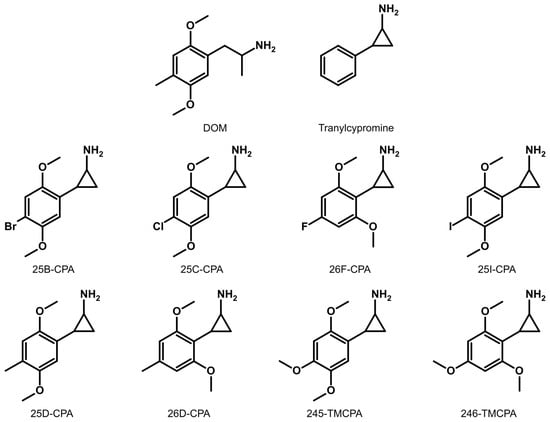
2,5-Dimethoxy-4-methylphenylcyclopropylamine (25D-CPA or DMCPA; see Figure 1) is the cyclized phenylethylamine analog of 2,5-dimethoxy-4-methylamphetamine (DOM; see Figure 1), a serotonin receptor agonist, and psychedelic [1,2,3]. Both compounds were synthesized and investigated by Shulgin, but DOM gained popularity in 1967 when it was distributed under the street name STP as a legal substitute for LSD [4,5]. DOM was described to induce mild euphoria in low doses and to cause long-lasting and pronounced hallucinogenic effects in greater doses [6]. Its effects were described to be comparable to those of LSD, mescaline, and psilocybin, but with more pronounced sympathomimetic effects and side effects included sweating, nausea, muscle tremors, and increases in blood pressure and heart rate [7]. In 1971, DOM was scheduled in the Convention on Psychotropic Substances, 1971, by the United Nations [8]. The connection of the α- and β-positions of DOM via an additional carbon atom resulted in the formation of the cyclopropyl ring in 25D-CPA. Shulgin and Shulgin reported central effects lasting between 4 and 8 h following doses of 15–20 mg, including light-headedness, feelings of detachment, visual hallucinations, mild anorexia, and an unpleasant sense of loss of control [4].
Figure 1.
Chemical structures of DOM, tranylcypromine, and eight psychedelics of the cyclopropylamine type.
As a phenylcyclopropylamine (CPA), 25D-CPA is closely related to the non-selective and irreversible monoamine oxidase (MAO) inhibitor tranylcypromine, that is clinically used to treat depressive disorders (see Figure 1). MAO are enzymes located in the outer mitochondrial membrane that catalyze the oxidative deamination of monoamines and play a central role in the regulation of endogenous monoamine homeostasis as well as the biotransformation of xenobiotic amines. Two isoforms, MAO-A and MAO-B, are expressed in a tissue-specific manner and exhibit distinct, although partially overlapping, substrate specificities [9,10]. MAO-A preferentially metabolizes serotonin, norepinephrine, and epinephrine, whereas MAO-B exhibits a higher affinity for β-phenylethylamine. Dopamine and tyramine serve as common substrates for both isoforms [9,10,11]. Through the oxidative deamination of monoamines, MAOs contribute to the termination of neurotransmitter signaling and the maintenance of physiological concentrations of biogenic amines in both the central nervous system and peripheral tissues. In addition to their role in neurotransmitter catabolism, MAOs generate corresponding aldehydes, ammonia, and hydrogen peroxide as reaction products, thereby linking monoamine metabolism to cellular redox balance and oxidative stress pathways [9,12,13].
Given their pivotal role in monoamine turnover, MAOs have long been recognized as important therapeutic targets mainly in the treatment of depressive disorders and Parkinson’s disease [9,14]. The development of reversible and isoform-selective inhibitors has substantially improved the safety profile of MAO-targeted therapies, while non-selective and irreversible MAO inhibitors like tranylcypromine are widely acknowledged to have a high risk of drug–drug interactions and serious side effects [9]. These side effects are particularly relevant from a toxicological perspective, as MAO inhibition (MAOI) may lead to elevated serotonin, (nor)epinephrine, and dopamine levels and ultimately monoaminergic toxicity. The risk of intoxication is especially high if the MAOI properties of a compound are unknown, which is usually the case for drugs of abuse. Drugs of abuse typically do not undergo the comprehensive drug development process, including preclinical and clinical studies, that is required for the approval of therapeutic drugs. As a result, they are often introduced to the global market with little or no information available on their toxicodynamics, toxicokinetics, safety, or toxicity.
This study aimed to assess the risk of MAOI and intoxication after consumption of 25D-CPA and seven other prophetic CPAs sharing their core structure with tranylcypromine (see Figure 1) by studying their in vitro MAOI potential and comparing it to clinically relevant MAO inhibitors including tranylcypromine.
2. Materials and Methods
2.1. Chemicals and Enzymes
4-Bromo-2,5-dimethoxyphenylcyclopropylamine (25B-CPA), 4-chloro-2,5-dimethoxyphenylcyclopropylamine (25C-CPA), 4-fluoro-2,6-dimethoxyphenylcyclopropylamine (26F-CPA), and 4-iodo-2,5-dimethoxyphenylcyclopropylamine (25I-CPA) were obtained as HCl salts from Uorsy (Kyiv, Ukraine), 25D-CPA HCl was purchased from FCH Group (Chemigiv, Ukraine), and 2,6-dimethoxy-4-methylphenylcyclopropylamine (26D-CPA), 2,4,5-trimethoxyphenylcyclopropylamine (245-TMCPA), and 2,4,6-trimethoxyphenylcyclopropylamine (246-TMCPA) HCl salts were provided by Enamine Ltd. (Kyiv, Ukraine). All cyclopropane analogs were obtained in the rac-(1R,2S)-trans-configuration (purity ≥ 95%). 4-Hydroxyquinoline (4-OHC), kynuramine (KYN), potassium dihydrogen phosphate, dipotassium hydrogen phosphate, and selegiline were obtained from Sigma-Aldrich (Taufkirchen, Germany), racemic trans-tranylcypromine sulfate from Roehm Pharma (Darmstadt, Germany), and amphetamine-d5 from LGC Standards (Wesel, Germany). 5-(2-Aminopropyl)indole (5-IT) was available from previous investigations [15]. Acetonitrile (LC-MS grade), ammonium formate (analytical grade), formic acid (LC MS grade), methanol (LC-MS grade), and all other chemicals and reagents (analytical-grade) were obtained from VWR (Darmstadt, Germany). The baculovirus-infected insect cell microsomes (Supersomes) containing the human complementary cDNA-expressed MAO-A or MAO-B (5 mg protein/mL, each), as well as wild-type Supersomes without MAO activity as a negative control (MAO control, 5 mg protein/mL), were obtained from Corning (Amsterdam, The Netherlands). After delivery, the enzyme preparations were thawed at 37 °C, aliquoted, snap-frozen in liquid nitrogen, and stored at −80 °C until use.
2.2. Initial MAO Inhibition Screening
As described before [15], initial MAOI screening was performed in a total incubation volume of 30 µL containing 1 μg/mL MAO-A or MAO-B, the non-selective MAO substrate KYN at concentrations corresponding to its Km value (43 µM for MAO-A and 23 µM for MAO-B), and 10 µM of the respective test inhibitor (test samples). Reactions were initiated by addition of the enzyme, incubated for 20 min at 37 °C, and terminated by adding 30 μL of ice-cold acetonitrile containing 10 μM amphetamine-d5 as internal standard (IS). Samples were centrifuged for 2 min at 18,407× g, and 50 μL of the supernatant was transferred to autosampler vials for analysis by hydrophilic interaction liquid chromatography coupled to high-resolution tandem mass spectrometry (HILIC-HRMS/MS). Reference incubations without MAO inhibitor were used to represent maximum MAO activity (reference samples, 100% MAO activity). Incubations containing the model inhibitors 5-IT (MAO-A) or selegiline (MAO-B) at a final concentration of 10 µM served as positive controls to verify appropriate assay performance. Blank incubations without MAO activity were included to assess non-enzymatic formation of 4-OHC (blank samples). In addition, interference controls were prepared to exclude analytical effects caused by the test compounds. For this purpose, reference incubations were terminated with ice-cold acetonitrile containing the IS and the respective test inhibitor (10 µM) immediately prior to analysis. All incubations were performed in triplicate. The mean 4-OHC formation, determined as the peak area ratio of 4-OHC to the IS, in blank samples was subtracted from all other samples. The mean 4-OHC formation in reference samples was defined as 100% MAO activity and used to normalize all other results. Statistical analysis was performed using one-way ANOVA followed by Dunnett’s multiple-comparison test (significance level, p < 0.001, 99.9% confidence intervals) in GraphPad Prism 11.0.2 (GraphPad Software, San Diego, CA, USA).
2.3. Assessment of Potentially Irreversible MAO Inhibition
To assess potentially irreversible inhibition, MAO-A or MAO-B was preincubated with a potential inhibitor prior to the addition of the substrate KYN. The preincubation mixture (20 µL) consisted of 1.5 µg/mL MAO-A or MAO-B and 15 µM of the respective test inhibitor (test samples). After preincubation for 30 min at 37 °C, reactions were initiated by the addition of 10 µL KYN (final concentrations corresponding to the Km values: 43 µM for MAO-A and 23 µM for MAO-B). Following incubation for 20 min at 37 °C, reactions were terminated by adding 30 µL ice-cold acetonitrile containing 10 µM amphetamine-d5 as IS. Samples were centrifuged and analyzed by HILIC-HRMS/MS as described in Section 2.2. Blank incubations without MAO activity (blank samples), reference incubations without MAO inhibitor (reference samples, representing 100% MAO activity) and incubations containing the model inhibitors 5-IT (MAO-A) or selegiline (MAO-B) at 10 µM were subjected to the same preincubation procedure. All experiments were performed in triplicate. The mean 4-OHC formation measured in the blank samples was subtracted from all other samples. The mean 4-OHC formation in the reference samples without inhibitor was defined as 100% MAO activity and used to normalize all other results. Statistical analysis was performed using one-way ANOVA followed by Dunnett’s multiple comparison test (significance level, p < 0.001, 99.9% confidence intervals) in GraphPad Prism 11.0.2.
2.4. Determination of IC50 Values
For the determination of IC50 values, MAO-A or MAO-B were incubated with 10 inhibitor concentrations, each (see Table 1). All incubations were performed in duplicate. All other incubation conditions and concentrations including the incubation of reference and blank samples were as described above. The IC50 values were calculated by plotting the MAO activity (4-OHC formation relative to reference samples) over the logarithm of the inhibitor concentration using GraphPad Prism 11.0.2.
Table 1.
Test inhibitor concentrations used for the determination of IC50 values against MAO-A and MAO-B.
2.5. Determination of Apparent Inhibition Constants
For experimental determination, four concentration levels of the test inhibitor were incubated with KYN at five different concentrations (0.5, 5, 25, 100, and 500 µM). Inhibitor concentration levels of tranylcypromine and 246-TMCPA were 0, 0.1, 0.5, and 1 µM based on the previously determined IC50 values. All other incubation conditions and concentrations were the same as described above. Tranylcypromine and 246-TMCPA were incubated with both MAO isoforms (1 μg/mL, each). The apparent inhibition constants (Kiapp values) were calculated using GraphPad Prism 11.0.2. Michaelis–Menten plots were transferred to Lineweaver–Burk plots (1/metabolite formation versus 1/KYN concentration), and fit factors for different inhibition models were compared to determine the most probable inhibition mode.
2.6. HILIC–HRMS/MS Conditions
The instrumentation and chromatographic conditions have been described previously [15]. Briefly, chromatographic analyses were performed using a Thermo Fisher Scientific (TF, Dreieich, Germany) Dionex UltiMate 3000 Rapid Separation (RS) UHPLC system consisting of a quaternary Ulti-Mate 3000 RS pump and an UltiMate 3000 RS autosampler, controlled by TF Chromeleon software version 6.80. The chromatographic system was coupled to a TF Q-Exactive Plus mass spectrometer equipped with a heated electrospray ionization II (HESI-II) source. Chromatographic separation was carried out at 60 °C using a Dionex UltiMate 3000 RS column heater and a Macherey-Nagel (Düren, Germany) HILIC Nucleodur column (125 × 3 mm, 3 μm). Gradient elution was performed using 25 mM aqueous ammonium acetate (eluent A) and acetonitrile containing 0.1%, v/v, formic acid (eluent B) at a flow rate of 500 μL/min. The gradient program is summarized in Table 2.
Table 2.
Gradient program.
The injection volume was 1 μL for all samples. Mass spectrometric parameters are listed in Table 3. External mass calibration was performed prior to analysis according to the manufacturer’s recommendations. Quantification was based on targeted single ion monitoring (t-SIM) of the protonated analytes and IS, while structural confirmation was achieved using data-dependent tandem mass spectrometry (dd-MS2). The inclusion list contained the exact masses of the protonated IS (amphetamine-d5, m/z 141.1434), KYN (m/z 165.1022), and 4-OHC (m/z 146.0600). Data processing was performed using TF Xcalibur Qual Browser software version 3.0.63. Automated peak integration was carried out using the ICIS peak detection algorithm with an area noise factor of 5 and a peak noise factor of 300. Outlier analysis was performed using GraphPad QuickCalcs (Grubbs’ test, standard settings, http://graphpad.com/quickcalcs/grubbs1 (accessed on 30 October 2026), used mid February and March 2026), and statistical analyses were conducted using GraphPad Prism version 11.0.2.
Table 3.
Mass spectrometric parameters. AU, arbitrary units.
3. Results
3.1. Initial MAO Inhibition Screening and Assessment of Potentially Irreversible MAO Inhibition
KYN is a non-selective MAO substrate. The formation of the aldehyde by MAO-catalyzed deamination is followed by non-enzymatic cyclization to the stable product 4-OHC [16]. The analytical procedure was based on HILIC-HRMS/MS in t-SIM mode for quantitation of 4-OHC. MS2 spectra were used to confirm the identity of KYN, 4-OHC, and the IS. The method was successfully validated in accordance with the European Medicines Agency’s guideline on bioanalytical method validation and the procedure was applied for the MAOI testing of 14 alpha-methyltryptamine-type new psychoactive substances, 17 phenylethylamine-derived drugs of abuse of the 2C-series, and three (2-aminopropyl)benzo[b]thiophene-type psychedelics [15,16,17].
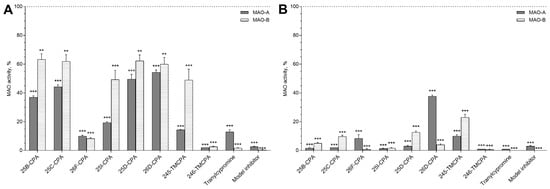
Only minimal 4-OHC amounts (below 1% of 4-OHC in reference incubations) were detected in blank samples without MAO activity and were subtracted from that in all other samples. Due to the fact that the analytical procedure did not include measurement of the test inhibitors, interfering samples were used to exclude erroneous measurement caused by coelution leading to ion enhancement or suppression of the peak areas of 4-OHC or the IS. Fortunately, the 4-OHC formation in the interfering samples was not found to be significantly different from those in the reference samples leading to the conclusion that the presence of the test inhibitors did not impair the 4-OHC quantification. Only this finding allowed the comparison of the 4-OHC-formation in the test samples with that in the reference samples (see Figure 2A). The mean 4-OHC formation measured in the reference samples without inhibitor was referred to as 100% MAO activity (indicated as dotted lines in Figure 2A,B). Incubations of the positive control samples confirmed the applicability of the initial inhibition screening procedure to assess the MAOI potency and ensured suitable incubation conditions. The presence of the model inhibitors 5-IT or selegiline significantly reduced the activity of MAO-A or MAO-B, respectively, in accordance with previous studies [15,16,17].
Figure 2.
Initial monoamine oxidase (MAO) inhibition screening results using 10 μM of each test inhibitor without (A) or with preincubation of MAO and test inhibitor for 30 min before the MAO substrate kynuramine was added (B). 5-IT was used as model inhibitors for MAO-A, while selegiline was used as model inhibitor for MAO-B. Percentage of MAO activity represented the percentage of 4-hydroxyquinoline (4-OHC) formation in relation to reference incubations without inhibitor (100%, indicated by dotted line). Dark gray bars indicate MAO-A activity, while dotted bars indicate MAO-B activity. Values are expressed as mean and were tested for significance (n = 3, ***, p < 0.001, **, p < 0.01, for 4-OHC formation in incubations with the inhibitor versus 4-OHC formation in reference incubations).
All tested CPAs showed significant inhibition of MAO-A resulting in residual MAO-A activities between 2% (246-TMCPA) and 54% (26D-CPA) and significant inhibition of MAO-B resulting in residual MAO-B activities between 3% (246-TMCPA) and about 60% (25B-CPA, 25I-CPA, 25D-CPA, and 26D-CPA) in the initial MAOI screening without preincubation (see Figure 2A). Tranylcypromine was also found to significantly decrease the MAO-A and MAO-B activity resulting in residual activities of 13% and 2%, respectively.
The inhibitory effects of the CPA were even more pronounced if a preincubation was conducted before the MAO substrate KYN was added (see Figure 2B). The initial MAOI screening with preincubation resulted in residual MAO-A activities between below 2% (25B-CPA, 25C-CPA, 25I-CPA, and 246-TMCPA) and about 40% (26D-CPA) and residual MAO-B activities between about 1% (26F-CPA, 25I-CPA, and 246-TMCPA) and about 20% (245-TMCPA). Preincubation with tranylcypromine was also found to decrease the MAO-A and MAO-B activity resulting in residual activities of 1% and 0%, respectively.
3.2. IC50 Values
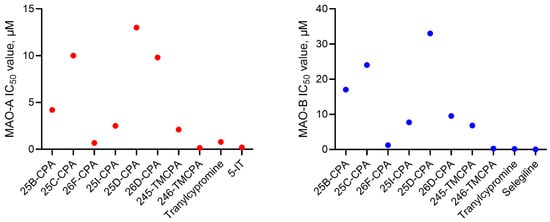
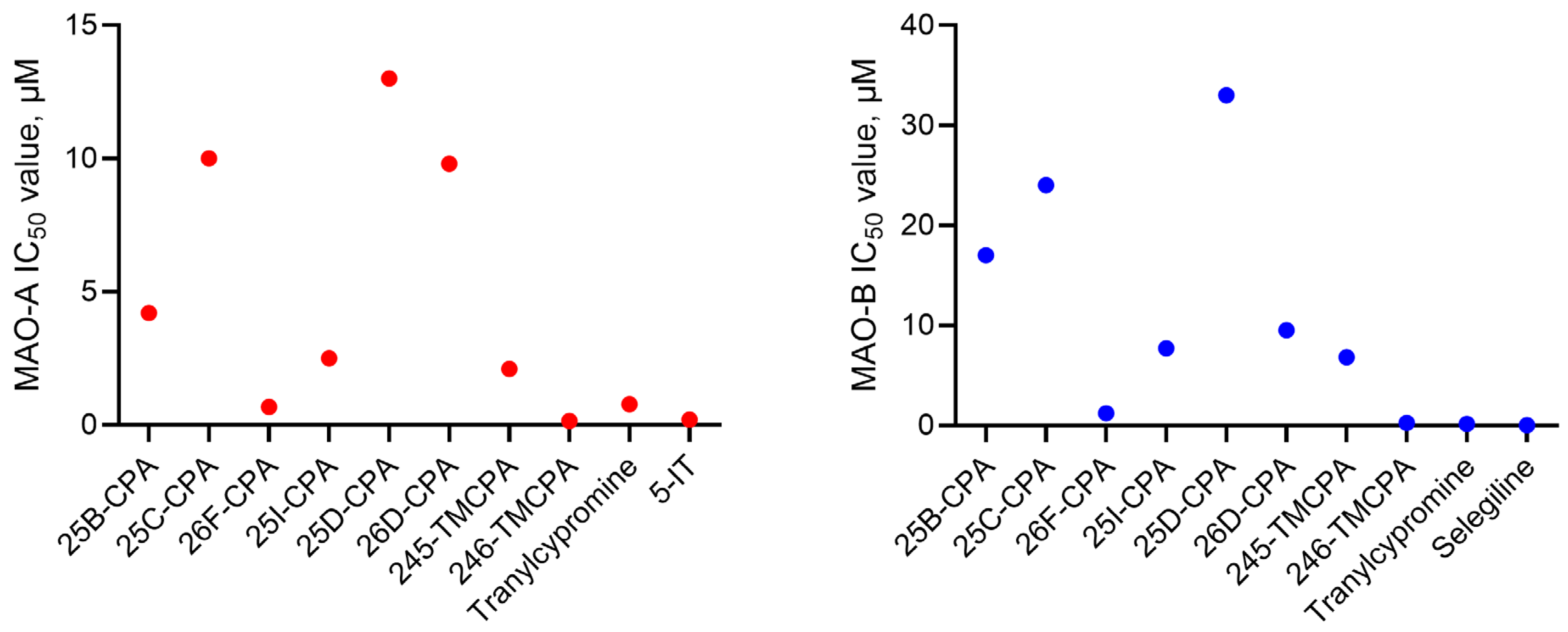
To further characterize the inhibitory effects of tranylcypromine and all other CPAs and to be able to compare their inhibition potential to that of MAO model inhibitors, all IC50 values against MAO-A and MAO-B were determined and are listed in Table 4. The IC50 value represents the concentration of a test compound required to reduce the measured biological activity by 50% under defined experimental conditions. For tranylcypromine, MAO-A and MAO-B IC50 values of 0.78 and 0.15 µM were determined, respectively. For MAO-A, only the IC50 values of 246-TMCPA (0.16 µM) and 26F-CPA (0.69 µM) were found to be lower than that of tranylcypromine. The MAO-A IC50 values of all other CPAs ranged from about 2 µM (25I-CPA and 245-TMCPA) to 13 µM (25D-CPA). For MAO-B, the IC50 values of the CPA were higher than that of tranylcypromine ranging from 0.26 µM (246-TMCPA) to 33 µM (25D-CPA).
Table 4.
IC50 values of the test inhibitors against MAO-A and MAO-B and the corresponding 95% confidence interval (CI).
As expected after the initial MAOI screening, the averaged IC50 values of the CPA against MAO-A were found to be lower than those against MAO-B. However, Figure 3 illustrates even better than Table 4 that the inhibitory pattern across MAO-A and MAO-B was almost identical and that potent MAO-A inhibitors were also found to be potent MAO-B inhibitors, while weaker MAO-A inhibitors were also found to be weaker MAO-B inhibitors.
Figure 3.
Monoamine oxidase (MAO)-A IC50 values (left) and MAO-B IC50 values (right) of the phenylcyclopropylamine (CPA) test compounds including tranylcypromine and the model inhibitors 5-(2-aminopropyl)indole (5-IT, MAO-A) and selegiline (MAO-B).
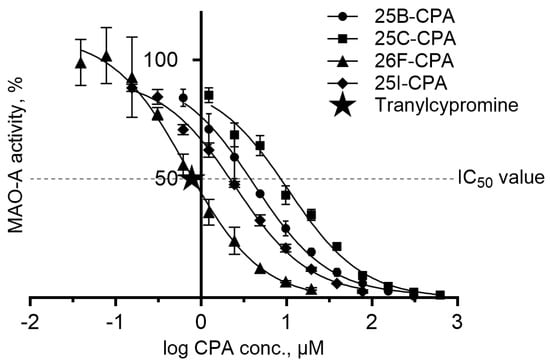
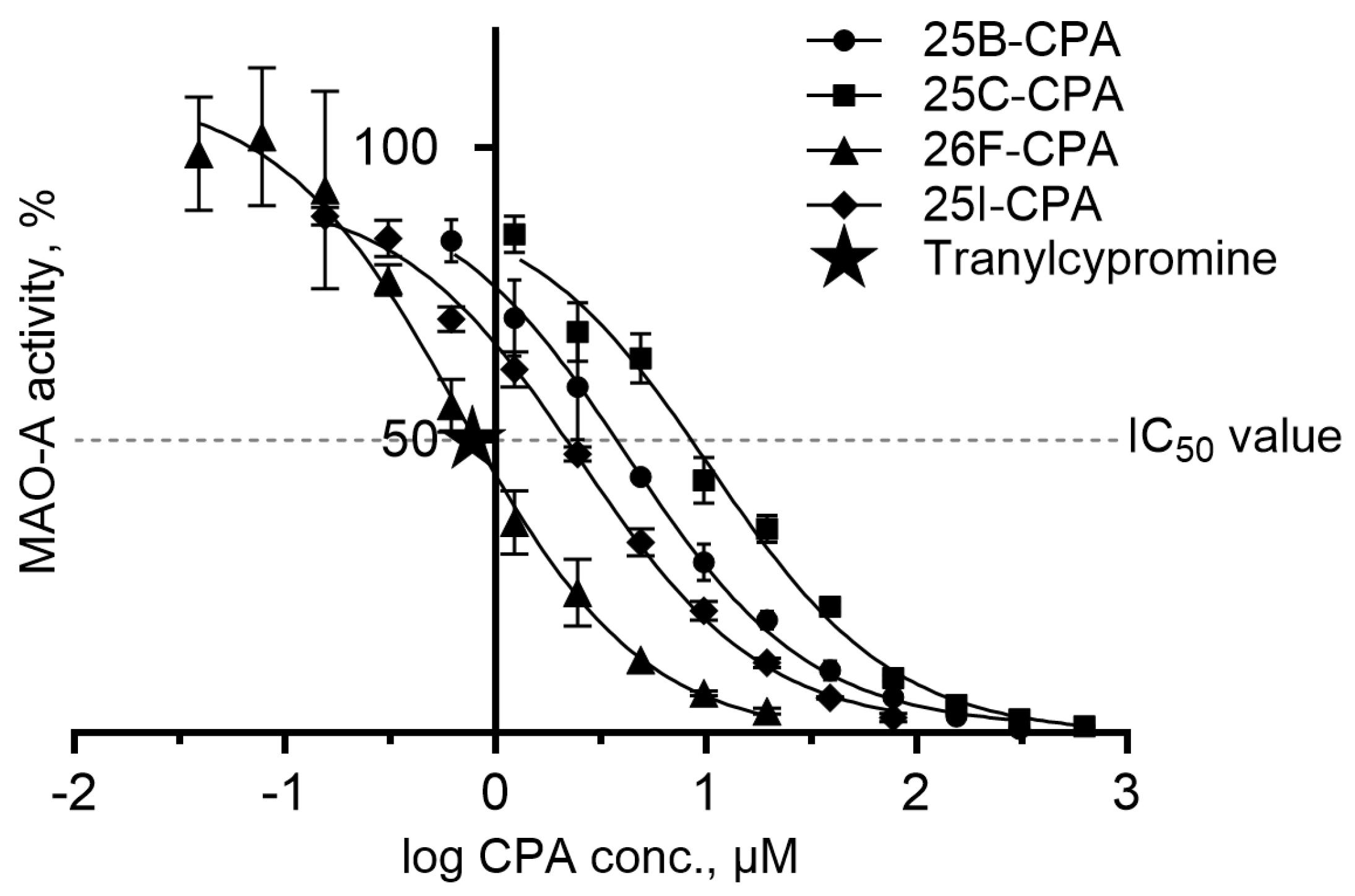
The CPAs were categorized according to their substitution patterns as follows: halogen-substituted (25B-CPA, 25C-CPA, 26F-CPA, and 25I-CPA), methyl-substituted (25D-CPA and 26D-CPA), and trimethoxy-substituted (245-TMCPA and 246-TMCPA). The MAO-A activity as a function of the logarithmic concentrations of the halogen-substituted CPA test compounds used for IC50 determination is shown exemplarily in Figure 4. The MAO-A IC50 values decreased stepwise from 10 µM for 25C-CPA to 4.2 µM for 25B-CPA, 2.5 µM for 25I-CPA, and 0.69 µM for 26F-CPA. Among the halogen-substituted CPAs, 26F-CPA exhibited the strongest inhibitory effect on MAO-A. The inhibitory effect of 26F-CPA on MAO-A was directly comparable to that of tranylcypromine (MAO-A IC50 value 0.78 µM).
Figure 4.
Monoamine oxidase (MAO)-A activity depending on different test compound concentrations (plotted as logarithmic concentration of the phenylcyclopropylamine, CPA, test compound) for IC50 value determination, exemplarily shown for the halogen-substituted CPA test compounds. Data points represent the mean value of duplicate measurements (n = 2). Asterisk marks IC50 value of tranylcypromine.
3.3. Inhibition Constants
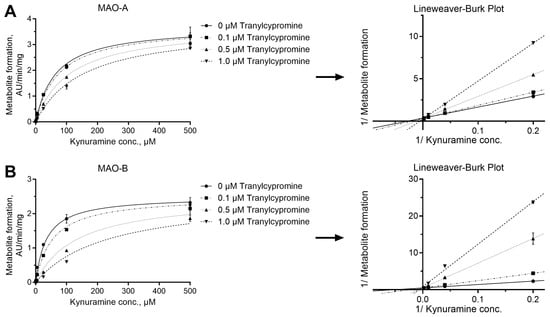
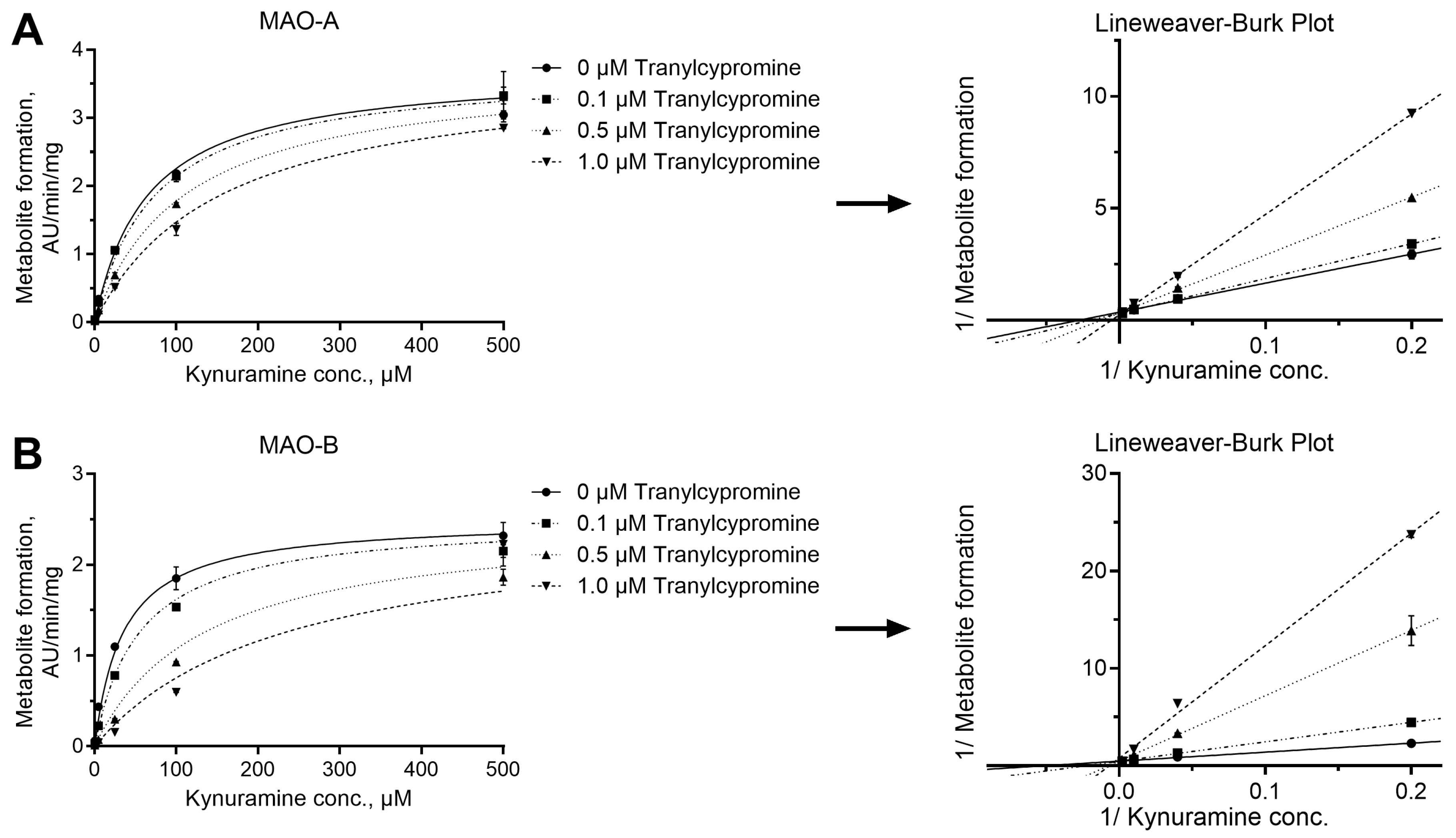
Michaelis–Menten and Lineweaver–Burk plots after incubation of tranylcypromine are depicted in Figure 5. The Kiapp values were 0.73 µM for MAO-A and 0.18 µM for MAO-B. A competitive inhibition model was preferred, which was in line with the visual inspection of the intersection in the Lineweaver–Burk plot. For 246-TMCPA, experimentally determined Kiapp values were 0.12 µM and 0.18 µM for MAO-A and MAO-B, respectively. Visual inspection and software-based evaluation both preferred the competitive inhibition model for 246-TMCPA.
Figure 5.
Michaelis–Menten plots (left part) of the deamination of kynuramine in absence or presence of three given concentrations of tranylcypromine for determination of the apparent inhibition constant. Data points represent means and ranges (error bars) of duplicate measurements. Transformation of data to a Lineweaver–Burk plot (right part) for determination of the apparent inhibition mode. The upper part of the figure (A) illustrates the inhibitory effects of tranylcypromine against MAO-A, the lower part of the figure (B) towards MAO-B.
4. Discussion
All investigated CPA test compounds share the tranylcypromine core structure substituted with two methoxy groups in 2- and 5-position or in 2- and 6-position and a halogen, a methyl group or an additional methoxy group in position 4. This substitution pattern makes the CPA test compounds direct derivatives of the psychedelic phenylethylamines of the 2C-x series like 4-bromo-2,5-dimethoxyphenylethylamine (2C-B), 4-chloro-2,5-dimethoxyphenylethylamine (2C-C), 2,5-dimethoxy-4-methylphenylethylamine (2C-D), 4-fluoro-2,5-dimethoxyphenylethylamine (2C-F), 4-iodo-2,5-dimethoxyphenylethylamine (2C-I), and 2,4,5-trimethoxyphenylethylamine (TMPEA), and the psychedelic amphetamines of the DOx series like 4-bromo-2,5-dimethoxyamphetamine (DOB), 4-chloro-2,5-dimethoxyamphetamine (DOC), DOM, 2,6-dimethoxy-4-methylamphetamine (Ψ-DOM), 4-fluoro-2,5-dimethoxyamphetamine (DOF), 4-iodo-2,5-dimethoxyamphetamine (DOI), 2,4,5-trimethoxyamphetamine (TMA-2), and 2,4,6-trimethoxyamphetamine (TMA-6), that were synthesized and investigated by Shulgin and Shulgin [4]. Based on their description of the pharmacological effects, the influence of the 2,5-dimethoxy substitution compared to the 2,6-dimethoxy substitution was only possible for DOM/Ψ-DOM and TMA-2/TMA-6 and the 2,5-substitution pattern seems to be favorable in terms of psychedelic potency [4].
All eight CPA test compounds were identified as non-selective and potentially irreversible inhibitors of MAO-A and MAO-B. The preincubation experiments revealed a time-dependent increase in MAO inhibition for tranylcypromine and the CPA test compounds, which is consistent with irreversible enzyme inhibition. However, the experimental design applied in this study did not include a dilution or washout step following preincubation. Therefore, a clear distinction between truly irreversible inhibition and slowly reversible inhibition cannot be made unequivocally based on the present data. Consequently, the observed effects should primarily be interpreted as evidence of time-dependent inhibition rather than definitive proof of irreversible enzyme inactivation, but the marked reduction in MAO activity following preincubation supports a strong and persistent interaction of the CPA test compounds with the enzyme. To further assess their inhibitory potency, IC50 values were determined using an established incubation protocol [15,16]. Because IC50 values are highly dependent on assay conditions, particularly incubation time, comparisons with values reported in the literature should be interpreted with caution, especially for irreversible inhibitors [18]. Nevertheless, the standardized experimental setup allowed a direct comparison of the inhibitory potencies of the investigated CPAs and of compounds previously evaluated under the same conditions [16]. The IC50 values demonstrated that there are differences in the potency of the MAOI amongst the CPA test compounds. 246-TMCPA and 26F-CPA were identified as most potent inhibitors of MAO-A and MAO-B. Their inhibition potency was found to be comparable to that of tranylcypromine, as well as other relevant MAO inhibitors like alpha-methyltryptamine and 5-IT (0.38 µM and 0.20 µM, respectively), two drugs of abuse known to be potent MAO-A inhibitors. Nevertheless, selegiline’s IC50 value (0.017 µM), a clinically used selective and irreversible MAO-B inhibitor, was lower [16].
It should be noted that different enantiomers of tranylcypromine exhibit varying selectivity toward MAO isoforms. While (+)-trans-tranylcypromine shows moderate selectivity for MAO-A, the less active (−)-trans-tranylcypromine was found to be selective for MAO-B [19]. In clinical practice, tranylcypromine is administered orally as the sulfate salt of the racemate [20], which was also used in the current study. Consequently, the determined tranylcypromine IC50 values are applicable only to the racemic mixture (±)-trans-tranylcypromine and do not reflect the inhibitory activity of the individual enantiomers. In accordance, the IC50 values obtained for the CPA test compound reflect the MAO inhibitory potency of the rac-(1R,2S)-trans-configuration.
Structure–activity relationship analyses (SAR) correlate the structural features of a set of compounds with their effects. In the current case, the substitution pattern of the CPA in positions 4, 5, and 6 was correlated with the MAOI strength indicated as the IC50 value. Regarding MAO-A inhibition, SAR analyses suggested that both substituent identity and substitution pattern contribute to inhibitory potency. Comparison of 246-TMCPA, 26F-CPA, and 26D-CPA, which all share a 2,6-dimethoxy substitution pattern but differ in the substituent at position 4, revealed a pronounced substituent-dependent effect. Potency decreased in the order 4-methoxy (246-TMCPA, IC50 = 0.16 µM) > 4-fluoro (26F-CPA, IC50 = 0.69 µM) >> 4-methyl (26D-CPA, IC50 = 9.8 µM), indicating a substantial influence of substituent identity. In addition, comparisons of pairs differing only in substitution position suggested an independent positional effect. Relocation of a methoxy group from position 6 to position 5 reduced MAO-A inhibitory potency from 0.16 µM for 246-TMCPA to 2.1 µM for 245-TMCPA. A similar trend was observed for 26D-CPA and 25D-CPA, whose IC50 values increased from 9.8 µM to 13 µM upon changing the dimethoxy substitution pattern from 2,6 to 2,5. A highly similar SAR was observed for MAO-B inhibition. As for MAO-A, both substituent identity and substitution pattern influenced inhibitory potency. Among compounds sharing the same 2,6-substitution pattern, MAO-B inhibition decreased in the order 4-methoxy (246-TMCPA, IC50 = 0.26 µM) > 4-fluoro (26F-CPA, IC50 = 1.2 µM) > 4-methyl (26D-CPA, IC50 = 9.5 µM), indicating a significant contribution of the 4-substituent. Likewise, comparisons of compounds differing only in substitution pattern revealed a pronounced positional effect. For both the trimethoxy-substituted analogs (246-TMCPA vs. 245-TMCPA) and the dimethoxy-methyl-substituted analogs (26D-CPA vs. 25D-CPA), compounds bearing a substituent in position 6 were more potent MAO-B inhibitors than their corresponding 5-substituted analogs. Thus, the SAR trends observed for MAO-B closely mirrored those found for MAO-A, suggesting that both substituent identity and substitution pattern contribute to inhibitory potency. Although these observations are consistent with contributions of electronic, steric, conformational, and binding-site-related effects, the present data do not allow the relative importance of these factors to be determined. Therefore, the proposed explanations should be regarded as hypotheses requiring further experimental verification. One possible explanation is that shifting the substituent from the 5- to the 6-position introduced an ortho-substitution effect with steric consequences like restricted rotation around the phenylcyclopropylamine scaffold, which might promote conformations that interact more favorably with the MAO active site.
Taken together, the data suggest that the observed MAOI strength is governed by a combination of electronic, steric, lipophilic, and positional effects rather than by a single physicochemical parameter. In particular, the favorable effect of methoxy substitution and its pronounced positional dependence point toward specific spatial interactions within the binding site. 246-TMCPA, bearing methoxy groups at positions 2, 4 and 6, represents the most favorable substitution pattern amongst the substituted CPA. However, relative to the unsubstituted reference compound tranylcypromine, substitution effects differed markedly between MAO-A and MAO-B inhibition. For MAO-A inhibition, selected methoxy substitutions, particularly the 2,4,6-trimethoxy pattern, substantially improved potency, with 246-TMCPA showing the highest activity (0.16 µM vs. 0.78 µM for the reference tranylcypromine). In contrast, the unsubstituted tranylcypromine displayed the highest activity toward MAO-B (0.15 µM), with all substituted analogs showing reduced activity, although 246-TMCPA retained the highest inhibition strength among the substituted CPA (0.26 µM). These findings confirm that the structural requirements for both MAO isoforms are not identical and suggest that the observed SAR is defined by activity-specific interactions rather than by a simple general substituent effect.
The irreversible MAOI by tranylcypromine is generally considered a suicide-inhibition process [21]. Tranylcypromine initially acts as a substrate analog and is oxidized by the enzyme. Oxidative activation induces cleavage of the cyclopropyl ring, generating a highly reactive radical intermediate. This intermediate covalently modifies the enzyme-bound flavin adenine dinucleotide cofactor, resulting in permanent loss of catalytic activity [22,23,24]. Consequently, the duration of inhibition is determined primarily by the rate of MAO protein turnover rather than by the pharmacokinetic elimination of the inhibitor. Although tranylcypromine inhibits both MAO isoforms irreversibly, in vitro studies suggest a slight kinetic preference for MAO-B over MAO-A [25], which was confirmed by the results of the current study.
Furthermore, the Kiapp values of tranylcypromine and 246-TMCPA, the most potent CPA test compound, were experimentally determined. Ki values provide a measure of the affinity of an inhibitor for its target enzyme, with lower values indicating stronger binding. Michaelis–Menten and Lineweaver–Burk analyses using varying substrate and inhibitor concentrations are widely used for the determination of Ki values and enable characterization of the inhibition mode. However, it must be noted that the determination of Ki values is usually performed for inhibitors with a reversible inhibition mode [26]. Because the investigated CPAs are potentially irreversible inhibitors, the obtained Kiapp values should be interpreted with caution, as they primarily reflect the initial binding interaction rather than the subsequent irreversible enzyme inactivation [18]. As suicide inhibitors continuously inactivate MAO over time, ongoing enzyme deactivation results in a progressive decline in MAO activity and ongoing enzyme inactivation during the assay duration. Consequently, the inclusion of an additional preincubation step would be expected to further reduce residual enzyme activity and yield lower Kiapp values. Consequently, Kiapp values alone may not fully describe inhibitory potency, which is additionally determined by the rate of enzyme inactivation. Previous incubations with the irreversible MAO-B inhibitor selegiline resulted in similar findings [16].
Finally, the question arises whether the present in vitro findings indicate a clinically relevant risk of MAOI and subsequent intoxication following consumption of the investigated CPA. Addressing this question is challenging due to the almost complete lack of human data. Although the observed inhibition of MAO-A and MAO-B demonstrates that the investigated compounds can interact with these enzymes under in vitro conditions, the toxicological and clinical relevance of this finding remains unclear. The present experiments were conducted using simplified in vitro systems and therefore do not account for important physiological factors such as absorption, distribution, metabolism, excretion, plasma protein binding, blood–brain barrier permeability, or active transport mechanisms. Furthermore, no human toxicokinetic data are currently available for these compounds, making it impossible to estimate whether sufficiently high concentrations could be achieved in vivo to produce comparable levels of enzyme inhibition in the central nervous system or peripheral tissues. Consequently, the present findings should be regarded as an initial indication of MAO inhibitory potential rather than evidence for clinically relevant MAO inhibition.
To date, only one out of eight CPA test compounds, by name 25D-CPA, has been described in the context of human use, with orally administered doses of approximately 15–20 mg reported to produce psychedelic effects [4]. Interestingly, this dose range is within the therapeutic dose range of the irreversible MAO inhibitor tranylcypromine (10–40 mg/day) and exceeds the commonly reported active dose range of the structurally related psychedelic DOM (3–10 mg) [4,20]. This observation may suggest that higher doses of 25D-CPA are required to elicit the desired psychoactive effects compared to DOM, potentially limiting the attractiveness of CPA-derived compounds as new psychoactive substances. However, such considerations must be interpreted with caution, as even minor structural modifications can substantially alter pharmacological potency and efficacy within this compound class.
Notably, Shulgin reported the occurrence of toxic effects at oral doses of approximately 20 mg 25D-CPA and hypothesized that these adverse effects could be related to the structural similarity of 25D-CPA to tranylcypromine and a resulting inhibition of MAO activity. The in vitro data obtained in the present study support the possibility of pharmacologically relevant MAOI. Averaged peak plasma concentrations of tranylcypromine of approximately 0.8 µM (112 µg/L) have been reported in nine adults receiving a 20 mg oral dose during maintenance therapy [20]. Notably, these concentrations are within the range of the in vitro IC50 values determined for tranylcypromine against MAO-A and MAO-B. In contrast, it remains unknown whether the described 25D-CPA doses lead to plasma concentrations in the range of the 25D-CPA in vitro IC50 values against MAO-A and MAO-B. Nevertheless, if the inhibition proves to be at least partially irreversible under physiological conditions, repeated intake may result in cumulative enzyme inactivation and a progressive decline in MAO activity, potentially increasing the risk of monoaminergic adverse effects and drug–drug interactions. For the remaining CPA investigated here, no information regarding human consumption patterns, effective doses, or toxicity is currently available. Nevertheless, the observed MAO inhibition, particularly in the low-micromolar-concentration range, suggests that clinically relevant monoaminergic toxicity cannot be excluded, especially following repeated administration, which may lead to cumulative enzyme inactivation. Furthermore, drug–drug interactions may occur when CPAs are co-administered with serotonergic medications such as selective serotonin reuptake inhibitors or other monoaminergic agents, potentially increasing the risk of serotonergic adverse effects. Despite these considerations, the present findings are based exclusively on in vitro experiments. Although several CPAs showed pronounced MAO inhibitory activity in vitro, the relevance of these findings for human exposure remains uncertain. The present experiments were designed to assess interactions with MAO-A and MAO-B under controlled experimental conditions and do not account for important pharmacokinetic determinants such as absorption, distribution, metabolism, excretion, plasma protein binding, tissue distribution, or blood–brain barrier permeability. Consequently, it remains unknown whether sufficient concentrations would be achieved in vivo to elicit comparable degrees of MAO inhibition. Furthermore, the overall pharmacological effects of CPA are likely determined by a combination of multiple properties rather than MAO inhibition alone. Therefore, the present findings should be regarded as evidence of MAO inhibitory potential rather than proof of clinically relevant MAOI activity or MAOI-mediated drug interactions. Consequently, the clinical relevance of the observed MAOI and its potential contribution to toxicity remain speculative and additional pharmacokinetic and pharmacodynamic studies will be required to assess the in vivo significance of the observed effects.
5. Conclusions
In conclusion, all investigated CPAs inhibited both MAO-A and MAO-B in vitro, indicating that this class of compounds generally act as non-selective MAO inhibitors. Notably, 26F-CPA and 246-TMCPA were found to be the most potent MAO inhibitors amongst the tested CPAs with inhibition potencies within the range of established reference inhibitors, including tranylcypromine. Based on the observed time-dependent inhibition profiles, the investigated CPAs might act as potentially irreversible MAO inhibitors. These findings demonstrate that several CPAs exhibit MAO inhibitory activity in vitro. However, the extent to which this property contributes to the pharmacological, toxicological, or clinical effects of these substances in humans remains unknown. Further pharmacokinetic, clinical, and toxicological studies are required to determine whether the observed in vitro effects translate into clinically relevant MAO inhibition, drug–drug interactions, or monoaminergic toxicity following CPA consumption.
These findings suggest a substantial risk of MAO-related toxicity following CPA consumption, including potentially severe drug–drug interactions and monoaminergic toxicity, e.g., if combined with serotonergic drugs like SSRIs or repeated intake of the CPA. Nevertheless, further clinical studies or well-documented case series would be required to determine the relevance of these in vitro findings for human intoxications and to assess their impact on the clinical management of CPA exposure.
Author Contributions
Conceptualization, L.W. and M.R.M.; data curation, L.W.; formal analysis, L.W. and F.S.; investigation, L.W. and F.S.; methodology, L.W.; project administration, M.R.M.; resources, S.J.C., S.D.B. and M.R.M.; supervision, L.W. and M.R.M.; validation, L.W.; visualization, L.W.; writing—original draft preparation, L.W.; writing—review and editing, F.S., S.J.C., S.D.B. and M.R.M. All authors have read and agreed to the published version of the manuscript.
Funding
This research received no external funding.
Institutional Review Board Statement
Not applicable.
Informed Consent Statement
Not applicable.
Data Availability Statement
The data that support the findings of this study are available from the corresponding author upon reasonable request.
Acknowledgments
The authors would like to thank Juel Maalouli Schaar and Sascha K. Manier for their support.
Conflicts of Interest
The authors declare no conflicts of interest. Stephen J. Chapman is an employee of Isomer Design. The paper reflects the views of the scientists, not the company.
References
- Aldous, F.A.; Barrass, B.C.; Brewster, K.; Buxton, D.A.; Green, D.M.; Pinder, R.M.; Rich, P.; Skeels, M.; Tutt, K.J. Structure-activity relationships in psychotomimetic phenylalkylamines. J. Med. Chem. 1974, 17, 1100–1111. [Google Scholar] [CrossRef] [Scilit] [PubMed]
- Jain, M.K.; Gumpper, R.H.; Slocum, S.T.; Schmitz, G.P.; Madsen, J.S.; Tummino, T.A.; Suomivuori, C.M.; Huang, X.P.; Shub, L.; DiBerto, J.F.; et al. The polypharmacology of psychedelics reveals multiple targets for potential therapeutics. Neuron 2025, 113, 3129–3142.e3129. [Google Scholar] [CrossRef] [Scilit] [PubMed]
- Nichols, D.E.; Woodard, R.; Hathaway, B.A.; Lowy, M.T.; Yom, K.W. Resolution and absolute configuration of trans-2-(2,5-dimethoxy-4-methylphenyl)cyclopropylamine, a potent hallucinogen analogue. J. Med. Chem. 1979, 22, 458–460. [Google Scholar] [CrossRef] [Scilit] [PubMed]
- Shulgin, A.; Shulgin, A. Pihkal, a Chemical Love Story; Transform Press: Berkley, CA, USA, 1991. [Google Scholar]
- Shulgin, A.T. STP. J. Psychedelic Drugs 1977, 9, 171–172. [Google Scholar] [CrossRef] [Scilit]
- Snyder, S.H.; Faillace, L.; Hollister, L. 2,5-dimethoxy-4-methyl-amphetamine (STP): A new hallucinogenic drug. Science 1967, 158, 669–670. [Google Scholar] [CrossRef] [Scilit] [PubMed]
- Hollister, L.E.; Macnicol, M.F.; Gillespie, H.K. An hallucinogenic amphetamine analog (DOM) in man. Psychopharmacologia 1969, 14, 62–73. [Google Scholar] [CrossRef] [Scilit] [PubMed]
- UNODC. Convention on Psychotropic Substances, 1971. 1971. Available online: https://www.unodc.org/pdf/convention_1971_en.pdf (accessed on 7 October 2026).
- Bhawna; Kumar, A.; Bhatia, M.; Kapoor, A.; Kumar, P.; Kumar, S. Monoamine oxidase inhibitors: A concise review with special emphasis on structure activity relationship studies. Eur. J. Med. Chem. 2022, 242, 114655. [Google Scholar] [CrossRef] [Scilit] [PubMed]
- Shih, J.C.; Wu, J.B.; Chen, K. Transcriptional regulation and multiple functions of MAO genes. J. Neural Transm. 2011, 118, 979–986. [Google Scholar] [CrossRef] [Scilit] [PubMed]
- Geha, R.M.; Rebrin, I.; Chen, K.; Shih, J.C. Substrate and inhibitor specificities for human monoamine oxidase A and B are influenced by a single amino acid. J. Biol. Chem. 2001, 276, 9877–9882. [Google Scholar] [CrossRef] [Scilit] [PubMed]
- Naoi, M.; Maruyama, W.; Shamoto-Nagai, M. Type A and B monoamine oxidases distinctly modulate signal transduction pathway and gene expression to regulate brain function and survival of neurons. J. Neural Transm. 2018, 125, 1635–1650. [Google Scholar] [CrossRef] [Scilit] [PubMed]
- Niveta, J.P.S.; John, C.M.; Arockiasamy, S. Monoamine oxidase mediated oxidative stress: A potential molecular and biochemical crux in the pathogenesis of obesity. Mol. Biol. Rep. 2023, 51, 29. [Google Scholar] [CrossRef] [Scilit] [PubMed]
- Yeung, A.W.K.; Georgieva, M.G.; Atanasov, A.G.; Tzvetkov, N.T. Monoamine Oxidases (MAOs) as Privileged Molecular Targets in Neuroscience: Research Literature Analysis. Front. Mol. Neurosci. 2019, 12, 143. [Google Scholar] [CrossRef] [Scilit] [PubMed]
- Wagmann, L.; Brandt, S.D.; Stratford, A.; Maurer, H.H.; Meyer, M.R. Interactions of phenethylamine-derived psychoactive substances of the 2C-series with human monoamine oxidases. Drug Test. Anal. 2019, 11, 318–324. [Google Scholar] [CrossRef] [Scilit] [PubMed]
- Wagmann, L.; Brandt, S.D.; Kavanagh, P.V.; Maurer, H.H.; Meyer, M.R. In vitro monoamine oxidase inhibition potential of alpha-methyltryptamine analog new psychoactive substances for assessing possible toxic risks. Toxicol. Lett. 2017, 272, 84–93. [Google Scholar] [CrossRef] [Scilit] [PubMed][Green Version]
- Wagmann, L.; Brandt, S.D.; Kavanagh, P.V.; Meyer, M.R. In vivo and in vitro toxicokinetics including metabolism, isozyme mapping, and monoamine oxidase inhibition of three (2-aminopropyl)benzo[b]thiophene (APBT) psychedelics. Toxicology 2026, 521, 154402. [Google Scholar] [CrossRef] [Scilit] [PubMed]
- Krippendorff, B.F.; Neuhaus, R.; Lienau, P.; Reichel, A.; Huisinga, W. Mechanism-based inhibition: Deriving K(I) and k(inact) directly from time-dependent IC(50) values. J. Biomol. Screen. 2009, 14, 913–923. [Google Scholar] [CrossRef] [Scilit] [PubMed]
- Song, Y.; Chang, J.; Yu, B. Unravelling the target landscape of tranylcypromines for new drug discovery. Acta Pharm. Sin. B 2025, 15, 2985–3007. [Google Scholar] [CrossRef] [Scilit] [PubMed]
- Baselt, R.C. Disposition of Toxic Drugs and Chemicals in Man, 12th ed.; Biomedical Publications: Seal Beach, CA, USA, 2020. [Google Scholar]
- Paech, C.; Salach, J.I.; Singer, T.P. Suicide inactivation of monoamine oxidase by trans-phenylcyclopropylamine. J. Biol. Chem. 1980, 255, 2700–2704. [Google Scholar] [CrossRef] [Scilit]
- Gaweska, H.; Fitzpatrick, P.F. Structures and Mechanism of the Monoamine Oxidase Family. Biomol. Concepts 2011, 2, 365–377. [Google Scholar] [CrossRef] [Scilit] [PubMed]
- Binda, C.; Valente, S.; Romanenghi, M.; Pilotto, S.; Cirilli, R.; Karytinos, A.; Ciossani, G.; Botrugno, O.A.; Forneris, F.; Tardugno, M.; et al. Biochemical, structural, and biological evaluation of tranylcypromine derivatives as inhibitors of histone demethylases LSD1 and LSD2. J. Am. Chem. Soc. 2010, 132, 6827–6833. [Google Scholar] [CrossRef] [Scilit] [PubMed]
- Silverman, R.B.; Zieske, P.A. Mechanism of inactivation of monoamine oxidase by 1-phenylcyclopropylamine. Biochemistry 1985, 24, 2128–2138. [Google Scholar] [CrossRef] [Scilit] [PubMed]
- Drechsel, J.; Kyrousi, C.; Cappello, S.; Sieber, S.A. Tranylcypromine specificity for monoamine oxidase is limited by promiscuous protein labelling and lysosomal trapping. RSC Chem. Biol. 2020, 1, 209–213. [Google Scholar] [CrossRef] [Scilit] [PubMed]
- Heppner, D.E.; Ogboo, B.C.; Urul, D.A.; May, E.W.; Schaefer, E.M.; Murkin, A.S.; Gehringer, M. Demystifying Functional Parameters for Irreversible Enzyme Inhibitors. J. Med. Chem. 2024, 67, 14693–14696. [Google Scholar] [CrossRef] [Scilit] [PubMed]

Disclaimer/Publisher’s Note: The statements, opinions and data contained in all publications are solely those of the individual author(s) and contributor(s) and not of MDPI and/or the editor(s). MDPI and/or the editor(s) disclaim responsibility for any injury to people or property resulting from any ideas, methods, instructions or products referred to in the content. |
© 2026 by the authors. Licensee MDPI, Basel, Switzerland. This article is an open access article distributed under the terms and conditions of the Creative Commons Attribution (CC BY) license.