


Abstract
Objective: Exercise therapy is recommended for patients with peripheral arterial disease (PAD) to improve walking capacity and functional outcomes. However, rehabilitation programmes after lower-limb revascularisation remain poorly defined. We aimed to map the existing literature on exercise-based rehabilitation following lower-limb revascularisation in patients with PAD and summarise key intervention features and reported outcomes. Data Sources: PubMed/MEDLINE, Embase, the Physiotherapy Evidence Database (PEDro), and the Cochrane Central Register of Controlled Trials were systematically searched from inception to identify relevant studies. Review Methods: This review followed the Preferred Reporting Items for Systematic Reviews and Meta-Analyses Extension for Scoping Reviews (PRISMA-ScR). Studies involving adult patients with PAD or chronic limb-threatening ischaemia who underwent lower-limb revascularisation and participated in postoperative exercise or rehabilitation programmes were included. Two reviewers independently screened studies and extracted data on study characteristics, intervention components, and outcomes. Findings were synthesised descriptively and presented in tables and narrative summaries. Results: Fourteen studies were included. Rehabilitation programmes showed substantial heterogeneity in exercise modality, timing of initiation, intensity, supervision, and duration. Walking-based exercise was the most commonly reported modality. Sessions typically lasted 20–60 min. Exercise frequency ranged from daily inpatient mobilisation or 6 days/week during early rehabilitation to two to five sessions/week in outpatient or home-based programmes, and programme length ranged from inpatient-only rehabilitation to 12 months. The most frequently reported outcomes were measures of walking capacity, including treadmill walking distance and the 6 min walk test. In contrast, limb-related outcomes (e.g., wound healing, limb salvage, and reintervention) and safety outcomes were less frequently reported. Conclusions: Exercise-based rehabilitation after lower-limb revascularisation in patients with PAD demonstrates considerable variability in programme characteristics and outcome measures. Although most studies focus on walking performance, key outcomes—particularly limb-related events and safety—remain underreported. Future research should establish standardised postoperative rehabilitation protocols and evaluate a broader range of clinically relevant outcomes, especially in patients with chronic limb-threatening ischaemia.
1. Introduction
Peripheral arterial disease (PAD) is a common manifestation of systemic atherosclerosis, affecting over 200 million individuals worldwide and contributing to substantial morbidity, impaired mobility, and increased cardiovascular risk [1,2]. The most advanced form of PAD, chronic limb-threatening ischaemia (CLTI), is characterised by ischaemic rest pain, non-healing ulcers, or gangrene and is associated with a significantly elevated risk of major amputation and mortality [3,4]. Lower-limb revascularisation—including endo-vascular and surgical bypass procedures—remains the cornerstone of treatment, aiming to improve perfusion, relieve ischaemic symptoms, and prevent limb loss in patients with advanced PAD [3,4,5].
Despite successful revascularisation, many patients experience significant postoperative functional limitations. Impaired walking capacity, reduced physical activity, muscle weakness, and delayed mobility recovery are frequently observed in the postoperative period [6,7,8]. Patients with CLTI often present with severe deconditioning, frailty, sarcopenia, and multiple comorbidities, all of which may hinder functional recovery even after successful revascularisation [6,9,10]. Accordingly, improving postoperative functional recovery and mobility has become an increasingly important component of comprehensive PAD management [8,11].
Exercise therapy has been extensively studied in patients with claudication and is strongly recommended in international guidelines due to its ability to improve walking distance, functional performance, and quality of life [4,12,13,14]. Supervised programmes have demonstrated significant improvements in treadmill walking distance and community ambulation in patients with stable PAD [12,13]. However, the applicability of exercise interventions in postoperative settings remains unclear. Patients undergoing revascularisation, particularly those with CLTI, may require careful consideration of rehabilitation timing, wound management, exercise intensity, and safety monitoring [7,15].
Existing studies on postoperative rehabilitation vary widely in exercise modality, programme structure, initiation timing, supervision, and outcome assessment [7,15,16,17]. Restoration of arterial patency does not necessarily translate into functional recovery, and many patients continue to experience limitations despite technically successful revascularisation. From a vascular surgery perspective, clinically relevant outcomes such as graft patency, restenosis, reintervention, and major adverse limb events are critical indicators of procedural success. However, these outcomes have rarely been evaluated in postoperative rehabilitation studies, representing a key gap in the current literature.
Importantly, patients undergoing revascularisation constitute a clinically distinct population, and evidence generated in stable, non-revascularised PAD cannot be directly extrapolated to them. Rehabilitation in the postoperative setting must accommodate surgical wound healing and the integrity of the graft or stent, and the therapeutic objective shifts from promoting collateral adaptation under persistent ischaemia towards restoring function once perfusion has been re-established. Safety monitoring requirements differ accordingly, and patients undergoing revascularisation—particularly those with CLTI—carry a considerably greater burden of frailty, deconditioning, and comorbidity than the ambulatory claudication cohorts in which supervised exercise therapy has been established. These differences in physiology, rehabilitation goals, and safety considerations mean that postoperative rehabilitation warrants investigation in its own right.
We selected a scoping review methodology rather than a systematic review with meta-analysis for three reasons. First, the available evidence base is small and methodologically diverse, encompassing randomised trials, cohort studies, and case series. Second, rehabilitation protocols and outcome measures are highly heterogeneous, so pooling would obscure rather than clarify the differences between interventions. Third, our primary objective is to map what has been done and to identify where evidence is absent, rather than to estimate a pooled treatment effect. A systematic review with meta-analysis would require a degree of standardisation in intervention and outcome reporting that this literature does not currently possess.
Furthermore, previous reviews have primarily focused on patients with claudication rather than postoperative PAD or CLTI populations [17,18,19,20]. Therefore, comprehensive mapping of the available evidence is warranted. We aimed to systematically identify and summarise postoperative exercise-based rehabilitation following lower-limb revascularisation in patients with PAD and characterise the key components of these programmes and their reported outcomes.
2. Methods
2.1. Study Design
This review was conducted in accordance with the Preferred Reporting Items for Systematic Reviews and Meta-Analyses extension for Scoping Reviews (PRISMA-ScR) guidelines [21]. A scoping review methodology was selected due to the anticipated heterogeneity in study designs, patient populations (including individuals with claudication and CLTI), rehabilitation protocols, and outcome measures. Given this variability and the limited number of studies, a quantitative synthesis or meta-analysis was deemed inappropriate. Instead, this approach allows for comprehensive mapping of the available evidence and identification of key knowledge gaps. The protocol for this scoping review was prospectively registered with the Open Science Framework on 17 December 2025 (https://osf.io/58v7p/; accessed on 26 August 2026).
2.2. Participants
Studies involving adult patients (≥18 years) diagnosed with PAD, CLTI, or critical limb ischaemia who underwent lower-limb revascularisation, including endovascular therapy (EVT) or surgical bypass were included. Studies with mixed populations were eligible if adult-specific data could be extracted. The definitions of PAD and CLTI followed widely accepted clinical and guideline-based criteria [3,4]. These populations were included together because they share the defining exposure of this review—lower-limb revascularisation followed by an exercise-based intervention—while differing in prognosis and rehabilitation goals; differences between disease stages were addressed analytically by stratifying studies into claudication-dominant, mixed symptomatic PAD, and CLTI-dominant categories (Supplementary Table S2).
2.3. Concept
Studies were included if they described or evaluated exercise-based rehabilitation after lower-limb revascularisation. Eligible studies were required to report at least one quantitative characteristic of the rehabilitation intervention, such as exercise modality (e.g., walking training, cycling, or resistance training), session frequency, session duration, programme length, exercise intensity (e.g., heart rate targets or rating of perceived exertion), mobilisation level, or total exercise dose. Studies describing postoperative care without specific or quantitative information on exercise or rehabilitation were excluded. Interventions were assigned a priori to one or more of four predefined categories: (i) early postoperative mobilisation; (ii) structured exercise programmes without formal supervision; (iii) supervised exercise therapy (SET); and (iv) physical activity promotion or counselling without a prescribed exercise dose. These categories were not treated as interchangeable, as they differ substantially in exercise dose, supervision intensity, and rehabilitation objective; the category assigned to each included study is reported in Table 1.
Table 1.
Characteristics of included studies evaluating exercise-based rehabilitation following lower-limb revascularisation in patients with peripheral arterial disease.
2.4. Context
Studies conducted in diverse clinical settings were considered eligible, including vascular surgery wards, intensive care units, inpatient rehabilitation units, outpatient rehabilitation services, and supervised exercise programmes following revascularisation. Home-based rehabilitation programmes were also eligible if they were explicitly implemented postoperatively. Studies focusing exclusively on preoperative rehabilitation or mixed rehabilitation phases in which postoperative rehabilitation could not be clearly distinguished were excluded.
2.5. Types of Sources
This review considered a wide range of evidence sources, including randomised controlled trials (RCTs), quasi-experimental studies, prospective or retrospective cohort studies, case-control studies, and case series with at least 10 patients. Grey literature, including dissertations and health service reports, was also considered [36,37,38]. There were no restrictions regarding publication year or language, provided the full text was accessible. Broad design eligibility is consistent with established scoping review guidance, the purpose of which is to map the extent and nature of the available evidence rather than to appraise a restricted body of comparative studies; restricting inclusion to randomised trials would have excluded most of the postoperative rehabilitation literature and would have concealed the evidentiary gap this review seeks to demonstrate. The threshold of 10 participants was applied pragmatically to exclude single-patient and very small case reports, in which intervention parameters are typically idiosyncratic, while retaining case series large enough to describe a defined protocol; we acknowledge that this threshold is pragmatic rather than derived from a formal methodological standard.
2.6. Search Strategy
A comprehensive search strategy was developed to identify both published and unpublished studies. The electronic databases searched were PubMed/MEDLINE (4 February 2026), Embase (4 February 2026), the Physiotherapy Evidence Database (PEDro; 4 February 2026), and the Cochrane Central Register of Controlled Trials (CENTRAL; 4 February 2026). The search combined controlled vocabulary terms and free-text keywords related to PAD, lower-limb revascularisation, and exercise-based rehabilitation [39]. Detailed search strategies for each database are provided in Supplementary Table S1. All database searches were current to 4 February 2026, which is reported here as the uniform final search date. The execution date for each database is given in Supplementary Table S1, and re-running the Embase search on that date returned no additional eligible studies. In addition to database searches, reference lists of the included studies and relevant reviews were manually screened to identify further eligible studies. Grey literature sources, including trial registries and conference abstracts, were also considered to minimise publication bias. Prior to manuscript submission, an updated search was performed to capture studies published after the initial search; no additional eligible studies were identified.
2.7. Study Selection
Study selection was conducted using Rayyan, a web-based platform designed to support systematic and scoping reviews. Two reviewers independently screened studies in two stages [40]. First, titles and abstracts were assessed to identify potentially relevant studies. Second, full texts of potentially eligible articles were reviewed to determine final inclusion according to the predefined eligibility criteria. Disagreements between reviewers were resolved through discussion, with a third reviewer consulted if necessary. Rayyan was also used to facilitate systematic review management, identify duplicates, and streamline article screening. The study selection process was documented using a PRISMA-ScR flow diagram, in accordance with recommended reporting standards for scoping reviews [21].
2.8. Data Extraction
Data were extracted using Microsoft Excel (Microsoft Corp., Redmond, WA, USA). Two reviewers independently performed data extraction, and any disagreements were resolved through discussion or consultation with a third reviewer. Extracted information included study characteristics (authors, publication year, country, study design, and clinical setting), participant characteristics (sample size, age, sex, and PAD severity), and revascularisation characteristics, including the type of procedure (e.g., endovascular revascularisation, surgical bypass, or hybrid procedures). Details of the exercise interventions were also collected, including exercise modality, timing of initiation after revascularisation, session frequency and duration, total programme length, intensity parameters, and supervision level. Reported outcome measures were extracted, encompassing walking capacity, wound healing, amputation-related outcomes, quality of life, adverse events, rehospitalisation, and mortality.
2.9. Data Synthesis
The extracted data were synthesised descriptively to map the characteristics of exercise-based rehabilitation programmes following lower-limb revascularisation. The synthesis focused on identifying patterns in rehabilitation timing, exercise modalities, exercise intensity and dose parameters, supervision level, and reported outcomes [41,42,43,44]. Findings are presented using summary tables and narrative descriptions to provide a comprehensive overview of current evidence and highlight gaps for future research. Additionally, a severity-stratified summary of the included studies was developed to illustrate differences in rehabilitation approaches according to PAD severity. Critical appraisal of individual sources of evidence was not performed, as this review aimed to comprehensively map the existing literature in accordance with the scoping review methodology.
3. Results
3.1. Study Selection
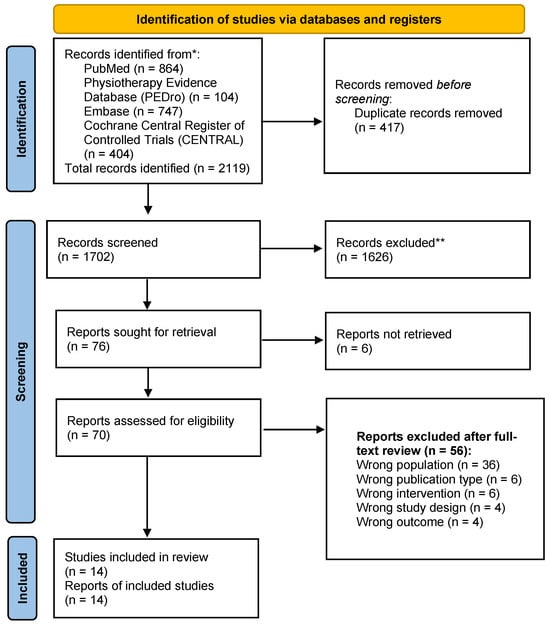
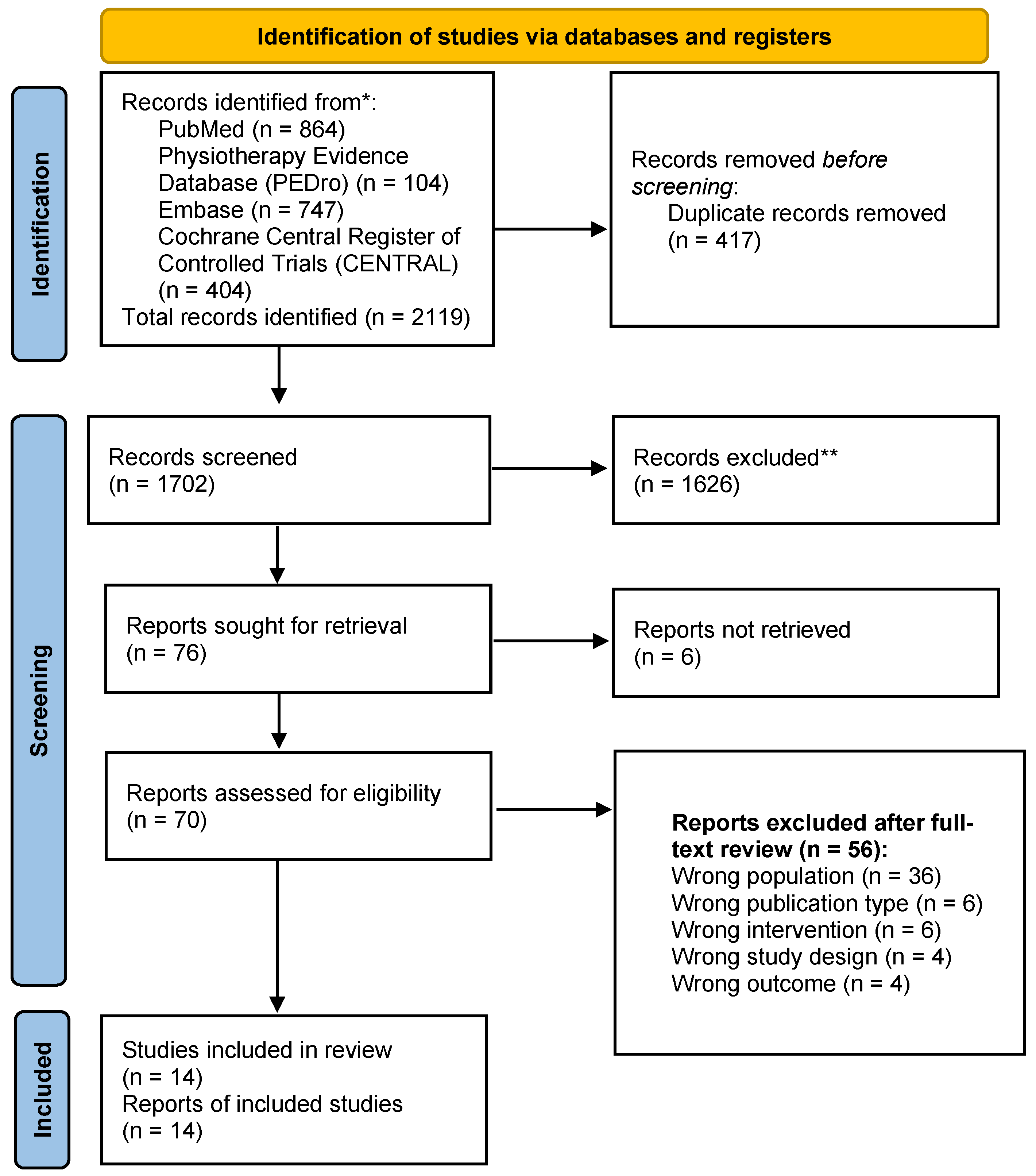
The literature search identified 2119 records across electronic databases (PubMed, n = 864; PEDro, n = 104; Embase, n = 747; CENTRAL, n = 404). After removing 417 duplicates, 1702 records remained for title and abstract screening. Following this initial screening, 1626 records were excluded based on predefined eligibility criteria. The great majority of these records were excluded because they concerned populations without PAD, evaluated exercise therapy in patients with PAD who had not undergone revascularisation, described revascularisation without any exercise or rehabilitation component, or were reviews, editorials, or case reports; they were therefore not near-misses for eligibility. A total of 76 full-text reports were sought for retrieval, of which 6 were not obtained. Ultimately, 70 full-text articles were assessed for eligibility. Of these, 56 were excluded for the following reasons: incorrect population (n = 36), incorrect publication type (n = 6), incorrect intervention (n = 6), incorrect study design (n = 4), and incorrect outcome (n = 4). Fourteen studies met the inclusion criteria and were included in this review. The study selection process is illustrated in Figure 1 (PRISMA flow diagram).
Figure 1.
Study selection process. Preferred Reporting Items for Systematic Reviews and Meta-Analyses Extension for Scoping Reviews (PRISMA-ScR) flow diagram showing the identification, screening, eligibility assessment, and inclusion of studies. * Consider, if feasible to do so, reporting the number of records identified from each database or register searched (rather than the total number across all databases/registers). ** If automation tools were used, indicate how many records were excluded by a human and how many were excluded by automation tools.
3.2. Study Characteristics
The 14 included studies were published between 1989 and 2023 and were conducted across multiple countries in Europe, Asia, and North America (Table 1). The included literature spans more than three decades, and the studies differ systematically by publication era. Studies published before approximately 2010 predominantly evaluated open surgical bypass with inpatient or hospital-based rehabilitation, whereas those published from 2010 onwards predominantly evaluated endovascular revascularisation with outpatient, home-based, or community-based programmes, mirroring the broader shift in PAD management towards endovascular-first strategies [22,23,24,25,26,27,28,29,30,31,32,33,34,35]. Study designs included randomised controlled trials, prospective cohort studies, retrospective cohort studies, and controlled observational studies. Sample sizes ranged from 14 to 218 participants. Most studies enrolled patients with claudication, although several studies also included patients with CLTI. The included studies reported both endovascular interventions and surgical bypass procedures. Earlier studies frequently focused on surgical bypass, whereas more recent studies predominantly examined endovascular therapy. To further illustrate the heterogeneity of the included populations, studies were summarised according to PAD severity categories: claudication-dominant, mixed symptomatic PAD, and CLTI-dominant (Supplementary Table S2).
3.3. Characteristics of Exercise-Based Rehabilitation Interventions
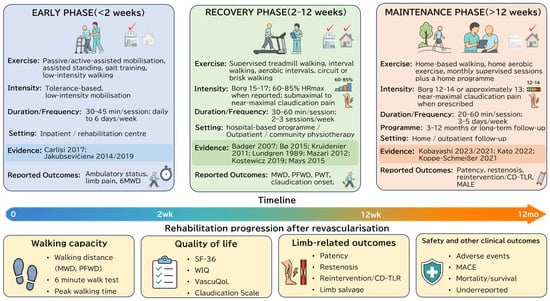
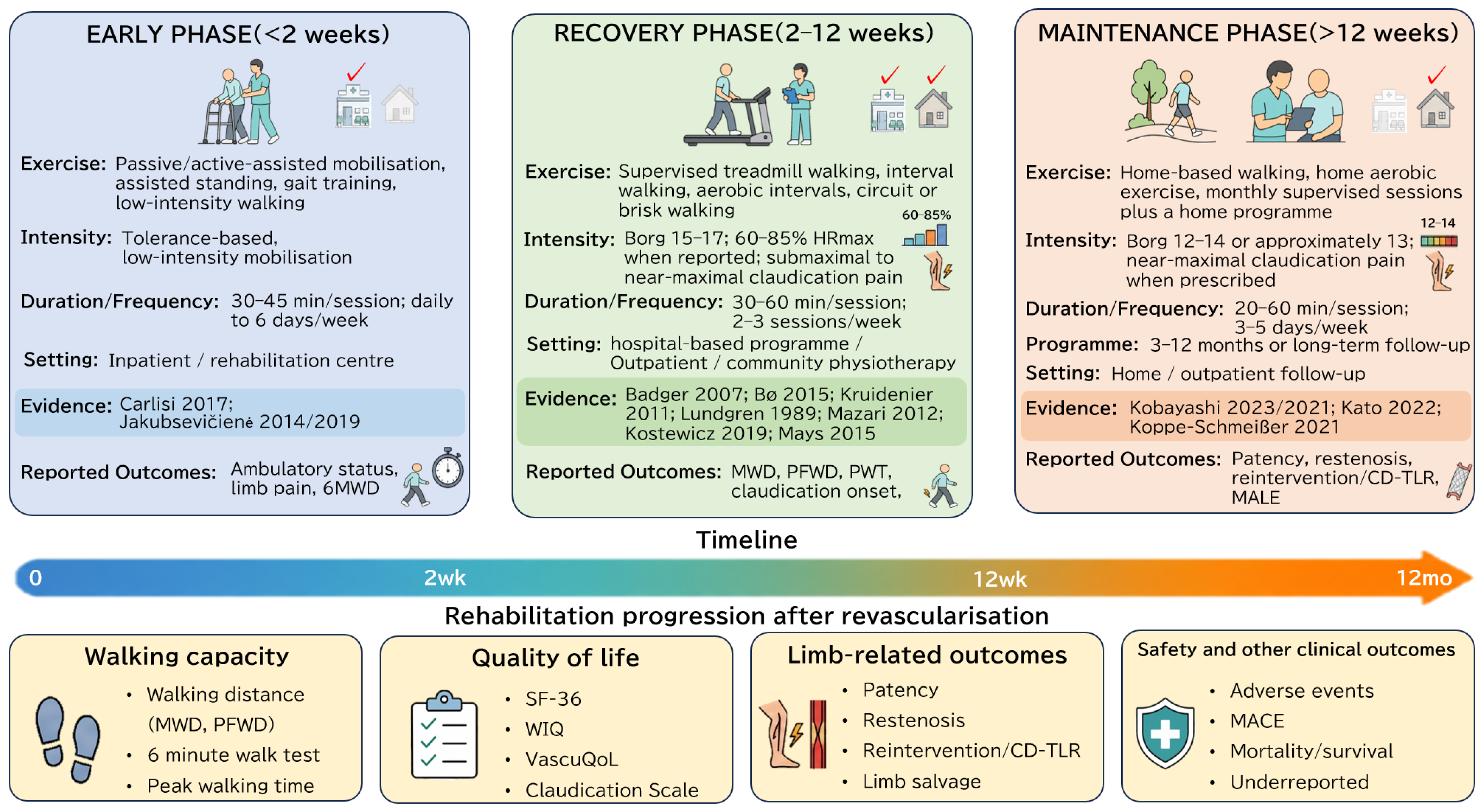
Considerable heterogeneity was observed in exercise-based rehabilitation programmes following revascularisation (Table 2). The most commonly reported modalities were walking-based exercises, including treadmill walking, structured walking programmes, and home-based walking training. Applying the four predefined intervention categories, one study evaluated early postoperative mobilisation [22], four evaluated structured exercise programmes without formal supervision [24,29,30,34], four evaluated supervised exercise therapy alone [25,27,28,33], and five combined an initial supervised phase with a subsequent unsupervised structured programme [23,26,31,32,35]; no study evaluated physical activity promotion or counselling without a prescribed exercise dose (Table 1). Based on reported rehabilitation initiation timing and programme characteristics, interventions can be broadly categorised into three phases (Figure 2). This three-phase framework was derived from patterns identified across the included studies and should be interpreted as a conceptual model rather than a standardised or evidence-based protocol. Differences in rehabilitation approaches according to PAD severity are summarised in Supplementary Table S2. The early phase (0–2 weeks post-revascularisation) typically involves early ambulation and low-intensity mobilisation, including passive mobilisation, assisted standing, and short walking sessions during the immediate postoperative period. The recovery phase (2–12 weeks) generally consists of structured walking programmes, often delivered as supervised exercise therapy (SET) in outpatient or rehabilitation settings. These programmes frequently include treadmill walking, interval walking, and a combination of aerobic and resistance exercises. Exercise intensity is commonly prescribed using Borg scale values, approximately 12–17 across protocols, symptom-limited or submaximal to near-maximal claudication pain, or heart-rate targets corresponding to approximately 60–85% of maximal heart rate (HRmax) when reported. The maintenance phase (>3 months) primarily comprises home-based exercise programmes and long-term physical activity aimed at sustaining functional improvements achieved during earlier rehabilitation phases. Across studies, exercise sessions typically lasted 20–60 min. Frequency ranged from daily inpatient mobilisation or 6 days/week during early rehabilitation to two to five sessions/week in outpatient or home-based programmes, and programme length ranged from inpatient-only rehabilitation to 12 months, with 12-week and 3–6-month programmes commonly reported.
Table 2.
Characteristics of exercise-based rehabilitation interventions following lower-limb revascularisation in patients with peripheral arterial disease.
Figure 2.
Rehabilitation progression after lower-limb revascularisation in patients with peripheral arterial disease. Conceptual framework for postoperative rehabilitation following lower-limb revascularisation, categorised into early (≤2 weeks), recovery (2–12 weeks), and maintenance (>3 months) phases. Rehabilitation typically progresses from low-intensity mobilisation during the early postoperative period to structured supervised exercise during the recovery phase and subsequently to home-based programmes during the maintenance phase. Walking capacity was the most frequently reported outcome, whereas limb-related and safety outcomes were reported less frequently. This framework was derived from patterns identified across the included studies and should not be interpreted as a standardised evidence-based protocol [22,23,24,25,26,27,28,29,30,31,32,33,34,35].
3.4. Reported Outcomes
A wide range of outcome measures were reported across the included studies (Table 3). The most frequently reported outcomes were measures of walking capacity, including treadmill walking distance, maximal walking distance, peak walking time, and the 6 min walk test (6MWT). Several studies also evaluated patient-reported outcomes, particularly quality of life, using instruments such as the Short Form-36 (SF-36), the Walking Impairment Questionnaire (WIQ), and the Vascular Quality of Life Questionnaire (VascuQoL). In contrast, limb-related outcomes—including limb salvage, restenosis, and reintervention—were reported less frequently. Similarly, adverse events associated with rehabilitation interventions were rarely documented, with most studies reporting either no major complications or a low incidence of adverse events. Overall, the available evidence suggests that exercise-based rehabilitation following lower-limb revascularisation has primarily focused on improving walking capacity, whereas clinically important outcomes such as limb-related events and safety remain relatively underreported.
Table 3.
Outcome measures reported across included studies evaluating exercise-based rehabilitation after lower-limb revascularisation in patients with peripheral arterial disease.
Beyond mapping which outcomes were reported, the direction and magnitude of effects were summarised qualitatively across the three principal outcome domains (Table 3). For walking capacity, the most consistently assessed domain, studies reporting walking distance or 6MWT generally favoured the exercise or combined revascularisation-plus-exercise groups, with most studies describing improvements in walking distance, walking time, or 6 min walk performance, although the magnitude of benefit varied across interventions and outcome measures. Patient-reported quality-of-life measures (SF-36, WIQ, VascuQoL) showed broadly concordant improvement, although the magnitude varied and several studies reported non-significant between-group differences. The number of studies formally reporting significant between-group QoL differences was limited; among the eight studies that assessed QoL, approximately half described statistically significant improvements in at least one domain, while the remainder reported non-significant or mixed findings. In contrast, limb-related outcomes (patency, restenosis, reintervention, limb salvage) and safety outcomes were reported in only a minority of studies, and where reported, event rates were low and effect estimates imprecise. Only five of the fourteen included studies reported vascular limb-related outcomes—primarily restenosis, reintervention, or patency—and findings were heterogeneous with no consistent direction of benefit. Adverse events were reported in five studies, generally at low rates, precluding any reliable estimate of the effect of postoperative rehabilitation on safety outcomes. Taken together, the evidence indicates a consistent direction of benefit for walking-based functional outcomes, whereas the effect of postoperative rehabilitation on vascular and safety outcomes cannot be reliably determined from the available data.
4. Discussion
PAD is a common manifestation of systemic atherosclerosis and is associated with impaired walking ability, reduced physical activity, and diminished quality of life [1,2]. Patients with PAD often experience progressive functional decline, substantially affecting mobility and independence [6,9,10]. Lower-limb revascularisation procedures, including endovascular therapy and surgical bypass, are widely performed to restore limb perfusion and alleviate ischaemic symptoms, particularly in patients with CLTI [3,4,5]. However, restoration of arterial perfusion does not necessarily translate into optimal functional recovery, and exercise-based rehabilitation has therefore been recognised as a key component of comprehensive PAD management [8,14,20]. From a vascular care perspective, rehabilitation is a critical but often underutilised component, highlighting the need to bridge the gap between procedural success and patient-centred outcomes.
In this scoping review, we mapped the existing literature describing exercise-based rehabilitation following lower-limb revascularisation and identified 14 studies addressing this topic [22,23,24,25,26,27,28,29,30,31,32,33,34,35]. The findings demonstrate considerable variability in rehabilitation programme characteristics, including exercise modality, initiation timing, intensity prescription, supervision, and programme duration. Walking-based exercise was the most frequently reported intervention, consistent with current guideline recommendations emphasising walking training as the cornerstone of PAD rehabilitation [14]. Notably, exercise intensity was prescribed using various approaches, including symptom-limited claudication pain, Borg scale values, or heart rate targets, while programme durations ranged from several weeks to several months. Similar heterogeneity in exercise protocols has been reported in previous systematic reviews of exercise therapy in patients with PAD [16,18]. The severity-stratified summary presented in Supplementary Table S2 further illustrates that rehabilitation strategies differ according to PAD severity. Studies involving claudication primarily focused on improving walking performance and physical activity, whereas studies including patients with CLTI emphasised early mobilisation and basic functional recovery.
Another important observation was the variation in the timing of rehabilitation initiation following revascularisation. Some studies initiated rehabilitation during the early postoperative period, whereas others implemented structured exercise programmes several weeks after revascularisation in outpatient settings. These differences may reflect variations in postoperative care pathways, concerns regarding wound healing, and differences in patient populations, particularly between those with claudication and those with CLTI [3,5]. Early mobilisation strategies have been proposed to prevent postoperative deconditioning and improve functional recovery in vascular surgery populations [7,17]. However, the optimal timing and progression of rehabilitation after revascularisation remain unclear and require further investigation.
This review also demonstrated that walking capacity was the most frequently reported outcome measure. Improvements in walking performance, including treadmill walking distance and the 6MWT, are widely recognised therapeutic targets in PAD rehabilitation and have been consistently reported in exercise intervention trials [8,14,18]. Randomised trials have shown that SET and structured home-based walking programmes can significantly improve walking performance and functional capacity in patients with PAD [12,13,45,46]. Additionally, combined strategies involving revascularisation and exercise therapy may provide complementary benefits in improving functional outcomes [12,47]. From a vascular perspective, clinically relevant outcomes such as patency, major adverse limb events (MALE), wound healing, and reintervention are critically important. However, these outcomes have been inconsistently reported across studies, limiting the ability to determine the impact of rehabilitation on vascular prognosis. Future studies should incorporate both functional and vascular outcomes to more comprehensively evaluate the benefits of postoperative rehabilitation.
Another important finding is that most rehabilitation programmes focus on walking-based exercises, with limited use of multimodal or comprehensive rehabilitation approaches. Although walking training remains the cornerstone of PAD rehabilitation, patients with advanced PAD or CLTI often present with skeletal muscle dysfunction, frailty, and reduced overall physical capacity [6,9]. Consequently, rehabilitation strategies incorporating resistance training, balance training, and functional mobility interventions may provide additional benefits. However, such multimodal approaches have been infrequently described in the included studies, highlighting an important gap in the current literature. This suggests that existing rehabilitation strategies may not fully address the complex functional impairments observed in this population.
A further question raised by this review is why exercise-based rehabilitation after lower-limb revascularisation remains poorly defined. Several factors may contribute. First, vascular and rehabilitation perspectives have traditionally emphasised different outcomes, with procedural success assessed mainly by vascular endpoints and rehabilitation studies focusing on functional recovery. Second, although major PAD guidelines recommend exercise following revascularisation, they provide limited guidance on postoperative-specific aspects such as initiation timing, exercise progression, and adaptation to wound status or disease severity. Practical implementation may also be complicated by wound care, mobility restrictions, and the transition from inpatient to outpatient or home-based rehabilitation. Finally, substantial heterogeneity in PAD severity, revascularisation procedures, frailty, comorbidities, and tissue loss makes standardisation challenging. Together, these factors may explain why postoperative exercise rehabilitation remains less standardised than exercise therapy for stable claudication.
Interpretation of the reported functional improvements requires particular caution in this setting. Most included studies did not report the technical outcome of the revascularisation itself—primary patency, restenosis, or reintervention during the rehabilitation period—so it cannot be determined whether an observed change in walking capacity reflects the exercise programme, the haemodynamic effect of a patent revascularisation, or the loss of that effect through restenosis. Spontaneous functional recovery following restoration of perfusion may account for a substantial proportion of the improvement observed, and in uncontrolled studies improvement cannot be attributed to the exercise intervention. In addition, unsupervised home-based programmes predominated among the included studies, yet few reported adherence in any quantitative form, so the exercise dose actually delivered is frequently unknown. The predominance of unsupervised programmes combined with sparse adherence reporting is itself a principal finding of this review and a major limitation of the current evidence base; concurrent reporting of vascular outcomes and adherence should be regarded as a minimum requirement for future studies.
Although CLTI is the population in which rehabilitation is most needed and least studied, the barriers in this group are substantial and require explicit consideration. Frailty and sarcopenia limit the tolerable exercise dose; tissue loss and wound infection restrict weight-bearing and ambulation and often dictate the rehabilitation schedule; markedly reduced exercise capacity renders conventional treadmill-based protocols and endpoints unsuitable; and the competing risks of major amputation and mortality complicate both the design and the interpretation of functional outcome studies. Rehabilitation strategies for CLTI therefore cannot simply be adapted from claudication protocols, and outcome measures other than maximal walking distance are likely to be required.
Comparisons drawn in this review between postoperative populations and patients with stable claudication are intended to provide context rather than to support inference. These populations differ substantially in disease severity, baseline functional capacity, wound healing status, comorbidity burden, and rehabilitation priorities, and evidence derived from stable PAD cohorts should not be assumed to transfer to patients undergoing revascularisation.
This study has some limitations. First, the included studies were heterogeneous in terms of study design, patient populations, and rehabilitation protocols, which limited direct comparisons. Second, as a scoping review, the aim was to map the existing literature rather than to quantitatively synthesise the effectiveness of rehabilitation interventions. Notably, most included studies focused on patients with claudication, while evidence specific to patients with CLTI remains limited. Furthermore, variability in outcome reporting across studies further restricts comparability and hinders evaluation of the impact of rehabilitation on vascular outcomes.
Two further characteristics of this literature qualify the map presented here. First, the included studies span more than three decades, and the applicability of the earliest studies to contemporary practice is limited by subsequent changes in revascularisation technique, perioperative care, and medical therapy; this temporal heterogeneity is an additional reason why the included evidence cannot be pooled. Second, the design limitations recorded in Table 3 indicate the prevailing methodological weaknesses of this literature: a control group or randomisation was absent in several studies, sample sizes were generally small, blinded outcome assessment was rarely feasible given the nature of the intervention, and adherence and vascular outcomes were seldom reported alongside functional outcomes.
Postoperative rehabilitation following lower-limb revascularisation remains inconsistently implemented despite its potential importance in functional recovery. The included studies indicate that early mobilisation and subsequent structured walking programmes have been implemented and appear feasible in selected postoperative populations. However, the available evidence does not establish the optimal timing of initiation, does not demonstrate safety with adequate statistical power given how rarely adverse events were reported, and does not permit comparison of effectiveness between timing strategies. The three-phase pattern described above should therefore be regarded as a preliminary, hypothesis-generating conceptual framework derived from 14 heterogeneous studies, intended to organise the existing literature and to guide the design of future research, rather than as a validated or recommended clinical pathway. Prospective validation is required before it could be used to inform clinical practice.
5. Conclusions
Exercise-based rehabilitation following lower-limb revascularisation in patients with PAD demonstrates substantial heterogeneity in programme characteristics, including exercise modality, timing of initiation, intensity prescription, supervision, and programme duration. Across the included studies, walking-based exercise was the most commonly implemented rehabilitation strategy, and walking capacity was the most frequently reported outcome measure. In contrast, clinically important outcomes—such as limb-related events, wound healing, and safety—have been reported less consistently. These findings highlight important gaps in the literature. Future research should focus on establishing standardised postoperative rehabilitation protocols and evaluating clinically meaningful outcomes beyond walking performance, particularly in patients with CLTI.
The current evidence map does not establish the effectiveness or safety of postoperative rehabilitation, the optimal timing of initiation, or the comparative effectiveness of different rehabilitation strategies. Future studies should use clearly defined postoperative populations, document revascularisation status and adherence, and report both functional and vascular outcomes together with intervention-related adverse events.
Supplementary Materials
The following supporting information can be downloaded at https://www.mdpi.com/article/10.3390/diseases14090311/s1: Table S1: Search strategy used for each database; Table S2: Severity-stratified summary of included studies.
Author Contributions
Conceived and designed the study, S.W., T.K. (Takayasu Koike) and K.S. (Keisuke Suzuki); developed the search strategy and conducted the literature search, S.W., T.K. (Takayasu Koike) and R.T.; performed study screening, data extraction, and data synthesis and drafted the manuscript, S.W., T.K. (Takayasu Koike) and T.K. (Tomohiko Kamo); contributed to the interpretation of the findings and critically revised the manuscript for important intellectual content, T.K. (Takayasu Koike), K.T., R.T., T.K. (Tomohiko Kamo), K.S. (Katsuyoshi Suzuki) and K.S. (Keisuke Suzuki); supervised the study and approved the final manuscript, K.S. (Keisuke Suzuki). All authors have read and agreed to the published version of the manuscript.
Funding
This research received no external funding.
Institutional Review Board Statement
Not applicable. This study is a scoping review of previously published literature and did not involve human participants, human tissue, identifiable personal data, or animals; therefore, ethical approval was not required.
Informed Consent Statement
Not applicable.
Data Availability Statement
No new data were created or analyzed in this study. Data sharing is not applicable to this article.
Acknowledgments
During the preparation of this manuscript, the authors additionally used ChatGPT (OpenAI, GPT-4o) as a supplementary tool for data consistency checking. The authors reviewed and edited all output and take full responsibility for the content of this publication.
Conflicts of Interest
The authors declare no conflicts of interest.
Abbreviations
The following abbreviations are used in this manuscript:
| 6MWD | 6 min walk distance |
| 6MWT | 6 min walk test |
| ABI | ankle–brachial index |
| CD-TLR | clinically driven target lesion revascularisation |
| CENTRAL | Cochrane Central Register of Controlled Trials |
| CLTI | chronic limb-threatening ischaemia |
| EVT | endovascular therapy |
| HRmax | maximal heart rate |
| HRQoL | health-related quality of life |
| IC | intermittent claudication |
| MACE | major adverse cardiovascular events |
| MALE | major adverse limb events |
| MEDLINE | Medical Literature Analysis and Retrieval System Online |
| MWD | maximal walking distance |
| NR | not reported |
| PAD | peripheral arterial disease |
| PEDro | Physiotherapy Evidence Database |
| PFWD | pain-free walking distance |
| PRISMA-ScR | Preferred Reporting Items for Systematic Reviews and Meta-Analyses Extension for Scoping Reviews |
| PTA | percutaneous transluminal angioplasty |
| PWT | peak walking time |
| QoL | quality of life |
| RCT | randomised controlled trial |
| SET | supervised exercise therapy |
| SF-36 | 36-Item Short Form Health Survey |
| VascuQoL | Vascular Quality of Life Questionnaire |
| WIQ | Walking Impairment Questionnaire |
References
- Fowkes, F.G.; Rudan, D.; Rudan, I.; Aboyans, V.; Denenberg, J.O.; McDermott, M.M.; Norman, P.E.; Sampson, U.K.A.; Williams, L.J.; Mensah, G.A.; et al. Comparison of global estimates of prevalence and risk factors for peripheral artery disease in 2000 and 2010: A systematic review and analysis. Lancet 2013, 382, 1329–1340. [Google Scholar] [CrossRef] [Scilit] [PubMed]
- Song, P.; Rudan, D.; Zhu, Y.; Fowkes, F.J.I.; Rahimi, K.; Fowkes, F.G.R.; Rudan, I. Global, regional, and national prevalence and risk factors for peripheral artery disease in 2015: An updated systematic review and analysis. Lancet Glob. Health 2019, 7, e1020–e1030. [Google Scholar] [CrossRef] [Scilit] [PubMed]
- Farber, A. Chronic limb-threatening ischemia. N. Engl. J. Med. 2018, 379, 171–180. [Google Scholar] [CrossRef] [Scilit] [PubMed]
- Aboyans, V.; Ricco, J.-B.; Bartelink, M.-L.E.L.; Björck, M.; Brodmann, M.; Cohnert, T.; Collet, J.-P.; Czerny, M.; De Carlo, M.; Debus, S.; et al. 2017 ESC Guidelines on the Diagnosis and Treatment of Peripheral Arterial Diseases, in collaboration with the European Society for Vascular Surgery (ESVS): Document covering atherosclerotic disease of extracranial carotid and vertebral, mesenteric, renal, upper and lower ex-tremity arteriesEndorsed by: The European Stroke Organization (ESO)The Task Force for the Diagnosis and Treatment of Peripheral Arterial Diseases of the European Society of Cardiology (ESC) and of the European Society for Vascular Surgery (ESVS). Eur. Heart J. 2018, 39, 763–816. [Google Scholar] [CrossRef] [Scilit] [PubMed]
- Farber, A.; Eberhardt, R.T. The current state of critical limb ischemia: A Systematic Review. JAMA Surg. 2016, 151, 1070–1077. [Google Scholar] [CrossRef] [Scilit] [PubMed]
- McDermott, M.M. Lower extremity manifestations of peripheral artery disease. Circ. Res. 2015, 116, 1540–1550. [Google Scholar] [CrossRef] [Scilit] [PubMed]
- Palmer, J.; Pymer, S.; Smith, G.E.; Harwood, A.E.; Ingle, L.; Huang, C.; Chetter, I.C. Presurgery exercise-based conditioning interventions (prehabilitation) in adults undergoing lower limb surgery for peripheral arterial disease. Cochrane Database Syst. Rev. 2020, 9, CD013407. [Google Scholar] [CrossRef] [Scilit]
- Treat-Jacobson, D.; McDermott, M.M.; Beckman, J.A.; Burt, M.A.; Creager, M.A.; Ehrman, J.K.; Gardner, A.W.; Mays, R.J.; Regensteiner, J.G.; Salisbury, D.L.; et al. Implementation of Supervised Exercise Therapy for Patients With Symptomatic Peripheral Artery Disease: A Science Advisory From the American Heart Association. Circulation 2019, 140, e700–e710. [Google Scholar] [CrossRef] [Scilit] [PubMed]
- McDermott, M.M.; Liu, K.; Tian, L.; Guralnik, J.M.; Criqui, M.H.; Liao, Y.; Ferrucci, L. Calf muscle characteristics, strength measures, and mortality in peripheral arterial disease: A longitudinal study. J. Am. Coll. Cardiol. 2012, 59, 1159–1167. [Google Scholar] [CrossRef] [Scilit] [PubMed]
- McDermott, M.M.; Liu, K.; Ferrucci, L.; Tian, L.; Guralnik, J.M.; Liao, Y.; Criqui, M.H. Decline in functional performance predicts later increased mobility loss and mortality in peripheral arterial disease. J. Am. Coll. Cardiol. 2011, 57, 962–970. [Google Scholar] [CrossRef] [Scilit] [PubMed]
- Nordanstig, J.; Behrendt, C.-A.; Baumgartner, I.; Belch, J.; Bäck, M.; Fitridge, R.; Hinchliffe, R.; Lejay, A.; Mills, J.L.; Rother, U.; et al. Editor’s Choice–European Society for Vascular Surgery (ESVS) 2024 Clinical Practice Guidelines on the Management of Asymptomatic Lower Limb Peripheral Arterial Disease and Intermittent Claudication. Eur. J. Vasc. Endovasc. Surg. 2024, 67, 9–96. [Google Scholar] [CrossRef] [Scilit] [PubMed]
- Fakhry, F.; Spronk, S.; van der Laan, L.; Wever, J.J.; Teijink, J.A.W.; Hoffmann, W.H.; Smits, T.M.; van Brussel, J.P.; Stultiens, G.N.M.; Derom, A.; et al. Endovascular revascularization and supervised exercise for peripheral artery disease. JAMA 2015, 314, 1936–1944. [Google Scholar] [CrossRef] [Scilit] [PubMed]
- McDermott, M.M.; Kibbe, M.R.; Guralnik, J.M.; Ferrucci, L.; Criqui, M.H.; Domanchuk, K.; Tian, L.; Zhao, L.; Li, L.; Patel, K.; et al. Durability of benefits from supervised treadmill exercise in people with peripheral artery disease. J. Am. Heart Assoc. 2019, 8, e009380. [Google Scholar] [CrossRef] [Scilit] [PubMed]
- Treat-Jacobson, D.; McDermott, M.M.; Bronas, U.G.; Campia, U.; Collins, T.C.; Criqui, M.H.; Gardner, A.W.; Hiatt, W.R.; Regensteiner, J.G.; Rich, K.; et al. Optimal exercise programs for patients with peripheral artery disease: A scientific statement from the American Heart Association. Circulation 2019, 139, e10–e33. [Google Scholar] [CrossRef] [Scilit] [PubMed]
- Ehrman, J.K.; Gardner, A.W.; Salisbury, D.; Lui, K.; Treat-Jacobson, D. Supervised exercise therapy for symptomatic peripheral artery disease: A review of current experience and practice-based recommendations. J. Cardiopulm. Rehabil. Prev. 2023, 43, 15–21. [Google Scholar] [CrossRef] [Scilit] [PubMed]
- Lane, R.; Harwood, A.; Watson, L.; Leng, G.C. Exercise for intermittent claudication. Cochrane Database Syst. Rev. 2017, 12, CD000990. [Google Scholar] [CrossRef] [Scilit] [PubMed]
- Harwood, A.E.; Smith, G.E.; Cayton, T.; Broadbent, E.; Chetter, I.C. A systematic review of the uptake and adherence rates to supervised exercise programs in patients with intermittent claudication. Ann. Vasc. Surg. 2016, 34, 280–289. [Google Scholar] [CrossRef] [Scilit] [PubMed]
- Mazzolai, L.; Belch, J.; Venermo, M.; Aboyans, V.; Brodmann, M.; Bura-Rivière, A.; Debus, S.; Espinola-Klein, C.; Harwood, A.E.; Hawley, A.J.; et al. Exercise therapy for chronic symptomatic peripheral artery disease: A clinical consensus document of the European Society of Cardiology Working Group on Aorta and Peripheral Vascular Diseases in collaboration with the European Society of Vascular Medicine and the European Society for Vascular Surgery. Eur. Heart J. 2024, 45, 1303–1321. [Google Scholar] [CrossRef] [Scilit] [PubMed]
- Thangada, N.D.; McDermott, M.M. Exercise therapy for peripheral artery disease. Curr. Cardiol. Rep. 2024, 26, 405–412. [Google Scholar] [CrossRef] [Scilit] [PubMed]
- Hamburg, N.M.; Balady, G.J. Exercise rehabilitation in peripheral artery disease: Functional impact and mechanisms of benefits. Circulation 2011, 123, 87–97. [Google Scholar] [CrossRef] [Scilit] [PubMed]
- Tricco, A.C.; Lillie, E.; Zarin, W.; O’Brien, K.K.; Colquhoun, H.; Levac, D.; Moher, D.; Peters, M.D.J.; Horsley, T.; Weeks, L.; et al. PRISMA extension for scoping reviews (PRISMA-ScR): Checklist and explanation. Ann. Intern. Med. 2018, 169, 467–473. [Google Scholar] [CrossRef] [Scilit] [PubMed]
- Carlisi, E.; Caspani, P.; Morlino, P.; Bardoni, M.T.; Lisi, C.; Bejor, M.; Toffola, E.D. Early rehabilitative treatment after infrainguinal lower limb bypass surgery. Acta Biomed. 2017, 88, 167–171. [Google Scholar] [CrossRef] [Scilit] [PubMed]
- Jakubsevičienė, E.; Vasiliauskas, D.; Velička, L.; Kubilius, R.; Milinavičienė, E.; Venclovienė, J. Effectiveness of a new exercise program after lower limb arterial blood flow surgery in patients with peripheral arterial disease: A randomized clinical trial. Int. J. Environ. Res. Public Health 2014, 11, 7961–7976. [Google Scholar] [CrossRef] [Scilit] [PubMed]
- Kostewicz, M.; Kostewicz, W. Impact of twelve weeks march field training on intermittent claudication in patients with peripheral artery disease after endovascular procedures. Adv. Rehabil. 2019, 33, 15–21. [Google Scholar] [CrossRef] [Scilit]
- Badger, S.A.; Soong, C.V.; O’Donnell, M.E.; Boreham, C.A.; McGuigan, K.E. Benefits of a supervised exercise program after lower limb bypass surgery. Vasc. Endovasc. Surg. 2007, 41, 27–32. [Google Scholar] [CrossRef] [Scilit] [PubMed]
- Bø, E.; Bergland, A.; Stranden, E.; Jørgensen, J.J.; Sandbaek, G.; Grøtta, O.J.; Hisdal, J. Effects of 12 weeks of supervised exercise after endovascular treatment: A randomized clinical trial. Physiother. Res. Int. 2015, 20, 147–157. [Google Scholar] [CrossRef] [Scilit] [PubMed]
- Kruidenier, L.M.; Nicolaï, S.P.; Rouwet, E.V.; Peters, R.J.; Prins, M.H.; Teijink, J.A. Additional supervised exercise therapy after a percutaneous vascular intervention for peripheral arterial disease: A randomized clinical trial. J. Vasc. Interv. Radiol. 2011, 22, 961–968. [Google Scholar] [CrossRef] [Scilit] [PubMed]
- Lundgren, F.; Dahllöf, A.G.; Lundholm, K.; Scherstén, T.; Volkmann, R. Intermittent claudication—Surgical reconstruction or physical training? A prospective randomized trial of treatment efficiency. Ann. Surg. 1989, 209, 346–355. [Google Scholar] [CrossRef] [Scilit] [PubMed]
- Kobayashi, T.; Hamamoto, M.; Okazaki, T.; Tomota, M.; Fujiwara, T.; Honma, T.; Takahashi, S. Effectiveness of unsupervised Exercise Therapy After Endovascular Treatment for an Iliac Occlusive Lesion. Vasc. Endovasc. Surg. 2023, 57, 331–338. [Google Scholar] [CrossRef] [Scilit] [PubMed]
- Kobayashi, T.; Hamamoto, M.; Okazaki, T.; Honma, T.; Takahashi, S. Effectiveness of continuous unsupervised exercise therapy after above-knee femoropopliteal bypass. Vascular 2021, 29, 387–395. [Google Scholar] [CrossRef] [Scilit] [PubMed]
- Kato, T.; Miura, T.; Yamamoto, S.; Miyashita, Y.; Hashizume, N.; Shoin, K.; Sasaki, S.; Kanzaki, Y.; Yui, H.; Maruyama, S.; et al. Intensive exercise therapy for restenosis after superficial femoral artery stenting: The REASON randomized clinical trial. Heart Vessels 2022, 37, 1596–1603. [Google Scholar] [CrossRef] [Scilit] [PubMed]
- Jakubsevičienė, E.; Mėlinytė, K.; Kubilius, R. A Novel, Individualized Exercise Program for Patients with Peripheral Arterial Disease Recovering from Bypass Surgery. Int. J. Environ. Res. Public Health 2019, 16, 2127. [Google Scholar] [CrossRef] [Scilit] [PubMed]
- Mazari, F.A.K.; Khan, J.A.; Carradice, D.; Samuel, N.; Rahman, M.N.A.A.; Gulati, S.; Lee, H.L.D.; Mehta, T.A.; McCollum, P.T.; Chetter, I.C. Randomized clinical trial of percutaneous transluminal angioplasty, supervised exercise and combined treatment for intermittent claudication due to femoropopliteal arterial disease. Br. J. Surg. 2012, 99, 39–48. [Google Scholar] [CrossRef] [Scilit] [PubMed]
- Koppe-Schmeißer, F.; Schwaderlapp, M.; Schmeißer, J.; Dopheide, J.F.; Münzel, T.; Daiber, A.; Espinola-Klein, C. Influence of peripheral transluminal angioplasty alongside exercise training on oxidative stress and inflammation in patients with peripheral arterial disease. J. Clin. Med. 2021, 10, 5851. [Google Scholar] [CrossRef] [Scilit] [PubMed]
- Mays, R.J.; Hiatt, W.R.; Casserly, I.P.; Rogers, R.K.; Main, D.S.; Kohrt, W.M.; Ho, P.M.; Regensteiner, J.G. Community-based walking exercise for peripheral artery disease: An exploratory pilot study. Vasc. Med. 2015, 20, 339–347. [Google Scholar] [CrossRef] [Scilit] [PubMed]
- Arksey, H.; O’Malley, L. Scoping studies: Towards a methodological framework. Int. J. Soc. Res. Methodol. 2005, 8, 19–32. [Google Scholar] [CrossRef] [Scilit]
- Peters, M.D.J.; Marnie, C.; Tricco, A.C.; Pollock, D.; Munn, Z.; Alexander, L.; McInerney, P.; Godfrey, C.M.; Khalil, H. Updated methodological guidance for the conduct of scoping reviews. JBI Evid. Synth. 2020, 18, 2119–2126. [Google Scholar] [CrossRef] [Scilit] [PubMed]
- Khalil, H.; Peters, M.; Godfrey, C.M.; McInerney, P.; Soares, C.B.; Parker, D. An evidence-based approach to scoping reviews. Worldviews Evid. Based Nurs. 2016, 13, 118–123. [Google Scholar] [CrossRef] [Scilit] [PubMed]
- Bramer, W.M.; de Jonge, G.B.; Rethlefsen, M.L.; Mast, F.; Kleijnen, J. A systematic approach to searching: An efficient and complete method to develop literature searches. J. Med. Libr. Assoc. 2018, 106, 531–541. [Google Scholar] [CrossRef] [Scilit] [PubMed]
- Ouzzani, M.; Hammady, H.; Fedorowicz, Z.; Elmagarmid, A. Rayyan—A web and mobile app for systematic reviews. Syst. Rev. 2016, 5, 210. [Google Scholar] [CrossRef] [Scilit] [PubMed]
- Levac, D.; Colquhoun, H.; O’Brien, K.K. Scoping studies: Advancing the methodology. Implement Sci. 2010, 5, 69. [Google Scholar] [CrossRef] [Scilit] [PubMed]
- Pham, M.T.; Rajić, A.; Greig, J.D.; Sargeant, J.M.; Papadopoulos, A.; McEwen, S.A. A scoping review of scoping reviews: Advancing the approach and enhancing the consistency. Res. Synth. Methods 2014, 5, 371–385. [Google Scholar] [CrossRef] [Scilit] [PubMed]
- Munn, Z.; Peters, M.D.J.; Stern, C.; Tufanaru, C.; McArthur, A.; Aromataris, E. Systematic review or scoping review? Guidance for authors when choosing between a systematic or scoping review approach. BMC Med. Res. Methodol. 2018, 18, 143. [Google Scholar] [CrossRef] [PubMed]
- Aromataris, E.; Lockwood, C.; Porritt, K.; Pilla, B.; Jordan, Z. (Eds.) JBI Manual for Evidence Synthesis; JBI: North Adelaide, Australia, 2024; Available online: https://synthesismanual.jbi.global (accessed on 14 July 2026).
- McDermott, M.M.; Liu, K.; Guralnik, J.M.; Criqui, M.H.; Spring, B.; Tian, L.; Domanchuk, K.; Ferrucci, L.; Lloyd-Jones, D.; Kibbe, M.; et al. Home-based walking exercise intervention in peripheral artery disease: A randomized clinical trial. JAMA 2013, 310, 57–65. [Google Scholar] [CrossRef] [Scilit] [PubMed]
- McDermott, M.M.; Ades, P.; Guralnik, J.M.; Dyer, A.; Ferrucci, L.; Liu, K.; Nelson, M.; Lloyd-Jones, D.; Van Horn, L.; Garside, D.; et al. Treadmill exercise and resistance training in patients with peripheral arterial disease with and without intermittent claudication: A randomized clinical trial. JAMA 2009, 301, 165–174. [Google Scholar] [CrossRef] [Scilit] [PubMed]
- Pandey, A.; Banerjee, S.; Ngo, C.; Mody, P.; Marso, S.P.; Brilakis, E.S.; Armstrong, E.J.; Giri, J.; Bonaca, M.P.; Pradhan, A.; et al. Comparative efficacy of endovascular revascularization versus supervised exercise training in patients with intermittent claudication: Meta-analysis of randomized controlled trials. JACC Cardiovasc. Interv. 2017, 10, 712–724. [Google Scholar] [CrossRef] [Scilit] [PubMed]

Disclaimer/Publisher’s Note: The statements, opinions and data contained in all publications are solely those of the individual author(s) and contributor(s) and not of MDPI and/or the editor(s). MDPI and/or the editor(s) disclaim responsibility for any injury to people or property resulting from any ideas, methods, instructions or products referred to in the content. |
© 2026 by the authors. Licensee MDPI, Basel, Switzerland. This article is an open access article distributed under the terms and conditions of the Creative Commons Attribution (CC BY) license.