
Increasing Numbers of Persons with Sleeping Problems in Sweden


Abstract
1. Introduction
1.1. Limits for Microwave RF Radiation
1.2. Evidence of Impact on Sleep
1.3. Aim of This Study
2. Method
3. Results



4. Discussion
5. Conclusions
Author Contributions
Funding
Institutional Review Board Statement
Informed Consent Statement
Data Availability Statement
Acknowledgments
Conflicts of Interest
References
- Nilsson, M.; Hardell, L. Increasing numbers of children aged 5–19 years with memory problems in Sweden and Norway. Arch. Clin. Biomed. Res. 2025, 9, 431–439. [Google Scholar] [CrossRef] [Scilit]
- Hardell, L.; Nilsson, M. Case Report: The microwave syndrome after installation of 5G emphasizes the need for protection from radiofrequency radiation. Ann. Case Rep. 2023, 8, 1112. [Google Scholar] [CrossRef] [Scilit]
- Nilsson, M.; Hardell, L. Development of the microwave syndrome in two men shortly after installation of 5G on the roof above their office. Ann. Clin. Case Rep. 2023, 8, 2378. Available online: https://www.anncaserep.com/open-access/development-of-the-microwave-syndrome-in-two-men-shortly-after-9589.pdf (accessed on 20 December 2025).
- Hardell, L.; Nilsson, M. Case Report: A 52-year healthy woman developed severe microwave syndrome shortly after installation of a 5G base station close to her apartment. Ann. Clin. Med. Case Rep. 2023, 10, 1–10. Available online: https://acmcasereports.org/pdf/ACMCR-v10-1926.pdf (accessed on 20 December 2025).
- Nilsson, M.; Hardell, L. 5G Radiofrequency radiation caused the microwave syndrome in a family living close to the base stations. J. Cancer Sci. Clin. Ther. 2023, 7, 127–134. [Google Scholar] [CrossRef] [Scilit]
- Nilsson, M.; Hardell, L. A 49-year-old man developed severe microwave syndrome after activation of 5G base station 20 meters from his apartment. J. Community Med. Public Health 2023, 7, 382. [Google Scholar] [CrossRef] [Scilit]
- Nilsson, M.; Hardell, L. Case Report: Both parents and their three children developed symptoms of the microwave syndrome while on holiday near a 5G tower. Ann. Clin. Med. Case Rep. 2023, 12, 1–7. [Google Scholar]
- Hardell, L.; Nilsson, M. A woman aged 82 years with electromagnetic hypersensitivity since almost four decades developed the microwave syndrome after installation of 5G base stations in her living vicinity—Ethical principles in medicine are violated. J. Environ. Sci. Public Health 2024, 8, 1–8. [Google Scholar] [CrossRef] [Scilit]
- Hardell, L.; Nilsson, M. An eight year old boy developed severe headache in a school close to a mast with 5G base stations. Ann. Clin. Case Stud. 2024, 6, 1093. Available online: https://www.medtextpublications.com/open-access/an-eight-year-old-boy-developed-severe-headache-in-a-1582.pdf (accessed on 20 December 2025).
- Balmori, A. Evidence for a health risk by RF on humans living around mobile phone base stations: From radiofrequency sickness to cancer. Environ. Res. 2022, 214, 113851. [Google Scholar] [CrossRef] [Scilit] [PubMed]
- Federal Communications Commission (FCC). Evaluating Compliance with FCC Guidelines for Human Exposure to Radiofrequency Electromagnetic Fields. OET Bull. 1997, 65, 1–53. Available online: https://www.lbagroup.com/images/PDFs/oet65c.pdf (accessed on 20 December 2025).
- International Commission on Non-Ionizing Radiation Protection (ICNIRP). Guidelines for limiting exposure to electromagnetic fields (100 kHz to 300 GHz). Health Phys. 2020, 118, 483–524. [Google Scholar]
- GSMA. International EMF Exposure Guidelines Explaining the 2020 RF-EMF Exposure Guidelines Published by the International Commission on Non-Ionizing Radiation Protection (ICNIRP) October 2021. Available online: https://www.gsma.com/solutions-and-impact/connectivity-for-good/public-policy/wp-content/uploads/2021/10/GSMA_International_EMF_Exposure_Guideline_Oct21.pdf (accessed on 20 December 2025).
- Hardell, L.; Nilsson, M.; Koppel, T.; Carlberg, M. Aspects on the International Commission on Non-Ionizing Radiation Protection (ICNIRP) 2020 guidelines on radiofrequency radiation. J. Cancer Sci. Clin. Ther. 2021, 5, 250–283. [Google Scholar] [CrossRef] [Scilit]
- Ramirez-Vazquez, R.; Escobar, I.; Vandenbosch, G.A.E.; Arribas, E. Personal exposure to radiofrequency electromagnetic fields: A comparative analysis of international, national, and regional guidelines. Environ. Res. 2024, 246, 118124. [Google Scholar] [CrossRef] [Scilit]
- Törnevik, C. Impact of EMF limits on 5G network roll-out. In Proceedings of the ITU Workshop on 5G, EMF & Health, Warsaw, Poland, 5 December 2017. [Google Scholar]
- International Commission on the Biological Effects of Electromagnetic Fields (ICBE-EMF). Scientific evidence invalidates health assumptions underlying the FCC and ICNIRP exposure limit determinations for radiofrequency radiation: Implications for 5G. Environ. Health 2022, 21, 92. [Google Scholar] [CrossRef] [Scilit] [PubMed] [PubMed Central]
- Carpenter, D.O. The microwave syndrome or electro-hypersensitivity: Historical background. Rev. Environ. Health 2015, 30, 217–222. [Google Scholar] [PubMed]
- Pollack, H. The microwave syndrome. Bull. N. Y. Acad. Med. 1979, 55, 1240–1243. [Google Scholar]
- Marha, K.; Musil, J.; Tuha, H. Biological effects of electromagnetic waves and their mechanism. In Electromagnetic Fields and the Life Environment; San Francisco Press: Berkeley, CA, USA, 1971; pp. 29–38. Available online: https://www.stralskyddsstiftelsen.se/wp-content/uploads/2020/12/1971book_marha.pdf (accessed on 20 December 2025).
- Dodge, C. Clinical and Hygienic Aspects of Exposure to Electromagnetic Fields: A Review; U.S. Naval Observatory: Washington, DC, USA, 1969; Available online: https://www.magdahavas.com/wp-content/uploads/2010/08/Dodge_1969.pdf (accessed on 20 December 2025).
- Sailo, L.; Laldinpuii; Zosangzuali, M.; Weller, S.; Varte, C.L.; Tochhawng, L.; McCredden, J.E.; Zothansiamaa. Greater prevalence of symptoms associated with higher exposures to mobile phone base stations in a hilly, densely populated city in Mizoram, India. Electromagn. Biol. Med. 2025, 44, 385–404. [Google Scholar] [CrossRef] [Scilit]
- Abdel-Rassoul, G.; El-Fateh, O.A.; Salem, M.A.; Michael, A.; Farahat, F.; El-Batanouny, M.; Salem, E. Neurobehavioral effects among inhabitants around mobile phone base stations. Neurotoxicology 2007, 28, 434–440. [Google Scholar] [CrossRef] [Scilit] [PubMed]
- López, I.; Félix, N.; Rivera, M.; Alonso, A.; Maestú, C. What is the radiation before 5G? A correlation study between measurements in situ and in real time and epidemiological indicators in Vallecas, Madrid. Environ. Res. 2021, 194, 110734. [Google Scholar] [CrossRef] [Scilit]
- Hardell, L.; Nilsson, M. Summary of seven Swedish case reports on the microwave syndrome associated with 5G radiofrequency radiation. Rev. Environ. Health 2025, 40, 147–157. [Google Scholar] [CrossRef] [Scilit]
- Chandel, P.; Singh, M.M.; Pati, A.K.; Parganiha, A. Exposure to radio-frequency electromagnetic radiation shortens sleep duration and lengthens sleep latency and sleep inertia in humans living in proximity to the base transceiver stations. South Asian J. Exp. Biol. 2021, 11, 466–481. [Google Scholar] [CrossRef] [Scilit]
- Tettamanti, G.; Auvinen, A.; Åkerstedt, T.; Kojo, K.; Ahlbom, A.; Heinävaara, S.; Elliott, P.; Schüz, J.; Deltour, I.; Kromhout, H.; et al. Long-term effect of mobile phone use on sleep quality: Results from the cohort study of mobile phone use and health (COSMOS). Environ. Int. 2020, 140, 105687. [Google Scholar] [CrossRef] [Scilit]
- Rafique, N.; Al-Asoom, L.I.; Alsunni, A.A.; Saudagar, F.N.; Almulhim, L.; Alkaltham, G. Effects of Mobile Use on Subjective Sleep Quality. Nat. Sci. Sleep 2020, 12, 357–364. [Google Scholar] [CrossRef] [Scilit] [PubMed]
- Loughran, S.P.; Verrender, A.; Dalecki, A.; Burdon, C.A.; Tagami, K.; Park, J.; Taylor, N.A.S.; Croft, R.J. Radiofrequency Electromagnetic Field Exposure and the Resting EEG: Exploring the Thermal Mechanism Hypothesis. Int. J. Environ. Res. Public Health 2019, 16, 1505. [Google Scholar] [CrossRef] [Scilit] [PubMed] [PubMed Central]
- Bijlsma, N.; Conduit, R.; Kennedy, G.; Cohen, M. Does radiofrequency radiation impact sleep? A double-blind, randomised, placebo-controlled, crossover pilot study. Front. Public Health 2024, 12, 1481537. [Google Scholar] [CrossRef] [Scilit] [PubMed] [PubMed Central]
- Carter, B.; Rees, P.; Hale, L.; Bhattacharjee, D.; Paradkar, M.S. Association Between Portable Screen-Based Media Device Access or Use and Sleep Outcomes: A Systematic Review and Meta-analysis. JAMA Pediatr. 2016, 170, 1202–1208. [Google Scholar] [CrossRef] [Scilit] [PubMed] [PubMed Central]
- Kumar, M.; Katoch, O.R.; Kumar, N.; Sehgal, S. Exploring the link between smartphone use and sleep quality: A systematic review. Sleep Res. 2025, 2, 42–56. [Google Scholar] [CrossRef] [Scilit]
- Röösli, M.; Dongus, S.; Jalilian, H.; Eyers, J.; Esu, E.; Oringanje, C.M.; Meremikwu, M.; Bosch-Capblanch, X. The effects of radiofrequency electromagnetic fields exposure on tinnitus, migraine and non-specific symptoms in the general and working population: A systematic review and meta-analysis on human observational studies. Environ. Int. 2024, 183, 108338. [Google Scholar] [CrossRef] [Scilit] [PubMed]
- Hardell, L. World Health Organization, radiofrequency radiation and health–a hard nut to crack. Int. J. Oncol. 2017, 51, 405–413. [Google Scholar]
- Nyberg, R.; McCredden, J.; Hardell, L. The European Union assessments of radiofrequency radiation health risks—Another hard nut to crack. Rev. Environ. Health 2023, 39, 709–719. [Google Scholar] [CrossRef] [Scilit]
- Carley, D.W.; Farabi, S.S. Physiology of Sleep. Diabetes Spectr. 2016, 29, 5–9. [Google Scholar] [CrossRef] [Scilit]
- Newbury, C.R.; Crowley, R.; Rastle, K.; Tamminen, J. Sleep deprivation and memory: Meta-analytic reviews of studies on sleep deprivation before and after learning. Psychol. Bull. 2021, 147, 1215–1240. [Google Scholar] [CrossRef] [Scilit] [PubMed]
- Riemann, D.; Espie, C.A.; Altena, E.; Arnardottir, E.S.; Baglioni, C.; Bassetti, C.L.A.; Bastien, C.; Berzina, N.; Bjorvatn, B.; Dikeos, D.; et al. The European Insomnia Guideline: An update on the diagnosis and treatment of insomnia 2023. J. Sleep Res. 2023, 32, e14035. [Google Scholar] [CrossRef] [Scilit]
- Blom, V.; Kallings, L.V.; Ekblom, B.; Wallin, P.; Andersson, G.; Hemmingsson, E.; Ekblom, Ö.; Söderling, J.; Ekblom Bak, E. Self-reported general health, overall and work-related stress, loneliness, and sleeping problems in 335,625 Swedish adults from 2000 to 2016. Int. J. Environ. Res. Public Health 2020, 17, 511. [Google Scholar] [CrossRef] [Scilit] [PubMed] [PubMed Central]
- Dagens Medicin. Fler Barn får Sömnmedel–Femdubblad Förskrivning på tio år. 2022. Available online: https://www.dagensmedicin.se/alla-nyheter/lakemedel/fler-barn-far-somnmedel-femdubblad-forskrivning-pa-tio-ar/ (accessed on 20 December 2025).
- SVT Nyheter Halland. Stor Ökning av Unga som tar Sömnmedel–det här är Orsaken. 2025. Available online: https://www.svt.se/nyheter/lokalt/halland/stor-okning-av-unga-som-tar-somnmedel-det-har-ar-orsaken (accessed on 20 December 2025).
- Zucco, A.G.; Drews, H.J.; Uleman, J.F.; Bhatt, S.; Rod, N.H. Exploring nationwide patterns of sleep problems from late adolescence to adulthood using machine learning. Sci. Adv. 2025, 11, eadw1227. [Google Scholar] [CrossRef] [Scilit]
- Kronholm, E.; Puusniekka, R.; Jokela, J.; Villberg, J.; Urrila, A.S.; Paunio, T.; Välimaa, R.; Tynjälä, J. Trends in self-reported sleep problems, tiredness and related school performance among Finnish adolescents from 1984 to 2011. J. Sleep Res. 2015, 24, 3–10. [Google Scholar] [CrossRef] [Scilit] [PubMed]
- Ford, E.S.; Wheaton, A.G.; Cunningham, T.J.; Giles, W.H.; Chapman, D.P.; Croft, J.B. Trends in outpatient visits for insomnia, sleep apnea, and prescriptions for sleep medications among US adults: Findings from the National Ambulatory Medical Care survey 1999–2010. Sleep 2014, 37, 1283–1293. [Google Scholar] [CrossRef] [Scilit] [PubMed] [PubMed Central]
- Ford, E.S.; Cunningham, T.J.; Giles, W.H.; Croft, J.B. Trends in insomnia and excessive daytime sleepiness among U.S. adults from 2002 to 2012. Sleep Med. 2015, 16, 372–378. [Google Scholar] [CrossRef] [Scilit] [PubMed] [PubMed Central]
- Chattu, V.K.; Manzar, M.D.; Kumary, S.; Burman, D.; Spence, D.W.; Pandi-Perumal, S.R. The global problem of insufficient sleep and its serious public health implications. Healthcare 2018, 7, 1. [Google Scholar] [CrossRef] [Scilit]
- Expressen. Tele2 Skickar Kontantkort till Sjuåringar. 2009. Available online: https://www.expressen.se/nyheter/tele2-skickar-kontantkort-till-sjuaringar/ (accessed on 20 December 2025).
- Statens medieråd. Ungar & Medier 2023, En Statistisk Undersökning av Ungas Medievanor och Attityder till Medieanvändning. 2023. Available online: https://mediemyndigheten.se/globalassets/rapporter-och-analyser/ungar-och-medier/ungar--medier-2023_anpassad.pdf (accessed on 20 December 2025).
- Bodewein, L.; Dechent, D.; Graefrath, D.; Kraus, T.; Krause, T.; Driessen, S. Systematic review of the physiological and health-related effects of radiofrequency electromagnetic field exposure from wireless communication devices on children and adolescents in experimental and epidemiological human studies. PLoS ONE 2022, 17, e0268641. [Google Scholar] [CrossRef] [Scilit] [PubMed]
- Chang, A.M.; Aeschbach, D.; Duffy, J.F.; Czeisler, C.A. Evening use of light-emitting eReaders negatively affects sleep, circadian timing, and next-morning alertness. Proc. Natl. Acad. Sci. USA 2015, 112, 1232–1237. [Google Scholar] [CrossRef] [Scilit] [PubMed] [PubMed Central]

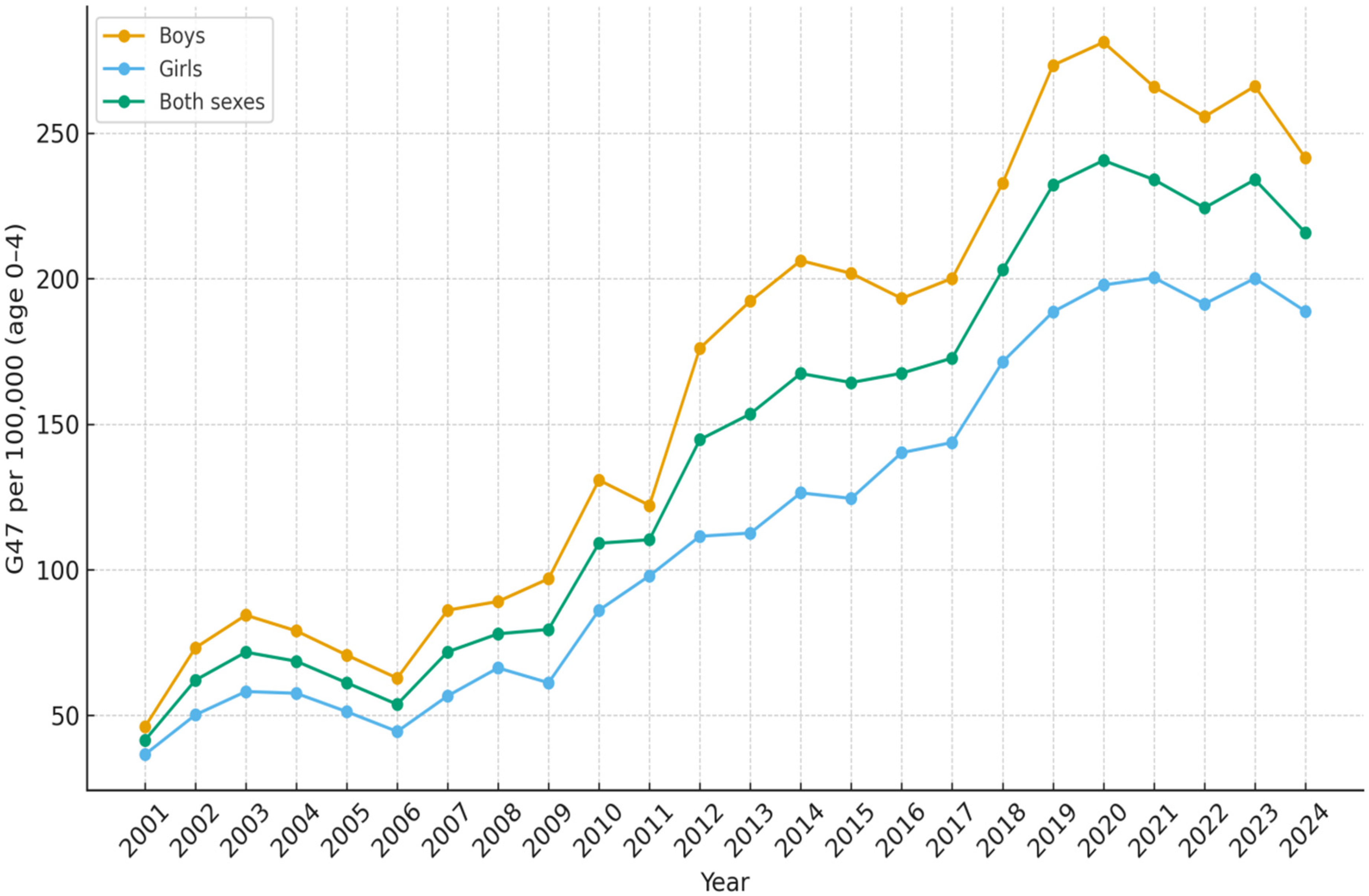
| Year | Number of Patients per 100,000 |
|---|---|
| 2001 | 41.5 |
| 2002 | 62.1 |
| 2003 | 71.7 |
| 2004 | 68.6 |
| 2005 | 61.2 |
| 2006 | 53.8 |
| 2007 | 71.8 |
| 2008 | 78.0 |
| 2009 | 79.5 |
| 2010 | 109.1 |
| 2011 | 110.3 |
| 2012 | 144.7 |
| 2013 | 153.5 |
| 2014 | 167.4 |
| 2015 | 164.3 |
| 2016 | 167.5 |
| 2017 | 172.7 |
| 2018 | 203.0 |
| 2019 | 232.2 |
| 2020 | 240.6 |
| 2021 | 234.0 |
| 2022 | 224.3 |
| 2023 | 234.0 |
| 2024 | 215.8 |
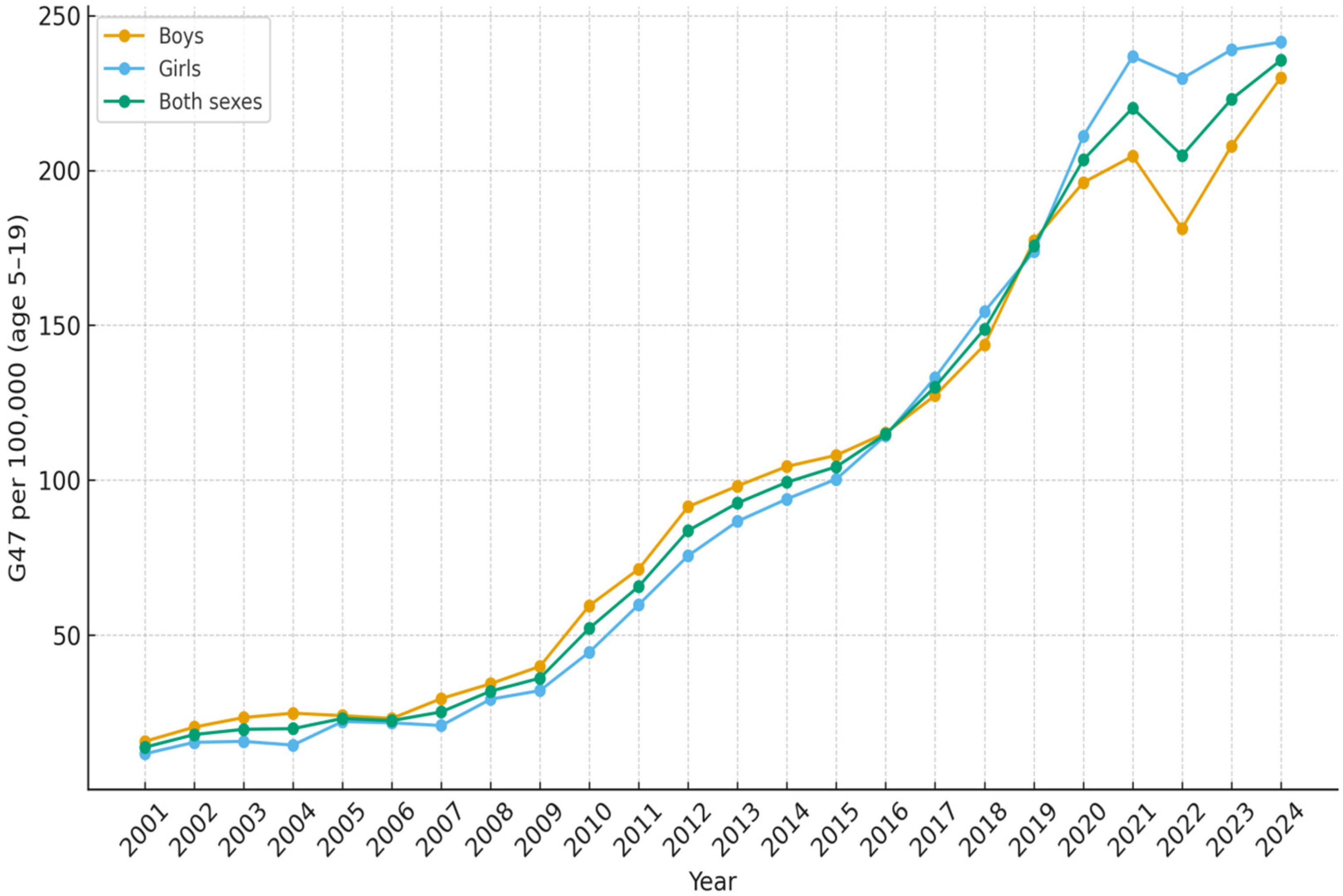
| Year | Number of Patients per 100,000 |
|---|---|
| 2001 | 13.8 |
| 2002 | 17.9 |
| 2003 | 19.6 |
| 2004 | 19.8 |
| 2005 | 23.1 |
| 2006 | 22.4 |
| 2007 | 25.2 |
| 2008 | 31.9 |
| 2009 | 36.1 |
| 2010 | 52.2 |
| 2011 | 65.7 |
| 2012 | 83.7 |
| 2013 | 92.6 |
| 2014 | 99.3 |
| 2015 | 104.3 |
| 2016 | 114.8 |
| 2017 | 130.1 |
| 2018 | 148.8 |
| 2019 | 175.7 |
| 2020 | 203.4 |
| 2021 | 220.2 |
| 2022 | 204.8 |
| 2023 | 223.0 |
| 2024 | 235.6 |
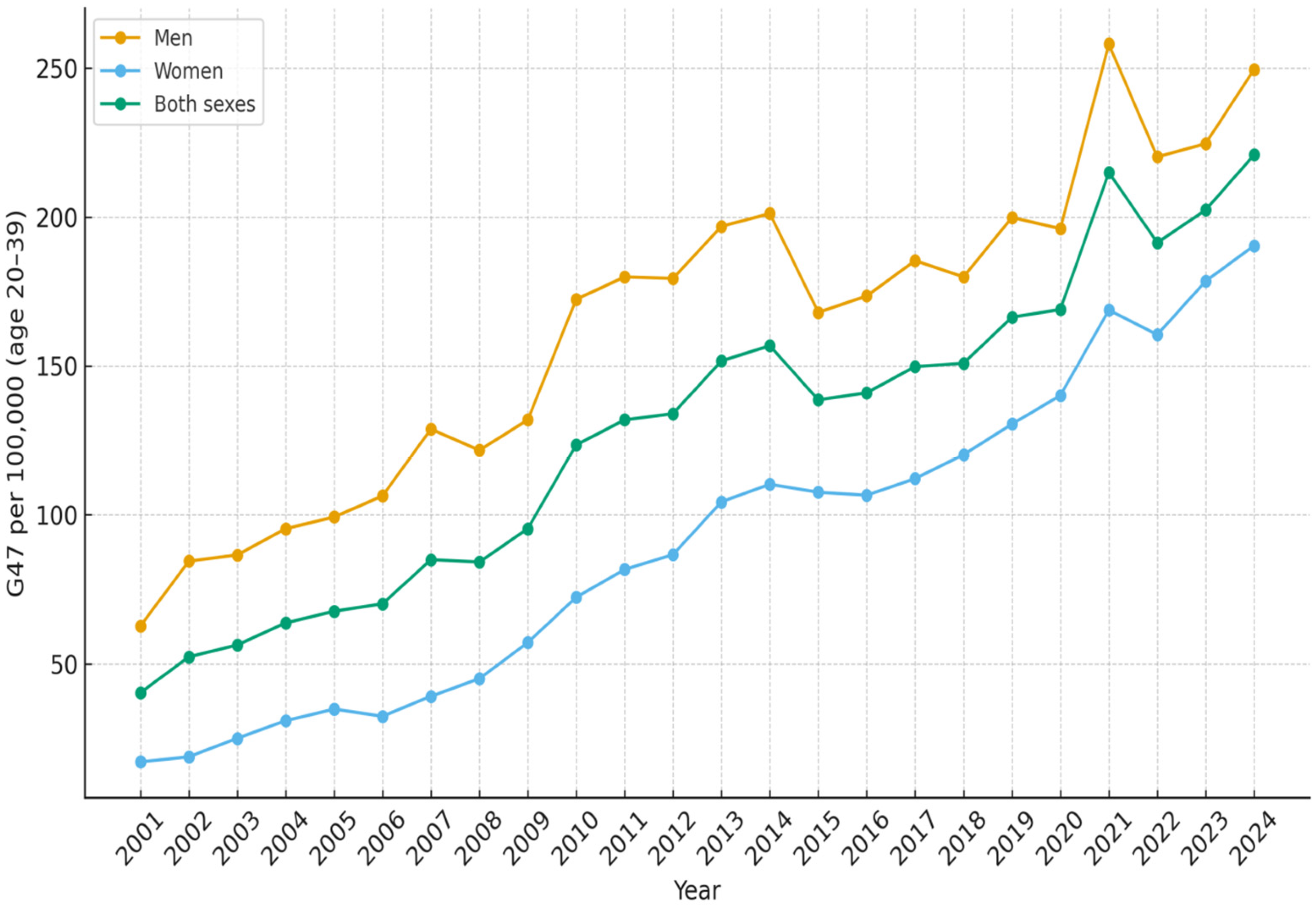
| Year | Number of Patients per 100,000 |
|---|---|
| 2001 | 40.4 |
| 2002 | 52.4 |
| 2003 | 56.4 |
| 2004 | 63.8 |
| 2005 | 67.7 |
| 2006 | 70.2 |
| 2007 | 85.0 |
| 2008 | 84.2 |
| 2009 | 95.4 |
| 2010 | 123.5 |
| 2011 | 131.9 |
| 2012 | 134.0 |
| 2013 | 151.7 |
| 2014 | 156.8 |
| 2015 | 138.6 |
| 2016 | 141.0 |
| 2017 | 149.8 |
| 2018 | 150.9 |
| 2019 | 166.4 |
| 2020 | 169.0 |
| 2021 | 215.0 |
| 2022 | 191.4 |
| 2023 | 202.4 |
| 2024 | 220.9 |
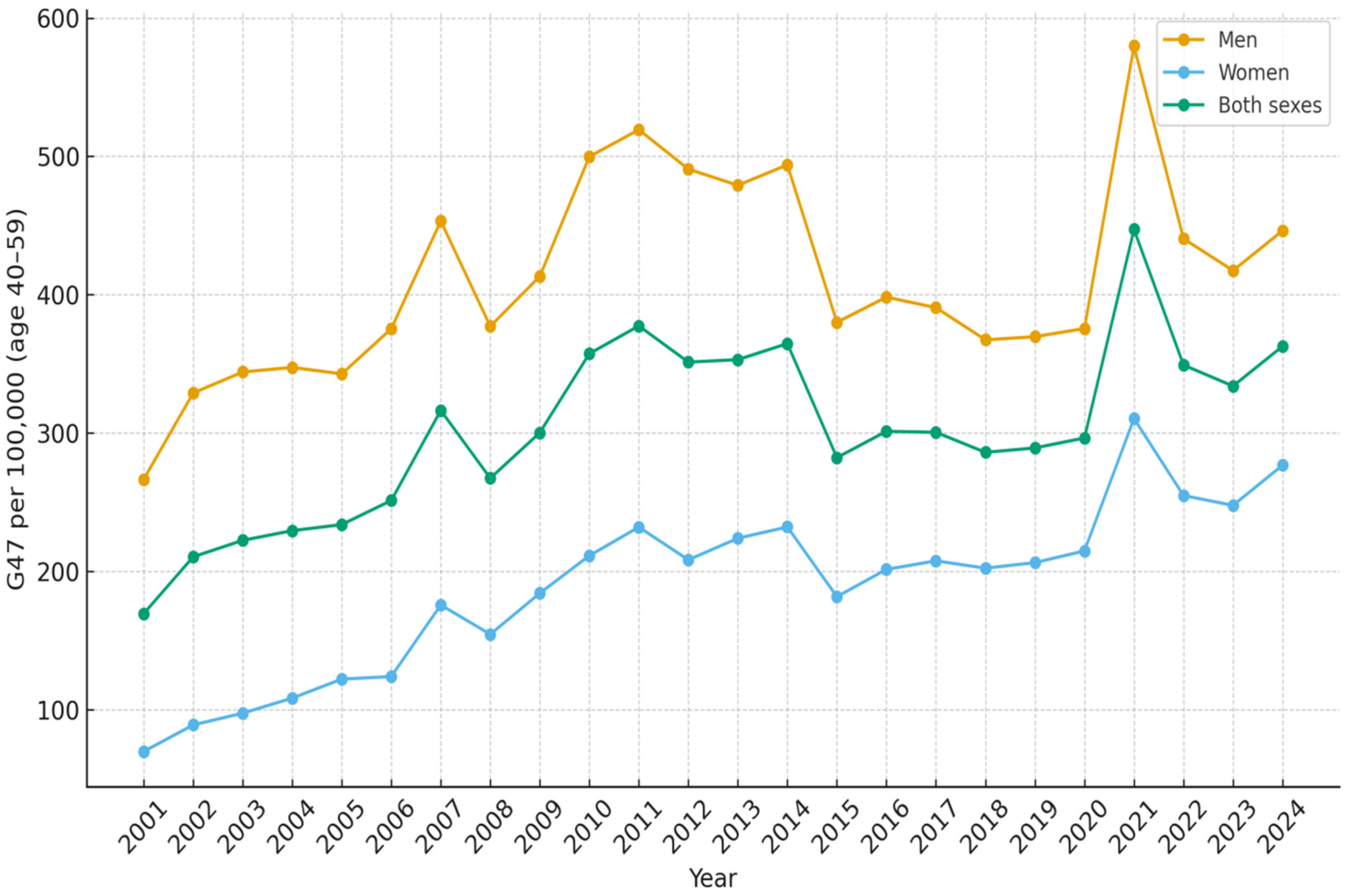
| Year | Number of Patients per 100,000 |
|---|---|
| 2001 | 169.5 |
| 2002 | 210.6 |
| 2003 | 222.5 |
| 2004 | 229.5 |
| 2005 | 233.9 |
| 2006 | 251.3 |
| 2007 | 316.4 |
| 2008 | 267.4 |
| 2009 | 300.3 |
| 2010 | 357.4 |
| 2011 | 377.5 |
| 2012 | 351.3 |
| 2013 | 353.1 |
| 2014 | 364.7 |
| 2015 | 282.3 |
| 2016 | 301.3 |
| 2017 | 300.6 |
| 2018 | 286.1 |
| 2019 | 289.3 |
| 2020 | 296.5 |
| 2021 | 447.2 |
| 2022 | 349.2 |
| 2023 | 334.0 |
| 2024 | 362.8 |
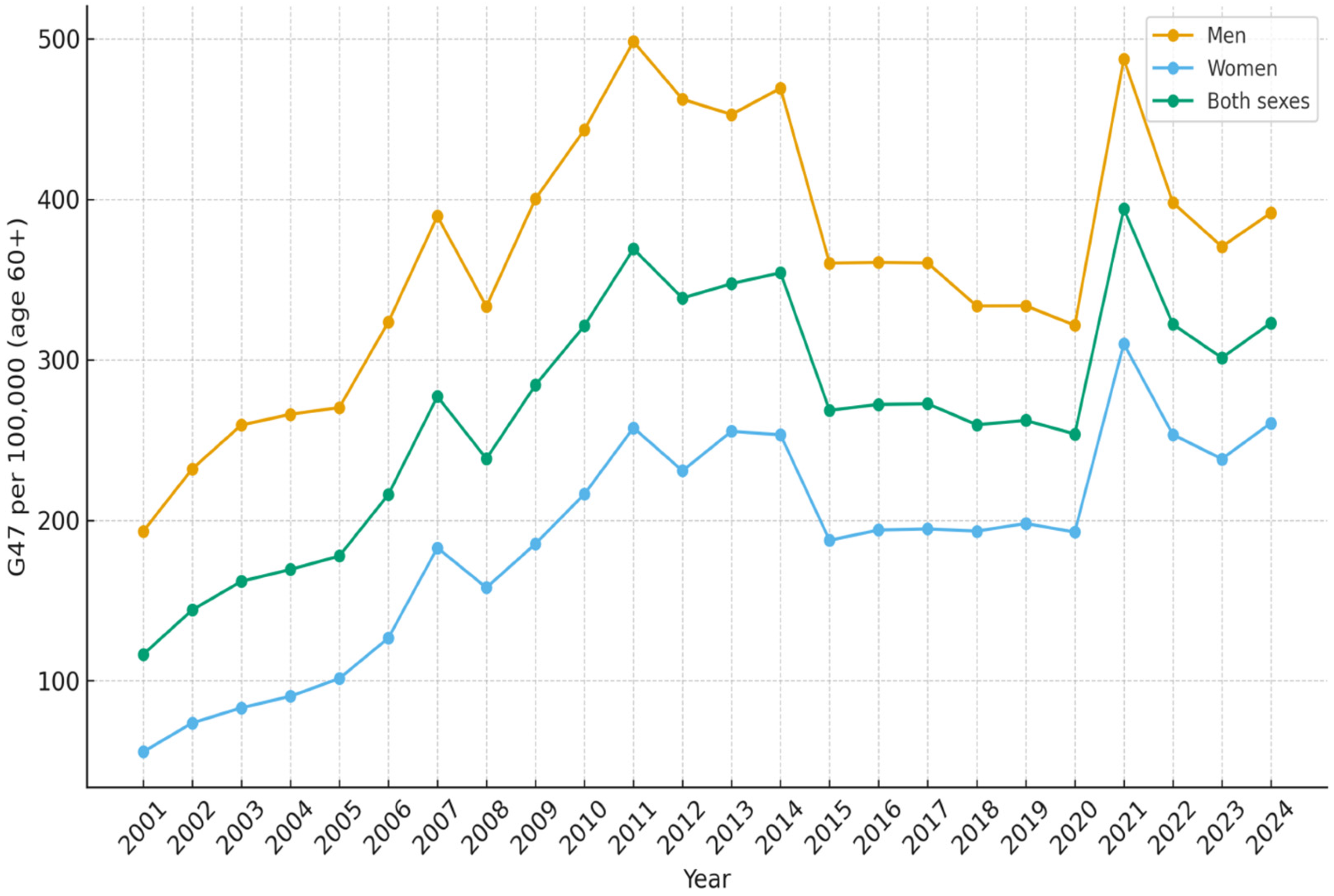
| Year | Number of Patients per 100,000 |
|---|---|
| 2001 | 116.4 |
| 2002 | 144.1 |
| 2003 | 161.9 |
| 2004 | 169.3 |
| 2005 | 177.7 |
| 2006 | 216.0 |
| 2007 | 277.1 |
| 2008 | 238.3 |
| 2009 | 284.2 |
| 2010 | 321.2 |
| 2011 | 369.0 |
| 2012 | 338.4 |
| 2013 | 347.4 |
| 2014 | 354.2 |
| 2015 | 268.5 |
| 2016 | 272.2 |
| 2017 | 272.6 |
| 2018 | 259.5 |
| 2019 | 262.2 |
| 2020 | 253.7 |
| 2021 | 394.1 |
| 2022 | 322.1 |
| 2023 | 301.2 |
| 2024 | 322.9 |
Disclaimer/Publisher’s Note: The statements, opinions and data contained in all publications are solely those of the individual author(s) and contributor(s) and not of MDPI and/or the editor(s). MDPI and/or the editor(s) disclaim responsibility for any injury to people or property resulting from any ideas, methods, instructions or products referred to in the content. |
© 2026 by the authors. Licensee MDPI, Basel, Switzerland. This article is an open access article distributed under the terms and conditions of the Creative Commons Attribution (CC BY) license.
Share and Cite
Nilsson, M.; Hardell, L. Increasing Numbers of Persons with Sleeping Problems in Sweden. Diseases 2026, 14, 25. https://doi.org/10.3390/diseases14010025
Nilsson M, Hardell L. Increasing Numbers of Persons with Sleeping Problems in Sweden. Diseases. 2026; 14(1):25. https://doi.org/10.3390/diseases14010025
Chicago/Turabian StyleNilsson, Mona, and Lennart Hardell. 2026. "Increasing Numbers of Persons with Sleeping Problems in Sweden" Diseases 14, no. 1: 25. https://doi.org/10.3390/diseases14010025
APA StyleNilsson, M., & Hardell, L. (2026). Increasing Numbers of Persons with Sleeping Problems in Sweden. Diseases, 14(1), 25. https://doi.org/10.3390/diseases14010025