


Abstract
This paper proposes a novel three-layer parallel deep neural network (DNN) equalizer that achieves superior performance and resource efficiency compared to conventional decision feedback equalizers (DFEs). Evaluated in a 56 GBd PAM4 transmission system over a 306 mm channel, the proposed equalizer reduces the bit error rate (BER) by an order of magnitude relative to a first-order DFE while matching the performance of a second-order DFE, all with comparable computational complexity. Notably, the parallel architecture accelerates equalization processing without compromising BER performance and fundamentally eliminates the inherent feedback delay element in DFE structures, thereby overcoming a key timing bottleneck of traditional equalizers. Simulation results demonstrate that under similar power constraints, the DNN equalizer achieves higher throughput than its second-order DFE counterpart, highlighting its significant advantages in resource utilization efficiency.
1. Introduction
The rapid development of information technology has driven the emergence of big data, cloud computing, and artificial intelligence, leading to surging demand for large-scale data center construction and higher requirements for high-speed, reliable data transmission capabilities. Against this backdrop, the importance of high-performance channel equalization technology has become increasingly prominent. Although traditional equalizers, such as DFEs [1,2,3] are widely used, they still exhibit significant limitations. DFEs are particularly vulnerable to burst errors, where a single misjudged signal can trigger consecutive error propagation in scenarios with severe inter-symbol interference. Additionally, the structural characteristic of DFEs, which relies on feedback loops combined with delay constraints in the forward path, imposes limitations on transmission rate improvement.
In recent years, researchers have proposed a series of improvement schemes to address DFE limitations. For example, Cheng et al. proposed a low-power 16 Gbps equalizer employing a single adaptive system, which implements DFEs using low-power techniques to enhance energy efficiency. Its data path includes a continuous-time linear equalizer (CTLE) [4,5,6] and a two-tap DFE [7]. Xing et al. proposed a novel adaptive DFE based on the light pattern protection (LPP) algorithm, which ensures consistent convergence direction even under extreme data flow conditions and maintains convergence speed during equalization [8]. Feng’s team developed a high-performance PAM-4 digital equalizer for 64 Gb/s backplane I/O interfaces, featuring a tap-configurable feedforward equalizer (FFE) [9,10,11] and a partially expanded DFE. The DFE processes the last two post-cursors, while the FFE further suppresses noise and crosstalk. The configurable FFE taps enable better adaptation to different channel types [12]. Ahn et al. presented a filtered FFE scheme that shortens the channel impulse response to 2 unit intervals, enabling efficient data recovery with a 1-tap DFE [13]. Despite these improvements, such approaches often introduce higher complexity, computational cost, and potential instability, particularly in time-varying channels.
The application of neural networks in signal equalization represents a paradigm shift in this field. Recent research has begun exploring the potential of neural networks to overcome the inherent limitations of traditional equalizers. For instance, Lilan Wei proposed a deep learning-based equalizer capable of real-time adaptation to channel conditions, significantly improving BER performance [14]. Q Liu et al. investigated a convolutional neural network (CNN)-based blind equalizer for shortwave channels, finding that the convolutional neural network equalizer (CNNE) achieves lower BER than recurrent neural network equalizers (RNNE). Moreover, the characteristics of the classification layer enhance equalization performance at the same Signal-to-Noise Ratio while reducing CNN structural complexity [15]. S Lavania et al. studied neural network-based adaptive channel equalization through simulation analysis of BPSK signal transmission over multiple SUI channels (modeled for fixed wireless applications), demonstrating that RNN equalizers consistently outperform MLP equalizers in BER performance [16]. These studies collectively demonstrate that neural networks offer significant advantages in equalizer construction, particularly in handling complex nonlinear channel distortions, adapting to time-varying conditions, and achieving superior performance with efficient architectural designs.
With advancements in intelligent computing, modern communication systems impose stringent requirements on latency and bit error rate. For instance, Gao et al. proposed a CNN-based time-domain equalizer for visible light communication (VLC) systems, demonstrating significant BER performance improvements [17]. Numerical simulations showed that at 20 dB SNR with 16/32/64-QAM modulation, the equalizer reduces BER from approximately 0.5 to below 1 × 10⁻⁵, well beneath the forward error correction (FEC) limit of 3.8 × 10⁻³.
Neural networks possess tremendous potential for learning from complex channel behavior in a data-driven manner, offering significant advantages. Through training, neural networks can adapt to various channel conditions, providing flexible and robust solutions for equalization challenges. However, the training process requires large amounts of labeled data, and the inference stage demands substantial computational resources, posing challenges for real-time applications.
Despite these challenges, the integration of neural networks in signal equalization offers unique advantages. Their ability to learn from data and adapt to new environments enables them to address various signal distortion problems. Additionally, the parallel processing capability of neural networks can significantly reduce equalization time, making them highly suitable for high-speed data transmission applications.
This paper presents a novel deep parallel neural network equalizer architecture. The equalizer employs a deeply parallel architecture to achieve rapid convergence while incorporating a hard-decision mechanism to maintain hardware-friendly characteristics, significantly reducing implementation costs while improving processing efficiency. Compared to conventional solutions, this design adaptively learns channel characteristics through a data-driven methodology without requiring precise mathematical modeling, effectively compensating for nonlinear distortions in short-distance transmission while maintaining low computational complexity. Simulation results demonstrate that in a 306-mm channel environment, the DNN [18,19,20,21,22,23] equalizer achieves a bit error rate one order of magnitude lower than the first-order DFE (feedback taps is 1) while matching the equalization performance of the second-order DFE (feedback taps is 2), providing an innovative solution that combines high performance and low complexity for data center short-distance interconnects.
Compared with existing neural network equalizers, the proposed architecture offers three key innovations: (1) a parallel input structure that eliminates the feedback timing constraint inherent in DFEs; (2) a hard-decision-oriented output mapping compatible with PAM4 signaling, enabling efficient hardware implementation; and (3) a lightweight three-layer design that achieves second-order DFE performance with significantly reduced resource usage.
2. Deep Neural Network Equalization Technology
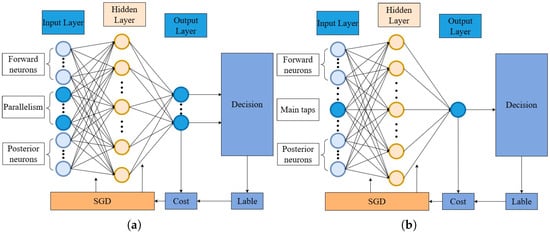
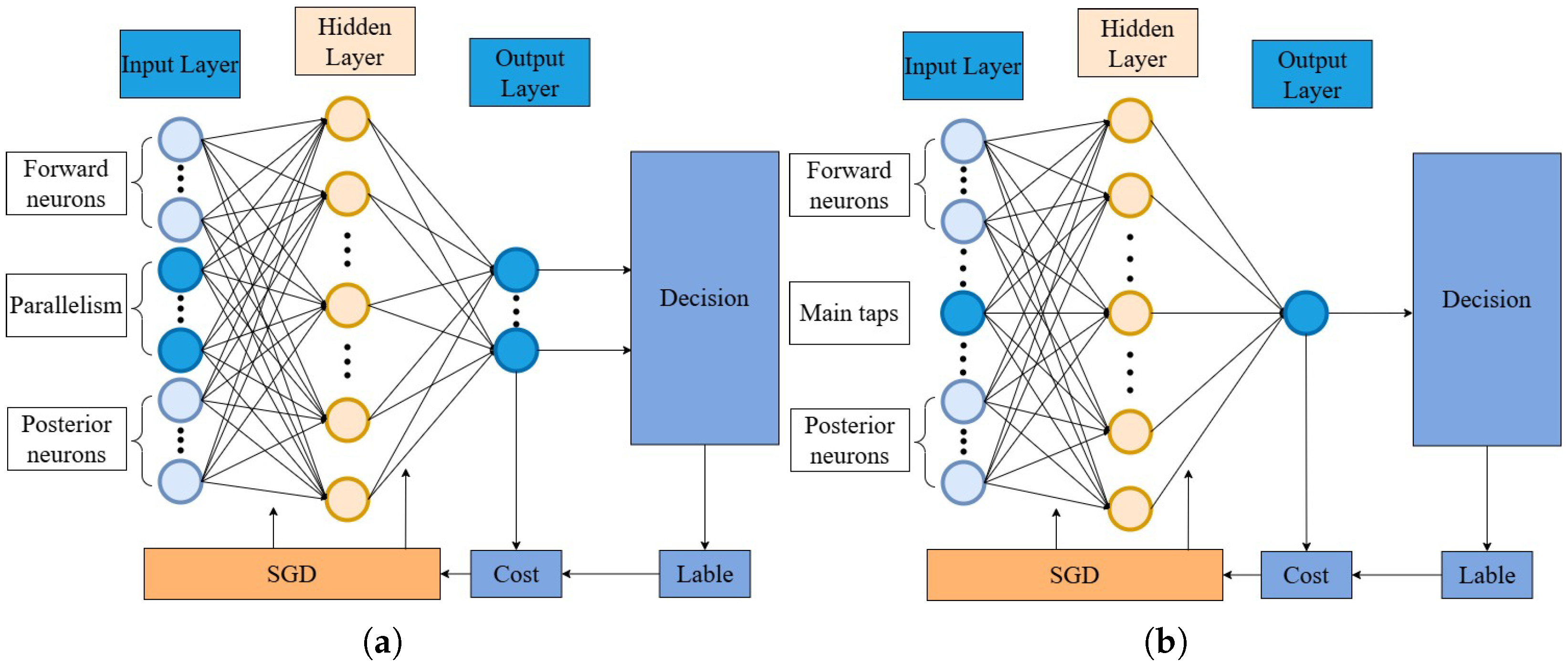
The DNN equalizer architecture developed in this study is illustrated in Figure 1a. The network structure is defined by the number of layers and neurons in each layer. We employ a three-layer neural network architecture where the first layer serves as the input layer with N neurons, the second layer is a hidden layer containing n neurons, and the final layer is the output layer with neurons. This configuration can be expressed as:
where represents the number of pre-cursor neurons, denotes the parallelism degree, and indicates the number of post-cursor neurons.
Figure 1.
(a) Parallelized neural network equalizer architecture. (b) Single-input neural network equalizer architecture.
Figure 1b illustrates a single-input neural network architecture capable only of single-path data transmission, unlike the parallel signal transmission capability shown in Figure 1a. The key advantage of Figure 1a over Figure 1b is that with the same number of input layer neurons, the parallel architecture supports multiple simultaneous transmissions, significantly reducing transmission time.
The adoption of a three-layer DNN architecture is grounded in both theoretical and practical considerations. While a single hidden layer structure theoretically possesses sufficient channel response inversion capability when adequately expanded, such configuration often leads to parameter inefficiency and overfitting risks. Our three-layer design enables more efficient hierarchical feature extraction: the first hidden layer captures fundamental distortion characteristics, while subsequent layers perform nonlinear combination of these features for final decision-making. This architecture achieves superior balance between model capacity, training stability, and generalization performance compared to an excessively wide single-layer network. Simulation results demonstrate that our approach maintains competitive computational efficiency while achieving bit error rate performance comparable to second-order DFEs, providing reliable signal recovery assurance for high-speed communication systems.
The network receives parallel quantized digital signals from the ADC module into the input layer. To enhance detection accuracy, the equalizer simultaneously processes input signals as pre-cursor and post-cursor signal components. Due to the fully connected nature between layers, intermediate symbols incorporate more pre- and post-cursor information than explicitly defined by and . The output layer, as the final network layer, contains neurons to efficiently process multiple parallel signals leveraging the neural network’s parallelized structure.
The hidden and output layers can be viewed as arrays of neurons. Activations are computed by summing weighted inputs and bias terms, followed by application of a nonlinear function to obtain the neuron output y.
where is the weight vector, represents the input vector, b denotes the bias term, and the superscript T indicates matrix or vector transpose. For the jth neuron in the m-layer, its output is calculated as:
In vector form, this expression becomes:
where represents the weight matrix of the mth layer and is the corresponding bias vector. The nonlinear function , known as the activation function, enables neural networks to handle highly complex data representations beyond simple linear mappings. For our three-layer DNN structure, we employ the ReLU function in the hidden layer and the Sigmoid function in the output layer.
The activation functions used in this study are defined as follows.
The choice of activation functions directly impacts both engineering implementation complexity and system performance. While linear activation functions offer computational simplicity, they cannot effectively handle nonlinear distortions in communication channels. This study adopts an engineering practical nonlinear activation function scheme: the hidden layer employs the ReLU function, whose piecewise linear characteristics ensure nonlinear representation capability while facilitating hardware implementation; the output layer utilizes the Sigmoid function to compress output values to the range, directly meeting the requirements of subsequent decision circuits. This scheme requires only minimal logic resources in hardware implementation, maintaining nonlinear processing capability while satisfying the low-latency demands of real-time processing, thereby providing an optimized solution for hardware deployment of equalizers.
After the DNN signal output, each symbol is determined by a decision function. In this study, the PAM4 modulation format is adopted, with symbol levels set to . This level selection is based on the principle of equal minimum Euclidean distance between symbols, where the spacing between adjacent symbols is uniformly 2, ensuring balanced bit error performance under additive white Gaussian noise channels. Since the output layer of the DNN employs a Sigmoid activation function, the output values are constrained to the interval . To map the continuous outputs to discrete symbols, the decision thresholds are set based on the principle of uniform quantization, as defined in Equation (8):
where a represents the output value of the neural network.
These thresholds evenly divide the output interval into four subintervals, each corresponding to one of the four PAM4 symbols. In hardware implementation, the two most significant bits of the DNN output value are directly taken to efficiently map the four decision results of 0, 1, 2, and 3. This mapping corresponds to natural binary coding, eliminating the need for additional multiplication or comparison operations and effectively reducing hardware overhead.
In the BER calculation, natural binary coding is used to map binary bits to PAM4 symbols. Compared with NRZ coding, PAM4 modulation requires only half the baud rate and Nyquist frequency to achieve the same data transmission rate. Based on the three-layer DNN structure, a hard-decision detection scheme is adopted, which significantly reduces computational overhead by simplifying the hardware architecture, thereby providing a solid foundation for hardware implementation.
In this work, the neural network is trained using the Mean Squared Error (MSE) as the loss function to quantify the discrepancy between the network output and the expected output , as shown in Equation (9):
where denotes the squared Euclidean norm. To minimize the loss function, the backpropagation algorithm is employed to compute the gradients of the network parameters, and the stochastic gradient descent (SGD) algorithm is used for parameter updates [24]. The update rules for weights and biases are given in Equations (10) and (11):
During training, the learning rate is fixed at , and the regularization parameter is set to for L2 regularization to prevent overfitting. The model is trained using mini-batches with a batch size of 1024, i.e., each batch contains 1024 samples, and each sample consists of features.
The training adopts an early stopping mechanism to control the number of iterations. After each training epoch, the bit error rate (BER) on the validation set is computed. Training terminates when the validation BER falls below a preset threshold or when the number of epochs reaches a preset upper limit.
3. Experimental Simulation
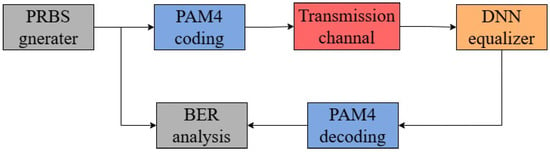
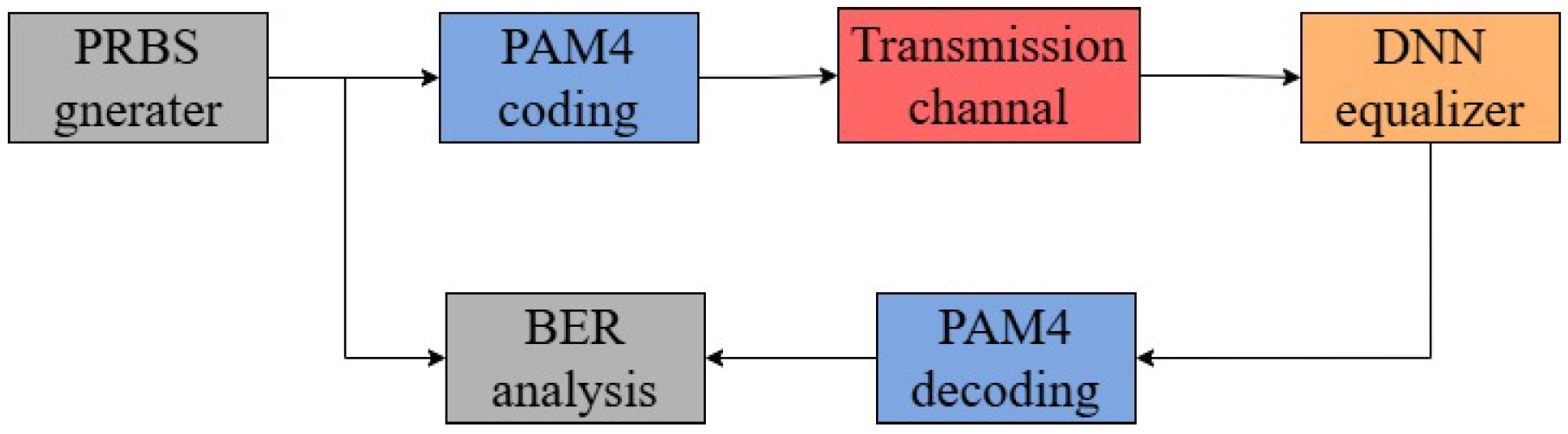
The experimental platform utilized in this study is MATLAB R2020b. The experimental procedure involves signal synchronization using a pseudo-random bit sequence (PRBS). The complete simulation setup is illustrated in Figure 2.
Figure 2.
Setup and structure of the simulation system.
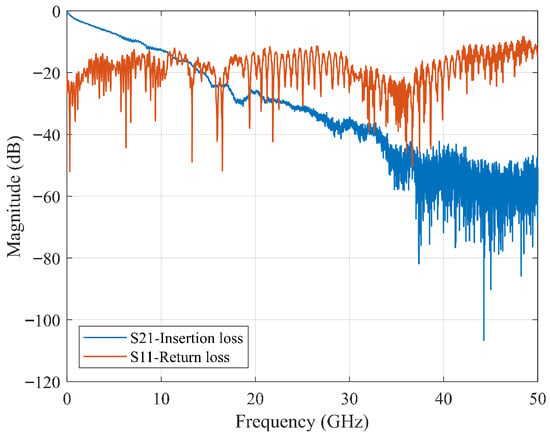
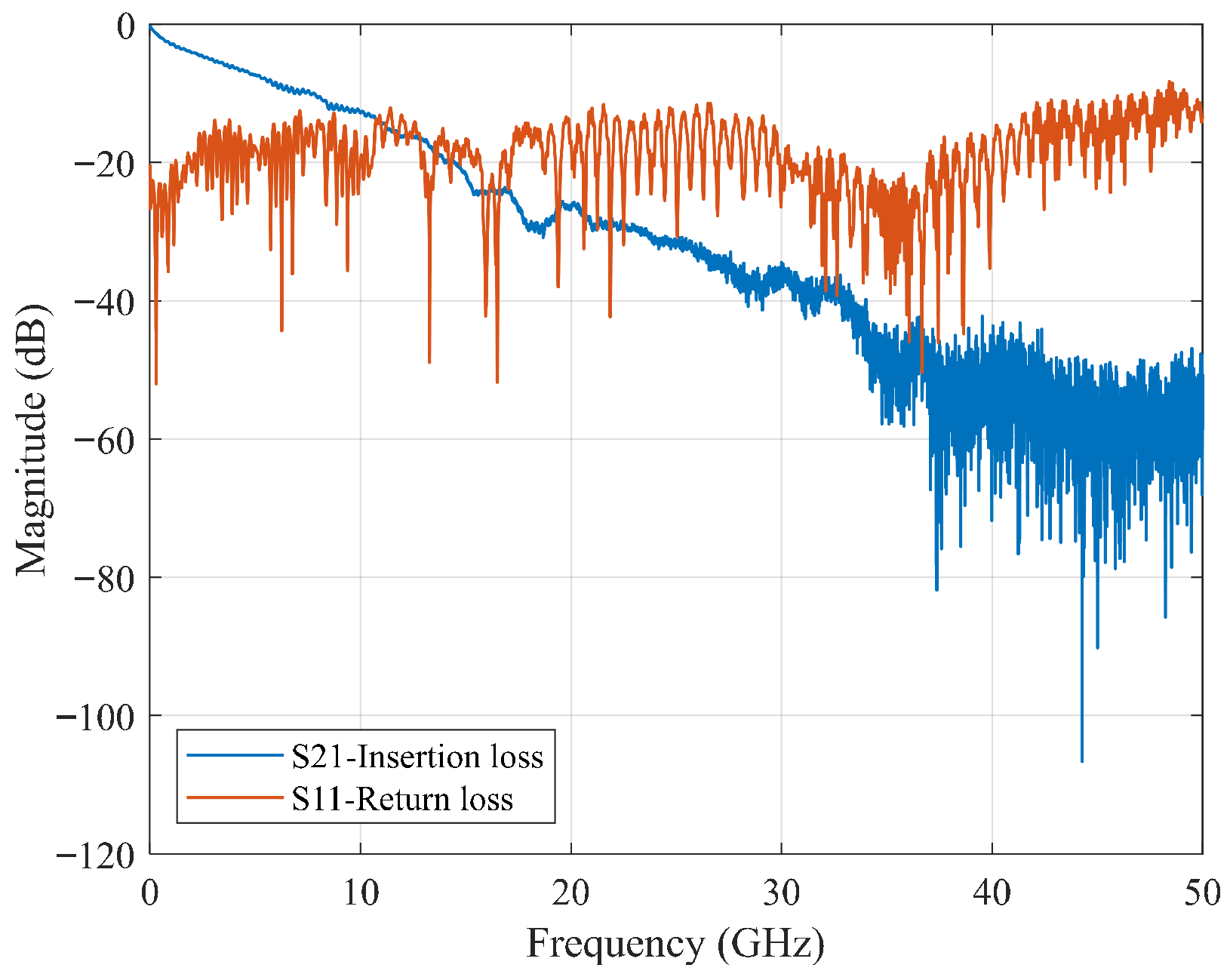
In this study, a channel model is established based on a four-port S-parameter file (306mm.s4p) (Figure 3). The S-parameter data are first read, and frequency-domain analysis is conducted to characterize the channel’s insertion loss () and return loss (). A rational function approximation is then applied to fit the S21 parameter, with the delay factor set to 0.98 to enhance model stability, resulting in a pole-residue frequency-domain analytical model of the channel. Subsequently, an arbitrary input signal is combined with the obtained rational function model, and time-domain response simulation is performed to compute the output waveform after the signal traverses the channel. This approach enables accurate time-domain modeling and signal integrity assessment for high-speed interconnect channels.
Figure 3.
Insertion loss and return loss of simulated channel with a 306 mm Megtron7N PCB traces and two connectors.
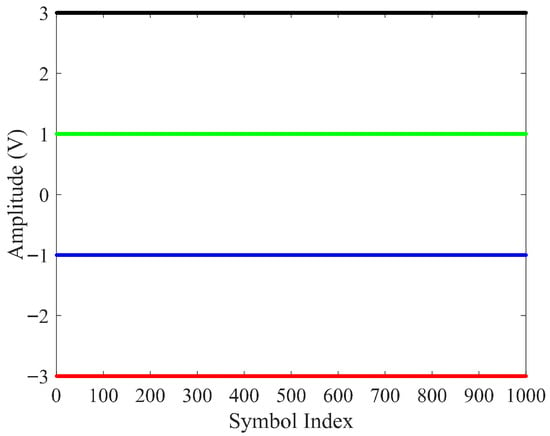
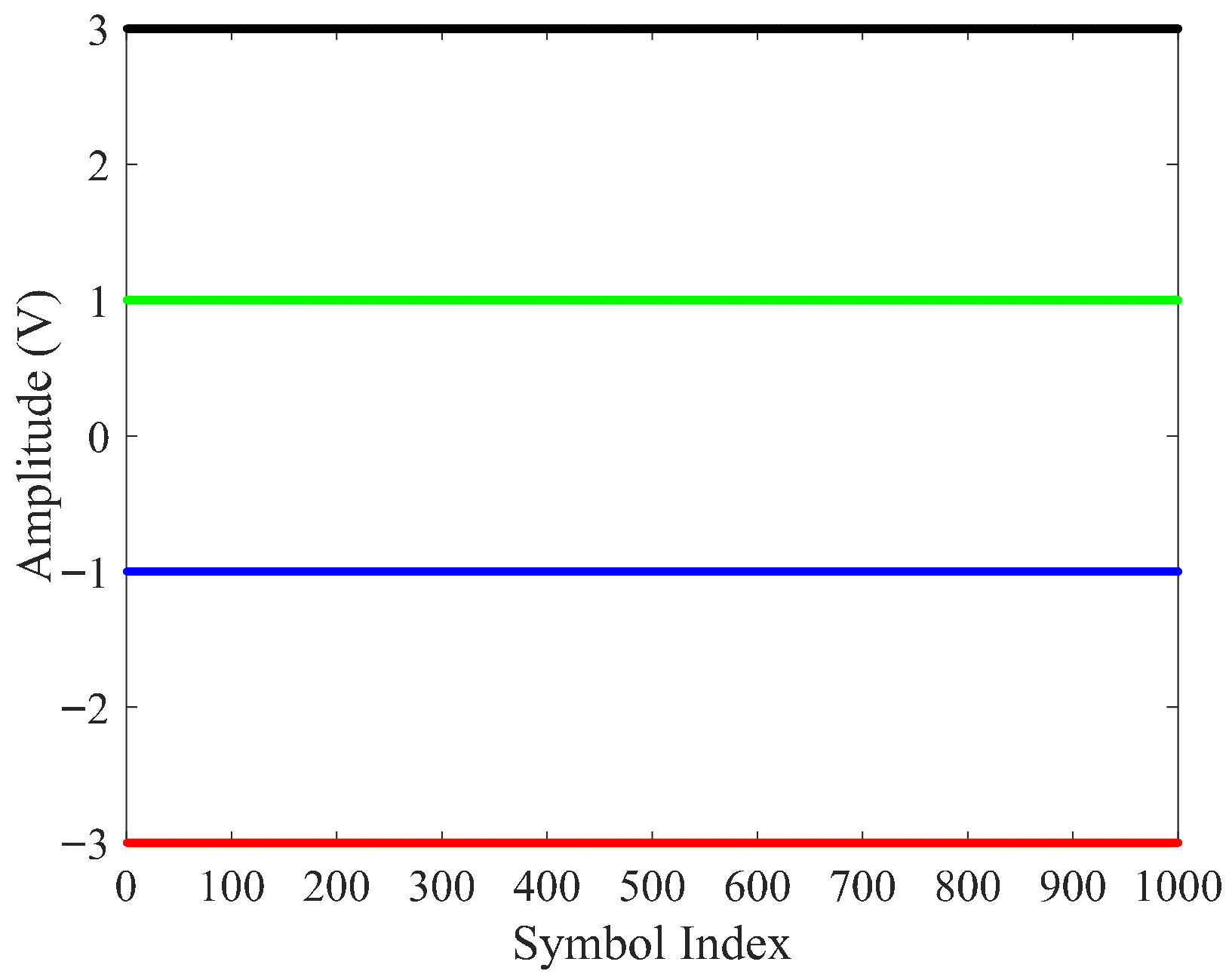
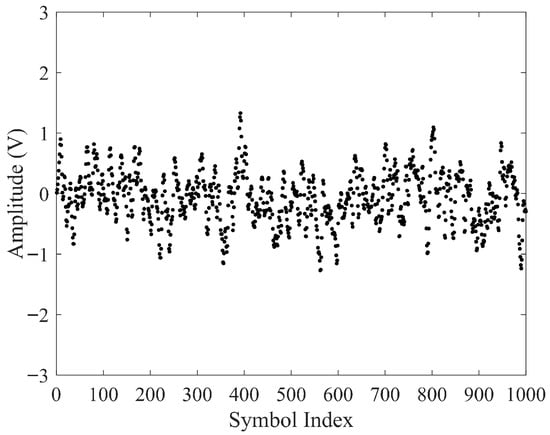
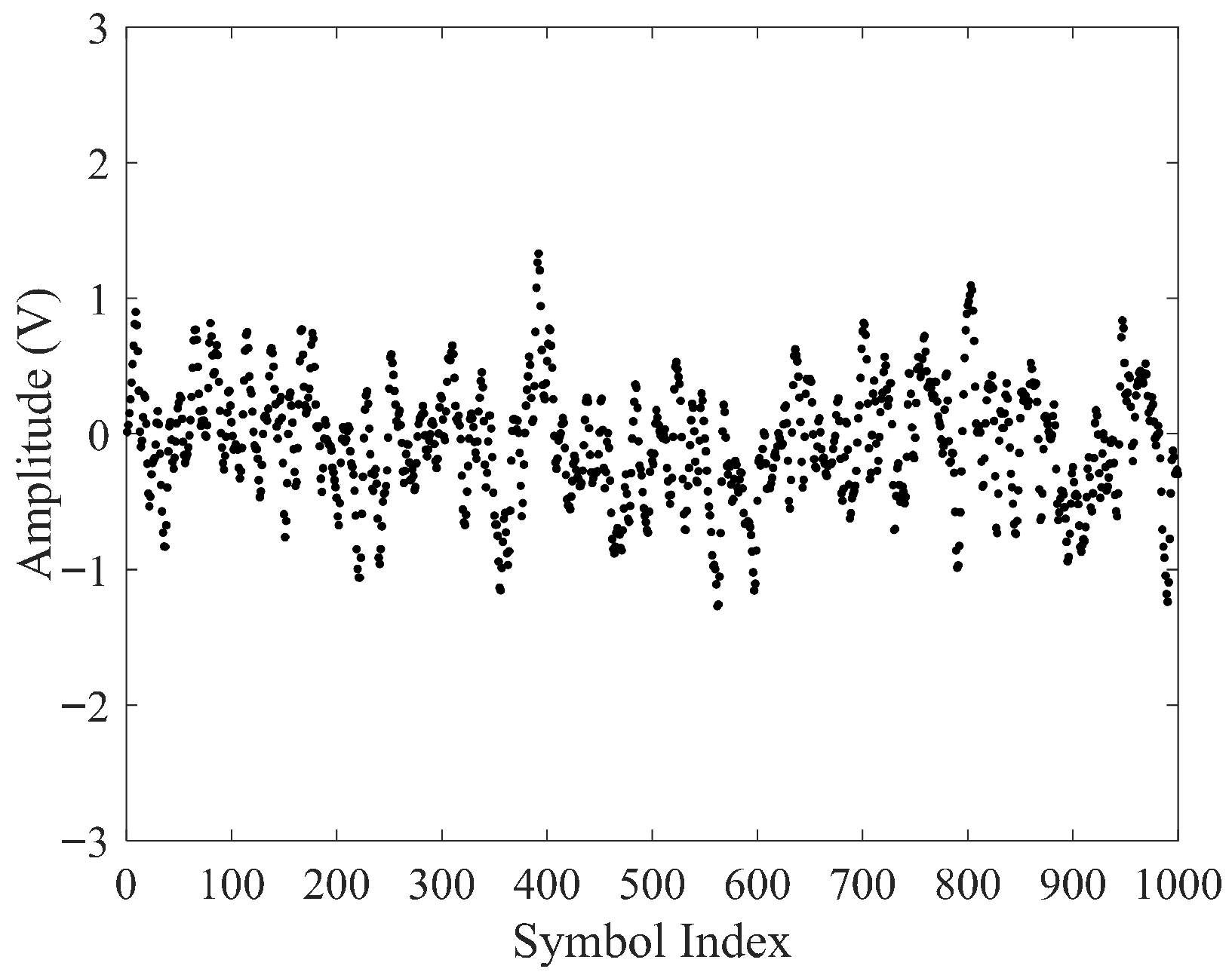
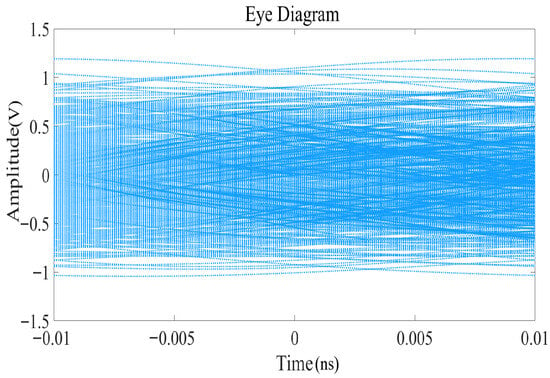
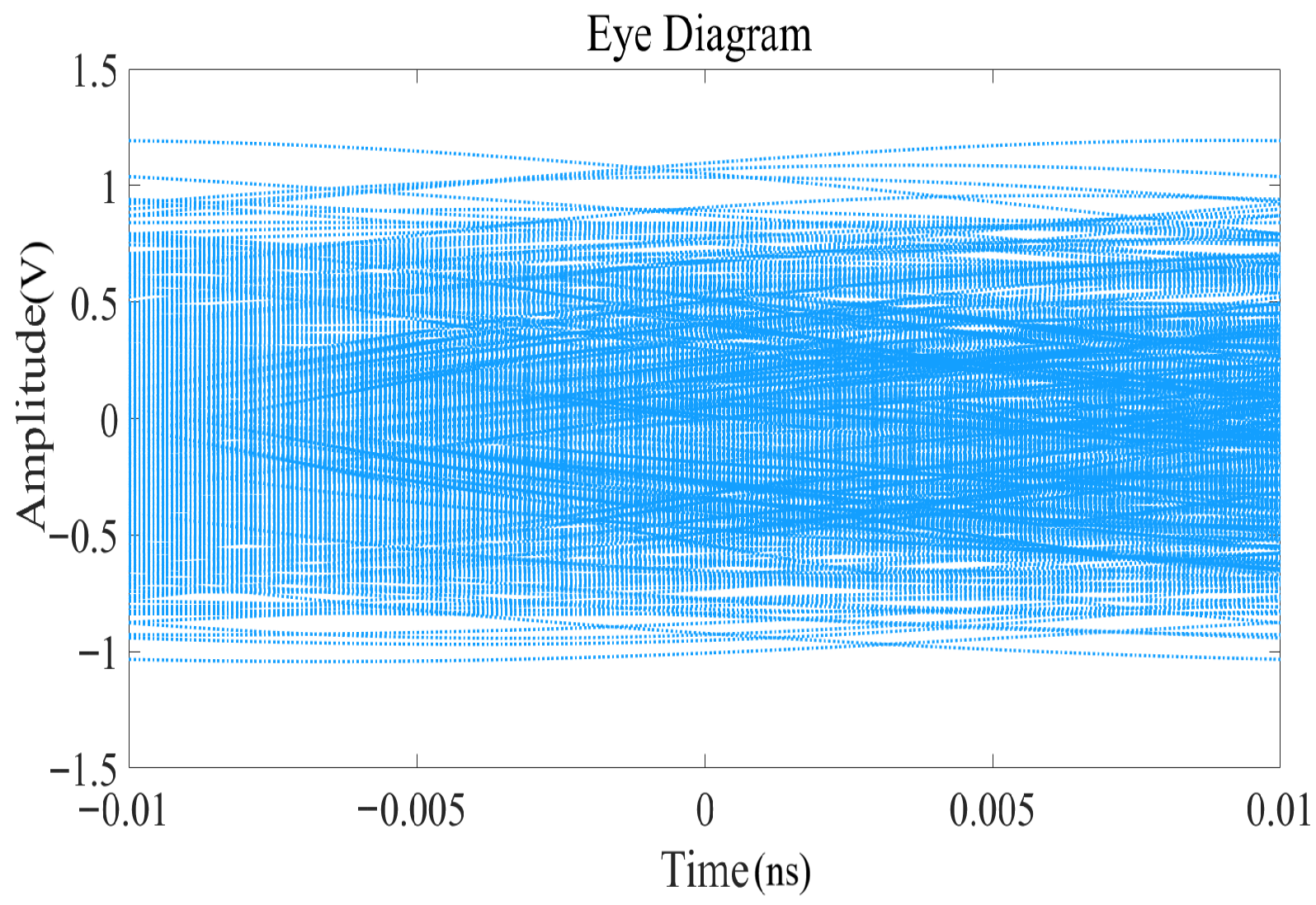
As shown in the scatter plots and eye diagrams in Figure 4, Figure 5 and Figure 6, high-frequency insertion loss causes severe degradation of transmission signal quality. Specifically, Figure 4 displays the scatter plot of the original PAM4 signal, while Figure 5 and Figure 6 clearly demonstrate the significant signal distortion after channel transmission. To address the challenges of time-varying channel characteristics, this study employs an online adaptive DNN equalizer that utilizes decision-generated labels as training data to achieve real-time fine-tuning of network parameters. This decision-directed adaptive mechanism enables the equalizer to dynamically track channel variations, effectively compensate for signal distortion, and thus maintain optimal equalization performance consistently.
Figure 4.
Input Signal Scatter Plot.
Figure 5.
Output signal scatter plot.
Figure 6.
Output eye diagram of the signal.
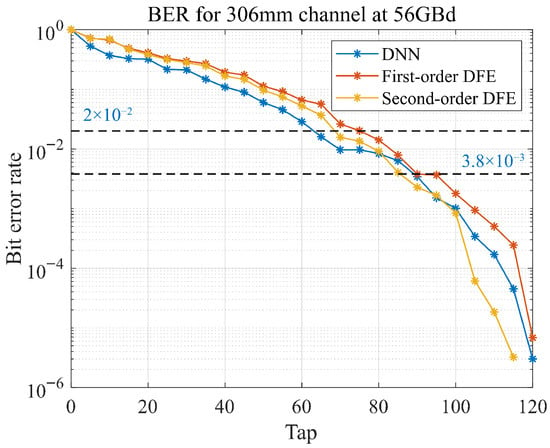
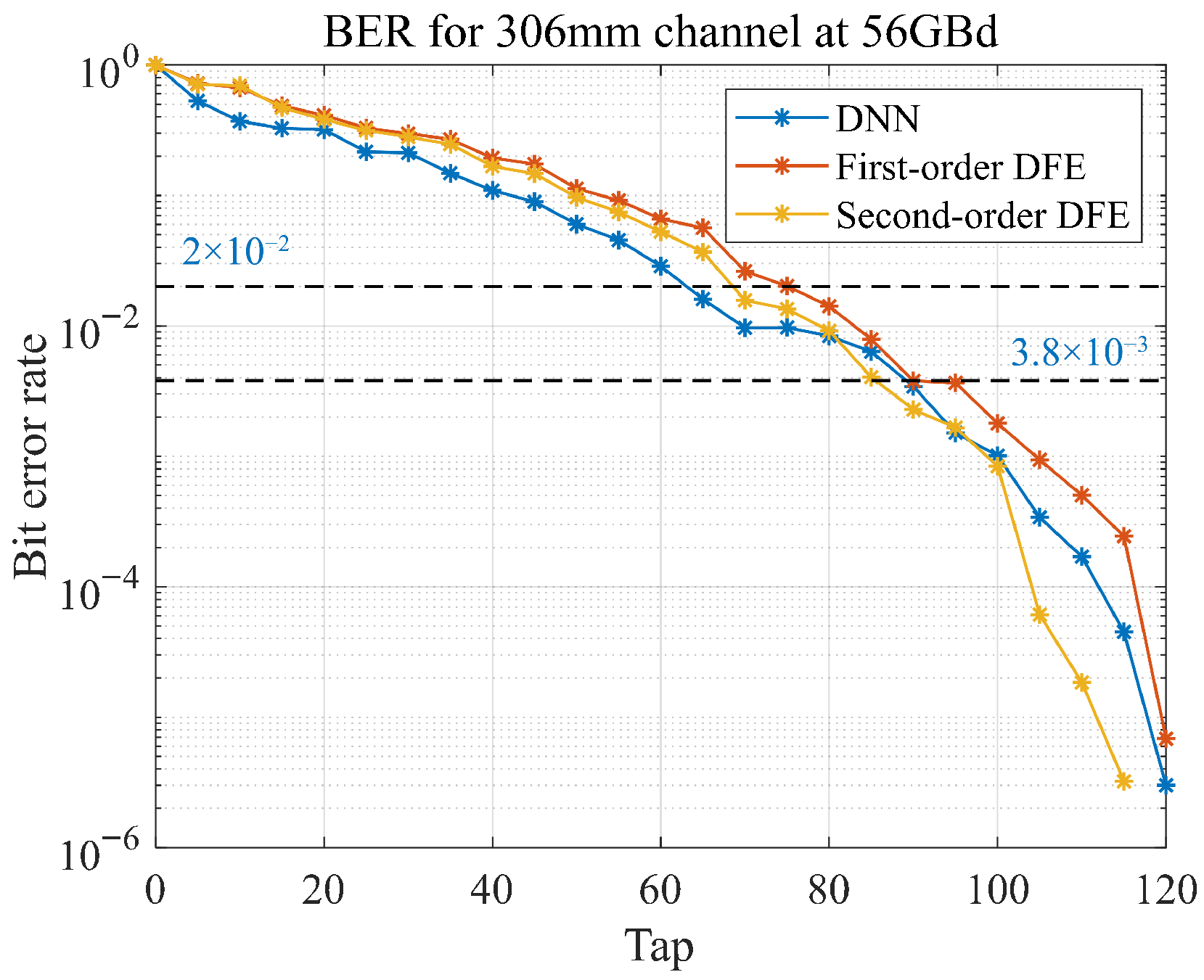
In tests with 56 GBd PAM4 signals (Figure 7), the DNN equalizer configured with only one degree of parallelism and one hidden neuron achieves a bit error rate two orders of magnitude lower than first-order DFEs with an equivalent number of taps, while performing on par with second-order DFEs. This indicates that even with a minimal parallel structure and simple hidden layer design, the DNN equalizer can reach the equalization level of second-order DFEs.
Figure 7.
The convergence process of 56GBd PAM4 encoding, DNN with first-order DFE and second-order DFE at the same number of taps.
Compared to traditional DFEs, the proposed parallel DNN equalizer not only eliminates the timing constraints associated with feedback loops, theoretically supporting unlimited channel rates, but also achieves higher resource utilization efficiency and faster convergence speed through its parallel architecture, providing an effective solution for high-speed data communication systems.
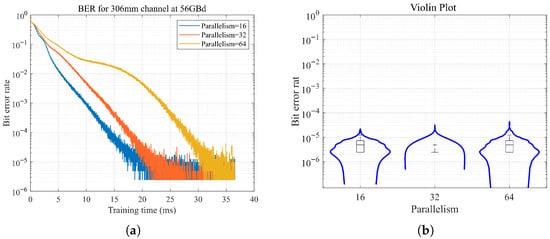
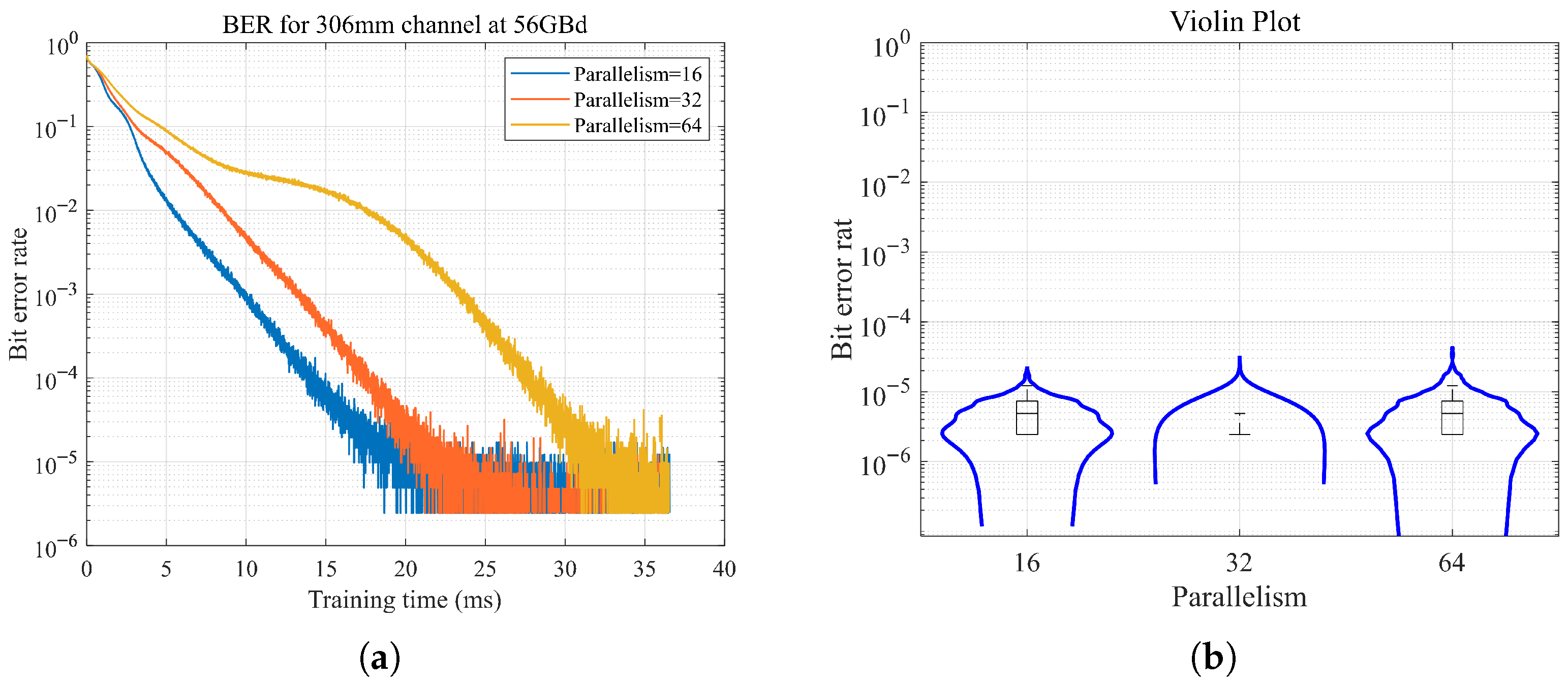
Based on the simulation results presented above, the proposed parallel DNN equalizer demonstrates significant advantages in high-speed channel transmission. As shown in Figure 8, the equalizer successfully achieves effective equalization of 64-bit data streams, addressing the issue of information insufficiency during equalization through increased parallelism while substantially improving processing speed. Figure 8b indicates that at a parallelism degree of 64, the minimum bit error rate reaches the order of , comparable to the performance of second-order DFEs. This confirms that even under high parallelism conditions, excellent equalization performance can be maintained through structural optimization.
Figure 8.
(a) The convergence process of 56GBd PAM4 encoding and DNN at different parallelisms. (b) Violin plot with low BER.
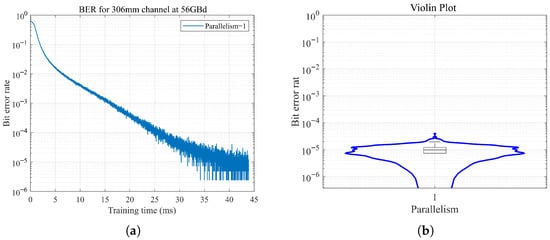
The comparison of convergence characteristics in Figure 8 and Figure 9 shows that the parallel input equalizer supports simultaneous processing of multiple signals and achieves a significantly faster convergence speed than the single-input structure. The simulation results indicate that the 64-bit parallel configuration converges at 35 ms, whereas the single-input counterpart converges at 40 ms; therefore, the 64-bit parallel configuration converges 5 ms faster than the single-input structure. Comparing the 16-bit parallel structure with the single-input structure, it not only converges faster but also requires only 34 hidden layer neurons, while the single input requires 64 neurons, reducing the number of neurons needed in the hidden layer by 30. These results highlight the dual advantages of the parallel scheme in resource utilization and convergence speed, demonstrating its potential for high-speed hardware implementation under practical constraints such as inference latency and memory bandwidth.
Figure 9.
(a) The convergence process of 56GBd PAM4 encoding and DNN under a parallelism of 1. (b) Violin plot with low BER.
4. Conclusions
This paper has presented a high-speed channel equalizer based on a parallel three-layer DNN. Simulation results confirm that the proposed equalizer achieves a bit error rate comparable to a second-order DFE in a 56 GBd PAM4 system, while its parallel architecture effectively overcomes the timing constraints of DFE feedback loops and significantly boosts processing throughput. Furthermore, the design demonstrates superior convergence speed and resource utilization compared to single-input DNN equalizers. These attributes make it a highly promising solution for next-generation high-speed data links.
Despite the promising results, several challenges remain for practical deployment. Future work will prioritize the hardware implementation of the equalizer, focusing on optimizing its computational complexity and power efficiency. We also plan to explore more advanced adaptive algorithms to enhance its robustness in rapidly time-varying channels. Investigating hybrid architectures that fuse neural networks with classical signal processing techniques may offer a path to further reduce computational overhead. Finally, extending the approach to support higher-order modulation formats and multi-channel scenarios will be a critical step toward widespread adoption.
Author Contributions
Conceptualization, S.D.; methodology, D.H. and Z.L.; validation, D.H. and Z.L.; investigation, D.H.; resources, S.D.; data curation, D.H.; writing—original draft preparation, D.H.; writing—review and editing, S.D. and Z.L.; supervision, Z.L.; project administration, S.D. All authors have read and agreed to the published version of the manuscript.
Funding
This research was funded by the National Key Research and Development Program of China 2021YFB2206600, National Natural Science Foundation of China (No. 62471177, 62001163, 62234008), Natural Science Foundation of Hunan Province (2022JJ30160, 2023JJ30168), Special Funds for the Construction of Innovative Provinces in Hunan Province (2022SK2007, 2023GK2062, 2023GK2071), Scientific Research Project of Education Department of Hunan Province 21A0012 and Changsha Science and Technology Project KH2202001.
Data Availability Statement
The datasets used and/or analyzed during the current study are available from the corresponding author upon reasonable request.
Conflicts of Interest
The authors declare no conflicts of interest.
References
- Kang, Y.; Yu, S.M.; An, J.; Choi, W.; Song, J. A 28Gb/s Quad-Rate 1-FIR 2-IIR DFE with 20dB Loss Compensation in 65nm CMOS Process. In Proceedings of the 2021 International Conference on Electronics, Information, and Communication (ICEIC), Singapore, 31 January–3 February 2021; pp. 1–4. [Google Scholar] [CrossRef] [Scilit]
- Choi, J.; Choi, Y.; Park, H.; Sim, J.; Kwon, Y.; Park, S.; Kim, S.; Kim, C. A 16-Gb/s NRZ Receiver With 0.0019-pJ/bit/dB 1-Tap Charge-Redistribution DFE. IEEE Trans. Circuits Syst. II Express Briefs 2023, 70, 904–908. [Google Scholar] [CrossRef] [Scilit]
- Roy, S. Decision Feedback Equalizer (DFE) Modeled as a Linear Transversal Filter. In Proceedings of the 2022 IEEE North Karnataka Subsection Flagship International Conference (NKCon), Vijaypur, India, 20–21 November 2022; pp. 1–3. [Google Scholar] [CrossRef] [Scilit]
- Zheng, J.; Shi, T.; Wang, J.; Zou, Q.; Ren, M. A 16Gbps Programmable CTLE Design with Adjustable Gain. In Proceedings of the 2023 3rd International Conference on Electronic Information Engineering and Computer Science (EIECS), Changchun, China, 22–24 September 2023; pp. 220–225. [Google Scholar] [CrossRef] [Scilit]
- Wang, G.; Zhang, Z. A 64-Gb/s 0.33-pJ/bit PAM4 Receiver Analog Front-End with a Single-Stage Triple-Peaking CTLE Achieving 22.5-dB Boost in 40-nm CMOS Process. Integr. Circuits Syst. 2024, 1, 103–108. [Google Scholar] [CrossRef] [Scilit]
- Zhang, C.; Xu, Y.; Zhang, X.; Wang, H. 50Gb/s High-Speed Serial Interface Receiver CTLE Equalization Circuit Design. In Proceedings of the 2023 8th International Conference on Integrated Circuits and Microsystems (ICICM), Nanjing, China, 20–23 October 2023; pp. 417–421. [Google Scholar] [CrossRef] [Scilit]
- Cheng, K.H.; Chang, C.Y.; Huang, H.Y.; Shih, Y.T. A Low Power 16 Gbps CTLE and Quarter-Rate DFE with Single Adaptive System. In Proceedings of the 2023 30th IEEE International Conference on Electronics, Circuits and Systems (ICECS), Istanbul, Turkey, 4–7 December 2023; pp. 1–4. [Google Scholar] [CrossRef] [Scilit]
- Xing, S.; Lin, C.; Li, Y.; Wang, H. An Adaptive DFE Using Light-Pattern-Protection Algorithm in 12 NM CMOS Technology. In Proceedings of the ICASSP 2023—2023 IEEE International Conference on Acoustics, Speech and Signal Processing (ICASSP), Rhodes Island, Greece, 4–10 June 2023; pp. 1–5. [Google Scholar] [CrossRef] [Scilit]
- Zhang, C.; Song, R.; Wang, H.; Xu, Y. A Low-Power 40Gb/s PAM4 Transmitter with High Speed-Latch and 3-Tap FFE. In Proceedings of the 2023 5th International Conference on Circuits and Systems (ICCS), Huzhou, China, 27–30 October 2023; pp. 175–180. [Google Scholar] [CrossRef] [Scilit]
- Shin, W.; Seo, H.; Lee, S.; Choi, D.H.; Kwak, Y.H.; Won, S.J.; Han, J. A Variation-Tolerant Voltage-Mode Transmitter with 3+1 Tap FFE in 28-nm CMOS. IEEE Trans. Circuits Syst. II Express Briefs 2024, 71, 1819–1823. [Google Scholar] [CrossRef] [Scilit]
- Zhang, D.; Wang, S.; He, P.; Zhang, M.; Liu, D. Joint FFE and Error-Based-FFE Algorithm for 100 Gb/s Bandwidth-Limited IMDD Optical System. In Proceedings of the 2022 Asia Communications and Photonics Conference (ACP), Shenzhen, China, 5–8 November 2022; pp. 733–736. [Google Scholar] [CrossRef] [Scilit]
- Feng, X.; Chen, Y.; Gu, Y.; Wu, J. A 64Gb/s PAM-4 Digital Equalizer with Tap-Configurable FFE and Partially Unrolled DFE in 28nm CMOS. In Proceedings of the 2022 IEEE International Conference on Integrated Circuits, Technologies and Applications (ICTA), Xi’an, China, 28–30 October 2022; pp. 162–163. [Google Scholar] [CrossRef] [Scilit]
- Ahn, C.; Hong, J.; Shin, J.; Kim, B.; Sim, J.Y. An 18-Gb/s NRZ Transceiver with a Channel-Included 2-UI Impulse-Response Filtering FFE and 1-Tap DFE Compensating up to 32-dB Loss. IEEE Trans. Circuits Syst. II Express Briefs 2020, 67, 2119–2123. [Google Scholar] [CrossRef] [Scilit]
- Wei, L. Deep Learning Algorithm Based Channel Equalization Method for Optical Communication System. Laser J. 2023, 44, 155–160. (In Chinese) [Google Scholar]
- Liu, Q.; Sun, W.; Ru, G.; Gan, L. Influence of CNN Structure Parameters on Blind Equalization of Shortwave Channels. Wuhan Univ. J. Nat. Sci. 2021, 26, 45–52. (In Chinese) [Google Scholar]
- Lavania, S.; Kumam, B.; Matey, P.S.; Annepu, V.; Bagadi, K. Adaptive Channel Equalization Using Recurrent Neural Network Under SUI Channel Model. In Proceedings of the 2015 IEEE International Conference on Signal Processing, Informatics, Communication and Energy Systems (SPICES), Kozhikode, India, 19–21 February 2015; pp. 1–5. [Google Scholar] [CrossRef] [Scilit]
- Gao, Z.; Yang, W.; Jiang, J. Convolution Neural Network-Based Time-Domain Equalizer for DFT-Spread OFDM VLC System. Opt. Commun. 2019, 435, 35–40. [Google Scholar] [CrossRef] [Scilit]
- Nakamura, J.; Ikuta, K.; Nakamura, M. Learning Speed of Four-Layer-DNN-Based Nonlinear Equalizer for Optical Communication Systems. In Proceedings of the 2022 27th OptoElectronics and Communications Conference (OECC) and 2022 International Conference on Photonics in Switching and Computing (PSC), Toyama, Japan, 3–6 July 2022; pp. 1–3. [Google Scholar] [CrossRef] [Scilit]
- Du, Z.; Ge, W.; Cai, C.; Wang, H.; Song, G.; Xiong, J.; Li, Y.; Zhang, Z.; Xu, J. 90-m/660-Mbps Underwater Wireless Optical Communication Enabled by Interleaved Single-Carrier FDM Scheme Combined with Sparse Weight-Initiated DNN Equalizer. J. Light. Technol. 2023, 41, 5310–5320. [Google Scholar] [CrossRef] [Scilit]
- Sayyafan, A.; Aboutaleb, A.; Belzer, B.J.; Sivakumar, K.; Greaves, S.; Chan, K.S. Turbo-Detection for Multilayer Magnetic Recording Using Deep Neural Network-Based Equalizer and Media Noise Predictor. IEEE Trans. Magn. 2022, 58, 3200611. [Google Scholar] [CrossRef] [Scilit]
- Gao, D.; Guo, Q.; Yuen, C. Structured DNN-Based Receiver for Millimeter-Wave MIMO with Nonlinear Distortions. IEEE Wirel. Commun. Lett. 2022, 11, 411–415. [Google Scholar] [CrossRef] [Scilit]
- Sun, Y.; Yang, Z.; Bi, M.; Hu, M.; Jin, Z.; Hu, W. DNN Based Transfer Learning Scheme for DML-IMDD Transmission Systems Equalization. In Proceedings of the 2022 Asia Communications and Photonics Conference (ACP), Shenzhen, China, 5–8 November 2022; pp. 778–781. [Google Scholar] [CrossRef] [Scilit]
- Kaneda, N.; Chuang, C.Y.; Zhu, Z.; Mahadevan, A.; Farah, B.; Bergman, K.; Van Veen, D.; Houtsma, V. Fixed-Point Analysis and FPGA Implementation of Deep Neural Network Based Equalizers for High-Speed PON. J. Light. Technol. 2022, 40, 1972–1980. [Google Scholar] [CrossRef] [Scilit]
- Rumelhart, D.E.; Hinton, G.E.; Williams, R.J. Learning Representations by Back Propagating Errors. Nature 1986, 323, 533–536. [Google Scholar] [CrossRef] [Scilit]
Disclaimer/Publisher’s Note: The statements, opinions and data contained in all publications are solely those of the individual author(s) and contributor(s) and not of MDPI and/or the editor(s). MDPI and/or the editor(s) disclaim responsibility for any injury to people or property resulting from any ideas, methods, instructions or products referred to in the content. |
© 2026 by the authors. Licensee MDPI, Basel, Switzerland. This article is an open access article distributed under the terms and conditions of the Creative Commons Attribution (CC BY) license.