


Abstract
With the rapid growth of e-commerce, recommender systems have been widely adopted across diverse online services by presenting products aligned with user preferences. Moreover, review-based recommender systems have been studied to alleviate the sparsity of interaction data. However, many studies directly use full review texts, which may contain redundant semantics or noise that is irrelevant to recommendations, thereby degrading data quality and recommendation performance. To address this limitation, this study proposes summarized reviews fusion for adaptive recommendation (SuReFAR), which predicts ratings by summarizing reviews into key information using a multi-summarization strategy. Specifically, SuReFAR utilizes TextRank and bidirectional and auto-regressive transformers (BART) to generate extractive and abstractive summaries of user and item review sets, respectively. Subsequently, we apply an attention mechanism to emphasize salient information within each summary representation and fuse multiple summary representations by adaptively controlling their contributions through a gated multimodal unit (GMU) to predict ratings. We conducted experiments on Amazon and Yelp review datasets, demonstrating that the proposed model consistently outperforms baseline models and captures user preferences more effectively via personalized summary representations.
1. Introduction
As the e-commerce market grows rapidly with technological development, users increasingly struggle to find relevant information and make decisions amid the overwhelming volume of product information [1]. To address the challenges of information overload, recommender systems provide personalized suggestions that align with user interests, ultimately serving as a critical tool for increasing sales and market presence [2,3]. Early recommender systems used user behavior data to learn user–item interactions and provide recommendations. Collaborative filtering (CF), which has been widely adopted in both academic research and practical applications, assumes that users exhibiting similar rating behaviors tend to have similar preferences [4]. However, CF is limited by the sparsity of rating data, which hinders accurate inference of user preferences, and by the lack of information on user experiences and purchase motivations, both of which can degrade recommendation performance [5,6].
To address these limitations, recommender systems that incorporate review texts have been studied to enhance representations of user preferences. Review texts provide diverse information related to user experiences, which supports the extraction of detailed user preferences and item characteristics [6,7]. Recent research has proposed various approaches for analyzing review texts to mitigate data sparsity issues and achieve superior recommendation results [4]. For example, Zheng et al. [8] suggested a model that captures local user and item features from review texts to effectively represent their interactions. Similarly, Chen et al. [9] concentrated on salient information in review texts to infer user and item characteristics and enhanced recommendation performance.
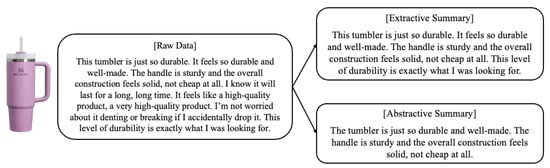
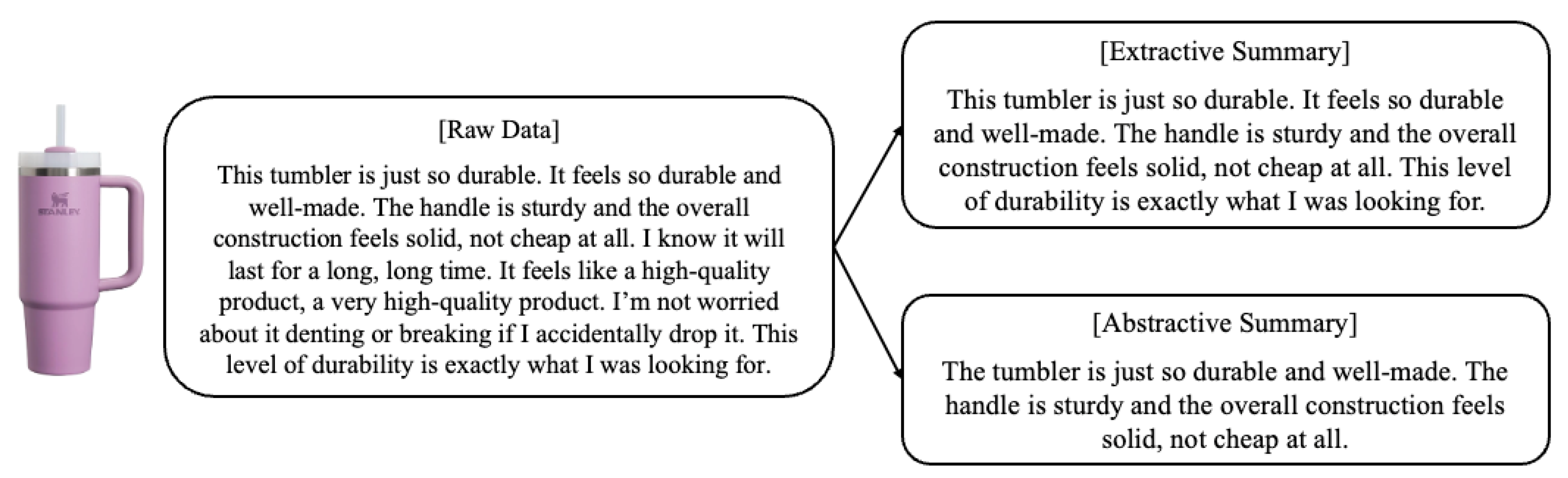
However, many studies utilize full review texts, which may include semantically redundant content or noise irrelevant to user preferences. The degradation in data quality can hinder recommendation performance [10,11]. As illustrated in Figure 1, original review texts may repeatedly highlight identical salient features or include content unrelated to user preference. By preserving essential semantic information and eliminating redundant content, text summarization helps recommendation models learn more accurate semantic representations [7]. Consequently, recent research has adopted text summarization to refine the semantic information of reviews, thereby enhancing the precision of user preference modeling.
Figure 1.
Example of review summarization in which similar meanings are repeatedly expressed.
Text summarization techniques are primarily categorized into extractive and abstractive approaches. Extractive summarization selects key sentences or phrases from the source text and concatenates them into a summary [12]. By preserving original expressions, extractive methods can minimize semantic loss and facilitate effective inference of user preferences [13,14]. In contrast, abstractive summarization generates a new text that is coherent and focused on salient information by considering the overall context [15]. Since abstractive methods model semantic context, they are suitable for capturing user preferences from review texts that contain diverse and complex information [16].
Recently, several studies have utilized text summarization in recommender systems. For instance, Roul and Arora [17] used a clustering approach based on semantic similarity to extract key sentences, improving inference of user preferences. Bai, Li, and Wang [7] extracted summaries by selecting key sentences based on inter-sentence similarity to represent user preferences more accurately. Kim et al. [18] improved recommendation performance by using a pretrained language model to generate coherent abstractive summaries that preserve salient semantic information. However, these studies tend to employ a single summarization approach, despite the inherent limitations of individual approaches. Extractive summarization can lack coherence and may overlook diverse semantic information distributed across sentences [15,19]. Consequently, this limitation can degrade recommendation performance by restricting the effective extraction of fine-grained user and item representations. In contrast, abstractive summarization may produce summaries that distort the original meaning and thus decrease the model’s recommendation accuracy [20]. Since the strengths of one approach can compensate for the weaknesses of the other, these two approaches provide complementary information [21]. Nevertheless, prior recommendation studies based on summarized reviews have largely overlooked the complementary strength between extractive and abstractive summaries. Specifically, the adaptive integration of these summaries based on their contextual importance to refine user preference modeling has yet to be fully explored.
To address this research gap, we propose summarized reviews fusion for adaptive recommendation (SuReFAR). The proposed SuReFAR is designed to jointly utilize extractive and abstractive summaries for rating prediction. Unlike prior studies relying on a single summarization method, the model leverages the complementary strengths of extractive and abstractive summaries. By jointly using both summaries, the model more effectively captures the semantic richness of user and item characteristics. First, user and item review sets are summarized through TextRank and bidirectional and auto-regressive transformers (BART), which reduce noise while preserving salient semantic information. Second, the SuReFAR emphasizes key information within each summary representation using an attention mechanism and adaptively fuses the two summary representations through a gated multimodal unit (GMU). Third, the fused representations are used to predict item ratings. This study evaluates the proposed model through experiments on Amazon and Yelp review datasets and examines whether summarized reviews can improve recommendation performance under data sparsity. The main contributions are as follows:
- We address a limitation of prior studies that predominantly rely on a single summarization approach by generating complementary extractive and abstractive summary representations with TextRank and BART.
- We incorporate an attention mechanism and a GMU into the SuReFAR to highlight salient information and adaptively fuse extractive and abstractive summary representations for rating prediction.
- We verify the effectiveness of the SuReFAR on Amazon and Yelp datasets, demonstrating consistent improvements over baseline models and robustness under sparse interaction conditions.
The rest of this article is organized as follows. We review the related work in Section 2 and present the architecture of SuReFAR in Section 3. We then describe the experimental data, evaluation metrics, baseline models, and experimental design in Section 4. Finally, we present the experimental results in Section 5 and conclude with a discussion of implications and limitations in Section 6.
2. Related Work
2.1. Review-Based Recommender System
Users experience information overload on e-commerce platforms, and recommender systems alleviate this issue by recommending items relevant to user preferences [2,22]. Matrix factorization (MF) and neural collaborative filtering (NCF), widely studied in early research, utilize user–item interaction data to infer user preferences [4]. However, since user–item interaction data, such as ratings, are sparse and do not capture user experiences, these methods are limited in improving recommendation performance [5,6].
To alleviate these limitations of early studies, recommender systems have incorporated review texts to model user experience and item characteristics [4]. For instance, Zheng, Noroozi, and Yu [8] proposed a convolutional neural network (CNN)-based model that extracts local features from review sets to address data sparsity and model complex interactions between users and items. Seo et al. [23] improved recommendation performance by using word- and sentence-level attention mechanisms to extract multi-perspective essential information from review texts. In addition, unlike studies that assign equal weight to all reviews, Chen, Zhang, Liu, and Ma [9] proposed a model that learns review-level weights to emphasize informative reviews, thereby improving accuracy in inferring user preferences. More recent work employs pretrained language models to capture fine-grained user and item attributes from review texts. Wang et al. [24] used a lite BERT (ALBERT) to extract the representations of users and items from review texts, showing that combining these representations with rating-matrix latent factors captures complex user–item interactions more effectively. Similarly, Lim et al. [25] employed multi-embedding methods based on bidirectional encoder representations from transformers (BERT) and robustly optimized BERT approach (RoBERTa) to learn richer review representations. They indicated that multi-embedding approaches can capture fine-grained user preferences and item attributes more effectively from complex semantic information in review texts.
Previous review-based recommender systems have proposed diverse approaches to alleviate data sparsity and improve recommendation performance. Nevertheless, reviews may contain redundant semantic content and information irrelevant to recommendations, which can distort or obscure user preferences [10,11]. In response to these limitations, this study employs summarized reviews to more effectively model user and item features.
2.2. Text Summarization
Text summarization compresses documents while preserving salient information from the source text [26]. It has been widely studied to alleviate information overload and reduce search costs [12]. Text summarization approaches are generally categorized as extractive or abstractive depending on the strategy used, and early work primarily focused on extractive methods. Extractive summarization constructs summaries by selecting salient words or sentences based on statistical characteristics, such as frequency [19]. Mihalcea and Tarau [27] proposed TextRank, a representative extractive method that models text as a sentence graph and ranks sentences based on inter-sentence similarity. They showed that structural connectivity between sentences helps extract key sentences using global information. Given its relatively simple architecture and effective preservation of semantic information, TextRank has been widely utilized in recent studies [28]. Abstractive summarization generates coherent summaries that preserve salient semantics by modeling the context of the source text [26]. BART, proposed by Lewis et al. [29], is a prominent abstractive model that is pretrained to reconstruct text corrupted with noise. BART combines a bidirectional encoder with an auto-regressive decoder, and it learns rich contextual representations and generates fluent, coherent sentences. Because of its strong sequence-generation capabilities, BART is widely applied to summarization and other downstream tasks [12,21].
Since review texts contain abundant auxiliary information for inferring user preferences in a recommender system, removing noisy or redundant content is important for recommendation performance [6,10]. Consequently, recommender systems have applied review summarization to reduce noise and support fine-grained preference modeling. For instance, Bai, Li, and Wang [7] constructed a graph-based representation and extracted summaries by selecting top-ranked sentences based on inter-sentence similarity. They showed that this approach improves recommendation accuracy and captures user preferences more effectively. In addition, Kim, Jin, Li, Li, Yoon, and Kim [18] generated abstractive summaries from review sets and demonstrated that these summaries enrich user and item representations and improve recommendations.
However, extractive summarization can overlook global context and produce incoherent text as it selects salient sentences using local or statistical features [18]. Abstractive summarization can generate content that is inconsistent with the source text, potentially distorting user preferences [19]. Ghadimi and Beigy [21] demonstrated that integrating the two approaches can compensate for each approach’s weaknesses and improve performance. Nevertheless, many previous studies rely on a single summarization approach, and research on integrating summarized reviews to improve data quality and recommendation performance remains limited. To address these issues, this study integrates multiple summarized reviews using a GMU to model personalized user and item representations, thereby improving recommendation accuracy.
3. SuReFAR Framework
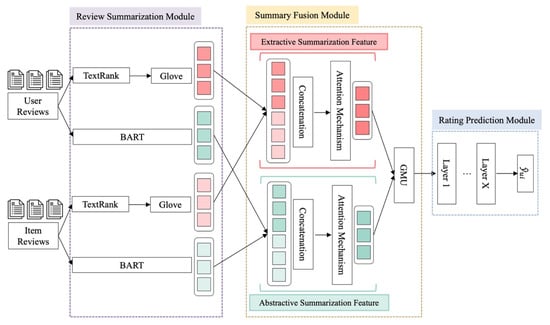
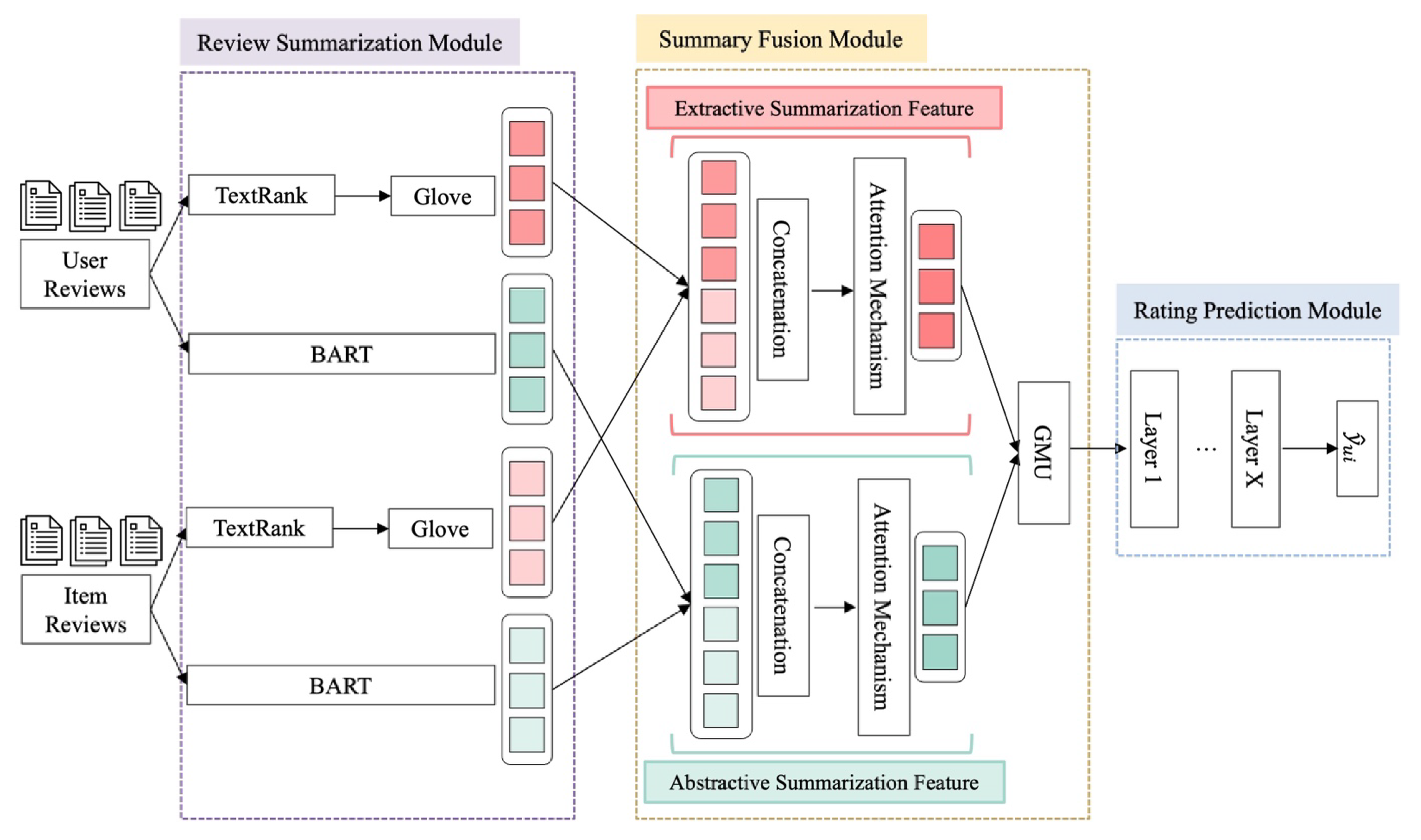
In this section, we describe the proposed SuReFAR. As shown in Figure 2, SuReFAR consists of three main modules. First, the Review Summarization Module employs TextRank and BART to summarize user and item review sets, focusing on key information relevant to recommendations. Second, the Summary Fusion Module applies an attention mechanism to extractive and abstractive summary vectors and uses a GMU to adaptively weight them for each user, yielding a fused representation vector. Third, the Rating Prediction Module predicts user ratings from the fused representation.
Figure 2.
Framework of SuReFAR.
3.1. Review Summarization Module
The Review Summarization Module summarizes user and item review sets using multiple methods to reduce noise and preserve salient information for recommendations. Previous research tends to rely on a single summarization method, which can introduce summarization bias and result in information loss. Therefore, we generate both extractive and abstractive summaries from review sets to form complementary multiple summary representations.
3.1.1. Extractive Summarization
We employ TextRank, a graph-based ranking algorithm, to generate extractive summaries. TextRank constructs a graph in which sentences are represented as nodes and inter-sentence similarities are represented as edge weights. It extracts summaries by selecting top-ranked sentences while preserving a simple unsupervised architecture [27]. Since TextRank is an unsupervised method, it can be applied across different domains without pretraining, while preserving semantic information and reducing the time and cost of building labeled training data [27,28]. TextRank captures relationships among words and sentences by modeling co-occurrence as a graph beyond simple frequency-based methods [30]. Accordingly, we apply TextRank to user and item review sets to construct sentence graphs and extract summaries that retain key information for learning user and item representation vectors.
First, we aggregate individual reviews into user and item review sets as follows:
3.1.2. Abstractive Summarization
To generate abstractive summaries from review sets, we use BART, which combines a bidirectional encoder with an auto-regressive decoder. BART tokenizes text sequences with Byte-Pair Encoding (BPE) and is pretrained as a sequence-to-sequence denoising autoencoder. The model is trained to reconstruct the original text by predicting and removing the noise added to the input sequences. Specifically, text infilling is used as a noising strategy that replaces random text spans with a single [MASK] token. For example, noise is added by masking a part of the sentence “I love a strawberry” as “I [MASK] a strawberry”. These corruptions make BART learn syntactic structure and inter-word dependencies more deeply, as it must predict the masked content and infer the original span length. Sentence permutation corrupts the input text by shuffling the order of text segments, such as transforming “I love a strawberry” to “love I a strawberry”. This strengthens the model’s long-context understanding by reconstructing the source text, which requires modeling global coherence and inter-sentence semantics. After pretraining on corrupted texts, BART reconstructs the source text using the auto-regressive decoder.
BART can be applied to a range of downstream tasks, such as sequence generation. In this framework, the encoder processes the source text to learn contextual representations, while the decoder produces the target sequence auto-regressively, informed by the encoder outputs. In pretraining, the source text is distorted with noising strategies, and the model is trained to reproduce the original text. As the final hidden state reflects the key contextual information of the entire text, it serves as an effective summary representation for diverse downstream tasks. We use the final hidden state produced by the BART-base decoder as the abstractive summary vector, as it captures the global contextual information of the input review set.
In this module, the user and item review sets and are processed by BART-base model (https://huggingface.co/facebook/bart-base, accessed on 12 May 2025) to generate abstractive summary vectors. The procedure is as follows:
where and denote -dimensional embedding vectors, corresponding to the output dimension of the BART-base model.
3.2. Summary Fusion Module
This module generates personalized summary representations by fusing extractive and abstractive summaries. While linear fusion methods such as concatenation and inner product are common in recommender systems, they may have limitations in capturing complex interactions between semantic representations [31]. Moreover, since users show different review writing patterns, the most effective summarization method may differ across users. GMU is a neural module that uses multiplicative gates to integrate multiple inputs into richer representations by learning input-specific contributions [32]. Accordingly, we use the GMU to model interactions between multi-summary representations and learn user-specific weights for each summary type.
First, we concatenate the user and item representations within each summarization type. The procedure is as follows:
where denotes concatenation, and and denote the weight matrix and bias used to linearly project the concatenated extractive summary vectors into the extractive representation . In addition, and denote the corresponding weight matrix and bias used to project the concatenated abstractive summary vectors into the abstractive representation .
Subsequently, we apply a multi-head attention mechanism to and to emphasize key information useful for rating prediction, as follows:
where , , and denote the query, key, and value vectors of the -th head. In each head, the dot product between the query and key is passed through a softmax function to generate attention weights, allowing the model to concentrate on salient information in each summary representation. Multi-head attention facilitates the learning of salient information from diverse perspectives. The outputs are concatenated and linearly projected, as follows:
where denotes the final output of multi-head attention and represents attended representations focused on salient information within each summary. Accordingly, we derive the attended extractive and abstractive vectors and .
Subsequently, we employ the GMU to adaptively learn the relative contribution of each representation and fuse and , and the process is as follows:
where and denote the weight matrices for extractive and abstractive summaries, and and denote the corresponding biases. Each summary representation is transformed using the tanh activation function to generate summary-specific representations and . Then, we derive a gating vector as follows:
where denotes the sigmoid function and is a bias vector. We first concatenate the representations and multiply them by the weight matrix . Subsequently, the gating vector is derived by applying the sigmoid function to determine the relative contribution of each summary. The final fused summary vector is computed as follows:
where denotes element-wise multiplication. By performing element-wise weighting with and , respectively, the GMU adaptively fuses the extractive and abstractive summary vectors and derives the fused summary vector .
3.3. Rating Prediction Module
This module predicts user ratings based on the fused summary vector , which captures user preferences by adaptively weighting the extractive and abstractive summaries. We feed into an MLP as the initial input (), and the output of the final layer is used to predict the rating. The MLP is defined as follows:
where and denote the weight matrix and bias of the -th layer. As this study frames recommendation as a rating prediction task, the ReLU activation function is applied to , following prior work on rating prediction [33]. The procedure is as follows:
3.4. Optimization
We use mean squared error (MSE) as the loss function to optimize the proposed model effectively. MSE computes the average squared difference between predicted and actual ratings, as follows:
where denotes the number of predicted ratings, and and represent the predicted and actual ratings, respectively. In addition, this study applies the adaptive moment estimation (Adam) optimizer to minimize the loss function.
4. Experiments
In this section, we evaluate the performance of the proposed SuReFAR. We conducted extensive experiments to answer the following research questions:
- RQ 1. Does the proposed model outperform state-of-the-art baseline models in recommendation performance?
- RQ 2. How does each summarization method contribute to enhancing recommendation performance?
- RQ 3. How do different fusion methods affect recommendation performance?
- RQ 4. Does the proposed model rely on both Attention and GMU to achieve optimal recommendation performance?
- RQ 5. How does the proposed model perform across different levels of data sparsity?
4.1. Datasets
We evaluated the recommendation performance of the proposed model on review datasets from Amazon and Yelp. We used the Amazon Books and Amazon Movie and TV subsets from Amazon and restaurant reviews from Yelp. For each dataset, we extracted user IDs, item IDs, review texts, and ratings. In the text preprocessing step, all reviews were converted to lowercase. In addition, stopwords, whitespace, HTML tags, emojis, and other non-informative tokens were removed, and reviews with zero length after preprocessing were excluded. For TextRank-based extractive summarization, sentence segmentation was performed using punctuation-based splitting. We required a minimum of five interactions per user and item to facilitate effective latent feature learning [34]. The datasets were divided into training, validation, and test sets in a 7:1:2 ratio [35]. In addition, all baselines were evaluated using the same datasets and under the same filtering, preprocessing, and data splits for fair comparison. The statistics of the datasets are presented in Table 1.
Table 1.
Statistical results of Amazon and Yelp datasets after preprocessing.
4.2. Evaluation Metrics
To evaluate the rating prediction accuracy of the proposed model, we used mean absolute error (MAE) and root mean squared error (RMSE), which are widely used in recommender systems. MAE is defined as the mean of the absolute differences between actual and predicted ratings, providing an intuitive error metric. RMSE is the square root of the mean squared error and is more sensitive to outliers. These evaluation metrics are defined in Equations (21) and (22), respectively. For both metrics, lower values indicate smaller differences between the predicted and true ratings, indicating better recommendation performance.
where denotes the number of evaluated ratings, and and represent the actual and the predicted ratings, respectively.
4.3. Baseline Models
In this section, we describe the baseline models utilized in our experiments to evaluate the recommendation performance of the proposed model:
- NCF [36]: NCF utilizes neural networks to model linear and nonlinear user–item interactions to predict user preferences.
- DeepCoNN [8]: DeepCoNN applies CNN to user and item review sets to learn local text features. Then, it models user–item interactions with factorization machines.
- NARRE [9]: NARRE learns user and item representations from their review sets using CNN and assigns review-level attention weights to focus on informative reviews for predicting user preferences.
- AENAR [37]: AENAR extracts textual features from user and item reviews with CNN and fuses them with latent factor vectors. Subsequently, it utilizes an attention mechanism to capture aspect-specific information relevant to user preferences.
- MFNR [25]: MFNR utilizes multi-embedding approaches (BERT and RoBERTa) to encode user and item reviews and fuses these representations to predict user preferences.
4.4. Experimental Setup
To optimize the performance of the proposed model, we tuned the hyperparameters over a range of values. We selected the batch size from [64, 128, 256], the dropout rate from [0.1, 0.2, 0.3, 0.4, 0.5], and the learning rate from [0.001, 0.0001, 0.0003, 0.0005, 0.00001]. Additionally, the projected summary representation dimension was selected from [128, 256, 300, 512], while the MLP hidden layer dimension and depth were chosen from [64, 128, 256, 512] and [1, 2, 3, 4, 5], respectively. Based on validation performance, we set the batch size to 128, the dropout rate to 0.3, the learning rate to 0.0003, the embedding dimension to 300, the MLP hidden layer dimension to 512, and the MLP depth to 2. Moreover, the number of attention heads was set to 4, and early stopping was used to avoid overfitting if the validation loss did not improve for 5 consecutive epochs. Following prior studies [7], the TextRank extraction ratio was set to 0.6 to retain salient information while alleviating noise introduced by excessive text. Therefore, the top 60% of the most salient sentences were extracted from both user and item review sets. For these TextRank-based extractive summaries, input sequences were padded or truncated to a dataset-specific maximum length based on the average review length before GloVe embedding. Conversely, for abstractive summaries, we used a pre-trained BART-base model in a frozen state without additional fine-tuning, with input sequences padded or truncated to a maximum of 512 tokens. The experiments were repeated five times to minimize experimental variance, and the average values were reported as the final performance results. The experiments were conducted on a server equipped with an Intel(R) Core(TM) i9-9900KF CPU, 64 GB RAM, and an NVIDIA GeForce RTX 2080 Ti GPU, using TensorFlow 2.8.0.
5. Experimental Results
5.1. Performance Comparison with Baseline Models (RQ1)
We compared SuReFAR with several baseline models using review data from Amazon and Yelp to evaluate the recommendation performance. As shown in Table 2, SuReFAR demonstrates superior performance across all datasets. Specifically, the proposed SuReFAR improved MAE by 6.11–32.00% on Books, 5.69–36.61% on Movie and TV, and 1.91–15.29% on Yelp. For RMSE, the improvements were 0.66–16.08%, 1.20–21.21%, and 0.74–11.88%, respectively. The experimental results can be analyzed as follows.
Table 2.
Performance comparison between the proposed model and baseline models.
First, the NCF model, which relies solely on rating data, achieved the lowest performance among all baselines. This result suggests that rating data alone is insufficient to capture nuanced user preferences. Second, review-based models, including DeepCoNN, NARRE, AENAR, and MFNR, substantially outperformed the rating-based NCF model. This indicates that the rich semantic information in review texts facilitates the extraction of precise user and item representations, resulting in superior recommendation accuracy. Among review-based models, AENAR and MFNR demonstrated superior performance. AENAR captures user preferences effectively by identifying aspect-specific information that aligns with user interests. MFNR utilizes multi-embedding approaches to learn contextual information from multiple perspectives and model complex user preferences. In contrast, DeepCoNN employs CNN to extract local features from reviews but fails to capture global contextual information, resulting in lower performance. Third, the proposed SuReFAR achieved the highest performance across all experiments. Compared with NCF, which relies solely on interaction signals, the proposed model additionally incorporates review information to model user preferences, thereby achieving better performance. Furthermore, while existing review-based models use full review texts, the proposed model uses summarized reviews that are more relevant to recommendation tasks and more effectively capture user and item features. Notably, the model utilizes a gating mechanism to dynamically weight multi-summary representations, facilitating more effective learning of user preferences. Consequently, the results suggest that integrating multiple summary representations helps the model exploit the complementary strengths of different summarization approaches.
Accordingly, the SuReFAR surpassed all baseline models across all datasets and evaluation metrics, proving the clear advantage of adaptively integrating multi-summarization approaches. To verify whether these improvements were statistically meaningful, we further conducted paired t-tests based on the repeated experimental results.
As presented in Table 3, the proposed SuReFAR demonstrates significant performance improvements across all evaluated datasets for both MAE and RMSE metrics. Specifically, the performance gains over recent baselines, such as MFNR and AENAR, are statistically significant. This indicates that the improvements are stable and not driven by random variance. Moreover, these results provide empirical evidence that the adaptive fusion of extractive and abstractive summaries systematically enhances user preference modeling, yielding more reliable and robust recommendations.
Table 3.
Statistical significance test results of recommendation performance.
From a practical perspective, it is worth noting that the review summarization stage is performed offline as a one-time preprocessing step and does not add to the complexity of the online recommendation model. During the online prediction phase, the SuReFAR contains approximately 31.8 M parameters, which is comparable to DeepCoNN (30.2 M) and moderately larger than AENAR (23.3 M). Given that the performance improvements over these baselines are statistically significant, SuReFAR achieves a favorable balance between recommendation accuracy and model complexity.
5.2. Efficiency Analysis of Summarization Method (RQ2)
SuReFAR fuses extractive (TextRank) and abstractive (BART) summarizations to capture salient semantics in review texts from multiple perspectives. While previous studies have predominantly relied on a single summarization approach, which may result in information bias or loss, this study alleviates such limitations by fusing two summaries in a complementary way. In this section, we examine how multi-summarization influences recommendation accuracy in comparison to models based on a single summarization method, as illustrated in Table 4.
Table 4.
Performance comparison based on summarization features.
The BART-only model achieved lower performance than the TextRank-only and fused models. Abstractive summarization can generate coherent summaries by modeling the review context, but it may paraphrase or modify source information and thus distort user preferences. This risk can be amplified for review sets that are lengthy and redundant and may include recommendation-irrelevant information. Ghadimi and Beigy [21] note that generated summaries are not guaranteed to be syntactically correct or convey the same semantics as the original documents. These observations indicate that extractive summarization can be more reliable for preserving source information. The TextRank-only model preserved original expressions and thus produced more reliable representations than the BART-only model, but it still underperformed the fused model. Extractive summaries preserve salient information by retaining original expressions but are limited in capturing global context across review sets. Considering the inherent advantages and drawbacks of individual summarization methods, the results demonstrate that the SuReFAR shows superior recommendation accuracy by adaptively integrating diverse summaries to model user preferences more accurately.
5.3. Efficiency Analysis of Fusion Method (RQ3)
Given the inherent differences in user review styles, the optimal summarization approach for capturing user preferences can vary across users. Therefore, the proposed model employs a GMU to adaptively weight and fuse extractive and abstractive summary representations. We evaluate the GMU by comparing it with commonly used fusion methods, such as concatenation, inner product, element-wise product, and the attention mechanism, with the results shown in Table 5.
Table 5.
Performance comparison of summarization fusion methods.
The proposed SuReFAR achieved the best performance in this experiment, indicating that dynamically weighting multiple summary representations facilitates more effective capture of user preferences. The GMU computes the contribution of each representation to the final vector and assigns weights accordingly. Compared with linear fusion methods, the GMU can model more complex interactions between representations and thus more effectively represent individual user preferences.
The attention-based fusion model achieved the second-best performance. Although attention-based fusion emphasizes highly correlated information, its effectiveness may be limited when semantic consistency across summaries is low, which can introduce noise into the fused representation. By contrast, the GMU outperformed the attention-based model, suggesting that it more effectively adapts weights when extractive and abstractive summaries are partially inconsistent. Among linear combination methods, concatenation achieved superior performance. Concatenation preserves information from both summaries by combining them directly, which facilitates more effective capture of user and item features. Element-wise product ranked second, followed by inner product. Both methods underperformed concatenation. Element-wise product multiplies corresponding dimensions of the two vectors, which obscures salient information and results in information loss. The inner product reduces two vectors to a single scalar, resulting in excessive compression of diverse information. Therefore, it resulted in the lowest performance among the linear methods.
5.4. Ablation Study on the Attention and GMU (RQ4)
To examine the individual contributions of the attention mechanism and the GMU, we performed an ablation study using the proposed SuReFAR and two reduced variants. The first variant, denoted as w/o Attention, removes the attention mechanism while retaining the GMU-based fusion module. The second variant, denoted as w/o GMU, removes the GMU-based adaptive fusion while preserving the attention mechanism. In the w/o GMU setting, the attention-refined TextRank and BART representations are concatenated and passed through a linear projection layer prior to rating prediction. Through these comparisons, we examine the extent to which the attention mechanism and the GMU individually contribute to the overall recommendation performance.
As shown in Table 6, the proposed model consistently shows superior performance across all datasets, indicating that both the attention mechanism and the GMU contribute to the effectiveness of the SuReFAR. Specifically, the performance degradation in the w/o Attention variant suggests that emphasizing salient information within each summary representation improves the quality of user–item representations. Similarly, the degradation in the w/o GMU variant indicates that adaptively integrating extractive and abstractive summaries is also important for capturing complementary review information. Notably, removing the GMU results in a relatively larger degradation in RMSE on the Amazon Books and Amazon Movie and TV datasets, suggesting that adaptive fusion is particularly helpful for reducing larger prediction errors. In contrast, on the Yelp dataset, the larger MAE degradation observed in the w/o Attention variant implies that the attention mechanism is especially useful for filtering informative signals from more diverse review content.
Table 6.
Performance comparison of different model variants in the ablation study.
5.5. Validation of the Impact of Interaction Sparsity on Recommendation Performance (RQ5)
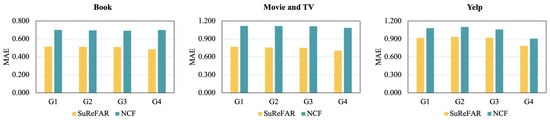
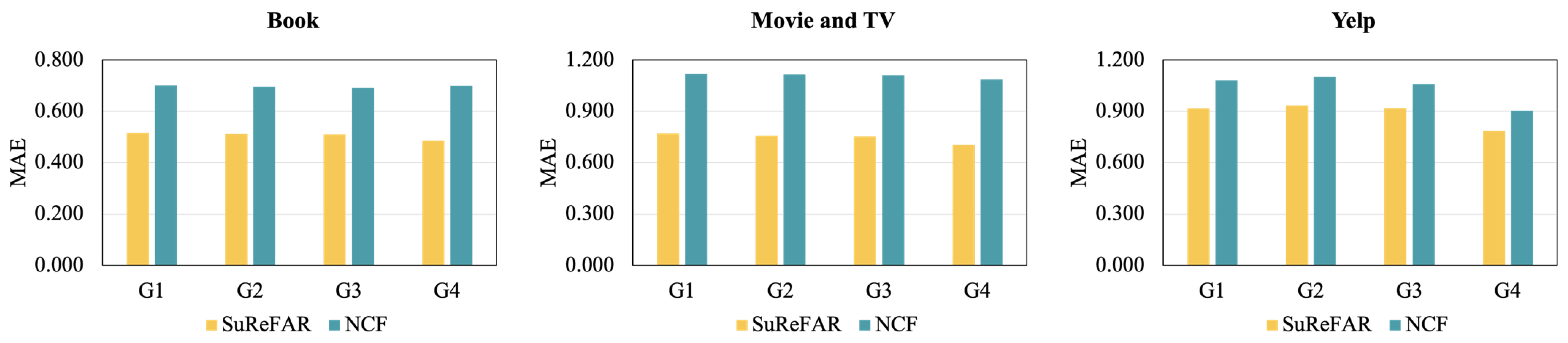
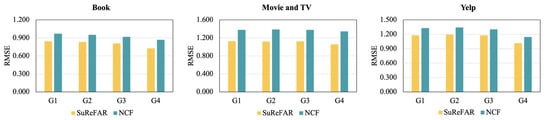
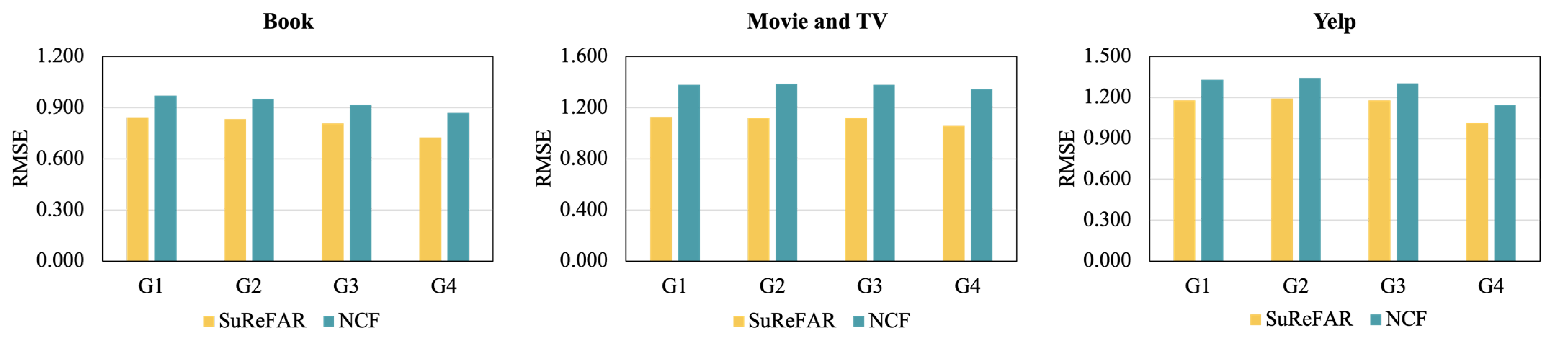
This study aims to alleviate interaction sparsity and improve recommendation performance by modeling user and item features using multi-summary information. To validate this approach, we construct user groups based on interaction sparsity and compare the proposed model with NCF, which relies solely on interaction data. Specifically, we quantify each user’s interaction level by the number of ratings and partition all users into four equally sized groups (G1–G4). G1 represents the sparsest user group, whereas G4 represents the most active group with the densest interaction history. The results are presented in Figure 3 and Figure 4.
Figure 3.
Performance comparison between user group with NCF (MAE).
Figure 4.
Performance comparison between user group with NCF (RMSE).
Across all datasets and user groups, SuReFAR consistently achieved lower MAE and RMSE than NCF, demonstrating superior performance. These results highlight the limitations of relying solely on interaction data and validate that using review-summary information is effective for capturing nuanced user preferences. The analysis of the results by dataset is as follows.
For the Amazon Books and Amazon Movie and TV datasets, recommendation accuracy improves with the number of user-item interactions, and SuReFAR outperforms NCF across all user groups. The performance gap is largest in G4, indicating that when interaction data are abundant, summarized reviews provide complementary information that improves preference modeling. Conversely, in the Yelp dataset, G1 group achieved the second-best performance after G4, with the second largest improvement over NCF also observed in G1. This suggests that under severe sparsity, review-summary information facilitates fine-grained modeling of user preferences and substantially alleviates the data sparsity problem. Consequently, these results demonstrate that SuReFAR effectively addresses data sparsity by utilizing multi-summary information while also capturing detailed user preferences when interaction data are abundant.
6. Conclusions
This study proposes SuReFAR, a model that captures user preferences effectively and recommends suitable items by using summarized reviews to alleviate information overload on e-commerce platforms. SuReFAR generates multiple types of summaries that capture key semantic information from multiple perspectives utilizing TextRank and BART, and it adaptively adjusts each summary’s contribution via a GMU to improve recommendation performance.
Experiments on Amazon Books, Amazon Movie and TV, and Yelp datasets demonstrated that SuReFAR outperforms baseline models across all metrics. The results indicate that a multi-summarization approach captures user preferences more effectively than models relying on a single summarization approach. In addition, statistical significance tests confirmed that the observed improvements were robust across repeated runs. The ablation study demonstrated that both the attention mechanism and the GMU contribute to enhancing recommendation performance. Specifically, the attention mechanism emphasizes salient information within each summary, while the GMU adaptively integrates extractive and abstractive representations. In the sparsity analysis, the results indicate that utilizing summarized review information improves recommendation performance for users with sparse interaction data.
This study presents the following academic contributions. First, this study suggests that review summarization can alleviate the impact of irrelevant information by constructing representations focused on key information. Compressing large-scale reviews into recommendation-relevant summaries reduces noise and improves recommendation performance. Second, this study demonstrates that integrating extractive and abstractive summarization alleviates bias and information loss that may result from relying on a single summarization approach. Third, the proposed SuReFAR demonstrates that the GMU is an effective mechanism for fusing multiple summary representations according to user features by dynamically adjusting each summary’s contribution.
Moreover, the practical contributions of this study are as follows. First, multi-summarization compresses review data into key information and reduces noise, which helps in noisy environments containing many low-quality reviews. Second, GMU allows recommender systems to adapt to heterogeneous review-writing styles by assigning user-specific weights to each summary, improving personalization. Third, the proposed approach has the potential to improve the initial user experience by providing higher-quality recommendations for users with limited activity histories. In the sparsity analysis (RQ5), the proposed model outperformed NCF in low-activity user groups. These results indicates potential benefits for key business outcomes, such as long-term user retention on e-commerce platforms, where low-activity users constitute a large portion of the user base.
Despite these academic and practical contributions, this study has several limitations. First, SuReFAR constructs static user and item profiles and does not consider temporal dynamics. Future work could examine whether assigning higher weights to recent reviews helps capture changes in user preferences and further improves recommendation performance. Second, while this study focuses on review text, e-commerce platforms provide additional modalities such as product images. Future research should examine whether integrating multi-modal information can enhance recommendation performance. Third, although recent large language models (LLMs) present stronger reasoning capabilities and generate explanations, this study is limited to using BART as a pretrained model. Therefore, future work could explore LLM-based user profiling and rationale generation modules to support both rating prediction and explanation generation, while evaluating the quality of the generated explanations. Future work could also extend the sparsity analysis to comparisons with review-based baselines and provide a more dedicated examination of summary faithfulness.
Author Contributions
Conceptualization, M.P., S.K., X.L., S.P. and J.K.; methodology, M.P., S.K. and X.L.; software, M.P., S.K. and X.L.; data curation, M.P. and S.K.; writing—original draft, M.P. and S.K.; writing—review & editing, M.P., S.K., X.L., S.P. and J.K.; supervision, J.K. All authors have read and agreed to the published version of the manuscript.
Funding
This research received no external funding.
Data Availability Statement
The Amazon and Yelp datasets are publicly available at https://amazon-reviews-2023.github.io/ and https://business.yelp.com/data/resources/open-dataset/ (accessed on 27 February 2026).
Conflicts of Interest
The authors declare no conflicts of interest.
References
- Sulthana, A.R.; Ramasamy, S. Ontology and context based recommendation system using neuro-fuzzy classification. Comput. Electr. Eng. 2019, 74, 498–510. [Google Scholar] [CrossRef] [Scilit]
- Di, Y.; Wang, X.; Shi, H.; Fan, C.; Zhou, R.; Ma, R.; Liu, Y. Personalized consumer federated recommender system using fine-grained transformation and hybrid information sharing. IEEE Trans. Consum. Electron. 2025, 71, 7254–7268. [Google Scholar] [CrossRef] [Scilit]
- El Alaoui, D.; Riffi, J.; Sabri, A.; Aghoutane, B.; Yahyaouy, A.; Tairi, H. A novel session-based recommendation system using capsule graph neural network. Neural Netw. 2025, 185, 107176. [Google Scholar] [CrossRef] [Scilit]
- Sun, G.; Li, Y.; Yu, H.; Chang, V. Attention distribution guided information transfer networks for recommendation in practice. Appl. Soft. Comput. 2020, 97, 106772. [Google Scholar] [CrossRef] [Scilit]
- Cao, R.; Zhang, X.; Wang, H. A review semantics based model for rating prediction. IEEE Access 2019, 8, 4714–4723. [Google Scholar] [CrossRef] [Scilit]
- Liu, D.; Li, J.; Du, B.; Chang, J.; Gao, R.; Wu, Y. A hybrid neural network approach to combine textual information and rating information for item recommendation. Knowl. Inf. Syst. 2021, 63, 621–646. [Google Scholar] [CrossRef] [Scilit]
- Bai, Y.; Li, Y.; Wang, L. A joint summarization and pre-trained model for review-based recommendation. Information 2021, 12, 223. [Google Scholar] [CrossRef] [Scilit]
- Zheng, L.; Noroozi, V.; Yu, P.S. Joint deep modeling of users and items using reviews for recommendation. In Proceedings of the Tenth ACM International Conference on Web Search and Data Mining, Cambridge, UK, 6–10 February 2017; pp. 425–434. [Google Scholar]
- Chen, C.; Zhang, M.; Liu, Y.; Ma, S. Neural attentional rating regression with review-level explanations. In Proceedings of the 2018 World Wide Web Conference, Lyon, France, 23–27 April 2018; pp. 1583–1592. [Google Scholar]
- Ait Hammou, B.; Ait Lahcen, A.; Mouline, S. Towards a real-time processing framework based on improved distributed recurrent neural network variants with fastText for social big data analytics. Inf. Process. Manag. 2020, 57, 102122. [Google Scholar] [CrossRef] [Scilit]
- Basaran, D.; Ntoutsi, E.; Zimek, A. Redundancies in data and their effect on the evaluation of recommendation systems: A case study on the amazon reviews datasets. In Proceedings of the 2017 SIAM International Conference on Data Mining, Houston, TX, USA, 27–29 April 2017; pp. 390–398. [Google Scholar]
- Sharma, G.; Sharma, D. Automatic text summarization methods: A comprehensive review. SN Comput. Sci. 2022, 4, 33. [Google Scholar] [CrossRef] [Scilit]
- Gambhir, M.; Gupta, V. Recent automatic text summarization techniques: A survey. Artif. Intell. Rev. 2017, 47, 1–66. [Google Scholar] [CrossRef] [Scilit]
- Mutlu, B.; Sezer, E.A. Enhanced sentence representation for extractive text summarization: Investigating the syntactic and semantic features and their contribution to sentence scoring. Expert Syst. Appl. 2023, 227, 120302. [Google Scholar] [CrossRef] [Scilit]
- Giarelis, N.; Mastrokostas, C.; Karacapilidis, N. Abstractive vs. extractive summarization: An experimental review. Appl. Sci. 2023, 13, 7620. [Google Scholar] [CrossRef] [Scilit]
- Xu, H.; Liu, H.; Zhang, W.; Jiao, P.; Wang, W. Rating-boosted abstractive review summarization with neural personalized generation. Knowl.-Based Syst. 2021, 218, 106858. [Google Scholar] [CrossRef] [Scilit]
- Roul, R.K.; Arora, K. A nifty review to text summarization-based recommendation system for electronic products. Soft Comput. 2019, 23, 13183–13204. [Google Scholar] [CrossRef] [Scilit]
- Kim, S.; Jin, L.; Li, Q.; Li, X.; Yoon, C.; Kim, J. Utilizing Advanced Transformers for Summarized Review-Aware Recommender System. IEEE Access 2025, 13, 144578–144590. [Google Scholar] [CrossRef] [Scilit]
- El-Kassas, W.S.; Salama, C.R.; Rafea, A.A.; Mohamed, H.K. Automatic text summarization: A comprehensive survey. Expert Syst. Appl. 2021, 165, 113679. [Google Scholar] [CrossRef] [Scilit]
- Chrysostomou, G.; Zhao, Z.; Williams, M.; Aletras, N. Investigating hallucinations in pruned large language models for abstractive summarization. Trans. Assoc. Comput. Linguist. 2024, 12, 1163–1181. [Google Scholar] [CrossRef] [Scilit]
- Ghadimi, A.; Beigy, H. Hybrid multi-document summarization using pre-trained language models. Expert Syst. Appl. 2022, 192, 116292. [Google Scholar] [CrossRef] [Scilit]
- Liu, Y.; Wang, S.; Khan, M.S.; He, J. A novel deep hybrid recommender system based on auto-encoder with neural collaborative filtering. Big Data Min. Anal. 2018, 1, 211–221. [Google Scholar] [CrossRef] [Scilit]
- Seo, S.; Huang, J.; Yang, H.; Liu, Y. Interpretable convolutional neural networks with dual local and global attention for review rating prediction. In Proceedings of the Eleventh ACM Conference on Recommender Systems, Como, Italy, 27–31 August 2017; pp. 297–305. [Google Scholar]
- Wang, S.; Du, W.; Bhuiyan, A.; Chen, Z. Personalized Recommendation Method Based on Rating Matrix and Review Text. Comput. Intell. 2025, 41, e70024. [Google Scholar] [CrossRef] [Scilit]
- Lim, H.; Li, Q.; Yang, S.; Kim, J. A BERT-Based Multi-Embedding Fusion Method Using Review Text for Recommendation. Expert Syst. 2025, 42, e70041. [Google Scholar] [CrossRef] [Scilit]
- Zhang, H.; Yu, P.S.; Zhang, J. A systematic survey of text summarization: From statistical methods to large language models. ACM Comput. Surv. 2025, 57, 277. [Google Scholar] [CrossRef] [Scilit]
- Mihalcea, R.; Tarau, P. Textrank: Bringing order into text. In Proceedings of the 2004 Conference on Empirical Methods in Natural Language Processing, Barcelona, Spain, 25–26 July 2004; pp. 404–411. [Google Scholar]
- Liu, W.; Sun, Y.; Yu, B.; Wang, H.; Peng, Q.; Hou, M.; Guo, H.; Wang, H.; Liu, C. Automatic text summarization method based on improved TextRank algorithm and K-means clustering. Knowl.-Based Syst. 2024, 287, 111447. [Google Scholar] [CrossRef] [Scilit]
- Lewis, M.; Liu, Y.; Goyal, N.; Ghazvininejad, M.; Mohamed, A.; Levy, O.; Stoyanov, V.; Zettlemoyer, L. BART: Denoising sequence-to-sequence pre-training for natural language generation, translation, and comprehension. arXiv 2019, arXiv:1910.13461. [Google Scholar]
- Zhang, M.; Li, X.; Yue, S.; Yang, L. An empirical study of TextRank for keyword extraction. IEEE Access 2020, 8, 178849–178858. [Google Scholar] [CrossRef] [Scilit]
- Cao, Q.; Hou, M.; Chen, B.; Zhang, Z.; Lu, G. Hierarchical network based on the fusion of static and dynamic features for speech emotion recognition. In Proceedings of the ICASSP 2021–2021 IEEE International Conference on Acoustics, Speech and Signal Processing (ICASSP), Toronto, ON, Canada, 6–11 June 2021; pp. 6334–6338. [Google Scholar]
- Arevalo, J.; Solorio, T.; Montes-y-Gómez, M.; González, F.A. Gated multimodal units for information fusion. arXiv 2017, arXiv:1702.01992. [Google Scholar] [CrossRef] [Scilit]
- Tegene, A.; Liu, Q.; Gan, Y.; Dai, T.; Leka, H.; Ayenew, M. Deep learning and embedding based latent factor model for collaborative recommender systems. Appl. Sci. 2023, 13, 726. [Google Scholar] [CrossRef] [Scilit]
- Li, P.; Tuzhilin, A. Learning latent multi-criteria ratings from user reviews for recommendations. IEEE Trans. Knowl. Data Eng. 2020, 34, 3854–3866. [Google Scholar] [CrossRef] [Scilit]
- Cheng, W.; Shen, Y.; Huang, L.; Zhu, Y. Dual-embedding based deep latent factor models for recommendation. ACM Trans. Knowl. Discov. Data (TKDD) 2021, 15, 85. [Google Scholar] [CrossRef] [Scilit]
- He, X.; Liao, L.; Zhang, H.; Nie, L.; Hu, X.; Chua, T.-S. Neural collaborative filtering. In Proceedings of the 26th International Conference on World Wide Web, Perth, Australia, 3–7 April 2017; pp. 173–182. [Google Scholar]
- Zhang, T.; Sun, C.; Cheng, Z.; Dong, X. AENAR: An aspect-aware explainable neural attentional recommender model for rating predication. Expert Syst. Appl. 2022, 198, 116717. [Google Scholar] [CrossRef] [Scilit]

Disclaimer/Publisher’s Note: The statements, opinions and data contained in all publications are solely those of the individual author(s) and contributor(s) and not of MDPI and/or the editor(s). MDPI and/or the editor(s) disclaim responsibility for any injury to people or property resulting from any ideas, methods, instructions or products referred to in the content. |
© 2026 by the authors. Licensee MDPI, Basel, Switzerland. This article is an open access article distributed under the terms and conditions of the Creative Commons Attribution (CC BY) license.