


Abstract
This paper presents an ARMv8/NEON-oriented implementation of NCC-Sign targeting the NTT-friendly trinomial parameter sets (NCC-Sign-1/3/5), whose dominant cost arises from mixed-radix NTT computations with . We design lane-local SIMD kernels—including a four-lane Montgomery multiply–reduce, a centered modular reduction pass, a fused stage-0 butterfly, and streamlined radix-2/radix-3 pipelines—and extend them with three further optimizations: (i) radix-2 multi-stage butterfly merging to halve intermediate load/store traffic, (ii) a stride-3 vectorization technique exploiting NEON structure load/store instructions (vld3q/vst3q) to fully vectorize small-len radix-3 stages that would otherwise fall back to scalar execution, and (iii) NEON-parallel pointwise Montgomery multiplication. Using cycle-accurate PMU measurements under identical toolchains for baseline and optimized builds on Apple M1 Pro, we observe geometric-mean speedups of 1.40× for key generation, 2.24× for signing, and 2.01× for verification across NCC-Sign-1/3/5, with per-kernel gains of up to 5–6× for NTT/INTT and 7.5× for pointwise multiplication. To contextualize these results, we provide a direct comparison with the NEON-optimized ML-DSA (Dilithium) implementation of Becker et al. on the same platform, a cross-platform evaluation on Arm Cortex-A72 (Raspberry Pi 4), a Montgomery-versus-Barrett microbenchmark supporting our design choice, and an empirical constant-time assessment via dudect confirming that no timing leakage is detected in any NEON kernel under 30 million measurements.
Keywords:
NCC-Sign; ARMv8; NEON; NTT; mixed-radix; Montgomery reduction; performance optimization; benchmarking 1. Introduction
Quantum-capable adversaries pose a concrete long-term confidentiality risk: encrypted traffic exfiltrated today may become decryptable once sufficiently large quantum computers emerge (the “harvest-now, decrypt-later” threat). This concern is grounded in Shor’s polynomial-time algorithms for factoring and discrete logarithms and in Grover’s quadratic speedup for search [1,2]. In response, governments and industry have shifted from exploratory research toward migration planning for post-quantum cryptography (PQC), guided by joint readiness advisories and roadmaps [3].
On the standardization front, NIST has issued its first PQC standards—ML-KEM (FIPS 203), ML-DSA (FIPS 204), and SLH-DSA (FIPS 205)—thereby providing concrete, interoperable targets for near-term deployment [4,5,6,7]. These standards emphasize not only asymptotic security but also implementation quality, performance, memory footprint, and resistance to side-channel attacks in real systems.
In parallel with the NIST effort, Korea organized the KpqC competition to evaluate candidate KEMs and signature schemes for domestic standardization. Among the Round 1 candidates promoted to Round 2 was NCC-Sign, whereas the final selection announced on 16 January 2025 standardized AIMer and HAETAE for signatures and NTRU+ and SMAUG-T for KEM [8,9]. We nevertheless select NCC-Sign as a practical optimization target and focus on its NTT-friendly trinomial parameter sets (NCC-Sign-1/3/5), for which the dominant cost arises from mixed-radix NTT computations. Unlike the power-of-two cyclotomic settings common in lattice-based signatures, NCC-Sign’s trinomial instantiations adopt , which introduces radix-3 stages and additional data-movement challenges. This structure defines a technically non-trivial ARMv8 workload, because performance depends strongly on SIMD lane locality and the cost of cross-lane shuffles. NCC-Sign also supports a non-cyclotomic instantiation and non-NTT polynomial multiplication (e.g., Toom–Cook/Karatsuba), but those variants lie outside the scope of this work. Our goal is to engineer efficient NEON kernels for the NTT-friendly sets and quantify their end-to-end impact through cycle-accurate measurements on Apple M1 Pro and Arm Cortex-A72.
Beyond NCC-Sign itself, mixed-radix NTT structures of the form appear in other lattice-based settings that depart from power-of-two cyclotomic rings, yet systematic SIMD optimization studies for such transforms on ARMv8 remain scarce. The interplay between radix-3 butterfly stages and the fixed four-lane width of NEON poses vectorization challenges absent from the well-studied power-of-two case, making NCC-Sign’s trinomial parameter sets a technically informative target.
We therefore focus on an ARMv8/NEON-oriented implementation of NCC-Sign for the NTT-friendly trinomial parameter sets. ARMv8 is ubiquitous in mobile and edge deployments, and NEON intrinsics expose 128-bit SIMD operations that match the structured, data-parallel arithmetic common in lattice-based cryptography [10]. Prior work has shown that NEON-tuned ARMv8 implementations can substantially reshape performance relative to scalar-C baselines across lattice schemes such as ML-DSA (Dilithium), Kyber, Saber, Falcon, and HAETAE, underscoring the broader value of architecture-conscious PQC implementations [11,12,13].
Accordingly, this paper examines how architecture-agnostic algorithmic kernels can be engineered for ARMv8/NEON to deliver end-to-end gains for a lattice-signature workload while preserving arithmetic correctness and stable kernel control flow. Section 2 reviews the KpqC competition and standardization context, provides a high-level description of NCC-Sign, and summarizes the relevant ARMv8/NEON concepts. Section 3 details our ARMv8-oriented implementation. Section 4 presents the evaluation, including cross-platform and cross-scheme comparisons, function-level profiling, constant-time analysis, and a design-choice microbenchmark. Section 5 discusses transferability, energy considerations, and limitations. Section 6 concludes.
Contributions
We summarize our main contributions as follows.
- Comprehensive ARMv8/NEON optimization of mixed-radix NTT in NCC-Sign. Beyond the baseline NEON kernels (four-lane Montgomery multiply–reduce, centered reduction, fused stage-0 butterfly, and radix-2/radix-3 pipelines), we apply radix-2 multi-stage butterfly merging—adapting the interleaved multi-layer approach of Becker et al. [11] to the mixed-radix setting—and propose a stride-3 vectorization technique that exploits NEON structure load/store instructions (vld3q/vst3q) to fully vectorize small-len radix-3 stages previously handled by scalar fallback code. We also vectorize the pointwise Montgomery multiplication and integrate two-way parallel hashing (fips202x2) where the algorithm structure permits (Section 3).
- Function-level profiling and Amdahl’s-law analysis. We decompose the cycle cost of each operation into individual kernels, derive the theoretical end-to-end speedup bound, and characterize the effect and limitations of each optimization in the mixed-radix pipeline (Section 4).
- Two-platform evaluation and cross-scheme comparison. We benchmark on Apple M1 Pro and Arm Cortex-A72 (Raspberry Pi 4), two architecturally distinct ARMv8 cores, and provide a direct cycle-level comparison with the NEON-optimized ML-DSA (Dilithium) of Becker et al. [11] under identical measurement conditions. A Montgomery-vs.-Barrett microbenchmark supports our modular-reduction design choice (Section 4).
- Empirical constant-time verification via dudect. We apply the fixed-vs-random t-test methodology of Reparaz et al. to all NEON kernels (NTT, INTT, pointwise multiplication) and confirm that no timing leakage is detected under 30 million measurements on Apple M1 Pro (Section 4).
To support reproducibility and follow-up research, we publicly released the optimized NCC-Sign implementation for ARMv8 platforms together with the benchmarking and validation harness: https://github.com/minunejip/PQC-ARMv8 (accessed on 27 March 2026). The repository additionally includes the cycle-counting adaptations for Cortex-A72, the dudect test harness, and all raw benchmark data to facilitate independent reproduction.
2. Related Work
2.1. KpqC Competition and Standardization Context
The Korean Post-Quantum Cryptography (KpqC) competition was launched to curate a domestically standardized portfolio of KEMs and digital signatures in parallel with international standardization, with an explicit remit that went beyond asymptotic security to include implementation maturity, constant-time discipline, and transition readiness across general-purpose and embedded platforms.
As sketched in Figure 1, an initial call in 2022 led to a Round 1 cohort comprising nine digital signatures and seven KEMs; on 7 December 2023, eight candidates advanced to Round 2—four signatures (AIMer, HAETAE, MQ-Sign, and NCC-Sign) and four KEMs (NTRU+, PALOMA, REDOG, and SMAUG+TiGER (merged)) [8]. The final decision on 16 January 2025 standardized AIMer and HAETAE for signatures and NTRU+ and SMAUG-T for KEM, reflecting both cryptanalytic assurance and implementability considerations [9].
Figure 1.
Schematic timeline of the KpqC competition.
Table 1 summarizes the final selections by family and hardness assumption. To situate these choices within deployment practice, complementary studies report reproducible benchmarking and constant-time code hygiene for Round 1 candidates [14], and integration of KpqC algorithms into production-grade TLS/X.509 stacks to quantify end-to-end overheads and deployment trade-offs [15]. Within this landscape, NCC-Sign is noted as a Round 2 signature candidate.
Table 1.
KpqC final selections by family and hardness.
2.2. NCC-Sign: A Ring-LWE-Based Digital Signature Scheme
NCC-Sign is a lattice-based digital signature built on the Ring-Learning with Errors (Ring–LWE) assumption. It is intended as a lightweight yet structurally cautious alternative to mainstream lattice signatures such as ML-DSA (Dilithium). Unlike designs fixed to power-of-two cyclotomic rings, NCC-Sign uses a more flexible polynomial ring to reduce exploitable symmetries and to allow finer parameter tuning [20]. The algebraic setting is without restricting to be cyclotomic. The specification provides two instantiations: (i) a non-cyclotomic option with prime p, which suppresses cyclotomic/subfield structure; and (ii) an NTT-friendly trinomial with for fast transforms [20].
2.2.1. Parameters
Table 2 lists the conservative non-cyclotomic sets (). “Exp. reps.” denotes the expected number of signing attempts due to rejection sampling (lower is better).
Table 2.
NCC-Sign non-cyclotomic parameter sets (conservative).
2.2.2. Protocol
NCC-Sign follows the Bai–Galbraith “Fiat–Shamir with aborts” pattern with rounding and hint reconciliation [21,22]. Key generation publishes a compressed of and retains . Signing samples bounded y, computes w, and sets . It then derives a -sparse challenge , sets and a hint h, and rejects unless and low-bit checks pass. Verification reconstructs and accepts if and . Secrets are sampled uniformly from bounded sets (), avoiding Gaussian samplers and easing constant-time implementations.
For NTT-friendly settings, Table 3 summarizes the trinomial parameter sets used in practice.
Table 3.
NCC-Sign trinomial parameter sets.
2.2.3. Security
Unforgeability in the (Q)ROM is argued under RLWE/RSIS/SelfTargetRSIS using standard Fiat–Shamir-with-aborts techniques; rounding/hint mechanisms follow the established analysis of Lyubashevsky and Bai–Galbraith [21,22].
2.2.4. Artifact Sizes
Table 4 compares public-key, secret-key, and signature sizes across representative PQC schemes; NCC rows correspond to the conservative sets above [20]. Numbers for ML-DSA follow FIPS 204 [6], SLH-DSA follows FIPS 205 [7], and Falcon follows its v1.2 specification [23]; the SPHINCS+ framework itself was introduced at CCS 2019 [24].
Table 4.
Sizes (bytes) for keys and signatures across selected PQC schemes.
2.3. ARMv8 and NEON SIMD: Concepts and Rationale
This work targets the ARMv8-A execution environment in AArch64 state. The platform exposes a bank of thirty-two 128-bit SIMD/FP registers – that are shared by Advanced SIMD (NEON). Under the AAPCS64 procedure-call standard, – carry vector arguments and return values across public interfaces, – are callee-saved, and all other SIMD registers are caller-saved; these conventions shape inlining boundaries and the way our kernels spill vector state when needed [25].
NEON provides a fixed-width (128-bit) data-parallel model with integer and floating-point lanes and low-cost permutation primitives (zip/unzip/extract). For lattice-oriented arithmetic (e.g., NTT butterflies, modular reductions, and coefficient reordering), this model enables regular, predictable control flow and memory access, which is desirable for constant-time implementations and cache behavior. In this paper we focus on 32-bit integer lanes and avoid using optional extensions (e.g., SVE/SVE2) to keep portability across mainstream ARMv8-A cores.
A less commonly exploited feature of NEON is its structure load/store family (vld2q/vld3q/vld4q and the corresponding stores), which deinterleaves or interleaves data at the memory interface with no additional ALU cost. For example, vld3q_s32 reads twelve contiguous 32-bit words and distributes them across three registers in a stride-3 pattern, effectively performing a hardware-level transpose. In Section 3, we show that this mechanism maps naturally to the data-access pattern of radix-3 NTT butterflies, enabling full vectorization of stages whose length falls below the four-lane SIMD width.
We program NEON through the Arm C Language Extensions (ACLE) intrinsics (<arm_neon.h>), which provide a standardized, compiler-agnostic mapping from C/C++ to A64 vector instructions. Compared to handwritten assembly, intrinsics preserve portability (GCC/Clang/armclang), enable the compiler to schedule around loads/stores, and make constant-time discipline easier to audit; Section 3 details which intrinsics realize each kernel [26,27].
Empirically, prior work reports substantial speedups from NEON vectorization for lattice schemes on ARMv8-A (e.g., Kyber, Saber, NTRU, ML-DSA (Dilithium)), confirming that the above programming model is effective for polynomial transforms and modular arithmetic on contemporary cores [11,28,29]. Among these, Becker et al. [11] introduced interleaved multi-layer butterflies that process up to four radix-2 NTT stages per memory pass, along with a Barrett-multiplication technique for one-known-factor reduction. These advances target power-of-two cyclotomic NTTs; their adaptation to the mixed-radix setting of NCC-Sign is discussed in Section 3.
3. Optimization Methodology
3.1. Design Choice: Montgomery vs. Barrett Reduction
Several ARMv8/NEON implementations of lattice-based schemes adopt Barrett multiplication as a fast modular reduction strategy [11]. In our setting, we choose Montgomery multiplication for three practical reasons. First, NCC-Sign’s NTT-friendly trinomial parameter sets use , requiring mixed-radix stages (notably radix-3) and introducing additional data-movement and shuffle overhead compared to power-of-two cyclotomic NTTs. Our optimization focus is therefore not only the arithmetic cost per residue, but also the SIMD dataflow that keeps lanes local and memory accesses streaming. Second, Montgomery multiplication maps naturally to 32-bit lane arithmetic when combined with ARM’s signed high-multiply intrinsics (vqdmulhq_s32), enabling an efficient multiply–reduce pipeline without resorting to wider per-lane operations. Barrett, by contrast, requires a multiply-by-reciprocal and one or more shift/correction steps per residue. Third, we integrate a centered reduction step in the pipeline to cap dynamic ranges and prevent edge cases in signed high-multiply operations (Lemma 2), which improves robustness of the SIMD arithmetic path. Overall, while Barrett and Montgomery are both viable modular reduction strategies, our choice is guided by the mixed-radix workload characteristics of NCC-Sign and the resulting SIMD dataflow on ARMv8/NEON. Section 4.6 provides a microbenchmark on Apple M1 Pro confirming this choice empirically: in a NEON radix-2 butterfly, the Montgomery path costs 0.74 cycles per butterfly versus 0.95 for Barrett, a 23% advantage attributable to Montgomery’s shorter five-instruction critical path and lower register pressure.
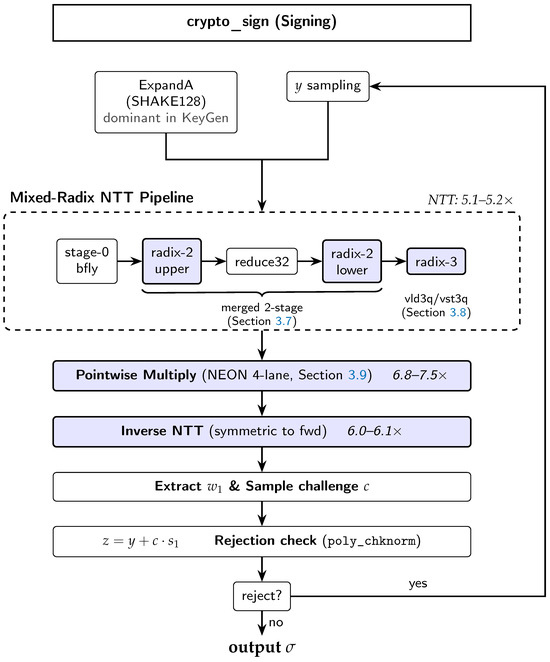
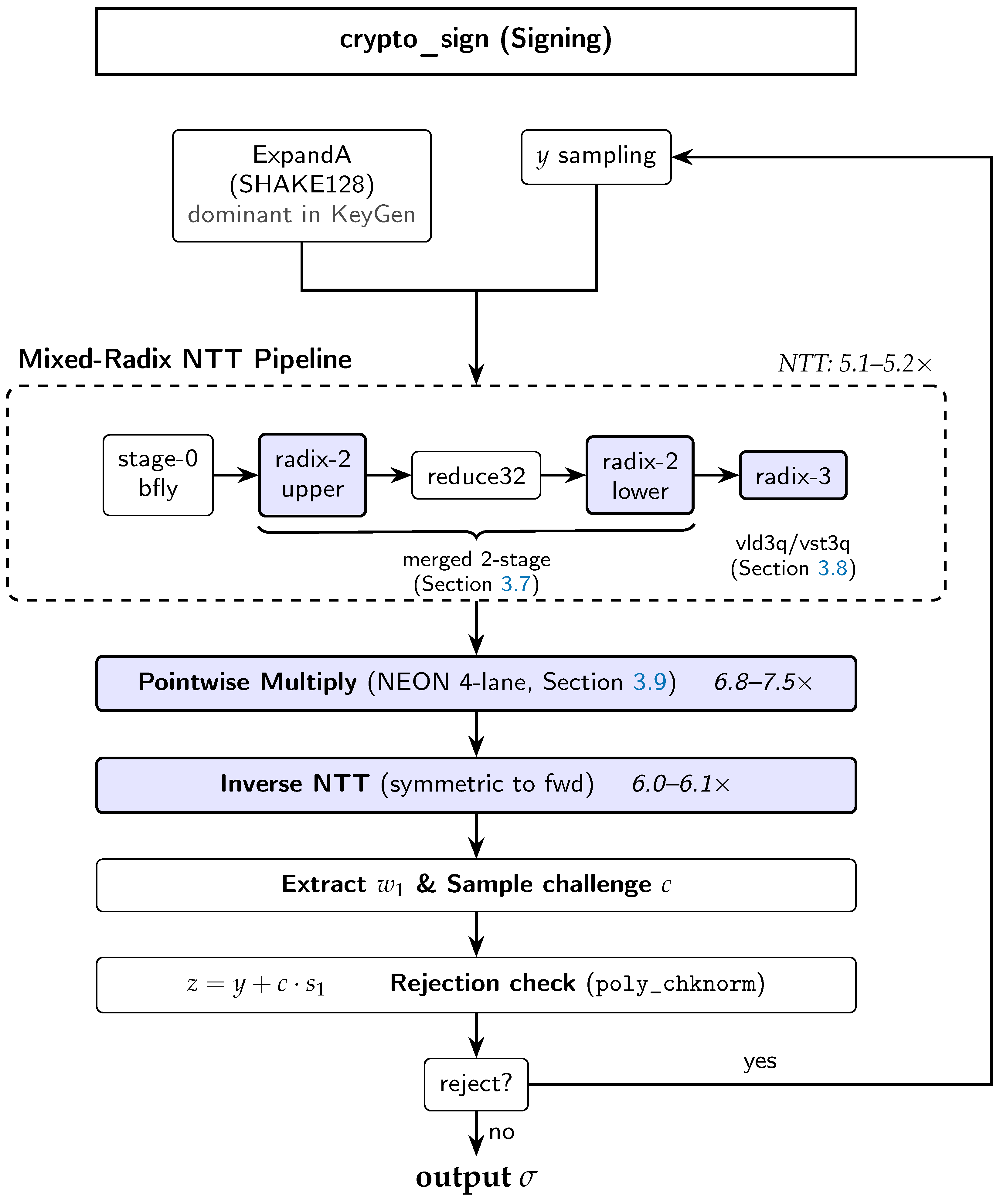
Figure 2 provides an overview of the signing pipeline with optimization targets highlighted. Section 3.2, Section 3.3, Section 3.4, Section 3.5 and Section 3.6 describe the baseline NEON kernels that were part of our initial implementation. Section 3.7, Section 3.8 and Section 3.9 then present three additional optimizations developed during revision: radix-2 multi-stage butterfly merging (Section 3.7), stride-3 vectorization of small-len radix-3 stages using NEON structure load/store instructions (Section 3.8), and pointwise Montgomery vectorization with parallel hashing (Section 3.9).
Figure 2.
Overview of the NCC-Sign signing pipeline with optimization targets highlighted. Shaded blocks indicate components accelerated by our NEON kernels, with section references and per-kernel speedups on Apple M1 Pro. Unshaded blocks (ExpandA, rejection check) remain unchanged and constitute the primary remaining bottleneck.
3.2. Building Blocks
We present the kernels in NEON intrinsic notation to make the mapping between algorithmic steps and the ARMv8 instruction stream explicit.
3.2.1. Montgomery Reduction Kernel (4-Lane NEON)
We implement Montgomery reduction for signed 32-bit lanes with radix and an odd modulus . Let satisfy . For a broadcast twiddle z and a 4-lane vector b, the scalar reference
is realized lane-wise using the NEON “doubling-high” primitive and an arithmetic halving: we form , a correction , , then , and output . This mapping avoids cross-lane traffic and remains branch-free for secret-dependent values; given , it does not trigger saturation in the doubling-high instruction. Our vector kernel emits five NEON instructions for four results: vqdmulhq_s32, vmulq_s32, vmulq_s32, vqdmulhq_s32, vhsubq_s32. The algorithmic complexity remains per residue; the gain is from instruction- and lane-level parallelism.
Correctness and Range Analysis
Let and let satisfy . Our kernel implements a signed Montgomery product: given a twiddle z and coefficient b, it returns with r in a centered range.
Lemma 1
(Montgomery correctness). Define , , , , and , where is the signed doubling-high multiply. Then, and whenever .
Proof.
By construction and . Since , we have , so ; dividing by R gives an integer congruent to . The halving subtract recovers this quotient in the signed representable range. Under , the intermediate products stay within the 64-bit range, and the final result satisfies . □
Lemma 2
(No saturation in signed high-multiply). The ARM instruction vqdmulhq_s32 saturates only when is requested. If a centered reduction step (reduce32_vec, Section 3.2.2) is applied mid-pipeline so that every input lane satisfies , no lane can equal , and the saturation condition is never met.
Proof.
The two’s-complement corner case arises only for , since exceeds the maximum signed 32-bit value. By construction, reduce32_vec maps each lane into , which is far from . Hence, no NEON lane in the pipeline triggers the saturation path. □
Lemma 1 justifies the algebraic correctness of Algorithm 1, while Lemma 2 formalizes the role of the mid-pipeline centered reduction in preventing edge-case saturation.
| Algorithm 1 montgomery_mul4_sqdmulh (4-lane, NEON; ) | |
| Require: b, vZ, vQ, vQINV (int32x4_t) | |
| Ensure: r | |
| 1: high_ab ← vqdmulhq_s32(vZ, b) | ▹ per lane |
| 2: b_qinv ← vmulq_s32(b, vQINV) | ▹ |
| 3: a_times ← vmulq_s32(vZ, b_qinv) | |
| 4: high_corr ← vqdmulhq_s32(a_times, vQ) | ▹ |
| 5: r ← vhsubq_s32(high_ab, high_corr) | ▹ arith. halving of |
| 6: return r | |
3.2.2. Centered Modular Reduction (reduce32_vec)
We normalize signed 32-bit coefficients using a vectorized Barrett-style step tuned for a modulus Q close to (e.g., ). For a lane value x, we compute
This realizes a centered reduction that returns r in a narrow signed interval around 0. The operation is branch-free for secret-dependent values; it uses a single right-shift to approximate division and one multiply by Q for the correction. Per four residues the kernel issues four vector ALU instructions: vaddq_s32, vshrq_n_s32, vmulq_s32, vsubq_s32—i.e., exactly instruction per result.
3.3. Radix-2 Butterfly Pipeline
The forward NTT begins with the stage-0 butterfly, which consumes the first twiddle and processes the top split with . Each 4-lane iteration computes and writes . Note that the stage-0 output differs from the standard Cooley–Tukey butterfly used in negacyclic NTTs. This is because the trinomial factors over two roots and of , yielding the CRT split and . The cost is 8 vector ALU ops per 8 residues (/residue).
After stage 0, two radix-2 kernels handle the remaining lengths in a Cooley–Tukey pattern. The radix2_upper_neon kernel processes lengths from down to (but not including) radix2_redlen_ntt; the radix2_lower_neon kernel continues from radix2_redlen_ntt down to , after which the mixed radix-3 stage takes over. For each pair at a given , we compute
using the 4-lane Montgomery kernel (Algorithm 1). Per 4-lane pair (eight residues), we perform two loads, one 5-op Montgomery kernel, one vaddq_s32, one vsubq_s32, and two stores; this totals 7 vector ALU ops, i.e., ALU ops per residue.
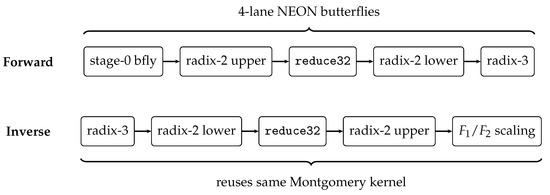
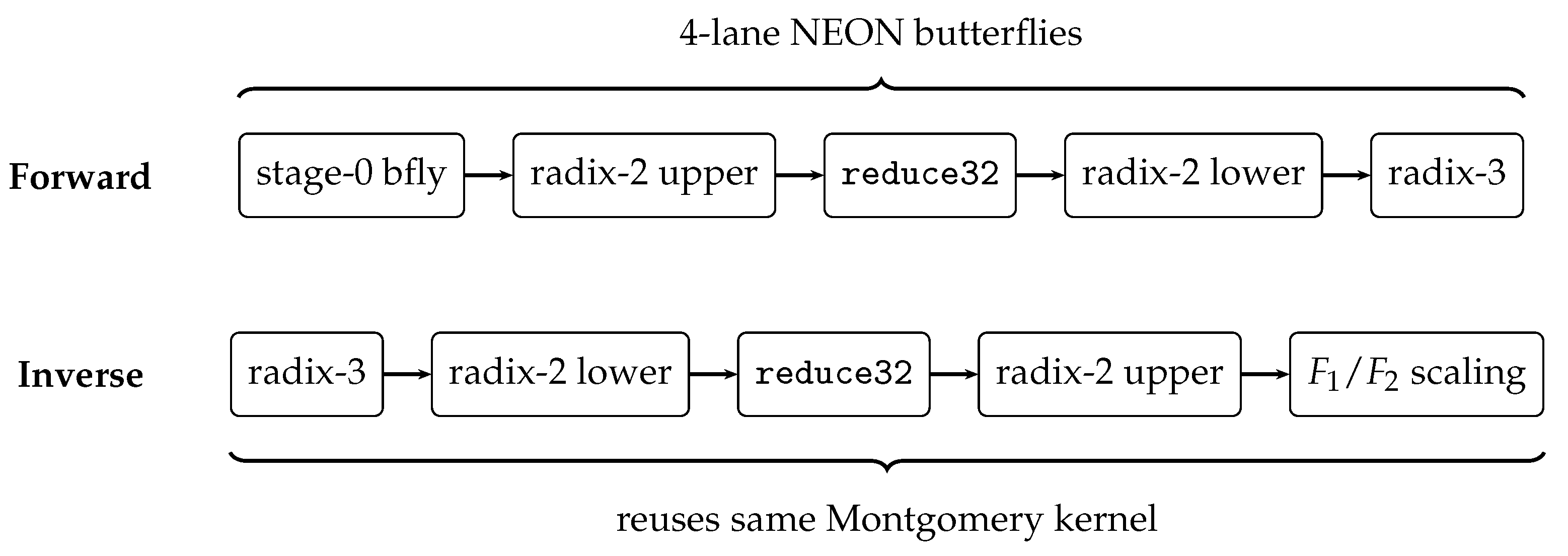
Between the upper and lower kernels we insert a mid-pipeline centered reduction sweep (Section 3.2.2; see Figure 3) to cap coefficient growth and maintain the non-saturating input conditions for vqdmulhq_s32 (Lemma 2). The lower kernel (radix2_lower_neon) follows the same structure as Algorithm 2 with a different len range; we omit a separate listing. All arithmetic-kernel code paths are branch-free with respect to secret-dependent data.
Figure 3.
Forward and inverse NTT pipelines with mid-pipeline vector reduce32 sweep (sign1/5 modes).
3.4. Mixed Radix-3 Pipeline
The mixed-radix parameter sets of NCC-Sign () require radix-3 stages after the radix-2 cascade. For a triplet at a given stride , with stage twiddles , we compute
and output
where all products are Montgomery products modulo Q with radix (Algorithm 1). The vector kernel maps these operations lane-wise; no cross-lane permutation is needed. The 4-lane NEON implementation of the forward mixed radix-3 stage is described in Algorithm 3.
| Algorithm 2 radix2_upper_neon (4-lane, NEON; radix2_redlen_ntt + 1) | |
| Require: Out, zetas, pk, vQ, vQINV | |
| 1: for down to radix2_redlen_ntt by do | |
| 2: for to step do | |
| 3: ; vZ ← vdupq_n_s32(z) | |
| 4: ; | |
| 5: while do | |
| 6: a ← vld1q_s32(&Out[j]) | |
| 7: b ← vld1q_s32(&Out[j + len]) | |
| 8: t ← montgomery_mul4_sqdmulh(b, vZ, vQ, vQINV) | |
| 9: vst1q_s32(&Out[j + len], vsubq_s32(a, t)) | ▹ |
| 10: vst1q_s32(&Out[j], vaddq_s32(a, t)) | ▹ |
| 11: | |
| 12: end while | |
| 13: while do | ▹ scalar tail |
| 14: standard scalar butterfly with montgomery_reduce | |
| 15: | |
| 16: end while | |
| 17: end for | |
| 18: end for | |
| Algorithm 3 radix3_forward_mixed_neon (4-lane, NEON; sign1/5) | ||
| Require: Out, zetas, pk, vQ, vQINV | ||
| 1: vW ← vdupq_n_s32(Wmont); vW2 ← vdupq_n_s32(W2mont) | ||
| 2: for down to 1 by do | ||
| 3: for to step do | ||
| 4: ; | ||
| 5: vZ1 ← vdupq_n_s32(); vZ2 ← vdupq_n_s32() | ||
| 6: ; | ||
| 7: while do | ||
| 8: a0 ← vld1q_s32(&Out[j]) | ||
| 9: a1 ← vld1q_s32(&Out[j + len]) | ||
| 10: a2 ← vld1q_s32(&Out[j + 2*len]) | ||
| 11: t1 ← montgomery_mul4_sqdmulh(a1, vZ1, vQ, vQINV) | ||
| 12: t2 ← montgomery_mul4_sqdmulh(a2, vZ2, vQ, vQINV) | ||
| 13: t12 ← vaddq_s32(t1, t2) | ||
| 14: u1 ← montgomery_mul4_sqdmulh(t1, vW, vQ, vQINV) | ||
| 15: u2 ← montgomery_mul4_sqdmulh(t2, vW2, vQ, vQINV) | ||
| 16: t34 ← vaddq_s32(u1, u2) | ||
| 17: a0n ← vaddq_s32(a0, t12) | ||
| 18: a1n ← vaddq_s32(a0, t34) | ||
| 19: a2n ← vsubq_s32(a0, vaddq_s32(t12, t34)) | ||
| 20: vst1q_s32(&Out[j], a0n) | ||
| 21: vst1q_s32(&Out[j + len], a1n) | ||
| 22: vst1q_s32(&Out[j + 2*len], a2n) | ||
| 23: | ||
| 24: end while | ||
| 25: while do | ▹ scalar tail (bit-identical to reference) | |
| 26: standard scalar radix-3 butterfly | ||
| 27: | ||
| 28: end while | ||
| 29: end for | ||
| 30: end for | ||
Cost
Per 4-lane triplet (12 residues): three loads, four calls to the Montgomery kernel ( vector ALU ops), four add/sub, and three stores—overall 24 vector ALU ops, or about ops per residue. Lengths commonly leave a scalar tail; the vector path handles any full 4-lane chunks.
3.5. Inverse Path
The inverse pipeline mirrors the forward path and stays lane-local. For sign1/5 we reuse the same 4-lane Montgomery primitive and compose three steps in reverse order: (i) an in-place inverse butterfly (inv_bfly4_store), (ii) a mixed radix-3 inverse kernel (radix3_inverse_mixed_neon), and (iii) a final fixed-twiddle scaling with . For sign3, the driver keeps a reference-compatible dispatch for part of the inverse path; reported speedups therefore reflect both optimized kernels and unchanged reference components. The inverse kernels mirror their forward counterparts; the principal differences are reversed stage order and the use of inverse twiddles. We omit separate algorithm listings as the kernel structure is symmetric to the forward path; see the public repository for full details.
Cost (Summary)
inv_bfly4_store: about 7 vector ALU ops per 8 residues (≈0.875/residue). Radix-3 inverse triplet: about 25 ALU ops per 12 residues (≈2.08/residue). Final scaling: about 18 ALU ops per 8 residues (≈2.25/residue). All described arithmetic kernels are data-independent with respect to secret-dependent control flow.
3.6. Integration Notes
3.6.1. NEON Intrinsics Summary
Table 5 lists the ARMv8 NEON intrinsics used across all kernels, together with their roles. All intrinsics operate on int32x4_t (four 32-bit signed lanes).
Table 5.
Summary of ARMv8 NEON intrinsics used in our kernels.
3.6.2. Normalization Strategy
Instead of normalizing after every butterfly, we apply a mid-pipeline centered reduction using reduce32_vec (Algorithm 4) between the radix-2 upper and lower spans (and symmetrically in the inverse path). This “reduce-late” policy minimizes arithmetic while preserving numerical safety. Without reduction, magnitude can grow roughly by a factor ≤2 per level; a single sweep with vector ALU op per residue caps all inputs well within the non-saturating domain (Lemma 2). Final normalization is deferred to the inverse-path epilogue, where scaling with canonicalizes outputs.
| Algorithm 4 reduce32_vec (4-lane, NEON; centered reduction) | |
| Require: x (int32x4_t), constants Q, | |
| Ensure: r in a centered interval | |
| 1: add ← vdupq_n_s32(C) | ▹ broadcast |
| 2: qv ← vdupq_n_s32(Q) | ▹ broadcast Q |
| 3: t ← vaddq_s32(x, add) | ▹ |
| 4: t ← vshrq_n_s32(t, 23) | ▹ |
| 5: tq ← vmulq_s32(t, qv) | ▹ (low 32 bits) |
| 6: r ← vsubq_s32(x, tq) | ▹ centered subtraction |
| 7: return r | |
3.6.3. Memory and Throughput
We operate in place with two contiguous loads and two stores per 4-lane butterfly (stage-0/radix-2), and three loads/stores per radix-3 triplet. Twiddles are broadcast once per start-block (vdupq_n_s32); Q and are hoisted out of the loops using restrict pointers. Accesses over halves at stride preserve streaming patterns, and scalar tails handle non-multiples of four without divergence. For best throughput, Out should be 16-byte aligned; vld1q_s32/vst1q_s32 still function correctly if unaligned, with minor penalties.
3.7. Radix-2 Multi-Stage Butterfly Merging
In the baseline implementation, each radix-2 NTT stage performs a full pass over the coefficient array: loading every element, computing the butterfly, and storing the result before the next stage begins. For k consecutive radix-2 stages this incurs k round trips to memory, and on both Apple M1 Pro and Cortex-A72, the load/store cost dominates the arithmetic cost of the butterfly itself.
Becker et al. [11] showed that for power-of-two NTTs, multiple radix-2 layers could be interleaved within NEON registers so that intermediate results are never written back to memory. We adapted this idea to the radix-2 span of NCC-Sign’s mixed-radix NTT pipeline, merging two consecutive stages into a single memory pass. The proposed two-stage merged radix-2 forward NEON kernel is given in Algorithm 5.
Concretely, let and denote the outer and inner stage lengths. For each group of four coefficient positions , the merged kernel:
- Loads four values with four vld1q_s32 instructions;
- Performs the outer butterfly in registers: , , , and likewise for ;
- Immediately performs the inner butterfly on the results: , , , and likewise with ;
- Stores the four results with four vst1q_s32 instructions.
The net effect is that each coefficient is loaded and stored once instead of twice, halving the memory traffic for the merged stages. The twiddle factors for both stages are consumed in sequence: outer twiddles occupy indices through , and inner twiddles follow immediately. When the total number of radix-2 stages in a span is odd, the last stage falls back to the unmerged single-stage kernel.
We apply this merging to both the forward and inverse radix-2 paths. In the inverse direction the butterfly order is reversed (inner before outer), and the twiddle consumption order is adjusted accordingly. The mid-pipeline reduce32 sweep (Section 3.2.2) is retained at the boundary between the upper and lower radix-2 spans to prevent coefficient growth from reaching the saturation threshold of vqdmulhq_s32 (Lemma 2).
| Algorithm 5 radix2_merged2_fwd_neon (2-stage merged, 4-lane NEON) |
| Require: Out, zetas, pk, vQ, vQINV, (outer stage length) |
| Ensure: Two consecutive radix-2 NTT stages in one memory pass |
| 1: |
| 2: for to step do |
| 3: ; |
| 4: ; |
| 5: ; |
| 6: for to step 4 do |
| 7: |
| 8: |
| 9: |
| 10: |
| ▹Outer butterfly (stage ) |
| 11: |
| 12: |
| 13: ; |
| 14: ; |
| ▹Inner butterfly (stage ) |
| 15: |
| 16: |
| 17: |
| 18: |
| 19: |
| 20: |
| 21: end for |
| 22: end for |
We note that extending this approach across the radix-2/radix-3 boundary was also investigated: merging the last radix-2 stage with the first radix-3 stage would avoid one additional memory round trip. However, the stride-3 access pattern of the radix-3 stage is incompatible with the contiguous four-lane loads used in the radix-2 path, and the gather/scatter overhead required to reconcile the two patterns exceeds the load/store saving. We therefore kept the radix-2 and radix-3 pipelines separate.
3.8. Stride-3 Vectorization of Radix-3 Stages
In the baseline radix-3 kernel (Section 3.4), the inner loop processes triplets in chunks of four lanes using vld1q_s32 and the Montgomery kernel. When the stage length is four or greater, this works well. However, the final radix-3 stages of NCC-Sign-1 and NCC-Sign-5 operate at and , both below the NEON four-lane width. In the baseline code these iterations fall through to a scalar tail that executes the Montgomery reduction one coefficient at a time, forfeiting the SIMD advantage precisely where the radix-3 cost concentrates.
A stage-merging approach analogous to Section 3.7 does not help here: the small array segments already reside in L1 cache, so eliminating one load/store round trip has negligible effect. The bottleneck is not memory traffic but the per-coefficient cost of the scalar Montgomery reduction, which processes one residue at a time instead of four.
We resolve this with a data-layout transformation that maps the radix-3 access pattern onto NEON structure load/store instructions.
3.8.1. (Four-Block Gather)
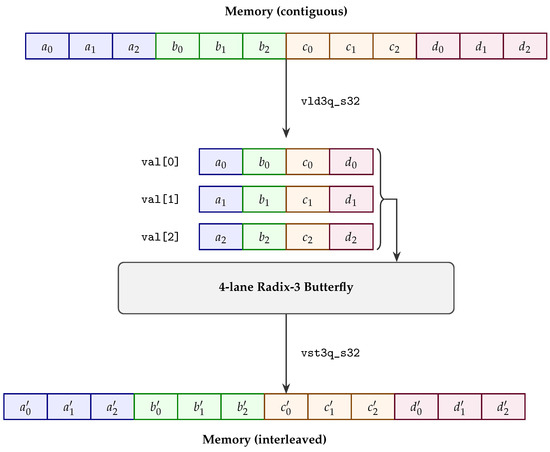
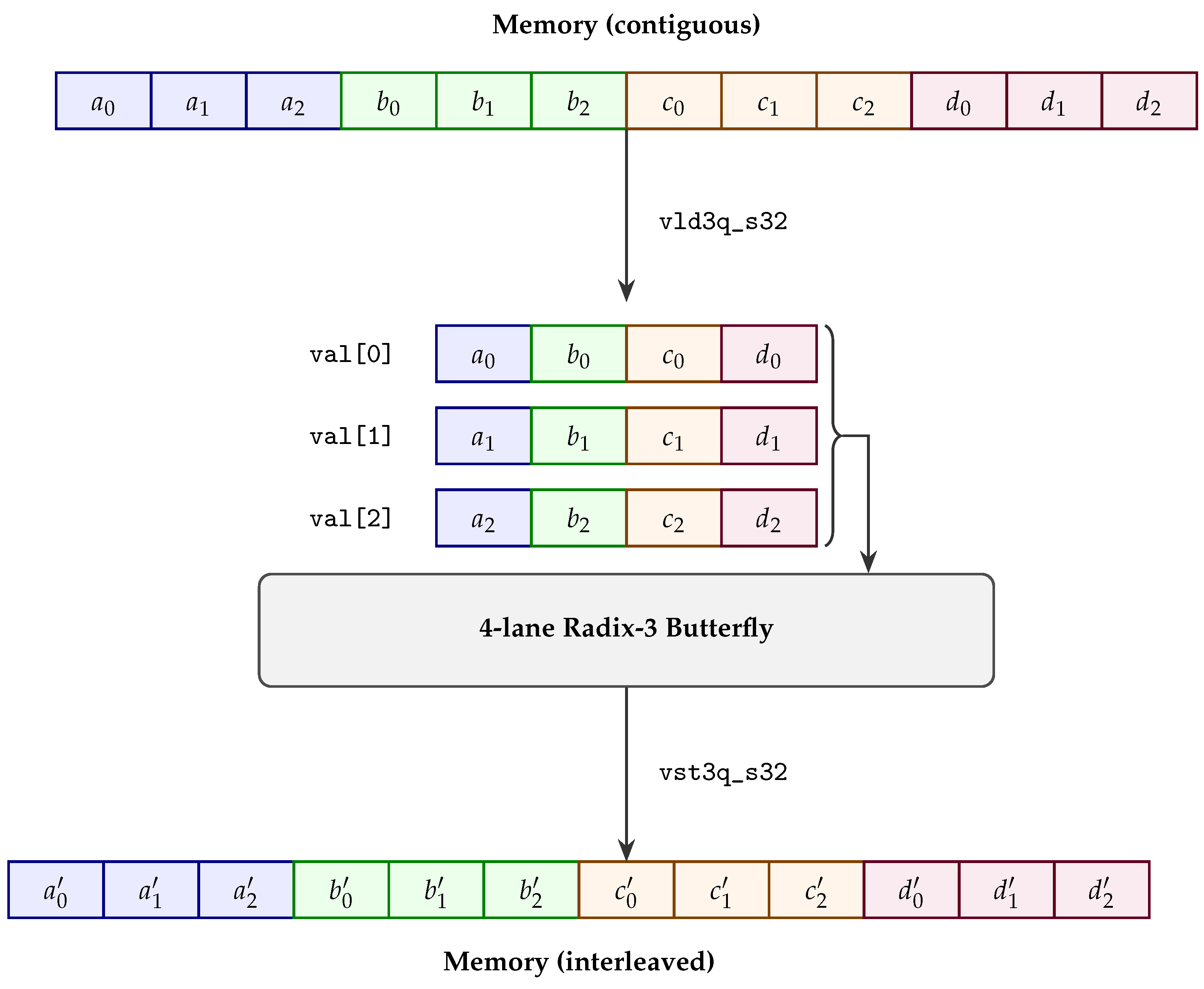
Figure 4 illustrates the data-layout transformation for this case. When each radix-3 block spans three contiguous coefficients, and successive blocks are laid out consecutively in memory. The NEON instruction vld3q_s32 reads twelve contiguous 32-bit words and distributes them into three registers with a hardware stride-3 deinterleave at no additional ALU cost:
which groups the first, second, and third elements of four independent triplets into separate NEON registers. Because each block uses different twiddle factors, we load these as vectors as well: vld2q_s32 on the twiddle array separates the pairs for four blocks in one instruction. The four-lane Montgomery kernel then processes all four triplets simultaneously. After the butterfly, vst3q_s32 performs the inverse interleave and writes the twelve results back. The loop advances by four blocks (twelve coefficients) per iteration; a scalar tail handles any remainder. To fully vectorize the len = 1 radix-3 stage, we reorganize the data layout as shown in Algorithm 6.
Figure 4.
Data-layout transformation for the radix-3 vectorization. vld3q_s32 deinterleaves twelve contiguous coefficients from four independent triplets into three NEON registers, enabling a four-lane parallel radix-3 butterfly. vst3q_s32 restores the interleaved layout.
3.8.2. (Three-Wide SoA)
When a single block spans nine coefficients. Within one block the three sub-arrays , , are each contiguous. We load each sub-array into a NEON register via vld1q_s32, obtaining three lanes of useful data per register (the fourth lane is unused). The same twiddle factor applies to all three lanes, so a single vdupq_n_s32 broadcast suffices. After the radix-3 butterfly, we store only the lower three elements of each result register. Because the twiddle is shared within a block, no gather/scatter is needed.
NCC-Sign-3 uses , whose single radix-3 stage operates at and is therefore already handled by the baseline four-lane path; no stride-3 transformation is applied.
| Algorithm 6 radix3_stride3_len1_neon (vld3q, 4-block parallel) | |
| Require: Out, zetas, pk, vQ, vQINV, vW, vW2 | |
| Ensure: Radix-3 butterfly on four consecutive triplets | |
| 1: for to step 12 do | |
| 2: | ▹ stride-3 deinterleave |
| 3: ; ; | |
| 4: | ▹ load blocks |
| 5: ; | |
| 6: | |
| ▹ Four-lane radix-3 butterfly | |
| 7: | |
| 8: | |
| 9: | |
| 10: | |
| 11: | |
| 12: | |
| 13: | |
| 14: | |
| 15: | |
| 16: | ▹ stride-3 interleave |
| 17: end for | |
3.8.3. Effect
The stride-3 vectorization converts the radix-3 path from fully scalar to fully vectorized execution for NCC-Sign-1 and NCC-Sign-5. The resulting end-to-end impact is most visible in verification, where the inverse NTT is dominated by these small-len radix-3 stages; quantitative results are presented in Section 4.3. We emphasize that the key enabler is the observation that NEON’s structure load/store instructions match the stride-3 memory pattern of radix-3 butterflies—an optimization opportunity specific to mixed-radix NTTs that does not arise in the power-of-two transforms common in ML-KEM and ML-DSA.
3.9. Pointwise Multiplication and Parallel Hashing
Two further optimizations target non-NTT components of the signing pipeline.
3.9.1. Pointwise Montgomery Multiplication
In the baseline code, the coefficient-wise multiplication of two NTT-domain polynomials invokes the scalar montgomery_reduce function in a simple loop. Because each coefficient pair is independent, the loop maps directly to the existing four-lane Montgomery kernel (Section 3.2.1): four coefficient pairs are loaded with vld1q_s32, multiplied via montgomery_mul4_sqdmulh, and stored back. For NCC-Sign-1 and NCC-Sign-5 (modes 1/5), whose pointwise operation is a straightforward element-wise product, N is a multiple of four and no scalar tail is needed. For NCC-Sign-3 (mode 3), the pointwise step involves a base multiplication over degree-2 residues with stride-6 memory access; we batch four such blocks into a single NEON pass using explicit gather (vld1q_lane_s32) and scatter helpers, performing nine Montgomery multiplications per batch in four-lane vectors. The performance impact of this vectorization is quantified in Section 4.3.
3.9.2. Parallel Hashing (fips202x2)
Sampling and hashing operations based on SHAKE128/256 account for over 50% of key-generation cycles (Section 4), motivating the integration of a two-way NEON-parallel Keccak implementation. We adopt the fips202x2 module from the neon-ntt repository, which interleaves two independent SHAKE instances on a single pair of NEON register files by executing the KeccakF1600 permutation on both states simultaneously.
Within NCC-Sign, we apply fips202x2 to the secret-key sampling phase of key generation, where two independent -bounded polynomials ( and ) are derived from the same seed with different nonces. The two SHAKE256 streams are absorbed and squeezed in parallel, and each stream is independently passed through the rejection-sampling loop (rej_eta).
The achievable speedup is inherently limited by the algorithm structure. NCC-Sign uses a single polynomial ring (as opposed to the module structure of ML-DSA), so the dominant hashing cost—the ExpandA call that derives the public matrix element from a SHAKE128 stream—is a single sequential invocation that cannot be paired. The parallel path therefore covers only the / sampling, which represents roughly 10–15% of total sampling cost. The measured end-to-end improvement from fips202x2 is accordingly modest (1–2% for key generation). We include this optimization for completeness and note that it would yield substantially larger gains in module-lattice schemes where ExpandA generates independent matrix entries.
4. Performance Evaluation
4.1. Benchmarking Environment
We measured the end-to-end cost of three core signature operations—key generation (crypto_sign_keypair), signing (crypto_sign), and verification (crypto_sign_open)—on two architecturally distinct ARMv8 platforms.
4.1.1. Platform 1: Apple M1 Pro
A MacBook Pro with Apple M1 Pro (eight performance + two efficiency cores), 16 GB RAM, macOS Sequoia, compiled with Apple clang 14.0.3 (target: arm64-apple-darwin) using -O3 -fomit-frame-pointer and the same warning flags as the baseline. Cycle counting used Apple silicon’s PMU core-cycle counter through the private kperf/kpc interface (kpc_get_thread_counters()), following the open-source M1/M2 cycle-counter library by Nguyen [30] and established practice for Apple silicon benchmarking [31,32,33]. The benchmark thread was pinned to a high-performance core via QOS_CLASS_USER_INTERACTIVE.
4.1.2. Platform 2: Arm Cortex-A72 (Raspberry Pi 4)
A Raspberry Pi 4 Model B with a quad-core Cortex-A72 at 1.8 GHz, 8 GB RAM, running 64-bit Raspberry Pi OS (Linux aarch64), compiled with GCC 14 using the same -O3 flag. Cycle counting used the Linux perf_event_open interface configured for PERF_COUNT_HW_CPU_CYCLES with kernel-mode exclusion, which does not require root privileges when perf_event_paranoid . The Cortex-A72 represents a widely deployed embedded ARMv8 core and serves as the standard benchmarking platform in prior PQC NEON work [11,28].
The two platforms differ substantially in microarchitecture: the M1 Pro features a wide out-of-order pipeline with high instruction-level parallelism, whereas the Cortex-A72 has a narrower pipeline. Evaluating on both allows us to distinguish optimization effects that are robust across microarchitectures from those specific to a particular core design.
4.1.3. Methodology
Each benchmark binary (KpqC_bench) executed 10,000 iterations of the target operation and reported the arithmetic mean. We ran each binary 20 times and report the minimum (best) of the 20 runs as the primary metric, as this most closely reflects the true algorithmic cost by minimizing interference from OS scheduling and DVFS transients. The mean and standard deviation of the 20 runs are reported alongside to characterize measurement stability. Because signing involves a rejection loop whose iteration count varies stochastically (expected attempts: for Sign-1, for Sign-3, for Sign-5), the Sign metric inherently exhibits higher variance than the deterministic KeyGen and Verify operations.
4.1.4. Baselines
We adopted the NCC-Sign implementations from KPQClean and its ver. 2 branch [34,35], which follow the PQClean philosophy of clean, dependency-free baselines [36]. Both the baseline and optimized variants were compiled with the identical toolchain, optimization level (-O3), and flags on each platform; the only difference was the activation of ARMv8/NEON kernels in the optimized build.
4.1.5. Parameter Sets
We benchmarked the 1, 3, and 5 parameter sets, corresponding to the build targets NCC-Sign1, NCC-Sign3, and NCC-Sign5 [20].
4.1.6. Public Release
All artifacts described above—including compile-time switches to enable or disable NEON kernels, cycle-counting adaptations for both platforms, the dudect test harness, and the Montgomery-versus-Barrett microbenchmark—are included in the public repository introduced in Section 1. Functional correctness was verified by the built-in test routines, which confirmed that signatures generated by the optimized path were accepted by the corresponding verification routine.
4.2. End-to-End Results
Table 6 reports cycle counts on Apple M1 Pro for NCC-Sign-1/3/5, measured as the best of 20 runs with 10,000 iterations each.
Table 6.
Cycle counts on Apple M1 Pro (best of 20 runs × 10,000 iterations). The primary metric is the best (minimum) of 20 independent runs. Measurement stability (mean ± std) is reported separately in Table 7.
Table 7.
Measurement stability of the optimized build on Apple M1 Pro: mean and standard deviation over 20 independent runs. KeyGen and Verify are deterministic and exhibit low variance (KeyGen: std < 0.5% of mean; Verify: std < 1.5% of mean). Sign includes rejection sampling, producing inherently high variance; the best (minimum) value reported in Table 6 reflects the per-attempt cost most accurately.
Table 8 presents the corresponding results on Arm Cortex-A72 (Raspberry Pi 4).
Table 8.
Cycle counts on Arm Cortex-A72 (best of 20 runs × 10,000 iterations). The primary metric is the best (minimum) of 20 independent runs. Measurement stability is reported in Table 9.
Table 9.
Measurement stability of the optimized build on Arm Cortex-A72: mean and standard deviation over 20 independent runs. KeyGen and Verify are deterministic and exhibit negligible variance (KeyGen: std < 0.5% of mean; Verify: std < 1.5% of mean).
Discussion
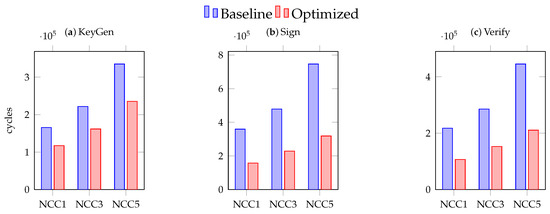
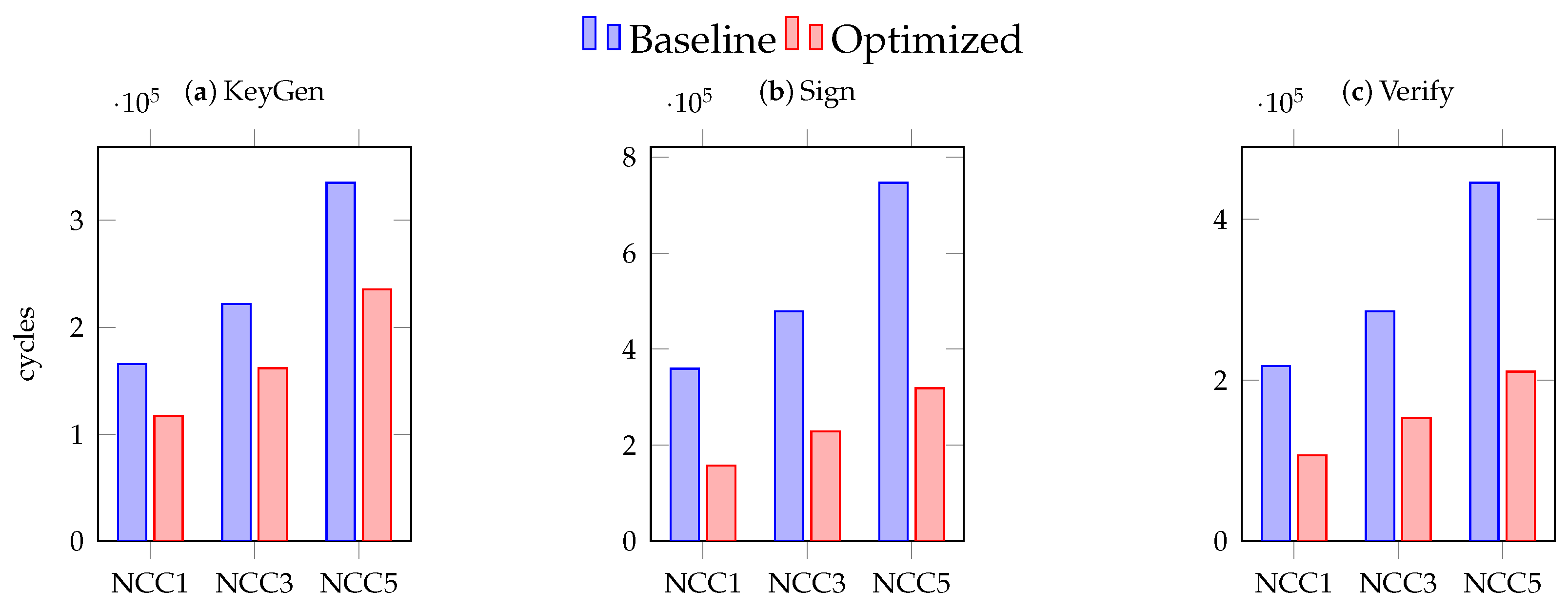
Figure 5 visualizes the per-operation improvements on M1 Pro. On Apple M1 Pro, the NEON-optimized build achieves geometric-mean speedups of for key generation, for signing, and for verification across the three parameter sets. The signing and verification paths benefit the most, consistent with these operations spending the majority of their cycles in NTT/INTT and pointwise multiplication (quantified in Section 4.3). Key generation improves more modestly because its dominant cost is Keccak-based sampling (ExpandA), which is not targeted by our NEON kernels.
Figure 5.
Per-operation cycle counts on Apple M1 Pro: baseline (left) vs. optimized (right) across NCC-Sign-1/3/5.
On Cortex-A72 the same optimizations yield lower but consistent speedups: for key generation, for signing, and for verification. The reduced gains reflect the narrower execution pipeline of the Cortex-A72, where the scalar baseline already achieves relatively higher utilization of the available issue width. Nevertheless, the optimizations are beneficial on both microarchitectures, confirming that the NEON kernels are portable across distinct ARMv8-A implementations.
Absolute cycle counts on Cortex-A72 are – higher than on M1 Pro for the same operation, with the ratio being larger for NTT-intensive operations (Sign, Verify) than for sampling-dominated ones (KeyGen). This is consistent with the M1 Pro’s wider pipeline extracting more instruction-level parallelism from the vectorized NTT loops.
4.3. Function-Level Profiling
To understand where the speedups originate, we profile the optimized build on Apple M1 Pro by measuring each arithmetic kernel in isolation (1000 iterations, median cycles). Table 10 reports the per-kernel speedups for the three operations targeted by our NEON optimization.
Table 10.
Per-kernel speedups (clean baseline → NEON optimized) on Apple M1 Pro. Median of 1000 independent calls.
The NTT and INTT kernels achieve 3.6–6.1× speedups, reflecting the combined effect of four-lane Montgomery butterflies, multi-stage merging, and stride-3 radix-3 vectorization. The pointwise multiplication (BaseMul) sees even larger gains (–) because the baseline scalar code performs one Montgomery reduction per coefficient, whereas the NEON path processes four in parallel with no additional overhead.
Sign-3 exhibits somewhat lower kernel-level speedups than Sign-1 and Sign-5. This is because NCC-Sign-3 uses with a single radix-3 stage at , so the stride-3 vectorization of Section 3.8 does not apply; moreover, its base multiplication uses a degree-2 residue structure requiring gather/scatter access patterns that reduce NEON throughput.
Table 11 shows the cycle breakdown of the optimized build for key generation on Sign-1, illustrating the relative weight of each component.
Table 11.
Cycle breakdown of NCC-Sign-1 key generation (optimized build, Apple M1 Pro). The NTT/INTT/BaseMul kernels account for only 8.5% of the total, with Keccak-based sampling dominating at 30.7%.
Amdahl’s Law Interpretation
On M1 Pro, the combined NTT + INTT cost in the clean baseline accounts for approximately 63% of a single signing attempt for NCC-Sign-1. With per-kernel speedups of 5–, the theoretical end-to-end upper bound under Amdahl’s law is approximately . The measured end-to-end signing speedup of (best of 20 runs) exceeds this single-kernel bound because the pointwise multiplication and the radix-3 vectorization contribute additional, independent gains.
For key generation, the NTT/INTT/BaseMul kernels occupy only 8.5% of the total cost (Table 11); even infinite speedup on these kernels would yield at most a end-to-end improvement. The measured reflects savings in other vectorized components (polynomial arithmetic helpers such as poly_reduce and poly_caddq), but further improvement requires accelerating the Keccak-based sampling path, which we identify as future work (Section 5).
4.4. Cross-Scheme Comparison
To assess the competitiveness of our optimized NCC-Sign against a state-of-the-art ARMv8 implementation of a standardized scheme, we benchmarked the NEON-optimized ML-DSA (Dilithium) of Becker et al. [11] on the same two platforms under the same measurement methodology (best of 20 runs, 10,000 iterations). The ML-DSA code was compiled from the neon-ntt repository with -O3; on Apple M1 Pro it used the same kperf/kpc cycle counter, and on Cortex-A72 it used the PMU kernel module provided in the repository. Both implementations used the same fips202/fips202x2 modules for Keccak hashing and were compiled with identical optimization flags (-O3 -fomit-frame-pointer on M1 Pro, -O3 on Cortex-A72) to ensure a fair comparison.
Table 12 compares NCC-Sign and ML-DSA (Dilithium) on Apple M1 Pro at matching security levels.
Table 12.
Cycle counts of optimized NCC-Sign and NEON-optimized Dilithium on Apple M1 Pro (best of 20 runs). Bold entries indicate the faster scheme at each security level.
Table 13 presents the same comparison on Cortex-A72.
Table 13.
Cycle counts of optimized NCC-Sign and NEON-optimized Dilithium on Arm Cortex-A72 (best of 20 runs).
Discussion
On Apple M1 Pro, NCC-Sign produces signatures faster than ML-DSA at all three security levels, by 23–34%. On Cortex-A72, NCC-Sign is faster at Levels 1 and 3 (by 3–9%), but at Level 5, ML-DSA’s signing is 8.7% faster (1122k vs. 1220k cycles), likely because ML-DSA’s power-of-two NTT benefits more from the Cortex-A72’s narrower pipeline at larger transform sizes. ML-DSA’s advantage in key generation and verification on M1 Pro reflects its module-lattice structure, where the matrix enables parallel NTT calls that amortize sampling and hashing costs more effectively than NCC-Sign’s single-polynomial ring. Conversely, NCC-Sign’s signing path benefits from a lower expected rejection count and a more compact NTT pipeline.
On Cortex-A72, an interesting reversal occurs at Levels 3 and 5: NCC-Sign’s key generation becomes faster than ML-DSA’s (416k vs. 568k at Level 3, 626k vs. 873k at Level 5). This suggests that ML-DSA’s matrix-expansion overhead scales less favorably on the narrower Cortex-A72 pipeline, whereas NCC-Sign’s single-polynomial ExpandA remains lightweight.
For completeness, Table 14 reproduces the NEON-optimized HAETAE results reported by Sim et al. [13] on the same Apple M1 Pro platform.
Table 14.
HAETAE NEON-optimized performance on Apple M1 Pro reported by Sim et al. [13]. Unit: per operation (derived from 10,000-iteration wall-clock totals). These figures use wall-clock timing rather than PMU cycle counts and are included for qualitative reference only.
Because Sim et al. employed wall-clock timing rather than PMU cycle counters, the measurements include OS scheduling and DVFS overhead that our methodology excludes; a direct numerical comparison with Table 6 and Table 12 is therefore not appropriate. Nevertheless, two qualitative observations are possible. First, HAETAE-260 (Level 5) exhibits a signing cost roughly two orders of magnitude higher than Levels 2–3, reflecting its larger module dimensions and substantially higher rejection rate. Second, at Levels 2 and 3, HAETAE’s verification is notably fast (31.6–54.5 ), while its signing cost (372–682 ) places it in a broadly similar range to ML-DSA on the same platform, and both are slower than our optimized NCC-Sign in the signing operation.
4.5. Constant-Time Analysis
A cryptographic implementation intended for deployment must not leak secret information through execution-time variations. Our NEON kernels are designed to be branch-free and data-independent with respect to secret values: all NEON instructions used (vqdmulhq_s32, vmulq_s32, vhsubq_s32, vaddq_s32, vsubq_s32, vld1q_s32, vst1q_s32, vld3q_s32, vst3q_s32) are specified as fixed-latency operations in the Arm architecture, and no secret-dependent branch or table lookup appears in any kernel. To substantiate this claim empirically, we apply the dudect methodology of Reparaz et al. [37].
4.5.1. Methodology
dudect performs a Welch t-test on execution-time distributions collected under two input classes. Following recommended practice, we used a fixed–random versus random–random design: class 0 supplied a fixed (but randomly chosen) input polynomial, and class 1 supplied a fresh random polynomial for each measurement. This avoids false positives that can arise from degenerate inputs such as all-zero polynomials, whose cache-access patterns may differ systematically from typical inputs without implying a secret-dependent timing channel. Each test accumulated 30 million measurements on Apple M1 Pro. A maximum -value below five was interpreted as no detected leakage.
Table 15 summarizes the results.
Table 15.
Dudect leakage-detection results on Apple M1 Pro (fixed–random vs. random–random, 30 M measurements). pass: max ; fail entries are design-level timing variations, not implementation defects (see text).
All NEON-optimized kernels—NTT, INTT, and pointwise multiplication—passed the dudect threshold on all three parameter sets, with a comfortable margin (maximum ). The clean scalar pointwise multiplication also passed, confirming that the NEON vectorization did not introduce timing leakage absent from the reference code.
Two functions reported fail, both for design-level reasons unrelated to our optimization. First, poly_chknorm uses an early-return structure that terminates as soon as any coefficient exceeds a public bound; this is a norm-checking utility whose output determines only whether the signing attempt is rejected, not any secret value. Second, crypto_sign as a whole exhibits large timing variation () because the Fiat–Shamir-with-Aborts paradigm entails a rejection loop whose iteration count depends on the sampled intermediate values. This variable-time behavior is inherent to the algorithm design and is shared by all Fiat–Shamir-with-Aborts schemes, including the NIST-standardized ML-DSA. It does not constitute a side-channel vulnerability, as the number of rejection iterations does not reveal information about the long-term signing key.
4.5.2. Limitations
dudect is an empirical, black-box test; passing it does not constitute a formal proof of constant-time execution. Subtle microarchitectural effects (e.g., operand-dependent forwarding latencies, cache-bank conflicts) may escape statistical detection at the measurement granularity used. Formal verification of constant-time properties, for instance via tools such as ct-verif or Binsec, is left as future work.
4.6. Montgomery vs. Barrett Microbenchmark
Section 3 justified the choice of Montgomery multiplication over Barrett reduction on theoretical grounds. Here, we validate that choice empirically with a microbenchmark on Apple M1 Pro, measuring the cost of a single radix-2 NTT butterfly implemented with each reduction strategy.
For Barrett reduction, we implemented a standard multiply-by-reciprocal sequence adapted to NCC-Sign’s modulus : a high-multiply to approximate the quotient, a shift, a correction multiply by Q, and a conditional subtraction. The NEON Barrett path required approximately nine vector instructions per butterfly, compared to five for the Montgomery path (Section 3.2.1). Both implementations were verified against the same set of 100,000 random inputs.
Table 16 reports the per-butterfly cost.
Table 16.
Radix-2 NTT butterfly cost (cycles per butterfly) on Apple M1 Pro. Montgomery reduction requires fewer NEON instructions and achieves a 23% advantage in the vectorized path.
Montgomery’s advantage stems from two factors. First, its five-instruction critical path (vqdmulhq, vmul, vmul, vqdmulhq, vhsub) is shorter than Barrett’s nine-instruction sequence, directly reducing arithmetic latency. Second, Montgomery operates entirely within 32-bit lanes using the doubling high-multiply primitive, whereas a faithful Barrett implementation on NEON requires careful management of intermediate precision, since ARMv8 NEON lacks a native 64-bit integer multiply. Together these factors yield a consistent 23% speed advantage per butterfly in the NEON path and 19% in the scalar path, confirming that Montgomery is the better fit for NCC-Sign’s mixed-radix NTT on ARMv8.
5. Discussion
5.1. Transferability and Broader Relevance
NCC-Sign was not selected in the final KpqC standardization; AIMer and HAETAE were chosen for signatures. Nevertheless, the optimization techniques developed in this work have relevance beyond the specific scheme. The baseline NEON kernels (four-lane Montgomery multiplication, centered reduction, multi-stage radix-2 merging) are directly applicable to any lattice-based scheme whose arithmetic reduces to modular polynomial multiplication via NTT, including ML-DSA, ML-KEM, and HAETAE. The stride-3 vectorization technique of Section 3.8, which exploits NEON structure load/store instructions to handle radix-3 stages below the SIMD lane width, is specific to mixed-radix NTTs of the form . Such transforms arise in NCC-Sign and could appear in future schemes that adopt non-power-of-two polynomial rings for algebraic or security reasons. We note, however, that the current NIST and KpqC standards exclusively use power-of-two NTTs, so the immediate applicability of the radix-3 technique is limited to non-standard settings.
More broadly, the function-level profiling methodology and Amdahl’s law’s analysis framework presented in Section 4.3 are scheme-agnostic and can guide optimization prioritization for any NTT-based cryptographic workload. The dudect-based constant-time verification workflow (Section 4.5) is likewise reusable across implementations.
5.2. Energy Considerations
Our NEON vectorization reduces the dynamic instruction count for NTT-intensive operations by processing four coefficients per instruction rather than one. On both Apple M1 Pro and Cortex-A72, this translates to fewer executed instructions for the same workload, which generally correlates with lower dynamic energy consumption. However, we do not provide quantitative energy measurements in this work, as cycle-accurate energy counters are not publicly exposed on either platform. Obtaining per-operation energy data via external power monitors or platform-specific profiling tools (e.g., Apple’s powermetrics) remains future work.
5.3. Limitations
Our evaluation covers two ARMv8-A microarchitectures (Apple M1 Pro and Arm Cortex-A72). While these represent distinct design points—a high-performance wide-issue core and a widely deployed embedded core—additional platforms (e.g., Cortex-A55, Cortex-A76, Cortex-X series) would further characterize portability. All kernels use 128-bit NEON only; exploring Arm SVE/SVE2 with scalable vectors is a natural extension. The Keccak-based sampling (ExpandA) dominates key-generation cost (Section 4.3) and is not accelerated by our current NEON kernels; leveraging ARMv8.2-SHA3 instructions for single-stream Keccak acceleration is a promising direction. Finally, the dudect assessment is empirical and does not replace formal constant-time verification; tools such as ct-verif or Binsec could provide stronger guarantees.
6. Conclusions
This paper presented an ARMv8/NEON-optimized implementation of NCC-Sign for the mixed-radix NTT trinomial parameter sets (NCC-Sign-1/3/5). Beyond the baseline lane-local SIMD kernels, we introduced radix-2 multi-stage butterfly merging, a stride-3 vectorization technique using NEON structure load/store instructions for small-len radix-3 stages, and NEON-parallel pointwise Montgomery multiplication.
On Apple M1 Pro, the optimized build achieved geometric-mean speedups of for key generation, for signing, and for verification, with individual kernel gains of up to 5– (NTT/INTT) and (pointwise multiplication). On Arm Cortex-A72, consistent speedups of (KeyGen), (Sign), and (Verify) confirmed cross-platform portability. A direct comparison with the NEON-optimized ML-DSA (Dilithium) showed that NCC-Sign produced signatures 23–34% faster on M1 Pro at all security levels, while ML-DSA retained an advantage in key generation and verification due to its module-lattice structure.
Empirical constant-time testing via dudect confirmed that all NEON kernels passed the leakage-detection threshold under 30 million measurements, and a Montgomery-versus-Barrett microbenchmark validated the modular-reduction design choice with a measured 23% speed advantage.
Author Contributions
Conceptualization, M.L. and H.S.; methodology, M.L.; software, M.L.; validation, M.L., M.S. and S.E.; formal analysis, M.L.; investigation, M.L.; resources, H.S.; data curation, M.L.; writing—original draft preparation, M.L.; writing—review and editing, M.S., S.E. and H.S.; visualization, M.L.; supervision, H.S.; project administration, H.S.; funding acquisition, H.S. All authors have read and agreed to the published version of the manuscript.
Funding
This research was financially supported by Hansung University.
Data Availability Statement
The optimized implementation and benchmarking/validation scripts are publicly available at https://github.com/minunejip/PQC-ARMv8 (accessed on 27 March 2026).
Conflicts of Interest
The authors declare no conflicts of interest.
References
- Shor, P.W. Polynomial-Time Algorithms for Prime Factorization and Discrete Logarithms on a Quantum Computer. SIAM J. Comput. 1997, 26, 1484–1509. [Google Scholar] [CrossRef] [Scilit]
- Grover, L.K. Quantum Mechanics Helps in Searching for a Needle in a Haystack. Phys. Rev. Lett. 1997, 79, 325–328. [Google Scholar] [CrossRef] [Scilit]
- CISA; NSA; NIST. Quantum-Readiness: Migration to Post-Quantum Cryptography; Technical Report; U.S. Cybersecurity and Infrastructure Security Agency: Washington, DC, USA, 2023. Available online: https://www.cisa.gov/sites/default/files/2023-08/Quantum%20Readiness_Final_CLEAR_508c%20(3).pdf (accessed on 19 February 2026).
- NIST PQC Project. Post-Quantum Cryptography Project. 2025. Available online: https://csrc.nist.gov/Projects/post-quantum-cryptography (accessed on 19 February 2026).
- NIST. FIPS 203: Module-Lattice-Based Key-Encapsulation Mechanism (ML-KEM); Technical Report; National Institute of Standards and Technology: Gaithersburg, MD, USA, 2024. Available online: https://nvlpubs.nist.gov/nistpubs/fips/nist.fips.203.pdf (accessed on 19 February 2026).
- NIST. FIPS 204: Module-Lattice-Based Digital Signature Standard (ML-DSA); Technical Report; National Institute of Standards and Technology: Gaithersburg, MD, USA, 2024. Available online: https://nvlpubs.nist.gov/nistpubs/fips/nist.fips.204.pdf (accessed on 19 February 2026).
- NIST. FIPS 205: Stateless Hash-Based Digital Signature Standard (SLH-DSA); Technical Report; National Institute of Standards and Technology: Gaithersburg, MD, USA, 2024. Available online: https://nvlpubs.nist.gov/nistpubs/fips/nist.fips.205.pdf (accessed on 19 February 2026).
- KpqC Team. Selected Algorithms from the KpqC Competition Round 1. 2023. Available online: https://www.kpqc.or.kr/competition.html (accessed on 19 February 2026).
- KpqC Team. Selected Algorithms from the KpqC Competition Round 2 (Final Selection). 2025. Available online: https://kpqc.or.kr/competition_02.html (accessed on 19 February 2026).
- Arm Limited. Armv8-A Instruction Set Architecture: An Introduction to the Armv8 Instruction Sets. 2025. Available online: https://developer.arm.com/documentation/den0024/a/An-Introduction-to-the-ARMv8-Instruction-Sets (accessed on 19 February 2026).
- Becker, H.; Hwang, V.; Kannwischer, M.J.; Yang, B.Y.; Yang, S.Y. Neon NTT: Faster Dilithium, Kyber, and Saber on Cortex-A72 and Apple M1. IACR Trans. Cryptogr. Hardw. Embed. Syst. 2022, 2022, 221–244. [Google Scholar] [CrossRef] [Scilit]
- Nguyen, D.T.; Gaj, K. Fast Falcon Signature Generation and Verification Using ARMv8 NEON Instructions. In Proceedings of the NIST 4th PQC Standardization Conference, Virtual, 29 November–1 December 2022; Available online: https://csrc.nist.gov/csrc/media/Events/2022/fourth-pqc-standardization-conference/documents/papers/fast-falcon-signature-generation-and-verification-pqc2022.pdf (accessed on 19 February 2026).
- Sim, M.; Lee, M.; Seo, H. HAETAE on ARMv8. Electronics 2024, 13, 3863. [Google Scholar] [CrossRef] [Scilit]
- Choi, Y.; Kim, M.; Kim, Y.; Song, J.; Jin, J.; Kim, H.; Seo, S.C. KpqBench: Performance and Implementation Security Analysis of KpqC Competition Round 1 Candidates. IEEE Access 2024, 12, 18606–18626. [Google Scholar] [CrossRef] [Scilit]
- Sim, M.; Song, G.; Eum, S.; Lee, M.; Yoon, S.; Baksi, A.; Seo, H. Integrating and Benchmarking KpqC in TLS/X.509. Electronics 2025, 14, 3717. [Google Scholar] [CrossRef] [Scilit]
- Kim, S.; Cho, J.; Cho, M.; Ha, J.; Kwon, J.; Lee, B.; Lee, J.; Lee, J.; Lee, S.; Moon, D.; et al. The AIMer Signature Scheme: Algorithm Specifications; Technical Report; NIST PQC (Digital Signatures Additional Round): Gaithersburg, MD, USA, 2023. Available online: https://csrc.nist.gov/csrc/media/Projects/pqc-dig-sig/documents/round-1/spec-files/AIMer-spec-web.pdf (accessed on 19 February 2026).
- Cheon, J.H.; Choe, H.; Devevey, J.; Güneysu, T.; Hong, D.; Krausz, M.; Land, G.; Shin, J.; Stehlé, D.; Yi, M. HAETAE: Algorithm Specifications and Supporting Documentation; Technical Report; KpqC/NIST PQC (Digital Signatures Additional Round): Gaithersburg, MD, USA, 2023. Available online: https://csrc.nist.gov/csrc/media/Projects/pqc-dig-sig/documents/round-1/spec-files/haetae-spec-web.pdf (accessed on 19 February 2026).
- Kim, J.; Park, J.H. NTRU+: Compact Construction of NTRU Using Simple Encoding Method; Technical report; KpqC Submission: Daejeon, Republic of Korea, 2022; Available online: https://www.kpqc.or.kr/images/pdf/NTRU%2B.pdf (accessed on 19 February 2026).
- Cheon, J.H.; Choe, H.; Choi, J.; Hong, D.; Hong, J.; Jung, C.G.; Kang, H.; Lee, J.; Lim, S.; Park, A.; et al. SMAUG-T: The Key Exchange Algorithm Based on Module-LWE and Module-LWR; Technical Report; KpqC Submission: Daejeon, Republic of Korea, 2024; Available online: https://kpqc.or.kr/images/pdf/SMAUG-T_Document.pdf (accessed on 19 February 2026).
- Shim, K.A.; Kim, J.; An, Y. NCC-Sign: A New Lattice-Based Signature Scheme Using Non-Cyclotomic Polynomials; Technical Report; National Institute for Mathematical Sciences: Daejeon, Republic of Korea, 2023; Available online: https://www.kpqc.or.kr/images/pdf/NCC-Sign.pdf (accessed on 19 February 2026).
- Lyubashevsky, V. Fiat–Shamir with Aborts: Applications to Lattice and Factoring-Based Signatures. In Proceedings of the ASIACRYPT; Springer: Berlin/Heidelberg, Germany, 2009; Volume 5912, pp. 598–616. [Google Scholar]
- Bai, S.; Galbraith, S.D. Lattice Signatures from Rejection Sampling. In Proceedings of the ASIACRYPT; Springer: Berlin/Heidelberg, Germany, 2014; Volume 8874, pp. 117–137. [Google Scholar] [CrossRef] [Scilit]
- Fouque, P.A.; Hoffstein, J.; Kirchner, P.; Lyubashevsky, V.; Pornin, T.; Prest, T.; Ricosset, T.; Seiler, G.; Whyte, W.; Zhang, Z. Falcon: Fast-Fourier Lattice-Based Compact Signatures over NTRU. Specification v1.2; Technical Report; Falcon Team: Gennevilliers, France, 2020; Available online: https://falcon-sign.info/falcon.pdf (accessed on 19 February 2026).
- Bernstein, D.J.; Hülsing, A.; Kölbl, S.; Niederhagen, R.; Papachristodoulou, T.; Rijneveld, J.; Schwabe, P. The SPHINCS+ Signature Framework. In Proceedings of the ACM CCS, London, UK, 11–15 November 2019; pp. 2129–2146. [Google Scholar] [CrossRef] [Scilit]
- Arm Limited. Procedure Call Standard for the Arm 64-Bit Architecture (AAPCS64). 2025. Available online: https://github.com/ARM-software/abi-aa/releases (accessed on 19 February 2026).
- Arm Limited. Arm C Language Extensions (ACLE). 2025. Available online: https://arm-software.github.io/acle/main/acle.html (accessed on 19 February 2026).
- Arm Limited. Arm NEON Intrinsics Reference (Advanced SIMD). 2025. Available online: https://arm-software.github.io/acle/neon_intrinsics/advsimd.html (accessed on 19 February 2026).
- Nguyen, D.T.; Gaj, K. Fast NEON-Based Multiplication for Lattice-Based NIST Post-Quantum Cryptography Finalists. In Proceedings of the Post-Quantum Cryptography (PQCrypto 2021); Lecture Notes in Computer Science; Springer: Berlin/Heidelberg, Germany, 2021; Volume 12710, pp. 234–254. [Google Scholar] [CrossRef] [Scilit]
- Bernstein, D.J.; Schwabe, P. NEON Crypto. In Proceedings of the Cryptographic Hardware and Embedded Systems—CHES 2012; Lecture Notes in Computer Science; Springer: Berlin/Heidelberg, Germany, 2012; Volume 7428, pp. 320–339. [Google Scholar] [CrossRef] [Scilit]
- Nguyen, D.T. Apple M1/M2 Cycle Counter Library (kperf/kpc). 2022. Available online: https://gist.github.com/dougallj/5bafb113492047c865c0c8cfbc930155 (accessed on 19 February 2026).
- Lemire, D. Counting Cycles and Instructions on ARM-Based Apple Systems. 2023. Available online: https://lemire.me/blog/2023/03/21/counting-cycles-and-instructions-on-arm-based-apple-systems/ (accessed on 19 February 2026).
- ibireme. A Demo Showing How to Read Intel or Apple M1 CPU Performance Counters on macOS (kperf/kpc). 2022. Available online: https://gist.github.com/ibireme/173517c208c7dc333ba962c1f0d67d12 (accessed on 19 February 2026).
- Apple Inc. Tuning Your Code’s Performance for Apple Silicon. 2024. Available online: https://developer.apple.com/documentation/apple-silicon/tuning-your-code-s-performance-for-apple-silicon (accessed on 19 February 2026).
- KPQC-CryptoCraft. KPQClean: Benchmark on Korean Post Quantum Cryptography. 2024. Available online: https://github.com/kpqc-cryptocraft/KPQClean (accessed on 19 February 2026).
- KPQC-CryptoCraft. KpqClean_ver2: Benchmark on KPQC (Ver. 2). 2024. Available online: https://github.com/kpqc-cryptocraft/KpqClean_ver2 (accessed on 19 February 2026).
- Kannwischer, M.J.; Schwabe, P.; Stebila, D.; Wiggers, T. Improving Software Quality in Cryptography Standardization Projects. In Proceedings of the Security Standardization Research (SSR 2022), Genoa, Italy, 6 June 2022; Available online: https://kannwischer.eu/papers/2022_pqclean.pdf (accessed on 19 February 2026).
- Reparaz, O.; Balasch, J.; Verbauwhede, I. Dude, is my code constant time? In Proceedings of the Design, Automation & Test in Europe Conference (DATE), Lausanne, Switzerland, 27–31 March 2017; pp. 1697–1702. Available online: https://eprint.iacr.org/2016/1123 (accessed on 24 March 2026). [CrossRef] [Scilit]



Disclaimer/Publisher’s Note: The statements, opinions and data contained in all publications are solely those of the individual author(s) and contributor(s) and not of MDPI and/or the editor(s). MDPI and/or the editor(s) disclaim responsibility for any injury to people or property resulting from any ideas, methods, instructions or products referred to in the content. |
© 2026 by the authors. Licensee MDPI, Basel, Switzerland. This article is an open access article distributed under the terms and conditions of the Creative Commons Attribution (CC BY) license.