


Abstract
The device-to-device (D2D) communication that underlays cellular networks is a key enabler in the process of improving the utilization spectrum and energy efficiency (EE) of 5G systems. Most EE optimization studies have focused solely on a single-band configuration or single cell, while practical deployments inherently involve multi-cell and multi-band interference coupling that significantly affects the power allocation and system-level EE performance. In this study, we investigated EE maximization for multi-band, multi-cell D2D underlaying networks and propose two hybrid metaheuristic optimization algorithms: the evolutionary algorithm enhanced-particle grey wolf optimizer (EA-PGWO) and the memetic particle-guided grey wolf optimizer with derivative local learning (MPGWO-DLL). For fairness and a more comprehensive evaluation, three baseline algorithms—the derivative algorithm (DA), particle swarm optimization (PSO), and the genetic algorithm (GA)—were benchmarked and compared against our proposed algorithms. The proposed hybrid algorithms use population-based global exploration with local refinement to increase and stabilize the optimization under non-convex and interference-limited conditions. From the obtained simulation results, we obtained a clear outperformance from both the EA-PGWO and MPGWO-DLL in terms of EE against all three baseline algorithms and across varying D2D and cellular user densities. Among all the evaluated methods, MPGWO-DLL achieved the highest EE gains due to its memetic local learning stage combined with its derivative-guided refinement.
1. Introduction
The device-to-device (D2D) communication that underlays cellular networks has been used as a key enabling technology for 5G wireless networks and systems, with improvements reflected in multiple areas, such as spectral efficiency, latency reduction, and energy efficiency (EE), through its enabling of direct communication between nearby devices while reusing cellular spectrum resources [1,2,3]. With the reduction in transmission distances and the offloading of traffic from the base station, D2D communication is crucial in supporting data-intensive services and emerging applications, such as the Internet of things, smart cities, and ultra-dense networks [4,5].
However, integrating D2D into cellular networks introduces significant challenges, primarily due to the mutual interference between D2D and cellular users sharing the same frequency resources. This interference directly affects the signal-to-interference-noise ratio (SINR), achievable data rates, and ultimately the EE of the network [6]. As a result, energy-efficient power allocation and resource management have become the central research problems in all D2D-enabled cellular networks.
Early research efforts into D2D EE optimization have largely focused on the single-cell and single-band scenarios, with analytical or derivative-based optimization techniques used to allocate the transmission power while satisfying quality-of-service constraints [6]. Consequently, optimization strategies developed for simplified single-cell settings may lead to suboptimal or unstable performance when extended to dense multi-cell networks.
In order to deal with the non-convex and complex EE optimization in D2D networks, metaheuristic optimization algorithms have increasingly been adopted. These methods offer flexibility and robustness in handling interference-limited high-dimensional optimization problems, where closed-form solutions cannot be easily obtained [7,8]. Among these, particle swarm optimization (PSO) and the genetic algorithm (GA) are two baseline techniques widely used due to their population-based search mechanisms and their ease of implementation [8,9], albeit that PSO is prone to premature convergence in highly nonlinear optimization landscapes and GA normally exhibits slow convergence due to excessive randomness in its genetic operations, especially in interference-coupled wireless optimization problems [10].
In recent years, grey wolf optimization (GWO) has gained research attention for its ability to balance exploration, exploitation, and simple leadership-based search mechanisms. However, standard GWOs may still experience reduced solution diversity when applied to complex and multi-modal optimization problems, such as multi-cell D2D EE maximization. In order to overcome these limitations, multiple studies have proposed hybrid GWO-based algorithms, where GWO is combined with evolutionary operators, swarm intelligence, or adaptive learning strategies to enhance convergence stability and solution quality [11,12].
Motivated by these solutions, we focused on EE maximization in multi-band, multicell D2D underlaying cellular networks, proposing two hybrid metaheuristic optimization algorithms. The first, the evolutionary algorithm enhanced-particle grey wolf optimizer (EA-PGWO), integrates the evolutionary operators with GWO to improve the population diversity and global exploration. The second, the memetic particle-guided grey wolf optimizer with derivative local learning (MPGWO-DLL), incorporates memetic local search and derivative-guided refinement to enhance convergence accuracy in the final optimization stages.
In order to be fair and unbiased in the performance evaluation, the proposed hybrid algorithms were benchmarked against three baseline optimization approaches that represent different paradigms: the derivative algorithm (DA), PSO, and the GA. All the algorithms were evaluated under identical system-level network parameters and constraints, allowing performance differences to be attributed solely to the optimization strategies rather than parameter tuning.
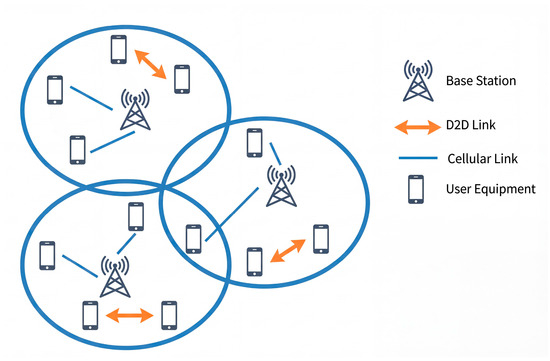
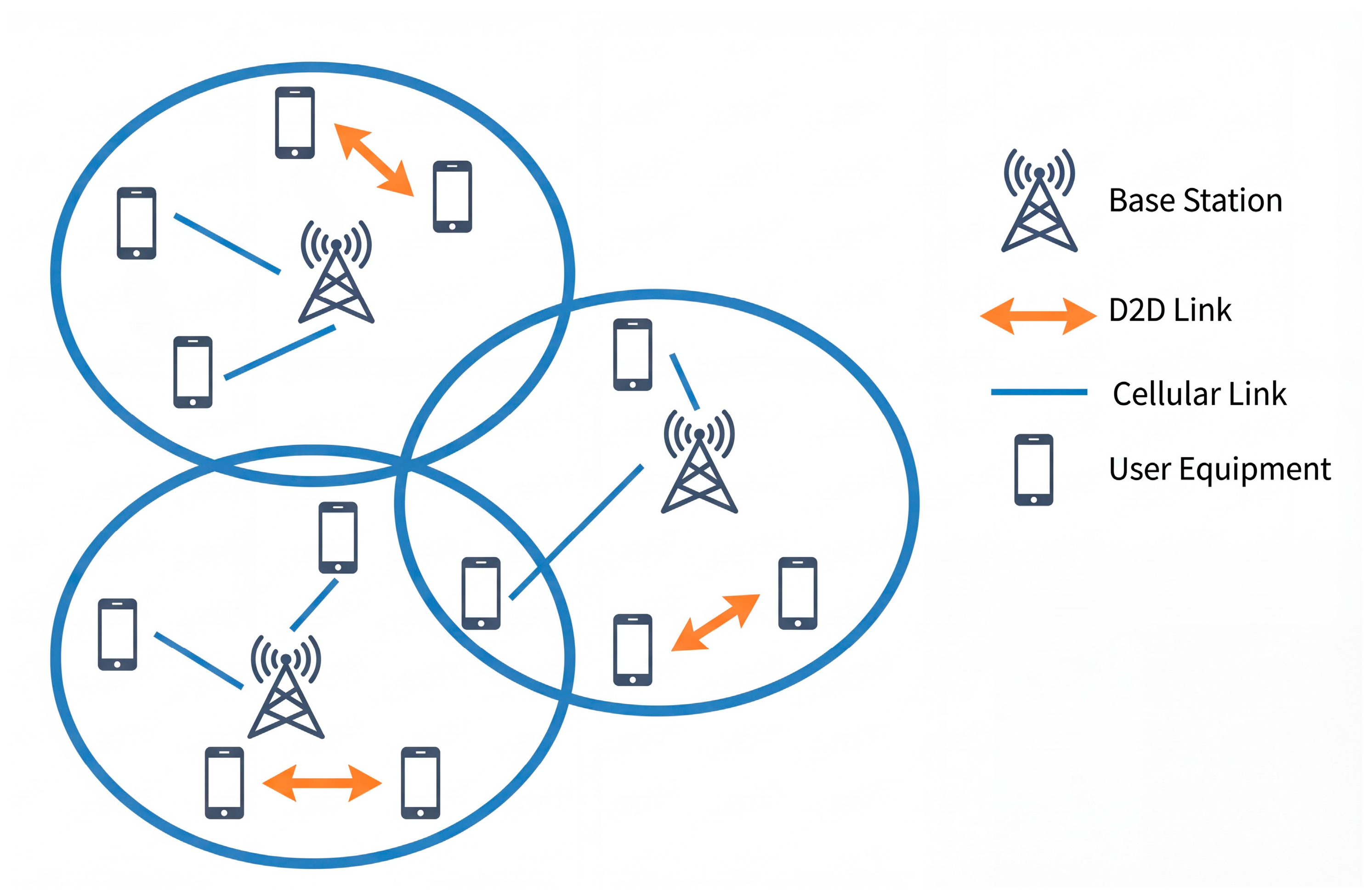
This work addresses EE maximization in multi-cell, multi-band D2D underlaying cellular networks, capturing inter-cell and cross-band interference effects that are not adequately represented in single-cell studies [7,13]. An example of this architecture is given in Figure 1.
Figure 1.
Example of a device-to-device (D2D) underlaid cellular network.
Two distinct hybrid metaheuristic algorithms are proposed. The EA-PGWO enhances GWO through evolutionary operators for exploration improvement, while the MPGWO-DLL adds the memetic local search and uses derivative-guided refinement to enhance convergence and accuracy. Three different systematic comparisons were conducted against the proposed hybrid algorithms, representing analytical swarm intelligence and evolutionary optimization paradigms. A robust EE performance evaluation was performed under varying network densities and different D2D scenarios to demonstrate the robustness and scalability of the proposed hybrid algorithms in dense interference-limited environments.
We intended to provide practical insight into how hybrid metaheuristic optimization balances exploration and exploitation in non-convex D2D EE problems, highlighting the advantages of combining evolutionary search, swarm intelligence, and derivative-based refinement for the next generation of wireless systems.
The remainder of this paper is organized as follows. Section 2 reviews the relevant metaheuristic optimization algorithms. Section 3 presents the system model and problem formulation. Section 4 presents the proposed hybrid optimization algorithms in detail. Section 5 discusses the simulation setup and the numerical results and provides a comprehensive discussion of the obtained results, and Section 6 concludes this paper.
2. Metaheuristic Optimization Algorithms
Multiple metaheuristic optimization algorithms have already been used to improve the EE of underlaid D2D communications with the application of 5G networks. The reason for this is that 5G networks using D2D communication are typically non-convex, so traditional methods handle D2D-related optimization poorly. In addition, metaheuristic optimization algorithms offer wide solution diversity, one of their most important advantages being flexibility for hybridization [14]. Derivative algorithms are considered to be the base algorithm and as such have been used in many studies to reduce energy consumption and increase EE in the overall network. Single-cell and multi-band scenario studies have been conducted by Zhang Y et al. [8].
By contrast, GWO has been considered in several studies [14,15]. This can be combined with PSO algorithms as a hybrid algorithm offering significantly improved solution and convergence diversity characteristics. Incorporating a local derivative adjustment increases precision in resource allocation [11]. This improvement arises from considering, rather than neglecting, gradient information [16].
Grey wolf optimization, as introduced by Mirjalili S et al. [17], has become one of the most popular algorithms for balancing exploitation and exploration in optimization. Other concerns have arisen in high-dimensional and multi-modal problems, including premature convergence and slow adaptation to dynamic environments [18]. Hybridization is considered to be one of the optimal solutions for overcoming the abovementioned problems, with multiple studies having proposed variants of hybrid algorithms based on GWOs. In Shaikh M et al. [15], a hybrid GWO-PSO (HGWPSO) was shown to improve convergence speed and robustness by using the PSO’s position-update mechanism. The memetic GWO (MGWO) used by Huang H et al. [12] enhances the fine-tuning ability through local search strategies, such as derivative approximation and hill climbing. Another hybrid variant is the adaptive GWO [10], which introduces adaptive parameters (learning mechanisms) to maintain the balance between local and global searches.
Evolutionary algorithms (EAs), such as GAs and differential evolution (DE), have been widely applied, primarily to tackle complex multi-objective problems. They naturally perform selection, crossover, and mutation to find optimal solutions with well-distributed populations [16]. However, using EAs alone increases randomness and leads to a slow convergence rate. To address this, combining an EA with GWO––for example, to form an EA-PGWO––leverages the EA’s global search with the GWO’s fast leader-based adaptability. This methodology was successfully applied by Shaikh M et al. [11], who combined the PSO update of velocity into GWO. Fuzzy system optimization combines genetic operations with GWO, providing improved performance compared to using either method alone [11]. Table 1 summarizes multiple studies on hybrid algorithms, their methods, and their findings.
Table 1.
Summary of hybrid algorithm studies and the methods used therein.
3. System Model and Problem Formulation
3.1. Network Model
We considered a multi-cell cellular network underlaid with D2D communication, where multiple D2D transmitter receiver pairs reuse the uplink spectrum resources allocated to cellular users. This configuration reflects realistic 5G deployments, where frequency reuse across neighboring cells and spectrum sharing between cellular and D2D users are unavoidable [1,19].
Each cell contained one base station (BS), a set of cellular users communicating with the BS, and a set of D2D pairs communicating directly with one another. The network operated over multiple orthogonal frequency bands indexed by k = 1, 2, …, K, where each band may be simultaneously accessed by both cellular and D2D users. This multi-band structure allows efficient spectrum reuse but also introduces cross-tier and inter-cell interference, which significantly impacts the system’s EE.
The D2D was assumed to operate in underlay mode, meaning that the D2D users share spectrum resources with cellular users under predefined interference and power constraints. This kind of underlay configuration has been widely adopted in the literature due to its high spectral efficiency and practical relevance for dense networks [13,21].
3.2. Channel and Interference Model
The wireless channels between transmitters and receivers are modeled using distance-dependent path loss with exponent α, combined with small-scale fading. The received signal quality is characterized by the SINR, which is caused by the interference between the cellular users and D2D receivers, between the D2D transmitters and cellular receivers, and the inter-cell interference caused by spectrum reuse across neighboring cells. In multi-cell, multi-band systems, these interference components are coupled across frequency bands and cells, resulting in a non-convex EE optimization problem [8]. As cellular and D2D user densities increase, interference grows rapidly, leading to diminishing returns in throughput and EE unless power allocation is carefully optimized [8].
The EE of the D2D communication system is defined as the ratio between the achievable data rate and the total power consumption. For the kth band, the EE depends on the D2D transmission power, channel conditions, and interference levels. The overall EE is computed as the aggregated contribution across all spectrum bands, consistent with prior multi-band D2D studies. This formulation captures the fundamental trade-off between throughput maximization and power consumption minimization, which is central to energy-aware resource allocation in 5G networks [7].
3.3. Optimization Aim and Constraints
The aim of this work was to maximize the total EE of D2D communication across all spectrum bands by optimizing the D2D transmission power allocation, subject to the total transmit power constraint, ensuring that the aggregate D2D transmission power did not exceed a predefined maximum budget, per-band power constraints limiting the minimum and maximum transmission power on each frequency band, and that the quality of service constraints ensured acceptable SINR levels for both cellular and D2D users. These constraints reflect practical hardware limitations and interference management requirements in real cellular networks [21].
Due to the nonlinear and interference-coupled nature of the EE expression, the resulting optimization problem is non-convex, making classical convex optimization methods ineffective or computationally too expensive for large-scale multi-cell systems. This encourages the use of metaheuristic and hybrid optimization techniques that are capable of efficiently exploring complex solution spaces [9,17].
The main aim in all the applied algorithms was to maximize the EE using multiple spectrum bands for D2D communication by considering the interference and power constraints. The EE is calculated as follows:
where
and
The constraint is as follows:
where:
K is the total number of available spectrums in the band;
is the total available power for D2D communication;
is the minimum allowable transmission power on k; and
is the maximum allowable transmission power on k.
3.4. Baseline Optimization Algorithms
To ensure a comprehensive and fair benchmarking framework, we evaluated the proposed hybrid algorithms against three baseline optimization approaches, each representing a distinct optimization paradigm commonly adopted in wireless resource-allocation problems.
3.4.1. Derivative-Based Algorithm
A derivative-based power-allocation algorithm was adopted as an analytical baseline. This method iteratively adjusts the D2D transmission power by exploiting the gradient of the EE with respect to the power variables. This approach has been widely applied in D2D EE optimization due to the algorithm’s low computational complexity and analytical tractability, particularly in simplified single-cell scenarios [7].
However, because DAs rely on local gradient information, they are sensitive to initialization and prone to convergence toward local optima, especially in multi-cell and multi-band environments where interference coupling leads to highly non-convex optimization landscapes.
For the DA applied to the problem, the derivative of EEk is computed with respect to Pd,k, and the minimal marginal efficiency (smallest absolute gradient) is selected to satisfy the total power constraint. The derivative-based equation is as follows:
First, initialize Pd,k to an initial guess of . Then, iteratively reduce the power on the selected band until . This is called the “greedy adjustment.”
3.4.2. Particle Swarm Optimization
Here, PSO was employed as a population-based swarm intelligence baseline. In PSO, candidate solutions or particles update their positions based on both individual best experiences and the global best solution, enabling fast convergence in early iterations [22]. Despite its simplicity and rapid convergence, PSO is known to suffer from premature convergence in nonlinear and interference-limited optimization problems, such as EE maximization in dense D2D underlay networks [23]. This makes PSO a relevant, but challenging, benchmark for evaluating the effectiveness of hybrid optimization strategies [24].
For the PSO algorithm applied to the EE maximization problem, each particle represents a candidate D2D power-allocation vector in the equation, as follows:
Subject to the total power constraint, at iteration t, the velocity and position of the ith particle in the kth dimension are updated, according to the following:
where:
is the inertia weight;
c1 and c2 are the cognitive and social acceleration coefficients;
denotes the best position previously visited by particle i; and
denotes the globally best position found by the swarm.
After each position update, the power vector is projected into the feasible region by enforcing the following equation:
The fitness of each particle is evaluated using the total D2D EE, as follows:
The global best solution is then iteratively updated until convergence.
3.4.3. Genetic Algorithm
The GA was adopted as a classical evolutionary optimization baseline, employing selection crossover and mutation operators to explore the solution space [25]. The GA is widely used in wireless resource allocation due to its strong global search capability and robustness against local optima. However, it often exhibits slow convergence and a high computational overhead when applied to large-scale interference-coupled optimization problems because excessive randomness in genetic operations may delay the exploitation of high-quality solutions. This limitation is particularly pronounced in multi-cell D2D EE optimization scenarios.
In the GA, each chromosome encodes a feasible D2D power-allocation vector similar to the PSO to satisfy the total power constraints. The fitness of each chromosome is defined as the total EE, presented as follows:
Selection is performed based on fitness values, using a fitness proportional or tournament strategy. Given two parent chromosomes, and , crossover generates offspring, as follows:
Mutation is applied to introduce diversity by perturbing individual genes, as follows:
This is followed by feasibility repair to satisfy the following:
The population is updated through elitist replacement, and the algorithm iterates until convergence or until a predefined maximum number of generations is reached.
3.5. Motivation for Hybrid Optimization
In order to overcome the limitations of derivative-based and conventional metaheuristic methods, we propose two hybrid GWO-based algorithms: EA-PGWO and MPGWO-DLL. These hybrids were designed to combine the fast analytical guidance of DA, the population diversity of GA, the collective learning behavior of PSO, and the balanced exploration–exploitation mechanism of GWO. By integrating these complementary characteristics, the proposed hybrid algorithms achieved superior robustness and EE performance in multi-cell, multi-band D2D underlay networks while maintaining fairness through identical system-level simulation parameters across all evaluated algorithms.
4. Proposed Hybrid Optimization Algorithms
Here, we describe the design logic of the proposed hybrid optimization algorithms, with particular emphasis on the solution generation, parent selection, and hybridization mechanisms that are critical for reproducibility and performance interpretation in hybrid metaheuristic frameworks.
The proposed algorithms were designed to solve non-convex EE maximization problems arising in multi-cell and multi-band D2D underlaying cellular networks. Due to strong interference coupling and nonlinearity, classical derivative-based approaches cannot guarantee global optimality [7,13]. These two hybrid algorithms are proposed to address these challenges. The two proposed algorithms were based on, and built on, the GWO framework [17], while incorporating extra mechanisms from EAs, swarm intelligence, and derivative-based refinement.
4.1. Grey Wolf Optimizing Algorithm
In standard GWO, each candidate solution is represented as a wolf, and the population is hierarchically structured based on fitness values. Three best solutions were selected (referred to as alpha, beta, and delta) as representing the best, second-best, and third-best solution, respectively. The remaining wolves followed these leaders and updated their positions based on a weighted combination of the leader’s position. This mechanism enables a balance between exploration and exploitation through leadership-based guidance [10]. However, in complex optimization landscapes, such as multi-cell D2D EE problems, standard GWO may suffer from limited population diversity and premature convergence.
First, the grey wolf update rule is calculated for the optimization, where:
Understanding that are the coefficient vectors, and , , are the best three solutions
The addition of the EA is where we mix two wolves into one, named Pchild:
With a random perturbation for mutation named Pmut:
GWO will grant the global search, and then the memetic phase will fine-tune the updates in the local neighborhood, and the DLL will use the analytical gradient to estimate the number, based on the original EE expression, to obtain values close to optimal. After GWO initialization, the memetic local search performs a greedy one-dimensional search around the current position, using small-step perturbations and accepting moves that improve the fitness, as follows:
Understanding is considered a small adaptive step.
Second, for the top few wolves (e.g., the best 10%), an analytical derivative step is applied for one more refinement, accelerating local convergence after global exploration. The DLL expression is as follows:
with
4.2. Evolutionary Algorithm-Enhanced Grey Wolf Optimizing Algorithm
4.2.1. Parent Selection Mechanism
In the EA-PGWO, each wolf represents a candidate power-allocation vector. Hybridization is achieved by explicitly introducing evolutionary operators where the parents are selected from two complementary subsets of the population. The first will be the elite parents, where the alpha, beta, and delta wolves are always eligible as parents due to their high fitness values. These elite solutions guide exploitation. The second are the diverse parents, where additional parents are randomly selected from the remaining population to maintain diversity and to prevent stagnation. This mixed-parent selection strategy ensures that the new solutions inherit high-quality traits, while preserving the exploration capability consistent with evolutionary optimization principles [10].
4.2.2. Hybrid Solution Generation
Once the parents have been selected, new candidate solutions or offspring are generated using crossover-like operations, where solution components from two parent wolves are combined to form a child solution, and mutation-like perturbations, where small random variations are introduced to enhance exploration and to avoid premature convergence.
After the evolutionary operations, the resulting offspring are integrated back into the GWO population, where the fitness evaluation and hierarchical ranking are updated. This preserves the original GWO leadership structure, while enhancing the population diversity. Note that the GWO position update rule will remain active, that is, the evolutionary offspring are still influenced by the alpha, beta, and delta wolves in subsequent iterations. This integration differentiates the EA-PGWO from the standalone GA or PSO approaches.
4.2.3. Design Rationale
The EA-PGWO algorithm combines GWO leadership-based exploitation, GA-inspired diversity through parent recombination, and PSO-like collective guidance via leader influence. As a result, the EA-PGWO is particularly effective at avoiding local optima and maintaining stable convergence in interference-limited D2D optimization problems [11].
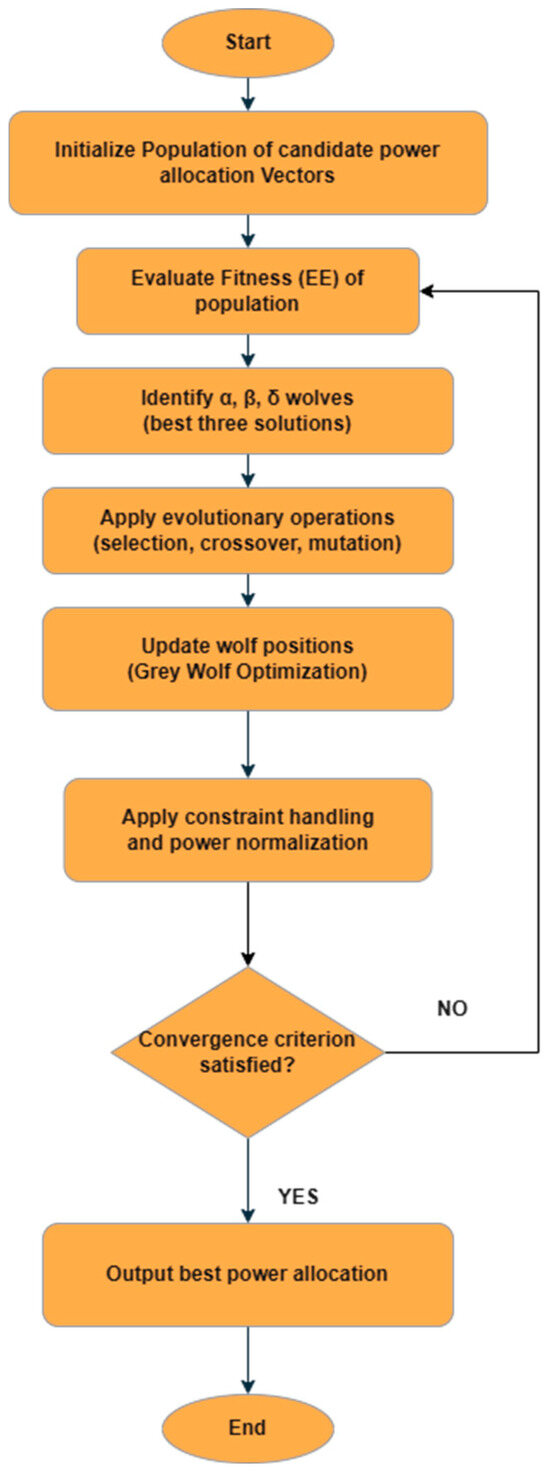
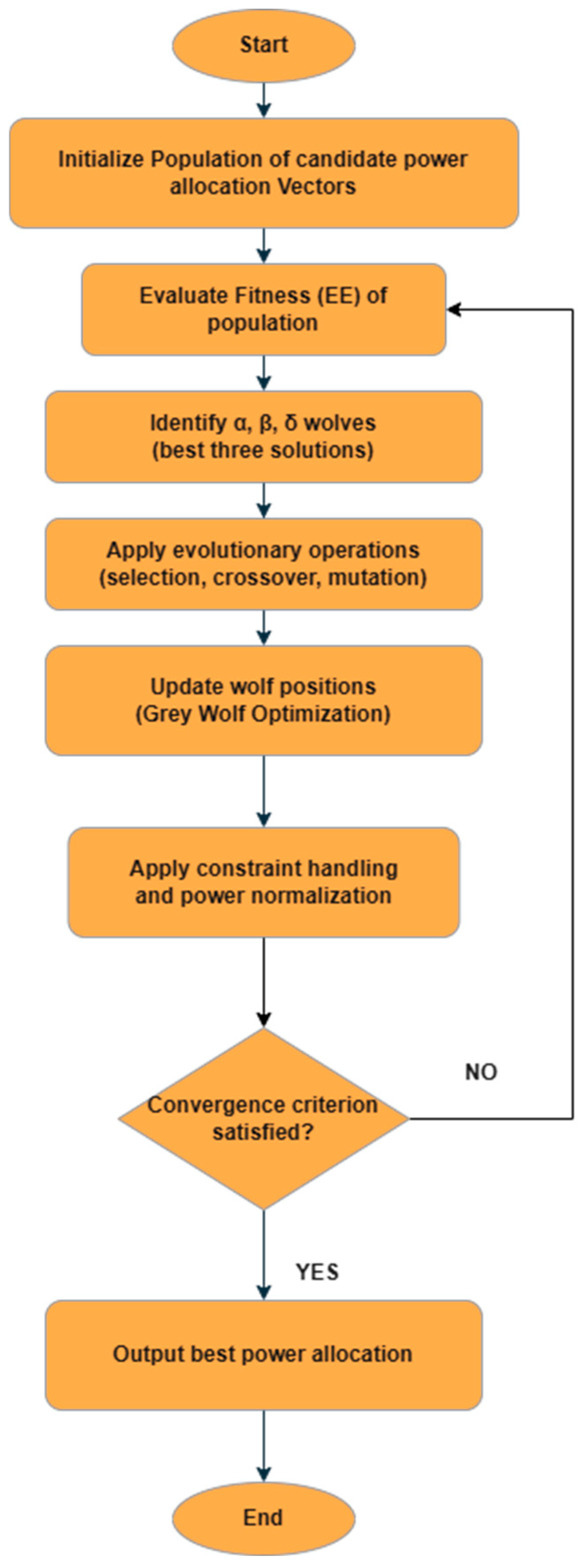
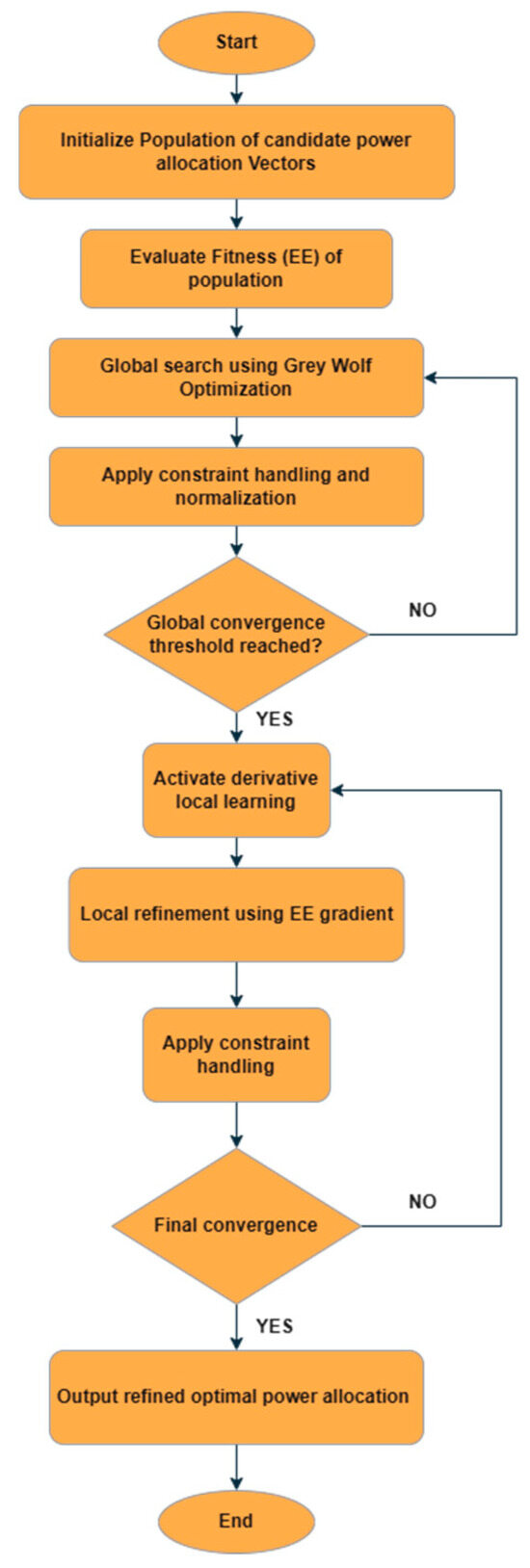
Figure 2 presents the flowchart of the proposed EA-PGWO algorithm. The algorithm integrates evolutionary operators with GWO to enhance global exploration. Candidate power-allocation vectors evolve through selection crossover and mutation, followed by grey wolf position updates. Constraint handling and normalization are applied at each iteration to ensure feasibility. This hybrid design improves robustness against local optima, while maintaining convergence stability in non-convex optimization landscapes.
Figure 2.
Evolutionary algorithm enhanced-particle grey wolf optimizer (EA-PGWO) flowchart.
4.3. Memetic Particle-Guided Grey Wolf Optimization with Derivative Local Learning
4.3.1. Global Search Phase
In MPGWO-DLL, the global exploration phase follows standard GWO dynamics. The parents in this phase are implicitly the alpha, beta, and delta wolves whose positions guide the population search. Unlike in an EA-PGWO, no evolutionary crossover is applied at this stage. Instead, the focus is on efficient global exploration using leadership-based guidance.
4.3.2. Memetic Local Learning Phase
After the global GWO phase, MPGWO-DLL introduces a memetic local search stage, where a subset of elite wolves undergoes localized refinement. In this phase, the concept of multiple parents is replaced by a single-solution refinement. Each elite solution acts as its own parent, generating improved variants through small adaptive perturbations. Memetic optimization enhances exploitation capability and improves solution precision near convergence [12].
4.3.3. Derivative Local Learning Phase
To further refine the convergence accuracy, MGWO-DLL incorporates a derivative-based local learning mechanism, applied selectively to the best-performing solutions. This stage uses analytical gradient information of the EE function to guide fine-grained power adjustments. Unlike the derivative-based baseline algorithm, DLL is applied only after global exploration, avoiding sensitivity to poor initialization [26]. Here, the notion of the parents is no longer applicable. Instead, the current best solution is iteratively refined.
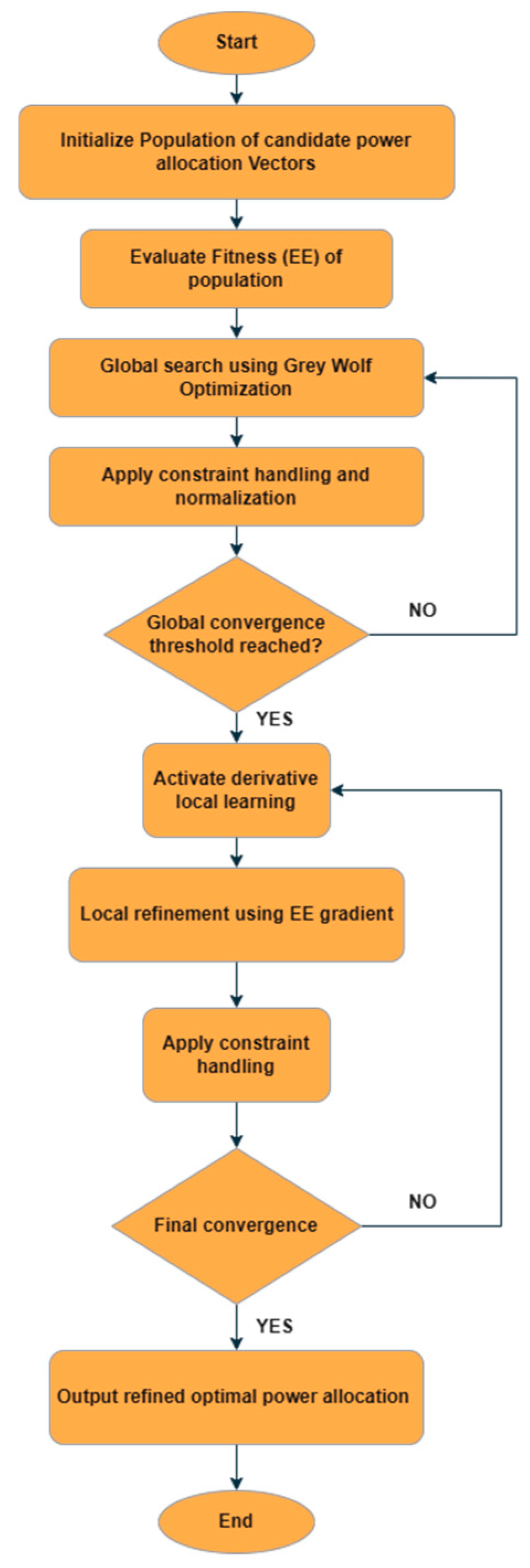
Figure 3 depicts a flowchart showing the proposed MPGWO-DLL algorithm. This algorithm operates in two stages. First, a population-based grey wolf global search is performed to explore the solution space and identify promising regions. Once convergence reaches a predefined threshold, a derivative-based local learning mechanism is activated to refine the solution near convergence. This memetic structure effectively balances exploration and exploitation, enabling improved convergence accuracy and robustness under dense multi-cell interference conditions.
Figure 3.
Memetic particle-guided grey wolf optimizer with derivative local learning (MPGWO-DLL) flowchart.
4.4. Comparison of Hybridization Strategies
The key difference between the two proposed hybrid algorithms can be summarized as follows. The EA-PGWO emphasizes population diversity and global exploration through explicit parent selection and evolutionary operators. The MPGWO-DLL emphasizes solution precision and convergence accuracy through memetic refinement and derivative-guided learning. Both approaches preserve the GWO leadership hierarchy, while addressing its limitations in different optimization phases, making them complementary solutions for multi-cell D2D EE optimization.
4.5. Computational Complexity Analysis and Discussion
Here, using Big-O, we analyze the computational complexity of the evaluated optimization algorithms in terms of population size and iteration count, providing insights into their relative computational costs and scalability. Let N denote the population size and T the maximum number of iterations. The dimensionality of the optimization problem is determined by the number of spectrum bands, K, and remains fixed across all algorithms.
The derivative-based algorithm updates the transmission power values sequentially based on analytical gradient calculations. In each iteration, the EE gradient is evaluated for all K bands, leading to a computational complexity of O (T.K).
Due to its low computational overhead, the DA converges rapidly, although it is highly sensitive to initialization and prone to convergence toward local optima in non-convex interference-coupled environments [7].
In PSO, each particle updates its position based on its personal best and the global best solution. Fitness evaluation and velocity updates are performed for all particles in each iteration, resulting in a computational complexity of O (T.N.K). While PSO exhibits rapid early convergence, its computational efficiency deteriorates in highly nonlinear optimization landscapes due to stagnation and repeated fitness evaluation [24].
The GA performs selection crossover mutation and fitness evaluation at each generation. These operations collectively lead to a computational complexity of O (T.N.K). Although the GA maintains strong population diversity, its convergence speed is typically slower than that of PSO due to stochastic genetic operations, which can increase the number of iterations required to achieve high-quality solutions [25].
The EA-PGWO extends standard GWO by incorporating evolutionary operators. In each iteration, position updates are performed for all wolves, followed by crossover and mutation applied to a subset of the population. The resulting computational complexity can be expressed as O (T.N.K). Although the EA-PGWO introduces additional evolutionary operations, these do not change the order of complexity relative to PSO and the GA. Instead, they improve the solution quality and convergence robustness by enhancing exploration without significantly increasing the computational burden [10].
MPGWO-DLL further augments GWO with a memetic local learning phase and derivative-guided refinement applied to a small subset of elite solutions. Let Ne << N denote the number of elite solutions selected for local refinement. The computational complexity of MPGWO-DLL can be approximated as O (T.N.K) + O (T.Ne.K). Because Ne represents only a small fraction of these populations, the additional cost remains limited. As a result, MPGWO-DLL preserves the scalability of population-based metaheuristics, while achieving improved convergence accuracy in the final optimization stages.
From a complexity perspective, all the population-based algorithms, PSO, GA, EA-PGWO, and MPGWO-DLL, share the same asymptotic complexity order. However, their practical performances differ significantly due to differences in convergence speed and solution quality. While the DA has the lowest computational complexity, its performance deteriorates in complex multi-cell scenarios.
From a practical standpoint, the dominant computational cost of all population-based algorithms lies in the fitness evaluation rather than control operations, such as crossover mutation or local learning. Because EA-PGWO and MPGWO-DLL use the same population size and iteration count as PSO and the GA, their additional hybridization steps introduce only limited overhead. In MPGWO-DLL, the DLL is applied exclusively to a small elite subset, ensuring that the overall computational burden remains comparable to those of conventional metaheuristic approaches. To summarize, Table 2 provides a brief comparison of the five algorithms.
Table 2.
Simplified comparative summary table describing the five algorithms.
5. Simulation and Results
The simulations were conducted in MATLAB 2024b for all considered optimization algorithms, and the corresponding system-level and algorithm-specific parameters are summarized in a single unified parameter in Table 3. All network and system parameters were kept identical across all simulations to ensure a fair and unbiased comparison.
Table 3.
Unified simulation parameters for DA, GA, PSO, EA-PGWO, and MPGWO-DLL algorithms.
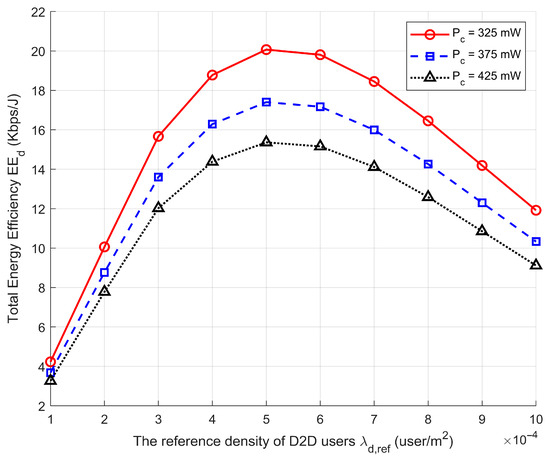
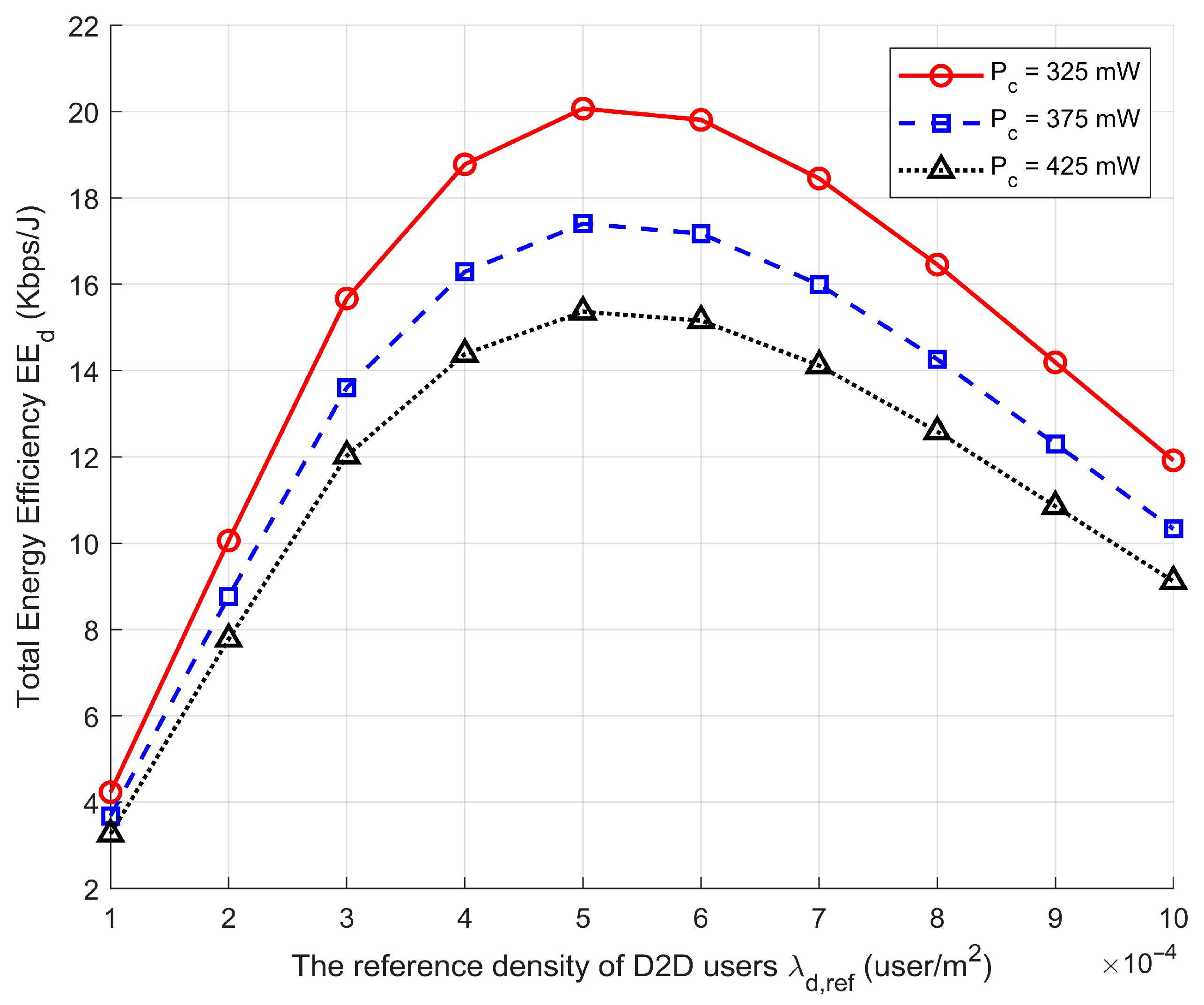
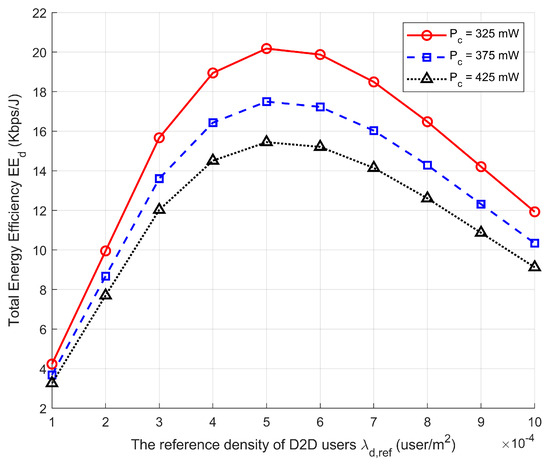
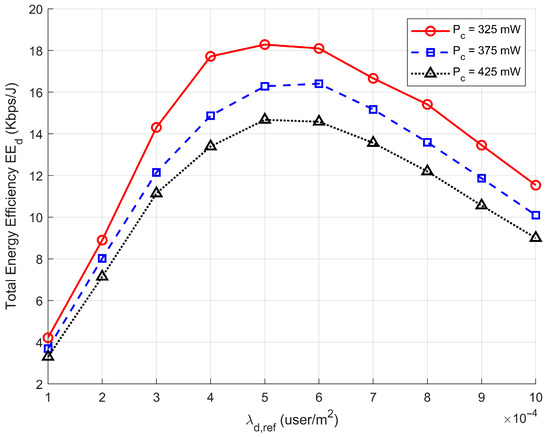
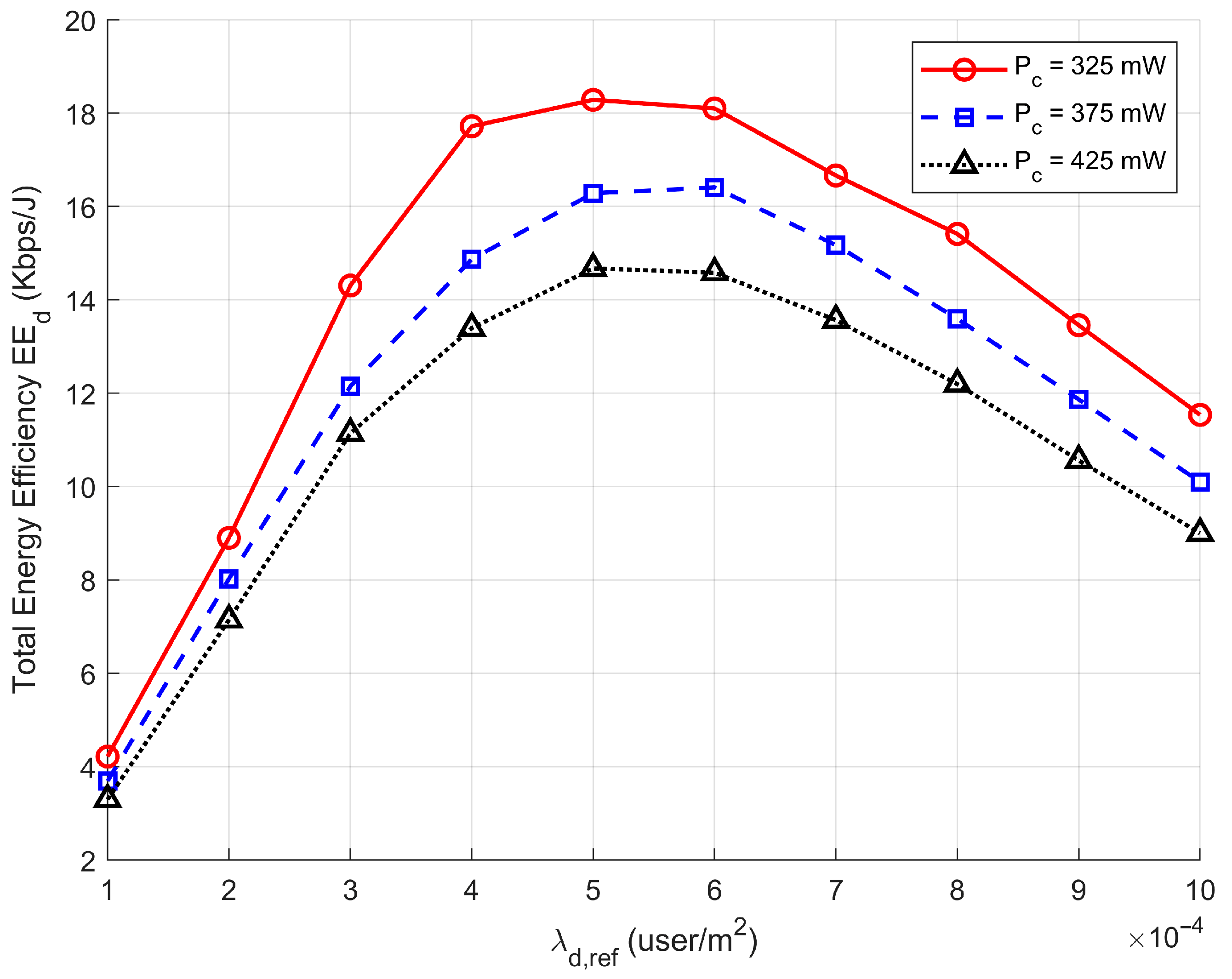
Figure 4, Figure 5 and Figure 6 show the D2D EE versus the D2D user reference density using the three baseline algorithms (DA, GA, and PSO, respectively). The uplink consists of five bands, each 20 MHz, shared by cellular and D2D. The curve rises to a peak and then declines, forming an arc. The simulations used three user transmission powers: 325, 375, and 425 mW. The efficiency drop at higher densities is due to increased interference from higher cellular power as the reference density increases.
Figure 4.
Energy efficiency (EE) vs. reference density of D2D users using the DA.
Figure 5.
EE vs. reference density of D2D users using the GA.
Figure 6.
EE vs. reference density of D2D users using PSO.
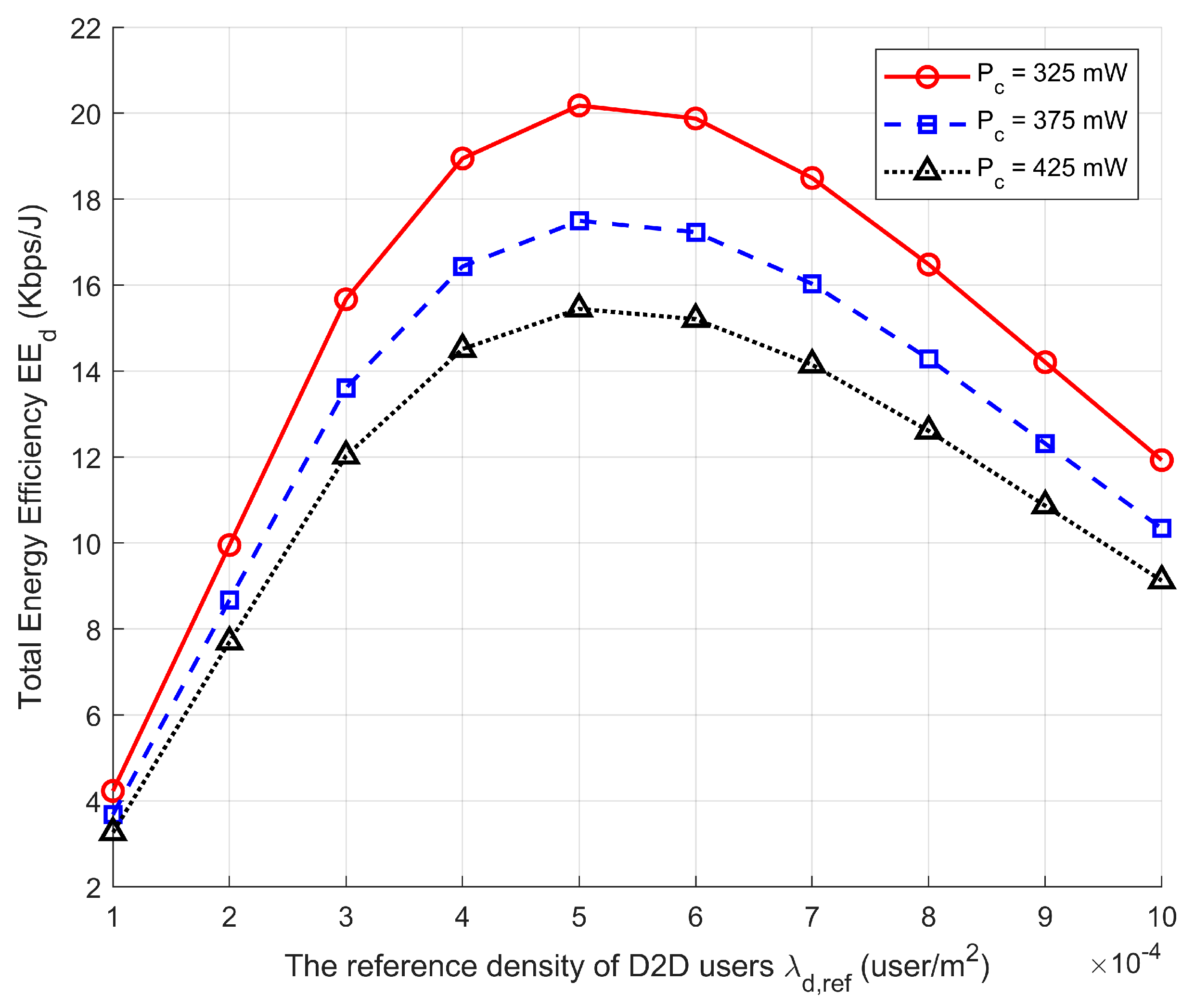
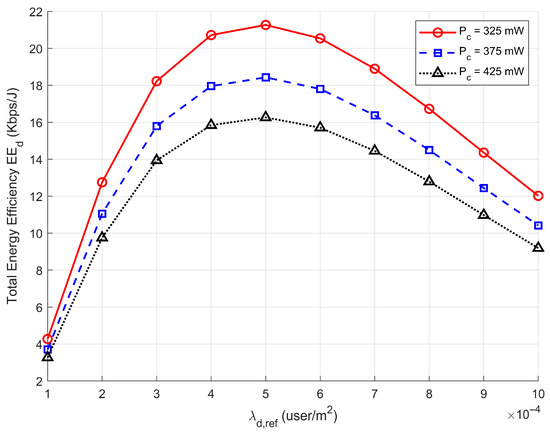
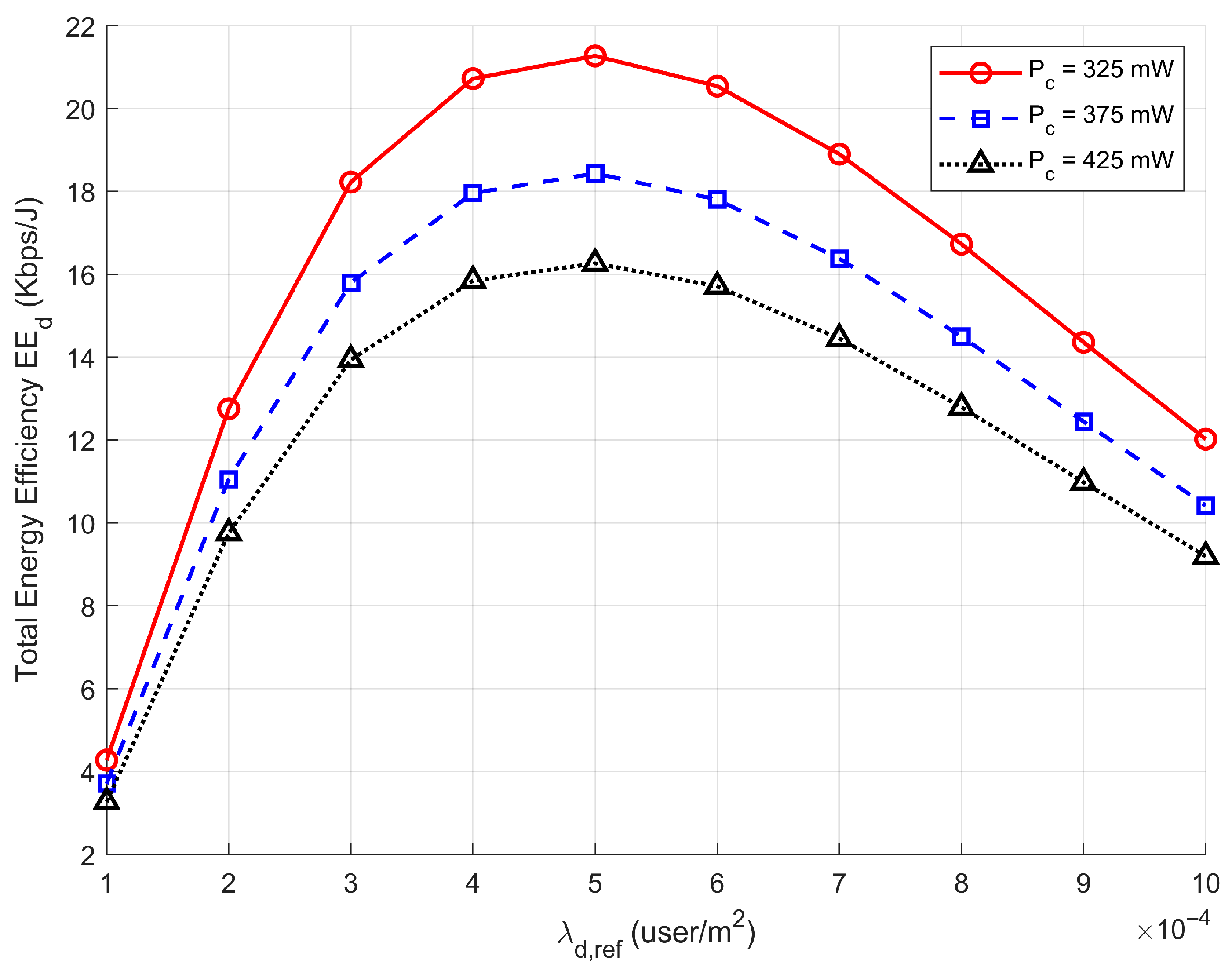
The same analysis was conducted for the EA-PGWO algorithm, simulating EE at cellular powers of 325, 375, and 425 mW, as shown in Figure 7. It can be seen that the EE increases with density up to a maximum and then decreases due to interference caused by higher cellular power.
Figure 7.
EE vs. reference density of D2D users using the EA-PGWO.
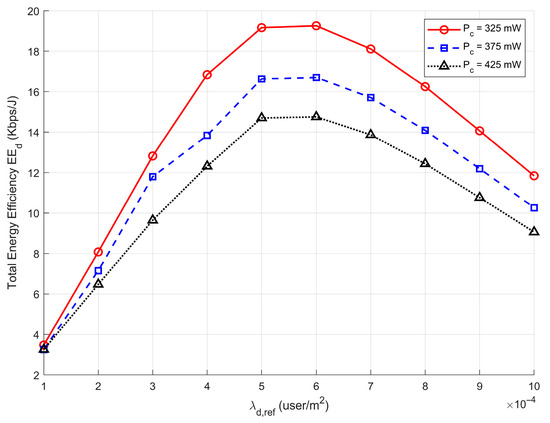
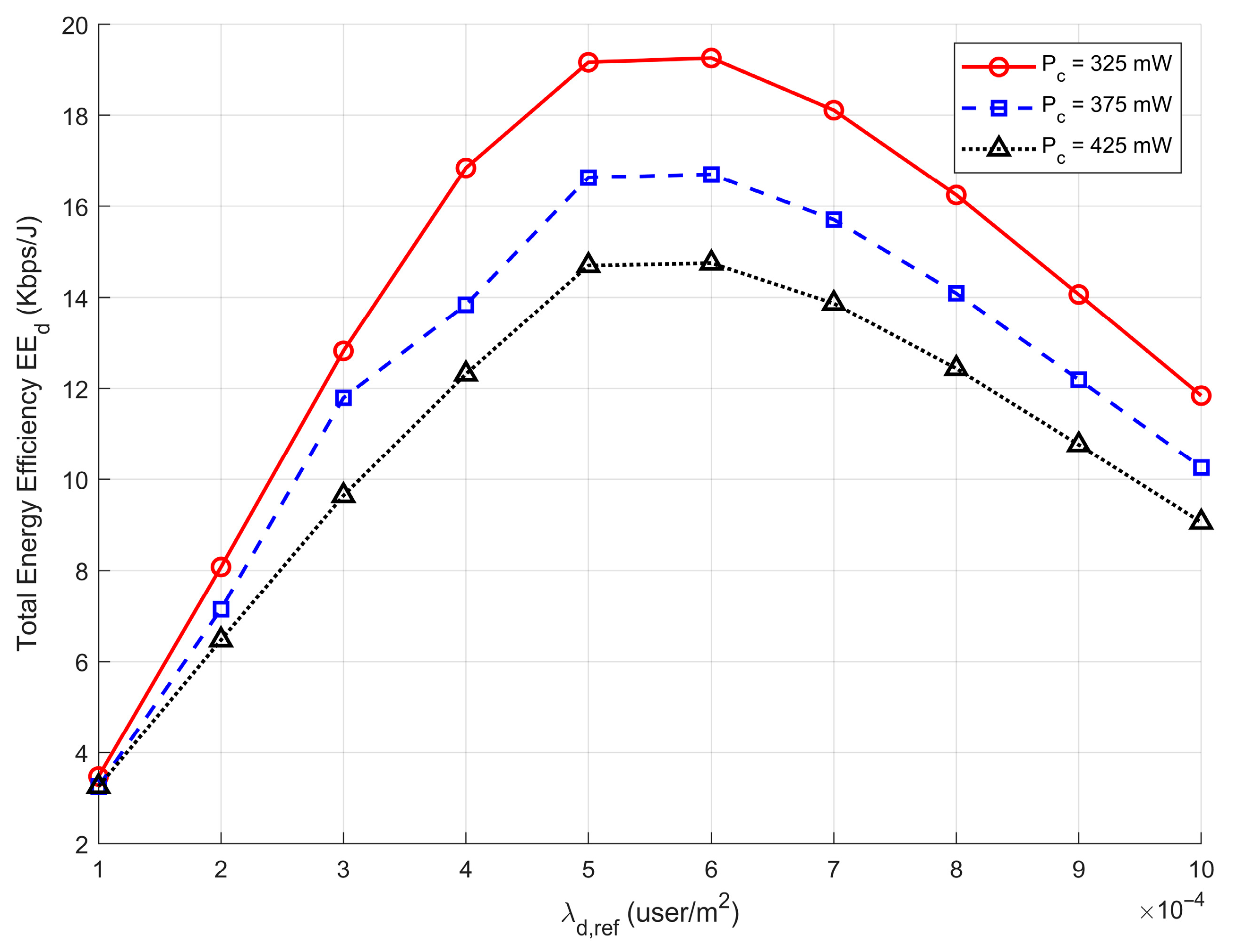
Figure 8 shows EE versus D2D user density, under the same three power levels of 325, 375, and 425 mW. Using the MPGWO-DLL hybrid optimizer, the curves show higher peak EE than the previous results, followed by a decline for the same interference-related reasons observed with the DA and EA-PGWO.
Figure 8.
EE vs. reference density of D2D users using MPGWO-DLL.
Table 4a presents a numerical comparison of four algorithms: the DA [8], the modified DA [11], the EA-PGWO, and MPGWO-DLL. For the modified DA, different parameters were used, with the Pd fixed at 65 mW (ignoring power variations), the cellular distance increased, and the D2D distances fixed at 20 m. The other results share the same parameters, evaluating the total EE versus D2D user density under the three power scenarios of 325, 375, and 425 mW.
Table 4.
(a) Obtained EE comparison between the DA, modified DA, EA-PGWO, and MPGWO-DLL with respect to the user density for D2D. (b) Obtained EE comparison between the GA, PSO, EA-PGWO, and MPGWO-DLL with respect to the user density for D2D.
Table 4b presents a numerical comparison of four algorithms: the GA, PSO, EA-PGWO, and MPGWO-DLL. The results were obtained by evaluating the total EE versus D2D user density under three power scenarios: 325, 375, and 425 mW. All the results obtained from this analysis share the same parameters for all the algorithms, including the DA.
Table 4a,b present the total EE achieved by all the algorithms as a function of the D2D user density for three maximum D2D transmission power levels. Across all power levels, there was an initial increase in EE as the D2D user density grew. This is due to improved spatial reuse and more efficient spectrum utilization at moderate densities. However, beyond a certain density threshold, the EE gradually decreased due to increased interference, which degrades the success probability of D2D transmissions. This trend was consistently observed for all algorithms, confirming the validity of the system model.
At low and moderate D2D densities, derivative-based approaches (the DA and modified DA) provided reasonable performance, their EE quickly saturating and degrading as the density increased. This behavior highlights the limitation of gradient-dependent methods in highly non-convex interference-dominated environments.
The population-based algorithms exhibited superior robustness, with the GA and PSO consistently outperforming the DA across all density levels, indicating their improved exploration capability in non-convex optimization landscapes. However, both the GA and PSO showed notable performance degradation at higher densities, particularly under strict power constraints, suggesting limited exploitation capabilities.
The proposed hybrid algorithms, EA-PGWO and MPGWO-DLL, achieved the highest EE values across all D2D densities and power levels. The EA-PGWO benefitted from enhanced exploration, leading to consistent improvements over the GA and PSO. The MPGWO-DLL further improved performance by including derivative-based local learning at the final optimization stage, enabling refined power allocation near convergence. As a result, MPGWO-DLL consistently achieved the maximum EE values in all examined scenarios, demonstrating both stability and scalability with respect to D2D user density.
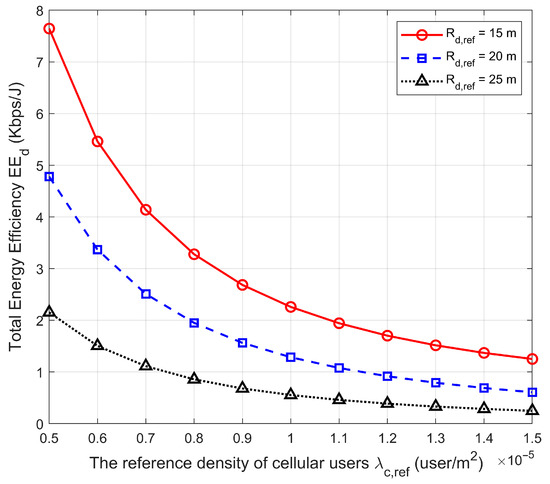
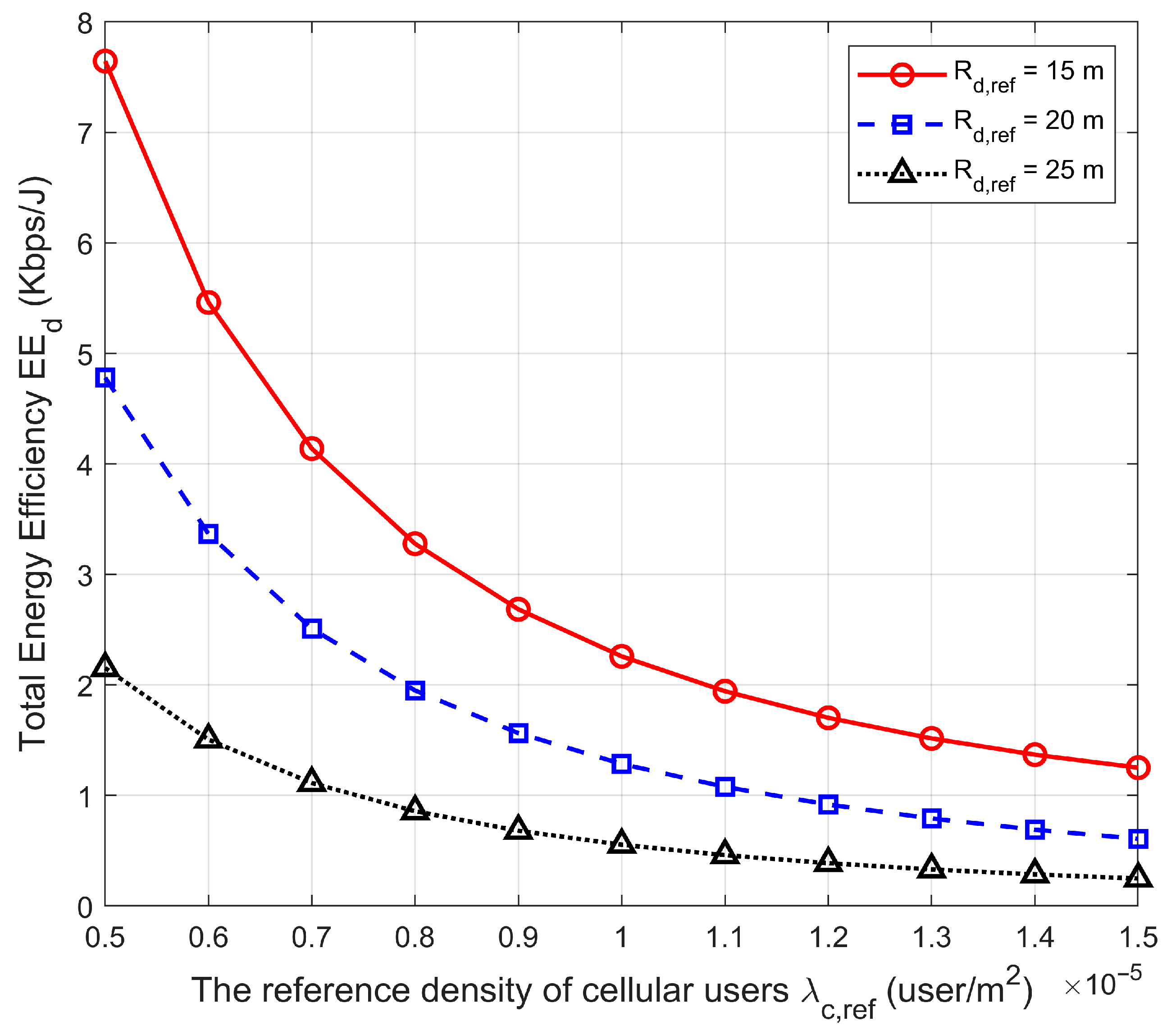
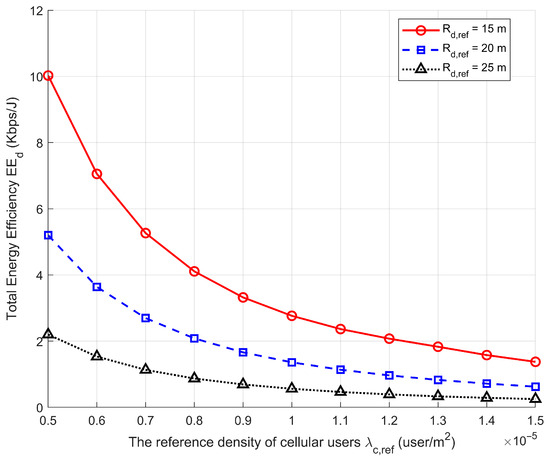
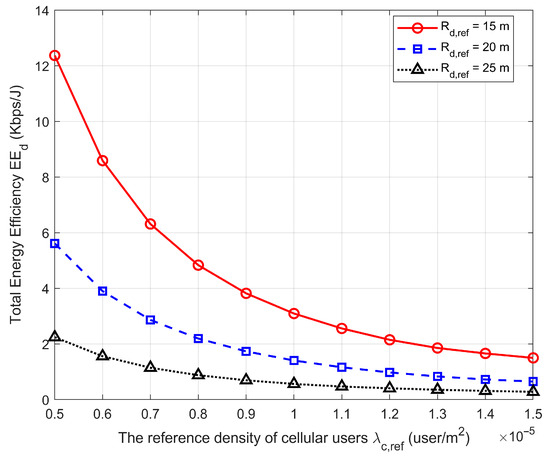
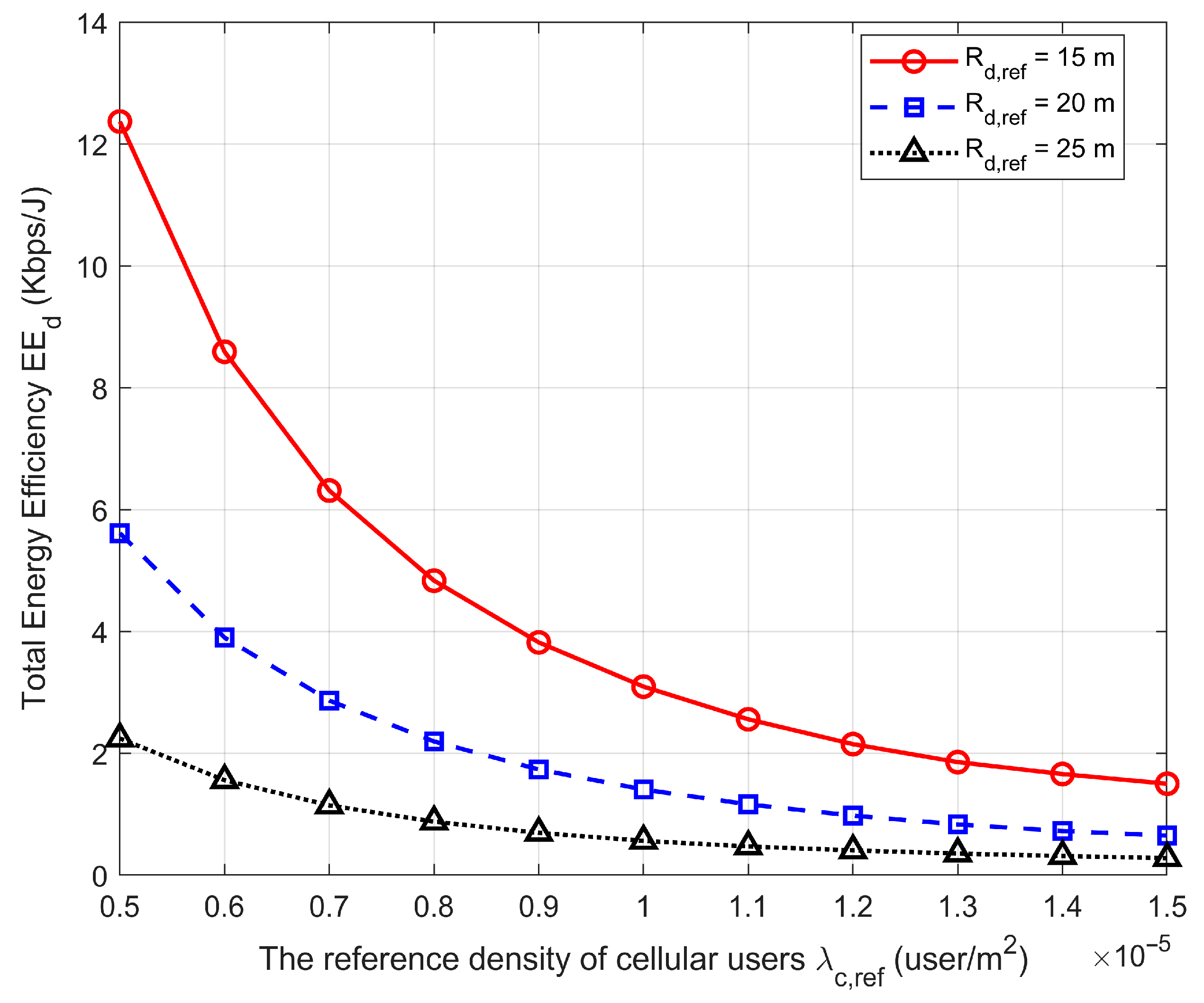
In the next results, the EE characteristics were simulated versus the reference density of cellular users instead of D2D users. Fixed D2D distances of 15, 20, and 25 m were considered, using the same simulation parameters. Figure 9, Figure 10 and Figure 11 show decaying curves for the DA, GA, and PSO as the baseline algorithms. This decline was caused by the increase in interference with increasing distance, which reduced the average sum rate and lowered the EE.
Figure 9.
EE of D2D users vs. reference density of cellular users using the DA.
Figure 10.
EE of D2D users vs. reference density of cellular users using the GA.
Figure 11.
EE of D2D users vs. reference density of cellular users using PSO.
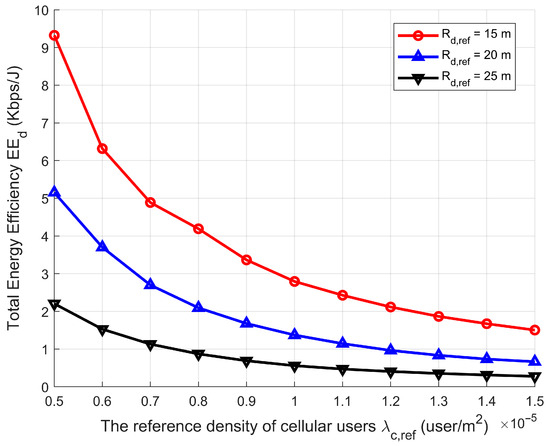
In Figure 12, showing the EA-PGWO with fixed D2D distances of 15, 20, and 25 m, the EE is higher than with the DA but still decays as the cellular user density increases, due to rising interference.
Figure 12.
EE of D2D users vs. reference density of cellular users using the EA-PGWO.
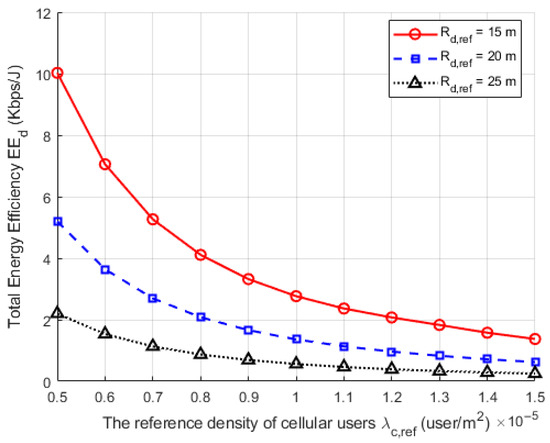
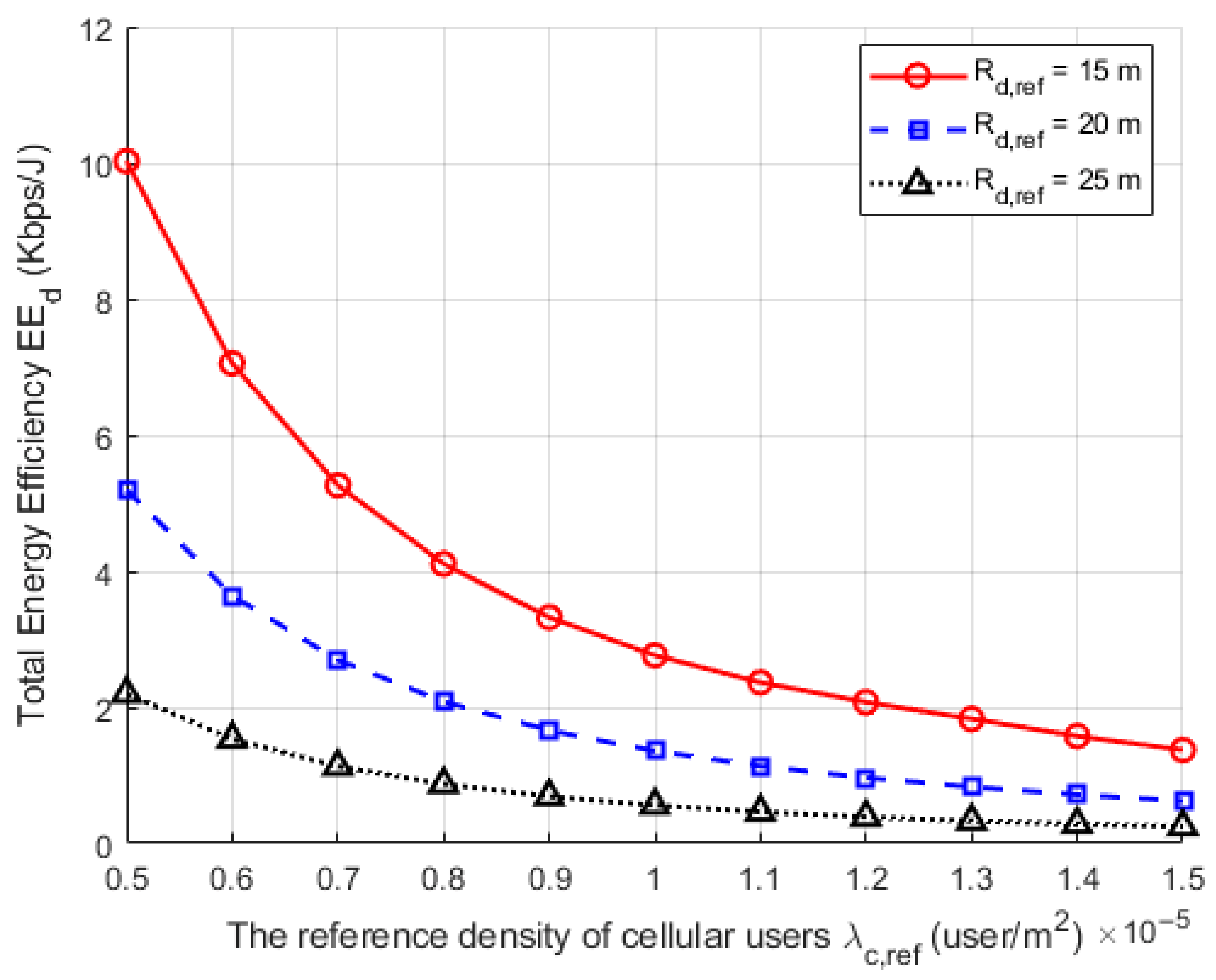
Figure 13 presents the EE of D2D underlaying cellular users using MPGWO-DLL. Reference distances of 15, 20, and 25 m were considered. As expected, smaller distances yielded higher EE. As the cellular user density increased, the EE declined due to the rising signal-to-interference ratio.
Figure 13.
EE of D2D users vs. reference density of cellular users using MPGWO-DLL.
Table 5a presents a numerical comparison of the four algorithms: the DA [8], modified DA [11], EA-PGWO, and MPGWO-DLL. For the modified DA, different parameters were used, the Pd being fixed at 65 mW (ignoring power variations), the cellular distance increased, and the D2D distances fixed at 20 m. The other results shared the same parameters, evaluating the total EE versus cellular user density using three reference distances: 15, 20, and 25 m.
Table 5.
(a) Obtained EE comparison between the DA, modified DA, EA-PGWO, and MPGWO-DLL with respect to the cellular user density. (b) Obtained EE comparison between the GA, PSO, EA-PGWO, and MPGWO-DLL with respect to the cellular user density.
Table 5a,b show the results of the total EE as a function of the cellular user density for three D2D link distances. For all the algorithms, the EE decreased monotonically as the cellular user density increased. This behavior was expected because higher cellular densities lead to increased cross-tier interference, reducing the achievable D2D transmission success probability. The decrease is more pronounced for larger D2D distances, where path loss and interference effects are amplified.
The derivative-based algorithms exhibited the fastest EE degradation with increasing cellular density, especially at greater D2D distances. This confirms their sensitivity to interference variations and their limited adaptability in dense cellular environments.
The GA and PSO demonstrated improved robustness compared to the derivative-based methods, maintaining higher EE values across all densities. However, their performance gap relative to the hybrid methods widened as the cellular density increased, indicating that exploration alone is insufficient to guarantee optimal performance under severe interference conditions.
The EA-PGWO consistently outperformed the GA and PSO by maintaining higher EE values across all cellular densities and D2D distances, and MPGWO-DLL further enhanced this performance by combining population-based exploration with derivative-guided local refinement, resulting in the slowest EE degradation among all the considered algorithms. This confirms the effectiveness of the proposed memetic design in addressing both the global search and local exploitation requirements in dense multi-cell environments.
The comparison between the proposed hybrid optimization algorithms and the classical baseline approaches under different network densities and power constraints was conducted in terms of the total D2D EE achieved (in Kbps/J) using identical system parameters and constraints for all the algorithms to ensure fairness. All the results presented in the figures and tables clearly demonstrate a consistent performance hierarchy across all scenarios, with MPGWO-DLL outperforming the EA-PGWO, which outperformed the GA and PSO, which outperformed the DA.
This ordering highlights three key observations. The first is that the population-based optimization significantly outperformed the purely derivative-based approaches in non-convex interference-limited D2D communication systems. Second, hybridization strategies that enhance the exploration EA-PGWO yielded notable gains over the classical evolutionary and swarm-based methods. Third, the integration of DLL at the final optimization stage (MPGWO-DLL) provided additional refinement, enabling superior convergence and robustness under varying density and power conditions.
Overall, the proposed MPGWO-DLL algorithm achieved the best trade-off between exploration and exploitation, leading to consistently higher EE across all evaluated scenarios. These results confirm the suitability of the proposed hybrid framework for energy efficient resource allocation in dense 5G D2D underlaying networks.
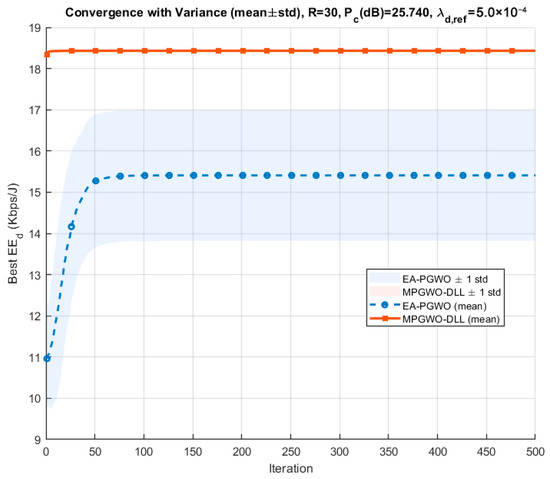
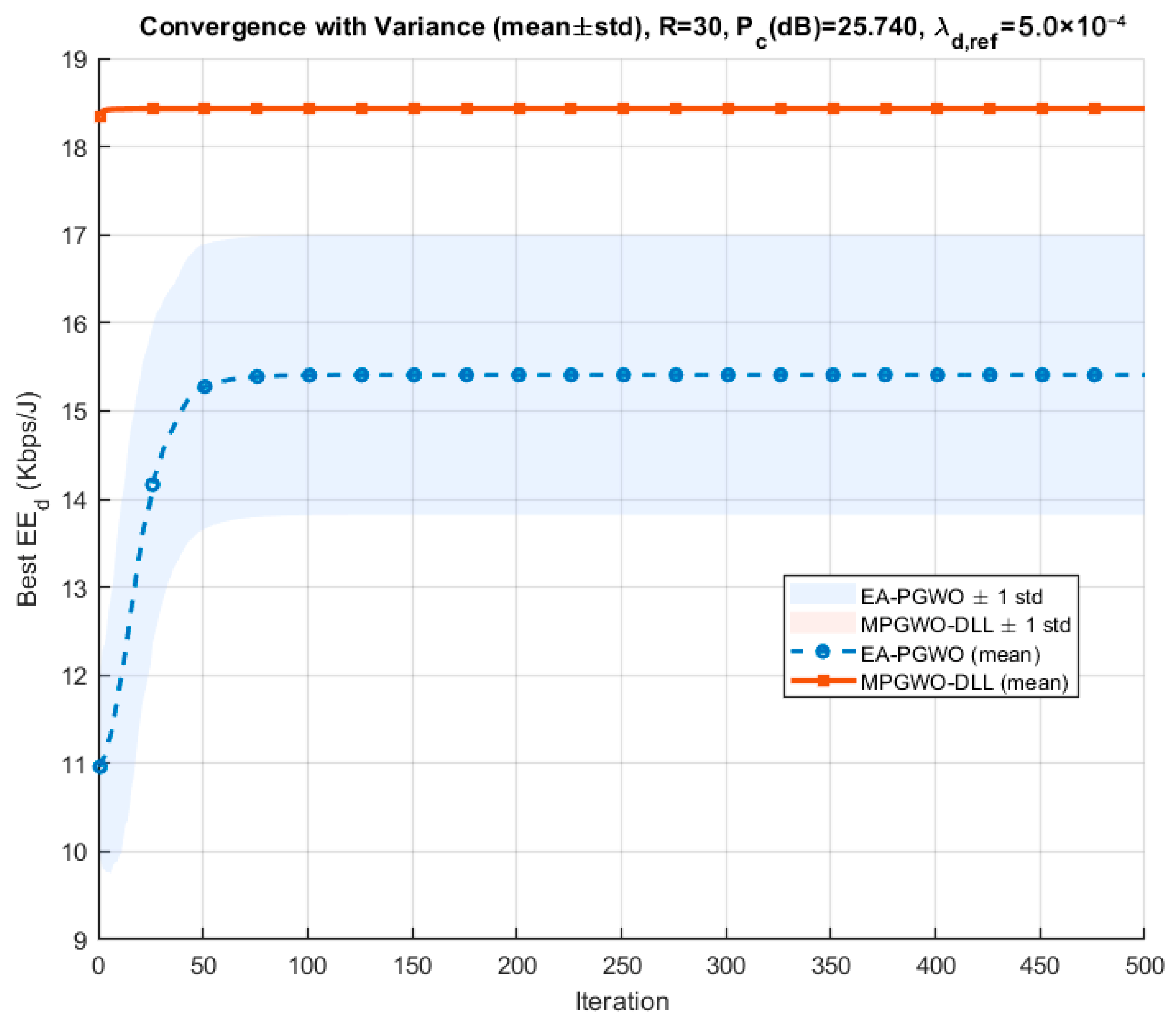
To evaluate the convergence behavior and robustness of the proposed hybrid algorithms, each optimization method was executed over R independent runs with different random initializations. Figure 14 illustrates the average convergence curves in terms of the best EE achieved versus iteration number. The proposed MPGWO-DLL converged faster and achieved higher steady-state EE than the EA-PGWO.
Figure 14.
Convergence behavior of the EA-PGWO and MPGWO-DLL in terms of total EE over 30 independent runs (mean ± standard deviation).
Table 6 reports the mean standard deviation and extreme values of the final EE obtained over 30 independent runs, confirming the robustness and reduced performance variability of the proposed MPGWO-DLL algorithm.
Table 6.
Statistical performance comparison of the EA-PGWO and MPGWO-DLL over 30 independent runs.
6. Conclusions and Future Work
We investigated the problem of EE maximization in multi-band, multi-cell D2D communications underlaying cellular networks. To address the non-convex and interference-limited nature of the problem, two hybrid metaheuristic optimization algorithms—EA-PGWO and MPGWO-DLL—were proposed and evaluated against classical baseline approaches, including derivative-based algorithms, GAs, and PSO.
The comprehensive numerical results demonstrated that the population-based optimization methods significantly outperformed the purely derivative-based approaches in dense D2D environments. Also, while the GA and PSO provided improved robustness over gradient-dependent methods, their performances degraded under higher EE by enhancing global exploration, whereas the MPGWO-DLL algorithm further improved in performance by incorporating derivative-based local learning near convergence. As a result, MPGWO-DLL achieved the highest EE across all evaluated D2D and cellular density scenarios, transmission power constraints, and D2D link distances.
Our results confirm that combining a population-based global search with local refinement mechanisms provides an effective balance between exploration and exploitation, leading to stable and scalable performance in complex multi-cell D2D underlay networks. The consistent performance gains observed across different scenarios validated the robustness and general applicability of the proposed hybrid framework for energy-efficient resource allocation in future 5G systems.
Future work will focus on extending the proposed framework to more realistic network settings, including dynamic user mobility, imperfect channel state information, and the heterogeneous quality of service requirements. In addition, investigating distributed implementations and reducing computational overheads will be essential to assess the feasibility of real-time deployment in large-scale 5G networks and beyond.
Author Contributions
Conceptualization, A.E.M. and M.T.; Methodology, A.E.M. and M.T.; Validation, H.Ö.; Writing—original draft, A.E.M.; Writing—review & editing, M.T.; Supervision, H.Ö. All authors have read and agreed to the published version of the manuscript.
Funding
This research received no external funding.
Data Availability Statement
The original contributions presented in this study are included in the article. Further inquiries can be directed to the corresponding author.
Conflicts of Interest
The authors declare no conflicts of interest.
Abbreviations
The following abbreviations are used in this manuscript:
| BB | Branch and Bound |
| BS | Base Station |
| CVRP | Capacitated Vehicle Routing Problem |
| DA | Derivative Algorithm |
| DE | Differential Evolution |
| D2D | Device to Device |
| DLL | Derivative Local Learning |
| EA | Evolutionary Algorithm |
| EA-PGWO | Evolutionary Algorithm Enhanced-Particle Grey Wolf Optimization |
| EE | Energy Efficiency |
| GWO | Grey Wolf Optimization |
| GA | Genetic Algorithm |
| HGWPSO | Hybrid Grey Wolf Particle Swarm Optimization |
| IoT | Internet of Things |
| LTE | Long-Term Evolution |
| MGWO | Memetic Grey Wolf Optimization |
| MIMO | Multiple Input Multiple Output |
| MPGWO-DLL | Memetic Particle Grey Wolf Optimization Derivative Local Learning |
| PSO | Particle Swarm Optimization |
| SINR | Signal-To-Interference-Noise Ratio |
References
- Wei, L.; Hu, R.Q.; Qian, Y.; Wu, G. Enable device-to-device communications underlaying cellular networks: Challenges and research aspects. IEEE Commun. Mag. 2014, 52, 90–96. [Google Scholar] [CrossRef] [Scilit]
- Liu, J.; Kato, N.; Ma, J.; Kadowaki, N. Device-to-Device Communication in LTE-Advanced Networks: A Survey. IEEE Commun. Surv. Tutor. 2015, 17, 1923–1940. [Google Scholar] [CrossRef] [Scilit]
- Tehrani, M.; Uysal, M.; Yanikomeroglu, H. Device-to-device communication in 5G cellular networks: Challenges, solutions, and future directions. IEEE Commun. Mag. 2014, 52, 86–92. [Google Scholar] [CrossRef] [Scilit]
- Shafique, K.; Khawaja, B.A.; Sabir, F.; Qazi, S.; Mustaqim, M. Internet of things (IoT) for next-generation smart systems: A review of current challenges, future trends and prospects for emerging 5G-IoT Scenarios. IEEE Access 2020, 8, 23022–23040. [Google Scholar] [CrossRef] [Scilit]
- Al-Falahy, N.; Alani, O.Y. Technologies for 5G Networks: Challenges and Opportunities. IT Prof. 2017, 19, 12–20. [Google Scholar] [CrossRef] [Scilit]
- Wei, L.; Hu, R.Q.; Li, Q.C.; Wu, G. Energy-efficiency of multi-hop device-to-device communications underlaying cellular networks. In Proceedings of the 2014 IEEE International Conference on Communications, ICC 2014, Sydney, Australia, 10–14 June 2014. [Google Scholar] [CrossRef] [Scilit]
- Feng, D.; Yu, G.; Xiong, C.; Yuan-Wu, Y.; Li, G.Y.; Feng, G.; Li, S. Mode Switching for Energy-Efficient Device-to-Device Communications in Cellular Networks. IEEE Trans. Wirel. Commun. 2015, 14, 6993–7003. [Google Scholar] [CrossRef] [Scilit]
- Zhang, Y.; Yang, Y.; Dai, L. Energy Efficiency Maximization for Device-To-Device Communication Underlaying Cellular Networks on Multiple Bands. IEEE Access 2016, 4, 7682–7691. [Google Scholar] [CrossRef] [Scilit]
- Lin, X.; Heath, R.W.; Andrews, J.G. The interplay between massive MIMO and underlaid D2D networking. IEEE Trans. Wirel. Commun. 2015, 14, 3337–3351. [Google Scholar] [CrossRef] [Scilit]
- Elghamrawy, S.M.; Hassanien, A.E. A hybrid Genetic–Grey Wolf Optimization algorithm for optimizing Takagi–Sugeno–Kang fuzzy systems. Neural Comput. Appl. 2022, 34, 17051–17069. [Google Scholar] [CrossRef] [Scilit]
- Shaikh, M.S.; Lin, H.; Xie, S.; Dong, X.; Lin, Y.; Shiva, C.K.; Mbasso, W.F. An intelligent hybrid grey wolf-particle swarm optimizer for optimization in complex engineering design problem. Sci. Rep. 2025, 15, 18313. [Google Scholar] [CrossRef] [Scilit] [PubMed]
- Huang, H.; Qi, Y.; Huang, G.; Yanguang, C.; Xu, Y. Memetic Grey Wolf Optimizer Algorithm for Solving the Cumulative CVRP. Int. J. Auton. Adapt. Commun. Syst. 2024, 17, 513–535. [Google Scholar] [CrossRef] [Scilit]
- He, C.; Tian, C.; Zhang, C.; Feng, D.; Pan, C.; Zheng, F.C. Energy Efficiency Optimization for Distributed Antenna Systems with D2D Communications under Channel Uncertainty. IEEE Trans. Green Commun. Netw. 2020, 4, 1037–1047. [Google Scholar] [CrossRef] [Scilit]
- Yu, M.; Xu, J.; Liang, W.; Qiu, Y.; Bao, S.; Tang, L. Improved multi-strategy adaptive Grey Wolf Optimization for practical engineering applications and high-dimensional problem solving. Artif. Intell. Rev. 2024, 57, 277. [Google Scholar] [CrossRef] [Scilit]
- Shaikh, M.S.; Lin, H.; Zheng, G.; Wang, C.; Lin, Y.; Dong, X. Innovative hybrid grey wolf-particle swarm optimization for calculating transmission line parameter. Heliyon 2024, 10, e38555. [Google Scholar] [CrossRef] [Scilit] [PubMed]
- Price, K.V.; Storn, R.M.; Lampinen, J.A. Differential Evolution; Springer Nature: Durham, NC, USA, 2005. [Google Scholar] [CrossRef] [Scilit]
- Mirjalili, S.; Mirjalili, S.M.; Lewis, A. Grey Wolf Optimizer. Adv. Eng. Softw. 2014, 69, 46–61. [Google Scholar] [CrossRef] [Scilit]
- Riza, L.S.; Iip; Nugroho, E.P.; Prabowo, M.B.A.; Junaeti, E.; Abdullah, A.G. metaheuristicOpt: Metaheuristic Optimization Algorithms. R Package Version 2.0.0. 2018. Available online: https://cran.r-project.org/web/packages/metaheuristicOpt/metaheuristicOpt.pdf (accessed on 23 December 2025).
- Qiu, Y.; Yang, X.; Chen, S. An improved gray wolf optimization algorithm solving to functional optimization and engineering design problems. Sci. Rep. 2024, 14, 14190. [Google Scholar] [CrossRef] [Scilit] [PubMed]
- Sheng, L.; Wu, S.; Lv, Z. Modified Grey Wolf Optimizer and Application in Parameter Optimization of PI Controller. Appl. Sci. 2025, 15, 4530. [Google Scholar] [CrossRef] [Scilit]
- Yu, S.; Ejaz, W.; Guan, L.; Anpalagan, A. Resource Allocation Schemes in D2D Communications: Overview, Classification, and Challenges. Wirel. Pers. Commun. 2017, 96, 303–322. [Google Scholar] [CrossRef] [Scilit]
- Kennedy, J.; Eberhart, R. Particle swarm optimization. In Proceedings of ICNN’95—International Conference on Neural Networks; IEEE: Piscataway, NJ, USA, 1995; pp. 1942–1948. [Google Scholar] [CrossRef] [Scilit]
- Nagapuri, L.; Prabu, A.V.; Penchala, S.; Salah, B.; Saleem, W.; Kumar, G.S.; Aziz, A.S.A. Energy Efficient Underlaid D2D Communication for 5G Applications. Electronics 2022, 11, 2587. [Google Scholar] [CrossRef] [Scilit]
- Shi, Y.; Eberhart, R. A modified particle swarm optimizer. In Proceedings of the 1998 IEEE International Conference on Evolutionary Computation Proceedings. IEEE World Congress on Computational Intelligence (Cat. No.98TH8360), Anchorage, AK, USA, 4–9 May 1998; IEEE: Piscataway, NJ, USA, 1998; pp. 69–73. [Google Scholar] [CrossRef] [Scilit]
- Vanneschi, L.; Silva, S. Genetic Algorithms. In Lectures on Intelligent Systems; Natural Computing Series; Springer: Cham, Switzerland, 2023. [Google Scholar] [CrossRef] [Scilit]
- Zhang, W.; Li, C.; Gen, M.; Yang, W.; Zhang, G. A multiobjective memetic algorithm with particle swarm optimization and Q-learning-based local search for energy-efficient distributed heterogeneous hybrid flow-shop scheduling problem. Expert Syst. Appl. 2024, 237, 121570. [Google Scholar] [CrossRef] [Scilit]

Disclaimer/Publisher’s Note: The statements, opinions and data contained in all publications are solely those of the individual author(s) and contributor(s) and not of MDPI and/or the editor(s). MDPI and/or the editor(s) disclaim responsibility for any injury to people or property resulting from any ideas, methods, instructions or products referred to in the content. |
© 2026 by the authors. Licensee MDPI, Basel, Switzerland. This article is an open access article distributed under the terms and conditions of the Creative Commons Attribution (CC BY) license.