


Abstract
Remaining useful life (RUL) prediction is essential for ensuring equipment reliability in smart manufacturing. However, mixed-model production introduces a significant challenge due to the discrepancy between the continuous nature of latent degradation and the abrupt, discrete transitions observed in sensor signals. These transitions are driven by the stochastic sequencing of product variants, which obscures the true health state of the equipment. Traditional RUL models are primarily designed for continuous and coherent evolutionary patterns, and consequently, they struggle to distinguish these observable, event-driven jumps from the hidden, underlying degradation trajectories. To resolve this, we propose the Dynamic Segmentation Network (DSNet), a framework designed to synchronize with discrete production rhythms while preserving the continuity of latent health indicators. Specifically, a segmentation loss integrating Proxy-NCA and information entropy is developed to guide the model in discerning discrete process boundaries and achieving semantically consistent partitioning. Furthermore, a hybrid encoding scheme integrates absolute and rotary positional information to capture multi-granularity temporal dependencies, which effectively bridges global degradation trends with local intra-segment structures. These innovations empower DSNet to extract highly discriminative features that are robust to process-induced fluctuations, thereby significantly enhancing RUL prediction performance. Extensive evaluations on 53 industrial welding guns from Bayerische Motoren Werke (BMW) Shenyang plants demonstrate that DSNet achieves reductions in MAE and RMSE by 12.29% and 10.66%, respectively. Consistent performance gains across three public benchmarks further validate the framework’s exceptional generalizability and robustness.
1. Introduction
Remaining useful life (RUL) prediction based on deep learning is essential in smart manufacturing, enabling precise forecasting of equipment health states and failure timelines. By modeling historical degradation patterns and fault precursors, these data-driven approaches facilitate the estimation of remaining operational durations. Such capabilities allow for predictive maintenance systems to optimize intervention schedules and minimize unplanned downtime, thereby enhancing overall system reliability.
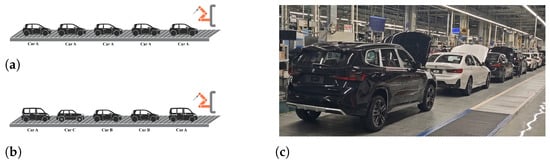
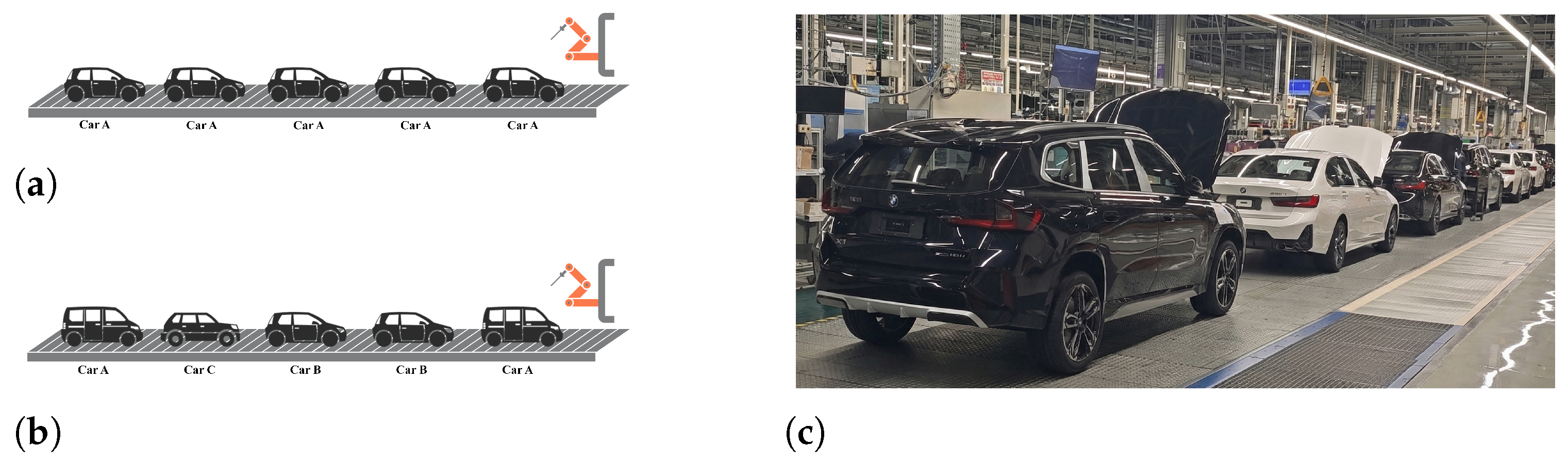
While RUL prediction significantly enhances maintenance efficiency in stable environments, the widespread adoption of mixed-model production introduces new technical complexities, as illustrated in Figure 1. In these settings, the interleaved production of diverse product variants imposes unique signal signatures and fluctuating processing times onto the sensor data stream. The specific sequence and composition of products within any observation window are typically stochastic. Consequently, sensor data exhibit discrete, product-dependent jumps rather than a continuous progression. These factors hinder the extraction of robust health indicators. Specifically, unpredictable production sequences leave heterogeneous operational footprints that confound the underlying equipment degradation. Consequently, traditional models struggle to decouple intrinsic wear-out from irregular, event-driven transitions. These transitions are primarily induced by shifting production tasks.
Figure 1.
Production scheduling. (a) Single-model production. (b) Mixed-model production. (c) Mixed-model production in real world.
Recent advances in time-series forecasting have achieved significant progress by explicitly modeling key temporal structures. Representative approaches include decomposing sequences into periodic and trend components [1,2], modeling cross-variable interactions [3], and analyzing series in the frequency domain [4,5]. Furthermore, distribution shifts are addressed through stationarization or temporal clustering [6,7], while multi-scale dependencies are captured via pyramidal or patch-based designs [8,9,10]. However, most methodologies excel in continuous temporal evolution-specific ways to align the hidden degradation with the discrete signal changes in mixed-model production. Consequently, standard models often mistake rhythmic pulses for random noise, forcing these sudden shifts into frameworks designed for smooth evolution. This mismatch ruins the underlying wear pathway and ultimately reduces the reliability of RUL predictions.
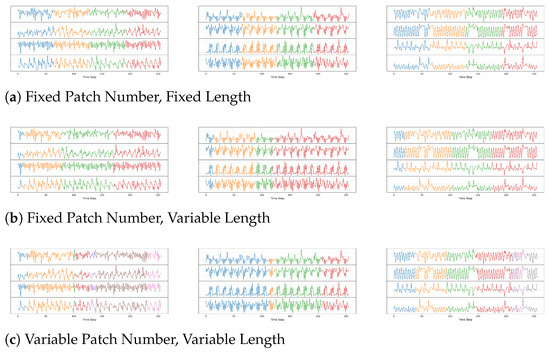
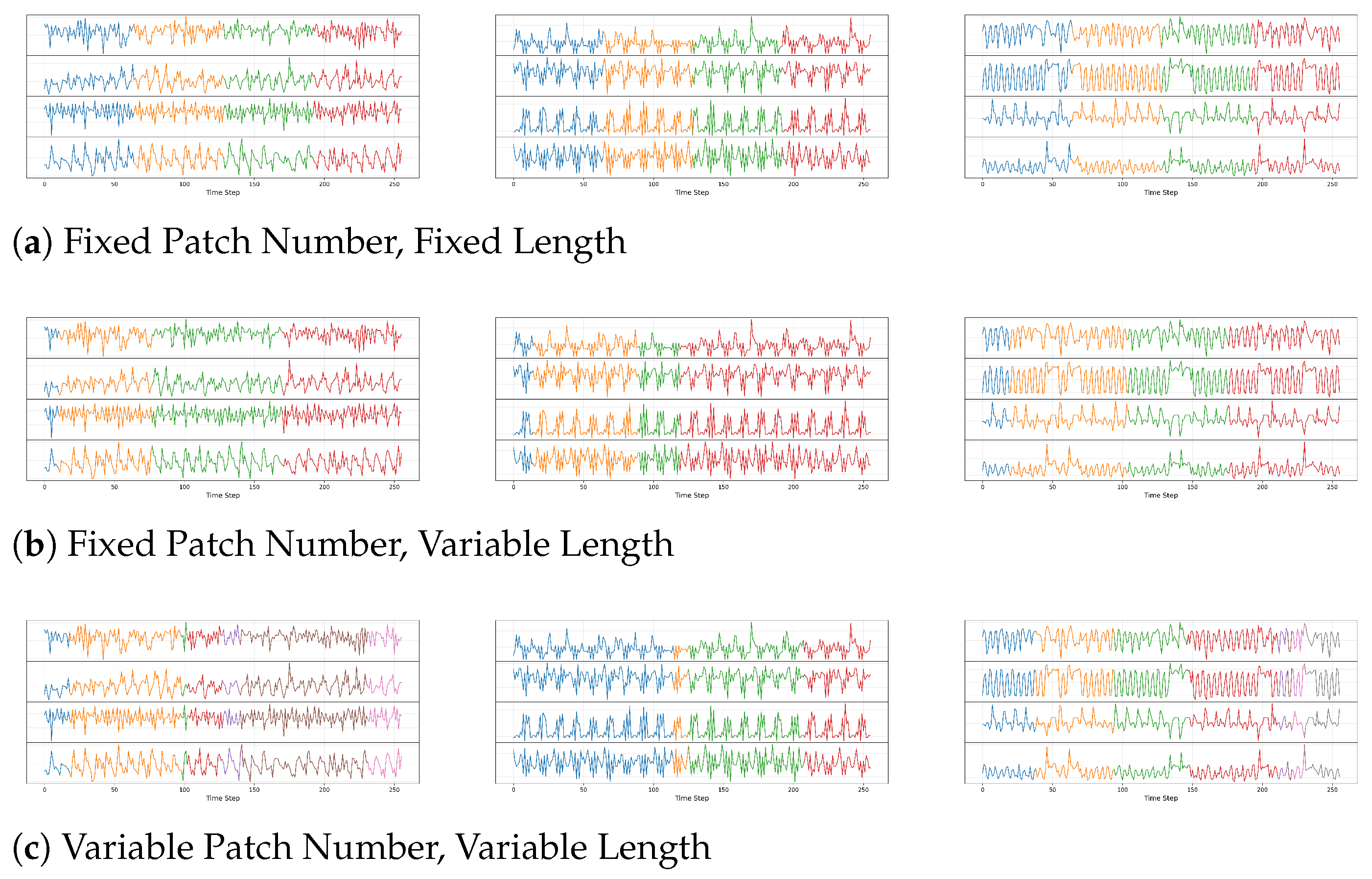
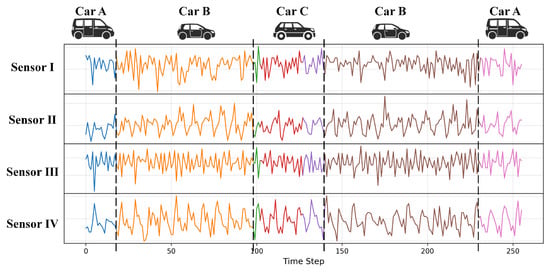
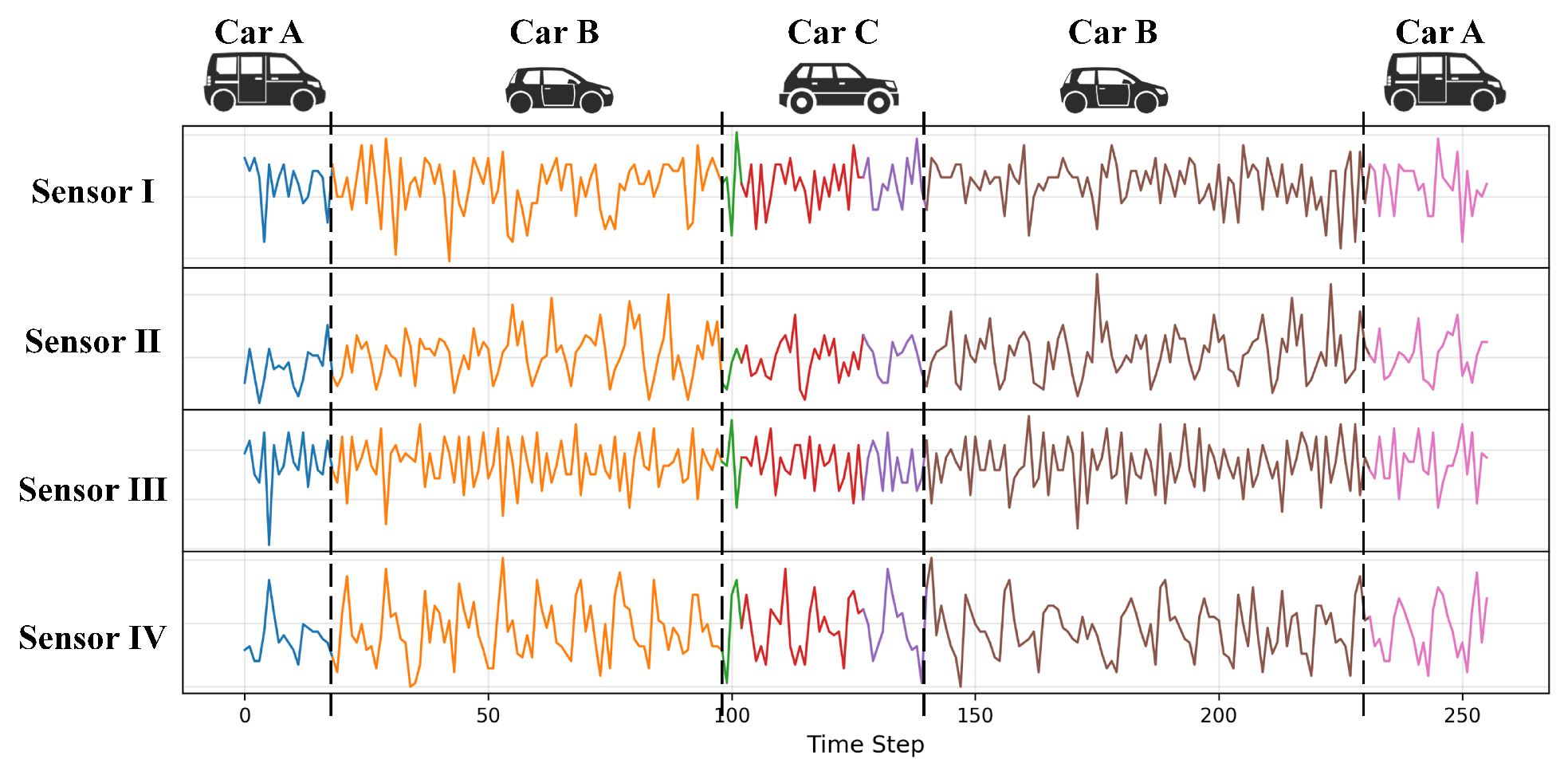
In such complex environments, local signal variations offer the most discriminative information for health state estimation. Inspired by PatchTST [11], recent research has adopted a patch-based perspective to emphasize local semantic features. However, as illustrated in Figure 2, current patch-based methods [11,12,13,14,15] primarily rely on rigid partitioning with fixed patch lengths or quantities. These static schemes fail to account for the event-driven nature of production beats, making them unable to synchronize with the unpredictable durations of diverse manufacturing stages. Consequently, a segmentation strategy that allows for a variable number of adaptive-length patches, as shown in Figure 3, is essential to capture the event-driven rhythms of production and decompose complex signals into a series of locally coherent semantic units.
Figure 2.
Three temporal patching methods. Different colors represent distinct temporal patches obtained by the patching approach, where continuous areas of the same color denote a single temporal patch.
Figure 3.
An optimal time segmentation strategy for mixed-model production. Different colors represent distinct temporal patches obtained by the patching approach, where continuous areas of the same color denote a single temporal patch.
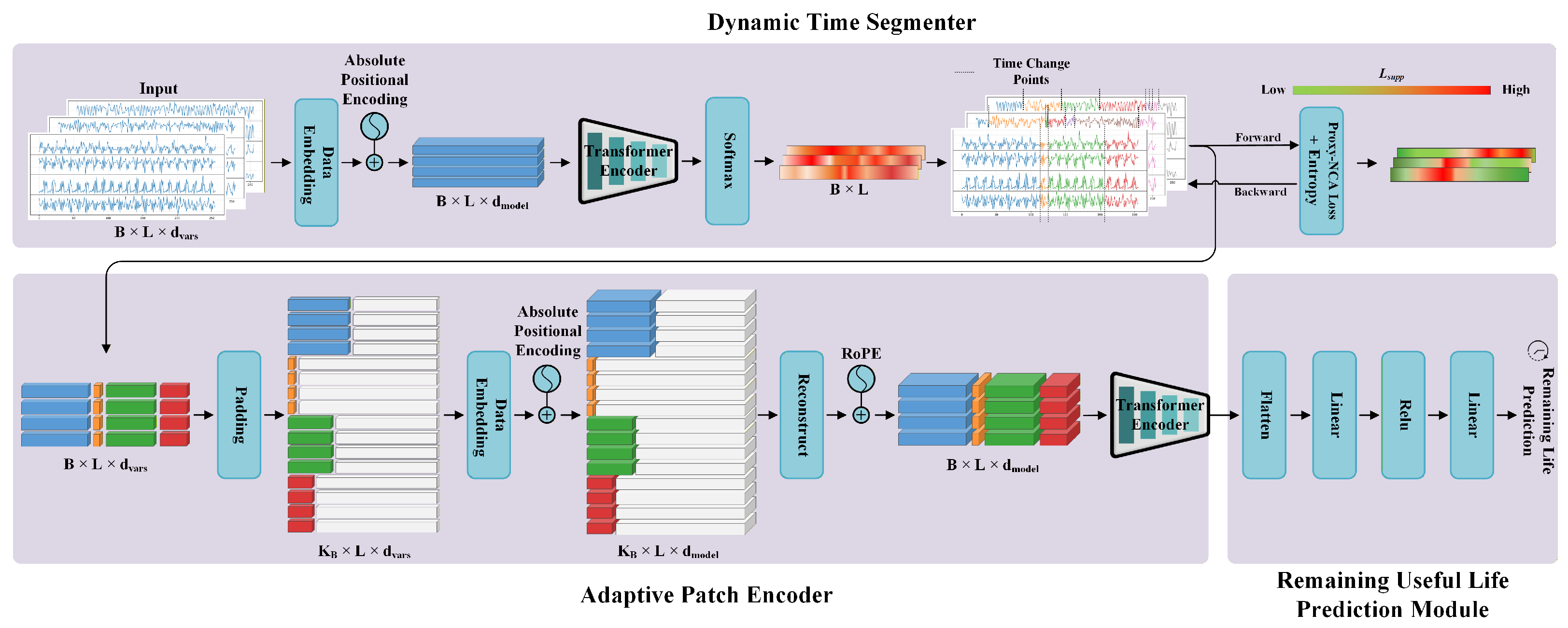
To address these challenges, the Dynamic Segmentation Network (DSNet) is introduced as a framework that adaptively partitions time-series data into latent semantic segments corresponding to production transitions. The core innovation of DSNet lies in generating a variable number of unequal-length patches that align with event-driven transitions in mixed-model environments. The architecture consists of three primary components: (1) a Dynamic Time Segmenter that identifies process boundaries to partition sensor data into semantic segments; (2) an Adaptive Patch Encoder that uses both absolute and rotary positional encodings to capture temporal relationships at multiple scales; and (3) an RUL Prediction Module that aggregates dynamic patch-wise features to estimate the remaining operational life.
The specific contributions of this work are as follows:
- A Task-Driven Dynamic Segmentation Paradigm: We propose a shift from rigid, fixed-length windowing to an adaptive partitioning framework (DSNet). By synchronizing continuous sensor streams with latent production rhythms, this paradigm effectively decouples intrinsic equipment degradation from the stochastic operational footprints inherent to mixed-model environments.
- A Flexible Multi-Scale Temporal Encoding Architecture: We develop an adaptive encoder designed to process an indefinite number of irregular-length segments. This architecture preserves local semantic consistency within production phases while maintaining global degradation continuity, addressing the challenge of capturing multi-scale dependencies across non-uniform temporal patches.
- A Large-Scale Industrial Benchmark and Empirical Validation: We contribute a comprehensive RUL dataset collected from a real-world mixed-model production line at the BMW Shenyang plant. Extensive evaluations demonstrate that DSNet significantly outperforms state-of-the-art baselines in both predictive accuracy and cross-domain generalizability.
2. Related Work
2.1. Time-Series Models
Recent research in time-series modeling has introduced various architectural innovations to isolate underlying patterns and handle distribution shifts. Regarding pattern decomposition, Wu et al. [1] integrated seasonal-trend decomposition into the Transformer architecture, while Zeng et al. [2] demonstrated that linear structures could effectively achieve similar results. For cross-variable dependencies, Wang et al. [3] developed a strategy that processes channels independently before mixing them to incorporate inter-channel information. To address non-stationarity, Liu et al. [6] utilized series stationarization to unify input statistics, whereas Qiu et al. [7] employed temporal clustering to identify fine-grained distributions across heterogeneous patterns.
Frequency-domain and multi-scale modeling have also emerged as powerful tools for representation learning. Zhou et al. [4] leveraged Fourier transforms in an adversarial framework, and Wu et al. [5] introduced frequency-band patching to enhance spectral partitioning. In terms of resolution, Liu et al. [8] explored pyramidal attention, while Wang et al. [9] and Zhang et al. [10] developed hierarchical mixing strategies to capture dependencies across multiple scales. Patch-based methods have further refined local feature extraction. Nie et al. [11] introduced channel-independent patching, a concept extended by Chen et al. [13] through multi-size kernels and by Huang et al. [12] via length-extendable patchers. Most recently, Kamarthi et al. [15] proposed optimal slicing techniques that utilize exhaustive scoring mechanisms to identify ideal segment lengths.
Despite these advancements, existing methodologies remain limited in mixed-model production environments. Decomposition or frequency-based approaches typically assume temporal regularities. However, such regularities are inconsistent with the abrupt signal jumps inherent to product changeovers. Furthermore, current patch-based methods rely on fixed counts or uniform lengths, preventing them from synchronizing with the unpredictable durations of actual production stages. To address such operational variability, recent applied studies have explored adaptive, threshold-free pipelines at the micro-process level. For instance, Wu et al. [16] successfully utilized Dynamic Time Warping (DTW) for adaptive pulse classification in highly variable Electrical Discharge Machining (EDM) environments. While these data-driven techniques excel at identifying and aligning short-term, micro-level signal variations without predefined criteria, extending this matching philosophy to capture long-term macro-level degradation semantics across multiple production cycles remains a significant challenge. To bridge this gap, DSNet elevates this adaptive concept to the macro level via a dynamic partitioning mechanism. By aligning data segments with physical events, the model ensures physically meaningful feature extraction for RUL prediction.
2.2. Remaining Useful Life Prediction
Current advancements in remaining useful life (RUL) prediction are primarily categorized into ensemble learning, few-shot learning, and advanced sensor data analysis.
Ensemble Learning: These methods focus on aggregating multiple models to enhance prediction stability. Li et al. [17] optimized degradation-dependent weights for learning algorithms, and Zhang et al. [18] developed a dynamic weighting scheme with bias correction. Additionally, Lin et al. [19] utilized sparse variational Bayesian methods for the automatic fusion of multiple degradation models.
Few-Shot Learning: To address data scarcity, various frameworks leverage knowledge transfer and meta-learning. Li et al. [20] developed a dual-stream feature extraction system with similarity contrastive pre-training. Ding et al. [21] utilized spatial–temporal graph data, Yang et al. [22] introduced random attention update networks to improve machinery prognostics under noisy conditions, and Cui et al. [23] developed a GPT-based RUL prediction model that utilizes cross-modal knowledge transfer to achieve strong few-shot learning performance. Beyond knowledge transfer, recent studies also tackle data scarcity via virtual sample generation and flat network structures. For instance, Zhang et al. [24] synthesized high-quality virtual fault samples using conditional Wasserstein GANs for robust data augmentation. Additionally, Zhu et al. [25] integrated a Broad Learning System to efficiently capture nonlinear degradation processes for accurate RUL estimation.
Advancements in Sensor Data Analysis Models: Deep learning architectures have significantly evolved to extract features from high-dimensional sensor signals. Cen et al. [26] introduced multi-dimensional attention for feature interaction, while Cao et al. [27] utilized TCN-transformer models with two-stage optimization. Tang et al. [28] employed graph attention networks to capture spatial–temporal dependencies. Wu et al. [29] addressed computational redundancy and multi-modal semantic conflicts by introducing a highly efficient dual-branch network equipped with partial convolutions and a dynamic attention-based fusion module. Alabbad et al. [30] introduced a Digital Twin-enabled predictive maintenance framework leveraging hybrid machine learning models. Finally, Zheng et al. [31] utilized Time-VQVAE for signal generation, and Liu et al. [32] proposed the LT-Mamba model to track implicit operating condition changes.
Despite these contributions, a fundamental limitation persists in mixed-model production. Existing models are generally designed for signal streams representing a single, continuous operational mode. In mixed-model environments, stochastic product changeovers introduce discrete signal shifts that represent task changes rather than equipment wear. Consequently, attention or state-space models often attempt to smooth over these jumps, which distorts the continuous degradation trend. DSNet addresses this by adaptively partitioning the data stream to isolate process-induced fluctuations from the underlying wear-out pathway.
3. Methodology
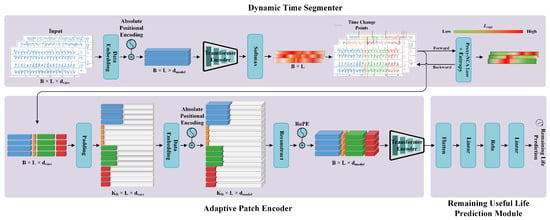
As illustrated in Figure 4, DSNet consists of three core components including a Dynamic Time Segmenter, an Adaptive Patch Encoder, and an RUL Prediction Module. These modules work together to analyze sensor data input X into health state representations F. These modules work together to transform raw sensor sequences into health state representations through a systematic modeling process. Formally, let represent the historical multivariate time series where is the number of sensor dimensions and L is the window length. The objective of the framework is to predict the equipment states over a future period of M time steps. This setup allows the model to identify potential failure modes in upcoming production cycles by capturing the underlying degradation patterns within the historical sensor data.
Figure 4.
Network structure of DSNet. The framework sequentially processes the multivariate input through three distinct stages: (1) The Dynamic Time Segmenter extracts variable-length semantic patches using a Transformer encoder and a boundary detection mechanism guided by Proxy-NCA and entropy loss. (2) The Adaptive Patch Encoder handles these irregular patches via uniform padding and leverages rotary positional encoding (RoPE) alongside a second Transformer to capture multi-scale temporal dependencies. (3) The Remaining Useful Life Prediction Module utilizes a Flatten layer and a multi-layer perceptron to map the aggregated patch features to the final multi-target RUL predictions.
3.1. Dynamic Time Segmenter
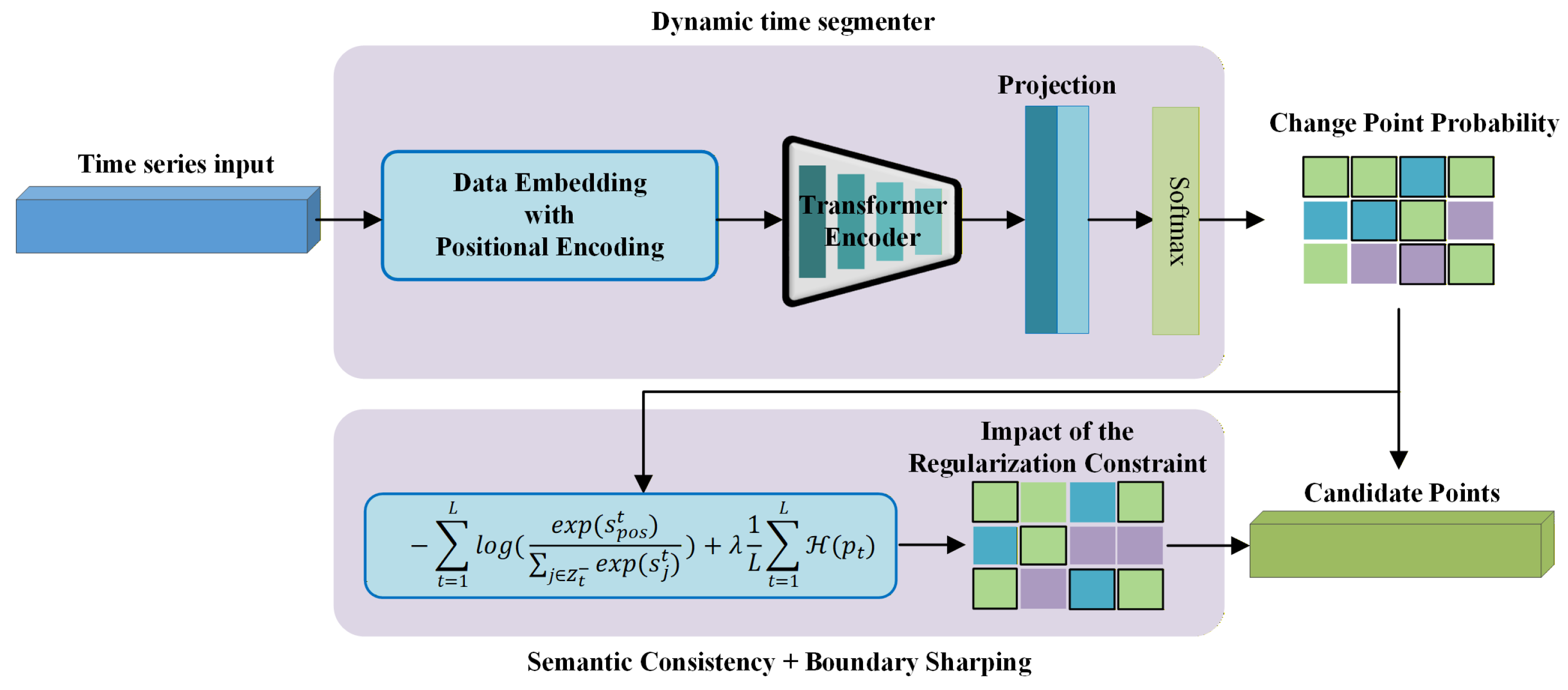
The Dynamic Time Segmenter is designed to decompose the continuous sensor stream into several semantically meaningful sub-processes. As illustrated in Figure 5, the input X is partitioned into a variable number K of patches with adaptive lengths. This partitioning strategy aims to simplify the complexity of the temporal dynamics, enabling the model to better capture local patterns that reflect the underlying production transitions. Conceptually distinct from unsupervised Change Point Detection (CPD) or clustering, our approach is end-to-end and task-driven. Instead of relying on statistical heuristics, segment boundaries are optimized directly by the RUL prediction loss to discover degradation phases specifically tailored for forecasting.
Figure 5.
Architecture and workflow of the Dynamic Time Segmenter. The upper branch extracts temporal features via a Transformer encoder to generate initial change point probabilities. The lower branch combined Proxy-NCA and entropy loss to yield precise candidate points for segmentation.
To capture the initial feature representation, the segmenter first maps the input into a latent space using linear projection and sinusoidal positional encoding:
where and are trainable parameters. The term PE denotes the positional encoding used to retain temporal order, defined as
To extract deep temporal dependencies for boundary identification, a Transformer encoder is utilized to process the embeddings :
where represents the sequence of encoded temporal features. Subsequently, each time step t is assigned a score representing the probability of a transition occurring at that moment. This is implemented through a linear projection followed by a sigmoid activation:
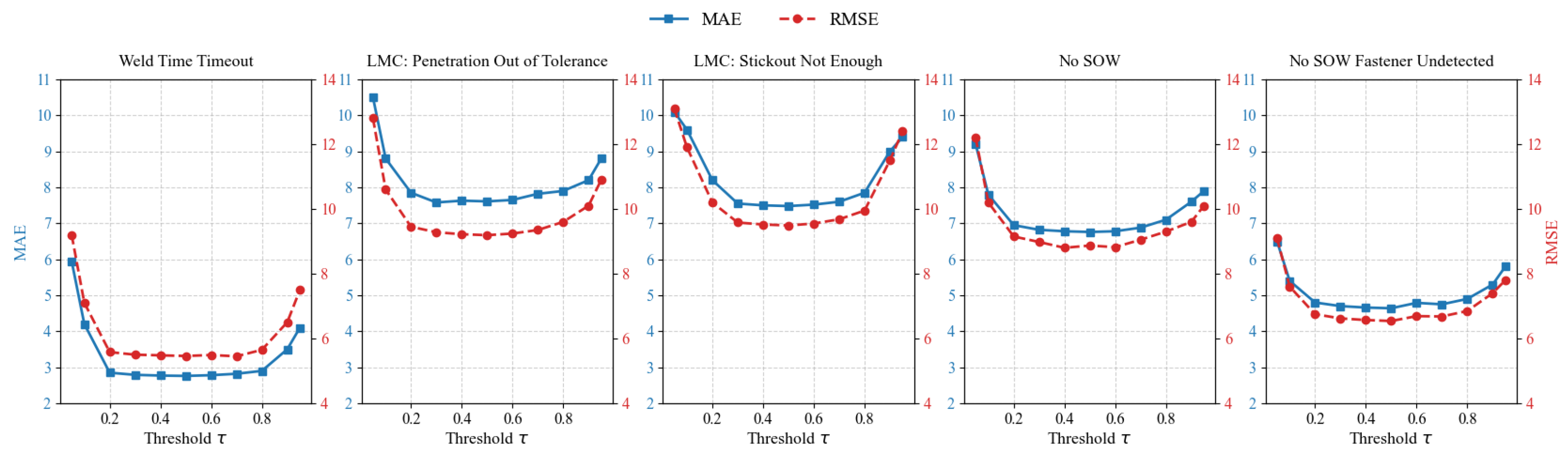
where and are trainable parameters. A set of candidate change points is then identified by applying a threshold . In our experiments, the threshold for identifying candidate change points was empirically set to 0.5 for all subsequent evaluations. These points serve as the boundaries to divide the continuous sequence into K adaptive patches.
To ensure that the generated patches correspond to distinct production semantics and to minimize ambiguity in boundary detection, a Semantic Boundary Discovery Loss is introduced. This mechanism utilizes a dynamic bank of learnable prototypes , where N represents the capacity of potential production states.
For each time step t, the affinity between the temporal feature and the prototypes is computed via a softmax distribution:
where indicates the probability that the current process belongs to a specific latent production state. To provide a supervisory signal for clustering, the most probable state index is identified as . To simultaneously enforce semantic consistency and optimize the precision of candidate points, the segmentation loss is formulated by integrating Proxy-NCA with information entropy:
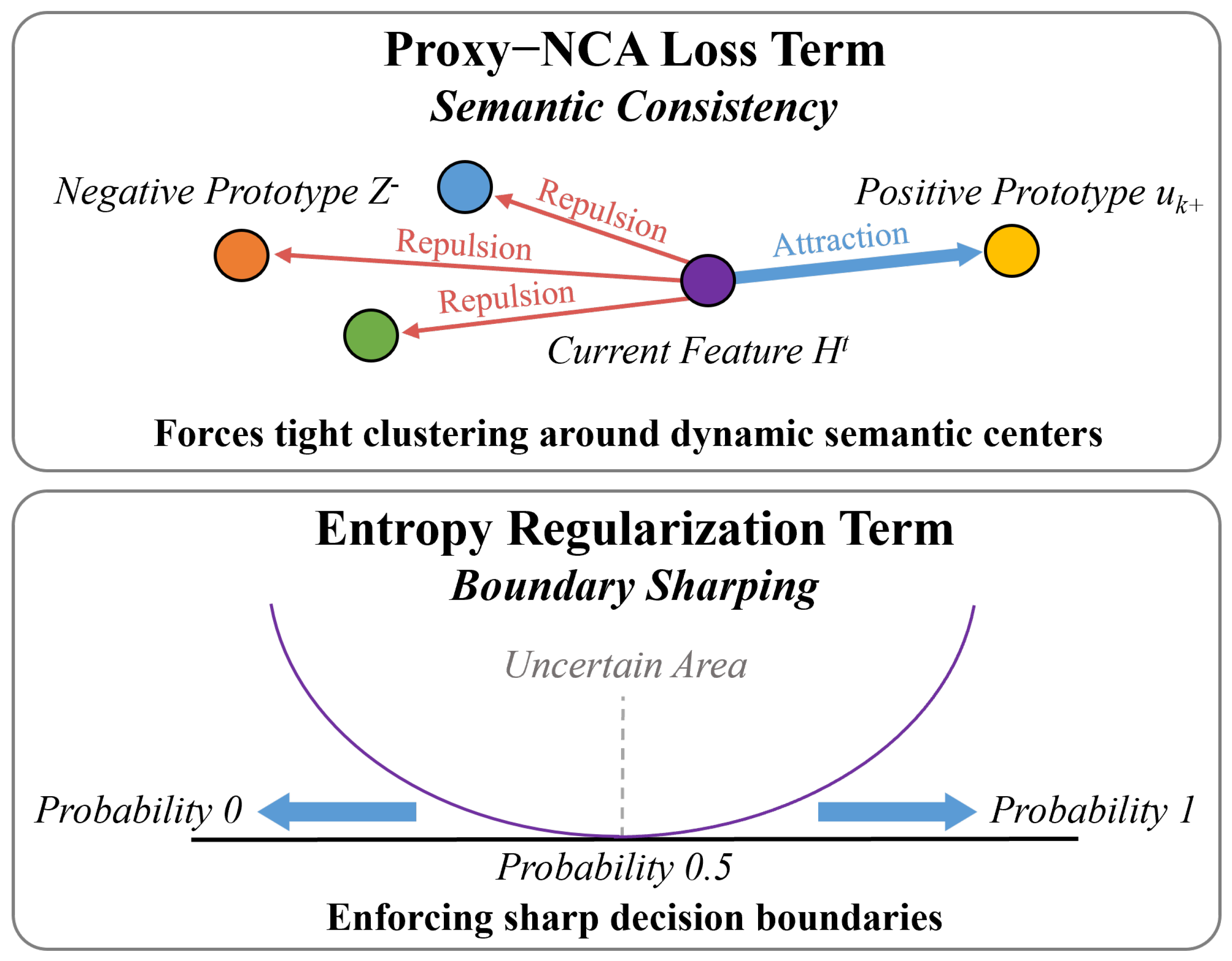
In the Proxy-NCA term, denotes the similarity to the most relevant prototype , serving as the dynamic positive proxy, while denotes the set of negative proxies. Physically, this acts as a semantic clustering mechanism that groups continuous time steps into discrete operational states. This term compels temporal features to cluster around semantic centers, forming piecewise stable phases and inducing abrupt transitions in the feature space exactly when the underlying physical process shifts.
The second term utilizes the binary entropy to penalize uncertain predictions. From a temporal perspective, it eliminates ambiguous boundary probabilities during phase shifts. By minimizing this entropy, the segmenter is driven to output decisive probabilities (approaching 0 or 1), thereby sharpening the decision boundaries.
Together, as shown in Figure 6, these two terms work synergistically: the Proxy-NCA determines what constitutes a meaningful physical phase, while the entropy regularization precisely localizes when the transition occurs. This joint optimization ensures that the identified change points C are both semantically meaningful and mathematically precise, facilitating the generation of high-quality adaptive patches.
Figure 6.
Conceptual illustration of the Semantic Boundary Discovery mechanism.
Utilizing the identified change points, the continuous sensor sequence X is partitioned into a series of adaptive-length patches. Let the set of change points be represented as an ordered sequence where each . To ensure a complete partition of the window length L, the boundary points are defined as and . Consequently, the k-th temporal patch is obtained by
where each patch possesses a variable length . This adaptive partitioning mechanism ensures that the sensor data are organized into semantic segments that correspond to the underlying production rhythm. These patches, despite their irregular lengths, serve as the foundational units for the subsequent feature encoding process, allowing the model to analyze the degradation trend within discrete yet coherent task-specific blocks.
3.2. Adaptive Patch Encoder
The Adaptive Patch Encoder is designed to process variable-length subsequences and reconstruct them into a comprehensive sequence representation. To ensure computational efficiency during batch processing, each variable-length patch is first aligned to the original window length L using zero-padding:
where is the length of patch , and denotes a zero matrix. For each patch, a position index is recorded, representing the batch index, start position, and end position, respectively. These padded segments are then mapped into a latent space through a linear transformation and sinusoidal positional encoding:
where represents the encoded features for all patches in a batch, and is the total number of patches.
After the initial encoding, as shown in Algorithm 1, these features are reconstructed into a full sequence representation using the stored indices . A zero tensor is initialized to store the features. During reconstruction, Rotary Positional Encoding (RoPE) is applied to each segment to help the model perceive its relative position within the global timeline based on the start index :
The RoPE mechanism applies a rotation to the feature vector at each time step n within a patch, with the rotation angle determined by the global offset :
By applying this rotation, the model incorporates the global context into the local patch representations. Finally, the reconstructed sequence is passed through a Transformer encoder to extract temporal features for RUL prediction:
where contains the deep features used for state estimation.
Algorithm 1 Reconstruction with Rotary Positional Encoding |
|
3.3. RUL Prediction Module
The final module aggregates the extracted fault-related features to estimate the remaining useful life. To capture the global health degradation information across the entire time window, the temporal and feature dimensions are flattened into a unified representation .
The RUL prediction is subsequently generated through a multi-layer perceptron (MLP) architecture, which maps the high-dimensional temporal features into a continuous health state value:
where and are learnable weight matrices, with representing the hidden dimension. The vectors and denote the corresponding bias terms, and is the ReLU activation function. To supervise the regression task, the Mean Squared Error (MSE) loss is employed to minimize the discrepancy between the predicted value and the actual RUL R:
The total training objective of DSNet is defined as the weighted sum of the RUL prediction loss and the dynamic segmentation loss, , where is a balancing coefficient used to coordinate the two learning objectives.
4. Experiments
4.1. BMW Stud Welding Gun RUL Datasets
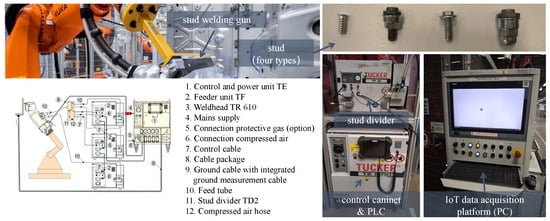
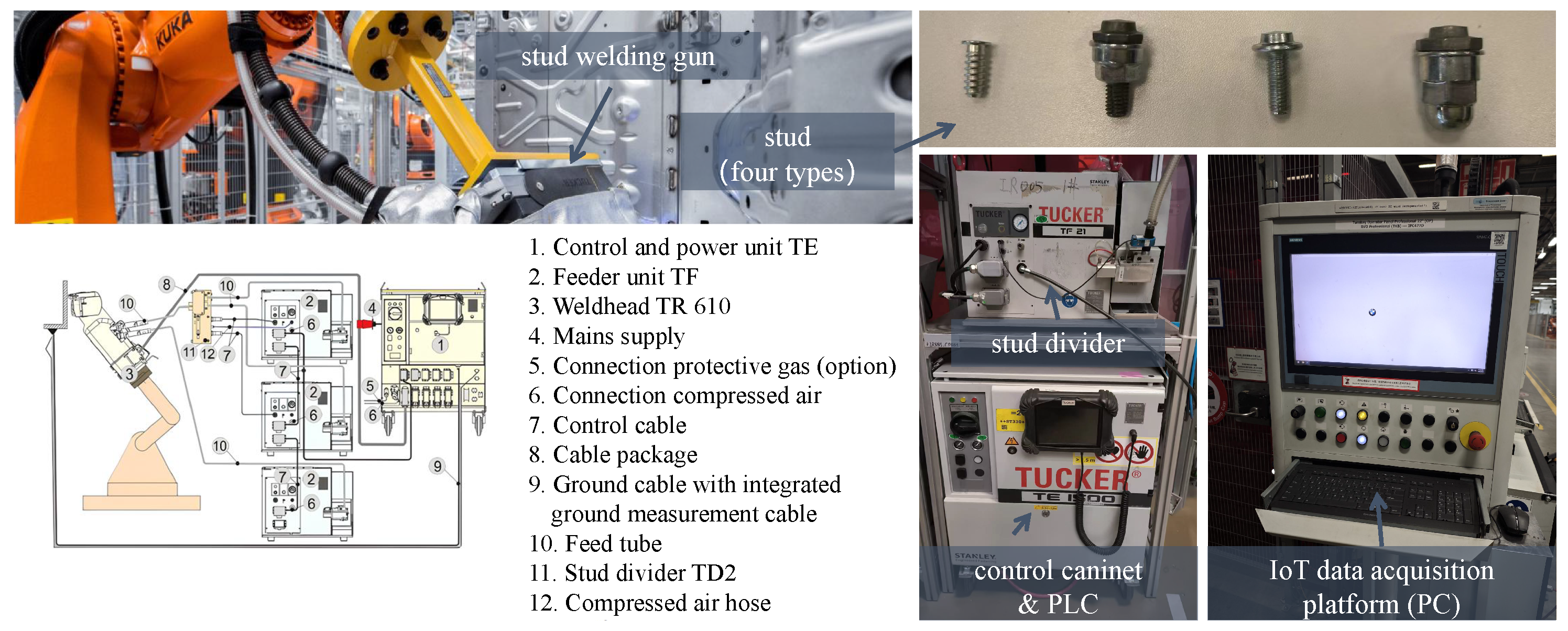
The experimental dataset was obtained from 53 stud welding guns at the BMW Shenyang plant, which utilizes mixed-model production to manage diverse manufacturing orders. Data collection spanned from 1 January 1 to 1 June 2024, capturing sensor readings from TUCKER programmable logic controllers (PLCs) at each welding point, as shown in Figure 7. This process yielded over 4 billion time-series records, where each record represents a single welding operation along with its associated sensor states and production outcomes.
Figure 7.
Equipment used in current study.
Although the PLC systems initially recorded 73 variables, nine key parameters were identified as critical for health prediction through correlation analysis and consultation with field engineers. These features, detailed in Table 1, are categorized into five groups: (1) a unique identifier (studId) representing specific welding tasks and vehicle body locations; (2) a temporal marker (enqueuedTime) for sequence tracking; (3) geometric parameters including lifting height, penetration depth, and stud length; (4) electrical parameters such as current, voltage, and energy input; and (5) an operational record of the welding duration.
Table 1.
Features of Dataset.
The PLC system logs various status codes, from which five critical failure modes that directly cause production line stoppages are selected for analysis. Accurate remaining useful life (RUL) prediction for these faults is essential for proactive maintenance. As shown in Table 2, the selected faults include weld time timeout, Penetration Out of Tolerance, Stickout Not Enough, and stud feeding failures such as No SOW and No SOW Fastener Undetected. Each of these events triggers an automatic equipment stop to prevent quality defects, halting the production line until the issue is resolved.
Table 2.
Fault description.
To construct a supervised learning framework, sensor data are linked to subsequent fault events. Sequences from individual guns are divided into consecutive, non-overlapping windows of 256 welding points. This window size provides sufficient temporal context for pattern recognition while maintaining computational efficiency. Each window is treated as an input sample, resulting in a total of 16,029,056 training samples.
For every sample window, an RUL label is computed for each of the five failure modes. The timestamp of the last operation within the window serves as the reference point . The system then calculates the time interval in hours from to the next occurrence of a specific fault for that gun. If no fault occurs within 48 h, the sample is assigned a censored RUL value of 48, indicating a healthy state for that duration. As determined with the maintenance department, precisely predicting an RUL beyond 48 h offers limited practical value on the shop floor. Conversely, a 48 h warning window provides the exact sufficient lead time required to formulate maintenance plans and prepare necessary tools without halting active production. While treating these right-censored instances with standard MSE loss (Equation (14)) may introduce a slight underestimation bias for highly healthy equipment, it intentionally focuses the model on the critical near-term failure window (≤48 h). This procedure establishes a multi-target regression task where each input sample is associated with five distinct RUL values.
4.2. Experimental Settings
Data Preprocessing: To prepare the raw data for model training, a systematic preprocessing pipeline was implemented. First, categorical encoding was applied to the studId feature using one-hot encoding to convert the welding-task identifiers into a numerical format. Second, to address sensor unreliability, missing values caused by communication delays were imputed using forward-filling for short gaps and linear interpolation for longer intervals. Notably, while missing data was imputed, high-frequency spikes and potential sensor outliers were intentionally preserved rather than smoothed. In the context of predicting remaining useful life, these anomalous fluctuations often carry critical degradation signatures and phase transition information; smoothing them would risk destroying the predictive signal. Third, all continuous sensor features were normalized using Z-score standardization to facilitate stable and efficient model convergence. Finally, as detailed in the previous section, each data sample was assigned a remaining useful life (RUL) value for each of the five failure modes. To maintain the temporal order of events and prevent look-ahead bias, the labeled dataset was chronologically partitioned into three subsets: a training set (first 60%, 964,544 samples), a validation set (next 10%, 1,603,392 samples), and a test set (final 30%, 4,810,176 samples).
Network Configuration and Training: The network parameters were randomly initialized. The model dimensions and were set to 256 and 1024, respectively, while the multi-head attention mechanism utilized 64 heads. Training was conducted over 40 epochs with a batch size of 64. The Adam optimizer was employed with a periodic learning rate decay strategy. To address the multi-target regression objective, WeightedMSELoss was utilized as the loss function.
To guarantee a rigorously fair evaluation, all compared baseline models were evaluated under the exact same experimental setup and subjected to extensive hyperparameter tuning across a comprehensive search space (e.g., exploring optimal learning rates, batch sizes, and hidden dimensions). The performance metrics reported in all subsequent comparative analyses strictly represent the optimal results achieved by each respective method after rigorous tuning processes.
The proposed framework was implemented using the PyTorch 2.10.0. All experiments were performed in a Python 3.8 environment on a workstation equipped with an Intel Xeon Silver 4310 CPU and an Nvidia GeForce RTX 3090 GPU, utilizing CUDA 11.3.1 and cuDNN v8 for hardware acceleration.
4.3. Comparison on BMW Stud Welding Gun RUL Dataset
The performance of DSNet was evaluated using the industrial dataset from BMW Brilliance Automotive (BBA). The RUL prediction task focuses on forecasting the time-to-failure within an upper limit of 48 h. For a comparative analysis, several time-series solutions and relevant prognostic models were included, all of which followed the same experimental setup with an input length of . RMSE and MAE were utilized to evaluate the prediction accuracy. To ensure statistical reliability, all reported results in this study represent the mean and standard deviation calculated from 10 independent runs under optimal parameter settings.
Table 3 presents the comparative results of various methodologies. DSNet outperformed existing methods across the majority of fault types. Quantitatively, compared with the highest-performing existing models, DSNet achieved improvements in MAE and RMSE by 12.29% and 10.66%, respectively. Regarding experimental stability, the standard deviation results reveal a fault-dependent pattern, where prediction stability varies according to the specific fault type. While DSNet achieves superior mean performance, it exhibits slightly lower stability than rigid static models. This variance is likely due to the initialization sensitivity of the adaptive segmentation technique, as the dynamic boundary search may converge differently across independent runs. Ultimately, DSNet effectively trades a marginal loss in variance for a massive leap in mean prediction accuracy.
Table 3.
RUL comparison results for Stud Welding Gun Dataset. Bold indicates the best result, and underline indicates the second-best result.
Specific comparisons with patch-based architectures further highlight the advantages of the adaptive approach. Compared to PatchTST, which utilizes fixed-length patches, DSNet improved the MAE by 39.91% and RMSE by 18.06%. Similarly, in comparison to MPRNet, which employs a multi-scale patch approach, DSNet showed a 37.43% improvement in MAE and a 16.77% improvement in RMSE. Furthermore, DSNet demonstrated a 42.11% improvement in MAE and a 23.79% improvement in RMSE over HDMixer, a method using a fixed number of variable-length patches. These results suggest that the dynamic segmentation capability of DSNet is more effective at capturing phase transitions in manufacturing processes than traditional static segmentation approaches.
However, FEDformer achieved superior RUL prediction performance in the No SOW category and exhibited competitive results elsewhere. This indicates that frequency-domain modeling provides specific advantages in certain scenarios, offering a direction for potential model enhancements.
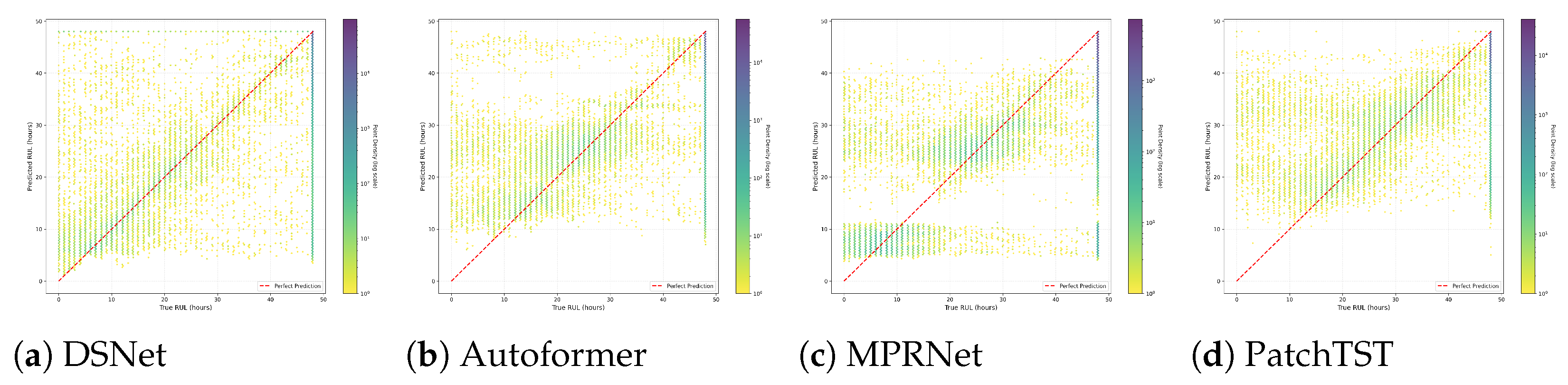
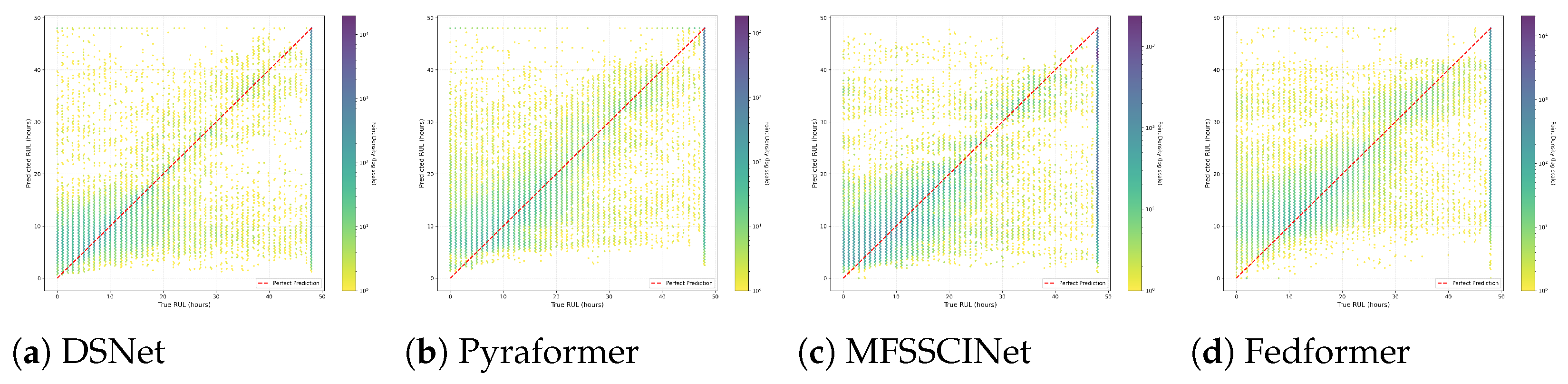
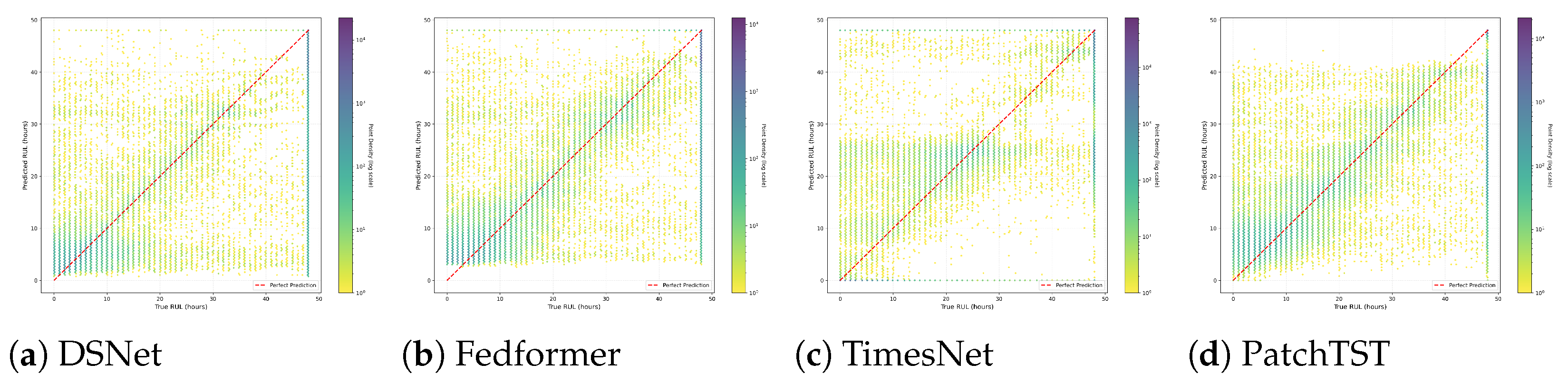
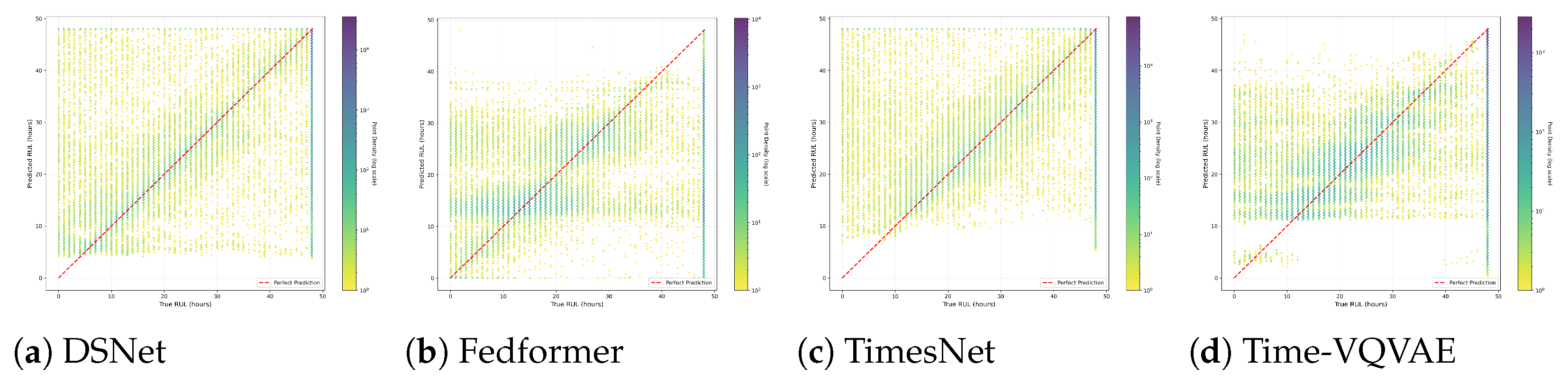
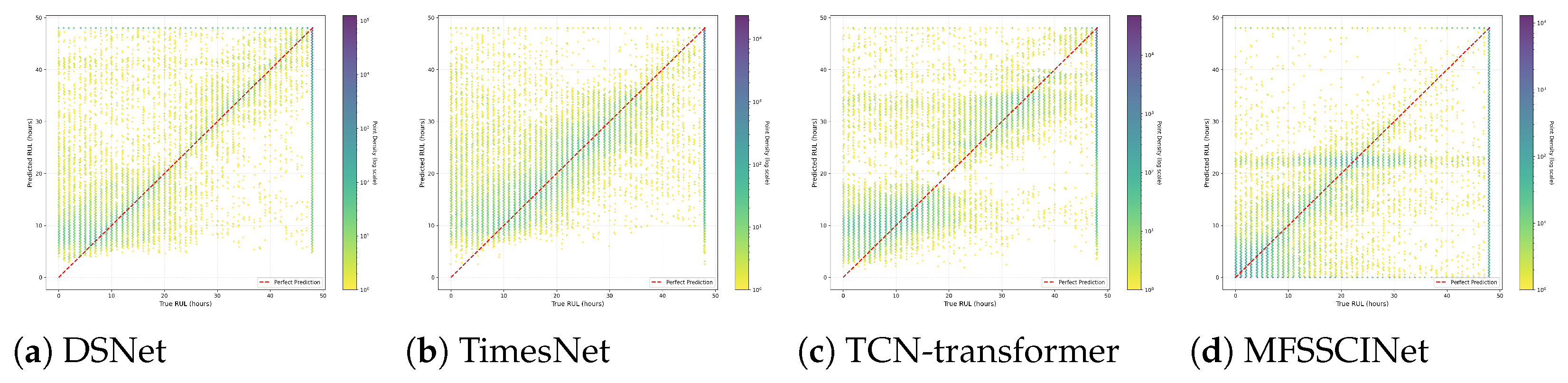
To provide a deeper interpretation of the results, the visualization outputs in Figure 8, Figure 9, Figure 10, Figure 11 and Figure 12 were analyzed. For each fault type, the scatter plots compare the four top-performing algorithms. In these plots, the color gradient reflects the density of the prediction points, where darker blue indicates a higher concentration and lighter yellow corresponds to sparser distributions.
Figure 8.
Experimental results of RUL prediction on weld time timeout.
Figure 9.
Experimental results of RUL prediction on LMC: Penetration Out of Tolerance.
Figure 10.
Experimental results of RUL prediction on LMC: Stickout Not Enough.
Figure 11.
Experimental results of RUL prediction on No SOW.
Figure 12.
Experimental results of RUL prediction on No SOW Fastener Undetected.
Two primary observations are drawn from these visualizations. First, DSNet exhibits a tighter clustering of points along the diagonal compared to other methods, which show broader dispersion. This pattern suggests that DSNet provides more accurate RUL estimates that remain consistently close to actual values. Second, DSNet demonstrates comprehensive coverage across the full 48 h horizon, avoiding the large blank sections observed in competing methods. This indicates a robust ability to capture RUL characteristics throughout the entire equipment lifecycle.
In Figure 11, while DSNet maintains broad coverage, FEDformer shows stronger performance near the end-of-life stage for the No SOW fault type. This suggests No SOW condition alters the mechanical resonance of the welding gun, introducing highly distinct high-frequency vibrational signatures during the actuation cycle. FEDformer, leveraging Fourier transforms, explicitly isolates and amplifies these frequency-domain precursors. In contrast, DSNet is primarily designed to capture time-domain semantic transitions and long-term degradation pathways. Although DSNet effectively tracks the overall macro-degradation trend of the No SOW fault, methods operating in the frequency domain demonstrate superior performance. This finding highlights a potential limitation in capturing frequency-domain features and suggests that incorporating frequency-aware mechanisms could be a meaningful direction for future development.
4.4. Comparison on Public RUL Dataset
The generalization capability of DSNet is further validated through evaluations on six public prognostic benchmarks, including the NASA C-MAPSS engine datasets [34] and the IMS/PRONOSTIA bearing datasets [35,36]. All models shared the same experimental setup and hyperparameter search space. The reported results reflect the best performance of each model obtained through rigorous parameter tuning.
The comparative results are summarized in Table 4. It is reported as the mean and standard deviation over 10 independent runs. DSNet achieves the best overall performance by obtaining the lowest MAE and RMSE on five of the six datasets (FD001, FD002, FD004, IMS, and PRONOSTIA) while maintaining competitive second-best results on the remaining benchmark. Beyond the superior mean accuracy, the standard deviation metrics further highlight DSNet’s robustness across varying physical domains. On relatively stable degradation processes, such as the IMS and PRONOSTIA bearing datasets, DSNet exhibits exceptionally low variance. These findings demonstrate consistent effectiveness across diverse equipment types and failure modes.
Table 4.
RUL comparison results for open dataset. Bold indicates the best result, and underline indicates the second-best result.
Specifically, DSNet demonstrates consistent improvements compared to representative baselines utilizing various temporal modeling strategies. Against MPRNet, which uses a multi-scale patch approach, DSNet reduces the average MAE and RMSE across all public datasets by 6.5% and 4.2%, respectively. Compared to TimeMixer, DSNet achieves an average improvement of 5.1% in MAE and 3.8% in RMSE. The advantage is also evident when compared to other segmentation paradigms. DSNet outperforms PatchTST, which uses fixed-length patches, by an average of 12.3% in MAE on the C-MAPSS subsets. It also surpasses HDMixer, which employs variable-length patches, by an average of 9.7% in MAE on the bearing datasets. This multi-faceted comparison confirms that the Adaptive Patch Encoder provides a more effective and generalizable inductive bias for RUL prediction than existing fixed or manual segmentation schemes.
Although DSNet exhibits robust overall superiority, MSPA-GAT performs best on the FD003 dataset. This suggests that graph attention may offer specific benefits for certain fault interactions. However, the leading results of DSNet across the majority of benchmarks confirm that the adaptive patch encoding mechanism generalizes well and effectively captures degradation dynamics in different time-series prognostics tasks.
4.5. Ablation Study
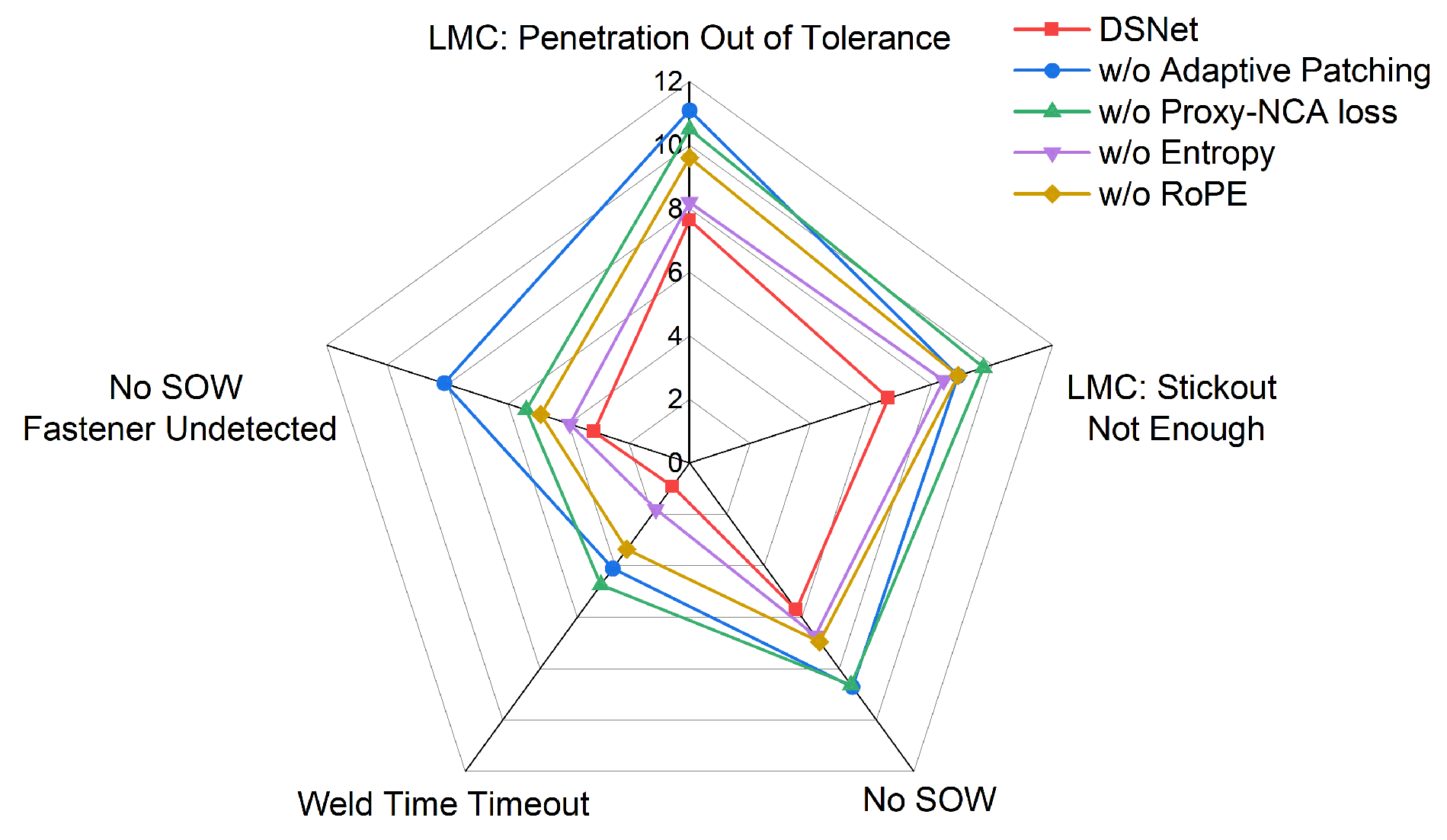
To rigorously validate the individual contributions of the core components proposed in DSNet, we conducted a comprehensive ablation study across the five failure sub-tasks. We designed four degraded variants of our architecture for comparison:
- w/o Adaptive Patching: This variant replaces the Dynamic Time Segmenter with a rigid, fixed-length partitioning strategy (similar to traditional patching methods). It divides the sequence into uniform segments without considering the underlying semantic transitions.
- w/o Proxy-NCA loss: This variant removes the Proxy-NCA term from the Semantic Boundary Discovery Loss, meaning the segmenter partitions the temporal data without the guidance of semantic prototype clustering.
- w/o Entropy: This variant eliminates the entropy regularization term , removing the mechanism designed to penalize uncertain boundary predictions and sharpen transition probabilities.
- w/o RoPE: This variant replaces the Rotary Positional Encoding in the Adaptive Patch Encoder with standard absolute positional encoding, discarding the relative global temporal awareness during the reconstruction of variable-length patches.
The prediction errors of the complete DSNet and its four variants are visualized in the radar chart (Figure 13). The results clearly demonstrate that the complete DSNet consistently achieves the lowest prediction error across all five specific failure modes, confirming the necessity of integrating these modules. Crucially, the w/o Adaptive Patching variant and the w/o Proxy-NCA loss variant exhibit the most significant performance degradation, forming the outermost boundaries of the radar chart. The severe error increase in the uniform patching variant strongly validates our core motivation: rigid segmentation forcibly disrupts the semantic continuity of complex manufacturing processes, leading to temporal feature misalignment. Furthermore, the poor performance of the model without Proxy-NCA loss highlights that assigning latent production semantics to patches is indispensable for accurately capturing degradation patterns. Additionally, removing the entropy penalty (w/o Entropy) or the rotary positional encoding (w/o RoPE) also leads to a noticeable expansion of the error polygons. Without entropy regularization, the model struggles to output decisive boundary probabilities, resulting in ambiguous and suboptimal patch generation. Meanwhile, the absence of RoPE disrupts the model’s ability to anchor variable-length patches into the global timeline, proving that global temporal awareness is a prerequisite for reconstructing accurate health state representations. Ultimately, the synergy of these tailored mechanisms enables DSNet to achieve robust and superior RUL prediction performance.
Figure 13.
Ablation study.
4.6. Parameter Sensitivity Analysis
Sensitivity of the Threshold : The threshold determines the sensitivity of the Dynamic Time Segmenter in detecting process transitions. To evaluate its impact on the final RUL prediction accuracy, we conducted a sensitivity analysis by varying from 0.05 to 0.95. As shown in Figure 14, the model’s performance remains relatively stable when is between 0.2 and 0.8. This consistent trend across different sub-tasks is largely attributed to the entropy regularization term in our Semantic Boundary Discovery Loss, which forces the transition probabilities to approach either 0 or 1, thereby sharpening the decision boundaries. However, setting too low (e.g., <0.2) leads to over-segmentation, fracturing the continuous temporal context into fragmented patches and increasing computational overhead. Conversely, an excessively high results in under-segmentation, causing the model to miss subtle state transitions and blurring the semantic boundaries of the production processes. Therefore, was selected to balance fine-grained segment discovery and temporal continuity.
Figure 14.
Sensitivity analysis of the threshold .
4.7. Computational Complexity and Industrial Deployment Analysis
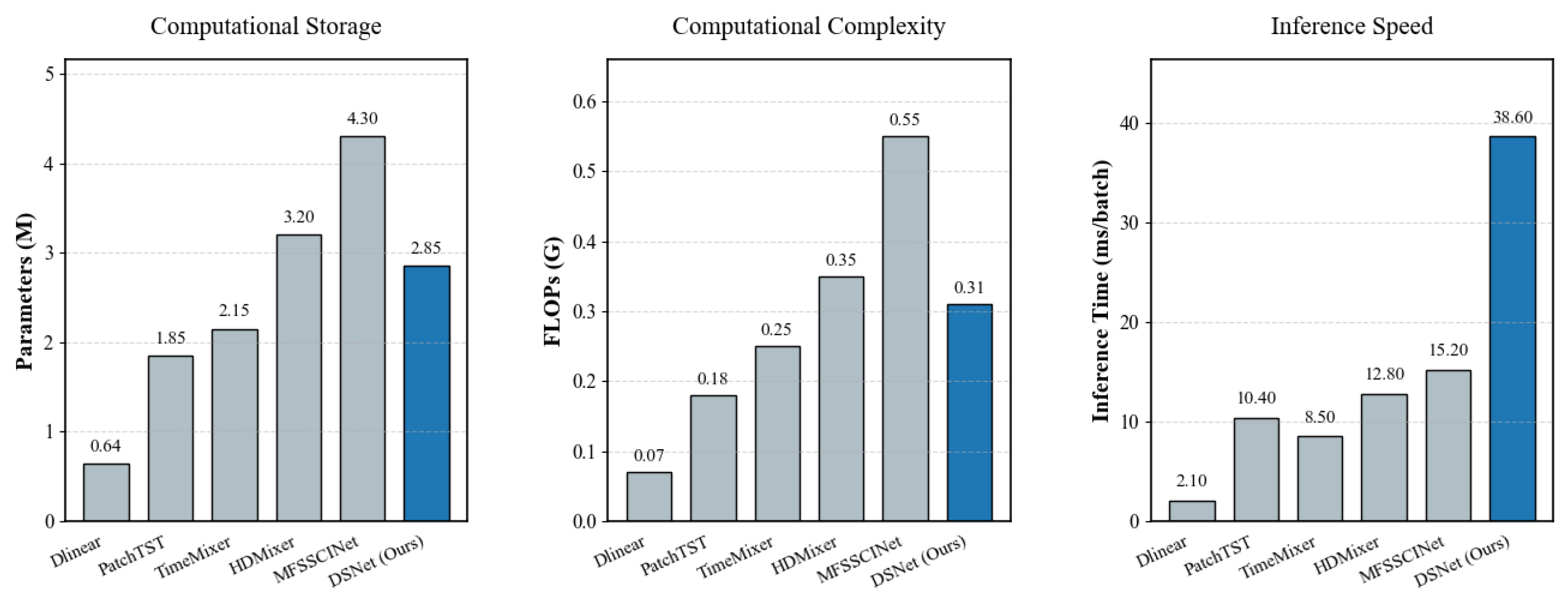
To evaluate the practical viability of deploying DSNet in real-world industrial environments, we quantified its computational overhead. As illustrated in Figure 15, we compared the parameter count (Params), floating-point operations (FLOPs), and inference latency between DSNet and representative baseline models.
Figure 15.
Comparison of computational complexity and inference latency among different models.
As shown in the results, DSNet requires only 2.85 M parameters and 0.31 G FLOPs. This demonstrates high storage and computational efficiency, largely because our Dynamic Time Segmenter effectively compresses the temporal sequence into a smaller number of semantic patches, significantly reducing the computational burden on the subsequent Transformer layers. However, the dynamic slicing and variable-length padding mechanisms slightly interrupt parallel computation, resulting in an inference latency of 38.6 ms/batch, which is moderately higher than basic linear models. In the actual mixed-model production setup, the predictive maintenance system aims to forecast failure events within a 48 h future horizon, and the RUL assessment is scheduled to execute only once every one hour. Compared to this 1 h operational cycle, a 38.6 ms inference time easily satisfies the real-time constraints of industrial deployment without causing any bottlenecks.
5. Conclusions
This study introduces DSNet, a novel framework designed for remaining useful life (RUL) prediction within the complex environment of mixed-model manufacturing. The core of the framework is the Dynamic Time Segmenter, which utilizes a Proxy-NCA loss and information entropy to adaptively partition sensor streams into variable-length segments. This mechanism effectively addresses the challenge of non-stationary signal shifts caused by frequent product changeovers, ensuring that the resulting patches align with underlying production phases rather than arbitrary time windows. Furthermore, the Adaptive Patch Encoder incorporates Rotary Positional Encoding to re-anchor these local segments back into the global timeline, preserving both local degradation details and global temporal context.
Experimental evaluations on both industrial datasets from the BMW Shenyang plant and multiple public benchmarks confirm the superiority of the proposed approach. Compared to state-of-the-art models, DSNet achieved average improvements in MAE and RMSE of 12.29% and 10.66%, respectively, on real-world welding tasks. Specifically, the framework demonstrated significant performance gains over existing patch-based methods like PatchTST and MPRNet, illustrating the value of adaptive segmentation in capturing equipment wear-out pathways amidst unpredictable production rhythms. While the current model primarily operates in the time domain, future research could explore the integration of frequency-aware mechanisms to further enhance prediction accuracy for specific fault modes. These results validate DSNet as a robust and generalizable solution for proactive maintenance in modern intelligent manufacturing systems.
Despite its superior performance, a systematic analysis reveals certain limitations and potential failure cases of DSNet. First, regarding computational overhead, the dynamic generation of variable-length patches disrupts standard GPU matrix parallelization. Although our padding strategy ensures an inference latency suitable for 1 h maintenance cycles, the training phase inherently demands higher memory and time costs than static-patch models. Second, in extreme failure cases involving massive sensor noise or severe signal loss, the Proxy-NCA mechanism may suffer from “over-segmentation,” mistaking random high-amplitude noise for task transitions and generating fragmented, non-informative patches.
Future research will directly address these limitations. We aim to integrate hardware-aware sparse attention to optimize computational efficiency and incorporate frequency-aware mechanisms to better isolate structural degradation from extreme noise. Furthermore, we plan to introduce explainable methods into our dynamic segmentation to explicitly interpret the physical significance of specific degradation patterns, bridging the gap between data-driven RUL predictions and industrial semantics.
Author Contributions
Conceptualization, M.C.; methodology, M.C.; software, M.C.; validation, M.C.; formal analysis, M.C.; investigation, M.C.; resources, M.C., Z.L. and P.Y.; data curation, M.C., Z.L. and P.Y.; writing—original draft preparation, M.C.; writing—review and editing, M.C.; visualization, M.C.; supervision, M.C.; project administration, R.Y.; funding acquisition, R.Y. All authors have read and agreed to the published version of the manuscript.
Funding
This work was supported in part by the National Key Research and Development Program of China under Grant 2024YFB3409202 and the Fundamental Research Funds for the Central Universities under Grant N25ZLL045.
Data Availability Statement
The data presented in this study are available upon reasonable request from the author. Due to institutional policy, the data are not publicly archived.
Conflicts of Interest
The authors declare no conflicts of interest.
References
- Wu, H.; Xu, J.; Wang, J.; Long, M. Autoformer: Decomposition transformers with auto-correlation for long-term series forecasting. In Advances in Neural Information Processing Systems 34: Annual Conference on Neural Information Processing Systems 2021, NeurIPS 2021, virtual, 6–14 December 2021; Ranzato, M., Beygelzimer, A., Dauphin, Y.N., Liang, P., Vaughan, J.W., Eds.; Curran Associates, Inc.: Red Hook, NY, USA, 2021; pp. 22419–22430. Available online: https://proceedings.neurips.cc/paper/2021/hash/bcc0d400288793e8bdcd7c19a8ac0c2b-Abstract.html (accessed on 27 March 2026).
- Zeng, A.; Chen, M.; Zhang, L.; Xu, Q. Are transformers effective for time series forecasting? Proc. AAAI Conf. Artif. Intell. 2023, 37, 11121–11128. [Google Scholar] [CrossRef] [Scilit]
- Wang, H.; Mo, Y.; Xiang, K.; Yin, N.; Dai, H.; Li, B.; Fan, S.; Mo, S. Csformer: Combining channel independence and mixing for robust multivariate time series forecasting. In AAAI-25, Sponsored by the Association for the Advancement of Artificial Intelligence, Philadelphia, PA, USA, 25 February–4 March 2025; Walsh, T., Shah, J., Kolter, Z., Eds.; AAAI Press: Washington, DC, USA, 2025; pp. 21090–21098. [Google Scholar] [CrossRef] [Scilit]
- Zhou, T.; Ma, Z.; Wen, Q.; Wang, X.; Sun, L.; Jin, R. Fedformer: Frequency enhanced decomposed transformer for long-term series forecasting. In Proceedings of the 39th International Conference on Machine Learning, ICML 2022, Baltimore, MD, USA, 17–23 July 2022; Chaudhuri, K., Jegelka, S., Song, L., Szepesvári, C., Niu, G., Sabato, S., Eds.; PMLR: San Diego, CA, USA, 2022; Volume 162, pp. 27268–27286. Available online: https://proceedings.mlr.press/v162/zhou22g.html (accessed on 27 March 2026).
- Wu, X.; Qiu, X.; Li, Z.; Wang, Y.; Hu, J.; Guo, C.; Xiong, H.; Yang, B. CATCH: Channel-aware multivariate time series anomaly detection via frequency patching. In Proceedings of the Thirteenth International Conference on Learning Representations, ICLR 2025, Singapore, 24–28 April 2025; Available online: https://openreview.net/forum?id=m08aK3xxdJ (accessed on 27 March 2026).
- Liu, Y.; Wu, H.; Wang, J.; Long, M. Non-stationary transformers: Exploring the stationarity in time series forecasting. In Advances in Neural Information Processing Systems 35: Annual Conference on Neural Information Processing Systems 2022, NeurIPS 2022, New Orleans, LA, USA, 28 November–9 December 2022; Koyejo, S., Mohamed, S., Agarwal, A., Belgrave, D., Cho, K., Oh, A., Eds.; Curran Associates, Inc.: Red Hook, NY, USA, 2022; Available online: http://papers.nips.cc/paper_files/paper/2022/hash/4054556fcaa934b0bf76da52cf4f92cb-Abstract-Conference.html (accessed on 27 March 2026).
- Qiu, X.; Wu, X.; Lin, Y.; Guo, C.; Hu, J.; Yang, B. DUET: Dual clustering enhanced multivariate time series forecasting. In Proceedings of the 31st ACM SIGKDD Conference on Knowledge Discovery and Data Mining, V.1, KDD 2025, Toronto, ON, Canada, 3–7 August 2025; Sun, Y., Chierichetti, F., Lauw, H.W., Perlich, C., Tok, W.H., Tomkins, A., Eds.; ACM: New York, NY, USA, 2025; pp. 1185–1196. [Google Scholar] [CrossRef] [Scilit]
- Liu, S.; Yu, H.; Liao, C.; Li, J.; Lin, W.; Liu, A.X.; Dustdar, S. Pyraformer: Low-complexity pyramidal attention for long-range time series modeling and forecasting. In Proceedings of the Tenth International Conference on Learning Representations, ICLR 2022, Virtual Event, 25–29 April 2022; Available online: https://openreview.net/forum?id=0EXmFzUn5I (accessed on 27 March 2026).
- Wang, H.; Peng, J.; Huang, F.; Wang, J.; Chen, J.; Xiao, Y. MICN: Multi-scale local and global context modeling for long-term series forecasting. In Proceedings of the Eleventh International Conference on Learning Representations, ICLR 2023, Kigali, Rwanda, 1–5 May 2023; Available online: https://openreview.net/pdf?id=zt53IDUR1U (accessed on 27 March 2026).
- Wang, S.; Li, J.; Shi, X.; Ye, Z.; Mo, B.; Lin, W.; Ju, S.; Chu, Z.; Jin, M. Timemixer++: A general time series pattern machine for universal predictive analysis. In Proceedings of the Thirteenth International Conference on Learning Representations, ICLR 2025, Singapore, 24–28 April 2025; Available online: https://openreview.net/forum?id=1CLzLXSFNn (accessed on 27 March 2026).
- Nie, Y.; Nguyen, N.H.; Sinthong, P.; Kalagnanam, J. A time series is worth 64 words: Long-term forecasting with transformers. In Proceedings of the Eleventh International Conference on Learning Representations, ICLR 2023, Kigali, Rwanda, 1–5 May 2023; Available online: https://openreview.net/pdf?id=Jbdc0vTOcol (accessed on 27 March 2026).
- Huang, Q.; Shen, L.; Zhang, R.; Cheng, J.; Ding, S.; Zhou, Z.; Wang, Y. Hdmixer: Hierarchical dependency with extendable patch for multivariate time series forecasting. Proc. AAAI Conf. Artif. Intell. 2024, 38, 12608–12616. [Google Scholar] [CrossRef] [Scilit]
- Chen, P.; Zhang, Y.; Cheng, Y.; Shu, Y.; Wang, Y.; Wen, Q.; Yang, B.; Guo, C. Pathformer: Multi-scale transformers with adaptive pathways for time series forecasting. In Proceedings of the Twelfth International Conference on Learning Representations, ICLR 2024, Vienna, Austria, 7–11 May 2024; Available online: https://openreview.net/forum?id=lJkOCMP2aW (accessed on 27 March 2026).
- Chen, M.; Yu, R.; Liang, Z.; Li, K.; Qi, H. A multiscale process-aware retention network for fault prediction in mixed-model production. Comput. Ind. 2025, 170, 104313. [Google Scholar] [CrossRef] [Scilit]
- Kamarthi, H.; Prakash, B.A. Large pre-trained time series models for cross-domain time series analysis tasks. In Advances in Neural Information Processing Systems 38: Annual Conference on Neural Information Processing Systems 2024, NeurIPS 2024, Vancouver, BC, Canada, 10–15 December 2024; Globersons, A., Mackey, L., Belgrave, D., Fan, A., Paquet, U., Tomczak, J.M., Zhang, C., Eds.; Curran Associates, Inc.: Red Hook, NY, USA, 2024; Available online: http://papers.nips.cc/paper_files/paper/2024/hash/662dcc5c2b9aca77b2a0ec8a98aefae9-Abstract-Conference.html (accessed on 27 March 2026).
- Wu, M.; Yao, Z.; Abts, R.; Karsmakers, P.; Verbeke, M.; Reynaerts, D. A threshold-free and label-free pipeline for adaptive pulse classification in electrical discharge machining. Procedia CIRP 2025, 133, 692–697. [Google Scholar] [CrossRef] [Scilit]
- Li, Z.; Wu, D.; Hu, C.; Terpenny, J.P. An ensemble learning-based prognostic approach with degradation-dependent weights for remaining useful life prediction. Reliab. Eng. Syst. Saf. 2019, 184, 110–122. [Google Scholar] [CrossRef] [Scilit]
- Zhang, D.; Baraldi, P.; Cadet, C.; Yousfi-Steiner, N.; Bérenguer, C.; Zio, E. An ensemble of models for integrating dependent sources of information for the prognosis of the remaining useful life of proton exchange membrane fuel cells. Mech. Syst. Signal Process. 2019, 124, 479–501. [Google Scholar] [CrossRef] [Scilit]
- Lin, W.; Chai, Y.; Chen, X.; Liu, Q.; Feng, F. A generalized remaining useful life prediction method based on hybrid model and sparse variational bayesian. IEEE Trans. Ind. Inform. 2025, 21, 2254–2263. [Google Scholar] [CrossRef] [Scilit]
- Li, H.; Cao, P.; Wang, X.; Li, Y.; Yi, B.; Huang, M. Pre-training enhanced unsupervised contrastive domain adaptation for industrial equipment remaining useful life prediction. Adv. Eng. Inform. 2024, 60, 102517. [Google Scholar] [CrossRef] [Scilit]
- Ding, P.; Xia, J.; Zhao, X.; Jia, M. Graph structure few-shot prognostics for machinery remaining useful life prediction under variable operating conditions. Adv. Eng. Inform. 2024, 60, 102360. [Google Scholar] [CrossRef] [Scilit]
- Yang, J.; Wang, X.; Zhang, M.; Liu, L.; Li, J. Meta-knowledge random attention update network for few-shot and anti-noise remaining useful life prediction. Adv. Eng. Inform. 2025, 65, 103358. [Google Scholar] [CrossRef] [Scilit]
- Cui, H.; Guo, X.; Yu, L. Leveraging pre-trained gpt models for equipment remaining useful life prognostics. Electronics 2025, 14, 1265. [Google Scholar] [CrossRef] [Scilit]
- Zhang, W.; Hao, Y.; Luo, S.; Li, K.; Wu, X.; Jin, Z. Enhanced open-circuit fault diagnosis in T-type inverters using conditional virtual sample generation. IEEE Trans. Instrum. Meas. 2025, 74, 3535610. [Google Scholar] [CrossRef] [Scilit]
- Zhu, Y.; Wu, J.; Liu, X.; Wu, J.; Chai, K.; Hao, G.; Liu, S. Hybrid scheme through read-first-LSTM encoder-decoder and broad learning system for bearings degradation monitoring and remaining useful life estimation. Adv. Eng. Inform. 2023, 56, 102014. [Google Scholar] [CrossRef] [Scilit]
- Cen, Z.; Hu, S.; Hou, Y.; Chen, Z.; Ke, Y. Remaining useful life prediction of machinery based on improved sample convolution and interaction network. Eng. Appl. Artif. Intell. 2024, 135, 108813. [Google Scholar] [CrossRef] [Scilit]
- Cao, W.; Meng, Z.; Li, J.; Wu, J.; Fan, F. A remaining useful life prediction method for rolling bearing based on tcn-transformer. IEEE Trans. Instrum. Meas. 2025, 74, 3501309. [Google Scholar] [CrossRef] [Scilit]
- Tang, J.; Miao, Y.; Xia, Y.; Zhou, Q.; Yi, C. A multiscale pooling attention-based graph attention network for remaining useful life prediction. IEEE Trans. Instrum. Meas. 2025, 74, 3528914. [Google Scholar] [CrossRef] [Scilit]
- Wu, L.; Song, S.; Li, H.; Hu, C.; Luo, Y. Palc-net: A partial convolution attention-enhanced cnn-lstm network for aircraft engine remaining useful life prediction. Electronics 2026, 15, 131. [Google Scholar] [CrossRef] [Scilit]
- Alabbad, S.; Altınkaya, H. An intelligent predictive maintenance architecture for substation automation: Real-world validation of a digital twin and ai framework of the badra oil field project. Electronics 2026, 15, 416. [Google Scholar] [CrossRef] [Scilit]
- Zheng, Q.; Teng, P.; Zhang, K.; Ding, G.; Lai, X.; Li, Z.; Yuan, Z. A generalized network with domain invariance and specificity representation for bearing remaining useful life prediction under unknown conditions. Knowl. Based Syst. 2025, 310, 112915. [Google Scholar] [CrossRef] [Scilit]
- Xie, Y.; Lin, X.; Liu, F.; Qi, H.; Zhao, J. Lt-mamba: A novel network for rul estimation of multisensor signals. IEEE Sens. J. 2025, 25, 40450–40460. [Google Scholar] [CrossRef] [Scilit]
- Wu, H.; Hu, T.; Liu, Y.; Zhou, H.; Wang, J.; Long, M. Timesnet: Temporal 2d-variation modeling for general time series analysis. In Proceedings of the Eleventh International Conference on Learning Representations, ICLR 2023, Kigali, Rwanda, 1–5 May 2023; Available online: https://openreview.net/pdf?id=ju_Uqw384Oq (accessed on 27 March 2026).
- Saxena, A.; Goebel, K. Phm08 challenge data set. NASA Ames Prognostics Data Repository. 2008. Available online: https://www.nasa.gov/intelligent-systems-division/discovery-and-systems-health/pcoe/pcoe-data-set-repository/ (accessed on 27 March 2026).
- Lee, J.; Qiu, H.; Yu, G.; Lin, J. Rexnord Technical Services, Bearing Data Set, Ims, University of Cincinnati. Nasa Ames Prognostics Data Repository. NASA Ames, Moffett Field, CA, 2007. Available online: https://www.nasa.gov/intelligent-systems-division/discovery-and-systems-health/pcoe/pcoe-data-set-repository/ (accessed on 27 March 2026).
- Nectoux, P.; Gouriveau, R.; Medjaher, K.; Ramasso, E.; Chebel-Morello, B.; Zerhouni, N.; Varnier, C. Pronostia: An experimental platform for bearings accelerated degradation tests. In IEEE International Conference on Prognostics and Health Management, PHM’12; IEEE: Piscataway, NJ, USA, 2012; pp. 1–8. [Google Scholar]

Disclaimer/Publisher’s Note: The statements, opinions and data contained in all publications are solely those of the individual author(s) and contributor(s) and not of MDPI and/or the editor(s). MDPI and/or the editor(s) disclaim responsibility for any injury to people or property resulting from any ideas, methods, instructions or products referred to in the content. |
© 2026 by the authors. Licensee MDPI, Basel, Switzerland. This article is an open access article distributed under the terms and conditions of the Creative Commons Attribution (CC BY) license.