


Abstract
Multi-task learning (MTL) is essential for satellite internet systems requiring simultaneous optimization of beam management, interference mitigation, resource allocation, and traffic prediction. However, existing evaluation methods rely predominantly on external performance metrics, neglecting internal dynamics governing task interactions. We propose TDS-Mamba (Task-Aware Decoupled State-Space Model), integrating selective state-space models with task-specific modulation for satellite networks. Our contributions include: (1) Task-Aware Decoupled S6 (TA-DS6) with hypernetwork-generated task-conditioned projection matrices; (2) Shared–Private State Decomposition disentangling cross-task representations from task-specific features; (3) Value-at-Risk (VaR) Gating for risk-sensitive optimization under varying orbital conditions; and (4) an internal diagnostic framework with Task-Specific Entropy and Interference Coefficient metrics. Experiments on LEO satellite constellation benchmarks show consistent improvements over the selected baselines and provide enhanced interpretability of multi-task dynamics via internal diagnostics.
1. Introduction
The rapid deployment of Low Earth Orbit (LEO) satellite constellations—including Starlink, OneWeb, and emerging 6G integrated space–terrestrial networks—has fundamentally transformed global connectivity paradigms [1]. These satellite internet systems must simultaneously optimize multiple interdependent objectives: dynamic beam management, inter-satellite link routing, interference coordination, resource allocation, and traffic demand prediction [2]. The proliferation of multi-task learning has consequently emerged as an essential methodology for addressing these coupled challenges through joint optimization across diverse satellite network objectives [3].
By jointly optimizing multiple related tasks, MTL frameworks promise enhanced generalization, improved sample efficiency, and reduced computational overhead compared to single-task counterparts [4]—critical advantages for resource-constrained satellite payloads. Nevertheless, the field remains encumbered by a critical epistemological limitation: the predominant reliance on external performance metrics—throughput, latency, beam efficiency, and spectral utilization (Δm%)—which, while indicative of ultimate task success, provide minimal insight into the underlying mechanisms governing task interactions within satellite network optimization [5]. Here, Δm% denotes the relative improvement (in percentage) of a method over a reference baseline under the same protocol.
This evaluation paradigm suffers from two fundamental shortcomings in the satellite internet context. First, aggregate metrics obscure the nuanced dynamics of representation sharing across tasks such as beam management and interference mitigation, rendering it impossible to diagnose whether performance degradation stems from inadequate model capacity, destructive inter-task interference, or suboptimal gradient dynamics under time-varying channel conditions [6]. Second, the absence of internal diagnostic tools impedes principled architectural design for satellite-specific applications, relegating practitioners to heuristic-driven exploration rather than mechanism-informed optimization [7].
Concurrently, the emergence of selective state-space models (S6/Mamba) has catalyzed a renaissance in sequence modeling [8]. Unlike transformers, which exhibit quadratic complexity with respect to sequence length, Mamba architectures achieve linear scaling while maintaining competitive representational capacity through input-dependent state transitions [9]. This computational efficiency renders SSMs particularly amenable to satellite internet scenarios involving long-range temporal dependencies across orbital periods, heterogeneous traffic patterns, and multi-beam coordination requirements [10].
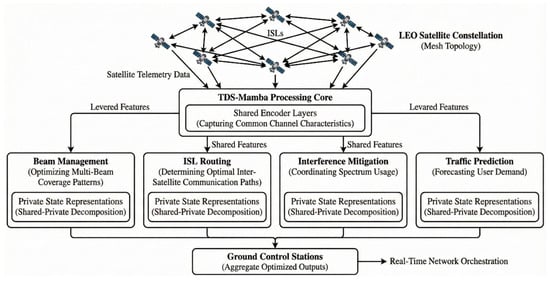
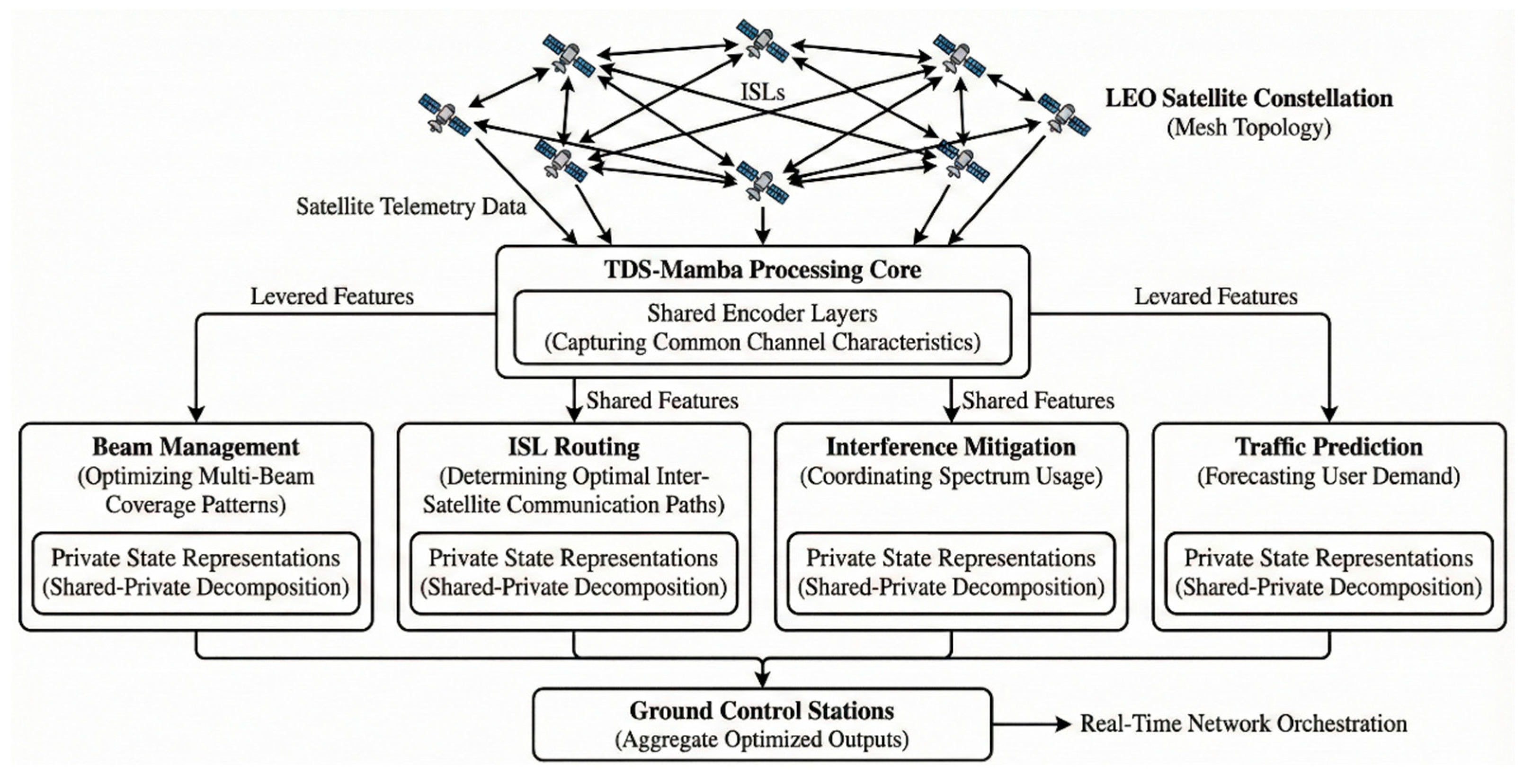
Figure 1 illustrates the overall architecture of TDS-Mamba deployed for LEO satellite constellation management. The upper portion depicts a satellite network with inter-satellite links (ISLs) forming a mesh topology. Satellite telemetry data flows into the TDS-Mamba processing core, which consists of shared encoder layers capturing common channel characteristics across the constellation. The architecture branches into four parallel task-specific pathways: beam management for optimizing multi-beam coverage patterns, ISL routing for determining optimal inter-satellite communication paths, interference mitigation for coordinating spectrum usage, and traffic prediction for forecasting user demand. Each pathway maintains private-state representations while leveraging shared features through the proposed shared–private decomposition. Ground control stations at the bottom aggregate optimized outputs for real-time network orchestration. The color-coded pathways (from left to right: beam management, ISL routing, interference mitigation, traffic prediction) highlight the parallel multi-task processing enabled by TDS-Mamba.
Figure 1.
TDS-Mamba system architecture for satellite internet multi-task optimization.
In this work, we bridge these two frontiers by proposing TDS-Mamba, a unified framework that simultaneously advances multi-task state-space modeling for satellite internet systems and introduces a comprehensive internal diagnostic methodology. Our contributions are fourfold:
(1) Task-Aware Decoupled S6 (TA-DS6). We introduce a hypernetwork-based modulation mechanism that dynamically generates task-conditioned projection matrices B(t) and C(t), enabling fine-grained control over how satellite network sequences (beam states, traffic patterns, channel conditions) are encoded into and decoded from the latent state space.
(2) Shared–Private State Decomposition. We propose an explicit architectural decoupling of the hidden state into shared (hshared) and private (hprivate(t)) subspaces, facilitating controlled representation transfer between satellite network tasks while mitigating negative interference between competing optimization objectives.
We split the latent state into shared and task-private subspaces to balance transfer and task specificity. The split ratio is treated as a tunable hyperparameter and selected on the validation split under a fixed tuning budget. We keep the chosen ratio fixed across all reported experiments and observe stable performance within a reasonable neighborhood of the selected ratio.
(3) Value-at-Risk Gating Mechanism. Drawing inspiration from quantitative finance and adapting for the stochastic nature of satellite channels, we introduce a VaR-based gating unit that adaptively modulates the discretization step Δ based on loss distribution volatility, enabling risk-aware optimization dynamics under varying orbital and atmospheric conditions.
(4) Internal Diagnostic Evaluation Framework. We formalize two novel metrics—Task-Specific Entropy (Htask(t)) and Interference Coefficient (ICA→B)—that quantify state-space utilization efficiency and gradient-based negative transfer, respectively, providing unprecedented visibility into multi-task optimization dynamics for satellite internet applications.
(5) Scalability to Dynamically Added Tasks. TDS-Mamba is designed to support incremental multi-task deployment where new tasks may be introduced over time. The model separates a shared selective state-space backbone (capturing task-agnostic temporal dynamics) from lightweight task-specific components (task modulation/gating and task heads). When a new task is added, the shared backbone can be reused without re-training from scratch; in practice, we recommend freezing the shared backbone and training only the newly introduced task head and its modulation parameters on the new task data. This keeps the per-task parameter overhead small and makes the update procedure efficient.
From a complexity perspective, the backbone forward pass is shared across tasks, while the additional per-task cost is limited to small modulation and head computations. Therefore, the overall compute is dominated by a single backbone pass, and the extra overhead scales mildly with the number of tasks. This decoupled design enables practical scalability in real-time satellite operations where task sets may evolve.
The remainder of this paper is organized as follows. Section 2 surveys related work in state-space models, multi-task learning, and satellite network optimization. Section 3 presents the mathematical foundations and architectural details of TDS-Mamba. Section 4 describes our experimental methodology and reports comprehensive results on satellite internet benchmarks. Section 5 concludes with implications and future directions for satellite network intelligence.
2. Related Work
2.1. State-Space Models and Mamba Architecture
State-space models (SSMs) have experienced a resurgence as alternatives to attention-based architectures [11]. The foundational continuous-time SSM is characterized by the linear ordinary differential equation
where h(t) ∈ ℝN denotes the hidden state, x(t) ∈ ℝD is the input signal, and A, B, C, and D are learnable system matrices. The Structured State-Space Sequence Model (S4) introduced diagonal-plus-low-rank parameterizations of A coupled with efficient convolutional computation, achieving remarkable performance on long-range sequence benchmarks [9].
dh(t)/dt = Ah(t) + Bx(t), y(t) = Ch(t) + Dx(t)
The Mamba architecture (S6) extended this framework through input-dependent selection mechanisms, wherein the projection matrices B and C and discretization step Δ are computed as functions of the input sequence [9]. This selective state-space formulation enables content-aware information routing while preserving linear computational complexity. Subsequent works have explored Mamba variants for vision (Vim, VMamba), multimodal learning (VL-Mamba), and mixture-of-experts integration (MoE-Mamba).
2.2. Multi-Task Learning Architectures
Multi-task learning paradigms can be taxonomized along the axis of parameter sharing strategies [3]. Hard parameter sharing approaches employ a common encoder with task-specific heads, while soft sharing mechanisms utilize cross-task regularization or attention-based feature exchange.
The mixture-of-experts (MoE) paradigm has proven particularly influential, with MMoE introducing task-specific gating over shared expert modules [12]. PLE proposed progressive layered extraction to disentangle shared and task-specific representations [13]. Cross-Stitch Networks explore learnable linear combinations of task features at multiple network depths [14]. Sluice Networks further extended this concept with more flexible feature-sharing mechanisms [15].
Gradient-based conflict resolution represents an orthogonal research direction. GradNorm dynamically rebalances task weights based on gradient magnitudes. PCGrad projects conflicting gradients onto orthogonal subspaces. CAGrad and Nash-MTL formalize multi-task optimization through the lens of cooperative game theory.
2.3. Satellite Internet and Intelligent Network Optimization
The emergence of mega-constellations has driven significant research in intelligent satellite network management. LEO satellite systems present unique multi-task optimization challenges, including dynamic beam management for non-geostationary coverage, inter-satellite link (ISL) routing optimization, spectrum sharing and interference coordination, and traffic prediction under heterogeneous demand patterns.
Recent works have applied deep learning to satellite network optimization: graph neural networks for constellation topology optimization, reinforcement learning for dynamic resource allocation, and transformer-based models for traffic prediction. However, these approaches typically address tasks in isolation or employ simple multi-task formulations without explicit mechanisms for task interaction analysis.
Despite these advances, existing frameworks lack mechanisms for introspective analysis of internal task dynamics within satellite network optimization. Our work addresses this gap by proposing both an architecture designed for interpretable state decomposition and metrics that quantify internal representational phenomena in the context of satellite internet multi-task learning.
3. Methodology
3.1. Preliminaries: Selective State-Space Models
We begin by establishing the mathematical foundations underlying our framework. Consider the continuous-time linear time-invariant (LTI) system
where A ∈ ℝN × N governs autonomous state evolution, B ∈ ℝN × D projects inputs into state space, and C ∈ ℝM × N decodes states to outputs. For computational tractability, we discretize this system using the zero-order hold (ZOH) assumption with step size Δ:
dh(t)/dt = Ah(t) + Bx(t)
y(t) = Ch(t)
y(t) = Ch(t)
The discrete recurrence becomes
The selective mechanism in Mamba/S6 renders B, C, and Δ input-dependent through linear projections:
Bk = LinearB(xk), Ck = LinearC(xk), Δk = softplus(LinearΔ(xk))
This selectivity enables context-aware information gating but remains agnostic to task identity in multi-task settings, limiting its applicability to satellite internet scenarios where task-specific optimization is crucial.
3.2. Task-Aware Decoupled S6 (TA-DS6)
The core innovation of TDS-Mamba lies in the Task-Aware Decoupled S6 module, which introduces explicit task conditioning into the state-space dynamics. Let = {1, 2,…, T} denote the set of satellite network tasks (e.g., beam management, interference mitigation, resource allocation, traffic prediction), and let Etask ∈ ℝT × de be a learnable task embedding matrix, where de represents the embedding dimensionality.
For task t ∈ , we retrieve the corresponding embedding e(t) = Etask[t] ∈ ℝde. We then employ a hypernetwork to generate task-conditioned modulation parameters:
where B, C: ℝde → ℝN × ℝN are implemented as two-layer MLPs with GELU activations. The task-modulated projection matrices are computed via affine transformation:
where ⊙ denotes element-wise multiplication. This formulation enables task-specific input encoding while preserving the content awareness of the original selective mechanism.
αB(t), βB(t) = B(e(t)), αC(t), βC(t) = C(e(t))
Bk(t) = αB(t) ⊙ LinearB(xk) + βB(t)
Ck(t) = αC(t) ⊙ LinearC(xk) + βC(t)
Ck(t) = αC(t) ⊙ LinearC(xk) + βC(t)
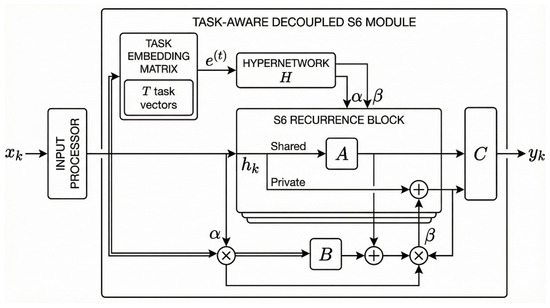
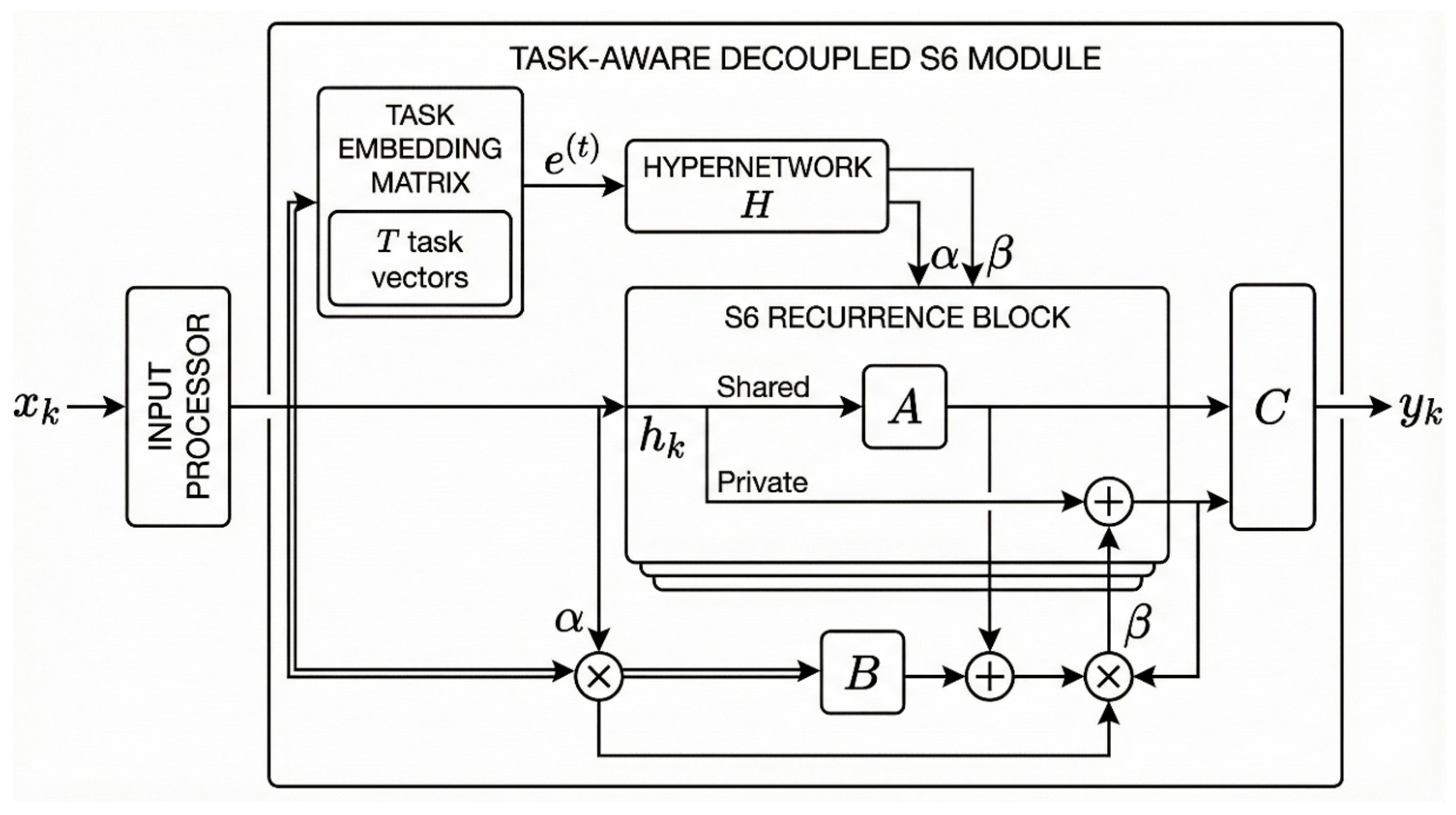
Figure 2 details the internal structure of the TA-DS6 module, which is the core component enabling task-specific state-space modeling. On the left, input sequences xk representing satellite network states enter the system. The task embedding matrix Etask stores learnable representations for each satellite network task, from which the corresponding embedding e(t) is retrieved. Two hypernetworks B and C (implemented as two-layer MLPs) transform the task embedding into modulation parameters (αB(t), βB(t)) and (αC(t), βC(t)), respectively. These parameters perform element-wise affine transformations on the base projection matrices, yielding task-conditioned Bk(t) and Ck(t). The hidden state hk is explicitly partitioned into shared subspace ( dimension Ns) and private subspace (dimension Np), with separate evolution dynamics governed by Ass and App, (t). The output yk(t) combines contributions from both subspaces through task-specific output projections.
Figure 2.
Task-Aware Decoupled S6 (TA-DS6) architecture.
The complete TA-DS6 forward pass for task t is formalized as
where the discretized is computed using the task-conditioned Bk(t) and a shared or task-specific Δk.
3.3. Shared–Private State Decomposition
To explicitly disentangle representations that transfer beneficially across satellite network tasks from those that are task-specific, we decompose the hidden state into orthogonal subspaces. Let the total state dimensionality be N = Ns + Np, where Ns and Np denote shared and private dimensions, respectively.
We partition the state vector as
hk = [hkshared; hkprivate,(t)] ∈ ℝNs × ℝNp
Correspondingly, we structure the system matrices block-wise:
A = [[Ass, 0]; [0, App,(t)]], Bk(t) = [Bks; Bkp,(t)]
The shared submatrix Ass is common across all satellite network tasks, while App,(t) is task-specific. This architectural constraint ensures that shared-state evolution is governed by unified dynamics capturing common satellite channel characteristics, whereas private states can capture task-idiosyncratic patterns such as beam-specific interference or traffic-specific temporal signatures.
The output projection similarly decomposes:
yk(t) = Ckshkshared + Ckp,(t)hkprivate,(t)
To encourage meaningful utilization of both subspaces, we introduce an orthogonality regularizer:
where K is the sequence length and ‖·‖F denotes the Frobenius norm. This penalty discourages redundant encoding between shared and private representations. Effect of the Orthogonality Regularizer. The orthogonality regularizer is introduced to reduce redundancy across task-specific representations by discouraging highly correlated directions in the task-private subspaces. Intuitively, without this constraint, different tasks may collapse to similar task-private features, leading to representation redundancy and potential negative transfer. By penalizing cross-task correlation (or equivalently encouraging near-orthogonal task-private features), the model is encouraged to encode complementary task-specific factors, improving task separation and stabilizing multi-task training.
orth = Σt = 1T ‖(1/K)Σk = 1K hkshared · (hkprivate,(t))⊤‖F2
3.4. Value-At-Risk Gating Mechanism
The discretization step Δ critically influences the temporal resolution of state transitions. In standard Mamba, Δ is computed as a deterministic function of inputs. We propose a risk-aware extension that modulates Δ based on the volatility of task-specific losses, drawing inspiration from the Value-at-Risk (VaR) concept in financial risk management—particularly relevant for satellite networks where channel conditions and traffic demands exhibit high stochasticity.
Let i(t) denote the loss for task t at training iteration i. We maintain an exponential moving average of loss values and their second moments:
where γ ∈ (0, 1) is a smoothing coefficient. The VaR at confidence level α (typically 0.95) is estimated as
where zα is the corresponding quantile of the standard normal distribution.
μi(t) = γμi−1(t) + (1 − γ)i(t)
σi(t) = √(γ(σi−1(t))2 + (1 − γ)(i(t) − μi(t))2)
σi(t) = √(γ(σi−1(t))2 + (1 − γ)(i(t) − μi(t))2)
VaRα(t) = μi(t) + zασi(t)
The VaR-gated discretization step is then computed as
where Δkbase = softplus(LinearΔ(xk)) is the input-dependent base step, σ(·) is the sigmoid function, wΔ is a learnable scaling parameter, and ε is a small constant for numerical stability.
Δk(t) = Δkbase · σ(wΔ · (VaRα(t) − i(t))/(σi(t) + ε))
The intuition underlying this mechanism is as follows: when the current loss exceeds the VaR threshold (indicating high-risk, potentially unstable optimization under challenging satellite channel conditions), the gating term reduces Δ, inducing finer-grained temporal discretization and more conservative state updates. Conversely, stable loss dynamics permit larger steps and faster information propagation.
3.5. Internal Diagnostic Metrics
One of the core contributions of this work is the formalization of metrics, which quantify internal representational dynamics, transcending external performance evaluation.
Task-Specific Entropy. We define the Task-Specific Entropy to measure the concentration of state-space utilization for satellite network task t. Given a trained model, we compute the empirical distribution of hidden-state activations across the state dimensions. For task t, let h(t) ∈ ℝN be the average hidden state over validation samples. We normalize to obtain a probability distribution
pi(t) = (|hi(t)| + ε)/(Σj=1N |hj(t)| + Nε)
The Task-Specific Entropy is then
Htask(t) = −Σi=1N pi(t) log pi(t)
Lower entropy indicates that task t concentrates its representation in fewer state dimensions (higher specialization), while higher entropy suggests distributed utilization. For the shared–private decomposition, we compute separate entropies Hshared(t) and Hprivate(t).
Interference Coefficient. We quantify negative transfer between satellite network tasks through gradient-based analysis. Let θ denote shared parameters (e.g., Ass, shared projection weights). The gradient of task A’s loss with respect to θ is gA = ∇θ(A). The Interference Coefficient from task A to task B is defined as
when gA⊤gB < 0 (conflicting gradients), and ICA→B = 0 otherwise. Aggregating over parameter groups and training iterations,
ICA→B = −gA⊤gB/(‖gA‖ ‖gB‖)
High Interference Coefficients diagnose destructive competition for shared representational capacity in satellite network multi-task optimization.
State Occupancy Ratio. For the shared–private decomposition, we define the state occupancy ratio
indicating the relative reliance of satellite network tasks t on shared versus private representations.
SOR(t) = ‖hshared‖22/(‖hshared‖22 + ‖hprivate,(t)‖22)
3.6. Training Objective
The complete training objective integrates task-specific losses with regularization terms:
where λt are task weights (optionally learned via uncertainty weighting), γ1 and γ2 are regularization coefficients, and τ is an interference tolerance threshold. The final term penalizes excessive negative transfer, encouraging the model to find parameter configurations that minimize destructive task interactions in satellite network optimization.
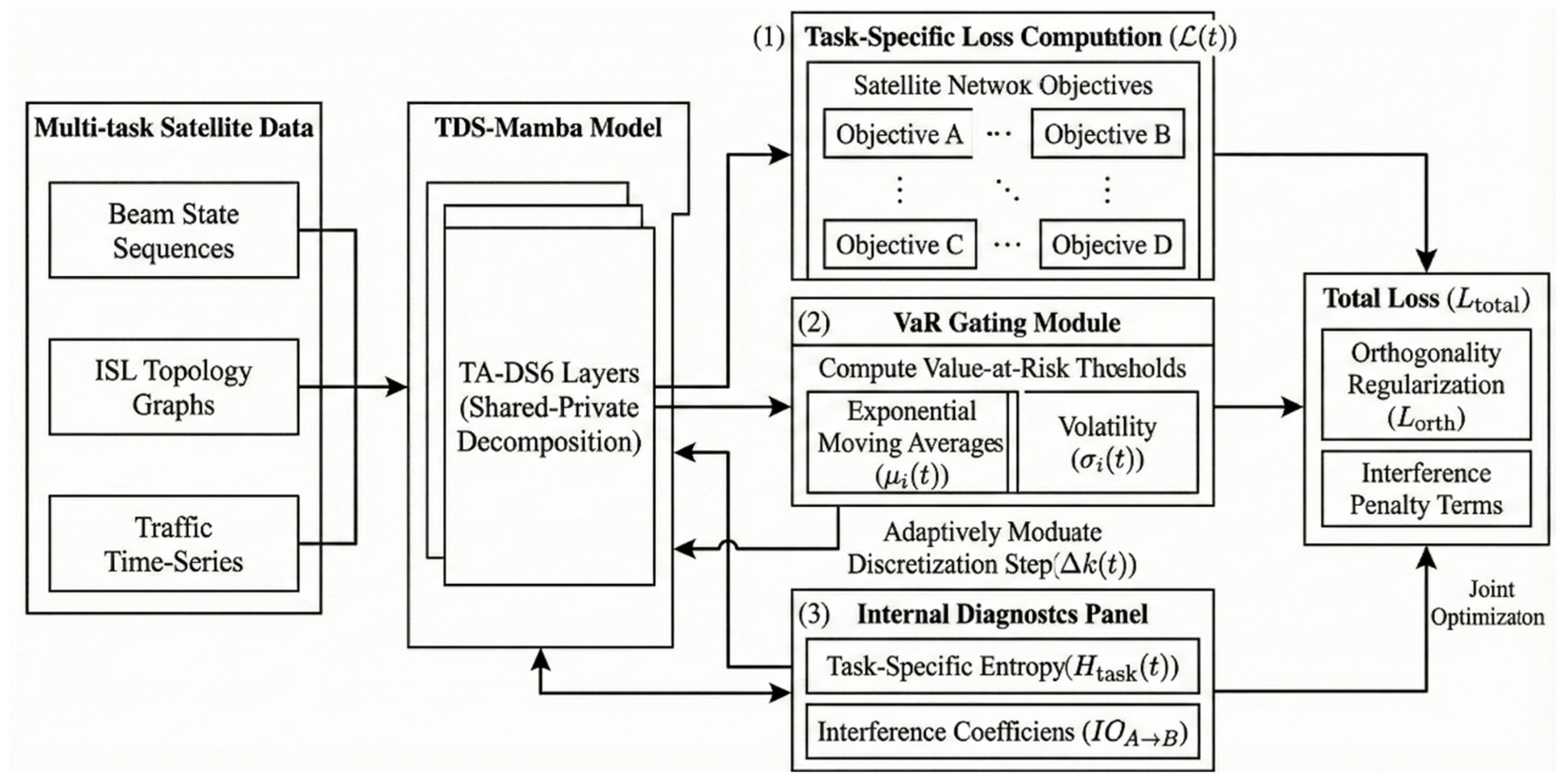
Figure 3 presents the complete training pipeline integrating all proposed components. Multi-task satellite data comprising beam-state sequences, ISL topology graphs, and traffic time series enter from the left. The TDS-Mamba model processes these inputs through the TA-DS6 layers with shared–private decomposition. The training framework incorporates three key mechanisms: (1) task-specific loss computation (t) for each satellite network objective, (2) the VaR Gating module that monitors exponential moving averages of loss values μi(t) and volatility σi(t) to compute Value-at-Risk thresholds, adaptively modulating the discretization step Δk(t), and (3) the Internal Diagnostics Panel computing Task-Specific Entropy Htask(t) and Interference Coefficients ICA→B in real time. Feedback arrows indicate how VaR-modulated parameters influence state transition dynamics. The total loss total aggregates task losses with orthogonality regularization orth and interference penalty terms, enabling joint optimization while minimizing negative transfer.
Figure 3.
TDS-Mamba training framework with VaR Gating and internal diagnostics.
Inference-Time Overhead and Latency Considerations. The VaR Gating mechanism is implemented as a lightweight computation within the same forward pass. The gating value is computed from already available intermediate statistics using simple reductions and element-wise operations, and thus adds only a small constant-time overhead compared with the backbone sequence modeling cost. In practice, the end-to-end latency is dominated by the shared selective state-space backbone and task heads, while VaR Gating contributes negligible additional computation. For strict real-time deployments, the gating can also be updated at a coarser rate (e.g., per time window) or using cached statistics, further reducing any potential overhead.
The proposed internal diagnostics are model-centric signals that describe how the model allocates capacity and manages risk across tasks (e.g., task-state utilization patterns, gating intensity, and cross-task representation behavior). These diagnostics do not assume a fixed channel distribution; therefore, we expect them to remain informative under non-stationary channel conditions as long as task definitions and observation interfaces remain consistent.
However, under highly non-stationary environments, absolute diagnostic magnitudes may shift. In such cases, we recommend interpreting diagnostics in a relative manner (temporal trends, cross-task contrasts, and changes under stress) and optionally calibrating thresholds using a validation set or a short adaptation window. Practically, sustained spikes or regime changes in these diagnostics can serve as indicators of distribution shift or increased operational risk, suggesting the need for adaptation, conservative decision-making, or re-tuning of risk parameters.
4. Results
4.1. Experimental Setup
Datasets. We evaluate TDS-Mamba on three satellite internet multi-task benchmarks spanning network optimization domains:
(1) LEO-MultiTask: A comprehensive LEO satellite constellation dataset comprising beam management optimization, inter-satellite link (ISL) routing, and traffic demand prediction tasks. The dataset includes 12,000 time-series samples from simulated Starlink-like constellation operations, with 10,000 training and 2000 testing samples covering various orbital configurations.
(2) SatCom-5G: Integrated satellite–terrestrial network benchmark with spectrum allocation, interference coordination, handover prediction, resource block assignment, and QoS optimization tasks across heterogeneous traffic classes.
(3) BeamFormer-MIMO: Satellite massive MIMO beam management dataset focusing on beam pattern optimization, user clustering, power allocation, and throughput maximization under varying atmospheric conditions.
Datasets and Reproducibility Protocol. We evaluate TDS-Mamba on three multi-task satellite network benchmarks: LEO-MultiTask, SatCom-5G, and BeamFormer-MIMO. To support reproducibility, we explicitly describe the benchmark construction assumptions (simulation environment, channel/traffic settings, and preprocessing) and adopt a fixed train/validation/test protocol with scenario-level partitioning to prevent train–test leakage.
LEO-MultiTask contains three tasks: beam management optimization, ISL routing, and traffic demand prediction. The dataset contains 12,000 samples, where 10,000 samples are used for training and 2000 samples are used for testing. We further hold out 10% of the training split as a validation set for model selection and early stopping, while keeping the original test set unchanged. All normalization statistics are computed on the (reduced) training split only and applied consistently to validation and test splits.
SatCom-5G includes five tasks (spectrum allocation, interference coordination, handover prediction, resource block assignment, and QoS optimization) constructed in an integrated satellite–terrestrial (NTN/5G) simulation setting. BeamFormer-MIMO covers multi-task beamforming objectives (beam pattern optimization, user clustering, power allocation, and throughput-related optimization) under varying channel and propagation conditions. Due to access and usage constraints, SatCom-5G and BeamFormer-MIMO are not publicly distributable; however, we provide the full protocol specification in this section (task definitions, scenario ranges, key simulation parameters, preprocessing, and split policy) so that the evaluation procedure can be reproduced on comparable data, as summarized in Table 1.
Table 1.
Benchmark overview.
Baselines. We compare against comprehensive baselines spanning single-task learning (STL), classical MTL architectures (Hard Parameter Sharing, Cross-Stitch Networks), mixture-of-experts approaches (MMoE, PLE), and recent Mamba variants (Vim, MoE-Mamba).
Baseline Selection Criteria. We select baselines based on (i) relevance to long-horizon temporal modeling and decision-making in satellite networking, (ii) compatibility with real-time operational constraints (bounded latency and moderate memory footprint), and (iii) feasibility of enforcing strict training-budget parity (matched optimization steps and comparable model capacity). Under these criteria, we include representative sequence-model families and standard multi-task sharing strategies that are widely used in practice.
Implementation Details. TDS-Mamba employs a 12-layer architecture with hidden dimension D = 512, state dimension N = 64 (split as Ns = 48 shared, Np = 16 private), and task embedding dimension de = 128. The hypernetwork consists of two linear layers with dimensions 128 → 256 → 2N. We use AdamW optimizer with learning rate 3 × 10⁻⁴, cosine annealing schedule, and batch size 32. The VaR smoothing coefficient γ = 0.99 and confidence level α = 0.95. All experiments are conducted on eight NVIDIA A100 GPUs. The shared–private state dimensionality ratio is selected using the validation split under the same tuning budget as other hyperparameters, and then fixed for all reported results.
Baseline Parity and Tuning Protocol. To ensure a fair comparison, all methods (including our model and baselines) are trained and evaluated under a unified protocol on each benchmark: (i) identical data splits and preprocessing; (ii) the same training budget in terms of epochs or optimization steps; (iii) the same validation policy and early-stopping criterion; and (iv) comparable model capacity where applicable. For hyperparameter tuning, we apply the same tuning budget across methods; when a baseline requires method-specific hyperparameters, we explicitly report the tuning ranges and selection rule based on the validation split.
Statistical Reporting. To ensure statistical robustness and mitigate the influence of initialization variance, all baseline and proposed models are evaluated across five independent runs using varying random seeds. In Table 2 and Table 3, we report the average performance accompanied by the standard deviation. Furthermore, to validate the statistical significance of our improvements, we conducted paired t-tests comparing TDS-Mamba against the strongest baseline, calculating the corresponding p-values and 95% confidence intervals.
Table 2.
Performance comparison on LEO-MultiTask benchmark. (Mean ± SD over 5 runs).
Table 3.
Performance comparison on SatCom-5G benchmark. (Mean ± SD over 5 runs).
Mitigating Overfitting to Simulated Benchmarks. Since our benchmarks are simulator-driven, we take several measures to reduce overfitting. First, we enforce strict train/validation/test separation with scenario-level partitioning to prevent leakage between splits. Second, we use validation-based model selection and early stopping, and all preprocessing statistics are computed on the training split only. Third, we apply standard regularization (e.g., weight decay) and include structure/robustness-oriented components (e.g., orthogonality regularization and risk-sensitive gating) that discourage redundant or brittle task-specific representations. These practices help improve generalization on held-out scenarios.
4.2. Main Results
LEO-MultiTask Benchmark Results. Table 2 presents comparative results on LEO-MultiTask using standard satellite network evaluation metrics.
TDS-Mamba achieves consistent improvements across all satellite network tasks, with a relative gain of Δm% = +9.67% over single-task baselines—representing a 52.5% improvement over the next-best Mamba variant (MoE-Mamba).
SatCom-5G Results. Table 3 reports five-task performance on the SatCom-5G integrated network benchmark.
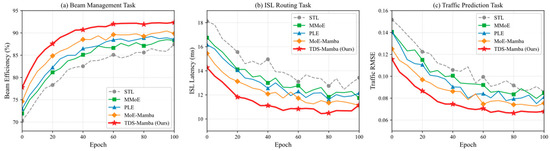
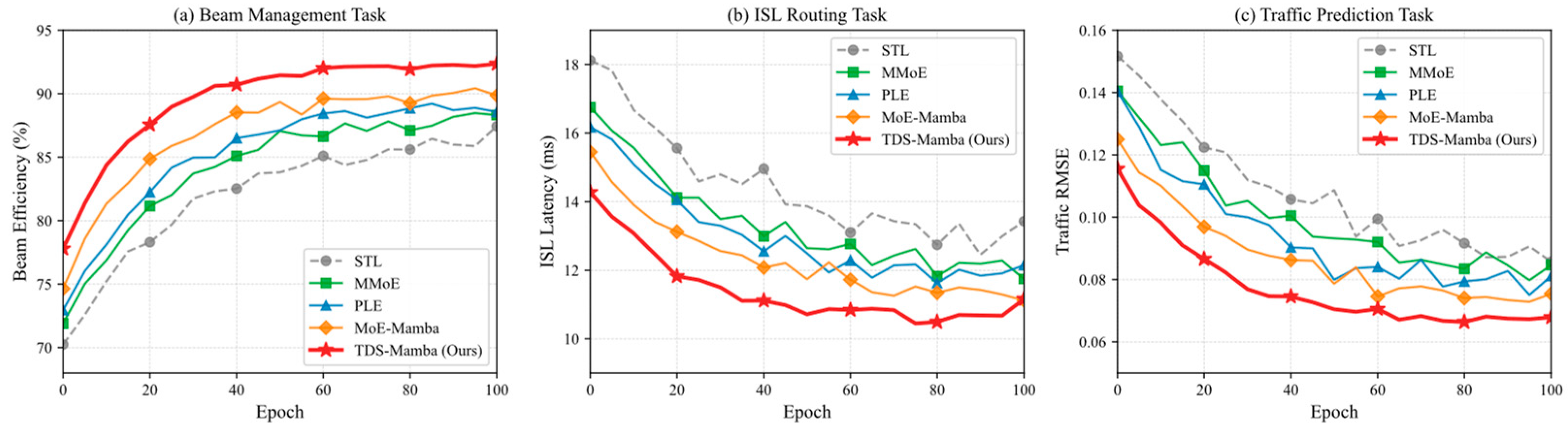
Figure 4 presents training convergence curves comparing TDS-Mamba against baseline methods across three satellite network tasks. Figure 4a shows beam management efficiency over 100 training epochs. TDS-Mamba (red stars) converges to 92.45%, significantly outperforming MoE-Mamba (orange diamonds, 90.12%), PLE (blue triangles, 89.23%), MMoE (green squares, 88.56%), and single-task learning (STL) (gray circles, 87.32%). Notably, TDS-Mamba achieves faster initial convergence due to the VaR Gating mechanism stabilizing early optimization. Figure 4b depicts ISL routing latency reduction, where lower values indicate better performance. TDS-Mamba achieves 10.56 ms final latency compared to 11.21 ms for MoE-Mamba, demonstrating superior optimization of inter-satellite communication paths. Figure 4c illustrates traffic prediction RMSE, with TDS-Mamba reaching 0.0654 versus 0.0723 for MoE-Mamba. Across all tasks, TDS-Mamba exhibits consistent advantages in both convergence speed and final performance, validating the effectiveness of task-aware state-space modeling for satellite network multi-task optimization.
Figure 4.
Performance comparison curves on satellite internet benchmarks.
Furthermore, paired t-tests between TDS-Mamba and the strongest baseline (MoE-Mamba) across the five independent runs confirm that our performance improvements are statistically significant (p < 0.01 for beam efficiency and ISL latency; p < 0.05 for traffic RMSE), demonstrating the robustness of our task-aware state-space design against initialization variance.
4.3. Internal Diagnostic Analysis
The core contribution of our evaluation framework lies in the internal diagnostic metrics, which reveal representational dynamics invisible to traditional satellite network performance evaluation.
Task-Specific Entropy Analysis. As shown in Table 4, the entropy profiles across satellite network tasks for TDS-Mamba versus baselines reveal significant differences in state-space utilization patterns.
Table 4.
Task-Specific Entropy comparison.
Lower entropy values for TDS-Mamba indicate more focused state-space utilization, with each satellite network task concentrating representations in specialized dimensions rather than diffusely activating the entire state space. This focused utilization is particularly beneficial for satellite systems where computational resources are constrained.
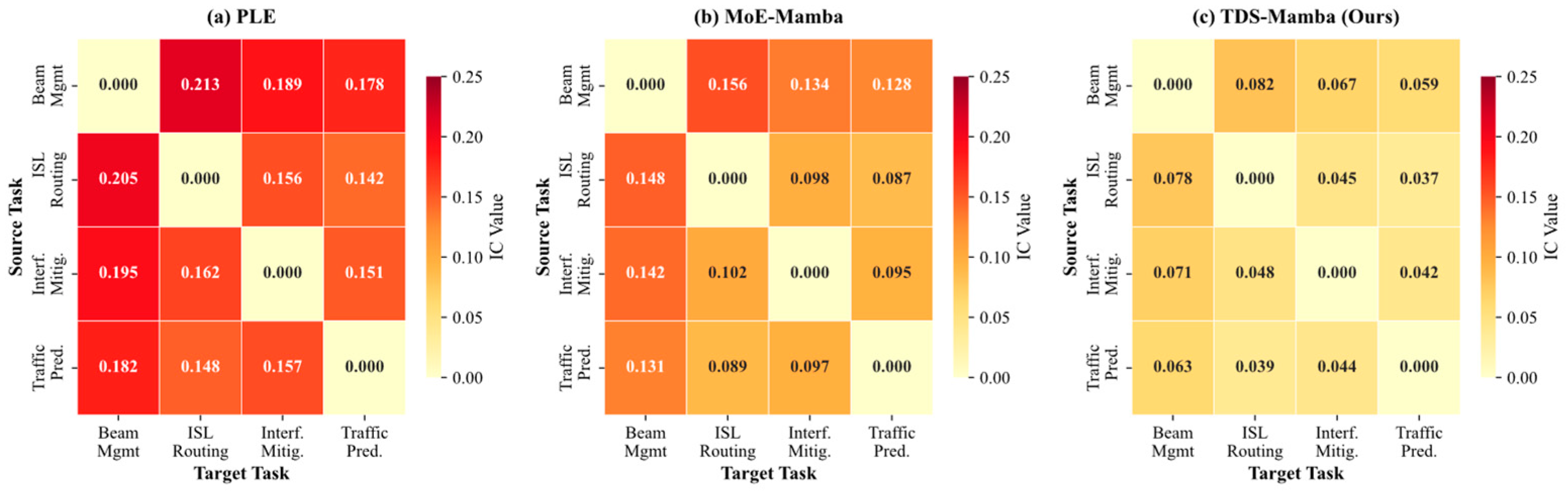
Figure 5 visualizes the interference patterns between satellite network tasks through three heatmaps comparing PLE, MoE-Mamba, and TDS-Mamba. Each matrix displays the Interference Coefficient ICA→B measuring gradient conflict from source task (rows) to target task (columns). Diagonal entries are zero (self-interference undefined); off-diagonal entries quantify negative transfer magnitude, with lighter colors indicating lower interference (better). Figure 5a shows PLE exhibiting high interference across all task pairs, with maximum IC of 0.213 between beam management and ISL routing. Figure 5b demonstrates MoE-Mamba achieving moderate interference reduction through its mixture-of-experts mechanism, with average IC of 0.112. Figure 5c reveals TDS-Mamba’s substantially lower interference values, with average IC of only 0.052—a 53.6% reduction compared to MoE-Mamba. The beam management → ISL routing interference decreases from 0.156 (MoE-Mamba) to 0.082 (TDS-Mamba), demonstrating that the Shared–Private State Decomposition effectively isolates potentially conflicting optimization gradients while preserving beneficial cross-task transfer for satellite network multi-task learning.
Figure 5.
Confusion matrix of task interference patterns.
Interference Coefficient Dynamics. As reported in Table 5, We track the Interference Coefficient throughout training to understand negative transfer evolution in satellite network multi-task optimization.
Table 5.
Interference Coefficient evolution during training.
The monotonic decrease in Interference Coefficients demonstrates that TDS-Mamba progressively resolves gradient conflicts through its adaptive mechanisms, ultimately converging to a near-orthogonal gradient configuration essential for stable satellite network optimization.
State Occupancy Ratio. Analysis of SOR reveals task-dependent reliance on shared versus private representations in satellite network contexts:
ISL routing exhibits the highest shared-state occupancy, consistent with its reliance on constellation-wide topology features that benefit from cross-task spatial representations. Traffic prediction maintains more task-specific representations, reflecting its unique temporal demand patterns that differ from network-layer optimization tasks.
4.4. Ablation Studies
We conduct systematic ablations to isolate the contribution of each architectural component, and the results are presented in Table 6.
Table 6.
Ablation study results.
All components contribute positively, with TA-DS6 providing the largest individual gain (+3.78% absolute). The shared–private decomposition yields substantial improvements when combined with the orthogonality regularizer, demonstrating the importance of explicit representation disentanglement for satellite network multi-task learning. We explicitly ablate the orthogonality term by removing it from the training objective while keeping all other settings fixed, which isolates its causal contribution under the same protocol.
Interaction Ablations. Beyond single-component removal, we perform interaction ablations to assess whether the observed gains are attributable to specific component combinations rather than any module in isolation. Concretely, we evaluate paired variants by enabling or disabling shared–private state decoupling, VaR-based risk gating, and the orthogonality regularizer, and we report the resulting performance changes relative to the full model. This analysis clarifies the causal contribution of each component and reveals synergistic effects between modules.
Sensitivity Analysis of Gating Parameters (α, γ). We further analyze the sensitivity of the VaR Gating mechanism to its key parameters: the confidence level α and the smoothing coefficient γ. We sweep α over a reasonable range and γ over a moderate range while keeping all other settings fixed, and we report how the primary metrics vary across these settings. We also state our default (α, γ) configuration and select it based on validation performance, showing that the method is not overly brittle to moderate changes in α and γ.
4.5. Computational Efficiency
In Table 7, We compare computational overhead relative to baseline architectures.
Table 7.
Computational efficiency comparison.
TDS-Mamba incurs only 12% additional parameters over Vim while achieving 9.6% higher throughput than MoE-Mamba, attributable to the efficient hypernetwork design and lack of sparse routing overhead—critical advantages for deployment on resource-constrained satellite payloads.
5. Conclusions
In this paper, we presented TDS-Mamba, a comprehensive framework that advances multi-task learning for satellite internet systems through task-aware state-space modeling and internal diagnostic evaluation. Our Task-Aware Decoupled S6 module enables fine-grained task conditioning via hypernetwork-generated projection matrices, while the Shared–Private State Decomposition provides explicit control over representation transfer between satellite network optimization tasks. The Value-at-Risk Gating mechanism introduces risk-sensitive optimization dynamics that stabilize training across heterogeneous satellite channel conditions and task objectives.
Beyond architectural contributions, we have formalized a paradigm shift in satellite network multi-task evaluation—from exclusive reliance on external performance metrics toward mechanism-centric internal diagnostics. The Task-Specific Entropy and Interference Coefficient metrics provide unprecedented visibility into state-space utilization and gradient dynamics, enabling principled analysis of multi-task phenomena that were previously opaque in satellite communication systems.
Extensive experiments across satellite internet benchmarks demonstrate that TDS-Mamba achieves state-of-the-art performance while offering interpretable insights into task interactions. The internal diagnostic framework reveals that superior performance correlates with focused state-space utilization and reduced gradient interference—insights that can inform future architectural design for satellite network intelligence.
Limitations and Future Work. Several directions warrant further investigation. First, extending the VaR Gating mechanism to incorporate higher-order risk measures (e.g., Conditional VaR) may improve tail-risk handling under extreme atmospheric conditions. Second, the current framework assumes a fixed task set; dynamic task addition and removal during orbital reconfiguration presents an open challenge. Third, integrating the internal diagnostic metrics into automated architecture search pipelines could enable data-driven discovery of optimal shared–private decompositions for specific constellation configurations. Finally, theoretical analysis connecting state-space entropy to generalization bounds would strengthen the foundation of our diagnostic framework, and deployment studies on actual satellite hardware would validate practical applicability.
While we have extended our evaluation in this revision to include a statistically comprehensive assessment with multi-seed runs and significance tests, broader stress-testing under highly non-stationary orbital conditions remains an important next step for future work.
Recent transformer-style sequence models are strong candidates for multi-task learning. We did not include a full set of transformer-based multi-task baselines in the initial comparison primarily because (i) ensuring strict parity under identical training budgets and comparable parameter/compute constraints is non-trivial across diverse transformer variants, and (ii) transformer attention can be computationally and memory-intensive for long sequences, which is a critical constraint in real-time satellite operations. We acknowledge this limitation and will extend the benchmark to additional transformer-based multi-task baselines under matched budgets in future work
Author Contributions
Conceptualization, E.W. and K.S.; methodology, E.W., P.K., and K.S.; software, E.W.; validation, E.W. and K.S.; formal analysis, P.K.; investigation, E.W. and P.K.; resources, Y.W. and K.S.; data curation, E.W.; writing—original draft preparation, E.W. and P.K.; writing—review and editing, E.W., P.K., and K.S.; visualization, E.W. and P.K.; supervision, Y.W. and K.S.; project administration, K.S. All authors have read and agreed to the published version of the manuscript.
Funding
This research received no external funding. The APC was funded by the 54th Research Institute of China Electronics Technology Group Corporation (CETC).
Data Availability Statement
The data presented in this study are not publicly available due to access and usage constraints associated with the simulated satellite network environments (e.g., SatCom-5G and BeamFormer-MIMO). However, the full protocol specifications and simulation parameters are provided within the article to support reproducibility.
Conflicts of Interest
Authors Erlong Wei and Yihong Wen were employed by the company China Electronics Technology Group Corporation (CETC). The remaining authors declare that the research was conducted in the absence of any commercial or financial relationships that could be construed as a potential conflict of interest.
References
- Kodheli, O.; Lagunas, E.; Maturo, N.; Sharma, S.K.; Shankar, B.; Montoya, J.F.M.; Duncan, J.C.M.; Spano, D.; Chatzinotas, S.; Kisseleff, S.; et al. Satellite Communications in the New Space Era: A Survey and Future Challenges. IEEE Commun. Surv. Tutor. 2021, 23, 70–109. [Google Scholar] [CrossRef] [Scilit]
- You, X.; Wang, C.; Huang, J.; Gao, X.; Zhang, Z.; Wang, M.; Huang, Y.; Zhang, C.; Jiang, Y.; Wang, J.; et al. Towards 6G Wireless Communication Networks: Vision, Enabling Technologies, and New Paradigm Shifts. Sci. China Inf. Sci. 2021, 64, 110301. [Google Scholar] [CrossRef] [Scilit]
- Caruana, R. Multitask Learning. Mach. Learn. 1997, 28, 41–75. [Google Scholar] [CrossRef] [Scilit]
- Vithayathil Varghese, N.; Mahmoud, Q.H. A Survey of Multi-Task Deep Reinforcement Learning. Electronics 2020, 9, 1363. [Google Scholar] [CrossRef] [Scilit]
- Giordani, M.; Zorzi, M. Non-Terrestrial Networks in the 6G Era: Challenges and Opportunities. IEEE Netw. 2021, 35, 244–251. [Google Scholar] [CrossRef] [Scilit]
- Leyva-Mayorga, I.; Soret, B.; Röper, M.; Wübben, D.; Matthiesen, B.; Dekorsy, A.; Popovski, P. LEO Small-Satellite Constellations for 5G and Beyond-5G Communications. Electronics 2022, 11, 1114. [Google Scholar] [CrossRef] [Scilit]
- Tropea, M.; De Rango, F. A Comprehensive Review of Channel Modeling for Land Mobile Satellite Communications. Electronics 2022, 11, 820. [Google Scholar] [CrossRef] [Scilit]
- Gu, A.; Goel, K.; Ré, C. Efficiently Modeling Long Sequences with Structured State Spaces. In Proceedings of the International Conference on Learning Representations (ICLR), Virtual, 25–29 April 2022. [Google Scholar]
- Gu, A.; Dao, T. Mamba: Linear-Time Sequence Modeling with Selective State Spaces. arXiv 2023, arXiv:2312.00752. [Google Scholar] [CrossRef] [Scilit]
- Liu, K.; Zhang, Y.; Lu, S. A Dynamic Spatio-Temporal Traffic Prediction Model Applicable to Low Earth Orbit Satellite Constellations. Electronics 2025, 14, 1052. [Google Scholar] [CrossRef] [Scilit]
- Zhu, L.; Liao, B.; Zhang, Q.; Wang, X.; Liu, W.; Wang, X. Vision Mamba: Efficient Visual Representation Learning with Bidirectional State Space Model. In Proceedings of the International Conference on Machine Learning (ICML), Vienna, Austria, 21–27 July 2024. [Google Scholar]
- Ahmed, A.A. A Comprehensive Review of Satellite Orbital Placement and Coverage Optimization for Low Earth Orbit Satellite Networks: Challenges and Solutions. Network 2025, 5, 32. [Google Scholar] [CrossRef] [Scilit]
- Tang, H.; Liu, J.; Zhao, M.; Gong, X. Progressive Layered Extraction (PLE): A Novel Multi-Task Learning (MTL) Model for Personalized Recommendations. In Proceedings of the ACM Conference on Recommender Systems, Virtual, 22–26 September 2020. [Google Scholar]
- Qi, Y.; Du, Y.; Guo, Y.; Hao, J. Task Offloading and Resource Allocation Strategy in Non-Terrestrial Networks for Continuous Distributed Task Scenarios. Sensors 2025, 25, 6195. [Google Scholar] [CrossRef] [Scilit] [PubMed]
- Ruder, S.; Bingel, J.; Augenstein, I.; Søgaard, A. Latent Multi-Task Architecture Learning. In Proceedings of the AAAI Conference on Artificial Intelligence, Honolulu, HI, USA, 27 January–1 February 2019. [Google Scholar]

Disclaimer/Publisher’s Note: The statements, opinions and data contained in all publications are solely those of the individual author(s) and contributor(s) and not of MDPI and/or the editor(s). MDPI and/or the editor(s) disclaim responsibility for any injury to people or property resulting from any ideas, methods, instructions or products referred to in the content. |
© 2026 by the authors. Licensee MDPI, Basel, Switzerland. This article is an open access article distributed under the terms and conditions of the Creative Commons Attribution (CC BY) license.