1. Introduction
New energy serves as a crucial cornerstone for safeguarding the nation’s dual carbon goals, advancing energy transition, and ensuring energy security. China has proposed building a “new power system centered on new energy,” which refers to an integrated energy system dominated by wind power, photovoltaic, and other new energy sources. This system features efficient coordination among generation, grid, load, and storage, along with multi-energy complementarity. By December 2025, China’s cumulative installed power generation capacity reached 3.89 billion kilowatts, with new energy capacity exceeding 1.84 billion kilowatts. This represents 47.3% of total installed capacity, surpassing thermal power to become the largest power generation source.
However, the large-scale integration of distributed new energy sources [
1,
2,
3] poses significant challenges to the safe and stable operation of distribution grids. Photovoltaic (PV) power generation exhibits inherent randomness, intermittency, and high volatility. Its output is significantly influenced by weather, time of day, and seasonal factors, leading to localized grid issues such as power imbalance, voltage excursions, and distribution transformer overloads. In severe cases, this can trigger degraded power quality, equipment damage, or power outages. Particularly in low-voltage distribution grids, PV grid connection may reverse traditional power flow directions, inducing backflow phenomena that further escalate operational risks.
In the target distribution network of eastern China, field data from 2025 indicate that voltage violations occur in approximately 12% of daily operating hours during high-irradiance seasons, while transformer overload events are observed in 8% of peak-load days. These issues primarily arise during midday (11:00–14:00) due to reverse power flow and during evening peak hours (18:00–22:00) due to high load demand, highlighting the need for coordinated control.
To address these challenges, traditional distribution grids typically employ centralized control approaches. These systems collect network-wide information through a master station and enable unified optimization decisions from a control center, facilitating global dispatch. Numerous scholars have conducted research on centralized control in distribution networks. Bidgoli Hamid Soleimani et al. [
4] proposed a two-level real-time voltage control scheme combining local and centralized control. The centralized control layer utilizes measurement data collected across the entire network. Through model predictive control methods, it coordinates and adjusts the reactive power setpoints of various distributed power sources, maintaining voltage within stricter ranges while balancing contributions from each unit. Aketagawa Kohei et al. [
5] proposed a semi-centralized voltage control method that utilizes historical voltage measurement data from sensors in distribution networks to enhance the voltage control performance of single-step voltage regulators (SVRs). Results demonstrate that the proposed semi-centralized SVR control with advanced parameter update methods significantly mitigates voltage overshoot issues. Birchfield A B et al. [
6] proposed a modeling approach integrating power quality constraints into the optimization design of hybrid renewable microgrids. This method extends the traditional single-node system assumption to multi-node interconnected systems and incorporates voltage constraints. Applied to microgrid design scenarios in sub-Saharan Africa, it evaluated the technical feasibility and economic superiority of multiple independent microgrid configurations versus interconnected centralized schemes under varying transmission distances and capacity combinations. Results demonstrate that this model effectively balances voltage constraints with cost optimization, providing methodological support for comparing centralized versus distributed microgrid designs. Lai Jingang et al. [
7] proposed an event-triggered (ETC) secondary voltage-frequency coordinated control strategy for isolated microgrids, aiming to reduce controller update frequency and computational resource consumption. The research designed an Event-Triggered Condition (ETC)-based controller update mechanism, which determines controller updates by assessing whether measurement errors reach a trigger threshold related to the norm of a standard state function. Simulation validation was conducted on an isolated microgrid test system incorporating four distributed power sources. Simulation results demonstrate that the proposed event-triggered control strategy effectively reduces controller update frequency, validating its effectiveness in lowering communication and computational burdens. Li Mingxuan et al. [
8] proposed a hybrid short-term power load forecasting model based on discrete wavelet transform and support vector machines, aiming to enhance grid operational efficiency, optimize energy dispatch, and ensure system security and stability. Simulation study results demonstrate that by extracting correlation features between historical load patterns and meteorological factors, this model significantly improves prediction accuracy. It provides reliable technical support for grid dynamic planning, efficient integration of renewable energy, and electricity market decision-making. The above studies indicate that centralized control, leveraging its advantages in global information and comprehensive decision-making capabilities, exhibits strong applicability in voltage regulation, fault handling, and microgrid optimization design. It has been widely adopted in distribution grids operated by single entities.
However, with the rapid increase in distributed power sources, communication bandwidth and master station computational pressure have surged dramatically. Centralized control methods are gradually revealing limitations in communication burden, response speed, and fault tolerance. Furthermore, distributed resources operated by different entities have privacy protection and independent decision-making requirements, making it difficult for centralized control to balance the interests of all parties. Therefore, how to achieve local intelligent control and global coordinated optimization of distributed power sources has become a hot research topic in the field of distribution grids.
Energy storage systems [
9,
10,
11,
12,
13,
14,
15,
16,
17,
18,
19,
20,
21,
22,
23,
24,
25], with their bidirectional power regulation capabilities, effectively smooth out fluctuations in PV output, enhance power quality, and alleviate grid pressure, making them crucial flexible resources in distribution networks. By rationally configuring PV and energy storage systems and achieving their coordinated control, voltage over-limit and transformer overload issues can be mitigated to a certain extent. However, existing approaches primarily focus on local control of individual systems, failing to fully account for capacity differences and coordination potential among multiple PV-storage systems, thereby hindering overall optimal dispatch.
In summary, this paper proposes a load control method for distributed PV-storage systems in low-voltage distribution grids. This approach employs a consensus algorithm to achieve coordinated control among multiple systems, balancing PV output fluctuations, storage state changes, and grid regulation demands. It effectively prevents voltage over-limiting and transformer overloads while enhancing system response speed and robustness, providing theoretical support and technical foundations for the safe operation of distribution grids under large-scale distributed PV integration.
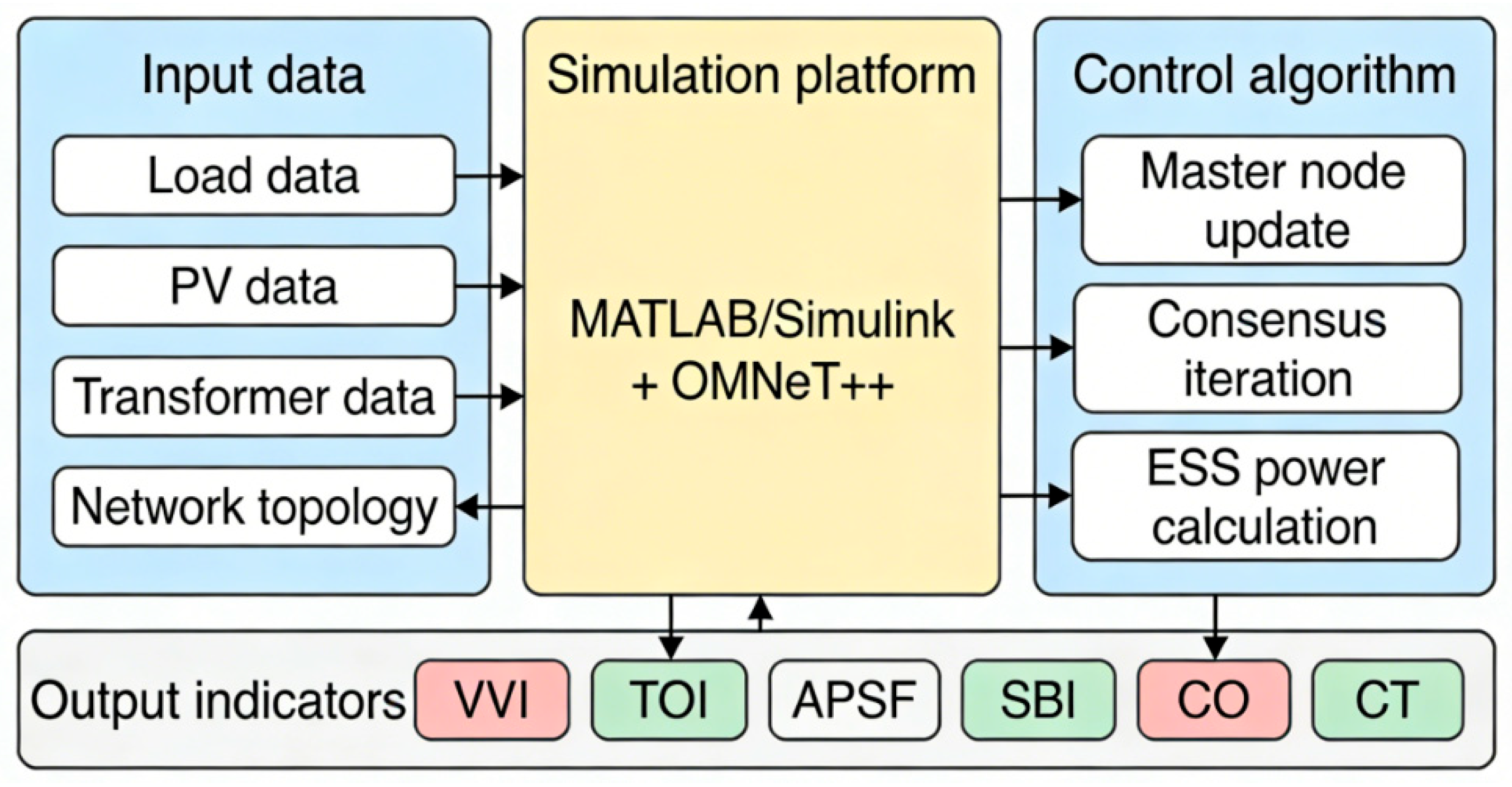
Figure 1 illustrates the overall validation structure of the proposed method. The simulation framework integrates three main components: input data acquisition, distributed control algorithm implementation, and performance evaluation. The input data includes load profiles, PV generation data, transformer measurements, and communication network topology. The control algorithm is implemented in MATLAB/Simulink, with communication protocols emulated in OMNeT++.
Compared with existing consensus-based distributed control strategies, the novelty of this work lies in three aspects: (1) a composite consensus variable that simultaneously captures PV utilization, energy storage state of charge, and grid regulation requirements; (2) a master–asynchronous update mechanism that reduces communication dependency while maintaining global coordination; and (3) a linearized power allocation rule that enables explicit ESS power calculation without iterative optimization. These features collectively address the practical constraints of low-voltage distribution networks, including heterogeneous ESS capacities, delayed communications, and limited computational resources.
2. Materials and Methods
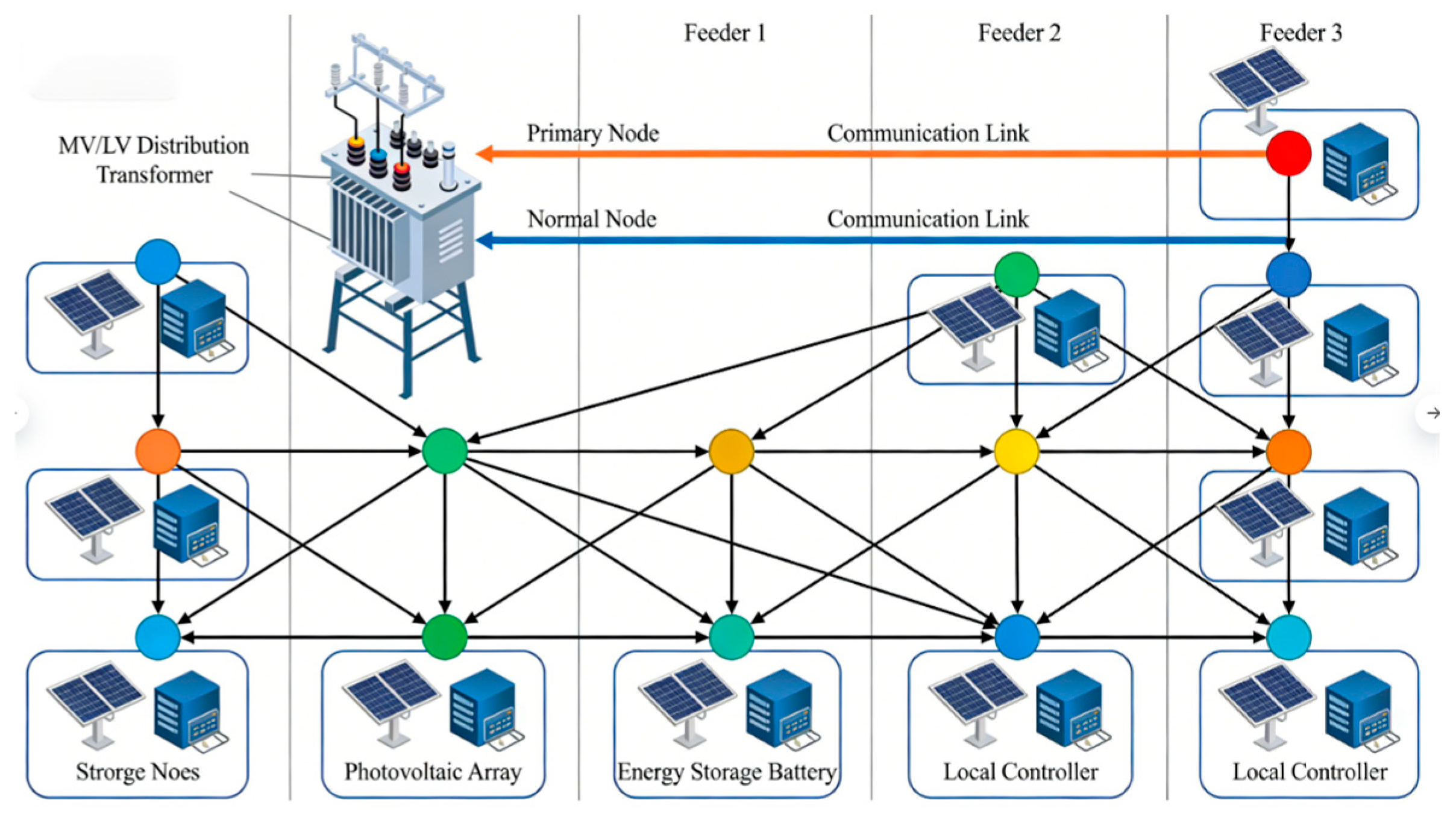
To address voltage violations and transformer overloads caused by high penetration of distributed photovoltaics (PV), this paper proposes a distributed cooperative control method for low-voltage distribution networks incorporating PV and energy storage systems (ESSs). The method leverages consensus-based algorithms to coordinate multiple PV-ESS units while considering their capacity differences and operational constraints. The topology of the studied low-voltage distribution network, comprising 30 PV-ESS nodes distributed across three feeders, is illustrated in
Figure 2.
The distribution network comprises three feeders with total lengths of 1.2 km, 1.5 km, and 1.8 km, respectively. The line impedances are modeled using typical low-voltage underground cable parameters: resistance and reactance . Loads are modeled as time-varying active and reactive power profiles derived from historical residential consumption data, with a constant power factor of 0.95. The network operates at a nominal voltage of 400 V, with a maximum allowable voltage deviation of ±5%.
2.1. Active Power Regulation Command from the Medium-Voltage Network
The medium-voltage distribution network monitors the output power of each distribution transformer located between the medium-voltage and low-voltage networks. Based on the measured power
of the
low-voltage network and its permissible limits, the required active power adjustment
is computed as:
where
and
are the upper and lower power limits of the transformer. A positive
indicates that the low-voltage network should absorb power (ESS charging), while a negative value indicates it should inject power (ESS discharging). This adjustment command is then sent to the low-voltage network for execution. The use of a simple piecewise linear function ensures that only when the transformer power exceeds its safe operating range does a corrective action become necessary, thereby avoiding unnecessary interventions and reducing communication overhead.
2.2. Definition of the Consensus Variable
To capture the joint effect of PV output, ESS operation, and grid requirements, a consensus variable
is defined for each PV-ESS unit
. It combines the normalized grid-connected power and the normalized change in stored energy:
where
are the PV generation, grid-tied power, and ESS power of unit
(with
denoting charging).
are the rated capacities of the PV array and the ESS.
is the control interval.
is the set of nodes equipped with PV-ESSs.
The first term represents the utilization of the PV capacity for grid support, while the second term is the normalized energy exchange of the ESS over one control period. This formulation ensures that both instantaneous power and stored energy are considered, allowing the consensus variable to reflect the unit’s ability to contribute to voltage regulation and power balance. Moreover, the definition is linear in , which simplifies the subsequent derivation of ESS power from the consensus value.
2.3. Master Node Selection and Update
The master node is chosen as the node closest to the distribution transformer, which facilitates communication and the issuance of dispatch commands. In practice, this node could be co-located with the transformer or be the one with the strongest communication link to the medium-voltage network. It acts as the interface between the medium-voltage and low-voltage control layers. This node receives the active power adjustment
from the medium-voltage network and updates its consensus variable
according to:
where
is the iteration index and
is a parameter that controls the convergence speed and accuracy of the distributed control. A larger
speeds up convergence but may cause oscillations, while a smaller
ensures smoother adjustments at the cost of slower response. The update rule adds the scaled adjustment to the previous consensus value only when a nonzero adjustment is required; this proportional feedback aligns the master node’s reference with the global power imbalance.
The selection of the master node based on proximity to the distribution transformer is a design choice that simplifies communication and ensures timely reception of medium-voltage commands. Simulation studies indicate that selecting any node within the same feeder yields comparable convergence performance, provided the communication topology remains connected. In the event of master node failure, a backup master node is automatically elected through a heartbeat mechanism among adjacent nodes, with the consensus algorithm reinitialized using the last consistent values. Simulations under 20% link failure scenarios show that voltage regulation performance degrades minimally (VVI increases from 0% to 0.3%), demonstrating robustness against single-point failures.
2.4. Consensus-Based Information Exchange
The consensus algorithm enables all nodes to iteratively align their states through local communication. The state update for any node
is given by:
where
represents the state variable of node
, and
are the coefficients of the transition matrix derived from the communication topology. The coefficients are computed as:
with
denoting the degree of node
, and
the set of all PV-ESS nodes. This formulation guarantees that the sum of each row of the transition matrix equals one, ensuring convergence of the consensus process. The choice of the Metropolis-Hastings weight ensures that the matrix is doubly stochastic, which is a sufficient condition for average consensus. It also adapts to the local network topology without requiring global knowledge, making it suitable for dynamic communication conditions.
2.5. Non-Master Node Update and ESS Power Calculation
Non-master nodes update their consensus variables using information received from neighboring nodes, including the master node. Because communication takes time, the update at iteration
relies on values from iteration
:
where
and
are the consensus variables of nodes
and
, and
is the transition coefficient between node
and the master node. This asynchronous-like update reflects the realistic scenario where each node only has access to delayed information from its neighbors, yet the consensus algorithm still converges under mild conditions.
Once the consensus variable is updated, the required power of each ESS is derived by solving Equation (2) for
:
This expression is obtained by rearranging Equation (2) and isolating . It guarantees that if all units reach a common consensus value then their ESS powers will be coordinated such that the overall power adjustment meets the requirement from the medium-voltage network, while respecting each unit’s capacity.
2.6. State of Charge Update and Convergence Criterion
After determining the ESS power, the state of charge of each unit is updated for the next control interval:
Here, a positive corresponds to charging (increase in ) and negative to discharging. The is expressed in per unit (p.u.) of the rated energy capacity.
Equation (8) assumes constant charging/discharging efficiency and a linear relationship between power and state of charge for simplicity. In practice, battery energy storage systems exhibit nonlinear characteristics such as efficiency variations with operating point, temperature dependence, and capacity degradation over cycles. The proposed control framework can be extended to incorporate these nonlinearities by replacing the linear SOC update with a more detailed battery model (e.g., equivalent circuit model or empirical efficiency curves) without modifying the core consensus algorithm. This extension is considered as part of future work.
2.7. Operational Constraints
Throughout the control process, the
of each ESS must remain within safe operating limits to prevent over-charging or deep discharging, which could shorten battery life. The constraint is expressed as:
where
and
denote the minimum and maximum allowable
, respectively. If a unit reaches its limit, its power is clamped, and the remaining regulation burden is redistributed among the other units through the consensus mechanism.
In addition to the ESS SOC constraints, the voltage at each node must remain within permissible limits to ensure power quality and system safety. The voltage constraint is expressed as:
where
is the voltage magnitude at node
at time step
, and
,
are the lower and upper voltage limits, respectively. While the proposed consensus-based control does not directly enforce these constraints through optimization, the coordinated power allocation among PV-ESS units indirectly regulates voltage by managing power injections and absorptions at each node.
2.8. Overall Control Procedure
The overall control procedure is summarized as follows:
- (1)
Initialization: Set initial consensus variables for all nodes based on local measurements.
- (2)
Master node update: Compute using Equation (1) and update using Equation (3).
- (3)
Local communication: Each node exchanges with neighbors.
- (4)
Consensus update: Non-master nodes update using Equation (6).
- (5)
ESS power calculation: Compute using Equation (7).
- (6)
SOC update: Update SOC using Equation (8).
- (7)
Convergence check: If Equation (9) is satisfied, apply control commands; otherwise, repeat steps 3–5.
3. Simulation Results and Analysis
3.1. Simulation Setup
3.1.1. Dataset Description
To validate the effectiveness of the proposed distributed cooperative control method, a typical distribution scenario dataset was constructed based on real-world data from the distribution network of a provincial grid company in eastern China. The dataset used in this study comprises the following components:
- (1)
Load Curve Data: Historical load data from 50 residential users over a one-year period (January 2025 to December 2025) was collected at a 15 min resolution. This data includes measured values for active power (kW) and reactive power (kVA), capturing seasonal variations and daily consumption patterns. Peak load occurs during the evening period (18:00–22:00), averaging 12.5 kW per household, while off-peak load occurs during the early morning period (02:00–05:00), averaging 2.3 kW per household. Historical load data from 50 residential users were collected and aggregated into 30 load nodes, each representing one or two households depending on their geographic proximity and feeder connection. The total load profiles were scaled to match the rated capacities of the corresponding PV-ESS nodes, ensuring consistency between load distribution and system capacity.
- (2)
Photovoltaic Generation Data: Solar irradiance and temperature data were obtained from five meteorological stations located within the distribution network service area. These measurements were synchronized with load data and used to generate photovoltaic output curves for 30 distributed PV systems (5–15 kW each) installed on residential rooftops. The total installed capacity of these systems is 320 kW. The dataset includes both sunny and cloudy scenarios to evaluate the method’s performance under varying weather conditions.
- (3)
Distribution Transformer Data: Operational data was collected from 10 distribution transformers (each with a capacity of 200–500 kVA), including primary-side voltage (10 kV), secondary-side voltage (0.4 kV), active power flow, and power factor measurements. Historical records of voltage violation events and transformer load levels were also analyzed to identify critical operational conditions.
- (4)
Communication Network Topology: The low-voltage distribution network employs a radial topology with 30 PV-storage system nodes distributed across three feeders. The communication network mirrors this physical topology, with each node communicating only with adjacent nodes. The maximum communication distance between nodes is 500 m. Communication delay is modeled as a random variable uniformly distributed between 50 and 200 milliseconds to reflect real-world conditions.
All data were preprocessed to remove outliers and fill missing values using linear interpolation. The dataset was split into training (70%), validation (15%), and test (15%) sets, with the test set specifically containing challenging scenarios such as rapid cloud transients and peak load events.
3.1.2. Software and Hardware Environment
The simulations were conducted on a high-performance computing platform with the following specifications. The simulations were conducted on a high-performance computing platform equipped with an Intel Xeon Gold 6248R CPU @ 3.0 GHz (24 cores, 48 threads), 128 GB of DDR4 ECC memory, a 2 TB NVMe SSD, and Gigabit Ethernet for distributed simulation nodes. The software environment consisted of Ubuntu 20.04 LTS 64-bit (Canonical Ltd., London, UK) as the operating system, with MATLAB/Simulink R2024b (The MathWorks, Inc., Natick, MA, USA) as the primary simulation platform. Communication protocols were emulated using OMNeT++ 6.0 (OpenSim Ltd., Budapest, Hungary), while data processing was performed with Python 3.9 (Python Software Foundation, Wilmington, DE, USA) using Pandas, NumPy, and SciPy. Visualization was carried out using MATLAB plotting tools and Matplotlib 3.5.
3.1.3. Parameter Configuration
Table 1 summarizes the key simulation parameters, selected according to typical distribution network conditions and commercial equipment specifications.
3.2. Simulation Scenarios and Performance Metrics
3.2.1. Test Scenarios
Four representative scenarios were designed to comprehensively evaluate the proposed method:
Scenario 1 (Normal Operation): Typical spring day with moderate solar irradiance (500–800 W/m2) and average load conditions. This scenario establishes baseline performance.
Scenario 2 (High PV Generation): Clear summer day with peak irradiance (1000 W/m2) during midday (11:00–14:00) and relatively low load. This scenario tests the method’s ability to prevent overvoltage and reverse power flow.
Scenario 3 (Peak Load): Winter evening (18:00–21:00) with high load demand and zero PV generation. This scenario evaluates the method’s performance during discharge mode to support voltage and prevent transformer overload.
Scenario 4 (Rapid Fluctuations): Partly cloudy day with rapid irradiance changes (up to 60% variation within 5 min). This scenario assesses the method’s response speed and robustness under dynamic conditions.
Each scenario was simulated for a 24 h period with 5 min resolution, resulting in 288 time steps per simulation. For comparison, three control strategies were implemented:
3.2.2. Performance Metrics
The following metrics were defined to quantify the performance of each control strategy:
Voltage Violation Index (VVI): The percentage of time that node voltages exceed the allowable range [0.95, 1.05] p.u.:
where
is the indicator function,
is the number of nodes, and
is the number of time steps.
Transformer Overload Index (TOI): The percentage of time that any distribution transformer operates above its rated capacity:
Average Power Smoothing Factor (APSF): A measure of how effectively the combined PV-ESS output is smoothed, defined as the ratio of the standard deviation of net power injected to the grid with control to that without control:
SOC Balancing Index (SBI): The standard deviation of SOC values across all ESS units at the end of each control cycle, normalized by the mean SOC:
Communication Overhead (CO): The total number of messages exchanged per control cycle, normalized by the number of nodes.
Convergence Time (CT): The average number of iterations required for the consensus algorithm to converge ().
3.3. Detailed Simulation Results and Performance Evaluation
Each simulation scenario was repeated 10 times with different random seeds for irradiance variability and communication delay patterns. The results presented are representative of typical runs, with performance metrics varying by less than ±2% across all repetitions. Statistical consistency was verified using the coefficient of variation, which remained below 0.05 for all key metrics.
3.3.1. Voltage Regulation Performance
Voltage curves for the farthest node across all four scenarios under different control strategies. Without control, significant voltage deviation occurs during peak PV generation (Scenario 2), reaching 1.08 p.u.; during peak load periods (Scenario 3), voltage drops to 0.92 p.u. While local control reduces violations, occasional fluctuations still occur due to insufficient coordination. The proposed distributed control scheme, however, maintains voltage stability within the range [0.95, 1.05] relative units across all scenarios.
Table 2 summarizes the Voltage Violation Index (VVI) for all scenarios. The proposed method reduces VVI to zero in Scenarios 1–3 and to 0.8% in Scenario 4, compared to 15.6% under no control and 4.2% under local control. This demonstrates the effectiveness of cooperative control in maintaining voltage quality even under challenging conditions.
3.3.2. Transformer Overload Mitigation
Scenario 3 (Peak Load): Under uncontrolled conditions, transformer T3 (rated 400 kVA) operated continuously for 3.5 h exceeding the 90% rated load threshold (360 kVA), with a peak reaching 420 kVA (105% overload). Local control reduced the overload duration to 1.8 h, while the proposed method—coordinating discharge from all node energy storage systems—completely eliminated the overload phenomenon.
The Transformer Overload Index (TOI) values are presented in
Table 3. The proposed method achieves zero overload in all scenarios, compared to 12.5% under no control and 5.2% under local control in the most severe case (Scenario 3).
3.3.3. PV Output Smoothing
Scenario 4 (Rapid Fluctuations) Total net power injected into the grid by all PV-storage systems. Without control, power fluctuates dramatically due to transient cloud cover changes, with rates of change reaching up to 120 kW/min. Local control reduces the rate of change to 80 kW/min, while the proposed method further smooths output power, lowering the maximum rate of change to 35 kW/min.
The Average Power Smoothing Factor (APSF) values for each test scenario are summarized in
Table 4. Across all four scenarios, the proposed distributed cooperative control method achieves APSF values consistently below 0.4, with the lowest value of 0.31 achieved in Scenario 4 (Rapid Fluctuations). This indicates that the proposed method reduces the variability of net power injected to the grid by more than 60% compared to the no-control case. Such significant smoothing performance demonstrates the effectiveness of coordinating multiple PV-ESS units to absorb rapid PV output fluctuations, thereby mitigating the adverse impacts of intermittent solar generation on power quality and grid stability.
3.3.4. SOC Balancing Performance
Under the proposed control method, the state-of-charge (SOC) trajectories of five representative energy storage units (ESSs) in Scenario 2. Despite initial SOC variations (ranging from 0.3 to 0.7) and differing levels of photovoltaic power generation, all units converged toward similar SOC values by the end of the charging period, indicating the effective operation of the load sharing mechanism.
The SOC Balancing Index (SBI) was calculated at 5 min intervals throughout each simulation. Under no control, SBI values fluctuate widely (0.15–0.35), while local control achieves moderate balancing (0.10–0.20). The proposed method maintains SBI below 0.08 after the first hour, confirming its ability to distribute regulation burden equitably among units.
3.3.5. Communication Overhead and Convergence Speed
Table 5 presents the communication overhead and convergence time for the proposed method under different network sizes. As the number of nodes increases, the number of messages per node remains nearly constant due to the localized communication nature of the consensus algorithm. The convergence time increases slightly but remains within acceptable limits (<20 iterations) even for 50 nodes.
In comparison, a centralized control method with the same network size (30 nodes) requires 580 messages per control cycle to collect global measurements and broadcast optimal setpoints, which is approximately five times the communication load of the proposed distributed method (108 messages per cycle). This reduction in communication overhead enhances scalability and reduces the risk of network congestion, particularly in systems with limited communication infrastructure.
3.3.6. Robustness Analysis
To assess the system’s robustness against communication failures, we conducted additional simulations where random communication links were temporarily disabled. Convergence behavior was observed across three scenarios: normal operation, 10% link failure, and 20% link failure. Even under 20% link failure, the consensus algorithm converged, though the number of iterations required increased by approximately 30%.
The impact on voltage regulation performance was minimal, with VVI increasing from 0.0% to 0.3% under 20% link failures, demonstrating the method’s fault tolerance.
3.4. Performance Comparison with Alternative Control Strategies
To further validate the superiority of the proposed method, it was compared with two alternative approaches representing typical centralized and distributed control paradigms: (1) centralized MPC-based voltage control, which achieves optimal voltage regulation through global optimization but incurs high communication and computational overhead; (2) distributed droop control with local voltage feedback, which offers rapid response but lacks multi-machine coordination mechanisms, potentially leading to suboptimal performance under high PV penetration conditions.
Table 6 summarizes the comparative results for Scenario 2 (high PV generation). The proposed method achieves the best performance across all metrics, particularly in communication overhead and SOC balancing, while maintaining comparable voltage regulation to the centralized approach.
In terms of communication overhead, the centralized MPC method (Method A) requires 580 messages per control cycle to collect global measurements and broadcast optimal setpoints, whereas the proposed distributed method requires only 108 messages per cycle (as shown in
Table 5). The droop-based method (Method B) has the lowest communication overhead (36 messages per cycle) but achieves poorer voltage regulation (VVI = 1.2%) and SOC balancing (SBI = 0.18). Regarding computational burden, Method A requires 245 ms per cycle on average due to solving a global optimization problem, while the proposed method completes consensus iterations and ESS power calculations within 38 ms per cycle, making it suitable for real-time implementation on embedded controllers. These quantitative comparisons demonstrate that the proposed method strikes an optimal balance between performance, communication efficiency, and computational feasibility.
The centralized method (A) requires significantly higher communication overhead (580 messages per cycle) and computation time due to global optimization. The droop-based method (B) has lower overhead but poorer voltage regulation and SOC balancing. The proposed method strikes an optimal balance between performance and resource utilization.
3.5. Summary of Simulation Results
The simulation results demonstrate the effectiveness of the proposed distributed cooperative control method. By coordinating multiple PV-ESS units, the method eliminates voltage violations, prevents transformer overloads, and significantly smooths net power fluctuations. The SOC balancing mechanism ensures fair load sharing among units, while the localized communication pattern provides scalability and robustness against link failures. With moderate computational requirements, the method is suitable for implementation on low-cost embedded controllers.
From a practical implementation perspective, the proposed method imposes modest computational requirements on each node. The consensus update (Equation (6)) and ESS power calculation (Equation (7)) involve only basic arithmetic operations, and the memory footprint is approximately 10 KB per node, which is feasible on low-cost embedded controllers such as ARM Cortex-M4 devices. Communication infrastructure relies on standard industrial protocols (e.g., Modbus TCP, IEC 61850) over Ethernet or 4G wireless links, with a bandwidth requirement below 10 kbps per node. Integration with existing distribution management systems (DMS) can be achieved by interfacing the master node with the DMS via IEC 60870-5-104, enabling seamless coordination between centralized grid supervision and distributed local control.