


Abstract
Nowadays, Convolutional Neural Networks (CNNs) are the mainstream model in the bearing fault diagnosis area. Aiming at the problems of “incomplete capture of multiscale fault features and insufficient use of key time and frequency domain information”, a bearing fault diagnosis model combining multiscale convolution and Convolutional Block Attention Module (CBAM) is proposed, referred to as Mscon-C (standing for Multiscale convolution and CBAM) in this paper. Firstly, the time-frequency domain joint features of bearing faults are obtained by continuous wavelet transform. Then, the fine-grained and global fault features are synchronously extracted by multiscale parallel convolution. Finally, the weight of key features is enhanced by CBAM attention. The performance of Mscon-C was verified on two datasets, and its accuracy reached more than 95% on 12 tasks in two datasets, which was significantly improved compared with traditional CNN and Squeeze-and-Excitation-CNN (SE-CNN), and verified the effectiveness of the combination of multiscale parallel convolution and CBAM.
1. Introduction
A rolling bearing is the core component of rotating machinery such as the motor and the fan, which usually needs long-term operation, and its rolling element, inner ring, and outer ring are vulnerable to wear [1]. How to accurately diagnose the fault state of a bearing has always been one of the core issues concerned by industry and academia. Traditional bearing fault diagnosis relies on manual extraction of time domain (such as peak and root mean square) or frequency domain (such as spectral peak and barycenter frequency) features, but there are limitations, such as poor adaptation of non-stationary features and strong subjectivity of artificial features.
Research efforts in bearing fault diagnosis are predominantly directed toward the automated extraction of time-domain and frequency-domain features. Time-domain analysis concentrates on capturing trends in waveform variations, whereas frequency-domain features are derived through time-frequency analysis techniques such as wavelet transform, envelope spectrum, and Fourier transform. The wavelet time-frequency analysis method enables the transformation of one-dimensional vibration signals into two-dimensional time-frequency maps. By preserving both temporal and spectral characteristics, it provides an ideal input for visual recognition models and has been widely adopted in the field of bearing fault diagnosis.
Puntambekar et al. examine the evolution and current state of various ML and DL approaches for vibration-based bearing fault diagnosis [2]. CNN has gradually become the mainstream model of fault diagnosis based on the time-frequency map because it has the ability of automatic feature extraction, strong nonlinear fitting, and automatic classification. Wang et al. implemented the rolling bearing fault diagnosis method based on the Short-Time Fourier Transform (STFT) and Attention Temporal Convolutional Neural Network (ATCNN) [3]. To solve the problem of poor noise resistance ability, Zhao et al. transformed the original vibration signal into a grayscale image based on envelope spectrum analysis and then constructed a CNN to carry out feature learning and fault pattern classification of the grayscale image [4]. Han et al. transformed the time-frequency signal into the time-frequency map and identified the bearing fault based on the map’s color [5]. Qi et al. proposed a dual-channel CNN diagnosis model. One channel inputs the original vibration signal [6], and the other channel inputs the corresponding time-frequency map obtained by wavelet transform, and then fuses the features to judge the bearing fault state. The above studies have achieved good results. However, there are significant differences in the time-frequency characteristics corresponding to different degrees of bearing faults. The early slight wear is the local texture anomaly with small scale and low activation, while the typical feature of severe spalling is the regional structure damage with large scale and high activation. The existing methods still have much room for improvement.
Therefore, to simultaneously capture the fine-grained local and global structural features of bearing faults in the time-frequency domain and improve the model stability under different tasks and operating conditions, this paper proposes a bearing fault diagnosis model (Mscon-C) that integrates multiscale parallel convolution and CBAM attention mechanisms. This method first uses a continuous wavelet transform to convert the original vibration signal into a two-dimensional time-frequency map, enabling the signal’s time and frequency information to be expressed in a unified representation space. Subsequently, a multiscale parallel convolution structure is used to extract features from the time-frequency map in parallel using convolution kernels of different sizes (3 × 3, 5 × 5, and 7 × 7), allowing the model to simultaneously perceive feature information from different receptive fields at the same level. Based on this, a CBAM attention module is introduced to further optimize the fused features. Through the synergistic effect of channel attention and spatial attention, key frequency bands and key time regions with diagnostic value are adaptively strengthened, while suppressing interference from irrelevant information. This allows the model to perform more reliable feature weighting based on multiscale features, thereby improving the expressive power of key fault features and enhancing the stability of feature selection. This multiscale feature extraction-attention enhancement synergistic mechanism reduces bias in the feature selection process while ensuring sufficient feature representation, thus mitigating the performance fluctuation problem that traditional CBAM-CNN is prone to in different data tasks. Finally, bearing fault category identification is achieved through fully connected layers. The main contributions of this paper are as follows:
- (1)
- A bearing fault diagnosis framework, Mscon-C, integrating multiscale parallel convolution and CBAM attention mechanism, is proposed. Multiscale parallel convolution, through the synergistic effect of receptive fields at different scales, simultaneously extracts local fine-grained features and global structural features, thereby constructing a more stable and comprehensive time-frequency feature representation.
- (2)
- Based on multiscale feature extraction, the CBAM attention mechanism is introduced. Through the synergistic weighting of channel attention and spatial attention, key frequency bands and key time regions are strengthened, thereby improving the expressive power of key fault features and enhancing the stability of feature selection, alleviating the performance fluctuation problem of traditional CBAM-CNN in different tasks.
- (3)
- The proposed Mscon-C model is systematically validated on two publicly available bearing datasets. Experimental results show that this method can maintain a high and stable diagnostic accuracy under different working conditions, exhibiting more stable and superior fault recognition performance compared to traditional CNN, SE-CNN, Multiscale-CNN, and CBAM-CNN models, thus verifying the effectiveness of the synergistic design of multiscale feature extraction and attention mechanism.
2. Related Work
CNN has an excellent accuracy in multiple open datasets of fault diagnosis [7,8] and has become the core direction of extensive research by scholars in industry and academia. The current research has developed from the early single CNN for processing single-source vibration signals to an intelligent diagnosis framework that deeply integrates a variety of advanced technologies [9].
2.1. Representation of Time-Frequency Feature
Transforming a one-dimensional vibration signal into a two-dimensional map to make full use of the visual feature extraction ability of CNN has become mainstream technology in the field of fault diagnosis. Among them, the time-frequency analysis method is widely used because it can simultaneously characterize the time-domain and frequency-domain characteristics of signals. Joseph et al. used STFT to construct the time-frequency map [10] and combined it with AlexNet to realize the classification of five types of faults. Zheng et al. proposed a lightweight end-to-end fault diagnosis framework [11]. The framework uses ECA OS blocks with an efficient channel attention mechanism to capture features of different scales, and performs global adaptive weighting through a signal attention mechanism to focus on key signals.
However, due to the fixed window length of STFT, the resolution of high-frequency impact features is insufficient. In contrast, the wavelet transform is more promising in time-frequency representation by virtue of the advantages of multi-resolution analysis. Shao et al. proposed to convert the motor fault signal into a time-frequency map by wavelet transform [12], and realize fault detection by combining a CNN. Zhang et al. proposed to combine Lightweight Block (LWB) and Lightweight Attention (LA) [13] for fault diagnosis. Chen et al. proposed a frequency domain Fourier Markov Transition Field (FMTF) feature extraction method based on Fast Fourier transform (FFT) and MTF algorithm [14], and verified its effectiveness on the public data set of Jiangnan University. Cong et al. proposed a multiscale petal pattern (MSPP) method to reconstruct the original one-dimensional time-domain signal into a two-dimensional image signal [15].
2.2. Applications of Multiscale Convolution
Aiming at the multi-pattern characteristics of bearing fault signals under different working conditions, multiscale convolution technology is then adopted to improve the feature representation ability. Liu et al. proposed a residual CNN based on a multiscale convolution kernel [16]. By designing convolution kernels with different sizes to adapt to the pattern differences in vibration signals, it effectively improved the fault diagnosis ability under unstable conditions. This method verifies the advantages of multiscale feature learning in dealing with the variability of working conditions, but there is still room for optimization in the feature fusion strategy. The ECMCTP model proposed by Chen et al. first used Continuous Wavelet Transform (CWT) to convert one-dimensional vibration signals into two-dimensional time-frequency maps [17], and then adopted parallel branches to extract time-frequency features. Si et al. proposed the Multi-Scale Dilated Convolution and Dense Temporal Convolutional Network to address the issue of industrial noise masking critical fault features [18]. Tang et al. proposed a credible multi-scale quadratic attention convolutional neural network for the fault recognition under small sample size and noise interference, and load variation [19].
The existing multiscale convolution models have some limitations. Firstly, most of them adopt a serial multiscale pattern, which reduces the parameter scale, but the efficiency of feature extraction is not high; Secondly, the fusion method of multiscale features is relatively simple, and the correlation between different scale features is not fully explored.
2.3. Applications of Attention Mechanism
Attention mechanisms can effectively improve the performance of fault diagnosis models by enhancing the weight of key features and suppressing the interference of irrelevant information, so it is widely used in the field of fault diagnosis. Wang et al. combine the multi-head self-attention mechanism with 1DCNN and significantly improve the fault diagnosis performance [20]. Wang et al. proposed a joint learning CNN guided by an attention mechanism, and verified its excellent noise resistance performance on different levels of noise datasets [21]. Cui et al. used Squeeze-and-Excitation Networks (SENet) to select diagnostically relevant features [22]. But these methods lack collaboration between channel and spatial attention.
The Convolutional Block Attention Module (CBAM) [23] has demonstrated excellent feature enhancement performance in visual classification tasks. With its lightweight parameter design and flexible integration into various convolutional neural network architectures, CBAM has been adopted in several fault diagnosis studies. For instance, Su et al. incorporated CBAM into bridge crack detection to improve feature representation [24]; Chen et al. developed a lightweight CNN based on CBAM for crack classification [25]; Huang and Zhang proposed a CBAM-CNN model for bearing fault diagnosis [26], which first converts one-dimensional vibration signals into two-dimensional time-frequency maps, then uses CBAM to highlight critical features, and finally feeds them into a CNN for recognition; Jia et al. further optimized the classic CBAM structure and implemented a lightweight fault diagnosis model based on the enhanced module [27].
To sum up, although bearing fault diagnosis technology has made significant progress, it still faces some challenges. Firstly, the multiscale learning mechanism of time-frequency features is difficult to efficiently capture local and global fault features; Secondly, the integration strategy of multiscale features and attention mechanism fails to give full play to the collaboration effect, and needs to be optimized.
3. Methodology
3.1. Task Definition
Suppose that the continuous temporal signal is , where represents the temporal interval, and is the signal length. The signal set is marked as . Let the fault category set be , where represents the fault type. Bearing fault diagnosis can be expressed as a classifier (function): . The whole classification process is defined as a composite function: , where represents the wavelet transform, represents feature extraction, and is the fault category of .
3.2. Overall Framework
The proposed Mscon-C adopts a four-stage architecture of “signal transformation—multiscale feature extraction—attention enhancement—bearing fault classification”, as shown in Figure 1. Specifically, the vibration signal is transformed to the time-frequency map through the wavelet transform, and the key fault features are extracted by the multiscale convolution and strengthened by CBAM, and the classification is then achieved through the full connection layer.
Figure 1.
The framework of Mscon-C.
3.3. Construction of Wavelet Time-Frequency Map
The CWT is applied to transform the vibration signal into time-frequency representation. The wavelet transform uses a wavelet generating function , whose scaling and shifting versions are , where is the scale parameter, and is the time shift parameter. The definition of the wavelet transform is shown in Equation (1), where * represents the complex conjugate:
In the experiments, the wavelet base is DB4, and the decomposition level is 5. Based on Equation (1), the 1D signal is converted into a 2D time-frequency map where the horizontal axis is the sampling point in the time domain, the vertical axis is the frequency domain component, and the color intensity represents the signal amplitude. The obtained map is then resized to 64 × 64. Subsequently, map the value of pixel to [0, 1] using Min-Max normalization as shown in Equation (2), eliminating the effects of illumination and signal amplitude variations:
where is the original pixel value, is the normalized pixel value, and and are the minimum and maximum values of pixels in the dataset, respectively.
3.4. Multiscale Parallel Convolution
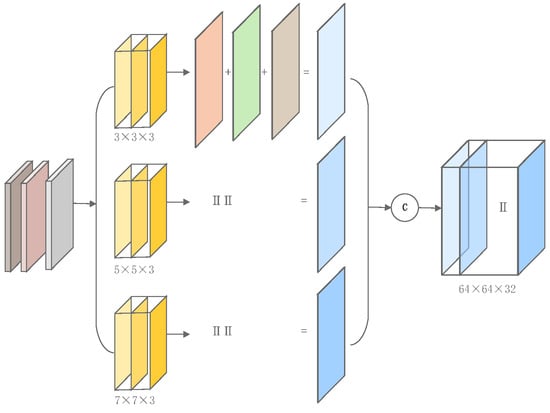
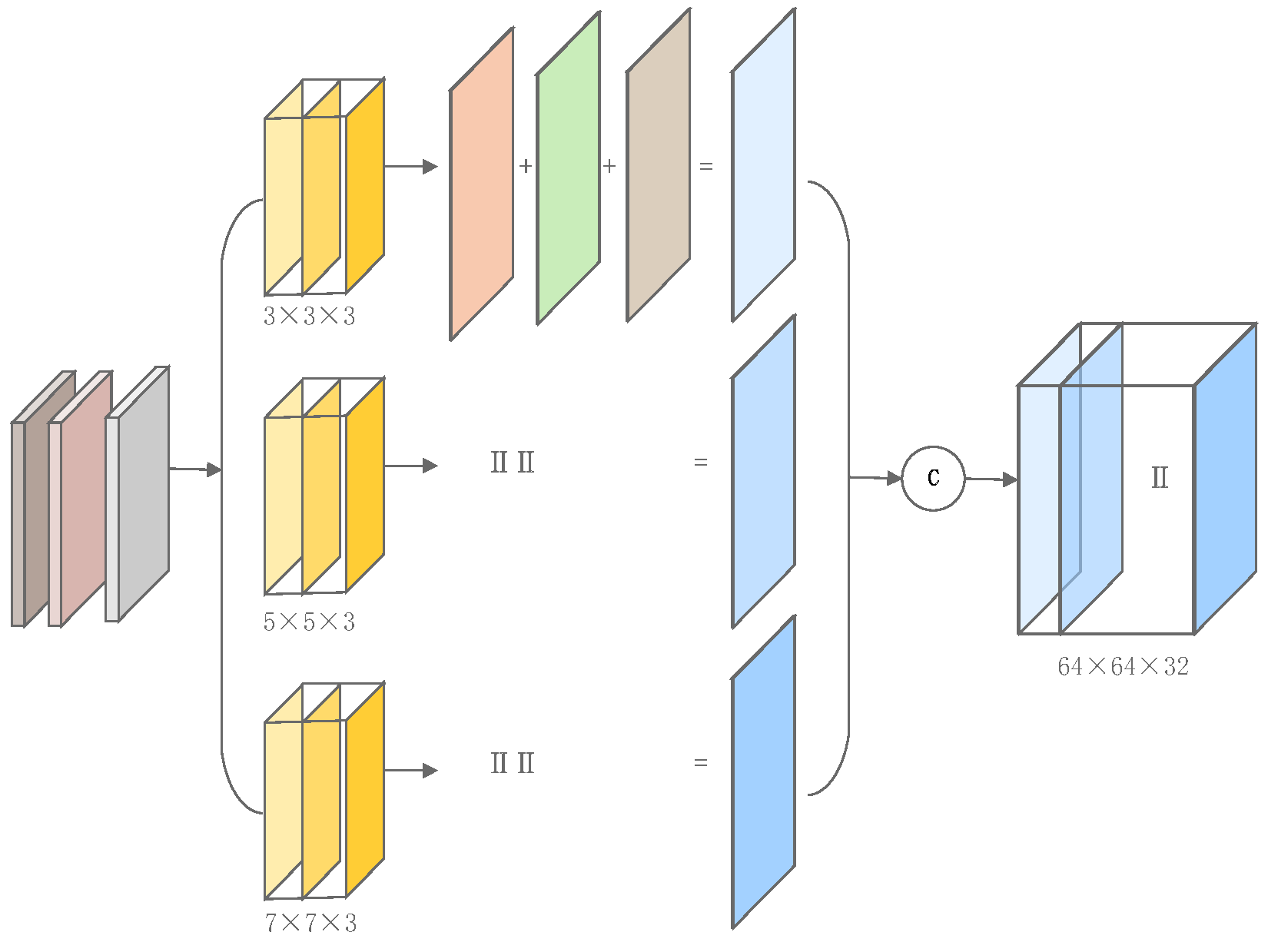
The receptive fields of different time-frequency patterns are different. A single convolution kernel cannot simultaneously take into account the “fine-grained characteristics of early faults” and the “global characteristics of severe faults”. The traditional serial multiscale convolution has the problem of “feature transfer loss”, so this paper designs a parallel multiscale convolution module, which extracts features in parallel through three different kernels and then concatenates them. Two multiscale parallel convolution modules are designed with a similar structure except for the input and output. The first convolution takes a 64 × 64 × 3 time-frequency map as the input and outputs a 64 × 64 × 32 feature map (as shown in Figure 2, where c represents concatenation operation); The second convolution takes the feature map (32 × 32 × 32) after the first convolution and pooling as the input, and the output feature map is 64 × 32 × 32.
Figure 2.
Structure of multiscale parallel convolution.
Multiscale parallel convolution can be formalized as Equations (3)–(5):
The input feature is denoted as , and representing the convolution kernel parameters and size, respectively. The feature map obtained after convolutions is , and the concatenation of multiple feature maps yields . The output from the first convolutional layer is , while the feature map after the first max pooling operation is referred to as .
3.5. CBAM
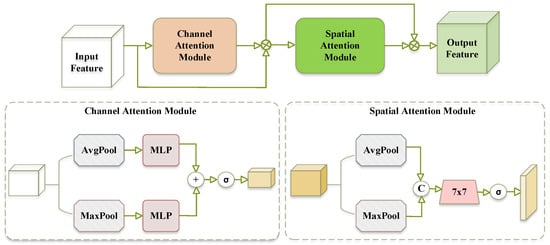
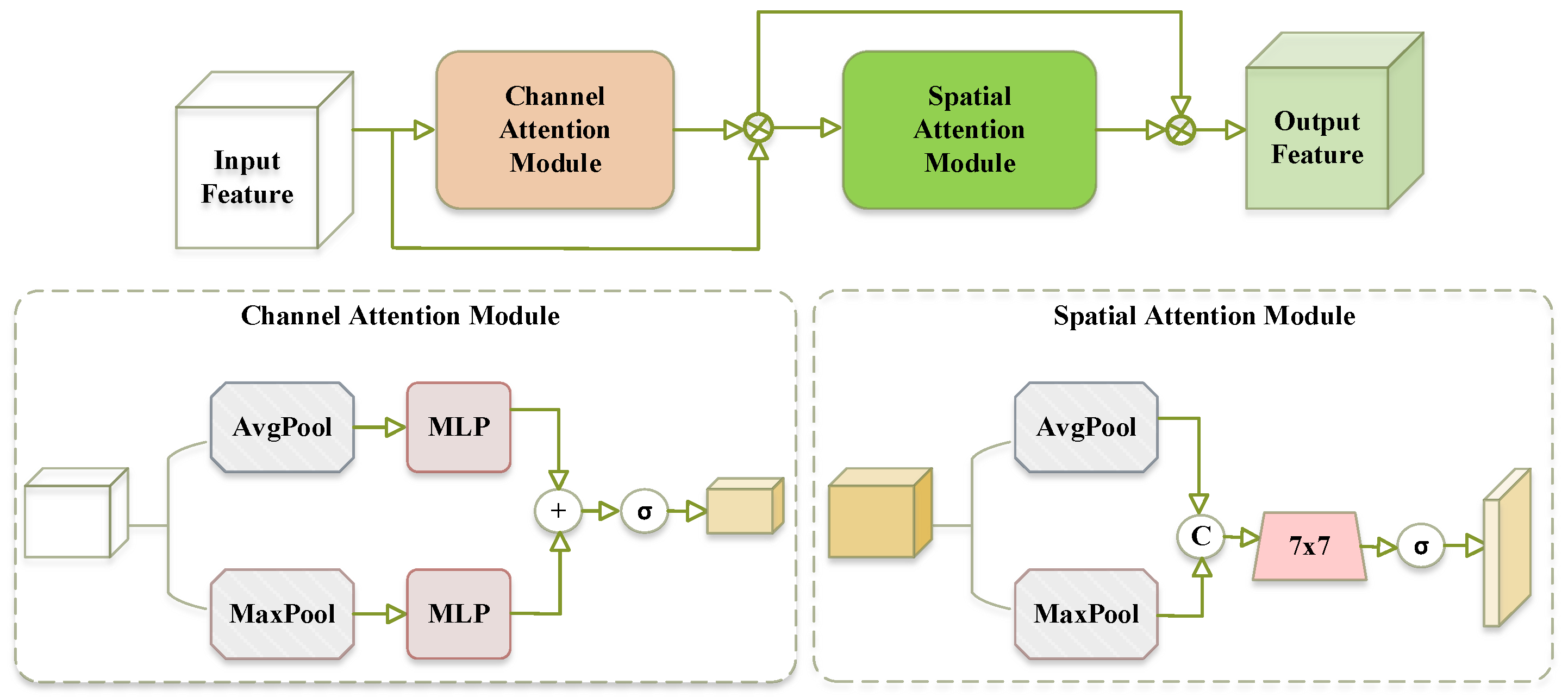
Mscon-C adopts the CBAM attention mechanism for feature optimization, in which channel attention is used to screen the effective frequency band corresponding to fault features, and spatial attention is used to locate the impulse region in the time-frequency map. Through the collaborative weighting of channel and spatial dimensions, the CBAM module enhances fault-related discriminative features while suppressing irrelevant or noisy information, thereby improving the anti-interference capability of the model under complex operating conditions. The structure is shown in Figure 3, and the process is shown in Equations (7)–(10):
where represents channel attention, represents spatial attention, ⊗ represents element-wise multiplication, and represents Sigmoid() function; represents a 7 × 7 convolution operation, and represent average pooling and maximum pooling, respectively.
Figure 3.
CBAM attention mechanism structure.
3.6. Classification
The above feature map was generated by the first attention mechanism ( in Equation (8)) is subjected to the second multiscale parallel convolution and maximum pooling. Finally, the final feature map is obtained by CBAM convolution again, which is recorded as . is then sent to the full connection layer for classification, and the cross-entropy loss function is used.
3.7. Network Structure Parameter Settings
The model input is a three-channel time-frequency map obtained through continuous wavelet transform, with a size of 64 × 64 × 3. The feature extraction part consists of two-level multiscale parallel convolutional modules, each containing three parallel convolutional branches with kernel sizes of 3 × 3, 5 × 5, and 7 × 7, respectively. To ensure consistent spatial dimensions of the output feature maps from each branch, the stride of the three convolutional branches is 1, the padding is 1, 2, and 3, and the dilation rate is 1. The first-layer multiscale convolutional module has 3 input channels and 32 output channels. After feature concatenation, Batch Normalization, and ReLU activation, a 64 × 64 × 32 feature map is obtained. Subsequently, it is down-sampled to 32 × 32 × 32 using 2 × 2 max pooling (stride = 2). The second-layer multiscale convolutional module takes a 32 × 32 × 32 input and outputs 64 channels. After processing with the same convolutional structure, it yields a 32 × 32 × 64 feature map, which is then down-sampled to 16 × 16 × 64 using 2 × 2 max pooling.
In the feature enhancement stage, a CBAM attention module is introduced after each multiscale convolutional module. Channel attention generates channel descriptions through global average pooling and global max pooling, and generates channel weights through two 1 × 1 convolutional layers (compression ratio 16). Spatial attention performs average pooling and max pooling on the channel dimensions, concatenates the two, and generates a spatial weight map through a 7 × 7 convolution (stride = 1, padding = 3), thereby enhancing key frequency bands and key time regions. The resulting 16 × 16 × 64 feature map was flattened into a 16,384-dimensional vector and used to perform fault classification through a two-layer fully connected network (16,384→256→10). The first layer used the ReLU activation function and Dropout (0.5) to improve generalization ability. The model was trained using the Adam optimizer with a learning rate of 0.007, a batch size of 64, 100 training epochs, and the cross-entropy loss function.
4. Experiments and Results Analysis
The experimental environment of this paper is listed in Table 1.
Table 1.
The experimental environment.
4.1. Datasets
We use two public datasets in our experiments, which are the SDUST bearing dataset and the CWRU bearing dataset.
4.1.1. SDUST Bearing Dataset
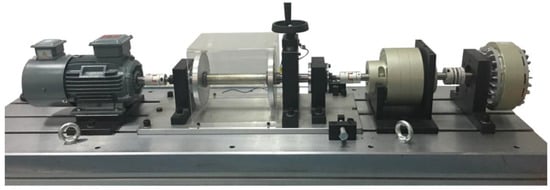
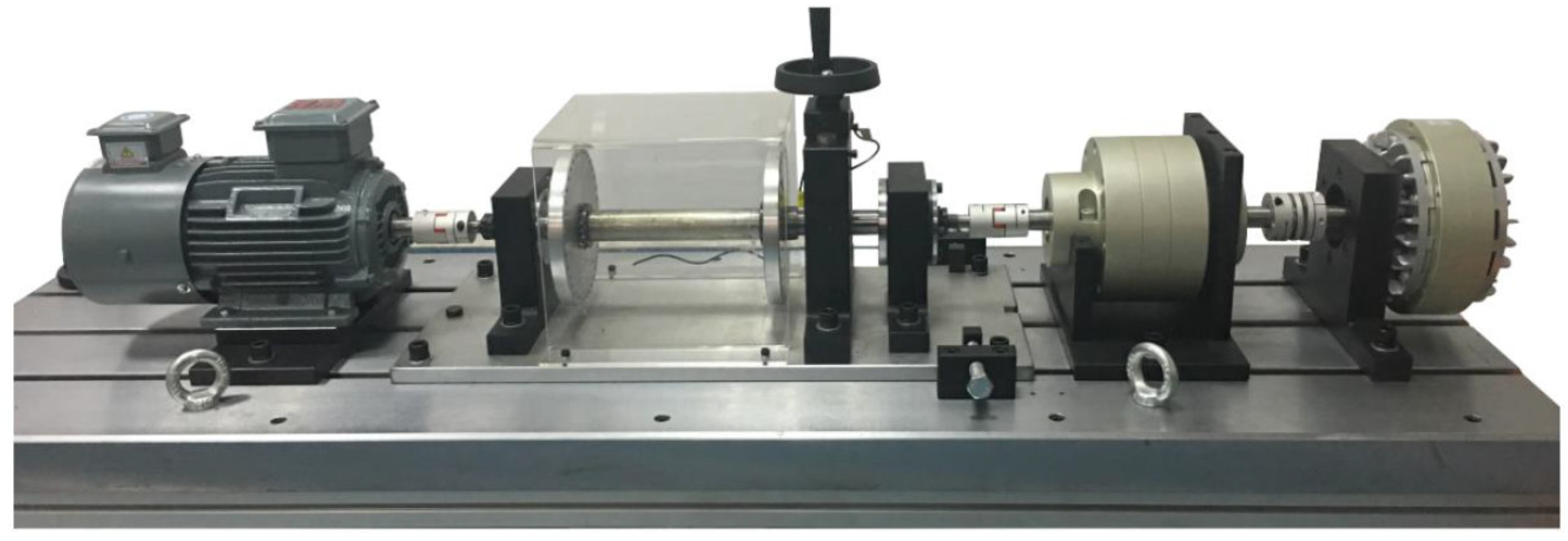
SDUST is the rolling bearing dataset collected through the test bench (Figure 4) designed by Shandong University of Science and Technology [28,29,30], which can be downloaded at https://github.com/JRWang-SDUST/SDUST-Dataset.git (18 March 2026). The vibration acceleration sensor is located above the fault bearing seat, and the vibration signal is collected by the LMS signal acquisition instrument with a sampling frequency of 25.6 kHz. There are three types of bearing fault: inner ring fault (IF), outer ring fault (OF), and rolling element fault (RF). Each fault type has three different damage widths, which are 0.2 mm, 0.4 mm, and 0.6 mm, respectively. Therefore, there are 10 different working conditions for the fault data. The normal condition is represented by NC, the inner ring fault is represented by IF0.2, IF0.4, and IF0.6, respectively, according to the damage width, the outer ring fault is represented by OF0.2, OF0.4, and OF0.6, respectively, and the rolling element fault is represented by RF0.2, RF0.4, and RF0.6.
Figure 4.
The test bench was designed by Shandong University of Science and Technology.
For the SDUST dataset, the experiments will be carried out under six groups of different speeds and loads, given in Table 2:
Table 2.
Task setting of the SDUST dataset.
4.1.2. CWRU Bearing Dataset
CWRU is an authoritative and widely used benchmark dataset, which is provided by Case Western Reserve University, and can be obtained from https://engineering.case.edu/bearingdatacenter/download-data-file (18 March 2026). It is collected from a special bearing test bench. The single-point fault is introduced into the test bearing by EDM technology. For CWRU, the experiments were also conducted at six different tasks with different speeds, which are shown in Table 3.
Table 3.
Task setting of the CWRU dataset.
4.2. Comparative Models
To verify the effectiveness of the proposed Mscon-C and analyze the contributions of the multiscale convolution and CBAM modules, the following comparative models are used.
- (1)
- Traditional CNN. It uses a traditional CNN to realize fault diagnosis, which is composed of three layers of convolution and pooling. The convolution kernel size is 5 × 5, 5 × 5, and 3 × 3, and the feature extraction is followed by three layers of a full connection layer to realize fault classification.
- (2)
- SE-CNN. On the basis of a traditional CNN, SE-CNN introduces SE to enhance the weight of key signals through global average pooling and channel weighting. At the same time, a multi-layer perceptron structure with residual connections is used in the classification layer to improve the gradient flow.
- (3)
- Multiscale CNN. This model introduces the multiscale convolution structure into the traditional CNN. Convolution kernels of three different sizes are applied in parallel to extract features with different receptive fields, and the resulting feature maps are fused through channel concatenation. This model is used to verify the effectiveness of the multiscale convolution module in capturing fault features at different scales, but it does not incorporate any attention mechanism.
- (4)
- CBAM-CNN. This model integrates the CBAM attention mechanism into the traditional CNN architecture. By applying channel attention and spatial attention, the model can emphasize important features and suppress irrelevant information. This model is used to verify the effectiveness of the CBAM attention mechanism in enhancing fault feature representation.
- (5)
- Mscon-C. This is the proposed model in this paper, which combines multiscale parallel convolution and the CBAM attention mechanism. By integrating multiscale feature extraction and attention-based feature enhancement, the model can simultaneously capture fault features at different scales and highlight the most informative regions in the time–frequency representation.
4.3. Results Analysis
4.3.1. Training Curve Analysis
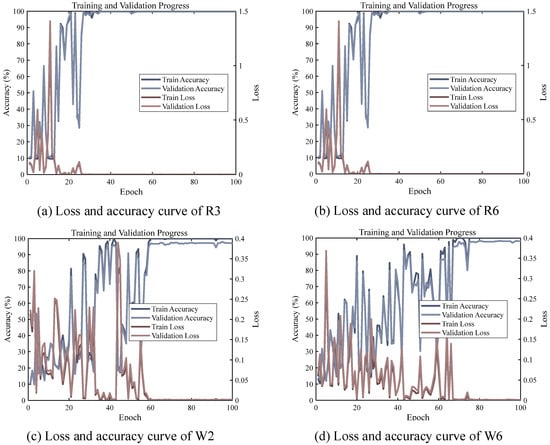
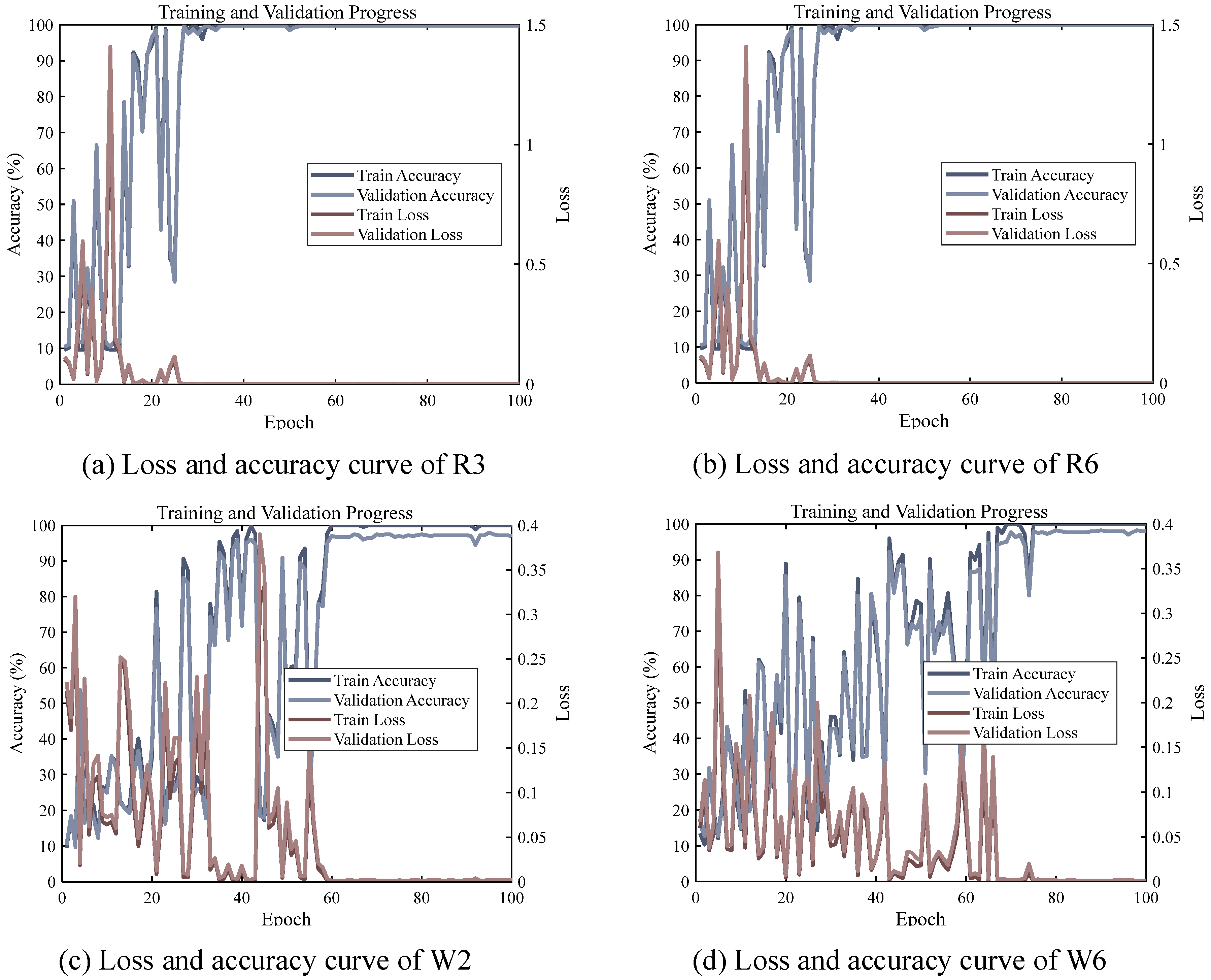
This set of experiments evaluated the proposed model’s training stability and convergence efficiency by randomly selecting two tasks—R6 (CWRU dataset) and W2 (SDUST dataset)—and analyzing their accuracy and loss curves. The results are presented in Figure 5.
Figure 5.
Accuracy and loss curves of Mscon-C in R6 and W2 tasks.
It can be seen from the trend of the loss curves in Figure 5 that Mscon-C shows efficient and stable convergence performance, converging at 35 and 60 rounds, respectively, and the training loss after convergence is stable, without obvious fluctuation or rebounds, indicating that it exhibits a moderate yet good fit to the training data, without overfitting to the noise. From the trend of accuracy curves, the model’s accuracy continued to rise steadily during training, indicating that Mscon-C can accurately identify various fault patterns in R6 and W2 tasks, and has excellent classification performance. These two tasks were randomly selected from the six experimental tasks as representative examples to illustrate the training process of the network. To further supplement the analysis, the training curves of additional tasks (R3 and W6) are also provided, and their convergence trends are similar to those of R6 and W2. This is mainly due to the collaborative design of multiscale parallel convolution and CBAM. The former can capture fault features of different dimensions. The latter focuses on the key fault features and suppresses irrelevant interference information through the attention mechanism.
4.3.2. Accuracy Analysis
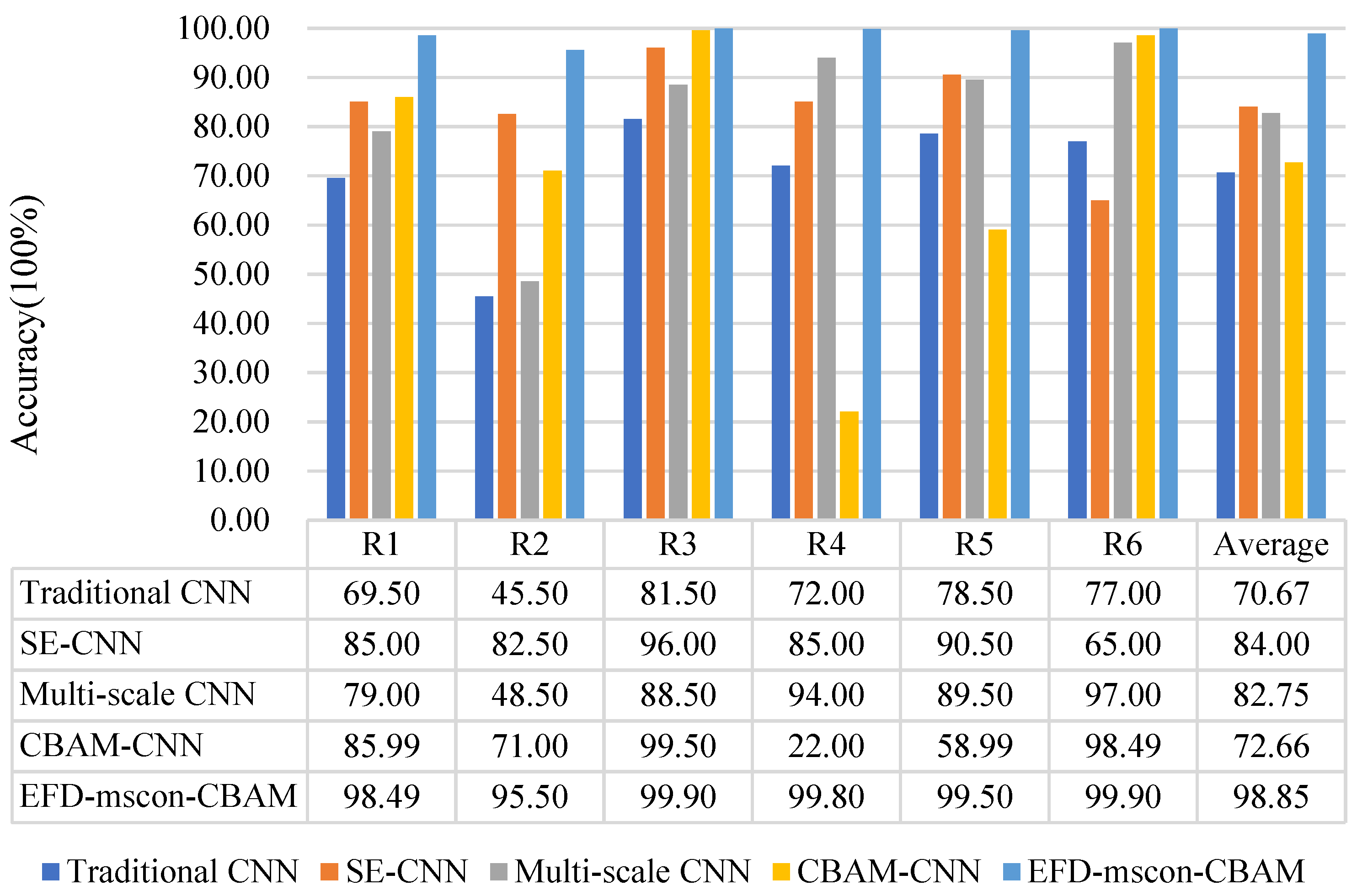
To compare model accuracy, experiments were first performed on the six tasks of the CWRU dataset. Results are presented in Figure 6.
Figure 6.
Accuracies of different models on the CWRU dataset.
As can be seen from Figure 6, Mscon-C has shown excellent performance in all tasks, comprehensively surpassing all comparison models. The performance of traditional CNN is the worst, whose accuracy on R2 task is only 45.5%, indicating that the basic CNN has limited ability to recognize some fault types. The performance of SE-CNN was significantly improved after the introduction of the attention mechanism, but Performance on the R6 task exhibited clear deficiencies, reflecting the instability of the SE attention mechanism’s effectiveness. The performance of the multiscale CNN fluctuated greatly, and the performance of the R2 task was poor (48.50%), but the performance of the R6 task was excellent (97.00%), indicating that multiscale feature extraction is only effective for certain types of faults. The performance of CBAM-CNN is extremely unstable: R3 and R6 tasks performed well, but the accuracy of the R4 task plummeted to 22.00%, and the R5 task was only 58.99%, indicating that pure CBAM attention may lead to model overfitting or feature selection failure in some cases. Mscon-C has an accuracy of more than 95.50% in all tasks. It has no abnormal fluctuations in performance, which solves the instability problem of CBAM-CNN. It has been proven that the effective fusion of multiscale convolution and CBAM can adapt to a variety of fault features.
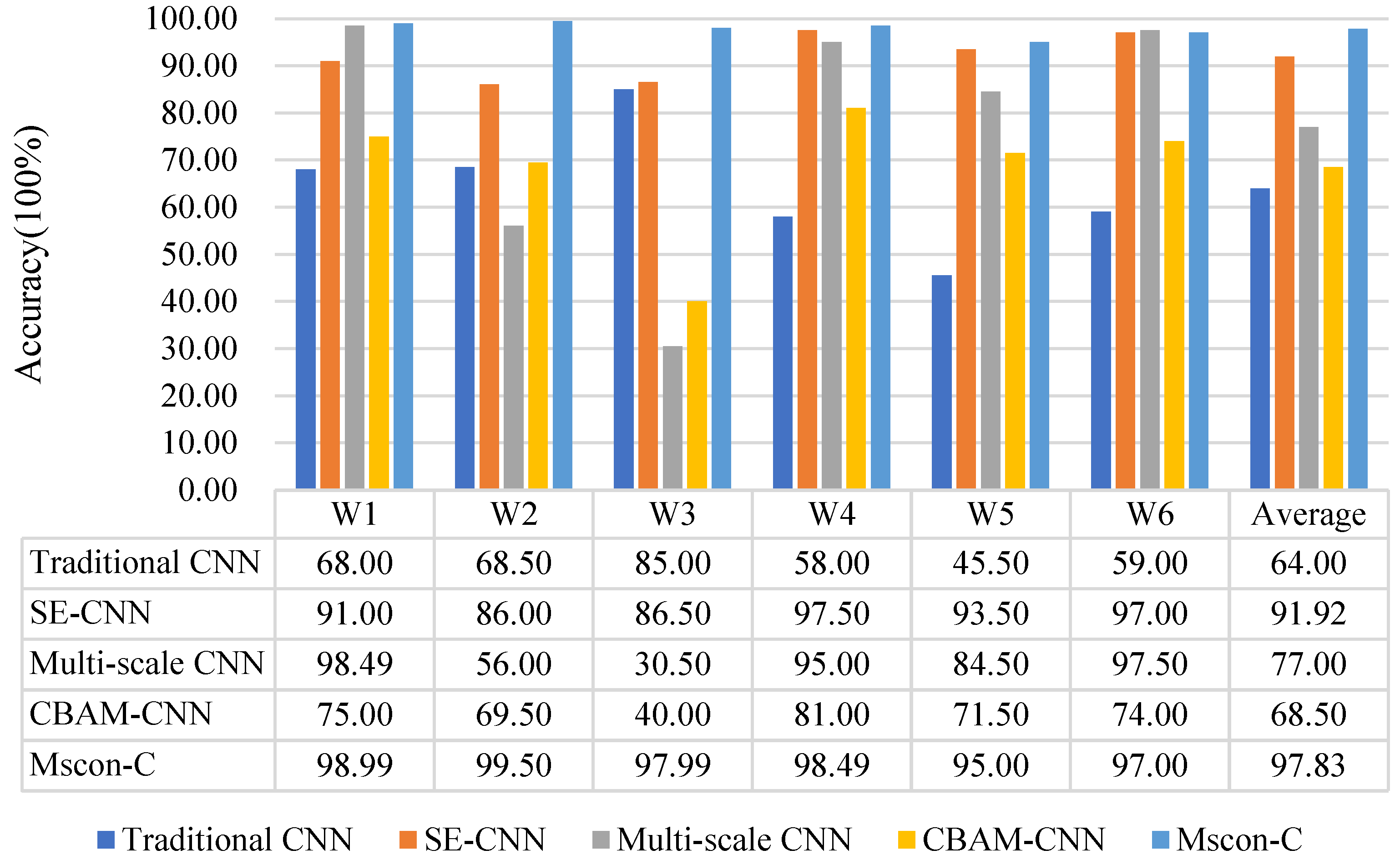
Secondly, evaluations were performed across the six tasks of the SDUST dataset, with the outcomes illustrated in Figure 7.
Figure 7.
Accuracies of different models on the SDUST dataset.
It can be seen from Figure 7 that Mscon-C has also verified its excellent performance on the SDUST dataset. All tasks have maintained high and stable performance, and the minimum accuracy is 95.00%. Specifically, the traditional CNN has the worst performance and obvious fluctuations, indicating that the basic CNN has poor adaptability to high-speed conditions. The performance of SE-CNN is significantly improved and relatively stable, indicating that the SE attention mechanism has good robustness under different working conditions. The performance of the multiscale CNN is extremely unstable. It performs well in W1, W4, and W6, but not in W3 and W2. The performance of CBAM-CNN is mediocre and unstable, and it also performs poorly in W3, indicating that the performance of pure CBAM attention is limited in complex conditions. In addition, although the CBAM-CNN achieves relatively higher accuracy in W5 compared with some other tasks, its performance still shows noticeable fluctuations across different tasks, which further reflects that the use of the CBAM attention mechanism alone cannot ensure stable diagnostic performance under varying operating conditions.
4.3.3. Confusion Matrix Analysis
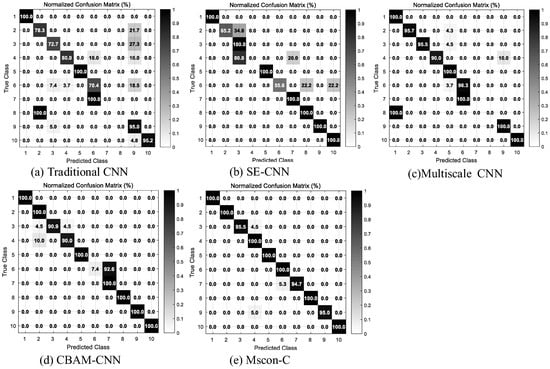
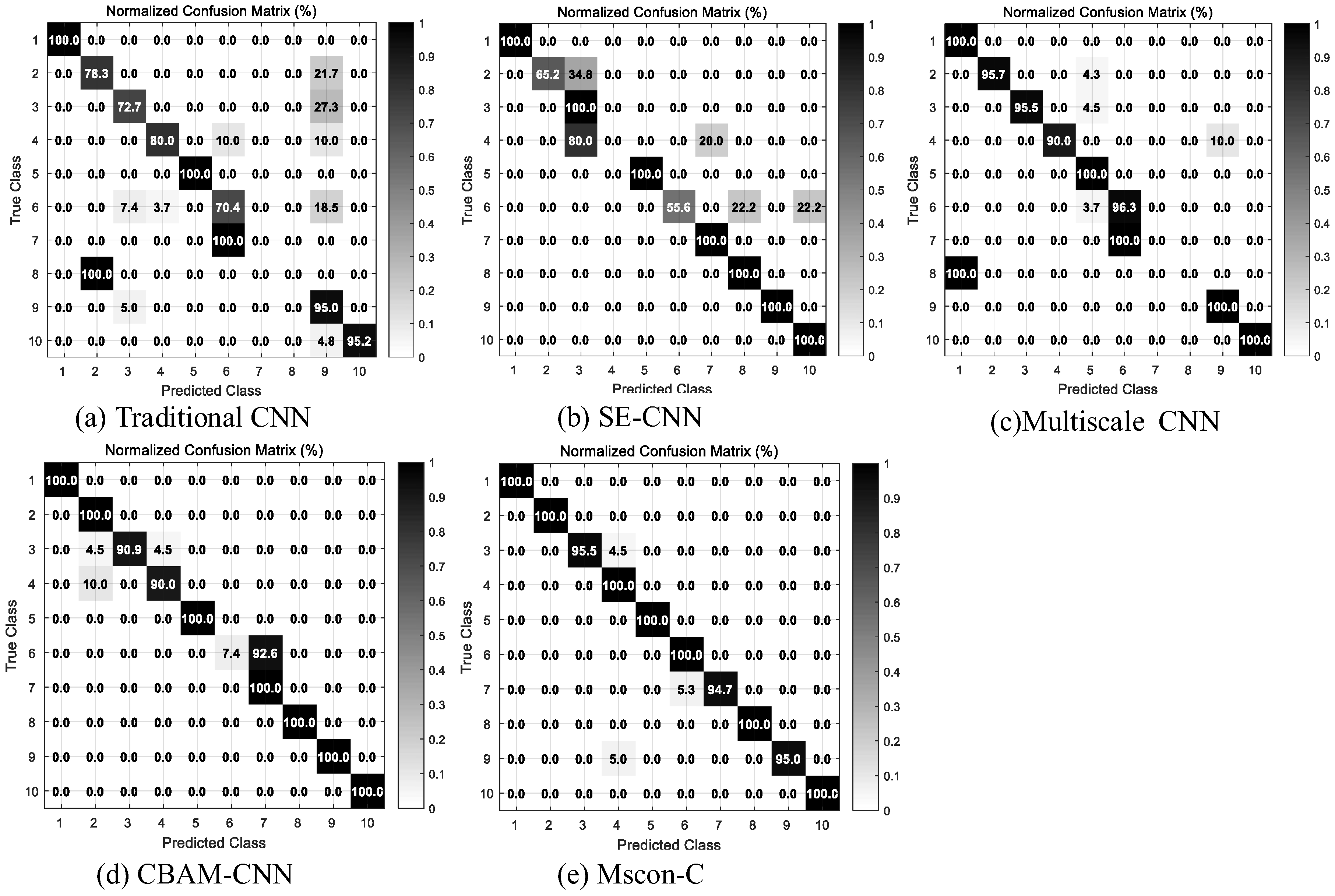
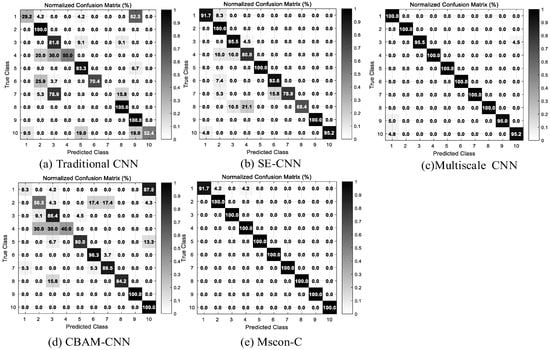
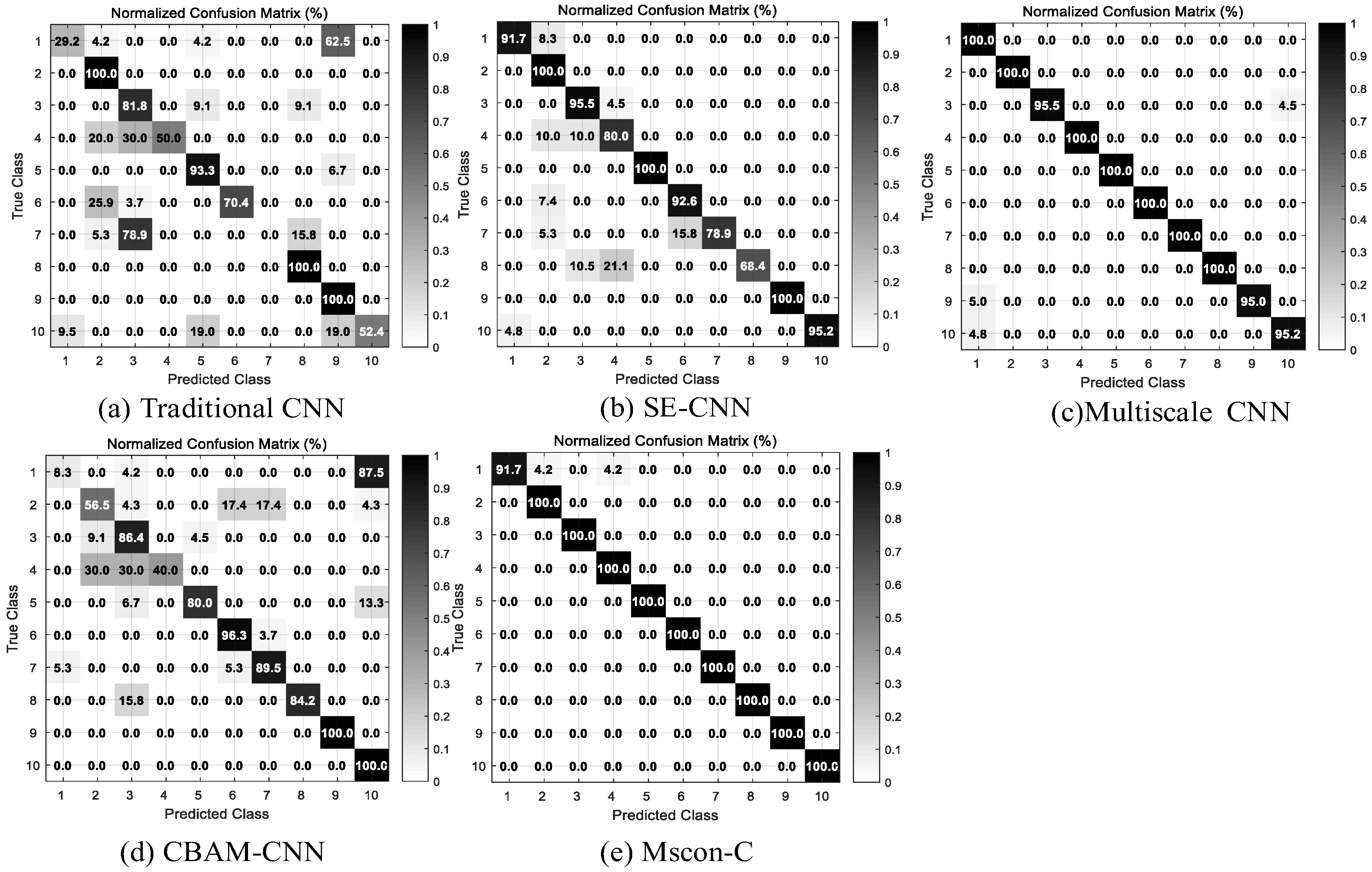
In order to further reveal the classification performance in different categories, Figure 8 and Figure 9 show the confusion matrix of the five comparative models on the randomly selected R1 and W1 tasks.
Figure 8.
Confusion matrix on R1 task.
Figure 9.
Confusion matrix on W1 task.
There are obvious bright spots in the off-diagonal area of the confusion matrix of traditional CNN and SE-CNN, shown in Figure 8a,b. There are many cross-misclassifications between the two types of fault categories with similar characteristics, indicating that their ability to distinguish fault features is limited, and they are vulnerable to the interference of similar fault modes. From Figure 8c,d, we can see that the brightness of the diagonal has increased, but there are still obvious misclassifications, indicating that the accuracy of fault categories with low proportion or insignificant characteristics is insufficient. In Figure 8e, the brightness of diagonal elements is uniform and significantly higher than that of other models, indicating that the accuracy of Mscon-C for all fault categories is at a high level, and reflecting the advantages of Mscon-C in strong consistency and high stability of classification results.
From Figure 9a–d, it can be seen that the classification performances of the first four models are further challenged: the scope of error classification area of these models is expanded, some methods have cross confusion between three or more fault categories, and the number and brightness of off-diagonal bright spots are higher than those in the R1 task. CBAM-CNN, as a scheme with better performance, still has obvious category confusion in the W1 task, indicating that its feature extraction ability is difficult to adapt to all the fault patterns, and its adaptability to the differences in data distribution is insufficient. In Figure 9e, the diagonal element brightness remains high, and the diagonal brightness corresponding to each fault category is evenly distributed, indicating that Mscon-C can capture the critical fault features through the optimized feature extraction mechanism and has stable diagnosis ability for various faults.
4.3.4. Feature Visualization
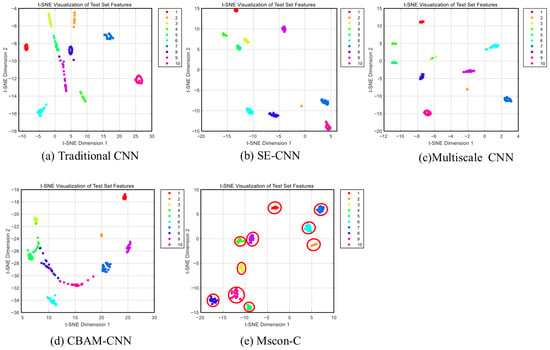
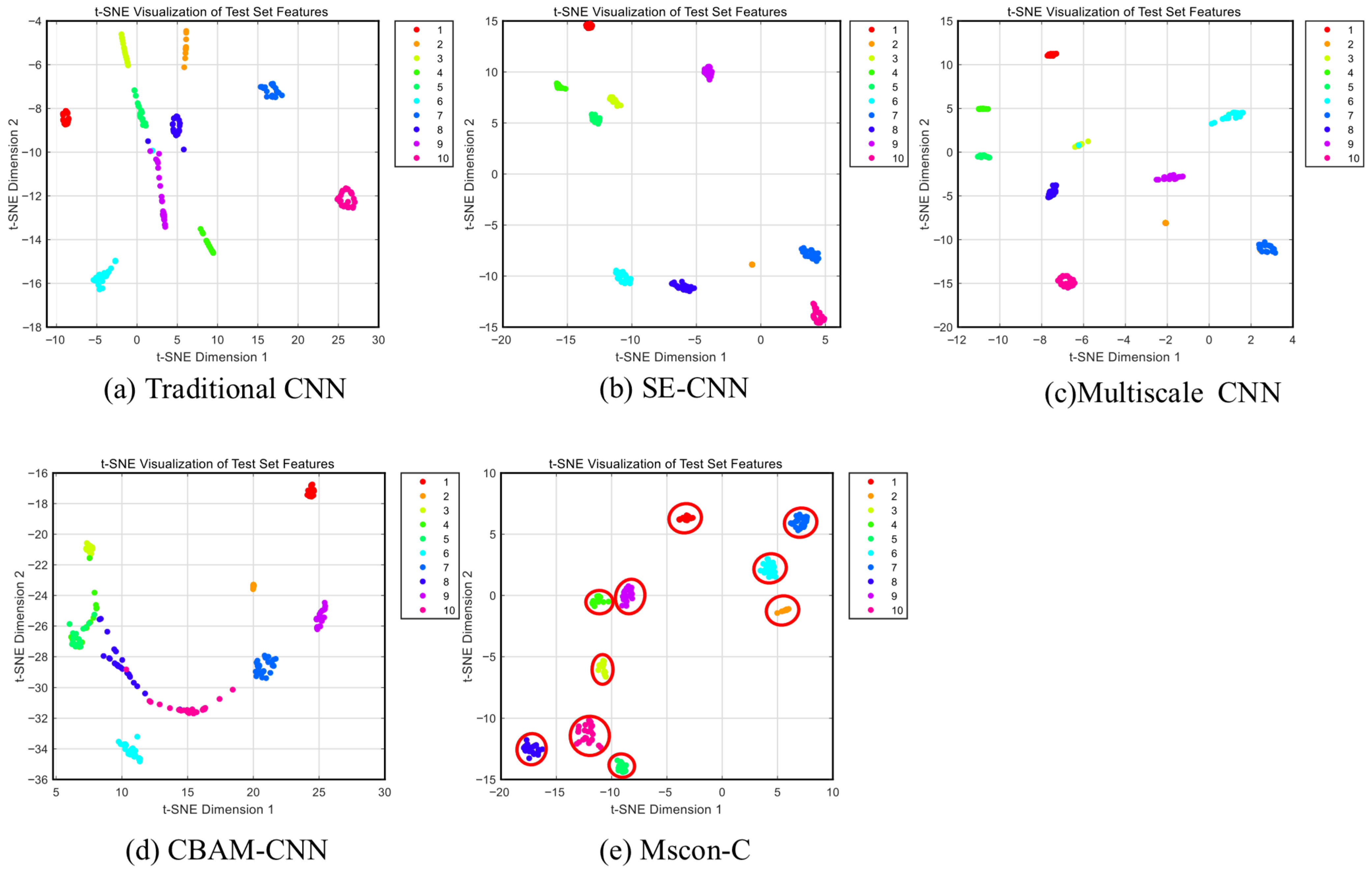
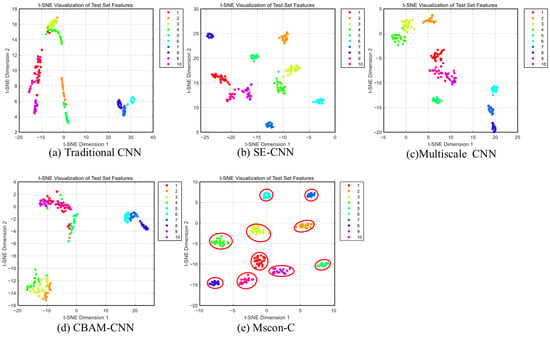
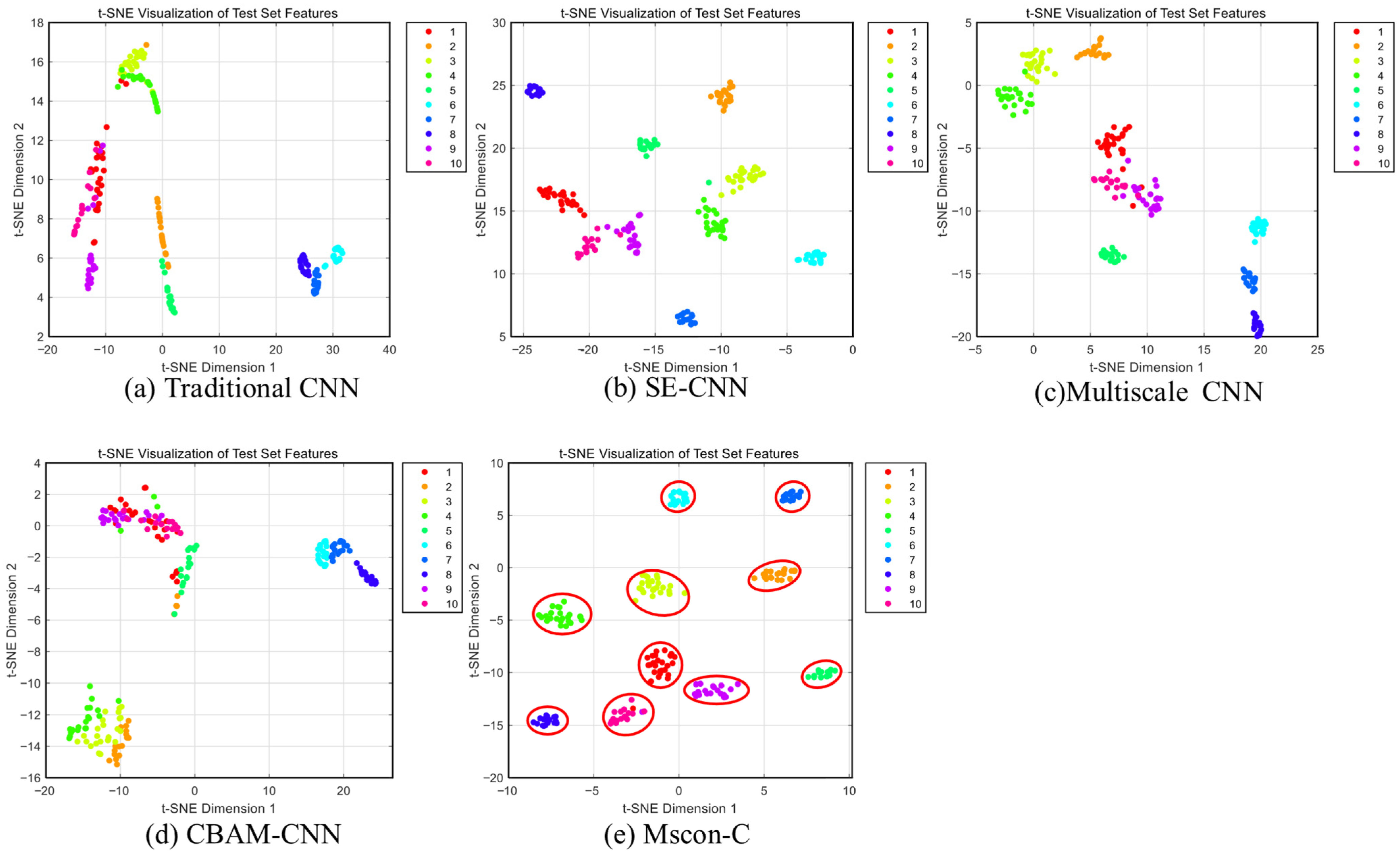
In this group of experiments, the CWRU-R5 task and SDUST-W6 task are randomly selected, and t-SNE is used for visual analysis, which are shown in Figure 10 and Figure 11, respectively. It is worth noting that in Figure 10e and Figure 11e, we have added a red circle to highlight the feature extraction capability of the Mscon-C model.
Figure 10.
t-SNE of 5 models on CWRU-R5 Task.
Figure 11.
t-SNE of 5 models on SDUST-W6 Task.
From Figure 10, we can see that the distribution of feature points of traditional CNN and CBAM-CNN shows obvious cross-overlap between classes, indicating that these two models cannot effectively separate the features of different fault categories, and the extracted features have strong redundancy and confusion. The orange feature points identified by SE-CNN and multiscale CNN are only sparsely distributed in the target region, indicating that these two models insufficiently capture the critical features of such faults. In Mscon-C, the feature points corresponding to 10 types of faults show a highly concentrated aggregation state, the feature points of similar faults are closely clustered, and there are clear blank boundaries between the feature clusters of different colors, which shows that Mscon-C can effectively mine the unique characteristics of various types of faults.
As shown in Figure 11, in the SDUST dataset, the feature extraction defects of the first four comparative models are further highlighted: the feature points show extensive dispersion and serious overlapping between classes, and it is difficult to distinguish independent category regions. Although some traditional methods can form local feature aggregation, the aggregation area is too large, the boundary is fuzzy, and there are a large number of isolated abnormal feature points, which reflects the poor stability of feature extraction and is vulnerable to data fluctuations. Mscon-C still maintains excellent feature extraction performance in this task, which shows that its feature learning has strong stability.
5. Conclusions and Future Work
In response to issues such as the “incomprehensive capture of multiscale fault features and inadequate utilization of key information”, we propose a bearing fault diagnosis model (Mscon-C) combining multiscale parallel convolution and CBAM attention mechanism, and prove the success of the idea through extensive experiments. The main contribution of this work lies in the collaborative design of multiscale parallel convolution and the CBAM attention mechanism, which enables the model to simultaneously capture fine-grained local features and global structural features from time-frequency representations. From the experimental results, we can conclude that the multiscale parallel convolution framework can extract fine-grained and global fault features synchronously, and alleviate the problem of incomplete feature capture to a certain extent. Compared with traditional CNN-based models, the proposed framework improves feature representation by integrating multiscale receptive fields, which provides a more stable feature basis for subsequent attention-based feature enhancement. The CBAM attention mechanism effectively strengthens the key fault features in the time-frequency map through the two-dimensional weighting of channel and space, improves the anti-interference capability, and thereby significantly increases multi-category fault diagnosis accuracy. Experimental results on two bearing datasets further demonstrate that the proposed Mscon-C model achieves more stable and higher diagnostic accuracy than several comparative models, verifying the effectiveness of integrating multiscale feature extraction and attention-based feature enhancement.
In future work, more diversified modal features, such as sound signal features and current signal features, can be introduced. More effective attention mechanisms can then be applied to achieve weighted fusion of multi-modal features. Additionally, the graph convolution network can be introduced to further model the features to improve the performance of fault diagnosis. These directions may further improve the robustness, generalization ability, and practical applicability of the proposed framework in complex industrial environments.
Author Contributions
M.W.: Conceptualization, methodology, validation, data curation, and writing—original draft. C.C.: Formal analysis, study design, writing—review, and editing. M.C.: literature search, formatting. All authors have read and agreed to the published version of the manuscript.
Funding
This work was supported in part by the Natural Science Foundation of Shandong Province of China under grant ZR2025QC725.
Data Availability Statement
The data are available from the corresponding author upon reasonable request.
Conflicts of Interest
The authors declare no conflicts of interest.
References
- Wang, R.X.; Jiang, H.K.; Wu, Z.H.; Xu, J.; Zhang, J. A reinforcement transfer learning method based on a policy gradient for rolling bearing fault diagnosis. Meas. Sci. Technol. 2022, 33, 065020. [Google Scholar] [CrossRef] [Scilit]
- Puntambekar, R.; Vyas, P.; Thakkar, A.; Patel, D. A survey of machine learning and deep learning methods for vibration-based Bearing fault diagnosis: The need, challenges, and potential future research directions. Neurocomputing 2026, 659, 131628. [Google Scholar] [CrossRef] [Scilit]
- Wang, Y.F.; Zhang, W.F.; Lv, X.B.; Ren, J.; Zhao, Q.Q.; Xu, Z.F. A rolling bearing fault diagnosis method based on instantaneous Fourier transform and attention temporal convolutional neural network. J. Eng. Therm. Energy Power 2025, 40, 160–170. (In Chinese) [Google Scholar] [CrossRef]
- Zhao, Q.C.; Wang, J.X.; Xie, Z.J.; Li, D.D. Application of Envelope Gray Image and CNN in Rolling Bearing Fault Diagnosis. Machinery Design & Manufacture. Available online: https://link.cnki.net/urlid/21.1140.th.20251223.1247.014 (accessed on 18 March 2026).
- Han, T.; Tian, Z.X.; Yin, Z.J.; Tan, A. Bearing fault identification based on convolutional neural network by different input modes. J. Braz. Soc. Mech. Sci. Eng. 2020, 42, 474. [Google Scholar] [CrossRef] [Scilit]
- Qi, A.L.; Li, L.; Zhu, Y.X.; Zhang, G.M. Dual channel CNN bearing fault identification based on fusion feature. Mach. Electron. 2021, 39, 15–19. [Google Scholar] [CrossRef] [Scilit]
- Zhao, Z.; Li, T.; Wu, J. Deep learning algorithms for rotating machinery intelligent diagnosis: An open-source benchmark study. ISA Trans. 2020, 107, 224–255. [Google Scholar] [CrossRef] [Scilit]
- Zhang, Q.; Ju, Z. Rolling bearing fault diagnosis based on 2DCNN and hybrid kernel fuzzy SVM. Adv. Theory Simul. 2025, 8, 202400793. [Google Scholar] [CrossRef] [Scilit]
- Jia, Z.; Xu, Z.; Leng, Y.; Wen, X.; Gong, H. Lightweight fault diagnosis model based on parallel optimized CBAM. J. Appl. Sci.-Electron. Inf. Eng. 2025, 43, 94–109. (In Chinese) [Google Scholar] [CrossRef]
- Joseph, T.; Sudeep, U.; Keerthi, K.K. Deep learning-based fault diagnosis of rolling bearing using spectrogram and CWT images of vibration data. In Proceedings of the 2024 11th International Conference on Advances in Computing and Communications (ICACC); IEEE: New York, NY, USA, 2024; pp. 1–5. [Google Scholar] [CrossRef] [Scilit]
- Zheng, X.; Hu, Q.; Li, C.; Zhao, S. An enhanced dual-channel-omni-scale 1DCNN for fault diagnosis. In Pattern Recognition and Computer Vision (PRCV); Springer: Singapore, 2024; Volume 15031, pp. 152–166. [Google Scholar] [CrossRef] [Scilit]
- Shao, S.; Yan, R.; Lu, Y. DCNN-based multi-signal induction motor fault diagnosis. IEEE Trans. Instrum. Meas. 2020, 69, 2658–2669. [Google Scholar] [CrossRef] [Scilit]
- Zhang, L.; Zhang, C.; Xiao, Y. When Lightweight Block Meet Attention: A Lightweight Deep CNN for Fault Diagnosis in Beam Pumping Units. In Proceedings of the 2025 10th International Conference on Intelligent Computing and Signal Processing (ICSP); IEEE: New York, NY, USA, 2025. [Google Scholar] [CrossRef] [Scilit]
- Cong, F.; Bo, Q.; Fan, Y.; Zhou, Q.; Zhao, W.; Zhou, Y. A Novel Multiscale Petal Pattern and CNN-BiLSTM Structure for Acoustic Signal-Based Rolling Bearing Fault Diagnosis. J. Vib. Acoust. 2026, 148, 011009. [Google Scholar] [CrossRef] [Scilit]
- Chen, X.; Zhang, Y.; Su, Y. A short time series rolling bearing fault diagnosis method based on FMTF-CNN. Eng. Res. Express 2024, 6, 025346. [Google Scholar] [CrossRef] [Scilit]
- Liu, R.; Wang, F.; Yang, B. Multiscale kernel based residual convolutional neural network for motor fault diagnosis under nonstationary conditions. IEEE Trans. Ind. Inform. 2020, 16, 3797–3806. [Google Scholar] [CrossRef] [Scilit]
- Chen, Q.; Zhang, F.; Wang, Y. Bearing fault diagnosis based on efficient cross space multiscale CNN transformer parallelism. Sci. Rep. 2025, 15, 12344. [Google Scholar] [CrossRef] [Scilit] [PubMed]
- Si, X.; Yan, H.; Hu, Y.; Duan, J.; Shi, T. Bearing fault diagnosis under heavy noise: A multi-scale dilated convolution and dense temporal convolutional network. Neurocomputing 2025, 652, 131092. [Google Scholar] [CrossRef] [Scilit]
- Tang, Y.; Zhang, C.; Zhang, D.; Wu, J.; Xue, J. Bearing fault identification based on credible multi-scale quadratic attention convolutional neural network. Comput. Integr. Manuf. Syst. 2025, 31, 3021–3022. (In Chinese) [Google Scholar] [CrossRef]
- Wang, H.; Liu, Z.; Peng, D. Understanding and learning discriminant features based on multi-attention 1DCNN for wheelset bearing fault diagnosis. IEEE Trans. Ind. Inform. 2020, 16, 5735–5745. [Google Scholar] [CrossRef] [Scilit]
- Wang, H.; Liu, Z.L.; Peng, D. Attention-guided joint learning CNN with noise robustness for bearing fault diagnosis and vibration signal denoising. ISA Trans. 2022, 128, 470–484. [Google Scholar] [CrossRef] [Scilit]
- Cui, J.; Gao, J.; Xing, R.; Wu, W.; Li, M.; Yang, Y. Fault diagnosis method for rolling bearing based on attention mechanism and BiTCN model. Digit. Signal Process. 2025, 167, 105454. [Google Scholar] [CrossRef] [Scilit]
- Woo, S.; Park, J.; Lee, J.Y. CBAM: Convolutional block attention module. In Computer Vision—ECCV 2018; Springer: Cham, Switzerland, 2018; pp. 3–19. [Google Scholar] [CrossRef] [Scilit]
- Su, H.F.; Wang, X.; Han, T. Research on a U-net bridge crack identification and feature-calculation methods based on a CBAM attention mechanism. Buildings 2022, 12, 1561. [Google Scholar] [CrossRef] [Scilit]
- Chen, L.J.; Yao, H.D.; Fu, J.Y. The classification and localization of crack using lightweight convolutional neural network with CBAM. Eng. Struct. 2023, 275, 115291. [Google Scholar] [CrossRef] [Scilit]
- Huang, C.S.; Zhang, J.P. Rolling bearing fault diagnosis method based on CBAM-CNN. Modem Manuf. Eng. 2022, 506, 137–143. (In Chinese) [Google Scholar] [CrossRef]
- Jia, Z.; Yu, H.; Qiao, L.; Wang, G.; Cui, Y.; Xu, Z.; Yang, Y.; Zhang, F. Intelligent fault diagnosis based on dual-graph transformation and P2D-Sk-ResNet-XGBoost. Processes 2025, 13, 3342. [Google Scholar] [CrossRef] [Scilit]
- Han, B.K.; Jiang, X.W.; Wang, J.R. A novel domain adaptive fault diagnosis method for bearings based on unbalance data generation. IEEE Trans. Instrum. Meas. 2023, 72, 3519911. [Google Scholar] [CrossRef] [Scilit]
- Wang, J.R.; Zhang, X.P.; Zhang, Z.Z. Attention guided multi-wavelet adversarial network for cross domain fault diagnosis. Knowl.-Based Syst. 2024, 284, 111285. [Google Scholar] [CrossRef] [Scilit]
- Zhang, X.; Wang, J.R.; Zhang, Z.Z. Integrated decision-making with adaptive feature weighting adversarial network for multi-target domain compound fault diagnosis of machinery. Adv. Eng. Inform. 2024, 62, 102730. [Google Scholar] [CrossRef] [Scilit]



Disclaimer/Publisher’s Note: The statements, opinions and data contained in all publications are solely those of the individual author(s) and contributor(s) and not of MDPI and/or the editor(s). MDPI and/or the editor(s) disclaim responsibility for any injury to people or property resulting from any ideas, methods, instructions or products referred to in the content. |
© 2026 by the authors. Licensee MDPI, Basel, Switzerland. This article is an open access article distributed under the terms and conditions of the Creative Commons Attribution (CC BY) license.