


Abstract
The integration of Artificial Intelligence (AI) into Internet of Things (IoT) medical devices has revolutionized arrhythmia monitoring. However, the high computational and power demands of traditional Deep Learning (DL) models pose significant challenges for long-term, battery-operated smart electronics. Spiking Neural Networks (SNNs), inspired by the biological efficiency of the human brain, offer a promising solution. This paper reviews the intersection of SNNs, low-power IoT hardware, and biomedical signal processing. I examine the transition from frame-based to event-driven processing, and discuss the hardware–software co-design necessary for next-generation cardiac wearables.
1. Introduction: The Convergence of Clinical Diagnostics and Neuromorphic IoT
Cardiovascular diseases (CVDs) remain the leading cause of global mortality, accounting for approximately 17.9 million deaths annually [1,2]. A critical subset of these conditions is cardiac arrhythmia—a group of conditions where the heartbeat is irregular, too fast (tachycardia), or too slow (bradycardia) [3]. Detecting these anomalies, particularly Atrial Fibrillation (AFib), is vital as they are often paroxysmal (intermittent) and can remain asymptomatic until a catastrophic event, such as a stroke or sudden cardiac arrest, occurs. The fundamental challenge in modern cardiology is the transition from reactive, hospital-based “snapshot” diagnostics to proactive, continuous, “always-on” monitoring through wearable smart electronics [4,5].
1.1. The Diverse Approaches to Measuring Arrhythmia
In clinical practice, arrhythmia measurement and anomaly detection rely on a spectrum of imaging and sensing modalities. Understanding these is crucial for defining the scope of IoT-based solutions:
- Electrocardiogram (ECG) [6]: The gold standard for electrical activity. It captures bio-potential changes through electrodes, providing the detailed “P-QRS-T” morphology required to diagnose specific conduction blocks like Left Bundle Branch Block (LBBB) or Right Bundle Branch Block (RBBB).
- Photoplethysmography (PPG) [7]: Natively found in smartwatches, PPG uses optical sensors to measure blood volume changes. Recent studies indicate that while PPG is very sensitive for heart rate variability (HRV) [8], it does not match the electrical precision of ECG for complex morphological analysis.
- Positron Emission Tomography (PET) and Computed Tomography (CT) [9]: Scans provide high-resolution metabolic and structural insights, identifying myocardial scarring or structural remodeling that serve as substrates for arrhythmias. While indispensable for surgical planning and episodic diagnosis, they involve radiation and stationary equipment, serving a fundamentally different clinical role than longitudinal wearable monitoring.
- Echocardiography and Magnetic Resonance Imaging (MRI) [10,11]: These modalities offer real-time visualization of mechanical heart function and tissue characterization, but are restricted to clinical environments due to size and cost.
1.2. The Energy Crisis and the Shift to Neuromorphic Computing
The primary hurdle in transitioning these diagnostics to the Internet of Things (IoT) is the “Energy Crisis”. Standard Deep Learning (DL) models—Convolutional Neural Networks (CNNs) and Recurrent Neural Networks (RNNs)—are frame-based and computationally intensive [12]. In a wearable “always-on” monitor, a CNN processes every sample of the ECG, even during the “isoelectric” quiet periods of the cardiac cycle. This leads to excessive power drain, limiting the battery life of smart electronics to mere days. Neuromorphic computing, specifically through Spiking Neural Networks (SNNs)-the “third generation” of neural networks [13], offers a paradigm shift from the Von Neumann architecture [14]. SNNs mimic the biological efficiency of the human brain by processing information as discrete, asynchronous “spikes” [15]. By leveraging temporal sparsity, an SNN remains idle when the heart is quiet, consuming only dynamic power when a clinical “event” (such as an R-peak) occurs. Under specific benchmarking conditions, neuromorphic processors such as Intel’s Loihi 2 and specialized Application-Specific Integrated Circuits (ASICs) have demonstrated energy efficiencies as low as 0.3 µJ per classification [16]. While such figures suggest a potential reduction in energy consumption compared to certain traditional microcontrollers, these gains are highly contingent on the neural network architecture, data sparsity, and the specific hardware–software co-optimization used in the study. A comparative summary of traditional DL and SNNs is detailed in Table 1. Building upon this comparison, the subsequent section explores the integration of spectral methods as a strategic pathway to enhance SNN performance within the neuromorphic paradigm.
Table 1.
Comparative Analysis: Traditional DL vs. SNN in Biomedicine.
1.3. Integrating Spectral Methods with Neuromorphic Computing
The efficiency of neuromorphic systems is fundamentally predicated on temporal sparsity, where signals characterized by distinct, pulse-like ‘events’ offer the most seamless integration with SNNs. To bridge the gap between noisy raw data and clinical accuracy, SNNs [17,18,19] are increasingly integrated with Spectral Methods [20], as standard filtering often struggles with electromyography (EMG) muscle artifacts and baseline wander [21,22]. By employing Fast Fourier Transform (FFT) or Discrete Wavelet Transform (DWT), the system decomposes the ECG into frequency-domain components that are subsequently converted into spike trains using strategies such as delta modulation.
This ‘spectral-to-spike’ conversion enables the network to isolate the high-frequency components characteristic of QRS complexes while effectively filtering out low-frequency noise. Advanced architectures, such as Spikformers, leverage these spectral signatures [23] to maintain near-98% accuracy—matching the performance of power-hungry CNNs while retaining the benefits of spike-based efficiency. This relationship between signal morphology and hardware fit is best illustrated by comparing modalities: ECG signals exhibit high neuromorphic potential due to their sharp peaks (P, QRS, and T waves), whereas PPG signals present a more moderate fit due to their smooth, sinusoidal nature, which complicates sparse encoding.
Using the SNN/Spectral approach addresses these limitations by functioning as a native Core Architecture that leverages the event-driven nature of spectral shifts to achieve ultra-low power consumption. A comparison of different arrhythmia detection modalities is presented in Table 2, alongside the proposed SNN/spectral approach that serves as the focus of this study.
Table 2.
Comparison of Cardiac Monitoring Technologies.
1.4. Building the Framework: Low-Energy Neuromorphic IoT Delivery
Drawing upon the evolving landscape of neuromorphic research, this literature review suggests following a conceptual architectural framework designed to advance autonomous, low-energy cardiac health monitoring. To establish a rigorous methodological grounding, my analysis is predicated on a hardware–software co-design perspective that emphasizes the essential combination between biologically inspired algorithms and specialized neuromorphic electronics. By integrating these developments, this work seeks to offer a clearer articulation of the technical requirements necessary to achieve reliable long-term monitoring trends in wearable edge devices. To this end, the recent advancements in the field are organized and evaluated through four primary thematic pillars:
- Multimodal Sensing and Data Fusion: As a primary potential solution to the limitations of unimodal monitoring, the framework integrates both electrical (ECG) and mechanical (PPG) sensors. This multimodal approach facilitates the high-fidelity capture of cardiac conduction and vascular dynamics, enabling advanced diagnostics such as sub-millisecond Pulse Transit Time (PTT) estimation for continuous, cuffless blood pressure monitoring.
- Neuromorphic Edge Intelligence: The implementation of on-device SNNs ensures real-time, event-driven classification within sub-milliwatt power envelopes. By leveraging asynchronous logic design and neuromorphic ASICs, such as Intel’s Loihi, the system exploits the inherent temporal sparsity of physiological signals, potentially reducing active power consumption compared to traditional frame-based models.
- Adaptive Personalization via Local Plasticity: To mitigate the high false-alarm rates stemming from inter-patient variability, Online Spike-Timing-Dependent Plasticity (STDP) could be utilized. This mechanism allows the wearable device to function as a “living model,” adapting its synaptic weights locally to a patient’s unique “normal” baseline without requiring energy-intensive cloud-based retraining.
- Decentralized Privacy and Global Learning: Federated Learning protocols could be the framework employed to reconcile the need for global model updates with the necessity of data security. By transmitting only learned synaptic weights or classification results rather than raw, sensitive physiological data, the system preserves patient privacy while further extending battery life through reduced transmission overhead.
By integrating these specialized components, we move toward a paradigm where “smart electronics” transcend their role as mere sensors to become autonomous, intelligent guardians of long-term cardiac health, potentially shifting the paradigm from reactive diagnostics toward continuous monitoring, pending the resolution of several technical and regulatory hurdles.
1.5. Scope and Evidence Taxonomy
To ensure a rigorous distinction between clinical standards and research frontiers, this review categorizes the discussed frameworks into a three-tier taxonomy:
- Established Frameworks: Industry-standard low-power microcontrollers (e.g., ARM Cortex-M) and frame-based deep learning (CNNs/RNNs) with existing clinical validation and regulatory clearance.
- Emerging Frameworks: SNN implementations on specialized neuromorphic research platforms (e.g., Intel Loihi 2) and hardware-accelerated spectral feature extraction. While these offer versatility for discovery, they are currently in the research validation phase.
- Speculative/Proposed Synthesis: This tier represents the author’s perspective on future research directions. It includes the transition from general-purpose many-core platforms toward custom ASICs and optimized FPGA (Field-Programmable Gate Array) implementations designed for extreme power efficiency in wearables, alongside advanced theoretical integrations like decentralized federated neuromorphic learning and on-chip local plasticity for real-time personalization.
1.6. Review Methodology and Scope
To ensure a rigorous and contemporary synthesis of the neuromorphic landscape, this review employs a structured selection methodology focused on up-to-date advancements across our four defined conceptual pillars. I consulted primary digital libraries—including IEEE Xplore, ACM Digital Library, and PubMed—focusing on the five-year period from 2021 to 2025. This timeframe was specifically selected to capture the maturation of high-fidelity neuromorphic platforms like Loihi 2 and the emergence of sub-microwatt SNN ASICs, which are central to the realization of my proposed framework.
The following section explores the transition from Von Neumann architecture to brain-inspired neuromorphic systems designed to overcome the energy bottlenecks of traditional architectures. It highlights how specialized hardware and co-design strategies are essential for the next generation of efficient, real-time computational tasks.
2. The Hardware Ecosystem: From Von Neumann Architecture to Neuromorphic Computing
The implementation of intelligent arrhythmia detection in wearable electronics is fundamentally limited by the “memory wall” and the energy demands of traditional computing. As discussed in Section 1, while imaging technologies such as CT and PET scans offer valuable structural insights, the IoT ecosystem requires continuous and low-power processing of electrical signals (ECG) and hemodynamic signals (PPG) [19]. This necessity calls for a shift in hardware design from synchronous, frame-based processing to asynchronous, event-driven architectures [24].
2.1. The Role of Standard IoT Platforms in Addressing the Energy Crisis
Current wearable devices primarily utilize low-power Microcontroller Units (MCUs) based on ARM Cortex-M [25] or RISC-V architectures [26]. While these chips are becoming increasingly “AI-ready” with the introduction of vectorized instructions like ARM Helium technology, they are still constrained by the Von Neumann bottleneck [27]. This bottleneck refers to the continuous and energy-intensive transfer of data between memory and the processor.
Additionally, the Frame-Based Limitation inherent in standard MCUs forces the processing of signals in fixed temporal windows (known as frames), regardless of signal activity. This requires the processor to remain in a high-power ‘Active’ state even during the isoelectric phases of the cardiac cycle, where no significant data is present. Consequently, the average power consumption of traditional Nyquist-based systems often exceeds the 1–2 mW budget required to sustain multi-week battery life on standard wearable energy cells [28,29,30].
2.2. Neuromorphic Chips and Spiking Neural Networks (SNNs)
The emergence of neuromorphic hardware signifies a fundamental architectural pivot toward “compute-in-memory” (CiM) paradigms and asynchronous logic [31], effectively mitigating the energy-intensive data movement overhead known as the von Neumann bottleneck. These specialized platforms are tailored to facilitate the execution of SNNs, which are a bio-mimetic computational model in which information is conveyed through discrete, all-or-nothing binary events rather than continuous analog values. By leveraging temporal sparsity and event-driven processing, these chips ensure that energy dissipation is strictly confined to instances when a neuron’s internal membrane potential surpasses a critical threshold, thereby triggering a sparse “spike” [32,33]. Unlike conventional accelerators such as Graphics Processing Units (GPUs) or Tensor Processing Units (TPUs), which are optimized for dense matrix operations, neuromorphic architectures are uniquely engineered to exploit the inherent recurrence and temporal dynamics of SNNs for superior energy efficiency in edge and IoT applications. Here are examples of research on brain-inspired processors, and a summary of these neuromorphic processors is provided in Table 3:
Table 3.
Summary of Neuromorphic Processors and their Core Features.
- Intel Loihi 2 [34]: Built using the Intel 4 process, Loihi 2 features a fully programmable neuron model. This enhancement allows for the integration of Adaptive Exponential (AdEx) neurons, which can more accurately replicate the complex refractory periods of the heart compared to traditional Leaky Integrate-and-Fire (LIF) neurons.
- SynSense DYNAP-SE [24]: This sub-threshold analog/digital chip excels in real-time signal processing. It is particularly effective for implementing Spectral-to-Spike conversion, where the frequency-domain components of a signal are directly mapped to specific neural populations on the chip.
- BrainChip Akida [35]: A digital neuromorphic system-on-chip (SoC) enables “One-Shot” learning, which is crucial for the personalized medicine trends. This allows the device to adapt to a specific patient’s arrhythmia signature without requiring cloud intervention.
2.3. Hardware–Software Co-Design for Spectral Methods
To extract discriminative features in cardiac electrophysiology, multifaceted time-frequency analytical frameworks—including the Short-Time Fourier Transform (STFT) [36], Discrete Wavelet Transform (DWT) [37], Complex Shearlet Transform [38,39], and broader Wavelet Transform (WT) architectures—have become essential. These methodologies transform cardiac signals into a joint time-frequency representation, enabling simultaneous capture of transient temporal anomalies and spectral signatures essential for effective classification of arrhythmic events. Unlike STFT, the wavelet transforms facilitate a comprehensive statistical appraisal of physiological frequency bands, illuminating signal morphology across multiple resolutions [40]. This multiresolution capacity is well-suited to the nonstationary nature of cardiac oscillations, with empirical evidence indicating that classification algorithms achieve superior performance when operating on wavelet-derived feature sets [19,25,41,42,43].
Conversely, while the Fast Fourier Transform (FFT) provides high computational throughput for spectral decomposition [44], its utility is constrained by a lack of temporal localization and the flawed assumption of signal stationarity [40], often rendering it less effective for capturing paroxysmal cardiac disturbances. The DWT overcomes these limitations by using efficient subband coding, thereby reducing computational overhead and resource usage. Within this framework, a digital analysis filter bank decomposes the signal into distinct bands: a low-pass filter to preserve coarse structural data and a high-pass filter to isolate defining morphological characteristics [45]. Furthermore, the application of band-pass filtering serves to normalize the data and suppress environmental noise [42]. Although these detailed frequency features greatly enhance a classifier’s capability to differentiate between complex waveforms, the effectiveness of the preprocessing stage heavily relies on the accurate calibration of frequency bands to the specific characteristics of the clinical dataset.
A paradigm-shifting advancement during recent years is the emergence of specialized, hardware-level front-end accelerators for spectral methods like FFT and DWT, integrated directly alongside neuromorphic cores [25,42]. By embedding a low-power DWT block on-chip, contemporary systems can achieve real-time sub-band decomposition prior to spike encoding, ensuring that the architecture remains event-driven and energy-efficient [25]. This structural integration facilitates a “selective triggering” mechanism, wherein only clinically significant high-frequency events—such as the QRS complex—activate resource-intensive neural processing layers [41,46]. Concurrently, low-frequency artifacts and baseline wander are attenuated at the hardware level, drastically reducing the data footprint and power requirements for next-generation wearable and implantable cardiac monitors [25]. To ensure coherence, I review recent advancements in neuromorphic techniques for arrhythmia detection as stated below.
Rana et al. [41] present an electrocardiography classification framework that utilizes LIF neurons within an artificial neural network-inspired spiking structure. The methodology intentionally avoids heavy spectral or wavelet transforms during the preprocessing stage to maintain low computational overhead; instead, the signal undergoes basic normalization and noise filtering before being transformed into temporal spike trains via direct encoding. A primary advantage of this approach is its high energy efficiency and reduced complexity, making it ideal for portable monitoring devices, though the lack of a robust spectral feature extraction stage can increase sensitivity to noise and motion artifacts. The system shows performance by achieving a classification accuracy of 93.4% on the MIT-BIH Arrhythmia Database and 85.8% on the 2017 PhysioNet Challenge dataset.
Kolhar et al. [42] explore a neuromorphic approach to early arrhythmia detection using a bio-inspired pipeline that combines LIF neurons with STDP. Rather than relying on Wavelet Transforms for feature extraction, the methodology employs rate coding to translate filtered ECG signals into spikes, allowing the network to learn complex temporal patterns through dynamic synaptic weight updates. This unsupervised learning capability is a significant advantage, as it enables the system to adapt to physiological signals with inherently low power consumption, although STDP-based networks can be challenging to tune and often require more intensive training compared to backpropagation-based models. The study reports a strong performance profile, with an overall accuracy of 94.4% and high sensitivity across various arrhythmia classes in 12-lead ECG data.
Huang et al. [43] propose a bio-inspired, spiking shallow network designed for on-device edge learning to detect cardiac abnormalities. Their methodology prioritizes real-time personalization, allowing the system to learn an individual user’s specific heart patterns directly at the point of sensing. To ensure high-quality data for the network, the authors utilize a precise preprocessing pipeline. This begins with a Butterworth bandpass filter (0.5–40 Hz) that removes 50 Hz powerline noise while preserving critical ECG components like the P wave, T wave, and QRS complex. The signal is then processed using an STFT with overlapping windows to capture time-dependent frequency variations. After being normalized via max-min scaling, the data is converted through a spike generation process to make it compatible with the spiking neural network. This architecture is highly efficient, achieving microwatt-scale power consumption—approximately 4.68 µJ per inference—and extremely low latency. While the network’s shallow design may limit its ability to distinguish between more subtle or complex multi-class abnormalities, it demonstrates reasonable performance in cardiac detection, yielding an F1 score of 0.82 and an AUROC of 0.91.
Ran et al. [19] introduce a multi-modal diagnostic framework that balances detection accuracy with energy efficiency by fusing ECG and PCG signals. By combining the electrical and mechanical data of the heart, this dual-modality approach enhances detection robustness compared to single-modality models. A central feature of their methodology is the use of the Adaptive Superlets Transform (ASLT) for high-resolution time-frequency analysis. Unlike traditional methods such as the STFT or other Wavelet Transforms, ASLT dynamically adjusts wavelet orders to achieve an optimal trade-off between temporal and frequency localization. To provide a smooth spectral representation, the authors employ fractional superlets—using a weighted geometric mean—which eliminates the “banding effects” often caused by discrete jumps in wavelet order. Furthermore, by coupling the wavelet order with frequency, the ASLT maintains a constant absolute bandwidth, ensuring consistent resolution across a wideband analysis. This study employed an SNN approach for CVD. The results indicate that this method provides satisfactory diagnostic performance. Validated on the PhysioNet/CinC Challenge 2016 dataset, the model achieved an accuracy of 89.74% and an AUC of 89.08%, while maintaining an energy footprint of 209.6 µJ.
2.4. Multi-Modal Sensor Fusion and Asynchronous ASICs
To enhance the diagnostic utility of wearable monitors toward clinical-grade standards, the field of smart electronics is transitioning toward resource-constrained, on-chip AI classifiers [16,25,47], serving as a preliminary screening layer between home tracking and specialized hospital diagnostics. These systems leverage lightweight neural network models integrated directly onto low-resource wearable hardware to enable continuous, real-time edge computing while addressing the sustainability challenges and high power demands of traditional AI hardware like GPUs [25,47]. Furthermore, the integration of on-chip learning capabilities allows these devices to adapt to individual physiological variations. It eliminates the need for high-power, cloud-based training, which often compromises user privacy [16]. Central to this shift is the use of Asynchronous Application-Specific Integrated Circuits (ASICs) that utilize sparse, event-driven signaling to inherently model the complex temporal dynamics of physiological time-series data [48].
- The Dual-Modality ASIC: These custom chips fuse multiple physiological signals at the hardware level to ensure accuracy across diverse perspectives [19]. For instance, combining ECG with Phonocardiogram (PCG) or PPG signals through a differential fusion strategy allows the system to maintain detection performance even when one signal is corrupted [19]. To further maximize efficiency, two-layer dynamic architectures are increasingly employed, where a low-precision binary-classification network monitors for abnormalities and only activates high-precision SNN modules when a potential event is detected, thereby filtering out the vast majority of normal signals to conserve energy [16].In such “dual-modality” frameworks, asynchronous logic can “gate” the SNN, switching the focus between modality spike trains to maintain continuous monitoring without waking up a high-power central processor. Modern ultra-low-power neuromorphic chipsets, such as DYNAP-SE2 or Xylo, further enhance this by providing on-chip interfaces that connect directly with event-based sensors for efficient, real-time multi-modal processing [48].
- Benchmarking Energy Efficiency: Research into event-driven neuromorphic processors, such as the Dynamic Neuromorphic Asynchronous Processor (DYNAP), demonstrates that encoding biological signals as asynchronous streams of binary events can achieve ultra-low power consumption in the sub-mW range [16,46,48]. For specialized tasks such as ECG classification, custom SNN ASICs have been reported to achieve energy-per-inference values ranging from 0.3 µJ to 0.75 µJ [48,49]. This level of efficiency highlights a significant contrast with general-purpose edge GPUs, which typically operate in the millijoule (mJ) range. While these specialized architectures trade the flexibility of general-purpose platforms for extreme efficiency, they address the sustainability barriers often associated with high-power ubiquitous computing [47,50]. Furthermore, system-level implementations leveraging asynchronous communication interfaces and clock gating—to deactivate idle network modules—have demonstrated consumption levels of 215.53 µJ per classification for more complex processing pipelines [16]. These figures are corroborated by recent SNN frameworks designed for multi-modal heart disease diagnosis, which achieve a balance between diagnostic accuracy and power, consuming approximately 209.6 µJ [19]. To ensure long-term autonomy, these high-efficiency hardware architectures are increasingly integrated with intelligent energy management strategies, such as energy harvesting and controlled battery charging [51].
3. Architectural Synthesis: The Generalized Neuromorphic Pipeline for Cardiac IoT
The development of neuromorphic smart electronics for cardiac monitoring requires a comprehensive hardware–software co-design approach [52]. Unlike traditional DL pipelines that operate on fixed-frame tensors, the neuromorphic methodology is inherently event-driven, functioning on asynchronous streams of information [53]. This section presents an author perspective and synthesis of the multi-stage process—from signal acquisition and encoding to on-chip learning—aggregating the diverse approaches identified in the literature to outline a generalized framework for energy-efficient cardiac IoT.
3.1. Acquisition of Signals and Preparation of Multi-Modal Data
Current clinical practice for detecting arrhythmias employs a range of modalities, from the gold-standard ECGs to high-resolution structural imaging techniques such as CT and PET scans. While these imaging methods function as episodic diagnostic tools that provide critical, one-time structural and metabolic mapping of the myocardial substrate, they are not suitable for continuous wearable monitoring due to their lack of portability and high levels of radiation exposure [54]. In contrast, ECG and PPG-based wearables serve as longitudinal screening and triage signals, providing the temporal resolution necessary to capture transient cardiac events over extended periods. Consequently, there is a shift toward multi-modal sensor fusion, which integrates electrical signals (ECG) and hemodynamic signals (PPG) [55,56] to improve robustness for continuous ambulatory monitoring within the constraints of a wearable device.
The dual-modality approach enables extreme edge computing by fusing ECG and PPG data through asynchronous, event-driven ASICs [57]. Emerging research indicates that this asynchronous logic enables ‘gated’ neural processing, in which the system remains idle until a relevant event occurs. For example, if motion artifacts corrupt an ECG signal, the ASIC can dynamically shift its computational focus to the PPG spike train to maintain accuracy [57]. This hardware architecture facilitates continuous monitoring by avoiding the high power consumption of clocked central processors, a critical requirement for autonomous, ‘always-on’ cardiac health devices.
3.1.1. Dataset Selection and Pre-Processing
To ensure ecological validity and computational efficiency within a neuromorphic framework, the validation methodology often employs a multi-tiered data strategy that transitions from curated clinical benchmarks to “noise-heavy” real-world wearable data. The following datasets are employed in the literature:
- Gold-Standard Clinical Benchmarking: Initial algorithm performance could be validated using the MIT-BIH Arrhythmia Database [58] and the MIMIC-III/IV Waveform Database (PhysioNet) [59]. These repositories provide high-fidelity, verified annotations for critical pathologies such as Atrial Fibrillation (AFib) and Premature Ventricular Contractions (PVCs), serving as the ground-truth baseline for cardiac electromechanical timing.
- Cross-Modal Synchronization and Motion Robustness: To evaluate the system’s resilience at the extreme edge, the BIDMC Dataset [60] and the PPG-DaLiA [61] dataset could be integrated. These datasets facilitate the calculation of Pulse Arrival Time (PAT) and Pulse Transit Time (PTT) by providing synchronized ECG and PPG streams [62]. This stage is critical for validating how asynchronous ASICs can dynamically “gate” neural processing during high-motion periods—shifting computational focus when one modality, such as the ECG, becomes corrupted by motion artifacts [57].
- Neuromorphic “Spike-Ready” Augmentation: Recognizing the scarcity of native event-based biological datasets, the incorporation of Generative Adversarial Networks (GANs) alongside Delta-Modulation encoding can assist in the robustness of the built model. This dual approach transforms traditional Nyquist-sampled waveforms into asynchronous spike trains. By synthesizing a wide variety of paroxysmal events, this strategy ensures that the SNNs are optimized for rare cardiac anomalies while maintaining the ultra-low-power, “always-on” profile required for autonomous health monitoring [57].
Pre-processing is re-envisioned not merely as a corrective cleanup step, but as a critical enhancement layer that optimizes the model’s computational efficiency. By filtering noise at the hardware–software interface, the system ensures that only clinically significant physiological events trigger “expensive” higher-layer neural processing. Pre-processing effectively mitigates the generation of ‘false spikes’—stochastic noise events that would otherwise trigger redundant computations and lead to excessive power drain within event-driven neuromorphic architectures.
To maximize the synergy between raw sensory input and the spike-encoding core, the following pre-processing techniques can be applied to enhance model robustness and energy efficiency:
- Adaptive Bandpass Filtering [63,64]: A digital Butterworth filter (typically 0.5–45 Hz) is employed to attenuate baseline wander and high-frequency electromyographic (EMG) artifacts. This ensures the model focuses on the frequency bands where cardiac morphology is most prominent.
- Hardware-Level Notch Filtering [65,66]: To eliminate pervasive power-line interference, a 50/60 Hz notch filter is implemented directly at the hardware front-end. This prevents periodic noise from being encoded as repetitive, meaningless spikes.
- Normalization [67]: Signals are scaled to a unit range (e.g., [0, 1]) to facilitate stable spike encoding. This normalization ensures that the threshold-based event generation remains consistent across diverse patient morphologies and varying signal amplitudes, preventing gradient instability in the SNN.
- Hardware-Integrated Spectral Decomposition: Moving beyond traditional software-only approaches, this methodology leverages on-chip DWT [68] or FFT [69] blocks. By decomposing the signal into frequency sub-bands, the “Spectral Filter” allows the hardware to prioritize high-frequency QRS complexes while masking low-frequency environmental noise before it reaches the neuromorphic core. This architectural co-design drastically reduces the input event rate, directly translating to enhanced battery longevity for wearable devices.
This rigorous pre-processing and data preparation stage is the first step in achieving energy efficiency improvement. By ensuring only high-quality, relevant data is converted into spikes, the system can operate at a minimal energy-per-inference of that could be approximated in µJ, compared to mJ required by traditional, frame-based edge GPUs [70]. This efficiency is the cornerstone of a future where smart electronics serve as permanent, intelligent guardians of long-term cardiac health.
3.1.2. Multi-Modal Fusion (ECG and PPG): A Strategic Paradigm for Reliable Edge Intelligence
A significant shift in the research landscape is the transition from analyzing isolated single-lead ECG data to employing multi-modal sensor fusion, an approach that leverages the complementary nature of electrical and hemodynamic signals to address inherent wearable limitations such as motion artifacts and electrode detachment [71]. While the ECG remains the gold standard for analyzing structural morphology and conduction anomalies—including P-wave indices and QRS complex duration—it is highly susceptible to noise at the skin-electrode interface. Integrating PPG addresses such vulnerabilities by providing complementary hemodynamic insights that reflect blood volume changes within the peripheral microvasculature.
Consequently, this dual-modality integration transforms basic monitoring tools into comprehensive cardiovascular diagnostic suites, offering a promising approach for cuffless, continuous blood pressure (BP) monitoring that avoids the discomfort of traditional methods and assists in long-term health tracking [72,73]. A key advantage of combining these data streams is the ability to calculate PAT [62,72,73]. Determined by measuring the time interval between the ECG R-peak and the subsequent PPG systolic peak, PAT serves as a clinically validated surrogate for estimating non-invasive blood pressure (NIBP) and assessing vascular stiffness [74,75]. A comparative analysis of both ECG and PPG measurements is presented in Table 4.
Table 4.
Comparative Analysis of ECG vs. PPG.
Asynchronous Noise Gating can be used to enhance robustness and efficiency in various systems. One of the most promising advancements in this approach is the implementation of Asynchronous Logic Gating in custom neuromorphic ASICs. Traditional systems often waste active power by processing noisy data that offers minimal clinical value. In the proposed review architecture, an intelligent gating mechanism could address this issue, as follows:
- Dynamic SNR Weighting [76]: The hardware front-end continuously monitors the Signal-to-Noise Ratio (SNR). If the ECG SNR degrades due to physical activity or electrode displacement, the asynchronous ASIC dynamically “gates” the neural processing logic, increasing the weight of the PPG spike train to maintain diagnostic continuity.
- Energy-Efficiency Gains [77]: This gating is not merely a software update but a hardware-level feature of event-driven ASICs. By suppressing the processing of corrupted signals and only “waking” the neuromorphic core when a high-SNR event is detected, the system circumvents the energy-intensive Von Neumann bottleneck.
This multi-modal fusion strategy represents a significant area of interest for future research in autonomous cardiac care. By achieving a hardware-level synergy between ECG and PPG, integrating these modalities aims to improve the redundancy and reliability of monitoring environments. When combined with custom SNN ASICs, this approach significantly enhances energy efficiency. This methodology ensures that the next generation of smart electronics will not only serve as passive sensors but may eventually enable devices to perform autonomous, on-device anomaly detection. These devices will be capable of operating for several weeks on a single charge while maintaining secure, end-to-end data integrity suitable for continuous ambulatory monitoring.
3.2. Signal-to-Spike Encoding Strategies
The encoding front-end serves as the foundational interface within the neuromorphic pipeline, facilitating the transduction of continuous, analog bio-signals into discrete, event-driven spike trains. This layer is not merely a pre-processing step but a critical determinant of the information-theoretic efficiency of the entire system. The chosen strategy dictates the Sparsity Ratio, which serves as the primary lever for minimizing dynamic power consumption in downstream SNN hardware (e.g., Loihi, TrueNorth, or custom ASICs).
The selection of an encoding paradigm is inherently a trade-off between temporal precision and computational bandwidth. While various methods exist, they are broadly categorized by how they represent stimulus intensity—whether through the density of events, the timing of individual pulses, or the detection of signal derivatives. The following sections explore the three primary mechanisms utilized in contemporary neuromorphic front-ends: Rate Coding [78,79], Delta Modulation [80], and Time-to-First-Spike (TTFS) [79].
3.2.1. Rate Coding (Frequency-Based)
Historically derived from the Adrian and Zotterman observations of biological sensory neurons, rate coding represents information through the statistical firing frequency of a neural population.
- Mechanism: Over a predefined observation window T, the cumulative number of spikes N encodes the instantaneous signal intensity.
- Mathematical Representation: The spike rate is typically modeled as a linear or sigmoidal function of the input voltage:where represents the normalized input amplitude and k denotes the gain factor or maximum firing frequency.
- Critical Evaluation: While rate coding exhibits inherent resilience to high-frequency stochastic noise due to its integrative nature, it is increasingly considered suboptimal for ultra-low-power (ULP) IoT applications. The primary drawback is the “spike-rate overhead”: even during isoelectric phases (the P-R or S-T intervals), the encoder continues to generate a dense spike train. This leads to high active power dissipation and violates the core neuromorphic principle of event-driven sparsity [81,82].
3.2.2. Delta Modulation (Temporal Contrast)
Delta modulation, or “level-crossing” sampling, is currently the paradigm of choice for always-on wearable monitoring due to its ability to exploit the intrinsic temporal sparsity of cardiac cycles.
- Mechanism: This asynchronous approach generates events only when the signal deviates from a baseline by a specific threshold , effectively performing hardware-level derivative computation.
- Encoding Logic:
- −
- If : Emit an UP spike.
- −
- If : Emit a DOWN spike.
- Impact on ULP Systems: Research suggests that delta modulation can reduce the event rate drastically compared to traditional Nyquist sampling [83]. By remaining quiescent during the quiescent T-P intervals and only activating during the high-velocity QRS complex, the system achieves a high Signal-to-Event Ratio. This “computational silence” directly translates to extended battery life in resource-constrained wearables.
3.2.3. Time-to-First-Spike (TTFS)/Latency Coding
TTFS encoding utilizes the precise temporal latency of a spike relative to a trigger or a periodic window to represent scalar values.
- Mechanism: In this scheme, information is mapped to a temporal delay. High-amplitude features, such as the R-peak, trigger an immediate spike (low latency), whereas lower-amplitude features, like the P or T waves, result in delayed spike generation.
- Utility and Constraints: TTFS is highly valued for its “Rapid Inference” capabilities; a classification network can theoretically reach a decision as soon as the first wave of spikes arrives, without waiting for the entire window to elapse [84]. However, its implementation in the field remains challenging due to temporal jitter. Small fluctuations in hardware clock synchronization or environmental noise can significantly corrupt the encoded data, requiring sophisticated error-correction or high-precision oscillators that may contradict the ULP design objective.
3.2.4. Comparative Analysis of Methodologies
As illustrated in Table 5, the selection of an encoding scheme involves a fundamental multi-dimensional trade-off between temporal precision, energy economy, and noise resilience.
Table 5.
Comparative Performance of Spike Encoding Methodologies for Wearable IoT.
Rate Coding: serves as the most resilient paradigm against stochastic noise, making it suitable for high-interference environments. However, its reliance on high spike counts (N) results in a low Sparsity Ratio, leading to elevated dynamic power consumption and increased latency. In contrast, Delta Modulation represents the current state-of-the-art for power-constrained bio-signal processing. By focusing on signal derivatives (), it achieves a high Sparsity Ratio and maintains minimal power consumption, providing a balanced profile of moderate hardware complexity and low latency. Finally, TTFS offers the theoretical limit of temporal efficiency. With minimal latency, it is unparalleled for ultra-fast detection, though it requires high hardware complexity for precise global synchronization and is highly vulnerable to noise, as a single jittered spike can significantly corrupt the timing-based information.
The efficacy of these front-ends is ultimately realized through their integration with neuromorphic back-ends. While Rate Coding is compatible with traditional synchronous MCUs, the event-driven nature of Delta Modulation and TTFS is required to fully exploit the asynchronous processing capabilities of architectures like Loihi 2 or DYNAP-SE2 [24,47]. By matching the encoding sparsity to the hardware’s event-handling capacity, the system minimizes redundant data movement, fulfilling the “always-on” requirements of modern wearable IoT benchmarks. Ultimately, for wearable IoT applications where the battery life is the primary constraint, Delta Modulation often emerges as the optimal compromise. In contrast, TTFS is reserved for specialized, high-speed neural prosthetics.
3.3. Spiking Neural Network (SNN) Architectures
Following the encoding stage, the resulting event stream is ingested by SNN architectures that emulate the brain’s asynchronous processing capabilities. Unlike traditional frame-based networks, SNNs utilize integrate-and-fire dynamics to maintain temporal context [85], allowing the system to process information only when spikes occur. This event-driven execution is the cornerstone of the “always-on” monitoring capability, as it ensures that the hardware remains in a low-power state during periods of signal quiescence.
3.3.1. Neuronal Dynamics: From Efficiency to Diagnostic Fidelity
The choice of neuron model within the SNN dictates the balance between computational overhead and biological expressivity. While several models exist, the following are most prevalent in neuromorphic bio-signal pipelines:
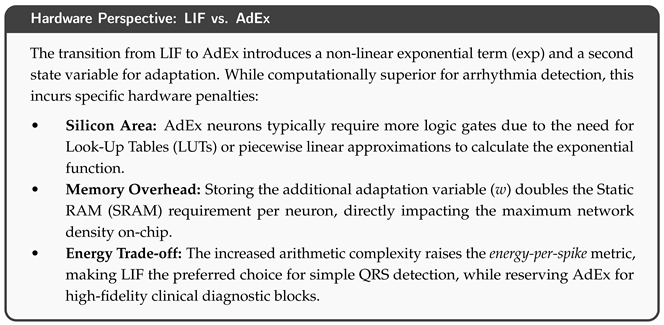
- I. Leaky Integrate-and-Fire (LIF) [86]: The LIF model is the de facto standard for ULP hardware due to its optimal balance between biological realism and mathematical simplicity. It effectively reduces the complex electrodynamics of a biological neuron to a first-order linear differential equation.
- −
- Mathematical Dynamics: The sub-threshold membrane potential is governed by:where represents the membrane time constant, is the resting potential, and is the injected input current from the encoding front-end.
- −
- Thresholding and Memory: When reaches a predefined threshold , the neuron emits a spike and immediately resets its potential. This mechanism acts as a temporal integrator, enabling the network to “remember” preceding signal states without the high-memory overhead associated with traditional RNNs [87].
- II. Adaptive Exponential (AdEx) [88]: While LIF is sufficient for basic pattern recognition, AdEx models are preferred for sensitive diagnostic tasks requiring higher physiological accuracy.
- −
- Complex Behavior: The AdEx model introduces an adaptation variable to simulate the heart’s refractory periods and “bursting” behaviors.
- −
- Clinical Utility: This added complexity is essential for identifying non-linear cardiac phenomena. For instance, modeling the recovery time of the myocardium is critical for detecting complex arrhythmias such as Torsades de Pointes, where the precise timing of “bursting” spikes can indicate life-threatening electrolyte imbalances or long QT syndrome.
3.3.2. Scaling SNNs: The Spikformer Revolution
While the LIF and AdEx models provide the necessary physiological granularity for signal processing, scaling these dynamics to complex, multi-lead bio-signals requires an architecture capable of capturing long-range dependencies. Traditional SNNs often struggle with “vanishing memory” over long temporal windows [89,90].
A pivotal shift in neuromorphic AI with the introduction of the Spiking Transformer (Spikformer) [91,92,93]. This architecture successfully addresses the “Attention Bottleneck” that previously prevented Transformers from being deployed on edge-tier hardware.
The Shift to Spike-Driven Self-Attention (SSA)
Traditional Transformers rely on the Softmax-based self-attention mechanism, which is computationally expensive due to its complexity. The Spikformer replaces this with Spiking Self-Attention (SSA), transforming the quadratic dot-product operation into a series of sparse, integer-based additions. Table 6 presents a further comparison of computational efficiency between traditional transformers and Spikformers.
Table 6.
Computational Efficiency: Traditional Transformers vs. Spikformers.
Clinical Performance and Hardware Synergy
The Spikformer is not merely a theoretical exercise; it has set new benchmarks for wearable diagnostic accuracy:
- MIT-BIH Benchmark: Recent implementations have achieved state-of-the-art (SOTA) accuracy of 99% on the ECG datasets [92,94], a level of precision previously reserved for power-hungry GPU models.
- Loihi 2 Compatibility: Being fundamentally event-driven, the Spikformer is fully compatible with asynchronous processors like Intel Loihi 2 [91].
- Dynamic Sparsity: It leverages the inherent sparsity of the cardiac cycle [95,96], allowing for a reduction in dynamic power compared to traditional Vision Transformers (ViTs).
Summary Recommendation: The Spikformer establishes a new design paradigm where achieving clinical precision no longer necessitates a compromise on battery longevity.
3.3.3. Learning Mechanisms: STDP vs. Surrogate Gradients
The transition from static neuronal models to functional diagnostic systems requires robust optimization strategies and efficient structural arrangements. Training SNNs for bio-signal classification (e.g., Arrhythmia detection) involves overcoming the “Credit Assignment Problem” [97] caused by the non-differentiable nature of discrete spikes [98].
To navigate the spike-discontinuity bottleneck, researchers employ two divergent learning paradigms, each serving a specific phase of the clinical pipeline:
- Spike-Timing-Dependent Plasticity (STDP) [99,100]: An unsupervised, local learning rule where synaptic weights are adjusted based on the millisecond-scale timing between pre- and post-synaptic spikes.
- −
- Clinical Utility: STDP enables on-chip, patient-specific adaptation without the need for vast labeled datasets. This is critical for long-term wearables that must adapt to an individual’s unique baseline ECG morphology.
- Surrogate Gradient Descent (SGD) [101]: To achieve high-accuracy offline training, surrogate functions (e.g., sigmoid or piecewise-linear) are used to approximate the derivative of the Heaviside step function during backpropagation.
- −
- Clinical Utility: This allows SNNs to achieve diagnostic accuracies on ECG signals for arrhythmia detection while maintaining a fraction of the power cost [42,102]. SGD with SNN can achieve accuracies above 98% on the MIT-BIH database [103].
3.3.4. Network Topologies: Feed-Forward vs. Recurrent SNNs (RSNNs)
Beyond the learning rule, the spatial and temporal arrangement of neurons determines the network’s capacity to handle long-term temporal dependencies, such as R-R interval variability. There are two common topologies described briefly as follows:
- Feed-Forward SNNs [93,104]: These architectures are highly efficient for low-latency tasks like simple QRS detection or R-peak localization, where instantaneous patterns are sufficient for classification.
- Recurrent SNNs (RSNNs) [105]: By introducing feedback loops, RSNNs create a “liquid state” or internal memory [106]. This recurrence is vital for detecting conditions like Atrial Fibrillation, which manifest over multiple cardiac cycles.
- −
- Efficiency Gain: Recent studies indicate that RSNNs can reduce the required neuron count [105] for complex temporal tasks compared to traditional ANN, significantly shrinking the silicon footprint on wearable ASICs. Further, RSNNs provide increased computational power per neuron and allow a single neuron to participate multiple times in a computation, enabling them to match the performance of state-of-the-art machine learning models [107].
4. Hardware Implementation and Accelerators
The physical realization of neuromorphic algorithms necessitates a fundamental departure from traditional von Neumann architectures. Standard CPUs and GPUs are frequently plagued by the “memory wall”—a performance bottleneck caused by the constant shuttling of data between the processor and memory during high-frequency spike processing [108]. To overcome this, effective hardware must provide native support for asynchronous, event-driven execution and massive parallelization of synaptic weights. This paradigm shift has led to the development of several distinct hardware categories, beginning with flexible, research-oriented platforms designed to explore the boundaries of neural computation.
4.1. Many-Core Neuromorphic Research Platforms
General-purpose neuromorphic research chips, such as Intel Loihi 2 [109] and SpiNNaker [110], serve as the primary testbeds for exploring complex Recurrent Spiking Neural Network (RSNN) [111] topologies. These platforms act as a bridge between computational neuroscience and practical engineering by offering high degrees of reconfigurability. Two primary characteristics define their usefulness in the current research landscape:
- Architectural Flexibility: These platforms feature programmable microcode engines that allow for the implementation of diverse neuron models and on-chip learning rules, such as STDP. This allows researchers to iterate on biological learning mechanisms without the need for hardware redesign.
- Benchmarking Utility: They are instrumental in establishing baseline metrics for energy-per-inference. This capability allows researchers to quantify how different signal-to-spike encoding strategies impact the dynamic power consumption of large-scale neural meshes, providing a gold standard for algorithmic comparison.
4.2. Domain-Specific ASICs and FPGA Accelerators
While many-core platforms offer the versatility needed for discovery, the transition toward power-constrained wearable IoT applications has shifted the trend toward custom ASICs and optimized FPGA implementations [50,112,113,114]. These solutions trade general-purpose flexibility for extreme efficiency, focusing on the specific demands of continuous biological monitoring. This specialization is typically achieved through two design strategies:
- System-on-Chip (SoC) Integration: focuses on the physical and functional consolidation of diverse components onto a single silicon fabric to minimize system-level overhead [115]. This architectural convergence is pivotal for creating a highly efficient ‘sensing-to-inference’ pipeline, as it enables the following technical advancements:
- Sensing-to-Inference Pipeline: Modern SoCs integrate Level-Crossing Analog-to-Digital Converter (LC-ADC) directly with SNN cores to create a seamless pipeline [116].
- Data Efficiency: This integration allows for nonuniform sampling, where data is only captured when signals cross predefined thresholds, significantly reducing redundant data processing [116].
- Eliminating Off-Chip Bottlenecks: By integrating processing elements and memory on the same chip, SoCs eliminate the high energy cost of off-chip bus communication and address the “Von-Neumann bottleneck” [117].
- Power Efficiency Gains: Analog SoC implementations for SNNs can consume average power lower than their digital counterparts implemented on FPGAs [115].
- Hardware Granularity: refers to the architectural level at which computation and memory are organized to optimize specific mathematical operations within a network. By optimizing at this structural level, designers can implement specialized configurations that move beyond general-purpose limitations:
- Layer-Specific Optimization: Granularity involves tailoring hardware structures to the needs of different network layers [117].
- Hybrid Architectures: For example, the ACE-SNN architecture uses a processing-in-memory (PIM) granularity for the first layer to handle “energy-hungry” digital multiplications, while remaining layers use highly parallel digital architectures for cheap accumulates [117].
- Specialized Circuit Structures: Efficiency is achieved through fine-grained circuit design, such as using current multiplier charge injector (CMCI) synapses and asynchronous neuron structures to reduce chip area and increase energy sensitivity [115].
- Managing Computational Silence: Custom ASICs optimized for bio-signal tasks minimize leakage current during periods of “computational silence” between cardiac cycles, ensuring energy is consumed only when relevant physiological events occur.
- ASIC vs. FPGA Trade-offs: The choice of granularity often involves moving from versatile many-core platforms toward custom ASICs for extreme efficiency or optimized FPGA implementations when design flexibility is required [115].
These design strategies work together to promote a transition from general-purpose flexibility to application-specific efficiency, establishing the micro-architectural foundation needed for the next generation of autonomous, power-constrained wearable IoT and biomedical devices.
4.3. The Energy-Efficiency Paradigm: Power-Delay Product (PDP)
The qualitative benefits of specialized hardware are ultimately validated through rigorous quantitative assessment [118,119]. A critical metric in expert literature is the Power-Delay Product (PDP), which evaluates the trade-off between energy consumption and processing speed [120,121]. The PDP is mathematically expressed as:
where P represents the average power consumption and is the propagation delay [119,120,121]. This metric serves as a vital tool for comparing the viability of decentralized architectures against traditional models:
- Edge vs. Cloud Trade-off: Traditional wearable systems transmit raw, high-bandwidth biomedical data via Bluetooth Low Energy (BLE) to a smartphone or cloud server [118]. This process is notoriously energy-intensive and often accounts for the primary battery drain in medical wearables [122].
- Quantifiable Gains at the Extreme Edge: Recent hardware/software co-design efforts for edge-based systems indicate that transitioning from traditional GPU-based cloud processing to specialized ASIC-based accelerators can improve energy efficiency compared to high-end desktop GPUs [122]. While this gain is significant, the most extreme energy reductions are typically associated with the shift toward neuromorphic computation at the “extreme edge” (near-sensor) [123]. By leveraging event-driven neuromorphic processing and hybrid temporal coding [124], these systems can focus on transmitting only sparse, feature-rich ‘spike’ patterns rather than continuous raw data streams. This approach would achieve a reduction in spike activity, drastically extending the operational longevity of battery-powered monitors [118].
To sustain performance improvements in power-constrained environments, two main design strategies have emerged for specialized hardware optimization. The integration of Carbon Nanotube Field-Effect Transistor (CNTFET) technology and the adoption of Approximate Computing [120,125]. CNTFET-based designs have demonstrated resilience to process voltage and temperature (PVT) variations compared to traditional CMOS or FinFET architectures, while maintaining sub-milliwatt power profiles [120]. By leveraging current-mode logic and approximate arithmetic units, hardware complexity and transistor counts are significantly reduced [119,126]. These approximate circuits effectively trade negligible precision losses for substantial energy savings, making them ideal for fault-tolerant medical signal processing applications where perceptual accuracy is prioritized over bit-level exactness [125,126]. Such hardware-level specialization, when combined with architectural accelerators like Coarse-Grained Linear Arrays (CGLAs), positions the “extreme edge” as a sustainable platform for next-generation bio-signal monitoring [118,122].
4.4. Comparative Synthesis of the Hardware Ecosystem
The transition from general-purpose microcontrollers toward specialized neuromorphic accelerators represents a fundamental shift in the power-performance trade-off for wearable cardiac monitoring. While many-core platforms offer the versatility needed for discovery, the trend toward power-constrained wearable IoT applications has shifted toward custom ASICs and optimized FPGA implementations [50]. To synthesize this diverse landscape, Table 7 provides a multidimensional comparison of the current state-of-the-art platforms, contrasting research-grade many-core systems with deployment-focused hardware to highlight the trade-offs between architectural flexibility and clinical scalability. To further provide the consistent contextualization necessary for assessing these diverse platforms, Table 8 standardizes reported energy and power metrics against their respective hardware abstractions and task complexities.
Table 7.
Summary Table: Hardware Ecosystem Benchmarks for Biomedical AI (2021–2025) [24,25,26,42,46,47,48,49,50,113,116,118,120,122,124,126].
Table 8.
Contextualized Performance Comparison of Neuromorphic and Edge AI Cardiac Classifiers.
Analysis of the Hardware Landscape
As illustrated in Table 7, the selection of hardware is deeply tethered to the intended clinical application, ranging from high-fidelity diagnostics to “always-on” monitoring. Platforms like Loihi 2, DYNAP-SE, and SpiNNaker provide the necessary sandbox for developing complex models, such as RSNN for Brain–Computer Interface (BCI) research and real-time arrhythmia detection. Conversely, Custom SNN ASICs and Mixed-Signal SoCs represent the frontier for long-term clinical deployment and medical implants, where the minimization of the Power-Delay Product (PDP) through subthreshold analog and data-flow strategies is the primary driver for device longevity. FPGAs and Low-Power (LP) MCUs remain an indispensable middle ground, offering a reconfigurable Von Neumann architecture that allows for the update of detection algorithms post-deployment—a critical feature as medical standards for bio-signal classification and HRV/PPG tracking continue to evolve.
As illustrated in Table 8, the variance in energy consumption is largely a function of hardware specialization and the resulting “efficiency-flexibility” trade-off. Traditional MCU-based systems [25] provide high programmability but incur an energy cost of hundreds of µJ per inference. In contrast, neuromorphic ASICs [49] leverage event-driven sparsity to achieve sub-µJ efficiency. However, as shown by Ran et al. [19], consumption increases significantly when expanding to complex multimodal diagnostics (ECG + PCG), highlighting that energy benchmarks must be viewed through the lens of task dimensionality. Ultimately, the synthesis of these technologies suggests that while FPGAs serve as excellent prototyping platforms, custom SNN ASICs remain the most viable path for the “always-on” monitoring required for long-term cardiac health.
5. Decentralized Data Integrity: Federated Learning (FL) Paradigms for Multi-Modal ECG and PPG Monitoring
Beyond the optimization of the refinement of spiking algorithms and neuromorphic hardware, a truly deployable clinical system must establish a robust third pillar: the preservation of patient data integrity [127]. Incorporating a Federated Learning (FL) framework addresses the critical dual challenges of data sovereignty and clinical security [127,128]. This decentralized paradigm is especially vital for multi-modal wearables capturing sensitive physiological streams, such as ECG and PPG [128,129]. By ensuring that raw waveforms never leave the local device, FL mitigates the risk of a patient’s unique “cardiac signature” being intercepted or exploited as a biometric identifier [129,130].
However, moving from isolated edge inference to a collaborative FL network requires a deliberate hardware–software co-design to bridge the gap between static deployment and dynamic adaptation. While conventional neuromorphic ASICs are primarily optimized for low-power inference, active participation in an FL ecosystem necessitates on-chip gradient learning capabilities [124]. To achieve this, the hardware must possess computational depth to execute surrogate gradient descent locally, as standard backpropagation is often incompatible with the non-differentiable nature of spiking neurons [124]. This local training capacity enables the model to adapt in real-time to the specific physiological morphology of a patient—such as detecting subtle QRS complex anomalies in ECG streams or variations in the systolic peaks of PPG signals [128,129,131].
Such adaptability is essential because cardiovascular signals are highly dynamic, influenced by factors like peripheral resistance and vessel elasticity, which require models to capture complex relationships between ECG and PPG features [131]. Furthermore, the integration of multimodal sensor fusion on-device allows for more robust cardiovascular monitoring by correlating data from different physiological streams [55,62]. By processing these updates locally and only transmitting weight gradients to a global server, the system ensures that sensitive raw waveforms never leave the device, thereby maintaining the “cardiac signature” as a protected biometric identifier [128,129,130]. This decentralized approach is particularly critical for wearables that use capacitive sensors or photoplethysmography to extract vital signs from pulse waveforms, as it provides a secure alternative to cloud-based processing [55,72].
The implementation of localized, gradient-aware training bridges the gap between hardware-level constraints and software-level intelligence, establishing a framework that harmonizes individual data sovereignty with the benefits of collective model refinement:
- Waveform Sovereignty: Sensitive raw data, including high-frequency temporal features and motion-artifact-prone PPG signals, are processed at the source [128,129]. By sharing only encrypted model updates rather than raw telemetry, the system significantly reduces both the transmission bandwidth and the attack surface for data breaches [127,130].
- Cross-Modality Global Intelligence: A central aggregator facilitates the convergence of a “population-level” model that learns the complex correlations between ECG and PPG features across a diverse user base [62,131]. This allows for improved detection of systemic conditions, such as Atrial Fibrillation (AFib) or vascular stiffness, without requiring the centralized storage of a single private bio-signal [72,73,128].
Ultimately, the literature indicates that FL serves as a critical junction where neuromorphic efficiency meets clinical data mandates [124,127]. This convergence ensures that the power-saving benefits of spiking architectures are preserved while meeting the strict data-handling mandates of modern healthcare ecosystems [128,129].
6. Challenges and Future Directions
Integrating SNNs into cardiac monitoring merges low-power neuromorphic engineering with high-fidelity physiological sensing [24,132]. While ECG is the standard for electrical conduction analysis [132,133], PPG offers a continuous and unobtrusive way to assess vascular health [134,135].
SNNs are uniquely suited for this multimodal future due to their ability to process asynchronous, event-driven data with sub-milliwatt power envelopes, enabling “always-on” clinical surveillance at the edge [24]. While SNNs offer a radical alternative to traditional frame-based DL [12], several technical and systemic hurdles must be addressed to move from research prototypes to clinical-grade smart electronics [132,133].
As summarized in Table 4, the specific physiological origin of the signal—whether electrical (ECG) or mechanical (PPG)—dictates the architectural requirements and the primary challenges the SNN must overcome [134,135,136].
6.1. Technical Barriers and Mitigation Strategies
6.1.1. The “Training Gap” and Gradient Discontinuity
The discrete, non-differentiable nature of spikes precludes the direct application of standard backpropagation used in traditional DL [15,98]. This often results in a “training gap” where SNNs struggle to match the high accuracy of standard CNNs on complex arrhythmia datasets [98,133] or subtle PPG pulse wave deviations [134].
Solution: The implementation of Surrogate Gradient Descent allows for the approximation of gradients during the backward pass, enabling SNNs to be trained in standard frameworks like PyTorch or TensorFlow while maintaining temporal dynamics [24,98]. Furthermore, the emergence of Spikformers blend Transformer-based attention mechanisms with spiking neurons, which can significantly close the accuracy gap for long-term physiological modeling by leveraging the strengths of both temporal precision and global attention [133,136].
6.1.2. Clinical Feature Retention vs. Data Sparsity
The primary benefit of SNNs is sparsity [24,98]; however, aggressive encoding (e.g., high thresholds in Delta Modulation [80]) can cause the loss of subtle clinical markers like the P-wave or ST-segment in ECG [132,133], and the dicrotic notch in PPG [134,135].
Solution: Adaptive Encoding Strategies [80,137] offer a path forward where the threshold () is dynamic rather than static. For instance, “R-peak Triggered Coding” can dynamically lower the encoding threshold during the expected window of the P-wave and T-wave [132,133] to ensure clinical features are captured, while remaining highly sparse during the isoelectric line [24,98].
6.1.3. Hardware–Software Co-Design and Benchmarking
While SNNs promise unprecedented efficiency, the neuromorphic research field has historically lacked standardized benchmarks, making it difficult to objectively measure technological advancements against conventional DL methods [138]. There is currently a significant discrepancy between the theoretical promise of SNNs and their actual implementation, as most research utilizes synchronous GPU-based simulators that fail to exploit the temporal sparsity and event-driven nature of biological neural processing [139,140].
Solution: The transition toward Asynchronous Logic Design and specialized Neuromorphic ASICs, such as Intel Loihi 2 or the DYNAP-SE2 processor, provides a path to ultra-low-power computation by only consuming energy during active spiking events [24,138]. To standardize this transition, the NeuroBench framework introduces multi-dimensional KPIs that prioritize Energy-per-Inference (J/inf) and Footprint (memory/operations) over traditional FLOPS [138]. This shift is essential for wearable IoT, where extremely high activation sparsity can be directly translated into hardware efficiency for continuous biological monitoring.
6.2. Personalized and Private Intelligence
As highlighted in Table 4, the inherent variability in signal resolution and the prevalence of motion artifacts or baseline wander necessitate a shift toward localized, adaptive intelligence at the edge [132,134]. To maintain clinical reliability, models must move beyond static filters toward on-chip adaptive learning that can distinguish between physiological pulse wave deviations and environmental noise in real-time [24,138]. Furthermore, providing explainable AI (XAI) frameworks ensures that these localized decisions remain transparent and clinically interpretable across diverse patient demographics [133].
6.2.1. On-Chip Adaptability
The clinical utility of automated arrhythmia detection is often restricted by the “inter-patient pattern,” where inherent physiological differences between individuals limit the ability of models trained on population-level datasets to generalize to new, unseen subjects [141,142]. Because cardiac signals are distinctive enough to serve as biometrics [143], a static, global model may struggle to differentiate between a truly pathological anomaly and a specific user’s healthy physiological baseline [142,144].
Solution: Implementing on-chip local learning rules, such as STDP or the Forward-Forward (FF) algorithm, transforms wearable monitors into “Living Models” capable of autonomous, longitudinal adaptation [98,100]. By updating synaptic weights locally in response to the user’s cardiac signature [24], these devices can establish a personalized baseline during continuous monitoring [142]. This edge-based adaptation ensures high-fidelity anomaly detection while mitigating the privacy risks and latency typically associated with transmitting sensitive medical data for cloud-based retraining [143,144].
6.2.2. Privacy-Preserving Federated Neuromorphic Learning
Conventional DL frameworks for cardiac monitoring typically rely on the centralization of sensitive biometric data on cloud servers, a practice that introduces significant privacy vulnerabilities and increases the risk of data breaches involving uniquely identifiable physiological signatures [143,144].
Solution: Federated Neuromorphic Learning addresses these challenges by facilitating a decentralized optimization paradigm where multiple wearable devices collaboratively improve a global SNN without centralizing raw data [138,144]. In this architecture, devices preserve user privacy by sharing only locally learned synaptic weights rather than raw physiological spike trains [144]. This process could be further enhanced by the Forward-Forward (FF) algorithm, which replaces traditional backpropagation with two forward passes to enable layer-wise localized learning [100]. Because the FF algorithm eliminates the need for a global error signal and a memory-intensive backward pass, it significantly reduces the communication overhead and bandwidth required for weight synchronization between the edge and the cloud [100]. This localized adaptation allows neuromorphic processors, such as the DYNAP-SE2, to autonomously establish a personalized baseline on-chip, ensuring energy-efficient, real-time clinical monitoring while maintaining strict data isolation [24,98].
6.3. Neuromorphic-Centric Data Augmentation
A primary obstacle to the widespread adoption of SNNs in clinical settings is the scarcity of large-scale, “spike-ready” biomedical datasets, which are necessary to train models capable of handling high-fidelity physiological signals [18]. Unlike traditional DL, where spatial data augmentation (e.g., image rotation) is standard, SNNs require strategies that respect the inherent temporal dynamics of spike-based information processing [139,145]:
- Event-Based Augmentation: To improve temporal robustness, training pipelines can employ Temporal Jittering, a process where individual spikes are stochastically shifted by milliseconds. This technique mimics the hardware-induced timing noise found in analog neuromorphic systems, forcing the network to learn features that are invariant to precise temporal fluctuations [146,147].
- Threshold Variation during Training: The robustness of SNNs to sensor-level variability can be enhanced by training models on data encoded through multiple Delta Modulation thresholds (). This multi-threshold exposure ensures that the SNN remains accurate across diverse SNR and varying sensor sensitivities, which often fluctuate in wearable IoT environments [137,147].
- Generative Synthetic Spiking: Emerging research suggests the use of Spiking Generative Adversarial Networks (SGANs) to synthesize high-fidelity physiological signals like ECG and PPG [148,149]. These generative models can be tuned to produce both spike-dense and spike-sparse scenarios, allowing SNNs to be pre-trained on a vast library of synthetic morphologies that encompass various heart rates and pathological conditions without the privacy risks associated with raw patient data [143,150].
To conclude this section, Table 9 provides a comprehensive summary of the current technical hurdles and their corresponding mitigation strategies. This comparative overview details how specific architectural solutions—ranging from surrogate gradients to federated learning—address the unique constraints of clinical-grade cardiac monitoring.
Table 9.
Summary of Challenges and Proposed Solutions.
7. Conclusions
The integration of Spiking Neural Networks (SNNs) into the next generation of wearable cardiac monitors represents a fundamental paradigm shift at the intersection of cardiovascular health and neuromorphic engineering. As the global prevalence of chronic cardiac conditions continues to rise, the demand for continuous, long-term surveillance has increasingly exposed the limitations of traditional, battery-intensive deep learning models. This review underscores that by replicating the event-driven efficiency of the biological brain, SNNs provide a definitive pathway toward approaching clinically useful screening performance for arrhythmia detection within the highly constrained power budgets of edge-based IoT devices.
The analysis highlights several transformative takeaways for the future of embedded healthcare systems:
- Multimodal Synergy as a Comprehensive Solution: A key potential solution for advanced monitoring lies in the fusion of electrical (ECG) and mechanical (PPG) signals. Within an SNN framework, this multimodal approach capitalizes on sub-millisecond temporal precision to resolve Pulse Transit Time (PTT) with unparalleled accuracy, offering a robust foundation for continuous, cuffless blood pressure estimation.
- Energy Efficiency through Sparsity: By exploiting the inherent temporal sparsity of cardiac signals, SNNs can potentially reduce active power consumption compared to frame-based counterparts when deployed on asynchronous hardware.
- Hardware–Software Co-design: The transition to neuromorphic computing necessitates a deep synergy between event-driven sensors, sophisticated encoding strategies—such as Delta Modulation—and dedicated accelerators like Intel’s Loihi or custom ASICs.
- Personalized and Private Intelligence: Emerging trends in on-chip Online Spike-Timing-Dependent Plasticity (STDP) and Federated Learning frameworks ensure that future devices are not only energy-efficient but also highly personalized to a user’s unique cardiac baseline while preserving data privacy.
While technical barriers such as the “training gap” and the retention of subtle clinical features persist, the rapid evolution of surrogate gradient descent and adaptive encoding strategies is successfully closing the performance gap with traditional artificial intelligence. Ultimately, the convergence of neuromorphic computing and smart electronics will catalyze the transition from reactive diagnostics to “always-on” proactive healthcare, establishing continuous monitoring as a life-saving preventive tool.
Funding
This research received no external funding.
Institutional Review Board Statement
Not applicable.
Data Availability Statement
No new data were created or analyzed in this study.
Conflicts of Interest
The author declares no conflicts of interest.
References
- Naeem, A.; Abbas, S.H.; Yousaf, M.; Ishtiaq, A.; Murtaza, I. Global Impact and Strategies to Reduce the Mortality from Cardiovascular Diseases. In Integrated Science for Sustainable Development Goal 3: Empowering Global Wellness Initiatives; Springer: Berlin/Heidelberg, Germany, 2024; pp. 283–306. [Google Scholar]
- Chu, H.; Yan, Y.; Gan, L.; Jia, H.; Qian, L.; Huan, Y.; Zheng, L.; Zou, Z. A neuromorphic processing system with spike-driven SNN processor for wearable ECG classification. IEEE Trans. Biomed. Circuits Syst. 2022, 16, 511–523. [Google Scholar] [CrossRef] [Scilit]
- Cohen, T.J.; Blumenthal, R.S. Slow and Fast Rhythms. In Surviving and Thriving With Heart Disease; Springer: Berlin/Heidelberg, Germany, 2025; pp. 29–33. [Google Scholar]
- Pervez, K.; Izhar, M.; Ahmed, A.; Alturki, N.; Abdullah, S. Smart implantable devices for cardiac health: A novel self-powered wireless ECG monitoring system using energy harvesting and machine learning-driven anomaly detection. Smart Health 2025, 37, 100582. [Google Scholar]
- Hsieh, Y.T.; Anjum, K.; Pompili, D. Ultra-low power analog folded neural network for cardiovascular health monitoring. IEEE J. Biomed. Health Inform. 2025, 29, 3968–3978. [Google Scholar] [CrossRef] [Scilit]
- Ghamya, K.; Reddy Madhavi, K. Internet of medical things-based ECG monitoring for arrhythmia classification utilizing metaheuristic optimization with ensemble deep learning model. Clust. Comput. 2025, 28, 369. [Google Scholar] [CrossRef] [Scilit]
- Bokhari, S.F.H.; Waseem, A.B.; Raza, H.; Iqbal, A.; Javaid, S.; Idrees, B.; Saad, K.A.D.; Bakht, D.; Dost, W. Advancing cardiac arrhythmia management: The integration of wearable technology and remote monitoring. World J. Cardiol. 2025, 17, 106841. [Google Scholar] [CrossRef] [Scilit] [PubMed]
- Coste, A.; Millour, G.; Hausswirth, C. A comparative study between ECG-and PPG-based heart rate sensors for heart rate variability measurements: Influence of body position, duration, sex, and age. Sensors 2025, 25, 5745. [Google Scholar] [CrossRef] [Scilit] [PubMed]
- Watanabe, E.; Miyagawa, M.; Uetani, T.; Kinoshita, M.; Kitazawa, R.; Kurata, M.; Ishimura, H.; Matsuda, T.; Tanabe, Y.; Kido, T.; et al. Positron emission tomography/computed tomography detection of increased 18F-fluorodeoxyglucose uptake in the cardiac atria of patients with atrial fibrillation. Int. J. Cardiol. 2019, 283, 171–177. [Google Scholar] [CrossRef] [Scilit] [PubMed]
- Macedo, R.; Schmidt, A.; Rochitte, C.E.; Lima, J.A.; Bluemke, D.A. MRI to assess arrhythmia and cardiomyopathies: Relationship to echocardiography. Echocardiography 2007, 24, 194–206. [Google Scholar] [CrossRef] [Scilit]
- Papadopoulos, C.H.; Oikonomidis, D.; Lazaris, E.; Nihoyannopoulos, P. Echocardiography and cardiac arrhythmias. Hell. J. Cardiol. 2018, 59, 140–149. [Google Scholar] [CrossRef] [Scilit]
- Alzubaidi, L.; Zhang, J.; Humaidi, A.J.; Al-Dujaili, A.; Duan, Y.; Al-Shamma, O.; Santamaría, J.; Fadhel, M.A.; Al-Amidie, M.; Farhan, L. Review of deep learning: Concepts, CNN architectures, challenges, applications, future directions. J. Big Data 2021, 8, 53. [Google Scholar] [CrossRef] [Scilit]
- Maass, W. Networks of spiking neurons: The third generation of neural network models. Neural Netw. 1997, 10, 1659–1671. [Google Scholar]
- Siddique, A.; Vai, M.I.; Pun, S.H. A low cost neuromorphic learning engine based on a high performance supervised SNN learning algorithm. Sci. Rep. 2023, 13, 6280. [Google Scholar] [CrossRef] [Scilit]
- Gerstner, W.; Kistler, W.M.; Naud, R.; Paninski, L. Neuronal Dynamics: From Single Neurons to Networks and Models of Cognition; Cambridge University Press: Cambridge, UK, 2014. [Google Scholar]
- Mao, J.; Hu, Y.; Song, F.; Li, Y.; Ma, D. A Low-Power SNN Processor Supporting On-Chip Learning for ECG Detection. Electronics 2025, 14, 4923. [Google Scholar]
- Cai, S.; Lin, Z.; Liu, X.; Wei, W.; Wang, S.; Zhang, M.; Schultz, T.; Li, H. Spiking neural networks for EEG signal analysis: From theory to practice. Neural Netw. 2025, 108127. [Google Scholar]
- Choi, S.H. Spiking neural networks for biomedical signal analysis. Biomed. Eng. Lett. 2024, 14, 955–966. [Google Scholar] [CrossRef] [Scilit]
- Ran, G.; Wang, Y.; Zhang, H.; Cheng, J.; Lai, D. Balancing Energy Consumption and Detection Accuracy in Cardiovascular Disease Diagnosis: A Spiking Neural Network-Based Approach with ECG and PCG Signals. Sensors 2025, 25, 5263. [Google Scholar] [CrossRef] [Scilit]
- Li, J.; Shen, H.; Wang, W.; Zhuang, P.; Liu, X.; Zhang, T. Hyper-S3NN: Spatial–spectral spiking neural network for hyperspectral image classification. Infrared Phys. Technol. 2024, 138, 105251. [Google Scholar] [CrossRef] [Scilit]
- Mehta, N.; Islam, B.; Clancy, E.A. Machine learning-based estimation of EMG baseline noise standard deviation without rest trials. J. Electromyogr. Kinesiol. 2026, 86, 103097. [Google Scholar]
- De Luca, C.; Tincani, M.; Indiveri, G.; Donati, E. A neuromorphic multi-scale approach for real-time heart rate and state detection. npj Unconv. Comput. 2025, 2, 6. [Google Scholar] [PubMed]
- Gao, S.; Fan, X.; Deng, X.; Hong, Z.; Zhou, H.; Zhu, Z. TE-Spikformer: Temporal-enhanced spiking neural network with transformer. Neurocomputing 2024, 602, 128268. [Google Scholar] [CrossRef] [Scilit]
- Richter, O.; Wu, C.; Whatley, A.M.; Köstinger, G.; Nielsen, C.; Qiao, N.; Indiveri, G. DYNAP-SE2: A scalable multi-core dynamic neuromorphic asynchronous spiking neural network processor. Neuromorphic Comput. Eng. 2024, 4, 014003. [Google Scholar]
- Rahman, M.; Morshed, B.I. Resource-Constrained On-Chip AI Classifier for Beat-by-Beat Real-Time Arrhythmia Detection with an ECG Wearable System. Electronics 2025, 14, 2654. [Google Scholar] [CrossRef] [Scilit]
- Zhang, T.; Huang, B.; Liu, X.; Fan, J.; Li, J.; Yue, Z.; Wang, Y. MCU intelligent upgrades: An overview of AI-enabled low-power technologies. J. Low Power Electron. Appl. 2025, 15, 60. [Google Scholar]
- Kumar, V.; Joshi, K.; Kumar, R.; Memoria, M.; Gupta, A.; Ajesh, F. Future prospective of neuromorphic computing in artificial intelligence: A review, methods, and challenges. In Primer to Neuromorphic Computing; Elsevier: Amsterdam, The Netherlands, 2025; pp. 185–197. [Google Scholar] [CrossRef] [Scilit]
- Hooshmand, M.; Zordan, D.; Del Testa, D.; Grisan, E.; Rossi, M. Boosting the battery life of wearables for health monitoring through the compression of biosignals. IEEE Internet Things J. 2017, 4, 1647–1662. [Google Scholar] [CrossRef] [Scilit]
- Yin, L.; Wang, J. Wearable energy systems: What are the limits and limitations? Natl. Sci. Rev. 2023, 10, nwac060. [Google Scholar] [PubMed]
- Culman, C.; Aminikhanghahi, S.; J. Cook, D. Easing power consumption of wearable activity monitoring with change point detection. Sensors 2020, 20, 310. [Google Scholar] [CrossRef] [Scilit]
- Rathi, N.; Chakraborty, I.; Kosta, A.; Sengupta, A.; Ankit, A.; Panda, P.; Roy, K. Exploring neuromorphic computing based on spiking neural networks: Algorithms to hardware. ACM Comput. Surv. 2023, 55, 1–49. [Google Scholar] [CrossRef] [Scilit]
- Rueckauer, B.; Lungu, I.A.; Hu, Y.; Pfeiffer, M.; Liu, S.C. Conversion of continuous-valued deep networks to efficient event-driven networks for image classification. Front. Neurosci. 2017, 11, 682. [Google Scholar]
- Gerstner, W.; Kistler, W.M. Spiking Neuron Models: Single Neurons, Populations, Plasticity; Cambridge University Press: Cambridge, UK, 2002. [Google Scholar]
- Orchard, G.; Frady, E.P.; Rubin, D.B.D.; Sanborn, S.; Shrestha, S.B.; Sommer, F.T.; Davies, M. Efficient neuromorphic signal processing with loihi 2. In 2021 IEEE Workshop on Signal Processing Systems (SiPS); IEEE: Piscataway, NJ, USA, 2021; pp. 254–259. [Google Scholar]
- Chemnitz, C.; Ermis, M. Comparison of Akida Neuromorphic Processor and NVIDIA Graphics Processor Unit for Spiking Neural Networks. Ph.D. Thesis, KTH Royal Institute of Technology, Stockholm, Sweden, 2025. [Google Scholar]
- Durak, L.; Arikan, O. Short-time Fourier transform: Two fundamental properties and an optimal implementation. IEEE Trans. Signal Process. 2003, 51, 1231–1242. [Google Scholar] [CrossRef]
- Heil, C.E.; Walnut, D.F. Continuous and discrete wavelet transforms. SIAM Rev. 1989, 31, 628–666. [Google Scholar] [CrossRef] [Scilit]
- Alinsaif, S.; Lang, J. Texture features in the Shearlet domain for histopathological image classification. BMC Med. Inform. Decis. Mak. 2020, 20, 312. [Google Scholar]
- Alinsaif, S. DCA-Enhanced Alzheimer’s detection with shearlet and deep learning integration. Comput. Biol. Med. 2025, 185, 109538. [Google Scholar]
- Polat, A. The comprehensive analysis of the determination of wavelet function-level pair for the decomposition and reconstruction of artificial S1 heart signals by using multi-resolution analysis. Biomed. Signal Process. Control 2021, 70, 103055. [Google Scholar]
- Rana, A.; Kim, K.K. Electrocardiography classification with leaky Integrate-and-Fire neurons in an artificial neural network-Inspired spiking neural network framework. Sensors 2024, 24, 3426. [Google Scholar]
- Kolhar, M. A neuromorphic approach to early arrhythmia detection. Sci. Rep. 2025, 15, 39635. [Google Scholar] [CrossRef] [Scilit]
- Huang, Z.; Leung, W.H.; Yu, L.; Herbozo Contreras, L.F.; Zhang, Z.; Truong, N.D.; Nikpour, A.; Kavehei, O. On-device edge-learning for cardiac abnormality detection using a bio-inspired and spiking shallow network. APL Mach. Learn. 2024, 2, 026109. [Google Scholar] [CrossRef] [Scilit]
- Flandrin, P. Explorations in Time-Frequency Analysis; Cambridge University Press: Cambridge, UK, 2018. [Google Scholar]
- Bohra, M.; Singh, K.U.; Kumar, I.; Mishra, S. Multi-Resolution Wavelet Packet-Driven Dual Path CNN for Breast Lesion Classification. IEEE Internet Things J. 2025, 12, 44750–44762. [Google Scholar]
- Bauer, F.C.; Muir, D.R.; Indiveri, G. Real-time ultra-low power ECG anomaly detection using an event-driven neuromorphic processor. IEEE Trans. Biomed. Circuits Syst. 2019, 13, 1575–1582. [Google Scholar] [PubMed]
- Azadi, B.; Anzengruber-Tanase, B.; Sopidis, G.; Haslgrübler, M.; Ferscha, A. Towards an Energy-Efficient and Sustainable IIoT using Embedded Neuromorphic AI. In Proceedings of the 15th International Conference on the Internet of Things, Vienna, Austria, 18–21 November 2025; pp. 237–244. [Google Scholar]
- Sabbella, H.; Mukherjee, A.; Kandappu, T.; Dey, S.; Pal, A.; Misra, A.; Ma, D. The Promise of Spiking Neural Networks for Ubiquitous Computing: A Survey and New Perspectives. arXiv 2025, arXiv:2506.01737. [Google Scholar] [CrossRef] [Scilit]
- Mao, R.; Li, S.; Zhang, Z.; Xia, Z.; Xiao, J.; Zhu, Z.; Liu, J.; Shan, W.; Chang, L.; Zhou, J. An ultra-energy-efficient and high accuracy ECG classification processor with SNN inference assisted by on-chip ANN learning. IEEE Trans. Biomed. Circuits Syst. 2022, 16, 832–841. [Google Scholar] [CrossRef] [Scilit]
- Xu, J. Comparison and Application of FPGA and ASIC in Digital System Design. In Proceedings of the 5th International Conference on Decision Science & Management, Hong Kong, China, 26–28 April 2024; pp. 216–220. [Google Scholar]
- Azevedo, J.A.; Santos, F.E. A more efficient technique to power home monitoring systems using controlled battery charging. Energies 2021, 14, 3846. [Google Scholar] [CrossRef] [Scilit]
- Manohar, R. Hardware/software co-design for neuromorphic systems. In 2022 IEEE Custom Integrated Circuits Conference (CICC); IEEE: Piscataway, NJ, USA, 2022; pp. 01–05. [Google Scholar]
- Becattini, F.; Berlincioni, L.; Cultrera, L.; Del Bimbo, A. Neuromorphic face analysis: A survey. Pattern Recognit. Lett. 2025, 187, 42–48. [Google Scholar] [CrossRef] [Scilit]
- Sharma, A. Current trends in nanotheranostics: A concise review on bioimaging and smart wearable technology. Nano 2023, 7, 258–269. [Google Scholar] [CrossRef] [Scilit]
- Abrori, S.A. Wearable Sensors for Health Monitoring: Technologies, Applications, Challenges, and Future Perspectives. Eng. Math. Comput. Sci. J. (EMACS) 2025, 7, 229–239. [Google Scholar] [CrossRef]
- Siyoucef, S.; Al-Aslani, R.; Adnane, M.; Rahman, M.M.U.; Laleg-Kirati, T.M.; Al-Naffouri, T.Y. Internet of medical things for non-invasive and non-contact dehydration monitoring away from the hospital: State-of-the-art, challenges and prospects. IEEE Trans. Instrum. Meas. 2025, 74, 1–23. [Google Scholar] [CrossRef] [Scilit]
- Covi, E.; Donati, E.; Liang, X.; Kappel, D.; Heidari, H.; Payvand, M.; Wang, W. Adaptive extreme edge computing for wearable devices. Front. Neurosci. 2021, 15, 611300. [Google Scholar] [CrossRef] [Scilit] [PubMed]
- Alinsaif, S. Unraveling arrhythmias with graph-based analysis: A survey of the mit-bih database. Computation 2024, 12, 21. [Google Scholar] [CrossRef] [Scilit]
- Moody, B.; Moody, G.; Villarroel, M.; Clifford, G.; Silva, I. MIMIC-III waveform database (version 1.0). PhysioNet 2020, 3. [Google Scholar] [CrossRef]
- Pimentel, M.A.; Johnson, A.E.; Charlton, P.H.; Birrenkott, D.; Watkinson, P.J.; Tarassenko, L.; Clifton, D.A. Toward a robust estimation of respiratory rate from pulse oximeters. IEEE Trans. Biomed. Eng. 2016, 64, 1914–1923. [Google Scholar] [CrossRef] [Scilit]
- Reiss, A.; Indlekofer, I.; Schmidt, P. PPG-DaLiA [Dataset]. UCI Machine Learning Repository. 2019. Available online: https://archive.ics.uci.edu/dataset/495/ppg+dalia (accessed on 1 January 2026).
- Tran, K.T.; Tran, T.N.; Huynh, D.N.; Le, N.K.; Le, C.D.; Mai, H.X.; Huynh, Q.L.; Nguyen, T.H. A multimodal system for comprehensive cardiovascular monitoring using ECG, PCG, and PPG signal fusion. Sensors 2025, 25, 6708. [Google Scholar] [CrossRef] [Scilit] [PubMed]
- Zhong, T.; Yang, H.; Sun, C.; Liu, C.; Chen, J. Adaptive band-pass filter and VMD-esprit based multi-mode monitoring method for broadband electromagnetic oscillation in “Double High” power systems. Energies 2023, 16, 3110. [Google Scholar] [CrossRef] [Scilit]
- Christiano, L.J.; Fitzgerald, T.J. The band pass filter. Int. Econ. Rev. 2003, 44, 435–465. [Google Scholar] [CrossRef] [Scilit]
- Same, M.H.; Gandubert, G.; Ivanov, P.; Landry, R., Jr.; Gleeton, G. Effects of interference and mitigation using notch filter for the DVB-S2 standard. Telecom 2020, 1, 242–265. [Google Scholar] [CrossRef] [Scilit]
- Hirano, K.; Nishimura, S.; Mitra, S. Design of digital notch filters. IEEE Trans. Commun. 1974, 22, 964–970. [Google Scholar] [CrossRef]
- Ali, P.J.M.; Faraj, R.H.; Koya, E.; Ali, P.J.M.; Faraj, R.H. Data normalization and standardization: A technical report. Mach. Learn. Tech. Rep. 2014, 1, 1–6. [Google Scholar]
- Edwards, T. Discrete wavelet transforms: Theory and implementation. Universidad 1991, 1991, 2. [Google Scholar]
- Randall, R.B.; Antoni, J. Choosing the right signal processing tools for mechanical systems. Mech. Syst. Signal Process. 2025, 224, 112090. [Google Scholar] [CrossRef] [Scilit]
- Corral, J.M.R.; Civit-Masot, J.; Luna-Perejón, F.; Díaz-Cano, I.; Morgado-Estévez, A.; Domínguez-Morales, M. Energy efficiency in edge TPU vs. embedded GPU for computer-aided medical imaging segmentation and classification. Eng. Appl. Artif. Intell. 2024, 127, 107298. [Google Scholar] [CrossRef] [Scilit]
- Khan, B.; Wasimullah, K.; Masrur, M.H.; Khalid, R.T.; Khan, B.; Khoo, B.L.; Abdullah, S. Hybrid sensor integration in wearable devices for improved cardiovascular health monitoring. J. Sci. Adv. Mater. Devices 2025, 10, 100889. [Google Scholar] [CrossRef] [Scilit]
- Quan, X.; Liu, J.; Roxlo, T.; Siddharth, S.; Leong, W.; Muir, A.; Cheong, S.M.; Rao, A. Advances in non-invasive blood pressure monitoring. Sensors 2021, 21, 4273. [Google Scholar] [CrossRef] [Scilit] [PubMed]
- Zhou, Z.B.; Cui, T.R.; Li, D.; Jian, J.M.; Li, Z.; Ji, S.R.; Li, X.; Xu, J.D.; Liu, H.F.; Yang, Y.; et al. Wearable continuous blood pressure monitoring devices based on pulse wave transit time and pulse arrival time: A review. Materials 2023, 16, 2133. [Google Scholar] [CrossRef] [Scilit]
- Paliakaitė, B.; Daukantas, S.; Marozas, V. Assessment of pulse arrival time for arterial stiffness monitoring on body composition scales. Comput. Biol. Med. 2017, 85, 135–142. [Google Scholar] [CrossRef] [Scilit] [PubMed]
- Jose, A.S.; Srivastav, S.; Mehta, B. Exploring the repeatability of pulse arrival time in healthy subjects: A test-retest approach. Indian J. Physiol. Pharmacol. 2025, 69, 27–33. [Google Scholar]
- Yang, C.; Soong, F.K.; Lee, T. Static and dynamic spectral features: Their noise robustness and optimal weights for ASR. IEEE Trans. Audio Speech Lang. Process. 2007, 15, 1087–1097. [Google Scholar]
- Jouni, Z.; Soupizet, T.; Wang, S.; Benlarbi-Delai, A.; Ferreira, P.M. 1.2 nW neuromorphic enhanced wake-up radio. In 2022 35th SBC/SBMicro/IEEE/ACM Symposium on Integrated Circuits and Systems Design (SBCCI); IEEE: Piscataway, NJ, USA, 2022; pp. 1–6. [Google Scholar]
- Tomar, R. Methods of firing rate estimation. BioSystems 2019, 183, 103980. [Google Scholar] [CrossRef] [Scilit]
- Li, F.; Li, D.; Wang, C.; Liu, G.; Wang, R.; Ren, H.; Tang, Y.; Wang, Y.; Chen, Y.; Liang, K.; et al. An artificial visual neuron with multiplexed rate and time-to-first-spike coding. Nat. Commun. 2024, 15, 3689. [Google Scholar] [CrossRef] [Scilit]
- Schindler, H. Delta modulation. IEEE Spectr. 1970, 7, 69–78. [Google Scholar] [CrossRef] [Scilit]
- Gallego, G.; Delbrück, T.; Orchard, G.; Bartolozzi, C.; Taba, B.; Censi, A.; Leutenegger, S.; Davison, A.J.; Conradt, J.; Daniilidis, K.; et al. Event-based vision: A survey. IEEE Trans. Pattern Anal. Mach. Intell. 2020, 44, 154–180. [Google Scholar] [CrossRef] [Scilit]
- Liu, S.; Leung, V.C.; Dragotti, P.L. First-spike coding promotes accurate and efficient spiking neural networks for discrete events with rich temporal structures. Front. Neurosci. 2023, 17, 1266003. [Google Scholar] [CrossRef] [Scilit] [PubMed]
- Guo, R.; Bhandari, A. ED-FreEst: Event-driven frequency estimation. In 2024 32nd European Signal Processing Conference (EUSIPCO); IEEE: Piscataway, NJ, USA, 2024; pp. 867–871. [Google Scholar]
- Thorpe, S.; Delorme, A.; Van Rullen, R. Spike-based strategies for rapid processing. Neural Netw. 2001, 14, 715–725. [Google Scholar]
- Shupe, L.; Fetz, E. An integrate-and-fire spiking neural network model simulating artificially induced cortical plasticity. Eneuro 2021, 8. [Google Scholar] [CrossRef] [Scilit]
- Nahmias, M.A.; Shastri, B.J.; Tait, A.N.; Prucnal, P.R. A leaky integrate-and-fire laser neuron for ultrafast cognitive computing. IEEE J. Sel. Top. Quantum Electron. 2013, 19, 1800212. [Google Scholar]
- Harvat, M.; Martín-Guerrero, J.D. Memory degradation induced by attention in recurrent neural architectures. Neurocomputing 2022, 502, 161–176. [Google Scholar] [CrossRef] [Scilit]
- Gerstner, W.; Brette, R. Adaptive exponential integrate-and-fire model. Scholarpedia 2009, 4, 8427. [Google Scholar] [CrossRef] [Scilit]
- Guo, Y.; Chen, Y.; Hao, Z.; Peng, W.; Jie, Z.; Zhang, Y.; Liu, X.; Ma, Z. Take a shortcut back: Mitigating the gradient vanishing for training spiking neural networks. Adv. Neural Inf. Process. Syst. 2024, 37, 24849–24867. [Google Scholar]
- Kimura, N.; Duran, C.; Byambadorj, Z.; Nakane, R.; Iizuka, T. Hardware-friendly implementation of physical reservoir computing with CMOS-based time-domain analog spiking neurons. Neuromorphic Comput. Eng. 2025, 5, 024015. [Google Scholar] [CrossRef] [Scilit]
- Zhou, Z.; Zhu, Y.; He, C.; Wang, Y.; Yan, S.; Tian, Y.; Yuan, L. Spikformer: When spiking neural network meets transformer. arXiv 2022, arXiv:2209.15425. [Google Scholar] [CrossRef] [Scilit]
- Rai, H.M.; Pal, A.; Lee, S.R.; Khudaykul, B.A. SkipCNN-Based ECG Transformer Spike Model for Accurate Cardiac Arrhythmia Detection. In Generative AI in Healthcare: Concepts, Methodologies, Tools, and Applications; Springer: Berlin/Heidelberg, Germany, 2025; pp. 69–96. [Google Scholar]
- Choi, H.; Park, J.; Lee, J.; Sim, D. Review on spiking neural network-based ECG classification methods for low-power environments. Biomed. Eng. Lett. 2024, 14, 917–941. [Google Scholar] [CrossRef] [Scilit]
- Kim, D.; Lee, K.R.; Lim, D.S.; Lee, K.H.; Lee, J.S.; Kim, D.Y.; Sohn, C.B. A novel hybrid CNN-transformer model for arrhythmia detection without R-peak identification using stockwell transform. Sci. Rep. 2025, 15, 7817. [Google Scholar] [CrossRef] [Scilit]
- Kim, E.; Kim, Y. Exploring the potential of spiking neural networks in biomedical applications: Advantages, limitations, and future perspectives. Biomed. Eng. Lett. 2024, 14, 967–980. [Google Scholar] [CrossRef] [Scilit]
- Lee, Y. Abrupt Change Detection of ECG by Spiking Neural Networks: Policy-Aware Operating Points for Edge-Level MI Screening. Appl. Sci. 2025, 15, 12210. [Google Scholar]
- Richards, B.A.; Lillicrap, T.P. Dendritic solutions to the credit assignment problem. Curr. Opin. Neurobiol. 2019, 54, 28–36. [Google Scholar] [CrossRef] [Scilit]
- Zenke, F.; Bohté, S.M.; Clopath, C.; Comşa, I.M.; Göltz, J.; Maass, W.; Masquelier, T.; Naud, R.; Neftci, E.O.; Petrovici, M.A.; et al. Visualizing a joint future of neuroscience and neuromorphic engineering. Neuron 2021, 109, 571–575. [Google Scholar] [CrossRef] [Scilit]
- Bi, G.q.; Poo, M.m. Synaptic modifications in cultured hippocampal neurons: Dependence on spike timing, synaptic strength, and postsynaptic cell type. J. Neurosci. 1998, 18, 10464–10472. [Google Scholar] [CrossRef] [Scilit] [PubMed]
- Ghader, M.; Kheradpisheh, S.R.; Farahani, B.; Fazlali, M. Backpropagation-free Spiking Neural Networks with the Forward-Forward Algorithm. arXiv 2025, arXiv:2502.20411. [Google Scholar]
- Neftci, E.O.; Mostafa, H.; Zenke, F. Surrogate gradient learning in spiking neural networks: Bringing the power of gradient-based optimization to spiking neural networks. IEEE Signal Process. Mag. 2019, 36, 51–63. [Google Scholar] [CrossRef] [Scilit]
- Banjo, O.; Ghoraani, B. QCSNN: A Memory-Efficient Spiking Neural Network for On-Device ECG-Based Arrhythmia Detection. In 2025 IEEE International Conference on Omni-Layer Intelligent Systems (COINS); IEEE: Piscataway, NJ, USA, 2025; pp. 1–6. [Google Scholar]
- Zheng, C. A wearable ultra-low power real-time ECG analysis system based on spiking neural network. In IET Conference Proceedings CP952; IET: Hertfordshire, UK, 2025; Volume 2025, pp. 1153–1163. [Google Scholar]
- Banerjee, D.; Dey, S.; Pal, A. Atrial fibrillation detector from ECG on wearable edge devices using spiking neural networks. In 2024 International Joint Conference on Neural Networks (IJCNN); IEEE: Piscataway, NJ, USA, 2024; pp. 1–8. [Google Scholar]
- Barchi, F.; Parisi, E.; Zanatta, L.; Bartolini, A.; Acquaviva, A. Energy efficient and low-latency spiking neural networks on embedded microcontrollers through spiking activity tuning. Neural Comput. Appl. 2024, 36, 18897–18917. [Google Scholar] [CrossRef] [Scilit]
- Iaboni, C.; Abichandani, P. Event-based Spiking Neural Networks for Object Detection: Datasets, Architectures, Learning Rules, and Implementation. IEEE Access 2024, 12, 180532–180596. [Google Scholar]
- Bellec, G.; Scherr, F.; Subramoney, A.; Hajek, E.; Salaj, D.; Legenstein, R.; Maass, W. A solution to the learning dilemma for recurrent networks of spiking neurons. Nat. Commun. 2020, 11, 3625. [Google Scholar] [CrossRef] [Scilit]
- Gholami, A.; Yao, Z.; Kim, S.; Hooper, C.; Mahoney, M.W.; Keutzer, K. Ai and memory wall. IEEE Micro 2024, 44, 33–39. [Google Scholar] [CrossRef] [Scilit]
- Buettner, K.; George, A.D. Heartbeat classification with spiking neural networks on the loihi neuromorphic processor. In 2021 IEEE Computer Society Annual Symposium on VLSI (ISVLSI); IEEE: Piscataway, NJ, USA, 2021; pp. 138–143. [Google Scholar]
- Furber, S.B.; Galluppi, F.; Temple, S.; Plana, L.A. The spinnaker project. Proc. IEEE 2014, 102, 652–665. [Google Scholar] [CrossRef] [Scilit]
- Bezugam, S.S.; Shaban, A.; Suri, M. Neuromorphic recurrent spiking neural networks for EMG gesture classification and low power implementation on Loihi. In 2023 IEEE International Symposium on Circuits and Systems (ISCAS); IEEE: Piscataway, NJ, USA, 2023; pp. 1–5. [Google Scholar]
- Murphy, P.; Frantz, J.P.; Welsh, E.; Hardy, R.; Mohsenin, T.; Cavallaro, J. VALID: Custom ASIC verification and FPGA education platform. In Proceedings 2003 IEEE International Conference on Microelectronic Systems Education. MSE’03; IEEE: Piscataway, NJ, USA, 2003; pp. 64–65. [Google Scholar]
- Sajjad, M.; Yusoff, M.Z.; Ahmed, M. A customized floating-point processor design for FPGA and ASIC based thermal compensation in high-precision sensing. Ann. Emerg. Technol. Comput. (AETiC) 2021, 5, 40–50. [Google Scholar]
- Kayalvizhi, S.; Sooriya, R.; Malarvizhi, S. High Performance Image Processing: Comparative Analysis of FPGA and ASIC Hardware Accelerations. In 2025 International Conference on Recent Advances in Electrical, Electronics, Ubiquitous Communication, and Computational Intelligence (RAEEUCCI); IEEE: Piscataway, NJ, USA, 2025; pp. 1–5. [Google Scholar]
- Asghar, M.S.; Arslan, S.; Al-Hamid, A.A.; Kim, H. A compact and low-power SoC design for spiking neural network based on current multiplier charge injector synapse. Sensors 2023, 23, 6275. [Google Scholar] [CrossRef] [Scilit] [PubMed]
- Naidu, S.; Snehalatha, G.; Raj, C.V.; Goud, M.N. Energy-Efficient Level Crossing ADC for Biomedical Applications: High-Precision Signal Acquisition with Ultra-Low Power Consumption. In 2025 International Conference on Inventive Computation Technologies (ICICT); IEEE: Piscataway, NJ, USA, 2025; pp. 1819–1824. [Google Scholar]
- Datta, G.; Kundu, S.; Jaiswal, A.R.; Beerel, P.A. ACE-SNN: Algorithm-hardware co-design of energy-efficient & low-latency deep spiking neural networks for 3d image recognition. Front. Neurosci. 2022, 16, 815258. [Google Scholar]
- Mendez, T.; Parupudi, T.; Kedlaya K, V.; Nayak, S.G. Development of power-delay product optimized ASIC-based computational unit for medical image compression. Technologies 2024, 12, 121. [Google Scholar]
- Tavakkoli, E.; Aminian, M. Design and analysis of energy-efficient compressors based on low-power XOR gates in carbon nanotube technology. IET Circuits Devices Syst. 2022, 16, 240–256. [Google Scholar]
- Foroutan, P.; Navi, K. Design of low power and high speed approximate multipliers utilizing current mode 4 to 2 compressors based on CNTFET technology. Sci. Rep. 2026, 16, 4834. [Google Scholar] [CrossRef] [Scilit]
- Parmar, Y.; Pandey, N. Energy Efficient Dynamic Logic Based on TGDI Cell for Portable Electronics. In 2025 8th International Conference on Trends in Electronics and Informatics (ICOEI); IEEE: Piscataway, NJ, USA, 2025; pp. 180–187. [Google Scholar]
- Ando, T.; Takeuchi, Y.E.A.; Nakashima, Y. Energy-Efficient Hardware Acceleration of Whisper ASR on a CGLA. In 2025 Thirteenth International Symposium on Computing and Networking (CANDAR); IEEE: Piscataway, NJ, USA, 2025; pp. 85–91. [Google Scholar]
- Safa, A.; Van Assche, J.; Alea, M.D.; Catthoor, F.; Gielen, G.G. Neuromorphic near-sensor computing: From event-based sensing to edge learning. IEEE Micro 2022, 42, 88–95. [Google Scholar] [CrossRef] [Scilit]
- Imanov, O.Y.L.; Kulali, D.U.; Yilmaz, T.; Erisken, D.; Turhan, R.I. Energy-Efficient Neuromorphic Computing for Edge AI: A Framework with Adaptive Spiking Neural Networks and Hardware-Aware Optimization. arXiv 2026, arXiv:2602.02439. [Google Scholar]
- Han, J.; Orshansky, M. Approximate computing: An emerging paradigm for energy-efficient design. In 2013 18th IEEE European Test Symposium (ETS); IEEE: Piscataway, NJ, USA, 2013; pp. 1–6. [Google Scholar]
- Foroutan, P.; Navi, K. Energy efficient approximate compressor architectures for high performance image multiplication in CNTFET technology. Sci. Rep. 2025, 15, 36269. [Google Scholar] [CrossRef] [Scilit] [PubMed]
- Ayensu, F.; Turner, C.; Osunmakinde, I. Enhancing Federated Learning Security with a Defense Framework Against Adversarial Attacks in Privacy-Sensitive Healthcare Applications. Int. J. Adv. Comput. Sci. Appl. 2025, 16. [Google Scholar] [CrossRef] [Scilit]
- Abbas, S.R.; Abbas, Z.; Zahir, A.; Lee, S.W. Federated learning in smart healthcare: A comprehensive review on privacy, security, and predictive analytics with IoT integration. Healthcare 2024, 12, 2587. [Google Scholar] [CrossRef] [Scilit]
- Berkani, M.R.A.; Chouchane, A.; Himeur, Y.; Ouamane, A.; Miniaoui, S.; Atalla, S.; Mansoor, W.; Al-Ahmad, H. Advances in federated learning: Applications and challenges in smart building environments and beyond. Computers 2025, 14, 124. [Google Scholar] [CrossRef] [Scilit]
- Akhtarshenas, A.; Vahedifar, M.A.; Ayoobi, N.; Maham, B.; Alizadeh, T.; Ebrahimi, S.; López-Pérez, D. Federated learning: A cutting-edge survey of the latest advancements and applications. Comput. Commun. 2024, 228, 107964. [Google Scholar] [CrossRef] [Scilit]
- Rastegar, S.; Gholam Hosseini, H.; Lowe, A. Hybrid CNN-SVR blood pressure estimation model using ECG and PPG signals. Sensors 2023, 23, 1259. [Google Scholar] [CrossRef] [Scilit] [PubMed]
- Serhani, M.A.; T. El Kassabi, H.; Ismail, H.; Nujum Navaz, A. ECG monitoring systems: Review, architecture, processes, and key challenges. Sensors 2020, 20, 1796. [Google Scholar] [CrossRef] [Scilit] [PubMed]
- Manimaran, G.; Peimankar, A.; Puthusserypady, S.; Momeni, M.; Asyari, R.A.I.; Jahan, M.S.; Moll, J.; Wiil, U.K.; Ebrahimi, A. Explainable deep learning based techniques for ECG-Based heart disease classification: A systematic literature review and future direction. Comput. Biol. Med. 2025, 199, 111324. [Google Scholar] [CrossRef] [Scilit]
- Scardulla, F.; Cosoli, G.; Spinsante, S.; Poli, A.; Iadarola, G.; Pernice, R.; Busacca, A.; Pasta, S.; Scalise, L.; D’Acquisto, L. Photoplethysmograhic sensors, potential and limitations: Is it time for regulation? A comprehensive review. Measurement 2023, 218, 113150. [Google Scholar] [CrossRef] [Scilit]
- Bassiouni, M.M.; Hegazy, I.; Rizk, N.; El-Dahshan, S.A.; Salem, A.M. Combination of ECG and PPG signals for healthcare applications: A survey. Adv. Model. Anal. 2021, 64, 63–70. [Google Scholar]
- Slapničar, G.; Su, J.; Wang, W. Fundamental and practical feasibility of electrocardiogram reconstruction from photoplethysmogram. Sensors 2024, 24, 2100. [Google Scholar] [CrossRef] [Scilit]
- Schindler, H. Linear, nonlinear, and adaptive delta modulation. IEEE Trans. Commun. 1974, 22, 1807–1823. [Google Scholar] [CrossRef] [Scilit]
- Yik, J.; Van den Berghe, K.; Den Blanken, D.; Bouhadjar, Y.; Fabre, M.; Hueber, P.; Ke, W.; Khoei, M.A.; Kleyko, D.; Pacik-Nelson, N.; et al. The neurobench framework for benchmarking neuromorphic computing algorithms and systems. Nat. Commun. 2025, 16, 1545. [Google Scholar] [CrossRef] [Scilit] [PubMed]
- Pfeiffer, M.; Pfeil, T. Deep learning with spiking neurons: Opportunities and challenges. Front. Neurosci. 2018, 12, 409662. [Google Scholar] [CrossRef] [Scilit]
- Kulkarni, S.R.; Parsa, M.; Mitchell, J.P.; Schuman, C.D. Benchmarking the performance of neuromorphic and spiking neural network simulators. Neurocomputing 2021, 447, 145–160. [Google Scholar] [CrossRef] [Scilit]
- Garcia, G.; Moreira, G.; Menotti, D.; Luz, E. Inter-patient ECG heartbeat classification with temporal VCG optimized by PSO. Sci. Rep. 2017, 7, 10543. [Google Scholar] [CrossRef] [Scilit]
- Naseri, A.; Tax, D.M.; van der Bilt, I.; Reinders, M. Tackling inter-subject variability in smartwatch data using factorization models. Sci. Rep. 2025, 15, 26704. [Google Scholar] [CrossRef] [Scilit]
- Senthuran, V.; Thayasivam, U.; Natgunanathan, I.; Sood, K.; Xiang, Y. Balancing privacy and health integrity: A novel framework for ECG signal analysis in immersive environments. Comput. Biol. Med. 2025, 192, 110234. [Google Scholar] [CrossRef] [Scilit] [PubMed]
- Kapsecker, M.; Jonas, S.M. Cross-device federated unsupervised learning for the detection of anomalies in single-lead electrocardiogram signals. PLoS Digit. Health 2025, 4, e0000793. [Google Scholar] [CrossRef] [Scilit] [PubMed]
- Singanamalla, S.K.R.; Lin, C.T. Spiking neural network for augmenting electroencephalographic data for brain computer interfaces. Front. Neurosci. 2021, 15, 651762. [Google Scholar] [CrossRef] [Scilit]
- Jouni, Z.; Rioufol, T.P.; Wang, S.; Benlarbi-Delai, A.; Ferreira, P.M. Jitter noise impact on analog spiking neural networks: STDP limitations. In 2023 36th SBC/SBMicro/IEEE/ACM Symposium on Integrated Circuits and Systems Design (SBCCI); IEEE: Piscataway, NJ, USA, 2023; pp. 1–6. [Google Scholar]
- Hwang, C.; Zhou, B.; Ke, Y.; Mohan, V.; Ko, J.H.; Basu, A. Event-based neural spike detection using spiking neural networks for neuromorphic ibmi systems. In 2025 IEEE International Symposium on Circuits and Systems (ISCAS); IEEE: Piscataway, NJ, USA, 2025; pp. 1–5. [Google Scholar]
- Hazra, D.; Byun, Y.C. SynSigGAN: Generative adversarial networks for synthetic biomedical signal generation. Biology 2020, 9, 441. [Google Scholar] [CrossRef] [Scilit]
- Adib, E.; Afghah, F.; Prevost, J.J. Synthetic ECG signal generation using generative neural networks. PLoS ONE 2025, 20, e0271270. [Google Scholar] [CrossRef] [Scilit] [PubMed]
- Piacentino, E.; Guarner, A.; Angulo, C. Generating synthetic ecgs using gans for anonymizing healthcare data. Electronics 2021, 10, 389. [Google Scholar] [CrossRef] [Scilit]

Disclaimer/Publisher’s Note: The statements, opinions and data contained in all publications are solely those of the individual author(s) and contributor(s) and not of MDPI and/or the editor(s). MDPI and/or the editor(s) disclaim responsibility for any injury to people or property resulting from any ideas, methods, instructions or products referred to in the content. |
© 2026 by the author. Licensee MDPI, Basel, Switzerland. This article is an open access article distributed under the terms and conditions of the Creative Commons Attribution (CC BY) license.