


Abstract
High-quality text corpora are essential for knowledge graph construction and domain-specific large model pre-training in technology-intensive industries, with the steel metallurgy sector serving as a representative case. However, many industrial documents remain in scanned or PDF formats, where general-purpose Optical Character Recognition (OCR) systems exhibit systematic errors when recognizing Chinese metallurgical documents. In particular, visually similar Chinese characters that differ by only minor strokes are frequently confused, leading to severe degradation of text reliability and cascading errors in downstream knowledge extraction. This paper proposes FeOCR, a general-purpose domain-adaptive framework for machine-printed Chinese characters, which is specifically evaluated within the context of the steel metallurgy industry. The framework integrates visual character disambiguation with context-aware semantic correction. We first construct a metallurgy-specific OCR dataset emphasizing high-frequency confusable Chinese word pairs and enhance data diversity through font perturbation and noise synthesis. Parameter-efficient fine-tuning (LoRA) is then applied to adapt a general OCR model to domain-specific visual patterns. Furthermore, a Large Language Model-based correction module performs semantic refinement of residual errors under domain lexical constraints. Experiments demonstrate significant reductions in character and word error rates, especially for confusable technical terms, providing a reliable foundation for industrial Chinese document digitization.
1. Introduction
The digitalization of technology-intensive industries often requires a general domain-adaptive recognition framework, with the steel metallurgy industry serving as a representative case. Its production process covers raw material preparation, ironmaking and steelmaking, secondary refining, continuous casting, and rolling. It involves a large number of machine-printed process specifications, equipment technical documents, quality inspection standards, and scientific papers. With the rapid development of knowledge graphs [1], large models, and industrial agents in manufacturing, constructing high-quality domain corpora [2] from these unstructured documents has become a key prerequisite for supporting intelligent applications in metallurgy. The performance upper bound of systems such as large model question answering [3], expert knowledge reasoning engines, and intelligent decision systems for process optimization is constrained by the accuracy and standardization of the input texts.
However, a large number of historical documents in the industry are still archived in PDF or scanned form. Their layouts are complex, images and text are mixed, and the imaging quality varies. This makes OCR an indispensable entry point for corpus construction. Although general OCR systems such as Tesseract [4], MinerU [5], PaddleOCR [6,7,8], and HunyuanOCR [9] have achieved notable progress in multilingual and multi-scene settings in recent years, they still show clear limitations when applied to metallurgy technical documents. In particular, for technical term recognition, general models tend to generate more common general words instead of domain-specific vocabulary. This issue is especially critical in Chinese metallurgy corpora. Due to the high density of Chinese characters and the visual similarity between distinct logograms, generic models frequently fail to distinguish fine-grained stroke differences in technical contexts. Typical errors include recognizing “冶金” as “治全” and recognizing “铸坯” as “铸坏”. These errors are systematic, structural, and frequent. Once they enter the knowledge extraction or large model pre-training process, they will spread and be amplified. This leads to concept confusion, failures in entity recognition, and a decline in the reasoning ability of models in the technical domain. Recent studies [10] have shown that OCR errors can significantly hinder the performance of retrieval-augmented generation systems, as recognition noise propagates and amplifies through downstream retrieval and generation stages.
Existing correction methods mainly include dictionary-based or rule-based post-processing. They repair part of the errors through character replacement or edit-distance matching. However, in the metallurgy domain, many terms have fixed technical meanings and strong dependence on context. Dictionary matching alone cannot determine whether a term has been incorrectly replaced in a specific text segment. Large language models (LLMs) have semantic reasoning ability, yet directly applying them to OCR correction tends to cause over-modification or term hallucination. In addition, annotated data in the industry domain are scarce. Fully training a dedicated OCR model from scratch for metallurgy documents is neither practical nor cost-effective due to data scarcity. Therefore, under limited annotation resources, how to efficiently improve the performance of general OCR on technical term recognition has become a key problem for the digitalization of metallurgy literature.
To address the above challenges, this paper proposes a method framework for the steel metallurgy domain that combines domain adaptation of a general OCR model with context correction enhancement. The method is designed for engineering practicality. It constructs a domain-specific dataset of confusable word pairs. It performs lightweight domain incremental training on the DeepSeek-OCR [11] model through parameter-efficient fine-tuning. It further builds a context correction module that integrates a technical lexicon and a Large Language Model (LLM). This module reduces the misrecognition probability of metallurgy technical terms in both the recognition stage and the post-processing stage. On the model side, the framework guides the general OCR to capture statistical priors of domain vocabulary. On the semantic side, it uses LLM-based correction to compensate for the limitations of visual recognition. In this way, it forms a highly robust OCR processing pipeline suitable for industrial scenarios.
The main contributions of this paper are summarized as follows:
- We propose an OCR adaptation framework for the metallurgy domain. It integrates a general OCR model with incremental domain training and a context correction mechanism driven by an LLM. It achieves systematic enhancement in the recognition of technical terms.
- We develop a domain-specific OCR benchmark featuring a semantically filtered metallurgy lexicon and high-frequency confusable character pairs. To overcome the scarcity of manual annotations, we employ an automated synthesis strategy involving typeface perturbation and diverse noise regimes, ensuring high visual diversity and technical relevance in the resulting training data.
- We implement parameter-efficient domain fine-tuning of DeepSeek-OCR. Without requiring large-scale annotated data, low-rank adaptation (LoRA) significantly improves the general OCR model’s tendency to recognize key metallurgy terms while preserving its general document recognition ability.
- We design a context correction module that combines an LLM with constraints from a technical lexicon. Through semantic rewriting, terminology consistency checking, and confusable pair constraints, it performs stable and controllable semantic-level correction. It effectively avoids terminology hallucination and structural bias that may occur when using an LLM directly for correction.
In summary, this paper is driven by practical engineering needs and provides a reusable and scalable OCR adaptation path for large-scale document digitalization and knowledge system construction of the steel metallurgy domain. The method can be further extended to other technology-intensive domains such as materials science and mechanical engineering.
2. Related Work
The importance of OCR in industrial document digitalization continues to grow. Related studies can be broadly categorized into: (1) general document OCR techniques, (2) OCR adaptation methods for vertical domains, and (3) OCR post-processing and semantic correction mechanisms based on language models. This section provides a brief review of these directions.
2.1. Development of General Document OCR Techniques
Early OCR systems mainly relied on template matching or hand-crafted features. They used traditional methods such as Hidden Markov Models (HMMs) [12] and Support Vector Machines (SVMs) [13] for printed character recognition. However, these methods perform poorly in noisy conditions, in layouts with high complexity, and in scenarios that contain technical terms. With the widespread adoption of deep learning, convolutional networks [14] and recurrent networks [15,16] became the mainstream. Representative models include the Convolutional Recurrent Neural Network (CRNN) structure [17] and attention-based encoder–decoder models [18]. Through end-to-end training, they effectively improve the recognition ability of complex text lines.
In recent years, the success of Transformer [19] in image representation has driven further development of OCR in document scenarios. Vision Transformer (ViT) [20] and Swin Transformer [21] have been integrated into OCR visual encoders [22]. This allows models to perform global modeling of long text lines and irregular layouts. Some systems such as PaddleOCR and MinerU deploy text detection, recognition, and layout understanding in a modular manner. They provide large-scale open-source solutions for general documents.
Although these systems perform well on public benchmarks, their training data mainly come from natural scenes, receipts, and general documents. They do not include dedicated modeling of many technical terms, abbreviations, and visually similar characters that frequently appear in technical industries. As a result, they tend to produce systematic misrecognition when applied to engineering documents of the steel metallurgy domain.
2.2. Vertical Domain OCR and Domain Adaptation
To address the limited transferability of general OCR for technical domains, researchers have begun to explore OCR models and dataset construction methods for specific domains. Tasks such as prescription recognition in medicine [23], financial document recognition [24], and digitization of ancient books [25] all rely on dedicated training data and model adaptation strategies. Common domain adaptation approaches include three directions. The first direction is building an OCR model of the domain from scratch. The second direction is performing domain fine-tuning on a general model. The third direction is introducing domain constraints at the character level or the word level, such as constraints of a lexicon or a restricted character set.
Existing studies [26,27] have shown that, even with limited annotated data, OCR models based on Transformer or CNN-RNN can achieve significant improvement in the recognition accuracy of domain technical terms through lightweight fine-tuning as long as the training samples cover key domain vocabulary and confusable patterns. Some studies further introduce domain lexicons [28], confusable set perturbation [29], or joint learning strategies [30]. These methods improve the output bias of the model in specific contexts.
However, current research on domain OCR mainly focuses on scenarios such as medicine, finance, and cultural heritage. Research on engineering documents of the steel metallurgy domain is relatively scarce. The metallurgy domain contains rich technical terminology and strict process descriptions, which differ significantly from general corpora. Industry documents are also difficult to access publicly. As a result, reusable datasets and evaluation benchmarks are lacking. Therefore, under the background of industrial document digitalization, achieving low-cost and reusable domain adaptation of general OCR models still has an important practical value.
2.3. Post-Processing and Correction Based on Language Models
OCR results inevitably contain noise, so post-OCR correction has long been a core task of document digitalization. Traditional methods rely on lexicons [31], character confusion tables, or language models [32]. They mainly handle low-level errors, such as substitution, deletion, and repetition. These methods are simple to implement, but they struggle to address term misuse that depends on context. Their recall in technical domains is also limited.
With the development of neural networks, text correction can be modeled in a sequence-to-sequence manner. Noisy OCR text is mapped directly to a normalized output. Some studies introduce attention mechanisms, edit-distance constraints, or OCR noise simulation strategies [33] to better handle insertion, deletion, and substitution errors. Recently, with the emergence of large-scale pre-trained language models, researchers have begun to use their context understanding ability to perform semantic disambiguation and repair of OCR noise. Existing work has demonstrated the advantages of LLMs in long-text correction [34], word-form normalization, and semantic consistency maintenance in scenarios such as historical [25] and medical documents [23].
However, directly applying an LLM for correction introduces the risk of terminology rewriting. In technical documents, this may lead to incorrect technical expressions or over-correction. Therefore, how to integrate the semantic reasoning ability of a Large Language Model with constraints of a technical lexicon, a confusion set, and rules to build a controllable and robust OCR correction mechanism remains an open problem. These studies provide the foundation for the method proposed in this paper. This paper aims to combine domain fine-tuning of a general OCR model with semantic correction driven by an LLM. The goal is to form a vertical domain OCR processing pipeline that adapts to the characteristics of steel metallurgy documents and achieves both accuracy and controllability.
3. Method
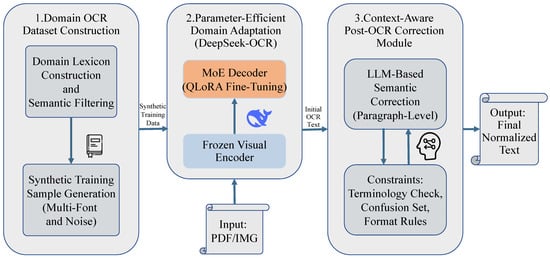
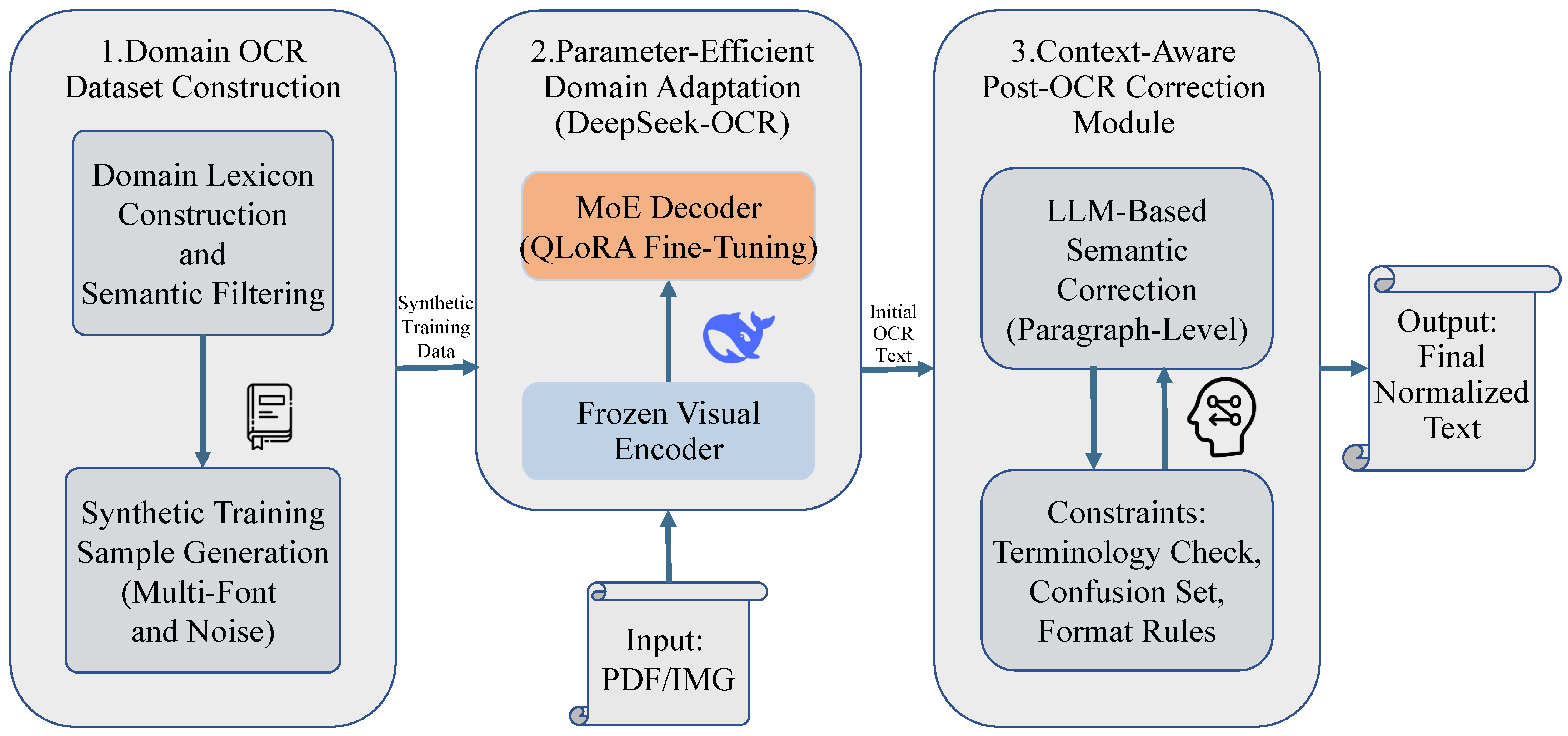
The OCR adaptation framework for the steel metallurgy domain proposed in this paper consists of three core components. The first is OCR dataset construction driven by domain vocabulary. The second is domain incremental fine-tuning of DeepSeek-OCR. The third is a context semantic correction module that combines a technical lexicon and a Large Language Model. The overall pipeline, as shown in Figure 1, covers the full process from PDF documents to the final normalized text. This section provides a detailed description of the principles and design ideas of each module.
Figure 1.
The overall architecture of the FeOCR framework. Stage 1 constructs a domain-specific dataset using semantic filtering and multi-font synthesis. Stage 2 implements parameter-efficient domain adaptation; input document images are processed by a frozen visual encoder, while the MoE decoder (highlighted in orange) is fine-tuned via QLoRA [35,36] using the synthetic data. Stage 3 applies a context-aware correction module, leveraging an LLM with terminology constraints to refine the initial OCR output.
3.1. Stage 1: OCR Dataset Construction for the Steel Metallurgy Domain
3.1.1. Domain Lexicon Construction and Semantic Filtering
We extract raw text from industry standards, academic theses, and process specifications. We perform initial filtering through jieba segmentation and a general stopword list to obtain candidate words that have actual semantic value. We then use an LLM to perform semantic classification of the word list. Technical terms are filtered into categories such as metallurgy process, defect type, material composition, and equipment name. This forms a high-purity metallurgy technical lexicon. The process enhances the domain representativeness of the samples. It also provides the basis for constructing confusion sets and semantic correction.
3.1.2. Synthetic Training Sample Generation
To address the scarcity of manually annotated real-world data, we developed an automated pipeline to generate 8137 synthetic terminology samples derived from the metallurgy lexicon. The pipeline consists of a three-stage workflow: rendering, perturbation, and labeling.
First, textual terms are rendered into clean images using eight distinct font styles: Fangsong, Heiti, Huawenxihei, Kaiti, Lishu, Songti, Microsoft Yahei, and Youyuan. To emulate diverse printing layouts, each term is rendered on a white background with 20-pixel padding and subjected to a random micro-rotation within ±5° to simulate scanning misalignment.
Second, we introduce eight carefully designed noise regimes to replicate distortion patterns commonly observed in low-resolution, damaged, or aged scanned documents. In the following noise models, denotes the standard deviation of the Gaussian distribution, p represents the noise density (probability), and s indicates the scaling ratio:
- Clean: The original high-quality rendered image, serving as a baseline representation of domain vocabulary.
- Blur: Gaussian blur with a radius of 1.5, simulating motion artifacts or focus inaccuracies during scanning.
- Gaussian (low): Low-intensity electronic sensor noise with standard deviation .
- Gaussian (high): High-intensity electronic sensor noise with standard deviation .
- Salt-and-pepper: Impulse noise injected with probability p = 0.02 to mimic dust particles, ink splatter, or paper degradation.
- Lines: Random gray lines overlaid on the text to simulate scratches or scanline artifacts.
- Pixelate: Downsampling with a scale factor s = 0.25, followed by nearest-neighbor upsampling to reproduce low-resolution aliasing and jagged edges.
- Combo-heavy: A sequential degradation pipeline combining random lines, Gaussian noise ( = 20), and Gaussian blur to simulate severely deteriorated archival documents.
Finally, each processed image is automatically paired with its corresponding ground-truth text and assigned a unique hash-based filename to ensure dataset consistency and traceability. This pipeline achieves a strong balance between visual diversity and domain specificity, substantially improving the model’s ability to learn typeface-invariant and noise-robust representations.
3.2. Stage 2: Parameter-Efficient Domain Adaptation of DeepSeek-OCR
DeepSeek-OCR adopts a paradigm that is significantly different from traditional OCR systems. It does not rely on long sequences formed by text tokenization. Instead, it renders documents into images and compresses them into visual tokens through a visual encoder. The number of visual tokens is far smaller than the length of a language token sequence. The model structure consists of two main parts. The first part is the visual encoder (i.e., DeepEncoder), which maps high-resolution images into compact visual token sequences and achieves about ten to twenty times context compression. The second part is the DeepSeek-3B-MoE decoder [11]. It is a language model based on a Mixture-of-Experts (MoE) architecture and is used to generate the final text. This optical context compression allows the model to maintain efficient inference in long-document scenarios and provides stronger modeling of text layout and visual features.
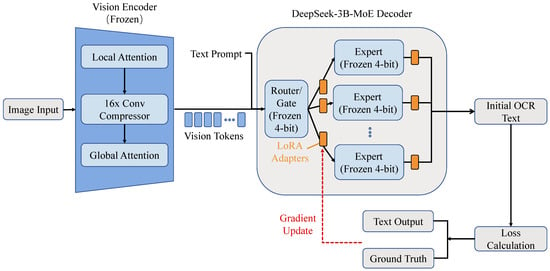
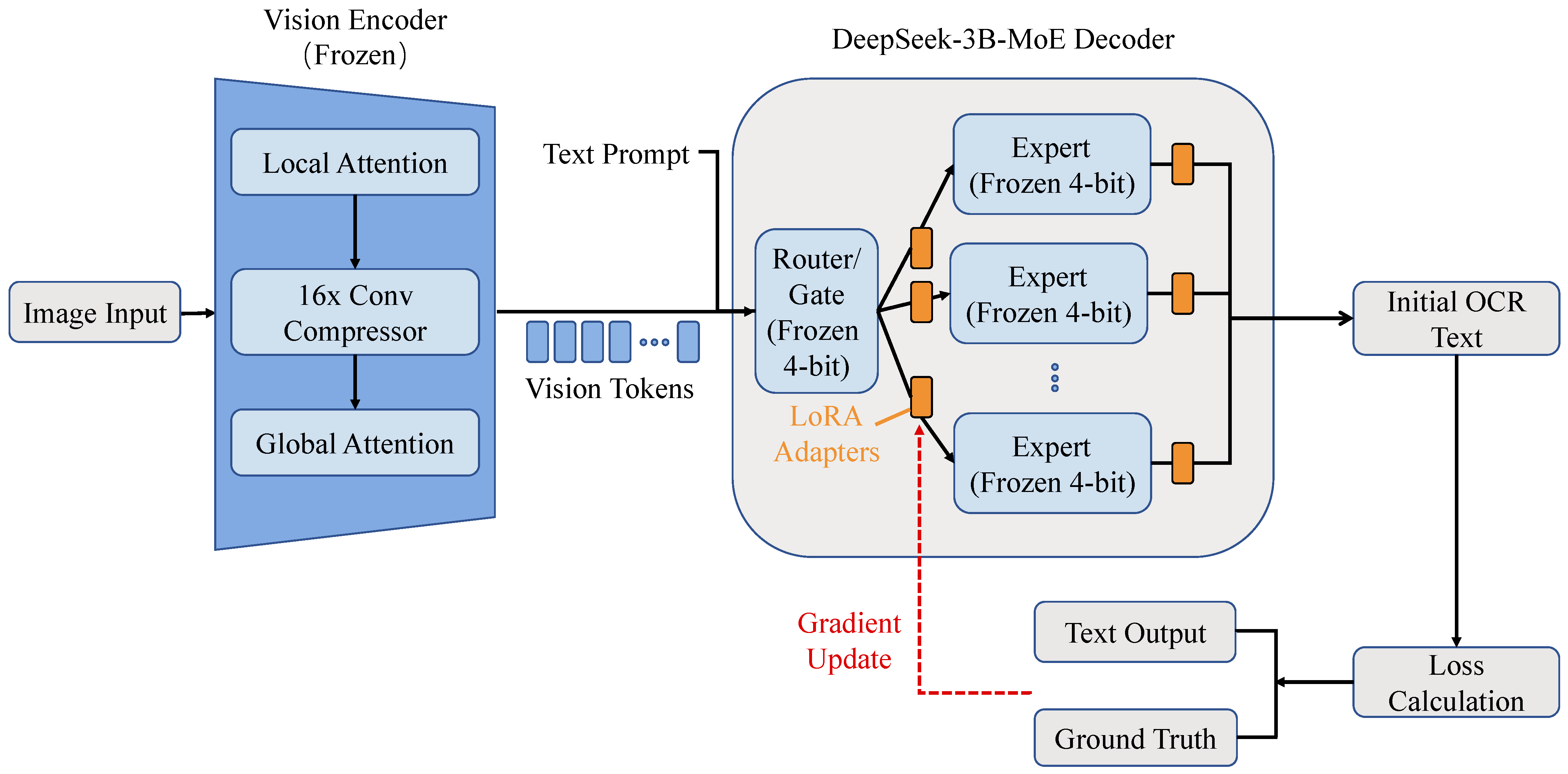
Traditional MoE models have extremely large parameter sizes and complex computation graphs. Fine-tuning them on GPUs is expensive. To address this, this paper applies the following techniques for efficient domain adaptation. As illustrated in Figure 2, we adopt a parameter-efficient domain adaptation (PEDA) architecture for the MoE decoder, where only low-rank adaptation modules are updated during training.
Figure 2.
The parameter-efficient domain adaptation (PEDA) architecture for the MoE decoder. The visual encoder and the MoE backbone (quantized to 4-bit) remain frozen (indicated in blue) to preserve general capabilities. LoRA adapters (highlighted in orange) are injected into the projection layers and experts, serving as the only trainable parameters during domain adaptation. The red dashed line indicates that gradient updates are applied exclusively to these low-rank adapters.
3.2.1. QLoRA (Quantized LoRA) Fine-Tuning for the MoE Architecture
To achieve efficient domain adaptation of the MoE decoder, we adopt the QLoRA [35] strategy, which allows for high-fidelity fine-tuning of quantized models without significant performance degradation.
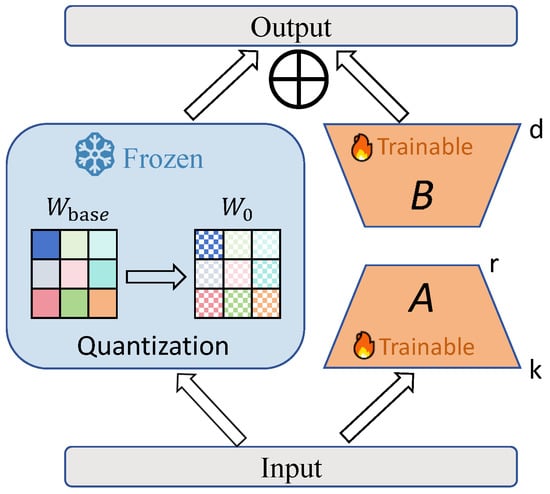
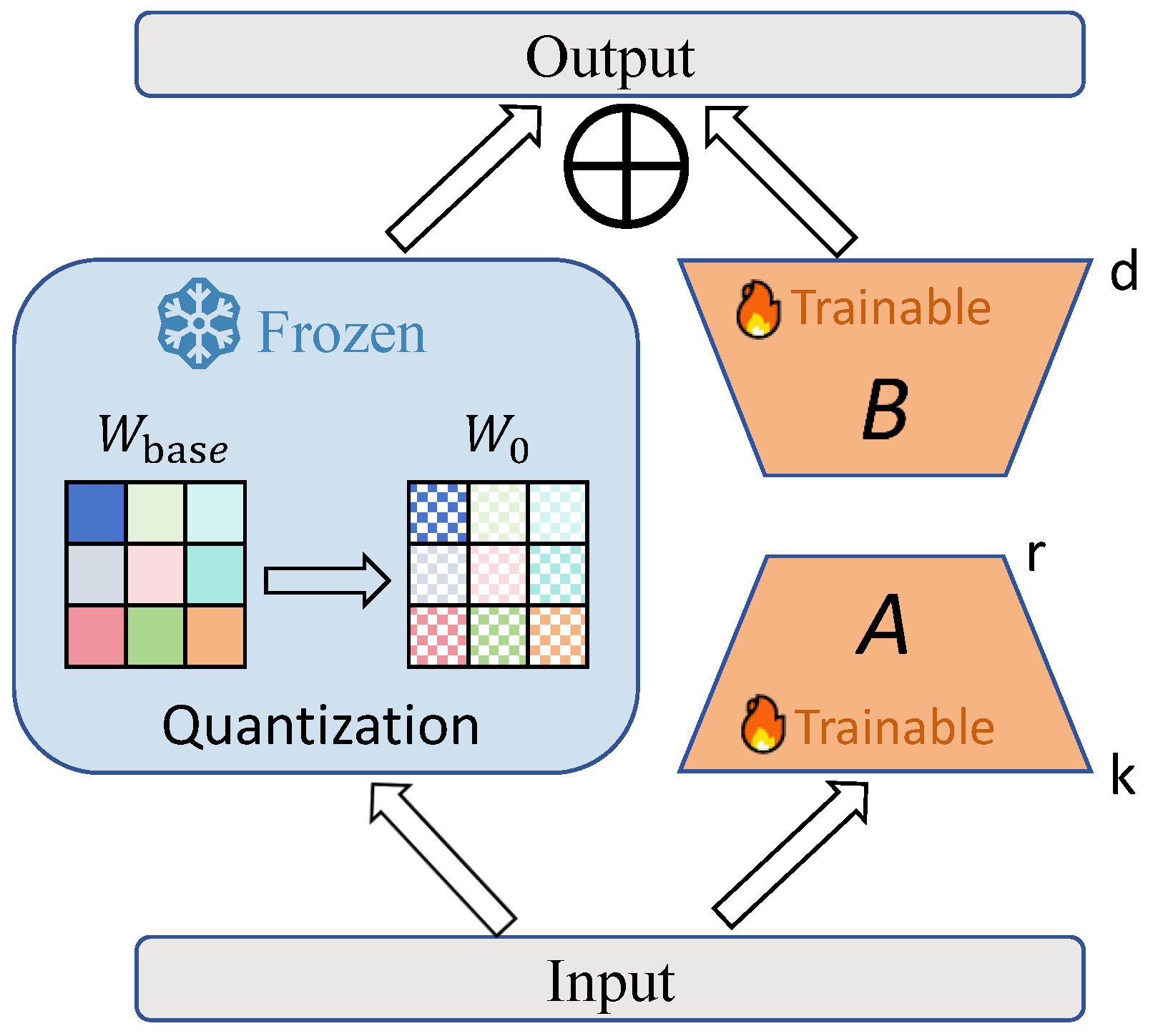
As illustrated in Figure 3, we first quantize the high-precision pre-trained weights () of the MoE backbone to NF4 (4-bit NormalFloat) format to form the frozen weight matrix . During the fine-tuning process, all original backbone parameters are kept frozen to maintain the model’s foundational capabilities. We inject low-rank trainable matrices into key projection layers of the MoE decoder, including the self-attention projections () and the Feed-Forward Network (FFN) projections (up, gate, down). To balance model capacity and training efficiency, we set the LoRA rank to . This strategy ensures that gradients are backpropagated through the frozen 4-bit quantized backbone to update only the lightweight adapters, making it feasible to fine-tune the 3-billion-parameter MoE model on consumer-grade GPUs such as the RTX 4090. The weight update is defined as follows:
where represents the final updated weight matrix, and is the frozen, 4-bit quantized pre-trained weight matrix. The term denotes the learned incremental update, where (initialized to zero) and (initialized with a random Gaussian distribution) are the trainable low-rank matrices. In this formulation, k and d represent the input and output dimensions of the corresponding neural network layer, respectively, and the adaptation rank r is constrained such that to ensure parameter efficiency.
Figure 3.
Internal structure of the QLoRA adapter module. The pre-trained high-precision weights are quantized into an NF4 frozen backbone . Trainable low-rank matrices A and B are injected in parallel to the frozen path to capture domain-specific patterns. The final output is the summation (⊕) of the frozen and trainable branches, where k and d denote the layer dimensions and r is the adaptation rank.
3.2.2. Cross-Modal Alignment Between Vision and Language
The visual encoder of the system, known as DeepEncoder, adopts a serial architecture to map high-resolution document images into compact visual token sequences [11]. As illustrated in Figure 2, the DeepEncoder consists of three core components: a SAM-base (80 M) module for local perception via window attention [37], a convolutional compressor for spatial downsampling, and a CLIP-large (300 M) module for extracting high-level visual knowledge through global attention [38].
This design implements an optical context compression mechanism. For a standard 1024 × 1024 input image, the encoder initially generates 4096 patch tokens, which are then compressed 16-fold by the convolutional module into just 256 vision tokens. This achieves an overall compression ratio of 10 to 20 times, effectively transforming dense visual information into a sequence of tokens that the language decoder can efficiently process. Because the DeepEncoder is strongly pre-trained on diverse document datasets, it possesses exceptional generalization ability.
We therefore follow a strategy to freeze the visual encoder (including the SAM, CLIP, and compressor modules) during domain adaptation. This prevents the loss of its robust visual feature extraction capabilities when training on the smaller-scale metallurgy dataset. During the domain-specific alignment stage, only the cross-modal projection layers and the language decoder’s LoRA adapters are updated. This ensures that the model does not need to relearn low-level image interpretation; instead, the training focus is entirely shifted toward adapting the domain-specific vocabulary and layout patterns in the language output.
3.2.3. Triton Kernel Optimization and Gradient Checkpointing for Long Sequences
Given the long-context nature of OCR tasks, we leverage a highly optimized training framework to accelerate the adaptation of DeepSeek-OCR. This framework rewrites computationally intensive operators such as RoPE [39], RMSNorm [40], and Cross-Entropy [41] using Triton kernels, thereby boosting throughput for long sequences. It also incorporates gradient checkpointing to minimize memory usage during training. Together, these improvements support higher input resolutions and larger batch sizes, making it possible to fine-tune the model on accessible hardware such as the A6000 or RTX 4090. These advancements effectively democratize the fine-tuning process for metallurgy domain documents by lowering both engineering and resource barriers.
Model training uses visual tokens and an instruction template as input. The instruction specifies that the model must output pure text OCR results. This allows the decoder to learn the language distribution characteristics of metallurgy technical terms. The training objective is to minimize the autoregressive cross-entropy loss, which is defined as follows:
where represents the set of trainable parameters, and T denotes the total length of the target text sequence. The symbol signifies the target character at time step t, while refers to the preceding sequence of characters () that serves as context. The term is the conditional probability of predicting the correct character given the visual features and the prior textual history.
We apply masking to the prompt so that gradients only act on the model output region, which further improves training efficiency.
3.3. Stage 3: Context-Aware Post-OCR Correction Module
Even after domain fine-tuning, residual errors still appear in OCR output. This is especially common for highly confusable characters such as the pairs “冶/治”, “坯/坏”. To further improve text quality, we propose an OCR correction module that combines the semantic reconstruction of an LLM with the constraints of a technical lexicon.
3.3.1. Semantic Correction of Paragraphs Based on an LLM
We treat OCR output as noisy text and use an LLM to perform paragraph-level rewriting. Specifically, we adopt an instruction-style prompt that asks the model to correct OCR errors while preserving the original layout and domain-specific terminology. By leveraging its contextual understanding of metallurgy, the model can complete missing semantics and resolve ambiguities caused by unclear visual features. Compared with sentence-level correction, paragraph-level input enables the model to exploit cross-sentence dependencies to better determine the appropriateness of technical terms, further reducing the risk of misrecognition.
3.3.2. Constraints of a Technical Lexicon and Confusion Sets
To avoid terminology hallucination and over-modification of key technical terms, we design multiple constraints.
- Terminology consistency checking. We compare corrected text with the technical lexicon to ensure that key terms are not replaced or distorted.
- Confusion set constraint. If an output word belongs to a confusable pair but does not match the semantic tendency of the domain, the correction is rolled back or repeated.
- Rule-based format validation. We perform regular checks and repairs for fixed patterns such as material grades, standard identifiers, and chemical compositions.
3.3.3. Efficient Inference Integration Strategy
To reduce the cost of error correction, we introduce several efficiency-oriented mechanisms. Specifically, the LLM is invoked only for text segments that contain low-confidence predictions or highly confusable words. In addition, we cache correction results for recurring segments and process long documents in a segmented manner to limit inference overhead. Together, these strategies make the correction module cost-controllable from an engineering perspective, while enabling flexible integration into OCR pipelines with varying accuracy requirements.
4. Experiment
This section presents a comprehensive empirical evaluation of the proposed OCR adaptation framework for the steel and metallurgy domain. We aim to answer the following research questions:
- RQ1: Does domain-specific fine-tuning of a general OCR model significantly improve recognition accuracy on metallurgy texts, especially for technical terminology?
- RQ2: To what extent does the context-aware post-OCR correction module further improve the quality of recognized text?
- RQ3: How robust is the proposed system under noisy imaging conditions and complex document layouts?
- RQ4: What are the individual and joint contributions of the key components (synthetic data, LoRA-based fine-tuning, and LLM-based correction)?
4.1. Datasets
We construct a metallurgy-oriented OCR benchmark to evaluate domain-specific recognition and correction performance. As summarized in Table 1, the benchmark consists of four complementary subsets designed for different evaluation purposes.
Table 1.
Overview of the metallurgy-oriented OCR benchmark.
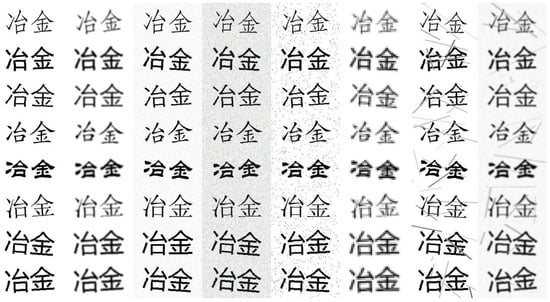
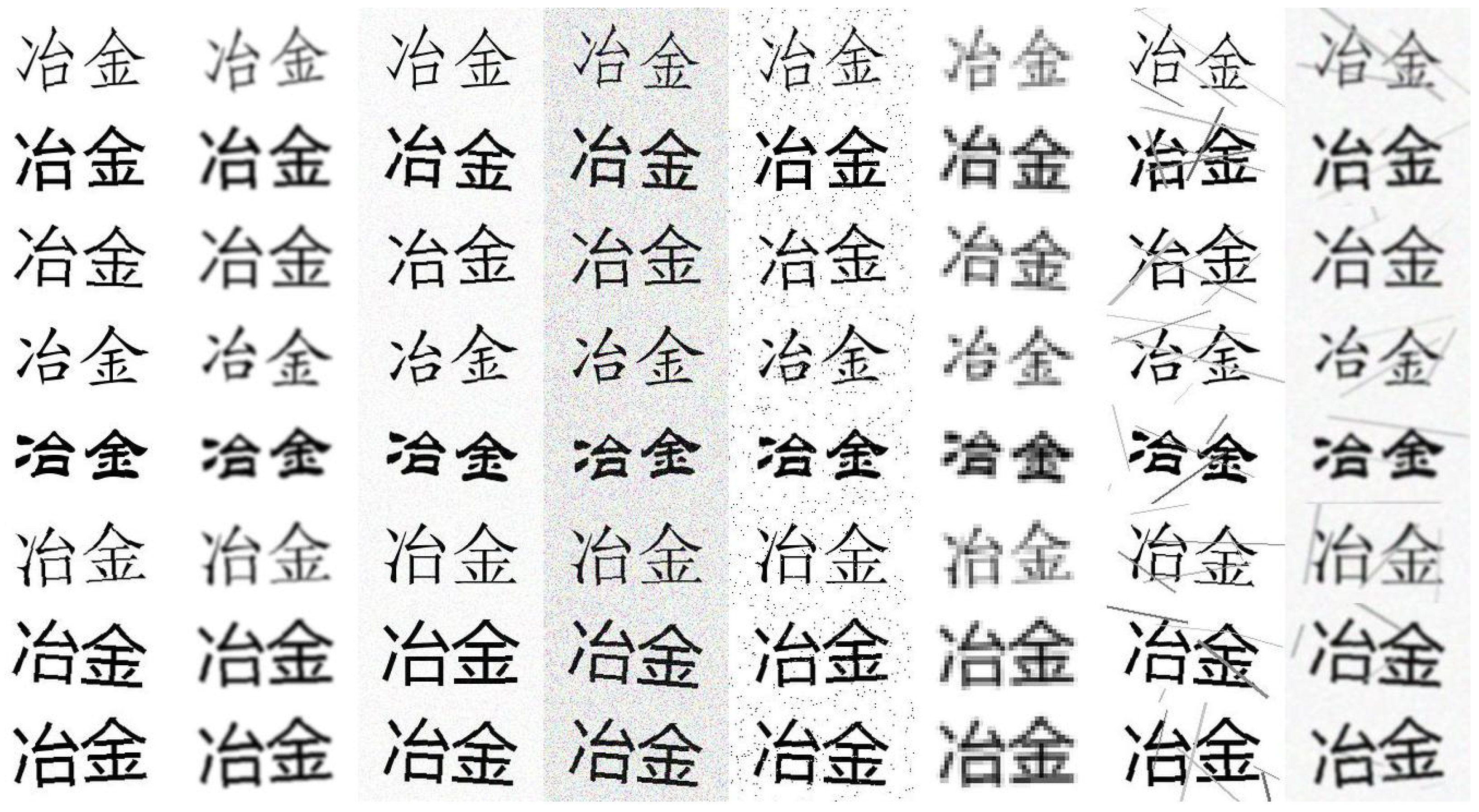
Specifically, to address the scarcity of annotated domain-specific data, we generate the “Synthetic terminology” subset by rendering technical terms with diverse visual effects. Figure 4 illustrates the synthesis process using the word “冶金” (Metallurgy) as an example. To capture the typographic characteristics of industrial documents, we employ 8 distinct fonts: Fangsong, Heiti, Huawenxihei, Kaiti, Lishu, Songti, Microsoft Yahei, and Youyuan. Furthermore, each term is processed through 8 noise regimes to simulate real-world scanning distortions and aging artifacts, including motion blur, two levels of Gaussian noise, salt-and-pepper noise, scanline interference (lines), pixelation, and a compound heavy noise (combo). This multi-font and multi-noise strategy ensures the model learns robust, typeface-invariant features.
Figure 4.
Visual examples of the “synthetic terminology” subset. The Chinese word “冶金” (Metallurgy) is rendered as a representative domain-specific sample to demonstrate the diversity of our dataset: (1) rows show eight font styles: Fangsong, Heiti, Huawenxihei, Kaiti, Lishu, Songti, Microsoft Yahei, and Youyuan; (2) columns represent eight noise types: clean, blur, Gaussian (low), Gaussian (high), salt-and-pepper, pixelate, lines, and combo-heavy.
The benchmark comprises 13,137 image-text pairs, with approximately 10,000 samples (76%) dedicated to fine-tuning (training), while the remaining 3137 samples (24%) are partitioned into validation and test sets. To ensure a rigorous evaluation of the model’s generalization capability, we implemented a vocabulary-oriented split for the synthetic data. This approach guarantees zero overlap between the technical terms in the training subset and those in any test subsets. By isolating the vocabulary, we ensure that the model is evaluated on its ability to recognize domain-specific patterns in unseen terms rather than merely memorizing typeface features of previously encountered words.
4.2. Baseline Systems
We compare two internal variants of the proposed system against four widely used OCR engines as follows:
- MinerU [5]: A document-level OCR and layout analysis pipeline designed for complex PDFs, integrating text recognition with structural parsing.
- PaddleOCR-VL [22]: A widely used open-source OCR framework with strong generalization ability across multiple languages and document types.
- HunyuanOCR [9]: A recent large-scale vision-language OCR model emphasizing end-to-end text recognition without domain-specific adaptation.
- DeepSeek-OCR [11] (Base): The original foundation OCR model used as the backbone of our domain adaptation approach, without any fine-tuning.
- Ours-FT: The DeepSeek-OCR model fine-tuned on the proposed metallurgy dataset using the QLoRA strategy described in Section 3.2.
- Ours-FT+LLM&Dict: An enhanced variant of Ours-FT that further applies a context-aware post-OCR correction module based on Large Language Models and domain lexicon constraints, as described in Section 3.3.
These systems cover both generic OCR baselines and our domain-adapted variants.
4.3. Evaluation Metrics
We report the following evaluation metrics:
- CER (Character Error Rate), measuring the ratio of character-level edit operations to the total number of characters in the ground truth.
- 1 − NED, where NED denotes the character-level normalized edit distance between the prediction and the ground truth.
- WER (Word Error Rate), measuring the ratio of word-level insertions, deletions, and substitutions.
- BLEU-4, to measure n-gram consistency and local semantic fidelity in long-paragraph correction.
- Term-Acc, defined as the exact-match accuracy over 1937 samples of the synthetic test subset.
- Confusion-Acc, the accuracy on a predefined set of 288 samples from the confusion-pair test subset.
Unless otherwise stated, all metrics are computed on the intersection of samples with valid outputs across all systems to ensure a fair comparison.
4.4. Implementation Details
4.4.1. Hardware and Software
Experiments are conducted on a workstation with dual NVIDIA RTX A6000 GPUs (48 GB VRAM each), an Intel i9 CPU, 128 GB RAM, and a 1 TB NVMe SSD, running Ubuntu 20.04. The models are implemented in PyTorch 2.9 with CUDA acceleration.
4.4.2. Fine-Tuning
We adopt the framework with QLoRA-based parameter-efficient fine-tuning of the DeepSeek-OCR decoder as follows:
- LoRA rank: 64;
- Targeted modules: attention projections (q, k, v, o) and FFN projections (up, gate, down) in the MoE decoder;
- Optimizer: AdamW (8-bit);
- Learning rate: with linear warmup and decay;
- Weight decay: 0.01;
- Batch size: 16;
- Training steps: 600 (≈1 epoch over the training subset);
- Precision: mixed bfloat16 for forward/backward passes;
- Vision encoder and optical compression module are kept frozen; only projection layers and decoder adapters are updated.
For the LLM-based correction, we invoke a GPT-style Large Language Model via API, using a fixed prompt template that
- Explicitly states that the input is OCR output of steel/metallurgy technical documents;
- Instructs the model to correct obvious recognition errors while preserving metallurgy terminology;
- Discourages unnecessary paraphrasing or stylistic rewriting.
To reduce cost, only text segments containing low-confidence tokens or tokens belonging to known confusion sets are passed to the correction module. We also cache correction results for repeated segments.
4.4.3. Post-OCR Correction Module Implementation
To ensure the reproducibility of the post-OCR correction stage, we provide the following technical specifications regarding the LLM, its decoding configurations, and the prompt engineering strategy.
Model and Hyperparameters. We utilize the GLM-4 Flash model via API for semantic refinement. To ensure deterministic results for industrial application, we set the temperature to 0.0 and top_p to 1.0, effectively disabling stochastic sampling. The maximum response length is constrained by max_tokens = 2048, and the model is invoked in a non-streaming mode to maintain pipeline stability.
Prompt and Constraint Specification. The correction process is driven by a specialized instruction-style prompt that assigns the LLM a domain-specific role and a set of rigorous technical constraints. The full prompt template used in our experiments is as follows:
“As an auditor for the National Steel Terminology Standardization Committee, you must cleanse OCR-processed metallurgical texts containing noise into professional plain text compliant with GB/T standards. Tasks include: removing erroneous Markdown tags and redundant symbols; correcting common homographs, typos, and metallurgical terminology; restoring split words; accurately identifying chemical elements and units while preserving original process data; fully retaining the original meaning of terms with minimal modifications to the source text; replacing unrecognizable content with ’error result’ without any explanatory text. Output must be professional, rigorous, and technically oriented, returning only the cleaned text itself without any additional notes.”
Workflow. For each inference, the final prompt is constructed by concatenating the above template with the initial OCR text using the format: “[Template] Initial OCR Text: [Initial OCR Text] Please return the corrected text.” This zero-shot approach ensures that the model focuses exclusively on semantic reconstruction and terminology preservation without introducing conversational hallucinations.
4.5. Overall Results
Table 2 summarizes the overall performance of all systems on the main metallurgy OCR test set. The proposed framework (Ours-FT+LLM&Dict) outperforms both general commercial OCR engines and the baseline model across all metrics.
Table 2.
Overall performance on the metallurgy OCR test set. ↑ denotes higher is better; ↓ denotes lower is better.
4.5.1. Subset-Wise and Layout-Aware Analysis
To better understand the behavior of each component, we conduct a subset-wise evaluation across different data distributions, including Real Document Crops, Synthetic Terminology, Confusion-Pair Set, and Long-Paragraph Set. Different subsets are evaluated with task-aligned metrics to ensure fair and interpretable comparison.
Real Document Crops (Real-World Layout Variations)
This subset reflects realistic scanning artifacts, layout diversity, and complex formatting patterns commonly observed in industrial documents, including multi-column text, embedded tables, and mixed typography. Therefore, we report all metrics to comprehensively evaluate end-to-end robustness under practical deployment conditions. Compared with PaddleOCR-VL and Hunyuan, our adapted model consistently achieves lower CER and WER across heterogeneous layouts, indicating improved stability in handling structured and semi-structured document regions. The results suggest that domain adaptation not only improves character recognition accuracy, but also enhances robustness to layout-induced noise and real-world document variability. Overall, simply deploying a strong general OCR engine is insufficient for industrial scenarios, whereas our domain-aware framework achieves more reliable performance under realistic formatting conditions.
Synthetic Terminology (Short Domain Terms)
This subset focuses on isolated metallurgical terms without contextual dependencies. Therefore, we primarily report character-level metrics (CER and 1-NED) and terminology accuracy (Term-Acc). Compared with the DeepSeek-OCR Base model, Ours-FT significantly reduces CER, indicating that domain fine-tuning effectively adapts the decoder to specialized vocabulary distributions. The improvement in Term-Acc confirms that QLoRA-based adaptation enhances the recognition of domain-specific terminology even without modifying the visual encoder.
Confusion-Pair Set (Minor-Stroke Discrimination)
This stress-test subset evaluates the ability to distinguish visually similar characters. Accordingly, we report CER and Confusion-Acc. Domain fine-tuning nearly doubles the Confusion-Acc (0.406 → 0.813), demonstrating that lightweight adaptation successfully corrects the statistical bias of the general model toward high-frequency common characters. The integration of the LLM-based correction module further stabilizes the performance (0.819), indicating that context-aware post-processing does not compromise fine-grained visual discrimination.
Long-Paragraph Set (Context-Dependent Text)
This subset contains multi-sentence industrial descriptions with stronger contextual dependencies. In addition to CER, we report WER and BLEU-4 to evaluate structural and semantic consistency. While domain fine-tuning substantially reduces character-level errors, the addition of the LLM-based correction module further decreases residual noise (CER: 1.095 → 0.608) and improves sequence-level consistency, demonstrating the complementary role of context-aware correction in long-form recognition.
4.5.2. Noise-Type-Wise Robustness Analysis
To evaluate the robustness of domain fine-tuning under visual degradation, we conduct controlled noise injection experiments on the Confusion-Pair Set and report Confusion-Acc in Table 3. Since the LLM-based correction module operates at the text level and is independent of image perturbations, we focus on comparing DeepSeek-OCR Base and Ours-FT to isolate the effect of visual-domain adaptation.
Table 3.
Confusion-Acc (%) under different noise types on the Confusion-Pair Set.
Across all noise types, Ours-FT consistently outperforms the Base model by a substantial margin. While the Base model shows a monotonic degradation from 0.611 (clean) to 0.229 (combo-heavy), Ours-FT maintains high discrimination accuracy under most perturbations, remaining above 0.90 under blur and Gaussian noise and above 0.80 under salt-and-pepper and pixelation distortions. This indicates that domain fine-tuning effectively reshapes the decoder’s character distribution, reducing its tendency to revert to high-frequency common characters when visual evidence becomes ambiguous.
Different noise types exhibit distinct impact patterns. Blur and Gaussian noise primarily soften stroke boundaries but preserve overall structural layout; under these conditions, Ours-FT remains highly stable (0.906–0.909), whereas the Base model degrades significantly. This suggests that fine-tuning enhances statistical discrimination between visually similar technical characters even when fine-grained stroke details are partially corrupted.
In contrast, structured perturbations such as artificial lines and heavy combined noise introduce geometric disruptions that directly interfere with character topology. Under these settings, Ours-FT experiences a more noticeable drop (0.598 and 0.623, respectively), although it still substantially exceeds the Base model. This pattern confirms that domain adaptation improves decision-level robustness but cannot fully compensate for severe structural damage in the visual encoder.
Overall, the results demonstrate that parameter-efficient domain fine-tuning enhances robustness at the statistical decoding level rather than altering low-level visual feature extraction. The adapted model becomes less sensitive to moderate noise perturbations while maintaining superior confusion discrimination capability, thereby validating the effectiveness of the proposed domain-aware adaptation strategy.
4.6. Ablation Study
To disentangle the contributions of different components, we conduct ablation experiments focusing on the LoRA fine-tuning configuration and the post-OCR correction strategies.
LoRA Configuration (Stage 2). We examine the necessity of fine-tuning different modules within the MoE decoder. Table 4 compares the performance of the Base model against variants with LoRA adapters injected into different projection layers.
Table 4.
Ablation on LoRA configuration. ↑ denotes higher is better; ↓ denotes lower is better.
As shown in Table 4, the Base model without adaptation yields a CER of 4.208. Injecting LoRA adapters only into the attention projection layers brings noticeable gains, reducing CER significantly. However, the Full LoRA configuration (targeting both attention q, k, v, o, and FFN projections) achieves the best trade-off, reaching a CER of 1.095 (consistent with the Ours-FT result in Table 2). This indicates that adapting the Feed-Forward Networks (FFN), which typically store knowledge in Transformer models, is crucial for capturing the domain-specific vocabulary of steel metallurgy.
Post-OCR Correction Variants (Stage 3). We further evaluate the effectiveness of the proposed context-aware correction module by comparing it with rule-based and unconstrained LLM approaches. The results are presented in Table 5.
Table 5.
Ablation of post-OCR correction variants. ↑ denotes higher is better; ↓ denotes lower is better.
- Rule-only: Relying solely on regex and lexicon replacement yields a high CER of 0.944. Rule-based methods often fail to cover the wide variety of OCR errors and cannot handle context-dependent ambiguity.
- LLM-only: Directly applying an unconstrained Large Language Model for rewriting achieves a CER of 1.226, which is surprisingly higher than the fine-tuned model’s output (1.095). This degradation validates our hypothesis that unconstrained LLMs tend to generate “terminology hallucinations” or over-correct valid technical codes, leading to semantic drift.
- LLM+Dict (ours): By combining the LLM’s semantic reasoning with rigid constraints from the metallurgy lexicon and confusion sets, our method suppresses these hallucinations. This synergy achieves the lowest CER of 0.608 and the highest terminology accuracy of 0.833, demonstrating that controllability is key to applying LLMs in industrial OCR tasks.
4.7. Qualitative Analysis of the Correction Module
To further demonstrate the controllability and reliability of the proposed correction module, we provide representative qualitative examples covering confusion-pair correction, terminology hallucination control, and failure cases.
First, the module effectively resolves minor-stroke confusion pairs frequently observed in metallurgical documents. For example, the OCR output “高炉煤气压カ控制系统” incorrectly replaces the character “力” with “カ”. Our method correctly restores “高炉煤气压力控制系统” without altering surrounding content. Similar improvements are observed in domain-specific terms such as correcting “波劫” to “波动” in “钢液温度波动范围”. These cases show that the model performs localized corrections guided by both visual cues and domain terminology constraints.
Second, we evaluate terminology hallucination behavior by comparing with an unconstrained LLM-based correction strategy. When processing “转炉吹氧强度3.5 Nm3/t”, an unconstrained LLM expands the text to “转炉吹氧强度为3.5 Nm3/t (标准状态)”, introducing additional domain assumptions. In contrast, our method preserves the original process data exactly and avoids injecting new technical content. This demonstrates the controllability of the correction module under strict output constraints.
Finally, we report a representative failure case. When the OCR output contains semantically valid but contextually incorrect polarity (e.g., “0.45% 以上” instead of “0.45% 以下”), the correction module does not modify the expression, as both variants are technically plausible. This indicates that the current framework prioritizes conservative correction and does not perform global semantic verification. Future work may incorporate structured process constraints to address such issues.
5. Conclusions
This paper presents FeOCR, a domain-adaptive OCR framework for Chinese metallurgical documents, aiming to address the limitations of general-purpose OCR systems in industrial scenarios. The framework integrates domain lexicon construction, parameter-efficient incremental fine-tuning of DeepSeek-OCR, and a context correction strategy that combines an LLM with a technical lexicon. It suppresses OCR errors from three levels. These levels are data, model, and semantics. The framework improves the reliability and adaptability of general OCR models in metallurgy scenarios through lightweight and engineering-friendly mechanisms.
At the data level, this paper constructs a domain dataset that covers key metallurgy terms and high-frequency confusable pairs. It generates diverse visual samples through font perturbation and multiple types of noise augmentation. This provides necessary support for the model to capture statistical priors of domain vocabulary. At the model level, QLoRA is used to fine-tune the decoder of DeepSeek-OCR. The decoder maintains its general ability and gains stronger recognition tendency for metallurgy terminology. At the semantic level, the context correction module combines a domain lexicon, confusion set constraints, and paragraph-level semantic reconstruction of an LLM. It effectively prevents misreplacement of technical terms and semantic drift during the OCR process. Experimental results show that the proposed method achieves significant improvement in character-level, word-level, and terminology-level metrics. It demonstrates strong robustness in scenarios with highly confusable word pairs and greatly reduces systematic bias of general OCR models in domain-specific settings.
The framework proposed in this paper has strong scalability and transferability. The method does not rely on large amounts of domain-annotated data. It also does not require retraining of the underlying visual encoder. Therefore, it can be efficiently deployed in industrial environments with limited resources and can be applied to OCR adaptation tasks of documents in other technical domains such as materials science, mechanical engineering, and chemical engineering.
Despite its effectiveness, the current FeOCR framework has several limitations that provide opportunities for further refinement. First, while it handles standard technical layouts well, its performance on documents featuring highly dense mathematical formulas, complex nested tables, and intricate graphical overlays remains to be fully optimized, as these elements require more specialized structural parsing. Second, as a modular pipeline, the system is susceptible to cascading errors; if the initial visual recognition produces extremely low-confidence or fragmented text, the semantic correction module may lack sufficient context to perform an accurate recovery. Furthermore, the system’s error correction performance is intrinsically coupled with the coverage of the domain lexicon, meaning that recognition of emerging or rare technical terms not present in the current dictionary may still be suboptimal. Lastly, the integration of a Large Language Model for post-processing, though selectively invoked, introduces higher inference latency compared with traditional, lightweight OCR engines.
To address these challenges, we propose three primary directions for future work. First, we will evaluate and enhance the system’s robustness on larger-scale industrial documents with increased structural complexity, particularly those containing mixed text, formulas, and graphics. Second, we aim to investigate end-to-end training strategies that integrate visual recognition and semantic correction into a unified framework, thereby mitigating error propagation between modules. Third, we will explore automated methods for domain lexicon construction and confusion set mining to ensure the adaptation process is more scalable and responsive to evolving technical vocabularies.
In summary, this paper provides a practical, cost-efficient, and predictable solution for OCR adaptation in technical domains. It offers a solid data foundation for building high-quality metallurgy large models and knowledge graphs. It also provides new paradigms and new perspectives for the development of AI systems in vertical domains.
Author Contributions
Conceptualization, Q.Z. and L.W.; methodology, Q.Z. and Y.S.; software, Y.S., F.M., and M.L.; validation, H.Z., F.M., and M.L.; formal analysis, H.Z., F.M., and M.L.; investigation, Q.Z. and Y.S.; resources, Q.Z.; data curation, Y.S. and M.L.; writing—original draft preparation, Q.Z.; writing—review and editing, Q.Z., Y.S., and L.W.; visualization, M.L.; supervision, L.W. and H.Z.; project administration, L.W. and H.Z.; funding acquisition, Q.Z. All authors have read and agreed to the published version of the manuscript.
Funding
This research was funded by the National Science and Technology Major Project “Intelligent Manufacturing Systems and Robots” (No. 2025ZD1602500).
Institutional Review Board Statement
Not applicable.
Informed Consent Statement
Not applicable.
Data Availability Statement
A representative public subset of the synthetic metallurgy terminology dataset, including approximately 43,172 image–text pairs and the core evaluation benchmark, is available at https://anonymous.4open.science/r/FeOCR_SyntheticTerminology (accessed on 3 March 2026). The data that support the findings of this study are available from the corresponding author upon reasonable request due to privacy concerns.
Conflicts of Interest
The authors declare no conflicts of interest.
References
- Shang, Y.; Ren, Y.; Peng, H.; Wang, Y.; Wang, G.; Li, Z.C.; Yang, Y.; Li, Y. A Perspective Survey on Industrial Knowledge Graphs: Recent Advances, Open Challenges, and Future Directions. In Proceedings of the 2023 International Conference on Machine Learning and Cybernetics (ICMLC); IEEE: New York, NY, USA, 2023; pp. 194–200. [Google Scholar] [CrossRef] [Scilit]
- Sun, Q.; Luo, Y.; Zhang, W.; Li, S.; Li, J.; Niu, K.; Kong, X.; Liu, W. Docs2kg: Unified knowledge graph construction from heterogeneous documents assisted by large language models. arXiv 2024, arXiv:2406.02962. [Google Scholar] [CrossRef] [Scilit]
- Knollmeyer, S.; Caymazer, O.; Grossmann, D. Document GraphRAG: Knowledge Graph Enhanced Retrieval Augmented Generation for Document Question Answering Within the Manufacturing Domain. Electronics 2025, 14, 2102. [Google Scholar] [CrossRef] [Scilit]
- Smith, R. An Overview of the Tesseract OCR Engine. In Ninth International Conference on Document Analysis and Recognition (ICDAR 2007); IEEE: New York, NY, USA, 2007; Volume 2, pp. 629–633. [Google Scholar] [CrossRef] [Scilit]
- Niu, J.; Liu, Z.; Gu, Z.; Wang, B.; Ouyang, L.; Zhao, Z.; Chu, T.; He, T.; Wu, F.; Zhang, Q.; et al. Mineru2.5: A decoupled vision-language model for efficient high-resolution document parsing. arXiv 2025, arXiv:2509.22186. [Google Scholar] [CrossRef] [Scilit]
- Du, Y.; Li, C.; Guo, R.; Yin, X.; Liu, W.; Zhou, J.; Bai, Y.; Yu, Z.; Yang, Y.; Dang, Q.; et al. Pp-ocr: A practical ultra lightweight ocr system. arXiv 2020, arXiv:2009.09941. [Google Scholar] [CrossRef] [Scilit]
- Li, C.; Liu, W.; Guo, R.; Yin, X.; Jiang, K.; Du, Y.; Du, Y.; Zhu, L.; Lai, B.; Hu, X.; et al. PP-OCRv3: More attempts for the improvement of ultra lightweight OCR system. arXiv 2022, arXiv:2206.03001. [Google Scholar] [CrossRef] [Scilit]
- Cui, C.; Sun, T.; Lin, M.; Gao, T.; Zhang, Y.; Liu, J.; Wang, X.; Zhang, Z.; Zhou, C.; Liu, H.; et al. Paddleocr 3.0 technical report. arXiv 2025, arXiv:2507.05595. [Google Scholar] [CrossRef] [Scilit]
- Team, H.V.; Lyu, P.; Wan, X.; Li, G.; Peng, S.; Wang, W.; Wu, L.; Shen, H.; Zhou, Y.; Tang, C.; et al. HunyuanOCR Technical Report. arXiv 2025, arXiv:2511.19575. [Google Scholar] [CrossRef] [Scilit]
- Zhang, J.; Zhang, Q.; Wang, B.; Ouyang, L.; Wen, Z.; Li, Y.; Chow, K.H.; He, C.; Zhang, W. OCR Hinders RAG: Evaluating the Cascading Impact of OCR on Retrieval-Augmented Generation. In IEEE/CVF International Conference on Computer Vision (ICCV); IEEE: New York, NY, USA, 2025; pp. 17443–17453. [Google Scholar] [CrossRef] [Scilit]
- Wei, H.; Sun, Y.; Li, Y. Deepseek-ocr: Contexts optical compression. arXiv 2025, arXiv:2510.18234. [Google Scholar] [CrossRef] [Scilit]
- Rabiner, L. A tutorial on hidden Markov models and selected applications in speech recognition. Proc. IEEE 1989, 77, 257–286. [Google Scholar] [CrossRef] [Scilit]
- Cortes, C.; Vapnik, V. Support-vector networks. Mach. Learn. 1995, 20, 273–297. [Google Scholar] [CrossRef] [Scilit]
- Lecun, Y.; Bottou, L.; Bengio, Y.; Haffner, P. Gradient-based learning applied to document recognition. Proc. IEEE 1998, 86, 2278–2324. [Google Scholar] [CrossRef] [Scilit]
- Elman, J.L. Finding structure in time. Cogn. Sci. 1990, 14, 179–211. [Google Scholar] [CrossRef]
- Hochreiter, S.; Schmidhuber, J. Long Short-Term Memory. Neural Comput. 1997, 9, 1735–1780. [Google Scholar] [CrossRef] [Scilit] [PubMed]
- Shi, B.; Bai, X.; Yao, C. An End-to-End Trainable Neural Network for Image-Based Sequence Recognition and Its Application to Scene Text Recognition. IEEE Trans. Pattern Anal. Mach. Intell. 2017, 39, 2298–2304. [Google Scholar] [CrossRef] [Scilit]
- Sutskever, I.; Vinyals, O.; Le, Q.V. Sequence to Sequence Learning with Neural Networks. In Advances in Neural Information Processing Systems; Curran Associates, Inc.: Red Hook, NY, USA, 2014; Volume 27. [Google Scholar] [CrossRef] [Scilit]
- Vaswani, A.; Shazeer, N.; Parmar, N.; Uszkoreit, J.; Jones, L.; Gomez, A.N.; Kaiser, L.u.; Polosukhin, I. Attention is All you Need. In Advances in Neural Information Processing Systems; Guyon, I., Luxburg, U.V., Bengio, S., Wallach, H., Fergus, R., Vishwanathan, S., Garnett, R., Eds.; Curran Associates, Inc.: Red Hook, NY, USA, 2017; Volume 30. [Google Scholar] [CrossRef] [Scilit]
- Dosovitskiy, A.; Beyer, L.; Kolesnikov, A.; Weissenborn, D.; Zhai, X.; Unterthiner, T.; Dehghani, M.; Minderer, M.; Heigold, G.; Gelly, S.; et al. An Image is Worth 16 × 16 Words: Transformers for Image Recognition at Scale. arXiv 2021, arXiv:2010.11929. [Google Scholar] [CrossRef] [Scilit]
- Liu, Z.; Lin, Y.; Cao, Y.; Hu, H.; Wei, Y.; Zhang, Z.; Lin, S.; Guo, B. Swin Transformer: Hierarchical Vision Transformer using Shifted Windows. In 2021 IEEE/CVF International Conference on Computer Vision (ICCV); IEEE: New York, NY, USA, 2021; pp. 9992–10002. [Google Scholar] [CrossRef] [Scilit]
- Cui, C.; Sun, T.; Liang, S.; Gao, T.; Zhang, Z.; Liu, J.; Wang, X.; Zhou, C.; Liu, H.; Lin, M.; et al. PaddleOCR-VL: Boosting Multilingual Document Parsing via a 0.9 B Ultra-Compact Vision-Language Model. arXiv 2025, arXiv:2510.14528. [Google Scholar] [CrossRef] [Scilit]
- Karthikeyan, S.; de Herrera, A.G.S.; Doctor, F.; Mirza, A. An OCR Post-Correction Approach Using Deep Learning for Processing Medical Reports. IEEE Trans. Circuits Syst. Video Technol. 2022, 32, 2574–2581. [Google Scholar] [CrossRef] [Scilit]
- Yimyam, W.; Ketcham, M.; Jensuttiwetchakult, T.; Hiranchan, S.; Pramkeaw, P.; Chumuang, N. Enhancing and Evaluating an Impact of OCR and Ontology on Financial Document Checking Process. In 2020 15th International Joint Symposium on Artificial Intelligence and Natural Language Processing (iSAI-NLP); IEEE: New York, NY, USA, 2020; pp. 1–6. [Google Scholar] [CrossRef] [Scilit]
- Ma, H.Y.; Huang, H.H.; Liu, C.L. Reading between the Lines: Image-Based Order Detection in OCR for Chinese Historical Documents. Proc. AAAI Conf. Artif. Intell. 2024, 38, 23808–23810. [Google Scholar] [CrossRef] [Scilit]
- Baek, J.; Kim, G.; Lee, J.; Park, S.; Han, D.; Yun, S.; Oh, S.J.; Lee, H. What Is Wrong With Scene Text Recognition Model Comparisons? Dataset and Model Analysis. In 2019 IEEE/CVF International Conference on Computer Vision (ICCV); IEEE: New York, NY, USA, 2019; pp. 4714–4722. [Google Scholar] [CrossRef] [Scilit]
- Li, H.; Wang, P.; Shen, C.; Zhang, G. Show, Attend and Read: A Simple and Strong Baseline for Irregular Text Recognition. Proc. AAAI Conf. Artif. Intell. 2019, 33, 8610–8617. [Google Scholar] [CrossRef] [Scilit]
- Chen, X.; Jin, L.; Zhu, Y.; Luo, C.; Wang, T. Text Recognition in the Wild: A Survey. ACM Comput. Surv. 2021, 54, 42. [Google Scholar] [CrossRef] [Scilit]
- Cheng, Z.; Bai, F.; Xu, Y.; Zheng, G.; Pu, S.; Zhou, S. Focusing Attention: Towards Accurate Text Recognition in Natural Images. In 2017 IEEE International Conference on Computer Vision (ICCV); IEEE: New York, NY, USA, 2017; pp. 5086–5094. [Google Scholar] [CrossRef] [Scilit]
- Fang, S.; Mao, Z.; Xie, H.; Wang, Y.; Yan, C.; Zhang, Y. ABINet++: Autonomous, Bidirectional and Iterative Language Modeling for Scene Text Spotting. IEEE Trans. Pattern Anal. Mach. Intell. 2023, 45, 7123–7141. [Google Scholar] [CrossRef] [Scilit]
- Rijhwani, S.; Rosenblum, D.; Anastasopoulos, A.; Neubig, G. Lexically Aware Semi-Supervised Learning for OCR Post-Correction. Trans. Assoc. Comput. Linguist. 2021, 9, 1285–1302. [Google Scholar] [CrossRef] [Scilit]
- Gupta, H.; Del Corro, L.; Broscheit, S.; Hoffart, J.; Brenner, E. Unsupervised Multi-View Post-OCR Error Correction With Language Models. In 2021 Conference on Empirical Methods in Natural Language Processing; Association for Computational Linguistics: Stroudsburg, PA, USA, 2021; pp. 8647–8652. [Google Scholar] [CrossRef] [Scilit]
- Chen, Y.H.; Zhou, Y. Enhancing ocr performance through Post-OCR models: Adopting glyph embedding for improved correction. arXiv 2023, arXiv:2308.15262. [Google Scholar] [CrossRef] [Scilit]
- Chen, Y.H.; Ströbel, P.B. TrOCR Meets Language Models: An End-to-End Post-correction Approach. In Document Analysis and Recognition—ICDAR 2024 Workshops; Springer: Cham, Switzerland, 2024; pp. 12–26. [Google Scholar] [CrossRef] [Scilit]
- Dettmers, T.; Pagnoni, A.; Holtzman, A.; Zettlemoyer, L. QLoRA: Efficient Finetuning of Quantized LLMs. In Advances in Neural Information Processing Systems; Curran Associates, Inc.: Red Hook, NY, USA, 2023; Volume 36, pp. 10088–10115. [Google Scholar] [CrossRef] [Scilit]
- Hu, E.J.; Shen, Y.; Wallis, P.; Allen-Zhu, Z.; Li, Y.; Wang, S.; Wang, L.; Chen, W. LoRA: Low-Rank Adaptation of Large Language Models. In International Conference on Learning Representations; Association for Computational Linguistics: Stroudsburg, PA, USA, 2022. [Google Scholar] [CrossRef] [Scilit]
- Kirillov, A.; Mintun, E.; Ravi, N.; Mao, H.; Rolland, C.; Gustafson, L.; Xiao, T.; Whitehead, S.; Berg, A.C.; Lo, W.Y.; et al. Segment Anything. In IEEE/CVF International Conference on Computer Vision (ICCV); IEEE: New York, NY, USA, 2023; pp. 4015–4026. [Google Scholar]
- Radford, A.; Kim, J.W.; Hallacy, C.; Ramesh, A.; Goh, G.; Agarwal, S.; Sastry, G.; Askell, A.; Mishkin, P.; Clark, J.; et al. Learning Transferable Visual Models From Natural Language Supervision. In Proceedings of the 38th International Conference on Machine Learning, Online, 18–24 July 2021; IMLS: San Diego, CA, USA, 2021; Volume 139, pp. 8748–8763. [Google Scholar]
- Su, J.; Ahmed, M.; Lu, Y.; Pan, S.; Bo, W.; Liu, Y. RoFormer: Enhanced transformer with Rotary Position Embedding. Neurocomputing 2024, 568, 127063. [Google Scholar] [CrossRef] [Scilit]
- Zhang, B.; Sennrich, R. Root Mean Square Layer Normalization. In Advances in Neural Information Processing Systems; Wallach, H., Larochelle, H., Beygelzimer, A., d’Alché-Buc, F., Fox, E., Garnett, R., Eds.; Curran Associates, Inc.: Red Hook, NY, USA, 2019; Volume 32. [Google Scholar] [CrossRef] [Scilit]
- Mao, A.; Mohri, M.; Zhong, Y. Cross-Entropy Loss Functions: Theoretical Analysis and Applications. In Proceedings of the 40th International Conference on Machine Learning, Honolulu, HI, USA, 23–29 July 2023; IMLS: San Diego, CA, USA, 2023; Volume 202, pp. 23803–23828. [Google Scholar] [CrossRef] [Scilit]

Disclaimer/Publisher’s Note: The statements, opinions and data contained in all publications are solely those of the individual author(s) and contributor(s) and not of MDPI and/or the editor(s). MDPI and/or the editor(s) disclaim responsibility for any injury to people or property resulting from any ideas, methods, instructions or products referred to in the content. |
© 2026 by the authors. Licensee MDPI, Basel, Switzerland. This article is an open access article distributed under the terms and conditions of the Creative Commons Attribution (CC BY) license.