


Abstract
Object detection in UAV aerial imagery presents significant challenges, including large-scale variations, complex background interference, object occlusion, and a high density of small targets. These factors restrict the generalization and localization capabilities of existing detectors. To address these issues, we propose YOLO-DMA, an efficient detection framework for aerial images. The framework incorporates three key improvements. First, we designed a Hierarchical Deformable Block (HDB), which uses adaptive sampling grids and a progressive multi-branch structure to capture features of irregular objects while preserving network depth, enabling richer hierarchical feature representation. Second, we proposed a Dual-Path Linear-complexity Perception (DPLP) module. One path employs a linear-complexity attention mechanism to model the global context efficiently, while the other utilizes lightweight convolutions to extract local details. This design effectively fuses shallow details with mid-level semantics, improving detection and localization accuracy. Third, we adopted the Wise-IoU v3 loss function, which dynamically adjusts optimization objectives, suppressing harmful gradients from low-quality samples and emphasizing small objects during training. Comprehensive experiments on the VisDrone dataset show that YOLO-DMA achieves 42.8% mAP50 and 25.7% mAP50:95. These correspond to improvements of 4.8% and 3.1% over YOLOv10. Experimental results demonstrate the effectiveness and practicality of the proposed framework.
1. Introduction
In recent years, Unmanned Aerial Vehicles (UAVs) have been widely used in fields such as traffic monitoring, agricultural management, and disaster relief [1,2,3,4,5,6], owing to their flexibility and unique aerial perspective. As a key technology enabling UAVs to achieve intelligent perception, object detection has thus garnered significant attention. However, object detection in low-altitude aerial scenarios still faces a series of specific challenges. Firstly, targets exhibit drastic scale variations, with a substantial size discrepancy between nearby and distant objects within the same image, imposing higher demands on the model’s multi-scale adaptability. Secondly, complex background interference, such as similar textures of ground objects and dense occlusion, severely complicates the distinction between targets and the background. Moreover, small objects suffer from insufficient effective features, as they occupy few pixels in the image, and their limited feature information is prone to being overlooked or diminished during feature extraction and fusion. These interrelated challenges cause general-purpose detection models to perform inadequately in aerial scenarios. Therefore, developing specialized detection algorithms capable of addressing the aforementioned issues holds considerable research significance and practical value.
Deep learning-based methods have become the dominant approach in object detection research [7], with development mainly following two paradigms: two-stage and one-stage detectors. Representative two-stage detectors include the R-CNN, Fast R-CNN, and Faster R-CNN series [8,9,10]. These methods decompose detection into two steps. First, candidate object regions are generated using techniques like selective search or a Region Proposal Network (RPN). Then, each candidate region undergoes feature resampling for precise classification and bounding box regression. This paradigm often achieves high accuracy. While its sequential design leads to substantial computational costs. This makes it difficult to meet the real-time demands of UAV platforms. In contrast, one-stage detectors like the YOLO series perform object localization and classification within a single end-to-end network. This integrated approach offers a better balance between efficiency and accuracy, making it more suitable for real-time UAV image analysis. For example, YOLOv5 [11] is built on PyTorch 1.5 and improved model generalization by optimizing its anchor mechanism and multi-scale training. YOLOv8 [12] further advanced feature fusion with its C2f module and adopted a decoupled, anchor-free detection head, achieving higher accuracy with a simpler design. The recent YOLOv10 [13] introduced a dual-label assignment strategy, using separate heads for training and inference. This innovation completely removes the need for Non-Maximum Suppression (NMS) post-processing, boosting inference speed while maintaining strong accuracy. Due to this favorable efficiency-accuracy balance, YOLOv10 is chosen as our baseline model. However, as a general-purpose detector, it is not specifically optimized for aerial imaging challenges like small objects, large scale variations, and complex backgrounds. Its limited ability to preserve small-object features during processing hinders its performance in UAV scenarios.
To tackle these core challenges, this paper proposes a Multi-scale Deformable convolution and linear Attention enhanced YOLO (YOLO-DMA), which is developed based on YOLOv10. The model adds a dedicated head for tiny objects and incorporates targeted improvements in feature extraction, multi-scale perception, and the loss function. These enhancements aim to boost detection performance in aerial scenes. Our main contributions are:
- We propose a Hierarchical Deformable Block (HDB) with a parallel, progressive split architecture. It employs group convolution and depthwise separable convolution to ensure computational efficiency while utilizing deformable convolution to adaptively capture features of objects with multi-scale and irregular shapes. This design enhances the flexibility and robustness of feature representation.
- We design a Dual-Path Linear Perception (DPLP) module and place it before the P2, P3, and P4 detection heads. One path uses linear attention to model the global context, while the other uses lightweight convolution to capture local details. This design effectively combines global perception with detail preservation in shallow and middle-level features.
- We introduce the Wise-IoU v3 loss function. Its non-monotonic focusing mechanism dynamically adjusts gradient weights. This increases the model’s sensitivity to small objects and reduces harmful gradients from low-quality bounding boxes during training.
2. Related Work
Researchers in the field of UAV image object detection recognize that expanding receptive field can help model capture richer contextual information, thereby improving detection performance for targets with significant scale variations [14]. Mittal et al. [15] introduced dilated residual blocks into Faster R-CNN, using dilated convolutions to widen the receptive field and improve performance. However, the fixed sampling pattern of dilated convolution may lose fine local details. Wang et al. [16] combined large convolutional kernels with frequency-domain attention to enhance global feature perception, though this design increases computational cost. Zeng et al. [17] adopted Inception deep convolution for lightweight receptive field expansion, but its asymmetric structure tends to over-emphasize directional features, making it less effective at capturing key small-object information. Wang et al. [18] stacked standard and dilated convolutions in parallel to expand the receptive field with few parameters, achieving good results on VisDrone. Nevertheless, this approach raises computational load while reducing network depth, potentially limiting feature representation richness. Although these methods advance receptive field design, effectively modeling irregular objects and fine details in UAV images—where scales vary greatly and backgrounds are complex—remains an open challenge.
Attention mechanisms improve model expressiveness by highlighting important features and suppressing irrelevant ones. Li et al. [19] fused channel and spatial attention to enhance joint modeling of channel–spatial relationships. Yang et al. [20] proposed a ternary attention mechanism that separately compresses width, height, and channel dimensions to integrate spatial and channel information better. Zhou et al. [21] added a gating mechanism to sharpen the selection of key features further. However, while focusing on globally salient regions, these methods often underperform in preserving local details, limiting detection gains in detail-rich aerial scenes.
Loss function improvements aim to enhance the accuracy and stability of bounding box regression. IoU Loss directly optimizes overlap but fails when boxes do not intersect. Subsequent variants address this: GIoU Loss [22] adds a minimum enclosing box to provide gradients; DIoU Loss also minimizes the center-point distance for faster convergence; CIoU Loss [22] further enforces aspect-ratio consistency. More recently, Focaler-IoU [23] reshapes the IoU loss to help the model focus on hard or easy samples depending on the task. The Wise-IoU series [24] builds on this line with a dynamic, non-monotonic focusing mechanism, offering a promising way to balance gradient contributions from different-quality samples in UAV small-object detection.
3. Materials and Methods
Although YOLOv10 achieves fast and accurate generic object detection by decoupling the detection heads between the training and inference stages and eliminating NMS post-processing, its design is not specifically tailored for the challenges inherent in low-altitude remote sensing imagery. In UAV aerial scenarios, objects exhibit large-scale variations, small objects account for a high proportion, and during feature fusion, the detailed information of small objects is prone to being overwhelmed by larger ones. These factors limit the performance of YOLOv10 in such tasks [25,26,27,28,29,30].
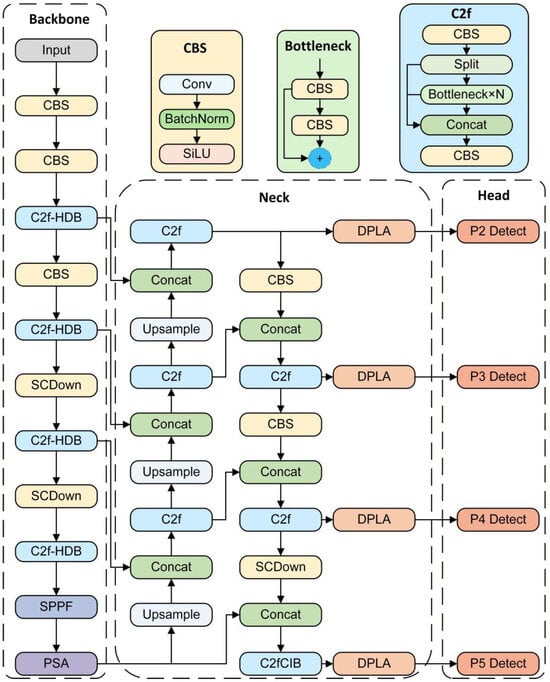
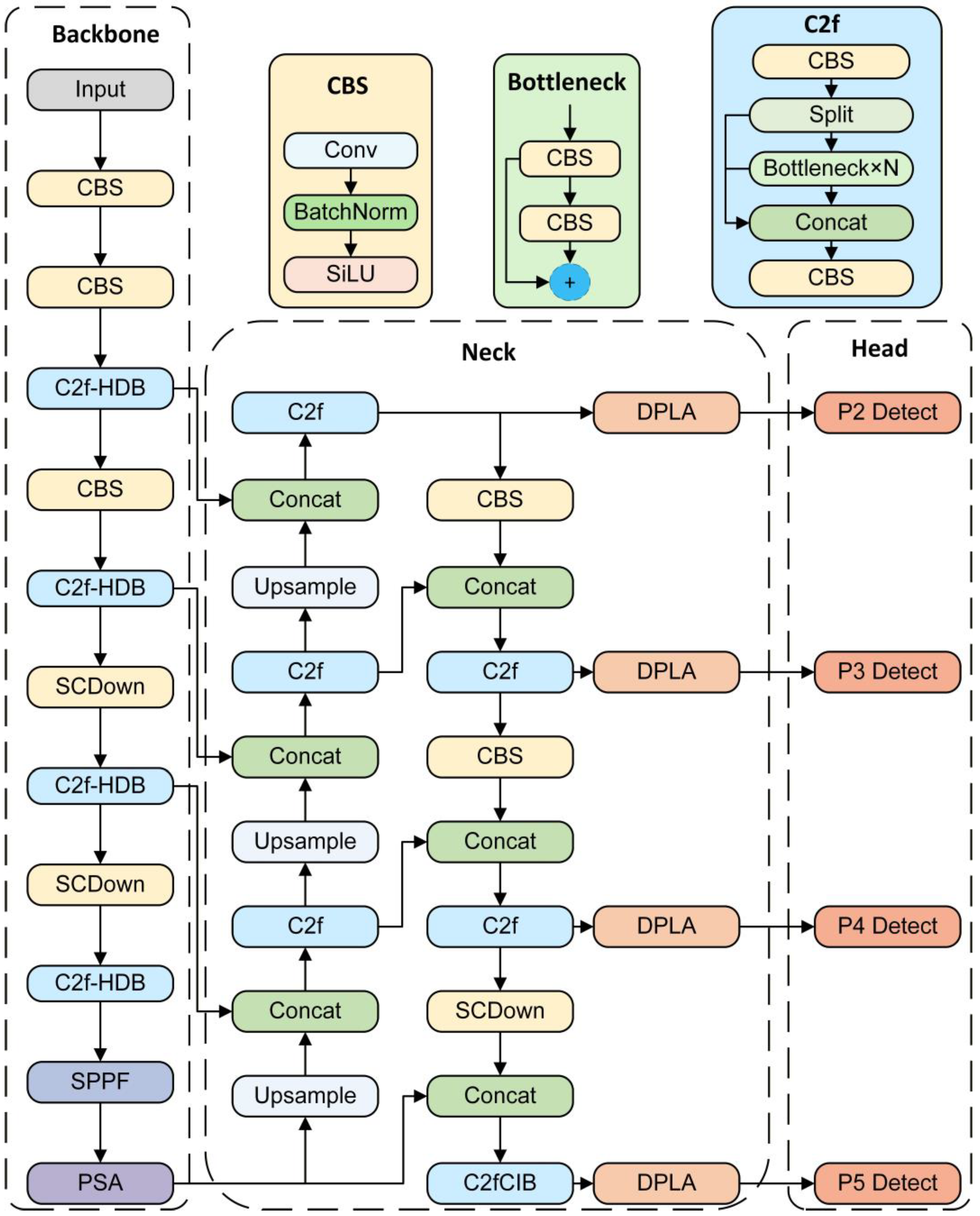
To address these issues, this paper proposes an enhanced model named YOLO-DMA, whose overall architecture is depicted in Figure 1. The model incorporates three key enhancements:
Figure 1.
The structure of YOLO-DMA.
First, a Hierarchical Deformable Block (HDB) is designed and integrated into the YOLOv10 backbone network to replace the original C2f module. This block achieves adaptive spatial sampling with low computational cost, effectively enhancing the model’s capability to represent features of multi-scale and irregularly shaped objects.
Second, an additional dedicated detection head with a 160 × 160 resolution is introduced, along with a Dual-Path Linear Perception (DPLP) module, to strengthen the semantic representation of shallow and intermediate feature maps. By cooperatively modeling the global context and local details through parallel paths, this module significantly improves the model’s capacity to perceive and retain features of small objects.
Finally, the Wise-IoU v3 loss function is adopted. Utilizing its dynamic non-monotonic focusing mechanism, the training process pays more attention to medium-quality samples, reduces the tendency to overfit easy samples, and effectively suppresses harmful gradients from low-quality samples. This comprehensively optimizes the detection robustness and accuracy of the model.
3.1. Hierarchical Deformable Block
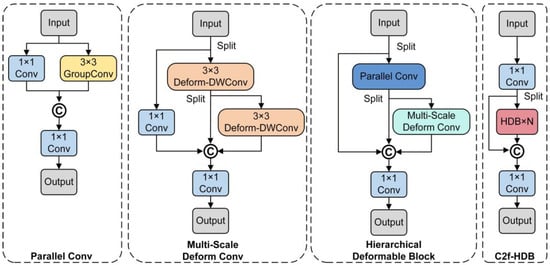
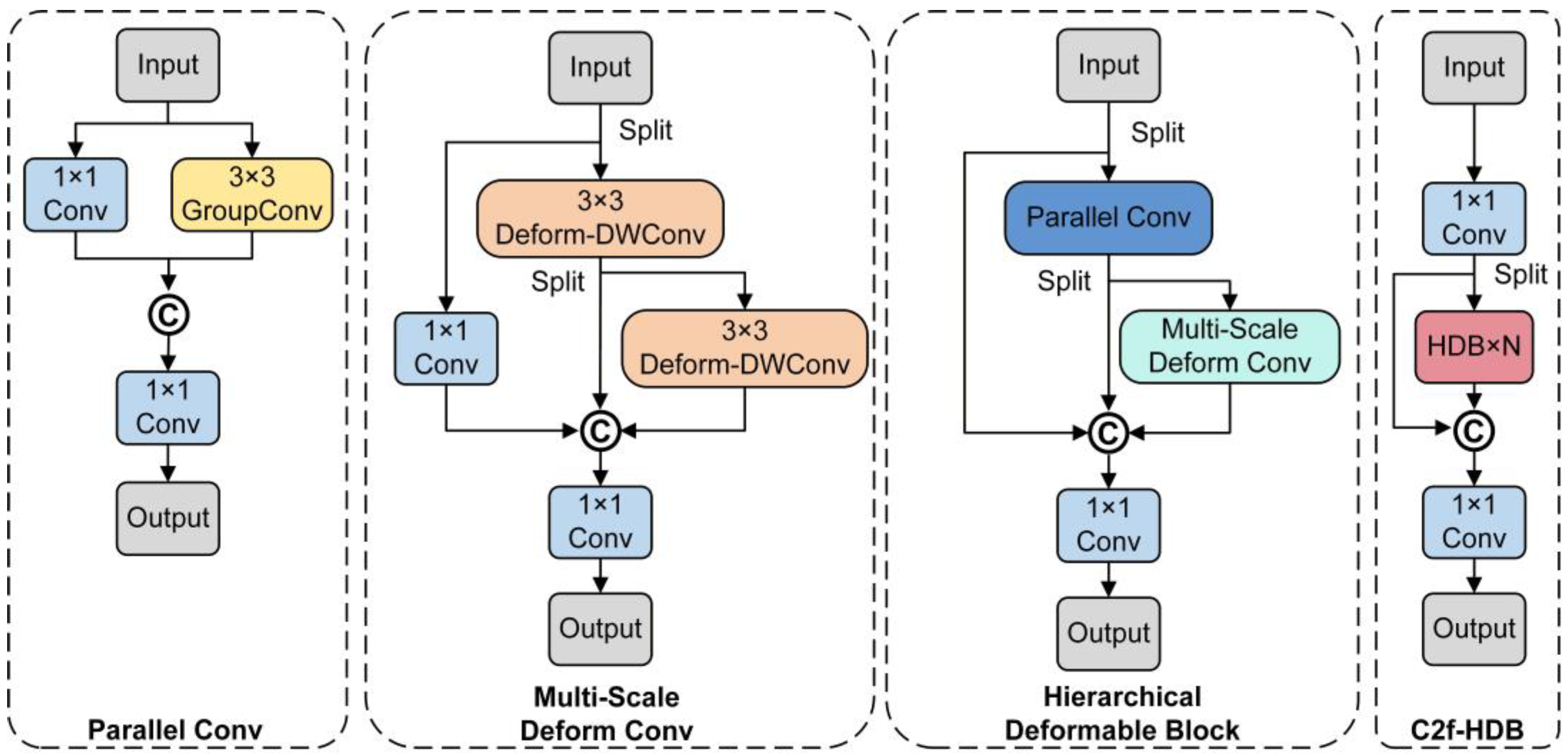
Small-object detection in UAV aerial images confronts significant challenges, including substantial scale variations influenced by object size and shooting distance, irregular shapes caused by viewing angles and partial occlusion, and sparse features where limited pixel information is easily diluted during feature extraction [31]. Traditional fixed-grid convolutions exhibit limitations: with small kernels, the restricted receptive fields tend to lose critical details; with large kernels, fixed sampling grids introduce extensive background interference that overwhelms subtle small object features. To address these issues, this section proposes the Hierarchical Deformable Block (HDB), which incorporates deformable convolution with adaptive sampling mechanisms [32], to balance computational overhead and enhance effective feature extraction for small objects. Furthermore, a progressive split architecture integrates multi-scale convolution results, accommodating feature extraction for targets of different scales in UAV aerial image detection. The overall structure of HDB is illustrated in Figure 2, mainly consisting of a Parallel Convolution unit and a Multi-scale Deformable Convolution unit (In the figure, C represents the concatenate layer).
Figure 2.
The structure of Parallel Conv unit, Multi-Scale Deform Conv unit, Hierarchical Deformable Block and C2f-HDB.
The Parallel Convolution unit aims to achieve feature interaction and extraction with higher parameter efficiency. While the standard 3 × 3 convolution can capture local spatial features, its computational complexity and parameter count are substantial. For an input feature map Fin∈RC,H,W, the computational complexity of a standard 3 × 3 convolution is 9C2HW. To improve efficiency while maintaining representational capacity, we design a lightweight parallel dual-branch structure: one branch uses a 1 × 1 standard convolution for efficient cross-channel information interaction; the other branch employs a 3 × 3 group convolution with a group number of 4, preserving spatial structure perception while significantly reducing parameters. The outputs of the two branches are concatenated along the channel dimension and then fused by a 1 × 1 convolution. The overall computational complexity of this parallel structure is 1.625C2HW, significantly lower than that of the standard 3 × 3 convolution, achieving comparable feature extraction capability with higher computational efficiency. This process is formulated as:
The Multi-scale Deformable Convolution unit is designed to overcome the inherent limitations of standard convolutions in handling geometric deformations and scale variations. Standard convolutions sample on a regular grid with a fixed receptive field, making it difficult to adapt to geometric distortions caused by target occlusion, pose changes, or viewing angle variations. Therefore, this unit incorporates deformable convolutions, which learn additional spatial offsets, allowing sampling points to adaptively focus on the key regions and irregular shapes of targets. Building on this, we construct HDB using a channel-split and progressive processing strategy. Its computational workflow is consolidated as follows:
First, the input feature map Fin is split along the channel dimension, and one of the branches undergoes transformation via a 1 × 1 standard convolution:
The other branch first extracts features through a 3 × 3 deformable depthwise convolution. Its output is then split again, with one of the resulting sub-branches further processed by a 5 × 5 deformable depthwise dilated convolution with a dilation rate of 2 to obtain a wider receptive field:
where denotes deformable depthwise convolution, and the superscript indicates a dilation rate of 2.
Deformable convolution gathers sampling points in the effective regions of irregular small objects through offset learning. The design that combines convolutions with different receptive field sizes in Equations (4) and (5) ensures that small objects of various scales receive appropriately matched receptive field coverage. Specifically, a 5 × 5 convolution with a dilation rate of 2 targets medium-sized small objects, while a 3 × 3 convolution focuses on the fine details of tiny objects.
Finally, the features extracted from the three paths at different levels and scales are deeply fused through a 1 × 1 convolution, achieving effective integration and enhancement of feature information:
The core advantage of the HDB module stems from the efficient synergy between the Parallel Conv unit and the Multi-Scale Deformable Conv unit. The Parallel Conv unit, through its lightweight dual-branch design, efficiently extracts and fuses local details with cross-channel information at low computational cost, providing information-dense and well-structured primary features for subsequent processing. Building upon this, the multi-scale deformable convolution module leverages its adaptive sampling capability to flexibly reorganize and refine these primary features across multiple scales, thereby accurately capturing the geometric deformations of irregular objects. The two components form a cascaded enhancement relationship: parallel convolution provides a rich feature foundation for deformable convolution, which in turn enables precise and adaptive transformations in the feature space. This synergistic mode of operation significantly enhances the model’s ability to represent complex targets while ensuring overall computational efficiency. Consequently, we integrate it into the C2f-HDB unit and deploy it primarily within the backbone network, which is highly sensitive to the quality of primitive features, thereby improving feature discriminability from the source. The neck network, being more focused on the stable fusion and propagation of multi-scale features, retains the more efficient original design.
3.2. Dual-Path Linear Perception
During feature fusion, small objects possess limited detail information and are susceptible to interference from complex background noise, leading to suboptimal performance in feature map detection [7]. The inherent feature fusion network of YOLOv10 lacks specialized design for enhancing small-object information, resulting in reduced salience of small objects in deep feature maps. To address this challenge, this paper proposes a Dual-Path Linear Perception (DPLP) module. This module aims to achieve effective global context modeling while preserving and enhancing local detail features, with a particular focus on highlighting the features of small target regions, thereby improving the model’s ability to perceive critical information in complex scenes.
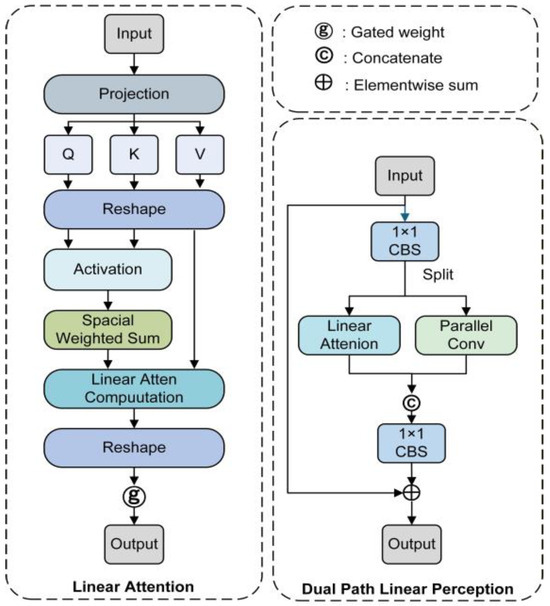
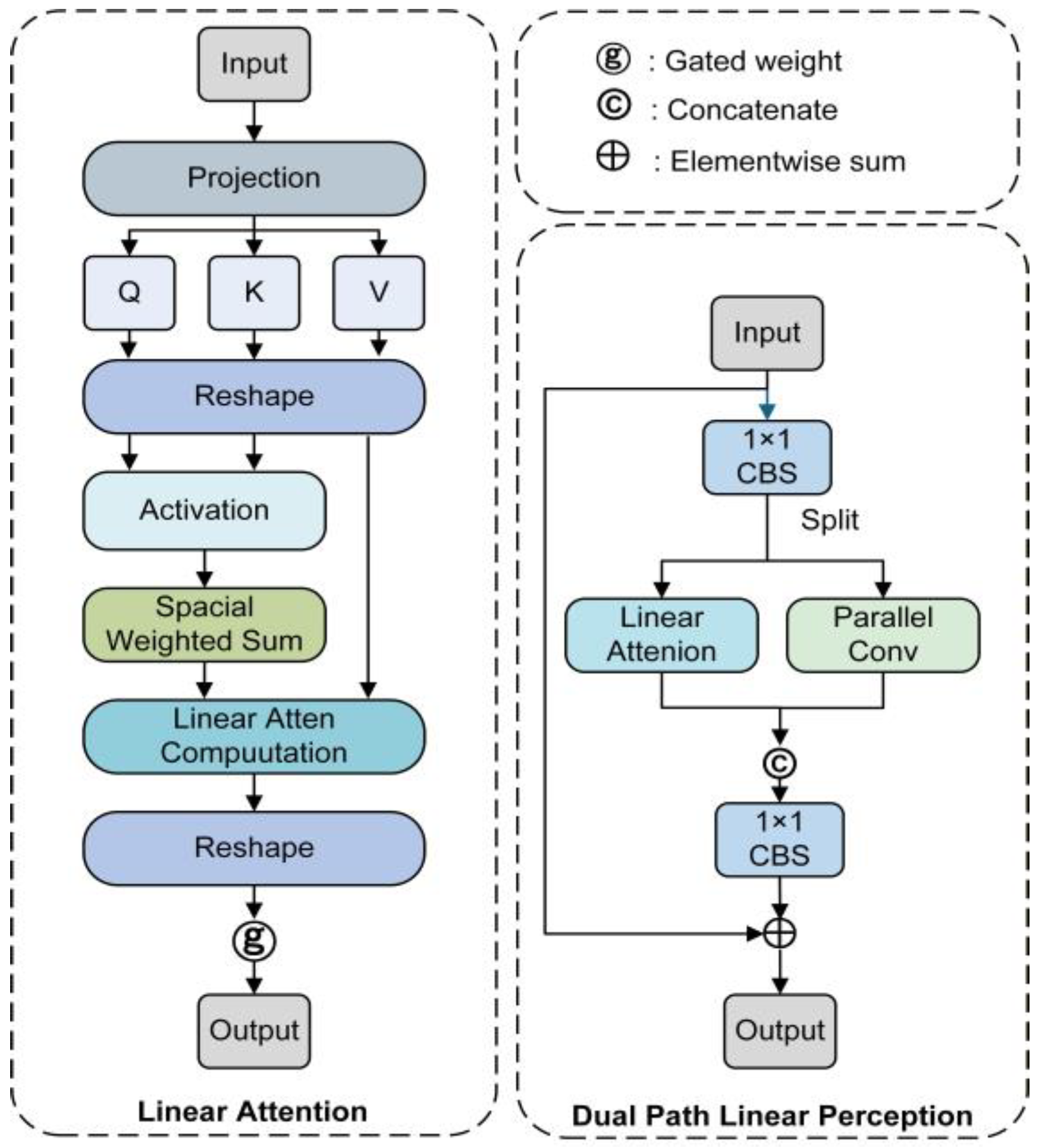
The overall structure of DPLP is illustrated in Figure 3. The input feature map is first split evenly along the channel dimension into two streams: one passes through a linear attention unit to model long-range dependencies and capture global context, while the other utilizes a lightweight parallel convolution unit to extract local detailed features, preserving sensitivity to spatial structure. The outputs of the two streams are concatenated along the channel dimension, fused via a 1 × 1 convolutional layer, and finally added to the original input through a residual connection. This design aims to achieve complementary integration of global perception and local detail, avoiding information loss due to over-reliance on a single mechanism.
Figure 3.
The structure of Dual Path Linear Perception module.
The core of the linear attention unit lies in achieving efficient computation through mathematical transformation. Its specific workflow is as follows. First, an input feature map Fin ∈ RC,H,W, is projected into Query (Q), Key (K), and Value (V) tensors via a projection layer:
The projection layer consists of a 1 × 1 convolution, batch normalization, and ReLU activation in sequence. The Reshape operation flattens the spatial dimensions, yielding Q, K, V ∈ RB×h×N×d, where his the number of attention heads, N = H × W is the sequence length, and d is the feature dimension per head.
A feature transformation is then applied to Q and K for subsequent kernel-based computation:
Φ([Q,K]) = ReLU([Q,K])
To enhance the module’s focus on potential small-object regions, a learnable spatial weighting mechanism is introduced. This mechanism first generates a spatial importance map by aggregating information across channels. It then uses this map to adaptively modulate the query features, thereby directing computational resources toward regions likely to contain critical details. The process is formulated as follows:
In the above equations, is obtained by averaging along the channel dimension, producing an initial spatial saliency map. represents the normalized spatial attention weights generated by the softmax function, The spatial weighting mechanism enhances the activation intensity in small target areas, providing targeted feature enhancement.
Subsequently, a weighted global context vector is computed, and the relevance of each position to it is evaluated:
The computed relevance weights are used to recalibrate , allowing the model to focus on information relevant to the global context:
Here, the factor compensates for the numerical scaling effect caused by the spatial averaging operation.
Finally, the attention output is computed efficiently in kernel form by rearranging the computation order:
This computation transforms the O(N2d) complexity required for the QK⊤ operation in standard attention into two matrix multiplications with O(Nd2) complexity, (Φ(K)⊤V) and (), thereby achieving linear complexity and enabling efficient processing of high-resolution feature maps.
The attention output is reshaped back to spatial format and adaptively filtered through a gating mechanism to suppress redundant information and enhance effective features:
G ∈ RB×C×H×W is a spatially adaptive gating weight map generated from the input features via a lightweight sub-network.
The other path of the module adopts the parallel convolution unit described in Section 3.1 (Equation (1)), which aims to stably extract local detail features with low parameter overhead. The outputs of the two paths are concatenated and fused to form the final enhanced feature of the module.
The strength of this design lies in its efficient cooperative working mode: the linear attention path effectively establishes long-range dependencies with linear complexity, counteracting the feature suppression issue that particularly affects small objects in complex backgrounds. Through its integrated spatial weighting mechanism, the module adaptively enhances activation intensity in small target regions, significantly improving the saliency of minute objects. The parallel convolution path reliably preserves crucial local details and edge information of small objects, preventing the loss of subtle features in deep network layers. The adaptive fusion of dual-path features through gating mechanisms generates highly discriminative representations for small objects while maintaining computational efficiency, directly tackling their inherent limitations of limited pixels and susceptibility to being overlooked. The advantage of DPLP lies primarily in processing high-resolution feature maps. Since the P2, P3, and P4 layers retain richer spatial detail information, while the P5 layer focuses more on high-level semantic abstraction, this module is applied to the P2–P4 layers to specifically enhance the detailed features crucial for small-object detection.
3.3. Wise-IoU Loss Function
UAV aerial datasets commonly contain low-quality samples, such as those with annotation noise or blurred boundaries, alongside a significant number of challenging targets like small and heavily occluded objects. Traditional bounding box regression losses struggle to balance the learning weights for samples of varying qualities. Applying equal focus to all samples allows harmful gradients from low-quality annotations to interfere with model convergence, while potentially undermining effective learning from genuinely difficult samples. To address this, this paper introduces the Wise-IoU v3 loss function [24], which incorporates a dynamic non-monotonic focusing mechanism. It is designed to adaptively allocate gradient weights—suppressing optimization interference caused by annotation defects while reinforcing the model’s discriminative capability for authentic hard samples. This approach aims to comprehensively enhance detection robustness and overall accuracy in complex aerial scenes.
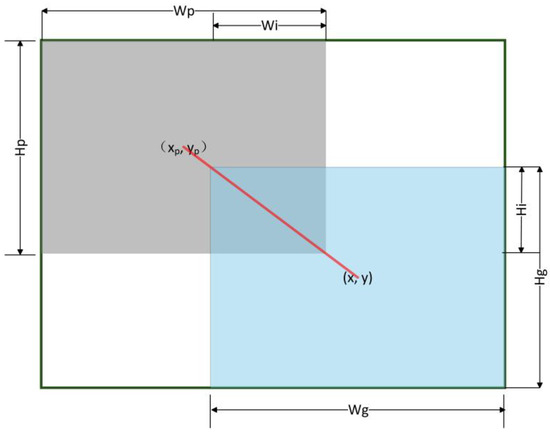
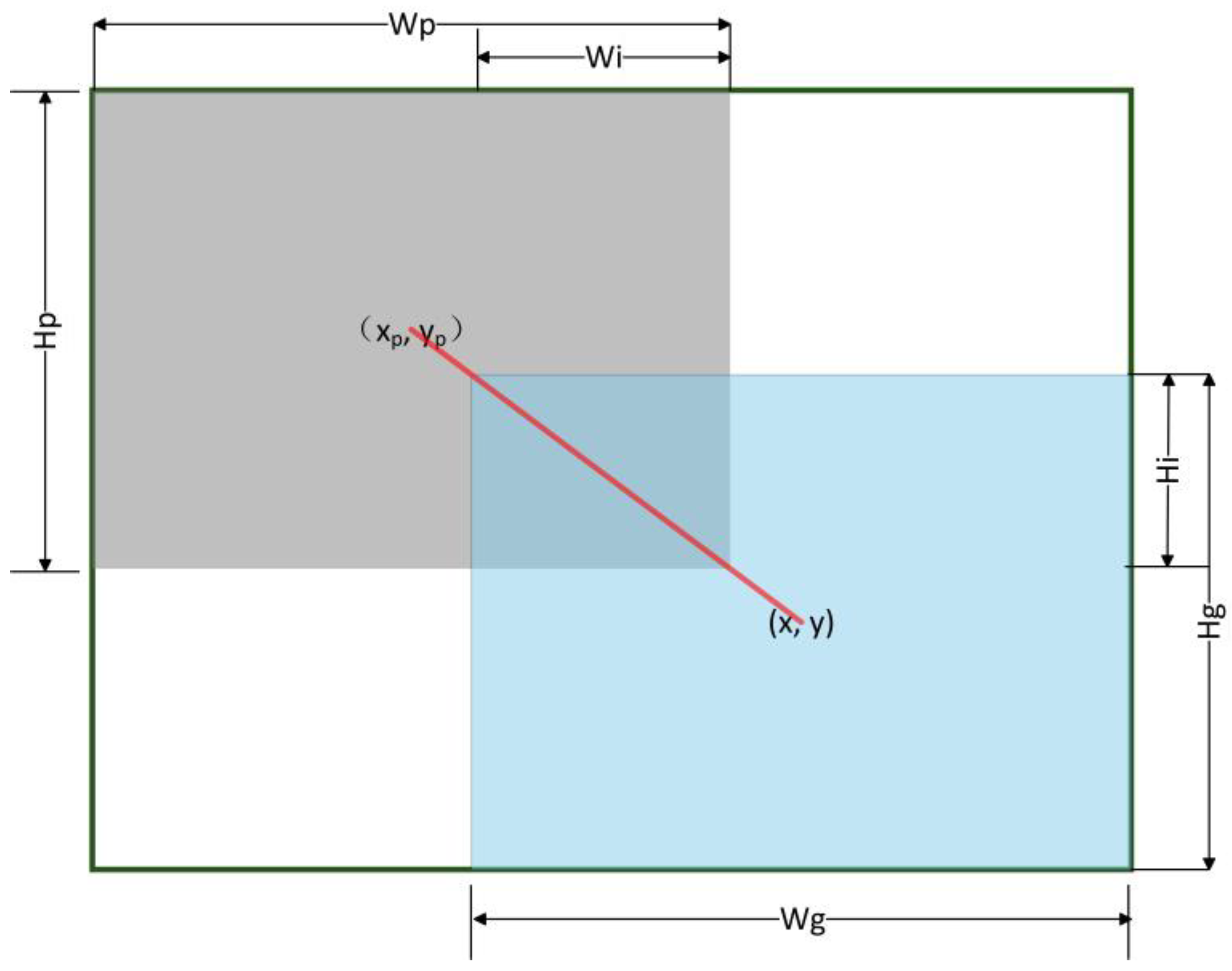
As shown in Figure 4, the specific computational procedure of Wise-IoU v3 is as follows. First, the Intersection over Union (IoU) between the predicted and ground-truth bounding boxes and the base IoU loss are calculated:
Figure 4.
Schematic diagram of the parameters of the loss function. (The grey area represents the predicted bounding boxes by the model, while the blue area represents the labeled bounding boxes).
and are the width and height of the intersection area, while , , , and are the dimensions of the ground-truth and predicted boxes, respectively.
To quantify the deviation between the centers of the predicted and ground-truth boxes and thereby enhance gradient focus on small targets, a center-distance weight RWIoU is introduced:
where and are the center coordinates of the ground-truth and predicted boxes, respectively. When the prediction box and ground truth box have the same absolute offset, the smaller size of small objects results in a larger relative offset, significantly increasing the weight term. This directs the model’s attention more towards precise localization of small objects during training, alleviating optimization imbalances caused by size differences.
To dynamically distinguish sample quality and modulate gradients accordingly, WIoUv3 defines an outlier degree β and a non-monotonic focusing coefficient r:
In these equations, represents the detached value of from the computational graph, is its moving average, and are hyperparameters that control the focusing rate. Following the experimental findings of Chen et al. [21] for small-object detection tasks, this paper adopts the parameter combination and .
The non-monotonic focusing mechanism in Equation (24) dynamically assesses sample quality through the outlier degree β. For small-object detection, this mechanism effectively distinguishes genuinely difficult samples (e.g., heavily occluded small objects) from low-quality samples (e.g., those with annotation noise) and applies differentiated gradient adjustments, ensuring that model learning resources concentrate on valuable small object samples.
Finally, the WIoUv3 loss function is defined as:
The loss function optimizes the training process through three synergistic mechanisms: it enhances focus on small targets by increasing gradient magnitude by ; suppresses harmful gradients from low-quality annotations by automatically reducing gradient gain through the non-monotonic coefficient when outlier degree is high; and balances learning weights by preventing overemphasis on either extremely easy or hard samples, thereby concentrating optimization on reliable ordinary and typical hard samples to improve overall generalization and detection performance.
4. Results
4.1. Dataset
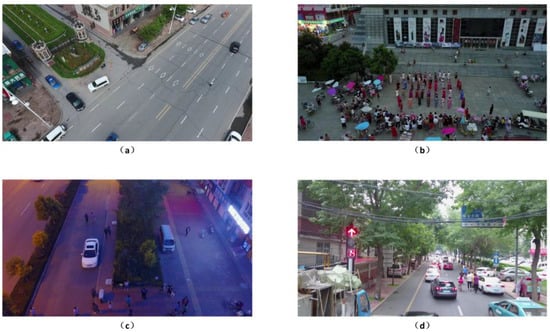
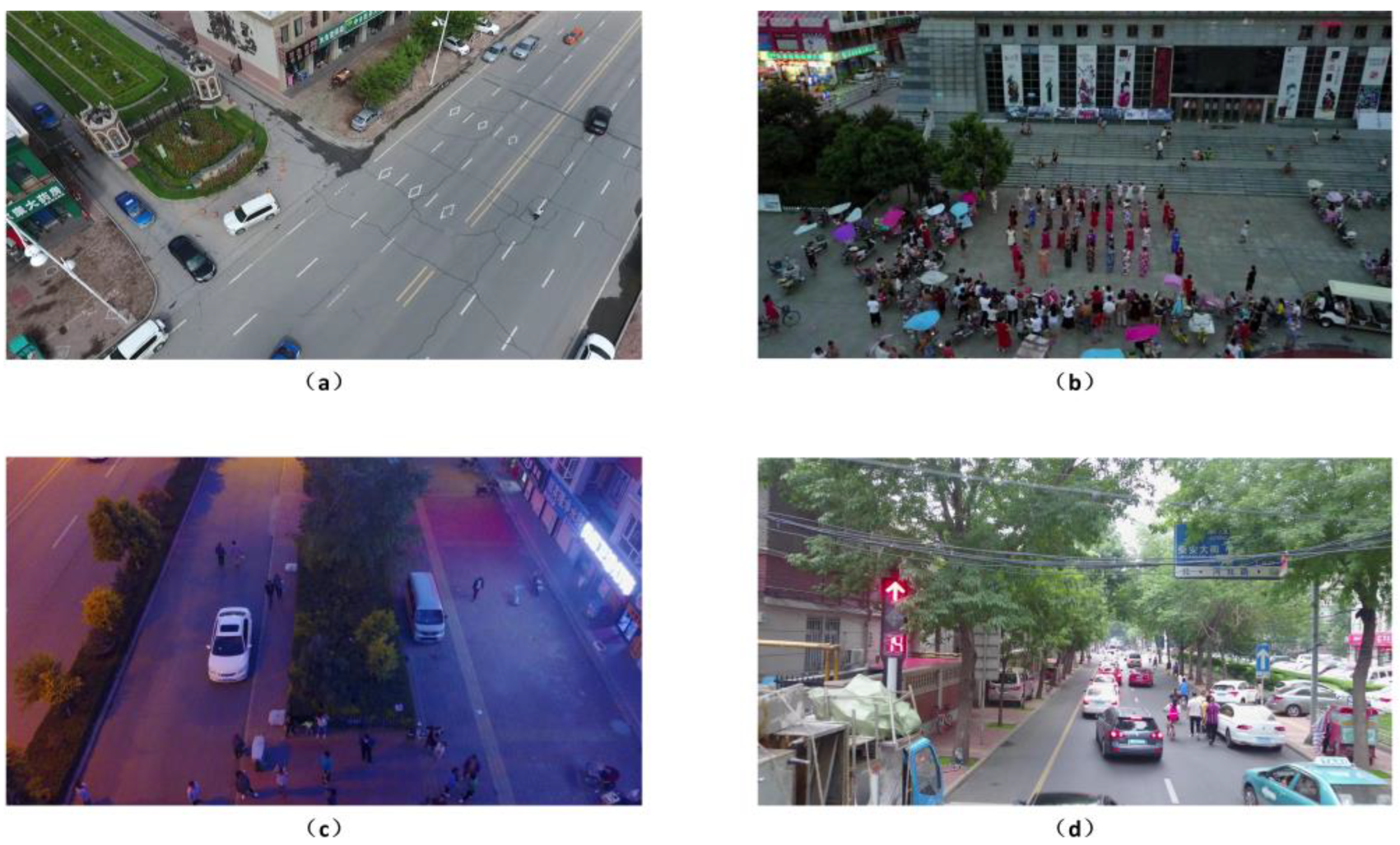
Vision Meets Drone Object Detection (VisDrone2019-DET) is a large-scale UAV aerial object detection dataset collected and publicly released by Tianjin University [33]. The dataset consists of 8629 images captured from over ten different cities in China, and is divided into 6471 images for training, 548 for validation, and 1610 for testing. As shown in Figure 5, the annotated instances in the dataset cover 10 common object categories, including pedestrian, people, car, van, bus, truck, motor, bicycle, awning-tricycle, and tricycle, making it suitable for researching and evaluating various application scenarios such as smart city management, traffic monitoring, and pedestrian recognition.
Figure 5.
Some representative images from the VisDrone2019-DET dataset. (a) Ordinary urban traffic scene; (b) Densely distributed small objects; (c) Low-light imaging condition; (d) Complex background with overlapping objects.
Furthermore, VisDrone2019-DET encompasses various real-world scenarios. These include urban areas, countryside, and highways. The dataset contains numerous challenging samples that reflect common difficulties in UAV imagery, such as dense objects, poor lighting conditions, and partial occlusion. This provides a solid data foundation for validating algorithm performance under complex practical conditions. The public availability of the dataset also ensures the reproducibility and comparability of research results.
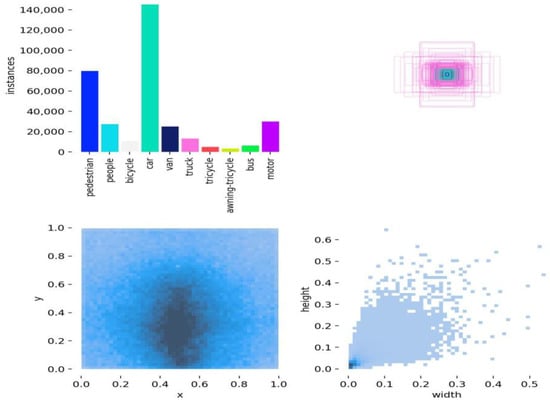
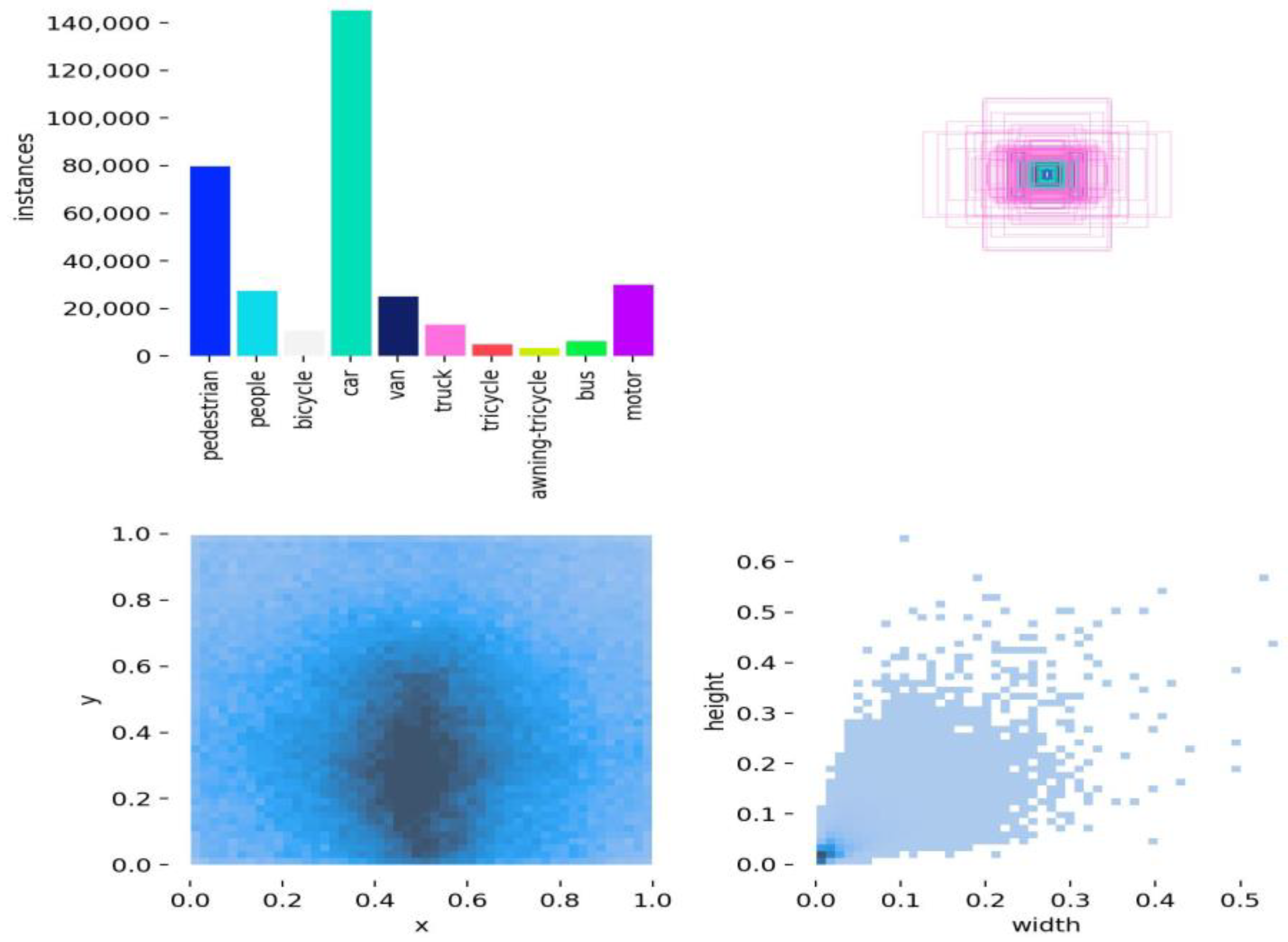
As shown in Figure 6, we conducted a statistical analysis of the annotation distribution from four perspectives. The category distribution chart shows that “car” and “pedestrian” are the dominant categories. The object scale distribution indicates that the dataset is primarily composed of small-scale objects. The object location distribution reveals that objects are mostly concentrated in the middle and lower parts of the images. Finally, the scatter plot of bounding box width versus height further confirms the prevalence of small-scale objects. These statistical characteristics collectively demonstrate that VisDrone2019-DET is a representative UAV detection benchmark dataset. It is characterized by small objects, diverse scenes, and great difficulty.
Figure 6.
Information about the manual labeling of objects in VisDrone2019 dataset (In the bottom row, darker color denotes higher sample density).
4.2. Environment Set up
The hardware and software platforms used in the experiments are shown in Table 1.
Table 1.
Hardware and Software Configuration Details.
The hyperparameter settings for model training are listed in Table 2.
Table 2.
Hyperparameter Settings.
4.3. Assessment Indicators
To evaluate the effectiveness of the proposed method, this paper counts the parameters and FLOPs to measure the model’s complexity. Parameters refer to the total number of learnable parameters in the model. A smaller value indicates a lower demand on device memory. FLOPs refer to the total number of floating-point operations required for one forward pass, used to measure computational complexity. A smaller value indicates a lower demand on computational power. Furthermore, this paper introduces Precision, Recall, mAP50, and mAP50:95 to assess the model’s detection performance.
Some of the metrics are defined as follows:
where TP is the number of true positive samples correctly predicted, FP is the number of false positive samples incorrectly predicted as positive, and FN is the number of missed targets (false negatives). P stands for Precision, used to measure the reliability of the model’s predicted bounding boxes; R stands for Recall, used to measure the model’s ability to detect objects.
mAP50 is the mean Average Precision across all categories when the Intersection over Union (IoU) threshold is set to 0.5. This metric comprehensively considers both Precision and Recall and is the most commonly used evaluation metric in UAV object detection tasks. mAP50:95 is the average precision calculated at ten different IoU thresholds ranging from 0.5 to 0.95 with a step size of 0.05. It is used to measure the model’s robustness to different IoU thresholds and its overall localization accuracy, serving as a comprehensive and rigorous evaluation metric.
4.4. Ablation Experiment
To verify the effectiveness of the proposed improvements, ablation studies were conducted on the VisDrone2019-DET dataset based on YOLOv10s. As shown in Table 3. The specific results are shown in the table below, where √ indicates the adoption of the corresponding improvement strategy, and bold data represents the best result. When evaluating the DPLP module’s ability to balance global context modeling and local details in feature maps, the module was initially added only after the P3 and P4 feature maps. In the final experiment, which introduced the P2 detection head, the DPLP module was added before all P2, P3, and P4 detection heads.
Table 3.
Ablation Experiment results. (The best results are indicated by bold font.)
The results of the ablation study show that each improvement strategy enhanced the detection performance of YOLOv10s to varying degrees. The introduction of the C2f-HDB module, which leverages deformable convolution for adaptive feature extraction, increased precision by 0.9%, mAP50 by 0.6%, and mAP50:95 by 0.3% while reducing both the number of parameters and computational cost. Critically, it achieved a 0.8% gain in APs, indicating its enhanced capability in capturing features of irregular small objects. These improvements indicate that the C2f-HDB module not only lightens the model but also enhances the backbone network’s ability to capture object information in feature maps.
After introducing WIoUv3 as the bounding box loss function, both precision and mAP50 increased by 0.4%, and a 0.2% increase in APs confirms its positive effect on small-object detection, as it helps the model focus on more representative samples. meaning the reliability of the model’s predicted boxes and its comprehensive performance under a lenient standard improved, a 0.2% increase in APs confirms its positive effect on small-object detection, as it helps the model focus on more representative samples. Recall and mAP50:95 both slightly decreased by 0.1%, indicating a minor weakening in the model’s ability to discover targets and its comprehensive performance under a strict standard. This signifies that the loss function successfully guided the model to focus more on harder-to-detect samples and reduce excessive attention on very easy ones. This pattern is consistent with the operational mechanism of WIoUv3. The concurrent rise in mAP50 and, more notably, in APs indicates an enhancement in the model’s capability for reliable identification and coarse localization of small objects. It is important to note that mAP50:95 is an aggregate metric averaging performance across all object scales. Its slight decline, alongside a rise in the dedicated small-object metric APs (which uses the same IoU thresholds), suggests that the dynamic focusing mechanism of WIoUv3 has effectively reallocated optimization resources. This prioritization leads to a net performance increase on the most challenging and prevalent small objects, even if it results in a minimal trade-off in the exhaustive localization accuracy for the entire dataset, as reflected in the comprehensive mAP50:95.
After introducing the P2 (160 × 160 resolution) detection head, all metrics improved significantly, demonstrating the substantial benefit of adding a dedicated small-object detection head for UAV image object detection tasks where small objects are prevalent.
The DPLP module, designed to integrate global context and local details via dual-path linear attention and convolution, improved overall detection performance with a minor cost. When integrated into the network, it enhanced mAP50 by 0.8% and mAP50:95 by 0.5%. Furthermore, it contributed a 0.3% gain in APs, demonstrating its efficacy in refining feature representation for small objects through global–local feature fusion.
After applying all improvement strategies, the proposed YOLO-DMA achieved a 4.8% increase in mAP50 and a 3.1% increase in mAP50:95 over the baseline. The collective improvements result in a 3.7% gain in APs, demonstrating the framework’s enhanced capability for small-object detection. Although the proposed model incurs higher computational costs, they remain within a reasonable range while providing substantially higher detection accuracy.
4.5. Comparative Experiments
This paper conducted comparative experiments between YOLO-DMA and ten other state-of-the-art algorithms on VisDrone2019-DET-test. As shown in Table 4, the best performance in each metric is indicated in bold. (Note: The result for FFCA-YOLO is directly cited from its publication as the code is not publicly available.)
Table 4.
The results of comparative experiments on the VisDrone2019-DET dataset.
The experimental results show that the proposed YOLO-DMA model achieves a good balance between detection accuracy, model complexity, and inference speed. In terms of detection accuracy, YOLO-DMA reaches 34.4% in mAP50, significantly outperforming other compared models. This metric is a core standard for evaluating detection performance on UAV aerial imagery. On the more stringent mAP50:95 metric, YOLO-DMA also achieves an excellent performance of 19.3%, demonstrating its comprehensive detection capability. Regarding model complexity, YOLO-DMA has 8.44M parameters and 37.3 GFLOPs. Although its parameter count and computational cost are slightly higher than those of lightweight models like YOLOv5s and YOLOv8s due to the introduced multi-scale detection mechanisms, YOLO-DMA holds a clear advantage in model complexity and computational overhead compared to traditional detection models like Faster R-CNN (41.3 M, 208 GFLOPs) and ATSS (38.91 M, 110.6 GFLOPs). In terms of inference speed, YOLO-DMA achieves 74 FPS. While this is not as high as general-purpose object detection models like YOLOv5s and YOLOv8s, it represents a significant improvement over models like Faster R-CNN (22 FPS), Cascade R-CNN (17 FPS), and ATSS (22 FPS), and can meet the real-time processing requirements for UAV aerial images. A comprehensive analysis indicates that YOLO-DMA demonstrates clear overall advantages in UAV aerial object detection tasks: it achieves a substantial improvement in detection accuracy while maintaining relatively low model complexity and an acceptable inference speed.
The experimental results on the UAVDT dataset, as presented in Table 5, demonstrate the performance of the proposed YOLO-DMA model against several state-of-the-art detectors. In terms of detection accuracy, YOLO-DMA achieves the highest scores among all compared models, with an mAP50 of 31.8% and an mAP50:95 of 19.6%. This represents a notable increase over the next best performers, RT-DETR (29.9% mAP50 and 16.5% mAP50:95) and YOLOv8s (29.2% mAP50 and 17.3% mAP50:95). Regarding model complexity, YOLO-DMA maintains a parameter count of 8.44 M and a computational cost of 37.3 GFLOPs. While its FLOPs are higher than those of the most lightweight baselines such as YOLOv10s (24.5 GFLOPs), its overall complexity remains substantially lower than that of larger architectures like Faster R-CNN (41.3 M parameters, 208 GFLOPs). The results indicate that YOLO-DMA provides an effective balance, offering superior detection accuracy on the UAVDT benchmark while maintaining competitive model complexity.
Table 5.
The results of comparative experiments on the UAVDT dataset. (The best results are indicated by bold font.)
4.6. Visualize Analysis
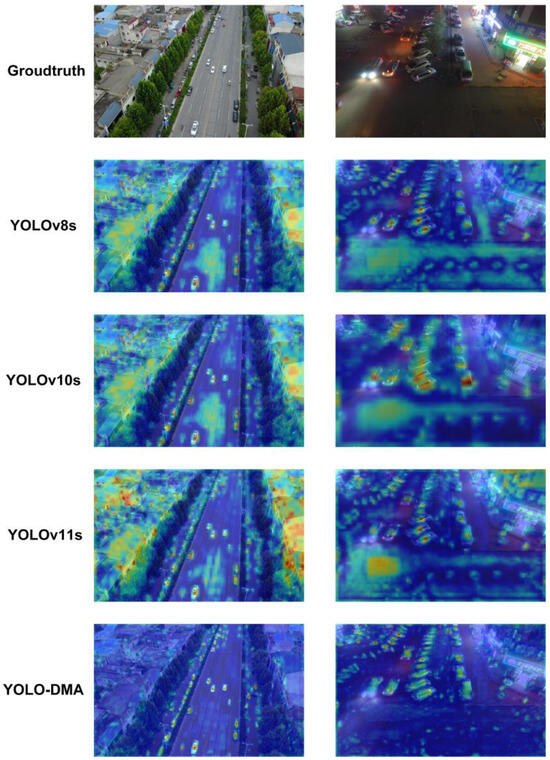
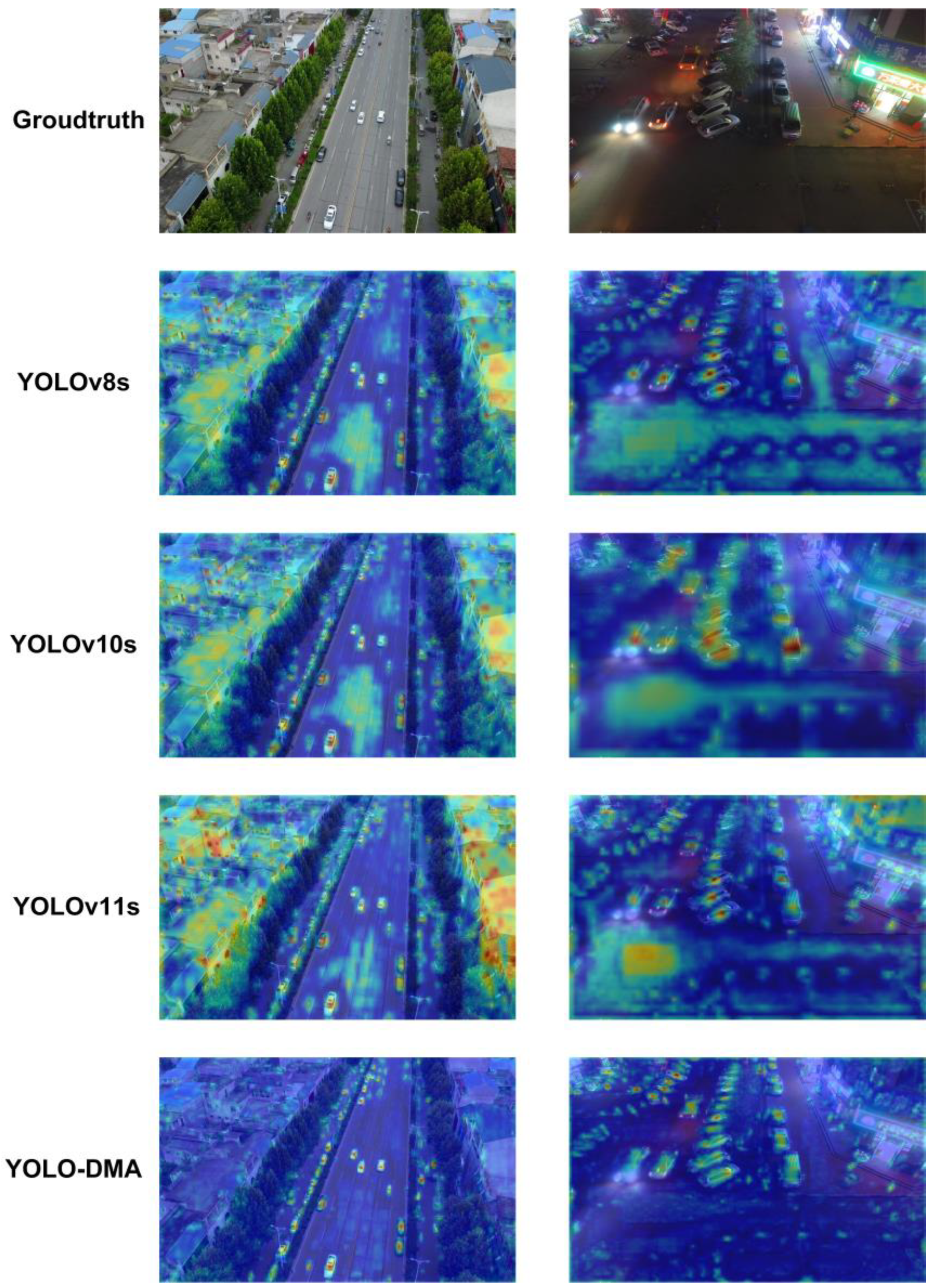
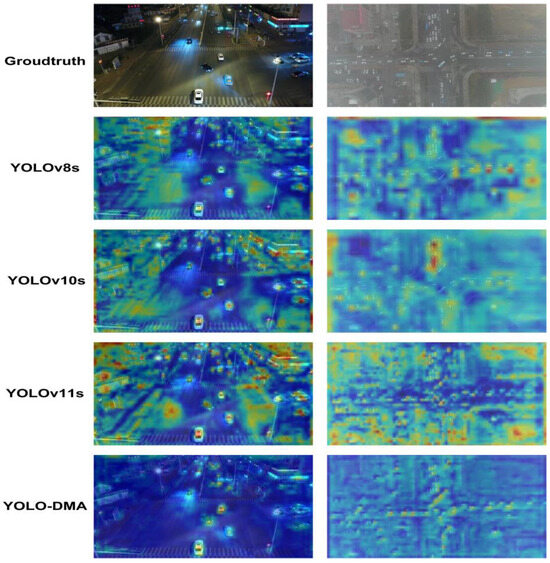
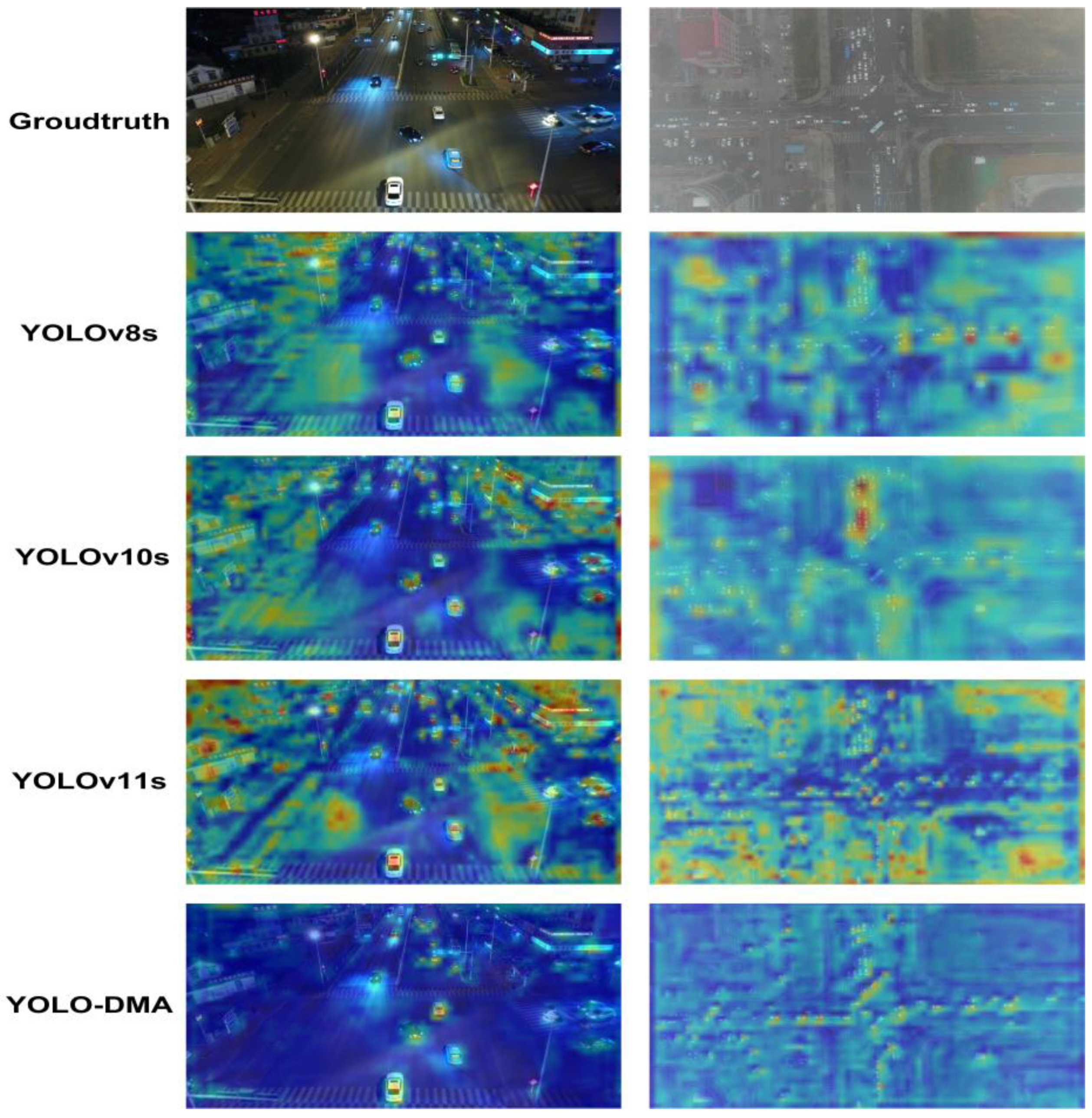
To analyze the decision-making process of the model, we use the Grad-CAM technique to visualize the regions that the model focuses on. The technique computes gradients of the model’s output with respect to feature maps and generates corresponding heatmaps, thereby revealing the image regions that contribute most to the model’s decisions.
Figure 7 and Figure 8 present a comparative heatmap analysis between the baseline models (YOLOv8s, YOLOv10s, YOLOv11s) and the proposed YOLO-DMA on both VisDrone and UAVDT datasets, covering diverse challenging conditions including daytime scenes, nighttime scenarios, and specific adverse conditions from UAVDT such as low-light environments and foggy weather. In the heatmap, the intensity of the color corresponds to the degree of attention the model allocates to that region (more saturated colors indicate higher attention weights). The heatmaps reveal that all baseline models exhibit a significant amount of gradient responses distributed in complex background regions, indicating insufficient suppression mechanisms for irrelevant environmental features and resulting in excessive attention allocation to background clutter rather than actual targets. This limitation is particularly pronounced under adverse weather and lighting conditions as demonstrated in Figure 8. In contrast, YOLO-DMA demonstrates consistently concentrated heatmap activation precisely on foreground target regions across all tested conditions, maintaining superior focus on critical targets despite challenging factors like fog and darkness. The concentrated attention mechanism of YOLO-DMA enables effective perception and characterization of small-scale objects while minimizing background distraction, ultimately leading to enhanced detection robustness in complex aerial scenarios.
Figure 7.
Heatmap visualization analysis of images between sufficient lighting and low-light Conditions on VisDrone2019-DET.
Figure 8.
Heatmap visualization analysis of images between dark and foggy conditions on the UAVDT dataset.
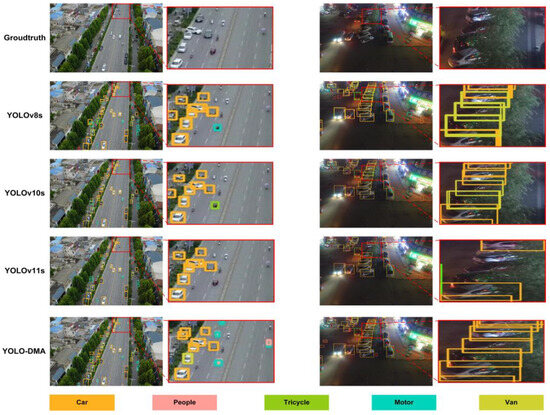
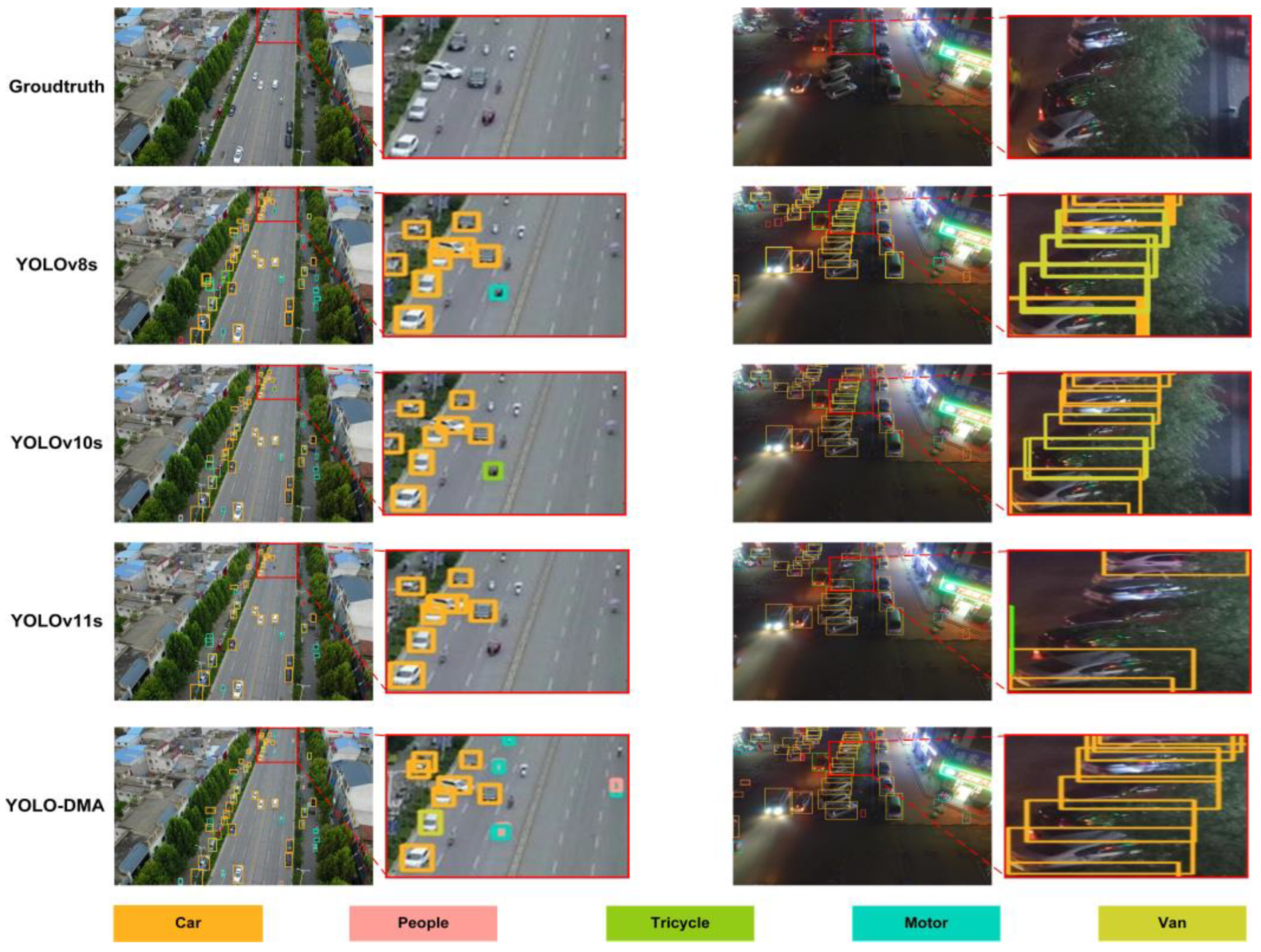
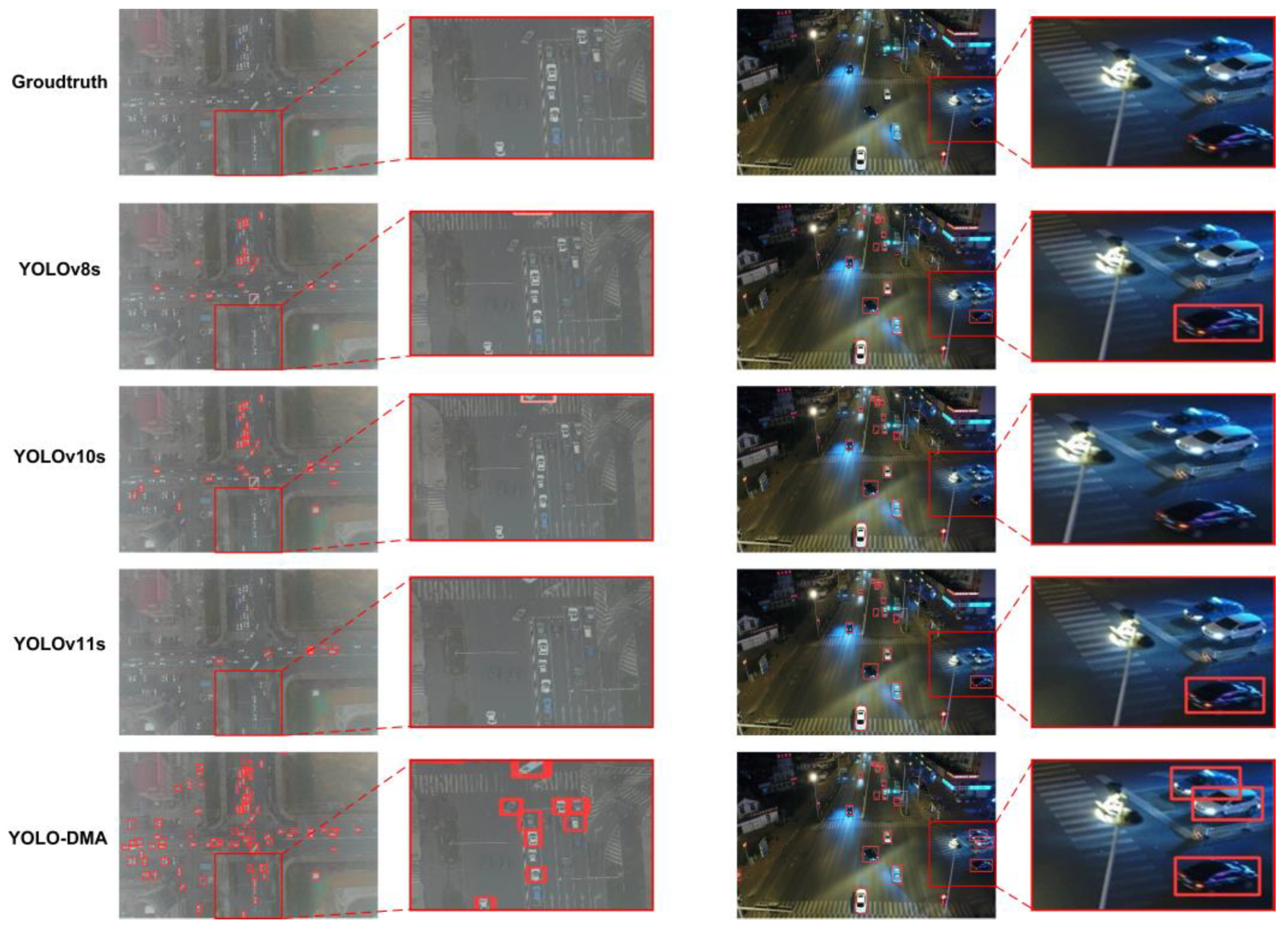
To visually demonstrate the performance of the proposed detection method, this study conducted a comparative inference experiment among YOLOv8s, YOLOv10s, YOLOv11s, and YOLO-DMA. The experiment selected two typical scenarios: a daytime traffic road with complex background textures, and a low-light nighttime street scene with tree occlusion. Both scenarios contain dense small objects and complex background interference, making them suitable for validating the model’s robustness under real-world conditions.
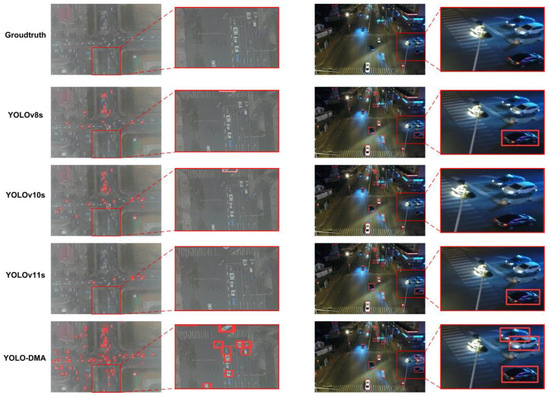
Figure 9 and Figure 10 present comparative inference results of YOLOv8s, YOLOv10s, YOLOv11s, and the proposed YOLO-DMA on both the VisDrone2019-DET and UAVDT datasets, with corresponding zoomed-in views for detailed analysis. In the VisDrone2019-DET results (Figure 9), the baseline models exhibit significant limitations in challenging scenarios. In the traffic scenario (left), distant small-scale motorcycles suffer from substantial missed detections, while in the dark condition (right), partial occlusion by trees leads to misclassification of cars as vans. In contrast, YOLO-DMA demonstrates superior performance with considerably fewer missed detections and correct classification under the same challenging conditions. Similarly, in the UAVDT results (Figure 10), under foggy weather conditions (left), all baseline models show numerous missed detections, whereas YOLO-DMA maintains significantly better detection coverage. In the dark condition (right), while baseline models fail to detect multiple vehicles on the right side of the image, YOLO-DMA achieves correct identification of these challenging targets. The comparative analysis clearly demonstrates that YOLO-DMA achieves higher detection accuracy and reduced missed detections across various complex scenarios, effectively enhancing the model’s robustness and reliability in real-world aerial imaging applications.
Figure 9.
Inference results on the VisDrone2019-DET dataset.
Figure 10.
Inference results on the UAVDT dataset.
5. Conclusions
This paper presents YOLO-DMA, a multi-scale feature extraction- and dual-path perception-enhanced object detection model for UAV imagery, which incorporates three key improvements to address the challenges of large-scale variations, complex backgrounds, and dense small targets in aerial images. A hierarchical deformable block (HDB) is designed, which enhances the deformation modeling capability for irregular objects through a parallel structure and an adaptive spatial sampling mechanism, improving multi-scale feature extraction performance with limited computational overhead. A dual-path linear perception module (DPLP) is proposed, which integrates global attention and local convolution with linear complexity, selectively enhancing the semantic representation of key targets in shallow and intermediate features. Additionally, the Wise-IoUv3 loss function is adopted, leveraging its dynamic non-monotonic focusing mechanism to appropriately allocate gradient weights during training, thereby strengthening the learning of small and difficult samples while suppressing interference from low-quality annotations. Experiments on the VisDrone2019-DET dataset demonstrate that the proposed method significantly outperforms the baseline model in both mAP50 and mAP50:95 metrics, validating the effectiveness of the introduced improvements.
Ablation studies indicate that the introduction of the P2 detection head is the primary source of the increase in FLOPs (from 24.5 G to 36.6 G). However, it contributes significantly to the accuracy of small-object detection (APs increases from 10.0% to 12.6%). In terms of deployment viability, the model’s parameter count of 8.44 M suggests a manageable memory footprint. With reference to related work on deploying improved YOLO models on UAVs [41], it is estimated to be compatible with UAV embedded platforms when using INT8 precision. Comparative experiments on the VisDrone dataset show that the FPS of YOLO-DMA decreases to 74 from 192. The main reason is the substantial computational overhead introduced by the convolutional layers within the P2 head. These structures are highly suitable for acceleration through standard optimization tools such as TensorRT and INT8 quantization, which is expected to mitigate the decline in FPS. Furthermore, we recognize that an increase in FLOPs can easily lead to higher power consumption for battery-powered UAVs, resulting in reduced endurance. However, the improvement in small-object detection performance can reduce the energy consumption associated with additional data transmission and manual analysis caused by false detections and missed detections, thereby enhancing task-level efficiency.
The current model incurs an increase in both parameter count and computational complexity due to the introduction of a high-resolution small-object detection head. Future work will focus on model lightweighting, such as through structural optimization, pruning, and quantization techniques, to further improve the deployment efficiency and practicality of the model on embedded UAV platforms.
Author Contributions
Conceptualization, X.L.; methodology, X.L.; validation, X.L.; writing—original draft, X.L.; supervision, L.H.; project administration, L.H. All authors have read and agreed to the published version of the manuscript.
Funding
This research received no external funding.
Data Availability Statement
Data are contained within the article.
Conflicts of Interest
The authors declare no conflicts of interest.
References
- Gano, B.; Bhadra, S.; Vilbig, J.M. Drone-based imaging sensors, techniques, and applications in plant phenotyping for crop breeding: A comprehensive review. Plant Phenome J. 2024, 7, 20100. [Google Scholar] [CrossRef] [Scilit]
- Zhou, J.; Jin, L.; Wang, X.; Sun, D. Resilient uav traffic congestion control using fluid queuing models. IEEE Trans. Intell. Transp. Syst. 2020, 22, 7561–7572. [Google Scholar] [CrossRef] [Scilit]
- Delavarpour, N.; Koparan, C.; Nowatzki, J.; Bajwa, S.; Sun, J. A technical study on UAV characteristics for precision agriculture applications and associated practical challenges. Remote Sens. 2021, 13, 1204. [Google Scholar] [CrossRef] [Scilit]
- Radoglou, P.; Sarigiannidis, P.; Lagkas, T.; Moscholios, L. A compilation of UAV applications for precision agriculture. Comput. Netw. 2020, 172, 107148. [Google Scholar] [CrossRef] [Scilit]
- Yang, C.; Liu, X.; Zhou, H. Towards accurate image stitching for drone-based wind turbine blade inspection. Renew. Energy 2023, 203, 267–279. [Google Scholar] [CrossRef] [Scilit]
- Kizilay, F.; Narman, M.R.; Song, H. Evaluating fine tuned deep learning models for real-time earthquake damage assessment with drone-based images. AI Civ. Eng. 2024, 3, 15. [Google Scholar] [CrossRef] [Scilit]
- Yin, S. Object Detection Based on Deep Learning: A Brief Review. IJLAI Trans. Sci. Eng. 2023, 1, 1–6. [Google Scholar]
- Girshick, R.; Donahue, J.; Darrell, T. Rich feature hierarchies for accurate object detection and semantic segmentation. In Proceedings of the IEEE Conference on Computer Vision and Pattern Recognition 2014, Columbus, OH, USA, 23–28 June 2014; pp. 580–587. [Google Scholar]
- Girshick, R. Fast r-cnn. In Proceedings of the IEEE International Conference on Computer Vision, Santiago, Chile, 7–13 December 2015; pp. 1440–1448. [Google Scholar]
- Ren, S.; He, K.; Girshick, R.; Sun, J. Faster R-CNN: Towards Real-Time Object Detection with Region Proposal Networks. IEEE Trans. Pattern Anal. Mach. Intell. 2017, 39, 1137–1149. [Google Scholar] [CrossRef] [Scilit]
- Khanam, R.; Hussain, M. What is YOLOv5: A deep look into the internal features of the popular object detector. arXiv 2024, arXiv:2407.20892. [Google Scholar] [CrossRef] [Scilit]
- Rejin, V.; Sambath, M. YOLOv8: A Novel Object Detection Algorithm with Enhanced Performance and Robustness. In Proceedings of the International Conference on Advances in Data Engineering and Intelligent Computing Systems, Chennai, India, 18–19 April 2024. [Google Scholar]
- Wang, A.; Chen, H.; Liu, L. Yolov10: Real-time end-to-end object detection. Adv. Neural Inf. Process. Syst. 2024, 37, 107984–108011. [Google Scholar]
- Yu, F.; Koltun, V.; Funkhouser, T. Dilated residual networks. In Proceedings of the IEEE Conference on Computer Vision and Pattern Recognition, Honolulu, HI, USA, 16–21 July 2017; pp. 472–480. [Google Scholar]
- Mittal, P.; Sharma, A.; Singh, R.; Dhull, V. Dilated convolution based RCNN using feature fusion for Low-Altitude aerial objects. Expert Syst. Appl. 2022, 199, 117106. [Google Scholar] [CrossRef] [Scilit]
- Wang, Y.; Zeng, W.; Zhao, Z. AOD-YOLO: A Self-Modulating Multi-Scale Feature Aggregation Mechanism for small object detection in airport surface scenes. Appl. Soft Comput. 2025, 185, 113849. [Google Scholar] [CrossRef] [Scilit]
- Zeng, K.; Yu, W.; Qin, X.; Long, S. Small-Target Detection Algorithm Based on Improved YOLOv11n. Sensors 2025, 26, 71. [Google Scholar] [CrossRef] [Scilit] [PubMed]
- Wang, X.; Xu, G.; Hong, C. A real-time detector for small-object remote sensing. Comput. Electr. Eng. 2025, 125, 110413. [Google Scholar] [CrossRef] [Scilit]
- Li, J.; Zheng, C.; Chen, P. Small object detection in UAV imagery based on channel-spatial fusion cross attention. Signal Image Video Process. 2025, 19, 302. [Google Scholar] [CrossRef] [Scilit]
- Yang, Y.; Gao, X.; Wang, Y.; Song, S. VAMYOLOX: An accurate and efficient object detection algorithm based on visual attention mechanism for UAV optical sensors. IEEE Sens. J. 2022, 23, 11139–11155. [Google Scholar] [CrossRef] [Scilit]
- Zhou, Z.; Yu, X.; Chen, X. Object detection in drone video with temporal attention gated recurrent unit based on transformer. Drones 2023, 7, 466. [Google Scholar] [CrossRef] [Scilit]
- Rezatofighi, H.; Tsoi, N.; Gwak, J.; Amir, S. Generalized intersection over union: A metric and a loss for bounding box regression. In Proceedings of the IEEE/CVF Conference on Computer Vision and Pattern Recognition, Long Beach, CA, USA, 15–21 June 2019; pp. 658–666. [Google Scholar]
- Zheng, Z.; Wang, P.; Liu, W.; Li, J.; Ye, R. Distance-IoU loss: Faster and better learning for bounding box regression. In Proceedings of the AAAI Conference on Artificial Intelligence, New York, NY, USA, 7–12 February 2020; pp. 12993–13000. [Google Scholar]
- Su, Q.; Mu, J.; Xu, S.; Wan, K.; Qi, X.; Zhang, Z.; Li, J. Drone object detection incorporating multi-head mixed self-attention and dynamic regression mapping loss function. J. Real-Time Image Process. 2025, 22, 56. [Google Scholar] [CrossRef] [Scilit]
- Nguyen, P.T.; Nguyen, G.L.; Bui, D.D. LW-UAV–YOLOv10: A lightweight model for small UAV detection on infrared data based on YOLOv10. Geomatica 2025, 77, 100049. [Google Scholar] [CrossRef] [Scilit]
- Chen, Z.; Guo, Y.; He, J.; Wang, L.; Zeng, K. Research on Lightweight Detection and Recognition of Tobacco Disease Based on RT-YOLOv10 and UAV Remote Sensing Images. Smart Agric. Technol. 2025, 12, 101415. [Google Scholar] [CrossRef] [Scilit]
- Zhai, Y.; Zhang, Z.; Xie, S.; Tong, C.; Luo, X. A Real-Time Improved YOLOv10 Model for Small and Multi-Scale Ground Target Detection in UAV LiDAR Range Images of Complex Scenes. Electronics 2026, 15, 211. [Google Scholar] [CrossRef] [Scilit]
- Wang, G.; Chen, Y.; An, P. UAV-YOLOv8: A small-object-detection model based on improved YOLOv8 for UAV aerial photography scenarios. Sensors 2023, 23, 7190. [Google Scholar] [CrossRef] [Scilit] [PubMed]
- Alazeb, A.; Hanzla, M.; Mudawi, H.; Alshehri, M.; Alhasson, H. Nighttime Intelligent UAV-Based Vehicle Detection and Classification Using YOLOv10 and Swin Transformer. Comput. Mater. Contin. 2025, 84, 4677–4697. [Google Scholar] [CrossRef] [Scilit]
- Gao, Z.; Meng, Q.; Wang, J.; Bu, F. Lao-Yolo: Improved YOLOv10 model for lightweight aerial object detection. Signal Image Video Process. 2025, 19, 451. [Google Scholar] [CrossRef] [Scilit]
- Zhang, R.; Newsam, S.; Shao, Z.; Huang, X.; Wang, J. Multi-scale adversarial network for vehicle detection in UAV imagery. ISPRS J. Photogramm. Remote Sens. 2021, 180, 283–295. [Google Scholar] [CrossRef] [Scilit]
- Dai, J.; Qi, H.; Xiong, Y.; Li, Y.; Zhang, G.; Hu, H.; Wei, Y. Deformable convolutional networks. In Proceedings of the IEEE International Conference on Computer Vision (ICCV), Venice, Italy, 22–29 October 2017; pp. 764–773. [Google Scholar]
- Du, D.; Zhu, P.; Wen, L.; Bian, X.; Lin, H.; Hu, Q.; Peng, T.; Zheng, J.; Wang, X.; Zhang, Y.; et al. VisDrone-DET2019: The Vision Meets Drone Object Detection in Image Challenge. In Proceedings of the 2019 IEEE/CVF International Conference on Computer Vision Workshop (ICCVW), Seoul, Republic of Korea, 28–29 October 2019. [Google Scholar]
- Zhang, X.; Wang, C.; Jin, J.; Huang, J. Object detection of VisDrone by stronger feature extraction Faster R-CNN. J. Electron. Imaging 2023, 32, 013018. [Google Scholar]
- Cai, Z.; Vasconcelos, N. Cascade r-cnn: Delving into high quality object detection. In Proceedings of the IEEE Conference on Computer Vision and Pattern Recognition, Salt Lake City, UT, USA, 18–22 June 2018; pp. 6154–6162. [Google Scholar]
- Zhang, S.; Chi, C.; Yao, Y.; Lei, Z.; Li, S.Z. Bridging the gap between anchor-based and anchor-free detection via adaptive training sample selection. In Proceedings of the IEEE/CVF Conference on Computer Vision and Pattern Recognition, Seattle, WA, USA, 13–19 June 2020; pp. 9759–9768. [Google Scholar]
- Li, X.; Wang, W.; Wu, L.; Chen, S.; Hu, X.; Li, J.; Tang, J.; Yang, J. Generalized focal loss: Learning qualified and distributed bounding boxes for dense object detection. Adv. Neural Inf. Process. Syst. 2020, 33, 21002–21012. [Google Scholar]
- Zhao, Y.; Lv, W.; Xu, S.; Wei, J.; Wang, G.; Dang, Q.; Liu, Y.; Chen, J. Detrs beat yolos on real-time object detection. In Proceedings of the IEEE/CVF Conference on Computer Vision and Pattern Recognition, Seattle, WA, USA, 17–21 June 2024. [Google Scholar]
- Zhang, Y.; Ye, M.; Zhu, G.; Liu, Y.; Guo, P.; Yan, J. FFCA-YOLO for small object detection in remote sensing images. IEEE Trans. Geosci. Remote Sens. 2020, 62, 1–15. [Google Scholar] [CrossRef] [Scilit]
- Zhang, Y.; Wu, C.; Guo, W.; Zhang, T.; Li, W. CFANet: Efficient detection of UAV image based on cross-layer feature aggregation. IEEE Trans. Geosci. Remote Sens. 2023, 61, 1–11. [Google Scholar] [CrossRef] [Scilit]
- Chen, Y.; Sun, H.; Tian, L.; Y, Y. Detecting infrared UAVs on edge devices through lightweight instance segmentation. PLoS ONE 2025, 20, e0330074. [Google Scholar] [CrossRef] [Scilit]

Disclaimer/Publisher’s Note: The statements, opinions and data contained in all publications are solely those of the individual author(s) and contributor(s) and not of MDPI and/or the editor(s). MDPI and/or the editor(s) disclaim responsibility for any injury to people or property resulting from any ideas, methods, instructions or products referred to in the content. |
© 2026 by the authors. Licensee MDPI, Basel, Switzerland. This article is an open access article distributed under the terms and conditions of the Creative Commons Attribution (CC BY) license.