


Abstract
Case reports suggest which inspections should be performed after a power equipment accident. Technical standards specify inspection procedures and their applicable conditions. We compared how both source types are used in a locally deployed language model. The model recommended up to five inspections based on incomplete accident materials and retrieved passages. Development used 29 reports covering 26 accidents; independent testing used 21 unseen accident groups with date-constrained retrieval. Across all 21 groups, recorded-inspection macro-coverage was 0.1134 for historical-frequency selection, 0.1015 for direct case reuse, 0.1140 for joint generation, and 0.1353 for fixed fusion. Among the 15 groups with eligible history, the corresponding coverages were 0.1588, 0.1421, 0.0955, and 0.1163. The baselines return empty lists for six groups without eligible history. Current-material-only generation reached 0.1290 overall; retrieval provided no confirmed coverage gain on unseen accidents. With eligible history, fixed fusion retained 104 of 151 reference hits from the separate responses, whereas joint generation retained 66 and supplied 17 additional hits. A baseline-first list with generated refill reached 0.1463 coverage, chiefly by filling empty historical lists. These exploratory comparisons identify complementary candidates, short-list selection losses, and a role for generation as an empty-history fallback. Reference extraction and matching have not undergone independent human verification.
1. Introduction
An accident investigation must first determine what to check next. Protection-system operation or visible damage may be the only evidence available at first. On-site observations, measurements, and sample analyses can then change the inspections needed. Investigators must connect these observations to the next measurements while the cause remains unresolved. We describe a recommended inspection by its object–method combination, purpose, and applicable conditions. Each recommendation thus identifies what to inspect at that stage and the uncertainty the inspection is intended to resolve.
Technical standards specify inspection procedures for particular equipment, events, and samples. A clause applies only when its preconditions are met, and the initial accident report may not establish whether those preconditions hold. Case reports record the observations, inspections, and findings of previous investigations. The order of inspections in a report may suggest components or measurement items that the current materials do not yet cover. We used these inspection sequences to help plan inspections, while keeping the relevant findings attributed to the historical accident in which they were recorded.
In retrieval-augmented generation (RAG), retrieved text passages are used to construct a response [1]. In inspection planning, case passages and standards passages may propose more check items than a response can hold. Component checks suggested by cases and sample checks specified by standards must compete for a limited number of list slots. When both sources are introduced together, check items already present in single-library responses may be displaced. Items absent from both single-library responses may also appear. We compare coverage and track these changes in the selected checks.
We compared four knowledge-input conditions on internal accident reports while keeping the generator, current-material window, and response format unchanged. Recommendations included purposes, conditions, and references to retrieved case and standards passages. Development results prompted a post hoc selection comparison on the saved single-library responses. We alternated between their entries, skipping exact duplicates. The saved lists fixed the candidate pool for tracing retained suggestions and identifying suggestions supplied by joint generation. We then froze this rule and tested it on unseen accidents, alongside two non-generative baselines and separately ablated retrieval components.
We scored each list against the later inspections documented in its report and tracked source-specific matches through combination. Repeated runs and alternative matching rules were used to check whether the findings persisted. The study distinguishes development data, three exposed pilot cases, and an independent test cohort. Its contribution is an empirical account of which checks the separate evidence routes supply, how a five-item list retains or loses them, and when generation supplements direct reuse. The independent evaluation applies historical availability constraints and reports results both with and without eligible cases. A separate development-stage fact-processing experiment is documented in Supplementary Section S6.
2. Related Work
2.1. Retrieval and Reuse in Industrial Maintenance
Wulf et al. [2] presented the design and evaluation of retrieval-augmented guidance at a machine manufacturer, and Shi et al. [3] used a knowledge graph to support structured maintenance guidance. The underlying idea of conditioning generation on retrieved passages was developed for knowledge-intensive language tasks by Lewis et al. [1]. Our question is which inspection to undertake as initial and field observations become available.
The use of earlier accident reports follows the retrieval-and-reuse part of case-based reasoning. Aamodt and Plaza [4] placed these operations in a cycle that also includes revision and retention. For an inspection recommendation, reuse means drawing an analogy from a case while keeping its observations and outcomes attached to their original accident. A standards clause has a different role: it supplies a requirement or procedure with conditions for its use. Separate case and standards inputs allow us to inspect the directions suggested by each source before combining their responses.
Data-driven diagnosis addresses a related but distinct task. Sun et al. [5] benchmarked neural network backbones for heating, ventilation, and air conditioning (HVAC) fault classification and parameter regression. Their comparison concerns prediction from measured system data. Here, the output is a next-inspection list based on an incomplete narrative, retrieved accident analogues, and conditional standards guidance. Our contribution concerns the evidence routes and selection of those inspections: joint generation combines passages before producing a list, whereas fixed fusion preserves candidates generated separately and makes their retention and loss directly traceable.
2.2. Evidence Ranking and Combination
Evidence can be combined when passages are retrieved or when the answer is generated. BM25 uses term matches and collection statistics to rank passages [6]. Reciprocal rank fusion (RRF) takes the positions in ranked lists as its inputs, so combining the lists requires no score calibration [7]. Fusion-in-Decoder works within the generator. It encodes each passage with the question and makes those representations available to the decoder [8]; the method was evaluated on passage aggregation for open-domain question answering.
We apply rank fusion during standards retrieval and compare two ways of producing the inspection list afterward. Joint generation receives both libraries in a single call. Fixed fusion draws from the two responses generated with one library each. Those separate responses give us candidate lists against which to trace the joint output: a match can be retained from the lists or appear only with joint generation.
2.3. Source Support and Evaluation
Gao et al. [9] treat citation support as a separate aspect of answer quality. For an inspection recommendation, source support for the procedure and its applicability to the current material must both be considered. Even an accurate procedure description may have a prerequisite that the current accident account leaves unresolved.
RAGAS (Retrieval Augmented Generation Assessment) [10] and ARES (Automated RAG Evaluation System) [11] automate the evaluation of retrieval-augmented systems. ARES combines trained judge models with a small human-annotated dataset through prediction-powered inference. FActScore [12] checks individual facts in long-form text against their sources. Our main evaluation matches inspection recommendations to recorded checks by object and method. A separate development-stage fact-processing experiment is documented in Supplementary Section S6.
3. Method
3.1. Task and Evidence Representation
For report i, we form a task at stage . The current-material input was selected from the accident description within the text budget. At the field stage, field observations were added. Up to two provisional cause directions may precede the response’s ordered inspection list
Here, is the object and inspection method, the purpose, the applicable conditions, and the source identifiers and quotations. Provisional causes provide context for selecting checks. Scoring applies to the inspections.
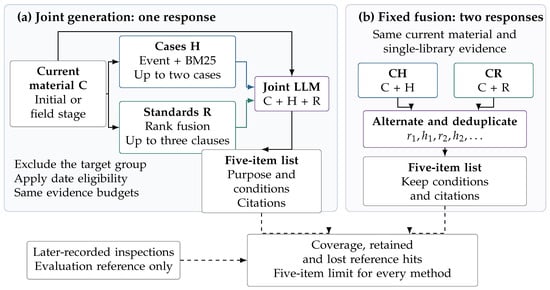
The historical library groups fragments by report and labels them by accident and field. The standards library stores clauses with version and applicability metadata. Retrieval returns and with identifiers that allow the passages to be traced to these records. We determine the stage boundaries from the report before retrieval. Figure 1 shows how the retrieved passages enter joint generation and how the saved single-library responses enter the subsequent fixed-fusion comparison.
Figure 1.
Recommendation routes. Joint generation receives both libraries in one response; fixed fusion selects from two single-library responses. Later-recorded inspections enter evaluation only. The development fact-processing task is reported separately in Supplementary Section S6. LLM: large language model.
3.2. Case Retrieval and Standards Retrieval
Case retrieval first applied the allowed historical identifiers for each task, excluding the target report and associated material. For chronological evaluation, additionally enforces the availability rules in Section 4.2. With denoting the accident group of report i, the eligible case set was
The query joined event-bearing current passages after removing numeric strings and station names, appended the selected field observations, and truncated the result to 4000 characters. Fixed patterns identified event features concerning cooling, external faults, energization, venting, and tap operation. Let be the query features in this focus set and those found in the candidate summary and protection-action text. Cases were sorted by the ascending lexicographic key
where contained the retained summary and protection-action fragments and was extracted from that text. Shared features thus took priority over BM25 score, with the stable case identifier resolving ties. Cases lacking these shared features followed in the ranking and could still be selected.
From the ranked cases, we selected at most two belonging to different accident groups. Within a selected case, BM25 ordered the fragments for a total text allowance of 550 characters. The selection attempted to include one fragment from each of the summary/protection-action, inspection/test-result, and recorded-cause groups. Tokenization retained alphanumeric tokens together with Chinese character unigrams and bigrams; BM25 used and .
Two queries were used for standards retrieval. The shared query was ; the event-and-task query expanded fixed event terms found in with generic terms for faults, checks, tests, causes, and handling. Each query yielded a BM25 ranking of all standards records using their scenario descriptions and source text. RRF combined the rankings [7]:
We scanned the fused ranking for up to three clause cards whose combined length fit the 1500-character allowance. A card contained its version, section, applicability, and source text. When a card exceeded the remaining space, the scan skipped it and continued with the next card. Ties in the BM25 and fused rankings were resolved using stable clause identifiers. The development control removed the second standards query together with case-feature priority. The independent evaluation removes each component separately (Section 5.4).
3.3. Joint Generation with Source Roles
We labeled the prompt’s sources as current accident materials, historical analogues, or standard guidance. The generator was instructed to link each finding to its equipment or component, event, and oil or gas sample. For a clause whose precondition remained unresolved in the available information, the inspection recommendation had to state that condition. The instructions required consulting records when test status was uncertain and specifying a purpose beyond the existing results for any repeated inspection. These rules specified how inspections are recommended under incomplete information.
With the common prompt and answer schema included in the generator , the joint and single-library responses are written as
The current-material condition is . Changing the evidence inputs does not eliminate the model’s general knowledge. Even without support from a specific retrieved passage, the model may use that knowledge to recommend a check.
Citations were limited to the supplied passages; each check could include up to two short, continuous quotations. The response was allowed to stop before five checks. We used Qwen3-14B-AWQ without task-specific training. Its activation-aware weight quantization (AWQ) reduces deployment resource requirements [13]; the execution settings are specified in Section 4.
3.4. Fixed Fusion of Single-Library Responses
The saved lists and were paired by task and repetition. Standards supplied the first candidate in the main alternating rule:
Before checking for duplicates, applies Unicode Normalization Form KC (NFKC), lowercases letters, and removes non-alphanumeric characters. removes later occurrences of an action with the same normalized text. Selection skips a list once it is exhausted. returns the first k surviving entries, or all surviving entries when fewer remain. The selected entries keep their purposes, conditions, source references, and quotations. We omit the repetition index for readability.
We varied the starting source and the order in which entries were selected. Selection either alternated between the two lists or exhausted one before moving to the other. These rules were specified after inspecting development results and before scoring the selection variants. They were subsequently frozen for independent testing. A failed path contributed an empty list, so selection continued from the other path. Every selected entry retained its original wording. Fixed fusion makes no additional generation call during selection. It uses two saved responses per task and repetition; joint generation uses one.
3.5. Non-Generative Baselines and Generated Refill
Historical-frequency selection (FREQ) returns up to five normalized inspection concepts ranked by their occurrence across eligible historical accident groups. Direct case reuse (DIRECT) takes inspection concepts from the same two retrieved case groups used by case-conditioned generation (CH), preserving the deterministic retrieval and inspection-index order and skipping duplicates. The baselines use the same date cutoff, target-group exclusion, and five-item limit as the generated conditions. They access the complete inspection index of eligible reports, whereas the generator sees the limited passages described above. Thus, these are practical reuse comparators with an explicit difference in evidence representation. Ties in frequency are resolved lexicographically by normalized object and method. DIRECT follows the retrieved case order and, within a case, the earliest numeric source position followed by reference identifier. Normalization applies Unicode NFKC, removes numbered transformer identifiers, maps the recorded transformer synonyms, lowercases letters, and removes non-alphanumeric characters; object–method pairs are then deduplicated. Fewer than five eligible concepts produce a shorter list, and an empty library produces an empty list. These baselines make no generation calls at test time, but their historical inspection index was constructed through the same model-assisted source annotation described in Supplementary Section S5.2.
A refill rule combines a baseline list with a generated list L. It orders candidates as and returns the first five distinct normalized action strings. When B is empty, L fills the list. We evaluate DIRECT with CH refill (D+CH), DIRECT with current-material-only refill (D+C), and FREQ with CH refill (F+CH). These lists require one underlying generated response. The current-material control separates the benefit of having a fallback from the contribution of case conditioning. The refill rule was fixed after the pilot and before inspecting the remaining test reports. Further selection variants examined after independent-test results are kept in Supplementary Section S4.
4. Data and Experimental Setup
4.1. Reports and Staged Tasks
The development collection consisted of 29 internal reports from 26 accident groups, organized into 29 report-level case records, with a total of 2505 source passages (Table 1). The standards corpus contained 56 records, each with passages, version information, and applicability conditions. We kept the accident documents and compiled libraries internally and generated responses through an internally hosted model service. Some standards records were compiled from public publications.
Table 1.
Development data and evaluation units. Recommendation tasks and repetitions were nested within 26 accident groups; the independent cohort is described below.
Each development report provided an initial-stage task and a field-stage task. The initial-stage task used the accident description and was scored against later field and investigation examinations. The field-stage task added field observations and used later investigation examinations as its target. The references contained 376 inspections: 77 field checks and 299 investigation checks. Repeated entries with the same inspection object and method represented a single inspection concept.
All 29 reports were used during development. Its initial comparison excluded the target accident group but allowed other reports regardless of date. Later-inspection references supplied the scoring targets. Identical recommendations shared an annotation, and method and repetition identifiers were hidden during matching.
The independent collection was screened from 36 additional source files. Three cases were randomly selected for a pilot (seed 20261109) and exposed during pipeline checks and refill-rule development. Six files overlapped with the development accidents, and four lacked the material required for staged evaluation. The remaining 23 files yielded 25 episodes: 21 trip or unplanned-outage accidents forming the primary cohort, and four defect episodes belonging to two related incident families for secondary analysis. The primary cohort provided 41 tasks (21 initial, 20 field); the secondary cohort provided five. Neither the pilot cases nor independent episodes entered the historical retrieval library. The development and test cohorts are distinct accident collections, not a random split of the 29 development reports.
The primary cohort contains 20 main-transformer-related accidents and one station-service-transformer accident. Fifteen groups had eligible history at both available stages; six had none, giving 30 history-available and 11 empty-history tasks. We report these strata alongside the full primary cohort. A field task was omitted when its later reference set was empty. The four defect episodes are reported separately because their event types and linked-group structure differ from the primary task.
The reference inventory initially contained 305 inspection concepts across the independent episodes. A source-table audit, completed before aggregate scores were computed, identified two omitted performed tests in one episode. The corrected inventory contains 307 concepts. Inputs, generated responses, and method rules were unchanged; Supplementary Section S3 retains the 305-reference analysis. Reference extraction and matching were assisted by the same artificial intelligence (AI) assistant, without independent human verification. Supplementary Sections S5.2 and S5.3 document the procedure and an anonymized example.
4.2. Temporal Eligibility and the Chronological Rerun
A historical report became eligible only when its conservative document-date upper bound preceded the target accident date. A report dated by month was assigned the month’s final day. Missing or conflicting document dates led to exclusion. Separate release or archive dates were unavailable, so these printed dates are availability proxies. Sixteen of the 29 development reports had usable date bounds; 13 were excluded by this rule. Standards were restricted by effective date, using the same target-accident cutoff at both information stages. All independent tasks retrieved from this fixed development library.
To distinguish chronology from simply reducing the corpus, the development tasks were rerun under three settings: unrestricted leave-group-out retrieval; retrieval from the date-known subcorpus without a chronological cutoff; and retrieval from that subcorpus with the cutoff. Standards-date filtering was applied in the chronological condition. All three were generated in the same rerun environment, so their paired differences estimate the effect of these restrictions without comparing separate serving runs.
In the unrestricted development retrieval, 31 of 116 selected case slots came from later accidents, affecting 25 of 58 tasks. Sixteen slots in 14 tasks failed the conservative report-date cutoff, and 50 slots in 36 tasks had unknown report dates. These categories overlap and describe different availability uncertainties. The median eligible-report counts were 28, 15, and 7 in the three settings; chronological counts ranged from 0 to 15, leaving 12 tasks without historical cases.
4.3. Conditions and Execution
By varying the use of corpora, we set up four conditions: C used only current materials; CH added historical cases; CR added technical standards; CHR provided both corpora simultaneously for joint generation. H and R denote historical evidence and standards evidence, respectively. The four conditions used the same model, current-material window, instructions, and output limits. Each response could contain at most two provisional cause directions and five inspections. Each inspection had to state its object, method, purpose, conditions, and source quotations.
We used an internally hosted qwen3-14b-awq generator with thinking mode disabled and temperature set to 0. The context and output limits were 8192 and 2200 tokens, respectively. At the field stage, the current-material budget was 2800 characters, initially allocating 1300 characters to the accident description and 1500 characters to field information. The remaining space was filled with complete source text blocks. Consequently, adding on-site observations could displace the accident-description text available at the initial stage. The retrieval quota was held constant across conditions, so adding a corpus increased the total input length.
Fixed fusion was introduced during development and then frozen before the independent evaluation. The saved CH and CR responses were paired by task and corresponding repetition (Figure 1). The primary rule started with CR, alternated entries between the two lists, and skipped duplicates that are identical after normalization. Selected entries retained their conditions and source quotations. A failed route was treated as an empty list. Because both responses had been saved, selection required no new calls; CHR used one underlying response per instance.
We evaluated two bundled ablations of joint generation. The retrieval ablation used single-query BM25 and removed case-event priority and standards-query fusion in the same control. The prompt ablation removed the evidence-use passage, which specified source roles, applicability, object distinctions, event binding, and duplicate merging together.
In the development run, 453 of the 464 response slots across the four main conditions succeeded and 11 had technical failures. We retried every failed slot once at the original settings. None succeeded on retry, and those slots received zero coverage in the main scores. The implementation ablations produced 225 successes in 232 slots. Across both sets of runs, there were 678 successful responses from 696 slots. The chronological rerun completed 792 model calls without failures. Independent testing used vLLM 0.11.2, one active request at a time, and the same generator settings. It completed 438 physical calls with no retry or failure. Identical complete inputs within a repetition shared a response; the two repetitions were generated independently. These calls populated 828 logical response slots for the nine generated arms. Consequently, the independent common-success subset equals the full set.
4.4. Measures and Analysis
We scored recommendations against the later inspections documented for each task. For a task–repetition instance , the reference set is and the distinct references matched by the first k recommendations form . Equipment, component, sample, and method had to be compatible for a match, and a reference could receive credit only once. Every scored task had a nonempty reference set. Let N denote the number of accident groups, the report or episode records in group g, and the available stage–repetition instances for record j. We average within each record, then within its accident group, and finally across groups:
For example, coverage of 0.14 means that the five-item list matches 14% of later-recorded inspection concepts after the averaging above. Larger reference sets and strict object–method matching lower this fraction. Under one-to-one matching, the per-task ceiling is ; the primary score can credit multiple concepts to a compound recommendation. For a stage-specific estimate, contains only that stage; a pooled estimate uses the available stages and both repetitions. Records within a group have equal weight, including linked defect episodes. Accident groups therefore have equal weight. Coverage, matched-recommendation fraction, retention, and Jaccard agreement are dimensionless scores in . Differences and confidence-interval endpoints are computed from unrounded estimates on the same scale. To calculate the matched-recommendation fraction, we divided the pooled count of recommendations matching at least one reference by the total number of recommendations.
For complementarity, let . For each combination method b (joint generation or fixed fusion), we calculated
The unit of these accumulated counts was a reference hit within a task–repetition instance. Several such hits could belong to the same accident. The main score allowed a compound recommendation to match multiple references. A sensitivity check used maximum bipartite matching to allow at most one reference per recommendation. Another check retained only instances in which CH, CR, and CHR all succeeded.
Repeat agreement used hit-set Jaccard, the intersection-to-union ratio. We reported all successful pairs and, separately, pairs excluding two empty sets; a pair of empty sets received 1.0000 agreement. Paired coverage differences used 10,000 accident-group bootstrap samples [14]. Development comparisons used seeds 20261015 and 20261017, and the chronological rerun used 20261108; the independent evaluation used 20261109, and later diagnostic analyses used 20261111. Each bootstrap resampled complete accident groups and preserved the nested averaging and paired methods. The 95% intervals were exploratory, with no adjustment for multiple comparisons. Cause directions received no diagnostic-accuracy score. Fact-processing counts use a separate selected reference set from the development reports. Reference-set size, five-item ceilings, and independent matching sensitivity appear in Supplementary Section S3.
5. Results
The development comparison established the candidate routes and list-selection rules. Its complete coverage, source-retention, and repeat-agreement results are provided in Supplementary Sections S1 and S2. The following evaluation applies chronological retrieval to that collection and then tests the frozen methods on independent accidents.
5.1. Chronological Evaluation on the Development Collection
Table 2 compares the three eligibility settings generated in the same rerun. Applying the date cutoff reduced CHR coverage from 0.1388 to 0.1171, a difference of (95% interval ). Relative to the date-known subcorpus, its change was . Fixed fusion changed from 0.1447 to 0.1428 under the unrestricted-to-chronological comparison, a difference of . Historical-frequency selection and direct reuse remained the strongest pooled means under chronological eligibility, at 0.1725 and 0.1503. These comparisons establish temporal sensitivity within the development collection; the earlier serving run is documented separately in Supplementary Table S1.
Table 2.
Development chronological rerun: accident-group macro-coverage at five recommendations. All columns use the same 26 groups and rerun environment. The date-known condition removes reports with unknown or conflicting dates but has no target-date cutoff.
5.2. Independent Evaluation with Historical Availability Constraints
The independent primary cohort comprised 21 accident groups. Table 3 separates the 15 groups with historical cases from the six without them. The median eligible library size per primary task was one report (range 0–16); the median standards count was 27 (range 8–56). Fixed fusion reached macro-coverage of 0.1353, compared with 0.1140 for CHR, a paired difference of 0.0213 . Compared with direct reuse, the differences were 0.0338 for fixed fusion and 0.0125 for CHR.
Table 3.
Independent primary cohort: coverage under date-constrained retrieval. History means at least one eligible historical case, not that the test accident appeared in development. Empty-history baselines return no items. All methods use the same five-item limit.
With available history, FREQ and DIRECT reached 0.1588 and 0.1421, respectively, compared with 0.0955 for CHR and 0.1163 for fixed fusion. The CHR–DIRECT difference was . Current-material generation reached 0.1290 overall, compared with 0.1247 for CH, 0.1186 for CR, and 0.1140 for CHR. The CHR–C difference was (95% interval ): the retrieval gain observed in development was not confirmed on unseen accidents. Direct reuse is a substantive comparator, and generation’s contribution must be examined through content, selection, and fallback behavior.
Supplementary Table S9 separates the five history-available groups with one eligible case from the ten with 6–16. Both simple baselines had higher mean coverage than CHR and fixed fusion in each subgroup. These small-subgroup results are descriptive. Stage-specific estimates, all predeclared method variants, and the secondary defect cohort are reported in Supplementary Section S3.
5.3. Independent Candidate Complementarity and Retention
Among the 15 history-available groups, the two single-library routes provided 151 reference-hit occurrences: 60 unique to CH, 46 unique to CR, and 45 shared. Joint generation retained 66 and supplied 17 outside that union. Fixed fusion retained 104, or 0.6887 of the union, compared with 0.4371 for joint generation (Table 4). These are matched-reference occurrences across stages and repetitions, not counts of independent accidents. Route-exclusive hits identify differences between generated candidate lists; they do not isolate the causal origin of a recommendation in a retrieved passage.
Table 4.
Independent reference-hit retention. Lost denotes union hits absent from the final list; extra denotes hits outside the separate-response union.
The candidate pool also contained checks missed by both simple methods. In the history-available stratum, 81 of its 151 hit occurrences were absent from the union of FREQ and DIRECT hits. Their group-macro reference coverage was 0.0990. This is evidence of complementary candidate content in a pool of up to ten entries; the five-item method scores remain those in Table 3.
A follow-up selection diagnostic used the reference labels to find the best subset of at most five candidates from each saved pool. In the history-available stratum, pool-union coverage was 0.1759 and the best-five bound was 0.1741; the budget alone therefore lost 0.0019. Fixed fusion achieved 0.1163, leaving 0.0577 between its selected list and that bound. This diagnostic locates most of the loss in candidate selection rather than the five-item limit. The label-informed bound is an analysis of the available pool, not a deployable method. Supplementary Section S4 gives the corresponding development and full-cohort results.
5.4. Isolated Retrieval and List-Selection Controls
The independent retrieval controls remove case-event priority and standards RRF separately while holding the remaining retrieval component, source budgets, prompts, and generator fixed. For fixed fusion, the affected single-library response is paired with the unchanged other route; for CHR, the altered evidence enters the joint prompt. Both routes are shown in Table 5.
Table 5.
Independent retrieval ablations: accident-group macro-coverage. The main-transformer subset contains 20 of the 21 primary groups. Event-priority removal left all selected evidence unchanged.
Event-priority removal produced identical rankings and passages in all 46 tasks: 16 had no eligible cases, 25 had no focus feature in the query, and five had a feature with zero overlap across eligible cases. The rule was inactive in this cohort. Removing standards RRF changed evidence in 39 tasks. For CHR, the full-minus-ablated difference was 0.0174 overall and with history.
A supplemental fixed-fusion contrast gave a full-minus-no-RRF difference of 0.0316 overall. It fell to 0.0075 with history and 0.0082 in the main-transformer subset. The overall mean was sensitive to a station-service-transformer accident with two reference items. This contrast was computed during follow-up analysis rather than included among the 18 prespecified contrasts. The results support reporting the component’s effects by stratum, with no gain attributed to inactive event-priority rules.
Follow-up controls on the saved candidate lists also varied the starting source, alternating versus concatenated order, and exact versus guarded semantic deduplication. Standards-first alternation gave 0.1353 overall, compared with 0.1117 for case-first alternation; changing deduplication did not change coverage. With history, case-first concatenation reached 0.1238, above standards-first alternation at 0.1163. The full selection matrix is retained in Supplementary Section S4.
5.5. Baseline Lists with Generated Refill
Table 6 evaluates the refill rule frozen before the independent test. DIRECT+CH reached 0.1463 coverage, an increase of 0.0448 over DIRECT. Of that overall gain, 80.9% arose in accidents without eligible history. Within the history-available stratum, the difference was 0.0120 .
Table 6.
Frozen baseline-first refill rules on the independent primary cohort. The first four baseline entries precede the generated list; the fifth baseline entry follows it. Exact normalized duplicates are skipped.
DIRECT+C reached 0.1481, slightly above DIRECT+CH; their paired difference (CH minus C) was . The practical gain in this comparison is therefore a populated fallback list, with similar performance from current-material-only generation. FREQ+CH reached 0.1569 overall. Context-based reranking of that list was studied only after test results were inspected and is reported as exploratory in Supplementary Section S4, together with non-generative mixed-list controls.
5.6. Independent Repeat Agreement and Inference Cost
Both repetitions succeeded for all 41 primary tasks. Table 7 reports reference-hit Jaccard agreement and request costs. No explicit random seed was supplied to the server. Temperature zero was a generation setting, and repeated requests still produced some different action lists and matched-reference sets. We report the observed differences without assigning them to an untested software or hardware mechanism. One-to-one matching preserved the principal comparisons: fixed fusion reached 0.1306, CHR 0.1128, DIRECT 0.1015, and DIRECT+CH refill 0.1394 (Supplementary Section S3).
Table 7.
Independent repeat agreement and mean Hypertext Transfer Protocol (HTTP) inference cost. Jaccard uses 41 primary task pairs; its second column excludes pairs with two empty hit sets. Cost means use all 46 tasks and both repetitions. Fixed fusion sums its two underlying calls.
Fixed fusion required about 1.91 times the Hypertext Transfer Protocol (HTTP) inference time of joint generation (31.83 versus 16.69 s per logical task–repetition). These timings include request handling and generation, but exclude local retrieval and list-processing time. Graphics processing unit memory, utilization, energy, and monetary cost were not measured. Cached calls shared by analyses are counted in each method’s logical cost, so reuse of a saved response does not make its generation free. Full prompt-token counts, reference-size distributions, and common-reference stage comparisons appear in Supplementary Section S3.
6. Discussion
6.1. Evidence Complementarity and Candidate Selection
In the development comparison, the inspection lists produced by case-only generation and by joint generation had similar coverage but different content. The two single-corpus responses contributed nearly equal numbers of source-specific matches. Joint generation retained some matches from the individual lists and also provided matches outside the union of their reference matches; fixed fusion retained more matches within the union. Even when aggregate coverage changed little, tracking which matches entered or left the list distinguishes the contributions of different sources.
The independent history-available comparison reinforces this content-level distinction. CH and CR supplied 60 and 46 route-exclusive reference-hit occurrences, and fixed fusion retained 104 of their 151 union occurrences. The label-informed best-five diagnostic placed only a small part of the loss at the response budget. Most lost hits were available in a different selection from the same candidates. This identifies list construction as a concrete target for further work.
The simple baselines clarify the role of generation. With eligible history, historical frequency and direct reuse exceeded both joint generation and fixed fusion in mean coverage. Retrieval provided no confirmed coverage gain over current-material generation in the independent cohort; the paired CHR–C interval includes both negative and positive differences. Generated refill helped chiefly by filling an otherwise empty historical list, and current-material-only refill performed similarly. The empirical contribution is the separation of candidate supply, short-list retention, and fallback behavior.
Retrieval and selection controls give a similarly specific account. The event-priority rule was inactive in the independent cohort; standards RRF affected the retrieved evidence but its coverage effect varied across strata. Exact deduplication produced no coverage gain. Fixed fusion retained more separate-response matches at about twice the inference cost of joint generation. These observations quantify the trade-off between match retention and inference cost.
6.2. Scope of the Evaluation
The reference set contains inspections recorded in the accident reports, but may omit useful inspection items. Some recorded inspection items may also have low priority at the current decision point. The coverage of five recommendations varies with the size of the reference set and with the specificity of the recorded objects and methods. Therefore, practical evaluation must judge the applicability and priority of recommendations in addition to checking agreement with reports.
Chronological retrieval uses conservative document-date proxies because separate issue or archive dates were unavailable. Reports with missing or conflicting dates are excluded, and a month-only date becomes eligible after that month ends. This improves temporal separation but reduces the available library. Independence concerns the unseen accident cohort and frozen input-to-list rules. The three exposed pilots are separate from that cohort, and selection analyses designed after inspecting its aggregate results are reported as exploratory.
Development references and initial scoring used the same Qwen model as generation, followed by assistant-supported source checks. In independent testing, the same AI assistant supported reference extraction and recommendation matching, with method names and repetition identifiers hidden during matching; the assistant was GPT-6 Astra (OpenAI), and its exact model snapshot identifier was not retained. Reference extraction and matching have not undergone independent human verification. The coverage results are exploratory comparisons based on these annotations. We report no human agreement, safety, or priority score. Source-linked annotations, completeness sensitivity, and one-to-one matching make the scoring process inspectable. Unmatched recommendations may include useful unrecorded checks, unsuitable procedures, or redundant suggestions. Operational use requires a qualified investigator to check prerequisites and priority.
The evidence is drawn mainly from transformer-related investigations within one internal reporting setting and one local language model. Two repetitions measure repeat agreement for that configuration. The small cohort and unadjusted exploratory intervals limit the precision of subgroup and component comparisons.
The auxiliary fact-processing experiment and its separate reference set are documented in Supplementary Section S6.
7. Conclusions
Cases and standards supplied complementary inspection candidates, and the way those candidates were selected determined which checks survived the five-item limit. In the independent history-available cohort, fixed fusion retained 104 of 151 reference hits from the separate responses, compared with 66 for joint generation; joint generation added 17 hits outside that union. These exploratory results trace candidate contributions and selection losses alongside aggregate coverage.
With eligible history, both simple baselines had higher mean coverage than joint generation and fixed fusion. The CHR–DIRECT difference was (95% interval ); fixed-fusion comparisons with both baselines included zero. These intervals are exploratory and unadjusted. Retrieval provided no confirmed coverage gain over current-material generation on unseen accidents. Generated refill improved direct reuse mainly when its historical list was empty, with similar performance from current-material-only refill. Event priority was inactive in this cohort. The findings identify complementary candidates and selection losses, while the unverified reference extraction and matching leave independent human validation outstanding.
Supplementary Materials
The following supporting information can be downloaded at: https://www.mdpi.com/article/10.3390/electronics15235526/s1. Section S1: Development comparisons; Section S2: Additional implementation and stage controls; Section S3: Independent-test detail and sensitivity; Section S4: Exploratory candidate-pool and selection analyses; Section S5: Equipment scope, annotation, and a worked example; Section S6: Auxiliary fact processing in the development collection. Table S1: Development comparison with a five-recommendation limit; Table S2: Fixed-fusion selection-rule and source-order controls using the same two responses and at most five recommendations; Table S3: Development repeat agreement and sensitivity checks; Table S4: Development bundled ablations of joint generation at five recommendations; Table S5: Stage-specific and scope sensitivity of the 13 frozen recommendation configurations (incident-group macro coverage, %); Table S6: All 18 frozen paired comparisons in the primary incident cohort: difference and 95% interval (percentage points); Table S7: Stage-specific numbers of later-recorded reference inspections and the one-to-one five-item ceiling; Table S8: Anonymized primary incident reference-set and eligible-library counts under the chronological protocol; Table S9: Descriptive coverage by eligible historical-library size in the independent cohort (incident-group macro-coverage, %); Table S10: One-to-one matching sensitivity for the 13 frozen configurations (incident-group macro coverage, %); Table S11: Reference completeness sensitivity for all 13 frozen configurations (primary incident-group macro coverage, %); Table S12: Independent common-reference stage control: 20 paired primary groups; Table S13: Saved CH/CR candidate-pool content beyond both simple baselines; Table S14: Complete follow-up shortlist comparisons on saved outputs (incident-group macro coverage, %); Table S15: Anonymized fixed-fusion recommendations and strict recorded-inspection matches; Table S16: Processing comparison for fact verification with fixed dual-library responses and 148 references. Figure S1: Source complementarity and retention at five checks.
Author Contributions
Conceptualization and methodology, K.S.; software, investigation and formal analysis, K.S. and H.H.; resources and data curation, K.S. and H.H.; writing—original draft preparation, K.S.; supervision and writing—review and editing, J.X. All authors have read and agreed to the published version of the manuscript.
Funding
This research received no external funding.
Institutional Review Board Statement
Not applicable.
Informed Consent Statement
Not applicable.
Data Availability Statement
The internal accident investigation reports analyzed in this study are restricted to internal use and are not publicly available. The accompanying reproducibility package provides prompts, processing and evaluation code, anonymized numerical results, and an illustrative scoring example. It excludes internal reports and copyrighted standards text.
Acknowledgments
Qwen3-14B-AWQ was deployed locally to generate inspection recommendations, as detailed in the methodology and experimental setup. An AI assistant, GPT-6 Astra (OpenAI), supported source-linked reference annotation, recommendation matching and scoring, analysis, and preparation of the revision. The exact model snapshot identifier was not retained. The annotation process and its limitations are described in Supplementary Section S5.2.
Conflicts of Interest
The authors declare no conflicts of interest.
References
- Lewis, P.; Perez, E.; Piktus, A.; Petroni, F.; Karpukhin, V.; Goyal, N.; Küttler, H.; Lewis, M.; Yih, W.-t.; Rocktäschel, T.; et al. Retrieval-Augmented Generation for Knowledge-Intensive NLP Tasks. In Advances in Neural Information Processing Systems; Curran Associates, Inc.: Red Hook, NY, USA, 2020; Volume 33, pp. 9459–9474. Available online: https://proceedings.neurips.cc/paper/2020/hash/6b493230205f780e1bc26945df7481e5-Abstract.html (accessed on 19 November 2026).
- Wulf, J.; Meierhofer, J.; Pascher, N. Guided Operations and Maintenance with Retrieval-Augmented Generation: System Design and Evaluation at a Machine Manufacturer. Procedia CIRP 2026, 139, 349–354. [Google Scholar] [CrossRef] [Scilit]
- Shi, F.; Chen, L.; Zhou, M.; Zhao, Y.; Zheng, Y. A stepwise intelligence generative method for structured maintenance guidance documents based on knowledge graph augmented LLM. Adv. Eng. Inform. 2025, 67, 103523. [Google Scholar] [CrossRef] [Scilit]
- Aamodt, A.; Plaza, E. Case-Based Reasoning: Foundational Issues, Methodological Variations, and System Approaches. AI Commun. 1994, 7, 39–59. [Google Scholar] [CrossRef] [Scilit]
- Sun, Z.; Yang, P.; Shi, L.; Yao, Q.; Li, L.; Xiao, H.; Zheng, X.; Shen, X. Benchmarking backbone neural networks for HVAC fault diagnosis and regression: Insights into spatiotemporal, graph, and attention-based architectures. Energy Build. 2026, 366, 117718. [Google Scholar] [CrossRef] [Scilit]
- Robertson, S.; Zaragoza, H. The Probabilistic Relevance Framework: BM25 and Beyond. Found. Trends Inf. Retr. 2009, 3, 333–389. [Google Scholar] [CrossRef] [Scilit]
- Cormack, G.V.; Clarke, C.L.A.; Büttcher, S. Reciprocal Rank Fusion Outperforms Condorcet and Individual Rank Learning Methods. In Proceedings of the 32nd International ACM SIGIR Conference on Research and Development in Information Retrieval; ACM, Inc.: New York, NY, USA, 2009; pp. 758–759. [Google Scholar] [CrossRef] [Scilit]
- Izacard, G.; Grave, E. Leveraging Passage Retrieval with Generative Models for Open Domain Question Answering. In Proceedings of the 16th Conference of the European Chapter of the Association for Computational Linguistics: Main Volume; Association for Computational Linguistics: Stroudsburg, PA, USA, 2021; pp. 874–880. [Google Scholar] [CrossRef] [Scilit]
- Gao, T.; Yen, H.; Yu, J.; Chen, D. Enabling Large Language Models to Generate Text with Citations. In Proceedings of the 2023 Conference on Empirical Methods in Natural Language Processing; Association for Computational Linguistics: Stroudsburg, PA, USA, 2023; pp. 6465–6488. [Google Scholar] [CrossRef] [Scilit]
- Es, S.; James, J.; Espinosa Anke, L.; Schockaert, S. RAGAs: Automated Evaluation of Retrieval Augmented Generation. In Proceedings of the 18th Conference of the European Chapter of the Association for Computational Linguistics: System Demonstrations; Association for Computational Linguistics: Stroudsburg, PA, USA, 2024; pp. 150–158. [Google Scholar] [CrossRef] [Scilit]
- Saad-Falcon, J.; Khattab, O.; Potts, C.; Zaharia, M. ARES: An Automated Evaluation Framework for Retrieval-Augmented Generation Systems. In Proceedings of the 2024 Conference of the North American Chapter of the Association for Computational Linguistics: Human Language Technologies; Association for Computational Linguistics: Stroudsburg, PA, USA, 2024; Volume 1, pp. 338–354. [Google Scholar] [CrossRef] [Scilit]
- Min, S.; Krishna, K.; Lyu, X.; Lewis, M.; Yih, W.-t.; Koh, P.W.; Iyyer, M.; Zettlemoyer, L.; Hajishirzi, H. FActScore: Fine-grained Atomic Evaluation of Factual Precision in Long Form Text Generation. In Proceedings of the 2023 Conference on Empirical Methods in Natural Language Processing; Association for Computational Linguistics: Stroudsburg, PA, USA, 2023; pp. 12076–12100. [Google Scholar] [CrossRef] [Scilit]
- Lin, J.; Tang, J.; Tang, H.; Yang, S.; Chen, W.-M.; Wang, W.-C.; Xiao, G.; Dang, X.; Gan, C.; Han, S. AWQ: Activation-aware Weight Quantization for On-Device LLM Compression and Acceleration. In Proceedings of Machine Learning and Systems; MLCommons Association: Santa Clara, CA, USA, 2024; Volume 6, pp. 87–100. Available online: https://proceedings.mlsys.org/paper_files/paper/2024/hash/42a452cbafa9dd64e9ba4aa95cc1ef21-Abstract-Conference.html (accessed on 19 November 2026).
- Efron, B. Bootstrap Methods: Another Look at the Jackknife. Ann. Stat. 1979, 7, 1–26. [Google Scholar] [CrossRef] [Scilit]

Disclaimer/Publisher’s Note: The statements, opinions and data contained in all publications are solely those of the individual author(s) and contributor(s) and not of MDPI and/or the editor(s). MDPI and/or the editor(s) disclaim responsibility for any injury to people or property resulting from any ideas, methods, instructions or products referred to in the content. |
© 2026 by the authors. Licensee MDPI, Basel, Switzerland. This article is an open access article distributed under the terms and conditions of the Creative Commons Attribution (CC BY) license.