


Abstract
Vision-based fall detection remains challenging when falls resemble routine daily activities and test environments differ from training conditions. We propose a fall-specific adaptation framework that extends a pretrained skeleton-based action recognizer while preserving its original pathway for classifying activities of daily living (ADL). RGB videos are converted into 3D skeleton sequences and encoded by a frozen Dense Spatio-Temporal Encoder (DSTE). A lightweight residual adapter refines the extracted features to distinguish among falls, transitions into a lying posture, lying postures, and other activities. To combine complementary supervision, we jointly train the adapter on SAFER-Activities and FU-Kinect-Fall using separate classification heads for four-class window-level and binary clip-level supervision, respectively. We then freeze the adapter and train a dedicated four-class classifier while leaving the original ADL pathway unchanged. Across five training seeds, the method achieves video-level F1-scores of and (mean ± standard deviation) on the unseen CAUCAFall and Le2i datasets, respectively. The corresponding mean improvements over a classifier trained on unadapted DSTE features are 2.98 and 0.20 percentage points. The method also achieves higher mean F1-scores than the dedicated fall detectors evaluated in this study. The framework provides a lightweight fall-specific extension to a pretrained skeleton-based ADL recognizer, producing four-class fall-related predictions alongside the unchanged original ADL classification pathway.
1. Introduction
Recognizing activities of daily living (ADL) from RGB video enables non-contact monitoring of routine behavior and the identification of potentially hazardous events [1,2]. Within an ADL monitoring system, fall detection needs to operate alongside general activity recognition. The system must distinguish falls from similar everyday behaviors, particularly transitions into a lying posture and the posture itself, while retaining the ability to recognize a broader range of routine activities.
Existing vision-based fall detectors commonly use spatiotemporal video features or skeletal cues to classify activities as falls or non-falls [3,4]. Weakly supervised approaches reduce annotation requirements by learning from video-level labels [1]. However, binary outputs group diverse non-fall behaviors into a single category and do not distinguish among lying transitions, lying postures, and other routine actions. Integrating fall detection into an existing ADL recognizer therefore requires learning more detailed fall-related distinctions while preserving the original activity categories.
Generalization across environments presents a second challenge. Many fall detection benchmarks include a limited range of subjects, viewpoints, and simulated fall patterns, so high within-dataset accuracy alone provides insufficient evidence of performance in unfamiliar scenes [1,4]. Differences in scene appearance, camera viewpoint, and pose-estimation quality can further affect recognition outside the training environment [2,5]. Evaluations on SAFER-Activities highlight this domain-shift problem and demonstrate the potential of skeleton-based representations for cross-environment transfer [2]. These findings motivate learning fall-specific distinctions from transferable body-motion features with reduced dependence on scene appearance.
Skeleton-based action foundation models provide a promising basis for this transfer. USDRL and its foundation-model extension learn reusable representations of spatial structure and temporal motion for multiple action-understanding tasks [6,7]. These general-purpose features nevertheless require a task-specific decision function to distinguish the behaviors relevant to fall monitoring. Parameter-efficient adaptation provides a way to specialize pretrained representations while keeping the backbone fixed [8]. The challenge is to learn these distinctions without altering the existing ADL pathway while accommodating fall datasets that differ in their label spaces and annotation granularity.
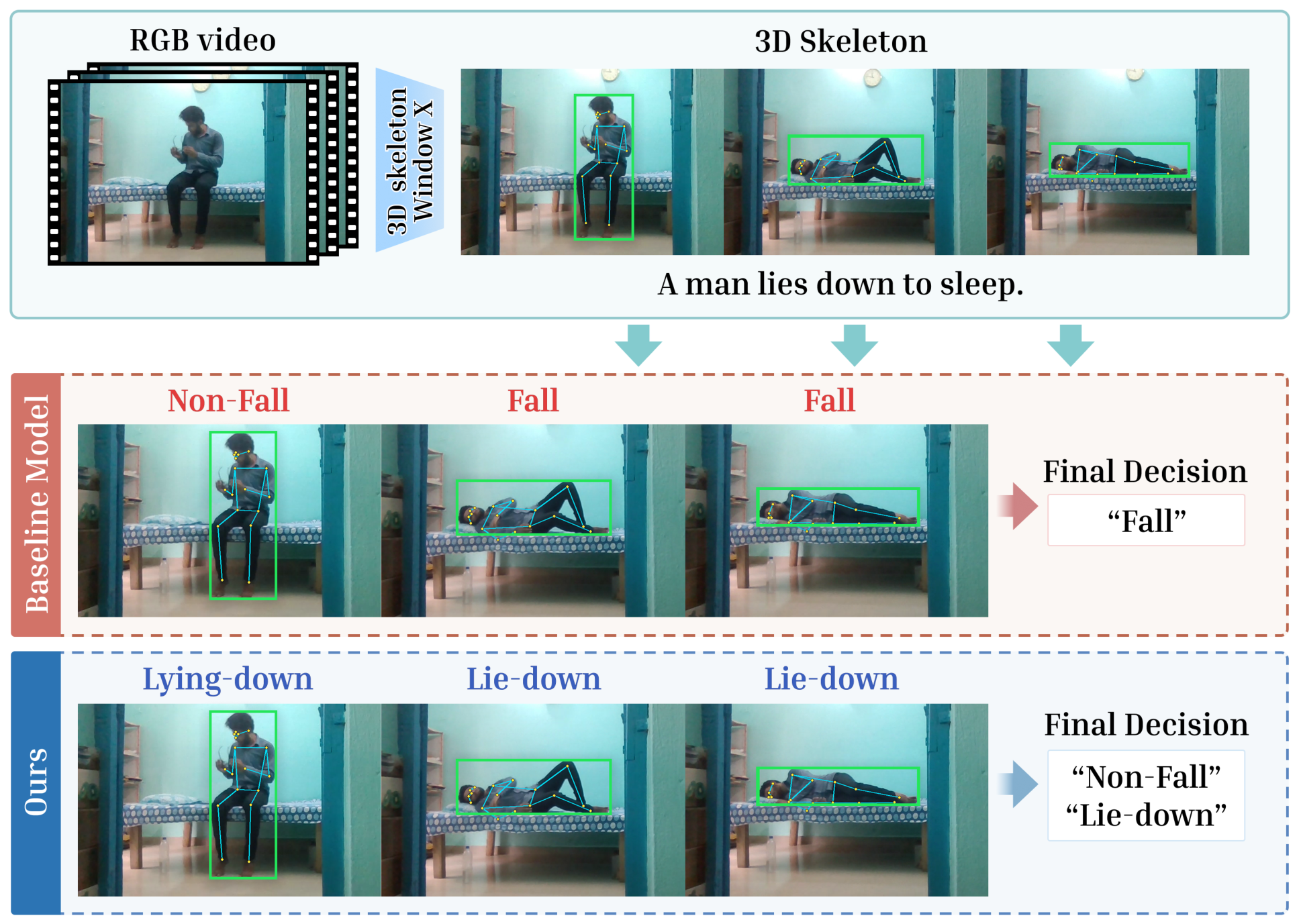
We address these challenges with a fall-specific adaptation framework that extends a pretrained skeleton-based ADL recognizer with a dedicated prediction branch (Figure 1). This branch combines a residual adapter with a four-class classifier to distinguish among falls, lying transitions, lying postures, and other activities. The framework is designed to meet two complementary objectives: preserving the original ADL pathway and learning transferable fall-specific distinctions.
Figure 1.
Comparison of conventional fall detection and the proposed fall-aware ADL recognition framework. A conventional detector (middle) may confuse lying-related activities with falls. The proposed framework (bottom) distinguishes falls, lying transitions, and lying postures while retaining the original ADL classification pathway.
To preserve the original ADL pathway, we freeze the pretrained Dense Spatio-Temporal Encoder (DSTE) [6] and its original 60-class classifier. DSTE encodes windows of 3D skeleton sequences estimated from RGB video into shared action features. The original ADL classifier receives these features directly, while a residual adapter applied after backbone pooling refines them for the fall-specific branch. Adaptation is thus confined to the added branch, leaving the computations of the backbone and original ADL classifier unchanged. The two pathways produce independent predictions, with no score fusion or overriding of the original ADL outputs.
To learn transferable fall-specific distinctions, we combine complementary supervision from SAFER-Activities [2] and FU-Kinect-Fall [9]. We derive four-class window-level labels from SAFER’s frame-level annotations and binary clip-level labels from FU’s activity annotations. We jointly train a shared residual adapter through separate dataset-specific heads, allowing both datasets to shape the adapted features while retaining their respective label spaces and supervision units. After adaptation, we freeze the adapter and train a new four-class linear classifier using SAFER alone. This separation allows multi-dataset supervision to specialize the representation and SAFER’s four-class labels to define the final decision function for fall-aware activity monitoring.
The main contributions are summarized as follows:
- We introduce a fall-specific adaptation framework that augments a pretrained skeleton-based ADL recognizer with detailed fall-related predictions while leaving the backbone and original activity-classification pathway unchanged.
- We develop a multi-dataset adaptation strategy that trains a shared residual adapter through separate classification heads using four-class window-level and binary clip-level supervision. This design preserves each dataset’s label space and annotation granularity.
- We separate multi-dataset representation adaptation from final classifier training by fitting a dedicated four-class classifier on fixed adapted features instead of reusing the dataset-specific heads trained during joint adaptation. We use ablation studies across five training seeds to evaluate the effects of representation adaptation, auxiliary FU supervision, and final classifier refitting.
2. Related Work
2.1. Vision-Based Fall Detection and Activity Monitoring
Vision-based fall detection draws on appearance, motion, and skeletal cues, with different methods emphasizing feature transfer, computational efficiency, or reduced annotation requirements. Alam et al. [3] extract spatiotemporal features using a frozen pretrained 3D convolutional neural network (CNN) and train a support vector machine (SVM) to distinguish falls from activities of daily living. Zeng et al. [4] combine lightweight fall-region detection, pose estimation, and feature selection based on a genetic algorithm to balance recognition performance and computational cost. Wu et al. [1] reduce annotation requirements by learning segment-level fall scores from video-level labels through multiple instance learning with RGB and optical-flow streams. Although these methods address complementary challenges, their binary outputs do not distinguish among different non-fall activities.
Other studies extend fall detection to broader activity recognition or more precise temporal localization. Ramirez et al. [10] use human skeleton features for both fall detection and activity recognition, while FLASH [11] combines hypergraph spatial modeling with a selective state-space model to identify impact frames. These approaches broaden the activity label space or increase the temporal specificity of fall predictions. Our work complements these directions by adding a dedicated fall-specific branch to a pretrained ADL recognizer. The branch distinguishes among falls, lying transitions, lying postures, and other activities while leaving the original ADL pathway unchanged. Its focus is fall-related activity classification rather than impact timing.
2.2. Generalization Across Environments and Modalities
Assessing recognition performance beyond the training environment requires diverse benchmarks. Small numbers of subjects, fixed camera configurations, and simulated falls limit the range of conditions represented in many fall detection datasets [1,4]. To broaden this coverage, Zeng et al. [4] introduce FDD15K, an image dataset with varied viewpoints, occlusions, and scene conditions. Wu et al. [1] construct RFDS from real-world fall videos recorded in indoor and outdoor environments. SAFER-Activities [2] provides continuous activity recordings with frame-level annotations, and the accompanying study evaluates recognition under domain shift. Its findings show that strong in-domain performance does not necessarily transfer to unfamiliar environments and highlight the potential advantages of skeleton-based representations for cross-environment recognition.
Cross-modal adaptation addresses a related but distinct problem: transferring recognition between sensing modalities. Xiao et al. [5] transfer fall recognition from labeled RGB videos to unlabeled depth data using intermediate-domain features, adversarial alignment, and pseudo-label supervision. Their method targets depth-based inference and uses target-modality data during training. Our approach uses complementary labeled sources to specialize a pretrained skeleton representation for fall-related motion distinctions that can transfer across environments. It does not explicitly align the representation with an observed target modality, distinguishing our training setting from unsupervised RGB-to-depth adaptation.
2.3. Skeleton-Based Action Representation Learning
Skeleton-based action recognition models body structure and temporal motion without directly encoding image texture. ST-GCN [12] represents skeleton sequences as spatiotemporal graphs that connect joints within and across frames. CTR-GCN [13] extends this formulation by learning channel-specific topology refinements. As an alternative to graph-based processing, PoseC3D [14] represents poses as stacked heatmaps and processes them using 3D convolutions, with reported improvements in robustness to pose-estimation noise and cross-dataset variation. These methods offer different ways to extract discriminative action features. Although structural representations reduce direct dependence on scene appearance, applying them to fall monitoring still requires a classifier tailored to the relevant activity distinctions.
Pretraining supports the reuse of motion representations across tasks. MotionBERT [15] learns a motion encoder by recovering 3D motion from noisy and incomplete 2D observations, then transfers the learned representation to downstream human-centric tasks. USDRL [6] combines a Dense Spatio-Temporal Encoder (DSTE) with multi-grained feature decorrelation for self-supervised skeleton representation learning. Its foundation-model extension [7] incorporates multi-perspective consistency training and evaluates the learned representation across multiple action-understanding tasks. We use this pretrained DSTE without introducing a new skeleton encoder or pretraining objective. Our fall-specific adaptation operates on its pooled output, leaving both the backbone parameters and the unadapted features supplied to the original ADL classifier unchanged.
2.4. Parameter-Efficient and Multi-Dataset Adaptation
Parameter-efficient adaptation specializes pretrained representations through a small set of trainable components. Rebuffi et al. [16] introduce residual modules for learning multiple visual domains with extensive parameter sharing. Houlsby et al. [17] develop bottleneck adapters for pretrained language models while keeping the original network parameters fixed. AdaptFormer [8] extends this principle to image and video recognition by adding trainable modules to pretrained Transformers. Our design adopts the residual bottleneck principle but places a single adapter after skeleton feature pooling rather than within Transformer blocks. This placement confines feature modification to the added fall-specific branch. The original ADL classifier bypasses the adapter and continues to operate on unadapted backbone features, preserving its original computation.
Multi-dataset adaptation must also accommodate differences in label spaces and supervision units. Multi-task learning [18] provides a general framework in which tasks share representations while retaining separate outputs. In our setting, SAFER-Activities [2] provides frame-level activity annotations, whereas FU-Kinect-Fall [9] provides labeled skeleton clips containing falls and routine activities. We derive four-class window-level supervision from the former and binary clip-level supervision from the latter. Through separate dataset-specific heads, we jointly train a shared residual adapter while retaining each dataset’s label space and supervision unit. We then freeze the adapter and train a separate four-class classifier on SAFER alone. In contrast to classifier-only transfer using unadapted features, this procedure specializes the representation through multi-dataset supervision before fitting the final fall-related classifier.
3. Method
3.1. Overview
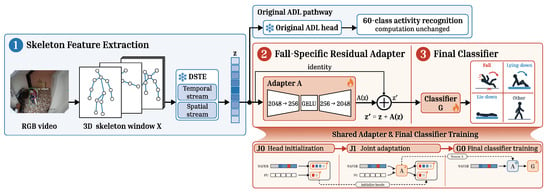
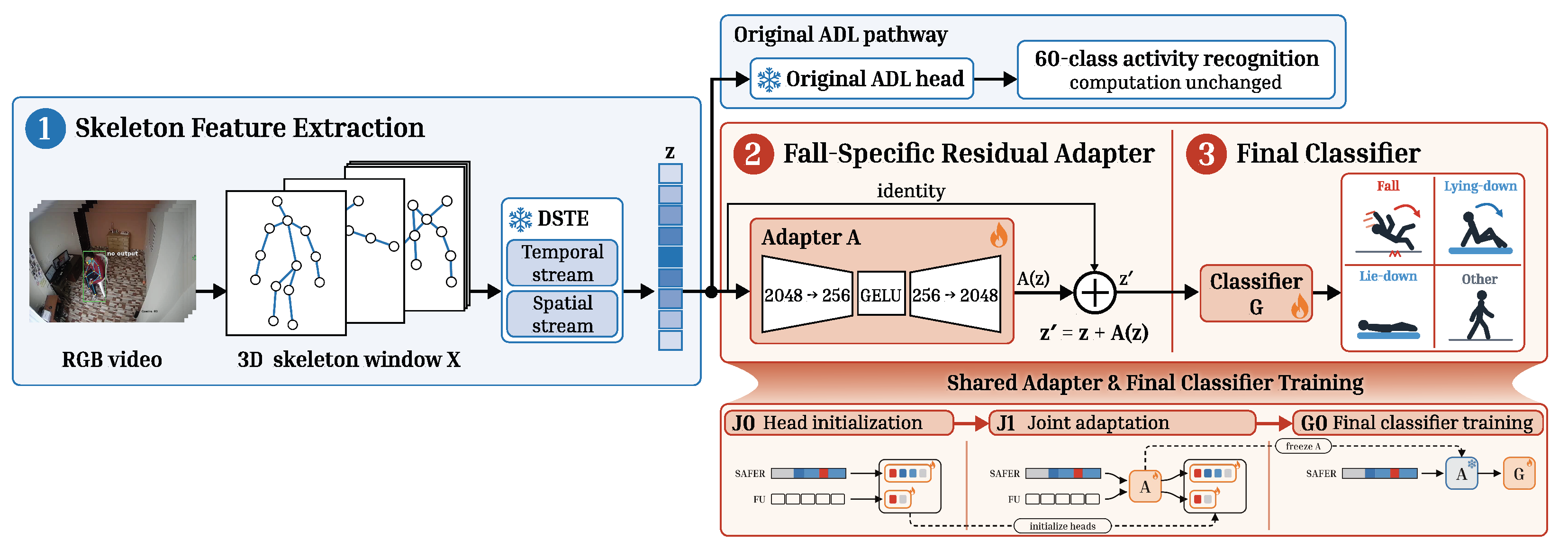
We extend a pretrained skeleton-based activity recognizer with a fall-specific branch while retaining its original ADL pathway (Figure 2). RGB videos are converted into windows of 3D skeleton sequences, from which a frozen Dense Spatio-Temporal Encoder (DSTE) extracts features. The original NTU60-trained classifier uses these features directly. The added branch refines them with a residual adapter and applies a four-class linear classifier to distinguish among falls, lying transitions, lying postures, and other activities.
Figure 2.
Overview of the proposed fall-specific adaptation framework. (1) RGB video is processed through person detection, 2D pose estimation, and 3D pose lifting to obtain normalized 3D skeleton windows. A frozen DSTE extracts features for two independent prediction pathways. The original 60-class ADL classifier uses the unadapted features directly. The fall-specific branch (2) refines these features with a residual adapter and (3) predicts one of four classes: other, fall, lie-down, or lying-down. The pretrained DSTE and original ADL pathway remain unchanged throughout the three training stages (J0, J1, and G0).
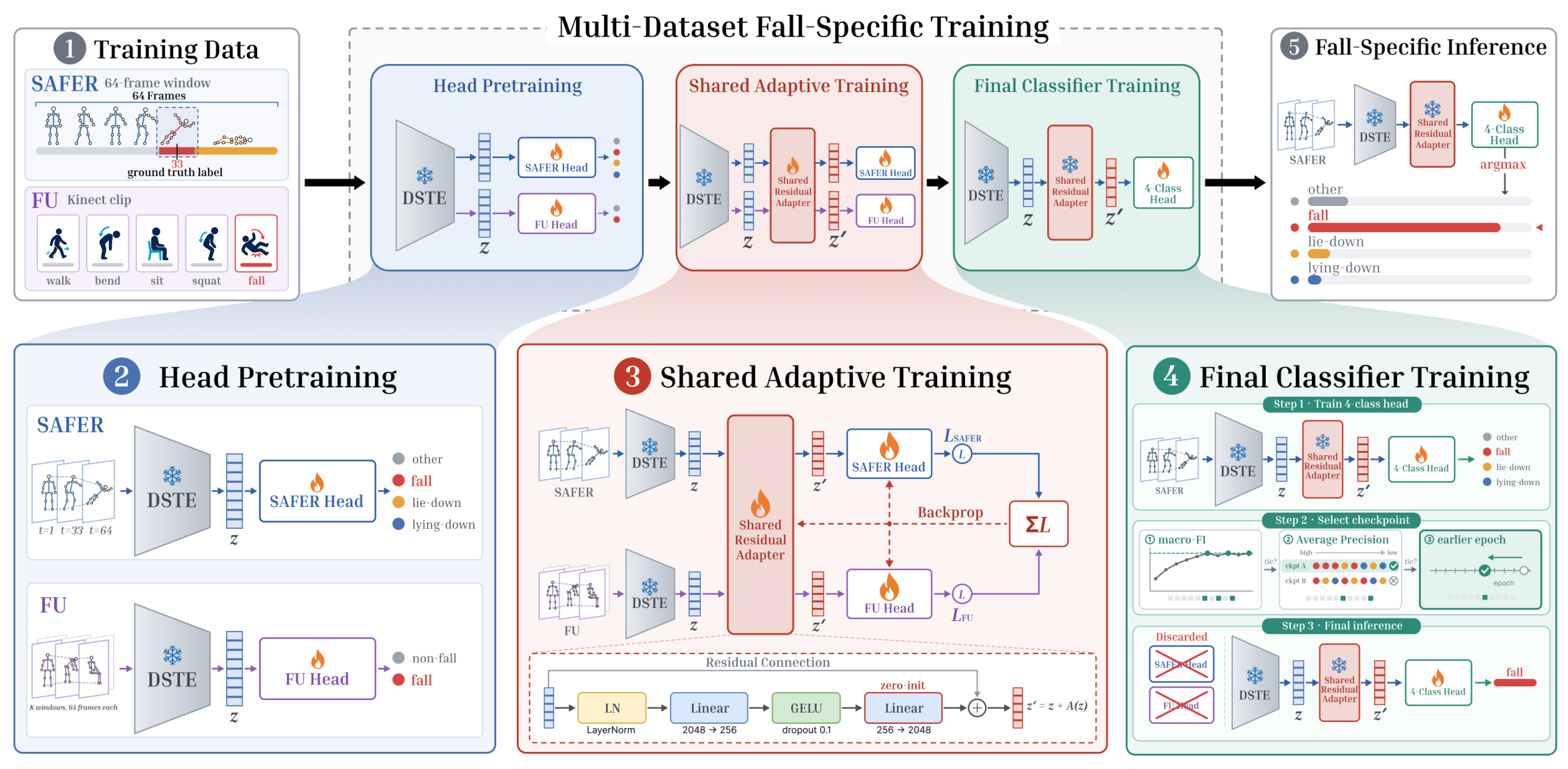
Training comprises three stages: dataset-specific head pretraining (J0), joint adaptation (J1), and final classifier training (G0). During J0, separate heads for SAFER-Activities and FU-Kinect-Fall are trained on unadapted DSTE features. During J1, these heads and a shared residual adapter are jointly updated while preserving each dataset’s label space and supervision unit. During G0, the adapter is frozen, and a new four-class classifier is trained using SAFER alone. The shared DSTE and original ADL classifier remain unchanged throughout training. The two prediction pathways operate independently; fall-specific outputs neither replace nor override the original ADL predictions.
3.2. Skeleton Feature Extraction
Skeleton construction. For external RGB videos, we detect people using YOLOv8x [19] with Ultralytics version 8.4.138 and estimate 2D poses using ViTPose-B [20] (code revision c050ed29). A single-person association rule combines detection confidence with bounding-box overlap relative to the most recent valid detection. SAFER inputs use the released 2D poses estimated with ViTPose-H. Before 3D lifting, we map joint coordinates and confidence scores using the same COCO-to-Human3.6M (H36M) correspondence. For each constructed joint, its confidence is the mean confidence of the source joints used to compute its coordinates. MotionAGFormer [21] (code revision 4756fd1e) lifts the resulting sequences into the H36M 17-joint 3D format [22].
We convert the lifted poses into a proxy NTU25 layout [23] compatible with DSTE. Unavailable distal hand and foot joints are represented using wrist or ankle proxies. A single scale factor is applied across the sequence to set the median valid torso length to 0.5. Each frame is centered at SpineMid, and a common yaw rotation is determined from the first valid shoulder direction. This mapping provides structural compatibility with the encoder rather than direct measurements of all 25 NTU joints.
FU-Kinect-Fall provides native Kinect V1 20-joint 3D skeletons, which undergo a separate conversion to the proxy NTU25 input. Source joints 0–19 are copied to the corresponding output indices, while output indices 20–24 are populated by copying source indices 2, 7, 7, 11, and 11, respectively. All mapping indices are zero-based. Each frame is centered at joint 1. A single axis-angle rotation, computed from the first-frame shoulder direction and the positive x-axis, is applied to the entire clip. Unlike the RGB-derived skeletons, FU inputs do not undergo torso-length scaling.
Each skeleton window is represented as , with dimensions corresponding to XYZ coordinates, frames, joints, and body slots, respectively. Each fall-specific training sample contains one target skeleton, with the second body slot filled with zeros. We verified this input convention for all 298 SAFER training sequences (609,183 windows) and all 993 FU clips used for adaptation.
Frozen backbone. We use the DSTE architecture introduced in USDRL [6], with the FoundSkelModel implementation (https://github.com/wengwanjiang/FoundSkelModel, accessed on 17 November 2026) provided by its foundation-model extension [7]. The encoder is initialized from the NTU60 cross-subject joint-stream checkpoint. Its temporal and spatial streams are processed separately. We max-pool each stream over its respective token dimension and concatenate the resulting features, as defined in Equation (1):
where each stream contributes 1024 dimensions and F includes DSTE and pooling.
For short FU clips, temporal pooling uses only observed positions, although the encoder input still contains repeated-frame padding. This restriction applies only to output pooling, not to encoder attention. Spatial pooling includes all spatial tokens. DSTE remains frozen, and we cache its features for training the adapter and classification heads.
3.3. Fall-Specific Residual Adapter
Following the residual bottleneck principle used in parameter-efficient adaptation [8,16,17], we attach a single adapter after DSTE pooling rather than within the backbone’s internal layers. The adapter learns an additive correction to the original representation, as expressed in Equation (2):
The adapter sequentially applies LayerNorm, a linear projection from 2048 to 256 dimensions, a GELU activation, dropout with a probability of 0.1, and a second linear projection back to 2048 dimensions. Both linear projections include bias terms.
We initialize the weights and bias of the output projection to zero, giving and when the adapter is introduced. This initialization ensures that the heads pretrained during J0 receive unchanged features at the start of J1. During joint adaptation, the shared adapter learns feature corrections while DSTE remains fixed. The original ADL head bypasses the adapter and is therefore unaffected by its updates.
3.4. Training Procedure
Figure 3 summarizes the three-stage training procedure. J0 and J1 use both SAFER-Activities [2] and FU-Kinect-Fall [9], whereas G0 uses SAFER alone. SAFER provides frame-level annotations for continuous sequences, while FU provides activity labels for complete clips. We accommodate these differences through dataset-specific sample construction and separate classification heads.
Figure 3.
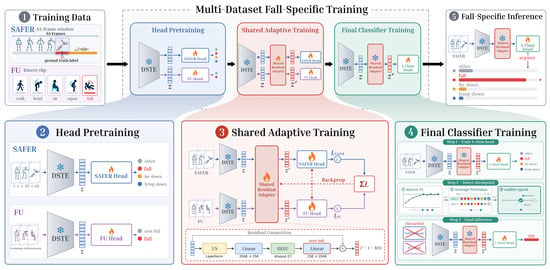
Multi-dataset training of the fall-specific adapter. (1) SAFER-Activities provides four-class window-level labels, while FU-Kinect-Fall provides binary clip-level labels. (2) J0 pretrains dataset-specific heads on features extracted by the frozen DSTE. (3) J1 jointly updates both heads and a shared residual adapter using the sum of the dataset-specific losses. The adapter’s output projection is initialized to zero before joint adaptation. (4) G0 freezes the adapter and trains a new four-class classifier on SAFER alone. (5) Fall-specific inference uses DSTE, the adapter, and the final classifier. Snowflake and flame icons indicate frozen and trainable modules, respectively.
SAFER: reference-frame supervision. From SAFER sequences sampled at 25 Hz, we extract complete 64-frame windows with a stride of eight frames, without appending an additional terminal window. For a window beginning at zero-based frame index s, the target label is the annotation at , corresponding to the 33rd frame.
The released coarse IDs 10, 11, and 12 are mapped to fall, lie_down, and lying_down, respectively. All remaining labels, including no_label, are grouped as other. Following the dataset definitions, lie_down denotes a lying posture, whereas lying_down denotes the transition into that posture. Thus, the four-class target describes the action at the reference frame, rather than indicating whether a fall occurs anywhere within the window.
FU-Kinect-Fall: clip-level supervision. We use Kinect V1 recordings of walking, bending, sitting, squatting, lying, and falling. Of the 1006 recordings, 13 are excluded based on the duplicate and repetition-index criteria, leaving 993 clips. Falling is labeled fall, and the other five activities are grouped as non-fall.
FU clips retain their native sampling rate of 30 Hz. We extract 64-frame windows with a stride of eight frames, repeat the last frame to pad short clips, and append a terminal window when needed. For a clip containing K windows, we average the corresponding DSTE features as shown in Equation (3):
This averaging is performed before adaptation. Consequently, the shared adapter receives one mean feature per clip during J1, and the binary label supervises the complete clip rather than individual frames or windows.
Dataset-specific objectives. Let index the training dataset, with and classes. For class c, let denote the number of training samples. We define the inverse-square-root class weights in Equation (4):
Sample counts are computed from the applicable training partition, using windows for SAFER and clips for FU. The weights have a mean of one across classes. Clamping each count to at least one ensures that the weights remain defined for absent classes.
For a batch , the weighted cross-entropy loss is given by Equation (5):
where is the target label and is the probability assigned to that label by the corresponding head. In the implementation, cross-entropy is computed directly from the logits. Both J0 and J1 minimize the joint loss in Equation (6):
Each optimization step pairs one SAFER batch with one FU batch, contributing one separately normalized loss from each dataset. An epoch consists of one shuffled pass through the SAFER training windows, while FU clips are reshuffled and cycled as needed. The final, smaller SAFER batch is retained.
Head pretraining (J0). We train two dataset-specific linear heads on unadapted DSTE features: window features for SAFER and mean clip features for FU. The weights of both heads are initialized from a zero-mean Gaussian distribution with a standard deviation of 0.01, and their biases are initialized to zero. Each head is supervised only by its corresponding dataset. DSTE remains frozen, and the adapter is not used. The resulting head weights initialize J1.
Joint adaptation (J1). We introduce the residual adapter with its zero-initialized output projection and retain the J0-trained heads. The SAFER head receives , whereas the FU head receives . We jointly update the adapter and both heads while keeping DSTE frozen. Each head receives gradients only from its own dataset’s loss, whereas the adapter receives gradients from both losses. The shared adapter thus learns from both datasets while their output spaces remain separate, following the multi-task learning principle [18]. Each head retains its dataset’s label meanings; FU clips are not assigned to SAFER’s finer lying categories.
Optimization and source-data validation. J0 and J1 use AdamW with a weight decay of . The learning rate is in J0. In J1, it is for the adapter and for the heads. The batch sizes are 8192 SAFER windows and 32 FU clips. A separate optimizer is initialized for each stage. Source-data validation uses seed 0. Once the training durations have been fixed, J0 and J1 are repeated using seeds 0, 1, 2, 3, and 4.
During source-data validation, J0 and J1 run for up to 30 and 20 epochs, respectively. Learning rates are multiplied by 0.1 after epochs 20 and 25 in J0 and epochs 12 and 16 in J1. Checkpoints are selected based on the mean of SAFER validation macro-F1 and FU validation F1. Ties are resolved first by FU average precision, then by SAFER conditional fall-versus-lying average precision (defined below), and finally by the earlier epoch. For J1, the initial model at epoch 0 is also included among the checkpoint candidates.
For each of five subject-based FU outer folds, checkpoint selection uses the SAFER validation split and a separate FU inner-validation fold; the corresponding outer fold is excluded from selection. The median selected epoch across these folds determines the final training duration for each stage: 21 epochs for J0 and 12 for J1. The final J0 and J1 runs use the SAFER training split and all 993 FU clips, without further checkpoint selection.
Final classifier training (G0). After J1, we freeze the adapter, keep DSTE frozen, and cache the adapted SAFER features with adapter dropout disabled. We train a new four-class linear classifier G using only the SAFER training split and its weighted cross-entropy loss. FU is not used in this stage. This separates the representation learned from both sources from the final four-way decision function.
The classifier maps 2048-dimensional features to four logits. Its weights are initialized independently of the J1 SAFER head using a zero-mean Gaussian distribution with a standard deviation of 0.01, and its biases are initialized to zero. Neither J1 head is used for final fall inference. We optimize only G for 50 epochs using SGD with a learning rate of 0.006, momentum of 0.9, zero weight decay, and a batch size of 512.
Each G0 run uses the same seed as its corresponding J0 and J1 runs. The training seed controls random weight initialization, mini-batch ordering, and the adapter dropout masks used during J1. Dataset partitions, cached unadapted DSTE features, and optimization settings remain fixed across seeds. For each repeated condition, the mean and sample standard deviation summarize variability across the five trained models. During inference, all weights are fixed and adapter dropout is disabled.
Final classifier selection. We select the checkpoint with the highest SAFER validation macro-F1, breaking ties first by conditional fall-versus-lying average precision (AP) and then by the earlier epoch. Conditional AP is computed using only validation samples labeled as fall or either lying category. We exclude the other logit and apply softmax to the remaining three logits to obtain a fall score. AP treats fall samples as positives and samples from both lying categories as negatives. This restricted score is used only for checkpoint selection; inference retains all four classes. The G0 checkpoint is selected independently for each seed using this validation rule.
3.5. Inference
For each RGB-derived skeleton window, DSTE extracts the feature vector , and the residual adapter produces the adapted representation . The final classifier then computes the four-class probability vector using Equation (7):
We predict the class with the highest probability. The output order is other, fall, lie_down, and lying_down. All model weights remain fixed, and adapter dropout is disabled during inference.
Each prediction corresponds to the 33rd frame of a 64-frame window and uses the 31 subsequent frames as temporal context. Skeleton lifting and sequence-level normalization are performed offline. The framework therefore does not provide strictly causal predictions for the current frame. The external evaluation uses video-level decisions and does not assess event-localization accuracy or online alert latency. The classifier does not explicitly estimate fall onset, impact time, or event boundaries.
Original activity recognition branch. The original ADL pathway bypasses the adapter and retains its preprocessing, pooling operations, DSTE parameters, and NTU60-trained classifier. When both branches are active, they produce independent predictions, with no score fusion or class overriding.
The main external evaluation uses the fall-specific branch. This evaluation measures video-level fall detection; it does not assess 60-class action-recognition accuracy or demonstrate preservation of ADL accuracy.
4. Experimental Results
We evaluate video-level fall detection on unseen datasets, analyze the effects of adaptation, and measure computational cost and score discrimination. Qualitative results and limitations distinguish video-level detection from temporal localization and general ADL recognition.
4.1. Experimental Setup
Datasets. The shared adapter is trained on SAFER-Activities [2] and FU-Kinect-Fall [9], and the final classifier on SAFER alone (Section 3.4). External evaluation uses CAUCAFall [24] and Le2i [25], neither of which is used for training or model selection. CAUCAFall version 4 contains 100 evaluated videos (50 fall and 50 non-fall). Le2i contributes 130 videos (99 fall and 31 non-fall) from Coffee_room_01, Coffee_room_02, Home_01, and Home_02. Office and Lecture_room are excluded because temporal annotation files were unavailable in the Le2i release used. All methods share the evaluation lists and binary video labels, with model parameters and decision settings fixed during external evaluation. This design evaluates transfer to two unseen data sources rather than using their labels to tune the fall-specific adapter or classifier.
Video-level evaluation. Our method processes 64-frame skeleton windows at 25 Hz with stride eight and predicts one of other, fall, lying posture (lie_down), and lying transition (lying_down). A video is positive if any window predicts fall. Original USDRL, HFD, and FLASH likewise use an any-positive rule for their window, clip, and detected-frame outputs, respectively; Privacy X3D averages five clip logits before classification. We report video-level precision, recall, and F1-score with fall as the positive class. The any-positive rule is applied after obtaining the method-specific temporal predictions, rather than enforcing a common temporal sampling unit. These metrics neither require temporal overlap with the annotated fall interval nor penalize repeated alerts within one video.
Input-quality handling. Our method and Original USDRL require bounding-box and pose coverage of at least 0.8 and median pelvis confidence of at least 0.3. Pelvis confidence is the minimum of the hip confidence scores; invalid frames receive zero confidence before taking the median over resampled frames. This gate accepts 93 CAUCAFall and 119 Le2i videos. The seven rejected CAUCAFall videos comprise five falls and two non-falls; all eleven rejected Le2i videos are falls. Rejected videos remain in the evaluation as no-alert outcomes (false negatives for falls and true negatives otherwise), as does one CAUCAFall video with failed FLASH pose extraction. No accepted input has an unresolved missing inference output. Accordingly, all 100 CAUCAFall and 130 Le2i videos contribute to the primary video-level metrics, rather than excluding difficult inputs from the denominator.
ROC scoring. Receiver operating characteristic (ROC) analysis assigns each video a scalar score. For our method and Original USDRL, it is the maximum window-level margin between the fall logit and the largest non-fall logit. FLASH uses the maximum valid-frame impact logit; HFD uses the maximum SVM score across complete 16-frame clips; Privacy X3D uses the fall-minus-non-fall margin after averaging five clip logits. Videos lacking valid scores receive a common evaluation-only score one unit below the minimum valid score for that method and dataset. These tied scores are not model predictions; they enable ROC-AUC computation over all videos without changing no-alert outcomes under the fixed decision rules. The convention preserves the same test-set composition used for fixed-decision metrics, although it introduces a tie among invalid inputs. Thus, AUC reflects both model-score ranking and this explicitly defined missing-score convention.
Compared methods. We compare the proposed model with the unadapted USDRL pathway [6] and three dedicated detectors: FLASH [11], HFD 3D-CNN+SVM [3], and RGB-input Privacy X3D-UDA [5].
Original USDRL combines the released frozen DSTE with a 60-class linear classifier trained by us on NTU60 [23]. It processes the same skeleton windows and predicts fall when class A43 (falling down) has the highest logit, without an adapter or SAFER-trained classifier. For a separate threshold-calibrated evaluation, its fall score is the A43 logit minus the maximum of the other 59 logits. The threshold maximizing binary fall F1 on 106,680 SAFER validation windows is selected, with ties resolved toward the higher threshold. The resulting threshold () is fixed on both external datasets; windows with scores at least are positive. The input-quality gate and any-positive video rule remain unchanged, and external data are not used for calibration.
For ablation, we train an independent four-class linear classifier on unadapted DSTE features (Raw, or Ours w/o adapter in Section 4.2 and Section 4.4). Its SAFER splits, initialization, optimizer, weighted loss, class weights, 50-epoch budget, and checkpoint rule match G0 (Section 3.4). Raw uses the same five seeds as G0, with a separate SAFER-validation checkpoint selected for each seed. Neither external dataset enters the training or selection procedure. At test time, Raw shares our 3D skeleton inputs, quality gate, and video-level aggregation, making it the direct control for the full adaptation procedure. We also examine SAFER-only adaptation (No-FU), removing FU supervision from J0 and J1. No-FU retains the corresponding Full (SAFER+FU) condition’s SAFER batch order, loss coefficient, update count, and 21-epoch J0/12-epoch J1 schedule. For each condition, we evaluate both its J1 SAFER head and a newly trained G0 classifier G. J1 heads use their existing end-of-J1 checkpoints without additional selection or training. The five configurations are Raw, No-FU J1, No-FU G0, Full J1, and Full G0 (ours), all evaluated with the same five seeds.
For FLASH, 82 public UP-Fall [26] skeleton sequences are split into 64 training, nine validation, and nine test sequences. Training-only augmentation yields 256 training sequences; normalization uses training data, and checkpoints are selected by validation binary cross-entropy. Our reproduction corrects coordinate-column selection and preserves label alignment during temporal augmentation. External videos are converted into 33-joint MediaPipe skeletons [27] (software version 0.10.21) and processed in 100-frame blocks. A detected frame is positive when its impact logit exceeds zero; these frame outputs are aggregated at video level. The source task separates impact from non-impact frames within fall sequences, whereas our evaluation aggregates its outputs into video-level labels. All evaluated FLASH weights come from this reproduction, rather than a checkpoint fitted on either external dataset.
For HFD, the released Sports-1M-pretrained C3D extracts 4096-dimensional fc6 features. We fit a linear SVM () using 360 non-overlapping 16-frame clips from 32 GMDCSA [28] Subject-1 videos (16 fall and 16 ADL). A positive SVM margin on an external 16-frame clip indicates fall. This source-only reproduction uses a newly trained SVM; neither CAUCAFall nor Le2i contributes to its fitting or model selection. The clip-level SVM decisions are then aggregated by the common any-positive video rule.
For Privacy X3D, we use the author-released RGB/depth UDA checkpoint and official evaluation program with RGB inputs and the specified external frame lists. Its released configuration uses Kinetics-700 RGB and estimated depth, with an X3D backbone [29] initialized on Kinetics-400. Five 16-frame clips, sampled at interval five, are averaged in logit space; a fall probability above 0.5 indicates fall. The five clip logits are averaged before softmax, rather than voting over individual clip predictions. The RGB designation refers only to the evaluation input modality: the released model was adapted using RGB and depth.
These baselines use different source datasets, preprocessing pipelines, and temporal resolutions. Therefore, the shared evaluation lists and video-level metrics support a comparison of complete systems but not a controlled attribution of their performance differences to the underlying network architectures or to our adapter.
Statistical analysis. For Raw and the four adapted configurations, we report the mean ± sample standard deviation of per-model metrics across five seeds; differences are paired by seed. Original USDRL and dedicated detectors are single-run evaluations.
For Full G0 versus Raw, we estimate 95% confidence intervals for the mean video-level F1 difference using 20,000 paired participant-cluster bootstrap resamples. We resample participant clusters with replacement, retaining their videos and applying each resample to all five paired models. F1 is computed on pooled resampled videos for each model, and the five paired differences are averaged. Intervals use the 2.5th and 97.5th percentiles across resamples from 10 CAUCAFall and nine Le2i participant clusters. Participant clustering retains correlations between videos from the same person rather than treating those videos as independent observations. The intervals capture test-participant uncertainty conditional on the five fitted model pairs, whereas seed standard deviations describe training variation on the fixed test set.
4.2. Cross-Dataset Fall Detection
Table 1 compares video-level precision, recall, and F1-score on CAUCAFall and Le2i under the protocol above. We consider the original NTU60 decision pathway first, followed by dedicated fall detectors. The raw-feature comparison in the same table provides context for separating adaptation from task-specific classifier training.
Table 1.
Cross-dataset video-level fall detection on CAUCAFall and Le2i. Values are percentages. Ours w/o adapter (Raw) and Ours report mean ± sample standard deviation across five seeds (standard deviations in smaller type); other methods use single runs. Bold indicates the highest reported value in each column, using means for repeated runs. Textual differences use unrounded scores. Upward arrows indicate that higher values are better.
Improvement over the NTU60-based pathway. Original USDRL achieves 95.00% precision but only 38.00% recall on CAUCAFall (F1: 54.29%), missing many falls despite few false alerts. Our branch increases mean recall to 82.40% and mean precision to 97.31%, yielding 89.13% F1, a 34.85-percentage-point gain. This recall improvement does not reduce mean precision on CAUCAFall. On Le2i, mean recall rises from 70.71% to 87.07%, while precision changes from 98.59% to 96.42%; F1 increases from 82.35% to 91.50% (+9.15 points). Across both datasets, the fall-specific pathway provides a more favorable balance between false alarms and missed falls than the original NTU60 argmax classifier. These improvements are measured at the video level under fixed decision rules; they do not establish better fall-event timing or preservation of all ADL classes. Section 4.3 compares this performance with classifier-only transfer.
After calibrating Original USDRL’s decision threshold on SAFER validation, its F1 increases to 71.60% on CAUCAFall and 89.50% on Le2i. Because the encoder and 60-class head are unchanged, this result shows that the original argmax rule accounts for part of the observed performance gap. Our method nevertheless retains higher mean F1 on both datasets (89.13% and 91.50%).
Comparison with dedicated fall detectors. On CAUCAFall, FLASH and HFD attain 98.00% and 96.00% recall but only 49.49% and 51.61% precision, respectively. Privacy X3D achieves 73.44% F1, 15.70 percentage points below our mean. Our method has the highest reported mean precision and F1, while FLASH has the highest recall. On Le2i, FLASH achieves 100.00% recall with 76.15% precision; Privacy X3D achieves 98.21% precision with 55.56% recall, and HFD recalls 25.25% of falls. Our method achieves 96.42% mean precision, 87.07% mean recall, and 91.50% mean F1, outperforming FLASH, the strongest dedicated detector by F1, by 5.04 points. On CAUCAFall, the key distinction is the precision cost of the higher-recall dedicated detectors; on Le2i, several baselines also miss a substantial proportion of fall videos. These comparisons reflect complete systems with different training sources and input pipelines, however, and do not isolate the contribution of a particular network architecture.
Comparison on quality-accepted videos. We also evaluate every method on the same 93 CAUCAFall and 119 Le2i videos passing the DSTE quality gate; the FLASH pose-extraction failure remains a no-alert outcome. On CAUCAFall, our branch and Raw obtain F1-scores of and (five-seed mean ± standard deviation). Original USDRL, FLASH, HFD, and Privacy X3D obtain 58.46%, 64.23%, 65.65%, and 71.79%, respectively. On Le2i, our branch and Raw obtain and , compared with 88.05%, 85.02%, 35.71%, and 69.12% for the four baselines in the same order. On these common accepted subsets, our branch retains higher mean F1 than Raw and the reported single-run baseline values. The conditional analysis separates performance on successfully processed inputs from the effect of the quality gate, but it does not replace the primary all-video evaluation.
4.3. Ablation Study
Table 2 compares Raw with SAFER-only (No-FU) and SAFER+FU (Full) adaptation under matched training and evaluation settings. Raw is a four-class classifier trained on unadapted features , whereas both adapted conditions are evaluated using either their J1 SAFER head or a separately refitted G0 classifier on adapted features . DSTE remains frozen, and all conditions use the same five seeds. These comparisons distinguish the gain attributable to a task-specific classifier from the incremental effects of multi-dataset representation adaptation and final classifier refitting. The two J1 heads are assessed at their existing checkpoints, while G0 is trained according to the common classifier protocol. Table 2 summarizes Raw and the two G0 configurations, while the J1-head comparisons are discussed below to separate the contribution of the final classifier from that of feature adaptation.
Table 2.
Ablation of fall-specific adaptation on CAUCAFall and Le2i. All values are percentages (mean ± sample standard deviation over five seeds). Raw uses unadapted features; No-FU and Full adapt on SAFER alone and SAFER + FU, respectively, before fitting G in G0. Bold indicates the highest mean in each column. Standard deviations are shown in smaller type; upward arrows indicate that higher values are better.
Task-specific classification on frozen features. Without adaptation, Raw raises mean F1 from 54.29% (Original USDRL) to 86.15% on CAUCAFall and from 82.35% to 91.30% on Le2i. Mean recall similarly increases from 38.00% to 77.60% and from 70.71% to 86.87%, respectively. These results show that a task-specific classifier accounts for much of the gain over Original USDRL. Because the NTU60 head selects falling down among 60 classes whereas Raw is trained on SAFER’s four classes, the comparison changes both supervision and label space and does not isolate class count.
Complete adaptation versus classifier-only transfer. Compared with Raw, Full G0 increases mean precision from 97.13% to 97.31% on CAUCAFall and from 96.23% to 96.42% on Le2i; mean recall rises from 77.60% to 82.40% and from 86.87% to 87.07%, respectively. Mean F1 reaches 89.13% and 91.50%, corresponding to paired gains of and percentage points (mean ± sample standard deviation). The paired comparison includes both joint SAFER–FU representation adaptation and subsequent classifier training. It therefore estimates the benefit of the complete procedure relative to classifier-only transfer rather than the isolated effect of adapter architecture.
F1 improves in all five seeds on CAUCAFall but only two seeds on Le2i. Paired participant-cluster bootstrap 95% confidence intervals are [−0.65, 6.98] and [−0.08, 0.72] percentage points, respectively; both include zero. Thus, CAUCAFall shows a consistent positive direction across training runs on the fixed test set, but participant-level uncertainty remains. The smaller Le2i gain changes sign across seeds.
Contribution of auxiliary FU supervision. Relative to Raw, No-FU G0 increases F1 by points on CAUCAFall and on Le2i. Adding FU supervision under G0 yields further paired gains of and points. When evaluating the J1 SAFER heads directly, the Full-minus-No-FU differences are and points, respectively. All differences are paired within seed and reported as mean ± sample standard deviation. The auxiliary data’s effect therefore varies with dataset and classifier configuration under the fixed training schedule.
Effect of final classifier refitting. Under Full adaptation, replacing the J1 SAFER head with G0 changes F1 by points on CAUCAFall and on Le2i. Under No-FU, the changes are and points. With J1 heads, Full obtains mean F1 of 88.95% and 91.16%, compared with 89.71% and 90.91% for No-FU on CAUCAFall and Le2i, respectively. Thus, refitting does not yield a uniform gain, and its effect depends on both adaptation and evaluation setting.
4.4. Computational Cost
Table 3 reports parameter counts and runtime for the skeleton-classification path. These timings exclude person detection, 2D pose estimation, and 3D lifting in the RGB frontend. We additionally measure complete offline RGB processing time and memory usage to characterize end-to-end cost.
Table 3.
Parameters and runtime for the active skeleton-classification path, excluding the RGB/pose frontend. Batched time is the median of three runs over 212 quality-accepted videos (batch size 32), normalized per input frame. Head-only time uses cached DSTE features and includes the adapter when present. Batch-1 denotes median single-window skeleton-path latency. Parameter differences and are relative to Original USDRL.
Measurement scope and parameter counts. Batched timing includes DSTE and the active adapter–classifier configuration on precomputed 3D skeletons; it excludes RGB preprocessing, lifting, file I/O, and model initialization. Head-only timing excludes DSTE, while batch-1 covers the full skeleton path for one window. Our fall-only path has 0.94 M more parameters (+1.6%) than Original USDRL, adding a 1.05 M adapter and replacing the 0.12 M NTU60 head with the 0.008 M four-class G. Retaining both ADL and fall branches instead adds 1.06 M parameters (+1.9%) to the original model because the NTU60 classifier is not removed. This dual-branch accounting is distinct from the active fall-only parameter counts in the table, which replace that classifier for the purpose of measuring a single path.
During Full J1, the adapter and both dataset-specific heads contain 1,067,270 trainable parameters; DSTE is frozen. During G0, only the 8196-parameter four-class classifier is trained, with DSTE and the adapter frozen.
Measured inference overhead. Our batched skeleton-path time is 0.1824 ms/input frame versus 0.1825 ms for Original USDRL ( before rounding). Differences across all configurations are below 0.1% and do not establish a speed advantage. The adapter processes each pooled 2048-dimensional feature once through a 256-dimensional bottleneck, leaving DSTE as the dominant computation (Section 3.3).
With cached features, the adapter and G increase head-only latency by 0.241 ms/window on CAUCAFall (0.085 to 0.326 ms) and 0.248 ms/window on Le2i (0.085 to 0.332 ms), based on unrounded timings. Adapter + J1 SAFER takes 0.331 and 0.337 ms, respectively, while Raw takes 0.085 ms on both datasets. The similarity between the two adapter-based head-only measurements indicates that the added computation arises primarily from the adapter, not from whether the final head is the J1 classifier or the refitted G0 classifier. The increments are numerically about 1.8% and 1.9% of the corresponding batch-1 latencies (13.15 and 13.27 ms). Across models, the largest batch-1 differences from Original USDRL are approximately 3.4% and 1.4% on CAUCAFall and Le2i. The reciprocal of the batched per-frame time is approximately 5483 input frames/s in this offline setup. This calculation does not include pose estimation or 3D lifting, and therefore should not be interpreted as end-to-end RGB throughput, online throughput, or evidence of strictly causal detection.
End-to-end RGB processing. We evaluate the complete RGB pipeline on an NVIDIA GeForce RTX 3090 GPU (NVIDIA Corporation, Santa Clara, CA, USA) with Python 3.10.21 and PyTorch 2.5.1/CUDA 12.4 in FP32, disabling AMP and TF32. Four quality-accepted videos (one fall and one non-fall per external dataset) are selected by lexicographic ID within each dataset and label group. Each is processed three times using the fixed seed-0 Full G0 model. Trials start fresh processes for person detection/2D pose estimation, 3D lifting, and skeleton classification. Wall-clock measurements include process startup, model loading, decoding, intermediate I/O, and prediction output.
For video durations of 6.25–52.56 s, per-video median wall-clock times range from 27.81 to 92.67 s. The per-video medians of peak process-tree resident memory and PyTorch-allocated GPU memory are 1.99–2.01 GiB and 0.71–0.82 GiB, respectively. Resident memory is sampled every 50 ms; GPU peaks are the maxima across sequential stages and exclude driver/CUDA-context allocations. These measurements characterize offline processing rather than online alert latency.
4.5. ROC Analysis
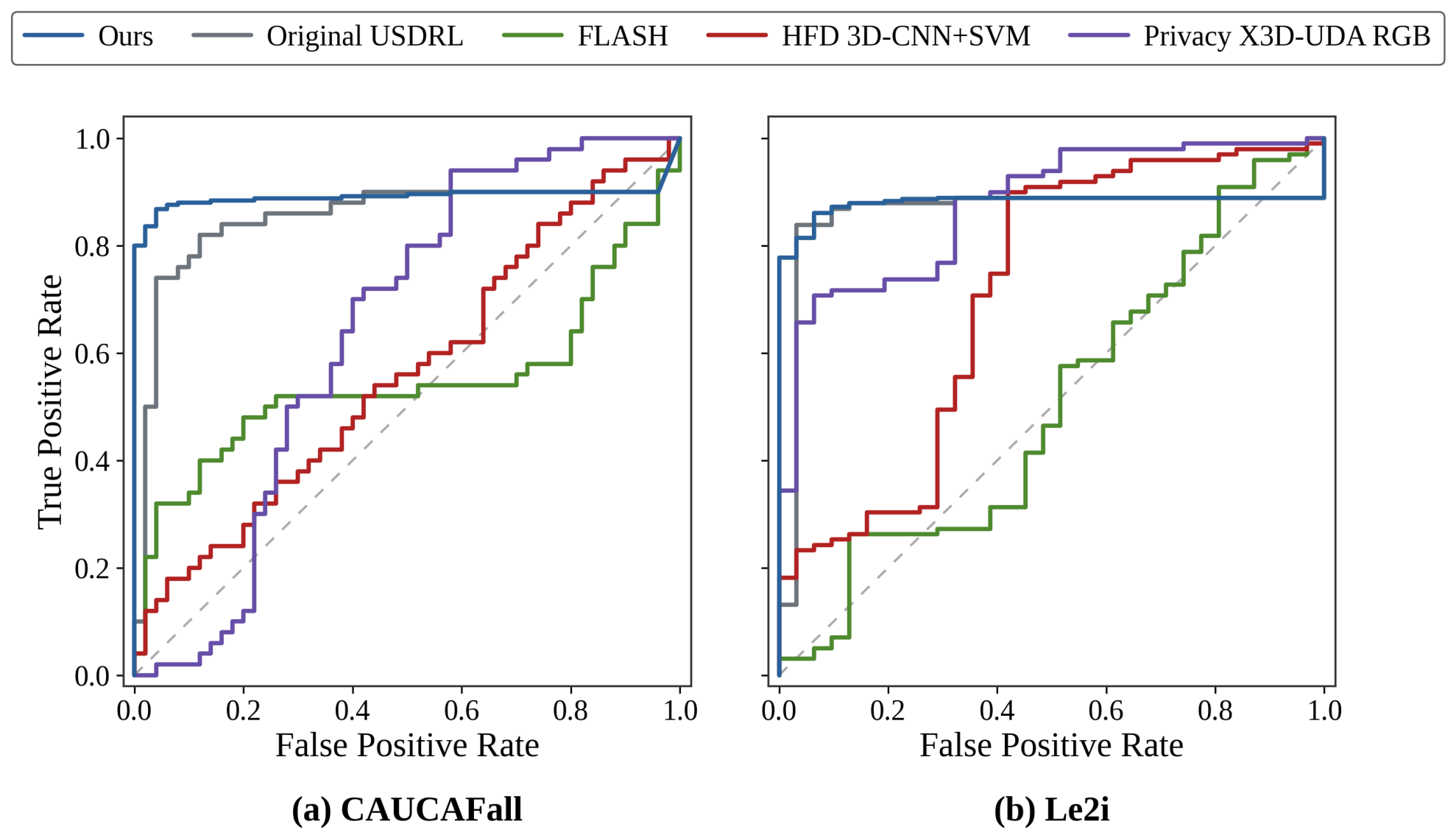
Figure 4 and Table 4 evaluate video-level score discrimination using the aggregation and missing-score rules in Section 4.1. Unlike precision, recall, and F1 computed at the specified operating point, AUC summarizes the ability of each method’s continuous video-level score to rank falls against non-falls across decision thresholds.
Figure 4.
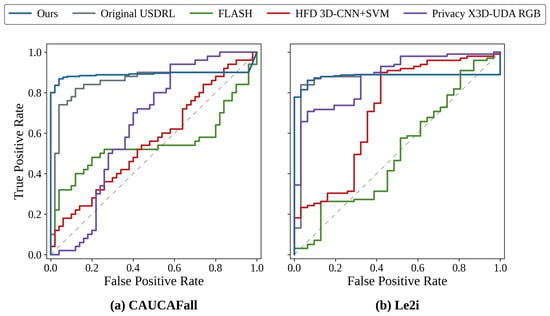
Video-level ROC curves on (a) CAUCAFall and (b) Le2i. Ours averages true-positive rates across five seeds at common false-positive rates by linear interpolation between ROC vertices; other curves represent fixed models. The dashed diagonal lines indicate chance-level discrimination (AUC = 0.5). All videos are included under the aggregation and missing-score convention in Section 4.1.
Table 4.
Video-level ROC-AUC on CAUCAFall and Le2i. Values are percentages; Ours reports mean ± sample standard deviation over five seeds, and other methods report single runs. Bold indicates the highest value in each column, using the mean for Ours. Standard deviations are shown in smaller type.
Our method achieves mean AUCs of 89.19% on CAUCAFall and 88.05% on Le2i, compared with 85.24% and 85.86% for Original USDRL. Both values exceed those of the dedicated detectors in Table 4, although the difference from Privacy X3D on Le2i is small (88.05% versus 87.42%). The advantage is therefore not equally large across datasets or baselines, despite the highest mean AUC among the methods evaluated here.
At zero observed false-positive rate, the mean ROC curves reach true-positive rates of 80.00% and 77.78% on CAUCAFall and Le2i, respectively. These are values from averaged curves, not a common threshold or the fixed argmax decision rule. The ROC endpoint arises when thresholds include the tied lowest scores assigned to invalid inputs; it does not indicate that the operational no-alert policy detects rejected videos.
4.6. Qualitative Analysis
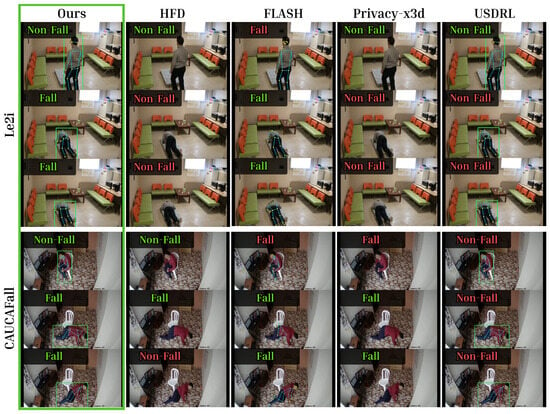
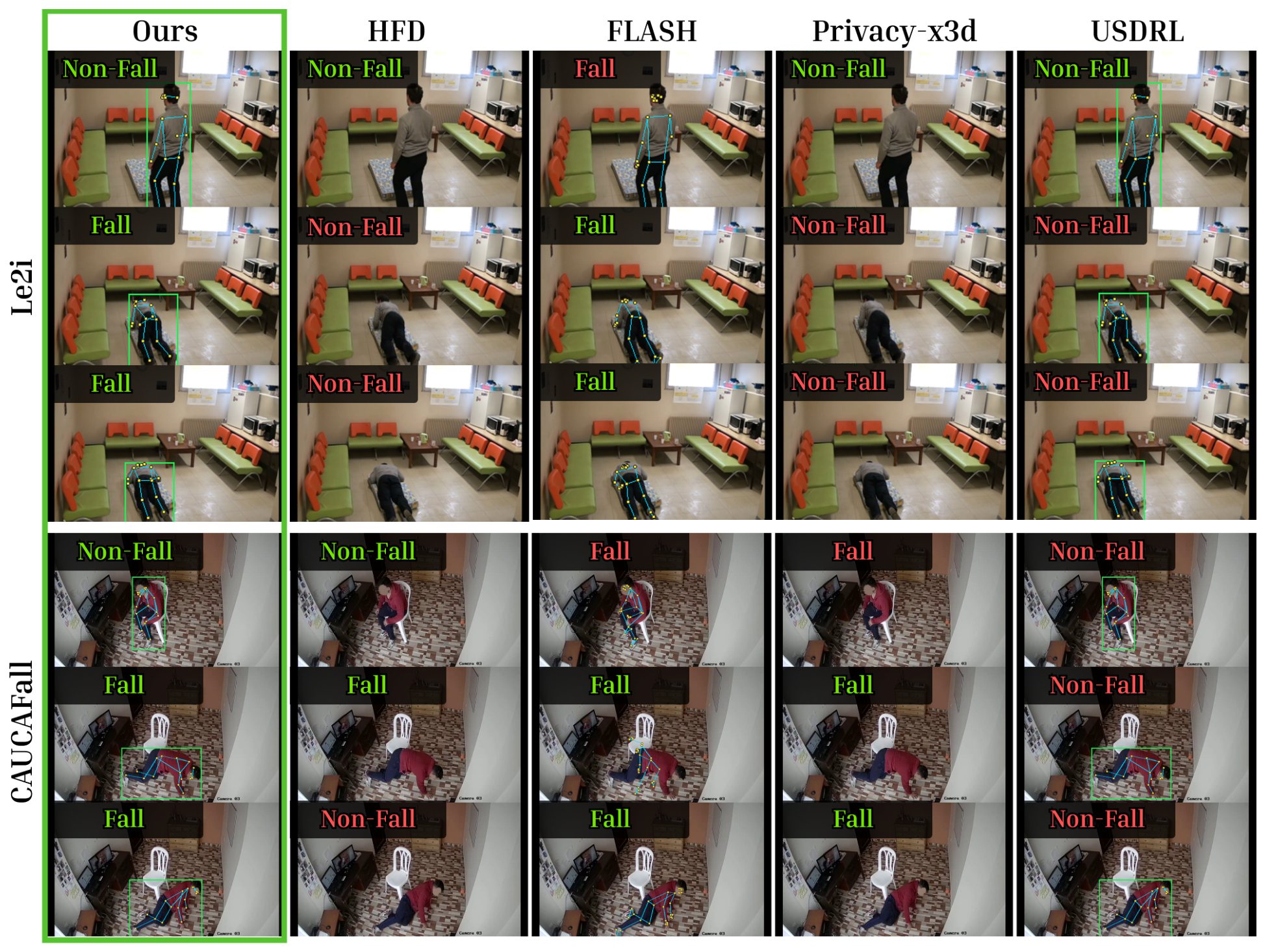
Figure 5 compares predictions from our method and four baselines at three selected time points in Le2i and CAUCAFall videos. In the Le2i example (top), our method identifies the initial non-fall state and subsequent falls; FLASH generates an initial false alarm, while HFD, Privacy X3D, and USDRL miss the later fall states shown. In CAUCAFall (bottom), our method again separates non-fall from fall states. FLASH and Privacy X3D produce initial false alarms, HFD misses the final fall state, and USDRL predicts non-fall at all three points. These snapshots illustrate two common error types: false alerts during non-fall behavior and missed predictions during a fall. They are qualitative examples rather than evidence of frame-level detection accuracy or precise temporal localization, especially because the compared methods operate at different temporal units.
Figure 5.
Selected fall detection examples from Le2i (top) and CAUCAFall (bottom), with predictions at three time points per video. Quantitative comparisons follow the video-level protocol in Section 4.1.
To evaluate four-class recognition, we additionally test on the held-out SAFER Test and OOD splits containing 219,896 and 71,964 windows, respectively. Across five seeds, macro-F1 is on Test and on OOD (mean ± sample standard deviation). Mean class-wise F1 for other, fall, lying posture (lie_down), and lying transition (lying_down) is 99.14%, 78.64%, 86.87%, and 43.70% on Test, versus 95.61%, 50.78%, 53.45%, and 24.36% on OOD.
These class-wise scores quantify the action at each window’s reference frame. The four labels represent alternative activity categories, not mandatory consecutive phases of a fall event. Lying transition has the lowest F1 on both splits, indicating difficulty in recognizing this brief action, particularly under domain shift. Standard deviations reflect training-seed variation; overlapping windows are not independent statistical replicates.
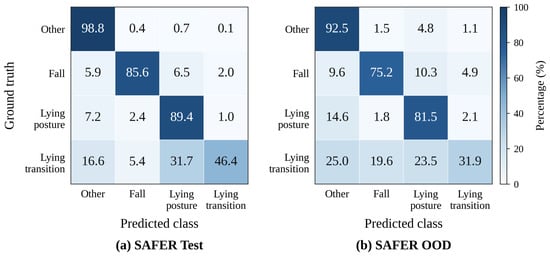
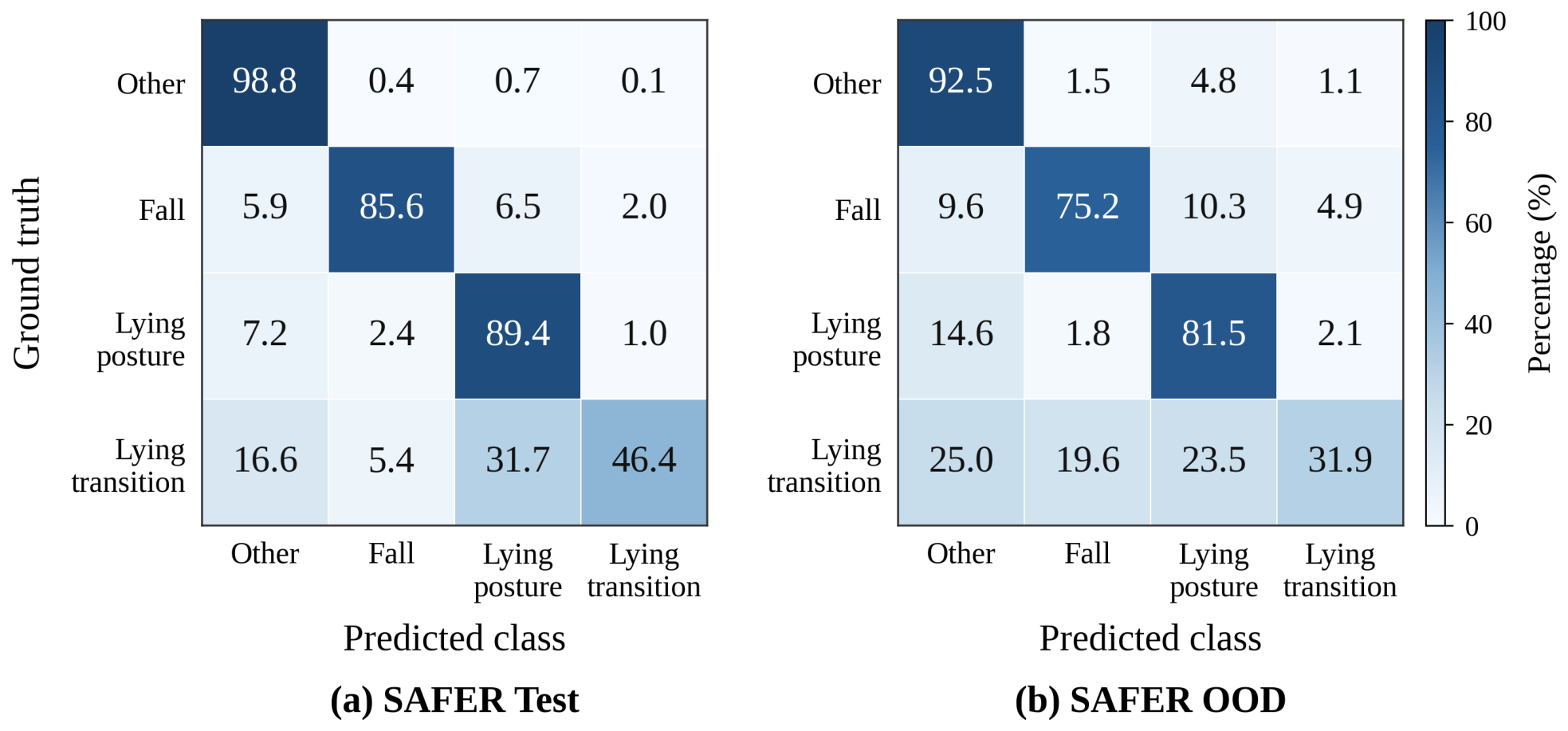
Figure 6 shows that lying postures are misclassified as falls in 2.4% of Test and 1.8% of OOD windows, versus 5.4% and 19.6% for lying transitions. On Test, transitions are more often confused with lying postures (31.7%) than with falls. In particular, confusion between a brief transition and a fall is substantially more frequent on OOD, while Test errors more often map transitions to the lying posture. Transition recognition therefore remains challenging, particularly under distribution shift.
Figure 6.
Four-class confusion matrices for (a) SAFER Test and (b) SAFER OOD. Cells show five-seed mean percentages after ground-truth row normalization. Labels correspond to the window reference frame, with lie_down indicating lying posture and lying_down indicating lying transition. Class supports in the displayed order are 204,832/3184/11,384/496 for Test and 67,458/972/2856/678 for OOD. Each seed uses the same windows; rows may differ slightly from 100% due to rounding.
4.7. Discussion and Limitations
Dependence on skeleton estimation. Our DSTE-based configurations share YOLOv8x person detection, single-person association, ViTPose-B, and MotionAGFormer (Section 3.2); other detectors use their own input pipelines. The proxy NTU25 layout ensures encoder compatibility without directly measuring all 25 joints. Consequently, recognition depends on upstream pose quality. Rejected videos remain no-alert outcomes for fixed decisions and receive evaluation-assigned lowest ROC scores. Keeping these cases in the evaluation avoids inflating the reported metrics by conditioning exclusively on successfully processed videos. Nevertheless, the quality gate does not recover missing poses, and the fall classifier cannot compensate for all upstream failures.
Scope of the ablation study. Raw distinguishes classifier-only transfer from the complete adaptation procedure. Across five seeds, No-FU and Full with J1 and G0 heads evaluate the incremental effects of FU supervision and classifier refitting under a fixed training schedule. The relatively small and sometimes negative changes show that FU supervision and G0 refitting do not produce uniform gains across datasets and classifier variants. We did not isolate head pretraining or test adapter-width sensitivity. Comparisons with other skeleton architectures trained on identical sources remain future work.
ADL preservation and fine-grained recognition. The original ADL branch bypasses the adapter and retains its preprocessing, pooling, DSTE weights, and NTU60 classifier, producing independent outputs without score fusion or overriding. However, external experiments use only the fall-specific branch; an unchanged computation does not establish unchanged 60-class ADL accuracy on new RGB inputs. Four-class recognition is instead assessed on SAFER Test and OOD (Section 4.6). The binary video labels in CAUCAFall and Le2i cannot determine whether the finer lying categories are correctly recognized on external data. Consequently, the four-class SAFER results and the binary external results address different aspects of the system’s behavior.
Scope of temporal predictions. A 64-frame window is labeled at its 33rd frame, using 31 subsequent frames as context (Section 3.5). Offline skeleton lifting and sequence normalization preclude strictly causal current-frame predictions; the classifier does not estimate fall onset, impact, or event boundaries. End-to-end RGB timing measures offline processing cost (Section 4.4). The reported video-level outcomes do not quantify event-localization accuracy, online alert delay, false alarms per hour, or missed-event rates. These measurements would be necessary to assess a continuously operating fall alert system.
5. Conclusions
We presented a fall-specific adaptation framework that extends a pretrained skeleton-based ADL recognizer while preserving its original prediction pathway. A frozen DSTE provides shared action features, and a lightweight residual adapter specializes these features for fall monitoring. Joint training on SAFER-Activities and FU-Kinect-Fall uses separate dataset-specific heads to accommodate four-class window-level supervision and binary clip-level supervision. With the adapter frozen after adaptation, a new four-class classifier is trained to distinguish among falls, lying transitions, lying postures, and other activities. The original ADL classifier continues to operate independently on unadapted features.
On the unseen CAUCAFall and Le2i datasets, the fall-specific branch achieves video-level F1-scores of and (mean ± sample standard deviation across five training seeds), respectively. The corresponding F1-scores for the same frozen DSTE with an NTU60-trained classifier are 54.29% and 82.35%. On CAUCAFall, mean recall reaches 82.40% and mean precision reaches 97.31%, compared with 38.00% and 95.00% for Original USDRL, respectively. The proposed method achieves the highest reported F1-scores and AUCs among the methods listed in Table 1 and Table 4.
Relative to an independently trained four-class head on unadapted features, the complete adaptation procedure provides additional mean F1 gains of 2.98 and 0.20 percentage points, distinguishing its effect from classifier-only transfer. These gains are dataset-dependent, and the participant-cluster 95% confidence intervals include zero on both datasets.
When both prediction branches are retained, the adapter and final classifier add 1.06 M parameters. We report skeleton-classification timing and separately measure the end-to-end RGB processing time and memory usage of the implemented offline pipeline. These findings support lightweight specialization of skeleton action representations [6,7] through parameter-efficient adaptation [8] for non-contact activity monitoring. The experiments assess external video-level fall detection and held-out SAFER four-class recognition, while 60-class ADL accuracy under new RGB conditions and precise temporal localization remain unevaluated. Future work will evaluate general ADL recognition alongside fall detection, examine alternative skeleton-estimation pipelines, and investigate fall onset and event boundaries through end-to-end online evaluation.
Author Contributions
Conceptualization, S.J., M.K. and S.S.; methodology, S.J., C.L. (Chanyoung Lee), C.L. (Chaerin Lee) and M.K.; software, S.J., C.L. (Chanyoung Lee) and C.L. (Chaerin Lee); validation, S.J., C.L. (Chanyoung Lee), C.L. (Chaerin Lee) and M.K.; formal analysis, C.L. (Chaerin Lee) and M.K.; investigation, S.J., C.L. (Chanyoung Lee) and M.K.; data curation, C.L. (Chanyoung Lee) and C.L. (Chaerin Lee); writing—original draft preparation, S.J., C.L. (Chanyoung Lee), C.L. (Chaerin Lee) and M.K.; writing—review and editing, S.J., C.L. (Chanyoung Lee), C.L. (Chaerin Lee), M.K. and S.S.; visualization, C.L. (Chaerin Lee) and M.K.; supervision, S.S.; project administration, S.S. All authors have read and agreed to the published version of the manuscript.
Funding
This work was supported by the Ministry of Science and ICT (MSIT), Korea, under the ICT Challenge and Advanced Network of HRD (ICAN) support program (IITP-2026-RS-2024-00437186) supervised by the Institute for Information & Communications Technology Planning & Evaluation (IITP), and by the Korea Institute of Energy Technology Evaluation and Planning (KETEP) and the Ministry of Climate, Energy & Environment (MCEE) of the Republic of Korea (No. 20224000000020).
Data Availability Statement
The data presented in this study are derived from four publicly available datasets: SAFER-Activities (https://huggingface.co/datasets/SAFER-Activities/SAFER-Activities, accessed on 17 November 2026), FU-Kinect-Fall (https://github.com/MuzafferAslan23/Fall-Detection-Dataset, accessed on 17 November 2026), CAUCAFall Version 4 (https://doi.org/10.17632/7w7fccy7ky.4, accessed on 17 November 2026), and Le2i (https://www.kaggle.com/datasets/tuyenldvn/falldataset-imvia, accessed on 17 November 2026). Access to some datasets may require registration or acceptance of the respective providers’ terms of use. No new video data were collected for this study. Code, fixed split lists, configurations, selected adapter/classifier checkpoints, and saved predictions are available in the reproduction release at https://github.com/lab-sehyeon/fall_detect_sehyeon/releases/tag/revision-20261109-r2, accessed on 17 November 2026. The release provides feature-level training and inference code and scripts for recomputing repeated-run metrics and paired confidence intervals; the README specifies required third-party assets and the verified reproduction scope.
Conflicts of Interest
The authors declare no conflicts of interest.
References
- Wu, L.; Huang, C.; Zhao, S.; Li, J.; Zhao, J.; Cui, Z.; Yu, Z.; Xu, Y.; Zhang, M. Robust fall detection in video surveillance based on weakly supervised learning. Neural Netw. 2023, 163, 286–297. [Google Scholar] [CrossRef] [Scilit] [PubMed]
- Lamsal, D.; Wickramatilake, P.; Moonrinta, J.; Ekpanyapong, M.; Dailey, M.N. SAFER-Activities: A Dataset for Smart Assessment of Fall Events and Routine Activities. In Proceedings of the European Conference on Computer Vision, Malmö, Sweden, 8–12 September 2026; Springer: Cham, Switzerland, 2026; pp. 375–394. [Google Scholar] [CrossRef] [Scilit]
- Alam, E.; Sufian, A.; Dutta, P.; Leo, M. Human Fall Detection Using Transfer Learning-Based 3D CNN. In Proceedings of the Computational Technologies and Electronics; Majumder, M., Zaman, J.K.M.S.U., Ghosh, M., Chakraborty, S., Eds.; Communications in Computer and Information Science; Springer: Cham, Switzerland, 2025; Volume 2376, pp. 102–113. [Google Scholar] [CrossRef] [Scilit]
- Zeng, G.; Zeng, B.; Hu, H. Real-world efficient fall detection: Balancing performance and complexity with FDGA workflow. Comput. Vis. Image Underst. 2023, 237, 103832. [Google Scholar] [CrossRef] [Scilit]
- Xiao, H.; Peng, K.; Huang, X.; Roitberg, A.; Li, H.; Wang, Z.; Stiefelhagen, R. Toward Privacy-Supporting Fall Detection via Deep Unsupervised RGB2Depth Adaptation. IEEE Sens. J. 2023, 23, 29143–29155. [Google Scholar] [CrossRef] [Scilit]
- Weng, W.; Wang, H.; Wang, J.; He, L.; Xie, G.S. USDRL: Unified Skeleton-Based Dense Representation Learning with Multi-Grained Feature Decorrelation. Proc. AAAI Conf. Artif. Intell. 2025, 39, 8332–8340. [Google Scholar] [CrossRef] [Scilit]
- Wang, H.; Weng, W.; Wang, J.; Zhao, F.; Xie, G.S.; Geng, X.; Wang, L. Foundation Model for Skeleton-Based Human Action Understanding. IEEE Trans. Pattern Anal. Mach. Intell. 2026, 48, 47–61. [Google Scholar] [CrossRef] [Scilit] [PubMed]
- Chen, S.; Ge, C.; Tong, Z.; Wang, J.; Song, Y.; Wang, J.; Luo, P. AdaptFormer: Adapting Vision Transformers for Scalable Visual Recognition. In Proceedings of the Advances in Neural Information Processing Systems; Neural Information Processing Systems Foundation, Inc.: San Diego, CA, USA, 2022; Volume 35, pp. 16664–16678. [Google Scholar] [CrossRef] [Scilit]
- Aslan, M.; Akbulut, Y.; Şengür, A.; İnce, M.C. Skeleton Based Efficient Fall Detection. J. Fac. Eng. Archit. Gazi Univ. 2017, 32, 1025–1034. [Google Scholar] [CrossRef] [Scilit]
- Ramirez, H.; Velastin, S.A.; Meza, I.; Fábregas, E.; Makris, D.; Farias, G. Fall Detection and Activity Recognition Using Human Skeleton Features. IEEE Access 2021, 9, 33532–33542. [Google Scholar] [CrossRef] [Scilit]
- Koffi, T.Y.; Mourchid, Y.; Dupuis, Y. FLASH: Efficient Impact Fall Detection with Unified Hypergraph State-Space Model. In Proceedings of the 2026 IEEE International Conference on Image Processing (ICIP), Tampere, Finland, 13–17 September 2026; IEEE: New York, NY, USA, 2026; pp. 1–6. [Google Scholar] [CrossRef] [Scilit]
- Yan, S.; Xiong, Y.; Lin, D. Spatial Temporal Graph Convolutional Networks for Skeleton-Based Action Recognition. Proc. AAAI Conf. Artif. Intell. 2018, 32, 7444–7452. [Google Scholar] [CrossRef] [Scilit]
- Chen, Y.; Zhang, Z.; Yuan, C.; Li, B.; Deng, Y.; Hu, W. Channel-wise Topology Refinement Graph Convolution for Skeleton-Based Action Recognition. In Proceedings of the 2021 IEEE/CVF International Conference on Computer Vision (ICCV), Montreal, QC, Canada, 10–17 October 2021; IEEE: New York, NY, USA, 2021; pp. 13339–13348. [Google Scholar] [CrossRef] [Scilit]
- Duan, H.; Zhao, Y.; Chen, K.; Lin, D.; Dai, B. Revisiting Skeleton-based Action Recognition. In Proceedings of the 2022 IEEE/CVF Conference on Computer Vision and Pattern Recognition (CVPR), New Orleans, LA, USA, 18–24 June 2022; IEEE: New York, NY, USA, 2022; pp. 2959–2968. [Google Scholar] [CrossRef] [Scilit]
- Zhu, W.; Ma, X.; Liu, Z.; Liu, L.; Wu, W.; Wang, Y. MotionBERT: A Unified Perspective on Learning Human Motion Representations. In Proceedings of the 2023 IEEE/CVF International Conference on Computer Vision (ICCV), Paris, France, 1–6 October 2023; IEEE: New York, NY, USA, 2023; pp. 15039–15053. [Google Scholar] [CrossRef] [Scilit]
- Rebuffi, S.A.; Bilen, H.; Vedaldi, A. Learning multiple visual domains with residual adapters. In Proceedings of the Advances in Neural Information Processing Systems; Neural Information Processing Systems Foundation, Inc.: San Diego, CA, USA, 2017; Volume 30, pp. 506–516. [Google Scholar]
- Houlsby, N.; Giurgiu, A.; Jastrzebski, S.; Morrone, B.; de Laroussilhe, Q.; Gesmundo, A.; Attariyan, M.; Gelly, S. Parameter-Efficient Transfer Learning for NLP. In Proceedings of the 36th International Conference on Machine Learning, PMLR; JMLR, Inc.: Norfolk, MA, USA, 2019; Volume 97, pp. 2790–2799. [Google Scholar]
- Caruana, R. Multitask Learning. Mach. Learn. 1997, 28, 41–75. [Google Scholar] [CrossRef] [Scilit]
- Ultralytics. YOLOv8x Pretrained Detection Weights (yolov8x.pt). Available online: https://github.com/ultralytics/assets/releases/download/v8.3.0/yolov8x.pt (accessed on 28 September 2026).
- Xu, Y.; Zhang, J.; Zhang, Q.; Tao, D. ViTPose: Simple Vision Transformer Baselines for Human Pose Estimation. In Proceedings of the Advances in Neural Information Processing Systems; Neural Information Processing Systems Foundation, Inc.: San Diego, CA, USA, 2022; Volume 35, pp. 38571–38584. [Google Scholar] [CrossRef] [Scilit]
- Mehraban, S.; Adeli, V.; Taati, B. MotionAGFormer: Enhancing 3D Human Pose Estimation with a Transformer-GCNFormer Network. In Proceedings of the IEEE/CVF Winter Conference on Applications of Computer Vision (WACV); IEEE: New York, NY, USA, 2024; pp. 6905–6915. [Google Scholar] [CrossRef] [Scilit]
- Ionescu, C.; Papava, D.; Olaru, V.; Sminchisescu, C. Human3.6M: Large Scale Datasets and Predictive Methods for 3D Human Sensing in Natural Environments. IEEE Trans. Pattern Anal. Mach. Intell. 2014, 36, 1325–1339. [Google Scholar] [CrossRef] [Scilit] [PubMed]
- Shahroudy, A.; Liu, J.; Ng, T.T.; Wang, G. NTU RGB+D: A Large Scale Dataset for 3D Human Activity Analysis. In Proceedings of the IEEE Conference on Computer Vision and Pattern Recognition, Las Vegas, NV, USA, 27–30 June 2016; IEEE: New York, NY, USA, 2016; pp. 1010–1019. [Google Scholar] [CrossRef] [Scilit]
- Guerrero, J.C.E.; España, E.M.; Añasco, M.M.; Lopera, J.E.P. Dataset for Human Fall Recognition in an Uncontrolled Environment. Data Brief 2022, 45, 108610. [Google Scholar] [CrossRef] [Scilit] [PubMed]
- Charfi, I.; Miteran, J.; Dubois, J.; Atri, M.; Tourki, R. Optimized Spatio-Temporal Descriptors for Real-Time Fall Detection: Comparison of Support Vector Machine and AdaBoost-Based Classification. J. Electron. Imaging 2013, 22, 041106. [Google Scholar] [CrossRef] [Scilit]
- Martínez-Villaseñor, L.; Ponce, H.; Brieva, J.; Moya-Albor, E.; Núñez-Martínez, J.; Peñafort-Asturiano, C. UP-Fall Detection Dataset: A Multimodal Approach. Sensors 2019, 19, 1988. [Google Scholar] [CrossRef] [Scilit] [PubMed]
- Bazarevsky, V.; Grishchenko, I.; Raveendran, K.; Zhu, T.; Zhang, F.; Grundmann, M. BlazePose: On-device Real-time Body Pose Tracking. arXiv 2020, arXiv:2006.10204. [Google Scholar] [CrossRef] [Scilit]
- Alam, E.; Sufian, A.; Dutta, P.; Leo, M.; Hameed, I.A. GMDCSA-24: A Dataset for Human Fall Detection in Videos. Data Brief. 2024, 57, 110892. [Google Scholar] [CrossRef] [Scilit] [PubMed]
- Feichtenhofer, C. X3D: Expanding Architectures for Efficient Video Recognition. In Proceedings of the 2020 IEEE/CVF Conference on Computer Vision and Pattern Recognition (CVPR), Seattle, WA, USA, 13–19 June 2020; IEEE: New York, NY, USA, 2020; pp. 200–210. [Google Scholar] [CrossRef] [Scilit]

Disclaimer/Publisher’s Note: The statements, opinions and data contained in all publications are solely those of the individual author(s) and contributor(s) and not of MDPI and/or the editor(s). MDPI and/or the editor(s) disclaim responsibility for any injury to people or property resulting from any ideas, methods, instructions or products referred to in the content. |
© 2026 by the authors. Licensee MDPI, Basel, Switzerland. This article is an open access article distributed under the terms and conditions of the Creative Commons Attribution (CC BY) license.