


Abstract
This paper investigates a novel reconfigurable intelligent surface (RIS)-enabled joint symbiotic backscatter nonorthogonal multiple access (NOMA) Internet-of-Things (IoT) network, where an RIS is deployed to enhance both the primary NOMA transmissions and backscatter communications. In conventional backscatter NOMA systems, prior studies have mostly focused on achieving higher energy efficiency, ergodic rate performance, and connectivity, while giving less attention to transmission reliability. To address this issue, we first propose a control mechanism to minimize the mutual interference in multi-user scenarios based on real-time propagation conditions. Specifically, the RIS jointly controls the channel gains of both the primary and backscatter systems under a continuous mechanism that adjusts the reflection coefficient in power, and an on–off mechanism by gradually activating RIS elements. Next, we evaluate the reliability of the proposed mechanisms by analyzing the coexistence outage probability (COP) of different users for the continuous method, while defining a symbiotic map and providing integral expressions using a mathematical induction for the on–off control method. Finally, numerical results are provided to assess the validity of the proposed analytical framework and demonstrate the effective interference suppression capabilities of the proposed joint mechanism in the underlying NOMA-based system. The proposed joint mechanism eliminates the high-SNR outage floor observed in the conventional symbiotic backscatter scheme under the considered continuous configuration, thereby improving the reliability of symbiotic transmissions. In a representative setting with 12 primary and 12 backscatter RIS elements at an SNR of 30 dB, the proposed mechanism achieves a COP of approximately , compared with approximately for the conventional symbiotic backscatter scheme with on–off control, corresponding to a reduction of about two orders of magnitude.
1. Introduction
With the sixth-generation (6G) era fast approaching, the demand for novel design methodologies and innovative technologies that support next-generation ultra-reliable low-latency communications (xURLLC) and ubiquitous three-dimensional (3D) coverage is rapidly growing [1]. Driven by the impetus to achieve the target 6G performance, reconfigurable intelligent surface (RIS), non-orthogonal multiple access (NOMA) and backscatter communications have garnered considerable attention as key enablers, aimed at providing sustainable, energy-efficient, cost-effective and massive network connectivity [2,3].
An RIS is a multi-layered structure designed to strategically manipulate the amplitude and/or phase of the impinging electromagnetic waves through a dedicated controller, thereby transforming the wireless propagation environment to offer a wide range of functionalities such as coverage expansion and shadowing mitigation, interference cancellation and sensing [4]. Shifting from its traditional role as an auxiliary relay or smart reflector, RIS has recently been envisioned as an information transmitter (see [5,6] and the references therein), thereby delivering spatial multiplexing and spectral efficiency gains.
NOMA has emerged as a prominent multiple-access scheme with the potential to provide massive connectivity and enhance spectral efficiency, reliability and user fairness for fifth-generation (5G) and beyond wireless networks [7]. Unlike orthogonal multiple access (OMA), NOMA allows multiple users to be served simultaneously in the same time–frequency resources through different sparse codes (code-domain NOMA) or power levels (power-domain NOMA) [8]. PD-NOMA generally achieves higher spectral efficiency and user fairness, and its implementation is simpler than CD-NOMA. Moreover, due to its flexibility in the power domain, PD-NOMA facilitates dynamic power control based on user requirements and real-time propagation environments, thereby simplifying resource allocation mechanisms and further optimizing transmission efficiency [9]. In this regard, NOMA has shown to outperform conventional OMA, since it offers higher spectral efficiency, superior connectivity and better throughout than the latter [10].
Ambient backscatter communications (AmBCs) are ideal for the next generation of pervasive Internet of Things (IoT) applications for enabling low-power or battery-free devices to communicate by modulating and reflecting ambient radio frequency (RF) signals such as TV, Wi-Fi or cellular signals [11]. Despite their promising features, AmBCs face several limitations that may hinder its large-scale deployment, and which include short communication ranges, low data rates and interference. To address these issues, symbiotic radio (SR) has been introduced to enhance the ability of backscatter devices to perceive, capture, and collaborate with ambient signals, thereby improving both the reliability and effectiveness of primary transmissions [12,13].
1.1. Prior Works
Given their attractive features, the aforementioned standalone technologies can be combined to provide additional benefits for the development of next-generation wireless networks. Accordingly, several studies have investigated the integration of these technologies to meet the requirements of future wireless applications.
In [14], the authors designed a symbiotic backscatter system that enables end users to simultaneously process and utilize both primary and backscatter signals. In [15], the authors proposed a symbiotic system based on a segmented RIS, which is divided into an enhancing-primary (EP) zone and a backscatter-device (BD) zone, as a substitute for a conventional backscatter relay. The former enhances the primary signal, while the latter modulates backscatter information onto the primary signal, thereby further enhancing reliability, spectral efficiency, and transmission capacity. In [16], Wen et al. proposed a decoding order for fast successive interference cancellation (SIC) (SIC is a receiver technique widely used to decode superposed signals. It successively decodes and subtracts interfering signal components from the received composite signal to recover the desired signal) that reduces hardware complexity by decoding the desired primary NOMA signal first, followed by the backscatter signal.
In recent years, a variety of RIS hardware structures have been proposed, designed, and analyzed to improve transmission performance. For instance, a simultaneous transmitting and reflecting RIS (STAR-RIS) supports both transmission and reflection of incident signals [17], thereby enabling coverage on both sides of the surface. The authors of [18] used the isolation characteristics of the STAR-RIS to design a two-user NOMA system. In [19], the authors proposed a constructive multipath reflection design for symbiotic NOMA systems and jointly optimized the transmit beamforming and the reflection coefficients of the backscatter devices to enhance their sum rate. In [20], Nguyen et al. further proposed the concept of partial NOMA (p-NOMA), which places one user on the transmission side and another on the reflection side of a backscatter STAR-RIS to combine the high ergodic rates of NOMA with the low mutual interference of OMA. In [21], Li et al. analyzed the outage performance of a downlink RIS-assisted backscatter communication system with NOMA. The RIS was used to improve the performance of backscatter communication over a primary NOMA signal. The authors of [22] investigated transmit antenna selection (TAS) for an RIS-aided NOMA backscatter system, using a model in which users are organized into groups of two, with each group served by a base station. Under imperfect SIC (ipSIC), closed-form expressions for the outage probability and ergodic capacity of the system were derived. In [23], the authors proposed a hybrid AmBC/relay communication (RCom) NOMA-assisted system with ipSIC and further investigated its reliability. Their results showed that an outage floor persists for users that cannot fully decode and cancel all primary signals in the presence of mutual interference from other users, thereby limiting transmission reliability.
In [24], Zhang et al. proposed an efficient scheme for a practical RIS-aided multiuser multiple-input single-output (MISO) system with RIS phase errors and imperfect amplitude gains. Specifically, limited control precision restricts the reflection coefficients to a finite set of quantized values, and the amplitudes of the RIS reflection coefficients are also subject to errors. In [25], a varactor-diode-based prototype was proposed as an alternative hardware solution that uses phase-shift keying (PSK) for backscatter modulation. However, the study in [26] highlighted the practical difficulty of siindependently controlling both the power and phase of the RIS reflection coefficients. In [27,28], the authors proposed a scheme that modulates the reflected signals by adjusting the on–off states of RIS elements. Controlling the channel or signal amplitude by varying the number of active elements has been shown to reduce hardware complexity and improve energy efficiency. The authors of [29] analyzed an on–off control scheme for RIS-aided wireless networks that balances transmission performance and energy consumption by adjusting the activation states of RIS elements.
1.2. Motivations and Contributions
Outage performance has been extensively studied in NOMA systems under various channel and signaling conditions. IpSIC has also been incorporated into NOMA outage analysis to characterize the effects of residual interference and error propagation. In [30], Liu and Cheng investigated the outage performance and optimization of a two-user downlink NOMA system with ipSIC and improper signaling. Palitharathna et al. [31] studied a full-duplex relay-assisted NOMA underwater optical wireless system, taking into account imperfect interference cancellation and receiver orientation effects. These studies provide useful approaches for analyzing the impact of practical SIC imperfections on NOMA outage performance. In contrast to these studies, this paper focuses on the outage analysis of a joint on–off mechanism. The main objective is to characterize the evolution of the activation state and derive the corresponding outage expressions using mathematical induction based on the activation state. Accordingly, ideal SIC is initially assumed to isolate the impact of the proposed on–off mechanism.
Despite extensive research and their potential benefits, RIS-enabled backscatter NOMA systems still face numerous challenges, particularly those associated with RIS hardware capabilities and mutual interference among end users. These challenges can be described as follows: (a) symbiotic backscatter communication over a primary NOMA carrier can result in substantial degradation of transmission reliability due to mutual interference (see, e.g., [16,23]); (b) practical limitations on the control of RIS reflection coefficients can prevent simultaneous continuous adjustment of their power and phase [32]; (c) existing backscatter NOMA systems mitigate mutual interference by placing users on opposite sides of the RIS or organizing users into small groups. Addressing these challenges can significantly increase the complexity of RIS-aided wireless systems and make it difficult to support massive connectivity (see, e.g., [18,20,21,22]).
Motivated by the above discussion, we investigate a novel RIS-enabled symbiotic backscatter NOMA system that dynamically allocates resources and reduces mutual interference between the primary and backscatter systems through continuous and on–off control mechanisms. The main contributions of our work can be summarized as follows:
- We propose a novel approach based on symbiotic transmissions, in which an RIS serves as a replacement for conventional backscatter devices. The deployed RIS comprises primary and backscatter elements that simultaneously enhance primary NOMA signals and modulate backscatter information onto the primary carrier within the same spectrum. The RIS also enables joint control of the primary and backscatter systems, balancing their transmission performance and minimizing mutual interference among end users based on real-time propagation conditions.
- We apply both the continuous and on–off mechanisms to the joint symbiotic system and subsequently analyze the coexistence outage probability (COP) of the end users, thereby assessing the system’s transmission reliability. The continuous mechanism provides a performance benchmark under ideal conditions, while the on–off mechanism approximates this behavior by controlling the activation of RIS elements.
- The proposed joint symbiotic mechanism achieves a diversity order equal to that of the single-user scenario, as established by the closed-form COP analysis, even when superposed NOMA signals serve as the primary carrier. Under the continuous mechanism, it eliminates the outage floor associated with interference that cannot be fully canceled during SIC decoding. The proposed mechanism also establishes a symmetric relationship between the primary and backscatter systems. Whereas conventional symbiotic systems restrict backscatter transmission to improve primary transmission, the proposed approach supports the coexistence of both systems through joint control.
- To derive an analytical framework for the COP under the on–off mechanism, we first examine the symbiotic conditions under the continuous mechanism and then investigate how these conditions evolve as RIS elements are activated under the on–off mechanism. We propose a symbiotic map to describe the evolution of RIS-enabled channel conditions during the activation process. Using mathematical induction, we derive an exact expression for the COP under the on–off mechanism that involves integrals of up to four dimensions and can be evaluated with finite computational complexity that can be evaluated numerically.
The remainder of this paper is organized as follows: The joint symbiotic system and a preliminary analysis of the COP under the continuous mechanism are presented in Section 2. Section 3 presents the symbiotic map model, while Section 4 analyzes the outage performance under the on–off mechanism using mathematical induction. Section 5 presents further discussion and extensions of the joint symbiotic system, with particular emphasis on the feasibility of the on–off mechanism. Section 6 provides extensive Monte Carlo simulations to validate the proposed analytical framework. Finally, Section 7 concludes the paper.
2. System Model and Joint Symbiotic Mechanism
2.1. System Model
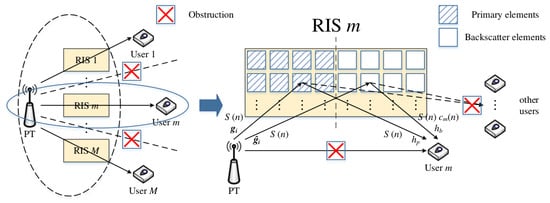
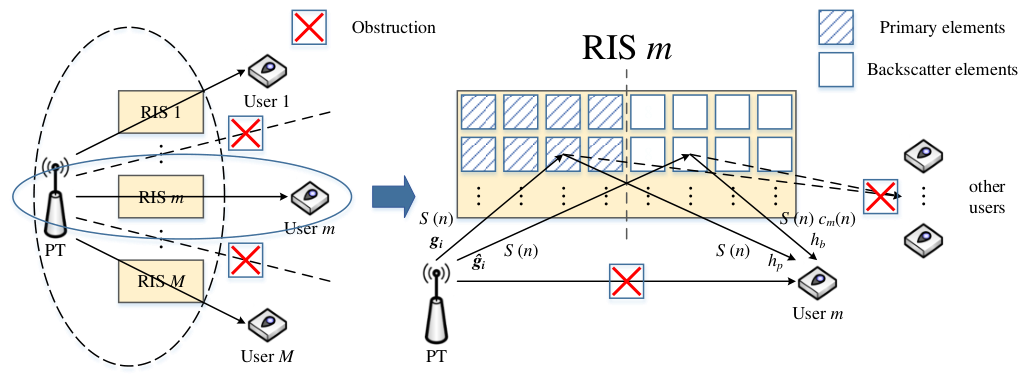
As shown in Figure 1, we consider a symbiotic backscatter NOMA IoT system in a distributed downlink scenario, where the primary transmitter (PT) broadcasts a NOMA signal to M clustered end users, while M RISs simultaneously operate in backscatter mode to transmit additional messages to the corresponding users over the same spectrum. To enable this functionality, each RIS is equipped with two functional groups, namely, primary elements and backscatter elements. Both groups consist of passive RIS elements that control the phase of the incident signal without amplifying it. After compensating for the phase of the corresponding cascaded channel, the primary elements enhance the primary NOMA signal . The backscatter elements perform the same phase compensation and impose a common PSK-modulated symbol on . Without loss of generality, we assume that the PT and all end users are equipped with a single antenna.
Figure 1.
Proposed joint symbiotic system.
The superposed NOMA signal transmitted by the PT is expressed as
where , , and denote the power allocation coefficient for User m , the transmit power of the PT, and the normalized primary signal intended for User m, respectively. The power allocation coefficients satisfy , and the normalized primary signals satisfy , where denotes the statistical expectation.
Assuming that primary elements and backscatter elements of RIS m serve User m, the corresponding primary and backscatter dual-hop channels are modeled as and , where denotes the transpose, while and are the channel vectors from the PT to RIS m and from RIS m to User m through the primary elements, respectively. Similarly, and denote the corresponding channel vectors associated with the backscatter elements. The diagonal phase-shift matrices and are designed to compensate for the phase shifts of the corresponding cascaded channels with the aid of accurate channel state information (CSI) (Despite the deployment of a large number of RIS elements, channel estimation can still be performed efficiently using compressive sensing and deep learning techniques [33]. Moreover, phase-shift compression with a limited quantization resolution can compensate for the channel phase shifts while preserving the full diversity order [34,35]. Accordingly, the phase of the reflection coefficient for the ith primary element can be adaptively set as ). Without loss of generality, all single-hop channels are assumed to undergo independent and identically distributed (i.i.d.) zero-mean complex Gaussian fading. Specifically, we have , , , and . To incorporate path-loss effects, the covariance matrices are defined as , , , and , where and denote the distances from the PT to RIS m and from RIS m to User m, respectively, is the path-loss exponent, and and are identity matrices of dimensions and , respectively.
Since the link via RIS m is assumed to be significantly stronger than the direct link [6], the direct link is neglected in the proposed system. The received signal at User m can be expressed as
where denotes the additive white Gaussian noise (AWGN) at User m, with . The parameters and denote the power reflection coefficients of the primary and backscatter elements, respectively, and satisfy . Here, is the maximum power reflection coefficient supported by the passive RIS hardware and architecture.
2.2. Joint Symbiotic Mechanism
In the proposed backscatter NOMA system, SIC (Perfect SIC (pSIC) is assumed in the main analytical development. This assumption means that a primary signal, once decoded and selected for cancellation, is canceled without residual interference. It does not imply that all primary signals are canceled. In particular, when User m, , decodes , the primary signals for remain uncanceled and may give rise to a nonzero outage floor [36]. The joint effects of imperfect CSI, imperfect SIC, and discrete activation are left for future work) is employed at User m to successively decode and cancel a subset of the superposed primary signals before decoding its desired primary and backscatter signals. Specifically, User m first decodes and cancels for , then decodes its desired primary signal , and finally decodes the backscatter symbol (For passive beamforming, the ith backscatter element has power reflection coefficient and phase . Modulating adds to this phase. Thus, its complex reflection coefficient is . Under the impedance-based reflection model, this coefficient is related to the equivalent antenna impedance and the chip impedance by , where denotes complex conjugation [37]).
The signal-to-interference-plus-noise ratio (SINR) at User m for decoding , where , is
where denotes the transmit signal-to-noise ratio (SNR), assuming a common noise variance for the users under consideration.
Let denote the target SINR for decoding . The corresponding successful-decoding event at User m is
where . This equivalence requires . If this condition is not met, the target SINR cannot be attained under the stated model.
After User m has decoded for all , it proceeds to decode the backscatter symbol . The corresponding SINR is expressed as
Similarly, let denote the target SINR for decoding the backscatter symbol . The corresponding successful-decoding event at User m can be expressed as
where . For a positive target SINR, this equivalence requires a positive denominator, yielding the power allocation constraint .
The symbiotic event in which User m successfully decodes all m required primary signals and its backscatter symbol is therefore
To characterize the symbiotic conditions under the continuous mechanism, we seek power reflection coefficients and that simultaneously satisfy (4) and (6). For notational simplicity, define , , , and . For and positive primary target SINRs, the feasible coefficients must satisfy the following coupled bounds:
When , as occurs for , the backscatter decoding condition reduces to and imposes no upper bound on beyond . Accordingly, the upper bound on in (8) is replaced by . Symbiotic transmission for User m is feasible if there exists a pair that jointly satisfies these bounds.
2.3. COP for the Continuous Joint Mechanism
To ensure the existence of a feasible value of , the interval in (9) must be nonempty. Accordingly, we require
For and , the two inequalities implied by (10) can be combined to yield
For the interval in (11) to be nonempty, the upper bound must be no smaller than the lower bound. Therefore,
Similarly, requiring a feasible value of gives
These conditions require .
Consequently, under the condition , the feasible ranges of and can be written as
The constants and satisfy the following coupled relations:
The minimum feasible reflection coefficients that satisfy the two decoding requirements are
Therefore, the symbiotic event for User m can be expressed as
Let and . The probability density function (PDF) and cumulative distribution function (CDF) of either random variable can be approximated by
where for , and for . Here, , and , where denotes the Gamma function and denotes the lower incomplete Gamma function [38] (eq. (8.350.1)).
According to (17), the connection outage probability (COP) of User m is given by the following (The COP analysis follows the channel distributions and large-scale gains specified in the system model. The RIS elements are assumed to compensate for the phases of the cascaded channels, thereby enabling coherent combining, while their amplitudes remain unadjusted under the adopted fading model. The small-scale fading coefficients associated with different elements and physical links are assumed to be independent or weakly correlated. Strong spatial correlation, phase errors, or channel-estimation errors would require modifying the resulting COP expressions):
where denotes the upper incomplete Gamma function [38] (eq. (8.350.2)).
At high SNR, the outage probability satisfies
Using , the product term is of higher order and can be neglected. Hence, , where the asymptotic diversity order is
and the asymptotic coding-gain coefficient is
3. Joint On–Off Symbiotic Mechanism
3.1. On–Off Symbiotic Conditions
The preceding section analyzed a joint symbiotic mechanism based on continuous adjustment of the power reflection coefficients of the RIS elements. However, implementing continuous amplitude control while maintaining the phase shifts required for passive beamforming can be challenging with practical RIS hardware. These implementation constraints motivate an on–off joint symbiotic mechanism, in which the effective channel gains are controlled by selectively activating RIS elements.
Under ideal phase alignment, activating additional RIS elements increases the coherently combined channel amplitude. For statistically comparable element contributions, the received channel power scales approximately with the square of the number of active elements [39]. Thus, element activation provides a discrete means of controlling the effective channel gains, serving a similar purpose to continuous adjustment of the power reflection coefficients. For simplicity, each active element is assumed to have a unit power reflection coefficient, such that , whereas inactive elements make no contribution to the corresponding effective channel (If all active elements share a fixed power reflection coefficient , this common factor can be absorbed into the transmit SNR by defining . Equivalently, in decibels, . This normalization assumes the same fixed reflection coefficient for the primary and backscatter RIS elements).
For a given activation configuration, and denote the effective primary and backscatter channels formed by the active elements. Under the power allocation constraints established previously and the feasibility condition , the symbiotic conditions for User m are
When both inequalities hold, they jointly imply and , where and are defined in (13) and (12), respectively. These individual channel-power bounds are necessary, but the coupled inequalities in (23) must also be satisfied by the selected activation configuration.
Remark 1.
For a given activation configuration, symbiotic outage occurs if at least one of the following decoding conditions is violated:
The first inequality indicates insufficient primary channel power relative to the backscatter interference and noise, whereas the second indicates insufficient backscatter channel power relative to the remaining interference and noise. These two failure events may occur simultaneously.
The proposed on–off joint symbiotic mechanism seeks an activation configuration that balances the effective primary and backscatter channel powers. During sequential element activation, an additional element is activated on the RIS associated with a violated decoding condition. Specifically, activating a primary RIS element increases the primary channel power to address the first failure event in Remark 1, whereas activating a backscatter RIS element increases the backscatter channel power to address the second (After each activation, both decoding conditions are evaluated again, since increasing either channel power can also increase the interference in the other decoding condition. The procedure seeks a configuration satisfying (23) within the available element budget. Successful symbiotic transmission depends on the existence of a feasible discrete activation configuration and on the activation procedure finding such a configuration).
3.2. Symbiotic Map
As more RIS elements are activated, the resulting symbiotic and outage states may exhibit an increasingly complex structure. To characterize these states, we introduce the concept of a symbiotic map, which represents the transmission state associated with each pair of numbers of active primary and backscatter RIS elements.
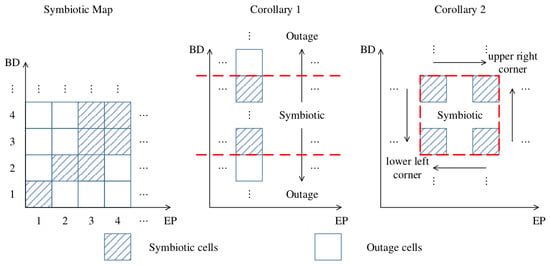
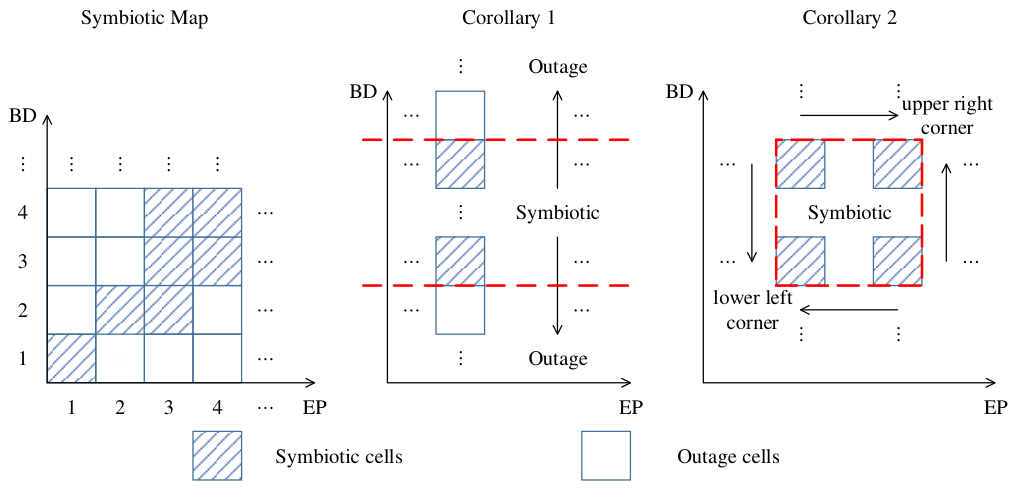
As illustrated in Figure 2, each state is represented by a “cell” indexed by , where and denote the numbers of active primary and backscatter RIS elements, respectively. Let and denote the corresponding primary and backscatter effective channels. The state of cell is determined by whether these two channels satisfy the symbiotic conditions in (23). We assume that the activation procedure is designed such that the effective channel magnitudes are nondecreasing with the number of active elements, i.e., and . Under this assumption, activating one additional primary RIS element moves the state to the right, whereas activating one additional backscatter RIS element moves the state upward.
Figure 2.
Illustration of the symbiotic map and Corollaries 1 and 2.
Lemma 1.
If the two cells on a symbiotic map and , where are symbiotic, then the lower-left cell and the upper-right cell are also symbiotic.
Proof.
Since is symbiotic, its primary decoding condition gives
Similarly, since is symbiotic, its backscatter decoding condition gives
Refs. (25) and (26) prove the two symbiotic conditions for the lower-left cell .
For the upper-right cell, monotonicity gives
Hence, the upper-right cell is also symbiotic. □
Corollary 1.
Along any fixed row or column of the symbiotic map, the symbiotic cells form a contiguous region. In other words, if two cells in the same row or column are symbiotic, then every cell between them is also symbiotic.
Remark 2.
The primary and backscatter systems enter the symbiotic conditions in a symmetric manner. Therefore, the arguments for rows and columns, as well as those for primary and backscatter element activation, are mutually applicable. In particular, activating a primary RIS element corresponds to moving horizontally across the map, whereas activating a backscatter RIS element corresponds to moving vertically.
Corollary 2.
If the two opposite side cells and are symbiotic, then every cell in the rectangle bounded by , , , and is symbiotic. Thus, the symbiotic region in the map has a rectangular connectivity property, as illustrated in Figure 2.
3.3. Definition of the On–Off Outage
According to Corollary 2, if a finite symbiotic map contains at least one symbiotic cell, it has a unique coordinate-wise minimal symbiotic cell. We refer to this cell as the initial symbiotic cell. No symbiotic cell can lie to its left or below it.
Let be the initial symbiotic cell. For cells in the same row with fewer than active primary RIS elements, the backscatter decoding condition remains satisfied, whereas the primary decoding condition must be violated. These cells therefore fall into the first outage state described in Remark 1. Likewise, cells in the same column with fewer than active backscatter RIS elements fall into the second outage state. Activating elements in the corresponding subsystem moves the state toward the initial symbiotic cell. If the activation path passes through this cell, it is the first symbiotic cell encountered along that path.
With at most primary and backscatter RIS elements available, the probability that the symbiotic map contains a feasible cell can be obtained by summing over the mutually exclusive locations of its initial symbiotic cell. Thus, the feasibility-based COP of User m is
where is the probability that is the initial symbiotic cell of the finite map. If no symbiotic cell exists within the available element budgets, User m is in outage.
4. Coexistence Outage Probability Analysis
Before activating an additional RIS element, let and denote the effective primary and backscatter channels formed by and active elements, respectively, where . Let and denote the contributions of a candidate additional primary and backscatter element, respectively. These contributions describe the corresponding neighboring cells; the two elements need not be activated simultaneously. Under coherent phase alignment, the effective channel magnitudes after the respective activations are and . This additive representation relies on phase alignment; without it, the magnitudes must instead be written as and .
To extend the Gamma approximations in (18), define , , , and . For , their respective shape parameters are , , and . The approximation in (18) then applies with equal to , , , or , using the appropriate scale parameter for each channel. When or , the corresponding pre-activation channel has no active elements: or , respectively. Such a variable is degenerate at zero rather than Gamma distributed with shape parameter zero.
Remark 3.
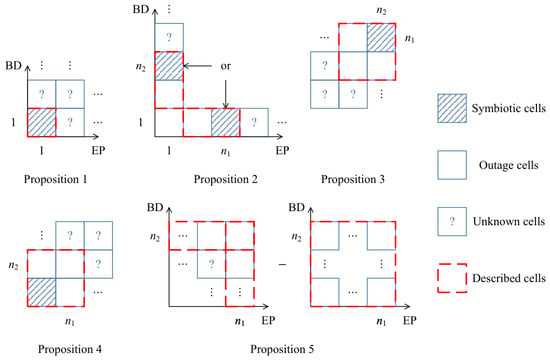
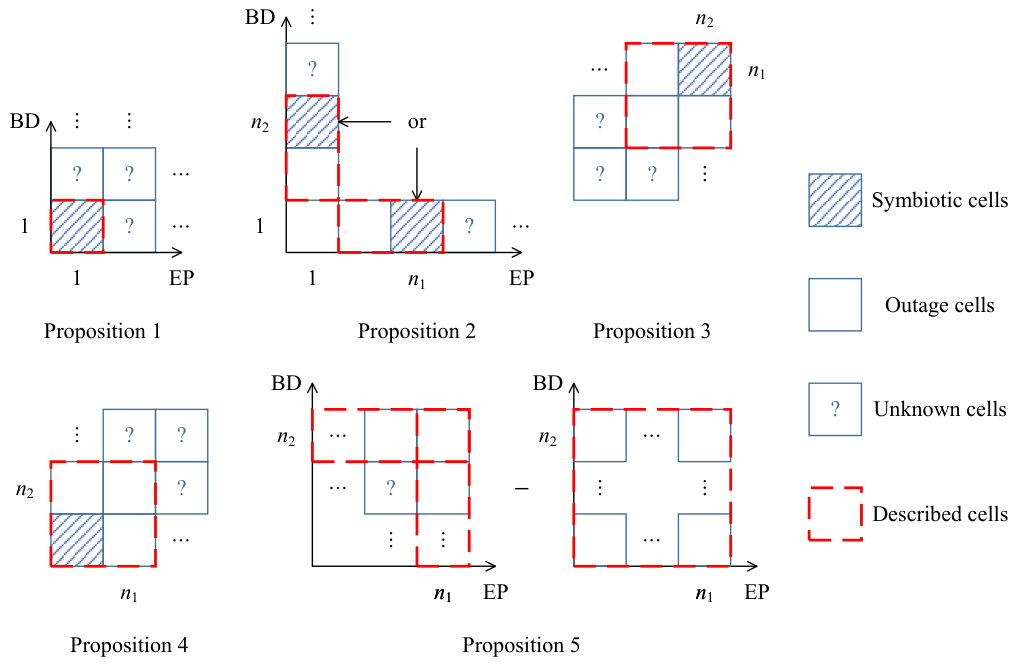
The following five propositions characterize the cell states needed to evaluate the COP, as illustrated in Figure 3. In each panel, the red dashed boxes identify cells whose states are specified by the corresponding proposition. Cells whose states are not specified are labeled “unknown”; this label does not imply that they are in outage.
Figure 3.
Illustration of Propositions 1–5 on the symbiotic map.
4.1. Preliminary Analysis on Symbiotic Conditions
Proposition 1.
At the start of the activation process, no RIS elements are active. One primary element and one backscatter element are then activated, forming the cell . Their respective channel magnitudes are W and Z. According to (23), this cell is symbiotic if
For User m , let denote the probability that this cell is symbiotic. If W and Z are independent, , , and the thresholds and remain fixed as , the high-SNR limit is as follows (this proposition and the subsequent propositions first present the relevant symbiotic probabilities in integral form):
Proposition 2.
Suppose that the initial symbiotic cell lies on the left or lower boundary of the symbiotic map, i.e., or . After the initial activation considered in Proposition 1, only one type of RIS element is activated: primary elements when , or backscatter elements when .
According to Corollary 1, it is sufficient to characterize the outage state of the boundary cell immediately preceding the first symbiotic cell. Once the corresponding additional RIS element is activated, the system enters the initial symbiotic cell.
Owing to the symmetry between the primary and backscatter systems, it is sufficient to consider the case in which the initial symbiotic cell lies on the lower boundary, namely, and . In this case, X denotes the primary channel magnitude before the additional primary element is activated, W denotes the contribution of that element, and Z denotes the backscatter channel magnitude formed by the single active backscatter element.
The conditions for to be the initial symbiotic cell can then be expressed, in the high-SNR regime, as
The first two inequalities guarantee that the cell is symbiotic, whereas the third inequality ensures that its preceding cell, , is in outage. Under the high-SNR approximation, these conditions reduce to
Assuming that X, W, and Z are mutually independent, the corresponding probability for User m is therefore given by
where the inner integral is understood to be zero whenever its lower limit exceeds its upper limit.
By exchanging the roles of the primary and backscatter systems, namely, substituting with , respectively, the corresponding probability for an initial symbiotic cell on the left boundary, with , follows immediately and is omitted for brevity.
Proposition 3.
Consider a candidate initial symbiotic cell with . For this cell to be the initial symbiotic cell, every cell with smaller coordinates must be in outage. We first consider a local event in which is symbiotic and its three neighboring cells to the left, below, and lower left are in outage. Denote the probability of this event by . Since the local event does not constrain all cells with smaller coordinates,
For , these three neighboring cells are all the cells with smaller coordinates; hence .
Under the coherent-addition model, the local event is characterized by
Equations (36a) and (36b) specify that is symbiotic. Equations (36c) and (36d) specify the outage states of and , respectively. Equation (36e) specifies that is in at least one of the two outage states described in Remark 1.
Let denote the probability of the local event when the first inequality in (36e) holds. Assuming that X, W, Y, and Z are mutually independent and that with , its high-SNR limit is
The high-SNR limit of the second part, , follows by exchanging the primary and backscatter variables and parameters: . Since , the two diagonal outage conditions in (36e) are mutually exclusive in the high-SNR limit, apart from boundary events of zero probability. Consequently,
4.2. Mathematical Induction
In what follows, we use mathematical induction to derive the COP of the end users when a large number of primary and backscatter RIS elements are deployed. When and are large, it becomes increasingly difficult to characterize the event in which is the initial symbiotic cell, because this requires all cells located to its lower left to be in outage. Consequently, obtaining a closed-form expression for becomes analytically challenging. To maintain an appropriate balance between accuracy and computational complexity, the propositions used in the induction are formulated using integrals of order no higher than four.
Lemma 2.
For primary RIS elements and backscatter RIS elements, the aggregate probability of the symbiotic cells, namely , can be decomposed as
Proof.
Since can be directly evaluated using Proposition 3, we use or as the first nontrivial case for the induction. These cells provide the basis for describing the subsequent activation process.
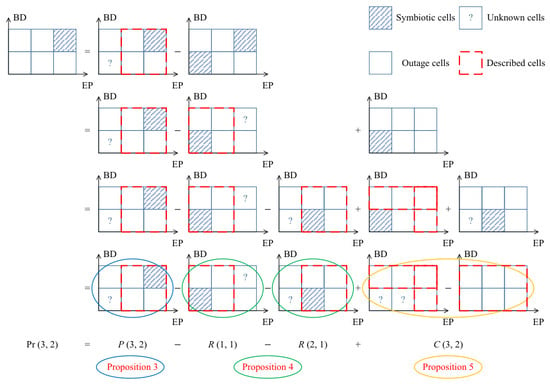
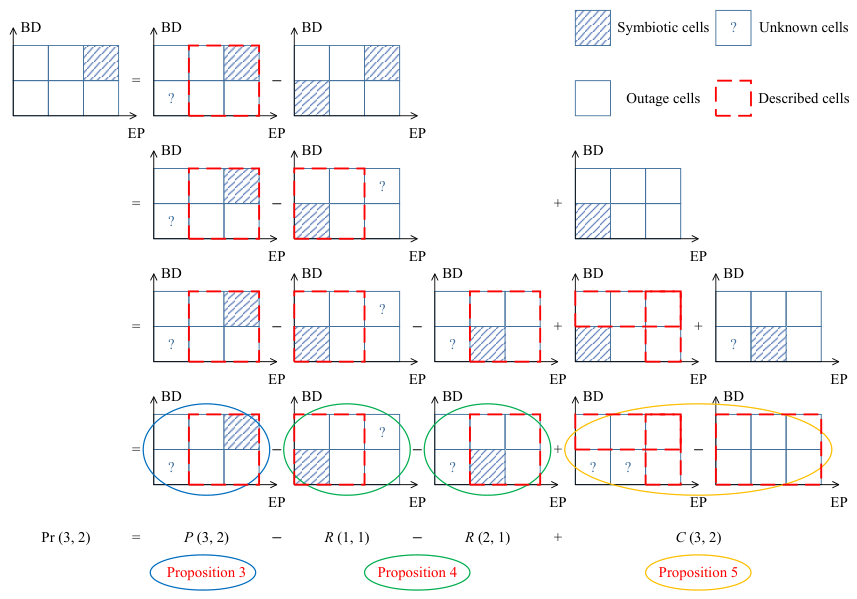
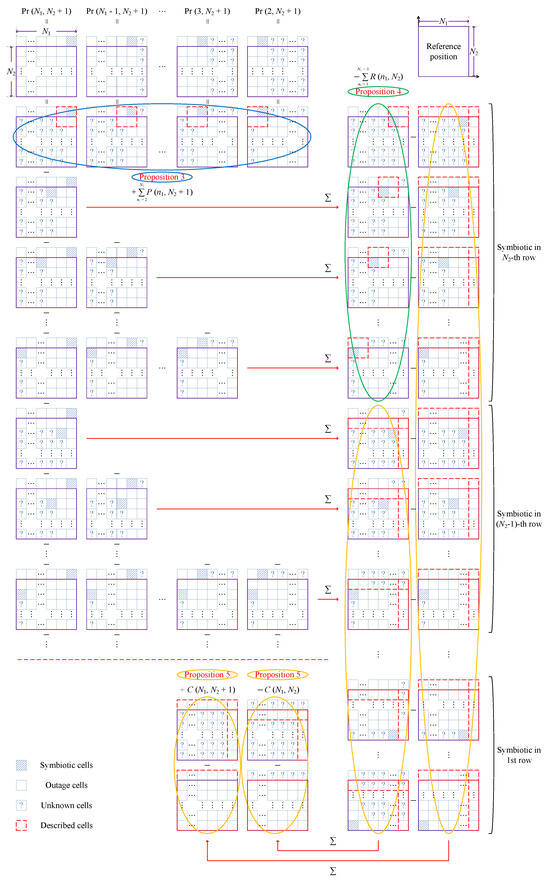
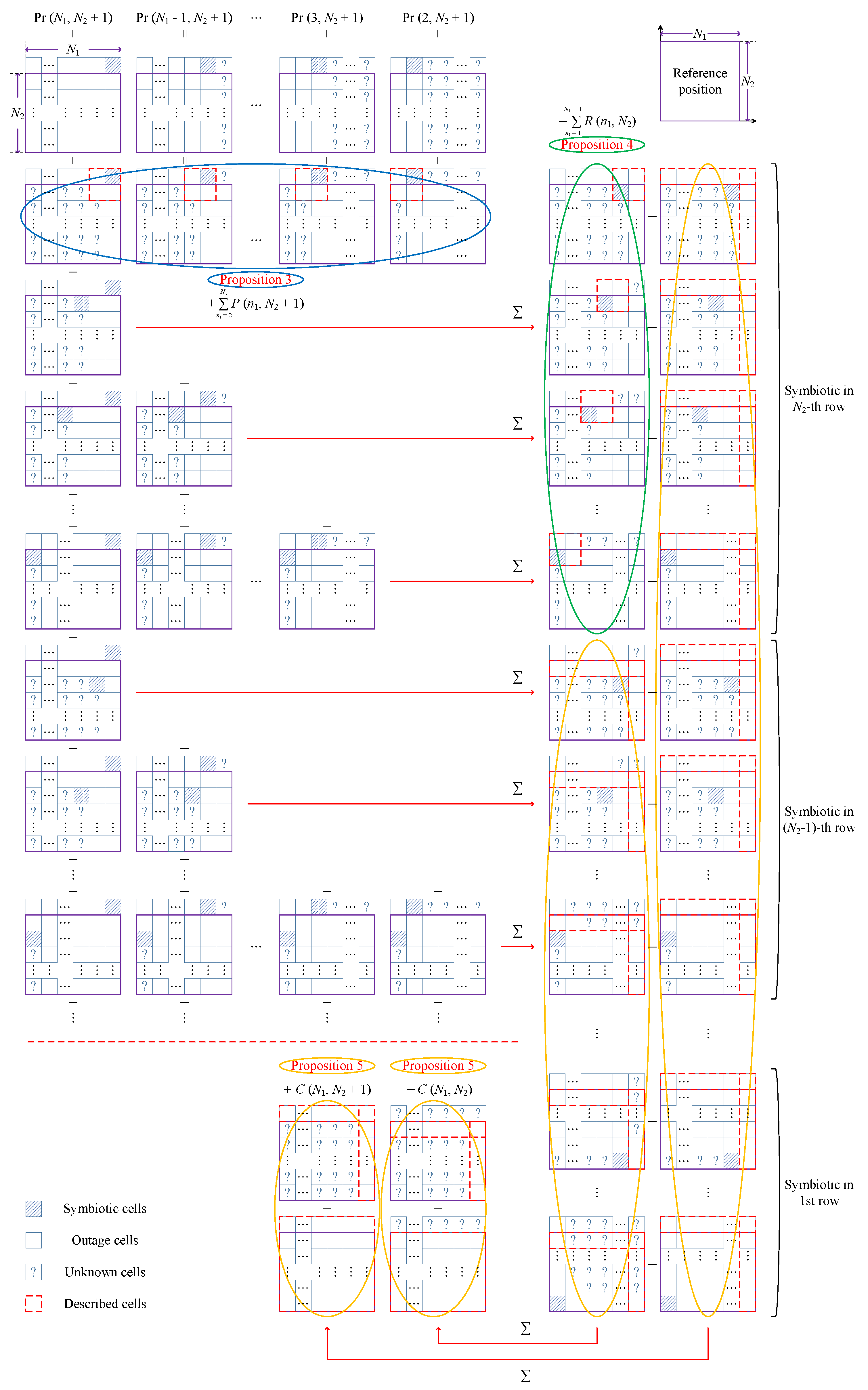
An event involving an unknown cell can be further divided into two mutually exclusive cases according to its actual state: the cell is either symbiotic or in outage. Therefore, the event corresponding to can be decomposed by identifying selected unknown cell as either symbiotic or in outage, while retaining the remaining cells. As illustrated in Figure 4 and the subsequent graphical derivations, all additions and subtractions are performed by classifying and evaluating the corresponding events according to the state of the unknown cell. The event corresponding to follows by symmetry.
Figure 4.
Decomposition of the symbiotic event corresponding to .
Remark 4.
To obtain an exact characterization, the states of both symbiotic and outage cells must be specified. Except for the state enclosed by the red dashed box, the remaining decompositions involve at least five random variables. Their exact occurrence probabilities therefore require integrals in the order of at least five. As the number of RIS elements increases, the order and complexity of these integrals grow rapidly, making an exact characterization increasingly intractable.
Based on the decomposition in Figure 4, the probability can be written as
in which and represent the cell configurations enclosed by the corresponding red dashed boxes. Their analytical expressions are derived in Propositions 4 and 5, respectively.
It follows that the aggregate probability for a symbiotic map is
For the induction step, suppose that the decomposition in (39) holds for an symbiotic map. By symmetry between the primary and backscatter systems, we add one backscatter RIS element, replacing with . The additional contribution can be decomposed as shown in Figure 5, which gives
Figure 5.
Graphical decomposition of the additional symbiotic probability in (42).
Therefore, after adding the -th backscatter RIS element, the aggregate symbiotic probability becomes
This is precisely the decomposition in (39) with replaced by . Hence, the result follows by mathematical induction. □
4.3. Residual Elimination and Compensation
In the inductive derivation, the three propositions above are insufficient to characterize the more complex symbiotic events. We therefore first consider the probability that is the initial symbiotic cell. The remaining probability terms are then decomposed and recombined, as described in the following two propositions:
Proposition 4.
Following the approach adopted in Proposition 3, the conditions required to characterize the residual probability can be written as
(44a) and (44b) characterize the outage state of . Conditions (44c) and (44d) are identical to (36c) and (36d), respectively. Finally, (44e) describes the two possible outage states that may experience.
In the high-SNR regime, the first component of the residual probability can be expressed by the following quadruple integral:
By interchanging the corresponding symmetric variables, the expression for can be obtained in an analogous manner. The sum of these two components gives the complete residual probability.
Proposition 5.
This proposition characterizes the event in which all cells on the outer boundary are in outage while at least one interior cell is symbiotic. Let A denote the event that all outer-boundary cells are in outage, and let B denote the event that all cells in the considered map are in outage. The exact compensation probability is then . Under event A, all cells in the -th column and the -th row of the symbiotic map are in outage, as illustrated in the left-hand part of Proposition 5 in Figure 3. Their specific outage states must also be identified, as discussed in Remark 1.
To account for the residual terms, we introduce a compensation term. Combining the contributions associated with the outermost column and row gives the following proposed upper bound:
where , with .
Proof.
First, the conditions defining can be written as
where (47b) describes an outage at cell caused by an insufficient backscatter-channel gain. After an additional backscatter element is activated, (47a) describes the continued failure of symbiotic transmission at due to an insufficient primary-channel gain.
Next, applying the conditions in (47) gives
The inequalities in (48a) identify outer-boundary cells that are in the first outage state described in Remark 1, owing to the insufficient primary-channel gain. They also identify the cells above that are in outage for the same reason. By contrast, (48b) identifies the other outage state for the cells below .
Thus, the outer-boundary cells can be divided into two groups according to the outage states specified in Remark 1. The transition occurs between two adjacent cells. When these cells lie in the -th column, for example, and , the probability of the corresponding event is denoted by .
The boundary conditions above establish event A; they do not rule out the possibility that every interior cell is also in outage. If the boundary configurations counted by and form a disjoint partition of A, then . Evaluating B requires the joint characterization of all interior cells. Let comprise the two analytically tractable all-outage boundary configurations, with . Consequently, subtracting instead of yields an upper bound on the exact compensation probability, rather than its exact value.
In the high-SNR regime, the conditions in (47) yield the following integral representation for :
The expression for follows by interchanging the corresponding symmetric variables and is omitted for brevity (In the analysis of the COP of the proposed on–off joint symbiotic system, the preceding five propositions retain integral expressions for the relevant symbiotic probabilities. Deriving closed-form results or accurate approximations for these integrals can be computationally demanding. Gaussian–Chebyshev quadrature may be used to evaluate the integrals [40]; a central limit theorem (CLT)-based Gaussian approximation may simplify the channel characterization [41]; and low-order Taylor expansions of the incomplete Gamma function [38] (eq. (8.354.1)) may facilitate further approximation. The accuracy of any such approximation should be assessed through simulation [42]. Because this paper focuses on modeling the joint symbiotic backscatter system and analyzing its on–off conditions, further evaluation of the integral expressions is left outside its scope).
Combining the analogous expression for with the boundary-event decomposition gives the proposed upper bound in (46), completing the proof subject to the stated event decomposition. □
5. Discussion and Extensions
In this section, we further discuss and extend the proposed joint symbiotic system. We first address issues arising in the derivation and then examine the implications of the results obtained above.
5.1. Special Case
The five propositions used to derive the COP specify the symbiotic conditions for User m () and the corresponding integral expressions. In the high-SNR regime, apart from the channel variables, the conditions depend on two parameters, a and b, which are associated with the backscatter and primary thresholds, respectively. These parameters also reflect the symmetry between the two components of the joint symbiotic system.
User M is a special case: its backscatter threshold gives , so the preceding symmetry no longer applies directly. For this user, the symbiotic probabilities in Propositions 1 and 2 simplify to
and
By symmetry, the corresponding limit for is zero when .
Moreover, the symbiotic conditions in Propositions 3–5 contain bounds of the form . When the quantities represented by are positive, these bounds cannot both hold as or . The corresponding symbiotic probabilities therefore vanish in these limiting cases. Consequently, for User M in the high-SNR regime with , the COP reduces to
Thus, under the proposed on–off mechanism, adding backscatter elements beyond the first does not further reduce User M’s high-SNR COP (In the high-SNR regime with a low backscatter threshold, the first symbiotic cell for User M has . Analogous conclusions for a low primary threshold () follow by symmetry and are omitted for brevity).
5.2. On–Off Approach
In the proposed joint symbiotic systems, the fundamental approach involves adjusting the amplitude of the primary and the backscatter signals simultaneously, enabling the end users to decode both signals based on their channel conditions. The continuous and the on–off mechanisms discussed herein are essentially methods for controlling the channel gain of the primary and the backscatter systems, thereby further regulating the signal amplitude. The continuous mechanism is predicated on a more ideal scenario in which the reflection coefficients can be controlled arbitrarily and continuously both in power and in phase. Conversely, the on–off mechanism governs the quantity of activated RIS elements. In the practical implementation, the proposed on–off mechanism avoids continuous amplitude control and adjusts the gain through binary activation of RIS elements or element batches. The proposed on–off implementation controls the phase responses of the activated RIS elements for passive beamforming and adjusts the equivalent channel gain through discrete element activation. Consequently, the proposed on–off mechanism can serve as a method for the conventional continuous mechanism or an alternative solution for addressing the challenges of the RIS-enabled channel gain control.
5.3. Batched Activation
In the preceding analysis, RIS elements are activated sequentially to establish symbiotic transmission. The proposed on–off mechanism can also be extended to batched activation, in which primary RIS elements or backscatter RIS elements are activated in a single batch. Accordingly, the parameters are redefined as , , , and . When and are integers, the COP under batched activation can be written as
The probabilities in this expression can be derived using the inductive approach described above. The resulting expressions are omitted for brevity.
For primary and backscatter RIS elements, element-by-element activation requires and activation-decision rounds, respectively. Batched activation reduces these counts to and . Thus, for , the reduction in decision rounds, expressed as a fraction of the element-by-element count, is . Fewer rounds may reduce sequential channel evaluations, feedback exchanges, stopping-condition checks, and decoding attempts. If elements within a batch must still be addressed individually, however, the number of element-level control commands remains . The principal benefit is therefore fewer control rounds and potentially lower processing latency, rather than necessarily fewer individual commands.
The batch size introduces a tradeoff between activation granularity and control overhead. With , every intermediate activation state is examined, at the cost of the largest number of decision rounds. With , some intermediate states are skipped. This reduces the number of rounds but may worsen the COP if a feasible intermediate state is skipped and no subsequently examined state provides a suitable alternative. The batch size should therefore be selected according to the desired balance between outage performance and activation latency (Batched activation reduces the maximum number of sequential decoding attempts for dimension i from to , provided that decoding is attempted once per activation batch. The total arithmetic complexity depends on how channel estimation and decoding are implemented for each batch; a reduction in decision rounds does not, by itself, establish a proportional reduction in total computation time).
6. Simulations and Results
In this section, we evaluate the COP of the RIS-enabled joint symbiotic system under both continuous and on–off activation mechanisms. Monte Carlo simulations are conducted for representative configurations to validate the analytical results and provide further insights into system performance. The analytical and numerical results are validated through Monte Carlo simulations over the considered SNR range and RIS-element configurations up to , which implies 32 RIS elements in total. These settings cover the moderate-outage region as well as the high-reliability region, with COP values reaching approximately . The simulation parameters are listed in Table 1.
Table 1.
Simulation parameters used in Section 6, unless otherwise stated.
For a fair comparison, all schemes use identical channel models, transmit-power budgets, power-allocation coefficients, RIS-element numbers, activation thresholds, and outage criteria. As shown in Table 2, all primary RIS elements remain active and only the backscatter elements are sequentially activated in the simulated standalone scheme. In contrast, the proposed joint mechanism starts with both types of RIS elements inactive and activates either a primary or a backscatter element according to the current channel conditions. This allows the weaker channel component to be compensated through the activation of the corresponding RIS elements. The benchmark scheme follows the standalone activation process but assumes that all primary signals are decoded. It is used only as an idealized reference to demonstrate that the proposed scheme avoids the outage floor even when only the required signals are decoded.
Table 2.
Comparison among benchmark schemes 1.
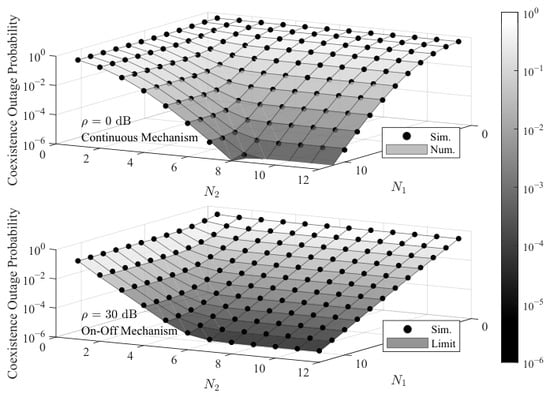
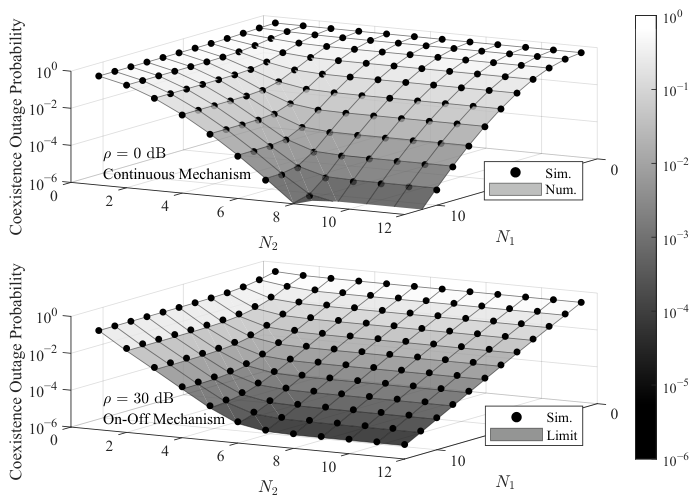
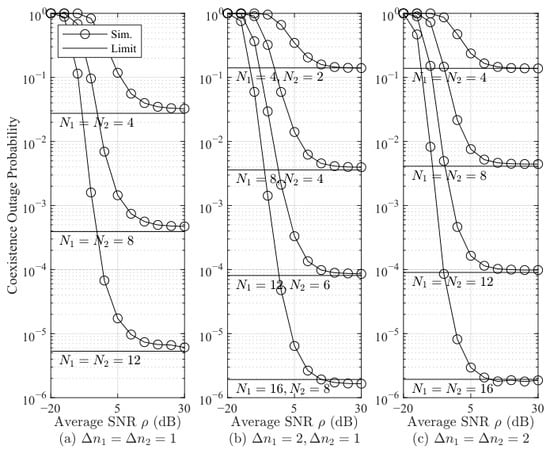
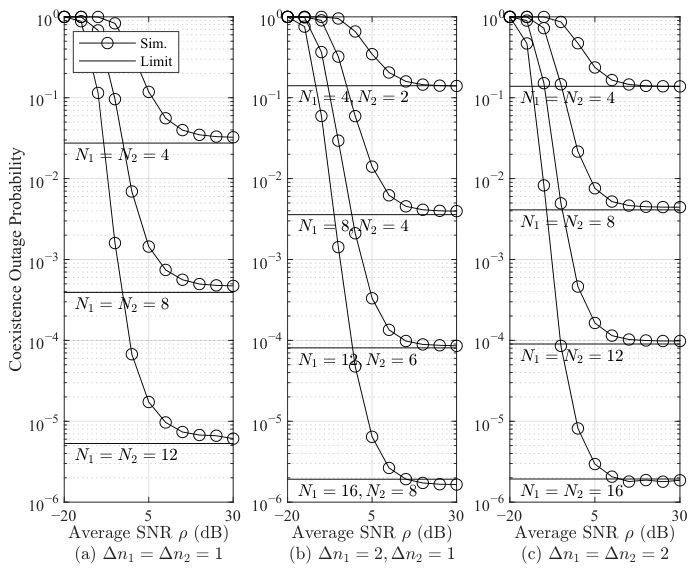
Figure 6 compares the simulated and analytical COP of User 1 under the continuous mechanism at dB. For the on–off mechanism, it also shows the simulation results at dB and the corresponding high-SNR limit, labeled “Limit.” The simulation results agree well with the analytical results, supporting the accuracy of the proposed analysis. For the continuous mechanism, the analytical result exhibits a slight bias while providing a tight upper bound. Under the on–off mechanism, the high-SNR limit indicates an outage floor. In both cases, the COP decreases as the number of RIS elements increases.
Figure 6.
COP of User 1 versus the numbers of primary () and backscatter () RIS elements under the continuous and on–off joint mechanisms.
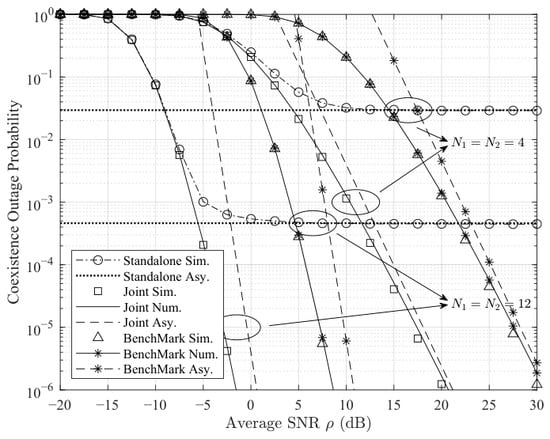
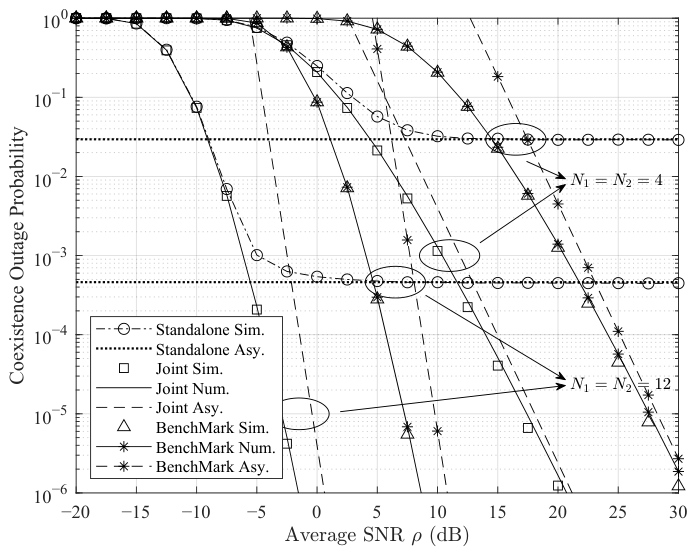
Figure 7 shows the COP of User 1 as a function of the average SNR under the continuous mechanism. In conventional standalone symbiotic systems, the backscatter system is typically subordinate to the primary system. Prioritizing primary-signal decoding can leave interference during backscatter-signal decoding, resulting in an outage floor. By contrast, the proposed joint symbiotic system accounts for the decoding requirements of both signals. Under the pSIC assumption, the joint mechanism balances the primary and backscatter channel gains according to the instantaneous channel conditions. In the ideal continuous case, this mitigates mutual interference and avoids the outage floor observed in the standalone system. Increasing the number of backscatter RIS elements can further improve transmission performance. As an alternative SIC strategy, User 1 may decode all primary NOMA signals before decoding the backscatter signal, doing so in the order , , , and . This strategy is labeled “BenchMark” in the figure. The proposed joint mechanism does not require User 1 to decode all primary signals before decoding the backscatter signal. It can therefore involve fewer decoding stages while achieving the reliability performance shown in the figure.
Figure 7.
Comparison of the COP of User 1 under the standalone and joint continuous mechanisms.
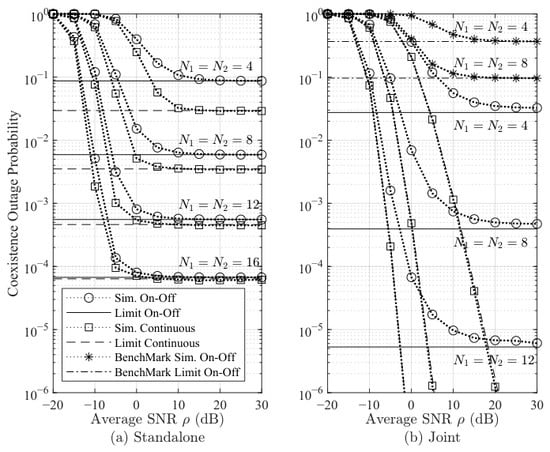
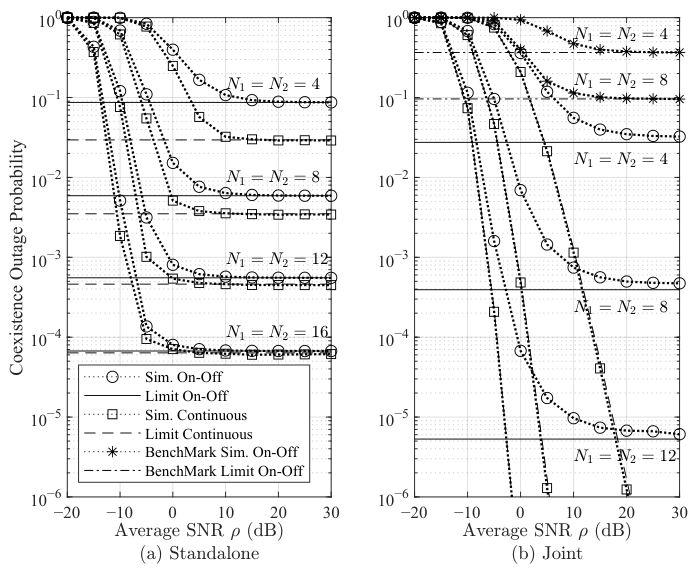
Figure 8 plots the COP of User 1 against the average SNR under continuous and on–off activation. For both the standalone and joint symbiotic systems, the on–off mechanism yields a higher COP than the ideal continuous mechanism, reflecting the performance cost of a simpler hardware architecture. In Figure 8a, the COP of the standalone on–off mechanism approaches that of the continuous mechanism as more RIS elements are allocated to User 1. In Figure 8b, the joint continuous mechanism exhibits no outage floor, whereas the COP under the joint on–off mechanism approaches a floor at high SNR. For the configurations considered, allocating more RIS elements to User 1 reduces the COP of the on–off mechanism. The joint on–off mechanism also outperforms the “BenchMark” scheme in Figure 8b. A comparison of panels (a) and (b) further indicates that the joint system achieves a lower COP than the standalone system under the simulated settings.
Figure 8.
Comparison of the COP of User 1 under the standalone and joint symbiotic systems with continuous and on–off activation.
Figure 9 shows the COP of User 1 as a function of the average SNR for three activation-batch configurations. In Figure 9a, RIS elements are activated individually, corresponding to . Figure 9b,c present the results for , and , respectively. Under batched activation, increasing the batch size skips some intermediate activation states on the symbiotic map. This may increase the COP because the first feasible activation state can be bypassed, although it reduces the number of activation attempts. Moreover, when the number of activation attempts is the same, a larger batch size provides better transmission performance under the considered simulation settings.
Figure 9.
Comparison of the COP of User 1 for different activation batch sizes.
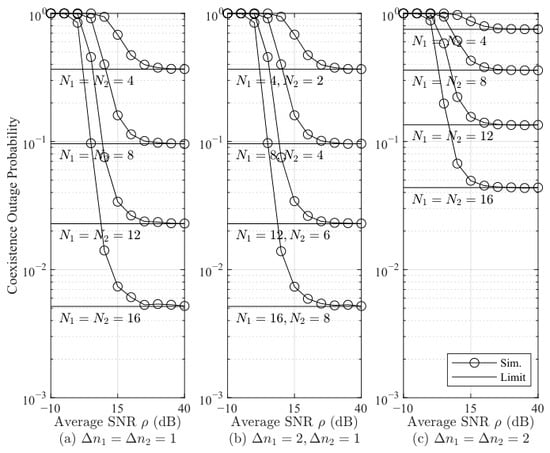
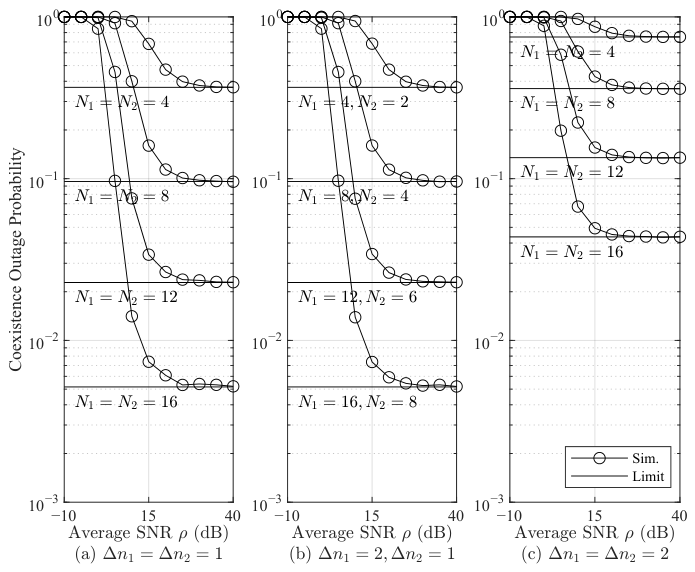
Figure 10 plots the COP of User 3 against the average SNR under batched activation with a low backscatter threshold (). Larger activation batches generally result in a higher COP. At high SNR, only the first batch is activated for User 3, while the remaining batches stay inactive. The outage floors in Figure 10a,b indicate that, for the configurations shown, changing the primary RIS batch size has no apparent effect on the high-SNR COP when the backscatter batch size is held constant. By contrast, the comparison between Figure 10b,c shows that increasing the backscatter batch size degrades outage performance when the number of activation attempts is held constant.
Figure 10.
Comparison of the COP of User 3 for different activation batch sizes.
7. Conclusions
In this paper, we investigated a novel RIS-enabled joint symbiotic backscatter NOMA system. To address the low transmission reliability of conventional backscatter NOMA systems, we proposed two mechanisms: a continuous mechanism that adjusts the RIS reflection coefficients and an on–off mechanism that sequentially activates the RIS elements. We then analyzed the COP of the system under both mechanisms. For the continuous mechanism, we derived the COP expressions for different users. For the on–off mechanism, we constructed a symbiotic map and obtained integral expressions through mathematical induction. Numerical results validated the proposed analytical framework and demonstrated the effective interference-suppression capability of the proposed joint mechanism. The results also showed that the primary and backscatter systems can operate on an equal footing and achieve balanced performance. These findings support the application of symbiotic backscatter communications in environments requiring connectivity for multiple devices.
Author Contributions
Conceptualization, M.C. and H.D.; methodology, M.C. and H.D.; software, M.C.; validation, M.C. and H.D.; formal analysis, M.C. and H.D.; investigation, M.C. and X.H.; resources, S.W.; data curation, M.C.; writing—original draft preparation, M.C.; writing—review and editing, J.M.M.; visualization, C.W.; supervision, H.D. and S.W.; project administration, H.D. and S.W.; funding acquisition, S.W. All authors have read and agreed to the published version of the manuscript.
Funding
This research was funded by the National Natural Science Foundation of China under grant 62371457.
Data Availability Statement
The original contributions presented in this study are included in the article. Further inquiries can be directed to the corresponding author.
Conflicts of Interest
The authors declare no conflicts of interest.
References
- Wang, C.X.; You, X.; Gao, X.; Zhu, X.; Li, Z.; Zhang, C.; Wang, H.; Huang, Y.; Chen, Y.; Haas, H.; et al. On the Road to 6G: Visions, Requirements, Key Technologies, and Testbeds. IEEE Commun. Surv. Tutor. 2023, 25, 905–974. [Google Scholar] [CrossRef] [Scilit]
- Ding, Z.; Peng, M.; Poor, H.V. Cooperative Non-Orthogonal Multiple Access in 5G Systems. IEEE Commun. Lett. 2015, 19, 1462–1465. [Google Scholar] [CrossRef] [Scilit]
- Liang, Y.C.; Zhang, Q.; Wang, J.; Long, R.; Zhou, H.; Yang, G. Backscatter Communication Assisted by Reconfigurable Intelligent Surfaces. Proc. IEEE 2022, 110, 1339–1357. [Google Scholar] [CrossRef] [Scilit]
- Khoshafa, M.H.; Maraqa, O.; Moualeu, J.M.; Aboagye, S.; Ngatched, T.M.N.; Ahmed, M.H.; Gadallah, Y.; Di Renzo, M. RIS-Assisted Physical Layer Security in Emerging RF and Optical Wireless Communications Systems: A Comprehensive Survey. IEEE Commun. Surv. Tutor. 2025, 27, 2156–2203. [Google Scholar] [CrossRef] [Scilit]
- Yao, J.; Xu, J.; Xu, W.; Yuen, C.; You, X. Superimposed RIS-Phase Modulation for MIMO Communications: A Novel Paradigm of Information Transfer. IEEE Trans. Wirel. Commun. 2024, 23, 2978–2993. [Google Scholar] [CrossRef] [Scilit]
- Zhao, W.; Wang, G.; Atapattu, S.; Tsiftsis, T.A.; Tellambura, C. Is Backscatter Link Stronger than Direct Link in Reconfigurable Intelligent Surface-Assisted System? IEEE Commun. Lett. 2020, 24, 1342–1346. [Google Scholar] [CrossRef] [Scilit]
- Vaezi, M.; Schober, R.; Ding, Z.; Poor, H.V. Non-Orthogonal Multiple Access: Common Myths and Critical Questions. IEEE Wirel. Commun. 2019, 26, 174–180. [Google Scholar] [CrossRef] [Scilit]
- Maraqa, O.; Rajasekaran, A.S.; Al-Ahmadi, S.; Yanikomeroglu, H.; Sait, S.M. A Survey of Rate-Optimal Power Domain NOMA with Enabling Technologies of Future Wireless Networks. IEEE Commun. Surv. Tutor. 2020, 22, 2192–2235. [Google Scholar] [CrossRef] [Scilit]
- Elhattab, M.; Arfaoui, M.A.; Assi, C.; Ghrayeb, A. RIS-Assisted Joint Transmission in a Two-Cell Downlink NOMA Cellular System. IEEE J. Sel. Areas Commun. 2022, 40, 1270–1286. [Google Scholar] [CrossRef] [Scilit]
- Men, J.; Ge, J.; Zhang, C. Performance Analysis of Nonorthogonal Multiple Access for Relaying Networks over Nakagami-m Fading Channels. IEEE Trans. Veh. Technol. 2017, 66, 1200–1208. [Google Scholar] [CrossRef] [Scilit]
- Liang, Y.C.; Long, R.; Zhang, Q.; Chen, J.; Cheng, H.V.; Guo, H. Large Intelligent Surface/Antennas (LISA): Making Reflective Radios Smar-t. J. Commun. Inf. Netw. 2019, 4, 40–50. [Google Scholar] [CrossRef] [Scilit]
- Liang, Y.C.; Zhang, Q.; Larsson, E.G.; Li, G.Y. Symbiotic Radio: Cognitive Backscattering Communications for Future Wireless Networks. IEEE Trans. Cogn. Commun. Netw. 2020, 6, 1242–1255. [Google Scholar] [CrossRef] [Scilit]
- Zhang, Q.; Zhang, L.; Liang, Y.C.; Kam, P.Y. Backscatter-NOMA: A Symbiotic System of Cellular and Internet-of-Things Networks. IEEE Access 2019, 7, 20000–20013. [Google Scholar] [CrossRef] [Scilit]
- Ding, H.; da Costa, D.B.; Ge, J. Outage Analysis for Cooperative Ambient Backscatter Systems. IEEE Wirel. Commun. Lett. 2020, 9, 601–605. [Google Scholar] [CrossRef] [Scilit]
- Yang, H.; Ding, H.; Cao, K.; Elkashlan, M.; Li, H.; Xin, K. A RIS-Segmented Symbiotic Ambient Backscatter Communication System. IEEE Trans. Veh. Technol. 2024, 73, 812–825. [Google Scholar] [CrossRef] [Scilit]
- Wen, Z.; Ding, H.; Elkashlan, M.; Li, D.; Yuen, C.; Moualeu, J.M.; Chen, M.; Liu, Z. Cut to the Chase: A Fast-Decoding Scheme for Symbiotic Backscatter Multi-User NOMA Systems. IEEE Trans. Wirel. Commun. 2025, 24, 7124–7141. [Google Scholar] [CrossRef] [Scilit]
- Liu, Y.; Mu, X.; Xu, J.; Schober, R.; Hao, Y.; Poor, H.V.; Hanzo, L. STAR: Simultaneous Transmission and Reflection for 360° Coverage by Intelligent Surfaces. IEEE Wirel. Commun. 2021, 28, 102–109. [Google Scholar] [CrossRef] [Scilit]
- Basharat, S.; Hassan, S.A.; Jung, H.; Mahmood, A.; Ding, Z.; Gidlund, M. On the Statistical Channel Distribution and Effective Capacity Analysis of STAR-RIS-Assisted BAC-NOMA Systems. IEEE Trans. Wirel. Commun. 2024, 23, 4675–4690. [Google Scholar] [CrossRef] [Scilit]
- Lv, L.; Wang, J.; Feng, Y.; Yang, L.; Nallanathan, A. Symbiotic NOMA Communications: A Constructive Multipath Reflection Design. IEEE Commun. Lett. 2026, 30, 130–134. [Google Scholar] [CrossRef] [Scilit]
- Nguyen, T.H.; Vu, T.H. A Generalized STAR-RIS-Empowered Ambient Backscatter Short-Packet Communication Systems with Partial NOMA. IEEE Commun. Lett. 2024, 28, 2744–2748. [Google Scholar] [CrossRef] [Scilit]
- Li, S.; Bariah, L.; Muhaidat, S.; Wang, A.; Liang, J. Outage Analysis of NOMA-Enabled Backscatter Communications with Intelligent Reflecting Surfaces. IEEE Internet Things J. 2022, 9, 15390–15400. [Google Scholar] [CrossRef] [Scilit]
- Van Nguyen, M.S.; Do, D.T.; Vahid, A.; Muhaidat, S.; Sicker, D. Enhancing NOMA Backscatter IoT Communications with RIS. IEEE Internet Things J. 2024, 11, 5604–5622. [Google Scholar] [CrossRef] [Scilit]
- Li, X.; Zheng, Y.; Zhang, J.; Dang, S.; Nallanathan, A.; Mumtaz, S. Finite SNR Diversity-Multiplexing Trade-Off in Hybrid ABCom/RCom-Assisted NOMA Networks. IEEE Trans. Mob. Comput. 2024, 23, 9108–9119. [Google Scholar] [CrossRef] [Scilit]
- Zhang, Q.; Liu, J.; Tang, H.; Dong, Z.; Li, Y. Practical RIS-Aided Multiuser Communications with Imperfect CSI: Practical Model, Amplitude Feedback, and Beamforming Optimization. IEEE Trans. Wirel. Commun. 2024, 23, 15245–15260. [Google Scholar] [CrossRef] [Scilit]
- Feng, C.; Ding, H.; Yang, G.; Song, G.; Liu, Z.; Xin, K.; Wen, Z.; Moualeu, J.M.; Li, D.; Yuen, C.; et al. RIS-Enabled Symbiotic Radio: From Idea to Prototype. IEEE Commun. Mag. 2026, 64, 32–39. [Google Scholar] [CrossRef] [Scilit]
- Tang, W.; Dai, J.Y.; Chen, M.Z.; Wong, K.K.; Li, X.; Zhao, X.; Jin, S.; Cheng, Q.; Cui, T.J. MIMO Transmission Through Reconfigurable Intelligent Surface: System Design, Analysis, and Implementation. IEEE J. Sel. Areas Commun. 2020, 38, 2683–2699. [Google Scholar] [CrossRef] [Scilit]
- Lin, S.; Zheng, B.; Alexandropoulos, G.C.; Wen, M.; Renzo, M.D.; Chen, F. Reconfigurable Intelligent Surfaces with Reflection Pattern Modulation: Beamforming Design and Performance Analysis. IEEE Trans. Wirel. Commun. 2021, 20, 741–754. [Google Scholar] [CrossRef] [Scilit]
- Lin, S.; Chen, F.; Wen, M.; Feng, Y.; Di Renzo, M. Reconfigurable Intelligent Surface-Aided Quadrature Reflection Modulation for Simultaneous Passive Beamforming and Information Transfer. IEEE Trans. Wirel. Commun. 2022, 21, 1469–1481. [Google Scholar] [CrossRef] [Scilit]
- Xie, H.; Li, D. To Reflect or Not to Reflect: On–Off Control and Number Configuration for Reflecting Elements in RIS-Aided Wireless Systems. IEEE Trans. Commun. 2023, 71, 7409–7424. [Google Scholar] [CrossRef] [Scilit]
- Liu, Y.; Cheng, H. Outage Performance Analysis and Optimization of Two-User Downlink NOMA Systems with Imperfect SIC and Improper Signaling. IEEE Trans. Wirel. Commun. 2024, 23, 11649–11661. [Google Scholar] [CrossRef] [Scilit]
- Palitharathna, K.W.; Suraweera, H.A.; Godaliyadda, R.I.; Herath, V.R.; Ding, Z. Impact of Receiver Orientation on Full-Duplex Relay Aided NOMA Underwater Optical Wireless Systems. In Proceedings of the ICC 2020—2020 IEEE International Conference on Communications (ICC), Dublin, Ireland, 7–11 June 2020; IEEE: New York, NY, USA, 2020; pp. 1–7. [Google Scholar] [CrossRef] [Scilit]
- Lee, J.; Seo, H.; Choi, W. Computation-Efficient Reflection Coefficient Design for Graphene-Based RIS in Wireless Communications. IEEE Trans. Veh. Technol. 2024, 73, 3663–3677. [Google Scholar] [CrossRef] [Scilit]
- Taha, A.; Alrabeiah, M.; Alkhateeb, A. Enabling Large Intelligent Surfaces with Compressive Sensing and Deep Learning. IEEE Access 2021, 9, 44304–44321. [Google Scholar] [CrossRef] [Scilit]
- Vu, T.H.; Kim, S. Performance Analysis of Full-Duplex Two-Way RIS-Based Systems with Imperfect CSI and Discrete Phase-Shift Design. IEEE Commun. Lett. 2023, 27, 512–516. [Google Scholar] [CrossRef] [Scilit]
- Zhang, H.; Di, B.; Song, L.; Han, Z. Reconfigurable Intelligent Surfaces Assisted Communications with Limited Phase Shifts: How Many Phase Shifts Are Enough? IEEE Trans. Veh. Technol. 2020, 69, 4498–4502. [Google Scholar] [CrossRef] [Scilit]
- Pei, Y.; Yue, X.; Yi, W.; Liu, Y.; Li, X.; Ding, Z. Secrecy Outage Probability Analysis for Downlink RIS-NOMA Networks with On-Off Control. IEEE Trans. Veh. Technol. 2023, 72, 11772–11786. [Google Scholar] [CrossRef] [Scilit]
- Darsena, D.; Gelli, G.; Verde, F. Modeling and Performance Analysis of Wireless Networks with Ambient Backscatter Devices. IEEE Trans. Commun. 2017, 65, 1797–1814. [Google Scholar] [CrossRef] [Scilit]
- Gradshteyn, I.S.; Ryzhik, I.M. Table of Integrals, Series, and Products; Academic Press: Cambridge, MA, USA, 2014. [Google Scholar]
- Wu, Q.; Zhang, S.; Zheng, B.; You, C.; Zhang, R. Intelligent Reflecting Surface-Aided Wireless Communications: A Tutorial. IEEE Trans. Commun. 2021, 69, 3313–3351. [Google Scholar] [CrossRef] [Scilit]
- Ye, Y.; Li, Y.; Zhou, F.; Al-Dhahir, N.; Zhang, H. Power Splitting-Based SWIPT with Dual-Hop DF Relaying in the Presence of a Direct Link. IEEE Syst. J. 2019, 13, 1316–1319. [Google Scholar] [CrossRef] [Scilit]
- Usman, M.; Basharat, S.; Hassan, S.A.; Pervaiz, H.; Ding, Z.; Jung, H. Performance Analysis of NOMA-Enabled RIS-Assisted Backscatter Communication. IEEE Trans. Veh. Technol. 2024, 73, 18961–18973. [Google Scholar] [CrossRef] [Scilit]
- Wang, H.M.; Yang, Q.; Ding, Z.; Poor, H.V. Secure Short-Packet Communications for Mission-Critical IoT Applications. IEEE Trans. Wirel. Commun. 2019, 18, 2565–2578. [Google Scholar] [CrossRef] [Scilit]

Disclaimer/Publisher’s Note: The statements, opinions and data contained in all publications are solely those of the individual author(s) and contributor(s) and not of MDPI and/or the editor(s). MDPI and/or the editor(s) disclaim responsibility for any injury to people or property resulting from any ideas, methods, instructions or products referred to in the content. |
© 2026 by the authors. Licensee MDPI, Basel, Switzerland. This article is an open access article distributed under the terms and conditions of the Creative Commons Attribution (CC BY) license.