


Abstract
In multi-core fiber elastic optical networks (MCF-EONs), a single fiber-link failure can disrupt traffic across every core of the failed fiber. This paper studies bandwidth-squeezed restoration (BSR) in IP over MCF-EON, where an admitted service must recover a demand-specific fraction of its original bandwidth. Four policy-matched mechanisms are considered: single-route IP-BSR, single-path optical SP-BSR, optical MP-BSR, and cross-layer Joint-MP-BSR. Joint-MP-BSR retains a complete IP-BSR branch and a flexible branch that assigns available bandwidth to one surviving IP route before using end-to-end optical multipath for the exact residual. A failure-scenario-indexed candidate-configuration MILP supplies an exact benchmark over an enumerated candidate set with core-slot collision, sharing, and cumulative inter-core-crosstalk constraints. In 30 paired NSFNET online-provisioning replications, Joint-MP-BSR reduces protected-service blocking by 0.0617 relative to IP-BSR (95% CI, 0.0308–0.0926) and by 0.1250 relative to MP-BSR (0.0632–0.1868); MP-BSR improves on SP-BSR by 0.2633 (0.1713–0.3553). On COST239, Joint-MP-BSR improves on IP-BSR, whereas its difference from MP-BSR is not statistically significant. In a separate 30-instance frozen N6S8 benchmark, heuristic/MILP admission totals are 112/112 for IP-BSR, 59/59 for MP-BSR, and 114/114 for Joint-MP-BSR. Joint’s conditional Tx/Rx overhead is 10.717% after the two admission objectives tie, exposing a resource refinement opportunity. These results support IP-first multipath BSR within the evaluated candidate, traffic, and physical-layer settings rather than universal or large-network dominance.
1. Introduction
The rapid growth of bandwidth-intensive applications such as ultra-high-definition video streaming, cloud computing, and data center interconnection has driven an explosive increase in Internet traffic [1]. To address the looming capacity crunch of conventional single-mode fiber (SMF) systems, elastic optical networks (EONs) have emerged as a promising technology by subdividing the optical spectrum into fine-granularity frequency slots (FSs) and enabling flexible bandwidth allocation [2,3,4]. Meanwhile, space division multiplexing (SDM) based on multi-core fiber (MCF) technology provides a multiplicative increase in transmission capacity by enabling simultaneous signal transmission across multiple fiber cores [5,6]. The combination of EON and MCF, known as MCF-EON, is regarded as one of the most promising architectures for next-generation optical transport networks due to its high capacity and flexible resource allocation capabilities [7].
However, MCF-EONs face a unique challenge: inter-core crosstalk (XT); this occurs when optical signals in adjacent cores interfere with each other [8]. This crosstalk degrades signal quality and must be carefully managed during network planning. The routing, core, and spectrum assignment (RCSA) problem in MCF-EONs is inherently more complex than the traditional routing and spectrum assignment (RSA) problem in conventional EONs, as it must additionally account for core selection and inter-core crosstalk constraints [9,10,11].
In an IP over MCF-EON architecture, aggregated backbone IP services are groomed onto optical lightpaths established in the MCF-EON. A lightpath can provide hundreds to thousands of Gbps, while the modeled aggregate IP demands occupy tens to hundreds of Gbps. This rate mismatch makes traffic grooming—the multiplexing of several client demands onto lightpath capacity—essential for efficient resource utilization [12,13]. Grooming can be performed electronically at the IP layer, optically, or jointly across both layers [12,14].
Network survivability is another critical concern, particularly in MCF-EONs where a single fiber link failure can disrupt traffic carried by all cores simultaneously, potentially affecting orders of magnitude more traffic than in traditional SMF networks [15]. Existing survivability techniques for MCF-EONs primarily fall into two categories: dedicated path protection (DPP) and shared backup path protection (SBPP) [16,17,18,19]. These techniques provide strong survivability, guaranteeing 100% bandwidth recovery for all affected traffic upon any single link failure. While highly reliable, strong survivability demands substantial redundant network resources, which can be prohibitively expensive in resource-constrained scenarios.
An alternative paradigm is weak survivability, which does not guarantee full bandwidth recovery but instead ensures network connectivity by providing partial bandwidth restoration [20,21]. Bandwidth-squeezed restoration (BSR) is a technique uniquely suited to elastic optical networks, where the inherent flexibility of bandwidth-variable transponders allows protection lightpaths to be provisioned with compressed bandwidth [20]. Under BSR, when a link failure occurs, affected traffic is rerouted through protection paths with reduced bandwidth, ensuring that critical connectivity is maintained even when full bandwidth cannot be restored. This approach is particularly valuable for disaster recovery scenarios where connectivity matters more than full bandwidth [22,23].
Prior studies have addressed BSR, optical multipath protection, traffic grooming, and multilayer restoration, but their combination leaves an unresolved design question: Can a minimum-ratio recovery target be completed by reusing surviving IP capacity first and aggregating only the residual bandwidth over crosstalk-feasible MCF optical paths? Three coupled requirements define this question:
- A demand-level minimum restoration ratio with full working-risk disjointness under each relevant single-fiber failure;
- An additive IP-first split that retains the complete IP-BSR alternative and uses optical multipaths only for the exact unresolved target;
- Scenario-indexed sharing, core-slot collision, and cumulative inter-core crosstalk constraints for both candidate and surviving fixed lightpaths.
This paper addresses these requirements through the following contributions:
- We define four policy-matched BSR mechanisms evaluated under common failure, candidate-generation, sharing, and physical-feasibility rules: single-route IP-BSR, single-path optical SP-BSR, optical MP-BSR, and cross-layer Joint-MP-BSR. SP-BSR is the = 1 ablation of MP-BSR.
- We formulate a unified failure-scenario-indexed candidate-configuration MILP. Its policy-specific constraints recover the feasible sets of all four mechanisms, including variable-bandwidth hybrid IP routes that may contain newly selected lightpaths; the solution is exact over the enumerated candidate set.
- The MILP enforces scenario-indexed virtual-link and shared optical capacity, core-slot collision, and cumulative inter-core crosstalk constraints for both candidate recovery lightpaths and surviving fixed lightpaths.
- We develop auxiliary-graph and finite-width multipath/beam heuristics. Joint-MP-BSR keeps a complete pure-IP lineage as a dominance anchor and compares it with IP-plus-optical states across successive demands.
- Through paired 30-replication online-provisioning studies on NSFNET and COST239, candidate-budget and restoration-ratio sensitivities, and 30 frozen N6S8 recovery-only instances, we separate optical multipath gain from cross-layer gain, quantify resource/computational trade-offs, and compare the heuristics with policy-matched candidate-set MILPs.
The rest of this paper is organized as follows. Section 2 reviews related work. Section 3 defines the architecture, failure semantics, and four restoration policies. Section 4 presents the unified candidate-configuration MILP. Section 5 describes the corresponding heuristics. Section 6 presents the simulation results, and Section 7 concludes this paper.
2. Related Work
2.1. BSR and Weak Survivability in Elastic Optical Networks
The concept of bandwidth-squeezed restoration (BSR) was first introduced by Sone et al. [20] for spectrum-sliced elastic optical path networks (SLICE). In BSR, when a link failure occurs and insufficient spectrum resources are available on the backup path, the protection lightpath is established with compressed bandwidth (fewer FSs), providing partial but guaranteed bandwidth recovery. This approach leverages the inherent bandwidth flexibility of elastic optical transponders, which can dynamically adjust their transmission rate by changing the number of subcarriers used.
Castro et al. [22,24] extended BSR to multipath recovery in flex-grid optical networks. Their single-path provisioning with multipath recovery scheme showed that residual capacity from several paths can improve recovered bitrate under a single-link failure. Dinarte et al. [25] more recently combined link-disjoint multipath routing with bandwidth squeezing and optimized asymmetric bitrate partitioning under dynamic traffic. Yang et al. [26] experimentally demonstrated OpenFlow-controlled multipath protection for data-center services. These studies establish optical multipath as a practical way to aggregate residual spectrum, but they do not formulate the IP-first residual-completion mechanism studied here.
Partial protection in elastic optical networks has been studied from several perspectives. Hai et al. [21] compared dedicated, shared, and squeezed forms of partial protection and showed that their resource/protection trade-offs differ. Zhang et al. [23] proposed ranked partial protection for degraded services, allowing differentiated recovery guarantees across service classes.
Recent work continues to broaden degraded survivability. Silva et al. [27] combine protection and restoration with class-dependent bandwidth and delay degradation, while the 2025 survey in [28] systematizes failure scenarios and survivability mechanisms in EONs. These studies reinforce the need for differentiated guarantees, but they do not model the proposed IP-first exact residual split in a crosstalk-constrained MCF substrate.
Bandwidth squeezing has also been combined with grooming and virtual-topology design. Assis et al. [29] formulated a squeezed-protection SLA with a minimum surviving bandwidth, optimized by an MILP and a heuristic in a SLICE virtual topology. That work is close in spirit to BSR with grooming, but it does not use an IP-first exact split over a crosstalk-constrained MCF physical layer.
Multilayer survivability forms a separate research line. Lin et al. [30] developed mathematical programming frameworks for survivable logical-topology routing in IP-over-WDM. Amar et al. [31] combined IP protection and optical restoration according to class of service, while Liu et al. [32] used cross-layer orchestration for cost-efficient restoration from IP-router outages in IP-over-EON. These models address survivable logical routing, full/multilayer restoration, or router outages rather than minimum-ratio optical multipath completion in IP over MCF-EON.
The methodological novelty is therefore the coupled decision rule rather than any isolated ingredient: For every demand and failure scenario, Joint-MP-BSR retains the complete single-route IP-BSR solution as a dominance anchor, tests one surviving IP route for a variable partial allocation, and sends exactly the unresolved ρB residual to end-to-end optical multipath configurations. The same model accounts for full working-risk disjointness, cross-demand scenario sharing, core-slot collision, and cumulative crosstalk for candidate and surviving fixed lightpaths. Table 1 distinguishes this combination from representative BSR, grooming, multipath, multilayer, and MCF-survivability studies.
Table 1.
Capability-level comparison with representative related survivability studies.
2.2. Traffic Grooming in MCF-EON
Traffic grooming in MCF-EONs has attracted significant research attention. Zhao et al. [13] proposed an auxiliary graph (AG)-based dynamic traffic grooming algorithm for SDM-EONs with multi-core fibers, which evaluates three grooming policies: maximal electrical grooming, maximal optical grooming, and maximal SDM grooming. Oliveira and da Fonseca [35] developed a traffic grooming algorithm for p-cycle-protected SDM optical networks, demonstrating that joint spectrum overlap and traffic grooming can effectively prevent network capacity bottlenecks.
Rumipamba-Zambrano et al. [14] investigated dynamic traffic grooming in joint switching (JoS)-enabled flex-grid/SDM optical core networks, showing that traffic grooming can accommodate up to 120% additional network traffic. Tian et al. [36] studied dynamic traffic grooming in SDM-EONs and proposed an AG algorithm that effectively reduces the number of fiber cores used.
For IP over EON specifically, Tang et al. [12] proposed mixed-channel traffic grooming with SBPP-based cross-layer protection, where working and protection IP traffic flows are allowed to share common optical channels. This integrated protection approach was shown to significantly reduce spectrum usage and transponder requirements compared to overlay and dedicated channel grooming schemes. This work was later extended to MCF-EON in [37], where mixed-channel traffic grooming was combined with crosstalk-aware RCSA in an SBPP-based IP over MCF-EON.
2.3. Crosstalk-Aware RCSA in MCF-EON
Inter-core crosstalk management is a fundamental challenge in MCF-EONs. Three main strategies have been proposed [9]: best-effort avoidance, best-effort core prioritization, and strict constraint. The strict constraint strategy, which only establishes a lightpath if the resulting crosstalk for all affected lightpaths remains below a predefined threshold, provides the highest signal quality guarantee [11,38].
Tang et al. [9] proposed a crosstalk-aware counter-propagating core assignment strategy for MCF networks, developing an ILP model and heuristic algorithm to minimize both the number of MCFs used and inter-core crosstalk. This analytical crosstalk model, based on the power coupling coefficient [8], was extended in [39] to jointly consider the spatial, frequency, and time domains for scheduled lightpath demands.
For survivable MCF-EONs, Tang et al. [16] formulated the crosstalk-aware RCSA (CA-RCSA) problem for SBPP-based MCF-EON as an ILP model, with the objective of minimizing the total number of MCF cores used and the total inter-core crosstalk while satisfying all crosstalk constraints. The proposed AG-based heuristic algorithm was shown to perform close to the ILP optimum while offering significantly lower computational complexity.
More recent crosstalk-aware survivability work includes distributed restoration with crankback and fragmentation awareness in SDM-EONs [33] and load-balanced multipath protection for crosstalk-aware SDM data-center traffic [34]. These methods address optical-layer feasibility and survivability, whereas the present work asks how surviving IP grooming capacity and optical multipath should be combined to meet a demand-level BSR target.
2.4. Summary and Motivation
This review motivates three focused gaps: Existing optical BSR studies do not jointly model MCF crosstalk and IP-layer residual capacity; existing multilayer survivability studies do not use exact minimum-ratio optical multipath completion; the value of an IP-first additive split has not been isolated from optical multipath gain under common physical rules. Under the matched NSFNET workload, the resulting quantitative ablations reduce blocking by 0.2633 from SP-BSR to MP-BSR, by a further 0.1250 from MP-BSR to Joint-MP-BSR, and by 0.0617 from IP-BSR to Joint-MP-BSR. These are controlled within-study comparisons; direct cross-paper numerical ranking would be misleading because the cited studies use different failure, traffic, topology, and physical-layer assumptions.
3. Network Model and Problem Description
3.1. IP over MCF-EON Architecture
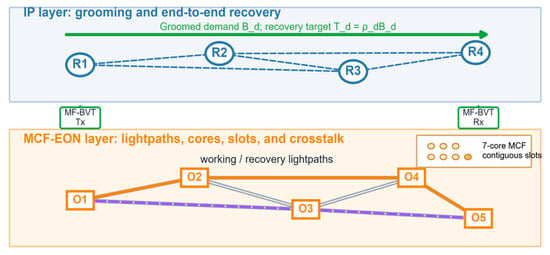
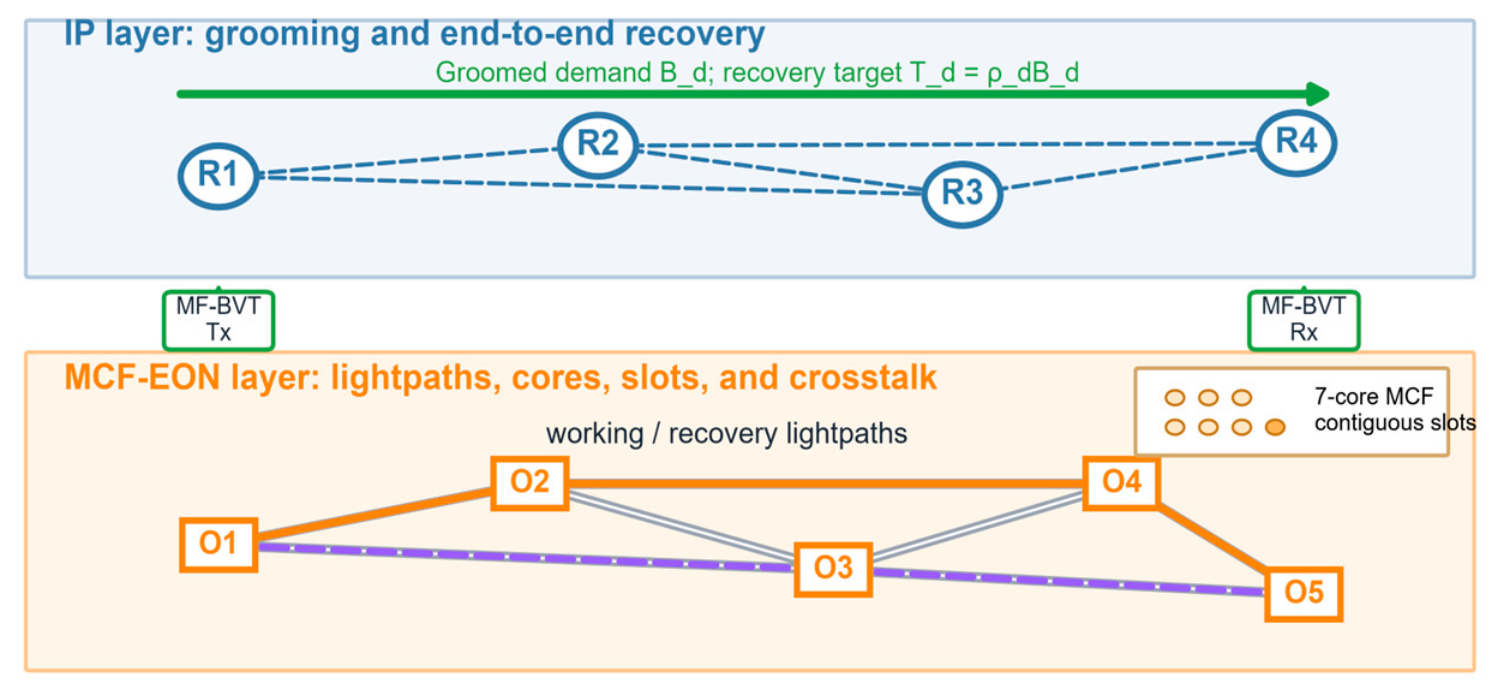
We consider an IP over MCF-EON architecture as illustrated in Figure 1. The network consists of two layers:
Figure 1.
IP over MCF-EON architecture with multi-layer traffic grooming. Blue dashed lines denote IP virtual links; gray solid lines denote physical MCF links. Orange solid and purple dashed paths illustrate working and recovery lightpaths, respectively, and the green arrow denotes the groomed demand.
- IP Layer: This layer comprises routers connected by virtual links (IP links). Each virtual link is supported by one or more lightpaths established in the optical layer. IP traffic demands are routed through the IP layer and can be groomed onto existing lightpaths.
- Optical Layer: This layer comprises optical cross-connects (OXCs) interconnected by MCF links. Each MCF contains multiple cores, and each core carries a set of FSs. Lightpaths are established by assigning a route, a core, and a contiguous block of FSs on each link along the route.
At each node, a pair of multi-flow bandwidth-variable transponders (MF-BVTs) [40] provides the interface between the IP layer and the optical layer. Each MF-BVT consists of multiple independent laser diodes, enabling a single transponder to establish multiple sub-lightpaths to different destinations. We adopt polarization multiplexing (PM) with three modulation formats, BPSK, QPSK, and 8-QAM, with spectral efficiencies (SEs) of 2, 4, and 6 bit/s/Hz, respectively [12]. Each FS has a bandwidth of 12.5 GHz.
3.2. Inter-Core Crosstalk Model
We adopt the analytical inter-core crosstalk model from [8,9]. The inter-core crosstalk between two co-propagating cores and in an MCF of length is calculated as
where is the mean inter-core crosstalk increase per unit length, expressed as
Here, is the bending radius, is the propagation constant, and is the core pitch (distance between cores and ). The mode coupling coefficient is calculated as
where is the relative refractive index difference, is the core radius, and are normalized transverse wave numbers in the core and cladding, respectively, and is the normalized frequency. The MCF parameters used in this study are listed in Table 2.
Table 2.
MCF parameters used for inter-core crosstalk calculation [9].
Inter-core crosstalk only occurs between lightpaths in adjacent cores that use overlapping FSs on the same link. We adopt the strictly constrained crosstalk management approach [16]: a new lightpath can only be established if the total inter-core crosstalk experienced by this lightpath and all existing lightpaths that are affected by it remain below a predefined threshold .
The FS-weighted inter-core crosstalk for core on link is defined as
where is the set of FSs, is the set of cores, and is a binary value that equals 1 if FS is used by lightpaths in both cores and .
3.3. BSR-Based Weak Survivability Policies
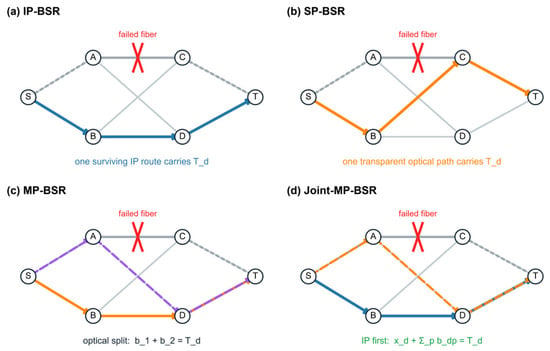
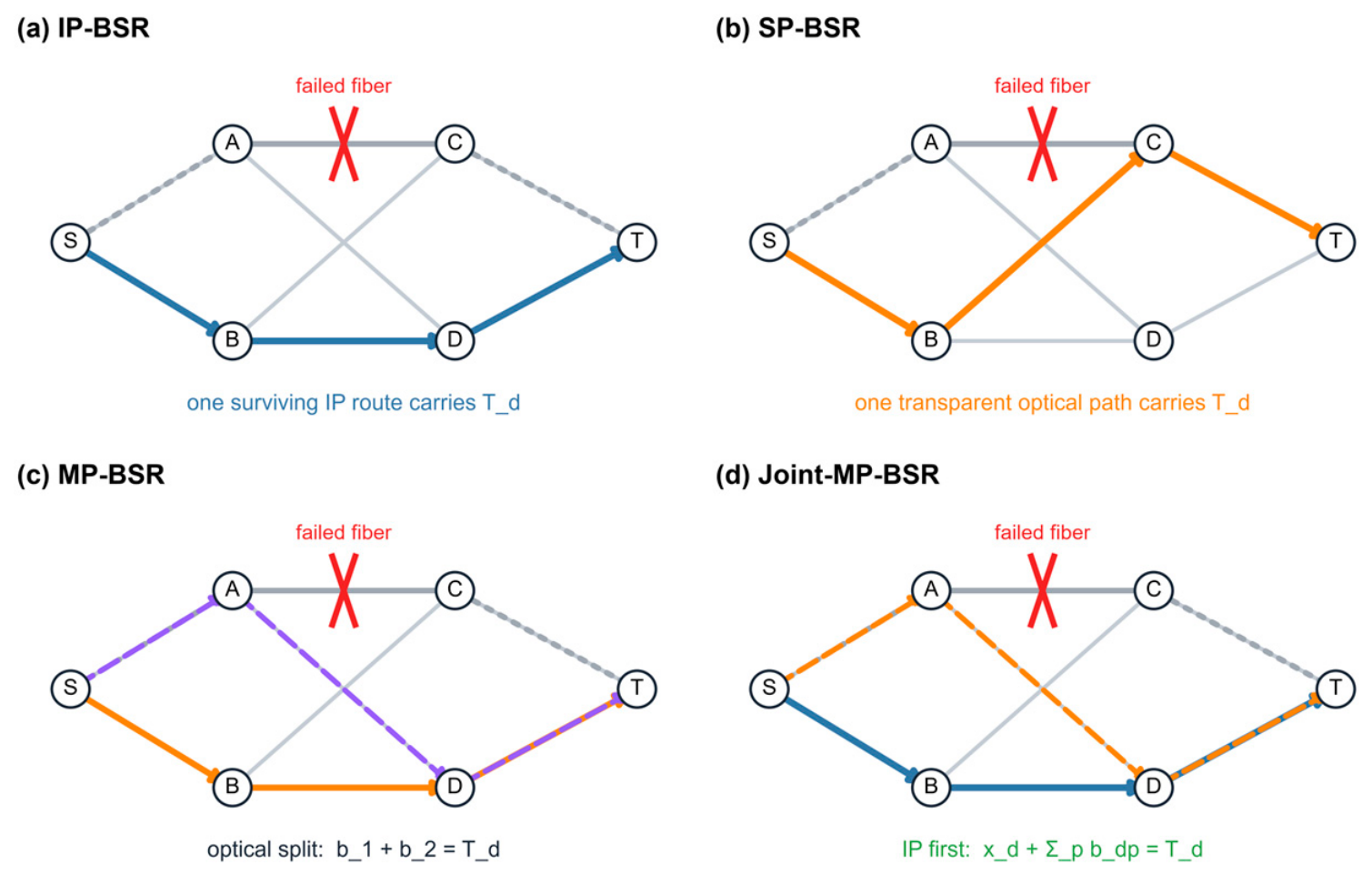
Weak survivability requires a degraded but explicit post-failure service level. For demand with original bandwidth and minimum restoration ratio , every admitted recovery must supply the exact target defined by (1). The failure set contains one undirected physical-fiber link at a time; all cores and all lightpaths traversing that fiber fail simultaneously. Figure 2 illustrates the four restoration policies.
Figure 2.
Four comparable BSR policies in IP over MCF-EON. S and T denote the source and destination, and A–D denote intermediate nodes. Gray dashed segments and the red cross identify the affected working route and failed fiber; gray solid lines show the physical topology. Blue solid paths denote surviving IP capacity, orange solid and purple dashed paths denote separate optical recovery paths, and the orange dashed path in (d) carries the residual optical recovery bandwidth.
IP-BSR. This policy finds one end-to-end path in the surviving IP virtual topology. The path may traverse several virtual links and intermediate IP routers, and it may combine residual virtual capacity with New-Lightpath edges. Its bottleneck must support , and the restoration flow is not split across multiple IP routes.
SP-BSR. This policy establishes at most one transparent end-to-end optical recovery lightpath. That single lightpath must independently carry while satisfying modulation reach, core and spectrum continuity, spectrum contiguity, complete work-risk disjointness, shared-capacity rules, and crosstalk constraints.
MP-BSR. This proposed optical multipath policy may divide across at most distinct end-to-end transparent recovery lightpaths. The assigned bandwidths sum exactly to ; physical capacity above the assigned amount is not counted as restored traffic. SP-BSR is the strict = 1 ablation.
Joint-MP-BSR. This cross-layer policy retains a complete pure-IP branch and a flexible mixed branch. The mixed branch assigns any feasible amount to at most one surviving end-to-end IP route in the current virtual topology and then restores the exact residual with end-to-end MP-BSR. The IP route may therefore reuse a recovery lightpath created for an earlier accepted demand, but the current demand does not create a new lightpath solely to increase its IP portion. The split is additive: IP bandwidth plus optical recovery equals .
All four policies use the same failure definition, candidate-construction rules, resource accounting, protection sharing, and crosstalk checks. In the frozen restoration benchmark, they also share the same working state and candidate pool. In the topology-scale online experiment, they share the same frozen background and foreground demand realization, although policy-specific foreground states can diverge after different admission decisions.
3.4. Problem Statement
The formal problem and the frozen exact benchmark concern restoration planning from a fixed pre-failure state. Background lightpaths, foreground working routes, residual virtual-link capacities, occupied core-slot units, and complete working-risk sets are fixed. Recovery decisions may reuse surviving capacity and reserve new recovery lightpaths, but they do not reroute the established work. Section 6 separately uses online protected-service provisioning at topology scale and states this distinction explicitly.
Given the IP over MCF-EON topology, frozen state, foreground set , single-link failure set , restoration ratios , modulation/reach rules, and linear-domain crosstalk threshold , demand must recover exactly whenever a physical link in its complete working-risk set fails.
The recovery route must be physically disjoint from the demand’s complete working-risk set, not merely from the particular failed link. Admission is atomic: The full target is allocated, or every tentative IP-capacity, optical-capacity, spectrum, and transponder reservation is rolled back. Recovery resources may be shared only across failure scenarios that do not activate the associated demands simultaneously.
Although the term restoration is retained, the formal design is preplanned and failure-independent: The same route/configuration choices must be feasible for every f in the demand’s working-risk set. New recovery configurations are reserved in the pre-failure plan and activated scenario by scenario. Consequently, even a segment that survives one realized failure is not reused when its physical risk intersects another segment of the complete work risk. The formulation is therefore closer to preplanned shared recovery than to unconstrained post-failure rerouting.
The primary objective is to minimize recovery blocking. Ties are resolved by the accepted original bandwidth, new Tx/Rx pairs, slot-core-link footprint, path count, and optical recovery bandwidth. The four policy restrictions are one IP route (IP-BSR), one transparent optical route (SP-BSR), up to optical routes (MP-BSR), and a pure-IP anchor plus a flexible IP/MP-optical branch (Joint-MP-BSR).
4. MILP Formulation
We formulate one mixed-integer linear program (MILP) for which its policy-specific feasible sets represent IP-BSR, SP-BSR, MP-BSR, and Joint-MP-BSR. The formulation optimizes restoration decisions over a fixed background, virtual topology, and working-risk state. It does not reroute already established working traffic. Because IP routes and optical configurations are enumerated before optimization, the model is exact over that candidate set; it is an unrestricted all-path optimum only when the enumeration is complete.
4.1. Modeling Scope and Candidate Configurations
Let be the set of foreground demands, and let be the relevant single undirected physical-link failures. Demand has the original bandwidth , minimum restoration ratio , and complete working-risk set . Its exact recovery target is .
A demand is tested in every failure contained in . Any candidate recovery route for which its physical risk intersects is removed before optimization, which enforces full work-risk disjointness rather than disjointness from only the currently failed link.
Let denote surviving directed IP virtual links; the candidate complete IP routes; and the candidate variable-bandwidth hybrid IP routes. For route , is its surviving-virtual-link subset and its selected New-Lightpath configurations. Let be the pre-enumerated direct optical configurations and those eligible for demand . Each configuration fixes a physical route , modulation , continuous core , starting slot , and contiguous slot count :
Thus, route continuity, modulation reach, core continuity, spectrum continuity, and spectrum contiguity are embedded in . Configuration capacity is . is the set of physical link-core-slot units; indicates whether occupies ; is fixed occupancy in failure ; is residual virtual-link capacity; = 1 when belongs to the working-risk set of ; is the optical recovery-path limit. The linear crosstalk threshold is .
4.2. Decision Variables
Binary admits demand . Binary selects direct optical configuration and continuous assigns its recovery bandwidth. Binary reserves globally, while activates it in failure . Binary selects a complete pure-IP route, which may contain surviving virtual links and New-Lightpath configurations. Binary selects a variable-bandwidth hybrid route, and is its assigned IP-layer bandwidth. Binary and select the pure-IP and flexible branches.
4.3. Common Assignment and Scenario-Activation Constraints
For every eligible demand–configuration pair, positive bandwidth and selection are linked by
Configurations with the same physical node sequence are treated as one recovery route for the path-count limit:
For configuration , , , and collect, respectively, its direct optical assignments, pure-IP route uses, and hybrid-route uses. Let be the corresponding binary selector. Global reservation and failure-specific activation are logical OR relations over ∪ ∪ :
The distinction between and is essential: one configuration may be reserved by several demands, but only the demands for which their working risk contains are active in scenario .
4.4. Scenario-Indexed Shared Capacity
For each optical configuration and failure, simultaneously activated recovery bandwidths cannot exceed physical capacities. The three terms below account for direct optical assignments, complete pure-IP routes that use a New-Lightpath configuration, and variable-bandwidth hybrid routes that use that configuration:
The surviving virtual-link capacity is constrained in the same failure-indexed manner for pure IP routes and the flexible Joint branch:
Therefore, two demands activated by mutually exclusive failures may share capacity, whereas demands activated together must fit simultaneously.
4.5. Spectrum and Crosstalk Constraints
For every physical link-core-slot unit and failure , candidate configurations may neither collide with one another nor with fixed traffic:
All crosstalk quantities are precomputed in the linear power domain. is the fixed crosstalk seen by candidate ; is the increment from active candidates; is the threshold. An inactive candidate is relaxed by 1, a valid implementation bound:
The reciprocal impact on every surviving fixed lightpath is also constrained. Here, is its existing crosstalk, and is the increment caused by candidate :
These two linear inequalities replace the variable products in the historical AMPL draft and ensure that both new recovery lightpaths and affected surviving lightpaths remain feasible.
4.6. Policy-Specific Feasible Sets
IP-BSR. Exactly one complete end-to-end IP route is selected when d is admitted. Every selected existing virtual link and New-Lightpath edge carries ; no IP multipath split is allowed.
SP-BSR. One transparent optical configuration must independently carry the exact target:
MP-BSR. At most distinct end-to-end optical routes jointly carry the exact target. Setting = 1 gives SP-BSR without changing the remaining constraints.
Joint-MP-BSR. Each admitted demand chooses either the complete pure-IP branch or the flexible IP-plus-optical branch:
The flexible branch selects at most one variable-bandwidth hybrid route. Such a route may contain surviving virtual links and selected New-Lightpath configurations, allowing the global MILP to represent a lightpath selected for one demand and reused by another demand’s hybrid IP component:
Direct optical configurations carry the exact residual after the hybrid-route amount, with at least one and at most routes whenever the flexible branch is selected:
The pure-IP branch preserves the IP-BSR anchor under the same enumeration. The global MILP optimizes over all enumerated hybrid routes and can assign selected new configurations within those routes. In the sequential heuristic, by contrast, the flexible branch uses only virtual links already present in its current state; a recovery lightpath created for an earlier demand is then an existing reusable link. The two descriptions therefore represent the same cross-demand reuse mechanism at different optimization scopes.
4.7. Lexicographic Objective
The solver uses six exact sequential stages. After each stage, its optimum is fixed before the next objective is solved:
The stages maximize admitted-demand count, maximize accepted original bandwidth, minimize reserved new optical configurations (the Tx/Rx-pair proxy), minimize slot-core-link footprint , minimize optical path assignments, and minimize optical restoration bandwidth. Sequential fixing avoids unverified large objective weights.
4.8. Exactness, Solver, and Deterministic Validation
The implementation uses Python 3.12.10, NumPy 2.5.1, and scipy.optimize.milp in SciPy 1.18.0 with the bundled HiGHS solver and a zero relative MIP-gap target. Experiments run on a 24-core/32-thread Intel Core i9-13900 workstation with 128 GB RAM. Deterministic mechanism cases verify 75+25 Gbps multipath aggregation, a 40 Gbps existing-IP plus 60 Gbps optical Joint split, cross-demand reuse of a dynamically established lightpath, the pure-IP anchor, failure-scenario sharing, candidate-to-candidate crosstalk, and preservation of a surviving fixed lightpath’s crosstalk margin. The complete v2 regression contains 31 passing tests: 20 heuristic tests, eight candidate-configuration MILP tests, and three frozen optimality-gap integration tests.
The deterministic cases validate formulation and implementation semantics. A separate 30-instance frozen N6S8 experiment connects the recovery-only IP-BSR, MP-BSR, and Joint-MP-BSR heuristics to the same persisted working states and finite route/configuration pools used by their policy-matched MILPs. Candidate generation remains the model boundary, so this experiment establishes candidate-set optimality rather than unrestricted all-path global optimality.
In isolated fresh-process measurements, the complete three-policy N6S8 heuristic/MILP run for seed 1 peaked at a working set of 96.22 MiB (81.53 MiB above process start); it contained three active failure scenarios, 225 optical configurations, and 14 IP routes. A four-policy NSFNET online run for seed 1 peaked at 41.44 MiB (26.81 MiB incremental). These representative measurements include native solver allocations but are not memory bounds for larger networks.
5. Heuristic Algorithm
The candidate-configuration MILP grows with the number of demands, failure scenarios, IP routes, optical configurations, and core-slot units. We therefore use policy-matched heuristics for topology-scale simulations. All policies share the same background construction, failure semantics, physical-route candidates, modulation/reach rules, RCSA checks, protection sharing, and lexicographic resource metrics. For the frozen benchmark, they additionally share the same foreground working-risk state.
5.1. Common Candidate Generation and Transaction Semantics
For every affected demand, candidates are generated only on resources that survive the failed undirected physical link and for which their complete physical risk is disjoint from the demand’s full working-risk set. A tentative recovery allocation is committed only after virtual capacity, optical capacity, spectrum collision, and cumulative crosstalk have passed in every relevant failure scenario; otherwise, the entire tentative allocation is rolled back.
5.2. IP-BSR and SP-BSR
IP-BSR searches one end-to-end route in the surviving IP auxiliary graph. It first attempts existing virtual-link capacity and may then mix existing virtual links with New-Lightpath edges. Every edge of the selected IP route must support the exact target , so the route bottleneck must be at least ; IP traffic is not split across multiple IP routes.
SP-BSR searches one transparent end-to-end optical lightpath that alone carries . The path must satisfy modulation reach, core continuity, frequency-slot continuity and contiguity, full work-risk disjointness, shared-capacity rules, and crosstalk thresholds. If no single configuration carries , the demand is blocked and rolled back.
5.3. MP-BSR Search
MP-BSR first attempts the SP-BSR solution. Only when a single path is infeasible does it expand multipath states. For each unused end-to-end physical route, the RCSA routine finds the widest feasible contiguous capacity and allocates only the unresolved amount, where is the state’s current cumulative recovery.
States are expanded by path count up to and are never allowed to use the same physical node sequence twice for one demand. Completed states are ranked by fewer paths and then by the maximum slot index, used link-core count, slot-core-link footprint, and protection units. Incomplete states retain larger recovered bandwidth first and are pruned to a fixed state width. This is a finite-width heuristic rather than an optimality proof.
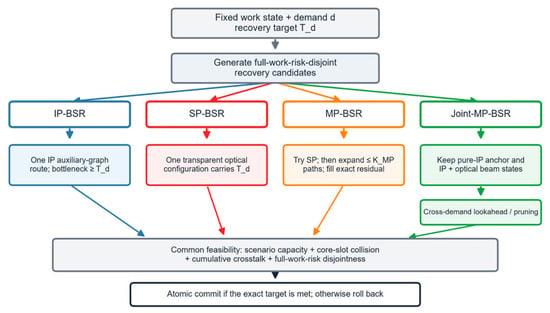
5.4. Joint-MP-BSR with Cross-Demand Beam/Lookahead
Joint-MP-BSR retains two branches for each demand. The pure-IP branch executes the complete IP-BSR search, including New-Lightpath edges when needed. The flexible branch uses at most one surviving IP route already available in the current sequential state, assigns any feasible amount up to its bottleneck, and sends the exact residual to end-to-end MP-BSR. It does not create a new lightpath solely to increase the current demand’s IP portion, but it may reuse a recovery lightpath created by an earlier accepted demand.
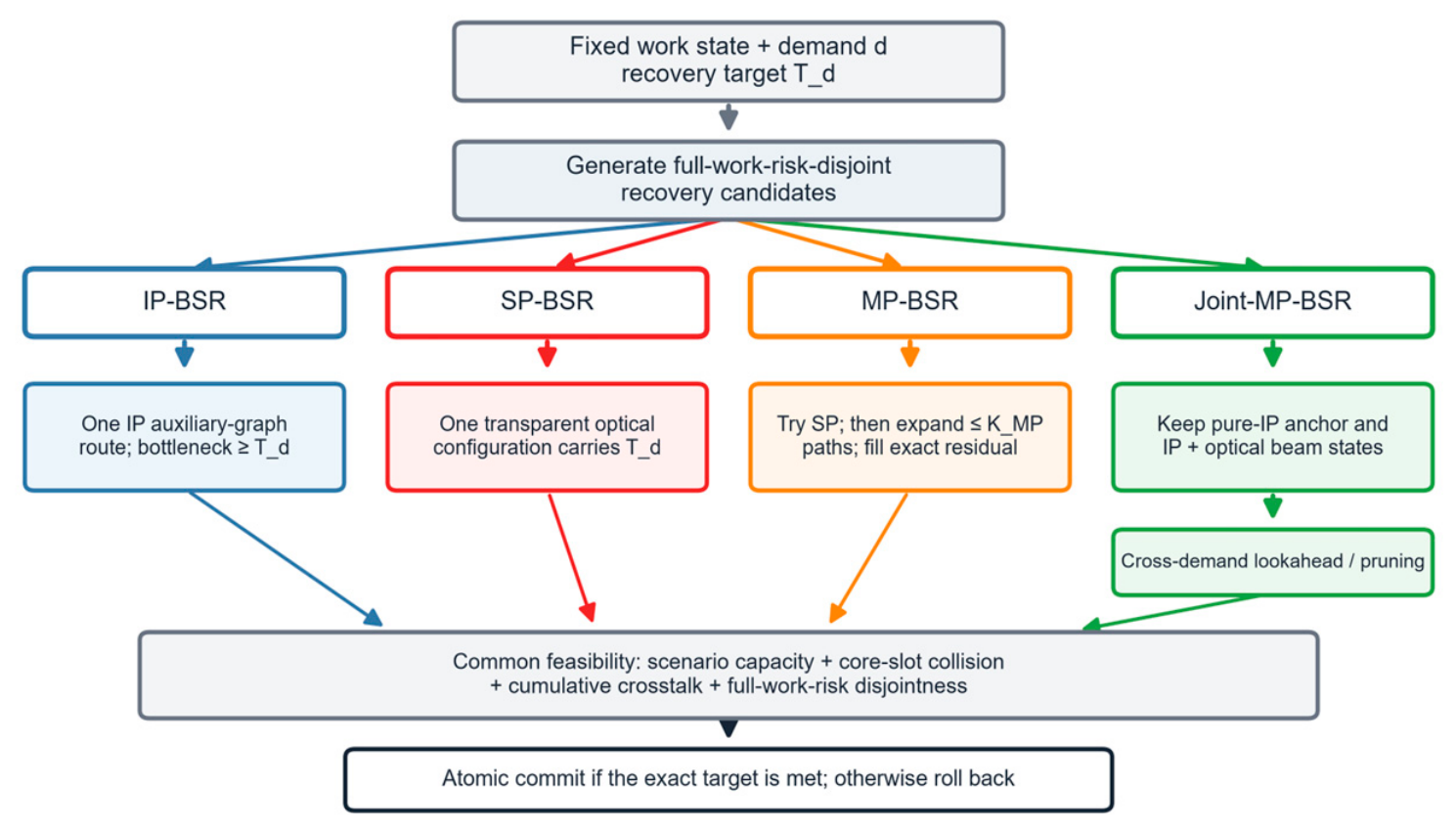
Across successive demands, beam/lookahead keeps both the pure-IP lineage and mixed IP-optical states for several demands before pruning. The pure-IP lineage is an explicit IP-BSR dominance anchor; the final state is selected by the same lexicographic criteria, without an artificial preference for the mixed branch. Consequently, any strict Joint-MP-BSR gain must come from a feasible mixed or multipath state rather than from weakening the IP baseline. Figure 3 summarizes the policy-matched restoration search.
Figure 3.
Policy-matched restoration search: single-route IP, single-path optical, multipath optical, and cross-layer beam branches.
5.5. Computational Scope
Let be the number of foreground demands, the retained physical-route count, the number of cores, the number of slots, the multipath state width, the cross-demand beam width, and the lookahead depth. Candidate configuration scanning is bounded by in the worst case when all contiguous slot intervals are considered; multipath expansion is bounded by the fixed and ; joint beam evaluation is bounded by the fixed and . These are implementation bounds, not optimality guarantees. Increasing , , , , or enlarges the explored state space. The MILP is exact only over its enumerated candidate set.
For D affected demands, F active failure scenarios, R candidate IP routes, H candidate optical configurations, and U core-slot units, the scenario-indexed MILP introduces admission/allocation variables across demand–scenario–route and demand–scenario–configuration combinations, capacity/collision constraints over the touched U units, and additional pairwise terms for simultaneous inter-core crosstalk interactions. Its size therefore grows at least linearly in D and F for a fixed pool but can grow combinatorially as route, slot-width, starting-slot, and core choices expand H. It is intended for bounded planning and benchmarking, not as evidence of tractability for hundreds of nodes or thousands of demands.
5.6. SDN-Enabled Operational Realization
A practical deployment can run candidate generation and MILP-assisted planning offline or periodically in a centralized SDN controller, while the online heuristic selects among persisted, physically validated candidates. Following failure detection by transport OAM, the controller identifies affected demands, activates the retained IP forwarding-rule bundle, and configures at most end-to-end optical recovery paths through router and ROADM/transponder southbound interfaces. OpenFlow-controlled elastic-optical multipath has been experimentally demonstrated [26], and distributed crosstalk-aware restoration with crankback has also been studied [33].
For each affected demand, the logical signaling load is one recovery transaction, one IP rule bundle when IP capacity is used, up to optical setup actions, and state updates for every touched virtual link and core-slot interval. End-to-end restoration time decomposes into failure detection, controller computation, message dissemination, and device configuration. The reported runtimes measure only computation; without an emulated or hardware control plane, they must not be interpreted as physical recovery latency.
6. Performance Evaluation
This section evaluates whether optical multipath improves a single-path baseline, whether IP-first residual completion further reduces blocking, which modes create that gain, how the result changes with restoration guarantee and candidate-path budget, what resource and computational cost accompanies the gain, and which conclusions persist across the two evaluated topologies.
6.1. Simulation Setup and Statistical Methodology
The primary experiments use the NSFNET-14-22-legacy topology, which contains 14 nodes and 22 undirected physical links. Each link is modeled as a seven-core fiber. Each core contains four 12.5-GHz frequency slots (FSs). This deliberately scarce spectrum is a reproducible stress case chosen to expose differences among restoration policies; it is not presented as the full spectrum of a deployed MCF system, and the resulting absolute blocking probabilities are not operational capacity forecasts. The distance-adaptive modulation engine selects 8-QAM, QPSK, or BPSK according to path length, giving 75, 50, or 25 Gbps per slot.
Each replication first establishes a background traffic state. For every seed/background-count pair, that state is frozen and cloned before each policy is executed. Thus, IP-BSR, SP-BSR, MP-BSR, and Joint-MP-BSR begin with the same accepted background connections, spectrum occupation, and crosstalk state and receive the same foreground demand realization. The paired construction controls initial conditions. Because each policy subsequently provisions foreground work and recovery atomically, its accepted foreground connections and later working routes may diverge. The NSFNET load axis contains 0, 4, 8, 12, and 16 background demands, for which their mean occupancy over active link-core resources rises from 0% to 34.79%. Global occupancy is lower because unused links and cores remain in the denominator; the background-demand count is therefore the primary horizontal axis.
For each frozen background state, four foreground demands are generated, with bandwidth uniformly distributed from 120 to 300 Gbps. The engine first provisions each demand’s working connection, and then, its policy-specific recovery allocation; failure of either stage blocks the demand and atomically rolls back both stages. The base minimum restoration ratio is = 0.8. The failure model removes one relevant undirected physical link at a time, while recovery candidates must be disjoint from the demand’s complete working-risk set. Spectrum collision and cumulative inter-core crosstalk are rechecked on every traversed link, core, and slot.
The base ρ = 0.80 represents a high but deliberately non-full recovery guarantee, leaving room for BSR to differ from 100% protection. The formulation already allows demand-specific . In a differentiated service design, lower-priority classes may use = 0.20 or 0.50, while stringent services may use = 0.95 or 1.00; the uniform-ρ sweep below isolates this parameter before mixed-class traffic is introduced.
The four policies differ in recovery flexibility rather than forming a simple ordered ladder. IP-BSR uses one end-to-end IP route; SP-BSR uses one transparent optical path; MP-BSR may divide the exact target over at most optical paths; Joint-MP-BSR retains IP-BSR as a complete branch while comparing it with an IP-plus-optical residual-completion branch. The larger joint feasible set can reduce blocking, but its value must be read together with spectrum footprint, transponder proxies, runtime, and the finite candidate boundary. Table 3 summarizes the simulation parameters.
Table 3.
Simulation parameters used in the formal evaluation.
All formal results use 30 simulation replications with deterministic seeds 1–30. A plotted point is the arithmetic mean across replications, and uncertainty is a two-sided 95% Student’s t confidence interval. Comparisons are paired: For each seed and load, the difference is computed from policies started from the same frozen background and given the same foreground realization. For the overall paired summary, the five NSFNET load points are first averaged within each seed, and the confidence interval is computed over the resulting 30 seed-level differences. This cluster-aware calculation avoids treating five observations generated by one seed as independent.
The primary blocking probability is for the four offered foreground demands; includes either working-connection failure or failure to commit the required recovery target. The accepted-bandwidth ratio is the sum of original bandwidth over accepted demands divided by the offered original bandwidth. MP-trigger and joint hybrid-mode rates use accepted demands as their denominator. These metrics therefore evaluate online protected-service admission; the N6S8 experiment later isolates restoration-only decisions on frozen foreground work.
Resource reporting includes the accepted-bandwidth ratio, occupied slot-core-link units, optical-assignment count, and Tx/Rx-pair proxy, together with algorithm runtime and representative peak working-set memory. These quantify spectrum, transponder, and computational overhead within the implemented abstraction. Energy consumption and physical recovery time require equipment power models and control/device measurements that are not present in this simulator and are therefore not inferred from slot or Tx/Rx counts.
6.2. Overall Performance Under Shared Background Load
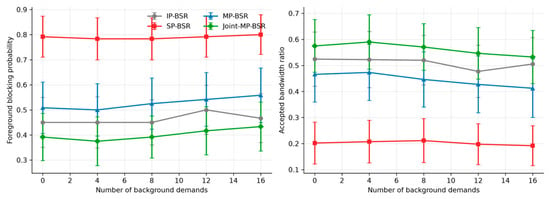
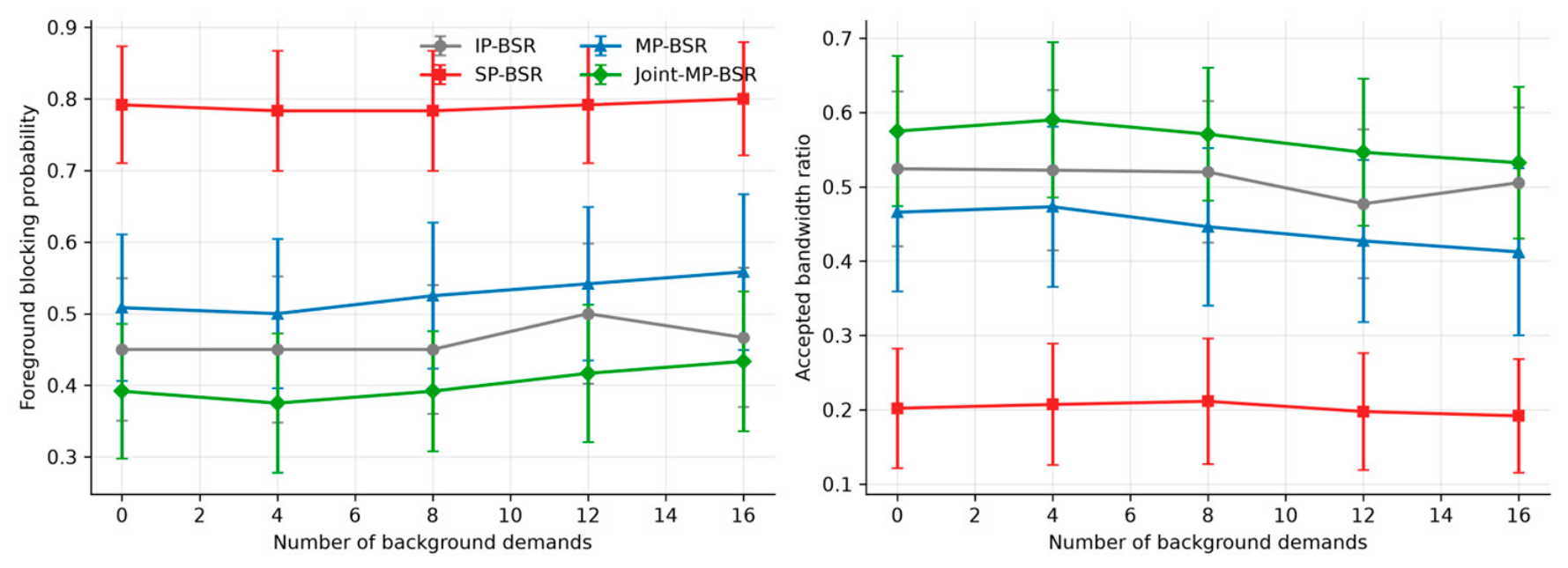
Figure 4 shows that Joint-MP-BSR has the lowest foreground protected-service blocking probability at every tested background load. As the background-demand count changes from 0 to 16, its mean blocking ranges from 0.375 to 0.433 compared with 0.450–0.500 for IP-BSR, 0.500–0.558 for MP-BSR, and 0.783–0.800 for SP-BSR. Its accepted-bandwidth ratio remains between 0.532 and 0.590, while IP-BSR achieves 0.477–0.524, MP-BSR 0.412–0.473, and SP-BSR 0.192–0.211. Adjacent-load non-monotonicity is compatible with finite replications and policy-dependent state evolution; it is not interpreted as a monotonic capacity law.
Figure 4.
Primary NSFNET online protected-service performance over 30 replications (seeds 1–30). All policies share each frozen background and foreground demand realization; points are means, and error bars are two-sided 95% Student’s t confidence intervals.
The ordering explains why optical multipath alone is insufficient in this stress setting. SP-BSR is frequently unable to place the target on one optical path, whereas MP-BSR can aggregate several paths and IP-BSR can reuse virtual capacity. Joint-MP-BSR can choose the complete IP solution or an IP-plus-optical completion. The N6S8 resource stages show that this flexibility is not cost-free: after the two admission objectives tie, joint has 10.717% conditional Tx/Rx overhead versus the policy-specific MILP, motivating a transceiver-aware tie breaker.
6.3. Paired Statistical Comparison
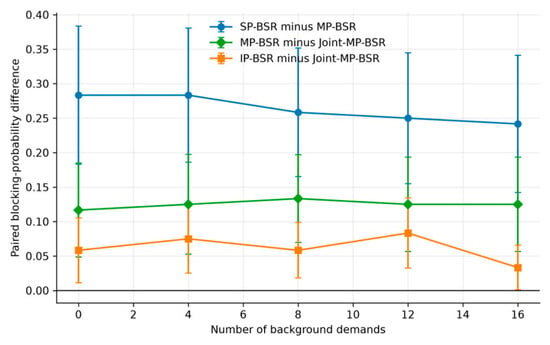
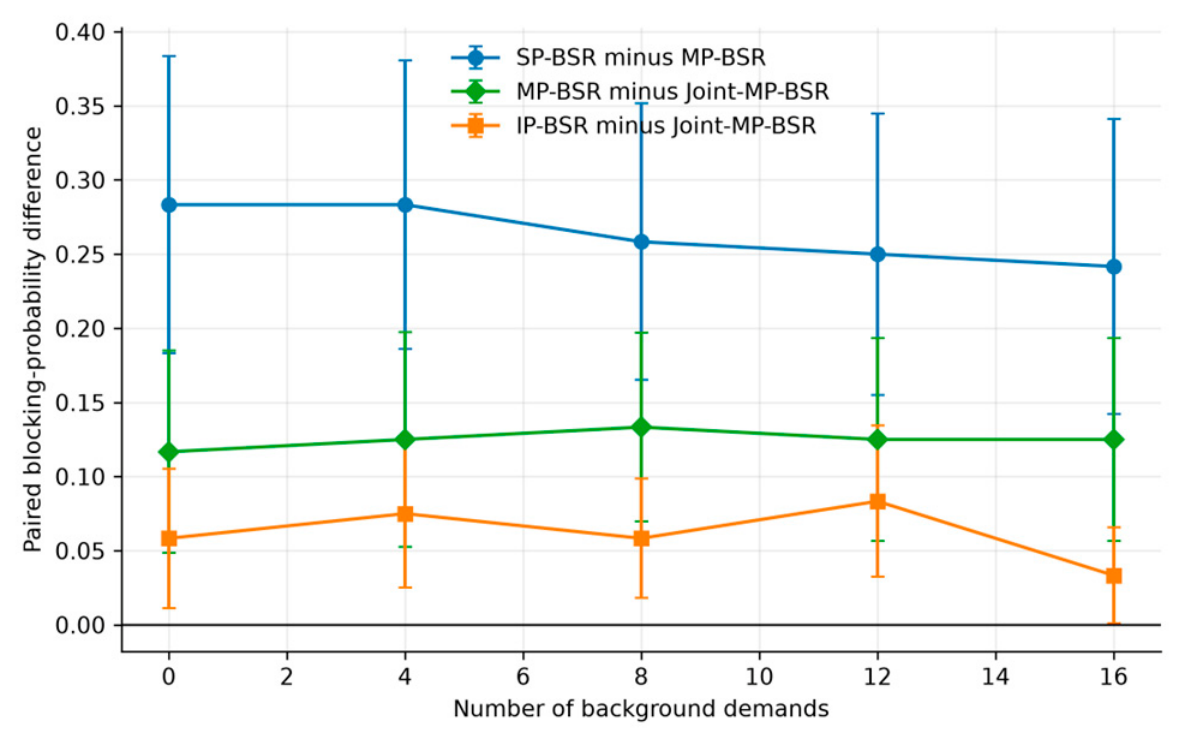
The paired analysis in Figure 5 confirms that the mean ordering is not caused by different frozen backgrounds or foreground draws. Averaged across five loads within each seed, the SP-BSR minus MP-BSR blocking difference is 0.2633 (95% CI, 0.1713–0.3553); 24 seeds favor MP-BSR and six are ties. The MP-BSR minus Joint-MP-BSR difference is 0.1250 (0.0632–0.1868), with 15 favorable seeds and 15 ties. The IP-BSR minus Joint-MP-BSR difference is 0.0617 (0.0308–0.0926), with 14 favorable seeds and 16 ties. All intervals lie above zero. Thus, multipath improves the single-path optical baseline, while the IP-first cross-layer feasible set provides an additional statistically resolved reduction relative to MP-BSR and IP-BSR in this NSFNET workload.
Figure 5.
Seed-clustered paired differences in NSFNET protected-service blocking. A positive value means that the second-named policy has lower blocking; intervals are two-sided 95% Student’s t confidence intervals over 30 seed-level averages.
6.4. Restoration Mechanism and Cross-Layer Split
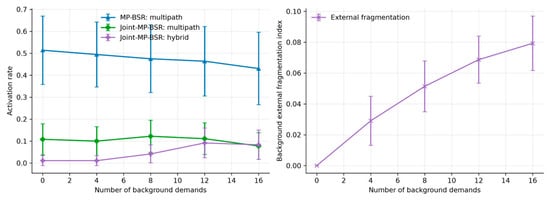
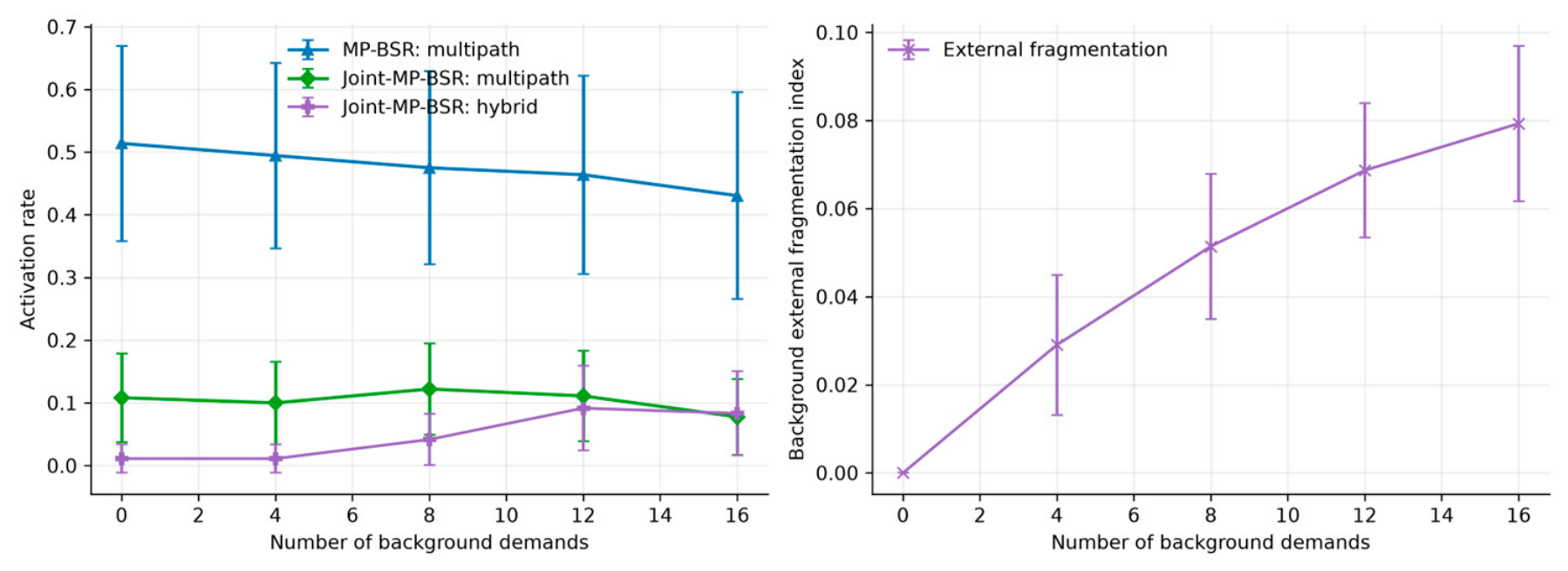
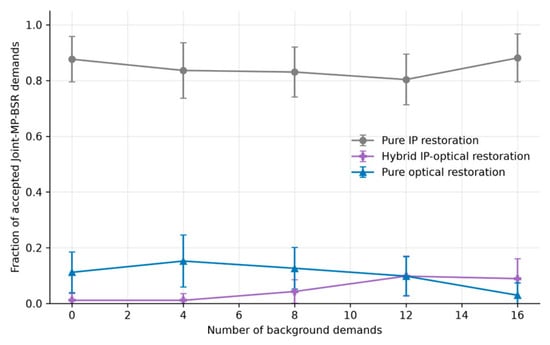
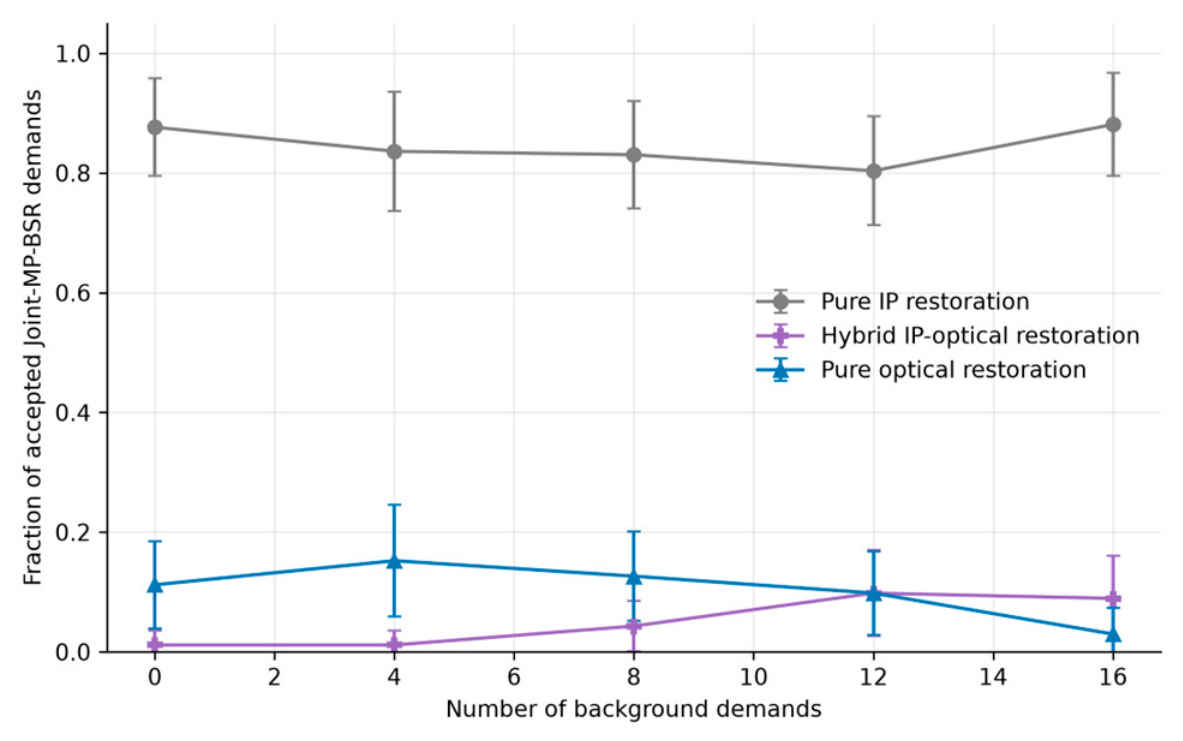
Figure 6 and Figure 7 reveal the mechanism behind the blocking reduction. Among accepted MP-BSR demands, optical multipath is triggered for approximately 43.1–51.4%. Among accepted Joint-MP-BSR demands, multipath optical completion is invoked for only about 7.8–12.2%, and the explicit hybrid-mode share rises from roughly 1.1% at light load to 8.3–9.2% at the two highest loads. In the joint composition, 80.4–88.1% of accepted demands use pure IP recovery, 1.1–9.8% use a hybrid IP–optical split, and 3.0–15.2% use pure optical recovery.
Figure 6.
Restoration-mechanism activation rates on NSFNET over 30 paired replications. MP and joint trigger rates are divided by the number of accepted demands, not by all offered attempts.
Figure 7.
Composition of accepted Joint-MP-BSR demands over 30 paired NSFNET replications: pure IP, hybrid IP–optical, and pure optical recovery modes; the denominator is accepted Joint-MP-BSR demands.
These distributions are important for interpreting the main result. Joint-MP-BSR does not assume that every restoration should consume new optical transmitter/receiver resources. Most accepted demands are completed in the IP layer; optical paths are created selectively when the IP route cannot meet B. The small hybrid fraction can still change the blocking outcome because it operates precisely on demands that would otherwise fall below the restoration threshold.
6.5. Sensitivity to the Minimum Restoration Ratio
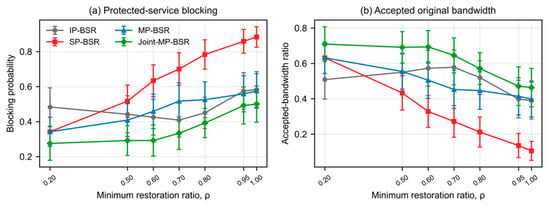
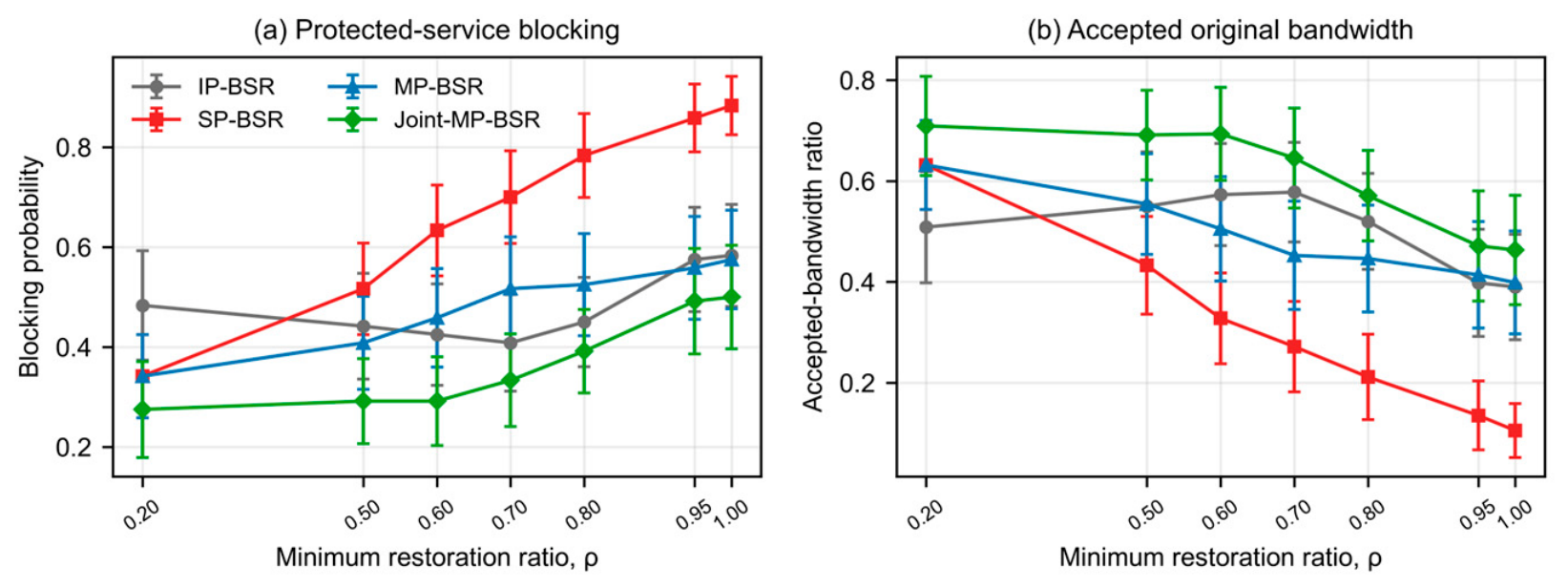
Figure 8 varies ρ from 0.20 to 1.00. Joint-MP-BSR has mean blocking probabilities of 0.275, 0.292, 0.292, 0.333, 0.392, 0.492, and 0.500 at ρ = 0.20, 0.50, 0.60, 0.70, 0.80, 0.95, and 1.00, respectively, and is lowest or tied for lowest among the three flexible policies at every tested value. Blocking generally increases as the restoration guarantee becomes stricter because fewer partial-capacity states can meet the target. Plateaus at adjacent values are consistent with discrete route, slot, and modulation feasibility. The result supports ρ = 0.80 as a demanding base case while showing that the observed ordering is not confined to one restoration ratio.
Figure 8.
Sensitivity of NSFNET online protected-service performance to the minimum restoration ratio ρ = 0.20–1.00 (30 paired replications; two-sided 95% Student’s t confidence intervals).
6.6. Candidate-Generation Sensitivity
At the base NSFNET load and ρ = 0.80, increasing the retained physical-route budget from K = 3 to 5 to 7 leaves IP-BSR blocking at 0.4500, SP-BSR at 0.7833, and Joint-MP-BSR at 0.3917. MP-BSR changes from 0.5333 at K = 3 to 0.5250 at K = 5 and remains 0.5250 at K = 7; its accepted-bandwidth ratio changes from 0.4377 to 0.4462 and then plateaus. Thus, K = 5 is saturated for the evaluated workload, while K = 3 modestly restricts MP-BSR. Policies are paired within each K value; across K values, traffic seeds are identical, and 29/30 frozen-background fingerprints match, while seed 21 differs because the candidate budget can alter background provisioning. This check reduces concerns that the base candidate budget selectively favors Joint-MP-BSR, but it does not prove insensitivity to every candidate-generation rule or unrestricted path set.
6.7. Multipath Limit and Resource-Proxy Ablation
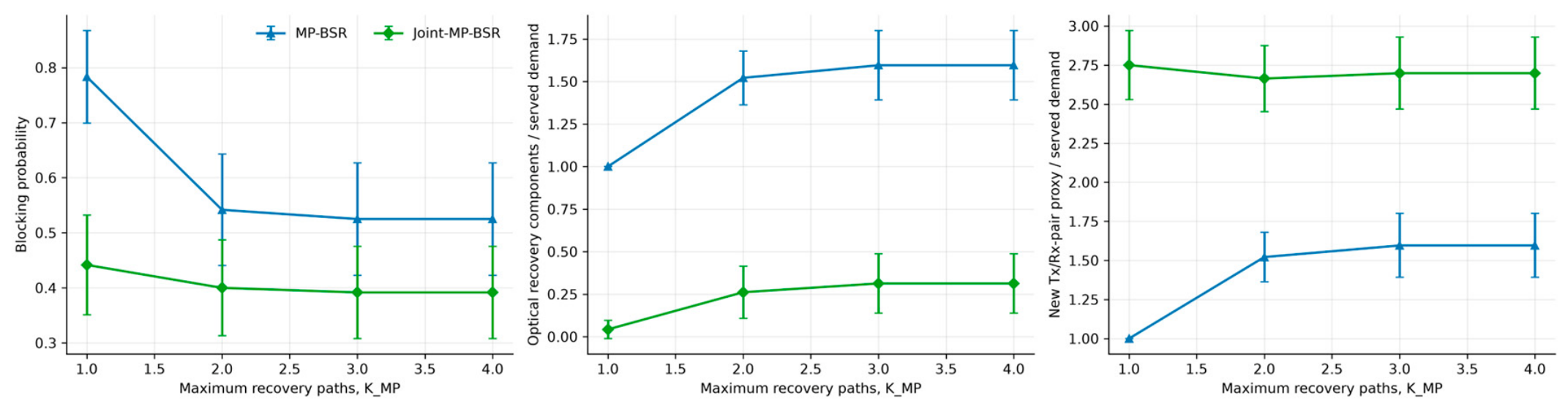
The multipath ablation in Figure 9 separates the value of splitting from the value of adding unbounded path choices. For MP-BSR, blocking falls from 0.783 at = 1 to 0.542 at = 2 and 0.525 at = 3; = 4 produces no further reduction. Joint-MP-BSR similarly improves from 0.442 to 0.400 and 0.392 and then plateaus. Hence, most of the benefit is obtained with two paths, and the residual gain is captured by the third, which justifies = 3 as the base setting. The lower panels should be interpreted as normalized resource proxies rather than a complete equipment-cost model: they reveal the resource consequences of splitting but do not assign monetary costs or model transceiver sharing beyond the implemented abstraction.
Figure 9.
Ablation of the maximum optical-path count on NSFNET, with normalized optical-resource and Tx/Rx-pair proxies (30 paired replications; 95% confidence intervals).
6.8. XT-Threshold and Lookahead Sensitivity
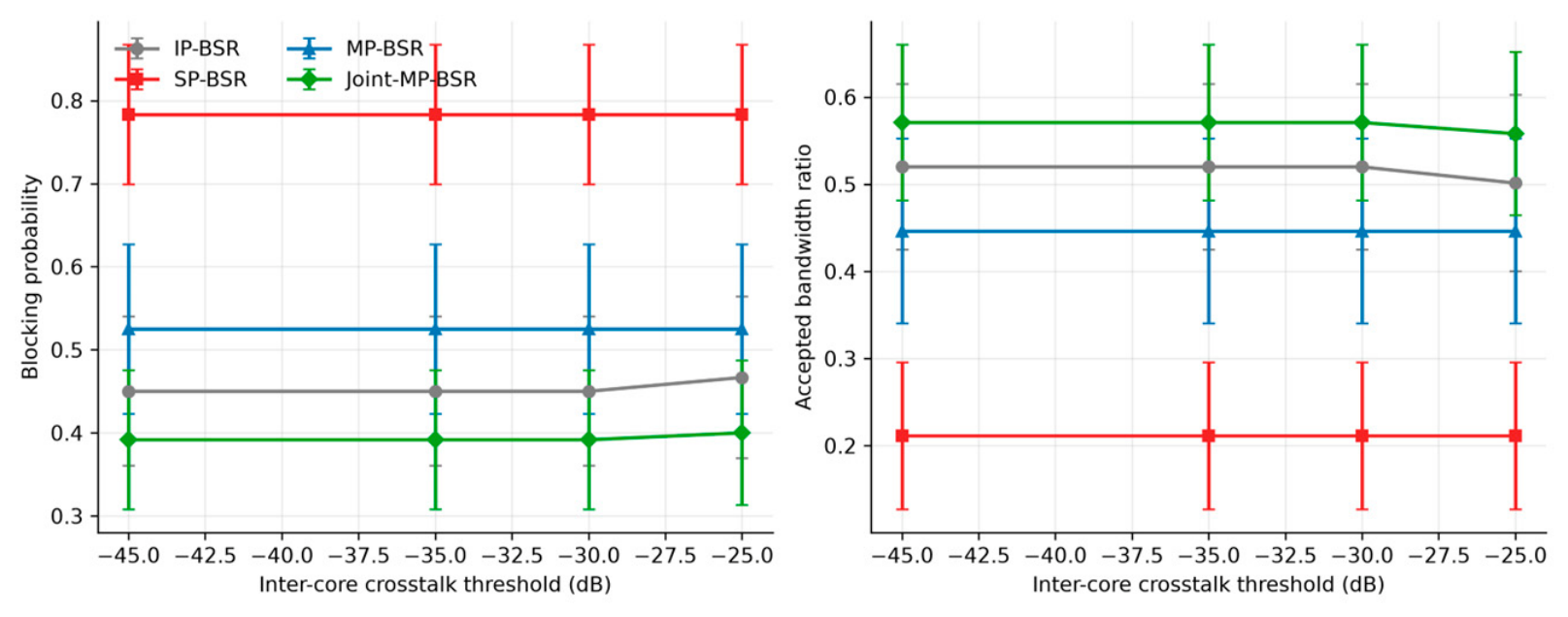
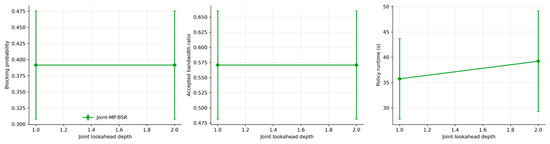
Figure 10 shows that, from −45 to −30 dB, the tested policies produce unchanged mean blocking and accepted-bandwidth ratios; at −25 dB, IP-BSR blocking changes from 0.450 to 0.467 and Joint-MP-BSR from 0.392 to 0.400, while MP-BSR and SP-BSR remain unchanged. The modulation engine jointly exercises 8-QAM, QPSK, and BPSK through their distance-dependent reach and per-slot rates. The threshold sweep is best interpreted as an aggregate XT-margin sensitivity under the fixed seven-core geometry and coupled-power model. It is not a substitute for uncertainty propagation over core pitch, bend radius, coupling coefficients, or alternative crosstalk models. Because a looser threshold cannot worsen an exact optimum, the small non-monotonic heuristic change at −25 dB is attributed to path ordering and state evolution rather than a physical claim that relaxed XT is harmful. Figure 11 reports the lookahead-depth ablation discussed below.
Figure 10.
Sensitivity to the inter-core crosstalk threshold under the same NSFNET online workload (30 paired replications; 95% confidence intervals).
Figure 11.
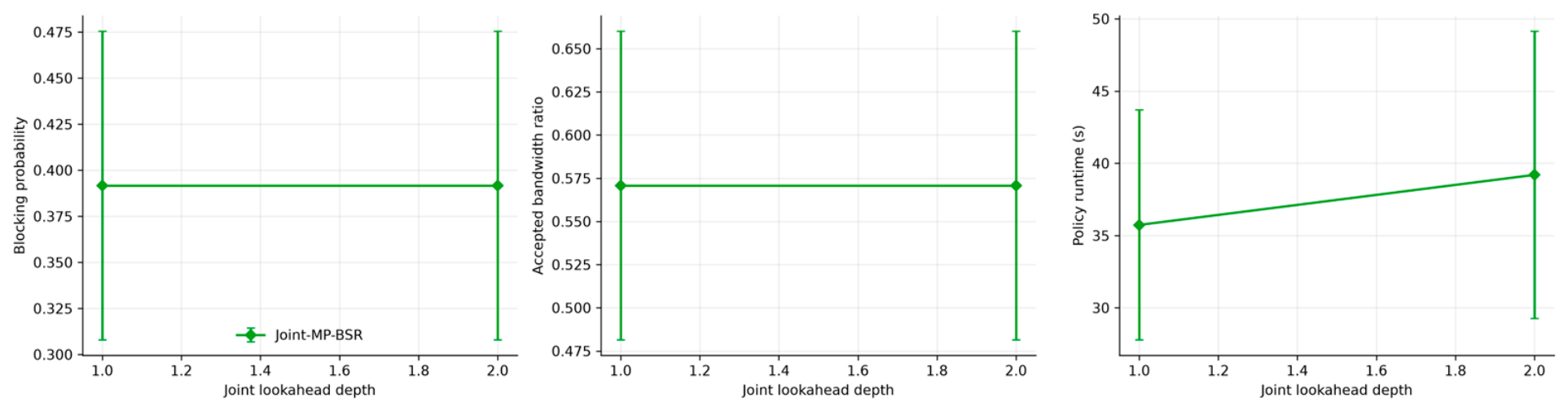
Joint-MP-BSR lookahead-depth ablation on NSFNET, including blocking, accepted bandwidth, and runtime (30 paired replications; 95% confidence intervals).
Increasing the lookahead depth from one to two does not change the observed blocking probability (0.3917) or accepted-bandwidth ratio (0.5707), while mean runtime increases from 35.74 s to 39.20 s, approximately 9.7%. The confidence intervals overlap. Accordingly, the performance gain reported in Figure 4 and Figure 5 is attributed to the IP-first hybrid/multipath mechanism, not to deeper lookahead. Depth two is retained as a conservative base configuration for future workloads with stronger cross-demand interactions, but depth one is the more economical choice for the present workload.
6.9. Topology Robustness at Matched Active Load
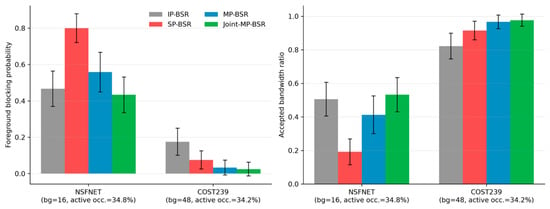
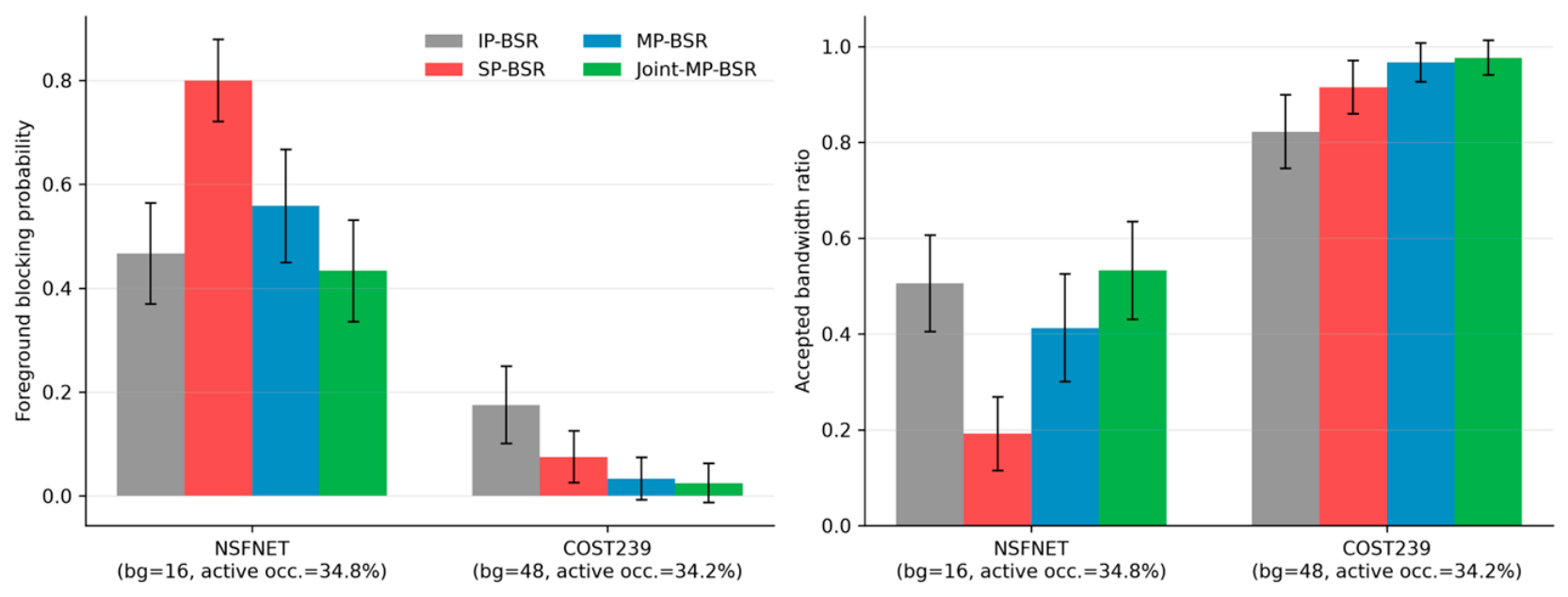
To test whether the NSFNET ordering is topology-specific (Figure 12), COST239 is evaluated at 48 background demands, yielding 34.21% mean active link-core occupancy, close to NSFNET’s 34.79% at 16 demands. On COST239, Joint-MP-BSR obtains 0.025 blocking and a 0.976 accepted-bandwidth ratio, compared with 0.175/0.822 for IP-BSR, 0.033/0.966 for MP-BSR, and 0.075/0.915 for SP-BSR. The paired IP-BSR minus Joint-MP-BSR blocking difference is 0.150 (95% CI, 0.087–0.213). The MP-BSR minus Joint-MP-BSR difference is 0.0083 (−0.0216–0.0382). The experiment therefore detects a joint advantage over IP-BSR but does not detect a statistically resolved difference between Joint-MP-BSR and MP-BSR. It neither establishes equivalence nor supports universal joint dominance.
Figure 12.
NSFNET and COST239 online protected-service comparison at matched mean active link-core occupancy. Both topologies use 30 paired replications and seven-core MCFs; error bars are two-sided 95% Student’s t confidence intervals.
6.10. Runtime, Memory, and Scalability Boundary
Across the 150 NSFNET policy runs (five loads and 30 seeds), the mean heuristic runtime is 18.36 s for IP-BSR, 4.60 s for SP-BSR, 6.22 s for MP-BSR, and 42.77 s for Joint-MP-BSR; the corresponding maxima are 55.09, 17.25, 24.03, and 215.64 s. At the matched COST239 load, means are 167.81, 41.41, 42.62, and 517.23 s, respectively, with joint reaching 800.56 s. These are implementation-specific batch wall-clock measurements, but they show that the current joint search is not suitable for sub-second reaction without offline preplanning, caching, or further pruning.
On the frozen N6S8 benchmark, mean heuristic/MILP runtimes are 0.6611/0.2608 s for IP-BSR, 0.0767/0.9219 s for MP-BSR, and 1.2509/0.9305 s for Joint-MP-BSR. All 90 finite-candidate MILPs are proven optimal with zero non-null MIP gaps. Together with the peak-memory measurements reported in Section 4.8, these data establish reproducibility only at the tested scales. Hundreds of nodes, thousands of demands, and higher-core-count/wider-spectrum MCFs remain outside the validated envelope because both candidate enumeration and crosstalk interaction counts expand sharply.
6.11. Frozen-Working-State N6S8 Heuristic–MILP Comparison
To isolate recovery planning from online working-route differences, we use 30 persisted N6S8 instances on a six-node/eight-link topology, each with four successfully established foreground working services and three active single-link failure scenarios. For each seed, IP-BSR, MP-BSR, Joint-MP-BSR, and their policy-matched MILPs receive the same frozen state and finite route/configuration pool. The candidate contract fully enumerates existing-only routes on the frozen virtual topology and adds the bounded union of New-Lightpath routes reached by three deterministic prepass orders. Seed 1 contains 225 optical configurations and 14 IP routes. Prepass computation is excluded from the reported heuristic runtime, and the result is exact only within each persisted pool.
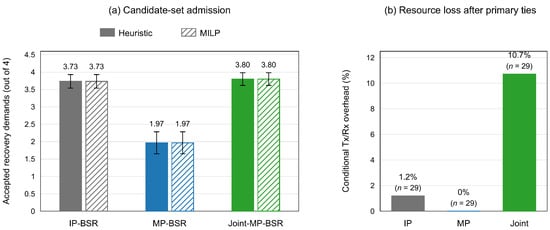
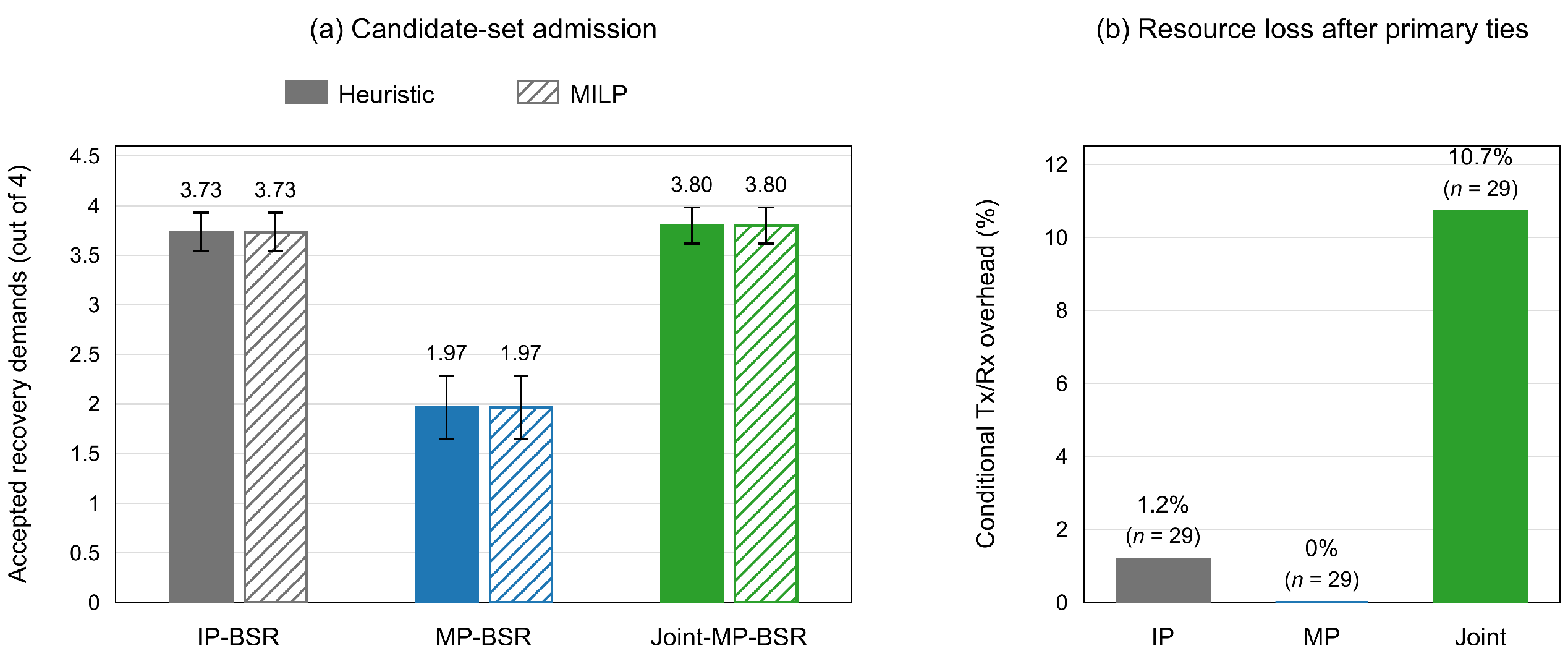
Table 4 and Figure 13 show zero admission-count gap in all 30 seeds for every policy: Heuristic/MILP totals are 112/112 for IP-BSR, 59/59 for MP-BSR, and 114/114 for Joint-MP-BSR. The accepted-bandwidth objective ties in 29/30 cases for each policy; the only gaps are 1.055% for IP-BSR and Joint-MP-BSR at seed 17 and 4.314% for MP-BSR at seed 11. Full six-stage equality holds in 24/30, 24/30, and 10/30 cases. Conditional on the two admission objectives being tied, the mean Tx/Rx overhead is 1.197% for IP-BSR (n = 29), 0% for MP-BSR (n = 29), and 10.717% for Joint-MP-BSR (n = 29). In aggregate, joint accepts two more demands than IP while using four fewer heuristic Tx/Rx pairs and four fewer slot-core-link units; relative to MP, it accepts 55 more demands, uses about 65% more Tx/Rx pairs per admitted demand and about 30% fewer slot-core-link units per admitted demand. The paired joint-minus-IP admission difference is 0.0667 demands per instance (95% CI, −0.0281–0.1614), so the N6S8 data do not resolve an admission advantage over IP; joint-minus-MP is 1.8333 (1.4786–2.1880). All 90 MILP instances reach proven optimality, all non-null MIP gaps are zero, and independent replay matches all non-timing fields.
Table 4.
Policy-matched heuristic–MILP comparison on 30 frozen N6S8 instances (SP-BSR excluded).
Figure 13.
Frozen N6S8 heuristic–MILP comparison over 30 persisted candidate-set instances. (a) Mean accepted recovery demands out of four with two-sided 95% Student’s t confidence intervals; hatched bars are policy-matched MILPs. (b) Mean heuristic Tx/Rx-pair overhead relative to the MILP, computed only after admitted-count and accepted-bandwidth objectives tie. SP-BSR is excluded.
6.12. Scope and Limitations of the Evaluation
The evaluation uses single undirected physical-link failures, fixed seven-core fibers, a four-slot NSFNET/COST239 stress configuration, four foreground demands per replication, and one fixed coupled-power XT model. COST239 changes topologies and the experiments vary traffic loads, restoration ratios, path counts, XT thresholds, and lookahead, but they do not yet form a factorial study over the core count, wide spectrum, fiber geometry, modulation uncertainty, or heterogeneous traffic classes. The online batches allow policy-specific working states to diverge; N6S8 freezes common work but uses one small topology, one load regime, ρ = 0.8, and finite candidate pools. Tx/Rx and slot quantities are resource proxies, not equipment purchase or energy models. Controller computation is measured, whereas failure detection, signaling transport, and device configuration latency are not. These boundaries prevent extrapolation to unrestricted all-path optima, hundreds-node scalability, carrier recovery time, or universal policy dominance.
7. Conclusions
This paper formulated weak survivability in IP over multi-core elastic optical networks as a minimum-bandwidth recovery problem. Joint-MP-BSR retains a complete IP-BSR branch and compares it with a flexible branch that assigns available capacity to one surviving IP route and sends only the exact residual ρB target to multipath optical recovery. The global MILP represents newly selected lightpaths inside variable-bandwidth hybrid routes, while the sequential heuristic realizes cross-demand reuse in its current state.
In 30 paired NSFNET online-provisioning replications, Joint-MP-BSR has the lowest protected-service blocking at all five background loads. The paired reduction relative to IP-BSR is 0.0617 (95% CI, 0.0308–0.0926), relative to MP-BSR, it is 0.1250 (0.0632–0.1868), and MP-BSR relative to SP-BSR is 0.2633 (0.1713–0.3553). Among accepted joint demands, 80.4–88.1% use pure IP recovery. Candidate-budget and restoration-ratio sensitivities support the base settings at the evaluated load, while the runtime measurements identify a clear cost for Joint’s broader search.
At matched active link-core occupancy on COST239, Joint-MP-BSR improves on IP-BSR, while its difference from MP-BSR is not statistically resolved. In the 30 frozen N6S8 instances, all three heuristics match their policy-specific MILP admitted count in every seed, with totals of 112/112, 59/59, and 114/114 for IP, MP, and Joint. Joint’s conditional Tx/Rx overhead is 10.717% after primary ties, but its aggregate slot-core-link footprint per admitted demand is lower than both comparators. The supported conclusion is that IP-first multipath BSR improves admission in the evaluated settings; it is neither universally dominant nor validated for carrier-scale real-time operation.
Future work will add third-party large topologies, wider spectrum and higher core counts, heterogeneous traffic classes, node and shared-risk-link-group failures, stochastic fiber/XT parameters, finite transceiver pools, calibrated energy and equipment costs, and SDN testbed measurements of detection, signaling, and device configuration time. It will also report candidate-generation time separately, expand the exact candidate universe, and develop transceiver-aware joint pruning and tie-breaking.
Author Contributions
Conceptualization, F.T., Y.W. and W.W.; methodology, F.T.; software, F.T.; validation, F.T. and Y.Z.; formal analysis, F.T.; investigation, F.T.; data curation, F.T. and Y.Z.; visualization, F.T.; writing—original draft preparation, F.T.; writing—review and editing, F.T., Y.W. and W.W.; supervision, Y.W. and W.W. All authors have read and agreed to the published version of the manuscript.
Funding
This work was supported in part by the National Natural Science Foundation of China under Grant 62201364; the Shenzhen Science and Technology Program under Grant RCBS20231211090733053; and the Shenzhen Polytechnic Research Fund under Grants 6022310017K, 6024310011K, and 1055-6024210101K1.
Institutional Review Board Statement
Not applicable. This study used computational network simulations and did not involve human participants or animals.
Data Availability Statement
Source code, deterministic seed lists, raw result tables, and frozen candidate-set instances supporting this study are available from the corresponding author upon reasonable request.
Acknowledgments
During manuscript preparation, the authors used OpenAI Codex for language editing and code–manuscript consistency checks. The authors reviewed and verified the resulting content and take full responsibility for this manuscript.
Conflicts of Interest
The authors declare no conflicts of interest.
References
- Cisco. Cisco Annual Internet Report (2018–2023) White Paper; Cisco: San Jose, CA, USA, 2020. [Google Scholar]
- Gerstel, O.; Jinno, M.; Lord, A.; Yoo, S.J.B. Elastic optical networking: A new dawn for the optical layer? IEEE Commun. Mag. 2012, 50, s12–s20. [Google Scholar] [CrossRef] [Scilit]
- Jinno, M.; Takara, H.; Kozicki, B.; Tsukishima, Y.; Sone, Y.; Matsuoka, S. Spectrum-efficient and scalable elastic optical path network. IEEE Commun. Mag. 2009, 47, 66–73. [Google Scholar] [CrossRef] [Scilit]
- Shen, G.; Zukerman, M. Spectrum-efficient and agile CO-OFDM optical transport networks. IEEE Commun. Mag. 2012, 50, 82–89. [Google Scholar] [CrossRef] [Scilit]
- Saridis, G.M.; Alexandropoulos, D.; Zervas, G.; Simeonidou, D. Survey and evaluation of space division multiplexing. IEEE Commun. Surv. Tutor. 2015, 17, 2136–2156. [Google Scholar] [CrossRef] [Scilit]
- Mizuno, T.; Takara, H.; Sano, A.; Miyamoto, Y. Dense space-division multiplexed transmission systems using multi-core and multi-mode fiber. J. Light. Technol. 2016, 34, 582–592. [Google Scholar] [CrossRef] [Scilit]
- Klinkowski, M.; Lechowicz, P.; Walkowiak, K. Survey of resource allocation schemes in spectrally-spatially flexible optical networking. Opt. Switch. Netw. 2018, 27, 58–78. [Google Scholar] [CrossRef] [Scilit]
- Koshiba, M.; Saitoh, K.; Takenaga, K.; Matsuo, S. Analytical expression of average power-coupling coefficients for estimating intercore crosstalk in multicore fibers. IEEE Photonics J. 2012, 4, 1987–1995. [Google Scholar] [CrossRef] [Scilit]
- Tang, F.; Yan, Y.; Peng, L.; Bose, S.K.; Shen, G. Crosstalk-aware counter-propagating core assignment to reduce inter-core crosstalk and capacity wastage in multi-core fiber optical networks. J. Light. Technol. 2019, 37, 5010–5027. [Google Scholar] [CrossRef] [Scilit]
- Muhammad, A.; Zervas, G.; Simeonidou, D.; Forchheimer, R. Routing, spectrum and core allocation in flexgrid SDM networks with multi-core fibers. In Proceedings of the 2014 International Conference on Optical Network Design and Modeling; IEEE: New York, NY, USA, 2014; pp. 192–197. [Google Scholar]
- Perelló, J.; Gené, J.M.; Pagès, A.; Lazaro, J.A.; Spadaro, S. Flex-grid/SDM backbone network design with inter-core XT-limited transmission reach. J. Opt. Commun. Netw. 2016, 8, 540–552. [Google Scholar] [CrossRef] [Scilit]
- Tang, F.; Shao, W.; Xiang, L.; Bose, S.K.; Shen, G. Mixed channel traffic grooming for IP over EON with SBPP-based cross-layer protection. J. Light. Technol. 2017, 35, 3836–3848. [Google Scholar] [CrossRef] [Scilit]
- Zhao, Y.; Tian, R.; Yu, X.; Zhang, J.; Zhang, J. An auxiliary graph based dynamic traffic grooming algorithm in SDM-EON with MCFs. Opt. Fiber Technol. 2017, 34, 52–58. [Google Scholar] [CrossRef] [Scilit]
- Rumipamba-Zambrano, R.; Perelló, J.; Spadaro, S. Dynamic traffic grooming in JoS-enabled flex-grid/SDM optical core networks. In Proceedings of the 2018 European Conference on Optical Communication (ECOC); IEEE: New York, NY, USA, 2018; pp. 1–3. [Google Scholar]
- Grover, W.D. Mesh-Based Survivable Transport Networks: Options and Strategies for Optical, MPLS, SONET and ATM Networking; Prentice-Hall: Upper Saddle River, NJ, USA, 2003. [Google Scholar]
- Tang, F.; Shen, G.; Rouskas, G.N. Crosstalk-aware shared backup path protection in multi-core fiber elastic optical networks. J. Light. Technol. 2021, 39, 3025–3036. [Google Scholar] [CrossRef] [Scilit]
- Oliveira, H.M.N.S.; da Fonseca, N.L.S. Protection, routing, modulation, core, and spectrum allocation in SDM elastic optical networks. IEEE Commun. Lett. 2018, 22, 1806–1809. [Google Scholar] [CrossRef] [Scilit]
- Moghaddam, E.E.; Beyranvand, H.; Salehi, J.A. Crosstalk-aware resource allocation in survivable SDM-EONs. J. Light. Technol. 2020, 38, 1095–1102. [Google Scholar] [CrossRef] [Scilit]
- Goścień, R.; Walkowiak, K. On the efficiency of survivable flex-grid SDM networks. J. Light. Technol. 2018, 36, 1815–1823. [Google Scholar] [CrossRef] [Scilit]
- Sone, Y.; Watanabe, A.; Imajuku, W.; Tsukishima, Y.; Kozicki, B.; Takara, H.; Jinno, M. Bandwidth squeezed restoration in spectrum-sliced elastic optical path networks (SLICE). J. Opt. Commun. Netw. 2011, 3, 223–233. [Google Scholar] [CrossRef] [Scilit]
- Hai, D.T.; Kassa, W.E.; Zhou, F. On three shades of partial protection in elastic optical networks. Opt. Fiber Technol. 2023, 80, 103394, Corrigendum in Opt. Fiber Technol. 2024, 82, 103574.. [Google Scholar] [CrossRef] [Scilit]
- Castro, A.; Velasco, L.; Comellas, J.; Junyent, G. On the benefits of multi-path recovery in flexgrid optical networks. Photonic Netw. Commun. 2014, 28, 251–263. [Google Scholar] [CrossRef] [Scilit]
- Zhang, L.; Li, X.; Xin, J.; Zhao, C.; Li, D.; Huang, S. A ranked partial protection scheme for degraded services in elastic optical networks. In Proceedings of the 2023 Opto-Electronics and Communications Conference (OECC); IEEE: New York, NY, USA, 2023. [Google Scholar] [CrossRef] [Scilit]
- Castro, A.; Velasco, L.; Ruiz, M.; Comellas, J. Single-path provisioning with multi-path recovery in flexgrid optical networks. In Proceedings of the 2012 IV International Congress on Ultra Modern Telecommunications and Control Systems; IEEE: New York, NY, USA, 2012; pp. 745–751. [Google Scholar][Green Version]
- Dinarte, H.A.; Assis, K.D.R.; Chaves, D.A.R.; Almeida, R.C., Jr.; Boutaba, R. Multi-objective optimization of asymmetric bit rate partitioning for multipath protection in elastic optical networks. Comput. Netw. 2024, 251, 110627. [Google Scholar] [CrossRef] [Scilit]
- Yang, H.; Cheng, L.; Yuan, J.; Zhang, J.; Zhao, Y.; Lee, Y. Multipath protection for data center services in OpenFlow-based software defined elastic optical networks. Opt. Fiber Technol. 2015, 23, 108–115. [Google Scholar] [CrossRef] [Scilit]
- de Oliveira Silva, T.; de Oliveira Perin, A.; de Oliveira Santos, E.; de Santi, J.; Figueiredo, G.B. Hybrid protection and restoration strategy for disaster-resilient EONs with differentiated degradation. Telecommun. Syst. 2026, 89, 86. [Google Scholar] [CrossRef] [Scilit]
- Sarma, A.K.; Deka, S.K.; Sarma, N. Survivable elastic optical network: A survey of failure scenarios and solutions. Opt. Switch. Netw. 2025, 58, 100823. [Google Scholar] [CrossRef] [Scilit]
- Assis, K.D.R.; Almeida, R.C.; Waldman, H.; Santos, A.F.; Alencar, M.S.; Reed, M.J.; Hammad, A.; Simeonidou, D. SLA formulation for squeezed protection in elastic optical networks considering the modulation format. J. Opt. Commun. Netw. 2019, 11, 202–212. [Google Scholar] [CrossRef] [Scilit]
- Lin, T.; Zhou, Z.; Thulasiraman, K.; Xue, G.; Sahni, S. Unified mathematical programming frameworks for survivable logical topology routing in IP-over-WDM optical networks. J. Opt. Commun. Netw. 2014, 6, 190–203. [Google Scholar] [CrossRef] [Scilit]
- Amar, D.; Le Rouzic, E.; Brochier, N.; Lepers, C. Class-of-service-based multilayer architecture for traffic restoration in elastic optical networks. J. Opt. Commun. Netw. 2016, 8, A34–A44. [Google Scholar] [CrossRef] [Scilit]
- Liu, S.; Lu, W.; Zhu, Z. On the cross-layer orchestration to address IP router outages with cost-efficient multilayer restoration in IP-over-EONs. J. Opt. Commun. Netw. 2018, 10, A122–A132. [Google Scholar] [CrossRef] [Scilit]
- Alvarez de Lima, L.; Pavani, G.S. Crosstalk- and fragmentation-aware survivable routing, modulation, space, and spectrum assignment using Ant Colony Optimization. Comput. Netw. 2024, 249, 110513. [Google Scholar] [CrossRef] [Scilit]
- Chandra, S.; Paira, S.; Singha, S.; Mondal, K. DC-LB-RSCA: A load-balanced framework for survivable routing of crosstalk-aware data center traffic in SDM-EONs. Discov. Appl. Sci. 2025, 7, 1049. [Google Scholar] [CrossRef] [Scilit]
- Oliveira, H.M.N.S.; da Fonseca, N.L.S. Spectrum overlap and traffic grooming in p-cycle algorithm protected SDM optical networks. In Proceedings of the 2018 IEEE International Conference on Communications (ICC); IEEE: New York, NY, USA, 2018; pp. 1–6. [Google Scholar]
- Tian, R.; Zhao, Y.; Zhang, J.; Yu, X.; Li, Y.; Yu, C.; Zhang, J.; Liu, C.; Zhang, G. Dynamic traffic grooming based on auxiliary graph in SDM-EON. In Proceedings of the 2016 15th International Conference on Optical Communications and Networks (ICOCN); IEEE: New York, NY, USA, 2016; pp. 1–3. [Google Scholar]
- Tang, F.; Wang, S.; Shen, G. Mixed channel traffic grooming in an SBPP-based IP over MCF-EON with minimized inter-core crosstalk. In Proceedings of the 2023 Asia Communications and Photonics Conference/2023 International Photonics and Optoelectronics Meetings (ACP/POEM); IEEE: New York, NY, USA, 2023; pp. 1–3. [Google Scholar]
- Yao, Q.; Yang, H.; Zhu, R.; Yu, A.; Bai, W.; Tan, Y.; Zhang, J.; Xiao, H. Core, mode, and spectrum assignment based on machine learning in SDM-EON. IEEE Access 2018, 6, 15898–15907. [Google Scholar] [CrossRef] [Scilit]
- Tang, F.; Li, Y.; Shen, G.; Rouskas, G.N. Minimizing inter-core crosstalk jointly in spatial, frequency, and time domains for scheduled lightpath demands in MCF-based EON. J. Light. Technol. 2020, 38, 5595–5607. [Google Scholar] [CrossRef] [Scilit]
- Jinno, M.; Takara, H.; Sone, Y.; Yonenaga, K.; Hirano, A. Multiflow optical transponder for efficient multilayer optical networking. IEEE Commun. Mag. 2012, 50, 56–65. [Google Scholar] [CrossRef] [Scilit]

Disclaimer/Publisher’s Note: The statements, opinions and data contained in all publications are solely those of the individual author(s) and contributor(s) and not of MDPI and/or the editor(s). MDPI and/or the editor(s) disclaim responsibility for any injury to people or property resulting from any ideas, methods, instructions or products referred to in the content. |
© 2026 by the authors. Licensee MDPI, Basel, Switzerland. This article is an open access article distributed under the terms and conditions of the Creative Commons Attribution (CC BY) license.