5.8 GHz Microstrip Patch Antennas for Wireless Power Transfer: A Comprehensive Review of Design, Optimization, Applications, and Future Trends

 , , , , and
Abstract
1. Introduction
2. Fundamentals of 5.8 GHz MPAs
2.1. Design Principles
2.2. Design Challenges at 5.8 GHz Antenna
2.3. Feeding Techniques Comparison
3. Comprehensive Analysis of MPA Architectures
3.1. Single-Element Designs

| Ref. | Tech. | G (dBi) | FBW (%) | η (%) | Substrate εr | Dimension | Anorm | hnorm |
|---|---|---|---|---|---|---|---|---|
| [9] | NA | 3.93 | 9.48 | 86.2 | FR4/(4.3) | 35 × 50 × 1.6 | 2.03 | 0.0545 |
| [20] | Slotting | 1.27 | 4.31 | 57 | FR-4/(4.3) | 35 × 50 × 1.6 | 2.03 | 0.0545 |
| [21] | Shorting Vias | 5 | 1.55 | 85 | Rogers5880/(2.2) | 30 × 24 × 0.787 | 0.48 | 0.0202 |
| [22] | MTM (Tx) | 11.34 | 1.72 | NA | R4730JXR/(3) | 105 × 105 × 1.52 | 9.40 | 0.0444 |
| [12] | Inset, Notch, Slot | 3.97 | 4.31 | 59 | FR-4/(4.3) | 25.5 × 23 × 1.6 | 0.68 | 0.0545 |
| [23] | Double E-shape | 7.63 | 2.17 | NA | RT5880/(2.2) | 70 × 75 × 1.575 | 3.47 | 0.0405 |
| [24] | NA | 9.33 | 4.95 | NA | RO4350/(3.66) | 60 × 60 × 1.524 | 3.64 | 0.0485 |
| [25] | NA | 4 | 79.31 | 95.9 | FR4/(4.3) | 22 × 22 × 1.5 | 0.56 | 0.0511 |
| [26] | CPW | 2.04 | 4.14 | NA | RT5880/(2.2) | 25 × 30 × 1.6 | 0.50 | 0.0412 |
| [27] | CPW | 2 | 3.45 | NA | Polyimide/(3.5) | 24 × 22 × 0.07 | 0.51 | 0.0022 |
| [28] | EBG | 11.2 | 6.47 | NA | FR4/(4.2) | 85 × 85 × 0.55 | 8.24 | 0.0186 |
| [29] | EBG | 11.4 | 6.03 | NA | FR4/(NA) | 101 × 98 × 1.6 | NA | NA |
| [30] | CPW | NA | 2.76 | NA | FR4/(4.4) | 30 × 28.4 × 1.6 | 1.01 | 0.0551 |
| [31] | NA | 0.9 | 3.45 | NA | FR4/(4.3) | 85 × 75 × 1.6 | 7.41 | 0.0545 |
| [32] | NA | 1.49 | 3.10 | NA | FR4/(4.4) | 25.5 × 22.5 × 1.6 | 0.68 | 0.0551 |
| [33] | DNG MTM Superstrate | 3.73 | 7.07 | 84 | RT5870/(2.33) RT5880/(2.2) | 70 × 60 × 1.57 70 × 56 × 0.787 | 2.98 2.59 | 0.0418 0.0202 |
| [34] | NA | 5.2 | 2.59 | NA | AD 250 (2.5) | 38 × 60 × 0.762 | 1.67 | 0.0206 |
| [35] | Multi-layer & CPW | 6.84 | 3.10 | NA | FR4/(4.4) | ∼50 × 96 | 5.70 | NA |
| [36] | NA | 3.2 | 17.24 | NA | FR4/(4.4) | NA | NA | NA |
| [37] | CPW | 4.38 | 3.79 | NA | FR-4/(4.4) | 38 × 22 × 1.6 | 0.99 | 0.0551 |
| [38] | NA | 5.2 | 3.45 | NA | FR4/(4.4) | 23.2 × 31 × 1.6 | 0.85 | 0.0551 |
| [39] | NA | 4.76 | 3.28 | 55 | FR4/(4.4) | 29 × 29 × 1.6 | 1.00 | 0.0551 |
| [40] | NA | 2.47 | 15.52 | NA | FR4/(4.4) | 10.7 × 11 × 1.6 | 0.14 | 0.0551 |
| [4] | NA | 4.2 | 38.97 | FR4/(4.4) | 40 × 40 × 1.6 | 1.90 | 0.0551 | |
| [41] | NA | 5.8 | 20.17 | 72.3 | FR4/(4.35) | 10 × 10 × 1.6 | 0.12 | 0.0549 |
| [42] | CPW | NA | 70.69 | NA | Polyimide/(3.5) | 7.8 × 7 × 0.15 | 0.05 | 0.0047 |
| [43] | EBG-backed | 7.2 | 7.76 | 85 | RT5880 & Foam/(2.2) | 32 × 32 × 3.6 | 0.68 | 0.0926 |
| [44] | DGS | 4.4 | 10.00 | NA | FR4/(NA) | 15 × 10.6 × 1 | NA | NA |
| [45] | DGS | 5.81 | 2.07 | FR4/(4.4) | 96 × 156.5 × 1.6 | 17.83 | 0.0551 | |
| [46] | CPW& DGS | 1.8 | 13.79 | NA | FR4/(4.4) | 15 × 24.5 × 1.6 | 0.44 | 0.0551 |
| [47] | Stubs and DGS | 4.17 | 3.45 | 75 | FR4/(4.4) | NA | NA | NA |
| [48] | NA | 4.866 | 6.90 | NA | FR4 (4.3) | 21.5 × 25.5 × 1.6 | 0.64 | 0.0545 |
| [49] | CPW | 8.56 | 20.69 | NA | PTF/(2.1) | 60 × 60 × 1.6 | 2.29 | 0.0404 |
| [50] | EBG | NA | 9.48 | NA | Denim/(1.7) | 62 × 97 × 0.7 | 3.26 | 0.0163 |
| [51] | NA | 11.30 | 3.28 | 90.85 | RT5880/(2.2) RO3010/(10.2) | 38 × 60 × 54.2 | 5.87 | 2.7513 |
| [52] | SPR | 11.85 | 2.24 | NA | Taconic TLY-5/(2.2) | 65 × 65 × 0.8 | 2.79 | 0.0206 |
| [53] | NA | 3.62 | 15.52 | NA | FR4/(4.4) | 14.6 × 14.6 × 0.8 | 0.25 | 0.0276 |
| [54] | CPW | 6.11 | 0.69 | 71 | TLF-35A/(3.42) | 60 × 45 × 1 | 2.58 | 0.0309 |
| [55] | CPW | 2.97 | 2.93 | 63.97 | FR4/(4.4) | 20 × 18 × 1.6 | 0.43 | 0.0551 |
| Ref. | G (dBi) | FBW (%) | η (%) | Tech | Dimension | Anorm | hnorm | |
|---|---|---|---|---|---|---|---|---|
| [7] | 2.1 | 2.76 | NA | FR-4/(4.4) | (CSRR/SRR), DGS | 40.86 × 52.16 × 1.6 | 2.53 | 0.0551 |
| [59] | 2.08 | 6.03 | 64.19 | FR4/(4.3) | NA | 28 × 26 × 1.4 | 0.85 | 0.0477 |
| [60] | 3.51 | 9.98 | NA | FR4/(4.3) | NA | 26 × 28 × 1.6 | 0.85 | 0.0545 |
| [61] | 6.49 | 1.90 | NA | RT5880/(2.2) | NA | 55.91 × 39.9 × 1.575 | 1.48 | 0.0405 |
| [62] | 5 | 17.24 | NA | FR4/(4.4) | CPW | 50 × 50 × 0.88 | 2.97 | 0.0303 |
| [63] | 3.04 | 17.24 | NA | FR4/(4.4) | CPW | 50 × 50 × 1.6 | 2.97 | 0.0551 |
| [64] | 5 | 4.71 | 59.9 | FR-4–PDMS–FR-4 /(4.5,2.65) | DGS | 30 × 30 × 2.6 | 1.09 | 0.0904 |
| [65] | 3.24 | 4.14 | 90 | RT4003/(3.55) | Pixelated DGS | 24.8 × 26 × 1.52 | 0.66 | 0.0487 |
| [66] | 6.2 | 3.28 | NA | Roger/(2.2) | SIW | 48 × 52 × 1.57 | 1.65 | 0.0404 |
| [67] | 5.48 | 5.17 | NA | FR4/(4.4) | PG | 15 × 12 × 1.6 | 0.21 | 0.0551 |
| [68] | 3.5 | 32.76 | NA | RT5870/(2.33) | CPW | 23 × 32 × 0.79 | 0.51 | 0.0208 |
| [69] | NA | NA | NA | FR4/(4.2) | NA | 56 × 62 × 1.6 | 3.96 | 0.0540 |
| [84] | 7.3 | 17.24 | NA | FR4/(4.4) | NA | 40 × 40 × 1.6 | 1.90 | 0.0551 |
| [85] | 6.33 | 3.10 | 80 | FR4/(4.3) | NA | 40 × 30 × 1.6 | 1.39 | 0.0545 |
| [86] | 2.30, 4.95 | 5.17 | 97.5,98.3 | RT5870/(2.33) | NA | 35 × 25 × 0.787 | 0.61 | 0.0207 |
| [87] | 8.55 | 9.48 | NA | FR-4/(3.4) | MTM | 32 × 25 × 1.6 | 0.76 | 0.0492 |
| [88] | 5.65, 7.39 | 4.66 | 57, 63 | Felt/(1.2) | Dual-Mode | NA | NA | NA |
| [89] | 3.8, 6.0 | 2.95 | 92, 91.7 | Rogers/(3) | E-Slot, ML | 40 × 41 × 0.5 | 1.40 | 0.0146 |
| [90] | 1.20, 7.45 | 13.10 | 80, 90 | F4B/(2.55) | Short Pins | 2463 × 5 | 1.83 | 0.1364 |
| [91] | 2.41, 5.22 | 8.79 | 90 | FR-4/(4.4) | PG | 40 × 24 × 1.6 | 1.14 | 0.0551 |
| [92] | 3.6, 4.7 | 7.76 | NA | Pyralux Flexible Laminate | Modified IFA | 77 × 14 × 0.1 | NA | NA |
| [93] | 2.5, 6.9 | 77.59 | 76, 93 | F4BM220 | Hybrid | 13 × 13 × 0.1 | 0.11 | NA |
| [94] | 6.8 | 3.28 | 80 | PLA-printed & copper/(∼2) | SRR & CSRR | 70 × 70 × 31 | 3.01 | 0.7677 |
| [95] | 4.2 | 2.59 | 88 | FR4/(4.4) | GCPW | 15 × 40 × 0.4 | 0.71 | 0.0138 |
| [96] | 3.96 | 6.03 | 69.9 | F4B/(2.65) | NA | 42.6 × 32.6 × 8 | 1.07 | 0.2217 |
| [97] | NA | 2.16 | NA | FR4/(NA) | NA | 34 × 44 | NA | NA |
| [98] | 3.7 | 24.14 | 47.6 | flexible felt/(1.43) | AMC | NA | NA | NA |
| [99] | 8.96 | 26.90 | 99 | FR4/(NA) | CPW | 15 × 30 × 1.6 | NA | NA |
| [100] | 3.5 | 15.34 | NA | FR4/(NA) | CPW | 29.5 × 29.5 × 1.6 | NA | NA |
| [101] | 2.94 | 6.90 | NA | RO4003/(3.55) | DGS | 14 × 14 × 1.52 | 0.19 | 0.0476 |
| [102] | 6.16 | 5.17 | 80 | RT5880/(2.2) | Pixelated DGS | 40 × 28 × 1.575 | 0.74 | 0.0405 |
| [103] | 2.8 | 6.90 | NA | FR4/(4.4) | DGS | 33 × 35 × 1.6 | 1.37 | 0.0551 |
| [104] | NA | 3.45 | NA | FR4/(4.4) | DGS | 41 × 44 × 1.6 | 2.14 | 0.0551 |
| [105] | 5 | 25.00 | NA | FR4/(4.3) | NA | 34 × 34 × 1.5 | 1.34 | 0.0511 |
| [106] | 6.8 | 18.45 | NA | FR4/(4.4) | FSS | 40 × 40 × 1.6 | 1.90 | 0.0551 |
| [107] | 6.27 | 15.52 | 98 | NA/(12) | DRA | 50 × 50 × 3 | 7.53 | 0.1647 |
| [108] | 4.78 | 8.62 | 83.41 | FR4/(4.4) | NA | 66 × 66 × 1.6 | 5.17 | 0.0551 |
| [109] | 4.11 | 2.76 | NA | FR4/(4.4) | DGS and Parasitic | 23 × 30 × 1.57 | 0.82 | 0.0541 |
| [110] | 3.22 | 17.24 | NA | RF30/(3.35) | CPW & SIW | 28 × 40 × 1.52 | 1.05 | 0.0465 |
| [111] | 3.1 | 7.76 | NA | FR4/(4.4) | NA | 55 × 33 × 1.6 | 2.15 | 0.0551 |
| [136] | 5.75 | 5.2 | 91.4 | RT3003/(3) | PIN diode | 41 × 44 × 1.52 | 1.54 | 0.0444 |
| Ref. | S11 (-) (dB) | G (dBi) | BW (GHz) | η (%) | Tech. | Dimension | Anorm | hnorm | |
|---|---|---|---|---|---|---|---|---|---|
| [6] | 22.3 | 4.35 | ∼0.8 | 81 | FR4/(4.3) | PG | 40 × 15 × 1.6 | 0.70 | 0.0545 |
| [70] | ∼13 | ∼1.2 | 0.6 | ∼75 | FR4/(4.4) | CPW | 21 × 21 × 1.6 | 0.52 | 0.0551 |
| [71] | 36.67 | 3.947 | 0.17 | NA | FR4/(4.4) | NA | 38.429 × 46.86 × 1.6 | 2.14 | 0.0551 |
| [72] | ∼14.5 | NA | ∼0.2 | NA | FR4/(NA) | DGS | 29.6 × 30.5×1.5 | NA | NA |
| [73] | ∼27 | ∼3.4 | ∼2.4 | NA | FR4/(4.4) | CPW | 20 × 35 × 1.6 | 0.83 | 0.0551 |
| [74] | 28.93 | 3.36 | 3.76 | 85.62 | FR4/(4.3) | ANN | 24 × 33.5 × 1.56 | 0.93 | 0.0532 |
| [112] | 23 | 9.64 | 0.21 | NA | FR4/(4.4) | Two Substrate | 40 × 42 × 1.6 | 1.99 | 0.0551 |
| [113] | ∼38 | 5.14 | 1.06 | 90 | FR4/(4.4) | Groundless EBG | 23.8 × 17.9 × 1 | 0.51 | 0.0344 |
| [114] | ∼33 | 3.48 | 0.49 | 80.19 | FR4/(4.4) | SRR & CSRR | 35 × 35 × 1.6 | 1.45 | 0.0551 |
| [115] | ∼11 | 2.99 | 0.09 | NA | FR4/(4.3) | DGS | 34 × 30 × 1.6 | 1.18 | 0.0545 |
| [117] | ∼25.5 | 6.1 | 6.5 | NA | Kappa/(4.38) | CPW | NA | NA | NA |
| [118] | ∼33 | 4.14 | 0.1 | NA | FR4/(4.4) | DGS | 35 × 27.4 × 0.8 | 1.14 | 0.0276 |
| [119] | ∼37 | 4.63 | ∼1.4 | 88 | FR4/(4.4) | NA | 32 × 20 × 1.6 | 0.76 | 0.0551 |
| [120] | ∼34 | 8.45 | 2.16 | NA | PTFE/(2.4) | NA | 49.55 × 46.5 × 1.6 | 1.63 | 0.0426 |
3.2. Ultra-Wideband Antenna (UWB)
| Ref. | G (dBi) | BW (GHz) [FBW%] | η (%) | Substrate/εr | Tech. | Dimension | Anorm | hnorm |
|---|---|---|---|---|---|---|---|---|
| [75] | 5.36 | 4.5–6.2 [31.8%] | 91.62 | FR4/(4.4) | CPW | 27.34 × 27.34 × 1.6 | 0.89 | 0.0551 |
| [76] | 4.68 | 3–7.5 [85.7%] | NA | FR4/(4.4) | CPW | 24 × 25 × 1 | 0.71 | 0.0344 |
| [77] | NA | 2.35–12.9 [138.4%] | 96 | FR4/(4.3) | NA | 32 × 36 × 1.6 | 1.34 | 0.0545 |
| [121] | 2.53 | 5–6 [18.2%] | NA | FR4/(4.4) | CPW | 24 × 40 × 1.6 | 1.14 | 0.0551 |
| [122] | 2.32 | 2–6 [100%] | NA | FR4/(4.4) | CPW | 40 × 26 × 1.6 | 1.23 | 0.0551 |
| [123] | 3.66 | NA | 93.5 | FR4/(4.5) | CPW | 25 × 25 × 0.8 | 0.76 | 0.0278 |
| [124] | 4.7 | 3.6–13.9 [118.2%] | NA | FR4/(4.4) | CPW | 27 × 25 × 1.5 | 0.80 | 0.0517 |
| [125] | 3.7 | 3.4–6.3 [58.9%] | NA | FR4/(4.3) | Parasitic Element | 20 × 28 × 0.025 | 0.65 | 0.0009 |
| [126] | NA | 5.7–8 [33.6%] | NA | FR4/(NA) | CPW | 20 × 20 × 1.5 | NA | NA |
| [127] | NA | 2–9.67 [131.5%] | NA | FR4/(4.4) | EBG on the ground | 18 × 21 × 1.6 | 0.45 | 0.0551 |
| [128] | 3.6 | 2.3–9.6 [123.5%] | NA | NA/(2.2) | DGS | 18 × 15 × 1.6 | 0.18 | 0.0412 |
| [129] | 14.3 | 5.5–5.9 [6.0%] | NA | RO4003C/(3.55) | NA | NA | NA | NA |
| [130] | NA | 2–6 [100%] | NA | FR4/(4.4) | Chip-less | 21 × 21 × 0.8 | 0.52 | 0.0276 |
3.3. Array Antenna
| Ref. | G (dBi) | BW (GHz) | η (%) | Substrate/εr | Tech. | Dimension | Anorm | hnorm |
|---|---|---|---|---|---|---|---|---|
| [8] | 7.63 | 0.458 | 97 | RT5880/(2.2) | DGS | 50 × 54 × 1.575 | 1.79 | 0.0405 |
| [31] | NA | ∼0.45 | NA | FR4/(4.3) | 2 × 1 array | 85 × 75 × 1.6 | 7.41 | 0.0545 |
| [56] | 7.78 | 0.3 | 81 | FR4/(4.4) | 2 × 2 array | 49.47 × 47.94 | 2.81 | NA |
| [57] | 12 | 0.7 | NA | RT5880/(2.2) | 4 × 4 array | 67.67 × 65.52 | 2.93 | NA |
| [78] | 9.915 | ∼0.15 | NA | RT5880/(2.2) | 2 × 1 array | 30.77 × 59.44 × 1.56 | 1.21 | 0.0401 |
| [79] | 9.83 | ∼0.9 | NA | RT5880/(2.2) | 2 × 1 array | 38.77 × 59.44 × 1.6 | 1.52 | 0.0412 |
| [80] | 8.2 | ∼0.9 | NA | RT5880/(2.2) | 2 × 2 array | 83 × 71 × 0.287 | 3.90 | 0.0074 |
| [81] | 3.21 | 0.21 | NA | FR4/(4.4) | NA | 75 × 75 × 1.5 | 6.67 | 0.0517 |
| [82] | 8.9 | ∼0.1 | 73.39 | FR4/(4.4) | 2 × 2 | NA | NA | NA |
| [132] | 9.51 | 0.1353 | NA | RT5880/(2.2) | 2 × 1 array | 70 × 50 × 0.787 | 2.32 | 0.0202 |
| [133] | 12.1 | 0.78 | NA | FR4/(4.3) | SRR 2 × 1 array | 52.5 × 67.1 × 1.48 | 4.09 | 0.0504 |
| [134] | 4.2 | ∼0.2 | NA | RO3010/(10.2) | 2 × 2 array | 27 × 36 × 1.28 | 2.50 | 0.0650 |
| [137] | 4.1 | 1.5 | 0.37 | RT3003/(3) | 2 × 1 array | 2.5 × 5 × 0.762 | 0.01 | 0.0223 |
3.4. MIMO Antennas
| Ref. | No. E | DT | II (dB) | EES | G, DG (dBi, dB) | CCL (bits/s/Hz) | ECC | (η) (%) | Substrate εr | Anorm | hnorm |
|---|---|---|---|---|---|---|---|---|---|---|---|
| [83] | 2 × 2 | SMPRG | >12 | NA | 5.2, ≥10 | <0.5 | <0.0004 | 52 | FR4 (4.4) | 1.71 | 0.0525 |
| [142] | 2 | MTM | 9 | (7 mm) | 4, ≥9 | <0.05 | <0.1 | 97 | FR4 (4.4) | 1.93 | 0.0551 |
| [143] | 2 | Zigzag (DGS) | 37.48 | 1.5, 9.783 | NA | <0.02 | NA | PTFE (3.5) | 2.44 | 0.0476 | |
| [144] | 4 × 4 | M-DGS | NA | NA | NA | NA | <0.0001 | 83 | FR4 (4.4) | 1.75 | 0.0276 |
| [145] | 1 × 4 | array | NA | NA | 8–10.9, 10 | <0.3 | <0.003 | 97.46 | RT5880 (2.2) | 0.91 | 0.0404 |
| [146] | 4 × 2 | MGS | 18 | 2 mm NA | 9.2, NA | NA | <0.02 | 73.14 | Ro4350B (3.66) | 10.67 | 0.0969 |
3.5. Critical Synthesis of Architectural Trade-Offs and Performance Metrics
3.5.1. Key Performance Trade-Offs
3.5.2. Normalized Figures of Merit for Objective Comparison
- Substrate-Limited Performance: The performance of the substrate is limited when using high-εr materials such as FR-4, which allow designers to create small devices with low Anorm values but yield low FOM1 values due to increased surface-wave losses and elevated Q-factor. The FR-4 design presented in [20] achieves a FOM1 of 0.63 dBi, whereas the Rogers RT5880 design described in [21] yields a FOM1 of 10.42 dBi, resulting in a 16.5× improvement in area-normalized gain.
- Bandwidth–Efficiency Coupling: The research indicates that FOM2 values reach their maximum when designers use proximity-coupled and CPW-fed designs on materials with low-loss properties. The results demonstrate that designers can improve bandwidth performance using design changes that do not decrease efficiency levels. The CPW-fed antenna in [75,76,124] exhibits an η × FBW of 0.268, outperforming Microstrip-fed antennas.
- Array Efficacy: The absolute gain increases with arraying, but FOM1 analysis shows that 2 × 2 arrays on FR-4 [56] only achieve FOM1 = 2.77 dBi, while optimized single elements on Rogers material achieve FOM1 values above 10 dBi. The results demonstrate that arraying as a standalone method, without substrate optimization, results in decreased performance density per unit area.
3.6. Application-Specific Antennas
3.6.1. Wearable Antennas
| Ref. | No. of Bands | G (dBi) | BW (GHz) | η (%) | SAR (1 g*/10 g) | Substrate/εr | Tech. | Dimension (mm3) | Anorm | hnorm |
|---|---|---|---|---|---|---|---|---|---|---|
| [89] | dual | 6 | 0.87 | 91.7 | 0.872* | Rogers/(NA) | Machine learning | 40 × 41 × 1.52 | NA | NA |
| [150] | dual | 5.13 | ∼1 | 92.3 | 0.13 | RO3003/(3) | NA | 41 × 44 × 1.52 | 1.54 | 0.0444 |
| [153] | dual | 3.35 | 4.5 | 82.75 | 0.511* | fabric/(1.7) | FSS | 42 × 43 × 3 | 0.98 | 0.0698 |
| [154] | dual | 3.2 | 0.22 | 91 | 0.118* | RT5880/(2.2) | NA | 7.758 × 5.17 × 0.207 | 0.03 | 0.0053 |
| [155] | dual | 6.2 | 0.46 | 93 | 0.813* | RO3003/(0.5) | Machine learning | 30 × 48.8 × 0.5 | 1.25 | 0.0146 |
| [156] | dual | 12 | 1.15 | 76.4 | 0.11 | Denim (1.72) | DGS | 22 × 22 × 1 | 0.26 | 0.0234 |
| [157] | Multi | 3.3 | 1.1 | 82.6 | 0.765* | RT5880/(2.2) | PG | 25 × 40 × 1.5 | 0.66 | 0.0386 |
| [158] | dual | 8.7 | 0.45 | 61.5 | 1.2* | Poly/(3.4) | AMC | 15.6 × 20 × 0.3 | 0.30 | 0.0092 |
| [159] | Multi | 8.2 | 0.125 | NA | 0.84* | RO4003/(3.38) | CPW | 43.2 × 43.2 × 4.6 | 1.76 | 0.1414 |
| [160] | dual | NA | ∼0.2 | NA | 0.202* | RO3003/(3) | NA | 30 × 38 × 1.52 | 0.97 | 0.0444 |
| [161] | dual | 4.29 | 0.2 | 90 | 1.56* | RT3003C/(3) | NA | 28.81 × 19.22 × 1.58 | 0.47 | 0.0461 |
| [162] | dual | 6.85 | 0.13 | NA | 0.016 | Polyi/(3.5) | 3 × 3 AMC | 59.1 × 59.1 × 4.15 | 3.40 | 0.1295 |
| [163] | dual | 7.665 | 0.43 | 96.5 | 0.33* | RO3003/(3) | 4 × 4 AMC | 86 × 86 × 1.52 | 6.31 | 0.0444 |
| [164] | Single | 8.69 | 0.6 | 80 | 0.353 | RT5880/(2.2) | 2 × 3 AMC | 15.27 × 15.27 × 2.2 | 0.15 | 0.0566 |
| [165] | Single | 9.35 | 2.2 | NA | 0.195 | Poly/(3.5) | 2 × 2 AMC | 30 × 30 × 0.1 | 0.88 | 0.0031 |
| [166] | dual | 3.17 | 0.6 | 100 | NA | Ultralam 3850/(2.9) | CPW | 35 × 20 × 0.1 | 0.59 | 0.0029 |
| [167] | dual | NA | 0.2 | NA | NA | Jeans/(1.6) | PG | 64 × 94 × 1 | 3.11 | 0.0227 |
| [168] | dual | 6.98 | 0.218 | 53.6 | 0.09* | Felt/(1.2) | NA | 100 × 100 × 2 | 4.22 | 0.0411 |
| [169] | dual | 7.75 | 0.61 | NA | 0.75 | RO 3003/(3) | 4 × 4 AMC | 90 × 90 × 33 | 6.91 | 0.9638 |
| [170] | Single | 3.87 | ∼0.6 | 65 | NA | Jeans/(1.78) | NA | 40 × 40 × 0.6 | 0.90 | 0.0142 |
| [171] | Multi | 5.2 | 2.76 | NA | NA | Jeans/(1.6) | MTM | 60 × 60 × 2 | 1.86 | 0.0455 |
3.6.2. Adaptive Capabilities: Reconfigurable Antennas at 5.8 GHz
3.6.3. Integrated Energy Harvesting: 5.8 GHz Rectenna Systems
3.7. Critical Analysis and Figures of Merit
4. Advanced Optimization Strategies for 5.8 GHz MPAs
4.1. Surface Wave Suppression: EBG and DGS
4.2. Gain Enhancement: Metamaterials and Shorting Pins
4.3. Computational Optimization: Machine Learning (ML)
4.4. Material Innovation: Nanomaterials
5. Discussion and Future Work
5.1. Performance Trade-Offs and Synthesis of Current Trends
- Gain vs. Miniaturization: The system needs high-gain applications to perform WPT across long distances and for UAV power supply, which requires array configurations to achieve gains above 12 dBi, but this method violates the core advantage of single-element MPAs, which enable portable devices to remain compact.
- Bandwidth vs. Simplicity: The main trade-off between bandwidth and simplicity stems from ML feeds remaining a popular, low-cost solution that achieves only 2–3% bandwidth utilization. The process of achieving Ultra-Wideband (UWB) operation demands sophisticated feeding structures and optimization methods (e.g., CPW feeds provide up to 40% bandwidth), which make fabrication more complicated and reduce radiation efficiency.
- Safety vs. Efficiency in Wearables: Wearables’ operational efficiency must meet their safety requirements. The Specific Absorption Rate (SAR) of wearable and implantable devices needs to be measured at 1 g levels to remain below 1.6 W/kg. Achieving this goal requires specific methods, including AMC backing and flexible substrates, but these materials and structures introduce losses that force designers to reduce both peak gain and total efficiency.
5.2. Identified Research Gaps: Barriers to Next-Generation WPT
- Directivity and Radiation Pattern Characterization: The current body of research faces two main issues: either it fails to present directivity (D) measurements, or it provides only limited information about directivity. This metric requires exact, standardized reporting because it reflects the antenna’s actual performance through its beam-forming capability and directional WPT link efficiency. The evaluation process for WPT systems becomes more complicated because detailed 3D radiation pattern analysis is often missing, which prevents the determination of beam shape and side-lobe suppression performance.
- Simulation-to-Prototype Validation: The present system fails to perform adequate validation, making it impossible for researchers to verify the accuracy of their simulated results against their experimental data. Extensive research studies rely solely on Computer Simulation Technology (CST) and High-Frequency Structure Simulator (HFSS) results. However, they fail to account for the actual differences caused by fabrication errors, soldering defects, and changes in material properties in physical prototypes.
- Comprehensive Efficiency Analysis: Evaluating complete efficiency requires researchers to study gains, but they need to develop a more comprehensive method for assessing efficiency. Future research needs to develop specific methods that will enable scientists to measure the complete system efficiency.
- SAR Standardization in Medical Applications: Medical applications (e.g., WBAN, implantable) require SAR standardization because MPAs in biomedical research face a lack of complete SAR evaluation methods. New designs must follow all established boundaries, including FCC limits of 1.6 W/kg over 1 g, and must perform complete simulations using actual multi-layer human tissue phantoms 24.
- Flexibility and Bending Characterization: The mechanical behavior of wearable antennas requires researchers to study their response to bending, folding and compression forces. The development of research methods requires studying how mechanical stress affects the electrical performance of flexible designs through impedance matching and gain measurement, while using bending radius (Rmm) as a measurement standard.
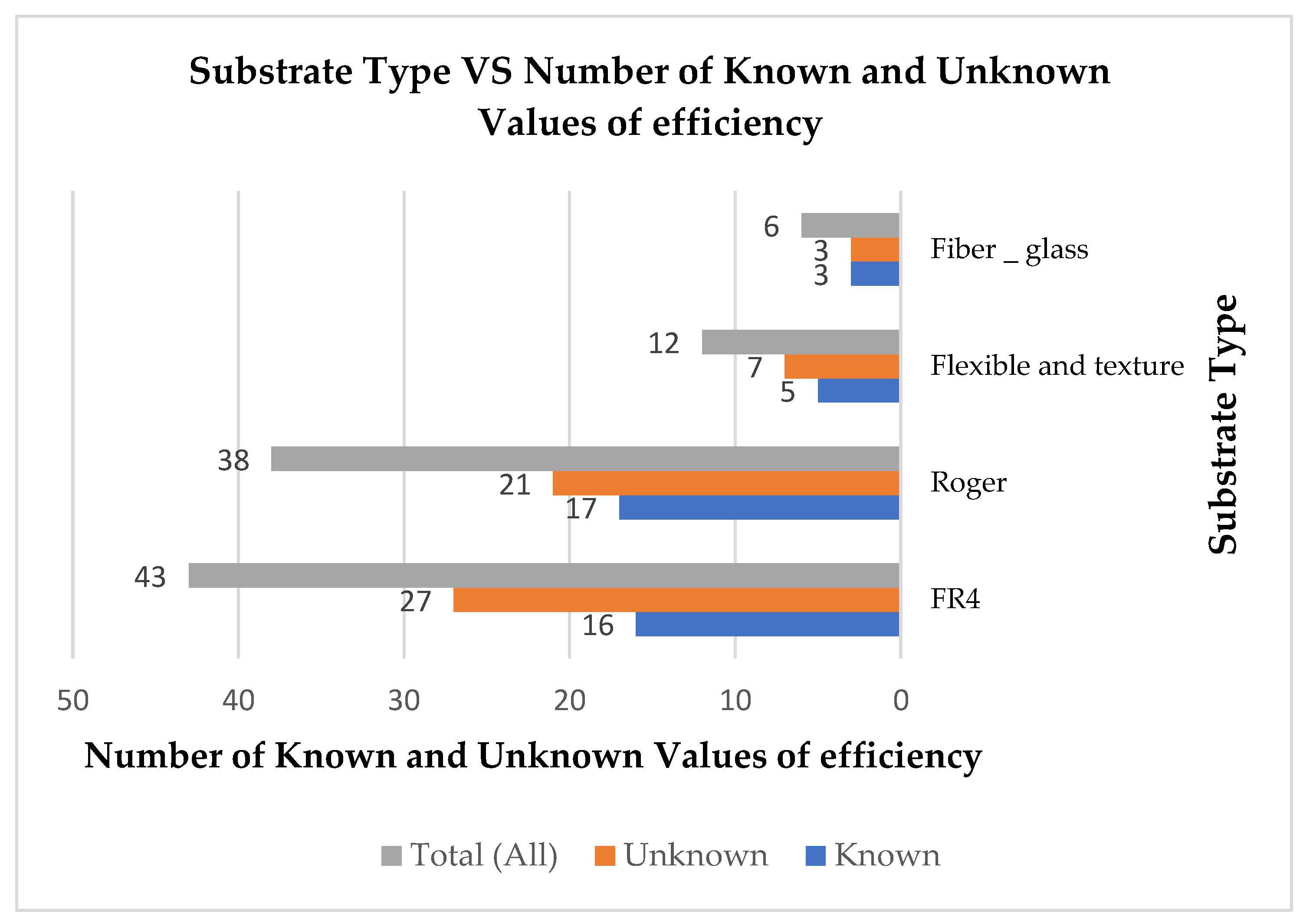
- Substrate Innovation: The current market relies heavily on standard substrate materials, including FR4 and Rogers. The need for exploratory research arises because it new materials must be identified, including nanomaterials (Graphene and CNTs) and affordable, flexible textiles (Jeans and Felt), to address the problems that standard dielectrics create.
- Machine Learning for Multi-Objective Design: The field of antenna design has not yet fully incorporated Machine Learning (ML) technology. The current applications of ML systems focus on achieving a single optimization goal, typically maximizing gain. The development of advanced ML algorithms requires immediate attention because these systems need to handle multiple opposing performance targets, including gain, bandwidth, and miniaturization, using data generated from tested prototypes.
- Intelligent Adaptive WPT Systems: The next generation of WPT needs to develop into intelligent adaptive systems that automatically track targets that move through space. The 5.8 GHz power beam of retrodirective arrays functions as a basic hardware component that uses an interrogating signal to direct the beam toward devices, thereby maximizing power delivery efficiency within the specified sector. The future development plan must focus on creating Computational Intelligence-based Adaptive Rectenna Systems, which will unite Generative Inverse Design with ML and FR/PR/RP and array technology (phased arrays/retrodirective principles) to achieve dependable power transmission in actual operational environments.
5.3. Strategic Future Research Directions
5.3.1. Advanced Hybrid Antenna Structures
- DGS/EBG Backing for Arrays: The development of compact arrays requires DGS or EBG structures that place elements under structures to improve both isolation and surface wave suppression and generate superior boresight gain than single-element integration.
- Reconfigurable Integrated Modules: The system needs to combine Frequency (FR), Polarization (PR), and Radiation Pattern (RP) reconfigurability using PIN diodes or RF-MEMs to develop an adaptive single-platform solution that operates at 5.8 GHz band.
- Shared-Aperture and Stacked Multifunctional Designs: The development of low-profile integrated modules that combine WPT with other RF functions and WLAN communication through one aperture stands as a crucial need for constructing small IoT devices. The strategic layer stacking method with shared radiator elements allows systems to operate at 5.8 GHz and surrounding frequency bands, which leads to smaller system sizes and reduced implementation costs. The development of these co-designed multifunctional platforms achieved a major advancement that surpassed the optimization of individual WPT antennas.
5.3.2. Performance-Driven Material Engineering
- Tunable Nanomaterials as Active Layers: Investigate Graphene/CNT thin films as electrically or mechanically tunable layers, enabling real-time polarization or frequency reconfigurability without discrete switches.
- 3D-Printed/Textile Substrates: Accurately characterize and model 3D-printed and flexible textile substrates to develop new design methodologies for high-performance, cost-effective, and conformal antennas. Scientists use new manufacturing approaches to create substrates and antennas because 3D printing technology has evolved through modern manufacturing developments. 3D printing technology allows users to produce complex shapes, which include curved substrates, graded dielectric structures, and embedded cavities that cannot be made with regular PCB laminates. The system enables researchers to perform new geometric optimization tasks, which include creating wearable devices through conformal wrapping and developing engineered dielectrics to improve bandwidth performance. The combination of additive manufacturing techniques with performance modeling systems will create new possibilities for antenna design, enabling the rapid development of customized high-performance 5.8 GHz WPT systems.
5.3.3. Full WPT System Integration and Verification
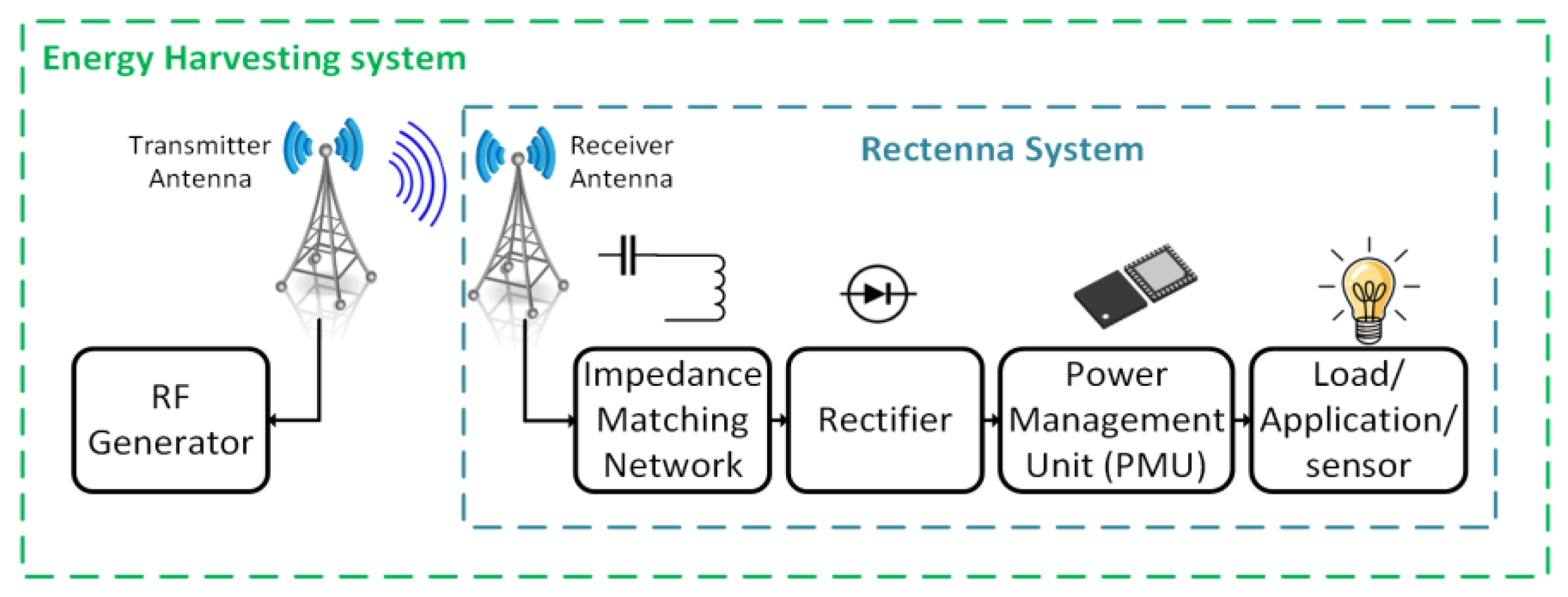
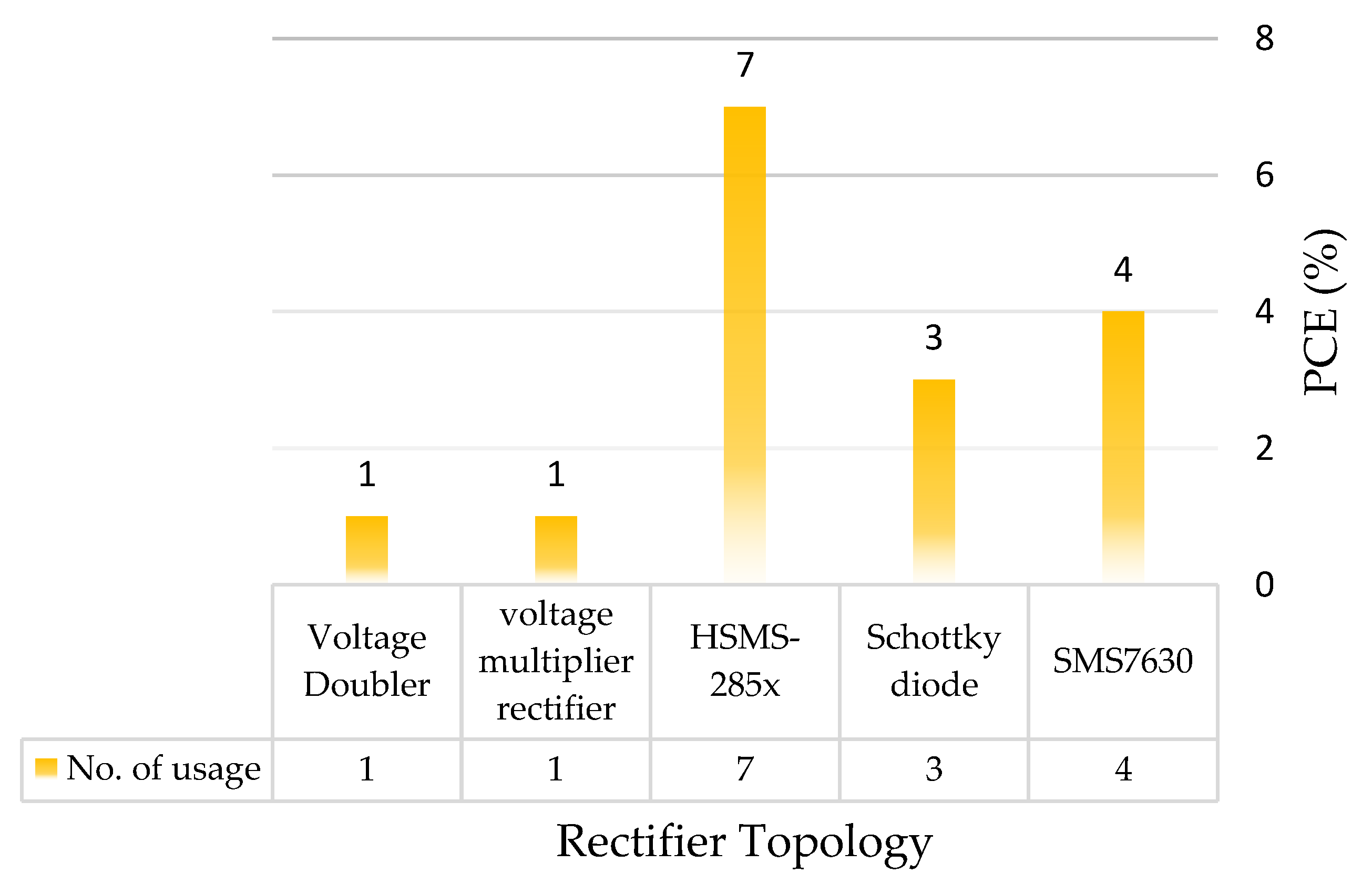
- PCE-Centric Rectenna Optimization: The primary design objective must change from achieving maximum antenna gain (G) to enhancing the complete Power Conversion Efficiency (PCE) of the rectenna system. The matching network, antenna, and rectifier circuit (including Schottky diodes) must be designed and simulated simultaneously for this to operate. The system needs to operate at its fundamental and harmonic frequencies because it achieves its highest non-linear impedance matching performance when input power density remains low, and load conditions change. The system needs to achieve its best non-linear impedance matching performance for both fundamental and harmonic frequencies under working conditions of low input power density and load changes.
- Real-World Channel and Misalignment Testing: The testing process needs to include actual operational scenarios, which include misalignment tests that go beyond anechoic chamber capabilities to evaluate system behavior under real-world conditions, such as body-worn and indoor environments with obstacles. The research needs to investigate how WPT link performance deteriorates because of the following three main factors that affect IoT and mobile applications: misalignment, channel fading, and dynamic movement.
5.3.4. Next-Generation Computational Methods
- Generative Machine Learning for Inverse Design: The inverse design problem in antenna design needs deep learning models, which include DNNs and GANs, to operate as generative machine learning tools. The model needs to generate an optimal MPA geometry that matches specific performance requirements instead of using geometry to forecast results.
- Creation of Open-Source Datasets: The research community needs to unite to create open-source datasets that will address the present challenge of lacking training data availability. The datasets need to link MPA shapes with their material properties and established performance measurements, which were both computer-simulated and physically measured.
6. Conclusions
Author Contributions
Funding
Data Availability Statement
Acknowledgments
Conflicts of Interest
Abbreviations
| IoT | Internet of Things |
| WPT | Wireless Power Transfer |
| EH | Energy Harvesting |
| PCB | Printed Circuit Board |
| MTM | Metamaterials |
| PCE | Power Conversion Efficiency |
| SIW | Substrate Integrated Waveguide |
| WLAN | Wireless Local Area Network |
| WiMAX | Worldwide Interoperability for Microwave Access |
| RFID | Radio Frequency Identification |
| WSN | Wireless Sensor Network |
| CPW | Coplanar Waveguide |
| Tx | Transmitter |
| ECC | Envelope Correlation Coefficient |
| SPR | Short Parasitic Ring |
| G | Gain |
| D | Directivity |
| SMA | Subminiature version A connector |
| η | Efficiency |
| Ref | Reference |
| PG | Partial Ground |
| Tech | Technique |
| SRR | Split-Ring Resonator |
| CSRR | Complementary Split-Ring Resonator |
| GCPW | Ground CPW |
| AMC | Artificial Magnetic Conductor |
| FSS | Frequency-Selective Surface |
| SIW | Substrate-Integrated Waveguide |
| DRA | Dielectric Resonator Antenna |
| ANN | Artificial Neural Network |
| SAR | Specific Absorption Rate |
| WBAN | Wireless Body Area Networks |
| UAVs | Unmanned Aerial Vehicles |
| SMPRG | Sharp-Edged Meander Lines Partial Ring Ground |
| M-DGS | Meandered DGS |
| MGS | Metamaterial Ground Structure |
| II | Isolation Improvement |
| EES | Edge To Edge Separation |
| DT | Decoupling Technique |
| Anorm | Normalized Area |
| hnorm | Electrical Thickness |
| R&D | Research and Development |
| tan δ | Loss Tangent |
| δ | Skin Depth |
| sheet R | Sheet Resistance |
| ABS | Acrylonitrile Butadiene Styrene |
References
- Arif, A.; Zubair, M.; Ali, M.; Khan, M.U.; Mehmood, M.Q. A compact, low-profile fractal antenna for wearable on-body WBAN applications. IEEE Antennas Wirel. Propag. Lett. 2019, 18, 981–985. [Google Scholar] [CrossRef]
- Aliqab, K.; Nadeem, I.; Khan, S.R. A Comprehensive Review of In-Body Biomedical Antennas: Design, Challenges and Applications. Micromachines 2023, 14, 1472. [Google Scholar] [CrossRef] [PubMed]
- Batra, A.K.; Alomari, A. Power Harvesting via Smart Materials; SPIE Press: Bellingham, WA, USA, 2017. [Google Scholar]
- Kodali, R.; Polepalli, S.; Prasad, M.N.G. Bandwidth enhanced deltoid leaf fractal antenna for 5.8 GHz WLAN applications. TELKOMNIKA (Telecommun. Comput. Electron. Control) 2022, 20, 963. [Google Scholar] [CrossRef]
- Guermal, M.; Zbitou, J.; Er-Rebyiy, R.; Aytouna, F.; Oukaira, A.; Oulhaj, O. A New Design of a Wideband Fractal Antenna for RF Energy Harvesting Applications at 5.8 GHz. EPJ Web Conf. 2025, 326, 01001. [Google Scholar] [CrossRef]
- Dulluc, S.; Göçen, C.; Akdag, I. 5.8 GHz Band Wi-Fi AND IoT Applications Antenna Design. ICONTECH Int. J. 2022, 6, 42–47. [Google Scholar] [CrossRef]
- Laabadli, A.-A.; Mejdoub, Y.; Elamri, A.; Tarbouch, M. Design of a miniaturized patch antenna for 2.45/5.8 GHz applications. Int. J. Adv. Appl. Sci. 2025, 14, 101–110. [Google Scholar] [CrossRef]
- Olan-Nuñez, K.N.; Murphy-Arteaga, R.S.; Colín-Beltrán, E. Miniature Patch and Slot Microstrip Arrays for IoT and ISM Band Applications. IEEE Access 2020, 8, 102846–102854. [Google Scholar] [CrossRef]
- Guneser, M.T.; Seker, C.; Guler, M.I.; Fitriyani, N.L.; Syafrudin, M. Efficient 5.8 GHz Microstrip Antennas for Intelligent Transportation Systems: Design, Fabrication, and Performance Analysis. Mathematics 2024, 12, 1202. [Google Scholar] [CrossRef]
- Albaihani, Y.; Akram, R.; Almohaimeed, A.M.; Almohaimeed, Z.M.; Buhari, L.O.; Shaban, M. Miniaturized EBG Antenna for Efficient 5.8 GHz RF Energy Harvesting in Self-Powered IoT and Medical Sensors. Sensors 2025, 25, 4777. [Google Scholar] [CrossRef]
- Fakhriddinovich, A.U.; Sufian, M.A.; Awan, W.A.; Hussain, N.; Kim, N. A Compact Antenna with Multiple Stubs for ISM, 5G Sub-6-GHz, and WLAN. IEEE Access 2023, 11, 130418–130425. [Google Scholar] [CrossRef]
- Kasinamubare, A.; Mukwewa, T. Performance Analysis of Patch Modification Techniques for Microstrip Antennas in 5.8 GHz IoT Applications. Int. J. Sci. Technol. 2025, 16, 1–14. [Google Scholar] [CrossRef]
- Khaled, Z.E.; Ajib, W.; Mcheick, H. An Accurate Empirical Path Loss Model for Heterogeneous Fixed Wireless Networks Below 5.8 GHz Frequencies. IEEE Access 2020, 8, 182755–182775. [Google Scholar] [CrossRef]
- Saravia, L.M.M.; Saravia, A.R.M.; Silva, M.M.; Gonsioroski, L. Comparing Exponential Decay Models for Path Loss Prediction at 5.8 GHz Using Machine Learning Techniques. In Proceedings of the 2024 IEEE 1st Latin American Conference on Antennas and Propagation (LACAP), Cartagena de Indias, Colombia, 1–4 December 2024; pp. 1–2. [Google Scholar] [CrossRef]
- Saravia, A.R.M.; Saravia, L.M.M.; Silva, M.M.; Ron, C.R. Comparing WINNER Path Loss Models with Machine Learning at 5.8 GHz. In Proceedings of the 2024 IEEE 1st Latin American Conference on Antennas and Propagation (LACAP), Cartagena de Indias, Colombia, 1–4 December 2024; pp. 1–2. [Google Scholar] [CrossRef]
- Amin, B.; Rehman, M.; Farooq, M.; Elahi, M.; Donaghey, K.; Wijns, W.; Shahzad, A.; Vàzquez, P. Optimizing Cardiac Wireless Implant Communication: A Feasibility Study on Selecting the Frequency and Matching Medium. Sensors 2023, 23, 3411. [Google Scholar] [CrossRef] [PubMed]
- Ma, M.-L.; Zhao, D.; Hu, Z.-J.; Wang, Y.; Liang, F.; Wang, B. Increasing Microwave Penetration Depth in the Human Body by a Complex Impedance Match of Skin Interface with a Two-Layered Medium. Electronics 2024, 13, 3915. [Google Scholar] [CrossRef]
- Kharade, S.A.; Khobragade, S.V.; Bagwari, A. An Aperture Coupled Microstrip Patch Antenna for Application at 7.5GHz. Int. J. Eng. Res. Technol. 2019, 8, 244–246. [Google Scholar]
- Prabowo, A.; Pambudiyatno, N.; Bagus Harianto, B. Microstrip Antenna Design with Patch Rectanguler for Primary Surveillance Radar (PSR) L-Band Application. J. Phys. Conf. Ser. 2021, 1845, 012033. [Google Scholar] [CrossRef]
- Srija, G.; Sagar, G.; Yashwanth, G.; Anuradha, K.; Ravi, B. 5.8 GHz Patch Antenna Design for Vehicular Communication Systems. In Proceedings of the 2025 International Conference on Computing Technologies & Data Communication (ICCTDC), Hassan, India, 4–5 July 2025. [Google Scholar]
- Prasad, C.S. Wide range of harmonics suppression of a semi-circular patch antenna using shorting vias. IEEE Antennas Wirel. Propag. Lett. 2025, 24, 2173–2176. [Google Scholar] [CrossRef]
- Yılmaz, H.Ö.; Yaman, F. Metamaterial antenna designs for a 5.8-GHz Doppler radar. IEEE Trans. Instrum. Meas. 2019, 69, 1775–1782. [Google Scholar] [CrossRef]
- Quzwain, K.; Olivia, L.N.; Rahmawati, P. Performance Analysis of a Unidirectional Double E-Shaped Microstrip Antenna in the ISM Band. J. Penelit. Pendidik. IPA 2025, 11, 1062–1067. [Google Scholar] [CrossRef]
- Wang, D.; Zhong, Z.-P.; Huang, P.; Chen, X.-D. Low-profile patch antenna with enhanced gain and bandwidth in the wireless energy transmission system at 5.8 GHz. In Proceedings of the 2020 Cross Strait Radio Science & Wireless Technology Conference (CSRSWTC), Fuzhou, China, 13–16 December 2020. [Google Scholar]
- Abid, F.A.; Al-Azzwi, F.F.; Khamees, R.A. Circular-Shaped Fractal Microstrip Patch Antenna with Square-Shaped Slots for Various Wireless Applications. In Proceedings of the 2021 Fourth International Conference on Electrical, Computer and Communication Technologies (ICECCT), Erode, India, 15–17 September 2021. [Google Scholar]
- Sharma, P.; Singh, A.K. Compact ambient RF energy harvesting CPW Fed Antenna for WLAN. In Proceedings of the 2021 5th International Conference on Trends in Electronics and Informatics (ICOEI), Tirunelveli, India, 3–5 June 2021. [Google Scholar]
- Supriya, A.; Kumar, S.A.; Shanmuganantham, T. Design of CPW Fed Antenna with Split Ring Resonator for ISM Band for Biomedical Applications. In Proceedings of the 2020 IEEE International Conference on Electronics, Computing and Communication Technologies (CONECCT), Bangalore, India, 2–4 July 2020. [Google Scholar]
- Alnaiemy, Y.; Nagy, L. Improved antenna gain and efficiency using novel EBG layer. In Proceedings of the 2020 IEEE 15th International Conference of System of Systems Engineering (SoSE), Budapest, Hungary, 2–4 June 2020. [Google Scholar]
- Alnaiemy, Y.; Nagy, L. Further Investigation of The Feasibility of Using EBG Structure-Based Microstrip Antenna for Gain Enhancement. In Proceedings of the 2020 International Conference on Radar, Antenna, Microwave, Electronics, and Telecommunications (ICRAMET), Tangerang, Indonesia, 18–20 November 2020. [Google Scholar]
- Ihlou, S.; Tizyi, H.; Bakkali, A.; El Abbassi, A.; Foshi, J. Design of a New CP Microstrip Patch Antennas for WPT to a UAV at 5.8 GHz. In Innovations in Smart Cities Applications Volume 4: The Proceedings of the 5th International Conference on Smart City Applications; Springer: Berlin/Heidelberg, Germany, 2021. [Google Scholar]
- Dou-allal, S.; Bendaoued, M.; Es-saleh, A.; Lakrit, S.; Das, S.; Faize, A. Study and Development of a Multi-band Triangular Patch Antenna for 2.45/5.8 GHz WLAN and Wi-Fi Applications. J. Nano- Electron. Phys. 2023, 15, 03014. [Google Scholar] [CrossRef]
- Atif, A.; Majid, A.; Zahid, M.; Amin, Y. Circular Slotted Triangular Patch Antenna for 5.8 GHz ISM Band Applications. Eng. Proc. 2023, 46, 10. [Google Scholar]
- Mark, R.; Rajak, N.; Mandal, K.; Das, S. Isolation and gain enhancement using metamaterial based superstrate for MIMO applications. Radioengineering 2019, 28, 689–695. [Google Scholar] [CrossRef]
- Nafea, S.N. A Single Plane Low profile Patch Antenna π-Shaped Slots and Low Side Lobe Level for Directive Wireless Communications. IOP Conf. Ser. Mater. Sci. Eng. 2023, 1291, 012046. [Google Scholar] [CrossRef]
- Yang, L.; Yang, L.; Zhu, Y.; Yoshitomi, K.; Kanaya, H. Polarization reconfigurable slot antenna for 5.8 GHz wireless applications. AEU—Int. J. Electron. Commun. 2019, 101, 27–32. [Google Scholar] [CrossRef]
- Abdellah, T.; Tajmouati, A.; Zbitou, J.; Errkik, A.; Latrach, M. A new design of a microstrip rectenna at 5.8 GHz for wireless power transmission applications. Int. J. Electr. Comput. Eng. 2019, 9, 1258–1266. [Google Scholar] [CrossRef]
- Girgiri, A.; Ain, M.F.; Pakhuruddin, M.Z.; Abdullahi, B.M.; Mahmud, M.N.; Omar, M.F.M. Design of Miniaturized On-chip Monopole Planar Antenna with loaded Interdigital Capacitor for 5.8 GHz Devices. Int. J. Electr. Comput. Eng. 2025, 17, 438–450. [Google Scholar] [CrossRef]
- Almorabeti, S.; Hanaoui, M.; Rifi, M.; Terchoune, H. Microstrip patch antennas at 5.8 GHz for wireless power transfer system to a MAV. In Proceedings of the 2nd International Conference on Computing and Wireless Communication Systems, Larache, Morocco, 14–16 November 2017. [Google Scholar]
- Das, T.K.; Mishra, D.P.; Behera, S.K. Slotted microstrip antenna for 5.8 GHz ISM band applications. In Proceedings of the 2019 International Conference on Range Technology (ICORT), Balasore, India, 15–17 February 2019. [Google Scholar]
- Bhaskar, S.; Singhal, S.; Singh, A.K. Folded-slot active tag antenna for 5.8 GHz RFID applications. Prog. Electromagn. Res. C 2018, 82, 89–97. [Google Scholar] [CrossRef]
- Mahapatra, S.; Mohanty, M.N. Slit-Loaded Hexagonal Patch for Body Area Network Applications at 5.8 GHz. Appl. Comput. Electromagn. Soc. 2021, 36, 1429–1437. [Google Scholar] [CrossRef]
- Liu, R.; Zheng, H.; Song, Z.; Wang, L.; Cui, W.; Wang, M.; Li, E. Design of wideband and flexible implantable antenna for wireless medical application. In Proceedings of the 2019 IEEE 2nd International Conference on Electronic Information and Communication Technology (ICEICT), Harbin, China, 20–22 January 2019. [Google Scholar]
- Saeed, A.; Ejaz, A.; Shahid, H.; Amin, Y.; Tenhunen, H. Robust and efficient EBG-backed wearable antenna for ISM applications. Turk. J. Electr. Eng. Comput. Sci. 2021, 29, 3036–3052. [Google Scholar] [CrossRef]
- Jung, J.-I.; Yang, J.-R. 5.8-GHz patch antenna with an enhanced defected ground structure for size reduction and increased bandwidth. J. Electromagn. Eng. Sci. 2022, 22, 245–251. [Google Scholar] [CrossRef]
- Bansode, P.S.; Wayase, S.; Tare, A. Design and Analysis of 5.8 GHz Defective Ground Structure Microstrip Patch Antenna. J. Emerg. Technol. Innov. Res. 2018, 5, 540–543. [Google Scholar]
- Mudaliar, M.; Dhanade, Y.B.; Sreelakshmi, K.; Bora, P.; Srivani, K.; Madhav, B. Slot loaded defected ground structured CPW fed antenna for ISM band applications. J. Adv. Res. Dyn. Control Syst. 2017, 9, 2346–2355. [Google Scholar]
- Pattapu, U.; Das, S. A Spurious-free 5.8 GHz circular patch antenna for rectenna applications. IETE Tech. Rev. 2018, 36, 510–516. [Google Scholar] [CrossRef]
- Jothilakshmi, P.; Mohanasundaram, R.; Iniyavan, D.; Jithin, S. Design and fabrication of 5.8 GHz ISM band microstrip patch antenna through aperture coupled feeding technique. Int. J. Emerg. Technol. Innov. 2019, 6, 449–455. [Google Scholar]
- Saranya, N.; Kesavamurthy, T. Design and performance analysis of broadband rectenna for an efficient RF energy harvesting application. Int. J. RF Microw. Comput.-Aided Eng. 2019, 29, e21628. [Google Scholar] [CrossRef]
- Keshwani, V.R.; Bhavarthe, P.P.; Rathod, S.S. Eight shape electromagnetic band gap structure for bandwidth improvement of wearable antenna. Prog. Electromagn. Res. C 2021, 116, 37–49. [Google Scholar] [CrossRef]
- Nafea, S.N. Performance Improvement for Patch Antenna Over ISM band (5.725–5.875) GHz Using Multiple Superstrates. Iraqi J. Inf. Commun. Technol. 2018, 1, 11–17. [Google Scholar] [CrossRef]
- Nguyen, D.M.; Au, N.D.; Seo, C. A microwave power transmission system using sequential phase ring antenna and inverted class F rectenna. IEEE Access 2021, 9, 134163–134173. [Google Scholar] [CrossRef]
- Ramya, C.M.; Rani, R.B. Miniaturized Spidron Fractal Wide-Slot Antenna for 5.8 GHz Active Radio Frequency Identification Tag Applications. Iran. J. Sci. Technol. Trans. Electr. Eng. 2022, 46, 935–942. [Google Scholar] [CrossRef]
- Wang, W.; Meng, L.; Ji, R.; Wang, Z.; Gao, J.; Liu, Y. A CPW-fed dual-beam shorted-patch antenna. IEICE Electron. Express 2018, 15, 20180100. [Google Scholar] [CrossRef]
- Mangal, J. RFID Reader with Miniaturized Horn Patch for Microwave Frequency Applications at 5.8 GHz. In Proceedings of the 2020 IEEE Bombay Section Signature Conference (IBSSC), Mumbai, India, 4–6 December 2020. [Google Scholar]
- Taqdeer, M.M.; Amin, Y.; Amjad, Q.M.; Zahid, M. 2 × 2 Hexagonal-Shaped Antenna Array for 5.8 GHz ISM Band Applications. In Proceedings of the 2023 7th International Multi-Topic ICT Conference (IMTIC), Jamshoro, Pakistan, 10–12 May 2023. [Google Scholar]
- Imran, A.Z.M.; Hakim, M.L.; Ahmed, M.R.; Islam, M.T.; Hossain, E. Design of microstrip patch antenna to deploy unmanned aerial vehicle as UE in 5G wireless network. Int. J. Electr. Comput. Eng. 2021, 11, 4202–4213. [Google Scholar] [CrossRef]
- El Hachimi, Y.; Arockiam, S.A.N.; Subramanian, V.; Das, S.; Farchi, A. Design of a Miniaturized Dual-Band Antenna using Slotted Techniques for 2.45/5.8 GHz Microwave Band RFID Utilizations. Eng. Technol. Appl. Sci. Res. 2025, 15, 20018–20023. [Google Scholar] [CrossRef]
- Islam, M.A.; Mohonto, N.C.; Abir, F.S.; Rahman, M.S.; Ferdous, J.; Rahman, M. A Dual Band Planar Patch Antenna for WLAN and ISM Band Applications. In Proceedings of the 2024 3rd International Conference on Advancement in Electrical and Electronic Engineering (ICAEEE), Gazipur, Bangladesh, 25–27 April 2024. [Google Scholar]
- El Hachimi, Y.; Gmih, Y.; Makroum, E.M.; Farchi, A. A compact dual-band antenna including symmetrical slots for 2.45/5.8 GHz handheld RFID reader applications. In Proceedings of the 2018 4th International Conference on Optimization and Applications (ICOA), Mohammedia, Morocco, 26–27 April 2018; pp. 1–5. [Google Scholar]
- El Mattar, S.; Baghdad, A. Design and optimization of a rectangular microstrip patch antenna for dual-band 2.45 GHz/5.8 GHz RFID application. Int. J. Electr. Comput. Eng. 2022, 12, 5114–5122. [Google Scholar] [CrossRef]
- Singh, S.K.; Singh, R.; Parashar, H.; Kavya, V. Design of CPW-Fed Circularly-Polarized Antenna with Cross Tuning Stub for WLAN/ISM Band Applications. Int. J. Comput. Sci. Eng. 2018, 6, 86–89. [Google Scholar]
- Jain, P.; Lamba, O. Parametric Analysis on a CPW Fed Novel shaped MSA. In Proceedings of the National Conference “AECD, 2018”, Jaipur, India, 9–10 March 2018. [Google Scholar]
- Shamsudin, N.A.; Shah, S. Miniaturized dual-band dual-mode microstrip patch antenna with defected ground structure for wearable applications. J. Electron. Volt. Appl. 2021, 2, 120–128. [Google Scholar] [CrossRef]
- Ullah, M.A.; Keshavarz, R.; Abolhasan, M.; Lipman, J.; Shariati, N. Low-profile dual-band pixelated defected ground antenna for multistandard IoT devices. Sci. Rep. 2022, 12, 11479. [Google Scholar] [CrossRef]
- Chaturvedi, D.; Kumar, A.; Raghavan, S. A Nested SIW Cavity-Backing Antenna for Wi-Fi/ISM Band Applications. IEEE Trans. Antennas Propag. 2019, 67, 2775–2780. [Google Scholar] [CrossRef]
- Farooq, M.U.; Saleh, H.M.; Zahid, M.; Amin, Y. Dual Band Scorpion-Shaped Antenna for 5.8 GHz ISM Band and X-Band Applications. In Proceedings of the 2023 7th International Multi-Topic ICT Conference (IMTIC), Jamshoro, Pakistan, 10–12 May 2023. [Google Scholar]
- Jarchavi, S.M.R.; Hussain, M.; Gardezi, S.H.H.; Alibakhshikenari, M.; Falcone, F.; Limiti, E. A Compact and Simple Prototype CPW-Fed Dual Band Antenna for ISM, Wi-Fi, and WLAN Applications. In Proceedings of the 2022 United States National Committee of URSI National Radio Science Meeting (USNC-URSI NRSM), Boulder, CO, USA, 4–8 January 2022. [Google Scholar]
- Aryal, B.; Pandey, M.P. Performance Analysis of Dual Band Micro Strip Patch Antenna in Varying Medical Implant Environments. 2023. Available online: https://cipn.ku.edu.np/wp-content/uploads/2023/06/CETS-04-Bimal-Aryal-PP-36-38-Web.pdf (accessed on 28 December 2025).
- Naji, D.K. Design of compact dual-band and tri-band microstrip patch antennas. Int. J. Electromagn. Appl. 2018, 8, 26–34. [Google Scholar]
- Sanil, N.; Venkat, P.A.N.; Ahmed, M.R. Design and performance analysis of multiband microstrip antennas for IoT applications via satellite communication. In Proceedings of the 2018 Second International Conference on Green Computing and Internet of Things (ICGCIoT), Bangalore, India, 16–18 August 2018. [Google Scholar]
- AlShaikhli, N.Q.A.; Neamah, M.A.; Aal-Nouman, M. Design of triband antenna for telecommunications and network applications. Bull. Electr. Eng. Inform. 2022, 11, 1084–1090. [Google Scholar] [CrossRef]
- Tiwari, R.; Yogi, L.; Bagwari, A.; Kushwah, V.S. Design and Performance Analysis of a Triple Band Micro-Strip Patch Antenna with CPW-Fed. Int. J. Wirel. Microw. Technol. 2019, 9, 36–42. [Google Scholar] [CrossRef]
- Aguni, L.; El Yassini, A.; Chabaa, S.; Ibnyaich, S.; Zeroual, A. Design of a symmetric CPW-fed patch antenna for WLAN/WIMAX applications using ANN. Wirel. Pers. Commun. 2020, 115, 439–456. [Google Scholar] [CrossRef]
- Indhuja, N.H.; Sathiyapriya, T.; Gurunathan, V.; Monasri, A.; Sathish, K.S.; Selvaraj, V. Design of High Gain Compact Microstrip Patch Antenna at ISM Band. J. Nano- Electron. Phys. 2023, 15, 04011. [Google Scholar]
- Muzaffar, S.; Turab, D.; Zahid, M.; Amin, Y. Dual-Band UWB Monopole Antenna for IoT Applications. Eng. Proc. 2023, 46, 29. [Google Scholar]
- Rao, P.K.; Singh, K.J.; Mishra, R. A circular shaped microstrip patch antenna for bluetooth/Wi-Fi/UWB/X-band applications. In Proceedings of the 2018 International Conference on Power Energy, Environment and Intelligent Control (PEEIC), Greater Noida, India, 13–14 April 2018. [Google Scholar]
- Ouazzani, O.; Bennani, S.D.; Jorio, M. Design and Simulation of two elements rectangular Microstrip Patch Antenna at 5.8 GHz for RFID Reader Applications with high Directivity and Gain. In Proceedings of the 2018 6th International Conference on Multimedia Computing and Systems (ICMCS), Rabat, Morocco, 10–12 May 2018. [Google Scholar]
- El Ouadi, Z.; Amadid, J.; Khabba, A.; El Yassini, A.; Ibnyaich, S.; Zeroual, A. Compact 2*1 reader array antenna operating in ISM band for RFID applications. E3S Web Conf. 2022, 351, 01050. [Google Scholar] [CrossRef]
- Salelkar, S.S.; Kerkar, P. 5.8 GHz Semi Slotted Patch Antennas For ISM Band Applications. Int. Res. J. Eng. Technol. 2019, 6, 3791–3794. [Google Scholar]
- Mishra, A.; Khan, A.; Dubey, S. Series fed Circular patch Antenna 3x1 array for C Band Applications. In Proceedings of the 2023 IEEE Wireless Antenna and Microwave Symposium (WAMS), Ahmedabad, India, 7–10 June 2023. [Google Scholar]
- Kumar, D.; Chaudhary, K. 5.8-GHz Antenna Array Design for Satellite Solar Power Station. In Advances in Smart Grid and Renewable Energy; Springer: Berlin/Heidelberg, Germany, 2018; pp. 659–666. [Google Scholar]
- Chouhan, S.; Panda, D.K.; Gupta, M.; Singhal, S. Meander line MIMO antenna for 5.8 GHz WLAN application. Int. J. RF Microw. Comput.-Aided Eng. 2018, 28, e21222. [Google Scholar] [CrossRef]
- Singh, N.; Kanaujia, B.K.; Beg, M.T.; Mainuddin; Kumar, S.; Khandelwal, M.K. A dual band rectifying antenna for RF energy harvesting. J. Comput. Electron. 2018, 17, 1748–1755. [Google Scholar] [CrossRef]
- Ahmad, S.; Ghaffar, A.; Hussain, N.; Kim, N. Compact dual-band antenna with paired L-shape slots for on-and off-body wireless communication. Sensors 2021, 21, 7953. [Google Scholar] [CrossRef]
- Sandhya, R.; Chandra, A. A Compact Tree-Shaped Dual-Band Wearable Antenna with Enhanced Far-Field Performance for WBAN Applications. IEEE Access 2025, 13, 152241–152252. [Google Scholar] [CrossRef]
- Sathiyapriya, T.; Sudhakar, R.; Gurunathan, V.; Sandhya, P.; Kiruthika, T.; Teena Infancia, J. Design and Analysis of a Metamaterial-Loaded Circularly Polarized Microstrip Antenna with WLAN Band Integrating PLM. In Proceedings of the 2025 5th International Conference on Soft Computing for Security Applications (ICSCSA), Salem, India, 4–6 August 2025. [Google Scholar]
- Gao, G.-P.; Guo, W.-D.; Wang, X.; Xia, J.-J.; Hu, B. Omni-/Unidirectional Dual-Mode Dual-polarized Wearable Antenna for IoT Applications. IEEE Open J. Antennas Propag. 2025, 6, 1972–1979. [Google Scholar] [CrossRef]
- Musa, U.; Smida, A.; Yahya, M.S.; Waly, M.I.; Tiang, J.J.; Mallat, N.K.; Muhammad, S.; Salisu, A. Machine learning-optimized dual-band wearable antenna for real-time remote patient monitoring in biomedical IoT systems. Sci. Rep. 2025, 15, 30943. [Google Scholar] [CrossRef] [PubMed]
- Zhang, W.; Li, W.; Feng, X.; Zhao, C.; Li, Y.; Liao, X. Design of a Compact Dual-Band and Dual-Mode Wearable Antenna for WBAN Applications. Sensors 2025, 25, 3361. [Google Scholar] [CrossRef] [PubMed]
- Assogba, O.; Bréard, A.; Duroc, Y. A New Low-Cost Compact Antenna for the 2.45 and 5.8 GHz ISM Bands. Appl. Sci. 2025, 15, 1912. [Google Scholar] [CrossRef]
- Januszkiewicz, Ł. Dual-Band Wearable Antenna Integrated with Glasses for 5G and Wi-Fi Systems. Appl. Sci. 2025, 15, 8018. [Google Scholar] [CrossRef]
- Li, X.-P.; Zhang, X.-L.; Yang, X.-Q.; Dong, Z.-Y.; Feng, X.-M.; Li, W. A Compact Dual-Band Dual-Mode Wearable Button Antenna for WBAN Applications. Micromachines 2025, 16, 975. [Google Scholar] [CrossRef]
- Olan-Nuñez, K.N.; Murphy-Arteaga, R.S. Dual-band antenna on 3D-printed substrate for 2.4/5.8 GHz ISM-band applications. Electronics 2023, 12, 2368. [Google Scholar] [CrossRef]
- Wong, K.-L.; Chang, H.-J.; Wang, C.-Y.; Wang, S.-Y. Very-low-profile grounded coplanar waveguide-fed dual-band WLAN slot antenna for on-body antenna application. IEEE Antennas Wirel. Propag. Lett. 2019, 19, 213–217. [Google Scholar] [CrossRef]
- Zhang, P.; Yi, H.; Liu, H.; Yang, H.; Zhou, G.; Li, L. Back-to-back microstrip antenna design for broadband wide-angle RF energy harvesting and dedicated wireless power transfer. IEEE Access 2020, 8, 126868–126875. [Google Scholar] [CrossRef]
- Sasikala, T.; Arunchandar, R.; Bhagyaveni, M.; Shanmuga Priya, M. Design of dual-band antenna for 2.45 and 5.8 GHz ISM band. Natl. Acad. Sci. Lett. 2019, 42, 221–226. [Google Scholar] [CrossRef]
- Dey, A.; Bhattacharjee, S.; Chaudhuri, S.B.; Mitra, M. A dual band flexible antenna on AMC ground for wearable applications. In Proceedings of the 2019 IEEE Asia-Pacific Microwave Conference (APMC), Singapore, 10–13 December 2019. [Google Scholar]
- Awan, W.A.; Ghaffar, A.; Hussain, N.; Li, X.J. CPW-fed dual-band antenna for 2.45/5.8 GHz applications. In Proceedings of the 2019 8th Asia-Pacific Conference on Antennas and Propagation (APCAP), Singapore, 10–13 December 2019. [Google Scholar]
- Tarbouch, M.; El Amri, A.; Terchoune, H. Design, realization and measurements of compact dual-band CPW-fed patch antenna for 2.45/5.80 GHz RFID applications. Int. J. Electr. Comput. Eng. 2018, 8, 172. [Google Scholar] [CrossRef][Green Version]
- Mao, Y.; Guo, S.; Chen, M. Compact dual-band monopole antenna with defected ground plane for Internet of things. IET Microw. Antennas Propag. 2018, 12, 1332–1338. [Google Scholar] [CrossRef]
- Derbal, M.C.; Nakmouche, M.F.; Nedil, M.; Amma, A.; Fawzy, D.E.; Sree, M.F.A. Dual Band Antenna Design Using Pixeled DGS for Energy Harvesting Applications. In Proceedings of the 2022 9th International Conference on Electrical and Electronics Engineering (ICEEE), Alanya, Turkey, 29–31 March 2022. [Google Scholar]
- Elhamraoui, A.; Abdelmounim, E.; Zbitou, J.; Bennis, H.; Latrach, M. A new design of a microstrip antenna with modified ground for RFID applications. Int. J. Intell. Eng. Syst. 2018, 11, 44–51. [Google Scholar] [CrossRef]
- Amjad, O.; Munir, S.W.; Imeci, S.T.; Ercan, A.Ö. Design and implementation of dual band microstrip patch antenna for WLAN energy harvesting system. Appl. Comput. Electromagn. Soc. J. 2018, 33, 746–751. [Google Scholar]
- Belgacem, W.; Bousahla, M.; Meriah, S.M. A novel compact dual band RFID handheld reader antenna for microwave ISM band application. Indones. J. Electr. Eng. Comput. Sci. 2021, 23, 321–329. [Google Scholar] [CrossRef]
- Fernandes, E.M.F.; da Silva, M.W.B.; da Silva Briggs, L.; de Siqueira Campos, A.L.P.; de Araújo, H.X.; Casella, I.R.S.; Capovilla, C.E.; Souza, V.P.R.M.; de Matos, L.J. 2.4–5.8 GHz dual-band patch antenna with FSS reflector for radiation parameters enhancement. AEU—Int. J. Electron. Commun. 2019, 108, 235–241. [Google Scholar] [CrossRef]
- Ranjan, P.; Sharma, A.; Gangwar, R.K. Experimental investigation on probe feed equilateral triangular dielectric resonator antenna for 5.8 GHz ISM band (IEEE 802.11). In Proceedings of the 2017 Progress in Electromagnetics Research Symposium-Spring (PIERS), St. Petersburg, Russia, 22–25 May 2017. [Google Scholar]
- Biswas, P.; De, S.; Bag, B.; Chanda Sarkar, D.; Biswas, S.; Sarkar, P.P. Dual ISM band printed antenna with omnidirectional radiation pattern and better radiation efficiency. Int. J. RF Microw. Comput.-Aided Eng. 2019, 29, e21780. [Google Scholar] [CrossRef]
- Ataş, İ.; Abbasov, T.; Kurt, M.B. Development of a High Gain, Dual-Band and Two-Layer Miniaturized Microstrip Antenna for 5.8 GHz ISM and 10 GHz X-Band Applications. Appl. Comput. Electromagn. Soc. J. 2019, 34, 1568–1575. [Google Scholar]
- Mira, F.; Llamas-Garro, I. A CPW-SIW Planar Dual-Band Antenna for ISM Applications. Parameters 2020, 1, t2. [Google Scholar]
- Biswas, P.; De, S.; Sarkar, D.C.; Biswas, S.; Sarkar, P.P. A High Gain Dual ISM Band Monopole Printed Antenna for WLAN Applications with Omnidirectional Radiation Pattern. Acta Tech. Napoc. 2018, 59, 9–12. [Google Scholar]
- Remya, V.R.; Abraham, M.; Parvathy, A.R.; Mathew, T. Multiband circularly polarised microstrip patch antenna with Minkowski fractal slot for wireless communications. Prog. Electromagn. Res. C 2021, 116, 65–80. [Google Scholar] [CrossRef]
- Laskar, M.I.; Basu, B.; Nandi, A. A multiband slot antenna with groundless EBG structure for wearable WLAN/WiMAX applications. Int. J. Electron. 2024, 111, 1920–1935. [Google Scholar] [CrossRef]
- Allin Joe, D.; Krishnan, T. A Triband Compact Antenna for Wireless Applications. Int. J. Antennas Propag. 2023, 2023, 344999. [Google Scholar] [CrossRef]
- Ibrahim, A.; Fazil, N.A.; Dewan, R. Triple-band antenna with defected ground structure (DGS) for WLAN/WiMAX applications. J. Phys. Conf. Ser. 2020, 1432, 012071. [Google Scholar] [CrossRef]
- Samir, A.; Fawzy, A.; Abd El Kader, H.M. Design of a Multi-Band U-Slot Microstrip Patch Antenna. IOSR J. Electron. Commun. Eng. 2019, 14, 8735. [Google Scholar]
- Taha, B.S. Design of quad band microstrip patch antenna for electromagnetic energy harvesting applications. J. Southwest Jiaotong Univ. 2019, 54, 1–9. [Google Scholar] [CrossRef]
- Chakraborty, M.; Chakraborty, S.; Reddy, P.S.; Samanta, S. High performance DGS integrated compact antenna for 2.4/5.2/5.8 GHz WLAN band. Radioengineering 2017, 26, 71–77. [Google Scholar] [CrossRef]
- Mohamed, H.A.; Sultan, K. Quad band monopole antenna for IoT applications. In Proceedings of the 2018 IEEE International Symposium on Antennas and Propagation & USNC/URSI National Radio Science Meeting, Boston, MA, USA, 8–13 July 2018. [Google Scholar]
- Mondal, K.; Murmu, L. A High Gain Broadband Modified Patch Antenna for ISM band/WLAN/WiMAX Applications. Wirel. Pers. Commun. 2021, 117, 2173–2192. [Google Scholar] [CrossRef]
- Fertas, F.; Challal, M.; Fertas, K. Design and implementation of a miniaturized CPW-fed microstrip antenna for triple-band applications. In Proceedings of the 2017 5th International Conference on Electrical Engineering-Boumerdes (ICEE-B), Boumerdes, Algeria, 29–31 October 2017. [Google Scholar]
- El Zoghbi, M.; Hamad, V.A.; Ibrahim, R.; Breard, A.; Zgheib, C.; Nassar, E.; Zaatar, Y. A wideband V-shaped coplanar patch antenna for 2-6 GHz designed for energy harvesting and wireless communications. Int. J. Commun. Antenna Propag. 2018, 8, 406. [Google Scholar] [CrossRef]
- Eltresy, N.A.; Elsheakh, D.N.; Abdallah, E.A.; Elhennawy, H.M. RF energy harvesting using transparent antenna for IoT application. In Proceedings of the 2019 International Conference on Innovative Trends in Computer Engineering (ITCE), Aswan, Egypt, 2–4 February 2019. [Google Scholar]
- Jameel, M.S.; Mezaal, Y.S.; Atilla, D.C. Miniaturized coplanar waveguide-fed UWB Antenna for wireless applications. Symmetry 2023, 15, 633. [Google Scholar] [CrossRef]
- Faisal, F.; Amin, Y.; Cho, Y.; Yoo, H. Compact and flexible novel wideband flower-shaped CPW-fed antennas for high data wireless applications. IEEE Trans. Antennas Propag. 2019, 67, 4184–4188. [Google Scholar] [CrossRef]
- Sharma, P.; Bhattacharya, P. Design and Development of a New Wideband CPW Fed Patch Antenna for Wireless Communication. EAI Endorsed Trans. Internet Things 2019, 5, e4. [Google Scholar] [CrossRef]
- Goswami, P.K.; Goswami, G.; Sharma, S.K. A Reconfigurable Compact Size Fractal Antenna for UWB RF Energy Harvesting. Int. J. Microw. Opt. Technol. 2018, 13, 415–423. [Google Scholar]
- Reddy, M.H.; Sheela, D. A Compact Ultra-Wide Band Patch Antenna Using Defected Ground Structure. 3C Tecnol. 2021, 39, 567. [Google Scholar] [CrossRef]
- Sacco, G.; D’Atanasio, P.; Pisa, S. A wideband and low-sidelobe series-fed patch array at 5.8 GHz for radar applications. IEEE Antennas Wirel. Propag. Lett. 2019, 19, 9–13. [Google Scholar] [CrossRef]
- Sahu, P.P.; Mishra, D.P.; Das, T.K.; Behera, S.K. Design of a Chipless RFID Tag for 2.4 GHz and 5.8 GHz ISM Band Applications. In Proceedings of the 2020 IEEE International Students’ Conference on Electrical, Electronics and Computer Science (SCEECS), Bhopal, India, 22–23 February 2020. [Google Scholar]
- Babu, B.A.; Madhav, B.; Srilatha, K.; Sriram, B.; Hemanth, A. A Compact Dual-Band Self-Diplexing MIMO Patch Antenna for ISM and X-Band Communications. J. Microw. Optoelectron. Electromagn. Appl. 2022, 21, 319–327. [Google Scholar] [CrossRef]
- Singh, G.; Singh, G.; Kumar, A.; Sahoo, B.C.; Singh, D. Design and Analysis of Slotted Antenna Array for Vehicular Applications. In Proceedings of the 2024 11th International Conference on Signal Processing and Integrated Networks (SPIN), Noida, India, 21–22 March 2024. [Google Scholar]
- Arora, C.; Pattnaik, S.S.; Baral, R.N. Performance enhancement of patch antenna array for 5.8 GHz Wi-MAX applications using metamaterial inspired technique. AEU—Int. J. Electron. Commun. 2017, 79, 124–131. [Google Scholar] [CrossRef]
- Majidi, N.; Yaralioglu, G.G.; Sobhani, M.R.; Imeci, T. Design of a quad element patch antenna at 5.8 GHz. In Proceedings of the 2018 International Applied Computational Electromagnetics Society Symposium (ACES), Denver, CO, USA, 25–29 March 2018. [Google Scholar]
- Kaplesh, A.; Prasad, C.S.; Kumar, S. Wide range of harmonic suppression of patch antenna using defective ground structure. Sādhanā 2025, 50, 322. [Google Scholar] [CrossRef]
- Musa, U.; Shah, S.M.; Majid, H.A.; Mahadi, I.A.; Rahim, M.K.A.; Yahya, M.S.; Abidin, Z.Z. Design and Implementation of Active Antennas for IoT-Based Healthcare Monitoring System. IEEE Access 2024, 12, 48453–48471. [Google Scholar] [CrossRef]
- Sharma, D.; Tiwari, R.N.; Kumar, S.; Poddar, A.K. An Improved Gain Antenna Array for Telehealth Monitoring on the Internet of Things Platform. IEEE Internet Things J. 2025, 12, 3055–3066. [Google Scholar] [CrossRef]
- Azarbahram, A.; López, O.L.A.; Souza, R.D.; Zhang, R.; Latva-Aho, M. Energy Beamforming for RF Wireless Power Transfer with Dynamic Metasurface Antennas. IEEE Wirel. Commun. Lett. 2023, 13, 781–785. [Google Scholar] [CrossRef]
- Lopezf, J.; Tsay, J.; Guzman, B.A.; Mayeda, J.; Lie, D.Y.C. Phased arrays in wireless power transfer. In Proceedings of the 2017 IEEE 60th International Midwest Symposium on Circuits and Systems (MWSCAS), Boston, MA, USA, 6–9 August 2017. [Google Scholar]
- Van Mulders, J.; Delabie, D.; Lecluyse, C.; Buyle, C.; Callebaut, G.; Van der Perre, L.; De Strycker, L. Wireless Power Transfer: Systems, Circuits, Standards, and Use Cases. Sensors 2022, 22, 5573. [Google Scholar] [CrossRef] [PubMed]
- Hajimiri, A.; Abiri, B.; Bohn, F.; Gal-Katziri, M.; Manohara, M.H. Dynamic Focusing of Large Arrays for Wireless Power Transfer and Beyond. IEEE J. Solid-State Circuits 2021, 56, 2077–2101. [Google Scholar] [CrossRef]
- Iqbal, A.; A Saraereh, O.; Bouazizi, A.; Basir, A. Metamaterial-Based Highly Isolated MIMO Antenna for Portable Wireless Applications. Electronics 2018, 7, 267. [Google Scholar] [CrossRef]
- Xing, H.; Wang, X.; Gao, Z.; An, X.; Zheng, H.-x.; Wang, M.; Li, E. Efficient Isolation of an MIMO Antenna Using Defected Ground Structure. Electronics 2020, 9, 1265. [Google Scholar] [CrossRef]
- Malaisamy, K.; Santhi, M.; Robinson, S. Design and analysis of 4 × 4 MIMO antenna with DGS for WLAN applications. Int. J. Microw. Wirel. Technol. 2020, 13, 979–985. [Google Scholar] [CrossRef]
- Ahmed, H.; Ameen, A.M.; Magdy, A.; Nasser, A.; Abo-Zahhad, M. Slotted Circular-Patch MIMO Antenna for 5G Applications at Sub-6 GHz. Telecom 2025, 6, 53. [Google Scholar] [CrossRef]
- Lan, N.N.; Van Yem, V. Gain enhancement for MIMO antenna using metamaterial structure. Int. J. Microw. Wirel. Technol. 2019, 11, 851–862. [Google Scholar] [CrossRef]
- Mahmood, S.N.; Ishak, A.J.; Saeidi, T.; Alsariera, H.; Alani, S.; Ismail, A.; Soh, A.C. Recent advances in wearable antenna technologies: A review. Prog. Electromagn. Res. B 2020, 89, 1–27. [Google Scholar] [CrossRef]
- El Gharbi, M.; Fernández-García, R.; Ahyoud, S.; Gil, I. A Review of Flexible Wearable Antenna Sensors: Design, Fabrication Methods, and Applications. Materials 2020, 13, 3781. [Google Scholar] [CrossRef]
- Ali, U.; Ullah, S.; Kamal, B.; Matekovits, L.; Altaf, A. Design, Analysis and Applications of Wearable Antennas: A Review. IEEE Access 2023, 11, 14458–14486. [Google Scholar] [CrossRef]
- Musa, U.; Shah, S.M.; Majid, H.A.; Mahadi, I.A.; Rahim, M.K.A.; Yahya, M.S.; Abidin, Z.Z. Design and Analysis of a Compact Dual-Band Wearable Antenna for WBAN Applications. IEEE Access 2023, 11, 30996–31009. [Google Scholar] [CrossRef]
- Rahman, N.A.; Yamada, Y.; Nordin, M.A. Analysis on the Effects of the Human Body on the Performance of Electro-Textile Antennas for Wearable Monitoring and Tracking Application. Materials 2019, 12, 1636. [Google Scholar] [CrossRef] [PubMed]
- Ashyap, A.Y.I.; Abidin, Z.Z.; Dahlan, S.H.; Majid, H.A.; Shah, S.M.; Kamarudin, M.R.; Alomainy, A. Compact and Low-Profile Textile EBG-Based Antenna for Wearable Medical Applications. IEEE Antennas Wirel. Propag. Lett. 2017, 16, 2550–2553. [Google Scholar] [CrossRef]
- Amit, S.; Talasila, V.; Ramya, T.; Shashidhar, R. Frequency Selective Surface Textile Antenna for Wearable Applications. Wirel. Pers. Commun. 2023, 132, 965–978. [Google Scholar] [CrossRef]
- Le, T.T.; Yun, T.-Y. Miniaturization of a dual-band wearable antenna for WBAN applications. IEEE Antennas Wirel. Propag. Lett. 2020, 19, 1452–1456. [Google Scholar] [CrossRef]
- Yahya, M.S.; Musa, U.; Zidan, M.S.; Soeung, S.; Izhar, L.I.; Zakaria, Z.; Al-Gburi, A.J.A. Machine learning-optimized compact dual-band medical syringe-inspired wearable antenna for efficient WBAN applications. Sci. Rep. 2025, 15, 43240. [Google Scholar] [CrossRef]
- Sharma, D.; Kumar, S.; Tiwari, R.N.; Choi, H.C.; Kim, K.W. On body and off body communication using a compact wideband and high gain wearable textile antenna. Sci. Rep. 2024, 14, 14493. [Google Scholar] [CrossRef]
- Ali, W.; Nizam-Uddin, N.; Abdulkawi, W.M.; Masood, A.; Hassan, A.; Abdul Nasir, J.; Khan, M.A. Design and Analysis of a Quad-Band Antenna for IoT and Wearable RFID Applications. Electronics 2024, 13, 700. [Google Scholar] [CrossRef]
- Qi, Y.; Liang, W.; Hu, Y.; Zhang, L.; You, C.; Zhang, Y.; Yan, T.; Zheng, H. A Single-Field Finite Difference Time-Domain Method Verified Using a Novel Antenna Design with an Artificial Magnetic Conductor Enhanced Structure. Micromachines 2025, 16, 489. [Google Scholar] [CrossRef]
- Mu, G.; Ren, P. A compact dual-band metasurface-based antenna for wearable medical body-area network devices. J. Electr. Comput. Eng. 2020, 2020, 967198. [Google Scholar] [CrossRef]
- Shah, S.M.; Rosman, A.; Rashid, M.; Zainal Abidin, Z.; Che Seman, F.; Majid, H.; Dahlan, S.; Hamzah, S.; Katiran, N.; Ponniran, A.; et al. A compact dual-band semi-flexible antenna at 2.45 GHz and 5.8 GHz for wearable applications. Bull. Electr. Eng. Inform. 2021, 10, 1739–1746. [Google Scholar] [CrossRef]
- Ahmad, S.; Shahzad, M.A. A Compact Size ISM Band Wearable Flexible Antenna for IoT Smart Watch Applications. In Proceedings of the 2021 1st International Conference on Microwave, Antennas & Circuits (ICMAC), Islamabad, Pakistan, 21–22 December 2021. [Google Scholar]
- Yin, B.; Ye, M.; Yu, Y.; Gu, J. A dual-band, miniaturized, AMC-based wearable antenna for health monitoring applications. Prog. Electromagn. Res. C 2021, 112, 165–177. [Google Scholar] [CrossRef]
- El Atrash, M.; Abdalla, M.A.; Elhennawy, H.M. A wearable dual-band low profile high gain low SAR antenna AMC-backed for WBAN applications. IEEE Trans. Antennas Propag. 2019, 67, 6378–6388. [Google Scholar] [CrossRef]
- Mumin, A.R.O.; Alias, R.; Abdullah, J.; Dahlan, S.H.; Ali, J.; Debnath, S.K. Design a compact square ring patch antenna with AMC for SAR reduction in WBAN applications. Bull. Electr. Eng. Inform. 2020, 9, 370–378. [Google Scholar] [CrossRef]
- Nadh, B.P.; Madhav, B.T.P. Design and Analysis of On-Body Wearable Antenna with AMC Backing for ISM Band Applications. Next-Gener. Antennas Adv. Chall. 2021, 91–103. [Google Scholar] [CrossRef]
- Kadry, M.; El Atrash, M.; Abdalla, M.A. Design of an ultra-thin compact flexible dual-band antenna for wearable applications. In Proceedings of the 2018 IEEE International Symposium on Antennas and Propagation & USNC/URSI National Radio Science Meeting, Boston, MA, USA, 8–13 July 2018. [Google Scholar]
- Aysha Safeena, A.; Sankar, S.P.; Sreelekshmi, S. Dual band Wearable Antenna for ISM band Application. Int. J. Sci. Dev. Res. 2017, 2, 70–74. [Google Scholar]
- Zhou, L.; Fang, S.; Jia, X. Dual-band and dual-polarised circular patch textile antenna for on-/off-body WBAN applications. IET Microw. Antennas Propag. 2020, 14, 643–648. [Google Scholar] [CrossRef]
- Yadav, M.; Ali, M.; Yadav, R. Gain enhanced dual band antenna backed by dual band AMC surface for Wireless Body Area Network applications. In Proceedings of the 2021 IEEE Indian Conference on Antennas and Propagation (InCAP), Jaipur, India, 13–16 December 2021. [Google Scholar]
- Ahmed, M.; Ahmed, M.; Shaalan, A. Investigation of electrical properties of fully wearable antenna for ISM applications. In Proceedings of the 2018 22nd International Microwave and Radar Conference (MIKON), Poznan, Poland, 14–17 May 2018. [Google Scholar]
- Roy, S.; Chakraborty, U. Metamaterial based dual wideband wearable antenna for wireless applications. Wirel. Pers. Commun 2019, 106, 1117–1133. [Google Scholar] [CrossRef]
- Isa, S.R.; Jusoh, M.; Sabapathy, T.; Nebhen, J.; Kamarudin, M.R.; Osman, M.N.; Abbasi, Q.H.; Rahim, H.A.; Yasin, M.N.M.; Soh, P.J. Reconfigurable Pattern Patch Antenna for Mid-Band 5G: A Review. Comput. Mater. Contin. 2022, 70, 2699–2725. [Google Scholar] [CrossRef]
- Karthika, K.; Kavitha, K. Reconfigurable antennas for advanced wireless communications: A review. Wirel. Pers. Commun. 2021, 120, 2711–2771. [Google Scholar] [CrossRef]
- Jenath, M.; Nagarajan, V. Review on frequency reconfigurable antenna for wireless applications. In Proceedings of the 2017 International Conference on Communication and Signal Processing (ICCSP), Chennai, India, 6–8 April 2017. [Google Scholar]
- Shereen, M.K.; Khattak, M.; Nebhen, J. A review of achieving frequency reconfiguration through switching in microstrip patch antennas for future 5G applications. Alex. Eng. J. 2022, 61, 29–40. [Google Scholar] [CrossRef]
- Parchin, N.O.; Basherlou, H.J.; Al-Yasir, Y.I.A.; Abdulkhaleq, A.M.; Abd-Alhameed, R.A. Reconfigurable antennas: Switching techniques—A survey. Electronics 2020, 9, 336. [Google Scholar] [CrossRef]
- Anagnostou, D.E.; Chryssomallis, M.T.; Goudos, S. Reconfigurable antennas. Electronics 2021, 10, 897. [Google Scholar] [CrossRef]
- Umamaheswari, G.; Praveena, A.; Vignesh, S.B. Reconfigurable Antennas for Internet of Things (IoT) Devices. In Internet of Things Enabled Antennas for Biomedical Devices and Systems: Impact, Challenges and Applications; Springer: Berlin/Heidelberg, Germany, 2023; pp. 113–128. [Google Scholar]
- Lago, H.; Zakaria, Z.; Jamlos, M.F.; Soh, P.J. A wideband reconfigurable folded planar dipole using MEMS and hybrid polymeric substrates. AEU—Int. J. Electron. Commun. 2019, 99, 347–353. [Google Scholar] [CrossRef]
- Alhamad, R.; Almajali, E.; Mahmoud, S. Electrical reconfigurability in modern 4g, 4g/5g and 5g antennas: A critical review of polarization and frequency reconfigurable designs. IEEE Access 2023, 11, 29215–29233. [Google Scholar] [CrossRef]
- Ghaffar, A.; Li, X.J.; Awan, W.A.; Hussain, N. Reconfigurable Antenna: Analysis and Applications. In Wideband, Multiband, and Smart Antenna Systems; Springer: Berlin/Heidelberg, Germany, 2021; pp. 269–323. [Google Scholar]
- Musa, U.; Shah, S.M.; Majid, H.A.; Mahadi, I.A.; Mohamad, K.A.R.; Yahya, M.S.; Abidin, Z.Z. Investigation of the nonlinearity of PIN diode on frequency reconfigurable patch antenna. J. Eng. 2023, 2023, e12308. [Google Scholar] [CrossRef]
- Usman, F.; Siddiqui, M.G.; Yadav, P.; Singh, S.; Yadav, R.S. Reconfigurable Antenna Design for Internet of Medical Things. Prog. Electromagn. Res. C 2021, 116, 249–264. [Google Scholar] [CrossRef]
- Ghaffar, A.; Li, X.J.; Awan, W.A.; Iffat Naqvi, S.; Hussain, N.; Seet, B.-C.; Alibakhshikenari, M.; Falcone, F.; Limiti, E. Design and realization of a frequency reconfigurable multimode antenna for ISM, 5G-sub-6-GHz, and S-band applications. Appl. Sci. 2021, 11, 1635. [Google Scholar] [CrossRef]
- Ismail, M.F.; Rahim, M.K.A.; Hamid, M.R.; Majid, H.A.; Omar, A.H.; Nur, L.O.; Nugroho, B.S. Dual-band pattern reconfigurable antenna using electromagnetic band-gap structure. AEU—Int. J. Electron. Commun. 2021, 130, 153571. [Google Scholar] [CrossRef]
- Musa, U.; Shah, S.M.; Majid, H.A.; Rahim, M.K.; Yahya, M.S.; Yunusa, Z.; Salisu, A.; Abidin, Z.Z. Wearable Dual-Band Frequency Reconfigurable Patch Antenna for WBAN Applications. Prog. Electromagn. Res. M 2023, 120, 95–111. [Google Scholar] [CrossRef]
- Sandeep, D.R.; Prabakaran, N.; Madhav, B.; Narayana, K.; Reddy, Y.P. Semicircular shape hybrid reconfigurable antenna on jute textile for ISM, Wi-Fi, Wi-MAX, and W-LAN applications. Int. J. RF Microw. Comput. Eng. 2020, 30, e22401. [Google Scholar] [CrossRef]
- Yan, Y.D.; Jiao, Y.C.; Zhang, C. Pattern and polarization reconfigurable circularly polarized antenna based on two pairs of planar complementary dipoles. Microw. Opt. Technol. Lett. 2021, 63, 876–882. [Google Scholar] [CrossRef]
- Shi, Y.; Jing, J.; Fan, Y.; Yang, L.; Li, Y.; Wang, M. A novel compact broadband rectenna for ambient RF energy harvesting. AEU—Int. J. Electron. Commun. 2018, 95, 264–270. [Google Scholar] [CrossRef]
- Mishra, S.; Varavadekar, J.; Haldankar, S. Design of rectenna for energy harvesting in ISM band. In Proceedings of the 2017 International conference of Electronics, Communication and Aerospace Technology (ICECA), Coimbatore, India, 20–22 April 2017. [Google Scholar]
- Rehman, M.U.; Ahmad, W.; Khan, W.T. Highly efficient dual band 2.45/5.85 GHz rectifier for RF energy harvesting applications in ISM band. In Proceedings of the 2017 IEEE Asia Pacific Microwave Conference (APMC), Kuala Lumpur, Malaysia, 13–16 November 2017. [Google Scholar]
- Huang, J.; Yu, S.; Kou, N.; Ding, Z.; Zhang, Z. Dual-Band rectenna for wireless information and power transmission of WLAN applications. Prog. Electromagn. Res. M 2020, 96, 45–54. [Google Scholar] [CrossRef]
- El Mattar, S.; Baghdad, A.; Ballouk, A. 5.8 GHz rectenna using dielectric resonator antenna. In Proceedings of the 2019 7th Mediterranean Congress of Telecommunications (CMT), Fez, Morocco, 24–25 October 2019. [Google Scholar]
- Suri, K.; Mohta, M.; Rajawat, A.; Gupta, S.H. A 5.8 GHz inset-fed rectenna for RF energy harvesting applications. In Proceedings of the 2017 International Conference on Intelligent Communication and Computational Techniques (ICCT), Jaipur, India, 22–23 December 2017. [Google Scholar]
- Olule, L.J.A.; Gnanagurunathan, G.; Kumar, N.T.; Kasi, B. Single band RF Energy Harvesting at 5.8 GHz using EBG unit cells. In Proceedings of the 2018 IEEE International RF and Microwave Conference (RFM), Penang, Malaysia, 17–19 December 2018. [Google Scholar]
- Pattapu, U.; Das, S. Capacitive coupled circular patch antenna based rectenna systems for 5.8 GHz wireless power transfer applications. Int. J. RF Microw. Comput. Aided Eng. 2021, 31, e22675. [Google Scholar] [CrossRef]
- Deng, X.; Yang, P.; Chen, S.; Ren, W. Design of a 2.4 & 5.8 GHz Efficient Circularly Polarized Rectenna for Wireless Power Transfer Applications. Electronics 2023, 12, 2645. [Google Scholar] [CrossRef]
- Taybi, A.; Tajmouati, A.; Zbitou, J.; Errkik, A.; Latrach, M. Design of a new 5.8 GHz RF-DC rectifier structure for wireless power transmission. In Proceedings of the 2017 International Conference on Wireless Technologies, Embedded and Intelligent Systems (WITS), Fez, Morocco, 19–20 April 2017. [Google Scholar]
- Naresh, B.; Singh, V.K.; Bhargavi, V.; Garg, A.; Bhoi, A.K. Dual-band wearable rectenna for low-power RF energy harvesting. In Advances in Power Systems and Energy Management; Springer: Berlin/Heidelberg, Germany, 2018; pp. 13–21. [Google Scholar]
- Kanoun, M.; Cordeau, D.; Paillot, J.-M.; Mnif, H.; Loulou, M. A 5.8 GHz Low-Power Energy Harvester for RF Wireless Power Transfer Systems. J. Circuits Syst. Comput. 2020, 29, 2050076. [Google Scholar] [CrossRef]
- Cai, X.; Geyi, W.; Guo, Y. A compact rectenna with flat-top angular coverage for RF energy harvesting. IEEE Antennas Wirel. Propag. Lett. 2021, 20, 1307–1311. [Google Scholar] [CrossRef]
- Shaker, M.F.; Ghali, H.A.; Elsheakh, D.M.N.; Elsadek, H.A.E. Multiband coplanar monopole antenna for energy harvesting. In Proceedings of the 2018 IEEE international symposium on radio-frequency integration technology (RFIT), Melbourne, VIC, Australia, 15–17 August 2018. [Google Scholar]
- Kumar, D.; Chaudhary, K. Design of an improved differentially fed antenna array for RF energy harvesting. IETE J. Res. 2020, 66, 353–358. [Google Scholar] [CrossRef]
- Derbal, M.C.; Nedil, M. A high gain dual band rectenna for RF energy harvesting applications. Prog. Electromagn. Res. Lett. 2020, 90, 29–36. [Google Scholar] [CrossRef]
- Hemalatha, T.; Roy, B.; Chakrabarti, B.; Bhattacharya, A.; Hirano, T. Analyzing the Effect of Substrates on a Compact Pentagonal Patch Antenna—A Short Review. In Proceedings of the 2023 3rd International Conference on Range Technology (ICORT), Chandipur, Balasore, India, 23–25 February 2023. [Google Scholar]
- Kumari, M.; Rao, T.V.; Jayakar, S.A.; Srinivas, D.; Padhan, D.G.; Reddy, A.K.; Reddy, P.R.; Tura, A.D. A Beam Steering Dielectric Resonator Antenna Designed Using Rogers RO4003C Material for S-Band Applications. Adv. Mater. Sci. Eng. 2022, 2022, 7783967. [Google Scholar] [CrossRef]
- Göksel, F.; Karamzadeh, S. Evaluating Substrate Influence on Rectangular and Circular Microstrip Patch Antennas for 5G. In Proceedings of the 2024 IEEE Workshop on Microwave Theory and Technology in Wireless Communications (MTTW), Riga, Latvia, 2–4 October 2024. [Google Scholar]
- Alkhafaji, M.K.; Hana’a, A.A.; Al-Yasir, Y.I.; Saleh, A.L.; Parchin, N.O.; Abd-Alhameed, R.A. Study on the effect of the substrate material type and thickness on the performance of the filtering antenna design. TELKOMNIKA (Telecommun. Comput. Electron. Control) 2020, 18, 72–79. [Google Scholar] [CrossRef]
- Kirtania, S.G.; Elger, A.W.; Hasan, M.R.; Wisniewska, A.; Sekhar, K.; Karacolak, T.; Sekhar, P.K. Flexible Antennas: A Review. Micromachines 2020, 11, 847. [Google Scholar] [CrossRef] [PubMed]
- Rani, P.; Dhaliwal, B.S.; Kumar, A. Design and Analysis of flexible patch antenna on transparent PVC material substrate. ITM Web Conf. 2023, 54, 04002. [Google Scholar] [CrossRef]
- Upreti, K. A Flexible Wearable Antenna for Wireless Body Area Network Application. In Proceedings of the 2021 IEEE Indian Conference on Antennas and Propagation (InCAP), Jaipur, India, 13–16 December 2021. [Google Scholar]
- Bakar, A.; Hasnan, F.; Razali, A.; Rahim, A.; Osman, M.; Ali, T.; Radzali, R. Polydimethylsiloxane as a Potential Antenna Substrate. Acta Phys. Pol. A 2019, 135, 938–941. [Google Scholar] [CrossRef]
- Dhanabalan, S.S.; Sitharthan, R.; Madurakavi, K.; Thirumurugan, A.; Rajesh, M.; Avaninathan, S.R.; Carrasco, M.F. Flexible compact system for wearable health monitoring applications. Comput. Electr. Eng. 2022, 102, 108130. [Google Scholar] [CrossRef]
- Katuru, P.; Nagalakshmi, T.J. Implementation of textile antenna using jeans substrate at 2.4 GHz for directivity improvement comparing with paper substrate antenna. AIP Conf. Proc. 2023, 2587, 070028. [Google Scholar] [CrossRef]
- Kaur, H.; Chawla, P. Performance analysis of novel wearable textile antenna design for medical and wireless applications. Wirel. Pers. Commun. 2022, 124, 1475–1491. [Google Scholar] [CrossRef]
- Sandeep, D.R.; Salma, S.; Kumar, K.S.; Kumar, P.R.; Reddy, S.S.M.; Kumari, K.A.; Bandi, S.; Madhav, B.T.P. Material Selection to Modeling: A Comprehensive Investigation of a Conformal Circularly Polarized Textile Antenna for Wearable Applications. IEEE Access 2025, 13, 110882–110899. [Google Scholar] [CrossRef]
- Noor, S.; Ramli, N. A review of the wearable textile-based antenna using different textile materials for wireless applications. Open J. Sci. Technol. 2020, 3, 237–244. [Google Scholar] [CrossRef]
- Zhou, X.; Leng, T.; Pan, K.; Abdalla, M.A.; Hu, Z. Graphene printed flexible and conformal array antenna on paper substrate for 5.8 GHz wireless communications. In Proceedings of the 2020 14th European Conference on Antennas and Propagation (EuCAP), Copenhagen, Denmark, 15–20 March 2020. [Google Scholar]
- Kuzmanić, I.; Vujović, I.; Petković, M.; Šoda, J. Influence of 3D printing properties on relative dielectric constant in PLA and ABS materials. Prog. Addit. Manuf. 2023, 8, 703–710. [Google Scholar] [CrossRef] [PubMed]
- Alhassoon, K.; Malallah, Y.; Daryoush, A.S. RF Characterization of 3-D-Printed Material for Antenna Applications. IEEE Trans. Antennas Propag. 2023, 71, 7073–7080. [Google Scholar] [CrossRef]
- Kim, J.-Y.; Lee, J.; Lee, W.H.; Kholmanov, I.N.; Suk, J.W.; Kim, T.; Hao, Y.; Chou, H.; Akinwande, D.; Ruoff, R.S. Flexible and transparent dielectric film with a high dielectric constant using chemical vapor deposition-grown graphene interlayer. ACS Nano 2014, 8, 269–274. [Google Scholar] [CrossRef] [PubMed]
- Ram, P.; Masoodhu Banu, N.; Rachel Jeeva Light, R. Design and testing of graphene-based screen printed antenna on flexible substrates for wireless energy harvesting applications. IETE J. Res. 2023, 69, 3604–3615. [Google Scholar] [CrossRef]
- Zhang, J.; Wang, Y.; Song, R.; Kou, Z.; He, D. Highly Flexible Graphene-Film-Based Rectenna for Wireless Energy Harvesting. Energy Environ. Mater. 2024, 7, e12548. [Google Scholar] [CrossRef]
- Varshney, G.; Debnath, S.; Sharma, A.K. Tunable circularly polarized graphene antenna for THz applications. Optik 2020, 223, 165412. [Google Scholar] [CrossRef]
- Curreli, N.; Dessì, C.; Lodi, M.B.; Melis, A.; Simone, M.; Melis, N.; Pilia, L.; Guarnera, D.; Di Donato, L.; Fanti, A.; et al. Cost-Effective Conductive Paste for Radiofrequency Devices Using Carbon-Based Materials. Small Sci. 2024, 4, 2400282. [Google Scholar] [CrossRef]
- Ibanez-Labiano, I.; Nourinovin, S.; Alomainy, A. Graphene Inkjet-Printed Ultrawideband Tapered Coplanar-Waveguide Antenna on Kapton Substrate. In Proceedings of the 2021 15th European Conference on Antennas and Propagation (EuCAP), Dusseldorf, Germany, 22–26 March 2021. [Google Scholar]
- Zhou, X.; Leng, T.; Pan, K.; Hu, Z.; Abdalla, M. Graphene Printed Antenna Array for Wireless Communication Applications. In Proceedings of the 2021 IEEE International Symposium on Antennas and Propagation and USNC-URSI Radio Science Meeting (APS/URSI), Singapore, 4–10 December 2021. [Google Scholar]
- Ziani, D.; Belkheir, M.; Rouissat, M.; Mokaddem, A. Design optimization for microstrip antennas based on polymethyl methacrylate (PMMA) substrate and carbon nanotube (CNT) conductive material in sub-6 GHz band. Beni-Suef Univ. J. Basic Appl. Sci. 2024, 13, 26. [Google Scholar] [CrossRef]
- Zhang, R.; Liu, J.; Wang, Y.; Luo, Z.; Zhang, B.; Duan, J. Flexible Wearable Composite Antennas for Global Wireless Communication Systems. Sensors 2021, 21, 6083. [Google Scholar] [CrossRef]
- Wang, C.; Zhang, N.; Liu, C.; Ma, B.; Zhang, K.; Li, R.; Wang, Q.; Zhang, S. New advances in antenna design toward wearable devices based on nanomaterials. Biosensors 2024, 14, 35. [Google Scholar] [CrossRef]
- Morales-Centla, N.; Torrealba-Melendez, R.; Tamariz-Flores, E.I.; López-López, M.; Arriaga-Arriaga, C.A.; Munoz-Pacheco, J.M.; Gonzalez-Diaz, V.R. Dual-band CPW graphene antenna for smart cities and IoT applications. Sensors 2022, 22, 5634. [Google Scholar] [CrossRef] [PubMed]
- Sivasubramaniyam, V.; Ramasamy, S.; Venkatraman, M.; Gatto, G.; Kumar, A. Carbon Nanotubes as an Alternative to Copper Wires in Electrical Machines: A Review. Energies 2023, 16, 3665. [Google Scholar] [CrossRef]
- Song, R.; Mao, B.; Wang, Z.; Hui, Y.; Zhang, N.; Fang, R.; Zhang, J.; Wu, Y.; Ge, Q.; Novoselov, K.S.; et al. Comparison of copper and graphene-assembled films in 5G wireless communication and THz electromagnetic-interference shielding. Proc. Natl. Acad. Sci. USA 2023, 120, e2209807120. [Google Scholar] [CrossRef] [PubMed]
- Quaranta, S.; Giorcelli, M.; Savi, P. Graphene and MWCNT Printed Films: Preparation and RF Electrical Properties Study. J. Nanomater. 2019, 2019, 4658215. [Google Scholar] [CrossRef]
- Wu, Y.; Wu, Y.; Kang, K.; Chen, Y.; Li, Y.; Chen, T.; Xu, Y. Characterization of CVD graphene permittivity and conductivity in micro-/millimeter wave frequency range. AIP Adv. 2016, 6, 095014. [Google Scholar] [CrossRef]
- Arun, H. Advancements in the use of carbon nanotubes for antenna realization. AEU—Int. J. Electron. Commun. 2021, 136, 153753. [Google Scholar] [CrossRef]
- Ibanez Labiano, I.; Arslan, D.; Ozden Yenigun, E.; Asadi, A.; Cebeci, H.; Alomainy, A. Screen Printing Carbon Nanotubes Textiles Antennas for Smart Wearables. Sensors 2021, 21, 4934. [Google Scholar] [CrossRef]
- Guerchouche, K.; Herth, E.; Calvet, L.E.; Roland, N.; Loyez, C. Conductive polymer based antenna for wireless green sensors applications. Microelectron. Eng. 2017, 182, 46–52. [Google Scholar] [CrossRef]
- De Keersmaecker, M.; Garrett, B.S.; Shen, D.E.; Jones, A.L.; Österholm, A.M.; Mirotznik, M.; Reynolds, J.R. Conducting Polymer Switches Permit the Development of a Frequency-Reconfigurable Antenna. ACS Appl. Electron. Mater. 2023, 5, 1697–1706. [Google Scholar] [CrossRef]
- Abdulhameed, M.; Isa, M.M.; Zakaria, Z.; Mohsin, M.K.; Attiah, M.L. Mushroom-like EBG to improve patch antenna performance for C-band satellite application. Int. J. Electr. Comput. Eng. 2018, 8, 3875. [Google Scholar] [CrossRef]
- Sultana, S.; Basak, R. Performance Evaluation of Meander Line Implantable Antenna integrated with EBG Based Ground for Anatomical Realistic Model. AIUB J. Sci. Eng. 2019, 18, 1–10. [Google Scholar] [CrossRef]
- Ibrahim, M.Y.; Ashyap, A.Y.I.; Abidin, Z.Z.; Dahlan, S.H. Implementation of electromagnetic band-gap structure in antenna applications: An overview. In Proceedings of the 2020 IEEE Student Conference on Research and Development (SCOReD), Batu Pahat, Malaysia, 27–29 September 2020. [Google Scholar]
- Khandelwal, M.K.; Kanaujia, B.K.; Kumar, S. Defected ground structure: Fundamentals, analysis, and applications in modern wireless trends. Int. J. Antennas Propag. 2017, 2017, 018527. [Google Scholar] [CrossRef]
- Konkyana, F.A.L.B.; Sudhakar, B.A. A Review on Microstrip Antennas with Defected Ground Structure Techniques for Ultra-Wideband Applications. In Proceedings of the 2019 International Conference on Communication and Signal Processing (ICCSP), Batu Pahat, Malaysia, 27–29 September 2019. [Google Scholar]
- Singh, J.; Lohar, F. Metamaterial-Based Miniaturized DGS Antenna for wireless Applications. IOP Conf. Ser. Mater. Sci. Eng. 2022, 1225, 012035. [Google Scholar] [CrossRef]
- Elwi, T. Novel UWB Printed Metamaterial Microstrip Antenna based Organic Substrates for RF-Energy Harvesting Applications. AEU—Int. J. Electron. Commun. 2019, 101, 44–53. [Google Scholar] [CrossRef]
- Zhang, K.; Soh, P.J.; Yan, S. Meta-Wearable Antennas—A Review of Metamaterial Based Antennas in Wireless Body Area Networks. Materials 2021, 14, 149. [Google Scholar] [CrossRef]
- Al-Tayyar, H.; Ali, Y. A Review on Metamaterial Used in Antennas Design: Advantages and Challenges. Al-Rafidain Eng. J. 2024, 29, 106–117. [Google Scholar] [CrossRef]
- Anwar, R.S.; Mao, L.; Ning, H. Frequency Selective Surfaces: A Review. Appl. Sci. 2018, 8, 1689. [Google Scholar] [CrossRef]
- Kang, E.; Seo, C.H.; Choo, H. High gain array antenna using the high-order mode for wireless power transfer applications. In Proceedings of the 2020 IEEE Wireless Power Transfer Conference (WPTC), Seoul, Republic of Korea, 15–19 November 2020. [Google Scholar]
- Chhaule, N.; Koley, C.; Mandal, S.; Onen, A.; Ustun, T.S. A Comprehensive Review on Conventional and Machine Learning-Assisted Design of 5G Microstrip Patch Antenna. Electronics 2024, 13, 3819. [Google Scholar] [CrossRef]
- Kurup, H.B.; Antony, D.; Rajan, V.; Rodrigues, S. Analysis and implementation of shorting pins in microstrip patch antenna for SAR reduction. Phys. Scr. 2024, 99, 035539. [Google Scholar] [CrossRef]
- Bereket, M.; Belen, M.A.; Belen, A. Data Driven Modelling of Microstrip Patch Antenna. J. Artif. Intell. Data Sci. 2023, 3, 17–21. [Google Scholar]
- Gajbhiye, P.A.; Singh, S.P.; Sharma, M.K. A comprehensive review of AI and machine learning techniques in antenna design optimization and measurement. Discov. Electron. 2025, 2, 46. [Google Scholar] [CrossRef]
- Kaduskar, V.; Kassa, S. Designing the future of connectivity: A systematic and bibliometric review of nanomaterial microstrip patch antennas in the context of the sustainable development goals. Discov. Sustain. 2025; in press. [Google Scholar] [CrossRef]


| Ref. | Challenge | Description | Common Solutions | Trade-Offs/Limitations |
|---|---|---|---|---|
| [4,5] | Bandwidth | The range of frequencies within which an antenna operates at its highest efficiency. | Slots, fractals, SIW, EBG, arrays | Complexity, matching issues |
| [6,7,8] | Miniaturization | The process of reducing an antenna’s physical size | Fractals, Metamaterials, DGS | Lower gain/efficiency |
| [9,10] | Efficiency/Gain | Efficiency measures the ability to transmit and receive RF signals, and gain describes how much power is transmitted in the direction of peak radiation compared to an isotropic source. | EBG, AMC, arrays, matching techniques | Increased size, design complexity |
| [6,11] | Multi-band | An antenna that is specifically designed to operate across many frequency bands. | Stubs, slots, reconfigurable elements | Size, complexity, cost |
| [12] | Cost/Fabrication | Achieving high performance with low cost. | FR-4, simple geometries | Higher losses, lower performance |
| Ref. | Parameter | Description | Typical Value/Behavior at 5.8 GHz |
|---|---|---|---|
| [13,14,15] | Path Loss | Signal attenuation in (dB) over distance and obstacles | High, especially in indoor/urban environments with obstacles. Critical for link budget calculation. |
| [16,17] | Penetration Depth in Lossy Dielectrics (e.g., human tissue) | Depth at which power density drops to 1/e (~37%) of its surface value. The system operates under the attenuation constant δ = 1/α, which depends on frequency, permittivity (ε), and conductivity (σ). | Order of millimeters in biological tissue (e.g., muscle: ~7.5 mm, skin: ~8 mm, Fat/Bone: 35 mm). Crucial for assessing power delivery depth in biomedical WPT/WBAN and for evaluating on-body antenna performance detuning. |
| [16,17] | Skin Depth in Conductors (e.g., copper) | Depth at which current density falls to 1/e of its surface value: | For high-conductivity metals: micrometer scale. For copper (σ ≈ 5.8 × 10⁷ S/m), δ ≈ 0.87 μm. This dictates the minimum effective conductor thickness and is a primary factor in calculating ohmic losses in microstrip traces and antenna metallization, especially critical for thin-film and printed electronics. |
| Characteristics | Microstrip Feed Line | Co-Axial Feed | Aperture Coupled Feed Line | Proximity Coupled Feed | CPW |
|---|---|---|---|---|---|
| Spurious feed radiation | More | More | Less | Minimum | More |
| Reliability | Better | Poor | Good | Good | Good |
| Ease of fabrication | Easy | Difficult | Difficult | Difficult | Easy |
| Impedance matching | Easy | Easy | Easy | Easy | Easy |
| Typical FBW for Resonant Patch | 2–3% | 2–3% | 3–5% | 13–15% | 40% |
| Polarization | Poor | Poor | Good | Poor | Good |
| Ref. | Type | Switching Mechanism | Substrate | Gain/Performance | Application |
|---|---|---|---|---|---|
| [35] | Polarization | L-Slots | FR-4 | 3 dB Axial Ratio | RFID/WLAN |
| [174] | Frequency | PIN Diode | Not Listed | Indoor/Short Range | Communications |
| [175] | Frequency & Pol. | 4 PIN Diodes | Flexible | 16 Modes | WBAN (Medical) |
| [176] | Frequency | PIN Diodes | Not Listed | Multi-mode | ISM/Sub-6GHz |
| [177] | Radiation Pattern | EBG Structure | Not Listed | Beam shift ± 26° | WPT |
| [178] | Frequency | PIN Diodes | Flexible | Low SAR | Wearable |
| [179] | Hybrid (Freq/Pol) | Conformal | Jute Textile | High Peak Gain | Wi-Fi/WiMAX |
| [180] | Pattern & Pol. | 8 PIN Diodes | Not Listed | CP | Medical Terminals |
| Ref. | Rectifier Topology | PCE | Dimension mm3 | Pin (dBm)/ Vout (mV) | Load (KΩ) |
|---|---|---|---|---|---|
| [10] | Voltage Doubler & HSMS-286B | 74 | 60 × 10 × 1.575 | 20/385 | 2.2 |
| [52] | Schottky diode | 78.4 | NA | 20/5876 | 0.65 |
| [190] | HSMS2850 diodes | 84.1 | 18 × 13.2 × 0.8 | NA | 1 |
| [191] | Voltage Doubler | 39.2 | NA | −10/659 | 20 |
| [192] | π-shaped & HSMS2860 | 61 | 32 × 48 × 1.6 | 16/∼700 | 0.300 |
| [193] | HSMS-285C | NA | 51.72 × 50 × 1.6 | −1/691.505 | 5.1 |
| [194] | HSMS- 285C | 74.38 | NA | 10/334 | 1.5 |
| [195] | SMS7630-079LF | 15 | 40 × 40 × 2.4 | −10/250 | 10 |
| [196] | SMS 7630 | 52.55 | 58.1 × 61.2 × 0.76 | 5/915 | 1.8 |
| [197] | HSMS-286C | 82 | 88 × 31 × 1.524 | 5.91/383 | 1.5 |
| [198] | Schottky diode | 47 | NA | 30/∼100 | 0.16 |
| [199] | HSMS-285x | 60 | 50 × 50 × 1 | −3/∼500 | 1 |
| [200] | HSMS-286B | 24 | NA | −10/1800 | 1 |
| [201] | SMS 7630 | 61 | 142.76 × 39.31 × 1.034 | NA/1799 | NA |
| [202] | NA | NA | 140 × 90 × 1.6 | NA | NA |
| [203] | Schottky diodes | 82.4 | NA | NA | NA |
| [204] | SMS7630 | 29 | 65 × 95 × 0.787 | 0/656.88 | 0.5 |
| Ref. | Substrate Material | Material Name | Loss Tangent tan δ | Cost | Applicable Scenarios | |
|---|---|---|---|---|---|---|
| [205] | Rigid Laminate | FR-4 (Standard) | 4.2–4.8 | 0.015–0.025 | 1 | General-purpose IoT, Wi-Fi, Consumer Electronics. |
| [206,207] | Rigid Laminate | Rogers RO4003C | 3.38 ± 0.05 | 0.0027 @ 10GHz | 3 | 5G, Automotive Radar, High-Reliability RF, Base Stations. |
| [208] | Rigid Laminate | RT/duroid 5880 | 2.20 ± 0.02 | 0.0009 @ 10GHz | 5 | mmWave, Satellite Comms, Precision Microwave. |
| [209] | Flexible Polymer | Kapton (Polyimide) | 3.2–3.5 | 0.002–0.012 | 4 | Aerospace, Medical Implants, Solderable Flex Circuits. |
| [210,211] | Flexible Polymer | PET | ~2.8–3.0 | 0.015–0.025 | 2 | RFID Tags, Smart Packaging, Disposable Sensors. |
| [212,213] | Flexible Polymer | PDMS | 2.65–2.75 | 0.02–0.057 | 2 | Skin-mounted sensors, Stretchable Electronics, Encapsulation. |
| [214,215,216] | Textile | Jeans (Denim) | 1.6–1.7 (Dry) | 0.02–0.08 | 2 | Smart Clothing, Body-Centric Comms (requires encapsulation). |
| [217] | Textile | Felt | 1.2–1.45 | 0.016–0.02 | 2 | Wearable Patches, Winter Wear integration. |
| [94,218,219] | Emerging | 3D Printed PLA | 1.2 (Low Infill)–2.9 (Solid) | 0.005–0.02 | 6 | Rapid Prototyping, Lens Antennas, Conformal Shapes. |
| [219,220] | Emerging | 3D Printed ABS | 2.2–3.0 (Solid) | 0.005–0.03 | 6 | Rugged Prototypes, Drone Airframes. |
| [221,222,223,224] | Emerging | Graphene Oxide | Highly Variable (10–100+) | 0.1–0.7 (Lossy) | 6 | EMI Shielding, Absorbers, Tunable Devices. |
| Material/Form | σ (MS/m) | sheet R (Ω/sq) | δ (μm) | tan (δ) | Primary RF Performance Trade-Off |
|---|---|---|---|---|---|
| Copper (Bulk, thin-film) [226,227] | ~5.8 | ~1.68 × 10⁻² (for 1 μm thickness) | ~0.87 | NA (Conductor) | Lowest RF loss, highest efficiency. Lacks flexibility and is corrosion-prone. |
| Graphene (CVD monolayer) [228,229] | ~1–10 | 30–1000 | ~0.1–2.8 | ~0.002–0.01 (on substrate) | High intrinsic mobility and transparency, but high contact resistance and challenging large-scale, uniform deposition degrades RF performance. |
| Carbon Nanotube (CNT) Mats/Inks [226,230,231] | ~10−2 –1 | 10–500 (depends on density, alignment, thickness) | ~2–20 | 0.01–0.05 (composite-dependent) | Excellent flexibility and stretchability. Low bulk conductivity and high junction resistance between tubes lead to significantly higher ohmic loss than copper. |
| Conductive Polymer (e.g., PEDOT:PSS) [232,233] | ~10−5–10−3 | 50–5000 | >100 | 0.02–0.1 | High flexibility and printability. Very high resistivity makes them unsuitable as primary radiating elements at 5.8 GHz; used mainly as interconnects or in hybrid designs. |
| Ref. | Optimization Technique | Gain Impact (dBi) | Impact on Bandwidth | Size Reduction | Cost/Complexity | Primary Benefit | Primary Drawback |
|---|---|---|---|---|---|---|---|
| [240,241,242] | EBG | +1 to +3 | Decreases slightly (Narrows resonance) | Low (Increases footprint) | Medium-High (Periodic patterns) | Suppresses surface waves; Improves isolation | Increases fabrication complexity |
| [128,243,244,245] | DGS | −0 to +2 | Increases FBW by 10–30% | Moderate (20–40%) | Low (Simple etching) | Miniaturization; BW control | Increases back-lobe radiation |
| [246,247,248,249] | Metamaterial (MTM)/FSS | +2 to +5 | Decreases (High-Q resonance) | High (30–50% loading) | High (Complex unit cells) | High Gain; Miniaturization | Narrow bandwidth; Lossy |
| [250,251,252] | Shorting Pins | Neutral | increase by exciting additional resonant modes | Compact | low-cost, and low complexity | Significant size reduction | Increased fabrication complexity and cost |
| [155,253,254] | Machine Learning | NA | Indirect (Optimization target) | Indirect (Optimization target) | Variable (High R&D, low iteration) | rapid optimization | large training datasets |
| [223,238,255] | Nanomaterials | −2 to −5 | Minimal direct impact | Enables ultra-thin/conformal | Very High (Specialized deposition) | Flexibility; Tunability | Higher ohmic losses |
Disclaimer/Publisher’s Note: The statements, opinions and data contained in all publications are solely those of the individual author(s) and contributor(s) and not of MDPI and/or the editor(s). MDPI and/or the editor(s) disclaim responsibility for any injury to people or property resulting from any ideas, methods, instructions or products referred to in the content. |
© 2026 by the authors. Licensee MDPI, Basel, Switzerland. This article is an open access article distributed under the terms and conditions of the Creative Commons Attribution (CC BY) license.
Share and Cite
Albaihani, Y.; Akram, R.; Hajlaoui, E.A.; Almohaimeed, A.M.; Almohaimeed, Z.M.; Albaihani, A. 5.8 GHz Microstrip Patch Antennas for Wireless Power Transfer: A Comprehensive Review of Design, Optimization, Applications, and Future Trends. Electronics 2026, 15, 311. https://doi.org/10.3390/electronics15020311
Albaihani Y, Akram R, Hajlaoui EA, Almohaimeed AM, Almohaimeed ZM, Albaihani A. 5.8 GHz Microstrip Patch Antennas for Wireless Power Transfer: A Comprehensive Review of Design, Optimization, Applications, and Future Trends. Electronics. 2026; 15(2):311. https://doi.org/10.3390/electronics15020311
Chicago/Turabian StyleAlbaihani, Yahya, Rizwan Akram, El Amjed Hajlaoui, Abdullah M. Almohaimeed, Ziyad M. Almohaimeed, and Abdullrab Albaihani. 2026. "5.8 GHz Microstrip Patch Antennas for Wireless Power Transfer: A Comprehensive Review of Design, Optimization, Applications, and Future Trends" Electronics 15, no. 2: 311. https://doi.org/10.3390/electronics15020311
APA StyleAlbaihani, Y., Akram, R., Hajlaoui, E. A., Almohaimeed, A. M., Almohaimeed, Z. M., & Albaihani, A. (2026). 5.8 GHz Microstrip Patch Antennas for Wireless Power Transfer: A Comprehensive Review of Design, Optimization, Applications, and Future Trends. Electronics, 15(2), 311. https://doi.org/10.3390/electronics15020311