


Abstract
This paper presents an intelligent framework for real-time hand gesture recognition using Frequency-Modulated Continuous-Wave (FMCW) mmWave radar and deep learning. Unlike traditional radar-based recognition methods that rely on Discrete Fourier Transform (DFT) signal representations and focus primarily on classifier optimization, the proposed system introduces a novel pre-processing stage based on the Continuous Wavelet Transform (CWT). The CWT enables the extraction of discriminative time–frequency features directly from raw radar signals, improving the interpretability and robustness of the learned representations. A lightweight convolutional neural network architecture is then designed to process the CWT maps for efficient classification on edge IoT devices. Experimental validation with data collected from 20 participants performing five standardized gestures demonstrates that the proposed framework achieves an accuracy of up to 99.87% using the Morlet wavelet, with strong generalization to unseen users (82–84% accuracy). The results confirm that the integration of CWT-based radar signal processing with deep learning forms a computationally efficient and accurate intelligent system for human–computer interaction in real-time IoT environments.
1. Introduction
Hand gestures constitute one of the most natural ways for humans to interact with devices and machines within the paradigm of the Internet of Things. Therefore, one of the developing technologies in the context of wearable devices is gesture recognition, enabling control of home appliances, smartphones, smartphones, smart speakers, or other Internet of Thing’s devices [1].
Human gesture recognition can be realized using a variety of different technologies. Traditionally, approaches based on image data, acquired using cameras with or without depth perception, are used [2], as well as direct motion measurements performed using sensors such as accelerometers, capacitive elements, or force-sensitive resistors [3]. Other solutions employ electromyographic sensors [4], as well as techniques based on Wi-Fi signals [5] or sonar [6]. Each of these approaches has its strengths and weaknesses: optical sensors allow precise gesture recognition but require appropriate lighting and may compromise user privacy [7]. Electromyographic sensors must be worn on the body and are not universal due to individual differences between users [8]. In turn, methods based on Wi-Fi or sonar are characterized by low resolution, which limits the ability to detect subtle gestures.
A very promising alternative for gesture recognition is Frequency-Modulated Continuous-Wave (FMCW) radars [9]. This technology makes it possible to combine the advantages of image-based and motion-sensor approaches while minimizing problems related to varying environmental conditions. The electromagnetic waves of FMCW radars can penetrate various materials, enabling gesture recording even through clothing [10]. Thanks to innovative solutions in sensor implementation, the radar can be integrated into wearable devices with low power consumption [11]. FMCW radars are characterized by high angular and distance precision, material penetration capability, and low energy consumption, allowing them to operate in complete darkness and capture subtle gestures [12]. Moreover, they are less invasive than cameras, making them an attractive choice for home applications where user privacy is a priority.
Moreover, since FMCW radars are an essential component of 5G technology, they will soon be integrated into billions of mobile and Internet of Things devices, opening broad opportunities for their use in contactless gesture recognition [13]. Dynamic control of hand gestures using millimeter-wave radars finds applications in many areas, such as vehicle operation [14], smart homes [15], the industrial Internet of Things [16], and sign language translation [17]. A key element of this type of interaction is the precise recognition of previously defined gestures.
Thanks to miniaturization and the introduction of low-cost integrated circuits, FMCW radars have begun to be used in a wide range of applications, such as vital signs monitoring [18], human activity recognition [19], fall detection [20], and gesture recognition systems [21,22,23,24,25,26,27,28,29,30,31,32,33].
Building on this growing adoption of compact and low-cost FMCW radars, recent years have seen a surge of research focused on further improving radar-based gesture recognition systems. In particular, studies published between 2020 and 2025 [1,23,24,25,26,27,28,29,30,31,32,33] demonstrate significant advances in radar configurations, signal processing techniques, and neural network architectures. These works explored a wide range of radar frequencies (24–81 GHz), bandwidths (0.75–7 GHz), and data representations, including raw I/Q signals, Range–Doppler, Range–Speed, Range–Angle maps, and multidimensional time–frequency images. Advanced AI models such as DenseNet, Transformers, and attention-enhanced networks have enabled highly accurate gesture detection, even in multi-user scenarios and realistic environments. A detailed analysis of these recent solutions is provided in Section 2.
Additionally, it is worth noting studies employing ultrasound for hand gesture recognition. The works by Franceschini et al. [34,35] present methods for acquiring and processing hand gesture signatures, as well as person identification and authentication based on the analysis of these signatures. These studies complement the current state of the art in contactless gesture recognition technologies and provide valuable reference points for comparing different sensing approaches.
For the purposes of this article, the following research questions were formulated:
- Is it possible to develop a universal set of gestures for FMCW radar systems, enabling comparability of results across different studies?
- How can gesture recognition models be generalized to users outside the training sample?
- How can the robustness of the system be increased with respect to individual differences, such as hand size, gesture execution style, or body posture?
- Which signal processing techniques and neural network architecture perform best in handling interference in real-world usage environments?
- Is it possible to develop lightweight and energy-efficient artificial intelligence models for gesture recognition in wearable or Internet of Things devices that maintain high accuracy?
The development of an innovative gesture recognition model based on FMCW radars and modern neural network architectures, including convolutional neural networks, represents a significant step forward in efficient radar data processing and gesture classification. This study makes several unique contributions:
- Focusing on a standardized set of gestures—the number of fingers shown by one hand—enabling comparability of results across studies;
- The use of the wavelet transform instead of the classical fast Fourier transform allows for the generation of time–frequency images, providing better detection of micro-finger movements, even at varying gesture execution speeds. Additionally, it enables the segmentation of gestures in time and space, cleaning the signal from background echoes and environmental noise, applying adaptive filtering in the wavelet domain, and normalizing the signal according to the distance between the radar and the hand;
- Tests conducted both in the laboratory and in environments resembling real-world applications, such as vehicle control or interactions in Internet of Things systems;
- The use of artificial data augmentation to address the problem of method generalizability.
The remainder of the article is organized as follows: Section 2 presents a literature review, including FMCW radar configurations and their parameters, signal processing methods, and artificial intelligence algorithms, as well as the experimental setups used for gesture recognition with frequency-modulated continuous-wave radars. Section 3 describes the applied methodology, covering the FMCW radar signal model, data pre-processing, the wavelet transforms, neural network design, and details of the proposed method. Section 4 provides details of the conducted experiments, both in laboratory conditions and in a vehicular environment, along with the research results. Section 5 presents the conclusions drawn from the conducted analyses and experiments.
2. Related Works
Since our study utilizes FMCW radar, the literature review is focused on works in which such systems were employed. The analysis covers both older, experimental implementations and more recent solutions using low-cost, compact radar systems for hand gesture recognition. It is worth noting, however, that there are also review studies [36,37,38] that present the application of other types of radars, as well as Wi-Fi, vision systems, mobile networks, and ultrasound.
2.1. FMCW Radar Setups and Parameters
The analysis of the compilation of works presented in Table 1 on hand gesture recognition using FMCW radars shows that the studies covered a wide frequency range, from 24 GHz in the work of Le [26] to 81 GHz in the systems of Liu [28] and Grobelny [29]. The radar bandwidth ranged from 750 MHz [26] to 7 GHz [21], which directly affected the distance resolution. Wideband systems (4–7 GHz) achieved resolutions on the order of a few centimeters—for example, 2.14 cm in the work of Hazra [21], 3 cm in the work of Du [23], or 3.75 cm in the works of Jiang [25] and Liu [28]. The most precise implementations, such as the Acconeer A1 [1], allowed the detection of very subtle movements with a resolution of 0.483 mm. In the case of the narrowband 750 MHz system [26], the distance resolution was not reported, highlighting the limitations of such configurations in detecting fine gestures.
Table 1.
FMCW radar setups and parameters.
In terms of radar data, there is significant diversity. Some studies used raw I/Q signals [1,24,25,30,32], which allows for full analysis of amplitude and phase information. Other studies employed Range–Doppler, Range–Speed, Range–Angle maps, or intermediate Beat/IF signals [21,23,27,28,29,33], which provided a more direct representation of gesture motion and facilitated classification in neural networks. Older implementations or micro-Doppler systems enabled the detection of subtle hand movement variations [26].
The velocity resolution in FMCW systems ranged from 2.44 cm/s in the work of Hazra [21] to 16 cm/s in the work of Du [23], while in many studies, it was not reported or only approximate values were provided, such as 3.9 cm/s [24] or 4.75 cm/s [25].
Antenna configurations also showed considerable diversity—from single transmitter and receiver setups to multiple-input multiple-output (MIMO) systems with several transmitters and receivers, enabling the creation of virtual antenna arrays, which improved the quality of spatial data and allowed for better 3D gesture detection [24,25,30].
It is worth noting that some authors do not provide all the parameters of their radar systems, such as the exact distance and velocity resolution or details of the antenna configuration [26,32,33]. The lack of this information makes it difficult to directly compare results and assess the effectiveness of individual approaches in the context of our study.
2.2. Signal Processing and AI Algorithms
Further literature analysis presented in Table 2 shows that in early works (e.g., Hazra 2018 [21], Kern 2020 [22]), classical radar signal processing methods dominated, such as the fast Fourier transform (FFT), short-time Fourier transform (STFT), or the generation of Range–Doppler maps (RDM). The results were promising but often limited in terms of gesture diversity and robustness to user variability—for example, Kern [22] achieved only 87.1% in a cross-user scenario (testing on users not seen during training). In subsequent years, there was a clear trend toward using more complex data representations, such as micro-Doppler spectrograms [25,26], Position Representation Matrices (PRM) [28], or multidimensional maps, including Range–Doppler–Time Images (RDTI), Doppler–Time Images (DTI), Range–Time Images (RTI), Horizontal–Angle–Time Images (HATI), Vertical–Angle–Time Images (VATI), and Two-Dimensional Angle–Time Images (2D-ATI) [24]. Such feature enrichment allowed for more precise capture of subtle hand movement changes, and consequently improved recognition performance. For example, Jiang [25] already achieved 95.2%, and Le [26] reached nearly perfect 99.87% using a dense convolutional neural network architecture. There is also a noticeable research trend toward comprehensive processing of raw signals without manual feature engineering—Zhao [30] and Jin [32] employed end-to-end approaches in which the model itself learns the representation, allowing them to surpass the 96–99% accuracy threshold.
Table 2.
Signal processing and AI algorithms.
In parallel, the artificial intelligence models themselves have evolved. Initially, shallow convolutional neural networks were used [21,22], later combined with long short-term memory networks (LSTM) [1,23], enabling the capture of temporal dynamics of gestures. In recent years, more advanced architectures have become increasingly common: DenseNet (a convolutional neural network with dense connections between layers) [26], custom networks optimized for radar gestures (EVL-NN—Event-Linked Neural Network) [28], Transformers [27,32], and models with an Attention mechanism [33].
Importantly, researchers have also begun to apply various data fusion strategies—from simple channel concatenation via convolution [21] and multi-frame temporal maps [32], to advanced methods of combining multiple feature dimensions, such as space, time, and angle (MFF—Multiple Feature Fusion) [33]. This has made it possible to achieve very high accuracies even in more challenging multi-user scenarios, where previously (e.g., Scherer 2021 [1]) performance could drop by as much as 6%. Overall, the trend indicates that the future of radar-based gesture recognition systems relies on combining rich signal representations (e.g., micro-Doppler, multidimensional maps) with next-generation architectures (Transformers, attention networks) and advanced information fusion.
2.3. Experimental Setups in FMCW Radar-Based Gesture Recognition
The analysis of the collected studies presented in Table 3 shows that the number of recognized gestures in individual works is highly variable. The smallest sets included 4–5 gestures, as in the works of Hazra [21], Scherer [1], and Le [26], while the largest experiment used as many as 49 gestures divided into different categories: general gestures, fine gestures, and sign language gestures, as in the study by Choi [27]. Most studies focused on dynamic hand gestures or hand movements related to human–machine interaction, including gestures for controlling devices (e.g., medical beds [23]), operating touch interfaces [28], or controlling multimedia systems [29].
Table 3.
Experimental Setups in FMCW Radar-Based Gesture Recognition.
In terms of experiment participants and the number of samples, studies included from a few individuals (as few as 4–5 participants in the works of Le [26] and Grobelny [29]) to several dozen participants, as in the studies of Kern [22] and Liu [28]. The number of gesture samples was equally diverse—from several hundred to tens of thousands of images or sequences, with some studies employing data augmentation techniques to increase the number of available samples [21,24]. Experimental scenarios included both controlled laboratory environments and realistic human–computer interaction conditions, including traffic movement simulations [22], touch interfaces [29], and clinical applications [33].
The distances at which gestures were performed relative to the radars were also varied. In laboratory and human–computer interaction scenarios, typical distances ranged from 10 to 40 cm [27,28,29], whereas in more dynamic or industrial experiments, gestures were recorded at distances of up to 1 m [24] or at different observation angles of 0–30° [25].
It is worth noting that a full classification of all gestures used in the analyzed studies is difficult to perform, as a total of 62 different types of gestures were identified. These include dynamic hand gestures, finger movements, whole-hand gestures, as well as more complex sequences used in various scenarios—from controlling medical devices, through interactions in human–computer interaction systems, to sign language gestures. Such a wide variety demonstrates that developing a universal gesture recognition system, encompassing all possible movements, remains a challenge both in terms of data acquisition and the selection of artificial intelligence algorithms.
Despite the enormous variety of gestures, certain gestures can be distinguished in the analyzed studies as the most frequently occurring. The most commonly used include hand swiping movements in various directions (Swipe, Slide), grabbing and pinching gestures (Grab, Pinch, Grip), hand or finger rotations (Rotate, Twirl), as well as basic directional signals such as up–down (Up–Down, Press Up/Down) or hand “open–close” gestures (Palm Up/Down, Fist). These recurring gestures constitute a natural starting point for designing and testing recognition systems, as they enable comparison of results across different studies and serve as a basis for classification algorithms in practical applications.
The literature analysis indicates that despite the rapid development of gesture recognition systems using FMCW radars, many research challenges remain. First, the variety of gestures used in experiments is enormous—in the reviewed studies, as many as 62 unique gestures were identified. Such diversity makes it difficult to create universal classification models that are robust to user variability and context of gesture execution. Another issue is the lack of a standard reference set of gestures, which complicates the comparison of results across different studies.
Another challenge is the limited number of participants in most studies. Many experiments are based on samples ranging from a few to several dozen individuals, which limit the generalizability of the developed models. Additionally, test scenarios are often laboratory-based or semi-simulated (e.g., hospital beds, vending stations), which do not fully reflect the complexity of real-world environments, where interference, varying radar approach angles, and physical obstacles occur.
Technically, although FMCW radar allows the recording of subtle gestures, many studies indicate limitations related to dynamic interference and environmental noise. Complex signal processing, such as generating Doppler or Range–Time maps, requires significant computational power, which complicates implementation in embedded or wearable devices.
Another gap is the lack of standardized methods for integrating radar data with deep neural networks—various approaches are used in the literature, from simple convolutional neural networks through long short-term memory networks, to hybrid Transformer–CNN models, making it difficult to evaluate optimal architectures.
Finally, data analysis reveals insufficient research on the robustness of systems to differences between users, changes in distance from the radar, various body positions, and dynamic environmental conditions. There is a clear need to develop methods that enable stable gesture recognition in real-world conditions, considering hardware limitations and low power consumption, especially in the context of the Internet of Things and mobile devices.
3. Methodology
3.1. FMCW Radar Signal Model
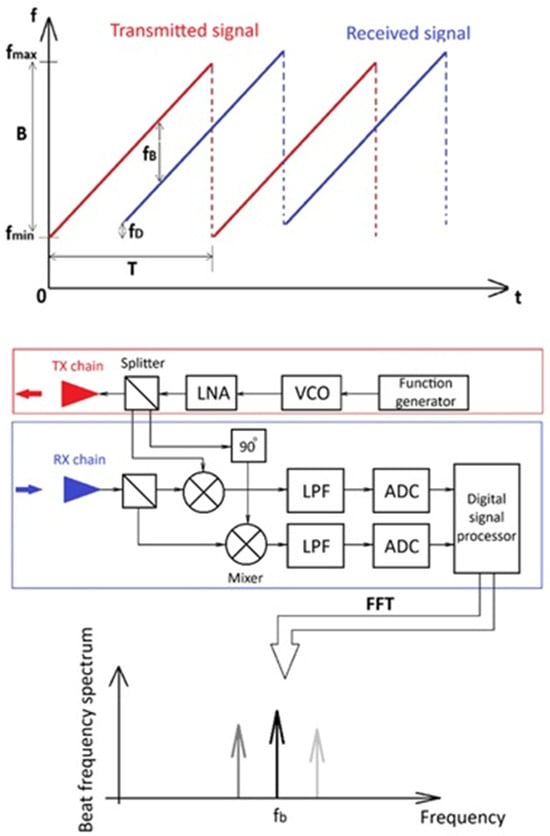
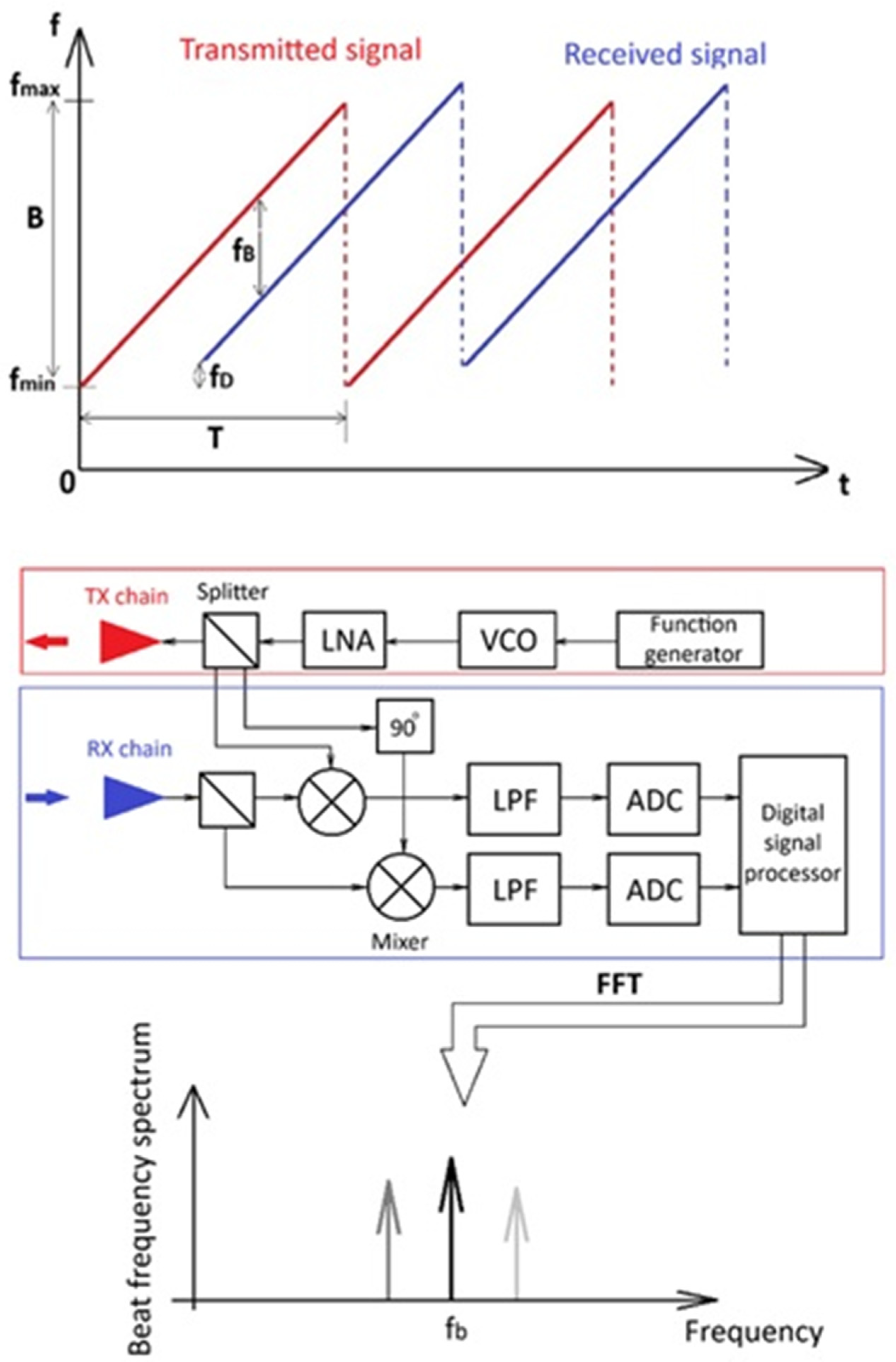
FMCW radar is widely used in short-range applications due to its high resolution in both distance and velocity measurements, while maintaining relatively low hardware complexity. The basic operating principle of FMCW radar is to transmit a continuous signal whose frequency changes linearly over time, known as a chirp. After reflecting off an object, the radar receives a delayed echo, and the difference between the transmitted and received frequencies—the so-called beat frequency—contains information about the distance to the object.
According to the diagram shown in Figure 1, the first stage of FMCW radar operation is the generation of the transmitted signal. In practical systems, this signal is produced by a Voltage-Controlled Oscillator (VCO), whose instantaneous frequency is controlled by the input voltage. When a linearly increasing control signal from a function generator is applied to the VCO, a linearly frequency-modulated (LFM) signal, also known as a chirp, is obtained. The VCO output is typically amplified by a Low-Noise Amplifier (LNA) before transmission to ensure sufficient signal power.
Figure 1.
Typical FMCW radar and signal processing.
The transmitted signal of the FMCW radar, after normalization, can be expressed as [12]:
where t denotes the so-called “fast time” within the chirp, that is, the time during a single frequency modulation, with −(T/2) ≤ t ≤ (T/2). The parameters fC and K = B/T correspond to the center frequency of the chirp and the frequency slope, respectively, while B and T denote the bandwidth and the duration of the chirp, respectively.
Assuming a point target moving at a distance R, the signal received by the radar can be expressed as [12]:
where σ is a coefficient proportional to the radar cross section (RCS) of the target, the antenna gain, and the distance attenuation, τ denotes the propagation time of the electromagnetic wave to the object and back, c denotes the speed of light. fD denotes the Doppler frequency shift and is expressed by the following relation [12]:
where VR denotes the radial velocity of the object, while λ denotes the wavelength of the radar signal.
The received signal is then mixed with a copy of the transmitted signal, creating an intermediate frequency (IF) signal, which, after passing through a low-pass filter (LPF), takes the following form [12]:
where fIF denotes the intermediate frequency signal, also referred to as the beat frequency [12]:
The distance to the target can be determined by measuring the beat frequency of the IF signal [12]:
In the case of multiple targets, their distances can be separated in the frequency domain using the fast Fourier transform (FFT) of the IF signals. The Doppler shifts of the targets can, in turn, be determined by analyzing consecutive chirps within a single frame. This makes it possible to obtain Range–Doppler (RD) maps by applying the FFT in both distance and velocity domains on data sampled over the frame time (slow time).
3.2. Preprocessing Data
As previously mentioned, in the proposed method, FFT is not used. The raw radar data in the form of I and Q signals are read from text files and converted from tables into numerical matrices. The application controlling the radar operation has the Moving Target Indicator (MTI) enabled algorithm, so the data are pre-cleaned from interference caused by stationary objects. The last two columns in the text files, containing the date and time, are removed. Then, samples from selected frames are concatenated into a single sequence, forming the complex signal I + jQ. For each segment of the signal, a time vector corresponding to the actual sampling frequency is generated.
The Continuous Wavelet Transform (CWT) analysis is performed on the prepared I + jQ signal. The CWT allows obtaining a time–frequency representation of the signal, enabling the detection of micro-finger movements and gesture dynamics in real time. The analysis is conducted using various wavelets in Python (Python 3.11.4, https://www.python.org/, accessed on 2 November 2025), including the Morlet wavelet, which allows selecting the most suitable representation for further feature extraction and gesture classification.
3.3. CWT
In tasks related to hand gesture recognition, the fast Fourier transform (FFT) is commonly used as a tool for analyzing frequency changes of the signal over time. Most implementations are based on the radix-2 [39] or radix-4 [40] algorithms. However, the literature often lacks detailed information regarding which variant of the FFT algorithm was used [41].
One of the main drawbacks of FFT-based analysis is that the quality of the results depends on the length of the time window. Achieving high frequency resolution requires collecting many samples, which is directly related to the signal duration and the sampling frequency. An additional disadvantage of the method is the inability to capture frequency changes over time.
A partial solution to the limitations is the use of the short-time Fourier transform (STFT), which involves performing FFT on consecutive, overlapping time windows. This method allows obtaining information about frequency variations over time; however, it does not eliminate the trade-off between time and frequency resolution. In practice, this means that using a longer window improves frequency accuracy but simultaneously reduces temporal localization precision.
An alternative to classical time–frequency analysis is the time–scale approach, which enables high precision both in the time domain and in the scale domain (corresponding to frequency). The tool that allows such analysis is CWT, whose operating principle will be discussed in the following section.
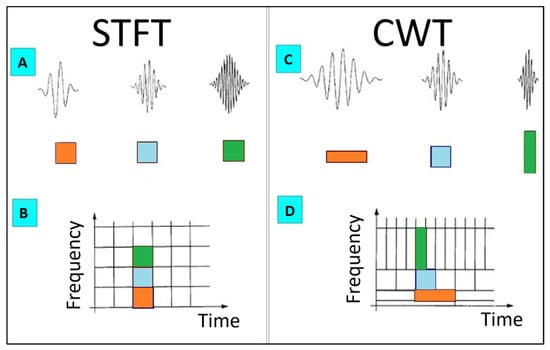
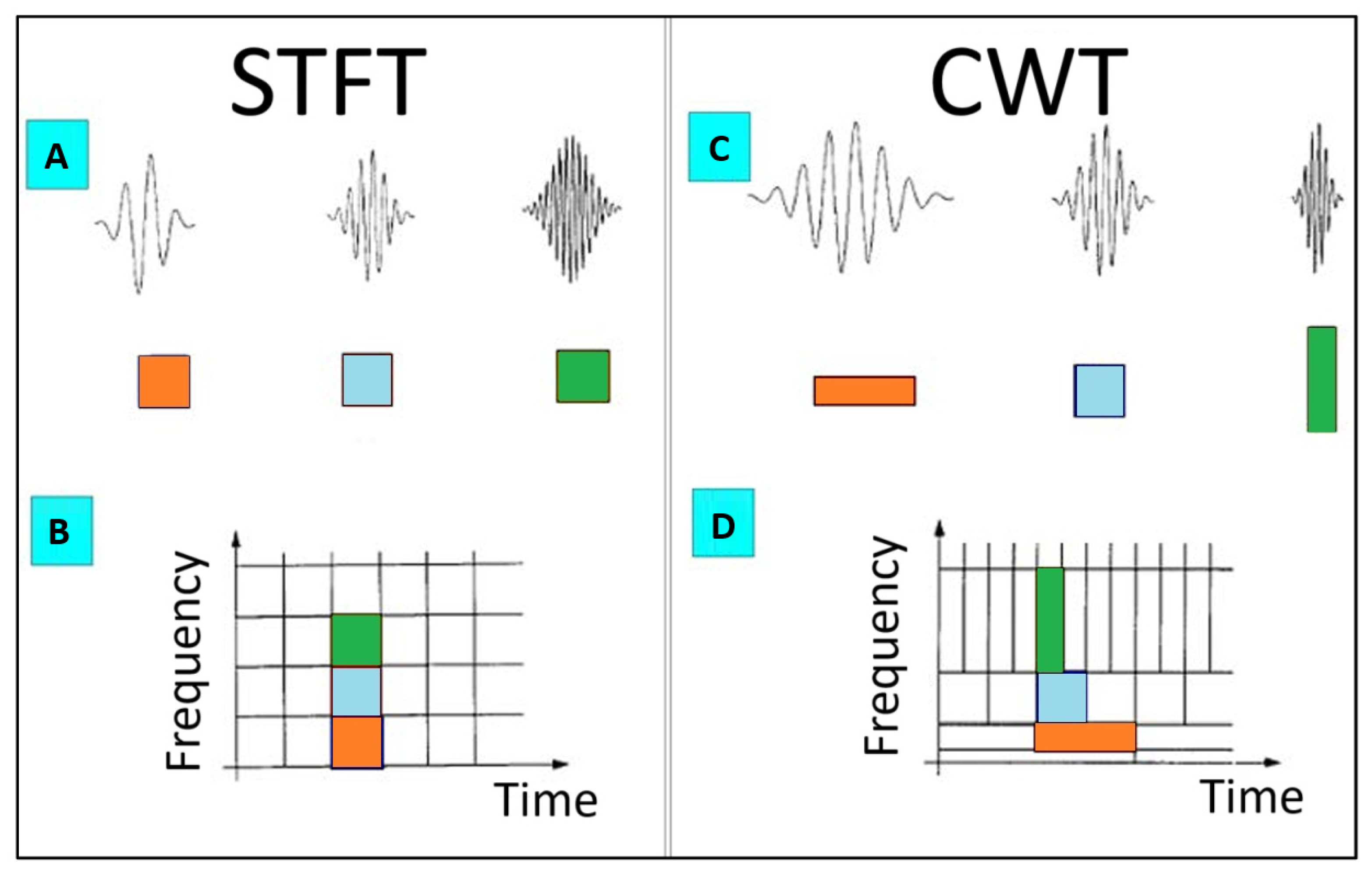
The frequency components of the analyzed signal, determined based on the STFT, are shown in Figure 2 (on the left). However, this analysis does not answer whether it is a single event in the signal or if the component occurs multiple times over time.
Figure 2.
Comparison of time–frequency representations using STFT and CWT. (A) STFT wavelet shapes for different components; (B) STFT time–frequency representation; (C) CWT wavelet shapes for different components; (D) CWT time–frequency representation.
One of the objectives of this article is to present a tool that enables accurate localization in both time and frequency while reducing the blurring of frequency components. The application of CWT, with a properly selected mother wavelet and optimized parameters, provides satisfactory results.
CWT allows transforming a one-dimensional time signal into a two-dimensional function dependent on scale and time. Its main advantage is the flexible adjustment of the time window width. This enables precise extraction of signal frequencies by adapting the window scale to the period of the dominant component. Low- and high-frequency components require different window sizes to capture their behavior across all periods. CWT is an integral transform that uses a suitably chosen kernel function. It is calculated according to the following formula [41]:
In the equation, the parameter s denotes the scale, and τ denotes the shift. The symbol refers to the complex conjugate of the mother wavelet function, while sIF(t) is the analyzed signal, for which the result consists of the CWT coefficients. A detailed discussion of the influence of scale and shift can be found in [42]. The mother wavelet can be any function that satisfies the kernel conditions. The literature describes, among others, Daubechies wavelets [43], Gaussian wavelets, Shannon wavelets, Morlet wavelets, as well as complex Morlet wavelets [44]. For example, the complex Morlet wavelet function is defined by the following formula [42]:
where fc denotes the center frequency, and fb corresponds to the bandwidth. The kernel of the complex Morlet wavelet consists of two main parts. The first part , through Euler’s formula, gives cosine and sine components that correspond to the basic carrier wave. The second part, , serves as the shape of the time window, which can be treated as the envelope of the signal.
Unlike the Fourier transform, which represents the signal solely in the frequency domain and does not retain time information, CWT allows simultaneous preservation of both time and frequency information. This process involves repeatedly convolving the signal with scaled (stretched or compressed) and time-shifted versions of the so-called mother wavelet ψ(t). The result of the transformation is a two-dimensional representation of the signal in the scale and time domains, enabling the observation of changes in individual frequency components over time. This makes it possible to detect local variations, transient events, oscillations, and other characteristic patterns in the signal. An example of such signals is radar data reflected from hand and finger movements during gestures, which allows capturing both micro-movements of individual fingers and the dynamics of the entire hand in real time.
3.4. Network Design
The choice of a convolutional neural network (CNN) as the primary classification model is motivated by its well-documented effectiveness in analyzing images and two-dimensional data, including time–frequency scalograms generated from radar signals [45]. CNNs automatically learn relevant spatial features, eliminating the need for manual feature extraction, which is particularly advantageous for complex microwave signals. In our case, the network was designed from scratch, considering the specific characteristics of CWT images for hand gestures, to maintain an appropriate balance between model depth and its generalization capability given the limited amount of data.
In the proposed convolutional network architecture, the starting point is the image input layer, whose size corresponds to standardized input data in the form of two-dimensional time–frequency maps obtained via the Continuous Wavelet Transform. Normalizing the image size to 256 × 256 pixels ensures uniformity of input data regardless of the original resolutions, allowing efficient processing and reducing computational complexity.
The first feature extraction block is a two-dimensional convolution with 8 filters of size 3 × 3, combined with a batch normalization layer and a ReLU nonlinearity. Using small filters (3 × 3) enables efficient capture of local patterns in the data, such as subtle changes in amplitude and the time–frequency structure of the radar signal. The number of filters was initially limited to 8 to reduce the number of parameters and avoid overfitting in the early learning stage.
To reduce dimensionality and focus on the most relevant features, a max-pooling layer with a window size of 2 × 2 and a stride of 2 was applied. This operation halves the dimensions of the feature maps while increasing the network’s robustness to translations and minor image perturbations.
The second convolutional block was designed similarly but with 16 filters of size 3 × 3, allowing the network to capture more complex and abstract patterns emerging from the data after the first filtering stage. The combination of batch normalization and the ReLU activation function ensures gradient stability and prevents the vanishing signal problem in deeper layers. The second max-pooling layer further reduces data dimensionality, preparing it for processing by the fully connected classifier.
At the classification stage, a fully connected layer with 64 neurons was used, integrating the features extracted by the convolutional part into a coherent high-level representation. The choice of 64 neurons represents a compromise between the capacity to model complex relationships and the risk of overfitting. To further increase nonlinearity and improve generalization capability, a ReLU activation function was applied.
To mitigate overfitting resulting from potential redundancy in the training data, a dropout layer with a 0.5 dropout rate was introduced, randomly disabling half of the neurons during training. This mechanism increases the network’s robustness to noise and enhances its generalization to new data.
The final part of the model is a fully connected layer with a few neurons corresponding to the number of gesture classes, followed by a softmax layer that converts the outputs into probabilities of belonging to each category. Classification is performed using the standard classification layer based on cross-entropy loss.
3.5. Proposed Method
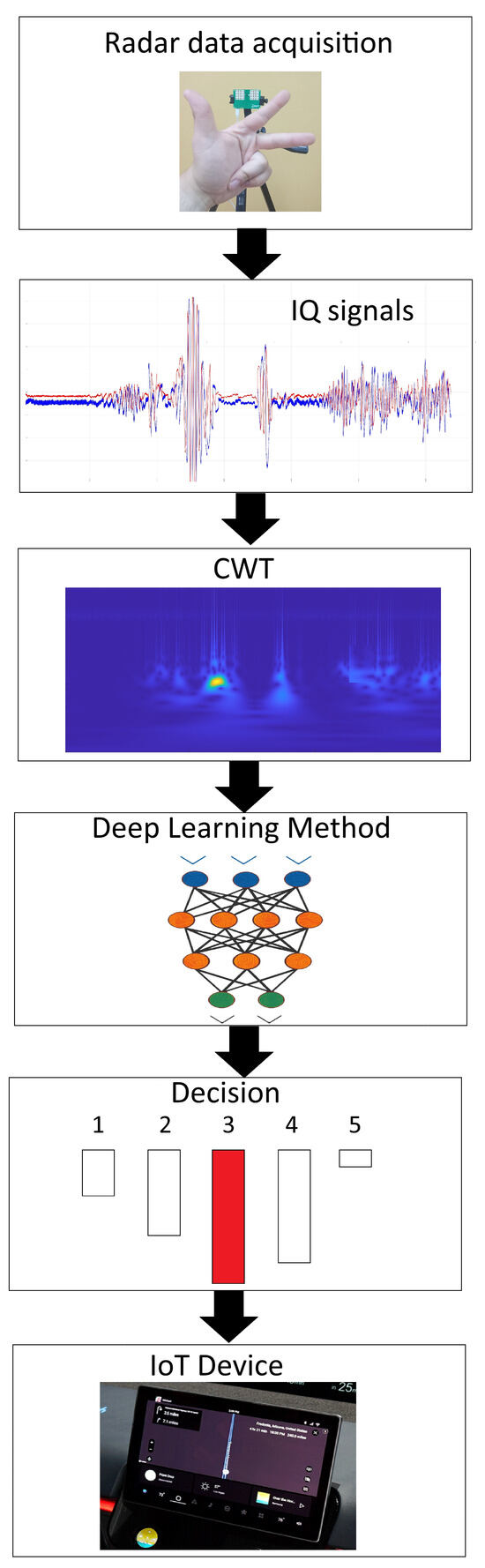
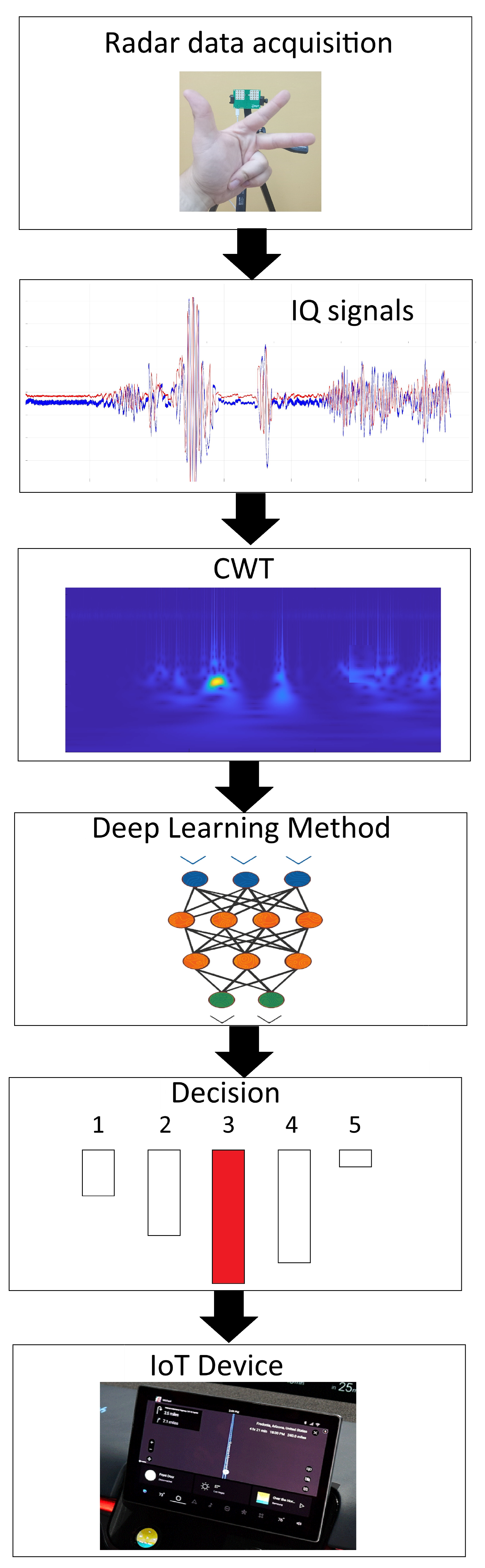
The developed hand gesture recognition method using radar, whose processing pipeline is shown in Figure 3, is based on several consecutive stages of signal processing and data analysis. In the first phase, signals are acquired using a 24 GHz FMCW radar (uRAD, Anteral, Navarra, Spain), which records both the in-phase (I) and quadrature (Q) components of the reflected signal. The radar is equipped with a built-in MTI function.
Figure 3.
Pipeline of proposed method.
In the next stage, the raw radar data undergoes preprocessing. First, the I and Q components are combined into a single complex signal. This is followed by segmentation into frames and conversion into a time–frequency representation. For this purpose, CWT is applied, providing high resolution in both the time and frequency domains. The result of this step is a set of scalogram images, which serve as characteristic representations of the dynamic gesture patterns.
To improve classifier robustness and reduce overfitting, data augmentation is applied. The scalogram images are modified using specific operations with well-defined parameters: translations (horizontal and vertical shifts in the range of ±5 pixels), rotations (±1.5° around the image center), scaling/zoom (factors from 0.98 to 1.02), and the addition of Gaussian noise (standard deviation 0.01–0.02). Brightness and contrast adjustments of ±5–10% and horizontal or vertical flips are applied when appropriate. Furthermore, all images are resized to a uniform dimension of 256 × 256 pixels and normalized to the [0, 1] range, allowing their direct use in the deep learning training process.
For the classification itself, a CNN is employed, taking the CWT images as input. The model architecture includes consecutive convolutional layers with ReLU nonlinear activation functions and pooling layers, followed by fully connected classification layers. The network is trained using a cross-entropy loss function and the Adam optimizer. The output of the model is the assignment of the input image to one of the predefined gesture classes. A correctly recognized gesture enables the control of an IoT device.
4. Experiments
4.1. Laboratory Setup and Dataset
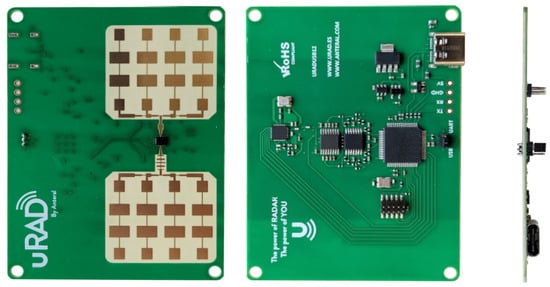
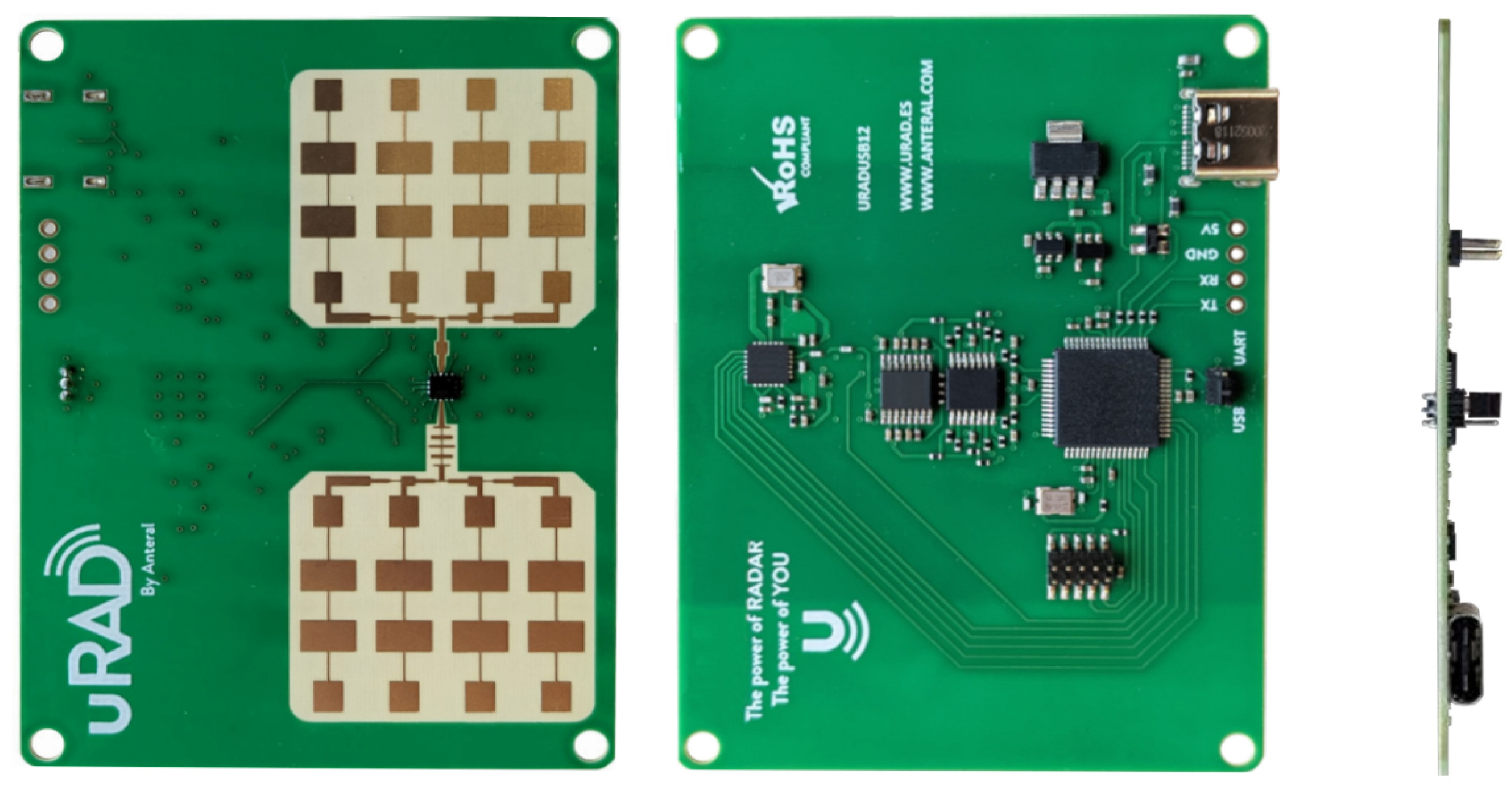
For the experiments, a uRAD radar from the Spanish company Anteral, operating in the 24 GHz band, was used. The radar is designed in a planar technology and built on a multilayer printed circuit board with numerous integrated circuits. Views of the radar from different sides are shown in Figure 4. On the top layer, the core of the device, the transceiver, and the transmitting and receiving antennas are placed, emitting microwave waves perpendicular to the surface. The bottom layer contains the power supply and signal processing components, controlled by a high-performance microcontroller. The radar was configured so that its antennas were directed toward the region of interest, ensuring proper reception of signals reflected from the hand and fingers. The technical specifications of the radar are summarized in Table 4.
Figure 4.
uRAD FMCW radar 24 GHz [46].
Table 4.
Parameters of 24 GHz uRAD FMCW radar.
The uRAD radar can detect up to five moving objects within its field of view, providing information on their distance, radial velocity, and reflected power, which can serve as an estimate of object size or detection level. For the experiments, a sawtooth waveform was used, with distance to objects as the measured parameter. The radar allowed detection in the range from 0.45 m to 100 m, with a maximum distance resolution of ±0.04 m or ±0.3% of the measured value.
The sweep bandwidth was 240 MHz, ensuring adequate accuracy and time–frequency resolution of the signal, enabling precise detection and localization of objects within the measurement area. The controlling software allows precise configuration of radar parameters, including the number of samples per measurement, the maximum number of detectable targets, activation of the MTI mode to ignore stationary objects, and device sensitivity.
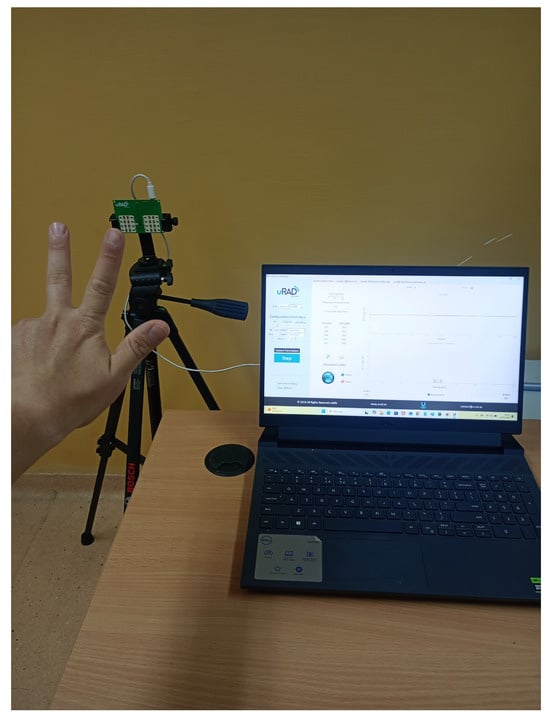
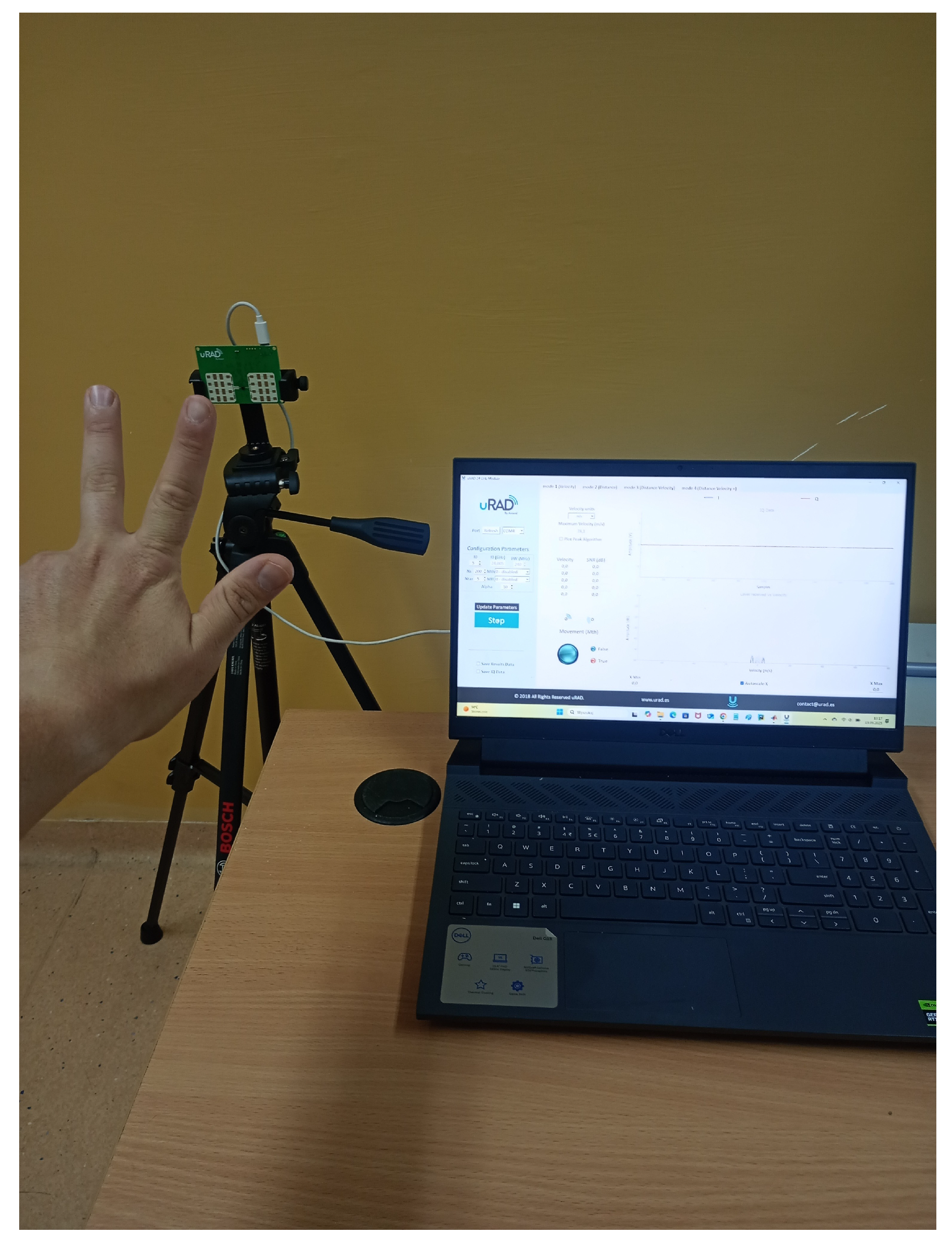
Preliminary experiments were conducted in the laboratory, where the uRAD radar was mounted on a specialized stand, ensuring stable and repeatable orientation of the antennas toward the objects under study. The measurement setup is shown in Figure 5. The radar was connected to a computer via a USB-C port, which simultaneously powered the radar and enabled real-time data transfer. Signal control and recording were performed using a computer equipped with an Intel Core i7-13650HX processor (2.60 GHz) (Intel Corporation, Santa Clara, CA, USA), 64 GB of RAM, and a 64-bit operating system, providing sufficient computational power to load, process, and analyze radar data in real time.
Figure 5.
Laboratory experimental setup.
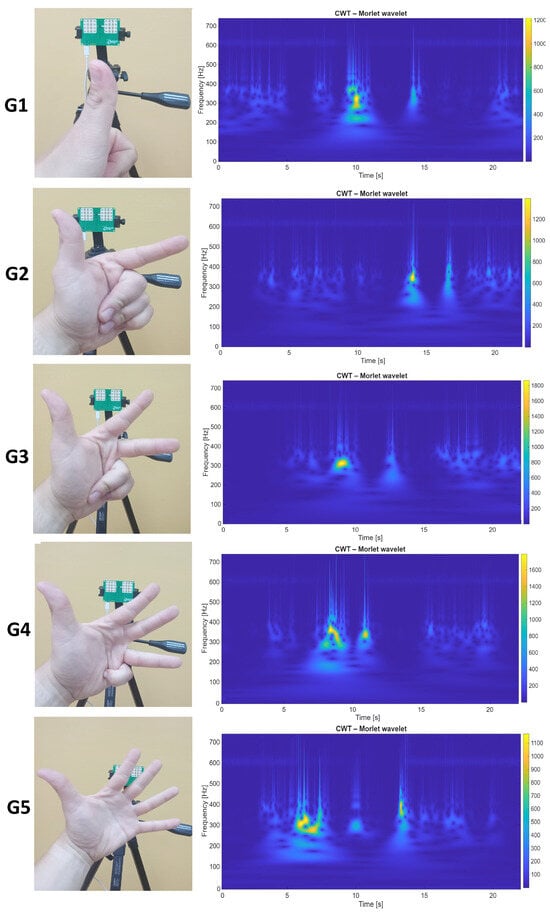
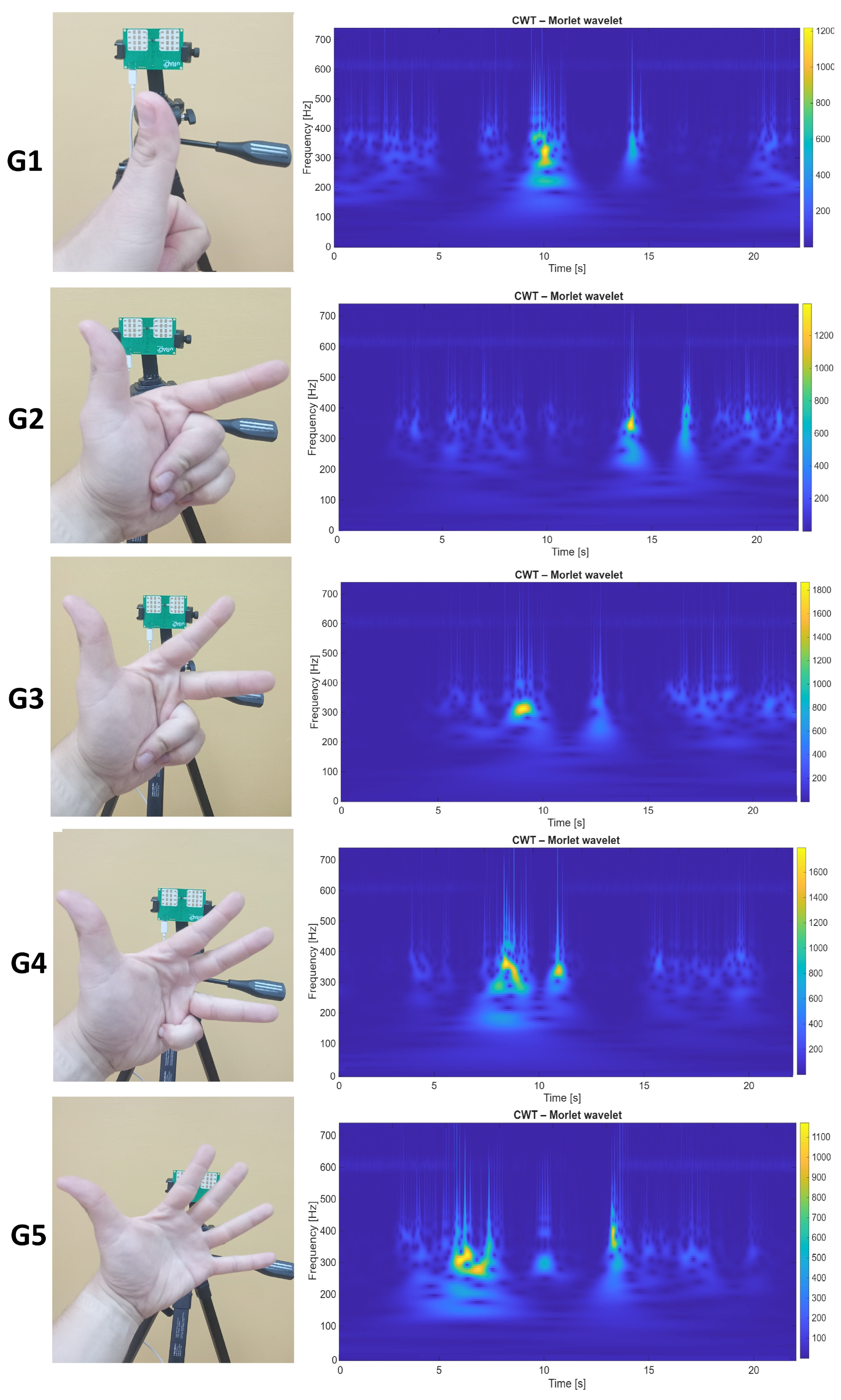
For the study, 20 participants aged 18–69 were selected, mainly family members and friends, who provided voluntary consent to take part in the experiment. Each participant performed five gestures at varying distances from the radar (ranging from 45 cm to 90 cm), with each gesture corresponding to a different number of extended fingers on one hand—starting from a single finger (thumb), through two, three, and four fingers, up to the entire hand with five fingers.
Each gesture was repeated twice by every participant, resulting in a total of 200 samples (20 participants × 5 gestures × 2 repetitions) and capturing natural variations in gesture execution across different ages and finger sizes. For each case, a CWT spectrogram of size 256 × 256 px was obtained. This gesture set (Figure 6) allowed standardization of movements and precise analysis of the radar signal dynamics for various hand and finger configurations, preparing the data for further analysis using the Continuous Wavelet Transform (CWT).
Figure 6.
Types of gestures performed by study participants.
Additionally, to enrich the dataset and improve the neural network’s generalization, a series of augmentation operations were applied to the previously obtained CWT images. Geometric transformations, such as image shifts by a specified number of pixels and scaling, were applied, as well as pixel-value operations including addition of noise, and modification of brightness and contrast. This enhanced the model’s robustness against variations in gesture execution and changing radar signal acquisition conditions.
4.2. Car Setup and Dataset
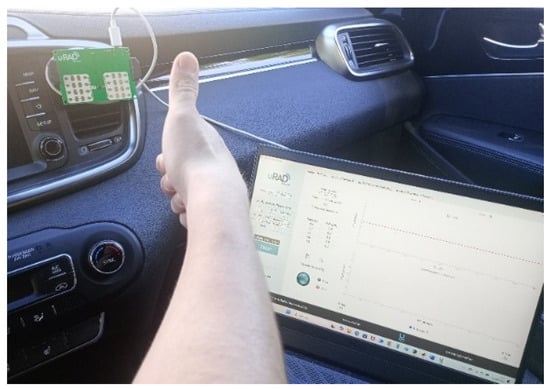
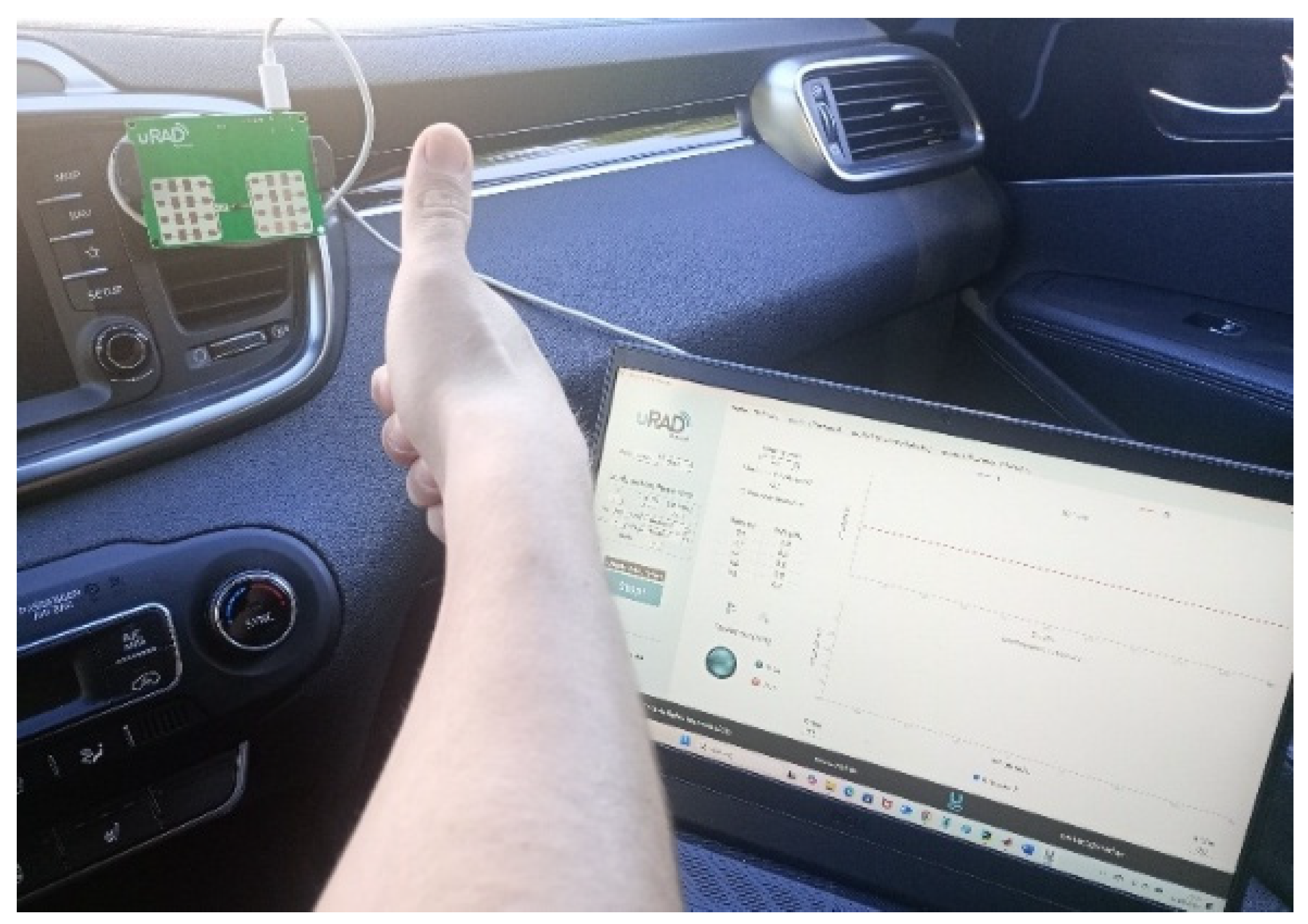
To test the developed method in a natural environment, experiments were conducted inside a vehicle cabin (Figure 7). The uRAD radar was mounted on a phone holder, ensuring stable signal acquisition while not obstructing the dashboard display. The device was connected to the same laptop used in the laboratory experiments, enabling consistent data collection.
Figure 7.
Car experimental setup.
The in-vehicle experiments were conducted using the same gestures and number of repetitions as in the laboratory, enabling a direct comparison of results between different environments. The experiments in the vehicle also accounted for additional constraints typical of natural settings, such as the user’s proximity and the potential presence of biological signals (vital signs), which could affect the quality and interpretation of the radar signal. These conditions allowed for the assessment of the system’s robustness against interference caused by nearby human objects and unwanted signals. Signal processing and neural network training were carried out in the Python environment.
4.3. Results
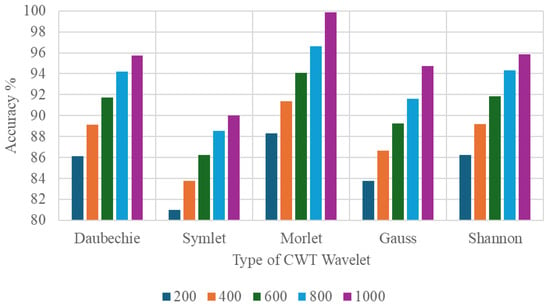
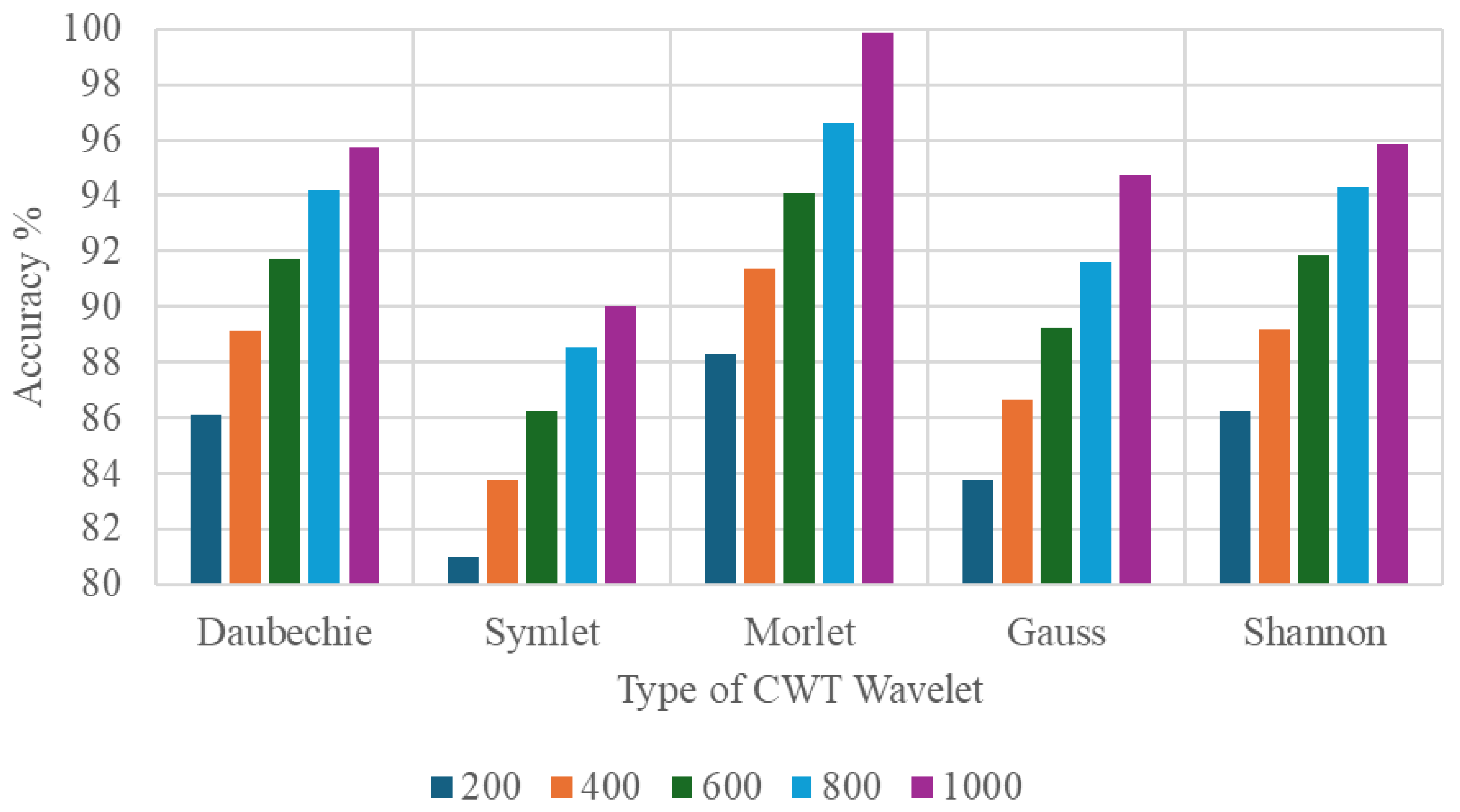
The first study, the results of which are shown in Figure 8, aimed to evaluate the impact of the choice of wavelet function in the CWT on the accuracy of hand gesture recognition. Initially, a dataset of 200 samples was collected (20 participants × 5 gestures × 2 repetitions). To train and test the network, 70% of the samples were used for the training set, 15% for the validation set, and the remaining samples constituted the test set. The sets were randomly selected each time.
Figure 8.
The results of the first study evaluating the impact of the choice of wavelet function in the CWT on hand gesture recognition accuracy.
Each signal was transformed into a time–frequency representation using various wavelets: Daubechies, Symlet, Morlet, Gaussian, and Shannon. The resulting images served as input data for the proposed CNN.
To further investigate the scalability of the method, the number of samples was gradually increased using data augmentation, producing datasets of 400, 600, 800, and 1000 samples.
The results show that the choice of wavelet has a noticeable impact on recognition accuracy. Among all tested wavelets, the Morlet wavelet consistently achieved the highest performance, reaching an accuracy of 99.87% with the 1000-sample dataset. Good results were also obtained for the Daubechies and Shannon wavelets, whereas the Symlet wavelet demonstrated the lowest effectiveness. Additionally, the study confirmed that increasing the number of samples through augmentation significantly improved the CNN model’s generalization ability, regardless of the wavelet used.
In the next study, the learning rate of the CNN was optimized, assuming that the Morlet wavelet was the best choice for CWT and that the number of samples had been increased to 1000 through data augmentation. The aim of this study was to determine how different learning rate values affect the recognition accuracy of individual gestures. Five gestures were analyzed—from a single finger (Gesture 1) to a full hand (Gesture 5)—and the average classification accuracy was measured for each learning rate value. The results are presented in Table 5, which shows that a moderate learning rate provides the best balance between training stability and convergence speed, enabling the highest accuracy for all gestures. A too-high learning rate causes instability in the training process and a decrease in precision, especially for more complex gestures, whereas a too-low learning rate prolongs the training time but allows for stable classification results.
Table 5.
Gesture recognition accuracy for different learning rates.
The next study investigated the impact of CWT image resolution on gesture classification accuracy. The experiments were conducted using 1000 samples, the Morlet wavelet, and a learning rate of 0.0001. The results are presented in the table below (Table 6).
Table 6.
Effect of CWT image resolution on gesture classification accuracy.
It has been shown that increasing image resolution improves recognition performance, particularly for gestures involving fine finger movements. The most significant gain in accuracy is observed when the resolution is increased from 64 × 64 to 256 × 256 pixels. Further increasing to 512 × 512 provides only minimal improvement over 256 × 256, so in practice, the optimal choice is 256 × 256 resolution, offering a balance between accuracy, training time, and memory requirements. However, it should be noted that higher resolutions significantly extend network training time and increase RAM usage, which may limit the practical use of very large images.
In the next stage of the study, the effectiveness of the proposed gesture recognition method was evaluated on a randomly selected group of five new participants. The results are presented in Table 7.
Table 7.
Gesture recognition accuracy for new participants in laboratory conditions.
The test group consisted of three men (21 M, 23 M, 24 M) and two women (22 F, 24 F). The study was conducted under laboratory conditions, and the participants had not previously taken part in the training dataset, allowing us to evaluate the CNN’s generalization capability to new users. The Morlet wavelet was used, and each participant performed each of the five gestures five times. Analysis of the results showed a decrease in classification accuracy compared to the training participants, highlighting the influence of individual variations in gesture execution and the need to account for diverse motion patterns across different users in the model.
To assess the practical usability of the method, additional tests were carried out inside a vehicle cabin, where various environmental disturbances and limited space were present. The same five participants performed the full set of five gestures twice under both conditions. Comparative analysis was conducted using CWT images obtained with the Morlet wavelet.
Results presented in Table 8 indicate that classification accuracy remains high in laboratory conditions, while a decrease is observed in the vehicle environment. This drop reflects the impact of environmental noise, perspective changes, and unforeseen movements on system performance. These findings emphasize the importance of testing the system in realistic usage scenarios to evaluate its practical effectiveness.
Table 8.
Gesture recognition accuracy for new participants across different environments.
Finally, to assess the performance of our proposed gesture recognition method, a comparison was made with selected approaches reported in the literature [21,23,24,26,31,33].
The comparison results are presented in Table 9. The selected studies represent diverse approaches to radar signal processing and gesture classification, allowing a comprehensive evaluation of our solution. The method described in [21] employs the LRACN model (All-CNN + LSTM) applied to Range-Doppler images. In [23], a CRNN (CNN + LSTM) operating on Range-Speed maps was used. The study [24] presents a lightweight, multi-channel CNN exploiting a combination of radial and angular features, denoted as DTI-HATI-VATI. Meanwhile, the method in [26] employs a Dop-DenseNet network on micro-Doppler spectrograms with a resolution of 200 × 200 pixels, and in [31], CNN or CNN + LSTM was applied to Time-Doppler matrices with a selected hand bin. The work [33] introduces an Attention-enhanced neural network using Multi-Feature Fusion (MFF). These studies were selected because they use 2D representations of radar signals like ours and allow implementation of their structures on our dataset.
Table 9.
Comparative evaluation of gesture recognition accuracy on our dataset using different state-of-the-art methods.
All comparative experiments were conducted using CWT images obtained with the Morlet wavelet (1000 samples) under laboratory conditions. For training and testing, 70% of the samples constituted the training set, 15% the validation set, and the remaining samples the test set, with the sets randomly assigned each time. The results show that our method, using the Morlet wavelet and 256 × 256 CWT images, achieves equal or superior performance compared to previously published solutions. It performs particularly well in recognizing gestures that involve subtle finger movements, confirming that combining appropriate radar signal processing with a well-chosen CNN architecture provides an advantage over classical approaches based on FFT, STFT, or other types of spectrograms. The analysis also indicates that methods incorporating multidimensional motion features (radial and angular), such as in [25,36], have better generalization capabilities, yet our approach achieves comparable accuracy with simpler implementation and lower memory requirements.
In addition to these performance results, it is important to consider the computational cost of the proposed method. The CNN-based gesture recognition model, designed to process 256 × 256 CWT images, has a total of approximately 4.2 million trainable parameters. The network consists of two convolutional blocks and fully connected layers, resulting in roughly 27–28 million multiply-accumulate operations (MAC) per inference. Classical FFT/STFT-based methods with small CNNs or LSTM networks typically require 20–40 million MAC, while more complex architectures, such as Dop-DenseNet or Attention-enhanced Multi-Feature Fusion (MFF) models, can exceed 50 million MAC per inference. Thus, our approach provides a favorable trade-off between computational cost and recognition accuracy (99.8%), making it suitable for real-time processing in embedded or IoT devices.
Despite the high accuracy achieved by the proposed CNN-based gesture recognition method, certain limitations should be noted. The dataset included a limited number of participants and a simple set of gestures (1–5 fingers), which may restrict generalization to a more diverse population and more complex gesture sequences. Experiments were conducted primarily under laboratory conditions and inside a vehicle cabin, so further evaluation in dynamic real-world environments is recommended. Additionally, higher CWT image resolutions improve accuracy but increase training time and memory requirements, which may limit practical deployment in IoT devices and embedded systems. Future work will focus on expanding the dataset, testing more complex gestures, and optimizing the network for efficient real-time operation.
5. Conclusions
In this article, a method for hand gesture recognition using FMCW radars in the mmWave band, combined with CWT and a lightweight, efficient CNN architecture, is presented. Experiments demonstrated that applying the Morlet wavelet allows the extraction of subtle finger motion features and achieves high classification accuracy even with a limited number of samples. Through data augmentation, the accuracy exceeded 99% on training samples, while achieving satisfactory generalization to new, previously unseen participants, with an average accuracy of 82–84%.
Additionally, the studies showed that the resolution of CWT images significantly affects recognition performance, with 256 × 256 pixels representing an optimal trade-off between accuracy, training time, and memory usage. Our results confirm that combining a standardized gesture set, wavelet transform, and modern network architecture yields a method that is fast, computationally efficient, and generalizes well to new users.
The developed method can be applied in real-time HCI systems, including gesture-based control interfaces for IoT devices and embedded systems, with its flexibility and lightweight design allowing practical deployment.
Future work will focus on expanding the gesture set and increasing the number of participants to further improve model generalization. Important directions also include testing the system in more complex and dynamic environments and optimizing the network architecture for IoT devices and embedded systems to ensure low energy consumption and minimal latency. Further research will explore integrating FMCW radars with other sensors, such as cameras or IMUs, to enhance robustness to environmental disturbances and improve accuracy in practical applications.
Author Contributions
Conceptualization, A.Ś. and A.K.; methodology, A.Ś.; software, A.Ś.; validation, A.Ś., and A.K.; formal analysis, A.K.; investigation, A.Ś.; resources, A.Ś.; data curation, A.Ś.; writing—original draft preparation, A.Ś.; writing—review and editing, A.K.; visualization, A.Ś.; supervision, A.K.; project administration, A.Ś.; funding acquisition, A.K. All authors have read and agreed to the published version of the manuscript.
Funding
This research received no external funding.
Data Availability Statement
Partial access to the dataset used in this study is available at https://doi.org/10.21227/0ycx-8366 (accessed on 25 September 2025). The full dataset can be obtained from the authors upon reasonable request.
Conflicts of Interest
The authors declare no conflicts of interest.
Abbreviations
The following abbreviations are used in this manuscript:
| 2D-ATI | Two-Dimensional Angle–Time Image |
| CNN | Convolutional Neural Network |
| CWT | Continuous Wavelet Transform |
| DFT | Discrete Fourier Transform |
| DTI | Doppler–Time Image |
| EVL-NN | Event-Linked Neural Network |
| FFT | Fast Fourier Transform |
| FMCW | Frequency-Modulated Continuous-Wave |
| HATI | Horizontal–Angle–Time Image |
| I/Q | In-Phase/Quadrature |
| IoT | Internet of Things |
| LFM | Linear Frequency-Modulated |
| LNA | Low-Noise Amplifier |
| LSTM | Long Short-Term Memory |
| mmWave | Millimeter Wave |
| MTI | Moving Target Indicator |
| NN | Neural Network |
| PRM | Position Representation Matrix |
| RDM | Range–Doppler Map |
| RDTI | Range–Doppler–Time Image |
| RTI | Range–Time Image |
References
- Scherer, M.; Magno, M.; Erb, J.; Mayer, P.; Eggimann, M.; Benini, L. TinyRadarNN: Combining Spatial and Temporal Convolutional Neural Networks for Embedded Gesture Recognition with Short-Range Radars. IEEE Internet Things J. 2021, 8, 10336–10346. [Google Scholar] [CrossRef] [Scilit]
- Zhang, W.; Wang, J.; Lan, F. Dynamic Hand Gesture Recognition Based on Short-Term Sampling Neural Networks. IEEE/CAA J. Autom. Sin. 2021, 8, 110–120. [Google Scholar] [CrossRef] [Scilit]
- Bandini, A.; Zariffa, J. Analysis of the Hands in Egocentric Vision: A Survey. IEEE Trans. Pattern Anal. Mach. Intell. 2021, 43, 3628–3645. [Google Scholar] [CrossRef] [Scilit]
- Pan, T.-Y.; Tsai, W.-L.; Chang, C.-Y.; Yeh, C.-W.; Hu, M.-C. A Hierarchical Hand Gesture Recognition Framework for Sports Referee Training Based on EMG and Accelerometer Sensors. IEEE Trans. Cybern. 2022, 52, 3172–3183. [Google Scholar] [CrossRef] [Scilit] [PubMed]
- Zhang, Y.; Harrison, C. Tomo: Wearable, Low-Cost Electrical Impedance Tomography for Hand Gesture Recognition. In Proceedings of the 28th Annual ACM Symposium on User Interface Software and Technology (UIST’15), New York, NY, USA, 11–15 November 2015; ACM: New York, NY, USA, 2015; pp. 167–173. [Google Scholar] [CrossRef] [Scilit]
- Mao, W.; He, J.; Qiu, L. CAT: High-Precision Acoustic Motion Tracking. In Proceedings of the 22nd Annual International Conference on Mobile Computing and Networking (MobiCom’16), New York, NY, USA, 3–7 October 2016; ACM: New York, NY, USA, 2016; pp. 69–81. [Google Scholar] [CrossRef] [Scilit]
- Wang, P.; Li, W.; Gao, Z.; Tang, C.; Ogunbona, P.O. Depth Pooling-Based Large-Scale 3D Action Recognition with Convolutional Neural Networks. IEEE Trans. Multimed. 2018, 20, 1051–1061. [Google Scholar] [CrossRef] [Scilit]
- Zhang, Y.; Chen, Y.; Yu, H.; Yang, X.; Lu, W. Learning Effective Spatio-Temporal Features for sEMG Armband-Based Gesture Recognition. IEEE Internet Things J. 2020, 7, 6979–6992. [Google Scholar] [CrossRef] [Scilit]
- Lien, J.; Gillian, N.; Karagozler, M.E.; Amihood, P.; Schwesig, C.; Olson, E.; Raja, H.; Poupyrev, I. Soli: Ubiquitous Gesture Sensing with Millimeter Wave Radar. ACM Trans. Graph. 2016, 35, 142. [Google Scholar] [CrossRef] [Scilit]
- Liang, H.; Wang, X.; Greco, M.S.; Gini, F. Enhanced Hand Gesture Recognition Using Continuous Wave Interferometric Radar. In Proceedings of the IEEE International Radar Conference (RADAR 2020), Washington, DC, USA, 27 April–1 May 2020; IEEE: Piscataway, NJ, USA, 2020; pp. 226–231. [Google Scholar]
- Dekker, B.; Jacobs, S.; Kossen, A.S.; Kruithof, M.C.; Huizing, A.G.; Geurts, M. Gesture Recognition with a Low Power FMCW Radar and a Deep Convolutional Neural Network. In Proceedings of the European Radar Conference (EURAD’17), Nuremberg, Germany, 11–13 October 2017; IEEE: Nuremberg, Germany, 2017; pp. 163–166. [Google Scholar]
- Jankiraman, M. FMCW Radar Design; Artech House: Norwood, MA, USA, 2018. [Google Scholar]
- Niu, Y.; Li, Y.; Jin, D.; Su, L.; Vasilakos, A.V. A Survey of Millimeter Wave Communications (mmWave) for 5G: Opportunities and Challenges. Wirel. Netw. 2015, 21, 2657–2676. [Google Scholar] [CrossRef] [Scilit]
- Perrett, T.; Mirmehdi, M.; Dias, E. Visual Monitoring of Driver and Passenger Control Panel Interactions. IEEE Trans. Intell. Transp. Syst. 2017, 18, 321–331. [Google Scholar] [CrossRef] [Scilit]
- Jayaweera, N.; Gamage, B.; Samaraweera, M.; Liyanage, S.; Lokuliyana, S.; Kuruppu, T. Gesture-Driven Smart Home Solution for Bedridden People. In Proceedings of the 35th IEEE/ACM International Conference on Automated Software Engineering Workshops (ASEW 2020), Melbourne, Australia, 21–25 September 2020; IEEE: Melbourne, Australia, 2020; pp. 152–158. [Google Scholar]
- Zhao, Y.; Xu, L.; Han, J.; Zhang, Q.; Wu, D.O. Device-Free Secure Interaction with Hand Gestures in WiFi-Enabled IoT Environment. IEEE Internet Things J. 2021, 8, 5619–5631. [Google Scholar] [CrossRef] [Scilit]
- Camgöz, N.C.; Koller, O.; Hadfield, S.; Bowden, R. Sign Language Transformers: Joint End-to-End Sign Language Recognition and Translation. In Proceedings of the IEEE/CVF Conference on Computer Vision and Pattern Recognition (CVPR 2020), Virtual, 14–19 June 2020; IEEE: Seattle, WA, USA, 2020; pp. 10020–10030. [Google Scholar]
- Singh, A.; Rehman, S.U.; Yongchareon, S.; Chong, P.H.J. Multi-Resident Non-Contact Vital Sign Monitoring Using Radar: A Review. IEEE Sens. J. 2021, 21, 4061–4084. [Google Scholar] [CrossRef] [Scilit]
- Khamis, A.; Kusy, B.; Chou, C.T.; McLaws, M.-L.; Hu, W. RFWash: Weakly Supervised Tracking of Hand Hygiene Technique. In Proceedings of the 18th Conference on Embedded Networked Sensor Systems (SenSys’20), Virtual, 16–19 November 2020; ACM: New York, NY, USA, 2020; pp. 572–584. [Google Scholar] [CrossRef] [Scilit]
- Wang, B.; Guo, L.; Zhang, H.; Guo, Y.-X. A Millimeter-Wave Radar-Based Fall Detection Method Using Line Kernel Convolutional Neural Network. IEEE Sens. J. 2020, 20, 13364–13370. [Google Scholar] [CrossRef] [Scilit]
- Hazra, S.; Santra, A. Robust Gesture Recognition Using Millimetric-Wave Radar System. IEEE Sens. Lett. 2018, 2, 7001804. [Google Scholar] [CrossRef] [Scilit]
- Kern, N.; Steiner, M.; Lorenzin, R.; Waldschmidt, C. Robust Doppler-Based Gesture Recognition with Incoherent Automotive Radar Sensor Networks. IEEE Sens. Lett. 2020, 4, 3501504. [Google Scholar] [CrossRef] [Scilit]
- Du, F.; Zhao, Y.; Wang, H.; Cao, Q. Hand Gesture Controlled Nursing Bed Using FMCW Radar. J. Phys. Conf. Ser. 2021, 1948, 012098. [Google Scholar] [CrossRef] [Scilit]
- Xia, Z.; Luomei, Y.; Zhou, C.; Xu, F. Multidimensional Feature Representation and Learning for Robust Hand-Gesture Recognition on Commercial Millimeter-Wave Radar. IEEE Trans. Geosci. Remote Sens. 2021, 59, 4749–4764. [Google Scholar] [CrossRef] [Scilit]
- Jiang, W.; Ren, Y.; Liu, Y.; Wang, Z.; Wang, X. Recognition of Dynamic Hand Gesture Based on mmWave FMCW Radar Micro-Doppler Signatures. In Proceedings of the IEEE International Conference on Acoustics, Speech, and Signal Processing (ICASSP 2021), Virtual, 6–11 June 2021; IEEE: Toronto, ON, Canada, 2021; pp. 4905–4909. [Google Scholar] [CrossRef] [Scilit]
- Le, H.; Hoang, V.-P.; Doan, V.-S.; Le, D.-P. Dop-DenseNet: Densely Convolutional Neural Network-Based Gesture Recognition Using a Micro-Doppler Radar. J. Electromagn. Eng. Sci. 2022, 22, 335–343. [Google Scholar] [CrossRef] [Scilit]
- Choi, J.-W.; Park, C.-W.; Kim, J.-H. FMCW Radar-Based Real-Time Hand Gesture Recognition System Capable of Out-of-Distribution Detection. IEEE Access 2022, 10, 87425–87434. [Google Scholar] [CrossRef] [Scilit]
- Liu, Z.; Liu, H.; Ma, C. A Robust Hand Gesture Sensing and Recognition Based on Dual-Flow Fusion with FMCW Radar. IEEE Geosci. Remote Sens. Lett. 2022, 19, 4028105. [Google Scholar] [CrossRef] [Scilit]
- Grobelny, P.; Narbudowicz, A. mm-Wave Radar-Based Recognition of Multiple Hand Gestures Using Long Short-Term Memory (LSTM) Neural Network. Electronics 2022, 11, 787. [Google Scholar] [CrossRef] [Scilit]
- Zhao, P.; Lu, C.; Wang, B.; Trigoni, N.; Markham, A. CubeLearn: End-to-End Learning for Human Motion Recognition from Raw mmWave Radar Signals. IEEE Internet Things J. 2023, 10, 10236–10249. [Google Scholar] [CrossRef] [Scilit]
- Iida, Y.; Fan, M.; Brahim, W.; Ma, J.; Ma, M.; Qi, A. Range-Aware Hand Gesture Recognition Using FMCW Radar and Deep Learning. In Proceedings of the 29th IEEE International Conference on Parallel and Distributed Systems (ICPADS 2023), Hainan, China, 17–21 December 2023; IEEE: Ocean Flower Island, China, 2023; pp. 602–609. [Google Scholar] [CrossRef] [Scilit]
- Jin, B.; Ma, X.; Zhang, Z.; Lian, Z.; Wang, B. Interference-Robust Millimeter-Wave Radar-Based Dynamic Hand Gesture Recognition Using 2D CNN-Transformer Networks. IEEE Internet Things J. 2024, 11, 2741–2752. [Google Scholar] [CrossRef] [Scilit]
- Wang, H.; Zhang, M.; Zhang, L.; Zhu, X.; Cao, Q. Real-Time Hand Gesture Recognition in Clinical Settings: A Low-Power FMCW Radar Integrated Sensor System with Multiple Feature Fusion. Sensors 2025, 25, 4169. [Google Scholar] [CrossRef] [Scilit] [PubMed]
- Franceschini, S.; Ambrosanio, M.; Pascazio, V.; Baselice, F. Hand Gesture Signatures Acquisition and Processing by Means of a Novel Ultrasound System. Bioengineering 2023, 10, 36. [Google Scholar] [CrossRef] [Scilit]
- Franceschini, S.; Ambrosanio, M.; Baselice, F.; Pascazio, V. Person identification and authentication via ultrasound hand-gesture-signature analysis. In Proceedings of the 2022 IEEE International Conference on E-Health Networking, Application & Services (HealthCom), Genoa, Italy, 17–19 October 2022; pp. 229–233. [Google Scholar] [CrossRef] [Scilit]
- Fertl, E.; Castillo, E.; Stettinger, G.; Cuéllar, M.P.; Morales, D.P. Hand Gesture Recognition on Edge Devices: Sensor Technologies, Algorithms, and Processing Hardware. Sensors 2025, 25, 1687. [Google Scholar] [CrossRef] [Scilit]
- Ahmed, S.; Kallu, K.D.; Ahmed, S.; Cho, S.-H. Hand Gestures Recognition Using Radar Sensors for Human-Computer Interaction: A Review. Remote Sens. 2021, 13, 527. [Google Scholar] [CrossRef] [Scilit]
- Cooley, J.W.; Tukey, J.W. An Algorithm for the Machine Calculation of Complex Fourier Series. Math. Comput. 1965, 19, 297–301. [Google Scholar] [CrossRef]
- Corinthios, M.J.; Smith, K.C.; Yen, J.L. A Parallel Radix-4 Fast Fourier Transform Computer. IEEE Trans. Comput. 1975, 24, 80–92. [Google Scholar] [CrossRef] [Scilit]
- Dobrowolski, A. Transformacje Sygnałów od Teorii do Praktyki; BTC: Legionowo, Poland, 2018. [Google Scholar]
- Walenczykowska, M.; Kawalec, A. Application of Continuous Wavelet Transform and Artificial Neural Network for Automatic Radar Signal Recognition. Sensors 2022, 22, 9743. [Google Scholar] [CrossRef] [Scilit]
- Gao, R.X.; Yan, R. Continuous Wavelet Transform. In Wavelets: Theory and Applications for Manufacturing; Springer: Boston, MA, USA, 2011; pp. 33–48. [Google Scholar] [CrossRef] [Scilit]
- Daubechies, I. Orthonormal Bases of Compactly Supported Wavelets. Commun. Pure Appl. Math. 1988, 41, 909–996. [Google Scholar] [CrossRef] [Scilit]
- Teolis, A. Computational Signal Processing with Wavelets; Birkhäuser: Boston, MA, USA, 1998. [Google Scholar]
- Goodfellow, I.; Bengio, Y.; Courville, A. Deep Learning; MIT Press: Cambridge, MA, USA, 2016. [Google Scholar]
- Anteral, S.L. uRAD USB v1.2 24 GHz Radar, Velocity and 1D Positioning—Datasheet; Anteral: Pamplona, Spain, 2022. [Google Scholar]

Disclaimer/Publisher’s Note: The statements, opinions and data contained in all publications are solely those of the individual author(s) and contributor(s) and not of MDPI and/or the editor(s). MDPI and/or the editor(s) disclaim responsibility for any injury to people or property resulting from any ideas, methods, instructions or products referred to in the content. |
© 2026 by the authors. Licensee MDPI, Basel, Switzerland. This article is an open access article distributed under the terms and conditions of the Creative Commons Attribution (CC BY) license.