1. Introduction
Small and medium-sized companies (SMEs) are crucial components of vibrant business ecosystems and play a key role in promoting equitable and sustainable economic growth. In Eastern European countries: the Czech Republic, Hungary, Moldova, Poland, Romania, Slovakia, and Ukraine, SMEs contribute significantly to national economies, accounting for approximately two-thirds of total employment and generating around 60% of value added to the economy. These enterprises operate in critical sectors, including manufacturing, technology, and services, and contribute significantly to technological innovation in the region [
1].
Despite their vital economic role, SMEs in Eastern Europe face substantial challenges due to current geopolitical tensions and global economic uncertainty. The ongoing conflict in Ukraine has created significant regional instability, leading to the closure of former export markets, unprecedented inflation, supply chain disruptions, and volatile exchange and interest rates [
2]. Additionally, SMEs encounter persistent financing difficulties that limit their growth potential, stemming from information asymmetry, low capitalization, high failure rates, market vulnerability, elevated financing costs, and insufficient collateral to satisfy lenders’ risk requirements [
3].
To address these financing challenges, Supply Chain Finance (SCF) has emerged as a viable alternative, optimizing working capital allocation and improving SMEs’ liquidity [
4,
5,
6]. However, traditional SCF has limitations, including strong reliance on buyer creditworthiness, complexity, time-consuming processes, and prerequisites for established buyer–supplier relationships [
7].
Blockchain technology offers promising solutions to traditional SCF limitations by enabling a decentralized, immutable ledger that supports automated transactions, enhanced transparency, real-time tracking, and reduced fraud risk. This technological foundation creates opportunities for safer and more effective financial operations within supply chain ecosystems [
8,
9,
10]. The integration of artificial intelligence further enhances these capabilities through advanced credit scoring, risk assessment models, automated smart contracts, fraud detection, and predictive analytics for cash flow management.
A critical area of focus is the near-real-time adaptability that blockchain and AI technologies offer SMEs in response to market fluctuations. Recent research demonstrates that the combined implementation of blockchain and AI in supply-chain operations enhances data transparency and operational resilience, enabling fast, informed responses to dynamic business environments [
11,
12]. Additionally, this integration supports advanced risk-based financing models, allowing lenders and financial institutions to leverage reliable decentralized data for more accurate risk assessments and flexible financing tailored to SME profiles [
13].
This study addresses these gaps by building UTAUT to develop a comprehensive conceptual model that examines factors influencing the adoption of blockchain-based supply chain financing platforms, including the role of AI technologies in enhancing user acceptance and platform usage.
This research paper is organized as follows: the introduction summarizes the goals and unmet research needs, which serves as a summary of the entire study. The second section includes a thorough literature review of financing opportunities and challenges for SMEs, traditional supply chain finance concepts, blockchain-driven solutions, and pertinent technology adoption models. The following section focuses on conceptual model design, including the development of research hypotheses and the identification of factors influencing the intention to use and the usage behavior of blockchain-driven supply chain financing platforms. The research methodology is then presented, followed by the analysis of the findings. General discussion, implications for theory and practice, limitations, and directions for further research are covered in the penultimate sections. The concluding section offers thorough findings and suggestions for researchers and practitioners in this developing field.
3. Research Methodology
The methodological framework adopted in this study details the conceptual model, hypothesis development, data collection procedures, and analytical techniques employed to examine the determinants of blockchain-enabled supply chain finance adoption.
3.1. Design of the Conceptual Model and Hypothesis Development
This study presents a novel conceptual framework that extends the UTAUT to investigate the determinants of blockchain technology adoption in supply chain financing contexts. The proposed framework offers an innovative theoretical perspective by modifying and expanding upon the foundational UTAUT model. Moreover, it resolves earlier methodological constraints by eliminating moderating variables, including age, gender, experience, and voluntariness of use, which demonstrated statistical insignificance in previous empirical investigations.
The developed conceptual framework integrates elements from established technology adoption research, specifically tailored to the distinctive environment of supply chain financing applications. The model also incorporates the specific characteristics and requirements of the intended user population, namely small and medium-sized enterprises (SMEs) operating in Eastern European markets.
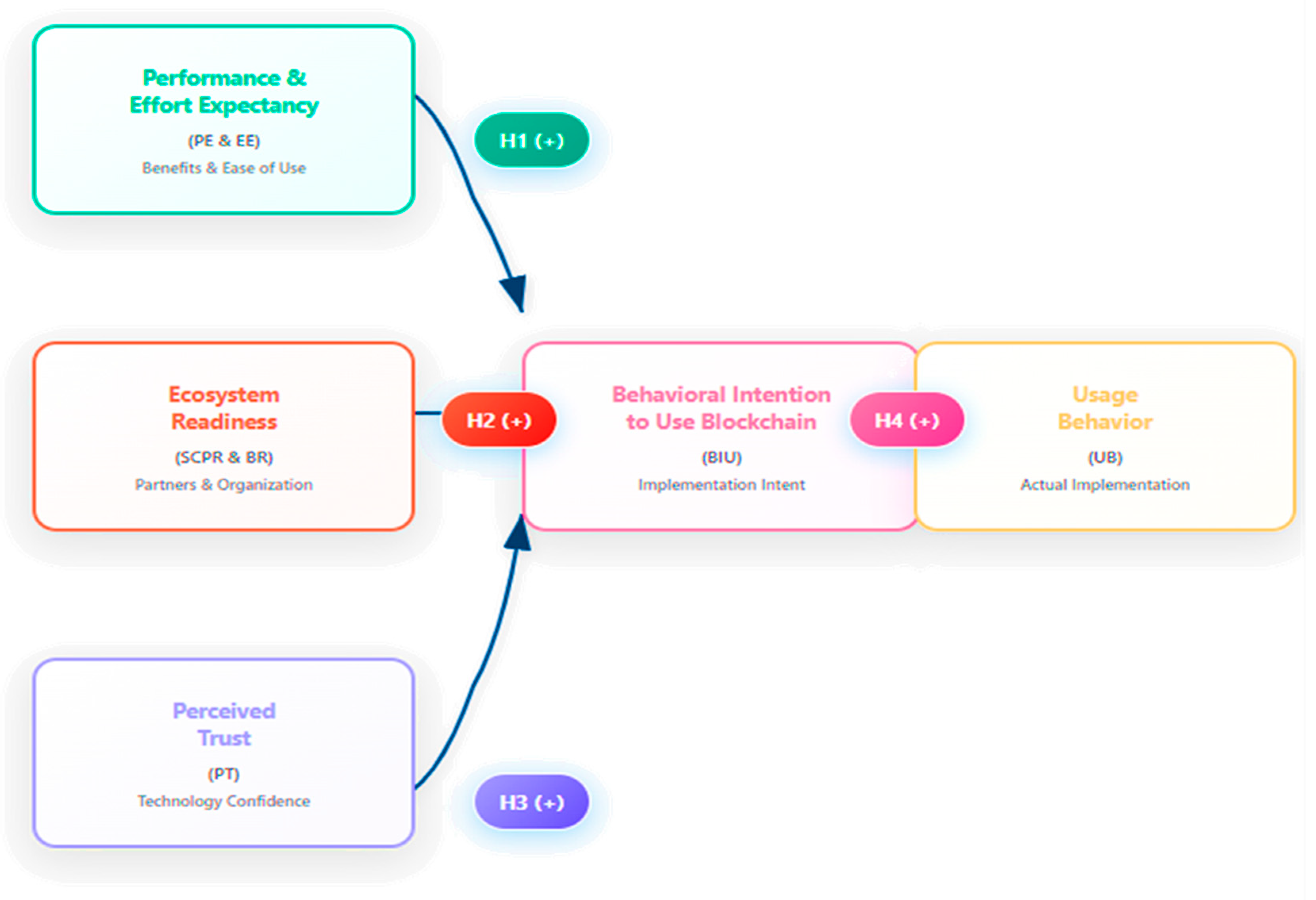
Consequently, the original UTAUT framework has been augmented by integrating three novel constructs: Supply Chain Partner Readiness, Perceived Trust, and Blockchain Readiness. These enhancements are designed to improve the model’s relevance and applicability within the supply chain financing sector. The visual representation of this enhanced model is illustrated in
Figure 3.
The framework comprises seven key constructs: Behavioral Intention to Use (BIU), Usage Behavior (UB), Performance Expectancy (PE), Effort Expectancy (EE), Supply Chain Partner Readiness (SCPR), Perceived Trust (PT), and Blockchain Readiness (BR). These constructs are interconnected through four hypothesized relationships.
The constructs selected for this research, combined with the theoretical relationships established in existing technology adoption literature, provide the empirical foundation for the research hypotheses that will be detailed in subsequent sections.
Building on the theoretical foundations outlined in the literature review, the proposed hypotheses integrate the core determinants identified in technology-adoption research with the specific characteristics of blockchain-enabled supply chain finance. Prior studies rooted in UTAUT highlight the importance of performance expectancy and effort expectancy in shaping behavioral intention toward digital technologies [
59,
61]. At the same time, subsequent extensions of the model further reinforce their relevance [
62,
63]. In parallel, research on supply chain finance and blockchain adoption emphasizes the importance of ecosystem readiness, including both partner readiness and technological preparedness, as key factors that reduce uncertainty and facilitate implementation across supply-chain contexts [
29,
30]. Trust also plays a central role in decentralized financial systems, strengthening the intention to adopt technologies that rely on transparent, immutable, and verifiable data-sharing processes.
Drawing on these theoretical insights, the conceptual model posits that behavioral intention to use BIU is a function of perceived usefulness, ease of use, ecosystem readiness, and trust. Consistent with prior empirical studies, behavioral intention is expected to translate into actual usage behavior, completing the technology adoption pathway. These theoretical analyses lead to the formulation of the study’s hypotheses, presented below:
H1. Performance and Effort Expectations (PE & EE) positively influence the behavioral intention to use blockchain for supply chain financing (BIU).
H2. Ecosystem Readiness (SCPR & BR) positively influences the behavioral intention to use blockchain for supply chain financing (BIU).
H3. Perceived Trust (PT) positively influences the behavioral intention to use blockchain for supply chain financing (BIU).
H4. Behavioral Intention to Use (BIU) blockchain for supply chain financing is positively correlated with actual Usage Behavior (UB).
For testing H1, managers will be more willing to adopt blockchain if they perceive that the technology will improve their operational performance (PE) and if they consider it easy to use, without requiring excessive effort (EE). The more valuable and simpler the technology appears, the greater the intention to adopt it, consistent with prior UTAUT-based empirical findings [
59,
61]. Given the multidimensional nature of the UTAUT-based constructs, H1 is specified at the level of individual relationships tested in the structural model.
For testing H2, blockchain adoption depends on the readiness of supply chain partners (SCPR)—meaning their willingness and capacity to integrate the technology—as highlighted in studies emphasizing the role of ecosystem preparedness in emerging technology implementations [
29,
30]. It further depends on internal organizational readiness (BR), including the necessary resources, culture, and IT expertise, a factor demonstrated to be critical in blockchain adoption contexts [
65,
66]. Given the multidimensional nature of H2, the empirical analysis allows for the independent evaluation of each component of this hypothesis. Accordingly, statistical testing assesses the effects of SCPR and BR separately, allowing acceptance or rejection of each relationship based on its statistical significance. This approach ensures a transparent and rigorous interpretation of the empirical results while preserving the original conceptual formulation of the hypothesis.
H3 offers users and ecosystem participants greater confidence in blockchain technology, the more predisposed they are to adopt it. Trust reduces the uncertainty associated with a new technology and facilitates the decision to implement it, especially for those with limited technological experience, as demonstrated in empirical research on blockchain trust [
67,
68].
H4 stated intention to use blockchain is a reliable predictor of actual technology usage, aligning with previous findings in technology-adoption literature [
59,
63]. If stakeholders express the intention to implement blockchain, they are likely to proceed with its use in practice for supply chain financing.
3.2. Measurement Items
To evaluate the variables within the extended UTAUT (Unified Theory of Acceptance and Use of Technology) framework, a 22-item questionnaire was used. To facilitate respondents’ evaluation, the questionnaire items were scored on a Likert scale from 1 to 7, with 1 indicating “strongly disagree” and 7 indicating “strongly agree.” Respondents were encouraged to base their assessments on their personal knowledge and expertise. Additionally, they were informed that there were no definitive right or wrong answers and that their responses would be used exclusively for academic research.
Table 2 presents the set of constructs and corresponding measurement items, along with the educational sources from which these items were derived.
3.3. Sample and Data Collection
This research employed a cross-sectional survey administered to 200 managers, directors, and other eligible experts from SMEs in seven Eastern European countries: the Czech Republic, Hungary, Moldova, Poland, Romania, Slovakia, and Ukraine. The intended participants were individuals who generally possess an understanding of the complexities of managing financial relationships among stakeholders in the supply chain and are aware of innovative technologies for SMEs, including blockchain.
The survey was designed in Qualtrics and distributed via the Prolific platform between March and May 2023. After removing incomplete responses, 200 valid surveys were obtained. The survey participants were predominantly men (58.50%), and the majority were from Romania (26.50%), followed by Poland (19.50%) and Ukraine (16.50%). The participants are employed in various industries, with 21.00% working in Manufacturing, 17.50% in Information Technology, 16.50% in Retail, 14.50% in Construction, 14.00% in Transportation, Distribution, and Logistics, and 10.00% in Hospitality and Tourism. The remaining 6.50% of participants are working in other sectors, including healthcare, agriculture, and personal care services. In terms of industry experience, 49.00% had 10–15 years, 35.00% had 5–10 years, and 16.00% had over 15 years. The demographic details of the participants are presented in
Table 3.
Finally, we conducted a full collinearity test to assess the potential presence of common method bias (CMB) in the collection of data through online surveys. The presence of CMB can artificially enhance or distort the relationship between external and internal factors with a single participant [
70]. Ref. [
92] proposed a practical method for detecting common method bias by examining the variance inflation factors (VIF). If a VIF exceeds 3.3, it suggests the presence of problematic collinearity and implies that the model may be influenced by common method bias. As depicted in
Table 4, our findings indicate that all the inner model VIFs derived from the full collinearity test in the model are below 3.3. As a result, we can conclude that the model is free from any indications of common method bias.
To validate the proposed model, the PLS-SEM (Partial Least Squares Structural Equation Modeling) approach was utilized. Using SmartPLS 4.0, the survey data was subjected to PLS-SEM analysis to evaluate the model and test the hypotheses. Unlike linear regression, which may be constrained in accounting for measurement errors, SEM adopts a confirmatory approach to analyzing the structure of the phenomenon and provides more reliable insights into the patterns of multiple indicator variables. PLS-SEM was specifically selected for this study due to its ability to estimate causal models with theoretical foundations, making it a contemporary multivariate analytical method. Additionally, PLS-SEM is more appropriate for estimating the variance of the connections between dependent and independent variables, surpassing covariance-based structural equation modeling techniques [
71,
72]. Finally, this analytical approach has been successfully applied to analyze and validate technology adoption models in recent scholarly articles in the supply chain management field [
93]. Therefore, the data underwent a two-stage analytical approach. In the first phase, the measurement model was examined to ensure its validity and reliability. Subsequently, the second stage involved hypothesis testing using a bootstrapping procedure.
5. Discussion
This research has identified and examined the key determinants that affect both the intention and actual adoption of blockchain technology among SMEs, aiming to enhance their access to financing solutions. These results provide a solid foundation for supporting and advancing the implementation of blockchain technology in the supply chain finance sector.
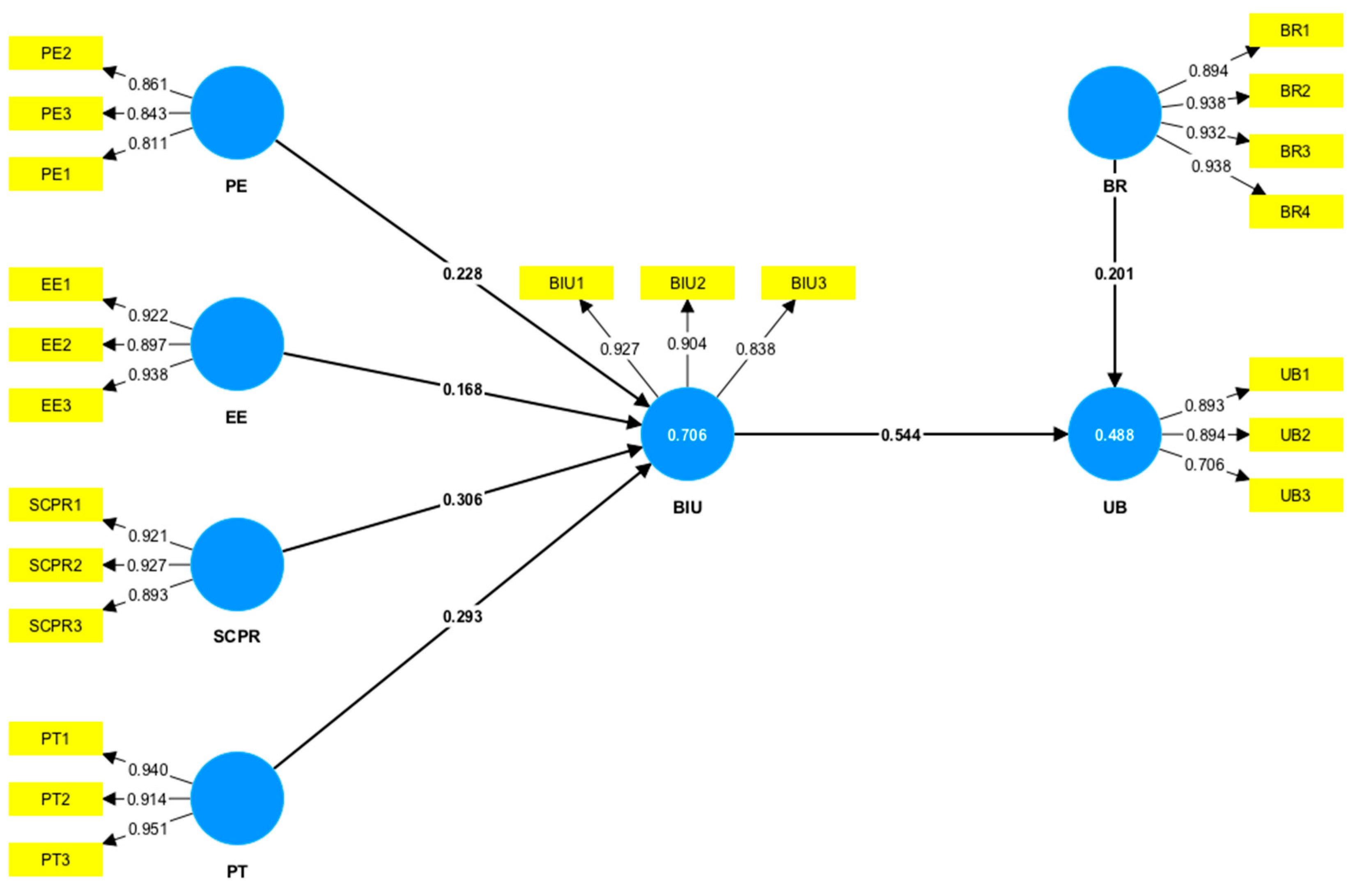
Drawing on survey responses from 200 participants representing SMEs across 7 Eastern European nations, this investigation highlights the distinction between behavioral intention to use blockchain-based supply chain financing platforms and actual usage patterns. The PLS-SEM analysis yielded several meaningful insights. Initially, this research validated extending the UTAUT model with Supply Chain Partner Readiness (SCPR), Perceived Trust (PT), and Blockchain Readiness (BR), which were both theoretically sound and statistically robust within the context of blockchain-enabled supply chain financing. The selection of these four independent variables yielded a model with substantial explanatory power, as Effort Expectancy (EE), Performance Expectancy (PE), Perceived Trust (PT), and Supply Chain Partner Readiness (SCPR) accounted for 70.6% of the variance in Behavioral Intention to Use (BIU).
Supply Chain Partner Readiness (SCPR) emerged as the most significant factor influencing Behavioral Intention to Use (BIU) blockchain-based supply chain financing platforms. This discovery illuminates the crucial function of supply chain partners in determining blockchain platform adoption for financing applications. It also underscores the importance of their technological competencies and financial capabilities in facilitating this adoption journey. This result aligns with [
100], who identified partner preparedness as the primary driver in blockchain technology adoption. Additionally, research by [
57,
63] similarly found that partner readiness substantially influences blockchain adoption intentions.
The results also confirm the meaningful relationship between Performance Expectancy and the intention to adopt blockchain technology, as documented in earlier empirical investigations [
64,
101,
102,
103,
104]. Likewise, the effect of Effort Expectancy on blockchain technology adoption intention was significant, consistent with previous findings by [
9,
60]. Furthermore, this study validates the considerable influence of Perceived Trust on adoption intentions for blockchain-based supply chain financing solutions, consistent with earlier investigations [
67,
68,
105,
106,
107,
108].
Finally, the absence of a significant effect of blockchain readiness on behavioral intention partially rejects H2, suggesting that organizational preparedness alone does not immediately translate into adoption intention in SME contexts. The results demonstrate that Blockchain Readiness meaningfully affects actual Usage Behavior, supporting previous work by [
65,
66]. These findings suggest that organizations exhibiting greater preparedness regarding technical infrastructure, skilled workforce, service provider accessibility, and financial resources are more likely to achieve effective implementation and integration of blockchain technologies within their operational framework.
The findings of this study both confirm and extend prior research on blockchain adoption in supply chain finance. Consistent with existing literature, performance expectancy, effort expectancy, and trust remain essential drivers of behavioral intention [
59,
61,
67]. However, a key contribution of this study lies in demonstrating that blockchain readiness not only influences adoption intention but also directly affects actual usage behavior. While previous studies largely conceptualize readiness as a pre-adoption condition [
65,
66], our results indicate that organizational preparedness continues to shape post-adoption outcomes, particularly in SME-oriented supply chain finance environments characterized by limited digital maturity and resource constraints.
5.1. Theoretical Implications
This study addresses the nascent research on blockchain technology adoption, particularly within supply chain financing in Eastern Europe, an area that remains underexplored. Drawing on the extended UTAUT framework and empirical data from small and medium enterprises (SMEs), we offer insights for scholars, industry practitioners, and policymakers. Our research identifies key determinants influencing blockchain adoption intentions in supply chain finance and analyzes user behavior during implementation.
From a theoretical perspective, this study extends existing technology adoption frameworks by highlighting the persistent role of blockchain readiness beyond the intention stage. Unlike prior models that position readiness-related constructs solely as antecedents of behavioral intention, the empirical evidence presented here suggests a direct linkage between blockchain readiness and usage behavior. This finding refines the application of UTAUT-based models in the context of emerging financial technologies. It underscores the importance of considering post-adoption dynamics when analyzing blockchain-enabled supply chain finance adoption.
Theoretically, this study enhances the original UTAUT model by incorporating three novel variables: Supply Chain Partner Readiness, Perceived Trust, and Blockchain Readiness. It represents the first empirical examination of blockchain-based financing platforms among SMEs in Eastern Europe. Using PLS-SEM, we elucidate how Performance Expectancy, Effort Expectancy, Supply Chain Partner Readiness, and Perceived Trust positively influence behavioral intentions toward these platforms, with Supply Chain Partner Readiness emerging as the most significant determinant. Additionally, Blockchain Readiness was a statistically significant predictor of actual usage behavior, reflecting necessary technological and resource capabilities for effective implementation.
5.2. Practical Implications
This research presents practical insights for SMEs in Eastern Europe aiming to implement blockchain-based supply chain financing platforms. It identifies key determinants of blockchain adoption, emphasizing Supply Chain Partner Readiness as a primary factor influencing financing accessibility. SMEs need to assess their partners’ preparedness for blockchain technology to enhance implementation strategies.
Perceived Trust emerges as the second most influential factor affecting the intention to adopt such platforms. To foster trust among employees and partners, SMEs should develop strategies that enhance understanding of blockchain functionality and establish robust data protection and transparent governance frameworks.
The variables of Performance Expectancy and Effort Expectancy also significantly impact behavioral intention. SMEs must recognize the benefits of blockchain technology, enabling faster, more cost-effective financing while ensuring a user-friendly platform design.
Additionally, Blockchain Readiness plays a crucial role in actual usage behavior, necessitating organizational support in terms of infrastructure, skilled personnel, and financial resources. This investigation provides SMEs with a framework to foster participation in blockchain-based supply chain financing networks, enabling more efficient financing solutions beneficial to their operations and partners.
5.3. Limitations and Future Direction
Beyond the identified theoretical contributions to the existing knowledge base and managerial implications, this study’s limitations should be recognized as opportunities for future research. First, this investigation employed a cross-sectional design, examining Behavioral Intention to Use and actual Usage Behavior of blockchain-based supply chain financing platforms at a singular time point. To overcome this constraint, researchers should consider conducting longitudinal studies, given that blockchain technology adoption is a dynamic, multifaceted process and the technology itself undergoes continuous evolution. Longitudinal approaches would enable researchers to capture temporal changes in adoption patterns, track the evolution of user perceptions, and better understand how external factors, such as regulatory changes, market conditions, and technological advancements, influence adoption decisions.
While this study establishes a foundation for future researchers examining factors influencing blockchain technology adoption, the empirical validation of the newly developed UTAUT model was conducted using a limited sample of SMEs within Eastern Europe. By offering innovative insights into variable integration that drive blockchain-based platform usage intentions, this research creates pathways for further investigation and model application across diverse contexts, enabling a deeper understanding of decision-making processes in emerging technology adoption. Consequently, extending the examination of the enhanced UTAUT model to other geographical regions, including developed Western economies, emerging Asian markets, and developing African nations, would enhance the generalizability of the proposed conceptual framework. Additionally, testing the model across different industry sectors such as manufacturing, retail, healthcare, and agriculture could reveal sector-specific adoption patterns and requirements.
Furthermore, the proposed factors within the extended UTAUT model cannot be deemed comprehensive. Additional organizational elements such as top management support, organizational culture, and change management capabilities; economic considerations including cost–benefit analysis, return on investment expectations, and financial risk assessment; technical aspects such as system compatibility, scalability requirements, and cybersecurity concerns; regulatory factors including compliance requirements, legal frameworks, and government policies; market-related variables such as competitive pressure, customer demands, and supplier requirements; and social factors including peer influence, industry norms, and stakeholder expectations form a complex array of considerations that organizations must navigate when adopting disruptive technologies. Therefore, researchers are encouraged to explore integrating these additional factors to enhance the model’s explanatory power and practical applicability. Future studies might also investigate the moderating effects of organizational size, industry type, technological maturity, and cultural dimensions on the relationships identified in this research.
6. Conclusions
SMEs in Eastern Europe face significant challenges securing financing due to factors such as insufficient collateral, limited capitalization, elevated financing costs, and restrictive lending criteria from traditional financial institutions. These barriers, combined with market competition, information asymmetries between borrowers and lenders, and underdeveloped capital markets, create substantial working capital constraints throughout supply chains. Additionally, SMEs often struggle with complex bureaucratic procedures, lengthy approval processes, and a lack of credit history documentation required by conventional banking systems. However, blockchain technology adoption offers potential solutions to circumvent limitations in traditional financing approaches. This technology can improve access to financing and establish trust within supply chains by providing transparent, immutable transaction records, reducing information asymmetries, and enabling automated contract execution. As a result, SMEs may access new growth opportunities, contributing to enhanced economic development and regional competitiveness in Eastern Europe.
Despite blockchain technology’s potential benefits, its adoption for supply chain financing among Eastern European SMEs remains limited due to technological complexity, implementation costs, regulatory uncertainty, and a lack of technical expertise. Therefore, this study’s primary objective was to identify and analyze the determinants of both behavioral intentions to use and actual use of blockchain-based supply chain financing platforms among Eastern European SMEs. This research proposed and empirically validated an extended Unified Theory of Acceptance and Use of Technology (UTAUT) framework. This investigation presents an integrated model that incorporates three novel variables: Supply Chain Partner Readiness, Perceived Trust, and Blockchain Readiness. The study contributes to understanding the dynamics of blockchain technology adoption in Eastern European SME contexts, addressing a gap in the current literature.
The empirical findings demonstrate the significant influence of Performance Expectancy, Effort Expectancy, Supply Chain Partner Readiness, and Perceived Trust on Behavioral Intention to Use blockchain-based supply chain financing platforms. Notably, Supply Chain Partner Readiness emerged as the strongest predictor of Behavioral Intention. Furthermore, the study identifies Blockchain Readiness as a determinant affecting actual usage behavior. These findings provide valuable insights and contribute to the existing knowledge base in supply chain financing literature. The implications extend across multiple stakeholder groups, including SME decision-makers seeking innovative financing solutions; supply chain participants such as financial institutions, suppliers, and logistics providers; policymakers developing supportive regulatory frameworks; technology practitioners designing implementation strategies; and academic researchers investigating emerging patterns of technology adoption.




 ,
,