


Abstract
This paper addresses safe coverage control for multi-agent systems on a spherical surface with obstacles. While centroidal Voronoi tessellation has been widely used for distributed coverage generation, its extension to spherical environments with safety constraints remains relatively underexplored. To address this problem, we propose a spherical coverage control framework that integrates spherical centroidal Voronoi tessellation with control barrier functions. The proposed method assigns coverage objectives through spherical Voronoi partitioning and corresponding centroid computation, while safety is enforced through barrier-based constraints that prevent inter-agent collisions and obstacle collisions during motion. In addition, a surface-retention mechanism is incorporated to mitigate agent drift away from the desired spherical surface. The method is examined in a Python-based simulation environment with multiple obstacle layouts. The results demonstrate that the proposed framework enables safe distributed coverage over a spherical surface and that the surface-retention mechanism improves conformity of the agent trajectories to the target spherical manifold. The proposed approach provides a practical basis for safe multi-agent deployment in spherical environments.
1. Introduction
Coverage control of multi-agent systems is a fundamental problem in distributed robotics, sensor networks, and autonomous monitoring. In a typical coverage task, multiple agents are deployed over a spatial domain so as to optimize sensing quality, monitoring performance, or service efficiency. Among existing approaches, centroidal Voronoi tessellation (CVT) has become one of the most established frameworks because it provides a natural connection between spatial partitioning and centroid-seeking agent motion [1,2]. Classical Voronoi-based coverage laws have shown that agents can self-distribute over a domain using local geometric information, and subsequent distributed and communication-efficient extensions have further broadened the applicability of coverage control in multi-agent systems [3,4,5,6].
In many practical applications, however, the workspace is not well modeled as a planar Euclidean region. Scenarios such as planetary observation, global environmental monitoring, sky surveillance, and surface-constrained inspection are more naturally defined on spherical or curved surfaces. In such settings, directly applying planar coverage methods is insufficient because both distance evaluation and partition-based objective generation must respect the underlying surface geometry. This motivates the study of spherical coverage strategies based on surface-aware Voronoi constructions and related geometric tools [7,8,9,10,11,12].
At the same time, safe execution is essential in realistic multi-agent deployment. Agents pursuing coverage objectives must avoid collisions with neighboring agents and with obstacles while continuing to move toward useful task configurations. Control barrier functions (CBFs) have emerged as a powerful framework for safety-critical control because they enable nominal control objectives to be filtered through inequality constraints that guarantee forward invariance of safe sets. As a result, CBF-based quadratic-program formulations have been widely adopted for collision avoidance, obstacle avoidance, and safe constrained navigation in robotic systems [13,14,15,16,17,18,19,20]. More broadly, constrained-control problems have also been addressed using prescribed performance control and barrier Lyapunov function based methods. Prescribed performance control is commonly used to regulate tracking or formation errors within predefined transient and steady-state performance bounds [21], while barrier Lyapunov function based methods are effective for nonlinear systems with state constraints by embedding barrier terms into Lyapunov-based stability analysis [22]. These approaches provide complementary viewpoints on constraint satisfaction, with different emphases on performance shaping, state-constraint enforcement, and safety filtering.
Although surface-aware coverage generation and safety-critical control have received considerable attention, their coupling in spherical coverage tasks remains insufficiently addressed. Existing spherical CVT studies mainly focus on the construction of surface partitions, centroidal point distributions, and mesh-generation schemes on spherical or curved domains [7,8,9,10,11,12]. These methods provide useful tools for defining coverage objectives on a sphere, but they generally do not consider how agents moving in the ambient three-dimensional space should safely reach such objectives in the presence of inter-agent and obstacle constraints [23,24]. Conversely, related CBF-based coordination and navigation studies provide safety guarantees for collision avoidance, safe motion coordination, or pursuit-type tasks, but they do not address the additional difficulty that, in spherical coverage control, the desired deployment objectives are generated by time-varying Voronoi regions on the surface [25,26,27,28,29,30]. Therefore, the present problem involves a nontrivial coupling between a manifold-defined coverage objective and an ambient-space safety-filtered control input. In particular, obstacle-avoidance or inter-agent safety constraints may drive the agents away from the desired spherical surface, even when the coverage goals themselves are generated on the sphere.
Motivated by this gap, this paper proposes a safe spherical coverage control framework for multi-agent systems with obstacle avoidance. The proposed method combines spherical Voronoi-based coverage generation with CBF-based safety filtering in a unified architecture. First, spherical Voronoi partitioning is used to define distributed coverage goals over the target sphere. Second, a barrier-based quadratic program modifies the nominal coverage-seeking control input only when necessary to ensure safe separation from neighboring agents and obstacles. Third, to address the mismatch between surface-defined deployment objectives and ambient-space motion, a surface-retention mechanism is introduced to reduce excessive deviation of agent trajectories from the target spherical manifold.
The main contributions of this paper are threefold. First, we formulate a safe spherical coverage control problem in which the coverage objective is defined on a spherical surface, whereas the agents evolve in the ambient three-dimensional space. This formulation explicitly accounts for the mismatch between surface-defined deployment objectives and ambient-space control inputs. Second, we construct a spherical-distance-based safety-filtering controller for the considered problem. The inter-agent and agent-obstacle safety constraints are defined using the radially projected positions on the target sphere and are embedded into a quadratic-program-based control law. In this way, the nominal spherical Voronoi coverage motion can be modified only when necessary to satisfy the prescribed safety constraints. Third, we introduce an auxiliary virtual-sphere-based surface-retention constraint to reduce undesirable radial deviation from the target sphere. This mechanism provides an additional geometric restriction that complements the coverage objective and the CBF-based safety constraints. We also add a theoretical discussion on the feasibility of the resulting quadratic programs and the forward invariance of the associated safety sets. In addition, an open-source Python-based software platform for three-dimensional and spherical coverage control simulations is provided to facilitate reproducibility and future research [31].
The remainder of this paper is organized as follows. Section 2 presents the problem formulation and the proposed method, including spherical Voronoi-based goal generation, CBF-based safety control, and the surface-retention mechanism. Section 3 reports the simulation setup and representative results. Section 4 concludes the paper and discusses future research directions.
2. Problem Formulation and Proposed Method
2.1. Problem Formulation
We consider a group of N agents moving in , while the coverage objective is defined on the surface of a sphere. Let the target sphere be denoted by
where is the sphere center and is the sphere radius.
The position of agent i is denoted by , , and the agent dynamics are modeled as first-order integrators,
where is the control input. For compact notation, the stacked state and input vectors are defined as
Although the agents evolve in the ambient three-dimensional space, the desired deployment is specified on the spherical surface . To associate each agent with a point on the target sphere, a radial scaling operation is introduced. For each , the corresponding scaled point is defined as
The set of scaled points is then used to construct the spherical coverage objective.
Let the obstacle set be denoted by
where represents the center of obstacle k, and denotes its corresponding radius. In the spherical environment considered in this paper, each obstacle is represented by its center position together with a prescribed radius. Safety must be maintained with respect to both neighboring agents and obstacles. At the same time, because the control inputs are computed in while the target deployment lies on , the resulting trajectories do not automatically remain on the spherical manifold.
Accordingly, the control objective of this study is to design inputs such that the agents are distributed over the spherical surface according to a spherical coverage objective, avoid collisions with other agents and obstacles, and remain sufficiently close to the target sphere throughout the motion. More explicitly, the problem considered in this paper is to design control inputs for agents evolving in such that their radially projected positions generate a distributed spherical coverage configuration on S, while the actual trajectories maintain inter-agent safety, avoid obstacle-related exclusion regions, and remain sufficiently close to the desired spherical deployment surface. This formulation highlights the main difficulty of the problem: the coverage objective is defined on the spherical manifold, whereas safety filtering and control execution are performed in the ambient three-dimensional space.
2.2. Spherical Coverage Objective
The coverage objective is defined directly on the target spherical surface . Let denote the scaled point associated with agent i as defined in Section 2.1. The set of scaled points is used as the generator set for spherical partitioning.
To define proximity on the spherical surface, the great-circle distance is adopted. For any two points , the spherical distance is written as
Using this distance, the spherical Voronoi region associated with agent i is defined by
In the present study, the spherical Voronoi regions are constructed numerically using the scaled generator points. For each region , let denote the set of vertices returned by the spherical Voronoi routine. A centroid-like representative point is then computed as the mean of the vertices,
and subsequently projected back onto the target sphere to obtain the goal point
This point is used as the numerical representative of the corresponding spherical Voronoi region.
Once the goal point is obtained, a nominal coverage-seeking input is assigned as
where is a control gain. This nominal input drives each agent toward the representative point of its spherical Voronoi region and thereby promotes a distributed deployment over the target sphere. Let
denote the stacked nominal input.
It should be emphasized that the present formulation is intentionally practical. Instead of deriving an intrinsic continuous spherical locational cost and its exact manifold gradient, the method constructs spherical Voronoi regions numerically and uses region-based representative points to generate motion objectives.
In the numerical implementation, the spherical Voronoi diagram is recomputed at each control update using the projected generator set . Specifically, the projected points are passed to the spherical Voronoi routine together with the prescribed sphere center c and radius r. The vertices of each Voronoi region are then sorted according to the region connectivity returned by the routine before the representative point in (9) is computed. After the Euclidean average of the vertices is obtained, the result is normalized and projected back to the target sphere according to (10). This projection step ensures that the representative goal point used by the controller lies on S, even though the arithmetic mean of the region vertices does not generally lie exactly on the sphere.
2.3. Safety-Constrained Control Using Control Barrier Functions
The nominal input defined in the previous subsection drives each agent toward the representative point of its spherical Voronoi region. However, directly applying this input may lead to unsafe motion when neighboring agents or obstacles are located nearby. To guarantee collision-free deployment, the nominal coverage input is filtered through a CBF-based quadratic program.
For inter-agent safety, each pair of agents is required to maintain a prescribed minimum separation on the spherical surface. Let
denote the great-circle distance between the scaled positions of agents i and j, and let be the corresponding minimum allowable separation. A pairwise barrier function is then defined as
The corresponding safe set is
For obstacle avoidance, each obstacle center is associated with a spherical reference point obtained by radial scaling,
The minimum allowable distance from agent i to obstacle k is determined by the obstacle radius and an additional clearance margin:
where denotes the radius of obstacle k, and represents an additional safety margin. Therefore, the pair defines a spherical cap-shaped obstacle-avoidance region on the target sphere. Here, is a surface distance, while specifies the minimum allowable surface distance from obstacle k. The obstacle-related barrier function is defined as
with the safe set
Following the standard CBF framework, safety is enforced by requiring the barrier functions to satisfy
where is a design constant. Accordingly, the inter-agent and obstacle-avoidance constraints are written as
and
These conditions ensure that, once the system state starts inside the corresponding safe sets, the motion remains within them under the resulting control action.
In practice, the actual control input is obtained by solving a quadratic program that remains as close as possible to the nominal coverage input while satisfying all barrier constraints:
In this way, the controller preserves the intended spherical coverage motion whenever possible and modifies it only when necessary to maintain safe separation from neighboring agents and obstacles. In implementation, the above barrier constraints are enforced through a practical numerical evaluation consistent with the simulation framework.
It should be noted that the present barrier construction is used here as a practical safety filter rather than as a fully intrinsic manifold controller. The deployment objective is defined on the spherical surface, whereas the control inputs are computed in the ambient Euclidean space and adjusted by the quadratic program.
2.4. Surface-Retention Mechanism
As discussed above, the spherical coverage objective is defined on the target sphere , while the actual control inputs are computed in the ambient space . Consequently, even when the nominal motion is generated from spherical Voronoi goals and the safety filter is designed using spherical separation constraints, the resulting trajectories do not automatically remain close to the desired spherical surface. To address this issue, an additional virtual-sphere construction is introduced. In this study, this mechanism is described in terms of auxiliary virtual spheres.
To describe this mechanism, let
be the outward radial unit vector associated with agent i. For each agent, an auxiliary virtual sphere is introduced inside the main target sphere. Let its center and radius be denoted by and , respectively. The auxiliary virtual-sphere center is placed along the radial direction corresponding to the current scaled surface point of agent i, and is written in the general form
where is a design parameter determining how far the auxiliary sphere is shifted inward from the main sphere center. The parameters and are chosen such that the auxiliary virtual sphere remains inside the target sphere. In this way, the auxiliary virtual sphere provides an additional geometric reference located inside the target spherical surface.
Using this construction, an auxiliary virtual-sphere barrier function is introduced as
The corresponding admissible set is
This set is used to restrict motion that would move the agent excessively away from the desired spherical surface.
Following the same barrier-based design used for inter-agent and obstacle avoidance, the auxiliary virtual-sphere constraint is imposed through
where is a design constant. Accordingly, the overall safety-filtered control input is obtained from the augmented quadratic program
Thus, the optimized control input is required not only to maintain safe separation from neighboring agents and obstacles, but also to remain compatible with the additional geometric restriction induced by the auxiliary virtual spheres.
It is important to clarify the role of this mechanism. The auxiliary virtual-sphere constraint is not introduced here as a strict proof-based manifold invariance condition. Rather, it serves as a practical geometric device for limiting excessive deviation from the target sphere during motion. With this additional component, the proposed control framework consists of three coordinated elements: spherical Voronoi-based generation of distributed coverage goals, control-barrier-function-based enforcement of safety with respect to neighboring agents and obstacles, and an auxiliary virtual-sphere-based mechanism that helps retain the motion of agents near the target spherical surface.
2.5. Well-Posedness and Safety Properties of the QP Controller
This subsection clarifies the well-posedness and safety properties of the proposed QP-based controller. The discussion focuses on the properties that are directly required for the safety-filtering formulation, rather than on a global convergence proof to a spherical centroidal Voronoi configuration.
We first consider the feasibility of the QPs in (23) and (29). The radial projection in (5) is assumed to be well defined; i.e., , and singular configurations of the spherical distance function, such as coincident or antipodal projected points, are excluded at the control-update instants. Under these regularity conditions, the barrier functions used for inter-agent safety, obstacle avoidance, and surface retention are differentiable with respect to the system state.
Since the agents are modeled as first-order integrators, the derivative of each barrier function is affine in the control input. Hence, the CBF constraints in (23) and (29) can be written in the compact form
where collects the gradients of the imposed barrier functions and collects the corresponding lower-bound terms, such as and .
Let
denote the admissible set associated with the inter-agent and obstacle-avoidance constraints, and let
denote the augmented admissible set when the auxiliary virtual-sphere constraint is included. If , then all inter-agent and obstacle-related barrier functions are nonnegative. Therefore, the zero input satisfies the CBF inequalities in (23), because for first-order integrator dynamics and the remaining barrier terms are nonnegative. Similarly, if , then also satisfies the auxiliary virtual-sphere CBF inequality in (29). Thus, the feasible sets of (23) and (29) are nonempty for states in and , respectively.
The objective function in both QPs is a strictly convex quadratic function of u, and the feasible sets defined by the affine CBF inequalities are closed and convex. Consequently, for every admissible state, the QPs in (23) and (29) admit unique optimal solutions. This establishes the well-posedness of the proposed safety-filtered controller in the considered class of admissible states, provided that no additional hard input constraints incompatible with the CBF inequalities are imposed.
The same CBF inequalities also imply safety preservation. For any imposed barrier function , the QP enforces , or equivalently . Solving this scalar differential inequality gives . Therefore, if , then for all subsequent times for which the closed-loop solution exists and the QP remains well defined. Hence, the inter-agent, obstacle-avoidance, and auxiliary virtual-sphere admissible sets are forward invariant under the proposed controller. Therefore, if , then for all subsequent times for which the closed-loop solution exists and the QP remains well defined. Hence, the inter-agent, obstacle-avoidance, and auxiliary virtual-sphere admissible sets are forward invariant under the proposed controller.
3. Simulation Studies
3.1. Simulation Environment and Scenario Design
The proposed spherical coverage control framework was evaluated in a Python 3-based simulation environment [31]. Spherical Voronoi partitioning was implemented using the scipy.spatial package, which was used to generate Voronoi regions on the spherical surface from the scaled agent positions and to compute the corresponding representative goal points introduced in Section 2.2.
In the simulation, the target environment was defined as a sphere with a radius of . Eight controllable agents were initialized from random points on the spherical surface, and six static obstacles, each with a radius of , were placed on the sphere. The obstacle centers were located at [20,0,0], [0,20,0], [0,−20,0], [−20,0,0], [0,0,20], [0,0,−20]. The initial agent positions were selected so that they were outside the safety barriers associated with both agents and obstacles. During the simulation, the agent velocities and the spherical Voronoi partition were updated once per second, and the maximum velocity magnitude was limited to .
Two simulation variants were considered in order to examine the effect of the proposed surface-retention mechanism. The first approach employed the spherical coverage objective and the CBF-based safety controller described in Section 2. The second approach additionally introduced the auxiliary virtual-sphere mechanism for each agent. In the original simulation setting, the auxiliary virtual sphere was chosen to be slightly smaller than the main target sphere, with radius , so as to discourage control actions pointing away from the desired spherical surface. Each model underwent three separate simulations, resulting in a total of six spherical simulations across the two approaches.
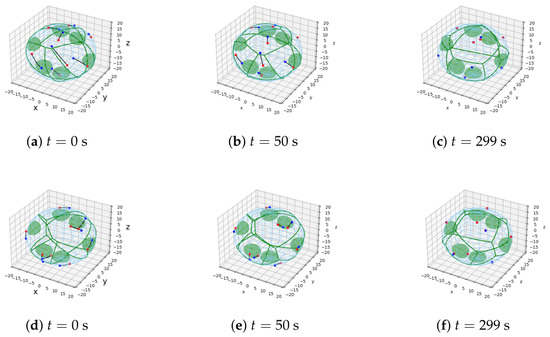
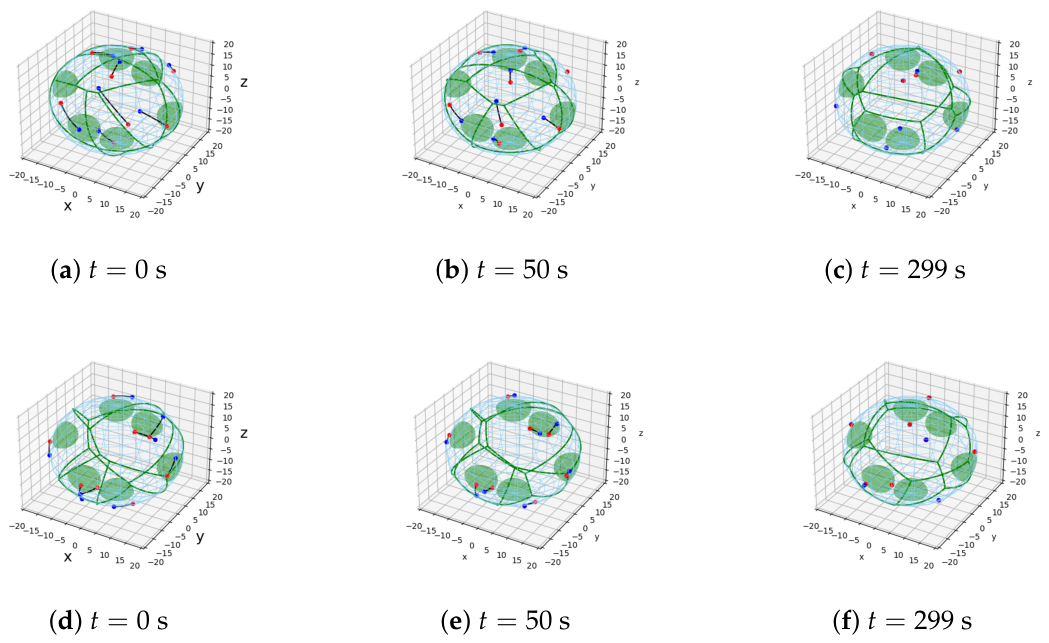
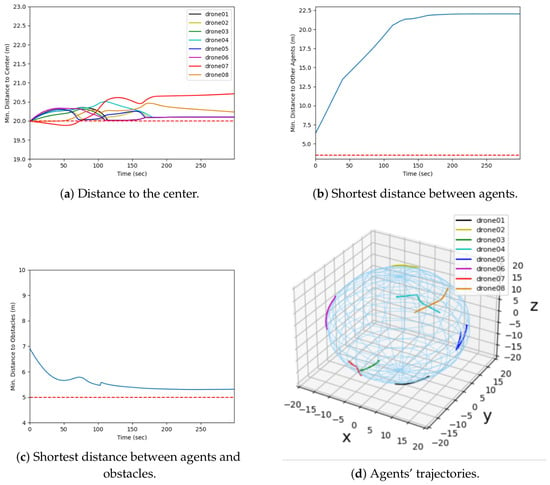
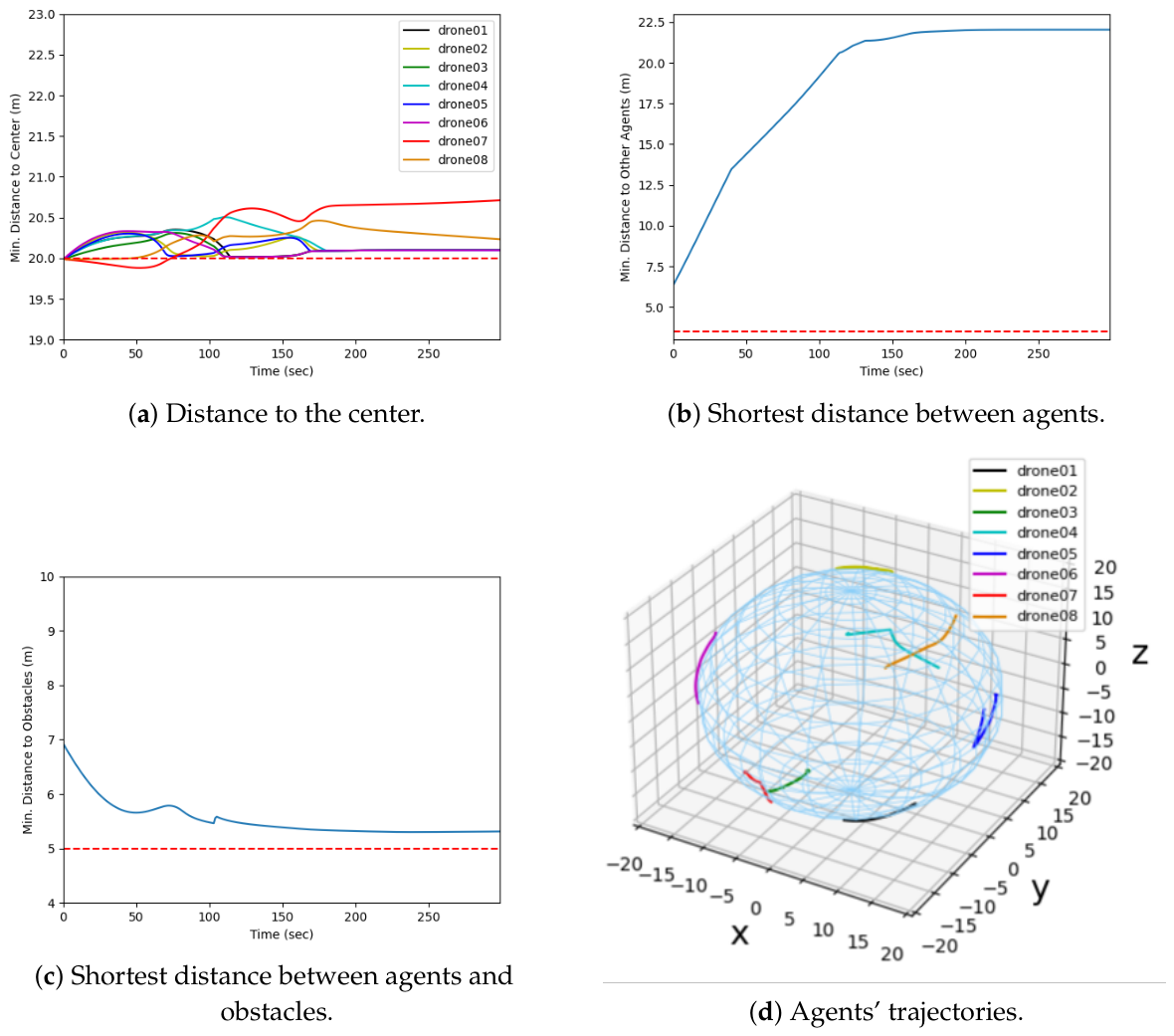
Each simulation was run for 300 frames, with each frame corresponding to one second of simulated time. The reported results include four types of information: the distance of each agent from the center of the sphere, the minimum distance between agents, the minimum distance between each agent and the obstacles, and the resulting agent trajectories on the spherical environment. These quantities were selected to assess not only whether the agents achieved distributed deployment over the spherical surface, but also whether the controller maintained safety and reduced undesirable deviation from the target sphere. For conciseness, the present paper shows representative scenario snapshots and representative quantitative results from Test 1 in Figure 1, Figure 2 and Figure 3, while the discussion below reflects the trends observed across all three runs of each approach.
Figure 1.
Representative scenario snapshots of the two simulation approaches in the spherical environment. Red dots indicate the agents, while blue dots indicate the centroids. The obstacles are shown as green circles. The Voronoi tessellations are represented by green lines, and the paths to the desired configuration are shown by black lines. The top row shows the first approach without the auxiliary virtual-sphere mechanism, and the bottom row shows the second approach with the auxiliary virtual-sphere mechanism. For each approach, the agent configurations are shown at s, s, and s.
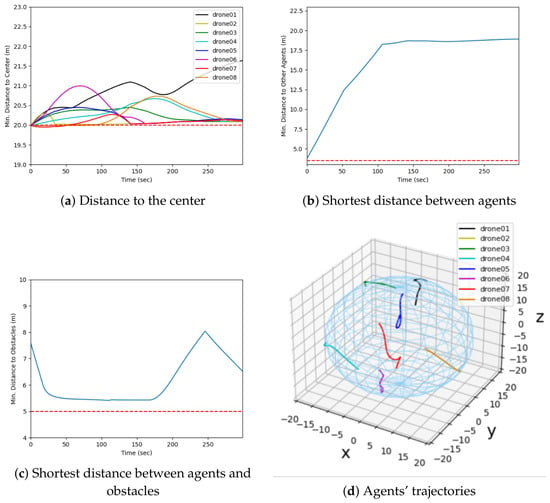
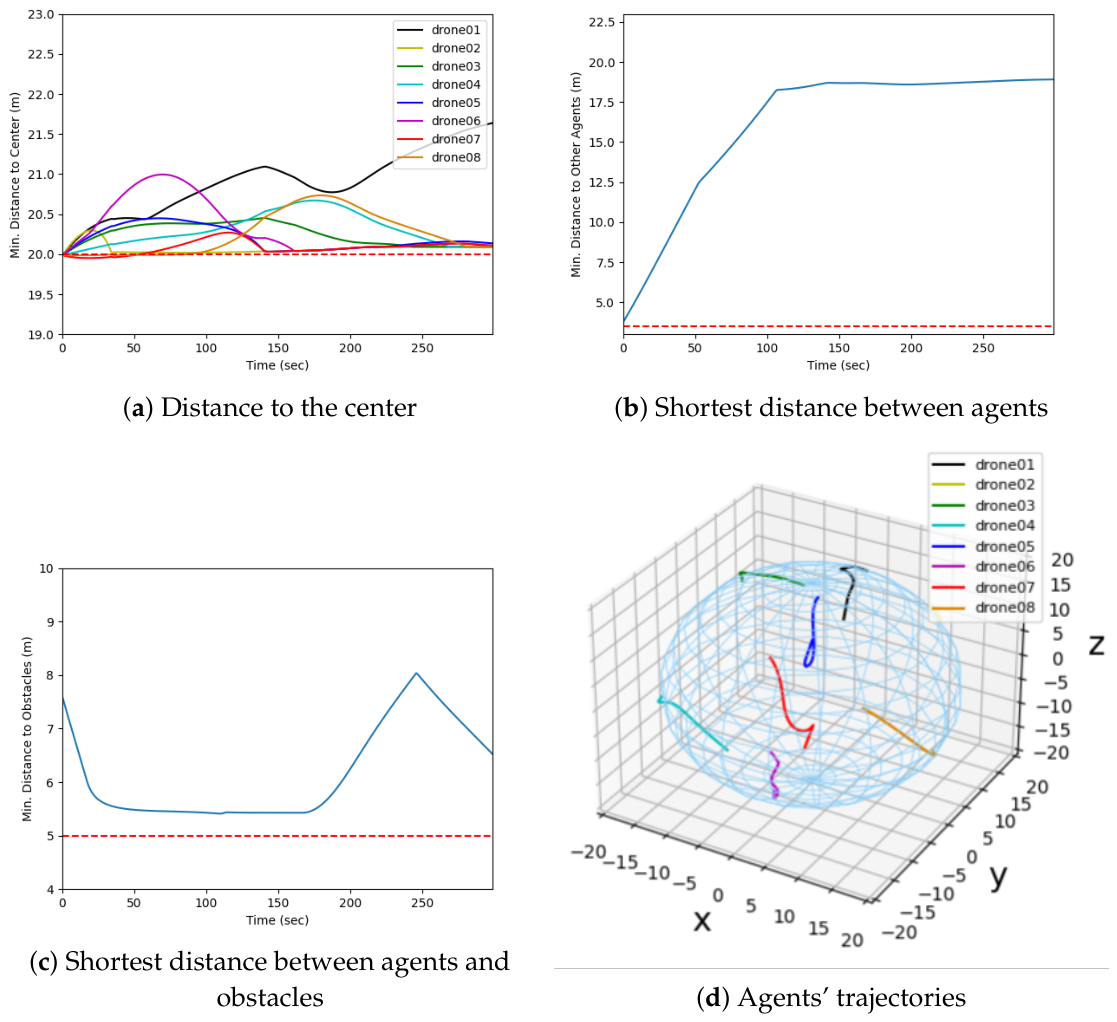
Figure 2.
Representative simulation results of the first approach. (a) Distance of each agent to the sphere center. (b) Minimum distance between agents. (c) Minimum distance between agents and obstacles. (d) Agent trajectories in the spherical environment. The dashed red lines indicate the prescribed safety thresholds where applicable.
Figure 3.
Representative simulation results of the second approach. (a) Distance of each agent to the sphere center. (b) Minimum distance between agents. (c) Minimum distance between agents and obstacles. (d) Agent trajectories in the spherical environment. The dashed red lines indicate the prescribed safety thresholds where applicable.
3.2. Results and Discussion
Across all six simulations, the agents were driven toward their assigned coverage goals within the 300 s simulation horizon while maintaining the prescribed safety margins with respect to neighboring agents and obstacles. The simulation scripts used to generate these representative results are included in the accompanying public repository [31]. In both approaches, the trajectories showed progressive redistribution over the spherical environment, indicating that the proposed controller can generate distributed goal-directed motion under static obstacle constraints.
Figure 1 presents representative scenario snapshots of the first and second approaches at , , and . In both cases, the snapshots show that the agents evolve from their initial random deployment toward a more distributed configuration over the spherical environment while avoiding the obstacle regions. The geometric trend is similar in the two approaches: the agents do not collapse into a clustered arrangement, but instead spread over the spherical surface in a manner consistent with the intended Voronoi-based coverage objective. At the same time, the snapshots visually suggest that the second approach preserves a tighter relationship to the target spherical surface during the transient phase.
Representative quantitative results of Test 1 for the first approach are shown in Figure 2. The shortest-distance plots confirm that the prescribed inter-agent and agent-obstacle safety thresholds are respected throughout the simulation, which is consistent with the intended role of the CBF-based safety filter. The trajectory plot further indicates that the agents still achieve distributed motion over the spherical environment despite the obstacle constraints. However, the distance-to-center curves show that some agents temporarily move farther away from the target spherical surface during the transient phase. This behavior is also consistent with the discussion of the first approach, where obstacle-induced obstruction of some goal directions caused certain agents to deviate more strongly from the main sphere while still remaining collision-free. In particular, the simulation results show that in the first test case one agent moved away from the center of the sphere to approximately , and in the second test case the maximum distance increased further to approximately when the goal remained obstructed by obstacles. By contrast, in the third test case, where the agents were able to reach their goals, safe motion was preserved without the same degree of outward deviation.
Representative quantitative results of Test 1 for the second approach are shown in Figure 3. As in the first approach, the shortest-distance plots remain above the safety thresholds, showing that the auxiliary virtual-sphere mechanism does not compromise collision avoidance with either neighboring agents or obstacles. The trajectory plot again shows distributed motion over the spherical environment. The main difference appears in the distance-to-center curves, where the second approach better limits excessive radial deviation from the target sphere. This is precisely the function of the auxiliary virtual-sphere mechanism: it does not replace the coverage objective or the barrier-based safety filter, but adds an additional geometric restriction that discourages motions pointing excessively away from the main sphere. The same qualitative trend was observed in the other two runs of the second approach in this study. In the first and third test cases, the simulation results show maximum distances of approximately and , respectively, while also noting that across the reported second-approach simulations the agent distance from the sphere center did not exceed approximately . Even in the second test case, where obstacle obstruction prevented some agents from reaching their goals, safety with respect to agents and obstacles was still preserved.
From a comparative viewpoint, the two approaches share the same essential capability of generating safe distributed motion over the spherical environment with static obstacles. Their difference lies mainly in how they handle radial deviation from the target sphere during the transient phase. The first approach is sufficient when moderate temporary deviation from the spherical surface is acceptable, since it already combines distributed spherical coverage generation with safe inter-agent and obstacle avoidance behavior. The second approach becomes advantageous when it is desirable to retain the motion closer to the target spherical manifold. In this sense, the auxiliary virtual-sphere mechanism should be interpreted as a complementary geometric constraint rather than as a replacement for either the coverage controller or the safety filter.
Overall, the selected figures and the full set of simulations support the feasibility of the proposed framework for safe spherical coverage control in the presence of static obstacles. The first approach demonstrates that spherical coverage generation and CBF-based safety control can already produce feasible obstacle-aware motion, while the second approach shows that the proposed surface-retention mechanism improves the ability of the agents to remain close to the desired spherical surface. Although only representative cases are shown in the present paper for conciseness, the original three-run comparison for each approach indicates the same overall trends: safe inter-agent and agent-obstacle separation are preserved in all runs, and the second approach more effectively limits excessive radial deviation from the target sphere.
It should also be noted that the present numerical validation is intended as a representative proof-of-concept demonstration rather than an exhaustive benchmark study. The simulations focus on the effect of the auxiliary virtual-sphere surface-retention mechanism within the proposed framework. Therefore, broader comparisons with classical spherical coverage controllers, planar CBF-based coverage methods, and other constrained-control baselines, together with more systematic coverage-quality and computational-efficiency metrics, remain important directions for future work.
4. Conclusions
This paper presented a safe spherical coverage control framework for multi-agent systems in the presence of static obstacles. The proposed method combines spherical Voronoi-based coverage generation with control-barrier-function-based safety filtering, so that distributed deployment over a target spherical surface can be achieved while maintaining safe separation from neighboring agents and obstacles. In addition, an auxiliary virtual-sphere-based surface-retention mechanism was introduced to reduce excessive deviation of agent motion from the desired spherical surface.
The proposed framework was examined through Python-based simulation studies under multiple predefined obstacle configurations. The results showed that both controller variants were able to achieve spherical coverage behavior while satisfying the prescribed safety constraints. Furthermore, the simulation results indicated that the auxiliary virtual-sphere mechanism improved the ability of the agents to remain close to the target spherical surface, while preserving the overall coverage and obstacle-avoidance performance of the controller. These observations support the feasibility of the proposed approach for obstacle-aware spherical deployment tasks. Future work will consider more rigorous intrinsic formulations of spherical coverage control, improved geometric modeling of obstacle regions on spherical surfaces, and validation in more diverse dynamic environments. Extension to physical robotic platforms or applications in which the agents are naturally constrained to move on spherical manifolds would also be of interest.
Author Contributions
Conceptualization, W.L. and M.S.; methodology, M.S.; software, K.B.; validation, K.B.; formal analysis, K.B. and S.A.T.; investigation, K.B. and S.A.T.; data curation, K.B.; writing—original draft preparation, W.L.; writing—review and editing, W.L.; supervision, M.S.; project administration, M.S. All authors have read and agreed to the published version of the manuscript.
Funding
This research received no external funding.
Data Availability Statement
The data presented in this study are available on request from the corresponding authors due to privacy restrictions.
Conflicts of Interest
The authors declare no conflicts of interest.
References
- Du, Q.; Faber, V.; Gunzburger, M. Centroidal Voronoi Tessellations: Applications and Algorithms. SIAM Rev. 1999, 41, 637–676. [Google Scholar] [CrossRef] [Scilit]
- Du, Q.; Emelianenko, M.; Ju, L. Convergence of the Lloyd Algorithm for Computing Centroidal Voronoi Tessellations. SIAM J. Numer. Anal. 2006, 44, 102–119. [Google Scholar] [CrossRef] [Scilit]
- Lloyd, S.P. Least Squares Quantization in PCM. IEEE Trans. Inf. Theory 1982, 28, 129–137. [Google Scholar] [CrossRef] [Scilit]
- Cortés, J.; Martínez, S.; Karatas, T.; Bullo, F. Coverage Control for Mobile Sensing Networks. IEEE Trans. Robot. Autom. 2004, 20, 243–255. [Google Scholar] [CrossRef] [Scilit]
- Cortés, J.; Martínez, S.; Bullo, F. Spatially-Distributed Coverage Optimization and Control with Limited-Range Interactions. ESAIM Control. Optim. Calc. Var. 2005, 11, 691–719. [Google Scholar] [CrossRef] [Scilit]
- Bullo, F.; Carli, R.; Frasca, P. Gossip Coverage Control for Robotic Networks. SIAM J. Control Optim. 2012, 50, 419–447. [Google Scholar] [CrossRef] [Scilit]
- Du, Q.; Gunzburger, M.D.; Ju, L. Constrained Centroidal Voronoi Tessellations for Surfaces. SIAM J. Sci. Comput. 2003, 24, 1488–1506. [Google Scholar] [CrossRef] [Scilit]
- Ju, L.; Ringler, T.; Gunzburger, M. Voronoi Tessellations and Their Application to Climate and Global Modeling. In Numerical Techniques for Global Atmospheric Models; Lauritzen, P.H., Jablonowski, C., Taylor, M.A., Nair, R.D., Eds.; Springer: Berlin, Germany, 2011; Volume 80, pp. 313–342. [Google Scholar]
- Ringler, T.; Ju, L.; Gunzburger, M. A Multiresolution Method for Climate System Modeling: Application of Spherical Centroidal Voronoi Tessellations. Ocean Dyn. 2008, 58, 475–498. [Google Scholar] [CrossRef] [Scilit]
- Yang, H.; Gunzburger, M.; Ju, L. Fast Spherical Centroidal Voronoi Mesh Generation: A Lloyd-Preconditioned LBFGS Method in Parallel. J. Comput. Phys. 2018, 367, 235–252. [Google Scholar] [CrossRef] [Scilit]
- Miura, H.; Kimoto, K. A Comparison of Grid Quality of Optimized Spherical Hexagonal-Pentagonal Geodesic Grids. Mon. Weather Rev. 2005, 133, 2817–2833. [Google Scholar] [CrossRef] [Scilit]
- Liu, Y.; Yang, T. Impact of Local Grid Refinements of Spherical Centroidal Voronoi Tessellations for Global Atmospheric Models. Commun. Comput. Phys. 2017, 21, 1310–1324. [Google Scholar] [CrossRef] [Scilit]
- Ames, A.D.; Grizzle, J.W.; Tabuada, P. Control Barrier Function Based Quadratic Programs with Application to Adaptive Cruise Control. In Proceedings of the 53rd IEEE Conference on Decision and Control, Los Angeles, CA, USA, 15–17 December 2014; pp. 6271–6278. [Google Scholar]
- Ames, A.D.; Xu, X.; Grizzle, J.W.; Tabuada, P. Control Barrier Function Based Quadratic Programs for Safety-Critical Systems. IEEE Trans. Autom. Control 2017, 62, 3861–3876. [Google Scholar] [CrossRef] [Scilit]
- Xu, X.; Tabuada, P.; Grizzle, J.W.; Ames, A.D. Robustness of Control Barrier Functions for Safety-Critical Control. IFAC-PapersOnLine 2015, 48, 54–61. [Google Scholar] [CrossRef] [Scilit]
- Nguyen, Q.; Sreenath, K. Exponential Control Barrier Functions for Enforcing High Relative-Degree Safety-Critical Constraints. In Proceedings of the American Control Conference, Boston, MA, USA, 6–8 July 2016; pp. 322–328. [Google Scholar]
- Ames, A.D.; Coogan, S.; Egerstedt, M.; Notomista, G.; Sreenath, K.; Tabuada, P. Control Barrier Functions: Theory and Applications. In Proceedings of the European Control Conference, Naples, Italy, 25–28 June 2019; pp. 3420–3431. [Google Scholar]
- Wang, L.; Ames, A.D.; Egerstedt, M. Safety Barrier Certificates for Collision-Free Multirobot Systems. IEEE Trans. Robot. 2017, 33, 661–674. [Google Scholar] [CrossRef] [Scilit]
- Chen, Y.; Singletary, A.; Ames, A.D. Guaranteed Obstacle Avoidance for Multi-Robot Operations with Limited Actuation: A Control Barrier Function Approach. IEEE Control Syst. Lett. 2021, 5, 127–132. [Google Scholar] [CrossRef] [Scilit]
- Luo, W.; Sun, W.; Kapoor, A. Multi-Robot Collision Avoidance under Uncertainty with Probabilistic Safety Barrier Certificates. In Proceedings of the Advances in Neural Information Processing Systems 33, Virtual Event, 6–12 December 2020; pp. 17269–17281. [Google Scholar]
- Zhao, X.; Yang, Q.; Zheng, K.; Zhao, Z.; Zheng, K.; Fang, H. Decoupled Prescribed Performance and Safe Formation Control of Multi-Agent Systems Under Input Constraints. IEEE Trans. Autom. Sci. Eng. 2026, 23, 5940–5952. [Google Scholar] [CrossRef] [Scilit]
- He, W.; Chen, Y.; Yin, Z. Adaptive Neural Network Control of an Uncertain Robot With Full-State Constraints. IEEE Trans. Cybern. 2016, 46, 620–629. [Google Scholar] [CrossRef] [Scilit] [PubMed]
- Ibuki, T.; Wilson, S.; Ames, A.D.; Egerstedt, M. Distributed Collision-Free Motion Coordination on a Sphere: A Conic Control Barrier Function Approach. IEEE Control Syst. Lett. 2020, 4, 976–981. [Google Scholar] [CrossRef] [Scilit]
- Fujinami, T.; Yamauchi, J.; Funada, R.; Fujita, M. A Control Barrier Function Approach for Observer-based Visually Safe Pursuit Control with Spherical Obstacles. IFAC-PapersOnLine 2023, 56, 10799–10804. [Google Scholar] [CrossRef] [Scilit]
- Liu, W.; Borikarnphanichphaisal, K.; Song, J.; Vasilieva, O.; Svinin, M. Safe 3D Coverage Control for Multi-Agent Systems. Actuators 2025, 14, 186. [Google Scholar] [CrossRef] [Scilit]
- Arslan, Ö.; Koditschek, D.E. Voronoi-Based Coverage Control of Heterogeneous Disk-Shaped Robots. In Proceedings of the IEEE International Conference on Robotics and Automation, Stockholm, Sweden, 16–21 May 2016; pp. 4259–4266. [Google Scholar]
- Martin, J.G.; Hatanaka, T.; Maestre, J.M.; Camacho, E.F. Persistent Coverage in Non-Convex Environments with Heterogeneous Robotic Networks: Constraint-Based Approach. IFAC-PapersOnLine 2023, 56, 10708–10714. [Google Scholar] [CrossRef] [Scilit]
- Mestres, P.; Nieto-Granda, C.; Cortés, J. Distributed Safe Navigation of Multi-Agent Systems Using Control Barrier Function-Based Controllers. IEEE Robot. Autom. Lett. 2024, 9, 6760–6767. [Google Scholar] [CrossRef] [Scilit]
- Siri, F.C.; Song, J.; Svinin, M. Safe Coverage Control of Multi-Agent Systems and Its Verification in ROS/Gazebo Environment. Information 2024, 15, 462. [Google Scholar] [CrossRef] [Scilit]
- Liu, W.; Jia, S.; Svinin, M. Super-Ellipse Control Barrier Functions for Enhanced Obstacle Avoidance in Complex Multi-Agent Environments. In Proceedings of the 2025 9th International Conference on Robotics and Automation Sciences (ICRAS), Osaka, Japan, 27–29 June 2025; pp. 317–321. [Google Scholar]
- Borikarnphanichphaisal, K. 3DAndSphereCC: Python Simulation Environment for 3D and Spherical Coverage Control. 2026. Available online: https://github.com/hahahuhu663/3DAndSphereCC (accessed on 3 May 2026).
Disclaimer/Publisher’s Note: The statements, opinions and data contained in all publications are solely those of the individual author(s) and contributor(s) and not of MDPI and/or the editor(s). MDPI and/or the editor(s) disclaim responsibility for any injury to people or property resulting from any ideas, methods, instructions or products referred to in the content. |
© 2026 by the authors. Licensee MDPI, Basel, Switzerland. This article is an open access article distributed under the terms and conditions of the Creative Commons Attribution (CC BY) license.