


Abstract
Detecting deeply buried weak-signature ferromagnetic targets is essential for mine clearance and anti-submarine missions, yet conventional detection algorithms struggle to balance recognition accuracy and computational overhead under strong geomagnetic clutter. This work develops a lightweight detection framework tailored to low-SNR magnetic contour maps, named YOLOv8n-M3CA. The framework adopts MobileNetV3 as the lightweight backbone and introduces Coordinate Attention to strengthen the extraction of faint spatial magnetic anomaly features. We build a COMSOL (Multiphysics 6.2) simulation dataset with 1076 magnetic images covering five target geometries. The dataset is divided into 861 training samples and 215 test samples with 1519 annotated targets overall. Comparative experiments demonstrate that our model reduces parameters from 3.16 M to 2.78 M and GFLOPs from 8.9 to 6.5, while boosting precision, recall, and F1-score to 0.996, 0.994, and 0.995; its training time is shortened to 11.01 h, achieving an inference FPS of 21.5 on CPU. In a preliminary field test on a buried rectangular target, our method attains a detection confidence of 0.73, far exceeding the baseline YOLOv8n at 0.34. Experimental results verify that the proposed framework delivers notable anti-interference performance toward faint magnetic signals, though further field validation with diverse targets and conditions remains necessary before full operational deployment.
1. Introduction
Magnetic target recognition (MTR) identifies concealed ferromagnetic objects by capturing microtesla to nanotesla level geomagnetic anomalies. Compared with radar, LiDAR, infrared, and sonar detection technologies, magnetometry possesses unique penetration capability for non-ferromagnetic media, including fog, vegetation, topsoil, and seawater, and is inherently immune to optical turbidity and acoustic clutter. Such inherent advantages render magnetic detection highly covert and adaptable, supporting extensive military and geophysical tasks such as submarine magnetic fingerprint matching, cooperative underwater target tracking for UUV swarms, and battlefield mine discrimination to distinguish unexploded ordnance from scattered metallic debris. Nevertheless, portable magnetometers and unmanned field detection platforms deployed in practical scenarios are commonly constrained by limited computing and storage resources, creating a practical demand for lightweight, low-latency, and robust magnetic anomaly detection algorithms [1,2,3,4].
Research on magnetic anomaly detection has gradually evolved from traditional handcrafted signal processing pipelines to data-driven deep learning paradigms. In the early stage, magnetic target recognition mainly depended on manual feature extraction and traditional machine learning algorithms. Sheinker et al. [5] adopted principal component analysis (PCA) to extract magnetic anomaly features and suppress background noise for weak signal identification. Nazlibilek et al. [6] utilized multilayer perceptron (MLP) and radial basis function (RBF) networks to classify magnetic contour images based on manually designed magnetic field features. To optimize the recognition of shallow-buried small magnetic targets, Zheng et al. [7] proposed a support vector machine (SVM) detection method. Additional efforts have combined PCA with stochastic resonance [2] and wavelet packet decomposition with SVM [8] for enhanced magnetic anomaly identification. However, these traditional methods rely heavily on empirical feature engineering and lack adaptive feature learning capability. Their detection performance is susceptible to complex geomagnetic noise, which severely limits their generalization ability and robustness in complex field environments.
With the rapid development of deep learning, convolutional neural networks (CNNs) have overcome the limitations of traditional manual feature extraction, becoming the mainstream technology for magnetic anomaly imaging and analysis due to their powerful autonomous feature learning capability. A large number of studies have verified the applicability of CNN frameworks in magnetic target detection [9,10]. Qu et al. [11] developed a hybrid CNN framework to achieve robust feature extraction and recognition of subsurface magnetic anomalies under complex noise backgrounds. Concurrently, two-stage deep learning detection architectures have also been widely applied to multi-target magnetic detection tasks. PointRend-based region-CNN [12] and dual-vector CNN architectures [13] further improve the extraction accuracy of magnetic anomaly contours, while 1D-CNN is explored for one-dimensional underwater magnetic signal detection [14]. Han et al. [15] proposed a multi-sensor fusion deep learning framework for ship shaft-rate magnetic field detection in underwater scenarios. Zhou et al. [16] adopted Mask R-CNN to achieve joint detection and classification of multiple magnetic sources. Nevertheless, two-stage detection and segmentation networks adopt separate feature screening and prediction branches, which introduce high computational overhead and low inference efficiency. Such frameworks cannot meet the real-time and lightweight deployment requirements of portable field magnetic detection equipment.
To balance detection accuracy and inference efficiency, single-stage YOLO detectors with inherent lightweight and fast inference advantages have been gradually deployed for automated identification of subsurface magnetic anomalies generated by buried unexploded ordnance (UXO). Previous studies have verified the applicability of YOLO pipelines in near-surface UAV geomagnetic surveys [17], underwater buried magnetic target recognition [18], and underwater UXO detection based on YOLOv8 [19]. These literature works focus on subsurface ferromagnetic anomalies consistent with the research object of this work and directly prove that YOLO architectures are compatible with magnetic contour imaging tasks.
As the latest mainstream single-stage detector, YOLOv8 [20] has attracted extensive optimization studies for magnetic-related inspection. Most existing YOLOv8 variants target industrial surface magnetic imaging defects, such as surface flaws of magnetic tiles [21,22], tiny precision imperfections on magnetic rings [23], and pipeline magnetic flux leakage signals [24]. Unlike common optical surface defect images captured by visible cameras, these industrial samples are reconstructed from magnetic field data, which creates basic homologous relevance to the geomagnetic contour maps adopted in this paper. In response to these industrial scenarios, researchers have carried out a series of improvements from two dimensions: network architecture optimization and feature enhancement. To meet the real-time detection requirements in magnetic tile production, Niu et al. [22] proposed the YOLO-RDM algorithm, which significantly reduces computational complexity while maintaining high detection accuracy by optimizing the feature fusion path. Ma et al. [21] further designed the YOLOv8-AHF model, achieving an effective balance between model lightweight design and detection precision. To enhance the model’s sensitivity to minor defects, Li et al. [23] constructed the BiContext architecture with multilevel contextual enhancement, effectively overcoming the feature extraction bottleneck for magnetic ring surface defects under complex backgrounds. Notably, these improved strategies have been extended to more challenging engineering environments. For instance, a YOLOv8-inspired framework has been applied to underwater magnetic anomaly detection [19], and Fu et al. [24] verified the robustness of an improved model in pipeline magnetic flux leakage detection via both simulation and experimental validation.
Despite the apparent similarities, industrial surface magnetic defect inspection and field subsurface magnetic detection differ substantially in signal formation rules and edge-device deployment constraints. Industrial magnetic anomalies exhibit sharp, high-contrast textures on smooth, noise-free backgrounds, without the random complex geomagnetic clutter that widely masks weak subsurface magnetic signals in field measurement data. However, despite such essential disparities, these industrial magnetic imaging studies propose two universal optimization directions: lightweight backbone compression and embedded attention modules for feature enhancement and noise suppression. These general methodological paradigms offer valuable technical references for the MobileNetV3 [25] lightweight backbone and Coordinate Attention [26] weak-feature extraction module adopted in this paper to address low-SNR magnetic anomaly detection in noisy measured geomagnetic maps. Crucially, all the above industrial surface defect studies predominantly assume relatively clean target backgrounds and fail to address the strong coupling interference between severe geomagnetic background noise and weak buried magnetic anomaly signals, which constitutes the core research motivation of the present work.
Current research has fully confirmed that lightweight convolution optimization and adaptive attention mechanisms can effectively enhance weak feature recognition and background noise suppression capabilities, rendering them applicable for low-SNR tiny target detection and edge intelligent deployment. Despite these advances across vision tasks, subsurface magnetic anomaly recognition still faces three critical unresolved bottlenecks:
- Cross-domain generalization limitations of existing detection models. Most current detection frameworks are directly migrated from natural optical images or industrial surface magnetic defect datasets. Subsurface magnetic contour data differ essentially from surface defect imagery in physical generation mechanisms, spatial signal distribution, and noise characteristics. Direct cross-domain transplantation leads to degraded generalization performance, and few existing models can simultaneously satisfy the high-precision and low-computation requirements for field-portable magnetometer deployment.
- Scarcity of standardized multi-condition magnetic anomaly benchmarks. Public open magnetic anomaly datasets for buried ferromagnetic targets are extremely limited. Large-scale standardized datasets covering diverse target geometries, variable burial depths, and complex geomagnetic noise backgrounds are still unavailable, restricting the standardized training and quantitative validation of dedicated magnetic detection networks.
- Lack of targeted lightweight anti-interference detection frameworks customized for low-SNR subsurface weak magnetic anomalies. Most existing YOLO-based magnetic detection improvement schemes target high-contrast industrial surface defects with clean, low-noise backgrounds. Few lightweight architectures are specially designed to resist severe coupled geomagnetic clutter and extract faint buried ferromagnetic signals. To the best of our knowledge, no published study integrates the MobileNetV3 lightweight backbone and Coordinate Attention to match the unique signal and noise distribution of subsurface geomagnetic contour maps. Developing a lightweight, noise-resistant detection network to highlight weak magnetic features under complex geomagnetic interference is still an unresolved core technical challenge.
The combination of MobileNetV3 and Coordinate Attention has achieved excellent performance in wire rope detection [27], concrete crack detection [28], railway fastener inspection [29], and rail surface defect detection [30], which inspires us to migrate this lightweight architecture to subsurface weak magnetic anomaly detection tasks.
Facing multi-dimensional challenges including insufficient standardized magnetic field datasets, severe geomagnetic interference, and stringent lightweight deployment requirements for edge devices, this paper develops an improved lightweight YOLOv8 framework tailored for subsurface magnetic anomaly images with four core contributions to construct a lightweight anti-interference detection framework for extracting faint low-SNR subsurface magnetic anomaly features from field-measured geomagnetic contour maps under limited computing resources.
- A dedicated magnetic anomaly dataset is built via COMSOL finite-element simulation, containing 1076 synthetic magnetic contour maps of five typical geometric targets under varying burial depths and noise levels.
- The original YOLOv8n backbone is replaced by MobileNetV3 with depthwise separable convolutions, which drastically cuts model parameters and computational overhead while preserving basic feature representation capability.
- Coordinate Attention (CA) is embedded to strengthen spatial and channel features related to targets, suppress background geomagnetic interference, and improve detection confidence of weak buried magnetic targets with negligible computational overhead.
- The lightweight MobileNetV3 backbone is integrated with the CA module to construct the YOLOv8n-M3CA detector.
Synthetic simulation tests and field measurement experiments on a single rectangular buried ferromagnetic target are conducted to validate the overall performance of the proposed model.
2. Materials and Methods
2.1. Improved YOLOv8 Algorithm
2.1.1. YOLOv8
YOLOv8, released by Ultralytics in 2023 [20], is a major upgrade of YOLOv5 that builds on the successes of all previous YOLO versions. It introduces a brand-new backbone, an anchor-free detection head, and a redesigned loss function while remaining deployable on diverse hardware ranging from CPU to GPU. By integrating many state-of-the-art techniques, YOLOv8 achieves an excellent trade-off between accuracy and speed, and its unified framework is expected to accommodate future YOLO variants. We take YOLOv8 as the baseline because of its stable performance, modular design, and wide usage in magnetic anomaly detection. Its flexible structure enables simple integration of our MobileNetV3 backbone and Coordinate Attention, and the proposed lightweight strategy can be transferred to other YOLO versions.
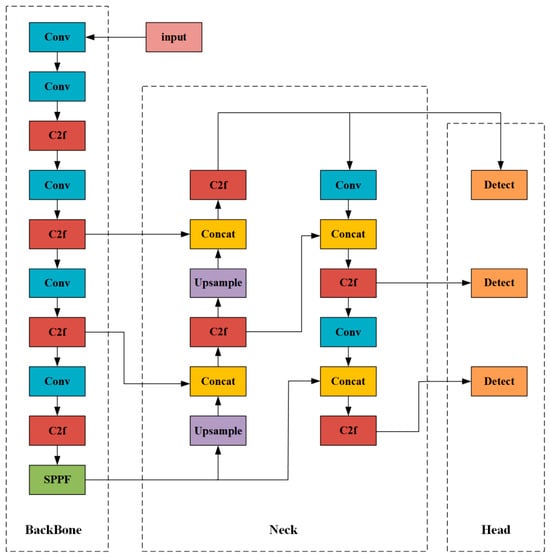
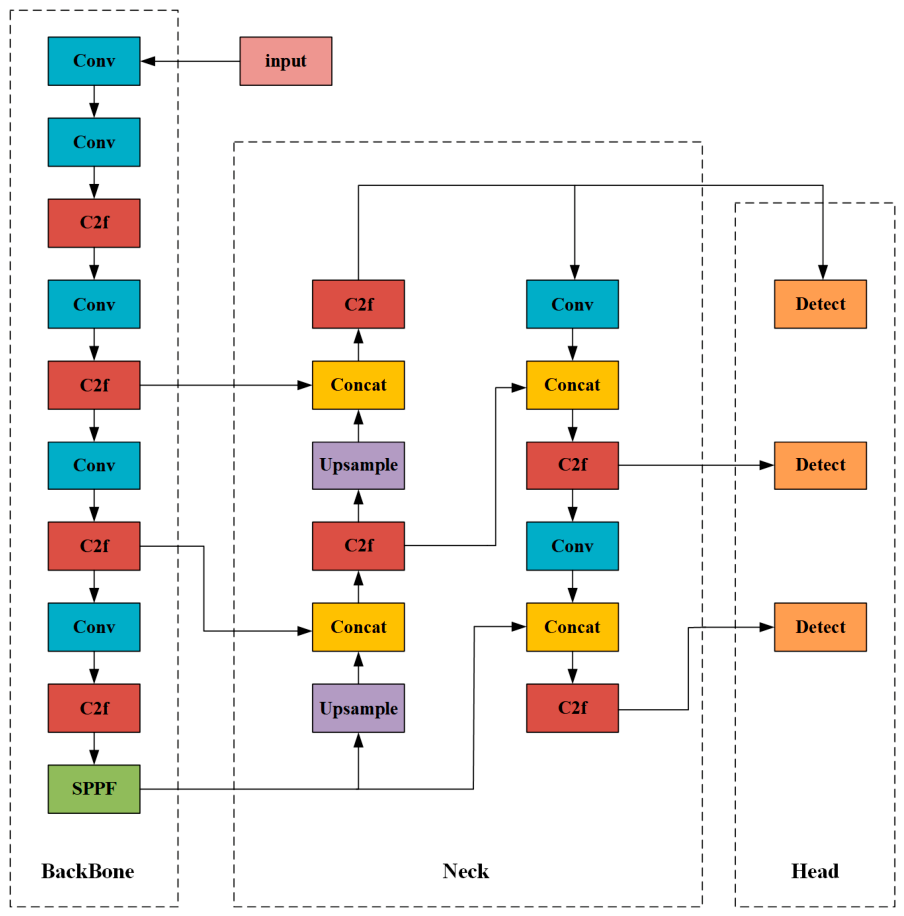
The family consists of five scaled models—YOLOv8n, YOLOv8s, YOLOv8m, YOLOv8l, and YOLOv8x—that share an identical architecture but differ in depth and width. We adopt YOLOv8n (Figure 1) in this paper. The network is composed of four sequentially connected parts: Input, Backbone, Neck, and Head. The backbone stacks Conv, C2f, and SPPF modules to extract multi-scale features. The Neck fuses these features through upsampling and concatenation (Concat), yielding enriched representations that are finally fed to the Head, implemented with stacked convolutional layers for classification and bounding-box regression.
Figure 1.
Architecture of the YOLOv8n network.
Each Conv block comprises a Conv2d layer, a batch normalization (BN) layer, and a SiLU activation function. The C2f module draws on the design concepts of YOLOv5’s C3 module and YOLOv7’s ELAN module. At the end of the backbone, fast spatial pyramid pooling (SPPF) is utilized to fuse feature maps with diverse receptive fields, boosting feature representation capability.
2.1.2. MobileNetV3 and Coordinate Attention (CA)
Proposed by Google, MobileNetV3 is the state-of-the-art variant of the MobileNet family [25], featuring compact architecture, fewer parameters, and high detection accuracy. It achieves competitive results in multiple tasks, including image classification and object detection.
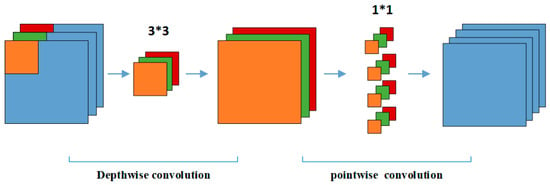
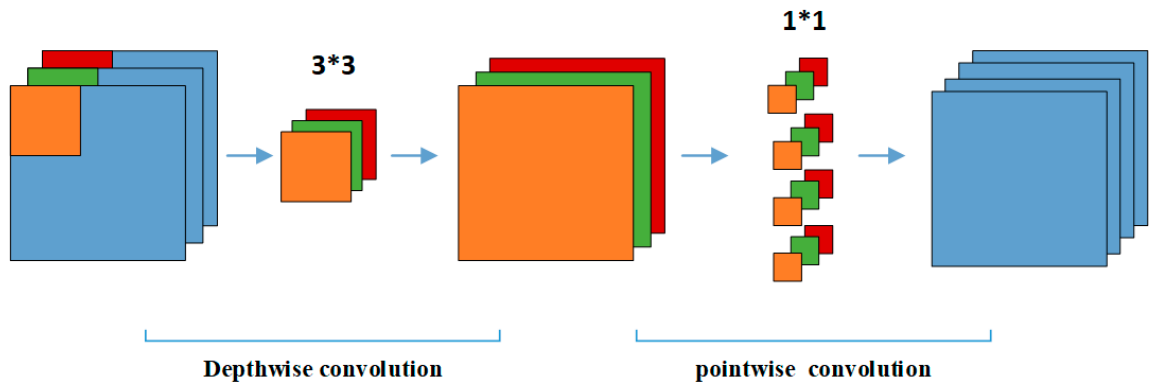
The lightweight property of all MobileNet models originates from depthwise separable convolution, which splits standard convolution into depthwise (channel-wise) convolution and 1 × 1 pointwise convolution. This decomposition greatly cuts computational overhead and parameter volume without significant degradation of feature representation, as illustrated in Figure 2.
Figure 2.
Depth-separable convolutional architecture diagram.
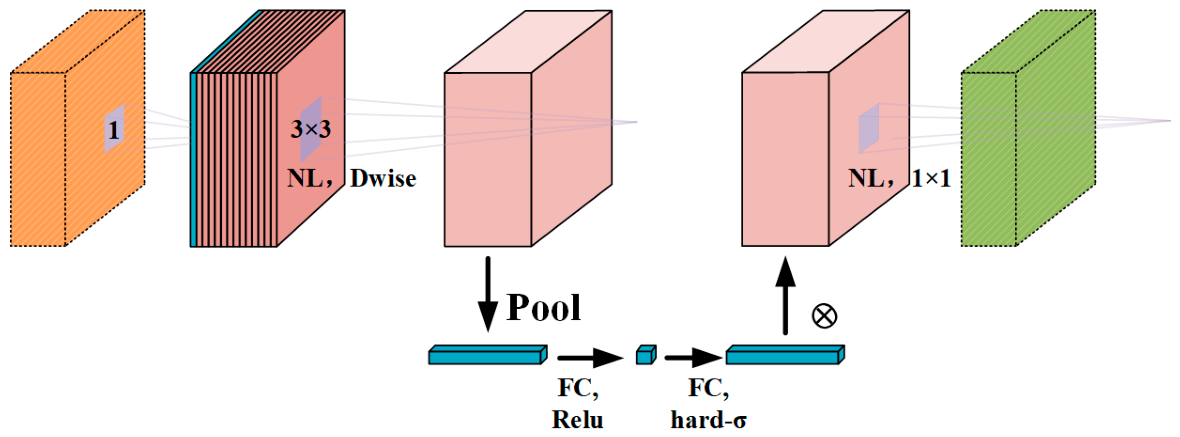
Building upon this basis, the MobileNet series has been continuously improved: MobileNetV1 first introduced depthwise separable convolution; MobileNetV2 further incorporates inverted residual bottlenecks; MobileNetV3 embeds squeeze-and-excitation (SE) attention and adopts the h-swish activation, achieving a better trade-off between accuracy and latency.
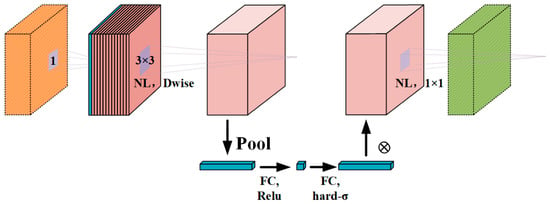
The core component of MobileNetV3 is the bottleneck (Bneck) block: a 1 × 1 convolution first expands features to a higher dimension for richer information, followed by depthwise and pointwise convolutions to compress the features back to a compact form. This design further reduces parameters and FLOPs while maintaining accuracy, facilitating lightweight deployment on mobile and edge-embedded devices. The overall structure is shown in Figure 3.
Figure 3.
Structure of the bneck module for the MobileNetV3 model.
Therefore, we adopt MobileNetV3 as the lightweight replacement backbone. The architectural specification of MobileNetV3 is detailed in Table 1.
Table 1.
Specification for MobileNetV3.
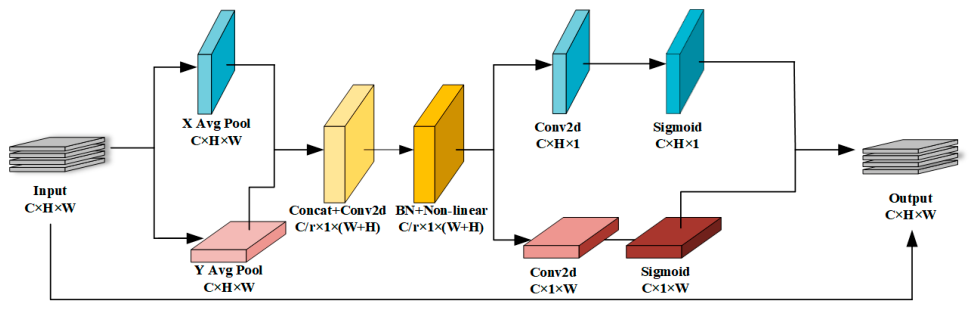
Although MobileNetV3 is computationally efficient, its comparatively shallow architecture can lead to a loss of fine-grained features in complex scenes. To compensate for this deficiency and to enhance the perceptual accuracy of the detector, the CA modules [26] are embedded into the last C2f module of the YOLOv8n Neck layer, immediately prior to the detection head. CA independently encodes spatial information by applying one-dimensional convolutions along the horizontal and vertical directions; for each channel , it generates an attention map of height and width that highlights location-specific details, computed as specified in (1) and (2) [26]. This operation introduces only 0.02 M additional parameters and <0.3 GFLOPs for a 640 × 640 × 3 input, ensuring that the lightweight characteristic of MobileNetV3 is preserved.
The Coordinate Attention (CA) module first extracts horizontal and vertical directional features and generates orientation-aware feature maps. These maps are concatenated along the channel dimension and transformed by a 1 × 1 convolution (denoted ), integrating spatial-directional information, as expressed in (3) [26].
After transforming via (3), the resulting feature map is split along the spatial dimension into two distinct tensors and . Two separate 1 × 1 convolutions, and , are then applied to and , respectively, to restore the channel dimension to that of the input, yielding (4) and (5) [26].
Ultimately, the derived attention weights are element-wise multiplied with the input feature map, producing the coordinate-attention-refined output [26], formulated as
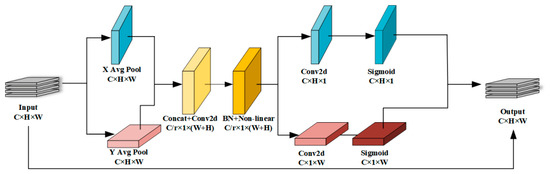
The architecture of the CA module is illustrated in Figure 4.
Figure 4.
The architecture of the CA module.
By adaptively weighting informative regions, the CA mechanism enables the lightweight network to locate objects more accurately, yielding a measurable gain in recognition performance with virtually no additional computational overhead.
2.1.3. YOLOv8n-M3CA
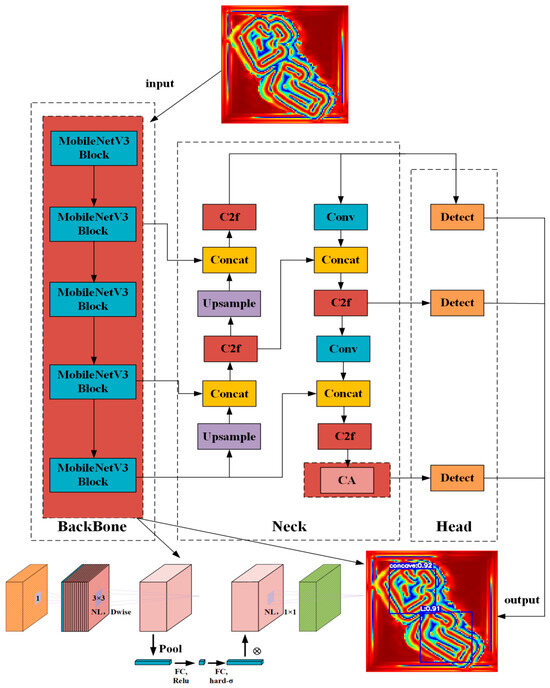
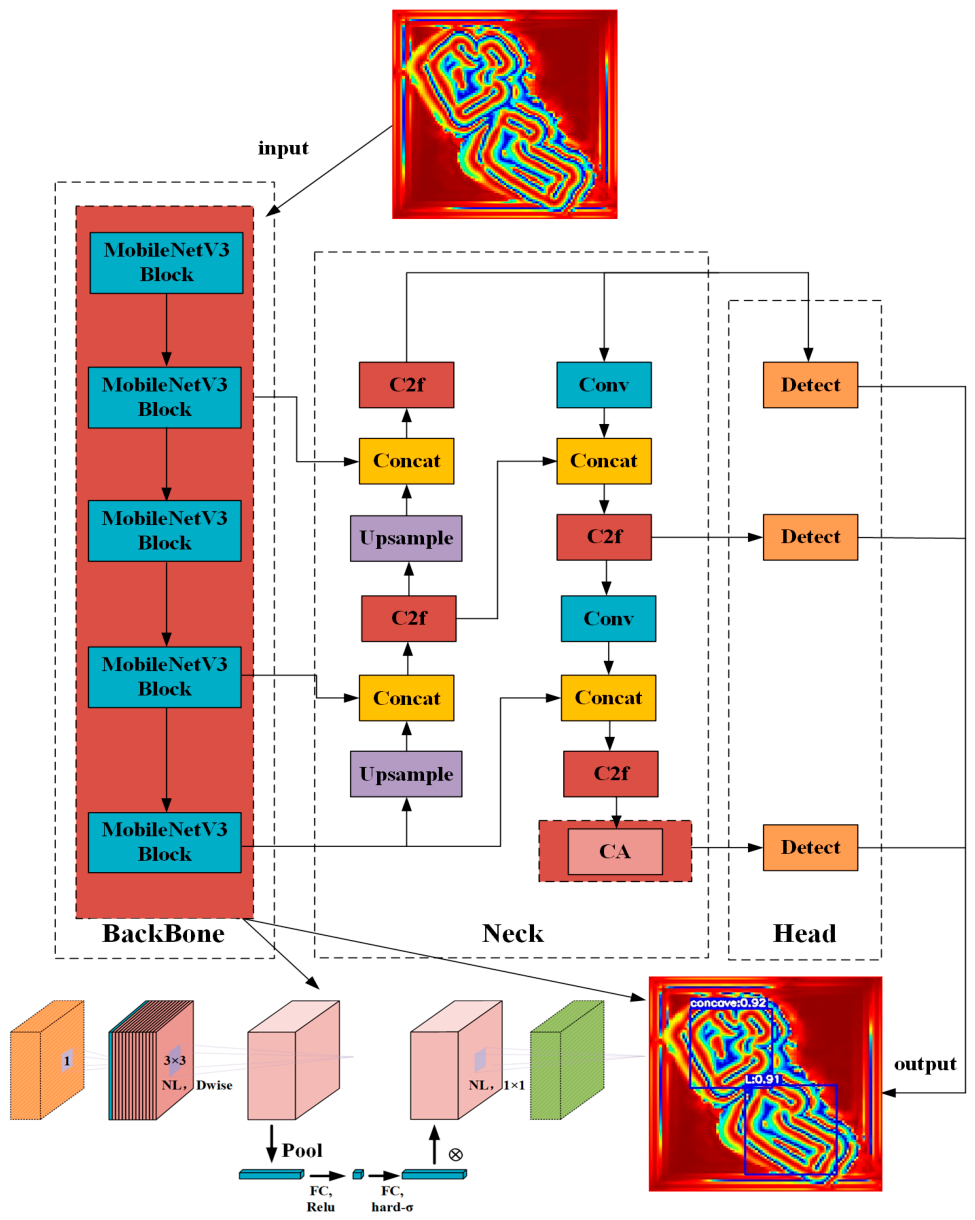
Building on the above insights, we improve the original YOLOv8n architecture: MobileNetV3 replaces the conventional backbone, while the Coordinate Attention (CA) mechanism is embedded within the last C2f module of the Neck layer, giving rise to the improved YOLOv8n-M3CA network whose overall structure is depicted in Figure 5.
Figure 5.
The architecture of the YOLOv8n-M3CA network.
2.2. Simulation
2.2.1. Dataset Construction
Training a target-recognition network demands a large-scale sample set, but field magnetic datasets are labor-intensive and time-consuming. We therefore adopt a finite-element simulation strategy: following COMSOL Multiphysics 6.2 operating procedures, we systematically vary the position, orientation, and burial depth of five magnetic target classes (spherical, rectangular, L-shape, convex, and concave) to generate a large number of magnetic anomaly samples. The background field is set to the geomagnetic vector of Huairou, Beijing ([27,500, −3700, 47,500] nT in the N-E-Down frame), which serves as the excitation source for magnetizing the targets.
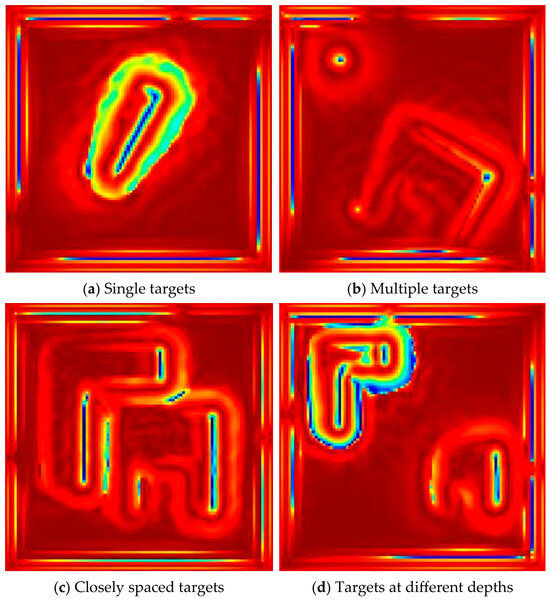
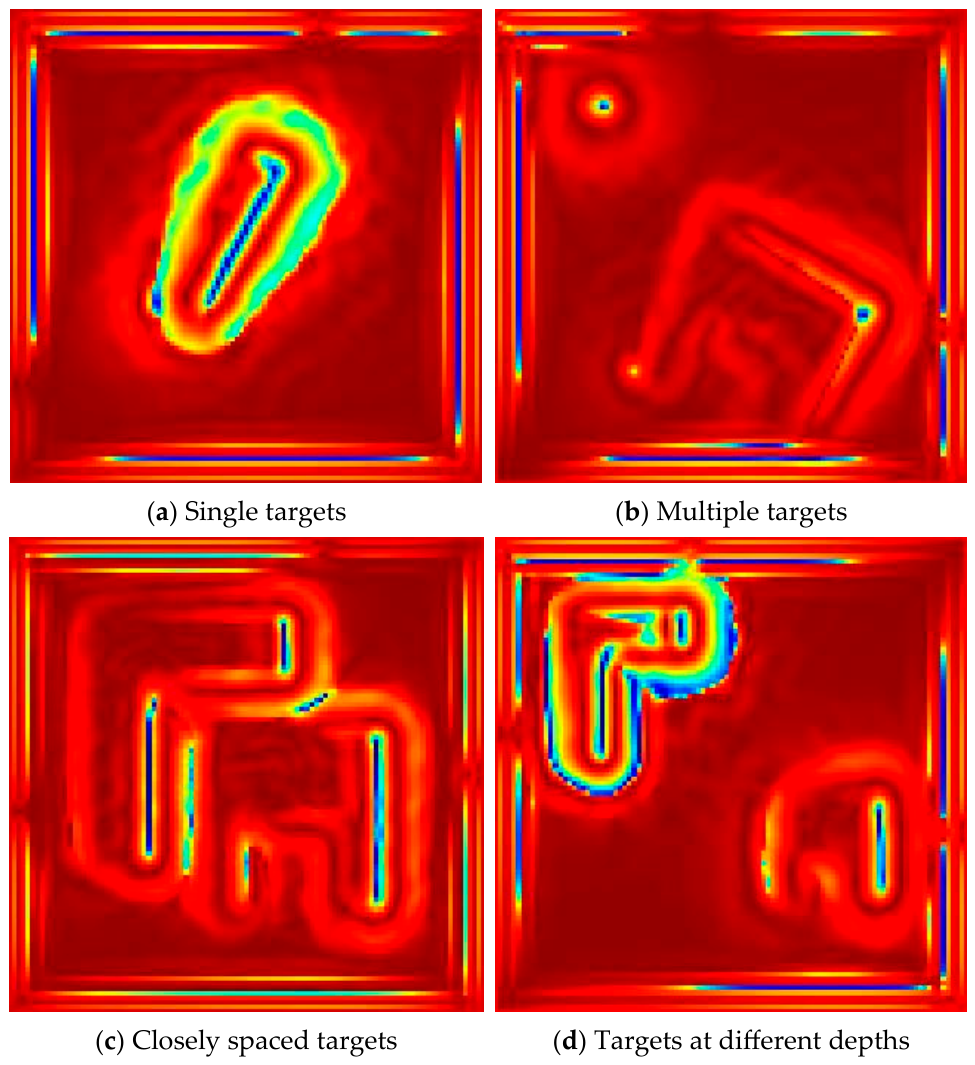
Magnetic vector data at 100 × 100 grid nodes within the working plane were exported from the simulation software, and a total-horizontal-component boundary-enhancement equalization based on Gabor filtering [31] was applied to generate pseudo-color magnetic images for use as training samples. To enable shape recognition of multiple magnetic objects and ensure sample diversity, finite-element modeling produced 1076 images covering five geometries—spherical, rectangular, L-shape, convex, and concave—which were grouped into four representative combinations shown in Figure 6.
Figure 6.
Four different types of targets. Colors indicate magnetic field intensity from low (blue) to high (red).
The five sample categories in the dataset are illustrated in Figure 6. Figure 6a,b present one and two magnetic sources, respectively; the anomalies are distinct and virtually free from mutual interference. Figure 6c shows interference when the two targets are closely deployed, while Figure 6d demonstrates that the target closer to the measurement plane produces a markedly stronger anomaly when the two sources are at different depths.
The selected five shapes—spherical, rectangular, L-shaped, convex, and concave—are representative of typical buried ferromagnetic targets. Regular geometries (spherical, rectangular) correspond to canonical objects, while irregular structures (L-shaped, convex, concave) approximate deformed metallic fragments commonly encountered in practical detection scenarios, covering a broad range of magnetic detection cases. These five shapes are arranged in four configurations—single, multiple, closely spaced, and different depths—as shown in Figure 6, with their corresponding bounding-box labels listed in Table 2.
Table 2.
Image class corresponding to anchor number.
In total, the experimental dataset comprises 1076 target-sample images, of which 861 are used for training and 215 for testing in the experiments, and the dataset contains 1519 annotated instances. Note that 1076 refers to the total number of original images, while 1519 represents all individual annotated target instances, as multiple targets may exist within a single image, with a relatively balanced sample distribution across the five target categories: 427 spherical targets, 367 concave targets, 305 L-shaped targets, 242 convex targets, and 178 rectangular targets, with no extreme class imbalance observed.
This distribution ensures that each target category has sufficient training samples, effectively avoiding prediction bias toward dominant classes during model training. Meanwhile, statistical results show that all targets are uniformly distributed across the entire image plane, with no obvious local aggregation or systematic positional deviation. This characteristic guarantees that the model can learn robust features independent of target location, thereby improving the generalization ability of the detection model.
Given that the training samples are physically constrained magnetic contour maps rather than natural images, the data augmentation pipeline is carefully designed to balance model robustness and physical fidelity. We adopt the standard YOLOv8 data augmentation strategies, including mosaic, scaling, translation, horizontal flipping, and HSV color jittering, to improve model generalization. Since our simulation dataset has comprehensively covered diverse target positions, azimuths, and burial depths during data generation, we disable rotation, vertical flipping, mixup, cutmix, and pixel-level noise injection in training. Rotation and vertical flipping are removed as they would artificially distort the intrinsic directional features of magnetic contours, which are strictly governed by the target geometry and its azimuth relative to the background geomagnetic field. Different from vertical flipping and rotation, horizontal flipping only mirrors the image along the left-right axis without altering the fixed north–south positive-negative distribution of magnetic dipoles, which corresponds to real field survey scenarios where the magnetometer passes the target from either the left or right side. Pixel-level noise augmentation is also omitted because the geomagnetic contour maps are inherently low-SNR; extra artificial noise would overwhelm faint anomaly signals and mislead the model to fit irrelevant noise instead of real magnetic characteristics. This selective augmentation scheme maintains the physical consistency of training data with real field measurement scenarios while retaining adequate sample diversity to guarantee model robustness.
2.2.2. Parameter Settings
All network models used in the experiments were implemented on the latest Ultralytics platform; the detailed runtime environment configuration is listed in Table 3.
Table 3.
System configuration.
Based on the design configuration of YOLOv8n-M3CA, the characteristics of magnetic-anomaly images, and extensive ablation experiments and comparisons, the optimal training hyperparameters are summarized in Table 4.
Table 4.
Training configuration.
To ensure the reproducibility of all reported results, we set the random seed to 0 for full reproducibility and enabled deterministic mode in all training pipelines.
2.3. Field Experiment
2.3.1. Experiment System
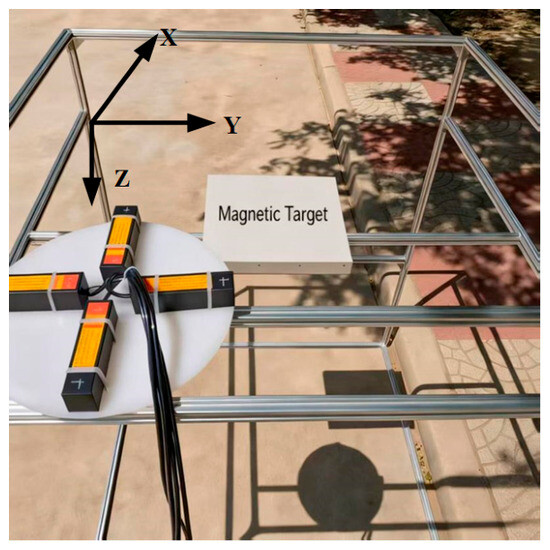
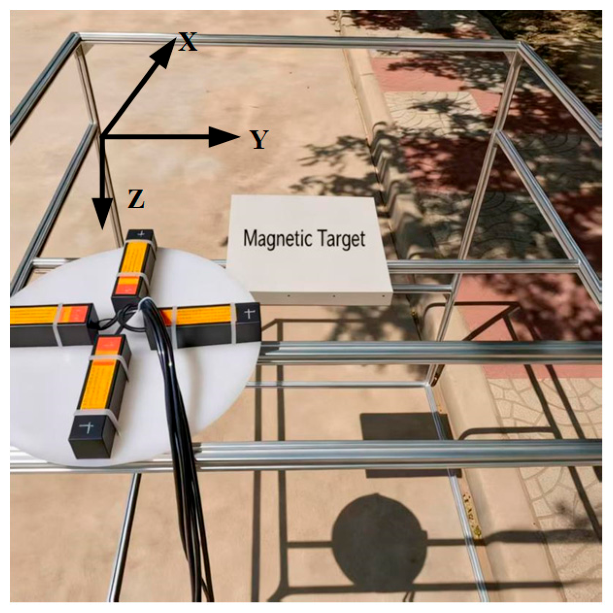
The experimental system consists of a cross-shaped sensor array (for measuring magnetic-field gradients), a magnetic target (a 0.28 m × 0.25 m × 0.04 m rectangular prism), the finite-element simulation software COMSOL, Python, a data-acquisition package, and the data-processing software MATLAB R2022b.
2.3.2. Experiment Operation
- The experiment was conducted in an open area of Huairou Beijing (40.3° N, 116.6° E), where the ambient geomagnetic noise level is less than 1 nT. The target object is a rectangular prism measuring 0.28 m × 0.25 m × 0.04 m. According to the IGRF-13 model, the local geomagnetic vector is F = [27,500, −3700, 47,500] nT in the N-E-Down frame, corresponding to a total geomagnetic intensity of 55,050 nT and an inclination of 59.7°.
- Data were acquired with a cross-shaped magnetic-gradient tensor system [32,33] flown at 1.0 m above ground, with the geometric center of the target located 0.20 m vertically beneath the array origin. A local right-handed coordinate frame was adopted: X north, Y east, Z positive downward (Figure 7).Figure 7. Schematic diagram of the rectangular-target experimental site.
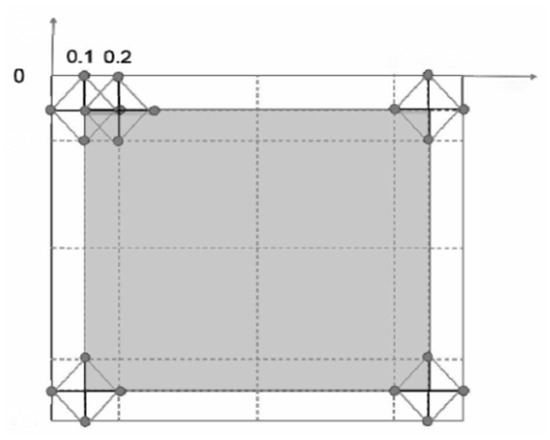
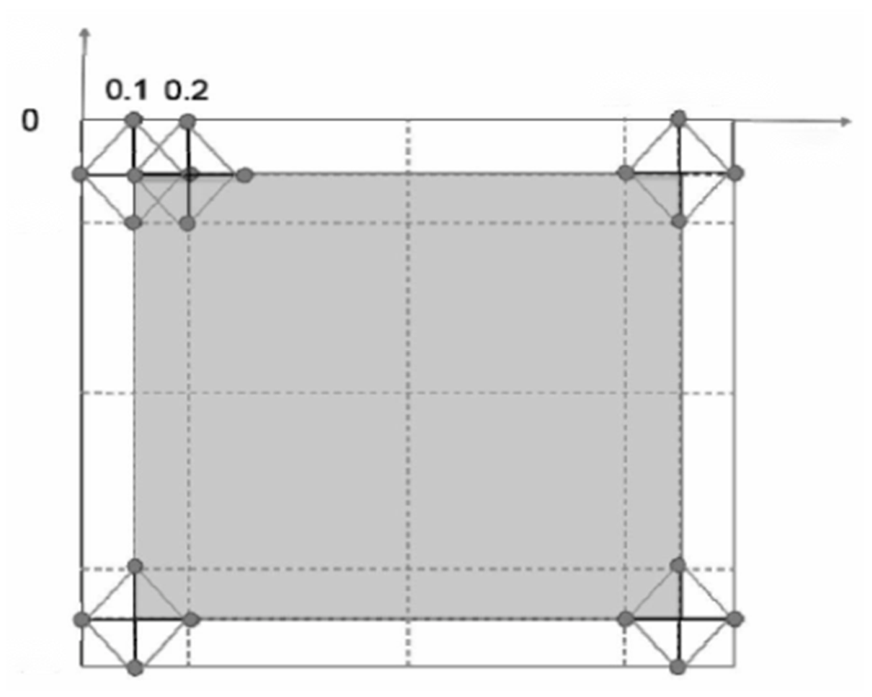
Unlike natural images captured in a single shot by optical sensors, the raw signal acquired by a magnetic surveying system is not an immediate pixel map. The field intensity must be measured point by point over a planar measurement grid; only afterward is the distribution visualized as an image to facilitate object detection. To balance single-point acquisition feasibility with labeling accuracy, we adopted a uniform grid-sampling scheme indexed as (1, 1), (1, 2), …, (1, 10), (2, 1), (2, 2), …, (2, 10), …, (10, 10). The sampling grid is illustrated in Figure 8.
Figure 8.
Schematic diagram of the grid sampling.
After the system is powered on and synchronized, the sampling rate is set to fs = 200 Hz. On the one hand, the magnetic-field data are streamed in real time to the host GUI via the built-in Ethernet port of the measurement-and-control platform for dynamic display; on the other hand, they are simultaneously backed up to an external memory card for post-processing. To mitigate the sparsity of the sampling grid, an interpolation step is applied between the acquired grid points; the final pseudocolor image of the survey area is rendered by color-mapping the interpolated values at each vertex.
- 3.
- Random noise was first suppressed with a moving-average filter; the data were then gridded, and the covariance matrix was rapidly computed for Kriging [34] interpolation. Subsequently, the total magnetic field edge detector THEGB—based on Gabor filtering [31,35]—was applied. The gradient field was calculated from the Gabor response, and THEGB was constructed using the arctangent of the ratio between the vertical derivative and the horizontal gradient amplitude [36], producing a pseudocolor map that enhances weak magnetic anomalies and blurred boundaries.
- 4.
- Finally, the magnetic data were processed using the proposed method and analyzed by the trained YOLOv8n and YOLOv8n-M3CA models to identify the rectangular magnetic target.
3. Results
3.1. Training Results Analysis of the YOLOv8n-M3CA Model
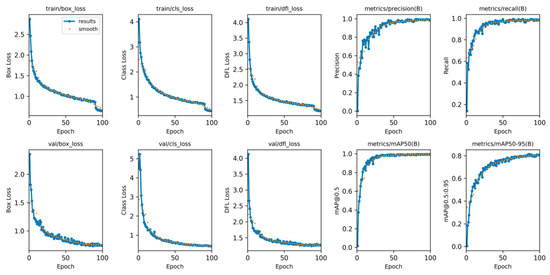
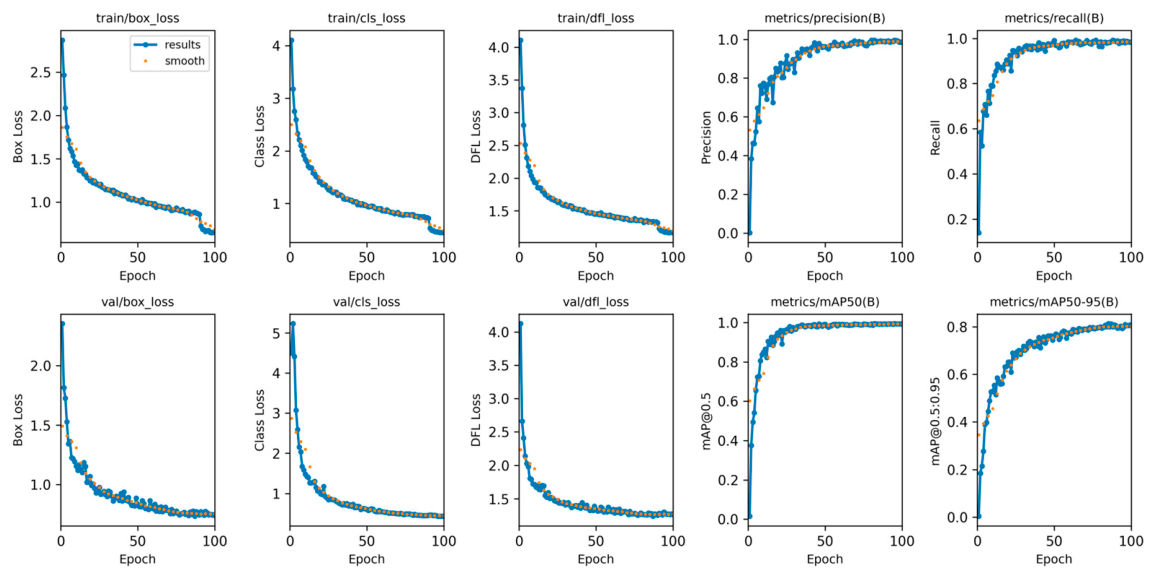
The experimental dataset comprises 1076 target-sample images, of which 861 are used for training and 215 for testing in the experiments. During the experiment, the network was trained for 100 epochs, taking approximately 11 h. Figure 9 illustrates the evolution of the total loss and the mAP curves for all object classes, as well as the corresponding values on the validation and test sets, throughout the entire training process.
Figure 9.
Convergence analysis of YOLOv8n-M3CA.
As shown in Figure 9, the box loss, classification loss (cls_loss), and distribution focal loss (dfl_loss) for both the training and validation sets decrease rapidly during the initial training phase and then converge smoothly, indicating that the model effectively learns target features and continuously reduces prediction errors. Core accuracy metrics, including precision, recall, mAP50, and mAP50–95, increase rapidly and tend to saturate, with mAP50 approaching 1.0. This demonstrates that the model achieves nearly perfect detection at an IoU threshold of 0.5, while maintaining high accuracy within the stricter IoU interval (0.5–0.95), thus exhibiting reliable detection performance. The loss curves for the training and validation sets exhibit highly consistent trends, signifying that the model possesses strong generalization ability to unseen validation data and that the training strategy is reasonable and effective.
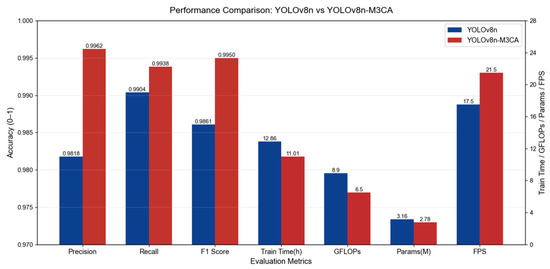
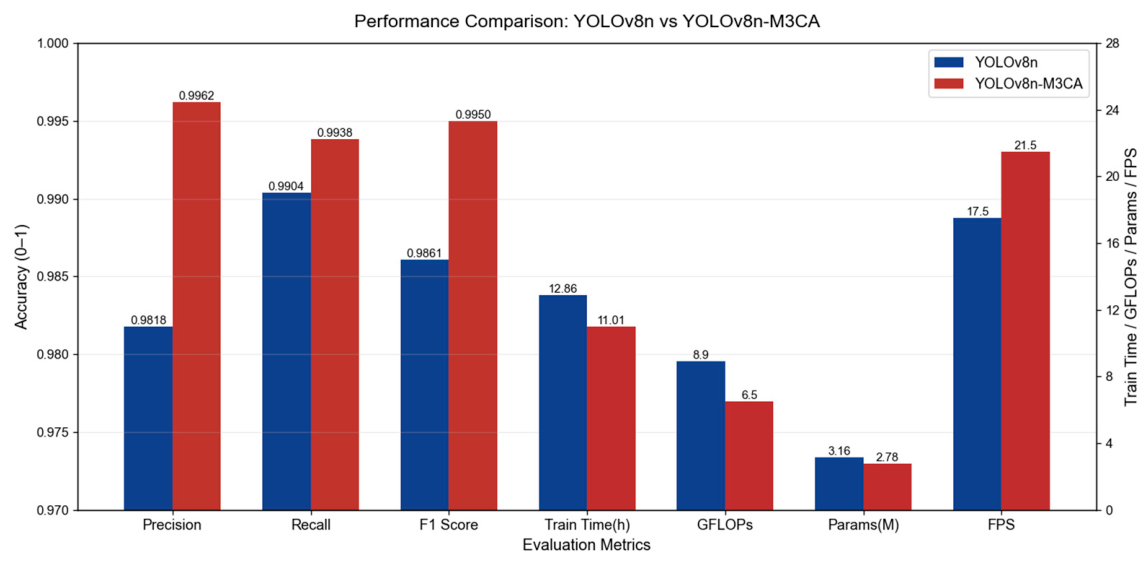
Performance evaluation of YOLOv8n vsYOLOv8n-M3CA (based on Figure 10).
Figure 10.
Bar chart visualization of comprehensive evaluation metrics for YOLOv8n and the improved YOLOv8n-M3CA model.
As listed in Table 5, the proposed YOLOv8n-M3CA achieves consistent improvements across all evaluation metrics compared with the original YOLOv8n. The precision rises from 0.9818 to 0.9962, recall increases from 0.9904 to 0.9938, and the F1 score improves from 0.9861 to 0.9950. Meanwhile, the training time is shortened from 12.86 h to 11.01 h, the GFLOPs decrease from 8.9 to 6.5, and the total parameters are reduced from 3.16 M to 2.78 M. In addition, the inference speed improves from 17.5 FPS to 21.5 FPS, further demonstrating the efficiency of the proposed lightweight design. The above results demonstrate that integrating the MobileNetV3 backbone and Coordinate Attention module can effectively reduce model complexity while maintaining and even improving detection accuracy compared with the baseline YOLOv8n.
Table 5.
Comparison of evaluation metrics between YOLOv8n-M3CA and YOLOv8 models.
3.2. Ablation and Comparison Experiments
To ensure the reliability and fairness of all ablation experiments, all models were trained under identical software environments and codebases. Inference speed (FPS) was evaluated on a separate machine under consistent software and hardware conditions for all models to ensure a fair comparison (SSD uses a batch size of 4 due to high memory occupation, while all YOLO models adopt a batch size of 16).
3.2.1. Comparison of Different Mainstream Detection Models
To verify the comprehensive performance advantages of the improved algorithm proposed in this paper, representative YOLO-series detection models widely adopted in industry and academia are selected for comparative experiments, covering YOLOv5n, YOLOv8n, YOLOv9t, and YOLOv10n. In addition, SSD (Single Shot MultiBox Detector) is included as a representative non-YOLO single-stage detector for horizontal comparison. The multi-model comparison can effectively validate the competitiveness of the proposed YOLOv8n-M3CA against state-of-the-art lightweight detection algorithms.
Table 6 compares the proposed YOLOv8n-M3CA with several mainstream lightweight YOLO–series detectors under identical training and testing conditions. Among the YOLO variants, YOLOv8n-M3CA achieves the highest Precision (0.9962), Recall (0.9938), and mAP50 (0.9949), outperforming the original YOLOv8n by 1.44%, 0.34%, and 0.18%, respectively. It also delivers the lowest GFLOPs (6.5) and the fastest inference speed (21.5 FPS) among all compared models while maintaining a moderate parameter count (2.78 M). Notably, YOLOv10n shows lower performance across all metrics (Precision: 0.9153, Recall: 0.9143, mAP50: 0.9653), suggesting that newer YOLO versions do not necessarily generalize well to low-SNR magnetic anomaly detection tasks without domain-specific adaptation. In terms of training efficiency, YOLOv5n achieves the shortest training time (10.06 h), but its detection accuracy and mAP50 are inferior to those of YOLOv8n-M3CA.
Table 6.
Comparison results of different mainstream detection models.
Compared with all lightweight YOLO models, the classic SSD (VGG16) performs worse in detection accuracy and efficiency. It has lower Precision, Recall, and mAP50, accompanied by far more parameters and GFLOPs. Its training time is the longest, and the FPS is only 0.45, which fails to support fast detection.
Overall, the results demonstrate that YOLOv8n-M3CA strikes a favorable balance among detection accuracy, model complexity, training efficiency, and inference speed, confirming the effectiveness of the MobileNetV3 backbone and Coordinate Attention module for magnetic anomaly detection tasks.
3.2.2. Ablation Experimental Analysis of Lightweight Backbone Network
To evaluate the impact of different lightweight backbones on the detection performance of YOLOv8n, we replace the original backbone of YOLOv8n with MobileNetV2, ShuffleNetV2, and MobileNetV3, respectively, while keeping the detection head and training configurations unchanged to construct three ablation models. All models are trained on identical CPU hardware with identical code and hyperparameters to quantitatively analyze the adaptability and computational efficiency of each backbone.
As shown in Table 7, the baseline YOLOv8n delivers moderate detection performance with 3.16 M parameters and 8.9 GFLOPs. When its backbone is substituted with MobileNetV2, the model attains the best Precision, Recall, and mAP50. Nevertheless, the larger parameter size and computational overhead introduce severe memory bandwidth bottlenecks on CPU platforms. Specifically, the inverted residual blocks of MobileNetV2 demand caching massive intermediate feature maps during backpropagation, leading to an extraordinarily long training duration of 129.69 h. Such heavy training overhead fails to satisfy the deployment requirement of portable magnetic detection equipment.
Table 7.
Ablation results of lightweight backbone networks.
ShuffleNetV2 lowers model complexity through grouped convolution, yet it exhibits the weakest capability to extract faint magnetic targets buried amid complex geomagnetic noise.
Optimized via neural architecture search, MobileNetV3 achieves the smallest parameter count (2.77 M) and GFLOPs (6.5), along with the shortest training time. Its mAP50 is comparable to the baseline and only marginally lower than that of MobileNetV2. Accordingly, MobileNetV3 is chosen as the backbone of our proposed detector, into which Coordinate Attention is embedded to further boost the recognition accuracy of weak magnetic anomalies.
3.2.3. Ablation Experimental Analysis of Multiple Attention Mechanism Modules
On the basis of determining the optimal lightweight backbone network, four typical attention mechanisms, including SE, CBAM, ECA, and CA, are embedded into the network to construct comparative models. This setup aims to verify the enhancement effects of different attention modules on feature representation and anti-interference capability and further explore the performance gains brought by attention strategies with different optimization dimensions.
As shown in Table 8, all four attention modules are deployed under the same lightweight MobileNetV3 backbone, with identical GFLOPs of 6.5 and minor gaps in parameter quantity and training time, which removes the interference of computational cost on horizontal comparison of attention performance. The ECA module owns the least parameters at 2.77 M, yet its detection metrics sit at the bottom of the four groups, with a precision of 0.9873, recall of 0.9863, and mAP50 of 0.9934. The SE and CBAM modules achieve moderate comprehensive performance; SE has relatively lower precision and recall, while CBAM reaches a mAP50 of 0.9939. The coordinate attention (CA) adopted in this work attains the best overall detection performance, with precision, recall, and mAP50 recorded as 0.9962, 0.9938, and 0.9949, respectively. Compared with ECA, CA only adds 0.01 M parameters and maintains consistent computation overhead, and all its detection metrics outperform the other three attention structures. It can be concluded that coordinate attention captures both channel and spatial feature information of weak geomagnetic targets simultaneously and brings better feature extraction and anti-interference ability to the lightweight backbone. For the magnetic detection task, CA performs better than single-channel attention SE, ECA, and the serial channel-spatial hybrid attention CBAM.
Table 8.
Ablation results of different attention mechanisms.
3.3. Confusion Matrix Analysis
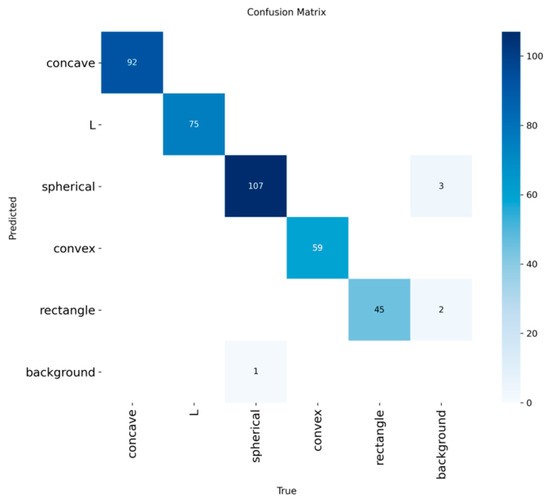
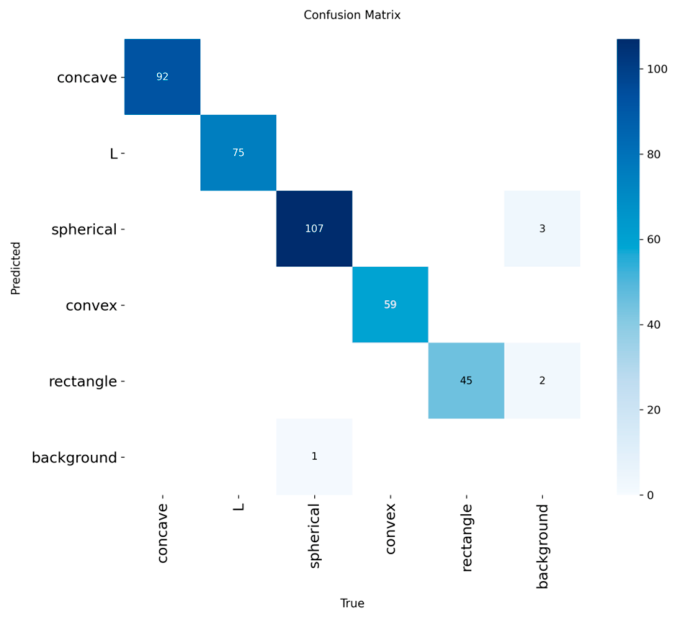
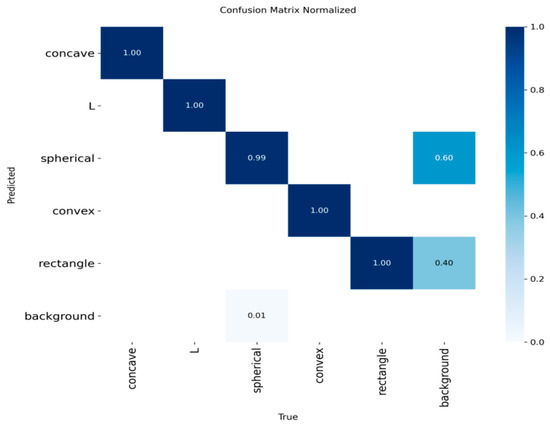
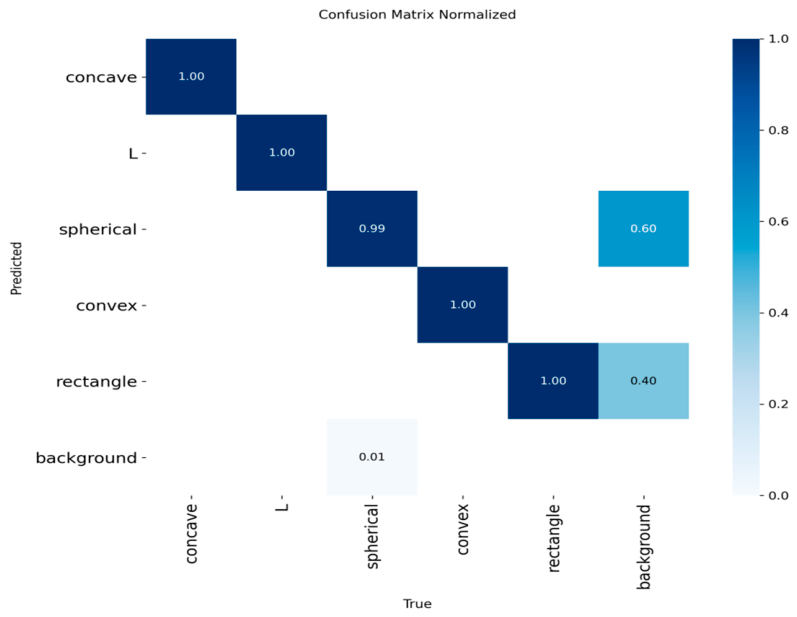
To visually evaluate the fine-grained classification accuracy and recognition performance of the improved model for different shape targets, the original count confusion matrix is illustrated in Figure 11, and the normalized confusion matrix is displayed in Figure 12. In the matrix, columns represent the true categories of samples, and the dataset only contains five detection targets: concave, L-shape, spherical, convex, and rectangle; rows represent the prediction categories of the model, and the background column in the matrix only represents false positive samples generated during model inference (background regions misjudged as targets), which is not a real label category in the dataset.
Figure 11.
Confusion matrix.
Figure 12.
Confusion matrix normalized.
It can be seen from the confusion matrix results that the improved model proposed in this paper has strong recognition ability for all kinds of targets: the classification accuracy of the model for concave, L-, convex, and rectangle all reaches 100%, and all real samples are accurately predicted without any inter-class confusion; the recognition accuracy for spherical is 99.1%, and only one sample is misjudged as background, demonstrating robust overall classification capability. The results prove that after adopting the MobileNetV3 lightweight backbone and embedding the CA mechanism, the model can effectively extract and focus on the key features of different shape targets and has excellent feature distinction and representation ability for multi-class shape targets.
In terms of false positive misjudgment, the model only produces 5 background misclassification samples, which are misjudged as spherical and rectangle, respectively, while no background regions are misidentified as the other three target classes. Such a small number of misjudgments mainly stem from the similarity between visual textures in the background and those of spherical and rectangular targets, which is a common limitation in lightweight object detection models. This problem can be further alleviated by subsequent detection threshold adjustment and background sample expansion.
Overall, the improved model maintains high classification accuracy and robustness in the core shape target detection task, which fully verifies the rationality and effectiveness of the lightweight improvement and attention enhancement strategy proposed in this paper.
3.4. Simulation Results Analysis of the YOLOv8n-M3CA Model
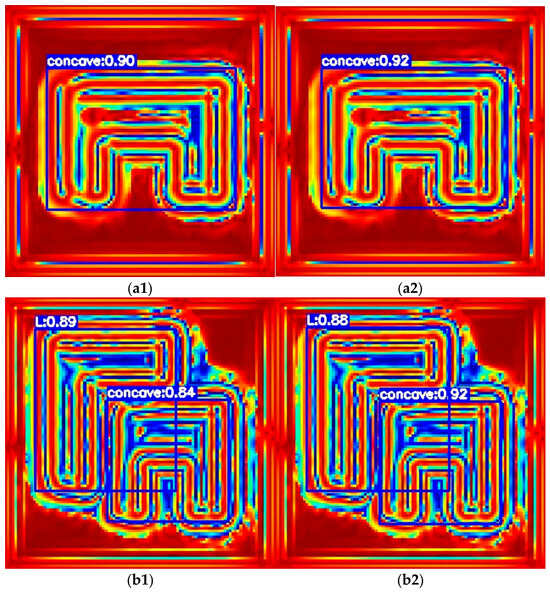
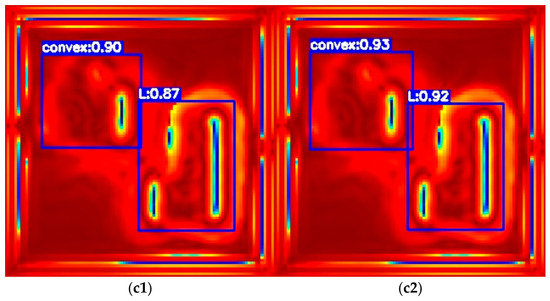
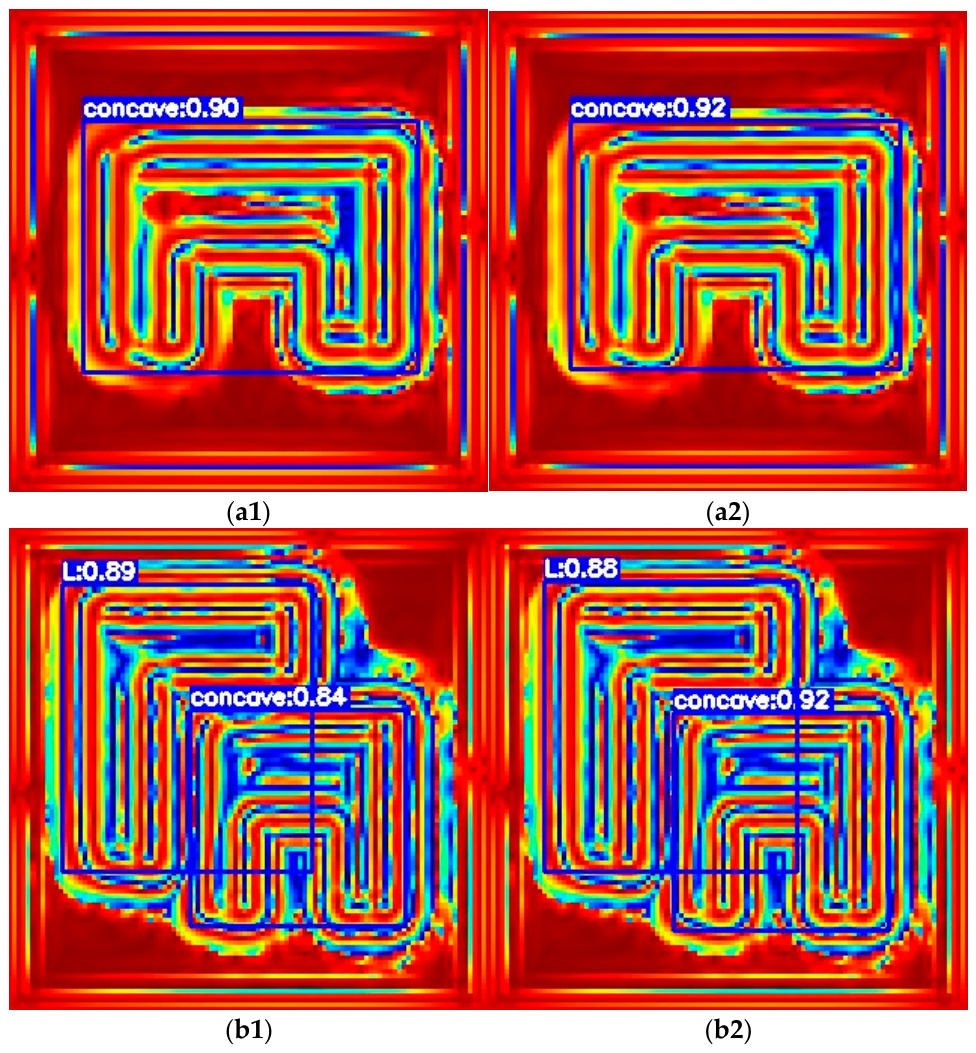
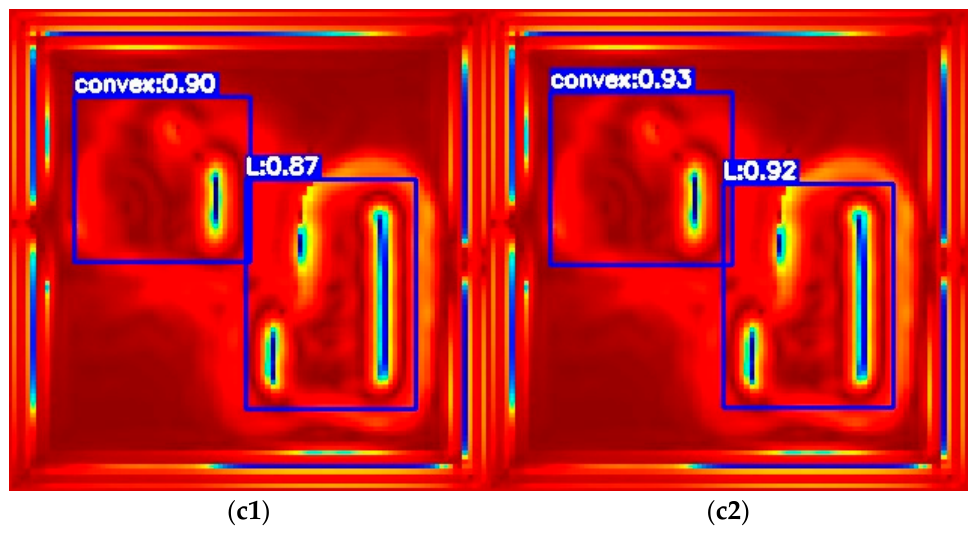
To validate the effectiveness of the proposed method, the pre-trained YOLOv8n and YOLOv8n-M3CA models were employed to identify and localize targets in magnetic-anomaly images, and their outputs were visualized for quantitative comparison. Experiments were conducted on randomly sampled scenes containing either a single target or multiple targets. Taking into account the relative-position complexity that frequently arises in multi-target detection, we further evaluated cases in which the objects were adjacent to one another or located at different depths. Figure 13 illustrates the corresponding results: the left column [(a1)–(c1)] shows the predictions generated by YOLOv8n, whereas the right column [(a2)–(c2)] presents those produced by the proposed YOLOv8n-M3CA. In each sub-figure, the rectangular bounding box delimits the magnetic object, the English label above the box gives the class name (consistent with Table 1), and the following scalar denotes the confidence score (ranging from 0 to 1) that quantifies the model’s certainty in the detection.
Figure 13.
Comparison of detection results on synthetic data. (a1) Single-target detection with YOLOv8n. (a2) Single-target detection with YOLOv8n-M3CA. (b1) Multi-target detection with YOLOv8n. (b2) Multi-target detection with YOLOv8n-M3CA. (c1) Adjacent-target detection with YOLOv8n. (c2) Adjacent-target detection with YOLOv8n-M3CA. Colors indicate magnetic field intensity from low (blue) to high (red).
The comparative results in Figure 13 reveal that YOLOv8n-M3CA constitutes an advancement over the baseline: it delivers higher detection confidence and competitive localization accuracy while maintaining stable performance under complex conditions such as densely packed, adjacent, or variable-depth buried targets, with simultaneous reductions in both false negatives and false positives. Therefore, YOLOv8n-M3CA exhibits preferable comprehensive performance compared with YOLOv8n for tasks requiring high detection precision and stability.
3.5. Field Experiment Result
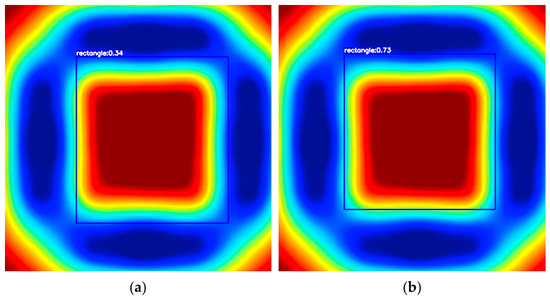
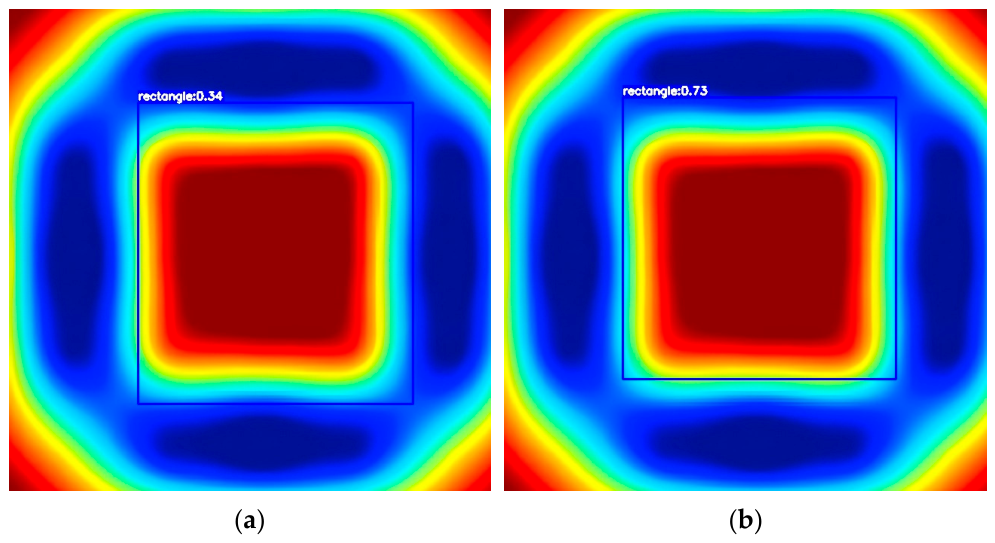
As illustrated in Figure 14, for the single rectangular buried target in the field experiment, the baseline YOLOv8n outputs a low prediction confidence of only 0.34, whereas our YOLOv8n-M3CA obtains a confidence score of 0.73 on the same sample. The IoU values with respect to the manually annotated ground-truth box are 0.74 for YOLOv8n and 0.64 for YOLOv8n-M3CA.
Figure 14.
Detection results comparison between YOLOv8n and YOLOv8n-M3CA on a 0.2 m buried target. (a) YOLOv8n detection results for 0.2 m buried targets. (b) YOLOv8n-M3CA detection results for 0.2 m buried targets. Colors indicate magnetic field intensity from low (blue) to high (red).
Under ideal simulation conditions with clean magnetic anomaly signals, obvious gradient variations, and complete target contours, both models can realize acceptable detection results. However, practical field measurement data are contaminated by heavy geomagnetic background noise, ambient interference, and sensor errors. These interferences blur faint magnetic anomaly signals and weaken the gradient contrast of target outlines, making field detection far more difficult. Consequently, the baseline YOLOv8n yields low-confidence and unstable prediction results in real measurement scenes.
Most existing deep learning-based magnetic target detection methods are designed for well-controlled simulation environments with high-contrast, clear target contours. In contrast, this work focuses on the more difficult practical task of identifying underground magnetic anomalies characterized by weak signals, low contrast, and fuzzy boundaries. For the rectangular target buried at 0.2 m in the field test, YOLOv8n-M3CA achieves more stable detection confidence, which verifies its stronger anti-noise ability when facing complex field interference compared with the baseline model.
4. Discussion
The results above confirm that integrating a MobileNetV3 lightweight backbone with a Coordinate Attention (CA) module effectively reduces model complexity while improving detection accuracy for magnetic anomaly targets. Instead of only listing numerical gains, this section elaborates on the intrinsic synergistic mechanism, analyzes typical detection failure cases, and clarifies the inherent limitations of this work.
4.1. Mechanism of the Lightweight-Attention Synergy
Ablation experiments show that replacing the original YOLOv8n backbone with MobileNetV3 cuts network parameters from 3.16 M to 2.77 M and GFLOPs from 8.9 to 6.5, with detection performance nearly unchanged (mAP50: 0.9931 vs. 0.9930). This proves that MobileNetV3’s depthwise separable convolutions [25] fit magnetic contour maps well [37], as their valid features are dominated by low-frequency spatial distributions and simple gradient structures. However, the slight decline in recall indicates that lightweight compression inevitably weakens the model’s sensitivity to faint, low-gradient magnetic anomalies, as reflected by the slight decline in recall from 0.9904 to 0.9849, which are easily masked by field background noise [1].
The embedded CA module [26] offsets such performance loss with merely 0.01 M extra parameters. Unlike traditional channel attention that ignores spatial location information, CA explicitly encodes long-range spatial dependencies and directional features [38]. This property matches geomagnetic signals, which are spatially continuous and sensitive to orientation. Consequently, the CA module selectively enhances feature responses in valid anomalous gradient regions and weakens irrelevant background textures that interfere with target identification, thereby improving the model’s ability to distinguish blurred target boundaries from noise. This mechanism explains why the proposed method achieves higher predictions in field tests (confidence: 0.73) compared with the baseline YOLOv8 (confidence: 0.34), which frequently misclassifies weak field anomalies as background texture.
4.2. Failure Cases and Remaining Challenges
Despite the promising overall detection performance, several typical defects still exist. The confusion matrix records five false-positive samples, all misclassified as spheres or rectangles. Although CA can enhance continuous anomaly features, it occasionally over-amplifies edge-like background textures similar to the magnetic signatures of regular targets and triggers false detection. One spherical target is also missed, demonstrating the model’s limited ability to identify targets with nearly isotropic, extremely weak magnetic responses [1].
These errors are systematic rather than random. They reveal the core difficulty of magnetic detection: faint targets with indistinct contours are hard to distinguish from complex geomagnetic backgrounds, which becomes the main bottleneck restricting further accuracy improvement [9].
4.3. Limitations and Practical Considerations
For objective evaluation of the proposed method, several inherent limitations are clarified. First, the dataset consists of low-contrast pseudo-color magnetic contour maps converted from geomagnetic gradient data, which present blurred target boundaries and intense background geomagnetic clutter. Such low-SNR characteristics inherently constrain the upper bound of detection accuracy improvement. Moreover, all simulation samples are generated based on fixed geomagnetic parameters corresponding to Huairou, Beijing. Geomagnetic intensity, inclination, and background noise vary drastically across geographic regions, leading to feature distribution shifts in magnetic contours and restricting the cross-region generalization capability of the model [1]. Second, field verification is performed only on a single cuboid target at a fixed burial depth. This test merely offers preliminary qualitative evidence and cannot fully validate the model’s robustness against various target geometries, variable burial depths, and complex magnetic field disturbances. Third, each category contains a limited number of validation samples (45–107 samples per class). Therefore, the high accuracy values shown in the confusion matrix should only be regarded as preliminary experimental results rather than generalizable conclusions.
Two practical gaps still exist for real-world engineering deployment. On one hand, the model is trained solely on synthetic data; fine-tuning with authentic field-measured data may further narrow the feature gap between simulation and actual scenes [4,6]. On the other hand, this study has evaluated inference speed on a separate machine under consistent conditions, but its performance and memory consumption on actual edge devices such as UAV-borne detectors remain unvalidated, which requires further testing for real-time deployment scenarios [39].
Detailed future research directions targeting the above limitations are presented in Section 5.5.
5. Limitations and Future Work
Despite the promising experimental results achieved in this work, several inherent limitations remain to be recognized, which will serve as the primary directions for our follow-up research.
5.1. Dataset Scale and Per-Class Sample Quantity
First, the dataset adopted in this study contains merely 1076 simulated magnetic anomaly images with five target categories. Though the overall sample distribution across classes is roughly balanced, the number of validation samples for each category only ranges from 45 to 107, which is insufficient to obtain statistically stable evaluation results for the deep neural network. Minor misclassification cases may lead to obvious fluctuations in per-class accuracy indicators. Accordingly, the high accuracy values shown in the confusion matrix need to be treated prudently, since they are obtained on this limited validation subset. Future research will expand the dataset by supplementing more simulated samples and introducing field-measured data to acquire more stable and statistically credible detection evaluation results.
5.2. Single-Site Simulation and Insufficient Generalization Ability
Second, all simulated samples are generated based on a fixed group of geomagnetic parameters matching the Huairou District of Beijing, with N-E-D component magnetic field values of [27,500, −3700, 47,500] nT. Geomagnetic magnitude, dip angle, and background noise differ greatly among various geographical areas, which will induce feature distribution shifts in magnetic contour maps. Hence, the detection performance of the proposed model may decline when applied to survey areas with disparate geomagnetic backgrounds, and its cross-region generalization ability has not been fully verified in this paper.
In addition, only one field experiment was carried out in this work, adopting a single cuboid target with a fixed burial depth. This single field test can only preliminarily verify the practical feasibility of the model qualitatively and cannot provide rigorous statistical validation. The conclusion about real-scene robustness should be interpreted conservatively; the existing field result can only be regarded as an illustrative case rather than comprehensive verification. Sufficient field tests covering multiple target types, burial depths, and measurement environments are required to fully prove the model’s generalization in practical engineering.
5.3. Simplified Target Geometric Structures
Third, this paper only adopts simplified geometric target models, including spherical, rectangular, L-shaped, convex, and concave structures. Although these categories can represent standard regular targets and deformed metallic fragments, real buried ferromagnetic targets usually exhibit more complex and irregular geometries. The model’s recognition performance for such intricate targets remains unevaluated.
5.4. Absence of Statistical Significance Testing
Fourth, statistical significance tests (e.g., multiple training runs with different random seeds) have not been performed in this study. The reported metrics are therefore point estimates from a single training run with a fixed random seed (seed = 0), rather than statistically validated results with measures of variance. Given the substantial computational cost of repeated deep neural network training, we prioritized the completion of ablation experiments and model comparisons within the available resources. Consequently, the observed improvements, though consistent across all metrics, should be interpreted with caution. It is worth noting that the single training run was conducted under a deterministic configuration, which ensures full reproducibility of the reported numerical results. However, this does not substitute for statistical significance testing. In future work, we plan to conduct multiple independent training runs to report the mean and standard deviation of all metrics, along with appropriate statistical tests (e.g., paired t-tests), to further confirm the significance of the observed performance gains.
5.5. Future Research Directions
Corresponding improvement plans are put forward to overcome the above limitations:
- Dataset expansion: Generate abundant simulated samples under multiple geomagnetic environments with different dip angles and magnetic magnitudes, and collect systematic field data from multiple regions containing various target types and burial depths.
- Cross-region verification: Evaluate the model on magnetic anomaly data from different geographical areas to quantitatively evaluate its cross-region generalization performance.
- Complex target modeling: Supplement the dataset with realistic irregular target geometries into the dataset instead of merely using simplified geometric bodies.
- Systematic field experiments: Conduct complete field measurements with diverse targets, burial depths, and measurement conditions to achieve statistically reliable validation of the model’s practical detection capacity.
In addition, comprehensive comparisons with two-stage (e.g., Faster R-CNN) and Transformer-based (e.g., DETR) detectors remain to be conducted in future work, as they require distinct training strategies and larger datasets for fair evaluation.
Carrying out the above research work will continuously improve the engineering practicability and generalization of the detection framework proposed in this paper.
6. Conclusions
Overall, YOLOv8n-M3CA offers a promising solution for magnetic-target identification.
This paper proposes YOLOv8n-M3CA, which integrates a MobileNetV3 lightweight backbone with Coordinate Attention for underground magnetic anomaly detection. On simulated data, the model outperforms YOLOv8n in precision, recall, and F1-score while reducing the parameter count, GFLOPs, and shortening 100-epoch training time by 14.39%. MobileNetV3 reduces network computational overhead yet slightly weakens sensitivity to faint magnetic signals; the embedded CA module offsets this performance loss with negligible extra cost by enhancing continuous anomalous features and weakening interfering background textures.
A preliminary field test is carried out on a single rectangular target buried at 0.2 m. The proposed model achieves a prediction confidence of 0.73, compared with only 0.34 for the baseline YOLOv8n. This outcome reflects its better anti-interference performance under this specific field condition, though a single trial cannot fully verify its cross-scene robustness.
The main limitations of this study include insufficient per-class training samples, simulated data generated under only one fixed geomagnetic setting, inadequate multi-condition field verification, and the absence of multiple training runs for statistical significance testing. Future work will generate multi-region simulated datasets, systematically collect field measurement data, and conduct comprehensive field trials to further improve the model’s generalization capacity.
In summary, YOLOv8n-M3CA achieves a favorable balance between lightweight architecture and detection accuracy and can provide a promising and practical solution for efficient detection of buried ferromagnetic targets.
Author Contributions
Conceptualization, Y.C. (Yangyang Chen), H.P. and Y.C. (Yiming Cai); methodology, Y.C. (Yangyang Chen), H.P., R.W. and Y.C. (Yiming Cai); software, Y.C. (Yangyang Chen) and Y.C. (Yiming Cai); validation, Y.C. (Yangyang Chen), H.P., Y.C. (Yiming Cai) and C.Z.; formal analysis, Y.C. (Yangyang Chen); investigation, Y.C. (Yangyang Chen), H.P., C.Z., R.W., Y.C. (Yiming Cai) and R.X.; resources, H.P.; data curation, R.X.; writing—original draft preparation, Y.C. (Yangyang Chen) and Y.C. (Yiming Cai); writing—review and editing, Y.C. (Yangyang Chen), H.P., R.W. and R.X.; visualization, Y.C. (Yangyang Chen), H.P. and C.Z.; supervision, H.P.; project administration, H.P.; funding acquisition, H.P. All authors have read and agreed to the published version of the manuscript.
Funding
This research is sponsored by the National Natural Science Foundation of China (Project Number: 61903380 and 62371472).
Data Availability Statement
The original contributions presented in this study are included in the article. Further inquiries can be directed to the corresponding author.
Acknowledgments
The authors would like to thank the anonymous reviewers for their constructive comments.
Conflicts of Interest
The authors declare no conflicts of interest. The funders had no role in the design of the study; in the collection, analyses, or interpretation of data; in the writing of the manuscript; or in the decision to publish the results.
Abbreviations
The following abbreviations are used in this manuscript:
| CA | Coordinate Attention |
| M3CA | MobilenetV3+CA |
| MTR | Magnetic Target Recognition |
| UUV | Unmanned Underwater Vehicle |
| PCA | Principal Component Analysis |
| MLP | Multilayer Perceptrons |
| RBF | Radial Basis Function |
| SVM | Support Vector Machine |
| CNN | Convolutional Neural Network |
| R-CNN | Region-based Convolutional Neural Network |
| 1D-CNN | One-Dimensional Convolutional Neural Network |
| Mask R-CNN | Mask Region-based Convolutional Neural Network |
| UXO | Unexploded Ordnance |
| UAV | Unmanned Aerial Vehicle |
| MAD | Magnetic Anomaly Detection |
| MGT | Magnetic Gradient Tensor |
| LiDAR | Light Detection and Ranging |
| TEM | Transient Electromagnetic |
| THEGB | Total Horizontal-component Edge-detection based on Gabor filter |
| IDW | Inverse Distance Weighting |
| SSD | Single Shot MultiBox Detector |
References
- Liu, H.; Zhang, X.; Dong, H.; Liu, Z.; Hu, X. Theories, Applications, and Expectations for Magnetic Anomaly Detection Technology: A Review. IEEE Sens. J. 2023, 23, 17868–17882. [Google Scholar] [CrossRef] [Scilit]
- Dai, F.; Peng, D.; Chen, Z.; Liu, B. Magnetic Anomaly Detection Method Based on Principal Component Analysis and Cascaded Stochastic Resonance. Rev. Sci. Instrum. 2026, 97, 045104. [Google Scholar] [CrossRef] [Scilit] [PubMed]
- Wang, S.; Zhang, J.; Li, Y.; Sun, K.; Mao, Z.; Wang, S. Advances in Magnetic Sensing Technologies for Small Target Detection: A Review. IEEE Sens. J. 2026, 26, 1465–1488. [Google Scholar] [CrossRef] [Scilit]
- Zheng, H.; Gu, H.; Gao, T. Non-Acoustic Detection and Localization of Large Underwater Targets for Unmanned Platforms: A Review of Wake-Based, Magnetic, and Gravity Anomaly Methods. Drones 2026, 10, 474. [Google Scholar] [CrossRef] [Scilit]
- Sheinker, A.; Moldwin, M.B. Magnetic Anomaly Detection (MAD) of Ferromagnetic Pipelines Using Principal Component Analysis (PCA). Meas. Sci. Technol. 2016, 27, 045104. [Google Scholar] [CrossRef] [Scilit]
- Nazlibilek, S.; Ege, Y.; Kalender, O.; Seker, S. Identification of Materials with Magnetic Characteristics by Neural Networks. Measurement 2012, 45, 734–744. [Google Scholar] [CrossRef] [Scilit]
- Zheng, J.; Fan, H.; Zhang, Q.; Yin, G.; Li, Z. Magnetic Anomaly Target Recognition Based on SVD and SVMs. IEEE Trans. Magn. 2019, 55, 6000708. [Google Scholar] [CrossRef] [Scilit]
- Wang, H.; Peng, G.; Wang, C.; Yan, H.; Zhang, Z.; Chen, Y. Magnetic Anomaly Detection on Wavelet Packet and Support Vector Machine. In Proceedings of the 2021 China Automation Congress (CAC), Beijing, China, 22–24 October 2021; pp. 4920–4925. [Google Scholar] [CrossRef] [Scilit]
- Zhang, P.; Li, C.; Shen, Y.; Chen, Z.; Guo, X.; Peng, Y. Robust and Accurate Magnetic Anomaly Detection Under Complex Noise Using Synchrosqueezed Short-Time Fourier Transform and Attention-Based Residual Network. IEEE Trans. Geosci. Remote Sens. 2026, 64, 5911011. [Google Scholar] [CrossRef] [Scilit]
- Wang, H.; Jiang, C.; Ren, Y.; Ding, L. Research on Magnetic Anomaly Signal Detection Based on CNN-LSTM. Meas. Sci. Technol. 2026, 37, 126111. [Google Scholar] [CrossRef] [Scilit]
- Qu, Z.; Gao, Y.; Li, S.; Zhang, X. A Hybrid Deep Learning Approach for Integrating Transient Electromagnetic and Magnetic Data to Enhance Subsurface Anomaly Detection. Appl. Sci. 2025, 15, 3125. [Google Scholar] [CrossRef] [Scilit]
- Wang, M.; Guo, Y.; Wang, Z.; Zhao, J.; Lin, J. Magnetic Target Detection Using PointRend-Based Region-Convolutional Neural Network. IEEE Geosci. Remote Sens. Lett. 2022, 19, 8029205. [Google Scholar] [CrossRef] [Scilit]
- Wang, S.; Song, W.; Zhang, X.; Zhao, Y.; Li, B. Dual-Vector Aeromagnetic Survey-Based Gradient Imaging and Detection of Target Magnetic Anomaly. IEEE Sens. J. 2024, 24, 24118–24126. [Google Scholar] [CrossRef] [Scilit]
- Lian, Y.; Song, X.; Zhang, B. One-Dimensional Convolutional Neural Network Based Underwater Magnetic Anomaly Target Detection. In Proceedings of the 2025 International Symposium on Intelligent Robotics and Systems (ISoIRS), Chengdu, China, 13–15 June 2025; pp. 1–5. [Google Scholar] [CrossRef] [Scilit]
- Han, Y.; Qiu, H.; Zhang, L.; Li, S.; Yang, X.; Ouyang, J. Time–Frequency Cross-Information Fusion Neural Network for Ship Shaft-Rate Magnetic Field Detection. IEEE Sens. J. 2025, 25, 28828–28844. [Google Scholar] [CrossRef] [Scilit]
- Zhou, Z.; Zhang, M.; Chen, J.; Wu, X. Detection and Classification of Multi-Magnetic Targets Using Mask-RCNN. IEEE Access 2020, 8, 187858–187868. [Google Scholar] [CrossRef] [Scilit]
- Mu, Y.; Zhang, X.; Xie, W.; Zheng, Y. Automatic Detection of Near-Surface Targets for Unmanned Aerial Vehicle (UAV) Magnetic Survey. Remote Sens. 2020, 12, 452. [Google Scholar] [CrossRef] [Scilit]
- Song, X.; Wang, J.; Gao, S. Underwater Magnetic Target Detection Method Based on Lightweight YOLOv3. In Proceedings of the 2021 International Conference on Autonomous Unmanned Systems (ICAUS 2021); Lecture Notes in Electrical Engineering; Springer: Singapore, 2022. [Google Scholar] [CrossRef] [Scilit]
- Tiwari, B.K.; G., A.E.; Ahuja, N. A Multi-Sensor Fusion and Deep Learning Framework for Autonomous Underwater Mine Detection. In Proceedings of the 2025 International Conference on Electronics and Computing, Communication Networking Automation Technologies (ICEC2NT), Pune, India, 3–4 September 2025; pp. 1–5. [Google Scholar] [CrossRef] [Scilit]
- Jocher, G.; Chaurasia, A.; Qiu, J. Ultralytics YOLOv8. GitHub Repository. 2023. Available online: https://github.com/ultralytics/ultralytics (accessed on 1 June 2025).
- Ma, C.; Pan, Y.; Chen, J. Surface Defect Detection of Magnetic Tiles Based on YOLOv8-AHF. Electronics 2025, 14, 2857. [Google Scholar] [CrossRef] [Scilit]
- Niu, W.; Lv, C.; Zhang, E.; Wei, Z. YOLO-RDM: A High Accuracy and Efficient Algorithm for Magnetic Tile Surface Defect Detection with Practical Applications. PLoS ONE 2025, 20, e0328815. [Google Scholar] [CrossRef] [Scilit] [PubMed]
- Li, Z.; Lai, X.; Lou, S.; Li, L. BiContext: Multilevel Contextual Enhancement for Efficient and Precise Detection of Magnetic Ring Surface Defects. IEEE Trans. Ind. Inform. 2025, 21, 7334–7344. [Google Scholar] [CrossRef] [Scilit]
- Fu, K.; Shi, T.; Liu, X.; Li, K.; Fu, M. A Study on Pipeline Defect Magnetic Flux Leakage Field Simulation and Recognition Based on an Enhanced YOLOv8 Model. In Proceedings of the ASME Pressure Vessels and Piping Conference (PVP), Montreal, QC, Canada, 20–25 July 2025; p. V003T03A015. [Google Scholar] [CrossRef] [Scilit]
- Howard, A.; Sandler, M.; Chen, B.; Wang, W.; Chen, L.-C.; Tan, M.; Chu, G.; Vasudevan, V.; Zhu, Y.; Pang, R.; et al. Searching for MobileNetV3. In Proceedings of the 2019 IEEE/CVF International Conference on Computer Vision (ICCV), Seoul, Republic of Korea, 27 October–2 November 2019; pp. 1314–1324. [Google Scholar]
- Hou, Q.; Zhou, D.; Feng, J. Coordinate Attention for Efficient Mobile Network Design. In Proceedings of the 2021 IEEE/CVF Conference on Computer Vision and Pattern Recognition (CVPR), Virtual Conference, 19–25 June 2021; pp. 13708–13717. [Google Scholar]
- Qian, M.; Wang, Y.; Liu, S.; Xu, Z.; Ji, Z.; Chen, M.; Wu, H.; Zhang, Z. Real Time Wire Rope Detection Method Based on Rockchip RK3588. Sci. Rep. 2025, 15, 2879. [Google Scholar] [CrossRef] [Scilit] [PubMed]
- Zhang, X.; Jing, Y. Research on Concrete Crack Recognition Method Based on Improved YOLOv8. In Proceedings of the SPIE International Conference on Image, Signal Processing and Machine Learning, Xi’an, China, 26–28 December 2025. [Google Scholar] [CrossRef] [Scilit]
- Lv, D.; Meng, J.; Meng, G.; Shen, Y. Railway Fastener Defect Detection Model Based on Dual Attention and MobileNetv3. World Electr. Veh. J. 2025, 16, 513. [Google Scholar] [CrossRef] [Scilit]
- CanYang, X.; Yingying, L.; Yongqiang, L.; Runliang, T.; Tao, G. Lightweight Rail Surface Defect Detection Algorithm Based on an Improved YOLOv8. Measurement 2025, 242, 115922. [Google Scholar] [CrossRef] [Scilit]
- Sertcelik, I.; Kafadar, O.; Kurtulus, C. Use of the Two Dimensional Gabor Filter to Interpret Magnetic Data Over the Marmara Sea, Turkey. Pure Appl. Geophys. 2013, 170, 887–894. [Google Scholar] [CrossRef] [Scilit]
- Zhang, Y.; Shen, Y.; Soh, Y.C.; Niu, W.; Xue, F.; Wang, H.; Liu, W. Directionally Regularized Two-Stage Calibration for Cross-Shaped MGT Sensor Arrays with Physics-Inspired Error Modeling. IEEE Trans. Instrum. Meas. 2026, 75, 9508112. [Google Scholar] [CrossRef] [Scilit]
- Liu, H.; Liu, Y.; Dong, H.; Liu, Z.; Hu, X. Integrated Error Propagation Modeling and Error Weight Quantifying for Effective Correction Within Cross-Shaped Magnetic Gradient Tensor Systems. Measurement 2026, 201, 120579. [Google Scholar] [CrossRef] [Scilit]
- Li, H.; Zhang, Q.; Pan, M.; Chen, D.; Yu, Z.; Xu, Y.; Ding, Z.; Liu, X.; Wan, K.; Dai, W. Enhancing Precision in Magnetic Map Interpolation for Regions with Sparse Data. Appl. Sci. 2024, 14, 756. [Google Scholar] [CrossRef] [Scilit]
- Ferreira, F.J.F.; de Souza, J.; Bongiolo, A.; de Castro, L.G. Enhancement of the Total Horizontal Gradient of Magnetic Anomalies Using the Tilt Angle. Geophysics 2013, 78, J33–J41. [Google Scholar] [CrossRef] [Scilit]
- Toktay, H.D.; Alvandi, A.; Ai, H. A Bi-Hyperbolic Tilt Method for Robust Edge Detection in Gravity and Magnetic Data. Eur. Phys. J. Plus 2026, 141, 398. [Google Scholar] [CrossRef] [Scilit]
- Liu, X.; Yuan, Z.; Xia, M. Application of Deep Learning in Denoising of Two-Dimensional Magnetic Anomaly Data. In Proceedings of the 2025 IEEE 17th International Conference on Electronic Measurement & Instruments (ICEMI), Beijing, China, 22–24 August 2025; pp. 378–383. [Google Scholar] [CrossRef] [Scilit]
- Yang, K.; Yin, X.; Qi, C.; Ai, S.; Yan, S.; Mu, W.; Xiong, Y.; Xue, L. PRPosNet: A CNN–Transformer Model with Coordinate Attention for Precision and Robust Magnetic Pose Estimation. IEEE Sens. J. 2025, 25, 24017–24029. [Google Scholar] [CrossRef] [Scilit]
- Yang, T.; Ling, D.; Shi, Q.; Jiang, T. YOLOv8-MCDE for lightweight detection of small instruments in complex backgrounds from inspection robots’ perspective. Sci. Rep. 2025, 15, 32060. [Google Scholar] [CrossRef] [Scilit] [PubMed]

Disclaimer/Publisher’s Note: The statements, opinions and data contained in all publications are solely those of the individual author(s) and contributor(s) and not of MDPI and/or the editor(s). MDPI and/or the editor(s) disclaim responsibility for any injury to people or property resulting from any ideas, methods, instructions or products referred to in the content. |
© 2026 by the authors. Licensee MDPI, Basel, Switzerland. This article is an open access article distributed under the terms and conditions of the Creative Commons Attribution (CC BY) license.