


Abstract
This article presents the design and implementation of a control system for an adaptive light luminaire with variable light distribution. The developed solution enables dynamic shaping of the light distribution characteristics by simultaneously controlling the geometry of the optical system and the spatial distribution of the emitted light flux. The system utilizes two cooperating control mechanisms. The first is implemented by four independently controlled reflectors with adjustable angles of inclination. The second is based on the independent control of eight sections of LED light sources. The coordination of both systems enables the implementation of various operating scenarios, including symmetric, asymmetric, and adaptive configurations, with variants of narrow and wide beam distribution. The central unit of the system is an ESP32 microcontroller that performs control functions, generates PWM signals, and coordinates the operation of the actuators. The system was implemented as a dedicated embedded system. The main contribution of this work is the implementation and experimental validation of an embedded control platform integrating mechanical beam shaping and segmented LED control within a single adaptive lighting system. As part of the work, predefined control scenarios for lighting system configuration were developed and experimentally tested. The developed solution increases the functionality of adaptive lighting systems and may contribute to reducing energy consumption by directing light only where required. However, the quantitative evaluation of the energy savings was beyond the scope of the present study.
1. Introduction
In recent years, there has been rapid growth in lighting technologies based on LED light sources, driven by their high luminous efficacy, long service life, and extensive options for controlling the operating parameters of lighting fixtures [1,2,3]. At the same time, the development of smart lighting systems, the Internet of Things (IoT) [4,5,6], The development of building automation and the Industry 4.0 concept has led to growing interest in adaptive lighting systems capable of dynamically adjusting their operating parameters to current usage conditions, energy requirements, and the specific nature of the lighting task at hand [7,8,9]. Recent studies indicate that adaptive lighting control can significantly reduce energy consumption while maintaining acceptable life-cycle costs for LED luminaires [10,11].
Current research in the field of smart lighting systems focuses primarily on light output regulation [12], color temperature control, the integration of wireless communication systems, and the optimization of energy consumption, as well as issues related to the impact of light sources on the power grid [13,14]. At the same time, in most available solutions, the light distribution characteristics of the luminaire remain constant and are most often achieved by replacing the optics, using different lenses, or manually adjusting mechanical components, significantly limiting the ability to dynamically adapt the photometric parameters of the luminaire to changing application requirements.
From the perspective of energy-efficient lighting, a fixed light distribution may also lead to inefficient utilization of luminous flux, since part of the emitted light can illuminate areas where lighting is not required. Consequently, selectively directing the luminous flux toward target areas may reduce the electrical power required to achieve the desired illuminance level, although the quantitative assessment depends on the specific lighting application.
In response to these limitations, adaptive optical systems that enable active changes in the geometry of the lighting system are attracting increasing interest [15]. A particularly important area of research is the integration of movable optical elements with segmented light sources and control systems, which allow for real-time scenario-based control of light distribution.
Adaptive luminaires capable of modifying their photometric distribution create new opportunities for improving luminous flux utilization. By dynamically redirecting light only to required areas and selectively controlling individual lighting sections, they may improve the efficiency of light distribution for specific applications. Consequently, such adaptive lighting strategies have the potential to contribute to reducing energy consumption. However, a quantitative evaluation of these potential energy savings requires dedicated measurements and was beyond the scope of the present study.
Din and his co-authors presented an attempt to extend classical control strategies directly determined by the design of the optical system. Changes in light distribution are by incorporating an additional parameter related to the spatial distribution of light [16]. In their paper, the authors proposed a method for simultaneously optimizing the luminous flux and beam angle of lighting fixtures to minimize energy consumption while maintaining the required level of illumination in selected areas of the room. The results of simulation analyses demonstrated the potential for significant improvements in energy efficiency compared to solutions based solely on regulating the luminous flux of light sources. However, the presented solution was purely conceptual and did not involve the physical implementation of a luminaire equipped with a mechanism enabling dynamic adjustment of the light distribution.
The concept of actively shaping a light beam using mechanical components was also developed in automotive systems in the paper [17], where adaptive lighting systems allow the direction and geometry of the light beam to be adjusted based on driving conditions and vehicle movement parameters.
Despite growing interest in this topic, complete hardware implementations that combine optical system geometry control with electronic control of the spatial distribution of light emission are still relatively rare in the literature.
As part of the previous research of the authors [18,19], an adaptive LED luminaire was developed, featuring a segmented optical system, independently positioned reflectors, and independent sections of LED light sources. Simulation studies and photometric measurements confirmed the possibility of effectively shaping the light distribution characteristics by changing the geometry of the reflector system and the configuration of the active LED sections. The results demonstrated the ability to generate both symmetric and asymmetric photometric patterns, confirming the practical potential of the concept developed [20].
Unlike our previous publications, which focused on the optical concept and photometric properties of the adaptive luminaire, the present work focuses on the design, implementation, and experimental validation of a dedicated embedded control platform enabling real-time scenario-based operation of the previously developed adaptive lighting system.
This paper presents a natural extension of previous research through the implementation of a complete control system for an adaptive luminaire with a variable light pattern. The developed system uses an ESP32 microcontroller (Espressif Systems, Shanghai, China) as its central processing unit and enables simultaneous control of the position of four reflectors and the operation of eight LED sections in accordance with pre-programmed operating scenarios. The main contribution of this work is the integration of a previously developed adaptive light-optical system with a dedicated embedded system incorporating real-time scenario control algorithms. Compared with representative adaptive lighting systems reported in the literature, the proposed solution integrates mechanical reflector positioning with independent LED section control within a single embedded platform. This integrated approach provides greater flexibility in shaping the photometric distribution while maintaining real-time operation of the lighting system.
As part of this work, the functional structure of the system was developed, a dedicated electronic circuit was designed, 20 control scenarios were defined, and experimental studies were conducted to evaluate the impact of the configuration of optical components and LED sections on the resulting light distribution characteristics.
2. Material and Methods
2.1. Design and Concept of a Control System for a Luminaire with a Variable Light Distribution
The control system was designed to be an integral part of an adaptive luminaire with a variable light distribution [18,19] and was developed to allow dynamic changes to the photometric properties of the luminaire without the need to modify its mechanical structure or replace optical components. The main task of the control system is to implement a controlled change in the light distribution of the luminaire by simultaneously controlling the geometry of the optical system and the spatial distribution of the luminous flux emitted by the LED light sources. The adopted control concept is based on two cooperating adjustment mechanisms.
- Adjusting the position of the movable reflectors that form the luminaire’s light beam. To achieve this, four independently controlled servomechanisms corresponding to the four optical sections were used. Each reflector can move within a range of 0° to 20° relative to its base position, allowing local adjustment of the light beam’s reflection direction and, consequently, modification of the shape of the light distribution.
- The light source is divided into eight independently controlled lighting sections, corresponding to LED arrays arranged within the four sectors of the luminaire. Each sector contains two lighting sections that can be switched on independently or controlled using PWM modulation. This allows for adjusting the contribution of individual parts of the light output to the total light output emitted by the luminaire, and consequently for further shaping of the light distribution.
The primary design objective was to adopt a control architecture that enables the implementation of predefined luminaire operating scenarios. Each scenario is defined as a set of parameters that simultaneously describe the positions of the reflectors and the configuration of the active LED sections. This approach allows each system configuration to be treated as a distinct operating state of the luminaire, tailored to specific lighting requirements, such as: narrowing or widening the light distribution, shifting the area of maximum illuminance, or creating asymmetrical light patterns.
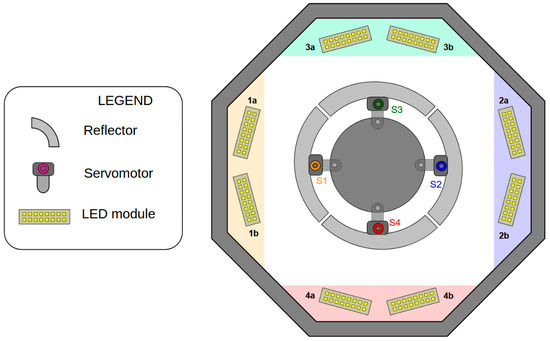
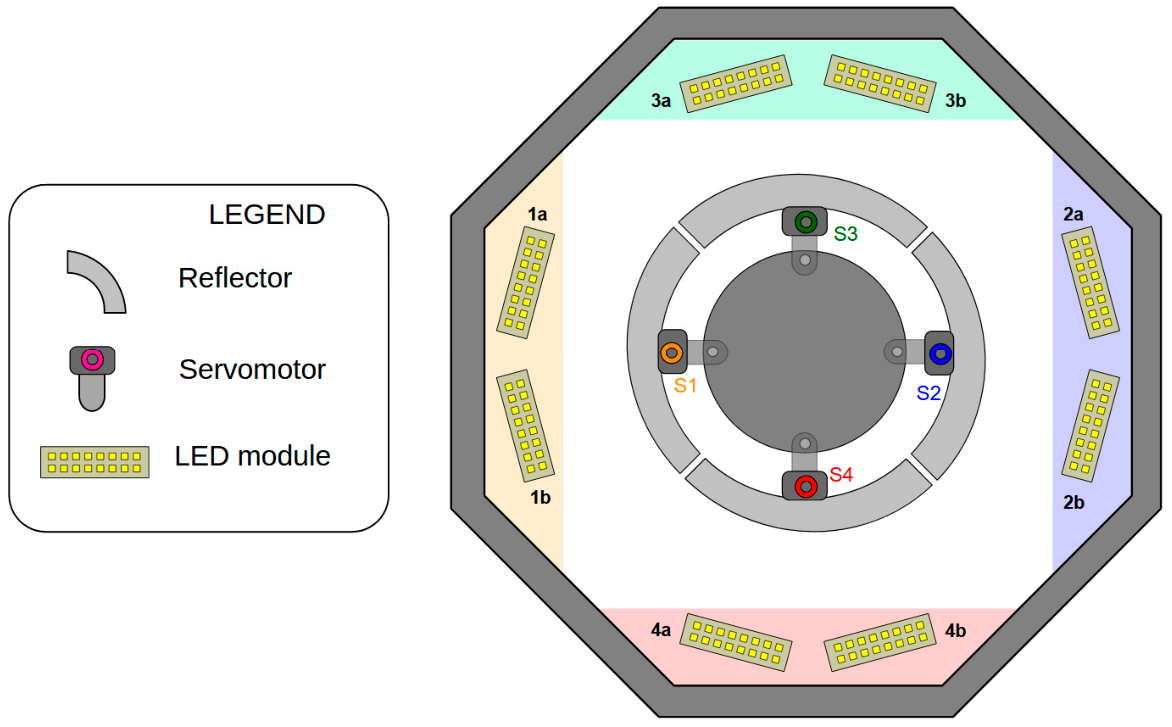
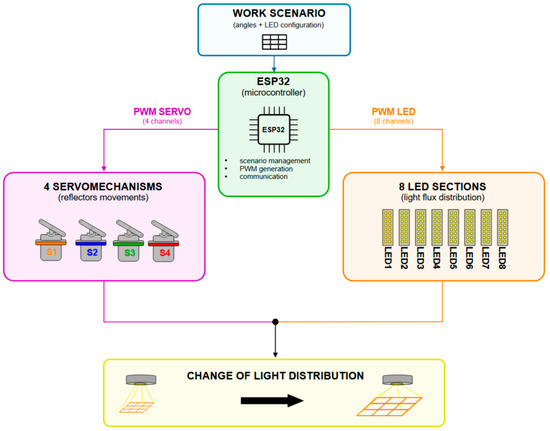
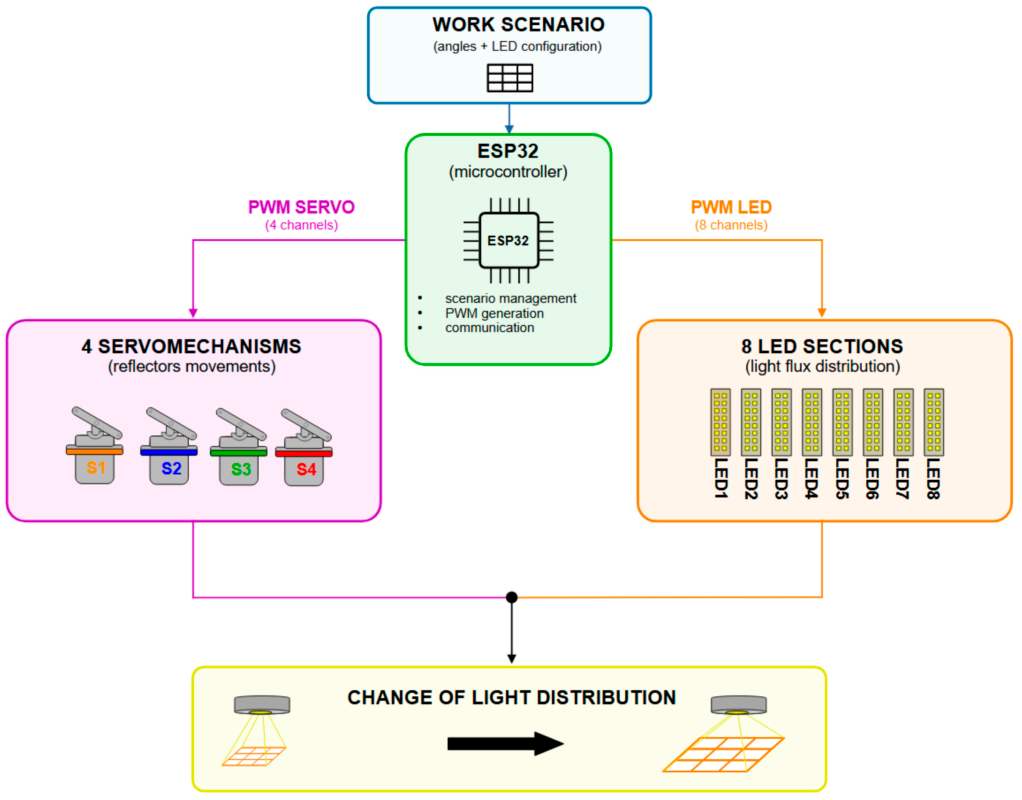
Figure 1 shows the division of the luminaire’s optical system into sections that form the basis of the adopted control system concept. The luminaire’s structure has been divided into four sectors corresponding to four independently controlled reflectors and eight LED light sections. This division of the lighting-optical system forms the basis for defining the operating scenarios of the luminaire, in which each configuration of reflector positions and active LED sections corresponds to a specific variant of the light pattern. Based on this, a functional concept for the control system was developed, as shown in Figure 2. This functional concept serves as the basis for developing the hardware structure of the control system.
Figure 1.
The lighting system is divided into controllable sections, comprising four movable reflectors and eight independently controlled LED sections.
Figure 2.
A functional design concept for a control system for an adaptive lighting fixture.
2.2. Functional Structure of the Control System
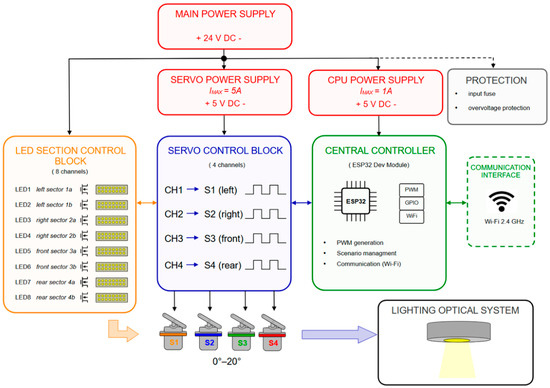
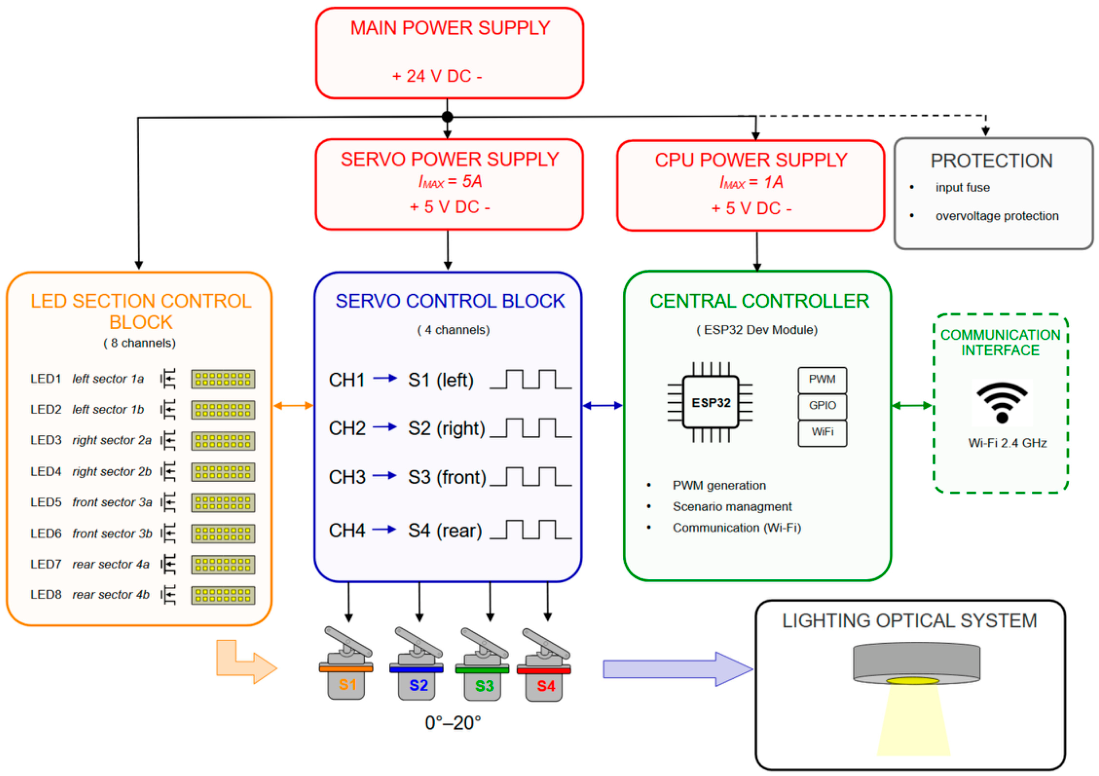
The functional structure of the control system shown in Figure 3 consists of interconnected hardware blocks responsible for power supply, control signal generation, and the execution of luminaire operating scenarios. The central component of the system is the ESP32 microcontroller, which acts as the master controller that coordinates the operation of the servos and LED matrices.
Figure 3.
Functional architecture of the hardware control system for a luminaire with variable light distribution.
The system architecture comprises two main control parts. The first includes a reflector control system based on four PWM channels that drive the servos used to position the optical components. The second channel comprises eight LED section control channels that regulate the contribution of individual light sections to the total light output emitted by the luminaire. The simultaneous operation of both mechanisms enables dynamic shaping of the light distribution.
A key component of the functional architecture is the power supply unit, which uses a single 24 V DC input and local step-down converters for the servo mechanisms and logic circuits. This architecture simplifies the integration of the system with the luminaire and enables the creation of a compact controller designed for installation within the final assembly of the luminaire.
2.3. Lighting Control Scenarios
One of the key features of the developed control system is the ability to implement predefined lighting scenarios that allow adaptive adjustments to the light distribution pattern based on lighting requirements. In this concept, a lighting scenario is defined as a specific configuration of control parameters that simultaneously specify the positions of the reflectors and the operating states of the LED light sections.
Each scenario is described as a set of parameters:
where
- θ1–θ4—denote the angles of deflection of the four reflectors, where
- L1–L8—denote the control levels of individual LED sections, defined as the on state or the duty cycle of the PWM signal:
A scenario defined in this way describes the complete operating state of the luminaire, specifying both the geometry of the optical system and the spatial distribution of the emitted light flux. Changing the scenario parameters alters the characteristics of the photometric solid, enabling the implementation of various light distribution patterns.
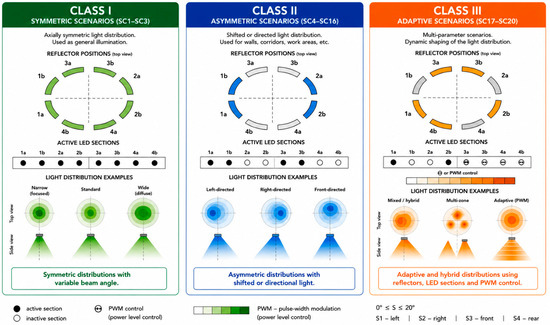
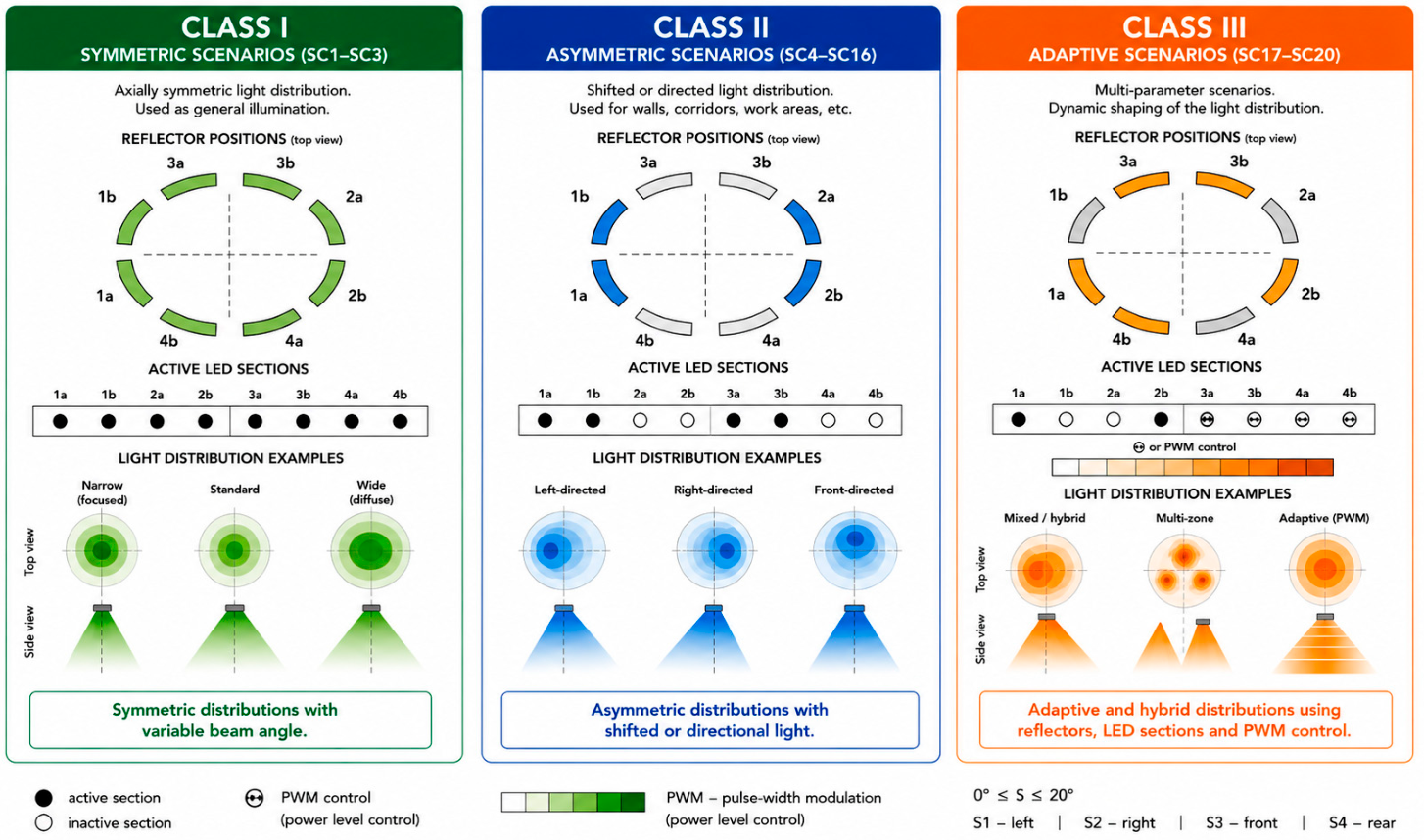
To organize the configurations developed, the scenarios have been divided into several basic functional groups—shown in the Figure 4. The following classes of luminaire operating scenarios have been identified:
Figure 4.
Classification of operating scenarios for luminaires with variable light distribution, taking into account reflector orientation, LED section configuration, and resulting light distribution patterns.
- Class I (symmetrical scenarios)—scenarios characterized by an axially symmetrical light distribution relative to the luminaire axis. This class includes both standard configurations and variants with a narrower or wider beam angle. These scenarios are primarily intended for general lighting in the space.
- Class II (asymmetric scenarios)—scenarios in which the light beam is intentionally directed in a specific direction. This allows for selective illumination of specific areas, such as walls, walkways, workstations, or display areas.
- Class III (adaptive scenarios)—multi-parameter scenarios that utilize simultaneous changes in the position of reflectors, the configuration of active LED sections, and control parameters (PWM). This class enables dynamic shaping of the light distribution and adaptation of the light output characteristics to changing operating conditions or user requirements.
The proposed classification is based primarily on the functional purpose of the lighting configuration rather than solely on reflector positions or LED activation patterns. Consequently, scenarios with similar mechanical configurations may belong to different classes if they are intended for different lighting functions.
Scenarios with a narrow or wide beam angle do not constitute separate functional classes but are treated as beam patterns within symmetric or asymmetric scenarios.
Based on the adopted classification, a set of twenty example luminaire operating scenarios was developed. The scenarios were selected to represent all the main operating modes of the proposed control system. The set includes representative symmetric beam configurations with different beam angles, directional asymmetric distributions intended for typical lighting tasks, and adaptive scenarios that combine reflector positioning, LED section activation, and PWM control. The objective was not to generate all possible combinations of actuators, but to define a representative set that covers the main functional capabilities of the developed controller. Scenarios SC1–SC3 represent Class I configurations, SC4–SC16 represent Class II configurations, and SC17–SC20 represent Class III configurations. Each scenario is described in terms of the position of four reflectors and the operating state of eight LED sections, which allows for a clear definition of both the geometry of the optical system and the spatial distribution of the emitted luminous flux.
In addition, scenarios were formulated taking into account the findings of the investigation on the segmentation of the LED array and the possibility of redistributing the luminous flux among selected groups of light sources while maintaining a constant luminaire power [1]. This allowed the control scenarios to be expanded not only to include cases resulting from changes in the geometry of the optical system, but also variants resulting from the activation of selected LED sections. Table 1 presents a matrix of sample scenarios for controlling the light source in a luminaire.
Table 1.
A matrix of sample scenarios for controlling the light source of a luminaire.
In the scenarios presented, it is assumed that the LED sections can operate in binary mode (on/off), although the proposed control system also allows for controlling the power level of individual sections using PWM modulation.
All scenarios developed were subjected to experimental validation. Representative photometric distributions are presented later in this paper, whereas quantitative photometric parameters for all twenty scenarios are summarized in Table 3.
2.4. Hardware Implementation of the Controller
To implement the concept developed for controlling an adaptive lighting fixture, a dedicated embedded system was designed that integrates the control functions of optical components, LED light sections, and actuators within a single hardware platform. The main design objective was to develop a compact and easily integrable controller capable of simultaneously implementing multi-channel control of reflector movement and the spatial distribution of the emitted light beam.
The central processing unit of the system is the ESP32 DevKit V1 microcontroller [21,22], selected for its large number of available I/O pins, hardware support for multiple PWM modulation channels, adequate computational performance and built-in Wi-Fi wireless communication capabilities. Communication between the web interface and the embedded controller is performed via a local Wi-Fi network using HTTP requests. The implemented communication architecture enables reliable interactive switching between predefined lighting scenarios during system operation. Quantitative evaluation of communication latency was beyond the scope of the present study, which focused on the implementation and functional validation of the embedded control platform. The microcontroller generates control signals for four PowerHD HD-1501MG servo actuators responsible for positioning the reflectors and eight channels controlling the LED sections. The LED channels are controlled using the ESP32 hardware PWM peripheral operating at a frequency of 1 kHz with a 10-bit duty-cycle resolution. PWM modulation was selected because it enables continuous adjustment of the optical output while maintaining high switching efficiency and flicker-free operation. Servo positioning is implemented using standard 50 Hz servo control pulses generated independently from the LED PWM channels. Although the servo actuators provide a wide mechanical rotation range, only approximately 20° of reflector movement is utilized. This limited operating range results from the geometry of the optical system and provides sufficient angular resolution for repeatable adjustment of the reflector orientation.
Before experimental measurements, the zero position of each reflector was established mechanically. Small software correction offsets were then applied to compensate for manufacturing tolerances and ensure that identical control commands produced identical reflector orientations in all four optical sections.
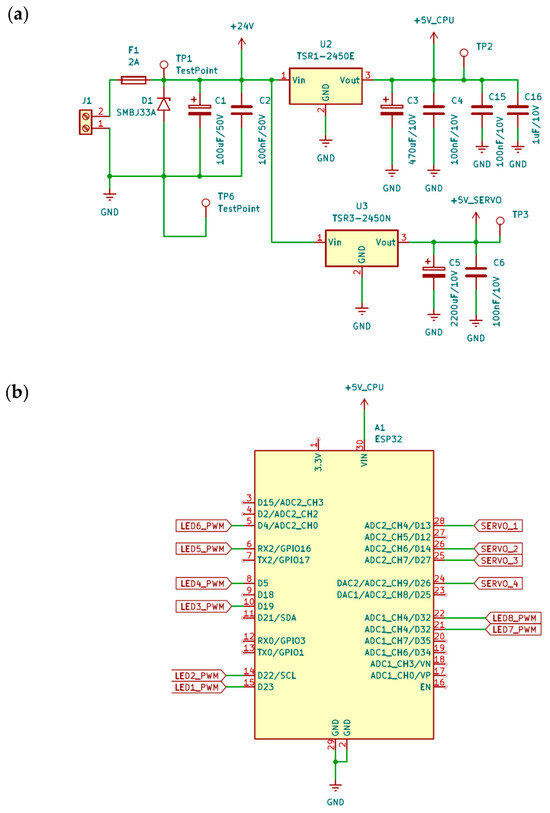
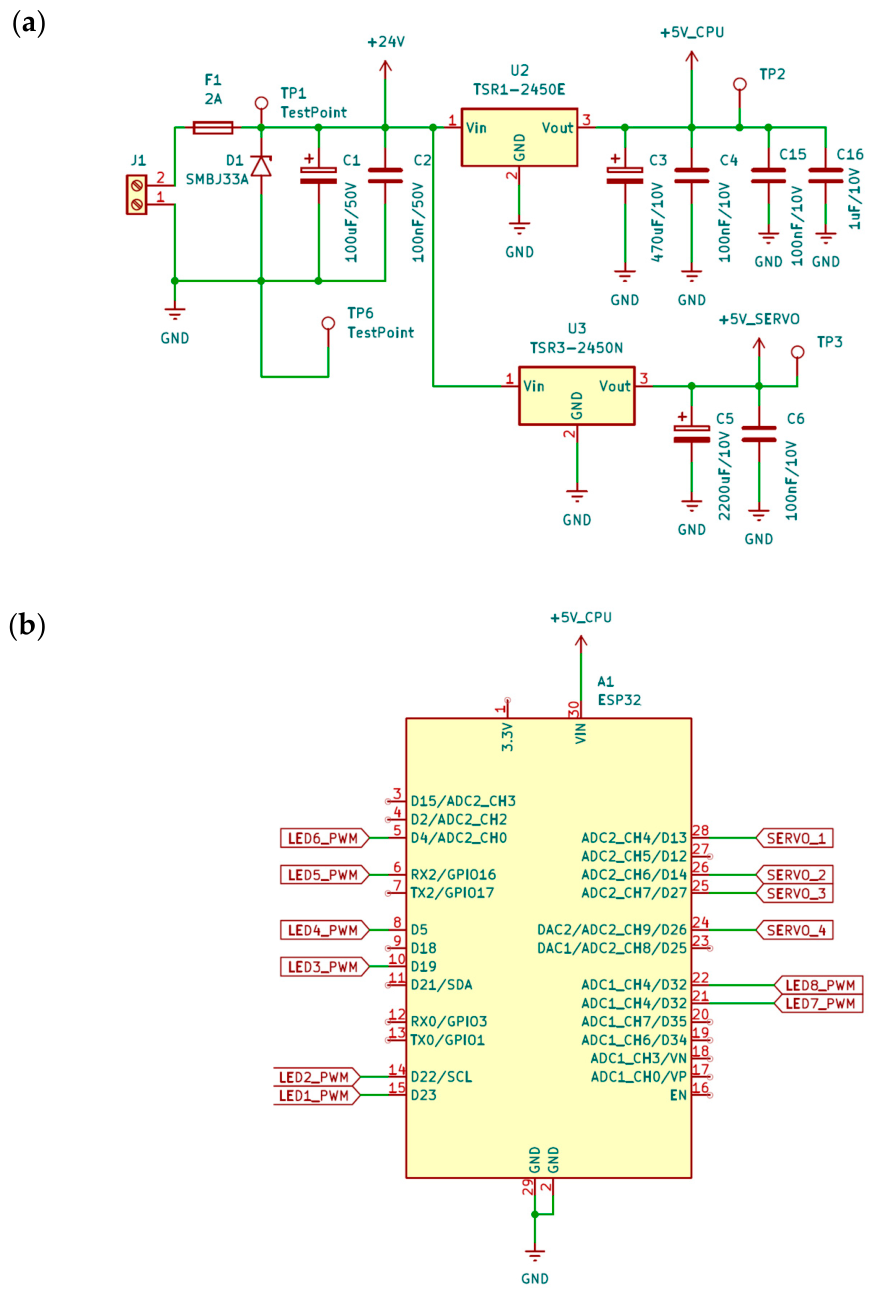
The designed circuit is powered by a single 24 V DC bus, in accordance with the requirements of the target luminaire design. To increase the system’s immunity to interference and ensure safe operation, overcurrent protection and a surge protection circuit have been implemented. The power supply structure includes two separate 5 V power rails. The first supplies the microcontroller and logic circuits, while the second is dedicated to powering the actuators. Separation of the power rails limits the impact of dynamic load changes generated by the drives on the stability of the digital components of the system.
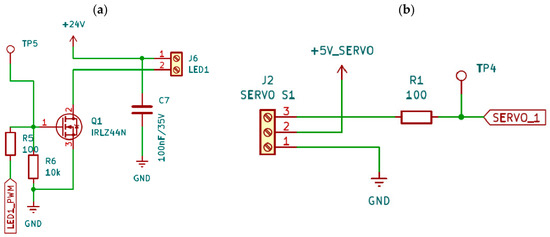
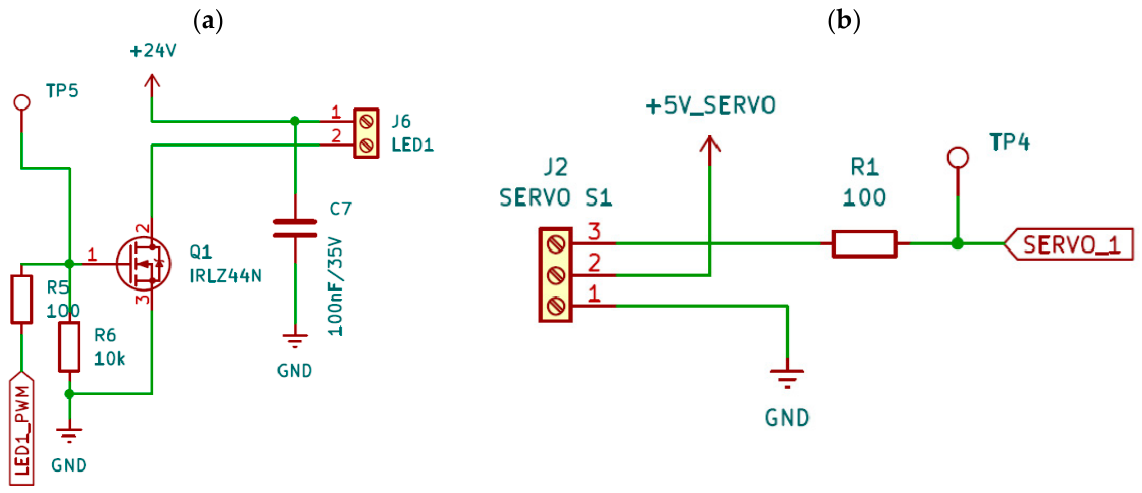
The lighting sections are controlled using eight independent transistor-based output channels that operate in a low-on configuration. Each channel allows for binary switching of the LED sections or smooth power regulation using PWM pulse width modulation [23]. Each output channel was designed to switch a single 24 V LED section with a maximum load current of approximately 2 A. Logic-level IRLZ44N MOSFET transistors (International Rectifier Corporation, El Segundo, CA, USA) were selected because their current-carrying capability provides a sufficient safety margin for the expected LED section load while allowing direct control from the 3.3 V GPIO outputs of the ESP32 without additional gate-driver circuitry. This solution simplified the hardware architecture while providing reliable switching of all independently controlled LED channels. To ensure stable operation of the transistors, gate current limiting resistors and pull-up resistors were used to ensure the correct logic state during system startup.
The schematic diagram of the developed control system is shown in Figure 5 and Figure 6. Figure 5 presents selected sections of the central unit of the system, including the power supply circuit with input protection, the separation of voltage paths for the logic and executive sections, and the configuration of the ESP32 microcontroller, along with the assignment of control lines to the LED channels and servos. Figure 6 shows examples of actuator circuits, including a single LED section control channel using a PWM-controlled MOSFET and the connection interface for the servo responsible for positioning the movable reflectors. The modular hardware architecture used enables easy system scalability, simplifies integration with the luminaire’s optical system, and allows independent control of all actuators within defined operating scenarios.
Figure 5.
Selected sections of the conceptual diagram of the central unit of the developed control system: (a) power supply circuit with input protection and separate power paths for the logic and actuator sections, (b) configuration of the ESP32 microcontroller, including the assignment of control lines to LED channels and servos.
Figure 6.
Selected sections of the conceptual diagram of the control circuits for the developed controller: (a) a single control channel for the LED section with a MOSFET and PWM control, (b) the servo motor connection interface, including the power supply circuit and control signal.
To physically implement the developed controller, a dedicated two-layer PCB was designed, specifically tailored for integration into the adaptive lighting fixture.
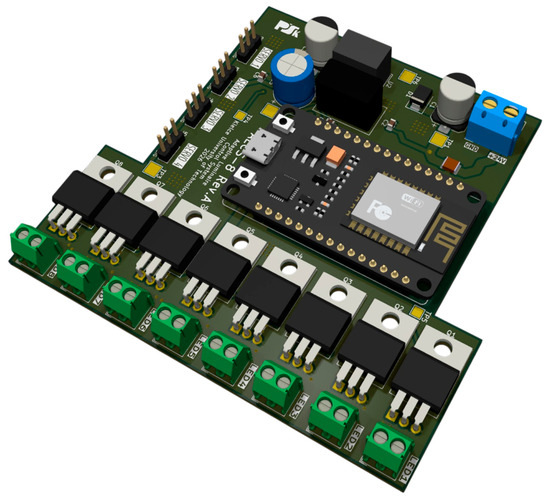
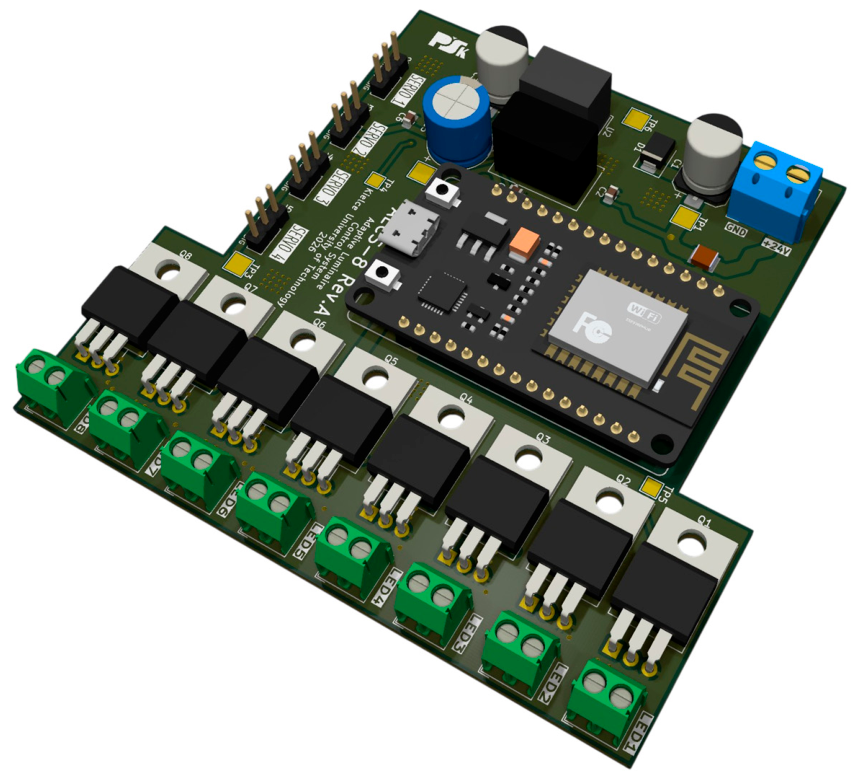
During the design process, special attention was paid to separating the power and signal paths, minimising electromagnetic interference, and ensuring stable operating conditions for the microcontroller and driver circuits. Full ground planes and stitching vias were used in both layers to improve the continuity of return paths and the circuit’s EMC performance. In addition, local decoupling capacitors, measurement points and an exclusion zone under the antenna of the ESP32 module were provided to maintain the proper wireless communication parameters. The prototype developed for the printed circuit board of the ALCS-8 controller is shown in Figure 7. The basic hardware parameters of the controller are shown in Table 2.
Figure 7.
A 3D visualization of the prototype ALCS-8 controller circuit board designed to control an adaptive luminaire with a variable light pattern.
Table 2.
Main hardware parameters.
2.5. Implementation of the Control Algorithm
Dedicated microcontroller firmware was developed to implement the control logic. The software generates PWM signals for eight LED channels, controls the position of four servos, and supports predefined operating scenarios for the luminaire. The operating algorithm is presented in Algorithm 1.
| Algorithm 1. Adaptive luminaire control procedure |
Initialize GPIO and PWM channels
Initialize servo control interfaces
Connect to Wi-Fi network
Start web server
while system_active do Read user command;
   Validate scenario parameters
   Limit reflector angles
   Normalize PWM values
   Update servo positions
   Update LED channels
   Refresh web interface while
|
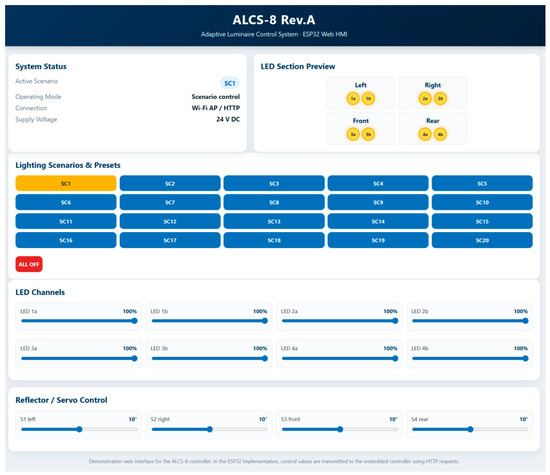
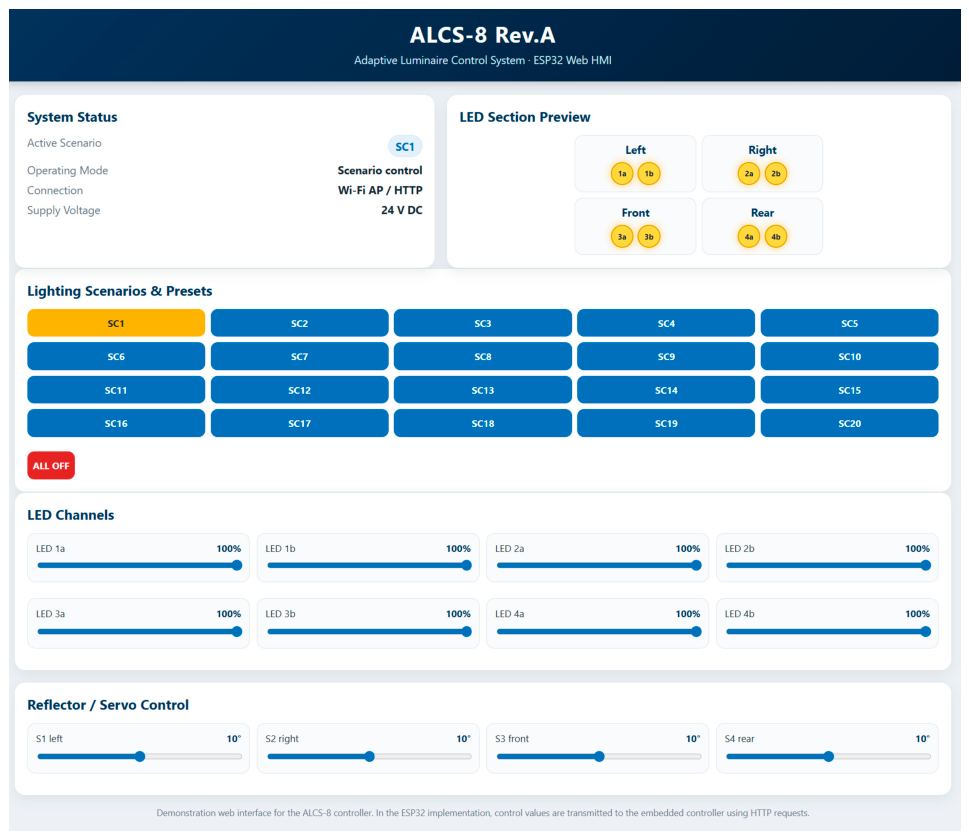
To ensure intuitive operation of the developed controller, a lightweight communication environment was implemented based on a built-in HTTP server running directly on the ESP32 microcontroller. The control software was developed in MicroPython 1.28, which was selected because it enables rapid firmware development, straightforward debugging, convenient implementation of web-based communication, and flexible modification of lighting scenarios during experimental investigations. Upon startup, the device creates its own Wi-Fi access point, which the user can connect from a computer or mobile device. The web interface allows users to select predefined lighting scenarios, manually adjust the drive level of individual LED channels, and change the position of the servos responsible for the orientation of the optical elements. Figure 8 shows the GUI web interface. The adopted architecture allows remote system configuration without the need for additional client applications, which increases the mobility and practical usability of the research platform.
Figure 8.
The user interface developed for the ALCS-8 control system is accessible through a web browser and allows users to select lighting scenarios, manually adjust LED channels, and control the position of servo motors.
3. Experimental Validation and Results
3.1. Experimental Setup
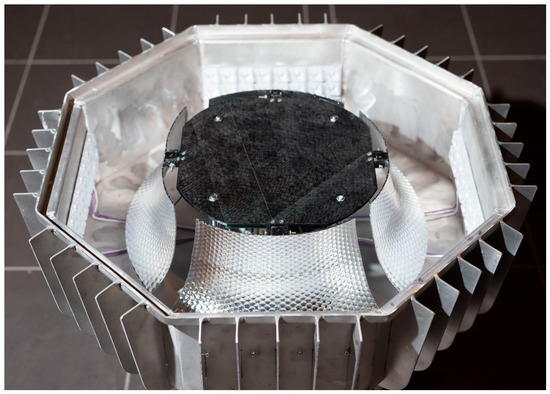
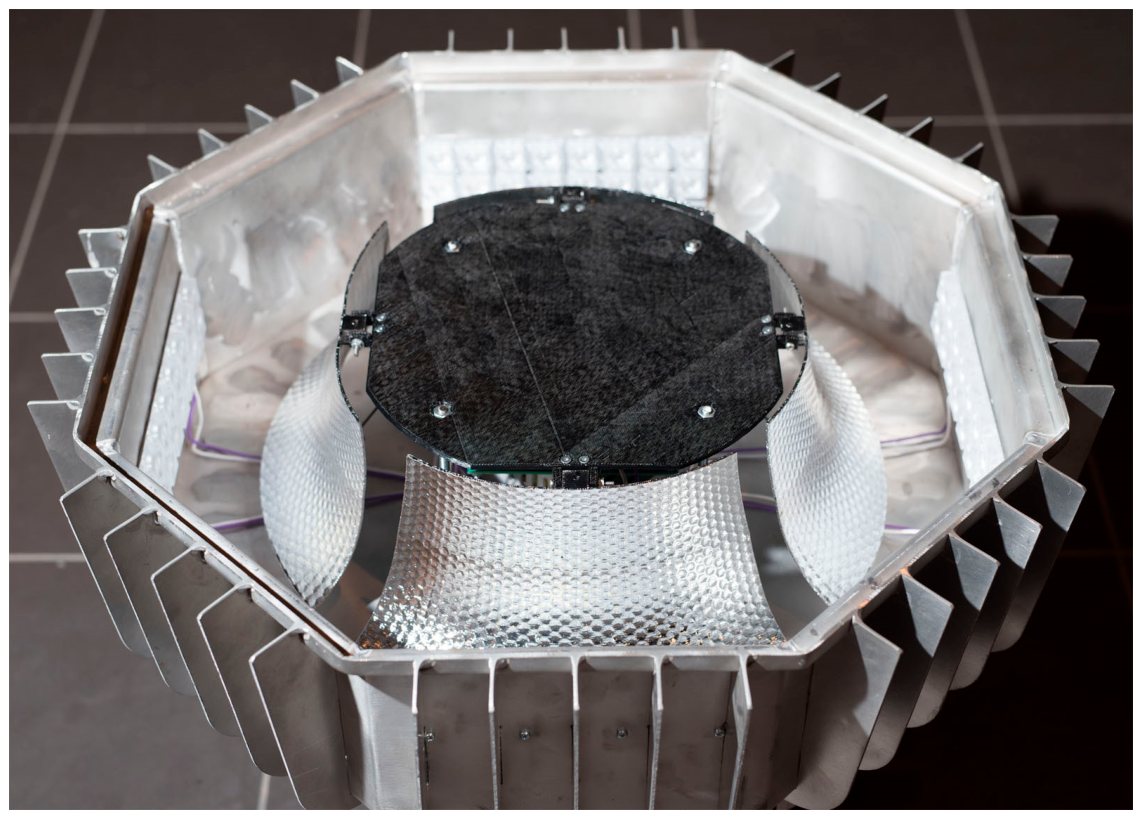
The developed control system was installed in the luminaire shown in Figure 9, which was equipped with four independently controlled reflectors and eight independently switchable LED sections. The luminaire (housing), designed in a polygonal shape, is made of aluminium and serves two functions: as a support structure and as a heat sink for the light sources. Four movable reflectors were placed in the central part of the luminaire, whose position could be adjusted within a range of 0° to 20° (the angle 20° is determined by the geometry of the luminaire and the acceptance angle of the LED light beam on the reflector) relative to a reference position established during mechanical calibration and throughout the control system.
Figure 9.
An experimental prototype of an adaptive lighting fixture equipped with four independently adjustable reflectors and segmented LED light sources.
The position of the reflectors and the activation of individual LED sections were controlled using the custom-designed ALCS-8 controller, which is based on an ESP32 microcontroller. Communication with the system was wireless, using a Wi-Fi interface and a built-in web interface that allows users to select operating scenarios and adjust parameters in real time.
Luminous intensity distribution measurements were made for the luminaire’s light distribution control scenarios (Table 1). Photometric measurements were performed using a SPECTRO-COLOR C Gamma photogoniometer (Spectro Color, Łódź, Polska) equipped with a Digi 02 photometer. The luminaire was positioned at a measurement distance of approximately 9 m from the photometric sensor. During all measurements, the luminaire was supplied from a stabilized 24 V DC laboratory transformer power supply to ensure constant electrical operating conditions. Before each measurement, the selected operating scenario was activated and a stabilization time of approximately 5 s was applied to allow the reflector positions and light output to reach steady-state conditions. All twenty control scenarios were evaluated using the same measurement procedure and identical experimental conditions. The photogoniometer provides automated angular positioning with a positioning accuracy of 0.01° in the C-plane and 0.2° in the γ-plane, ensuring repeatable acquisition of luminous intensity distributions.
No statistically based repeatability study was performed, as the objective of this work was the implementation and photometric validation of the embedded control system. Whenever verification of the measurement setup was required, additional control measurements confirmed the consistency of the obtained photometric characteristics.
3.2. Analysis of Luminaire Operating Scenarios
The first stage of experimental validation involved reference scenarios (Table 1) belonging to Class I (SC1–SC3).
Photometric measurements were performed on the planes C0–C180, C45–C225, and C90–C270. This approach allowed for a direct assessment of the effect of the optical system’s geometry on the resulting light distribution characteristics.
In Class I scenarios, all LED sections remained active, while only the position of the reflectors was altered. The results confirmed that changing the position of the reflectors leads to a controlled modification of the light distribution characteristics while maintaining the axial symmetry of the system.
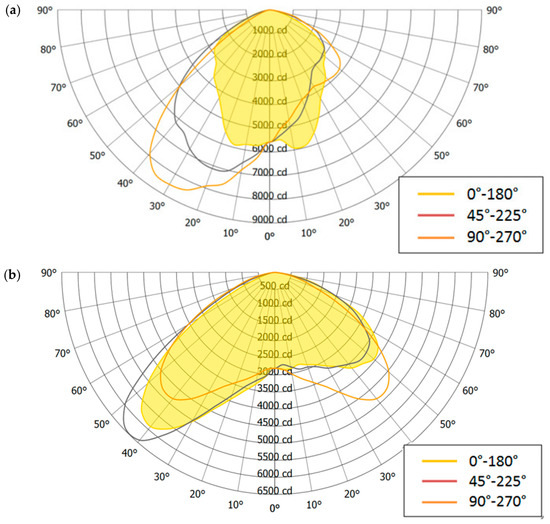
For scenario SC1, corresponding to the baseline configuration of the optical system, the widest light distribution was obtained among the cases analyzed. This characteristic was marked by a relatively uniform light distribution over a wide angular range, making this operating mode well-suited for general space lighting applications.
In the case of scenario SC2, a partial narrowing of the photometric characteristics and an increase in light concentration along the luminaire’s optical axis were observed. The resulting light distribution can be considered an intermediate configuration between the base mode and the concentrated mode.
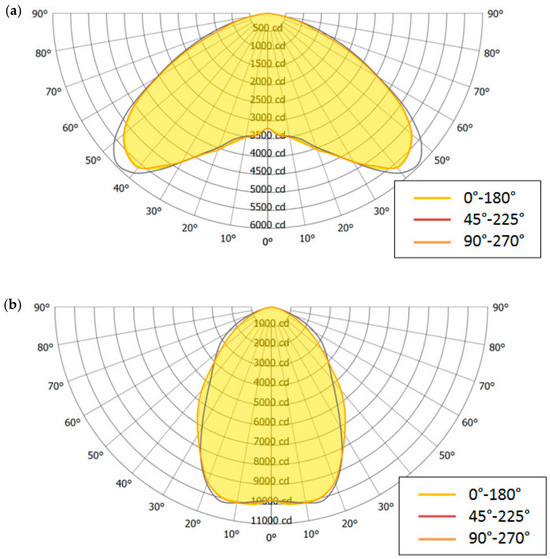
The highest concentration of luminous flux among the cases studied was obtained for scenario SC3. The resulting characteristics show a marked narrowing of the beam angle and an increase in the proportion of light in the central area of the distribution pattern, indicating that this mode can be used in applications requiring localized or accent lighting. The results of the test sample are shown in Figure 10.
Figure 10.
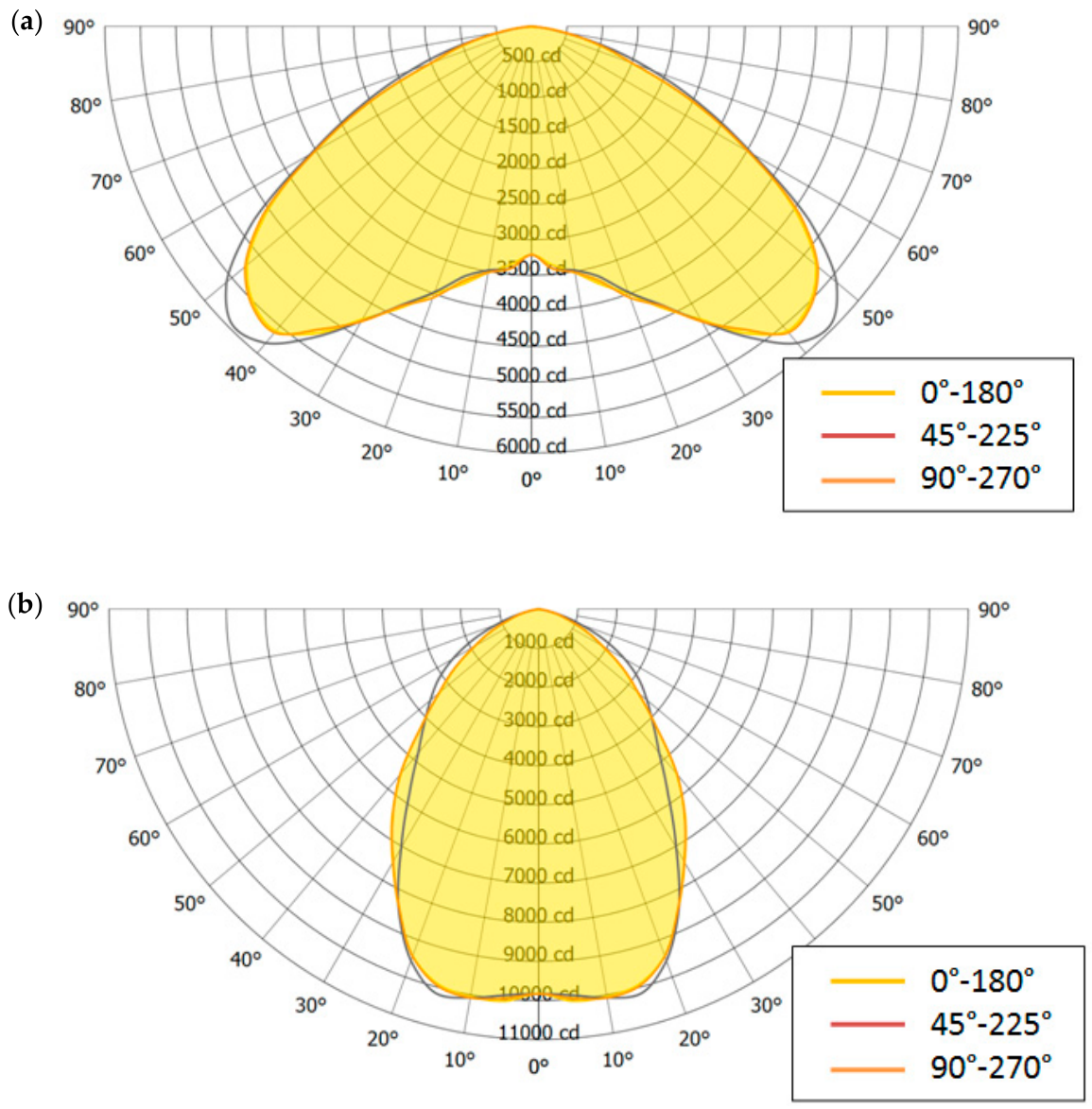
Luminous intensity distribution for symmetric scenarios: (a) SC1—wide distribution; (b) SC3—narrow distribution.
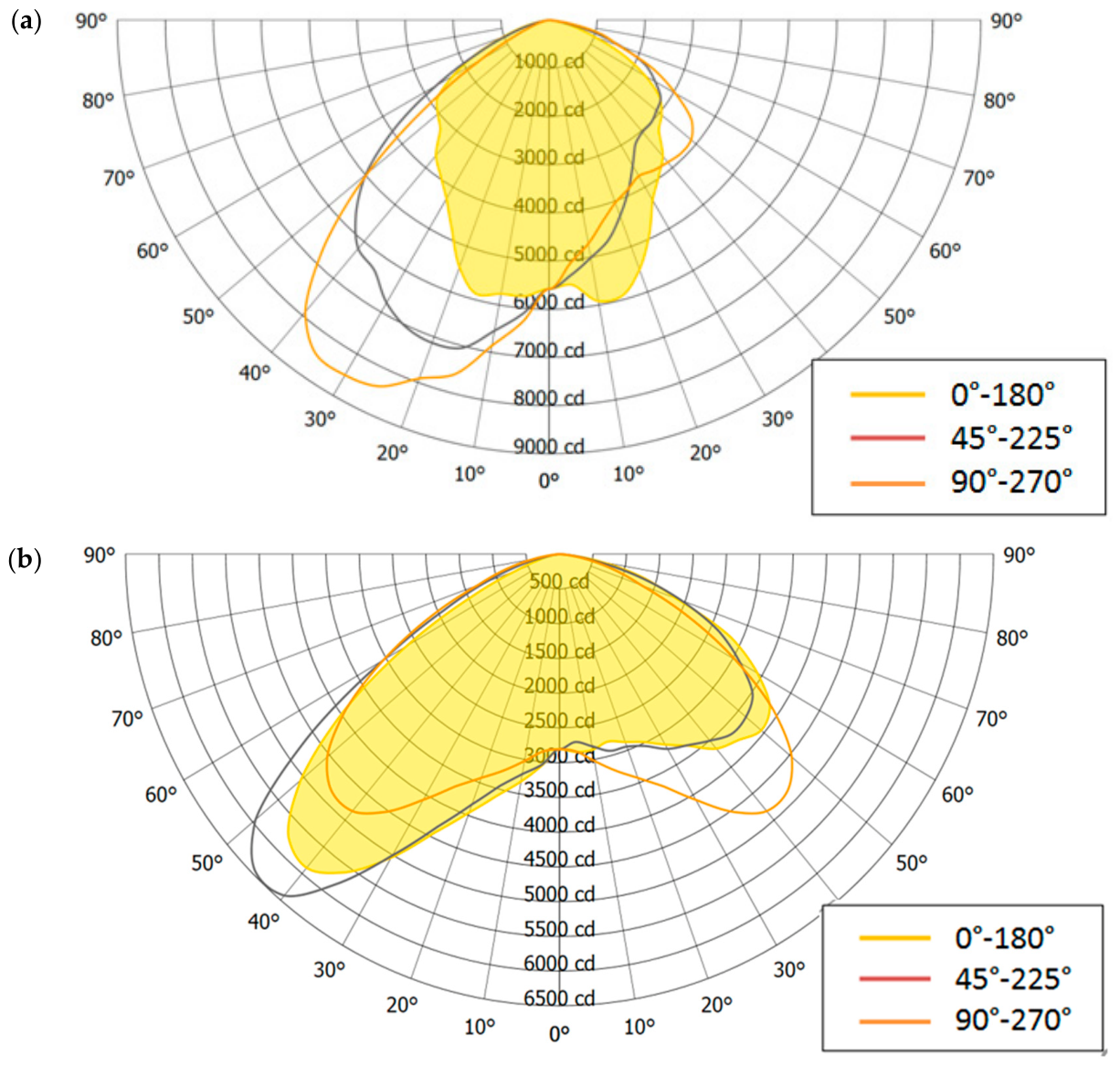
The subsequent section presents the testing and analysis of scenarios (Table 1) belonging to classes II and III (SC4–SC20). Photometric measurements were also taken in the planes C0–C180, C45–C225, and C90–C270. In Class II and III scenarios, the number of LED sections and the position of the reflectors were varied. The results confirmed that changing the orientation of the reflectors and LED sections allows for the effective shaping of the directional light distribution characteristics.
The results of the test sample are shown in Figure 11. Although only representative distributions of the luminous intensity are presented in Figure 10 and Figure 11, all twenty predefined control scenarios were experimentally measured using the same photometric procedure. The selected lighting parameters of the luminaire corresponding to different control scenarios are presented in Table 3. The obtained values of the beam angle for three planes (C0–C180, C45–C225 and C90–C270), total output luminous flux, maximum luminous intensity and optical efficiency are indicated. It should be noted that for scenarios SC19–SC20, it is not possible to specify clear lighting parameter values, as these scenarios do not define a precise configuration of the optical system control and light source power supply. They define variable luminaire operating modes, in which some system parameters may be constant (SC19) or all parameters may be time-varying (SC20). As a result of this control strategy, the output lighting parameters can vary widely, depending on the current configuration. The threshold values for the lighting parameters will not exceed the values corresponding to scenarios SC1–SC18.
Figure 11.
Luminous intensity distribution for asymmetric scenarios: (a) SC8—asymmetric beam distribution; (b) SC12—axially narrowed distribution.
Table 3.
A summary of selected luminaire lighting parameters corresponding to different control scenarios.
The results of the study indicate that the introduction of an asymmetric reflector configuration and the selective activation of LED sections affect the useful luminous flux and the optical efficiency of the luminaire. The results confirm that the developed control system enables effective shaping of the directional light distribution characteristics while maintaining stable power supply conditions. The quantitative parameters presented in Table 3 allow a direct comparison of the different operating scenarios and confirm the effectiveness of the proposed control strategy.
4. Discussion
The experimental results confirm that the use of movable reflectors and the appropriate activation of selected LED arrays allow the effective shaping of the light distribution characteristics without the need to change the electrical configuration of the light sources. Analysis of scenarios SC1–SC3 showed that by changing the position of the reflectors, it is possible to transition from a wide light distribution to a configuration with an increased concentration of luminous flux in the area of the luminaire’s optical axis while maintaining axial symmetry. In turn, the analysis of asymmetric scenarios confirmed that it is possible to narrow and widen the light distribution in specific directions.
In many of the solutions presented in the literature, the authors focus primarily on passive optical systems, such as asymmetric TIR lenses or dedicated secondary optical systems [24,25]. In contrast, current lighting control strategies are most often based solely on regulating the luminous flux by adjusting the power or duty cycle of the control signal for LED sources [14,24,26]. Unlike these solutions, the developed system allows for real-time physical changes to the geometry of the optical system and active shaping of the light beam. This represents a significant extension of the traditional concepts of intelligent lighting control.
From the perspective of energy-efficient lighting, the proposed solution offers advantages that extend beyond the ability to modify the photometric distribution of a luminaire. The luminaire’s adjustable beam width allows for the adjustment of the illuminated area, such as a work area or circulation area in industrial facilities, depending on current needs, including the type of work or traffic volume. Combined with the ability to adjust the luminous flux, this allows for smooth changes in the width of the illuminated area while maintaining the illuminance level.
The capability of dynamically modifying the light distribution may also contribute to reducing the electrical power required to achieve a given illuminance level in practical applications. Although the present study focused on the experimental validation of the control concept and photometric performance, the obtained results indicate considerable potential for future energy-optimization strategies based on adaptive beam shaping.
Another practical advantage of the proposed approach is the possibility of replacing several dedicated luminaire variants with a single adaptive lighting platform. This concept is particularly attractive in modern smart lighting systems, where adaptability and energy efficiency are becoming key design requirements.
Although the proposed control system enables adaptive redistribution of the luminous flux, the present study did not include measurements of electrical energy consumption. Evaluation of potential energy savings requires application-specific measurements performed under defined illuminance requirements and will be addressed in future work.
5. Conclusions
This paper presents the design and experimental validation of an adaptive lighting fixture equipped with movable reflectors and segmented LED light sources. The proposed system enables active control of the geometry of the optical system using a dedicated controller based on an ESP32 microcontroller.
Experimental validation was carried out for all twenty predefined lighting scenarios. Quantitative photometric parameters were determined for the fixed operating scenarios (SC1–SC18), whereas SC19 and SC20 were evaluated as variable operating modes. Representative luminous intensity distributions are presented for selected scenarios (Figure 10 and Figure 11). The obtained results confirmed the possibility of controlling the light distribution by adjusting the reflector positions and independently controlling the LED sections.
From the perspective of energy-efficient lighting systems, the proposed solution creates new opportunities for improving luminous flux utilization. By dynamically adapting the light distribution to the requirements of a given lighting task, it becomes possible to direct light only to selected areas and reduce unnecessary illumination outside the target zone. This functionality may contribute to lowering energy consumption while maintaining the required lighting conditions.
The proposed control system creates the possibility of improving lighting efficiency by adapting the light distribution to current application requirements. However, the quantitative assessment of the associated energy savings was beyond the scope of the present work, which focused on the implementation and photometric validation of the embedded control system. Further research will include a quantitative assessment of the energy-saving potential associated with adaptive beam shaping under representative operating conditions.
Author Contributions
Conceptualization, A.R., M.L. and P.S.; methodology, A.R. and P.S.; software, A.R. and M.L.; validation, A.R., M.L. and P.S.; formal analysis, A.R.; investigation, M.L. and P.S.; resources, A.R. and P.S.; data curation, P.S.; writing—original draft preparation, A.R. and M.L.; writing—review and editing, M.L. and P.S.; visualization, A.R., M.L. and P.S.; supervision, A.R. and P.S. All authors have read and agreed to the published version of the manuscript.
Funding
This research received no external funding.
Data Availability Statement
Most relevant data are included in the article. Additional data are not publicly available but can be obtained from the corresponding author upon request.
Conflicts of Interest
The authors declare no conflicts of interest.
References
- Li, J.; Zhang, G. Light-Emitting Diodes Materials, Processes, Devices and Applications: Materials, Processes, Devices and Applications; Springer: Berlin/Heidelberg, Germany, 2019. [Google Scholar]
- Cole, M.; Suvagau, C. LED Lighting: What We Know, What We Don’t Know, What Concerns Us, and What’s Next. In Proceedings of the 2025 IEEE IAS Petroleum and Chemical Industry Technical Conference (PCIC), Dallas, TX, USA, 22–25 September 2025; pp. 233–242. [Google Scholar]
- Baran, K.; Różowicz, A.; Różowicz, S.; Strączyński, P. Research on Thermal Resistance Rthj-c to Determine the Junction Temperature and Its Impact on Selected Light Parameters of High-Power LED Sources. Opto-Electron. Rev. 2026, 34, 157818. [Google Scholar] [CrossRef] [Scilit]
- Munthe, C.; Febriandirza, A. Smart Home Innovation: IOT-Based Lighting Control System Design. In Mechatronics and Automation Technology; IOS Press: Amsterdam, The Netherlands, 2024. [Google Scholar]
- Hu, C.-L.; Chan, T.-K.; Wen, Y.-C.; Tantidham, T.; Sanghlao, S.; Yimwadsana, B.; Mongkolwat, P. IoT-Based LED Lighting Control in Smart Home. In Proceedings of the 2018 IEEE International Conference on Applied System Invention (ICASI), Chiba, Japan, 13–17 April 2018; pp. 877–880. [Google Scholar]
- Kazala, R.; Straczynski, P.; Taneva, A.; Penkov, S. The Use of IoT Technologies for the Monitoring of Electrotechnological Systems. In Proceedings of the 2018 Conference on Electrotechnology: Processes, Models, Control and Computer Science (EPMCCS); IEEE: New York, NY, USA, 2018; pp. 1–7. [Google Scholar]
- Doulos, L.T.; Peña-García, A. New Perspectives on Lighting. Sustainability 2024, 16, 7219. [Google Scholar] [CrossRef] [Scilit]
- Akshaya, D.R.; Ezhil Dyana, M.V.; Jaffy, J.; Vani Lavanya, A. Integration of Adaptive Lighting Control and Energy Consumption Prediction. In Proceedings of the 2025 7th International Conference on Intelligent Sustainable Systems (ICISS), Tirunelveli, India, 12–14 March 2025; pp. 97–102. [Google Scholar]
- Gunay, H.B.; O’Brien, W.; Beausoleil-Morrison, I.; Gilani, S. Development and Implementation of an Adaptive Lighting and Blinds Control Algorithm. Build. Environ. 2017, 113, 185–199. [Google Scholar] [CrossRef] [Scilit]
- Askola, J.; Kärhä, P.; Baumgartner, H.; Porrasmaa, S.; Ikonen, E. Effect of Adaptive Control on the LED Street Luminaire Lifetime and on the Lifecycle Costs of a Lighting Installation. Light. Res. Technol. 2021, 54, 147715352110081. [Google Scholar] [CrossRef] [Scilit]
- Shaheen, H.I.; Yang, B.; Zuo, Y.; Vašak, M.; Lešić, V. Model Predictive Control for Adaptive Energy-Efficient Street Lighting: A Comprehensive Framework and Case Study. IEEE Trans. Ind. Electron. 2026, 73, 2960–2971. [Google Scholar] [CrossRef] [Scilit]
- Kirpichnikova, I.M.; Volkova, O.S.; Maliugina, A.A. Combined Lighting System Energy Efficiency Evaluation by the Light Flux Regulation. In Proceedings of the 2017 International Conference on Industrial Engineering, Applications and Manufacturing (ICIEAM), St. Petersburg, Russia, 16–19 May 2017; p. 116. [Google Scholar]
- Straczynski, P.; Wcislik, M. Higher Harmonics and Power in Circuits with LED Light Sources. In Proceedings of the 2018 Conference on Electrotechnology: Processes, Models, Control and Computer Science (EPMCCS), Cedzyna/Kielce, Poland, 12–14 November 2018; pp. 1–5. [Google Scholar]
- Wu, X.; Qin, P. Adaptive Lighting and Thermal Comfort Control Strategies in Digital Twin Classroom via Deep Reinforcement Learning. Electronics 2026, 15, 873. [Google Scholar] [CrossRef] [Scilit]
- Yu, C.; Verhaegen, M. Structured Modeling and Control of Adaptive Optics Systems. IEEE Trans. Control Syst. Technol. 2018, 26, 664–674. [Google Scholar] [CrossRef] [Scilit]
- Din, I.; Kim, J.; Kim, H. Joint Power and Beam Angle Control for Energy Efficiency in Lighting Control Systems. J. Appl. Res. Technol. JART 2013, 11, 402–407. [Google Scholar] [CrossRef] [Scilit]
- Mahadevan, R.; Gurusamy, M. Adaptive Headlight Control System. J. Phys. Conf. Ser. 2021, 1969, 012059. [Google Scholar] [CrossRef] [Scilit]
- Leśko, M.; Różowicz, A.; Wachta, H.; Różowicz, S. Adaptive Luminaire with Variable Luminous Intensity Distribution. Energies 2020, 13, 721. [Google Scholar] [CrossRef] [Scilit]
- Leśko, M.; Różowicz, A. Influence of the Reflector Properties on the Photometric Characteristics of a Luminaire with Variable Luminous Intensity Distribution. Przegląd Elektrotechniczny 2024, 2024, 199. [Google Scholar] [CrossRef] [Scilit]
- Różowicz, A.; Leśko, M.; Wachta, H. Evaluation of the Zonal Luminous Flux Distribution of LED Sources. In Proceedings of the 2016 13th Selected Issues of Electrical Engineering and Electronics (WZEE), Rzeszow, Poland, 4–8 May 2016; pp. 1–6. [Google Scholar]
- Delgado, R.; Park, J.; Choi, B.W. Open Embedded Real-Time Controllers for Industrial Distributed Control Systems. Electronics 2019, 8, 223. [Google Scholar] [CrossRef] [Scilit]
- Blachut, K.; Kryjak, T. Real-Time Efficient FPGA Implementation of the Multi-Scale Lucas-Kanade and Horn-Schunck Optical Flow Algorithms for a 4K Video Stream. Sensors 2022, 22, 5017. [Google Scholar] [CrossRef] [Scilit] [PubMed]
- Kudryashov, A.V.; Kalinina, A.S.; Yagovkin, G.N. Pulse Width Modulated LED Light Control and Vision Adaptation. In Proceedings of the 2017 International Conference on Industrial Engineering, Applications and Manufacturing (ICIEAM), Chelyabinsk, Russia, 16–19 May 2017; pp. 1–4. [Google Scholar]
- Hsu, K.-F.; Lin, C.-W.; Chen, M.-W.; Hwang, J.-M.; Lee, L.-L. Design of Asymmetrical Total Internal Reflection Optics with Microstructures for Lighting Museum Exhibits. Opt. Quantum Electron. 2016, 48, 236. [Google Scholar] [CrossRef] [Scilit]
- Rozowicz, A.; Lesko, M.; Wachta, H. The Technical Possibilities of Losses Reduction in the LED Optical Systems. In Proceedings of the 2016 IEEE Lighting Conference of the Visegrad Countries (Lumen V4), Karpacz, Poland, 13–16 September 2016; pp. 1–5. [Google Scholar]
- Rodrigues, W.A.; Morais, L.M.F.; Donoso-Garcia, P.F.; Cortizo, P.C.; Seleme, S.I. Comparative Analysis of Power LEDs Dimming Methods. In Proceedings of the XI Brazilian Power Electronics Conference, Natal, Brazil, 11–15 September 2011; pp. 378–383. [Google Scholar]



Disclaimer/Publisher’s Note: The statements, opinions and data contained in all publications are solely those of the individual author(s) and contributor(s) and not of MDPI and/or the editor(s). MDPI and/or the editor(s) disclaim responsibility for any injury to people or property resulting from any ideas, methods, instructions or products referred to in the content. |
© 2026 by the authors. Licensee MDPI, Basel, Switzerland. This article is an open access article distributed under the terms and conditions of the Creative Commons Attribution (CC BY) license.