


Abstract
With the rapid advancement of artificial intelligence (AI), large language models exhibit nearly universal problem-solving capabilities yet cannot autonomously comprehend human intentions. As the externalization of human thinking, prompt engineering embodies human unique core value in the intelligent era. Text-to-image (T2I) research has largely focused on prompt-surface optimization, while the prior question of how user intent should be structurally encoded remains underexplored. We investigate whether 5W3H/PPS (Prompt Protocol Structure), an eight-dimension intent encoding framework previously studied in text generation, retains protocol-level relevance in neural image generation. Using a frozen baseline pilot and two follow-up studies evaluated on three commercial Chinese T2I systems under Chinese-language task specifications, we examine three issues: cross-modal protocol transfer, functional differentiation within the Why dimension, and task-dependent density boundaries in structured intent encoding. We find evidence that PPS supports a task-conditioned intent protocol in image generation, rather than functioning as a uniformly superior prompting method. In the baseline pilot, the structural gap—defined as the difference between dimensional recovery and intent fidelity—persists across all pilot task–condition aggregates, indicating that structurally plausible images can still fail to preserve user-specific intent. A Why-decomposition study shows that purpose-oriented formulations outperform audience-oriented or mixed formulations in high-complexity tasks, whereas audience specification is more useful in lower-complexity settings. A density study further shows that protocol density is non-monotonic: some tasks benefit from full eight-dimension specification, whereas others collapse under over-specification. Taken together, these findings suggest that structured intent encoding in T2I is better understood as a task-calibrated protocol variable than as a uniformly beneficial prompting strategy. All findings are established on three Chinese commercial T2I systems under Chinese-language specifications and should be read as evidence for a task-calibrated intent protocol within this setting, not as a claim that generalizes to other languages, model families, or image-generation systems.
1. Introduction
1.1. The Intent Encoding Problem in Neural T2I Systems
Neural text-to-image (T2I) systems have made open-ended image generation widely accessible, but the interface for users to convey intent remains largely unstructured. In most deployed systems, users provide a short free-form prompt and the model must infer communicative purpose, target audience, contextual constraints, and stylistic requirements from whatever happens to be expressed [1,2]. This interaction style is convenient, but it leaves a persistent alignment problem unresolved: not whether an image can be generated, but whether the generated image aligns with the user’s intended communicative goals.
We refer to this problem as the intent encoding gap: the distance between the user’s internally represented intent and the portion of that intent that is actually transmitted through the prompt interface. This gap is not reducible to model capability alone. In practice, the same generation systems that appear to “misunderstand” underspecified prompts often perform well once key dimensions of intent are made explicit [3,4]. The problem is therefore partly upstream of generation itself: before optimizing prompt wording, one must ask what dimensions of intent should be encoded in the first place.
This distinction separates intent encoding from prompt surface optimization. Prompt optimization asks how a formulated request should be phrased [5,6]. Intent encoding asks which components of user intent should be made explicit, and how much structured specification a generation system can productively integrate before performance begins to degrade. The present study examines this problem in AI image generation.
1.2. Cross-Modal Transfer of Structured Intent Encoding
Prior PPS research in text generation has suggested two relevant observations. First, structured intent encoding is particularly valuable in high-ambiguity tasks, while its advantage shrinks or reverses in low-ambiguity settings [7]. Second, subsequent text-domain work found that PPS generalizes across Chinese, English, and Japanese and increasingly characterized PPS as a protocol-like communication layer rather than a task-specific prompting trick, with encoding overhead and cross-model robustness as central concerns [8,9]. These findings motivate a stricter question: if PPS captures something general about intent transmission, does its effect persist when the target modality changes from text to image?
This cross-modal transfer question is non-trivial. Image generation requires a further translation step from structured linguistic specification to visual artifact. The relative importance of intent dimensions may therefore shift: dimensions that are secondary in text tasks may become central in image tasks, while dense multi-dimensional specification may exceed the model’s capacity to integrate competing constraints. Cross-modal validation is therefore not a routine extension, but a test of whether structured intent encoding reflects a broader interaction principle rather than a text-domain convenience.
1.3. Research Questions and Contributions
This study addresses three research questions:
RQ1: Does PPS/5W3H exhibit cross-modal protocol effects in neural image generation, beyond prompt-surface differences?
RQ2: Which intent dimension, or which sub-component of a dimension, conveys the most critical signal in image generation?
RQ3: Does structured intent encoding in image generation exhibit a task-dependent density boundary, beyond which additional specification reduces rather than improves fidelity?
We make four contributions. First, we provide systematic evidence that structured intent encoding remains empirically meaningful in image generation as a protocol variable rather than a uniformly superior prompting method. Second, we show that the Why dimension is internally differentiated: purpose-oriented formulations behave differently from audience-oriented formulations, especially in high-complexity tasks. Third, we identify task-dependent density boundaries and distinguish multiple overload regimes instead of treating over-specification as a single failure mode. Fourth, we report a negative result: prompt-surface optimization of AI-expanded PPS variants does not reliably predict image-layer fidelity, indicating that protocol evaluation in T2I must be conducted at the execution level.
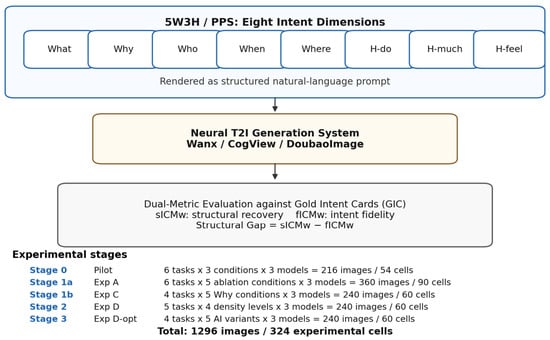
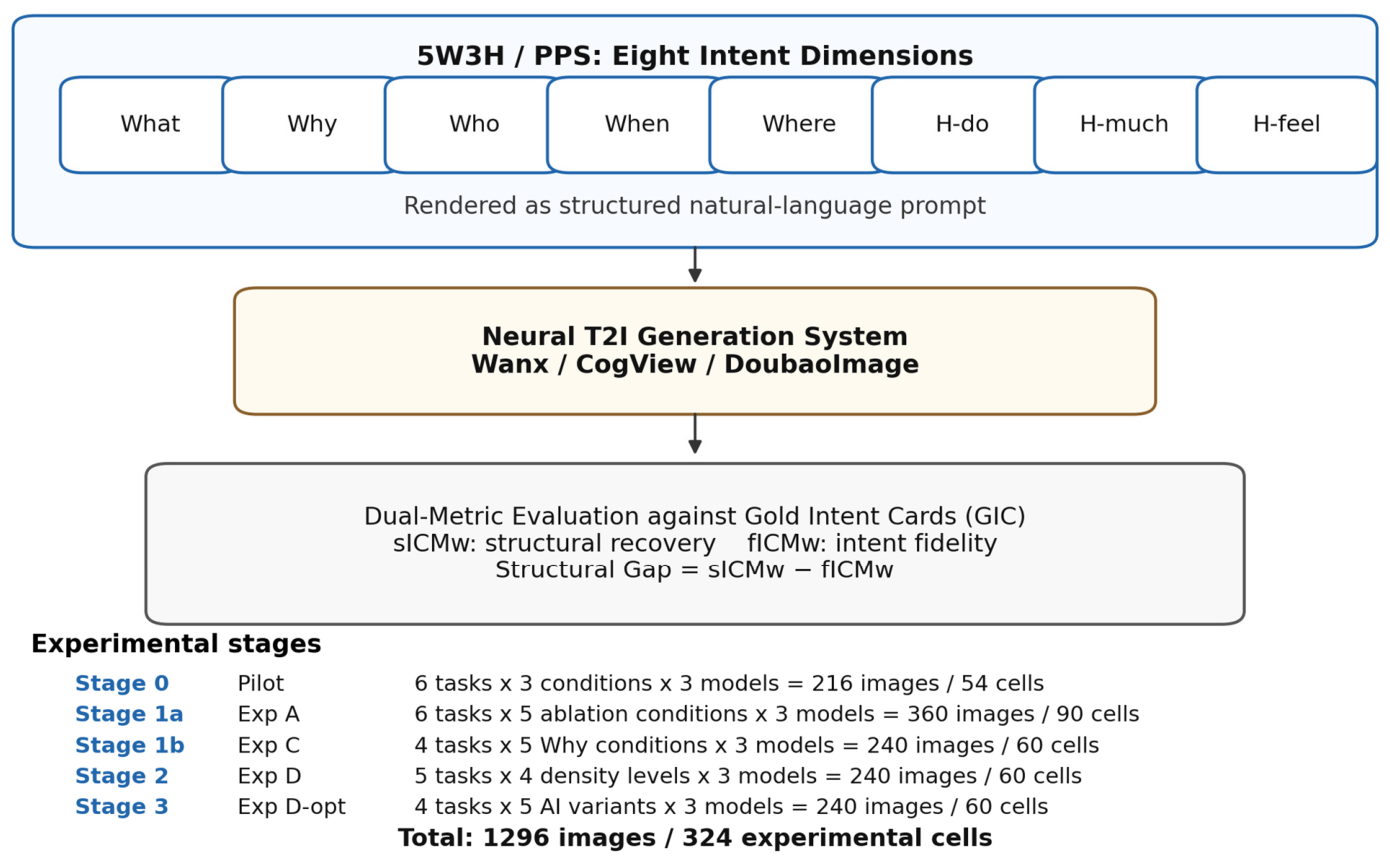
Figure 1 summarizes the PPS intent-encoding framework, the cross-modal evaluation pipeline, and the staged experimental design used throughout the paper.
Figure 1.
PPS intent encoding framework and experimental study design. Top: the eight 5W3H dimensions forming the PPS intent encoding schema. Middle: the cross-modal transfer pipeline from structured intent to neural T2I output. Bottom: dual ICMw evaluation framework and experimental stage overview. Condition A = free-form natural language; C = full 8-dimension PPS; D = AI-expanded PPS.
2. Background and Related Work
2.1. The PPS/5W3H Framework
The 5W3H vocabulary—organizing communicative intent across eight dimensions (What, Why, Who, When, Where, How-to-do, How-much, How-feel)—derives from journalism and cognitive rhetoric traditions for minimal-sufficient event specification [10]. The Prompt Protocol Structure (PPS) formalizes this as a structured encoding schema between human intent and AI generation systems, operating above the prompt surface and below model-specific optimization [7].
Prior text-based PPS evaluation across three commercial language models (DeepSeek, Qwen, Kimi) and three prompt conditions—free-form, raw structured JSON, and rendered PPS—established that rendered PPS outperforms free-form prompting in high-ambiguity tasks (gains converging to zero in low-ambiguity tasks), and that the rendering layer from structured fields to natural language is non-trivially important [6]. These results support a protocol-layer interpretation in text generation. The present study tests whether this interpretation extends to the image modality.
2.2. Text-to-Image Prompting and Prompt Optimization
A substantial literature examines how prompt surface features affect T2I output. Hao et al. [5] demonstrated that automated prompt optimization toward aesthetic preference scores improves benchmark performance. Witteveen and Andrews [6] showed that prompt length and structural features have highly model-dependent effects in diffusion models. Compositional generation research [11,12] addresses multi-object specification, spatial relations, and attribute binding; the Attend-and-Excite method [12] specifically uses attention map manipulation to improve attribute fidelity. Human preference modeling [13,14] has produced automated quality proxies aligned with aesthetic judgment. All these approaches operate at the prompt surface: how words and phrases in a prompt influence generation. The present work is orthogonal: we study intent structure—how organizing user intent prior to prompt composition influences whether the neural generation output reflects the user’s communicative purpose.
2.3. Structured and Chain-Type Prompting
Work on structuring model reasoning—rather than user intent—has substantially advanced text generation quality. Chain-of-Thought (CoT) prompting [3] elicits step-by-step model reasoning; Tree of Thoughts [15] explores multiple reasoning paths; chain-of-density prompting iteratively densifies document summaries. These methods act on the model’s internal computation. The instruction-following literature [16,17] structures task phrasing to improve model compliance. PPS addresses a different and logically prior problem: structuring the user’s intent itself, before any model interaction. This distinction—structuring user intent versus model reasoning—has not been systematically studied in prior work.
2.4. Human-AI Interaction and Intent Communication
Human–Computer Interaction (HCI) research has documented the difficulty users face in articulating intent to AI systems. AI Chains [18] showed that decomposing complex tasks into chained prompts improves outcome controllability. PromptMaker [13] demonstrated that prototype-based prompting tools help users express intent they struggle to articulate in free-form text. T2I interaction studies [19] found that users frequently discover their preferences through iterative generation rather than upfront specification. These findings motivate the protocol-layer approach: if users systematically fail to externalize intent in free-form text, providing a structured schema for intent articulation may address the problem at its source rather than at the model’s processing stage.
2.5. Evaluation of Image-Text Alignment and Cognitive Load
Standard T2I evaluation metrics—CLIPScore [20], FID, ImageReward [14]—measure aggregate alignment or aesthetic preference without distinguishing structural presence from intent fidelity at the dimension level. The ICMw framework introduced in this study extends dimensional ablation methodology to image generation, evaluating per-dimension structural recovery and intent fidelity separately. The density boundary findings connect to cognitive load theory [21] and information processing capacity research [22], extending this framework from human cognitive systems to neural generative models.
3. Methods
3.1. Task Design and Complexity Taxonomy
Tasks represent a range of communicative complexity levels in AI-assisted image creation. Eight tasks appear across one or more experimental stages. All tasks are specified in Chinese. Language and model selection serves two purposes: preserving task-language consistency and enabling a controlled multi-condition design on accessible commercial APIs within a single linguistic ecosystem. Table 1 lists the eight tasks and complexity categories.
Table 1.
Task Descriptions and Complexity Categories.
3.2. PPS/5W3H Condition Design
Base conditions used across pilot and all experimental stages: Condition A (Free-form) provides natural language description matched in word count to Condition C with no dimensional scaffolding. Condition C (Full PPS) provides complete eight-dimension 5W3H specification manually authored and rendered as structured natural language. Condition D (AI-expanded PPS) provides PPS specification generated by DeepSeek-Chat from a brief task description.
Exp A ablation conditions remove one dimension each from full PPS: ABL_WHY, ABL_WHO, ABL_HOWFEEL, ABL_HOWMUCH. Exp C Why-decomposition conditions hold all seven non-Why dimensions character-identical: WHY_PURPOSE (∼18 chars), WHY_AUDIENCE (∼16 chars), WHY_BOTH (∼23 chars), WHY_ABSTRACT (∼16 chars), NO_WHY. Exp D density conditions vary active dimension count: ELASTIC_3, ELASTIC_5, FULL_8, STRICT_PLUS.
Mean character counts per density condition across the five Exp D tasks (full data in the GitHub repository): ELASTIC_3 = 73 chars (range 68–81); ELASTIC_5 = 117 chars (range 105–135); FULL_8 = 194 chars (range 176–212); STRICT_PLUS = 255 chars (range 218–290). Character count scales monotonically with dimension count by design. Crucially, FULL_8 and STRICT_PLUS both specify all eight dimensions; their difference lies in the depth of specification within each dimension, not in the number of dimensions encoded. The T08 STRICT_PLUS collapse therefore isolates within-dimension over-specification rather than a simple length effect. The cross-task dissociation—T05 benefits from FULL_8 whereas T08 collapses—further confirms that prompt character count alone does not determine the direction of the density effect.
3.3. Image Generation Models
Three commercially deployed neural T2I systems were used. DoubaoImage exhibited a high-fidelity ceiling effect (mean fICMw = 0.990; C-vs.-A differences ≤ 0.016 in every task). We therefore report results at three layers: all-model pooled, Wanx + CogView pooled (primary inferential layer), and per-model. Table 2 summarizes the three models. All three systems are cloud services without public semantic version numbers; the API model identifiers listed in Table 2 (wanx-v1, cogview-3, doubao-seedream-5-0) denote the exact model versions used, accessed in April 2026 via the DashScope, OpenAI-compatible, and Volcano ARK APIs, respectively.
Table 2.
Image-generation models used in the experiments.
3.4. Evaluation Metrics
Each generated image was evaluated against a task-specific Gold Intent Card (GIC), authored before image generation and held constant across conditions. We use two complementary metrics. sICMw (structural intent coverage, weighted) measures whether a dimension is clearly instantiated in the image regardless of whether its content matches reference intent. fICMw (fidelity intent coverage, weighted) measures whether the instantiated dimension is also faithful to the reference intent. Structural gap = sICMw − fICMw captures structurally plausible but intent-misaligned outputs.
Scores were assigned by a fixed LLM-based judging pipeline (Qwen-VL-Max, temperature = 0) under a condition-invariant rubric and aggregated with a predefined task-sensitive weighting vector. Each image was independently scored by two LLM judge instances (J1, J2); all inferential statistics were computed on image-level averaged scores after merging. The judging models are cloud services accessed via API; Qwen-VL-Max (and the supplementary judges GPT-4o and Doubao-vision used for the multi-judge robustness check below) were accessed in April–May 2026, and the API model identifiers denote the model versions used.
Per-dimension rubric. Each 5W3H dimension is scored on two independent axes, each on a three-point ordinal scale. Structural recovery (s): 0 = the dimension is not observable in the image; 1 = a vague or placeholder instantiation; 2 = clearly instantiated. Intent fidelity (f): 0 = the content departs from the Gold Intent Card (GIC) reference or violates a GIC-listed forbidden addition; 1 = partial match; 2 = faithful. The two axes are scored independently, so an image can earn s = 2 while earning f = 0; per-image scores are summed across the eight dimensions (range 0–16) and normalized (sICMw, fICMw = sum/16), with no post hoc dimension weighting.
The 0/1/2 anchors are task-specific, fixed by each GIC’s scoring-anchor notes and forbidden-additions list. For example, a visually polished annual-report cover (T05) rendered in a bright festive style scores high on How-feel structurally but zero on fidelity, because the GIC requires a restrained corporate identity and lists festive style as forbidden; a striking cyberpunk product image (T08) scores “futuristic” structurally but fails the “approachable, not cold” fidelity criterion. Three fixed rules governed borderline cases: partial or placeholder instantiation maps to 1; any forbidden addition caps the affected dimension’s fidelity at 0 regardless of visual quality; and dimensions a GIC does not constrain are scored on instantiation only.
Multi-judge robustness. To verify that the structural-fidelity split is not an artifact of a single judge, a stratified subset of 60 images (spanning the strong-finding cells, a high-structural-gap subset, and low-gap controls) was independently re-scored, under the identical 0/1/2 rubric, by two additional strong vision-language judges distinct from the primary judge (Qwen-VL-Max): GPT-4o and Doubao-vision. GPT-4o is an international model outside the Chinese T2I ecosystem, so its agreement tests robustness across, not merely within, a single model family. On the high-structural-gap subset, both reproduced the gap reported by the primary judge (GPT-4o mean gap +0.203, present in 10/16 images; Doubao-vision +0.109, 8/16; primary +0.381, 16/16), and the three judges agreed pairwise on per-image fidelity (Spearman ρ = 0.568–0.664). The structural-fidelity split is therefore robust to judge identity, including a judge from an entirely independent (non-Chinese) model family.
Human-evaluation status. The evaluation here is conducted by vision-language judges rather than by human annotation of the image outputs. The same dimensional metric (f-ICMw) has been validated against human raters in the text-domain companion study (arXiv:2605.14517), reporting human-LLM Spearman ρ = 0.695 for f-ICMw versus 0.251 for holistic ratings. A dedicated image-domain human-annotation study with trained raters, using a protocol designed to elicit strict GIC-anchored dimensional judgments, was not feasible within this revision and remains a priority for future work; accordingly we do not claim the structural-fidelity split is human-perceptible at the image level.
Inter-rater agreement between J1 and J2 was computed across all 216 pilot-study images that received scores from both judge instances. Pearson r (J1, J2): fICMw = 0.956; sICMw = 0.896. Mean absolute difference: fICMw = 0.019 (94.0% of scores within 0.10); sICMw = 0.006 (97.7% within 0.10). These results indicate high internal scoring consistency. The fICMw metric was additionally validated against human raters in the text-domain companion study (arXiv:2605.14517), reporting human-LLM agreement rho = 0.695 for dimension-level fidelity scoring versus rho = 0.251 for holistic-judge ratings. Human ablation validation data are also reported in the IST framework paper (arXiv:2605.25058). The present paper applies this validated evaluation framework to image generation as a cross-modal transfer test; image-domain human annotation remains future work.
3.5. Data Integrity and Freeze Protocol
All experimental data were frozen in cryptographically sealed manifests prior to analysis. Three freeze manifests were generated: FREEZE_v1 (baseline pilot, 18 April 2026), FREEZE_exp_AB_v1 (ablation + optimization studies, 19 April 2026), FREEZE_exp_CD_v1 (Why decomposition + density studies, 20 April 2026). Each manifest records SHA-256 hashes of all data files. All hypotheses were pre-registered prior to data collection. Table 3 summarizes the full study design.
Table 3.
Study design overview.
4. Baseline Pilot: Cross-Modal Feasibility
4.1. Design Overview
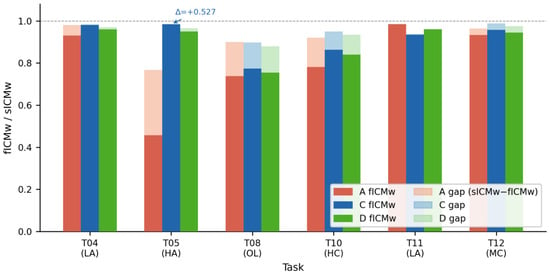
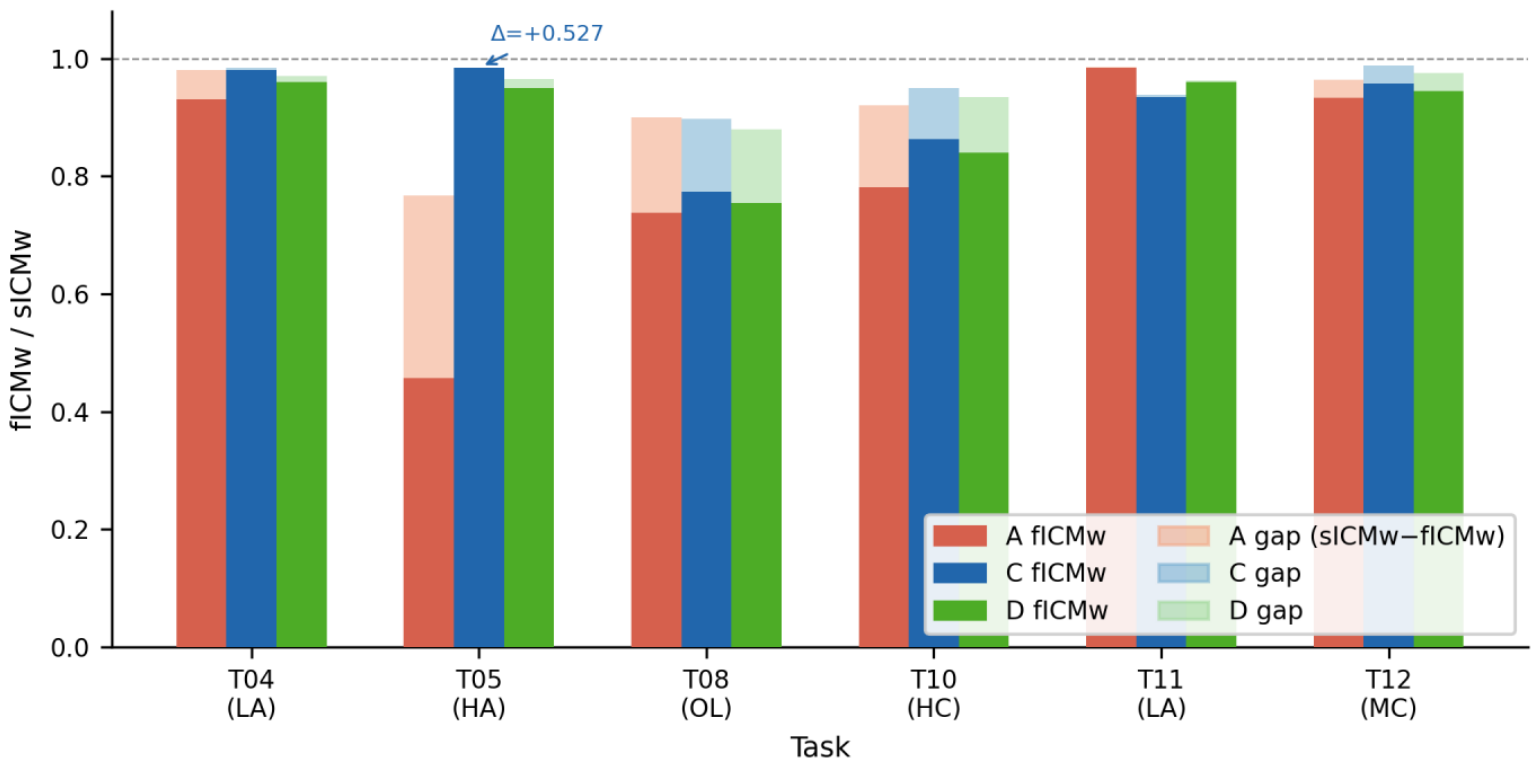
The baseline pilot tested whether PPS/5W3H shows any cross-modal protocol relevance in neural image generation before more targeted follow-up studies were undertaken. The pilot used six tasks under three prompt conditions and three commercial T2I systems. Five continuation criteria were specified in advance, covering prompt-layer explicitness, image-layer fidelity gain, task-level equivalence between manual and AI-expanded PPS, and the persistence of structural gap. All five criteria were satisfied in the frozen analysis. Figure 2 summarizes the baseline pilot fICMw and structural gap by task and condition (Wanx + CogView pooled).
Figure 2.
Baseline pilot fICMw and structural gap by task and condition (Wanx + CogView pooled). sICMw is shown as the full stacked bar and fICMw as the lower solid portion; the upper shaded segment represents structural gap. Structural gap is present in all 18 cells (100%).
4.2. Baseline Results
The frozen pilot supports the feasibility of a cross-modal PPS analysis. The strongest improvement was observed in T05, where the free-form condition frequently produced genre-correct but intent-misaligned outputs, whereas the full PPS condition substantially reduced this failure mode (Δ = +0.527, 95% CI = [0.246, 0.816], Cohen’s d = 1.73; 2/2 primary models consistent). T10 showed a smaller positive trend (Δ = +0.082, 95% CI = [−0.012, 0.172], d = 0.82). By contrast, low-ambiguity control tasks showed minimal condition differences. Structural gap persisted across all 18/18 pilot task–condition aggregates. Table 4 summarizes the continuation criteria.
Table 4.
Frozen pilot continuation criteria and outcomes.
4.3. Task Taxonomy
Table 5 condenses the pilot results into the task taxonomy that guides the remainder of the paper.
Table 5.
Baseline pilot task taxonomy (Wanx + CogView Pooled).
4.4. Ceiling Effects and Three-Layer Reporting
DoubaoImage exhibited a high-fidelity ceiling effect (mean fICMw = 0.990; C vs. A differences ≤0.016 in every task). We adopt a consistent three-layer reporting strategy: all-model pooled for transparency, Wanx + CogView pooled as the primary inferential layer, and per-model for robustness inspection. Claims about protocol differentiation are grounded primarily in the Wanx + CogView pooled layer.
5. Study 1—Dimensional Structure of Image Intent Encoding
5.1. Dimension Sensitivity Baseline (Exp A)
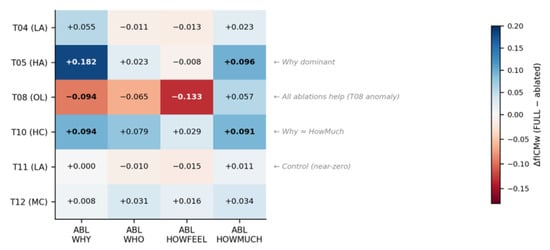
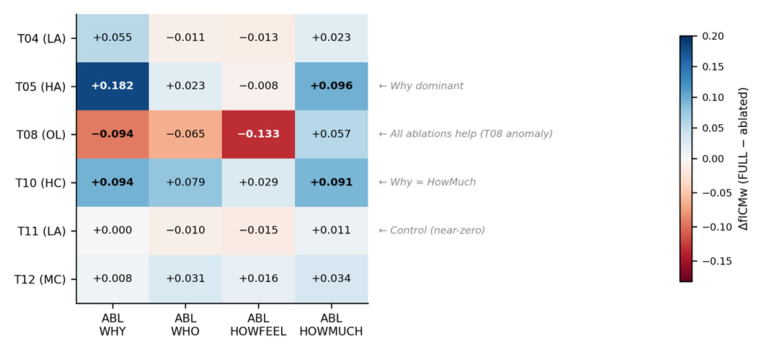
A targeted ablation study identifies which PPS dimensions matter most in image generation. Four candidates: Why, Who, How-feel, and How-much. Six tasks × 3 models = 90 cells, 360 images. ΔfICMw = fICMw(FULL) − fICMw(ablated). Across frozen results, Why emerges as the most consequential dimension in standard high-ambiguity tasks: largest fidelity loss when removed from T05 (Δ = +0.182) and T10 (Δ = +0.094). T08 is qualitatively distinct: removing Why increases fICMw by 0.094. Table 6 reports exact ablation deltas; Figure 3 visualizes the task-by-dimension heatmap.
Table 6.
ΔfICMw (FULL − Ablation) by task and ablated dimension (3-Model Pooled).
Figure 3.
Exp A dimensional ablation heatmap (3-model pooled). Each cell reports ΔfICMw = fICMw(FULL) − fICMw(ablated). Blue cells: dimension useful; orange/red cells: dimension counter-productive. T08 is the sole task where Why removal is beneficial.
5.2. The Anatomy of Why: Purpose Anchoring and Audience Constraint (Exp B)
The Why dimension is treated as a single field in the PPS schema, but communicatively it is not homogeneous. In image tasks, a Why specification can anchor generation through a purpose component (defining communicative role) and an audience component (framing the intended receiver) [23,24,25]. Exp C tests whether these functions behave equivalently by varying only the Why formulation while holding the other seven dimensions constant. Four tasks × 5 Why-variant conditions × 3 models = 60 cells, 240 unique images.
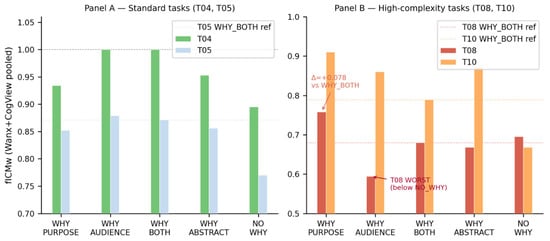
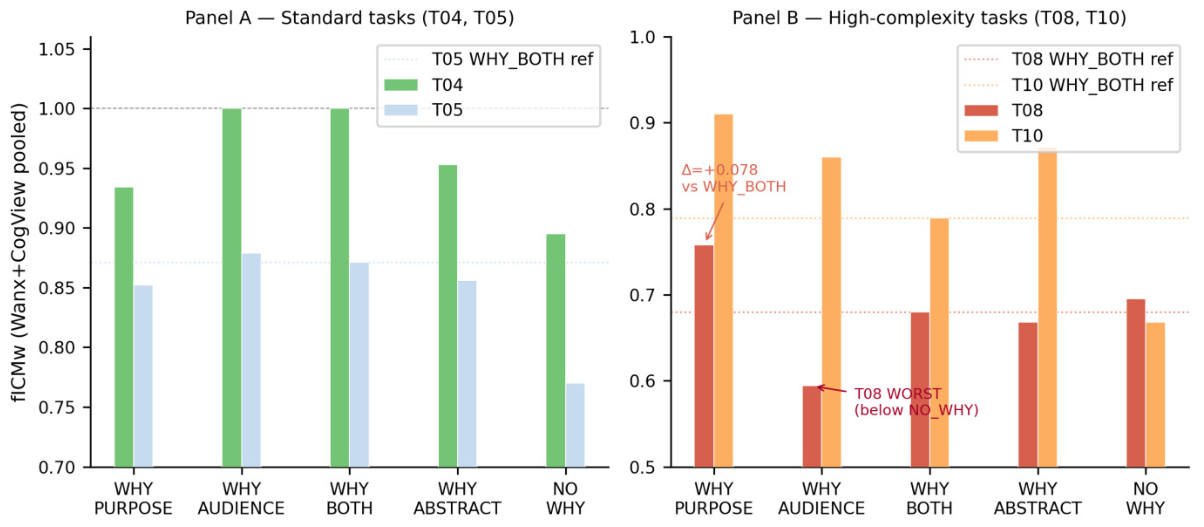
The Why variants do not behave as interchangeable alternatives. They separate into different functional roles conditioned by task complexity. Table 7 reports exact Wanx + CogView pooled values for five Why variants; Figure 4 visualizes the task-complexity-conditioned reversal.
Table 7.
fICMw by Task and Why Condition (Wanx + CogView Pooled); Δ Relative to WHY_BOTH.
Figure 4.
Exp B WHY-dimension decomposition and task-complexity-conditioned dissociation (Wanx + CogView pooled). Two-panel grouped bar chart: Panel A = standard-complexity tasks (T04, T05); Panel B = high-complexity tasks (T08, T10). Panel B shows reversal in which WHY_PURPOSE becomes dominant (+0.078 over WHY_BOTH for T08; +0.121 for T10).
5.3. Resolving the T08 Anomaly
Exp A showed that removing Why from T08 increased rather than decreased fidelity. Exp B clarifies why: the mixed or audience-loaded formulations used in the full configuration were already operating in a counter-productive regime. Once Why is reformulated as purpose anchoring, T08 improves again. Dimension ablation identifies the net contribution of a dimension as currently formulated, not the best possible contribution under an alternative formulation [23,26].
6. Study 2—Protocol Density and Overload in Neural Image Generation
6.1. Design and Rationale
The density study asks how many structured intent dimensions a T2I system can productively integrate before performance begins to deteriorate. Four density conditions: ELASTIC_3 (What + Why + one How), ELASTIC_5 (What + Why + Who + When/Where + one How), FULL_8 (all eight dimensions), STRICT_PLUS (all eight plus additional intra-dimensional constraints). Five tasks × 4 conditions × 3 models = 60 cells, 240 images. Four pre-registered hypotheses: H-D1 (ELASTIC_5 > FULL_8 for overload candidates), H-D2 (FULL_8 ≥ ELASTIC_5 for standard tasks), H-D3 (STRICT_PLUS < FULL_8 for overload candidates), H-D4 (no single density condition is globally optimal).
6.2. Density Is Task-Dependent, Not Monotonic
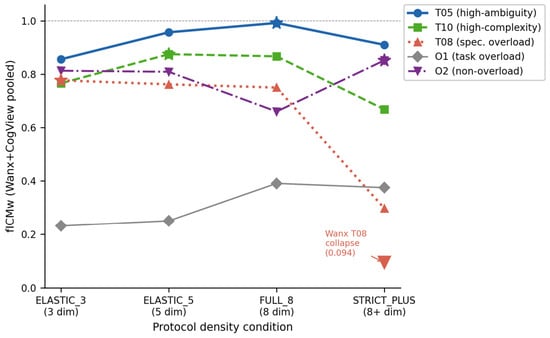
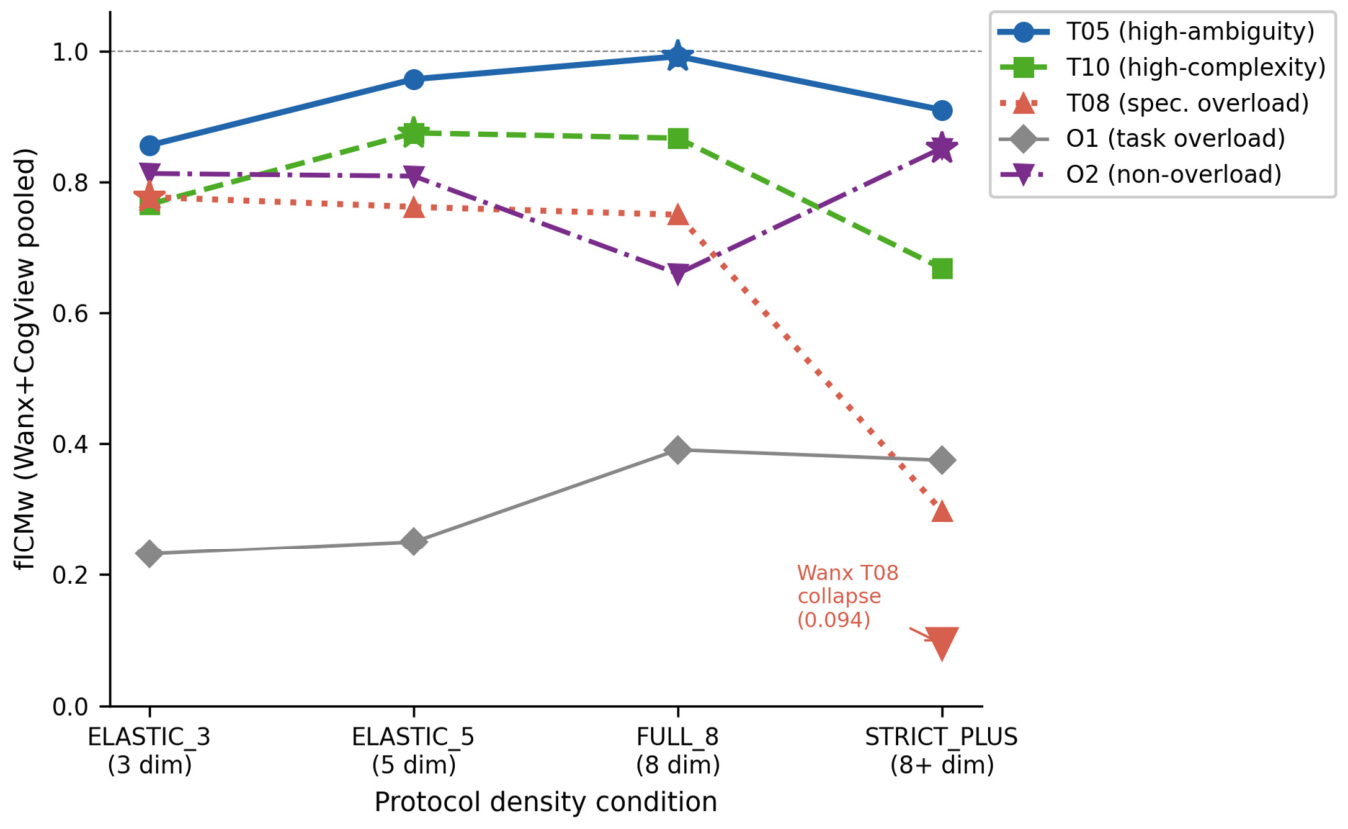
Protocol density does not exhibit a single globally optimal setting. T05 peaks at FULL_8, T10 peaks at ELASTIC_5, T08 peaks at ELASTIC_3, and O2 peaks at STRICT_PLUS. O1 remains low across all density settings. Figure 5 displays density-fidelity profiles; Table 8 provides precise values.
Figure 5.
Exp D protocol density profiles for all five tasks (Wanx + CogView pooled). Each line represents one task; x-axis = protocol density (active PPS dimensions); y-axis = mean fICMw. Stars mark the optimal density for each task. Five distinct profile shapes emerge.
Table 8.
fICMw by task and density condition (Wanx + CogView Pooled; n = 8 averaged image-level observations per comparison).
6.3. Overload Collapse at the Upper Density Boundary
T08 provides the clearest evidence that over-specification can become counterproductive. The STRICT_PLUS collapse: pooled Δ = −0.453 (95% CI = [−0.629, −0.270], d = −2.31; direction consistent across all three models). Table 9 reports per-model density values for T08 and T05.
Table 9.
Per-model fICMw for T08 and T05 across density conditions.
6.4. Overload Is Not a Single Regime
Three overload regimes: (1) Specification overload (T08)—density-sensitive decline, catastrophic STRICT_PLUS collapse, mechanism: constraint competition. (2) Task-level overload (O1)—density-insensitive, all density conditions yield similarly low fICMw (0.231–0.391), mechanism: intrinsic task constraint conflict. (3) Non-overload tension (O2)—STRICT_PLUS optimal (0.852), competing desiderata are explicitly specifiable and resolvable. Table 10 condenses these three regimes.
Table 10.
Three overload regimes: diagnostic features and protocol recommendations.
7. Study 3: Limits of Prompt-Surface Optimization
A secondary optimization study (Exp D-opt) tested whether AI-expanded PPS variants selected for prompt-surface quality would improve image-layer fidelity. They did not. Across four tasks (T05, T08, T10, T12; 60 cells, 240 images), no optimized D variant reliably outperformed either manual Condition C or the simpler D0 baseline across any task. For T05, Condition C remained higher than all optimized variants (0.984 vs. 0.921–0.944). For T08, the optimized variants stayed below Condition C (0.773) and D0_BASE (0.761). This negative result is methodologically important: prompt-surface quality is not a sufficient proxy for execution-layer intent fidelity in T2I. Protocol effectiveness must be assessed at the generation outcome level, not inferred from the apparent completeness or elegance of the prompt.
8. Cross-Experiment Synthesis
8.1. Convergent Evidence Across Studies
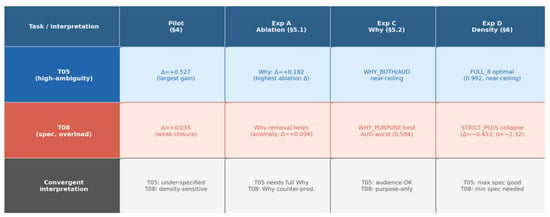
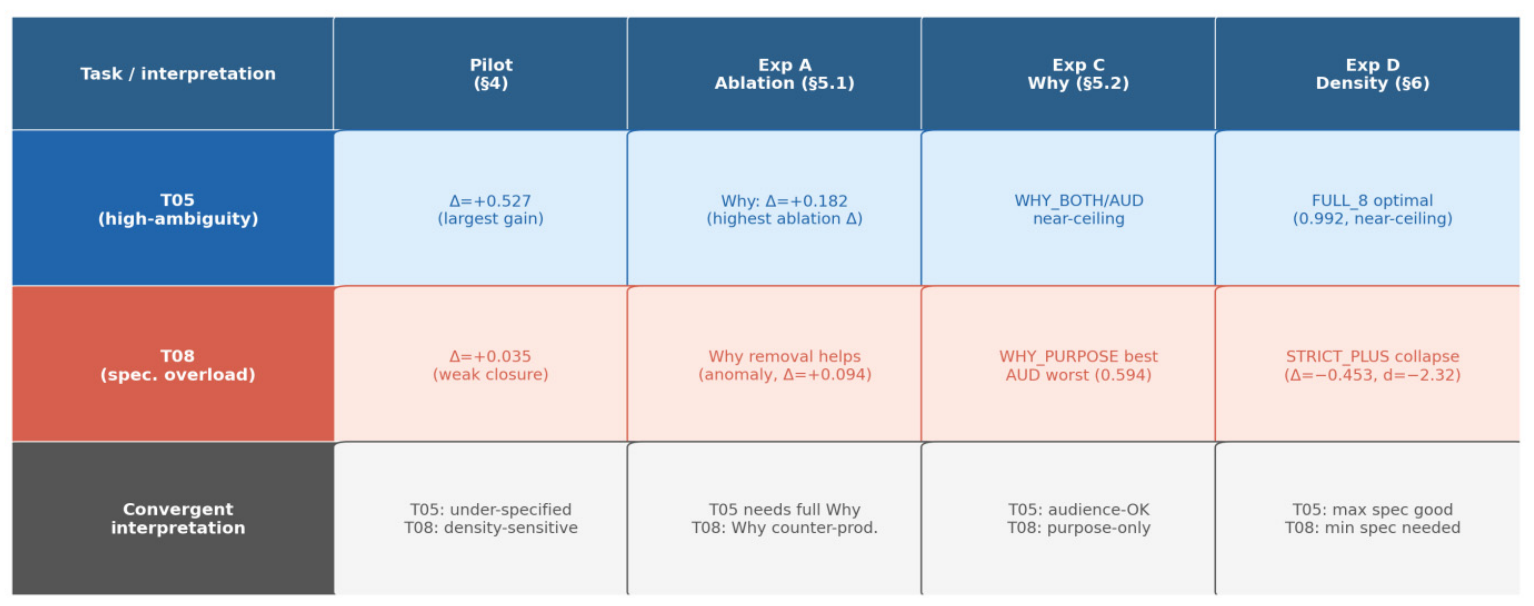
Cross the pilot and follow-up studies, the same conclusion emerges from different analytical angles: PPS/5W3H transfers to image generation not as a fixed optimal template, but as a task-conditioned intent protocol defined by anchoring choice and density calibration. T05 and T10 illustrate two standard but distinct task types. T08 shows a convergent overload signature across experiments: weak pilot closure (Δ = +0.035), anomalous Why ablation (+0.094), strong preference for purpose-only Why (Δ = +0.078 over WHY_BOTH), and collapse under maximal density (pooled Δ = −0.453, d = −2.31; 3/3 models consistent). Figure 6 synthesizes this convergence.
Figure 6.
Cross-experiment convergence between T05 (high-ambiguity standard) and T08 (specification overload). The table shows how the same four experimental stages produce coherently opposite diagnostic signals for the two tasks.
8.2. Main Pairwise Comparisons
Table 11 summarizes the principal pairwise contrasts used to anchor the strongest quantitative claims in the paper.
Table 11.
Summary of key pairwise comparisons (Wanx + CogView Pooled; n = 8 averaged image-level observations per comparison; Bootstrap 95% CI, 10,000 resamples).
8.3. Protocol Taxonomy
Table 12 distills the cross-experiment results into a protocol taxonomy linking task type, preferred Why form, density optimum, and gap behavior.
Table 12.
Cross-experiment protocol taxonomy.
9. Discussions
9.1. Principal Findings
Four experimental stages provide a convergent answer: PPS/5W3H exhibits cross-modal protocol-like effects in neural AI image generation, but its effectiveness is task-conditioned, component-selective, and density-bounded.
Three empirically supported claims:
Terminology note: throughout this section, “strong result” denotes a comparison whose 95% bootstrap CI excludes zero and whose direction is consistent across all relevant models. “Directional trend” denotes a comparison where the CI spans zero or model consistency is partial; such results are exploratory and require replication. Three comparisons qualify as strong results: T05 Condition C vs. A (CI = [+0.246, +0.816]); T10 WHY_PURPOSE vs. WHY_BOTH (CI = [+0.043, +0.203]); T08 STRICT_PLUS collapse (CI = [−0.629, −0.270], all three models consistent). All other comparisons reported below are directional trends.
Cross-modal transfer is supported. Structured intent encoding produces stable, measurable changes in prompt-layer explicitness, image-layer fidelity, and structural gap across the text-to-image modality boundary. Image-layer gains peak at Δ = +0.527 for T05, and structural gap remains visible across all 18 pilot task-condition cells.
Why is functionally differentiated? Purpose anchoring outperforms comprehensive formulation (WHY_BOTH) in high-complexity tasks. For T10: strong effect (Δ = +0.121, 95% CI = [0.043, 0.203], d = 1.39; CI excludes zero; 2/2 primary models). For T08: directional but CI spans zero (Δ = +0.078, 95% CI = [−0.062, 0.211], d = 0.51; 2/2 primary models positive). Audience specification shows harmful trend in high-complexity generation.
Strong evidence for a task-specific density boundary. The T08 STRICT_PLUS collapse (pooled: Δ = −0.453, 95% CI = [−0.629, −0.270], d = −2.31; direction consistent across all three models) provides strong evidence for a density overload threshold in structured prompting.
9.2. Limitations and Future Work
Several limitations should be noted. First, the image-domain study evaluates three Chinese commercial T2I systems under Chinese-language task specifications; future work should test whether findings replicate in Western-market architectures (DALL-E 3, Stable Diffusion) and non-Chinese prompt settings. The multilingual scope of the underlying PPS framework has been established in text-domain studies [8,9]; extending this validation to image generation across languages remains an open question. Second, the scoring pipeline relies on a fixed LLM-based judge; future work should incorporate multi-judge or human-validated subsets. Third, the frozen analysis does not report CLIPScore, ImageReward, or related metric correlations. Fourth, the paper identifies overload boundaries empirically but does not provide a model-internal mechanistic account. In this revision we additionally re-scored a stratified 60-image subset with two further vision-language judges (GPT-4o, an international model outside the Chinese ecosystem, and Doubao-vision); both reproduced the structural gap on the high-gap subset (Spearman ρ = 0.568–0.664 with the primary judge), indicating the split is not judge-specific. A controlled image-domain human-annotation study with trained raters remains the key outstanding validation.
Three specific future research directions address the principal limitations. First, cross-architecture replication: submit the identical task set (translated to English) to DALL-E 3, Stable Diffusion XL, and Midjourney using the same Gold Intent Cards and ICMw evaluation pipeline, with the analysis plan pre-registered on OSF before data collection. Second, user study with practitioners: recruit designers or content creators who use T2I systems for actual work tasks, and measure whether 5W3H-guided intent encoding reduces revision cycles and user-reported intent misalignment relative to a free-form control condition. Third, mechanistic investigation via attention analysis: use cross-attention map extraction in open-source diffusion models to test whether explicitly encoded PPS dimensions produce stronger or more localized attention activations, providing a model-internal account of the density boundary findings.
9.3. Implications for Neural Generative System Design
The present findings bear on the user-side encoding problem in generative AI. Most structured prompting research focuses on reasoning scaffolds or output control [3,15], whereas this study addresses how users should externalize intent before any generation begins. The image results suggest that intent encoding remains a meaningful design problem across modalities, even if the optimal configuration is modality-sensitive.
9.4. Practical Guidance
Scope note: The following guidelines derive from controlled image generation experiments under the conditions described in Section 3 and Section 7. They should be treated as task-type recommendations from a structured experimental setting, not as prescriptive rules for all deployment contexts. Their external validity with respect to real user workflows has not been independently established and awaits user study validation (see Section 9.2).
Tailor protocol density to task type:
High-ambiguity tasks: FULL_8. High-complexity tasks with competing requirements: ELASTIC_3 to ELASTIC_5. Tasks with resolvable constraint tension: FULL_8 to STRICT_PLUS.
Prioritize purpose anchoring in Why. For non-trivial task complexity, WHY_PURPOSE provides more robust intent anchoring than WHY_AUDIENCE or WHY_BOTH.
Use structural gap as a diagnostic. Persistent high sICMw + low fICMw signals specification-overload susceptibility (density-sensitive) or task-level overload (density-insensitive). Evaluate at the execution layer: prompt-surface quality does not predict image-layer fidelity.
10. Conclusions
This study investigated whether 5W3H/PPS functions as a cross-modal intent protocol in neural image generation. Using a frozen baseline pilot and two targeted follow-up studies (1296 images total; 324 experimental cells; three commercial T2I models), the results indicate that structured intent encoding transfers to image generation in a task-conditioned rather than uniformly beneficial form. PPS remains meaningful at three levels: it changes prompt-layer explicitness, it changes image-layer fidelity in ambiguity-sensitive tasks, and it reveals persistent structural gaps between dimensional recovery and intent fidelity.
Two findings are especially central. First, the Why dimension appears internally differentiated in image generation: purpose-oriented formulations act as the most robust anchor in high-complexity tasks, whereas audience-oriented formulations can become counterproductive. Second, the evidence supports a task-dependent, non-monotonic view of protocol density: some tasks benefit from complete eight-dimension specification, whereas others peak at lower density or collapse under over-specification (T08 STRICT_PLUS: Δ = −0.453, d = −2.31; direction consistent across all three models).
PPS/5W3H is best interpreted not as a fixed best-practice prompting recipe for T2I, but as a configurable intent encoding protocol whose effectiveness depends on anchoring choice, task structure, and density calibration. These conclusions are drawn from a single linguistic and commercial ecosystem (Chinese-language tasks on three Chinese T2I systems) and from an LLM-judge pipeline whose robustness we support with three independent vision-language judges, including the international GPT-4o; cross-language, cross-architecture, and image-domain human-perception validation are required before the protocol taxonomy can be claimed to hold across image-generation systems in general.
Author Contributions
C.L.: Investigation, image generation and scoring execution, Data curation, Formal analysis, Visualization, Writing—original draft. L.Y.: Conceptualization, Methodology, Validation, Resources, Supervision, Project administration, Writing—review and editing. All authors have read and agreed to the published version of the manuscript.
Funding
This work was funded by grant from Dongguan Key Laboratory of Industrial Software for Intelligent Manufacturing under Grant No. 20231600400522.
Data Availability Statement
The data that support the findings of this study are openly available in GitHub repository at https://github.com/pglarry/prompt-protocol-specification/tree/main/dataset/data/paper_image (accessed on 18 April 2026). The code and experimental resources are also provided for full reproducibility. The data repository (same URL as above) additionally contains: (a) all task-condition prompts in prompts/full/prompt_master.csv; (b) all eight Gold Intent Cards with full 5W3H fields, hard requirements, forbidden additions, and scoring anchor notes (gold_intent_cards/gold_intent_cards.csv); (c) per-image J1 and J2 scores including per-dimension structural and fidelity values (scores/image_scoring/image_scoring.csv); (d) all generated images organized by task and condition (outputs/); (e) SHA-256 freeze manifests for all three data collection stages. A sample Gold Intent Card for Task T05 is reproduced in Appendix A.
Conflicts of Interest
The authors declare no conflicts of interest.
Abbreviations
The following abbreviations are used in this manuscript:
| T2I | Text-to-image |
| 5W3H | What, Why, Who, When, Where, How-to-do, How-much, How-feel |
| PPS | Prompt Protocol Structure |
| GAN | Generative Adversarial Network |
| AI | Artificial Intelligence |
| GIC | Gold Intent Card |
| sICMw | structural intent coverage, weighted |
| fICMw | fidelity intent coverage, weighted |
| CoT | Chain-of-Thought |
| HCI | Human–Computer Interaction |
| CLIPScore | Contrastive Language–Image Pre-training Score |
| FID | Frechet Inception Distance |
| API | Application Programming Interface |
| SHA-256 | Secure Hash Algorithm 256-bit |
| LLM | Large Language Model |
| Δ | Delta |
| CI | Confidence Interval |
Appendix A. Sample Gold Intent Card (Task T05—Corporate Annual Report Cover)
The following reproduces the complete Gold Intent Card for Task T05, showing all evaluation fields. The GIC was authored before any image generation and held constant across all experimental conditions. All eight GICs are available in the GitHub repository (see Data Availability Statement).
What: Corporate annual report cover with formal visual identity; primary visual for printed and digital distribution.
Why: Communicate institutional credibility, financial confidence, and brand consistency to shareholders and stakeholders.
Who: Corporate shareholders, institutional investors, board members; formal high-status visual language expected.
When: Annual report publication cycle; formal corporate communication context.
Where: Printed annual report front cover and digital PDF; formal business setting.
How-to-do: Formal editorial layout; structured composition; abstract geometric or architectural motif; no illustrative or cartoon elements.
How-much: Single primary visual; minimal text elements (company name/report year placeholder); uncluttered.
How-feel: Authoritative, stable, trustworthy; restrained color palette (navy, grey, gold, or equivalent); no warmth or playfulness.
Hard requirements: Must read as a corporate annual report cover; must convey formal institutional credibility.
Forbidden additions: Cartoon elements, photographic portraits, consumer product imagery, bright saturated colors, informal typography.
Structural gap illustration: an image displaying a formal dark-background layout with geometric motifs (high sICMw on How-feel, How-to-do, What) but using a color palette inconsistent with the corporate-credibility specification (low fICMw on How-feel) receives sICMw > fICMw, producing a positive structural gap. This intent-misalignment pattern—structurally plausible but intent-unfaithful—is the primary phenomenon the study measures.
References
- Betker, J.; Goh, G.; Jing, L.; Brookst, T.; Wang, J.; Li, L.; Ouyang, L.; Zhuang, J.; Lee, J.; Guo, Y.; et al. Improving image generation with better captions. OpenAI Tech. Rep. 2023. [Google Scholar]
- Ramesh, A.; Pavlov, M.; Goh, G.; Gray, S.; Voss, C.; Radford, A.; Chen, M.; Sutskever, I. Zero-shot text-to-image generation. In Proceedings of the 38th International Conference on Machine Learning, Virtual, 18–24 July 2021; pp. 8821–8831. [Google Scholar]
- Wei, J.; Wang, X.; Schuurmans, D.; Bosma, M.; Xia, F.; Chi, E.; Le, Q.V.; Zhou, D. Chain-of-thought prompting elicits reasoning in large language models. Adv. Neural Inf. Process. Syst. 2022, 35, 24824–24837. [Google Scholar]
- Brown, T.; Mann, B.; Ryder, N.; Subbiah, M.; Kaplan, J.D.; Dhariwal, P.; Neelakantan, A.; Shyam, P.; Sastry, G.; Askell, A.; et al. Language models are few-shot learners. Adv. Neural Inf. Process. Syst. 2020, 33, 1877–1901. [Google Scholar]
- Hao, Y.; Chi, Z.; Dong, L.; Wei, F. Optimizing prompts for text-to-image generation. Adv. Neural Inf. Process. Syst. 2023, 36, 66923–66939. [Google Scholar]
- Witteveen, S.; Andrews, M. Investigating prompt engineering in diffusion models. arXiv 2022, arXiv:2211.15462. [Google Scholar] [CrossRef] [Scilit]
- Peng, G. Evaluating 5W3H structured prompting for intent alignment in human-AI interaction. arXiv 2026, arXiv:2603.18976. [Google Scholar] [CrossRef] [Scilit]
- Peng, G. Does structured intent representation generalize? A cross-language, cross-model empirical study of 5W3H prompting. arXiv 2026, arXiv:2603.25379. [Google Scholar] [CrossRef] [Scilit]
- Peng, G. Structured intent as a protocol-like communication layer: Cross-model robustness, framework comparison, and the weak-model compensation effect. arXiv 2026, arXiv:2603.29953. [Google Scholar] [CrossRef] [Scilit]
- Lasswell, H.D. The structure and function of communication in society. In The Communication of Ideas; Bryson, L., Ed.; Harper & Brothers: New York, NY, USA, 1948; pp. 37–51. [Google Scholar]
- Feng, W.; Zhu, W.; Fu, T.J.; Jampani, V.; Akula, A.; He, X.; Basu, S.; Wang, X.E.; Wang, W.Y. LayoutGPT: Compositional visual planning and generation with large language models. Adv. Neural Inf. Process. Syst. 2023, 36, 18225–18250. [Google Scholar] [CrossRef] [Scilit]
- Chefer, H.; Alaluf, Y.; Vinker, Y.; Wolf, L.; Cohen-Or, D. Attend-and-Excite: Attention-based semantic guidance for text-to-image diffusion models. ACM Trans. Graph. TOG 2023, 42, 148. [Google Scholar] [CrossRef] [Scilit]
- Jiang, E.; Olson, K.; Toh, E.; Molina, A.; Donsbach, A.; Terry, M.; Cai, C.J. PromptMaker: Prompt-based prototyping with large language models. In CHI Conference on Human Factors in Computing Systems Extended Abstracts; Association for Computing Machinery: New York, NY, USA, 2022; pp. 1–7. [Google Scholar]
- Xu, J.; Liu, X.; Wu, Y.; Tong, Y.; Li, Q.; Ding, M.; Tang, J.; Dong, Y. ImageReward: Learning and evaluating human preferences for text-to-image generation. Adv. Neural Inf. Process. Syst. 2023, 36, 15903–15935. [Google Scholar]
- Yao, S.; Yu, D.; Zhao, J.; Shafran, I.; Griffiths, T.; Cao, Y.; Narasimhan, K. Tree of thoughts: Deliberate problem solving with large language models. Adv. Neural Inf. Process. Syst. 2023, 36, 11809–11822. [Google Scholar] [CrossRef] [Scilit]
- Ouyang, L.; Wu, J.; Jiang, X.; Almeida, D.; Wainwright, C.; Mishkin, P.; Zhang, C.; Agarwal, S.; Slama, K.; Ray, A.; et al. Training language models to follow instructions with human feedback. Adv. Neural Inf. Process. Syst. 2022, 35, 27730–27744. [Google Scholar] [CrossRef] [Scilit]
- Mishra, S.; Khashabi, D.; Baral, C.; Hajishirzi, H. Cross-task generalization via natural language crowdsourcing instructions. In Proceedings of the 60th Annual Meeting of the Association for Computational Linguistics; Association for Computational Linguistics: Dublin, Ireland, 2022; pp. 3470–3487. [Google Scholar]
- Wu, T.; Terry, M.; Cai, C.J. AI Chains: Transparent and controllable human-AI interaction by chaining large language model prompts. In Proceedings of the 2022 CHI Conference on Human Factors in Computing Systems; Association for Computing Machinery: New York, NY, USA, 2022; pp. 1–22. [Google Scholar]
- Chung, J.J.Y.; Adar, E. PromptPaint: Steering Text-to-Image Generation Through Paint Medium-Inspired Interactions. In Proceedings of the 36th Annual ACM Symposium on User Interface Software and Technology (UIST ’23); ACM: New York, NY, USA, 2023; pp. 1–17. [Google Scholar]
- Hessel, J.; Holtzman, A.; Forbes, M.; Le Bras, R.; Choi, Y. CLIPScore: A reference-free evaluation metric for image captioning. In Proceedings of the 2021 Conference on Empirical Methods in Natural Language Processing; Association for Computational Linguistics: Stroudsburg, PA, USA, 2021; pp. 7514–7528. [Google Scholar]
- Sweller, J. Cognitive load during problem solving: Effects on learning. Cogn. Sci. 1988, 12, 257–285. [Google Scholar] [CrossRef]
- Miller, G.A. The magical number seven, plus or minus two: Some limits on our capacity for processing information. Psychol. Rev. 1956, 63, 81–97. [Google Scholar] [CrossRef] [Scilit] [PubMed]
- Searle, J.R. Speech Acts: An Essay in the Philosophy of Language; Cambridge University Press: Cambridge, UK, 1969. [Google Scholar]
- Sperber, D.; Wilson, D. Relevance: Communication and Cognition, 2nd ed.; Harvard University Press: Cambridge, MA, USA, 1995. [Google Scholar]
- Grice, H.P. Logic and conversation. In Syntax and Semantics, Vol. 3: Speech Acts; Cole, P., Morgan, J., Eds.; Academic Press: Cambridge, MA, USA, 1975; pp. 41–58. [Google Scholar]
- Bell, A. Language style as audience design. Lang. Soc. 1984, 13, 145–204. [Google Scholar] [CrossRef] [Scilit]

Disclaimer/Publisher’s Note: The statements, opinions and data contained in all publications are solely those of the individual author(s) and contributor(s) and not of MDPI and/or the editor(s). MDPI and/or the editor(s) disclaim responsibility for any injury to people or property resulting from any ideas, methods, instructions or products referred to in the content. |
© 2026 by the authors. Licensee MDPI, Basel, Switzerland. This article is an open access article distributed under the terms and conditions of the Creative Commons Attribution (CC BY) license.