


Abstract
As quantum communication evolves from point-to-point to multi-user networks, existing scalable schemes for multi-party quantum key distribution increasingly reveal their limitations in complex scenarios. These limitations are primarily manifested as a reliance on a central node, which results in insufficient hierarchical control capabilities of the system. Furthermore, existing schemes cannot enforce communication controllability at the quantum physical layer, making authorized communication difficult. To address these challenges, we propose a GHZ-state-based quantum-layer authorized hierarchical multi-user quantum key distribution scheme. By exploiting the global correlation of multipartite entanglement, authorization is mapped onto constraints imposed by managers’ measurement outcomes on receivers’ correlation structures, enabling hierarchically controlled key establishment. Specifically, any two users dynamically act as managers, whose measurements act as entanglement constraints dictating whether remaining users successfully establish a shared secret key. Theoretical analysis demonstrates the scheme guarantees correctness and consistency of key generation. Simulation results further indicate good robustness against typical types of channel noise, enabling stable controlled quantum key distribution within low-noise regimes. This work shifts communication authorization from classical mechanisms at the application layer to the quantum physical layer, providing a promising approach for secure quantum communication in complex networks.
1. Introduction
Quantum key distribution (QKD), as the cornerstone for achieving information-theoretic security, has made significant theoretical and experimental progress since the inception of the BB84 and E91 protocols [1,2,3,4]. Current research mainly focuses on key generation rate, transmission distance and noise immunity performance, which promotes the gradual practicalization of point-to-point quantum secure communication [5]. However, the paradigm is shifting from traditional P2P modes toward multi-user quantum network architectures featuring hierarchical structures and controlled key distribution mechanisms. In this context, imposing constraints from superior nodes on the communication behaviors of subordinate nodes has become a core issue in system design [5,6,7,8,9]. Furthermore, the demand for dynamic and scalable multi-party key establishment is universally expanding across complex, heterogeneous environments. For instance, recent classical network advancements have highlighted the necessity of dynamic group key agreement for data aggregation in hybrid satellite networks [10], as well as lightweight state-assisted authentication mechanisms for frequent multi-node access in VANETs [11]. These highly dynamic and cross-domain communication scenarios severely challenge traditional centralized architectures, thereby underscoring the urgent necessity of exploring endogenous, distributed, and highly efficient authorization mechanisms at the quantum physical layer.
Firstly, the lack of distributed capability has become a critical bottleneck restricting system scalability in multi-user quantum communication. Most existing QKD and its multipartite extensions rely on a central node for entanglement distribution and communication scheduling, resulting in an architecture that is essentially a “weakly distributed” mode. In such systems, communication relationships between users are often pre-configured or dynamically coordinated by a central node, making it difficult to realize flexible, user-driven networking. This not only limits the adaptability of the system in complex network environments but also leads to a lack of reconfigurability in practical applications.Therefore, achieving decentralized authorization in QKD—where arbitrary users can establish communication relationships governed by designated managers without relying on the central node for logical access control—remains a pressing challenge [12,13,14].
Secondly, the aforementioned centralized structure raises concerns regarding the semi-trustworthiness of the central node. In most current schemes, the central node is responsible for entanglement state preparation, distribution, and even coordinating the communication process, which inevitably introduces additional trust assumptions. However, in high-security scenarios such as military command systems or critical infrastructure networks, full reliance on a single central node is often unrealistic. If the central node is compromised or exhibits “honest-but-curious” behavior, the global information it possesses could pose a potential threat to communication security. Thus, a key challenge in designing multipartite QKD is reducing trust reliance on the central node while retaining its resource scheduling capabilities, thereby achieving a semi-trusted model characterized by “functionality availability with information inaccessibility [15,16]”. Foundational protocols have demonstrated that a semi-trusted third party can securely manage the preparation of entangled pairs and execute joint basis measurements without ever acquiring the participants’ secret information [17]. Building on this concept, Recent studies utilizing multi-particle GHZ states have demonstrated the feasibility of such a model, proving that a semi-trusted third party can securely manage state preparation and joint measurements without ever accessing the participants’ secret information [18].
Lastly, a more fundamental but unresolved issue is that communication control mechanisms remain confined to the classical or application layer rather than descending to the quantum physical layer. In practical multi-user networks, communication behaviors typically involve explicit hierarchical constraints; specifically, “key establishment” should be governed by a designated authorization process. However, traditional QKD protocols are mostly based on symmetric models with peer-to-peer status, focusing on the confidentiality of the distribution process while neglecting authority determination at the quantum level. Existing schemes often rely on classical authentication external to the quantum layer, failing to achieve information-theoretic completeness in security. By leveraging the global correlation of multipartite entanglement, authorization mechanisms can be directly mapped to the physical constraints imposed by “managers” on the correlation structures of “users”, enabling an endogenous controlled communication mechanism without additional trust assumptions. Although multipartite quantum communication based on multi-particle entanglement has provided a path forward—where complex relationships can be encoded within a single quantum state [7,13,19,20,21,22]—most existing GHZ-state-based protocols focus on scale expansion or parallel generation. Their symmetric designs result in equal authority for all participants, failing to exploit the potential of multipartite entanglement in constructing “managed–controlled” hierarchical structures. Breaking this role symmetry at the physical layer to establish direct authorization mechanisms remains an open question [21,23].
To address these challenges, we propose a hierarchical controlled multi-user QKD scheme based on 4-particle GHZ states, where a semi-trusted central node solely prepares and distributes entanglement without accessing the final key. Furthermore, this scheme leverages GHZ permutation symmetry for dynamic role reconfiguration and embeds authorization into the quantum physical layer, ensuring key establishment strictly depends on managers’ joint measurements.
2. Theoretical Foundation and Characteristic Analysis
2.1. Theoretical Foundation
Maximally entangled states exhibit strong global correlations, where the whole system remains pure while each local subsystem is completely mixed. Due to their non-classical correlations and inseparability, they are widely used in QKD, distributed quantum computing, and quantum networks. The most representative example is the Greenberger–Horne–Zeilinger state [24,25], expressed for an n-qubit system as:
where and are the eigenstates of a qubit, and denotes the tensor product of n qubits. This state constitutes the maximally entangled state of an n-qubit system, manifesting the global correlation among multiple particles. Specifically, upon measurement, the outcomes of all qubits are strictly perfectly correlated, yielding either all zeros or all ones.
The eigenstates and in the Z-basis can be expressed in terms of the X-basis as follows:
The eigenstates and in the X-basis can be expressed in terms of the Z-basis as follows:
2.2. Analysis of Entanglement Properties and Correlation Structures
Based on the theoretical framework established above, this section focuses on investigating the unique correlation properties of the 4-particle GHZ state. For , we obtain:
The representation in the X-basis is formulated as:
As derived from Equation (5), the measurement outcomes of the 4-particle GHZ state in the X-basis exhibit strict correlation properties, as illustrated in Table 1.
Table 1.
State representation under different status combinations.
- State consistency correlation: When the measurement outcomes of particle 1 and 2 are identical (i.e., both are or both are ), the states of particle 3 and particle 4 are necessarily identical;
- State anti-correlation: When the measurement outcomes of particle 1 and 2 are opposite (i.e., one is and the other is ), the states of particle 3 and particle 4 are necessarily opposite.
2.3. Distributed Role Reconfiguration Based on Permutation Symmetry
As illustrated in Table 2, the 4-particle GHZ state exhibits complete permutation symmetry, where its correlations are governed by global entanglement constraints rather than local pairwise entanglement. Consequently, the measurement outcomes of any two particles can conditionally determine the correlations of the remaining two particles.
Table 2.
Correlation Relationships Between Control Particle Pairs and Constrained Particle Pairs.
In hierarchical controlled quantum communication, this property can be naturally interpreted as a quantum-level authorization mechanism [26]. Specifically, only when the superior nodes correctly perform measurements and publish the corresponding information can the subordinate nodes recover consistent shared keys through conditional correction; otherwise, the correlations remain indeterminate and key establishment fails.
Therefore, the control authority in the proposed scheme is embedded directly into the physical structure of multipartite entanglement rather than relying on centralized authorization or classical signaling. However, it must be noted that the 4-particle GHZ state must still be created by the Quantum Server and securely distributed among all participating parties. In practical applications, maintaining the fidelity of multi-particle entangled states during transmission is not a trivial task. Compared with conventional GHZ-state-based QKD schemes, the proposed protocol achieves flexible role allocation and quantum-level controlled authorization while reducing trust dependence on the Quantum Server.
As shown in Table 1 and Table 2, the 4-particle GHZ state does not require predefined communication pairings. By measuring any two particles, the correlation structure of the remaining two particles can be uniquely constrained, thereby providing the physical foundation for hierarchical controlled communication. Based on this property, the proposed scheme supports high-security communication scenarios with dynamic coordination and hierarchical authorization requirements, enabling flexible secure communication under the joint control of multiple managers while reducing trust dependence on the central node.
3. Functional Definition and Scheme Description
3.1. Functional Definitions
To characterize the practical utility of the proposed scheme in hierarchical controlled multi-user scenarios with quantum-layer manager-user authorization, the proposed architecture comprises 4 types of entities, based on the correlation structure of the 4-particle GHZ state detailed in Section 2.
- Quantum Server (QS): Responsible for the preparation and distribution of the 4-particle GHZ states.
- Managers ( and ): Act as the managing entities to execute measurements and provide authorization information, thereby controlling the communication of the user nodes.
- Controlled Parties ( and ): Serve as the subordinate nodes to generate the shared secret key and establish communication under the authorized conditions.
- External Eavesdropper (Eve): Does not legitimately participate in the protocol execution, but may launch attacks on the quantum or classical channels in an attempt to obtain the secret key.
3.2. Scheme Description
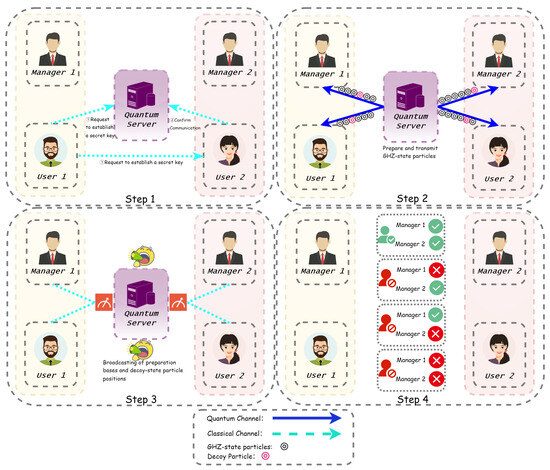
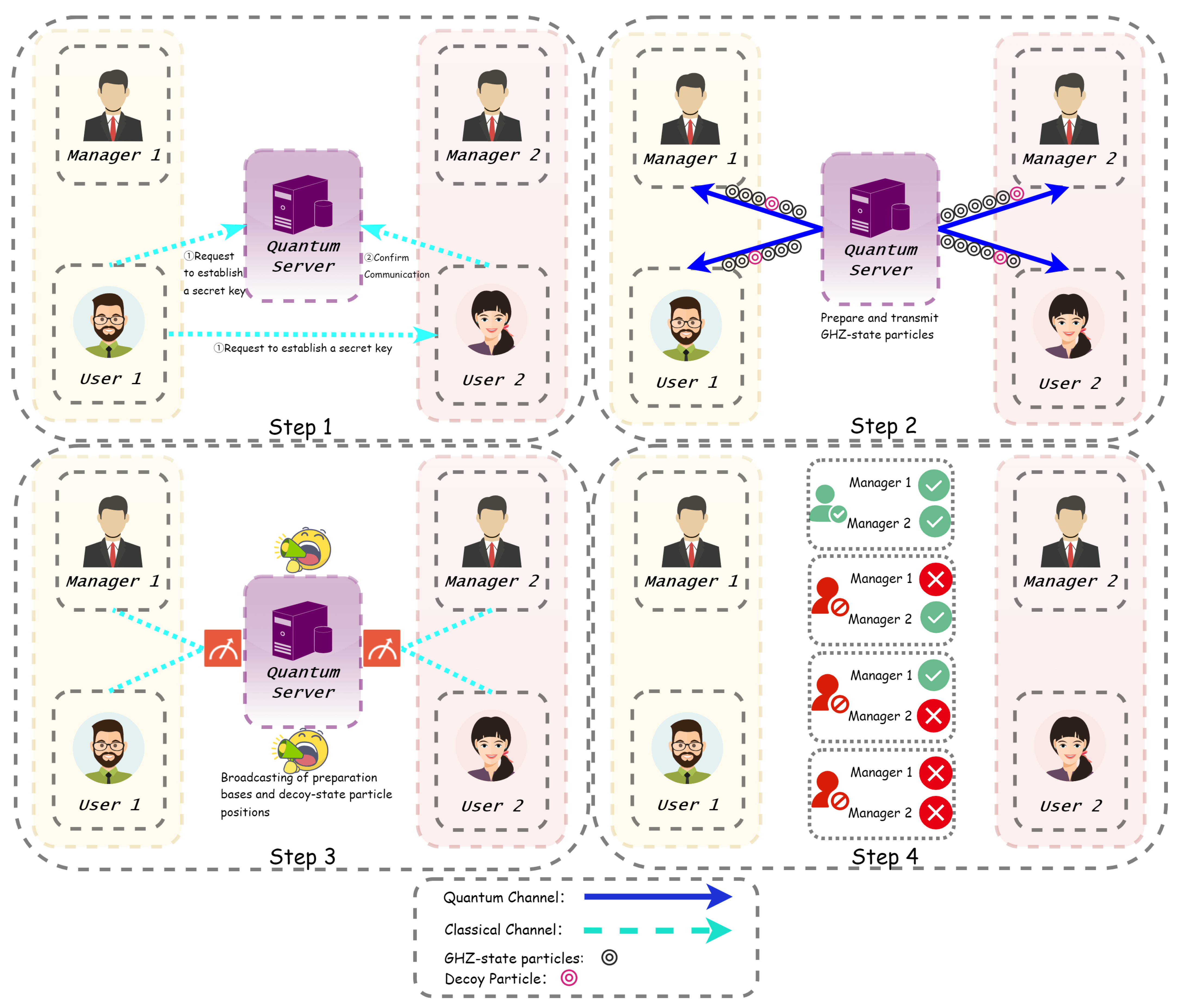
The specific execution process of the proposed hierarchical controlled multi-user QKD scheme is illustrated in Figure 1, which proceeds through the following steps:
Figure 1.
Schematic diagram of the scheme.
Step 1. When intends to establish a secure communication key with , first transmits a communication request to the QS and the target user, , via a classical channel. Upon receiving the request signal, subsequently sends a response feedback to the QS to confirm the intent to communicate. The QS determines the validity of the communication demand and initiates the subsequent quantum entanglement preparation procedure only upon the synchronized receipt of bidirectional instructions from both and .
Step 2. QS prepares n sets of 4-particle GHZ states. It extracts the 1st, 2nd, 3rd, and 4th particles from each state to construct sequences , , , and in order. The Quantum Server inserts decoy particles at random positions within , , , and , respectively. Subsequently, the Quantum Server transmits and to the superior nodes and , and sends and to the subordinate nodes and via quantum channels.
Step 3. After , , , and receive their corresponding quantum sequences, the QS publicly announces the positions and preparation bases of the decoy particle inserted into each sequence. Upon receiving this information, the participating parties measure the corresponding qubits using the specified bases and obtain their measurement outcomes.
Subsequently, all participants broadcast their measurement outcomes of the decoy particles via an authenticated classical channel. The QS collects all the reported outcomes and compares them with the initial states of the decoy particles to calculate the quantum bit error rates (QBER) for the four transmission processes [27]. If all four QBERs fall below a predetermined threshold, all quantum channels are deemed secure, and the Scheme proceeds to the next step. Conversely, if any QBER exceeds the threshold, the presence of eavesdropping is determined, and the execution of the Scheme is terminated.
Step 4. Upon the completion of eavesdropping detection, and independently determine whether to authorize the key establishment between the target users based on predefined strategies. Depending on their decision outcomes, the Scheme proceeds under the following three cases:
Case 1: Full Authorization
In this scenario, both managers measure their respective quantum sequences using the X-basis and encode the measurement outcomes into classical bit strings. Subsequently, they publicly announce the necessary information for key recovery, enabling the receivers to perform conditional corrections. Ultimately, the target users can successfully establish a consistent shared secret key.
All users measure their respective received quantum sequences using the X-basis. and generate binary codes and according to the encoding rule.
During this stage, the measurement actions of the superior nodes are physically equivalent to imposing global constraints on the 4-particle GHZ state, serving as an indispensable prerequisite for the subordinate nodes to acquire communication authorization. Consequently, communication authorization is granted.Once this authorization is formally confirmed, and measure their respectively received quantum sequences, and , using the X-basis, and generate binary codes and according to the specified encoding rules. Subsequently, and perform conditional corrections based on the measurement outcomes, and , announced by and . Specifically, if the i-th bits of and are identical, the corresponding i-th bits of and remain unchanged. Conversely, if the i-th bits of and differ, a bit-flip operation is applied to the i-th bit of , whereas the corresponding bit of remains unchanged. Consequently, under the premise of acquiring authorization from the superior nodes, the subordinate nodes can successfully generate a consistent shared secret key.
Case 2: Partial Authorization.
In this scenario, the global correlation information of the GHZ state is only partially revealed. Due to the incomplete management information, the receivers cannot uniquely determine the required correction relationships. Consequently, the derived key sequences are statistically uncorrelated, rendering the establishment of a valid shared secret key impossible.
Case 3: No Authorization
In this scenario, the managers withhold all valid measurement information, making the intrinsic correlations of the GHZ state inaccessible to the receivers. Consequently, key recovery cannot be accomplished. Thus, the protocol terminates without generating any shared secret key.
Step 5. To ensure the consistency of the generated keys and explicitly detect any potential forged authorization information from the managers, and must perform a key verification procedure. randomly selects a hash function h from a publicly known universal hash family, computes the hash value of length l where , and transmits the function index and to via the authenticated classical channel. Upon receiving this, computes . If , the generated secret key is confirmed to be perfectly identical and is accepted. Otherwise, a key mismatch is detected, indicating potential channel noise or malicious forged signaling, so the current key sequence is discarded and the protocol is aborted.
4. Scheme Analysis
4.1. Correctness Analysis
After and randomly measure their respective sequences and using the X-basis, the following characteristics emerge based on the entanglement properties of the 4-particle GHZ state formulated in Equation (5). When the i-th particles of and are identical, the i-th particles of and are deterministically identical, yielding . Conversely, when the i-th particles of and are opposite, the i-th particles of and are necessarily opposite. In this scenario, by simply applying a bit-flip operation to the encoded bit corresponding to the i-th particle of , the condition is guaranteed. In summary, all eight possible scenarios are exhaustively enumerated in Table 3.
Table 3.
Measurement outcomes and key consistency analysis.
In QKD, correctness requires not only that legitimate users can obtain consistent keys under authorization, but also that the keys possess complete uncertainty when unauthorized. In this section, we introduce Shannon entropy and mutual information from information theory to rigorously prove the key recovery mechanism of the proposed scheme from the perspective of uncertainty elimination.According to the global parity constraint property of the four-particle GHZ state, the measurement outcomes of the participants in the X basis, denoted as , satisfy the following relationship:
Since any local subsystem of the GHZ state behaves as a completely mixed state, for any single party who has not acquired the global correlation information, the prior probability of their measurement outcomes exhibits a uniform distribution, i.e., . Therefore, the Shannon entropy of the initial measurement outcome for a single receiver reaches its maximum value:
This indicates that prior to obtaining the authorization information from the managers, the key sequences between the receivers are mutually independent, containing maximum uncertainty. The correctness of the scheme is proved below through the evolution of information entropy in conjunction with specific scenarios of the authorization mechanism.
Case 1: Both and approve the communication authorization.
In this scenario, both managers disclose their X-basis measurement outcomes and . Consequently, the joint authorization condition information obtained by the receivers is .
Because can deterministically correct its measurement outcome based on the equation , given the condition information E and the state of , the conditional probability of ’s state is . Thus, its conditional entropy can be calculated as:
The above equation demonstrates that under the condition of joint authorization by dual managers, all residual uncertainty regarding ’s key in the system is completely eliminated.Furthermore, we calculate the conditional mutual information between and the corrected to measure the correlation of the shared key:
The mutual information reaches the theoretical maximum of 1 bit, which rigorously proves from an information-theoretic perspective that under complete authorization, the disorder of information transmission is reduced to zero, enabling the two parties to stably generate a perfectly consistent and secure shared key.
Case 2: Only one of and approves the authorization, while the other rejects it.
Suppose agrees to authorize and publishes , while refuses authorization (withholds ). At this point, the receivers can only acquire partial condition information .
Due to the absence of the independent random variable from , for any given and , still faces two equiprobable correction possibilities. The conditional entropy of the system at this time is calculated as follows:
A conditional entropy of 1 bit implies that although has obtained half of the control information, its inference regarding the true key of still retains complete randomness. Correspondingly, the available mutual information between and degenerates to:
The mutual information is strictly zero, proving that a single manager cannot independently disrupt the chaotic state of the system. Statistically, the controlled parties cannot establish any valid correlation, thereby ensuring the correct logic that “dual authorization is indispensable” within the hierarchically controlled mechanism.
Case 3: Both and reject the authorization.
In this scenario, both managers refuse to publish their measurement outcomes, and the controlled parties cannot obtain any classical control information, i.e., the condition set is .
Lacking the input of the global parity constraint from multi-body entanglement, and only hold local random sequences with evenly distributed marginal probabilities. Here, the uncertainty of the system under unauthorized conditions remains at its theoretical peak:
Accordingly, the mutual information of the measurement outcomes between the two parties is:
The zero mutual information directly proves that the bit sequences between the controlled parties are absolutely independent on a statistical level. This result not only verifies that the scheme will never leak keys under unauthorized circumstances, but also proves that the permission constraint at the quantum level is equivalent to security isolation at the information-theoretic level.
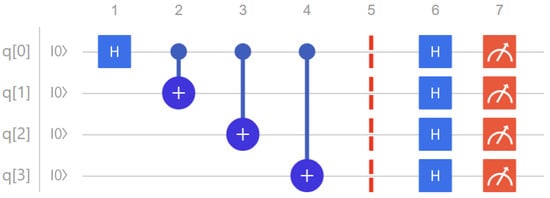
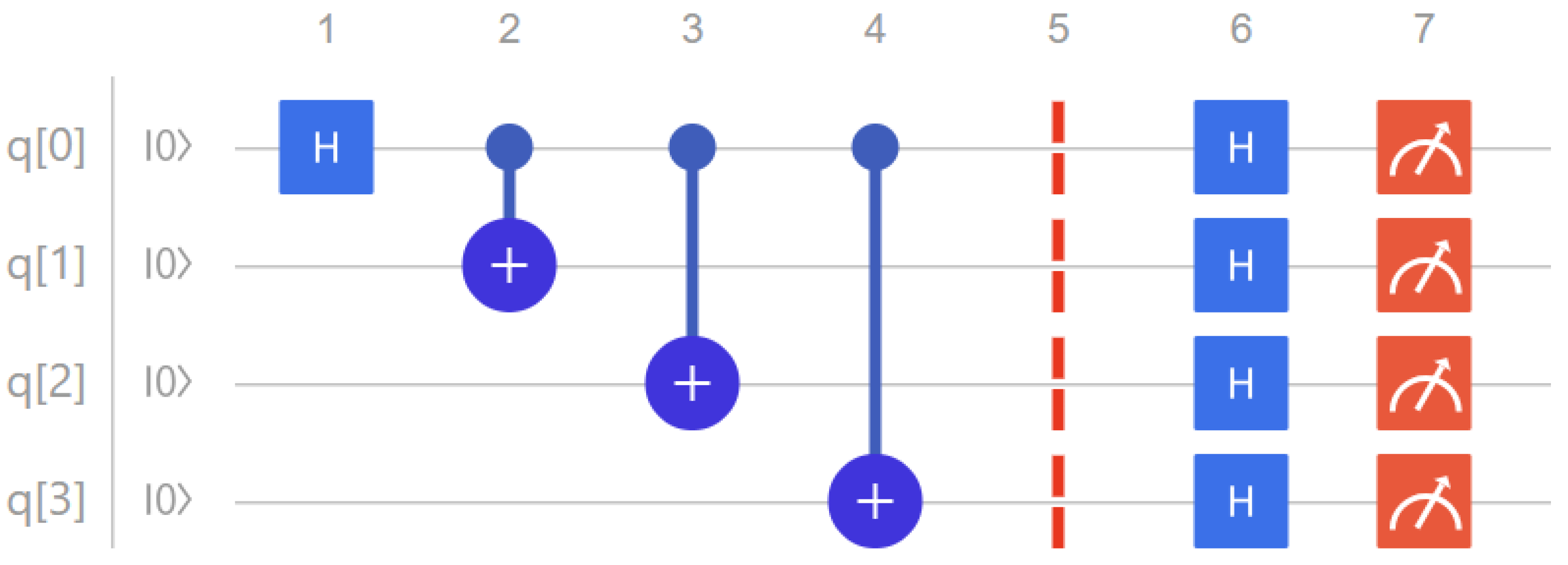
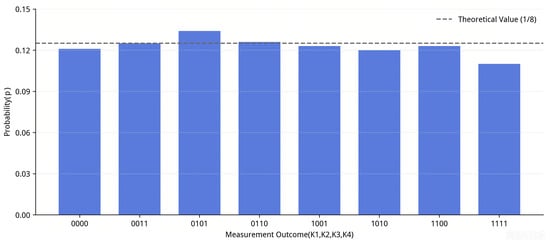
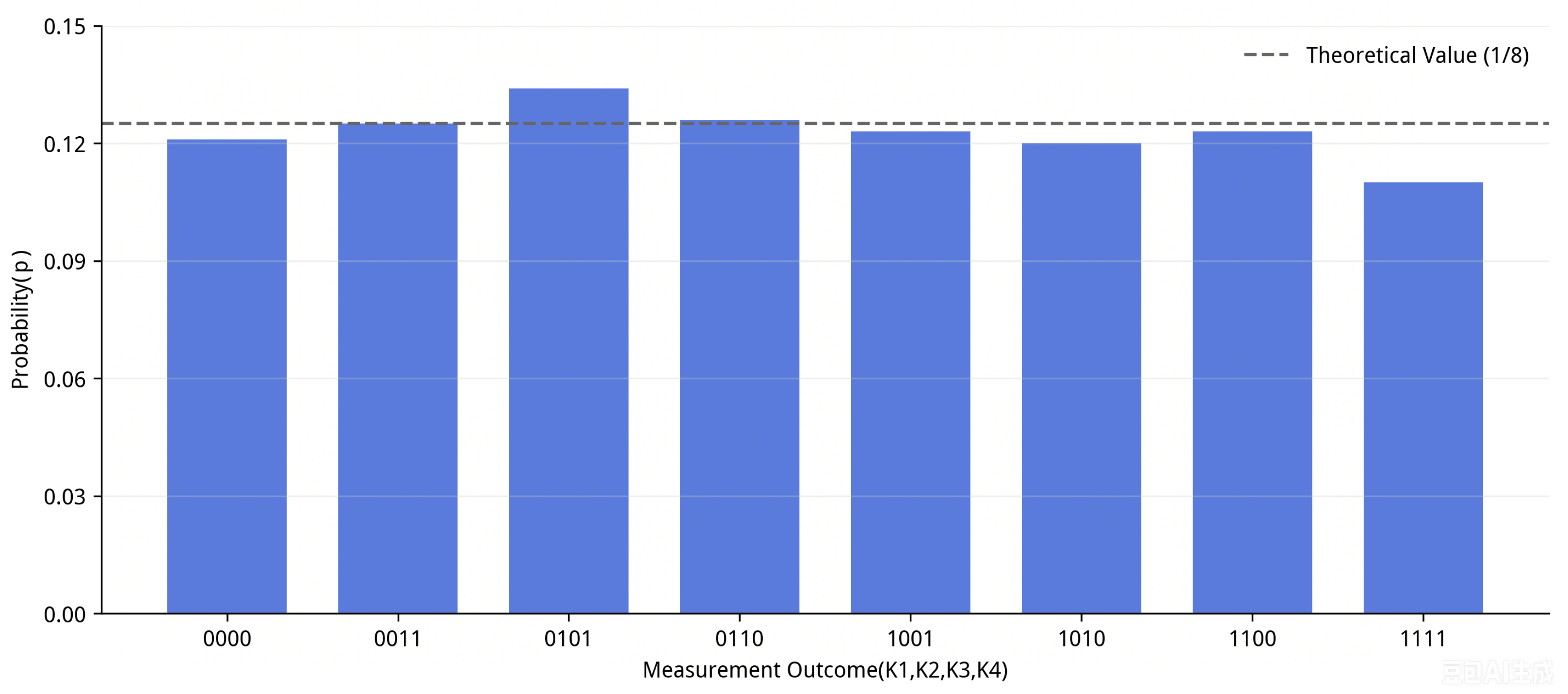
To verify the theoretical correctness of the proposed 4-particle GHZ-state quantum protocol, a corresponding quantum circuit model was constructed. The basic quantum circuit for GHZ-4 state preparation and measurement implemented in our simulation is illustrated in Figure 2. To validate this theoretical derivation, the corresponding simulated measurement results for these eight valid scenarios are presented in Figure 3, which confirms that each outcome approaches the theoretical probability of 1/8.
Figure 2.
Quantum Circuit Diagram for GHZ-4 State Preparation and Measurement.
Figure 3.
Simulated probability distribution of the eight valid measurement outcomes.
Therefore, under ideal conditions, the proposed scheme can ensure that the receiving parties generate identical shared secret keys, thus proving the theoretical correctness of the protocol.
4.2. Efficiency Analysis
4.2.1. Traditional Efficiency Analysis
To quantitatively evaluate the performance of the proposed scheme in terms of communication resource utilization, this paper analyzes the transmission efficiency of the scheme from an information-theoretic perspective. Assume that the length of the quantum key to be transmitted is n. Referring to the definition commonly used in existing quantum communication protocols, where denotes the number of shared key bits successfully generated in one valid protocol execution round, is the total number of qubits transmitted in the quantum channel, and is the number of classical communication bits required during the protocol execution.
Taking the preparation of a set of 4-particle GHZ states as an example, .
Herein, the total number of qubits consumed by the protocol is . Since and only perform management and authorization functions and do not participate in key generation, while and satisfy after conditional correction, each GHZ state can generate 1 bit of valid shared key, i.e., . To sum up, we obtain:
The calculation results demonstrate that the qubit efficiency of the proposed scheme reaches 25%. This signifies that, despite the introduction of additional managing entities and a complex 4-particle entangled structure, the proposed scheme successfully achieves distributed multi-user key distribution without compromising the quantum channel capacity.
4.2.2. Network Efficiency Analysis
Network Model Definition:
- Number of quantum transmission hops, ;
- Number of classical control hops, ;
- Total number of hops, .
Given that n bits of the shared secret key are generated in each round, the network efficiency is given by:
4.3. Security Analysis
Game 1: Eavesdropping Attack
Under the passive eavesdropping attack model, the eavesdropper, Eve, does not actively interfere with the quantum channels. Instead, she attempts to extract key-related information by monitoring all publicly exchanged classical communications throughout the protocol execution. Specifically, Eve can fully access the measurement outcomes announced by and , along with all auxiliary information transmitted over the authenticated classical channels.
In the proposed scheme, the final shared secret key between and is derived by applying conditional corrections to their local measurement outcomes based on the information announced by the managers. Although and publicly disclose partial measurement outcomes, this information is fundamentally insufficient to uniquely determine the final secret key.
From the perspective of the quantum correlation structure, the 4-particle GHZ state satisfies a global parity constraint in the X-basis, which can be expressed as:
where represent the measurement outcome encodings of the four particles in the X-basis, respectively.
Eve can obtain and through public channels. However, since and are local private information, and the measurement outcomes possess intrinsic randomness, Eve is unable to uniquely determine the shared secret key in the absence of user-side information.
Furthermore, proceeding from the information-theoretic properties of quantum states, the reduced density matrix of any subsystem of a GHZ state is a maximally mixed state. For instance, by taking the partial trace over the particles on the user side, we have:
This result indicates that the user-side system exhibits maximum uncertainty before incorporating the control information. Similarly, for an eavesdropper, the conditional probability distribution corresponding to the information they hold satisfies:
That is, the shared secret key still follows a uniform distribution conditioned on Eve’s available information.
Therefore, from an information-theoretic perspective, the mutual information between the shared secret key and the eavesdropper’s information can be obtained as:
where is the entropy of the secret key, and denotes the conditional entropy.
These results demonstrate that the proposed scheme not only withstands active attacks but also ensures robustness against passive information leakage from an information-theoretic perspective.
Game 2: Entanglement Attack
The entanglement attack is a sophisticated active eavesdropping strategy where the attacker, Eve, attempts to gain information by entangling her auxiliary quantum state with the particles transmitted in the quantum channel. In this protocol, this attack would typically occur during the distribution phase from the QS to the participants.
Assume Eve intercepts a particle in the sequence and performs a unitary operation on a larger Hilbert space consisting of the intercepted particle and her auxiliary state . The action of the unitary operator on the computational basis is defined as follows:
where are the pure states of Eve’s auxiliary system that satisfy the normalization condition:
To ensure is a unitary operator (), the coefficients must satisfy:
This implies that and .
The protocol utilizes decoy particles (e.g., ) to detect eavesdropping. When Eve applies her unitary operation to a decoy particle in the state , the resulting state is:
Similarly, for the state , the operation yields:
During the eavesdropping detection phase (Step 3), the participants measure the decoy particles using the correct basis. If Eve has entangled her state with the sequence (), her interference necessarily introduces errors in the measurement outcomes. The probability of detection P is determined by the coefficient :
If no error is introduced (), then and , which forces the total system to exist as a straight product state:
In a straight product state, there is no correlation between Eve’s auxiliary particles and the quantum sequence. Consequently, Eve cannot obtain any useful information without introducing a detectable error rate that exceeds the security threshold. Therefore, the proposed protocol is theoretically robust against entanglement attacks.
Game 3: Fake Signal Attack
In a false-signal attack, a malicious participant or semi-trusted QS attempts to disrupt the protocol by publishing forged measurement outcomes or incorrect control information. However, in the proposed scheme, the final shared key is jointly determined by the global correlations of the 4-particle GHZ state and the conditional correction process. Any falsified measurement information will destroy the consistency constraints required for key recovery, causing the subordinate nodes to obtain inconsistent keys.
Consequently, the legitimacy of the published control information is strictly verified through the explicit key confirmation round introduced in Step 5. Once a key mismatch is detected via the universal hash check indicating , the subordinate nodes will immediately become aware of the disagreement before using the key, and the protocol is safely terminated.Therefore, forged signaling cannot help an attacker recover useful key information and can be effectively identified by the legitimate participants.
Game 4: Security Analysis of the QS
In the proposed scheme, the primary responsibility of the QS is to prepare the 4-particle GHZ states. After inserting decoy particles into the sequences from to , the QS transmits to , to , to , and to via quantum channels, respectively.
This scheme assumes that the QS is semi-trusted, implying that the users are not required to place absolute trust in the QS. The fundamental rationale for employing a semi-trusted third party in the protocol is that certain operations must be executed by an external entity, necessitating a baseline level of credibility. Although the QS acts as a strong coordination point responsible for the physical preparation of states and initial channel security verification including QBER calculation, this architecture effectively separates physical coordination from logical authorization. In the subsequent key distribution process, the assignment of managers and managed users is determined autonomously by the participants themselves, meaning the QS is entirely excluded from the classical measurement announcement and conditional correction steps. This server-assisted mechanism ensures that even though the QS is actively involved in setup, it remains oblivious to the final generated secret keys, demonstrating the decentralized nature of the authorization logic. Overall, by empowering users to independently designate the managing and managed roles, the security of the key distribution is significantly enhanced. This approach reduces the dependency on the QS and inherently mitigates the probability of third-party attacks.
Game 5: Intercept–Measure–Resend Attack
Eve attempts to intercept the transmitted particles between the QS and legitimate users, measure them to obtain key information, and then resend forged particles. However, in the proposed scheme, the shared key relies on the global correlations of the 4-particle GHZ state. Once any particle is measured by Eve, the original entanglement structure collapses, thereby destroying the correlation constraints among , , , and .
Since the key recovery process of the subordinate nodes strictly depends on the consistency between the published management information and the GHZ correlations, the forged particles resent by Eve cannot simultaneously satisfy the required global correlation conditions. Consequently, additional errors are introduced during the eavesdropping detection and correlation verification stages. Legitimate users can therefore detect the attack and terminate the protocol, demonstrating that the proposed scheme can effectively resist intercept–measure–resend attacks.
Game 6: Classical Attacks
In the proposed protocol, all secret keys are generated from the intrinsic correlations of the 4-particle GHZ state, while only limited auxiliary information is transmitted through the classical channel. Although an attacker may obtain all publicly announced classical information, the users’ local measurement outcomes are never disclosed. Therefore, the final shared key cannot be reconstructed solely from classical communications.
Furthermore, any modification, forgery, or replay of classical messages will destroy the consistency required for conditional correction, resulting in key disagreement and protocol failure. Consequently, classical attacks cannot enable an adversary to recover the shared key or compromise the security of the proposed scheme.
Game 7: Denial-of-Service Attack via Channel Disturbance
As delineated in Section 3.2, the proposed hierarchical architecture necessitates highly reliable quantum channels among the QS, the managers (, ), and the receivers (, ). In practical applications, this stringent topological requirement implies that the communication between all nodes must be near-perfect. Consequently, an Eve can exploit this inherent channel sensitivity to perform a targeted blocking attack by deliberately disturbing the QS-to-manager or QS-to-user communications. Because the global correlation of the 4-particle GHZ state is highly fragile, any induced disturbance during particle transmission will inevitably result in a faulty QKD protocol execution. Specifically, the disturbance will cause the QBER to exceed the secure threshold during the decoy-state detection phase, forcing the legitimate parties to abort the protocol.While such an attack severely impairs the availability of the quantum network, it does not compromise the confidentiality of the secret key, as no sensitive information is leaked to the adversary, it underscores a practical limitation. Acknowledging and mitigating this susceptibility to physical-layer Denial-of-Service (DoS) attacks is an essential consideration for the future deployment of this multi-user scheme.
4.4. Comparative Analysis
The comparison of different quantum communication protocols is summarized in Table 4.
Table 4.
Comparison of different quantum communication protocols. Here, ‘✓’ and ‘×’ denote the presence and absence of the corresponding features, respectively.
5. Experiments and Data Analysis
5.1. Summary of Experimental Data
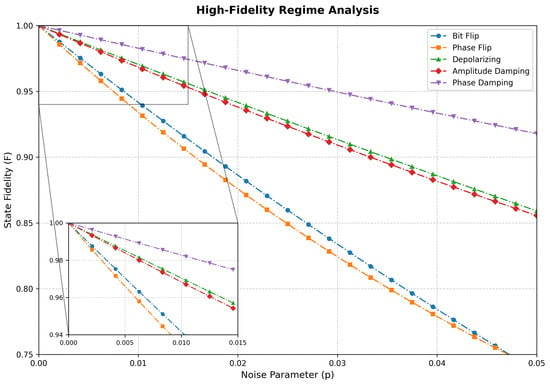
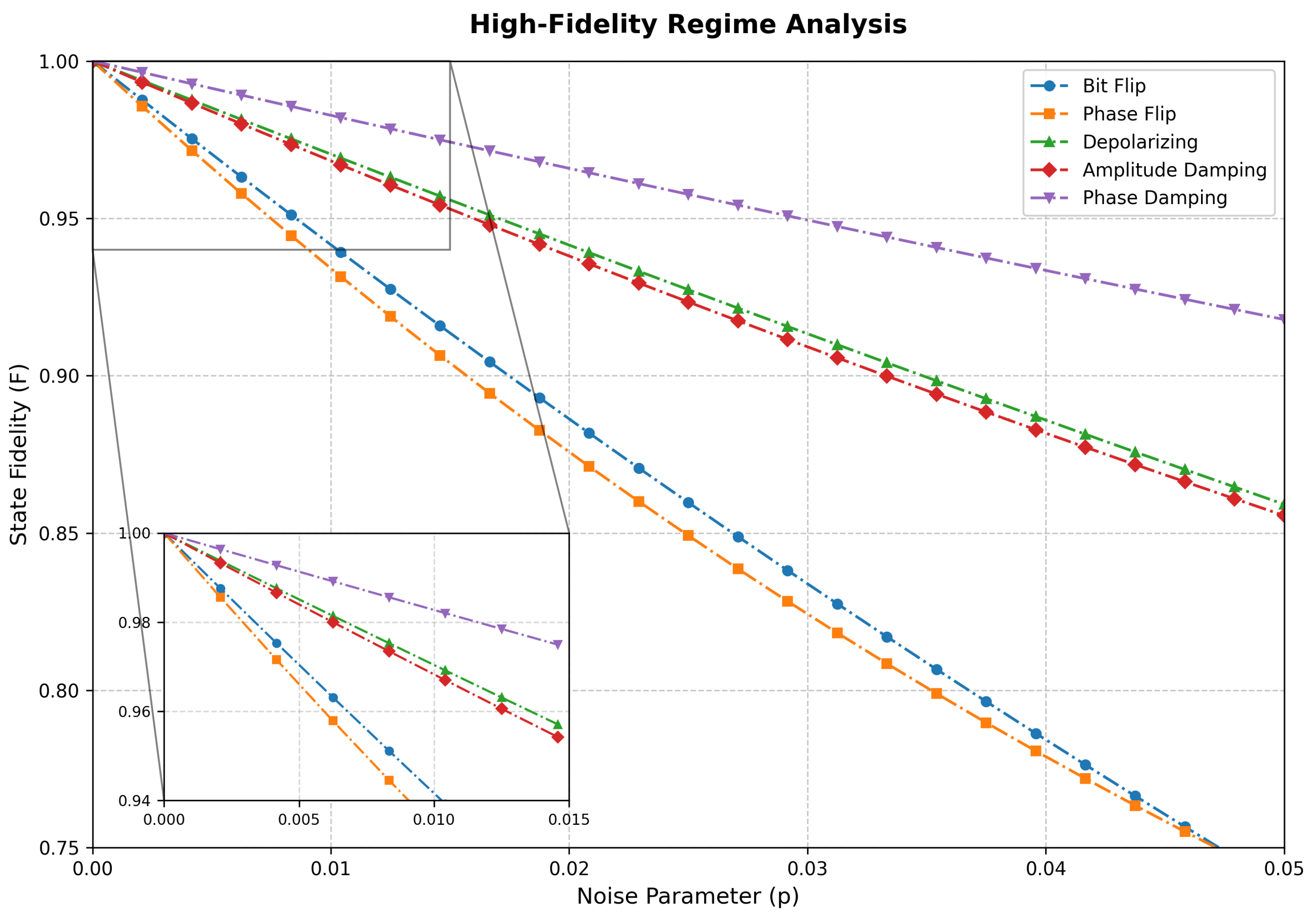
To evaluate the robustness of the proposed 4-particle GHZ-state quantum protocol in practical environments, a quantum distribution and noise model was constructed using the Qiskit simulation framework. The experiment analyzes the influence of five typical quantum channel noises on entangled-state fidelity within the low-noise region . Specifically, the distribution process from the QS to , , , and was simulated under independent noise conditions. The corresponding fidelity variation trends are shown in Figure 4.
Figure 4.
State Fidelity of I/X Encoding under Different Noise Channels.
5.2. Experimental Conclusions
In the environments of the five aforementioned types of noise, even when the noise intensity reaches 0.05, the proposed scheme can still ensure that the fidelity is greater than 0.75. This is sufficient to support the efficient key generation and reconciliation in the subsequent Step 4.
6. Conclusions
In this paper, we propose a hierarchical controlled multi-user QKD protocol based on 4-particle GHZ states. By introducing a dual management authorization mechanism, two managers can jointly control key establishment between users via their measurement outcomes. Rigorous security analysis demonstrates that the protocol achieves information-theoretic security against intercept–resend, entanglement-measurement, and fake signal attacks. Furthermore, it supports flexible dynamic role assignment, enhancing system scalability. While we have verified the correctness of the scheme under ideal channels and demonstrated its robustness in noisy environments, practical implementations will inevitably introduce varying QBER depending on specific environmental factors. Therefore, further empirical validation under realistic physical conditions is deferred to future research. Future work will focus on extending this framework to larger-scale networks, conducting hardware validation to address these practical channel imperfections, and integrating post-quantum cryptography. This hierarchical mechanism also holds promise for application in other quantum cryptographic primitives, such as quantum secure direct communication and quantum secret sharing.
Author Contributions
Conceptualization, J.H. and Y.J.; methodology, J.H. and Y.J.; writing—original draft, J.H.; writing—review and editing, J.H., Y.J. and Z.P. supervision, Y.J. and Z.P. All authors have read and agreed to the published version of the manuscript.
Funding
This research was funded by the Natural Science Foundation of Xizang (Grant Nos. XZ202401ZR0030, XZ202501ZY0094), the Natural Science Foundation of Xizang Minzu University (Grant No. 25MDY22), and the Key Laboratory of Optical Information Processing and Visualization Technology of Xizang Autonomous Region.
Data Availability Statement
Data is contained within the article.
Conflicts of Interest
The authors declare no conflicts of interest.
References
- Bennett, C.H.; Brassard, G. Quantum cryptography: Public key distribution and coin tossing. Theor. Comput. Sci. 2014, 560, 7–11. [Google Scholar] [CrossRef] [Scilit]
- Ekert, A.K. Quantum cryptography based on Bell’s theorem. Phys. Rev. Lett. 1991, 67, 661. [Google Scholar] [CrossRef] [Scilit] [PubMed]
- Zahidy, M.; Ribezzo, D.; De Lazzari, C.; Vagniluca, I.; Biagi, N.; Müller, R.; Occhipinti, T.; Oxenløwe, L.K.; Galili, M.; Hayashi, T.; et al. Practical high-dimensional quantum key distribution protocol over deployed multicore fiber. Nat. Commun. 2024, 15, 1651. [Google Scholar] [CrossRef] [Scilit] [PubMed]
- Liu, S.; Lu, Z.; Wang, P.; Tian, Y.; Wang, X.; Li, Y. Experimental demonstration of multiparty quantum secret sharing and conference key agreement. npj Quantum Inf. 2023, 9, 92. [Google Scholar] [CrossRef] [Scilit]
- Chen, Y.A.; Zhang, Q.; Chen, T.Y.; Cai, W.Q.; Liao, S.K.; Zhang, J.; Chen, K.; Yin, J.; Ren, J.G.; Chen, Z.; et al. An integrated space-to-ground quantum communication network over 4600 kilometres. Nature 2021, 589, 214–219. [Google Scholar] [CrossRef] [Scilit] [PubMed]
- Wehner, S.; Elkouss, D.; Hanson, R. Quantum internet: A vision for the road ahead. Science 2018, 362, eaam9288. [Google Scholar] [CrossRef] [Scilit] [PubMed]
- Tsai, C.W.; Wang, C.H. Multi-party quantum key distribution protocol in quantum network. EPJ Quantum Technol. 2024, 11, 63. [Google Scholar] [CrossRef] [Scilit]
- Jallow, L.; Khan, M.I. Multi-user quantum key distribution with deep Q networks for secure routing. Appl. Soft Comput. 2025, 188, 114448. [Google Scholar] [CrossRef] [Scilit]
- Cao, Y.; Zhao, Y.; Zhang, J.; Wang, Q. Software-defined heterogeneous quantum key distribution chaining: An enabler for multi-protocol quantum networks. IEEE Commun. Mag. 2022, 60, 38–44. [Google Scholar] [CrossRef] [Scilit]
- Tan, H.; Fang, C.; Shen, J.; Bhuiyan, Z.A.; Wu, Q.J. Cross-Domain Heterogeneous Data Aggregation with Dynamic Group Key Agreement for Hybrid Satellite Networks. IEEE Trans. Dependable Secur. Comput. 2025, 23, 4830–4844. [Google Scholar] [CrossRef] [Scilit]
- Liu, Z.; Yao, N.; Bai, S.; Li, Q. A State-Assisted Authentication and Key Agreement Scheme for Lightweight Multi-RSU Access in VANETs. Future Internet 2026, 18, 292. [Google Scholar] [CrossRef] [Scilit]
- Epure, L.I. Q-MESH: A Hierarchical Multi-tier Architecture for Scalable Quantum Key Distribution Networks Using Adaptive UAV Swarms. Authorea 2025, preprints. [Google Scholar] [CrossRef] [Scilit]
- Epping, M.; Kampermann, H.; Macchiavello, C.; Bruß, D. Multi-partite entanglement can speed up quantum key distribution in networks. New J. Phys. 2017, 19, 093012. [Google Scholar] [CrossRef] [Scilit]
- Grasselli, F.; Curty, M. Practical decoy-state method for twin-field quantum key distribution. New J. Phys. 2019, 21, 073001. [Google Scholar] [CrossRef] [Scilit]
- Zhu, H.; Wang, C.; Li, Z. Semi-honest three-party mutual authentication quantum key agreement protocol based on GHZ-like state. Int. J. Theor. Phys. 2021, 60, 293–303. [Google Scholar] [CrossRef] [Scilit]
- Bányai, L.A.; Bundaru, M.; Gartner, P. Thermal fluctuations and electromagnetic noise spectra in quantum statistical mechanics. Int. J. Theor. Phys. 2022, 61, 164. [Google Scholar] [CrossRef] [Scilit]
- Jiang, Y.H.; Zhang, S.B.; Dai, J.Q.; Shi, Z.P. Quantum secret information equal exchange protocol based on dense coding. Mod. Phys. Lett. B 2018, 32, 1850125. [Google Scholar] [CrossRef] [Scilit]
- Jiang, Y.; Chen, L.; Gong, X.; Zhu, Y.; Gao, Y. Quantum multi-party fair exchange protocol based on three-particle GHZ states: Y. Jiang et al. Quantum Inf. Process. 2023, 22, 353. [Google Scholar] [CrossRef] [Scilit]
- Yan, C.H.; Li, Z.H.; Liu, L.; Han, Z.W. Layered Quantum Key Distribution Protocol with a Small Number of Participants. J. Softw. 2023, 34, 2878–2891. [Google Scholar]
- Wang, C.; Zhu, H. A secure centralized multi-party quantum key distribution protocol with new encoding mode. Int. J. Theor. Phys. 2023, 62, 128. [Google Scholar] [CrossRef] [Scilit]
- Hua, X.; Li, D.; Fu, Y.; Zhu, Y.; Jiang, Y.; Zhou, J.; Yang, X.; Tan, Y. Hierarchical controlled hybrid quantum communication based on six-qubit entangled states in IoT. Sensors 2023, 23, 9111. [Google Scholar] [CrossRef] [Scilit] [PubMed]
- Pivoluska, M.; Huber, M.; Malik, M. Layered quantum key distribution. Phys. Rev. A 2018, 97, 032312. [Google Scholar] [CrossRef] [Scilit]
- Murta, G.; Grasselli, F.; Kampermann, H.; Bruß, D. Quantum conference key agreement: A review. Adv. Quantum Technol. 2020, 3, 2000025. [Google Scholar] [CrossRef] [Scilit]
- Greenberger, D.M.; Horne, M.A.; Zeilinger, A. Going beyond Bell’s theorem. In Bell’s Theorem, Quantum Theory and Conceptions of the Universe; Springer: Berlin/Heidelberg, Germany, 1989; pp. 69–72. [Google Scholar] [CrossRef] [Scilit]
- Pan, J.W.; Bouwmeester, D.; Daniell, M.; Weinfurter, H.; Zeilinger, A. Experimental test of quantum nonlocality in three-photon Greenberger–Horne–Zeilinger entanglement. Nature 2000, 403, 515–519. [Google Scholar] [CrossRef] [Scilit] [PubMed]
- Karlsson, A.; Bourennane, M. Quantum teleportation using three-particle entanglement. Phys. Rev. A 1998, 58, 4394. [Google Scholar] [CrossRef] [Scilit]
- Lee, A.; Castillo, A.T.; Whitehill, C.; Donaldson, R. Quantum bit error rate timing jitter dependency on multi-mode fibers. Opt. Express 2023, 31, 6076–6087. [Google Scholar] [CrossRef] [Scilit] [PubMed]
- Inoue, K.; Honjo, T. Quantum conference key agreement based on differential-phase-shift quantum key distribution. Quantum Inf. Process. 2024, 23, 253. [Google Scholar] [CrossRef] [Scilit]
- Shu, Y.X.; Bai, C.M.; Zhang, S. Multiparty quantum key agreement based on GHZ states. EPJ Quantum Technol. 2025, 12, 48. [Google Scholar] [CrossRef] [Scilit]
- Yuan, Q.; Yuan, H.; Zhou, M.; Wen, J.; Li, J.; Hao, B. A improved group quantum key distribution protocol with multi-party collaboration. Sci. Rep. 2025, 15, 526. [Google Scholar] [CrossRef] [Scilit] [PubMed]

Disclaimer/Publisher’s Note: The statements, opinions and data contained in all publications are solely those of the individual author(s) and contributor(s) and not of MDPI and/or the editor(s). MDPI and/or the editor(s) disclaim responsibility for any injury to people or property resulting from any ideas, methods, instructions or products referred to in the content. |
© 2026 by the authors. Licensee MDPI, Basel, Switzerland. This article is an open access article distributed under the terms and conditions of the Creative Commons Attribution (CC BY) license.