


Abstract
The reliability of dry-type transformers depends heavily on the coil winding process, which currently lacks effective automated monitoring and relies on error-prone manual inspection. Deploying vision-based monitoring on edge devices faces challenges due to complex industrial backgrounds, target occlusions, and strict lightweight processing requirements. To address these issues, we propose LCD-YOLOv11, a lightweight object detection model built upon the YOLOv11n architecture. First, a Lightweight Ghost Coordinate Attention (LGCA) block is introduced into the backbone to reduce computational redundancy while enhancing spatial localization. Second, a CA2RAFE operator replaces standard upsampling in the neck to improve complex boundary reconstruction. Finally, a dynamic detection head (Dy-Detect) is implemented to decouple the parameter scale from the computational cost. Evaluated on a custom dataset, LCD-YOLOv11 achieves an mAP@50 of 0.841, representing a 1.8% improvement over the baseline. Crucially, it significantly reduces the parameter count by 11.58% (to 2.29 M) and the computational load by 20.63% (to 5.0 GFLOPs). LCD-YOLOv11 achieves an effective accuracy–efficiency balance, providing a highly deployable and robust solution for automated compliance verification in industrial manufacturing.
1. Introduction
Driven by China’s modernization, the “dual-carbon” strategy, and the transition to a new power system, sustained macroeconomic growth has accelerated electricity demand [1]. Consequently, increasing power loads have substantially elevated the demand for dry-type transformers [2]. However, the operational reliability and service life of these transformers are highly dependent on their manufacturing quality. Among these processes, coil winding is the core manufacturing step. This step directly dictates the electrical insulation performance and short-circuit resistance of the transformer. Furthermore, it serves as a critical safeguard against premature failures, including partial discharge and anomalous temperature increases. Therefore, rigorous control and monitoring of the winding process are crucial for ensuring the safe and stable operation of both the transformers and the broader power system [3,4,5].
While modern manufacturing is increasingly automated, winding dry-type transformers remains a highly manual, labor-intensive process requiring close human–machine collaboration. Except for the number of coil turns, which can be monitored in real time using an electronic counter, the execution of other critical process steps lacks effective automated monitoring mechanisms. Traditional quality control methods typically rely on manual inspection or basic automated systems. These approaches can be time-consuming and susceptible to human error, and may fail to detect every anomaly, leading to costly rework, scrap, or even product recalls [6]. To overcome the limitations of traditional manual quality inspection, intelligent monitoring technologies powered by computer vision [7] and deep learning [8] have been widely adopted in manufacturing. Given the complex human–machine interactions involved in the operation, ensuring operator flexibility and absolute production safety necessitates strictly avoiding the use of any contact-based or wearable sensors on workers. Consequently, a non-contact, vision-based monitoring approach emerges as the only feasible technical solution for this process. However, directly applying vision-based human action recognition models to identify operational behaviors faces two major bottlenecks in real-world workshop deployment. First, processing continuous video frames to extract spatiotemporal correlations imposes substantial computational overhead, making it difficult to satisfy the stringent real-time requirements of edge deployment [9]. Second, in a complex three-dimensional occlusion environment formed by winding machines, insulating materials, and large molds, reliance solely on RGB video streams readily leads to the loss of critical hand and torso keypoints, thereby significantly degrading model robustness [10,11]. To address these challenges, this study proposes a state-driven lightweight monitoring strategy. We use object detection algorithms to pinpoint key targets at each stage of the winding process, and bind this visually extracted state information with the real-time turn counts from the winding machine’s electronic counter. This synergy ensures the entire winding operation strictly adheres to standard operating procedures.
In recent years, object detection technologies have been extensively deployed across multiple critical stages of intelligent manufacturing, significantly reducing quality-related costs arising from operator fatigue and misjudgment [12]. Based on different model structures, current mainstream deep-learning-based object detection algorithms can be mainly divided into two categories: two-stage and one-stage methods. One category is the two-stage object detection methods represented by Fast R-CNN [13] and Faster R-CNN [14], which possess excellent detection accuracy; however, their substantial computational overhead makes them unsuitable for real-time workshop monitoring scenarios. In contrast, one-stage algorithms eliminate the explicit region proposal generation step, significantly accelerating inference speed. For instance, the SSD [15] algorithm does not require a dedicated region proposal network; instead, it introduces multi-scale convolutional layers to directly predict target bounding boxes of various scales in a single forward pass. Among numerous one-stage algorithms, the YOLO series [16] stands out owing to its unique end-to-end regression philosophy and ultimate speed advantage.
To date, numerous improvements based on the original YOLO framework have been proposed to address challenges arising in diverse application scenarios. In industrial applications [17,18,19,20,21], Shi et al. [22] enhanced the underlying feature extraction capabilities and expanded the receptive field by designing the ConvStemBlock, and achieved multi-level semantic refinement through the integration of a FocusBlock, thereby enabling lightweight deployment in resource-constrained environments. Zhi et al. [23] introduced an EB module incorporating one-dimensional convolution to strengthen feature extraction in the backbone network, and employed a CC module to integrate cross-stage local features for deeper contextual semantic understanding, significantly improving the detection accuracy of small and elongated defects on steel strip surfaces.
In the dry-type transformer winding process, practical production challenges such as complex background interference, multi-scale target variation, and severe spatial occlusion pose significant difficulties. Under these conditions, existing object detection models often struggle to simultaneously satisfy the stringent lightweight requirements of factory edge deployment while maintaining high detection accuracy. Direct application of existing models often results in poor generalization under complex visual variations, leading to unacceptable missed detections and false positives. To address these challenges, this study proposes a novel lightweight object detection framework, termed LCD-YOLOv11, built upon the YOLOv11n architecture. By integrating a spatial attention mechanism and a dynamic perception module, the proposed model substantially enhances feature extraction and localization capabilities.
The main contributions of this paper are summarized as follows:
- We establish a dedicated monitoring framework and construct a task-specific dataset for dry-type transformer winding operations. We propose a state-driven lightweight monitoring strategy that integrates vision-extracted key object information with turn-count data from the electronic counter of the winding machine, thereby enabling automated compliance verification of complex winding operations. To support this strategy, a dedicated dataset is compiled, comprising 3082 high-quality images spanning 15 categories of critical process-relevant targets commonly encountered during winding operations.
- We design the LGCA-Block module, structurally integrating Ghost convolutions and Coordinate Attention into the CSP architecture to supersede the conventional C3k2 units in the backbone. This module balances lightweight design with high accuracy; it significantly reduces computational redundancy while enhancing the model’s ability to capture features of slender and heavily occluded targets. Consequently, it extracts and propagates high-quality, spatially aware features, establishing a robust prior for subsequent feature reassembly and dynamic detection operations.
- We introduce the CA2RAFE operator to replace traditional nearest-neighbor interpolation for feature upsampling. Diverging from the localized kernel prediction of standard CARAFE, CA2RAFE structurally embeds a Coordinate Attention prior. This specific integration allows the operator to accurately focus on the slender and frequently occluded targets inherent in the dry-type transformer winding process, ensuring precise boundary reconstruction and high-fidelity feature alignment.
- We replace the standard detection head with a Dy-Detect dynamic detection head. The proposed module introduces a dynamic convolution mechanism based on multi-expert kernel aggregation, which decouples the strong dependency between parameter scale and computational cost, significantly reducing computational overhead (with GFLOPs reduced by approximately 20%) while substantially improving the model’s fitting accuracy and recall for complex geometric features.
2. Materials and Methods
2.1. YOLOv11
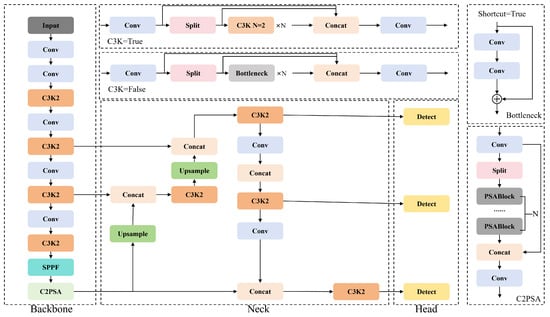
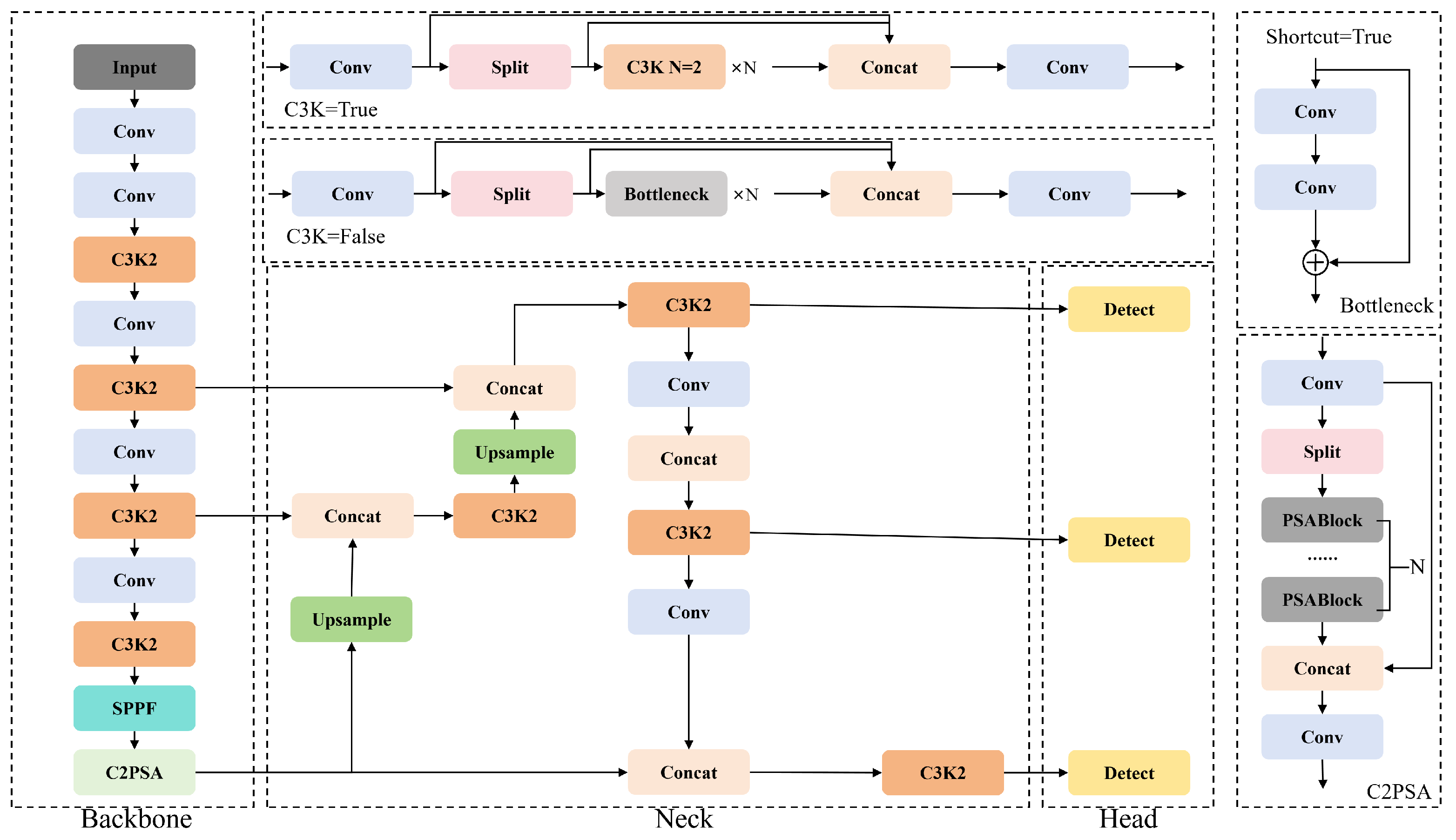
In the field of object detection, the YOLO series of algorithms has attracted significant attention due to its high efficiency and accuracy. As a representative model of the new generation of YOLO algorithms, YOLOv11 introduces iterative improvements over previous versions by optimizing the network architecture, resulting in enhanced feature extraction capability, detection accuracy, and inference speed. The overall architecture of YOLOv11 is illustrated in Figure 1.
Figure 1.
YOLOv11 network structure diagram.
The model follows the classical one-stage detection paradigm and its architecture consists mainly of three components: the backbone, the neck, and the detection head. The backbone performs hierarchical feature extraction and integrates the C3k2 module to optimize gradient flow and improve feature reuse efficiency. These components aim to fuse multi-scale contextual information and adaptively enhance feature responses in important channels and spatial regions. The neck adopts a bidirectional feature pyramid structure, which facilitates top-down semantic propagation and bottom-up detail enhancement. It aligns and concatenates deep semantic features with shallow high-resolution features, thereby constructing fused features that contain both rich semantic information and precise localization cues. The detection head performs dense prediction based on an anchor-free design. By directly regressing object locations and sizes, it reduces redundant hyperparameters and improves adaptability across multiple scales. This design provides an efficient and robust architectural foundation for subsequent task-specific optimizations. Depending on different network depths and widths, the YOLO series provides five model variants of different scales. Among them, YOLO11n achieves the smallest model size and the lowest computational complexity. Despite its compact architecture, it still maintains relatively high detection accuracy. Therefore, it is more suitable for deployment in resource-constrained embedded environments such as factory workshops.
2.2. LCD-YOLOv11
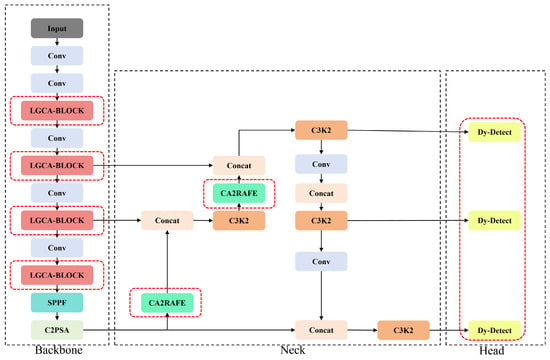
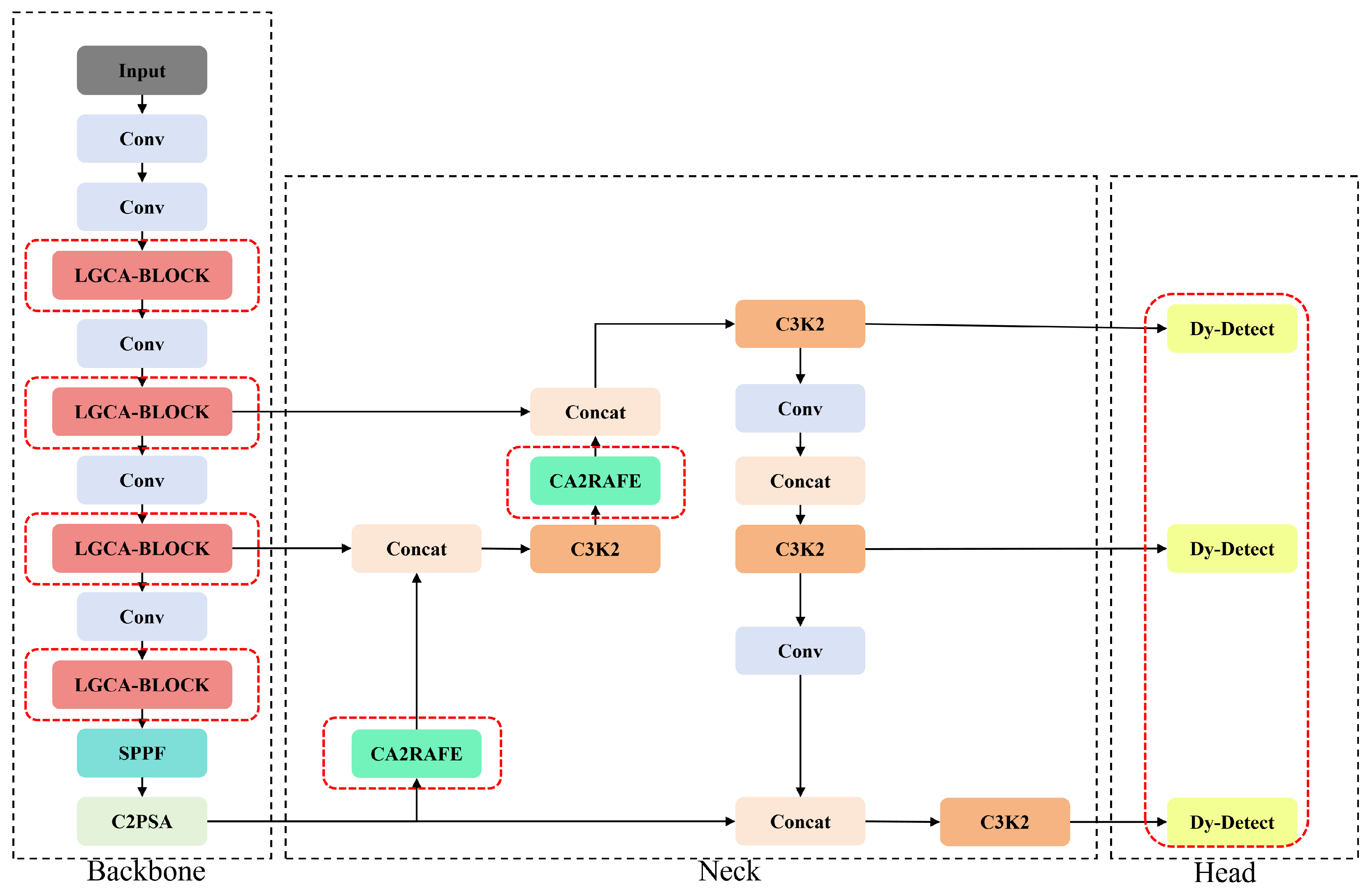
To address the challenges of complex background interference, large variations in target scale, and stringent lightweight requirements for factory-edge devices in dry-type transformer winding processes, this study comprehensively redesigns the original YOLOv11 architecture and proposes an efficient and high-accuracy model named LCD-YOLOv11. The overall architecture of the proposed model is illustrated in Figure 2. Unlike the baseline model, which relies on computationally intensive standard convolutions and content-agnostic nearest-neighbor interpolation strategies, the new architecture introduces targeted lightweight design and enhanced feature representation capabilities across three key components: the backbone, the neck, and the detection head. These structural optimizations significantly improve the model’s accurate localization capability for critical process targets under severe occlusion and extreme aspect-ratio conditions, while effectively controlling computational redundancy.
Figure 2.
LCD-YOLO network structure diagram.
The specific improvements of the proposed model are mainly reflected in three aspects. First, an LGCA-Block module is integrated into the backbone network to replace the original C3k2 unit. This module effectively combines the “cheap operation” property of Ghost convolution with the spatial awareness capability of the Coordinate Attention (CA) mechanism. While significantly reducing the number of network parameters and computational redundancy, it enhances the model’s ability to capture complex features and suppress background noise.
Second, during the feature fusion stage, a CA2RAFE operator is employed to replace the conventional standard upsampling layer. By embedding coordinate-sensitive priors into the content encoder, the operator dynamically generates spatially heterogeneous adaptive reassembly kernels. This mechanism effectively overcomes the semantic misalignment and boundary blurring problems caused by traditional rigid interpolation methods, thereby enabling high-fidelity reconstruction of complex object boundaries and high-frequency textures.
Finally, a Dy-Detect dynamic detection head is deployed to perform the final object localization and classification tasks. This component introduces dynamic convolution with multi-expert kernel aggregation, breaking the strong coupling between model parameters and computational cost. As a result, it alleviates the feature representation bottleneck caused by parameter limitations in lightweight models and significantly improves the model’s fitting accuracy for complex geometric features as well as the overall recall rate.
2.2.1. Coordinate Attention
In recent years, attention mechanisms have been widely applied in computer vision tasks and have achieved remarkable success, particularly in deep learning networks [24]. In the target detection task for dry-type transformer winding processes, the objects exhibit significant variations in geometric characteristics. These include elongated objects spanning a large portion of the visual field, such as insulation meshes and wrapped conductors, as well as spatially sensitive small targets, such as positioning markers.
Traditional channel attention mechanisms typically employ global average pooling to aggregate spatial information. Although this operation can capture global contextual information, it inevitably discards spatial positional cues, which makes precise localization difficult for the model.
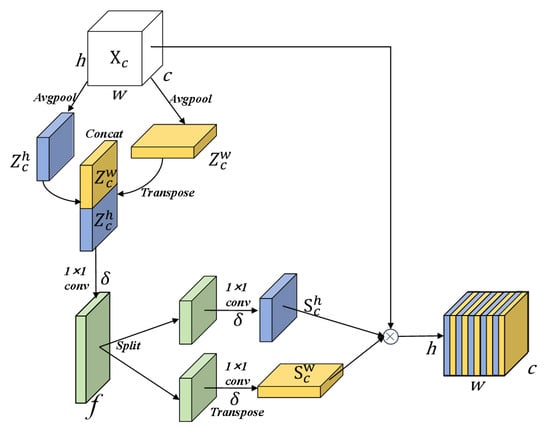
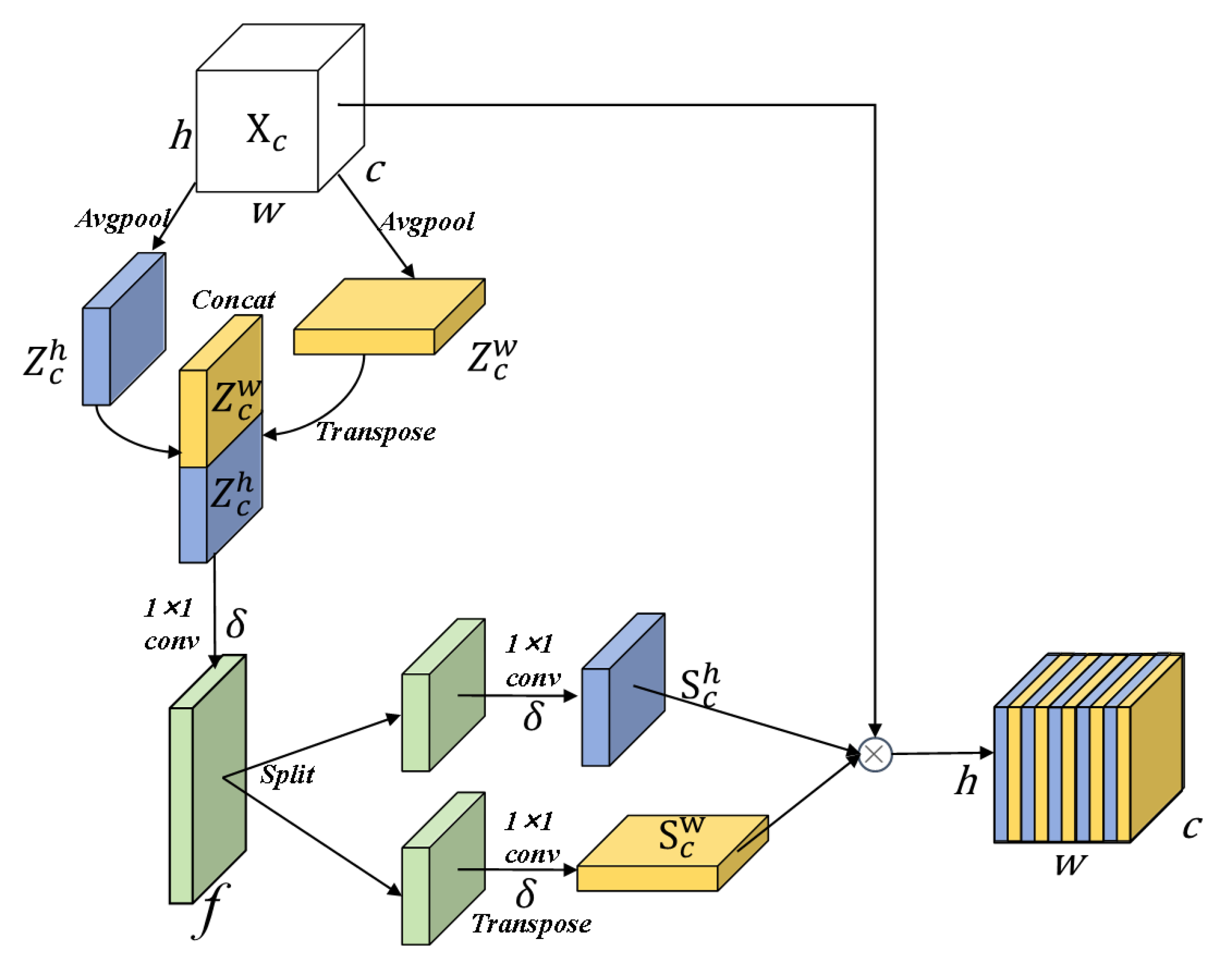
To address this limitation, Coordinate Attention (CA) [25] is introduced in this study. Due to its ability to preserve spatial structural information, the CA module is integrated into both the backbone feature extraction stage (LGCA-Block) and the neck feature reconstruction stage (CA-CARAFE). This design enhances the model’s ability to perceive elongated and small-scale targets. The architecture of the CA module is illustrated in Figure 3.
Figure 3.
CA structure diagram.
As shown in the figure, the CA module first performs two one-dimensional global pooling operations to aggregate the input features along the horizontal and vertical directions, respectively. For a given input feature tensor , pooling kernels with dimensions of and are utilized to encode the c-th channel. This process yields two direction-aware feature maps: A feature vector with a height of H and another with a width of W. These operations are mathematically formulated as Equations (1) and (2):
These transformations enable the network to capture long-range dependencies along one spatial direction while retaining precise positional information along the other, thereby facilitating the accurate localization of elongated targets within the coil winding process. To fully exploit the embedded coordinate information, the CA module generates attention maps via a sequence of convolutional transformations. Initially, the aggregated feature maps generated by Equations (1) and (2) are concatenated and subsequently passed through a shared convolutional transformation function. This operation achieves dimensionality reduction and feature fusion, as demonstrated in Formula (3):
where denotes the concatenation operation along the spatial dimension, and represents a non-linear activation function. The intermediate feature map f encodes spatial information from both the horizontal and vertical directions. Here, represents a convolutional transformation that reduces the channel dimension from C to , with r denoting the reduction ratio.
Subsequently, the intermediate feature map f is split along the spatial dimension into two independent tensors, and . Two additional convolutional transformations, denoted by and , are utilized to restore the feature channel count to C. Following this, a Sigmoid activation function is applied to generate the final attention weights, and . These operations are mathematically defined in Equations (4) and (5):
Ultimately, the original input feature map X is reweighted via element-wise multiplication with the generated directional attention weights, and . This process yields the final attention-aware output feature map Y, formulated as follows:
where and denote the scalar values at spatial position within the c-th channel of the input tensor X and output tensor Y, respectively.
Through the aforementioned operations, the Coordinate Attention mechanism not only captures inter-channel dependencies but also simultaneously encodes precise spatial positional information.
2.2.2. Lightweight Ghost Coordinate Attention(LGCA)-Block
Despite the parameter-level optimizations inherent in the YOLOv11n architecture, the extensive utilization of standard convolutions and C3k2 modules within its backbone still incurs substantial computational redundancy, particularly when processing high-resolution feature maps. To facilitate efficient feature extraction under the rigorous computational constraints of resource-limited embedded devices, while concurrently augmenting the geometric perception of elongated targets inherent to the coil winding process, we propose the novel LGCA-Block as a strategic replacement for the original C3k2 units. The architectural novelty of this module lies in integrating the CA mechanism into the “cheap operation” paradigm of Ghost convolution [26] to construct a lightweight inverted residual attention architecture. This specific integration is uniquely optimized to capture the slender topological features of targets during the winding process without inflating the parameter footprint.
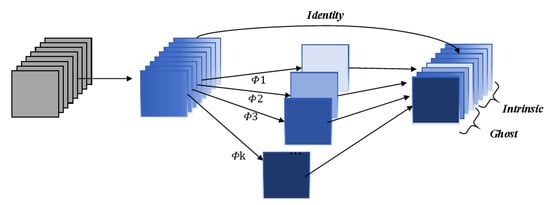
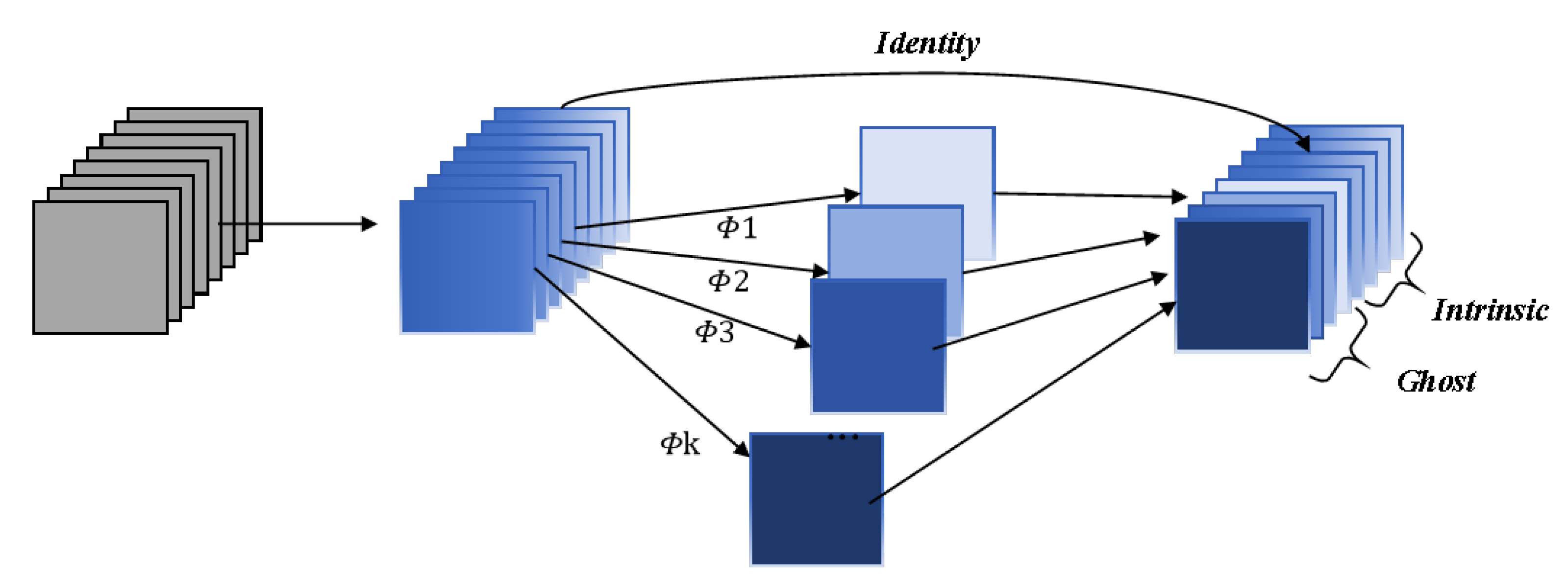
Built upon the GhostNet framework, the feature generation process of the foundational Ghost module is illustrated in Figure 4. Specifically, given an input feature tensor , the Ghost convolution initially employs a limited set of standard convolutional kernels to generate m intrinsic feature maps :
where ∗ denotes the convolution operation and f represents the convolutional kernel. Subsequently, to enrich feature diversity at a minimal computational cost, a series of cheap linear operations are applied to each intrinsic feature map , thereby generating s additional feature maps. In this study, the cheap linear operation is implemented as a depthwise convolution to efficiently generate the ghost feature maps.
Figure 4.
GhostNet structure diagram.
The final output feature map Y is constructed by concatenating the intrinsic feature maps and the generated ghost feature maps along the channel dimension. This mechanism strictly preserves the representational capacity of the feature channels while substantially reducing the computational complexity FLOPs and the overall parameter count.
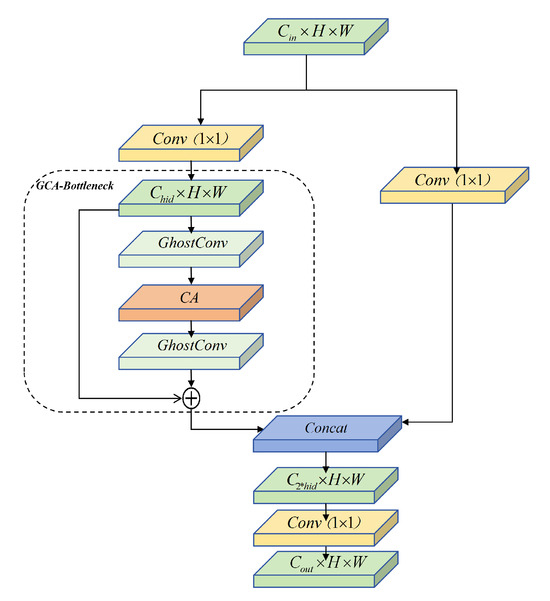
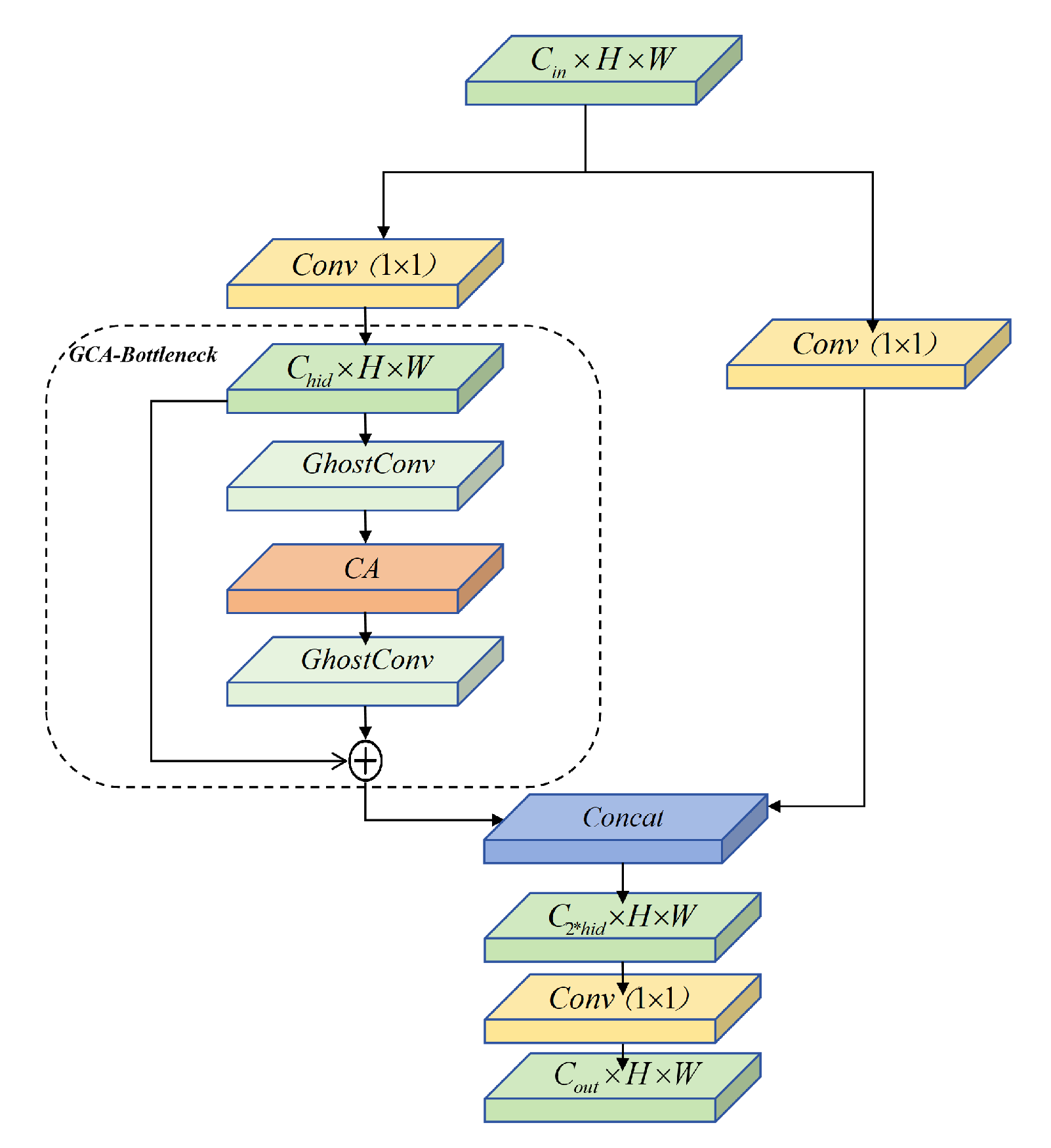
To further augment the spatial localization capability of the lightweight network for coil winding targets, the LGCA-Block adopts Cross-Stage Partial (CSP) architecture, as illustrated in Figure 5, with its core component unit being the GCA-Bottleneck. Specifically, it deeply integrates the Coordinate Attention (CA) mechanism within the “high-dimensional expansion” phase of the inverted residual structure, thereby formulating a systematic processing pipeline: feature decoupling, spatial calibration, and subsequent feature projection. To thoroughly disentangle the coupled information among features and enrich their semantic representation, thereby providing a sufficiently expressive feature manifold for the subsequent spatial attention mechanism, the GCA-Bottleneck first employs a Ghost module (Expansion Layer) to project the input feature from its original channel dimension into an expanded high-dimensional space , yielding the intermediate feature tensor
Figure 5.
LGCA-Block structure diagram.
Within the expanded high-dimensional feature space , to mitigate the degradation of spatial information pertaining to fine-grained targets during feature abstraction, we directly apply the Coordinate Attention (CA) mechanism to the expanded feature tensor . In alignment with the principles delineated in Section 2.2, the CA module aggregates spatial context along the X and Y directions, respectively, yielding a direction-aware attention weight map. This weight map is subsequently utilized to calibrate the expanded features via channel-wise reweighting
where ⊗ denotes element-wise multiplication.
The spatially calibrated features are subsequently projected back to the output channel dimension via the second Ghost module, effectively eliminating channel redundancy. Concurrently, a shortcut connection is introduced to fuse the initial input features with the projected features, facilitating efficient gradient propagation and mitigating the degradation problem prevalent in deep neural networks:
Through these architectural designs, the LGCA-Block not only inherits the computational efficiency of Ghost convolutions but also synergizes it with the Coordinate Attention mechanism within the high-dimensional feature space. This synergy enables the comprehensive capture of cross-channel long-range dependencies and fine-grained contextual features, thereby substantially enhancing the network’s perceptual capability toward elongated and occluded targets. Consequently, it effectively mitigates the prevalent limitation of lightweight models regarding insufficient feature representational capacity in complex background environments.
2.2.3. Coordinate Attention and Content-Aware Reassembly of Features(CA2RAFE)
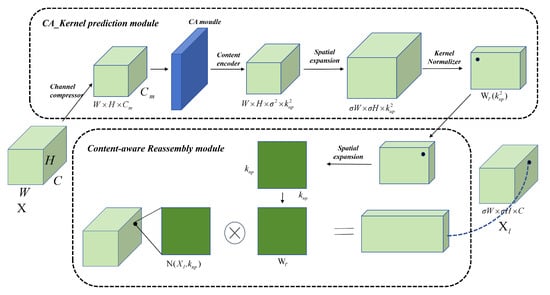
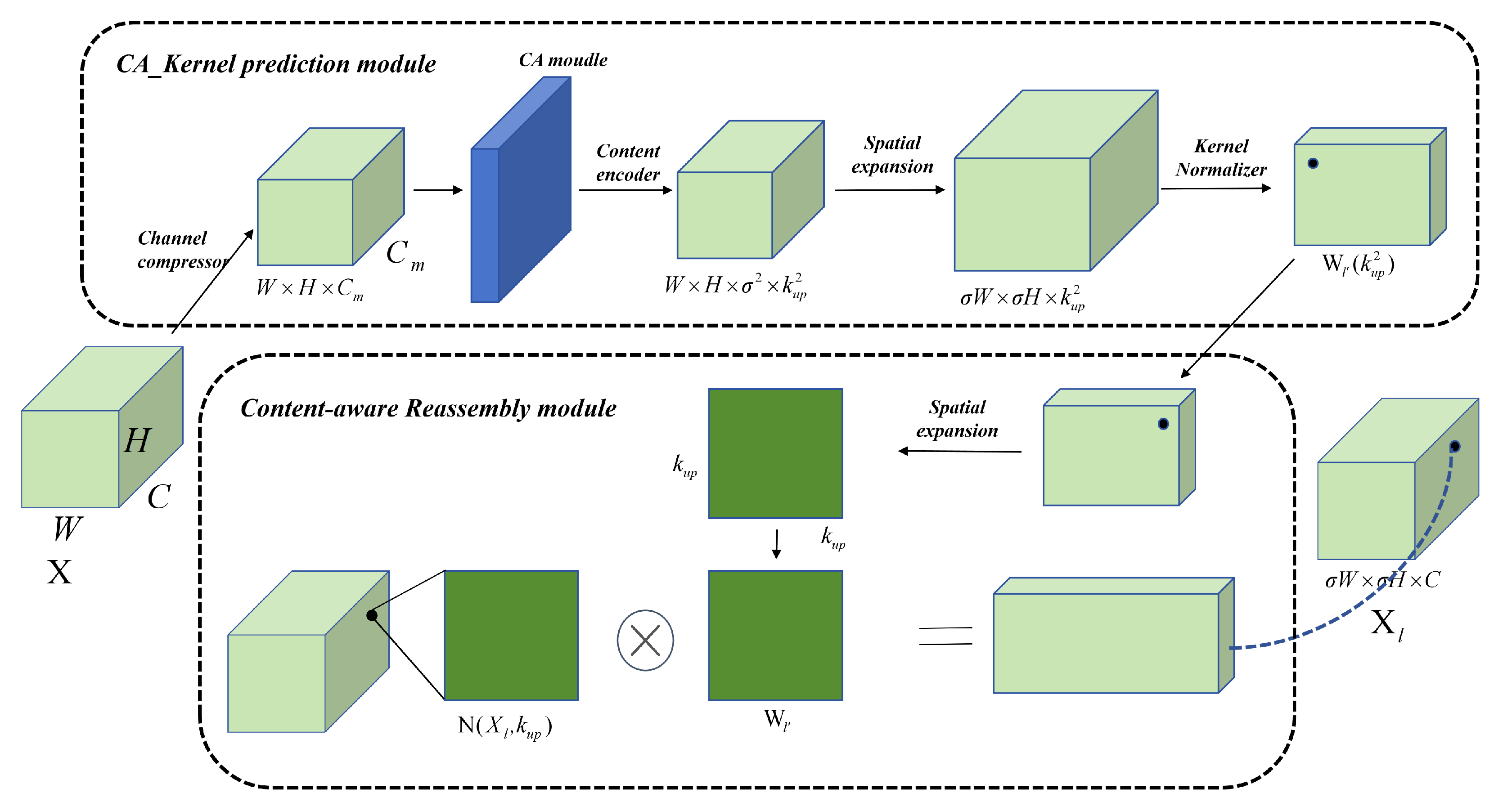
Within the YOLOv11 architecture, deep semantic features are systematically fused with shallow, fine-grained features via upsampling. The default nearest-neighbor interpolation is inherently a content-agnostic operation; it determines sampling points based solely on spatial proximity, thereby neglecting the intrinsic semantic structure within the feature maps. When addressing the detection of targets with intricate textures—such as insulation grids and fiberglass tapes inherent to the dry-type transformer winding process—this rigid upsampling paradigm is highly susceptible to inducing blurred defect boundaries and semantic misalignment. To circumvent these limitations, this study introduces the Content-Aware Reassembly of Features (CARAFE) operator as the core upsampling component [27]. Compared to conventional upsampling operators, CARAFE possesses a broader receptive field and superior content-aware capabilities. It significantly elevates feature reconstruction quality while incurring minimal parameter and computational overhead, perfectly aligning with the lightweight deployment constraints of embedded devices. To further bolster the robustness of CARAFE within high-noise industrial environments, we propose an enhanced variant by integrating the Coordinate Attention (CA) mechanism as a prior guide before the kernel prediction module. The topological structure of this improved module, designated as CA2RAFE, is illustrated in Figure 6.
Figure 6.
CA2RAFE structure diagram.
The key structural novelty of CA2RAFE lies in its departure from standard, content-agnostic upsampling, it diverges from the standard CARAFE operator by embedding a Coordinate Attention mechanism into the kernel prediction encoder. While standard CARAFE generates reassembly kernels based solely on localized convolutional features, CA2RAFE spatially re-weights the semantic features prior to kernel generation. In the context of dry-type transformer monitoring, the targets during the winding process frequently exhibit slender geometric profiles and are subject to severe occlusion. Standard upsampling methods, including CARAFE, tend to blur the boundaries of such challenging features during feature expansion. By injecting the Coordinate Attention, the kernel prediction module is directed to accurately focus on these slender and occluded targets. Consequently, CA2RAFE reconstructs the clear edges of these targets during feature upsampling while suppressing background noise, achieving precise feature alignment for downstream detection. Within the Kernel Prediction Module, input feature tensor , aggregating spatial context to yield the attention-enhanced feature map . Subsequently, the kernel prediction function is applied to . For any given target location on the output feature map , it is first mapped back to its corresponding source location on the input feature map. Following this, a local neighborhood, denoted by , is extracted centered at l. Finally, within the Content-Aware Reassembly Module, the predicted spatially heterogeneous kernel is employed to perform a weighted aggregation on the local neighborhood of the original input features X, thereby accomplishing the high-resolution feature reconstruction. This systematic process is mathematically formulated in Equations (12) and (13):
where comprises a channel-compressing convolutional layer and a content-encoding convolutional layer; denotes the predicted reassembly kernel with spatial dimensions of (empirically set to in this study); and defines the corresponding reassembly radius.
Through these architectural designs, the CA2RAFE module not only inherits the inherent efficiency of the original CARAFE operator—characterized by a large receptive field and low computational overhead—but also integrates the Coordinate Attention mechanism prior to the kernel prediction module. This integration leverages spatial prior information to guide the network in dynamically generating spatially heterogeneous reassembly kernels. In contrast to the limitations of conventional nearest-neighbor interpolation, which relies exclusively on physical spatial distance for rigid sampling, this approach significantly enhances the precision of edge reconstruction and detail recovery when processing high-frequency, intricate textures—such as insulation grids and fiberglass tapes encountered in dry-type transformer winding. Furthermore, when confronted with local occlusions typical of actual production environments, the network can leverage its expanded receptive field and high-level semantic context to smoothly reassemble fragmented and disconnected feature boundaries. This mechanism robustly suppresses feature degradation amidst high-noise and complex occluded backgrounds. It effectively resolves the prevalent issues of semantic misalignment and boundary blurring that frequently afflict lightweight networks during the fusion of multi-scale deep and shallow features, thereby laying a solid foundation for high-precision target localization and accurate feature alignment.
2.2.4. Dy-Detect
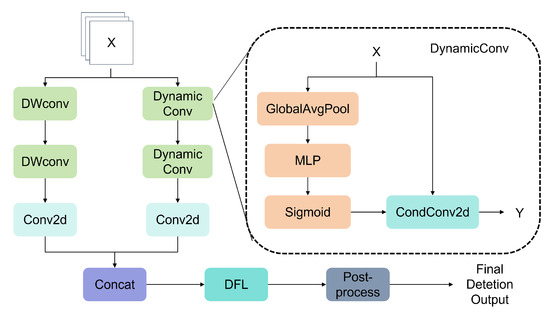
Within the original YOLOv11 architecture, the detection head employs a decoupled design predicated on static convolutions. However, models subjected to aggressive FLOPs compression for accelerated edge-device inference inherently suffer from insufficient parameter capacity. This severely hampers their ability to fully exploit the rich feature representations embedded in large-scale data, thereby imposing a strict upper bound on detection performance [28]. To address this bottleneck, we propose the Dy-Detect module at the detection end, which introduces dynamic convolutions to fundamentally decouple parameter count from computational complexity. In the vanilla Detect architecture, the regression branch heavily relies on stacked standard convolutions for geometric feature extraction. Nevertheless, fixed-weight convolutional kernels lack the representational flexibility required to simultaneously model intricate textures and targets with highly variable morphological characteristics. To transcend this limitation, Dy-Detect introduces a dynamic upgrade to the regression branch by strategically replacing the conventional static convolutional layers with dynamic convolutions, enabling the network to adaptively adjust kernel weights based on input features.
The architectural layout of the proposed Dy-Detect module is illustrated in Figure 7. Specifically, given an input feature tensor X, a global average pooling (GAP) operation coupled with a Multi-Layer Perceptron (MLP) routing module is initially employed to generate normalized dynamic coefficients :
Figure 7.
Dy-Detect structure diagram.
Concurrently, M parallel expert kernels (each being a standard convolutional kernel, empirically set to in this study) are introduced. The derived coefficients are utilized to perform a linear weighted aggregation across all expert kernels , thereby generating an input-specific dynamic convolutional kernel tailored to the current sample. The final output features Y are subsequently computed via Equation (16):
Through the aforementioned operations, the Dy-Detect module not only preserves the deployment advantages of lightweight networks—characterized by low computational overhead—but also fundamentally decouples the parameter count from computational complexity by introducing a dynamic convolutional mechanism driven by multi-expert kernel aggregation. This architectural paradigm significantly enhances the geometric fitting precision of the regression branch when delineating targets with intricate textures and highly variable morphologies. Consequently, it effectively addresses the restricted upper bound of feature representational capacity caused by the inherent parameter deficits of lightweight models.
3. Experiments
3.1. Dataset Construction and Analysis
3.1.1. Data Collection
The image data for this study were collected in a real-world dry-type transformer winding production workshop at a large transformer manufacturing enterprise. To authentically reflect visual interference factors in actual industrial settings and ensure model generalization capability, the acquisition environment encompassed complex industrial backgrounds, including large winding molds, cluttered tool benches, and other workers moving through the background. Additionally, considering the mixed lighting conditions of natural light and factory overhead lamps within the workshop, the acquisition period spanned different production shifts to capture dynamic variations in light intensity and shadow angles.
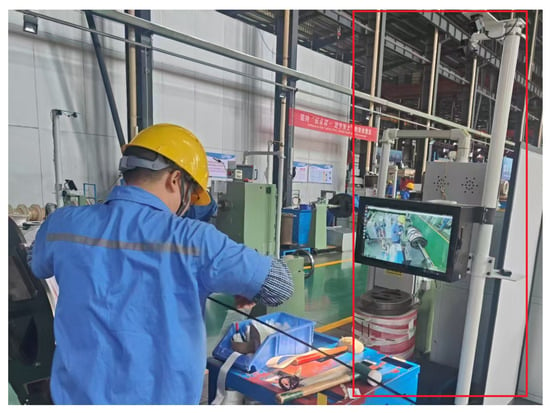
Regarding the hardware setup and deployment strategy, and in order to strictly comply with production safety regulations while enabling non-contact monitoring, no wearable sensors were introduced on the workers. Instead, industrial-grade high-definition cameras were used to continuously capture video streams. The cameras were securely mounted on fixed stands approximately 2 m behind and to the side of the winding workstation, with a tilt angle of about 50 degrees. This camera viewpoint was carefully validated to ensure full coverage of the core operational area of the dry-type transformer winding process, while clearly capturing fine operations such as insulation layer placement and insulation wrapping, and minimizing any physical interference of the equipment with the standard operating procedures of the workers. The setup of the acquisition equipment is shown in Figure 8.
Figure 8.
Image acquisition equipment layout.
3.1.2. Dataset Annotation and Construction
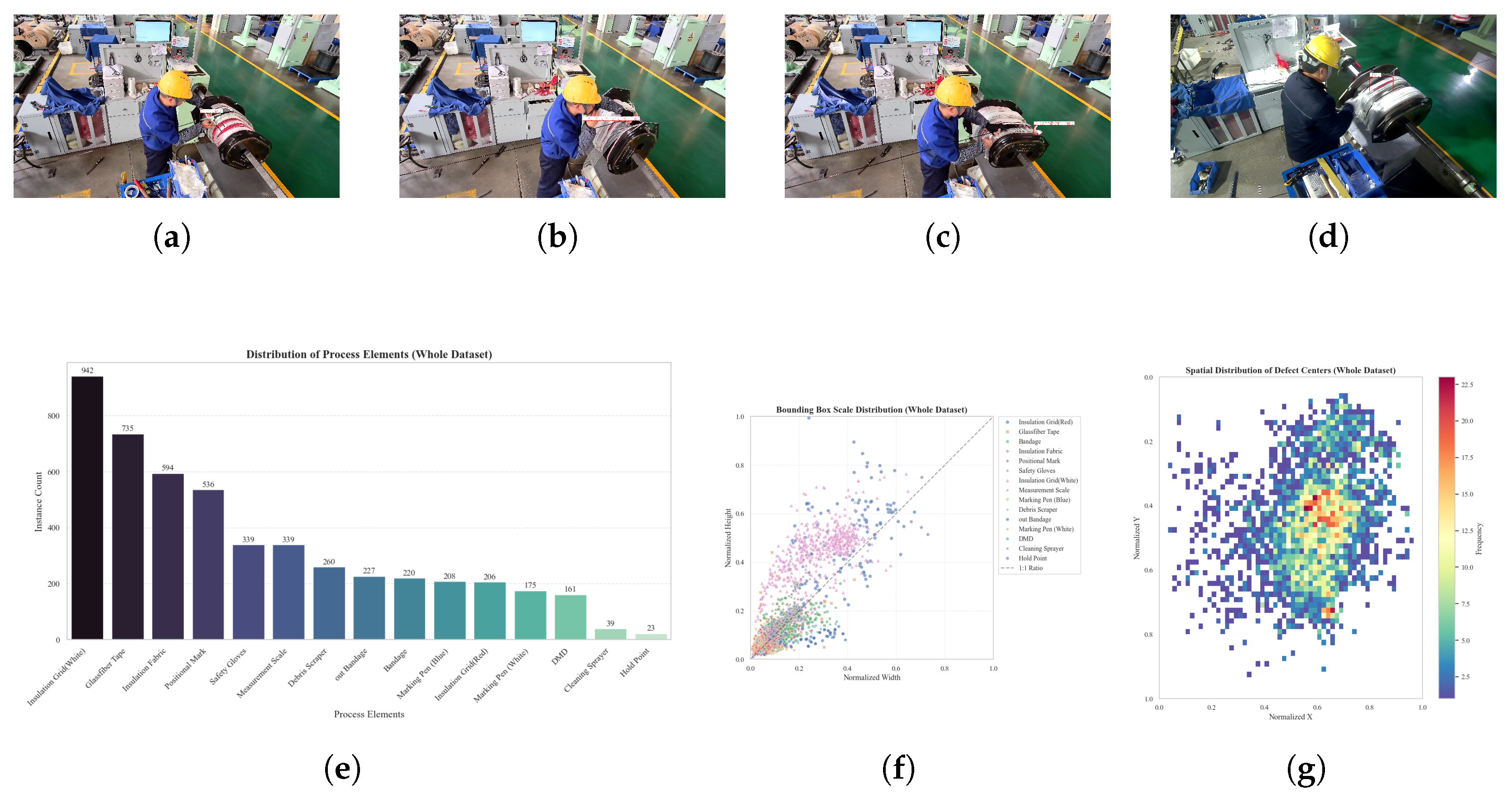
After data acquisition, the collected video streams were processed, resulting in 3200 raw images. To improve the quality and usability of the dataset, a systematic data cleaning process was performed. This involved removing duplicate images and discarding samples exhibiting severe blurring, overexposure, or significant obstruction, thereby significantly improving image clarity and target resolution. During the annotation stage, the professional annotation tool LabelMe was used to carefully label the key process-related targets in each image. As a result, a high-quality dataset containing 3082 images was established, covering 15 categories of targets related to the dry-type transformer winding process. Detailed statistics of the dataset are presented in Figure 9.
Figure 9.
Overview of the dry-type transformer winding dataset. (a–d) Representative sample images capturing key process elements under different conditions, including (a) tap wrapping, (b) DMD, (c) glass fiber tape, and (d) white insulating mesh fabric. (e) Category distribution across the entire dataset, exhibiting an overall long-tail characteristic. (f) Bounding box scale distribution. (g) Spatial heatmap of defect centers.
For model training and performance evaluation, the constructed dataset was divided into training and validation sets at an 8:2 ratio, comprising 2740 images for training and 342 images for validation. It should be noted that the category distribution of the dataset is inherently imbalanced, consistent with real-world inspection statistics for certain process-critical targets.
3.2. Experiment Environment
All experiments were conducted on a Windows 11 operating system with the following software environment: PyTorch 2.5 and Python 3.9. The models were optimized using Stochastic Gradient Descent (SGD) and the Cross-Entropy loss function, with an initial learning rate of 0.01, a batch size of 16, and a total of 200 training epochs. To mitigate the inherent class imbalance and enhance model robustness, standard data augmentation strategies, including Mosaic, HSV photometric distortions, and random horizontal flipping, were applied during the training phase. The detailed hardware environment and configuration parameters are presented in Table 1 and Table 2.
Table 1.
Experimental environment configuration.
Table 2.
Model parameter settings.
3.3. Evaluation Indicators
Precision (P) and Recall (R) serve as the fundamental evaluation metrics in object detection. Precision reflects the accuracy of the positive predictions, whereas recall measures the completeness of identifying true positive instances. Their mathematical formulations are defined in Equations (17) and (18), where , , and denote the number of correctly detected targets (True Positives), backgrounds erroneously classified as targets (False Positives), and actual targets missed by the detector (False Negatives), respectively.
Average Precision (AP) serves as a pivotal metric in object detection for the comprehensive evaluation of a model’s performance on a specific category. It reflects the overall detection accuracy by integrating precision across varying recall levels. The computation of AP is predicated on the Precision–Recall (P–R) curve, quantifying the model’s overall efficacy for a given category by calculating the Area Under the Curve. Its mathematical formulation is presented in Equation (19), where denotes the precision value at a specific recall threshold R:
The mean Average Precision (mAP) serves as the definitive metric for assessing the holistic performance of a multi-class object detection model, reflecting its average detection accuracy across all categories. Derived by calculating the arithmetic mean of the AP values across all individual classes, the mAP provides a comprehensive assessment of the model’s generalized detection capabilities. Its computation is formulated in Equation (20), where N represents the total number of categories, and denotes the Average Precision of the i-th category:
3.4. Ablation Experiments
To comprehensively dissect the specific impacts of the three proposed core enhancement mechanisms on overall model performance, a series of rigorous ablation studies were designed and executed. These experiments not only independently validate the efficacy of each individual module but also systematically investigate their synergistic enhancement effects when combined. Consequently, this provides a stringent empirical foundation for the architectural design and optimization of the final LCD-YOLOv11 model. The detailed quantitative evaluation results are summarized in Table 2. Within the table, the checkmark symbol “√” denotes the integration of the corresponding module into the current network configuration. The absence of any markings indicates the unmodified YOLOv11n baseline model. Given its demonstrably superior fundamental performance under lightweight constraints, it was established as the foundational baseline for this optimization trajectory. Furthermore, to strictly control variables and ensure the absolute objectivity and fairness of the experimental outcomes, all network variants were configured with hyperparameters perfectly identical to those of the baseline model. A uniform train-from-scratch strategy was implemented across all configurations to completely isolate and eliminate any extraneous performance gains attributable to external training artifacts.
As shown in Table 3, the isolated integration of the LGCA-block module into the baseline YOLOv11n architecture yields a comprehensive performance enhancement across all primary metrics. Specifically, Precision, Recall, mAP@50, and mAP@50-95 register notable increments of 2.0, 0.7, 0.6, and 0.5 percentage points, respectively. Concurrently, the parameter count is reduced by 0.24M, and the computational complexity decreases to 6.2 GFLOPs. This substantiates that the LGCA-block effectively augments the extraction and fusion quality of both global and local features, thereby elevating detection performance while simultaneously mitigating model complexity. When the CA2RAFE module is introduced in isolation, the model’s Precision and the stringent mAP@50-95 metric surpass the baseline by 1.5 and 0.8 percentage points, respectively. This demonstrates that the feature reassembly mechanism effectively bolsters the network’s fine-grained localization capability for complex target boundaries. However, this integration is accompanied by an increase in parameter count and computational complexity to 2.74 M and 6.7 GFLOPs, respectively, alongside a 2.4 percentage point decline in Recall. The independent incorporation of the Dy-Detect module yields a substantial 3.7 percentage point surge in Precision, reaching a global peak of 0.861, while significantly slashing the computational load to 5.0 GFLOPs. This indicates that Dy-Detect drastically curtails redundant computations and significantly suppresses false positive detections. Synthesizing these observations, the solitary introduction of either the CA2RAFE or Dy-Detect module inevitably incurs varying degrees of degradation in Recall. The root cause of the Recall degradation observed when introducing either the CA2RAFE or Dy-Detect module individually requires an in-depth analysis of the information flow within the feature representation pipeline. First, although the CA2RAFE operator integrates an internal Coordinate Attention mechanism to guide kernel prediction, the effectiveness of this attention is inherently bounded by the quality of the input features. When CA2RAFE is deployed independently—without the pre-purification and feature decoupling provided by the LGCA-Block—the features fed into the neck network remain heavily entangled with background noise. Consequently, the internal attention mechanism of CA2RAFE can be easily misled, inadvertently generating reassembly kernels that amplify high-frequency noise at target boundaries, which ultimately leads to missed detections under severe occlusion.
Table 3.
Ablation study results of different modules.
Similarly, when the Dy-Detect head is employed in isolation, its dynamic routing module heavily relies on the global context vector extracted via Global Average Pooling to allocate weights among expert kernels. If the preceding neck network merely utilizes standard nearest-neighbor upsampling, the multi-scale feature fusion process inevitably introduces severe semantic misalignment and boundary blurring, causing the generated global context vector to be saturated with noise and ambiguity. Such distorted information forces the dynamic routing mechanism into a ’decision blind spot’, leading to the erroneous allocation of suboptimal expert convolutional kernels to the target regions. This degradation in feature extraction capability ultimately precipitates a decline in the model’s Recall.
Furthermore, the exploration of combinatorial configurations reveals a critical phenomenon: When the CA2RAFE and Dy-Detect modules are concurrently integrated into the network, although Precision (P) is sustained at a high level of 0.852, Recall (R) precipitously drops to 0.742, accompanied by a near-stagnation in comprehensive accuracy gains. This suggests an underlying optimization conflict between the altered feature distributions and the dynamic routing mechanism when the feature reassembly module is directly cascaded with the dynamic detection head. However, the simultaneous incorporation of all three modules—LGCA-block, CA2RAFE, and Dy-Detect—in the finalized LCD-YOLOv11 architecture effectively circumvents this limitation. This tripartite combination not only fully compensates for the precipitous decline in Recall (R) caused by the absence of semantic transition but also further optimizes the overall computational load of the network. Ultimately, this demonstrates a profound synergistic complementarity among the three components. Acting as a crucial feature bridge, the LGCA-block harmonizes the interplay between feature reassembly and dynamic detection, collectively maximizing the model’s detection efficacy in highly complex operational scenarios.
When comparing the finalized LCD-YOLOv11 architecture against the vanilla YOLOv11n baseline, the proposed model achieves remarkable performance gains, elevating Precision, Recall, mAP@50, and mAP@50-95 by 3.0, 0.9, 1.8, and 1.2 percentage points, respectively. Regarding lightweight deployment metrics, the parameter count undergoes a substantial reduction of 11.58%, while the computational complexity is significantly decreased by 20.63% in terms of GFLOPs. Mechanistically, the CA2RAFE module optimizes the reassembly and representation of the feature space, thereby augmenting the network’s capacity to capture fine-grained details. Concurrently, Dy-Detect filters out ineffectual computations through its dynamic routing mechanism, markedly improving localization efficiency. Meanwhile, the LGCA-block serves as a highly efficient contextual feature fusion bridge between the two, effectively mitigating any potential model bloat. In summary, by seamlessly integrating these three core enhancements, the LCD-YOLOv11 architecture preserves exceptional detection accuracy while simultaneously achieving a smaller footprint and lower computational overhead. Ultimately, it strikes a vastly superior balance between extreme lightweight design and high-precision inference.
3.4.1. Analysis of the Training Rurves
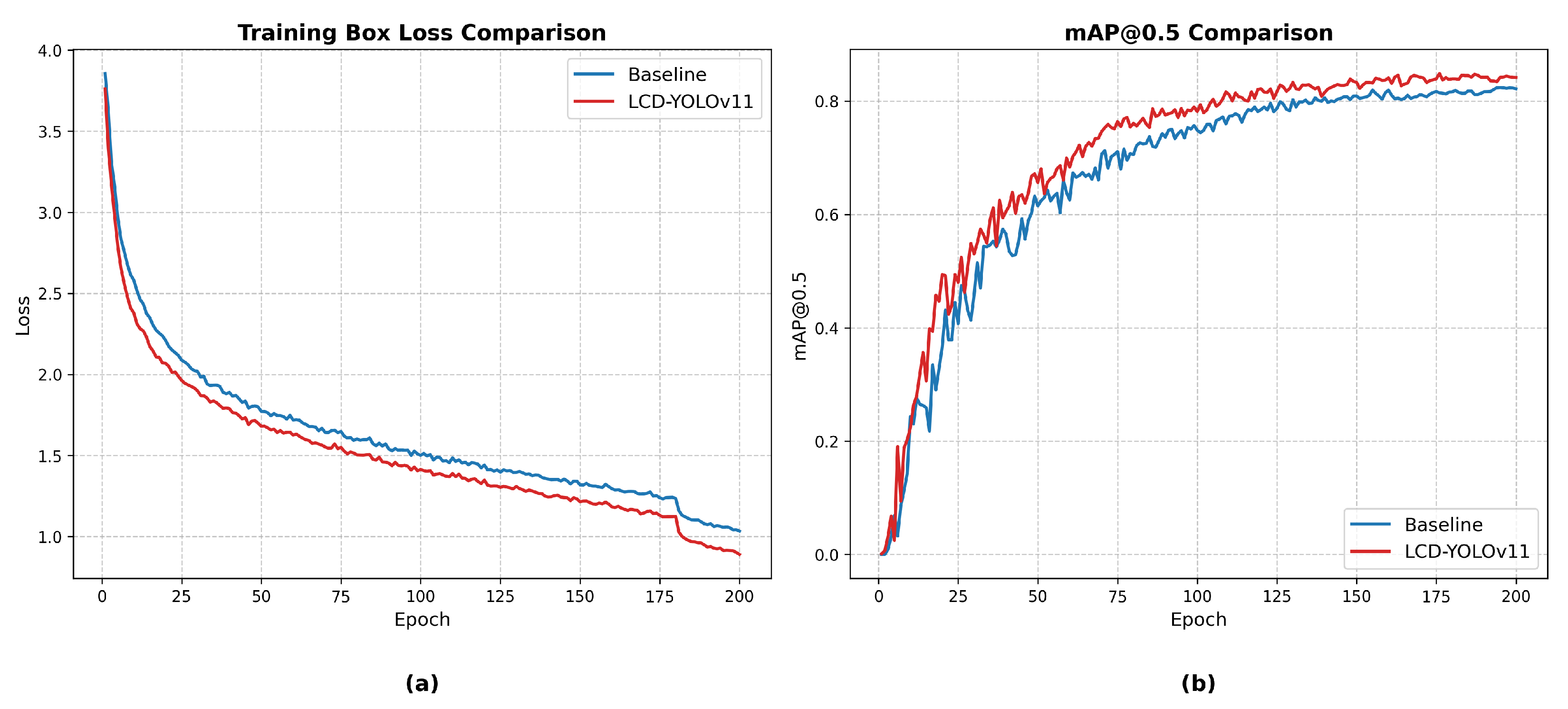
To validate the efficacy of the proposed LCD-YOLOv11 architecture, comprehensive comparative experiments were conducted against the baseline model. Figure 10 illustrates the evolutionary trajectories of the bounding box loss and the mAP@0.5 metric for both models across the entire 200-epoch training regimen.
Figure 10.
Comparative analysis of the training curves between the Baseline and the proposed LCD-YOLOv11 models. (a) Bounding box loss curves on the training set. (b) Mean Average Precision (mAP@0.5) curves on the validation set.
As depicted in Figure 9a, the bounding box loss of the LCD-YOLOv11 consistently remains beneath that of the baseline model throughout the entire training trajectory. This observation convincingly demonstrates that the proposed LCD module substantially bolsters the network’s bounding box regression capabilities and localization precision, specifically tailored to the intricate features of dry-type transformer windings. Concurrently, the mAP@0.5 curves illustrated in Figure 9b reveal that the LCD-YOLOv11 exhibits a markedly accelerated convergence rate during the initial training phase, and sustains a definitive accuracy advantage throughout the remainder of the optimization process.
3.4.2. Qualitative Analysis of Model Interpretability
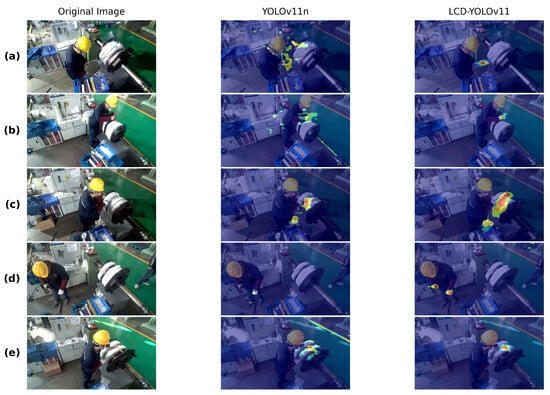
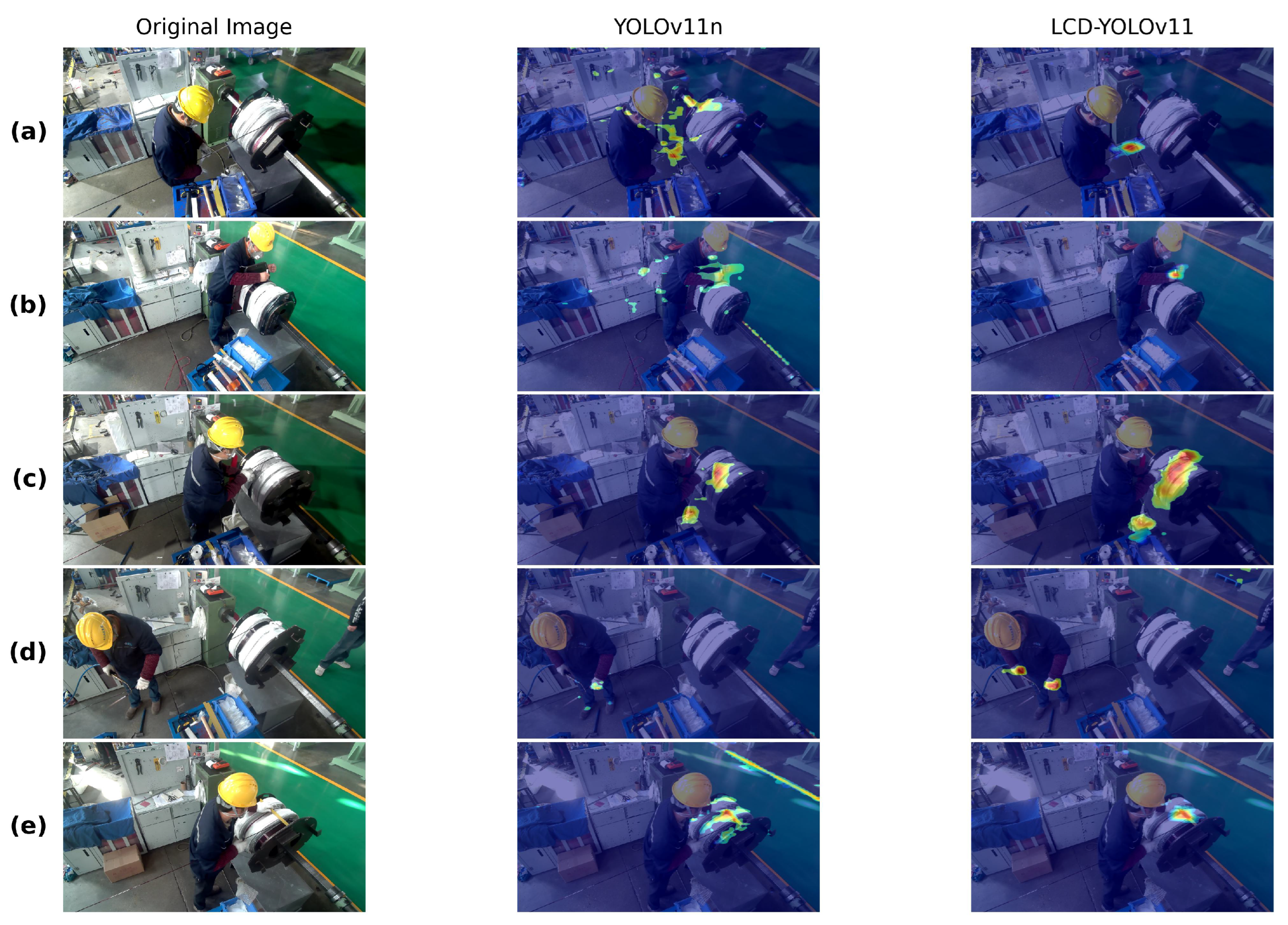
While the preceding quantitative analysis of the training curves substantiates the macroscopic superiority of LCD-YOLOv11, it is imperative to elucidate how the proposed modules substantively optimize the network’s feature extraction capabilities within complex workshop environments. To achieve this, we employ the Grad-CAM++ technique [29] to conduct a comparative visual analysis of the class activation mappings between the baseline model and LCD-YOLOv11. For this evaluation, detection targets exhibiting diverse morphological features were deliberately selected. The resulting visualization heatmaps are presented in Figure 11.
Figure 11.
Heatmap visualizations under various challenging scenarios: (a) Elongated targets; (b) Small-scale targets; (c) Targets with complex textures; (d) Off-center targets; (e) Occluded targets.
As observed in the middle column representing the baseline model, conventional static networks suffer from severe “attention dispersion” and “semantic drift” when confronted with complex workshop backgrounds. For instance, in Figure 11b,e, the baseline model exhibits strong, erroneous activations in response to irrelevant background contours and specular highlights; conversely, in Figure 11a,c, its attentional focus is undesirably diverted toward extraneous elements such as workers’ safety helmets and non-operational equipment casings. Most critically, when tasked with detecting the off-center targets depicted in Figure 11d, the baseline model experiences a near-total collapse in its feature acquisition capabilities, rendering it highly vulnerable to missed detections.
In contrast, the LCD-YOLOv11 model (depicted in the right column) demonstrates exceptionally precise spatial localization and robust anti-interference capabilities across all evaluated scenarios. Benefiting from the global contextual awareness conferred by the LGCA-Block, the model successfully decouples the targets from the distracting background noise present in Figure 11b,e. Furthermore, driven by the synergistic integration of the Dy-Detect and CA2RAFE modules, LCD-YOLOv11 is capable of precisely and continuously anchoring the deep-red, high-activation regions directly onto the core operational areas. Particularly noteworthy is its performance in the challenging off-center scenario depicted in Figure 11d, where the enhanced model still unequivocally locks onto the worker’s bilateral hand movements. Collectively, this multi-scenario visual evidence compellingly substantiates that LCD-YOLOv11 is highly tailored to meet the stringent object detection requirements of the dry-type transformer winding process.
3.4.3. Comparison of Inference Results
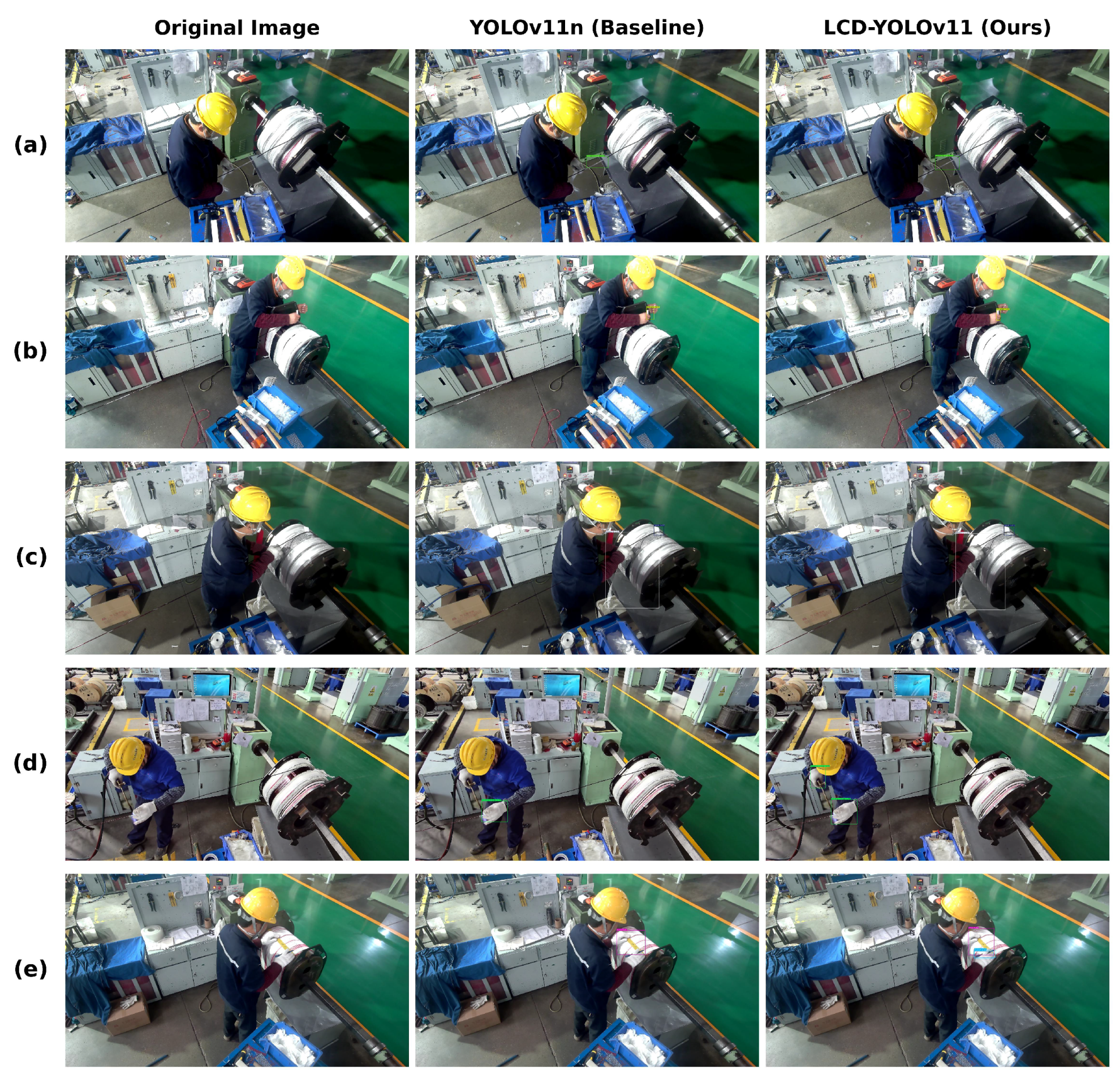
To further evaluate the practical detection capabilities, a comprehensive visual comparison of the inference results between the baseline and the proposed LCD-YOLOv11 is presented in Figure 12.
Figure 12.
Comparison of detection results. (a) Elongated targets; (b) Small-scale targets; (c) Targets with complex textures; (d) Off-center targets; (e) Occluded targets.
As illustrated in the second column of Figure 12, the prediction results of the unmodified YOLOv11n baseline model are presented. Although it possesses fundamental feature perception capabilities, the baseline model remains susceptible to missed detections and localization deviations under complex operational conditions. Specifically, it exhibits issues such as missing bounding boxes or suboptimal regression alignment for certain critical targets. These limitations substantially compromise the model’s reliability for compliance verification in actual winding processes.
In stark contrast, the third column displays the detection results of the proposed LCD-YOLOv11 model. Benefiting from deep structural optimizations, this enhanced architecture maintains high-precision object localization and robustness even when confronted with severe visual challenges. The model not only accurately captures off-center peripheral targets but also demonstrates exceptional feature decoupling and detection performance when addressing challenging cases involving small-scale and overlapping targets.
3.5. Performance Comparison with Different Detection Models
To rigorously validate the comprehensive performance of the proposed LCD-YOLOv11 architecture, an extensive suite of comparative experiments was designed and executed. This study systematically benchmarks the LCD-YOLOv11 against a spectrum of mainstream object detection algorithms. The comparative lineup encompasses not only multiple lightweight iterations of the YOLO lineage—namely, YOLOv5n, YOLOv6n, YOLOv8n, YOLOv10n, and the baseline YOLOv11n—but also incorporates representative classic and state-of-the-art (SOTA) detection paradigms, such as SSD and RT-DETR. For a fair comparison, all benchmark models were trained from scratch using the identical dataset and consistent hyperparameters, without relying on pre-trained weights. The detailed quantitative results of this comparative analysis are presented in Table 4.
Table 4.
Comparison with different detection models.
As summarized in Table 4, the proposed LCD-YOLOv11 model demonstrates improved performance across key detection metrics. Specifically, LCD-YOLOv11 achieves an mAP@50 of 0.841, representing an increase of 1.8% and 1.6% compared to the YOLOv11n baseline and the YOLOv10n model, respectively. While its Precision of 0.854 is slightly lower than that of YOLOv8n (0.855), it yields a higher Recall of 0.790 compared to 0.737 for YOLOv8n. This balance between Precision and Recall contributes to reducing missed detections and false positives typically caused by object occlusion or background interference during the dry-type transformer winding process. These results confirm the practical applicability and effectiveness of the algorithm in complex industrial vision scenarios.
Secondly, it is noteworthy that the proposed method achieves precision enhancements while simultaneously reducing both parameter count and computational complexity. Specifically, LCD-YOLOv11 features a parameter count of only 2.29 M and a computational workload of 5.0 GFLOPs, representing the lowest values among all benchmarked models. Compared to other lightweight architectures such as YOLOv10n and YOLOv6n, the computational overhead is substantially reduced. This efficiency is primarily attributable to the integration of the LGCA-Block and Dy-Detect modules, which enable the model to utilize visual information more effectively, achieving multi-scale spatial feature refinement and fusion with minimal parameters.
Finally, we examine the trade-offs between performance and deployment feasibility. Although the large-scale RT-DETR-l architecture achieves a higher mAP@50-95 of 0.541, it yields a lower Recall of 0.707 and carries a substantial parameter load of 32.01 M, making it less suitable for real-time inference on edge devices. In contrast, while LCD-YOLOv11 shows a marginal 1% decrease in mAP@50-95 compared to YOLOv10n, this is offset by a nearly 40% reduction in GFLOPs and a 2.7% improvement in Recall. In practical dry-type transformer winding monitoring, preventing missed detections and ensuring high-frame-rate execution are prioritized over pursuing pixel-level bounding box alignment mAP@50-95. Consequently, LCD-YOLOv11 demonstrates significant pragmatic engineering value for industrial applications.
In summary, LCD-YOLOv11 achieves a favorable trade-off between detection performance and computational efficiency. It delivers competitive detection accuracy while maintaining a parameter count and computational overhead significantly lower than those of rival models. Although architectures such as RT-DETR-l and YOLOv10n provide comparable localized precision metrics, they involve substantially higher parameter counts and computational demands compared to the proposed LCD-YOLOv11. Given the dual requirements for high speed and precision in dry-type transformer winding monitoring, LCD-YOLOv11 emerges as a highly viable solution for practical industrial implementation.
3.6. Inference Performance on Edge Computing Device
To evaluate the real-world edge deployment feasibility of the proposed model, we deployed both the baseline YOLOv11n and our LCD-YOLOv11 on an NVIDIA Jetson Nano. As a widely adopted embedded AI development platform, the Jetson Nano is characterized by its compact size, low power consumption, and efficient parallel computing capabilities, rendering it highly suitable for resource-constrained industrial workshop environments. The detailed hardware specifications of the Jetson Nano are presented in Table 5.
Table 5.
Hardware specifications of the Jetson Nano.
Regarding the deployment pipeline, the native PyTorch model weights (.pt) were first exported into the universally supported ONNX format. Subsequently, NVIDIA TensorRT was utilized to accelerate the inference speed specifically using FP16 (16-bit floating point) precision quantization. Finally, both the optimized baseline and the LCD-YOLOv11 models were executed on the Jetson Nano for inference validation. The comparative experimental results, including inference latency and frames per second (FPS), are summarized in Table 6. As shown, LCD-YOLOv11 achieves an inference latency of 40.4 ms and a speed of 24.8 FPS. Given the typical frame rates of industrial cameras, this performance effectively guarantees smooth, real-time compliance monitoring on extremely low-power edge hardware.
Table 6.
Experimental results.
4. Discussion
The development of LCD-YOLOv11 builds upon the established efficiency of the YOLOv11n architecture, yet it introduces targeted innovations specifically tailored to the visual challenges of the dry-type transformer winding process. Rather than simply stacking existing attention mechanisms, this study strategically integrates and redesigns structural components to create a cohesive, domain-specific solution.
The LGCA-Block serves as a specialized feature extractor designed for extreme lightweightness. While standard Ghost convolution effectively reduces channel redundancy, its direct application often compromises spatial sensitivity. By embedding a lightweight coordinate attention mechanism, the LGCA-Block preserves critical positional information of small-scale positioning markers without the computational penalty of traditional self-attention layers. Furthermore, the CA2RAFE operator in the neck network demonstrates a targeted adaptation for complex target boundaries. Unlike standard upsampling techniques commonly used in generic object detection, CA2RAFE adaptively reorganizes feature content. This is particularly crucial for reconstructing the blurred boundaries of semi-transparent insulation materials against highly textured background machinery.
Finally, the Dy-Detect head represents a fundamental shift in managing computational load. By utilizing dynamic routing, it breaks the conventional strong coupling between parameter scale and computational cost. This synergy directly addresses the common trade-off between speed and accuracy, ensuring that the model can handle diverse geometric variations without inflating the network’s overall footprint.
While the utilized dataset provides a realistic benchmark for the targeted winding process, a comprehensive analysis of the model’s robustness and limitations is necessary. Regarding lighting and environmental variations, the data acquisition process inherently incorporated images captured under diverse real-world illumination conditions. To further amplify this natural diversity, systematic data augmentation strategies were employed during dataset preparation. Consequently, the model has empirically adapted to typical factory lighting fluctuations, demonstrating strong robustness. Similarly, the model exhibits high robustness to different macroscopic transformer configurations. Because the detection framework is explicitly designed to identify key micro-level targets rather than the corresponding transformer as a whole, it relies on morphologically invariant local features, effectively insulating performance from variations in overall transformer types. However, challenges remain regarding domain shift and data distribution. Due to strict industrial confidentiality protocols, data collection was restricted exclusively to the current manufacturing environment, precluding empirical validation on external datasets and leaving the model’s exact sensitivity to severe cross-domain shifts unquantified. Furthermore, although synthesis-based data augmentations were applied to balance the training distribution, the inherent long-tailed nature of industrial anomalies results in a residual sensitivity to class imbalance, where minority defect categories yield slightly lower precision. Addressing these specific domain and distribution limitations through multi-plant data acquisition constitutes a critical direction for future research.
To overcome this inherent data scarcity and enhance generalized robustness, future workflows will focus on the generation of synthetic datasets using simulated industrial environments. As suggested by the study [30], by utilizing 3D simulation tools to systematically generate scenes with varying equipment configurations, severe occlusions, and complex lighting conditions, highly diverse synthetic data can be produced without violating industrial confidentiality. Ultimately, adopting a hybrid training approach—mixing the limited real-world factory data with these highly diverse synthetic samples—will provide a robust and scalable pathway for deploying the model across diverse manufacturing facilities.
Consequently, future efforts will aim to broaden data diversity by integrating samples from different transformer capacities, varying production lines, and diverse illumination scenarios. Additionally, future work will include direct hardware benchmarking on edge devices to profile concrete latency, power consumption, and memory utilization metrics under real-world operational constraints. Exploring cross-line evaluation will also be essential to fully validate the model’s robustness and generalization capability across diverse manufacturing contexts.
5. Conclusions
Addressing the challenges of high manual dependency and the lack of automated monitoring in the dry-type transformer winding process, this study proposes a state-driven monitoring strategy that integrates visual object detection with physical coil turn counts and introduces the lightweight LCD-YOLOv11 model. To tackle visual challenges typical of winding workshops—such as semi-transparent insulation materials, small-scale positioning markers blending into the background, and frequent hand occlusions—the LCD-YOLOv11 architecture incorporates several deep optimizations based on the YOLOv11n framework. Specifically, the LGCA-Block is introduced into the backbone to enhance global contextual awareness while mitigating computational redundancy. During the feature fusion stage, the CA2RAFE operator is employed to achieve adaptive content reorganization, improving reconstruction precision for complex target boundaries. Furthermore, the Dy-Detect dynamic detection head is designed to decouple the relationship between parameter count and computational workload, significantly enhancing the model’s ability to fit diverse geometric features.
Experimental results demonstrate that the proposed model achieves improvements of 3.0%, 0.9%, 1.8%, and 1.2% in Precision, Recall, mAP@50, and mAP@50-95, respectively, relative to the baseline. Compared to the original YOLOv11n, the parameter count and GFLOPs are substantially reduced by 11.58% and 20.63%. The enhanced model effectively improves feature capture capabilities for critical winding elements in complex factory environments. It significantly bolsters the accuracy of process compliance monitoring, particularly in scenarios characterized by low contrast between targets and backgrounds or severe operational occlusions.
In summary, the proposed LCD-YOLOv11 model achieves an effective balance between lightweight design and detection accuracy, providing a cost-effective and efficient visual assistance solution for the automated monitoring of the dry-type transformer winding process. Its low hardware resource consumption confers the potential for real-time deployment on edge computing devices, which can effectively mitigate the issues of strong subjectivity and susceptibility to missed detections inherent in traditional manual inspections. This contributes significant engineering value toward ensuring the winding quality and long-term reliability of transformers. Moving forward, future research will address current data diversity constraints by exploring the development of simulated industrial environments. Generating highly diverse, photorealistic synthetic training data will provide a scalable pathway to evaluate and optimize the model’s generalization capability across multiple transformer models and novel production line environments. Ultimately, the successful deployment of this lightweight architecture provides a robust technical foundation for advancing intelligent manufacturing and automated quality assurance within the broader electrical equipment industry.
Author Contributions
Conceptualization, Z.H. and Y.Y.; methodology, Z.H. and Y.Y.; validation Z.H. and X.C.; data curation, Z.H. and W.C.; investigation, Z.H. and K.W.; writing—review and editing, Y.Y. and Z.H. All authors have read and agreed to the published version of the manuscript.
Funding
This research received no external funding.
Data Availability Statement
The data presented in this study are not publicly available due to privacy and confidentiality restrictions.
Acknowledgments
During the preparation of this manuscript, the authors used Gemini 3 solely for language refinement, including grammar, phrasing, and text editing. The AI tool did not participate in the research design, data analysis, experimental development, scientific interpretation, or the generation of technical content. All AI-assisted text was fully reviewed, verified, and revised by the authors, who take full responsibility for the final scientific content. All authors have agreed to this acknowledgment.
Conflicts of Interest
The authors declare no conflicts of interest.
References
- Baoguo, S.; Qing, L.; Lili, Z.; Haifeng, Z.; Chenglong, Z.; Shanshan, W.; Wanlei, X. Analysis of China’s Power Demand Situation in the Last Three Years of the “14th Five-Year Plan” Under the New Situation. Electr. Power 2023, 56, 1–11. [Google Scholar] [CrossRef]
- Wang, Q.; Zheng, M.; Yang, K.; Shang, C.; Luo, Y. Research and Implementation of Fault Data Recovery Method for Dry-Type Transformer Temperature Control Sensor Based on ISSA-LSTM Algorithm. Measurement 2024, 228, 114333. [Google Scholar] [CrossRef] [Scilit]
- Aj, C.; Salam, M.A.; Rahman, Q.M.; Wen, F.; Ang, S.P.; Voon, W. Causes of Transformer Failures and Diagnostic Methods—A Review. Renew. Sustain. Energy Rev. 2018, 82, 1442–1456. [Google Scholar] [CrossRef] [Scilit]
- Arias Velásquez, R.M.; Mejía Lara, J.V. Root Cause Analysis Improved with Machine Learning for Failure Analysis in Power Transformers. Eng. Fail. Anal. 2020, 115, 104684. [Google Scholar] [CrossRef] [Scilit]
- Arumugam, S. Failure Diagnosis and Root-Cause Analysis of In-Service and Defective Distribution Transformers. Energies 2021, 14, 4997. [Google Scholar] [CrossRef] [Scilit]
- Chukwunweike, J.N.; Anang, A.N.; Adeniran, A.A.; Dike, J. Enhancing Manufacturing Efficiency and Quality through Automation and Deep Learning: Addressing Redundancy, Defects, Vibration Analysis, and Material Strength Optimization. World J. Adv. Res. Rev. 2024, 23, 1272–1295. [Google Scholar] [CrossRef] [Scilit]
- Moru, D.K.; Borro, D. A Machine Vision Algorithm for Quality Control Inspection of Gears. Int. J. Adv. Manuf. Technol. 2020, 106, 105–123. [Google Scholar] [CrossRef] [Scilit]
- Yang, Y.; Pan, L.; Ma, J.; Yang, R.; Zhu, Y.; Yang, Y.; Zhang, L. A High-Performance Deep Learning Algorithm for the Automated Optical Inspection of Laser Welding. Appl. Sci. 2020, 10, 933. [Google Scholar] [CrossRef] [Scilit]
- Yang, H.; Yuan, C.; Li, B.; Du, Y.; Xing, J.; Hu, W.; Maybank, S.J. Asymmetric 3D Convolutional Neural Networks for Action Recognition. Pattern Recognit. 2019, 85, 1–12. [Google Scholar] [CrossRef] [Scilit]
- Zhang, H.B.; Zhang, Y.X.; Zhong, B.; Lei, Q.; Yang, L.; Du, J.X.; Chen, D.S. A Comprehensive Survey of Vision-Based Human Action Recognition Methods. Sensors 2019, 19, 1005. [Google Scholar] [CrossRef] [Scilit]
- Tasnim, N.; Baek, J.H. Dynamic Edge Convolutional Neural Network for Skeleton-Based Human Action Recognition. Sensors 2023, 23, 778. [Google Scholar] [CrossRef] [Scilit] [PubMed]
- Ahmad, H.M.; Rahimi, A. Deep Learning Methods for Object Detection in Smart Manufacturing: A Survey. J. Manuf. Syst. 2022, 64, 181–196. [Google Scholar] [CrossRef] [Scilit]
- Girshick, R. Fast R-CNN. In Proceedings of the 2015 IEEE International Conference on Computer Vision (ICCV), Santiago, Chile, 7–13 December 2015; pp. 1440–1448. [Google Scholar] [CrossRef] [Scilit]
- Ren, S.; He, K.; Girshick, R.; Sun, J. Faster R-CNN: Towards Real-Time Object Detection with Region Proposal Networks. IEEE Trans. Pattern Anal. Mach. Intell. 2017, 39, 1137–1149. [Google Scholar] [CrossRef] [Scilit] [PubMed]
- Liu, W.; Anguelov, D.; Erhan, D.; Szegedy, C.; Reed, S.; Fu, C.Y.; Berg, A.C. SSD: Single Shot MultiBox Detector. In Proceedings of the Computer Vision—ECCV 2016; Leibe, B., Matas, J., Sebe, N., Welling, M., Eds.; Springer: Cham, Switzerland, 2016; pp. 21–37. [Google Scholar] [CrossRef] [Scilit]
- Sapkota, R.; Flores-Calero, M.; Qureshi, R.; Badgujar, C.; Nepal, U.; Poulose, A.; Zeno, P.; Vaddevolu, U.B.P.; Khan, S.; Shoman, M.; et al. YOLO Advances to Its Genesis: A Decadal and Comprehensive Review of the You Only Look Once (YOLO) Series. Artif. Intell. Rev. 2025, 58, 274. [Google Scholar] [CrossRef] [Scilit]
- Liu, G.; Nouaze, J.C.; Mbouembe, P.L.T.; Kim, J.H. YOLO-Tomato: A Robust Algorithm for Tomato Detection Based on YOLOv3. Sensors 2020, 20, 2145. [Google Scholar] [CrossRef] [Scilit]
- Huang, J.; Wang, K.; Hou, Y.; Wang, J. LW-YOLO11: A Lightweight Arbitrary-Oriented Ship Detection Method Based on Improved YOLO11. Sensors 2024, 25, 65. [Google Scholar] [CrossRef] [Scilit] [PubMed]
- Wang, B.; Li, Y.Y.; Xu, W.; Wang, H.; Hu, L. Vehicle–Pedestrian Detection Method Based on Improved YOLOv8. Electronics 2024, 13, 2149. [Google Scholar] [CrossRef] [Scilit]
- Hu, J.; Wei, Y.; Chen, W.; Zhi, X.; Zhang, W. CM-YOLO: Typical Object Detection Method in Remote Sensing Cloud and Mist Scene Images. Remote Sens. 2025, 17, 125. [Google Scholar] [CrossRef] [Scilit]
- Wang, Z.; Su, Y.; Kang, F.; Wang, L.; Lin, Y.; Wu, Q.; Li, H.; Cai, Z. PC-YOLO11s: A Lightweight and Effective Feature Extraction Method for Small Target Image Detection. Sensors 2025, 25, 348. [Google Scholar] [CrossRef] [Scilit]
- Shi, C.; Chen, Y.; Zhang, C.; Chang, D.G.; Chen, J.Y.; Wang, Q. ICSD-YOLO: Intelligent Detection for Real-Time Industrial Field Safety. Expert Syst. Appl. 2026, 307, 130994. [Google Scholar] [CrossRef] [Scilit]
- Cheng, Z.; Gao, L.; Wang, Y.; Deng, Z.; Tao, Y. EC-YOLO: Effectual Detection Model for Steel Strip Surface Defects Based on YOLO-V5. IEEE Access 2024, 12, 62765–62778. [Google Scholar] [CrossRef] [Scilit]
- Guo, M.H.; Xu, T.X.; Liu, J.J.; Liu, Z.N.; Jiang, P.T.; Mu, T.J.; Zhang, S.H.; Martin, R.R.; Cheng, M.M.; Hu, S.M. Attention Mechanisms in Computer Vision: A Survey. Comput. Vis. Media 2022, 8, 331–368. [Google Scholar] [CrossRef] [Scilit]
- Hou, Q.; Zhou, D.; Feng, J. Coordinate Attention for Efficient Mobile Network Design. In Proceedings of the IEEE/CVF Conference on Computer Vision and Pattern Recognition, Nashville, TN, USA, 20–25 June 2021; pp. 13713–13722. [Google Scholar]
- Han, K.; Wang, Y.; Tian, Q.; Guo, J.; Xu, C.; Xu, C. GhostNet: More Features From Cheap Operations. In Proceedings of the 2020 IEEE/CVF Conference on Computer Vision and Pattern Recognition (CVPR), Seattle, WA, USA, 13–19 June 2020; pp. 1577–1586. [Google Scholar] [CrossRef] [Scilit]
- Wang, J.; Chen, K.; Xu, R.; Liu, Z.; Loy, C.C.; Lin, D. CARAFE: Content-Aware ReAssembly of FEatures. In Proceedings of the IEEE/CVF International Conference on Computer Vision, Seoul, Republic of Korea, 27 October–2 November 2019; pp. 3007–3016. [Google Scholar]
- Han, K.; Wang, Y.; Guo, J.; Wu, E. ParameterNet: Parameters Are All You Need for Large-Scale Visual Pretraining of Mobile Networks. In Proceedings of the IEEE/CVF Conference on Computer Vision and Pattern Recognition, Seattle, WA, USA, 16–22 June 2024; pp. 15751–15761. [Google Scholar]
- Chattopadhay, A.; Sarkar, A.; Howlader, P.; Balasubramanian, V.N. Grad-CAM++: Generalized Gradient-Based Visual Explanations for Deep Convolutional Networks. In Proceedings of the 2018 IEEE Winter Conference on Applications of Computer Vision (WACV), Lake Tahoe, NV, USA, 12–15 March 2018; pp. 839–847. [Google Scholar] [CrossRef] [Scilit]
- Staniszewski, M.; Kempski, A.; Marczyk, M.; Socha, M.; Foszner, P.; Cebula, M.; Labus, A.; Cogiel, M.; Golba, D. Searching for the Ideal Recipe for Preparing Synthetic Data in the Multi-Object Detection Problem. Appl. Sci. 2025, 15, 354. [Google Scholar] [CrossRef] [Scilit]

Disclaimer/Publisher’s Note: The statements, opinions and data contained in all publications are solely those of the individual author(s) and contributor(s) and not of MDPI and/or the editor(s). MDPI and/or the editor(s) disclaim responsibility for any injury to people or property resulting from any ideas, methods, instructions or products referred to in the content. |
© 2026 by the authors. Licensee MDPI, Basel, Switzerland. This article is an open access article distributed under the terms and conditions of the Creative Commons Attribution (CC BY) license.