


Abstract
Encryption-then-compression (EtC) enables secure image processing while retaining coding efficiency. In grayscale-based EtC pipelines with YCbCr transformation and component serialization, reversible data hiding (RDH) becomes challenging because cross-channel correspondence is disrupted, and block-wise encryption operations (permutation, rotation, and brightness inversion) break embedding synchronization. This paper presents a block-independent and lightweight RDH framework for such component-serialized grayscale EtC systems. The framework combines diagonal pixel absolute difference (DPAD)-based embedding with an encryption-invariant synchronization index (EISI), enabling reliable encrypted-domain extraction and self-synchronization under component serialization and block permutation, without auxiliary side information or any modification to the underlying EtC pipeline. All operations are performed locally at the block level, making the framework naturally parallelizable when needed. Experiments on standard datasets with diverse texture characteristics demonstrate reliable data extraction and perfect reversibility while preserving the structural properties required for secure encryption and lossless-mode compression. These results indicate that the proposed framework is well-suited to practical EtC deployments where lightweight implementation and block-level independence are essential.
1. Introduction
The widespread deployment of digital imaging systems has intensified the demand for secure and efficient image processing across a wide range of electronic platforms. In many practical scenarios, images must be transmitted, stored, or processed by untrusted intermediate systems, making confidentiality a fundamental requirement. At the same time, compression remains indispensable for reducing storage costs and transmission bandwidth. These requirements have motivated the development of encryption-then-compression (EtC) frameworks, in which images are encrypted prior to compression so that privacy is preserved without sacrificing coding efficiency [1,2,3,4,5,6,7].
Compared with traditional compression-then-encryption (CtE) approaches [8,9,10,11,12,13], EtC systems maintain confidentiality throughout the processing pipeline and avoid exposing unencrypted content at intermediate stages. However, conventional compression algorithms optimized for natural images, such as JPEG, JPEG 2000, JPEG XL, and PNG [14,15,16,17], typically perform poorly on encrypted data because encryption destroys spatial correlation. To mitigate this issue, recent EtC pipelines adopt compression-friendly visual encryption strategies (e.g., block-wise scrambling) that preserve certain local statistical properties while ensuring visual confidentiality. In this study, the compression stage is instantiated in lossless mode (PNG, JPEG 2000 lossless, and JPEG XL lossless), consistent with our experimental protocol and the bit-exact reversibility requirement of reversible processing. Accordingly, decompression is pixel-wise identical to the pre-compression image, i.e., , where and denote a paired compression and decompression function, respectively, and denotes the input image. Robustness under aggressive lossy compression (e.g., low-quality JPEG) is beyond the scope of this paper.
Beyond confidentiality and coding efficiency, many EtC deployments require embedding reversible auxiliary payloads (e.g., provenance/integrity tags, audit metadata, or access-control labels) into protected images while keeping the underlying compression/encryption pipeline unchanged, which motivates reversible data hiding (RDH) and RDH in encrypted images (RDHEIs) [18,19,20,21,22,23,24,25,26,27,28,29,30,31,32,33,34,35,36,37,38,39,40,41,42,43,44]. Such requirements arise in practical scenarios, including cloud storage/content delivery, lossless medical archiving, and secure forensics/mission workflows.
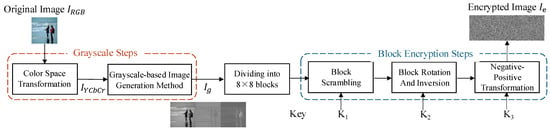
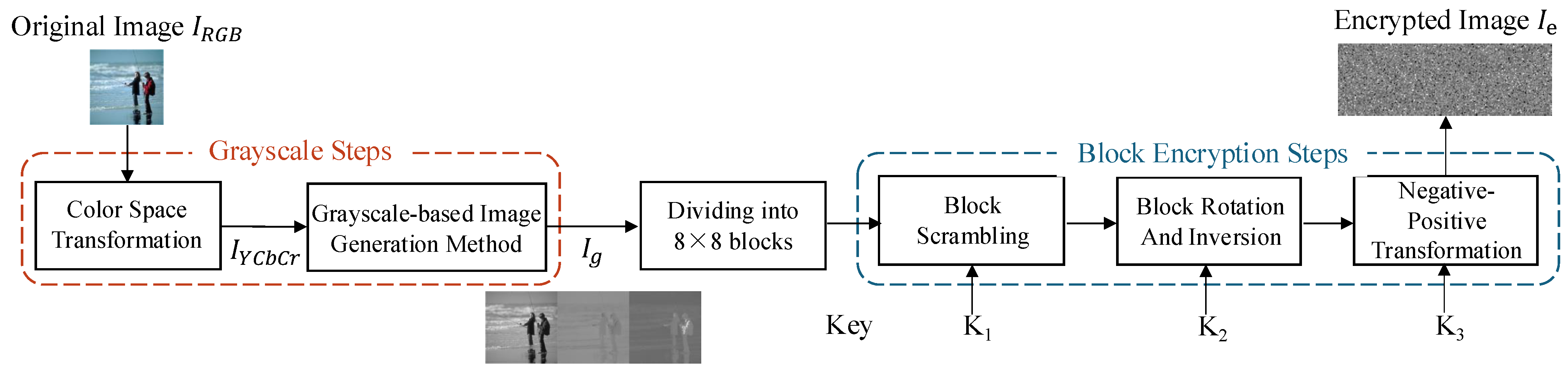
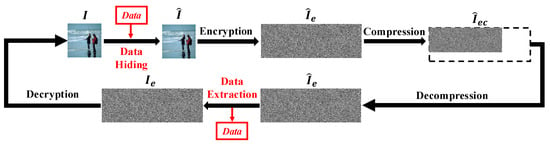
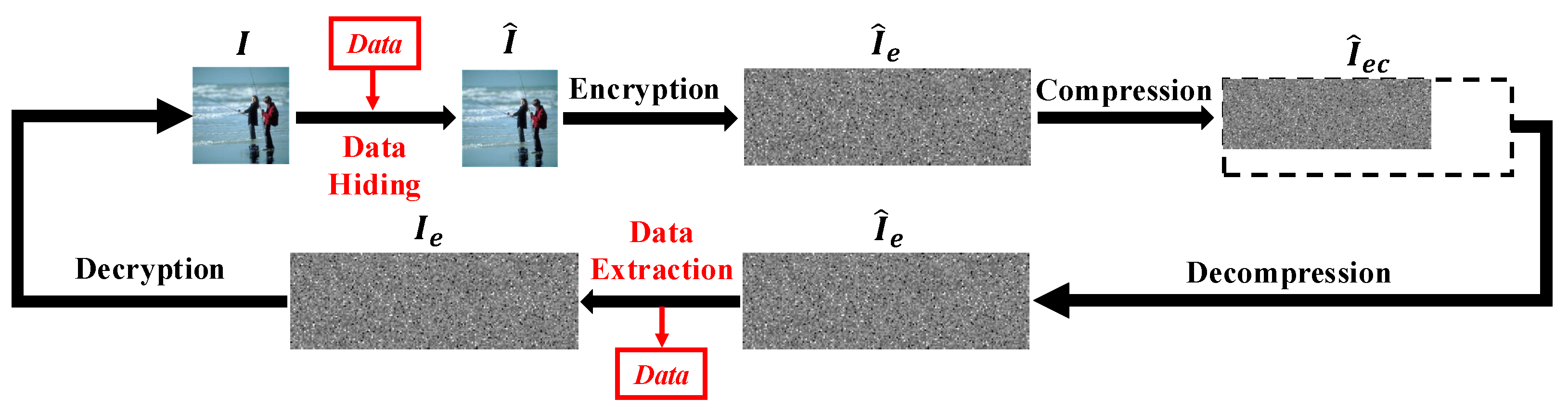
In particular, state-of-the-art EtC pipelines increasingly employ grayscale-based representations to improve compression efficiency and compatibility with standard codecs [6,7]. These systems first convert RGB images into the YCbCr color space and then serialize the luminance and chrominance components into a single grayscale image prior to encryption, as shown in Figure 1. While this design is effective for compression, it fundamentally disrupts spatial correspondence across color channels. As a result, the original alignment between color components is lost, posing a significant challenge for RDH, which typically relies on spatial or inter-pixel correlations for reliable embedding and extraction [31,32,33].
Figure 1.
The grayscale-based encryption-then-compression (EtC) pipeline [6,7]. In this paper, the encrypted grayscale image is compressed by a standard codec in lossless mode to satisfy the bit-exact reversibility requirement of reversible data hiding (RDH).
This challenge is further exacerbated by the block-based visual encryption operations commonly employed in grayscale-based EtC systems, including block permutation, block rotation or reflection, and block-wise brightness inversion [6,7]. These operations effectively destroy the spatial order of image blocks, making it difficult to preserve or recover the correct embedding sequence after encryption. Consequently, many existing RDH schemes for encrypted images either fail under such transformations or require auxiliary information, global synchronization, or restrictive assumptions that limit their applicability in practical EtC pipelines [39,40,41,42,43,44].
From an implementation perspective, an additional difficulty arises from the structural complexity of many RDH/RDHEI schemes. Approaches that rely on global histogram analysis, sequential decoding, or inter-block dependencies inherently limit scalability and complicate deployment on modern electronic platforms [36,37,38]. While lightweight RDH/RDHEI designs have been explored [28,29], they are not tailored to grayscale-based EtC pipelines with YCbCr color space transformation and component serialization, nor do they address the synchronization loss caused by the combined block permutation, rotation/reflection, and brightness inversion used in state-of-the-art grayscale-based EtC systems [6,7]. Therefore, a practical RDH framework for such EtC pipelines should be lightweight, block-independent, and capable of self-synchronization without auxiliary side information.
To address these issues, this paper proposes a block-independent and lightweight RDH framework specifically designed for grayscale-based EtC systems with YCbCr color space transformation and component serialization [6,7]. The framework employs a diagonal pixel absolute differences (DPAD)-based embedding strategy and an encryption-invariant synchronization index (EISI), both of which have been previously introduced in our earlier studies, as fundamental building blocks. By integrating these established techniques into a unified, block-independent framework, the proposed approach enables reliable data embedding and extraction under block permutation, rotation/reflection, and brightness inversion applied to component-serialized grayscale representations, without requiring auxiliary side information.
The main technical aspects of this work can be summarized as follows:
- A RDH framework is developed specifically for grayscale-based EtC pipelines employing YCbCr color space transformation and component serialization, where conventional RDH schemes fail due to the loss of cross-channel correspondence.
- An EISI is employed to recover the embedding order under the block permutation applied to component-serialized grayscale representations, enabling data extraction without auxiliary side information.
- A block-level RDH procedure based on an existing DPAD embedding strategy is employed to ensure compatibility with block permutation, rotation/reflection, and brightness inversion in grayscale-based EtC systems; since all computations are local and constant per block with no inter-block dependencies, the resulting RDH pipeline is lightweight and naturally parallelizable.
Experimental results demonstrate that the proposed scheme achieves reliable data extraction and perfect reversibility while maintaining the statistical characteristics required by the underlying EtC framework [15,16,17,38]. These results confirm that the proposed method provides a practical and effective solution for RDH in modern EtC-based image processing systems with block-level independence.
Paper Organization. The remainder of this paper is organized as follows: Section 2 introduces the grayscale-based EtC pipeline and the limitations of conventional RDH in this setting; Section 3 presents the proposed auxiliary-free, self-synchronizing framework; Section 4 details the embedding and extraction procedures; Section 5 reports experimental results, including security preservation, lossless compression efficiency, capacity, ablation, and complexity/parallel scalability; and Section 6 concludes the paper with limitations and future work.
2. Preparation
2.1. Grayscale-Based EtC System for Efficient Processing
Most existing image compression techniques are optimized for natural (unencrypted) images and therefore perform poorly when applied to noise-like encrypted data. While traditional compression-then-encryption (CtE) systems preserve compression efficiency, they expose unencrypted content during the compression stage and are thus unsuitable for privacy-sensitive applications. In contrast, encryption-then-compression (EtC) systems apply encryption prior to compression, enabling secure image processing without sacrificing coding efficiency.
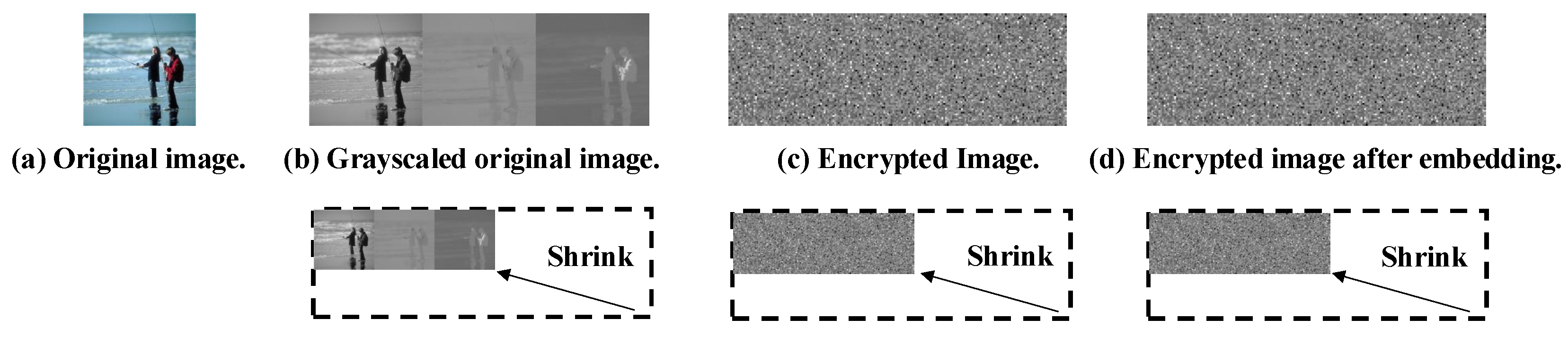
Among various EtC approaches, the grayscale-based EtC framework [6,7] has attracted considerable attention due to its compatibility with standard image codecs and its block-based processing structure. In this framework, an RGB image is first converted into the YCbCr color space, and the luminance and chrominance components are serialized into a single grayscale representation. The resulting grayscale image is then encrypted using a set of block-based operations. Owing to the local and independent nature of these operations, the framework is well-suited for block-wise processing without introducing inter-block dependencies. Note that the RGB↔YCbCr conversion is an inherent step of the target grayscale-based EtC pipeline [6,7] for codec compatibility, rather than an additional operation introduced by our RDH method.
The overall procedure of the grayscale-based EtC system is summarized as follows. Here, “PRNG” denotes a key-driven pseudo-random number generator (seeded by the secret key) that produces deterministic pseudo-random sequences for the block-wise operations as in [6,7].
- Convert an RGB image of size into a YCbCr image consisting of three channels: , , and .
- Horizontally concatenate the three channels to generate a grayscale image of size (see Figure 2).Figure 2. Illustration of grayscale-based image generation [6,7]. The RGB components are converted to YCbCr and concatenated horizontally to form (4:4:4) prior to encryption.
- Divide into non-overlapping blocks of size .
- Pseudo-randomly permute the block positions using a PRNG.
- Pseudo-randomly rotate and/or flip each block using another PRNG.
- Pseudo-randomly invert the brightness of each block using a third PRNG.
- Obtain the encrypted grayscale image of size .
Details of Steps 1, 4, 5, and 6 are described below.
2.1.1. Color Space Transformation
Let the pixel values at the same spatial position in the RGB and YCbCr images be denoted by R, G, B, Y, , and , respectively. The color space transformation is defined as
with the inverse transformation given by
Here, denotes rounding followed by clamping to the range [14].
2.1.2. Block Permutation
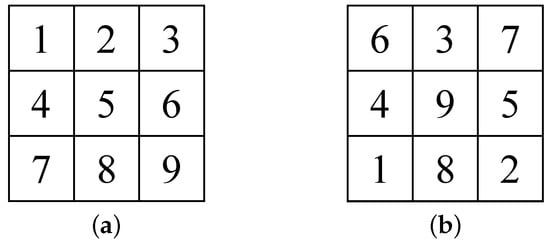
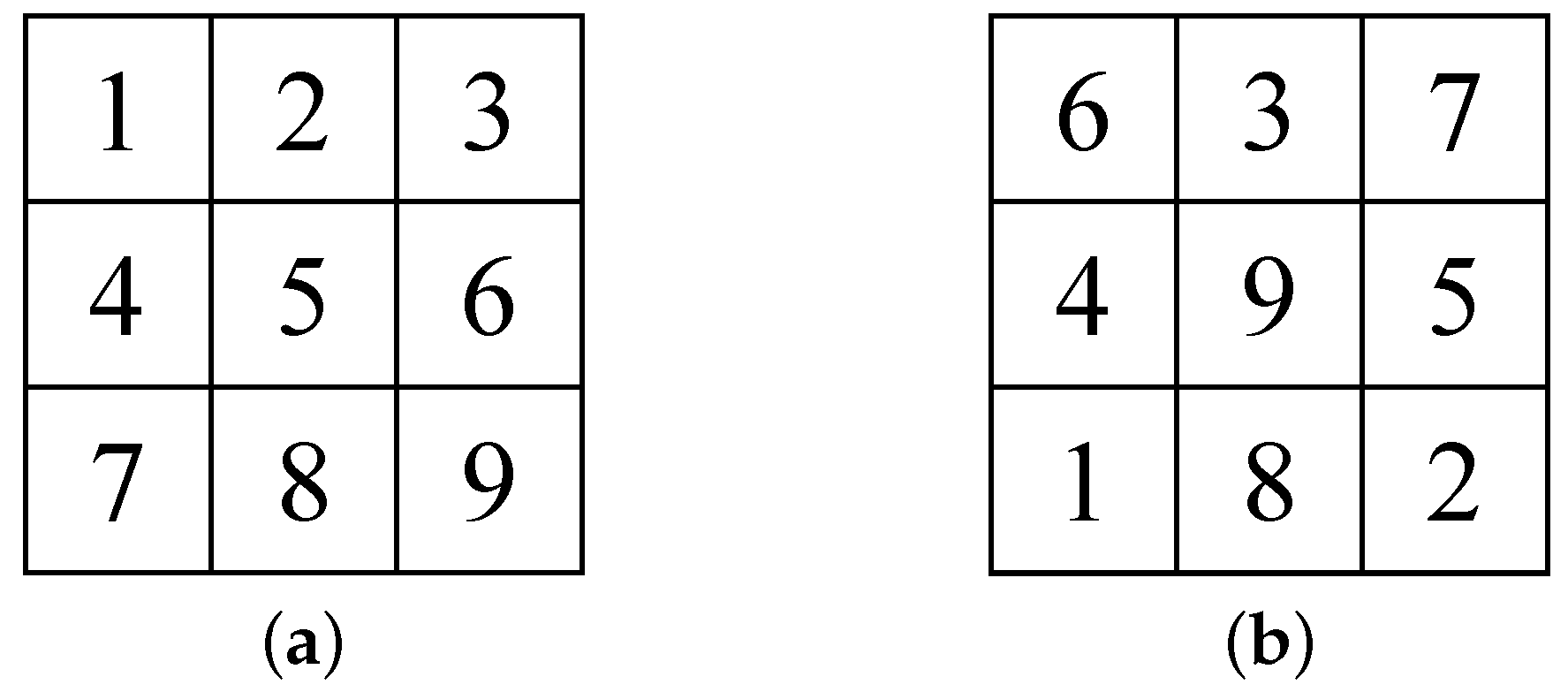
Using a PRNG with key , the blocks in are pseudo-randomly permuted as shown in Figure 3. This operation destroys the global spatial structure of the image while preserving intra-block pixel relationships. Specifically, the image is partitioned into non-overlapping blocks and indexed in raster-scan order. A key-driven PRNG seeded by generates a deterministic permutation of the block indices, and the blocks are rearranged accordingly to form the permuted image.
Figure 3.
An example of block permutation. (a) Before permutation. (b) After permutation.
2.1.3. Block Rotation/Flipping
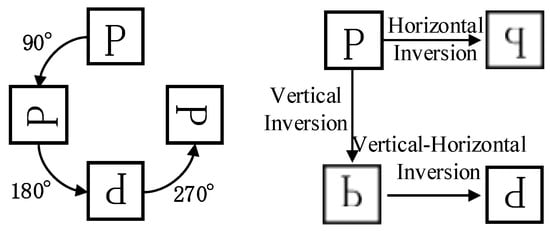
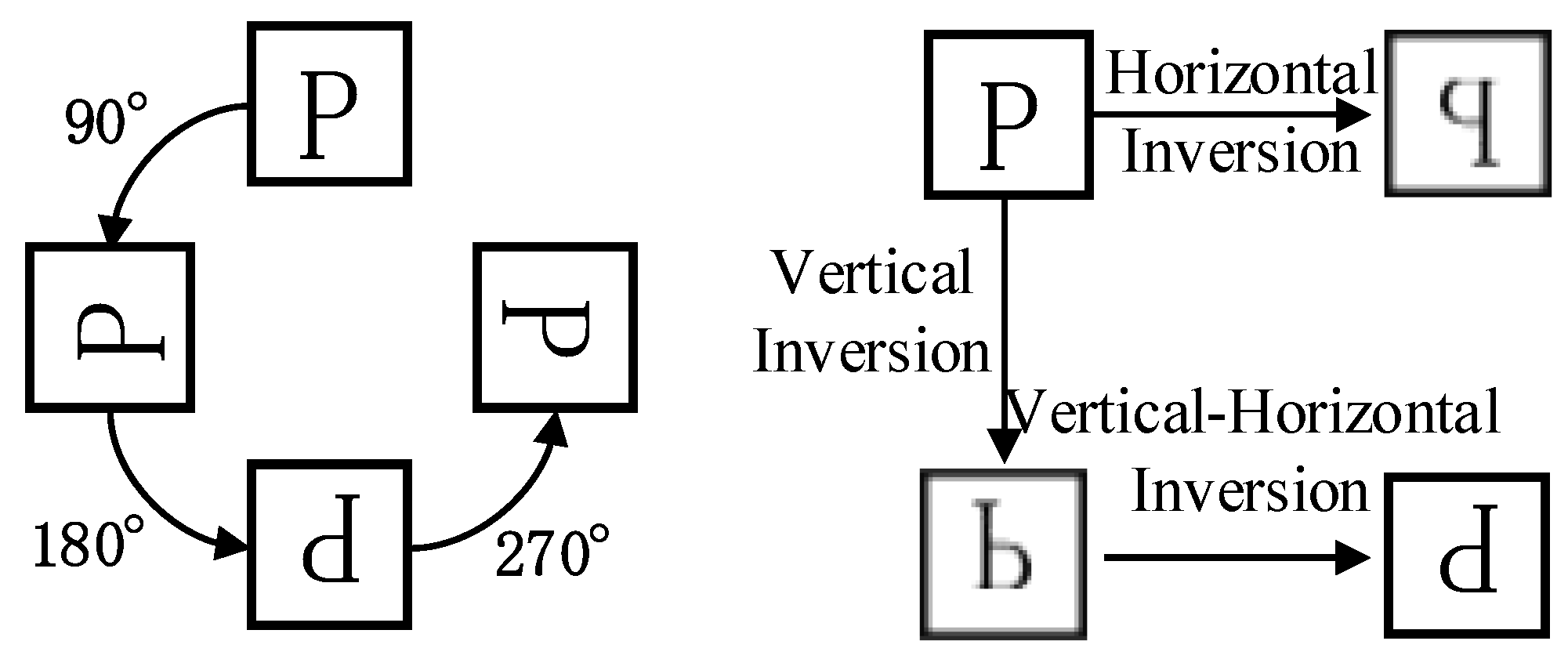
Using another PRNG with key , each block is pseudo-randomly rotated and/or flipped. As illustrated in Figure 4, this step scrambles local geometric orientation while keeping the set of pixel values within each block unchanged. Specifically, each block is assigned an index, and a key-driven PRNG seeded by generates a deterministic pseudo-random integer for block . The value selects one transform from a predefined candidate set consisting of four rotations with an optional reflection, and the selected transform is applied independently to each block. This operation assumes square blocks () as in [6,7].
Figure 4.
Block rotation and flipping.
2.1.4. Brightness Inversion
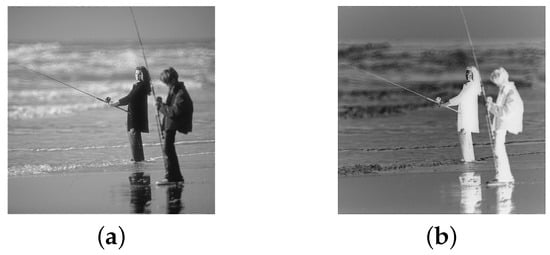
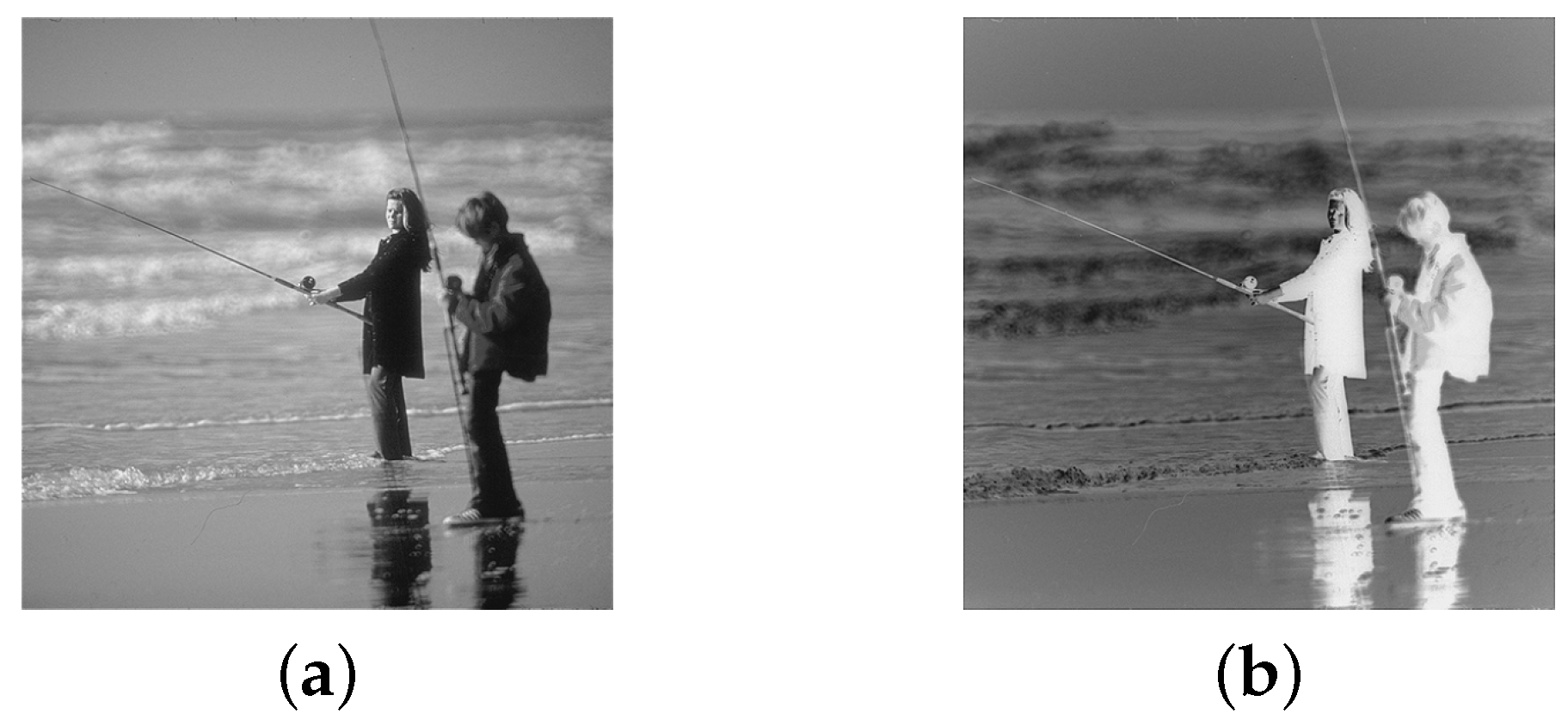
With key , the pixel values in each block are inverted, c.f. Figure 5, according to
where p and denote the original and transformed pixel values, respectively, is a random bit for the i-th block, and A is the maximum possible pixel value.
Figure 5.
An example of a negative–positive transformation (all pixels are inverted for illustration). (a) Original. (b) Brightness inverted.
2.2. Limitations of Conventional RDH Schemes
RDH can be applied either before or after encryption. In the context of EtC systems, RDH performed prior to encryption is often preferable, c.f., Figure 6, as it avoids the complexity associated with manipulating encrypted data.
Figure 6.
The RDH assumed in this paper.
However, conventional RDH schemes encounter substantial difficulties when applied to grayscale-based EtC pipelines:
- Computational Overhead: Methods based on prediction-error expansion or histogram shifting [37,38] typically rely on global histogram analysis or complex predictors, which introduce non-local dependencies.
- Auxiliary Information Dependence: To cope with geometric transformations and brightness inversion, many schemes require additional side information, increasing system complexity and reducing effective payload.
- Color Transformation Sensitivity: The non-bijective nature of RGB-to-YCbCr conversion causes rounding errors that invalidate reversibility assumptions in many existing RDH approaches.
These limitations motivate the development of an RDH framework that is lightweight, block-independent, and robust to the specific distortions introduced by grayscale-based EtC systems. The proposed method addresses these requirements through a block-wise design based on diagonal pixel differences, as detailed in the following section.
3. Proposed Framework
The proposed framework is designed with the following objectives in mind:
- Compatibility: Ensuring seamless integration with grayscale-based EtC pipelines employing YCbCr color space transformation and component serialization, while remaining robust against the three standard block-based encryption operations used in EtC systems [6,7].
- Reliability: Enabling accurate extraction of embedded data and perfect image restoration without relying on image-dependent parameters or auxiliary side information.
- Structural Efficiency: Organizing embedding and extraction operations in a block-independent manner using only low-complexity arithmetic, so that the resulting framework is naturally amenable to parallel execution.
3.1. Support for Color Space Conversion and Component Serialization
In the considered grayscale-based EtC pipeline, an RGB image is first converted into the YCbCr color space, and the luminance and chrominance components are serialized into a single grayscale image prior to encryption. The proposed framework performs data embedding directly on this component-serialized grayscale representation, thereby avoiding interference with the reversibility of the color space transformation.
In particular, data embedding is restricted to the Cb and Cr chrominance components rather than the Y (luminance) component. Since the Y channel typically exhibits higher sensitivity to pixel modification, avoiding it helps reduce visual distortion and mitigates overflow/underflow risks in reversible processing.
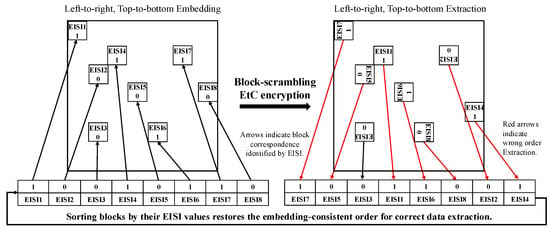
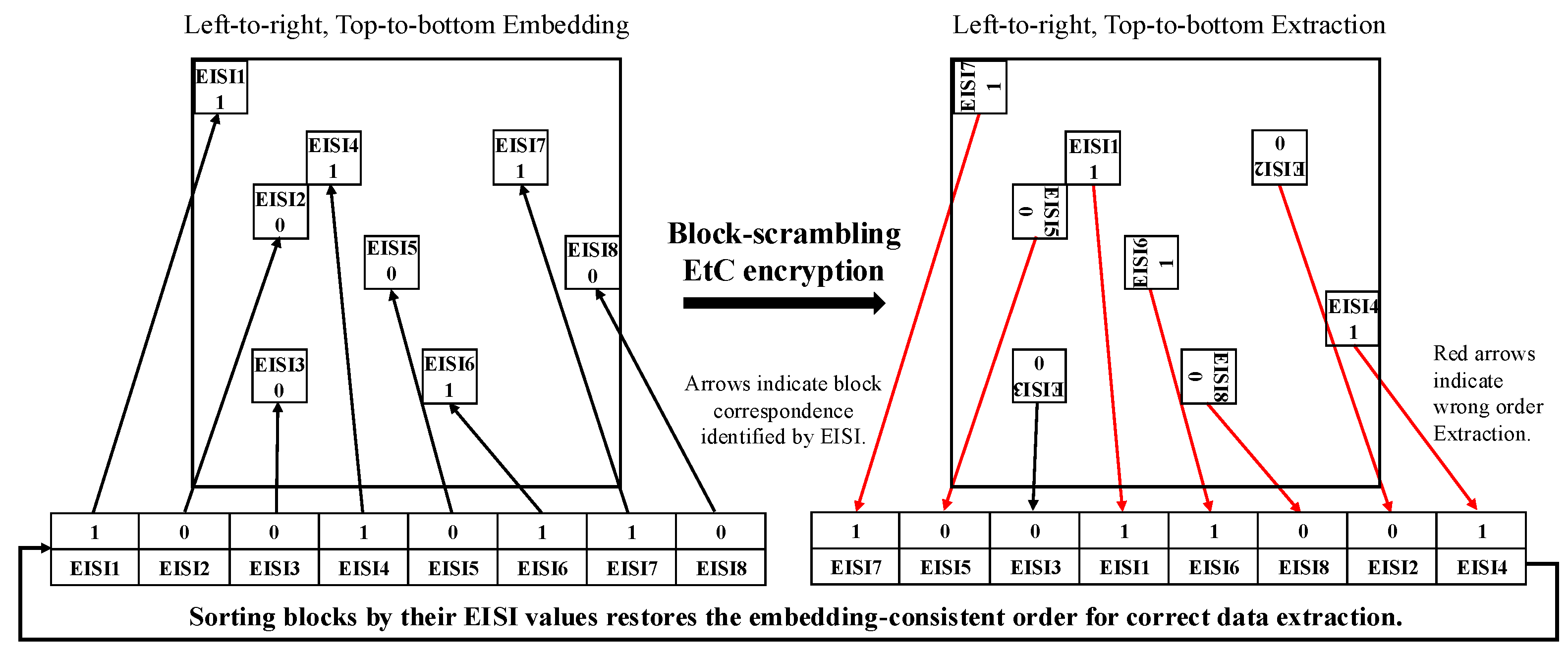
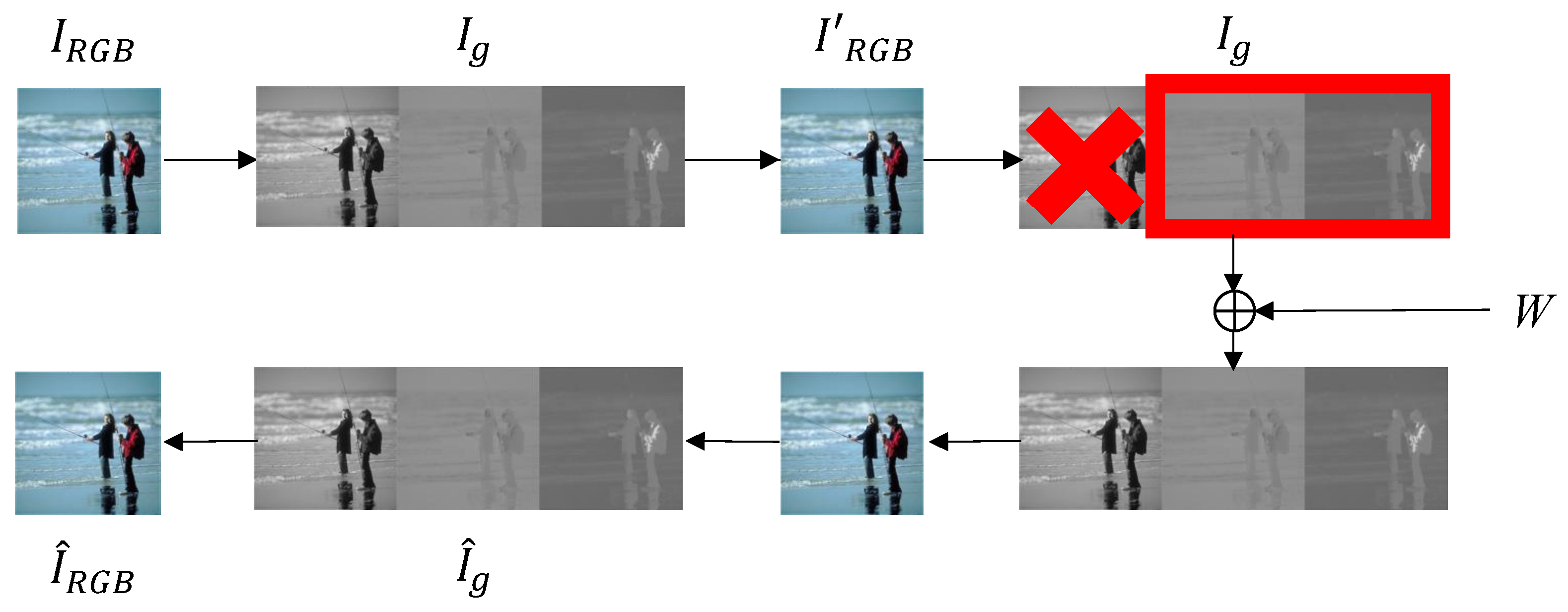
As conceptually illustrated in Figure 7, after YCbCr component serialization, the subsequent block-based encryption operations in the grayscale-based EtC system—block permutation, block rotation/reflection, and block-wise brightness inversion—severely disrupt the spatial ordering and orientation consistency of blocks, making conventional scan-order-dependent embedding/extraction unreliable. In contrast, each block preserves its EISI under these operations, which enables the extractor to reconstruct an embedding-consistent block order directly in the encrypted domain without auxiliary side information.
Figure 7.
Impact of block-based encryption and EISI-based synchronization in component-serialized grayscale EtC systems.
Embedding in the RGB domain is unsuitable in this context. The RGB-to-YCbCr conversion involves rounding operations (Equations (1)–(6)), which introduce quantization errors that cannot be compensated once subsequent encryption operations disrupt pixel correlations. As confirmed by preliminary experiments (Section 5.5), embedding cues defined in the RGB domain are almost entirely destroyed after color space conversion. Therefore, reliable reversible embedding must be performed on the YCbCr-derived grayscale representation before encryption.
3.2. Auxiliary-Information-Free and Self-Synchronizing Block-Level Design
As illustrated in Figure 7, the block-based encryption operations employed in EtC systems—namely block permutation, rotation/reflection, and brightness inversion—severely disrupt the spatial ordering of blocks. As a result, embedding schemes that rely on global scanning order or inter-block dependencies become ineffective.
To address this issue, the proposed framework adopts a block-independent design that leverages two previously established components:
3.2.1. Transformation-Invariant Embedding Cue (DPAD)
As an embedding cue, the framework employs the DPAD, which is computed using only basic subtraction and absolute value operations. DPAD is invariant under block rotation, flipping, and brightness inversion, allowing embedded and non-embedded blocks to be distinguished directly in the encrypted domain. By relying solely on local pixel relationships, DPAD avoids the need for complex predictors or global statistics.
3.2.2. Encryption-Invariant Synchronization Index (EISI)
While DPAD enables reliable block-level embedding detection, it does not recover the original ordering of permuted blocks. For this purpose, the framework adopts the EISI, a content-based tag computed independently within each block. Because EISI is invariant under block permutation applied to component-serialized grayscale representations, it enables the extraction process to reconstruct the embedding-consistent order without auxiliary side information. As conceptually illustrated in Figure 7, each block preserves its EISI value even after block-based encryption, allowing the extractor to restore the correct embedding order directly in the encrypted domain.
Since both DPAD computation and EISI evaluation are performed independently for each block, embedding and extraction can be carried out without inter-block dependencies. This auxiliary-free, self-synchronizing structure simplifies system integration and naturally supports parallel execution across blocks.
4. Proposed Scheme
The proposed scheme is designed to meet the following objectives, focusing on practical deployment within grayscale-based EtC pipelines:
- Compatibility: Supporting grayscale image generation based on the YCbCr color space and ensuring robustness against the three visual encryption operations of EtC systems [6,7].
- Reliability: Enabling accurate extraction of embedded data and perfect image restoration without requiring the transmission, storage, or memorization of image-dependent parameters or auxiliary side information.
- Lightweight and Parallelizable Design: Ensuring that the embedding and extraction procedures rely only on low-complexity arithmetic and block-wise independent operations, which are amenable to parallel implementation and hardware-friendly deployment.
4.1. Design Strategy
4.1.1. Support for Color Space Conversion
To generate the grayscale image used in the embedding stage, the proposed scheme first converts RGB images to the YCbCr color space and horizontally concatenates the three components (Figure 8). This structure ensures that data embedding is performed within the EtC pipeline without interfering with the reversibility of the color transformation.
Figure 8.
Policy for inverse color space conversion support.
Specifically, the proposed scheme embeds data into the Cb and Cr chrominance components, excluding the Y (luminance) component. This design choice provides the following practical advantages:
- Reduced processing scope: Restricting the embedding and extraction operations to chrominance components simplifies the processing flow and reduces the number of candidate blocks to be examined, which is beneficial for practical implementations.
- Favorable local statistics for difference-based embedding: Compared with the luminance component, chrominance components often exhibit smoother local variations, which tend to produce smaller difference values and can improve the feasibility of difference-expansion-based reversible embedding under strict reversibility constraints.
- Conservative distortion control: Avoiding modifications to the luminance component helps limit perceptually sensitive changes and reduces the risk of value overflow/underflow when combined with RGB↔YCbCr conversion and subsequent EtC operations.
Crucially, direct embedding in the RGB domain is identified as unsuitable for this framework. The RGB-to-YCbCr conversion involves rounding operations that introduce quantization errors. These errors are not bitwise reversible after the encryption process disrupts the pixel correlations. Our experiments (discussed in Section 5.5) confirm that over 99.99% of embedding cues defined in the RGB domain are destroyed after color conversion. This demonstrates that for a reliable reversible system, embedding must be performed on the YCbCr-derived grayscale representation prior to encryption.
4.1.2. Auxiliary-Information-Free and Self-Synchronizing Embedding
As illustrated in Figure 7, the EtC encryption steps [6,7]—specifically block permutation, rotation/flipping, and brightness inversion—dramatically alter the spatial arrangement of blocks. Consequently, the original order of the embedded bitstream is disrupted, rendering conventional RDH schemes infeasible.
To address this, we adopt a block-independent embedding strategy based on two lightweight components that are preserved under the EtC operations:
- Transformation-Invariant Embedding Cue (DPAD): We build upon the DPAD, whose computation requires only basic subtraction and absolute value operations. DPAD is preserved under block rotation/reflection and brightness inversion, enabling the decoder to identify candidate embeddable blocks from the encrypted image without decryption.
- EISI: To handle the synchronization issue caused by block permutation, we build upon an EISI, which is computed locally within each block and remains available after the EtC operations. In particular, the EISI is designed to support ordering recovery even under block permutation applied to component-serialized grayscale representations, enabling extraction without auxiliary side information.
4.2. Data Embedding Procedure
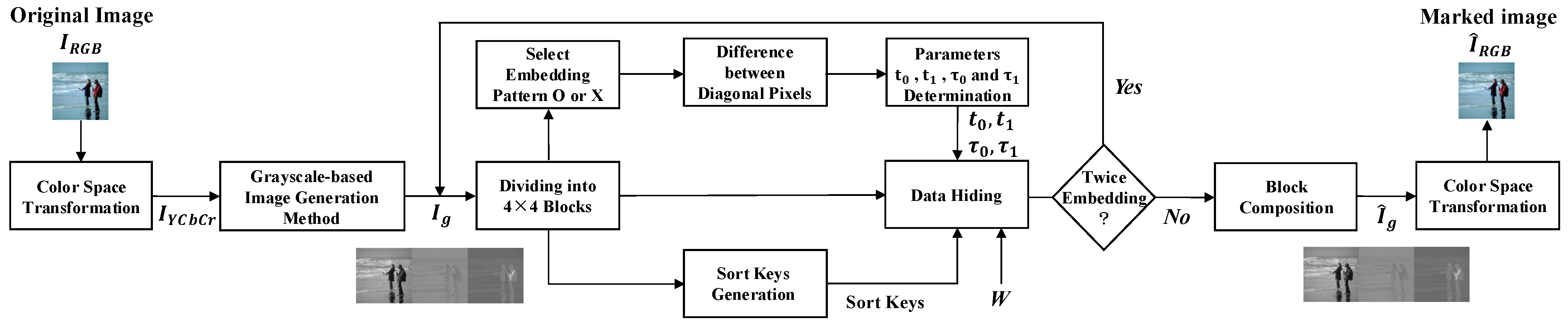
The proposed scheme embeds data into grayscale images generated from YCbCr-transformed color images as shown in Figure 9. The process follows these steps:
Figure 9.
Overview of the proposed data hiding scheme.
- Color Space Conversion. Convert the RGB image of size into the YCbCr color space, resulting in three separate channels: , , and .
- Channel Concatenation. Horizontally concatenate the three channels to generate a grayscale image of size .
- Block Partitioning. Divide into non-overlapping blocks. The embedding block size is set to , which evenly partitions the encryption blocks of the target EtC system [6,7] and prevents any embedding block from spanning two encrypted blocks. Moreover, provides a suitable balance for the DPAD + EISI design: tends to produce less discriminative EISI (higher collision probability), whereas increases the chance of violating reversible-embedding constraints (e.g., overflow/underflow) under DPAD.
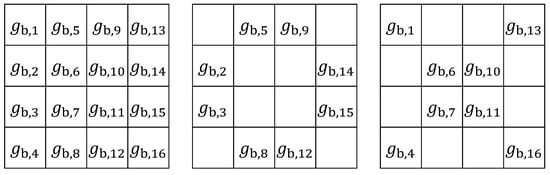
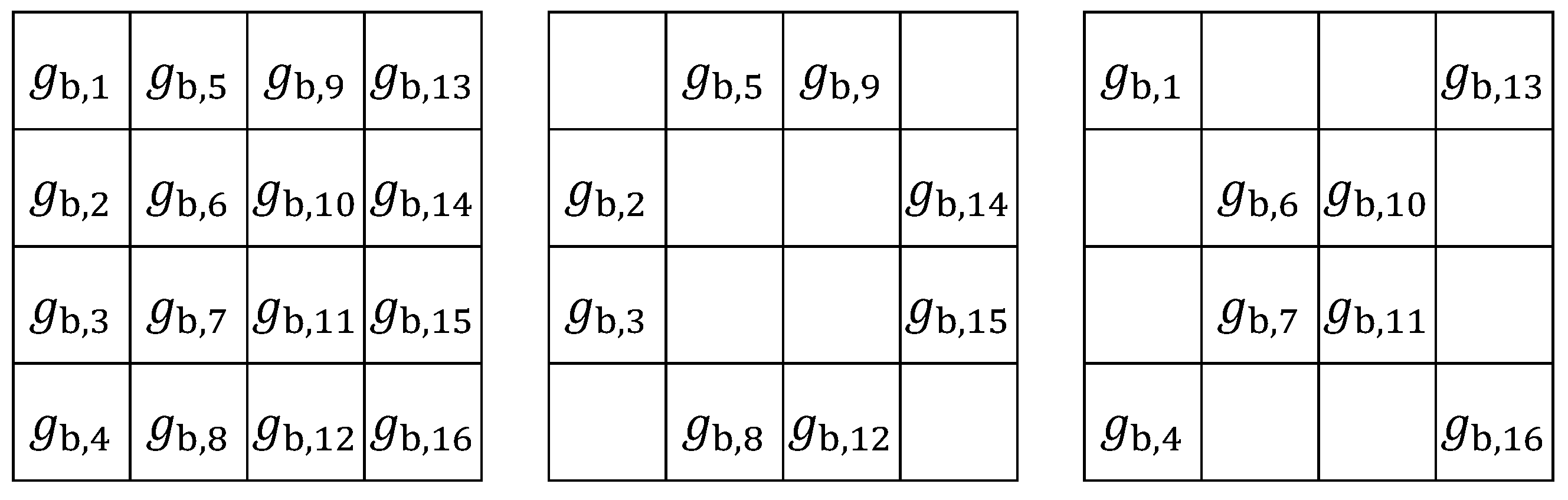
- Pattern Selection (O or X). Select one of two embedding patterns —O or X— as shown in Figure 10. Each pattern defines specific pixel pairs within the block used to compute DPAD values. The indices are assigned as follows:Figure 10. For the b-th -pixel block (left), pattern O uses the 2nd, 3rd, 5th, 8th, 9th, 12th, 14th, and 15th pixels within the block for embedding (center), while pattern X utilizes the 1st, 4th, 6th, 7th, 10th, 11th, 13th, and 16th pixels (right).
- DPAD Computation. For each block, calculate the absolute differences between pixel pairs along diagonal paths, where . Compute the mean of these differences, , and their relative difference, , to determine embeddability.
- Parameter Determination. Set parameters , , , and based on the distribution of zero-frequency (histogram-gap) DPAD values. Let the DPAD value domain be for 8-bit images, and let denote the empirical histogram count of DPAD value d computed over the blocks used for parameter determination. We define the set of zero-frequency DPAD values asand its even/odd subsets asAfter sorting each subset in ascending order, and denote the n-th smallest elements of and , respectively.
- Trial Embedding. Only blocks with are considered for embedding. Note that blocks from the luminance channel are explicitly excluded to optimize efficiency and image quality.
- If , attempt to expand based on .
- If , attempt to expand using .
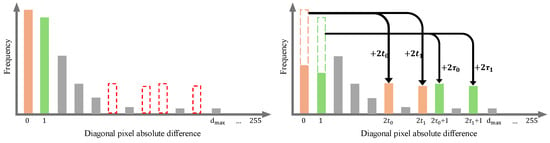
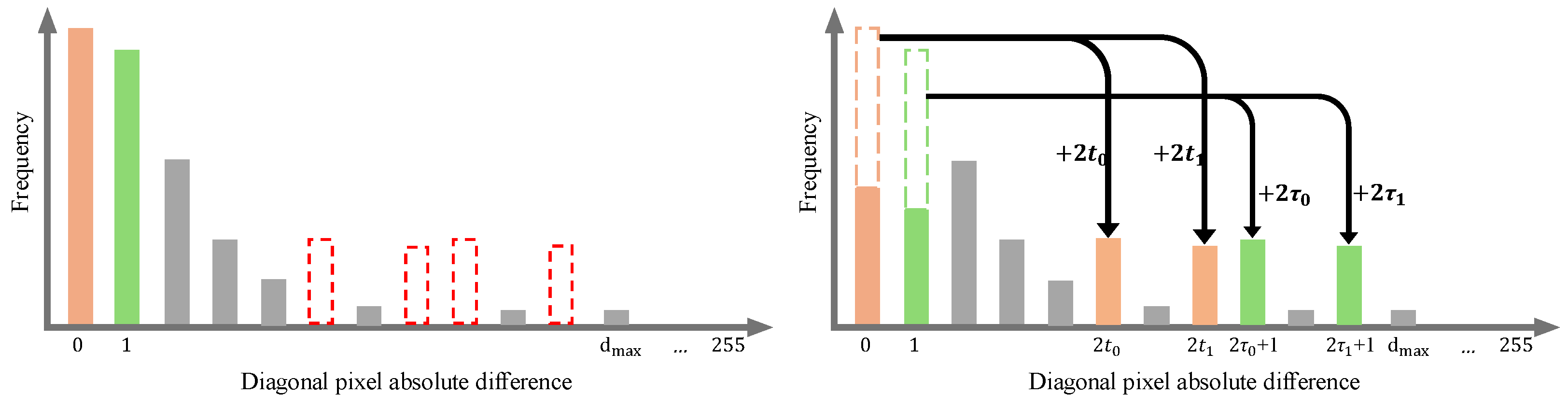
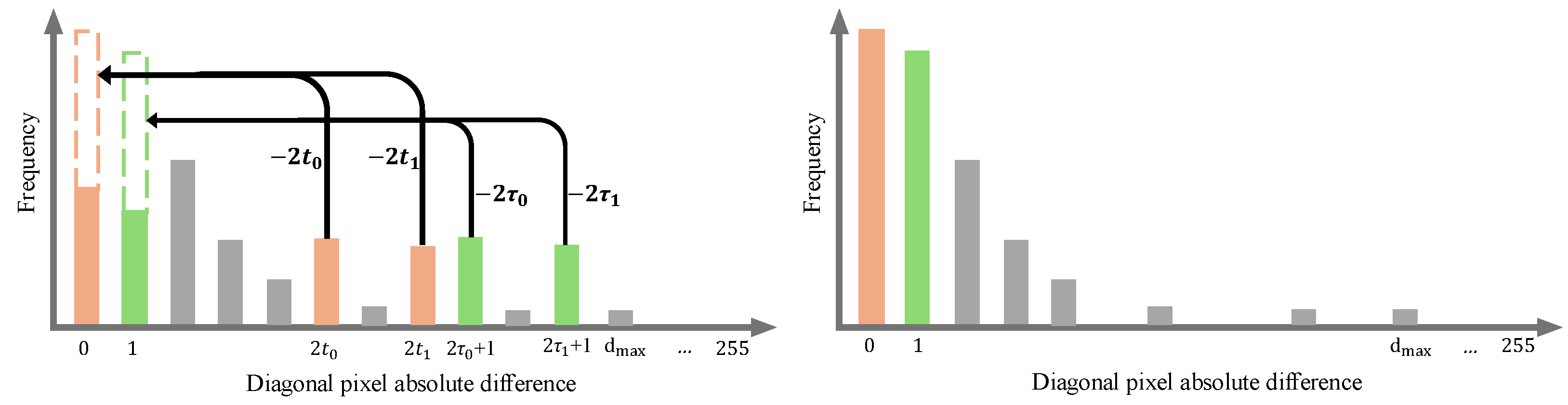
We perform a reversibility pre-check by simulating the required rounding/clamping in the RGB↔YCbCr conversion and verifying that the difference-expansion update does not cause overflow/underflow. Blocks that violate these constraints are excluded from embedding. For suitable blocks, an EISI is then generated:where denotes concatenation of integer fields into a single index. Here, the pixel difference terms and (detailed in Step 7) are sorted in ascending order to form and , so that the resulting index is robust to block rotation and flipping.To guarantee a unique extraction order, blocks with non-unique EISI values are excluded from embedding; i.e., we keep only the blocks whose appears exactly once among all candidate blocks. - Difference Expansion. In ascending order of , apply difference expansion using t or as shown in Figure 11. The embedding modifies specific diagonal pixels according to their pattern (O or X) and payload bit . Specifically:Figure 11. Expanding diagonal pixel absolute difference (DPAD) to hide data.Here, denotes the group of diagonal pixels in the -th block of , where and .
- Optional Second Embedding Pass. To increase capacity, a second embedding can be performed using the alternate pattern. If no second pass is required, proceed to the next step.
- Reconstruction and Restoration. Combine all blocks to obtain , then split into Y, Cb, and Cr channels and convert back to RGB to obtain the final stego image .
4.3. Image Recovery and Data Extraction
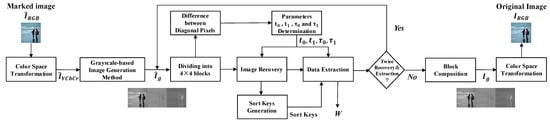
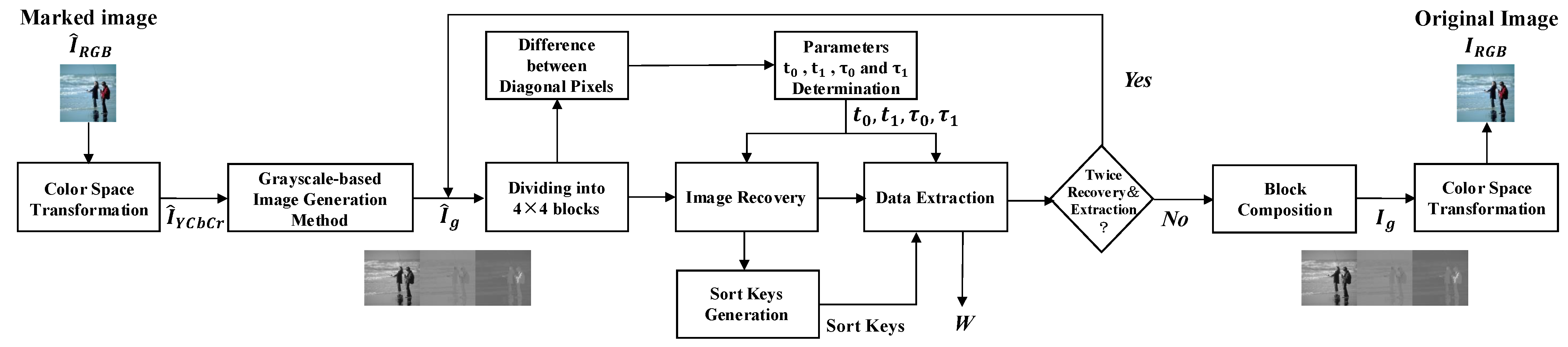
The extraction process reverses the embedding procedure to recover both the embedded data and the original image. Figure 12 illustrates the overall workflow.
Figure 12.
Data extraction and image recovery in the proposed scheme.
- Color Space Conversion and Block Partitioning. Convert stego image to YCbCr, concatenate channels, and divide into blocks.
- Pattern Identification. Identify whether pattern O or X was used. If two embedding passes were performed, reverse the order during extraction (last-in, first-out).
- DPAD and EISI Recomputation. Recompute DPAD values () and select candidate blocks with . For these candidates, recalculate the EISI using the encryption-invariant features.
- Bit Extraction and Block Restoration. Processing candidate blocks in ascending order of , perform inverse difference expansion to recover the embedded bits and restore the original pixel values.
- If originally , the embedded change used ;
- If originally , the embedded change used .
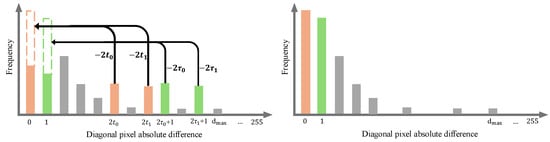
By examining the expanded differences (Figure 13), one can deduce the embedded bit and undo the pixel modifications. Since this step relies only on local block data, it can be executed in parallel threads due to its block-independent design.Figure 13. Restoring diagonal pixel absolute differences (DPAD) for data extraction and image restoration. - Data Collection and Image Reconstruction. Append extracted bits to the output payload , recombine restored blocks into , and finally convert back to RGB format.
Summary. Overall, by embedding only in the Cb/Cr region and using DPAD-based block selection together with EISI-based ordering in a block-independent manner, the proposed scheme enables reliable reversible extraction and perfect restoration under permutation, rotation/reflection, and brightness inversion, while remaining naturally parallelizable for practical grayscale-based EtC deployments.
5. Experimental Results
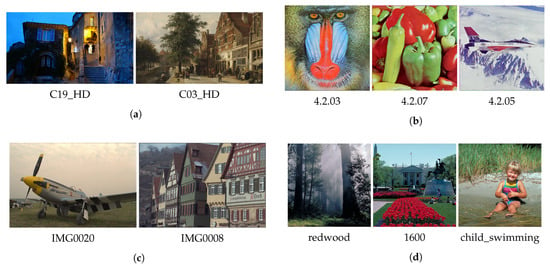
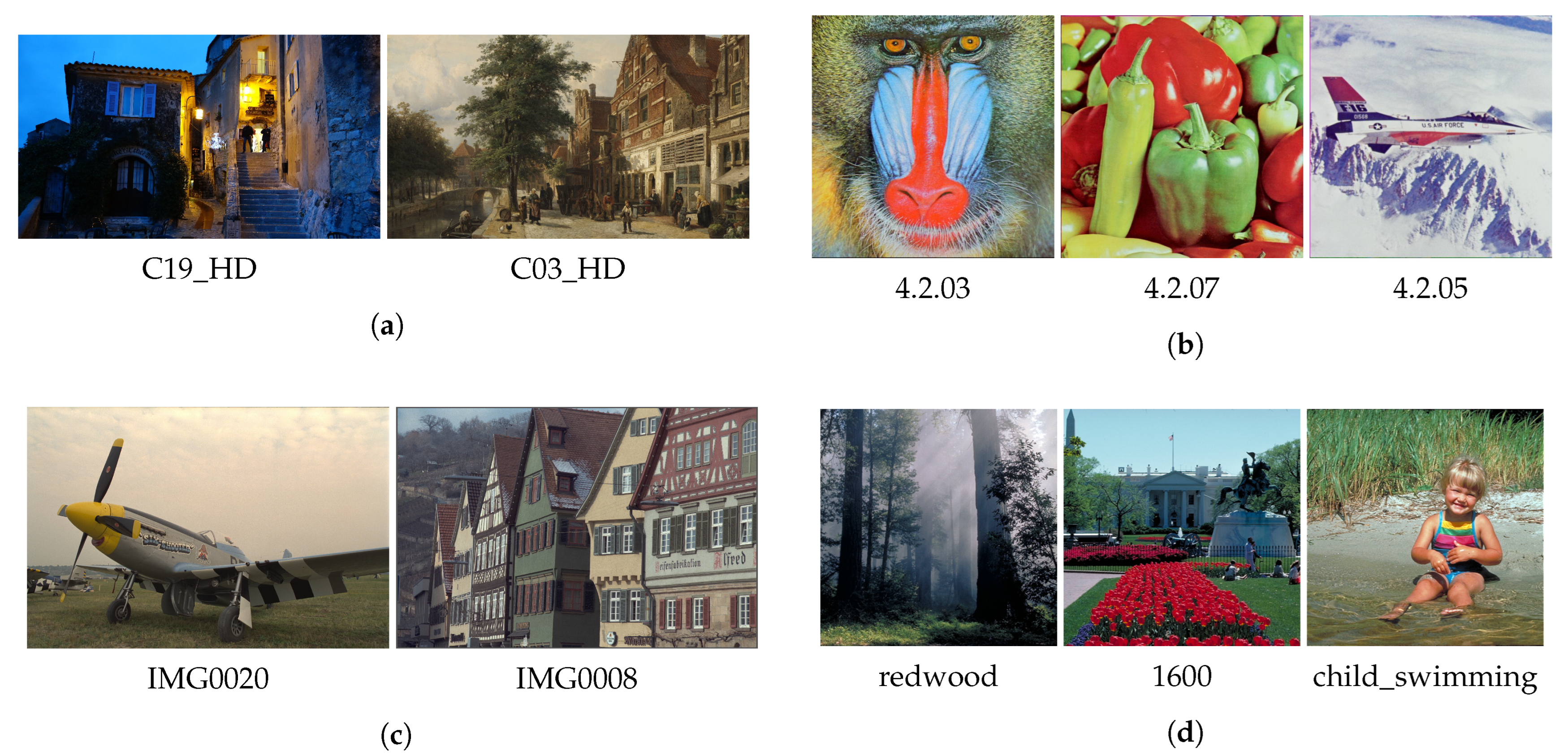
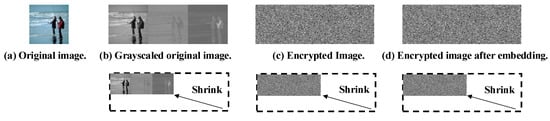
To evaluate the performance and compatibility of the proposed scheme with the EtC system [6,7], experiments were conducted using 24-bit RGB images from four publicly available datasets—UltraEye [45], USC-SIPI [46], Kodak [47], and CSIQ [48], as shown in Figure 14. Across all four datasets and all tested payload settings (including maximum payload cases), the proposed scheme consistently achieves a 100% extraction success rate (ESR) and 0 bit error rate (BER), where the ESR is defined as the percentage of trials with perfect payload recovery (BER = 0), demonstrating that the DPAD-based cue remains stable across diverse texture characteristics.
Figure 14.
Some images from four different datasets with their respective total number of images and image sizes. (a) UltraEye dataset [45]: 38 images, . (b) USC-SIPI dataset [46]: 50 images, to . (c) Kodak dataset [47]: 24 images, . (d) CSIQ dataset [48]: 30 images, .
- Scope of comparisons
Direct quantitative comparisons with existing RDH/RDHEI methods are not reported here because most representative schemes are developed under ciphertext models and processing assumptions that are not aligned with the target grayscale-based EtC pipeline [6,7]. Since our evaluation requires strict error-free extraction (BER = 0) under the unmodified target pipeline, such methods cannot be meaningfully benchmarked in the same experimental protocol. Instead, Table 1 summarizes the key compatibility factors and clarifies the comparison boundary considered in this work.
Table 1.
Compatibility summary with representative related methods under the target grayscale-based EtC setting [6,7].
In the following subsections, we analyze the impact of data hiding on encryption security, evaluate lossless compression efficiency, investigate embedding capacity, and validate the architecture through an ablation study. Finally, we provide a theoretical complexity analysis to demonstrate the scheme’s suitability for practical EtC-based image processing pipelines.
5.1. Adjacent Pixel Correlation
To confirm that data embedding does not compromise encryption security, we analyze the statistical properties of the encrypted images. Since the EtC system performs encryption on a block-by-block basis with blocks, its security can be evaluated by analyzing the correlation between adjacent blocks [38]. High encryption performance leads to low block-to-block correlation.
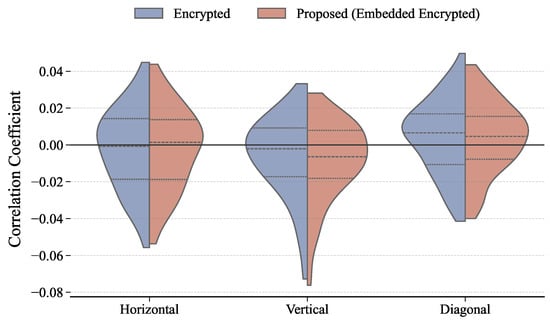
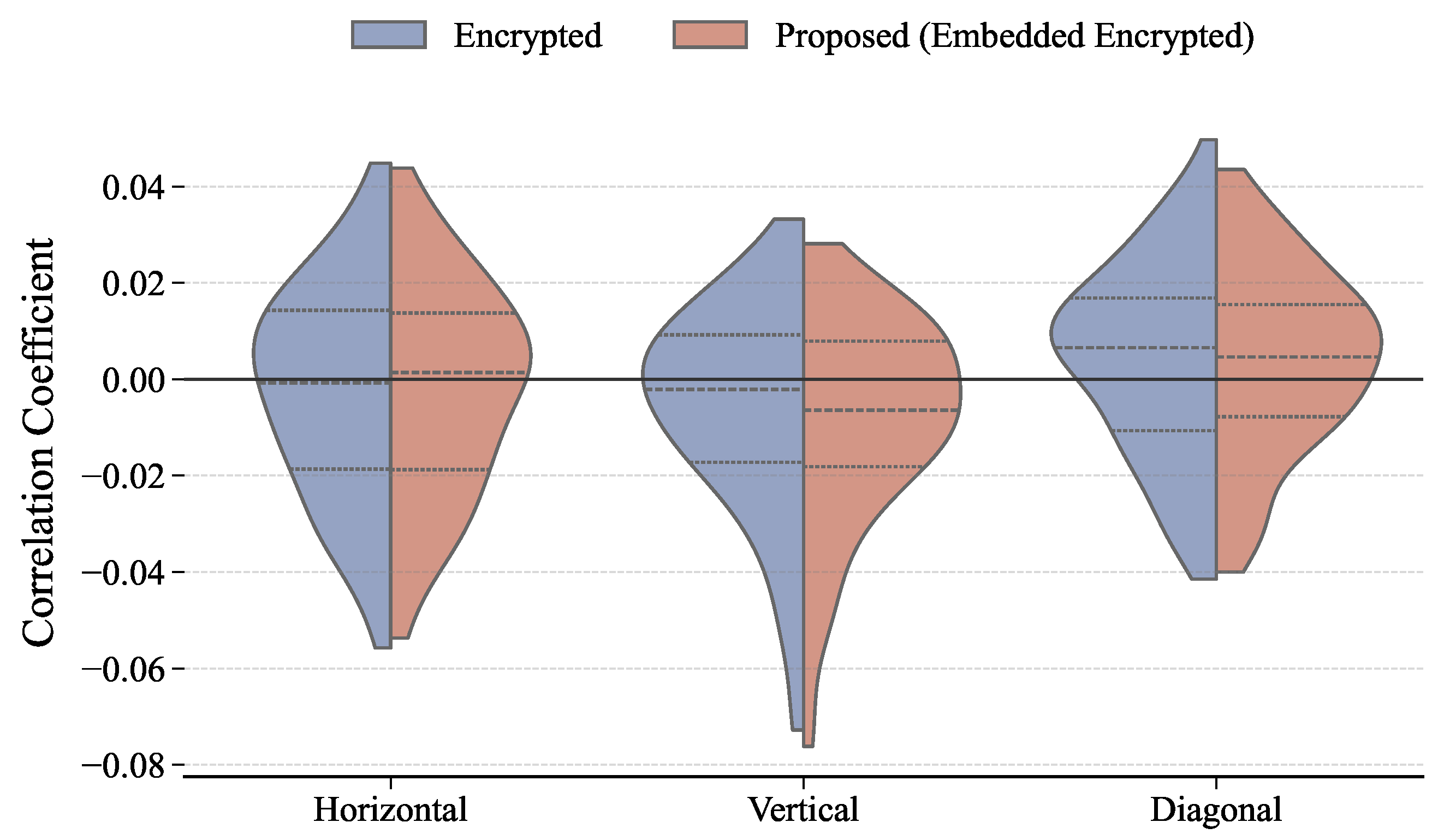
To calculate block-level correlation, a downsampled image was created by extracting the top-left pixel of each block, forming a 1/8-scale image (Figure 15). Figure 16 shows the correlation coefficients computed using the following equation:
where are pixel value pairs from adjacent blocks, and N is the total number of such pairs [49].
Figure 15.
Illustration of the downsampling process for block-level correlation analysis.
Figure 16.
Split violin plot of correlation coefficients between adjacent blocks (horizontal, vertical, and diagonal) for encrypted images with and without embedded data under the condition that the maximum payload is embedded. Since the average absolute value stays well below 0.02, data hiding by the proposed scheme hardly affects the randomness of encrypted images.
The results confirm that the correlation coefficients remain close to zero and that their distribution is essentially preserved even after data embedding. This indicates that the proposed embedding process does not degrade the security strength of the EtC system, as the statistical characteristics of encrypted blocks remain random-like and no detectable anomalies are introduced.
Moreover, EISI is a deterministic per-block descriptor computed solely from within-block local invariant statistics, containing no secret key material or PRNG outputs; it provides no cross-block linkage constraints or relative spatial-position information, and it introduces no additional side information beyond what is already observable from the original EtC ciphertext.
5.2. Lossless Compression Efficiency
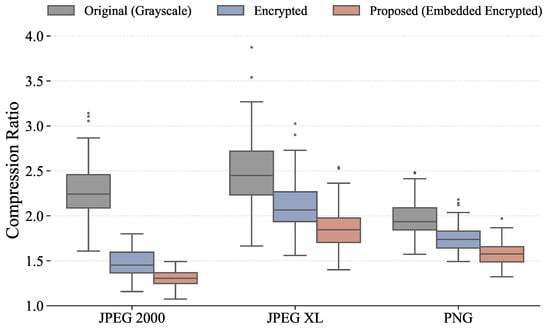
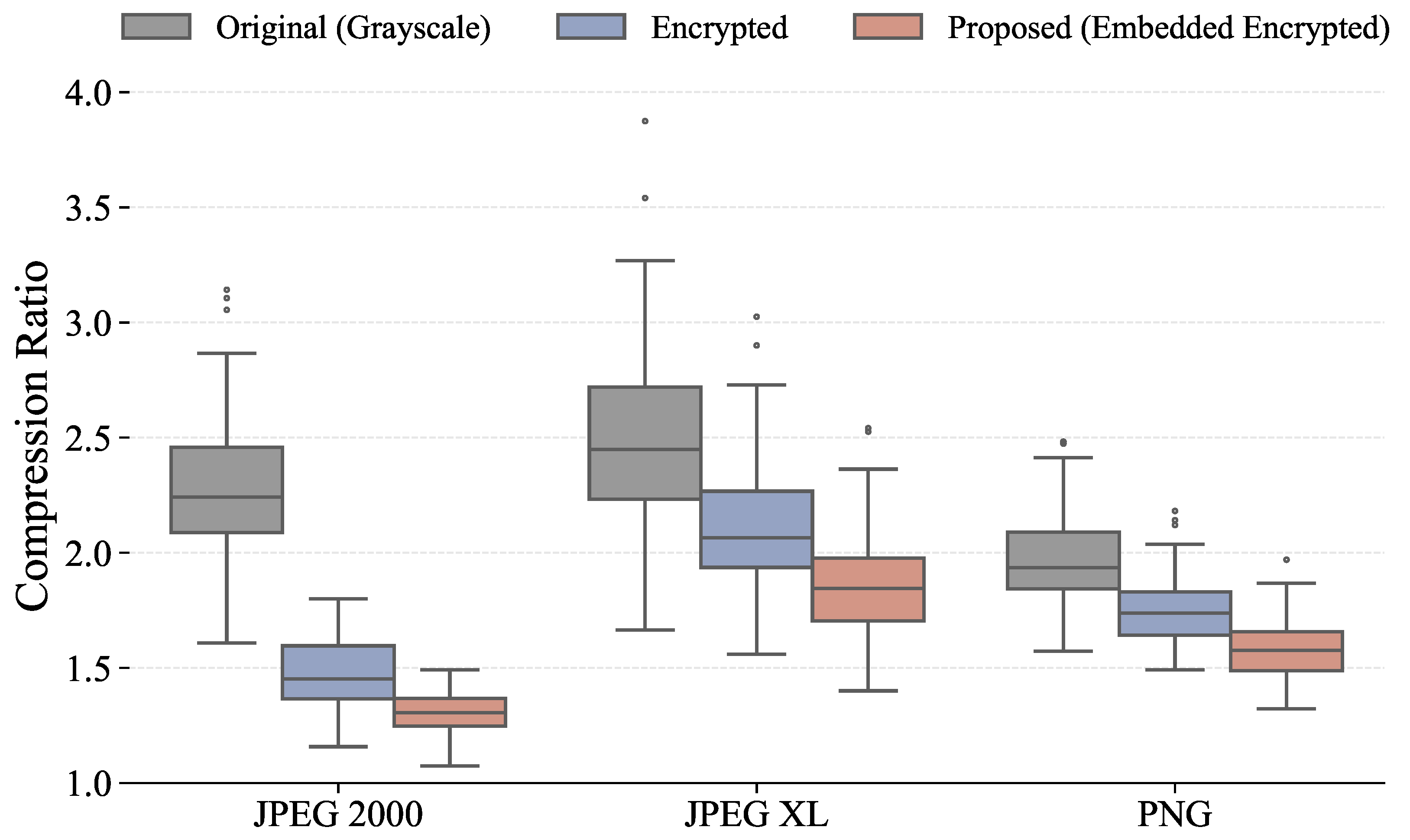
The impact of the proposed embedding scheme on lossless compression performance was evaluated using JPEG 2000 [15], JPEG XL [16], and PNG [17]. Compression was applied to three types of images: the original, the encrypted, and the encrypted image with embedded data. The encoder used for JPEG 2000 was OpenJPEG 2.3.1 [50].
As shown in Figure 17, embedding slightly affects the compression ratio. However, this impact is significantly smaller than that introduced by the encryption process itself. This confirms that the proposed scheme preserves the compression efficiency benefits of the EtC framework, which is crucial for bandwidth-constrained secure imaging systems.
Figure 17.
Compression ratios using JPEG 2000 [15], JPEG XL [16], and PNG [17] lossless compression, where marked images carry the maximum embeddable payloads.
Because the codecs are used in lossless mode, decompression is bit-exact; hence, DPAD cues and per-block EISI values are preserved after decompression, and the proposed extractor yields ESR = 100% and BER = 0 regardless of the achieved compression ratio. Lossy compression (e.g., low-quality JPEG) is beyond the scope of this paper because quantization perturbs pixel values and local difference statistics.
5.3. Maximum Embeddable Information Capacity
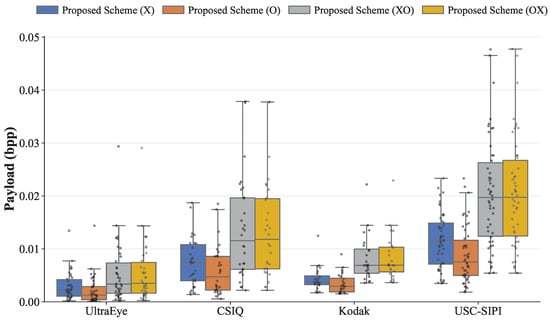
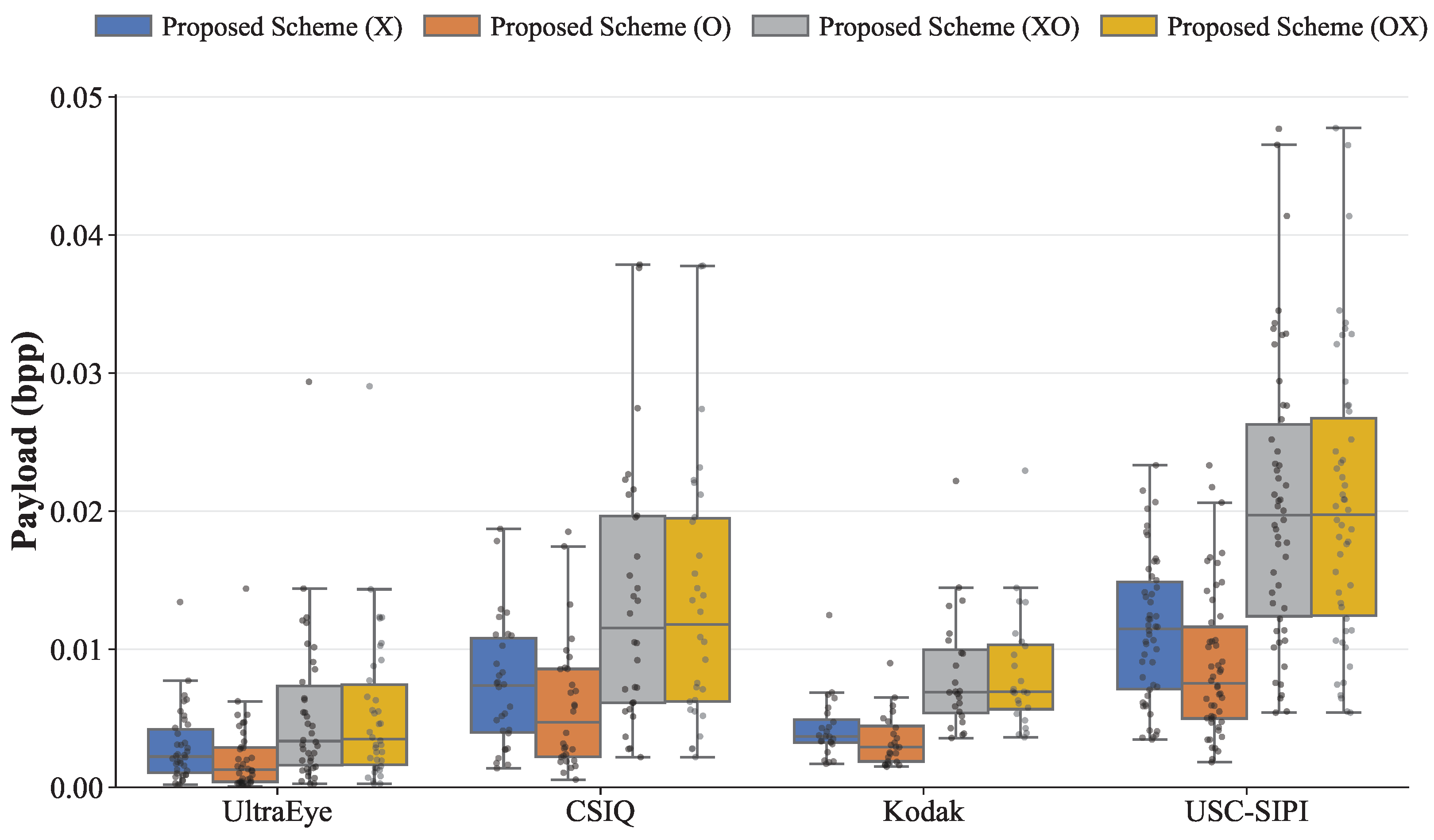
Figure 18 shows the maximum payload size (in bpp) for both single and double embedding scenarios. In single embedding, pattern X often achieves higher capacity due to smaller embedding parameters. For double embedding, the sequence “pattern O followed by pattern X” typically yields the highest capacity. This is because the EISI is updated after the first pass, exposing additional embeddable blocks.
Figure 18.
Maximum embeddable information capacity (bpp) of images for evaluation.
It is noted that for perfectly uniform images (e.g., solid backgrounds), all blocks yield identical EISI values, limiting the payload to 2 bits. This is an inherent limitation of EISI-based embedding in texture-less regions, though such cases are rare in natural photographic images.
5.4. Multi-Core Scalability
We benchmarked the proposed framework on an Apple M1 Max (32 GB) using MATLAB R2025a (macOS 26.2). The benchmark reports wall-clock time for processing 142 images (four datasets) with two-pass embedding. The measured runtime covers the forward pipeline, including DPAD/EISI computation, embedding and ordering, grayscale-based EtC encryption, and JPEG 2000 lossless compression (OpenJPEG 2.3.1 [50]), as well as writing output images and result files. No decompression or extraction is included in this benchmark. We used threads and define and . As shown in Table 2, the implementation achieves a speedup at with efficiency, demonstrating strong multi-core scalability.
Table 2.
Multi-core speedup on Apple M1 Max (142 images, two-pass embedding, forward pipeline including EtC encryption and JPEG 2000 lossless compression). Time/pass is .
5.5. Ablation Study
To validate the architectural decisions, we conducted an ablation study on two critical components: the embedding domain and the synchronization mechanism.
5.5.1. Necessity of YCbCr Domain Processing
The EtC system involves floating-point arithmetic and rounding during RGB-to-YCbCr conversion. If data were embedded in the RGB domain prior to encryption, these rounding errors would corrupt the data during conversion. We quantified this by measuring the “Unchanged Ratio” of blocks after a full RGB→YCbCr→RGB cycle. As shown in Table 3, the unchanged ratio is extremely low (e.g., 0.01% for USC-SIPI). This confirms that embedding must occur in the YCbCr-derived grayscale domain to ensure reversibility.
Table 3.
Analysis of block reversibility under color space conversion (RGB↔YCbCr). The low unchanged ratio demonstrates why embedding must occur in the YCbCr domain.
5.5.2. Necessity of EISI
EtC encryption applies a random block permutation, which destroys the spatial order of blocks. As shown in Table 4, over 10 independent encryption rounds, the unchanged ratio is near zero; hence, spatial positions cannot be used to reproduce the embedding order.
Table 4.
Block position stability and ablation on EISI-based synchronization over 10 independent encryption rounds. ESR is the percentage of trials with perfect payload recovery (BER = 0).
We further provide an ablation in terms of the ESR. Without EISI, the extractor reads bits from a permuted block sequence and fails to recover the payload (ESR ); with EISI, the embedding order is deterministically reconstructed, yielding ESR = 100%.
5.6. Block-Level Structural Complexity
This analysis is provided to clarify the structural and algorithmic properties of the proposed framework; practical execution time depends on the implementation platform and is beyond the scope of this study.
To characterize the block-level computational structure of the proposed framework, we analyze the computational complexity of both the host EtC pipeline and the proposed RDH procedure. Let denote the resolution of the input RGB image. After YCbCr conversion and component serialization, the grayscale image has size . Let B be the total number of blocks in the serialized grayscale image; thus .
5.6.1. Complexity of the EtC System
The grayscale-based EtC pipeline consists of color space transformation, channel serialization, and three block-based encryption operations.
- Color Transformation and Serialization: RGB-to-YCbCr conversion requires a constant number of arithmetic operations per pixel, and serialization is a linear memory operation. Therefore, the overall complexity is .
- Block-wise Encryption: Block permutation, rotation/flipping, and brightness inversion are performed independently per encryption block in [6,7]. Each operation takes constant time per block, yielding , where . Hence, the overall encryption complexity is .
5.6.2. Complexity of the Proposed RDH Scheme
The proposed RDH procedure is designed to be lightweight and mainly consists of block-local operations:
- Target Block Selection: Embedding is restricted to the Cb/Cr regions, so at most blocks are processed for candidate selection.
- Per-block Feature Computation: For each candidate block, DPAD and EISI are computed using a constant number of integer operations. In particular, EISI requires sorting two fixed-length sets of 8 difference values; sorting a constant-size array is per block.
- Embedding/Extraction: Difference expansion and its inverse involve only a constant number of comparisons and integer additions/subtractions per selected block, i.e., .
Therefore, excluding the synchronization stage, the RDH computation over all blocks is linear in the number of pixels, i.e., . In addition, the self-synchronization stage requires (i) counting EISI occurrences to remove non-unique indices and (ii) ordering blocks by EISI for deterministic embedding/extraction. These two steps can be implemented as counting plus sorting (or near-linear time using radix sort for fixed-width integer keys). Importantly, all per-block computations are embarrassingly parallel, and the synchronization stage is also amenable to parallel implementations (e.g., parallel counting and parallel/radix sorting). As a result, the proposed framework is practically suitable for parallel execution on multi-core CPUs or GPUs, while maintaining overall linear-to-near-linear complexity with respect to image size.
6. Conclusions and Outlooks
This paper presents a parallelizable and lightweight reversible data hiding (RDH) framework tailored to grayscale-based encryption-then-compression (EtC) systems [6,7]. Rather than introducing new embedding primitives, the proposed framework integrates previously established DPAD-based embedding and EISI into a component-serialized grayscale EtC pipeline, achieving full compatibility with YCbCr color space transformation and robustness against block permutation, rotation/reflection, and brightness inversion. Experimental results confirm that the embedding process preserves the statistical characteristics required for secure EtC operation (adjacent block correlation coefficients in the encrypted domain remain close to zero) while achieving practical embedding capacity under strict compatibility constraints; moreover, dual embedding patterns enable flexible payload enhancement without sacrificing reversibility or compression behavior. Since DPAD computation, synchronization, and difference expansion are all performed independently at the block level, the framework is structurally compatible with block-wise parallel implementations and enables recovery of an embedding-consistent block order directly from the encrypted image without auxiliary side information. The framework is therefore most suitable for lossless EtC workflows that require auxiliary-free synchronization and bit-exact recovery, while robustness under aggressive lossy compression or adversarial modifications remains outside the present scope, as commonly encountered in cloud-based content delivery/storage, lossless medical archiving, and secure forensics/mission communications.
Overall, this work establishes a system-compatible and system-oriented RDH framework for advanced grayscale-based EtC pipelines, emphasizing compatibility, robustness, and architectural clarity. Future work will explore extensions to additional operating conditions, such as small-sized images and robustness under lossy compression or adversarial modifications, as well as alternative block-level organization strategies to further enhance payload flexibility while preserving EtC compatibility.
Author Contributions
Conceptualization, R.L.; Methodology, R.L.; Software, R.L.; Validation, R.L.; Formal analysis, R.L.; Investigation, R.L.; Resources, R.L.; Data curation, R.L.; Writing—original draft, R.L.; Writing—review & editing, M.F.; Supervision, M.F.; Project administration, M.F.; Funding acquisition, M.F. All authors have read and agreed to the published version of the manuscript.
Funding
This work was supported in part by the “Tokyo Global Partner Scholarship.”
Institutional Review Board Statement
Not applicable.
Informed Consent Statement
Not applicable.
Data Availability Statement
The datasets analyzed in this study are derived from public domain resources (UltraEye, USC-SIPI, Kodak PhotoCD, and CSIQ; see the corresponding URLs in the References). The derived data supporting the findings of this study are contained within the article.
Conflicts of Interest
The authors declare no conflicts of interest.
References
- Zhou, J.; Liu, X.; Au, O.C.; Tang, Y.Y. Designing an efficient image encryption-then-compression system via prediction error clustering and random permutation. IEEE Trans. Inf. Forensics Secur. 2014, 9, 39–50. [Google Scholar] [CrossRef] [Scilit]
- Zhang, X.; Ren, Y.; Shen, L.; Qian, Z.; Feng, G. Compressing encrypted images with auxiliary information. IEEE Trans. Multimed. 2014, 16, 1327–1336. [Google Scholar] [CrossRef] [Scilit]
- Wang, C.; Ni, J.; Huang, Q. A new encryption-then-compression algorithm using the rate–distortion optimization. Signal Process. Image Commun. 2015, 39, 141–150. [Google Scholar] [CrossRef] [Scilit]
- Kumar, M.; Vaish, A. An efficient encryption-then-compression technique for encrypted images using SVD. Digit. Signal Process. 2017, 60, 81–89. [Google Scholar] [CrossRef] [Scilit]
- Kurihara, K.; Kikuchi, M.; Imaizumi, S.; Shiota, S.; Kiya, H. An encryption-then-compression system for JPEG/Motion JPEG standard. IEICE Trans. Fundam. 2015, E98-A, 2238–2245. [Google Scholar] [CrossRef] [Scilit]
- Sirichotedumrong, W.; Kiya, H. Grayscale-based block scrambling image encryption using YCbCr color space for encryption-then-compression systems. APSIPA Trans. Signal Inf. Process. 2019, 8, e7. [Google Scholar] [CrossRef] [Scilit]
- Chuman, T.; Sirichotedumrong, W.; Kiya, H. Encryption-then-compression system using grayscale-based image encryption for JPEG images. IEEE Trans. Inf. Forensics Secur. 2019, 14, 1515–1525. [Google Scholar] [CrossRef] [Scilit]
- Piva, A.; Katzenbeisser, S. Special issue on signal processing in the encrypted domain. EURASIP J. Inf. Secur. 2007, 2007, 082790. [Google Scholar] [CrossRef] [Scilit]
- Fujiyoshi, M.; Kuroiwa, K.; Kiya, H. A scrambling method for Motion JPEG videos enabling moving objects detection from scrambled videos. In Proceedings of the IEEE International Conference on Image Processing (ICIP), San Diego, CA, USA, 12–15 October 2008; pp. 773–776. [Google Scholar]
- Li, X.; Xiao, D.; Mou, H.; Lu, D.; Peng, M. A compressive sensing based image encryption and compression algorithm with identity authentication and blind signcryption. IEEE Access 2020, 8, 211676–211690. [Google Scholar] [CrossRef] [Scilit]
- Lidong, L.; Jiang, D.; Wang, X.; Zhang, L.; Rong, X. A dynamic triple-image encryption scheme based on chaos, S-Box and image compressing. IEEE Access 2020, 8, 210382–210399. [Google Scholar] [CrossRef] [Scilit]
- Hu, H.; Cao, Y.; Xu, J.; Ma, C.; Yan, H. An image compression and encryption algorithm based on the fractional-order simplest chaotic circuit. IEEE Access 2021, 9, 22141–22155. [Google Scholar] [CrossRef] [Scilit]
- Anand, A.; Singh, A.K.; Lv, Z.; Bhatnagar, G. Compression-then-encryption-based secure watermarking technique for smart healthcare system. IEEE MultiMedia 2020, 27, 133–143. [Google Scholar] [CrossRef] [Scilit]
- ISO/IEC 10918-5:2013; Information Technology—Digital Compression and Coding of Continuous-Tone Still Images: JPEG File Interchange Format (JFIF). ISO/IEC: Geneva, Switzerland, 2013.
- ISO/IEC 15444-1:2004; Information Technology—JPEG 2000 Image Coding System—Part 1: Core Coding System. ISO/IEC: Geneva, Switzerland, 2004.
- ISO/IEC 18181-1:2022; Information Technology—JPEG XL Image Coding System—Part 1: Core Coding System. ISO/IEC: Geneva, Switzerland, 2022.
- ISO/IEC 15948:2003; Information Technology—Computer Graphics and Image Processing—Portable Network Graphics (PNG): Functional Specification. ISO/IEC: Geneva, Switzerland, 2003.
- Tian, J. Reversible data embedding using a difference expansion. IEEE Trans. Circuits Syst. Video Technol. 2003, 13, 890–896. [Google Scholar] [CrossRef] [Scilit]
- Ni, Z.; Shi, Y.Q.; Ansari, N.; Su, W. Reversible data hiding. IEEE Trans. Circuits Syst. Video Technol. 2006, 16, 354–362. [Google Scholar]
- Shi, Y.Q.; Li, X.; Zhang, X.; Wu, H.T.; Ma, B. Reversible data hiding: Advances in the past two decades. IEEE Access 2016, 4, 3210–3237. [Google Scholar] [CrossRef] [Scilit]
- Fujiyoshi, M.; Kiya, H. A blind reversible data hiding method for high dynamic range images taking advantage of sparse histogram. In Image Analysis and Processing—ICIAP 2017; Battiato, S., Gallo, G., Schettini, R., Stanco, F., Eds.; Lecture Notes in Computer Science; Springer: Cham, Switzerland, 2017; Volume 10431, pp. 347–361. [Google Scholar]
- Weng, S.; Shi, Y.Q.; Hong, W.; Yao, Y. Dynamic improved pixel value ordering reversible data hiding. Inf. Sci. 2019, 489, 136–154. [Google Scholar] [CrossRef] [Scilit]
- Kim, S.; Qu, X.; Sachnev, V.; Kim, H.J. Skewed histogram shifting for reversible data hiding using a pair of extreme predictions. IEEE Trans. Circuits Syst. Video Technol. 2019, 29, 3236–3246. [Google Scholar] [CrossRef] [Scilit]
- Wang, J.; Chen, X.; Ni, J.; Mao, N.; Shi, Y. Multiple histograms-based reversible data hiding: Framework and realization. IEEE Trans. Circuits Syst. Video Technol. 2020, 30, 2313–2328. [Google Scholar] [CrossRef] [Scilit]
- Zhang, T.; Li, W.; Qi, W.; Guo, Z. Location-based PVO and adaptive pairwise modification for efficient reversible data hiding. IEEE Trans. Inf. Forensics Secur. 2020, 15, 2306–2319. [Google Scholar] [CrossRef] [Scilit]
- He, W.; Xiong, G.; Wang, Y. Reversible data hiding based on adaptive multiple histograms modification. IEEE Trans. Inf. Forensics Secur. 2021, 16, 3000–3012. [Google Scholar] [CrossRef] [Scilit]
- Kong, P.; Zhang, Z.; Wang, J.; Qian, Z. Neural network-based reversible data hiding for medical image. Expert Syst. Appl. 2024, 256, 124903. [Google Scholar] [CrossRef] [Scilit]
- Yamni, M.; Daoui, A.; El-Kasri, C.; Almousa, M.; AlQahtani, A.A.S.; Abd El-Latif, A.A. Lightweight Reversible Data Hiding System for Microcontrollers Using Integer Reversible Meixner Transform. IET Image Process. 2025, 19, e70218. [Google Scholar] [CrossRef] [Scilit]
- Chen, Y.C.; Hung, T.H.; Hsieh, S.H.; Shiu, C.W. A New Reversible Data Hiding in Encrypted Image Based on Multi-Secret Sharing and Lightweight Cryptographic Algorithms. IEEE Trans. Inf. Forensics Secur. 2019, 14, 3332–3343. [Google Scholar] [CrossRef] [Scilit]
- Hirasawa, R.; Imaizumi, S.; Kiya, H. An MSB prediction-based method with marker bits for reversible data hiding in encrypted images. In Proceedings of the IEEE 3rd Global Conference on Life Sciences and Technologies (LifeTech), Nara, Japan, 9–11 March 2021; pp. 48–50. [Google Scholar]
- Kumar, R.; Sharma, A.K. Bit-plane based reversible data hiding in encrypted images using multi-level blocking with quad-tree. IEEE Trans. Multimed. 2024, 26, 4722–4735. [Google Scholar]
- Puteaux, P.; Puech, W. A recursive reversible data hiding in encrypted images method with a very high payload. IEEE Trans. Multimed. 2021, 23, 636–650. [Google Scholar] [CrossRef] [Scilit]
- Yu, C.; Zhang, X.; Qin, C.; Tang, Z. Reversible data hiding in encrypted images with secret sharing and hybrid coding. IEEE Trans. Circuits Syst. Video Technol. 2023, 33, 6443–6458. [Google Scholar] [CrossRef] [Scilit]
- Arai, E.; Imaizumi, S. High-capacity reversible data hiding in encrypted images with flexible restoration. J. Imaging 2022, 8, 176. [Google Scholar] [CrossRef] [Scilit]
- Motomura, R.; Imaizumi, S.; Kiya, H. A reversible data hiding method in encrypted images for controlling trade-off between hiding capacity and compression efficiency. J. Imaging 2021, 7, 268. [Google Scholar] [CrossRef] [Scilit] [PubMed]
- Wong, K.; Kiya, H. Reversible data hiding for compression-friendly image encryption method. In Proceedings of the Asia-Pacific Signal and Information Processing Association Annual Summit and Conference (APSIPA ASC), Kuala Lumpur, Malaysia, 12–15 December 2017. [Google Scholar]
- Motomura, R.; Imaizumi, S.; Kiya, H. A reversible data hiding method with prediction-error expansion in compressible encrypted images. Appl. Sci. 2022, 12, 9418. [Google Scholar] [CrossRef] [Scilit]
- Imaizumi, S.; Izawa, Y.; Hirasawa, R.; Kiya, H. A reversible data hiding method in compressible encrypted images. IEICE Trans. Fundam. 2020, E103-A, 1579–1588. [Google Scholar] [CrossRef] [Scilit]
- Fujiyoshi, M.; Li, R.; Kiya, H. A scheme of reversible data hiding for the encryption-then-compression system. IEICE Trans. Inf. Syst. 2021, E104-D, 43–50. [Google Scholar] [CrossRef] [Scilit]
- Ren, F.; Zhang, Z.; Jiang, K.; Zhang, P.; Yang, T. Reversible data hiding and authentication scheme for encrypted image based on prediction error compression. Sci. Rep. 2025, 15, 11636. [Google Scholar] [CrossRef] [Scilit] [PubMed]
- Ren, H.; Yue, Z.; Gu, F.; Li, M.; Chen, T.; Bai, G. A novel reversible data hiding method in encrypted images using efficient parametric binary tree labeling. Knowl.-Based Syst. 2024, 300, 112198. [Google Scholar] [CrossRef] [Scilit]
- Yavuz, E. Reversible data hiding in encrypted images using chaos theory and Chinese Remainder Theorem. Pattern Anal. Appl. 2025, 28, 120. [Google Scholar] [CrossRef] [Scilit]
- Zhang, X.; He, F.; Yu, C.; Zhang, X.; Yang, C.N.; Tang, Z. Reversible data hiding in encrypted images with asymmetric coding and bit-plane block compression. IEEE Trans. Multimed. 2024, 26, 10174–10188. [Google Scholar] [CrossRef] [Scilit]
- Qiu, Y. Reversible data hiding in encrypted images based on edge-directed prediction and multi-MSB self-prediction. IEEE Access 2025, 13, 63000–63012. [Google Scholar] [CrossRef] [Scilit]
- Nemoto, H.; Hanhart, P.; Korshunov, P.; Ebrahimi, T. Ultra-Eye: UHD and HD images eye tracking dataset. In Proceedings of the 6th International Workshop on Quality of Multimedia Experience (QoMEX), Singapore, 18–20 September 2014; pp. 39–40. Available online: https://www.epfl.ch/labs/mmspg/downloads/ultra-eye/ (accessed on 22 December 2025).
- Signal and Image Processing Institute, University of Southern California. The USC-SIPI Image Database. Available online: https://sipi.usc.edu/database/ (accessed on 17 December 2025).
- Lucier, B.J. Kodak Photo CD Photo Sampler Color Images. Available online: https://www.math.purdue.edu/lucier/PHOTO_CD/D65_TIFF_IMAGES/ (accessed on 17 December 2025).
- Larson, E.C.; Chandler, D.M. Most apparent distortion: Full reference image quality assessment and the role of strategy. J. Electron. Imaging 2010, 19, 011006. Available online: https://s2.smu.edu/eclarson/csiq.html (accessed on 22 December 2025). [CrossRef] [Scilit]
- Kumari, M.; Gupta, S.; Sardana, P. A survey of image encryption algorithms. 3D Res. 2017, 8, 37. [Google Scholar] [CrossRef] [Scilit]
- Image and Signal Processing Group, Université de Louvain. OpenJPEG. Available online: http://www.openjpeg.org (accessed on 17 December 2025).



Disclaimer/Publisher’s Note: The statements, opinions and data contained in all publications are solely those of the individual author(s) and contributor(s) and not of MDPI and/or the editor(s). MDPI and/or the editor(s) disclaim responsibility for any injury to people or property resulting from any ideas, methods, instructions or products referred to in the content. |
© 2025 by the authors. Licensee MDPI, Basel, Switzerland. This article is an open access article distributed under the terms and conditions of the Creative Commons Attribution (CC BY) license.