Article

A Novel Detection Method for Wheel Irregular Wear Using Stator Current Based on an Electromechanical Coupling Model

by
Guinan Zhang
1,
Bo Zhang
1,*,
Yongfeng Song
1 and
Bing Lu
2
1
Locomotive & Car Research Institute, China Academy of Railway Sciences Corporation Limited, Beijing 100081, China
2
School of Electrical Engineering, Southwest Jiaotong University, Chengdu 610032, China
*
Author to whom correspondence should be addressed.
Electronics 2026, 15(1), 138; https://doi.org/10.3390/electronics15010138
Submission received: 24 November 2025 / Revised: 21 December 2025 / Accepted: 24 December 2025 / Published: 28 December 2025
(This article belongs to the Section Circuit and Signal Processing)

Abstract

Irregular wheel wear can significantly degrade wheel–rail interaction performance and, in severe cases, compromise the safety of high-speed trains. Accurate and timely monitoring of wheel wear is crucial for maintaining operational reliability. Existing monitoring methods often rely on high-end sensors or are sensitive to environmental disturbances, limiting their practical deployment. This study proposes a novel method for monitoring irregular wheel wear by analyzing the stator current spectrum of traction motors. Firstly, an electromechanical coupled model is developed by integrating the electric drive system with the vehicle–track dynamic model to capture the propagation of wear-induced excitation. The effect of polygonal wear on the stator current is investigated, revealing the presence of harmonic components coupled with the wear excitation frequency. To extract these features, a comb filter based on Variational Mode Decomposition (VMD) is introduced. The method effectively isolates wheel wear-related harmonics from existing electrical harmonics in the stator current signal. Simulation results demonstrate that the proposed approach can accurately detect harmonic features caused by polygonal wear, validating its applicability. This method provides a feasible and non-intrusive solution for wheel wear monitoring, offering theoretical support for condition-based maintenance of high-speed rail systems.

1. Introduction

Since the 1990s, problems related to abnormal wheel wear have gradually begun to emerge [1]. With the continuous increase in operating speeds of high-speed Electric Multiple Units (EMUs) and the growing axle loads in heavy-haul freight transportation [2,3], wheel wear has become a serious challenge for railway vehicles. Wheel wear can deteriorate wheel–rail contact conditions, and unstable wheel–rail interaction may further lead to safety risks in train operation [4,5]. Scholars have devoted substantial effort to investigating the root causes, development patterns, and mitigation measures of abnormal wheel wear [6]. Although the formation mechanisms of different types of wheel wear remain a subject of considerable debate, most viewpoints have been partially validated [7,8]. In recent years, railway operation and maintenance have once again become central research topics, among which wheel state monitoring and fault diagnosis have attracted significant attention. Timely detection of wheel wear and implementation of corresponding maintenance measures—such as wheel reprofiling—can effectively prevent further deterioration and avoid more serious operational safety issues.
A substantial body of research has been conducted on the monitoring of abnormal wheel wear, particularly on wheel out-of-roundness (OOR) faults such as wheel flats and wheel polygonization. Wheel fault detection technologies can be generally classified into two categories: wayside detection and onboard detection. Wayside methods are more widely applied and relatively mature, including wheel–rail force detection [9], wheel–rail noise detection [10], track vibration acceleration detection [11], ultrasonic detection [12], and image-based detection [13]. Onboard monitoring technologies mainly include acoustic detection [14] and vehicle vibration detection [15]. Among these methods, wheel–rail force detection and ultrasonic detection offer high accuracy but involve high equipment costs, making large-scale deployment difficult. Acoustic detection, vehicle–track vibration-based detection, and image-based detection require simpler equipment structures and are easier to implement, but their performance is more susceptible to environmental disturbances.
In addition, Wu et al. [16] proposed a non-contact photoelectric detection method for locomotive wheel tread wear, which achieves high-precision contour acquisition using precision laser displacement sensors and detectors. Other studies have improved traditional frequency-domain analysis approaches to further enhance the accuracy of detecting abnormal wheel wear. Sun et al. [17] developed a wheel polygonal wear identification scheme based on angle-domain synchronous averaging, in which the easily accessible vertical axle-box acceleration is used as the core input signal. Furthermore, Xie et al. [18] introduced an iterative algorithm capable of extracting the vertical acceleration within each wheel rotation period, and based on this, proposed an improved frequency-domain scoring method that enables accurate capture of wheel polygon characteristics. Xu et al. [19] proposed a quantitative diagnosis approach for wheel polygonal wear using a Cepstral–Bayesian calibrated frequency response function, providing new theoretical and methodological support for improving the accuracy of polygon wear identification.
It is worth noting that some researchers have also developed characteristic indices to represent the health condition of railway wheels. Ref. [20] measured the strain response of the rail using fiber Bragg grating sensors and subsequently constructed a health index reflecting the wheelset condition, based on which a corresponding wheelset defect detection method was developed. Moreover, Song et al. [21] measured the wheel–rail impact forces induced by polygonal wear using piezoelectric sensors and converted these measurements into a condition index associated with the degree of wheel polygonization, thereby enabling effective monitoring of polygonal wear.
In recent years, with the rapid development of artificial intelligence, machine vision, big data analytics, and deep learning, data-driven methods have increasingly become important tools for fault monitoring and diagnosis of mechanical equipment [22,23,24]. These techniques not only enhance detection accuracy but also promote the intelligent evolution of equipment health management. Naturally, they have also been introduced into wheel wear monitoring.
Ref. [25] proposed a machine-vision-based method for detecting abnormal wheel wear using high-resolution wheel images combined with the Canny edge detection algorithm. For the OOR problem in metro wheels, Jiang et al. [26] developed a structure-information-assisted generalization network, forming a data-driven OOR fault detection framework that effectively addresses the performance degradation caused by discrepancies between training and field data. In Ref. [27], an unsupervised wheel OOR detection method was developed within a machine learning framework, where the confidence boundary was determined from the health condition of normal wheels. Moreover, Ye et al. [28] proposed a deep learning model named OORNet, which uses large quantities of vertical vibration acceleration data as the training dataset to achieve automated monitoring of wheel wear. Similarly, Can et al. [29] also employed vertical axle-box acceleration (ABA) signals as the core training data and developed quantitative detection models for wheel polygonal wear based on deep learning algorithms. In Ref. [30], convolutional neural networks were used to adaptively extract features from ABA signals, enabling accurate identification and classification of wheel out-of-roundness.
Currently, most methods for wheel wear monitoring are based on the direct or indirect analysis of mechanical vibration signals, such ABA signal. However, the acquisition of mechanical signals is often susceptible to external environmental disturbances, which compromises the stability and reliability of the monitoring results. In addition, while some artificial intelligence (AI)-based approaches exhibit certain intelligent recognition capabilities, they tend to rely heavily on training data, making them difficult to generalize to unseen scenarios and lacking physical interpretability. It is worth noting that the train traction drive system is inherently a complex closed-loop electromechanical coupled system. Mechanical excitations caused by irregular wheel wear, such as polygonal wear, can propagate from the wheelset through the gear transmission system and rotor to the electrical system, eventually leading to fluctuations in electrical parameters such as stator current. This propagation process provides a physical basis for monitoring wheel condition using electrical signals.
In practical train operations, traction control systems already require real-time monitoring of electrical parameters to ensure stable operation. Therefore, leveraging existing electrical signals to infer wheel wear conditions eliminates the need for additional sensors, offering high engineering feasibility and economic efficiency. To this end, this paper proposes a method for monitoring irregular wheel wear based on frequency-domain analysis of stator current. The main contributions involve:
(1)
Developing an electromechanical coupled model of a high-speed train considering the interaction among vehicle, track, and traction drive system.
(2)
Analyzing the influence of typical wear types (e.g., wheel flat and polygonal wear) on the electric drive system, and establishing a frequency-domain mapping between wheel wear and electrical parameters.
(3)
Designing a comb filter based on Variational Mode Decomposition (VMD) to extract spectral components related to wheel wear excitations from the stator current, thereby achieving accurate identification and monitoring of abnormal wear conditions.

2. Development of an Electromechanical Coupling Model

2.1. Electric Traction Drive System

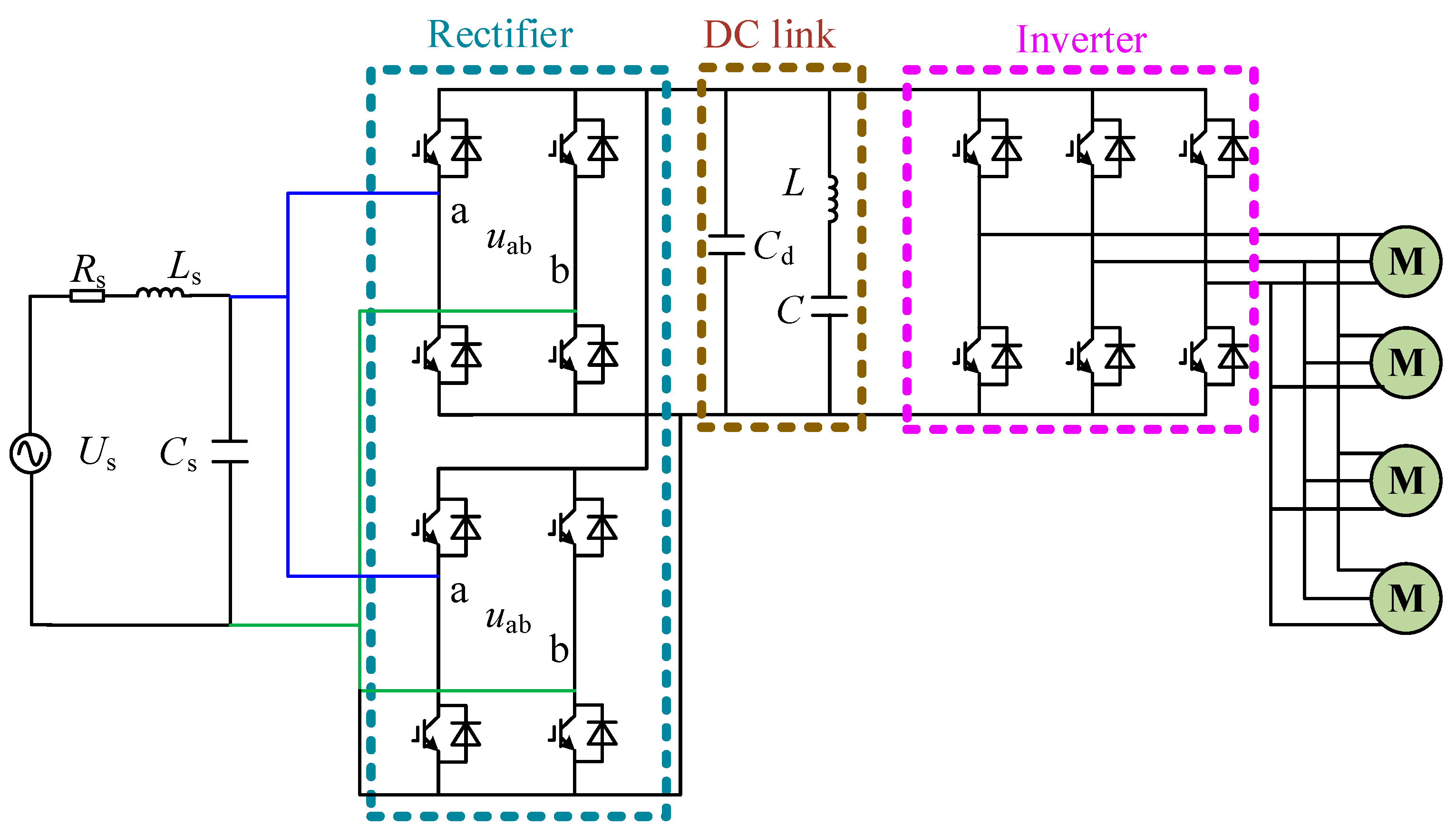
The electric traction drive system of a high-speed train is the core system responsible for power output and operational control [31]. It directly affects the train’s traction performance, energy efficiency, and operational stability. The system mainly consists of a pantograph, transformer, traction converter, and traction motor. Since the pantograph generally does not influence the harmonic characteristics or performance of the drive system, it is not considered in the electrical-level modeling. A simplified schematic of the electrical traction drive system is shown in Figure 1. When neglecting grid-side harmonics and voltage fluctuations, the electric energy collected by the pantograph can be modeled as an ideal single-phase AC power source. The system further includes transformers, single-phase AC–DC–three-phase AC traction converters, and induction motors [32].
In this configuration, the rectifier is responsible for transient current control, which adopts a dual closed-loop strategy consisting of an inner voltage loop and an outer current loop. The inverter employs field-oriented control (FOC), which decouples the current into magnetizing and torque components for independent regulation. This approach allows real-time tracking of the rotor magnetic field direction, resulting in more efficient torque control and faster dynamic response. Modeling parameters of the electric traction drive system is shown in Table 1 [33,34].
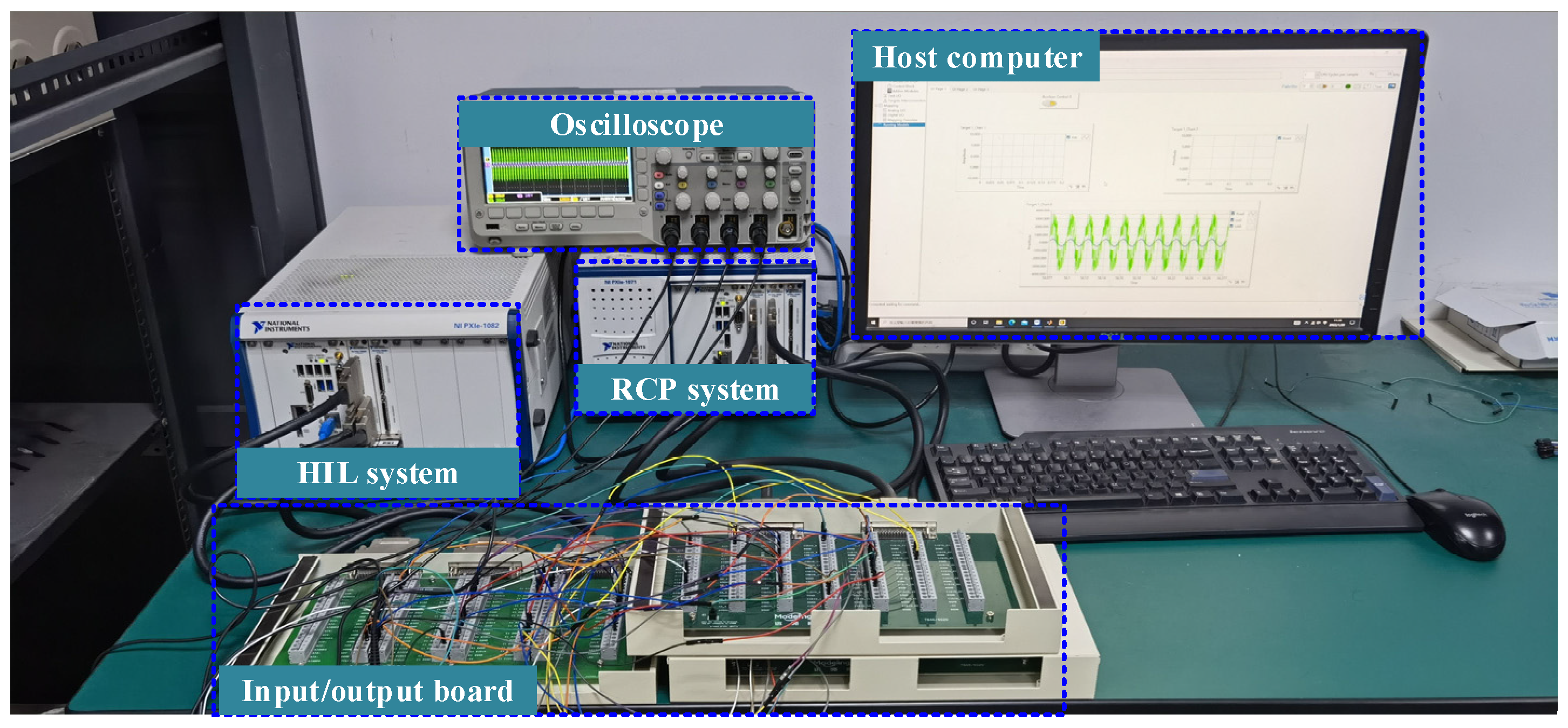
To verify the accuracy of the electric traction drive system model, experimental validation is carried out on a hardware-in-the-loop (HIL) simulation platform. The configuration of the platform is shown in Figure 2 and mainly consists of a real-time simulator (HIL system) based on the NI PXIe FPGA-7868R, a rapid control prototyping (RCP) system based on the NI PXIe FPGA-7846R, a host computer, input/output boards, and an oscilloscope. NI PXIe FPGA-7868R and NI PXIe FPGA-7846R are both products of ModelingTech Energy Technology Co., Ltd. (Shanghai, China). In the experiment, the electric traction drive system is divided into a main circuit model and a control circuit model. The main circuit model is implemented and executed on the HIL system with a simulation step size of 1 μs, while the control circuit model runs on the RCP system with a sampling frequency of 20 kHz. The host computer is used to supervise the operation of the entire model, as well as to configure system parameters and monitor experimental data.
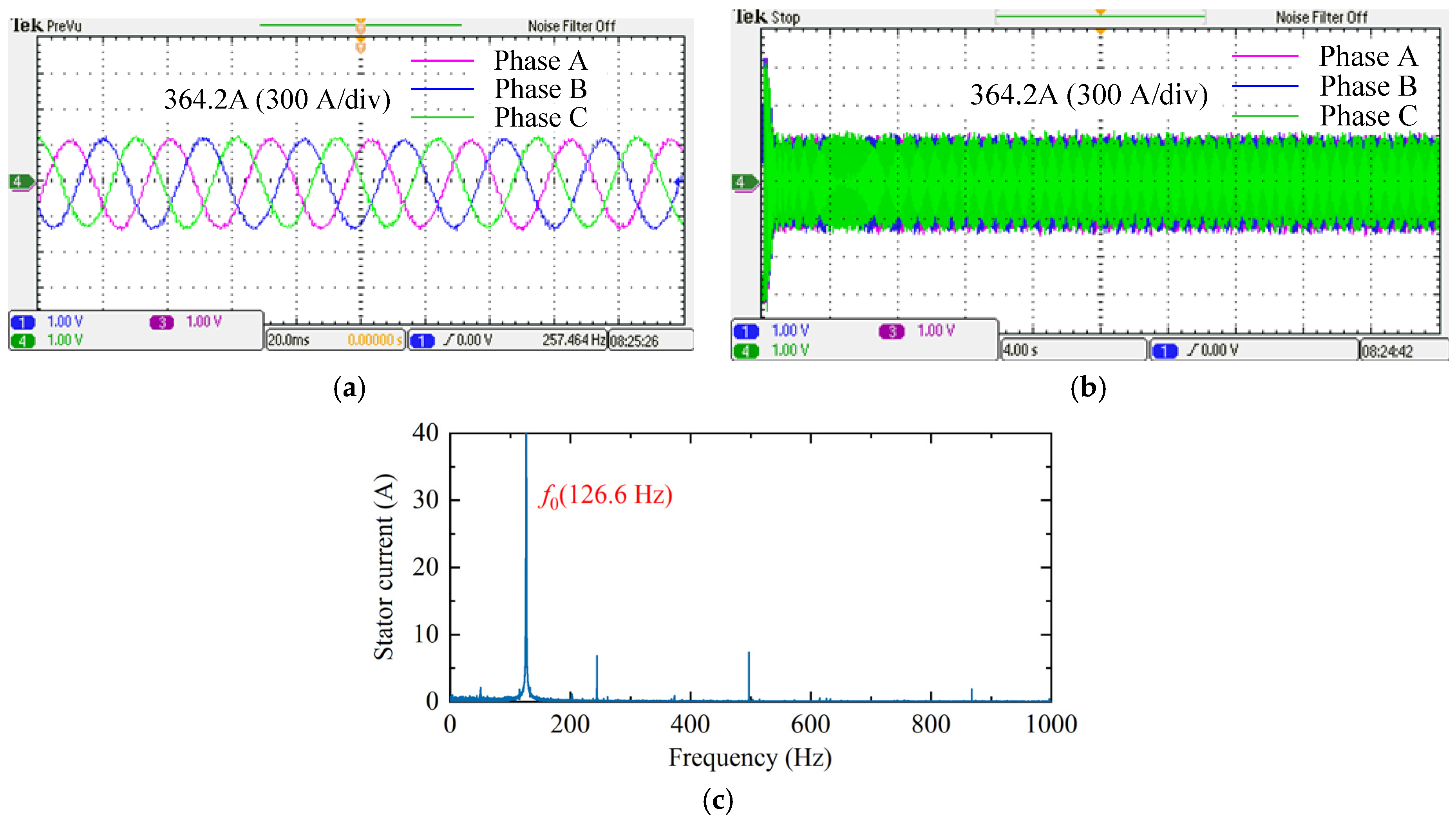
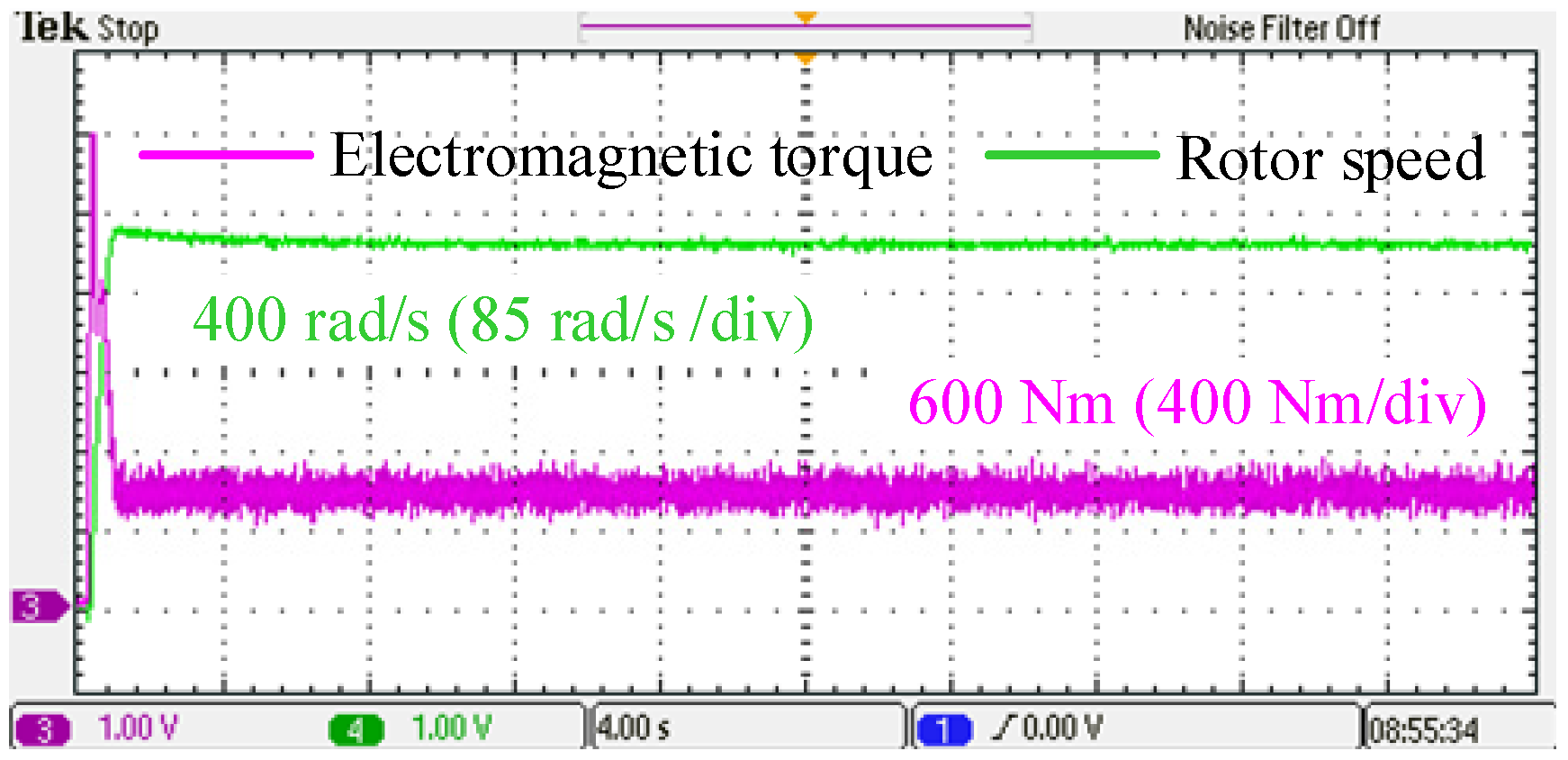
The measured three-phase stator current waveforms of the traction motor obtained from the oscilloscope are shown in Figure 3, with a current amplitude of 364.2 A. FFT analysis is applied to the measured stator current, and the corresponding frequency spectrum is presented in Figure 3c. When the train speed is 261 km/h, the fundamental frequency of the stator current is 126.6 Hz. In addition, the measured rotor angular speed and electromagnetic torque are shown in Figure 4. After the system reaches steady-state operation, the rotor angular speed stabilizes at 400 rad/s, and the average electromagnetic torque is approximately 600 N·m. These test results are in good agreement with the pre-set model values, demonstrating the accuracy and validity of the proposed electric traction drive system model.

2.2. Train–Track Coupled Dynamic Model

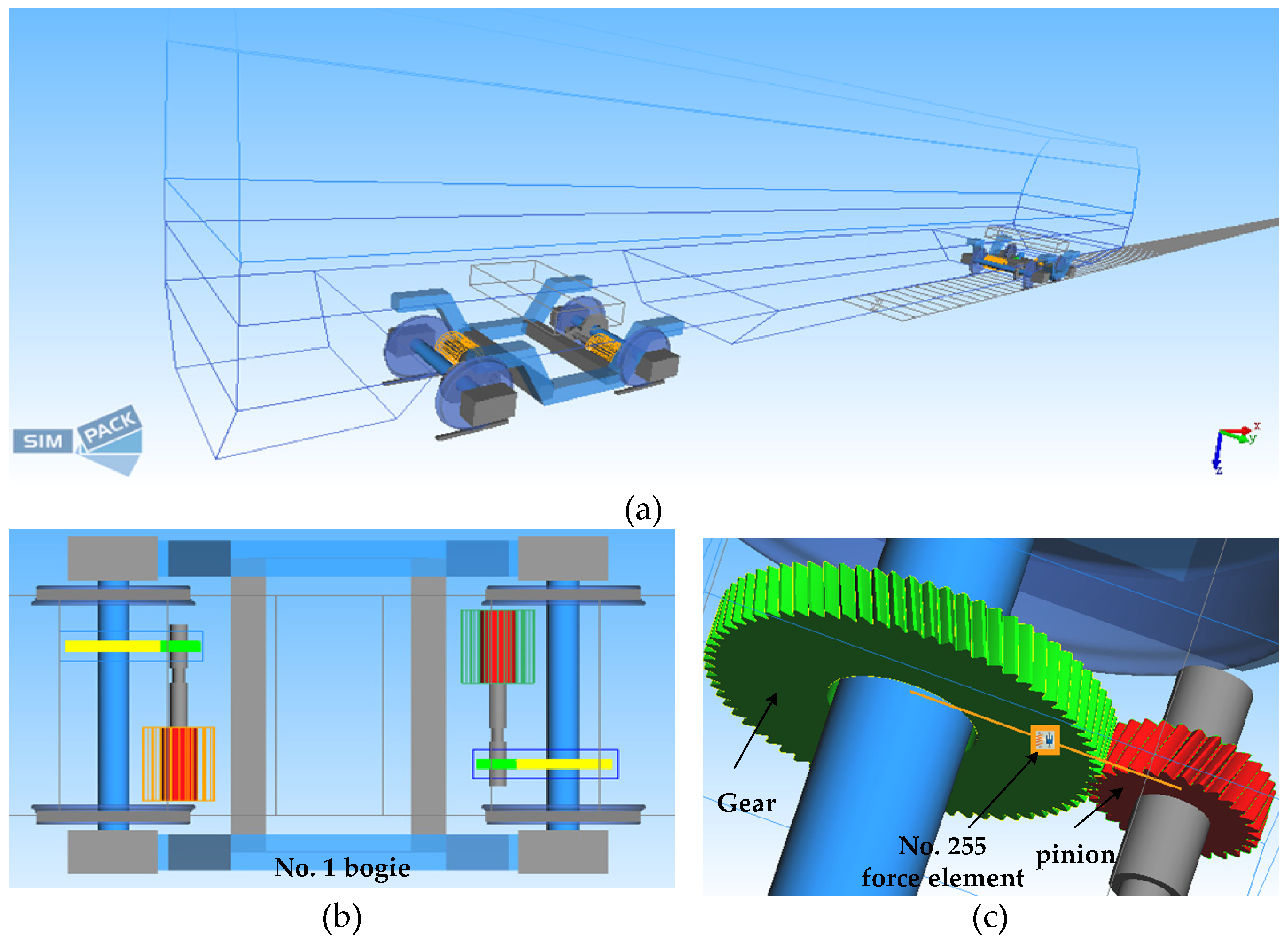
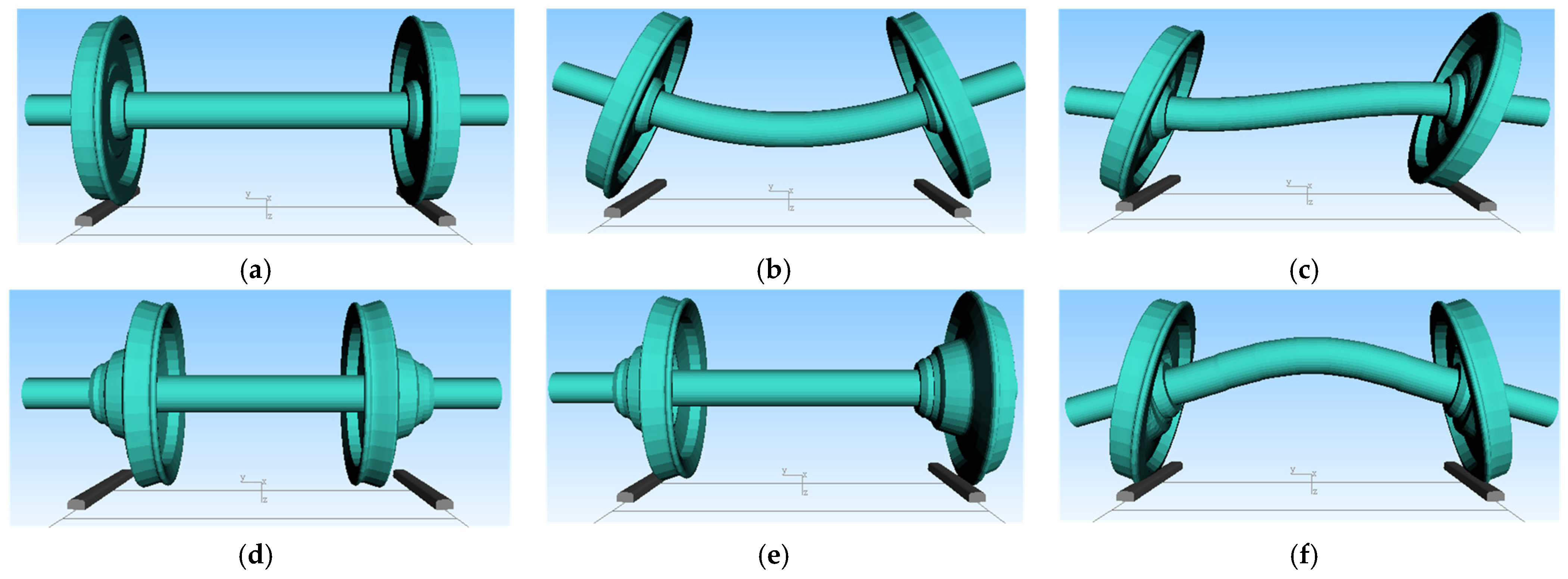
To comprehensively analyze the dynamic characteristics of the mechanical load in the traction transmission system during train operation, this paper establishes a coupled dynamic model consisting of three subsystems: the train subsystem, the track subsystem, and the wheel–rail coupling subsystem [35], as shown in Figure 5. Figure 5a illustrates the overall structure of the vehicle–track dynamic model. Figure 5b presents the structure of Bogie No. 1, which mainly consists of two wheelsets, two traction motors, and two gear transmission systems. A local enlarged view of the gear transmission system is shown in Figure 5c, where a force element (No. 255) is employed to model the gear meshing interaction. In contrast to conventional models, the proposed train subsystem incorporates detailed modeling of the traction motor and gear transmission system, while the wheelset is treated as a flexible body rather than a rigid one. The modeling parameters of the gear transmission system are shown in Table 2. The modal analysis results of the flexible wheelset are shown in Figure 6. The finite element model of the wheelset was established in ANSYS/APDL 16.0, where mesh generation and modal analysis were performed. In the modeling process, the wheelset was assumed to be under free boundary conditions. This enhancement enables a more accurate representation of the electromechanical coupling and vibration behavior of the traction drive system under real operating conditions.
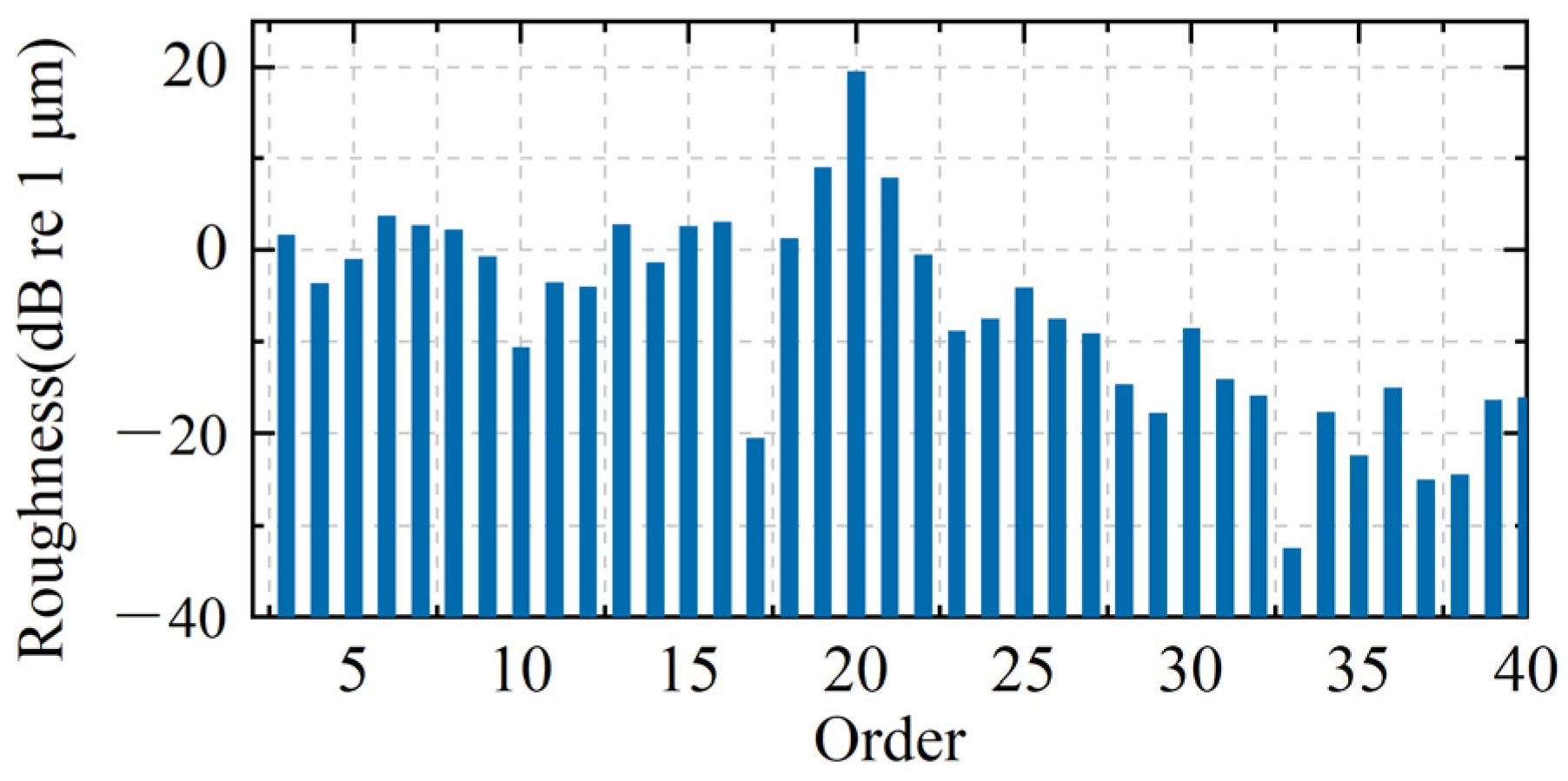
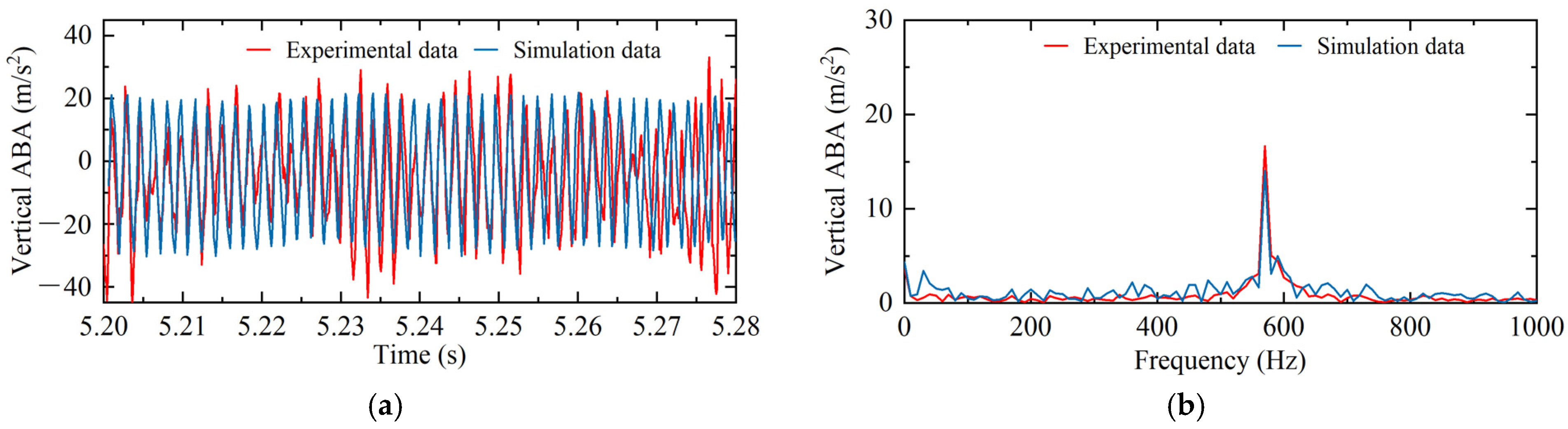
To validate the accuracy of the train–track coupled dynamic model, an on-track vibration test was conducted. Most existing studies assess the reliability of dynamic models by comparing the vertical ABA (axle-box vertical acceleration) obtained from measurements and simulations [36,37]. Therefore, in this validation test, the vertical ABA was also extracted for comparison. Since the test locomotive exhibited noticeable wheel polygonal wear, the measured polygonal wear data is imported into the dynamic model for simulation. An order analysis was performed on the measured wheel wear data, and the results are shown in Figure 7. The dominant wheel polygonal wear corresponds to the 20th order, while the amplitudes of other higher-order polygonal components are relatively low. as shown in Figure 7. The extracted vertical ABA is shown in Figure 8. It can be clearly observed that the measured and simulated results maintain good agreement in both the time and frequency domains, where the dominant frequency in the spectrum corresponds to the excitation frequency induced by the polygonal wear. These results indicate that the proposed train–track coupled dynamic model can accurately reproduce the vibration response observed in operation, thereby verifying the model’s validity and reliability.

2.3. Modeling of the Coupling Between Electrical and Mechanical Systems

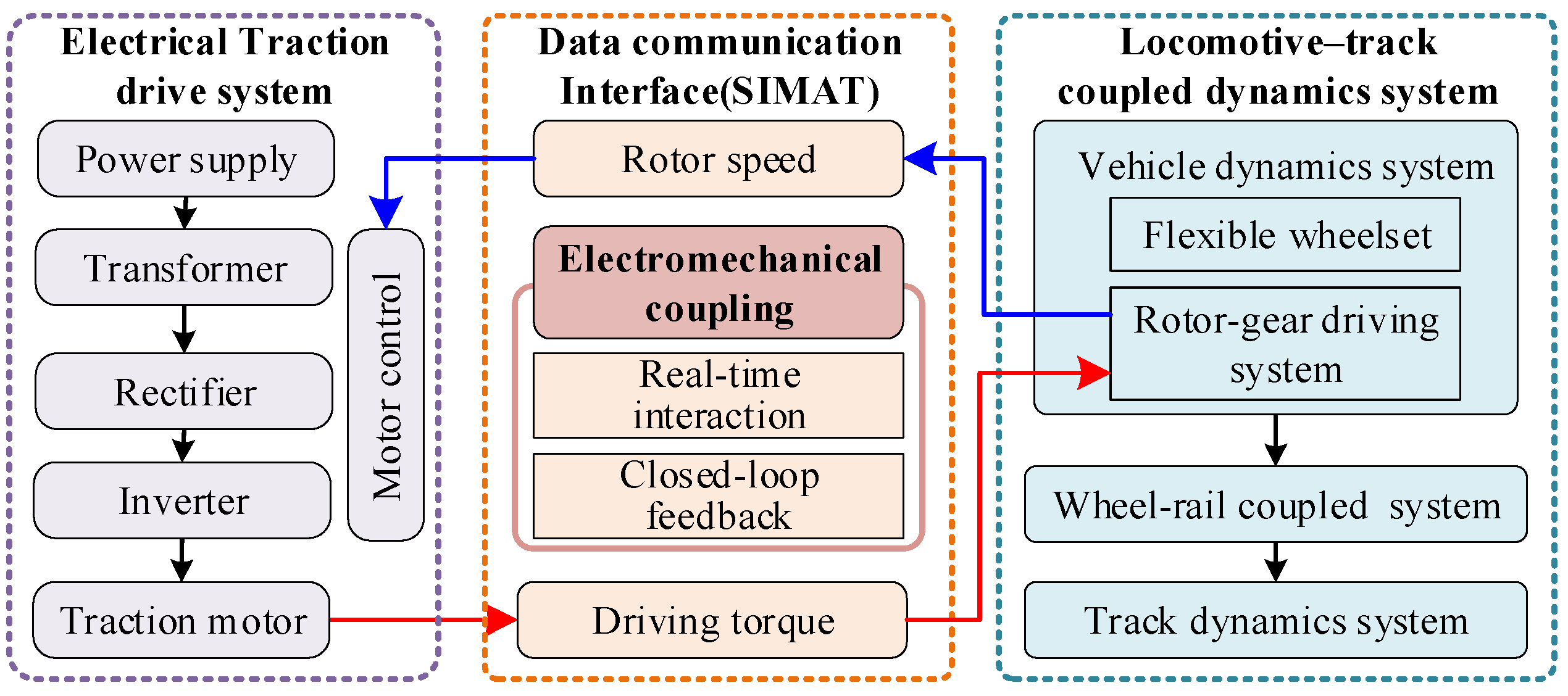
To establish an electromechanical coupling system, a complete closed-loop feedback structure must be constructed. From the perspective of energy conversion in the traction transmission system, the interaction between the electrical and mechanical subsystems can be characterized as a bidirectional coupling process: the electrical subsystem exerts a forward driving effect on the mechanical subsystem, while the mechanical subsystem provides a reverse excitation or negative feedback to the electrical subsystem, as shown in Figure 9. Specifically, the electrical subsystem generates the driving torque that acts on the mechanical subsystem, whereas the rotor angular velocity of the mechanical subsystem is continuously fed back to the motor control loop. This feedback process forms a closed-loop structure, thereby realizing the dynamic coupling between the electrical and mechanical domains. The data exchange between the electrical and mechanical subsystems is implemented through the communication interface between MATLAB/Simulink 2018b and SIMPACK 2021x, using the SIMAT co-simulation interface. To prevent frequency aliasing during communication, the simulation frequencies of the electrical subsystem, the mechanical subsystem, and their coupling interface are all set to 20,000 Hz.
Moreover, the aerodynamic resistance and additional running resistance encountered during train operation are also taken into account. These resistances are calculated in Simulink and transferred to SIMPACK via the SIMAT interface, where they are applied to the center of mass of the train body in the form of concentrated forces. The basic unit resistance of the train can be calculated as
ω 0 ( v ) = 7.75 + 0.062367 v + 0.00113 v 2

3. The Proposed Novel Method

Since the traction drive system is a typical electromechanical coupling system, the vibration excitation generated by the wheel–rail interaction can be fed back into the electrical system. This study ingeniously takes advantage of this adverse effect and, by thoroughly analyzing the relationship between wheel wear and stator current harmonics, proposes a wheel polygonal wear monitoring method based on stator current analysis.

3.1. Influence of Wheel Irregular Wear on the Electric Drive System

For high-speed trains, the most common types of wheel irregular wear are wheel polygonal wear and wheel flats. Both types of abnormal wear cause the wheel–rail system to vibrate at a fixed frequency, provided that the vehicle is running at a constant speed. To clearly illustrate the transmission path and characteristics of abnormal-wear-induced excitation within the traction drive system, we take the more complex case of wheel polygonal wear as an example.
Assuming that the polygonal wear of the wheel is of order M, the wheel radius can be expressed as
Δ r ( t ) = A sin ( M ω t + θ )
where A is the amplitude of the wheel polygonal wear, ω is the rotational angular speed of the wheel, and θ is the phase angle of the M-th order polygon. In this case, the vibration frequency of the wheel–rail system induced by the polygonal wear can be expressed as:
f pw = M ω / ( 2 π )
According to the wheel–rail coupled dynamics theory and the equations of motion of the wheelset, the vertical motion induced by polygonal wear affects its rotational behavior, which further influences the rotational motion of other connected components, particularly the driven gear and the traction motor. The rotational dynamic behavior of the driven gear can be expressed as
J g 2 β ¨ g 2 = T g 2 w F m R g 2
where Jg2 denotes is the rotational inertia of the driven gear; R is the base-circle radius of the driven gear; Tg2w denotes the torque generated on the axle between the driven gear and the wheelset, and Fm is the meshing force between the driving and driven gears. The rotational dynamic behavior of the driving gear can then be expressed as:
J g 1 β ¨ g 1 = T rg 1 F m R g 1
where Jg1 is the rotational inertia of the driving gear, and Trg2 is the torsional torque between the driving gear and the motor rotor. From Equations (4) and (5), it can be seen that the rotational vibration of the driven gear induces the rotational vibration of the driving gear. Furthermore, the equation of motion of the train rotor can be written as:
J r β ¨ r = T e K rg 1 ( β r β g 1 ) + C rg 1 ( β ˙ r β ˙ g 1 )
where Jr is the rotational inertia of the rotor, Te is the electromagnetic torque, and Krg1 and Crg1 are the stiffness and damping between the motor rotor and the driven gear, respectively. It can thus be concluded that the rotational motion of the pinion will inevitably propagate to the motor rotor and induce speed fluctuations. The electric traction drive system, consisting of the traction converter and the traction motor, controls the train by adjusting the motor output according to the feedback of the motor speed. Therefore, fluctuations in rotor speed will lead to instability in the electric drive system. In the following, this influence is analyzed based on the topology and operating principle of the inverter–motor system.
For FOC, the rotor speed is used as a feedback variable to compute the torque reference T e * , which can be calculated as
T e * = K P ( ω r ω r * ) + K I ( ω r ω r * ) d t + Δ T e * sin ( ω pw t + θ T )
where ωpw denotes the excitation angular frequency of the M-th order wheel polygonal wear, and KP and KI are the proportional and integral gains of the speed control module, respectively. The torque reference thus contains fluctuation components associated with the polygonal wear. Furthermore, the feedforward voltage can be calculated as
E sM * = R s ψ r * L m T e * ( L r L s L m 2 ) L m ψ r * ω r T e * 2 ( L r L s L m 2 ) n p 2 L m ψ r * 3 E sT * = n p L s ψ * L m ω r + T e * ( R s L r + R r L s ) n p L m ψ r *
where Lr and Ls are the rotor and stator inductances, respectively, Lm is the mutual inductance between the coaxially equivalent stator and rotor windings, and Rs and Rr are the stator and rotor resistances, respectively. Ψ r denotes the rotor flux reference value; np is the number of pole pairs of the motor. Substituting Equation (7) into Equation (8) yields
E sM * = a 0 + a 1 sin ( ω pw t + θ r ) + a 2 Δ T e * sin ( ω pw t + θ T ) + a 3 Δ T e * Δ ω r sin ( ω pw t + θ r ) sin ( ω pw t + θ T ) + a 4 sin 2 ( ω pw t + θ T ) E sT * = b 0 + b 1 Δ ω r sin ( ω pw t + θ r ) + b 2 Δ T e * sin ( ω pw t + θ T )
where
a 0 = R s ψ r * L m + L m 2 L r L s L m ψ r * T e * ω r _ avg + L m 2 L r L s n p 2 L m ψ r * 3 T e * 2 a 1 = L m 2 L r L s L m ψ r * T e * a 2 = L m 2 L r L s L m ψ r * ω r _ avg + 2 L m 2 L r L s n p 2 L m ψ r * 3 T e * a 3 = L m 2 L r L s L m ψ r * ,   a 4 = L m 2 L r L s n p 2 L m ψ r * 3
and
b 0 = b 1 ω r _ a v g + b 2 T e * ,   b 1 = n p L s ψ * L m ,   b 2 = R s L r + R r L s n p L m ψ r *
Upon transforming the feedforward voltage into the three-phase reference frame, the phase-a voltage (ua) can be expressed as
u a ( t ) = a 0 cos φ 1 2 a 3 Δ T e * Δ ω r cos θ r θ T + 1 2 a 4 cos φ b 0 sin φ sin ω 0 t + φ a   + 1 2 a 1 cos φ 1 2 b 1 Δ ω r sin φ cos ω pw + ω 0 t + θ r + φ a   + 1 2 a 2 Δ T e * cos φ 1 2 b 2 Δ T e * sin φ cos ω pw + ω 0 t + θ T + φ a   1 2 a 1 cos φ 1 2 b 1 Δ ω r sin φ cos ω pw ω 0 t + θ r φ a   + 1 2 a 2 Δ T e * cos φ 1 2 b 2 Δ T e * sin φ cos ω pw ω 0 t + θ T φ a   + 1 4 a 3 Δ T e * Δ ω r sin 2 ω pw + ω 0 t + θ r + θ T + φ a   1 4 a 4 cos φ sin 2 ω pw + ω 0 t + 2 θ T + φ a   1 4 a 3 Δ T e * Δ ω r sin 2 ω pw ω 0 t + θ r + θ T φ a   + 1 4 a 4 cos φ sin 2 ω pw ω 0 t + 2 θ T φ a
From Equation (12), it is readily observed that the stator voltage contains harmonic components associated with the polygonal wear, namely ω pw ± ω 0 , 2 ω pw ± ω 0 and higher-order terms. The present study focuses on a voltage-source inverter, which ultimately supplies the traction motor with three-phase currents of the desired frequency and amplitude. After being processed by SVPWM, the voltage reference is converted into gating signals that regulate the inverter output current, within which the aforementioned harmonic components are unavoidably included.
Furthermore, when the electromagnetic torque is formulated in terms of the rotor flux, and under the condition of field-oriented control, the torque can be expressed as
T e = n p L m L r i s T Ψ r
From the above expression, it follows that the T-axis current fluctuations induced by polygonal wear ultimately give rise to harmonic torque components, whose frequencies coincide with the excitation frequency of the polygonal wear.

3.2. Comb Filter Based on Variable Modal Decomposition

Previous research has revealed a clear correspondence between the characteristic frequencies of wheel polygonal wear and the harmonic components it introduces into the electric drive system. Based on this relationship, an abnormal wear monitoring strategy can be established. However, the electric drive system contains a large number of inherent harmonics and interharmonics, some of which may overlap or couple with the frequencies associated with polygonal wear, making it difficult to rapidly and accurately extract the wear-related harmonic features from the complex spectrum. Meanwhile, the frequent changes in traction operating conditions and significant load fluctuations further increase the complexity of feature extraction. To address these challenges, a comb filter based on variable modal decomposition (VMD) is proposed in this study to enable fast extraction and identification of the harmonics induced by polygonal wear.
The comb-filtering method based on VMD enables adaptive separation of various inherent harmonics in complex electric drive systems, and enhances the target harmonics selectively through a comb-like frequency structure. This approach allows for rapid and accurate extraction of characteristic harmonics induced by polygonal wear, even under conditions of frequency overlap and operating fluctuations.
Next, the theoretical basis of the proposed method is introduced. First, assume that the stator current as Equation (14).
i ( t ) = A c cos ( 2 π p f e t ) + k = 2 3 A 2 k + 1 cos ( 2 π ( 2 k + 1 ) f e t ) + p = 1 P A m p cos ( 2 π p f w ) + p = 1 P β p cos ( 2 π f e t ) cos ( 2 π p f w ) + n ( t )
where Ac is the fundamental amplitude; A2k+1 is the amplitude of the odd-order harmonic components, fe is the fundamental frequency of the stator current, fw is the excitation frequency caused by wheel wear, β is the modulation index, and n(t) denotes Gaussian white noise.
First, the current signal is decomposed using VMD, yielding
i ( t ) = k = 1 K u k ( t ) + r ( t )
where uk(t) denotes the kth mode extracted from the current signal, r(t) represents the residual after decomposition. VMD is used as a pre-processing tool combined with a comb filter to suppress noise and separate frequency bands. The mode number k is set to 10 based on the stator current spectrum and wear-induced sidebands, and the penalty factor α is set to 2200 to ensure compact modes and stable decomposition. As feature extraction mainly relies on the subsequent comb filter, the proposed method is not highly sensitive to the exact VMD parameters. The objective of VMD is to minimize the sum of the derivative energies of all modes, which can be mathematically expressed as
min { u k } , { ω k } = k = 1 K t ( u k ( t ) e j ω k t ) 2 2
where ωk is the center frequency of each mode. Each mode uk(t) is shifted to its center frequency ωk, and its derivative energy is computed as a measure of the bandwidth. Then, the total derivative energy is minimized to enforce narrow spectra for each mode. It is important to note that a constraint must be considered: the sum of the reconstructed signals of all modes must equal the original current signal i(t). After incorporating the reconstruction constraint, the Lagrangian expression is formed as Equation (17).
L ( { u k } , { ω k } , λ ) = α k = 1 K t ( u k ( t ) e j ω k t ) 2 2 + f ( t ) k = 1 K u k ( t ) 2 2 + λ ( t ) , f ( t ) k = 1 K u k ( t )
where α is the bandwidth penalty coefficient (regularization factor), and λ(t) is the Lagrange multiplier used to enforce the constraint that the sum of all modes reconstructs the original signal.
The complete reconstruction of the stator current signal is
i ^ ( t ) = k = 1 K u k ( t ) + r ( t )
The reconstructed signal is then subjected to Fourier transform, resulting in
I ^ ( f ) = F k = 1 K u k ( t ) + r ( t )
To concentrate on the target frequency components, a logical mask—implemented as a comb filter—is constructed on the discrete frequency axis Fk = kΔff = fs/N). This filter selectively preserves the wear-induced excitation frequencies and the sidebands resulting from their coupling with the fundamental frequency of the current.
F target = p f pw ± f e   |   p = 1 , 2
For each target frequency, a rectangular passband window with a bandwidth of B is constructed centered at the frequency.
M comb ( F k ) = p = 1 P 1 [ p fault B ω 2 , p fault + B ω 2 ] ( F k )
where Bω denotes the bandwidth of a single tooth, accounting for estimation errors or drift. Applying the mask to the spectrum of the reconstructed signal i(t) yields the final retained function.
I keep ( F ) = I ^ ( F ) M comb ( F )
Then, an inverse transform is applied to return to the time-domain.
i keep ( t ) = F 1 I keep ( F )
This step is equivalent to a multi-band zero-phase filter, which only ‘opens’ the narrow bands corresponding to the fault frequencies.
It should be noted that, to ensure ikeep(t) is a real-valued signal, the frequency-domain mask must satisfy conjugate symmetry:
B keep ( F ) = B keep ( F ) ¯
In a single-sided implementation, a mirror operation can be performed after constructing the mask:
M comb ( ± ) ( F ) = M comb ( F )   on   [ 0 , f s 2 ] M comb ( ± ) ( F ) = M comb ( ± ) ( f s F )   on   [ f s 2 , f s ]

4. Results and Analysis

4.1. Numerical Simulation

To verify the propagation of excitation caused by abnormal wear within both the mechanical transmission system and the electric drive system, as well as its correlation with electrical signals, numerical simulations are conducted. All simulations are performed based on the electromechanical coupled model developed in Section 2.
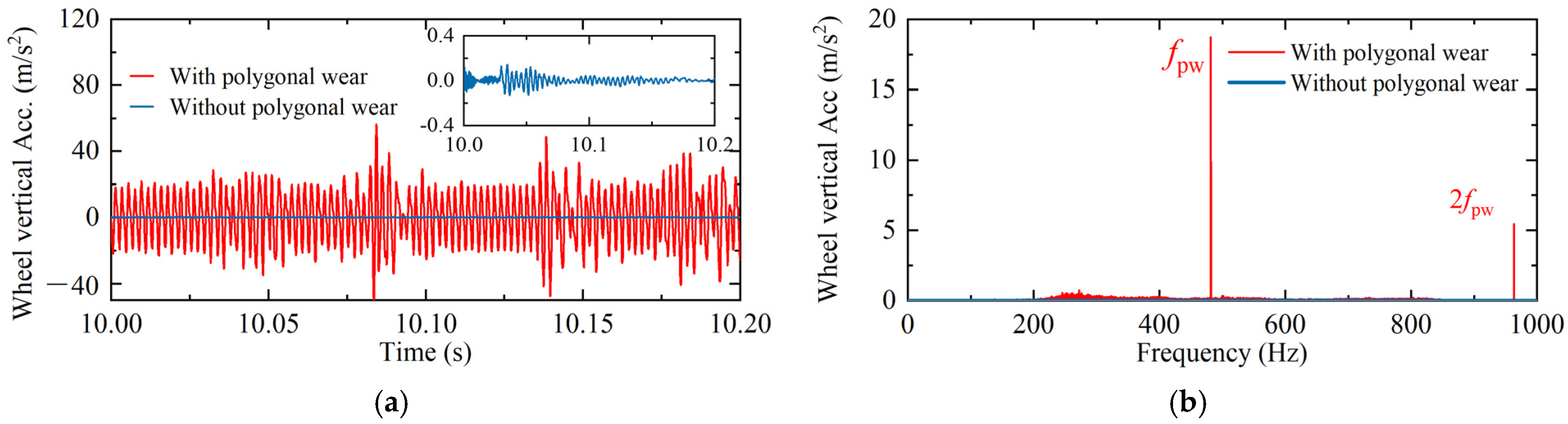
In this simulation, polygonal wear was introduced into the wheelset of the vehicle–track dynamics model in the form of radial deviation. The simulated polygonal wear corresponds to the 18th harmonic order with a wear depth of 0.05 mm. The locomotive speed was maintained at 261 km/h. Polygonal wear directly affects the dynamic response of the wheelset. The vertical acceleration of the wheelset extracted from the simulation is shown in Figure 10. From the time-domain waveform, it is evident that the wheelset undergoes significant vertical vibration under the excitation of polygonal wear. The frequency-domain analysis reveals prominent components at fpw (481.7 Hz) and its second harmonic 2fpw (963.4 Hz). fpw denotes the excitation frequency induced by wheel polygonal wear, representing a periodic excitation with a fixed wavelength. The frequency can be expressed as
f pw = N v 2 π R
where N is the harmonic order of the polygonal wear, v is the train speed (in m/s), and R is the wheel radius, which is set to 0.43 m in this simulation.
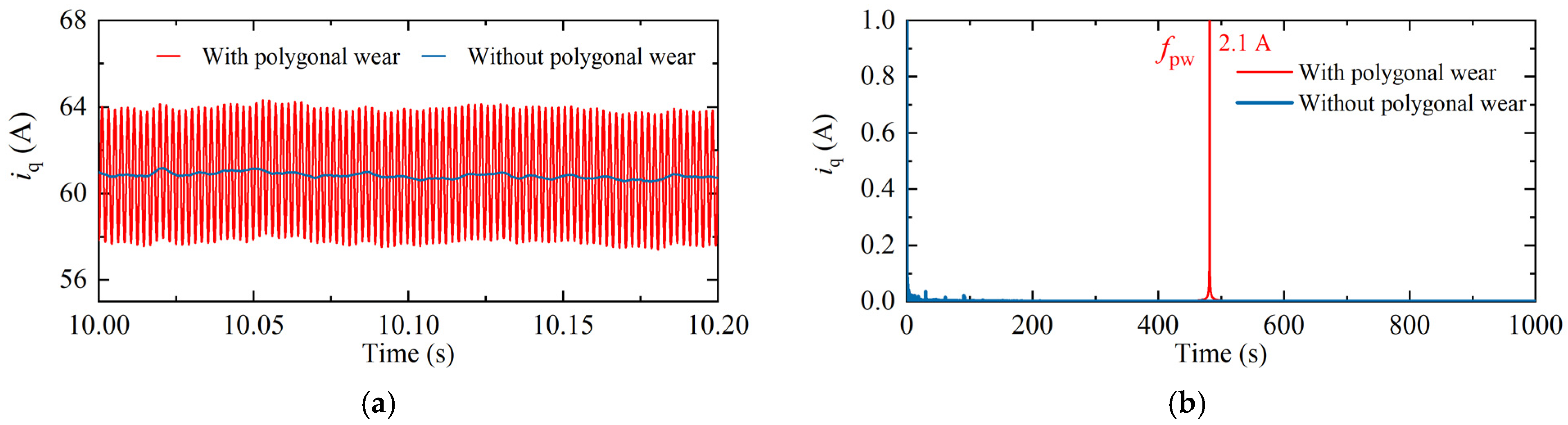
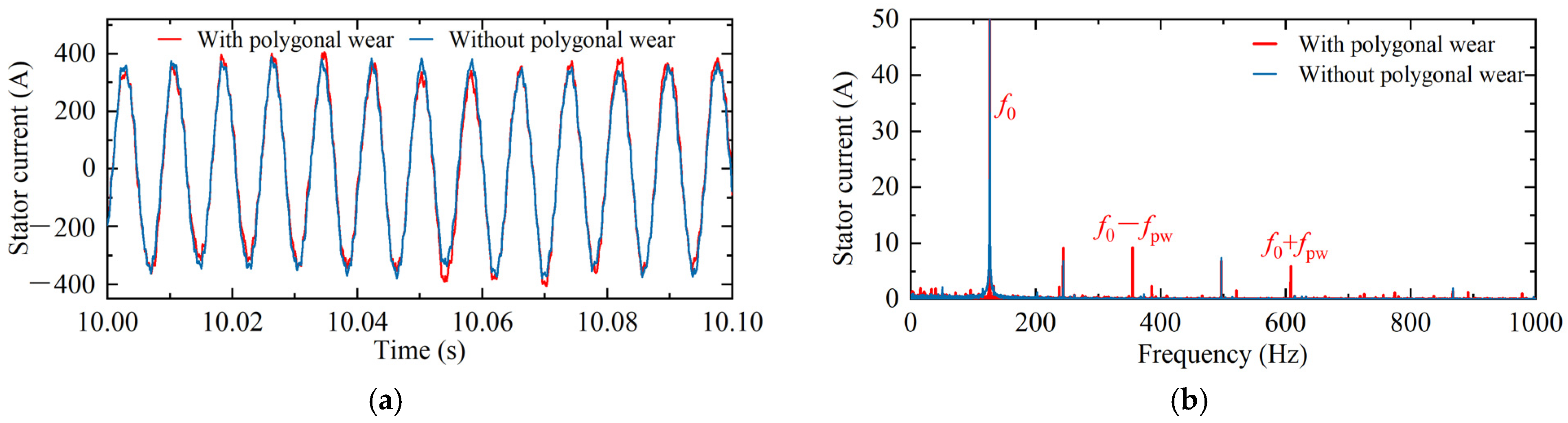
Under the influence of polygonal wear, oscillations appear in the q-axis current, with the dominant frequency matching the excitation frequency induced by the polygonal wear, as shown in Figure 11. Figure 12 compares the time-domain and frequency-domain characteristics of the stator current with and without polygonal wear excitation. The time-domain waveforms show that the wear-induced excitation has a negligible impact on the amplitude of the stator current, indicating that the developed electric traction drive system possesses strong disturbance rejection capability. In the frequency-domain, coupling components between the motor fundamental frequency (f0) and the polygonal wear excitation frequency (fpw) are clearly observed, namely |f0fpw| and |f0 + fpw|.
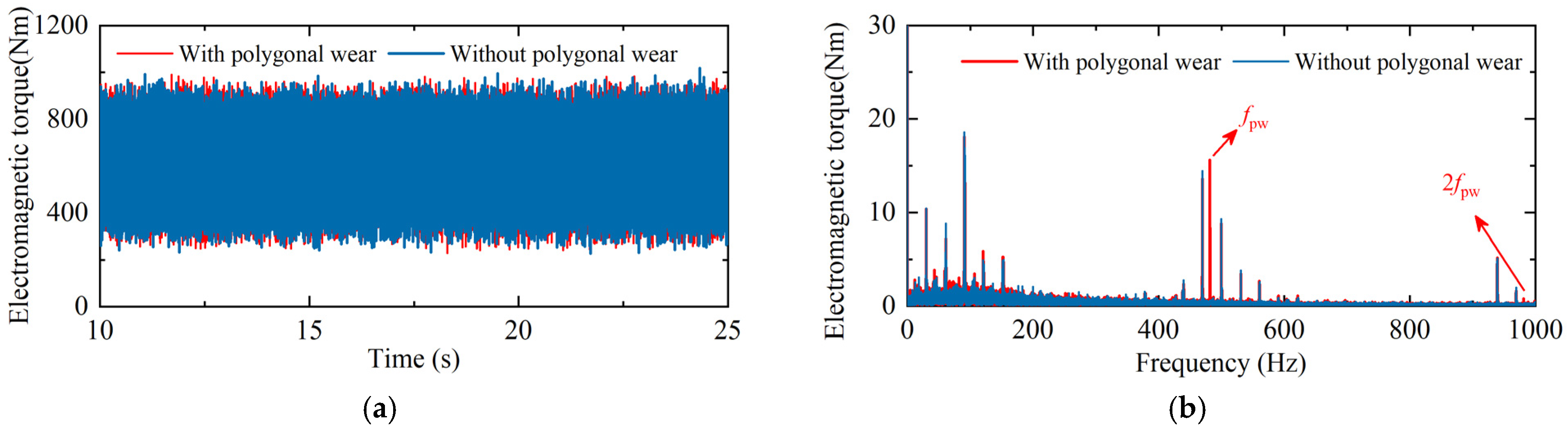
Furthermore, the presence of polygonal wear leads to increased amplitudes in both harmonic and interharmonic components of the stator current. These harmonic currents ultimately generate harmonic electromagnetic torque with a dominant frequency of fpw, as illustrated in Figure 13.
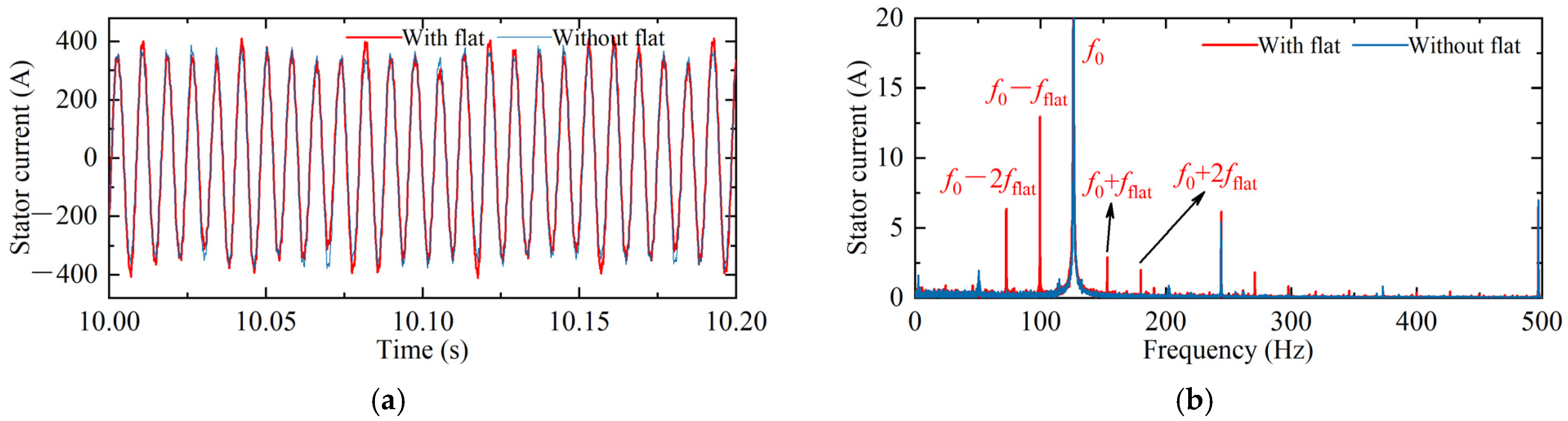
In addition, the time–frequency characteristics of the stator current under the influence of wheel flat excitation were simulated, as illustrated in Figure 14. The flat is defined with a length of 0.15 m and a depth of 0.25 mm. At a train speed of 261 km/h, the corresponding excitation frequency fflat is calculated as 26.8 Hz. The results clearly show the presence of harmonic current components associated with the flat excitation, including 73 Hz (f0 − 2fflat), 99.8 Hz (f0fflat), 153.4 Hz (f0 + fflat), and 180.2 Hz (f0 + 2fflat). These harmonic features induced by the flat are consistent with theoretical predictions.
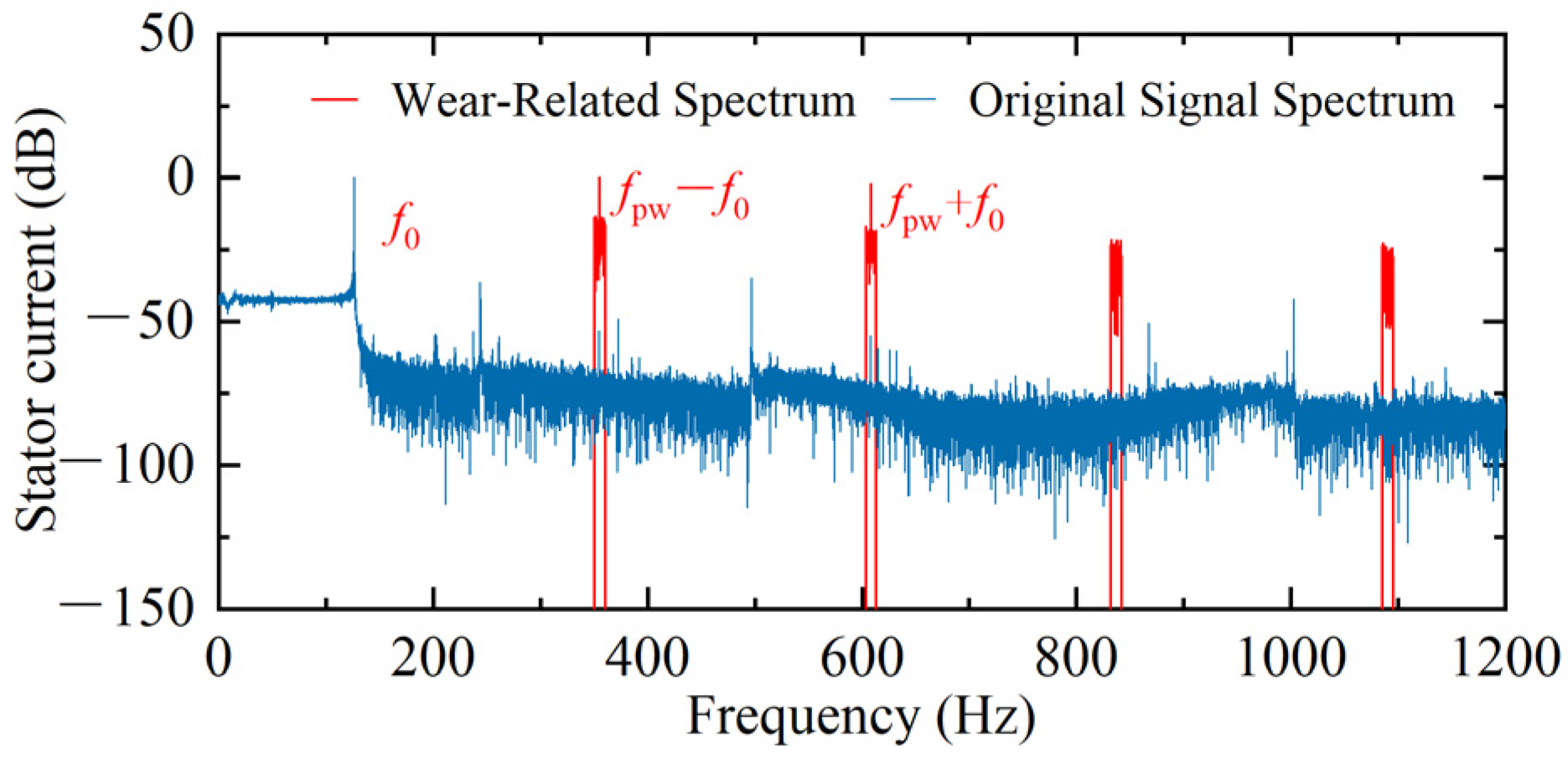
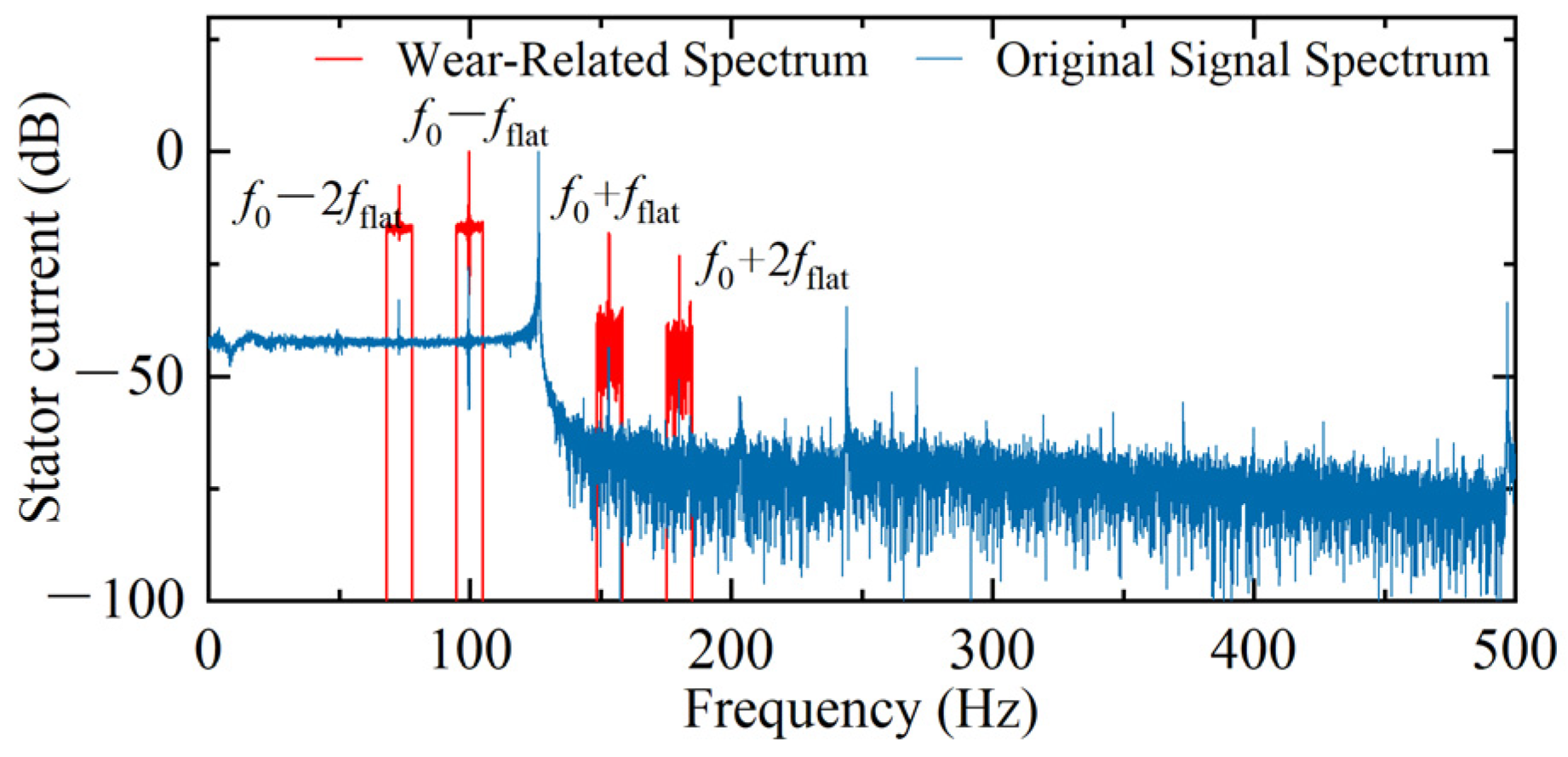
As shown in Figure 12 and Figure 14, abnormal wear may, at certain locomotive speeds, be confused with existing harmonic or interharmonic components of the electric drive system. To address this, the proposed comb filter based on VMD is applied to the stator current signal to extract wear-related harmonic components and intuitively reveal the spectral characteristics of the wear excitation. Using the proposed method, the stator currents corresponding to the irregular wear in Figure 6 (polygonal wear) and Figure 8 (wheel flat) are analyzed, and the results are presented in Figure 15 and Figure 16. It is clearly observed that the proposed approach effectively extracts the harmonic currents associated with abnormal wear, successfully separating them from the original harmonics. These results demonstrate the effectiveness of the method proposed in this study.

4.2. HIL Test

This study validates the effectiveness of the proposed wheel irregular wear monitoring method on the HIL experimental platform, based on the established electromechanical coupled model and measured wheel polygonal wear data. Specifically, the mechanical subsystem of the electromechanical coupled model is equivalently embedded into the control circuit, enabling real-time interaction with the traction main circuit. In this way, closed-loop operation of the electromechanical coupled system is realized on the HIL platform. On this basis, validation tests are carried out under constant-speed and variable-speed operating conditions to systematically evaluate the capability of the proposed method to detect wheel irregular wear under different operating scenarios.
(1)
Constant-speed condition
To verify the capability of the proposed method to detect wheel irregular wear under steady-speed conditions, the train speed is set to 200 km/h in the test. The measured wheel polygonal wear data shown in Figure 7 are introduced into the dynamic model, and the stator current signals of the traction motor are acquired and analyzed under this operating condition.
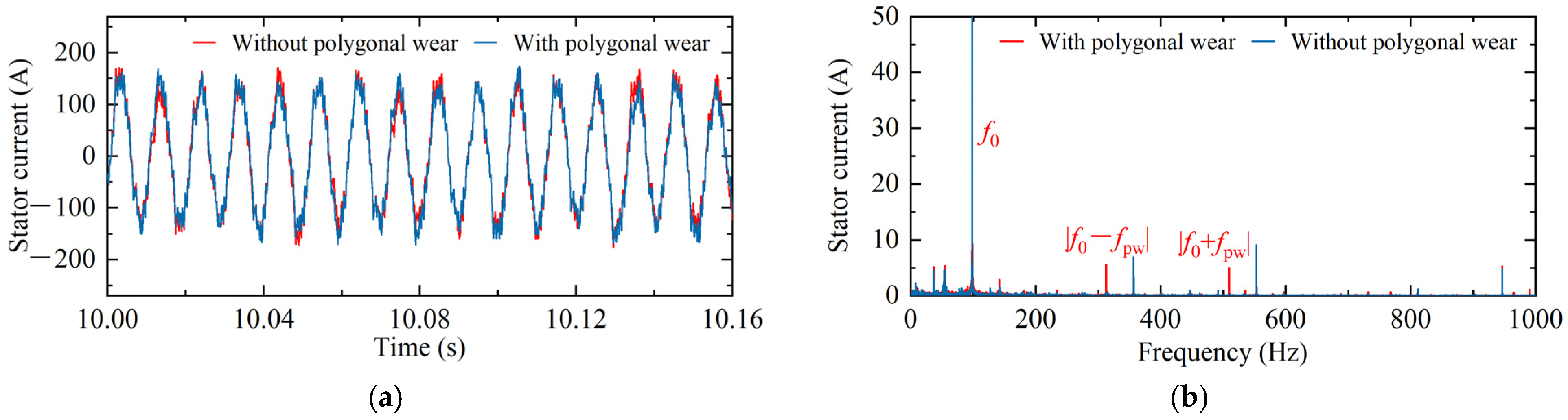
The measured time-domain waveform of phase-A stator current and its FFT spectrum are shown in Figure 17. The dominant order of the measured wheel polygonal wear is the 20th order. When the train operates at 200 km/h, the corresponding excitation frequency of the polygonal wear (fpw) is 411.2 Hz, while the fundamental frequency of the stator current (f0) is 98.3 Hz. Consequently, the characteristic harmonic components induced by polygonal wear in the stator current appear at 509.5 Hz (|f0 + fpw|) and 312.9 Hz (|f0fpw|), which is consistent with the results shown in Figure 17b.
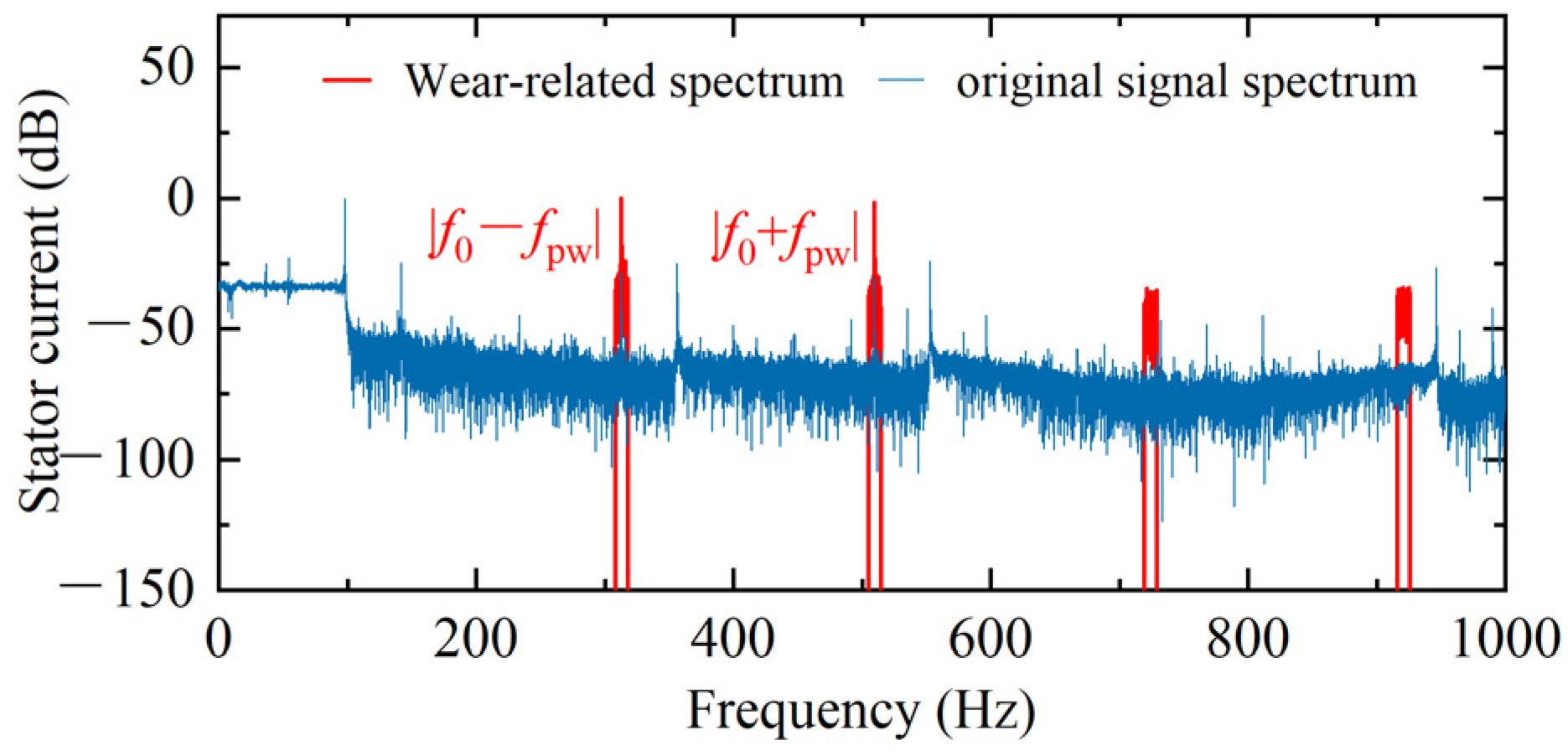
The proposed method is then applied to process the stator current signal, and the analysis results are presented in Figure 18. It can be clearly observed that the proposed method is capable of effectively extracting the characteristic components related to wheel polygonal wear from the stator current spectrum, demonstrating good detection performance.
(2)
Variable-speed condition
To evaluate the performance of the proposed method under continuously varying train speed, a traction acceleration condition is selected for testing. The train speed is assumed to increase uniformly from 200 km/h to 220 km/h. The measured wheel polygonal wear data shown in Figure 7 are introduced into the dynamic model, and the stator current signals are tested and analyzed during the acceleration process.
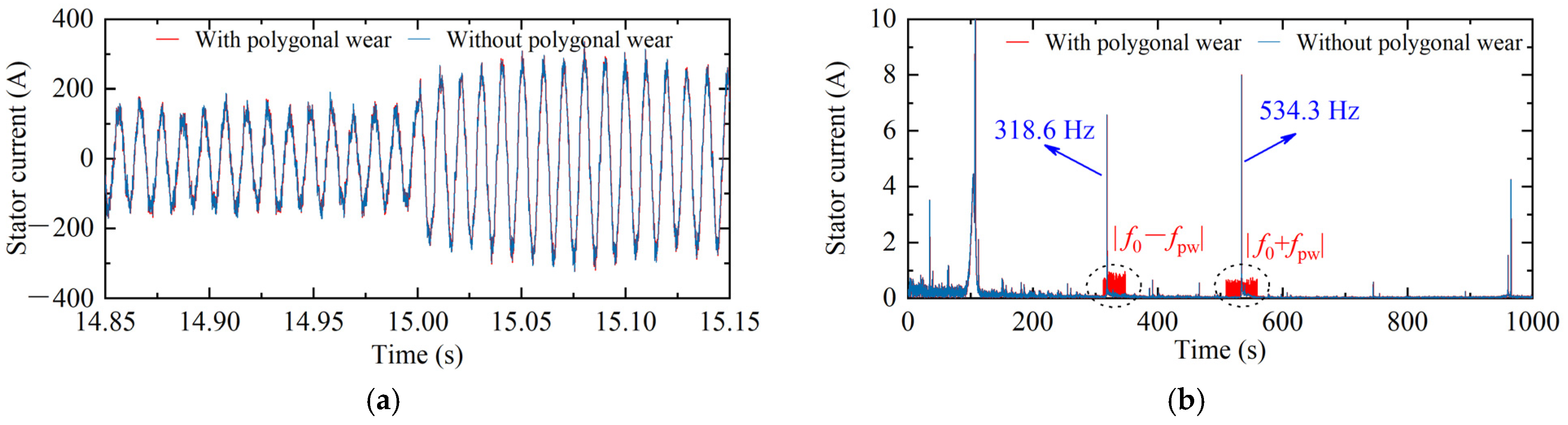
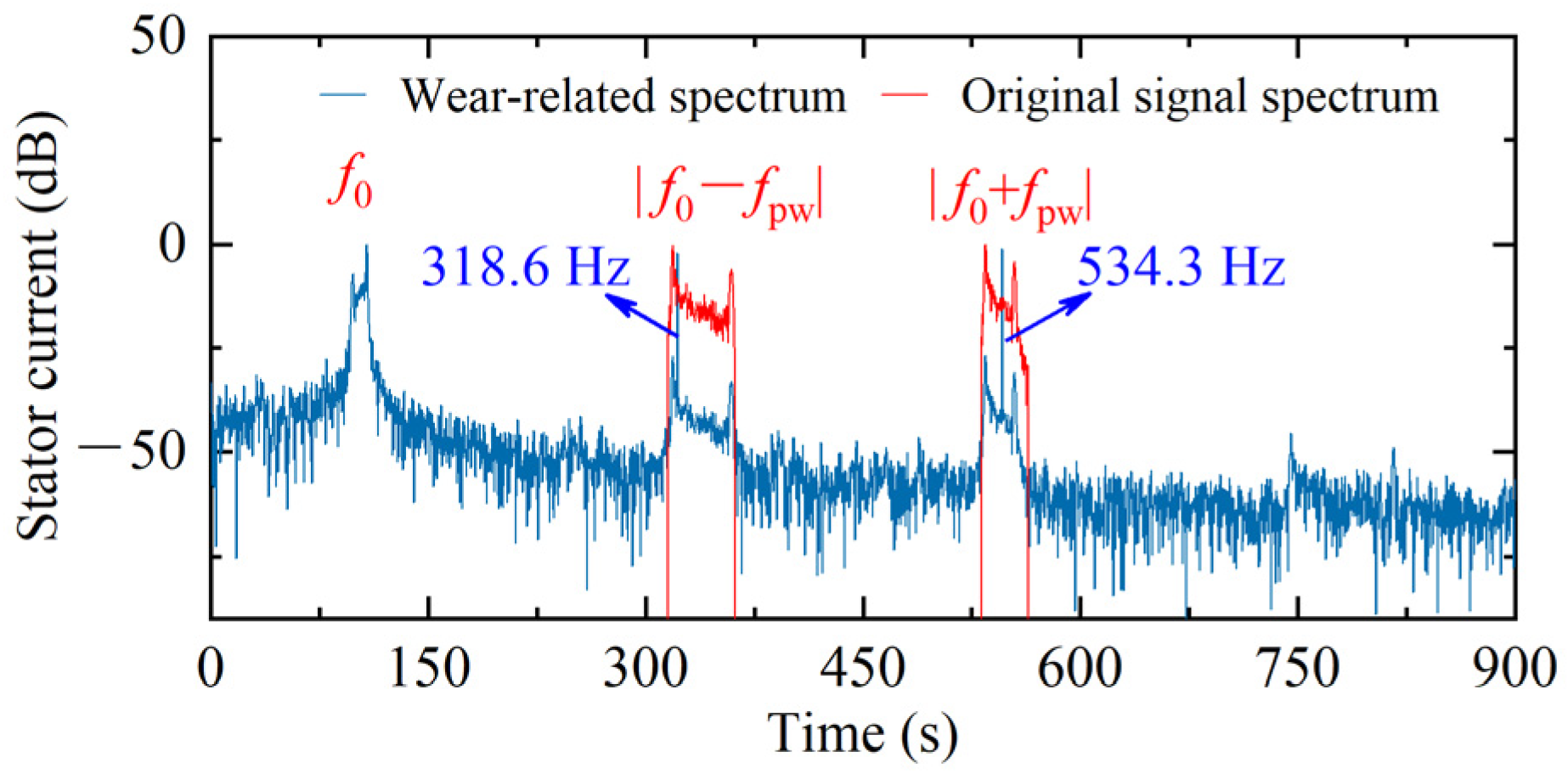
The extracted time-domain waveform of the stator current and its FFT spectrum are shown in Figure 19. As the train speed increases from 200 km/h to 220 km/h, the corresponding fundamental frequency of the stator current varies from 98.3 Hz to 108.2 Hz. The main characteristic frequency components induced by the 20th-order wheel polygonal wear in the stator current are distributed in the range of 312.9~348.3 Hz (|f0fpw|) and around 509.5 Hz, which agrees well with the results shown in Figure 19b. The proposed method is applied to analyze the stator current signals under this variable-speed condition, and the results are illustrated in Figure 20. It can be observed that even under continuously varying speed conditions, the wheel polygonal wear features can still be reliably identified by the proposed method. It should be noted that, by comparing Figure 19b with Figure 20, the original harmonic components at 318.6 Hz and 534.3 Hz overlap with the broadband harmonics induced by wheel polygonal wear. The proposed method does not misidentify these inherent system harmonics as wear-related components, which further demonstrates its effectiveness and discrimination capability.

5. Conclusions

In this study, a novel detection method for wheel irregular wear based on stator current spectrum analysis of the traction motor is proposed, taking into account the electromechanical coupling effects within the traction drive system of high-speed trains. The main conclusions are as follows:
  • An electromechanical coupling model of the traction drive system for high-speed trains is established, which can accurately simulate the electrical and mechanical behaviors of the system under multiple operating conditions.
  • Wheel irregular wear—such as wheel polygonal wear and wheel flats—induces wheel–rail vibration excitations that can propagate into the electrical drive system. These excitations couple with the motor fundamental frequency and generate harmonics and harmonic torque components.
  • A comb filter based on variational mode decomposition is proposed. This method can effectively identify the frequency components in the stator current that are associated with wheel irregular wear, thereby enabling reliable monitoring of wheel wear conditions.
Future work will focus on establishing a quantitative relationship between wheel wear severity and stator current features, including a systematic sensitivity analysis to determine the minimum detectable wear level under different operating conditions. Further validation using extended hardware-in-the-loop and field measurement data will also be conducted to enhance the practical applicability of the proposed method.

Author Contributions

Conceptualization, G.Z. and B.L.; methodology, B.Z.; software, B.Z. and B.L.; validation, G.Z. and Y.S.; writing—original draft preparation, G.Z.; writing—review and editing, B.Z.; supervision, Y.S.; project administration, Y.S. All authors have read and agreed to the published version of the manuscript.

Funding

This work was supported by Science and Technology Research and Development Program of China Academy of Railway Sciences Group Co., Ltd. (N2023J068-A(JB)), and the Open Fund Project of the State Key Laboratory of Traction Power for EMUs and Locomotives, China Academy of Railway Sciences Group Co., Ltd. (Research on the Electromechanical Coupling Model of High-Speed Trains Considering Train–Track Co-Simulation, 2023YJ369).

Data Availability Statement

The data are available upon reasonable request.

Conflicts of Interest

The authors declare no conflicts of interest.

Abbreviations

The following abbreviations are used in this manuscript:
VMDVariational Mode Decomposition
SPWMSinusoidal Pulse Width Modulation
PWPolygonal Wear

References

  1. Tao, G.; Wang, L.; Wen, Z.; Guan, Q.; Jin, X. Measurement and assessment of out-of-round electric locomotive wheels. Proc. Inst. Mech. Eng. Part F J. Rail Rapid Transit 2018, 232, 275–287. [Google Scholar] [CrossRef]
  2. Wang, H.; Song, Y.; Yang, H.; Liu, Z. Generalized Koopman Neural Operator for Data-driven Modelling of Electric Railway Pantograph-catenary Systems. IEEE Trans. Transp. Electrif. 2025, 11, 14100–14112. [Google Scholar] [CrossRef]
  3. Wang, X.; Guo, F.; Li, F.; Liu, Z.; Kou, J. Influence of Surface Roughness of Sliding Friction Pairs on Pantograph-Catenary Contact Resistance. IEEE Trans. Transp. Electrif. 2024, 10, 10208–10218. [Google Scholar] [CrossRef]
  4. Hu, Z.; Chen, L.; Song, Y.; Liu, Z.; Pombo, J. A deep learning-based surrogate model for dynamic interaction assessment of high-speed overhead conductor rail system. Eng. Struct. 2025, 343, 121221. [Google Scholar] [CrossRef]
  5. Lukas, H.; Harald, H.; Thomas, T.; Zagar, B. Magnetic Railway Sleeper Detector. Electronics 2024, 13, 4005. [Google Scholar] [CrossRef]
  6. Song, Z.; Wang, F.; Hu, X.; Cheng, D.; Li, Q. Influences of wheel polygon amplitude on wheel-rail vibration and sound radiation. J. Low Freq. Noise Vib. Act. Control. 2023, 42, 477–495. [Google Scholar] [CrossRef]
  7. Lu, B.; Song, Y.; Liu, Z.; Tao, G.; Wang, X.; Zhang, Q.; Li, Z. Evolution analysis of wheel polygon wear considering the effect of interharmonics in electrical traction drive system. Mech. Mach. Theory 2024, 191, 105470. [Google Scholar] [CrossRef]
  8. Lu, B.; Song, Y.; Liu, Z.; Wang, X.; Zhang, Q.; Lu, Y. Evolution Analysis of Three-Dimensional Wheel Polygonal Wear for Electric Locomotives Considering the Effect of Interharmonics. IEEE Trans. Veh. Technol. 2025, 74, 2443–2457. [Google Scholar] [CrossRef]
  9. Nong, H.; Lin, J. Continuous measurement method for wheel/rail vertical force based on strain of rail. Instrum. Tech. Sens. 2012, 12, 95–98, 102. [Google Scholar]
  10. Chen, L.; Choy, Y.; Wang, T.; Chiang, Y. Fault detection of wheel in wheel/rail system using kurtosis beamforming method. Struct. Health Monit. 2020, 19, 495–509. [Google Scholar] [CrossRef]
  11. Lee, M.; Chiu, W. Determination of Railway Vertical Wheel Impact Magnitudes: Field Trials. Struct. Health Monit. 2007, 6, 49–65. [Google Scholar] [CrossRef]
  12. Salzburger, H.; Schunppmann, M.; Wang, L.; Gao, X. In-motion ultrasonic testing of the tread of high-speed railway wheels using the inspection system. Insight-Non-Destr. Test. Cond. Monit. 2009, 51, 1–8. [Google Scholar] [CrossRef]
  13. Tian, L.; Fang, Z.; Zhao, Y. Locating methods of peeling and flat spots in detection of wheel tread damages of railway wagons. J. China Railw. Soc. 2009, 31, 31–36. [Google Scholar]
  14. Jiang, H.; Shang, C.; Gao, R. Wheel/rail fault noise diagnosis method based on EMD and neural network. J. Vib. Shock. 2014, 33, 34–38. [Google Scholar]
  15. Dong, W. Fault Detection of Urban Rail Track Flat Scar Based on Rail Side Vibration Signal. Master’s Thesis, Nanjing University of Science and Technology, Nanjing, China, 2018. [Google Scholar]
  16. Wu, K.; Zhang, J.; Huang, Z. Research on Measurement of Wheel Set Tread Wear by Non-contact Optoelectronic Detecting Method. J. Optoelectron. Laser 2005, 16, 332–335. [Google Scholar]
  17. Sun, Q.; Chen, C.; Andrew, H.K. An on-board detection framework for polygon wear of railway wheel based on vibration acceleration of axle-box. Mech. Syst. Signal Process. 2021, 153, 107540. [Google Scholar] [CrossRef]
  18. Xie, Q.; Tao, G.; Lo, S.M.; Cai, W.; Wen, Z. High-speed railway wheel polygon detection framework using improved frequency domain integration. Veh. Syst. Dyn. 2024, 62, 1424–1445. [Google Scholar] [CrossRef]
  19. Xu, W.; Cui, L.; Cai, W.; Wu, X.; Tao, G.; Chi, M.; Liang, S. Enhanced onboard quantitative diagnosis of wheel polygonal wear using Cepstral-Bayesian calibrated FRF. Measurement 2024, 234, 114904. [Google Scholar] [CrossRef]
  20. Wei, C.; Xin, Q.; Chung, W.; Liu, S.; Tam, H.; Ho, S.L. Real-Time Train Wheel Condition Monitoring by Fiber Bragg Grating Sensors. Int. J. Distrib. Sens. Netw. 2011, 8, 1–7. [Google Scholar] [CrossRef]
  21. Song, Y.; Sun, B. Recognition of Wheel Polygon Based on W/R Force Measurement by Piezoelectric Sensors in GSM-R Network. Wirel. Pers. Commun. 2018, 102, 1283–1291. [Google Scholar] [CrossRef]
  22. Weng, Y.; Li, Z.; Chen, X.; He, J.; Peng, C.; Xiang, H. A Railway Track Extraction Method Based on Improved DeepLabV3+. Electronics 2023, 12, 3500. [Google Scholar] [CrossRef]
  23. Pan, H.; Li, Y.; Wang, H.; Tian, X. Railway Obstacle Intrusion Detection Based on Convolution Neural Network Multitask Learning. Electronics 2022, 11, 2697. [Google Scholar] [CrossRef]
  24. Meng, C.; Wang, Z.; Shi, L.; Gao, Y. SDRC-YOLO: A Novel Foreign Object Intrusion Detection Algorithm in Railway Scenarios. Electronics 2023, 12, 1256. [Google Scholar] [CrossRef]
  25. Wang, X.; Liu, J.; Fan, F. Abnormal Wear Monitoring Method of Freight Car Wheel Tread Based on Machine Vision. Autom. Technol. Appl. 2021, 40, 128–132. [Google Scholar]
  26. Jiang, J.; Tao, G.; Liang, H.; Zhang, K.; Xie, Q.; Lu, C.; Wen, Z.; Xiao, Q. A structure information-assisted generalization network for fault diagnosis of out-of-round wheels of metro trains. Measurement 2025, 244, 116519. [Google Scholar] [CrossRef]
  27. Magalhães, J.; Jorge, T.; Silva, R.; Mosleh, A.; Vale, C.; Montenegro, P.; Cury, A. A strategy for out-of-roundness damage wheels identification in railway vehicles based on sparse autoencoders. Railw. Eng. Sci. 2024, 32, 421–443. [Google Scholar] [CrossRef]
  28. Ye, Y.; Zhu, B.; Huang, P.; Peng, B. OORNet: A deep learning model for on-board condition monitoring and fault diagnosis of out-of-round wheels of high-speed trains. Measurement 2022, 199, 111268. [Google Scholar] [CrossRef]
  29. Gan, W.; Bai, Z.; Xie, Q.; Wne, B.; Qian, X.; Hu, Z. Study on the Vibration Behaviour of Locomotives Under Wheel Polygon Excitation and Its Quantitative Detection Method. IEEE Access 2024, 12, 91873–91885. [Google Scholar] [CrossRef]
  30. Deng, L.; Xie, Q.; Tao, G.; Wen, Z. Identification Method of Wheel Out-of-roundness State of High-speed Train Based on Axle Box Vibration and Dynamic Model. J. Mech. Eng. 2023, 59, 110–121. [Google Scholar]
  31. Hu, Z.; Song, Y.; Chen, L.; Duan, F.; Liu, Z.; Feng, X. Experimental and numerical exploration of support stiffness influence on the current collection quality of pantograph and overhead conductor rail system. IEEE Trans. Transp. Electrif. 2023, 10, 7112–7126. [Google Scholar] [CrossRef]
  32. Lu, B.; Duan, F.; Song, Y.; Wang, X.; Liu, Z.; Zhang, Q.; Lu, Y. Impact of Wheel Polygonal Wear on the Operational Performance of Electric Traction Drive Systems in Locomotives. IEEE Trans. Transp. Electrif. 2025, 11, 4359–4370. [Google Scholar] [CrossRef]
  33. Lu, B.; Liu, Z.; Wang, X.; Song, Y.; Wu, S.; Tao, G. Influence of Electric Traction Drive System Harmonics and Interharmonics on the Vibration of Key Locomotive Components. IEEE Trans. Veh. Technol. 2023, 72, 12830–12844. [Google Scholar] [CrossRef]
  34. Zhang, Q.; Zhang, Y.; Huang, K.; Adamu, I.; Lu, B.; Meng, X.; Liu, Z.; Sun, W. Modeling of Regenerative Braking Energy for Electric Multiple Units Passing Long Downhill Section. IEEE Trans. Transp. Electrif. 2022, 8, 3742–3758. [Google Scholar] [CrossRef]
  35. Zhai, W. Vehicle-Track Coupled Dynamics; Springer: Singapore, 2020. [Google Scholar]
  36. Ma, C.; Gao, L.; Xu, Y.; Cai, X.; Hou, B.; Wang, L. Initiation mechanism analysis of wheel polygonal wear on high-speed railway based on refined vibration model for ballastless track system. J. Sound Vib. 2023, 559, 117782. [Google Scholar] [CrossRef]
  37. Wang, Z.; Mei, G.; Xiong, Q.; Yin, Z.; Zhang, W. Motor car–track spatial coupled dynamics model of a high-speed train with traction transmission systems. Mech. Mach. Theory 2019, 137, 386–403. [Google Scholar] [CrossRef]
Figure 1. Electrical traction drive system.
Electronics 15 00138 g001
Figure 2. Hardware-in-the-loop architecture.
Electronics 15 00138 g002
Figure 3. HIL test results of three-phase stator currents: (a) Global view, (b) Local enlarged view, (c) FFT spectrum.
Electronics 15 00138 g003
Figure 4. HIL test results of Electromagnetic torque and rotor speed.
Electronics 15 00138 g004
Figure 5. Train–track coupled dynamics model considering the motor–gear transmission system: (a) overall structural layout, (b) top view of Bogie No. 1, (c) local enlarged view of the gear transmission.
Electronics 15 00138 g005
Figure 6. Modal analysis results of the flexible wheel: (a) 1st torsion, 88.9 Hz; (b) 1st bending, 103 Hz; (c) Lateral bending, 167 Hz; (d) 1st umbrella, 267 Hz; (e) 2nd bending, 328 Hz; (f) 2nd umbrella, 390 Hz.
Electronics 15 00138 g006
Figure 7. Order analysis of wheel polygonal wear introduced into the dynamic model.
Electronics 15 00138 g007
Figure 8. Experimental and simulation data of vertical ABA: (a) time history, (b) FFT spectrum.
Electronics 15 00138 g008
Figure 9. Schematic diagram of the electromechanical coupling model.
Electronics 15 00138 g009
Figure 10. Wheelset vertical acceleration under polygonal wear excitation: (a) time history, (b) FFT spectrum.
Electronics 15 00138 g010
Figure 11. q-axis current under polygonal wear excitation: (a) time history, (b) FFT spectrum.
Electronics 15 00138 g011
Figure 12. Stator current under polygonal wear excitation: (a) time history, (b) FFT spectrum.
Electronics 15 00138 g012
Figure 13. Electromagnetic torque: (a) time history, (b) FFT spectrum.
Electronics 15 00138 g013
Figure 14. Stator current under wheel flat excitation: (a) time history, (b) FFT spectrum.
Electronics 15 00138 g014
Figure 15. Extraction results of stator current spectrum under polygonal wear excitation using the proposed method.
Electronics 15 00138 g015
Figure 16. Extraction results of stator current spectrum under wheel flat excitation using the proposed method.
Electronics 15 00138 g016
Figure 17. Stator current under polygonal wear excitation: (a) time history, (b) Frequency spectrum.
Electronics 15 00138 g017
Figure 18. Extraction results of the stator current spectrum under wheel polygonal wear excitation using the proposed method on the HIL platform.
Electronics 15 00138 g018
Figure 19. Stator current under polygonal wear excitation: (a) time history, (b) FFT spectrum.
Electronics 15 00138 g019
Figure 20. Extraction results of the stator current spectrum under wheel polygonal wear excitation using the proposed method on the HIL platform.
Electronics 15 00138 g020
Table 1. Modeling Parameters of the Electric Traction Drive System.
ParametersSymbolValue
DC-link support capacitorCd9.01 mF
Stator resistanceRs0.15 Ω
Stator inductanceLs0.16 H
Rotor resistanceRr0.02682 Ω
Rotor inductanceLr0.0314 H
Stator–rotor mutual inductanceLm0.027 H
Table 2. Modeling Parameters of the Gear Transmission System.
ParametersDriving GearDriven Gear
Normal module7 mm7 mm
Number of Teeth6929
Normal Pressure angle26 deg25 deg
Helix angle−20 deg20 deg
Modulus of Elasticity210 GPa210 GPa
Addendum11
Dedendum1.251.25
Damping Coefficient5000 N·s/m5000 N·s/m
Moment of Inertia6.76 kg·m20.2 kg·m2
Disclaimer/Publisher’s Note: The statements, opinions and data contained in all publications are solely those of the individual author(s) and contributor(s) and not of MDPI and/or the editor(s). MDPI and/or the editor(s) disclaim responsibility for any injury to people or property resulting from any ideas, methods, instructions or products referred to in the content.