


Abstract
Mission-critical applications such as telemedicine demand extremely high communication reliability. Multipath redundant transmission ensures reliable packet delivery by concurrently forwarding replicated packets over multiple paths. However, fewer studies focus on implementing redundant transmission in a distributed manner by in-network nodes, which limits the applicability and efficiency of such mechanisms in wide-area networks. This paper proposes a Distributed Adaptive Multipath Redundant Transmission (DAMR-T) mechanism, where intermediate nodes autonomously determine replica counts and make routing decisions based on local link conditions and a custom residual loss budget field in each packet. Simulations show that DAMR-T achieves reliability comparable to the source-side replication scheme while incurring the lowest redundant bandwidth overhead among all evaluated schemes. Specifically, it reduces redundant bandwidth radio by an average of 35.44% compared to the source-side replication scheme, with up to 56.1% in specific scenarios. It also achieves the lowest 95th percentile first-arrival delay across all baselines.
1. Introduction
Mission-critical applications such as modern industrial control, real-time financial transactions, and telemedicine impose stringent requirements on communication quality over wide-area networks, demanding near-deterministic guarantees in both reliability and latency. Similar reliability pressures also emerge in other complex networked infrastructures [1], reinforcing the broader need for dependable communication services. In network Quality-of-Service (QoS) research, the end-to-end packet loss rate serves as the fundamental metric for evaluating communication reliability [2,3]. Moreover, a study on application-layer latency [4] indicates that packet loss is a major contributor to increased transmission delay and degraded real-time performance. Consequently, high-reliability transmission constitutes the foundation for achieving low-latency communication, and is a prerequisite for the proper functioning of such applications [5,6]. A range of technologies, with Deterministic Networking (DetNet) [7] as a prominent example, prioritize guaranteeing high-reliability transmission as a core objective.
However, packet loss remains an inherent characteristic of Internet transmission due to network congestion, transient failures and other unpredictable factors. Conventional countermeasures to handle packet loss include Automatic Repeat reQuest (ARQ) and Forward Error Correction (FEC) techniques. ARQ enhances reliability through active retransmission of lost packets, yet inevitably increases round-trip latency [8]. FEC enables the receiver to recover lost packets independently by adding redundant data, but its recovery capability is limited and it introduces block-level buffering delay [9,10]. To meet the demands of high-reliability transmission in real-time services, multipath redundant transmission has been adopted by many schemes [11,12,13,14]. In this approach, packets are replicated into multiple replicas and transmitted concurrently over multiple paths to mitigate the risk of packet loss. Successful delivery is achieved as long as any one of the replicas arrives at the receiver within the deadline [13,15].
Multipath Redundant Transmission offers significant advantages in mitigating packet loss, but incurs additional bandwidth overhead [16]. Existing approaches typically perform packet replication at the source node of traffic flows, functionally providing end-to-end redundant protection [17]. However, the source-side replication strategy cannot precisely satisfy the diverse reliability requirements of packets at the link level, and it often results in significant bandwidth waste [18]. Therefore, several researchers have proposed in-network replication schemes, where intermediate nodes perform selective replication. Nevertheless, these approaches universally rely on centralized architectures with continuous global monitoring and centralized optimization. As network scale expands, these designs become fundamentally inadequate for meeting real-time processing constraints in wide-area deterministic networks [19,20].
To address the above issues, this paper proposes a Distributed Adaptive Multipath Redundant Transmission (DAMR-T) mechanism, which adopts an in-network replication strategy. Without requiring global network knowledge, each node makes hop-by-hop replication and routing decisions independently based on local link conditions and the reliability requirements of each packet.
The main contributions are as follows:
- To overcome the resource waste caused by source-side replication strategies that transmit replicas using bandwidth in integer multiples, we propose a redundancy factor and routing decision algorithm executed at in-network nodes. Each node collaboratively determines the optimal number of replicas and next-hop forwarding nodes, taking into account local link conditions as well as the current reliability requirements of every packet. The algorithm aims to minimize bandwidth waste while satisfying local reliability constraints, and simultaneously considers the latency and packet loss performance of the forwarding links.
- To address the challenge of maintaining global end-to-end reliability constraints in distributed environments, we propose a hop-by-hop update method for the packet’s residual loss budget: A dedicated field is embedded into each packet to indicate the maximum tolerable loss probability for the remaining transmission path. Each node dynamically updates this value based on its local link conditions and forwarding decisions. Consequently, the end-to-end reliability objective is maintained in a fully distributed manner through the accumulation of per-hop loss probabilities, ensuring both scalability and transmission reliability.
The remainder of this paper is organized as follows: Section 2 reviews related work on multipath redundant transmission. Section 3 presents the overall architecture of the proposed DAMR-T mechanism and formulates the corresponding optimization problem. Section 4 details the mechanism design and algorithm implementation. In Section 5, simulation experiments are conducted to evaluate the performance of DAMR-T. Finally, Section 6 concludes the paper.
2. Related Work
With the rapid growth of real-time applications requiring high-reliability transmission, multipath redundant transmission has increasingly become a research focus. Literature [21] and [22] have demonstrated through mathematical analysis and extensive experiments that redundancy-based transmission mechanisms significantly enhance network reliability, particularly in wide-area network scenarios. Furthermore, redundancy has also been broadly discussed from a fault-tolerant routing perspective. As reviewed in [23], multipath replication techniques enhance robustness by distributing duplicated chunks across diverse transmission paths. Existing multipath redundant transmission techniques can be categorized into two types based on packet replication location: source-side replication and in-network replication.
Source-side replication methods generate all replicas at the source node of the traffic flow, while in-network nodes are only responsible for forwarding. Some researchers leverage existing multipath transport protocols, such as MPTCP [24] and MPQUIC [25], to implement end-to-end redundancy. However, these approaches fail to control or optimize the specific network-layer paths of individual replicas [26]: A. Hunger et al. developed an rMPTCP extension to enhance fault tolerance by injecting redundant packets into multiple subflows [6,16]. Their work also focuses on the trade-off between transmission gains and bandwidth overhead. Wang et al. [27] designed MPTCP-L for cloud data center networks, in which two subflows are used to transmit latency-sensitive packets in parallel, aiming to proactively mitigate the impact of packet loss on short flows. In [28], the authors considers a hybrid traffic scenario involving both critical and non-critical application flows on a single MP-QUIC connection, redundancy is selectively applied to high-priority data. Similarly, Carvalho et al. [29] improve reliability in mixed-criticality wireless systems by replicating critical messages across multiple quasi-orthogonal LoRaWAN links. Their mechanism employs multi-SF transmission paths, effectively reducing confirmed-message failures. Elattar et al. establish multiple end-to-end paths via distinct ISPs to ensure highly reliable data transmission for Internet-based physical network systems. The number of replicas is jointly determined by the service’s reliability requirements and the quality of available paths [14,30,31]. However, above approaches rely on the path management mechanisms of underlying protocols and lack effective control over the forwarding paths of individual replicas, which makes them vulnerable to performance fluctuations under dynamic network conditions. To address this limitation, many researchers have proposed integrating source-side redundant methods with routing mechanisms to explicitly configure the transmission path of each replica: To maximize path diversity, one approach leverages MPLS technology to explicitly assign paths for each redundant replica; however, it does not consider the quality of the selected paths [32]. Comer et al. [33] employ Software-Defined Networking (SDN) to construct multiple edge-disjoint paths between the sender and receiver using a centralized controller, which continuously monitors path performance and replaces underperforming paths. Reliability and schedulability in multipath routing are jointly addressed in [34], where a set of candidate routes satisfying a given reliability threshold is first identified. A metaheuristic algorithm is then applied to select routes that minimize both flow conflicts and overall latency. To improve the reliability of intelligent computing service flows across WANs, an SRv6-based “dual-transmission selective-reception” technique is introduced in [35]. Demir et al. [36] propose an overlay-based QoS routing scheme that clusters nodes according to their Autonomous Systems (AS), and then computes intra- and inter-cluster paths separately to construct multiple disjoint routes, thereby enabling fault-tolerant communication for mission-critical applications.
The in-network replication approach shifts replica generation and forwarding tasks to intermediate nodes, thereby reducing the bandwidth waste inherent in source-side replication strategies that transmit redundant frames at integer multiples of the original bandwidth. To improve failure resilience, Desai and Punnekkat propose a method to leverage machine learning to detect changes in link quality and predict potential failures, replicating frames only at nodes with a high likelihood of failure [37]. A redundant transmission mechanism based on optimized node selection is presented in [38], where a genetic algorithm identifies replication and elimination nodes by jointly considering node location and attributes. Two disjoint paths are then selected to transmit the original packet and its replica in parallel. An improved routing algorithm based on link pruning is introduced in [39], which selects edge-disjoint path pairs along with replication and elimination nodes to protect critical flows. Djambazova and Andreev [40] study hop-by-hop repetition and localized redundancy management along a single path in dependable distributed real-time systems, showing that intermediate nodes can still enhance reliability without exploiting path diversity. However, these studies do not integrate flow-specific reliability requirements into their decision models, making it difficult to ensure that predefined reliability targets are met. A segmented redundant routing scheme is proposed in [17,41] for FlexE-over-WDM networks, where replication and elimination nodes are deployed centrally to satisfy loss rate requirements while minimizing the number of involved nodes. To address load imbalance in redundant transmission, Wen et al. [18] propose a reliability-aware segmented routing and scheduling mechanism that precisely meets service reliability requirements while improving schedulability. Nonetheless, these approaches rely heavily on global network knowledge and centralized control, which limits their responsiveness and scalability in wide-area networks.
To address the limitations of existing multipath redundant transmission mechanisms, this paper proposes a distributed adaptive multipath redundant transmission mechanism, DAMR-T. Unlike centralized approaches that rely on global topology knowledge and end-to-end path monitoring, the proposed mechanism enables DAMR-T-capable in-network nodes to make independent decisions using only local link conditions and packet-carried status information. Specifically, participating nodes autonomously determine the number of redundant replicas and select their forwarding next hops. By performing hop-by-hop updates to a Residual Loss Budget (RLB) field carried in the packet header, DAMR-T achieves distributed enforcement of global end-to-end reliability targets. The objective of DAMR-T is to provide high-reliability transmission for mission-critical services over wide-area networks, while at the same time minimizing redundant bandwidth consumption and biasing forwarding decisions towards higher-quality links.
3. System Architecture and Optimization Modeling
This section first presents the overall architecture of the proposed DAMR-T mechanism, including its fundamental working principles and the per-node processing procedures during packet forwarding. It subsequently formulates an optimization model and analyzes the corresponding local subproblems that in-network nodes need to solve under distributed conditions.
3.1. Overview of the DAMR-T Mechanism
3.1.1. DAMR-T Working Principles
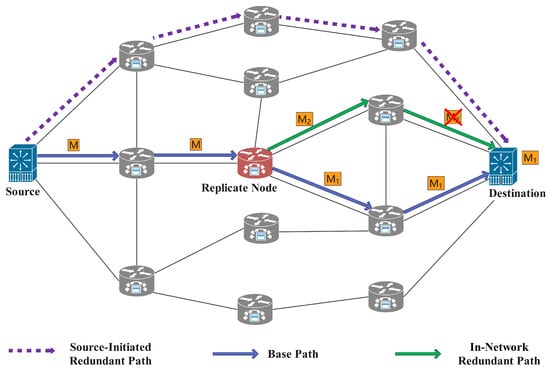
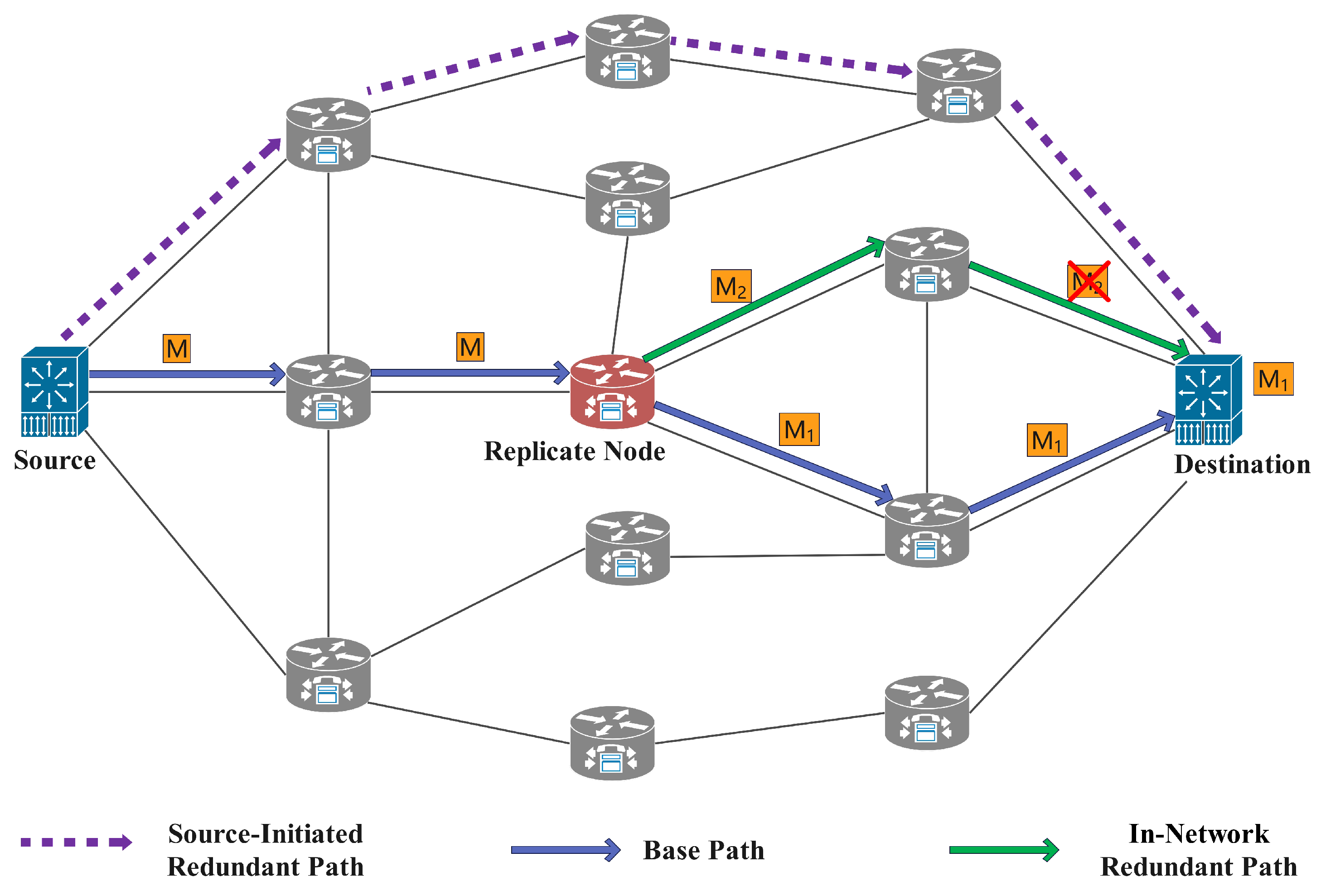
Figure 1 illustrates the operation of the DAMR-T mechanism within a simplified wide-area network topology, where in-network nodes equipped with DAMR-T functionality perform packet replication and multipath transmission. For simplicity, all nodes and links in the figure are drawn as a flat physical topology; however, the same architecture also applies when DAMR-T is implemented on overlay nodes and logical links deployed over an existing wide-area network. In practical deployment, DAMR-T is intended as a reliability-enhancement mechanism for a limited set of mission-critical flows rather than a universal forwarding scheme for all traffic. Only traffic with stringent end-to-end reliability requirements is handled by DAMR-T, while most best-effort traffic still relies on conventional forwarding and congestion-control mechanisms.
Figure 1.
Illustration of the DAMR-T mechanism with in-network replication and multipath forwarding.
Given the diverse high-reliability transmission requirements of different services, the corresponding flows are subject to different upper-bound constraints on end-to-end packet loss rates. However, in a distributed environment lacking centralized control, each node must independently make decisions and collaboratively maintain the global transmission reliability objective based only on its partial network view. To address this, we introduce a key field into each packet—Residual Loss Budget (RLB). The RLB field indicates the maximum tolerable loss probability for the packet throughout the remainder of its transmission path, serving as an explicit representation of its remaining reliability requirement. This field’s value is the core basis for local decision-making at each node. Initialized at the source based on the service’s target end-to-end loss bound (e.g., specified by SLA or QoS requirements), the RLB value is then dynamically updated at each hop during forwarding, so that nodes can cooperatively maintain the global reliability objective in a fully distributed manner.
The application of this mechanism requires each node to maintain multiple reachable forwarding paths toward the same destination, thereby providing the foundational support for subsequent redundant replication and multipath forwarding. Common multipath construction methods include Equal-Cost Multi-Path (ECMP) [42], K-shortest paths algorithm [43], and Quality-of-Service-aware (QoS-aware) path selection strategies [44]. In this study, we adopt a simple QoS-aware multipath construction in the routing control plane. The WAN is modeled as a weighted graph in which each link is assigned a loss-related cost (larger for higher average loss), and the cost of a path is the sum of its link costs. For each logical destination, we first compute the minimum-hop path and use its hop count as a baseline. We then run a k-shortest simple paths search and retain up to k = 4 loop-free paths whose hop count does not exceed the baseline plus two hops. For each node, the DAMR-T next-hop set towards a destination consists of the first hops of these retained paths; if fewer than k admissible paths exist, the node simply uses the available subset. Thus, instead of a single next hop as in traditional single-path routing, each node maintains a next-hop set of multiple quality-acceptable neighbors for the same destination in its routing table. It is worth noting that multipath construction itself is not the focus of this work, but rather a prerequisite for the proper functioning of the proposed DAMR-T mechanism. Given the extensive prior research in this area, further details are omitted.
3.1.2. Node-Level Processing Procedures
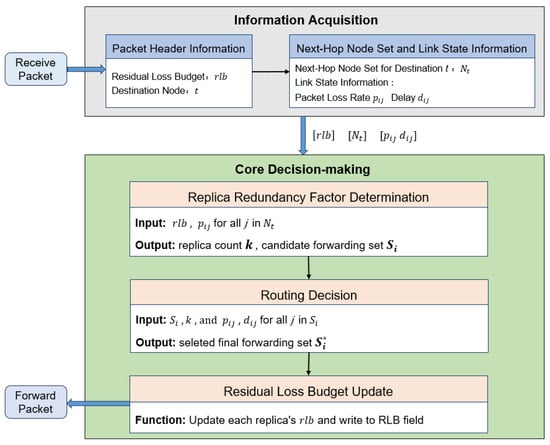
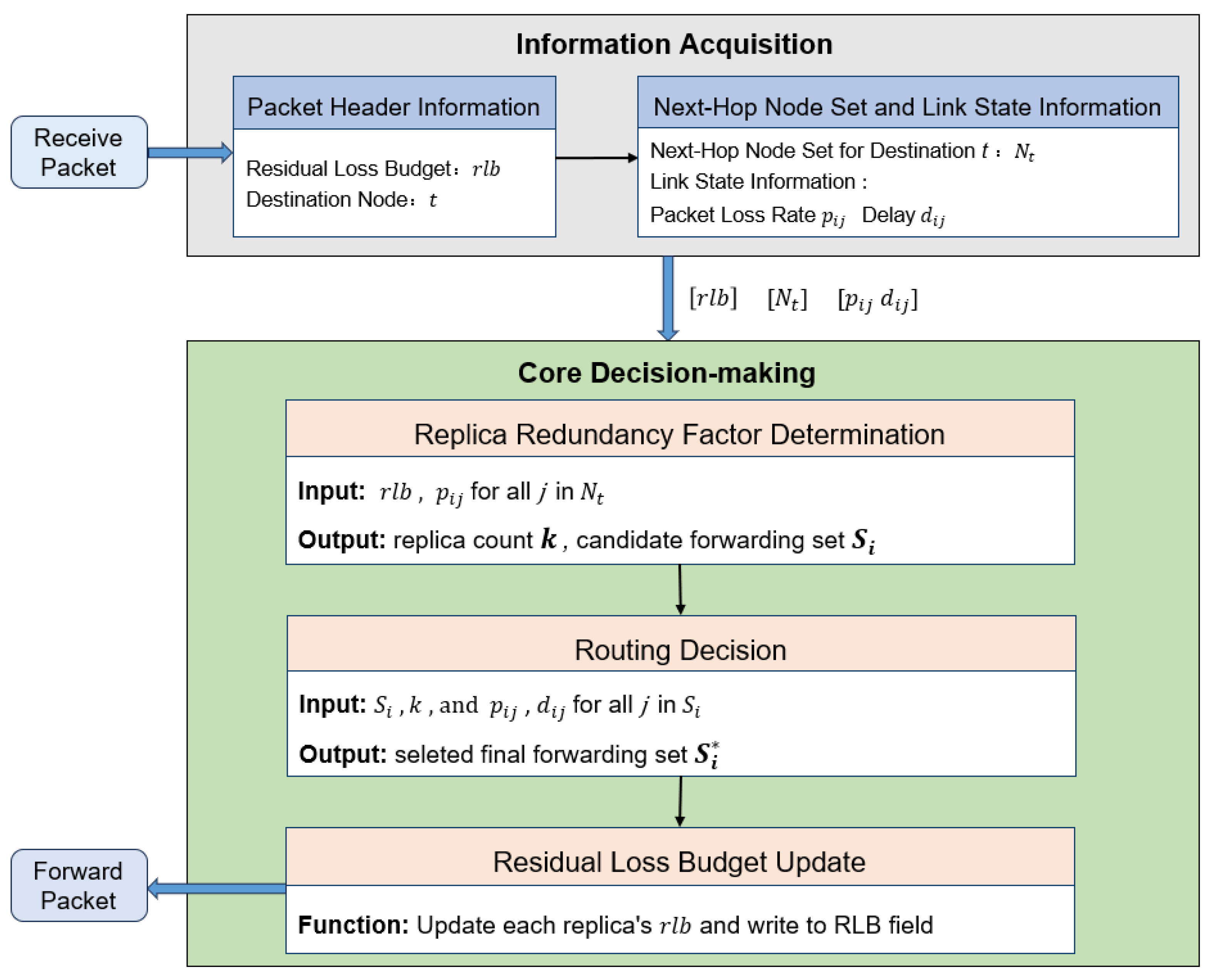
The DAMR-T mechanism is collaboratively implemented by network nodes in a distributed environment. Within each node, functional modules interact through internal information exchange to jointly perform redundancy factor determination, forwarding decision-making, and RLB field updates. Figure 2 illustrates the complete processing procedure executed by a network node i upon receiving a packet.
Figure 2.
Node-level packet processing workflow in DAMR-T mechanism.
Upon receiving a packet, a node first parses the packet header to extract the value of the RLB field. It then queries the local routing table to obtain the next-hop node set toward the destination node t, along with the real-time status of the corresponding outgoing links, including their loss rates and delays. This data serves as the basis for subsequent decision-making. The core component of DAMR-T lies in its decision-making logic, which comprises three key modules: Redundancy Factor Determination, Routing Decision, and Residual Loss Budget Update. The Redundancy Factor Determination module calculates the minimum number of replicas k required to satisfy the local reliability constraint, based on the incoming packet’s RLB value and the local link loss rates. It then filters the initial next-hop candidate set to derive a qualified candidate forwarding set . The Routing Decision module replicates the original packet into k identical replicas. Leveraging link loss rates and delay metrics, it then selects k nodes with optimal link quality from the candidate set to form the final forwarding set , assigning each replica to a specific next-hop node. Before the actual forwarding of replicas, the Residual Loss Budget Update module recalculates and updates the RLB field based on the current RLB value, the number of replicas k, and the loss rates of selected links. This ensures sufficient support for subsequent nodes to make independent decisions.
The overall processing workflow achieves dynamic orchestration of packet replication and multipath forwarding in a distributed environment, thus effectively supporting the attainment of end-to-end reliability objectives. The detailed design and algorithmic implementation of the mechanism will be elaborated in Section 4.
3.2. Problem Formulation and Distributed Subproblem Design
To precisely characterize the design objectives and performance constraints of the proposed mechanism, this subsection first formulates an optimization model from a global network perspective. This model serves as the theoretical foundation for the design and decomposition of the subsequent distributed decision strategy. Our model considers a network topology as illustrated in Figure 1. It is abstracted as a directed graph , where V represents the set of network nodes and E denotes the set of directed links between connected node pairs. Each physical full-duplex connection between two nodes is modeled as two directed links and , and the delay and loss probability are defined per direction and may be asymmetric. The analysis is conducted at the granularity of individual packets. For packets requiring high-reliability transmission, the end-to-end packet loss probability must not exceed a predefined threshold.
3.2.1. Mathematical Notation and Definitions
Table 1 summarizes the formal notation used in the optimization model. For simplicity, both original packets and their replicated copies are uniformly referred to as replicas throughout the formulation.
Table 1.
Symbol definitions in optimization model.
3.2.2. Constraint Formulation and Parameter Computation
To ensure packet reachability, we first impose constraints on link selection:
Equation (1) constrains each network node i to select its forwarding nodes exclusively from the destination-specific next-hop node set . Additionally, to prevent multiple replicas from being simultaneously affected by a high-loss link, node i is prohibited from sending more than one locally replicated replica to the same downstream node:
Here, is a binary decision variable indicating whether link is selected to carry a self-generated replica when node i performs active replication for the considered packet, and denotes the total number of replicas of that packet that traverse link , including both self-generated replicas at node i and replicas forwarded from upstream nodes; the constraint simply ensures basic consistency between these two quantities.
Ensuring transmission reliability is the primary objective for each packet—specifically, the joint loss probability of all its replicas must remain below the predefined loss rate threshold. Equations (3) and (4) together define the strict reliability constraint:
Equation (3) requires that the probability of the destination node d successfully receiving at least one replica—i.e., the successful delivery probability—be no less than . For each intermediate node , the value of is computed through cumulative conditional probability propagation:
As shown in Equation (4), the successful delivery probability at node j depends on the of all its upstream nodes i, the number of replicas transmitted on incoming link , and the corresponding link loss rate . Given that the source node always possesses the original packet, is set to 1. For each source–destination pair, Equation (4) is evaluated on a destination-oriented, loop-free forwarding graph derived from the precomputed multipath structure, processing nodes in order from s to d so that each depends only on already computed upstream and no circular dependence arises. The successful delivery probability at the destination node d is required to meet the end-to-end reliability constraint defined by Equation (3).
The end-to-end transmission delay is also the key performance metric considered in this work. We introduce the delay of the earliest arriving replica (i.e., first-arrival delay) as the evaluation metric, which is computed as shown in Equation (5).
In this work, the first-arrival delay in Equation (5) is used as an approximate analytical metric: it is computed as the minimum path delay among the links that actually carry replicas and is interpreted as the delay of the earliest successful replica, conditioned on successful delivery. The overall probability that at least one replica arrives is modeled separately through the reliability constraints in Equations (3) and (4), rather than being explicitly embedded in Equation (5). For the source node s, the first-arrival delay is .
3.2.3. Optimization Objective
The primary focus of this study is to reduce the additional bandwidth consumption introduced by multipath redundant transmission while satisfying the reliability constraints defined in the previous subsection. On this basis, it further aims to optimize the overall routing and replication pattern in the network. In the global optimization model, this pattern is represented by the link-level replica counts over all links; these per-link replica counts, together with the associated binary indicators introduced in Equations (1) and (2), constitute the decision variables and are constrained by the link-selection and consistency conditions for and for . To achieve this, we adopt a hierarchical optimization structure: the primary objective is to minimize the redundant bandwidth overhead; the secondary objective minimizes both the probability of all replicas being lost and the first-arrival delay. Lexicographic optimization is adopted in Equation (6) to explicitly prioritize the objectives.
The primary objective minimizes the total bandwidth consumption across the network, represented by the cumulative number of transmissions of packet m and its replicas over all links. Under the premise of minimizing redundant bandwidth, the secondary objective aims to further enhance quality of service. To account for the differences in physical units among objectives, normalization is applied to both the first-arrival delay and the loss probability: the loss probability term uses the flow’s end-to-end loss rate threshold as the normalization baseline, while the delay term is normalized by a reference constant , which in the global optimization model is treated as a service-level upper bound on the first-arrival delay (for example, an SLA delay target or a high quantile of the empirical first-arrival delay distribution estimated from historical measurements). We emphasize that Equation (6) serves as a global theoretical objective under such reference parameters, whereas the actual DAMR-T forwarding decisions are made in a fully distributed manner, as detailed in the following subsections. The weighting coefficients and satisfy and ; in our numerical evaluation, they are fixed to and , which reflects that we place more emphasis on reliability than delay while keeping the two normalized terms at a comparable magnitude. The resulting weighted cost function provides a theoretical foundation for the subsequent design of the distributed algorithm.
3.3. Optimization Model Summary and Distributed Solution
The optimization problem is summarized as follows in Equation (7).
The proposed optimization problem constitutes a multi-objective, mixed-integer nonlinear programming problem, whose computational complexity grows exponentially with network size, making centralized solutions impractical in large-scale networks. Therefore, this paper further decomposes the original model to construct a distributed solution framework that can be independently executed by individual forwarding nodes. The proposed DAMR-T mechanism enables efficient and feasible solutions under distributed conditions through real-time, online decision-making. In the performance evaluation, the effectiveness of this localized formulation is assessed through the observed Bandwidth Redundancy Ratio, end-to-end packet loss rate, and first-arrival delay, which together provide an empirical assessment of the distributed solution under the evaluated scenarios.
The core idea of the proposed mechanism is to decompose the global optimization problem, as formulated in Equation (7), into distributed per-hop local subproblems. By leveraging the aforementioned RLB field, the end-to-end packet loss constraint is partitioned into per-hop local constraints along the path. Each node only needs to rely on its local link state to ensure that the joint loss probability of self-generated replicas does not exceed the current RLB value. To align with the global objective function, the primary goal of each local subproblem is to determine the minimum number of replicas required at the current node. On this basis, the node then selects the final forwarding node set with lower delay and packet loss rate, thereby reducing the cumulative transmission delay and the loss probability of each replica.
4. Design and Algorithmic Implementation of DAMR-T
This section details the specific design and algorithmic implementation of the DAMR-T mechanism. The proposed mechanism consists of two core components: (1) Redundancy Factor and Routing Decision Algorithm, which performs a joint decision on packet replication and next-hop node selection based on the local optimization subproblem using a two-phase solution strategy; (2) Hop-by-Hop Update Method for the Residual Loss Budget, which enables distributed maintenance of end-to-end reliability objective by dynamically updating the residual loss tolerance along the transmission path.
4.1. Redundancy Factor and Routing Decision Algorithm
4.1.1. Local Optimization Subproblem
Upon receiving a packet, network node i needs to determine the number of replicas to be generated (i.e., the redundancy factor k) and select the set of next-hop nodes for replica forwarding. As previously described, we first decompose the global optimization problem defined in Equation (7) into local subproblems at each node. Specifically, the global end-to-end packet loss rate constraint is distributed as local forwarding constraints per node. Assuming the current residual loss budget value carried by the packet is , the local decision at node i requires that the combined loss rate of the selected forwarding links satisfies:
Based on the satisfaction of the local reliability constraint, the node first prioritizes minimizing the replica redundancy factor k, thereby reducing redundant bandwidth consumption. Subsequently, it seeks to select a forwarding set that achieves optimal overall performance in terms of both delay and packet loss rate.To ensure dimension-consistent weighting and to avoid dominance due to heterogeneous units and ranges (milliseconds vs. unitless loss; loss spanning multiple orders of magnitude), a normalization process is applied to both metrics in (9). Specifically, link delay is linearly scaled, while packet loss rate—due to its order-of-magnitude variability—is normalized on a logarithmic scale. Here, and (similarly, and ) denote the minimum and maximum link delays (loss rates) among the candidate next-hop links at node i, i.e., the outgoing links that remain in the locally filtered candidate set for the current decision step.
The cost function for each forwarding node is defined as:
Accordingly, the optimization objective of the local subproblem is defined as:
4.1.2. Solution Strategy
To solve the local optimization subproblem described in the previous subsection, a two-stage solution strategy is adopted:
Stage 1: Determining the Minimum Redundancy Factor That Satisfies the Reliability Constraint
When the loss rate of every outgoing link exceeds the current residual loss budget carried by the packet, replication is required. Directly determining the redundancy factor based on the original constraint (8) involves exhaustive enumeration of all possible next-hop link combinations and joint probability calculations, and is highly sensitive to errors in link state estimation. To enhance computational efficiency and stability of local decisions, we adopt a stricter substitute constraint. Specifically, we employ a discrete search method to traverse whether the loss rates of the next-hop links satisfy the following condition:
The nodes that satisfy the condition (12) are added to the candidate set . Formally:
If the condition holds, it indicates that the current redundancy factor k is a feasible solution. In this case, the node set serves as the initial candidate forwarding set, from which selecting any k next-hop nodes can meet the local packet loss rate constraint. Otherwise, the process proceeds to higher k values and reconstructs the corresponding candidate set. The search begins with and proceeds incrementally until the minimum feasible redundancy factor is identified.
Stage 2: Forwarding Node Selection Based on Weighted Cost Optimization
Based on the minimum redundancy factor and initial candidate set determined in Stage 1, this stage aims to further optimize the quality of service during packet forwarding. We first calculate the cost function value for each node in the initial candidate set according to Equations (9) and (10). The nodes with the lowest cost values are selected to form the final forwarding node set :
4.1.3. Algorithm Implementation Details
In the algorithm implementation, specific optimizations are applied for special cases: when the destination node is a direct neighbor of the current node, the destination node is directly selected as the sole next-hop forwarder, in order to minimize the final-hop delay and keep the endpoint behavior simple, rather than introducing local detours near the destination that add extra delay and complexity but cannot consistently guarantee a more reliable last hop. For other scenarios, the established two-phase solution strategy remains effective.
Node i first parses the packet to extract the current Residual Loss Budget value . It then queries its local routing table to obtain the next-hop node set and the corresponding link state information. These parameters serve as inputs for the Redundancy Factor and Routing Decision Algorithm. Algorithm’s output consists of the number of replicas k and the selected forwarding next-hop node set , which is initialized to ⌀.
The detailed steps of the algorithm are shown in Algorithm 1.
| Algorithm 1 Redundancy Factor and Routing Decision Algorithm |
| Input: , |
| Output: , |
| Initialize: |
|
Node i first checks whether the destination node d is a direct neighbor. If so, the algorithm terminates immediately and returns the forwarding set and the redundancy factor . Otherwise, the algorithm continues (Lines 1–3).
First, the minimum number of redundant replicas k that satisfies the strict reliability constraint is determined. The maximum redundancy allowed per node is limited to 4, chosen as a practical upper bound in our evaluation to balance reliability improvement and bandwidth overhead. Starting from , the algorithm iteratively traverses the next-hop node set . In each iteration, for every node j in the set, if the corresponding link loss rate satisfies the reliability threshold condition , node j is added to the candidate set . At the end of each iteration, evaluate whether the condition is satisfied: If not met, increment and continue the loop; otherwise, the loop terminates, and the current value of k is taken as the minimum feasible redundancy factor (Lines 4–15).
After determining the redundancy factor k and the initial candidate set , the algorithm first normalizes the loss rate and delay of the link associated with each node in . It then computes the composite cost for each node. Finally, the candidate set is sorted in ascending order based on cost, and the nodes with the lowest costs are selected to form the final forwarding set (Lines 16–21).
Finally, the algorithm returns the determined redundancy factor and the forwarding node set (Line 22).
4.2. Hop-by-Hop Update Method for the Residual Loss Budget
The DAMR-T mechanism decomposes the global reliability objective—i.e., ensuring that the end-to-end packet loss rate remains below a predefined threshold—into hop-by-hop controllable local constraints. This is achieved by embedding a “Residual Loss Budget” (RLB) field in each packet, whose value represents the maximum tolerable packet loss probability during subsequent transmission path. After executing the Redundancy Factor and Routing Decision Algorithm, each network node dynamically updates the RLB value based on the states of selected links. The update process involves two cases: (1) without packet replication (), and (2) with packet replication ().
4.2.1. RLB Update Without Packet Replication
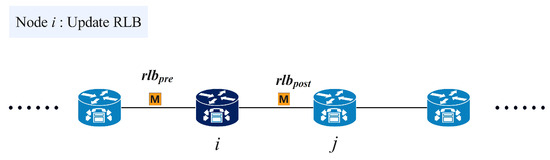
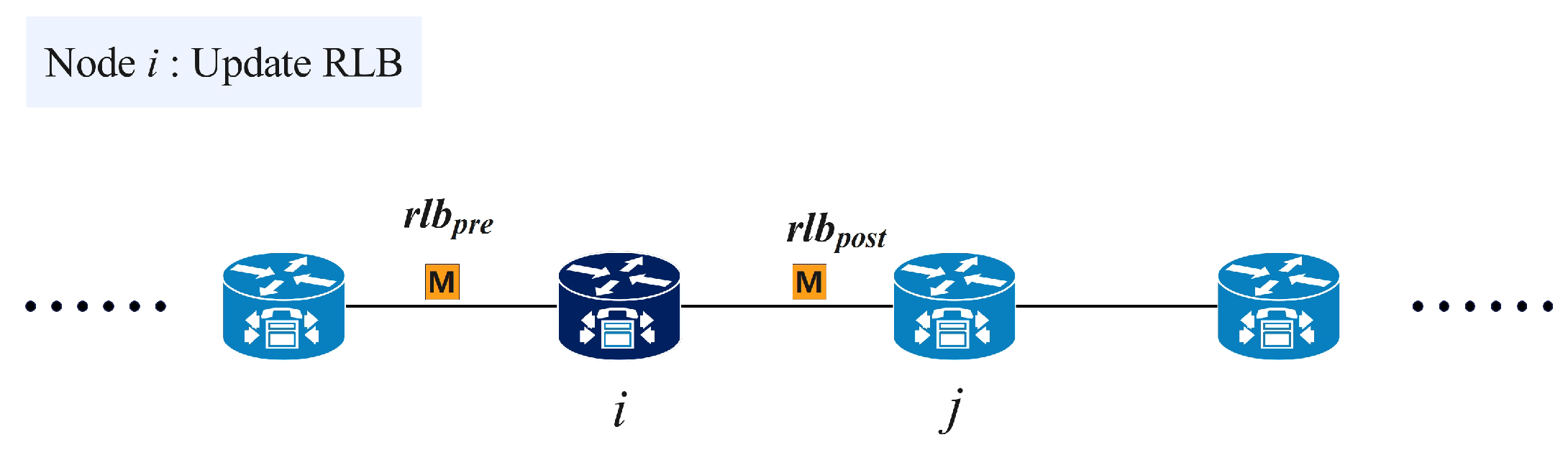
As shown in Figure 3, upon receiving a packet with the current Residual Loss Budget , network node i uses the Redundancy Factor and Routing Decision Algorithm to determine that replication is unnecessary, and directly forwards the packet to node j.
Figure 3.
Forwarding process without packet replication at in-network nodes under DAMR-T.
Assuming that the packet has been successfully received by node j, and the packet loss probability during subsequent transmission from node j to destination node d is . To meet the high-reliability transmission requirement, the following condition must be satisfied:
Furthermore, the condition can be rewritten as follows:
The maximum value of represents the highest tolerable packet loss probability for the subsequent path after the packet is forwarded from node i to node j. In other words, it corresponds to the updated value of the “Residual Loss Budget” field.
Through the above analysis, we can derive the dynamic update formula for the case without packet replication. When node i receives a packet with the current Residual Loss Budget value of , if it selects node j as the next-hop forwarding node, the value of the Residual Loss Budget field must be updated before forwarding as follows:
4.2.2. RLB Update with Packet Replication
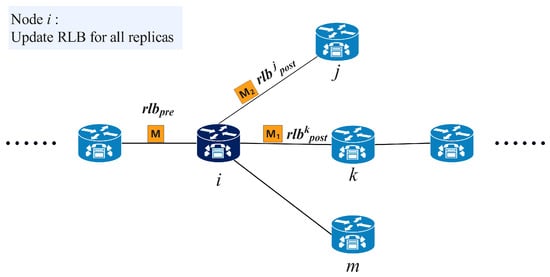
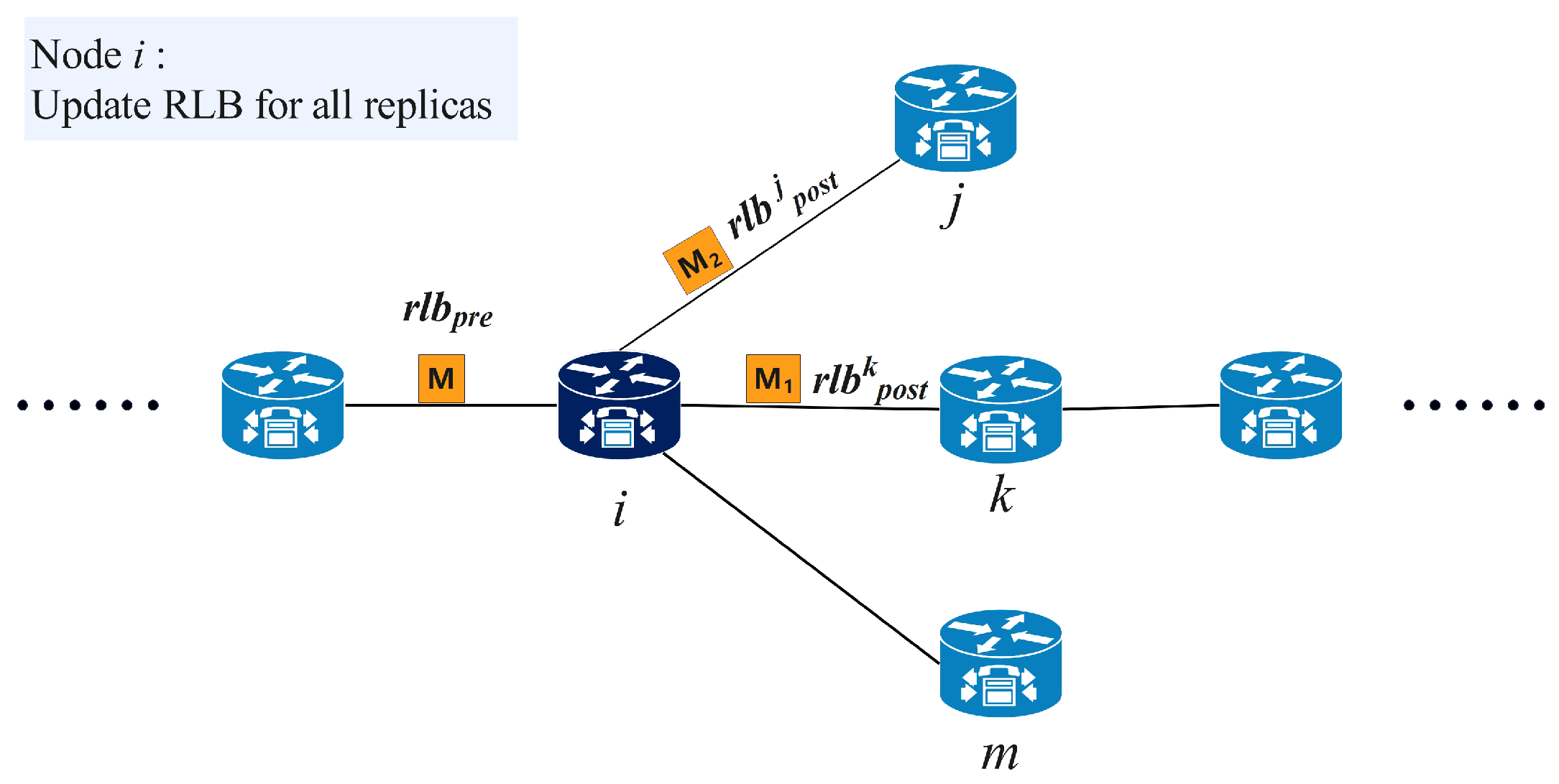
When the algorithm determines that packet replication is required, the node will replicate the packet into identical replicas and forward them to multiple next-hop nodes, as illustrated in Figure 4.
Figure 4.
Forwarding process with packet replication at in-network nodes under DAMR-T.
According to constraint Equation (10), to ensure that the joint loss probability of all replicas along their respective downstream paths satisfies the global reliability requirement, the remaining loss tolerance is first evenly divided among the copies. The residual loss budget for each copy becomes:
Subsequently, each replica updates its own Residual Loss Budget field based on the status of the outgoing link to its assigned next-hop node j, according to Equation (12):
5. Experiments and Analysis
This section presents the simulation experiments conducted for the proposed DAMR-T mechanism and compares its performance against existing schemes. Based on the experimental results, we analyze and discuss the effectiveness of the proposed mechanism.
5.1. Experimental Setup
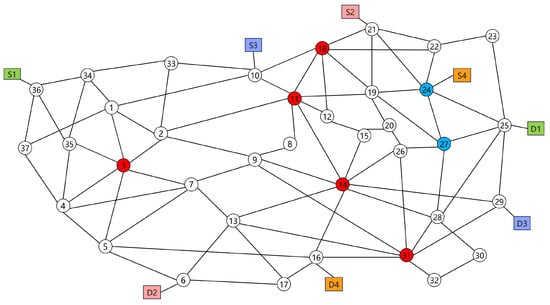
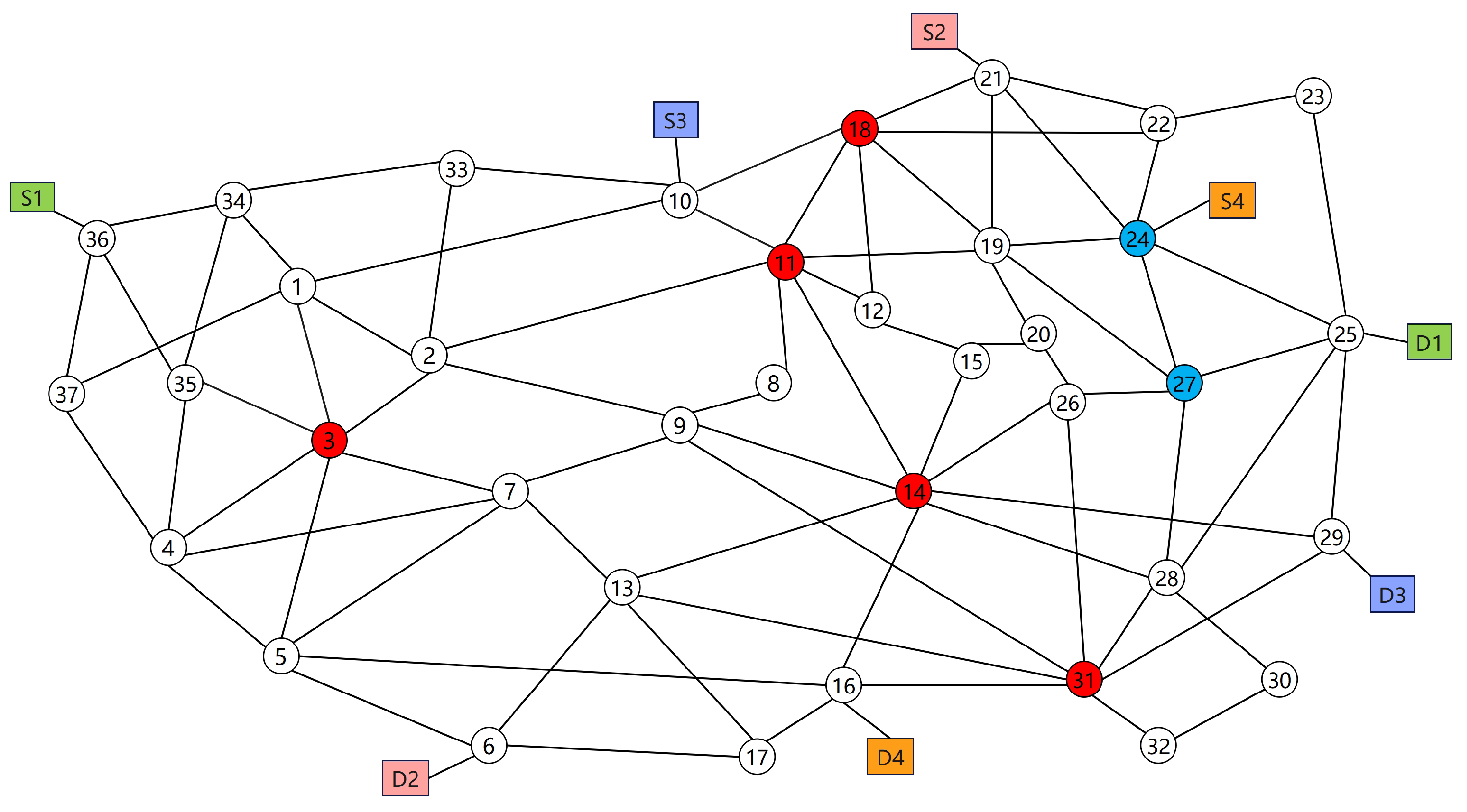
This paper implemented the proposed mechanism using the NS-3 simulation platform. To effectively evaluate its performance under realistic network conditions, this study adopts the network topology illustrated in Figure 5. The topology is based on the European Academic Network (GEANT2), with additional nodes and links incorporated to form an extended network with richer candidate paths. The resulting experimental network consists of 36 routing nodes and 4 pairs of sender and receiver end hosts with differing end-to-end path lengths.
Figure 5.
Experimental network topology. Red nodes represent congested nodes, while uncolored nodes represent non-congested nodes.
To simulate congestion-induced packet loss in real-world networks caused by traffic concentration, routing nodes are categorized into regular nodes and congested nodes based on the node centrality metric. Specifically, we adopt degree centrality (i.e., the number of incident links) as the centrality metric and designate nodes whose degree exceeds 6 as congested nodes. For each congested node, all links that are directly connected to it and carry traffic flowing into this node along the direction of the simulated data flows are labeled as congested links, whereas all remaining links are treated as non-congested links.
The configured link loss rates reference empirical measurements from actual internet deployments [45,46]. Specifically, links associated with regular nodes (non-congested links) are assigned a random packet loss rate in the range of , and propagation delays are randomly set between 4 and 6 ms. In contrast, links connected to congested nodes (congested links) experience higher packet loss rates ranging from , while delays are within 9 to 12 ms. Packet losses on non-congested links are modeled as independent random events with the configured per-link loss probabilities, whereas congested links follow a burst-error packet-loss model to capture the correlation of losses under congestion. The access links between end hosts and their corresponding edge nodes are configured with ultra-low latency (1 ms) and are assumed to be loss-free by default. The main experimental parameter configurations are provided in Table 2 for reference.
Table 2.
Simulation Configuration.
Three alternative schemes are adopted as baseline comparisons to evaluate the performance: Random Replication Forwarding (Random), Source-side Dynamic Redundant Path Selection Algorithm (SDRPS), and the Segment Frame Replication and Elimination Routing (S-FRER) algorithm. Random replicates each packet into two copies with a fixed probability (set to 0.4 in the experiments), and randomly selects forwarding nodes. SDRPS performs replication at the source side by selecting the path with the lowest loss rate as the primary path, and determines the number of redundant paths based on path loss rates. S-FRER, proposed in [39], first selects replication and elimination nodes based on node attributes. When a path fails to meet reliability requirements, additional redundant paths are introduced by inserting replication nodes.
5.2. Performance Comparison and Analysis
We evaluate the effectiveness of the proposed DAMR-T mechanism from four perspectives: reliability assurance, bandwidth overhead, end-to-end packet loss rate, and first-arrival delay.
5.2.1. Reliability Assurance Performance
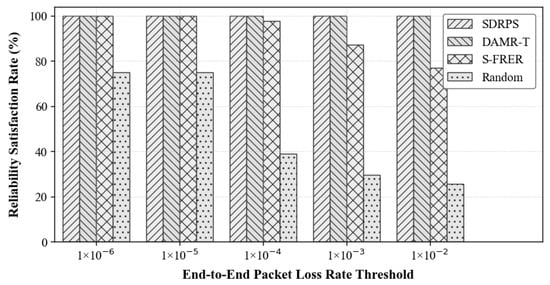
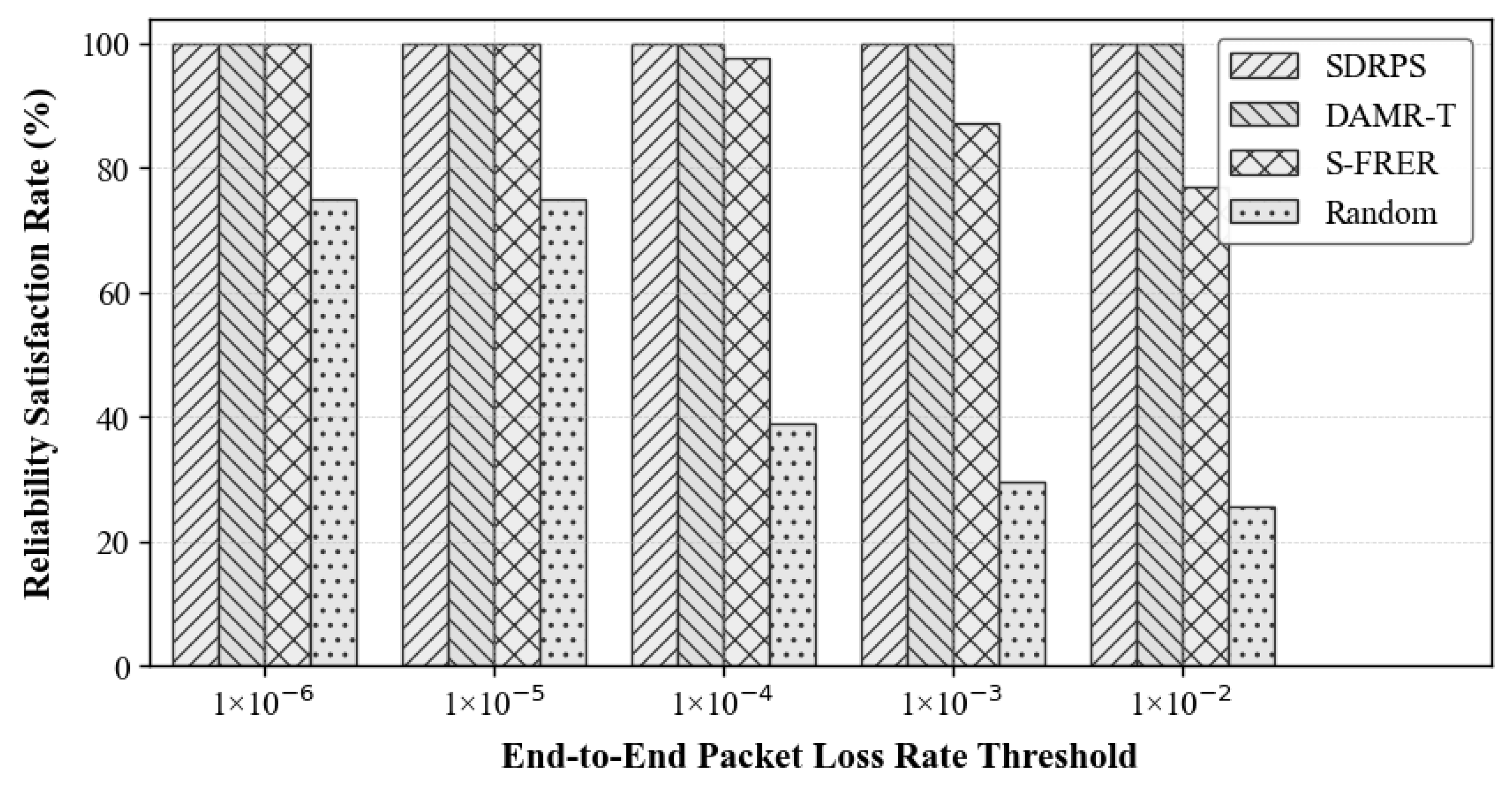
We first evaluate the performance of various methods under different reliability requirements. Four pairs of end-to-end connections , , , are used, where each sender randomly transmits packets with diverse end-to-end loss rate thresholds to its corresponding receiver. A total of 1000 experiments are conducted, and the Reliability Satisfaction Rate (RSR) under each loss rate threshold is calculated for all methods. The results are illustrated in Figure 6.
Figure 6.
Reliability Satisfaction Rate under varying end-to-end loss rate thresholds.
The Random scheme does not consider the actual link conditions throughout the transmission process, resulting in consistently low RSR. The SDRPS scheme employs source-side replication to provide end-to-end protection for data flows, fully satisfying diverse packet loss rate requirements. The performance of S-FRER lies between Random and SDRPS. Since its core design focuses on selecting replication nodes based on node location and attribute information, its RSR gradually decreases as the loss rate threshold decreases, dropping to 76.9% under the most stringent condition. In contrast, the proposed DAMR-T mechanism demonstrates stable and superior performance across all reliability requirements, consistently achieving an RSR of 100%. This is on par with the ideal source-side protection scheme SDRPS, thereby validating its effectiveness.
5.2.2. Bandwidth Overhead Evaluation
To evaluate the bandwidth overhead introduced by different algorithms, this study adopts the Bandwidth Redundancy Ratio (BRR) as the performance metric to quantify bandwidth wastage. The BRR is calculated as follows:
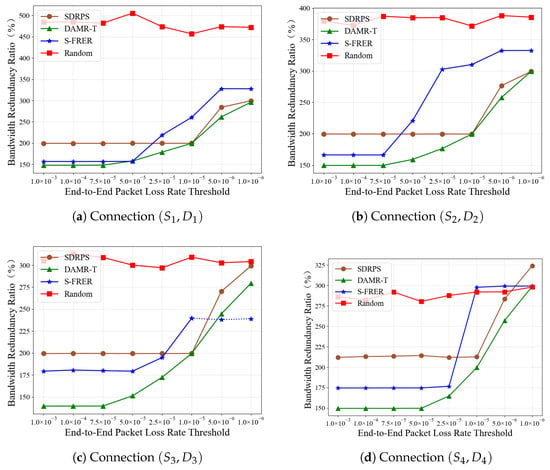
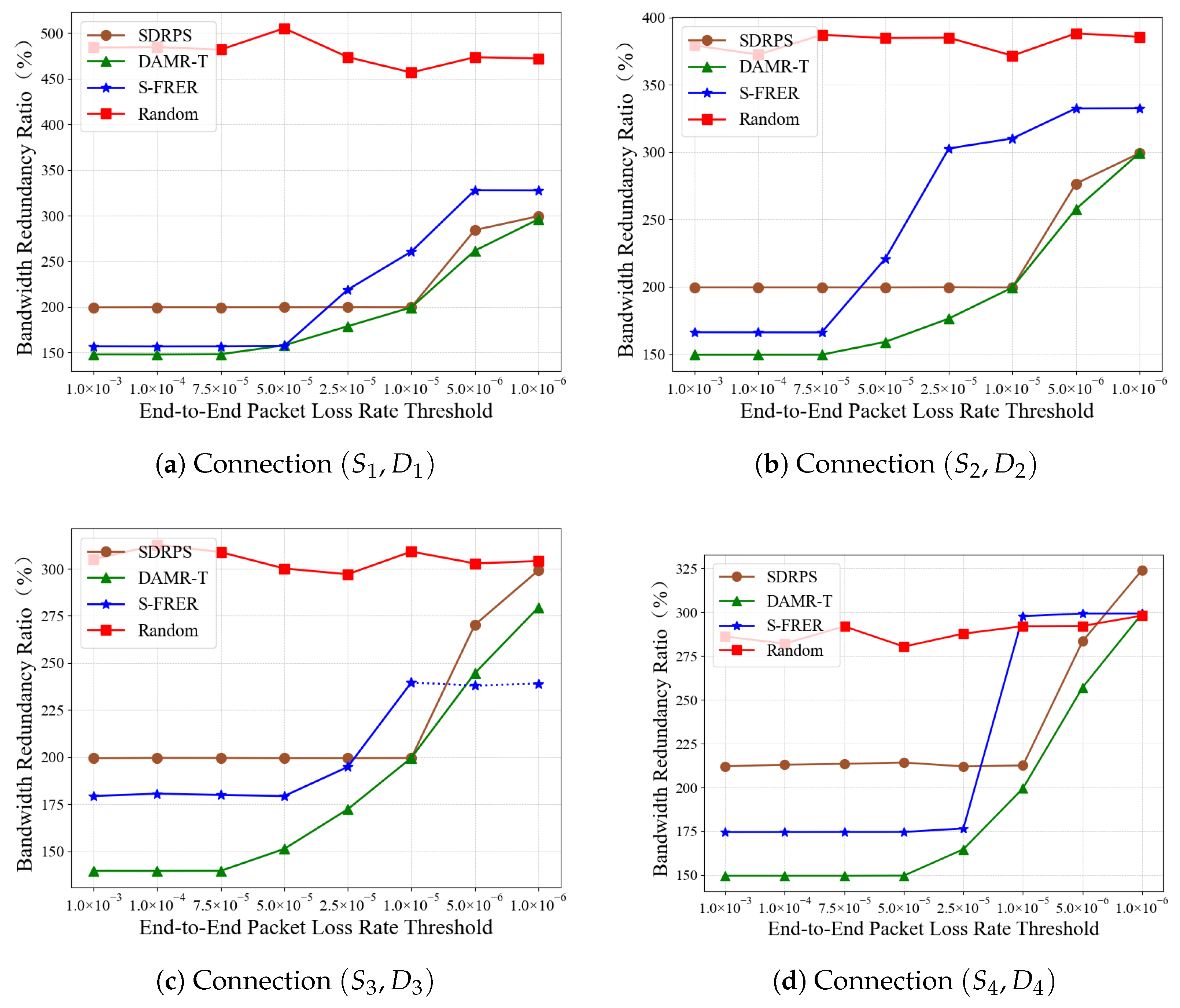
where denotes the total number of packet replicas transmitted across all links in the network under each evaluated scheme, and represents the number when no redundancy is applied and packets are forwarded along the shortest paths. A larger value of this ratio indicates more bandwidth overhead (or waste) introduced by redundancy, whereas a smaller value implies a more efficient use of bandwidth to satisfy the reliability requirements. The results are illustrated in Figure 7. Except for the Random scheme, the bandwidth consumption of the remaining three schemes increases progressively with stricter end-to-end reliability requirements. This occurs because higher reliability demands necessitate a greater number of replicas and redundant paths. Furthermore, in the results of connection , when the packet loss rate requirement falls below , S-FRER fails to meet the requirement due to the difficulty in locating suitable replication nodes.
Figure 7.
Bandwidth Redundancy Comparison under Varying Reliability Requirements.
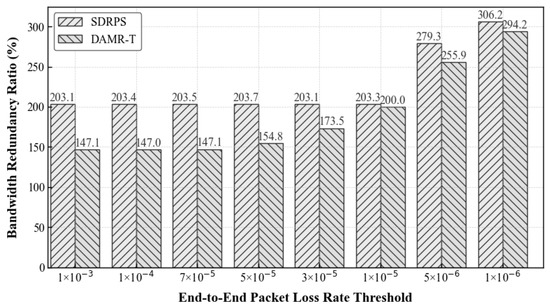
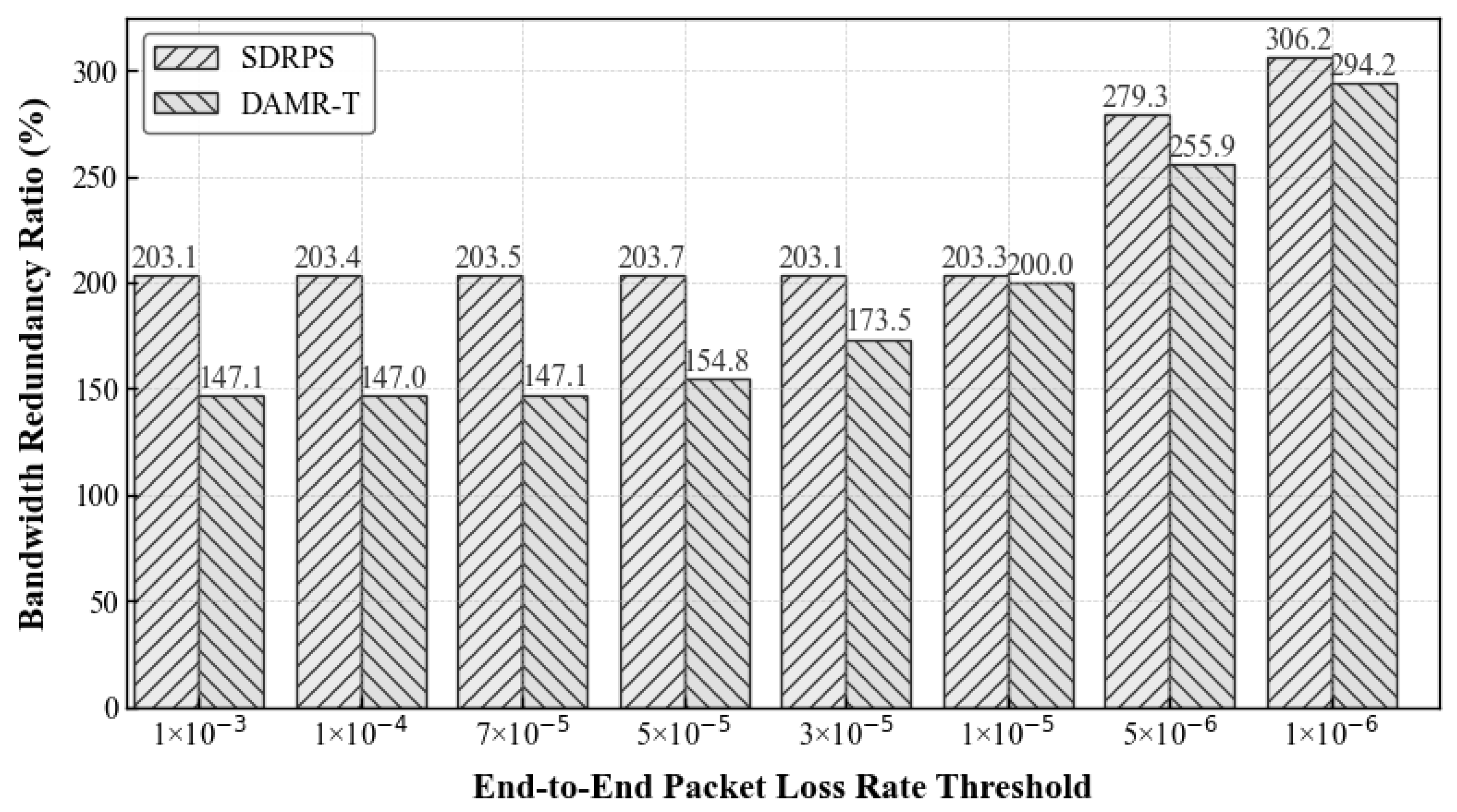
According to the results, across four end-to-end connections with unequal path lengths, DAMR-T mechanism consistently exhibits lower total bandwidth consumption than all comparative methods within the packet loss rate threshold range of . In particular, when the target loss rate becomes extremely strict (e.g., ), the bandwidth redundancy of DAMR-T does not continue to increase markedly. This is because the residual loss budget triggers replication earlier along the path, and the small integer redundancy factor k (typically 2–3 and bounded in our evaluation) already makes the joint probability that all replicas are lost significantly lower than the target loss (e.g., on the order of or below under the configured link-loss ranges). As a result, further tightening the reliability requirement within this range does not change the replication pattern or the total number of transmissions. To evaluate the overall bandwidth overhead of the proposed mechanism, we conducted a statistical analysis of simulation results across multiple connections and compared them with the SDRPS scheme. Figure 8 presents the total redundant bandwidth overhead.
Figure 8.
Comparison of overall bandwidth redundancy between DAMR-T and SDRPS.
As shown in Figure 8, taking the shortest-path transmission as the baseline, the DAMR-T mechanism achieves an average bandwidth reduction of 35.44% compared to the SDRPS scheme, with a maximum saving of up to 56.1%. Combined with its excellent performance in reliability assurance, these results demonstrate that DAMR-T can precisely meet packet reliability requirements while effectively reducing bandwidth consumption. It is also observed that as reliability requirements increase, DAMR-T maintains consistent superiority over SDRPS, exhibiting lower bandwidth redundancy radio in most scenarios. However, the relative bandwidth-saving advantage of DAMR-T becomes less significant under higher reliability demands. This is because as the reliability requirement increases, nodes tend to initiate replication earlier. Some packets may be replicated near or even at the source itself, leading to higher bandwidth overhead. However, the results show that even under such conditions, DAMR-T still incurs less bandwidth overhead than SDRPS.
5.2.3. End-to-End Packet Loss Assessment
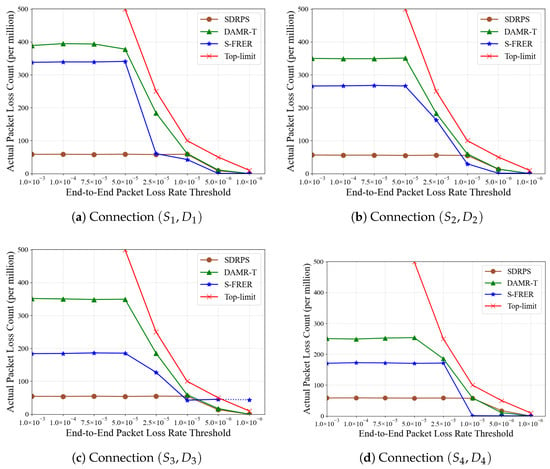
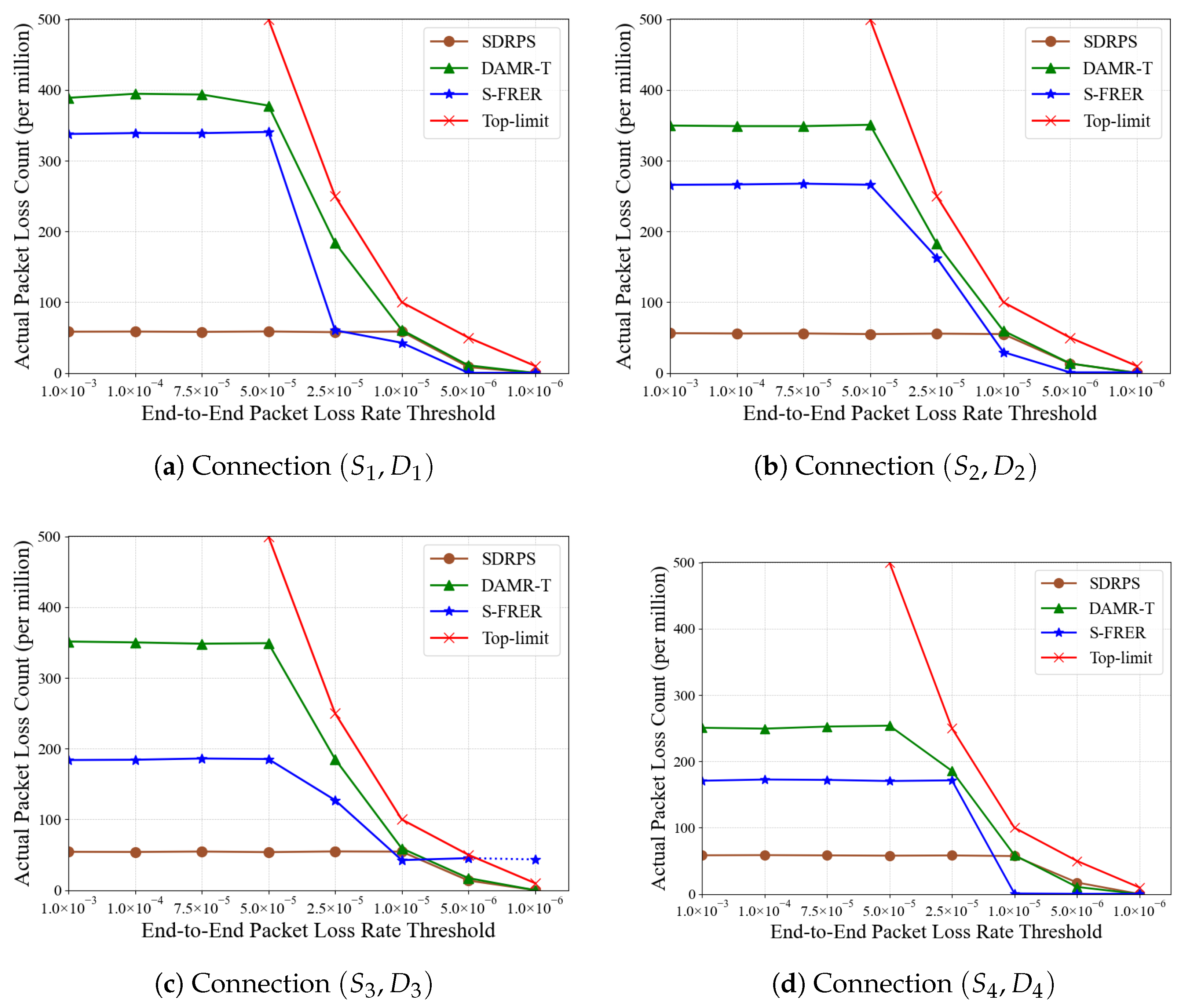
To further quantify actual transmission performance of every scheme, this section conducts a comparative analysis of their end-to-end average packet loss rates. Experimental results are shown in Figure 9 below.
Figure 9.
End-to-end packet Loss comparison under varying reliability requirements.
Due to the significantly high average packet loss rate of the Random method, its numerical results are excluded from the figure. For completeness, the requirement-specific top-limit packet loss rate (denoted as Top-Limit) is presented as a reference. To improve visual clarity, the end-to-end packet loss rate metric is converted into the average number of lost packets per million transmitted packets. DAMR-T consistently maintains loss rates below the corresponding Top-Limit thresholds, indicating its capability to precisely meet diverse transmission reliability requirements. The SDRPS generally achieves the lowest end-to-end loss rate, demonstrating the advantage of source-side replication in enhancing reliability. In comparison, DAMR-T exhibits a slightly higher average loss rate than SDRPS and S-FRER. This is primarily due to differences in design objectives: DAMR-T aims to minimize bandwidth overhead caused by replication under the constraint of meeting loss requirements. Consequently, its scheduling strategy is more conservative in resource usage. By jointly analyzing the experimental results of end-to-end packet loss rate and bandwidth overhead, we observe that a higher bandwidth redundancy ratio generally leads to a lower end-to-end packet loss rate. DAMR-T prioritizes reducing bandwidth waste, at the cost of some reliability margin.
5.2.4. First-Arrival Delay Analysis
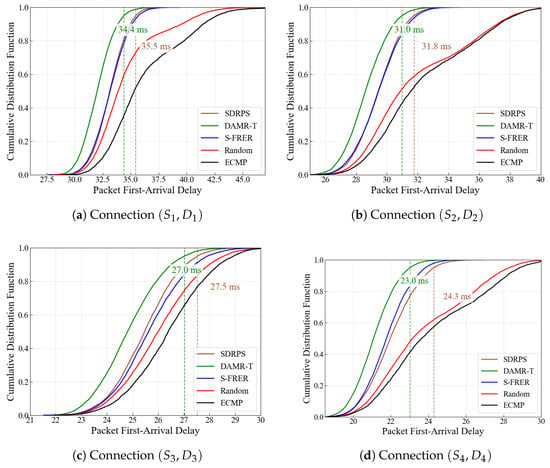
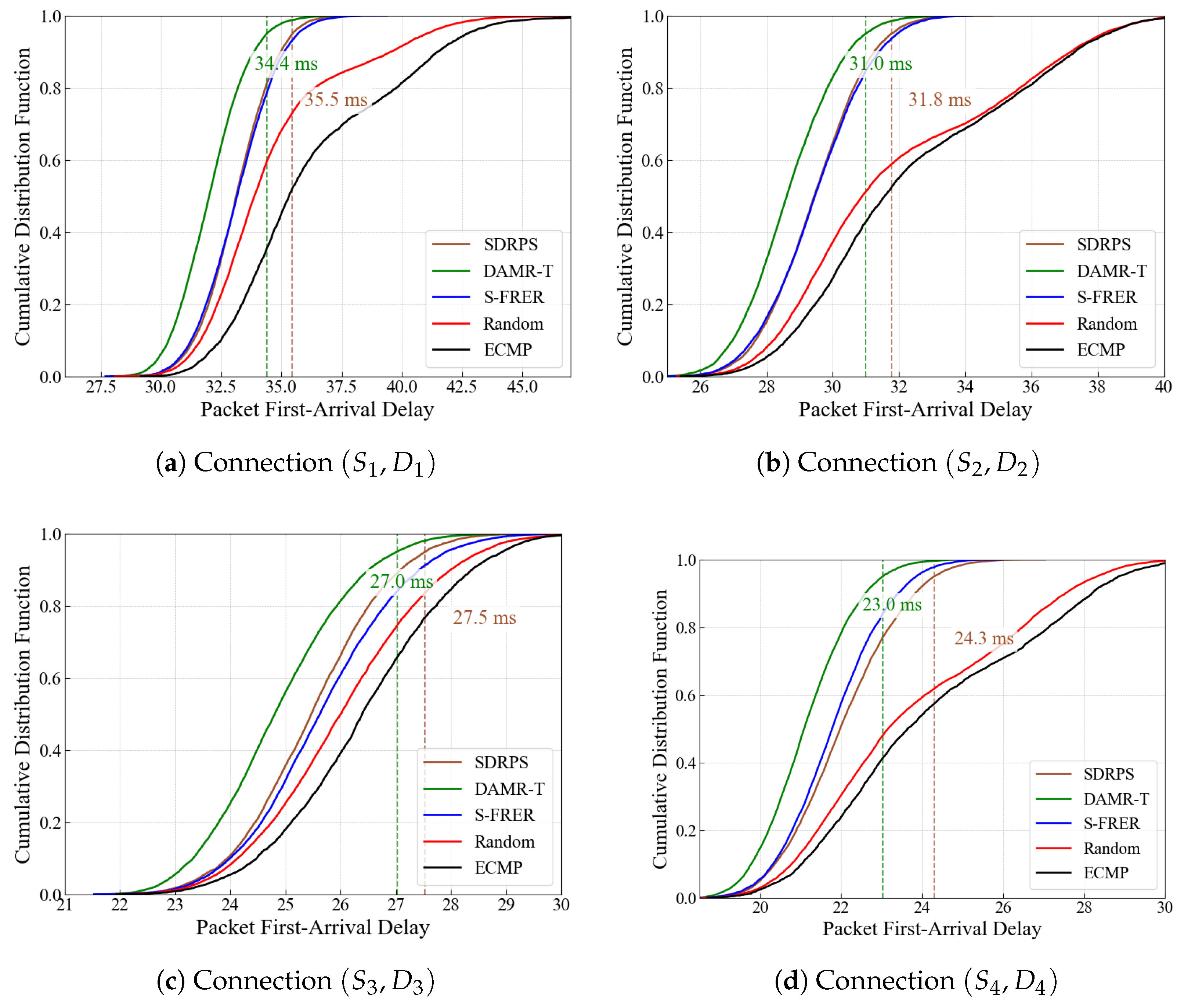
In multipath redundant transmission, the receiver adopts a first-arrival replica, accepting only the earliest arriving copy of the packet while discarding subsequent replicas. Therefore, the first-arrival delay is used as the evaluation metric. The experimental results are shown in Figure 10. We consider scenarios with mixed high-reliability data flows, where each connection simultaneously transmits packets with diverse reliability requirements. In addition, we include a non-redundant ECMP scheme as a baseline. The delay distribution characteristics of each scheme are presented using CDF (Cumulative Distribution Function) curves.
Figure 10.
Cumulative Distribution Function (CDF) of packet first-arrival delay.
Results show that all redundancy-based transmission strategies achieve lower packet first-arrival delays compared to the traditional ECMP scheme. This advantage is attributed to the delay compensation effect introduced by multipath redundancy: even without packet loss, the receiver only accepts the earliest-arriving replica. As a result, replicas arriving via superior-path paths can effectively mask the delay disadvantages of lower-quality paths, thereby optimizing the overall transmission delay [47]. Since DAMR-T explicitly incorporates delay as a secondary optimization objective, it demonstrates superior first-arrival delay performance compared to SDRPS and S-FRER, which focus on maximizing transmission reliability only. The CDF curves highlight the advantage of DAMR-T in improving the timeliness of packet arrival. To further quantify tail latency performance, the 95th percentile delay is explicitly highlighted. Results show that DAMR-T consistently achieves lowest 95th percentile delays across all connections, with an average reduction of 0.93 ms compared to SDRPS.
6. Conclusions
To address the issues of severe bandwidth waste and poor scalability encountered by existing Multipath Redundancy Transmission mechanisms in wide-area network scenarios, this paper proposes a Distributed Adaptive Multipath Redundant Transmission (DAMR-T) mechanism. This mechanism introduces a Redundancy Factor and Routing Decision Algorithm based on in-network node replication, in which each node independently determines the number of redundant replicas and selects the forwarding next-hop nodes based solely on local link states and the information carried within the packet. Under local reliability constraints, DAMR-T reduces the additional bandwidth consumption and simultaneously improves the quality of forwarding paths. In addition, a Hop-by-Hop Update Method for the Residual Loss Budget is proposed to enable the progressive propagation and distributed maintenance of end-to-end reliability constraints. Simulation results demonstrate that DAMR-T significantly reduces redundant bandwidth overhead while satisfying diverse reliability demands of different data flows. In typical scenarios, DAMR-T reduces bandwidth consumption by an average of 35.44% compared to source-side replication strategy SDRPS, with maximum savings reaching up to 56.1%. Moreover, it offers advantages in first-arrival delay performance, achieving significantly lower 95th percentile latency compared to existing approaches. Although the average end-to-end packet loss rate of DAMR-T is slightly higher than those of some baseline schemes, it achieves a superior trade-off between reliability assurance and resource efficiency. In summary, the proposed DAMR-T mechanism offers a redundant transmission solution that balances high reliability, bandwidth efficiency, and distributed scalability, making it well-suited for the demands of reliable communication in wide-area networks.
Despite the promising performance of DAMR-T, several open issues remain for future exploration. Future work may pursue three complementary directions. (i) The current mechanism relies on historically measured link state information for local decision-making, without explicitly modeling the temporal evolution or predicting future trends of link quality metrics; exploring lightweight link quality prediction and local information completion techniques may help DAMR-T proactively avoid potential performance degradation and improve robustness under sudden congestion or rapidly changing network conditions. (ii) The present design reflects congestion only indirectly through delay and loss, without explicitly using dedicated congestion or burst-loss indicators; extending the decision process to make cautious use of explicit signals (when available) from queue occupancy, link utilization, or burst-loss statistics could further refine the formation of the forwarding set, especially in heavily loaded or highly bursty scenarios. (iii) The security of the RLB update process has not yet been addressed; a systematic study of integrity protection mechanisms (e.g., header-level authentication) and attack-resilient RLB update rules to defend against malicious tampering of the RLB field in adversarial deployments is another important direction for future research.
Author Contributions
Conceptualization, Z.T., J.Y. and Y.L.; Methodology, Z.T. and J.Y.; Data curation, Z.T.; Formal analysis, Z.T. and J.Y.; Funding acquisition, J.Y.; Investigation, Z.T., J.Y. and Y.L.; Project administration, J.Y.; Resources, Z.T.; Software, Z.T.; Supervision, J.Y.; Validation, Z.T. and J.Y.; Visualization, Z.T.; Writing—original draft, Z.T.; Writing—review & editing, Z.T. and J.Y. All authors have read and agreed to the published version of the manuscript.
Funding
This work was funded by the Basic and Frontier Exploration Project independently deployed by the Institute of Acoustics, Chinese Academy of Sciences: Research on Wide-Area RDMA Transmission Acceleration Technology Based on SEANet (Project No. JCQY202407).
Data Availability Statement
The original data presented in this study are included within the article. Additional data can be obtained from the first author or corresponding author on reasonable request.
Conflicts of Interest
The authors declare no conflicts of interest.
References
- Hong, S.; Yue, T.; You, Y.; Lv, Z.; Tang, X.; Hu, J.; Yin, H. A Resilience Recovery Method for Complex Traffic Network Security Based on Trend Forecasting. Int. J. Intell. Syst. 2025, 2025, 3715086. [Google Scholar] [CrossRef] [Scilit]
- Zhang, G.; Gao, S.; Yue, J.; Zhao, Z. A service protection mechanism impelemented on P4 by packet replication. In Proceedings of the 2021 2nd Information Communication Technologies Conference (ICTC), Nanjing, China, 7–9 May 2021; IEEE: Piscataway, NJ, USA, 2021; pp. 1–5. [Google Scholar]
- Teng, R.; Sato, K. A Fundamental Study of Reliable Vehicle-to-Cloud Communication Using Multiple Paths with Redundancy Mitigation. Appl. Sci. 2024, 14, 2841. [Google Scholar] [CrossRef] [Scilit]
- Briscoe, B.; Brunstrom, A.; Petlund, A.; Hayes, D.; Ros, D.; Tsang, J.; Gjessing, S.; Fairhurst, G.; Griwodz, C.; Welzl, M. Reducing internet latency: A survey of techniques and their merits. IEEE Commun. Surv. Tutorials 2014, 18, 2149–2196. [Google Scholar] [CrossRef] [Scilit]
- Yan, J.; Ren, J.; Yang, D. A routing approach towards frame replication and elimination in time-sensitive networks. In Proceedings of the 2023 IEEE 3rd International Conference on Information Technology, Big Data and Artificial Intelligence (ICIBA), Chongqing, China, 26–28 May 2023; IEEE: Piscataway, NJ, USA, 2023; Volume 3, pp. 1045–1050. [Google Scholar]
- Hunger, A.; Klein, P.A. Equalizing latency peaks using a redundant multipath-TCP scheme. In Proceedings of the 2016 International Conference on Information Networking (ICOIN), Kota Kinabalu, Malaysia, 13–15 January 2016; IEEE: Piscataway, NJ, USA, 2016; pp. 184–189. [Google Scholar]
- IEEE Std 802.1CB-2017; IEEE Standard for Local and metropolitan area networks–Frame Replication and Elimination for Reliability. IEEE: Piscataway, NJ, USA, 2017; pp. 1–102. [CrossRef] [Scilit]
- Noronha, A.; Noronha, J.W. A Study of Protocols for Low-Latency Video Transport over the Internet. In Proceedings of the Broadcast Engineering and Information Technology Conference (BEITC), Las Vegas, NV, USA, 7–12 April 2018. [Google Scholar]
- Bettermann, S.; Rong, Y. Effects of fully redundant dispersity routing on VoIP quality. In Proceedings of the 2011 IEEE International Workshop Technical Committee on Communications Quality and Reliability (CQR), Naples, FL, USA, 10–12 May 2011; IEEE: Piscataway, NJ, USA, 2011; pp. 1–6. [Google Scholar]
- Michel, F.; Cohen, A.; Malak, D.; De Coninck, Q.; Médard, M.; Bonaventure, O. FlEC: Enhancing QUIC with application-tailored reliability mechanisms. IEEE/ACM Trans. Netw. 2022, 31, 606–619. [Google Scholar] [CrossRef] [Scilit]
- Bogatyrev, V.A.; Bogatyrev, A.; Bogatyrev, S. Redundant servicing of a flow of heterogeneous requests critical to the total waiting time during the multi-path passage of a sequence of info-communication nodes. In Proceedings of the International Conference on Distributed Computer and Communication Networks, Moscow, Russia, 14–18 September 2020; Springer: Cham, Switzerland, 2020; pp. 100–112. [Google Scholar]
- Parshutina, S.A.; Bogatyrev, V.A. Models to support design of highly reliable distributed computer systems with redundant processes of data transmission and handling. In Proceedings of the 2017 International Conference “Quality Management, Transport and Information Security, Information Technologies (IT&QM&IS)”, St. Petersburg, Russia, 24–30 September 2017; IEEE: Piscataway, NJ, USA, 2017; pp. 96–99. [Google Scholar]
- Bogatyrev, V.; Bogatyrev, S.; Bogatyrev, A. Multipath redundant real-time transmission with the destruction of expired packets in intermediate nodes. In Proceedings of the CEUR Workshop Proceedings, Nizhny Novgorod, Russia, 27–30 September 2021; Volume 3027, pp. 971–979. [Google Scholar]
- Elattar, M.; Friesen, M.; Jasperneite, J. Evaluation of multipath communication protocols for reliable internet-based cyber-physical systems. In Proceedings of the 2017 IEEE 26th International Symposium on Industrial Electronics (ISIE), Edinburgh, UK, 19–21 June 2017; IEEE: Piscataway, NJ, USA, 2017; pp. 1195–1200. [Google Scholar]
- Bogatyrev, A.; Bogatyrev, V.; Bogatyrev, S. The probability of timeliness of a fully connected exchange in a redundant real-time communication system. In Proceedings of the 2020 Wave Electronics and its Application in Information and Telecommunication Systems (WECONF), St. Petersburg, Russia, 1–5 June 2020; IEEE: Piscataway, NJ, USA, 2020; pp. 1–4. [Google Scholar]
- Hunger, A.; Klein, P.A.; Verbunt, M.H. Evaluation of the redundancy-bandwidth trade-off and jitter compensation in rMPTCP. In Proceedings of the 2016 8th IFIP International Conference on New Technologies, Mobility and Security (NTMS), Larnaca, Cyprus, 21–23 November 2016; IEEE: Piscataway, NJ, USA, 2016; pp. 1–5. [Google Scholar]
- Wu, K.; Zhang, J.; Ji, Y. Redundant routing provision in a FlexE-over-WDM network based on segment frame replication and elimination. In Proceedings of the 2021 17th International Conference on the Design of Reliable Communication Networks (DRCN), Milano, Italy, 19–22 April 2021; IEEE: Piscataway, NJ, USA, 2021; pp. 1–6. [Google Scholar]
- Wen, X.; Lu, Y.; Chen, Z.; Wang, M.; Qin, J. Reliability-aware Segmented Redundant Routing and Scheduling Mechanism in Time-Sensitive Networking. In Proceedings of the 2024 7th International Conference on Electronics Technology (ICET), Chengdu, China, 17–20 May 2024; IEEE: Piscataway, NJ, USA, 2024; pp. 834–843. [Google Scholar]
- Lara, A.; Kolasani, A.; Ramamurthy, B. Network innovation using openflow: A survey. IEEE Commun. Surv. Tutorials 2013, 16, 493–512. [Google Scholar] [CrossRef] [Scilit]
- Feamster, N.; Rexford, J.; Zegura, E. The road to SDN: An intellectual history of programmable networks. ACM SIGCOMM Comput. Commun. Rev. 2014, 44, 87–98. [Google Scholar] [CrossRef] [Scilit]
- Farthofer, S.; Lima, D.T.B.; Du, J.L. Application layer benefits of redundant disjoint paths in a real-time Ethernet. In Proceedings of the 2020 International Conference on Information and Communication Technology Convergence (ICTC), Jeju, Republic of Korea, 21–23 October 2020; IEEE: Piscataway, NJ, USA, 2020; pp. 161–165. [Google Scholar]
- De Armas, J.; Tuset, P.; Chang, T.; Adelantado, F.; Watteyne, T.; Vilajosana, X. Determinism through path diversity: Why packet replication makes sense. In Proceedings of the 2016 International Conference on Intelligent Networking and Collaborative Systems (INCoS), Ostrava, Czech Republic, 7–9 September 2016; IEEE: Piscataway, NJ, USA, 2016; pp. 150–154. [Google Scholar]
- Rullo, A.; Serra, E.; Lobo, J. Redundancy as a measure of fault-tolerance for the Internet of Things: A review. In Policy-Based Autonomic Data Governance; Springer: Cham, Switzerland, 2019; pp. 202–226. [Google Scholar]
- Ford, A.; Raiciu, C.; Handley, M.J.; Bonaventure, O. TCP Extensions for Multipath Operation with Multiple Addresses; RFC 6824; RFC Editor: Redwood City, CA, USA, 2013; Available online: https://www.rfc-editor.org/rfc/rfc6824 (accessed on 27 November 2025).
- De Coninck, Q.; Bonaventure, O. Multipath quic: Design and evaluation. In Proceedings of the 13th International Conference on Emerging Networking Experiments and Technologies, Incheon, Republic of Korea, 12–15 December 2017; pp. 160–166. [Google Scholar]
- Bogatyrev, V.; Bogatyrev, A.; Bogatyrev, S. Multipath transmission of heterogeneous traffic in acceptable delays with packet replication and destruction of expired replicas in the nodes that make up the path. In Proceedings of the International Conference on Distributed Computer and Communication Networks, Moscow, Russia, 26–29 September 2022; Springer: Cham, Switzerland, 2022; pp. 104–121. [Google Scholar]
- Ito, K.; Nakazato, J.; Fontugne, R.; Tsukada, M.; Esaki, H. Enhancing real-time streaming quality through a multipath redundant communication framework. In Proceedings of the 2024 IFIP Networking Conference (IFIP Networking), Thessaloniki, Greece, 3–6 June 2024; IEEE: Piscataway, NJ, USA, 2024; pp. 1–10. [Google Scholar]
- Mogensen, R.S.; Markmoller, C.; Madsen, T.K.; Kolding, T.; Pocovi, G.; Lauridsen, M. Selective redundant MP-QUIC for 5G mission critical wireless applications. In Proceedings of the 2019 IEEE 89th Vehicular Technology Conference (VTC2019-Spring), Kuala Lumpur, Malaysia, 28 April–1 May 2019; IEEE: Piscataway, NJ, USA, 2019; pp. 1–5. [Google Scholar]
- Carvalho, D.F.; Ferrari, P.; Sisinni, E.; Flammini, A. Improving redundancy in LoRaWAN for mixed-criticality scenarios. IEEE Syst. J. 2020, 15, 3682–3691. [Google Scholar] [CrossRef] [Scilit]
- Elattar, M.; Cao, T.; Wendt, V.; Jaspemeite, J.; Trächtler, A. Reliable multipath communication approach for internet-based cyber-physical systems. In Proceedings of the 2017 IEEE 26th International Symposium on Industrial Electronics (ISIE), Edinburgh, UK, 19–21 June 2017; IEEE: Piscataway, NJ, USA, 2017; pp. 1226–1233. [Google Scholar]
- Elattar, M.; Friesen, M.; Henneke, D.; Jasperneite, J. Reliability-oriented multipath communication for internet-based cyber-physical systems. In Proceedings of the 2018 14th IEEE International Workshop on Factory Communication Systems (WFCS), Imperia, Italy, 13–15 June 2018; IEEE: Piscataway, NJ, USA, 2018; pp. 1–10. [Google Scholar]
- Lopez, I.; Aguado, M.; Ugarte, D.; Mendiola, A.; Higuero, M. Exploiting redundancy and path diversity for railway signalling resiliency. In Proceedings of the 2016 IEEE International Conference on Intelligent Rail Transportation (ICIRT), Birmingham, UK, 23–25 August 2016; IEEE: Piscataway, NJ, USA, 2016; pp. 432–439. [Google Scholar]
- Comer, D.; Karandikar, R.H.; Rastegarnia, A. Resilient packet delivery through software defined redundancy: An experimental study. In Proceedings of the 2017 IEEE 7th Annual Computing and Communication Workshop and Conference (CCWC), Las Vegas, NV, USA, 9–11 January 2017; IEEE: Piscataway, NJ, USA, 2017; pp. 1–6. [Google Scholar]
- Huang, K.; Wan, X.; Wang, K.; Jiang, X.; Chen, J.; Deng, Q.; Xu, W.; Peng, Y.; Liu, Z. Reliability-Aware Multipath Routing of Time-Triggered Traffic in Time-Sensitive Networks. Electronics 2021, 10, 125. [Google Scholar] [CrossRef] [Scilit]
- Sheng, H.; Zhou, X.; Zhao, J. Enhancing Wide-Area Network Efficiency for Intelligent Computing Through SRv6-Based Path Optimization and Dynamic Load Balancing. In Proceedings of the 2024 Twelfth International Conference on Advanced Cloud and Big Data (CBD), Brisbane, Australia, 28 November–2 December 2024; IEEE: Piscataway, NJ, USA, 2024; pp. 410–415. [Google Scholar]
- Demir, K.; Germanus, D.; Suri, N. Robust and real-time communication on heterogeneous networks for smart distribution grid. In Proceedings of the 2014 IEEE International Conference on Smart Grid Communications (SmartGridComm), Venice, Italy, 3–6 November 2014; IEEE: Piscataway, NJ, USA, 2014; pp. 386–391. [Google Scholar]
- Desai, N.; Punnekkat, S. Enhancing fault detection in time sensitive networks using machine learning. In Proceedings of the 2020 International Conference on Communication Systems & Networks (Comsnets), Bengaluru, India, 7–11 January 2020; IEEE: Piscataway, NJ, USA, 2020; pp. 714–719. [Google Scholar]
- Yao, Z.; Cai, Y.; Li, T. A Forwarding Mechanism Based on Optimized Node Selection for Frame Replication and Elimination in Time-Sensitive Networks. In Proceedings of the 2020 China Information and Communications Conference (CICC 2020), Chongqing, China, 9–11 August 2020. (In Chinese) [Google Scholar]
- Li, T.; Cai, Y. A service protection mechanism of deterministic networking based on segment routing. In Proceedings of the International Conference on Game Theory for Networks, Virtual Event, 7–8 July 2022; Springer: Cham, Switzerland, 2022; pp. 83–99. [Google Scholar]
- Álvarez, I.; Furió, I.; Proenza, J.; Barranco, M. Design and experimental evaluation of the proactive transmission of replicated frames mechanism over time-sensitive networking. Sensors 2021, 21, 756. [Google Scholar] [CrossRef] [Scilit] [PubMed]
- Zhang, J.; Gao, X.; Wu, K.; Ji, Y. Segment frame replication and elimination for redundant routing provision in the FlexE-over-WDM networks. Opt. Switch. Netw. 2023, 47, 100709. [Google Scholar] [CrossRef] [Scilit]
- Hopps, C. Analysis of an Equal-Cost Multi-Path Algorithm; RFC 2992; RFC Editor: Redwood City, CA, USA, 2000; Available online: https://www.rfc-editor.org/rfc/rfc2992 (accessed on 27 November 2025).
- Martins, E.Q.; Pascoal, M.M. A new implementation of Yen’s ranking loopless paths algorithm. Q. J. Belg. Fr. Ital. Oper. Res. Soc. 2003, 1, 121–133. [Google Scholar]
- Chen, S.; Nahrstedt, K. An overview of quality of service routing for next-generation high-speed networks: Problems and solutions. IEEE Netw. 1998, 12, 64–79. [Google Scholar] [CrossRef] [Scilit]
- Singh, B.K.; Gupte, N. Congestion and decongestion in a communication network. Phys. Rev. E—Stat. Nonlinear Soft Matter Phys. 2005, 71, 055103. [Google Scholar] [CrossRef] [Scilit] [PubMed]
- Chydzinski, A.; Adamczyk, B. Burst ratio of packet losses in individual network flows. Informatica 2023, 34, 35–52. [Google Scholar] [CrossRef] [Scilit]
- Bogatyrev, A.; Bogatyrev, V.; Bogatyrev, S. Multipath Redundant Transmission with Packet Segmentation. In Proceedings of the 2019 Wave Electronics and Its Application in Information and Telecommunication Systems (WECONF), St. Petersburg, Russia, 3–7 June 2019; IEEE: Piscataway, NJ, USA, 2019; pp. 1–4. [Google Scholar]

Disclaimer/Publisher’s Note: The statements, opinions and data contained in all publications are solely those of the individual author(s) and contributor(s) and not of MDPI and/or the editor(s). MDPI and/or the editor(s) disclaim responsibility for any injury to people or property resulting from any ideas, methods, instructions or products referred to in the content. |
© 2025 by the authors. Licensee MDPI, Basel, Switzerland. This article is an open access article distributed under the terms and conditions of the Creative Commons Attribution (CC BY) license (https://creativecommons.org/licenses/by/4.0/).