Article

XGBoost Method-Based Gearbox Fault Diagnosis Using Time-Domain Signal Under Road Vehicle Characteristics


1
Faculty of Mathematics and Statistics, Ton Duc Thang University, Ho Chi Minh City 72912, Vietnam
2
Department of Intelligent Mobility Engineering, Kongju National University, Cheonan-si 31080, Republic of Korea
3
Institute of Intelligent Vehicle, Kongju National University, 1223-24 Cheonandaero, Seobuk-gu, Cheonan 31080, Republic of Korea
4
School of Mechanical Engineering, University of Ulsan, Ulsan 44610, Republic of Korea
*
Author to whom correspondence should be addressed.
Electronics 2025, 14(23), 4736; https://doi.org/10.3390/electronics14234736
Submission received: 18 October 2025 / Revised: 18 November 2025 / Accepted: 28 November 2025 / Published: 1 December 2025

Abstract

Gearbox condition monitoring plays a crucial role in ensuring the reliability and safety of mechanical transmission systems in road vehicles. This study proposes an XGBoost-based fault diagnosis method using time-domain signals collected from four wheels—front-left, front-right, rear-left, and rear-right—under real-world operational conditions. Twelve statistical features extracted from the wheel-speed signals, combined with road vehicle characteristics, are considered as input for the model. The performance of the proposed method is verified through time-domain experiments. The experimental results indicate that the proposed XGBoost approach achieves superior fault classification accuracy compared to traditional tree-based ensemble methods such as Decision Trees and Random Forests, at 82.42%, 75.82%, and 72.53%, respectively. The method offers an effective tool for real-time gearbox fault diagnosis in complex vehicle environments.

1. Introduction

Gearbox is a critical component in mechanical transmission systems, essential for ensuring stable operation and directly influencing the reliability and safety of industrial processes. It has been widely applied in industries, including automotive, wind turbines, electric overhead cranes, machine tools, sugar processing, and material handling equipment. Gearbox failures arise from a combination of mechanical wear, lubrication issues, operational stresses, and installation errors, leading to unexpected downtime, reduced productivity, and potential safety hazards [1,2,3,4]. Therefore, efficient detection and diagnosis of gearbox faults are crucial to avoid failures and maintain the operational integrity of mechanical transmission systems. Gears are often the primary source of failures within gearboxes, substantially affecting the durability and reliability of the equipment. Timely identification of gear system faults enhances mechanical system stability and mitigates risks associated with gear faults.
When a gearbox malfunctions, the energy transfer mechanisms and frequency components of the associated signals become unstable, serving as early indicators of fault conditions. Consequently, extracting fault-sensitive features such as specific frequency components and amplitude fluctuations can provide valuable diagnostic information. To identify gearbox faults, signal processing techniques in the time domain, frequency domain, and time–frequency domain have been extensively studied [5,6,7]. Advanced spectrum analysis methods include Fourier transform analysis, time series modeling, holographic spectrum analysis, noise reduction techniques, and matching pursuit analysis [8,9]. Additionally, more sophisticated approaches addressing non-stationary, nonlinear, and non-Gaussian signals have been developed, including high-order spectral analysis, principal component analysis, short-time Fourier transform (STFT), wavelet transform (WT), cyclic stationary analysis, stochastic resonance methods, empirical mode decomposition (EMD), Hilbert–Huang transform (HHT), and various composite signal processing techniques [10,11].
Recently, machine learning algorithms have been widely adopted in the fault diagnosis field. Specifically, Tree Ensemble methods (TE) such as Decision Tree (DT), Extra Tree Classifier (ETC), Random Forest (RF), and gradient boosting (GBoost) to fault diagnosis and related mechanical fault classification including mechanical bearing, power transformer, and gearbox are increasingly applied by researchers due to their low computational demands. Regarding bearings, most bearing fault diagnosis-applied ensemble learning utilizes the Case Western Reserve University (CWRU) bearing dataset for training model and identification. For example, the paper in [12] has studied the low computational demands and high classification accuracy of TE methods in mechanical fault diagnosis, with XGBoost achieving up to 92% accuracy in bearing fault detection. Ref. [13] has proposed Random Forest ensemble learning for fault diagnosis model with CWRU bearing datasets using fast spectral correlation and particle swarm optimization. In [14], a fault feature extraction method using variational mode decomposition (VMD) and autoregression (AR) model parameters for bearing fault diagnosis-based Random Forest (RF) is explored. This method has demonstrated not only good results in fault location, but also excellent diagnosis results in fault degree classification. The authors of [15] have applied the XGBoost algorithm to the fault diagnosis of rolling bearing. This study has indicated that the XGboost algorithm is superior to other tree algorithms in accuracy and time due to its characteristic of fast computation. For fault diagnosis methods in power transformers, Pani et al., in [16], have applied Decision Tree, Random Forest, and gradient boosting classifiers to simulated internal transformer faults, reporting 100% fault detection accuracy with tree-based models. Ref. [17] has researched a fault diagnosis method for power transformers combining Random Forests and wavelet transform for improved feature extraction and fault classification. A fault diagnosis method for transformers based on the XGBoost model has been studied in [18]. The results of this study show that the XGBoost is more accurate in the fault diagnosis of transformers compared to logistic regression (LR), Decision Tree (DTC), Random Forest (RF), and gradient boosting tree (GBDT). In term of fault diagnosis methods for gearboxes, a Random Forest regression method for predicting the remaining life of gearbox in pitting failure mode has been proposed in [19]. Ref. [20] has combined multi-feature extraction like discrete wavelet transforms and boosting methods for enhanced fault classification under varying operational conditions. In general, recent advancements in tree-based ensemble methods have identified remarkable performance in diagnosing faults. Moreover, by leveraging parallel computing while ensuring generalizability, the XGBoost model has demonstrated better accuracy and handled complex nonlinear relationships more effectively compared to tree-based ensemble algorithms.
Recent studies have increasingly adopted deep learning architectures for gearbox and gear fault diagnosis under variable working conditions. Ref. [21] conducted a comparative study between SDP-CNN and time–frequency–CNN approaches, demonstrating that advanced 2D signal representation techniques significantly enhance diagnostic accuracy in fault detection tasks. This study further improved the robustness of SDP-CNN models through multi-order tracking filtering, enabling more reliable gear fault diagnosis under varying rotational speeds and fluctuating loads [22]. Similarly, ref. [23] proposed a comprehensive data-driven framework for gearbox monitoring that integrates adaptive preprocessing with machine learning to effectively handle dynamic operating environments. These studies highlight the rapid evolution of deep learning methods in the gearbox fault-diagnosis domain. However, most rely on controlled laboratory datasets. In contrast, the present study focuses on applying XGBoost directly to real-vehicle wheel-speed signals collected under real-world driving conditions, providing a lightweight yet effective solution suitable for on-board automotive applications.
Although XGBoost has been applied in various fault-diagnosis domains such as bearings and transformers, its direct transfer to vehicle gearbox diagnosis is not straightforward. Gearbox faults that manifest through wheel-speed signals are highly challenging to identify due to real driving conditions—characterized by strong external noise, load fluctuations, changing road surfaces, speed variations, and dynamic interactions between mechanical subsystems. These complexities introduce non-stationary behavior in the signals, making gearbox diagnostics significantly more difficult than in controlled laboratory environments.
To address these challenges, this study aims to develop and evaluate a gearbox fault-diagnosis technique for automotive applications. Specifically, the XGBoost method for gearbox fault diagnosis is firstly applied using real-vehicle four-wheel speed data acquired under diverse driving scenarios. The approach extracts twelve time-domain statistical features from the raw signals captured from four wheels of the test vehicle: front-left (FL), front-right (FR), rear-left (RL), and rear-right (RR). Additionally, key road vehicle characteristics are incorporated as input features to enhance the model’s diagnostic capability. The main contributions of this study are summarized as follows:
  • Real-world time-domain wheel-speed signals from four wheels under diverse driving conditions (multiple speeds, hill grades, and steering pad) were collected to support gearbox fault diagnosis. These signals inherently contain noise, dynamic disturbances, and nonlinear interactions representative of actual vehicle operation. The proposed XGBoost model was validated using this comprehensive, real-world dataset, demonstrating robustness in a highly challenging diagnostic scenario.
  • Twelve statistical time-domain features combined with vehicle operational parameters were extracted from the wheel-speed signals. These features were selected to capture the dynamic behaviors associated with gearbox health states. By leveraging wheel-speed-based features rather than traditional sensors, this study offers a practical, diagnostic approach suitable for on-board vehicle implementations.
  • The proposed XGBoost-based diagnostic model achieved superior accuracy compared with benchmark tree-based methods such as Decision Tree and Random Forest. The enhanced performance results from XGBoost’s ability to capture nonlinear feature interactions, handle noisy real-world data. These advantages make XGBoost particularly suitable for gearbox diagnostics in real driving environments where conventional methods struggle.
The remainder of this paper is organized as follows. In Section 2, the overall methodology for gearbox fault detection is presented, including detailed descriptions of the data collection process, data preprocessing techniques, and the experimental setup for the proposed XGBoost-based fault diagnosis method. Section 3 provides the performance evaluation of the proposed method, including comparative analyses with other tree-based decision algorithms. Finally, Section 4 concludes the article

2. Methodology

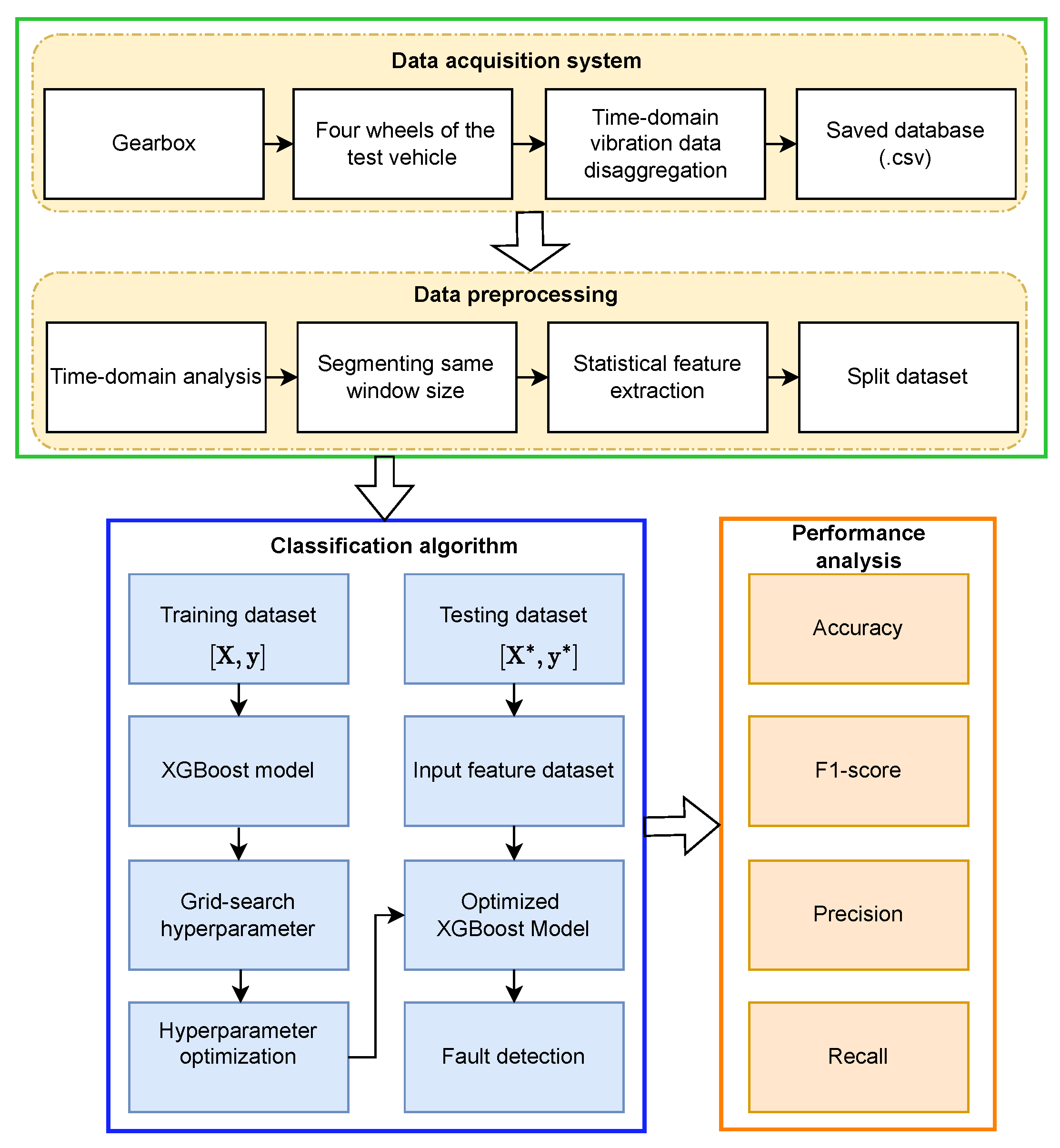
In this section, the proposed approach for diagnosing gear fault is described in detail. Figure 1 illustrates the overall methodology using a machine learning framework, divided into three main periods: data acquisition, data preprocessing, and fault classification with performance analysis. Firstly, the data acquisition system collects signal data from the four wheels of the test vehicle equipped with a gearbox under various operational scenarios. The second stage is data preprocessing and time-domain analysis of the acquired signals for experimental data setup. The final stage is to apply a machine learning method for fault detection, followed by a performance analysis to evaluate the model’s effectiveness.

2.1. Experimental Setup

The data collection process was designed to support fault diagnosis-reflected drivetrain health and vehicle dynamics. The measurement campaign was conducted at the Korea Railroad Research Institute (KRRI) proving ground, where both normal and faulty conditions were evaluated under controlled driving scenarios.

2.1.1. System Configuration

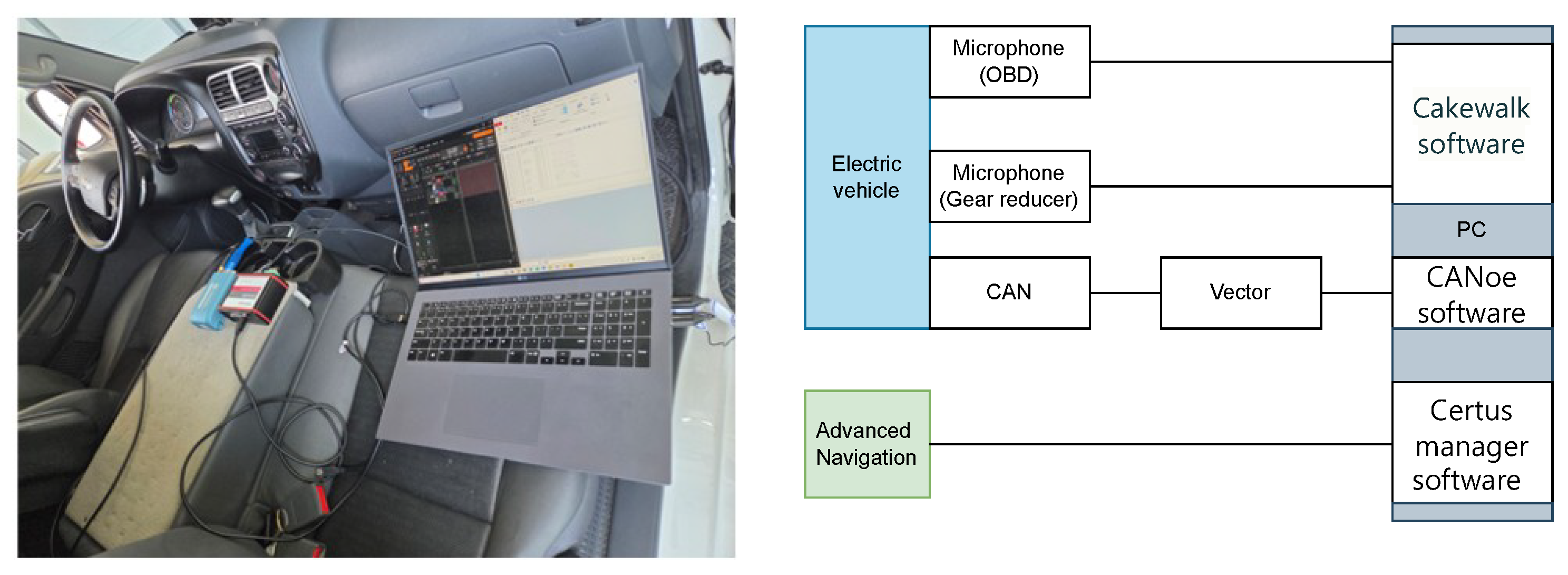
Figure 2 describes a system configuration for data acquisition. To comprehensively monitor drivetrain performance, the experimental setup for data acquisition was established on a low-floor electric vehicle to analyze noise, wheel speed, and dynamic behavior under various gearbox conditions. Two microphones were used to simultaneously capture interior and exterior noise: one positioned near the driver’s seat to record interior noise from the OBD (On-Board Diagnostics) area, and another mounted on the gear reducer near the drivetrain to capture exterior noise. In addition, a CAN (Controller Area Network) signal acquisition device was connected to the vehicle’s CAN port to record driving condition parameters, such as vehicle speed, steering angle, pedal positions, and gear status. The CAN signals were acquired using the Vector VN1640A device, allowing comprehensive logging of data transmitted within the vehicle network. For precise localization and synchronization, an Advanced Navigation system equipped with two GNSS antennas was installed on the front and rear of the vehicle roof, while the navigation module was securely mounted between the driver and passenger seats.
All data acquisition devices were integrated and connected to a single PC to enable synchronized real-time recording via dedicated software interface. Two microphones recorded signals, with data streamed through BandLab’s Cakewalk software, which supports multi-channel audio input, enabling precise synchronization and separation of interior and exterior noise channels. CAN signal monitoring and logging were performed using Vector’s CANoe software, which allows real-time visualization and post-acquisition analysis of CAN data streams. The Advanced Navigation system data were managed through Certus Manager software, enabling real-time vehicle dynamics monitoring and data logging. The synchronized data streams were logged continuously in standard numerical formats (.csv) and subsequently used for AI-based fault diagnosis model development. This synchronization is crucial for analyzing the relative behavior of individual wheel speeds, which can expose slip, differential faults, or irregular torque transfer caused by gearbox issues.

2.1.2. Driving Scenarios

To evaluate gearbox fault conditions, experiments were conducted using both normal and faulty gearbox. The representative driving scenarios were executed as follows:
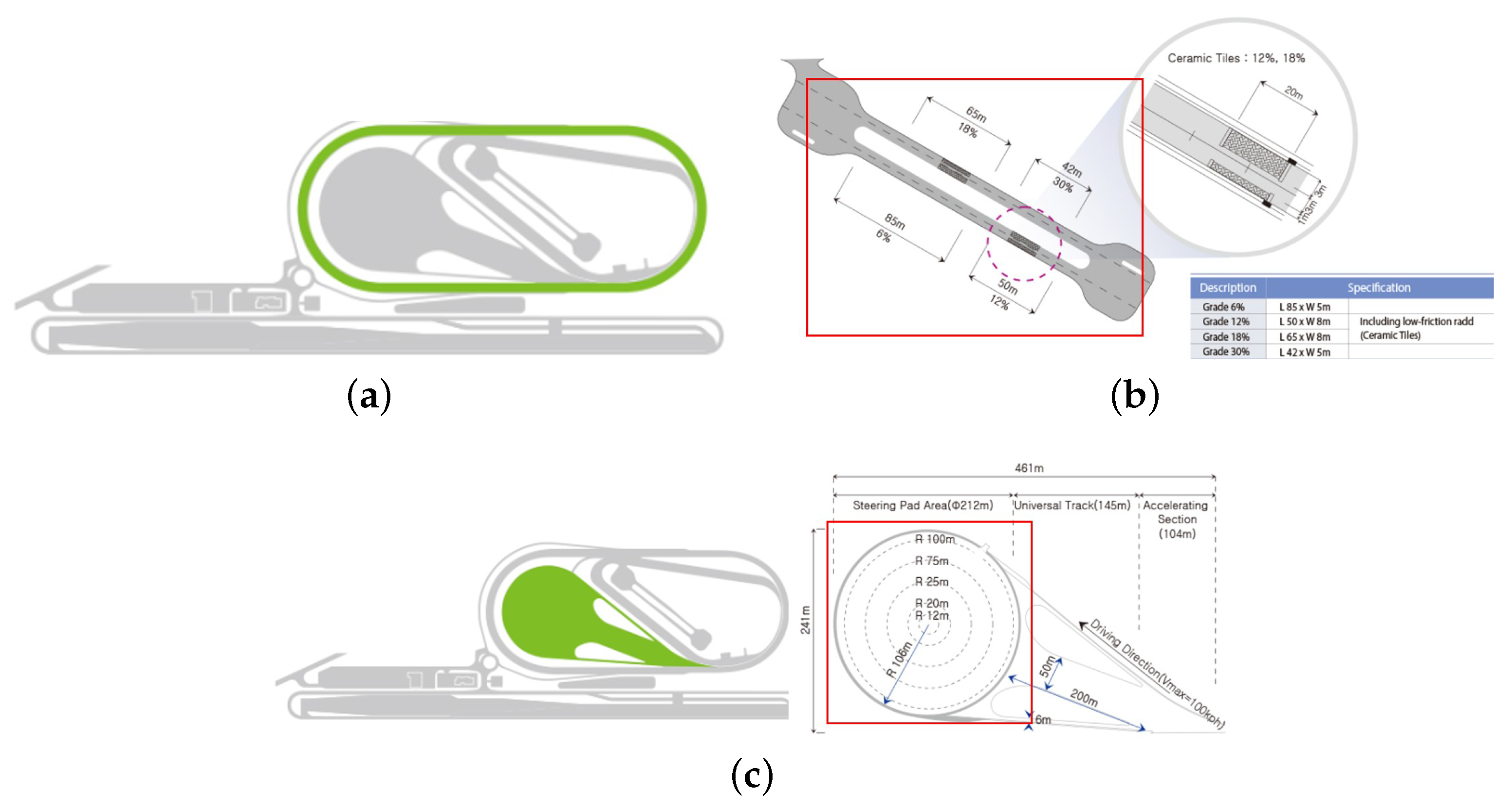
  • High-Speed Circuit: Conducted on a closed track combining straight and curved sections. Driving speeds of 20 kph (low), 60 kph (medium), and 80 kph (high) were tested, with three repetitions at each speed.
  • Uphill Road: Designed to examine the reducer’s response to varying load conditions. Uphill and downhill driving were performed on slopes of 6%, 12%, 18%, and 30%. Vehicles drove at a constant speed of 20 kph. Measurements were consistent with the high-speed circuit.
  • Steering Pad: Implemented to analyze the torque imbalance between left and right wheels during steering. The vehicle was driven in a circular path for one minute at a constant speed of 40 kph to evaluate load transfer and vibration behavior.
During each driving scenario, both the normal and abnormal reducer configurations were evaluated under identical environmental and operational conditions. The abnormal configuration corresponds to the initial, pre-improvement design version of the reducer, whereas the normal configuration refers to the final, improved design version installed on the vehicle. Figure 3 illustrates the variety of controlled test scenarios under which data were collected, including multiple vehicle speeds (20, 60, and 80 kph), inclines of different grades (6%, 12%, 18%, and 30%), and steering pad tests performed at 40 kph. This broad set of operational conditions enabled a comprehensive evaluation of the gearbox’s behavior in realistic driving environments. By capturing wheel-speed variations alongside mechanical signal and vehicle dynamic data, the dataset facilitates multifaceted fault diagnosis through cross-correlated analysis of rotational speed irregularities and signatures, ultimately improving condition monitoring and early fault detection of the gearbox.

2.2. Data Preprocessing

Table 1 provides meaningful representations of signal characteristics relevant to gearbox fault detection. The standard deviation (STD) and variance quantify the overall dispersion of signal amplitudes, reflecting the level of vibration irregularity. The mean provides a central tendency reference for evaluating deviation-based features [24]. The root mean square (RMS), also known as the quadratic mean, is defined as the square root of the arithmetic mean of the squares of the signal values and corresponds to the energy within the time domain [25]. Peak and peak-to-peak (P2P) values capture extreme amplitudes and are highly sensitive to impulsive events commonly produced by early-stage mechanical defects. The shape factor describes the waveform shape by comparing RMS to the mean value, while the clearance factor emphasizes high-amplitude impulses relative to low-level vibration components. The Np4 Factor magnifies small changes in the distribution of weaker amplitude components and has shown utility in distinguishing subtle fault progression patterns. Skewness measures the asymmetry of the amplitude distribution in the signal. Significant skewness can indicate fault conditions, especially those creating asymmetric impacts or wear patterns [26]. The crest factor (CRSF) is a dimensionless metric calculated as the ratio of the peak amplitude to the RMS value of the signal, reflecting the extremity of signal peaks. Due to its sensitivity to signal spikiness, CRSF can provide early indications of significant changes in characteristic patterns [27]. Signals containing random or periodic spikes exhibit elevated crest factors compared to pure sinusoidal waves. Prior research has shown that CRSF is more sensitive than skewness in detecting the effects of radial loads on vibrations [28]. Another critical parameter is Kurtosis (KURT), which measures the “tailedness” of a probability distribution by representing the fourth-order normalized moment normalized by the square of the variance of the time series signal [29]. Kurtosis is highly sensitive to impacts and degradation phenomena, often outperforming CRSF in early fault detection of rolling element bearings. A KURT value around 3 generally characterizes normal operational behavior, while values exceeding 3 suggest progressive fault development, reflecting distributions with heavier tails than a Gaussian profile [30]. Therefore, KURT serves as a vital indicator for monitoring the health of rotating machinery, including gears, bearings, and related components. In this study, twelve time-domain parameters were selected from the existing literature and utilized for training and testing the machine learning models for gearbox fault detection.

2.3. Experimental Data Setup

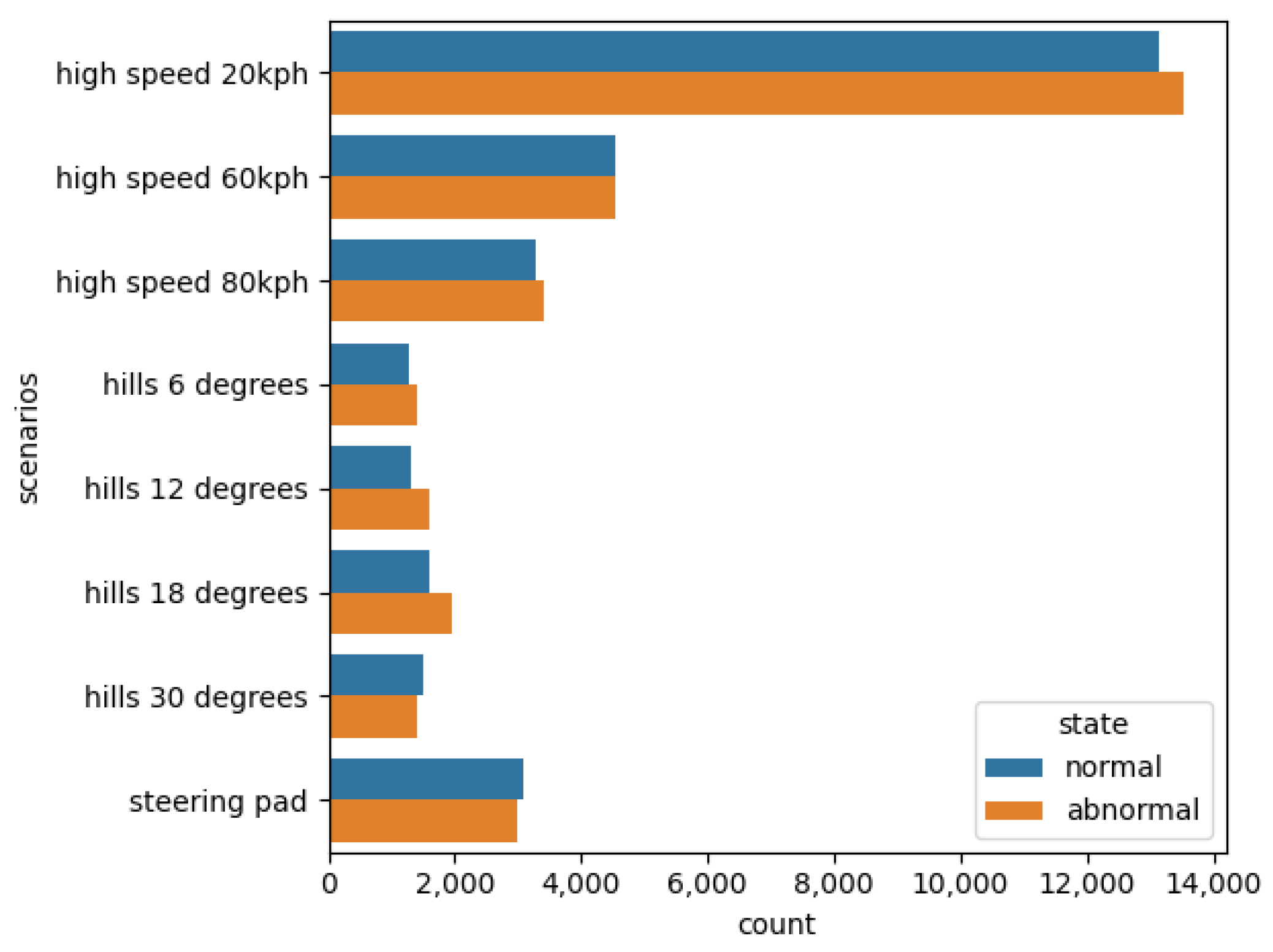
In this study, the experimental dataset utilized for gearbox fault diagnosis encompassed a comprehensive range of driving scenarios designed to capture the characteristic patterns and dynamic behavior of the vehicle under both normal and abnormal gearbox states. In this context, the abnormal state corresponds to data collected from a vehicle equipped with the initial, pre-improvement design version of the reducer, whereas the normal state represents data collected from the final, improved design version of the same component. This distinction reflects the underlying mechanical differences that influence vibration transmission paths, load distribution, and internal gear meshing behavior—factors that directly affect the observed sensor signals. Figure 4 illustrates the distribution of normal and abnormal data samples collected across various test conditions, including multiple speeds (20, 60, and 80 kph), different hill grades (6%, 12%, 18%, and 30% inclines), and a steering pad. The dataset is balanced with respect to normal and abnormal condition samples in most scenarios, ensuring robust representation for model training and evaluation. Notably, the majority of data originate from high-speed trials at 20 and 60 kph, while hill tests and steering exercises provide additional stress and dynamic variability to enhance model generalizability. This diverse dataset supports comprehensive fault identification across a wide operational spectrum.
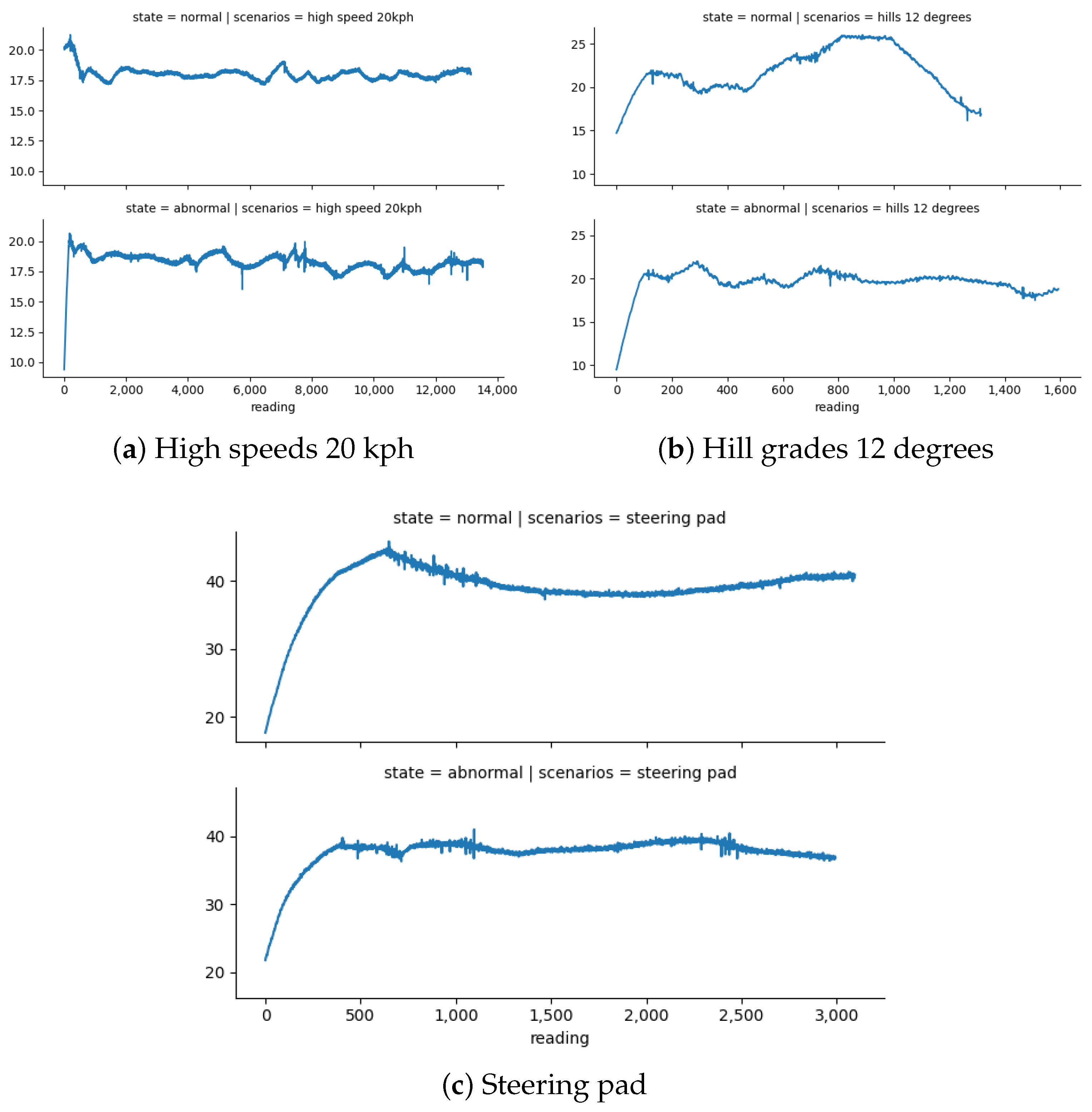
Figure 5 presents a detailed comparison of the wheel-speed signals from the front-right (FR) wheel for normal and abnormal gearbox conditions under different driving scenarios. The wheel-speed signals at a high speed of 20 kph are depicted in Figure 5a, in which the normal state exhibits relatively stable signals and consistent wheel-speed readings, whereas the abnormal condition presents more fluctuations and intermittent variance, indicating irregular rotational behavior possibly caused by gearbox faults. The similarity pattern is shown in Figure 5b on a hill road with a 12-degree grade. The normal state shows a smooth increase and then a gradual decrease in wheel speed as the vehicle navigates the incline. In contrast, the abnormal state demonstrates more fluctuations across the same interval, reflecting mechanical disturbances affecting wheel rotation under load. For the steering pad scenario, the comparison is reflected in Figure 5c, where both normal and abnormal conditions show an initial phase followed by a steady increase in wheel speed. However, the abnormal condition features noticeable noise and irregularities throughout the steady-state portion, showing persistent mechanical issues impacting wheel performance.
For each group, the continuous stream of signal measurements was segmented into fixed-size windows of 500 samples to capture localized temporal features, excluding the final incomplete segment to ensure uniformity. Within each window, statistical time-domain features such as mean, standard deviation, Kurtosis, and skewness were computed to characterize the dynamic behavior of the system under the given operating conditions.
Each feature set was annotated with binary labels based on the system state, where a label of ’1’ denoted abnormal or faulty conditions, and ’0’ represented normal operation. The aggregated feature vectors and their corresponding labels were compiled into a structured dataset conducive to machine learning model development. This dataset balances signal characteristics with operational states, enabling robust training and evaluation of fault detection algorithms in gearbox condition monitoring.

2.4. Model Development

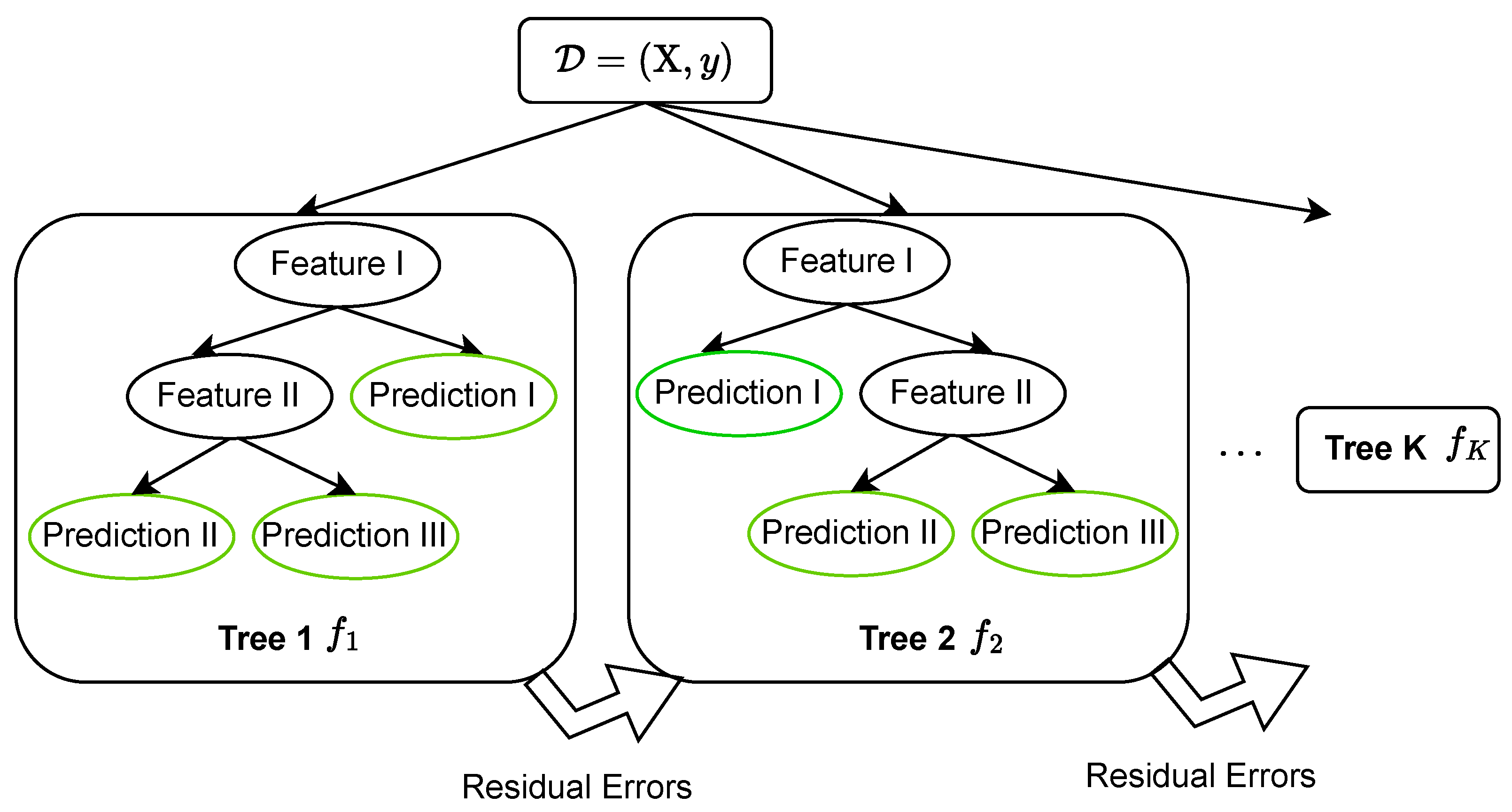
In this section, we focus on machine learning (ML)-based gearbox fault diagnosis, specifically employing the Extreme Gradient Boosting (XGBoost) algorithm. The proposed XGBoost architecture for classifying the healthy state of gearbox is shown in Figure 6. XGBoost is a gradient boosting framework based on decision trees. It learns models sequentially, where each model trains and improves throughout its previous model. This enhances accuracy and robustness against overfitting during model training [31]. The success of XGBoost largely stems from its objective function, which combines a loss function and a regularization term. For a given dataset with n examples and m features D = ( X , y ) , where X = ( x 1 , x 2 , , x n ) , x i R m , and y R n , a predicted output for x i with K additive trees is defined as follows:
y i ^ = k = 1 K f k ( x i ) ,
where f k F represents the kth tree in the model, as shown in Figure 6.
The objective function L minimized by XGBoost is computed as
L ( ) = i = 1 N l ( y i , y i ^ ) + k = 1 K Ω ( f k ) ,
in which the loss function l ( y i , y i ^ ) calculates the difference between the true label y i and the prediction y ^ i .
Unlike Random Forests, which train Decision Trees in parallel, XGBoost trains trees sequentially. They optimize residual errors of previous trees, thus producing a strong ensemble model. XGBoost is favored for its ability to efficiently handle large datasets, manage missing values without extensive preprocessing, and deliver state-of-the-art performance in classification and regression tasks. Its built-in support for parallel processing ensures rapid training times on large-scale data. Since its introduction, XGBoost has become widely adopted among data scientists due to its speed, ease of use, and impressive performance, often requiring minimal hyperparameter tuning [31,32].
To mitigate overfitting and underfitting issues common in Random Forests and Decision Trees, XGBoost incorporates regularization techniques such as feature subsampling and learning rate adjustment. The regularization term is defined as
Ω ( f ) = γ T + 1 2 λ j = 1 T ω j 2 ,
in which γ is a regularization parameter controlling the complexity penalty based on the number of terminal nodes T , while λ is the L2 regularization parameter applied to the weights ω j of leaves, collectively restraining model complexity to prevent overfitting.

2.5. Optimization Framework

Optimizing XGBoost’s hyperparameters is essential for capturing complex relationships while ensuring generalizability. The proposed XGBoost model was trained by applying different combinations of hyperparameters throughout the grid search method with five-fold cross-validation, and the best combination was selected. Table 2 summarizes the hyperparameter grid search performed to optimize the XGBoost model. Various values were tested for key parameters, including the number of estimators, maximum tree depth, learning rate, and subsampling ratio. Among the generated models, the best-performing parameters were identified with a learning rate of 0.1, a maximum tree depth of 9, a subsample ratio of 0.8, and 300 estimators. This combination provided the optimal balance between bias and variance, which can improve model accuracy and generalization on the testing dataset.

3. Performance Evaluations

In this section, we present the performance evaluation of gearbox fault classification using time-domain features to clarify the effectiveness of the XGBoost algorithm in diagnosing the healthy state of gearboxes. The dataset comprises four wheel-speed signals collected from real-world driving scenarios, including high-speed circuits, test hills, and steering pad exercises. In each time-domain signal from four wheels, twelve distinct time-domain statistical features were calculated from the signals for each 500 segmented signals. In general, m = 14 features were extracted—comprising twelve time-domain statistical features along with the driving-condition code (representing high speed, hill, and steering pad conditions as 0, 1, and 2, respectively) and the wheel-speed position code (encoding the FL, FR, RL, and RR wheels as 0, 1, 2, and 3, respectively)—as input variables for the machine learning models. The classification task of the proposed algorithm was used to predict the gearbox condition as either normal or abnormal based on input features. The number of samples for normal and abnormal gear state in the experiments is shown in Table 3. To ensure robust evaluation, the dataset was split into training (80%) and testing (20%) subsets using stratified sampling to maintain the class balance throughout. Therefore, with 452 samples in the entire dataset, 361 samples in total were used for the training model. The test set of 91 samples was applied to validate the performance of the model. Furthermore, during the training stage, the training system automatically reserved 10% of the training data as a validation subset. This internal validation process helps monitor model convergence and prevents overfitting by providing performance feedback throughout training.
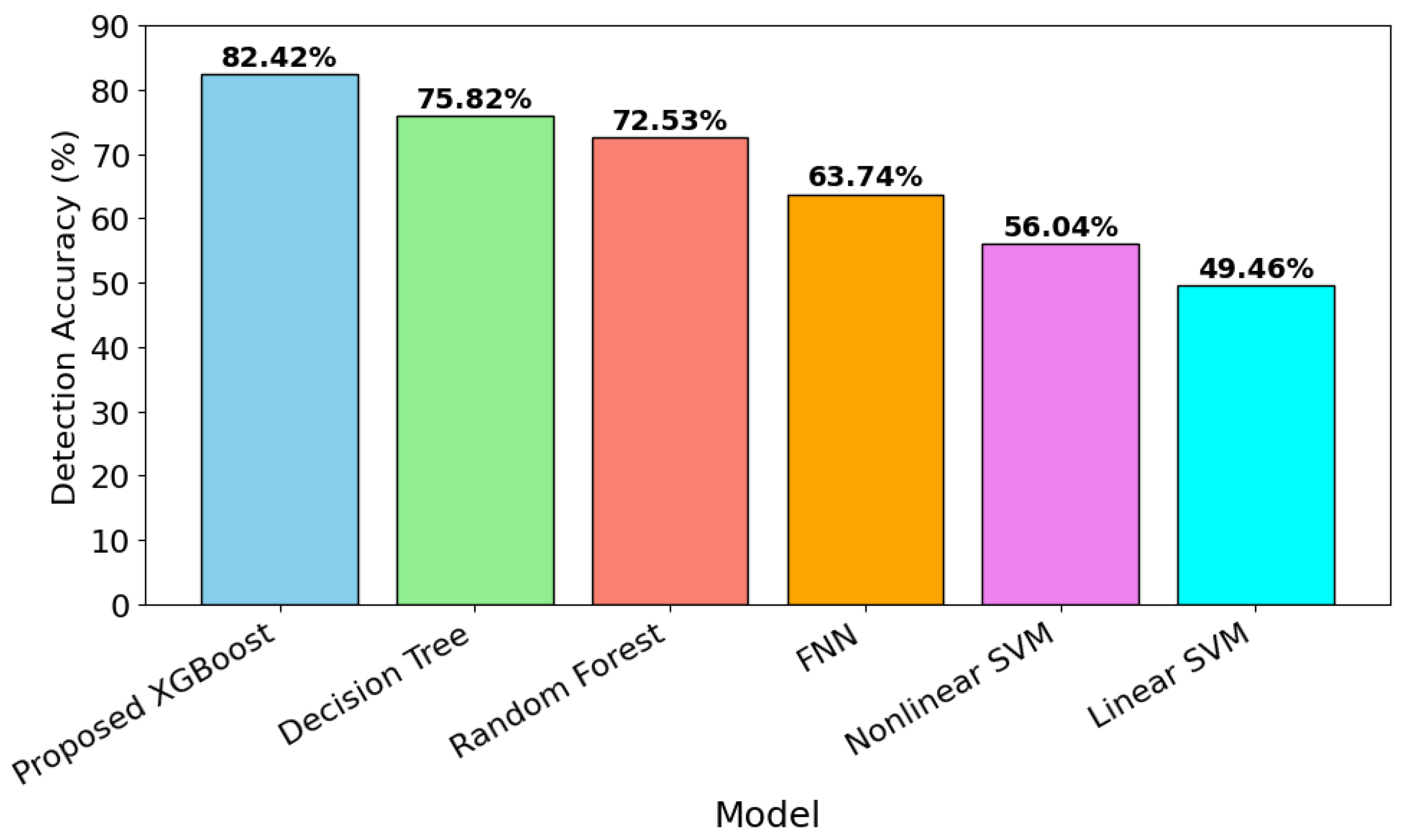
A comparison of the evaluation performance of the proposed XGBoost, Decision Tree, Random Forest, fully connected neural network (FNN), and support vector machine (SVM) models for fault recognition in gearbox is provided in Figure 7. For comparison, we used tree-based algorithms, namely Decision Trees and Random Forests, and other machine learning methods such as linear and nonlinear SVMs with a radial basis function (RBF) and an FNN model [33,34,35]. The Decision Tree model was configured with a maximum depth of 10, a minimum of 1 sample per leaf, and 2 samples per split, while the Random Forest model employed 300 estimators with a shallow maximum depth of 2, a minimum of 2 samples per leaf, and 1 sample per split. In the SVMs, the linear version was trained with C = 0.01 , whereas the nonlinear SVM used an RBF kernel with C = 0.01 and γ = 0.1 . The FNN model consisted of five hidden layers (512, 256, 256, 128, and 64 units), each followed by ReLU activation and a dropout rate of 0.3, the total trainable parameters of which were 254,849. All models were optimized via grid search over multiple parameter combinations to ensure a fair comparison, and the best combination was chosen. From Figure 7, it is clearly observed that the proposed XGBoost model attained the highest overall recognition accuracy performance (at roughly 82.42%), demonstrating its strong ability to capture nonlinear and high-frequency signal signatures through gradient boosting. The Decision Tree model followed with an accuracy of 75.82%, while the Random Forest achieved 72.53%, indicating that the shallow ensemble depth limited its capacity to learn more complex discriminative patterns. The FNN model obtained 63.74% accuracy, reflecting the difficulty of training deep networks effectively on this relatively small and noisy signal dataset without extensive regularization. Linear and nonlinear SVMs showed the lowest performance at 49.46% and 56.04%, respectively, likely due to the challenge of separating highly overlapping fault classes in the original feature space and the sensitivity of SVMs to parameter settings in high-dimensional vibration data.
Table 4 shows the training and testing time comparisons for the proposed XGBoost and other benchmark models. In our experiments, we use the same hardware configuration on a Google Colab platform. As can be seen, all models exhibit fast training times (under 0.5 s) and testing times (under 0.1 s), except for the FNN model, which requires a training time of approximately 19.38 s and a testing time of around 0.22 s. The proposed XGBoost has a slightly higher training time ( 0.44 s) compared to other tree-based algorithms due to the sequential construction of multiple weak learners during boosting. However, its testing time remains very low ( 0.0034 s), showing that it is suitable for real-time deployment scenarios.
The normal and abnormal gear detection results using time-domain statistical features for Random Forest and Decision Tree methods were also investigated, as shown in Table 5. It is clear that the accuracy rate of normal and abnormal gear recognition of the proposed XGBoost is the highest among all methods, with 86.67% for normal state, 78.26% for abnormal state, and an overall accuracy of 82.42%, while the Decision Tree achieved an overall accuracy of 75.82%, with 80.00% and 71.74% for normal and abnormal states, respectively. Meanwhile, Random Forest achieved only 71.11% and 73.91% accuracy rates in recognizing the normal and abnormal states, respectively. These performances indicate the efficiency of the proposed XGBoost algorithm in gearbox fault detection.
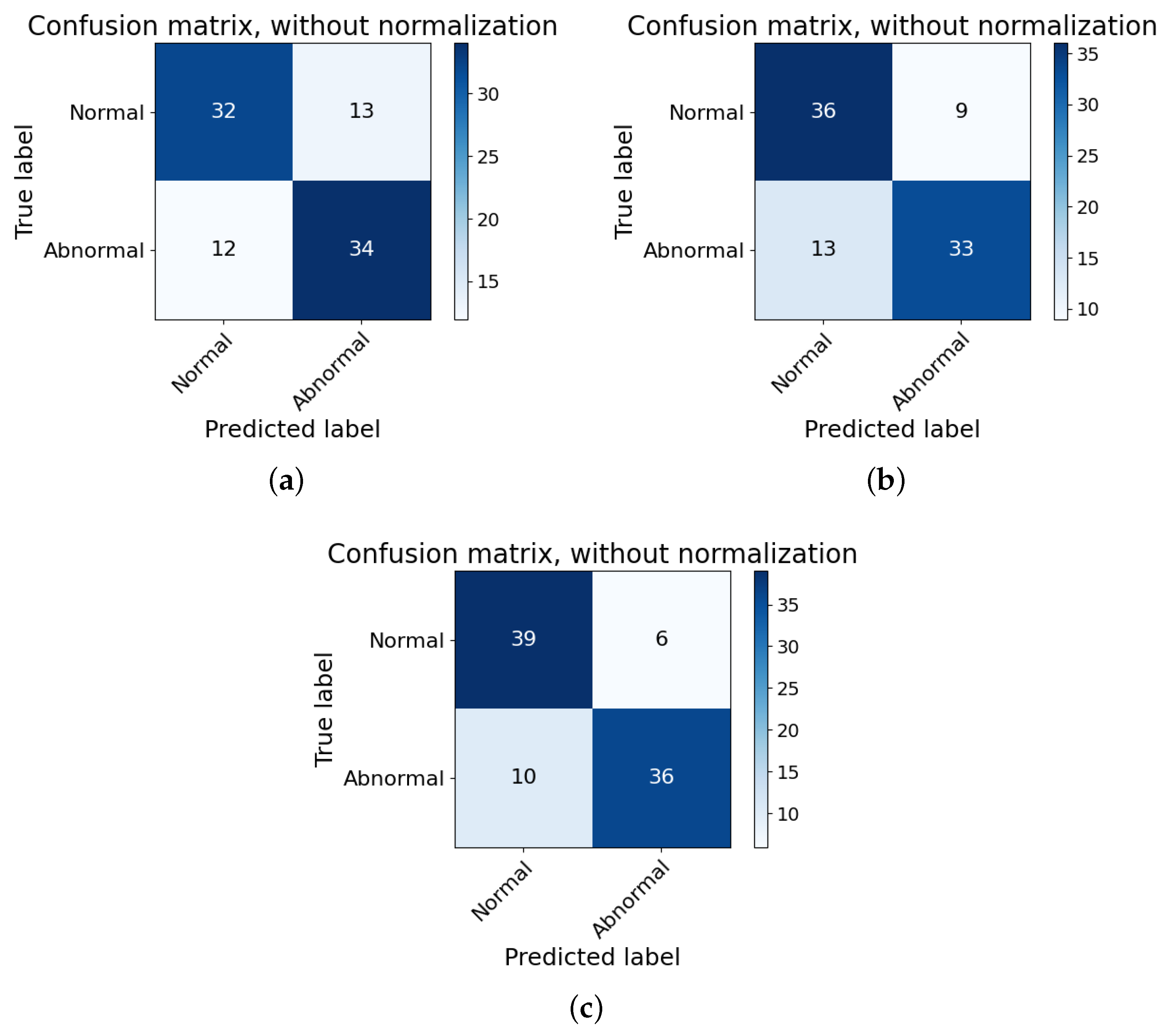
Figure 8 presents a confusion matrix for the classification performance of three machine learning models on a testing dataset for gearbox fault diagnosis. This comparison indicates that the proposed XGBoost model outperforms both Random Forest and Decision Tree in accurately identifying normal and abnormal gearbox states, reflected in higher true positive and true negative counts along with lower misclassification rates. In particular, as can be seen in Figure 8a, the Random Forest method only correctly recognized normal states with 32 samples and abnormal states with 34 samples while it misclassified 13 normal cases and 12 abnormal cases. These relatively high misclassification counts suggest that the Random Forest model struggles to consistently separate normal from faulty gearbox behaviors, especially when the signal is strongly affected by noise, load fluctuations, and non-stationary vehicle dynamics. Meanwhile, the proposed XGBoost achieves the largest number of correctly identified normal (39) and abnormal (36) samples, which is higher by 3 samples for normal and abnormal detection than in the Decision Tree model, shown in Figure 8b,c. The superior performance of XGBoost demonstrates its effectiveness for fault diagnosis using the provided dataset. This is because XGBoost’s boosted tree architecture and regularization allows it to model nonlinear interactions between statistical features and vehicle operating conditions, enabling more accurate identification of both normal and abnormal gearbox states.
To evaluate the stability of the proposed model, the XGBoost model was trained and tested 10 times with different random seeds. Table 6 summarizes the performance of the proposed XGBoost model on the testing data. For the normal health state, the model achieved a precision of 0.84, a recall of 0.80, and an F1-score of 0.82. For the abnormal state, the precision was 0.82, recall 0.85, and F1-score 0.83. On average, the model exhibited stable and balanced performance with a precision of 0.83, recall of 0.82, and F1-score of 0.82. The relatively low standard deviations indicate that the model maintains consistent reliability across multiple runs, demonstrating robustness in distinguishing between normal and abnormal gearbox conditions.
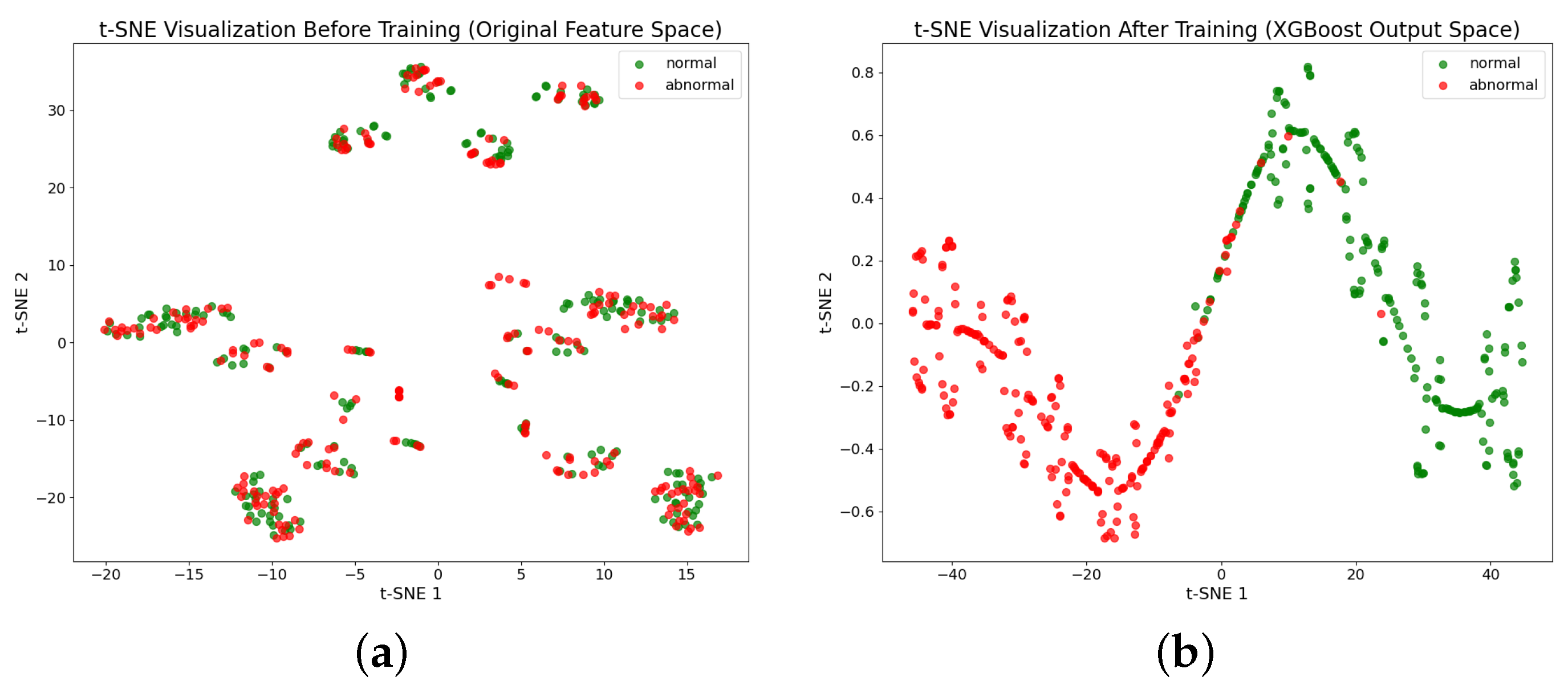
To comprehensively understand the model learning better, the feature distributions before and after training the proposed XGBoost learning model were analyzed using t-distributed stochastic neighbor embedding (t-SNE). Here, the t-SNE reduces the dimensions of the data into two-dimensional components that preserve the maximum variation and allow for visual inspection, where similar features are projected as nearby points. Figure 9 illustrates the t-SNE visualizations of the input features and the learned feature representations from the XGBoost model. As shown in Figure 9a, the numerous fault data and normal data are very close to each other and, hence, are difficult to classify accurately using the input PRPDs. In contrast, after training (Figure 9b), the XGBoost model effectively separates the normal and abnormal feature distributions, demonstrating its capability to learn discriminative representations.

4. Conclusions

In this article, we proposed an XGBoost-based approach for gearbox fault diagnosis using time-domain signals collected from four wheels of a test vehicle under real-world driving conditions. The classification task differentiates between normal and abnormal gearbox states, where the abnormal state corresponds to the initial, pre-improvement design of the reducer. The approach leverages twelve statistical time-domain features extracted from the four wheel-speed signals and driving conditions. Experimental results demonstrate that the proposed XGBoost model outperforms traditional tree-based methods, achieving an overall accuracy of 82.42%, compared to 75.82% for Decision Tree and 72.53% for Random Forest. The superior performance of XGBoost is thanks to its gradient boosting framework, which excels at capturing complex fault patterns and improving model generalization. These results verified the potential of XGBoost as an efficient tool for real-time gearbox fault detection in dynamic vehicular environments, providing valuable knowledge for predictive maintenance and reliability enhancement.
For future works, we will take into account specific fault types (e.g., tooth surface wear, tooth root cracks, pitting corrosion) or quantifiable fault severity levels (e.g., wear depth or crack length). This will allow the model to diagnose not only the health state of the gearbox but also the nature and severity of the underlying faults. Furthermore, the proposed scheme will be extended to investigate how the design-induced abnormalities used in this study correspond to actual failure modes in real operating conditions and whether they can serve as reliable indicators of early-stage gearbox faults.

Author Contributions

V.-N.T.-D. and M.C. conceived the presented idea. V.-N.T.-D. developed the model and performed the computations. M.C. and G.P. verified the experimental setup and results. All authors have read and agreed to the published version of the manuscript.

Funding

This work was supported by the research grant of Kongju National University in 2025. “Regional Innovation System & Education (RISE)” through the Ulsan RISE Center, funded by the Ministry of Education (MOE) and the Ulsan Metropolitan City, Republic of Korea (2025-RISE-07-001).

Data Availability Statement

Data are contained within the article.

Conflicts of Interest

The authors declare no conflicts of interest.

References

  1. Kumar, P.; Hirani, H. Misalignment effect on gearbox failure: An experimental study. Measurement 2021, 169, 108492. [Google Scholar] [CrossRef]
  2. Goswami, P.; Rai, R.N. A systematic review on failure modes and proposed methodology to artificially seed faults for promoting PHM studies in laboratory environment for an industrial gearbox. Eng. Fail. Anal. 2023, 146, 107226. [Google Scholar] [CrossRef]
  3. Latiffianti, E.; Sheng, S.; Ding, Y. Wind turbine gearbox failure detection through cumulative sum of multivariate time series data. Front. Energy Res. 2022, 10, 904622. [Google Scholar] [CrossRef]
  4. Li, F.; Ding, N.; Song, M.; Zhong, Z.; Liu, L.; Shen, X.; Xu, H.; Tian, L.; Xu, N.; Guo, W.; et al. A review on research of gear failures in mechanical equipment. J. Fail. Anal. Prev. 2025, 25, 612–648. [Google Scholar] [CrossRef]
  5. Wu, J.; Zhou, Y.; Jiang, W.; Chen, X. Time-domain dynamic modeling and analysis of complex heavy-duty gearbox considering floating effect. Appl. Sci. 2021, 11, 6876. [Google Scholar] [CrossRef]
  6. Zhang, J.; Zhang, Q.; Feng, W.; Qin, X.; Sun, Y. Gearbox fault diagnosis based on frequency-domain Gramian angular difference field and deep convolutional neural network. Proc. Inst. Mech. Eng. C J. Mech. Eng. Sci. 2023, 237, 5187–5202. [Google Scholar] [CrossRef]
  7. Qiu, T.; Wang, L.; Huang, W. Time-frequency domain feature enhanced sparse matrix and singular value vector optimization for gearbox fault diagnosis. In Proceedings of the 2024 International Conference on Sensing, Measurement & Data Analytics in the Era of Artificial Intelligence (ICSMD), Huangshan, China, 15–31 August 2024; pp. 1–4. [Google Scholar]
  8. Başaran, M.; Fidan, M. Gearbox fault classification by using frequency-based feature extraction. Eskisehir Tech. Univ. J. Sci. Technol. A Appl. Sci. Eng. 2020, 21, 101–107. [Google Scholar] [CrossRef]
  9. Chen, Y.; Zuo, M. A sparse multivariate time series model-based fault detection method for gearboxes under variable speed condition. Mech. Syst. Signal Process. 2022, 167, 108539. [Google Scholar] [CrossRef]
  10. Han, G.; Wan, S.; Lv, Z.; Liu, R.; Wang, J.; Tang, G. The analysis of gearbox fault diagnosis research based on the EMD and Hilbert envelope demodulation. Adv. Mater. Res. 2014, 926–930, 1800–1805. [Google Scholar] [CrossRef]
  11. Gelman, L.; Soliński, K.; Ball, A. Novel higher-order spectral cross-correlation technologies for vibration sensor-based diagnosis of gearboxes. Sensors 2020, 20, 5131. [Google Scholar] [CrossRef]
  12. Alhams, A.; Abdelhadi, A.; Badri, Y.; Sassi, S.; Renno, J. Enhanced bearing fault diagnosis through trees ensemble method and feature importance analysis. J. Vib. Eng. Technol. 2024, 12, 109–125. [Google Scholar] [CrossRef]
  13. Tang, G.; Pang, B.; Tian, T.; Zhou, C. Fault diagnosis of rolling bearings based on improved fast spectral correlation and optimized random forest. Appl. Sci. 2018, 8, 1859. [Google Scholar] [CrossRef]
  14. Han, T.; Jiang, D. Rolling bearing fault diagnostic method based on VMD–AR model and random forest classifier. Shock Vib. 2016, 2016, 5132046. [Google Scholar] [CrossRef]
  15. Zhang, R.; Li, B.; Jiao, B. Application of XGBoost algorithm in bearing fault diagnosis. IOP Conf. Ser. Mater. Sci. Eng. 2019, 490, 072062. [Google Scholar] [CrossRef]
  16. Pani, S.R.; Bera, P.K.; Kumar, V. Detection and classification of internal faults in power transformers using tree-based classifiers. In Proceedings of the 2020 IEEE International Conference on Power Electronics, Drives and Energy Systems (PEDES), Jaipur, India, 16–19 December 2020; pp. 1–6. [Google Scholar]
  17. Zhang, M.; Fang, C.; Ji, S. Research on fault diagnosis for power transformer based on random forests and wavelet transform. Int. J. Wirel. Mob. Comput. 2024, 26, 354–360. [Google Scholar] [CrossRef]
  18. Wang, L. Fault diagnosis of transformer based on XGBoost. Appl. Comput. Eng. 2024, 90, 107–111. [Google Scholar] [CrossRef]
  19. Kundu, P.; Darpe, A.K.; Kulkarni, M.S. An ensemble decision tree methodology for remaining useful life prediction of spur gears under natural pitting progression. Struct. Health Monit. 2020, 19, 854–872. [Google Scholar] [CrossRef]
  20. Ikhlef, B.; Rahmoune, C.; Toufik, B.; Benazzouz, D. Gearboxes fault detection under operation varying condition based on MODWPT, ant colony optimization algorithm and random forest classifier. Adv. Mech. Eng. 2021, 13, 168781402110430. [Google Scholar] [CrossRef]
  21. Spirto, M.; Melluso, F.; Nicolella, A.; Malfi, P.; Cosenza, C.; Savino, S.; Niola, V. A comparative study between SDP-CNN and time–frequency-CNN based approaches for fault detection. J. Dyn. Monit. Diagn. 2025, in press. [Google Scholar] [CrossRef]
  22. Spirto, M.; Nicolella, A.; Melluso, F.; Malfi, P.; Cosenza, C.; Savino, S.; Niola, V. Enhancing SDP-CNN for gear fault detection under variable working conditions via multi-order tracking filtering. J. Dyn. Monit. Diagn. 2025, in press. [Google Scholar] [CrossRef]
  23. Hoang, N.P.; Nguyen, T.D.; Nguyen, T.H.; Pham, D.H.; Nguyen, P.D.; Nguyen, T.V.H. A data-driven framework for fault diagnostics in gearbox health monitoring under non-stationary conditions. Processes 2025, 13, 1663. [Google Scholar] [CrossRef]
  24. Bastianin, A. Robust measures of skewness and kurtosis for macroeconomic and financial time series. Appl. Econ. 2020, 52, 637–670. [Google Scholar] [CrossRef]
  25. Smith, J. Root mean square (RMS) vibration measurement and analysis. J. Sound Vib. 2017, 403, 265–274. [Google Scholar]
  26. Brys, G.; Hubert, M.; Struyf, A. A robust measure of skewness. J. Comput. Graph. Stat. 2004, 13, 996–1017. [Google Scholar] [CrossRef]
  27. Dutta, A.; Chakraborty, N. On the use of crest factor in machine condition monitoring: An overview. Measurement 2016, 87, 147–160. [Google Scholar]
  28. Randall, R.B. Vibration-Based Condition Monitoring: Industrial, Aerospace and Automotive Applications; Wiley: Chichester, UK, 2010. [Google Scholar]
  29. Antoni, J. The spectral kurtosis: A useful tool for characterising non-stationary signals. Mech. Syst. Signal Process. 2006, 20, 282–307. [Google Scholar] [CrossRef]
  30. Wu, H.; Zhang, P.; Zhu, R.; Kong, F. Kurtosis-based fault detection in rolling element bearings under varying operating conditions. IEEE Trans. Instrum. Meas. 2019, 68, 4319–4329. [Google Scholar]
  31. Chen, T.; Guestrin, C. XGBoost: A scalable tree boosting system. In Proceedings of the 22nd ACM SIGKDD International Conference on Knowledge Discovery and Data Mining, San Francisco, CA, USA, 13–17 August 2016; pp. 785–794. [Google Scholar]
  32. Aisy, R. Residual XGBoost regression—Based individual moving window GDP forecasting. PLoS ONE 2025, 20, e0321660. [Google Scholar] [CrossRef] [PubMed]
  33. Cortes, C.; Vapnik, V.N. Support vector networks. Mach. Learn. 1995, 20, 273–297. [Google Scholar] [CrossRef]
  34. Huang, H.-Y.; Lin, C.-J. Linear and kernel classification: When to use which? In Proceedings of the SIAM International Conference on Data Mining, Miami, FL, USA, 5–7 May 2016; pp. 216–224. [Google Scholar]
  35. Scabini, L.F.S.; Bruno, O.M. Structure and performance of fully connected neural networks: Emerging complex network properties. Phys. A Stat. Mech. Its Appl. 2023, 615, 128585. [Google Scholar] [CrossRef]
Figure 1. A flowchart of the proposed methodology.
Electronics 14 04736 g001
Figure 2. Data acquisition system configuration.
Electronics 14 04736 g002
Figure 3. Controlled driving scenarios for data collection: (a) high-speed circuit, (b) test hills, and (c) circular track.
Electronics 14 04736 g003
Figure 4. Experimental dataset for normal and abnormal state in different scenarios.
Electronics 14 04736 g004
Figure 5. Comparison of signals of wheel speeds from the front-right (FR) wheel for normal and abnormal gear conditions under different driving scenarios.
Electronics 14 04736 g005
Figure 6. The proposed XGBoost architecture.
Electronics 14 04736 g006
Figure 7. Detection accuracy performance for different models.
Electronics 14 04736 g007
Figure 8. Confusion matrices for (a) Random Forest, (b) Decision Tree, and (c) proposed XGBoost on the testing data.
Electronics 14 04736 g008
Figure 9. Data visualization using t-SNE: (a) input, (b) proposed XGBoost method.
Electronics 14 04736 g009
Table 1. Time-domain indicators used as feature parameters for training and testing of machine learning models.
Equation NameEquation Formula
Root square mean (RMS) R M S = 1 N i = 1 N x i 2 (1)
Standard deviation (STD) S T D = 1 N 1 i = 1 N ( x i x ¯ ) 2 (2)
Mean x ¯ = 1 N i = 1 N x i (3)
Variance σ 2 = 1 N 1 i = 1 N ( x i x ¯ ) 2 (4)
Peak P e a k = max ( | x i | ) (5)
Peak to peak (P2P) P 2 P = max ( x i ) min ( x i ) (6)
Shape factor S h a p e = R M S | x ¯ | (7)
Clearance factor C l e a r a n c e = P e a k ( 1 N i = 1 N | x i | ) 2 (8)
Np4 factor N p 4 = P e a k ( 1 N i = 1 N | x i | 1 / 4 ) 4 (9)
Crest factor (CRSF) C R S F = m a x ( | x i | ) R M S (10)
Kurtosis (KURT) K U R T = N i = 1 N ( x i x ¯ ) 4 i = 1 N ( x i x ¯ ) 2 2 (11)
Skewness (SKEW) S K E W = N i = 1 N ( x i x ¯ ) 3 i = 1 N ( x i x ¯ ) 2 3 (12)
Table 2. Grid search of hyperparameter optimization.
HyperparameterGrid Search
n estimators 100 , 300 , 500
Max depth 5 , 7 , 9
Learning rate 0.01 , 0.05 , 0.1
Subsampling 0.7 , 0.8 , 0.9
Table 3. Experimental dataset for normal and abnormal gearbox.
Health StateNormalAbnormalTotal
Number of experiments224228452
Table 4. Training and testing time comparisons.
Model TypeTraining Time (Seconds)Testing Time (Seconds)
Proposed XGBoost∼0.44∼0.0034
Decision Tree∼0.02∼0.0011
Random Forest∼0.37∼0.015
FNN∼19.38∼0.22
Nonlinear SVM∼0.78∼0.0029
Linear SVM∼0.03∼0.0012
Table 5. Comparison of detection performance with different methods using time-domain features.
Heath StateNormalAbnormalOverall
Random Forest (%)71.1173.9172.53
Decision Tree (%)80.0071.7475.82
Proposed XGBoost (%)86.6778.2682.42
Table 6. Performance metrics of the XGBoost model on the testing data (mean ± std over 10 runs).
Health StatePrecisionRecallF1-Score
Normal0.84 ± 0.040.80 ± 0.080.82 ± 0.05
Abnormal0.82 ± 0.060.85 ± 0.040.83 ± 0.03
Average0.83 ± 0.050.82 ± 0.070.82 ± 0.04
Disclaimer/Publisher’s Note: The statements, opinions and data contained in all publications are solely those of the individual author(s) and contributor(s) and not of MDPI and/or the editor(s). MDPI and/or the editor(s) disclaim responsibility for any injury to people or property resulting from any ideas, methods, instructions or products referred to in the content.