


Abstract
The knowledge graph link prediction task currently faces challenges such as insufficient semantic fusion of structured knowledge and unstructured text, limited representation learning of long-tailed entities, and insufficient interpretability of the reasoning process. Aiming at the above problems, this paper proposes a multi-chain fusion reasoning framework to realize accurate link prediction. First, a dual retrieval mechanism based on semantic similarity metrics and embedded feature matching is designed to construct a high-confidence candidate entity set; second, entity-attribute chains, entity-relationship chains, and historical context chains are established by integrating context information from external knowledge bases to generate a candidate entity set. Finally, a self-consistency scoring method fusing type constraints and semantic space alignment is proposed to realize the joint validation of structural rationality and semantic relevance of candidate entities. Experiments on two public datasets show that the method in this paper fully utilizes the ability of multi-chain reasoning and significantly improves the accuracy of knowledge graph link prediction.
1. Introduction
A knowledge graph (KG) is a structured semantic network focused on entities and their interrelations, representing real-world knowledge and the connections between entities [1,2]. As a key form of knowledge representation, KGs facilitate the intuitive and efficient organization of complex information and are extensively utilized in search engines, recommendation systems, intelligent question-answering, and medical diagnosis [3,4,5,6,7]. However, KGs are often incomplete, a challenge that has driven the rapid advancement of knowledge graph reasoning techniques. Link prediction, a core task in knowledge graph reasoning, aims to infer the missing components of partial triples. For instance, given a query triple , the task is to predict the potential tail entity t. This link prediction capability is applicable in various contexts, including personalized recommendations, drug discovery, and scientific literature analysis [8,9,10,11,12].
Link prediction models typically fall into two categories: translation-based and semantic matching-based models. These approaches are straightforward in design and computationally efficient. However, their reliance on shallow networks limits their ability to capture intricate semantic relationships and structural features [13,14,15]. In contrast, pre-trained model-based methods utilize pre-trained language models to learn embeddings from the textual descriptions of entities and relationships, thereby improving the model’s capacity to comprehend text semantics [16,17]. Despite this advantage, the disparity in semantic space and information granularity between structured and unstructured knowledge hinders effective semantic fusion. This limitation also impacts the knowledge graph’s reasoning capabilities in dynamic contexts.
In addition, long-tail entities are prevalent in knowledge graphs and can comprise critical domain knowledge, such as specialized terminology and rare diseases. Due to their infrequent occurrence, traditional embedding models often fail to generate adequate feature representations from limited training data [18,19]. To address this challenge, Cai et al. [20] proposed a meta-learning-based knowledge graph structural pattern extraction method to enhance the model’s generalization in data-sparse scenarios. Similarly, Sadeghian et al. [21] combined logical rules with embedding models to improve the reasoning capabilities for implicit relationships. While these approaches have demonstrated significant performance improvements in experiments, they still face difficulties when dealing with long-tail entities in knowledge graphs.
The success of Large Language Models (LLMs) [22] has opened new avenues for the task of knowledge graph link prediction. LLMs’ semantic comprehension capabilities allow for a profound exploration of implicit relationships within knowledge graphs. Particularly in scenarios involving complex semantic interactions, LLMs enhance link prediction accuracy through contextual learning. Furthermore, their robust natural language generation and semantic alignment skills enable LLMs to bridge the gap between structured knowledge graph information and unstructured text, thus addressing the limitations of traditional models in processing multi-source knowledge. However, effective link prediction requires not only accuracy but also interpretability. Recent studies have proposed novel solutions for interpretable knowledge graph reasoning using LLMs. Wei et al. [23] conducted reasoning based on LLM knowledge prompts to improve the efficiency of link prediction. Xu et al. [24] utilized LLMs to expand the context of the triple structure and adopted pre-trained models to learn the embedding representations of entities and relationships. Nevertheless, these frameworks still face challenges in presenting a clear and coherent logical reasoning chain.
This paper proposes a knowledge graph link prediction method driven by multi-chain fusion reasoning (MCFR). We clarify that ’reasoning’ in this paper differs from formal symbolic deduction. It refers to a contextualized inference process driven by a large language model, which synthesizes evidence from multiple semantic chains to form a prediction. Therefore, our approach should be understood as a sophisticated heuristic for semantic exploration, rather than a formal logical procedure. The key contributions are as follows:
(1) A multi-source fusion-based candidate entity retrieval mechanism. A dual screening strategy is employed to select candidate entities based on semantic similarity and embedding feature similarity. Two retrieval methods, namely relevant triple retrieval and embedding model retrieval, are adopted. This approach not only improves the quality of candidate entities but also effectively reduces the computational cost of large language models.
(2) A context-based multi-chain fusion reasoning mechanism. By incorporating triple context and reasoning examples, we construct three reasoning chains: an entity attribute chain, an entity-relationship chain, and a historical background chain. This enables context-aware reasoning for candidate entities from multiple semantic perspectives, thereby providing a more comprehensive explanation of the model’s predictions.
(3) A prediction scoring mechanism based on self-consistency. A candidate entity scoring approach is developed, evaluating both type consistency and semantic consistency. This dual constraint on structural matching and semantic rationality further improves the accuracy of the model output.
2. Related Work
Existing knowledge graph link prediction methods can be classified into three categories: triple-based methods, pre-trained model-based methods, and large language model-based methods.
2.1. Triple-Based Methods
The triple-based approach involves mapping entities and relationships from the knowledge graph into a continuous low-dimensional space and assessing the plausibility of these triples using a scoring function [25,26,27,28]. TransE (Translating Embedding), an early method for knowledge graph embedding, represents linear or affine relationships between entities and relationships through basic geometric transformations, offering efficiency and ease of implementation. Wang et al. [29] applied 3D convolution to capture intricate interactions among entities and relationships in triples, embedding them into a low-dimensional continuous vector space for link prediction tasks. Cai et al. [30] proposed a link prediction model based on a line graph neural network. This method converts the original graph into a line graph, avoids the information loss caused by graph pooling, and improves the performance of link prediction. Wang et al. [31] proposed a Transformer-based KG representation learning method with structure-aware capabilities. Nevertheless, these models struggle to capture comprehensive semantics and model intricate interactions within the knowledge graph.
2.2. Pre-Trained Model-Based Methods
The approach utilizing pre-trained models leverages textual data within a knowledge graph to extract comprehensive semantic information. In early deep knowledge representation learning, convolutional neural networks were utilized to extract features from textual entity descriptions and generate associated embedding vectors [32,33,34]. Wang et al. [35] introduced the Knowledge Embedding and Pre-trained Language Representation (KEPLER) framework for multitask learning with pre-trained models. This approach encodes entity text descriptions by integrating structured knowledge graph information and jointly optimizes knowledge embedding learning and language model objectives. Chen et al. [36] introduced KGEditor (Knowledge Graph Embedding Editor), which employs a pre-trained language model to align entity, relationship, and word tag embedding into a unified semantic space to enhance the representation of less common entities. This method refines knowledge graph embedding tasks based on the language model, enabling rapid and efficient updates to knowledge graph embedding. However, the ability of pre-trained models to model context is still limited, and it is difficult to provide sufficient semantic support when dealing with extremely sparse entity information.
2.3. Large Language Model-Based Methods
In recent years, there has been a growing interest in leveraging LLMs for knowledge graph tasks. Jiang et al. [37] introduced a comprehensive framework called StructGPT, which leverages LLMs to process structured data for enhancing knowledge graph question-answering tasks. Similarly, Zhang et al. [38] developed a method known as knowledge prefix adapter, which creates knowledge structure embedding from pre-trained models and conveys this cross-modal structural information to LLMs to enhance knowledge reasoning capabilities. Additionally, Wei et al. [23] presented the knowledge graph completion framework KICGPT, which employs LLM-based knowledge prompts for reasoning. By leveraging both knowledge graph structure information and LLM knowledge bases, KICGPT effectively addresses the limitations of traditional Knowledge Graph Completion (KGC) methods, particularly in handling long-tail entities.
3. Multi-Chain Fusion Reasoning for Knowledge Graph Link Prediction
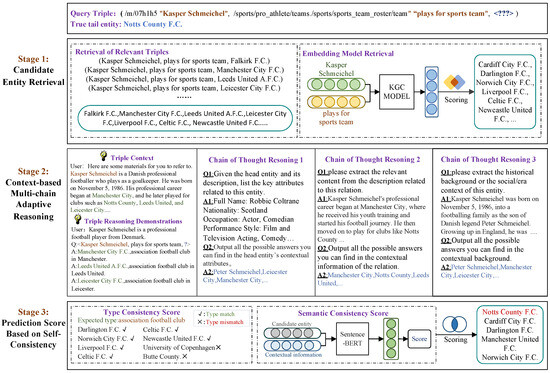
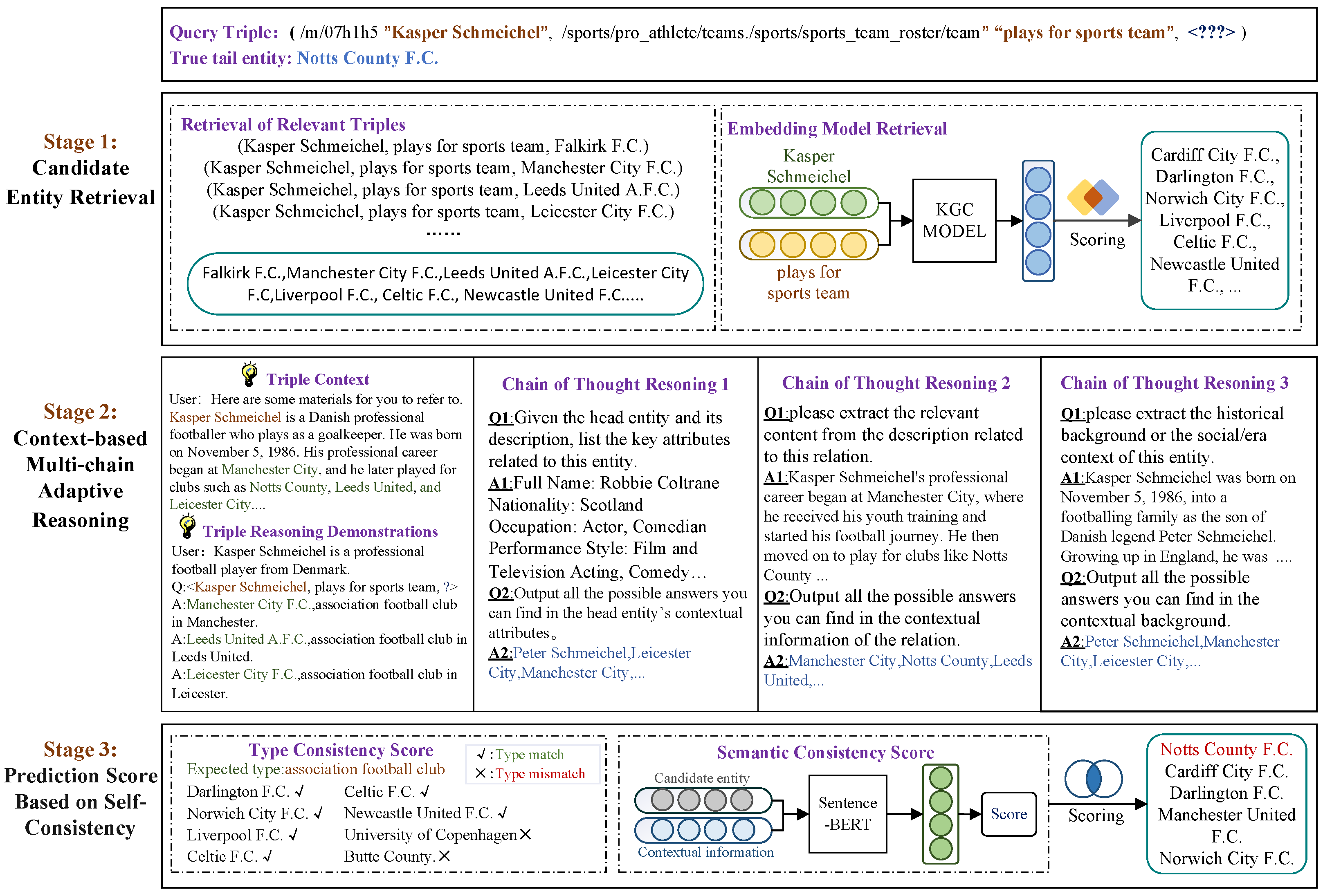
This paper introduces a novel method for link prediction in knowledge graphs, termed the multi-chain fusion reasoning approach. Initially, candidate entity sets are derived through semantic similarity screening and embedding feature similarity screening of query triples. Subsequently, external knowledge related to query triplets and examples of triplet reasoning are incorporated. A multi-chain fusion reasoning mechanism is then employed to generate a candidate entity list based on entity attributes, entity relationships, and historical context. Finally, a self-consistency scoring mechanism is proposed to facilitate link prediction by assessing type consistency and semantic coherence among candidate entities. The framework of the method is illustrated in Figure 1.
Figure 1.
Model framework diagram.
3.1. Candidate Entity Retrieval
Candidate entity retrieval encompasses both relevant triple retrieval and embedding model retrieval. An initial set of candidate entities is generated through semantic similarity screening and embedding feature similarity screening of the query triples. This approach not only reduces the computational demands on the LLM but also enhances prediction accuracy.
3.1.1. Retrieval of Relevant Triples
Entities in knowledge graphs are commonly represented as structured triples. Notably, entities linked by the same relationship often exhibit shared key attributes. Consequently, the inherent knowledge encoded within the knowledge graph can provide effective support for processing query triples. For a given query triple , candidate entities are obtained by extracting the semantically closest relevant triples from the knowledge graph. Specifically, triples with the same head entity h and the same relation r as the query triple are selected from the training set, and the tail entities in these triples are extracted to form a candidate entity set for relevant triples, denoted as
3.1.2. Embedding Model Retrieval
To mitigate the computational demands of LLMs when processing numerous candidate entities, this study utilizes an efficient knowledge graph feature representation model to derive embedded feature representations of query triples. The embedding model captures candidate entities and relationships with significant structural correlation and semantic coherence. The model’s scoring results are used to select the top k candidate entities, forming a candidate entity set , thereby minimizing the number of entities forwarded to the LLM, denoted as
where is the scoring outcome of the embedding model. In this study, three representative embedding models are employed for candidate entity scoring, namely CompGCN [39], HittER [40], and SAttLE [41]. CompGCN reduces model complexity by sharing relation embeddings and decomposing basis vectors. HittER, on the other hand, leverages a hierarchical Transformer architecture to capture the intricate hierarchical structures of entities and relations in knowledge graphs, thereby enhancing the quality of embedding representations. SAttLE adopts a self-attention mechanism to model the interactions between entities and relations, enabling efficient feature representation in a low-dimensional embedding space.
Upon executing the triple retrieval and embedding model retrieval processes, the resulting candidate entity sets are consolidated, with duplicate entities systematically eliminated to yield the preliminary candidate entity set , represented as
3.2. Context-Based Multi-Chain Fusion Reasoning
In knowledge graph reasoning tasks, traditional chain-of-thought approaches inadequately leverage the contextual information inherent in triples, thereby compromising predictive accuracy. To mitigate this limitation, we introduce a context-based multi-chain fusion reasoning method. This approach enhances reasoning stability and generalization by integrating entity attributes, relationships, and background information.
3.2.1. Triple Context
To enhance the model’s semantic understanding of the head entity in the query triple, this work leverages textual information about entities from external knowledge as supplementary context. Specifically, the entity ID is mapped to its corresponding Wikidata QID, and textual data such as the entity’s label and brief description are extracted from the associated Wikidata URI. The retrieval process is precise and strictly limited. We only use static descriptive fields. Any textual attributes describing relational facts are explicitly excluded. Similarly, links to other entities are also excluded. This approach prevents any potential information leakage. This textual context typically encompasses the entity’s key attributes, well-known roles, and relevant social or historical background. An example of such triple context is provided in Table 1. Furthermore, our experiments strictly adhere to the standard training, validation, and test splits of the benchmark datasets, ensuring no information from the test set is ever used to construct the context.
Table 1.
A triple context example.
3.2.2. Triple Reasoning Demonstrations
To enhance the reasoning capabilities of LLMs, this study selects k correct triples from the training set as reasoning demonstrations. These demonstrations provide a structured knowledge framework and guide the model in learning effective reasoning paths for more accurate prediction.
We prioritize triples that share the same head entity and relationship as the query triple, ensuring strong semantic and structural relevance. Each demonstration comprises two components: a natural-language background description related to the triple and a formal question prompt that clearly delineates the reasoning task and expected answer. Table 2 illustrates the specific format of these triple reasoning examples.
Table 2.
Triple reasoning demonstration.
3.2.3. Multi-Chain Fusion Reasoning
The knowledge graph reasoning task often fails to fully capture the complex relationships between entities using simple chain-of-thought reasoning [42,43]. To address this, the present study constructs multiple independent reasoning chains that collaborate to predict missing links in the knowledge graph from diverse perspectives, thereby enhancing the accuracy and stability of the reasoning process. Specifically, the study implements entity attribute reasoning chains, entity-relation reasoning chains, and historical background reasoning chains. Each reasoning chain performs reasoning in the form of , where represents different questions addressed by the i-th reasoning chain, denotes the different context corresponding to the i-th reasoning chain, and A is the answer derived from the respective contextual information.
The entity attribute reasoning chain retrieves the attribute context based on the attribute question of the head entity h in the query triple Q. This context includes relevant information about the head entity, such as its name, occupation, nationality, and representative works. Formally, this process can be represented as
Based on the attribute context , triple demonstration examples , triple context , and attribute questions, the entity-attribute chain infers a candidate answer list based on the attribute context, denoted as
The entity-relationship chain first retrieves the context information of the relationship r in the query triple Q, which is represented as
Utilizing the relational context , examples of triple demonstrations , triple context , and entity-relation questions , the entity-relation chain generates a list of potential answers derived from the entity-relation context, indicated as
Historical background chain first the retrieval the historical background context of the head entity h in the query triples Q, denoted as
Based on the historical background context , triple demonstration examples , triple context , and historical background questions , a list of candidate answers based on the historical background context is inferred and represented as
The specific forms of questions in the entity attribute chain, entity-relation chain, and historical background chain are detailed in Appendix A. We present a complete reasoning instance in Appendix A. This example details how the entity-attribute chain, entity-relation chain, and historical background chain unfold through a two-stage questioning process (Q1, Q2) to generate their respective candidate answers. This process clearly demonstrates that the model does not simply perform black-box prediction but follows a structured and traceable reasoning path, thereby enhancing the model’s interpretability.
Ultimately, the final candidate list is generated by first attempting a strict intersection of all candidate sets. If this intersection is empty, a fallback to their union is performed to ensure a candidate list is always available for scoring. This is denoted as
Algorithm 1 provides the concrete implementation of this procedure.
| Algorithm 1 Generation of the Final Candidate Entity Set |
| Input: Initial candidate set , candidate sets from three reasoning chains . |
| Output: The final candidate entity set . |
| Let |
| if then |
| else |
| end if |
| return |
3.3. Prediction Score Based on Self-Consistency
The self-consistency principle proposed by Wang et al. [44] provides a promising approach to enhance the accuracy of LLM reasoning by sampling the chain-of-thought. Inspired by this work, the present study introduces a knowledge graph link prediction scoring framework grounded in the principle of self-consistency. Specifically, we design scoring functions to assess the consistency of entity types and semantic coherence and leverage these metrics to optimize the selection and ranking of candidate entities. This integrated approach aims to improve the rationality and precision of the final prediction outcomes.
3.3.1. Type Consistency Score
To evaluate the plausibility of candidate entities, a type consistency scoring function is formulated to evaluate the entities within the candidate entity sequence . For a given triple and a candidate entity , this function assesses whether the type of aligns with the expected tail entity type typically associated with the relation r. Crucially, to prevent data leakage, this expected type is not derived from the ground-truth tail entity of the test triple. Instead, it is determined in a pre-processing step by statistically analyzing the training set. For each relation r, we identify the most frequent type of its tail entities across all training instances and designate this as the type(t expected). This pre-computed mapping ensures that no information from the actual answer is used during inference. The score is then represented as
where represents the type of the expected tail entity in the triple, type denotes the type of the candidate entity.
Algorithm 2 formally outlines this pre-computation procedure.
| Algorithm 2 Pre-computation of Expected Entity Types |
| Input: Training set |
| Output: A map from a relation to its expected tail entity type. |
| Initialize |
| Let R be the set of all unique relations in . |
| for each relation do |
| Initialize a frequency map |
| for each triple do |
| Let be the type of entity t. |
| end for |
| Let |
| end for |
| return |
3.3.2. Semantic Consistency Score
To evaluate the degree of semantic matching between candidate entities and contextual information, a semantic consistency scoring function is designed. This function quantifies the semantic relevance by calculating the semantic consistency between candidate entities and contextual information. Specifically, the SentenceBERT model [45] is used to generate the embedded vector representations of the input text. The cosine similarity between the context description and the candidate entities is then calculated to determine the semantic consistency. The score is represented as
where represents the embedded vector representation of the context information , and represents the semantic embedded vector of the candidate entity .
Finally, assign a comprehensive score to each candidate tail entity to quantify the dynamic reasoning results based on context enhancement. The comprehensive scoring function is defined as
where the parameters and serve as weight factors to balance the significance of type and semantic similarity. Ultimately, the candidate tail entity with the highest comprehensive score is selected as the predicted tail entity, denoted as
The specific algorithm steps of the prediction score based on self-consistency are shown in Algorithm 3.
| Algorithm 3 Prediction Score Based on Self-Consistency |
| Input: h, r, , , , |
| Output: Predicted tail entity |
| for do |
| ; |
| end for |
| for do |
| end for |
| for do |
| end for |
| return |
4. Experiment
4.1. Experimental Set
4.1.1. Experimental Dataset
To validate the model’s effectiveness, experiments were conducted using the public datasets FB15k-237, CODEX-S and Wikidata5M. Table 3 details these datasets. FB15k-237, a subgraph of Freebase, excludes inverse relations and emphasizes symmetric, asymmetric, and compositional relations, making it apt for complex relation prediction tasks. CODEX-S, a benchmark dataset for knowledge graph completion, is derived from Wikidata and Wikipedia. It includes multilingual labels, entity and relation descriptions, and Wikipedia summaries. Inverse relations are omitted to prevent test leakage, and negative samples are manually verified, establishing it as a standard for link prediction tasks. Wikidata5M is a large-scale knowledge graph extracted from Wikidata. Each entity is aligned with a corresponding Wikipedia page, providing rich textual descriptions. Due to its scale and semantic diversity, Wikidata5M serves as a challenging benchmark for evaluating models that integrate textual and structural knowledge.
Table 3.
Datasets’ statistical data.
4.1.2. Experimental Parameters
The FB15k-237 dataset was trained for 1500 epochs with a batch size of 4096 to generate candidate entities for the SAttLE embedding model. On the CODEX-S dataset, the training was conducted for 4500 epochs with a batch size of 1024. On the Wikidata5M dataset, the training was conducted for 1000 epochs with a batch size of 1024. The language model used in the experiment was ChatGPT (gpt-4o), with a maximum generation length of 256 tokens. In the context-enhanced reasoning chain, several parameters were set to ensure deterministic and consistent outputs. The frequency_penalty and presence_penalty parameters of ChatGPT were set to zero, and the max_tokens parameter was set to 100. Notably, during the reasoning chain generation phase, the temperature was also set to 0. This deterministic setting was chosen to minimize the randomness of the output, ensuring that the prompts produce the most consistent reasoning paths possible across multiple runs.
In the self-consistency prediction scoring stage, the number of self-consistent candidate entities k was set to 50, and the parameters and were set to 0.6 and 0.4, respectively.
All metrics reported in the result tables represent the average performance obtained from five independent runs of the experiment, ensuring the statistical reliability of the findings.
4.1.3. Baseline
In this study, three categories of established methods were selected as comparative baselines. First, traditional knowledge graph embedding models such as RESCAL [14], TransE [13], DistMult [15], and ComplEx [46] represent entities and relationships through various embedding strategies and have been widely applied to link prediction tasks. Second, models like RotatE [47] and HAKE [48] incorporate geometric features to enhance the ability to capture complex relationships. Second, text-augmented approaches, including Pretrain-KGE [17], KG-BERT [16], and MEM-KGC [49], combine structural knowledge with external textual information to improve prediction and reasoning capabilities. Third, path-based and GNN-based methods leverage graph structures for reasoning. This category includes models like Neural LP [50], DRUM [51], RGCN [52], and NBFNet [53], which are designed to capture graph structural information and perform multi-hop reasoning. Finally, methods based on large language models, such as ChatGPT [54], KICGPT [23], and MPIKGC [55], leverage the semantic understanding abilities of generative models in an attempt to overcome the limitations of traditional techniques. By comparing the performance of these baseline models, the strengths and weaknesses of the model proposed in this paper can be comprehensively evaluated.
4.2. Experimental RESULT
As shown in Table 4, in the comparative experiments with different embedding models, CompGCN [39], HittER [40], and SAttLE [41], each exhibit distinct roles in candidate entity scoring. Specifically, CompGCN [39] reduces model complexity by sharing relation embeddings and decomposing basis vectors, thereby ensuring computational efficiency and delivering stable performance. On both the FB15k-237 and CODEX-S datasets, the MCFR model with CompGCN [39] achieves better MRR and Hits@k metrics than traditional triple-based embedding models, providing a reliable baseline capability. In contrast, HittER [40] leverages a hierarchical Transformer architecture to capture multi-level semantic features of entities and relations in knowledge graphs, leading to stronger modeling ability compared to CompGCN [39]. On the FB15k-237 dataset, MCFR-HittER achieves an MRR of 0.501, outperforming MCFR-CompGCN at 0.462; similarly, on CODEX-S, MCFR-HittER reaches 0.528, exceeding the 0.519 achieved by MCFR-CompGCN.
Table 4.
Mean results of knowledge graph link prediction on FB15k-237 and CODEX-S.
Notably, SAttLE [41] demonstrates the most significant advantage among the three embedding models. By employing a self-attention mechanism, SAttLE [41] effectively captures fine-grained interaction patterns between entities and relations and achieves efficient feature representation in a low-dimensional embedding space, thereby substantially improving predictive performance. On the FB15k-237 dataset, MCFR-SAttLE achieves an MRR of 0.526, representing a 5.0% improvement over MCFR-HittER, with Hits@10 further increasing to 0.629. On the CODEX-S dataset, MCFR-SAttLE achieves an MRR of 0.565, also surpassing MCFR-HittER at 0.528, with Hits@10 improving to 0.742. These results indicate that SAttLE [41] not only outperforms CompGCN [39] and HittER [40] in overall accuracy but also demonstrates stronger generalization ability for long-tail entities. Overall, while CompGCN [39] provides an efficient structural modeling baseline and HittER [40] enhances hierarchical semantic representation, SAttLE [41] achieves a superior balance between efficiency and representational quality, making it the most advantageous embedding model for knowledge graph link prediction. In the following experiments, all reported results are based on the SAttLE [41] embedding model to consistently demonstrate the performance of the proposed MCFR framework.
Table 4 compares the performance of various indicators for link prediction on the FB15k-237 and CODEX-S datasets. The proposed MCFR model outperforms conventional triple-based methods, achieving notable improvements on both datasets. On the FB15k-237 dataset, the proposed model’s Mean Reciprocal Rank (MRR) surpasses that of established triple embedding methods such as RESCAL [14], TransE [13], DistMult [15], ComplEx [46], and RotatE [47]. Notably, the MRR of the proposed model exceeds that of the TransE model by 24.7%. This improvement is primarily due to the high expressive capability of SAttLE’s self-attention mechanism. In addition, MCFR’s semantic-enhanced reasoning and self-consistency scoring contribute to more precise modeling of entity-relation patterns. These advantages are particularly evident for complex and long-tail relations. As a result, the model demonstrates stronger entity-relation modeling capacity and significantly outperforms traditional approaches. These findings suggest that conventional triple-based embedding methods fail to capture the intricate semantic information within knowledge graphs. In contrast, the proposed model achieves a substantial improvement in link prediction performance.
The MCFR model presented in this work demonstrates superior performance compared to text-based pre-training methods such as Pretrain-KGE [17] and KG-BERT [16], as evidenced by higher MRR and Hits@k metrics. Specifically, the MRR of the model on the FB15k-237 dataset is 0.526, a 19.4% improvement over the 0.332 MRR achieved by Pretrain-KGE. Furthermore, the model’s enhanced performance on Hits@1, Hits@3, and Hits@10 metrics suggests its ability to more effectively leverage contextual information when reasoning about entities and relationships within knowledge graphs, thereby improving the overall accuracy of the reasoning process.
Path-based and GNN-based methods demonstrate strong capabilities in knowledge graph link prediction. For instance, NBFNet [52] achieves an MRR of 0.415 and Hits@10 of 0.599 on FB15k-237, and an MRR of 0.515 and Hits@10 of 0.659 on CODEX-S, indicating that path- and graph-based approaches can effectively capture graph structural information and perform multi-hop reasoning. However, our proposed MCFR models consistently outperform these methods. Specifically, MCFR-SAttLE achieves an MRR of 0.526 on FB15k-237, 11.0% higher than NBFNet [52], with Hits@10 reaching 0.629; on CODEX-S, MRR rises to 0.565 and Hits@10 to 0.742.
The MCFR model introduced in this study demonstrates substantial performance enhancements over the state-of-the-art LLM-based method, KICGPT [23], on the FB15k-237 dataset. Specifically, the model achieves an 11.4% increase in MRR, with Hits@1, Hits@3, and Hits@10 improving by 13.7%, 10.9%, and 7.5%, respectively. These results suggest that the proposed model more effectively harnesses the capabilities of LLMs, optimizing entity linking and reasoning processes. On the CODEX-S dataset, the model outperforms KICGPT [23] with a 5.2% higher MRR and increases in Hits@1, Hits@3, and Hits@10 by 1.1%, 3.2%, and 8.7%, respectively. Notably, the enhancement in Hits@10 underscores the model’s superior predictive performance for long-tail entities.
The experimental results demonstrate that the MCFR model proposed in this paper surpasses traditional triple-based, text-based, and LLM-based approaches. By fully leveraging the structural information within the knowledge graph and effectively enhancing the reasoning capabilities through a context augmentation strategy, the method is suitable for more complex link prediction tasks.
To further validate the effectiveness and scalability of the proposed MCFR framework, we additionally evaluate its performance on the larger and more diverse Wikidata5M dataset, which contains more complex and noisy relations compared to FB15k-237 and CODEX-S. As shown in Table 5, MCFR-SAttLE achieves an MRR of 0.492, substantially outperforming conventional triple-based methods such as TransE [13], DistMult [15], ComplEx [46], SimplE [56], and RotatE [14], as well as the text-enhanced KEPLER model [35]. These results indicate that MCFR’s structural reasoning capabilities generalize well to larger, noisier knowledge graphs.
Table 5.
Results of link predictions on Wikidata5M.
4.3. Ablation Experiments
This section presents an ablation study to evaluate the contribution of each module to the MCFR model’s performance. The analysis includes the candidate entity extraction method, the context-based reasoning strategy, the scoring method for final candidate entities, and the effect of varying the number of candidate entities.
4.3.1. Influence of the Initial Candidate Entity Retrieval Method
Table 6 illustrates the use of two distinct candidate entity retrieval methods: one based on the embedding model and the other integrating relevant triples with the embedding model. These methods are compared to evaluate their performance in the link prediction task.
Table 6.
The results of knowledge graph link prediction.
The proposed candidate entity retrieval method demonstrated significant performance improvements across all evaluated metrics. On the FB15K-237 dataset, the method achieved an MRR of 0.526 and a Hits@10 score of 0.629. In comparison, the retrieval method based solely on the embedding model yielded an MRR of 0.485 and a Hits@10 of 0.597. These results suggest that the candidate entity retrieval method, which integrates relevant triples and the embedding model, can more comprehensively retrieve candidate entities, thereby enhancing the overall predictive accuracy of the model.
4.3.2. Influence of Context-Based Multi-Chain Fusion Reasoning
Table 7 presents the results of link prediction experiments conducted on three individual inference chains and a combined multi-chain inference strategy.
Table 7.
Effects of different reasoning chain.
These experiments assess the impact of multi-chain inference on model performance. The results indicate an improvement in model performance to varying extents. For the FB15k-237 dataset, the MRR values for the individual inference chains are 0.436, 0.486, and 0.470, with the highest Hits@10 recorded at 0.591. In contrast, the multi-chain inference strategy, which integrates the three chains, elevates the MRR to 0.526 and the Hits@10 to 0.629. This demonstrates that the integration of multi-chain information significantly enhances the model’s capability to capture complex semantic structures and improve inference accuracy.
To further analyze the interaction among different reasoning chains, we conducted an ablation experiment by activating any two of the three chains.
As shown in Table 8, removing any chain leads to a noticeable performance drop compared to using all three chains. Specifically, on FB15k-237, removing the historical chain (i.e., using only the attribute–relation combination) causes a clear decline in MRR (0.526 → 0.436), while removing the relation chain (attribute–history) results in a moderate decrease. This suggests that the historical chain contributes most to enhancing contextual reasoning, while the attribute and relation chains provide complementary semantic features. A similar trend is observed on CODEX-S, demonstrating the necessity of multi-chain cooperation for robust reasoning.
Table 8.
Effects of different reasoning chain combinations.
4.3.3. Influence of Self-Consistency Prediction Score
To validate the self-consistency scoring mechanism, this paper compares it with type consistency and semantic consistency scoring. The experimental results are presented in Table 9.
Table 9.
Effects of self-consistency score.
The experimental results demonstrate that the introduction of the scoring mechanism yields robust model performance. The type consistency scoring primarily leverages entity type information for screening purposes. However, the lack of sufficient contextual information limits the improvement in prediction performance. In contrast, the semantic consistency scoring calculates the semantic similarity between candidate entities and triple descriptions through embedding, further enhancing the inference accuracy, particularly on the CODEX-S dataset. In addition, self-consistency scoring, when combined with individual scoring approaches, further improves the inference effect. In the FB15K-237 dataset, the MRR reaches 0.526, and Hits@10 attains 0.629; on the CODEX-S dataset, the MRR increases to 0.565, and Hits@10 reaches 0.742.
While the self-consistency prediction score has been shown to improve prediction reliability, it can also serve as a partial indicator of hallucinated triples, i.e., triples that appear plausible but are factually incorrect. By measuring the internal agreement among multiple prediction chains, inconsistent or low-confidence triples can be flagged. However, this mechanism cannot fully prevent fabricated relations, and inherent biases in LLMs (e.g., cultural or linguistic biases) may still affect prediction results. Addressing these risks in a comprehensive manner is left for future work, such as integrating external knowledge graph constraints or ensemble verification mechanisms.
4.3.4. Influence of Different Numbers of Candidate Entities
Table 10 illustrates the impact of varying the number of candidate entities on the performance of the model. In the experimental setup, the number of candidate entities k is set to 10, 50, 100 and 200, respectively.
Table 10.
Effects of self-consistency score.
The experimental results demonstrate that the performance of the model improves as the number of candidate entities increases. In the FB15K-237 dataset, when the hyperparameter value k is increased from 10 to 50, the MRR improves from 0.361 to 0.526, Hits@1 from 0.268 to 0.464 and Hits@10 from 0.542 to 0.629, indicating a significant performance improvement. However, further increasing the value of k leads to diminishing returns, as the rate of performance improvement decreases. When k is set to 100 and 200, the changes in MRR, Hits@1, Hits@3 and Hits@10 become relatively small, suggesting that the model performance tends to stabilize. A similar trend is observed in the CODEX-S dataset, where the MRR and Hits@k metrics gradually improve as the value of k increases, but the amplitude of performance improvement narrows after k is set to 100 and 200.
Given the time and cost associated with LLM processing, increasing the number of candidate entities can enhance performance. However, the improvement beyond 50 candidates is marginal. Consequently, has been chosen, balancing the performance of the model with the need to mitigate the excessive computational overhead and cost.
4.3.5. Sensitivity Analysis of Hyperparameters and
To further assess the robustness of our method ad ensure reproducibility, we conducted an ablation study on the key hyperparameters and , which control the weighting of different components in the final scoring function. Recall that the predicted score for a candidate tail entity is computed as
where balances the contribution from the fusion reasoning chains, and scales the self-consistency score. In our main experiments, we set and , with candidate entities per chain.
We varied from 0.3 to 0.9 (with ) to observe its impact on Hits@1, Hits@3, and MRR metrics across both FB15k-237 and CODEX-S datasets. Similarly, we fixed and varied from 0.1 to 0.7 to examine its influence.
As shown in Table 11, the performance is relatively stable for values between 0.5 and 0.7, indicating that the method is not overly sensitive to exact hyperparameter selection. Extreme settings, e.g., or , slightly degrade performance, as they under- or over-emphasize the chain scores relative to self-consistency.
Table 11.
Sensitivity of model performance to and on FB15k-237 and CODEX-S.
Reproducibility Note: The candidate entity list for each chain is obtained directly from ChatGPT using the prompt templates provided in Appendix A. For clarity, we parse the LLM outputs by extracting the top-k entities mentioned explicitly in the output, ignoring additional commentary or explanations. Setting ensures a sufficiently diverse candidate pool for MI estimation and final scoring. By providing both the prompt templates and explicit parsing rules, all experiments can be fully reproduced.
In summary, this sensitivity analysis validates that our chosen hyperparameters , , and represent a reasonable trade-off between chain contributions and self-consistency, and the results are robust across a moderate range of hyperparameter values.
4.3.6. Efficiency and Cost Analysis
To further evaluate the practical applicability of MCFR, we provide a quantitative analysis of its computational cost. Since our method calls the LLM for each candidate entity across multiple reasoning chains, the computational cost is non-negligible. We measure the efficiency from three aspects: runtime, total token consumption, and estimated monetary cost.
We record the total number of tokens consumed by ChatGPT for generating candidate entities for all test triples in FB15k-237, CODEX-S and Wikidata5M. The runtime is measured on a single GPU workstation with 32 GB memory. The estimated monetary cost is calculated based on the token usage and the prevailing API pricing.
As shown in Table 12, the token consumption and runtime scale linearly with the number of test triples and the number of candidate entities per chain. While MCFR requires multiple LLM calls, the actual cost remains moderate for academic-scale datasets. By adjusting the candidate pool size k, users can trade off between computational cost and predictive performance.
Table 12.
Quantitative efficiency analysis of MCFR.
This analysis is demonstrates that, despite the LLM calls for each candidate, MCFR maintains a reasonable balance between high predictive accuracy and computational cost, supporting its practical applicability in knowledge graph link prediction tasks.
5. Conclusions
This paper presents a knowledge graph link prediction method based on multi-chain fusion reasoning to address key challenges in knowledge graph completion. By incorporating context-based multi-chain fusion reasoning and a self-consistency scoring mechanism, the proposed approach achieves performance optimization in both candidate entity retrieval and the reasoning process. Experimental results demonstrate that the method significantly outperforms traditional techniques and existing large language model-based models on mainstream evaluation metrics such as MRR and Hits@k, while also exhibiting excellent performance on complex semantic reasoning tasks. Future research directions include extending the approach to cross-modal knowledge graph completion, real-time knowledge updates, and systematically evaluating its robustness on noisy and incomplete data to meet a broader range of practical application requirements. We will also address the stability and reproducibility concerns introduced by LLMs by exploring advanced prompt engineering methods to enforce more deterministic outputs and by comparing the performance using open-source LLMs to demonstrate the framework’s portability. Additionally, optimizing the reasoning efficiency and computational cost of large language models will provide more practical solutions for the construction and application of large-scale knowledge graphs.
Author Contributions
Conceptualization, S.H.; methodology, S.H. and P.L.; formal analysis, H.W.; investigation, H.W.; resources, P.L.; data curation, H.W.; writing original draft preparation, S.H. and P.L.; writing review and editing, H.W. and Z.C.; visualization, P.L.; supervision, Z.C.; project administration, Z.C.; funding acquisition, S.H. All authors have read and agreed to the published version of the manuscript.
Funding
This work was supported in part by the the National Social Science Fund of China (Grant No. 21BTJ026) and in part by the Research Projects of the Education Department of Hunan Province (Grant No. 24A0429).
Data Availability Statement
Data openly available in a public repository.
Acknowledgments
We wish to thank all data providers. We also wish to thank all colleagues, reviewers, and editors who provided valuable suggestions.
Conflicts of Interest
The authors declare no conflicts of interest.
Appendix A
Table A1.
A prompt template of multi-chain fusion reasoning.
Table A2.
Parsing rules for candidate entity extraction from LLM output.
Table A3.
Example of parsing an LLM-generated string into candidate entities.
References
- Khan, M.A.; Khan, S.U.R.; Haider, S.Z.Q.; Khan, S.A.; Bilal, O. Evolving knowledge representation learning with the dynamic asymmetric embedding model. Evol. Syst. 2024, 15, 2323–2338. [Google Scholar] [CrossRef] [Scilit]
- Zhou, X.; Zheng, X.; Shu, T.; Liang, W.; Wang, K.I.K.; Qi, L.; Shimizu, S.; Jin, Q. Information theoretic learning-enhanced dual-generative adversarial networks with causal representation for robust OOD generalization. IEEE Trans. Neural Netw. Learn. Syst. 2023, 36, 2066–2079. [Google Scholar] [CrossRef] [Scilit]
- Sun, W.; Jiang, J.; Huang, Y.; Li, J.; Zhang, M. An integrated PCA-DAEGCN model for movie recommendation in the social internet of things. IEEE Internet Things J. 2021, 9, 9410–9418. [Google Scholar] [CrossRef] [Scilit]
- Zhou, X.; Li, Y.; Liang, W. CNN-RNN based intelligent recommendation for online medical pre-diagnosis support. IEEE/ACM Trans. Comput. Biol. Bioinform. 2020, 18, 912–921. [Google Scholar] [CrossRef] [Scilit] [PubMed]
- Zhou, X.; Ye, X.; Kevin, I.; Wang, K.; Liang, W.; Nair, N.K.C.; Shimizu, S.; Yan, Z.; Jin, Q. Hierarchical federated learning with social context clustering-based participant selection for internet of medical things applications. IEEE Trans. Comput. Soc. Syst. 2023, 10, 1742–1751. [Google Scholar] [CrossRef] [Scilit]
- Prathibha, L.; Fatima, K. Convolutional Neural Networks (CNN) with Quantum-Behaved Particle Swarm Optimization (QPSO)-Based Medical Image Fusion. Int. J. Image Graph. 2024, 25, 2340004:1–2340004:20. [Google Scholar] [CrossRef] [Scilit]
- Rai, S.; Ullah, A.; Kuan, W.L.; Mustafa, R. An Enhanced Compression Method for Medical Images Using SPIHT Encoder for Fog Computing. Int. J. Image Graph. 2025, 25, 2550025:1–2550025:21. [Google Scholar] [CrossRef] [Scilit]
- Jiang, W.; Chen, J.; Jiang, Y.; Xu, Y.; Wang, Y.; Tan, L.; Liang, G. A New Time-Aware Collaborative Filtering Intelligent Recommendation System. Comput. Mater. Contin. 2019, 61, 849. [Google Scholar] [CrossRef] [Scilit]
- Shi, D.; Zheng, H. A mortality risk assessment approach on ICU patients clinical medication events using deep learning. Comput. Model. Eng. Sci. 2021, 128, 161–181. [Google Scholar] [CrossRef] [Scilit]
- Zhou, X.; Liang, W.; Kevin, I.; Wang, K.; Yang, L.T. Deep correlation mining based on hierarchical hybrid networks for heterogeneous big data recommendations. IEEE Trans. Comput. Soc. Syst. 2020, 8, 171–178. [Google Scholar] [CrossRef] [Scilit]
- Mulla, S.; Shaikh, N.F. Weighted Graph Embedding Feature with Bi-Directional Long Short-Term Memory Classifier for Multi-Document Text Summarization. Int. J. Image Graph. 2024, 24, 2450022:1–2450022:27. [Google Scholar] [CrossRef] [Scilit]
- Nagdeote, S.; Prabhu, S.; Chaudhari, J. Enhanced Power Law Transformation for Histopathology Images of Breast Cancer. Int. J. Image Graph. 2025, 25, 2550028:1–2550028:22. [Google Scholar] [CrossRef] [Scilit]
- Asmara, S.M.; Sahabudin, N.A.; Ismail, N.S.N.; Sabri, I.A. A review of knowledge graph embedding methods of transe, transh and transr for missing links. In Proceedings of the 2023 IEEE 8th International Conference on Software Engineering and Computer Systems (ICSECS), Penang, Malaysia, 25–27 August 2023; IEEE: Piscataway, NJ, USA, 2023; pp. 470–475. [Google Scholar]
- Nickel, M.; Tresp, V.; Kriegel, H.P. A three-way model for collective learning on multi-relational data. In Proceedings of the 28th International Conference on Machine Learning, Washington, DC, USA, 28 June–2 July 2011; pp. 3104482–3104584. [Google Scholar]
- Goel, R.; Kazemi, S.M.; Brubaker, M.; Poupart, P. Diachronic embedding for temporal knowledge graph completion. Proc. AAAI Conf. Artif. Intell. 2020, 34, 3988–3995. [Google Scholar] [CrossRef] [Scilit]
- Do, P.; Phan, T.H.V. Developing a BERT based triple classification model using knowledge graph embedding for question answering system. Appl. Intell. 2022, 52, 636–651. [Google Scholar]
- Zhang, Z.; Liu, X.; Zhang, Y.; Su, Q.; Sun, X.; He, B. Pretrain-KGE: Learning knowledge representation from pretrained language models. In Findings of the Association for Computational Linguistics: EMNLP 2020; Association for Computational Linguistics: Kerrville, TX, USA, 2020; pp. 259–266. [Google Scholar]
- Liang, W.; Chen, X.; Huang, S.; Xiong, G.; Yan, K.; Zhou, X. Federal learning edge network based sentiment analysis combating global COVID-19. Comput. Commun. 2023, 204, 33–42. [Google Scholar] [CrossRef] [Scilit]
- Zhou, X.; Liang, W.; Yan, K.; Li, W.; Wang, K.I.K.; Ma, J.; Jin, Q. Edge-enabled two-stage scheduling based on deep reinforcement learning for internet of everything. IEEE Internet Things J. 2022, 10, 3295–3304. [Google Scholar] [CrossRef] [Scilit]
- Cai, L.; Wang, L.; Yuan, R.; Lai, T. Meta-learning based dynamic adaptive relation learning for few-shot knowledge graph completion. Big Data Res. 2023, 33, 100394. [Google Scholar] [CrossRef] [Scilit]
- Sadeghian, A.; Armandpour, M.; Ding, P.; Wang, D.Z. Drum: End-to-end differentiable rule mining on knowledge graphs. Adv. Neural Inf. Process. Syst. 2019, 32. [Google Scholar]
- Pan, S.; Luo, L.; Wang, Y. Unifying large language models and knowledge graphs: A roadmap. IEEE Trans. Knowl. Data Eng. 2024, 36, 3580–3599. [Google Scholar] [CrossRef] [Scilit]
- Wei, Y.; Huang, Q.; Kwok, J.T.; Zhang, Y. Kicgpt: Large language model with knowledge in context for knowledge graph completion. arXiv 2024, arXiv:2402.02389. [Google Scholar] [CrossRef] [Scilit]
- Xu, D.; Zhang, Z.; Lin, Z.; Wu, X.; Zhu, Z.; Xu, T.; Zhao, X.; Zheng, Y.; Chen, E. Multi-perspective improvement of knowledge graph completion with large language models. arXiv 2024, arXiv:2403.01972. [Google Scholar] [CrossRef] [Scilit]
- Wang, Z.; Chai, Y.; Sun, C.; Rui, X.; Mi, H.; Zhang, X.; Yu, P.S. A weighted symmetric graph embedding approach for link prediction in undirected graphs. IEEE Trans. Cybern. 2022, 54, 1037–1047. [Google Scholar] [CrossRef] [Scilit]
- Li, C.; Zhu, D.; Hu, C.; Li, X.; Nan, S.; Huang, H. ECDX: Energy consumption prediction model based on distance correlation and XGBoost for edge data center. Inf. Sci. 2023, 643, 119218. [Google Scholar] [CrossRef] [Scilit]
- Jiang, W.; Ye, F.; Liu, W.; Liu, X.; Liang, G.; Xu, Y.; Tan, L. Research on Prediction Methods of Prevalence Perception under Information Exposure. Comput. Mater. Contin. 2020, 65, 2263. [Google Scholar] [CrossRef] [Scilit]
- Pasha, M.A.; Narayana, M. Development of Trio Optimal Feature Extraction Model for Attention-Based Adaptive Weighted RNN-Based Lung and Colon Cancer Detection Framework Using Histopathological Images. Int. J. Image Graph. 2025, 25, 2550027:1–2550027:31. [Google Scholar] [CrossRef] [Scilit]
- Wang, C.; Wang, X.; Li, Z.; Chen, Z.; Li, J. Hyconve: A novel embedding model for knowledge hypergraph link prediction with convolutional neural networks. In Proceedings of the ACM Web Conference 2023, Austin, TX, USA, 30 April–4 May 2023; pp. 188–198. [Google Scholar]
- Cai, L.; Li, J.; Wang, J. Line graph neural networks for link prediction. IEEE Trans. Pattern Anal. Mach. Intell. 2021, 44, 5103–5113. [Google Scholar] [CrossRef] [Scilit]
- Wang, J.C.H.; Zhang, W. Structure-Aware Transformer for hyper-relational knowledge graph completion. Expert Syst. Appl. 2025, 277, 126992. [Google Scholar] [CrossRef] [Scilit]
- Xie, R.; Liu, Z.; Jia, J.; Luan, H.; Sun, M. Representation learning of knowledge graphs with entity descriptions. In Proceedings of the AAAI Conference on Artificial Intelligence, Phoenix, AZ, USA, 12–17 February 2016; Volume 30. [Google Scholar]
- Yang, Y.; Wu, Y.; Hou, M.; Luo, J.; Xie, X. Solving Emden–Fowler Equations Using Improved Extreme Learning Machine Algorithm Based on Block Legendre Basis Neural Network. Neural Process. Lett. 2023, 55, 7135–7154. [Google Scholar] [CrossRef] [Scilit]
- Jiang, F.; Wang, K.; Dong, L.; Pan, C.; Yang, K. Stacked autoencoder-based deep reinforcement learning for online resource scheduling in large-scale MEC networks. IEEE Internet Things J. 2020, 7, 9278–9290. [Google Scholar] [CrossRef] [Scilit]
- Wang, X.; Gao, T.; Zhu, Z.; Zhang, Z.; Liu, Z.; Li, J.; Tang, J. KEPLER: A unified model for knowledge embedding and pre-trained language representation. Trans. Assoc. Comput. Linguist. 2021, 9, 176–194. [Google Scholar]
- Cheng, S.; Zhang, N.; Tian, B.; Chen, X.; Liu, Q.; Chen, H. Editing language model-based knowledge graph embeddings. In Proceedings of the AAAI Conference on Artificial Intelligence, Vancouver, BC, Canada, 20–27 February 2024; Volume 38, pp. 17835–17843. [Google Scholar]
- Jiang, J.; Zhou, K.; Dong, Z.; Ye, K.; Zhao, W.X.; Wen, J.R. Structgpt: A general framework for large language model to reason over structured data. arXiv 2023, arXiv:2305.09645. [Google Scholar] [CrossRef] [Scilit]
- Zhang, Y.; Chen, Z.; Guo, L.; Xu, Y.; Zhang, W.; Chen, H. Making large language models perform better in knowledge graph completion. In Proceedings of the 32nd ACM International Conference on Multimedia, Melbourne, VIC, Australia, 28 October–1 November 2024; pp. 233–242. [Google Scholar]
- Vashishth, S.; Sanyal, S.; Nitin, V.; Talukdar, P. Composition-based multi-relational graph convolutional networks. arXiv 2019, arXiv:1911.03082. [Google Scholar]
- Chen, S.; Liu, X.; Gao, J.; Jiao, J.; Zhang, R.; Ji, Y. Hitter: Hierarchical transformers for knowledge graph embeddings. arXiv 2020, arXiv:2008.12813. [Google Scholar]
- Baghershahi, P.; Hosseini, R.; Moradi, H. Self-attention presents low-dimensional knowledge graph embeddings for link prediction. Knowl.-Based Syst. 2023, 260, 110124. [Google Scholar] [CrossRef] [Scilit]
- Wei, J.; Wang, X.; Schuurmans, D. Chain-of-thought prompting elicits reasoning in large language models. Adv. Neural Inf. Process. Syst. 2022, 35, 24824–24837. [Google Scholar]
- Zhou, X.; Zheng, X.; Cui, X.; Shi, J.; Liang, W.; Yan, Z.; Yang, L.T.; Shimizu, S.; Wang, K.I.-K. Digital twin enhanced federated reinforcement learning with lightweight knowledge distillation in mobile networks. IEEE J. Sel. Areas Commun. 2023, 41, 3191–3211. [Google Scholar] [CrossRef] [Scilit]
- Wang, X.; Wei, J.; Schuurmans, D.; Le, Q.; Chi, E.; Narang, S.; Chowdhery, A.; Zhou, D. Self-consistency improves chain of thought reasoning in language models. arXiv 2022, arXiv:2203.11171. [Google Scholar]
- Chu, Y.; Cao, H.; Diao, Y. Refined sbert: Representing sentence bert in manifold space. Neurocomputing 2023, 555, 126453. [Google Scholar] [CrossRef] [Scilit]
- Trouillon, T.; Welbl, J.; Riedel, S.; Gaussier, É.; Bouchard, G. Complex embeddings for simple link prediction. In Proceedings of the International Conference on Machine Learning, New York, NY, USA, 19–24 June 2016; pp. 2071–2080. [Google Scholar]
- Huang, X.; Tang, J.; Tan, Z. Knowledge graph embedding by relational and entity rotation. Knowl.-Based Syst. 2021, 229, 107310. [Google Scholar] [CrossRef] [Scilit]
- Zhang, Z.; Cai, J.; Zhang, Y.; Wang, J. Learning hierarchy-aware knowledge graph embeddings for link prediction. In Proceedings of the AAAI Conference on Artificial Intelligence, New York, NY, USA, 7–12 February 2020; Volume 34, pp. 3065–3072. [Google Scholar]
- Choi, B.; Jang, D.; Ko, Y. MEM-KGC: Masked entity model for knowledge graph completion with pre-trained language model. IEEE Access 2021, 9, 132025–132032. [Google Scholar] [CrossRef] [Scilit]
- Yang, F.; Yang, Z.; Cohen, W.W. Differentiable learning of logical rules for knowledge base reasoning. Adv. Neural Inf. Process. Syst. 2017, 30. [Google Scholar]
- Schlichtkrull, M.; Kipf, T.N.; Bloem, P.; Van Den Berg, R.; Titov, I.; Welling, M. Modeling relational data with graph convolutional networks. In Proceedings of the European Semantic Web Conference, Heraklion, Greece, 3–7 June 2018; Springer International Publishing: Cham, Switzerland, 2018; pp. 593–607. [Google Scholar]
- Zhu, Z.; Zhang, Z.; Xhonneux, L.P.; Tang, J. Neural bellman-ford networks: A general graph neural network framework for link prediction. Adv. Neural Inf. Process. Syst. 2021, 34, 29476–29490. [Google Scholar]
- Zhu, Y.; Wang, X.; Chen, J. Llms for knowledge graph construction and reasoning: Recent capabilities and future opportunities. World Wide Web 2024, 27, 58. [Google Scholar] [CrossRef] [Scilit]
- Wang, H.; Yang, J.; Yang, L.T. Mvtucker: Multi-view knowledge graphs representation learning based on tensor tucker model. Fusion 2024, 106, 102249. [Google Scholar]
- Wu, Z.; Pan, S.; Chen, F. A comprehensive survey on graph neural networks. IEEE Trans. Neural Netw. Learn. Syst. 2020, 32, 4–24. [Google Scholar]
- Kazemi, S.M.; Poole, D. Simple embedding for link prediction in knowledge graphs. Adv. Neural Inf. Process. Syst. 2018, 31. [Google Scholar]

Disclaimer/Publisher’s Note: The statements, opinions and data contained in all publications are solely those of the individual author(s) and contributor(s) and not of MDPI and/or the editor(s). MDPI and/or the editor(s) disclaim responsibility for any injury to people or property resulting from any ideas, methods, instructions or products referred to in the content. |
© 2025 by the authors. Licensee MDPI, Basel, Switzerland. This article is an open access article distributed under the terms and conditions of the Creative Commons Attribution (CC BY) license (https://creativecommons.org/licenses/by/4.0/).