


Abstract
Data transmission is one of the critical factors in the future of the Internet of Things (IoT). The techniques of a reconfigurable intelligent surface (RIS) and backscatter communication (BackCom) are in need of a solution of realizing low-power sustainable transmission, which shows great potential in wireless communication. Hence, this paper introduces an RIS-based BackCom system, where the RIS receives energy from a base station (BS) and sends information by backscattering the signals from the BS. To maximize the sum rate of all IoT devices (IoTDs), we jointly optimized the time allocation, the RIS-reflecting phase shifts and the transmit power of the BS by exploiting an alternative optimization algorithm. The simulation results illustrate the effectiveness and the feasibility of the proposed wireless communication scheme and the proposed algorithm in IoT networks.
1. Introduction
The ever-increasing number and variety of intelligent devices and applications in Internet-of-Things (IoT) networks are bringing unprecedented life experiences, such as smart cities, unmanned driving and multisensory virtual reality [1]. However, the quality of service (QoS) of IoT devices (IoTDs) in the reliable IoT network is highly susceptible to environmental interference and blocking, especially in some complex working environments like deep-sea exploration and thermal power stations. Some related techniques such as wireless power transfer (WPT) and multiple-input multiple-output (MIMO) are used to improve the QoS and working time [2,3], but their practical implementations are still constrained by high hardware cost and energy consumption [4].
Nowadays, the newly emerging technology of a reconfigurable intelligent surface (RIS) has come to be regarded as one of the potential techniques for 6th generation (6G) communications [5]. It comprises a vast number of passive reflecting elements, which have the ability to adjust its phase shifts according to the practical environment to improve the QoS of wireless communications. For instance, the authors of [6] investigated the secrecy energy efficiency (SEE) in RIS-assisted multi-user multiple-input single-output (MISO) networks. Their numerical results demonstrated that the employment of RIS can effectively enhance the SEE compared to the traditional MISO communication method. Moreover, the RIS has been studied in simultaneous wireless information and power transfer (SWIPT) [7,8], orthogonal frequency division multiplexing (OFDM) systems [9,10], and massive MIMO systems [11,12]. However, due to the fact that the RIS only passively reflects the target signals, how to better apply it to wireless communication systems has become a major challenge.
Furthermore, the RIS can also be used as a backscatter device to support wireless communications. It is well known that backscatter communication (BackCom) is another passive green communication technology [13] in which incident signals can be remodulated by a BackCom device into a new form with little power consumption. For example, in [14], an RIS was taken as a transmitter that transforms the undesired signals into the desired signals to resist interference and jamming signals. The authors of [15] investigated the sum rate maximization problem by integrating sensing and RIS-based BackCom. Their simulation results illustrated the tradeoff between the communication and sensing performance. And in [16], an RIS was taken as a passive BackCom device to help transmitting the primary communication from the base station (BS) to the users as well as to reflect its information back to the BS. However, research on RIS-based BackCom is still in its early stage.
Unlike the existing works on the RIS-based BackCom, in this paper, an RIS is taken as a BackCom device using the collected energy from the BS to remodulate the target signals and then send them to the IoTDs that are blocked by the obstacles. The contributions of this paper are summarized as follows:
- In this paper, we consider a self-sustainable RIS-harvesting energy from the BS and remodulate the target signals to the IoTDs, which is a more practical method than those in previous works where passive RISs are considered. Moreover, in the BackCom step, extra thermal noise is incorporated and transmitted to the IoTDs.
- In order to satisfy the QoS of all the IoTDs, we formulate the sum data transmit rate maximization problem that maximizes the sum receiving data rate of the IoTDs, subject to the unit modulus of the phase shifts of the RIS and the transmit power of the BS for energy-harvesting. To address this non-convex optimization problem, an alternative optimization algorithm is adopted to deal with the non-convex constraints. Then, the transmit power beamforming is updated in an quadratically constrained quadratic program (QCQP) and the the phase shifts are updated by the penalty convex–concave procedure (CCP).
- We demonstrate the effectiveness of the proposed algorithm through numerical results, showing that the sum data rate of all the IoTDs can achieve better performance under different system parameters, such as the number of reflecting elements of the RIS, the number of IoTDs and the maximum transmit power of the BS.
The organization of this paper is summarized as follows. Section 2 introduces the system model and the sum rate optimization problem is formulated and solved. The simulation results that demonstrate the effectiveness of the RIS-based BackCom scheme is presented in Section 3. Finally, we conclude the paper in Section 4.
2. System Model
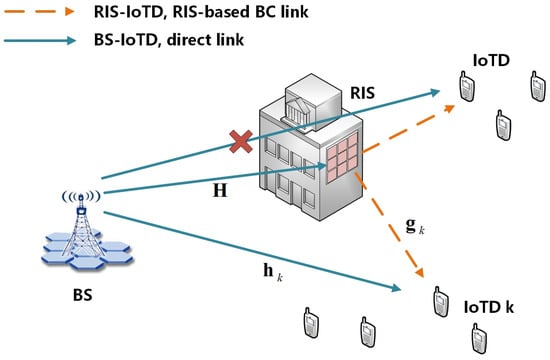
We consider a self-sustainable RIS-assisted system, which is illustrated in Figure 1. The system contains one BS that is equipped with M antennas, one self-sustainable RIS and K single-antenna IoTDs. The RIS is composed of N reflecting elements, a CPU and an energy storage device. The RIS firstly absorbs energy from the BS and then transmits remodulated target signals to all the IoTDs. We assume that all channels are reciprocal and follow quasi-static block fading [17,18]. We assume a quasi-static fading environment, and the channel state information (CSI) of all channels involved is assumed to be acquired perfectly by the BS [19].
Figure 1.
RIS-aided multi-IoTD wireless communication model.
In order to illustrate the operating mechanism of the system, we mainly consider the communication process in one time block T, in which all channels are keep constant. During the transmission of the target signals from the BS in T, the working status of the RIS is divided into two steps. In the first step , the signals arriving at the RIS is used for charging by exploiting the energy-harvesting circuits. In the second step , the RIS uses the stored energy to supply the BC circuit to remodulate and transmit the signals.
In the first step, the received signal at the RIS can be formulated as
where denotes the channel gain between the BS and the RIS and is the beamforming vector used for the signal s with in the first step. denotes additive white Gaussian noise (AWGN) with . The harvest energy at RIS can be characterized as a non-linear model [20,21]. In order to measure the non-linear character of the energy-harvesting operation, a two-piece linear harvested energy model is adopted [22,23], in which the harvested power is given by
where denotes the energy-harvesting efficiency of the RIS. and are the received power and the saturation power of the RIS. After ignoring the received noise power [24], the harvested energy at the RIS can be expressed as
In the second step, define as the backscatter matrix of the RIS, in which and denote the reflection and modulation matrices, respectively. is used to realize spatial modulation and backscatter communication. Then, the backscatter operation for the signal x with can be expressed as [25]
where denotes the diagonal reflection coefficient matrix. and are the phase shift and amplitude of the ith reflecting element of an RIS, respectively. is the channel gain between the RIS and the kth IoTD. is the beamformer of the BS in the second step.
Hence, the received signal at the kth IoTD is given by
where is the channel gain between the BS and the kth IoTD. and are independent, identically distributed AWGNs at the RIS and the kth IoTD with and , respectively. Hence, the signal-to-interference-plus-noise ratio (SINR) at the kth IoTD can be expressed as
2.1. Problem Formulation
We aim to maximize the sum rate of all the IoTDs by optimizing the time allocation for the working mode of the RIS, the beamforming vectors of the BS and the phase shifts of the RIS, as well as satisfying the harvesting energy limit, the maximum transmit power of the BS and the unit modulus constraints of the RIS. Hence, the optimization problem can be formulated as
where W is the transmitting bandwidth, is the maximum transmit power of BS, and denotes the energy consumption of the RIS in the second step, where is the power consumption of one element. This problem is non-convex due to the coupled variables , , , and in the maximization objective function and constraints. In the next section, we will use an alternative method to decouple this intractable problem into four sub-problems, which can be solved by using the method of iteration.
2.2. Time Allocation Optimization
In this section, we will optimize the time allocation variables , with fixed , and . The optimization problem can be reformulated as
It can be seen that is a linear problem and can be easily solved.
2.3. Beamforming Vector Optimization
With fixed , and , the beamformer vectors’ optimization of the BS is simplified as
According to the Equation (6), becomes a feasibility-check problem for the variable . To solve it, an additional indicator variable is introduced to check the feasibility of the problem , which can be reformulated as
Furthermore, according to the SINR in (6), this problem can be expressed as
where , . This problem is a quadratically constrained quadratic program (QCQP) problem, which can be solved by using CVX tools.
2.4. Phase Shift Optimization of the RIS
For given , , and , variable can be optimized by solving the following sub-problem:
This problem is non-convex due to the intractable objective function and constraints. To facilitate the analysis, slack variables are introduced. Then, we have
Consequently, problem can be reformulated as
However, this problem is still intractable because of the non-convex constraints. To solve (15b), successive convex approximation (SCA) is used. Specifically, given a local feasible point , the convex part can be approximated by its first-order Tayler expansion, which can be expressed as
where , , , , .
Similarly, constraint (15c) can be approximated by
Then, the only non-convex constraint is the unit modulus constraint (15d) and it can be transformed into . By using the penalty convex–concave procedure (CCP) principle [26], the non-convex part is further approximated by . After introducing slack variable , problem can be reformulated as
This sub-problem is a QCQP problem and the optimal solutions can be obtained by using CVX tools.
According to the above investigation, we have concluded the proposed algorithm to solve problem in Table 1.
Table 1.
The process of maximizing the sum rate of all the IoTDs.
2.5. Computational Complexity Analysis
The problem can be solved by iterating through the three sub-problems. The time allocation optimization sub-problem is a linear optimization problem that can be neglected. The complexity of solving the beamforming vectors’ optimization problem is , where is the number of iterations needed for convergence, is the prescribed accuracy and V is a constant set in [27] and . Similarly, the complexity of solving the RIS’s phase shift optimization problem is , where is the iteration number for this problem to convergence. Then, the overall complexity of the proposed algorithm is .
3. Simulation Results
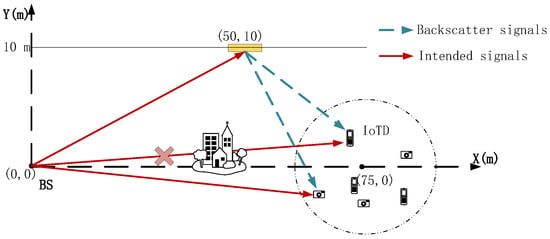
We investigate the sum rate of all the IoTDs in the RIS-based BackCom system by using the proposed algorithm under different system parameters. Specifically, the simulation system model is illustrated in Figure 2, where one BS is placed at (0 m, 0 m) and the RIS is located at (50 m, 10 m). IoTDs are randomly and uniformly distributed in a circle with a radius of 10 m, which is centered at (75 m, 0 m). All simulation channels are assumed to contain large-scale and small-scale fading. The large-scale fading model can be defined as , where is the path loss coefficient and the path loss for the reference distance ( m) is denoted as . The small-scale fading for , and obey the Rayleigh distribution. For ease of calculation, the saturation power is assumed to be equal to the transmit power of the BS . The other simulation parameters are listed in Table 2.
Figure 2.
Simulation system model setup.
Table 2.
Simulation parameters.
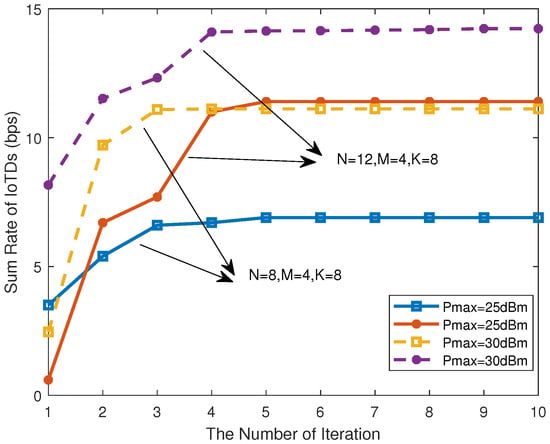
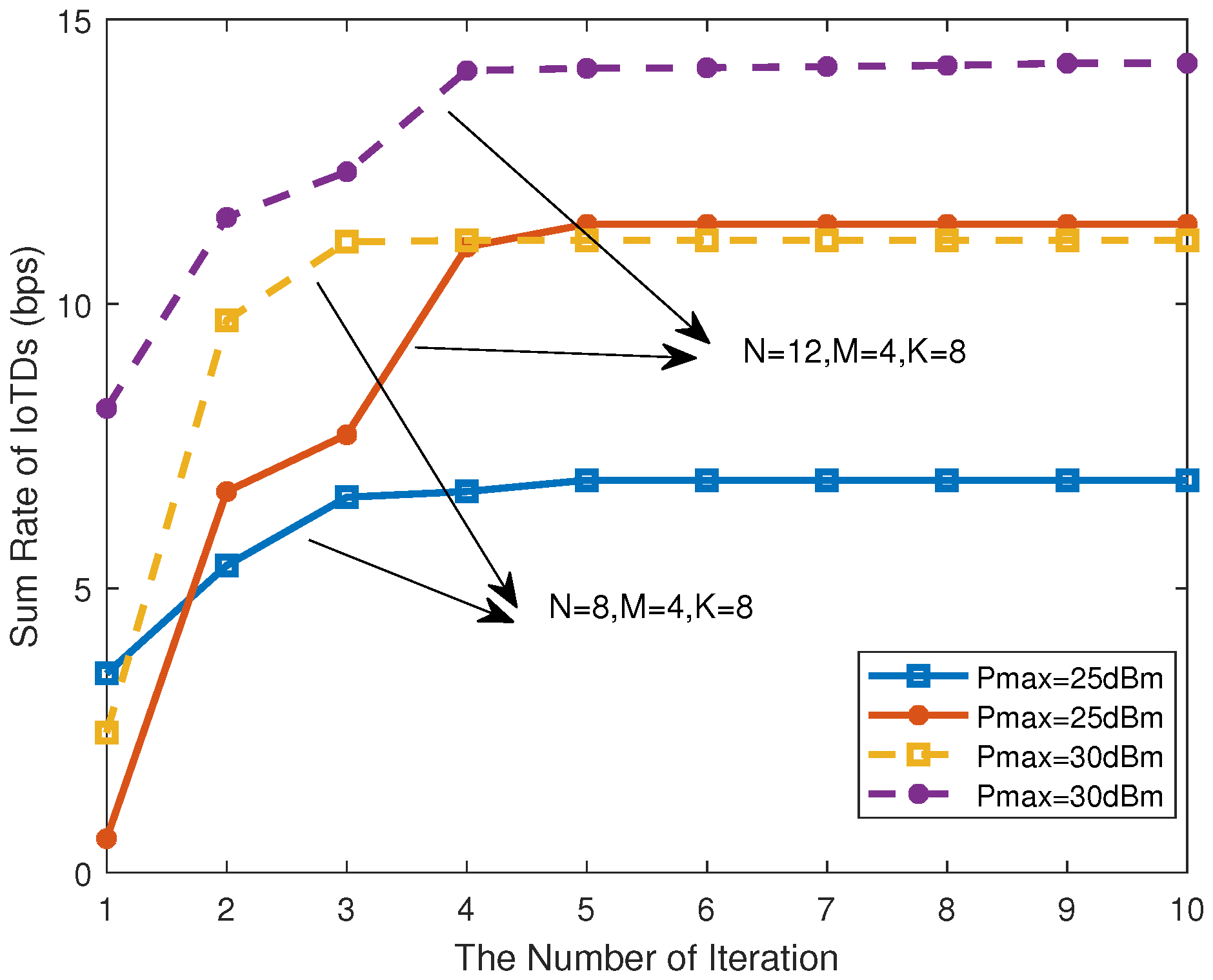
Figure 3 presents the convergence manner of the proposed algorithm under different system parameters. Specifically, when the maximum transmit power of the BS dBm and dBm, the proposed algorithm converges within ten iterations under different numbers of reflecting elements. It is obvious that the sum rate of IoTDs can be effectively improved by increasing the number of reflecting elements of the RIS. Moreover, deploying large numbers of reflecting elements is far more effective at increasing the sum rate than at increasing the transmitter power.
Figure 3.
Convergence behavior of the proposed algorithm.
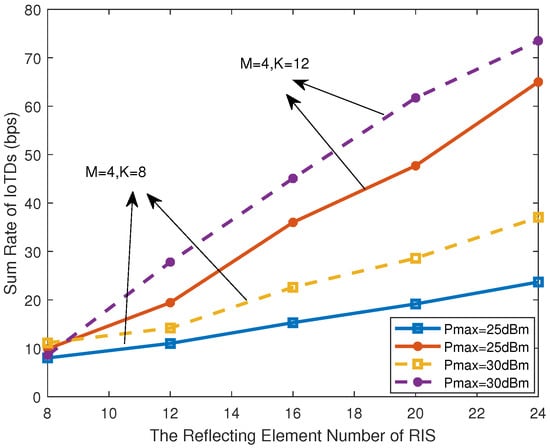
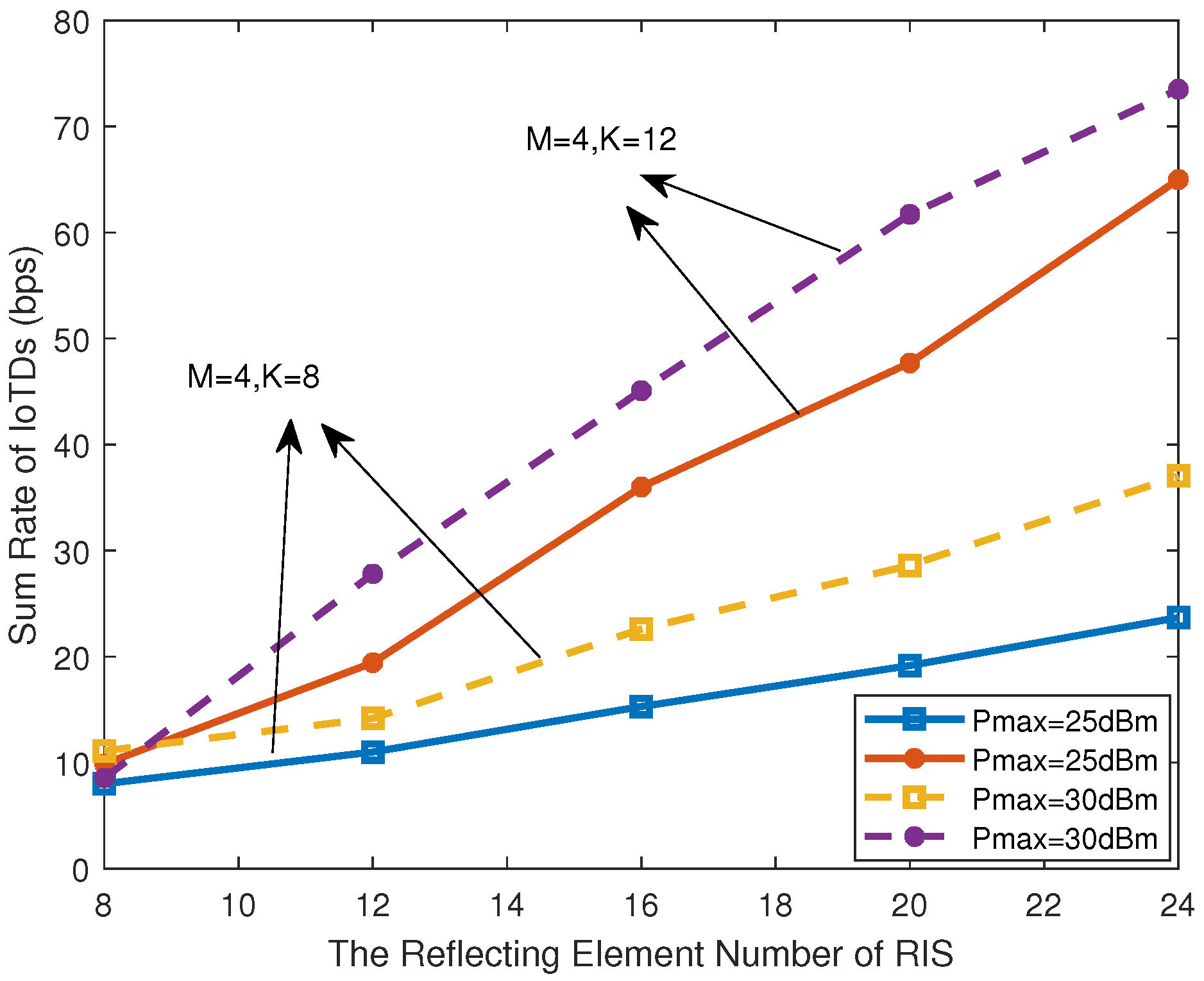
Figure 4 shows the performance of the sum rate of IoTDs under different numbers of reflecting elements of the RIS. It can be seen that the sum rate of IoTDs is effectively enhanced by increasing the number of the reflecting elements of the RIS, especially when the number of IoTDs becomes larger. Furthermore, when the number of IoTDs is small, increasing the transmit power of BS is a good method. However, it begins to fail gradually when the number of IoTDs increases. For example, when the number of reflecting elements of the RIS is and the number of IoTDs is , increasing the maximum transmit power from 25 dBm to 30 dBm increases the sum rate about , while the efficiency gains reduce to when the number of IoTDs .
Figure 4.
Sum rate of IoTDs versus the number of reflecting elements of RIS.
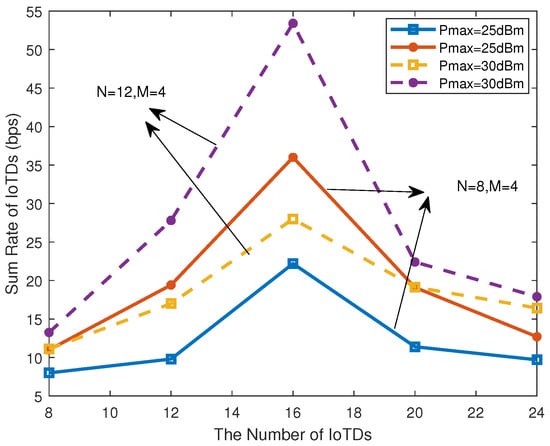
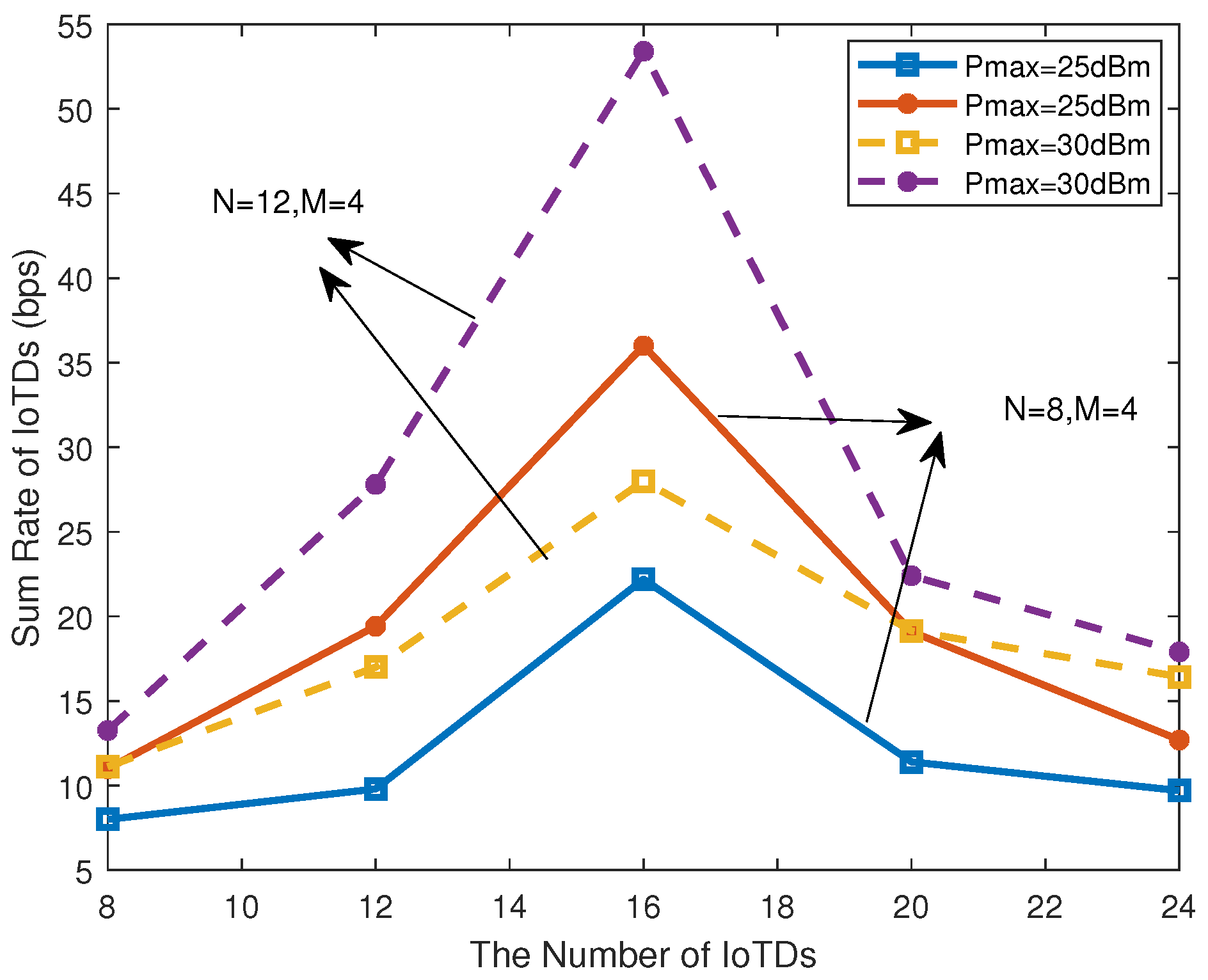
Figure 5 presents the change in sum rate when the number of IoTDs increases. It is obvious that the sum rate of IoTDs first increases and then decreases with the growth of the number of IoTDs. This is because the limited number of reflecting elements of the RIS and the transmit power cannot afford the ever-increasing number of IoTDs, and the performance gain begins to decline after reaching its service limit. However, it is still possible to increase the maximum transmit power of the BS even with limited reflecting elements, but its gain becomes very limited.
Figure 5.
Sum rate versus the number of IoTDs.
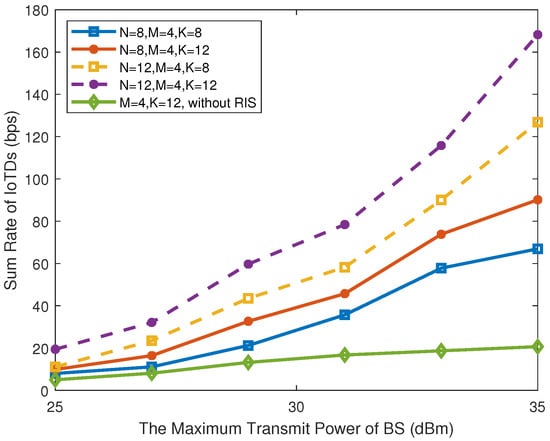
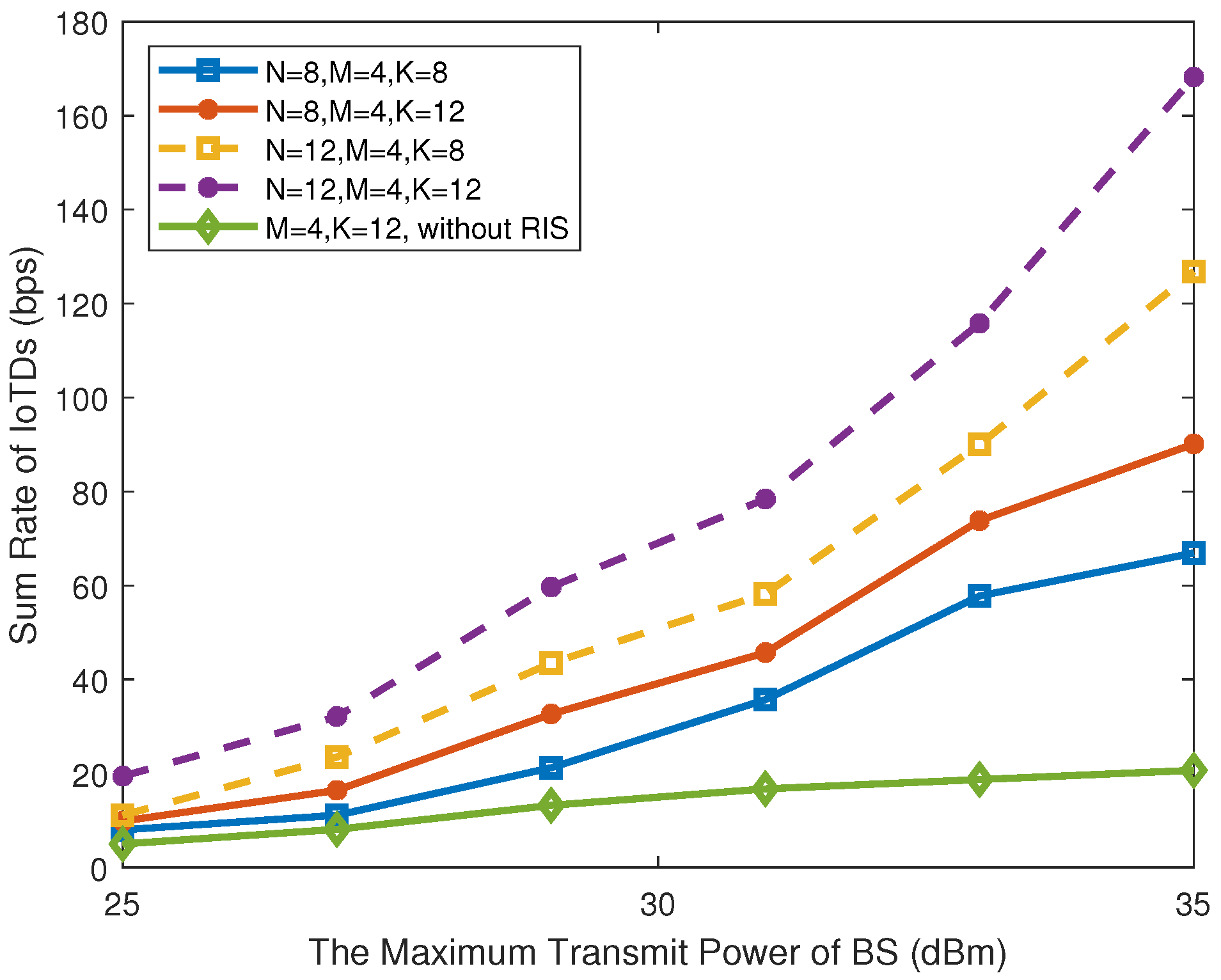
Figure 6 illustrates the change in sum rate when the maximum transmit power increases from 25 dBm to 35 dBm. The simulation results show that the sum rate of IoTDs increases with the growth of maximum transmit power of the BS. In particular, when the number of IoTDs increases, increasing both the maximum transmit power and the number of reflecting elements of the RIS can improve the sum rate of IoTDs. However, it is obvious that deploying a large RIS leads to a better performance for the sum rate. For example, when the maximum transmit power changes from 33 dBm to 35 dBm, the performance gain of the sum rate only increases about with . After increase the number of reflecting elements of the RIS, the performance gain rises up to under the same condition with . When the number of IoTDs increases, this advantage is even more obvious. Moreover, all the scenarios are better than for the traditional wireless communication system without the help of the RIS.
Figure 6.
Sum rate versus the maximum transmit power of the BS.
4. Conclusions
Due to the sophisticated wireless communication structure, some IoTDs were blocked and could not directly receive information from the BS. This paper investigated an RIS-based BackCom IoT network, where IoTDs collected information from the backscattering signals of the RIS and the BS. By jointly optimizing the reflecting phase shifts of the RIS and the transmit power of the BS, an alternative optimization algorithm was proposed to maximize the data transmission sum rate of the IoTDs. The simulation results demonstrated the effectiveness of introducing the RIS-based BackCom into IoT networks. Increasing the number of reflecting elements of the RIS was a better choice than increasing the transmit power of the BS to improve the communication quality and the working time of the IoTDs.
Author Contributions
Conceptualization, H.Z. and X.L.; methodology, H.Z. and X.L.; software, H.Z.; validation, C.H.; formal analysis, H.Z.; investigation, H.Z.; resources, H.Z.; data curation, H.Z., X.L. and Y.W.; writing—original draft preparation, X.L. and H.Z.; writing—review and editing, X.L. and C.H.; visualization, C.H.; supervision, C.H. and G.W.; project administration, X.L.; funding acquisition, X.L. All authors have read and agreed to the published version of the manuscript.
Funding
This work was supported in part by the Shenzhen Basic Research Program under Grant JCYJ20220531103008018, and Grants 20231120142345001 and 20231127144045001, and the Natural Science Foundation of China under Grant U20A20156, and the Scientific Research Foundation for High-Level Talents in Shenzhen (RC2023-005).
Data Availability Statement
Data are within the article.
Conflicts of Interest
The authors declare no conflicts of interest.
References
- AlSelek, M.; Alcaraz-Calero, J.M.; Wang, Q. Dynamic AI-IoT: Enabling Updatable AI Models in Ultralow-Power 5G IoT Devices. IEEE Internet Things J. 2024, 11, 14192–14205. [Google Scholar] [CrossRef] [Scilit]
- Alzahrani, S.; Salh, A.; Audah, L.; Alhartomi, M.A.; Alotaibi, A.; Alsulami, R. Empowering Energy-Sustainable IoT Devices with Harvest Energy-Optimized Deep Neural Networks. IEEE Access 2024, 12, 70600–70614. [Google Scholar] [CrossRef] [Scilit]
- Fu, W. Stochastic Geometric Analysis of Handover Based on Fuzzy Logic in MIMO IoT Systems. IEEE Internet Things J. 2022, 9, 11004–11016. [Google Scholar] [CrossRef] [Scilit]
- Zhang, S.; Wu, Q.; Xu, S.; Li, G.Y. Fundamental Green Tradeoffs: Progresses, Challenges, and Impacts on 5G Networks. IEEE Commun. Surv. Tutor. 2017, 19, 33–56. [Google Scholar] [CrossRef] [Scilit]
- Almekhlafi, M.; Arfaoui, M.A.; Assi, C.; Ghrayeb, A. A Low Complexity Passive Beamforming Design for Reconfigurable Intelligent Surface (RIS) in 6G Networks. IEEE Trans. Veh. Technol. 2023, 72, 6309–6321. [Google Scholar] [CrossRef] [Scilit]
- Lu, Y. Secrecy Energy Efficiency in RIS-Assisted Networks. IEEE Trans. Veh. Technol. 2023, 72, 12419–12424. [Google Scholar] [CrossRef] [Scilit]
- Bian, M.; Shi, Y.; Huang, Y.; Tang, X. QoS-Aware Energy Storage Maximization in the RIS-Aided Joint-SWIPT-MEC System. IEEE Commun. Lett. 2023, 27, 3434–3438. [Google Scholar] [CrossRef] [Scilit]
- Mohamed, A.; Zappone, A.; Renzo, M.D. Bi-Objective Optimization of Information Rate and Harvested Power in RIS-Aided SWIPT Systems. IEEE Wireless Commun. Lett. 2022, 11, 2195–2199. [Google Scholar] [CrossRef] [Scilit]
- He, Z.; Shen, H.; Xu, W.; Zhao, C. Low-Cost Passive Beamforming for RIS-Aided Wideband OFDM Systems. IEEE Wireless Commun. Lett. 2022, 11, 318–322. [Google Scholar] [CrossRef] [Scilit]
- Yue, M.; Liu, L.; Yuan, X. RIS-Aided Multiuser MIMO-OFDM With Linear Precoding and Iterative Detection: Analysis and Optimization. IEEE Trans. Wireless Commun. 2023, 22, 7606–7619. [Google Scholar] [CrossRef] [Scilit]
- Zhi, K.; Pan, C.; Zhou, G.; Ren, H.; Elkashlan, M.; Schober, R. Is RIS-Aided Massive MIMO Promising With ZF Detectors and Imperfect CSI? IEEE J. Sel. Areas Commun. 2022, 40, 3010–3026. [Google Scholar] [CrossRef] [Scilit]
- Zhi, K.; Pan, C.; Ren, H.; Wang, K. Power Scaling Law Analysis and Phase Shift Optimization of RIS-Aided Massive MIMO Systems With Statistical CSI. IEEE Trans. Commun. 2022, 70, 3558–3574. [Google Scholar] [CrossRef] [Scilit]
- Jiang, T.; Zhang, Y.; Ma, W.; Peng, M.; Peng, Y.; Feng, M.; Liu, G. Backscatter Communication Meets Practical Battery-Free Internet of Things: A Survey and Outlook. IEEE Commun. Surv. Tutor. 2023, 25, 2021–2051. [Google Scholar] [CrossRef] [Scilit]
- Zhao, W.; Wang, G.; Atapattu, S.; Tsiftsis, T.A.; Tellambura, C. Is Backscatter Link Stronger than Direct Link in Reconfigurable Intelligent Surface-Assisted System? IEEE Commun. Lett. 2020, 24, 1342–1346. [Google Scholar] [CrossRef] [Scilit]
- Wang, X.; Fei, Z.; Wu, Q. Integrated Sensing and Communication for RIS-Assisted Backscatter Systems. IEEE Internet Things J. 2023, 10, 13716–13726. [Google Scholar] [CrossRef] [Scilit]
- Zhao, J.; Ye, J.; Guo, S.; Bai, Z.; Zhou, D.; Mohamed, A. Reconfigurable Intelligent Surface Enabled Joint Backscattering and Communication. IEEE Trans. Veh. Technol. 2024, 73, 771–782. [Google Scholar] [CrossRef] [Scilit]
- Li, Y.; Zhao, R.; Fan, L.; Liu, A. Antenna Mode Switching for Full-Duplex Destination-Based Jamming Secure Transmission. IEEE Access 2018, 6, 9442–9453. [Google Scholar] [CrossRef] [Scilit]
- Li, Y.; Zhao, R.; Wang, Y.; Pan, G.; Li, C. Artificial Noise Aided Precoding With Imperfect CSI in Full-Duplex Relaying Secure Communications. IEEE Access 2018, 6, 44107–44119. [Google Scholar] [CrossRef] [Scilit]
- Gao, Y.; Wu, Q.; Zhang, G.; Chen, W.; Ng, D.W.K.; Renzo, M.D. Beamforming Optimization for Active Intelligent Reflecting Surface-Aided SWIPT. IEEE Wireless Commun. 2023, 22, 362–378. [Google Scholar] [CrossRef] [Scilit]
- Nezhadmohammad, P.; Abedi, M.; Emadi, M.J.; Wichman, R. SWIPT-Enabled Multiple Access Channel: Effects of Decoding Cost and Non-Linear EH Model. IEEE Trans. Commun. 2022, 70, 306–316. [Google Scholar] [CrossRef] [Scilit]
- Jiang, R.; Xiong, K.; Yang, H.-C.; Fan, P.; Zhong, Z.; Letaief, K.B. On the Coverage of UAV-Assisted SWIPT Networks With Nonlinear EH Model. IEEE Wireless Commun. 2022, 21, 4464–4481. [Google Scholar] [CrossRef] [Scilit]
- Dong, Y.; Hossain, M.J.; Cheng, J. Performance of Wireless Powered Amplify and Forward Relaying Over Nakagami- m Fading Channels With Nonlinear Energy Harvester. IEEE Commun. Lett. 2016, 20, 672–675. [Google Scholar] [CrossRef] [Scilit]
- Pejoski, S.; Hadzi-Velkov, Z.; Schober, R. Optimal Power and Time Allocation for WPCNs With Piece-Wise Linear EH Model. IEEE Wireless Commun. 2018, 7, 364–367. [Google Scholar] [CrossRef] [Scilit]
- Li, Y.; Zhao, R.; Deng, Y.; Shu, F.; Nie, Z.; Aghvami, A.H. Harvest-and-Opportunistically-Relay: Analyses on Transmission Outage and Covertness. IEEE Wireless Commun. 2020, 19, 7779–7795. [Google Scholar] [CrossRef] [Scilit]
- Wang, J.; Han, S.; Li, C.; Meng, W. Efficient Data Collection Scheme for IRS-Based V2I Backscatter Communications. IEEE Wireless Commun. Lett. 2024, 13, 1128–1132. [Google Scholar] [CrossRef] [Scilit]
- Zhou, G.; Pan, C.; Ren, H.; Wang, K.; Nallanathan, A. A framework of robust transmission design for IRS-aided MISO communications with imperfect cascaded channels. IEEE Trans. Signal Process. 2020, 68, 5092–5106. [Google Scholar] [CrossRef] [Scilit]
- Nesterov, Y.; Nemirovskii, A. Interior-Point Polynomial Algorithms in Convex Programming; SIAM: Philadelphia, PA, USA, 2004. [Google Scholar]

Disclaimer/Publisher’s Note: The statements, opinions and data contained in all publications are solely those of the individual author(s) and contributor(s) and not of MDPI and/or the editor(s). MDPI and/or the editor(s) disclaim responsibility for any injury to people or property resulting from any ideas, methods, instructions or products referred to in the content. |
© 2024 by the authors. Licensee MDPI, Basel, Switzerland. This article is an open access article distributed under the terms and conditions of the Creative Commons Attribution (CC BY) license (https://creativecommons.org/licenses/by/4.0/).