Article

Pixel-Level Fusion Approach with Vision Transformer for Early Detection of Alzheimer’s Disease

by
Modupe Odusami
,
Rytis Maskeliūnas
and
Robertas Damaševičius
*
Center of Excellence Forest 4.0, Faculty of Informatics, Kaunas University of Technology, 44249 Kaunas, Lithuania
*
Author to whom correspondence should be addressed.
Electronics 2023, 12(5), 1218; https://doi.org/10.3390/electronics12051218

Submission received: 30 January 2023 / Revised: 25 February 2023 / Accepted: 27 February 2023 / Published: 3 March 2023

Abstract

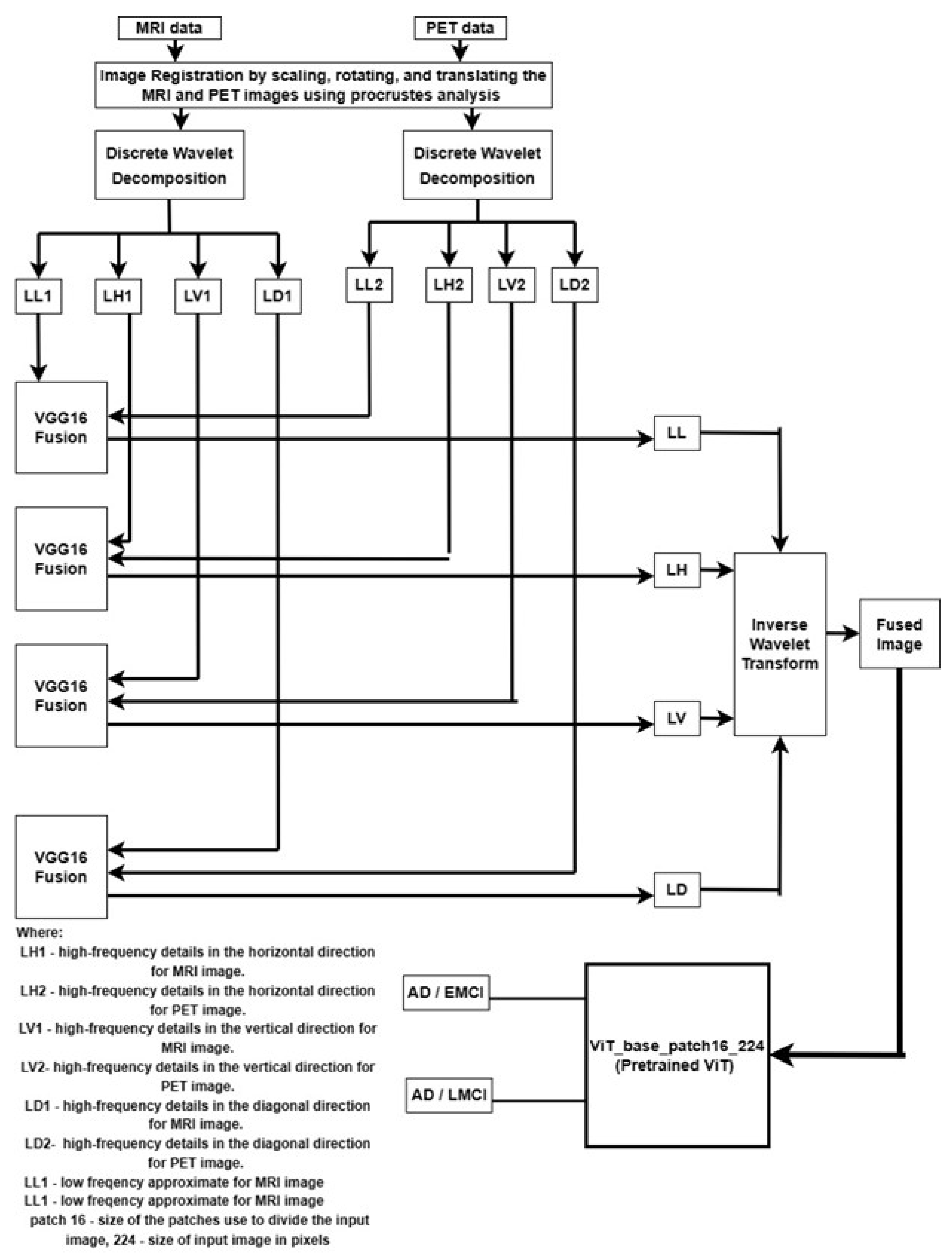
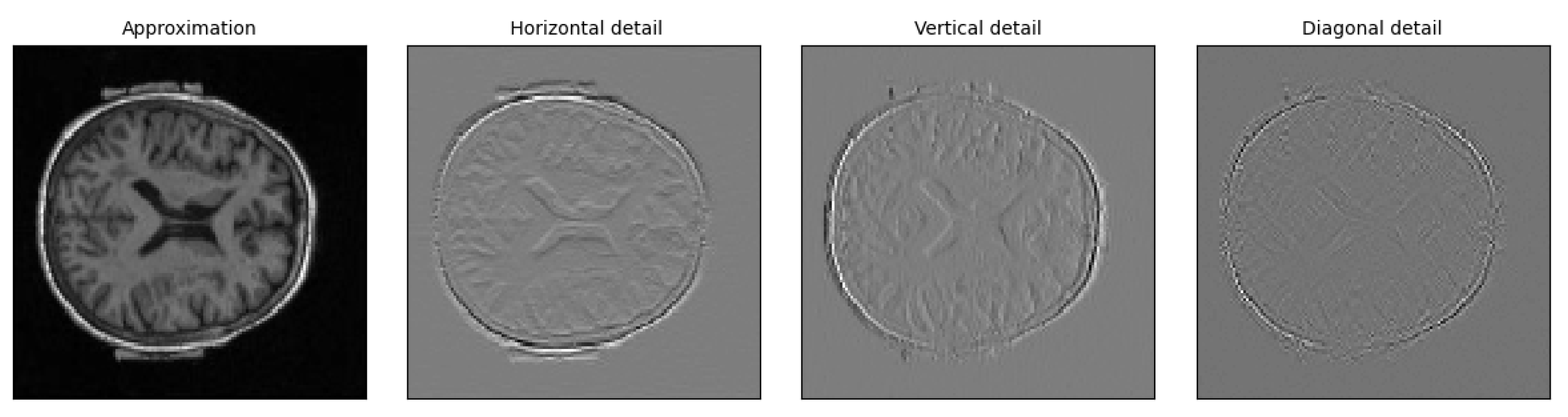
Alzheimer’s disease (AD) has become a serious hazard to human health in recent years, and proper screening and diagnosis of AD remain a challenge. Multimodal neuroimaging input can help identify AD in the early mild cognitive impairment (EMCI) and late mild cognitive impairment (LMCI) stages from normal cognitive development using magnetic resonance imaging (MRI) and positron emission tomography (PET). MRI provides useful information on brain structural abnormalities, while PET data provide the difference between physiological and pathological changes in brain anatomy. The precision of diagnosing AD can increase when these data are combined. However, they are heterogeneous and appropriate, and an adequate number of features are required for AD classification. This paper proposed a multimodal fusion-based approach that uses a mathematical technique called discrete wavelet transform (DWT) to analyse the data, and the optimisation of this technique is achieved through transfer learning using a pre-trained neural network called VGG16. The final fused image is reconstructed using inverse discrete wavelet transform (IDWT). The fused images are classified using a pre-trained vision transformer. The evaluation of the benchmark Alzheimer’s disease neuroimaging initiative (ADNI) dataset shows an accuracy of 81.25% for AD/EMCI and AD/LMCI in MRI test data, as well as 93.75% for AD/EMCI and AD/LMCI in PET test data. The proposed model performed better than existing studies when tested on PET data with an accuracy of 93.75%.
Keywords: Alzheimer’s disease; MRI; PET; data fusion; vision transformer Alzheimer’s disease; MRI; PET; data fusion; vision transformer